Shared posts

05 Oct 14:06

The Little Mermaid has always been a story about exclusion – and its author was an outsider

by Michelle Smith, Senior Lecturer in Literary Studies, Monash University
Edmund Dulac/IMDB

Disney’s forthcoming live-action adaptation of The Little Mermaid has sparked an astonishing backlash. The trailer for the 2023 film was met with millions of dislikes on YouTube, seemingly because the mermaid is played by Halle Bailey, a Black actress.

The 1989 animated Disney film, on which the upcoming film is based, featured a red-headed mermaid named Ariel (and a singing crab with a Jamaican accent). The implication of much of the recent criticism is that a Black mermaid is not “authentic” to The Little Mermaid fairy tale.

But fairy tales are continually retold in new ways over time.

Hans Christian Andersen’s literary fairy tale is radically different to the 1989 film. He was a bisexual social outsider who struggled to express his desires. And his The Little Mermaid was not the happily-ever-after romance Disney fans are familiar with, but a tale of torturous unrequited love – which he worked on while a man he was infatuated with was getting married.

Black girls react joyfully to The Little Mermaid trailer.

The first Cinderella was Chinese

Outrage over fairy tales crossing cultural and racial boundaries is misguided. Variations of most popular tales are found in multiple cultures, and familiar tale types have a history of circling the globe. The way they’re told has adapted, too: from being shared orally, to literary versions (from the 17th century), and now film, television and games (from the 20th century).

Indeed, the very reason fairy tales have endured is because they are continually retold in new ways, to suit changing audiences and cultural norms.

The first recorded Cinderella variant, for example, is Yeh-Hsien, from China. It was first published around 850; while Charles Perrault’s Cinderella, which influenced most adaptations we know today, was published in 1697. Yeh-Hsien does not have the aid of a fairy godmother; instead, she wishes on the bones of a fish. If fairy tales should only “belong” to the first culture in which they were ever told or written, then it would be logical to suggest we should only depict Cinderella as Chinese.

The story of Yeh-Hsien is the first recorded variant of Cinderella.

Hans Christian Andersen’s The Little Mermaid

Disney’s animated adaptations, beginning with Snow White in 1937, have come to define our cultural understanding of fairy tales. It’s one reason why we’ve lost our cultural awareness of the diverse origins and traditions surrounding these tales. And these films, aimed at a family audience, sanitise earlier fairy tale variants – which were often more gruesome and disturbing than their Disney adaptations.

The story of Disney’s Little Mermaid, Ariel, is very different from Hans Christian Andersen’s original.

Unlike the Disney films, Andersen’s The Little Mermaid is a tragic story of suffering and extreme sacrifice. P.L. Travers, the author of Mary Poppins, wrote about her dislike of the mermaid’s protracted agony and found Andersen’s “tortures, disguised as piety” to be “demoralizing”.

Many of Andersen’s protagonists are small and delicate figures who arouse our sympathy. This frailty can be due to being poor and uncared for, as in The Little Match Girl. Or it can result from characters who are unable to move without difficulty. The tiny Thumbelina must be carried from one location to another. And the Little Mermaid walks with the sensation of metal blades piercing her feet with every step.

The Little Mermaid is also a prime example of Andersen’s focus on female sacrifice and suffering. For a start, she has her tongue cut out by the sea witch and is made mute. And she maintains her delicate femininity with her “lovely, floating” walk on her hard-won human legs, despite the severe pain that is the cost of her bargain.

The mermaid saves the Prince on two occasions. First, she risks her life to rescue him from a shipwreck. Andersen’s fairy tale is not a love story, however, because the Prince never romantically desires the mermaid. He is impressed by her devotion but treats the mermaid like an animal or a child. He even gives her “permission to sleep on a velvet cushion at his door”.

The ultimate self-sacrifice of the Little Mermaid is evident when the Prince marries another woman and the mermaid holds the train of her wedding dress, while thinking only “of her death and of all she had lost in this world”.

The sea witch had promised that if the mermaid could make the prince fall in love with her, she would gain an immortal soul. If not, she would die of a broken heart on the first day after his marriage to someone else – and become sea foam on the waves. When she is faced with the choice to kill the Prince and rejoin her family in her mermaid form, she sacrifices her own life instead.


Read more: Mermaids aren't real – but they've fascinated people around the world for ages


Andersen as outsider

Andersen’s sad personal life unavoidably influences how his stories of downtrodden and pitiful characters are interpreted. In the case of the Little Mermaid, there is a close connection between the writing of the story and Andersen’s own feelings of isolation and rejection.

Hans Christian Andersen.

Andersen was a social outsider who never married – and potentially never had sex. He did become infatuated with both men and women and is therefore understood as bisexual. Yet he struggled to express his desires, an issue related to a series of complex psychological problems.

One of the men Andersen loved was his friend Edvard Collin, who did not return Andersen’s feelings. Biographer Jackie Wullschläger notes that The Little Mermaid was written “at the height of Andersen’s obsession with and renunciation of Edvard Collin”. When Collin’s marriage to a woman was held in August of 1836, Andersen intentionally remained on the Danish island of Funen in order to avoid the wedding. There, he continued to work on The Little Mermaid.

It is possible to view the Little Mermaid failing to gain an eternal soul through marriage to the Prince as Andersen rejecting the idea that immortality must depend on love being reciprocated. As Wullschläger suggests, Andersen likely equated himself, a bisexual, with the mermaid’s understanding of herself as a different species to humans.

Andersen wrote that he deliberately avoided the convention found in other mermaid fiction, such as Friedrich de la Motte Fouqué’s Undine (1811), in which human love enables the acquisition of a soul:

I’m sure that’s wrong! […] I won’t accept that sort of thing in this world. I have permitted my mermaid to follow a more natural, more divine path.

Andersen’s tales frequently promote his Christian religious ethics. The path to salvation with God that Andersen maps often entails a cheerful embrace of pain, suffering, or humiliation. Maria Tatar comments that Andersen’s protagonists embrace death “joyfully”. They “reproach themselves for their sins and endorse piety, humility, passivity, and a host of other ‘virtues’ designed to promote subservient behaviour”.

The mermaid and her sisters rescue the Prince. Stephen Reid

Most of Andersen’s protagonists are female. Fairy tales in the 19th century, such as those of the Brothers Grimm, commonly sought to direct the behaviour and morality of girls. In the case of the Little Mermaid, her harsh treatment and ultimate fate can be understood as punishment for her sexual curiosity in pursuing the Prince. It’s also a caution against attempting to leave the undersea home where she belongs.

The conclusion of Andersen’s tale transforms the Little Mermaid into sea foam and then a “daughter of the air” who may gain a soul after 300 years of compassionate, self-sacrificial behaviour. The moral educational function of fairy tales is especially evident in this ending. Child readers are informed their own good acts will shorten the length of time the Little Mermaid (and the other daughters of the air) must wait by one year, while bad acts will lengthen their wait.


Read more: How early Australian fairy tales displaced Aboriginal people with mythical creatures and fantasies of empty land


Diversifying and adapting fairy tales

Disney’s original, animated The Little Mermaid departs radically from Hans Christian Andersen’s published fairy tale. Some of these changes reflect developments in ideas about the purpose of stories of children. Young characters undergoing extreme self-sacrifice and unhappy endings now rarely appear in stories for children.

Disney’s transformation of a story of salvation and religious devotion into a straightforward romance is but one example of how fairy tales lend themselves to retelling in new contexts. The live-action adaptation starring Halle Bailey, which seeks to make children of colour feel represented in fairy tales, is one more iteration of the story.

This attempt to diversify fairy-tale adaptations builds on the queer history of The Little Mermaid. The story is already understood as having parallels with Andersen’s bisexuality – and the experience of transgender people. The most important UK organisation for supporting transgender, non-binary and gender-diverse young people, for example, is called Mermaids.

It’s unsurprising that outsiders of all kinds connect with a story about a mermaid who cannot fit in the human world she desperately wishes to belong to. Whether that’s a beloved author in 19th-century Denmark, or an African American girl today.

The Conversation

Michelle Smith does not work for, consult, own shares in or receive funding from any company or organization that would benefit from this article, and has disclosed no relevant affiliations beyond their academic appointment.

05 Oct 13:33

Antifa means Anti-fascist

by Elías Villoro

As Langston Hughes said in 1936, "Fascism is a new name for that kind of terror the Negro has always faced in America."

Antifa means anti-fascist. Do you believe in and support fascism? Do you believe in white supremacy? Do you believe in organized and individual violence to maintain hierarchies, order, and the status quo? — Read the rest

04 Oct 18:55

Hurricane Ian: When the power grid goes out, could solar and batteries power your home?

by Will Gorman, Graduate Student Researcher in Electricity Markets and Policy, Lawrence Berkeley National Laboratory
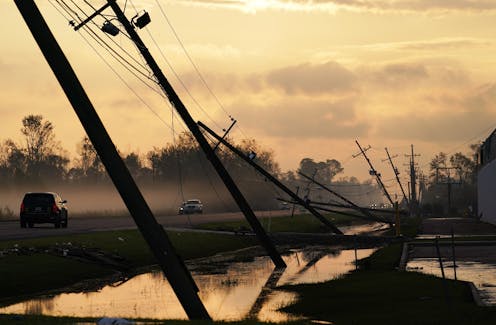
Downed powerlines can mean weeks without power. AP Photo/Matt Slocum

Hurricane Ian’s catastrophic winds and flooding are likely to bring long-lasting power outages to large parts of Florida. The storm is the latest in a line of hurricanes and extreme heat and cold events that have knocked out power to millions of Americans in recent years for days at a time.

In many disaster- and outage-prone areas, people are starting to ask whether investing in rooftop solar and battery storage systems can keep the lights on and the air conditioner running when the power grid can’t.

When the grid goes down, most solar systems that lack a battery will also shut down. But with batteries, a home can disconnect from the grid. Each day, the sun powers the home and charges up the batteries, which provide power through the night.

Our team at Berkeley Lab explored what it would take for homes and commercial buildings to ride out long power outages, of three days or more, with solar and batteries.

How much can solar + storage do?

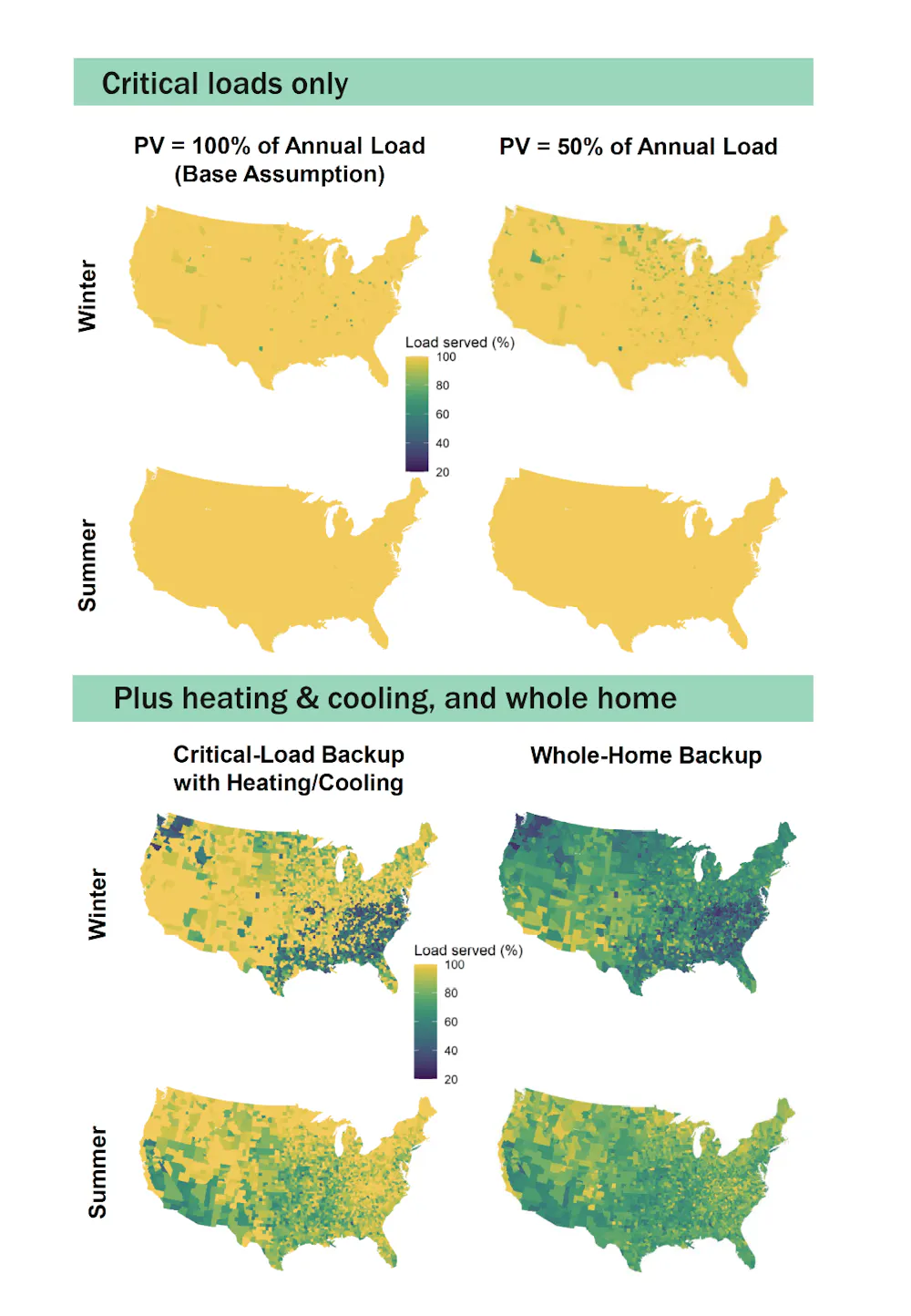
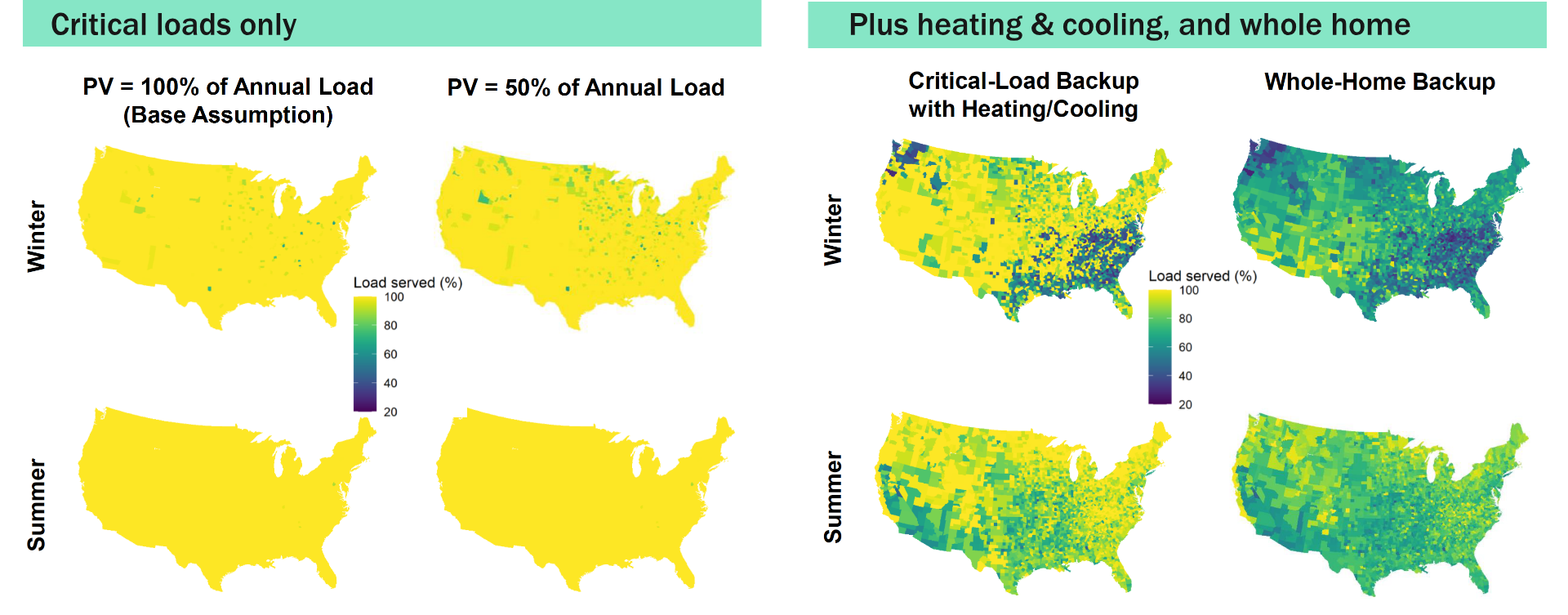
For a new report, we modeled a generic power outage for every county in the U.S., testing whether a rooftop solar system combined with a 10- or 30-kilowatt-hour battery could power critical loads, like refrigeration, lighting, internet service and well pumps; if it could go further and also power heating and air conditioning; or if it could even power a whole home.

To put that into perspective, the most popular battery on the market, the Tesla Powerwall, has just over 13 kWh of storage.

In general, we found that even a modest system of solar plus one battery can power critical loads in a home for days at a time, practically anywhere in the country.

But our maps show that providing backup for cooling and heat can be a challenge, though not an insurmountable one. Homes in the Southeast and Pacific Northwest often have power-hogging electric resistance heaters, exceeding the capability of solar and storage during winter outages. Homes with efficient heat pumps performed better. Summer air conditioning load can be heavy in the Southwest, making it harder to meet all cooling needs with solar and storage in a summer blackout.

Larger solar and battery systems can help, but meeting demand during outages still depends on the weather, how energy efficient the home is and other factors. For example, simple thermostat adjustments during power outages reduce heating and cooling needs and allow solar with storage to maintain backup power over longer periods.

Maps show most parts of the country can run on solar plus storage for 'critical' uses. Still, a large percentage can run air and heat, but few can support an entire home.
Where solar and storage with a 10-kWh battery can supply backup power, in various scenarios. Berkeley Lab, CC BY

The ability to power commercial buildings varies widely, depending on the building type. Schools and big-box retail stores, with sufficient roof space for solar relative to building power demand, fare much better than multistory, energy-intensive buildings like hospitals.

How solar would have handled 10 past disasters

We also looked at 10 real-world outage events from 2017 to 2020, including hurricanes, wildfires and storms, and modeled building performance for specific locations and real weather patterns during and after the outages.

We found that in seven of the outages, most homes would have been able to maintain critical loads plus heating and cooling using solar with 30 kWh of storage, or just over two Powerwalls.

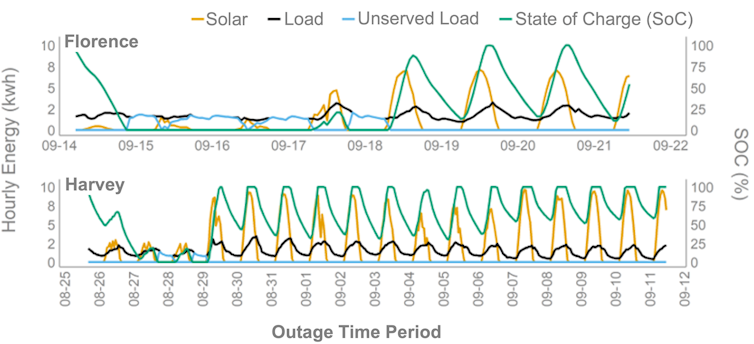
But the weather around the outage can have a big impact, especially for hurricanes. After Hurricane Florence knocked out power in North Carolina in 2018, cloudy skies hung around for three days, dimming or even stopping solar panels’ output.

Hurricane Harvey, on the other hand, slammed the Texas coast in August 2017 but moved on to cause widespread damage elsewhere in Texas. The skies over Corpus Christi cleared even as it took a week or more to get power restored. Solar and storage would have been a big help in that case, providing virtually all power needs for a typical single-family home, once the skies cleared.

Line charts show power potential from storage and demand during two major storms. They start low as the storm hits but then improve quickly.
How a typical home would have done with solar and 30 kWh of storage after hurricanes Florence and Harvey. The light blue line shows the short periods of ‘unserved load,’ or shortfalls in meeting power demand, right after the storms. The state of charge shows batteries were able stretch solar power through the night. Berkeley Labs, CC BY

Similarly, we found solar can do well in less cloudy events, like wildfire prevention shutoffs in California, or after the 2020 derecho windstorm in Iowa.

The heat source in a home is also a key factor. In a five-to-10-day outage following an ice storm in Oklahoma in 2020, we found that solar plus a 30-kWh battery could have supplied nearly all the critical power and heat needed for homes with natural gas heaters or heat pumps. But homes with electric resistance heating would have fallen short.

In Texas, over half of homes are heated with electricity, primarily resistance heaters. Energy Star-rated heat pumps – which provide both heating and cooling – use half as much electricity per unit of heat output as electric resistance heaters and are also more efficient at cooling than the average new air conditioner. Converting older resistance heaters to new heat pumps can not only save money and reduce peak demand but also increase resilience during outages.

New forms of backup

Setting up solar and storage to provide backup power in a home or building takes extra work and it costs more – just one Powerwall can run from US$12,000 to $16,500 for a full system installation, before incentives and taxes. That’s as much as a fair-sized solar system. Nevertheless, a growing number of homeowners are installing both.

Over 90% of new solar installations in Hawaii in 2021 were paired with batteries after a regulation change. Now these distributed power plants are helping power the grid as coal plants are retired.

California has over 1.5 million rooftop solar systems. A growing number of customers are retrofitting batteries on their systems, or adding new solar plus storage, in part because utilities have resorted to “public safety power shutoffs” to lower the risk of wildfires sparked by power lines during dry, windy days.

And new forms of backup power are emerging, especially from electric cars. Ford is partnering with SunRun to combine its new F150 Lightning electric pickup truck with solar and a two-way charger that can use the truck’s battery to power a house. The standard version of the truck comes with a 98-kWh battery, the equivalent of more than seven Tesla Powerwall stationary batteries.

Critical power for critical services

A fire station in Puerto Rico offers a glimpse of what solar and storage can do. After Hurricane Maria cut power for months in 2017, over 40,000 solar systems were installed on the island, often paired with battery storage. One of those is at the fire station in the town of Guánica, which had been unable to receive emergency calls in previous outages.

When Hurricane Fiona’s wind and flooding again knocked out power to most of Puerto Rico in September 2022, the fire station was still operating.

“The solar system is working beautifully!” Sgt. Luis Saez told Canary Media the day after Fiona knocked out power. “We did not lose power all throughout the hurricane.”

The Conversation

Will Gorman receives funding from the US Department of Energy.

Bentham Paulos receives funding from the US Department of Energy for this work.

Galen Barbose receives funding from the US Department of Energy.

04 Oct 18:47

Butter, garage doors and SUVs: Why shortages remain common 2½ years into the pandemic

by Michael Okrent, Part-Time Faculty in Project Management, Colorado State University Global
A frequent sight during the pandemic. Diana Haronis/Moment

Shortages of basic goods still plague the U.S. economy – 2½ years after the pandemic’s onset turned global supply chains upside down.

Want a new car? You may have to wait as long as six months, depending on the model you order. Looking for a spicy condiment? Supplies of Sriracha hot sauce have been running dangerously low. And if you feed your cat or dog dry pet food, expect empty shelves or elevated prices.

These aren’t isolated products. Baby formula, wine and spirits, lawn chairs, garage doors, butter, cream cheese, breakfast cereal and many more items have also been facing shortages in the U.S. during 2022 – and popcorn and tomatoes are expected to be in short supply soon.

In fact, global supply chains have been under the most strain in at least a quarter-century, and have been pretty much ever since the COVID-19 pandemic began.

I have been immersed in supply chain management for over 35 years, both as a manager and consultant in the private sector and as an adjunct professor at Colorado State University - Global Campus.

While each product experiencing a shortage has its own story as to what went wrong, at the root of most is a concept people in my field call the “bullwhip effect.”

What is the ‘bullwhip effect’?

The term bullwhip effect was coined in 1961 by MIT computer scientist Jay Forrester in his seminal book “Industrial Dynamics.” It describes what happens when fluctuations in demand reverberate and amplify throughout the supply chain, leading to worsening problems and shortages.

Imagine the physics of cracking a whip. It starts with a small flick of the wrist, but the whip’s wave patterns grow exponentially in a chain reaction, leading to the tip, a snap – and a sharp pain for anyone on the receiving end.

The same thing can happen in supply chains when orders for a product from a retailer, say, go up or down by some amount and that gets amplified by wholesalers, distributors and raw material suppliers.

The onset of the COVID-19 pandemic, which led to lengthy lockdowns, massive unemployment and a whole host of other effects that messed up global supply chains, essentially supercharged the bullwhip’s snap.

How the bullwhip effect works.

Cars and chips

The supply of autos is one such example.

New as well as used vehicles have been in short supply throughout the pandemic, at times forcing consumers to wait as long as a year for the most popular models.

In early 2020, when the pandemic put most Americans in lockdown, carmakers began to anticipate a fall in demand, so they significantly scaled back production. This sent a signal to suppliers, especially of computer chips, that they would need to find different buyers for their products.

Computer chips aren’t one size fits all; they are designed differently depending on their end use. So chipmakers began making fewer chips intended for use in cars and trucks and more for computers and smart refrigerators.

So when demand for vehicles suddenly returned in early 2021, carmakers were unable to secure enough chips to ramp up production. Production last year was down about 13% from 2019 levels. Since then, chipmakers have began to produce more car-specific chips, and Congress even passed a law to beef up U.S. manufacturing of semiconductors. Some carmakers, such as Ford and General Motors, have decided to sell incomplete cars, without chips and the special features they power like touchscreens, to relieve delays.

But shortages remain. You could chalk this up to poor planning, but it’s also the bullwhip effect in action.

The bullwhip is everywhere

And this is a problem for a heck of a lot of goods and parts, especially if they, like semiconductors, come from Asia.

In fact, pretty much everything Americans get from Asia – about 40% of all U.S. imports – could be affected by the bullwhip effect.

Most of this stuff travels to the U.S. by container ships, the cheapest means of transportation. That means goods must typically spend a week or longer traversing the Pacific Ocean.

The bullwhip effect comes in when a disruption in the information flow from customer to supplier happens.

For example, let’s say a customer sees that an order of lawn chairs has not been delivered by the expected date, perhaps because of a minor transportation delay. So the customer complains to the retailer, which in turn orders more from the manufacturer. Manufacturers see orders increase and pass the orders on to the suppliers with a little added, just in case.

What started out as a delay in transportation now has become a major increase in orders all down the supply chain. Now the retailer gets delivery of all the products it overordered and reduces the next order to the factory, which reduces its order to suppliers, and so on.

Now try to visualize the bullwhip of orders going up and down at the suppliers’ end.

The pandemic caused all kinds of transportation disruptions – whether due to a lack of workers, problems at a port or something else – most of which triggered the bullwhip effect.

The end isn’t nigh

When will these problems end? The answer will likely disappoint you.

As the world continues to become more interconnected, a minor problem can become larger if information is not available. Even with the right information at the right time, life happens. A storm might cause a ship carrying new cars from Europe to be lost at sea. Having only a few sources of baby formula causes a shortage when a safety issue shuts down the largest producer. Russia invades Ukraine, and 10% of the world’s grain is held hostage.

The early effects of the pandemic in 2020 led to a sharp drop in demand, which rippled through supply chains and decreased production. A strong U.S. economy and consumers flush with coronavirus cash led to a surge in demand in 2021, and the system had a hard time catching up. Now the impact of soaring inflation and a looming recession will reverse that effect, leading to a glut of stuff and a drop in orders. And the cycle will repeat.

As best as I can tell, these disruptions will take many years to recover from. And as recent inflation reduces demand for goods, and consumers begin cutting back, the bullwhip will again work its way through the supply chain – and you’ll see more shortages as it does.

The Conversation

Michael Okrent does not work for, consult, own shares in or receive funding from any company or organization that would benefit from this article, and has disclosed no relevant affiliations beyond their academic appointment.

04 Oct 18:33

Why it's such a big deal that Alla Pugacheva, 'the tsarina of Russian pop,' came out against the war in Ukraine

by Olga Partan, Associate Professor of Russian Studies, College of the Holy Cross
Russian President Vladimir Putin greets Alla Pugacheva during a 2014 awards ceremony honoring the pop singer with the Order For Merit to the Fatherland. Sasha Mordovets/Getty Images

Days before Russian President Vladimir Putin announced hasty referendums in the occupied regions of Ukraine and the conscription of Russian men, Russian singer Alla Pugacheva posted a message decrying the war on Instagram, where she commands 3.5 million followers.

As someone who has followed Pugacheva’s artistic career and written about her on- and off-stage personas, I knew this was no ordinary anti-war statement.

Despite the fact that Pugacheva is not well known outside of Russia, she is one of the top-selling music artists in the world and is arguably the most famous woman in Russia. In opinion polls over the past two decades, she’s routinely selected as one of the most popular Russians – sometimes appearing second only to Putin.

Her fan base encompasses all elements of Russian society, including millions of everyday Russians who, because they rely on Russian state media for information, are particularly susceptible to the Kremlin’s powerful propaganda machine.

In some ways, Pugacheva is a bridge to the past. Belonging to the same generation as Putin, she represents the stability and predictability of the Soviet era. Yet this isn’t the first time she’s leveraged her fame to challenge the political status quo.

A singer with many masks

Pugacheva burst onto the Soviet pop culture scene in 1975 with “Arlekino,” a song about a tragicomic clown. With the drama of a jester, she would alternate between laughter and tears, exuberant singing and pantomime.

Pugacheva’s first hit signaled different things to different audiences. The public was enthralled by the catchy tune and her stage presence. Meanwhile, the dissident intelligentsia interpreted it as a tribute to the plight of artists living in a totalitarian state.

Alla Pugacheva performs ‘Arlekino’ – the song that catapulted her to stardom – in 1975.

Her versatility – and her ability to merge high culture with low culture – would become hallmarks of her art. Though her performing style could be clownish – even grotesque – she became one of the first Russian pop singers to use lyrics drawn from the texts of classical poets such as William Shakespeare and Boris Pasternak.

Her songs, which are a combination of pop, rock, folk and gypsy music, defy categorization, and her performances almost appear to be miniature plays in which Pugacheva – an excellent actor in her own right – demonstrates her gift for assuming a range of characters over the course of a single track.

Subtle resistance

Today, millions of Russians still listen and sing along to Pugacheva’s songs.

One of her most popular tracks, “Millions of Scarlet Roses,” tells the story of a painter who falls in love with an actress. He sells all his canvases and belongings to buy roses so he can transform the square in front of her window into a sea of roses.

“One who is in love, and seriously so / Will transform his whole life for you into flowers,” Pugacheva sings at the end of the refrain.

Yet if you listen closely enough to some of her songs, you’ll hear skillfully camouflaged political messages. Her hit song “Kings Can Do Anything” was often interpreted as a cleverly disguised political joke with an underlying message about the illusory power of political leaders.

She ignored advice not to sing this song at concerts given for government officials, and on several memorable occasions she even pointed out leading government ministers in the audience as she sang the provocative refrain: “Kings can do anything, kings can do anything at all! / But whatever you say, not a single king can marry someone he loves!”

As a cultural icon she also rebelled against patriarchal gender stereotypes. She is a loving mother and grandmother who is happily married to a man 27 years her junior. By continuing to perform into old age, she upends cultural notions of femininity and sexuality, challenging the traditional image of an asexual Russian “babushka” dedicated to her progeny.

Portrait of woman with curly blond hair and tears welling in her eyes.
For four decades, Pugacheva has pushed up against cultural definitions of womanhood. Willy Spiller/RDB/ullstein bild via Getty Image

Pop tsarina vs. the ‘new tsar’

As “the tsarina of Russian pop,” Pugacheva has occasionally felt emboldened enough to express her opposition to a leader whom some call “Tsar Vladimir.”

In 2012, she became a spokesperson for the oligarch Mikhail Prokhorov in his unsuccessful presidential campaign against Putin, and in one TV interview she likened Putin to “the underworld boss of a criminal country.”

Despite her history of speaking out and maintaining a firm distance from the propaganda that imbued Soviet and Russian popular culture, her enduring popularity has compelled the Kremlin to repeatedly honor her in public.

Yet as war broke out in Ukraine, Pugacheva remained silent.

Pugacheva’s husband, comedian Maxim Galkin, however, was one of the first Russian celebrities who openly opposed the Russian invasion, and the couple left Russia with their young children soon after the war started. As the war dragged on, Galkin continued to ridicule the war and highlight the corruption of Putin’s regime on social media. The Kremlin eventually designated him a “foreign agent.”

In late August, Pugacheva unexpectedly returned to Moscow with her children but without her husband. When a journalist asked her about her plans, she teasingly answered, “I will put things in order. In my head and in your heads.”

On Sept. 18, 2022, she published the Instagram post. Addressing the Ministry of Justice of the Russian Federation, Pugacheva asked it to designate her a “foreign agent” in solidarity with her husband. She added that her husband is “an honest and decent human being, a true and incorruptible Russian patriot who wishes his homeland a flourishing and peaceful life, freedom of speech, and an end to the deaths of our boys for illusory goals that are making our country a pariah and worsening the life of our citizens.”

Reactions ranged from praise for her patriotic bravery to accusations of treason. Several Russian news agencies announced that Pugacheva’s statement discredited the Russian army and that she should be further investigated.

The satirist Mikhail Zhvanetsky once said, “The country knows Putin and Pugacheva, and these two are quite sufficient for the country. Alla dearest! She sang in such a way that everyone repeated her, she lives in such a way that everyone repeats her.”

Time will tell whether Pugacheva’s message against the war will resonate with her millions of devoted fans.

The Conversation

Olga Partan does not work for, consult, own shares in or receive funding from any company or organization that would benefit from this article, and has disclosed no relevant affiliations beyond their academic appointment.

04 Oct 18:28

Ukraine war: Putin announces annexation of four regions, but his hold on them may be flimsy

by Precious Chatterje-Doody, Lecturer in Politics and International Studies, The Open University

Vladimir Putin has formally signed a treaty annexing four Ukrainian regions into the Russian Federation. The Russian president announced, at a ceremony in Moscow’s Red Square, that the incorporation of Luhansk, Donetsk, Zaporizhzhia and Kherson, in the south and east of Ukraine, into Russia is the “choice of millions of people” who share a “common history” with the Russian Federation.

“We call on the Kyiv regime to immediately end hostilities, end the war that they unleashed back in 2014 and return to the negotiating table. We are ready for this,” Putin said. “But we will not discuss the choice of the people in Donetsk, Luhansk, Zaporizhzhia and Kherson. That has been made. Russia will not betray them.”

What the Russian president didn’t make clear was exactly what these newly minted so-called Russian regions actually represent. Putin recognised breakaway republics in Luhansk and Donetsk in the Donbas region in February, the day before he launched the all-out invasion of Ukraine. But the “republics” covered only part of the oblasts – or regions – these names refer to.

Currently, fierce fighting continues across all four annexed regions, including around Zaporizhzhia, the location of Europe’s largest nuclear power plant. It is thought that the land grab represents about 40,000 square miles, or about 15% of Ukraine’s territory.

It has been reported that Russian forces had shelled a civilian convoy in Zaporizhzhia, killing 25 people. Moscow has attempted to blame Kyiv for this. There is also heavy fighting around the key town of Lyman in the Donetsk region, where Ukrainian forces are reported to be close to encircling a large number of Russian troops.

Putin said that the citizens of the four occupied regions will be part of Russia “for ever”. He blamed the west for wanting to “colonise” Russia and its people.

But he said – as he has repeatedly in recent weeks – that Russia would defend the territories “with all the forces and means at our disposal”. This has widely been interpreted as a threat to use strategic nuclear weapons if Ukraine continues to pursue its counteroffensives in the occupied regions.

Tried and tested charade

The latest annexations follow the model that Russia debuted in Crimea in 2014. First, let your armed backers oversee a “referendum”. Given the circumstances, such an event can’t be considered free or fair.

Second, have unqualified and partisan regime allies from abroad sign it off as free and fair. Third, publicise your suspiciously large democratic mandate for incorporating the territories, dismiss international objections of illegality, and proceed with annexation.

The Putin regime has a long history of cynically using “the law” to justify its actions. As Mark Galeotti, who has written 24 books about Russia and its politics wrote in the Spectator recently, Putin “is a man who would burn down your house, but would issue himself a permit to do so first”.

But just as Putin has honed his annexation procedure over time to try and legitimise Russia’s land grabs, the international community has learned important lessons about how Russia boosts its military operations using media and disinformation.

If much of the international community does not buy Russia’s line, then who is this charade actually for? There is some evidence that Russia is tailoring its international messaging for the global south (developing countries in Asia, Africa and Latin America). Since Russia’s international broadcaster, RT, was banned or blocked across Europe and North America, it has reoriented its Twitter feed towards India.

This reflects Russian politicians’ rhetoric in recent years which has painted the country as part of a “rising power” collective that opposes western hegemony. Recent diplomatic efforts aimed at Iran and Putin’s appearance at the Shanghai Cooperation Organisation have reinforced this impression.

But the idea that Russia is fighting a “colonial” west doesn’t stand up to scrutiny. Before the invasion, Putin argued that Ukrainians were just Russians by another name and their country was an accident of history. Russian state media has argued that the whole concept of Ukraine as a sovereign nation is neo-Nazi by definition.

Official propaganda in occupied territories has stated that God is on Russia’s side and replaced Ukrainian flags and symbols with Russian. These tactics look strikingly familiar to any countries that have been on the receiving end of colonialism. Russia’s messaging about countering hegemony just doesn’t ring true.

Domestic consumption

On the other hand, the annexations might be intended to revitalise a lukewarm domestic population. Russia’s state media has faithfully parroted the Kremlin’s line throughout the conflict, and dissenting points of view have been ruthlessly crushed. Nonetheless, Russia’s biggest shows of support for the war have appeared manufactured, and Putin’s mobilisation decree last week has been met with widespread public protests.

Again, these public reactions have underlined Russia’s colonial mindset. Many metropolitan, well-to-do ethnic Russians have fled overseas. It appears that ethnic minorities have been disproportionately affected by the mobilisation.


Read more: Ukraine war: I've just returned from Georgia where they are angry about the conflict and fear an invasion


It is no accident that heated confrontations between protesters and police have occurred in Russia’s north Caucasus region. Ethnic groups that experience poverty and systemic discrimination in the Russian Federation are being sent, untrained and ill-equipped, as cannon fodder to the front.

As my previous research has shown, Russia’s national identity – and that of the Soviet Union before it – has traditionally been linked to its claim to military might and heroism. Yet, Putin’s war on Ukraine has made clear the inadequacies of Russia’s military.

There’s nothing heroic about sending unwilling and unprepared young men to die in a war of choice. Russia’s political elite has believed its own stories for so long that it struggles to believe that the audiences for its claims are rapidly decreasing.

Catherine the Great’s lover, Grigory Potemkin, is said to have impressed her with the beauty of Russia’s villages by constructing 2D painted façades. Perhaps Russia’s confidence when beginning its invasion was because of such an illusory Potemkin military, overhyped by officials unwilling to admit its corruption and decline.

But resistance to Russia’s occupation remains, and its Potemkin referendums are unlikely to help it turn the tide. Behind the façade, Russia’s hold on these illegally annexed territories is likely to be flimsy.

The Conversation

Precious Chatterje-Doody does not work for, consult, own shares in or receive funding from any company or organisation that would benefit from this article, and has disclosed no relevant affiliations beyond their academic appointment.

04 Oct 18:05

Five steps every researcher should take to ensure participants are not harmed and are fully heard

by Jasper Knight, Professor of Physical Geography, University of the Witwatersrand
Research comes with risks, so participants must be protected and supported as much as possible. bangoland/Shutterstock

Academic research is not always abstract or theoretical. Nor does it take place in a vacuum. Research in many different disciplines is often grounded in the real world; it aims to understand and address problems that affect people and the environment, such as climate change, poverty, migration or natural hazards.

This means researchers often have to interact with and collect data from a wide range of different people in government, industry and civil society. These are known as research participants.

Over the last 50 years, the relationship between researcher and participant has fundamentally changed. Previously, research participants were viewed merely as objects of study. They had little input into the research process or its outcomes. Now, participants are increasingly viewed as collaborative partners and co-creators of knowledge. There are also many ways in which they can engage with researchers. This shift has been largely driven by the need for research that is relevant to today’s world as well as greater recognition of the diversity of people and cultures, and the internet, social media and other communication tools.

In this context, ethical research practices are more important than ever. However, guidelines and standards for research ethics vary between country and institution. Expectations may also vary between disciplines. So, it’s a good time to identify the key issues in human research ethics that transcend institutional or disciplinary differences.

Issues to consider

I am a long-time chair of one my institutions’ research ethics committees, and I do research ethics training for researchers and managers across southern Africa. I have also published on research ethics. Based on this experience and drawing from other work done on the topic, I suggest there are five critical ethics issues for researchers to consider.

Managing vulnerability: Research participants, especially in the developing world, may be potentially vulnerable to coercion, exploitation and the exertion of soft power.

This vulnerability may arise because of systemic social, economic, political and cultural inequalities, which are particularly marked in developing countries. And it may be amplified by inequalities in healthcare and education. Some groups in any society – among them minors, people with disabilities, prisoners, orphans, refugees, and those with stigmatised conditions like HIV and AIDS or albinism – may be more vulnerable than others.

This issue can be managed by considering what the participant group is like and by making sure that the data collection process does not increase any existing vulnerabilities.

Obtaining informed consent: This is a key precondition for participation in any study. Potential participants should first be informed about the nature of the study and the terms and conditions of their participation. That includes details about anonymity, confidentiality and their right to withdraw.

The researcher then needs to ensure that the potential participant understands this information and has the opportunity to ask questions. This should be done in a language and using words that the person can understand. After these steps are taken, the participant can give informed consent. Informal (verbal or any other non-written) consent is more appropriate if participants are not literate or are particularly vulnerable.

Protecting people: The overarching principle of protecting research participants was articulated in the landmark Belmont Report. The report emerged from a national commission in the US in the 1970s to consider research ethics principles. It called for researchers in any study to demonstrate non-maleficence (the principle of not doing harm) and ensure that they protect both participants and their data.

This can be done at different stages through the research process: by decreasing the potential for risk or harm through careful study design; by providing support or counselling services to participants during or after data collection; and by maintaining confidentiality and anonymity in data collection and reporting. Finally, personal data must be protected or de-identified if they are being stored for later analysis.

Managing risk: Potential sources of risk or harm to participants should, as far as possible, be identified and mitigated when the study is being designed. Risk may arise in any study, either at the time of data collection or afterwards. Sometimes this is unexpected, such as where data collection becomes more dangerous due to civil unrest or under COVID-19 restrictions.

It is important that researchers provide the details of support or counselling service for participants in case these are needed. Any trade-offs between risk and benefits can be considered through a risk-benefits analysis. But researchers should be realistic about any potential benefits that may result from their study.

Championing human rights: Researchers have responsibilities: to their disciplines, funders, institutions and participants. This means they should not merely be passive analysers of data. Instead they should be positive role models in society by seeking solutions, advocating for change and upholding human rights and social justice through their actions.

Research activities, especially those involving participants, should address and find solutions for local and global problems. They ought to result in positive societal and environmental outcomes. This should be the context for all types of research activities in a 21st century world.

Making it happen

Increasingly, there are national and international codes of research ethics, guiding researchers in different fields. An example is the 2010 Singapore Statement on Research Integrity. It emphasises the principles of honesty, accountability, professional courtesy and fairness, and good stewardship of data. These are the characteristics not just of ethical researchers, but of good researchers too.

These principles and processes should make research less risky and protect the rights of participants by building trust between researchers and participants. These principles can also help in making research more transparent, accountable and equitable – critical in an increasingly divided and unequal world.

The Conversation

Jasper Knight does not work for, consult, own shares in or receive funding from any company or organisation that would benefit from this article, and has disclosed no relevant affiliations beyond their academic appointment.

04 Oct 12:00

Tampa named one of the top foodie cities in America

by Andrew Harlan

Tampa’s food scene continues to be celebrated. The MICHELIN Guide awarded several Tampa restaurants the Bib Gourmand Award, and a new restaurant within the Tampa EDITION will be helmed by a MICHELIN-starred chef. A recent analysis from WalletHub placed Tampa as the 8th best foodie city in the country.

WalletHub compared more than 180 US cities with 29 key foodie-friendly factors. Food festivals, access to affordable groceries, abundance of farmers markets, availability of high-end restaurants and fast casual joints all played a factor in the rankings.

a plate of Cuban bread covered in syrup. A table with several plates on it. A woman holds a halved sandwich on pressed Cuban bread
The best eats at The Flan Factory

The plethora of local cafes and coffee roasters, emergence of gourmet and budget-friendly grocers, and ample opportunity to explore farmers markets and food truck festivals make Tampa a foodie gem in the US.

Tampa locales have already garnered international recognition on their own. Fabrica was listed as one of the 50 best pizza spots in America from a group of critics based out of Italy. Our own Flan Factory also took the top prize at the International Cuban Sandwich Festival.

Inside the gorgeous Bern’s Steakhouse

The gorgeous, and lush Oxford Exchange is among the elite brunch destinations in the entire country, according to Food & Wine. Our city is also home to two of the most iconic restaurants in the entire state. The stats speak for themselves, and our city is 100% for food lovers.

What to read next: 

The post Tampa named one of the top foodie cities in America appeared first on That's So Tampa.

04 Oct 11:23

Fiends 1 2022

by Gene Ambaum

It’s October, so it’s time for Fiends of the Library again! You can click on the character name “Fiends of the Library” to find all previous Fiends comics.

03 Oct 19:32

"Girls who code" book series banned by a Pennsylvania school district

by Jason Weisberger

Continuing to demonstrate how evil the Christian Fascist movement is, in the United States, Central York school district in Pennsylvania has banned a popular book series that helps girls learn computer programming.

Exactly how is having STEM materials focused on engaging girls "too activist?" — Read the rest

03 Oct 19:22

Make your own techno and acid beats with this fun and free online clone of the legendary TR-909 drum machine

by David Pescovitz

Musician and programmer Matthew Cieplak, aka Extralife, created the ER-99, a delightful browser-based clone of the legendary Roland TR-909 Rhythm Composer. First produced in 1983, the 909 led to the birth of deep house, acid, and techno musical genres. — Read the rest

03 Oct 19:05

Why is the Christian Right fascinated with children's books from the 19th Century?

by Elías Villoro

History repeats itself, so the saying goes. It seems more accurate to consider that people repeat history and make choices similar to those others have made in the past. The continuity of choice is also the endurance of what is not chosen. — Read the rest

03 Oct 19:04

Libraries throughout the US are getting bomb threats

by Gareth Branwyn

In the latest double-plus ungood news from the Republic of Gilead, you can add librarians to the list of politicians, healthcare workers, poll workers, journalists, and others receiving threats of violence from extremists.

In the last two weeks, at least a dozen public libraries across the U.S.

Read the rest
03 Oct 19:00

You aren't spending enough money, so corporations keep inventing new "National [whatever]" days

by Mark Frauenfelder

Happy *insert fake holiday here* Day! Did you celebrate National Daughter's Day or National Son's Day this week? Today is National/International Coffee Day, did you know? Are you annoyed by all of the fake and made-up holidays? Do you have the sense that there are more holidays now than ever before? — Read the rest

03 Oct 17:46

Why Don’t Hurricanes Directly Hit Tampa Bay?

by Gillian Finklea

The popular refrain in you hear in Tampa Bay is that the area has not been directly hit by a major hurricane in over 100 years. As the Gulf Coast just south of Tampa Bay recovers from the devastation left from Hurricane Ian, many Tampa Bay residents are breathing an uneasy sigh of relief. We’ve made it through another major that was supposed to come right at us. Let’s take a deeper look at just how often Tampa Bay avoids a direct hit from hurricanes.

The Tarpon Springs hurricane

On October 25, 1921, the Tampa Bay Area suffered the most destructive hurricane to hit the area since the 1800s. A storm surge of up to 11 feet damaged and destroyed many structures along coastal locations from Pasco County south through southwest Florida. The highest storm surge was in the downtown Tampa and Tarpon Springs areas. Waves from the Bay almost reached the streets of Ybor City.

Winds were estimated at 120 mph near the landfall point in Tarpon Springs. There were eight confirmed fatalities, nearly half because of drowning as the storm surge inundated near shore locations. The others from the hazards of the fallen debris like live wires.

Some kind of sweet spot

Since then, the Tampa Bay has remained untouched. Here are some major hurricanes the past 60 years that have just avoided us:

  • Gladys 1968 — Made landfall near Homosassa. 6.7 million in damage. Killed 2 people. Absorbed by a cold front and made it all the way to Nova Scotia.
  • Elena 1985 — An extremely difficult to predict hurricane that devastated the Apalachicola Bay shellfish industry.
  • Erin 1995 — The first hurricane to strike the United States since Hurricane Andrew in 1992. Erin caused around $700 million in damage, with much of that incurred in Florida.
  • Gordon 2000 — Caused much death and destruction in Guatemala and the Yucatán Peninsula. Tampa Bay has minor home damage.
  • Frances 2004 — Frances passed over the central sections of Florida, three weeks after Hurricane Charley. Caused significant damage to the state’s citrus crop.
  • Irma 2017 — Irma caused widespread and catastrophic damage throughout its long lifetime, particularly in the northeastern Caribbean and the Florida Keys.

In 2004 alone, there were FOUR hurricanes set to hit the area.

2004 Four hurricanes that made landfall in Florida (Weather Channel/weather.com)

*Those of us in school in Tampa remember it with dread and fondness. On one hand, we avoided catastrophe and had an incredible amount of canceled school days. However, many people lost power and much of the state was still affected.

But why Tampa Bay?

The most obvious reason we’ve avoided major hurricane problems — sheer dumb luck. However, that doesn’t stop locals from looking for answers.

Tocobaga folklore

The Tocobaga people are the land ancestors of Tampa Bay. They lived in the area from around 900 to 1500s. The population significantly decreased with the arrival of Europeans (Spanish explorer Pánfilo de Narváez, to be exact) and eventually the tribe was extinct by the 1700s.

Tocobagan Indian Mounds have been found in Safety Harbor and near the Gandy. It’s unclear why the mounds were built, although many believe they were for burials. However, legend has passed down from Tampa resident to Tampa resident — whatever the mounds were for, they somehow offer protection from hurricanes.

It’s a nice myth, giving many Tampa Bay residents believe that we have ancient and otherworldly guardians against hurricane invasions.

Science

There is no found scientific reason hurricanes seem to avoid the area. However, that hasn’t prevented the scientific community from noticing this odd pattern.

Phil Klotzbach, research scientist in the Department of Atmospheric Science at Colorado State University, noted that only one of five hurricanes at Category 3 strength or higher has struck Tampa Bay since 1851.

After the infamous Tarpon Springs hurricane, the National Oceanographic and Atmospheric Administration said in a report on the 1921 storm:

In general, cyclones moving over the Gulf of Mexico had a tendency of passing well north of Tampa.

Our time will come

Legends and luck are nice stories when it comes to hurricanes, but at some point Tampa Bay will be hit. And it could be bad. Tampa Bay is shallow and many low-lying neighborhoods get flooded during a strong rainstorm.

So while we love the memes of a carefree Tampa:

Make sure to prepare for every hurricane. Those Tocobagan mounds can only hold back so many storms.

Hurricane prep links

The post Why Don’t Hurricanes Directly Hit Tampa Bay? appeared first on ModernGlobe.

03 Oct 14:52

Tampa Theatre reveals terrifying schedule for A Nightmare on Franklin Street

by Andrew Harlan

It’s spooky season in the city of Tampa, and that much is evident with the return of Tampa Theatre’s A Nightmare on Franklin Street. A host of classic horror flicks, ghost tours, spooky family classics and more will hit the stage and screen at our downtown movie palace this October. In late October, the hair-raising historic landmark goes 100% Halloween with classic horror movies, guest stars, ghost tours, spine-chilling stage shows, spooky storytelling, and family-friendly frights.

Side note: Tampa Theatre officially turns 96 this October! Get those birthday candles ready, Tampa! The 2022 series will fill Tampa’s most historic – and most haunted – movie palace with all of your Nightmare favorites like classic horror films and creepy cult favorites; two screenings of The Rocky Horror Picture Show with a live floor cast and audience partici… (Say it! Say it!) … pation; plenty of Ghosts of Tampa Theatre Tours; two Late-Night, Lights-Off Paranormal Investigations; the elegantly gothic stylings of Phantasmagoria with an Edgar Allen Poe-themed mainstage show; an evening of spooky Campfire Stories under the Theatre’s star-lit sky; family-friendly “Mummy & Me” screenings with FREE tickets for kids 12 and younger; and a presentation of Hitchcock’s silent thriller The Lodger with LIVE musical accompaniment on the Mighty Wurlitzer Theatre Organ.

The Tampa Theatre released some details on brand new additions to the A Nightmare on Franklin Street lineup:

  • On Sunday, Oct. 16, local author Paul Wilborn stops by to discuss his new book, Florida Hustle, after a special screening of Friday the 13th at 2:00pm. It is the story of an aspiring teen filmmaker whose obsession with a B-movie scream queen leads him on an adventure across 1980s-era south Florida. Paul will be joined by University of Tampa film professor and horror-movie expert Ryan Terry in discussing the genre and answering questions from the audience. Now through Oct. 1, advance tickets for this special screening and post-film conversation are $20 ($17 for Theatre Members) and include an autographed copy of Florida Hustle
  • On Tuesday, Oct. 18, local artist and filmmaker Antony Capers will debut the newest episode of his supernatural YouTube serial Grand Hampton as a FREE community screeningWhat started as a pandemic project with his family and neighbors in their New Tampa neighborhood has grown into a multi-year endeavor with a loyal cult following. Season 3, episode 1 – which was filmed in part at Tampa Theatre – will premiere on the big screen at 7:30pm, followed by an audience Q&A with Capers and members of his cast.
  • if you don’t think too hard about it, Stephen King’s Pet Semetary is – at its heart – a story about a family who REALLY loved their cat. So what more perfect (by Nightmare series logic) film to make a benefit for The Humane Society of Tampa Bay? On Thursday, Oct. 20, one dollar from each ticket sold for the 7:30pm screening will directly benefit animals looking for forever homes at The Humane Society, and you can come meet some of those adorable, adoptable cats starting at 6:00pm during a special pre-film kitten-cuddling happy hour event in the lobby.
  • On Saturday, Oct. 22, it’s 1927: opening night for the hottest new Vaudeville act to tour the circuit. A packed house has gathered. But just minutes before the auditorium doors are scheduled to open, the Theatre Manager rushes in: the star is dead… stabbed in her dressing room. The murderer must still be in the building. Nobody leaves until the killer is caught, and clues seem to be everywhere! SpiritsFest: “Opening Night” invites patrons to help sort through the dubious motives and solve the suspicious murder, all the while sampling creepy craft cocktails at every stop. Show times are 6:00 and 9:00pm, and tickets are $100 ($90 for Tampa Theatre Members). Attendance is extremely limited and 1920s-inspired attire is encouraged.
  • Earlier this year, the supernatural stories surrounding this historic landmark caught the attention of best friends Dalen Spratt, Juwan Mass and Marcus Harvey – otherwise known as TV’s The Ghost Brothers – who visited with a camera crew to investigate the claims for themselves. What did they discover? Join us at 7:00pm Wednesday, Oct. 26 for a special FREE screening of the resulting episode of discovery+’s Ghost Brothers: Lights Out. Then, you’ll hear from Dalen, Juwan and Marcus themselves, LIVE on stage to talk about their Tampa Theatre experience and take questions from the audience. 
  • On Sunday, Oct. 30, Tampa Theatre – in partnership with the City of Tampa’s Community Engagement and Partnerships Department and Tampa Hispanic Heritage, Inc. – presents a day of spooky Spanish-language films, including the animated family comedy El libro de la vida (English w. Spanish subtitles), the 2013 mindbender La Casa Del Fin De Los Tiempos, and the found-footage bloodbath Rec (both Spanish w. English subtitles). Tickets for each film are $10 ($7 for Tampa Theatre Members).

You can see a full lineup of films, ghost tours, and events by visiting Tampa Theatre’s website.

What to read next: 

The post Tampa Theatre reveals terrifying schedule for A Nightmare on Franklin Street appeared first on That's So Tampa.

03 Oct 14:51

hark ye oakland county

Howdy folks! Today I’ve decided to return to a long-neglected place of terrible vibes, Oakland County, Michigan. The house on special is, one could say, fit for a king but like maybe one of those kings that sells used cars on tv in the wee hours of the night. Anyway:

This house, built during the ripe housing bubble era of 2002, will only cost the good sir a marginal $3.2 million. For such a pittance, one receives 4 bedrooms, 4.5 bathrooms, and around 5,000 square feet. Princely!

Now, you might be thinking that this house will be decked out in the cheesiest middle ages decor imaginable – yes, Kate, surely you shall be showing us a cromulent McCastle specimen. Alas, nay, it is worse than that.

Here is my theory: the people who live in this house do not understand what houses are nor how one behaves in them. It’s like Mark Zuckerberg trying to be human. Nothing, and I mean nothing in this house matches, coordinates, flows, or makes sense. It’s subtle, yes, but when you start to notice it, it becomes infuriating.

yeah, you know what would look good in this mostly neutral room? a painting with a clown palette. good for the digestion.

Tbh I wish they stuck with the hokey castle thing instead of making a house that looks like a bank lobby.

There’s a weird Dracula subtext going on here and it makes me uncomfortable.

I am trying to understand the thought process here. First: tray ceiling. ok. normal mcmansion stuff. Now we need the two narrowest windows WITH a big fanlight on top. OK SO instead of doing a tray ceiling in the middle of the room, what if we did like, a double soffit with recessed lights. Ok. BUT THEN WHAT ABOUT THE WINDOW?? Well we could move the window down two feet or replace it with a more normal window shape, you know one that makes a modicum of sense. However, for some reason that is unacceptable. Hence, moldus interruptus. And yet (and yet) we still want that tray ceiling look because this is 2002. So i guess?? nail on some moldings??? but they’re brown because they have to match the doors instead of the white baseboards??????

???????????????

As a bonus, this room is the easiest for dressing up for Halloween.

You’ve got to give them credit where credit is due here. They had to find some kind of use for the McMansion foyer interzone despite the fact that it is a “room” with no walls that is clearly an oversized traffic area. It’s like putting lounge chairs in the middle of an airport hallway.

Finally, the back side of this house which is marginally better than the castle stuff.

Anyway, thanks for joining me on this confounding journey. Bonus posts will be up tomorrow, and there’s still time to catch me livestreaming terrible home design shows from the 90s on Thursday:

If you like this post and want more like it, support McMansion Hell on Patreon for as little as $1/month for access to great bonus content including extra posts and livestreams.

Not into recurring payments? Try the tip jar, because I live in Chicago and winter heating bills are coming

03 Oct 14:42

Google’s Perilous Plan for a Cloud Center in Saudi Arabia is an Irresponsible Threat to Human Rights

by Karen Gullo

On August 9, a Saudi woman was sentenced to 34 years in prison by the Kingdom of Saudi Arabia’s notorious specialized criminal court in Riyadh. Her crime? Having a Twitter account and following and retweeting dissidents and activists.

That same day, a federal jury in San Francisco convicted a former Twitter employee of money laundering and other charges for spying—on behalf of the kingdom—on Twitter users critical of the Saudi government.

These are just the latest examples of Saudi Arabia’s dismal track record of digital espionage, including infiltration of social media platforms, cyber surveillance, repression of public dissent, and censorship of those criticizing the government. Yet, against this backdrop of rampant repression and abusive surveillance, Google is moving ahead with plans to set up, in partnership with the state-owned company Saudi Aramco, a massive data center in Saudi Arabia for its cloud computing platform serving business customers.

These cloud data centers, which already exist in Jakarta, Tel Aviv, Berlin, Santiago, Chile, London, Los Angeles, and dozens of other cities around the world, are utilized by companies to run all aspects of their businesses. They store data, run databases, and provide IT for corporate human resources, customer service, legal, security, and communications departments.

As such, they can house reams of personal information on employees and customers, including personnel files, emails, confidential documents, and more. The Saudi-region cloud center is being developed “with a particular focus on businesses in the Kingdom,” Google said.

With Saudi Arabia’s poor human rights record, it’s difficult to see how or even if Google can ensure the privacy and security of people whose data will reside in this cloud. Saudi Arabia has proven time and again that it exploits access to private data to target activists, dissidents, and journalists, and will go to great lengths to illegally obtain information from US technology companies to identify, locate, and punish Saudi citizens who criticize government policies and the royal family.

Saudi agents infiltrated Twitter in 2014 and used their employee credentials to access information about individuals behind certain Twitter accounts critical of the government, including the account owners’ email addresses, phone numbers, IP addresses and dates of birth, according to the U.S. Department of Justice. The information is believed to have been used to identify a Saudi aid worker who was sentenced to 20 years in prison for allegedly using a satirical Twitter account to mock the government.

Meanwhile, a Citizen Lab investigation concluded with “high confidence” that in 2018, the mobile phone of a prominent Saudi activist based in Canada was infected with spyware that allows full access to chats, emails, photos, and device microphones and camera. And just last week, the wife of slain Saudi journalist Jamal Khashoggi announced that she is suing the NSO Group over alleged surveillance of her through Pegasus spyware. These are just a few examples of the Saudi government’s digital war on free expression.

Human rights and digital privacy rights advocates, including EFF, have called on Google to stop work on the data center until it has conducted a due diligence review about the human rights risks posed by the project, and outlined the type of government requests for data that are inconsistent with human rights norms and should be rejected by the company. Thirty-nine human rights and digital rights groups and individuals outlined four specific steps Google should take to work with rights groups in the region in evaluating the risks its plan imposes on potentially affected groups and develop standards for where it should host cloud services.

Google has said that an independent human rights assessment was conducted for the Saudi cloud center and steps were taken to address concerns, but it has not disclosed the assessment or any details about mitigation, such as what steps it is taking to ensure that Saudi agents can’t infiltrate the center the way they did Twitter, how personal data is being safeguarded against improper access, and whether it will stand up against government requests for user data that are legal under Saudi law but don’t comply with international human rights standards.

“The Saudi government has demonstrated time and again a flagrant disregard for human rights, both through its own direct actions against human rights defenders and its spying on corporate digital platforms to do the same,” the rights groups’ statement says. “We fear that in partnering with the Saudi government, Google will become complicit in future human rights violations affecting people in Saudi Arabia and the Middle East region.”

This isn’t the first time Google’s plans to do business with and profit from authoritarian governments has sparked outrage. In 2018, The Intercept revealed that Google was planning to release a censored version of its search engine service inside China. “Project Dragonfly” was a secretive plan to create a censored, trackable search tool for the Chinese government, raising a real risk that Google would directly assist the Chinese government in arresting or imprisoning people simply for expressing their views online.

Google eventually backed down, telling Congress that it had terminated Project Dragonfly. Unfortunately, we have seen no signs that Google is reevaluating its plans for the Saudi cloud center, despite the overwhelming evidence that dropping such a trove of potentially sensitive personal data smack dab into a country that has no compunction about accessing, by any means, information so it can identify and punish its critics will almost certainly endanger not only activists but everyday people for merely expressing opinions. 

Indeed, in June company leadership at Alphabet, Google’s parent company, urged shareholders to reject a resolution that would require the company to publish a human rights impact assessment and a mitigation plan for data centers located in areas with significant human rights risks, including Saudi Arabia. It even asked the Securities and Exchange Commission to exclude the resolution from its 2022 proxy statement because, among other things, it has already implemented its essential elements.

But this was hardly the case. Specifically, Google has said it is committed to standards in the United Nations Guiding Principles on Business and Human Rights (UNGP) and the Global Network Initiative (GNI) when expanding into new locations. Those standards require “formal reporting” when severe human rights impacts exist as a result of business operations or operating contexts, transparency with the public, and independent assessment and evaluation of how human rights protections are being met.

Google has done the opposite—it’s claimed to have conducted a human rights assessment for the cloud center in Saudi Arabia and addressed “matters identified” in that review, but has issued no details and no public report.

The shareholder resolution was defeated at Alphabet’s annual meeting. The good news is that a majority (57.6%) of independent shareholders voted in favor of the resolution, demonstrating alignment with rights groups that want Google to do the right thing and show that it knows full well the risks this cloud center poses to human rights in the region by disclosing exactly how it plans to protect people in the face of a government hell-bent on punishing dissent.

If Google can’t live up to its human rights commitments and its claims to have “addressed matters” that literally endanger people’s lives and liberty—and we question whether it can—then it should back off of this perilous plan. EFF and a host of groups around the world and in the region will be watching. 


03 Oct 13:20

OPINION: Martha’s Vineyard stunt shows what kind of president DeSantis would be

by Marcelene Pilcher
In illegally flying 48 migrants across the country, DeSantis shows that he’s willing to make sacrifices on behalf of his constituents for political clout. SPECIAL TO THE ORACLE/FLICKR

Over $615 thousand of Florida’s state budget was spent by Gov. Ron DeSantis in a Sept. 14 stunt where he flew 48 legal migrants to Martha’s Vineyard, according to the Tampa Bay Times

This is the latest in a series of PR stunts by DeSantis as the 2024 presidential nomination nears, and serves as an example to Floridians of how the governor is willing to surpass both the law and their well-being in the name of political clout.

In line with a series of made-for-Fox-News promotional stunts that saw no follow-through, like the Intellectual Diversity Study, the flights to Martha’s Vineyard achieved nothing other than landing DeSantis a few weeks of front-page headlines at the expense of some of America’s most vulnerable people.

“What we understand is a Venezuelan migrant was paid a bird-dog fee to recruit 50 migrants who were then lured — and I will use the word ‘lured’ under false pretenses — to staying in a hotel for a few days, then taken to an airplane where they were flown to Florida and then Martha’s Vineyard under false pretenses of being offered jobs,” Texas Sheriff Javier Salazar said in a Sept. 19 Facebook Live conference. 

“For what we can gather, a little more than a photo op, a video op and then they were left there.”

The video opportunity was, of course, granted to Fox News, who apparently received exclusive footage from DeSantis’ staff of the migrants exiting the plane in Martha’s Vineyard.

Days after the story broke, DeSantis traveled to Olathe, Kansas on Sept. 22 to give a presidential-style speech at a rally for Kansas Gov. Derek Schmidt, according to Reuters.

“They were homeless. They were hungry. They were trying to get to places like Florida and others. They were given basically a lottery ticket to get to the wealthiest sanctuary,” Desantis said to laughter from the crowd.

“If you’re going to support open borders, then you should have to deal with the consequences.”

DeSantis’ message is clear — he is tough on border control and states that support immigration. If his actual policy is to be anything like his stunts, it will come at great cost for the American people, in a literal sense.

Hiring aviation team Vertol Systems to ship the 48 migrants cost the state $615 thousand and DeSantis’ legislature has repurposed $12 million meant for COVID-19 relief into a migrant relocation program, according to a 2022 budget that took effect July 1. 

This $12 million would work to relocate migrants to sanctuary cities, nearly all of which are located in liberal voter bases. If working at the current cost, the trip to Martha’s Vineyard cost $12,812 per person. Meaning, the $12 million would only work to relocate about 937 people.

There are about 1.2 million illegal immigrants in Florida today, as estimated by the Federation for American Immigration Reform. DeSantis’ $12 million could demonstrably change the lives of Florida citizens still struggling with the impact of the pandemic, but will instead be allocated to moving .0008% of the immigrant population this upcoming year.

In addition to being wildly transparent political theater, DeSantis’ stunt broke federal law. If Salazar is correct, and the migrants were lured to the flights under false pretenses, then he could face human trafficking charges, according to former federal prosecutor Bianca Ford.

One of the migrants shared a pamphlet given to them by DeSantis’ staff listing benefits they would receive after being transported to Massachusetts. The benefits listed, however, are awarded to refugees — which they were not.

By misleading and illegally transporting migrants to Martha’s Vineyard in a cruel act of self-righteous vindication, DeSantis has shown exactly what kind of leader he is, and what kind of president he would be.

He acts out of his own campaigning self-interest at the expense of America’s most vulnerable and his constituents as a whole. He sees people as props in his own climb to power, and conservative Florida voters should consider whether he truly acts in their interests, or merely his own, when filling out the ballot this November.


23 Sep 12:46

White nationalism is a political ideology that mainstreams racist conspiracy theories

by Sara Kamali, Professor, Creative Writing, University of California San Diego
U.S. President Joe Biden delivers a prime-time speech on Sept. 1, 2022, in Philadelphia. Alex Wong/Getty Images

In September 2022, President Joe Biden convened a summit called United We Stand to denounce the “venom and violence” of white nationalism ahead of the midterm elections.

His remarks repeated the theme of his prime-time speech in Philadelphia on Sept. 1, 2022, during which he warned that America’s democratic values are at stake.

“We must be honest with each other and with ourselves,” Biden said. “Too much of what’s happening in our country today is not normal. Donald Trump and the MAGA Republicans represent extremism that threatens the very foundations of our republic.”

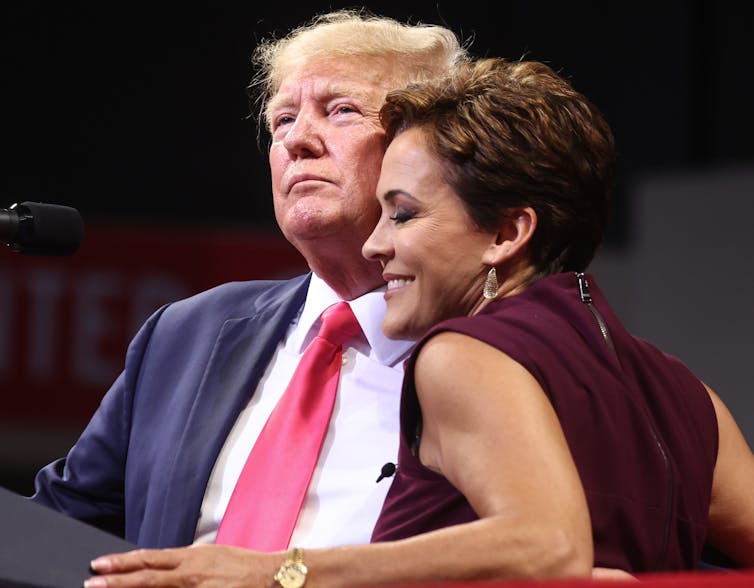
A white man dressed in navy blue suit with a white shirt and red tie hugs a smiling woman on stage.
Former President Donald Trump embraces Kari Lake, the Arizona GOP candidate for governor, at a rally on July 22, 2022. Mario Tama/Getty Images

While that message may resonate among many Democratic voters, it’s unclear whether it will have any impact on any Republicans whom Biden described as “dominated and intimidated” by former President Donald Trump, or on independent voters who have played decisive roles in elections, and will continue to do so, particularly as their numbers increase.

It’s also unclear whether Trump-endorsed candidates can win in general elections, in which they will face opposition not only from members of their own party but also from a broad swath of Democrats and independent voters.

What is clear is that this midterm election cycle has revealed the potency of conspiracy theories that prop up narratives of victimhood and messages of hate across the complex American landscape of white nationalism.

Campaigning on conspiracy theories

In my book, “Homegrown Hate: Why White Nationalists and Militant Islamists Are Waging War on the United States,” I detail how the white nationalist narrative of victimhood and particular grievances have gained traction to become ingrained in the present-day Republican Party.

I also examine four key strands of white nationalism that overlap in various configurations: religions, racism, conspiracy theories and anti-government views.

Conspiracy theories allow white nationalists to depict a world in which Black and brown people are endangering the livelihoods, social norms and morals of white people.

In general, conspiracy theories are based on the belief that individual circumstances are the result of powerful enemies actively agitating against the interests of a believing individual or group.

Based on the interviews I conducted while researching my book, these particular conspiracy theories are convenient because they justify the shared white nationalist goal of establishing institutions and territory of white people, for white people and by white people. While conspiracy theories are not new, and certainly not new to politics, they spread with increasing frequency and speed because of social media.

The “great replacement theory” is one such baseless belief that is playing a role in the anti-immigration rhetoric that is central to the 2022 strategies of many Republican candidates who are running for seats at all levels of government.

That theory erroneously warns believers of the threat that immigrants and people of color pose to white identity and institutions.

For months on the 2022 campaign trail, Republican Blake Masters, a venture capitalist who is running for a U.S. Senate seat in Arizona, has portrayed immigration at the U.S.-Mexico border as part of an elaborate plot by Democrats to dilute the political power of voters born in the United States.

“What the left really wants to do is change the demographics of this country,” Masters said in a video posted to Twitter last fall.

Georgia Gov. Brian Kemp is another Republican leader who decries what he calls “the invasion of the southern border.”

The lie of the ‘Big Lie’

Aside from the inflammatory anti-immigration rhetoric, the conspiracy theory currently having the biggest impact on local, state and federal political campaigns across the country is Trump’s “Big Lie” that he won the 2020 election.

Two middle-aged white men shake hands on a stage in front of a large crowd.
Donald Trump greets Pennsylvania gubernatorial candidate Doug Mastriano on Sept. 3, 2022. Spencer Platt/Getty Images

Of the 159 endorsements Trump has made for proponents of the Big Lie, 127 of them have won their primaries in 2022.

In addition, Republican candidates who align themselves with the Big Lie are also emerging victorious in races for state- and county-level offices whose responsibilities include direct oversight of elections.

The continuation of QAnon

On his social media site Truth Social, the former president quotes and spreads conspiracy theories from the quasi-religious QAnon. A major tenet of QAnon is the belief that the Democrats and people regarded as their liberal allies are a nefarious cabal of sexual predators and pedophiles.

Trump is not the only Republican politician who welcomes and spreads such disinformation.

Two of the most prominent politicians who have been linked to supporting QAnon are U.S. Reps. Lauren Boebert of Colorado and Marjorie Taylor Greene of Georgia, both of whom have been resoundingly endorsed by Trump.

Democracies under threat

The blatant use of conspiracy theories for political gain reflects the open embrace of white nationalism in not only the United States but also throughout Sweden, France, Italy and other parts of the world.

In my view, the conspiracy theories that drive the 2022 midterm campaigns reflect the global threat of hate around the world.

The Conversation

Sara Kamali does not work for, consult, own shares in or receive funding from any company or organization that would benefit from this article, and has disclosed no relevant affiliations beyond their academic appointment.

23 Sep 12:41

How do you teach a primary school child about consent? You can start with these books

by Emma Whatman, Sessional Academic, Faculty of Arts and Education, Deakin University
Johnny McClung/Unsplash, CC BY

Parents will be increasingly aware they need to talk about consent with their children.

There is no such thing as “too young” to start the conversation. In fact, the earlier the better, when it comes to understanding how to have respect for your body and other people’s.

We are researchers on children’s literature that deals with issues around sex and gender. Books can provide a safe, engaging way to discuss the tricky but vital topic of consent.

Books for younger children

For primary-aged children, books don’t usually discuss sexual consent, but cover topics such as boundaries, safe touching and healthy relationships.

Let’s Talk About Body Boundaries, Consent and Respect by primary teacher and mother Jayneen Sanders is one place you can start.

This book teaches verbal and non-verbal ways children can show they are OK for another person to go inside their “body boundary” – an invisible line around the child’s body. It also reminds adult readers that if a child indicates they don’t want to be touched, it’s important to respect this. As the book says in its opening line:

Your body belongs to you and you are the boss of it.

Front cover Rissy No Kisses by Katey Howees
Rissy No Kisses by Katey Howes. Lerner Publishing Group

Rissy No Kisses by children’s author Katey Howes is about a lovebird named Rissy. She says “no” to kisses because they make her uncomfortable, but this makes other people think she is being rude. Rissy learns there is nothing wrong with her. As her mother tells her: “your body and your heart are yours, and you choose how to share”.

Both these books show the importance of kids talking to trustworthy adults. They provide notes for children, parents and educators about body autonomy, consent and different ways to show affection. Even just reading and talking about consent with kids shows them their parents are part of their “safety network” (adults they can trust).

Consent (for Kids!): Boundaries and Being in Charge of You by former higher school teacher Rachel Brian uses more lighthearted language, but stays on the same theme. It with begins with the message:

Consent, it’s like being the ruler of your own country. Population: You. ‘I hearby decree that I won’t be doing any snuggling today’.

Books for older children

For older primary school children, there are also books that talk about consent more broadly, as well as sexual consent.

These books introduce the concepts of agency (the power to decide), saying “yes” and “no”, and what consent is before introducing sex, puberty and developing crushes.

They talk about how understanding consent is part of growing up.

Front cover of Welcome To Consent by Yumi Styles and Melissa Kang.
Welcome To Consent by Yumi Styles and Melissa Kang. Hardie Grant

Two books to consider here are Welcome to Consent by broadcaster and mother Yumi Stynes and former Dolly doctor Melissa Kang and Can We Talk About Consent by sex and relationships educator Justin Hancock and illustrator Fuchsia Macaree.

The latter’s chapter on sex begins by telling the reader “it’s okay if you aren’t ready to learn about sex yet. Either skip ahead, or put the book down for a bit”.

Both books use hand-drawn illustrations to represent different bodies and experiences.

Importantly, they define consent in clear ways, and use correct language to describe body parts and sexual acts. Unlike the Morrison government’s infamous, confusing “milkshake” video in 2021, there are no embarrassed metaphors or unhelpful euphemisms to talk about sex.

What to watch out for

Not all books cover consent well. Some frame consent as something that boys must get from girls, reinforcing gendered stereotypes. Others assume all readers are heterosexual, white and able-bodied. Look for books featuring different perspectives.

Welcome to Consent uses “own voices” quotes from lots of different people, meaning consent is approached from different angles. For example, 15-year-old Tans writes:

I have ADHD and autism and anxiety. These things can affect my ability to interpret body language. I need a few more cues.

Sometimes you can read these books with your child, sometimes they may want to read them alone. The most important thing is you are starting an open discussion with them.

Talking about consent with young people can be daunting, but it’s an important topic we can’t ignore. Books about consent can teach kids about safety and respect and – when the time is right – can empower them with understanding sex and consent as well.

The Conversation

Emma Whatman is affiliated with The Australasian Children’s Literature Association for Research (ACLAR) and The Australian Women’s and Gender Studies Association (AWGSA).

Paul Venzo is affiliated with the Australasian Children’s Literature Association for Research (ACLAR).

22 Sep 19:48

US politicians tweet far more misinformation than those in the UK and Germany – new research

by Stephan Lewandowsky, Chair of Cognitive Psychology, University of Bristol
Good ideas/Shutterstock

Politicians from mainstream parties in the UK and Germany post far fewer links to untrustworthy websites on Twitter and this has remained constant since 2016, according to our new research. By contrast, US politicians posted a much higher percentage of untrustworthy content in their tweets, and that share has been increasing steeply since 2020.

We also found systematic differences between the parties in the US, where Republican politicians were found to share untrustworthy websites more than nine times as often as Democrats.

For Republicans, overall around 4% (one in 25) links were untrustworthy compared with around 0.4% (one in 250) among Democrats, and that gap has widened in the last few years. Since 2020, more than 5% of Republican tweets contained links to untrustworthy information. Democrats have remained stable and predominantly share information that is trustworthy.

Over the five-year period we studied, mainstream elected UK MPs shared only 74 links to misinformation (0.01%), compared with 4,789 (1.8%) from elected mainstream US politicians and 812 (1.3%) from German politicians.

Building on earlier work that showed how former US president Donald Trump could set the political agenda using Twitter, we conducted a systematic examination of the accuracy of the tweets of parliamentarians in three countries: the US, the UK and Germany.

Together with colleagues David Garcia, Fabio Carrella, Almog Simchon and Segun Aroyehun, we collected all available tweets from former and present members of the US Congress, the German parliament and the British parliament. Altogether we collected more than 3 million tweets posted from 2016 to 2022.

To determine the trustworthiness of information shared by the politicians, we extracted all links to external websites contained in the tweets and then used the NewsGuard database to assess the trustworthiness of the domain being linked to.

NewsGuard curates a large number of sites in numerous different countries and languages and evaluates them along nine criteria that characterise responsible journalism – for example, whether a site publishes corrections and whether it differentiates between opinion and news.

Our team looked at MPs from the UK’s Conservative and Labour parties and from Germany (Greens, SPD, FDP, CDU/CSU) as well as US Republican and Democrat politicians.

Members of the conservative parties in Germany (CDU/CSU) and the UK (Conservatives) shared links to untrustworthy websites more frequently than their counterparts in the centre or centre-left. However, even conservative parliamentarians in Europe were more accurate than US Democrats, with only around 0.2% (one in 500) links from European conservatives being untrustworthy.

We repeated our analyses using a second database of news website trustworthiness instead of NewsGuard. This robustness check was important to minimise the risk of possible partisan bias in what is considered “untrustworthy”.

The second database was compiled by academics and fact checkers such as Media Bias/Fact Check. Reassuringly, the results matched our primary analyses and we find the same trends.


Read more: Three reasons why disinformation is so pervasive and what we can do about it


The world has been awash with concern about the state of our political discourse for many years now. There is ample justification for this concern, given that 30%-40% of Americans believe the baseless claim that the presidential election of 2020 was “stolen” by President Biden, and given that around 10% of the British public believes in at least one conspiracy theory surrounding COVID-19.

A US flag in front of the US Capitol building.
One in 25 websites that elected national US Republicans shared were found to be untrustworthy, compared with one in 250 among Democrats. Andrea Izzotti/Shutterstock

Much of the discussion of the misinformation problem — and much of the blame — has focused on social media, and in particular the algorithms that curate our newsfeeds and that may nudge us towards more and more extreme and outrage-provoking content. There is now considerable evidence that social media has been harmful to democracy in at least some countries.

However, social media is not the only source of the misinformation problem. Donald Trump made more than 30,000 false or misleading claims during his presidency and there are political leaders in Europe who have a poor track record.

However, compared with the plethora of research that has focused on the role of social media, and the relationship between technology and democracy more generally, there have been few attempts to systematically characterise the role of political leaders in the dissemination of low-quality information.

Our results are interesting in light of several recent analyses of the American public’s news diet, which have repeatedly shown that conservatives are more likely to encounter and share untrustworthy information than liberals. To date, the origins of that difference have remained disputed.

Our results contribute to a potential explanation if we assume that what politicians say sets the agenda and resonates with members of the public. By sharing misinformation, Republican members of Congress not only directly provide misinformation to their followers, but also legitimise the sharing of untrustworthy information more generally.

The Conversation

Stephan Lewandowsky receives funding from the European Union’s Horizon 2020 research and innovation programme under grant agreement no. 964728 (JITSUVAX). He also receives funding from the Australian Research Council via a Discovery Grant to Ullrich Ecker, from Jigsaw (a technology incubator created by Google), from UK Research and Innovation (through the Centre of Excellence, REPHRAIN), and from the Volkswagen Foundation in Germany. He also holds a European Research Council Advanced Grant (no. 101020961, PRODEMINFO) and receives funding from the John Templeton Foundation (via Wake Forest University’s Honesty Project). He is also the recipient of a Research Award from the Humboldt Foundation in Germany. He has worked with the European Commission on issues relating to social media governance and regulation.

Jana Lasser receives funding from the Marie Skłodowska-Curie grant No. 101026507.

21 Sep 14:55

Ukraine war: Putin calls up more troops and threatens nuclear option in a speech which ups the ante but shows Russia's weakness

by Stefan Wolff, Professor of International Security, University of Birmingham

Declaring a partial mobilisation and threatening the use of “lots of Russian weapons” in response to alleged western nuclear blackmail, Russia’s president Vladimir Putin has upped the ante once more in his war against Ukraine. Indeed, Putin nearly went so far as to say so: “When the territorial integrity of our country is threatened, we will use all the means at our disposal to defend Russia and our people – this is not a bluff.”

This latest escalation follows the announcement on September 20 of referendums in the territories that Russia currently occupies in Ukraine. It represents the latest gamble by the Russian president to find a face-saving way out of an increasingly dire situation in Ukraine.

Putin was speaking to the Russian people in a televised address at 9am Moscow time, insisting that the partial military mobilisation of its 2 million-strong military reservists was to defend Russia and its territories. He said that the west did not want peace in Ukraine, adding that Washington, London and Brussels were pushing Kyiv to “transfer military operations to our territory” with the aim of the “complete plunder of our country”.

Familiar tactic

Russia’s plan to annex territory in the east of Ukraine via “referendums” follows an established playbook, but it also constitutes a new round of escalation in a war that has not been going Putin’s way for most of the past seven months.

In March 2014, Putin annexed Crimea following a hastily staged referendum there after Russia had occupied the peninsula. And in February 2022 – days before he sent the Russian military into Ukraine – he recognised the independence of the so-called people’s republics of Donetsk and Luhansk, deploying “peacekeeping forces” to these territories occupied by Russia and its local proxies since 2014. Putin used the territories as launchpads for his illegal war against Ukraine just two days later.

As a result of this aggression, Russia captured around 20% of Ukraine’s territory – primarily in the east. Over the past several weeks, Moscow has lost some of these areas again but still controls around 90,000 sq km, mostly in the Donbas area and in the southeast of Ukraine. The Kremlin-installed de-facto authorities – covering large parts of the Donetsk, Luhansk, Zaporizhzhiya and Kherson regions – have now “asked” Moscow to hold referendums on their accession to the Russian Federation.

The referendums are likely to be staged between September 23 and 27, and the Russian parliament is expected to ratify any annexation decision quickly with Putin signing it into effect shortly afterwards. A similar process happened in Crimea in 2014.

A different kind of escalation

In 2014, Ukraine did not put up much of a fight over Crimea, and its anti-terrorist operation quickly ground to a halt as Russia poured troops and resources into Donbas to back its local proxies there. After eight months of heavy fighting, the result was the final instalment of the ill-fated Minsk peace accords in February 2015, which created an unstable ceasefire for seven years embedded in a dysfunctional dialogue process that failed to bring about a settlement.

There is no prospect now that Kyiv and its western partners are going to accept a similar deal which simply buys Moscow time to regroup and plan its next move. Ukrainian and western leaders have already said as much, including the French president Emmanuel Macron and the German chancellor Olaf Scholz.

But this is unlikely to stop Russia. Putin needs an “excuse” not so much to escalate in Ukraine but in Russia itself. Incorporating Ukrainian territory into Russia would, from a Russian perspective, turn Ukrainian military operations to liberate these areas from Russian occupation into an act of aggression against Russia.

This would give Putin a pretext to call for a general mobilisation and potentially even declare martial law in Russia. The approval, by Russia’s lower chamber of parliament, of tougher sentences for a variety of offences committed during periods of military mobilisation or martial law points in an ominous direction in this context.

The announcement of the referendums and all that they imply also poses a direct challenge to the west, daring policymakers in Nato and the EU to continue to support a Ukraine now framed by Russia as the aggressor. This would significantly increase the risk of a direct confrontation between Russia and the west and once again raise the spectre of Russia resorting to nuclear weapons.

This was something already raised back in July when Ukraine began to make progress in its counteroffensive in the south, but it appeared to be another of Russia’s inconsequential red lines.

The China factor

Putin met with China’s president Xi Jinping on September 15 at the margins of the annual summit of the Shanghai Cooperation Organisation in Samarkand, Uzbekistan. Just before, Xi had also visited Kazakhstan and expressed his clear support for that country’s sovereignty and territorial integrity. This was a clear signal to Putin to keep out of Central Asia and foreshadowed the subsequent humiliating climbdown of Putin having to admit that China had concerns about Russia’s “special military operation” in Ukraine.

The absence of a similar message on Ukraine, where China continues to avoid speaking out clearly against Russia’s aggression, may have created an impression in Moscow that Beijing’s desire for stability which Xi expressed in Samarkand was primarily about a quick end to the war, not necessarily the path there.

The idea that China is pushing Russia not simply out of Central Asia but in fact towards a more aggressive stance on its western borders is another one of the Kremlin’s misreadings of China. But it is a very dangerous one, considering the applicability of Russia’s playbook to “unfinished business” in the pro-Russian breakaway region of Transnistria in Moldova and the fact that Russia also recognised, in 2008, the independence of Georgia’s two breakaway regions of Abkhazia and South Ossetia.


Read more: Ukraine war: Putin's failure will pave the way for China's rise to pre-eminence in Eurasia


In his recent message to South Ossetian leader Alan Gagloev, Putin stressed “alliance and integration” as the principles of their relationship and Russia’s commitment to ensuring South Ossetia’s “national security”.

Putin’s last stand?

The question that arises from all of this is how far can and will Putin go? He has played most of his cards now and is still not winning. Energy blackmail against the west has not broken the united front of Nato and EU members and their allies.

Putin’s supporters are few and far between and they are dubious company – the likes of Iran and Syria, North Korea and Myanmar. China may buy Russian oil and gas, but Xi has yet to side openly with Putin on Ukraine and is unlikely to do so, especially if further escalation looms as a result of the planned referendums in the occupied territories.

Above all, Putin is not winning on the ground in Ukraine. His latest desperate attempt to raise the stakes is the clearest signal of this yet – but also an indication of how much more dangerous this already catastrophic situation may get.

The Conversation

Stefan Wolff receives funding from the United States Institute of Peace. He is a past recipient of grants from the Economic and Social Research Council of the UK, the British Academy, the NATO Science for Peace Programme, the EU Framework Programmes 6 and 7 and Horizon 2020, as well as the EU's Jean Monnet Programme. He is a Senior Research Fellow of the Foreign Policy Centre in London and Co-Coordinator of the OSCE Network of Think Tanks and Academic Institutions.

Tatyana Malyarenko receives funding from Alexander von Humboldt Foundation, Germany, and the Jean Monnet Programme of the European Union (Jean Monnet project Towards a More Secure Digital Europe: Multi-level Governance for Countering Online Disinformation and Hybrid Threats, 2020-2022) managed by the Ukrainian Institute for Crisis Management and Conflict Resolution, Mariupol, Ukraine

21 Sep 13:18

What Is "Aging in Place" — And Why Does It Matter?

by Jennifer Prince
Heres expert advice on why aging in place is essential and how to do it successfully. READ MORE...
21 Sep 13:04

Study Shows That Copyright Filters Harm Creators Rather Than Help Them

by Mike Masnick

The EU Copyright Directive contains one of the worst ideas in modern copyright: what amounts to a requirement to filter uploads on major sites.  Despite repeated explanations of why this would cause huge harm to both creators and members of the public, EU politicians were taken in by the soothing words of the legislation’s proponents, who even went so far as to deny that upload filters would be required at all.

The malign effects of the EU Copyright Directive have not yet been felt, as national legislatures struggle to implement a law with deep internal contradictions.  However, upload filters are already used on an ad hoc basis, for example YouTube’s Content ID.  There is thus already mounting evidence of the problems with the approach.   A new report, from the Colombian Fundación Karisma, adds to the concerns by providing additional examples of how creators have already suffered from upload filters:

This research found multiple cases of unjustified notifications of supposed violation of copyright directed at content that is either part of the public domain, original content, or instances of judicial overreach of copyright law. The digital producers that are the target of these unjust notifications affirm that the appeal process and counter-notification procedures don’t help them protect their rights. The appeals interface of the different platforms that were taken into account did not help resolve the cases, which leaves digital creators defenseless with no alternative other than what they can obtain from their contacts. This system damages the capacity of these producers to grow, maintain and monetize an audience at the same time that it affects the liberty of expression of independent producers as it creates a strong disincentive for them. On the contrary, this system incentivizes the bigger production companies to claim copyright on content to which they hold no rights.

As that summary notes, it’s not just that material was blocked without justification. Compounding the problem are appeal processes that are biased against creators, and a system that is rigged in favor of Big Content to the point where companies can falsely claim copyright on the work of others. The Fundación Karisma report is particularly valuable because it describes what has been happening in Colombia, rounding out other work that typically looks at the situation in the US and EU.

Follow me @glynmoody on TwitterDiaspora, or Mastodon. Post originally from Walled Culture.

20 Sep 19:42

Super-Earths are bigger, more common and more habitable than Earth itself – and astronomers are discovering more of the billions they think are out there

by Chris Impey, University Distinguished Professor of Astronomy, University of Arizona
Astronomers think the most likely place to find life in the galaxy is on super-Earths, like Kepler-69c, seen in this artist's rendering. NASA Ames/JPL-CalTech

Astronomers now routinely discover planets orbiting stars outside of the solar system – they’re called exoplanets. But in summer 2022, teams working on NASA’s Transiting Exoplanet Survey Satellite found a few particularly interesting planets orbiting in the habitable zones of their parent stars.

One planet is 30% larger than Earth and orbits its star in less than three days. The other is 70% larger than the Earth and might host a deep ocean. These two exoplanets are super-Earths – more massive than the Earth but smaller than ice giants like Uranus and Neptune.

I’m a professor of astronomy who studies galactic cores, distant galaxies, astrobiology and exoplanets. I closely follow the search for planets that might host life.

Earth is still the only place in the universe scientists know to be home to life. It would seem logical to focus the search for life on Earth clones – planets with properties close to Earth’s. But research has shown that the best chance astronomers have of finding life on another planet is likely to be on a super-Earth similar to the ones found recently.

An image showing Earth and Neptune with a middle sized planet in between.
A super-Earth is any rocky planet that is bigger than Earth and smaller than Neptune. Aldaron, CC BY-SA

Common and easy to find

Most super-Earths orbit cool dwarf stars, which are lower in mass and live much longer than the Sun. There are hundreds of cool dwarf stars for every star like the Sun, and scientists have found super-Earths orbiting 40% of cool dwarfs they have looked at. Using that number, astronomers estimate that there are tens of billions of super-Earths in habitable zones where liquid water can exist in the Milky Way alone. Since all life on Earth uses water, water is thought to be critical for habitability.

Based on current projections, about a third of all exoplanets are super-Earths, making them the most common type of exoplanet in the Milky Way. The nearest is only six light-years away from Earth. You might even say that our solar system is unusual since it does not have a planet with a mass between that of Earth and Neptune.

A diagram showing how a planet passing in front of a star can dim the light.
Most exoplanets are discovered by looking for how they dim the light coming from their parent stars, so bigger planets are easier to find. Nikola Smolenski, CC BY-SA

Another reason super-Earths are ideal targets in the search for life is that they’re much easier to detect and study than Earth-sized planets. There are two methods astronomers use to detect exoplanets. One looks for the gravitational effect of a planet on its parent star and the other looks for brief dimming of a star’s light as the planet passes in front of it. Both of these detection methods are easier with a bigger planet.

Super-Earths are super habitable

Over 300 years ago, German philosopher Gottfried Wilhelm Leibniz argued that Earth was the “best of all possible worlds.” Leibniz’s argument was meant to address the question of why evil exists, but modern astrobiologists have explored a similar question by asking what makes a planet hospitable to life. It turns out that Earth is not the best of all possible worlds.

Due to Earth’s tectonic activity and changes in the brightness of the Sun, the climate has veered over time from ocean-boiling hot to planetwide, deep-freeze cold. Earth has been uninhabitable for humans and other larger creatures for most of its 4.5-billion-year history. Simulations suggest the long-term habitability of Earth was not inevitable, but was a matter of chance. Humans are literally lucky to be alive.

Researchers have come up with a list of the attributes that make a planet very conducive to life. Larger planets are more likely to be geologically active, a feature that scientists think would promote biological evolution. So the most habitable planet would have roughly twice the mass of the Earth and be between 20% and 30% larger by volume. It would also have oceans that are shallow enough for light to stimulate life all the way to the seafloor and an average temperature of 77 degrees Fahrenheit (25 degrees Celsius). It would have an atmosphere thicker than the Earth’s that would act as an insulating blanket. Finally, such a planet would orbit a star older than the Sun to give life longer to develop, and it would have a strong magnetic field that protects against cosmic radiation. Scientists think that these attributes combined will make a planet super habitable.

By definition, super-Earths have many of the attributes of a super habitable planet. To date, astronomers have discovered two dozen super-Earth exoplanets that are, if not the best of all possible worlds, theoretically more habitable than Earth.

Recently, there’s been an exciting addition to the inventory of habitable planets. Astronomers have started discovering exoplanets that have been ejected from their star systems, and there could be billions of them roaming the Milky Way. If a super-Earth is ejected from its star system and has a dense atmosphere and watery surface, it could sustain life for tens of billions of years, far longer than life on Earth could persist before the Sun dies.

A watery world in front of a dim star.
One of the newly discovered super-Earths, TOI-1452b, might be covered in a deep ocean and could be conducive to life. Benoit Gougeon, Université de Montréal, CC BY-ND

Detecting life on super-Earths

To detect life on distant exoplanets, astronomers will look for biosignatures, byproducts of biology that are detectable in a planet’s atmosphere.

NASA’s James Webb Space Telescope was designed before astronomers had discovered exoplanets, so the telescope is not optimized for exoplanet research. But it is able to do some of this science and is scheduled to target two potentially habitable super-Earths in its first year of operations. Another set of super-Earths with massive oceans discovered in the past few years, as well as the planets discovered this summer, are also compelling targets for James Webb.

But the best chances for finding signs of life in exoplanet atmospheres will come with the next generation of giant, ground-based telescopes: the 39-meter Extremely Large Telescope, the Thirty Meter Telescope and the 24.5-meter Giant Magellan Telescope. These telescopes are all under construction and set to start collecting data by the end of the decade.

Astronomers know that the ingredients for life are out there, but habitable does not mean inhabited. Until researchers find evidence of life elsewhere, it’s possible that life on Earth was a unique accident. While there are many reasons why a habitable world would not have signs of life, if, over the coming years, astronomers look at these super habitable super-Earths and find nothing, humanity may be forced to conclude that the universe is a lonely place.

The Conversation

Chris Impey receives funding from the National Science Foundation.

20 Sep 19:40

Proposed federal abortion ban evokes 19th-century Comstock Act – a law so unpopular it triggered the centurylong backlash that led to Roe

by Amy Werbel, Professor of the History of Art, Fashion Institute of Technology (FIT)
A sign at a July 2022 abortion-rights protest in Santa Monica, California, recalls the country's long history of trying to restrict access to reproductive health care. David McNew/Getty Images

Sen. Lindsey Graham has proposed a national U.S. abortion ban barring the procedure after 15 weeks. This push to restrict abortion access across the country follows a rash of new state laws passed by Republicans after the Supreme Court overturned Roe v. Wade in June.

If American history is any guide, these efforts will ultimately neither reduce abortions nor remain settled law.

I am a historian who has studied American culture and law in the wake of the 1873 Comstock Act – the first U.S. effort to restrict access to birth control and abortions. My research finds that previous state and federal efforts to regulate the sexual expression and reproduction of Americans led to unintended consequences – and, in the long term, these laws failed.

Already, I see signs that new anti-abortion laws are triggering a similarly undermining backlash.

How ‘obscene’

In 1873, Congress hurriedly passed a law making it illegal to send “obscenities” through the U.S. mail. The legislation was branded the Comstock Act after its most vigorous proponent: Anthony Comstock, a U.S. postal inspector and evangelical Christian who believed sexual activity was a sin unless it occurred between a married man and woman for the purpose of procreation.

Birth control and substances used to induce abortion were included in the definition of “obscenity,” because Comstock and his supporters believed that life and death were God’s decisions. The law also banned mailing erotic images and literature. In Comstock’s expansive view, this category included images of athletes wearing tights.

Black-and-white drawing showing a rotund man with a mustache dragging a limp woman behind him to a judge's bench in a courtroom
A 1915 comic skewering the Comstock laws. The Masses

State versions of the original Comstock Law soon swept the United States. By 1900, 42 states had passed similar legislation outlawing the production, sale, possession or circulation of “obscene” matter in their own jurisdictions.

These statutes ruled until the Supreme Court declared a right to privacy in medical decision-making nearly 100 years later, in Griswold v. Connecticut (1965).

This is the same ruling that was cited eight years later to protect the right to have an abortion in the now defunct Roe v. Wade.

Impractical enforcement

Comstock zealously enforced the laws he’d advocated for, both as a detective for the privately funded New York Society for the Suppression of Vice, and as an inspector for the U.S. Post Office Department. In attempting to eradicate contraceptives – including condoms and early forms of diaphragms – Comstock organized the arrests of numerous defendants.

However, he had difficulty getting prosecutors, juries and judges to see the seriousness of many of the “crimes” he investigated. In the late 19th century, wealthier Americans already regularly used birth control.

“Of all the indictments prior to 1878, pending in the Court of General Sessions, not one has been tried the past year,” Comstock wrote in his 1879 annual report for the society.

In one of these cases, The New York Times reported, Comstock was chastised by a New York City district attorney named Phelps for his “sharp practice” in investigating Dr. Sarah Blakeslee Chase. These included his posing as a client to obtain birth control products and repeatedly harassing the suspect. A grand jury threw out the case, stating that it “did not think it for the public good.”

Even when Comstock obtained a conviction, many defendants were pardoned immediately.

Enforcing new anti-abortion laws is similarly unpopular with many legal professionals today. Shortly after the Supreme Court issued its opinion in Dobbs, more than 80 elected prosecutors vowed not to bring indictments in cases involving abortion.

As they recognize, conservative courts in jurisdictions with zealous anti-abortion prosecutors – who in some states are already enforcing new laws – will soon be filled with a host of extremely sympathetic defendants: relatives who assist children who are victims of rape in obtaining an illegal abortion, doctors saving the lives of mothers at risk, and those who choose to help pregnant cancer patients in making the best possible decisions for their health.

Enforcement of America’s new Comstock laws will likely once again make witnesses and defendants more sympathetic in the eyes of judges and jurors – and the public – undermining whatever support remains for these laws.

Beyond prosecutions, the tactics necessary to prevent women from obtaining abortions are even less practical today than they were in the late 19th century.

Enforcing anti-abortion laws may include restricting interstate travel, blocking interstate and international postal services and attempting to censor information about sexual health. All of these would require laborious investigations and extensive cooperation from law enforcement agencies and private corporations who will likely have little desire to involve themselves in unpopular prosecutions.

And that’s assuming that any of these methods survive court challenges.

Uniting disparate factions

By the time of Anthony Comstock’s death in 1915, backlash to his zealous overreach had provoked growing solidarity among activists and attorneys determined to defeat his agenda.

A woman sits in a chair being tended to by a nurse, standing
Margaret Sanger at America’s first family planning clinic in New York. Bain News Service/PhotoQuest/Getty Images

Women’s rights activists, including Margaret Sanger, Emma Goldman and Mary Ware Dennett – formerly focused on competing goals and strategies – joined in common cause to repeal the Comstock laws. Their efforts led to the creation of new and powerful national civil liberties organizations, including Planned Parenthood and the American Civil Liberties Union. Both used lobbying and lawsuits to contribute to the death of the original Comstock laws.

These groups are still fighting new abortion restrictions today. And once again, post-Dobbs, disparate individuals and groups are raising their voices in common cause.

Obstetricians from around the country have begun lobbying politicians and forming their own pro-choice political action committees for the first time. TikTok influencers like Olivia Julianna are rallying young citizens to vote for pro-choice politicians. And diverse podcasters, from one-time provocateur Howard Stern to the hosts of the true crime show “My Favorite Murder,” are sharing resources with their listeners and expressing support for abortion rights.

Ballot box backlash

Newly registered and energized voters are turning out to support candidates and ballot initiatives that reflect the nation’s majority support for abortion rights.

Kansas roundly rejected an anti-abortion referendum in August 2022. And more states will soon vote on state constitutional protections for abortion, including Michigan.

The Comstock laws were not repealed quickly. And it’s now clear that American women’s right to reproductive health care remained tenuous after their demise.

Viewing the past as prologue, however, suggests that, once again, unpopular anti-abortion laws will cause unintended consequences that, in the long run, will render them both ineffective and ultimately futile.

The Conversation

Amy Werbel does not work for, consult, own shares in or receive funding from any company or organisation that would benefit from this article, and has disclosed no relevant affiliations beyond their academic appointment.

20 Sep 19:29

Ron DeSantis and Greg Abbott pull from segregationists' playbook with their anti-immigration stunts

by Greta de Jong, Professor of History, University of Nevada, Reno
An undocumented immigrant from Venezuela kisses the forehead of another immigrant on the island of Martha's Vineyard in Massachusetts. Dominic Chavez for The Washington Post via Getty Images

As a historian of racism and white supremacy in the United States, I’ve become accustomed to callous actions like those of Republican governors who organized transportation for Latin American migrants to states run by their political opponents.

Governors Greg Abbott in Texas and Ron DeSantis in Florida are following the playbook of segregationists who provided one-way bus tickets to Northern cities for Black Southerners in the 1960s. At that time, the fight for racial equality was attracting national attention and support from many white Americans, inspiring some to join interracial Freedom Rides organized by civil rights groups to challenge segregation on interstate bus lines.

Then, as now, the message Southern racists aimed to send with their “reverse freedom rides” was, “Here, you love them so much, you take care of them.”

But these acts were more than just political stunts designed to embarrass Northern political leaders who sympathized with the civil rights movement. They were part of a broader effort by white supremacists to remove Black Americans from their communities and avoid dealing with the social consequences of centuries of racial discrimination.

Slavery, sharecropping and displacement

In the slavery and Jim Crow eras, racist policies backed by extreme violence limited access to education and economic opportunities for Black people to ensure that they had few options other than working for white employers.

Black sharecropping families in the early 20th century depended on their landlords to provide food, clothing and housing throughout the year until harvest time, when the costs of these goods were deducted from their share of the money made from sales of the crop. Plantation owners controlled the process, frequently using it to cheat workers out of their earnings and keep them perpetually in debt.

By the 1960s, however, most of these workers were no longer needed. Mechanization eliminated millions of agricultural jobs and generated massive unemployment in rural Southern communities. Rather than invest in job training programs or other initiatives to help displaced farm laborers, political leaders enacted policies designed to drive poor people out.

Strict eligibility requirements and arbitrary administration of state public assistance programs excluded many Black families from receiving aid. State legislators were slow to take advantage of federal funds that were available to expand anti-poverty programs, arguing that these were ploys to force integration on the South.

Government inaction left thousands of people without homes or income and exacerbated the suffering of the unemployed.

Segregationists’ ‘final solution’

Civil rights workers who came to the South to help local Black activists with desegregation and voter registration efforts were shocked by the economic deprivation that existed in the communities they visited. They reported seeing widespread hunger, dilapidated housing, unsanitary conditions, high infant mortality rates and other adverse health effects.

Raymond Wheeler, a doctor who visited Mississippi in 1967, described the state as “a vast concentration camp, in which live a great group of poor uneducated, semi-starving people, from whom all but token public support has been withdrawn.”

Others took the analogy to Nazi Germany further, arguing that this was white supremacists’ “final solution to the race question.” By denying Black Americans access to the basic means of survival, they left them with no options but to migrate away.

Political and economic motivations

The motivations behind these policies were both political and economic. White racists understood that providing assistance to displaced workers would encourage Black people to stay in the South. That posed a threat to their power, especially after passage of the Voting Rights Act in 1965 enabled more Black people to register to vote, participate in elections and run for office.

Moreover, the candidates Black Southerners supported ran on platforms that advocated policies to ensure racial and economic justice: investment in schools and other public services, enhanced assistance for unemployed people, more affordable health care and a stronger social safety net for those who were unable to work.

These proposals were anathema to wealthy white people who would face higher tax rates to pay for them. Warning of the consequences should Black Southerners be allowed to vote, Mississippi Citizens’ Council leader Ellett Lawrence asserted that property owners could see tax increases of “100%, 200% or more” if Black people were elected to office.

In a study of Wilcox County, Alabama, the National Education Association found that many landowners were afraid “the Negro majority will obtain control and raise land taxes to finance education and other services.” It concluded that this group showed “little taste for the anti-poverty programs of the sixties because it is more anxious to solve its problems through outmigration than it is to improve all of its people.”

Black and white photograph of people standing and sitting outside of a burning bus.
A group of Freedom Riders outside a bus that was set aflame by a group of white people in Alabama. Underwood Archives/Getty Images

White supremacy then and now

In many ways, Republicans like Abbott and DeSantis are the political descendants of Southern segregationists whose cruelty horrified other Americans in the 1960s.

Immigration scholars have noted how U.S. foreign policies contributed to the poverty and violence in Central and South America that migrants are fleeing. Yet rather than acknowledge this – along with assuming the moral responsibilities it entails – some GOP leaders denigrate and dehumanize refugees to win support from voters drawn to xenophobic messaging.

Watching this resurgent nativism, racism and disregard for human rights gaining strength in the 21st century is an ominous sight for anyone familiar with where these ideas have led in the past.

The Conversation

Greta de Jong does not work for, consult, own shares in or receive funding from any company or organization that would benefit from this article, and has disclosed no relevant affiliations beyond their academic appointment.
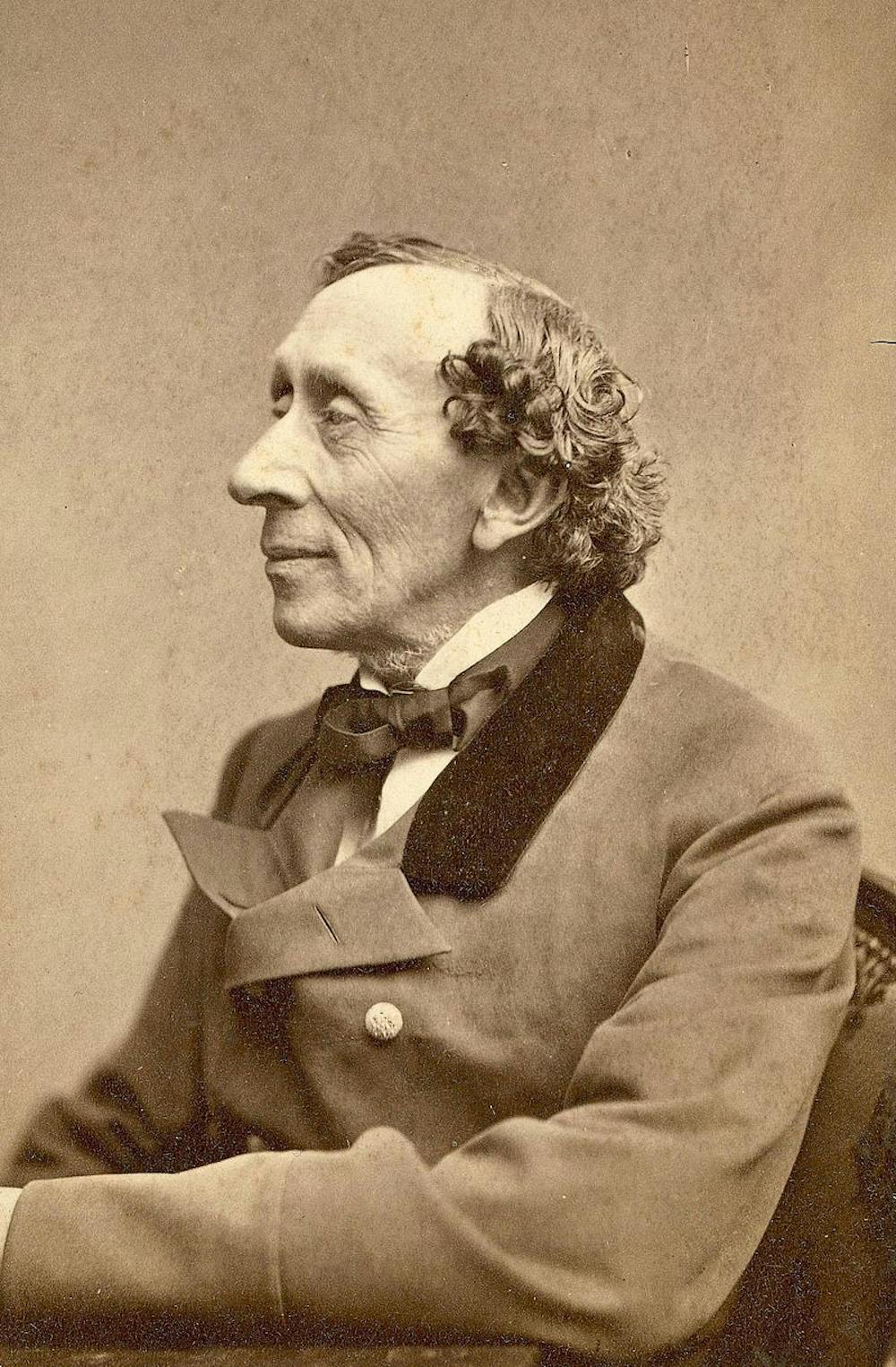
20 Sep 19:16

Book bans reflect outdated beliefs about how children read

by Trisha Tucker, Associate Teaching Professor of Writing, USC Dornsife College of Letters, Arts and Sciences
Book-banning campaigns often misrepresent how young readers consume and process literature. Michael Loccisano/Getty Images

Banned Books Week, an annual event that teachers and librarians across the U.S. mark with a combination of distress and defiance, is here again. The theme of this year’s event, which takes place Sept. 18-24, is “Books Unite Us. Censorship Divides Us.”

It comes amid regular high-profile efforts to remove allegedly controversial or inappropriate reading material from libraries and schools. Nowadays, the small groups of parents who traditionally spearhead such efforts are joined by politicians authoring legislation that would outlaw or criminalize making controversial books available to children.

I teach a class on banned books at the University of Southern California, so I’m prone to notice headlines on the topic, but this isn’t just perception bias. The American Library Association reports that in 2021, it tracked 729 challenges to library, school and university materials, targeting a total of 1,597 books. That’s the highest number of attempted book bans since tracking began more than 20 years ago. This year is on course to surpass 2021’s record with 681 challenges as of Aug. 31, 2022.

Increasingly, bans have targeted books written by or featuring LGBTQ people and people of color. But perennial classics like “To Kill a Mockingbird,” “Huckleberry Finn” and “Grapes of Wrath” also have been challenged by parents concerned about their racist language and marginalization of Black characters.

“Book banning doesn’t fit neatly into the rubrics of left and right politics,” reminds Pulitzer prize-winning author Viet Thanh Nguyen.

What unites these challenges is a professed desire to protect young readers from dangerous content. But attempts to ban books are frequently motivated by misapprehensions about how children consume and process literature.

How children read

Many adults presume that exposure to particular literary content will invariably produce particular effects.

Christian author and editor David Kopp acknowledged as much when he addressed the controversy around the 1989 children’s book “Heather Has Two Mommies.”

“[T]he deeper dilemma for many Christians who oppose this book is often not a theological one, but an emotional one. It has to do with what we fear,” he wrote on the faith-focused website BeliefNet in 2001. “We fear our kids will be indoctrinated somehow. We fear they’ll come to consider homosexuality as normal and then … the part we don’t say … become one.”

Kopp found this fear “absurd.” He insisted that a “book, well intentioned or otherwise, isn’t likely to change our child’s sexual orientation.”

Many scholars would agree. Research shows that children’s reading experiences are complex and unpredictable. As scholar Christine Jenkins explains in an article about censorship and young readers, “Readers respond to and are affected by texts in ways specific to each reader in the context of a specific time and place.”

Put simply, children co-create their own reading experiences. Their interpretation of books is informed by their personal and cultural histories, and those interpretations may change over time or when readers encounter the same stories in different contexts.

Neither the supposedly healthy nor the supposedly dangerous effects of childhood reading, then, can be taken for granted. Children are not merely empty vessels waiting to be filled by a text’s messages and images, despite how adults tend to portray young readers as helplessly in thrall to the stories they consume.

Wall Street Journal contributor Meghan Cox Gurdon has argued that parents must be ever-vigilant against books that would “bulldoze coarseness [and] misery into their children’s lives.” Earlier this year, an Ohio school board vice president accused Jason Tharp, author of “It’s Okay to Be a Unicorn,” of “pushing LGBTQ ideas on our most vulnerable students.”

Stack of six books, including The Nowhere Girls and None of the Above, on a dresser.
These are among the books under attack in Texas as of April 2022. Montinique Monroe for The Washington Post via Getty Images

Who children are

Such perceptions reflect pervasive stories American society tells about children and the nature of childhood. These stories are the focus of an undergraduate class I teach called “Boys and Girls Gone Wild,” in which we explore themes of childhood innocence and deviance through texts such as “Lord of the Flies,” “When They See Us” and “The Virgin Suicides.”

On the first day, I ask students to brainstorm on common traits of children. They frequently choose words like “innocent,” “pure” and “naive” – although babysitters and students with younger siblings are more likely to acknowledge that children can also be “mischievous” and “strange.”

My students are usually surprised to learn that the Western notion of children as innocents in need of protection is a relatively recent idea, stemming from economic and social changes in the 17th century.

English philosopher John Locke’s late-17th-century idea that humans were born as “tabulae rasae,” or blank slates, had incalculable influence. The child with no innate traits must be carefully molded. Thus “childhood became a period of intense governance and control,” according to scholar Alyson Miller.

Some groups held divergent views, such as 18th- and 19th-century evangelical Christians, who believed children were born imbued with original sin. But the narrative of the inherently pure, helpless child came to shape fields as diverse as biology and political theory.

Perhaps no disciplines were influenced as powerfully as the intertwined fields of literature and education.

The value of ‘unsafe’ books

Book bans gain traction in cultures that imagine themselves as upholding a barrier between the purity of children and the corruption of the world.

A person reads in a library
The library at the University of Texas, a battleground state for books. Brandon Bell/Getty Images

But this effort can have unintended consequences, argue scholars like Kerry H. Robinson. In her 2013 book on sexuality and censorship, she writes that “the regulation of children’s access to important knowledge … has undermined their development as competent, well-informed, critical-thinking and ethical young citizens.”

Debates about challenging books would go differently if participants understood young child readers as active participants in the discovery and creation of knowledge.

Jason Reynolds, the Library of Congress’ national ambassador for young people’s literature and author of the oft-targeted “All American Boys,” which depicts a racially charged police beating, offers a different – and, I’d argue, healthier – way to conceive of children’s relationship to reading.

“There’s no better place for a young person to engage and wrestle with ideas that may or may not be their own than a book,” he told CNN for an in-depth June 2022 feature on book banning in America. “These stories are meant to be playgrounds for ideas, playgrounds for debate and discourse. Books don’t brainwash. They represent ideas.”

For Reynolds and the other authors, librarians, readers, parents and educators commemorating Banned Books Week 2022, adults have a right to disagree with those ideas. But rather than fear the uncomfortable “conversations young people bring home,” adults can actively encourage them.

“If the adults are doing their jobs,” Reynolds says, the discomfort that often accompanies growth “doesn’t have to feel like danger.”

The Conversation

Trisha Tucker does not work for, consult, own shares in or receive funding from any company or organization that would benefit from this article, and has disclosed no relevant affiliations beyond their academic appointment.
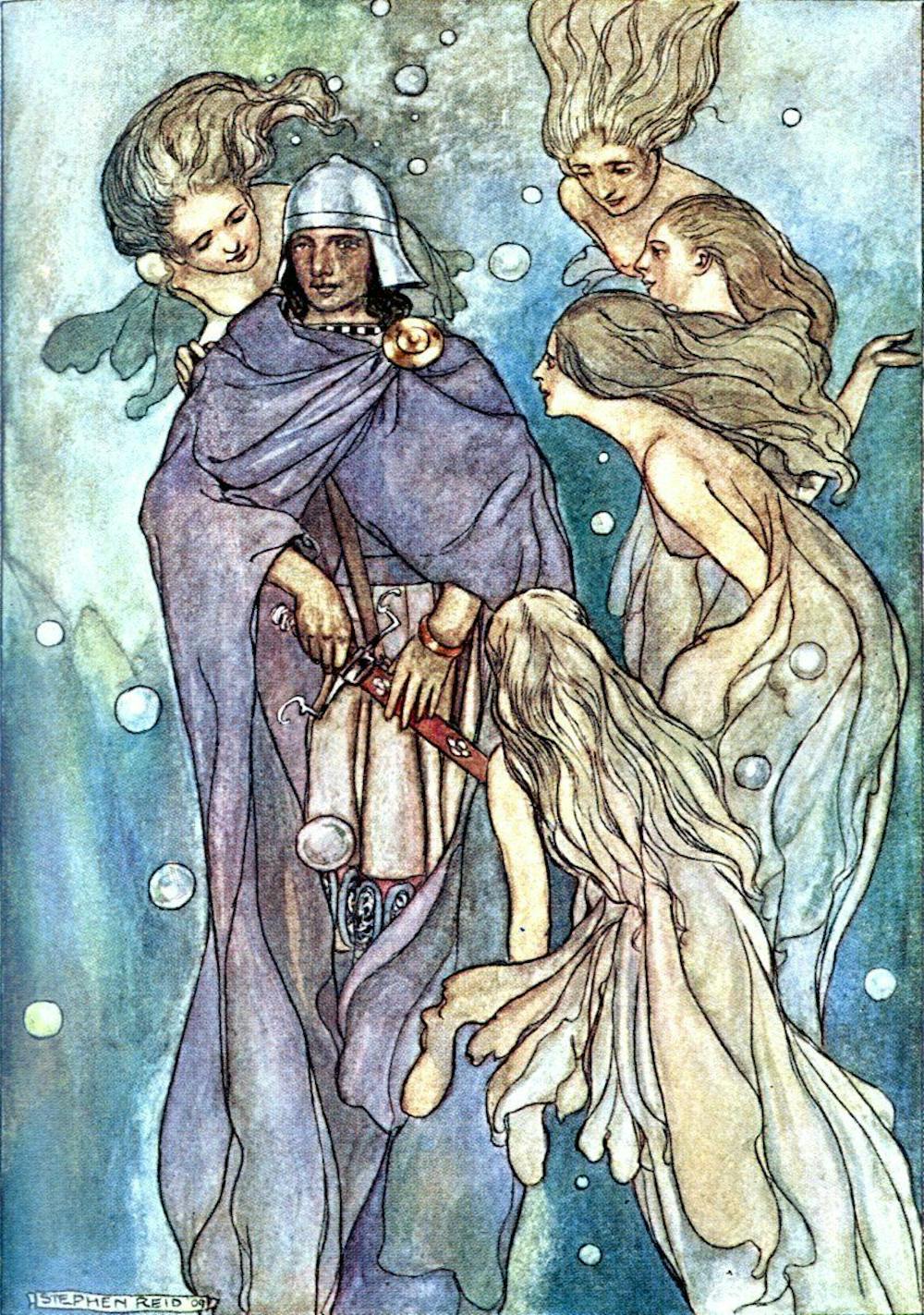
20 Sep 18:27

How to Ditch Facebook Without Losing Your Friends (Or Family, Customers or Communities)

by Cory Doctorow

Today, we launch “How to Ditch Facebook Without Losing Your Friends” - a narrated slideshow and essay explaining how Facebook locks in its users, how interoperability can free them, and what it would feel like to use an “interoperable Facebook” of the future, such as the one contemplated by the US ACCESS Act.

play
%3Ciframe%20src%3D%22https%3A%2F%2Farchive.org%2Fembed%2Finteroperable-facebook%22%20webkitallowfullscreen%3D%22true%22%20mozallowfullscreen%3D%22true%22%20allowfullscreen%3D%22%22%20width%3D%22560%22%20height%3D%22384%22%20frameborder%3D%220%22%20allow%3D%22autoplay%22%3E%3C%2Fiframe%3E
Privacy info. This embed will serve content from archive.org


Watch the video on the Internet Archive

Watch the video on Youtube

Millions of Facebook users claim to hate the service - its moderation, both high-handed and lax, its surveillance, its unfair treatment of the contractors who patrol it and the publishers who fill it with content - but they keep on using it.

Both Facebook and its critics have an explanation for this seeming paradox: people use Facebook even though they don’t like it because it’s so compelling. For some critics, this is proof that Facebook has perfected an “addictive technology” with techniques like “dopamine loops.” Facebook is rather fond of this critique, as it integrates neatly with Facebook’s pitch to advertisers: “We are so good at manipulating our users that we can help you sell anything.”

We think there’s a different explanation: disgruntled Facebook users keep using the service because they don’t want to leave behind their friends, family, communities and customers. Facebook’s own executives share this belief, as is revealed by internal memos in which those execs plot to raise “switching costs” for disloyal users who quit the service.

“Switching costs” are the economists’ term for everything you have to give up when you switch products or services. Giving up your printer might cost you all the ink you’ve bulk-purchased; switching mobile phone OSes might cost you the apps and media you paid for. 

The switching cost of leaving Facebook is losing touch with the people who stay behind. Because Facebook locks its messaging and communities inside a “walled garden” that can only be accessed by users who are logged into Facebook, leaving Facebook means leaving behind the people who matter to you (hypothetically, you could organize all of them to leave, too, but then you run into a “collective action problem” - another economists’ term describing the high cost of getting everyone to agree to a single course of action).

That’s where interoperability comes in. Laws like the US ACCESS Act and the European Digital Markets Act (DMA) aim to force the largest tech companies to allow smaller rivals to plug into them, so their users can exchange messages with the individuals and communities they’re connected to on Facebook - without using Facebook.

“How to Ditch Facebook Without Losing Your Friends” explains the rationale behind these proposals - and offers a tour of what it would be like to use a federated, interoperable Facebook, from setting up your account to protecting your privacy and taking control of your own community’s moderation policies, overriding the limits and permissions that Facebook has unilaterally imposed on its users.

You can get the presentation as a full video, or a highlight reel, or a PDF or web-page. We hope this user manual for an imaginary product will stimulate your own imagination and give you the impetus to demand - or make - something better than our current top-heavy, monopoly-dominated internet.