Shared posts

15 Dec 14:04

Legal alphabet soup

by Judy G. Russell

The language of the law. Part Latin, part Greek, part law French, even part Anglo-Saxon. And all confusing.

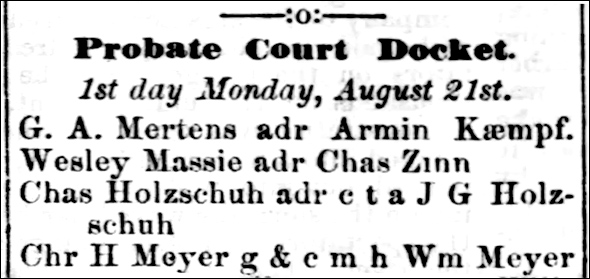
It was published in a Missouri newspaper in early August 1876.

The kind of report The Legal Genealogist just loves to see.

Under the heading “Probate Court Docket,” we find what was scheduled for the first day of the Probate Court session — to be held on Monday the 21st of August, and on the following three days.

Wonderful!

Except…

Sigh

The newspaper docket list is chock full of legal alphabet soup.

Advertiser Courier, page 4

In just this snippet from the Advertiser Courier, we find ourselves wading through it: “adr” and “adr c t a” and “g & c m h.”1

Oy…

Now if we’ve been working with probate records long enough, we can probably figure out that “adr” is the abbreviation the paper used for “administrator” — the person chosen by the court to handle the estate of a person who died without leaving a valid will.2

But then what’s the “c t a” bit? Which — sigh — you won’t find in the law dictionary as part of the definition of administrator…

Oh, you will find it in the law dictionary. At the start of the C letter entries in the abbreviations: “An abbreviation for cum testamento annexo, in describing a species of administration.”3

Well, that was helpful, wasn’t it?

So we’re off to another page, where we find that “cum testamento annexo” means “With the will annexed. A term applied to administration granted where a testator makes an incomplete will, without naming any executors, or where he names incapable persons, or where the executors named refuse to act.”4

Okay, got that.

So what about that “g & c m h” thingy?

I have to admit that one had me stumped for a minute. I was pretty sure we were talking about a guardian of minor heirs… But the “& c” part made me think.

Missouri, you may recall, was smack dab in the middle of the Louisiana Purchase. Meaning its earliest legal history was not under the English common law but rather under the civil law of France and Spain — and it carried that civil law tradition over into its early days as an American territory, modeling its courts after the French and Spanish legal system.5

And that civil law system used the term curator rather than guardian.

Was that it? Yep. Look up curator in Black’s Law Dictionary and it says: “In Missouri. The term ‘curator’ has been adopted from the civil law, and it is applied to the guardian of the estate of the ward as distinguished from the guardian of his person.”6

So the guardian took care of the child — making decisions about schooling and clothes and more, the curator took care of the child’s property, and the court could name one person to handle both roles.

Legal alphabet soup for sure… but digestible in small bites with the help of a good legal dictionary… and an appreciation of the history of time and place.


Cite/link to this post: Judy G. Russell, “Legal alphabet soup,” The Legal Genealogist (https://www.legalgenealogist.com/blog : posted 13 Dec 2022).

SOURCES

  1. “Probate Court Docket,” Advertiser Courier, Hermann, Missouri, 4 August 1876, p. 4, col. 3; digital images, Newspapers.com (https://www.newspapers.com/ : accessed 13 Dec 2022).
  2. See Henry Campbell Black, A Dictionary of Law (St. Paul, Minn. : West, 1891), 40, “administrator.”
  3. Ibid., 162, “C.T.A.”
  4. Ibid., 308, “cum testamento annexo.”
  5. See “The Bicentennial of the Missouri Judiciary: 1812–Missouri organizes as a territory,” Missouri Courts (https://www.courts.mo.gov/ : accessed 13 Dec 2022).
  6. Black, A Dictionary of Law, 309, “curator.”
15 Dec 14:03

Students Beware of Exam Help Scammers

by Jonathan Bailey

Yesterday, a student took to Reddit’s r/scams community to share the story of how they were scammed by an “Exam Help Scammer”

The scam was remarkably simple. The student involved had decided to cheat on an upcoming online exam and hired an “expert” from an exam help website. To that end, they paid $125 for the service.

They then gave their username and password to the person, so they could “study” for the exam. However, that person quickly responded with an error message related to their courses and said that they were about to get caught. They went on to say that, if they were paid $800, they could fix it.

The student ended up paying that amount, now totaling over $900 paid. However, the monetary demands did not stop there. They quickly demanded another $1,500, but it was at this point that the student realized it was a scam. 

The student changed their login information, and the “expert” did not end up taking any exams or completing any homework for them. However, the scammer did send an email to the student’s professor saying that the student had cheated and attached screenshots of their conversations. 

Before the post was deleted, the student updated to say that they took the test themselves and felt they “did good” but that they still haven’t heard from the professor.

Reddit was not kind to the student. Though some tried to provide some serious advice for the student, others felt it was an appropriate punishment, with comments such as “A cheater getting cheated on” and “You tried to commit a scam and got scammed.”

However, the case should serve as a warning. With exam season upon us, these “exam helper” sites are often anything but. They are often little more than expensive scams that are designed not to get you a good grade, but separate you from your money.

Note: The original post has been deleted and, though it appears to be a throwaway account and several of the person’s comments remain, I will not be naming them or sharing personal information. I’ve also opted not to post a copy of the original post, as it has already been summarized above and could contain other identifying information.

Essay Mills, Exam Help and Other Scams

The simple truth is that sites and services that help you cheat on assignments and tests are frequently scams. 

The reason is simple: The victim of the scam has little to no recourse, since they were acting unethically themselves. These scams can run the gamut from simply taking the money and running to out-and-out blackmail, as with the student above.

We’ve talked about this before in the context of essay mills, but exam help services are even more ripe for such exploitation. 

The reason is simple: Exam help sites usually require turning over the student’s login to take the test for them, this gives the would-be scammer a lot more information to threaten the student with. 

Scammers can directly contact professors, lock students out of their accounts, gather other personal information about the student and more. Depending on the information behind that login, they may be able to access other sites and services that the student uses.

In short, students that use essay help services aren’t just paying money to someone who might not come through, but they are turning over the keys to their academic lives, setting up cases like this one.

Advice for Students

The best advice for students is the most obvious: Don’t cheat, don’t plagiarize, and do your own work.

Simply put, the only way to 100% guarantee that you don’t get caught up in a scam that could harm or even end your academic career is to follow the rules of the assignment.

If you are worried about getting the grade you need, speak with your instructor during their office hours and seek help and guidance that way. Failing that, you can almost certainly find official homework and study help through your school.

However, if you are going to cheat, at least be cognizant of what you are doing. Understand that any dollar you pay, whether to a fellow student or an online service, may never come back and there’s no guarantee that the work you get will exist or, if it does, be of any quality.

More to the point, giving your login information to anyone is a risky proposition. Your student account holds as much private information as an email or, in some cases, a financial account. You should never do that, for any reason, especially to someone that you can’t trust.

And, to be clear, anyone helping you cheat on an exam or a paper is automatically someone you cannot trust. You are, fundamentally, engaging in unethical behavior, and someone who is willing to do that on your behalf for money is doing the same.

What you’re hoping is that their unethical behavior only extends to this one thing and not to also scamming you. That is not a bet I would suggest ever taking. 

Bottom Line

It’s easy to blame the students who get scammed this way. They were trying to cheat, and they simply met someone who has even fewer scruples than they have. It’s hard to feel sympathetic.

However, it’s important to remember that essay mills and exam help sites are an exploitative industry and a rapidly growing one. They use a variety of tactics to try and push students toward their services, including aggressive marketing, impersonating fellow students and more. 

While this doesn’t excuse the students that turn to such services, it does put them in a different light. Students are often young, unsure of the work, under a great deal of pressure and facing difficult deadlines. They’re easy targets for manipulation.

For those students who are tempted, it’s important to remember not just that cheating can severely harm your academic career, but that these services are very frequently scams and can easily cause problems rather than solve them. 

Your best bet is, no matter how tempting they might be, to simply stay away. 

The post Students Beware of Exam Help Scammers appeared first on Plagiarism Today.

13 Dec 16:01

5 Ways Copyright Has Shaped the Holidays

by Jonathan Bailey
It's a Wonderful Life Poster

The holiday season is upon us, and it’s safe to say that festivities are kicking into high gear.

However, as you enjoy your favorite seasonal traditions, it’s important to remember that, just like most things in our lives, copyright has had a role in shaping it.

Whether it’s a movie becoming a holiday classic due to it being (briefly) in the public domain, holiday songs still very much under copyright, multiple legal questions around a children’s classic or some long-running myths that have changed the way people view some of the season’s most important characters, copyright has been a factor.

So, since it is the holiday season, let’s take a look at five ways copyright has helped shape our season’s traditions.

1: It’s a Wonderful (Copyright) Life

It’s a Wonderful Life is currently a Christmas staple. It’s now of the best-known and best-loved holiday films. However, that wasn’t always the case.

Released in 1946 and based on a 1939 short story, the film itself lapsed into the public domain in 1974 after Republic Pictures, the movie’s rightsholders, failed to renew the copyright on the movie. 

However, when TV networks learned of the oversight, they jumped on it. Eager to fill hours of airtime in December, networks began playing the film almost constantly. For those who grew up before 1992, you likely remember the film being on a constant loop during the winter months.

That began to change in 1993. Boosted by a separate copyright case over the film Rear Window, Republic Pictures, obtained the rights to both the music in the film and the original short story. They began sending out notices of copyright claim to TV stations and signed a long-term deal with NBC that gave them exclusive rights to air it.

It’s a movie that only became famous because it was free and now is largely protected by copyright, thanks to a shifting legal landscape.

2: Christmas Music

Christmas music is an interesting duality. On one hand, many of the most popular Christmas songs are well into the public domain (at least for the composition). On the other, many others are not and become lucrative revenue generators for decades to come.

For example, Mariah Carey’s All I Want for Christmas is You has earned well over $60 million in royalties over the song’s run. Originally released in 1994, it has charted every year since its release, even hitting number one in 2019, 25 years after its debut.

One of the challenges is that it can be very difficult to tell which songs are and are not in public domain. That’s because many newer songs work to feel like “classics” that are much older and, after they’ve been around multiple decades, it’s easy to forget their relatively recent origins.

However, don’t let this lead you to think that you can’t play modern music at your private party. That is one of the many copyright myths that come with the holiday season

3: The How the Grinch Stole Christmas Parodies

As many likely already know, a new slasher film featuring the character The Grinch was released in theaters this weekend. However, the film is unlicensed by the Suess estate and, as we discussed last week, the filmmaker is moving forward with confidence due to the legal protections of parody.

However, this is a lesson that the Seuss estate has already learned. In 2016, the estate targeted an Off-Broadway performance of a one-woman play named Who’s Holiday. The play was to feature a grown up version of Cindy Lou Who, the character from the original book, who would be a vulgar adult who drinks, uses drugs and likely killed The Grinch.

The legal threats prompted the play’s creator, Matthew Lombardo, to file a proactive lawsuit seeking a declaratory judgment of non-infringement. He won that case in September 2017

The Seuss estate is well-known for being aggressive with litigation. However, it appears that this win may have set the stage for more than just Who’s Holiday and opened the door to other parodies of the famous Christmas book and cartoon. 

4: A Pair of Christmas Copyright Myths

As with anything else, there are a slew of copyright myths that come with the season. Though we’ve already touched on some in this article, one that definitely needs to be discusses is the myth that Coca-Cola owns Santa Claus.

While it is true that Coca-Cola ads from the 1920s and 1930s played a key role in setting how most people think of Santa, the description of Santa they were based upon was actually from the poem A Visit from St. Nicholas, which is more commonly known as The Night Before Christmas.

That poem was released in 1823 and has long lapsed into the public domain. This means that the version of Santa we all know isn’t owned by anyone.

But that doesn’t mean that all Christmas traditions are public domain. The Elf on the Shelf was first published in 2005 and is still very much protected by both copyright and trademark. 

Though the owners of the intellectual property haven’t been quite as litigious as the Seuss estate, they did file a lawsuit in 2011 against a parody book that was slated to be published. They failed to get an injunction in that case too. 

Still, it goes to show that the season’s traditions are a mix of new and old, setting up for some bizarre copyright issues.

5: The Battle Over Baby Yoda

2019 was an interesting year for Star Wars fans. In November, Disney+ opened its doors and released The Mandalorian. Though the series was an instant hit, it was the character of “Baby Yoda” that received the lion’s share of attention.

However, there was a problem. With the series releasing in November, official toys and merchandise for the character wouldn’t be released until May 2020. This meant that the 2019 holiday season would be Baby Yoda free, and that prompted many crafters to step in and fill that void.

Sites like Etsy and Ebay became flooded with unauthorized merchandise around the character. Everything from knitting/crochet patterns, dolls, paintings and more. 

Disney, for their part, came down hard, sending out a wide array of takedown notices targeting such unofficial merch. However, it was far too little, far too late. With no official merchandise, there was simply no way Disney could fill the void and others kept flooding into it.

The case became something of a warning. Though copyright enforcement can help and do great things, it can’t help you when you have the most popular toy of the year and no actual toys to sell. 

Bottom Line

Simply put, copyright plays a part in nearly every aspect of our lives. Often that connection is behind the scenes, many layers removed from the end user. 

Still, it shouldn’t be a surprise that copyright has altered the holiday season. So much of our traditions center around books, movies, songs and other kinds of protectable works that it’s inevitable.

Luckily, for most people, it’s fairly easy to have an infringement-free holiday season. Most of these issues are things that streaming services and retailers have to worry about, not end users.

It’s just interesting to think about the subtle ways copyright has and continues to steer those traditions as time moves on. 

The post 5 Ways Copyright Has Shaped the Holidays appeared first on Plagiarism Today.

09 Dec 14:01

Ukraine war: new figures suggest only one in four Russians support it, but that won't be enough to oust Putin

by Natasha Lindstaedt, Professor, Department of Government, University of Essex

Leaked internal Russian government polling recently indicated that as few as one in four Russians may be in favour of the war in Ukraine. Analysts believe that the forced mobilisation of over 300,000 civilians and the high level of casualties have all contributed to waning support for Russia’s war effort.

The polling, which also found that more than half the Russian people hope their government will enter peace talks, was reportedly conducted for the Kremlin’s Federal Guard Service (FSO) and published by the exiled dissident news website Meduza.

It’s important to bear in mind the source of this reporting and that obtaining accurate survey data one way or another is notoriously difficult but the UK ministry of defence said the results were “consistent with a separate October 2022 survey [conducted by the independent Levada Center] which found that 57% respondents reported being in favour of talks”.

This alleged collapse of support for the war has led to speculation about the security or otherwise of Vladimir Putin’s position as president. But while this is clearly the most precarious moment in Putin’s presidency, the chances of Putin being ousted remain low – even if maintaining his grip on power will become much more difficult.

Since taking office in 2000, Putin has enjoyed solid public support, which reached 82% after the annexation of Crimea in 2014. But research suggested that Putin’s popularity with the Russian public was genuine.

Meanwhile, the Kremlin’s near total monopoly over the media has meant that information is tightly controlled. Most of the news that citizens consume comes from of television shows that spew pro-Putin propaganda.

Unsurprisingly, this propaganda machine was ramped up to win over hearts and minds after the invasion in February. News programmes faithfully repeated the line that the Russians were successfully liberating Ukraine from neo-Nazi Ukrainians who were allegedly raping Russian women and killing their husbands (even as late as April when it was becoming clear to the rest of the world that this “military operation” was going far from swimmingly).

When the west responded to Russia’s invasion with its harsh packages of sanctions, leading to severe shortages and inflation, Putin’s propaganda machine squarely placed the blame on the west – which reports said had always been trying to destabilise Russia. And research has shown that, for the most part, this disinformation campaign has been fairly effective. Most Russians still believe Nato is responsible for escalating the conflict in the Donbas. They are also fearful for the Russian-speaking population in Ukraine.

Putin’s grip on power

While a growing number of the Russian population is expressing unhappiness at the war, estimating the exact number is tricky. And there remain plenty of reasons why these signs of discontent do not spell the end of Putin’s grip on power.

For one thing, Putin has coup-proofed his regime, ensuring that loyalists dominate the upper echelons of the military and security services (although the error-prone conduct of the war might well lead to discontent in the lower ranks, especially among more junior generals whose attrition rate has been remarkably high).

Putin’s political elite tend to share his worldview and hanker after a return to the glory days of empire. The siloviki – strong men – who surround him are just as hawkish about the conflict and Russia’s place in the world, as is Putin himself. These include the advisers responsible for feeding Putin the flawed intelligence that the Russian military would easily crush Ukraine’s armed forces.

At the other end of the political spectrum, a bottom-up regime change would require far greater popular discontent. A noted study by US researchers Erica Chenoweth and Maria Stephan has shown that for protests to be successful, there would need to be at least 3.5% of the population – in Russia’s case, 5 million people – taking to the streets against the regime. So far we’ve only seen thousands willing to brave reaction from the security services by expressing their discontent with Putin’s leadership.

And the Russian public is far too polarised to ensure the success of a revolution or a coup attempt. This is the most salient takeaway from the most recent polling. Russia’s climate of division is more conducive to a dictatorship than a healthy democracy.

An online experiment by academics from the US and Germany, the results of which were published in blog form in June 2022, found that citizens that supported the war were willing to punish fellow citizens who did not share their views on the conflict. Based on my interviews a couple of months ago with Russians who fled to Georgia, this bitter disagreement exists within members of the same family.


Read more: Ukraine war: I've just returned from Georgia where they are angry about the conflict and fear an invasion


Controlling opinion

Public opinion in Russia tends to be fairly tightly controlled, apart from an elite relatively few who are able to access international media via VPNs (virtual private networks) or shortwave radio and other means of bypassing the Putin administration’s blanket censorship. Most Russians still rely on the television for their news – which is entirely state-owned and completely on-message.

Career limiting move: a Russian journalist stages a one-woman protest against the war on Russian primetime news.

So it’s not surprising that most Russians trust the government and believe that their president knows best. As with many in the Soviet Union, many Russians prefer a strong hand, or a decisive style of leadership. And older citizens remember the chaos of the years after the Soviet Union was dissolved, during the country’s brief experiment with democracy. This last factor explains why there is a sizeable number of Russians who may dislike the war, but otherwise support Putin.

In the early days, despite his clear authoritarian tendencies, Putin didn’t need to resort to repression. This is no longer the case – and repression has become more widespread. As the country prepares for the 2024 presidential election, there are fears that there will be more show trials, repressive laws and threats and violence against those who protest against them.

While Putin faces many more challenges to his power than he did in the past, reports of his impending downfall are clearly exaggerated.

The Conversation

Natasha Lindstaedt does not work for, consult, own shares in or receive funding from any company or organisation that would benefit from this article, and has disclosed no relevant affiliations beyond their academic appointment.

09 Dec 14:00

COVID treatments and prevention are still improving – so the longer you can avoid it the better

by Christina Pagel, Professor of Operational Research, Director of the UCL Clinical Operational Research Unit, UCL
Cleaner air will help protect against other airborne pathogens too, not just COVID. 220 Selfmade studio/Shutterstock

There have been enough COVID infections in the UK since March 2020 for every person to have been infected between 1.3 and two times, according to mathematical modelling.

Of course, some people will have had COVID more than twice, and some won’t have had it at all. But COVID is not a “one and done” disease, and any ideas of eliminating it are now unrealistic.

There is, however, an increasingly pervasive narrative which suggests we shouldn’t bother to mitigate against COVID, apart from through vaccination, because infection (and reinfection) is supposedly inevitable – and even useful for topping up immunity.

But counter to this somewhat fatalistic perspective, multilayered mitigation measures alongside vaccination have shown the potential to reduce COVID spread. These measures, such as purifying the air in closed spaces and destroying the virus with a type of UV light, are sustainable and not restrictive. The result could be fewer infections overall and a longer time, on average, between infections.

Infections are not risk free

The “no point delaying infection” argument falls down in a number of places.

First, even after vaccination, some people remain vulnerable to becoming severely ill or dying from COVID. While infection risk remains high, clinically vulnerable people who don’t mount a good immune response to the vaccine can’t enjoy the same freedom as those who do.

Second, although both vaccination and previous infection reduce the risk of long COVID upon subsequent infection, they don’t eliminate this risk.

Third, a recent study showed that each subsequent COVID infection adds further risk of death and other serious ill health (such as stroke, heart attacks, neurological disorders and diabetes) in the year following reinfection. So, while a reinfection tends to be less serious than the first infection, it’s always worse to have been infected twice rather than just once.


Read more: Six common COVID myths busted by a virologist and a public health expert


Better treatments and vaccines on the horizon

Most adults in the UK have had at least two doses of vaccine. The days when hospitals were overwhelmed with COVID patients and thousands were dying each day are almost certainly behind us. So what difference does it make if you get infected now, or in a year, or in two years?

The difference is that we’re continually getting better at dealing with COVID. New treatments are being approved regularly and there are hundreds of ongoing trials for vaccines that are better targeted to newer COVID variants, or able to protect against any variant, or even which potentially prevent transmission completely.

Other protection is also improving. Far-UV is a type of light that efficiently inactivates microbes, but unlike regular UV light, doesn’t harm exposed skin. A recent preliminary study showed that far-UV light sources have the potential to safely kill almost all virus particles in indoor air within minutes.

So the longer you can delay exposure to COVID, the more likely an exposure won’t result in infection due to improved vaccines or mitigation measures, and the more likely there will be a better treatment available if you do become infected.

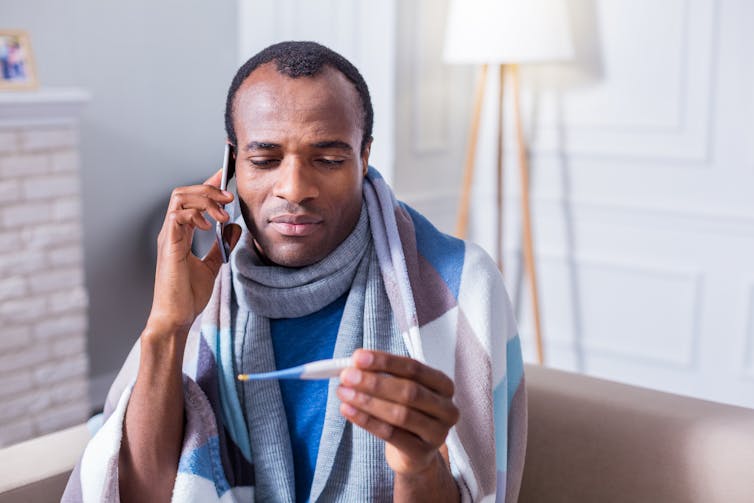
A man on the phone looks at a thermometer.
It’s best to avoid any COVID infection or reinfection if possible. Dmytro Zinkevych/Shutterstock

Some worry that delaying infections and reducing their overall number could increase susceptibility in the population leading to bigger, more severe waves. But these arguments implicitly assume that infection is the optimal – or indeed the only – way to build or maintain immunity.

While it remains important to maintain high levels of immunity in the population, vaccination presents an alternative way to top up immunity at much lower risk to the individual.

Unfortunately, the current vaccination strategy in the UK means that large swathes of the population haven’t had their immunity boosted by a vaccine dose for almost a year. There’s a strong argument for providing booster vaccines to these groups.


Read more: COVID vaccines: should people under 50 in the UK be offered a fourth dose?


Sustainable mitigation measures have broader benefits

Many studies have now shown that providing cleaner air in public spaces (for example, in schools and on public transport) can reduce the risk of COVID infections.

While people might still be exposed elsewhere, for many, travelling to and attending school or work are among the riskiest activities they undertake, not least because they spend a lot of time in those places. For these people, reducing the likelihood of transmission in these settings would significantly reduce their overall risk.

Cleaner air also has benefits beyond the COVID pandemic, including reducing the burden of other airborne pathogens such as colds, RSV and flu, which are currently putting pressure on healthcare systems in many countries.

Even before the pandemic, the UK’s Royal College of Paediatrics had called for the improvement of indoor air in schools and homes. The Royal Academy of Engineering estimated the economic benefits of improving ventilation alone in commercial, industrial and community settings could outweigh the costs by some margin – potentially £174 billion saved over 60 years.

During periods of high transmission, masks also represent an important tool to reduce transmission and are effective against a range of airborne viruses.

Broader societal measures such as improving housing quality, access to green spaces and sick pay, and reducing health inequalities, all represent sustainable mitigation strategies as well as being public goods more broadly. These have long been stated priorities of UK governments but there hasn’t been significant progress in implementing them.

Preparing for the next pandemic

One crucial benefit to many of these measures is that they will be effective not only against any COVID variant, but against any new airborne pandemic.

In 2020, our lack of pandemic preparedness let us down badly. Implementing these measures now will increase our preparedness for the next pandemic, and improve our health in the meantime.

The Conversation

Christina Pagel is a member of Independent SAGE.

Christian Yates is a member of Independent SAGE.

09 Dec 13:57

White teachers often talk about Black students in racially coded ways

by Rowhea Elmesky, Associate Professor of Education, Arts & Sciences at Washington University in St. Louis
Educators stereotype Black students in subtle ways. Jonathan Kirn via Getty Images

When a white Texas middle school teacher told his students in November 2022 that he was “ethnocentric” and thought his race was “superior,” he attempted to explain his position by arguing that he was hardly the only person who held such a view.

“Let me finish …” the teacher is seen telling his students on a now-viral video as they began to push back against his remarks. “I think everybody thinks that; they’re just not honest about it.”

Texas teacher tells his students he is racist.

The teacher in question has since been fired. His termination is hardly surprising given that he was captured on video making blatantly racist remarks in a public school classroom. But as we discovered while performing a study at a predominantly Black school with mostly white teachers, many of them – whether consciously or unconsciously – often harbor negative racial views and stereotypes about Black students and their families. The key difference is they verbalize those negative views in less obvious ways than the Texas teacher.

At the school we studied, the negative views were not isolated occurrences, but rather a part of a culture of coded racial stereotypes, which we argue encourages the disciplining of Black students at disproportionately higher rates.

Our findings were published in a peer-reviewed study that appeared in Urban Education in 2022. They are based on a study that began in 2015 when administrators at a predominantly Black high school asked our research team for help understanding why the predominantly white teaching staff was struggling to form positive relationships with the students. In the first part of our partnership with the school, we found that while Black students made up 89% of the student body, they represented 97% of all disciplinary infractions. Conversely, while white students made up 8% of the student population, they received only 1% of the disciplinary referrals. This early quantitative finding confirms studies from across the nation that showed that, even when controlling for rates of misbehavior and poverty, Black students are still disproportionately disciplined compared to their white peers.

We are education researchers who specialize in cultural and racial justice issues. We believe our findings shine light on how often educators hold racial biases against the students they’ve been entrusted to teach.

Stereotyping was prevalent

The racial biases came to light as we conducted focus groups with teachers and students to ask them about their school’s culture and experiences with classroom discipline.

Of the teachers who participated in the focus groups, 84% were white. During focus group discussions, 36 out of 38 teachers voiced a stereotype at least once, though some did so up to 10 times. While some teachers pushed back against stereotypes they heard, and even more often acknowledged systemic racism in the lives of their students, the teachers still frequently used stereotypes when discussing their students and families.

In a series of focus groups, we asked educators from the school to reflect on their experiences in the school, interacting with students, and their thoughts on the school discipline practices. We were particularly interested in hearing their thoughts on the types of infractions for which students were disciplined and how specific punishments were decided on. For example, why were some students who disrupted class sent back from the office to the classroom immediately, but others received 10 days of in-school suspension?

The majority of the focus group questions were not focused on race explicitly. Even so, we still noticed an undercurrent of racially coded stereotypes as the teachers reflected on the statistical trends in school discipline and on their school culture as a whole.

For example, in one focus group, a white teacher notes that when the then-vice principal, a Black man, went to the school as a student, “we had a much more diverse student body. So, he had an opportunity to see different types of behavior. And I think a lot of these kids that we have, the chronic misbehaviors, they don’t have that option. They’re in a class, class by class where they’re all very similar socioeconomic background, and that really makes a difference, I think. Their parents are working and are unable to monitor them. Maybe they didn’t have such a successful high school experience, so they don’t have the tools that some of the other kids – we still have a few of them, fortunate to have a number in my classes.”

The teacher directly connects the presence of “chronic misbehaviors” with a change in the school’s demographics. The teacher opines that in the past, when the student body was nearly equally Black and white, that Black individuals, such as the then-vice principal, in his example, could observe better behavior in school. The teacher therefore communicates an anti-Black stereotype in a coded way, implying that Black students needed white students to “see different types of behavior.”

In a different example, two white teachers began talking about how parents at their school didn’t care about their children. At one point, they pretended to be parents, with one of the teachers even making a joke that one of the parents completely forgot they even had a child:

Teacher 1: Yeah, just somebody saying, ‘Hey, you know you have a baby, right?’ Teacher 2: I do? Teacher 1: Yeah. Teacher 2: Oh. Teacher 1: Oh, wooord.

Nothing about this interaction is racially explicit. But the teacher’s joke invokes a stereotype of Black parents as disengaged from their children’s lives by using a stereotypical African American vernacular – “wooord.” When white teachers at a predominantly Black school make statements like these, they are upholding the stereotype that Black parents lack concern for their children – even if that is not the teachers’ intention.

A way of bonding

Using a theory that measures the speed of bonding, we found that when teachers used anti-Black stereotypes, they often bonded with each other more quickly and effectively. Certain types of communication — often ones that happen nonverbally — can help individuals bond with each other. These bonds then make individuals feel better about themselves and their community. In the data, teachers often used nonverbal communication or noises like “uh-huh,” laughter, and conversational rhythm, while stereotyping their students.

For example, in the “Hey, you know you have a baby, right?” joke, both teachers laughed as a result of the joke. Just as importantly, the rest of the teachers in the room also laughed. Laughter is an important display of bonding. In other interactions, teachers used verbalizations like “mhmmm” or “This is it” to support each other as they engaged in stereotyping their students.

Reform through reflection

Based on what social psychologist Russell Fazio has found, if teachers are given time to reflect on their potential biases, they have a better chance of removing those biases from their teaching. Through systematic and sustained professional learning, teachers can become aware of their implicit and explicit biases and how those biases may impact their behavior. This type of professional learning must be coupled with structural reforms to re-professionalize teaching to achieve lasting, anti-biasing results.

Since our study was completed, the educators, school and district have sought to revamp their disciplinary policies and school culture, including deep discussions about how their biases might affect how they discipline students. The school has begun to use restorative justice practices, an alternative approach to discipline that focuses on humanizing individuals and repairing harm after a wrong occurs. The school hired a full-time staff person to support restorative justice. According to the current principal, in the year following, suspensions dropped by 47% in one year and chronic absenteeism dropped by 7%.

The Conversation

ROWHEA ELMESKY received an internal university grant which helped fund this study.

Olivia Marcucci does not work for, consult, own shares in or receive funding from any company or organization that would benefit from this article, and has disclosed no relevant affiliations beyond their academic appointment.

09 Dec 13:48

Are conspiracy theorists true believers, or are they just acting out fantasies?

by Daniel Munro, Postdoctoral Fellow, Philosophy, University of Toronto
A man holding a Q sign waits in line to enter a Donald Trump rally in Wilkes-Barre, Pa., in 2018. THE CANADIAN PRESS/AP, Matt Rourke

Democrats are killing and eating children. Vaccines contain Satan’s DNA. Canada has a new queen who is really an extraterrestrial with special powers.


Read more: How the self-proclaimed 'Queen of Canada' is causing true harm to her subjects


It’s difficult for many people to understand how anyone could believe such wild conspiracy theories.

But in my view as a philosopher who studies the imagination, the key to understanding online conspiracy theorists is to understand how the line between fantasy and reality can become blurred.

Belief or fantasy?

Evidence suggests that many people don’t fully believe the wild conspiracy theories they seem to embrace. That explains why, when pressed, conspiracists often stop short of saying a theory is true. Instead, they say they’re “just asking questions” or that the theory could be true.

Why spend so much time engaging with a theory you don’t really believe? Why spend hours watching conspiracist YouTube videos, reading conspiracist blogs and posting on conspiracist message boards? We can better understand these behaviours if we adopt the hypothesis that many conspiracists are merely pretending and acting out fantasies.

Some support for this hypothesis comes from the fact that engagement with conspiracy theories is largely driven by how entertaining they are, not by how much evidence supports them. Online conspiracist communities are also full of self-proclaimed “live-action role players” who treat conspiracy theorizing as one big game of pretend.

It’s easy to see why wild conspiracy theories vividly capture people’s imaginations. They make for good stories, with plots that resemble political thrillers.

It’s also fun to imagine that you’re special because you know things that few others do (just imagine overhearing a juicy secret or piece of gossip). Since many conspiracy theorists have strong desires to be special or unique, they’d be attracted to fantasizing about having secret knowledge that’s been hidden from the general public.

From fantasy to belief

Of course, it would be hasty to claim that this applies to all conspiracy theorists.

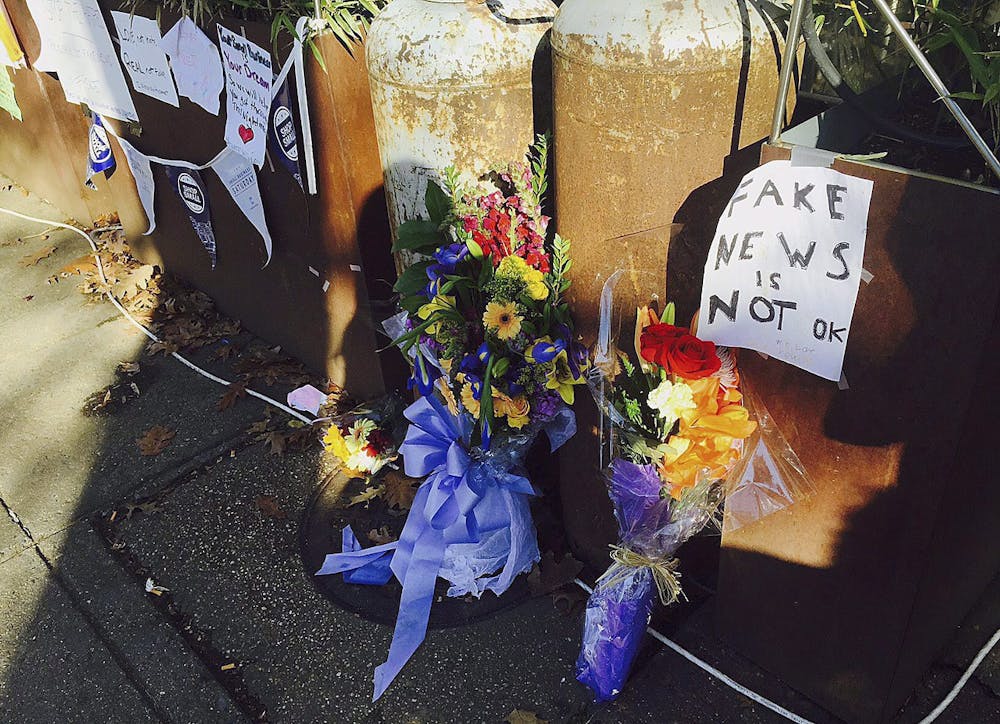
Flowers and notes are seen outside a resaturant.
In this 2016 photo, flowers and notes are shown outside a Washington, D.C., pizza restaurant where a man fired an assault rifle multiple times over Pizzagate. (AP Photo/Jessica Gresko)

Some people carry out extreme actions in the name of conspiracy theories. This has included opening fire in a family restaurant while investigating the baseless so-called Pizzagate conspiracy, as well as attempting to arrest cops at the order of Canada’s “queen.” We don’t usually do such dangerous, reckless things during games of pretend.

Perhaps we can then better understand how people come to believe such theories by considering how fantasy and reality can become confused.

Usually, we don’t allow our fantasies and games of pretend to influence what we believe. But we also often use our imaginations to form new beliefs about the world: you can imagine what your own future will be like, or you might imagine the exterior of your house when trying to figure out how many windows it has.

Because what we imagine can feed into what we believe, there’s always a risk that we accidentally allow our fantasies to infect our beliefs.


Read more: Conspiracy theories are dangerous even if they don’t affect behaviour


For various reasons, conspiracy theorists are especially likely to make this sort of mistake.

For one thing, people are more likely to mistake fantasy for reality when they imagine vividly or in great detail. And groups of people imagining things together create especially vivid and detailed imaginings.

Since conspiracy theories are often invented by groups of people communally constructing a narrative, we should expect their imaginings to be vivid and detailed.

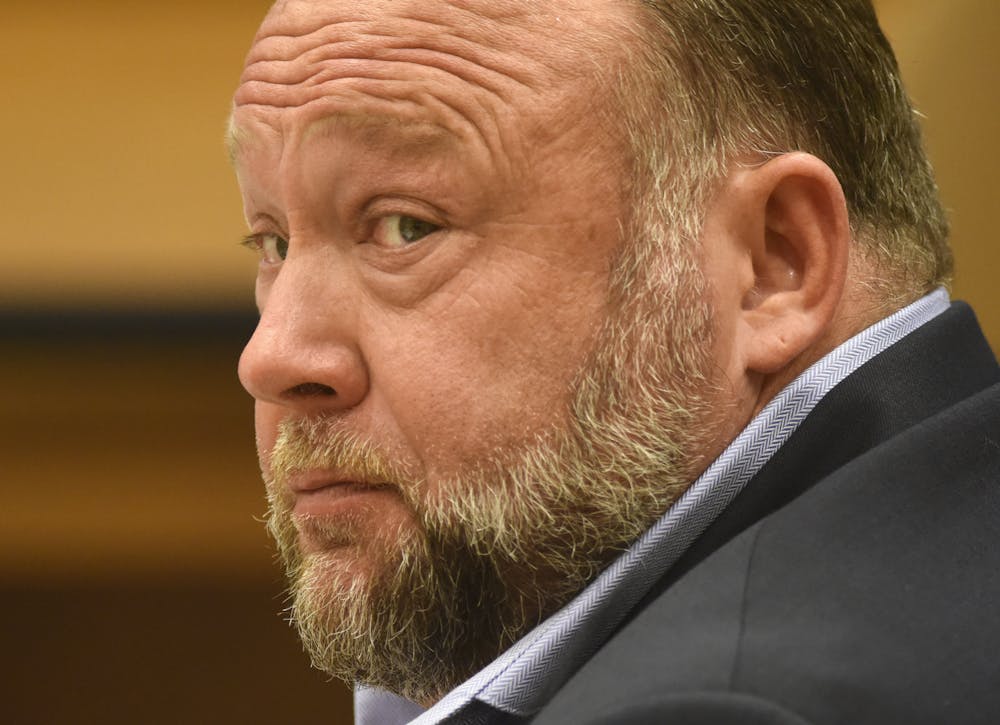
A large balding man with a beard is seen in profile.
Infowars founder Alex Jones appears in court during a Sandy Hook defamation trial in Connecticut in September 2022. Jones spread false conspiracy theories about the 2012 school massacre. (Tyler Sizemore/Hearst Connecticut Media via AP, Pool)

Conspiracy theorists also lack markers that ordinarily help us keep track of what’s real and what’s pretend. Consider an actor on stage or children having a pretend tea party. In those cases, the line between fiction and reality is clearly marked in the behaviours of everyone involved.

The actor can see the audience watching her and stops pretending once she leaves the stage. The children can see that their guests are dolls, and they refrain from taking real sips from their toy teacups.

No markers

Online conspiracy spaces lack such markers. Social media puts people under pressure to constantly like, share and retweet the most juicy and outrageous content, meaning users on conspiracy platforms are constantly under pressure to act as if they believe far-fetched theories.

A phone in someone's hand displaying the Twitter logo.
Social media platforms like Facebook, TikTok and Twitter have been a breeding ground for conspiracy theories. (AP Photo/Michael Dwyer)

People also probably endorse conspiracy theories in part to signal their political loyalties, which adds additional pressure not to reveal when one is faking it. When participating in online conspiracy communities, people are also surrounded by others under these same pressures.

So, conspiracy theorists don’t see many obvious markers of the fact that they’re merely acting out fantasies, neither in their own behaviours nor in the behaviours of those around them. This makes it easier to lose sight of what’s real and what’s pretend.

The imagination can be a tool for fantasizing and exploring fictional worlds. It can also be a tool for learning new things about reality.

When we let these uses get mixed up, we risk allowing fantasies to influence our beliefs. This seems to be the mistake made by many conspiracy theorists, who become so absorbed by their imaginations that they lose track of the line between fantasy and reality.

The Conversation

Daniel Munro receives funding from the Social Sciences and Humanities Research Council of Canada.

09 Dec 13:40

There are still good reasons to avoid catching COVID again – for one, your risk of long COVID goes up each time

by Ashwin Swaminathan, Senior Lecturer at the Australian National University Medical School, Australian National University
AP Photo/Mark Lennihan

Like Canadian Prime Minister Justin Trudeau and Mexican President Andrés Obrador before him, Prime Minister Anthony Albanese has been infected with COVID for a second time.

In the middle of this year’s fourth Omicron wave, Albanese’s reinfection should not come as a surprise. Population antibody surveys have shown roughly half of Australian adults had COVID at least once by mid-2022.

With Christmas parties and much-needed holidays beckoning, how much effort should we be putting in to avoid COVID a second (or third) time?

Studies suggest we should care about this, as each reinfection can increase the risk of poorer health outcomes into the future.

What are the risk factors for reinfection?

The United Kingdom’s COVID Infection Survey recently published an analysis of people testing positive for COVID again between June and October 2022, when the BA.4 and BA.5 Omicron subvariants were circulating widely.

They found reinfection rates were higher in those who had a very mild initial bout of illness and who’d had their second or third vaccine more than 90 days prior (suggesting waning immunity).

Interestingly, they also found reinfection rates were higher 14 days or more following a fourth vaccine dose than they were 14–89 days after a third dose. This is likely related to the qualification for the additional dose being an older and more chronically unwell population, compared with the three-dose regime recommended for a broader (healthier) population.


Read more: If you think scrapping COVID isolation periods will get us back to work and past the pandemic, think again


What are the health risks of reinfection?

For most viral infections (such as chickenpox or measles), when we get infected a second or further time, the symptoms and complications are fewer (or absent altogether) compared with the initial illness. This is due to the body’s long-lasting and protective immune system responses.

Whether this holds true for infection with SARS-CoV-2 (the virus that causes COVID) has been an open question due to its immune-evading ability, made possible by rapidly emerging mutations. The Australian government has just released its issues paper as part of its inquiry into long COVID and repeated COVID infections.

Research published last month in the peer-reviewed journal Nature Medicine offers the best evidence to date on the health risks of COVID reinfection.

These researchers used the enormous US Department of Veteran’s Affairs national database to compare around 440,000 veterans who had one infection with around 40,000 who’d had two or more infections. They also compared them against an uninfected control group (around 5 million people).

They found the reinfected people had a higher risk of poor health – from death and hospitalisation from any cause, through to fatigue and organ-specific issues (respiratory and heart health, neurological problems, mental health and digestive issues).


Read more: Even mild COVID raises the chance of heart attack and stroke. What to know about the risks ahead


What’s more, the risk increased with each new infection. So, those who’d had three infections had worse health outcomes compared with those who’d had COVID twice. And the latter group had worse health than those who’d only been infected once.

The link with worse outcomes was strongest in the first 30 days after their reinfection but was still evident six months later. Many of these persisting ailments, such as fatigue, poor concentration or breathlessness, are consistent with what we call long COVID syndrome.

It is important to note this research, though large and with important findings, is based on a US veteran population that is predominantly male, older (average age 60) and white. This means there will be differences in underlying health conditions and vaccination coverage compared with the wider population.


Read more: When does COVID become long COVID? And what's happening in the body when symptoms persist? Here's what we've learnt so far


Bottom line

These studies don’t mean that people feel sicker with the reinfection episode compared with their first – the severity of illness is related to the particular COVID variant, how much virus got into your respiratory tract (“the dose”) and your vaccination status. In many cases, the subsequent infection is “milder” than the initial one.

However, the Nature study does suggest repeated COVID infection can trigger a wide range of health problems down the track through biological pathways that scientists are still trying to unravel. So, getting infected again is best avoided.

Get yourself up-to-date with COVID vaccinations. We know that vaccinations protect against severe COVID illness (needing to be in hospital for oxygen or dying from COVID pneumonia). They also provide some modest protection against reinfection.

With the current wave of infections, be sensible in crowds and public transport and wear a mask. Protect vulnerable contacts, such as the elderly or immunosuppressed, by staying away if you have symptoms.

The end-of-year party and holiday season will bring more invitations to social events and travel. Taking sensible precautions to prevent reinfection will protect our future health.

The Conversation

Ashwin Swaminathan does not work for, consult, own shares in or receive funding from any company or organization that would benefit from this article, and has disclosed no relevant affiliations beyond their academic appointment.

09 Dec 13:39

Daydreaming's dark side: the compulsive, complex fantasy disorder that dominates some people's daily lives

by Giulia Poerio, Associate lecturer, University of Sussex
Maladaptive daydreaming differs from regular daydreaming in many ways. fizkes/ Shutterstock

Despite what we’re often taught to believe, daydreaming can be immensely useful. Not only can it be a source of pleasure and a way to relieve boredom, research shows that our ability to mentally escape the present can also boost creativity, problem-solving and planning, and provide an antidote to loneliness.

Daydreaming, when defined as thoughts that aren’t tied to what you’re currently doing, occupies a good chunk of our waking lives – an average of around 30% of the time if you randomly probe people. It’s part of our everyday conscious experience. You might even think of it as our default mode which we return to, especially when doing things that don’t require a lot of brain power, such as mundane tasks like hanging out washing.


Read more: Explainer: why daydreaming is good for you


But it’s estimated 2.5% of adults experience a type of excessive daydreaming which is defined as the disorder “maladaptive daydreaming”. So-called maladaptive daydreamers compulsively engage in vivid fantasies and daydreaming plots so excessively that it interferes with their ability to function in daily life.

What is maladaptive daydreaming?

Maladaptive daydreaming differs from typical daydreaming in several ways.

Unlike typical daydreams which can be fleeting (lasting seconds), maladaptive daydreamers can spend several hours at a time in a single daydream. According to one study, maladaptive daydreamers spent an average of at least half their waking hours immersed in deliberately constructed fantasy worlds. These invented worlds are often rich and fantastical, with complex plots and intricate storylines that evolve over many years.

Maladaptive daydreamers’ fantasy worlds are vivid and rewarding, and the need to continue the fantasy can be compulsive and addictive. With maladaptive daydreaming, there’s a strong urge to daydream and annoyance when this is not possible or interrupted. Most also find it difficult to stop or even reduce the amount of time they spend daydreaming.

But prioritising spending time in alternative, imagined realities at the expense of physical and social needs can create problems at work, at school and in maintaining close relationships. Many people with maladaptive daydreaming report experiencing psychological distress, difficulty sleeping and feelings of shame about their daydreaming activity – something that they may hide from others.

It’s important to note that immersive daydreaming and vivid fantasy activity isn’t by default maladaptive. What makes daydreaming “maladaptive” is when it becomes difficult to control, when time to daydream takes precedence over real life, and when the compulsion to daydream interferes with important life goals and relationships.

Why does it happen?

Researchers suspect that people who struggle with maladaptive daydreaming may have an innate ability for immersive imaginative fantasies. Many discover this ability early on in childhood, realising fantasy and daydreams can be used to regulate distress. By creating an inner world of comfort, they’re able to escape from reality.

A young girl sits at her desk at school, while staring out the window daydreaming.
Many discover their ability to create imaginative fantasies in childhood. Halfpoint/ Shutterstock

Some – but not all – maladaptive daydreamers may use daydreaming as a coping strategy. For example, daydreaming activity can distract from an unpleasant reality which may help to cope with trauma, difficult life events or social isolation. But doing so can lead to a vicious cycle of compulsive fantasy, where using fantasy to avoid negative emotions exacerbates the urge to daydream.

In many ways, daydreaming becomes an addictive behaviour that fuels the very problems it was intended to alleviate. Perhaps unsurprisingly, maladaptive daydreaming tends to occur alongside other disorders, the most common being ADHD, anxiety, depression and obsessive compulsive disorder (OCD).

There seems to be a strong relationship between OCD and maladaptive daydreaming. One study found that over half of participants with maladaptive daydreaming also exhibited signs of OCD. This may suggest possible shared mechanisms between the two disorders, including intrusive thoughts, dissociation and a lack of cognitive control.

Though maladaptive daydreaming has been garnering an increasing amount of attention online and through social media, it’s not yet formally recognised in psychiatric diagnostic manuals.

This means many health professionals may be unaware of the condition, leading to misdiagnosis or dismissal of symptoms, creating further distress, isolation, and shame for maladaptive daydreamers. Many instead turn to online forums for peer support and recognition.

The fact that maladaptive daydreaming is not recognised as a psychiatric condition also means we know little about treatment options. There is one documented case study published in a peer-reviewed journal showing a 25-year-old man was able to cut the time he spent daydreaming in half – from nearly three hours daily to under an hour and a half. This was done over the course of six months using a combination of psychological treatments such as cognitive behavioural therapy and mindfulness.

Although treatment didn’t affect how rewarding his daydreaming felt, he reported improvements in work and social functioning as well as in underlying obsessions. It’s hoped that with increasing recognition and understanding of maladaptive daydreaming, more treatment options will become available for sufferers.

The Conversation

Giulia Poerio does not work for, consult, own shares in or receive funding from any company or organisation that would benefit from this article, and has disclosed no relevant affiliations beyond their academic appointment.

09 Dec 13:28

Is the Grinch Slasher Film a Protected Parody?

by Jonathan Bailey

The upcoming release of the film The Mean One has been getting a great deal of attention from the media. Reimagining the classic Grinch character from Dr. Seuss’ How the Grinch Stole Christmas as a slasher movie villain, seems to have many excited about the possibilities.

However, one question that has come up repeatedly has been how the film can legally use the character without the permission of the Dr. Seuss estate. In a recent interview with Entertainment Weekly, director Steven LaMorte answered that question. 

“Well, parody is protected by the constitution. I don’t want to say that I’m a legal scholar, but I’ve done more than my fair share of research and consultation just to make sure that we’re not denigrating the source material. I love these stories; we want to honor it, of course, but it’s a parody; it’s supposed to be funny. Every word and script choice was chosen with the intention of really sticking to the letter of the law and making sure that we are a parody. We just wanted to put our own spin on it.”

While parody isn’t protected in the Constitution, fair use was codified into U.S. law with the Copyright Act of 1978, his point remains. He views The Mean One as a parody of the source material and, as such, it’s protected under the law.

But is he correct? Well, we don’t have too look far to find some direct comparisons.

Who’s Holiday and Other Places to Boldly Go

The Mean One isn’t the far from the first raunchy parody of How the Grinch Stole Christmas and, if litigation does happen, it won’t be the first to end up in court.

Back in 2017, a group made plans to stage a play entitled Who’s Holiday, a one-woman show featuring a foul-mouthed grown up version of Cindy Lou Who. The play featured substance abuse, talk of murder and a variety of other themes out of step of kid-friendly source material.

As the play got closer to opening, the Seuss estate sent cease and desist letters to try and stop it. However, Those behind the play filed a lawsuit seeking a ruling that they were a protected parody and, thus, non-infringing. 

The judge at the district court level ruled in favor of the play, and that decision was affirmed by the Second Circuit Court of Appeals. The verdicts enabled the play to move forward and also caused myself to get in on the fun of parodying How the Grinch Stole Christmas with my copyright-themed version of the poem

However, the opposite happened with a Star Trek/Dr. Seuss mashup book entitled Oh, the Places You’ll Boldly Go! In that case, ComicMix LLC was seeking to release a comic book that mashed up themes from the two elements, only to have the Ninth Circuit Court of Appeals rule against them, saying it was not protected by fair use. 

The case was settled before going to an eventual trial

It’s important to note that the two cases were very different in nature. Where Who’s Holiday! used nothing from the source material beyond the characters and general plot points, Oh, the Places You’ll Boldly Go! was accused of copying specific elements, including parts of some of the original artwork. The latter was also notably less directly humorous, relying more on the mashup of the two different elements than direct jokes at the expense of the source material. 

To that end, The Mean One feels more similar to Who’s Holiday! than it does Oh, the Places You’ll Boldly Go! However, there is another place we can look, the strange world of pornographic parodies.

Porn Parodies and Fair Use

While the idea of turning mainstream characters into slasher movie villains is a fairly new one, such characters have been appearing in genre-shifting parody films for decades, in particular in the adult content industry.

As we talked about in 2012, the pornographic film industry has been releasing “porn parodies” of popular movies and characters for decades. To that end, no intellectual property has been safe, nearly every franchise has been the subject of multiple pornographic adaptations.

This includes The Grinch, who was the feature of a 2017 film by Screwbox (Note: Link goes to the IMDB page).

These parodies have, outside of a few verbal barbs, have gone largely unchallenged. Lawsuits about such parodies are virtually nonexistent, and rulings about them even less common.

In fact, when Nintendo wanted to prevent the distribution of a porn parody of the Super Mario Brothers series, they opted to buy up the distribution rights to the film rather than file a lawsuit

Simply put, lawsuits against such films are an expensive proposition with a limited chance of success. Parody has strong protection under both trademark and copyright law, and the risks associated with targeting such parodies are seen as greatly outweighing the possible gains.

That, in turn, is also likely the case here.

Bottom Line

So, where does this leave The Mean One? Between the Who’s Holiday! ruling and the history with pornographic parodies, likely in a good place. 

It’s almost certain that the Seuss estate has been aware of this film for some time and, if they haven’t opted to file a lawsuit by now, it’s unlikely they’ll do so after the release. 

Granted, we have no way of knowing if the film truly is a parody or may have other legal issues. Until the movie is released, we don’t know what is in it and what potential legal issues may arise.

However, from a broad standpoint, parodies do enjoy a large amount of protection. This is something that the Seuss estate have learned themselves the hard way, and it’s even been codified into something of a norm when it comes to pornographic parodies.

So while there may be some legal questions depending on the specifics of the film, litigation seems unlikely.

However, if I were LaMorte, I’d consider sending a thank-you card to the team behind Who’s Holiday! Their successful defense likely helped to pave the path for his film to get made. 

The post Is the Grinch Slasher Film a Protected Parody? appeared first on Plagiarism Today.

09 Dec 13:24

More shady legal trouble over the rights to American classic To Kill a Mockingbird

by Thom Dunn

Many Americans read To Kill a Mockingbird in school. It's a great book. It was also, curiously, the only book that author Harper Lee published — at least until shortly after her death, when an earlier draft of Mockingbird was published as Go Set a Watchmen. — Read the rest

09 Dec 13:21

Elizabeth Cotten wins Early Influence Award from the Rock & Roll Hall of Fame

by Jennifer Sandlin

Last month, musician Elizabeth Cotten posthumously received the Early Influence Award from the Rock and Roll Hall of Fame Foundation—an award that honors artists who have had a profound influence on the development of rock and roll. This is a very well-earned award that's long overdue. — Read the rest

07 Dec 18:53

Our Work in Policy at CC: Artificial Intelligence

by Nate Angell

As the year comes to a close, we’re spotlighting Creative Commons’ public policy work, recapping what we’ve done and looking ahead to the new year. In this edition, we turn to our work on artificial intelligence (AI).

An aerial view of flat rural land with a few scattered clouds showing roads and structures that make the land look like a glowing gold circuit board.
Like A Giant Circuit Board” by Alan Levine is dedicated to the public domain via CC0 1.0; here modified with a filter and cropped.

Recently, you might have seen the news headline “Art Made With Artificial Intelligence Wins at State Fair,” or even played with one of many tools that enable people to generate content through artificial intelligence. These are just some of the ways AI is becoming increasingly connected with our daily lives. AI is a broad, evolving concept that relates to a number of technologies (such as machine learning and neural networks) that enable computers to analyze and make assessments about data on a scale that was never possible before.

At Creative Commons, we’ve focused on how the development of AI intersects with the commons. Generating content with AI is particularly relevant to CC’s mission, our better sharing strategy, and our participation in the Movement for a Better Internet. AI systems are often trained by analyzing copyrighted works — for instance, the coronavirus was detected in its early stages via large-scale analysis of news articles, and similar sorts of analysis are key to vaccine research. What’s more, AI is used in systems people use to find, access and share information — consider, for example, the recommendation systems used to find information across social media. Across all the complexity of new AI systems and their uses, we’re guided by two questions: How does the proliferation of AI connect to better sharing: sharing that is inclusive, just and equitable — where everyone has wide opportunity to access content, to contribute their own creativity, and to receive recognition and rewards for their contributions? And how does the proliferation of AI connect to a better internet: a public interest vision for an internet that benefits us all?

CC’s Approach to AI & Public Policy

Creative Commons’ advocacy on AI centers around our core beliefs about building the commons and around addressing copyright barriers to better sharing.

Originality and human authorship must remain essential to the granting of copyright or other related exclusive rights over creative works, and AI-generated content by itself does not meet those standards. Copyright exists to incentivize human creativity and, where the hallmarks of creative choices don’t exist, protection should not arise. Giving exclusive rights for works produced by AI would impede copyright’s core purposes and impoverish the commons without any recognizable public benefit in the form of bolstered creativity. Thus, AI-generated output should be presumed to be in the public domain, insofar as the content was generated autonomously without human, creative choices.

Copyright shouldn’t provide a broad monopoly over complementary technologies, and the use of lawfully-accessed creative works to train AI should not be constrained by copyright. The use of creative works to train AI, such as through text and data mining (TDM), does not compete with the original markets for the work, and, in fact, may enhance them by increasing demand for the work. Meanwhile, restricting such non-consumptive and non-expressive uses is not necessary to incentivize creation of the underlying works and thus would not create public benefit.

To take a holistic approach to supporting better sharing, we have also expanded the focus of our advocacy to consider other key issues.

The capacity to develop and use AI to support better sharing should be widely distributed, rather than concentrated among a narrow few: Better sharing depends on a dynamic environment, where people are not locked into a narrow set of services for sharing knowledge and creativity. While it is crucial to ensure commercial viability and incentives for investment in helpful services, it is also crucial to ensure that developments in AI do not come at the expense of robust competition, consumer protection, and the public interest more broadly.

The risks of AI should be addressed through tailored means, without wide-sweeping, generic restrictions on general purpose technology and sharing: AI does not always generate unqualified good or harm. Harmful uses are best addressed through a contextual approach, based on clear principles that can adapt to new developments in how AI is designed and implemented for different use cases based on their risks to society. Such a tailored approach can and should avoid overly broad restrictions on general purpose technology, in particular the sharing and use of open source tools.

Online platforms’ management of content sharing should be coupled with transparency and accountability measures: Large social media and user-generated content platforms use automated tools, increasingly driven by AI, in order to manage the vast scale of information produced and shared on their services. CC has long opposed mandatory, automated filtering for copyright infringement, because of the ways filtering can negatively impact free speech, as well as the sharing of culture and knowledge. When it comes to voluntary measures taken to manage content on sharing platforms, we believe it is important, at a minimum, to ensure people are well-informed about platforms’ practices, and to hold platforms accountable to their promises.

CC’s Engagement on AI & Public Policy in 2022

  • Engaging on AI regulation in EU and UK: Starting in 2021, the European Union has been considering a new AI Act, which would regulate certain uses of AI. In the EU, Creative Commons has proactively worked with policymakers and other key stakeholders, creating a constructive dialogue to inform both the content of the text and the context of the debate. We have focused on ensuring the intersection of copyright and AI is well understood. Moreover, we have advocated for the benefits of supporting open data, open source, and interoperability as means to support a healthy marketplace for and robust competition in the development and use of AI. Similarly, we responded to the UK’s consultation on their white paper: Establishing a pro-innovation approach to regulating AI.
  • Supporting transparency around content moderation and opposing filtering: The EU passed landmark legislation, the Digital Services Act, regarding how online platforms moderate user generated content. We raised concerns about proposals to mandate filters, which fortunately did not make it into the final text, and we supported the enhanced accountability and transparency measures included in the text. Meanwhile, in the USA, Creative Commons joined a coalition of groups concerned with legislation that would have mandated copyright filters.
  • Policy paper on copyright, including AI: In our new policy paper titled “Towards Better Sharing of Cultural Heritage — An Agenda for Copyright Reform,” we advanced proposals to support cultural heritage institutions in making use of their collections for AI-training purposes, and in making AI-generated content available. In addition, CC’s Copyright Platform Working Group is working to update previous work on the intersection of copyright and AI.
  • Webinars: AI Inputs, Outputs and the Public Commons: We also sought to bring more visibility to issues around AI and copyright, by hosting a series of webinars with experts, one focused on how open works and better sharing intersect with AI inputs  — works used in training and supplying AI — and another focused on how open works and better sharing intersect with AI outputs — works generated by AI that are, could be, or should be participating in the open commons.

What’s Next

Next year, we plan to build on this work in a number of ways. First, as AI tools for generating content have become more widely available, there are more and more questions about how copyright should apply. We will continue to engage in this debate to support better sharing. Second, as the EU’s institutions negotiate the final text of the AI Act, we will continue to actively engage and comment on the draft texts. We’ll also engage in similar debates in the UK, at the World Intellectual Property Organization, and elsewhere as opportunities arise.

The post Our Work in Policy at CC: Artificial Intelligence appeared first on Creative Commons.

07 Dec 18:45

'Any means necessary': the police who adopt the skull symbol of the ultra-violent comic book vigilante the Punisher

by Martyn Pedler, PhD Candidate, Swinburne University of Technology
Shutterstock/ Disney

In Travis Linnemann’s book The Horror Of Police, he quotes David Grossman, founder of the “bulletproof warrior” seminar series, notorious for teaching police that killing is “just not that big of a deal.”

At the end of a long day, Grossman says, police should “look out on your city and let your cape blow in the wind”.

This suggests police should see themselves as superheroes. In reality, they seem drawn to one superhero in particular: the classic Marvel comics character, the Punisher.“

He doesn’t wear a cape, admittedly. He’s more famous for the stylised skull logo plastered across his chest.

The Punisher as depicted in Marvel comics in 2013. Marvel

Brutal and abusive

It’s a skull that a group of rogue officers in Milwaukee wore while on patrol in 2011. They were characterised as "brutal and abusive” by a police academy supervisor. In 2017, the logo was added to police cruisers in Lexington, Kentucky – morphed together with a Blue Lives Matter flag – and only removed after public outcry.

A Chicago officer wore a Punisher skull in 2019 while pointing his weapon at teenagers, and police wearing the same skull were spotted at the crackdowns after George Floyd’s death in 2020.

Before you think this is limited to America, the skull has appeared on an Australian police car, too.

Why do so many police love the Punisher?

What makes the Punisher so appealing to these police? Created by writer Gerry Conway and artists John Romita Sr. and Ross Andru, the Punisher first appeared in Amazing Spider-Man #129 in 1974. He was the gun-toting, ex-soldier Frank Castle, determined to wipe out crime with deadly force after his family were murdered in front of him.

While initially an antagonist, it wasn’t long before he graduated to anti-hero. By 1986 he starred in his own Marvel miniseries, by the late ‘80s he was popular enough to have multiple ongoing comic books at once.

This included ten issues of The Punisher Armory, one of the strangest series Marvel has ever published: just page after page of flat, technical drawings of weapons. As Professor of Political Science Kent Worcester wrote in Law Text Review:

It is difficult to think of another comic book figure, in any universe, that could inspire such a relentless, militaristic, and fetishistic series.

A Marvel editor, Stephen Wacker, once noted the Punisher had killed around 48,502 people since his first appearance. Compare that to Batman, who refuses to kill – much to the annoyance of some fans. According to critic Glen Weldon, this is more than a moral decision. It’s also a “deliberate storytelling choice: it would be easy to mow down a roomful of bad guys with an uzi”.

Why would the police choose the Punisher skull instead of Batman’s logo? The police chief in Lexington, Kentucky, defended its use on their police cars by saying that the skull “represents that we will take any means necessary to keep our community safe.”

The adoption of the skull is a sign some police no longer want to be police – they want to be vigilantes, capable of using “any means necessary”. After all, as Worcester states, “the legal system is little more than an inconvenience” to the Punisher.

The vigilante impulse

After American citizen Kyle Rittenhouse was found not guilty of murder, after killing two men and seriously injure a third with a gun during a Black Lives Matter protest, a New York Times opinion piece described the vigilante impulse as a “central feature of the American experience”. The police are far from immune.

Gerry Conway, the Punisher’s co-creator, is appalled by law enforcement adopting the logo. He said on Twitter:

Any ‘cop’ who wears a Punisher logo in his official capacity is identifying law enforcement with an outlaw. These ‘cops’ are a disgrace to serious police officers everywhere. They show an imbecilic level of irresponsibility and should be fired immediately.

Many called on Marvel to make a statement about the skull’s unofficial use after the George Floyd crackdown. A spokesperson said they were “taking seriously” any unlicensed usage, but otherwise referred to a general message shared by Marvel:

We stand against racism. We stand for inclusion. We stand with our fellow Black employees, storytellers, creators and the entire Black community. We must unite and speak out.

They also pointed to a specific issue of The Punisher from the year before. In The Punisher #13 (2019), Frank Castle tears up a skull decal on a police car, explaining that if the police want a role model, they should look to Captain America instead.

This set a precedent: it is the character who would apparently be speaking for the company.

Professor of Film and Cultural Studies Will Brooker writes that origin stories are those that “bury the old, battered, weaker self and give the character a new life as someone braver and bolder”. But the origin for the Punisher’s crusade – watching his family die – had already been complicated by other Marvel stories.

A recent Punisher series suggests it wasn’t his family’s deaths that created the Punisher. It shows teenage Frank as a pathetic loser in grimy flashbacks, sulking in a Captain America mask. Instead of allowing him to become “braver and bolder”, we see Frank was always prone to fits of extreme violence.

In this version, the Punisher didn’t begin as a “bulletproof warrior”. He was a disturbed child – more Dexter Morgan than Dirty Harry.

Skulls for justice

A few years ago, Punisher creator Gerry Conway launched an initiative called Skulls For Justice. It asked artists to create new versions of the Punisher skull by combining it with the imagery of Black Lives Matter. Conway explains:

For too long, symbols associated with a character I co-created have been co-opted by forces of oppression and to intimidate Black Americans. This character and symbol was never intended as a symbol of oppression. This is a symbol of a systematic failure of equal justice. It’s time to claim this symbol for the cause of equal justice and Black Lives Matter.

Punisher as depicted in Marvel comics in 2022, with a new skull logo. Wikimedia

These skulls were not approved by Marvel. However, in the latest Punisher series, Marvel has also changed the iconic logo on Frank’s chest. Almost as if they know the old skull is too toxic to be redeemed, and – at least for now – they’re abandoning it to the vigilante police who’ve embraced it.

The Conversation

Martyn Pedler does not work for, consult, own shares in or receive funding from any company or organisation that would benefit from this article, and has disclosed no relevant affiliations beyond their academic appointment.

07 Dec 18:40

Cherokee Nation wants to send a delegate to the House – it's an idea older than Congress itself

by Julie Reed, Associate Professor in History, Penn State
At the Cherokee Heritage Center in Park Hill, Oklahoma, life-size sculptures depict the walk of the Cherokees along the Trail of Tears. Department of Transportation/Federal Highway Administration

In 1835, the Cherokee Nation was promised a delegate in Congress as part of the same treaty – Treaty of New Echota – that led to the death of thousands on the Trail of Tears. Nearly 200 years later, the Cherokee are still fighting to make that promise a reality.

“The Treaty of New Echota is a living, valid treaty, and the Delegate provision is intact because it has never been abrogated,” Cherokee Nation Principal Chief Chuck Hoskin wrote in testimony submitted to the House Committee on Rules on Nov. 16, 2022. “As the Supreme Court has made clear on multiple occasions, and as the landmark McGirt decision reaffirmed, lapse of time cannot divest Indian nations of their treaties and treaty rights.”

McGirt is the 2020 Supreme Court case that reaffirmed that the reservation boundaries of Muscogee (Creek) Nation survived Oklahoma statehood and remain in effect today. This decision, coupled with a follow-up decision, upheld the reservation status of the Cherokee Nation and four other tribes.

If the Cherokee Nation is successful in its bid, Kimberly Teehee, the nominated delegate, will join delegates representing the District of Columbia, Puerto Rico, Guam and other U.S. territories as a nonvoting member of the House.

As a citizen of the Cherokee Nation and a historian of Cherokee history and social welfare, I think it is important to acknowledge that the idea of a Cherokee delegate is not new. Rather, it is based on hundreds of years of Cherokee negotiations with European colonists and the U.S. government – negotiations that were built on Indigenous diplomatic tools as much as European ones.

What’s more, it is an opportunity for the U.S. to honor its treaties and affirm its government-to-government agreements with the Cherokee Nation.

Indigenous origins

Before the colonial period, more than 500 different Native tribes lived in what is now the United States. When conflicts arose among the various groups, Native peoples used diplomatic tools to address them.

The Chickasaws and Muscogee, also known as the Creek, appointed individuals known as micos to maintain diplomacy and peace within and among Native nations. When the French arrived, they accepted and abided by the mico system.

Similarly, by the early 19th century, Cherokee Chickamauga warrior Major Ridge – and later his son John Ridge – served as representatives to the Muscogee Council even though Cherokees fought against the Muscogee throughout the 18th century.

A black and white engraving of 18th century Native Americans in foreground, outside and surrounded by flora.
An engraving of the Cherokee ambassadors in England, 1730. Isaac Basire/Smithsonian Institution

Adaptations

Representation has always been important in Native nations’ dealings with European settlers and their decedents.

As early as 1730, Cherokee chiefs met with King George II to finalize a treaty.

The 13 newly united states ratified their first treaty with a Native nation in 1778. The Treaty of Fort Pitt, also known as the Delaware Treaty, included a provision for a delegate should the Delaware Nation ever form a state and join the fledgling union – an idea that has not yet come to pass.

In 1785, the Cherokee Nation signed its first treaty with the United States, the Treaty of Hopewell, which built on the precedent set with the Delaware by offering representation to the Cherokee.

New challenges

Although the relationship between Native tribes and European colonists began with some degree of respect and mutual accommodation, that power dynamic shifted as more white settlers arrived.

As the colonies grew in population, land speculators, slaveholders, settlers and Southern politicians were eager to see the federal government remove tribes, including the Cherokee, from their ancestral lands.

Using the same methods as Americans had to assert their independence, Cherokees fought back by writing their own constitution in 1827, intentionally including features of the U.S. constitution and reasserting the Cherokee Nation’s legal rights to its communally held lands.

This sovereign act angered Southerners. Andrew Jackson, elected President in 1828, strongly supported removal. Congress passed the Indian Removal Act in 1829, increasing pressure on Native nations to exchange territory in the east for lands west of the Mississippi River.

Still believing in the power of the pen, the Cherokee Nation next attempted to use the U.S. legal system to resist removal. In 1832, the Supreme Court in Worcester v. Georgia upheld their sovereignty as “a distinct community occupying its own territory in which the laws of Georgia can have no force.”

Everyday Cherokee people didn’t support removal; their leaders understood it didn’t make financial sense. But the U.S. government didn’t respect this majority view. Instead, the government resorted to negotiating the Treaty of New Echota in 1835 with a Cherokee political faction, led by the Ridges, who lacked the legal standing to finalize it.

The traitorous pact threw the tribe into political upheaval. Although Article 7 of the treaty articulated the rights of the Cherokee Nation to appoint a delegate to Congress, the people were in no position to press for this right to be recognized.

An oil on canvas painting of a meeting of hundreds of 19th century Native American tribe members.
In 1843, the International Indian Council, consisting of hundreds of tribe members from throughout the U.S., met at Tallequah, Indian Territory. Several U.S. government officials were also in attendance. John Mix Stanley/Smithsonian American Art Museum

Why not then

The negative effects of the treaty were both immediate and long lasting.

In the short term, it forced 16,000 Cherokee people off their homelands in the Southeast. An estimated 25% died before, during and after removal from disease, hunger, exposure and trauma.

In addition to dividing people from their homelands, removal also divided Cherokees from each other – and brought new Native groups together. A formal council was called in 1843 to establish alliances with other Native nations who were suddenly their neighbors due to displacement.

The U.S. Civil War disrupted these efforts. Some Cherokee people fought for the Union; others for the Confederacy – and that reopened removal era tensions.

After the Civil War, the U.S. government reaffirmed its relationship with the Cherokee Nation in a new treaty signed in 1866. The final article maintained the Cherokee Nation’s right to appoint a delegate to Congress.

Additional challenges

Despite the United States’ treaty promises to keep settlers out of Indian Territory, illegal settlement by U.S. citizens created new legal battles.

The 1887 Dawes General Allotment Act aimed to break up tribal communal landholding.

The Cherokee Nation sent delegations to Washington, and they were able to successfully resist this process for another 12 years, but despite their efforts, the 1898 Curtis Act led to the allotment of the Cherokee Nation. In other words, the federal government revoked some of its treaty responsibilities by breaking up the land the tribes held collectively into individual plots and creating the state of Oklahoma.

Still committed to representation, Native leaders held a Constitutional Convention and proposed the State of Sequoyah, which would exist side by side with Oklahoma. The effort failed largely because the Republican-led Congress opposed the possibility of adding two new Democrat-led states at the same time.

Allotment and Oklahoma statehood plunged Cherokee people into abject poverty, forcing many to turn to itinerant labor.

Why now?

In October 1870, the editor of the Cherokee Nation’s newspaper “The Cherokee Advocate,” after hearing about threats posed by railroads and those seeking to establish U.S. territories, wrote: “The danger, though successfully resisted for the time, is by no means past. The necessity of sending delegates to Washington, D.C. still exists and they must continue.”

That sentiment is still held by many Cherokees today almost two hundred years later.

Since the 1970s ushered in President Nixon’s Self-Determination policy, the Cherokee Nation has launched another phase of rebuilding, enhancing its economy and expanding tribal government and services.

Today the Cherokee Nation comprises more than 440,000 citizens, some of them Delaware. Its population exceeds that of Guam and trails Wyoming by roughly 140,000.

In 2022, the Cherokee Nation is asking for Congress to seat its delegate, as the Treaty of 1835 requires and for which the Cherokees have fought by legal and diplomatic means since before the U.S. existed.

The Conversation

Julie Reed has received funding from various organizations for consulting work on Cherokee history including New York Historical Society, Cherokee Nation Businesses, and various k-12 textbook producers. She has also received fellowship and scholarship support from the Spencer Foundation, the American Philosophical Society, and the Cherokee Nation Education Foundation. She is citizen of the Cherokee Nation.

07 Dec 18:27

Russian troops' poor performance and low morale may worsen during a winter of more discontent

by Liam Collins, Founding Director, Modern War Institute, United States Military Academy West Point
A man walks amid buildings damaged by Russian missiles in Ukraine on Nov. 28, 2022. Metin Aktas/Anadolu Agency via Getty Images

With Russian troops digging trenches to prepare for an expected winter standoff, it would be easy to conclude that fighting will slow in Ukraine until after the ground thaws in the spring.

But evidence from the Ukrainian battlefields point to a different trajectory.

As a career U.S. special forces officer who conducted field research on the 2008 and 2014 wars in Georgia and Ukraine, it is my view that this war has demonstrated that only one side, the Ukrainians, can execute effective combat maneuvers. I believe that the Ukrainians will attempt to launch a large-scale counteroffensive in late winter when the ground is still frozen.

Winter’s impact on war

Historically, the pace of fighting does slow in the winter.

Weapons and other equipment can freeze up in extreme cold, and it’s much more difficult to shoot a weapon while wearing thick gloves.

Shorter days are a factor. Despite technological advances, most of the fighting during this war has occurred during the day.

But this winter may be different for the Ukrainian military.

First, Ukrainian winters are not nearly as cold and snowy as many believe.

Donetsk, for example, has an average temperature of nearly 25 degrees Fahrenheit (-4 degrees Celsius) in January and February.

Its snowiest month, January, averages only 4.9 inches of snow, or .12 meters. Both January and February average just as many rainy days as snowy days – roughly two days of each.

A brief history of Russian attack

Since the invasion began in February 2022, Russia made most of its gains in the first month of the war when it seized Kherson, surrounded Mariupol, and was on the doorsteps of Kyiv and Kharkiv.

But Russia soon gave up on Kyiv and withdrew all its forces from the north.

Failing to achieve quick victory, Russia instead settled on making incremental gains in the east and south. Over the next five months, Russia captured Mariupol, but little else of tactical or strategic value.

During this time, Ukraine built up its combat power with new weaponry from the West and planned a large counteroffensive, which it initiated on Aug. 28, 2022.

In the first week of the counteroffensive, Ukraine liberated more territory than Russia had captured in the previous five months.

A man wearing a military uniform is standing near several large trucks that are being loaded with missiles.
A Ukrainian serviceman loads a truck with American Javelin anti-tank missiles on Feb. 11, 2022. Sergei Supinsky/AFP via Getty Images)

The success of the counteroffensive showed that Ukraine’s military was superior to Russia’s in every category with the exception of size. It had better doctrine, leaders, strategy, culture and will – and it had just proved that it could effectively fight battles with a combination of artillery, tanks, soldiers and air attacks.

By Sept. 12, 2022, Ukraine had liberated much of Kharkiv Oblast as Russian troops routinely fled from their positions.

After liberating the entirety of Kharkiv Oblast in early October 2022, Ukraine turned its attention to Kherson in the south. This was a different fight, and in some ways Ukraine’s military followed Chinese military strategist Sun Tzu’s axiom of “winning without fighting.”

The Ukrainians were able to conquer much of the territory without using many troops on the ground.

Instead, Ukraine used long-range rockets supplied by the U.S. and NATO allies to bombard Russian bases and supply lines that were previously unreachable. These attacks left Russian forces west of the Dnipro River in an untenable position.

Realizing this, Russia shockingly announced on Nov. 9, 2022, that it was withdrawing from Kherson. Two days later, Russia had completed its withdrawal from the west bank of the river.

What to expect from Russia

Over the course of the war, Russia has demonstrated little ability to conduct effective combat operations. This is not something that Russia can change overnight or over the course of the winter.

Russia’s best forces have been decimated throughout the conflict, and it is now increasingly relying on untrained conscripts.

Likewise, Russia is exhausting much of its weaponry as international sanctions against them are limiting Russia’s wartime production. Aside from Iran, few nations are providing military aid to Russia.

Russia’s military is now less trained, has lower morale, and has significantly fewer weapons and less ammunition than it had at the beginning of the current war.

As a result, Russia lacks the ability to conduct large-scale attacks, and it is left with little option but to continue what it has been doing: conducting missile strikes against targets that are either defenseless or offer little strategic value.

Limiting Russia’s options further, these strikes have been less effective as the war has progressed.

Early in the war, most of Russia’s missiles made it through Ukraine’s limited air defenses. With the help of western air defense systems, Ukraine was shooting down 50% of Russian missiles in October and is now intercepting over 80% of them.

Winter should not affect these types of combat operations.

But snow will have an impact on Russia’s already stressed and underperforming logistical system, and the cold will further lower – if that is possible – the already low morale of Russia’s poorly outfitted and undertrained soldiers.

What to expect from Ukraine

As the smaller military, Ukraine cannot afford to take heavy losses.

Thus far, it has used a strategy of defending territory when it could, retreating when it should to preserve combat power, and attacking when the opportunities have presented themselves.

A group of soldiers are sitting atop an armoured vehicle.
Ukrainian soldiers sitting on an armored vehicle near the the Russian front line in Donetsk in May 2022. Alex Chan Tsz Yuk/SOPA Images/LightRocket via Getty Images

Ukraine effectively employed this strategy to defend Kyiv in the first month of the war and during the September 2022 counteroffensive to reclaim the Kharkiv and Kherson oblasts.

An important question must be asked. Why did it take six months for Ukraine to launch its counteroffensive?

One reason is that Ukraine had to wait several months for promised Western aid to arrive at its bases. In my view, a significant factor is the lengthy amount of time it takes to plan large counteroffensives and to position supplies, equipment and forces.

The fact that Ukraine conducted the counterattacks in succession suggests that Ukraine lacks the combat power to conduct two large-scale counterattacks at the same time.

Ukraine is going to need time to regroup, refit and plan for its next large-scale operation.

Thus, it seems reasonable that Ukraine will have to wait at least 30 to 45 days – maybe more – before it is ready to execute its next counteroffensive, which would be in the heart of winter.

While conducting an attack in winter may be difficult, off-road movement in the spring could become impossible, as the Russians discovered during their initial invasion in muddy and wet terrain.

It seems reasonable to conclude that Ukraine may wish to initiate its next counteroffensive while the ground is still frozen – and Russian troop morale is at its lowest point since the invasion.

The Conversation

Liam Collins does not work for, consult, own shares in or receive funding from any company or organization that would benefit from this article, and has disclosed no relevant affiliations beyond their academic appointment.

07 Dec 18:16

Being cold really can cause you to catch a cold, scientists show

by David Pescovitz

The idea that you can catch cold from cold air is a long-perpetuated myth. But it's now turned out to be true, sort of. No, you can't actually catch a cold from the cold but it does hamper the nose's immune response to airborne viruses and bacteria, from cold to the flu and COVID-19. — Read the rest

07 Dec 18:09

Archaeologist solve mystery of huge object protruding from sand on Florida beach

by David Pescovitz

Yesterday, we posted that Volusia County, Florida, visitors to a beach stumbled upon a mysterious 80-foot-long object poking out from the sand at low tide. Theories about its origins included that it was part of an old pier, seating from NASCAR races on the beach, or the remnants of a shipwreck. — Read the rest

07 Dec 12:35

Mighty Mikko: A Book of Finnish Fairy Tales and Folk Tales (1922)

Mighty Mikko contains twelve stories loosely based on Finnish tales, illustrated with vibrant block prints by Jay Van Everen.

06 Dec 17:18

Facebook: no more linking to news if Congress lets publishers bill us for it

by Rob Beschizza

Congress is about to pass a law that could ultimately force websites to pay news publishers just for linking to them—an attempt to shore up the news business by exempting it from antitrust law and establishing a government-approved content cartel. — Read the rest

06 Dec 17:16

A deadly proximate cause

by Judy G. Russell

Immediate, ultimate, proximate

Reader Trudie Davis-Long was puzzled by some of the terminology found in death certificates she’s seen. In some cases, the word used to described the cause of death was “ultimate.” In others, “proximate” (on some forms, “proximal”). Modern death certificates add in “underlying.” And then, of course, there’s “immediate.”

What’s the difference?

Legally — a big one.

cause of death

In all cases, the words “ultimate,” “proximate/proximal” and “underlying” are interchangeable and mean the same thing: “the disease or injury that initiated the chain of events that led directly and inevitably to death.”1

In all cases, the word “immediate” means “the final disease, injury, or complication directly causing death.”2

And, in all cases, the report of a death works in reverse chronological order:

The first condition listed is the immediate cause of death, i.e. the condition which caused the individual to die at that time and in that place. The last condition listed is the proximate (or underlying) cause of death, i.e. the condition which started a chain of events leading to death. In some cases, these are one and the same—for example, “Toxic effects of cocaine”. More commonly, the chain has multiple links. For instance, if an individual suffered brain injury from a fall and, while bedridden and unconscious, developed pneumonia which led to death, his or her cause of death could be listed as, “Pneumonia, due to blunt force head trauma, due to fall.”3

Another example: “a man sustains a transabdominal gunshot wound with perforation of the colon. In spite of multiple operations and other treatment, over a period of three months, he develops generalized peritonitis, septicemia, disseminated intravascular coagulation and adult respiratory distress syndrome. The abdominal gunshot wound is the proximate or underlying cause of death and all of the complications listed are the immediate causes of death.”4

From “immediate” back all the way to “ultimate,” “proximate/proximal” or “underlying,” the chain of events has to be unbroken. If the person who fell had recovered fully and then died from pneumonia sometime later, the chain is broken and the fall isn’t the underlying cause of death. If the person who was shot had recovered fully from the gunshot wound, and then died because of other unrelated issues down the road, the gunshot wouldn’t be the underlying cause of death.

And that’s a big deal legally. Because you can’t charge somebody with murder if the underlying cause of death isn’t the act of the person you want to charge. Criminal homicide — the category that includes murder — is only “when one human being causes the death of another.”5

The things you learn reading death certificates…


Cite/link to this post: Judy G. Russell, “A deadly proximate cause,” The Legal Genealogist (https://www.legalgenealogist.com/blog : posted 5 Dec 2022).

SOURCES

  1. U.S. Standard Certificate of Death, Centers for Disease Control, November 2003; PDF, CDC.gov (https://www.cdc.gov/ : accessed 5 Dec 2022).
  2. Ibid.
  3. Cause and Manner of Death,” Clark County, Ohio; PDF, Clarkcountyohio.gov (https://www.clarkcountyohio.gov/ : accessed 5 Dec 2022).
  4. Glossary,” Harris County (TX) Institute of Forensic Sciences (https://ifs.harriscountytx.gov/ : accessed 5 Dec 2022).
  5. See generally Wex, Legal Information Institute, Cornell Law School (https://www.law.cornell.edu/wex : accessed 5 Dec 2022), “homicide.”
05 Dec 14:49

Gen. Ulysses S. Grant's pending promotion sheds new light on his overlooked fight for equal rights after the Civil War

by Anne Marshall, Associate Professor of History, Mississippi State University
General Grant stands in front of his campaign tent at his headquarters in Virginia in 1865. Bettmann/Getty Images

Tucked away in an amendment to the FY2023 U.S. defense authorization bill is a rare instance of congressional bipartisanship and a tribute to U.S. President Ulysses S. Grant.

If approved, the measure would posthumously promote Grant to the rank of General of the Armies of the U.S., making him only the third person – along with John J. Pershing and George Washington – to be awarded the nation’s highest military honor.

As Executive Director of the Ulysses S. Grant Presidential Library, I believe that the promotion would be much more than a symbolic nod to a great military general. Rather, it would highlight the overlooked legacy of a man who fought to end the last vestiges of slavery.

Outbreak of Civil War

During the Civil War, Grant rose to fame as a decisive leader who was willing to doggedly pursue Confederate armies and avoid retreat at all costs. He first gained his reputation for tenacity with Union victories at Shiloh, the Battles for Chattanooga and the Siege of Vicksburg.

Like most white Northerners, Grant signed up to fight for the Union – not for emancipation.

But by 1862, the freedom of enslaved African Americans had become vital to the Union war strategy, if not yet its cause.

A year before President Abraham Lincoln signed in 1863 the Emancipation Proclamation that freed enslaved people in the Confederate states, Grant oversaw the establishment of refugee, or contraband camps, throughout the Mississippi Valley. Those camps provided basic housing, food and work for Black men and women who had fled from slavery.

Grant also administered the enlistment of African American men into United States Colored Troops units during the Vicksburg campaign.

In March 1864, Lincoln appointed Grant to the rank of lieutenant general and ordered him to take on the Confederate Army in Virginia, a task at which numerous other Union leaders had failed.

At this point during the war, Grant assumed the role of chief strategist for the entire Union war effort. It took the next 13 months of fighting during the Overland campaign before Confederate General Robert E. Lee surrendered to Grant at Appomattox on April 9, 1865.

A white man dressed in a dark military uniform stands at a table with another white man dressed in a military uniform.
In this illustration, Gen. Ulysses S, Grant, left, accepts the surrender of Gen. Robert E. Lee. Getty Images

After the Federal victory, many Americans hailed Grant as the man who saved the Union.

But Grant was magnanimous in victory.

Multiple times during the war he honored the dignity of his defeated adversaries, most famously at Appomattox, where he did not require Lee to hand over his sword, as usually required. Grant also allowed Confederate officers to keep their sidearms and horses.

Lee appreciated Grant’s actions, remarking: “This will have the best possible effect upon the men … it will be very gratifying, and will do much toward conciliating our people.”

Impact of the ‘Lost Cause’

But after the war, the conciliatory feelings vanished.

Southern partisans constructed the narrative of the “Lost Cause.” It held that the root of the Civil War was not slavery, but the rights of states to control their own destinies. It further held that the Union victory had nothing to do with Confederate character or leadership, but rather the Union’s sheer numbers and superior resources.

In this Lost Cause narrative, Grant was seen as a bumbling butcher devoid of any meaningful strategic vision, who succeeded only by mercilessly throwing more soldiers at his enemy. It also revived the old rumors of his excessive drinking.

In this storyline, Grant’s foil was always the courtly gentleman, Robert E. Lee. The hagiography of Lee demanded Grant’s inferiority.

By the early 20th century, the Lost Cause was no longer isolated in the South and had spread across America. Crowds flocked to see the racist anti-Reconstruction “Birth of a Nation” in movie theaters, and during the World War I rush to build military bases, the Army named 10 of them after Confederate generals.

President Grant’s fight for equality

Grant served as president from 1869 to 1877 during a time when white Southerners proved hostile toward federal Reconstruction measures that sought equal rights for recently freed enslaved people.

Grant saw his role of enforcing these policies as an extension of his wartime duty and necessary to protect the gains of the Union victory, especially the newly established rights for African Americans.

He used the resources of the federal government to crush the Ku Klux Klan, established the Department of Justice to investigate civil rights abuses and signed the Civil Rights Act of 1875.

Grant’s latest cause

In recent years, the American public has questioned the Lost Cause and taken steps to mitigate its pervasiveness throughout the U.S.

Southerners themselves have chosen to remove Confederate leaders from town squares and state flags. The U.S. Army has established a Naming Commission to rebrand Confederate-named bases.

Construction workers use heavy-duty chains to remove a statue.
A statue of Confederate general Robert E. Lee is lifted off its pedestal in Charlottesville, Virginia. Getty Images

It is telling, too, that Grant’s Presidential Library is now located in Mississippi, a Deep South state he once conquered.

It remains to be seen whether the request made to elevate Grant’s rank by U.S. Senators Sherrod Brown of Ohio, a Democrat, and Roy Blunt of Missouri, a Republican – along with GOP U.S Rep. Ann Wagner – will be finally approved by Congress as part of the FY2023 National Defense Authorization Act.

Either way, in my view, a thoughtful reconsideration of Grant’s wartime and post-war contributions is long overdue.

The Conversation

Anne Marshall is affiliated with Ulysses S. Grant Association

02 Dec 20:31

Four-day week trial confirms working less increases wellbeing and productivity

by Jan-Emmanuel De Neve, Director, Wellbeing Research Centre, University of Oxford
Shorter working weeks can make people happier and more productive. fizkes / Shutterstock

A group of companies that have been trialling a four-day working week have recently reported increased revenue, with fewer employees taking time off or resigning. While it’s easy to understand the effects of a shorter week on worker wellbeing, the positive effects on company earnings and productivity may be more of a surprise – but research backs this up.

These firms have been participating in a trial organised by non-profit 4 Day Week Global. The four-day working week trial, which involved 33 companies and nearly 1,000 employees, saw no loss of pay for employees – organisations paid 100% of their salaries for 80% of their time. But employees also pledged to put in 100% of their usual effort over the shorter working week.

And this kind of strategy doesn’t just work for nine-to-five office jobs. Iceland trialled reduced working hours between 2015 and 2019 in a scheme that included hospitals, schools and social service workers. The country considered it an “overwhelming success” and reduced hours – without a reduction in pay – has since been rolled out to 86% of Iceland’s workforce.

Throughout history, our working patterns have adapted to the challenges of the day: whether that be more time toiling at an industrial loom, or a farmer shifting their hours to eke out productivity during fading daylight hours. But now, almost a century on from Henry Ford introducing the two-day “weekend” to his factories, many nations are still stuck with a 40-hour week split across five days of work, regardless of the industry. This way of working is increasingly at odds with our 21st-century lifestyles.

The latest findings from the 4-Day Week Global pilot are in line with ongoing research into working patterns that show reduced hours boost employees’ mental health and their productivity. It also brings other benefits such as reducing emissions by cutting commutes and providing the basis for evaluating our lives in more than just monetary terms.

Better mental health

Despite much economic growth since the 1970s, very little progress has been made on freeing up time for workers. Worse, in some cases, the trend has started going in reverse: Americans now work more hours than they did in 2000, for example.

That is starting to take its toll on employee wellbeing and mental health. It doesn’t take much to realise that becoming many times more productive over the past century (thanks in no small part to technology) means our human brains are being asked to process a lot more during a five-day work week than in the past. This has led to huge increases in stress, anxiety and burnout.

This is hitting national health services and families particularly hard. But employers are also bearing the cost: accountancy firm Deloitte estimated the annual cost to employers of mental health issues is £45 billion in the UK alone. This is mostly due to absenteeism, or worse “presenteeism” – where a person is physically present at work but not engaged because they feel ill.

The UK’s Office for National Statistics estimates that there were 17 million worker days lost to stress, depression or anxiety in the UK in 2021-22. And the same trends show up for most other wealthy countries.

Increased productivity

Of course, company bosses might think: “If my employees are working 20% less time, surely output will drop, too?”

But several studies have shown that is not the case. In fact, countries doing the least hours of work are often the most productive on an hourly basis. These countries, such as Denmark, Norway and the Netherlands, are also the happiest. All work less than 1,400 hours a year on average, compared with the US and UK average of about 1,800 hours.

My own research, in collaboration with British Telecom, helps explain why working less hours doesn’t necessarily mean an equivalent loss in output. We were able to show the positive effect of feeling better during the week on weekly productivity. We found evidence of more sales and more calls per hour when workers were happy.

Based on our research, we believe the work-life balance changes and improvements in wellbeing coming out of the 4 Day Week pilots could lead to an increase in productivity of about 10%.

Of course, a 10% increase in individual productivity will not immediately make up for employees working a day less. But these productivity gains would reduce the cost of a transition to a shorter work week. So there might still be a need for investment and subsidies from government and business alike to support this change, but people and the planet have much to gain from doing so.

Two men and two women, standing on line, waiting to board a train, checking phone.
A shorter working week could have wider benefits such cutting emissions from commuting. William Perugini / Shutterstock

Cutting emissions

It’s also important to think more holistically about the benefits of the four-day week beyond productivity and wellbeing. A shorter week might even reduce the UK’s carbon footprint by cutting commuting – assuming that most people won’t travel or will travel significantly less on their day off. A four-day week could have a positive effect on gender equality as well, since the pilots suggest that women report the largest increases in wellbeing.


Read more: Beyond GDP: changing how we measure progress is key to tackling a world in crisis – three leading experts


The four-day week debate also scratches the surface of an ongoing discussion among economists. GDP has long been used as the ultimate measure of a nation’s progress, often with the effect of seeing policymakers chase growth at any cost. But a country is much more than its gross domestic product.

Seeing the successful results of attempts to implement a four-day working week might convince business and policy leaders to redistribute some of the gains in GDP in terms of our most precious commodity: our time. Now that could be considered real progress.

The Conversation

Jan-Emmanuel De Neve is a Director of the World Wellbeing Movement which counts the 4 Day Week Global organization among its founding members.

02 Dec 13:08

Inaugural Water Street Tampa Holiday Promenade brings 60 vendors to chic district

by Andrew Harlan

Water Street Tampa is celebrating its very first holiday season. Its gorgeous Christmas tree, dazzling array of lights, giant-size rose gold teddy berry, and festive set pieces have transformed it into a winter wonderland. I’d call it Tampa’s own Rockefeller Plaza. One of the biggest events of its year will be the Holiday Promenade, a European-inspired outdoor market that will feature nearly 60 local vendors. The event will take place on December 8 from 5pm-8pm.

Guests are invited for an evening of shopping, strolling and discovering unique gifts set to the picture-perfect backdrop of holiday décor. For guests feeling creative, the Holiday Promenade offers curated Creation Stations, including wreath making and cooking decorating, happening in Raybon Plaza. Creation
Stations have limited availability and require a fee and registration.

The Water Street Promenade breakdown:

  • 50-60 local vendors along Water Street and throughout the Water Street Tampa neighborhood
  • Creation Stations in Raybon Plaza, including wreath making and cookie decorating
  • A gift wrapping station benefitting the Lighting Foundation
  • Various live seasonal entertainment

Those interested in participating the wreath making workshop can sign up online. A holiday cookie decorating class also has spots available. You can learn more about the event on Water Street Tampa’s website.

This is a free community event that will certainly add some sparkle to your holidays. Need more Tampa markets? We’ve compiled a huge list of markets happening in both Tampa and St. Petersburg this December. Additionally, we’ve crafted a list of our favorite small businesses you can support this holiday season in Tampa.

What to read next: 

The post Inaugural Water Street Tampa Holiday Promenade brings 60 vendors to chic district appeared first on That's So Tampa.

01 Dec 14:38

Gifts of Christmas past: buy secondhand to give your loved ones the gift of nostalgia and imagination

by Omar Khaled Abdelrahman, Lecturer, University of Huddersfield
Alex Traveler / Shutterstock

Christmas is a period for celebrating our relationships with family and friends – a time filled with nostalgia and sentimentality. Of course for many people it’s also a time of conspicuous consumption, even if this year in the face of a cost-of-living crisis, spending is expected to fall. But in times of uncertainty and anxiety for the future, feelings of nostalgia often come to the fore as people look back fondly on happier times.

Perhaps then, this Christmas is the time to move away from the tradition of splurging on new, box-fresh presents and give your loved ones the gift of the past.

Research shows that people like to receive sentimental gifts that remind them of cherished times and relationships. People appreciate gifts which remind them of treasured memories and help them to relive meaningful moments. Secondhand shops and markets are filled with objects that have value not because of their price, but because of their connection to people, places and times past.

We interviewed a number of vintage enthusiasts to explore the relationship people have with purchasing old objects. We’ve found that an item’s history, whether real or imagined, is what makes it a meaningful purchase. This is one reason vintage items would make great Christmas gifts.

Old objects have a history, a previous “life” before we come to own them secondhand. This might inspire consumers to think about the lives of previous owners, or imagine the journey the objects have been on. Part of people’s fascination with secondhand items is the associations and stories they develop around them through imagining their past. As one vintage enthusiast told us:

I think that filters down into why we buy secondhand stuff because you envisage all these fancy things, you imagine this certain world, and can attach it to them.

This fantasy can be a source of fun. When buying old things, we might get some details from person selling them, but we rarely get the whole story. This allows us to fantasise about the objects’ history to fill the gap – usually by mixing facts with imagination, creating a romanticised image of the past.

Consumers also develop their own narratives around an item, including the story of how they came to buy it, which they can share with others. A vintage trader we interviewed shared the imagined history of one of his treasured items, an Indo-Persian war shield he kept at home.

It’s had a life. At some point it’s been held by somebody with […] a sword […] possibly in a battle. It’s seen some action […] it may have only ever been ornamental, I don’t know, but, in my imagination, it’s had that life. Then you’ve got to wonder how it’s got from Indo-Persia to the charity shop in Oldham? […]. What’s been its journey?

Storytelling is a part of Christmas too. Just look at the television adverts, which compete for consumer attention by creating emotional or sentimental connections with viewers. Talking about the history of the presents you give and receive could be a great dinner table topic.

Sustainable giving

Buying secondhand is also a way to consume more sustainably. Not only does it give items a second life, it might inspire you to take better care of the things you have.

Curatorial consumption, a concept from the field of consumer research, reflects a responsibility to preserve old items which hold some sort of significance that might be missing in contemporary times, such as craftsmanship. This is often done by acquiring, using or displaying the items, and then selling or giving them to others who can get the same pleasure from them. Many of these items are well-made and durable in contrast to today’s throwaway culture, so can be passed on to others again and again.

A woman holds a vintage boat figurine and looks at it intently
Could a Christmas gift bring you on an emotional journey? aerogondo2 / Shutterstock

Sometimes, the recognition that an item has been cherished by a previous owner, might encourage some consumers to “continue loving it in the same way”, as one participant told us.

They’ve belonged to other people and they’ve been important to other people, and I think that’s really important to acknowledge. Most of the time, they’ve been very well made because things in the past […] weren’t made to be thrown away […] and there’s craftsmanship […] It’s been well made, it’s been well maintained until you got it, that means it’s been loved until the point at which you got it and I think you’ve got a responsibility to continue loving it in the same way.

Our research suggests that this circular way of consumption allows people to not only consume more responsibly, but also to connect with others with similar interests, helping build a sense of community and contribution.

As Black Friday and pre-holiday sales get underway, think instead about gift shopping at a local vintage shop or secondhand website. You may even start a new tradition by buying something old.

The Conversation

The authors do not work for, consult, own shares in or receive funding from any company or organisation that would benefit from this article, and have disclosed no relevant affiliations beyond their academic appointment.

01 Dec 14:37

Healthy democracy requires trust -- these 3 things could start to restore voters' declining faith in US elections

by Sarah Bush, Associate Professor, Political Science, Yale University
Election workers sort ballots at the Maricopa County Tabulation and Election Center on Nov. 9, 2022, in Phoenix. John Moore/Getty Images

The 2022 U.S. midterm elections ran relatively smoothly and faced few consequential accusations of fraud or mismanagement. Yet many Americans don’t trust this essential element of a democracy.

It’s dangerous for peace and stability when the public doubts democratic elections. Disastrous events like the insurrection by supporters of President Donald Trump at the U.S. Capitol in January 2021 make that clear.

But there are subtler effects of such doubt. Trump isn’t the only instigator of this distrust, which he sowed with his false assertions that the 2020 presidential vote was “rigged” and that he was the legitimate winner of the election.

Study after study – in both the U.S. and around the world – make clear that trust in elections predicts whether a person votes and decides to participate in politics in other ways, like attending peaceful demonstrations or even discussing politics. If people don’t think that elections are fair, then they don’t see the point in taking the steps that maintain democracy.

Healthy democracies are countries where regular elections lead to peaceful transfers of power. Citizens are essential to this process, especially as their votes and peaceful protests hold politicians accountable. Their beliefs about election credibility determine whether they are willing and able to play this role.

Four voters standing at voting booths, backs to the camera.
Voters cast their ballots at the Madison Senior Center on Nov. 8, 2022, in Madison, Wisconsin. Jim Vondruska/Getty Images

Winners trust elections – losers don’t

The consequences of the Capitol riot continue to loom large. The congressional hearings investigating the Jan. 6 insurrection have revealed the extent of then-President Trump’s desire to challenge the legitimacy of Joe Biden’s victory. In behind-the-scenes footage from his address on Jan. 7, 2021, to the nation, Trump said, “I don’t want to say the election is over.”

Trump’s actions on Jan. 6, 2021, were hardly the first time he sowed distrust in American elections. While campaigning in 2016, he warned the election could be “rigged” and called on his supporters to be “Trump Election Observers.” Trump built on the claims of earlier Republican politicians who for years stoked fears about what they called “voter fraud,” even though nonpartisan experts demonstrate such fraud is rare in American elections.

Although GOP politicians have done the most to sow distrust in American elections, some Democrats have also questioned the fairness of elections. In 2018, Stacey Abrams acknowledged losing the race for governor of Georgia to incumbent Brian Kemp, but said “the game was rigged against the voters of Georgia.”

Waning trust in elections not only turns off voters, but it also leads to other problems. Trump supporters deliberately overwhelmed local election officials before the midterms with information requests related to 2020 voting records. Other voters were “angry and confused,” uncertain about how to vote by mail and voting machines.

This situation is made worse by polarization in the United States. Many members of the American public will incorrectly question the accuracy of the midterms. As political scientists who study elections and democracy, we anticipate that post-election distrust will be especially high among the voters who supported candidates who lost.

Polarization widens the gap in trust between election winners and losers because partisans rely on different news sources, and some of them may even start to care more about their party winning than about democracy.

In 2016, for example, our surveys of Americans showed that Hillary Clinton’s supporters went into the presidential election thinking it would be significantly more credible than Trump’s supporters thought it would be. Prior to the election, Clinton’s supporters gave the election an average of 7.5 on a 10-point scale of credibility; Trump supporters gave the election an average of 5.4 on a 10-point scale of credibility.

After the election, Trump supporters were much more confident than Clinton supporters in the credibility of the election. Trump supporters gave an average 8.4 vs. Clinton supporters’ 5.4 on the same 10-point scale.

There was an even larger partisan gap after the 2020 presidential election, with Biden’s supporters expressing twice as much confidence in the election than Trump supporters. And the aftermath of that election is well known – the Jan. 6 insurrection.

Fostering faith

Can Americans’ trust in elections be rebuilt?

Answering that question is complicated by the country’s decentralized system of election management. Researchers have found that trust can be enhanced when whole countries reform their electoral systems to make them fairer and more transparent. Although American elections are democratic, it is difficult to highlight specific qualities – or implement reforms that would make elections even better – because election administration varies from state to state.

Poll worker training and other measures that make it likely that voters have a positive experience on election day can improve Americans’ trust in their elections. This will likely happen at a local level.

Another way that countries help the public understand election quality is through positive reports from trusted election observers, both domestic and international. More than 80% of national elections in the world have international monitors present. But, according to a study by the Carter Center and the National Conference of State Legislatures, 15 American states do not allow nonpartisan election observers to monitor polling stations. These states generally do allow partisan election observers, so that means citizens will be able to rely only on party-aligned reports – which citizens may not trust.

One valuable reform that would enhance the public’s trust would be to make it possible for nonpartisan groups to observe American elections more widely. In fact, many of the leaders in this practice abroad – like the Carter Center and the nonpartisan National Democratic Institute – are based in the U.S.

There is precedent for monitoring in American elections by such groups as the nonpartisan League of Women Voters. The U.S. government has also invited observers from international organizations, such as the Organization of American States and Organization for Security and Cooperation in Europe, to monitor elections under Presidents George W. Bush, Barack Obama and Trump.

Giving monitors access to more state elections and publicizing their work is a step toward rebuilding Americans’ trust in elections. We know this from national surveys of the American public we conducted around the 2016, 2018 and 2020 elections. We consistently found that telling Americans that monitors reported the elections were fair increased citizens’ trust.

Police and someone holding a US flag, fighting.
What happens when people don’t trust elections? They can get violent, as they did on Jan. 6, 2021, at the U.S. Capitol. Shay Horse/NurPhoto via Getty Images

Politicizing election administration

Steps like allowing nonpartisan monitors and publicizing their positive assessments can only go so far toward reversing Americans’ declining trust in elections.

If politicians continue to express doubt about the fairness and legitimacy of American elections, whether warranted or unwarranted, the damaging effect of their messages will be difficult to correct.

And some elected officials are taking steps to actively undermine not just perceptions of election credibility, but election integrity itself. For example, the nonpartisan organizations States United Democracy Center and Protect Democracy in August 2022 identified 24 bills that have been enacted across 17 states that politicize and interfere with professional election administration.

The politicization of election administration threatens to further erode public trust in election integrity. Democracy depends on the public’s active participation in elections and acceptance of their results.

The Conversation

Sarah Bush has received funding from the National Science Foundation and New Initiatives Grant in Election Science, MIT Election Data & Science Grant.

Lauren Prather has received funding from the National Science Foundation and New Initiatives Grant in Election Science, MIT Election Data & Science Grant.

01 Dec 14:28

USPS Operation Santa program lets people respond to kids' Santa letters with gifts

by Rusty Blazenhoff

USPS Operation Santa is a popular 110-year-old program that allows volunteers to adopt a kid's letter to Santa as a way "to help children and families have a magical holiday when they otherwise may not." To become a magic maker, you first have to make an account and have your identity verified. — Read the rest

30 Nov 18:33

Walking backwards has a surprising number of health benefits

by Jack McNamara, Lecturer in Clinical Exercise Physiology, University of East London
izf/Shutterstock

Walking doesn’t require any special equipment or gym memberships, and best of all, it’s completely free. For most of us, walking is something we do automatically. It doesn’t require conscious effort, so many of us fail to remember the benefits of walking for health. But what happens if we stop walking on auto-pilot and start challenging our brains and bodies by walking backwards? Not only does this change of direction demand more of our attention, but it may also bring additional health benefits.

Physical activity doesn’t need to be complicated. Whether you’re regularly active or not, even a brisk ten-minute daily walk can deliver a host of health benefits and can count towards the World Health Organization’s recommended minimum of 150 minutes of aerobic activity a week.

Yet walking is more complicated than many of us realise. Remaining upright requires coordination between our visual, vestibular (sensations linked to movements such as twisting, spinning or moving fast) and proprioceptive (awareness of where our bodies are in space) systems. When we walk backwards, it takes longer for our brains to process the extra demands of coordinating these systems. However, this increased level of challenge brings with it increased health benefits.

One of the most well-studied benefits of walking backwards is improving stability and balance. Walking backwards can improve forward gait (how a person walks) and balance for healthy adults and those with knee osteoarthritis. Walking backwards causes us to take shorter, more frequent steps, leading to improved muscular endurance for the muscles of the lower legs while reducing the burden on our joints.

Adding changes in incline or decline can also alter the range of motion for joints and muscles, offering pain relief for conditions such as plantar fasciitis – one of the most common causes of heel pain.

The postural changes brought about by walking backwards also use more of the muscles supporting our lumbar spine - suggesting backwards walking could be a particularly beneficial exercise for people with chronic lower back pain.

Walking backwards has even been used to identify and treat balance and walking speed in patients with neurological conditions or following chronic stroke.

But the benefits of changing direction aren’t just therapeutic - an interest in backwards movement has led researchers to discover various other benefits.

While normal walking can help us maintain a healthy weight, walking backwards may be even more effective. Energy expenditure when walking backwards is almost 40% higher than walking at the same speed forwards (6.0 Mets versus 4.3 Mets - one metabolic equivalent (Met) is the amount of oxygen consumed while sitting at rest), with one study showing reductions in body fat for women who completed a six-week backwards walk or run training programme.

When we become confident with travelling backwards, progressing to running can enhance the demands further. While often studied as a rehabilitation tool, backward running increases the strength of crucial muscles involved with straightening the knee, which not only carries over to injury prevention but also our ability to generate power and athletic performance.

Sustained backward running decreases the energy we expend when we run forwards. These improvements in running economy are even beneficial for experienced runners with an already economical running technique.

If walking backwards seems too easy, but space limitations affect your ability to run backwards, another way to increase the challenge further is to start dragging weights. Increasing the overall load increases the recruitment of the knee extensor muscles while placing heavy demands on your heart and lungs in a short space of time.

Loading a sledge and dragging it backwards carries a low risk of injury, as the most likely outcome if we’re too tired is that the sledge won’t move. But with lighter weights, this kind of exercise can produce an appropriate level of resistance to stimulate significant improvements in lower limb power, with dragging weights as little as 10% of total body weight leading to improved sprint times among young athletes.

How to get started

Walking backwards is simple, but that doesn’t mean it’s easy. So, how can you add walking backwards into your exercise regimen?

When walking backwards, we’re more likely to miss obstacles and hazards that we could crash into or fall over, so in the interest of safety, it’s best to start indoors where you won’t crash into someone or outside in a flat, open area.

Resist the urge to contort your body and look over your shoulder. Keep your head and chest upright while reaching back with your big toe for each step, rolling through the foot from toe to heel.

Once you become more confident walking backwards, you can begin to speed things up and even transition to a treadmill, being sure to use the guide rails when necessary. If using weights, start light. Focus on multiple sets rather than prolonged distances, and remember to maintain the integrity of your technique over no more than a 20-metre distance to begin with.

The Conversation

Jack McNamara does not work for, consult, own shares in or receive funding from any company or organisation that would benefit from this article, and has disclosed no relevant affiliations beyond their academic appointment.

30 Nov 14:16

What's a polycule? An expert on polyamory explains

by Riki Thompson, Associate Professor of Digital Rhetoric and Writing Studies, University of Washington
Given the complexity of polycules, it's important for participants to be on the same page. Nikki Kahn/The Washington Post via Getty Images

With the collapse of the cryptocurrency exchange FTX, the media shined a spotlight on the personal lives of founder Sam Bankman-Fried and his inner circle.

It turns out that Bankman-Fried, his on-and-off girlfriend, Caroline Ellison, who served as CEO of FTX subsidiary Alameda and others involved in the company have dabbled in polyamory. Polyamorous relationships are a form consensual non-monogamy in which partners seek out multiple romantic or sexual relationships.

The Guardian noted that many of the people in the crypto empire’s inner circle, who were sharing a luxury penthouse in the Bahamas, are thought to have been in a “polycule,” meaning a network of interconnected romantic relationships. According to Coindesk, “All 10 are, or used to be, paired up in romantic relationships with each other.”

In a 2020 post on her Tumblr blog, Ellison reflected upon her exploration of polyamory:

“When I…started my first foray into poly, I thought of it as a radical break from my [traditional] past. [B]ut [to be honest], I’ve come to decide the only acceptable style of poly is best characterised as something like [an] ‘imperial Chinese harem’…none of this non-hierarchical bullshit. Everyone should have a ranking of their partners, people should know where they fall on the ranking, and there should be vicious power struggles for the ranks.”

As a researcher who studies social media, online dating and polyamory, I am concerned that Ellison’s posts – and the news reports covering them – could create misunderstandings about polyamory and polycules, and further stigmatize non-traditional relationship styles.

A poly primer

Polyamory – often shortened to “poly” – is relationship-focused and predicated on consent. Everyone involved is privy to the arrangement. It isn’t strictly about sex.

These relationship networks are known as “polycules” or “constellations,” and they can be complex and interconnected. The word polycule is a blending of “polyamory” and “molecule,” reflecting relationship configurations that often resemble the chemical structure of molecules.

In hierarchical polycules, which Ellison refers to in her blog post, there is a central relationship usually referred to as the “primary” relationship. Other people outside the central relationship are often called “secondary” or “tertiary” partners.

Views of how status can operate within hierarchical structures vary. For example, the Scarleteen poly primer suggests that “A 'secondary’ partner isn’t necessarily less important, but may be a smaller part of someone’s daily life.”

The website Polyamory Today describes hierarchical poly as “One Primary Plus” where “Partners are not equal to each other in terms of power within the relationship and things like interconnection and relationship intensity.”

Non-hierarchical arrangements, on the other hand, reject a tiered system. In these sorts of relationship configurations, partners are not ranked with terms like primary or secondary. It also means that no one person has greater priority or privileges or “veto power” over other partners.

Hierarchy doesn’t mean subjugation

Debates about hierarchy are plentiful in poly circles and often elicit strong opinions – as Ellison’s blog reflects.

While Ellison sees the hierarchical style as superior, there is no evidence that one style of poly is better than another in terms of relationship satisfaction or attachment security. I’d argue that all styles are acceptable as long as everyone involved consents to the arrangement.

Hierarchical styles can clarify expectations about roles within a polycule. However even if Ellison is being tongue-in-cheek or sarcastic, I think it’s important to note that the “vicious power struggles for rank” that she calls for are contrary to the ethos of polyamory. The Find Poly blog states that advocating without competing is a vital skill in poly relationships, whether they’re hierarchical or non-hierarchical.

Furthermore, to those not familiar with polyamory, Ellison’s post can be misread to conflate contemporary polyamory with non-consensual forms of non-monogamy. By championing the Imperial Chinese Harem as a model, Ellison invokes the legacy of patriarchal societies in which women served as wives and concubines.

Why polycules matter

Recent studies show that consensual non-monogamy is becoming more common, especially among younger Americans. According to a YouGov survey from 2020, 43% of millennials are “likely to say their ideal relationship is non-monogamous.”

For this reason, Ellison’s posts more likely reflect changing relationship norms, rather than sexual deviancy.

The Conversation

Riki Thompson does not work for, consult, own shares in or receive funding from any company or organization that would benefit from this article, and has disclosed no relevant affiliations beyond their academic appointment.

30 Nov 14:05

Metropolis (1927) enters the public domain on January 1, 2023

by Mark Frauenfelder

Fritz Lang's iconic 1927 silent film, Metropolis, is set to enter the public domain on January 1, 2023. This is great news for film fans around the world, who will now be able to freely access, view, and enjoy this beloved classic. — Read the rest