The Museum of Science and Industry (MOSI) will host an event dedicated to the science of the Cuban sandwich on September 16. There is a formula to a great Cuban sandwich. Tampa residents have passionate feelings about which deli/restaurant makes the very best in the city, while others will contest what ingredients comprise the perfect Cuban. The bread, the seasoning, the meat, the pickles, as Tampenos it’s our duty to hyper fixate on each and every ingredient.
Area experts will go head-to-head, unraveling the secrets of the iconic Tampa Bay Cuban Sandwich. Prepare to be amazed by the physics of bread baking, the chemistry of fillings, and the mind-blowing biology of taste and flavor. Don’t fret, this educational experience comes with plenty of samples to snack on.
Tickets are $25 for non-members, and $20 for members. This event has limited availability so you’ll want to secure your spot ASAP. Your admission includes 1 drink ticket, 1 raffle ticket, swag bag for the 1st 100 guests, live music and delicious food samples.
MOSI is located at 4801 E. Fowler Avenue. In case you need another reason to visit the museum, they also just debuted a science-based mini golf course outside.
Local voters at the International Cuban sandwich Festival seem to have settled on two institutions that craft the best Cuban sandwiches around: Flan Factory and The Smokin’ Cuban.
by Alan Thomas Kennedy-Asser, Research Associate in Climate Science, University of Bristol
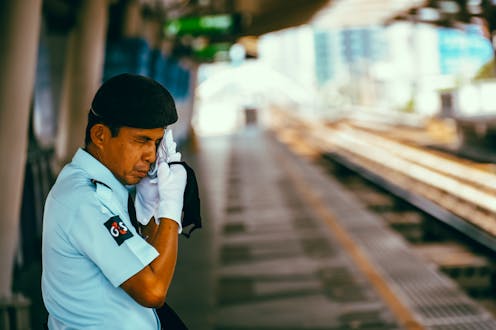
Phew: heat plus humidity can make Bangkok an uncomfortable place in a heatwave. Pavel V.Khon/SHutterstock
This year, even before the northern hemisphere hot season began, temperature records were being shattered. Spain for instance saw temperatures in April (38.8°C) that would be out of the ordinary even at the peak of summer. South and south-east Asia in particular were hammered by a very persistent heatwave, and all-time record temperatures were experienced in countries such as Vietnam and Thailand (44°C and 45°C respectively). In Singapore, the more modest record was also broken, as temperatures hit 37°C. And in China, Shanghai just recorded its highest May temperature for over a century at 36.7°C.
We know that climate change makes these temperatures more likely, but also that heatwaves of similar magnitudes can have very different impacts depending on factors like humidity or how prepared an area is for extreme heat. So, how does a humid country like Vietnam cope with a 44°C heatwave, and how does it compare with dry heat, or a less hot heatwave in even-more-humid Singapore?
Weather and physiology
The recent heatwave in south-east Asia may well be remembered for its level of heat-induced stress on the body. Heat stress is mostly caused by temperature, but other weather-related factors such as humidity, radiation and wind are also important.
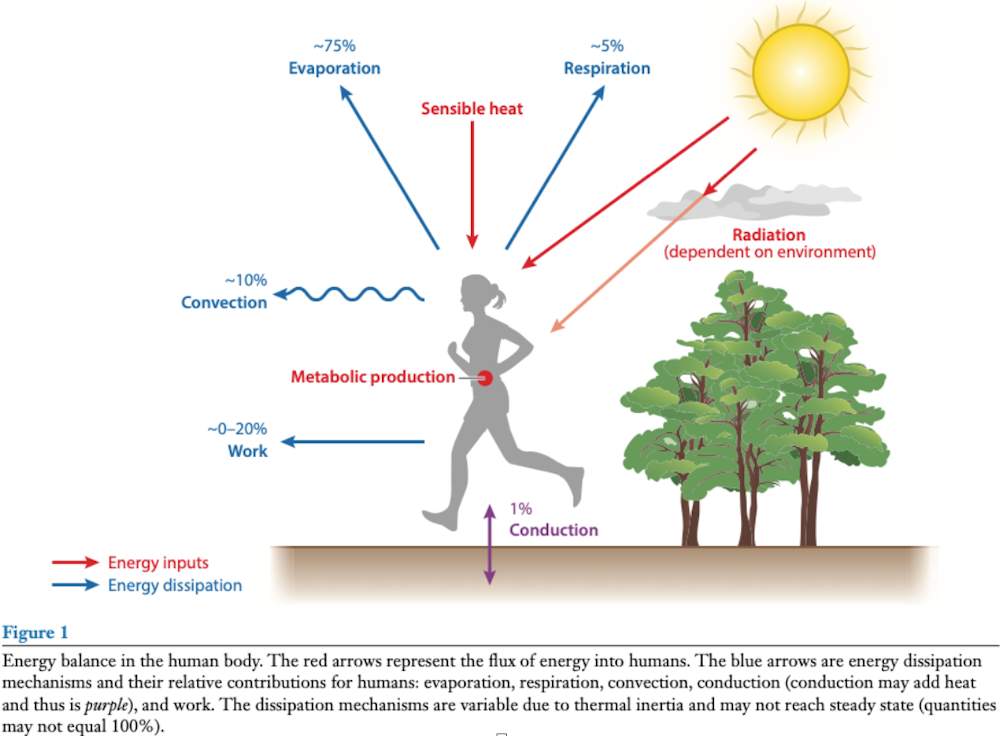
Our bodies gain heat from the air around us, from the sun, or from our own internal processes such as digestion and exercise. In response to this, our bodies must lose some heat. Some of this we lose directly to the air around us and some through breathing. But most heat is lost through sweating, as when the sweat on the surface of our skin evaporates it takes in energy from our skin and the air around us in the form of latent heat.
Meteorological factors affect all this. For example, being deprived of shade exposes the body to heat from direct sunlight, while higher humidity means that the rate of evaporation from our skin will decrease.
It’s this humidity that meant the recent heatwave in south-east Asia was so dangerous, as it’s already an extremely humid part of the world.
The limit of heat stress
Underlying health conditions and other personal circumstances can lead to some people being more vulnerable to heat stress. Yet heat stress can reach a limit above which all humans, even those who are not obviously vulnerable to heat risk – that is, people who are fit, healthy and well acclimatised – simply cannot survive even at a moderate level of exertion.
One way to assess heat stress is the so-called Wet Bulb Globe Temperature. In full sun conditions, that is approximately equivalent to 39°C in temperature combined with 50% relative humidity. This limit will likely have been exceeded in some places in the recent heatwave across south-east Asia.
In less humid places far from the tropics, the humidity and thus the wet bulb temperature and danger will be much lower. Spain’s heatwave in April with maximum temperatures of 38.8°C had WBGT values of “only” around 30°C, the 2022 heatwave in the UK, when temperatures exceeded 40°C, had a humidity of less than 20% and WBGT values of around 32°C.
Two of us (Eunice and Dann) were part of a team who recently used climate data to map heat stress around the world. The research highlighted regions most at risk of exceeding these thresholds, with literal hotspots including India and Pakistan, south-east Asia, the Arabian peninsula, equatorial Africa, equatorial South America and Australia. In these regions, heat stress thresholds are exceeded with increased frequency with greater global warming.
In reality, most people are already vulnerable well below the survivability thresholds, which is why we can see large death tolls in significantly cooler heat waves. Furthermore, these global analyses often do not capture some very localised extremes caused by microclimate processes. For example a certain neighbourhood in a city might trap heat more efficiently than its surroundings, or might be ventilated by a cool sea breeze, or be in the “rain shadow” of a local hill, making it less humid.
Variability and acclimatisation
The tropics typically have less variable temperatures. For example, Singapore sits almost on the equator and its daily maximum is about 32°C year round, while a typical maximum in London in mid summer is just 24°C. Yet London has a higher record temperature (40°C vs 37°C in Singapore).
Given that regions such as south-east Asia consistently have high heat stress already, perhaps that suggests that people will be well acclimatised to deal with heat. Initial reporting suggests the intense heat stress of the recent heatwave lead to surprisingly few direct deaths – but accurate reporting of deaths from indirect causes is not yet available.
On the other hand, due to the relative stability in year-round warmth, perhaps there is less preparedness for the large swings in temperature associated with the recent heatwave. Given that it is not unreasonable, even in the absence of climate change, that natural weather variability can produce significant heatwaves that break local records by several degrees Celsius, even nearing a physiological limit might be a very risky line to tread.
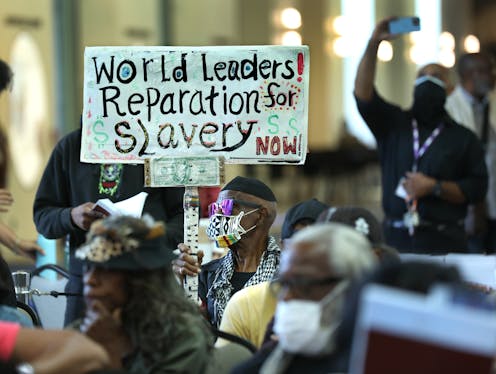
The debate about reparations to descendants of enslaved people rages on.
In California, the state’s reparations task force has estimated that the descendants of former enslaved people living in California should receive a payment of $1.2 million per person.
While the issue of reparations is nothing new, California Governor Gavin Newsome created the task force in 2020 and called for it to offer solutions to the “structural racism and bias built into and permeating throughout our democratic and economic institutions.”
So far, Newsome has remained quiet on his task force’s recommendations and is awaiting its final report, expected on July 1, 2023.
Several scholars of U.S. slavery and the history of reparations have written articles explaining what the ongoing debate has been about since the idea first emerged after the Civil War. Here we spotlight four examples of those scholars’ work:
1. Despite gains, persistent racial gaps remain
While researching his book “Making Whole What Has Been Smashed,” John Torpey learned that the idea of compensating freed slaves or their descendants has never really gained much traction in the United States.
A driving force behind the persistence of reparations talk is just how stark the racial differences remain, Torpey wrote.
Compared to whites, Torpey explained, “blacks tend to have lower educational attainment, rates of home ownership and life expectancy but higher rates of poverty, incarceration, unemployment and life-threatening diseases.”
As a result, the wealth gap between whites and Blacks remains very large, Torpey noted, “and wage inequality is likely making it worse.”
Anne Bailey has researched slavery for the past three decades and has concluded that there are many rationales for reparations.
For one, Bailey wrote, “There has never been a leveling of the playing field, or payments for the debt of unpaid labor over 250 years of slavery.”
Furthermore, she explained, Black contribution to the wealth of America has not been acknowledged or given its due.
“Paying reparations to Americans of African descent could help the U.S. reclaim some moral leadership on the global stage,” Bailey wrote. “The U.S. is not the only country in the world with human rights abuses then or now, but it can be one of the few countries in the world that truly addresses these wrongs.”
In other words, Bailey concluded, the U.S. can lead by example.
As a professor of public policy who has studied reparations, Thomas Craemer estimates the losses from unpaid wages and lost inheritances to Black descendants of the enslaved in America at around US$20 trillion in 2021 dollars.
“But what often gets forgotten by those who oppose reparations is that payouts for slavery have been made before,” Craemer wrote . “But those payments went to former slave owners and their descendants, not the enslaved or their legal heirs.”
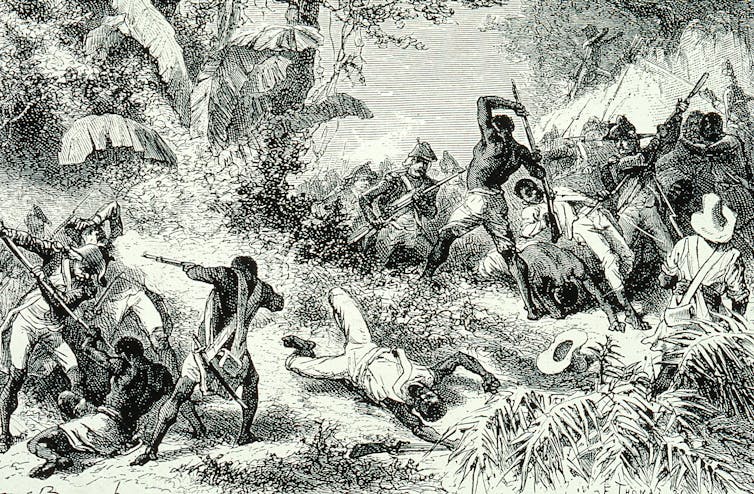
A prominent example is the so-called “Haitian Independence Debt” that burdened an independent Haiti with reparation payments to former slave owners in France. Another was the British government, which paid reparations totaling the equivalent of about $429 billion in 2021 to slave owners when it abolished slavery in 1833.
In the U.S., President Abraham Lincoln signed into law the “Act for the Release of certain Persons held to Service or Labor within the District of Columbia” on April 16, 1862.
It gave former slave owners $300 per enslaved person set free.
The act also provided for an emigration incentive of $100 – around $2,683 in 2021 dollars – if the former enslaved person agreed to permanently leave the United States.
In contrast,“ Craemer wrote, "the formerly enslaved received nothing if they decided to stay in the United States.”
As a professor of political science who studies the relationship between democracy, citizenship and justice, Bernd Reiter has examined how Germany dealt with the horrors of the Holocaust.
Instead of seeking to erase the Holocaust from its history, the German government has paid since the end of World War II the equivalent of $7 billion for Israel and $1 billion for the World Jewish Congress, an international federation of Jewish communities and organizations.
“The German government has worked hard to ensure remembrance, penance, recompense and justice,” Reiter wrote. “The United States, in contrast, has no official policy of atoning for slavery.”
by Conor Barker, Assistant Professor, Department of Psychology & Faculty of Education, Mount Saint Vincent University
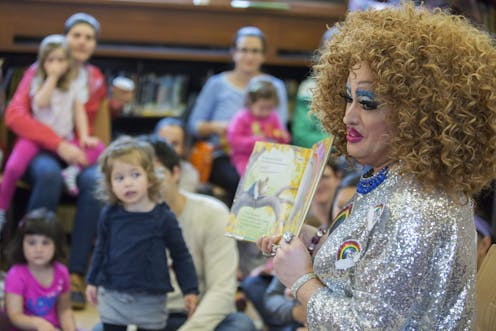
Contrary to misconceptions, exposing children to diverse expressions of gender identity supports their natural development and fosters inclusivity. (AP Photo/Mary Altaffer)
Recent news reports have described the public controversy involving topics of sexual orientation and gender identity, and how these are presented to children, especially in schools and libraries. Protests at Ontario, British Columbia, Alberta and New Brunswick libraries and public centres have targeted Drag Queen Story Time events.
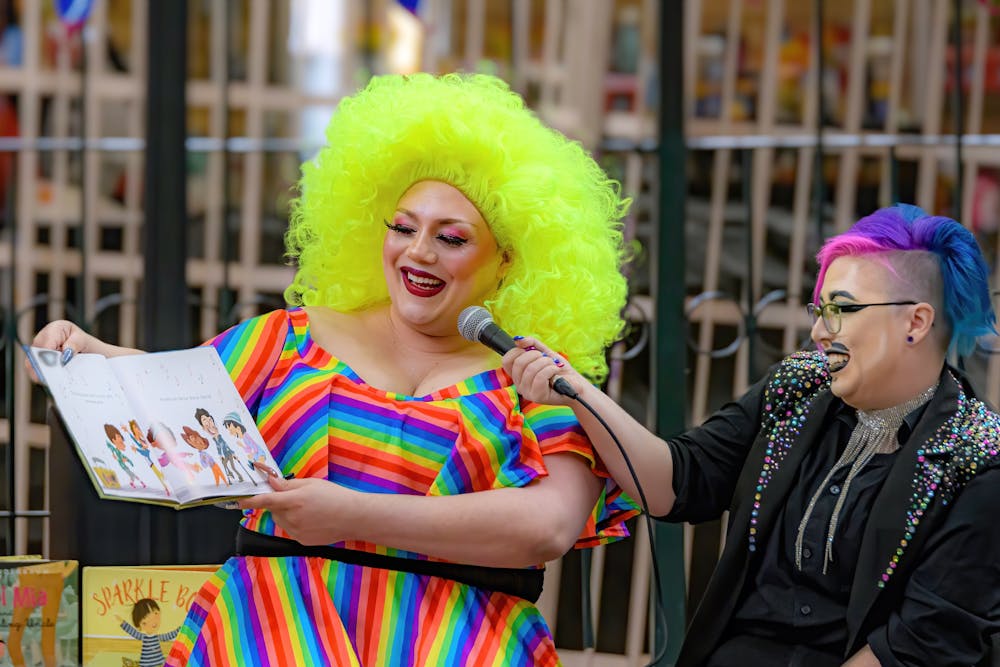
These are educational events where drag performers read books to children. The aim is to present the diversity of gender expression and identity, build acceptance and develop creativity in personal expression.
Through our research and clinical practice working with children, parents and schools, we believe parents and kids deserve a better understanding of what events like drag story times are about.
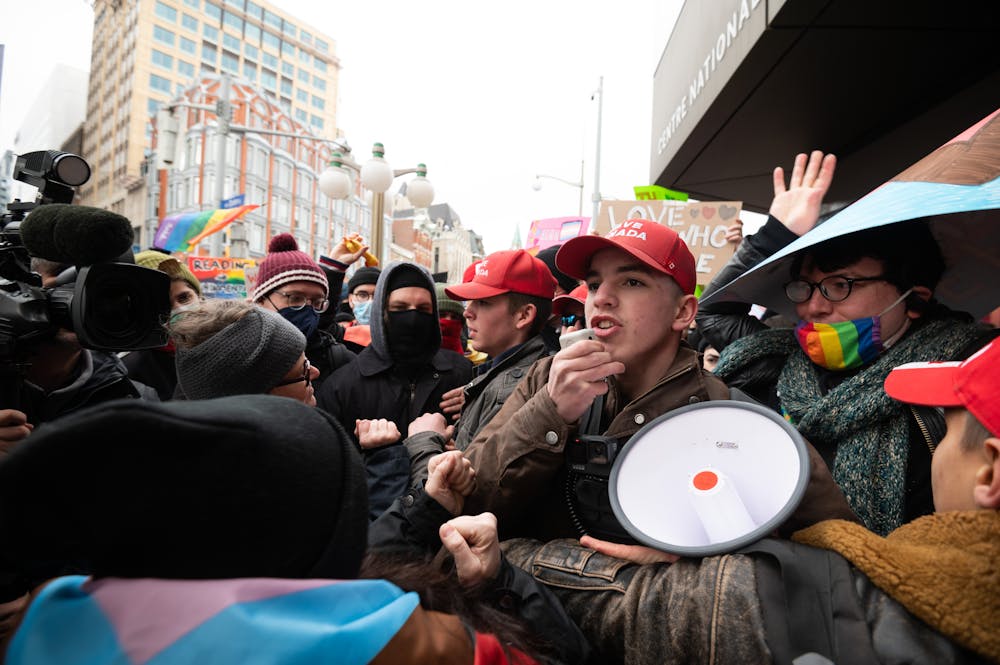
People protesting against a drag story time event clash with counter-protesters outside the National Arts Centre in Ottawa on Feb. 8, 2023.
THE CANADIAN PRESS/Spencer Colby
A drag performance combines elements of fashion, makeup, dance, lip-syncing, music and comedy. It is important to remember that, like other forms of art, it is available on a wide spectrum: from mature themes at a night club, to child-friendly performances that would be appropriate for schools, libraries and community centres.
What happens at a Drag Queen Story Time?
Drag Queen Story Time began in San Francisco in 2015. The events generally occur in public spaces like libraries, schools or community centres, with a drag queen host. Children most often attend with their families, parents and teachers. While the host adheres to the flamboyant art form in terms of colours and fashion, it is not a mature performance with sexualized overtones. Neither is it an opportunity for the host to groom children.
The development of gender identities in children is a complex process. It is influenced by a combination of factors, including biological, social, cognitive, environment and personal exploration. Children eventually develop a relative clarity of their gender and feel a sense of harmony between the complex factors that contribute to gender identity development.
People who are successful and positive role models are characterized as being competent and easily relatable. Such role models provide context for children to gain a better understanding of themselves and others. Further, adolescents whose gender or sexual identity is accepted by their parents experience fewer psychological problems compared to those whose parents are less accepting.
How can parents engage with Drag Queen Story Time?
Engaging with drag performers is an opportunity for parents to show their children that diversity is beautiful and worthy of celebration. Parents can foster engagement through communication and understanding of their own emotions and their child’s emotions. Being in tune with these emotional components helps ensure children are in an environment that supports positive development and growth.
Attending family-friendly drag events with children creates opportunities for discussion and reflection. Parents can think about and reflect on their own development of gender identity and expression, what influenced the choices they’ve made, and how this may impact the choices that their children may make. After Drag Queen Story Time, parents are sure to have important conversations with their children that will not only increase their understanding of self-identity, but of identities of others as well.
The authors do not work for, consult, own shares in or receive funding from any company or organization that would benefit from this article, and have disclosed no relevant affiliations beyond their academic appointment.
Illinois has effectively banned banning books, passing a law that mandates local libraries follow the American Library Association's rules if they wish to receive state funding.
Presidential hopeful Ron DeSantis' campaign of fear and discrimination in Florida is driving teachers out of the state. In the school district where one teacher recently became the focus of a state Department of Education investigation for showing kids a Disney film that happens to include a gay character, a recent school board meeting erupted:
As the cost of energy continues to rise, many consumers are turning to solar as away to save money and reduce their environmental impact. Installing solar panels on your roof can be a great investment. It can help you reduce your energy expense and your reliance on the grid. But it’s also important to be aware of the hidden fees that can increase the cost of your solar system. One of these fees is the dealer fee, which is charged by some lenders in the solar industry. In this blog post, we’ll discuss what a dealer fee is, why you should care about it, and how to avoid it.
What is a dealer fee?
A dealer fee is a fee that lenders charge solar installers to sell their loans or financing options. These fees can currently range from 20% to 40% which inflates the cost of solar for the consumer and is sometimes hidden in the price quote that you get from the installer! Installers are not required to pass this fee on to the consumer, but they often do so rather than eating the cost themselves and reducing their profit margin. As a result, you may end up paying more for your solar system without even realizing it.
Why should you care about dealer fees?
Dealer fees can significantly increase the cost of your solar system. If you’re financing your solar installation, the dealer fee will be added to the total cost of your loan. This means you’ll end up paying interest on this fee over the life of your loan. This can add up thousands of dollars over the life of your solar system. Furthermore, dealer fees are often hidden or not disclosed by the installer or the lender, which means you may not even be aware of the additional cost until it’s too late.
How can you avoid dealer fees?
The best way to avoid dealer fees is to work with a reputable solar installer that is transparent about their pricing and financing options. Ask your installer if they charge a dealer fee and if so, how much it is. If the fee is significant, consider working with a different installer or financing company that does not charge dealer fees. Places like Climate First Bank provide loans without dealer fees.
To summarize, dealer fees are a hidden cost that can significantly increase the cost of your solar system. As a consumer, it’s important to be aware of these fees and to work with a transparent installer. By doing so, you can ensure that you’re getting the best possible value for your investment in solar energy.
You can check out some of the best cultural artifacts Tampa Bay has to offer at the Tampa Museum of Art. And now, with Art on the House, the museum is making it easier for people to experience their collections. Now, every Thursday, admission prices become pay-as-you-will at the Tampa Museum of Art.
What is Art on the House?
Every Thursday from 4 to 8 p.m., the Tampa Museum of Art will offer Art on the House. This is where admission prices change to pay-as-you-will, and visitors choose whatever admission price they want to pay. You can bring your family and celebrate 100 years of art in Tampa with exhibitions that emphasize ancient, modern, and contemporary art.
How to do this? Just walk up to the Welcome Desk and tell the Visitor Experience and Engagement Representatives the admission price want to pay for your visit to the museum.
The museum is home to a vast collection of modern and contemporary art. As well as exhibitions from local, national, and international artists. The museum’s permanent collection features over 8,000 works of art, including paintings, sculptures, and photographs. One of the highlights of the museum is its impressive collection of ancient Greek and Roman artifacts. This exhibit includes sculptures, pottery, and jewelry.
The Tampa Museum of Art also offers educational programs, workshops, and events for visitors of all ages. With its stunning architecture, diverse collection, and engaging programs, the Tampa Museum of Art is a must-visit destination for art enthusiasts and cultural enthusiasts alike.
Since the start of the COVID-19 Pandemic in 2020, Florida paused its audits of the Medicaid rolls to ensure that no one lost coverage during a national emergency. But those audits resumed in April and 900,000 Floridians are expected to be deemed no longer eligible for Medicaid and could be dropped from its rolls.
Hillsborough County’s “best kept secret” offers a solution–the Hillsborough County Health Care Plan, which includes primary care, specialty care, emergency care, inpatient hospitalization, dental, pharmacy and vision at no cost to those who qualify.
Who Qualifies for Free Healthcare in Hillsborough?
To qualify for the county plan, applicants must meet the following criteria:
Live in Hillsborough County
Be ineligible for Medicaid or lost Medicaid coverage.
Have an income of at or below 175% of the federal poverty guidelines
Those who qualify include people who may work multiple part-time jobs or whose employers do not offer health insurance. It can also help those who have aged out of their parents’ insurance plan.
“I recently described it as the county’s best-kept secret,” said Philip Conti. He’s the Health Care Services Manager for Hillsborough County. And it is a program unique to Hillsborough County. Some 30 years ago, voters approved a half-penny sales tax to fund the health care program. “People back then really did have the best interest of the citizens of this county in mind,” Conti said.
For every purchase made in the county, a half penny goes into the health care plan trust fund.
Currently, 14,904 people use the Hillsborough County Health Care Plan. With the Medicaid audit likely to boot 250,000 county residents from its rolls, Conti expects the local program to take on many more clients.
“Minimum wage in this state is $11.50 and even if you are working full time for that amount, you can qualify for this program,” Conti said.
Getting people to go to a doctor
Most of those now enrolled are single and over 40 years old, he said. “Young people tend to think they are indestructible. But we are trying to get them signed up and used to going to a primary care physician.”
In many instances, experts say, those who find themselves in with no health insurance will fail to visit a doctor when it is necessary. Or they go to the emergency room, which puts a strain on resources. They may show up to the ER with a major health issue that could have been avoided had they been seeing a doctor regularly, Conti said.
Hillsborough County offers this coverage gap to avoid such situations. This gives residents a managed care program when they have limited income and assets.
All told the county’s program has assisted over 146,783 county residents. The problem is, not everyone knows about this plan, Conti said.
The program has recently expanded its eligibility criteria to include single people who make $1,980 or less each month.
Health care partners include the Tampa Family Health Centers, Suncoast Community Health Centers, Tampa General Medical Groups, and other providers and hospitals across Hillsborough County.
Those who enroll select a partnering provider health center convenient to their location and work with a medical doctor for their care. There are no copays or premiums.
Those who want to learn more can apply online or call and speak to a member services representative who can walk them through the application process. That number is 813-272-5040. For more information, send an email to HealthCareServicesInfo@HCFLGov.net.
El Niño typically means trouble for the Pacific and a break for the Atlantic coast and Caribbean. But while this climate phenomenon is highly likely to form this year, it isn’t a certainty before hurricane season ramps up this summer, and that makes it harder to know what might happen.
It’s also important to remember that even in quiet years, a single storm can cause enormous destruction.
As climate scientists, we study how climate patterns related to the frequency and intensity of hurricanes – information that is used to develop seasonal forecasts. Here is a quick look at how El Niño affects storms and why it tends to cause opposite effects in two basins separated only by a narrow stretch of land.
A tale of two basins
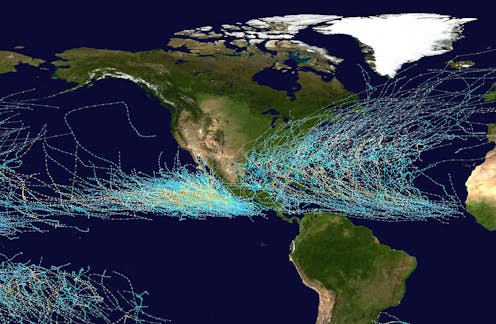
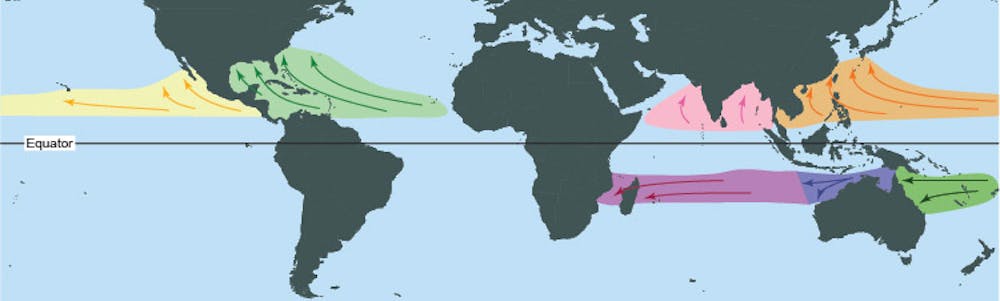
It’s helpful to start by visualizing where tropical storms develop in each ocean.
In the North Atlantic, tropical storms typically form over the warm waters off eastern Africa. As they move westward, they often hit Caribbean islands before making landfall on the U.S. Gulf Coast and Eastern Seaboard, or they curve off into the Atlantic.
In the eastern North Pacific, tropical storms tend to form closer to land, between Mexico and Clipperton Island off Central America. They typically move to the northwest before turning westward out to sea, sometimes inundating the Mexican coast known as the Mexican Riviera. Longer-tracked Pacific storms that move into the central Pacific can affect shipping and hit Hawaii, as Hurricane Lane did in 2018.
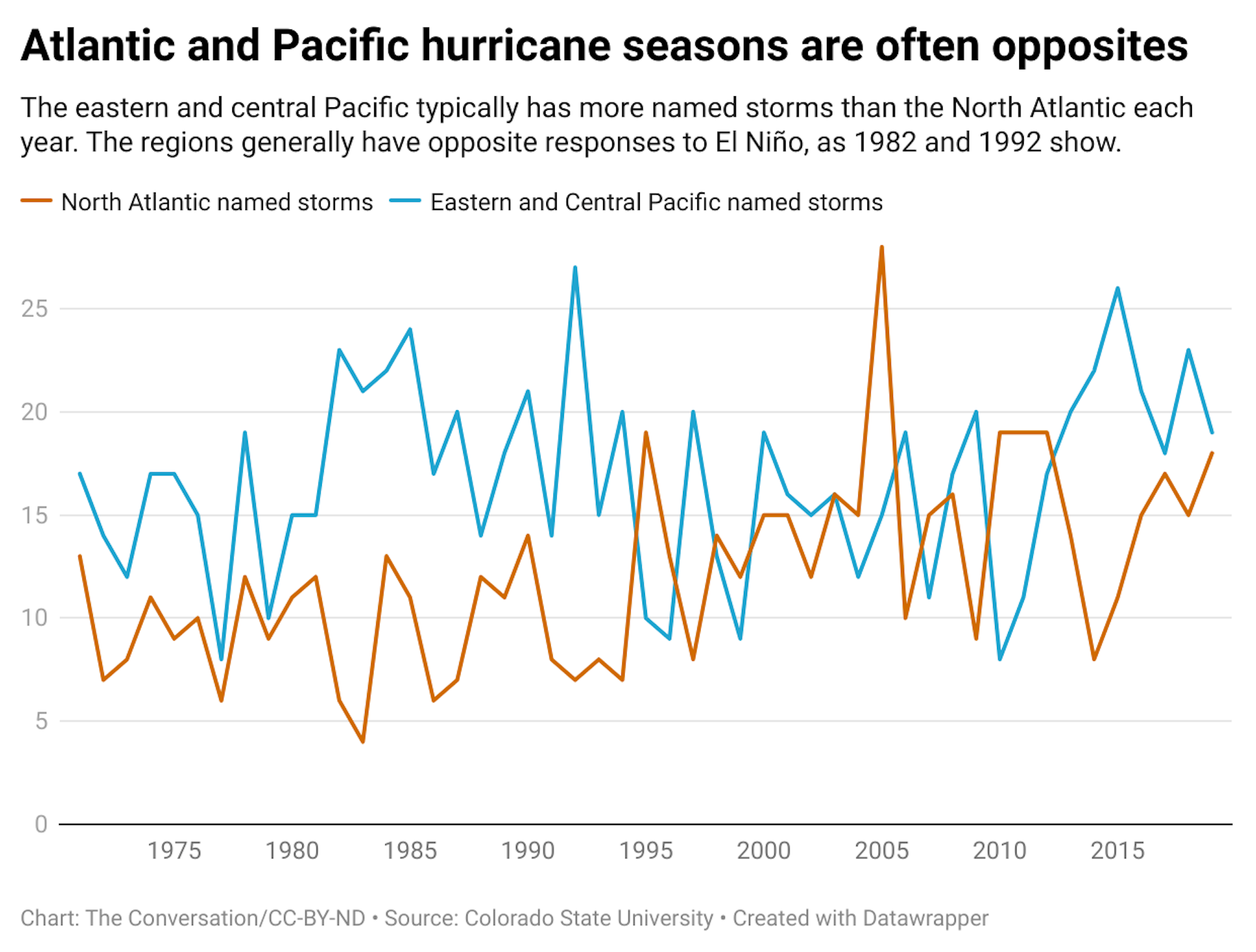
While the Atlantic gets the most attention, largely because it gets more damage with more people and property in the way, the Pacific tends to get more storms, especially during El Niño years. It’s often a seesaw pattern, with a busy year in one basin and a quieter season in the other.
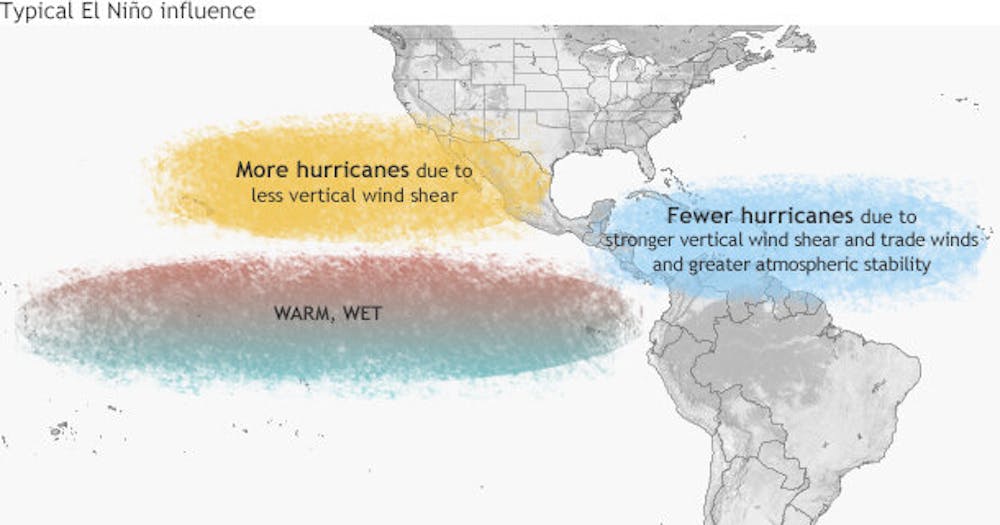
During El Niño, the trade winds that blow from east to west weaken, allowing warm ocean water to build up at the equator, west of South America. This causes a shift in the jet streams – strong upper-level winds – which affects rainfall and temperature patterns.
In the Atlantic Ocean, El Niño causes an area of low pressure in the upper atmosphere known as a trough and stronger upper-level winds, resulting in increased vertical wind shear – a change in wind speed or direction with height in the atmosphere. Wind shear can tilt and stabilize storms, allowing fewer hurricanes to form.
Conversely, El Niño typically causes an upper-level ridge, or area of high pressure, and decreased vertical wind shear in the eastern North Pacific basin, and often results in an active hurricane season.
La Niña – El Niño’s opposite, with cooler water in the tropical Pacific – reverses this pattern. The record 2020 and destructive 2021 Atlantic hurricane seasons were both during strong La Niña years.
On longer time scales, the Atlantic Multidecadal Oscillation, a fluctuation of North Atlantic sea surface temperatures, affects hurricane activity in cycles that span several decades. The AMO’s current warm phase, which began in 1995, has hosted seven of the 10 busiest Atlantic hurricane seasons. Hurricane activity often lessens in a cool phase of the AMO, during which the Atlantic is on average about 1 degree Fahrenheit (0.6 Celsius) cooler.
Who faces the greatest risk in the Pacific?
El Niño also changes who is at risk in the Pacific.
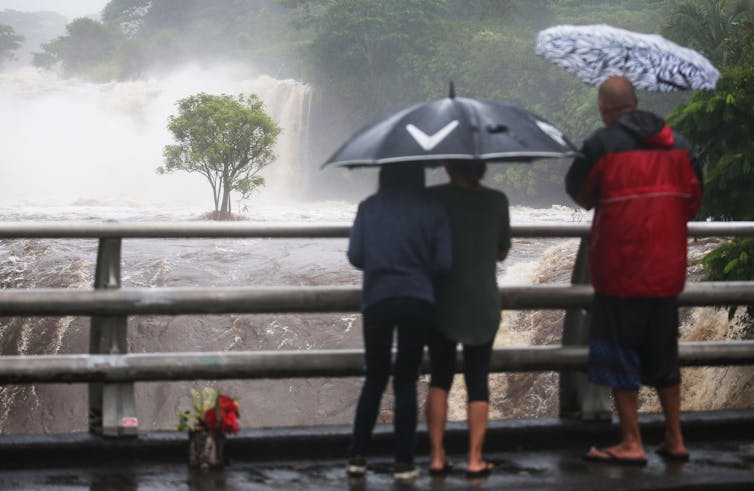
Hurricane Lane brought more than a foot of rain and flash flooding to Hawaii in 2018.
Mario Tama/Getty Images
The highly destructive Hurricanes Manuel in 2013 and Willa in 2018 show the immense impact Pacific storms can have in the region. Both triggered widespread flooding and mudslides in Mexico, and together led to over 125 deaths. In Hawaii, Hurricane Iniki’s storm surge and winds in 1992 destroyed over 1,400 homes on Kauai and damaged thousands more.
El Niño years also increase the viability of storms affecting the southwestern U.S. In 1997, multiple storms affected California and Arizona, including some that moved into the region after landfall in Mexico. Famously, in 2014, rough surf and swells associated with Hurricane Marie caused over US$16 million in damage at the Port of Long Beach.
Why 2023 hurricane forecasts are so uncertain
Forecasting the 2023 hurricane seasons is proving to be challenging for another reason: The Atlantic has abnormally warm sea surface temperatures this year, and that can power hurricanes – if storms are able to form.
Will the warm waters of the Atlantic overcome the unfavorable conditions brought by the El Niño? We’ll soon know.
The eastern Pacific hurricane season started May 15, and the Atlantic season starts June 1, with both running through Nov. 30.
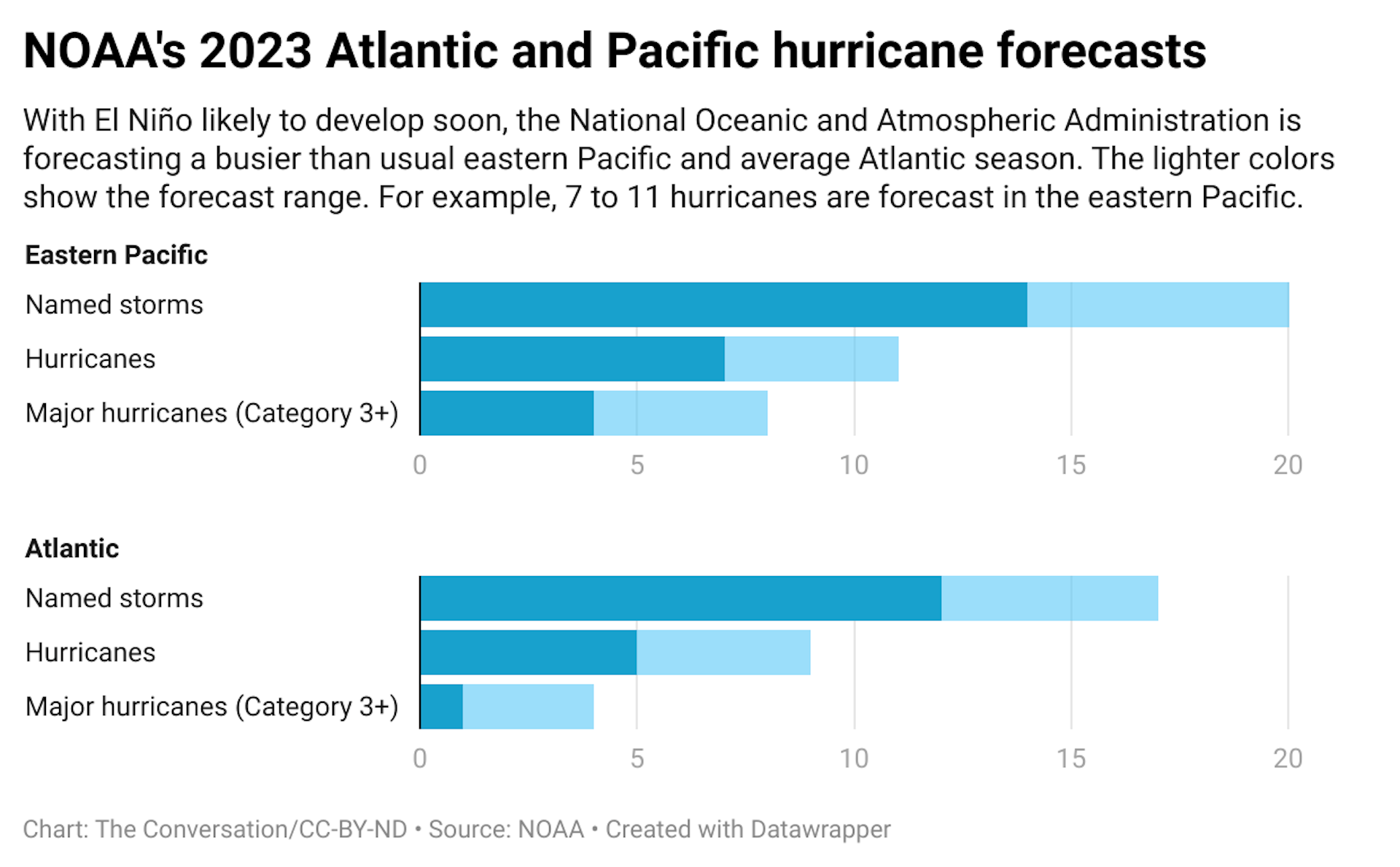
In its 2023 Atlantic hurricane outlook released in late May, the National Oceanic and Atmospheric Administration forecast 12 to 17 named storms, five to nine hurricanes and one to four major hurricanes. In the eastern Pacific, NOAA forecasts 14 to 20 named storms, seven to 11 hurricanes and four to eight major hurricanes. For the central Pacific, including Hawaii, NOAA’s forecast includes four to seven cyclones, also above or close to average.
Surprisingly, the Atlantic has already seen its first storm of the year – a storm in January was recently classified as a subtropical cyclone. This is rare. Our research shows the median date of the first named tropical cyclone is May 30 in the Pacific and June 20 in the Atlantic, though Atlantic storms have been occurring, on average, earlier each year. We should expect the next named Atlantic and Pacific storms – Arlene and Adrian, respectively – in the coming weeks.
This article was updated May 25, 2023, with the central Pacific forecast.
Kelsey Ellis receives funding from the National Oceanic and Atmospheric Administration and the National Science Foundation.
Nicholas Grondin does not work for, consult, own shares in or receive funding from any company or organization that would benefit from this article, and has disclosed no relevant affiliations beyond their academic appointment.
by Beauvais Lyons, Chancellor’s Professor of Art, University of Tennessee
Henry Darger worked as a hospital custodian. After his death in 1973, hundreds of his illustrations were discovered. Brooklyn Taxidermy/flickr, CC BY
Vernacular art is a genre of visual art made by artists who are usually self-taught. They tend to work outside of art academies and commercial galleries, which have traditionally been the purview of white, affluent artists and collectors.
In the U.S., vernacular art – which can also be called folk art or outsider art – is dominated by the works of African American, Appalachian and working-class people. In many cases these artists took up making paintings, sculptures, quilts or textiles outside of a day job, or later in life.
Awareness and recognition of this genre has grown over the past few decades, with the Smithsonian Museum of American Art in Washington, D.C.; the American Visionary Art Museum in Baltimore; Atlanta’s High Museum; and the Milwaukee Art Museum building significant collections.
Art history as artist history
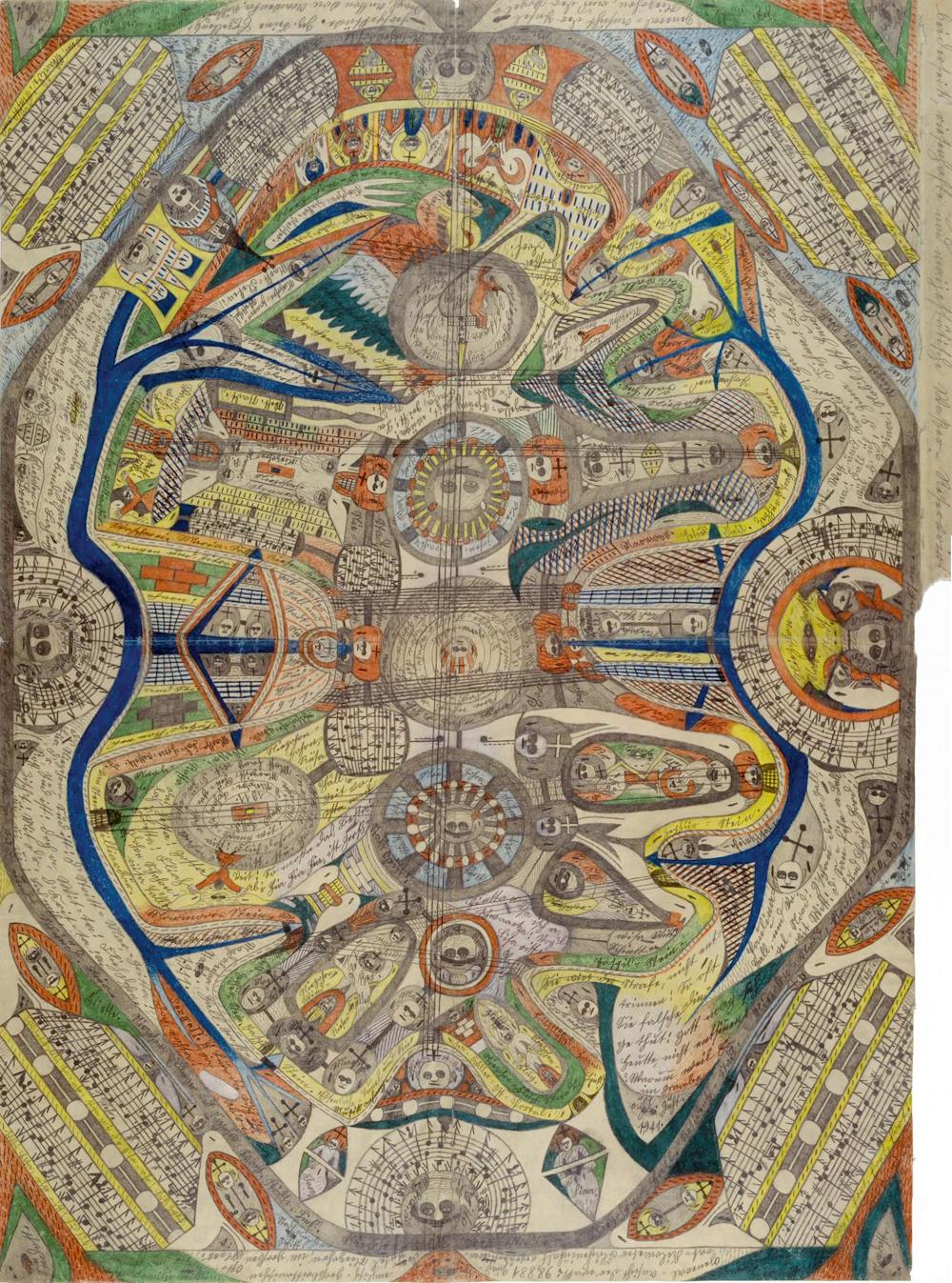
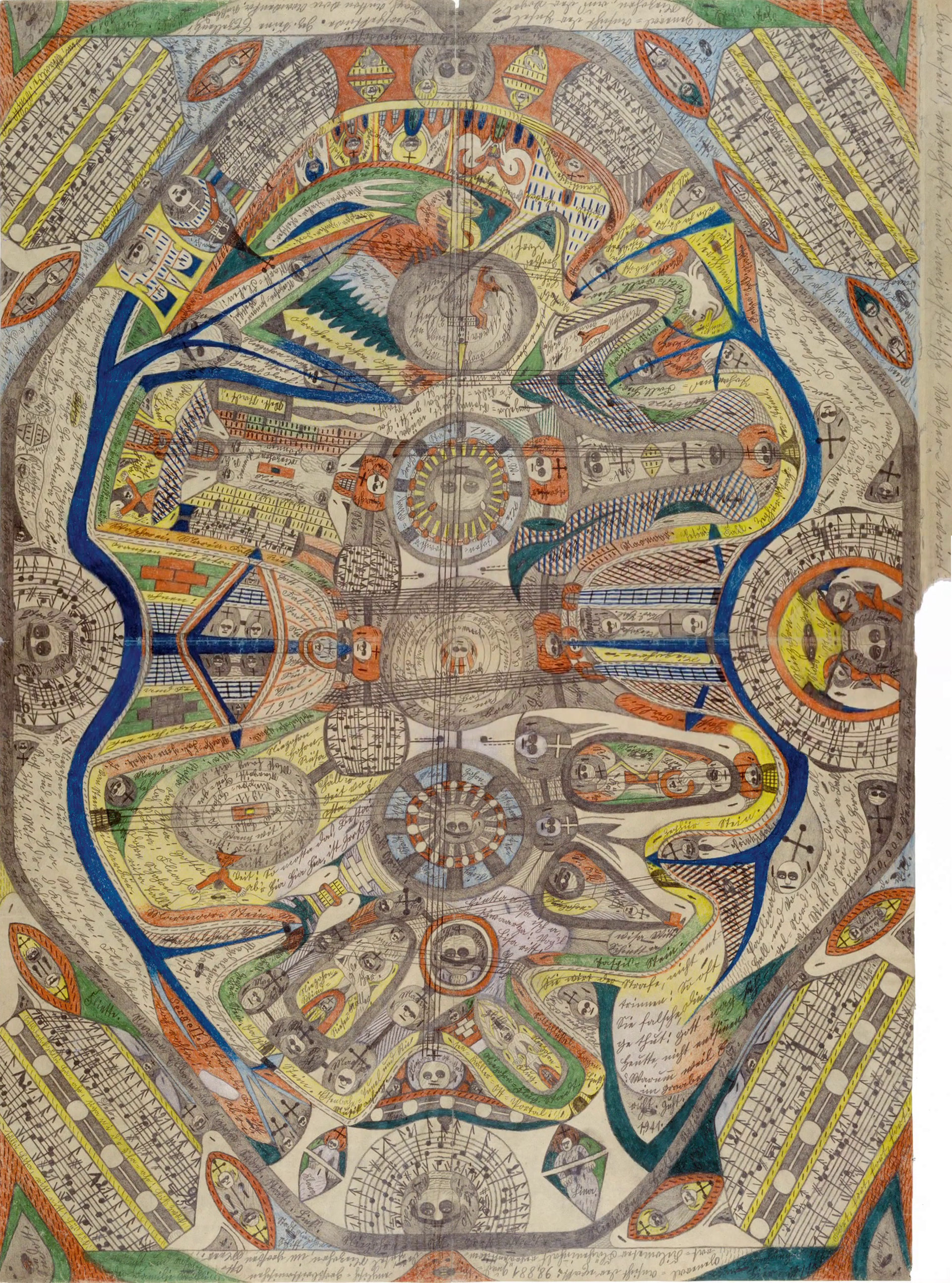
Adolf Wölfli’s ‘General view of the island Neveranger’ (1911).
Wikimedia Commons
In the 1940s, the French artist Jean Dubuffet came up with the term “art brut,” which translates as “raw art,” to describe art made by mental patients, prisoners or children. The drawings of Adolf Wölfli, who died in 1930, inspired Dubuffet’s term.
Wölfli was a patient with schizophrenia in a mental hospital in Bern, Switzerland, who was given pencils and paper as a form of therapy. Working mostly in pencil, Wölfli created elaborate drawings with decorative borders that included symbols, letters and his own system of musical notation.
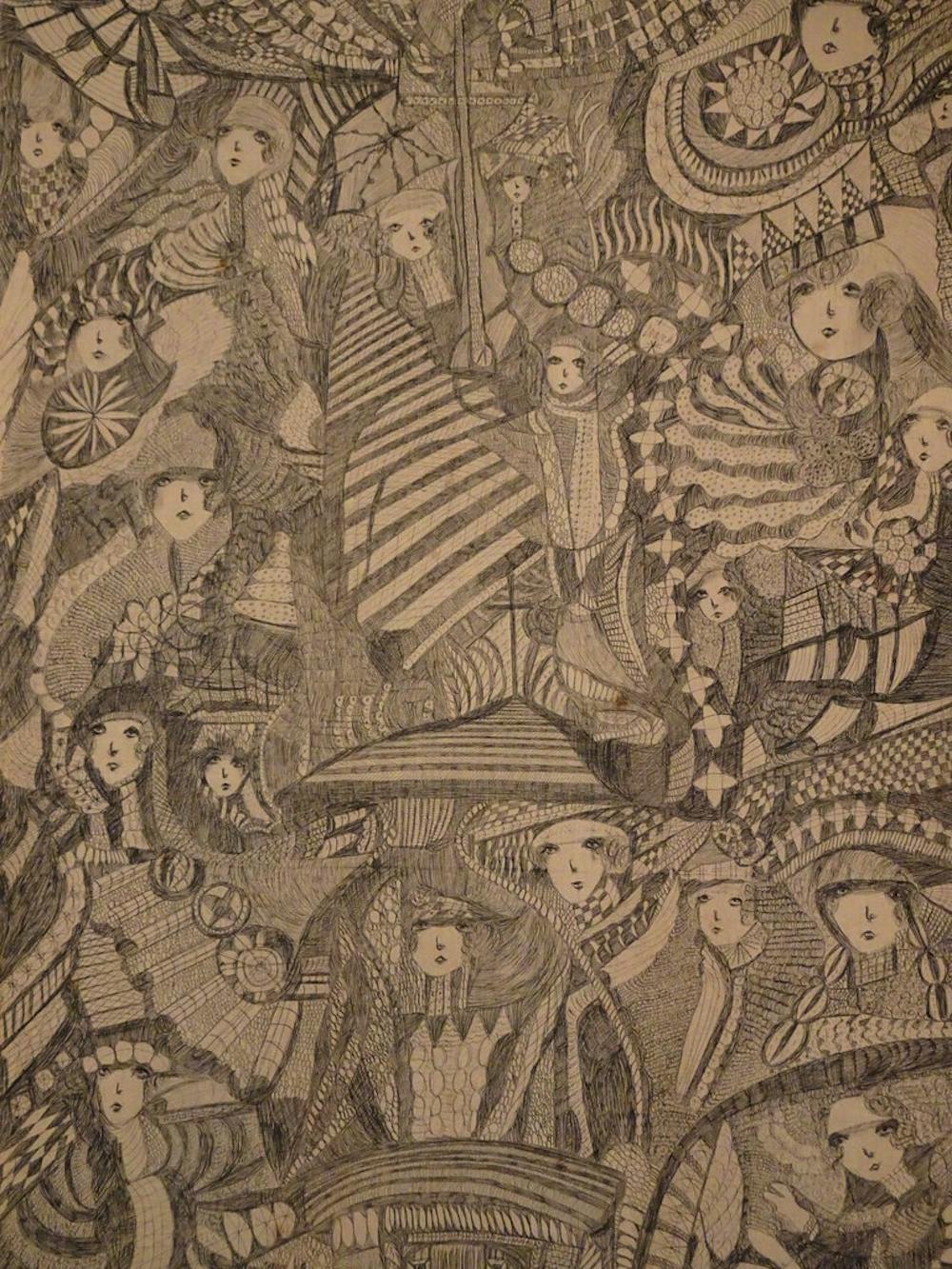
In an effort to promote this genre, in 1972 the British art historian Roger Cardinal advanced the term “outsider art” to expand the canon and include more artists, such as Madge Gill, who died in 1961. Gill, a British self-taught artist who spent much of her childhood in an orphanage, started making highly patterned drawings at the age of 38, claiming to compose the works while communicating with spirits.
In his 2004 book “Everyday Genius: Self-Taught Art and Culture of Authenticity,” sociologist Gary Allen Fine explains that a common facet of vernacular art is an emphasis on the artist’s biography: their personal, family and employment history. Fine observed that to collectors and dealers, these stories seemed to imbue the art with more meaning – and value. Some curators have argued that vernacular art should be included in exhibitions of contemporary art and not merely exist in its own siloed category.
But the relationship between vernacular artists and their promoters can be complicated.
As the sale of Tolson’s work shows, when huge sums of money enter the picture, the line between appreciation and exploitation gets blurred.
Why vernacular art matters
Vernacular art extends the artistic canon in the same way that folk music reflects broader traditions of expression. It reminds everyone that art is a universal human pursuit.
As the late Chris Strachwitz, the founder of Arhoulie Records, has pointed out, Black traditions of blues and roots music were not formally taught but were passed down from one generation to the next in local communities.
Similarly, the architect Robert Venturi promoted vernacular architecture in his 1972 book “Learning from Las Vegas.” In it, he highlighted the ways that Las Vegas casinos and hotels were designed to accommodate the automobile and were meant to be seen as symbols, with massive, outlandish signs – an approach that most schools of architecture would have scoffed at. In doing so, Venturi ushered in more playful forms of architecture.
Concepts of authenticity are central to the appeal of vernacular art. Fine art and culture can sometimes be esoteric and exclusionary, and in a time when artificial intelligence has put authorship in question, vernacular art has even more resonance. It is made by the artists’ hands, using common materials, in ways that reflect their own unique life and artistic visions.
This work represents a pre-digital form of expression, accessible to anyone, that showcases what it means to be resourceful, creative and human.
Nellie Mae Rowe wasn’t able to pursue her artistic ambitions until she was in her late 60s.
I once created a traveling exhibition of fictive folk art as a parody of the genre.
Idaho, Montana and Florida, all red states, had the greatest population growth among U.S. states between 2020 and 2022. Meanwhile, New York and Illinois, both blue states, and Louisiana, a red state, suffered the biggest population losses. California, another blue state, has experienced significant recent population loss as well.
One key reason for this migration is the high cost of living in places like New York and California, compared with the lower cost of living in red states such as Georgia or Indiana.
I am a scholar who studies the intersection between politics, media and psychology. I think it is important to note that another trend, though, is that people are largely migrating to places with lower life expectancies.
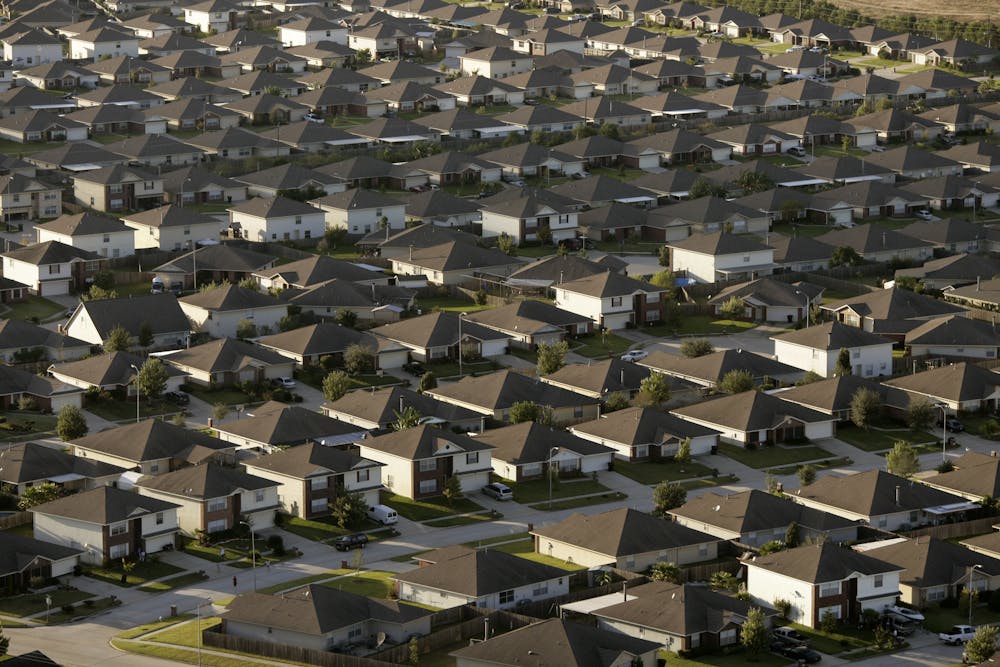
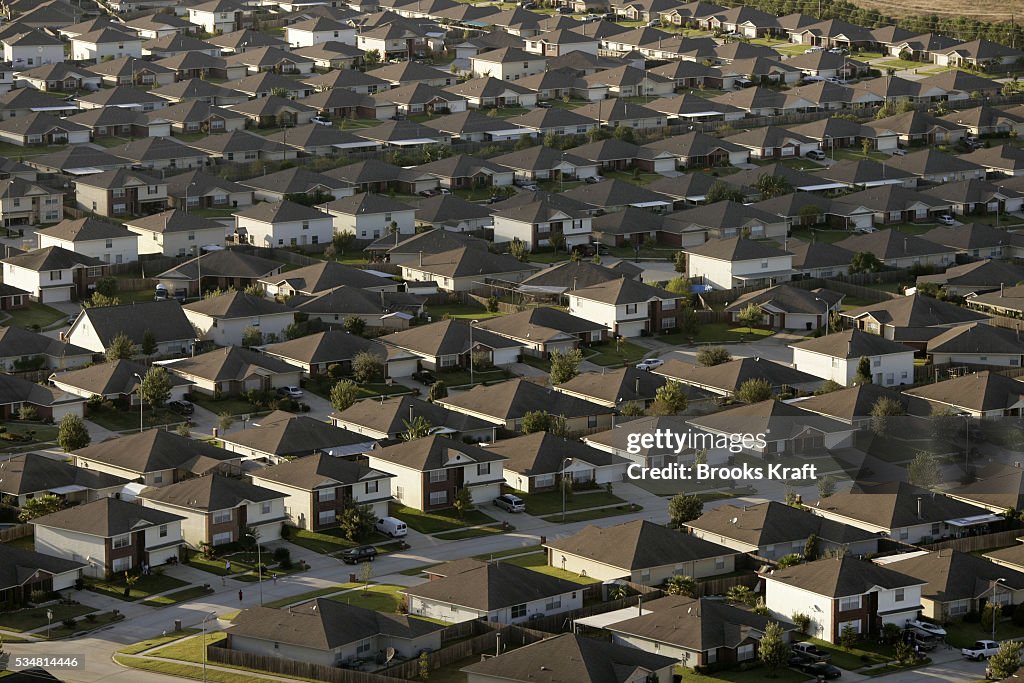
An aerial view of a new housing development in Houston, Texas, which has experienced significant population growth in recent years.
Brooks Kraft LLC/Corbis via Getty Images
For instance, people born in New York and California – two of the richest states in the country, which largely vote Democratic – have a life expectancy of 77.7 and 79 years, respectively. But people in Mississippi and Louisiana – two of the poorest states, which tend to vote Republican – live, on average, until they are 71.9 and 73.1 years old.
Poverty is an indicator for life expectancies in the U.S. – the poorer someone is, the more likely to die younger.
But there are likely other issues at play in people in red states’ having lower life spans.
Health differences
Research in 2020 showed that Americans in blue states tend to live longer than people in red states, primarily because of state policies on everything from seat belt laws to abortion laws. That research also identified health policies as a major factor.
Moreover, when looking at the rates of people who are diagnosed with cancer in each state, it is clear that people in red states are generally less healthy than people in blue ones. Red-state residents are also more likely to die from heart disease than people in blue states.
But health rates vary greatly across racial and ethnic groups. Black and Hispanic people are far more likely than white and Asian people in the U.S. to not have access to quality affordable health care, regardless of their state of residence.
Another key factor in this life span trend is that people in red states have lower levels of education than people in blue states.
This matters, since some recent research has shown that education levels are the best predictor of a person’s life span for a variety of complex, interconnected reasons, including an increased likelihood that receiving a higher education will lead to a boost in income.
Experts also often consider race and ethnicity another major factor, in part because of structural inequalities facing people of color that may place access to quality affordable education out of reach, for example.
Lack of education may be the most direct reason for lower incomes and shorter lives – but it is not clear if attaining a higher level of education makes people wealthier, or if people who are born into wealth receive more and better education.
Are people moving to die young?
There are other reasons that factor into the complex question of life expectancy, and discrepancies in longevity across states.
One reason identified by the Centers for Disease Control and Prevention, for example, is that there are more gun deaths – by homicide and suicide – in red states than blue states.
People are moving to different states in the U.S. for a variety of reasons – including, in some cases, political ideologies. While blue ZIP codes have been found to be getting bluer, red ones are becoming even more red.
But it is important to keep in mind that data on life spans and health are simply averages, and so there can be a high variation within particular locations.
Thee are people in red and blue states who defy these statistics – many people living long lives in poor red states, and people dying younger in rich blue ones.
Still, the overall trends are clear. People living in blue states – by and large – tend to live longer, healthier and wealthier lives.
Robert Samuels does not work for, consult, own shares in or receive funding from any company or organization that would benefit from this article, and has disclosed no relevant affiliations beyond their academic appointment.
by Ouidad Yousfi, Associate Professor of Finance, Université de Montpellier
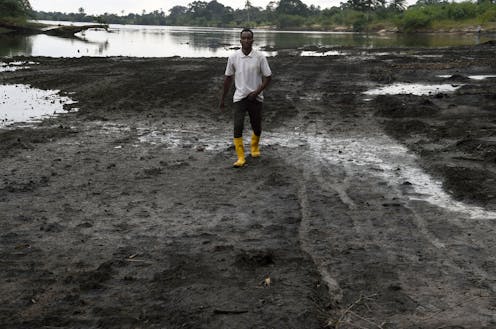
A farmer walks on a marshy shore of a river polluted by oil spills in Nigeria’s Niger delta, region. Pius Utomi Ekpei/ AFP
Companies implement corporate social responsibility (CSR) as a way to present an environmentally responsible image and therefore gain legitimacy in the eyes of their stakeholders. But some companies don’t actually live up to their claims.
Some businesses claim to be doing good for the environment, but don’t. Often they undertake green projects only for marketing purposes or to brand their products. Or they do only what legislation and stakeholder pressure force them to.
But others use CSR to achieve long-term competitive advantages. They see these “sustainable strategies” as a core part of their overall corporate strategy. They align their social commitments with their business objectives. They commit to responsible business practices that reduce their carbon footprint and minimise negative environmental impact.
To understand better the strategic corporate social responsibility, we analysed relevant studies and theories on CSR strategies. We concluded that companies disclose positive communication while they undertake irresponsible practices. We distinguish two types of CSR strategies:
those introduced to cope with environmental and social legislation and the stakeholders’ pressure (responsive CSR); and
strategies considering CSR as a differentiation process aligning social, environmental and financial performances.
In a second study, we examined how corporate lobbying could help businesses overcome their irresponsible actions and improve their CSR strategy, specifically after a greenwashing scandal. We explained how this type of incident could bring opportunities to meet stakeholders’ calls for action and how lobbying could drive a cleaner market image.
The energy sector is among the biggest polluters in the world. It produced 73.2% of global greenhouse gas emissions in 2016.
We found that energy companies used CSR projects to mask their environmentally destructive practices. They also misled the public about environmental achievements – a practice referred to as greenwashing. The studies also set out why, and how, civil society can play an active role in promoting sustainable practices.
The studies
Based on a survey of the literature reviewing different methodologies of more than 100 studies, we conclude that it is frequent that businesses in different sectors use elementary strategies to comply with social and environmental regulations. They aim to gain legitimacy in the stakeholders’ eyes without making corporate social responsibility a cornerstone of their overall strategy.
Secondly, the studies address how ambiguous claims, sophisticated euphemisms, or pure lies have become frequent in business communication specifically on sustainable and corporate social responsibility activities.
Thirdly, the studies explain how companies accused of greenwashing (misleading the public about environmental achievements) could use the scandals to rethink their social and environmental strategies and introduce effective changes.
Misleading information
Energy companies in 55 countries are committed to the Paris Agreement and a net-zero emission world, aiming at keeping global heating under 1.5℃. But a US congressional investigation that analysed 200 pages of internal corporate memos found oil giants such as Shell, Chevron and ExxonMobil were paying lip service to the agreement.
We can read, for instance:
Shell has no immediate plans to move to a net-zero emissions portfolio over our investment horizon of 10-20 years.
According to Richard Wiles, president of the Centre for Climate Integrity, these revelations are
the latest evidence that oil giants keep lying about their commitments to solve the climate crisis and should never be trusted by policymakers.
However, we also argue that there are negative as well as potential positive outcomes from greenwashing.
Negatives and positives
The negative effects of greenwashing, such as misleading and manipulating consumers, avoiding concrete actions and blocking green transition, can be significant.
The continuous exposure to green claims inspired by superficial green branding can shape and establish new social norms. And research has found that, greenwashing can ultimately undermine the establishment of sustainable social norms by eroding trust and credibility in green claims.
But there’s the potential for companies to use a negative situation as an opportunity to initiate positive changes. This is particularly the case when stakeholders, policy and market makers and researchers raise awareness of these practices. Consumers can call for more transparency and hold companies more accountable when they misbehave.
The 2015 Volkswagen case is instructive. The US government found “irregularities” in tests measuring carbon dioxide emissions levels affecting thousands of cars produced by the German company. The settlement with the US Environmental Protection Agency pushed the company to invest in electric vehicle infrastructure and technology. Volkswagen has subsequently become a key player in the electric vehicle market.
The public commitment made by companies can also inspire employees to work towards these goals and help to establish a standard for corporate sustainability.
Role of civil society
The outcomes of greenwashing can be heavily influenced by civil society.
In February 2023, the international NGO Global Witness accused one of the largest oil company, Shell, of misleading the US authorities and investors on its green transition. In our study, we conclude that
when consumers become aware of socially irresponsible behaviour, their positive identification of the company is interrupted.
Shell disclosed in its 2021 annual report that 12% of its capital expenditure was dedicated to the development of renewable and green energy solutions. However, only 1.5% was used to develop solar and wind sources and power plants. Global Witness found that the company was undertaking climate-wrecking gas projects.
This is not a unique scandal in which Shell is involved.
A Dutch court in 2021 found Shell’s subsidiary responsible for the oil spills between 2004 and 2007 in Nigeria. It ordered the company to pay compensation to the four Nigerian farmers who initiated the lawsuit. Shell’s reputation was severely impaired.
The company has pledged to compensate the Nigerian farmers with €15 million and install a leak detection system.
Shell also partnered with an environmental activist think tank, British Cycling to deliver a green image and enhance the acceptance and desirability of its products and services. But, very quickly, British Cycling was accused of greenwashing.
Ordinary citizens have been part of the increase in greenwashing awareness. For instance, they have launched many environmental “name and shame” campaigns against giants. In July 2020, misleading communication by Air France about its CO₂-neutral flights was retweeted multiple times.
Next steps
A carbon footprint can only be evaluated if the consequences and emissions associated with a range of technologies are taken into account. These range from raw material extraction to disposal or recycling. Many renewable energy technologies still rely to some extent on fossil fuels. It is essential to continuously improve their sustainability and efficiency to achieve a low carbon future.
Many businesses are taking advantage of this complexity and marketing to greenwash their business models without making significant changes.
To combat this, the following is needed:
transparency
effective regulation
monitoring
a genuine and proactive environmental approach to corporate and social responsibility projects.
The authors do not work for, consult, own shares in or receive funding from any company or organisation that would benefit from this article, and have disclosed no relevant affiliations beyond their academic appointment.
These Ron DeSantis Florida school book bans have have somehow gotten even more outrageous, offensive, cruel, and ridiculous. A Florida elementary school has banned its students from reading Amanda Gorman's poem The Hills We Climb, recited at Joe Biden's presidential inauguration ceremony in 2021, as well as three other books. — Read the rest
Calling all plant lovers! The USF Botanical Gardens, already a remarkable gem in the Tampa area, will host its annual plant festival on June 24. The event runs from 10am-3pm and admission is just $5. This is your chance to experience the stunning landscape first established in Tampa in 1969.
In addition to basking in the glory of the gardens, there will be ample vendors selling plants and plant-related items for those with a green thumb. Commercial growers and local clubs from throughout the state will be in attendance and totally available to field any and all plant-related questions.
USF Botanical Gardens spans 16 acres and 3,000 plants
The USF Botanical Gardens is part of the College of Arts and Sciences’ ECORE (Environmental and Conservation Outreach, Research, and Education) System. The ECORE System brings the Botanical Gardens, the Forest Preserve, and Geopark under one leadership team to better serve faculty, student, and community needs.
In all, it consists of 16 acres of gardens and greenbelt on the Tampa campus of USF and maintains a living collection of more than 3,000 plants, animals and natural habitats. The Gardens serve as an important outreach component of the University that attracts thousands of visitors annually. Plant festivals and other events bring enthusiasts from around the state to shop for rare and unusual plants. The Gardens also support ongoing research and serves as a living classroom for education.
A hub for education and conservation in Tampa
Studies in citrus greening, biology, engineering, and many more take place on site in the Research Park and classes from regenerative agriculture to botany are taught on site. There are many opportunities for researchers, teachers, student groups, and community members to get involved.
If you’d like to support the gardens, you can become a member/friend of the garden. Donations, and volunteer work help keep this lovely oasis glowing.
The USF Botanical Gardens is located on campus at 4202 E. Fowler Avenue. Event details are available on Facebook.
No one needs to tell Salman Rushdie about the cost of free speech.
In 1989, Rushdie’s novel “The Satanic Verses” triggered the ire of Iranian leader Ayatollah Ruhollah Khomeini, who called for the writer’s death.
Protests against Rushdie’s novel ignited violent attacks against bookstores across the world, and the book was later banned in such countries as Bangladesh, Sri Lanka and Sudan.
Even those safety precautions were not enough to prevent a nearly fatal attack on Rushdie in the summer of 2022 while he was on stage at a literary festival in western New York. Rushdie was stabbed repeatedly and eventually lost an eye.
In his first public appearance since the attack, on May 18, 2023, Rushdie, 75, accepted an award for his courage at the annual gala of PEN America, a nonprofit literary group that is in the middle of a fight in Florida over attempts to restrict access to books primarily involving race and LGBTQ+ identities.
During his brief speech, Rushdie said the attacks on books and teaching and even libraries have “never been more dangerous and never been more important to fight.”
“Terrorism must not terrorize us,” Rushdie said. “Violence must not deter us.”
Over the years, The Conversation U.S. has published numerous stories exploring the wave of attempts to ban certain books from public schools and how those attacks on free speech teeter on the edges of constitutionality – and potential violence. Here are three selections from those articles.
1. Outdated beliefs about how children read
Trisha Tucker teaches a class on banned books at the University of Southern California and explained that attempts to ban books are “frequently motivated by misapprehensions about how children consume and process literature.”
Research shows that children’s reading experiences are “complex and unpredictable.”
“Their interpretation of books is informed by their personal and cultural histories,” she wrote, “and those interpretations may change over time or when readers encounter the same stories in different contexts.”
2. A lack historical knowledge weakens a strong democracy
Since it began keeping tally in 2021, PEN America has counted more than 4,000 instances of book banning in the U.S.
Those banned books range from Toni Morrison’s “Beloved,” a fictional tale of freed enslaved people, to Anne Frank’s “Diary of a Young Girl”, a nonfiction account of a Jewish girl’s life under Nazi occupation.
Failing to teach about the Holocaust, for instance, “may rob students of such imperative lessons as how propaganda can mislead, grow and wreak havoc on democracy, as well as how societies and institutions can fall apart,” Dvir wrote.
It’s hard to definitively say whether the current incidents of book banning in schools are constitutional – or not.
First Amendment scholar Erica Goldberg explained the reason for the uncertainty is due to the courts’ analyzing decisions made in pubic schools differently than censorship in nongovernment contexts.
“Control over public education, in the words of the Supreme Court, is for the most part given to state and local authorities,” Goldberg wrote.
But not all is lost for those opposed to book bans in Florida and other U.S. states.
“Even though the government has discretion to control what’s taught in school,” Goldberg wrote, “the First Amendment ensures the right of free speech to those who want to protest what’s happening in schools.”
by Patrick Parenteau, Professor of Law Emeritus, Vermont Law & Graduate School
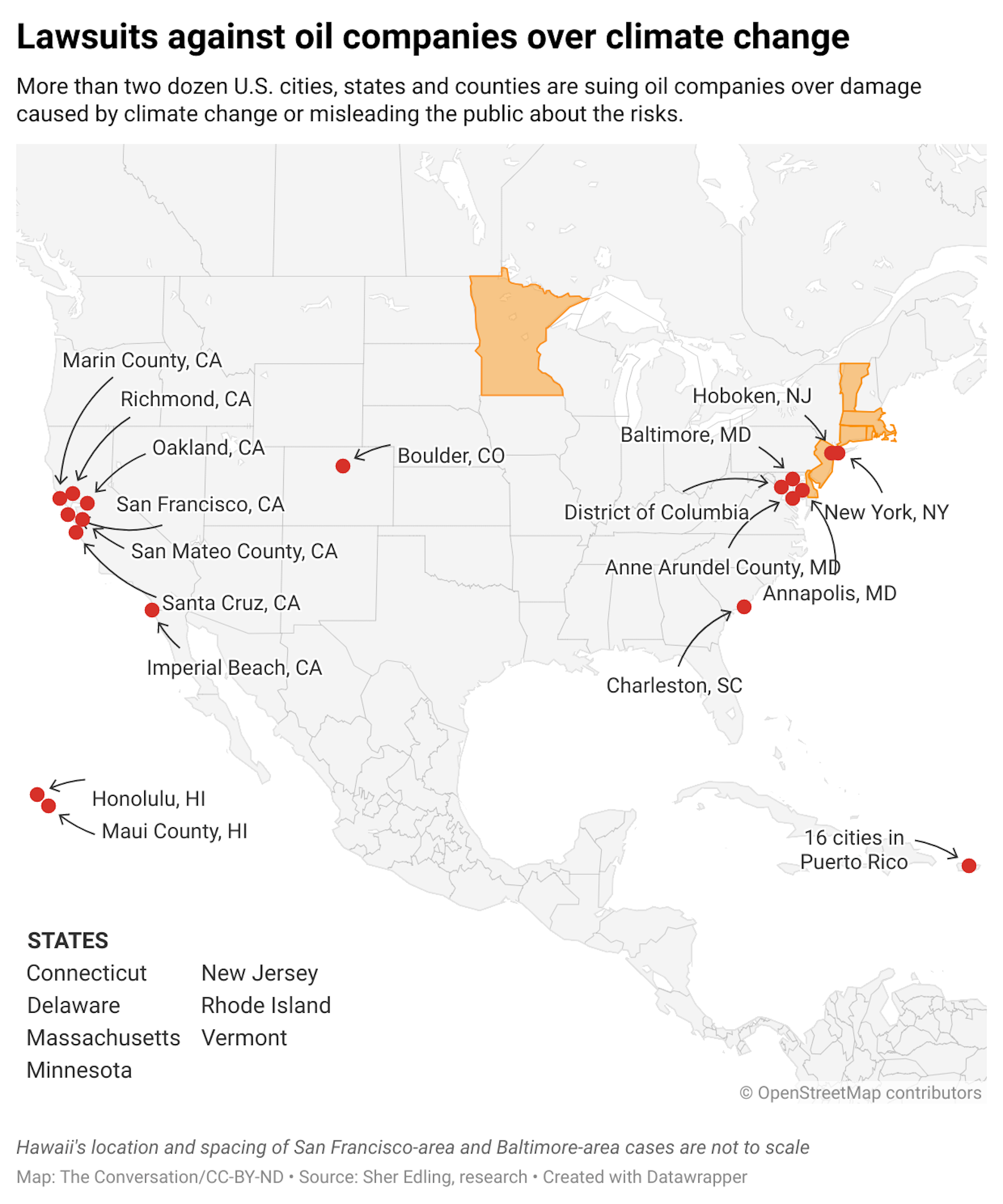
Honolulu has lost more than 5 miles of its famous beaches to sea level rise and storm surges. Sunny-day flooding during high tides makes many city roads impassable, and water mains for the public drinking water system are corroding from saltwater because of sea level rise.
The damage has left the city and county spending millions of dollars on repairs and infrastructure to try to adapt to the rising risks.
Future costs will almost certainly be higher. More than US$19 billion in property value, at today’s dollars, is at risk by 2100 from projected sea level rise, driven by greenhouse gas emissions largely from the burning of fossil fuels. Elsewhere in Honolulu County, which covers all of Oahu, many coastal communities will be cut off or uninhabitable.
Unwilling to have their taxpayers bear the full brunt of these costs, the city and county sued Sunoco LP, Exxon Mobil Corp. and other big oil companies in 2020.
At stake in all of these cases is who pays for the staggering cost of a changing climate.
Local and state governments that are suing want to hold the major oil companies responsible for the costs of responding to disasters that scientists are increasingly able to attribute to climate disruption and tie back to the fossil fuel industry. Several of the plaintiffs accuse the companies of lying to the public about their products’ risks in violation of state or local consumer protection laws that prohibit false advertising.
The governments in the Honolulu case allege that the oil companies “are directly responsible” for a substantial rise in carbon dioxide emissions that have been driving climate change. They say the companies should contribute their fair share to defray some of the costs.
The gist of Honolulu’s complaint is that the big oil companies have known for decades that their products cause climate change, yet their public statements continued to sow doubts about what was known, and they failed to warn their customers, investors and the public about the dangers posed by their products.
Were it not for this deception, the lawsuit says, the city and county would not be facing mounting costs of abating the damage from climate change.
Importantly, the complaint is based on state – not federal – law. It alleges that the defendants have violated established common law rules long recognized by the courts involving nuisance, failure to warn and trespass.
The city and county want the companies to help fund climate adaptation measures – everything from building seawalls and raising buildings to buying flood-prone properties and restoring beaches and dunes.
Supreme Court could have killed these cases
Not surprisingly, the oil companies have thrown their vast legal resources into fighting these cases.
On April 24, however, they lost one of their most powerful arguments.
The U.S. Supreme Court declined to hear challenges in the Hawaii case and four others involving the seemingly technical question of which court should hear these cases: state or federal.
The oil companies had “removed” the cases from state court to federal court, arguing that damage lawsuits for climate change go beyond the limits of state law and are governed by federal law.
That theory would have derailed all five cases – because there is no federal common law for greenhouse gases.
The court made that position clear in 2011 in American Electric Power Co. v. Connecticut. Several state and local governments had sued five major power companies for violating the federal common law of interstate nuisance and asked for a court order forcing these companies to reduce their emissions. The Supreme Court refused, holding that the federal Clean Air Act displaced federal common law for these gases.
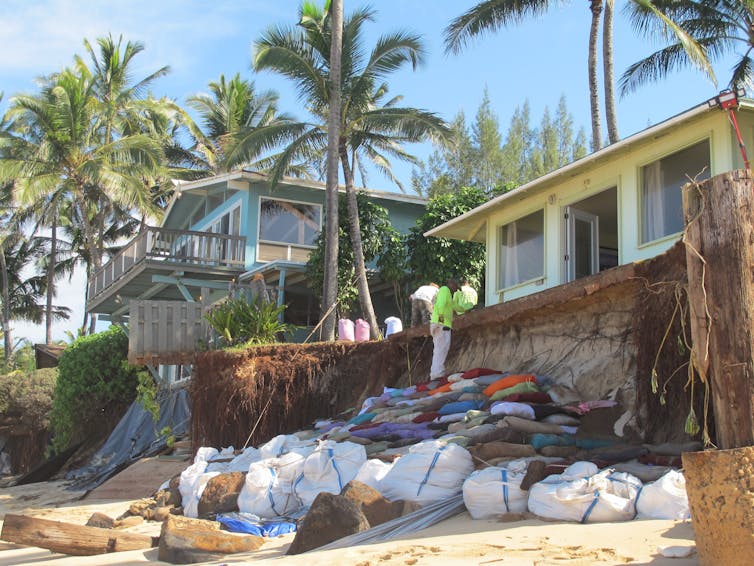
Several coastal communities, including in Honolulu County, facing increasing erosion want oil companies to help pay for protective infrastructure.
AP Photo/Audrey McAvoy
To avoid this fate, Honolulu and the other plaintiffs focused on violations of state law, not federal law. Without exception, the federal courts of appeals sided with them and sent the cases back to state court.
What happens next?
The Honolulu case leads the pack at this point.
In 2022, the 1st Circuit Court in Hawaii denied the oil companies’ motion to dismiss the case based on the argument that the Clean Air Act also preempts state common law. This could open the door for discovery to begin sometime this year.
In discovery, senior corporate officers – perhaps including former Exxon Mobil CEO Rex Tillerson, who was secretary of state under Donald Trump – will be required to answer questions under oath about what the companies knew about climate change versus what they disclosed to the public.
In 2019, former Exxon Mobil CEO Rex Tillerson testified in a securities fraud lawsuit brought by the New York attorney general’s office. The judge ruled in Exxon’s favor.
AP Photo/Seth Wenig
Evidence from Exxon documents, described in a recent study by science historians Naomi Oreskes and Geoffrey Supran, shows that the company’s own scientists “knew as much as academic and government scientists knew” about climate change going back decades. But instead of communicating what they knew, “Exxon worked to deny it,” Supran and Oreskes write. The company overemphasized uncertainties and cast doubt on climate models.
This is the kind of evidence that could sway a jury. The standard of proof in a civil case like Honolulu’s is “preponderance of the evidence,” which roughly translates to 51%. Ten of the 12 jurors must agree on a verdict.
Any verdict likely would be appealed, perhaps all the way to the U.S. Supreme Court, and it could be years before the Honolulu case is resolved.
Lawsuits don’t begin to cover the damage
It is unlikely that even substantial verdicts in these cases will come close to covering the full costs of damage from climate change.
According to the National Oceanic and Atmospheric Administration, in 2022 alone the U.S. sustained 18 weather and climate disasters that each exceeded $1 billion in damage. Together, they cost over $165 billion.
But for many of the communities most at risk from these disasters, every penny counts. We believe establishing the oil companies’ responsibility may also discourage further investments in fossil fuel production by banks and brokerage houses already nervous about the financial risks of climate disruption.
The authors do not work for, consult, own shares in or receive funding from any company or organization that would benefit from this article, and have disclosed no relevant affiliations beyond their academic appointment.
by Bethan Juliet Oake, PhD Candidate in the School Of Philosophy, Religion And History Of Science, University of Leeds
Satanic panic in the modern era: how conspiracy theories take hold in times of crisis. Canva
Earlier this year the non-binary singer-songwriter, Sam Smith, performed their song Unholy, at the Grammys. Dressed in a red devil-horned top hat and latex costume, the performance drew upon popular occult and gothic aesthetics. And it attracted a huge amount of criticism for the supposed promotion of satanic imagery.
Conspiracy theorists alleged that the performance was, in fact, a real, satanic ritual orchestrated by an elite cult of Hollywood satanists. Its supposed aim? To morally subvert society by brainwashing and indoctrinating young people.
Only a few months prior, a similar mass online panic had taken hold in the form of the Balenciaga scandal – with conspiracy theorists claiming that the fashion brand was secretly engaging in child trafficking and satanic ritual abuse.
This was after photographs for its latest campaign featured children holding teddy bear bags that appeared to be dressed in bondage fetish-wear.
These are just the latest in a string of satanic conspiracy theories, from the 2014 Hampstead hoax, which involved false allegations of a satanic paedophile ring operating out of a north London school, to the rise of the now infamous QAnon movement, where supporters believe that Satan-worshipping elites are trying to take over society.
Satanism scares
In the UK and further afield, there’s a long history of claims that secret, Satan-worshipping cults exist that ritualistically abuse and sacrifice children. Emerging in the form of moral panics known as “satanism scares”, it’s possible to trace these rumours and myths back to second-century Rome. Yet they really rose to prominence during the Middle Ages.
This satanic mythology has often been used as a way to demoniseJewish communities. In particular, they’ve often involved false allegations that Jewish people use the blood of non-Jewish – usually Christian – children for ritual purposes.
The European witch-hunts which happened during the 15th, 16th and 17th centuries also incorporated claims of devil-worship and child sacrifice.
Sam Smith at the 2023 Grammys.
While accusations of satanic abuse have repeatedly been found to be unsubstantiated and allegations debunked, these rumours and conspiracy theories can cause very real harm.
False satanic abuse allegations have resulted in harassment, death threats and online attacks. In one instance a child was kidnapped after a group falsely believed they were the victim of satanic ritual abuse. And there have even been death sentences (later overturned), in the case one 1990s murder trial in the US.
Indeed, satanism scares can be considered a form of witch-hunt. In the 1980s and 1990s there was a mass satanism scare in the US and UK which became known as the “satanic panic”.
This episode saw many people falsely accused, arrested and at times convicted of satanic abuse. To this day, courts are still working through exonerating those falsely accused.
In one case, a US couple spent 21 years in prison after being found guilty of satanic ritual abuse. Their conviction was eventually overturned due to the faulty witness testimony.
The most famous case was the McMartin preschool trial, which is still the longest-running and most expensive trial in US history. It followed false allegations that hundreds of children had been sexually abused and involved in satanic rituals at a California preschool. It led to fears that children and wider society were under attack from satanic forces.
The satanic panic gained momentum from religious TV channels, public authorities and perhaps most prominently from tabloid media. In both the US and the UK it built upon preexisting societal moral panics relating to cults and child abuse, as well as drawing upon existing homophobic narratives.
Today’s theories
Conspiracy theories appear to reemerge at times of crisis, such as the COVID pandemic and terror attacks. They are often used as a way to scapegoat specific groups considered responsible for widespread societal anxieties.
Satanic cult conspiracy theories today also integrate themselves within other conspiracy theories. Following the pandemic, anti-vax narratives and COVID-19 conspiracy theories are often incorporated.
They also incorporate “new world order” conspiracies, which are often explicitly antisemitic. These allege the existence of a powerful network of elites with a hidden, subversive satanic agenda.
While such allegations may appear far-fetched – and it may be difficult to understand how people can believe in them – at their core, satanism scares centre around two very common enemies: Satan and child abusers. In this sense, they act as a kind of demonology blueprint.
Many people may first become involved with these theories because they have genuine concerns about child abuse or “cults”. But these initial concerns can then be manipulated by conspiracy theory rhetoric and online misinformation.
Beyond simply affecting those falsely accused, these conspiracy theories can also be emotionally damaging for those caught up in them and their families.
The image of satanism that these theories propose draws on sensationalised occult stereotypes along with horror aesthetics. It lumps them together with notions of witchcraft, satanism, the paranormal and ceremonial occultism to create an amalgamated image of evil.
This is important because ultimately, understanding the ways that “satanic panic” can piggyback off of and weaponise popular political and social issues is crucial in recognising and removing their harmful effects.
Bethan Juliet Oake receives funding from the Arts and Humanities Research Council (AHRC) via the White Rose College of the Arts & Humanities (WRoCAH).
They also reportedly used drones in 2019 to scan the treetops for the birds and their techniques reportedly returned "numerous images" of the woodpeckers.
It’s a summer activity only a Floridian could love. The Florida Fish and Wildlife Conservation Commission (FWC) is excited to announce the 2023 Lionfish Challenge. The Lionfish Challenge is a free summer-long lionfish tournament open to recreational and commercial competitors of all ages around the state of Florida. Even though it’s the eighth year for the Lionfish Challenge,the goal remains the same: remove as many lionfish as we can in just four months.
Are you up for the Challenge?
Frying up some lionfish. Courtesy FWC
Why lionfish?
Lionfish are an invasive species that have a potential negative impact on native wildlife and habitat. Although native to the Indo-Pacific and Red Sea, lionfish can be found year-round in Florida waters and from North Carolina to South America. They were first reported off the coast of Florida in the mid-1980s. Since then, their population has boomed.
Lionfish reproduce quickly, compete with native species for food and habitat and have no natural predators in the Gulf of Mexico. Rarely caught on hook-and-line, the most effective methods of removal are spearing and using a hand-held net. Care should be taken when spear fishing so that the spears do not impact and damage reefs.
Lionfish Challenge tournament details
The tournament will last from June 1 to October 1. Participants will compete in either the commercial or the recreational division with grand prizes to the top competitors in each division.
Prizes will be awarded in tiers as follows:
Tier 1- Harvest 25 lionfish (recreational category) or 50 pounds of lionfish (commercial category).
Tier 2- Harvest 75 lionfish (recreational category) or 250 pounds of lionfish (commercial category).
Tier 3- Harvest 250 lionfish (recreational category) or 500 pounds of lionfish (commercial category).
Tier 4- Harvest 500 lionfish (recreational category) or 1,000 pounds of lionfish (commercial category).
Some Reef Rangers! Courtesy FWC
FWC Reef Rangers
FWC encourages divers, anglers and commercial harvesters to remove lionfish in Florida waters to limit negative impacts to native marine life and ecosystems. They even have a group of citizens dedicated to educating the public about the lionfish invasion. Reef Rangers interact with other fishers and divers and encourage lionfish removal and outreach efforts. Anyone can become a Reef Ranger by participating in an FWC program.
This week, the World Health Organization (WHO) advised that “non-sugar sweeteners should not be used as a means of achieving weight control or reducing the risk of noncommunicable diseases” such as diabetes and heart disease.
Artificial sweeteners are either natural compounds or synthesised compounds that taste sweet like sugar – and are are up to 400 times sweeter by weight – but provide no or negligible energy. As a comparison, sugar has 17kj (or four calories) per gram, so one teaspoon of sugar would have 85 kilojoules.
Several types of artificial sweeteners are used in Australia. Some are synthetic, others are extracted from foods such as monk fruit and the stevia plant.
So, what do the new WHO guidelines mean for people who have switched to artificial sweeteners for health reasons? Should they just go back to sugar?
As a practising clinical dietitian in the 1990s, I remember when artificial sweeteners began to appear in processed foods. They were promoted as a way of substituting sugar into food products that may lead to weight loss.
A can of sugar-sweetened soft drink contains on average about 500kj. Theoretically, the substitution of one sugar-sweetened can of soft drink with an artificially sweetened can of soft drink every day would reduce your weight by about 1kg per month.
But research over the past few decades shows this doesn’t hold up.
What’s the new advice based on?
The WHO has based its recommendation on a systematic review it has conducted. Its objective was to provide evidence-based guidance on the use of artificial sweeteners in weight management and for disease prevention.
Weight management is important, given obesity increases the risk of diseases such as diabetes and certain types of cancer, which are the leading cause of death globally.
The WHO’s systematic review included data from different types of studies, which give us different information:
50 were randomised controlled trials (when scientists intervene and make changes – in this case to the diet – while keeping everything else constant, to see the impact of that change)
97 were prospective cohort studies (when scientists observe a risk factor in a large group of people over a period of time to see how it impacts an outcome – without intervening or make any changes)
47 were case-control studies (another type of observational study that follows and compares two groups of otherwise matched people, aside from the risk factor of interest).
Randomised controlled trials provide us with causal data, allowing us to say the intervention led to the change we saw.
Prospective cohort and case-control only give us associations or links. We can’t prove the risk factors led to a change in the outcomes – in this case, weight – because other risk factors that scientists haven’t considered could be responsible. But they give great clues about what might be happening, particularly if we can’t do a trial because it’s unethical or unsafe to give or withhold specific treatments.
The WHO review looked at different types of studies investigating artificial sweeteners.
Unsplash, CC BY
The WHO’s systematic review looked at body fatness, non-communicable diseases and death.
For body fatness, the randomised controlled trials showed those consuming more artificial sweeteners had slightly lower weight – an average of 0.71kg – than those consuming less or no artificial sweeteners.
But the cohort studies found higher intakes of artificial sweeteners were associated with a higher BMI, or body mass index (0.14 kg/m2) and a 76% increased likelihood of having obesity.
The prospective cohort studies showed for higher intakes of artificial sweetened beverages there was a 23% increase in the risk of type 2 diabetes. If artificial sweeteners were consumed as a tabletop item (that the consumer added to foods and drinks) there was a 34% increase in the risk of diabetes.
In people with diabetes, artificial sweeteners did not improve or worsen any clinical indicators used to monitor their diabetes such as fasting blood sugar or insulin levels.
Higher intakes of artificial sweeteners were associated with an increased risk of type 2 diabetes, cardiovascular disease and death in the long-term prospective observational studies that followed participants for an average of 13 years.
But artificial sweeteners were not associated with differences in overall cancer rates or premature death from cancer.
Overall, while the randomised controlled trials suggested slightly more weight loss in people who used artificial sweeteners, the observational studies found this group tended to have an increased risk of obesity and poorer health outcomes.
Does the review have any shortcomings?
The WHO’s advice has led to some criticism because the randomised controlled trials did show some weight loss benefit to using artificial sweeteners, albeit small.
However the WHO clearly states its advice is based on the multiple research designs, not just randomised controlled trials.
Additionally, the WHO assessed the quality of the studies in the review to be of “low or very low certainty”.
This advice is not suggesting artificial sweeteners are unsafe or should be banned. The WHO’s scientific review was not about chemical or safety issues.
So are we better off having sugar instead?
The answer is no.
In 2015, the WHO released guidelines on added sugar intake to reduce the risk of excess weight and obesity. Added sugars are found in processed and ultra-processed foods and drinks such as soft drinks, fruits drinks, sports drinks, chocolate and confectionery, flavoured yoghurt and muesli bars.
It recommended people consume no more 10% of total energy intake, which is about 50 grams (ten teaspoons), of sugar per day for an average adult who needs 8,700kj a day.
The WHO’s recommendation is in line with the Australian Dietary Guidelines, which recommends no more than three serves of discretionary foods per day, if you need the extra energy. However it’s best to get extra energy from the core food groups (grains, vegetable, fruit, dairy and protein group) rather than discretionary foods.
So if artificial and sugar in drinks are not advised for weight loss, what can you drink?
Some options include water, kombucha with no added sugar, tea or coffee. Soda and mineral water flavoured with a small amount of your favourite fruit juice are good substitutes.
Milk is also a good option, particularly if you’re not currently meeting you calcium requirements.
Evangeline Mantzioris is affiliated with Alliance for Research in Nutrition, Exercise and Activity (ARENA) at the University of South Australia. Evangeline Mantzioris has received funding from the National Health and Medical Research Council, and has been appointed to the National Health and Medical Research Council Dietary Guideline Expert Committee.
by Sarah O'Shea, Professor and Higher Education Researcher, Curtin University
Shutterstock
This article is part of our series on big ideas for the Universities Accord. The federal government is calling for ideas to “reshape and reimagine higher education, and set it up for the next decade and beyond”. A review team is due to finish a draft report in June and a final report in December 2023.
Decades of research shows how the higher education system has failed to give Australians a “fair go”. For example, young people in major cities are much more likely to have a university degree than those from regional or remote areas. This is despite an increase in overall university participation over the past 20 years.
The Albanese government says it is aware of such discrepancies. “Greater access and participation” for students from underrepresented backgrounds is one of seven key areas identified for the University Accord review.
But how can we move from good intentions to long-overdue change?
The accord review team can begin by making recommendations that prioritise five key ideas: address student poverty, make it easier to study near home, properly understand disadvantage, support teaching staff and help marginalised students get a job when they graduate.
1. Address student poverty
Many Australian university students experience devastating poverty. A 2017 Universities Australia survey found one in seven regularly go without food or other necessities. This pre-pandemic figure increased to almost one in five for those from lower income backgrounds.
We know the prospect of debt also deters some students from studying in the first place, particularly those from disadvantaged backgrounds.
Changes to course fees in 2021 under the Job-ready Graduates scheme mean some undergraduates are now accruing record levels of debt.
So poverty does not end with graduation. According to a 2023 Melbourne University report, average debts are now as much as A$60,000. Former students can take more than nine years to repay their fees, with repayment times trending upwards.
We urgently need a national review of financial support for students separate from the accord process.
This should not just tinker around the edges but interrogate everything from student benefits such as Austudy, to the HELP scheme and the number of scholarships and bursaries available.
2. Make it easier to study near home
My research on Australian students has shown students in rural areas may be reluctant to go to university if it means leaving their communities.
According to the Australian Bureau of Statistics, 48.6% of 25 to 34-year-olds in major cities had a university degree as of May 2021. This figure drops the further away someone is from a city, from 26.9% (inner regional) to 21.1% (outer regional) and approximately 16% (remote and very remote).
If we want more students outside of urban areas to go to university, we need to give them more opportunities to study close to where they grew up. This is sometimes referred to as a “place-based pathway”.
We can do this through a nationally consistent approach to recognising studies undertaken across different education providers. This would see people able to move between universities, technical colleges, community colleges and regional university centres to complete their qualifications.
3. Properly understand disadvantage
The university sector continues to rely on an outdated approach when it comes to understanding disadvantage among its students.
Most students with a disadvantage are assigned into six blunt equity groups: low socio-economic status, students with a disability, rural and remote students, Indigenous students, women in non-traditional areas of study and students with English as a second language.
But about 50% of Australian students from underrepresented or marginalised backgrounds fall into more than one equity group. For example, someone could be from a low socioeconomic background and have a disability.
A 2019 Queensland University study showed experiencing many types of disadvantage reduces a student’s chances of entering or completing higher education.
Australia needs a national approach to understanding and responding to this complexity.
A 2020 federal government-commissioned study has already proposed how to do this. The University of Queensland team developed five prototype measurements to capture multiple disadvantaging factors. We need these types of measurements to properly support the diverse needs of our most vulnerable learners.
The accord discussion paper notes 50–80% of undergraduate teaching in universities is done by casual or contract staff.
This means the delicate work of supporting, engaging and teaching students from diverse backgrounds is often done by staff on temporary, precarious contracts.
Recent Australian studies show these staff often feel stressed, excluded and over-worked because of the nature of their work.
We cannot expect people to behave inclusively when they themselves are not included or valued in an institution.
Creating sustainable and secure employment options for academic staff would benefit staff and positively impact student outcomes and experience.
Assuming a student from a diverse background makes it to and through university, we need to support them when they look for a job.
Students from underrepresented groups can take longer to, or in some cases, are are less likely to find a job compared to their more advantaged peers. According to the 2022 Graduate Outcomes Survey 79.8% of undergraduates from a high socioeconomic backgrounds were in full-time work within six months of graduating, compared to 76.6% of students from low socioeconomic backgrounds.
Undergraduates with a reported disability had a full-time employment rate of 68.4%, compared to 79.5% for those with no reported disability. Those who spoke a language other than English at home have a full-time employment rate of 66%, compared to 78.9% of students whose home language was English.
We need a targeted national graduate employment strategy to level the playing field in a congested and competitive graduate employment environment. This should include ongoing support and advice offered to students to assist job-seeking activities even after graduation.
What now?
The accord promises to be a vast document with many recommendations. But if it really wants to live up to its promise to reshape and reimagine Australian higher education, equity can no longer be regarded as an add-on, bolted onto existing activities or structures.
Instead, it needs to be embedded across all the changes proposed by the University Accord.
Sarah O' Shea receives funding from the Australian Research Council and the Department of Education. She is affiliated with University of Wollongong (Honorary Fellow) and the Churchill Trust.
by Sarah Mokrzycki, Lecturer, children's literature and creative writing, Victoria University
A banned books display in a US bookshop Ted Shaffrey/AP
A new lawsuit against a Florida school board marks a “first-of-its-kind challenge to unlawful censorship”.
On May 17, the world’s largest English-language publisher, Penguin Random House, free-speech organisation PEN America, five authors (including bestselling queer YA author David Levithan) and two parents joined forces.
Their lawsuit claims Florida’s Escambia County School Board has “unlawfully” removed or restricted books about “race, racism and LGBTQ identities”, and those by non-white and/or LGBTQ authors.
“The School District and the School Board have done so based on their disagreement with the ideas expressed in those books,” reads the lawsuit.
David Levithan’s Two Boys Kissing is one of the impacted books.
It argues the book removals (and/or restricted access to books), against the recommendations of the district review committee charged with evaluating book challenges, violate the First Amendment, which protects freedom of speech. It also argues school officials violated the Equal Protection clause of the 14th amendment.
Nearly 200 books have been targeted in the district in the past year, according to publicly available information. CNN reports that more than half of those titles have been placed under restricted access and require parental permission during the review process, and 16 books have been either removed from all libraries or made only available for certain grades.
The lawsuit asks for books to be returned to school library shelves, “where they belong”.
PEN America CEO Suzanne Nossel says the book removals are “a deliberate attempt to suppress diverse voices”.
Children’s books about people of colour have historically been disproportionately underrepresented across Western countries, including the UK and Australia.
A UK survey found that only ten percent of children’s books feature Black, Asian or minority ethnic characters, and just five percent have such a protagonist. This percentage shows a clear underrepresentation of children from minority ethnic backgrounds, who account for 34.5 percent of UK school children.
Similarly, Australian research from 2020 shows “First Nations groups are commonly absent from children’s books.” As stated by researchers at Edith Cowan University:
A world of children’s books dominated by white authors, white images and white male heroes, creates a sense of white superiority. This is harmful to the worldviews and identities of all children.
This speaks to the idea of “windows and mirrors”, a term first coined by Dr Rudine Sims Bishop in 1990, in reference to the lack of people of colour in children’s literature. Bishop argues children need both windows (the ability to see others) and mirrors (the ability to see themselves) in their books. She writes:
When children cannot find themselves reflected in the books they read […] they learn a powerful lesson about how they are devalued in the society of which they are a part.
Books by LGBTQ authors or covering LGBTQ themes have a long history of censorship. One of the first picture books to show same-sex parents, Heather Has Two Mommies, has faced many challenges since its original publication in 1989. These include protests, 42 attempts to remove the book from American schools and libraries, and even book burnings.
More recently, the picture book And Tango Makes Three, which tells the true story of two male penguins who raise a chick together at Central Park Zoo, has met similar challenges. The book featured on the American Library Association’s Top Ten Most Challenged Book List eight times from 2006 to 2017 for depicting same-sex parents, and is “one of the most challenged books of all time”.
In Australia, the 2015 picture book Mummy and Mumma Get Married was questioned over its “appropriateness” for school libraries. Although seen by some as controversial, the book was largely positively received. However, some Catholic schools refused donations of the book to their school libraries.
Queer Australian YA author Will Kostakis’s latest novel, We Could Be Something, is a “part coming-out story”. He recently shared that when visiting religious schools as an author, he’s sometimes cautioned not to talk about his work if staff haven’t read (and presumably vetted) it first. He believes there’s a link to the current US culture wars.
“We can feel smug about the fact we don’t have politicised school books in Australia, but this move to ‘protect’ kids from queerness is bleeding into Australia,” he told me.
“We see it in the threats and intimidation that has seen drag storytime events be cancelled. We see it in schools, where teacher librarians who build collections that feature books that speak to current teen experiences, some of them queer, fear that one parent who might complain about content.”
Australian queer YA author Will Kostakis says this move to ‘protect’ kids from queerness is ‘bleeding into Australia’.
A recurring theme in response to Mummy and Mumma, as well as other LGBTQ books, is the idea children needed to be “taught” about same-sex parented families at a specific, appropriate age.
Conversely, heteronormative relationships are not seen as something that needs teaching, or left for discussion until a child is “old enough to understand”. Rather, as the default “norm”, heteronormativity is something children are exposed to from birth without explanation.
This “heterosexism” can prevent children with heterosexual parents from acknowledging – or understanding – that same sex parented families are “real” families.
According to research by PEN America, there has been a significant rise in educational gag orders and book bans in America in the past two years. Gag orders refer to state legislature restrictions on topics like “race, gender, American history and LGBTQ identities” being taught in schools.
Such restrictions have become law in 16 states, though 306 gag order bills have (so far) been introduced across 45 states. Meanwhile, 32 states (5,049 schools) currently have some form of book banning in place in school libraries. PEN America argues such censorship “imposes ideological control over the freedom to read, learn, and think”.
Conversely, Florida Governor Ron DeSantis claims reports of book banning in Florida are a “leftist hoax”. He argues the “mainstream media, unions and leftist activists” are trying to indoctrinate students, and that books with “pornographic content and other types of violent and age-inappropriate content” have been identified in 23 school districts across Florida.
Ron De Santis has complained of book bannings as a ‘leftist hoax’.
Douglas R Clifford/AP
In response to book banning allegations, he claims “harmful materials” are being removed from Florida schools to ensure students are provided with “a quality education free from sexualization”.
This is echoed by Florida Commissioner of Education, Manny Diaz Jr., who said:
Education is about the pursuit of truth, not woke indoctrination […] Under Governor DeSantis, Florida is committed to rigorous academic content and high standards so that students learn how to think and receive the tools necessary to go forth and make great decisions.
This directly contradicts the argument made by the lawsuit against Escambia County, which states:
Ensuring that students have access to books on a wide range of topics and expressing a diversity of viewpoints supports a core function of public education, preparing students to be thoughtful and engaged citizens.
It appears both sides are fighting against indoctrination – but fundamentally disagree on what it is.
What the research tells us
Representation is vital in children’s literature. Restricting diverse voices and stories is an issue with far-reaching consequences. Research shows that a child’s ability to “see themselves” in books has a wealth of educational and emotional benefits.
Books are mirrors in which children can see themselves. When they are represented in the literature we read, they can see themselves as valuable and worthy of notice.
Sarah Mokrzycki does not work for, consult, own shares in or receive funding from any company or organisation that would benefit from this article, and has disclosed no relevant affiliations beyond their academic appointment.
Peter Rabbit, the cute and wily bunny who wears a bright blue jacket, is the best-selling creation of English author Beatrix Potter. Originally published in 1902, the Tale of Peter Rabbit – the first of 23 tales in the series – has since been translated into more than 45 languages and sold over 45 million copies.
Peter’s home is the Lake District in north-west England, among ancient stone walls and picturesque rolling hedgerows that crisscross emerald fields. Heralded as Britain’s best-loved children’s author, Potter received much praise for her originality as well as her artistic and literary skills during her lifetime, and these “thoroughly English” tales continue to captivate young readers all over the world. The author was a frontrunner to appear on the UK’s latest £20 note, but was beaten by the painter J.M.W. Turner.
As a scholar of folktales and postcolonial literature, however, I spend a lot of time tracing the roots of stories and examining the impact of colonial legacies on them. While rereading another collection of children’s stories featuring the “trickster hero” Brer Rabbit – for my own book on how these folktales were introduced to North America by enslaved Africans – it became clear to me that the similarities between Beatrix Potter’s tales and the Brer Rabbit stories demand further consideration.
This article is part of Conversation Insights The Insights team generates long-form journalism derived from interdisciplinary research. The team is working with academics from different backgrounds who have been engaged in projects aimed at tackling societal and scientific challenges.
The tales of Brer Rabbit can be traced back to pre-colonial Africa, from where they were transported to the plantations of America by enslaved people. The stories were first adapted for a white audience in the late 19th century by the American journalist and folklorist Joel Chandler Harris.
Harris created a fictional African American narrator for his stories, Uncle Remus, whose name became the popular title for his collections. Brer Rabbit is a cunning trickster who lives in a briar (bramble) patch and outwits larger animals using his brains rather than his brawn.
In her 2008 biography of Potter, A Life in Nature, Linda Lear notes that while the author’s “first audience was British”, her work was strongly influenced by Harris – “whose Brer Rabbit stories she had loved as a child”. Lear also writes that Potter’s tales “were favourably compared to Uncle Remus in early reviews of her work”.
And yet, I was amazed to realise how little comment there has been over the years about the many similarities between Potter’s tales and the Africa-originated Brer Rabbit folktales. Indeed, one of the most striking references, cited in Lear’s biography, is found in a letter that Potter herself wrote to her publisher, Harold Warne, on November 18 1911. The letter is about her new Peter Rabbit story The Tale of Mr Tod, and directly refers to her use of the Uncle Remus folktales in this work:
I think the story is amusing; its principal defect is its imitation of ‘Uncle Remus’. It is no drawback for children, because they cannot read the Negro vernacular. I hardly think the publishers could object to it? I wrote it some time ago. I have copied it out lately.
We don’t know how Warne responded to this letter. However, having analysed the plotting, language and characters in Potter’s tales, it’s clear that she was more than just inspired by these folktales. Her tales owe a debt to the Brer Rabbit stories told by enslaved Africans working on American plantations that needs to be fully acknowledged.
Early encounters with Brer Rabbit
Potter knew Harris’s Brer Rabbit folktales as a child, having first encountered them in her father Rupert Potter’s library in their grand London home. Copies of the collections Songs and Sayings and its sequel Night with Uncle Remus were found at her farmhouse home in Sawrey in the Lake District after she died in 1943. Each bore her father’s bookplate.
These stories had not been published in the UK when Beatrix Potter was a child. It is therefore likely that her early contact with the Brer Rabbit tales (in comparison with the rest of the British public) was a result of her family roots in the cotton industry.
Her grandfather, Edmund Potter (1802–1883), was a Manchester cotton mill owner and industrialist. He became wealthy in the calico printing business, a cotton cloth originating from India.
Under the British East India Company (1600-1874), the cotton industry was an exploitative one. Cotton was grown by “peasant cultivators” in India who were heavily taxed. At the same time, the growth of demand in Britain and the development of British weaving techniques destroyed the traditional Indian cotton manufacturing industry.
In Manchester, Edmund Potter introduced precision machinery to his calico printing process. By 1883, his mill employed 350 workers – many of them children, according to Lear’s biography – and was the world’s largest calico printing factory.
A great portion of Edmund Potter’s wealth was passed on to Beatrix’s father, Rupert, a lawyer and photographer. He married a wealthy heiress, Helen Leech, whose family had also made a fortune in Manchester’s cotton industry by owning several cotton-spinning mills. By the early 19th century, the raw cotton used in these mills was sourced from the Americas, including from the Sea Islands region and Charleston in South Carolina.
This was the time of Manchester’s emergence as the world’s “cotton capital”. The city’s economic success was deeply connected to the enslavement of African people. Its industry predominantly involved the production of cloth made from raw cotton that had been picked by enslaved people on plantations in the Caribbean and US.
Many of the dyes such as logwood used in the printing of cotton were also imported from places such as Belize (known then as British Honduras) in the British Caribbean, and would have been harvested by enslaved people.
So, was it the Potter family’s connections with the cotton industry, the US, and the slave trade that brought a plantation Brer Rabbit into the Potter household?
How Potter fell in love with the Uncle Remus stories
The first is children’s author John Goldthwaite’s 1996 book, The Natural History of Make-Believe. This was used as a key source in the other important contribution, literary critic Peter Hollindale’s (unpublished) lecture Uncle Remus and Peter Rabbit, delivered in 2003 at the Beatrix Potter Society’s annual general meeting.
I found the title of Hollindale’s lecture on the society’s website and wrote to ask if he would share its contents. His wife typed up the lecture from his handwritten notes, and I am grateful for their assistance with my research.
From her earliest creative forays, the influence of Brer Rabbit on Potter was evident in her work. In 1893, when establishing herself as an illustrator for her writing, she did the first of eight Uncle Remus drawings – presumably having been inspired by A.B. Frost’s illustrations in Harris’s books. More followed in 1895 and 1896.
An illustration of Brer Rabbit by A.B. Frost, from Brer Rabbit and Tar Baby.
Wikimedia
Potter illustrated Harris’s tales for fun, it seems, and to stretch her artistic talent. She was not commissioned to do so, and there’s no indication that Harris was aware of her drawings or ever saw them.
There are, however, clear resemblances between Potter’s Uncle Remus illustrations and those in her tales of Peter Rabbit. For example, her illustration of Brer pretending to be Mr Billy Malone in the Remus tale In Some Lady’s Garden is very similar to her drawing of Peter and Benjamin in The Tale of Peter Rabbit and Benjamin Bunny, with both rabbits wearing fitted jackets and hats in an English country garden.
There are also similarities in her illustration of the Remus tale Brother Rescues Brother Terrapin with those she did of the fox character, Mr Tod, and the interior of his home for The Tale of Mr Tod.
Potter never publicly admitted the source of any inspiration for her drawings, plotlines or protagonists. But in his lecture, Hollindale argued that she “misunderstood her own talent and, to the end of her life, was afraid of being caught out as a cheat”.
The Brer Rabbit folklore character originated from the hare trickster figure of the Bantu-speaking peoples of south, central and east Africa. We know the origins of the tales through careful comparisons of plot, structure, language and characters in the stories. Brer was brought to the Americas by enslaved people and became a well-known folk figure across the French-speaking Caribbean and US.
In the Francophone Caribbean and American states, in particular Louisiana, the African hare was called Compère Lapin (Brother Rabbit), while in the English-speaking US he was known as Brer Rabbit.
This cunning trickster was known for outwitting his often more powerful animal adversaries using brains rather than brawn. The tales came to embody the tactics of resistance that enslaved people implemented to survive the brutality of plantation life. Harris adapted them while living on the Turnwold cotton plantation in the southern US state of Georgia in the late 19th century. He would spend his evenings in the quarters of the enslaved workers, listening to them share these stories.
Harris’s fictional narrator, Uncle Remus, was a formerly enslaved old man who was content with plantation life and for whom everything was “satisfactory”. Remus was based on, and propagated, a racist, minstrel-style stereotype that was deeply embedded into white American culture and consciousness.
Harris’s versions of the Brer Rabbit tales were sanitised to entertain white readers. The violence and injustice at the heart of both plantation life and the traditional folktales were tempered. Instead, Harris’s stories offered a more benign view of slavery.
Following on from the US’s emancipation proclamation of 1863, Harris’s portrayal of Uncle Remus, the “happy slave”, fed a white American nostalgia for its plantation past as a time when everybody knew their place. In this fantasy, unruly or child-like enslaved people were guided and cared for by benevolent white masters.
In an angry 1981 essay, Uncle Remus, No Friend of Mine, the African American author Alice Walker accused Harris of stealing part of her heritage and making her “feel ashamed of it”. Walker described feeling “separated from [her] own culture by an invention”, adding:
Even our folklore has been ridiculed and tampered with. And this is very serious, because folklore is at the heart of self-expression, and therefore at the heart of self-acceptance.
Poaching plantation stories
One of the key elements that Harris preserved in his retellings of the oral plantation folktales was the African American vernacular. And some of these turns of phrases and ways of speaking found their way directly into Potter’s stories.
Terms like “rabbit tobacco”, “puddle-duck”, “lickety-split” and “cottontail” are not English at all, but have been lifted from the African American vernacular she learned and enjoyed in the Remus tales.
And when writing about the success) of her tales, Potter referenced a “mischievous” enslaved character, Topsy, from Harriet Beecher Stowe’s plantation novel, Uncle Tom’s Cabin:
I have never quite understood the secret of Peter’s perennial charm. Perhaps it is because he and his friends keep on their way, busily absorbed with their own doings. They were always independent. Like Topsy, they just “grow’d”.
There are also numerous similarities in the plots of Harris’s and Potter’s tales. In Some Lady’s Garden (1883), for example, Brer Rabbit tricks Miss Janey into letting him into her father’s vegetable garden to steal English peas, sparrow grass (asparagus) and goobers’(peanuts) by pretending to be a friend of her father, Mr Man, from the big white (master’s) house.
This plot is the main storyline in most of Potter’s tales and is directly linked to the need for enslaved people to steal food from their masters to survive. In the most famous of Potter’s tales, Peter Rabbit repeatedly tries to steal vegetables from Mr McGregor’s garden.
But her Tale of Mr Tod is the one most clearly based on Harris’s narratives. Its plot centres on overcoming neighbourhood bullies, the badger Tommy Brock and the fox Mr Tod. In her biography of Potter, Lear explains that she copied the tale out from Uncle Remus, then changed the setting to the Lake District’s Sawrey countryside.
In his book, Goldthwaite traces the close connections between this tale and Harris’s Brother Rabbit Rescues Brother Terrapin (1883), which features a kidnapping, rescue and fight. Mr Tod follows a very similar narrative arc and, in some sections, exactly the same action plays out – for instance, a fight in the kitchen featuring crashing furniture.
For the average British reader, the vernacular in Harris’s tales would have been challenging to understand, and perhaps Potter’s knack for translation helped her cover her tracks. Take that kitchen fight. Harris’s story reads:
Dey year de cheers a-fallin’, en de table turnin’ over, en de crock’ry breakin’, en den de do’ flew’d open, en out come Brer Fox, a-squallin’ lak de Ole Boy wuz atter ‘im.
[They hear the chairs falling, and the tables turning over, and the crockery breaking, and then the door flew open, and out comes Brer Fox, squalling like the Old Boy was after him.]
Compare this with Potter’s tale:
There was a terrific battle all over the kitchen […] Everything was upset except the kitchen table. […] The crockery was smashed to atoms. […] The chairs were broken. […]
The environment Potter creates in her tales shares similarities to that of a plantation – a dangerous world where the fight for food and survival is paramount. Despite the backdrop of gentle Lake District landscapes and an English cottage garden, her tales are set in a context of merciless repercussions for those who don’t have the wits to avoid capture – including Peter Rabbit’s father, who we discover has been baked in a pie.
In a 2006 article entitled The Ugly Truth of Peter Rabbit, journalist Stuart Jeffries asked: “Should we be celebrating this creator of a dark, sadistic, bloodthirsty world?” He argued that Potter’s stories are a bad influence on children, but did not mention that the stories are drawn straight out of an American slave plantation environment.
‘Pretence of absolute originality’
Potter’s use of the Brer Rabbit stories as the basis of her tales is not the main issue here. This is the traditional way that folktales travel across cultures and geographies. As Goldthwaite puts it, Harris’s series was the “base camp” from which Potter could work.
Potter’s illustration of the fox Mr Tod.
Wikimedia
However, the steps Potter took to steer readers away from her sources are problematic. She appears to have been keen to claim the stories as her own, while ensuring that readers didn’t make the connection between Peter Rabbit and the stories narrated by Uncle Remus. Potter used the introductions to some of her tales to emphasise her authorship, using phrases such as “I remember” and “I can tell you” as if taking the place of Harris’s fictional narrator.
In the introduction to The Tale of Mr Tod, the darker sequel to The Tale of Peter Rabbit, Potter writes:
I have made many books about well-behaved people. Now, for a change, I’m going to make a story about two disagreeable people, called Tommy Brock and Mr Tod.
In his book, Goldthwaite writes of Potter’s “deception”, suggesting that those of Potter’s tales that were the most heavily indebted to Harris’s stories open with “pretence of absolute originality”:
Once satisfied that her translation from Uncle Remus has “grow’d” sufficiently, Potter stamps it officially as hers in the first person singular … What these introductions imply is that fresh work is being undertaken here, and that is the deception.
Goldthwaite adds that Potter’s “fear of being exposed as copyist would lead to a lifelong silence about Uncle Remus”.
It seems that the only references Potter herself made to her stories being drawn from Harris’s Brer Rabbit tales were in that single journal entry and letter. In his lecture to the Beatrix Potter Society, Hollindale commented on the oddity of this omission:
Strange, isn’t it, when you think that Black Rabbit, as in Mr Tod, is a glance at Brer Rabbit, and Cottontail is an Uncle Remus name, and an animal running “lippity lippity” first does so in Uncle Remus, and rabbit tobacco […] comes from there, not to mention some important elements of plotting? But [Potter] didn’t say much [about this].
At the same time, however, she did embed little clues regarding her Uncle Remus sources, making reference to “a fox coming up the plantation” in The Tale of Mr Tod, for example. In Goldthwaite’s view, these hints could be interpreted as a “careless shoplifter who secretly wants to get caught”.
I suspect Potter struggled to steer her work away from Harris’s tales. They absorbed her, they were central to her work in every way, and she enjoyed them. Rather than “clues”, these may be slippages – moments when Potter forgot to recast the story in her Lake District setting and slipped back into the world of Brer Rabbit.
At the same time, Potter expressed some strong ideas about other copycats – once accusing the children’s writer and illustrator Ernest Aris of plagiarism . At first she was, according to Lear’s biography, “strangely” defensive of Aris and his portrayal of a rabbit who happened to be named Peter. But later, Potter had a change of heart and wrote to him claiming his work had “no originality” and that “coincidence has a long arm, but there are limits to coincidences”.
This seems an ironic statement in light of Potter’s own silence around Brer Rabbit and the Uncle Remus tales.
Another famous Brer Rabbit fan
By their nature, stories constantly change to suit the needs of their audiences, and this is particularly the case with oral storytelling. Prior to Harris’s adaptations, the Brer Rabbit tales had already been remoulded to an American plantation environment by enslaved people from Africa. As such, there are no “authentic” versions of these folktales, which will continue to be told and adapted to new environments, moulded by the needs of the people that tell the tales.
Another British children’s author, Enid Blyton, also wrote versions of the Brer Rabbit stories, many of which were first published in magazines from the late 1930s onwards. Like Potter, Blyton understood the attractiveness of these folklore-based tales to British children – their delight in scams and tricking grown ups. However, Blyton acknowledged her sources.
Blyton began creating her Brer Rabbit stories in 1934 when she lived in Buckinghamshire. A big fan of Harris’s versions, she adapted them to a middle-class English country setting, further tempering the violence and adding some new characters, including her own beloved dogs and even unicorns. In all, Blyton wrote 338 Brer Rabbit tales as well as a play in 1939 and a cartoon strip.
Egmont Books Ltd
In the introduction to her collection Heyo, Brer Rabbit: Tales of Brer Rabbit and His Friends Retold From the Original (1938), Blyton describes the spread of the trickster rabbit figure around the world under different names, but insists the most delightful is his incarnation as Brer Rabbit – folktales she attributes to “the American Negro’s Friend and Brother Creature”.
Blyton explains that Harris’s stories were told in “difficult negro vernacular”, so she set about the “delightful” task of retelling the stories in her own way while retaining the “raciness” of the original stories, claiming that “Brer Rabbit has always been my favourite character”.
Like Potter, Blyton includes many phrases from Harris’s African American vernacular in her stories, such as “bless gracious”, “lay low”, “lippity, clippity” and “a-going”. Blyton’s collection The Wonder Book for Children (1948) includes three stories entitled Brer Rabbit Tales by Enid Blyton After J.C. Harris. They are illustrated by the artist behind Harris’s later editions, Harry Rountree, with Brer Rabbit smoking a pipe or cigar.
Ending the silence and changing the narrative
Both Potter and Blyton, constrained by patriarchal power and middle-class social etiquette, may have revelled in fantasies of breaking through the social boundaries and rules that constrained most women to roles as wives and mothers during their lifetimes. Perhaps they found a sense of freedom in the Brer Rabbit stories and the trickster’s anarchic antics.
Goldthwaite argues that Potter was drawn to these folktales as they enabled her to resist and subvert her “domestic plight” as a young woman living with her father and having to adhere to strict Victorian patriarchal codes of conduct. In Brer Rabbit, he suggests that Potter found what she loved:
The sheer joy of wiliness, the world of the trickster and subversive mischief-maker.
Literary critics have argued that Potter’s tales are anti-imperialist or anti-capitalist, highlighting the problems of private property and the struggles of the dispossessed. It has also been said that Potter created a sexist world in which only men have adventures and can misbehave.
But above all, Peter Rabbit and the rest of Potter’s tales are viewed as quintessentially English stories about characters conjured from Potter’s brilliant mind and inspired by her life in rural England. Yet her tales are, at heart, folktales that originated in Africa before being adapted to expose and reflect the violence, resistance and survival tactics of the plantation life of enslaved people in the Americas.
While Potter, according to the letter and diary entry mentioned earlier, was, at least initially, anxious about imitating Harris, both Hollindale and Goldthwaite ultimately concluded that she felt needlessly guilty about her “borrowing” and “deception” tactics, obvious as they felt these were.
Both academics are clearly great admirers of Potter, who is considered a national treasure – not only for her tales but for her conservation work and the bequeathing of her extensive land and property to the National Trust. She has very few critics.
However, in my view, Hollindale and Goldthwaite miss the point in their conclusions. Potter’s actions in shielding the reading public from her sources have fed into a damaging and reoccurring appropriation of black cultural forms that continues today.
The Beatrix Potter and Peter Rabbit brands are highly lucrative. Yet I have found no references to the black American sources of these tales in any of the Beatrix Potter museums and experiences in the UK and US, which attract hundreds of thousands of visitors yearly. There is similarly no mention of these sources in any of the films of her tales, nor in the 2006 Hollywood biopic Miss Potter.
While Harris moved the stories out of the reach of many African Americans and created a damaging minstrel stereotype in Uncle Remus, he did at least credit enslaved black Americans as the storytellers – while describing himself as a “humble compiler and transcriber”).
In contrast, through Potter’s silence concerning her sources, the African American tales that helped create her stories are passed over without acknowledgement or celebration. Brer Rabbit must be firmly reasserted into our understanding and appreciation of Beatrix Potter’s tales. For far too long, they have been stealing from his briar patch.
To hear about new Insights articles, join the hundreds of thousands of people who value The Conversation’s evidence-based news. Subscribe to our newsletter.
Emily Zobel Marshall does not work for, consult, own shares in or receive funding from any company or organisation that would benefit from this article, and has disclosed no relevant affiliations beyond their academic appointment.
Intestinal infections take a heavy toll on impoverished Black communities that have out-of-date sewage systems. These infections often spread through contaminated soil and water and are among the most common diseases worldwide.
Approximately one-quarter of the global population is infected with soil-transmitted helminths, intestinal parasitic worms that can cause serious health problems.
Additionally, up to 50% of people around the world are infected with Helicobacter pylori, bacteria that live in the stomach and can cause ulcers and cancer.
Historically, intestinal infections have been prevalent in parts of the U.S. where high poverty rates and environmental factors – such as flooding and warm, humid summers – favor infection spread.
Although many Americans believe these diseases now exist only in lower-income countries, research that my colleague and I have conducted challenges this assumption.
Renewed interest in US intestinal infections
Launched in 2019, the Rural Embodiment and Community Health Study started with the goal of measuring current infection rates and determining which living conditions contribute to infection risk.
Though national infection rates remain unclear because of the absence of large-scale studies, our preliminary work in 2019 found that 38% of children sampled in a predominantly Black Mississippi Delta community had intestinal parasitic infections.
Our more recent analyses from 2022 focused on adults living in the Mississippi Delta and Southwestern Illinois, two areas that experience regular flooding.
Among those adults, 73% displayed elevated intestinal inflammation, while 45% were infected with H. pylori, the bacteria that can cause ulcers and cancer.
Taken together, those results demonstrate widespread intestinal infections and inflammation at all ages in these low-income, mostly Black communities.
In a landmark May 2023 court ruling, the Biden administration found that Alabama’s public health department had discriminated against Black residents by denying access to adequate sanitation systems and imposed fines for resulting sewage issues.
President Joe Biden and Catherine Coleman Flowers at the White House on April 21, 2023.
Drew Angerer/Getty Images
This decision is being hailed by environmental justice advocates as a transformative environmental justice agreement that may increase public awareness of the ongoing health crisis that results from infrastructure neglect and associated pathogen exposure.
“This country’s neglect of wastewater infrastructure in majority Black communities, both urban and rural, is resulting in a hygienic hell for far too many people, a hell that climate change is only making worse,” Flowers said in a March 2023 interview.
Why are there still parasites in the US?
The story of parasite infection in the U.S. is two-sided.
On one hand, the U.S. has successfully controlled many parasite infections. Malaria is one of them.
In addition, advancements in sanitation infrastructure and household construction mean that many Americans do not generally have to worry about parasite infections.
But this national success is not complete, as demonstrated by the recent findings in low-income Black communities across the country.
Limited awareness of the continued threat posed by neglected intestinal infections has made it more difficult to identify and treat these diseases in the U.S. than in lower-income nations.
For instance, in many countries the drugs needed to treat hookworm infections cost mere cents, but in the U.S., where drug prices are unregulated by the federal government, these same medications can cost hundreds of dollars.
The recent court decision in Alabama represents an important step toward increased national recognition of the role intestinal infections play in perpetuating racial health inequities.
Increased awareness will ideally result in improved access to testing and treatment in affected communities. But more work is needed to assess the full extent of these infections across the U.S.
Even if medical treatment is accessible and affordable, vulnerable individuals are often reinfected, as these pathogens continue to spread through the environment. Structural changes are needed to break the cycle of infection and poor health.
Current federal investment in community infrastructure – including water quality – is encouraging but does not go far enough. Ultimately, a concentrated nationwide effort to update and maintain sanitation systems is the best way to finally halt infection transmission and support health equity across the U.S.
Theresa E. Gildner does not work for, consult, own shares in or receive funding from any company or organization that would benefit from this article, and has disclosed no relevant affiliations beyond their academic appointment.
From friends to families, partners to politicians, trust is
the fundamental glue that holds together our relationships. In the office, trust makes it easier for people to work together.
It enables them to rely on one another to complete projects, delegate tasks and take responsibility for mistakes. On the other hand, lack of trust can lead to lower levels of cooperation, subpar performance and negative feelings in the workplace.
When you start a new job, you may have to start from scratch to build trusting relationships. A good way of looking at trust is to identify green flags that signal the trustworthiness of a coworker or manager.
In my recent research into the role of trust-building among entrepreneurs in Africa, I found that integrity is often the most important driver of trustworthiness, followed closely by character. This is likely to hold true across any workplace.
My research participants defined integrity as being honest and having strong moral principles, while character was more about being dependable and empathetic towards those in need.
This article is part of Quarter Life, a series about issues affecting those of us in our twenties and thirties. From the challenges of beginning a career and taking care of our mental health, to the excitement of starting a family, adopting a pet or just making friends as an adult. The articles in this series explore the questions and bring answers as we navigate this turbulent period of life.
People with integrity follow through on their commitments and keep to their promises. They are reliable, dependable and accountable for their actions. This is true in both their personal and professional lives.
They prioritise honesty and fairness, and are committed to doing the right thing even when it’s difficult. Individuals with good character own up to their mistakes, take responsibility for their actions and make amends when necessary. They avoid spreading rumours, engaging in gossip or speaking negatively about others.
Trust and mental health
One aspect of workplace culture where trust can be key is in disclosing mental health conditions or personal issues with coworkers or managers. In a workplace with high levels of trust, choosing to disclose these issues can lead to more support and accommodation from line managers and colleagues. But if trust is low, it could result in isolation or even discrimination.
Some positive signs you can look out for to judge whether someone is trustworthy include:
active listening: someone who maintains eye contact, asks questions and acknowledges the speaker’s points during a sensitive discussion is likely to be understanding, empathetic and trustworthy
willingess to share: it is often the case that colleagues will share their own experiences too, as a sign of vulnerability and trust that can lead to deeper connections
respectful communication: communicating in a respectful and non-judgemental way is a positive sign for the working relationship
follow-through: upholding commitments made during these discussions, such as resources or support, demonstrates reliability and dependability.
If these signs aren’t evident, or you don’t feel that you can trust your managers or coworkers with such sensitive matters for other reasons, it may be best to seek advice from trusted advisers or mental health professionals.
Across trust research, frequently mentioned reasons for distrust at work include unmet expectations (broken promises or breaches in agreement), lack of transparency (when employees believe key information is being withheld from them), weak communication and misunderstandings, and micromanagement and unfair treatment.
And once trust has been broken, the process of rebuilding it can take more time and effort than the initial process of trust-building.
Here are some things to keep in mind when building trust:
1. Good communication
An easy way to win trust through communication is by being open and transparent about your intentions in the workplace. In other words, don’t keep secrets from colleagues (especially those you manage or who manage you) about your expectations for or understanding of a project.
In my work with indigenous entrepreneurs in Nigeria, I found that their business success often hinged on factors like shared cultural and religious practices or family ties. These factors helped build honest communication lines that are fundamental to trust-building.
2. Be empathetic
Empathy in the workplace refers to the ability to share and understand the unique feelings and perspectives of your colleagues. When employees believe that their colleagues care and understand their perspective, they are likely to feel valued and respected.
And, as I’ve found in my research, constructive feedback that takes into account another person’s feelings and emotional responses is a better way to build trust than through criticism and judgement.
In the same vein, gossip in the workplace that can damage the reputation of individual workers or entire companies can also contribute to a distrustful or uncomfortable work culture.
3. Consistency and accountability
Perhaps it goes without saying, but one of the easiest ways to build trust is to show that you can keep your commitments and do what you say you are going to do. Managers can contribute to this by creating highly structured environments where expectations (and how to meet them) are made clear.
Accountability goes hand in hand with this. If you can assume responsibility for your actions and hold yourself accountable when you make mistakes, you are communicating that you can be trusted, even if you may not always be perfect.
King Omeihe does not work for, consult, own shares in or receive funding from any company or organization that would benefit from this article, and has disclosed no relevant affiliations beyond their academic appointment.