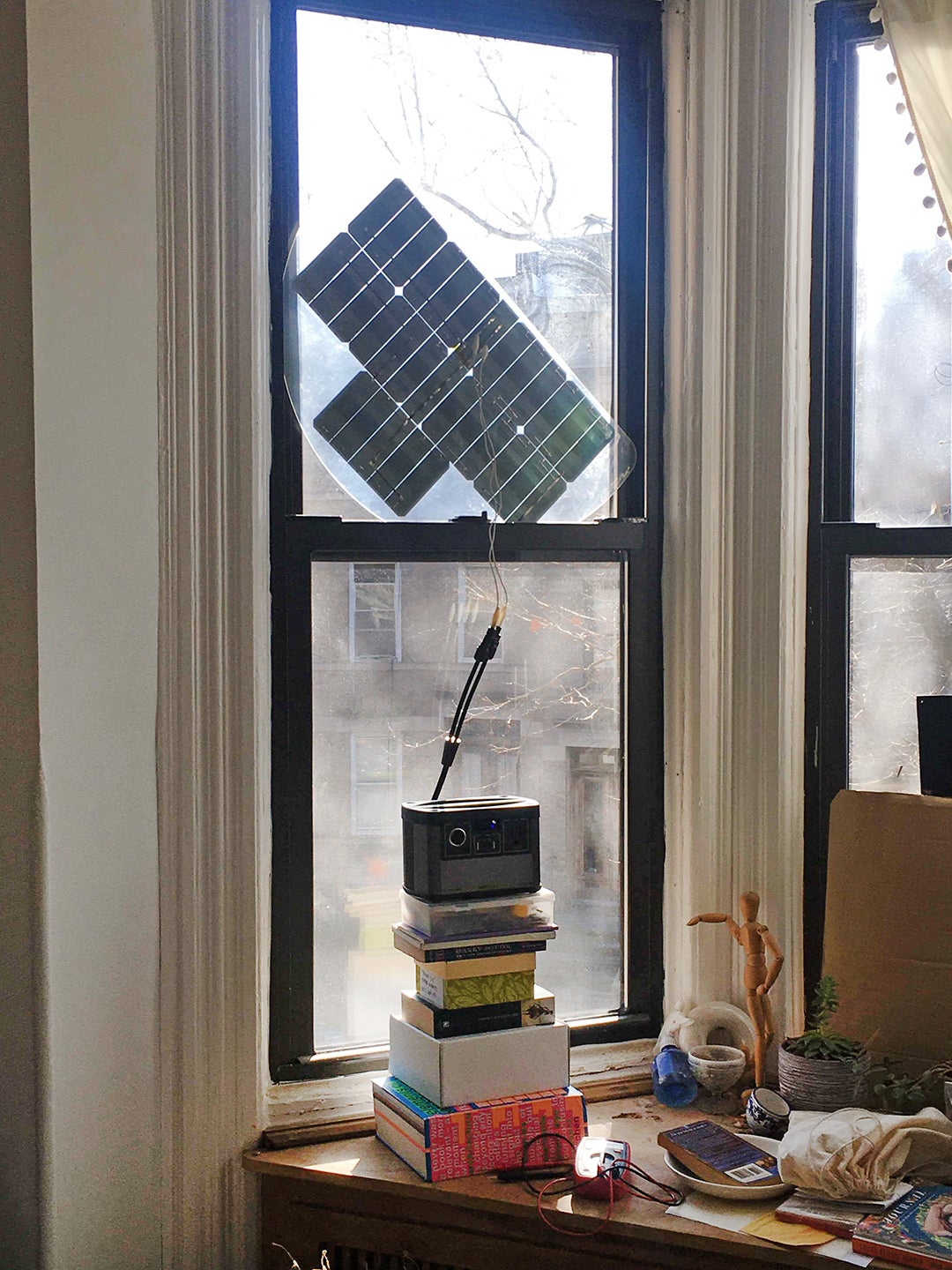
Back in 2019, Krystal Persaud and her husband were living in a 400-something-square-foot apartment on Manhattan’s Lower East Side. While the space was small, it had one seriously redeeming quality: really big windows. The natural light was ideal for keeping houseplants happy, but Persaud, who was working as a toy designer at the time, wanted to get more out of her space. She wanted energy. “I had a big aha moment,” says Persaud. “You think that a solar panel has to be outside on a roof at a perfect angle to work. It’s really just not true at all.” After some serious tinkering, she designed a 13-by-10-inch solar panel that can hang in a window via a suction cup hook and, after 10 hours of sunlight, can power up any USB-connected device.
While there were other portable solar panels on the market at the time Persaud launched her company, Grouphug, most of them are made for camping—and look like it. Persaud guesses that Grouphug’s solar charger likely only saves you $5 to $10 on your utility bill, but she sees it more as an introduction to renewable energy. The panel makes it possible for renters, apartment dwellers, and really anyone on a budget to harness the sun’s power. “It’s a baby step into solar that people can adopt in minutes,” says Persaud.
Courtesy of Krystal Persaud
Courtesy of Krystal Persaud
When Persaud and her husband moved from the Lower East Side to a railroad-style rental in Brooklyn, she began experimenting with even larger panels. The venture was once again sparked by a personal need: There were zero places to plug in a TV or a charger in the middle of the apartment, so she leaned a 3-by-4-foot panel in a window that could juice up a portable battery that could then power a fan or a laptop. “I was doing a ton of little experiments like that just to see how much power you could get from a window,” she says.
So far, Grouphug hasn’t released any XL versions—first, Persaud hopes to replenish its currently out-of-stock inventory within the next three months. In the meantime, she’s focused on Wildgrid, a platform she cofounded that primarily serves as an educational resource on energy efficiency, electrification, and renewable energy. There are also rebate calculators, product recommendations, and a directory of experts and contractors on the website. “We’re really just trying to show energy efficiency in a new light…that it can be fun and sexy and easy,” says Persaud.
If you’re hoping to secure a portable solar panel ASAP, Persaud notes she’s also a big fan of BioLite, a company aiming to provide 20 million people with access to clean energy by 2025. And while Goal Zero’s panels are similarly designed for off-the-grid living, Persaud has used its batteries for many of her makeshift apartment setups.
Hopefully, the next time someone tells you it looks like you got some sun, they’re talking about your fully charged phone battery.
Six people were charged on June 14, 2023, with buying and selling human remains stolen from the Harvard Medical School morgue and from an Arkansas mortuary. The macabre story made national headlines, particularly the indictment of Cedric Lodge: a morgue manager at Harvard from 1995 until earlier this year.
As a scholar in the sociology of religion, my research explores practices related to whole-body donation in medical schools across the United States. While these accusations against Lodge are deeply troubling, they are an aberration: Medical school communities go to incredible lengths to respect and honor the people who donate their bodies to science.
Much of this happens behind closed doors. The serious scientific work of anatomical study is undergirded by practices that promote the donors’ dignity, including memorial ceremonies to honor their gift. I conducted a census of allopathic medical schools – schools that grant the M.D. degree – and analyzed recordings of 60 donor memorial ceremonies, as well as other materials.
Foundation of learning
Despite advances made in technology, including virtual reality and 3D anatomy software, dissecting a real human body is generally considered irreplaceable in Western medical education. Substitutions result in less effective instruction, leading to lower scores on practical and written examinations. One benefit is that students who learn from dissection see normal bodies, with diversity, variations and imperfections that would not be evident on models. Faculty views donor bodies as essential because they are always accurate and up to date, which cannot always be said about books or software.
Bodies’ importance goes beyond their effectiveness as a teaching tool. Anatomy lab marks the students’ initiation into the medical profession. It teaches not only anatomy but the value of the human person, professionalism, ethics and clinical skills such as diagnosis.
From day one, medical students studying gross anatomy are encouraged to think of the donor body as their “first patient,” someone for whom they will care and from whom they will learn. Medical students are responsible for preserving the body, performing dissections correctly so as not to cause unnecessary mutilation, and speaking of the body and the donor respectfully.
Students work in teams, each of which is usually responsible for dissecting one body. Many also feel a sense of responsibility toward their donors – a duty to learn as much as they can, taking full advantage of the gift they have been given.
Reflection and respect
At the end of the semester, students say goodbye to the donors. My research found that more than nine out of 10 allopathic medical schools mark this occasion with a memorial ceremony. Ceremonies also take place at schools for other branches of health care, such as osteopathy and physical therapy. Wherever students learn from body donors, they gather together to express their gratitude for a gift that can never be reciprocated.
Some ceremonies are conducted before an audience that includes the friends and families of all body donors used that year. Some are open to the medical school community, and others are for the students alone. For many, these donors have played a transformative role in their lives. It is common to hear students refer to their donors as a friend or mentor.
At the 2018 University of Iowa ceremony, a student reflected: “I know her hands, her feet, what parts of her may have ached towards the end of life, which organs let her down. I spent countless hours as her pupil. She taught me things about life that no living person ever could. When I was confused and needed time to think, she was patient. My donor entrusted me with the intimate gift of her body to learn about the topics that make my heart race.”
Learning in the anatomy lab and participating in a donor memorial ceremony have something important in common. Both experiences stand apart from everyday life, making them, in a sense, sacred. These ceremonies set aside a special time and space for reflection and remembrance – time and space that busy medical students do not usually have.
Unlike most memorial services, these students have no personal memories of the deceased. In fact, some are not even told their donor’s first name, which is often concealed to preserve privacy.
Yet they know at least one fact: This person cared about medicine and other people’s health. Students reflect on how generous and principled the donors must have been – as well as their families, who were willing to carry out loved ones’ wishes in their time of grief. Though students did not witness donors’ lives, they can still celebrate and honor them.
A student at the University of Cincinnati’s 2019 service shared: “I am overwhelmed with respect and gratitude for all our donors. … As we gather here today, let’s remember the legacy that all of these donors and family members have left in all of us, and celebrate the legacy that they continue to forge even after death.”
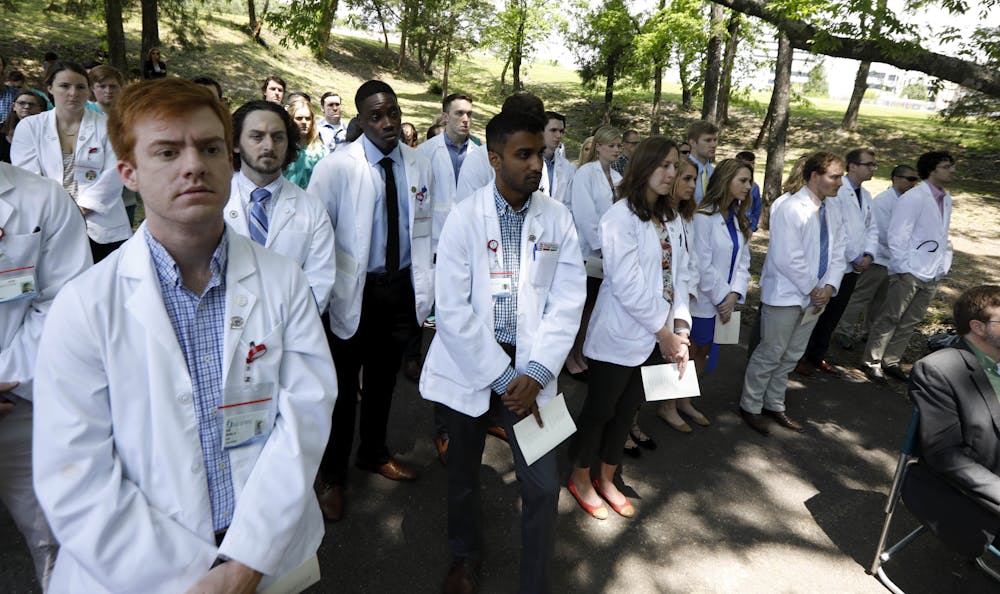
Medical students at the University of Mississippi Medical Center attend the Ceremony of Thanksgiving in Memory of Anatomical Donors in 2018.
AP Photo/Rogelio V. Solis
A donor body’s gift cannot be “paid back,” but medical students can try to pay it forward. Many describe ways they will try to serve others, as the donor did. Some doctors-to-be express a sense that the donors will forever guide their hands.
There is no foolproof way to prevent bad actors in any institution. Yet research into donor memorial ceremonies shows that no one takes the gift of body donation more seriously than the recipients.
Amy Lawton received funding from the Templeton Religion Trust administered through the Issachar Fund.
by Philip Ewell, Professor of music theory, Hunter College
These multicolored notes reflect the diversity of music across the world. MirageC/Getty Images
When it comes to achieving racial diversity, music education at the university level in the U.S. still has a long way to go.
One of the leading professional organizations, the Society for Music Theory, put it bluntly in 2020: “We humbly acknowledge that we have much work to do to dismantle the whiteness and systemic racism that deeply shape our discipline,” the group wrote.
The focus on white, male Europeans in textbooks and music selected for study has been called into question by countless scholars and practitioners because of music education’s deep roots in anti-Blackness.
In recent years, the simplest solution for music professors has been to find nonwhite classical composers and use their work on a program or concert to demonstrate the school’s commitment to diversity. One person whose work some professors have used in such a way is Florence Price. A composer and music teacher who died in 1953, Price is considered to be one of the first Black female musicians with mainstream appeal.
But in my view as one of only a few Black scholars in the field of music theory, such diversity efforts often serve only to reinforce the whiteness and maleness of the system.
Ethnomusicologist Dylan Robinson calls these efforts “additive inclusion” in that they give the impression of making positive change but serve only to maintain an overemphasis on the work of white male Europeans.
We wanted to establish a baseline of the racial and gender makeup of the composers represented in the books to see what teachers were offering to our students as the most important music to consider in the undergraduate music major.
Music theory courses, usually spread over four or five semesters, are often considered the most crucial aspect of the major, and theory textbooks are presented as authoritative sources that outline the essentials of the discipline.
Representative titles include “Harmony and Voice Leading,” “Harmony in Context,” “Harmonic Practice in Tonal Music” and “Concise Introduction to Tonal Harmony.”
Looming large in these textbooks is the word “harmony,” the sound that is heard when two or more instruments or voices sound together, though in a global context the term has other meanings as well. What is considered harmony in the U.S. is based on European notions of tonality, pitch, scale, mode, key and melody.
We found that of the nearly 3,000 musical examples cited in the textbooks, only 49 were written by composers who were not white and only 68 were written by composers who were not men.
On rare occasions those two subgroups overlapped, as with Florence Price. Only two examples were written by Asian composers.
All told, almost 98% of the musical examples were written by white men who mostly spoke German, and these seven textbooks represented about 96% of the market share.
In her 2019 master’s thesis “A Message of Inclusion, A History of Exclusion: Racial Injustice at the Peabody Institute,” violinist Sarah Thomas details a common American story of racial angst in higher education.
Thomas focused on the Peabody Institute, founded in 1857 in Baltimore, Maryland and the oldest U.S. music institution, and its board members’ letters about the possible admission of Black pianist Paul Brent.
In July 1949, Peabody President William Marbury wrote the school’s board of directors and reminded board members of the school’s unofficial policy at the time:
“We are brought face to face with the issue whether to modify our long-standing rule against the admission of negro students,” Marbury wrote.
Once the issue was put to a vote, only one board member, Douglas Gordon, openly opposed admitting Brent and cast the one dissenting vote.
“It seems to me that it would be a great mistake to change the present policy,” Gordon wrote. “In our climate the presence of negroes can to some be extremely offensive.”
Paul A. Brent, the first Black student to enroll at the Peabody Conservatory, is second from the right in the back row in this 1953 photograph.
Peabody Institute
Though Brent was admitted and became the first Black student to enroll at Peabody, the abhorrent views of Gordon still remain present today in more subtle forms.
The study of jazz is one such example of racial exclusion.
Generally considered a Black musical genre, jazz is now part of most music educational institutions, but is virtually always separate from the mainstream music major.
In a few cases, students are able to major in jazz. But in most cases, if students wants to major in jazz, they must major in classical music while playing jazz on the side.
Change in music education is coming
Citing declining enrollments for music majors across the country, the College Music Society in 2014 published a manifesto for change to the undergraduate music major.
It deemphasized music and methods of the Western canon while emphasizing the need for students to engage with music from different cultures and with new technologies.
This change has taken many forms.
Musicians are rethinking their curricula to treat all music of the world on equal footing as the European standards.
Piano proficiency and European language requirements are being reconsidered – in some cases cast aside – by music institutions. Other schools are creating new music majors for those working with digital sound and sound design, or for those studying popular genres such as blues, rock, metal and country.
It’s my belief that the sooner we musicians, irrespective of our own identities, can face up to our racial segregationist past, the sooner we can all reap the benefits of our nation’s unique musical diversity.
Philip Ewell does not work for, consult, own shares in or receive funding from any company or organization that would benefit from this article, and has disclosed no relevant affiliations beyond their academic appointment.
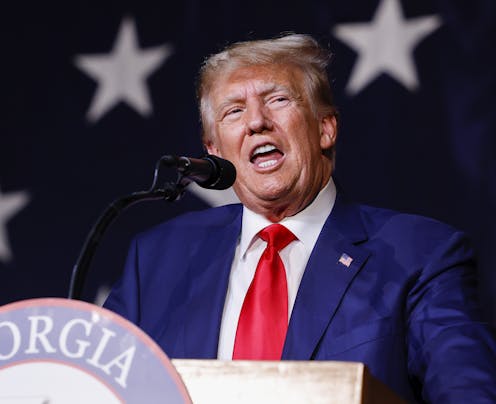
During his presidency, Donald Trump said, “We’re putting America first … we’re taking care of ourselves for a change,” and then declared, “I’m a nationalist.” In another speech, he stated that under his watch, the U.S. had “embrace[d] the doctrine of patriotism.”
Trump is now running for president again. When he announced his candidacy, he stated that he “need[s] every patriot on board because this is not just a campaign, this is a quest to save our country.”
There is a difference, and it’s important, not just to scholars but to regular citizens as well.
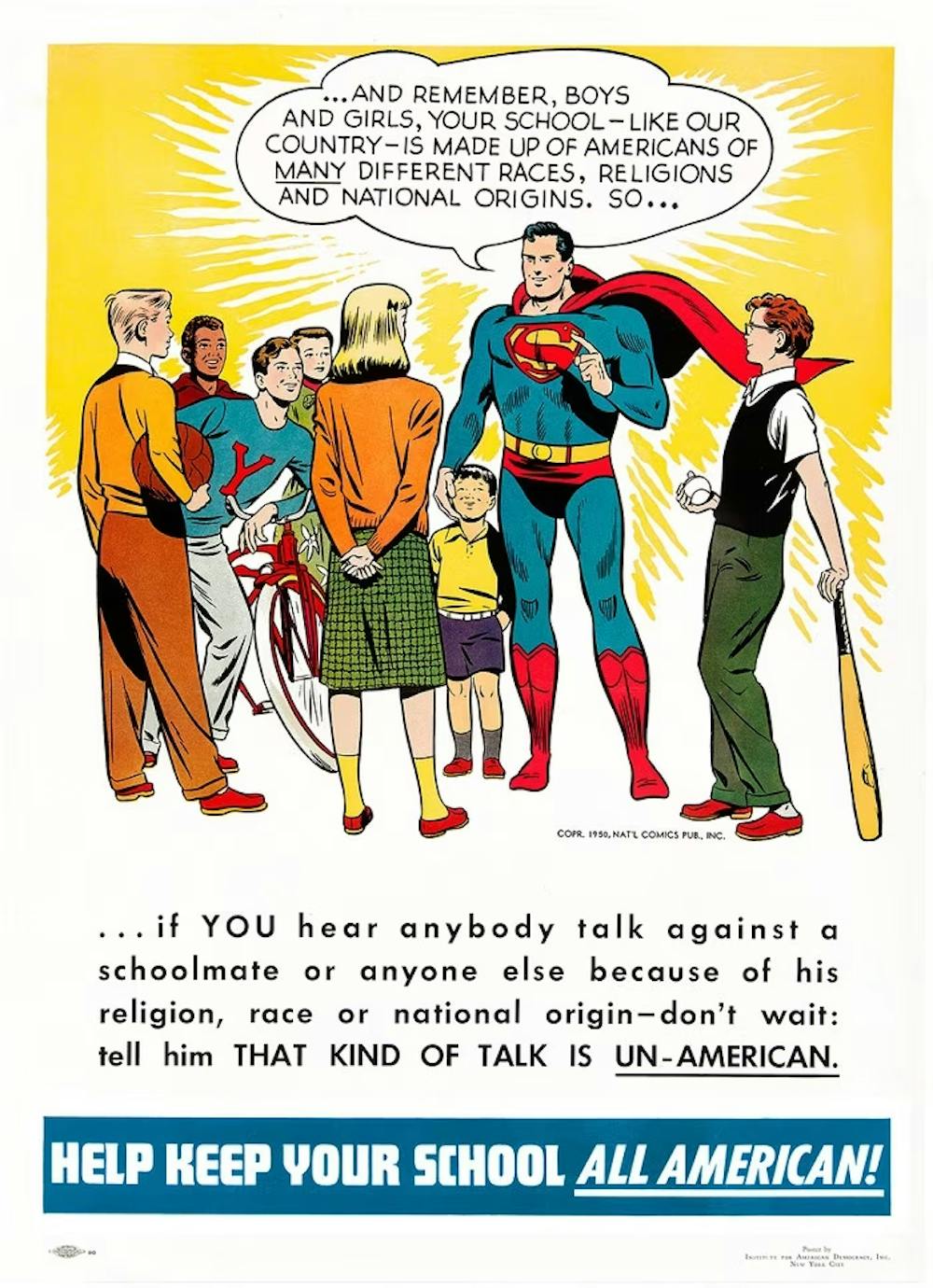
An image from 1950, colorized in 2017, shows Superman – a refugee from another planet and a character created by two Jewish immigrants to the U.S. – teaching that patriotism should drive out nationalism.
DC Comics
Devotion to a people
To understand what nationalism is, it’s useful to understand what a nation is – and isn’t.
A nation is a group of people who share a history, culture, language, religion or some combination thereof.
A country, which is sometimes called a state in political science terminology, is an area of land that has its own government.
A nation-state is a homogeneous political entity mostly comprising a single nation. Nation-states are rare, because nearly every country is home to more than one national group. One example of a nation-state would be North Korea, where almost all residents are ethnic Koreans.
The United States is neither a nation nor a nation-state. Rather, it is a country of many different groups of people who have a variety of shared histories, cultures, languages and religions.
Nationalism is, per one dictionary definition, “loyalty and devotion to a nation.” It is a person’s strong affinity for those who share the same history, culture, language or religion. Scholars understand nationalism as exclusive, boosting one identity group over – and at times in direct opposition to – others.
In addition to white and Black racial nationalisms, there are also ethnic and lingustic nationalisms, which typically seek greater autonomy for – and the eventual independence of – certain national groups. Examples include the Bloc Québécois, the Scottish Nationalist Party and Plaid Cymru – the Party of Wales, which are nationalist political parties that respectively advocate for the Québécois of Québéc, the Scots of Scotland and the Welsh of Wales.
Devotion to a place
In contrast to nationalism’s loyalty for or devotion to one’s nation, patriotism is, per the same dictionary, “love for or devotion to one’s country.” It comes from the word patriot, which itself can be traced back to the Greek word patrios, which means “of one’s father.”
In other words, patriotism has historically meant a love for and devotion to one’s fatherland, or country of origin.
Patriotism encompasses devotion to the country as a whole – including all the people who live within it. Nationalism refers to devotion to only one group of people over all others.
He contrasted that with nationalism, which he describes as “the habit of identifying oneself with a single nation or other unit, placing it beyond good and evil and recognizing no other duty than that of advancing its interests.”
In his ‘I Have a Dream’ speech and other works, Martin Luther King Jr. decried nationalism and encouraged patriotism.
The tragedy of the Holocaust was rooted in the nationalistic belief that certain groups of people were inferior. While Hitler is a particularly extreme example, in my own research as a human rights scholar, I have found that even in contemporary times, countries with nationalist leaders are more likely to have bad human rights records.
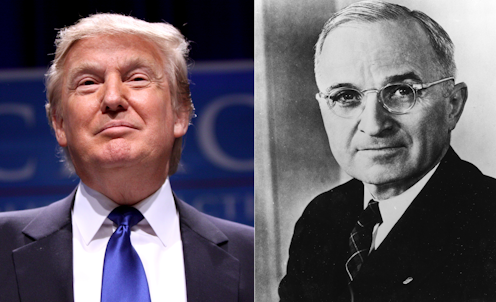
For Truman, putting America first did not mean exiting the global stage and sowing division at home with nationalist actions and rhetoric. Rather, he viewed the “principal concern of the people of the United States” to be “the creation of conditions of enduring peace throughout the world.” For him, patriotically putting the interests of his country first meant fighting against nationalism.
Joshua Holzer does not work for, consult, own shares in or receive funding from any company or organization that would benefit from this article, and has disclosed no relevant affiliations beyond their academic appointment.
by Robert W. Gehl, Ontario Research Chair of Digital Governance for Social Justice, York University, Canada
Artificial intelligence can be used to produce persuasive texts that influence behaviour. (Shutterstock)
Manipulative communication includes disinformation, propaganda, con artistry and fraud. With the increasing use of artificial intelligence (AI), manipulative communication is not only being aided by AI, automation and machine learning, but will likely be dominated by such practices in the near future.
‘Social Engineering’ looks at how the internet affected manipulative communication.
ChatGPT, one of the most popular and widely used chatbots, is an artificial intelligence chatbot, capable of parsing text input and quickly providing text responses.
While it has been critiqued for being misleading, when we asked it about the possibilities for manipulative communication, its response was remarkably prescient:
AI can be used for manipulative communication in a few ways:
• Social media bots: AI-powered bots can be programmed to mimic human behavior and spread false or misleading information to manipulate public opinion.
• Deepfake technology: AI algorithms can be used to generate fake audio or video content that appears to be real, making it easier to spread false information or manipulate individuals.
• Personalized advertising: AI algorithms can analyze data about a person’s behavior, preferences, and relationships to create targeted advertisements that manipulate their emotions and influence their purchasing decisions.
As we argue in Social Engineering, manipulative communication can be understood as a form of “masspersonal social engineering.” It’s “masspersonal” in that it can oscillate between targeted messages or societal-scale manipulation. It’s “social engineering” in that it combines the respective tools and techniques of hackers and propagandists in an attempt to shape the perceptions and actions of audiences.
Masspersonal social engineering typically involves three stages: trashing, pretexting and bullshitting.
Each of these stages can be automated, with new AI tools increasing the pace and intensity.
Trashing
Trashing is the stage where the masspersonal social engineer gathers information on potential targets. We use the term “trashing” because it hearkens back to a mid-20th century hacker process of literally going through corporate trash to find passwords and restricted information.
For example, trashing was key to the Russian hack of former White House Chief of Staff John Podesta’s emails in 2016. Podesta, who was in charge of Hillary Clinton’s 2016 presidential campaign, fell victim to a phishing attack.
Podesta wasn’t the first target — the Russian hackers worked their way through several email addresses used by Clinton staffers, including staffers who were no longer part of her campaign and who had abandoned their email accounts years before.
In other words, they had to work their way through the digital detritus of old and abandoned emails until they were able to find active ones – including Podesta’s – and then they could send a phishing email.
Beyond social media, websites — particularly those that have organizational structures, names of employees and email addresses — are targets.
Pretexting
A pretext is the role a masspersonal social engineer plays when trying to get information or manipulate a target. For example, in a phishing email, the phisher is playing a role as a bank or government representative. The most effective pretexts are developed based on the information gathered in trashing — the more information a social engineer has on their target, the more likely the social engineer can construct a compelling role to play.
When phishing for information, a social engineer may play a deceptive role.
(Jefferson Santos/Unsplash), CC BY
But evidence from security professionals show that automated imitations of everyday people are happening, too. A case of fraud involving an AI-based imitation of a CEO’s voice has already occurred, and there are reports of fraudsters using AI-generated voices of relatives to scam their loved ones.
Bullshitting
The third and final stage, bullshitting, is the actual engagement with the target. All the trashing and development of a pretext leads to this point: trashing gives the social engineer background information, and the pretext provides a role-playing framework, but in any back-and-forth engagement with the target, the social engineer engages in improvisation.
As moral philosopher Harry Frankfurt famously defines it, “bullshit” is not lying — it’s the indifference to truth. A bullshitter may or may not speak truth. The truth is beside the point; it’s the effect of the communication that matters.
AI could produce bullshit content — including deepfakes — that floods a media system at a much larger scale than a person, or group of people, working together. The primary concern here is the production of seemingly real content that is meant to deceive or muddy debate.
And we are already seeing interest among content marketers, who are using AI to help them crank out more content for their blogs.
Even if no one piece is particularly effective, the flood of such content online will further add to the “firehose of falsehood.” This could have the effect of further muddying the waters of online discourse, and eroding our sense of what is true, false and authentic online.
Increased intensity
Manipulative communication isn’t new. But automated manipulative communication is a new development, increasing the pace and intensity of disinformation and misinformation.
We hope that this framework, which breaks down the manipulative communication process into stages, helps future researchers and policymakers come to grips with this development.
Reducing trashing behaviours involves better privacy regulations and cybersecurity to prevent data breaches, and enhanced penalties for organizations that do leak private data.
Addressing pretexting can involve more transparency in the funding for advertising campaigns, particularly in the case of political advertising on social media.
And to combat bullshitting, we should support projects that teach digital media literacy.
Robert W. Gehl received funding from the Fulbright Commission.
Sean Lawson does not work for, consult, own shares in or receive funding from any company or organisation that would benefit from this article, and has disclosed no relevant affiliations beyond their academic appointment.
The Cross Bay Ferry ended its season in May between Tampa and St. Pete. Ferry officials announced that this season they had a record breaking season with more than 72,000 passengers carries between the two thriving cities. The vessel will return to the region in October. Expanded hours, and permanent year-round service with additional vessels is in the works.
This splendid new transit option connecting downtown Tampa and downtown St. Pete reached a new milestone in its history during the first week of April when it transported its 300,000th rider since the system’s launch in 2016.
Photo by Andrew Harlan
The Cross-Bay Ferry is also one of the coolest ways to take in a sunset, and offers one of my favorite reading spots in the whole city. It represents a collaboration between Hillsborough County, city of Tampa, city of St. Petersburg, and Florida Department of Transportation.
Cross-Bay Ferry’s St. Pete docking station is located at 375 Bayshore Dr. NE. The ferry arrives at 333 S Franklin Street in Tampa. You can learn more about the ferry on its website. Follow along on Instagram as well for updates on its official return to the county.
Linked up with the free Tampa Streetcar, and the Sunrunner in the ‘Burg, residents have effective car-free ways of traveling between St. Pete Beach and Ybor City.
Since the Litter Skimmer launched in Tampa in 2022, the vessel has picked up 20 tons of garbage out of the Hillsborough River and surrounding channels and in the waters around Bayshore Boulevard and Davis Islands.
The Litter Skimmer launched last year as part of the “Keep It Clean, Tampa” initiative. Since it’s inception, the Little Skimmer has:
Been on the water for a total of 841 hours
Collected 40,216 pounds of trash (20.01 Tons)
Generated 9,645 KWh of electricity from the trash collected.
“Litter Skimmer” by the City of Tampa’s Solid Waste Department operates ten hours a day, four days per week, picking up floating trash along the Hillsborough River, Davis Islands, and the Bay. According to the Ocean Conservancy, the top contributor to marine debris is single-use, or disposable, plastic products, including container caps and lids, beverage bottles, plastic bags, food wrappers, cups, plates, cutlery, and drinking straws. Single-use plastic utensils and containers threaten marine environments because they do not fully break down or decompose.
Converting waste to energy with the Litter Skimmer in Tampa
At the end of each day, the waste is taken to the city’s waste-to-energy facility, which generates enough electricity to power 15,000 homes per month. The Tampa Bay area is home to four waste-to-energy facilities, located in the City of Tampa and in the counties of Hillsborough, Pinellas and Pasco. Without these facilities, local governments would be faced with the daunting task of siting large landfills near our rapidly growing residential communities.
Florida’s waste-to-energy facilities eliminate 90% of the waste that once would have been landfilled.
The best way to reduce environmental impacts when it comes to waste is to prevent making it in the first place. Practicing waste reduction leads us to divert less materials to regular disposal methods like waste-to-energy or landfills. Not only does it lead to less items going to disposal but it also reduces litter, saves resources, and saves money. This will require some new habits of refusing disposable items, repairing what can be fixed, and reducing our food waste.
Like most Americans, I was forced to read George Orwell's Animal Farm at some point in high school. And, like most Americans, I was taught as part of that public school English curriculum that the book, along with Orwell's 1984, was all about the evils of the Soviet Union. — Read the rest
On June 19, 1865, two months after the U.S. Civil War ended, Union Gen. Gordon Granger walked onto the balcony at Ashton Villa in Galveston, Texas, and announced to the people of the state that “all slaves are free.”
If Juneteenth meant anything, it meant at least that Joshua Houston and his family were free.
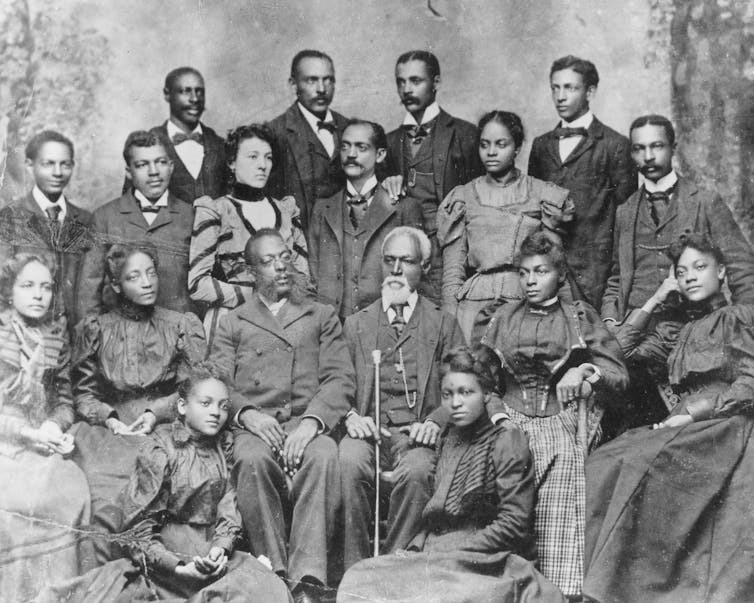
Joshua Houston and his family in October 1898.
Courtesy of the Sam Houston Memorial Museum and Republic of Texas Presidential Library, Huntsville, Texas
But there was more too.
The promise of freedom meant that more work needed to be done. Families needed to be reunited. Land needed to be secured. Children needed to be educated.
Indeed, the radical promise of Juneteenth is embodied in the community activism of Joshua Houston and the educational career of his son Samuel Walker Houston.
The violent white reaction to Black political power
Within a year of Granger’s proclamation, Houston had established a blacksmith shop near the Huntsville town square and moved his family into a two-story house on the adjoining lot.
He helped found the Union Church, the first Black-owned institution in the city, as well as a freedmen’s school to begin educating African American children.
In 1878 and 1882, a Republican coalition of Black and white voters opposed to conservative Democratic rule elected Houston as the county’s first Black county commissioner, a powerful position in local governance.
Despite this dramatic turn of events, Houston’s political story was hardly unique.
In the two decades following emancipation, 52 Black men served in the state Legislature or the state’s constitutional conventions.
But that number had fallen to two by 1882.
Opposition to Black freedom had been a powerful force in the state’s political culture since emancipation.
In 1871, the violence continued when the white citizens of Huntsville stormed the county courthouse and aided the escape of three men who had lynched freedman Sam Jenkins.
In the early 1900s, changes in state election laws, including the introduction of the poll tax, effectively disenfranchised most Black voters and many poor whites as well. Voter participation dropped from roughly 85% at the high tide of Texas populism in 1896 to roughly 35% when the poll tax became effective in 1904.
As a result, Robert Lloyd Smith was the last Black legislator for nearly 70 years when he finished his term in 1897.
These changes enabled the election of Black officials such as Barbara Jordan, the first African American woman to serve in the Texas Senate.
Like father, like son
On an unknown date, a few years after Juneteenth, Joshua Houston’s son Samuel Walker Houston was born free in the bright light of Reconstruction.
Although he spent his adulthood in some of the darkest years of Jim Crow, he continued his father’s work as an educator and community leader. Following a short stint at Atlanta University in Georgia and Howard University in Washington, D.C., Samuel Walker Houston returned to Huntsville and founded a school in the nearby Galilee community.
Houston’s school was named for him and served as one of the first county training schools for African Americans in Texas. It enrolled students at every level, from first grade through high school, and provided a curriculum based on Booker T. Washington’s Tuskegee model of vocational training.
Young women at Houston’s school received training in homemaking, sewing and cooking, while young men learned carpentry, woodworking and mathematics.
By 1922, enrollment at the school had grown to 400 students, and it was recognized by contemporaries as the leading school of East Texas. In the 1930s, Houston’s school was absorbed into Huntsville’s school district, and he became the director of Black education in the county.
This 1919 photograph shows officials laying the foundation for a new building at the Samuel Walker Houston Training School.
Jackson Davis Collection of African American Educational Photographs, Special Collections, University of Virginia Library
Houston encouraged a practical education for Black Texans, but he also believed that young Texans of all races needed to learn an account of history that differed from the white supremacist narrative that dominated Southern history.
Toward this end, he joined with Joseph Clark and Ramsey Woods, two white professors who pioneered race relations courses at Sam Houston State Teachers College. Together, the group led the Texas Commission on Interracial Cooperation’s effort to evaluate Texas public school textbooks during the 1930s.
In an analysis of racial attitudes in state-endorsed textbooks, they found that 74% of books presented a racist view of the past and of Black Americans. Most excluded the scientific, literary and civic contributions of Black people, while mentioning their economic contributions only in the period of slavery before the Civil War.
Instead, the group argued, books designed for both Black and white Texans needed to take the “opportunity … to do simple justice” by including Black history and the “struggle for the exercise” of equal civil, political and legal rights.
White Texans refused to adopt a textbook in the 1930s that taught the fundamental equality of the races, or portrayed Reconstruction, as it is now widely understood, as a missed opportunity to establish a more just and egalitarian Texas.
But Houston and his white counterparts were motivated by the conviction that progress, both for African Americans and for Texas, required a more honest and progressive account of the state and its history.
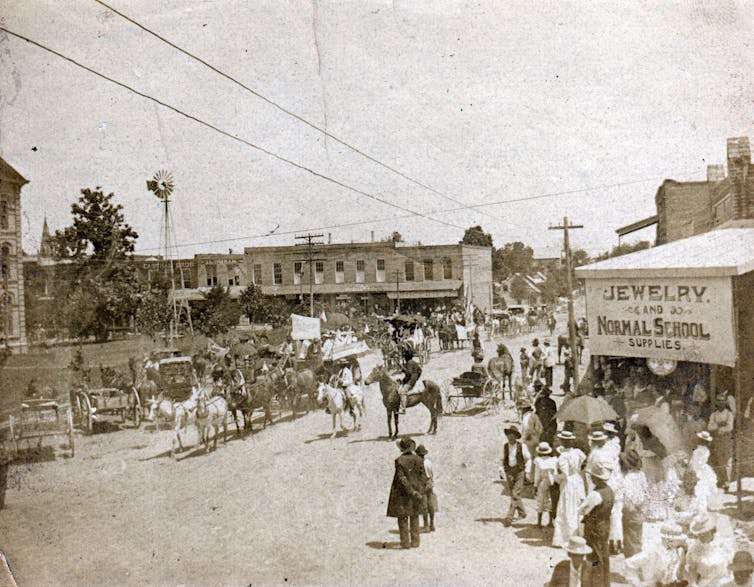
The Juneteenth Parade in Huntsville, Texas, circa 1900.
Sam Houston Memorial Museum and Republic of Texas Presidential Library, Huntsville, Texas.
An ongoing battle for equality
Today’s legislative efforts in Texas and elsewhere to restrict the teaching of systemic racism in public schools ignore the lessons and realities represented by Joshua and Samuel Walker Houston’s lives.
The argument used for supporting such restrictions is that “divisive concepts” like the history of racism may make some students feel uncomfortable or guilty.
In reality, the prohibition on teaching the darker chapters of our past creates a segregated history.
Instead, as Samuel Walker Houston recognized, young Texans must have a more honest account of the past and of one another to progress into a unified and egalitarian society.
Texas history is both the story of people who dedicated their lives to the work of advancing freedom and the story of powerful people and forces that stood against it.
One cannot be understood without the other.
Americans cannot appreciate the accomplishments of Joshua and Samuel Walker Houston without examining the vicious realities of Jim Crow society.
The lesson of their lives, and of the Juneteenth holiday, is that freedom is a precious thing that requires constant work to make real.
The authors do not work for, consult, own shares in or receive funding from any company or organization that would benefit from this article, and have disclosed no relevant affiliations beyond their academic appointment.
by Steve Turton, Adjunct Professor of Environmental Geography, CQUniversity Australia
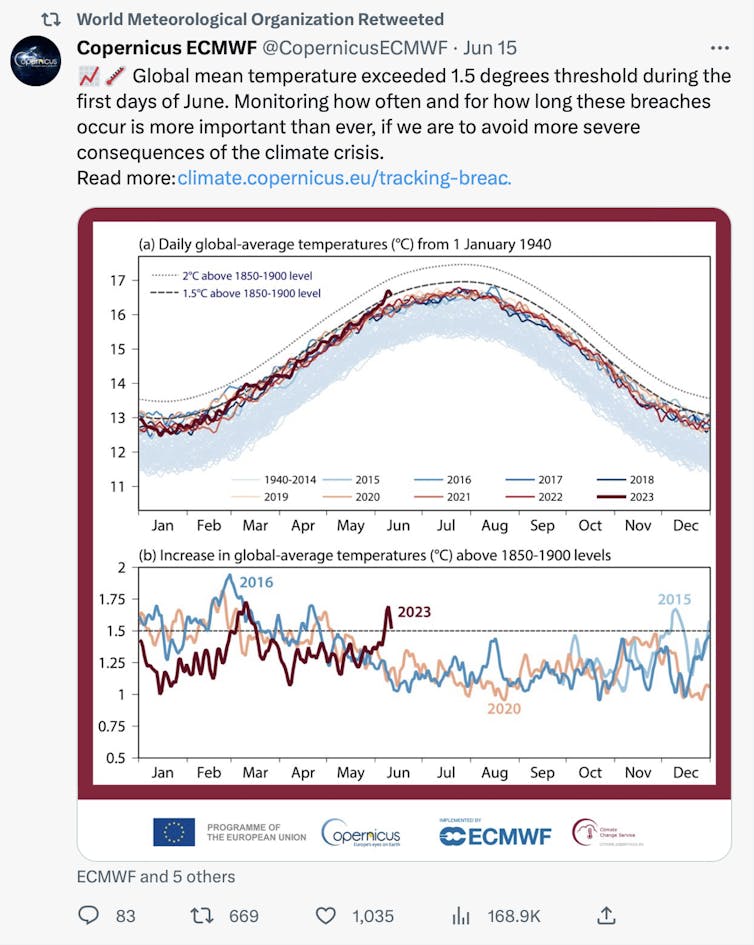
Recent spikes in ocean heat content and average global air temperature have left climate scientists across the world scrambling to find the cause. The global average air temperature, relative to 1850-1900, exceeded the 1.5℃ lower Paris Agreement threshold during part of March and the first days of June. This last happened in 2020, and before that during the powerful 2015-16 El Niño.
What makes these most recent temperature spikes so alarming is that they’ve occurred before a forecast El Niño event in the Pacific, rather than during one.
It is now clear that Earth’s climate system is way out of kilter and we should be very concerned.
Global average temperatures, showing the 1.5℃ and 2.0℃ Paris Agreement thresholds. World Meteorological Organization (2023).
Twitter @CopernicusECMWF
We already know El Niño events are associated with above-average global temperatures. Given the impending El Niño, we all need to take extra notice of what lies ahead for the next few years. This is especially so as this forecast warming event will follow the recent rare triple La Niña event that usually brings cooler average global temperatures, meaning the trajectory of this year’s uptick in average temperatures is likely to be even steeper.
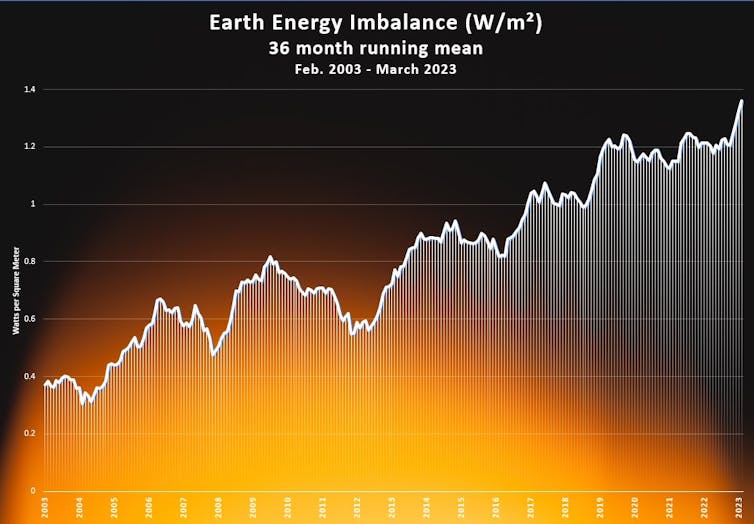
The Earth Energy Imbalance - the difference between the amount of energy arriving from the Sun and the amount returning to space - is now running at an all-time high. This is the most crucial measure of the prospects for continued global heating and human-driven climate change.
This metric will also be vital for monitoring our overall success in meeting the Paris Agreement’s targets, which call for humanity to hold average warming ideally to 1.5℃ above the pre-industrial average, or at least to as much under 2℃ as possible.
How much warmer are the oceans this year?
Since 1971, about 89 % of the excess heat in Earth’s climate system has been stored in the ocean (with 6 % on land, 1 % in the atmosphere, and about 4 % going towards melting ice on land and sea).
Because of this, any significant upward trend in average ocean heat is considered a harbinger for the acceleration of human-driven climate change more generally.
Scientists monitor the status of Earth’s energy imbalance by considering how much the average sea-surface temperature differs from the historical average, for a vast slice of the oceans covering everywhere between the Arctic Circle (60°N) and Antarctic Circle (60°S). These “sea surface temperature anomalies” are calculated each month, relative to the 1971-2000 baseline.
The global sea surface temperature anomaly on June 13 was about 4.5 standard deviations above the baseline global average. Put another way, this means the likelihood of current temperatures happening totally at random, if the climate this month was unchanged from the baseline period, are about 1 in 1.2 million.
The 36-month running average for the Earth Energy Imbalance is now at a record 1.36 Watts per square metre. This looks like a small value, but it corresponds to an average of 11 Hiroshimas of excess energy per second accumulating in Earth’s climate system over the past three years.
Earth Energy Imbalance: 36 month running mean (Feb 2003 - March 2023)
Professor Eliot Jacobson
The early arrival of El Niño may also be playing a lesser role, as the warming in the central and eastern equatorial Pacific is not expected to peak until next year.
The submarine volcano Hunga Tonga-Hunga Ha'apai erupted in January 2022 and ejected record-breaking amounts of water vapour into the stratosphere. Water vapour acts as a potent greenhouse gas, and this may be contributing to the currently observed warming.
Views from the satellites GOES-West and Himawari-8 of the violent eruption of the underwater volcano Hunga Tonga-Hunga Haʻapai. It blasted an enormous plume of water vapour into Earth’s stratosphere – enough water to fill more than 58,000 Olympic-size swimming pools. Public Domain.
Other possible agents of warming include new regulations around sulfur aerosol emissions from shipping, and even a recent lack of Saharan dust. Both these forms of atmospheric aerosols have a cooling effect, as they reflect a small percentage of sunlight back to space.
Greenhouse gases from human sources continue to rise and accumulate in the atmosphere. Rising emissions will fuel global heating, resulting in shifting climate baselines – what is often termed the “new normal” brought about by climate change.
Climate models predict with high certainty that as these climate baselines shift, so will the increased risk of extreme weather events. Effects of natural climate drivers, such as El Niño patterns in the Pacific, are likely to be amplified as the background climate warms.
Scientists will watch the current spike in global ocean and atmospheric temperatures very closely as the forecast El Niño strengthens later this year. What is less well understood is how other climate drivers may interact with the warming effects of El Niño.
Notably, how will the lingering atmospheric water vapour from the Hunga Tonga-Hunga Ha'apai eruption amplify any El Niño warming? All we can do is prepare for more record-breaking weather.
Steve Turton has previously received funding from the Australian Government. Steve is the vice chair of the Australian Citizen Science Association.
Over the past few months, artificial intelligence (AI) has entered the global conversation as a result of the widespread adoption of generative AI-based tools such as chatbots and automatic image generation programs. Prominent AI scientists and technologists have raised concerns about the hypothetical existential risks posed by these developments.
Having worked in AI for decades, this surge in popularity and the sensationalism that has followed have caught us by surprise. Our goal with this article is not to antagonise, but to balance the public perception which seems disproportionately dominated by fears of speculative AI-related existential threats.
It’s not our place to say one cannot, or should not, worry about the more exotic risks. As members of the European Laboratory for Learning and Intelligent Systems (ELLIS), a research-anchored organisation focused on machine learning, we do feel it is our place to put these risks into perspective, particularly in the context of governmental organisations contemplating regulatory actions with input from tech companies.
What is AI?
AI is a discipline within computer science or engineering that took shape in the 1950s. Its aspiration is to build intelligent computational systems, taking as a reference human intelligence. In the same way as human intelligence is complex and diverse, there are many areas within artificial intelligence that aim to emulate aspects of human intelligence, from perception to reasoning, planning and decision-making.
Depending on the level of competence, AI systems can be divided into three levels:
Narrow or weak AI, which refers to AI systems that are able to perform specific tasks or solve particular problems, nowadays often with a level of performance superior to humans. All AI systems today are narrow AI. Examples include chatbots like chatGPT, voice assistants like Siri and Alexa, image recognition systems, and recommendation algorithms.
General or strong AI, which refers to AI systems that exhibit a level of intelligence similar to that of humans, including the ability to understand, learn and apply knowledge across a wide range of tasks and incorporating concepts such as consciousness. General AI is largely hypothetical and has not been achieved to date.
t
Super AI, which refers to AI systems with an intelligence superior to human intelligence on all tasks. By definition, we are unable to understand this kind of intelligence in the same way an ant is not able to understand our intelligence. Super AI is an even more speculative concept than general AI.
AI can be applied to any field from education to transportation, healthcare, law or manufacturing. Thus, it is profoundly changing all aspects of society. Even in its “narrow AI” form, it has a significant potential to generate sustainable economic growth and help us tackle the most pressing challenges of the 21st century, such as climate change, pandemics, and inequality.
Challenges posed by today’s AI systems
The adoption of AI-based decision-making systems over the last decade on a wide range of domains, from social media to the labour market, also poses significant societal risks and challenges that need to be understood and addressed.
The recent emergence of highly capable large, generative pre-trained transformer (GPT) models exacerbates many of the existing challenges while creating new ones that deserve careful attention. The unprecedented scale and speed with which these tools have been adopted by hundreds of millions of people worldwide is placing further stress on our societal and regulatory systems.
There are some critically important challenges that should be our priority:
The manipulation of human behavior by AI algorithms with potentially devastating social consequences in the spread of false information, the formation of public opinions and the outcomes of democratic processes.
Algorithmic biases and discrimination that not only perpetuate but exacerbate stereotypes, patterns of discrimination, or even oppression.
The lack of transparency in both models and their uses.
The violation of privacy and the use of massive amounts of training data without consent by or compensation for its creators.
The exploitation of workers annotating, training, and correcting AI systems, many of whom are in developing countries with meagre wages.
The massive carbon footprint of the large data centres and neural networks that are needed to build these AI systems.
The lack of truthfulness in generative AI systems that invent believable content (images, texts, audios, videos…) without correspondence to the real world.
The fragility of these large models that can make mistakes and be deceived.
The displacement of jobs and professions.
The concentration of power in the hands of an oligopoly of those controlling today’s AI systems.
Is AI really an existential risk for humanity?
Unfortunately, rather than focusing on these tangible risks, the public conversation – most notably the recent open letters – has mainly focused on hypothetical existential risks of AI.
An existential risk refers to a potential event or scenario that represents a threat to the continued existence of humanity with consequences that could irreversibly damage or destroy human civilisation, and therefore lead to the extinction of our species. A global catastrophic event (such as an asteroid impact or a pandemic), the destruction of a livable planet (due to climate change, deforestation or depletion of critical resources like water and clean air), or a worldwide nuclear war are examples of existential risks.
Our world certainly faces a number of risks, and future developments are hard to predict. In the face of this uncertainty, we need to prioritise our efforts. The remote possibility of an uncontrolled super-intelligence thus needs to be viewed in context, and this includes the context of 3.6 billion people in the world who are highly vulnerable due to climate change; the roughly 1 billion people who live on less than 1 US dollar a day; or the 2 billion people who are affected by conflict. These are real human beings whose lives are in severe danger today, a danger certainly not caused by super AI.
Focusing on a hypothetical existential risk deviates our attention from the documented severe challenges that AI poses today, does not encompass the different perspectives of the broader research community, and contributes to unnecessary panic in the population.
Society would surely benefit from including the necessary diversity, complexity, and nuance of these issues, and from designing concrete and coordinated actionable solutions to address today’s AI challenges, including regulation. Addressing these challenges requires the collaboration and involvement of the most impacted sectors of society together with the necessary technical and governance expertise. It is time to act now with ambition and wisdom – and in cooperation.
The authors of this article are members of The European Lab for Learning & Intelligent Systems (ELLIS) Board.
ELLIS Alicante recibe fondos de la Generalitat Valenciana, Fundacion Banc Sabadell, Fundacion Balearia y Fundacion Esperanza Pertusa, además de donativos de distintas personas físicas y jurídicas.
Bernhard Schölkopf recibe fondos de Max Planck Society, DFG, BMBF (German Ministry of Science), ETH Zürich, the federal state of Baden-Wuerttemberg, Hector foundation, Koerber foundation, CIFAR
Florence d'Alché-Buc receives support from ANR, Hi!Paris and the Telecom Paris Chair on AI and Data Science for Industry and services.
Nicolò Cesa-Bianchi receives support from the FAIR (Future Artificial Intelligence Research) project, funded by the NextGenerationEU program within the PNRR-PE-AI scheme.
Serge Belongie receives support from the Pioneer Centre for AI, Danish National Research Foundation (DNRF) grant number P1.
Sepp Hochreiter does not work for, consult, own shares in or receive funding from any company or organisation that would benefit from this article, and has disclosed no relevant affiliations beyond their academic appointment.
While there is no law in the U.S. that regulates what a man can do with his body, the reproductive health of women is now more regulated than it has been in 50 years. And the scope of reproductive health care that women can receive is highly dependent on where they live.
My research found that college women are concerned about pregnancy, but they lack knowledge and skills about navigating sexual consent and often participate in sexual activity without explicit consent, leaving them at risk for not using contraception and exposure to sexually transmitted infections.
These findings indicate that women are at risk of pregnancy at a historic time when women’s reproductive rights in the U.S. are restricted and not guaranteed.
A retrospective on Roe v. Wade – and a look ahead.
In some states, such as Texas, Louisiana and Mississippi, abortion is banned beginning at six weeks gestational age, when very few women even know they are pregnant. Other states, such as Massachusetts, Vermont, New York and Oregon, have enacted state-level protections for abortion.
The patchwork of state laws also results in a great deal of confusion. In the past year, women’s rights organizations and women’s health advocates have brought numerous legal challenges to restrictive abortion laws. These cases have halted the implementation of some of the strictest abortion regulations until additional court rulings are finalized.
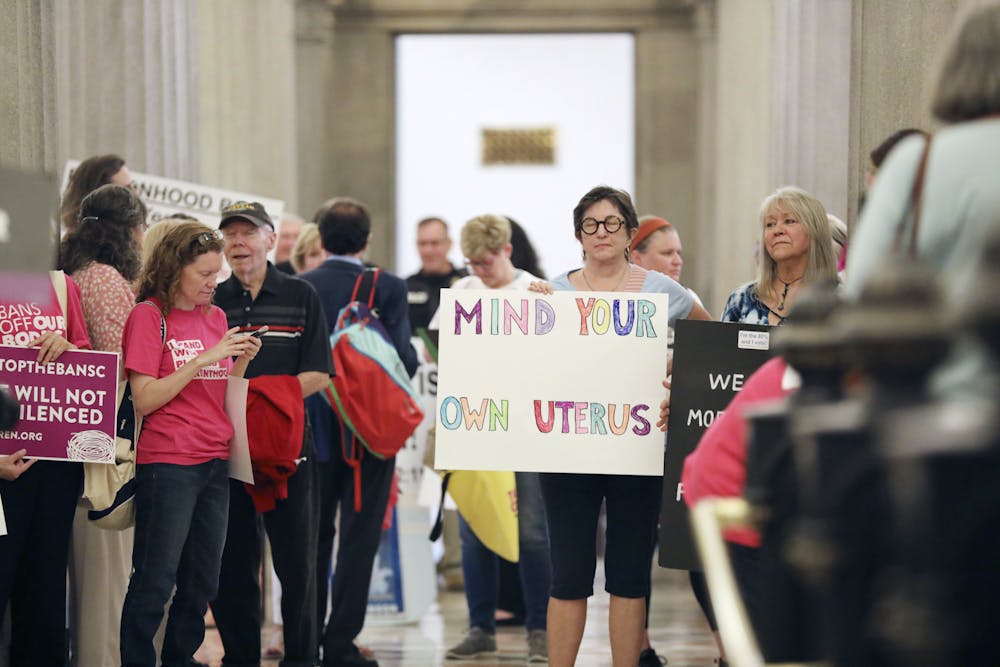
Protesters against a stricter abortion ban stand in the State House lobby on May 23, 2023, in Columbia, S.C.
AP Photo/Jeffrey Collins
Downstream effects for health care professionals
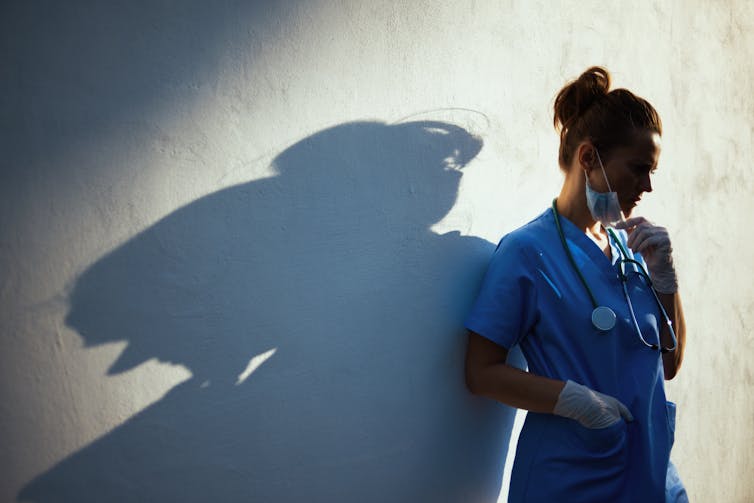
Abortion training is considered essential health care and a core competency for physicians in obstetrics and gynecology, or OB-GYN, residency programs. Approximately 50% of OB-GYN residency programs are located in states with restricted or highly restricted access to abortion. This will logically result in not only fewer health care providers being trained to perform gynecologic procedures for abortion, but also other conditions such as miscarriage, fetal death and nonviable pregnancies.
In states with changing abortion laws and legal challenges to new laws, physicians are uncertain of what procedures can be legally done. Penalties for violating abortion laws may include arrest, loss of medical license, fines and discipline by state boards of medicine.
The unequal access to abortion procedures across the country is most directly affecting the poorest women in the U.S.
Currently, 12 states restrict abortion coverage by private insurance, and more than 30 states prohibit public Medicaid payment for abortion. Women who qualify for Medicaid are among the poorest in the U.S. Lack of access to abortion limits education and wage earning and contributes to poverty. States with the most restrictive abortion laws also have limited access to pregnancy care and supportive programs for pregnant and parenting women.
In addition, traveling to a different state to obtain an abortion is often not possible for poor women. Lack of transportation and limited financial resources reduce or eliminate options to obtain an abortion in a different geographic location.
For example, Mississippi and Louisiana have the highest rates of maternal mortality in the U.S. and also have the most restrictive abortion laws. Black women have the highest maternal mortality of all races and ethnicities. Women in these states who are unable to terminate a pregnancy have a higher risk of dying as a result of the pregnancy than women in other states.
Additionally, research shows that a woman’s risk of dying related to pregnancy or childbirth is about 14 times higher than the risk of death from an abortion.
Restricting legal abortion increases the risk that women will seek out pregnancy termination from unskilled people in unsafe settings. Or they may not seek care quickly for pregnancy complications due to fear of being accused of a crime.
Prior to 1973, when Roe v. Wade established constitutional protection for abortion in the U.S., women often resorted to unsafe methods to induce abortion that resulted in a high death toll. Septic abortion wards – or designated areas of hospitals where women were treated for sepsis as a result of illegal abortions – were common. In 1965, 17% of all deaths related to pregnancy were attributed to illegal abortion.
Now that the constitutional right to abortion has been eliminated, more women will inevitably die or become seriously ill due to lack of safe access to abortion services. In states with the most restrictions on abortion, whether a woman meets the criteria for an exemption to save the life of the mother may be decided by a hospital committee. This can delay necessary care and increase the risk to the mother.
Said one: “I didn’t know I was important enough to draw boundaries around what people could and couldn’t do with my body.”
Currently, there are 14 states with abortion bans that contain no exception for rape or incest or require that the sexual assault be reported to law enforcement to qualify for exception.
Research has shown that women often don’t report sexual assault due to stigma, embarrassment or fear of not being believed. Even if women qualify for an abortion as a result of sexual violence, those who have not filed a formal police report lack “proof” that their pregnancy resulted from assault.
While the changes that have occurred since the fall of Roe one year ago are already deeply concerning, the full effect of eliminating the constitutional right to an abortion won’t be known for years. And as laws are enacted and subsequently challenged, uncertainty and confusion regarding women’s reproductive health care will undoubtedly continue for years to come.
Heidi Collins Fantasia has received funding from the National Institutes of Health, National Institute of Child Health and Human Development and Heart, Lung, and Blood Institute. Dr. Fantasia is the editor of Nursing for Women's Health.
by Michael H. Becker, Doctoral Student, Department of Justice, Law, and Criminology, American University
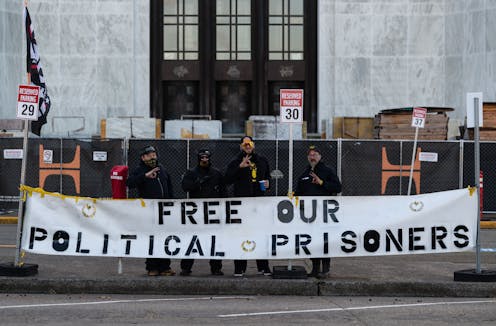
Former President Donald Trump has said he may pardon recently convicted leaders of the Proud Boys. Here, Proud Boys members protest in Salem, Ore., on Jan. 8, 2022. Mathieu Lewis-Rolland / AFP via Getty Images
At the same time, a number of conservative elected officials and politicians have publicly expressed interest in pardoning some of these same people. I am a scholar who studies the individuals, groups and movements that use political violence. Research shows that this use of the pardon power can damage the rule of law in the United States. It undermines one of the tools against violence that law enforcement can bring to bear - deterrence.
The American Bar Association describes the rule of law as a foundational principle for the U.S. justice system: “No one is above the law, everyone is treated equally under the law, everyone is held accountable to the same laws, there are clear and fair processes for enforcing laws, there is an independent judiciary, and human rights are guaranteed for all.”
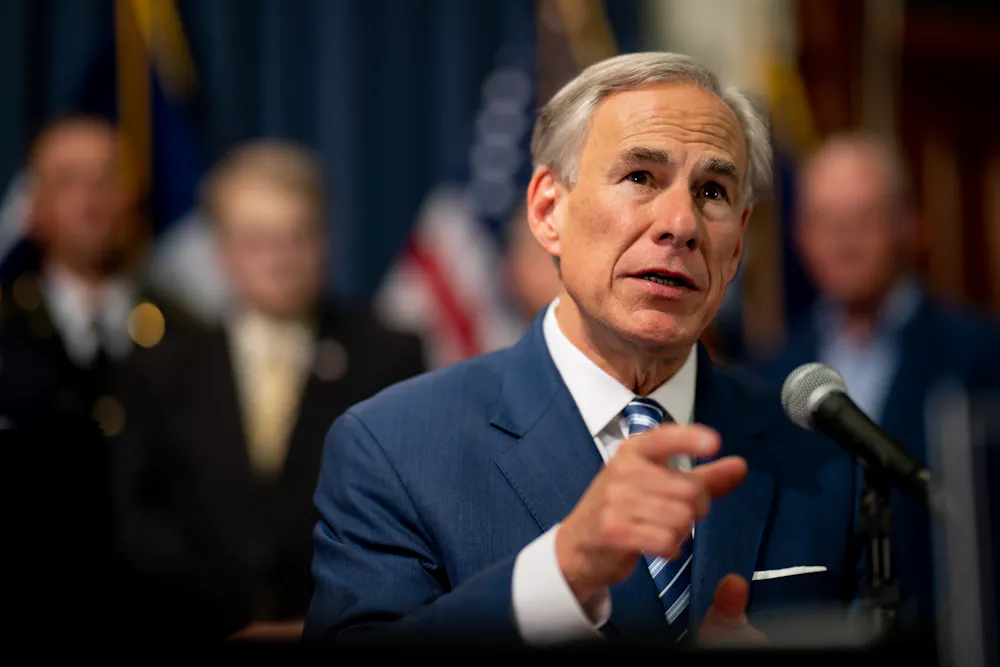
Texas Gov. Greg Abbott, who has said he intends to pardon the Army veteran who was recently convicted of killing a Black Lives Matter protester.
Brandon Bell/Getty Images
The pardon power is not limited to a sitting president, however; state governors can issue pardons for state crimes. And some have expressed similar interest in pardoning those convicted of politically motivated criminal acts in recent years.
Texas Gov. Greg Abbott has said he intends to pardon the Army veteran who was recently convicted of killing a Black Lives Matter protester and was sentenced to 25 years in prison.
In August 2021, Missouri Gov. Mike Parson pardoned the couple convicted of gun charges associated with brandishing firearms at protesters during the racial justice marches over the summer of 2020.
Missouri Gov. Mike Parson pardoned this couple, convicted of gun charges associated with brandishing firearms at protesters during the racial justice marches over the summer of 2020.
Criminal sanctuary
Since Jan. 6, 2021, over 1,000 of the people who participated in the attack on the U.S. Capitol have been criminally charged.
In other circumstances, the legal consequences could be expected to deter others from political violence in the U.S. However, when politicians signal that those responsible for or guilty of violence aligned with their interests could be shielded from punishment – as shown by the use of pardons – punishment seems less likely. This message of criminal sanctuary – relief from punishment – is what former President Trump, Gov. Abbott and Gov. Parson are communicating.
Recent research draws a direct connection between criminal sanctuary and political violence. “When people perceive that they will be provided sanctuary for their criminal actions … this too leads to crime,” write scholars Laura Dugan and Daren Fisher.
In my research, I look at how these signals of criminal sanctuary by politicians and elected officials are interpreted and acted upon by far-right online communities in the United States.
In a series of recent studies, my co-authors and I looked at what members of far-right online communities talked about and how it changed from before the November 2020 U.S. presidential election through the Jan. 6, 2021, attack on the Capitol.
Over the three-month period, when compared with mainstream online communities, far-right communities, most of them accepting of political violence, shifted their focus from discussions of disinformation around the election to specifically advocating for anti-government violence and civil war.
We looked at how far-right online communities responded when then-President Trump called on his supporters in a tweet to come to Washington, D.C., on Jan. 6, saying it “will be wild!” These users listened to the then president and responded with a sentiment of self-righteousness and a greater focus on the idea that they were acting as soldiers on behalf of Trump.
Consequently, members of those online communities played an important role in the Jan. 6 attack on the Capitol.
Michael H. Becker does not work for, consult, own shares in or receive funding from any company or organisation that would benefit from this article, and has disclosed no relevant affiliations beyond their academic appointment.
by Daniel Prince, Professor of Cyber Security, Lancaster University
Building a profile of someone can make it easier for criminals to gain access to their personal accounts. Metamorworks / Shutterstock
Warnings about artificial intelligence (AI) are ubiquitous right now. They have included fearful messages about AI’s potential to cause the extinction of humans, invoking images of the Terminator movies. The UK Prime Minister Rishi Sunak has even set up a summit to discuss AI safety.
However, we have been using AI tools for a long time – from the algorithms used to recommend relevant products on shopping websites, to cars with technology that recognises traffic signs and provides lane positioning. AI is a tool to increase efficiency, process and sort large volumes of data, and offload decision making.
Nevertheless, these tools are open to everyone, including criminals. And we’re already seeing the early stage adoption of AI by criminals. Deepfake technology has been used to generate revenge pornography, for example.
Technology enhances the efficiency of criminal activity. It allows lawbreakers to target a greater number of people and helps them be more plausible. Observing how criminals have adapted to, and adopted, technological advances in the past, can provide some clues as to how they might use AI.
1. A better phishing hook
AI tools like ChatGPT and Google’s Bard provide writing support, allowing inexperienced writers to craft effective marketing messages, for example. However, this technology could also help criminals sound more believable when contacting potential victims.
Think about all those spam phishing emails and texts that are badly written and easily detected. Being plausible is key to being able to elicit information from a victim.
Criminals could create a deepfake version of you who could interact with family members over the phone, text and email.
Fizkes / Shutterstock
Phishing is a numbers game: an estimated 3.4 billion spam emails are sent every day. My own calculations show that if criminals were able to improve their messages so that as little as 0.000005% of them now convinced someone to reveal information, it would result in 6.2 million more phishing victims each year.
2. Automated interactions
One of the early uses for AI tools was to automate interactions between customers and services over text, chat messages and the phone. This enabled a faster response to customers and optimised business efficiency. Your first contact with an organisation is likely to be with an AI system, before you get to speak to a human.
Criminals can use the same tools to create automated interactions with large numbers of potential victims, at a scale not possible if it were just carried out by humans. They can impersonate legitimate services like banks over the phone and on email, in an attempt to elicit information that would allow them to steal your money.
3. Deepfakes
AI is really good at generating mathematical models that can be “trained” on large amounts of real-world data, making those models better at a given task. Deepfake technology in video and audio is an example of this. A deepfake act called Metaphysic, recently demonstrated the technology’s potential when they unveiled a video of Simon Cowell singing opera on the television show America’s Got Talent.
This technology is beyond the reach of most criminals, but the ability to use AI to mimic the way a person would respond to texts, write emails, leave voice notes or make phone calls is freely available using AI. So is the data to train it, which can be gathered from videos on social media, for example.
The deepfake act Metaphysic perform on America’s Got Talent.
Social media has always been a rich seam for criminals mining information on potential targets. There is now the potential for AI to be used to create a deepfake version of you. This deepfake can be exploited to interact with friends and family, convincing them to hand criminals information on you. Gaining a better insight into your life makes it easier to guess passwords or pins.
4. Brute forcing
Another technique used by criminals called “brute forcing” could also benefit from AI. This is where many combinations of characters and symbols are tried in turn to see if they match your passwords.
That’s why long, complex passwords are safer; they are harder to
guess by this method. Brute forcing is resource intensive, but it’s easier if you know something about the person. For example, this allows lists of potential passwords to be ordered according to priority – increasing the efficiency of the process. For instance, they could start off with combinations that relate to the names of family members or pets.
Algorithms trained on your data could be used to help build these prioritised lists more accurately and target many people at once – so fewer resources are needed. Specific AI tools could be developed that harvest your online data, then analyse it all to build a profile of you.
If, for example, you frequently posted on social media about Taylor Swift, manually going through your posts for password clues would be hard work. Automated tools do this quickly and efficiently. All of this information would go into making the profile, making it easier to guess passwords and pins.
Healthy scepticism
We should not be frightened of AI, as it could bring real benefits to society. But as with any new technology, society needs to adapt to and understand it. Although we take smart phones for granted now, society had to adjust to having them in our lives. They have largely been beneficial, but uncertainties remain, such as a good amount of screen time for children.
As individuals, we should be proactive in our attempts to understand AI, not complacent. We should develop our own approaches to it, maintaining a healthy sense of scepticism. We will need to consider how we verify the validity of what we are reading, hearing or seeing.
These simple acts will help society reap the benefits of AI while ensuring we can protect ourselves from potential harms.
Daniel Prince receives funding from UKRI via the PETRAS The National Centre of Excellence for IoT Systems Cyber Security.
by John Dearing, Professor of Physical Geography, University of Southampton
Anna Kucherova / Shutterstock
Across the world, rainforests are becoming savanna or farmland, savanna is drying out and turning into desert, and icy tundra is thawing. Indeed, scientific studies have now recorded “regime shifts” like these in more than 20 different types of ecosystem where tipping points have been passed. Across the world, more than 20% of ecosystems are in danger of shifting or collapsing into something different.
These collapses might happen sooner than you’d think. Humans are already putting ecosystems under pressure in many different ways – what we refer to as stresses. And when you combine these stresses with an increase in climate-driven extreme weather, the date these tipping points are crossed could be brought forward by as much as 80%.
This means an ecosystem collapse that we might previously have expected to avoid until late this century could happen as soon as in the next few decades. That’s the gloomy conclusion of our latest research, published in Nature Sustainability.
Human population growth, increased economic demands, and greenhouse gas concentrations put pressures on ecosystems and landscapes to supply food and maintain key services such as clean water. The number of extreme climate events is also increasing and will only get worse.
What really worries us is that climate extremes could hit already stressed ecosystems, which in turn transfer new or heightened stresses to some other ecosystem, and so on. This means one collapsing ecosystem could have a knock-on effect on neighbouring ecosystems through successive feedback loops: an “ecological doom-loop” scenario, with catastrophic consequences.
How long until a collapse?
In our new research, we wanted to get a sense of the amount of stress that ecosystems can take before collapsing. We did this using models – computer programs that simulate how an ecosystem will work in future, and how it will react to changes in circumstance.
We used two general ecological models representing forests and lake water quality, and two location-specific models representing the Chilika lagoon fishery in the eastern Indian state of Odisha and Easter Island (Rapa Nui) in the Pacific Ocean. These latter two models both explicitly include interactions between human activities and the natural environment.
Fishing in Chilika sustains more than 150,000 people.
ImagesofIndia/Shutterstock
The key characteristic of each model is the presence of feedback mechanisms, which help to keep the system balanced and stable when stresses are sufficiently weak to be absorbed. For example, fishers on Lake Chilika tend to prefer catching adult fish while the fish stock is abundant. So long as enough adults are left to breed, this can be stable.
However, when stresses can no longer be absorbed, the ecosystem abruptly passes a point of no return – the tipping point – and collapses. In Chilika, this might occur when fishers increase the catch of juvenile fish during shortages, which further undermines the renewal of the fish stock.
We used the software to model more than 70,000 different simulations. Across all four models, the combinations of stress and extreme events brought forward the date of a predicted tipping point by between 30% and 80%.
This means an ecosystem predicted to collapse in the 2090s owing to the creeping rise of a single source of stress, such as global temperatures, could, in a worst-case scenario, collapse in the 2030s once we factor in other issues like extreme rainfall, pollution, or a sudden spike in natural resource use.
Importantly, around 15% of ecosystem collapses in our simulations occurred as a result of new stresses or extreme events, while the main stress was kept constant. In other words, even if we believe we are managing ecosystems sustainably by keeping the main stress levels constant – for example, by regulating fish catches – we had better keep an eye out for new stresses and extreme events.
There are no ecological bailouts
Previous studies have suggested significant costs from going past tipping points in large ecosystems will kick in from the second half of this century onwards. But our findings suggest these costs could occur much sooner.
We found the speed at which stress is applied is vital to understanding system collapse, which is probably relevant to non-ecological systems too. Indeed, the increased speed of both news coverage and mobile banking processes has recently been invoked as raising the risk of bank collapse. As the journalist Gillian Tett has observed:
The collapse of Silicon Valley Bank provided one horrifying lesson in how tech innovation can unexpectedly change finance (in this case by intensifying digital herding). Recent flash crashes offer another. However, these are probably a small foretaste of the future of viral feedback loops.
But there the comparison between ecological and economic systems runs out. Banks can be saved as long as governments provide sufficient financial capital in bailouts. In contrast, no government can provide the immediate natural capital needed to restore a collapsed ecosystem.
There is no way to restore collapsed ecosystems within any reasonable timeframe. There are no ecological bailouts. In the financial vernacular, we will just have to take the hit.
John Dearing is a member of the Green Party of England and Wales
Simon Willcock receives funding from UKRI (NE/W005050/1, NE/T00391X/1, ES/T007877/1, ES/R009279/1,
AH/W003813/1, and BB/X010961/1). He is affiliated with Rothamsted Research and Bangor University.
Gregory Cooper does not work for, consult, own shares in or receive funding from any company or organization that would benefit from this article, and has disclosed no relevant affiliations beyond their academic appointment.
Meet the northern snakehead, a horrifying fish that is an invasive species and can breathe out of water and walk on land—and it's just been spotted in Louisiana for the first time. This fish truly is the stuff of nightmares. According to this National Geographic video, not only can the northern snakehead travel across land and live without water for up to three days, it also has a massive appetite, razor sharp teeth, and snapping jaws that can tear human flesh. — Read the rest
It is now rainy season in Florida. This means every time someone puts fertilizer on their lawn, there is a serious chance those chemicals can end up in local waterways, including Tampa Bay and the Gulf of Mexico. The City of St. Petersburg is one of several local governments that uses summer fertilizer bans from June 1 through September 30 to curb water pollution.
“We follow the Pinellas County fertilizer ordinance, which has been in place for more than a decade,” said Julie Vogel. She’s senior capital projects coordinator for the engineering and capital improvement departments.
“Some parts of the ordinance are mandated, and some are encouragements to the public,” she said. “The fertilizer portion says nobody should apply fertilizer from June 1 to September 30 because we know excess nutrients can have negative impacts on our water bodies, from algae blooms to fish kills.”
Learn more about summer fertilizer bans
The county’s has regulations for people fertilizing their individual lawns and for companies using large amounts of fertilizer. The article requires the use of best management practices and has specific guidelines to minimize negative secondary and cumulative environmental effects associated with the misuse of fertilizers and improper landscape maintenance practices.
Those effects impact canals, estuaries, rivers, streams, and interior wetlands.
“Collectively, these water bodies are an asset critical to the environmental, recreational, cultural and economic well-being of Pinellas County residents and the health of the public,” the ordinance states. “Overgrowth of algae and vegetation hinder the effectiveness of flood attenuation provided by natural and artificial stormwater and drainage conveyances. Regulation of nutrients, including both phosphorus and nitrogen contained in fertilizer, will help improve and maintain water and habitat quality.”
Benefits of the ban
The ordinance is not new, Vogel said. “By now most everybody is familiar with the ordinance. It doesn’t come as a surprise. The county and city do a really good job of educating citizens.”
The city has seen the benefits of the fertilizer ban, she said. “We have seen beneficial water quality improvements over the last decade, so we know all of the city programs we do to curb excess nutrients from going downstream have beneficial impacts.”
Hillsborough County and the City of Tampa also have fertilizer restrictions.
The Hillsborough County Board of County Commissioners approved its fertilizer ordinance in 2021 to regulate fertilizers containing nitrogen and/or phosphorous. It provides specific management guidelines for fertilizer application to minimize negative impacts to natural waterbodies.
Any fertilizer containing nitrogen and/or phosphorous “may not be applied on turfgrass or landscape plants from June 1 through Sept. 30, though the ordinance does not prohibit stores from selling the material during this application blackout,” according to the Hillsborough County ordinance.
“Fertilizers containing iron, manganese and other ‘micronutrients’ also referred to as ‘summer blends’ can be applied during the restricted season to keep lawns healthy and green (as recommended by Florida Yards Neighborhood/Florida Friendly Landscape Program).”
Fertilizers containing phosphorous can never be applied to turfgrass or landscape plants. However if a soil analysis test shows a phosphorous deficiency they may be used.
How Homeowners Can Help
Refrain from using fertilizer throughout the summer
Use a slow-release fertilizer in spring or fertilizer-free micronutrients in the summer to keep the lawn healthy all summer
Remove debris or vegetation near storm drains year-round to keep it from entering water bodies
Leave a no-mow zone six feet from any body of water, which helps establish a protective barrier to keep toxic nutrients out of the water
Replace turfgrass and non-native plants with Florida-friendly native plants that require less water and maintenance
by Alexander Sasha Kondakov, Assistant Professor, Sociology, University College Dublin
Just a few months after a new version of Russia’s “gay propaganda” bill was signed into law in November 2022 by President Vladimir Putin, bookshops and libraries removed LGBTQ+ books from their shelves.
Gaming and streaming industries followed suit in December and removed queer characters from their content, and various people started to report nightclub patrons, schoolteachers, and even their own LGBTQ+ family members to the police for allegedly spreading “propaganda”.
This law had banned anything that suggested gay relationships were normal, as well as what it called “gay propaganda” in all forms of media.
Ahead of the tenth anniversary of the first federal “gay propaganda” law being signed by the Russian president on June 30 2013, Putin continues to ramp up his anti-LGBTQ+ agenda as a way of driving support for the Kremlin’s war against Ukraine. Conscription campaigns have carried a strong appeal to Russian men’s sense of traditional masculinity.
In the autumn of 2022, the Russian government engaged in a massive crackdown on the independent media and the civil society – and this included LGBTQ+ activism. The purpose of a new version of the “gay propaganda” law was part of Putin’s manipulation of the political agenda.
Now, LGBTQ+ people are being prosecuted for “gay propaganda”. In one example, two video bloggers from Kazan, a young queer couple, were prosecuted for sharing videos through social networks discussing gay issues. The case was reportedly based on a complaint that the couple suggestively touched each other, which – according to a BBC report, the prosecution said could cause minors to “desire to change sex”. One of them, a Chinese national, was detained and eventually deported to China. The other vlogger was reported to have been fined 200,000 rubles (£1,855).
The Russian media censorship agency, Roskomnadzor, is working on criteria to help the public more easily identify “harmful” LGBTQ+ information and stop it from circulating. Yet the point of this legislation goes further than its stated aims.
Whenever governments try to spread hate towards an already marginalised section of the population, they are actually involved in a political struggle for the majority’s love and support. They target lasting divisions in society – such as sexuality or race – hoping that they will receive enough political legitimacy in return from various groups that are in favour. This is not specific to Russia and can be seen throughout history, in Nazi Germany, for example.
As Putin tries to consolidate support for his war in Ukraine, the Russian president clearly believes there is value in creating heroes and villains in Russian society: in this case, traditional masculine males who join up as heroes and LGBTQ+ people who are set up to provide a counterpoint as villains.
Russian feminist activists Pussy Riot.
I have spent nearly a decade analysing this anti-queer legislation. The law officially bans “propaganda of non-traditional sexual relationships and (or) preferences and propaganda of sex change” – so it is an extreme variant of “don’t say gay” bill in Florida that bans the discussion of sexual orientation and gender identity in schools. In 2013, the first version of Russia’s law pretended to protect children from LGBTQ+ content and activism. In 2022, the censorship was extended to the entire adult population.
But the restrictions on LGBTQ+ information, ensuring difficulties in accessing gay books and films have never been its primary aim. Even though LGBTQ+ literature and films, as well as LGBTQ+ activism existed in Russia, it was not particularly visible.
In my recent book, Violent Affections: Queer sexuality, techniques of power, and law in Russia, I investigate the effects of the original 2013 law on Russian society. According to my analysis, violence against LGBTQ+ Russians started to grow significantly in 2013 and doubled by 2015: from 33 victims of anti-LGBTQ+ violence before the “propaganda” law to 68 victims two years after its adoption.
These numbers are only the tip of the iceberg because they come from criminal court rulings that I analysed (so these cases were reported, investigated, and prosecuted, even though not as hate crimes). Of those cases, 40% were homicides, the rest were serious injuries and assaults. Only a handful are less violent robberies or assaults. Less violent cases simply didn’t make it to court.
Other scholars have investigated the effects of stigmatising LGBTQ+ people and their self-expression. A 2021 study by US-based sociologist Alexandra Novitskaya suggests that since the discrimination really began to ramp up in 2013, many LGBTQ+ Russians have been forced to emigrate to safer countries.
Those that stay have had to be less open about their sexuality. The aim of these anti-LGBTQ+ “propaganda” speech acts was to generate fear, or hatred, of a minority. But also to create political legitimacy for the powerful, by pitting the majority “us” against the minority “them”.
The original “gay propaganda” law had a very clear political mission: it was supposed to increase support of Putin’s fading popularity. Polls in 2013 revealed that 43% of Russians thought homosexuality was “licentiousness, a bad habit” and 35% thought it was “illness or the result of psychological trauma”. So the law, passed at a time when Putin faced mass demonstrations opposing what many believed to have been widespread voter fraud in the 2011 Duma (parliamentary) elections, was a bid to distract attention and divert people’s antipathy towards an already marginalised group.
Even though dissent has been forced underground, there are some suggestions that discontent is brewing in Russia, particularly at the conduct of the war in Ukraine and mass conscription. Putin’s power base is shaky, and he is frightened of losing it. So once again he is ramping up anti-gay sentiment to attract popular support. It worked before – and may work again.
Alexander Sasha Kondakov does not work for, consult, own shares in or receive funding from any company or organisation that would benefit from this article, and has disclosed no relevant affiliations beyond their academic appointment.
by Andrei Lux, Lecturer of Leadership and Director of Academic Studies, Edith Cowan University
Shutterstock
You’re in a meeting, with something important to say. Just as you begin, a colleague sighs and shares an eye-roll with their buddy. And not for the first time.
Workplaces aren’t always harmonious. Whether it’s a cafe, factory or parliament, people do and say hurtful things. They may talk down to you, “call you out” in front of others, make jokes at your expense, gossip about you behind your back, or give you the silent treatment.
This type of incivility doesn’t quite rise to the level where you can complain to human resources and expect a satisfying resolution. Organisations typically have policies against racism, sexism, harassment and other overt forms of abuse. But incivility – being less severe and more difficult to prove – tends to fly under the radar.
Most of us will experience incivility at some point at work. More than 50% experience it weekly. According to a 2022 meta-analysis of 105 incivility studies, you’re more likely to cop it if you’re new, female, in a subordinate position, or from an ethnic minority.
Unkind and thoughtless words matter. As linguist Louise Banks says in the 2016 film Arrival: “Language is the first weapon drawn in a conflict.”
What people say and how they say it affects us deeply. One cruel remark can ruin your whole day. Left unchecked, incivility makes for a toxic workplace.
It’s tempting to simply blame bad character. Certainly such behaviour is much more likely from people with dysfunctional personality traits, especially the “dark triad” of narcissism, psychopathy and Machiavellianism.
Narcissists are self-obsessed and dominate social interactions. Psychopaths lack empathy and don’t understand social norms. Machiavellians are manipulative, self-interested and amoral.
But even “nice” people can be uncivil, with the three most common incivility triggers being because they feel let down by their leaders, are under more pressure than they can handle, or someone else was rude first – to them or others.
Incivility can therefore become a vicious spiral that turns victims and bystanders into perpetrators. That’s how toxic workplaces are born, develop, and perpetuate.
Leadership sets the tone. We’re social creatures and learn what’s expected and acceptable from those we look up to. Our leaders’ behaviour is infectious, and cascades down throughout and across organisations – for better or worse.
Incivility is most harmful when it comes from a supervisor: someone we’re supposed to trust, who’s supposed to look after us.
The power asymmetry means leaders’ inappropriate behaviour is less likely to be challenged. Take, for example, Harvey Weinstein, who for decades abused his position as one of Hollywood’s most successful film producers to sexually exploit women, before finally being held to account.
But managers can be derelict in their duty without being perpetrators. As in the case of sexual harassment, it may be easier to see and hear no evil, perhaps because the perpetrator is favoured as a high performer or a friend. With the capacity for one individual to make life a misery for many colleagues, this leadership failure can lead to a toxic workplace culture.
Authentic leadership ‘in the trenches’
It’s up to leaders to be the first movers against incivility and create positive work cultures with their own behaviour. What leaders will tolerate on their team sets the bar for how everyone else will behave.
With colleagues Stephen Teo and David Pick, I’ve surveyed 230 nurses across Australia about the leadership qualities that help reduce incivility.
Why ask nurses? Because their work is stressful and demanding. The strain of providing critical care for patients creates conditions conducive to conflict, from swearing to physical violence. Workplace incivility is frequent and these stressors increase the likelihood of medical mistakes. So there’s good reason to reduce incivility to improve health-care quality.
Nurses work in stressful and demanding conditions, conducive to conflict.
Shutterstock
Our research shows that authentic leadership promotes workplace cultures with less incivility and better well-being. Such authentic leaders are aware of their own strengths and weaknesses, act on their values even under pressure, and work to understand how their leadership affects others.
What can you do?
Incivility isn’t okay. It should never be excused as “just part of the job”.
If this is happening to you, or others in your workplace, avoiding it won’t help you or your colleagues. Putting up with incivility is emotionally taxing, entrenches feelings of resentment and will likely lead to bigger conflicts down the track.
Responding with more incivility of your own isn’t a good idea. Retaliation rarely deters a person who engages in such behaviour and instead effectively endorses it.
One approach recommended by psychologists when dealing with high-conflict personalities is known as the BIFF technique: be brief, informative, friendly and firm.
When someone says something mean, you might respond, as calmly as possible, along the lines of: “Your comments are hurtful and damage our working relationship. Please, let’s keep things professional.”
Don’t retaliate. Be brief, informative and friendly but firm.
Shutterstock
If the behaviour persists, approach your supervisor. Again, stay calm. Explain what’s happening and how it’s affecting you. You don’t have to go at it alone either: consider inviting colleagues who can support you, and your claims.
Will this fix the problem? Possibly not. Your manager might simply shrug their shoulders, or arrange a “mediation” that resolves nothing. But saying and doing nothing will almost certainly leave you unsatisfied.
If your manager is the perpetrator, contact your HR department first (if your organisation has one) or else your union. The union can offer advice on other avenues to seek redress.
Statutory agencies such as Australia’s Fair Work Ombudsman, Employment New Zealand and the UK’s Advisory, Conciliation and Arbitration Service have the power to investigate workplace complaints, and to intervene in disputes through formal conciliation or arbitration. But before embarking on such a process, it’s best to get expert advice. You might get justice, but also still need to find another job.
Incivility is unlikely to stop on its own, however. Your voice matters and can help break the cycle.
Andrei Lux works for Edith Cowan University and is a Director of the Australian and New Zealand Academy of Management.
by Kirsten Matoy Carlson, Professor of Law and Adjunct Professor of Political Science, Wayne State University
Wiping away tears, Nita Battise, vice chairperson of the tribal council of the Alabama-Coushatta Tribe of Texas, reacts to the Supreme Court ruling upholding a law that gives Native American families priority in adoptions and foster care placements of tribal children. Mandel Ngan/AFP via Getty Images
The Supreme Court affirmed the constitutionality of the Indian Child Welfare Act, a 1978 law enacted to protect Native American children in the U.S. and strengthen their families, in a June 15, 2023, ruling. Tribal leaders praised the decision as upholding the basic constitutional principles governing the relationships among Native nations and the federal government.
Congress originally passed the Indian Child Welfare Act in response to requests from tribal leaders, and other advocates for Native Americans, to stop state governments from removing an alarming number of Native children from their families. Before the law took effect, state social welfare agencies were removing between 25% and 35% of all Native American children, and 90% of those removed were sent to be raised by non-Native families.
The Indian Child Welfare Act recognizes the government-to-government relationship Native American nations have with the United States. It covers certain child placements and sets uniform standards for state and tribal courts to follow when they decide American Indian child welfare cases. These standards include provisions that ensure that tribal governments are aware of and can have a say in the placement of Native American children. They aim to reduce the trauma of family and tribal separation by instructing courts to make active efforts to keep families together.
In 2017, the state of Texas and non-Natives seeking to adopt or foster Native American children challenged provisions of the law. They argued that the law exceeds Congress’ constitutional powers, impermissibly tells state officials what to do, and illegally discriminates against non-American Indians.
Writing for a 7-2 majority, Justice Amy Coney Barrett wrote, “the bottom line is that we reject all of the petitioners’ challenges to the statute.”
As a result of the ruling, Native nations’ most valuable resource – their children – will continue to gain the benefits of growing up knowing their own Indigenous cultures and communities.
Court and Congress diverge
As my research has shown, Congress and the Supreme Court have increasingly diverged in how they view the laws that relate to Native American tribes.
The court has not consistently deferred to Congress but rather has increasingly claimed the power to be the final arbitrator of American Indian policy. In doing so, it has undermined congressional policies meant to foster tribal governance and protect tribal lands and bodies.
The petitioners in the current case, Haaland v. Brackeen, seized on this trend. They questioned Congress’ ability to enact laws affecting tribal governments and their citizens. They argued that Congress lacked the constitutional authority to enact the Indian Child Welfare Act.
From my perspective as an expert in federal Native American law, the court’s decision is significant because the court affirmed Congress’ constitutional power over American Indian affairs.
The majority of the justices responded to the petitioners’ arguments by reiterating the court’s longstanding characterization of Congress’ power over American Indian affairs as “plenary and exclusive.”
Writing for the majority, Barrett stated, “Congress’s power to legislate with respect to Indians is well-established and broad. Consistent with that breadth, we have not doubted Congress’s ability to legislate across a wide range of areas, including criminal law, domestic violence, employment, property, tax, and trade.”
Barrett relied on earlier cases to find that Congress’ power over American Indian affairs comes from and remains limited by the U.S. Constitution. “We reiterate that Congress’s authority to legislate with respect to Indians is not unbounded,” she wrote.
The majority concluded, “If there are arguments that [the act] exceeds Congress’s authority as our precedent stands today, petitioners do not make them.”
Open questions remain
The majority reaffirmed Congress’ broad authority over Native American affairs but left other questions unresolved.
The Texas attorney general and the other litigants claimed that the Indian Child Welfare Act discriminates against non-Native Americans by making it harder for them to adopt Native children. The law instructs courts to place children with their relatives – either Native or non-Native, someone in their tribe, or an American Indian family if possible.
The litigants said this preference for placement with an Native family is racial and violated the equal protection clause of the Constitution, which requires government policies to be racially neutral. Tribal nations counter that federal laws and previous court decisions have defined Native status as a political, not racial, designation. The Court did not deal with this claim.
Justice Brett Kavanaugh wrote separately to emphasize the seriousness of these claims. He stated, “[t]he equal protection issue remains undecided.”
Kavanaugh’s words may invite future challenges to the Indian Child Welfare Act and to the political status of American Indians as citizens of tribal governments.
In the meantime, the court’s decision ensures that Native children will continue to experience the social and health benefits of being raised in their tribal cultures.
More importantly, the court’s decision acknowledges the vital, constitutional role that Congress plays in Native American affairs and defers to a congressional policy protective of Native nations and their people.
Kirsten Matoy Carlson does not work for, consult, own shares in or receive funding from any company or organization that would benefit from this article, and has disclosed no relevant affiliations beyond their academic appointment.
Poet Amanda Gorman’s poem ban highlights major flaws with recent book bans. SPECIAL TO THE ORACLE/ FLICKR
Poet Amanda Gorman’s “The Hill We Climb” was banned from a Miami-Dade elementary school, despite the parent objecting to the poem admitting to not reading the whole thing, according to a May 28 article from USA Today.
Book bans have become prominent in the state within the past year, but the recent news of Gorman’s poem being banned reinforces the fundamental issues that plague these bans whenever they occur.
These bans often disproportionately affect LGBTQ authors and authors of color, and Florida’s school officials need to be more responsible when looking over these complaints and deciding to ban a particular book.
The mother who objected to the poem, Daily Salinas, said she took issue with the poem’s “indirect hate messages,” according to a May 24 article from the Jewish Telegraphic Agency.
“I’m not a reader. I’m not a book person. I’m a mom involved in my children’s education,” she said.
When filling out the complaint form, Salinas cited pages 12 and 13 as being the areas where the “‘hate messages’” were, according to a May 25 article from NPR. An excerpt from those pages reads:
“We’ve braved the belly of the beast.
We’ve learned that quiet isn’t always peace,
And the norms and notions of what “just is”
Isn’t always justice.”
The poem, which was read at Joe Biden’s inauguration, includes many similar metaphorical stanzas throughout, as a means of referring to the transition between President Trump and Biden, and the state that America has been left in, and could become in the future.
Gorman stated that she had finished the poem after the Capitol Riot on Jan. 6, so the words could “be a point of unity and collaboration and togetherness,” according to a 2021 interview with BBC World Service Newshour.
This statement comes as a contrast to the “hate messages” that Salinas alleged, showing a misunderstanding on what the point of the poem was.
When asked about the nature of Gorman’s poem being banned, USF literacy studies professor and faculty senate president Jenifer Jasinski Schneider, wasn’t very favorable of the decision.
“In the case of removing Amanda Gorman’s book, a fair and legitimate process wasn’t followed and the book does not contain objectionable material. It shouldn’t have happened and the decision should be reversed,” said Schneider in an interview with The Oracle.
Authors of color, like Gorman, are frequently targeted by these bans. The American Library Association has seen a rising number of challenges against books dealing with race or Black history, according to a 2022 article by Education Week.
From July 1 to Dec. 31, 2022, there were 1,477 instances of books being banned, according to an April 20 report from PEN America. Of the 874 books that have been banned, 30% included characters and discussions of color and race, and 26% had LGBTQ characters or themes.
Banning books without legitimate reason can set a dangerous precedent for censorship in higher education as well. In fact, several universities in Florida have already faced these kinds of issues.
In January, DeSantis railed against AP African American Studies and DEI and CRT programs at Florida’s universities, according to a Feb. 2 article from The Oracle. The College Board would go on to revise the AP course, but denied that Florida’s politics played a part in the decision, according to a Feb. 1 statement from All Access.
Going forward, when parents file book ban complaints, they need stronger reasons for why a book isn’t appropriate for a class. If it contains harmful or inappropriate content, then they need to show a more concrete understanding of the work in question.
There’s some hope for change down the line. President Joe Biden announced on June 8 a new coordinator to look into book bans that the president feels “violates” the civil rights of LGBTQ students, according to a June 8 news conference uploaded to YouTube by CBS News.
The action also comes in the midst of both PEN America and Penguin Random House suing the Escambia County School District for their book removals, claiming that it also “violates” the First and Fourteenth Amendments, according to the May 17 court document.
Hopefully, these actions can lead to a state where book bannings aren’t so commonplace, because continuing down this road would be dangerous for education.
Most food and garden waste in Australia comes from homes. Australian households waste 3.1 million tonnes of food each year. That’s more than five kilograms each household per week.
Over half of all household waste is food organics and garden organics, also known as “FOGO”. These scraps and clippings take up space in landfill and, when they rot, emit dangerous greenhouse gases.
The federal government’s National Waste Policy Action Plan aims to increase the organic waste recycling rate from 47% to 80% by 2030 and halve the amount sent to landfill. This won’t happen on its own - we need investment and action.
Food and garden waste can be captured and turned into compost. Composting is no longer just the domain of the home gardener or eco-warrior. It’s happening at commercial scale, through services such as council collection from homes.
A federal government fund is building new composting facilities and supporting other food and garden organics recycling projects. The South Australian government has invested in council trials of weekly green bin collection and fortnightly rubbish collection.
But more must be done. Recycling food waste into high-quality compost is a win-win solution, for people and the planet. Here, we explain why.
Scrap Together is a community education program from EPA NSW helping councils harvest FOGO.
When food rots in landfill, in the absence of oxygen, the process releases a potent greenhouse gas called methane.
Composting is different because the microbes can breathe. In the presence of oxygen, they transform waste into valuable organic matter without producing methane. They recycle organic carbon and nutrients into compost, which can be used to improve soil health and productivity.
This process also captures and stores carbon in the soil, rather than releasing it as carbon dioxide (CO₂) to the atmosphere.
In Australia, organics recycling (including food and garden organics, biosolids and tree wastes) saves an estimated 3.8 million tonnes of CO₂ from entering the atmosphere each year. That’s equivalent to planting 5.7 million trees or taking 877,000 cars off the road.
Soils can profit from compost because globally an estimated 116 billion tonnes of organic carbon has been lost from agricultural soils. This has contributed to rising CO₂ levels in the atmosphere.
Promisingly, compost can restore soil organic carbon while also boosting health and fertility. Compost improves soil structure and water retention. It’s also a source of essential nutrients that reduces the demand for costly fertilisers.
The opportunity presented by soils to draw down atmospheric CO₂ levels was brought to global awareness in the 2015 global Paris Agreement, via the “4-per-mille” initiative.
Translated from French, it means increasing the organic carbon stored in global soils by 0.04% each year (4 per 1000) would neutralise increases in atmospheric CO₂. In other words, CO₂ would remain constant rather than continue to increase. That would make a substantial contribution to mitigating climate change.
Introducing the international “4 per 1000” Initiative.
Our research has investigated how compost can benefit global agriculture.
We found that in most cases where compost is applied as a generic product to agricultural land, the benefits are not fully realised. But if suitable composts and application methods were aligned with target crops and growth environments, crop yields can be increased and organic carbon in soils replenished.
We call this a “precision compost strategy”. Using a data-driven approach, we estimate global application of this strategy has potential to increase the production of major cereal crops by 96.3 million tonnes annually. This is 4% of current global production and twice Australia’s annual cereal harvest.
Of great relevance for Australia’s farms, precision compost has the strongest effects in dry and warm climates, boosting yield by up to 40%. We now need to develop this strategy for the specific needs of farms.
Compost has the potential to restore 19.5 billion tonnes carbon in cropland topsoil, equivalent to 26.5% of current topsoil soil organic carbon stocks in the top 20 cm.
Give FOGO a go-go
The amount of food and garden waste in Australia is growing at a rate six times faster than Australia’s population and 2.5 times faster than GDP.
But less than a third of Australian households have access to food waste collection services. A national rollout has been pushed back from 2023 to the end of this decade so there is time to overcome some roadblocks. This includes uptake by community and high quality composting.
This waste stream offers a huge opportunity for landfill diversion and compost production. The cost benefit alone is compelling: councils can save up to A$4.2 million a year on landfill levies by diverting 30,000 tonnes of waste (based on A$74 to 140 per tonne of waste, with levies increasing).
Preventing food in the home from being wasted should be top priority. But for unavoidable food waste, turning it into high-quality compost makes perfect sense.
by Liquan Liu, Senior lecturer, Western Sydney University
Shutterstock
None of us is a stranger to the downsides of the pandemic. For families with kids, kindergartens and schools closed during the lockdown, and parents had to manage schooling and working from home.
Yet there is a silver lining: our research shows that, in families where a parent’s mother tongue is not the language spoken in wider society, children learned more about that language during lockdowns.
Let’s call the language these parents speak the “home language” and the language society uses the “societal language”. Take me as an example: at home I speak Shanghainese with my mum, Mandarin with dad, and Telepath with my cat. But in the community and at work, I speak English, the societal language.
To many multilingual families, our kids’ home language often comes second to the societal language, which dominates their language development as they grow up. When parents witness this transition, they fear their children will gradually lose the ability to use the language they speak. They fear that, as a consequence, their children will lose touch with their roots.
Along with my colleagues, Elisabet García González and Elizabeth Lanza, we conducted a survey of around 200 multilingual families in Norway (published in the journal Multilingua). Parents expressed their concerns about their children’s development of home and societal languages. For example, one said:
Since our daughter mostly speaks [home language] with her father and [societal language] with me and at kindergarten (although her father and I exclusively speak [home language] to each other), her [home language] is generally less advanced than her [societal language] […]
Multilingual children rarely use all their languages in the same contexts or with the same frequency. This is often perceived as being more or less “advanced” in one language than the other, but in reality multilingual speakers use their languages as best fits their needs.
Despite these concerns, there was a silver lining. Our study found children’s home language literacy improved during the pandemic. The parents who reported the concern above later said:
We’ve clearly noticed that her spoken [home language] has developed during the lockdown.
Another family told us:
With the two-year-old, I noticed an improvement in her [home language] vocabulary while kindergarten was closed.
What is the reason for this improvement in the home language? As one family shared:
My children started to be interested and speak more [home language] during the lockdown. Assume this is a result of (us) working from home for an international company and them hearing mum use this (home) language.
Another said:
My kids have started using more [home language] in their [societal language] speech with parents and each other during the lockdown, because they are watching more YouTube and playing Minecraft, Animal Crossing and Zelda. Words from the games are difficult to translate into [societal language].
Our statistical analyses had something even more interesting to say: the improvement of a child’s home language made their parents feel more positive about their children being multilingual. Parents see it as a source of wellbeing, especially when they notice their child is picking up their mother tongue. Overall, family relationships, resilience, cultural connection and hope are boosted even in the darkest days of the pandemic.
Is this at the expense of the societal language, one may ask? Indeed, some parents were worried about the development of kids’ societal language, especially when it was not spoken at home. Others said the societal language was still being used during the lockdown, such as in online media. One parent said:
My son is a bit behind the level of the class. He really improved his [societal language] reading during the lockdown, since we had more time to individually support him in a positive way. Before, he was much more negative.
Another family told us:
The difference (in language use) was noticeable when the kindergarten reopened. [Societal language] came back for the kids as easily as restarting to ride a bike.
The societal language is often strong in young children – sometimes so strong that it can bully the home language into a corner. The key task for many multilingual families is not so much to find a balance between the two languages, but to make sure the home language is being actively used and not being overshadowed by the societal language.
Unity is important in society. Being able to speak a common language is important, but equity and diversity are important too. The ability to speak one’s mother tongue can become a source of belonging and wellbeing.
In addition, children growing up in a culturally and linguistically diverse environment tend to be more flexible. Their neurocognitive plasticity shines across developmental domains, from language learning to music perception.
So the pandemic lockdowns were bad, but not all bad. Our kids adapt and adjust to the new environment, and can surprise us with stronger skills that make mum and dad proud.
Liquan Liu receives funding from uropean Union’s Horizon 2020 research and innovation programme under the Marie Skłodowska-Curie grant agreement No. 798658 hosted by Center for Multilingualism across the Lifespan at the University of Oslo, financed by Research Council of Norway through its Centers of Excellence funding scheme grant agreement No. 223265; and from Western Sydney University School of Psychology 20820 83181.
The corresponding academic publication will be published on journal Multilingua. DOI details to be added. Co-authors are Elisabet Garcia Gonzalez and Elizabeth Lanza.
by Ronald S. Sullivan Jr., Professor of Law, Harvard University
Former President Donald Trump speaks out against his federal indictment on June 10, 2023, during a speech in Georgia. Anna Moneymaker/Getty Images
The question of whether to indict a former U.S. president is a difficult one.
And yet, a state prosecutor has charged Donald Trump with violating New York business laws. And a federal prosecutor has charged Trump with violating national security laws as well.
On one hand, the U.S. judiciary system is based on a basic principle of English law that dates back to the early 1200s, that no one is above the law. As medieval jurist Henry de Bracton explained in “On the Laws and Customs of England,” the law makes the king, and thus, the king must be subject to the law.
“The king should be under no man, but under God and the law,” de Bracton wrote.
In his brief public statement, Special Counsel Jack Smith paraphrased that concept in announcing his decision to indict Trump on charges of violating national security laws as well as participating in a conspiracy to obstruct justice.
“We have one set of laws in this country, and they apply to everyone,” Smith said. “Adherence to the rule of law is a bedrock principle. … And our nation’s commitment to the rule of law sets an example for the world.”
But a strong case can be made for a prosecutor to exercise discretion and not charge a former president.
Part of that argument is based on the perception such a decision would have among some of the American public, that the criminal justice system had been weaponized to punish political rivals.
In fact, Trump, as well as some of his supporters, has used that perception in an attempt to convince his political base that both indictments are politically motivated. One of Trump’s congressional supporters, Jim Jordan, a Republican from Ohio, has even convened hearings on the weaponization of the FBI, among other federal agencies.
House Speaker Kevin McCarthy spoke for many of Trump’s supporters when he told Fox News Digital: “This is going to disrupt this nation because it goes to the core of equal justice for all, which is not being seen today. And we’re not going to stand for it.”
It’s reasonable that regular citizens might fear prosecutors would abuse their power by filing unmerited, politically motivated charges against their political opponents. Some foundational legal principles can shed light on when such prosecutions are or aren’t reasonable.
When I teach first-year criminal law at Harvard, one of my goals is to help the class understand that criminal law is based on what communities deem to be morally wrong behavior.
In the state case as well as the federal one, both prosecutors believe that Trump’s behavior surpassed that threshold.
Justice system needs credibility
When considering charging a former president with crimes, two extreme positions should be rejected at the onset.
First, some argue that equality under the law means just that. If a former president commits a crime, he should be charged.
This position ignores the reality that the costs associated with charging a former president – particularly one who is a current candidate for president – can be high.
Our criminal justice system relies on the citizenry believing in its legitimacy. Widespread belief that the prosecution of a former president is being used as a political tool undermines that legitimacy.
Second, others like McCarthy argue that a former president should not be charged with any crime, as doing so will exact permanent injury on the credibility of American democratic traditions.
This argument overstates the likely consequences as well.
In recent years, two democracies, France and Israel, have indicted a former or sitting leader, and both of those democracies are still functioning.
Like France and Israel, the United States’ democratic traditions are strong enough to endure the prosecution of a a former president or a presidential candidate.
When to charge a former president
Legal theorists have divided the criminal law into two categories.
Known in Latin as “malum in se,” the first category is used to define conduct that is considered naturally evil as determined by the sense of a civilized community.
Such conduct includes, murder, larceny and assault.
Manhattan District Attorney Alvin Bragg makes a point following the arraignment of former President Donald Trump on April 4, 2023.
Kena Betancur/Getty Images
The other category is known in Latin as “malum prohibitum” and involves conduct that is a crime only because the law makes it so.
In plain terms, the malum in se is illegal because the conduct, on its face, is immoral.
In contrast, malum prohibitum is immoral only because a law has deemed it illegal.
For example, a premeditated murder is immoral on its face.
Failing to proceed with caution at a yellow light is not immoral per se; it’s wrong because lawmakers have written a code that says it’s wrong.
What sort of crime?
Prosecutors should only indict former presidents or presidential candidates for crimes believed to be immoral.
In this way, an entire class of nonserious crimes are excluded from
consideration. For example, Americans will never have a Democratic prosecutor charging a Republican former president with jaywalking. Likewise, a Republican prosecutor will not charge a Democratic presidential candidate with littering.
While the exclusion of very many crimes by prosecutors is a helpful start in determining whether to prosecute or not, the difficult analytical work comes when deciding which categories certain crimes fall in.
Former President Donald Trump arrives for an arraignment hearing on April 04, 2023, in New York City.
Michael M. Santiago/Getty Images
Is it evil to violate a state’s business record laws?
Is it immoral to violate national security laws?
Are they more like a traffic violation or a premeditated homicide?
What if the former president violated the business record laws for the purpose of violating some other law, which raises the conduct from a misdemeanor to a felony?
In his public statements shortly after indicting Trump, Manhattan District Attorney Alvin Bragg explained that New York is the financial capital of the world and that the state has a significant interest in enforcing its business records laws.
Bragg further explained that failure to police business records laws could have an impact on consumers – real, everyday people who rely on fair business practices, which, in turn, is the basis for fair markets, fair interest rates and fair prices for a range of goods and services.
No one is above the law
In the end, the decision to criminally charge a former president turns on a tricky question.
Equal protection under law is a value that Americans should hold dear. But when it comes to a former president, competing values must be considered.
Is the alleged crime so egregious that the benefit of holding a former president equal before the law outweighs the cost associated with the appearance of a partisan, weaponized prosecution?
So far, Smith and Bragg are the only state and federal prosecutors to answer that question by seeking an indictment.
“We today uphold our solemn responsibility to ensure that everyone stands equal before the law,” Bragg said. “No amount of money … and power changes that enduring American principle.”
Likewise, Jack Smith urged those interested in the case to read the indictment before making charges that his investigation was politically motivated.
“Our laws that protect national defense information are critical to the safety and security of the United States, and they must be enforced,” Smith said. “Violations of those laws put our country at risk.”
This article has been corrected to fix the position held by Benjamin Netanyahu.
Ronald S. Sullivan Jr. does not work for, consult, own shares in or receive funding from any company or organization that would benefit from this article, and has disclosed no relevant affiliations beyond their academic appointment.
by Gary Ross, Associate Professor Intelligence Studies, Texas A&M University
Boxes containing classified documents are stored in a bathroom of Donald Trump’s Mar-a-Lago Club.
Department of Justice
When Donald Trump pled not guilty on June 13, 2023, to federal criminal charges related to his alleged illegal retention of classified documents, it was his first opportunity to formally answer charges that he violated the Espionage Act.
The Justice Department alleges that, after his presidency, Trump held, in an unsecure location, documents about some of the nation’s most sensitive secrets, including information about U.S. nuclear programs as well as U.S. and allies’ defense and weapons capabilities and potential vulnerabilities to military attack and that he repeatedly thwarted efforts by the National Archives to retrieve them.
U.S. national security includes the country’s ability to defend itself, collect and analyze sensitive information about other nations’ capabilities and intentions, and maintain relationships with allies. National security can be compromised in a variety of ways.
Americans are familiar with espionage, or spying. It’s when a government recruits an official or resident of another country – just as the Soviet Union recruited Robert Hanssen, a senior FBI special agent, in 1979 - to provide classified U.S. intelligence.
But the Espionage Act is much broader than traditional spying and includes the unauthorized possession, storage or disclosure of classified information.
According to the federal indictment, Trump stored boxes containing various levels of classified material in different parts of The Mar-a-Lago Club, his Palm Beach, Florida, resort. Boxes were kept on a ballroom stage, in his bedroom and in a bathroom and shower between Jan. 20, 2020, when he left the White House, and Aug. 8, 2021, when the FBI recovered 102 classified documents.
This was particularly concerning because, according to the indictment, Mar-a-Lago was the site of more than 150 social events, attended by tens of thousands of people, between January 2020 and August 2021.
Boxes full of classified documents sit on top of an ornate stage inside the Mar-a-Lago Club’s White and Gold Ballroom.
Department of Justice
Historically, foreign spies have attempted to enter highly secure U.S. government buildings to obtain classified information. In 1987, for example, the U.S. Marine Corps charged two Marine guards with allowing Soviet agents to repeatedly access sensitive areas inside the U.S. Embassy in Moscow.
If foreign spies knew Trump stored classified documents at Mar-a-Lago, they may have attempted to enter the property. In 2019, a Chinese business consultant entered the resort and initially got past Secret Service agents. She was stopped in the main reception area, carrying multiple electronic devices.
Based on the classification markings identified in the indictment, documents Trump stored at Mar-a-Lago contained intelligence from multiple U.S. sources, including satellite images, human sources and intercepted foreign communications, which can include cell phone calls or email messages.
If other countries gained access to this intelligence, their counterintelligence professionals could learn how the U.S. obtained specific information and they could use countermeasures that could render a particular source or method useless to the U.S. moving forward.
In April 1983, a terrorist attack killed 63 people at the U.S. Embassy in Beirut. At the time, the terrorist organization operating in Syria was communicating with counterparts in Iran. The U.S. government began intercepting the traffic, which two media outlets later reported, according to an opinion piece by Katherine Graham published in The Washington Post. Shortly after, communication between Syria and Iran stopped and the U.S. intelligence community lost insight into the Syrian terrorists’s activities. This may have left the U.S. unable to detect or prevent an attack by the same terrorist group on the Marine barracks in Beirut six months later. That attack left 241 U.S. service men and women dead.
What’s the risk to US foreign relations and alliances?
Diplomacy, the connection between sovereign states, largely forged through foreign policy, is an important component of national security, as is intelligence sharing among allied intelligence services.
The U.S., for example, belongs to what is known as the Five Eyes intelligence alliance, in which intelligence agencies from five allied countries share a range of information. But, the allegation that a document with Five Eyes classification markings had spilled onto a Mar-a-Lago storage room floor may lead the other four countries to reconsider their level of information sharing with the U.S. It has happened before.
Classified documents meant to be seen only by the Five Eyes intelligence alliance and newspapers spill onto the floor of a storage room of the Mar-a-Lago Club.
The Department of Justice
In addition to information about U.S. nuclear programs, U.S. and allies’ defense and weapons capabilities and potential military vulnerabilities, the indictment alleges Trump also unlawfully retained classified information about U.S. military retaliation plans in response to a foreign attack.
In enemy hands, this intelligence, if still valid, could significantly increase their ability to develop effective countermeasures or to alter their military tactics. At best, this could prolong a conflict, and, at worst, could allow an adversary to defeat U.S. forces, which could jeopardize citizens’ lives.
In each scenario, the lives of U.S. service members could be placed at increased risk.
Additionally, an enemy able to identify a U.S. vulnerability, particularly a self-identified vulnerability, can also try to exploit that weakness to their advantage, just as the United States did during World War II.
Prior to the 1942 Battle of Midway, U.S. intelligence intercepted and decrypted communications detailing Japan’s military strategy for the upcoming battle.
U.S. forces took advantage of the information, won the decisive conflict and turned the tide of the war.
Ironically, the U.S. was unsuccessful in safeguarding the fact that it had intercepted and decrypted Japanese communications. A Naval officer allowed a Chicago Tribune journalist unauthorized access to classified U.S. communications. The journalist subsequently wrote an article revealing the U.S. penetration. This was one of the few instances in which the U.S. government considered, but ultimately rejected, prosecuting a media outlet for disclosing national defense information.
Gary Ross does not work for, consult, own shares in or receive funding from any company or organisation that would benefit from this article, and has disclosed no relevant affiliations beyond their academic appointment.
As a scholar of modern Jewish history, religion and politics, I am often asked to explain the differences between Judaism’s major denominations. Here is a very brief overview:
Rabbinic roots
Two thousand years ago, Jews were divided between competing sects all based on the Jewish scriptures, but with different interpretations. After the Romans destroyed the Jerusalem Temple in 70 C.E., one main group, who called themselves “rabbis” – sages or teachers – began to dominate. What we now know as “Judaism” grew out of this group, technically called “Rabbinic Judaism.”
Rabbinic Judaism believed that God gave Jewish teachings and scriptures to Moses at Mt. Sinai, but that they came in two parts: the “written law” or “written Torah” and the “oral law” or “oral Torah.” The oral Torah is a vast body of interpretations that expands upon the written Torah and is the source for most of the rules and theology of Rabbinic Judaism.
Fearful that these traditions might be lost, the early rabbis began the process of writing them down, culminating in two texts called the Mishna and the Talmud. This corpus became the foundation of rabbinic literature.
The rabbis assured the Jews that although the temple’s destruction was devastating, Jews could continue to serve God through study, prayer and observing God’s commandments, called “mitzvot.” Someday, they promised, God would send the Messiah, a descendant of King David who would rebuild the temple and return the exiled Jews to the land of Israel.
Historic turning point
There were tensions in Rabbinic Judaism from the outset. For example, starting in the Middle Ages, a Jewish group called the Karaites challenged the rabbis’ authority by rejecting the oral Torah.
Even within the rabbinic tradition, there were regular disagreements: between mysticsand rationalists, for example; debates over people claiming to be the messiah; and differences in customs between regions, from medieval Spain to Poland to Yemen.
Still, Rabbinic Judaism remained a more or less united religious community for some 1,500 years – until the 19th century.
Around that time, Jews began to experience emancipation in many parts of Europe, acquiring equal citizenship where they had previously constituted a separate, legal community. Meanwhile, thousands – eventually millions – of Jews moved to the United States, which likewise offered equal citizenship.
Jewish immigrants arriving at the immigration office on Ellis Island in New York City, around 1910.
Apic/Getty Images
These freedoms brought opportunity, but also new challenges. Traditionally, Judaism was based on Jewish autonomy – communities governed by rabbinic law – and taking the truth of its beliefs for granted. Political emancipation challenged the first, while Enlightenment ideas challenged the second. Jews were now free to choose what to believe and how to practice Judaism, if at all, at a time when they were experiencing widespread exposure to competing ideas.
Three major groups
Competing Jewish denominations emerged, each one attempting to negotiate the relationship between Jewishness and modernity in its own way. Each group claimed that they followed the best or most authentic traditions of Judaism.
The first modern denomination to organize was Reform – first in Germany in the early 19th century, but soon in America as well. Reform Judaism is based on the idea that both the Bible and the laws of the oral Torah are divinely inspired, but humanly constructed, meaning they should be adapted based on contemporary moral ideals. Reform congregations tend to emphasize prophetic themes such as social justice more than Talmudic law, though in recent years many have reclaimed some rituals, such as Hebrew liturgy and stricter observance of Shabbat.
Orthodox Judaism soon organized in reaction to Reform, rallying to defend the strict observance of Jewish customs and law. Orthodox leaders often blurred the distinction between these categories and put particular emphasis on the 16th-century legal code called the Shulchan Aruch. Orthodoxy insists that both the written and oral Torah have divine origins. Contrary views in pre-modern sources are often censored.
Conservative Judaism, which did not arrive in the U.S. until the mid-1900s, shares many of Reform Judaism’s views, such as equal religious roles for men and women. However, Conservative Jews argue that the Reform movement pulled too far away from Jewish tradition. They insist that Jewish law remains obligatory, but that the Orthodox interpretation is too rigid. In practice, most Conservative Jews tend not to be strict about even major rituals, like observing Sabbath restrictions or kosher food practices.
There are also smaller but still influential Jewish movements. For example, Reconstructionism, created by Rabbi Mordecai Kaplan in the 1930s and 1940s, emphasizes community over ritual obligations. And the Jewish Renewal movement, born out of the late 1960s counterculture, seeks to incorporate insights from Jewish mysticism with an egalitarian perspective, and without necessarily following the minutiae of Jewish law.
Finally, what makes Jewish identities even more complex is that for many Jewish people, being “Jewish” is more of a cultural or ethnic identity than a religious one. Over a quarter of Americans who describe themselves as Jewish say they do not identify with the Jewish religion at all, though Jewish culture or their family’s Jewish background may be very important to them.
From Orthodox to ultra-Orthodox
Of all the Jewish denominations, the Orthodox groups are perhaps most misunderstood. They all share a commitment to Jewish law – especially regarding gender roles and sexuality, food consumption and Sabbath restrictions – but there are many divisions, generally categorized on a spectrum from “modern” to “ultra” Orthodox.
Modern Orthodoxy celebrates secular education and integration into the modern world, yet insists on a relatively strict approach to ritual observance and traditional tenets of belief. They also tend to see Zionism – the modern movement calling for Jewish national rights, today connected to support for Israel – as part of their religious worldview, rather than just a political belief.
The ultra-Orthodox, on the other hand – sometimes called “Haredim” or Haredi Jews – advocate segregation from the outside world. Many continue to speak Yiddish, the traditional language of Jews in Eastern Europe, or to dress as traditional Jews did in Europe before the Holocaust.
This is especially true of Hasidic Jews, who make up about half of the ultra-Orthodox population worldwide. Hasidism is a mystical movement born in 18th-century Ukraine, but today mostly concentrated in New York and Israel. Hasidic Jews are known for being particularly strict about shunning secular culture and education, but they remain also a mystical movement focused on God’s close presence. They are divided into subgroups named after cities in Eastern Europe, and they follow leaders known as “Rebbes,” who wield enormous power in their communities.
Haredim are particularly committed to gender segregation, separating men and women beyond what previous Jewish traditions called for, and tend toward the strictest interpretation of Jewish law, even when traditional understanding of a rule has been more lenient.
Ultra-Orthodox boys prepare for Yom Kippur, the most important day in the Jewish calendar, in the Israeli city of Netanya.
Jack Guez/AFP via Getty Images
Whether modern or Haredi, Orthodox Judaism sees itself as “traditional.” However, it is more accurate to say it is “traditionalist.” By this I mean that Orthodoxy is attempting to recreate a pre-modern religion in a modern era. Not only has Orthodox Judaism innovated many rituals and teachings, but people today have greater awareness that other types of life are available – creating a firm break with the traditional world Orthodoxy claims to perpetuate.
Becoming a nation
Jewish groups are often described as “Zionist.” What is Zionism, and where does it fit in to all these terms?
The first Zionists were mostly secular Jews from Eastern Europe. Inspired by nationalist movements around them, they claimed that Jews constituted a modern nation, rather than just a religion. Traditions and prayers connected to the land – often reinterpreted through a secular, nationalist lens – became all-important for Zionists, while many other rituals and traditions were abandoned.
Most Jews opposed Zionism for decades. Reform Jews and even some early Orthodox Jews worried that defining Jews as a “nation” would undermine their claim to equal citizenship in other countries. Orthodox Jews, meanwhile, opposed Zionists’ staunch secularism and emphasized that Jews must wait for the Messiah to lead them back to the land of Israel.
Within a decade or two of Israel’s establishment as a modern state, however, most Jewish denominations integrated Zionism into their worldview. Still, most ultra-Orthodox Jews today continue to oppose Zionist ideology, even as they hold right-wing political views on Israel. Young liberal Jews, too, are increasingly emphasizing the distinction between Zionism and their own Jewish identity.
Today, most U.S. Jews are either unaffiliated with any particular denomination or Reform. However, the percentage of Jews who are Orthodox – especially ultra-Orthodox, whose members tend to have very large families – is growing rapidly. Almost 10% of American Jews and nearly 25% of Israeli Jews are Orthodox today, although attrition from these communities is also rising.
This trend may continue, or that sector may see mass defections, as it did a century ago. Either way, Orthodoxy is going to continue to play a very important role in Jewish life for many years to come.
Joshua Shanes does not work for, consult, own shares in or receive funding from any company or organization that would benefit from this article, and has disclosed no relevant affiliations beyond their academic appointment.
Even his opponents in the primaries, starting with his main rival Ron Desantis, have almost universally embraced the narrative of an indictment that is purely a political attack by Joe Biden on one of the leading contenders for the Republican presidential nomination.
If the most prominent Republicans are either defending the former president or keeping a low profile, it’s because Donald Trump remains very popular with right-wing voters. He leads the polls in primary voting intentions at over 50%, racing ahead over his main rival, Desantis, by more than 30 points. This gap continues to widen, even in the state of Florida, where Ron Desantis was overwhelmingly re-elected governor in 2022.
In line with previous scandals, the new indictment is unlikely to dent Republican voters’ support for the former president. It could even strengthen it, especially since, if convicted, Trump would remain electable anyway. Indeed, under the Constitution and the 14th Amendment, only a conviction for insurrection or rebellion could disqualify him. Theoretically, he could campaign from prison, as another candidate, Eugene Debbs, did in 1920 and immediately pardon himself if elected.
On paper, it would appear there is room for an alternative to Trump within the party, especially after the disappointing results for Republicans in the 2022 mid-term elections. In fact, despite appearances, the so-called “MAGA” (Make American Great Again) republicans are in the minority in the party. According to a study published in2022, they represent around a third of the Republicans (30 to 37%), or roughly 15% of American voters, a number confirmed by a recent NBC poll.
Divided Republicans
The problem is that, apart from this homogeneous radicalized pro-Trump base unified around the former president, the Republicans are divided. Those who might be prepared to opt for a candidate other than the former president are motivated to varying degrees and for various reasons. And almost a third of them (i.e. 20% of Republican voters) have not found an alternative candidate and therefore say they are ready to rally behind Trump.
The challenge for any of Trump’s competitors is not only to rally a sufficiently large percentage of Republican voters under the same banner but also to position themselves as both heir and rival to Donald Trump. Meanwhile, the former president will not pull his punches against anyone he might perceive as a threat, as he has been doing with Desantis.
Almost a dozen have already officially declared their candidacy. But none of them seem to be emerging yet, and, apart from former New Jersey Governor Chris Christie, and former Vice President Mike Pence, who were already perceived as disloyal even before they entered the race, the primary candidates have largely avoided attacking Trump heads-on, preferring to save their blows for Desantis.
One other important factor not often considered is that only a tiny minority of voters cast a ballot in the primaries – less than 15% turnout among Republicans in 2016, which is still the highest rate in over 30 years. It is often assumed that it is the more radicalised fringe that votes in this poll, although research on this subject is inconclusive.
A more radical but less charismatic rival
The strategy adopted by Ron Desantis is to campaign to the right of Trump on cultural war themes: anti-woke, anti-abortion, anti-transgender and LGBT, and pro-gun. But in so doing, DeSantis is actually seeking to appeal to a segment of the electorate quite similar to that of Trump.
As soon as the former president is in trouble, a vast majority (70%) of Republican sympathizers rally behind him. For the majority of Republicans, the mere idea of an indictment feels politically motivated. Similarly, a majority continues to believe that the 2020 election was stolen from them, including those who now recognize that there is no proof whatsoever.
This enduring suspicion illustrates not only that perception counts for more than reality, but also that there is a form of paranoia symptomatic of an identity crisis rooted in economic anxiety and racial resentment. Research has extensively documented that Donald Trump’s voters are predominantly white, non-educated, evangelical and middle-class, and that it was primarily the question of identity – especially related to race, religion and gender – more than the economy, that was the driving force behind Trump’s election in 2016.
What’s remarkable, and perhaps counter-intuitive, is that this narrative of racial resentment is even sometimes adopted by minorities who feel antipathy toward other minority groups. A recent study shows, for example, a growing number of Latinos and people of colour in the white supremacist movement.
Trump has also been able to tap into white evangelical Christians’ fear, as Kristin Kobes Du Mez has shown, offering them a narrative of “American carnage” that resonates with their eschatological beliefs of decline and destruction in the end times.
Martyr and superhero
Donald Trump has built a narrative around himself in which he is a victim-in-chief, even a martyr, with whom his electorate can identify on the one hand and, and a hypemasculinizedsuperhero in whom his base can project itself on the other. On the eve of the 2016 elections, he claimed to be the “voice of the forgotten”. Ahead of the 2024 primaries, he presents himself as their “warrior” and “justice,” promising to be the “retribution” for “those who have been wronged and betrayed.”
That vengeance applies as well to the Republicans who betray him. Let’s not forget that Kevin McCarthy, whose leadership of the House relies on a slim majority, is at the mercy of the most pro-Trump fringe of his party’s elected representatives. In the same way, the Grand Old Party is held hostage by a powerful minority movement whose only consistency is its unquestioned loyalty to their leader, Donald Trump, even if it means weakening the party and losing elections.
In such a context, we can legitimately wonder what would happen if Trump were to lose the Republican primaries. It is not impossible that he would then reject the results and claim that they were rigged as he did in 2020. If he were to run then as an independent, almost 30% of Republican voters would be ready to follow him, even if history and research shows that he would have almost no chance of winning. In any case, he would blow up the Republican Party, a possibility that only strengthens his domination over an already weakened party, incapable of redefining itself along any clear ideological and intellectual lines.
Jérôme Viala-Gaudefroy ne travaille pas, ne conseille pas, ne possède pas de parts, ne reçoit pas de fonds d'une organisation qui pourrait tirer profit de cet article, et n'a déclaré aucune autre affiliation que son organisme de recherche.
by Robert Mahari, JD-PhD Student, Massachusetts Institute of Technology (MIT)
Still from 'All watched over by machines of loving grace' by Memo Akten, 2021. Created using custom AI software. Memo Akten, CC BY-SA
In 2022, an AI-generated work of art won the Colorado State Fair’s art competition. The artist, Jason Allen, had used Midjourney – a generative AI system trained on art scraped from the internet – to create the piece. The process was far from fully automated: Allen went through some 900 iterations over 80 hours to create and refine his submission.
Yet his use of AI to win the art competition triggered a heated backlash online, with one Twitter user claiming, “We’re watching the death of artistry unfold right before our eyes.”
As generative AI art tools like Midjourney and Stable Diffusion have been thrust into the limelight, so too have questions about ownership and authorship.
These tools’ generative ability is the result of training them with scores of prior artworks, from which the AI learns how to create artistic outputs.
Should the artists whose art was scraped to train the models be compensated? Who owns the images that AI systems produce? Is the process of fine-tuning prompts for generative AI a form of authentic creative expression?
On one hand, technophiles rave over work like Allen’s. But on the other, many working artists consider the use of their art to train AI to be exploitative.
We’re part of a team of 14 experts across disciplines that just published a paper on generative AI in Science magazine. In it, we explore how advances in AI will affect creative work, aesthetics and the media. One of the key questions that emerged has to do with U.S. copyright laws, and whether they can adequately deal with the unique challenges of generative AI.
Copyright laws were created to promote the arts and creative thinking. But the rise of generative AI has complicated existing notions of authorship.
Photography serves as a helpful lens
Generative AI might seem unprecedented, but history can act as a guide.
Take the emergence of photography in the 1800s. Before its invention, artists could only try to portray the world through drawing, painting or sculpture. Suddenly, reality could be captured in a flash using a camera and chemicals.
As with generative AI, many argued that photography lacked artistic merit. In 1884, the U.S. Supreme Court weighed in on the issue and found that cameras served as tools that an artist could use to give an idea visible form; the “masterminds” behind the cameras, the court ruled, should own the photographs they create.
Unlike inanimate cameras, AI possesses capabilities – like the ability to convert basic instructions into impressive artistic works – that make it prone to anthropomorphization. Even the term “artificial intelligence” encourages people to think that these systems have humanlike intent or even self-awareness.
This led some people to wonder whether AI systems can be “owners.” But the U.S. Copyright Office has stated unequivocally that only humans can hold copyrights.
So who can claim ownership of images produced by AI? Is it the artists whose images were used to train the systems? The users who type in prompts to create images? Or the people who build the AI systems?
Infringement or fair use?
While artists draw obliquely from past works that have educated and inspired them in order to create, generative AI relies on training data to produce outputs.
This training data consists of prior artworks, many of which are protected by copyright law and which have been collected without artists’ knowledge or consent. Using art in this way might violate copyright law even before the AI generates a new work.
Still from ‘All watched over by machines of loving grace’ by Memo Akten, 2021. Created using custom AI software.
Memo Akten, CC BY-SA
For Jason Allen to create his award-winning art, Midjourney was trained on 100 million prior works.
Was that a form of infringement? Or was it a new form of “fair use,” a legal doctrine that permits the unlicensed use of protected works if they’re sufficiently transformed into something new?
While AI systems do not contain literal copies of the training data, they do sometimes manage to recreate works from the training data, complicating this legal analysis.
Will contemporary copyright law favor end users and companies over the artists whose content is in the training data?
To mitigate this concern, some scholars propose new regulations to protect and compensate artists whose work is used for training. These proposals include a right for artists to opt out of their data’s being used for generative AI or a way to automatically compensate artists when their work is used to train an AI.
Muddled ownership
Training data, however, is only part of the process. Frequently, artists who use generative AI tools go through many rounds of revision to refine their prompts, which suggests a degree of originality.
Answering the question of who should own the outputs requires looking into the contributions of all those involved in the generative AI supply chain.
The legal analysis is easier when an output is different from works in the training data. In this case, whoever prompted the AI to produce the output appears to be the default owner.
However, copyright law requires meaningful creative input – a standard satisfied by clicking the shutter button on a camera. It remains unclear how courts will decide what this means for the use of generative AI. Is composing and refining a prompt enough?
Matters are more complicated when outputs resemble works in the training data. If the resemblance is based only on general style or content, it is unlikely to violate copyright, because style is not copyrightable.
The illustrator Hollie Mengert encountered this issue firsthand when her unique style was mimicked by generative AI engines in a way that did not capture what, in her eyes, made her work unique. Meanwhile, the singer Grimes embraced the tech, “open-sourcing” her voice and encouraging fans to create songs in her style using generative AI.
If an output contains major elements from a work in the training data, it might infringe on that work’s copyright. Recently, the Supreme Court ruled that Andy Warhol’s drawing of a photograph was not permitted by fair use. That means that using AI to just change the style of a work – say, from a photo to an illustration – is not enough to claim ownership over the modified output.
While copyright law tends to favor an all-or-nothing approach, scholars at Harvard Law School have proposed new models of joint ownership that allow artists to gain some rights in outputs that resemble their works.
In many ways, generative AI is yet another creative tool that allows a new group of people access to image-making, just like cameras, paintbrushes or Adobe Photoshop. But a key difference is this new set of tools relies explicitly on training data, and therefore creative contributions cannot easily be traced back to a single artist.
The ways in which existing laws are interpreted or reformed – and whether generative AI is appropriately treated as the tool it is – will have real consequences for the future of creative expression.
Jessica Fjeld is a member of the board of the Global Network Initiative.
Ziv Epstein received compensation from OpenAI for adversarially testing DALL-E 2 in Spring 2022.
Robert Mahari does not work for, consult, own shares in or receive funding from any company or organization that would benefit from this article, and has disclosed no relevant affiliations beyond their academic appointment.
After reading "The Great Big Book of Families" at a Los Angeles Unified School District's board meeting, President Jackie Goldberg's remarks were so fantastic and spot on; everyone in America should hear this. Faced with angry protestors whose hate was fuelled by imaginary wrongs, Goldberg's passion, simplicity, and the obvious truth of her words ring like a bell. — Read the rest
If humans went extinct, what would the Earth look like one year later? – Essie, age 11, Michigan
Have you ever wondered what the world would be like if everyone suddenly disappeared?
What would happen to all our stuff? What would happen to our houses, our schools, our neighborhoods, our cities? Who would feed the dog? Who would cut the grass? Although it’s a common theme in movies, TV shows and books, the end of humanity is still a strange thing to think about.
But as an associate professor of urban design – that is, someone who helps towns and cities plan what their communities will look like – it’s sometimes my job to think about prospects like this.
So much silence
If humans just disappeared from the world, and you could come back to Earth to see what had happened one year later, the first thing you’d notice wouldn’t be with your eyes.
It would be with your ears.
The world would be quiet. And you would realize how much noise people make. Our buildings are noisy. Our cars are noisy. Our sky is noisy. All of that noise would stop.
You’d notice the weather. After a year without people, the sky would be bluer, the air clearer. The wind and the rain would scrub clean the surface of the Earth; all the smog and dust that humans make would be gone.
Imagine that first year, when your house would sit unbothered by anyone.
Go inside your house – and hope you’re not thirsty, because no water would be in your faucets. Water systems require constant pumping. If no one’s at the public water supply to manage the machines that pump water, then there’s no water.
But the water that was in the pipes when everyone disappeared would still be there when the first winter came – so on the first cold snap, the frigid air would freeze the water in the pipes and burst them.
There would be no electricity. Power plants would stop working because no one would monitor them and maintain a supply of fuel. So your house would be dark, with no lights, TV, phones or computers.
Your house would be dusty. Actually, there’s dust in the air all the time, but we don’t notice it because our air conditioning systems and heaters blow air around. And as you move through the rooms in your house, you keep dust on the move too. But once all that stops, the air inside your house would be still and the dust would settle all over.
The grass in your yard would grow – and grow and grow until it got so long and floppy it would stop growing. New weeds would appear, and they would be everywhere.
Lots of plants that you’ve never seen before would take root in your yard. Every time a tree drops a seed, a little sapling might grow. No one would be there to pull it out or cut it down.
You’d notice a lot more bugs buzzing around. Remember, people tend to do everything they can to get rid of bugs. They spray the air and the ground with bug spray. They remove bug habitat. They put screens on the windows. And if that doesn’t work, they swat them.
Without people doing all these things, the bugs would come back. They would have free rein of the world again.
First the little ones: mice, groundhogs, raccoons, skunks, foxes and beavers. That last one might surprise you, but North America was once rich with beavers.
Bigger animals would come later – deer, coyotes and the occasional bear. Not in the first year, maybe, but eventually.
With no electric lights, the rhythm of the natural world would return. The only light would be from the Sun, the Moon and the stars. The night critters would feel good they got their dark sky back.
Fires would happen frequently. Lightning might strike a tree or a field and set brush on fire, or hit the houses and buildings. Without people to put them out, those fires would keeping going until they burned themselves out.
Around your city
After just one year, the concrete stuff – roads, highways, bridges and buildings – would look about the same.
Come back, say, a decade later, and cracks in them would have appeared, with little plants wiggling up through them. This happens because the Earth is constantly moving. With this motion comes pressure, and with this pressure come cracks. Eventually, the roads would crack so much they would look like broken glass, and even trees would grow through them.
The dams and levees that people have built on the rivers and streams of the world would erode. Farms would fall back to nature. The plants we eat would begin to disappear. Not much corn or potatoes or tomatoes anymore.
Farm animals would be easy prey for bears, coyotes, wolves and panthers. And pets? The cats would go feral – that is, they would become wild, though many would be preyed upon by larger animals. Most dogs wouldn’t survive, either.
An asteroid hit and a solar flare are two of the ways the world could end.
Like ancient Rome
In a thousand years, the world you remember would still be vaguely recognizable. Some things would remain; it would depend on the materials they were made of, the climate they’re in, and just plain luck. An apartment building here, a movie theater there, or a crumbling shopping mall would stand as monuments to a lost civilization. The Roman Empire collapsed more than 1,500 years ago, yet you can see some remnants even today.
If nothing else, humans’ suddenly vanishing from the world would reveal something about the way we treated the Earth. It would also show us that the world we have today can’t survive without us and that we can’t survive if we don’t care for it. To keep it working, civilization – like anything else – requires constant upkeep.
Hello, curious kids! Do you have a question you’d like an expert to answer? Ask an adult to send your question to CuriousKidsUS@theconversation.com. Please tell us your name, age and the city where you live.
And since curiosity has no age limit – adults, let us know what you’re wondering, too. We won’t be able to answer every question, but we will do our best.
Carlton Basmajian does not work for, consult, own shares in or receive funding from any company or organization that would benefit from this article, and has disclosed no relevant affiliations beyond their academic appointment.