Shared posts

09 Jun 18:06

Greenhouse gas emissions are at an all-time high and Earth is warming faster than ever – report

by Piers Forster, Professor of Physical Climate Change; Director of the Priestley International Centre for Climate, University of Leeds
Lawrence Wee/Shutterstock

Greenhouse gas emissions are at an all-time high, with yearly emissions equivalent to 54 billion tonnes of carbon dioxide. Humanity has caused surface temperatures to warm by 1.14°C since the late 1800s – and this warming is increasing at an unprecedented rate of over 0.2°C per decade. The highest temperatures recorded over land (what climate scientists refer to as maximum land surface temperatures) are increasing twice as fast. And it’s these temperatures that are most relevant to the record heat people feel or whether wildfires spawn.

These changes mean that the remaining carbon budget for 1.5°C – the amount of carbon dioxide global society can still emit and keep a 50% chance of holding temperature rise to 1.5°C – is now only around 250 billion tonnes. At current emission levels, this will run out in less than six years.

These are the findings of a new report that I have published with 49 other scientists from around the world. It tracks the most recent changes in emissions, temperatures and energy flows in the Earth system. Data that can inform climate action. For example, by informing how fast emissions need to fall to meet international temperature goals. The first report, in what is to become a series of annual reports, has captured the pace at which Earth is heating up.

We are launching an initiative called Indicators of Global Climate Change which brings all the necessary ingredients together to track human-induced warming year by year for the first time. We track emissions of both greenhouse gases and particulate pollution and their warming or cooling influences to determine their role in causing surface temperature change.

We use rigorous methods based on those established in the comprehensive United Nations Intergovernmental Panel on Climate Change (IPCC) assessments. IPCC assessments are trusted as a reliable source of information by governments and their climate policy negotiators. Yet, they are published around eight years apart.

In a rapidly changing world where policies can shift quickly, this leaves an information gap: trusted indicators on the state of the climate have been missing from annual UN climate negotiations.

Climate data for all to use

In this first report, we collected evidence on all greenhouse gas emissions and their changes during the pandemic. From this, we built the evidence to quantify the temperature change caused by human activity. This tells us how close the world is to breaching the long-term goal of holding temperatures to within 1.5°C set by the Paris agreement, and how quickly we are approaching it.

In this first report, we explained how much things have changed since the last comprehensive assessment by the IPCC (the sixth assessment report, or AR6) which evaluated data up to 2019.

An infographic of key findings.
Greenhouse gas emissions are up and so are temperatures. Indicators of Global Climate Change, Author provided

To evaluate how much of the observed temperature changes are caused by human activity, we needed to track how these activities alter energy flows within the Earth system. Emissions of greenhouse gas accumulate in the atmosphere, trapping heat, while polluting particles, such as sulphate aerosols produced from burning coal, tend to cool the Earth by reflecting more sunlight. In recent years, greenhouse gases have risen strongly but pollution has fallen around the world. Both these trends compound to warm the climate. We assessed that this is causing the highest-ever rate of global warming – over 0.2°C per decade.

In future years, we would like to involve a wider scientific community and especially make it possible to track climate extremes, such as heatwaves, floods and wildfires, like those currently sweeping through Canada. We mark our intention for doing this in this first year by tracking how daily maximum temperatures have increased over land. These are rising twice as fast as the average temperature – and are already 1.74°C above where they were in the 1800s.

We are hoping this data is used by the main users of IPCC information – namely, government climate negotiators – so they understand the scale of action needed. We also want a much wider audience to have access to timely and trustworthy climate data in a fully transparent way, where the scientific methods are documented for the public record, so we are building an open data dashboard that anyone can access to see the data.

We want to build trust in our exercise and so we present this data without advocating for particular policies. We adopt the IPCC mantra of being “policy relevant” but not “policy prescriptive”. We want to let the data speak for itself, giving policymakers the agency to understand the pace of climate change and necessary actions.

As we produce a series of these reports over the coming years, depending on the choices made throughout society, we may track continued high rates of emissions or warming, or a rapid emission decline, with warming levels beginning to stabilise. Whatever happens, the global climate science community will be watching and reporting.


Imagine weekly climate newsletter

Don’t have time to read about climate change as much as you’d like?
Get a weekly roundup in your inbox instead. Every Wednesday, The Conversation’s environment editor writes Imagine, a short email that goes a little deeper into just one climate issue. Join the 20,000+ readers who’ve subscribed so far.


The Conversation

Piers Forster receives funding from European Horizon 2020 Research programmes. He is a member of the UK government's Climate Change Committee.

09 Jun 18:04

Four strategies to make your neighborhood safer

by Ishita Chordia, PhD Candidate, Information Science, University of Washington
By getting to know your neighbors and investing in your community, you can make your neighborhood safer. Vladimir Vladimirov/E+/Getty Images

A series of gunshots fired late at night in East Atlanta recently prompted my neighbor to post on our local Facebook group, asking what we can do as a community to make it less dangerous to live and work in the area.

You may be asking yourself the same question. Since the start of the COVID-19 pandemic, cities across the country have seen an increase in gun violence and homicides.

Around the country, crime seems to be rising, and that sense of danger influences our daily choices – from where we walk our dogs to how we vote.

As a researcher at the University of Washington, I study how media and technology influence our sense of safety. New apps and technologies have made crime information increasingly accessible and available in real time and on demand. However, I’ve found that access to so much information can cause some people to feel helpless and anxious rather than empowered.

If that sounds like you, here are four evidence-based strategies you can use to take power and transform your neighborhood. While these strategies may not lead to immediate changes, they shift the underlying social, economic and environmental characteristics of your neighborhood to make it truly safer in the long run.

1. Be neighborly

Get to know your neighbors.

Research shows that neighborhoods where people walk around and greet one another are safer. That’s because they deter potential offenders, who prefer quieter neighborhoods, and because they give people the power to look out for one another.

For example, if you see a child involved in a fight, knowing your neighbors might help you contact the child’s parent or guardian or intervene yourself. If you see an older adult looking lost, you may know how to guide them home or call someone who does. You do not need to be close friends with your neighbors, but by taking small, consistent actions to look out for one another, especially those neighbors who are most vulnerable, you are creating a safer community.

2. Selectively listen to crime news

Despite the real problems the country is facing with gun violence, crime rates in the United States are still at historic lows: Property crime and violent crime have been decreasing steadily since the early 1990s, with a slight uptick in violent crime since 2015.

Then why have you heard about so much crime?

While crime rates are largely decreasing, information about crime is more accessible than ever. Mobile apps and websites now enable you to view and share crime information in real time with the click of a few buttons.

In a recent study, we interviewed people who use the Citizen app to stay informed about local safety incidents. We found that while such apps can provide users with timely local information, they can also spike users’ fears by raising the salience and visibility of every little incident regardless of whether it presents a risk to users’ safety.

The Citizen app, like many other apps, has a financial incentive to report as much information as possible because it profits from users’ engagement. However, for users of these apps, the resulting fear can lead them to avoid going out in the evenings or heighten their fear of strangers - the opposite of the kind of social trust and cohesion necessary for long-term crime prevention.

If you find yourself feeling anxious or fearful after reading crime news, consider using filters, turning off alerts and maintaining perspective by reading good news as well as the crime stories.

3. Support local organizations

Another influential study found that organizations that focus on neighborhood development, substance abuse prevention, crime prevention, job training and recreational activities for youth all reduce the crime rate.

The study was large, looking at data from 20 years and 264 cities, and found that establishing 10 additional community organizations in a city decreases the homicide rate by 9%, the violent crime rate by 6% and the property crime rate by 4% within a year. Those effects persist for at least three years, even if the organizations cease to exist.

One famous example is a program called Midnight Basketball, which began in the early 1990s in Washington D.C. Its aim was to provide youth with a safe space to play basketball during high-crime hours and use that opportunity to connect them with educational and social services.

Despite research documenting the success of Midnight Basketball in reducing crime, the program struggled for many years due to poor political and financial support. By supporting local, high-quality programs in various ways – with dollars, volunteer time and political support – community members can begin addressing the underlying social and economic factors that lead to crime in the first place.

4. Fix up your neighborhood

Organizing is an effective crime prevention strategy. When neighborhoods organize against crime, however, they often default to crime watches and neighborhood patrols. One study estimates that over 40% of the U.S. population lives in areas monitored by a neighborhood watch group.

While some studies have shown these programs to be effective in reducing the crime rate, research also shows that monitoring a neighborhood leads to the unjustified suspicion and harassment of Black people, due to deeply held biases.

There are other ways to organize that makes the area safer for everyone. For example, you can focus on changing the underlying characteristics of a neighborhood.

Community members can identify individual blocks or vacant plots of land that look run down. Clean up trash, advocate for more street lights and plant greenery – the goal is to transform run-down parts of your neighborhood into vibrant areas where people would enjoy congregating.

This sort of organizing can have a large impact – in Philadelphia, for example, the Pennsylvania Horticultural Society’s program to convert vacant lots into green spaces led to a 29% reduction in gun violence in the affected neighborhoods. That would translate to 350 fewer shootings each year if the program were implemented citywide.

More relationships, more community involvement

When you feel unsafe, a natural reaction is to isolate yourself and distrust the strangers around you. However, such responses not only lead to more fear, but they can also weaken community cohesion and make your neighborhood less safe.

By building relationships, looking out for one another and investing in your social and physical infrastructure, you can truly make your neighborhood safer in the long run.

The Conversation

Ishita Chordia does not work for, consult, own shares in or receive funding from any company or organisation that would benefit from this article, and has disclosed no relevant affiliations beyond their academic appointment.

09 Jun 18:02

Why a federal judge found Tennessee’s anti-drag law unconstitutional

by Mark Satta, Assistant Professor of Philosophy, Wayne State University
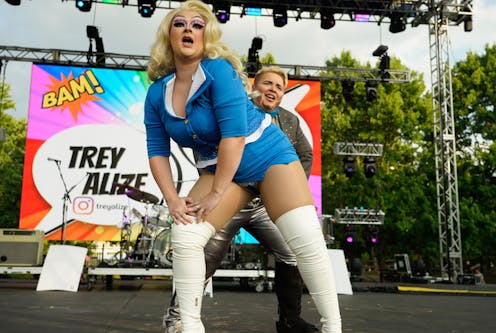
A drag show in Nashville, Tenn., during Day One of Nashville Pride 2022. Mickey Bernal/Getty Images

The drag shows will go on. At least for now.

On June 2, 2023, Judge Thomas Parker, a Trump-appointed federal district court judge in western Tennessee, ruled that Tennessee’s “Adult Entertainment Act” violated the First Amendment’s free speech protection.

The act had been passed by the Tennessee Legislature and signed into law by Tennessee Gov. Bill Lee in March 2023. The law gained national attention because it appeared designed to limit drag performances through regulation of “male and female impersonators.”

Parker provided several grounds for concluding that the law is unconstitutional. Using my experience as a First Amendment scholar, below I explain how Judge Parker reached those conclusions and what they mean for Tennessee’s law.

Speech protections

The First Amendment of the U.S. Constitution protects, among other things, free speech.

As Parker noted at the beginning of his opinion, “Freedom of speech is not just about speech. It is also about the right to debate with fellow citizens on self-government, to discover the truth in the marketplace of ideas, to express one’s identity, and to realize self-fulfillment in a free society.”

Freedom of speech protects more than just speech, in the colloquial sense. It also protects many other ways that people express themselves, such as by waving a flag, marching in a parade or dancing.

Drag shows typically consist of various forms of protected speech, like dancing, acting, lip-syncing, telling jokes and wearing elaborate outfits designed to send messages. Thus, any law seeking to limit drag performances raises important questions about whether that law violates the First Amendment.

Not all speech is protected by the First Amendment. Freedom of speech does not include the right to engage in, for example, perjury, defamation or threats of violence.

Freedom of speech also doesn’t protect the narrow category of legally defined obscenity. According to the Supreme Court, something is legally obscene only if, applying contemporary community standards, a reasonable person would find that the work, when viewed holistically, appeals to prurient interests, contains patently offensive content, and lacks any serious literary, artistic, political or scientific value.

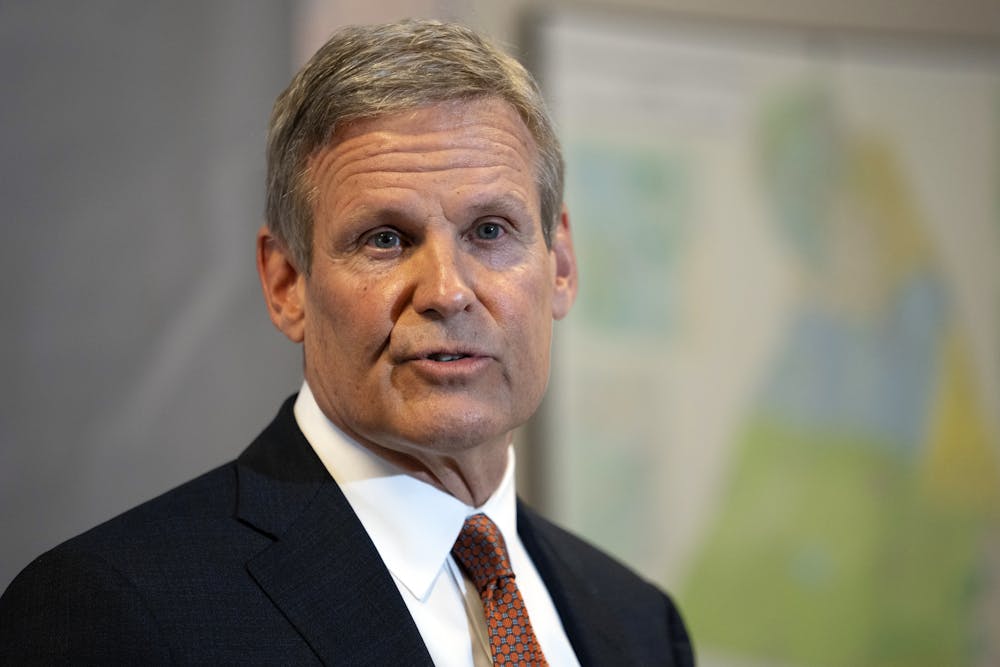
A gray-haired man in a dark blazer, white shirt and red tie.
Tennessee Gov. Bill Lee signed the drag ban legislation that was overturned by a federal judge. AP Photo/George Walker IV, File

Thus, as Parker noted, “there is a difference between material that is ‘obscene’ in the vernacular, and material that is ‘obscene’ under the law,” and the law imposes “an exceptionally high standard” for what counts as legally obscene.

The clearest example of sexually explicit material that does not receive First Amendment protection is child pornography. But the precise boundaries of what counts as legal obscenity are vague. Many kinds of sexually explicit material are not deemed legally obscene because it has often been relatively easy for litigants to convince modern courts that the material in question has serious literary, artistic, political or scientific value.

Tennessee’s anti-drag law

Tennessee’s Adult Entertainment Act would have made it a crime “to perform adult cabaret entertainment” on “public property” or anywhere it “could be viewed by a person who is not an adult.”

The act defined “adult cabaret entertainment” to include performances by “male or female impersonators” that are deemed “harmful to minors.” The act’s definition of “harmful to minors” came from existing Tennessee legal code. That code was based on the U.S. Supreme Court’s criteria for legal obscenity.

However, that Tennessee legal code modified the standard of legal obscenity so that it applied specifically “for minors.” So, for example, rather than designating as obscene certain speech that lacked “serious literary, artistic, political or scientific value,” full stop, Tennessee’s standard applied to certain speech that lacked “serious literary, artistic, political or scientific value for minors.”

On March 31, Parker temporarily blocked the law from taking effect. His final ruling on June 2 permanently barred enforcement of it in Tennessee’s Shelby County on the grounds that it was an unconstitutional violation of the First Amendment. The reason his ruling applied only to Shelby County is that the sole defendant at that stage in the case was Shelby County’s district attorney, whose authority to enforce the law is limited to that county.

A person with fist raised, speaking in public outside a columned building.
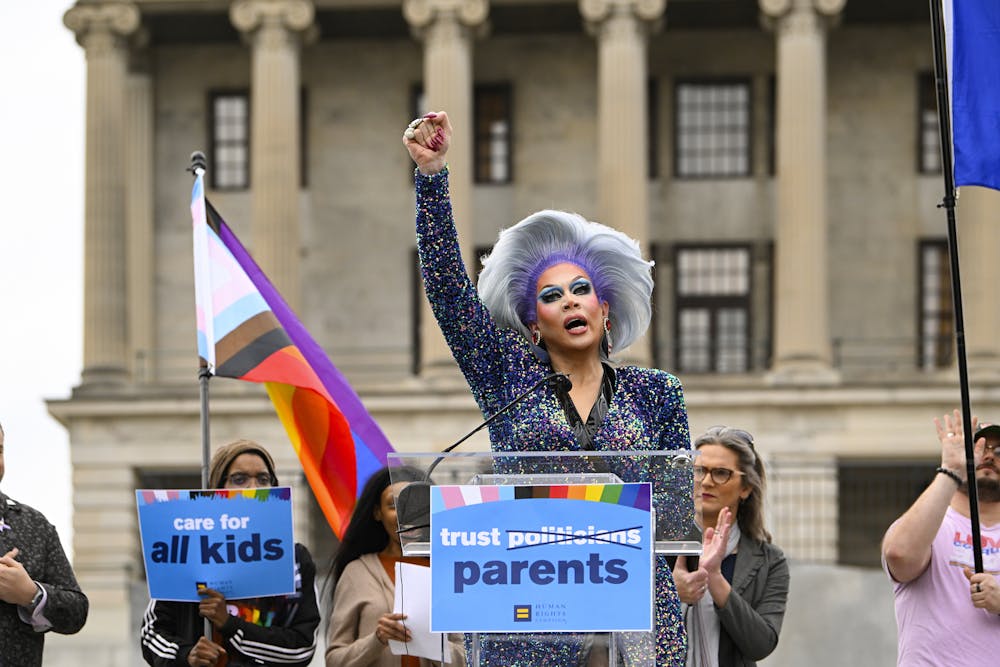
Drag artist Vidalia Anne Gentry at a news conference held by the Human Rights Campaign to draw attention to anti-drag bills in the state Legislature, Feb. 14, 2023, in Nashville, Tenn. John Amis/AP Images for Human Rights Campaign via AP, File

Unconstitutional restriction

Parker determined that the law targeted more than just legally obscene speech; it also targeted speech protected under the First Amendment.

The Supreme Court has set very high standards for when regulation of protected speech can discriminate based on the speech’s content or viewpoint.

Content discrimination restricts speech based on subject matter. Viewpoint discrimination restricts speech based on the position taken. So, for example, a ban on speech about elections would discriminate based on content, while a ban on speech that is negative about a particular political candidate would discriminate based on viewpoint.

Parker concluded that the Tennessee law discriminated based on both the speech’s content and its viewpoint.

He concluded that it discriminated based on content because it specifically targets “adult-oriented performances that are harmful to minors” and discriminates based on viewpoint because it specifically targets the speech of “male and female impersonators.”

To make the point that the law discriminated based on viewpoint, Parker used an example of two Elvis impersonators dressed in revealing but nonobscene outfits. If one performer were male and the other female, the law would have made it more likely that the female Elvis impersonator would be subject to prosecution than the male Elvis impersonator. That discriminates against certain expressions of gender identity.

Laws that discriminate based on viewpoint are subject to the highest standard of judicial review, known as strict scrutiny, which requires laws to be “narrowly tailored” and “well defined.” Parker concluded that the law was neither. On this basis, he also concluded that it failed to meet the high standard of review and was unconstitutional.

He noted instead that on any plausible reading of the law, it “criminally sanctions qualifying performers virtually anywhere,” including those performing in “private events at people’s homes or arguably even age-restricted venues.” He also wrote that the law appeared designed for the “impermissible purpose” of “chilling constitutionally-protected speech.”

Vague and overbroad

A vague law can violate a person’s rights because it can be hard to tell if one is breaking the law.

Parker found the “harmful to minors” standard unconstitutionally vague because what is harmful for different minors can change drastically depending on the minor. Consider, for example, the differences between a 5-year-old and a 17-year-old. He also concluded that the law was overbroad because it covered, or could reasonably be interpreted to cover, many types of protected speech.

Looking ahead

Parker’s ruling barred enforcement of the law only in Shelby County. However, his reasoning regarding the unconstitutionality of the law would apply equally well to any challenge brought against the law anywhere in Tennessee. Parker’s reasoning may also prove persuasive to judges assessing other anti-drag laws in other states.

The Conversation

Mark Satta does not work for, consult, own shares in or receive funding from any company or organization that would benefit from this article, and has disclosed no relevant affiliations beyond their academic appointment.
09 Jun 17:55

What is the 'splinternet'? Here's why the internet is less whole than you might think

by Robbie Fordyce, Lecturer, Communications and Media Studies, Monash University
Shutterstock

“Splinternet” refers to the way the internet is being splintered – broken up, divided, separated, locked down, boxed up, or otherwise segmented.

Whether for nation states or corporations, there’s money and control to be had by influencing what information people can access and share, as well as the costs that are paid for this access.

The idea of a splinternet isn’t new, nor is the problem. But recent developments are likely to enhance segmentation, and have brought it back into new light.


Read more: Meta just copped a A$1.9bn fine for keeping EU data in the US. But why should users care where data are stored?


The internet as a whole

The core question is whether we have just one single internet for everyone, or whether we have many.

Think of how we refer to things like the sky, the sea, or the economy. Despite these conceptually being singular things, we’re often only seeing a perspective: a part of the whole that isn’t complete, but we still experience directly. This applies to the internet, too.

A large portion of the internet is what’s known as the “deep web”. These are the parts search engines and web crawlers generally don’t go to. Estimates vary, but a rule of thumb is that approximately 70% of the web is “deep”.

Despite the name and the anxious news reporting in some sectors, the deep web is mostly benign. It refers to the parts of the web to which access is restricted in some ways.

Your personal email is a part of the deep web – no matter how bad your password might be, it requires authorisation to access. So do your Dropbox, OneDrive, or Google Drive accounts. If your work or school has its own servers, these are part of the deep web – they’re connected, but not publicly accessible by default (we hope).


Read more: Searching deep and dark: Building a Google for the less visible parts of the web


We can expand this to things like the experience of multiplayer videogames, most social media platforms, and much more. Yes, there are parts that live up to the ominous name, but most of the deep web is just the stuff that needs password access.

The internet changes, too – connections go live, cables get broken or satellites fail, people bring their new Internet of Things devices (like “smart” fridges and doorbells) online, or accidentally open their computer ports to the net.

But because such a huge portion of the web is shaped by our individual access, we all have our own perspectives on what it’s like to use the internet. Just like standing under “the sky”, our local experience is different to that of others. No one can see the full picture.

A fractured internet poised to fracture even more

Was there ever a single “Internet”? Certainly the US research computer network called ARPANET in the 1960s was clear, discrete, and unfractured.

Alongside this, in the ‘60s and '70s, governments in the Soviet Union and Chile also each worked on similar network projects called OGAS and CyberSyn, respectively. These systems were proto-internets that could have expanded significantly, and had themes that resonate today – OGAS was heavily surveilled by the KGB, and CyberSyn was a social experiment destroyed during a far-right coup.

Each was very clearly separate, each was a fractured computer network that relied on government support to succeed, and ARPANET was the only one to succeed due to its significant government funding. It was the kernel that would become the basis of the internet, and it was Tim Berners-Lee’s work on HTML at CERN that became the basis of the web we have today, and something he seeks to protect.

A pencil drawing on a stamp showing a smiling man next to two computer screens with www on them
The Marshall Islands released a postal stamp in 1999 celebrating English computer scientist Tim Berners-Lee as the inventor of the World Wide Web. Shutterstock

Today, we can see the unified “Internet” has given way to a fractured internet – one poised to fracture even more.

Many nations effectively have their own internets already. These are still technically connected to the rest of the internet, but are subject to such distinct policies, regulations and costs that they are distinctly different for the users.

For example, Russia maintains a Soviet-era-style surveillance of the internet, and is far from alone in doing so – thanks to Xi Jinping, there is now “the great firewall of China”.

Surveillance isn’t the only barrier to internet use, with harassment, abuse, censorship, taxation and pricing of access, and similar internet controls being a major issue across many countries.

Content controls aren’t bad in themselves – it’s easy to think of content that most people would prefer didn’t exist. Nonetheless, these national regulations lead to a splintering of internet experience depending on which country you’re in.

Indeed, every single country has local factors that shape the internet experience, from language to law, from culture to censorship.

While this can be overcome by tools such as VPNs (virtual private networks) or shifting to blockchain networks, in practice these are individual solutions that only a small percentage of people use, and don’t represent a stable solution.

We’re already on the splinternet

In short, it doesn’t fix it for those who aren’t technically savvy and it doesn’t fix the issues with commercial services. Even without censorious governments, the problems remain. In 2021, Facebook shut down Australian news content as a protest against the News Media Bargaining Code, leading to potential change in the industry.

Before that, organisations such as Wikipedia and Google protested the winding back of network neutrality provisions in the US in 2017 following earlier campaigns.


Read more: Facebook's news blockade in Australia shows how tech giants are swallowing the web


Facebook (now known as Meta) attempted to create a walled garden internet in India called Free Basics – this led to a massive outcry about corporate control in late 2015 and early 2016. Today, Meta’s breaches of EU law are placing its business model at risk in the territory.

This broad shift has been described in the past by my colleague Mark Andrejevic in 2007 as digital enclosure – where states and commercial interests increasingly segment, separate and restrict what is accessible on the internet.

The uneven overlapping of national regulations and economies will interact oddly with digital services that cut across multiple borders. Further reductions in network neutrality will open the doors to restrictive internet service provider deals, price-based discrimination, and lock-in contracts with content providers.

The existing diversity of experience on the internet will see users’ experiences and access continue to diverge. As internet-based companies increasingly rely on exclusive access to users for tracking and advertising, as services and ISPs overcome falling revenue with lock-in agreements, and as government policies change, we’ll see the splintering continue.

The splinternet isn’t that different from what we already have. But it does represent an internet that’s even less global, less deliberative, less fair and less unified than we have today.


Read more: Tim Berners-Lee's plan to save the internet: give us back control of our data


The Conversation

Robbie Fordyce is affiliated with the Australian Communications Consumer Action Network.

09 Jun 17:51

El Niño is back – that's good news or bad news, depending on where you live

by Bob Leamon, Associate Research Scientist, University of Maryland, Baltimore County
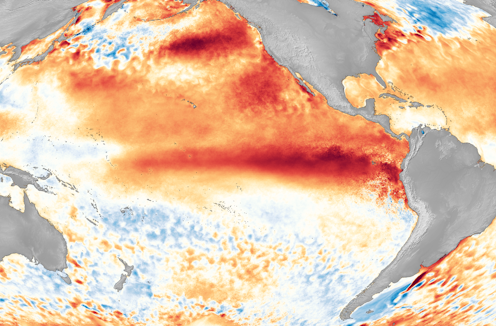
Warm water along the equator off South America signals an El Niño, like this one in 2016. NOAA

El Niño is officially here, and while it’s still weak right now, federal forecasters expect this global disrupter of worldwide weather patterns to gradually strengthen.

That may sound ominous, but El Niño – Spanish for “the little boy” – is not malevolent, or even automatically bad.

Here’s what forecasters expect, and what it means for the U.S.

What is El Niño?

El Niño is a climate pattern that starts with warm water building up in the tropical Pacific west of South America. This happens every three to seven years or so. It might last a few months or a couple of years.

Normally, the trade winds push warm water away from the coast there, allowing cooler water to surface. But when the trade winds weaken, water near the equator can heat up, and that can have all kinds of effects through what are known as teleconnections. The ocean is so vast – covering approximately one-third of the planet, or about 15 times the size of the U.S. – that those sloshings of warm water have knock-on effects around the globe.

The National Oceanic and Atmospheric Administration explains teleconnections and the impact of El Niño.

That warming at the equator during El Niño leads to the warming of the stratosphere, starting about 6.2 miles (10 kilometers) above the surface. Scientists are still studying how exactly this teleconnection occurs.

At the same time, the lower tropical stratosphere cools.

That combination can shift the upper-level winds known as the jet stream, which blow from west to east. Altering the jet stream can affect all kinds of weather variables, from temperatures to storms and winds that can tear hurricanes apart.

Basically, what happens in the Pacific doesn’t stay in the Pacific.

So, what does all that mean for you and me?

With apologies to Charles Dickens, El Niño tends to create a tale of two regions: the best of times for some, and the worst of times for others.

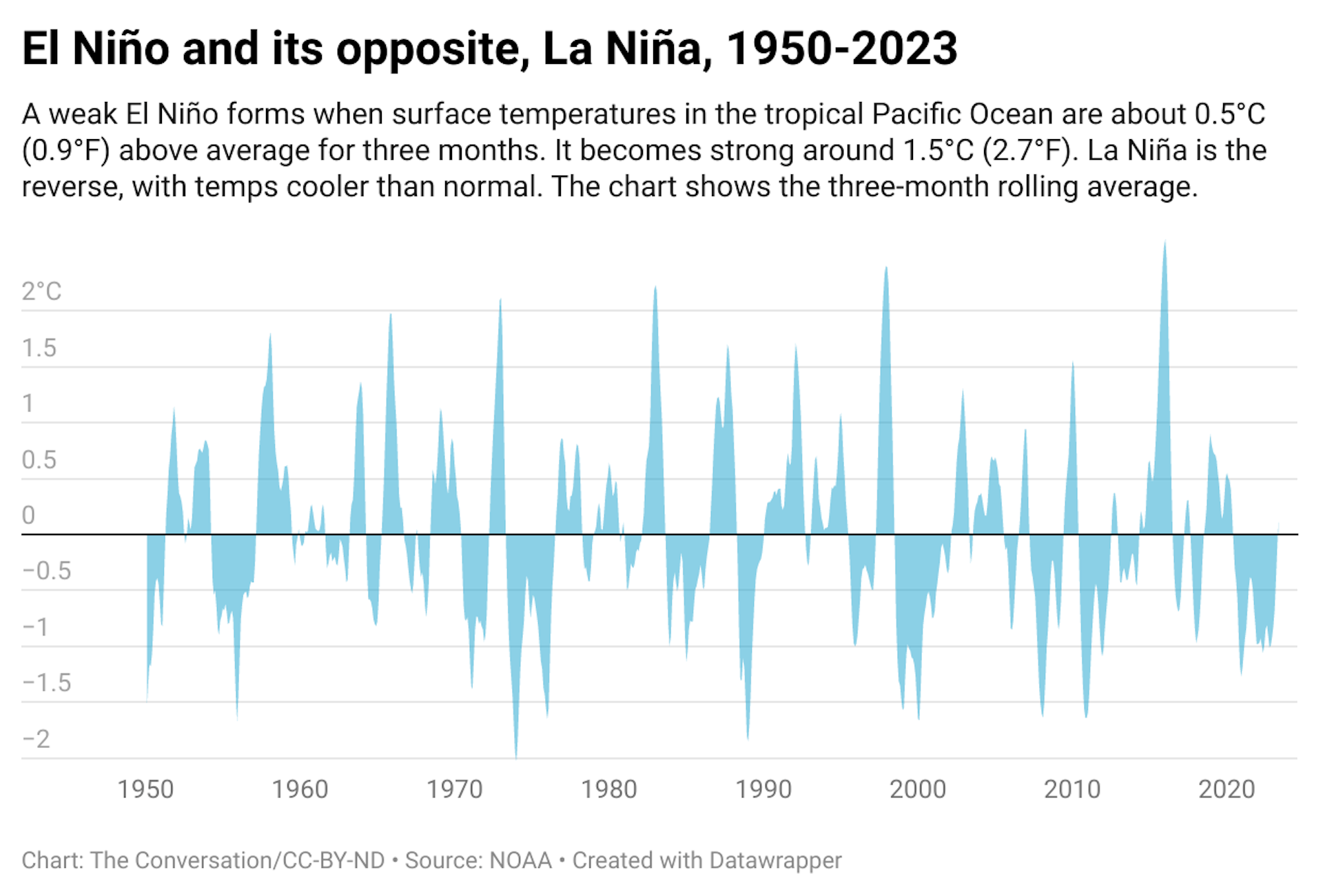
On average, El Niño years are warmer globally than La Niña years – El Niño’s opposite. Globally, a strong El Niño can boost temperatures by about 0.7 degrees Fahrenheit (0.4 Celsius). But in North America, there is a lot of local variation.

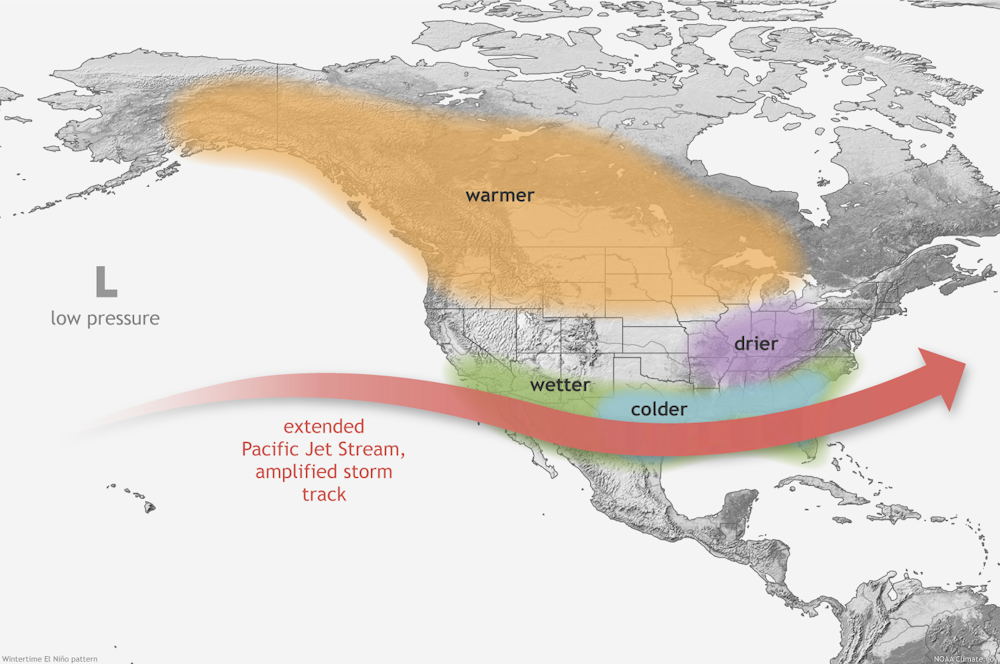
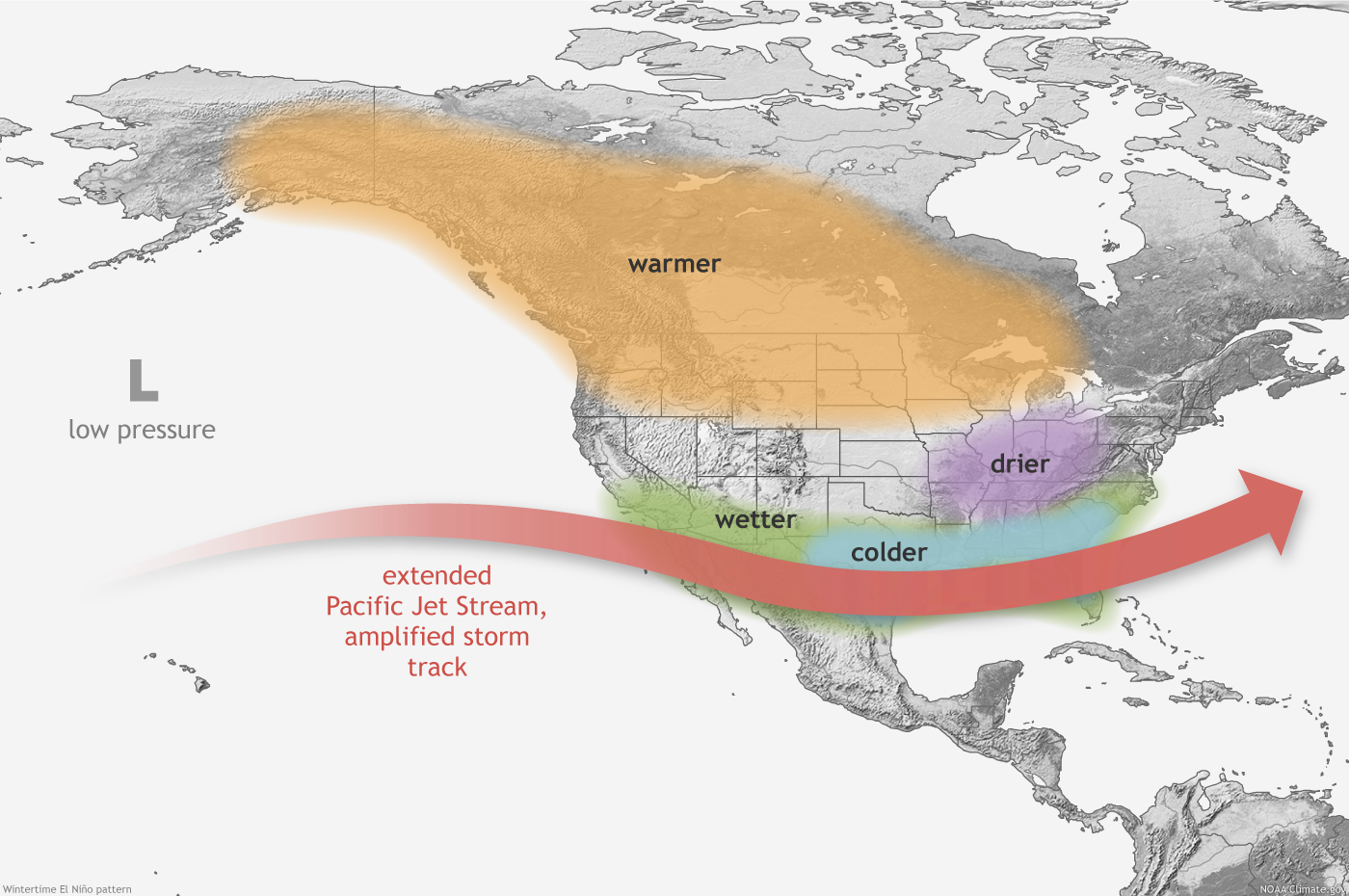
El Niño years tend to be warmer across the northern part of the U.S. and in Canada, and the Pacific Northwest and Ohio Valley are often drier than usual in the winter and fall. The Southwest, on the other hand, tends to be cooler and wetter than average.

El Niño typically shifts the jet stream farther south, so it blows pretty much due west to east over the southern U.S. That shift tends to block moisture from the Gulf of Mexico, reducing the fuel for thunderstorms in the Southeast. La Niña, conversely, is associated with a more wavy and northward-shifted jet stream, which can enhance severe weather activity in the South and Southeast.

A map shows warmer, drier air over the northern U.S. and Canada; wetter conditions across the Southwest and dry in the Southeast. The jet stream shifts southward.
El Niño’s typical effects in winter. NOAA

El Niño also affects hurricanes, but in different ways in the Atlantic and Pacific.

Over the Atlantic, El Niño tends to increase wind shear – the change in wind speed with height in the atmosphere – which can tear apart hurricanes. But El Niño has the opposite effect in the eastern Pacific, where it can mean more storms. The ocean heat can also raise the risk of marine heat waves that can devastate corals and ecosystems fish rely on.

In the middle of the U.S., El Niño is generally associated with warmer and drier conditions that can mildly increase the chances of a bountiful corn crop.

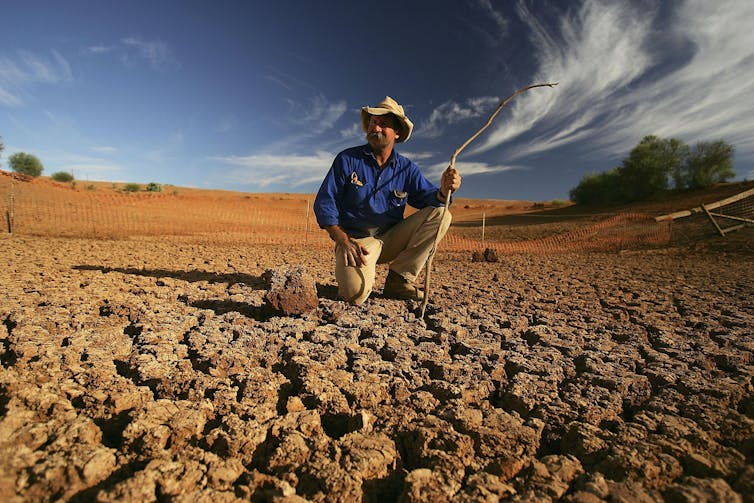
In contrast, El Niño can wreak havoc on crops in Southern Africa and Australia and increase Australia’s fire risk with dangerously dry conditions. Brazil and northern South America also tend to be drier, while parts of Argentina and Chile tend to be wetter.

A stockman stands in the dry bed of a creek on his property in Australia in 2005 during a severe drought that coincided with El Nino.
Australia endured its worst drought in decades in 2005 with the combined effect of increasing temperatures and an El Niño. Ian Waldie/Getty Images

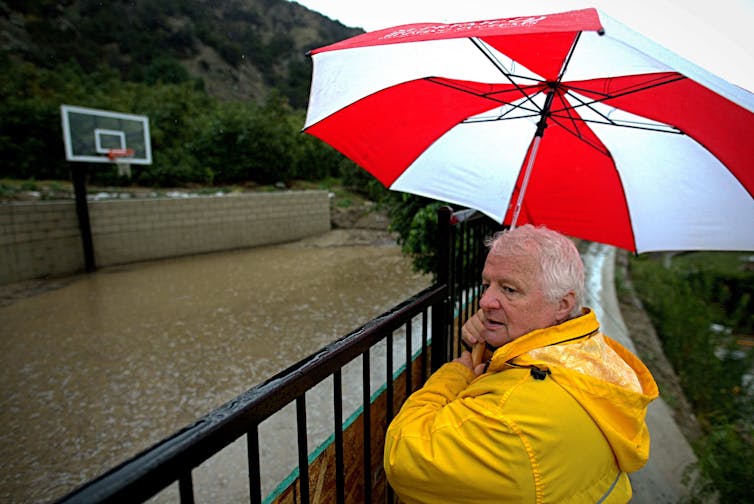
Of course, just because this is normally what happens doesn’t mean it happens every time. Witness California’s record rainfalls from multiple atmospheric rivers at the end of the last La Niña, which normally would mean dry conditions.

Every weather event is somewhat different, so the influence of El Niño is a matter of probability, not certainty. How El Niño and La Niña will be influenced over time by climate change isn’t yet clear.

The forecasts don’t all agree

Is 2023 going to be a record-breaking year? That’s the multibillion-dollar question.

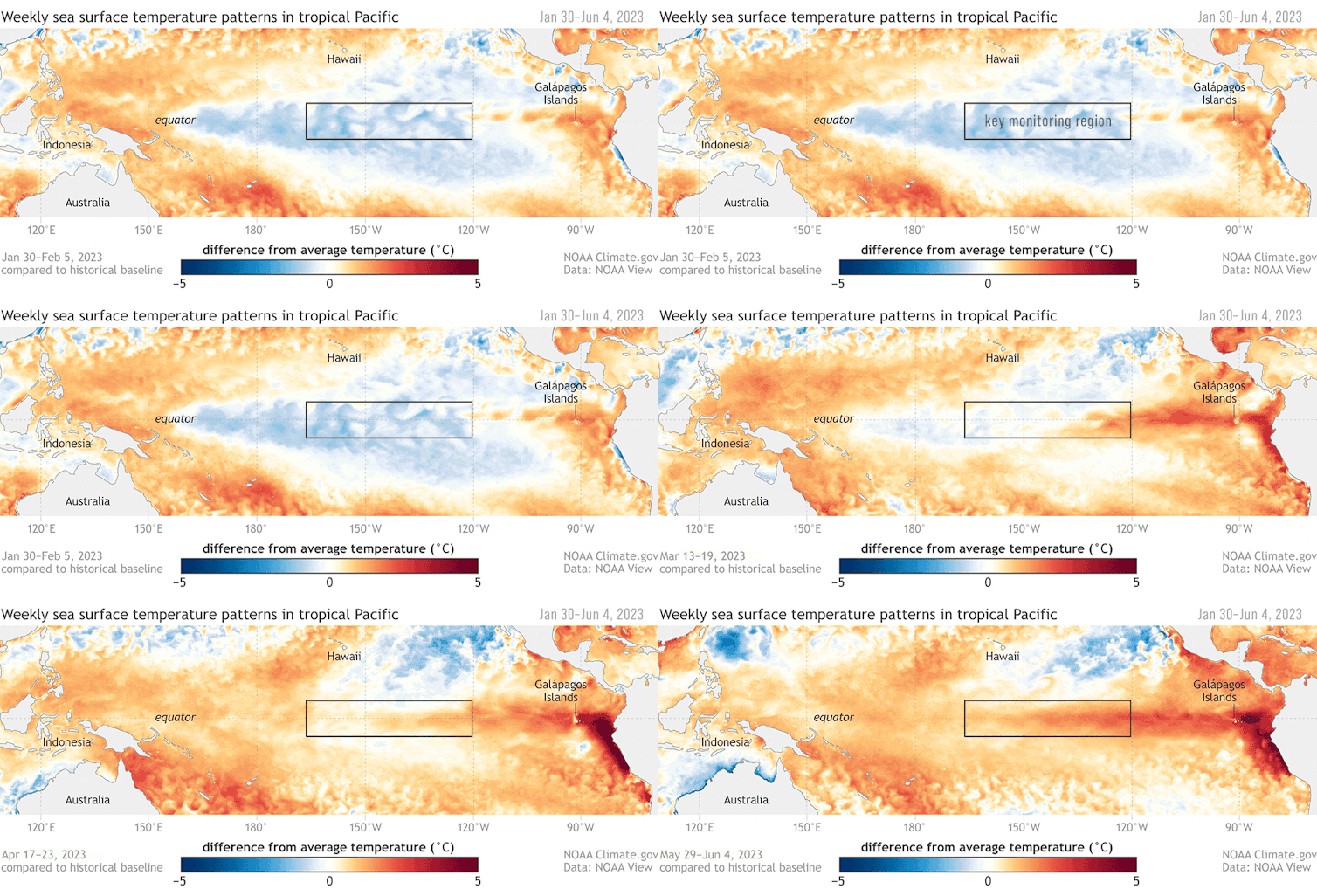
The National Weather Service declares the onset of El Niño when water temperatures are at least 0.9 F (0.5 C) above normal for a three-month period in what’s known as the Niño3.4 region. That’s a large imaginary rectangle south of Hawaii along the equator.

An animation shows satellite images of how temperatures headed up in the equatorial pacific, with a warm streak developing and intensifying west of South America.
Watching El Niño develop in the tropical Pacific, January to June 2023. The box shows the Niño3.4 region. NOAA Climate.gov

For a strong El Niño, the Niño3.4 region needs to warm by 2.7 F (1.5 C) for three months. It’s not clear as of right now whether this El Niño will meet that threshold this year.

The National Oceanic and Atmospheric Administration’s first El Niño advisory of the year, released on June 8, sees an 84% chance of El Niño being greater than moderate by winter and a 56% chance that it will be strong.

Those forecasts can change, though, and different forecasting methods offer different forecasts of the magnitude.

“Dynamical” models, similar to the models used for typical weather forecasts, have projected a very strong El Niño, whereas “static” or statistical models are far less optimistic. Personally, I’m a statistical modeler, and my own model doesn’t suggest a strong El Niño in 2023. Rather, my model – like other static models – predicts that 2023 will fizzle out, and after a couple of quiet, or neutral, years, we will see a strong El Niño in 2026. I did get the recent unusual “triple dip” La Niña right, but I’m willing to be proved wrong by observations, as any good scientist should be.

A man in a raincoat stands under a big umbrella watching his backyard fill with rainwater in California in 2023. California saw record rain from atmospheric rivers in early 2023.
El Niño often means winter rain for California. While it’s needed, it’s sometimes too much. Watchara Phomicinda/MediaNews Group/The Press-Enterprise via Getty Images

But no computer model of any flavor has had experience with the globally super-high ocean temperatures that are occurring right now. The Atlantic is unusually warm, and that could offset some of the usual forces that come with El Niño.

The Conversation

Bob Leamon receives funding from NASA.

09 Jun 17:50

The US has a child labor problem – recalling an embarrassing past that Americans may think they've left behind

by Beth Saunders, Curator and Head of Special Collections and Gallery, University of Maryland, Baltimore County
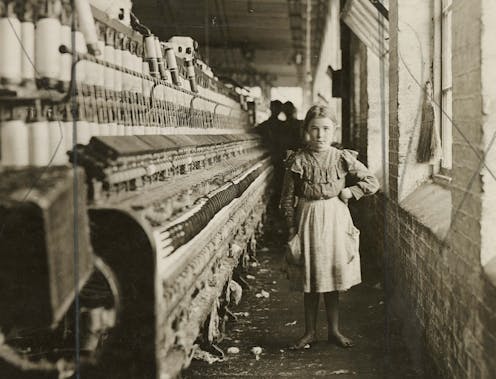
Lewis Wickes Hine, 'A little spinner in a Georgia Cotton Mill, 1909.' Gelatin silver print, 5 x 7 in. The Photography Collections, University of Maryland, Baltimore County (P545), CC BY-SA

At the University of Maryland, Baltimore County’s Special Collections, where I am head curator, we’ve recently completed a major digitization and rehousing project of our collection of over 5,400 photographs made by Lewis Wickes Hine in the early 20th century.

Traveling the country with his camera, Hine captured the often oppressive working conditions of thousands of children – some as young as 3 years old.

As I’ve worked with this collection over the past two years, the social and political implications of Hine’s photographs have been very much on my mind. The patina of these black-and-white photographs suggests a bygone era – an embarrassing past that many Americans might imagine they’ve left behind.

But with numerous reports of child labor violations, many involving immigrants, occurring in the U.S., along with an uptick in state legislation rolling back the legal working age, it’s clear that Hine’s work is as relevant today as it was a century ago.

‘An investigator with a camera’

A sociologist by training, Hine began making photographs in 1903 while working as a teacher at the progressive Ethical Culture School in New York City.

Between 1903 and 1908, he and his students photographed migrants at Ellis Island. Hine believed that the future of the U.S. rested in its identity as an immigrant nation – a position that contrasted with escalating xenophobic fears.

Based on this work, the National Child Labor Committee, which advocated for child labor laws, hired Hine to document the living and working conditions of American children.

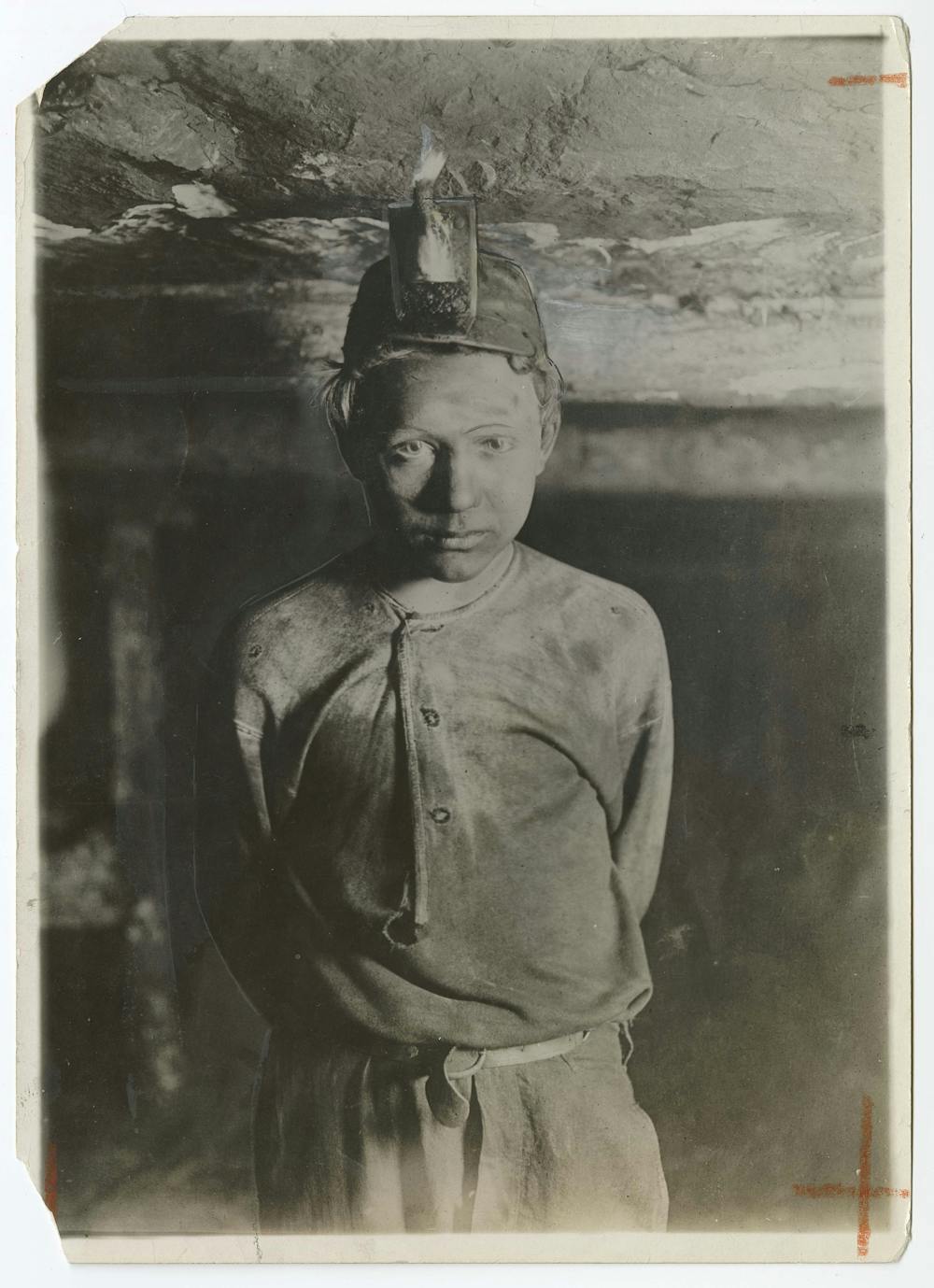
Boy covered in soot poses with his hands clasped behind his back.
Lewis Wickes Hine, ‘Trapper Boy, Turkey Knob Mine, MacDonald, West Virginia, 1908.’ Gelatin silver print. 5 x 7 in. The Photography Collections, University of Maryland, Baltimore County (P148), CC BY-SA

By the late 19th century, several states had passed laws limiting the age of child laborers and establishing maximum working hours. But at the turn of the century, the number of working kids soared – between 1890 and 1910, 18% of children ages 10 to 15 were employed.

In his work for the National Child Labor Committee, Hine journeyed to farms and mills in the industrializing South and the streets and factories of the Northeast. He used a Graflex camera with 5-by-7-inch glass plate negatives and employed flash powder for nighttime and interior shots, hauling upward of 50 pounds of equipment on his slight frame.

To gain entry into factories and other facilities, Hine sometimes disguised himself as a Bible, postcard or insurance salesman. Other times he’d wait outside to catch workers arriving for or departing from their shifts.

Along with photographic records, Hine collected his subjects’ personal stories, including their ages and ethnicities. He documented their working lives, such as their typical hours and any injuries or ailments they incurred as a result of their labor.

Hine, who considered himself “an investigator with a camera,” used this information to create what he termed “photo stories” – combinations of images and text that could be used on posters, in public lectures and in published reports to help the organization advance its mission.

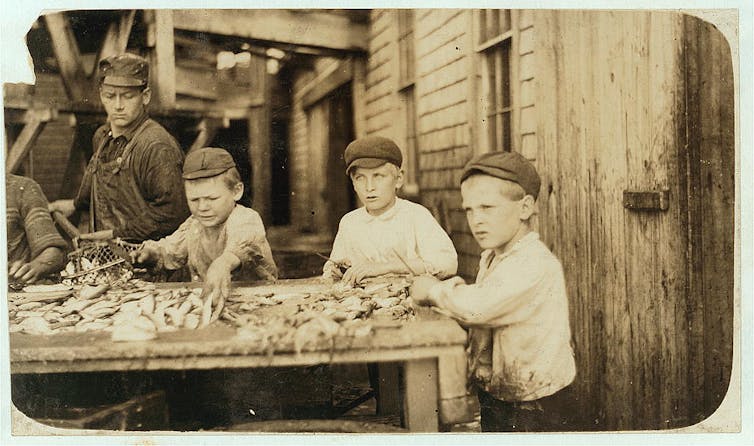
Boys standing at a table splayed with seafood as an older worker obsveres
Lewis Wickes Hine’s photograph of three young fish cutters working at the Seacoast Canning Co. in Eastport, Maine. National Child Labor Committee collection, Library of Congress, Prints and Photographs Division

Legislation follows

Hine’s muckraking photographs exemplify the genre of documentary photography, which relies upon the perceived truthfulness of photography to make a case for social change.

The camera serves as an eyewitness to a societal ill, a problem that needs a solution. Hine portrayed his subjects in a direct manner, typically frontally and looking straight into the camera, against the backdrop of the very factories, farmland or cities where they worked.

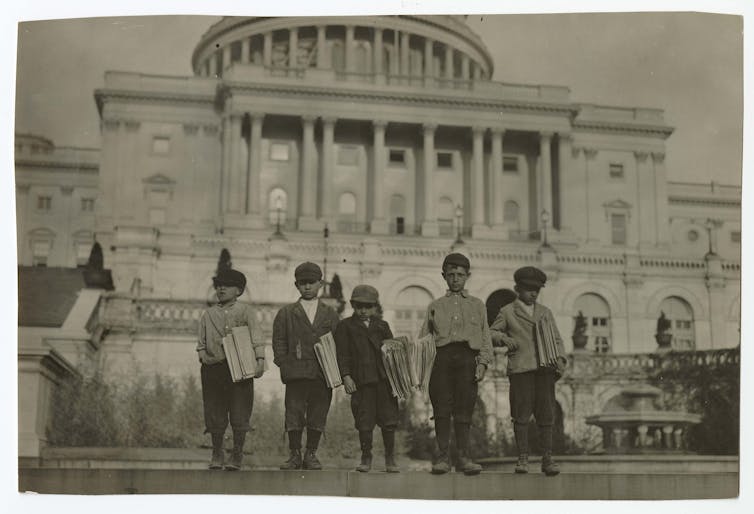
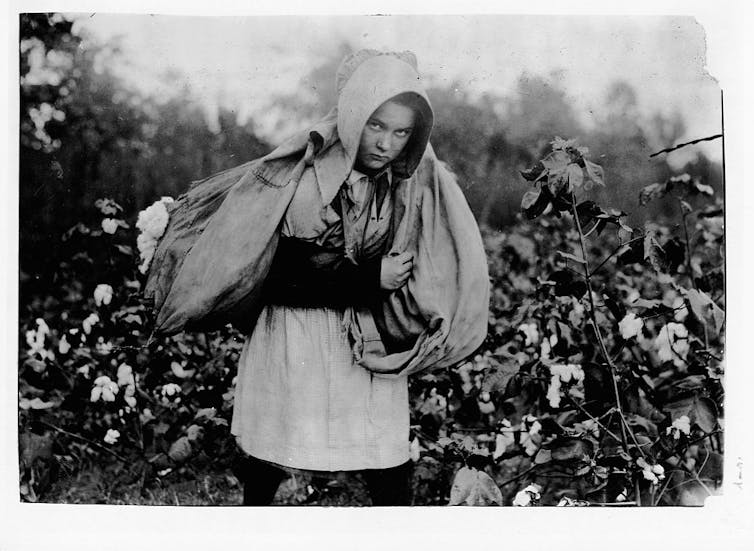
By capturing details of his sitters’ bare feet, tattered clothes, soiled faces and hands, and diminutive stature against hulking industrial equipment, Hine made a direct statement about the poor conditions and precarity of these children’s lives.

Five young boys wearing caps and holding newspapers in front of an imposing white building.
Lewis Wickes Hine, ‘Group of newsies selling on Capitol steps, April 11, 1912.’ The Photography Collections, University of Maryland, Baltimore County (P2904), CC BY-SA

Hine’s photographs made a successful case for child labor reform.

Notably, the National Child Labor Committee’s efforts resulted in Congress establishing the Children’s Bureau in 1912 and passing the Keating-Owen Act in 1916, which limited working hours for children and prohibited the interstate sale of goods produced by child labor.

Although the Supreme Court later ruled it and a subsequent Child Labor Tax Law of 1919 unconstitutional, momentum for enshrining protections for child workers had been created. In 1938, Congress passed the Fair Labor Standards Act, which established restrictions and protections on employing children.

The National Child Labor Committee’s project also included advocacy for the enforcement of existing child labor regulations, a regulatory problem reemerging today as the Department of Labor – the agency tasked with enforcing labor laws – comes under fire for failing to protect child workers.

Hooded girl in a field of cotton stares forlornly at the camera.
A young picker carries a large sack of cotton on her back. Lewis Wickes Hine/Library of Congress via Getty Images

The ethics of picturing child labor

A recent surge of unaccompanied minors, primarily from Central America, has brought new attention to America’s old problem of child labor and has threatened the very laws Hine and the National Child Labor Committee worked to enact.

Some estimates suggest that one-third of migrants under 18 are working illegally, whether it’s laboring more hours than current laws permit, or working without the proper authorizations. Many of them perform hazardous jobs similar to those of Hine’s subjects: handling dangerous equipment and being exposed to noxious chemicals in factories, slaughterhouses and industrial farms.

While the content of Hine’s photographs remains pertinent to today’s child labor crisis, a key distinction between the subject of Hine’s photographs and working children today is race.

Hine focused his camera almost exclusively on white children who arrived in the country during waves of immigration from Europe during the late-19th and early-20th centuries. As art historian Natalie Zelt argues, Hine’s pictorial treatment of Black children – either ignored or forced to the margins of his images – implied to viewers that the face of childhood in America was, by default, white.

The perceived racial hierarchies of Hine’s era reverberate into the present, where underage migrants of color live and work at the margins of society.

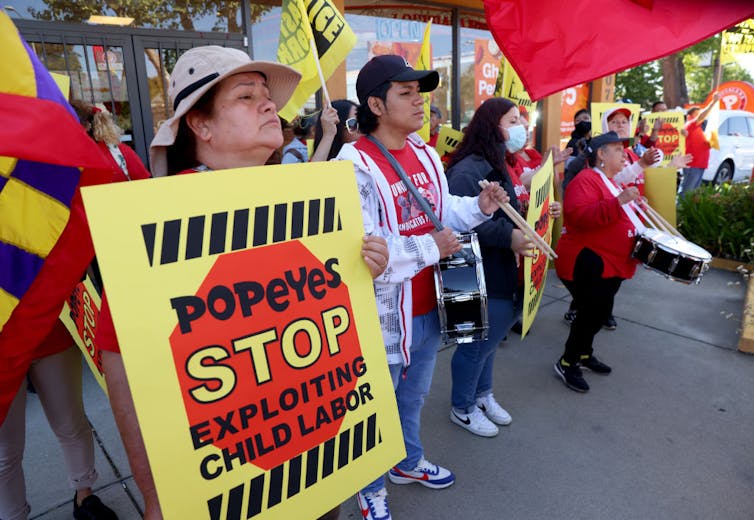
A group of women hold drums and signs reading 'Popeyes Stop Exploiting Child Labor.'
Workers protest outside a Popeye’s restaurant in Oakland, Calif., on May 18, 2023, after reports emerged of the franchise exploiting child labor. Jane Tyska/Digital First Media/East Bay Times via Getty Images

Contemporary reports of child labor violations offer few images to accompany their texts, graphs and statistics. There are legitimate reasons for this. By not including identifying personal information or portraits, news outlets protect a vulnerable population. Ethical guidelines frown upon revealing private details of the lives of children interviewed. And, as Hine’s experience demonstrates, it can be difficult to infiltrate the sites of these labor violations, since they are typically kept secure.

Digital cameras and smartphones offer a workaround. Beginning in 2015, the International Labor Organization urged child laborers in Myanmar to become “young activists” and use their own images and words to create “photo stories” – echoing Hine’s use of the term – that the organization could then disseminate.

Photographs of child labor in foreign countries are far more common than those made in the U.S., which leaves the impression that child labor is someone else’s problem, not ours. Perhaps it’s too hard for Americans to look at this domestic issue square in the eyes.

A similar effect is at work when viewing Hine’s photographs today. While they were originally valued for their immediacy, they can seem to belong to a distant past.

But if Hine’s photographic archive of child laborers is evidence of the power of photography to sway public opinion, does the lack of images in today’s reporting – even if nobly intended – create a disconnect?

Is the public capable of understanding the harmful consequences of lack of labor enforcement when the faces of the people affected are missing from the picture?

The Conversation

Beth Saunders does not work for, consult, own shares in or receive funding from any company or organisation that would benefit from this article, and has disclosed no relevant affiliations beyond their academic appointment.

09 Jun 17:49

Supreme Court rules in favor of Black voters in Alabama and protects landmark Voting Rights Act

by Rodney Coates, Professor of Critical Race and Ethnic Studies, Miami University
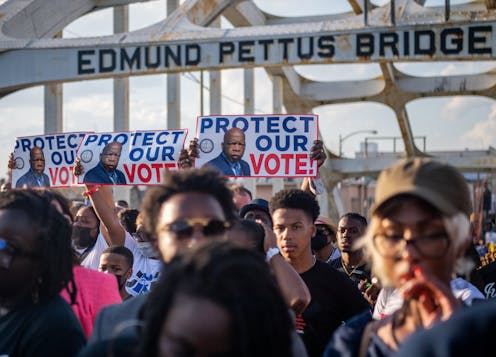
Black marchers in Selma, Ala., demonstrate for voting rights protections on March 6, 2022. Brandon Bell/Getty Images

In a surprising ruling on June 8, 2023, the conservative leaning U.S. Supreme Court threw out Republican-drawn congressional districts in Alabama that a lower court had ruled discriminated against Black voters and violated Section 2 of the Voting Rights Act of 1965.

At issue in the case that was before the court, Allen v. Milligan, was whether the power of Black voters in Alabama was diluted by dividing them into districts where white voters dominate. After the 2020 census, the Republican-controlled Alabama legislature redrew the state’s congressional districts to include only one out of seven in which Black voters would likely be able to elect a candidate of their choosing.

Black residents make up about 27% of the state’s population, and voting rights advocates argued that they deserved not one but two political districts.

Rodney Coates is a sociologist who studies race and ethnicity and has followed efforts by politicians throughout American history to use redistricting to disenfranchise Black voters. The Conversation asked him four questions about the ruling and its implications.

What does the decision mean for Black voters in Alabama?

The decision means that Black voters in Alabama, and across the country, will retain the last remaining voter rights protections. Specifically, Alabama lawmakers will need to redraw their legislative districts to include two districts that reflect the Black population.

The Voting Rights Act of 1965 was enacted to prohibit racist practices by Southern states that were used to prevent Black people from voting. Those measures included literacy tests, poll taxes and voter intimidation.

Prior to the law’s passage, less than a quarter of voting-age Blacks were registered to vote across the nation. In 1969, that figure had risen to 61%.

The ruling will also set an important precedent for redistricting cases alleging discrimination as voters and their representatives challenge state maps. Among Democrats there is the belief that the ruling will impact pending cases and require Alabama, as well as Louisiana and Georgia, to add new majority-minority districts prior to the next congressional elections.

Why was this decision considered a surprise?

The ruling in Allen vs. Milligan was a surprise because of the voting by conservative Chief Justice John Roberts Jr. and Justice Brett M. Kavanaugh with the three liberal justices.

In his opinion for the majority, Roberts traced the importance of Section 2 of the Voting Rights Act. He explained how racially motivated voter suppression after the Civil War led to the initial passage of the 1965 Voting Rights Act.

In order to avoid creating racially designated legislative districts, Congress established that the electoral process should allow for the equal participation of all racial groups, Roberts wrote in his opinion.

Roberts’ thinking in Allen vs. Milligan is radically different from the one he held when he was an attorney serving in the U.S. Department of Justice during the Reagan administration. Then, Roberts wrote 25 memos in opposition to the VRA, specifically in reference to section 2.

Only Roberts knows why his perspective has changed over time. But perhaps Alabama went too far, too fast and was too partisan.

“States shouldn’t let race be the primary factor in deciding how to draw boundaries but it should be a consideration,” Roberts wrote. “The line we have drawn is between consciousness and predominance.”

Roberts went further by citing the repugnant racial history of Alabama.

Even as the Black population increased to over 27% of the state’s population over the past 30 years, the number of Black districts remained at one, largely because white conservatives have used their control of the state legislature to dilute the strength of Black voters.

Is the Voting Rights Act still under attack?

While a breath of fresh air for voting rights activists, this ruling does not mean that white conservatives will cease their attack.

GOP-controlled congressional maps diluting or eliminating Black districts have been drawn in multiple states, including Louisiana, Georgia, Ohio and Texas. These efforts could significantly alter the 2024 electoral map.

Several lawsuits are currently working their way through the courts across the country in states such as Florida, Arkansas, South Carolina and New York.

What are the remaining obstacles to full Black voting power?

Across the country, there has been a concerted effort to restrict voting and control the election machinery and even the outcome of these votes.

Dozens of Republican-controlled states have passed a series of laws that will curtail voting of Blacks and many other Americans.

These laws are in Florida, where registration is harder; in Nebraska, which has enacted more stringent voter identification measures; in Mississippi, which placed restrictions on absentee ballots; and in Georgia, which increased voter scrutiny by allowing anyone to challenge the qualifications of other voters.

Uncertainty prevails at the state and federal level, and according to Congressional Black Caucus Chairman Steven Horsford, only a national law aimed at eliminating the various suppression tactics that target Black voters will remedy the situation.

How do these laws typically affect Black people?

As many as 42 restrictive voting-rights laws in 21 states have been passed since 2021.

Among these, 33 contain at least one restrictive provision that will impact elections in 20 states. These restrictive provisions would make it harder for eligible Blacks to vote.

These laws are being vigorously challenged by groups such as the ACLU, NAACP, League of Women Voters, Fair Fight Action and the Southern Poverty Law Center, which are mobilizing protests, organizing voters and launching legal challenges.

The Conversation

Rodney Coates does not work for, consult, own shares in or receive funding from any company or organisation that would benefit from this article, and has disclosed no relevant affiliations beyond their academic appointment.
09 Jun 17:48

6 books that explain the history and meaning of Juneteenth

by Corey D. B. Walker, Wake Forest Professor of the Humanities, Wake Forest University
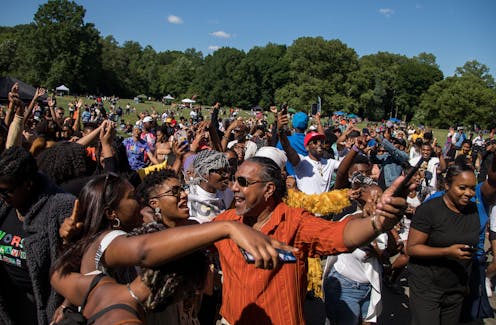
A Juneteenth celebration in Prospect Park in New York City in 2022. Michael Nagle/Xinhua News Agency via Getty Images

After decades of being celebrated at mostly the local level, Juneteenth – the long-standing holiday that commemorates the arrival of news of emancipation and freedom to enslaved Black people in Galveston, Texas, in 1865 – became a federal holiday in 2021. In honor of this year’s Juneteenth, The Conversation reached out to Wake Forest University humanities professor Corey D. B. Walker for a list of readings that can help people better understand the history and meaning of the observance. Below, Walker recommends six books.

‘On Juneteenth’

Combining history and memoir, Annette Gordon-Reed’s “On Juneteenth” offers a moving history of African American life and culture through the prism of Juneteenth. The award-winning Harvard historian presents an intimate portrait of the experiences of her family and her memories of life as an African American girl growing up in segregated Texas. The essays in her book invite readers to enter a world shaped by the forces of freedom and slavery.

Reed’s exploration of the history and legacy of Juneteenth is a poignant reminder of the hard history all Americans face.

‘O Freedom! Afro-American Emancipation Celebrations’

William H. Wiggins Jr.‘s “O Freedom! Afro-American Emancipation Celebrations” is the historical standard for African American emancipation celebrations. It offers an accessible and well-researched account of the emergence and evolution of Juneteenth.

Wiggins brings together oral history with archival research to share the stories of how African Americans celebrated emancipation. It explains how Juneteenth is part of the tapestry of emancipation celebrations. These celebrations included such dates as January 1, in North Carolina, April 3, in Richmond, Virginia, and April 16, in Washington, D.C.

Three women hug or gesture.
A Juneteenth celebration in 2022 in San Francisco. Liu Yilin/Xinhua News Agency via Getty Images

What began as a local holiday has evolved into a national celebration.

Juneteenth celebrations are known for the variety of programs and events that highlight African American history and culture. In the 1960s, students at Prairie View A&M University in Prairie View, Texas, informed faculty that classes would not be held on Juneteenth. In Milwaukee, the local Juneteenth parade includes a group known as the Black Cowboys riding their horses along Dr. Martin Luther King Jr. Drive. Juneteenth celebrations also feature cultural fairs and exhibitions, artistic performances and historical reenactments. Lectures and public conversations, community feasts and religious services are also part of the celebrations.

'Juneteenth’

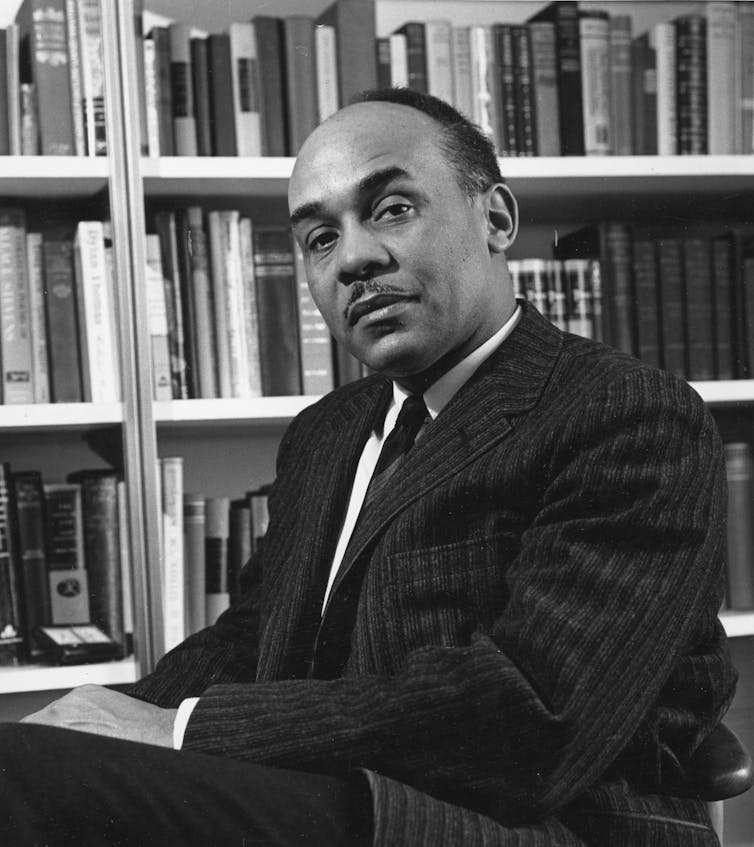
Ralph Ellison, perhaps best known for his novel “Invisible Man,” offers multiple meanings of Juneteenth in African American and American life in his posthumously published novel “Juneteenth.”

A black-and-white portrait of a man in front of a shelve of books.
Ralph Ellison’s novel ‘Juneteenth’ was released posthumously. United States Information Agency/PhotoQuest via Getty Images

The ambivalence of Juneteenth is of a freedom delayed but not denied. Ellison’s spiraling novel captures this in the entangled and tragic lives of the racist Senator Sunraider – previously known as Bliss – and the minister who raised him, the Reverend A. Z. Hickman. For Ellison, Juneteenth represents more than just a celebration of emancipation. It also represents the shared fate of white Americans and African Americans in the quest to create a just and equal society. The promise and peril of Juneteenth is elegantly captured in Hickman’s words, “There’s been a heap of Juneteenths before this one and I tell you there’ll be a heap more before we’re truly free!”

‘Festivals of Freedom: Memory and Meaning of African American Emancipation Celebrations, 1808-1915’

Mitch Kachun’s book, “Festivals of Freedom: Memory and Meaning of African American Emancipation Celebrations, 1808-1915,” traces the history of emancipation celebrations and their influence on African American identity and community. Juneteenth joined a longer tradition of emancipation celebrations. Those celebrations included ones at the end of the trans-Atlantic slave trade in the United States on Jan. 1, 1808. They also included the August First Day/West India Day celebrations that marked the abolition of slavery throughout the British Empire on Aug. 1, 1834.

With an eye for historical detail, Kachun narrates a complex history of how Juneteenth and other freedom festivals shaped African American identity and political culture. The celebrations also displayed competing meanings of African American identity. In Washington, D.C. in the late 19th century, different groups of African Americans held distinct celebrations. These variations underscored tensions around political ideals, status and identity. Kachun’s book reminds us that Juneteenth served as a crucible for forging a collective and contested sense of African American community.

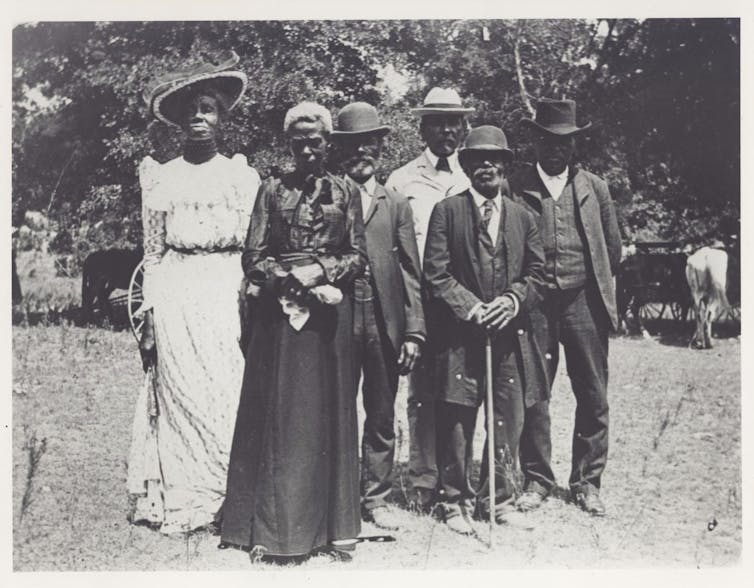
Six older African Americans face the camera in a photo from the year 1900.
An Emancipation Day celebration from 1900 in Austin, Texas. The Austin History Center

‘Rites of August First: Emancipation Day in the Black Atlantic World’

Similar to Kachun’s book, Howard University historian Jeffrey R. Kerr-Ritchie’s “Rites of August First: Emancipation Day in the Black Atlantic World” reminds readers of a broader history and geography of emancipation celebrations.

Kerr-Ritchie focuses on how various African American communities adopted and adapted West India Day celebrations. He also explores how they created meaning and culture in celebrating the abolition of slavery in the British West Indies. Kerr-Ritchie’s book details how these celebrations moved across political borders and boundaries.

‘Juneteenth: The Story Behind the Celebration’

Contemporary invocations of Juneteenth often overlook its military history.

Edward T. Cotham, Jr.‘s “Juneteenth: The Story Behind the Celebration” fills the void by exploring the Civil War origins of Juneteenth.

Cotham renders explicit the military context leading up to the events on June 19, 1865, in Galveston. This is when enslaved Black people there finally got word that they had been freed more than two years prior. Cotham reminds readers that the history of Juneteenth involves ordinary actions of many individual people whose names may not be widely known.

Collectively, these books about Juneteenth offer fresh perspectives on the history and culture of African Americans on a quest to fully express their freedom. Juneteenth is also an invitation for all Americans to continue to learn about and strive for freedom for all people.

The Conversation

Corey D. B. Walker does not work for, consult, own shares in or receive funding from any company or organization that would benefit from this article, and has disclosed no relevant affiliations beyond their academic appointment.
09 Jun 16:42

Hawaii's Kilauea volcano erupts, watch live stream here

by Mark Frauenfelder

The Kilauea volcano, located within Hawai'i Volcanoes National Park, erupted early this morning. The Hawaiian Volcano Observatory (HVO) has upgraded the Volcano Alert Level to Red, indicating increased volcanic activity and potential hazards.

The eruption is centered within Halemaʻumaʻu crater in Kilauea's summit caldera. — Read the rest

09 Jun 16:42

Crocodile impregnated itself in first recorded "virgin birth"

by David Pescovitz

In Costa Rica, a female crocodile birthed a clutch of eggs. No big deal except for the fact that this particular crocodile hadn't been around any male crocodiles in more than 15 years. Of all the eggs, only one of them developed into a foetus—and it didn't survive—but it was 99.9% genetically identical to its mother. — Read the rest

09 Jun 16:40

Orcas toss yacht 'like a rag doll' in Gibraltar Strait attack

by Rusty Blazenhoff

A pod of five orcas, or killer whales, attacked a yacht in the Strait of Gibraltar. The British sailor and owner of the yacht, Iain Hamilton, found himself in a precarious situation when the orcas ripped off both rudders of his yacht, disabling him from steering. — Read the rest

09 Jun 16:39

Southern Poverty Law Center releases its 2022 "Year in Hate" report, which includes Moms for Liberty for the first time

by Jennifer Sandlin

The Southern Poverty Law Center recently released its new report, "The Year in Hate and Extremism 2022," which documents the activities of hate groups in the United States in 2022. They explain:

In 2022, SPLC documented 1,225 hate and antigovernment extremist groups across the United States.

Read the rest
09 Jun 16:31

DeSmog is the antidote to disinformation about climate, energy, and environmental issues

by Jennifer Sandlin

Ealier today we shared the video of Steve Milloy being interviewed by Laura Ingraham on Fox News, where, during the entire conversation, Milloy tried to convince the audience that breathing the smoke-filled air that's plaguing so much of the US and Canada right now is perfectly healthy for you. — Read the rest

07 Jun 12:44

The ugly side of beauty: Chemicals in cosmetics threaten college-age women's reproductive health

by Leslie Hart, Associate Professor, College of Charleston
Many types of makeup contain endocrine-disrupting chemicals. Charles Gullung/The Image Bank via Getty Imagges

When you walk through the personal care aisles of your local store, you likely see dozens of products that promise to soften your skin, make you smell better, extend your lashes, decrease wrinkling, tame your curly hair, or even semi-permanently change the color of your lips, hair or skin.

Remember the old adage “If it seems too good to be true, it probably is”?

What many people don’t realize is that many of these promises are based on chemicals that can also be hazardous to your health, including endocrine-disrupting chemicals that can interfere with fertility and reproduction, fetal growth, and infant development.

That’s a big concern, because these products are heavily marketed to young women in the years before they might consider starting a family.

Recent studies have demonstrated that college-age women use cosmetic products at higher rates than other groups. Additionally, many of these young women are unaware of the health risks from frequent use of popular products containing contaminants of emerging concern. And finding cleaner alternatives often means paying more.

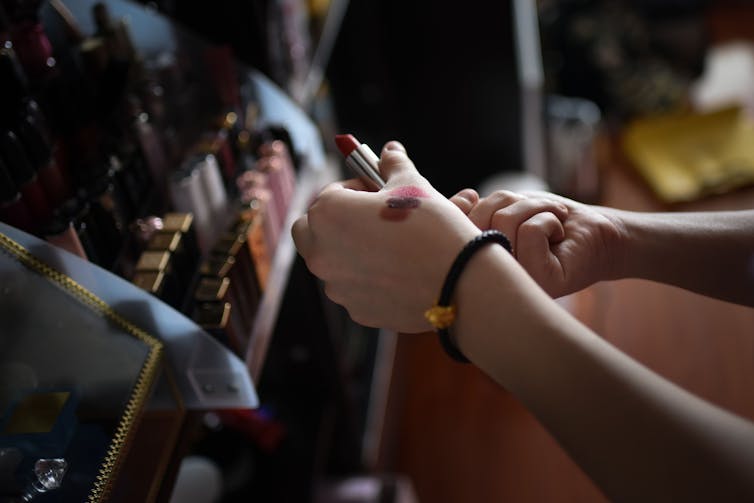
A person's hands test colors of lipstick in store in front of a counter filled with cosmetics.
Cosmetics designed to be free of endocrine-disrupting chemicals are often more expensive. Wang Zhao/AFP via Getty Images

As an epidemiologist who has fought my own fertility battles, I study exposure to endocrine-disrupting chemicals found in everyday products, such as cosmetics, shampoos, lotions and plastics. I have been working to raise awareness of the health risks to young people and encourage prudent use of cosmetic products.

Unregulated and potentially risky

According to the U.S. Food and Drug Administration, the term “cosmetic” can include deodorants, perfumes, lotions, nail polish, shampoos and other hair products, as well as eye, lip and face makeup.

This is important to know, because unless these products are used to treat a condition, such as dandruff or perspiration, they are not federally regulated in the same way drugs are. That leaves it up to cosmetic companies to decide how to communicate product safety.

Personal care products contain many types of chemicals that manufacturers add for specific purposes, including some that can interfere with or disrupt the normal functioning of the endocrine system. For example, they commonly add UV filters like oxybenzone to protect skin from sun damage, phthalates to enhance fragrance, parabens and triclosan for their antimicrobial properties, and per- and polyfluoroalkyl substances, or PFAS, to enhance durability.

However, not all of these chemicals are present in all products, so figuring out how to avoid exposure can be complicated. For example, in a 2021 review of studies detecting endocrine-disrupting chemicals in daily-use cosmetic products, phthalates were present in perfumes, shower gels, shampoo and nail polish. Parabens were detected in lotions, creams, shampoos, body wash, face cleansers and lipstick. Triclosan was detected in toothpastes, soaps and other cleansers. And UV filters were present in sunscreens, lotions, toothpaste, and lipstick.

Many of these chemicals can co-occur in products, putting consumers at risk of exposure to multiple chemicals at once, and sometimes without warning, as labels do not always list endocrine-disrupting chemicals among the ingredients.

Why are chemicals in cosmetics a health risk?

As you rub cosmetic products onto your skin, breathe in their scent or use them to brush your teeth, the chemicals found within can travel throughout your body, targeting your endocrine, nervous and cardiovascular systems.

When these chemicals are endocrine disruptors, such as phthalates, parabens, triclosan and PFAS, they can mimic naturally produced hormones or block hormone receptors. Their presence can result in abnormal hormone production, secretion or transport throughout the body.

These hormonal changes can lead to reproductive problems, including poor sperm quality, miscarriage and endometriosis. They can also lead to thyroid disruption and abnormal growth and development.

Neurological conditions such as attention-deficit/hyperactivity disorder (ADHD), cognitive impairment and depression have also been linked to chemicals added to cosmetic products. So have cardiovascular issues such as high blood pressure, insulin resistance and coronary heart disease.

The level of risk is often difficult to measure and depends in part on the amount of exposure, the type of chemical and how the chemical interacts with the endocrine system. One study of women ages 18-44 in Utah and California found increased exposure to a common phthalate was associated with twice the odds of developing endometriosis, which can be painful and interfere with pregnancy. In a meta-analysis of pregnant women with occupational exposure to endocrine-disrupting chemicals, researchers calculated a 25% increase in the odds of low birth weight when mothers were exposed to more than one type of endocrine-disrupting chemical.

States are starting to ban these chemicals

Our study of college-age females found that, on average, young women use eight different personal care products each day that can contain endocrine-disrupting chemicals, but some report as many as 17. This is concerning, as the number of products people use has been linked to higher exposure to endocrine-disrupting chemicals.

Furthermore, 80% of the women we surveyed did not know whether their cosmetic products contained harmful chemicals.

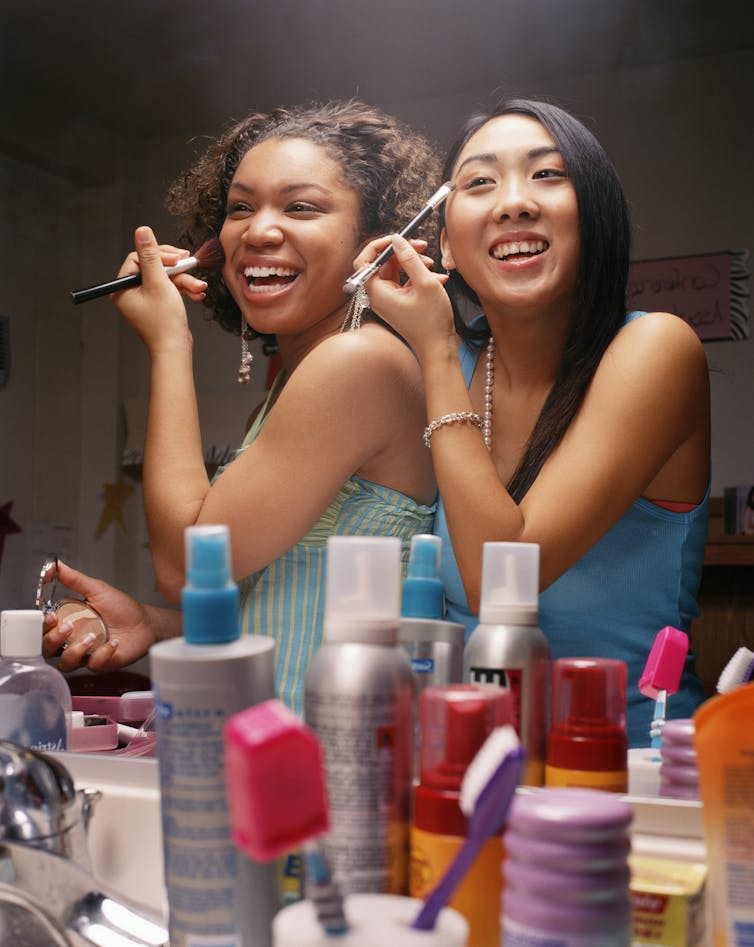
Two young women in party dresses stand in front of a mirror putting on makeup. The counter in front of them has many types of cosmetics that can contain harmful chemicals.
Many young women aren’t aware of the risks chemicals in cosmetics can contain. Shannon Fagan/The Image Bank via Getty Images

Studies have found significantly higher exposure to phthalates and other chemicals among adolescent girls who wore foundation, blush and mascara than among those who did not. One found that when adolescent girls stopped using products containing endocrine-disrupting chemicals, the concentrations in their urine dropped by as much as 45%.

The European Union has led the way on regulating the use of these chemicals in cosmetic products, with U.S. policies generally lagging behind, but that’s changing.

Washington state recently passed legislation that bans PFAS, lead, phthalates, formaldehyde and other harmful chemicals starting in 2025 and creates new incentives for companies to produce safer products. New York banned mercury, a neurotoxin that can be used as a skin lightener, effective June 1, 2023. California, Minnesota and Maine also have broad restrictions on chemical additives in cosmetics.

While many cosmetic companies offer alternative products without endocrine-disrupting chemicals, they tend to cost more, which can put safer products out of reach of young people. I believe a national ban on the use of harmful chemicals in cosmetic products would be the most equitable means for reducing everyone’s exposure.

The Conversation

Leslie Hart receives funding from The National Institute of Environmental Health Sciences.

07 Jun 12:44

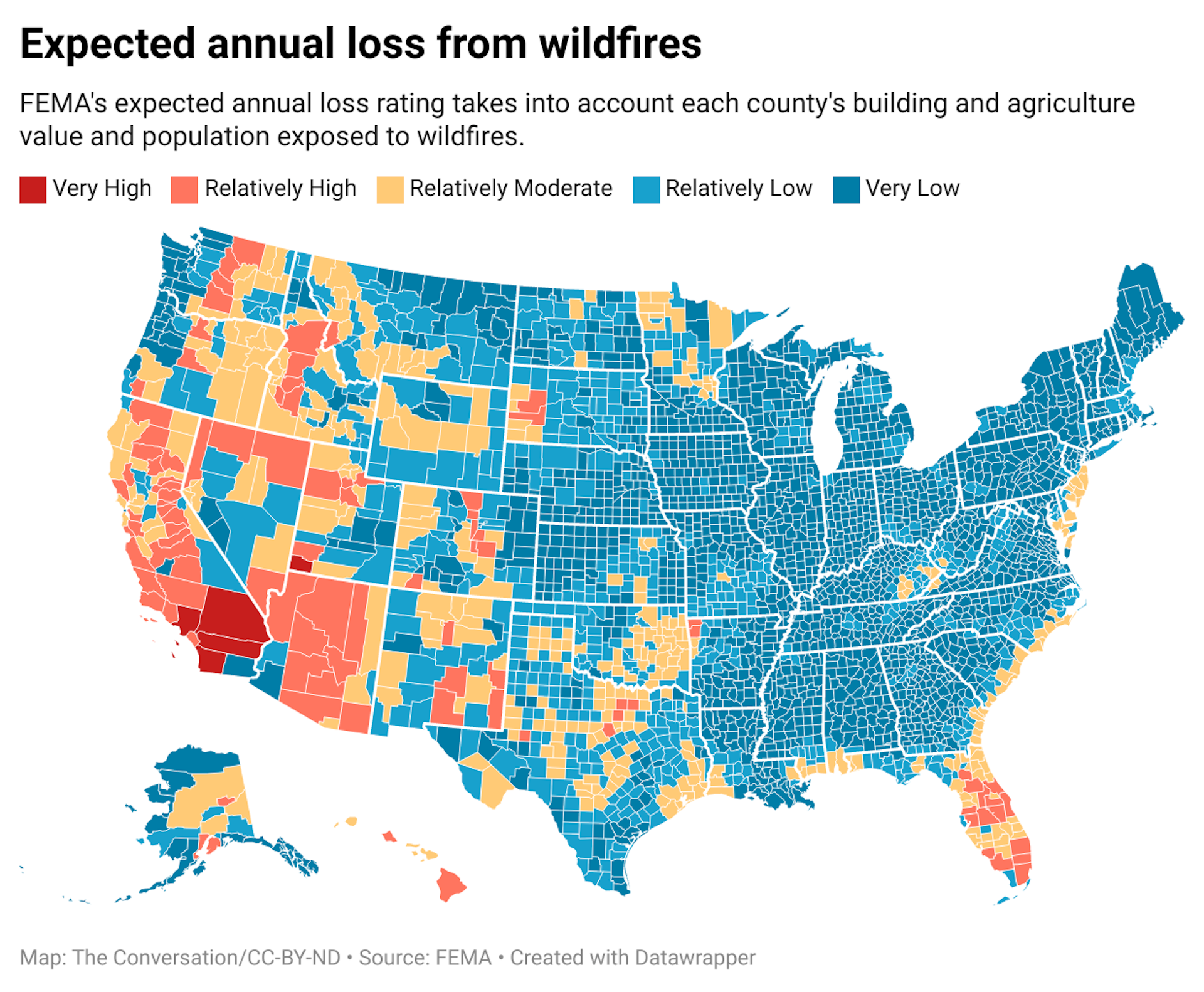
Why insurance companies are pulling out of California and Florida, and how to fix some of the underlying problems

by Melanie Gall, Assistant Professor and Co-Director, Center for Emergency Management and Homeland Security, Watts College, Arizona State University
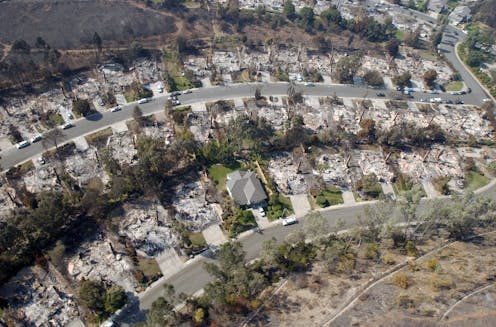
Wildfires can destroy hundreds of homes within hours. PH2(AW/SW) Michael J. Pusnik, Jr / Navy Visual News Service / AFP via Getty Images

When the nation’s No. 1 and No. 4 property and casualty insurance companies – State Farm and Allstate – confirmed that they would stop issuing new home insurance policies in California, it may have been a shock but shouldn’t have been a surprise. It’s a trend Florida and other hurricane- and flood-prone states know well.

Insurers have been retreating from high-risk, high-loss markets for years after catastrophic events. Hurricane Andrew’s unprecedented US$16 billion in insured losses across Florida in 1992 set off alarm bells. Multibillion-dollar disasters since then have left several insurers insolvent and pushed many others to reevaluate what they’re willing to insure.

I co-direct the Center for Emergency Management and Homeland Security at Arizona State University, where I study disaster losses and manage the Spatial Hazard Events and Losses database (SHELDUS). As losses from natural hazards steadily increase, research shows it’s not a question of if insurance will become unavailable or unaffordable in high-risk areas – it’s a question of when.

Reinsurers are worried

Insurance is a vehicle to transfer risk. When an individual buys an insurance policy, that person pays to transfer the risk of expensive repairs to the insurer if the home is damaged by a covered event, like a fire or thunderstorm. Most policyholders don’t experience major disasters, so insurance companies make money.

However, disasters are extremely costly when they do occur, so insurers also buy their own insurance, called reinsurance.

Reinsurance costs have been rising fast in response to expensive disasters around the world in recent years. Reinsurers’ risk-adjusted property-catastrophe prices rose 33% on average at their June 1, 2023, renewal, after a 25% rise in 2022, according to reinsurance broker Howden Tiger’s analysis.

If prices are too high and insurers can no longer transfer excessive risk to the reinsurance market, they are stuck “holding the risk” – meaning the cost of claims when disasters strike. A big enough disaster can put insurance companies out of business, or they can decide to leave the state, as seen in California, Louisiana and elsewhere.

Responsible insurers are not in the business of gambling, so they do what State Farm and Allstate did: They reevaluate their portfolios – the various lines of insurance they offer, such as auto, life, property insurance and health insurance – and their prices. Insurance is a highly data-driven business and uses some of the most sophisticated climate and risk modeling in the world to forecast future risks, including the likelihood a property will be damaged by wildfire or other natural hazards.

State Farm cited “catastrophe exposure” as a reason for ending new high-risk personal and commercial property and casualty policies in California. That refers to the likelihood that costly claims would exceed the risk State Farm was willing to accept.

Why drop only California?

So, why did State Farm and Allstate only stop new policies in California and not in other wildfire-prone states like Colorado or Arizona?

The answer can only be speculative since State Farm or Allstate don’t publicly disclose their exposure. That’s calculated based on how many personal and commercial property and casualty policies the company holds in the state, particularly in the wildland-urban interface where fire risk is higher, and at what value.

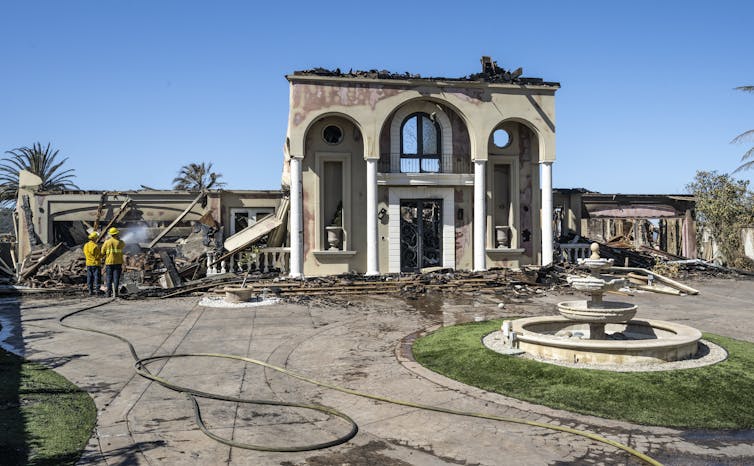
Firefighters work on the remains of a high-end home, with its elaborate front entrance and fountain out front being about all the remains from a 2022 fire near Los Angeles that's recognizable.
Expensive home building prices in California have also raised the risk for insurers. Paul Bersebach/MediaNews Group/Orange County Register via Getty Images

State Farm did cite California’s increasing wildfire risk and home construction prices, but there are other influences to consider.

One is state insurance regulations that can limit premium increases, prohibit policy cancellations and require certain levels of coverage. Insurer Chubb’s chief executive mentioned restrictions that left it unable to charge “an adequate price for the risk” as part of the reason for its 2022 decision to not renew policies for expensive homes in high-risk areas of California. California also has a unique “efficient proximate cause” rule that forces property insurers to also cover post-fire flooding, such as mudslides. Rainy winters like 2023’s often trigger destructive mudslides in wildfire burn areas.

What happens now?

When insurers pull out of a community, residents and companies without access to property and casualty insurance are left holding their own risk – and paying the price if a disaster strikes. From a societal and political perspective, that’s a problem.

Residents and businesses without insurance tend to recover more slowly. Uninsured residents often depend on donations, loans or federal individual assistance. The latter, however, is only available for catastrophic disasters and covers only immediate needs.

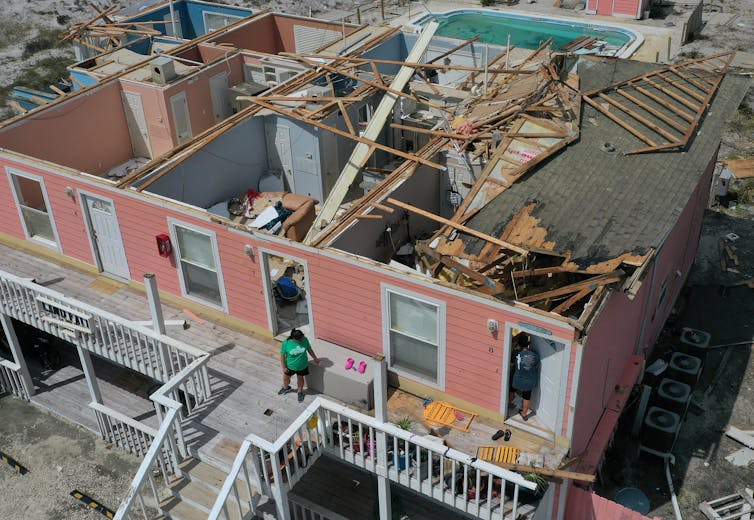
A one-story apartment building on stilts with the roof torn off after Hurricane Sally. Pink beach shoes and folded beach chairs sit on a porch.
Hurricanes cause so much damage, they can put small insurers out of business. Joe Raedle/Getty Images

To fill the gap and provide access to insurance, states including California, Florida, Louisiana and Texas have created either private or public insurance options of last resort with generally very pricey premiums.

Residents covered by these options transfer their risk to the state, such as in Louisiana and Florida – meaning state taxpayers, who fund the state insurance programs, hold the risk directly or indirectly. In California, the privately insured FAIR Plan, in existence since 1968, wrote close to 270,000 policies in 2021, nearly double the number in 2018.

Similarly, anyone purchasing flood insurance through the National Flood Insurance Program since 1968 is transferring their risk to federal taxpayers. The NFIP currently insures almost $1.3 trillion in value across 5 million policies.

Politicians are not catastrophe risk experts, though, and do not make decisions based on data alone.

In the short term, I expect that insurance pools, as well as federal- and state-run insurers of last resort, will add more policies, and that state legislators will incentivize the return of insurers. But while the political willingness to support such a trend exists, the financial resources do not.

The National Flood Insurance Program has plenty of lessons to teach about the challenges of balancing exposure and keeping premiums affordable: It is more than $20 billion in debt. Texas has resorted to charging insurers operating in the state to help cover its program’s costs.

Fixing insurance starts with the property itself

Despite the risk of properties becoming uninsurable, communities today continue to permit development in floodplains, along coastlines and in the wildfire-prone wildland urban interface. Inadequate building codes allow developers to build homes that cannot withstand severe weather. These practices have placed millions of residents and the things they value in harm’s way.

As climate change continues to dial up the frequency and severity of natural hazards, there are some steps states and communities can take involving property to lower the risk:

  • Make smarter land use choices and limit development in high-risk areas to avoid placing people and the things they value in harm’s way.

  • Adopt more stringent building codes and safety standards at state and community levels.

  • Price risk into home sales, either through an insurance contingency that allows the buyer to withdraw when they cannot secure insurance or lower assessed property values for real estate in high-risk areas, which can dissuade builders and buyers.

  • Require comprehensive disclosures of all present and future risks along with historic claims associated with a property to educate potential buyers.

  • Make risk information accessible and understandable. My research shows that most people have a hard time fully grasping how likely they are to be affected by a catastrophic event. They need better tools that communicate the information in a way that resonates with them.

  • Help residents in high-risk areas relocate through buyouts and managed retreat that returns the land to nature or public uses such as parks.

The Conversation

Melanie Gall currently receives research funding from the National Academies' Gulf Research Program, HUD, USAID, DHS, Feeding America, and the Society of Actuaries. She is a member of the National Hazard Mitigation Association, the North American Alliance of Hazards and Disaster Research Institutes, the Association of State Floodplain Managers, and American Association of Geographers.

07 Jun 11:21

USF Now Has Graduate Certificate Program in AI

by Staff

Tampa Bay has become a magnet for tech start-ups. It’s an industry growing more quickly than the talent pool, especially in artificial intelligence (AI). In response to this demand, the University of South Florida has launched a graduate certificate program in AI. This program is for working professionals in the technology sector interested in enhancing their skillset.

“As Tampa keeps growing in economic development and becoming a bigger technology hub, USF had the foresight to put together this program to upscale the current workforce. Not just here, but everywhere,” said Distinguished University Professor Sudeep Sarkar. He’s chair of the Department of Computer Science and Engineering.

What does the graduate program in AI cover?

Participants in the Artificial Intelligence Graduate Certificate are required to take four online courses. These courses provide detailed information about crucial domains in AI, how to modify AI tools and strengthen programs. The certificate also serves as a pathway for those interested in enrolling in the USF Master of Science in Data Intelligence. This program will launch in the fall.

“Artificial Intelligence is an emerging field that will have a transformational impact on business,” said Craig J. Richard, president and CEO of the Tampa Bay Economic Development Council. “It’s wonderful that USF is being proactive in offering this additional training to our local tech professionals. This certificate program will strengthen our community’s competitiveness as we build our tech talent pipeline further to meet the demand for these new specialized roles.”

Related: AI and Small Business — The Partnership of the Future

According to Dice, Tampa is among the fastest-growing U.S. tech hubs for IT talent with an average salary of $120,900. The Tampa Bay Economic Development Council reports the number of businesses in the IT industry in the region has increased 27 percent during the past five years. That’s growth from 13,400 businesses to nearly 17,000. Predictions show the industry growing in Tampa with more than 3,700 jobs by 2027.

The Artificial Intelligence Graduate Certificate launches in the fall. An informational session is scheduled for June 9. Registration information is available here. The deadline to register for the course is Aug. 1. More information can be found here.

The post USF Now Has Graduate Certificate Program in AI appeared first on ModernGlobe.

06 Jun 16:26

Historians are learning more about how the Nazis targeted trans people

by Laurie Marhoefer, Jon Bridgman Endowed Professor of History, University of Washington
Patrons at the Eldorado, a popular LGBTQ cabaret in Berlin during the Weimar years. Herbert Hoffmann/ullstein bild via Getty Images

In the fall of 2022, a German court heard an unusual case.

It was a civil lawsuit that grew out of a feud on Twitter about whether transgender people were victims of the Holocaust. Though there is no longer much debate about whether gay men and lesbians were persecuted, there’s been very little scholarship on trans people during this period.

The court took expert statements from historians, including myself, before finding that the historical evidence shows that trans people were, indeed, persecuted by the Nazi regime.

This is an important case. It was the first time a court recognized the persecution of trans people in Nazi Germany. It was followed a few months later by the Bundestag, Germany’s parliament, formally releasing a statement recognizing trans and cisgender queer people as victims of fascism.

Up until the past few years, there had been little research on trans people under the Nazi regime. Historians like myself are now uncovering more cases, like that of Toni Simon.

Being trans during the Weimar Republic

In 1933, the year that Hitler took power, the police in Essen, Germany, revoked Toni Simon’s permit to dress as a woman in public. Simon, who was in her mid-40s, had been living as a woman for many years.

The Weimar Republic, the more tolerant democratic government that existed before Hitler, recognized the rights of trans people, though in a begrudging, limited way. Under the republic, police granted trans people permits like the one Simon had.

In the 1930s, transgender people were called “transvestites,” a term that is offensive today but at the time approximated what’s now meant by “transgender.” The police permits were called “transvestite certificates,” and they exempted a person from the laws against cross-dressing. Under the Republic, trans people could also change their names legally, though they had to pick from a short, preapproved list.

In Berlin, transgender people published several magazines and had a political club. Some glamorous trans women worked at the internationally famous Eldorado cabaret. The sexologist Magnus Hirschfeld, who ran Berlin’s Institute for Sexual Science, advocated for the rights of transgender people.

The rise of Nazi Germany destroyed this relatively open environment. The Nazis shut down the magazines, the Eldorado and Hirschfeld’s institute. Most people who held “transvestite certificates,” as Toni Simon did, had them revoked or watched helplessly as police refused to honor them.

That was just the beginning of the trouble.

Two police officers stand in front of a shuttered nightclub, which has Nazi banners hanging in the window.
Nazi banners hang in the windows of the former Eldorado nightclub. Landesarchiv Berlin/U.S. Holocaust Memorial Museum

‘Draconian measures’ against trans people

In Nazi Germany, transgender people were not used as a political wedge issue in the way they are today. There was little public discussion of trans people.

What the Nazis did say about them, however, was chilling.

The author of a 1938 book on “the problem of transvestitism” wrote that before Hitler was in power, there was not much that could be done about transgender people, but that now, in Nazi Germany, they could be put in concentration camps or subjected to forced castration. That was good, he believed, because the “asocial mindset” of trans people and their supposedly frequent “criminal activity … justifies draconian measures by the state.”

Toni Simon was a brave person. I first came across her police file when I was researching trans people at the United States Holocaust Memorial Museum. The Essen police knew Simon as the sassy proprietor of an underground club where LGBTQ people gathered. In the mid 1930s, she was hauled into court for criticizing the Nazi regime. By then, the Gestapo had had enough of her. Simon was a danger to youth, a Gestapo officer wrote. A concentration camp was “absolutely necessary.”

I am not certain what happened to Simon. Her file ends abruptly, with the Gestapo planning her arrest. But there are no actual arrest papers. Hopefully, she evaded the police.

Other trans women did not escape. At the Hamburg State Archive, I read about H. Bode, who often went out in public dressed as a woman and dated men. Under the Weimar Republic, she held a transvestite certificate. Nazi police went after her for “cross-dressing” and for having sex with men. They considered her male, so her relationships were homosexual and illegal. They sent her to the concentration camp Buchenwald, where she was murdered.

Liddy Bacroff of Hamburg also had a transvestite pass under the Republic. She made her living selling sex to male clients. After 1933, the police went after her. They wrote that she was “fundamentally a transvestite” and a “morals criminal of the worst sort.” She too was sent to a camp, Mauthausen, and murdered.

Trans Germans previously misgendered

For a long time, the public didn’t know the stories of trans people in Nazi Germany.

Earlier histories tended to misgender trans women, which was odd: When you read the records of their police interrogations, they are often remarkably clear about their gender identity, even though they were not helping their cases at all by doing so.

Bacroff, for example, told the police, “My sense of my sex is fully and completely that of a woman.”

There was also confusion caused by a few cases that, by chance, came to light first. In these cases, police acted less violently. For example, there is a well-known case from Berlin where police renewed a trans man’s “transvestite certificate” after he spent some months in a concentration camp. Historians initially took this case to be representative. Now that we have a lot more cases, we can see that it is an outlier. Police normally revoked the certificates.

A through line to today

Today, right-wing attacks against trans people in the U.S. are intensifying.

Though the American Academy of Pediatrics and every major medical association approves gender-affirming health care for trans kids, Republican politicians have banned it in 19 states, with even more moving to prohibit it.

Gender-affirming medicine is now over 100 years old – and it has roots in Weimar Germany. It had never before been legally restricted in the U.S. Yet Missouri has essentially banned it for adults, and other states are trying to restrict adult care. A host of other anti-trans bills are moving through state legislatures.

I find it fitting, then, that “A Transparent Musical” recently premiered in Los Angeles. In it, fabulously dressed trans Berliners sing and dance in defiance of Nazi thugs.

It’s a reminder that attacks on trans people are nothing new – and that many of them are straight out of the Nazi playbook.

The Conversation

Laurie Marhoefer receives funding from the Holocaust Education Foundation (Northwestern University), Stroum Center for Jewish Studies (University of Washington).

06 Jun 16:21

Supreme Court is poised to dismantle an integral part of LBJ's Great Society – affirmative action

by Travis Knoll, Adjunct Professor of History, University of North Carolina – Charlotte
President Lyndon Johnson delivers the commencement address at Howard University on June 4, 1965.

Of all the civil rights policies enacted by U.S President Lyndon Johnson, affirmative action is arguably one of the most enduring – and most challenged.

Johnson made it clear during a commencement address at Howard University on June 4, 1965, where he stood.

In his speech, “To Fulfill These Rights,” Johnson argued that civil rights were only as secure as society and the government were willing to make them.

“Nothing in any country touches us more profoundly, and nothing is more freighted with meaning for our own destiny than the revolution of the Negro American,” Johnson said.

In my view as a scholar of the history of affirmative action, Johnson’s speech and the legal structure it helped produce directly contradict those who would dismantle affirmative action and besmirch diversity programs today.

As the Supreme Court looks ready to strike down affirmative action in college admissions, it’s my belief that unlike the court’s conservative majority, Johnson understood that the U.S. could not serve as a moral leader around the world if it did not acknowledge its past of racial injustices and try to make amends.

‘Equality as a result’

Johnson knew that changing laws was only part of the solution to racial disparities and systemic racism.

Freedom is not enough,” he declared. “You do not take a person who, for years, has been hobbled by chains and liberate him, bring him up to the starting line of a race and then say, ‘you are free to compete with all the others,’ and still justly believe that you have been completely fair.”

In proposing to address these injustices, Johnson laid out a phrase that would become a defense of affirmative action.

“We seek not just legal equity but human ability, not just equality as a right and a theory but equality as a fact and equality as a result.”

Achieving this latter goal, Johnson explained, would be the “more profound stage of the battle for civil rights.”

A white man dressed in a business suit talks with a Black woman who is smiling.
President Lyndon Johnson chats with Howard law professor Patricia Harris after Howard’s commencement on June 4, 1965. Bettmann/GettyImages

Johnson rejected the idea that individual merit was the sole basis for measuring equality.

“Ability is stretched or stunted by the family that you live with, and the neighborhood you live in – by the school you go to and the poverty or the richness of your surroundings,” Johnson said. “It is the product of a hundred unseen forces playing upon the little infant, the child, and finally the man.”

Johnson took a structural view of discrimination against Black Americans and explained that racial differences could not “be understood as isolated infirmities.”

“They are a seamless web,” Johnson said. “They cause each other. They result from each other. They reinforce each other.”

“Negro poverty is not white poverty,” Johnson said, “but rather the consequence of ancient brutality, past injustice and present prejudice.”

A middle-aged white man stands in front of a crowd of people as he hands a pen to a Black man dressed in a business suit.
President Lyndon Johnson hands a pen to Rev. Martin Luther King Jr. after signing the Voting Rights Act on Aug. 6, 1965. Getty Images

Johnson also rejected comparisons to other minorities who immigrated to the U.S. and had allegedly overcome discrimination through assimilation.

“They did not have the heritage of centuries to overcome,” Johnson said, “and they did not have a cultural tradition which had been twisted and battered by endless years of hatred and hopelessness, nor were they excluded – these others – because of race or color – a feeling whose dark intensity is matched by no other prejudice in our society.”

A constant challenge

That profound battle over how to address the legacies of slavery, Jim Crow and modern-day inequalities is once again before the Supreme Court.

Though the court is the most diverse in American history – with three justices of color and four women – the conservatives, who have historically opposed affirmative action programs, hold a 6-3 majority.

And that majority has the power to ban the use of race when the court issues a decision in Students for Fair Admissions v. Harvard and Students for Fair Admissions v. University of North Carolina. A decision is expected in June 2023.

Five men and four women are wearing black robes as they pose for a portrait.
The Supreme Court, from left in front row: Sonia Sotomayor, Clarence Thomas, Chief Justice John Roberts, Samuel Alito and Elena Kagan; and from left in back row: Amy Coney Barrett, Neil Gorsuch, Brett Kavanaugh and Ketanji Brown Jackson. Alex Wong/Getty Images

At the time of Johnson’s speech, the U.S. faced growing opposition to its escalating war in Vietnam and racial unrest across the country.

But Johnson was determined to achieve his goal of racial equality. During his commencement address, Johnson heralded the passage of the 1964 Civil Rights Act that he signed into law on July 2, 1964, and prohibited workplace discrimination. He also promised passage of the Voting Rights Act that would ban discriminatory voting practices. Johnson signed that into law on Aug. 6, 1965.

And shortly after his speech, Johnson signed Executive Order 11246 on Sept. 24, 1965.

It charged the Department of Labor with taking “affirmative action to ensure that applicants are employed … without regard to their race, color, religion, sex or national origin.”

For Johnson, racial justice was attainable and, once achieved, would alleviate social strife at home and advance the United States’ standing abroad.

Despite urging civil rights activists to “light that candle of understanding in the heart of all America,” even Johnson became disillusioned with the racial politics of forming a more perfect union.

In the aftermath of urban riots in Newark, New Jersey, Detroit and other U.S. cities in 1967, Johnson created the National Advisory Commission on Civil Disorders – better known as the Kerner Commission – to investigate the causes of the riots and suggest remedies.

The commission recommended billions of dollars’ worth of new government programs, including sweeping federal initiatives directed at improving educational and employment opportunities, public services and housing in Black urban neighborhoods.

The commission found that “white racism” was the basic cause of the racial unrest.

Although the report was a bestseller, Johnson found the conclusions politically untenable and distanced himself from the commission report.

Torn between his need to balance Southern votes and his ambition to leave a strong civil rights legacy, Johnson proceeded along a very cautious path.

He did nothing about the report.

U.S. Sen. Edward W. Brooke, Black Massachusetts Republican, was one of the 11 members on the commission.

In his book “Bridging the Divide,” Brooke explained Johnson’s reticence.

“In retrospect,” he wrote, “I can see that our report was too strong for him to take. It suggested that all his great achievements — his civil rights legislation, his antipoverty programs, Head Start, housing legislation, and all the rest of it – had been only a beginning. It asked him, in an election year, to endorse the idea that white America bore much of the responsibility for black rioting and rebellion.”

Even for a politician like Johnson, that proved too much to handle.

The Conversation

Travis Knoll does not work for, consult, own shares in or receive funding from any company or organization that would benefit from this article, and has disclosed no relevant affiliations beyond their academic appointment.
05 Jun 17:00

Baseless anti-trans claims fuel adoption of harmful laws – two criminologists explain

by Henry F. Fradella, Professor, School of Criminology and Criminal Justice. Affiliate Professor, Sandra Day O'Connor College of Law., Arizona State University
Kansas legislators Brenda Landwehr, left, and Chris Croft confer during a vote on an anti-transgender bathroom bill, which both support. AP Photo/John Hanna

It has been seven years since North Carolina made headlines for enacting a “bathroom bill” – legislation intended to prevent transgender people from using restrooms that align with their gender identity.

After boycotts threatened to cost the state more than US$3.7 billion, legislators repealed the law in 2017. Since then, however, religious and political conservatives have successfully spread an anti-trans moral panic, or irrational fear, across the United States.

As far back as 2001, Republican lawmakers proposed the first of what are now nearly 900 anti-LGBTQ+ bills. More than 500 of these were introduced in 49 state legislatures and the U.S. Congress during the first five months of 2023. To date, at least 79 have passed.

Many of these anti-trans laws are written and financed by a group of far-right interest groups, including the Alliance Defending Freedom, the Family Research Council, the Liberty Counsel and the American Principles Project.

These groups claim their proposed laws would protect cisgender women and girls – those whose gender identity matches the sex they were assigned at birth – from the sorts of violent trans people that are often depicted in movies and other media.

But as criminologists, we know these claims are without merit. No reliable data supports the argument that transgender people commit violent crimes at higher rates than cisgender men and women. In fact, transgender people are more than four times as likely to be the victim of a crime as cisgender people.

A group of people walk down a sidewalk carrying flags promoting equality and LGBTQ+ rights
Demonstrators protest against a Tennessee proposal to ban drag shows, one of many anti-trans proposals across the U.S. John Amis/AP Images for Human Rights Campaign

Expanding reach

Anti-trans laws like the one enacted in Kansas over the governor’s veto reach beyond restrooms to limit access to many sex-segregated spaces, including “locker rooms, prisons, domestic violence shelters and rape crisis centers,” based on the sex assigned at birth to a person who seeks to use those spaces.

As of the end of May 2023, at least 18 states had enacted laws within the preceding 12 months that limit medically age-appropriate gender-affirming health care for trans minors, with similar bills pending in 14 more states. And Florida’s barrage of anti-LGBTQ+ regulations even prohibits the mere discussion of sexuality and gender identity in schools through the 12th grade. Journalist Adam Rhodes called these efforts a “centrally coordinated attack on transgender existence.”

We believe these laws and bills illustrate the increasingly hostile legislative landscape for LGBTQ+ people despite polls showing that most people in the United States want trans people to be protected from discrimination in public spaces on the basis of their gender.

What the data shows

A variety of myths, false narratives, bad science, misconceptions and outright misrepresentations undergird anti-trans laws. The reality, however, is that trans-exclusionary laws do not protect cisgender women and girls from harassment or violence. Rather, they result in dramatic increases in violent victimization for transgender and gender-nonconforming adults and children.

When laws permit transgender people to access sex-segregated spaces in accordance with their gender identities, crime rates do not increase. There is no association between trans-inclusive policies and more crime. As one of us wrote in a recent paper, this is likely because, just like cisgender folks, “transgender people use locker rooms and restrooms to change clothes and go to the bathroom,” not for sexual gratification or predatory reasons.

Conversely, when trans people are forced by law to use sex-segregated spaces that align with the sex assigned to them at birth instead of their gender identity, two important facts should be noted.

First, no studies show that violent crime rates against cisgender women and girls in such spaces decrease. In other words, cisgender women and girls are no safer than they would be in the absence of anti-trans laws. Certainly, the possibility exists that a cisgender man might pose as a woman to go into certain spaces under false pretenses. But that same possibility remains regardless of whether transgender people are lawfully permitted in those spaces.

Second, trans people are significantly more likely to be victimized in sex-segregated spaces than are cisgender people. For instance, while incarcerated in facilities designated for men, trans women are nine to 13 times as likely to be sexually assaulted as the men with whom they are boarded.

In women’s prisons, correctional staff are responsible for 41% of women’s sexual victimization, with cisgender women committing the balance of nearly all prisoner-on-prisoner violence. Similarly, trans boys and girls who are barred from using the washrooms and locker rooms that align with their gender identity are respectively between 26% to 149% more likely to be sexually victimized in the locations they are forced to use than cisgender youths.

In society at large, between 84% and 90% of all crimes of sexual violence are perpetrated by someone the victim knows, not a stranger lurking in the shadows – or the showers or restroom stalls. But trans and nonbinary people feel very unsafe in bathrooms and locker rooms, though others experience relative safety there. In fact, the largest study of its kind found that upward of 75% of trans men and 64% of trans women reported that they routinely avoid public restrooms to minimize their chances of being harassed or assaulted.

A person cries out while being handled by police officers.
Qween Jean, a transgender rights activist, is arrested May 31, 2023, during a trans-rights demonstration in New York City. Stephanie Keith/Getty Images

Lies drive harm

Because criminological data does not support trans-exclusionary laws or policies, advocates of anti-trans laws often resort to lies, flawed anecdotal evidence, or what fact-checkers have called “extreme cherry-picking” to support their position.

For instance, one of us documented how isolated news stories, often from notoriously transphobic tabloids, conflate the actions of sexual predators with the “dangerousness” of trans women. Although there are undeniably examples of actual transgender people committing crimes, even deeply troubling ones, they are not evidence of any behavioral trends among the broader class of trans people. No such data exists.

We believe the spate of anti-trans proposals represents a textbook example of crime-control theater – an unnecessary, ineffective and harmful legislative response to unfounded fearmongering.

Anti-trans laws are not just baseless. They’re hurtful and damaging, especially to LGBTQ+ teenagers. Recent polls indicate that more than 60% of these people experience deteriorating mental health – including depression, anxiety and suicidal thoughts – as a result of laws and policies aimed at restricting their personhood.

The criminological research is clear that anti-trans laws do not help the people they are claimed to protect. In fact, these laws inflict harm on people who are even more vulnerable.

The Conversation

Henry F. Fradella has received funding from the National Science Foundation and the National Institute of Justice, but not with regard to anything relevant to the subject matter of this piece.

Alexis Rowland does not work for, consult, own shares in or receive funding from any company or organization that would benefit from this article, and has disclosed no relevant affiliations beyond their academic appointment.

05 Jun 16:59

Saying that students embrace censorship on college campuses is incorrect -- here's how to discuss the issue more constructively

by Bradford Vivian, Professor of Communication Arts and Sciences, Penn State
It's not true that college students reject challenging ideas wholesale and oppose conservative views. SDI Productions/E+/Getty Images

The claim that college students censor viewpoints with which they disagree is now common. Versions of this claim include the falsehoods that students “shut down” most invited speakers to campuses, reject challenging ideas and oppose conservative views.

Such cynical distortions dominate discussions of higher education today, misinform the public and threaten both democracy and higher education.

Indeed, politicians in states such as Florida, Texas and Ohio argue that a so-called “free speech crisis” on college campuses justifies stronger government control over what gets taught in universities.

Since 2020, numerous state legislatures have attempted to censor forms of speech on campuses by citing exaggerations about students and their studies. Passing laws to ban certain kinds of speech or ideas from college campuses is no way to promote true free speech and intellectual diversity. The most common targets of such censorship are programs that discuss race, gender, sexuality and other forms of multiculturalism.

My concerns over public discourse about higher education extend from my book on popular misinformation about universities and why it threatens democracy. In it, I show that many negative perceptions of students and universities rest on factual distortions and exaggerations.

The character of public debates about higher education is important. Millions of Americans rely on a healthy system of university education for professional and personal success. Rampant cynicism about higher education, leading to declines in public support for it, only undermines their pursuits.

Based on my research, I offer alternative ways to frame debates about higher education. They can lead to discussions that are more constructive and accurate while better protecting fundamental American values such as free speech and democracy.

A man in a dark suit standing at a lectern with the sign 'Florida, the education state' on it.
One bill signed in May 2023 by Florida Gov. Ron DeSantis, center, includes restrictions that bar public colleges in Florida from spending money on diversity, equity and inclusion programs. Thomas Simonetti for The Washington Post via Getty Images

1. Avoid stereotypes about college students

The idea that college students are hostile to opposing viewpoints is false. Pundits and media personalities have promoted this falsehood aggressively. Such figures have benefited, politically or financially, from sensationalism about a college “free speech crisis.”

In opinion polls, college students typically express stronger support for free speech and diverse viewpoints than other groups. Partisan organizations often cherry-pick that data to make it seem otherwise. But poll results tell only part of the story about college campuses today.

Several thousand institutions make up U.S. higher education. The system includes hundreds of thousands of students from different backgrounds. College campuses are often more demographically and intellectually diverse than surrounding communities.

Judgments about higher education based on sweeping generalizations about college students conflict with the full realities of campus life. A wider range of perspectives, including from students themselves, can enrich debates about university education.

2. Consider all forums for free speech in universities

Universities protect free speech more effectively than do other parts of society. They don’t do so perfectly, but more effectively.

Universities are major centers for the study of the First Amendment, the free press, human rights, cultural differences, international diplomacy, conflict resolution and more. Many institutions require students to take basic speech and writing courses that enhance their skill in argument and debate.

Manufactured outrage about college students who protest invited speakers fuels sensationalism about free speech on campuses. Despite occasional disruptions over bigoted speakers, universities offer numerous forums for free speech, open debate and intellectual diversity.

Just one large university holds thousands of classes, meetings, performances and other events on a daily basis. People freely express their views and pursue new ideas in those settings. Now multiply that reality by several thousand different institutions.

Debates over free speech in higher education can be improved by acknowledging the many forums in which people speak freely every day.

3. Recognize the true threats to free speech on campuses

For the past several years, many state legislatures have promoted the falsehood that universities are hostile to various ideas. The most commonly cited examples are conservative ideas, traditional expressions of patriotism and great works of Western literature.

The notion of hostility to such ideas on college campuses has surfaced in numerous bills that create new forms of state interference in education. Thirty-five pieces of legislation banning diversity, equity and inclusion programs in colleges have been introduced in state legislatures. So far, three of them have been signed into law, while four are pending final legislative approval.

Tenure for faculty members, which protects independent thought, is also under assault in states such as Florida and Texas. Politicians in those states justify ending tenure protections by claiming that professors teach students to censor free speech.

Such rising government interference creates a genuine threat to free speech on college campuses and in society beyond. A historic increase in state censorship, which began with higher education, has spilled over into censorship of materials about race, gender, sexuality and multiculturalism in K-12 schools and public libraries.

Advocacy organizations like the ACLU and the American Association of University Professors have condemned this censorship. So have numerous conservative leaders.

Informed scrutiny of university policies and what faculty members teach is always welcome. But cynical distortions have fueled anti-democratic censorship of universities, not constructive efforts to improve them.

4. Understand the role of academic freedom

Many graduates in academic gowns walking past a huge crowd in a stadium.
Academic freedom isn’t a luxury found only in the Ivy League. It exists at community colleges such as Long Beach City College in California, whose June 9, 2022, graduation ceremony is seen here. Brittany Murray/MediaNews Group/Long Beach Press-Telegram via Getty Images

The ability of citizens to exercise academic freedom is not only vital in education. It’s also training for democracy.

Academic freedom includes the freedom to attend a university of one’s choice. The freedom to learn what one chooses in that university. The freedom of an institution to offer a wide range of subject matters to students. And the freedom to teach or conduct research without political interference.

These freedoms are not reserved for Ivy League universities. U.S. higher education includes state schools and community colleges that serve middle- and working-class communities. Those institutions are the backbone of many professions, from health care and technology to engineering and education.

The quality of public debate over free speech in higher education matters. Government interference with colleges does not punish elites. It rewards deeply cynical views of higher education and restricts a freedom that should be available to all Americans.

The Conversation

Bradford Vivian does not work for, consult, own shares in or receive funding from any company or organisation that would benefit from this article, and has disclosed no relevant affiliations beyond their academic appointment.

05 Jun 11:34

MOSI Tampa hosts “The Science of the Cuban Sandwich” this September

by Andrew Harlan

The Museum of Science and Industry (MOSI) will host an event dedicated to the science of the Cuban sandwich on September 16. There is a formula to a great Cuban sandwich. Tampa residents have passionate feelings about which deli/restaurant makes the very best in the city, while others will contest what ingredients comprise the perfect Cuban. The bread, the seasoning, the meat, the pickles, as Tampenos it’s our duty to hyper fixate on each and every ingredient.

Area experts will go head-to-head, unraveling the secrets of the iconic Tampa Bay Cuban Sandwich. Prepare to be amazed by the physics of bread baking, the chemistry of fillings, and the mind-blowing biology of taste and flavor. Don’t fret, this educational experience comes with plenty of samples to snack on.

exterior of a museum with a spherical dome structure

Tickets are $25 for non-members, and $20 for members. This event has limited availability so you’ll want to secure your spot ASAP. Your admission includes 1 drink ticket, 1 raffle ticket, swag bag for the 1st 100 guests, live music and delicious food samples. 

MOSI is located at 4801 E. Fowler Avenue. In case you need another reason to visit the museum, they also just debuted a science-based mini golf course outside.

Local voters at the International Cuban sandwich Festival seem to have settled on two institutions that craft the best Cuban sandwiches around: Flan Factory and The Smokin’ Cuban.

What to read next:

The post MOSI Tampa hosts “The Science of the Cuban Sandwich” this September appeared first on That's So Tampa.

05 Jun 11:33

Visualized: The Daily Routines of Famous Creatives

by Staff
Visualized: The Daily Routines of Famous Creatives

What is the best daily routine to unlock creativity, or is there such a thing?

Many modern suggestions for optimizing creativity—like scheduling time for “deep work,” and building small, sustainable “atomic habits”—can be traced back to famous creatives in many different eras. And though they all found success, they employed different methods as well.

Related: Creative Arts Theatre Company Brings Innovative Performances to Kids

In this unique visualization, RJ Andrews from InfoWeTrust has charted how notable creatives in different fields spent their days. He picked 16 of the 161 “inspired minds” covered by Daily Rituals: How Artists Work, a book by writer and editor Mason Currey published in 2013.

How Much “Creativity Time” in Famous Daily Routines?

Dividing the day into 24 hours, Andrews denoted certain categories for daily activities like working creatively, sleeping, and other miscellaneous endeavors (meals, leisure, exercise, and social time).

For the creatives with a separate day job—Immanuel Kant and Wolfgang Amadeus Mozart—their ordinary labor is also counted in miscellaneous activities.

Below is a breakdown of the daily routine of all 16 people featured above:

The average and median amount of time spent on creative work for these individuals was just over 8 hours a day. At the extremes were two French novelists, Honoré de Balzac with 13.5 hours daily spent on creative work, and Victor Hugo with only 2 hours.

Interestingly, the allocation of creative work time was different in almost every daily routine. Maya Angelou’s routine resembles the modern work day, with the bulk of her writing between 7 a.m. to 2 p.m. Others like Kant and Mozart had creativity blocks when time allowed, such as before and after their teaching jobs.

Then there are outliers like Honoré de Balzac and Sigmund Freud, who worked as much as they could. Balzac wrote from 1:00 a.m. to 4:00 p.m. with just an hour and a half nap break in between, fueled by up to 50 cups of coffee. Freud split up his creative work into three different blocks: analyzing patients in the morning, consulting in the afternoon, and reading and writing journals into the late evening.

But somewhere in their days, most of these brilliant minds made sure to get a good rest, with an average of 7.25 hours of sleep across the board.

Schedule Yourself to Create Success

Creativity may ebb and flow, but these great minds had one clear thing in common: scheduling time for creative work.

The perfect daily routine was usually what fit in with their lifestyle (and their bodies), not based on an arbitrary amount of work. For example, night owls with later chronotypes worked late, while socialites and politicians found time outside of their commitments.

They also found time to move and enjoy life. Half of the people in the dataset specified exercise in their accounts—either leisurely strolls or fast walks. Many also scheduled social time with partners, friends, or children, often paired with a meal.

Perhaps the greatest insight, however, is that the day-to-day routine doesn’t have to look extraordinary to be able to create extraordinary work.

Story attributed to Visual Capitalist.

The post Visualized: The Daily Routines of Famous Creatives appeared first on ModernGlobe.

02 Jun 19:27

Why 40°C is bearable in a desert but lethal in the tropics

by Alan Thomas Kennedy-Asser, Research Associate in Climate Science, University of Bristol
Phew: heat plus humidity can make Bangkok an uncomfortable place in a heatwave. Pavel V.Khon/SHutterstock

This year, even before the northern hemisphere hot season began, temperature records were being shattered. Spain for instance saw temperatures in April (38.8°C) that would be out of the ordinary even at the peak of summer. South and south-east Asia in particular were hammered by a very persistent heatwave, and all-time record temperatures were experienced in countries such as Vietnam and Thailand (44°C and 45°C respectively). In Singapore, the more modest record was also broken, as temperatures hit 37°C. And in China, Shanghai just recorded its highest May temperature for over a century at 36.7°C.

We know that climate change makes these temperatures more likely, but also that heatwaves of similar magnitudes can have very different impacts depending on factors like humidity or how prepared an area is for extreme heat. So, how does a humid country like Vietnam cope with a 44°C heatwave, and how does it compare with dry heat, or a less hot heatwave in even-more-humid Singapore?

Weather and physiology

The recent heatwave in south-east Asia may well be remembered for its level of heat-induced stress on the body. Heat stress is mostly caused by temperature, but other weather-related factors such as humidity, radiation and wind are also important.

Our bodies gain heat from the air around us, from the sun, or from our own internal processes such as digestion and exercise. In response to this, our bodies must lose some heat. Some of this we lose directly to the air around us and some through breathing. But most heat is lost through sweating, as when the sweat on the surface of our skin evaporates it takes in energy from our skin and the air around us in the form of latent heat.

annotated diagram of person
How humans heat up and cool down. Take from Buzan and Huber (2020) Annual Review of Earth and Planetary Sciences, Author provided

Meteorological factors affect all this. For example, being deprived of shade exposes the body to heat from direct sunlight, while higher humidity means that the rate of evaporation from our skin will decrease.

It’s this humidity that meant the recent heatwave in south-east Asia was so dangerous, as it’s already an extremely humid part of the world.

The limit of heat stress

Underlying health conditions and other personal circumstances can lead to some people being more vulnerable to heat stress. Yet heat stress can reach a limit above which all humans, even those who are not obviously vulnerable to heat risk – that is, people who are fit, healthy and well acclimatised – simply cannot survive even at a moderate level of exertion.

One way to assess heat stress is the so-called Wet Bulb Globe Temperature. In full sun conditions, that is approximately equivalent to 39°C in temperature combined with 50% relative humidity. This limit will likely have been exceeded in some places in the recent heatwave across south-east Asia.

In less humid places far from the tropics, the humidity and thus the wet bulb temperature and danger will be much lower. Spain’s heatwave in April with maximum temperatures of 38.8°C had WBGT values of “only” around 30°C, the 2022 heatwave in the UK, when temperatures exceeded 40°C, had a humidity of less than 20% and WBGT values of around 32°C.

Two of us (Eunice and Dann) were part of a team who recently used climate data to map heat stress around the world. The research highlighted regions most at risk of exceeding these thresholds, with literal hotspots including India and Pakistan, south-east Asia, the Arabian peninsula, equatorial Africa, equatorial South America and Australia. In these regions, heat stress thresholds are exceeded with increased frequency with greater global warming.

In reality, most people are already vulnerable well below the survivability thresholds, which is why we can see large death tolls in significantly cooler heat waves. Furthermore, these global analyses often do not capture some very localised extremes caused by microclimate processes. For example a certain neighbourhood in a city might trap heat more efficiently than its surroundings, or might be ventilated by a cool sea breeze, or be in the “rain shadow” of a local hill, making it less humid.

Variability and acclimatisation

The tropics typically have less variable temperatures. For example, Singapore sits almost on the equator and its daily maximum is about 32°C year round, while a typical maximum in London in mid summer is just 24°C. Yet London has a higher record temperature (40°C vs 37°C in Singapore).

Given that regions such as south-east Asia consistently have high heat stress already, perhaps that suggests that people will be well acclimatised to deal with heat. Initial reporting suggests the intense heat stress of the recent heatwave lead to surprisingly few direct deaths – but accurate reporting of deaths from indirect causes is not yet available.

On the other hand, due to the relative stability in year-round warmth, perhaps there is less preparedness for the large swings in temperature associated with the recent heatwave. Given that it is not unreasonable, even in the absence of climate change, that natural weather variability can produce significant heatwaves that break local records by several degrees Celsius, even nearing a physiological limit might be a very risky line to tread.


Imagine weekly climate newsletter

Don’t have time to read about climate change as much as you’d like?
Get a weekly roundup in your inbox instead. Every Wednesday, The Conversation’s environment editor writes Imagine, a short email that goes a little deeper into just one climate issue. Join the 10,000+ readers who’ve subscribed so far.


The Conversation

Alan Thomas Kennedy-Asser receives funding from NERC.

Dann Mitchell receives funding from NERC.

Eunice Lo receives funding from NERC and the Wellcome Trust.

02 Jun 19:05

Reparations over formerly enslaved people has a long history: 4 essential reads on why the idea remains unresolved

by Howard Manly, Race + Equity Editor, The Conversation US
A Black man holds up a sign during a Reparations Task Force meeting in Los Angeles, California on Sept. 22, 2022. Carolyn Cole / Los Angeles Times via Getty Images

The debate about reparations to descendants of enslaved people rages on.

In California, the state’s reparations task force has estimated that the descendants of former enslaved people living in California should receive a payment of $1.2 million per person.

While the issue of reparations is nothing new, California Governor Gavin Newsome created the task force in 2020 and called for it to offer solutions to the “structural racism and bias built into and permeating throughout our democratic and economic institutions.”

So far, Newsome has remained quiet on his task force’s recommendations and is awaiting its final report, expected on July 1, 2023.

Several scholars of U.S. slavery and the history of reparations have written articles explaining what the ongoing debate has been about since the idea first emerged after the Civil War. Here we spotlight four examples of those scholars’ work:

1. Despite gains, persistent racial gaps remain

While researching his book “Making Whole What Has Been Smashed,” John Torpey learned that the idea of compensating freed slaves or their descendants has never really gained much traction in the United States.

A driving force behind the persistence of reparations talk is just how stark the racial differences remain, Torpey wrote.

Compared to whites, Torpey explained, “blacks tend to have lower educational attainment, rates of home ownership and life expectancy but higher rates of poverty, incarceration, unemployment and life-threatening diseases.”

As a result, the wealth gap between whites and Blacks remains very large, Torpey noted, “and wage inequality is likely making it worse.”


Read more: From ‘40 acres and a mule’ to LBJ to the 2020 election, a brief history of slavery reparation promises


2. Righting past wrongs

Anne Bailey has researched slavery for the past three decades and has concluded that there are many rationales for reparations.

For one, Bailey wrote, “There has never been a leveling of the playing field, or payments for the debt of unpaid labor over 250 years of slavery.”

Furthermore, she explained, Black contribution to the wealth of America has not been acknowledged or given its due.

“Paying reparations to Americans of African descent could help the U.S. reclaim some moral leadership on the global stage,” Bailey wrote. “The U.S. is not the only country in the world with human rights abuses then or now, but it can be one of the few countries in the world that truly addresses these wrongs.”

In other words, Bailey concluded, the U.S. can lead by example.


Read more: Revisiting reparations: Is it time for the US to pay its debt for the legacy of slavery?


3. Slave owners received reparations

As a professor of public policy who has studied reparations, Thomas Craemer estimates the losses from unpaid wages and lost inheritances to Black descendants of the enslaved in America at around US$20 trillion in 2021 dollars.

“But what often gets forgotten by those who oppose reparations is that payouts for slavery have been made before,” Craemer wrote . “But those payments went to former slave owners and their descendants, not the enslaved or their legal heirs.”

A prominent example is the so-called “Haitian Independence Debt” that burdened an independent Haiti with reparation payments to former slave owners in France. Another was the British government, which paid reparations totaling the equivalent of about $429 billion in 2021 to slave owners when it abolished slavery in 1833.

A 1791 depiction of fighting between French troops and Haitian revolutionaries.
Haitians had to pay for their independence. API/Gamma-Rapho via Getty Images

In the U.S., President Abraham Lincoln signed into law the “Act for the Release of certain Persons held to Service or Labor within the District of Columbia” on April 16, 1862.

It gave former slave owners $300 per enslaved person set free.

The act also provided for an emigration incentive of $100 – around $2,683 in 2021 dollars – if the former enslaved person agreed to permanently leave the United States.

In contrast,“ Craemer wrote, "the formerly enslaved received nothing if they decided to stay in the United States.”


Read more: There was a time reparations were actually paid out – just not to formerly enslaved people


4. Germany reparations to Holocaust survivors

As a professor of political science who studies the relationship between democracy, citizenship and justice, Bernd Reiter has examined how Germany dealt with the horrors of the Holocaust.

Instead of seeking to erase the Holocaust from its history, the German government has paid since the end of World War II the equivalent of $7 billion for Israel and $1 billion for the World Jewish Congress, an international federation of Jewish communities and organizations.

“The German government has worked hard to ensure remembrance, penance, recompense and justice,” Reiter wrote. “The United States, in contrast, has no official policy of atoning for slavery.”


Read more: If Germany atoned for the Holocaust, the US can pay reparations for slavery


Editor’s note: This story is a roundup of articles from The Conversation’s archives.

The Conversation
02 Jun 18:05

Five things to know about Drag Queen Story Time

by Conor Barker, Assistant Professor, Department of Psychology & Faculty of Education, Mount Saint Vincent University
Contrary to misconceptions, exposing children to diverse expressions of gender identity supports their natural development and fosters inclusivity. (AP Photo/Mary Altaffer)

Recent news reports have described the public controversy involving topics of sexual orientation and gender identity, and how these are presented to children, especially in schools and libraries. Protests at Ontario, British Columbia, Alberta and New Brunswick libraries and public centres have targeted Drag Queen Story Time events.

These are educational events where drag performers read books to children. The aim is to present the diversity of gender expression and identity, build acceptance and develop creativity in personal expression.

Recently, however, these events have been met with backlash. School leaders have prevented children from attending events that discuss sexual and gender identity. In New Brunswick, where the provincial government is reviewing gender identity policy in schools due to public pressure, Premier Blaine Higgs put the question plainly: “Should [there] be drag story time for young kindergarten, grade 1, grade 2?”

Through our research and clinical practice working with children, parents and schools, we believe parents and kids deserve a better understanding of what events like drag story times are about.

A man with a megaphone in the middle of a chaotic crowd of people. Rainbow flags are seen in the background.
People protesting against a drag story time event clash with counter-protesters outside the National Arts Centre in Ottawa on Feb. 8, 2023. THE CANADIAN PRESS/Spencer Colby

Contrary to misconceptions, exposing children to diverse gender identities and expressions supports their natural development. Further, it fosters inclusive and accepting communities and school environments, which is fundamental for developing well-adjusted adults.

Parents play a critical role in providing nurturing environments for their children. This can be best accomplished when parents are well-informed on topics that dominate mainstream media.

What is drag?

Drag is an art form that has been around for centuries, including during the First World War. Drag has evolved within gay culture, can be performed by all genders and is generally an exaggeration of gender expression.

A drag performance combines elements of fashion, makeup, dance, lip-syncing, music and comedy. It is important to remember that, like other forms of art, it is available on a wide spectrum: from mature themes at a night club, to child-friendly performances that would be appropriate for schools, libraries and community centres.

What happens at a Drag Queen Story Time?

Drag Queen Story Time began in San Francisco in 2015. The events generally occur in public spaces like libraries, schools or community centres, with a drag queen host. Children most often attend with their families, parents and teachers. While the host adheres to the flamboyant art form in terms of colours and fashion, it is not a mature performance with sexualized overtones. Neither is it an opportunity for the host to groom children.

The host will read a story book to the children, often one promoting themes of acceptance, diversity and self-expression, presenting characters and families from diverse backgrounds. The host will also often interact with the participants, answering questions the children may have, playing games, making crafts or posing for photographs with the children. The overall aim of the event is to provide a positive message to children about the diversity of gender expression.

How do children develop their gender identities?

The development of gender identities in children is a complex process. It is influenced by a combination of factors, including biological, social, cognitive, environment and personal exploration. Children eventually develop a relative clarity of their gender and feel a sense of harmony between the complex factors that contribute to gender identity development.

In some children, these factors may conflict, most commonly when children do not conform to societal expectations of their assigned sex at birth. This can result in negative emotions and lead to behavioural or mental health issues. These issues are often remediated when gender-affirming care is provided.

Introducing children to diverse gender expressions does not encourage gender dysphoria or confusion. On the contrary, diverse experiences throughout life have been shown to foster self and collective understandings of gender and gender differences. Furthermore, it’s important for a child’s development that parents, schools and communities support children in their exploration and expression of gender identity in a safe and affirming environment.

A drag queen in a multi-coloured dress with bright yellow hair reads from a children's book.
A drag queen reading children’s stories during an event in Saint John, N.B. (Shutterstock)

The importance of positive role models

Children and youth who identify as 2SLGBTQI+ usually have little-to-no access to positive role models that can relate to their own experiences. Having access to positive role models and having positive experiences with people who have diverse gender identities can foster a better sense of belonging and promote self-acceptance.

People who are successful and positive role models are characterized as being competent and easily relatable. Such role models provide context for children to gain a better understanding of themselves and others. Further, adolescents whose gender or sexual identity is accepted by their parents experience fewer psychological problems compared to those whose parents are less accepting.

How can parents engage with Drag Queen Story Time?

Engaging with drag performers is an opportunity for parents to show their children that diversity is beautiful and worthy of celebration. Parents can foster engagement through communication and understanding of their own emotions and their child’s emotions. Being in tune with these emotional components helps ensure children are in an environment that supports positive development and growth.

Attending family-friendly drag events with children creates opportunities for discussion and reflection. Parents can think about and reflect on their own development of gender identity and expression, what influenced the choices they’ve made, and how this may impact the choices that their children may make. After Drag Queen Story Time, parents are sure to have important conversations with their children that will not only increase their understanding of self-identity, but of identities of others as well.

The Conversation

The authors do not work for, consult, own shares in or receive funding from any company or organization that would benefit from this article, and have disclosed no relevant affiliations beyond their academic appointment.

02 Jun 17:44

The 'truther playbook': tactics that explain vaccine conspiracy theorist RFK Jr's presidential momentum

by Stephanie Alice Baker, Senior Lecturer in Sociology, City, University of London

While incumbent Joe Biden is the favoured Democratic pick for the 2024 US presidential nomination, another more controversial candidate is gaining popular support in the polls. Robert F. Kennedy Jr, a self-described vaccine sceptic, announced his candidacy to run for president as a Democrat in April.

Our new study on the rhetorical techniques used to spread vaccine disinformation partly explains Kennedy’s appeal to voters. We examined the strategies of RFK Jr and American osteopath Joseph Mercola, two prominent members of the “disinformation dozen”.

These 12 anti-vaccine advocates, according to research conducted by the Center for Countering Digital Hate, were responsible for nearly two-thirds of anti-vaccine content posted to Facebook and Twitter during the pandemic.

We analysed their social media profiles, books, documentaries, websites and newsletters from 2021-22, and identified the techniques that comprise what we call the “truther playbook”. These take the form of four enticing promises which figures like Kennedy and Mercola use to give their claims legitimacy and build a loyal following.

These techniques – promising identity and belonging, revealing “true” knowledge, providing meaning and purpose, as well as promising leadership and guidance – feature prominently in Kennedy’s 2024 presidential campaign.

1. Identity and belonging

COVID truthers offer their followers access to an exclusive in-group identity. They adhere to a dualistic belief system that divides the world into good and bad actors, light and dark forces. For COVID truthers, it is not simply that their opponents have acted through ignorance or error – they frame them as corrupt and evil.

Kennedy’s and Mercola’s social media posts, newsletters and publications frequently frame prominent public figures such as Anthony Fauci and Bill Gates as evil elites, or “dark forces” allegedly conspiring against ordinary people.

COVID truthers present themselves in opposition to these corrupt corporations and government institutions. They offer a promising invitation to their followers: join me, and be part of the movement fighting “the system”.

Kennedy, for example, refers to himself as a resolute “defender” of children and the public. His anti-vaccine activism is framed as a noble pursuit aligned with the public good. Similarly, his presidential pledge of honest government is pitched as being “for the people”.

2. True knowledge and enlightenment

The spread of disinformation about COVID vaccines has occurred in a society characterised by low institutional trust. Figures such as Kennedy and Mercola capitalise on this, appealing to those disillusioned with the government’s official narrative. They present themselves as having access to privileged knowledge and understanding.

They do this by revealing alternative “facts” that contradict the official narrative, and that they claim have been concealed from the public. Some researchers refer to such information as “stigmatised knowledge”, meaning claims that are not accepted by mainstream institutions.

COVID truthers, as the name suggests, promise to expose, release and reveal the truth, which they claim has been censored by powerful, corrupt organisations.

Kennedy’s presidential bid exists in opposition to what he has described as “an incredibly sophisticated system of information control”. He refers to himself as a “truth teller”, and promises to establish an honest government that will earn back the trust of the public.

Photo illustration of a woman wearing glasses, with stars and galaxies in her head to represent thinking
The truther playbook promises followers ‘true’ knowledge and enlightenment. metamorworks/Shutterstock

3. Meaning and purpose

COVID truthers provide their followers with meaning, offering a reason to believe in a greater purpose. This can take the form of New Age spirituality, suggesting that humanity is undergoing a “shift in consciousness”, or a more secular commitment to truth, freedom and justice.

Kennedy frequently deploys the language of social justice in his posts and newsletters, as a rallying call to unite his followers. Most of his early anti-vaccine messaging focused on protecting pregnant women and children from harmful ingredients in vaccines.

During the pandemic, Kennedy shifted to the topic of medical racism – situating the opposition to vaccine mandates in a broader civil rights agenda. He compared racial segregation to non-vaccination, or what he refers to as “the new apartheid”.

In a direct call to action, Kennedy’s newsletters invited followers to “unite to create a better world”, and reminded them of the importance of “seeking justice and spreading the truth”. He made explicit analogies to the civil rights movement, telling supporters: “We won a revolution before, we can win it again.”

Similar messaging appears in his presidential campaign, which calls on supporters to “join the movement”, “spread the word”, and “restore our rights”.

4. Leadership and guidance

COVID truthers proffer order and security in a world that feels disorderly and insecure. They speak to the institutional distrust many people feel towards “the establishment”.

Kennedy’s campaign contrasts the power of corrupt government institutions, corporate cronyism and nefarious media elites with the powerlessness that the disenfranchised public feels. As a consequence, he positions himself as an incorruptible leader with the capacity to “clean up government”, restore civil liberties, and speak truth to power.

Why this matters

The success of the truther playbook in spreading anti-vaccine discourse during the pandemic demonstrates the popular appeal of belief and emotion in the current political climate. Filings with charity regulators show that revenue for Kennedy’s organisation more than doubled in 2020, to US$6.8 million.

In our current post-truth era, where opinions often triumph over facts, influencers and celebrities can achieve authority. By framing their opponents as corrupt and evil, and claiming to expose this corruption, COVID truthers can successfully encourage others to join their movement.

And, as Kennedy’s campaign is now demonstrating, these rhetorical techniques can be used to promote populist politics just as much as anti-vaccine content.

The Conversation

The authors do not work for, consult, own shares in or receive funding from any company or organisation that would benefit from this article, and have disclosed no relevant affiliations beyond their academic appointment.

02 Jun 17:30

How teachers can stay true to history without breaking new laws that restrict what they can teach about racism

by W. Fitzhugh Brundage, Professor of History, University of North Carolina at Chapel Hill
A growing number of states have passed laws that restrict what teachers can teach about racism. FangXiaNuo via Getty Images

When it comes to America’s latest “history war,” one of the biggest consequences is that it has made many K-12 educators scared and confused about what they can and can’t say in their classrooms.

Since 2021, at least 28 states have adopted measures that restrict how teachers can teach the history of racism in the U.S. Many more states have proposals on the table. The laws have been portrayed in the media as measures that would prevent teachers from teaching “divisive concepts” or lessons that would cause “discomfort, anguish or guilt.”

As a historian who studies some of the most brutal aspects of American history – from anti-Black lynching in the South after the Civil War to the use of torture during the war on terror – I don’t believe teachers have as much to worry about as many may think. Some observers have posited that the wave of new education laws will have a chilling effect on how history is taught. But a close look at these laws shows that they are generally written so broadly that they can’t effectively stop teachers from teaching history in a way that’s fair, accurate and true.

Weaknesses seen

I’m not the first to make this point. For instance, one media critic has noted that coverage of the laws has “focused more on educators’ perceptions of and emotions about the legislation than on the actual language.” A law professor has argued that the mainstream media “distorts reality by mischaracterizing the laws” as bans against critical race theory, or CRT. Critical race theory is a concept that holds that racism is not just something that takes place among individuals, but rather has been embedded in American law and policy.

Some, such as law professor Jonathan Feingold, go so far as to say most of the laws actually call for more CRT, not less. I wouldn’t go that far. However, I do see a lot of leeway and loopholes in the laws. Here, I offer several examples of ways teachers can introduce difficult subjects that involve racism in the U.S. without violating the new laws that govern how teachers can discuss it.

Focus on the free market

In teaching about the history of American free markets, teachers would be justified to point out that slavery – and the associated industries of cotton and tobacco, to name just two – were all major components of the economy before the Civil War.

To make this more relatable to children, teachers could discuss something that every child understands: food and hunger. Historical records reveal that slaveholders cut costs by underfeeding enslaved children. They often did this until the children were old enough to become productive laborers. Slave owners also published extensive advice on how to reward and punish the people they had enslaved. Teachers can point out that for all the prowess of America’s free market, before the Civil War, that free market was largely dependent on the violence and forced labor that slavery involved.

Examining the concept of liberty

Considerable debate has taken place as of late over whether students should be required to say the Pledge of Allegiance – a daily school ritual that ends with the reciting of the words “and liberty and justice for all.”

Since liberty has been a long-standing pillar of American society, no teacher could be faulted for having students examine if and how the nation historically has lived up to the notion that liberty had truly been secured “for all.”

For instance, when Patrick Henry reportedly exhorted his fellow Virginians “Give me liberty, or give me death!” in an effort to persuade them to declare independence from Great Britain, he was himself a slaveholder. So were most of the signers of the Declaration of Independence, which famously describes liberty as an “inalienable” God-given right.

Teachers could also examine the starkly different visions of liberty that developed over time. For instance, students could compare and contrast the visions of liberty espoused by Confederates in relation to the views held by President Abraham Lincoln and other Unionists.

Paying homage to freed men in battle

In an effort to encourage patriotism, the “Stop Woke” law in Florida – adopted in 2022 – requires teachers to educate students about the sacrifices that veterans and Medal of Honor recipients have made for democracy. This serves as a great reason to teach about formerly enslaved men – including those who were awarded the Medal of Honor – who joined the Union army and helped defeat the Confederacy.

By studying these men and the reason they received these medals, students will learn the role that Black people themselves played in the abolition of slavery – the largest expansion of liberty in American history.

Given the current political climate in the U.S., there is no reason to assume more laws that govern what can be taught in public schools will not be passed. But based on how the laws are being written, there are still plenty of ways for teachers to tackle difficult subjects, such as racism in American society

The Conversation

W. Fitzhugh Brundage does not work for, consult, own shares in or receive funding from any company or organization that would benefit from this article, and has disclosed no relevant affiliations beyond their academic appointment.
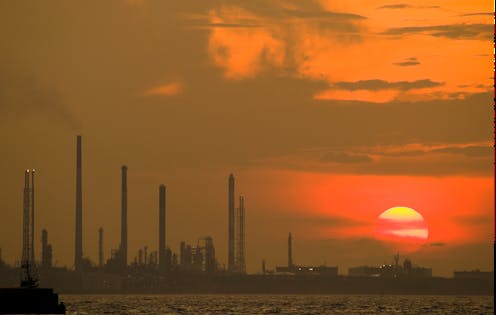
02 Jun 17:27

Florida 'freakishness': why the sunshine state might have lost its appeal

by Dafydd Townley, Teaching Fellow in International Security, University of Portsmouth
Florida's Clearwater Beach. Viaval Tours/Shutterstock

Florida is known worldwide for its beaches, resorts and theme parks, but has recently made headlines for a different reason. The state has been rocked by political controversies, bitter debates and fatal shootings at odds with its previously laid back holiday destination image.

In his 1947 book, Inside USA, writer John Gunther described Florida’s “freakishness in everything from architecture to social behaviour unmatched in any American state”. If Gunther had been writing today, he might be just as judgemental.

Florida’s recent political turmoil can be attributed to some highly contentious policies. The state has witnessed heated debates and legislative battles on issues including abortion, gun control, education, LGBTQ+ rights and voting rights.

Florida has been derided as “the worst state” in which to live, one of the worst in which to be unemployed or a student, and not a good place to die.

Even Donald Trump, who moved to his Florida Mar-a-Lago home during his presidency, has called it “among the worst states” to live in or retire to. This was an attack on Florida governor Ron DeSantis, who is also running for the Republican presidential nomination.

What was once considered by many to be a purple state – one that could either be Republican or Democrat – is now fiercely Republican. In recent years, the divide between those of different political beliefs has become toxic.

Importance of international image

International tourism and trade is huge business for Florida. In 2022, more than 1.1 million people visited Florida from the UK, the second largest group of international visitors on an annual basis. The UK is also Florida’s eighth largest trade partner with bilateral trade reaching $5.8 billion (£4.6 billion) in 2022. So state leaders might worry about tarnishing its image abroad.

Business leaders are already fretting about a fall in international visitor numbers linked to COVID and negative media coverage of the state. Around US$50 million was invested in marketing the state to tourists in 2023, this is expected to rise dramatically in 2024. The state’s ability to attract workers to keep its tourism and other industries going is weakening, reports suggest.

Heather DiGiacomo, chief of staff at the Florida Department of Juvenile Justice, told Florida senators that applications for jobs at state-run agencies were down and staff retention was down too. “These turnover rates … impacts the number of well-trained staff available to mentor new staff and puts additional strain on current staff without longer shifts in detention.”

Republican governor Ron DeSantis, now a presidential candidate, has been at the centre of Florida’s significant political divisions. The Republican state legislature’s controversial partisan bills, such as the recent redrawing of the electoral map to benefit the Republican party, was signed into law despite intense opposition.

While his conservative policies on taxes, regulation and immigration have won strong support from conservatives, critics argue that he prioritises partisan politics over the needs of all Floridians. His outspoken handling of the COVID pandemic sparked controversy, with accusations of downplaying the severity of the virus and prioritising economic interests.

Florida’s restrictive abortion laws have also attracted national and international attention. In April 2023, the state passed the foetal heartbeat bill, which prohibits abortions once a foetal heartbeat is detected, typically at around six weeks gestation. This law has faced significant backlash from reproductive rights advocates, who argue that many individuals may not even be aware of their pregnancy at such an early stage.

School shootings and gun laws

The Marjory Stoneman Douglas High School Public Safety Act was passed into Florida state law after the Parkland school shooting in 2018, in which 17 people were killed. It was controversial because it did not place restrictions on gun ownership or introduce background checks before gun purchases, but allowed schools to employ armed “guardians”. Critics argued that it fell short of addressing the root causes of gun violence in Florida.

There were seven mass shootings in Florida in the first two months of 2023. Despite this, the state has just passed a law that will come into effect on July 1 that will allow anyone who can legally own a gun in Florida to carry one without the need for a permit.

Florida’s partisan divide has been exacerbated by the introduction and passage of several laws that discriminate against the LGBTQ+ community. These laws cover areas including adoption, education, and transgender rights.

This year a massive LGBTQ event in a Florida theme park, which typically attracts 150,000 people, is taking out extra security measures, after new “don’t say gay” state laws were introduced in 2022. These rules ban teachers from discussing topics including sexual orientation. More generally, travel advisory warnings have been issued on the risks of travel to the state for LGBTQ+, African American and Latino people. A recent federal ruling overturned municipal bans on conversion therapy.

Although the “don’t say gay” bill was originally only aimed at third grade students and under, the bill has since been extended by Florida’s Board of Education to apply to all school pupils.

DeSantis has also become embroiled in a long legal and political battle with the Walt Disney Company, a major state employer, over the “don’t say gay” legislation. Disney recently announced it was cancelling a US$1 billion office complex project in the state.

Bills that restrict transgender students’ participation in school sports teams consistent with their gender identity have also sparked heated debate.

Meanwhile, changes in voting laws brought in by the state, including stricter identification requirements and limitations on the drop boxes where voters can leave mail-in ballots, have been criticised for making it more difficult for some people to vote.

Florida’s recent political turmoil has thrust the state into the national, and global, spotlight. Its deeply partisan divide, controversial policies and gun laws have created a toxic political climate, which has the ability to significantly damage the sunshine state’s appeal.

The Conversation

Dafydd Townley does not work for, consult, own shares in or receive funding from any company or organisation that would benefit from this article, and has disclosed no relevant affiliations beyond their academic appointment.
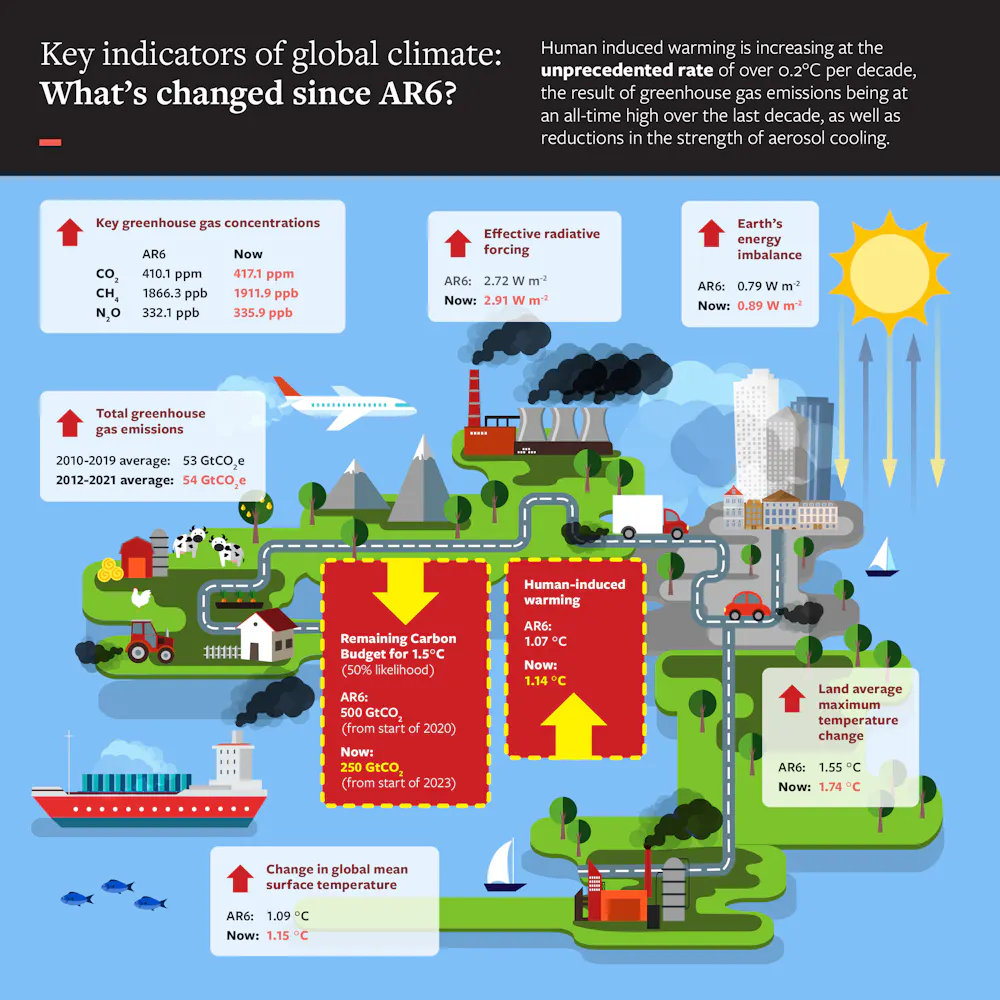
02 Jun 16:44

Florida teacher tells school board, "No one is teaching your kids to be gay! …I have math to teach"

by Jason Weisberger

Presidential hopeful Ron DeSantis' campaign of fear and discrimination in Florida is driving teachers out of the state. In the school district where one teacher recently became the focus of a state Department of Education investigation for showing kids a Disney film that happens to include a gay character, a recent school board meeting erupted:
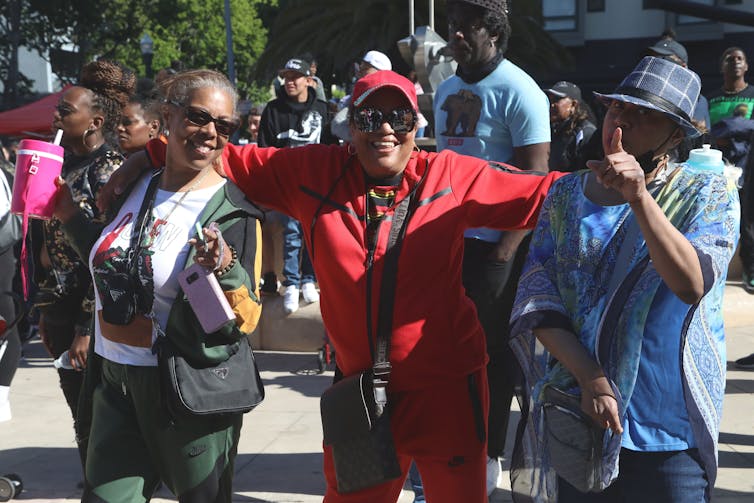
Raw Story:

"No one is teaching your kids to be gay!"

Read the rest
02 Jun 16:38

Charles Schulz, creator of "Peanuts," on Democracy

by Ruben Bolling

My personal cartooning hero, Peanuts author Charles Schulz was sent a letter in 1970 from a ten year old student asking what makes a good citizen.

Schulz responded with a letter that resonates strongly today, 53 years later.

Good grief.

Read the rest