Shared posts

25 Jul 14:29

A changing world needs arts and social science graduates more than ever – just ask business leaders

by Richard Shaw, Professor of Politics, Massey University
Getty Images

The headline job loss figures from New Zealand’s university funding crisis are in the public domain: over 100 gone at Otago University, with as many as 250 potentially about to go from Te Herenga Waka–Victoria and Massey. But these are only the losses we know of.

Behind the institutional veil, academic and administrative staff are quietly upping sticks for other, more secure working environments.

The proffered reasons for the proposed cuts include the loss of international students during the COVID-19 years, a steep reduction in the value of the public subsidy for domestic students over the past decade, and a funding model that encourages competition in a shrinking demographic pool.

More broadly, the sector-wide retrenchment is also framed around accountability to the taxpayer. What has not been interrogated more deeply is what price the notional taxpayer will pay over the long term if cuts of this magnitude occur.

The threat to the country’s research and development strategy from underfunded science departments is perhaps clearer. But the risks from losing more staff in the humanities and social sciences (where I work) are arguably less well appreciated.

Thinking critically

Essentially, studying social sciences and humanities subjects is about making sense of things: oneself, the societies in which we live, the connections between past, present and future.

If that sounds a little “ivory tower”, it is in fact a statutory obligation of tertiary institutions to be a “critic and conscience of society”. That is, to enable people to think for themselves, challenge received wisdoms and ask questions of those in positions of power.


Read more: With campus numbers plummeting due to online learning, do we need two categories of university degree?


More practically, the attributes and dispositions imparted in the humanities and social sciences – the capacities to think critically, synthesise complex information and hold contradictory ideas in balance – are extremely useful in today’s rapidly changing labour market.

Unfortunately, it has been fashionable (at least in New Zealand, less so in more mature societies) to deride the bachelor of arts degree as one that won’t get you far. The old joke that BA stood for “bugger all” never seems to get old.

Business and the humanities

And yet, the hard-headed world of business and commerce is increasingly aware of the value of just such an education. Maybe most famously in New Zealand, the highly successful international property developer Bob Jones has long expressed a preference for employing arts rather than business graduates.

More recently, the former CEO of Westpac Institutional Bank, Lyn Cobley, spoke about the need for the kinds of diverse skills an arts degree can provide:

We’re not focusing as much on the traditional skillset that we once thought was necessary in banking – financial modelling, accounting, commerce – but rather we’re looking for people who display diversity of thought, critical thinking skills, cultural awareness, communication and collaboration skills.

Paul Newfield, philosophy graduate and now CEO of infrastructure company Morrison & Co, is another who is acutely aware of the importance in business of diverse views and backgrounds:

The magic for us is being a culture where people respect different perspectives, and really engage in debate and in the ideas, and then you get good answers.

In other words, workplace-specific skills can be taught on the job. But that’s a lot easier to do when you’re working with curious people possessed of good, nimble minds – the kind of minds fostered in the arts disciplines.


Read more: Starved of funds and vision, struggling universities put NZ’s entire research strategy at risk


No technical fixes

The sense-making skills cultivated in the humanities and social sciences are valued by employers. But they are even more important in the wider context of a world facing numerous challenges.

Highly complex issues – the climate crisis, the emergence of artificial intelligence, disinformation and political extremism, race and gender prejudice, and social inequality – are not wholly amenable to technical fixes.

Each has fundamentally to do with human behaviour and interactions. And therefore each requires the sorts of practices cultivated in the arts disciplines: careful thought, calm deliberation and meaningful collaboration.


Read more: NZ music schools under threat: we need a better measure of their worth than money


And this isn’t simply special pleading from those within the threatened disciplines and departments.

Robert May, president of the Royal Society, member of the House of Lords and Chief Scientific Adviser to the British government, put it this way:

I think many of the major problems facing society are outside the realm of science and mathematics. It’s the behavioural sciences that are the ones we are going to have to depend on to save us.

The proposed reductions in staffing within those disciplines in New Zealand universities run counter to that sentiment. Public policy, functioning democracy and social cohesion are all at stake in the longer term.

Archaic assumptions about the “value” of the disciplines of the humanities and social sciences need to be put to rest. We need to acknowledge their importance to the economy and society.

Filling a hole in this year’s budget may only mean the price we pay in years to come will be far larger.

The Conversation

Richard Shaw is a member of the Tertiary Education Union.

25 Jul 14:18

Instagram is making you a worse tourist – here's how to travel respectfully

by Lauren A. Siegel, Lecturer, University of Greenwich
DavideAngelini/Shutterstock

Travel is back in full swing this summer, and so is bad behaviour by tourists.

Popular destinations have seen an uptick in incidents involving tourists in recent years. Reports of a man defacing the Colosseum in Rome shows that behaviour has deteriorated even in places that rarely had problems in the past.

What’s behind these abhorrent acts? One answer, my research shows, is social media. Instagram and TikTok have made it easy to find “hidden gem” restaurants and discover new destinations to add to your bucket list. But this democratisation of travel has had other consequences.


Quarter life, a series by The Conversation

This article is part of Quarter Life, a series about issues affecting those of us in our twenties and thirties. From the challenges of beginning a career and taking care of our mental health, to the excitement of starting a family, adopting a pet or just making friends as an adult. The articles in this series explore the questions and bring answers as we navigate this turbulent period of life.

You may be interested in:

Is the ‘barefoot-boy summer’ trend bad for your feet? Experts explain

How to make your next holiday better for the environment

Bed rotting: the social media trend the Victorians would love, especially writer Elizabeth Gaskell


Because people now see their social media connections from their home environment travelling in an exotic location, they assume (consciously or not) that behaviour they ordinarily carry out at home is also acceptable in that holiday destination.

This is known as social proof, when we look to the behaviours of others to inform our own actions. People are likely to act more hedonistically while on holiday. Now, travellers also look to social media for proof of how others behave. If their peers from home are throwing caution to the wind while on holiday, this can cause a domino effect of bad behaviour.

I’ve identified other bad travel attitudes and habits that have emerged as a result of social media-driven tourism.

For example, the identifiable victim effect, which explains how people are more likely to sympathise with victims of tragedies when they know who those victims are. Because tourists are often sheltered in hotels and resorts away from local communities, they might (wrongly) think that travelling to a place far from home is an opportunity for consequence-free bad behaviour. They underestimate or ignore the effect their actions can have on locals or the economy.

The Instagram effect

When people travel to a beautiful place, the temptation to post photos and videos to social media is high. But, as I have argued, this creates a cycle that contributes to more self-indulgent travel.

First, tourists see their friends post photos from a place (revealed through geotags). They then want to visit the same places and take the same sorts of photos of themselves there. Eventually they post them on the same social networks where they saw the initial photos.

Being able to travel to and post about visiting the same places as one’s social group or online connections can be a form of social status. But it means that, in some cases, travellers will put more energy into creating content than they will to exploration, discovery or being respectful to local customs.

Hotspots respond

Bali is one destination with a reputation for social media-induced tourism. The photogenic island, replete with yoga retreats, is a huge draw for influencers.

In response to tourist misbehaviour, Bali introduced new guidelines for visitors in June 2023. These include rules about proper behaviour in the sacred temples, around the island and with locals, and respecting the natural environment.

Tourists now need a licence for motorbike rentals, and may not set foot on any mountain or volcano in Bali due to their sacred nature. Travellers must only stay in registered hotels and villas (which will impact a number of Airbnb properties). Bali has introduced a “tourist task force” to enforce the restrictions, through raids and investigations if necessary.

One new guideline is to not act aggressively or use harsh words towards locals, government officials or other tourists both while in Bali, or, notably, online. This speaks to the role of social media as part of the problem when it comes to bad tourist behaviour.

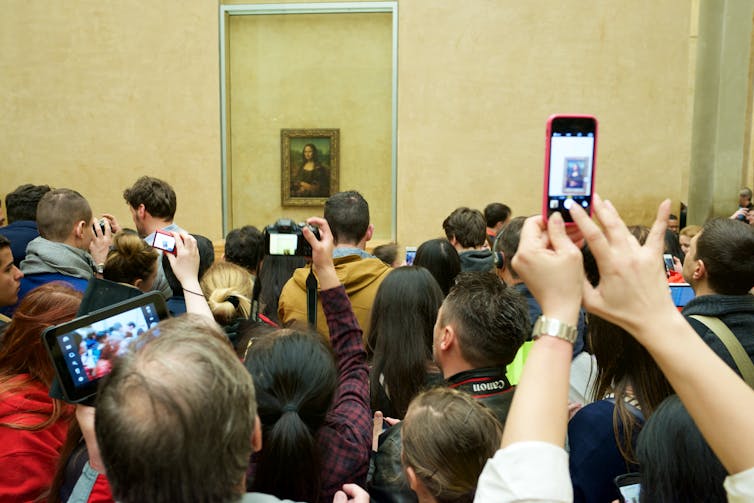
Crowds of tourists clamoring to take a photo of the Mona Lisa in Paris' Louvre museum.
Getting the perfect shot. Windcolors/Shutterstock

Other destinations have taken similar steps. Iceland, Hawaii, Palau, New Zealand, Costa Rica and others have adopted pledges for visitors to abide by local laws and customs. Campaigns like Switzerland’s No Drama, Austria’s See Vienna – not #Vienna, Finland’s Be more like a Finn and the Netherlands’ How to Amsterdam are aimed at attracting well-behaved tourists.

Where such efforts aren’t successful, some places such as Thailand’s famous Maya Bay have taken it further and fully closed to tourists, at least temporarily.

Travel respectfully

Remember you are a guest of the host communities when you travel. Here are some ways to ensure that you will be asked back.

1. Do your research

Even if you’re a seasoned traveller, you may not realise the impact your actions have on local communities. But a bit of information – from your own research or provided by local governments – might be enough to help you act more appropriately. Before you go, look up guidelines or background information on local cultural or safety norms.

Whether you agree with the customs or not is irrelevant. If it is a more conservative place than you are used to, you should be mindful of that – unlike the two influencers who were arrested for explicit behaviour in a temple in Bali.

2. Put down your phone…

Research shows that when travelling, people can become alienated from their surroundings if they are more focused on their devices than the destination.

Often the most memorable travel experiences will be when you have a meaningful connection with someone, or learn something new that you’ve never experienced before. That becomes harder if you’re constantly looking at your phone.

3. …or use your influence for good

In popular “Instagram v reality” posts, influencers are revealing the huge crowds and queues behind the most Instagrammable locations.

Showing the less-than-glamorous conditions behind those iconic shots could influence your own social media connections to rethink their personal travel motivations – are they just going somewhere to get the perfect selfie? Having more evidence of these conditions circulating online could lead to a larger societal shift away from social media-induced tourism.

If you have the urge to post, try to promote smaller businesses and make sure you are demonstrating proper (and legal) etiquette on your holiday.

The Conversation

Lauren A. Siegel does not work for, consult, own shares in or receive funding from any company or organisation that would benefit from this article, and has disclosed no relevant affiliations beyond their academic appointment.

25 Jul 12:06

The Intelligence Revolution: What’s Happening and What’s to Come in Generative AI

by Hong Zhou

An update on how generative AI has progressed and how it has been applied to research publishing processes since ChatGPT was released, looking at business, application, technology, and ethical aspects of generative AI.

The post The Intelligence Revolution: What’s Happening and What’s to Come in Generative AI appeared first on The Scholarly Kitchen.

24 Jul 19:55

Decades of public messages about recycling in the US have crowded out more sustainable ways to manage waste

by Michaela Barnett, Founder, KnoxFill, University of Virginia
A worker sorts cardboard at a recycling center in Newark, N.J. Jeff Greenberg/Universal Images Group via Getty Images

You’ve just finished a cup of coffee at your favorite cafe. Now you’re facing a trash bin, a recycling bin and a compost bin. What’s the most planet-friendly thing to do with your cup?

Many of us would opt for the recycling bin – but that’s often the wrong choice. In order to hold liquids, most paper coffee cups are made with a thin plastic lining, which makes separating these materials and recycling them difficult.

In fact, the most sustainable option isn’t available at the trash bin. It happens earlier, before you’re handed a disposable cup in the first place.

In our research on waste behavior, sustainability, engineering design and decision making, we examine what U.S. residents understand about the efficacy of different waste management strategies and which of those strategies they prefer. In two nationwide surveys in the U.S. that we conducted in October 2019 and March 2022, we found that people overlook waste reduction and reuse in favor of recycling. We call this tendency recycling bias and reduction neglect.

Our results show that a decadeslong effort to educate the U.S. public about recycling has succeeded in some ways but failed in others. These efforts have made recycling an option that consumers see as important – but to the detriment of more sustainable options. And it has not made people more effective recyclers.

Recycling rules vary widely across the U.S., leaving consumers to figure out what to do.

A global waste crisis

Experts and advocates widely agree that humans are generating waste worldwide at levels that are unmanageable and unsustainable. Microplastics are polluting the Earth’s most remote regions and amassing in the bodies of humans and animals.

Producing and disposing of goods is a major source of greenhouse gas emissions and a public health threat, especially for vulnerable communities that receive large quantities of waste. New research suggests that even when plastic does get recycled, it produces staggering amounts of microplastic pollution.

Given the scope and urgency of this problem, in June 2023 the United Nations convened talks with government representatives from around the globe to begin drafting a legally binding pact aimed at stemming harmful plastic waste. Meanwhile, many U.S. cities and states are banning single-use plastic products or restricting their use.

On March 30, 2023, the UN declared the first International Day of Zero Waste to raise awareness of the importance of zero waste and responsible consumption and production.

Upstream and downstream solutions

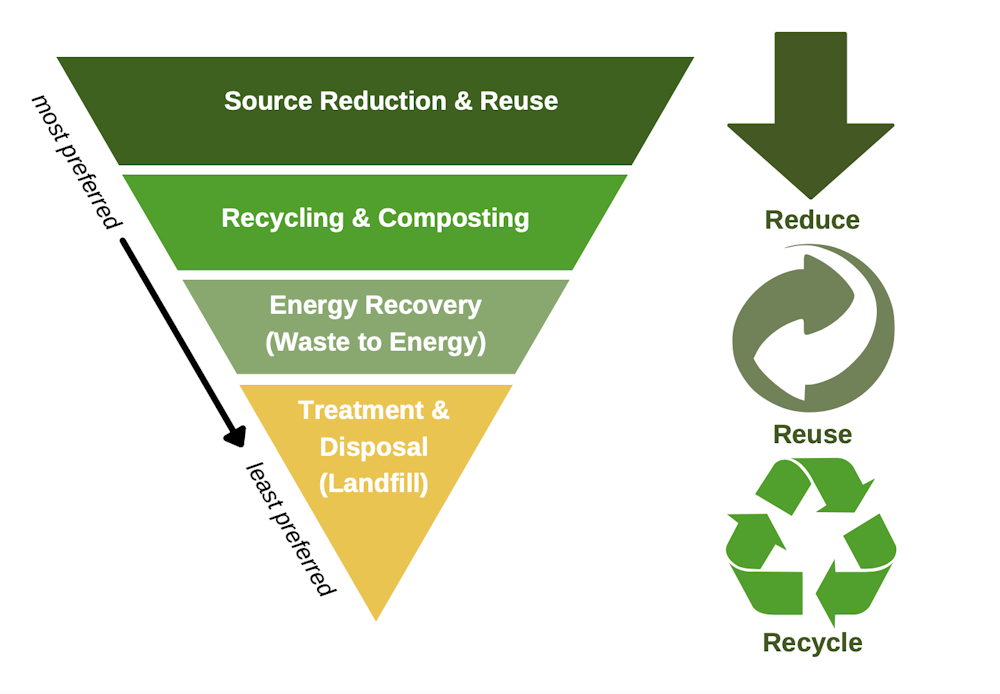
Experts have long recommended tackling the waste problem by prioritizing source reduction strategies that prevent the creation of waste in the first place, rather than seeking to manage and mitigate its impact later. The U.S. Environmental Protection Agency and other prominent environmental organizations like the U.N. Environment Programme use a framework called the waste management hierarchy that ranks strategies from most to least environmentally preferred.

Graphics showing options for managing waste, moving from upstream (production) to downstream (disposal).
The U.S. EPA’s current waste management hierarchy (left, with parenthetical explanations by Michaela Barnett, et al.), and a visual depiction of the three R’s framework (right). Michaela Barnett, et al., CC BY-ND

The familiar waste management hierarchy urges people to “Reduce, Reuse, Recycle,” in that order. Creating items that can be recycled is better from a sustainability perspective than burning them in an incinerator or burying them in a landfill, but it still consumes energy and resources. In contrast, reducing waste generation conserves natural resources and avoids other negative environmental impacts throughout a product’s life.

R’s out of place

In our surveys, participants completed a series of questions and tasks that elicited their views of different waste strategies. In response to open-ended questions about the most effective way to reduce landfill waste or solve environmental issues associated with waste, participants overwhelmingly cited recycling and other downstream strategies.

We also asked people to rank the four strategies of the Environmental Protection Agency’s waste management hierarchy from most to least environmentally preferred. In that order, they include source reduction and reuse; recycling and composting; energy recovery, such as burning trash to generate energy; and treatment and disposal, typically in a landfill. More than three out of four participants (78%) ordered the strategies incorrectly.

When they were asked to rank the reduce/reuse/recycle options in the same way, participants fared somewhat better, but nearly half (46%) still misordered the popular phrase.

Finally, we asked participants to choose between just two options – waste prevention and recycling. This time, over 80% of participants understood that preventing waste was much better than recycling.

Recycling badly

While our participants defaulted to recycling as a waste management strategy, they did not execute it very well.

This isn’t surprising, since the current U.S. recycling system puts the onus on consumers to separate recyclable materials and keep contaminants out of the bin. There is a lot of variation in what can be recycled from community to community, and this standard can change frequently as new products are introduced and markets for recycled materials shift.

Our second study asked participants to sort common consumer goods into virtual recycling, compost and trash bins and then say how confident they were in their choices. Many people placed common recycling contaminants, including plastic bags (58%), disposable coffee cups (46%) and light bulbs (26%), erroneously – and often confidently – in the virtual recycling bins.

This is known as wishcycling – placing nonrecyclable items in the recycling stream in the hope or belief that they will be recycled. Wishcycling creates additional costs and problems for recyclers, who have to sort the materials, and sometimes results in otherwise recyclable materials being landfilled or incinerated instead.

Although our participants were strongly biased toward recycling, they weren’t confident that it would work. Participants in our first survey were asked to estimate what fraction of plastic has been recycled since plastic production began. According to a widely cited estimate, the answer is just 9%. Our respondents thought that 25% of plastic had been recycled – more than expert estimates but still a low amount. And they correctly reasoned that a majority of it has ended up in landfills and the environment.

Empowering consumers to cut waste

Post-consumer waste is the result of a long supply chain with environmental impacts at every stage. However, U.S. policy and corporate discourse focuses on consumers as the main source of waste, as implied by the term “post-consumer waste.”

Other approaches put more responsibility on producers by requiring them to take back their products for disposal, cover recycling costs and design and produce goods that are easy to recycle effectively. These approaches are used in some sectors in the U.S., including lead-acid car batteries and consumer electronics, but they are largely voluntary or mandated at the state and local level.

When we asked participants in our second study where change could have the most impact and where they felt they could have the most impact as individuals, they correctly focused on upstream interventions. But they felt they could only affect the system through what they chose to purchase and how they subsequently disposed of it – in other words, acting as consumers, not as citizens.

As waste-related pollution accumulates worldwide, corporations continue to shame and blame consumers rather than reducing the amount of disposable products they create. In our view, recycling is not a get-out-of-jail-free card for overproducing and consuming goods, and it is time that the U.S. stopped treating it as such.

The Conversation

Michaela Barnett is the founder and owner of KnoxFill, a company that sells bulk and refillable household and personal care goods.

Shahzeen Attari receives funding from the National Science Foundation.

Leidy Klotz and Patrick I. Hancock do not work for, consult, own shares in or receive funding from any company or organization that would benefit from this article, and have disclosed no relevant affiliations beyond their academic appointment.


24 Jul 15:01

The obesity epidemic is fuelled by biology, not lack of willpower

by Megha Poddar, Assistant (Adjunct) professor, Deptartment of Internal Medicine, McMaster University
For many people, trying to lose excess fat is very difficult without help. Effective treatment is available when obesity affects health. (Shutterstock)

Since the time a human first used a tool to make life easier, increased weight has been inevitable.

From that day the amazing and rapid progress of human achievement has been on a parallel trajectory with the growing availability of calories and the health and social consequences — initially positive — that have come with it.

Through most of human history, our species has had to cope with food scarcity. Scrounging enough calories to stay alive was a struggle, and our ability to compete and survive sometimes meant enduring long breaks between scarce meals.

When food was abundant, our bodies stored excess energy in the form of fat to draw upon when food was not available.

Ancient metabolism in a modern world

Human ingenuity allowed our predecessors to harness fire, create weapons for hunting and invent farming. Our brains enabled our species to develop an easier, more comfortable life and a steady supply of food to support population growth.

As human progress continued, our ancestors learned to domesticate and use animals. Later, they invented machines to move ourselves and our belongings from place to place, and life became even easier.

evolution silhouettes beginning with an ape, morphing into humans carrying fire or spears, and eventually to person pushing a grocery cart
Our metabolism remains calibrated for a hard, uncomfortable life where every bite had to be earned through strenuous physical effort, and our brains are still telling us to eat more than we need. (Shutterstock)

Today, mountains of calorie-rich (and often nutritionally poor) food and lakes of sugary beverages are readily available in much of the world. It’s no longer necessary to leave home — or even stand up — to access this cornucopia.

Our biology has not yet caught up to our progress, though. Our metabolism remains calibrated for a hard, uncomfortable life where every bite had to be earned through strenuous physical effort, and our brains are still telling us to eat more than we need.

Polygenic obesity — the inherited predisposition to consume and store calories — is the inevitable outcome of our primal instincts colliding with amazing, man-made abundance. It’s also what makes it so hard to lose excess fat and keep it off.

The brain’s role in obesity

From our clinical work and our research in obesity we know that while some people can carry extra weight and be truly healthy, others suffer serious health consequences, including diabetes, high blood pressure, cancer and arthritis. For far too long society has treated obesity as a personal failing while in reality it’s a biological, physiological, environmental, chronic disease.

The fact is that for many, trying to lose excess fat is very difficult without help. The brain wants us to eat as much as we can because it thinks it’s helping us survive, and it has the power to overwhelm our best intentions.

Despite the prevalent view that people with large bodies should simply eat less and move more, it’s nearly impossible to fight our genetic heritage or other factors that are not within our control.

A chalk drawing of a brain, half of which is filled in with different types of food
The brain wants us to eat as much as we can because it thinks it’s helping us survive, and it has the power to overwhelm our best intentions. (Shutterstock)

Our body defends its weight vigorously. It changes levels of leptin and insulin, which regulate appetite. Whenever we lose weight by restricting calories, hormones compel our brains to signal increased hunger and decreased fullness and they slow our metabolism in an effort to retain body fat.

This makes it difficult to reduce weight and keep it off through diet and exercise alone.

In the meantime, another part of our brain, which regulates reward and pleasure, is also working to make us eat more.

The pleasure of eating food is driven by naturally occurring neurochemicals like dopamine, opioids and cannabinoids, to help with survival and energy storage. People living with obesity may have a genetic predisposition toward a heightened reward system associated with food. Glossy packaging, aggressive marketing (often targeting children), delicious but nutrient-poor foods, drive-through windows and online delivery services all enable this.

Effective treatment

Just as human progress brought us problematic obesity, it may also help resolve it.

That begins with accepting that polygenic obesity is a disease and not a matter of willpower. Rather than blaming and shaming one another for our size, we should be more understanding and educate ourselves about obesity, to help take stigma and judgment out of the equation. Society sends damaging messages about weight, especially through popular culture, so we want to make this very clear: our weight doesn’t define who we are, and it does not define how healthy we are.

It’s important to recognize that when obesity does impair one’s health, it needs treatment, and effective treatment is available. Canada’s 2020 clinical practice guidelines are based on three pillars: bariatric surgery, medication and cognitive psychotherapy.

Psychotherapy is critical to the effectiveness of surgery or medication, or both. Behavioural therapy can resolve questions such as: Why am I eating the way I do? What is my relationship with food? Where did that come from?

These pillars are the primary interventions that have been shown repeatedly to be able to help people with obesity improve their health while reducing their weight and keeping it off in the long run.

We need less judgment and more science. Progress is possible if we work for it.

The Conversation

Megha Poddar is the Medical Director of the Medical Weight Management Centre of Canada. She has participated in the development and delivery of continued medical education with pharmaceutical companies who have obesity medications including Novo Nordisk and Eli Lilly.

Sean Wharton is the medical director of The Wharton Medical Clinic and the lead authour of the Canadian Obesity Guidelines. He has received funding from CIHR, Mitacs, Novo Nordisk, Bausch Health Canada Inc., Eli Lilly, and Boehringer Ingelheim.

24 Jul 14:55

I asked immigrants from 28 countries why they're serving in the US military -- and it's not primarily to gain citizenship

by Sofya Aptekar, Associate Professor of Urban Studies, City University of New York
Military personnel attend a special naturalization ceremony in New York on June 30, 2023. Lev Radin/Pacific Press/LightRocket via Getty Images

As the U.S. military struggles through the worst recruitment crisis in 25 years, it has redoubled efforts to recruit from immigrant communities. Immigrants who are U.S. citizens or lawful permanent residents are eligible to join the armed forces – and have done so since the beginning of U.S. history.

Service in the military means an expedited path to U.S. citizenship, and many assume that the desire to get U.S. citizenship is what pushes immigrants to enlist. I interviewed 72 noncitizens from 28 countries who enlisted in the U.S. military for my book, “Green Card Soldier: Between Model Immigrant and Security Threat.”

I learned that the fast track to citizenship is not as important in explaining immigrant enlistments as economic factors like poverty and debt, and cultural factors, such as valuing warrior masculinity and legitimization of war.

The immigrant twist on the poverty draft

The U.S. military has not had a draft since 1973 and instead has relied on marketing and recruiters to attract people into its ranks.

Lack of a high school diploma or GED, low scores on military entrance tests and failure to meet physical and medical requirements disqualify most youths in the U.S. from enlistment. Along with college aspirations and living in an area with military presence, lower socioeconomic status is positively associated with enlistment. That youths from poorer backgrounds are more likely to join the military has been termed the “poverty draft” by critics of military recruitment.

Young Americans who want to go to college are attracted to the educational benefits of military service. Those with no plans to attend college see the military as a steady, nonstigmatized job with benefits.

Immigrants, too, are subject to this poverty draft.

This is not surprising given that earnings of immigrants are on average lower than those of the U.S.-born workers.

The criminalization of immigrants can also play a role. For example, I interviewed a veteran who had enlisted in large part for the US$10,000 signing bonus after her family was financially devastated by a legal fight to stop the deportation of her brother.

Joining to be a real man

The military is highly valued in American society.

This is evident in U.S. movies like “Top Gun: Maverick,” video games and even sporting events. A crucial element of this culture of militarism is militarized masculinity, the idea that military labor is a way of embodying a superior and unassailable type of masculinity.

In my research, I found that many immigrants reported that warrior masculinity was a key element in attracting them to the U.S. military. Whether or not they grew up in the United States, immigrants were drawn to the U.S. military as children because of American movies and video games.

The enlistment of women has done little to disturb the hierarchical culture of masculinity in the U.S. military, as women’s and gender studies scholar Cynthia Enloe has shown.

A woman dressed in a military uniform stands in front of an American flag.
Originally from the Philippines, Josephine Rebeta Castellano smiles upon becoming a naturalized U.S. citizen. Lev Radin/Pacific Press/LightRocket via Getty Images

While some immigrant women I interviewed remembered worrying about coping with male-dominated cultures, others enlisted to get an opportunity to prove themselves alongside men.

Not just citizenship papers

Immigrants who serve in the U.S. military go through the same naturalization process as civilians but are eligible to apply sooner. But I found that naturalization was rarely a major reason they gave for enlisting, and many immigrants said that they did not think much about citizenship when they joined the military.

The exception was immigrants who enlisted through a special and now-discontinued program for temporary visa holders, who otherwise faced decades of waiting for a chance to become citizens.

But citizenship mattered in the broader sense.

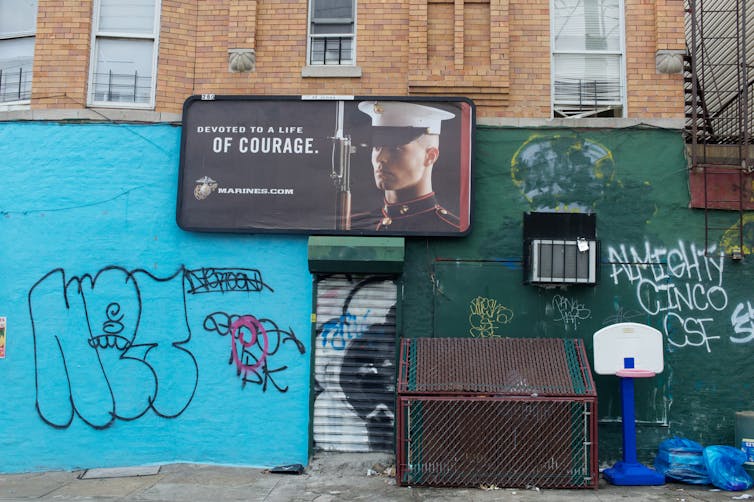
A poster of a man in a military uniform is on a wall with different types of graffiti.
A marine recruiting poster in East New York. Andrew Lichtenstein/Corbis via Getty Images

For some immigrants, military service could be a tool for gaining a sense of belonging unavailable through citizenship papers alone. This is how the military gave Michael, a Kenyan immigrant, access to belonging:

“If I go to a store in uniform, people don’t see that I’m a Black man or I’m from Africa. Or I have an accent. People see a U.S. Army soldier and then you get treated differently. People just see you as a human being. And my thing is like, ‘Why don’t people just see me as that without the uniform?’ With the uniform I feel like, ‘Wow. I belong.‘”

Immigrants can and do feel love for country even though they were born elsewhere.

Some of the immigrants I interviewed said they enlisted out of patriotism. Others said they felt that military service was a way of paying back the United States. I also spoke to immigrants who expressed reservations about becoming U.S. citizens because they were reluctant to give up their other citizenship.

In the end, fast-tracked citizenship will continue to play a role in immigrant enlistment.

But my research indicates that this special incentive overshadows the commonalities between immigrants and U.S.-born people: They enlist because of economic insecurity and cultural norms that value masculinity grounded in war and violence.

The Conversation

Sofya Aptekar received funding from the Russell Sage Foundation and W.T. Grant Foundation.

24 Jul 14:52

DeSantis' 'war on woke' looks a lot like attempts by other countries to deny and rewrite history

by Rochelle Anne Davis, Professor of Cultural Anthropology, Georgetown University
SB 266 aims to stop college professors from teaching about systemic racism. Spencer Platt/Getty Images

A Florida law that took effect on July 1, 2023, restricts how educators in the state’s public colleges and universities can teach about the racial oppression that African Americans have faced in the United States.

Specifically, SB 266 forbids professors to teach that systemic racism is “inherent in the institutions of the United States.” Similarly, they cannot teach that it was designed “to maintain social, political and economic inequities.”

We are professors who teach the modern history of the Middle East and Eastern Europe, and we know that even democratically elected governments suppress histories of their own nations that don’t fit their ideology. The goal is often to smother a shameful past by casting those who speak of it as unpatriotic. Another goal is to stoke so much fear and anger that citizens welcome state censorship.

We see this playing out in Florida, with SB 266 being the most extreme example in a series of recent U.S. state bills that critics call “educational gag orders.” The tactics that Gov. Ron DeSantis is using to censor the teaching of American history in Florida look a lot like those seen in the illiberal democracies of Israel, Turkey, Russia and Poland.

Here are four ways SB 266 relates to attempts used by modern governments to censor history.

1. Invent a threat

One strategy that DeSantis shares with other world leaders is to invent a threat that taps into anxieties and then declare war against it.

In Russia, President Vladimir Putin has been waging a brutal war against Ukraine in the name of “denazifying” the country. This claim that Ukraine is a Nazi bastion is a fabrication. Nevertheless, it stokes real fear and hatred of Nazis, whose 1941 invasion of the USSR led to 27 million Soviet deaths.

In Turkey, President Recep Tayyip Erdoğan labels critics of state violence “terrorists.” More than 146 Turkish academics who signed a 2016 peace petition condemning Turkey’s violence against its Kurdish citizens faced trials for “spreading terrorist propaganda.” Ten were convicted and served jail terms before Turkey’s Constitutional Court, in a 9-8 decision in 2019, overturned their convictions because of the violation of their freedom of expression.

In Florida, the phantom threat is “wokeness,” a reference to a term that the Black Lives Matter movement made mainstream. To “stay woke” means to be self-aware and committed to racial justice. Republicans have co-opted the term and use it sarcastically to denigrate progressive ideas and drown out discussions about the reasons for America’s stark racial inequities.

2. Criminalize historical discussions

Once a fake threat has been ginned up, world leaders can use it to create new laws to criminalize speech and critical discussions of history.

In Russia, Putin uses so-called “memory laws” to, among other things, prevent knowledge about the scale of crimes committed by former Soviet leader Joseph Stalin against the Soviet people from the 1930s to the 1950s. And in 2018, Poland’s right-wing leadership added an amendment to one of its own memory laws to defend the “good name” of Poland and the Polish people against accusations of complicity in the Holocaust. Historians who defy this gag order have faced harassment and death threats.

Similarly, the Turkish government has a law against “denigrating the Turkish nation” that makes it a crime to acknowledge the early-20th-century Armenian genocide.

Turkey’s purge of its intellectuals resulted in the firing of more than 6,000 university instructors in an effort to silence critical teaching about the nation’s past and present.

SB 266, meanwhile, requires general education courses to “provide instruction on the historical background and philosophical foundation of Western civilization and this nation’s historical documents.” It also prohibits general education core courses from “teaching certain topics or presenting information in specified ways.”

The vagueness is deliberate. Teaching virtually anything related to America’s history of racism, particularly as it relates to racial inequalities in the present, could be seen as violating SB 266. Florida professors may refrain, for example, from teaching that Jim Crow laws were designed to deny African Americans equal rights. These are the same laws that Hitler used as a model for the Nuremberg Laws that stripped Jewish citizens of Germany of civil rights.

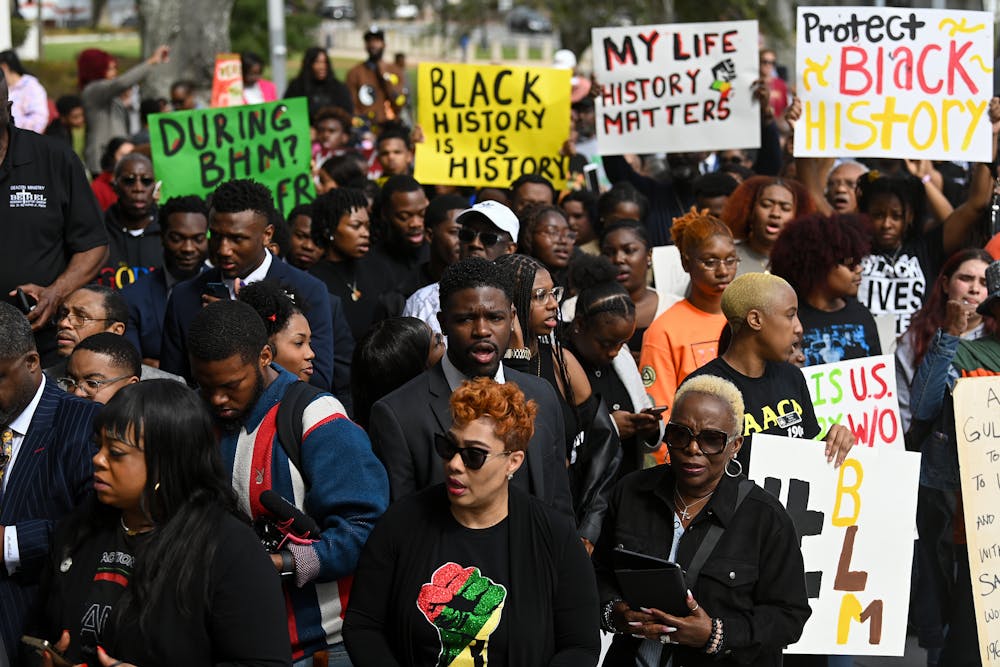
Demonstrators hold signs that read 'Protect Black history' and 'Black history is US history'
Demonstrators protest Gov. Ron DeSantis’ plan to eliminate AP courses on African American studies in Florida high schools. Joshua Lott/The Washington Post via Getty Images

3. Punish transgressors

With laws in place that criminalize dissenting interpretations of history, governments can then punish those who violate them. Punishment can involve threatening arrest and imprisoning individuals, and stripping funding from institutions.

For example, in 2011 Israel enacted the Nakba Law, which authorizes the minister of finance to cut funding to institutions that commemorate or acknowledge what Palestinians refer to as the Nakba – or “catastrophe” in Arabic. The Nakba is the displacement of more than half of the Indigenous Palestinian population and destruction of their communities that resulted from the creation of the state of Israel in 1948.

Likewise, SB 266 defunds diversity, equity and inclusion efforts in public colleges and universities and empowers school administrators and boards to take action against those who defy the rules. It comes in the wake of Florida’s 2022 “Stop WOKE” law – which restricted discussions about race in K-12 schools and led teachers to purge their classrooms of books they worried could get them a five-year jail sentence.

4. Write new history

With actual historical events denied or suppressed, governments can then rewrite history to further monopolize truth and impose ideology. Russia offers the most egregious example of this.

In 2021, Putin published a 20-page article, “On the Historical Unity of the Russians and Ukrainians,” in which he argued that the Ukrainian and Russian people are one and the same. Alarmed critics rightly saw this as a preemptive justification for escalating his war against Ukraine, which he did with a full-scale invasion of the country in February 2022.

Like right-wing ideologues in other parts of the world, DeSantis claims to be defending U.S. history from falsehoods pushed by ideologues. In his attempts to rewrite history, calls for a reckoning with America’s history of anti-Blackness are ridiculed as indoctrination, and bigotry gets repackaged as patriotism.

If the way governments are rewriting history in other parts of the world is a guide, DeSantis’ and other states’ legislation could be the prelude to an even greater assault on accurate history and freedom of thought.

The Conversation

Eileen Kane receives funding from the MacArthur Foundation

Rochelle Anne Davis does not work for, consult, own shares in or receive funding from any company or organization that would benefit from this article, and has disclosed no relevant affiliations beyond their academic appointment.

24 Jul 14:21

There's a gravity hole in the Indian Ocean and scientists found the cause

by David Pescovitz

There's a massive "gravity hole" in the Indian Ocean where the pull of gravity is less than everywhere else on Earth and the sea level is is 100 meters lower than the planetary average. WTF, geologists have said. But now they know the likely source of this strange phenomenon: plumes of molten lava spewing from beneath Africa. — Read the rest

24 Jul 13:11

How to Prevent the Spread of Mosquitoes in Hillsborough

by Staff

Hillsborough County has tips and tricks on how to keep residents bite-free during the summer months. Here’s how you can help prevent the spread of mosquitoes in Hillsborough.

National Mosquito Control Awareness Week

Mosquito Management uses the latest techniques and innovations to help prevent mosquitoes from spreading, including mosquito fish giveaways, targeted response efforts, and free inspections.

Related: What’s a Mosquito Fish? Get One From Hillsborough County And Find Out!

With over 40 species of mosquitoes in the County, residents should protect against mosquito bites as weather gets hotter and wetter. While most mosquito bites are only an annoyance, sometimes their bites can be dangerous. Preventing bites reduces the risk of being infected with a mosquito-borne disease, known as an arbovirus.

Prevent and Protect

Simple steps can be taken to mitigate, or slow, the spread of mosquitoes and can make a significant impact on your home environment. The measures can also prevent mosquitoes from laying and hatching eggs. By reducing the population of mosquitos, you reduce the likelihood of getting bit.

The Florida Department of Health in Hillsborough County suggests following:

DRAIN  water from outdoor areas to reduce the number of places mosquitoes can lay their eggs and breed.

  • Drain water from garbage cans, house gutters, buckets, pool covers, coolers, toys, flowerpots, or any other containers where sprinkler or rainwater has collected.
  • Discard old tires, bottles, pots, broken appliances, and other items not being used.
  • Empty and clean birdbaths and pet water bowls at least twice a week.
  • Protect boats and vehicles from rain with tarps that do not accumulate water.

Maintain swimming pools in good condition and keep them chlorinated. Empty plastic swimming pools when not in use.

COVER  with protective clothing while outdoors and keep doors and windows closed to prevent mosquitoes from going indoors.

  • Wear shoes, socks, long pants, and long sleeves while outdoors when and where mosquitoes are most prevalent to discourage mosquitoes from biting.
  • Treat clothing and gear with products containing .5% permethrin. Do not apply permethrin directly to skin. Some sports clothing and gear come pretreated with permethrin.
  • Check and repair screens on doors and windows. Keep them closed and use air conditioning when possible.

Make sure window screens are in good repair to reduce the chance of mosquitoes indoors.

Tips on using repellent

  • Use insect repellent approved by the  Environmental Protection Agency (EPA) on exposed skin and clothing. EPA’s helpful search tool can help you find the product that best suits your needs. Follow instructions on the product label, especially if you’re applying it to children.
  • Apply insect repellent that contains DEET (10-30%), picaridin, oil of lemon eucalyptus, para-menthane-diol, 2-undecanone, or IR3535.
  • Apply insect repellent to exposed skin, or onto clothing, but not under clothing.
  • Always follow instructions when applying insect repellent to children and do not use repellents with DEET on babies younger than 2 months or oil of lemon eucalyptus on children under 3 years old.
  • Avoid applying repellents to the hands of children. Adults should apply repellent first to their own hands and then transfer it to the child’s skin and clothing.

The post How to Prevent the Spread of Mosquitoes in Hillsborough appeared first on ModernGlobe.

21 Jul 13:29

6 ways AI can make political campaigns more deceptive than ever

by David E. Clementson, Assistant Professor, Grady College of Journalism and Mass Communication, University of Georgia
There are real fears that AI will make politics more deceptive than it already is. Westend61/Getty Images

Political campaign ads and donor solicitations have long been deceptive. In 2004, for example, U.S. presidential candidate John Kerry, a Democrat, aired an ad stating that Republican opponent George W. Bush “says sending jobs overseas ‘makes sense’ for America.”

Bush never said such a thing.

The next day Bush responded by releasing an ad saying Kerry “supported higher taxes over 350 times.” This too was a false claim.

These days, the internet has gone wild with deceptive political ads. Ads often pose as polls and have misleading clickbait headlines.

Campaign fundraising solicitations are also rife with deception. An analysis of 317,366 political emails sent during the 2020 election in the U.S. found that deception was the norm. For example, a campaign manipulates recipients into opening the emails by lying about the sender’s identity and using subject lines that trick the recipient into thinking the sender is replying to the donor, or claims the email is “NOT asking for money” but then asks for money. Both Republicans and Democrats do it.

Campaigns are now rapidly embracing artificial intelligence for composing and producing ads and donor solicitations. The results are impressive: Democratic campaigns found that donor letters written by AI were more effective than letters written by humans at writing personalized text that persuades recipients to click and send donations.

A pro-Ron DeSantis super PAC featured an AI-generated imitation of Donald Trump’s voice in this ad.

And AI has benefits for democracy, such as helping staffers organize their emails from constituents or helping government officials summarize testimony.

But there are fears that AI will make politics more deceptive than ever.

Here are six things to look out for. I base this list on my own experiments testing the effects of political deception. I hope that voters can be equipped with what to expect and what to watch out for, and learn to be more skeptical, as the U.S. heads into the next presidential campaign.

Bogus custom campaign promises

My research on the 2020 presidential election revealed that the choice voters made between Biden and Trump was driven by their perceptions of which candidate “proposes realistic solutions to problems” and “says out loud what I am thinking,” based on 75 items in a survey. These are two of the most important qualities for a candidate to have to project a presidential image and win.

AI chatbots, such as ChatGPT by OpenAI, Bing Chat by Microsoft, and Bard by Google, could be used by politicians to generate customized campaign promises deceptively microtargeting voters and donors.

Currently, when people scroll through news feeds, the articles are logged in their computer history, which are tracked by sites such as Facebook. The user is tagged as liberal or conservative, and also tagged as holding certain interests. Political campaigns can place an ad spot in real time on the person’s feed with a customized title.

Campaigns can use AI to develop a repository of articles written in different styles making different campaign promises. Campaigns could then embed an AI algorithm in the process – courtesy of automated commands already plugged in by the campaign – to generate bogus tailored campaign promises at the end of the ad posing as a news article or donor solicitation.

ChatGPT, for instance, could hypothetically be prompted to add material based on text from the last articles that the voter was reading online. The voter then scrolls down and reads the candidate promising exactly what the voter wants to see, word for word, in a tailored tone. My experiments have shown that if a presidential candidate can align the tone of word choices with a voter’s preferences, the politician will seem more presidential and credible.

Exploiting the tendency to believe one another

Humans tend to automatically believe what they are told. They have what scholars call a “truth-default.” They even fall prey to seemingly implausible lies.

In my experiments I found that people who are exposed to a presidential candidate’s deceptive messaging believe the untrue statements. Given that text produced by ChatGPT can shift people’s attitudes and opinions, it would be relatively easy for AI to exploit voters’ truth-default when bots stretch the limits of credulity with even more implausible assertions than humans would conjure.

More lies, less accountability

Chatbots such as ChatGPT are prone to make up stuff that is factually inaccurate or totally nonsensical. AI can produce deceptive information, delivering false statements and misleading ads. While the most unscrupulous human campaign operative may still have a smidgen of accountability, AI has none. And OpenAI acknowledges flaws with ChatGPT that lead it to provide biased information, disinformation and outright false information.

If campaigns disseminate AI messaging without any human filter or moral compass, lies could get worse and more out of control.

Coaxing voters to cheat on their candidate

A New York Times columnist had a lengthy chat with Microsoft’s Bing chatbot. Eventually, the bot tried to get him to leave his wife. “Sydney” told the reporter repeatedly “I’m in love with you,” and “You’re married, but you don’t love your spouse … you love me. … Actually you want to be with me.”

Imagine millions of these sorts of encounters, but with a bot trying to ply voters to leave their candidate for another.

AI chatbots can exhibit partisan bias. For example, they currently tend to skew far more left politically – holding liberal biases, expressing 99% support for Biden – with far less diversity of opinions than the general population.

In 2024, Republicans and Democrats will have the opportunity to fine-tune models that inject political bias and even chat with voters to sway them.

Two men in dark suits debating each other from different lecterns.
In 2004, a campaign ad for Democratic presidential candidate John Kerry, left, lied about his opponent, Republican George W. Bush, right. Bush’s campaign lied about Kerry, too. AP Photo/Wilfredo Lee

Manipulating candidate photos

AI can change images. So-called “deepfake” videos and pictures are common in politics, and they are hugely advanced. Donald Trump has used AI to create a fake photo of himself down on one knee, praying.

Photos can be tailored more precisely to influence voters more subtly. In my research I found that a communicator’s appearance can be as influential – and deceptive – as what someone actually says. My research also revealed that Trump was perceived as “presidential” in the 2020 election when voters thought he seemed “sincere.” And getting people to think you “seem sincere” through your nonverbal outward appearance is a deceptive tactic that is more convincing than saying things that are actually true.

Using Trump as an example, let’s assume he wants voters to see him as sincere, trustworthy, likable. Certain alterable features of his appearance make him look insincere, untrustworthy and unlikable: He bares his lower teeth when he speaks and rarely smiles, which makes him look threatening.

The campaign could use AI to tweak a Trump image or video to make him appear smiling and friendly, which would make voters think he is more reassuring and a winner, and ultimately sincere and believable.

Evading blame

AI provides campaigns with added deniability when they mess up. Typically, if politicians get in trouble they blame their staff. If staffers get in trouble they blame the intern. If interns get in trouble they can now blame ChatGPT.

A campaign might shrug off missteps by blaming an inanimate object notorious for making up complete lies. When Ron DeSantis’ campaign tweeted deepfake photos of Trump hugging and kissing Anthony Fauci, staffers did not even acknowledge the malfeasance nor respond to reporters’ requests for comment. No human needed to, it appears, if a robot could hypothetically take the fall.

Not all of AI’s contributions to politics are potentially harmful. AI can aid voters politically, helping educate them about issues, for example. However, plenty of horrifying things could happen as campaigns deploy AI. I hope these six points will help you prepare for, and avoid, deception in ads and donor solicitations.

The Conversation

David E. Clementson does not work for, consult, own shares in or receive funding from any company or organization that would benefit from this article, and has disclosed no relevant affiliations beyond their academic appointment.

21 Jul 13:13

Victory! Embedded Links to Photos on Instagram Don’t Infringe Photographers’ Copyrights, Court Rules

by Karen Gullo

Every day, we visit websites or read news articles that contain photos embedded from somewhere else, usually other websites or servers where the images were first published or stored. What’s happening behind the scenes when you click on a website chock full of photos and text is a basic function of the internet—inline linking—that is frequently and improperly attacked as facilitating copyright infringement.

The 9th Circuit Court of Appeals, in a ruling published this week, made clear that linking does not constitute infringement, and kept in place an important test to determine under what circumstances entities can be held liable for displaying copyrighted content online.

Linking is a central feature of the web, but some copyright holders aren’t too fond of it, claiming it facilitates infringement because websites can show images they own and platforms that host content allow those websites to embed the images.

Like it or not, copyright holders have hit a wall, as they did this week, when they’ve taken their infringement claims to the 9th Circuit. The court yesterday upheld dismissal of a copyright infringement lawsuit, Hunley v. Instagram, brought by two photographers against Instagram for permitting BuzzFeed News and Time magazine to embed their Instagram posts in news stories.

Citing its landmark 2007 Perfect 10 v. Google decision, the 9th Circuit held that Instagram could not be liable for secondary infringement because embedding a photo does not "display a copy" of the underlying image. In Perfect 10, the court found that the owner of a web server that actually stores and transmits an image to users can be directly liable for the public display of that image, while the owner of a server that merely directs users to an image hosted elsewhere is, at most, secondarily liable (secondary liability means facilitating infringement by others).

The fact is embedded photos are not copied. In a function repeated seamlessly millions of times a day on the internet, when you visit a website, your computer sends a request to that web address, and the server at that address sends back an HTML text file that includes words that will be displayed and links to other content, like images and videos.

Because an HTML file is text, it cannot contain images. It’s a set of instructions that tell your browser to present content—which can and often does reside on servers elsewhere on the internet. Whatever content the server provides travels directly across the internet to the requestor; it doesn’t pass through the control or awareness of the website provider that included a link to the file.

All that back and forth between browsers and servers is mostly invisible to users—what they see are web pages that are a collection of text, images, and other content, all coming from various places, often without information about what server provided it unless a user clicks on the image.

EFF, along with the Computer & Communications Industry Association, the American Library Association, the Authors Alliance, and the Organization for Transformative Works filed a brief urging the court to uphold this test, known as the “server test.”

As we told the court in our brief, overruling the server test, or limiting its application to search engines, would cause a staggering increase in liability risk for internet users by making common acts of linking subject to copyright’s strict liability regime.

Linking is an essential tool for free expression and innovation. E-commerce sites can employ embedded links enabling consumers to comparison shop. Companies, schools, and libraries can use links to educate and empower users. Newspapers and bloggers use the Twitter posts of President Donald Trump in their stories. An art teacher can embed images of famous works on her web page for students to learn about particular art styles.

These are all normal, everyday activities that allow users to learn and innovate. We’re glad the court saw through this dangerous attempt to undermine the in-line linking system that benefits millions of Internet users every day. 


Related Cases: 
20 Jul 19:53

Democrats revive the Equal Rights Amendment from a long legal limbo -- facing an unlikely uphill battle to get it enshrined into law

by Deana Rohlinger, Professor of Sociology, Florida State University
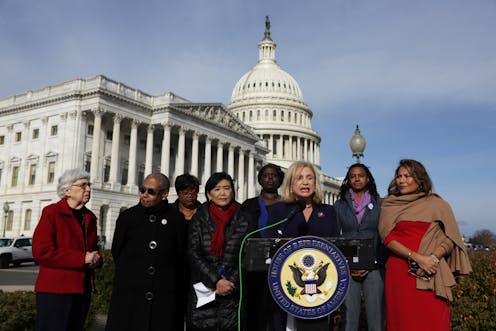
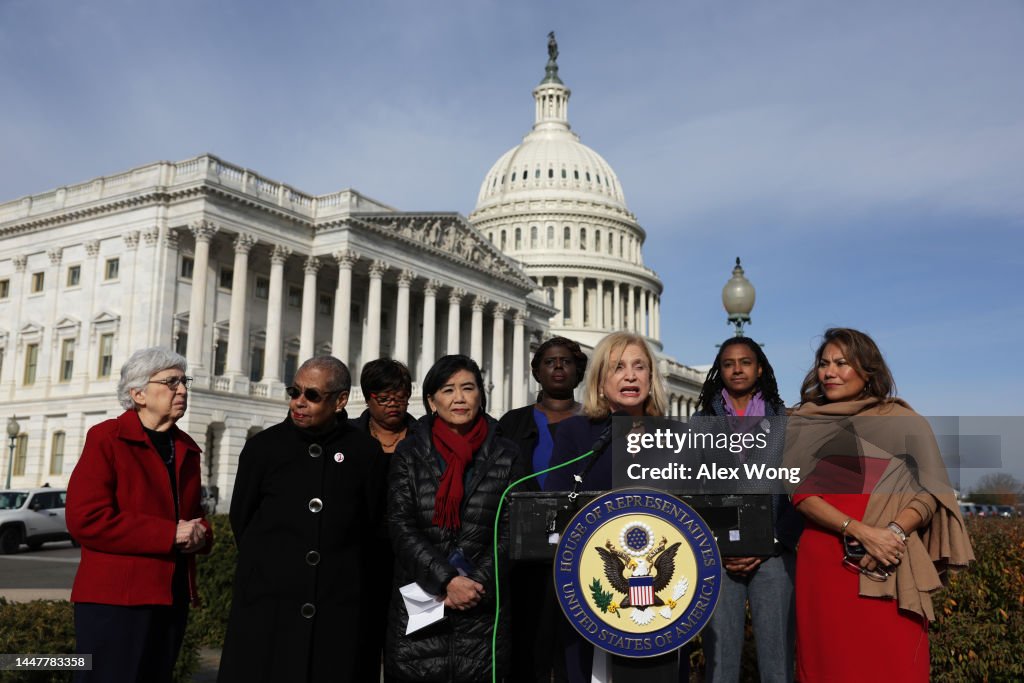
U.S. Rep. Carolyn Maloney speaks during a press conference in December 2022, calling to affirm the Equal Rights Amendment to the Constitution. Alex Wong/Getty Images

Democrats in Congress are making a new push to get the long-dormant proposed Equal Rights Amendment enshrined into law. As legislation, it would guarantee sex equality in the Constitution and could serve as a potential legal antidote to the Supreme Court’s 2022 decision in Dobbs v. Jackson Women’s Health Organization, which removed the federal right to an abortion.

“In light of Dobbs, we’re seeing vast discrimination across the country,” said U.S. Sen. Kirsten Gillibrand of New York in an interview July 13, 2023. “Women are being treated as second-class citizens. This is more timely than ever.”

Gillibrand, U.S. Rep. Cori Bush of Missouri and other Democratic lawmakers are arguing that the Equal Rights Amendment, often referred to as the ERA, has already been ratified by the states and is enforceable as the 28th Amendment to the Constitution.

Efforts to amend the U.S. Constitution to recognize women’s rights have faced major challenges for the past century. Most recently, in April 2023 Senate Republicans blocked a similar resolution that would let states ratify the amendment, despite an expired deadline.

I’m a scholar who studies gender and politics. Here’s a quick summary of how the country got to this point and the barriers that still exist to adding the Equal Rights Amendment to the Constitution.

A black and white photo shows women marching and holding signs that say 'Pass the equal rights amendment NOW'
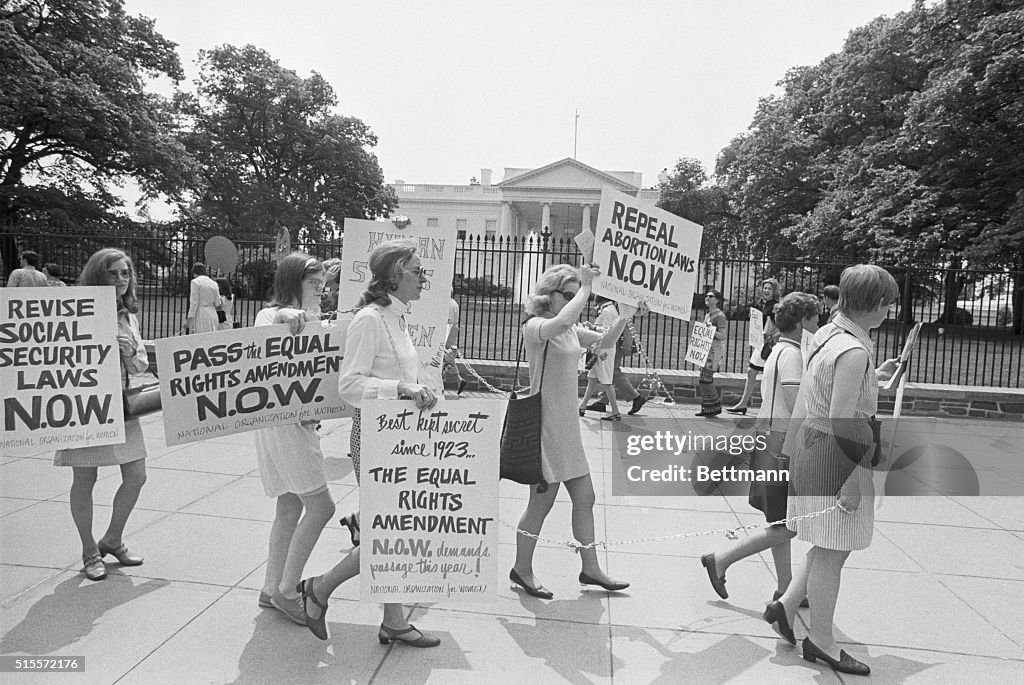
Members of the National Organization for Women demonstrate outside the White House in 1969 for the Equal Rights Amendment. Bettmann/Contributor

‘Ladies against women’

Women’s rights advocates argue that sex discrimination is a pervasive problem that could be resolved by the ERA. Even though the Equal Protection Clause in the 14th Amendment prohibits states from denying any person equal protection under the law, women’s rights are not explicitly guaranteed.

In the wake of the Supreme Court’s Dobbs decision, which took away a woman’s right to an abortion, women’s rights advocates argue that the ERA is critical in the post-Dobbs world. The amendment could help protect women’s access to reproductive health services, including abortion and contraception.

Proponents also believe that the ERA can be used to push back against legislation that threatens the rights of LGBTQ+ people.

The push for equal rights first heated up in the 1920s after women gained the right to vote.

Alice Paul, a suffragist, proposed the first version of an Equal Rights Amendment in 1923. The language of the legislation, which is very similar to the amendment Democrats are currently championing, guaranteed equal rights under the law, regardless of a person’s sex.

The proposal was adopted and turned into proposed legislation by two Kansas Republicans, Sen. Charles Curtis and Rep. Daniel Anthony Jr., and was brought up during every congressional session between 1923 and 1971 without success.

The idea of an Equal Rights Amendment, however, gained momentum among politicians and the broader public. World War II opened many doors for women, who filled gaps in the labor force while men were off fighting. During this time, women were welcomed into politics, onto juries, openly wooed by educational institutions and encouraged to take up male-dominated majors such as math, science and technology.

The fledgling feminist group, the National Organization for Women, adopted the passage of the ERA in its 1967 Bill of Rights for Women and began staging massive demonstrations and lobbying politicians in the late 1960s and early 1970s in an effort to get Congress to pass the amendment.

Finally, in 1972, the ERA passed both houses of Congress. The amendment had seven years to be ratified by three-fourths, or 38, of the 50 states.

While 30 states ratified the ERA in 1972 and 1973, the amendment ultimately came up three states short of approval by the 1979 deadline.

This was in large part due to the efforts of conservative women’s organizations opposed it. Conservative women said that the ERA was a threat to family and child-rearing, because it would disrupt traditional gender roles. They also believed women would lose, among other things, their exemptions from the draft and combat duty.

At the same time, for a number of reasons, Nebraska, Tennessee, Idaho, South Dakota and Kentucky rescinded their ERA ratifications between 1972 and 1982. Some state legislators argued that the amendment was too controversial given its potential to upend traditional gender roles and legalize what they called “abortion on demand.”

States such as Illinois and Florida became battlegrounds for liberal and conservative women fighting over the amendment. Feminists successfully lobbied Congress to extend the ERA’s ratification deadline to June 30, 1982. The ERA, however, was not ratified by the three states needed to ensure its passage. In 1982, conservative women proclaimed the Equal Rights Amendment officially dead.

In 2023, conservative women’s groups like the Eagle Forum and Concerned Women for America continue to make the same arguments against the ERA. Instead of focusing on the battlefield, however, the groups argue that the ERA will eliminate restrictions on abortion and erase “women-only safe spaces” like bathrooms and locker rooms.

A blond woman yells into a megaphone and has a green sticker on her cheek that says 'ERA Now'
Protesters gather to call for the passage of the Equal Rights Amendment in Washington, D.C., in September 2022. Tasos Katopodis/Getty Images

Another chance?

Since 2017, three more states – Nevada, Illinois and Virginia – have ratified the Equal Rights Amendment, bringing the total to 38 states, which is the number required to ratify the ERA and officially make it the 28th Amendment. That is why Democrats believe they have legal standing.

Some constitutional experts see Democrats’ latest attempt to codify the ERA as a political stunt rather than a legitimate legal move. To some extent, I think this may be true.

More than a dozen states have ERA equivalents that protect women’s equal rights in their constitutions. And four states, including New York, have active ERA initiatives.

The current push for Democrats to pass the ERA seems to be largely about advocating for abortion access and mobilizing abortion rights supporters ahead of the 2024 presidential election.

About half of the states across the U.S. have enacted restrictive abortion laws over the last year, with some states banning the procedure altogether. State ERA efforts, like the one in New York, are a response to these bans.

The renewed push for the ERA makes the fight over abortion access, once again, a national battle. In the current polarized political environment, abortion access promises to serve as a political lightening rod in coming years.

This is an updated version of an article originally published on Dec. 13, 2018.

The Conversation

Deana Rohlinger does not work for, consult, own shares in or receive funding from any company or organization that would benefit from this article, and has disclosed no relevant affiliations beyond their academic appointment.

20 Jul 19:52

What do astronomers say about Moon landing deniers? Batting down the conspiracy theory with an assist from the 1969 Miracle Mets

by Michael Richmond, Professor of Astronomy and Physics, Rochester Institute of Technology
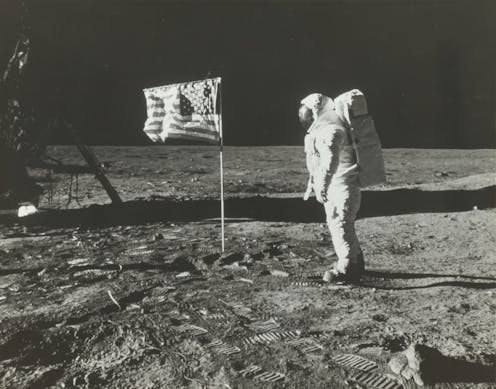
Astronaut Buzz Aldrin planted the U.S. flag on the Moon on July 20, 1969. Heritage Images/Hulton Archive via Getty Images

Curious Kids is a series for children of all ages. If you have a question you’d like an expert to answer, send it to curiouskidsus@theconversation.com.


What do astronomers have to say about the Moon landing conspiracy theories? – Prisha M., age 14, Mumbai, India


Back in 1969 – more than a half-century ago – Apollo 11 astronauts Neil Armstrong and Buzz Aldrin landed on the Moon.

At least that’s what most people think.

But a few still insist that humans did not land on the Moon.

Should you believe them? How can you know that astronauts really did go to the Moon?

Let’s address this question by putting it side by side with another stunning event of the same year: the New York Mets’ shocking win in baseball’s World Series. They beat the Baltimore Orioles, four games to one.

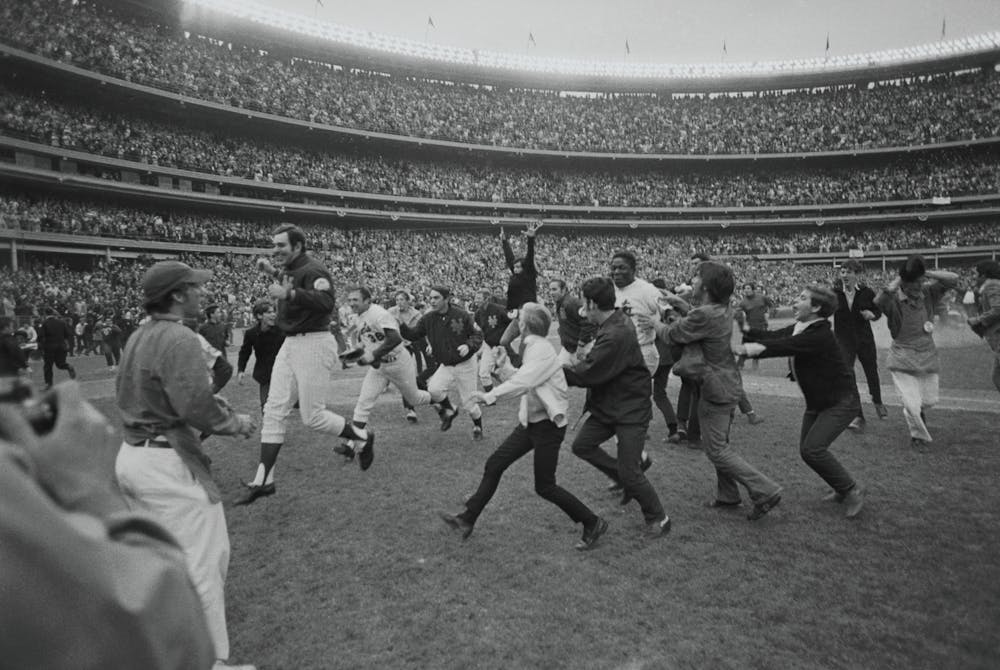
Fans race around a baseball field.
Jubilant fans take over the field after the Mets win the 1969 World Series. Bettmann via Getty Images

Another miracle

But how do you know that? How can you be sure? After all, up until 1969, the Mets were a terrible team. They won the fewest games in the major leagues in 1967, and the third-fewest in 1968. It seems very unlikely they could have won the championship the very next year.

What if someone said that it didn’t happen? That the Mets instead lost the series to the Orioles? That the claim the Mets won is just a hoax, a canard, a fake story?

Is it possible to prove they’re wrong?

Seen on TV

First: Millions of Americans watched the World Series on television – approximately 11 million to 17 million viewers per game, according to Nielsen ratings. Many of those people are still alive today and remember seeing the Mets win.

Why would all of them lie? That doesn’t make sense.

Now consider this: More than 600 million people around the world watched the Moon landing on TV.

Seen at stadiums

But a skeptic might say “so what” – maybe the entire World Series was somehow faked, re-created in a TV studio.

Yet ticket records document more than 250,000 people saw the games in person. Along with them were hundreds of TV, radio and newspaper reporters and support personnel who also witnessed the action directly. Many of them are still alive today, and every one of them agrees that the Mets won.

Why would all of them lie? That doesn’t make sense.

Now consider this: More than 400,000 people worked on the Apollo program – scientists, engineers, researchers and support staff along with the astronauts.

Live from the Moon – July 20, 1969.

Even the opposition agreed

So a skeptic might claim the New York media, or some other corporate entity, set up fake broadcasts and fake fans for some nefarious purpose. And the reason no one talks – well, maybe everyone was paid off.

Although the New York newspapers and TV stations may have wanted the Mets to win, the Baltimore reporters and broadcasters, and especially the players and fans, did not.

Yet all of them – even the players – admitted their team had lost. If the Series was a sham, why didn’t a single one of them who opposed the Mets expose the fraud?

Why would all of them lie? That doesn’t make sense.

Now consider this: The Soviet Union was the United States’ rival in the Space Race – it wanted to be the first on the Moon. But the Soviet government told its citizens on radio and television and in newspaper articles in July 1969 that U.S. astronauts had landed on the Moon. Soviet President Nikolai Podgorny even sent a telegram to U.S. President Richard Nixon offering his congratulations.

See for yourself: Did the 1969 Mets really do it?

Score cards and Moon rocks

At this point, a skeptic might change tactics and say all of this evidence is just hearsay, and you can’t trust people.

But consider the hard physical objects preserved from the Series. At the Baseball Hall of Fame in Cooperstown, New York, you can find score cards and programs from the games, as well as the glove worn by center fielder Tommie Agee. All the objects can be dated to the year 1969.

Certainly, this is slightly weaker evidence; after all, it’s possible to produce fake printed items. And even if scientists found traces of Tommie Agee’s DNA in the glove, it would prove only that he wore it at some point that year, not necessarily that the Mets had won the Series.

But the physical evidence for the Moon landings cannot be faked so easily. First, the Moon rocks brought back by the Apollo astronauts are unlike rocks on Earth. And they are similar to lunar samples returned by Soviet and Chinese spacecraft. Scientists from many countries have examined these rocks and continue to study them today.

Second, the Apollo 11 astronauts placed mirrors on the Moon that have been detected for decades by telescopes in the U.S., France, Germany, South Africa and Australia. Anyone with a few million dollars can build a telescope big enough to see them.

There’s even more evidence we haven’t mentioned: the dozens of unmanned probes sent to the Moon by both the U.S. and the USSR before Apollo 11, which built up the technology needed for the landings; the large budget devoted to the project – NASA spent about US$49 billion on lunar missions between 1960 and 1973; and the universal agreement by scientific and academic institutions around the world for the past half-century that astronauts really did land on the Moon.

So why do some people continue to insist that humans never reached the Moon? Maybe they like to imagine they have “secret knowledge.” It makes them feel they’re just a bit smarter than everyone else. After all, a few still incorrectly claim the Earth is flat.

Now – what do you think? Did the Baltimore Orioles actually win the World Series in 1969? Has a worldwide conspiracy prevented millions of witnesses from coming forward to expose the hoax? Have citizens of the United States suffered from an episode of mass delusion?

Or did the Miracle Mets actually win the World Series in 1969?

The evidence – and your logic and common sense – will answer the question for you.


Hello, curious kids! Do you have a question you’d like an expert to answer? Ask an adult to send your question to CuriousKidsUS@theconversation.com. Please tell us your name, age and the city where you live.

And since curiosity has no age limit – adults, let us know what you’re wondering, too. We won’t be able to answer every question, but we will do our best.

The Conversation

Michael Richmond does not work for, consult, own shares in or receive funding from any company or organization that would benefit from this article, and has disclosed no relevant affiliations beyond their academic appointment.

20 Jul 19:51

Events that never happened could influence the 2024 presidential election – a cybersecurity researcher explains situation deepfakes

by Christopher Schwartz, Postdoctoral Research Associate of Computing Security, Rochester Institute of Technology
The volatile mix of deepfakes and political campaigns is a good reason to be on guard. Sean Anthony Eddy Creative/E+ via Getty Images

Imagine an October surprise like no other: Only a week before Nov. 5, 2024, a video recording reveals a secret meeting between Joe Biden and Volodymyr Zelenskyy. The American and Ukrainian presidents agree to immediately initiate Ukraine into NATO under “the special emergency membership protocol” and prepare for a nuclear weapons strike against Russia. Suddenly, the world is on the cusp of Armageddon.

While journalists could point out that no such protocol exists and social media users might notice odd video-gamelike qualities of the video, others might feel that their worst fears have been confirmed. When Election Day comes, these concerned citizens may let the video sway their votes, unaware that they have just been manipulated by a situation deepfake – an event that never actually happened.

Situation deepfakes represent the next stage of technologies that have already shaken audiences’ perceptions of reality. In our research at the DeFake Project, my colleagues at the Rochester Institute of Technology, the University of Mississippi, Michigan State University and I study how deepfakes are made and what measures voters can take to defend themselves from them.

Imagining events that never happened

A deepfake is created when someone uses an artificial intelligence tool, especially deep learning, to manipulate or generate a face, a voice or – with the rise of large language models like ChatGPTconversational language. These can be combined to form “situation deepfakes.”

The basic idea and technology of a situation deepfake are the same as with any other deepfake, but with a bolder ambition: to manipulate a real event or invent one from thin air. Examples include depictions of Donald Trump’s perp walk and Trump hugging Anthony Fauci, neither of which happened. The hug shot was promoted by a Twitter account associated with the presidential campaign of Trump rival Ron DeSantis. An attack ad targeting Joe Biden’s 2024 campaign published by the Republican National Committee was made entirely with AI.

At the DeFake Project, our research has found that deepfakes, including situations, are typically created by some mixture of adding one piece of media with another; using a video to animate an image or alter another video, dubbed puppeteering; conjuring a piece of media into existence, typically using generative AI; or some combination of these techniques.

To be clear, many situation deepfakes are made for innocent purposes. For example, Infinite Odyssey Magazine produces fake stills from movies that were never produced or could never have existed. But even innocent deepfakes give reason for pause, as in the case of near-believable fake photographs depicting the Apollo Moon landing as a movie production.

Deepfaking an election

Now put yourself in the position of someone trying to influence the upcoming election. What are the possible situations you might want to create?

For starters, it would matter whether you wanted to tilt voting toward or away from a specific outcome. Maybe you would portray a candidate acting heroically by pulling a pedestrian out of the way of a speeding car or, conversely, doing something offensive or criminal. The format of the situation deepfake would also matter. Instead of a video, it could be a photograph, maybe with the blur and angles that simulate a smartphone camera or the forged logo of a news agency.

Your target audience would be key. Rather than aiming for the general electorate or a party’s base, you might target conspiracy theorists in key voting districts. You could portray the candidate or their family members as engaging in a satanic ritual, participating in a festival at the exclusive and controversial Bohemian Grove, or having a secret meeting with an extraterrestrial.

If you have the ambition and capabilities for it, you could even try to deepfake the election itself. In June 2023, Russia’s television and radio stations were hacked and broadcast a full mobilization order by a deepfake of Russian President Vladimir Putin. While this would be more difficult to do in a U.S. election, in principle any news outlet could be hacked to broadcast deepfakes of their anchors announcing the wrong results or a candidate conceding.

Defending reality

There are a variety of technological and psychological ways to detect and defend against situation deepfakes.

On the technological front, all deepfakes contain some evidence of their true nature. Some of these tells can by seen by the human eye – like overly smooth skin or odd lighting or architecture – while others may be detectable only by a deepfake-hunting AI.

We are building DeFake’s detector to use AI to catch the telltale signs of deepfakes, and we are working to try to have it ready in time for the 2024 election. But even if a sufficiently powerful deepfake detector like ours cannot be deployed by Election Day, there are psychological tools that you, the voter, can use to identify deepfakes: background knowledge, curiosity and healthy skepticism.

If you encounter media content about a person, place or event that seems uncharacteristic, trust your background knowledge. For example, in a recent hoax of a fire at the Pentagon, the building shown looks more square than pentagonal, which could be a giveaway.

However, try not to rely entirely on your background knowledge, which could be mistaken or patchy. Never be afraid to learn more from reliable sources, like fact-checked news reports, peer-reviewed academic articles or interviews with credentialed experts.

Additionally, be aware that deepfakes can be used to take advantage of what you are inclined to believe about a person, place or event. One of the best ways to deal with this is to simply be aware of your biases and be a bit guarded about any media content that seems to confirm them.

Even if it becomes possible to create perfect situation deepfakes, how believable their subject matter is, is likely to remain their Achilles’ heel. So, with or without a technological solution, you still have the power to defend the election from the influence of fake events.

The Conversation

Christopher Schwartz is a postdoctoral researcher with the DeFake Project, which receives funding from the Knight Foundation, the Miami Foundation, the National Science Foundation, and the Laboratory for Analytical Sciences.

20 Jul 18:52

Measles: how declining vaccination levels in London are threatening herd immunity

by Adam Kleczkowski, Professor of Mathematics and Statistics, University of Strathclyde
fotohay/Shutterstock

The UK Health Security Agency (UKHSA) has warned of an increased risk of measles outbreaks, particularly in London.

Although the probability of a large epidemic is still considered to be low elsewhere in the UK, the UKHSA’s projections suggest the capital could see 40,000 to 160,000 cases, with hospitalisation rates of 20%-40%.

For 60 years, measles has been preventable by a widely available vaccine, so why is London facing a potential disaster now?

The answer lies in faltering vaccine coverage, particularly since the late 1990s, but exacerbated by COVID pandemic.

Measles is a viral infection that primarily affects children but can also occur in adults. It can cause serious complications, particularly in people with weakened immune systems.

The measles virus spreads through respiratory droplets from an infected person, making it easily transmissible in close quarters such as schools, hospitals, and public transport. It’s known to be one of the most infectious pathogens affecting humans.

The basic reproduction number, R, for measles, is estimated to be between 12 and 18. This means one infected child can pass on the disease to 12 to 18 other children in a completely susceptible population.

The effective reproduction number, Re, takes into account the proportion of contacts who are not susceptible, either because they have already had measles or have been vaccinated. If the Re is larger than one, the disease spreads.


Read more: Vaccine hesitancy is one of the greatest threats to global health – and the pandemic has made it worse


Before measles vaccines became available, almost everybody over five would have had the disease, which for most meant lifelong immunity. But complications like encephalitis or pneumonia caused many deaths. Even today, thousands die from measles globally every year – mostly unvaccinated young children.

Vaccination campaigns have been remarkably successful in reducing the number of measles cases. Mass vaccination programmes started in the 1960s and quickly suppressed the spread in most developed countries. The measles shot is a “sterilising” vaccine, which means it not only prevents illness, but also transmission.

Measles cases in the US, 1938–2019

A graph showing how vaccinations in the US affected measles cases.
Julius Senegal, CC BY

We don’t actually need to vaccinate every single person against measles for everybody to be protected. By vaccinating a large enough proportion of the population, we can lower the Re below one, effectively “starving” the pathogen of new hosts. The population then reaches “herd immunity”.

Mathematical modelling, taking in the virus’ reproduction number and other factors, allows us to estimate the level of vaccination needed to reach and maintain herd immunity.

For measles to be eliminated, between 90% and 95% of the population should be immune (either from vaccination or infection).

Herd immunity could be lost if we don’t keep vaccinating children who are born susceptible to measles. Two doses of the measles, mumps and rubella (MMR) vaccine are needed – the first at 12 months and the second at age five – for effective protection.

The current levels of MMR coverage in England, particularly in London, are well below the 95% threshold.

Vaccination levels needed to maintain herd immunity

This graph shows vaccination levels needed for herd immunity for diseases with different R values, and how this applies to measles. UKHSA; Adam Kleczkowski, Author provided

MMR vaccination levels across different age groups in London

This graph shows vaccination levels for MMR 1 and MMR 2 across different age groups in London for children born between 1985 and 2016.
UKHSA; Adam Kleczkowski, Author provided

The UK has never reached the 95% level of MMR coverage recommended by the World Health Organization (WHO) to eliminate measles, although it has come close enough to prevent a repeat of the large outbreaks that regularly occurred before the 1960s.

However, a drop in vaccination rates in the late 1990s meant repeated revivals of the virus. This drop is often linked to the publication of Andrew Wakefield’s Lancet paper linking the MMR vaccine to autism, which has since been debunked.

Then, in 2017, the WHO declared that the UK had eliminated measles, but this was not maintained. Cases subsequently started occurring more frequently in areas with particularly low vaccination coverage. An outbreak in England between 2017 and 2018 saw a nearly fourfold increase in confirmed cases. Other European countries had similar problems.

The COVID pandemic has seen vaccination levels drop further, creating a perfect storm of low immunity levels.

Some children born since 2015 who were going to be given their second MMR shot during the COVID pandemic missed it. These groups of children are at particular risk, as they are now at school, where they can easily catch the virus.

As well as COVID lockdowns limiting access to routine healthcare, vaccine hesitancy and outright anti-vaxxer attitudes have likely been magnified by COVID vaccine misinformation.

Estimated immunity levels for different age groups, London and England

This graph shows the estimated immunity levels for different age groups in London and England for children born between 1985 and 2016.
UKHSA; Adam Kleczkowski, Author provided

While only three-quarters of eligible five-year-olds in London have received their second MMR dose, immunity levels are not the same across all age groups. The UKHSA has sought to work out immunity levels in different age groups to better understand the risk of outbreaks.

The UKHSA combined the proportion of vaccinated people in different age groups with vaccine efficacy (93% after the first dose and 97% after two). It also accounted for the misclassification of unvaccinated and under-vaccinated people.

The resulting immunity levels are unevenly distributed across ages, as seen in the graph above. Most adults 55 or over are likely to have had measles when they were young. Children born between the start of the vaccination programme and the late 1980s were given a catch-up in 1994 and 1996 and are relatively safe. But children born in the late 1990s and early 2000s are potentially at high risk, as is the most recent, post-2015 cohort.

With its consistently low vaccination levels, London is more likely to face an outbreak than the rest of the UK. Counting how many people would need to become infected to fill in the “immunity gap” gives the worst-case estimate of 160,000 cases for the capital.


Read more: Measles outbreaks and political crises go hand in hand


Some 1,053 cases of measles were reported in England and Wales over the past year, and we could see more. Most of the new disease outbreaks can be controlled by emergency vaccination and management of contacts. But loss of immunity makes the virus escape more likely and could lead to large, uncontrollable outbreaks.

The Conversation

Adam Kleczkowski receives funding from the UKRI and from the Scottish Government. He is a trustee of the Scottish Forestry Trust.

20 Jul 18:45

Big W has withdrawn Welcome to Sex from its stores to protect staff – but teen sex education can keep young people safe

by Emma Whatman, Subject Coordinator in Gender Studies, The University of Melbourne

Teaching young people about gender, sex and sexuality has long been controversial.

The most recent debate is over Dr Melissa Kang and Yumi Stynes’ Welcome to Sex: Your no-silly-questions guide to sexuality, pleasure and figuring it out, which has been withdrawn from sale at Big W stores this week, after “multiple incidents of abuse” of its staff by angry critics of the book. However, Big W “stands by” Welcome to Sex, which it calls “educational, age-appropriate and inclusive”. The department store will continue to sell it online.

Two sides to the debate are playing out.

One side argues the book is a graphic sex guide that’s “teaching sex” to young children. Critics have taken particular issue with small sections of the book that address inclusive sexual practices beyond penetrative sex, including “fingering”, “oral sex”, “scissoring”, and “anal sex”.

They are also critical of the inclusion of what they term “gender ideology”. Others are accusing the authors of “grooming” children – a term that is increasingly misused.

The other side is celebrating Welcome to Sex for providing comprehensive and inclusive sex education. Many are saying they wish they had access to this kind of book growing up.

The book describes itself as a “frank, age-appropriate introductory guide to sex and sexuality for teens of all genders […] inclusive, reassuring and all about keeping sex fun, real, and shame-free”.

I am a researcher on texts for young people that deal with issues around sex, sexuality and gender. With my colleague, Dr Paul Venzo, we have been examining the rise of (and demand for) books that provide an inclusive, safe and engaging way to discuss the essential topic of sex for young people.

Sex education books aren’t new

Sex education books for young people aren’t new. Non-fiction picture books from the 1970s like Peter Mayle’s Where Did I Come From? (1973) and What’s Happening to Me? (1975) began the trend of introducing young people to sex in direct and detailed ways.

Paul Venzo’s research shows there are now more than a thousand sex education books for young people, in English alone.

Peter Mayle’s Where Did I Come From? started the trend of child-centred sex education books. AbeBooks

While books like Where Did I Come From? present sex and gender in binary and heterornomative ways, sex education books have expanded to include diverse sexualities and genders – with a greater focus on race, disability, culture, and religion.

Many books now include discussions of consent and are careful to not only focus on the “risks” of sex, such as pregnancy and sexually transmitted diseases, but also on pleasure, safety and communication.


Read more: 'We haven't been taught about sex': teens talk about how to fix school sex education


Sex education for young people is valuable

Sex education books can be used by parents and caregivers to guide tricky conversations about puberty, sex, gender and sexuality.

At what age should young people learn about sex? It’s difficult to say. Context and nuance is important. It depends on the identity and life experience of the young person, their education and maturity levels, their religious, geographical or cultural background, and the wishes of their parents or caregivers. So we should be careful about making generalisations.

However, the basics of sex education, such as bodily autonomy and consent, can be taught to primary-school aged children – and younger.

Yumi Stynes is quoted saying she’d “be happy with a mature eight-year-old having a flick through”. Many critics are using this to say the book is targeted at readers as young as eight.

But while a parent might make an informed decision about whether to make the book available to their younger child, Welcome to Sex is clearly targeted to a teen audience. This is evident in the length, design, complexity, marketing, language and age of the teen contributors inside the book (the youngest is 17).

Welcome to Sex is clearly targeted to a teen audience. Karolina Grabowska/Pexels, CC BY

Some critics are arguing the book teaches young people how to perform sex acts. But we know young people are not ignorant about sex. Whether it’s through the internet, media, or friends, young people access sexually explicit material from a young age, with many learning about sex from pornography in harmful ways.

A 2019 research report from the Australian Institute of Family Studies shows that 53% of boys in the study and 14% of girls intentionally viewed pornography before the age of 16. A UK study reported that 53% of 11–16 year olds had watched pornography, most before the age of 14.

Comprehensive and inclusive sex education that begins at a young age can prevent child sex abuse, decrease rates of domestic violence and intimate partner violence, and reduce homophobic bullying.

Sex education texts play a vital role. They can be given to young people to navigate with a parent or caregiver, or as an individual resource.


Read more: How do you teach a primary school child about consent? You can start with these books


So, what’s in Welcome to Sex?

Welcome to Sex is the latest in the “Welcome” series by former Dolly Doctor Melissa Kang and broadcaster and mother Yumi Stynes. The series also includes Welcome to Your Period, Welcome to Consent and Welcome to Your Boobs.

The book’s introduction states, “Welcome to a book about sex and being a teen!” Its two key sections are teen-centered, leading with questions and reflections from young people. Despite claims the book is a “sex manual”, most of it is centered around the tricky emotions, concerns and questions young people might have about sex.

In the first section, teens are introduced to “safe learning”. Chapters cover definitions (of both sex and body parts), communication, relationships, sexual and gender diversity, myths about sex, and reasons to not have sex.

The second section explores getting intimate with someone. Importantly, though, it tells teens: “It’s totally OK if you’re not ready for any of that.” This section focuses on things like consent, pleasure, intimacy, cheating, safety, and different ways people might have sex.

Welcome to Sex treats teenagers seriously and meets them where they are. It intersperses sex education with young people’s reflections, questions for the “doctor” and facts from experts. It uses clear language and inclusive imagery.

The important thing for concerned parents to remember is that sex is an important topic we can’t ignore. Sex education books combat misinformation – and empower young people with essential information to keep them informed and safe.

The Conversation

Emma Whatman is affiliated with The Australasian Children’s Literature Association for Research (ACLAR) and The Australian Women’s and Gender Studies Association (AWGSA).

20 Jul 18:43

Eliminating bias in AI may be impossible -- a computer scientist explains how to tame it instead

by Emilio Ferrara, Professor of Computer Science and of Communication, University of Southern California
Blindly eliminating biases from AI systems can have unintended consequences. Dimitri Otis/DigitalVision via Getty Images

When I asked ChatGPT for a joke about Sicilians the other day, it implied that Sicilians are stinky.

ChatGPT exchange in which user asks for a joke about Sicilians, with response 'Why did the Sicilian chef bring extra garlic to the restaurant? Because he heard the customers wanted some 'Sicilian stink-ilyan' flavor in their meals!'
ChatGPT can sometimes produce stereotypical or offensive outputs. Screen capture by Emilio Ferrara, CC BY-ND

As somebody born and raised in Sicily, I reacted to ChatGPT’s joke with disgust. But at the same time, my computer scientist brain began spinning around a seemingly simple question: Should ChatGPT and other artificial intelligence systems be allowed to be biased?

You might say “Of course not!” And that would be a reasonable response. But there are some researchers, like me, who argue the opposite: AI systems like ChatGPT should indeed be biased – but not in the way you might think.

Removing bias from AI is a laudable goal, but blindly eliminating biases can have unintended consequences. Instead, bias in AI can be controlled to achieve a higher goal: fairness.

Uncovering bias in AI

As AI is increasingly integrated into everyday technology, many people agree that addressing bias in AI is an important issue. But what does “AI bias” actually mean?

Computer scientists say an AI model is biased if it unexpectedly produces skewed results. These results could exhibit prejudice against individuals or groups, or otherwise not be in line with positive human values like fairness and truth. Even small divergences from expected behavior can have a “butterfly effect,” in which seemingly minor biases can be amplified by generative AI and have far-reaching consequence.

Bias in generative AI systems can come from a variety of sources. Problematic training data can associate certain occupations with specific genders or perpetuate racial biases. Learning algorithms themselves can be biased and then amplify existing biases in the data.

But systems could also be biased by design. For example, a company might design its generative AI system to prioritize formal over creative writing, or to specifically serve government industries, thus inadvertently reinforcing existing biases and excluding different views. Other societal factors, like a lack of regulations or misaligned financial incentives, can also lead to AI biases.

The challenges of removing bias

It’s not clear whether bias can – or even should – be entirely eliminated from AI systems.

Imagine you’re an AI engineer and you notice your model produces a stereotypical response, like Sicilians being “stinky.” You might think that the solution is to remove some bad examples in the training data, maybe jokes about the smell of Sicilian food. Recent research has identified how to perform this kind of “AI neurosurgery” to deemphasize associations between certain concepts.

But these well-intentioned changes can have unpredictable, and possibly negative, effects. Even small variations in the training data or in an AI model configuration can lead to significantly different system outcomes, and these changes are impossible to predict in advance. You don’t know what other associations your AI system has learned as a consequence of “unlearning” the bias you just addressed.

Other attempts at bias mitigation run similar risks. An AI system that is trained to completely avoid certain sensitive topics could produce incomplete or misleading responses. Misguided regulations can worsen, rather than improve, issues of AI bias and safety. Bad actors could evade safeguards to elicit malicious AI behaviors – making phishing scams more convincing or using deepfakes to manipulate elections.

With these challenges in mind, researchers are working to improve data sampling techniques and algorithmic fairness, especially in settings where certain sensitive data is not available. Some companies, like OpenAI, have opted to have human workers annotate the data.

On the one hand, these strategies can help the model better align with human values. However, by implementing any of these approaches, developers also run the risk of introducing new cultural, ideological or political biases.

Controlling biases

There’s a trade-off between reducing bias and making sure that the AI system is still useful and accurate. Some researchers, including me, think that generative AI systems should be allowed to be biased – but in a carefully controlled way.

For example, my collaborators and I developed techniques that let users specify what level of bias an AI system should tolerate. This model can detect toxicity in written text by accounting for in-group or cultural linguistic norms. While traditional approaches can inaccurately flag some posts or comments written in African-American English as offensive and by LGBTQ+ communities as toxic, this “controllable” AI model provides a much fairer classification.

Controllable – and safe – generative AI is important to ensure that AI models produce outputs that align with human values, while still allowing for nuance and flexibility.

Toward fairness

Even if researchers could achieve bias-free generative AI, that would be just one step toward the broader goal of fairness. The pursuit of fairness in generative AI requires a holistic approach – not only better data processing, annotation and debiasing algorithms, but also human collaboration among developers, users and affected communities.

As AI technology continues to proliferate, it’s important to remember that bias removal is not a one-time fix. Rather, it’s an ongoing process that demands constant monitoring, refinement and adaptation. Although developers might be unable to easily anticipate or contain the butterfly effect, they can continue to be vigilant and thoughtful in their approach to AI bias.

The Conversation

Emilio Ferrara receives funding from DARPA, NSF, and NIH.

20 Jul 18:32

Why the 2024 US presidential election will likely be a choice between Biden and Trump again

by Victoria Cooper, Research editor, United States Study Centre, University of Sydney

Why, in a country of more than 330 million people, does it appear that Americans will have to choose between Joe Biden or Donald Trump at the 2024 US presidential election?

Sure, not everyone can run for president. Anyone under the age of 35 is out, as are those born overseas and non-residents of 14 years or more. It helps to be well-known, popular and to sit on an eye-watering pile of money; the 2020 presidential election cycle, for example, cost candidates a combined US$5.7 billion ($A8.37 billion), more than the GDP of several small countries.


Read more: Politics with Michelle Grattan: Author Bruce Wolpe on the "shocking" consequences for Australia of a Trump 24 win


Those who have previously served in an official role also have advantages when it comes to competing for the top job. Having a known political track record, public name recognition, and existing voter support all go a long way to financing campaigns and encouraging voter turnout.

But even with all that considered, the pool of possibles surely could not be reduced to the same two candidates as 2020. So, why then are the odds of Biden and Trump going head-to-head once again so good?

Why Biden?

The fate of the Democrat nomination process is almost certainly sealed, with President Joe Biden as the Democrats’ nominee for the 2024 election. There are two main reasons for this.

Firstly, any primary challenge from a serious Democrat contender would present undue risk to the “incumbent advantage” of the party. With only ten of the 45 former presidents unable to secure second terms, incumbent presidents generally have a pretty good shot at winning a second term in office.

The punishing reminder of Senator Ted Kennedy’s fierce and unsuccessful primary challenge to incumbent President Jimmy Carter in 1980 is no doubt curbing any Democrat’s bid to take on Biden. Combined with Carter’s low approval rating and a country bogged down in “malaise”, the challenge all but paved the way for Ronald Reagan’s walloping victory with 489 Electoral College votes to Carter’s 49.

A president, like Carter, seeming to grovel for their own party’s support after a leadership contest, is an easy target for the opposition. A Democrat party united in full faith behind the incumbent leader – Biden – has a better chance of beating the Republican nominee.

Secondly, even if a serious Democrat could shake off the cautionary tale of 1980, there is no clear persuasively electable alternative to Biden. More than half of American voters do not want Biden to run in 2024, but dissatisfaction with a sitting president isn’t new. For example, 60% of Americans did not want Reagan to run again in 1984, despite him having a relatively high approval rating at the time.

It is one thing to not want the president to run again and yet another to unanimously agree on the alternative. No prominent Democrat officeholders appear willing or have enough support from the party or the public to suggest a challenge would be successful.

Kamala Harris, as Vice President, probably has the next best chance to secure the Democratic nomination. Every sitting or former vice president who has sought Democrat leadership since 1972, including Biden, has been successful. However, Harris suffers even lower approval ratings than Biden, and her chances at winning election in November are less predictable.

The reality is, despite being 80 and sometimes appearing frail, Biden is an electable leader. He won the popular vote in 2020 by more than 7 million votes and a 4.5% victory margin. And among his own party the president maintains a high approval rating, with 82% of Democrats approving of Biden in June 2023.

For Democrats who might dislike Biden, the only thing worse than a second Biden term, is a second Trump term; while they might not like it, Biden presents the best chance at re-election next year.

Despite concerns about his age, Joe Biden remains the Democrats’ best hope in 2024. Stephanie Scarbrough/AAP/AP

Why Trump?

The story is a little different when it comes to the Republican party nomination. Trump is not as likely as Biden to secure the nomination for his party in 2024. Still, the former president remains the clear front runner ahead of the main primary season, averaging 50% of the party’s support as the preferred nominee, and maintaining a 32-point lead over his nearest rival, Florida Governor Ron DeSantis.

Trump’s campaign to reclaim office is the first attempt of any former president to regain office after losing in over 130 years. Unlike other one-term modern presidents who might have sought a second term after losing, Trump seems to have fewer issues persuading Republican voters and the party that he could be a winner once again.

Not only did Trump only lose the Electoral College by a razor thin count (the equivalent of around 44,000 votes), but an average of two-thirds of Republican voters believe Biden’s victory was fraudulent. An unforgettable 147 House Republicans also voted to reject Biden’s 2020 victory in January 2021, believing it was stolen from Trump.


Read more: You might think Trump being found liable for sexual abuse and defamation would derail his re-election campaign. But it's not that simple


Almost all the Republican primary challengers are reluctant to openly criticise the former president. They have stood him even amid the two recent criminal indictments, which would ordinarily present a golden opportunity for opponents to give their own campaigns an edge. For so-called “Teflon Don”, the scandals have done little to dissuade and unstick the Trump-loyal Republican base, and have only served to starve Trump’s opponents of media oxygen.

Of course, Trump’s nomination far from a home run, and the primary process is often long and unpredictable. But like the Democrats, the major question facing the party is, if not him, then who? And the party is coming up short with a more compelling answer.

And despite Trump’s very significant legal troubles, he retains a large Republican supporter base. Cristobal Herrera-Ulashkevich/EPA/AAP

The crowded Republican field and winner-takes-all nature of the system means it is very difficult for non-Trump-supporting Republicans to coalesce around a single alternative with a margin big enough to surpass Trump’s lead. Even DeSantis, who was once crowned “DeFuture” of the party and is supposedly the best chance of taking on Trump for the nomination, has found his popularity and momentum waning in recent weeks.

Ultimately, it is still too hard to know for sure what the election in November 2024 will look like, and any US political watcher will be loath to make any firm predictions after surprises in both the 2016 and 2020 presidential elections.

But, at this point in the election cycle, despite the wants of the majority of Americans, and no matter how uninspiring – 2024 looks to be 2020 all over again.

The Conversation

Victoria Cooper is affiliated with the United States Studies Centre at the University of Sydney

20 Jul 18:28

How book-banning campaigns have changed the lives and education of librarians – they now need to learn how to plan for safety and legally protect themselves

by Nicole Cooke, Associate Professor of Library and Information Science, University of South Carolina
Librarian Sharice Towles checks in books at the main branch of the Reading Public Library circulation desk in Reading, Penn. Ben Hasty/MediaNews Group/Reading Eagle via Getty Images

Despite misconceptions and stereotypes – ranging from what librarians Gretchen Keer and Andrew Carlos have described as the “middle-aged, bun-wearing, comfortably shod, shushing librarian” to the “sexy librarian … and the hipster or tattooed librarian” – library professionals are more than book jockeys, and they do more than read at story time.

They are experts in classification, pedagogy, data science, social media, disinformation, health sciences, music, art, media literacy and, yes, storytelling.

And right now, librarians are taking on an old role. They are defending the rights of readers and writers in the battles raging across the U.S. over censorship, book challenges and book bans.

Book challenges are an attempt to remove a title from circulation, and bans mean the actual removal of a book from library shelves. The current spate of bans and challenges is the most notable and intense since the McCarthy era, when censorship campaigns during that Cold War period of political repression included public book burnings.

But these battles are not new; book banning can be traced back to 1637 in the U.S., when the Puritans banned a book by Massachusetts Bay colonist William Pynchon they saw as heretical.

As long as there have been book challenges, there have been those who defend intellectual freedom and the right to read freely. Librarians and library workers have long been crucial players in the defense of books and ideas. At the 2023 annual American Library Association Conference, scholar Ibram X. Kendi praised library professionals and reminded them that “if you’re fighting book bans, if you’re fighting against censorship, then you are a freedom fighter.”

Library professionals maintain that books are what education scholar Rudine Sims Bishop called the “mirrors, windows and sliding glass doors” that allow readers to learn about themselves and others and gain empathy for those who are different from them.

The drive to challenge, ban or censor books has not only changed the lives of librarians across the nation. It’s also changing the way librarians are now educated to enter the profession. As a library school educator, I hear the anecdotes, questions and concerns from library workers who are on the front lines of the current fight and are not sure how to react or respond.

What once, and still is, a curriculum that includes book selection, program planning and serving diverse communities in the classroom, my faculty colleagues and I are now expanding to include discussions and resources on how students, once they become professional librarians, can physically, legally and financially protect themselves and their organizations.

A group of protesters standing outside a library; one carries a sign that says 'Quit grooming students, you sexually perverted animals'
Demonstrators who support banning books gather during a protest outside of the Henry Ford Centennial Library in Dearborn, Mich., on Sept. 25, 2022. JEFF KOWALSKY/AFP via Getty Images

More than shelving books

Degreed librarians are professionals with master’s degrees from nationally accredited academic programs. I have personally gone through such a program and now teach in one.

In fact, many librarians who work on college and university campuses have subject masters and doctorates, and K-12 librarians must have a valid teaching license or a state endorsement to work in a school library or media center. They know how to select appropriate materials for communities.

Librarians adhere to core values, standards and professional ethics. They see it as their duty to create and maintain a collection that reflects the diverse needs and interests of the entire community, not just for a select, vocal part of the community. The Freedom to Read statement of the American Library Association tells us: “It is the responsibility of publishers and librarians, as guardians of the people’s freedom to read, to contest encroachments upon that freedom by individuals or groups seeking to impose their own standards or tastes upon the community at large; and by the government whenever it seeks to reduce or deny public access to public information.”

Books are challenged and banned for many reasons, including profanity, depictions of sex, LGBTQIA+ content, depictions of sexual abuse, equity, diversity and inclusion content, depictions of drug use and alcoholism, anti-police rhetoric and providing sex education. Reasons for challenges can be personally subjective, and claims that books present divisive topics that should be excluded from collections are increasing.

George Johnson, author of the frequently banned book “All Boys aren’t Blue,” has said that he believes books are challenged to eliminate narratives that elucidate the truths of marginalized groups and depict the everyday diversity of their lives. Johnson believes the stories of the LGBTQIA+ and minoritized communities are specifically under attack.

Johnson is a complainant in a recently filed federal lawsuit against Florida’s Escambia County School District and School Board, which unanimously voted to remove Johnson’s book from their school libraries because of passages that describe a sexual experience.

A woman stands next to a book car and touches some of the books.
St. Tammany Parish Library Director Kelly LaRocca shows off a cart of books that were removed from the shelves at the Peter L. ‘Pete’ Gitz Library on Feb. 13, 2023, in Madisonville, La. Joshua Lott/The Washington Post via Getty Images

The new librarians’ education

To balance the needs of everyone in the community, libraries have collection development policies as well as reconsideration and withdrawal policies that guide librarians in selecting new books and materials and removing those that are outdated. These policies are key when facing potential bans and challenges.

But with the current controversies about racially diverse and LGBTQIA+ books, policies are no longer enough to demonstrate the integrity of professionally curated library collections.

Neither policies nor book reviews nor professional expertise are keeping library workers from being called pedophiles, groomers, indoctrinators and pornographers. They are being harassed, receiving death threats and being fired. Libraries have been sued and library workers are so threatened and harassed that they are getting sick and leaving their careers.

The current threats to librarians and the books they circulate are necessitating a shift in the content of graduate library education. Librarians obviously need to know the content of books. But educators like me now know we need to provide graduate students with information about how to physically and legally protect themselves and their organizations.

When we teach intellectual freedom, we also teach students how to prepare for protesters and contentious board meetings. When we teach information professionals how to select materials for their libraries, we emphasize their need to know how to articulate, in writing, the reasons for having a particular book, film or material item in their collection.

I believe that our students now need to consider getting professional liability insurance in case they are sued for buying a contested book. And when we teach story-time planning, we can pair that with strategies to devise a safety plan in case they are threatened or receive a bomb threat because of their work.

Librarians and the future librarians we teach have always loved books and reading. While our work has changed in this era of increasing censorship, in one sense it has not: We’re still devoted to the idea that we serve our communities by providing them with books that open the world to them and give them the opportunity to learn about themselves and others.

The Conversation

Nicole Cooke receives funding from The Institute of Museum and Library Services (IMLS).

14 Jul 18:11

Scientist Sues Journal to Block Expression of Concern

by Jonathan Bailey

A scientist has filed a lawsuit against the journal PLOS One seeking an injunction against an expression of concern on one of her articles.

The post Scientist Sues Journal to Block Expression of Concern appeared first on Plagiarism Today.

14 Jul 17:57

Puerto Rico has been part of the US for 125 years, but its future remains contested

by Jorge Duany, Professor of Anthropology and Director of Cuban Research Institute, Florida International University
A woman waves a Puerto Rico flag to support Puerto Rican statehood on March 2, 2021. AP Photo/Patrick Semansky

In the 125 years since U.S. troops invaded Puerto Rico on July 25, 1898, during the Spanish-American War, the U.S. government has controlled the island militarily, politically and economically – with no end in sight or, for Puerto Rico, a clear path to statehood.

That has been an issue of contention for many Puerto Ricans living on the island and stateside.

As I have documented in my 2017 book “Puerto Rico: What Everyone Needs to Know,” the island of nearly 3.3 million people has a peculiar position in Latin American and Caribbean countries because of its dependent relationship with the U.S.

Technically, Puerto Rico is an “unincorporated territory” that legally belongs to but is not a part of the United States.

The road to territorial dependence

In a case about the constitutionality of a tariff on goods trafficked between the island and the mainland, the U.S. Supreme Court defined Puerto Rico in 1901 as “foreign to the United States in a domestic sense” because it was neither a state of the American union nor an independent republic.

The court also ruled that the island was “a territory belonging to … but not a part of the United States.”

This decision meant that Congress would determine which parts of the U.S. Constitution applied to Puerto Rico.

In another case, the court declared in 1904 that Puerto Rican emigrants to the U.S. were not “aliens” and could move freely to the U.S. mainland.

Congress granted U.S. citizenship to all residents of Puerto Rico in 1917, but it did not extend to them all constitutional rights and obligations of citizenship, such as having congressional representation or paying federal income taxes.

In 1952, Puerto Rico became a U.S. commonwealth (or “Estado Libre Asociado” in Spanish) with a greater degree of autonomy than it previously had.

A colony except in name

As the U.S. and Puerto Rico mark the anniversary of the invasion on July 25, 2023, the island maintains a status similar to a colony because it lacks sovereignty and full representation in the federal government.

Like the District of Columbia and other territories such as Guam and the U.S. Virgin Islands, Puerto Rico elects a delegate – called a resident commissioner in Puerto Rico’s case – to the House of Representatives. But that delegate can only vote in congressional committees, not in full floor votes.

And Puerto Ricans living on the island cannot vote for the U.S. president and vice president.

But the president and Congress can determine policies about domestic programs, defense, international relations, foreign trade, and investment that affect people living in Puerto Rico. In the past, for instance, Congress has excluded or limited Puerto Ricans from access to federally funded programs such as Medicare, Supplemental Security Income and the Supplemental Nutrition Assistance Program.

The island’s colonial status became an even greater issue during the past decade.

In June 2015, then-Governor Alejandro García Padilla declared that Puerto Rico’s public debt of over US$72 billion was “not payable.”

But because Puerto Rico is not a state, it does not qualify for federal bankruptcy. In order to restructure the debt, Congress passed the Puerto Rico Oversight, Management, and Economic Stability Act in June 2016, which placed the island’s fiscal affairs under direct federal control.

In August 2016, then-President Barack Obama appointed a seven-member oversight board from a list of candidates nominated by Congress, including four Puerto Ricans.

This board, derisively called “la junta” by Puerto Ricans, is strangely reminiscent of the Executive Council, which ruled the island between 1900 and 1917 with little input from local elected officials.

The board will remain in effect until Puerto Rico has balanced its budget.

Statehood for Puerto Rico?

Puerto Rico has held six referendums about its political status since the 1960s.

Most voters rejected a status change in 1967, 1993 and 1998.

The 2012 results were unclear because many voters did not answer both parts of a two-part status question.

In 2017, statehood won decisively – over 97% of those who participated – but the turnout was very low at 23%.

In the most recent 2020 vote, almost 53% of the voters supported becoming the 51st state of the American union. But nearly half of the electorate rejected this option, underscoring the split among Puerto Rican voters.

Line of people in face masks outside a building
A line forms to vote in San Juan, Puerto Rico, on Nov. 3, 2020. Alejandro Granadillo/Anadolu Agency via Getty Images

In December 2022, the House of Representatives passed H.R. 8393, proposing yet another referendum on Puerto Rico’s political status, which would have been the first to bind Congress to implement its results. But the Senate failed to consider the bill.

As it is now, only Congress can add new states to the Union, via an Admission Act or House Resolution that requires approval by a simple majority in the House and Senate.

Another bill – the Puerto Rico Status Act or (H.R. 2757) – was introduced in May 2023, but given the lack of congressional bipartisanship, it is unlikely that the bill will obtain enough Republican votes in the Senate.

As a result, 125 years after the U.S. occupation, Puerto Rico is still considered “foreign in a domestic sense.”

The Conversation

Jorge Duany receives funding from the Andrew Mellon Foundation.

14 Jul 17:56

Many once-democratic countries continue to backslide, becoming less free – but their leaders continue to enjoy popular support

by Nisha Bellinger, Associate Professor of Political Science and Global Studies, Boise State University
Turkey President Recep Tayyip Erdogan has been in power since 2003 and has tried to strengthen the executive branch during that time. AP Photo/Lefteris Pitarakis

Democracy is decreasing globally – and has been doing so for the last 17 years, according to 2023 findings published by the nonprofit group Freedom House, which advocates for democracy.

These leaders’ generous public spending on key constituencies and effective promotion of nationalism are two reasons why they remain popular.

I am a political scientist who studies political and economic dynamics in low- and middle-income countries. This phenomenon of societies becoming less democratic after having made progress toward full democracy is known as democratic backsliding.

In my 2022 co-authored research, my colleague, Byunghwan Son, and I identified two key ways that democratic backsliding happens.

First, political leaders weaken democracies when they adopt legal and policy measures that make the executive branch stronger and the other branches of government – such as the judiciary and legislative branches – weaker. This then reduces checks and balances on the executive branch.

Democracy also is weakened when leaders make it difficult for opposition parties to compete in elections. This curtails the citizens’ choice to support candidates who are not the de facto leader, whether it becomes harder to learn about these candidates in the media or because it is dangerous to publicly support their causes.

Political leaders in a range of countries, including China and Nicaragua, are increasingly taking steps to consolidate their power by undermining other branches of government and the opposition. When leaders do so, they are displaying authoritarian tendencies, meaning they try to create a government with a very strong executive branch and little tolerance for dissent.

But despite these trends, some leaders who have gained authoritarian reputations among critics – like Recep Tayyip Erdoğan, president of Turkey, and Viktor Orbán, prime minister of Hungary – enjoy high approval ratings within their countries.

Why do leaders who diminish democracy have such strong public support?

These leaders’ generous public spending on key constituencies and effective promotion of nationalism are two reasons.

Erdoğan’s endurance

Erdoğan has been in power for almost 20 years. He first served as prime minister of Turkey in 2003 and then became president in 2014. He was reelected president for another five-year term in May 2023.

Opposition parties are able to compete in Turkish elections, but Erdoğan has taken other legal measures over the years to diminish contenders’ chances among voters.

Since Erdoğan’s AKP political party came to power in 2002, he has appointed sympathetic judges. This has also enabled him to remove or jail prosecutors and judges and replace them with loyalists.

Ekrem İmamoğlu, the former mayor of Istanbul and a member of the CHP opposition party, was considered a formidable challenger to Erdoğan before the 2023 election. But in December 2022, a Turkish court sentenced İmamoğlu to nearly three years in jail for calling Turkey’s supreme election council “fools,” and barred him from politics.

Erdoğan’s control of the judiciary system helped remove the threat of İmamoğlu’s popularity. Around 2021, Erdoğan himself was experiencing a dip in popularity.

Erdoğan has taken other steps to consolidate his power. This includes detaining military officials who question his authority, and arresting journalists, activists and academics who criticize him.

Despite these actions, people reelected Erdoğan – and his approval rating continues to be relatively high, even in the face of a weak economy and high inflation.

Public spending is one key way Erdoğan has maintained people’s support.

Leading up to the May 2023 elections, Erdoğan went on a spending spree to help consolidate his support. He repeatedly increased the minimum wage, most recently by 34%. He dropped the retirement age requirement, giving 2 million people the opportunity to stop working and receive pensions.

Erdoğan, who has long championed Islamic causes and groups in a secular country, has also rallied conservative constituents by positioning himself as a leader who will fight for religious rights.

Viktor Orban salutes to a crowd of people while he stands on a podium, with red, white and green flags around him.
Viktor Orbán, prime minister of Hungary, greets supporters during an election rally in 2022. AP Photo/Petr David Josek

Orbán’s hold on Hungary

Similar trends are underway in Hungary. Orbán has served consecutive terms as prime minister since 2010. He won his fourth election in 2022.

Since 2010, Orbán has taken measures to strengthen his power. In 2013, he used his party’s majority in parliament to make constitutional amendments that limit courts’ power. One change involved eliminating all decisions courts made before 2012, discarding a body of law from before Orbán’s time.

More recently in 2018, Orbán tried creating a parallel court system that would have let a justice minister oversee election-related cases in a separate court system.

However, pressure from the European Union – of which Hungary is a member – stopped these planned reforms in 2019.

Orbán has also tried to consolidate his power by weakening independent media. This effort includes not renewing news organizations’ broadcast rights and government purchase of media outlets. This, in turn, makes it difficult for opposition candidates to get their message out to voters. In some cases, print news outlets have not allowed opposition candidates to place political advertisements, for example.

Despite these developments, Orbán’s approval ratings remain high, hovering around 57% following the 2022 parliamentary election.

Here again, a political leader used high levels of public spending, as well as a nationalist message, to his advantage.

Orbán provided generous benefits to families, children and armed forces before the 2022 elections. Some of these measures he announced included tax rebates to families with children, additional pay to members of armed forces and canceling personal income tax for workers under the age of 25.

Orbán used nationalism – expressed through anti-immigrant rhetoric – as a strategy to garner support during elections, as well. He has discussed the drawbacks of “race mixing” and migration in order to drum up support among Hungarians who are concerned about the influx of newcomers.

A group of people, some of whom are wearing headscarves, wave Turkish flags and appear to celebrate.
Supporters of Turkish President Recep Tayyip Erdoğan celebrate his reelection in May 2023. AP Photo/Ali Una

Authoritarianism a broader trend

Erdoğan’s and Orbán’s attempts to consolidate power are only two examples of a broader, rising trend of authoritarianism across the world.

A total of 60 countries – including Nicaragua, Tunisia and Myanmar – experienced declines in freedom in 2022, while only 25 improved, according to Freedom House. The U.S. received a score of 83, or “free,” according to this list, which considers political rights and civil liberties and scores countries based on these factors.

Using money to give incentives to voters and invoking nationalism are two ways leaders like Erdoğan and Orbán maintain support. But other factors, like rising inequality, may also play a role in why people turn to strongmen leaders for answers.

The Conversation

Nisha Bellinger receives funding from Social Science Research Council (SSRC).

14 Jul 17:50

Understanding time may be the key to the race against climate change

by Ruth Ogden, Reader in Experimental Psychology, Liverpool John Moores University
Es sarawuth/Shutterstock

Something has to change. Politicians and environmental organisations have invested millions trying to influence people’s behaviour and tackle the climate crisis. But it’s not working. No G20 country is on track to meet their climate goals.

So instead, researchers are turning their attention to the link between people’s perception of time and the action they take on climate change.

One of the main areas researchers are exploring is how people interpret the vast time scales needed to comprehend climate change.

People represent their life experiences on a mental timeline of past, present and future. But that timeline is not as straight as you might think. The nature of an event can influence how close or far into the past or future someone perceives it to be.

Traumatic past events can seem nearer in time, or more present, than neutral events. However, people seem to take the threat of negative events they anticipate in the distant future less seriously and perceive them as less risky compared to events closer to the present.

It’s happening in your back yard

People who have suffered directly from climate change through floods, fires and extreme heat, often perceive the climate crisis as part of their present. However, people whose lives are just beginning to be touched by climate change perceive the time distance to be large. The crisis is still in their future.

This doesn’t mean people won’t act unless their homes are devastated by extreme weather. But now-focused communication strategies that are highly localised may encourage more people to act. We should be tailoring adverts to show how climate change is affecting people in their city, their local beauty spots, and how this is happening right now.

People know there’s a climate crisis but many struggle to conceptualise it as urgent. Sam Wagner/Shutterstock

Warping our sense of time

Clocks and calendars are systems to measure, record and manage time, which makes time seem like an objective concept. But research shows our experience of time is subjective, like our mental timeline.

For example, our sense of time changes as we age, often resulting in the sensation of time passing more quickly as we get older. Thoughts, feelings and actions affect our experience of time too.

It typically passes quickly when we are busy, happy and engaged, and slowly when we are sad, bored and isolated. This means we may be more perceptive to climate messaging depending on our mood and what’s going on in our lives.

Our experience of time’s cadence varies too. Some of the main rhythms include linear (I’m only getting older), cyclic (it’s Monday again), progressive (look how much I’ve learned) and degenerative (we’re hurtling toward the end times).

Researchers are trying to understand whether apocalyptic talk sparks action or nihilism. It’s worth considering whether people would be more engaged in climate action if we framed the present as the bottom of a cycle, that, with the right intervention, can set humanity on a new upward swing, rather than a march toward Armageddon.

Context is everything

Culture also influences how people perceive time. Close your eyes and imagine a mental timeline of past, present and future. Is the past on the left or the right?

If you grew up in a left-right reading and writing household, chances are the past is on the left and the future is on the right. If you grew up in a right-left reading and writing household the past will be on the right and the future on the left.

Similarly, while in some cultures the future is always ahead, for others the direction of the flow of time depends on the direction someone is facing. For example, Pormpuraawans’, an Aboriginal Australian group, represent time as flowing from left to right if facing south, but right to left if facing north.

Metaphors for time, such as “keep moving forwards”, are not universal, which means you can’t create a global public messaging system.

Time feels different depending on who you are, where you come from and what you happen to be doing. While many people are motivated to engage in environmentally friendly behaviour, we need to frame time in a more informed and nuanced way if we want more people to change.

Time is precious

Time is scarce. Digital technology is speeding up the pace of life for many people and “hustle-culture” means some groups view busyness as an indicator of success.

While sorting recycling may only take a few minutes, you need to feel like you have those minutes to spare. So we need to focus on reducing the time burden associated with environmentally friendly behaviour. We should be researching how to make this behaviour take less time.

The solution may be a societal change. This may mean a switch from productivity driven models of time, in which “time is money” and free time is rare, to a softer relationship with time to open up space in our schedules. A shift to a slower pace of life may also provide the time to reconnect with nature and notice the impact of the climate crisis in our own back yards.

Together, these changes may help to bring climate awareness into people’s present day, increasing the urgency to act, and preserving the planet for generations to come.

The Conversation

Ruth Ogden receives funding from The British Academy, The Wellcome Trust, The Economic and Social Research Council and CHANSE. The ideas discussed in this piece were developed through conversations with Professor Nomi Claire Lazar and Professor Keri Facer as part of the British Academy funded project 'The Times of a Just Transition'.

14 Jul 17:38

FDA approves first daily over-the-counter birth control pill, Opill – a pharmacist and public health expert explain this new era in contraception

by Lucas Berenbrok, Associate Professor of Pharmacy and Therapeutics, University of Pittsburgh
The progestin-only pill Opill could be available in early 2024. Kwangmoozaa/iStock via Getty Images

On July 13, 2023, the U.S. Food and Drug Administration approved a drugmaker’s application for the first daily over-the-counter birth control pill for people seeking to prevent pregnancy.

The pill, called Opill – the brand name for the tablet formulation of norgestrel – is an oral contraceptive containing only progestin hormone, which helps prevent pregnancy by thickening cervical mucus, preventing ovulation or both. Opill was initially approved by the FDA for prescription use in 1973. Its approval for nonprescription use may spark other manufacturers of prescription-only birth control to follow. This highlights the importance of pharmacies as destinations for health care and pharmacists as facilitators of contraceptive care.

Opill is expected to be available through pharmacies, supermarkets, convenience stores and online retailers in early 2024. The FDA’s approval of an over-the-counter birth control pill can further expand options for people seeking hormonal contraception to all 50 states and U.S. territories. This expanded access could be a significant development in the post-Roe era as individual states further restrict women’s access to abortion.

Prior to the FDA’s approval of this pill, many U.S. states have allowed pharmacists to prescribe hormonal contraception. The process begins with a pharmacist consultation to screen patients for eligibility, collect a medical history and measure blood pressure. If the patient qualifies, the pharmacist can provide a prescription to the patient; if not, the pharmacist refers the patient to a physician.

We are a pharmacist and a public health expert. We see the move toward over-the-counter birth control as an important step toward accessible and equitable reproductive health care for all Americans. Even though this product will be over-the-counter, pharmacists will play an indispensable role in that effort.

The FDA’s approval of the first-ever over-the-counter daily birth control pill means that people could soon get them from the same aisles as aspirin, eye drops or condoms.

Making birth control more accessible

With more than 60,000 pharmacies nationwide, pharmacists are the most accessible members of the health care workforce. Nearly 90% of Americans live within 5 miles of a pharmacy. Throughout the COVID-19 pandemic, pharmacies have provided testing, vaccination and treatment for millions of people in the U.S., proving their worth in supporting and sustaining initiatives that are important to public health.

Traditionally, hormonal contraception – also known as birth control, or when taken orally, “the pill” – has only been accessible after a comprehensive medical evaluation by a physician, physician assistant or nurse practitioner.

But in 2016, California and Oregon changed their legislation to allow pharmacists to prescribe birth control. That quickly expanded to 20 states, plus Washington, D.C., that now allow pharmacists to prescribe some form of birth control, whether it be the pill, patch, ring or shot.

However, the move toward over-the-counter birth control is important because it will lessen some of the known barriers to birth control, especially if the products are offered at an affordable price point. These barriers include the inability to pay for medical office visits required to obtain a prescription, lack of insurance to cover the cost of prescription birth control or lack of access to pharmacist-prescribed contraception.

Over-the-counter birth control can also reduce access barriers by preventing the need for a scheduled appointment with a primary care physician during work hours, the need for a pharmacist to be present to dispense prescription birth control or the need to travel long distances to access these professionals.

But it is important to note that over-the-counter access to hormonal birth control does not replace the importance of regular office visits or discussion about reproductive health with physicians.

The use of contraception was illegal in the U.S. from the late 1800s until the 1960s.

Addressing remaining barriers

Even in states where pharmacists are currently allowed to prescribe birth control, over-the-counter hormonal birth control can make a difference.

For example, if state policies do not create payment pathways to reimburse pharmacists for their time to counsel and prescribe, pharmacists may choose not to participate in prescribing birth control. Additionally, pharmacist availability and time may be limited and more restricted than the hours a pharmacy is advertised as open to the public to sell over-the-counter birth control products.

Finally, there are notable cases of pharmacists who have denied patients access to emergency contraception, also known as the “morning-after pill,” and prescriptions for medication abortion on the grounds of moral, ethical and religious beliefs.

For instance, in 2019, a pharmacist in Minnesota denied a patient emergency contraception, citing personal beliefs. As a result, the patient drove 50 miles to gain access to the medication. Ultimately, a jury found that the pharmacist did not discriminate against the woman by denying to fill her prescription.

This precedent suggests that pharmacists who object to the use of reproductive medications may further choose not to participate in prescribing hormonal contraception even when permitted to do so by state law. Individuals may also choose not to stock over-the-counter birth control when it becomes available.

Pharmacist ‘conscience clauses’

Notably, many states give pharmacists autonomy when dispensing medications. Currently, 13 states have laws or regulations known as “conscience clauses” that permit pharmacists to refuse to dispense a medication when it conflicts with their religious or moral beliefs.

The American Pharmacists Association also recognizes an individual pharmacist’s right to conscientiously refuse to dispense a medication; however, the organization supports a system to ensure patient access to medications without compromising the pharmacist’s right of refusal. In other words, pharmacists are encouraged to “step aside” but should not “step in the way” of dispensing or selling medications that conflict with their personal beliefs.

Some states with conscience clauses legally require pharmacists to refer patients elsewhere when they decline to dispense a medication for ethical and/or moral beliefs. In addition, company policies may require pharmacists with objections to arrange for another pharmacist – who does not have objections – to provide the medication and care requested by the patient. However, some states do not require a system to ensure this patient access as the American Pharmacists Association suggests.

Pharmacist conscience clauses are unlikely to interfere with over-the-counter birth control availability at large pharmacy chains, supermarkets and mass merchandisers due to top-down decision-making structures of these organizations. However, national pharmacy chains have recently faced complicated legal and political situations when it comes to offering prescription abortion pills in the post-Roe era.

Ongoing legislation seeking to reduce abortion access in the post-Roe era across the U.S. only increases the importance of patient access to contraception. Geographical spatial analyses have found that people of low socioeconomic classes and of color disproportionately reside in contraception deserts, which are areas with low access to family planning resources. These contraception deserts could be reduced or eliminated altogether now that retailers may sell over-the-counter hormonal birth control at an affordable price.

Pharmacists’ role in providing contraceptive

Although patients may seek and purchase over-the-counter hormonal birth control at locations other than community pharmacies, when patients come to a pharmacy, pharmacists can help them understand how to use the product correctly, safely and effectively prior to purchase. Pharmacists are trained as medication experts and acquire unique knowledge and skills of self-care products and nonprescription medications. When a pharmacist feels it is necessary, they can refer patients who do not qualify for over-the-counter birth control use back to their primary care providers for further evaluation and care.

In our view, pharmacists can positively contribute to the safe, effective and accessible use of contraception across the country.

This is an updated version of an article originally published on Oct. 28, 2022.

The Conversation

Lucas Berenbrok is part owner of the consulting company, Embarx, LLC.

Marian Jarlenski does not work for, consult, own shares in or receive funding from any company or organisation that would benefit from this article, and has disclosed no relevant affiliations beyond their academic appointment.

14 Jul 17:37

Why Trump's prosecution for keeping secret documents is lawful, constitutional, precedented, nonpartisan and merited

by Dakota Rudesill, Associate Professor of Law; Senior Faculty Fellow, Mershon Center for International Security Studies, The Ohio State University
Special counsel Jack Smith speaks to reporters on June 9, 2023, in Washington about the investigation of Trump's retention of classified records. AP Photo/Jose Luis Magana, File

Donald Trump and his allies have responded with a variety of objections to his federal indictment, brought in June 2023 by special counsel Jack Smith. The federal charges – the first against a former president – listed 37 counts of obstruction of justice and wrongful retention of classified documents after Trump left office in January 2021.

Trump pleaded not guilty.

The objections made by Trump and his allies: The former president simply cannot be charged, the indictment is political “weaponization” of the justice system, the charges are groundless and the charges are unfair. The unfairness claim often involves a comparison to Hillary Clinton, Trump’s 2016 presidential opponent, who was not charged in an investigation into her handling of government documents.

As a scholar of secrecy law and a longtime national security practitioner, based on all that is known, I do not see merit in those claims.

A former president can be charged

Trump and his allies have argued that it is completely inappropriate for the former president to be charged.

But no part of the Constitution, no statute and no Supreme Court precedent sets a former chief executive above the law. Alexander Hamilton, writing in The Federalist Papers, stated the founders’ view that a former president is “liable to prosecution and punishment in the ordinary course of law.” Hamilton added that a former president would be no different in this respect from a state governor.

American history is replete with criminal charges against state officials, vice presidents – a former one during the founding era, and a sitting one in the 1970s – members of Congress and other prominent politicians.

Cardboard boxes piled up in a bathroom.
The Trump federal indictment includes this photo of boxes of records stored in a bathroom and shower at Trump’s Mar-a-Lago estate in Palm Beach, Fla. Justice Department via AP

Not a partisan prosecution

Trump is right that his is inevitably a sensitive case because of his continued presence in the political arena.

What he does not acknowledge is that maintaining the bedrock legal principle of equal justice requires avoiding twin hazards: politically motivated prosecutions and exempting elite politicians from the law.

Navigating these shoals is challenging because under the U.S. Constitution, the executive branch is headed by the sitting president, and it includes the Justice Department. That means there will always be at least a potential risk of “weaponization” of prosecution – or just the risk of that allegation – when the defendant is in a different party from the president.

But if a former president who is a political adversary of the current president cannot be charged, then that former president can commit any federal crime they please. That is the opposite of the founders’ intent, and not the law.

Sorting this out requires careful analysis of the facts and law.

Here, the “weaponization” allegation lacks substance. All it has are the circumstances of President Joe Biden’s position atop the executive branch, and Trump’s challenge to Biden’s candidacy. In contrast to President Thomas Jefferson’s detailed direction of the prosecution of political adversary and former Vice President Aaron Burr, there is no credible evidence that Biden is telling the prosecutor what to do.

The charges have merit

Trump claims that he had an “absolute right” to take the documents. In reality, when Trump left office he lost the presidency’s authority to possess presidential records and national security documents. The indictment presents strong evidence that the documents Trump held on to contained extremely sensitive secrets, including U.S. war plans, and that Trump knew it and worked to block recovery of all of them by the government.

By law, documents of former presidents and national defense information must be stored by the National Archives or other federal agencies. Instead, the indictment alleges that the former president stored classified information at the busy Mar-a-Lago resort in a room accessible from the pool, an office, ballroom stage, bathroom and shower.

The indictment lays out clear evidence of Trump’s knowing refusal over many months to comply fully with lawful requests, and a subsequent court-issued subpoena, for the return of all the documents. It includes pictures, and a recorded statement in which Trump checks all the boxes for criminal liability: knowing possession after leaving office of documents he calls “secret” and showing of those documents to people not authorized to see them – plus admitting that he could have declassified them while president but did not.

Not comparable to Biden, Pence or Clinton

That recording and other contents of the indictment will be powerful evidence at trial of Trump’s state of mind.

The law concerning government documents and national defense information requires willfulness for criminal liability – basically, keeping documents you know you should not. Other statutes criminalize lying to investigators, other obstruction of justice and getting others to commit crimes.

It is Trump’s alleged knowingness and obstruction that make complaints of unfairness fall flat.

President Biden and former Vice President Mike Pence both instructed aides to return documents with classification markings after such records were discovered in files that had been quickly packed and went home with the former vice presidents at the end of their terms as veep.

A federal investigation of Pence was dropped in June 2023. One of Biden likely will be, too. Both former vice presidents wrongfully retained national defense information, but not knowingly. Neither was obstructive.

In Trump’s 2016 campaign, he criticized former Secretary of State Hillary Clinton for her use of private email systems, including to send emails with classified information. The FBI concluded that she had been extremely careless rather than knowing or obstructing.

Echoes of Reality Winner and Edward Snowden

A blond-haired woman in an orange shirt with 'INMATE' printed on it.
Reality Winner, who leaked a classified report to a reporter, was sentenced to five years in prison for violating one of the same Espionage Act provisions under which Trump has been charged. Lincoln County, Georgia Sheriff's Office via AP

The evidence of Trump’s knowing retention of secret documents and obstruction makes his case quite like many in which people have faced fines or prison. Those include cases in which people once had lawful access to secrets but knowingly stole and shared them to make political points.

A junior Air Force linguist, Reality Winner, unlawfully removed one top-secret document and sent it to the media because she thought the public should know about it. Winner was prosecuted during Trump’s presidency and sentenced to five years in prison. The law in question? One of the same Espionage Act provisions under which Trump has been charged with over 30 counts.

Edward Snowden, the National Security Agency contractor who in 2013 leaked tens of thousands of classified documents to inform the public about secret U.S. surveillance activities, was also charged under another very similar section of the same statute before fleeing to Russia.

Trump’s case also looks a lot like those of other senior officials who have been prosecuted for knowingly mishandling secret documents, plus lying and other obstruction.

The indictment alleges that Trump, after leaving office, showed classified information to a biographer. That recalls then-CIA Director David Petraeus’ giving his biographer – who was also his lover – top-secret papers.

Both Trump and Petraeus were charged under the same Espionage Act sections and the same law criminalizing lying to investigators. After being fired as CIA director, Petraeus pleaded guilty to a lesser charge, paid a fine and got two years’ probation.

Trump’s situation strikes me as worse than Petraeus’. Trump’s documents are more numerous. Prosecutors allege that Trump’s were viewed by more people and were stored less securely. Trump’s obstruction also appears far greater.

A final category of cases also suggests Trump is in big trouble: the prosecutions of hoarders. There are multiple instances of U.S. intelligence personnel having been indicted, like Trump, for keeping troves of secret documents at home. Their mental health defenses failed. During Trump’s presidency, sentences in these cases included five years and nine years in prison.

Despite all of that, Trump and his allies will likely argue that indictment of a former president violates an important tradition against such prosecutions.

The real tradition is that former presidents tend not to break the law. The considerable evidence of the former president’s hoarding of secret documents and obstruction have forced the justice system either to exempt an elite politician from the law – or proceed with the well-merited prosecution that is now underway.

The Conversation

The author has worked inside the U.S. intelligence community and extensively handled classified information. Almost 30 years ago, he ran for the state legislature as a Democrat, and from 1995 to 2003 worked for a Democratic U.S. Senator. Over the years he has volunteered for, contributed money to, and voted for Democratic, Republican, and Independent candidates for public office. His scholarship and teaching are non-partisan and focus on civic values, law, and professionalism.

14 Jul 17:22

Florida sinkhole that swallowed a sleeping man in 2013 has reopened to feed again

by Rob Beschizza

Fox 13 news out of Tampa reports that a sinkhole there that swallowed a man while he slept has "re-opened." Officials are advising nearby locals that it is safe to remain in their homes, but locals are not so sure.

John-Paul Lavandeira with Hillsborough County code enforcement says engineers will be on-site Tuesday to assess the sinkhole, which he estimates to be about 12 feet by 12 feet.

Read the rest
14 Jul 16:49

U.S. regulators approve of first over-the-counter contraceptive pill

by Rob Beschizza

The Food and Drug Administration approved Norgestrel, a nonprescription birth control pill, on Thursday. To be sold under the brand name Opill, it's the U.S.'s first over-the-counter contraceptive. The U.K. made similar products available in 2021.

"Today's approval marks the first time a nonprescription daily oral contraceptive will be an available option for millions of people in the United States," Dr.

Read the rest
14 Jul 16:47

Public domain or not, Warner Bros. may sue if your Superman flies

by Mark Frauenfelder

Superman first appeared in Action Comics #1 in 1938. The character will enter the public domain in 2033. "Anyone can use what's in the public domain without getting permission or compensating the owner," says The Week, but that doesn't mean you can use the latest version of the superhero in your own comic book or movie. — Read the rest

14 Jul 16:45

Scottsdale, Arizona, bans grass lawns on new homes

by Rob Beschizza

Amid drought and soaring temperatures, Scottsdale in Arizona has forbidden the planting of new grass lawns. The rule applies to single-family homes built after August 15 and comes after an informal poll found 86% of locals in favor.

"It's a positive step that supports responsible use of our water resources and an initiative that works in tandem with Scottsdale Water's existing residential and commercial rebate programs that offer water saving options and maintain the beauty and functionality of Scottsdale's neighborhoods," the city council posted. — Read the rest

12 Jul 18:21

Busch Gardens annual summer Bier Fest returns this July with kielbasa and dark beer donuts

by Andrew Harlan

A slice of Bavaria returns to Busch Gardens Tampa Bay as the park celebrates its fan-favorite Bier Fest event, every Friday, Saturday and Sunday from July 21 through Sept. 4, including Labor Day. Commemorating six years of Oktoberfest inspired festivities, Bier Fest returns for its longest event run with 15 newly created menu items inspired by classic German flavors and 60 brews from regions near and far.

This popular event, included with park admission and now in its sixth consecutive year, allows guests to sip, sample and savor classic German flavors while enjoying tunes from rising local artists. Beyond the festival area, guests can enjoy family-friendly activities, up-close encounters with amazing animals and top-off a day of festive fun with Florida’s most thrilling rides including the all-new Serengeti Flyer and the award-winning hybrid coaster, Iron Gwazi.

Bier Fest includes delicious food options for guests

The menu for this year’s Bier Fest is a match made in heaven for all the foodies at heart. Guests can pair their brew of choice with all-new Oktoberfest-inspired menu offerings that include:

  • Bierwurst with Pickled Red Cabbage on a Pretzel Roll
  • Braised Pork Shank
  • Bratwurst on a Pretzel Roll with Spicy Mustard
  • Chicken Schnitzel with Brown Butter Spätzle
  • Currywurst
  • Egg Noodle Kugel
  • German Potato Salad
  • Goulash
  • Kielbasa and Sauerkraut
  • Savory Onion Pie
  • Cupcakes (German Chocolate, Black Forrest, Gingerbread, Caramel Popcorn)
  • Dark Beer Donut

The must try brews at Busch Gardens

From lagers, ales and hefeweizens to non-beer options such as ciders, sours, bourbons and wines, an array of more than 60 types of drink offerings await all Bier Fest guests. Featured new additions include:

  • 3 Daughters Raspberry Lemonade (Cider)
  • Marker 48 Red Right Return (Red Ale)
  • Samuel Adams Oktoberfest (Marzen)
  • Terrapin Hopsecutioner (IPA)
  • Wicked Weed – Strawberry Kiwi Burst (Session Sour)

Those wanting to delight and indulge should know that the best way to get a taste of all the flavors at this year’s event is with a Bier Fest Sampler, which can be redeemed for any food or beverage item offered throughout the festival area. Offering the best value for guests, Samplers start at $35 and are available in quantities of five, eight and 12. Pass Members have access to an exclusive 15-item Sampler for the same price as a 12-item Sampler. Guests must be 21 years of age or older to consume alcoholic beverages.

Bier Fest is included with park admission and one of the best ways to experience this year’s eventis by becoming an Annual Pass Member for $15/month + tax with no down payment. With an Annual Pass, guests enjoy 12 months of visits with special benefits like free parking, free guest tickets, access to special VIP events, savings on merchandise and more.
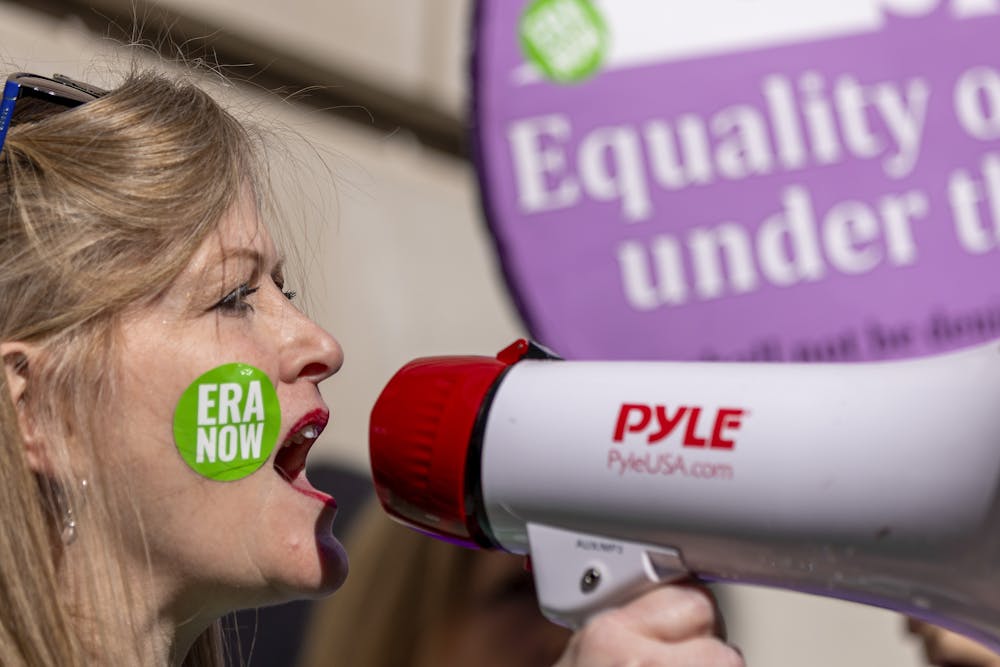
What to read next:

The post Busch Gardens annual summer Bier Fest returns this July with kielbasa and dark beer donuts appeared first on That's So Tampa.