Shared posts

21 Jul 14:03

Attention, Renters: You Don’t Need Access to a Roof to Benefit From Solar Power

by Lydia Geisel

We may earn revenue from the products available on this page and participate in affiliate programs.

Back in 2019, Krystal Persaud and her husband were living in a 400-something-square-foot apartment on Manhattan’s Lower East Side. While the space was small, it had one seriously redeeming quality: really big windows. The natural light was ideal for keeping houseplants happy, but Persaud, who was working as a toy designer at the time, wanted to get more out of her space. She wanted energy. “I had a big aha moment,” says Persaud. “You think that a solar panel has to be outside on a roof at a perfect angle to work. It’s really just not true at all.” After some serious tinkering, she designed a 13-by-10-inch solar panel that can hang in a window via a suction cup hook and, after 10 hours of sunlight, can power up any USB-connected device. 

While there were other portable solar panels on the market at the time Persaud launched her company, Grouphug, most of them are made for camping—and look like it. Persaud guesses that Grouphug’s solar charger likely only saves you $5 to $10 on your utility bill, but she sees it more as an introduction to renewable energy. The panel makes it possible for renters, apartment dwellers, and really anyone on a budget to harness the sun’s power. “It’s a baby step into solar that people can adopt in minutes,” says Persaud. 

Courtesy of Krystal Persaud

When Persaud and her husband moved from the Lower East Side to a railroad-style rental in Brooklyn, she began experimenting with even larger panels. The venture was once again sparked by a personal need: There were zero places to plug in a TV or a charger in the middle of the apartment, so she leaned a 3-by-4-foot panel in a window that could juice up a portable battery that could then power a fan or a laptop. “I was doing a ton of little experiments like that just to see how much power you could get from a window,” she says. 

Grouphug Window Solar Charger

Courtesy of Grouphug

So far, Grouphug hasn’t released any XL versions—first, Persaud hopes to replenish its currently out-of-stock inventory within the next three months. In the meantime, she’s focused on Wildgrid, a platform she cofounded that primarily serves as an educational resource on energy efficiency, electrification, and renewable energy. There are also rebate calculators, product recommendations, and a directory of experts and contractors on the website. “We’re really just trying to show energy efficiency in a new light…that it can be fun and sexy and easy,” says Persaud. 

Courtesy of Grouphug

If you’re hoping to secure a portable solar panel ASAP, Persaud notes she’s also a big fan of BioLite, a company aiming to provide 20 million people with access to clean energy by 2025. And while Goal Zero’s panels are similarly designed for off-the-grid living, Persaud has used its batteries for many of her makeshift apartment setups. 

Hopefully, the next time someone tells you it looks like you got some sun, they’re talking about your fully charged phone battery.

Shop Other Portable Solar Panels

The post Attention, Renters: You Don’t Need Access to a Roof to Benefit From Solar Power appeared first on domino.

14 Jul 17:24

The splayd outdoes the spork as the most dynamic utensil

by Popkin

You've likely heard of a spork before, the funny-looking spoon/fork combo beloved of campers, but have you heard of the splayd? A splayd is a knife, fork, and spoon combined in a single astonishing utensil, invented by a man from Australia named William McArthur in the 1940s.  — Read the rest

12 Jul 19:35

Russia's kidnapping of Ukrainian children is not unique – Putin and others have long used children as political pawns

by Clementine Fujimura, Professor of Anthropology, Area Studies and Russian, United States Naval Academy
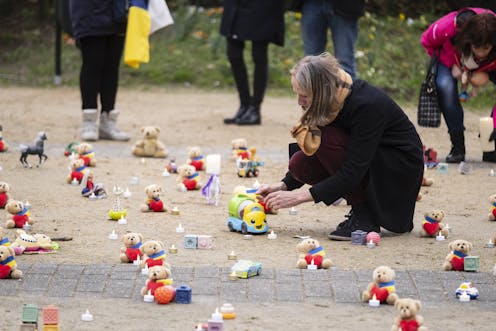
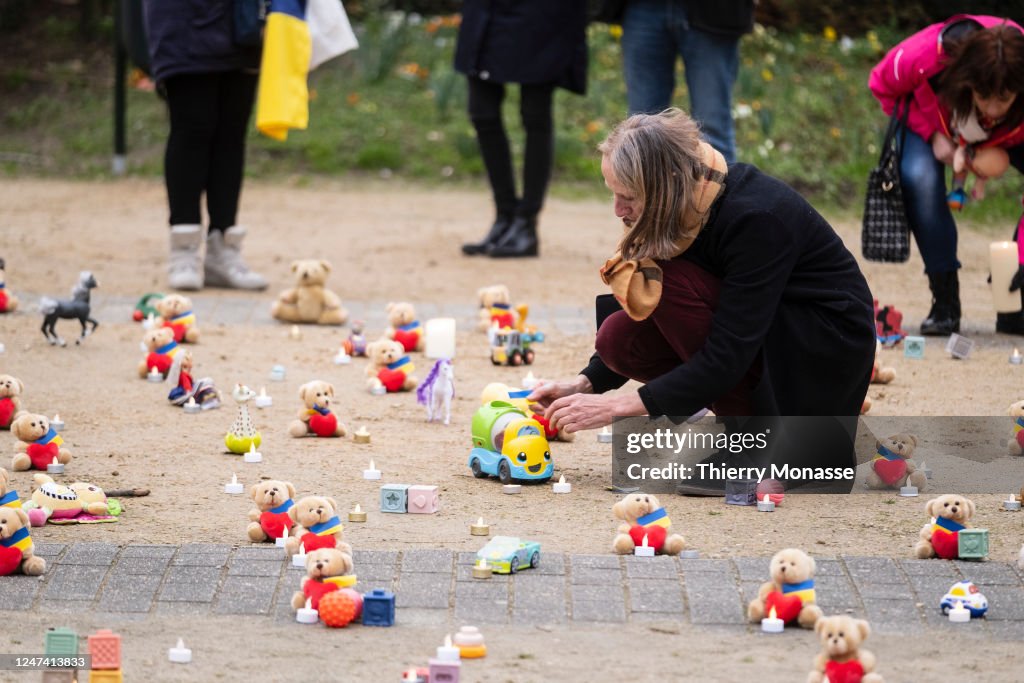
People in Brussels attend a memorial for the Ukrainian children who have been forcibly taken to Russia. hierry Monasse/Getty Images

Since Russia launched a full-scale invasion of Ukraine in February 2022, Russian soldiers have forcibly taken an estimated 16,000 Ukrainian children to Russia. Over 300 children have since returned home, but it is not clear what happened to most of the rest.

The mass abductions led prosecutors at the International Criminal Court to issue arrest warrants in March 2023 for Russian President Vladimir Putin and Russia’s children’s rights commissioner, Maria Lvova-Belova. Moscow counters that the children it has brought to Russia – its estimates are as many as 744,000 Ukrainian children – have been evacuated from conflict zones.

I am an anthropologist who studies marginalized communities, including youth subcultures in Russia and other places, including the United States and parts of Europe.

The kidnapping of Ukrainian children offers a reminder of how Putin and other Russian leaders have historically used children as pawns in international politics.

A Soviet promise to children

I explore the lives of homeless and abandoned Russian children, including kids in orphanages and other similar institutions in Moscow, in my 2005 co-authored book, “Russia’s Abandoned Children: An Intimate Understanding.”

My research included numerous trips to Russian orphanages between 1990 and 2000, as well as time spent living and volunteering in an orphanage and shelter for babies.

It’s helpful to understand that before the Soviet Union collapsed in 1991, the Soviet government presented a myth that all children – including those in institutions – would receive excellent care. The Soviet government promised these children that their futures were promising and that they would receive an education and have help getting a job.

Other than adults who worked in these Soviet orphanages or psychiatric hospitals, no one was allowed to see what went on inside.

The myth of these orphaned children’s perfect childhood calmed citizens’ potential concerns, my research shows.

However, the public began to realize Russian orphans’ plight once the Soviet Union broke apart. Orphans and otherwise abandoned children in orphanages began to escape the institutions when possible. They formed their own version of kinship groups, gathering on city streets and in underground train stations.

I discovered in my research that many abandoned children preferred being homeless to living in orphanages.

This trend of youth vagrancy became a sore spot for the Russian government, as it tried to grow its economy and rebrand itself in the West.

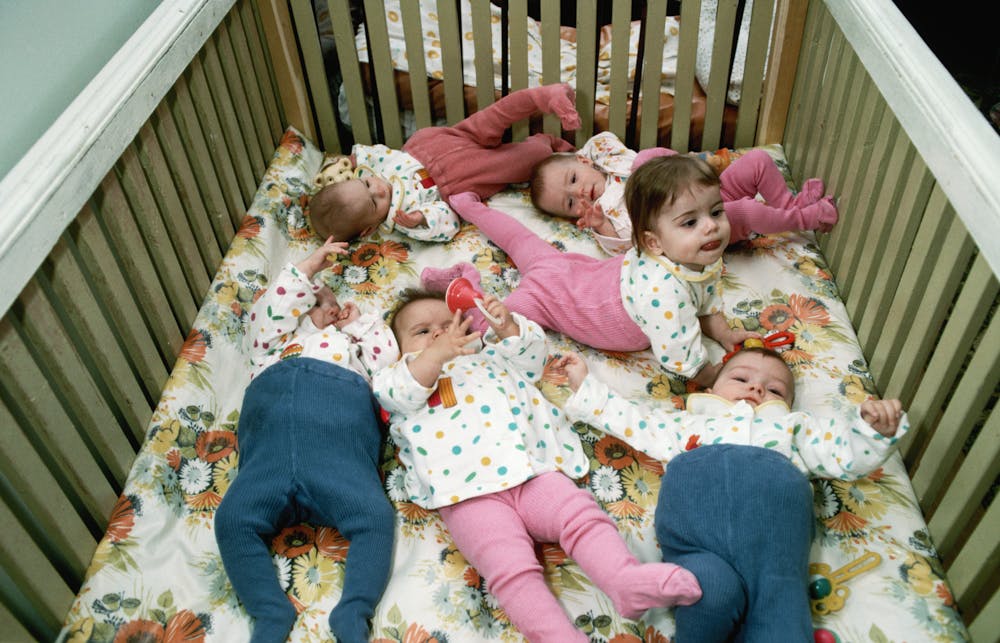
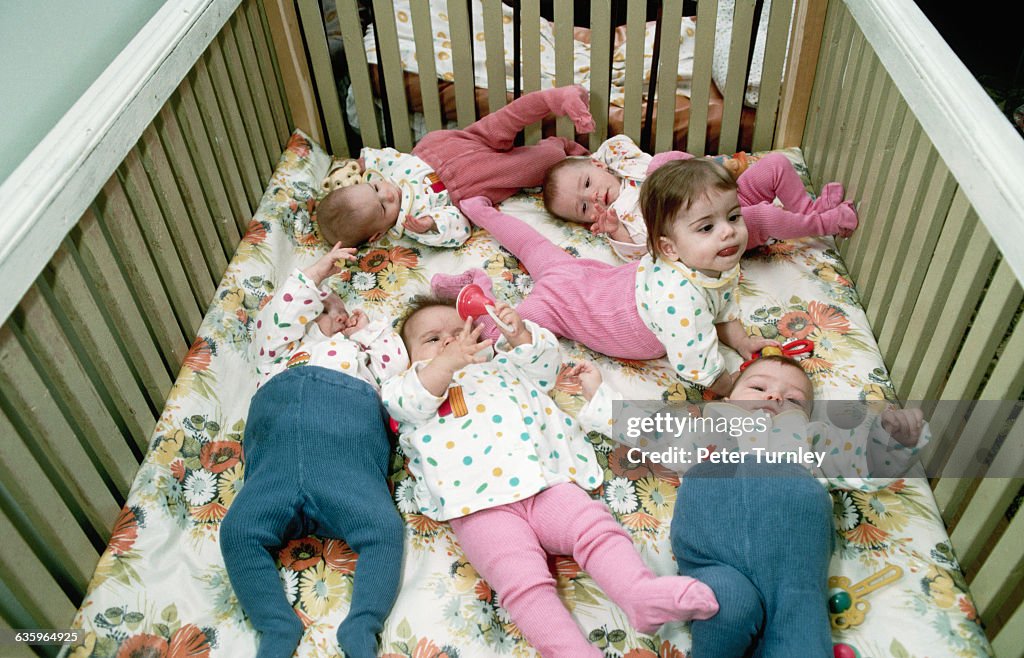
Six infants lie together in a crib, with a flower printed mattress.
Soviet orphans play in a crib in 1991, the year the Soviet Union fell. Peter Turnley/Corbis/VCG via Getty Images

Russia’s struggle to care for kids

Russia’s decision to end adoptions to American families in 2012 offers another example of how the Russian government has used children for nefarious purposes in the past few decades.

The Russian government first opened the doors for international adoption in 1991. Citizens from the U.S. and other Western countries eagerly responded, welcoming the new openness of Russia.

This helped boost Russia’s image in the West as a kinder country than it was during the Cold War. At the time, around 371,700 Russian children were growing up in state institutions. Most of these kids had at least one living parent.

In some cases, government deemed some parents unfit for the job and moved the kids to an institution.

U.S. citizens adopted more than 60,000 Russian orphans from the early 1990s until 2013.

During my time spent with teachers, doctors and children in Russian orphanages and shelters, it was clear that Russia struggled to care for abandoned and otherwise institutionalized children, including those taken from parents.

There were also widespread reports of the children being neglected and mistreated.

In the orphanage I studied, children did not eat fresh fruits and vegetables, and the caretakers often lamented the food’s lack of nutritional value. I was asked to bring vitamins, diaper rash cream and other basic necessities.

The fact that the Russian government could not handle its orphans was a source of embarrassment. Putin, who served as president from 2000 through 2008 and again starting in 2012, saw the need to change the narrative of the poor Russian orphan, if only for the sake of the country’s public image.

‘It’s hard to believe’

In 2008, a Russian toddler born with the name Dima Yakovlev died of heatstroke while left unattended in his adoptive father’s parked car in the Washington, D.C., area.

This news made international headlines. Some Russian officials pointed out the lack of oversight and abuse that adopted Russian children experienced in the U.S. This narrative helped weaken the U.S. in the eyes of Russian citizens, thereby strengthening the image of the Russian government.

“When we give our children to the West and they die, for some reason the West always tells us it was just an accident,” Russian politician Tatyana Yakovleva reportedly said in 2009. “It’s hard to believe.”

This case and other news stories about a few U.S. adoptive families treating Russian children poorly coincided with another political controversy.

Russian police arrested attorney Sergei Magnitsky on questionable grounds. Magnitsky had uncovered a tax fraud worth US$230 million. Magnitsky died while in custody in 2009, before he could stand trial.

In 2012, the U.S. Congress approved new legislation, called the Magnitsky Act, which identifies and imposes sanctions on Russian officials who are accused of human rights violations.

A halt to adoptions

In 2012, Putin signed the law banning international adoptions to the U.S.

Putin’s law, which went into effect in early 2013, halted thousands of adoptions already in progress with American families.

U.S. scholars and journalists have argued that Putin’s adoption ban was a direct retaliation to the Magnitsky Act and was not about Putin’s concern for Russian orphans. Putin promised to improve the Russian child welfare system in 2013. Some outside analysis by groups like the World Bank have documented positive changes at Russian institutions for children, such as more funding. But there remain challenges – including the fact that Russia has a much higher rate of institutionalized children than other middle- to high-income countries.

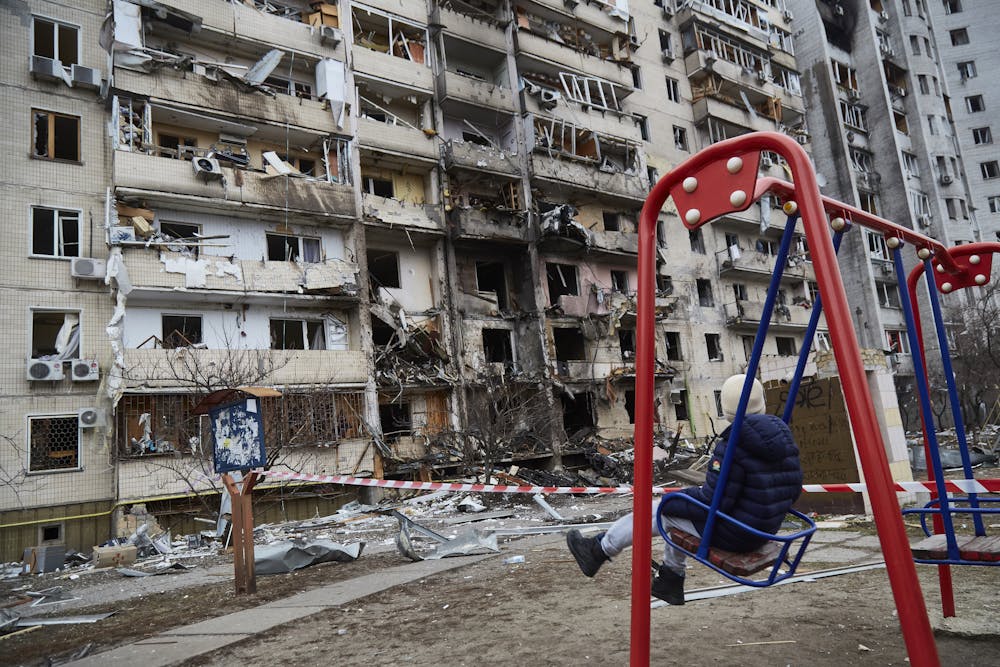
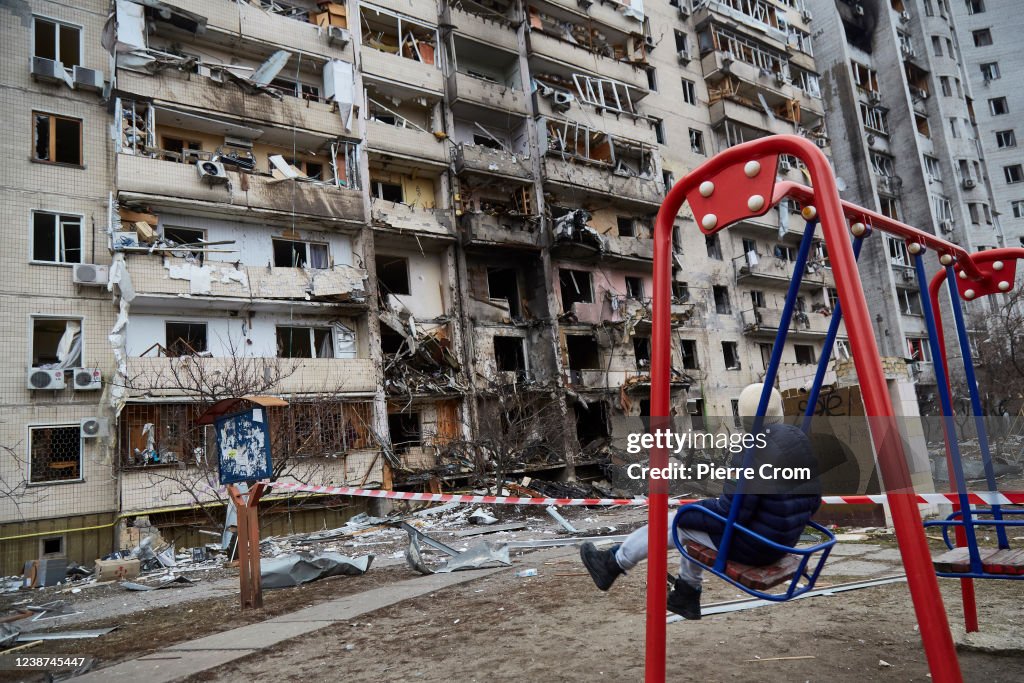
A child swings in front of a destroyed, burned looking building.
While some abducted Ukrainian children have come home to their families, most remain unaccounted for. Pierre Crom/Getty Images

A similar playbook

In the face of evolving battlefield failures in Ukraine, Putin has pivoted to a familiar playbook of using and abusing children, continuing to call for the “evacuation” of Ukrainian children, both from Ukrainian orphanages and from their families. These children are being moved to Russian orphanages and camps, where they learn how to be Russian.

In order to become citizens of Russia, these children have been forced to abandon their Ukrainian heritage, both physically and mentally, and to get a new education in Russian propaganda and history.

Russian citizens, in turn, are once again presented with the myth that children in Ukraine are being saved from the war and offered a better life.

But for Ukrainian families and orphanage staff involved, these abductions amount to a form of torture, with parents and caretakers clamoring to find their children and bring them home.

The Conversation

The USNA is not responsible for the content found in this article. In addition, the content of this article does not reflect the opinions, standards, policy, or endorsement of the Naval Academy or the United States Government.

12 Jul 19:34

Police treatment in black and white – report on Minneapolis policing is the latest reminder of systemic racial disparities

by Rashad Shabazz, Associate Professor at the School of Social Transformation, Arizona State University
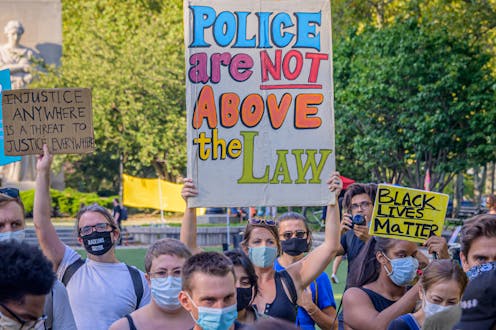
People in the Brooklyn borough of New York City protest police violence against Black women on Sept. 5, 2020. Erik McGregor/LightRocket via Getty Images

The latest reminder that police officers around the country routinely deny Black people their constitutional rights comes from the Justice Department. This time, it’s about Minneapolis, the site of a police officer’s video-recorded murder of resident George Floyd.

More than three years after Floyd’s brutal death and the global protest movement that sprang from it, a June 2023 Justice Department report found that Minneapolis police use excessive force, including unjustified deadly force in their interactions with civilians, and discriminate against Black people.

The report echoes Justice Department findings, released in March 2023, about police misconduct in Louisville, Kentucky, where officers killed Breonna Taylor during an unlawful search of her home in March 2020, and about police in Ferguson, Missouri, in a report released in March 2015. An officer shot and killed Michael Brown, who was unarmed, during a 2014 encounter.

The Justice Department found that Minneapolis police also discriminate against Native Americans; routinely use excessive force, including “unreasonable use of tasers”; violate the rights of citizens exercising their First Amendment right to free speech; participate in racially discriminatory stops against Black people and Native Americans; and discriminate against people with serious mental illnesses.

A uniformed, white police officer kneels on the neck of a Black man as he lies on the ground.
A screenshot of a video shows former Minneapolis Police Officer Derek Chauvin kneeling on George Floyd’s neck as Floyd cries out in pain, stating that he can’t breathe. 23 ABC News - KERO

As a geographer and scholar of African American studies, I’ve written about racist policing for The Conversation before. So, I struggled to find a new way to examine the topic this time around. And that led me to the enduring question: Why is racial discrimination by police so common in the United States?

Policing in black and white

Justice Department reports, complaints from citizens and dozens of academic studies painfully point to racial discrimination by police as a common practice.

The evidence is overwhelming. Countless studies have shown that Black people are routinely stopped by police and live in racially segregated communities that police heavily monitor. These conditions have led to Black people being overrepresented in arrests for violent crime that doesn’t involve a fatality.

Police body camera footage shows officers speak disrespectfully to Black people during traffic stops; about four of every 10 Black people say police have unfairly stopped them; and Black people are more than three times as likely to be killed by police during interactions. These experiences explain why Black people have negative views of police.

For white Americans, however, their feelings and interactions with the police are more positive. For instance, only a quarter of white people surveyed report being in situations where they believe police were suspicious of them. Meanwhile, 78% feel police protect people from crime; 75% say police use the correct amount of force and that they treat people of color and white people equally; and 70% of white Americans feel police are held accountable for their misconduct.

These experiences explain why white Americans are more likely to give police high marks – 75% – for job performance.

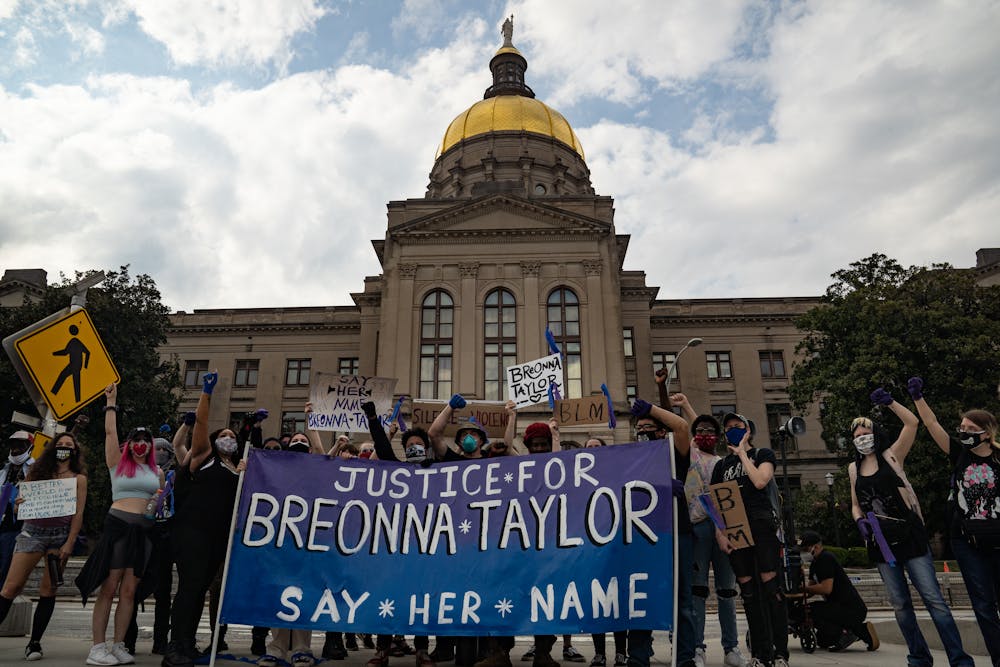
A group of people pose standing behind a large
Demonstrators pose in front of the Georgia Capitol building on March 13, 2021, during a march commemorating the one-year anniversary of the police killing of Breonna Taylor in Louisville, Ky. Megan Varner/Getty Images

These differences influence how race shapes people’s interactions with police. African Americans have negative views of police because of past and personal experience. Many white people have more positive views shaped by living on their side of the color line.

Experiences shape people’s views

The fact that Black and white Americans have different views on the police are not accidents.

This reality is built on a long history of police targeting people of color. Indeed, policing in the United States was established on the practice of controlling specific populations. In the 19th century, for example, policing in the South was designed to monitor the movement of enslaved Black people. Some of the first police forces in the nation were developed to keep the enslaved from escaping and to recapture them if they did. They were called slave patrols, and by law, some states required white men to serve as slave patrollers.

Similar histories exist with the Irish in the Northeast before they were considered white, as well as with Mexicans and Mexican Americans in the Southwest.

Policing and controlling the movements of specific nonwhite groups have often gone hand in hand. This powerful cocktail of racism and policing has enabled brutal forms of violence against people of color.

In each case, police discriminated against Black people in the South, Mexicans and Mexican Americans in the Southwest and the Irish in the North, while treating white Southerners, white Southwesterners and the middle and upper classes in the North differently. The parallels to this moment are not an accident. And neither is police misconduct.

Policing the way it was intended

The Justice Department’s report will place the practices of the Minneapolis Police Department under public scrutiny. And it will be part of the mountain of studies, complaints and federal reports that show widespread racial discrimination.
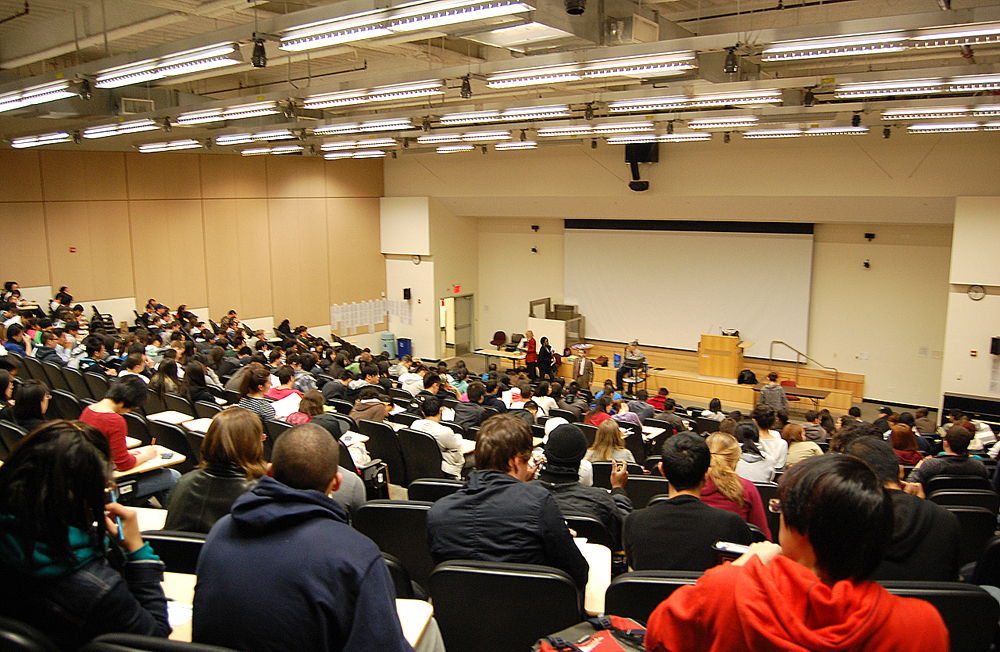
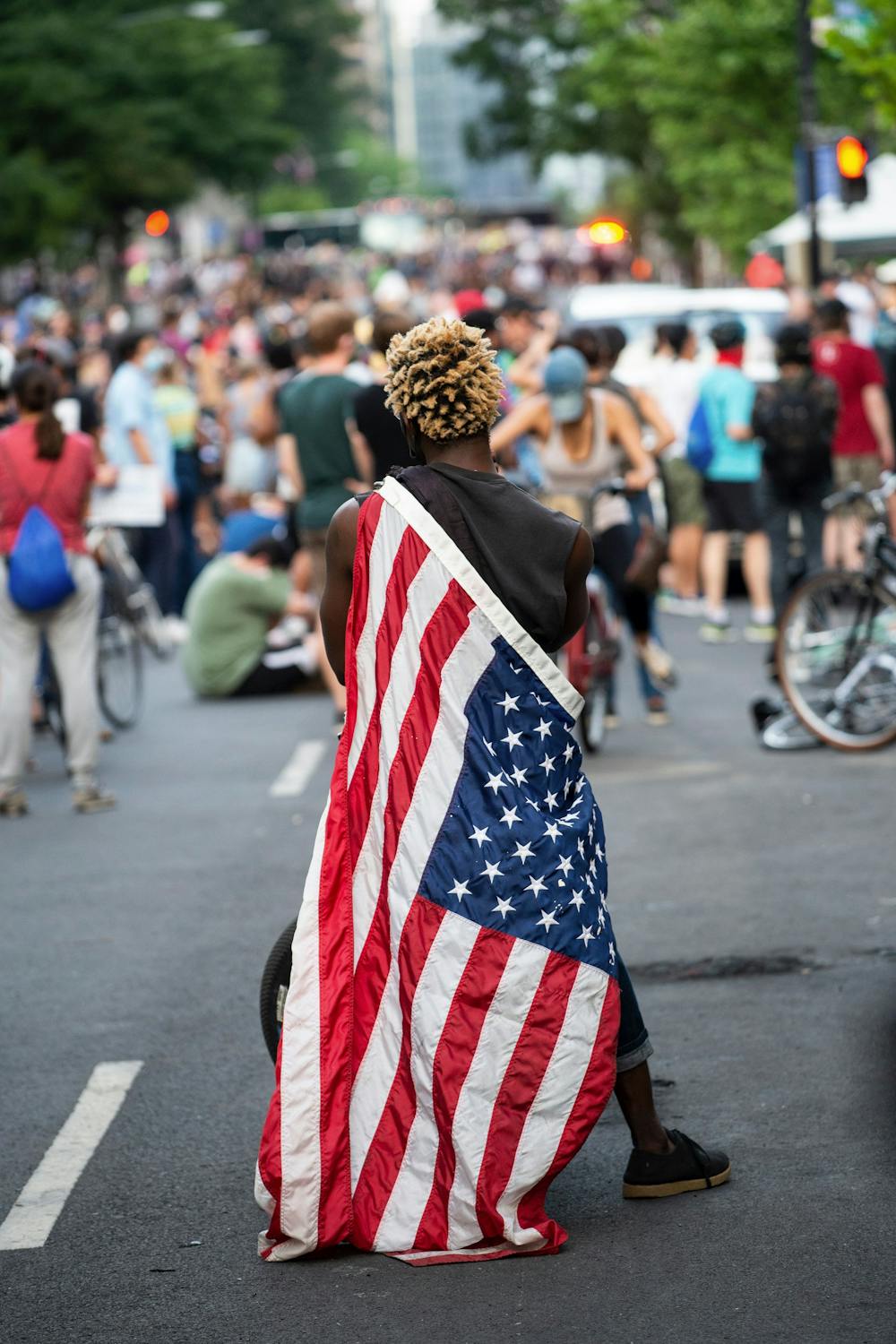
A man draped in the US flag, with his back to the camera, sits on a motorized bicycle. A crowd of people stand yards away from him with their backs to the camera as well.
A man draped in the U.S. flag sits on a motorized bicycle near the White House during June 3, 2020, protests over the death of George Floyd. Roberto Schmidt/AFP via Getty Images

That said, with the long history of how policing began and how targeting groups was part of its foundation, along with the studies that document it, what’s apparent is that police misconduct is not an aberration. Despite claims of serving and protecting the public, that is simply not what the police have always done.
It’s no wonder, then, that so many people believe racial discrimination is endemic to policing and is simply part of the way it works. And while this most recent Justice Department report shows that, it also makes the case that Minneapolis police are working the way they were intended.

If this is the case, then Black people’s denial of basic constitutional guarantees by law enforcement, enshrined in our nation’s founding documents, is, to quote the abolitionist Fredrick Douglass, a “shameless hypocrisy.”

The Conversation

Rashad Shabazz does not work for, consult, own shares in or receive funding from any company or organization that would benefit from this article, and has disclosed no relevant affiliations beyond their academic appointment.

12 Jul 19:22

Affirmative action lasted over 50 years: 3 essential reads explaining how it ended

by Howard Manly, Race + Equity Editor, The Conversation US
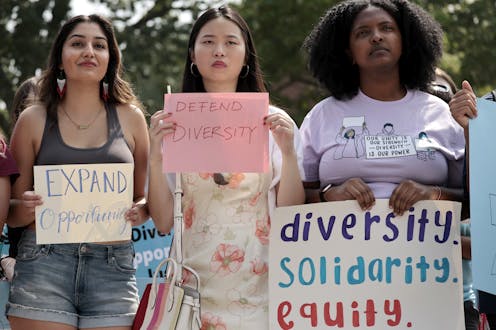
Harvard students protesting on July 1, 2023, after the Supreme Court's ruling against affirmative action. Craig F. Walker/The Boston Globe via Getty Images
Ever since U.S. President Lyndon Johnson enacted affirmative action in 1965, white conservatives have challenged the use of race in college admissions.

Their arguments against such policies are typically based on the use of the equal protection clause of the U.S. Constitution’s 14th Amendment, which prohibits discrimination against American citizens on the basis of their race, religion or sexuality.

According to this conservative thinking, race-based solutions are discriminatory by their very definition and, as such, are unconstitutional.

The question, then, is how does an institution try to offer a modern-day remedy to atone for long-standing patterns of racial discrimination?

Over the years, The Conversation U.S. has published numerous stories exploring affirmative action – and what diversity on college campuses means with race-neutral admission policies. Here is a selection from our archive.

1. An ambitious start to level the playing field

During his 1965 commencement address at Howard University, Johnson explained how he intended to make right the wrongs of the past.

“Freedom is not enough,” he declared in his speech, “To Fulfill These Rights.” “You do not take a person who, for years, has been hobbled by chains and liberate him, bring him up to the starting line of a race and then say, ‘you are free to compete with all the others,’ and still justly believe that you have been completely fair.”

One of Johnson’s solutions, as affirmative action scholar Travis Knoll pointed out, was affirmative action.

Unlike the conservative majority on today’s Supreme Court, “Johnson understood that the U.S. could not serve as a moral leader around the world if it did not acknowledge its past of racial injustices and try to make amends,” Knoll contended.


Read more: Supreme Court is poised to dismantle an integral part of LBJ's Great Society – affirmative action


2. Court’s mixed history on affirmative action

The battle over affirmative action heated up during the 1970s when a legal challenge reached the U.S. Supreme Court in Regents of the University of California v. Bakke.

In that 1978 case, Associate Justice Lewis Powell wrote that while race can still be one of several factors in the admissions process, a separate admissions process for minority students was unconstitutional.

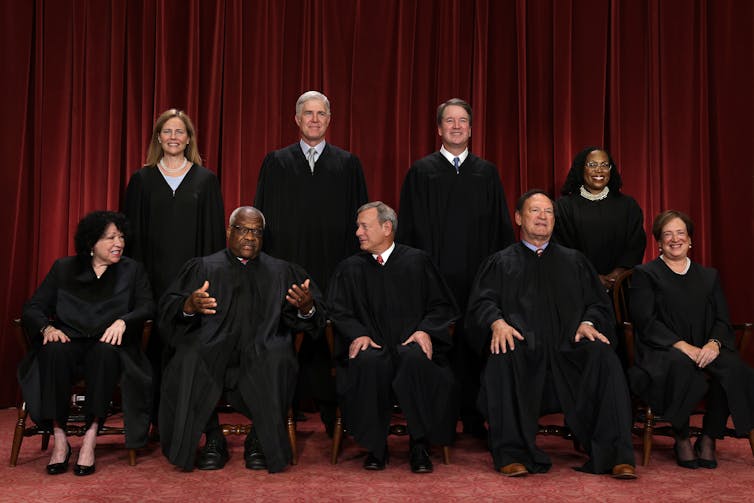
Five men and four women are wearing black robes as they pose for a portrait.
Current members of the Supreme Court, from left in front row: Sonia Sotomayor, Clarence Thomas, Chief Justice John Roberts, Samuel Alito and Elena Kagan; and from left in back row: Amy Coney Barrett, Neil Gorsuch, Brett Kavanaugh and Ketanji Brown Jackson. Alex Wong/Getty Images
Since then, the Supreme Court has issued different rulings on whether race could be used in college admissions.

As University of Pennsylvania race and equity legal scholar Kenneth Shropshire wrote, the court had subtly established an affirmative action expiration date in its 2003 Grutter v. Bollinger decision.

In that case, Associate Justice Sandra Day O’Connor wrote that the “Court expects that 25 years from now, the use of racial preferences will no longer be necessary to further the interest approved today.”

But Shropshire explained that that O'Connor’s deadline was one of desire and not reality.

“The vestiges of past discrimination and the unfortunate existence of ongoing discrimination continue,” Shropshire wrote. “No deadline has made these wrongs and their impact disappear.”


Read more: A 2003 Supreme Court decision upholding affirmative action planted the seeds of its overturning, as justices then and now thought racism an easily solved problem


3. Selective colleges will become less diverse

Natasha Warikoo, a sociology professor at Tufts University and author of “Is Affirmative Action Fair?: The Myth of Equity in College Admissions,” shared insights on how the racial and ethnic makeup of student bodies at selective colleges and universities will change now that the Supreme Court has decided to outlaw affirmative action.

As she pointed out, nine states already have bans on affirmative action, and studies of college enrollment in those states suggest that enrollment of Black, Hispanic and Native American undergraduate students will decline in the long term.

“Ending affirmative action will make it harder to increase the percentage of professionals and leaders from minority backgrounds,” she explained. “This is because, as research has shown, affirmative action has increased the number of Black college graduates and, in turn, increased the number of Black professionals with advanced degrees.”


Read more: Affirmative action bans make selective colleges less diverse – a national ban will do the same


Editor’s note: This story is a roundup of articles from The Conversation’s archives.

The Conversation
12 Jul 19:05

Streaming services are removing original TV and films. What this means for your favourite show – and our cultural heritage

by Marc C-Scott, Senior lecturer in Screen Media, Victoria University
Disney

Streaming services have dramatically transformed the media landscape, allowing consumers unparalleled access to vast libraries of content. However the streaming landscape has become far more crowded in the past few years.

This increase in competition has created many challenges for streaming services and resulted in many services recently reporting losses of both subscribers and profits.

As part of recent challenges, multiple services have removed TV and film from their libraries – in many cases, meaning they are gone forever, inaccessible to any fan.

This has sparked debates and raised questions about consumers’ access to content and the future positioning of streaming within the broader media landscape.

Content removal: for the consumer experience or just a tax write-off?

One of the key changes we have seen by streaming services is the removal of content from their libraries. While changes to a streaming service’s content library is not new, it has become a bigger talking point recently in the context of profit loses.

Previously, content has been usually removed from streaming services due to licensing agreements. This removal means that the particular television series and films are no longer available to view on that streaming service, but may reemerge on another streaming service as the licensing shifts.

But the more recent content removal discussion raises questions associated with streaming services – and their overarching corporations – wanting to save money. This can be done through the removal of content, which the corporation can write off as losses.

This not only impacts consumer access, but also impacts actors, writers, directors and other creatives involved in the production. This is due to the fact that if the profits are less, then the residual payments (fees paid when TV shows and films are broadcast) made to the creatives involved in the production are also lowered.

The removal of content is not particular to any streaming service. Hulu wiped shows such as Alaska Daily and The Company You Keep from its service after they were cancelled following a single season.

Programs that were removed after being cancelled on Disney+ have included Big Shot, Diary of a Future President, Just Beyond, The Mighty Ducks: Game Changers, The Mysterious Benedict Society, The World According to Jeff Goldblum, Turner & Hooch and Willow.

What needs to be considered with many of these is that they are “originals”, meaning they were created by Disney for Disney. The removal of original content from streaming services, in most instances, means they will not be accessible to viewers anywhere.

As part of the removal of programs, Disney recently reported it would take a US$1.5 billion write-down from the axed content. More content is expected to disappear in upcoming quarters, which could also include original content.

Has the streaming bubble burst?

In late 2022, many streaming services reported both subscriber and financial losses. For Netflix, this was the first time it had reported a loss of subscribers.

It was reported Netflix lost 200,000 subscribers worldwide, the complete opposite of Wall Street’s expectation that the service would add 2.5 million subscribers. This is despite still making a profit in that period.

But Netflix was not alone in the shedding of subscribers. Disney+ lost 2.4 million subscribers in the final quarter of 2022. This was only exacerbated by the loss of 3.8 million subscribers to its Disney+ Hotstar streaming services (the Disney+ service offered in India and parts of Southeast Asia).

Warner Bros Discovery also reported a financial loss of US$217 million across its streaming services.


Read more: Netflix and other streaming giants pay to get branded buttons on your remote control. Local TV services can’t afford to keep up


The impact on viewers and creators

The removal of TV and films from streaming penalises creators financially, but it also removes their means to use past work “as a calling card to help land future gigs”.

Eliza Skinner, head writer for Earth to Ned, which was removed from Disney+, says they were not aware of the decision until seeing it reported in an article. Skinner also noting that she doesn’t own a physical copy of the show, making it even more difficult to use the program for future work.

There appears to be a recent shift in content licensing across streaming services. HBO has just signed a deal with Netflix, that has seen Issa Rae’s Insecure launch on Netflix. Band of Brothers, The Pacific, Six Feet Under and Ballers will also be available on Netflix as part of the deal.

This is a significant shift in the previous approach by streaming services to create “originals” as a way to increase subscriptions. This new approach, could result in content being available across multiple streaming services and/or other subscription television.

Too many chefs in the production kitchen

The Independent Film & TV Alliance says there are a myriad of third-party contractual relationships and licenses which need to be negotiated and put in place when it comes to streaming rights.

The alliance also notes that “distributors are licensed exclusively for their country, language and release platform”. This results in major national distributors taking all rights for their country. This can result in content being available in countries at different times and across varying platforms.

For television series, licensing and agreements can become extremely complicated when multiple studios are involved across multiple seasons.

Arrested Development is a prime example of the interwoven complexities. Disney’s 20th Television unit owned the underlying rights and produced seasons one to three, with Netflix producing the last two seasons. This resulted in the first three seasons streaming on Disney’s Hulu service, while Netlfix had all five on its service.

Netflix announced this year that it would be removing all five seasons of the TV series due to licensing issues.

This is further complicated if you look at this from an Australian perspective. When season five premiered internationally on Netflix, it premiered on Foxtel in Australia. This was due to a “first run” agreement Foxtel had signed many years prior to Netflix’s involvement.

Will there be resurgence of physical media?

Thankfully if you are an Arrested Development fan, you can purchase DVDs for seasons one to four in Australia. That is, if you can find a store that sells physical media – Kmart removed the sale of physical media more than five years ago.

But for much of the new content being produced, physical media are not available. This means consumers will not be able to access the content once it has been removed from a streaming service.

But for all the content only going to streaming platforms, there must be a plan associated with archiving it and allowing consumer access. Already much of our film and television programs have been lost in the past – for example prior to 1947 there was no way to properly record a live television broadcast.

Even when they are recorded, this technology will only last for a period of time, something the National Film and Sound Archive knows only too well.

There is a perception that digital lasts forever and therefore is easily archived. But are we seeing history repeat itself? Will original streaming content follow a similar path to old film and television content and be lost forever?

The Conversation

Marc C-Scott does not work for, consult, own shares in or receive funding from any company or organisation that would benefit from this article, and has disclosed no relevant affiliations beyond their academic appointment.

12 Jul 18:42

Biophobia: search trends reveal a growing fear of nature

by Ricardo Correia, Assistant professor, University of Helsinki

“I can’t even watch a snake on TV without feeling sick to my stomach.”

“Swimming? Forget about it… I’m too afraid of sharks!”

“I can’t even be in the same room as a spider, it freaks me out.”

Fear, disgust, and other phobic reactions are not uncommon when it comes to our interactions with the natural world – who doesn’t know someone who is afraid of spiders or snakes? Indeed, fear of spiders (arachnophobia) or of snakes (ophidiophobia) are thought to be among the most common “biophobias”.

The latter is defined by the American Psychological Association as “the fear toward certain species and general aversion to nature that creates an urge to affiliate with technology and other human artifacts, interests, and constructions rather than with animals, landscapes, and other elements of the natural world”.

There are evolutionary reasons for this behaviour: in our ancestral past, nature was a potential source of danger, and phobic reactions toward certain elements of the living world may have helped early humans to avoid infectious diseases or harmful encounters with dangerous organisms.

Drivers of contemporary fear of nature

But what about nowadays? It is estimated that more than half of the world’s population lives in urbanised areas far removed from wildlife, and so we might expect a reduction in the prevalence of such fears. However, people continue to exhibit strong phobic responses toward organisms that do not live in our immediate vicinity even if they pose no tangible threats. This is worrying because it can lead to excessive anxiety and avoidance of interactions with nature, preventing affected individuals from experiencing the many physical and mental benefits that nature can provide.

Researchers interested in this phenomenon have therefore started to explore the reasons behind the sustained prevalence of nature phobias in modern societies. One hypothesis that has been put forward for this phenomenon points toward living in urbanised areas as a key driver of fear of nature in contemporary societies. The same conditions that protect us from potentially hazardous natural encounters also imply reduced opportunities to interact with nature. The absence of regular nature experiences, and the contextual information they provide, may cause people to wrongly evaluate the potential dangers associated with nature and lead to unfounded fears or disgust. Contemporary societies may suffer from a vicious cycle of biophobia, whereby nature disconnection leads to nature phobias and vice versa.

In this context, some researchers have suggested that biophobias may be increasingly prevalent across in modern societies but the extent to which this is true remains difficult to assess. Data on the prevalence of nature phobias is scarce, and is usually collected at specific points in time through targeted surveys, posing a challenge to assess how it has changed over time.

In a recent study, we approached this question through a different angle, using the power of the Internet. We reasoned that people suffering from nature-related phobias may search for online information about their condition and how to cope with it. Using worldwide data from Internet searches, we assessed the relative volume of Internet searches for 25 common biophobias between 2004 and 2022.

How prevalent are biophobias nowadays?

Our study suggests the most common biophobias include fear of spiders, microbes and germs (mysophobia), and parasites (parasitophobia). These results corroborate other reports that fear of spiders is among the most common nature-related phobias.

We also found a steady increase in online search volume for biophobias between 2004 and 2022, albeit with marked differences in trends for specific phobias. Interest in the some of the most common biophobias, such as fear of snakes (ophidiophobia) or germs, is also increasing, which suggests they are becoming more prevalent. For instance, our results show that searches for fear of germs peaked around the onset of the Covid-19 pandemic, providing additional evidence of the psychological strains caused by the pandemic. In contrast, only a few biophobias showed negative or stable trends. These trends were calculated based on the proportion of searches for biophobias in relation to the total number searches over the years, and thus cannot be simply explained by increasing Internet use.

Temporal trends of relative search interest for each of the 25 specific biophobias assessed in the study.

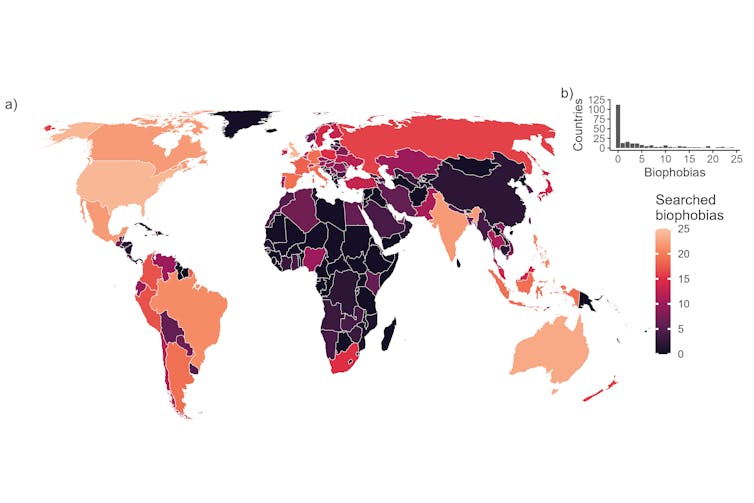
Additionally, we found evidence that at the country level, interest in a larger number of nature-related phobias related to the percentage of the population living in urbanised environments, the population’s trend (whether it is growing or stable) and the number of venomous species found in the country. Specifically, interest in more nature-related phobias is concentrated in countries with large, stable and long-established urban populations such as Australia, Canada, Germany, the United States, or the United Kingdom. It is possible that a disconnection with nature has had more time to crystallise in these countries where some people have only experienced urban living during their lifetime. In contrast, many countries with smaller but rapidly growing urban populations, such as many countries in Africa and the Middle East, expressed less online interest in nature-related phobias.

Map (a) and distribution (b) of the number of biophobias with recorded search interest for each country.

Other possible explanations for our results include aspects related to differences in Internet access between countries or the motivations behind Internet searches for biophobias. For example, populations in urban areas also tend to have better Internet access and this could explain the lower prevalence of searches for biophobias in rural areas. It could also be that fear toward nature may be seen as a useful response in more rural areas and thus not something that people would search for ways to cope with. We are also aware that search engines other than Google dominate the market in countries such as China and Russia, which could also affect our results.

Nevertheless, our findings support the idea that disconnection from nature is growing in many modern societies due to urban living and is having an increasing cost on human well-being by promoting unfounded fears toward other life forms. As human societies become more urbanised, we risk losing our connection to the natural world, and developing more negative perceptions of and interactions with nature. It is time to reevaluate our relationship with nature and develop ways to bridge the gap, rather than widen it. The future of our well-being may very well depend on it.

The Conversation

Ricardo A. Correia has received funding from the Academy of Finland (grant #348352) and the KONE Foundation (grant #202101976).

Stefano Mammola est membre de National Research Council (Italy).

10 Jul 18:49

Sky to dim as enormous Saharan dust cloud heads to U.S.

by Rusty Blazenhoff

A massive dust cloud, coming from Africa's Sahara Desert, is now making its way across the Atlantic Ocean towards the southeastern United States and the Caribbean. This weekend, the dust wave, although not expected to reach the intensity of the colossal 'Godzilla dust cloud' of June 2020, is still expected to bring poor air quality and a murky sky. — Read the rest

10 Jul 18:41

Sarah Silverman and other artists sue over AI tools trained on their work

by Rob Beschizza

Artists are suing OpenAI, accusing it of violating copyright law by training their content-generating tools on their work without permission.

The lawsuits, both filed in the Northern District Court of San Francisco, say ChatGPT generates accurate summaries of their books and highlighted this as evidence for the software being trained on their work.

Read the rest
07 Jul 19:28

Original 'Wilhelm Scream' found in discarded tapes

by Rusty Blazenhoff

The Wilhelm Scream, a classic sound effect, has been in hundreds of movies, from Raiders of the Lost Ark to Star Wars to Toy Story. It's a sort of audio signature, a hidden gem in plain hearing, that has become a beloved inside joke in the industry. — Read the rest

07 Jul 19:25

Malaria back in Florida and Texas

by Rob Beschizza

Seven cases of Malaria, America's first in decades, are reported in Florida and Texas. Officials in Sarasota County, Florida, and the Texas Department of Health confirm the transmission happened locally. The Centers for Disease Control has issued a nationwide alert for the disease. — Read the rest

07 Jul 19:21

This 1998 Octavia Butler novel predicted a Christofacist United States with the slogan "Make America Great Again"

by Mark Frauenfelder

Parable of the Talents, a novel by Octavia E. Butler, published in 1998, portrays a dystopian United States under the control of Christian fundamentalists. The group, known as "Christian America," is led by President Andrew Steele Jarret, whose slogan is "Make America Great Again." — Read the rest

07 Jul 19:19

New disinformation series promotes terrain theory pseudoscience

by Jennifer Sandlin
Image of COVID-19 coronavirus

I sign up for far-right, MAGA, and conspiritualist (conspiracy + spirituality) groups and listservs, as part of my research, so I'm always getting interesting/disturbing emails, like the one I got today from "Disinformation Dozen" darling Kelly Brogan, an MD turned COVID denier.   — Read the rest

07 Jul 19:14

July 4, 2023

by Judy G. Russell

IN CONGRESS, July 4, 1776.

The unanimous Declaration of the thirteen United States of America,

WHEN in the Course of human events, it becomes necessary for one people to dissolve the political bands which have connected them with another, and to assume among the powers of the earth, the separate and equal station to which the Laws of Nature and of Nature’s God entitle them, a decent respect to the opinions of mankind requires that they should declare the causes which impel them to the separation.

WE hold these truths to be self-evident, that all men are created equal, that they are endowed by their Creator with certain unalienable Rights, that among these are Life, Liberty and the pursuit of Happiness.–That to secure these rights, Governments are instituted among Men, deriving their just powers from the consent of the governed, –That whenever any Form of Government becomes destructive of these ends, it is the Right of the People to alter or to abolish it, and to institute new Government, laying its foundation on such principles and organizing its powers in such form, as to them shall seem most likely to effect their Safety and Happiness. Prudence, indeed, will dictate that Governments long established should not be changed for light and transient causes; and accordingly all experience hath shewn, that mankind are more disposed to suffer, while evils are sufferable, than to right themselves by abolishing the forms to which they are accustomed. But when a long train of abuses and usurpations, pursuing invariably the same Object evinces a design to reduce them under absolute Despotism, it is their right, it is their duty, to throw off such Government, and to provide new Guards for their future security.–Such has been the patient sufferance of these Colonies; and such is now the necessity which constrains them to alter their former Systems of Government. The history of the present King of Great Britain is a history of repeated injuries and usurpations, all having in direct object the establishment of an absolute Tyranny over these States. To prove this, let Facts be submitted to a candid world.

HE has refused his Assent to Laws, the most wholesome and necessary for the public good.

HE has forbidden his Governors to pass Laws of immediate and pressing importance, unless suspended in their operation till his Assent should be obtained; and when so suspended, he has utterly neglected to attend to them.

HE has refused to pass other Laws for the accommodation of large districts of people, unless those people would relinquish the right of Representation in the Legislature, a right inestimable to them and formidable to tyrants only.

HE has called together legislative bodies at places unusual, uncomfortable, and distant from the depository of their public Records, for the sole purpose of fatiguing them into compliance with his measures.

HE has dissolved Representative Houses repeatedly, for opposing with manly firmness his invasions on the rights of the people.

HE has refused for a long time, after such dissolutions, to cause others to be elected; whereby the Legislative powers, incapable of Annihilation, have returned to the People at large for their exercise; the State remaining in the mean time exposed to all the dangers of invasion from without, and convulsions within.

HE has endeavoured to prevent the population of these States; for that purpose obstructing the Laws for Naturalization of Foreigners; refusing to pass others to encourage their migrations hither, and raising the conditions of new Appropriations of Lands.

HE has obstructed the Administration of Justice, by refusing his Assent to Laws for establishing Judiciary powers.

HE has made Judges dependent on his Will alone, for the tenure of their offices, and the amount and payment of their salaries.

HE has erected a multitude of New Offices, and sent hither swarms of Officers to harrass our people, and eat out their substance.

HE has kept among us, in times of peace, Standing Armies without the Consent of our legislatures.

HE has affected to render the Military independent of and superior to the Civil power.

He has combined with others to subject us to a jurisdiction foreign to our constitution, and unacknowledged by our laws; giving his Assent to their Acts of pretended Legislation:

FOR Quartering large bodies of armed troops among us:

FOR protecting them, by a mock Trial, from punishment for any Murders which they should commit on the Inhabitants of these States:

FOR cutting off our Trade with all parts of the world:

FOR imposing Taxes on us without our Consent:

FOR depriving us in many cases, of the benefits of Trial by Jury:

FOR transporting us beyond Seas to be tried for pretended offences:

FOR abolishing the free System of English Laws in a neighbouring Province, establishing therein an Arbitrary government, and enlarging its Boundaries so as to render it at once an example and fit instrument for introducing the same absolute rule into these Colonies:

FOR taking away our Charters, abolishing our most valuable Laws, and altering fundamentally the Forms of our Governments:

FOR suspending our own Legislatures, and declaring themselves invested with power to legislate for us in all cases whatsoever.

HE has abdicated Government here, by declaring us out of his Protection and waging War against us.

HE has plundered our seas, ravaged our Coasts, burnt our towns, and destroyed the lives of our people.

HE is at this time transporting large Armies of foreign Mercenaries to compleat the works of death, desolation and tyranny, already begun with circumstances of Cruelty & perfidy scarcely paralleled in the most barbarous ages, and totally unworthy the Head of a civilized nation.

HE has constrained our fellow Citizens taken Captive on the high Seas to bear Arms against their Country, to become the executioners of their friends and Brethren, or to fall themselves by their Hands.

HE has excited domestic insurrections amongst us, and has endeavoured to bring on the inhabitants of our frontiers, the merciless Indian Savages, whose known rule of warfare, is an undistinguished destruction of all ages, sexes and conditions.

IN every stage of these Oppressions We have Petitioned for Redress in the most humble terms: Our repeated Petitions have been answered only by repeated injury. A Prince whose character is thus marked by every act which may define a Tyrant, is unfit to be the ruler of a free people.

NOR have We been wanting in attentions to our Brittish brethren. We have warned them from time to time of attempts by their legislature to extend an unwarrantable jurisdiction over us. We have reminded them of the circumstances of our emigration and settlement here. We have appealed to their native justice and magnanimity, and we have conjured them by the ties of our common kindred to disavow these usurpations, which, would inevitably interrupt our connections and correspondence. They too have been deaf to the voice of justice and of consanguinity. We must, therefore, acquiesce in the necessity, which denounces our Separation, and hold them, as we hold the rest of mankind, Enemies in War, in Peace Friends.

WE, therefore, the Representatives of the UNITED STATES OF AMERICA, in General Congress, Assembled, appealing to the Supreme Judge of the world for the rectitude of our intentions, do, in the Name, and by Authority of the good People of these Colonies, solemnly publish and declare, That these United Colonies are, and of Right ought to be FREE AND INDEPENDENT STATES; that they are Absolved from all Allegiance to the British Crown, and that all political connection between them and the State of Great Britain, is and ought to be totally dissolved; and that as FREE AND INDEPENDENT STATES, they have full Power to levy War, conclude Peace, contract Alliances, establish Commerce, and to do all other Acts and Things which INDEPENDENT STATES may of right do. And for the support of this Declaration, with a firm reliance on the protection of divine Providence, we mutually pledge to each other our Lives, our Fortunes and our sacred Honor.


Cite/link to this post: Judy G. Russell, “July 4, 2023,” The Legal Genealogist (https://www.legalgenealogist.com/blog : posted 4 July 2023).

07 Jul 19:04

OPINION: New diversity legislation will only worsen USF’s staffing issues

by Rachel Beaird, Opinion Editor
Senate Bill 266 needs to be overturned as it will drive away vital potential staff members from understaffed universities in Florida. SPECIAL TO THE ORACLE/WIKIMEDIA COMMONS

Senate Bill (S.B.) 266 went into effect on Saturday, and some USF staff members worry that it will make the university’s staffing challenges worse. 

S.B. 266 places strict limitations on diversity, equity and inclusion initiatives in Florida’s public universities and eliminates most course material having to do with critical race theory or women and gender studies. 

This bill must be overturned by the Florida legislature because of the detrimental effects that it will have on the state’s already understaffed universities. It will drive away potential employees and make it more difficult to receive federal funding.  

USF has been struggling with hiring and retaining a full staff for years.

In 2021, lingering effects from COVID-19 combined with an increasing number of students left USF scrambling to keep up with increased staffing demands.

“The biggest factor has been the budget and the lack of sufficient budget support over the years to adequately staff the College of Engineering. And that got worse of course during COVID-19,” said College of Engineering Dean Robert Bishop.

The university started using a system called Shared Services, which would allow colleges in the area to coordinate and share staff and resources in order to cut costs in an attempt to allocate more money to staffing. 

Despite these efforts, these staffing problems are still ongoing. USF has a student-instructor ratio of 22:1, according to the 2022-23 Fact Book. This is much lower than the state average of 14.71 students per faculty member, according to a 2022 report by Univstats. 

“We are still having retention challenges. Some faculty are moving and they are citing recent legislative changes,” said Provost Prasant Mohapatra.

This bill is likely going to ostracize women, people of color, members of the LGBT community and more, as it will likely make them feel unwelcome and unsafe in Florida. This is a large community of potential staff members being affected by this new law. 

Not only does this bill deter potential staff because of their personal beliefs and experiences, but it makes it more difficult for researchers to get federal grants. 

“Just pick a federal source. Almost always they have minimum requirements for things such as diversity, equal opportunity, inclusion and it often requires faculty to be tenured in order to receive grants,” said College of Education professor William Lang.

USF ranks 11th among American public research universities and 23rd among all universities worldwide in generating new patents. The university was awarded over $480 million in research grants and contracts for the 2022-23 school year, according to USF’s website. These funds made up 21% of USF’s annual operating budget

Since research is so vital to the university, difficulties receiving funding can be extremely detrimental.

Mohapatra believes that USF’s recent membership into the Association of American Universities may help combat this new legislation’s impact on staffing issues at USF. The university announced the new status in a June 1 press release. This will make USF much more attractive to potential new staff members as it is the most prestigious association in higher education, President Rhea Law said in the release. 

However, there are 71 universities currently in the AAU, and only three are in Florida. With so many other universities in this association, S.B. 266 will make USF one of the least appealing. 

Florida’s legislature should vote to overturn S.B. 266 as it will put even more strain on the state’s universities. Colleges like USF are already struggling to stay fully staffed, so a law that will drive away more people is counterintuitive.

03 Jul 19:33

3 myths about immigration in America

by April Nisan Ilkmen, PhD Candidate in Couple and Family Therapy, Adler University
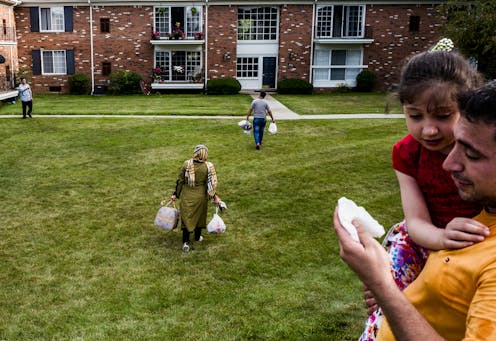
A family of Syrian refugees arrive at their new home in Bloomfield, Mich., in 2015. Andrew Renneisen/Getty Images

The U.S. is – and long has been – a pluralistic society that contains large immigrant communities.

Yet migration is an actively debated but poorly understood topic, and much of the conventional thinking and political rhetoric about migration are based on myths, rather than facts.

For these reasons, migration policies and strategies for easing acculturation – which refers to the psychological process of assimilating to a new culture – usually end up being ineffective.

I often work with immigrant populations in my job as a family therapist and as an acculturation scholar.

Here are a few of the most common misconceptions I come across in my work.

1. Immigrants don’t want to learn English

The U.S. is home to more international migrants than any other country, and more than the next four countries – Germany, Saudi Arabia, Russia and the United Kingdom – combined, according to 2020 data from the U.N. Population Division. While the U.S. population represents about 5% of the total world population, close to 20% of all global migrants reside there.

An overwhelming number of these immigrants are learning English, despite public perception to the contrary.

Immigrants and their children learn English today at the same rate as Italians, Germans and Eastern Europeans who emigrated in the early 19th century.

According to U.S. Census data, immigrant adults report having better English skills the longer they’ve lived in the U.S. And from 2009 to 2019, the percentage who could speak English “very well” increased from 57% to 62% among first-generation immigrants.

2. Immigrants are uneducated

Contrary to popular belief that immigrants moving to the U.S. have minimal education, many of them are well educated.

Over the past five years, 48% of arriving immigrants have been classified as highly skilled – that is, they have a bachelor’s degree or graduate degree. By comparison, only 33% of those born in the U.S. hold a bachelor’s degree or higher.

Moreover, the pursuit of higher education is valued and encouraged in immigrant communities, particularly those that arrived from collectivist societies, which are commonplace in the countries of South Asia. Immigrants from these places tend to prioritize the virtue of the learning process and the joy that comes from attaining an educational milestone.

That doesn’t mean highly educated immigrants can easily slide into high-paying jobs. Many of them find themselves working in menial jobs that don’t require a degree, and underemployment among highly educated immigrants remains a key issue in the U.S. today.

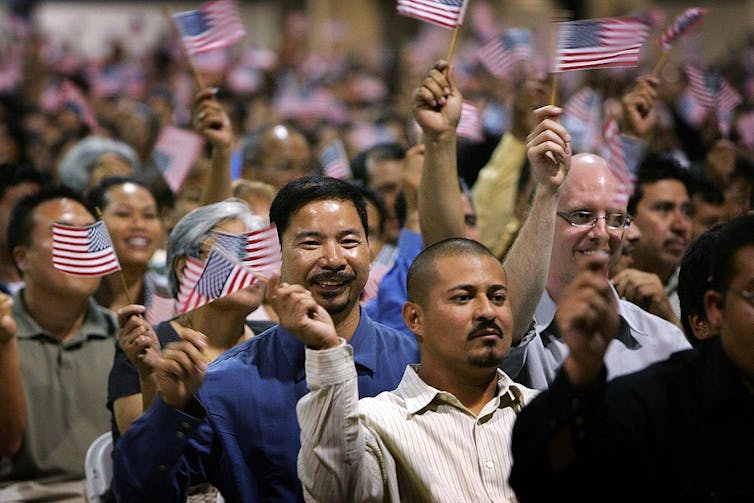
People waving U.S. flags.
A crowd celebrates after being sworn in as U.S. citizens at a naturalization ceremony in 2007 in California. David McNew/Getty Images

3. The best way to adapt is to embrace US culture

For decades, acculturation studies have highlighted the importance of immigrants’ embracing American culture. Policymakers, therapists and educators who offered services to immigrants adhered to a narrow understanding of acculturation, which encouraged immigrants to adapt to their host country by severing themselves from the culture of their homelands.

Then, in 1987, psychologist John Berry proposed an acculturation model outlining new strategies.

According to Berry, immigrants should strive to retain elements of their original cultural identity while also adopting a new cultural identity that folds in American culture and values.

Today, Berry’s model is the most commonly used to understand acculturation.

However, although the model acknowledges that acculturation strategies may evolve over time, it doesn’t take into account the emerging forms of transnational immigration, which refers to immigrants who live in another country but also maintain strong ties to their home country.

Technological advances have made it far easier for immigrants to maintain ties with their original culture. There are also U.S. cities, neighborhoods and towns where immigrant communities are the demographic majority – places like Hialeah, Florida, where Cubans and Cuban Americans make up 73% of the population, and parts of the Detroit metro area, which has growing numbers of Indian immigrants.

For immigrants living in these “immigrant islands,” there’s less of an obligation to undergo a transformative process of acculturation, whether it’s by Americanizing foreign names or not teaching children their home country’s language.

Still, many immigrants nonetheless feel pressured to downplay their backgrounds. While conducting interviews with members of the Turkish community in Chicago, I spoke with many people who admitted that they weren’t comfortable flaunting their Turkish culture. This didn’t surprise me. Immigrants are often exposed to new sets of prejudices and biases, and they fear not being able to access services such as medical care and education.

This fear reinforces the urge to assimilate into the dominant culture’s values – which, in America, includes individualist principles like independence – and suppress their own cultural values, such as being family-oriented. It’s essentially a strategy of self-protection.

In my work, I found that immigrants who engaged in what’s called “cultural innocuousness” – behaving in ways that may soften their ethnic and cultural expression – had the hardest time adapting to their new home.

For those reasons, it is crucial for social workers, therapists, teachers and policymakers who work with immigrant families to focus on the tensions among acculturation, ethnic identity and well-being.

The Conversation

April Nisan Ilkmen does not work for, consult, own shares in or receive funding from any company or organization that would benefit from this article, and has disclosed no relevant affiliations beyond their academic appointment.

03 Jul 19:31

By 'helping' wild animals, you could end their freedom or even their lives – here's why you should keep your distance

by Julian Avery, Associate Research Professor of Wildlife Conservation, Penn State
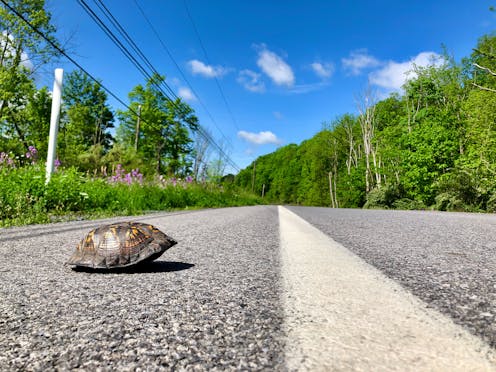
An eastern box turtle crossing a rural Pennsylvania road. Julian Avery, CC BY-ND

For anyone who enjoys nature, summer is a fascinating time to be outside. Animals are on the move: Turtles are nesting, baby birds are testing their wings, snakes are foraging and young mammals are emerging.

In central Pennsylvania, where I live, last year’s hatchling painted turtles have overwintered in their nests and emerged looking like tiny helpless snacks for raccoons and ravens. I’ve already rescued a baby killdeer – a shorebird that nests in parking lots – that ran off the road and got stuck in a grate. And I’ve watched an eastern chipmunk prey on a nest of towhee chicks.

I moved the killdeer to safety because it had fallen into what we call an “ecological trap.” Humans create these traps when we degrade habitat that looks suitable to animals. For killdeer, parking pads and roofs give off all the vibes of a great nesting site – except for the drains – and they have less natural habitat available these days.

But I didn’t intervene with the towhees. Their exposed nest site may have been a bad parental decision, or perhaps the chicks’ begging called too much attention. Either way, natural selection helped ensure that these birds and their genes were unlikely to survive. Ultimately, that may be better for the population and species than if I had intervened.

As a wildlife biologist, I know that relocating animals can be bad from a scientific perspective. It also can easily harm the creature you want to help.

Based on my experience as a scientist and university teacher, I’ve developed guidelines for when to get involved in the lives of animals I encounter outside. When I do intervene, it is after carefully considering the potential reasons for the animal’s situation, the species’ population status and the potential harm my actions might inflict upon the whole population – not just on one adorable creature.

A Humane Society wildlife expert explains what to know about backyard wildlife.

Reasons for caution

Wild animals have genetic associations with specific habitats that have evolved over many generations. Relocating them can disrupt those connections.

Moving animals means they can’t contribute their offspring and genes to the local population through breeding. That could be catastrophic for species with slow population growth, like many reptiles, who may take years to mature and might only manage a few successful broods in their lifetime.

For species like these, mature females are critical to keeping population sizes high. When populations are small, they lose genetic diversity that helps them resist environmental change.

Moving wildlife also may introduce new genes elsewhere, leading to genetic shifts over time that didn’t evolve through natural selection. Animals that are successful in a region tend to leave more offspring, and the heritable genetic variation tied to that success becomes more common and associated with the local environment. These are important relationships to safeguard.

A juvenile raccoon on a lawn, looking startled.
A young raccoon that appeared abandoned was soon retrieved by its mother. Raccoons spend many months with their parent after leaving the nest. Julian Avery, CC BY-ND

Moving animals also can cause immediate harm. Transported animals often can’t survive in a territory other animals have already claimed, or the new arrivals may do damage – for example, by preying on vulnerable local species. Wildlife managers may have to move them into captivity or even euthanize them.

Some species can spread pathogens to other wildlife or humans. At a minimum, moving animals can disorient them and make it hard for them to settle, find food and water or avoid predators.

It’s usually best to keep your distance

In general, your default choice should be not to interfere or interact with wildlife. Knowing that humans are nearby stresses animals. It makes them move away or forage and behave differently, and it can harm their body condition by triggering stress responses that ultimately reduce their fertility.

It’s especially common for people to see baby animals or birds, seemingly alone, and feel compelled to help. In fact, the parents may have secured their young and be actively caring for them, or the young animals may already be independent.

The amount of parental care that different species provide ranges from zero to a lot. For example, once a female turtle chooses a nest site with warm temperatures and the right amount of soil moisture, she lays her eggs and moves on. Hatchling turtles don’t need help unless they’re near pets or roads.

Rattlesnakes will bask in the sun to help their embryos be born live and healthy. Many mammals hide their young during the day and care for them for months.

Bluebirds and tree swallows work tirelessly to feed their young, even after fledging. In contrast, other birds kick their young out at an early stage so they can start the next clutch.

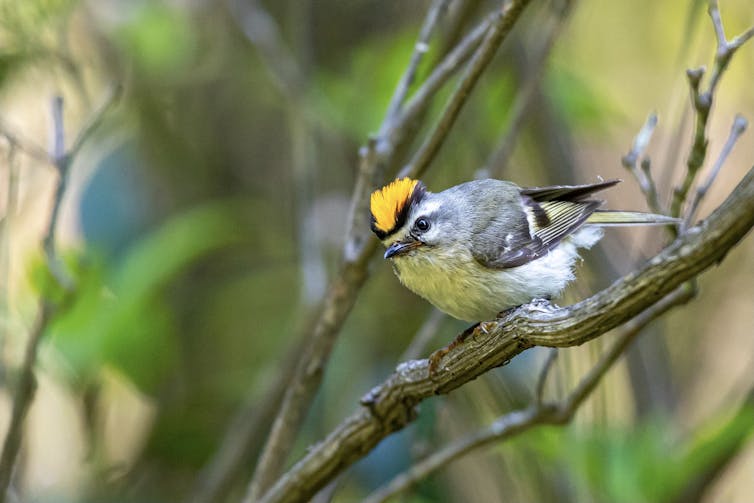
Golden-crowned kinglets, like this male, work together to raise 1-2 large broods a season. The male may even take over feeding fledglings as the female prepares the next clutch of 3-11 eggs. Julian Avery

Whatever the species, young and inexperienced animals without parents nearby may either be learning how to navigate or have been left hidden by their parents on purpose.

Parents do occasionally abandon their young. They may do it on purpose because their offspring are unfit, or because the parents aren’t fit enough to raise them. Or perhaps the parents have gotten lost. Whatever the reason, natural selection likely means these individuals and their gene complexes will not continue forward – and that benefits the species overall.

Put the animal’s needs before your own

It’s well established that getting close to nature is good for people’s mental health. I believe it’s very important to foster human connections to nature and facilitate these connections for people who have little exposure to the outdoors.

I advocate a mindful and hands-on approach to being outside. For example, I don’t touch animals that are rare unless it’s part of my research or covered by permits. If I handle an aquatic animal, I make sure my hands are wet and free of chemicals.

However, animals’ needs should come first. Whenever humans are active in an animal’s habitat, they can degrade it and lead the animals to seek other space.

Some wild animals may be abandoned or alone acting strangely because they are sick or generally unfit. People who handle these animals risk contracting zoonotic diseases, such as rabies, plague and avian influenza. Sometimes an unhealthy animal needs to be left alone to avoid spreading infection.

There also are animals that pretend to be injured or dead as a defense strategy. A casual observer may think a rescue is necessary, but don’t make assumptions. For example, Virginia opossums play dead in an involuntary fixed response to fear called defensive thanatosis. They can’t control it, but within minutes to hours, they’re up and back to normal.

When and how to help

Here are some guidelines for when and how to intervene in ways that minimize harm to wildlife.

First, don’t relocate animals over significant distances. An animal that accidentally hitches a ride over long distances, such as a treefrog under your bumper, shouldn’t be released in a new host area.

Helping an animal cross a busy road is OK if you move it in the direction in which it is already headed. This is particularly true for animals that live a long time and reproduce slowly, like box turtles, which are declining across North America. Ensuring the survival of a single adult female box turtle can be very important to the success of a local population.

Second, respect the rules at national, state and local parks. Parks often protect at-risk species that can’t safely interact with humans. For example, desert tortoises may urinate as a defense when picked up, which reduces their internal water supply.

Learn to identify common species that can handle human curiosity and make good ambassadors for biodiversity. Many state agencies have a website or atlas for major wildlife groups that will help you learn which species are widespread or more rare. Most ponds have a common frog that’s sure to catch your eye.

Third, if you think an animal is truly in danger, call a local game warden, wildlife officer, rehab professional or park ranger for advice. If the animal is immediately at risk from a pet or approaching car, and you can reach it safely, put on some gloves and help it – but leave it traveling in the same direction it was moving, or near its local area, so that it doesn’t become disoriented and try to disperse into dangerous habitat.

Fourth, get out and explore. But remember that you’re a guest in the animals’ habitat – tread softly and respectfully. A fallen log can shelter all kinds of creatures. Look underneath, and then place it back as it was so that it continues to be a home for them.

The Conversation

Julian Avery does not work for, consult, own shares in or receive funding from any company or organisation that would benefit from this article, and has disclosed no relevant affiliations beyond their academic appointment.

03 Jul 19:28

Locally transmitted malaria in the US could be a harbinger of rising disease risk in a warming climate – 5 questions answered

by Rajiv Chowdhury, Professor of Global Health, Florida International University
Some evidence suggests that malaria mosquitoes are becoming resistant to insecticides. Paul Starosta/Stone via Getty Images

The Centers for Disease Control and Prevention reported on June 26, 2023, that five cases of locally transmitted malaria had been identified – four in Florida and one in Texas – since May 2023. These are the first cases of locally acquired mosquito-borne malaria in the U.S. since 2003.

The Conversation spoke with Dr. Rajiv Chowdhury, a global health expert from Florida International University, about the significance of these cases and why they’re appearing now.

1. What is malaria and how did these people become infected?

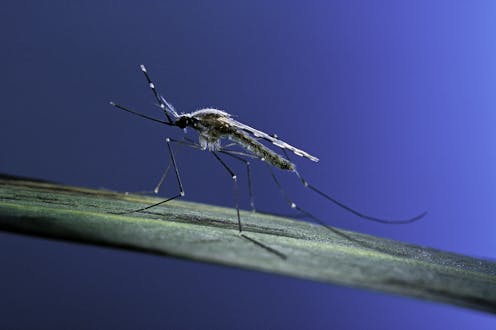
Malaria is a serious and sometimes life-threatening disease caused by the bite of a female mosquito from the genus Anopheles, the vector that transmits malaria.

The most common symptoms are fever, chills, headaches, muscle aches and fatigue. These symptoms typically occur from 10 to 15 days after people are infected with the parasite. However, if untreated, more severe symptoms may appear that include impaired consciousness, difficulty breathing, convulsions, abnormal bleeding and more, which can ultimately lead to death.

The five cases in Florida and Texas were caused by the Plasmodium vivax parasite, which is the most common malaria-causing parasite strain outside of the African continent. All are believed to be locally acquired, which means they were not connected to any international travel. In addition, there is no evidence to suggest that the cases in the two states are related. Plasmodium vivax is the most globally widespread of all Plasmodium strains and can cause severe, often fatal, infections.

All five patients have reportedly recovered, and surveillance for additional cases is ongoing.

2. Why might these cases be surfacing now?

There could be several factors driving the emergence of locally acquired malaria.

For one, climate change is causing a shift in weather patterns, some of which can worsen malaria conditions. A higher average surface temperature from global warming could lead to higher mosquito migration in areas that were previously uninhabitable by Anopheles mosquitoes.

These higher temperatures could also enhance the growth rate and transmissibility of the parasites responsible for malaria. These include Plasmodium parasite variants such as vivax, knowlesi and falciparum.

The effects of climate change can also lead to higher rainfall and sea level rise in many places – both of which can result in more areas or open spaces with stagnant water that typically serve as effective breeding grounds for mosquitoes.

Given these changes in local conditions, more cases could occur in populations that were previously “immunologically naïve” to malaria. In other words, since these people have never been exposed to it, their immune systems are ill-equipped to fight it.

Furthermore, when people travel to countries or areas where climate-driven malaria cases are on the rise, there is a greater possibility of bringing those infections back to the U.S., where local mosquitoes could be exposed to the parasite in an infected person’s blood.

Lastly, due to misuse and overuse of common antimalarial medications, such as artemisinin, antimicrobial resistance has become a major problem in many regions of the world. This drives up the number of drug-resistant cases, the severity of the illness and the possibility of larger outbreaks.

This is further complicated by emerging resistance to insecticides among Anopheles mosquitoes.

When traveling overseas this summer, here’s what to remember.

3. How can people help prevent malaria transmission?

The CDC and the Florida Department of Health are urging people to protect themselves by using bug spray, avoiding areas where mosquitoes congregate and covering exposed skin.

Precautions also include what’s known as “drain and cover” – in other words, draining standing water to prevent mosquitoes from multiplying and using screens to prevent mosquitoes from entering through doors and windows. Health departments also note that it’s important to drain or discard containers that can collect rainwater, such as flower pots, old tires and buckets.

4. What are the available malaria treatments?

There are several medicines used to prevent and treat malaria. The choice of medication typically depends on the type of malaria, whether a malaria parasite is resistant to a medicine, the weight or age of the person infected with malaria and whether the person is pregnant.

Most malaria medicines are taken in pill form. The most common include combination therapy medicines that include a class of semi-synthetic drugs called artemisinins. These kill malaria parasites by damaging their proteins and are usually the most effective treatment against malaria. Chloroquine phosphate, a medicine that has been used for decades to prevent and treat malaria, is now recommended for treatment of infection with Plasmodium vivax, but only in places where the parasite is still sensitive to this medicine. Lastly, there’s primaquine, a class of antimalarial drugs typically added to complement another treatment to prevent any relapse of infection.

With early diagnosis, malaria is very treatable.

5. Are vaccines against malaria available?

Nearly half of the global population is currently at risk of malaria, with almost 250 million cases and 620,000 deaths worldwide, mostly affecting children. Therefore, in October 2021, the World Health Organization began recommending the widespread use of a malaria vaccine known as RTS,S/ASOI for children who live in moderate- to high-risk areas.

This is the first-ever vaccine for a human parasitic infection. Trials show that the vaccine can significantly reduce malaria, including severe malaria, among young children.

A group of scientists from the U.K. reported a modified version of this vaccine, called R21, in September 2022. The early-phase clinical trial reported that the new vaccine is 80% effective at preventing disease in young children. However, real-world trials for this new candidate vaccine are still ongoing.

Other vaccine candidates are currently being developed by BioNTech, the company behind the Pfizer/BioNTech mRNA COVID-19 vaccine, and through joint efforts between Novavax and the Bill & Melinda Gates Medical Research Institute.

While new malaria vaccines will be a major boost for curbing malaria worldwide, it will be critical for health departments to continue emphasizing other preventive strategies, especially in newly affected areas like Florida and Texas.

The Conversation

Rajiv Chowdhury does not work for, consult, own shares in or receive funding from any company or organisation that would benefit from this article, and has disclosed no relevant affiliations beyond their academic appointment.

03 Jul 19:26

Controversy over poems at British Museum shows urgent need for more recognition for translators

by Caroline Summers, Assistant Professor of Translation & Transcultural Studies, University of Warwick
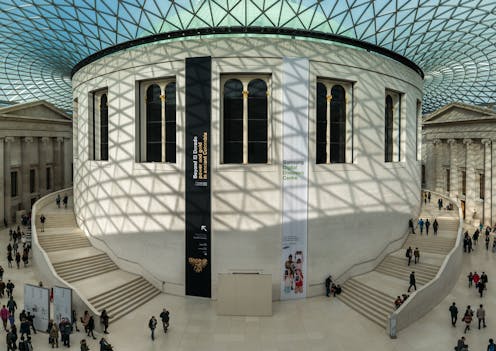
Interior of the British Museum. MarkLG/Shutterstock

The British Museum has had to apologise after a translator’s words were used without permission. Writer and translator Yilin Wang shared on Twitter that their translations of work by the Chinese feminist poet Qiu Jin appeared in the museum’s exhibition, China’s Hidden Century, without consent.

The museum’s subsequent press release cited “unintentional human error”. It explained that it had corresponded privately with Wang and had now offered a fee for the use of the translations. Along with the Chinese poems, these were then removed from the exhibition. But the removal of the texts has also fuelled criticism of the museum, and sparked a debate about the role of translators.

Translation and copyright

Literary translation is legally recognised as an act of original artistic production. This means that translated literary texts enjoy their own copyright status, independent of the source texts. While Qiu’s work is now out of copyright because she died in 1907, Wang’s translations are not.

The role of original creativity in translation practices is frequently ignored or underestimated. It’s common to talk about reading “author X” rather than “translator Y’s translation of author X”. Even the Nobel Prize conveniently sidesteps the role of translators and their creative work when it confers its annual literary honour.

Recently, however, literary publishing has increasingly recognised the role of translators. In 2016, the International Man Booker Prize announced it would now split winnings evenly between the author and the translator. Translators are gaining visibility and it is becoming more and more difficult to pretend they don’t exist.


Read more: International Booker Prize 2023: our experts review the six shortlisted books


Translations are creative acts that take place in specific cultural contexts. They transform source texts into new, original literary works, and they can advocate for the source text and writer by introducing them to new readers.

Wang has written about the power dynamics of literary translation, including the barriers to access and participation faced by translators who are “outsiders” and translators of colour. In their essay writing, they draw specifically on their experience of systemic prejudice while translating Qiu Jin’s poetry.

black and white photography of Qiu Jin in a large robe.
A photograph of Qiu Jin from circa 1908. Wiki Commons

They describe translation as an act of “reclamation and resistance” – and talk of the barriers they and others face finding a career in translation.

Like a translation, a museum is not neutral or objective. The objects and texts on display have been deliberately selected and positioned together. Just like the objects they frame, the words in a museum belong to someone and they have been chosen to tell a particular story.

Museums increasingly face pressure to reflect on their processes of acquisition and their contested ownership of items. This latest mistake – and handling of the fallout – shows that they also need to be transparent about the origins of the words they use to build the stories they tell.

From a “hidden century” to hidden texts

Removing items from display is not standard practice for the museum. The museum made a public statement in 2020 that it would not remove “controversial objects” from display. A section of the website dedicated to “contested objects” explicitly engages with the provenance of some of its most famous pieces, such as the Parthenon marbles.

But now Wang has described the museum’s response as “erasure”, and Wang argues, it has troubling implications, both for the museum’s critical engagement with its own curatorship and for the power dynamics of its relationships with non-white contributors.

The British Museum said in a statement: “In response to a request from Yilin Wang, we have taken down their translations in the exhibition. We have also offered financial payment for the period the translations appeared in the exhibition as well as for the continued use of quotations from their translations in the exhibition catalogue. The catalogue includes an acknowledgement of their work.” Wang contests this.

Meanwhile, the story has not gone away. It has been reported in the Chinese and French media, and Wang’s still developing Twitter thread about the discovery has been shared over 15,000 times.

As momentum grows behind the criticism of the museum, it is a good time for all of us to consider how we value and engage with the work of translators, whose creative labour allows us to access worlds and imaginations far beyond our own.

The Conversation

Caroline Summers does not work for, consult, own shares in or receive funding from any company or organisation that would benefit from this article, and has disclosed no relevant affiliations beyond their academic appointment.

03 Jul 19:25

“We the People” includes all Americans – but July 4 is a reminder that democracy remains a work in progress

by Joseph Jones, Assistant Professor of media ethics and law at Reed College of Media, West Virginia University
When the Constitution was written, the term 'We the People' had a very limited application for voting rights. Antenna/Getty Images

The United States’ founders firmly rejected King George III and the entire idea of monarchy 247 years ago, on July 4, 1776.

Political power does not come from some absolute authority of a king over people, the founders argued. Rather, political power comes from the people themselves. And these people must agree to any authority governing their society.

This is why the U.S. Constitution starts with the words “We the People,” and not “I, the ruler.”

I am a historian, ethicist and media scholar and have studied how people build communities.

America’s founders did not trust everyone’s ability to equally participate in the new democracy, as laws at the time showed.

But, because of policy changes on issues like voting, the idea of who actually is represented in the phrase “We the People” has changed over time.

A painting depicts men dressed in old fashioned clothing in a large room crowded around some men on a raised platform.
George Washington, Benjamin Franklin, Thomas Jefferson and other founders prepare to sign the Constitution in 1787. GraphicaArtis/Getty Images

First steps

In 1776, only white men who owned property had the right to vote.

“Few men, who have no property, have any judgment of their own,” as former President John Adams wrote in 1776.

As activists – including some women and Black Americans – proclaimed their equality, public education spread, and social thinking shifted.

By about 1860, all state legislatures had lifted property requirement for voting. Allowing only wealthy property owners to vote did not align with the democratic notion that “all men are created equal.”

While some states, like Vermont, eliminated the property voting requirement in the 18th century, this shift became more popular in the 1820s and the 1830s.

Congress passed the 15th Amendment in 1870, giving Black men and others the right to vote, regardless of race.

But that amendment still excluded some people, chiefly Native Americans and women.

An unfinished history

Despite the 15th Amendment, violence and intimidation in some states still prevented Black men from voting.

State lawmakers also used bureaucratic measures, such as a poll tax, renewed attempts at a property requirement and literacy tests, to prevent African Americans from voting.

The fight over African American suffrage continued for decades, and many courageous Americans protested and were arrested or killed in the struggle to exercise their voting rights.

Thanks to the work of civil rights activists – including John Lewis, Fannie Lou Hamer and Marting Luther King Jr. – public opinion shifted.

In the 1960s, Congress passed additional legal measures to protect the voting rights of Black Americans. This included the 24th Amendment, which outlawed the use of poll taxes, and the 1965 Voting Rights Act, which prohibited any racial discrimination in voting.

Women’s turn

In 1920, women gained the right to vote with the addition of the 19th Amendment, following another decadeslong struggle.

Women’s rights activists made the first organized call for female suffrage at the Seneca Falls Convention in 1848.

In the following years, suffragists pushed for constitutional amendments, state laws and a change in public thinking to include women in “We the People.”

Native American rights

Having self-governed for centuries, Native Americans were not legally recognized with voting rights until Congress approved the Indian Citizenship Act in 1924.

While that supposedly gave Native Americans the same rights as other Americans, Native Americans faced the same tactics, like violence, that white racists used to prevent Black Americans from voting.

Like other people excluded from “We the People,” Native Americans have continued to push for voting rights and other ways to ensure they are included in American self-government.

Making democracy more democratic

In 1971 “We the People” again expanded, to include younger people, with the lowering of the voting age from 21 to 18. The ongoing Vietnam War shifted public opinion, and there was popular support for the idea that someone old enough to die fighting for their country should also be able to vote.

A government once described by Abraham Lincoln as “of the people, by the people, and for the people” was now going to technically include all of the people.

But equality for women, young people and racially marginalized groups did not change overnight.

Social equality remains far off for many people, including undocumented immigrants, for example, and LGBTQ+ individuals.

A person walks past a white sign that says 'Vote here.'
While some states have it made it harder to vote in recent years, others have made it easier. Stephen Maturen/Getty Images

Current limitations to ‘We the People’

The government has recognized that citizens over the age of 18 have a right to participate in self-government. But there are still political and legal attempts to restrict people’s ability to vote.

While some states have passed new laws that make it harder to vote in recent years, other states have made it easier.

North Carolina passed new ID requirements in April 2023 that make it difficult for those without current state identification to vote.

Texas, Georgia, Oklahoma and Idaho are also among the states that are deleting some voters from their rolls – if people do not regularly vote, for example.

Arizona has closed multiple polling sites, making it more difficult for some people to vote.

Twenty-five states, meanwhile, including Hawaii and Delaware, have passed laws over the last few years that make it easier to vote. One of these measures automatically registers people to vote when they turn 18.

There are more examples. The bottom line is, voters have fewer protections when it becomes harder to vote, and American democracy is not as democratic as it could be.

The big picture

Voting is not the only form of recognition and participation in a democracy. People can be respected at work, paid what they are worth and treated with dignity. Community members can be treated fairly by police, school officials and other authorities, given an equal opportunity for justice and education to improve their lives.

People can also contribute to the social and economic well-being of a democracy in ways other than voting, doing everything from planting a tree in a public park to attending a political rally.

But the overall expansion of voting rights and a historical understanding of “We the People” shows that everyone belongs in a democratic society, regardless of wealth, achievement or other differences.

The Conversation

Joseph Jones does not work for, consult, own shares in or receive funding from any company or organisation that would benefit from this article, and has disclosed no relevant affiliations beyond their academic appointment.

03 Jul 19:18

How new state laws and book ban movements have made the teaching of US history contentious – 5 essential reads

by Jamaal Abdul-Alim, Education Editor, The Conversation
Certain state laws are banning the instruction of critical race theory. FatCamera/E+ via Getty Images

Of all the subjects taught in America’s public schools, few have become as contentious as U.S. history. At least 37 states have adopted new measures that limit how America’s undeniable history of racism – from chattel slavery to Jim Crow – can be discussed in public school classrooms.

Educators in certain states face laws that restrict classroom discussions about racism. Florida’s Stop Woke Act for example, limits what educators can say about racism in K-12 schools.

For insight on the restrictive laws and what educators can do, The Conversation compiled a roundup of archival stories from several scholars that explain their origin and intent, as well as how they could potentially affect everyday instruction in America’s schools.

1. The value of learning about systemic racism

History educators Jeffrey L. Littlejohn and Zachary Montz described how restrictions on teaching about systemic racism in Texas public schools prevent students from learning vital historical lessons.

The scholars referenced Joshua Houston, an enslaved servant from Texas who became the county’s first Black county commissioner, and his son Samuel Walker, who notably founded a school which served as one of the first county training schools for African Americans in Texas.

“Americans cannot appreciate the accomplishments of Joshua and Samuel Walker Houston without examining the vicious realities of Jim Crow society,” Littlejohn and Montz wrote. “The lesson of their lives, and of the Juneteenth holiday, is that freedom is a precious thing that requires constant work to make real.”


Read more: Juneteenth, Jim Crow and how the fight of one Black Texas family to make freedom real offers lessons for Texas lawmakers trying to erase history from the classroom


View of a classroom, with the educator teaching while standing next to a map of the world.
Some educators across the U.S. worry about the backlash from teaching about racial discrimination. Maskot via Getty Images

2. The importance of historical knowledge

Boaz Dvir, an assistant professor of journalism at Penn State and grandson of Holocaust survivors, is concerned that many educators are shying away from examining racism and genocide in the classroom due to new and proposed state laws that restrict conversations on crimes against humanity.

Consequently, Dvir wrote that an alarming 63% of American millennials and Generation Z lacked basic knowledge about the murder of six million Jews during the Holocaust.

According to Dvir without vital lessons on such crimes against humanity and the factors that give rise to them, students “may not have the knowledge and insight they need to sustain and thrive in a 21st-century democracy.”


Read more: I'm an educator and grandson of Holocaust survivors, and I see public schools failing to give students the historical knowledge they need to keep our democracy strong


3. Critical race theory’s impact on AP courses

Suneal Kolluri, a researcher who studies Advanced Placement courses – which provide students an opportunity to earn college credit while still in high school – raises another set of concerns regarding AP history and other history courses.

In 2022, two Oklahoma school districts got downgraded accreditation for violating the state’s anti-critical race theory law – a field of intellectual inquiry that looks into how race has been embedded into the legal system. Kolluri described his concern that AP courses could face similar penalties in states with restrictions on conversations on race.

“At a time when mostly Republican-led state legislatures have passed a rash of laws to restrict how public schoolteachers can educate students about America’s racist past, I worry that AP courses like U.S History and U.S. Government and Politics could be in jeopardy,” Kolluri wrote. “The danger is posed by those who support the various new state laws against the teaching of divisive topics and critical race theory.”


Read more: Advanced Placement courses could clash with laws that target critical race theory


Student reads textbook in library.
Research shows book banners often target stories by and about people of color and LGBTQ+ individuals. kundoy/Moment via Getty Images

4. The ongoing battle over book bans

Book bans in the 1980s focused on secular humanism, because it argued that there can be fulfillment without a belief in God. But of late, book bans have focused largely on critical race theory.

Fred L. Pincus, a professor of sociology at the University of Maryland examined how the book ban movement in the 1980s relates to the one occurring today. He wrote that both book ban movements objected to the critical teaching about race and racism.

Pincus also wrote that right-wing critics have claimed that critical race theory is designed to cause white students to feel guilty. As of June 2023, a total of 214 local, state and federal government entities across the U.S. have introduced 699 anti-critical race theory bills and other measures.

“Of course, some white students – and other students, too, for that matter – will feel uncomfortable upon learning not only about the history of American racism but also its present manifestations,” Pincus wrote. “Reality is sometimes uncomfortable.”


Read more: Battles over book bans reflect conflicts from the 1980s


5. How to teach about racism within the new laws

W. Fitzhugh Brundage, a professor of history at University of North Carolina, examined the ways teachers could stay true to American history without breaking any of the new laws.

For example, he suggested ways to mention slavery within the context of lessons about other topics, such as the free market before the Civil War and how it relied on violence and forced labor.

“Given the current political climate in the U.S., there is no reason to assume more laws that govern what can be taught in public schools will not be passed,” Brundage wrote. “But based on how the laws are being written, there are still plenty of ways for teachers to tackle difficult subjects, such as racism in American society.”


Read more: How teachers can stay true to history without breaking new laws that restrict what they can teach about racism


Editor’s note: This story is a roundup of articles from The Conversation’s archives.

The Conversation
30 Jun 19:40

Jurassic Quest brings giant animatronic dinosaurs to Tampa this summer

by Andrew Harlan

Jurassic Quest takes over the Florida State Fairgrounds (4800 US-301) July 21-23, and July 28-30. Tickets are available now online and range from $19-$36. Additional activity tickets can be purchased as well. These world-famous, life-size dinosaurs are meticulously painted and animated to be realer-than-real. 

Jump on a dinosaurs back and hang on tight. Some of the animatronic dinosaurs are ridable and perfect for kids. You can also dig for fossils, explore bounce houses, meet baby dinosaurs, and even walk among the animatronic creatures.

The event will not only have dozens of realistic animatronic exhibits but promises to transport you back with sights, sounds and interactive and educational areas that make the experience one the entire family can enjoy.

Officials say this year’s event is bigger and better than ever with more hands-on activities, themed rides and attractions, live dinosaur shows, fossil digs and a “Triceratots” soft play area for little explorers. You can learn more about the huge dino-centri event on Jurassic Quest’s website.

Jurassic Quest is a self-guided experience featuring more true-to-life size dinosaurs than any other touring dinosaur event, as well as dinosaur rides and a ton of activities. Organizers recommend planning 1-2 hours to experience everything.

What to read next:

The post Jurassic Quest brings giant animatronic dinosaurs to Tampa this summer appeared first on That's So Tampa.

29 Jun 17:58

Medical students honor body donors through words, deeds and ceremonies

by Amy Lawton, Research Manager, Chaplaincy Innovation Lab, Brandeis University
Donors' bodies lie covered in an anatomy lab at the Justus Liebig University in Giessen, Germany. Sebastian Gollnow/picture alliance via Getty Images

Six people were charged on June 14, 2023, with buying and selling human remains stolen from the Harvard Medical School morgue and from an Arkansas mortuary. The macabre story made national headlines, particularly the indictment of Cedric Lodge: a morgue manager at Harvard from 1995 until earlier this year.

As a scholar in the sociology of religion, my research explores practices related to whole-body donation in medical schools across the United States. While these accusations against Lodge are deeply troubling, they are an aberration: Medical school communities go to incredible lengths to respect and honor the people who donate their bodies to science.

Much of this happens behind closed doors. The serious scientific work of anatomical study is undergirded by practices that promote the donors’ dignity, including memorial ceremonies to honor their gift. I conducted a census of allopathic medical schools – schools that grant the M.D. degree – and analyzed recordings of 60 donor memorial ceremonies, as well as other materials.

Foundation of learning

Despite advances made in technology, including virtual reality and 3D anatomy software, dissecting a real human body is generally considered irreplaceable in Western medical education. Substitutions result in less effective instruction, leading to lower scores on practical and written examinations. One benefit is that students who learn from dissection see normal bodies, with diversity, variations and imperfections that would not be evident on models. Faculty views donor bodies as essential because they are always accurate and up to date, which cannot always be said about books or software.

In the U.S., medical schools accept bodies from donors and next of kin. A minority of institutions accept unclaimed bodies, but their use is controversial.

Bodies’ importance goes beyond their effectiveness as a teaching tool. Anatomy lab marks the students’ initiation into the medical profession. It teaches not only anatomy but the value of the human person, professionalism, ethics and clinical skills such as diagnosis.

A young brunette woman wearing gloves rinses a human heart in a sink in an anatomy lab.
The lessons medical students learn from donor bodies go beyond anatomy. Bill O'Leary/The Washington Post via Getty Images

From day one, medical students studying gross anatomy are encouraged to think of the donor body as their “first patient,” someone for whom they will care and from whom they will learn. Medical students are responsible for preserving the body, performing dissections correctly so as not to cause unnecessary mutilation, and speaking of the body and the donor respectfully.

Students work in teams, each of which is usually responsible for dissecting one body. Many also feel a sense of responsibility toward their donors – a duty to learn as much as they can, taking full advantage of the gift they have been given.

Reflection and respect

At the end of the semester, students say goodbye to the donors. My research found that more than nine out of 10 allopathic medical schools mark this occasion with a memorial ceremony. Ceremonies also take place at schools for other branches of health care, such as osteopathy and physical therapy. Wherever students learn from body donors, they gather together to express their gratitude for a gift that can never be reciprocated.

Some ceremonies are conducted before an audience that includes the friends and families of all body donors used that year. Some are open to the medical school community, and others are for the students alone. For many, these donors have played a transformative role in their lives. It is common to hear students refer to their donors as a friend or mentor.

At the 2018 University of Iowa ceremony, a student reflected: “I know her hands, her feet, what parts of her may have ached towards the end of life, which organs let her down. I spent countless hours as her pupil. She taught me things about life that no living person ever could. When I was confused and needed time to think, she was patient. My donor entrusted me with the intimate gift of her body to learn about the topics that make my heart race.”

Learning in the anatomy lab and participating in a donor memorial ceremony have something important in common. Both experiences stand apart from everyday life, making them, in a sense, sacred. These ceremonies set aside a special time and space for reflection and remembrance – time and space that busy medical students do not usually have.

Unlike most memorial services, these students have no personal memories of the deceased. In fact, some are not even told their donor’s first name, which is often concealed to preserve privacy.

Yet they know at least one fact: This person cared about medicine and other people’s health. Students reflect on how generous and principled the donors must have been – as well as their families, who were willing to carry out loved ones’ wishes in their time of grief. Though students did not witness donors’ lives, they can still celebrate and honor them.

A student at the University of Cincinnati’s 2019 service shared: “I am overwhelmed with respect and gratitude for all our donors. … As we gather here today, let’s remember the legacy that all of these donors and family members have left in all of us, and celebrate the legacy that they continue to forge even after death.”

Rows of young people in white medical coats stand respectfully outside at a ceremony.
Medical students at the University of Mississippi Medical Center attend the Ceremony of Thanksgiving in Memory of Anatomical Donors in 2018. AP Photo/Rogelio V. Solis

A donor body’s gift cannot be “paid back,” but medical students can try to pay it forward. Many describe ways they will try to serve others, as the donor did. Some doctors-to-be express a sense that the donors will forever guide their hands.

There is no foolproof way to prevent bad actors in any institution. Yet research into donor memorial ceremonies shows that no one takes the gift of body donation more seriously than the recipients.

The Conversation

Amy Lawton received funding from the Templeton Religion Trust administered through the Issachar Fund.

29 Jun 17:57

US music education has a history of anti-Blackness that is finally being confronted

by Philip Ewell, Professor of music theory, Hunter College
These multicolored notes reflect the diversity of music across the world. MirageC/Getty Images

When it comes to achieving racial diversity, music education at the university level in the U.S. still has a long way to go.

One of the leading professional organizations, the Society for Music Theory, put it bluntly in 2020: “We humbly acknowledge that we have much work to do to dismantle the whiteness and systemic racism that deeply shape our discipline,” the group wrote.

The focus on white, male Europeans in textbooks and music selected for study has been called into question by countless scholars and practitioners because of music education’s deep roots in anti-Blackness.

In recent years, the simplest solution for music professors has been to find nonwhite classical composers and use their work on a program or concert to demonstrate the school’s commitment to diversity. One person whose work some professors have used in such a way is Florence Price. A composer and music teacher who died in 1953, Price is considered to be one of the first Black female musicians with mainstream appeal.

But in my view as one of only a few Black scholars in the field of music theory, such diversity efforts often serve only to reinforce the whiteness and maleness of the system.

Ethnomusicologist Dylan Robinson calls these efforts “additive inclusion” in that they give the impression of making positive change but serve only to maintain an overemphasis on the work of white male Europeans.

Music theory textbooks

In 2020, music theorist Megan Lyons and I did an analysis of the seven most common undergraduate music theory textbooks in the U.S.

We wanted to establish a baseline of the racial and gender makeup of the composers represented in the books to see what teachers were offering to our students as the most important music to consider in the undergraduate music major.

Music theory courses, usually spread over four or five semesters, are often considered the most crucial aspect of the major, and theory textbooks are presented as authoritative sources that outline the essentials of the discipline.

Representative titles include “Harmony and Voice Leading,” “Harmony in Context,” “Harmonic Practice in Tonal Music” and “Concise Introduction to Tonal Harmony.”

Looming large in these textbooks is the word “harmony,” the sound that is heard when two or more instruments or voices sound together, though in a global context the term has other meanings as well. What is considered harmony in the U.S. is based on European notions of tonality, pitch, scale, mode, key and melody.

The three composers the books most commonly represented were Germans Johann Sebastian Bach and Ludwig van Beethoven and Austrian Wolfgang Amadeus Mozart.

A black and white portrait of a white man wearing a white powdered wig and holding a sheet of music.
A mid-19th-century engraving of Johann Sebastian Bach. FierceAbin/Getty Images

We found that of the nearly 3,000 musical examples cited in the textbooks, only 49 were written by composers who were not white and only 68 were written by composers who were not men.

On rare occasions those two subgroups overlapped, as with Florence Price. Only two examples were written by Asian composers.

All told, almost 98% of the musical examples were written by white men who mostly spoke German, and these seven textbooks represented about 96% of the market share.

Left out of textbooks are the many African American musicians who contributed significantly to American music, such as classical composers Nathaniel Dett, James Reese Europe, Julia Perry and Clarence Cameron White.

Also generally excluded were nonclassical genres like jazz, blues or bluegrass, or contemporary popular music such as hip-hop, soul or punk.

Anti-Blackness in music conservatories

American music academies generally reflect the social norms of the day. Anti-Blackness was commonly accepted in all music institutions until well into the 20th century through the eugenics of music pedagogue Carl Seashore, the white supremacy of the composer-pianist John Powell and the racism of music theorist Heinrich Schenker.

In her 2019 master’s thesis “A Message of Inclusion, A History of Exclusion: Racial Injustice at the Peabody Institute,” violinist Sarah Thomas details a common American story of racial angst in higher education.

Thomas focused on the Peabody Institute, founded in 1857 in Baltimore, Maryland and the oldest U.S. music institution, and its board members’ letters about the possible admission of Black pianist Paul Brent.

In July 1949, Peabody President William Marbury wrote the school’s board of directors and reminded board members of the school’s unofficial policy at the time:

“We are brought face to face with the issue whether to modify our long-standing rule against the admission of negro students,” Marbury wrote.

Once the issue was put to a vote, only one board member, Douglas Gordon, openly opposed admitting Brent and cast the one dissenting vote.

“It seems to me that it would be a great mistake to change the present policy,” Gordon wrote. “In our climate the presence of negroes can to some be extremely offensive.”

One black student stands with a group of white classmates.
Paul A. Brent, the first Black student to enroll at the Peabody Conservatory, is second from the right in the back row in this 1953 photograph. Peabody Institute

Though Brent was admitted and became the first Black student to enroll at Peabody, the abhorrent views of Gordon still remain present today in more subtle forms.

The study of jazz is one such example of racial exclusion.

Generally considered a Black musical genre, jazz is now part of most music educational institutions, but is virtually always separate from the mainstream music major.

In a few cases, students are able to major in jazz. But in most cases, if students wants to major in jazz, they must major in classical music while playing jazz on the side.

Change in music education is coming

Citing declining enrollments for music majors across the country, the College Music Society in 2014 published a manifesto for change to the undergraduate music major. It deemphasized music and methods of the Western canon while emphasizing the need for students to engage with music from different cultures and with new technologies.

This change has taken many forms.

Musicians are rethinking their curricula to treat all music of the world on equal footing as the European standards.

Piano proficiency and European language requirements are being reconsidered – in some cases cast aside – by music institutions. Other schools are creating new music majors for those working with digital sound and sound design, or for those studying popular genres such as blues, rock, metal and country.

Academic work in music is changing as well, and students can now at times get credit for work outside of traditional paper writing.

It’s my belief that the sooner we musicians, irrespective of our own identities, can face up to our racial segregationist past, the sooner we can all reap the benefits of our nation’s unique musical diversity.

The Conversation

Philip Ewell does not work for, consult, own shares in or receive funding from any company or organization that would benefit from this article, and has disclosed no relevant affiliations beyond their academic appointment.

29 Jun 17:56

What is the difference between nationalism and patriotism?

by Joshua Holzer, Assistant Professor of Political Science, Westminster College
Donald Trump, left, and Harry Truman: Two former presidents who had different ideas about nationalism and patriotism. The Conversation, with images from Wikimedia Commons, CC BY-NC

During his presidency, Donald Trump said, “We’re putting America first … we’re taking care of ourselves for a change,” and then declared, “I’m a nationalist.” In another speech, he stated that under his watch, the U.S. had “embrace[d] the doctrine of patriotism.”

Trump is now running for president again. When he announced his candidacy, he stated that he “need[s] every patriot on board because this is not just a campaign, this is a quest to save our country.”

One week later he dined in Mar-a-Lago with Nick Fuentes, a self-described nationalist who’s been banned from Facebook, Instagram, Twitter, YouTube and other platforms for using racist and antisemitic language.

Afterward, Trump confirmed that meeting but did not denounce Fuentes, despite calls for him to do so.

The words nationalism and patriotism are sometimes used as synonyms, such as when Trump and his supporters describe his America First agenda. But many political scientists, including me, don’t typically see those two terms as equivalent – or even compatible.

There is a difference, and it’s important, not just to scholars but to regular citizens as well.

A comic depicting Superman talking to people about treating others with respect and dignity.
An image from 1950, colorized in 2017, shows Superman – a refugee from another planet and a character created by two Jewish immigrants to the U.S. – teaching that patriotism should drive out nationalism. DC Comics

Devotion to a people

To understand what nationalism is, it’s useful to understand what a nation is – and isn’t.

A nation is a group of people who share a history, culture, language, religion or some combination thereof.

A country, which is sometimes called a state in political science terminology, is an area of land that has its own government.

A nation-state is a homogeneous political entity mostly comprising a single nation. Nation-states are rare, because nearly every country is home to more than one national group. One example of a nation-state would be North Korea, where almost all residents are ethnic Koreans.

The United States is neither a nation nor a nation-state. Rather, it is a country of many different groups of people who have a variety of shared histories, cultures, languages and religions.

Some of those groups are formally recognized by the federal government, such as the Navajo Nation and the Cherokee Nation. Similarly, in Canada, the French-speaking Québécois are recognized as being a distinct “nation within a united Canada.”

Nationalism is, per one dictionary definition, “loyalty and devotion to a nation.” It is a person’s strong affinity for those who share the same history, culture, language or religion. Scholars understand nationalism as exclusive, boosting one identity group over – and at times in direct opposition to – others.

The Oath Keepers and Proud Boys10 of whom were convicted of seditious conspiracy for their role in the Jan. 6 attack on the U.S. Capitol – are both examples of white nationalist groups, which believe that immigrants and people of color are a threat to their ideals of civilization.

Trump has described the events that took place on Jan. 6, 2021, as having occurred “Peacefully & Patrioticly”. He has described those who have been imprisoned as “great patriots” and has said that he would pardona large portion of them” if elected in 2024.

There are many other nationalisms beyond white nationalism. The Nation of Islam, for instance, is an example of a Black nationalist group. The Anti-Defamation League and the Southern Poverty Law Center have both characterized it as a Black supremacist hate group for its anti-white prejudices.

In addition to white and Black racial nationalisms, there are also ethnic and lingustic nationalisms, which typically seek greater autonomy for – and the eventual independence of – certain national groups. Examples include the Bloc Québécois, the Scottish Nationalist Party and Plaid Cymru – the Party of Wales, which are nationalist political parties that respectively advocate for the Québécois of Québéc, the Scots of Scotland and the Welsh of Wales.

Devotion to a place

In contrast to nationalism’s loyalty for or devotion to one’s nation, patriotism is, per the same dictionary, “love for or devotion to one’s country.” It comes from the word patriot, which itself can be traced back to the Greek word patrios, which means “of one’s father.”

In other words, patriotism has historically meant a love for and devotion to one’s fatherland, or country of origin.

Patriotism encompasses devotion to the country as a whole – including all the people who live within it. Nationalism refers to devotion to only one group of people over all others.

An example of patriotism would be Martin Luther King Jr.‘s “I Have a Dream” speech, in which he recites the first verse of the patriotic song “America (My Country 'Tis of Thee).” In his “Letter from Birmingham Jail,” King describes “nationalist groups” as being “made up of people who have lost faith in America.”

George Orwell, the author of “Animal Farm” and “Nineteen Eighty-Four,” describes patriotism as “devotion to a particular place and a particular way of life.”

He contrasted that with nationalism, which he describes as “the habit of identifying oneself with a single nation or other unit, placing it beyond good and evil and recognizing no other duty than that of advancing its interests.”

In his ‘I Have a Dream’ speech and other works, Martin Luther King Jr. decried nationalism and encouraged patriotism.

Nationalism vs. patriotism

Adolf Hitler’s rise in Germany was accomplished by perverting patriotism and embracing nationalism. According to Charles de Gaulle, who led Free France against Nazi Germany during World War II and later became president of France, “Patriotism is when love of your own people comes first; nationalism, when hate for people other than your own comes first.”

The tragedy of the Holocaust was rooted in the nationalistic belief that certain groups of people were inferior. While Hitler is a particularly extreme example, in my own research as a human rights scholar, I have found that even in contemporary times, countries with nationalist leaders are more likely to have bad human rights records.

After World War II, President Harry Truman signed the Marshall Plan, which would provide postwar aid to Europe. The intent of the program was to help European countries “break away from the self-defeating actions of narrow nationalism.”

For Truman, putting America first did not mean exiting the global stage and sowing division at home with nationalist actions and rhetoric. Rather, he viewed the “principal concern of the people of the United States” to be “the creation of conditions of enduring peace throughout the world.” For him, patriotically putting the interests of his country first meant fighting against nationalism.

This view is in line with that of French President Emmanuel Macron, who has stated that “patriotism is the exact opposite of nationalism.”

Nationalism,” he says, “is a betrayal of patriotism.”

The Conversation

Joshua Holzer does not work for, consult, own shares in or receive funding from any company or organization that would benefit from this article, and has disclosed no relevant affiliations beyond their academic appointment.

29 Jun 17:51

Americans in former Confederate states more likely to say violent protest against government is justified, 160 years after Gettysburg

by Alauna Safarpour, Postdoctoral Fellow, Network Science Institute, Northeastern University
Dead soldiers lie on the battlefield at Gettysburg in July of 1863. Corbis via Getty Images

Over the July Fourth long weekend, people will pour into the small town of Gettysburg, Pennsylvania, to commemorate the 160th anniversary of one of the deadliest battles in U.S. history.

The three-day battle left over 50,000 Union and Confederate soldiers dead, wounded or missing and cemented Gettysburg’s place in American history as the turning point of the Civil War.

A few months after the battle, President Abraham Lincoln visited the town for the dedication of Soldiers’ National Cemetery. There, he delivered his famed Gettysburg Address. Lincoln called on Americans to dedicate themselves to the “unfinished work” for which so many at Gettysburg had died: the preservation of the United States and a “new birth of freedom” for the nation.

I have researched Americans’ support for political violence in my work as a political scientist at Northeastern and Harvard Universities. As an incoming professor at Gettysburg College, which was attacked by Confederate soldiers and served as a makeshift hospital during the battle, I wanted to see whether the legacies of the Civil War still affected Americans’ support for political violence today.

I found that, overall, Americans living in the Confederate states that violently rebelled against the United States during the Civil War express significantly greater support for the notion that it can be justifiable to violently protest against the government.

Residents of what are known as the Border States, the slave states that did not secede from the Union, are also more likely than residents of Union states to say it can be justifiable to violently protest against the government. Confederate and Border State support are not statistically different from each other.

Residents of states belonging to the Confederacy are also significantly more likely than Americans living in Union or Border States to say it is justifiable to engage in violent protest against the government right now.

‘Greater support for political violence’

From Dec. 22, 2022, to Jan. 17, 2023, my colleagues and I at The COVID States Project, a multi-university team polling Americans in all 50 U.S. states, surveyed over 20,000 Americans about their support for violent protest against the U.S. government. Our survey asked whether they felt violence is ever justifiable, and whether violence is justifiable right now.

I then analyzed the responses by state residence, grouping survey respondents by their state’s allegiance in the Civil War: Union, Confederacy or Border State. Americans living in states that did not exist during the Civil War are excluded from the analysis.

Confederate state residents are about 2 percentage points more likely than Union state residents to say it is “definitely” or “probably” justifiable to engage in violent protest against the government. Border State residents are about 3 points more likely than Union residents to say violence can be justified.

When asked whether it is justifiable to engage in violent protest against the government right now, 12% of Confederate state residents say “yes” – which is 2 percentage points higher than the share who say “yes” in Border States and 3 points higher than those in Union states.

To ensure that these results do not reflect underlying social and demographic differences in the residents of these states, I used a statistical technique known as multiple regression. This technique allows researchers to determine the effect of a variable – in this case state residency – on an outcome – support for political violence – after accounting for differences attributable to other factors.

This analysis reveals that even after accounting for partisanship, race, gender, education, age, income, ideology and attitudes toward Black people, residents of Confederate states still express significantly greater support for political violence than do residents of Union or Border states.

Before you start fortifying your homes against a second Civil War, keep in mind that support for political violence – even among residents of the old Confederacy – remains low.

Nowhere close to a majority of Americans are ready to take up arms to overthrow the government. However, as the Jan. 6 attack on the U.S. Capitol demonstrated, even a small minority of people intent on violence can cause serious harm to the nation.

History matters

Overall, these results point to the importance of historical factors in understanding modern support for political violence.

Political scientists have traced the importance of slavery on modern political attitudes, demonstrating that institutions long since eradicated still shape politics today.

Research has also shown that Southern myths about the Civil War, including the “Lost Cause” narrative of the Confederacy – which casts the Confederate cause as glorious and honorable rather than aimed at maintaining slavery – dominated history textbooks after 1877.

Three cannons in front of a stone monument topped with a bronze figure sitting on a horse.
A monument to Confederate Gen. Robert E. Lee mounted on his horse sits atop a ridge held by Confederate troops in Gettysburg, Pa. AP Photo/Matt Rourke

These distortions affect how modern Americans think about history. As recently as 2017, polling by the Southern Poverty Law Center found that just 8% of American 12th graders could correctly identify slavery as the central cause of the Civil War.

Distorted portrayals of the Civil War as a glorious fight for independence by Southern states may contribute to the significantly greater support for political violence among these states’ residents today. The current political debate over how history can be taught in public schools highlights the importance of such decisions.

Lincoln: ‘These dead shall not have died in vain’

On this grim anniversary, perhaps Americans can spend time contemplating Lincoln’s famous words to “take increased devotion to that cause” for which these honored dead “gave the last full measure of devotion.”

The Civil War was essentially the largest instance of homegrown violence against the government in U.S. history. Now, at a time of increasing political violence in the nation, I believe it is more important than ever to reflect on the Battle of Gettysburg – and the terrible toll wrought by the violence there.

The Conversation

Alauna Safarpour is currently a postdoctoral fellow at Northeastern and Harvard Universities. Beginning in August 2023, she will be an Assistant Professor of Political Science at Gettysburg College. Gettysburg College was attacked by Confederate forces during the Battle of Gettysburg.

29 Jun 17:49

From raising the global sea level to crushing life on the seafloor -- here's why you should care about icebergs

by Lorna Linch, Principal Lecturer in Physical Geography, University of Brighton
Icebergs in Disko Bay, western Greenland. Chris Christophersen/Shutterstock

Late in the evening of April 14 1912, the RMS Titanic collided with an iceberg in the north-west Atlantic. In just over two and a half hours, the Titanic sank, claiming the lives of 1,514 people.

The Titanic disaster is one good reason to understand icebergs better. But their significance extends far beyond posing a risk to ships and other offshore structures. Icebergs are crucial to monitor because of their profound impact on the natural world and human societies.

Icebergs are formed when chunks of ice break off from the front of glaciers and floating ice shelves. They exist in a range of sizes, from small formations known as “growlers” and “bergy bits” (that extend up to 5 metres above sea level), to larger icebergs aptly referred to as “giants”.

In 2000, one of Antarctica’s largest icebergs, called B-15, had a surface area roughly the same size as Jamaica. Since then, B-15 has fractured into a number of smaller pieces and most have melted away.

Icebergs that break off from an already floating ice shelf do not displace ocean water when they melt, just as melting ice cubes do not raise the liquid level in a glass. But when an ice shelf collapses, it no longer holds back inland glacial ice. This inland ice will then move faster and can rapidly release new icebergs, which displace ocean water and contribute to sea level rise.

In 2022, Antarctica’s Conger ice shelf collapsed. Some of the continent’s other large ice shelves are also thought to be at risk of collapse in the future, particularly those around the unstable West Antarctic ice sheet. The collapse of the West Antarctic ice sheet alone could raise the global sea level by 3.2 metres.

A glacier calving large chunks of ice into the ocean.
A chunk of ice breaking off from a glacier in Neko Harbour, Antarctica. Steve Allen/Shutterstock

Global warming accelerates not only iceberg release, but also the rate at which icebergs melt. As icebergs melt, they release freshwater to the ocean.

In the northern hemisphere, a surplus of freshwater from the Greenland ice sheet in the future has the potential to weaken or even shut down the North Atlantic Conveyor “pump”, which circulates warm tropical waters northwards. If the North Atlantic Conveyor pump is significantly affected, the northern hemisphere could be plunged into sub-zero, glacial conditions.

‘Scouring’ the seabed

Icebergs are often thought of as floating masses of ice. Yet their undersides regularly come into contact with the seabed, gouging out sediment on the seafloor to form “scour” marks. Some 15–20% of the world’s oceans are affected by this phenomenon.

Research that I co-authored in 2016 on iceberg scouring in East Greenland, found that icebergs can disturb sediment up to several metres below the seabed. This disturbance poses a risk to offshore marine structures such as buried pipelines and telecommunication cables.

Icebergs can also crush plants and animals when they collide with the seabed. These organisms, such as seagrasses and molluscs, are important stores of carbon in polar regions. In areas of West Antarctica, referred to as “iceberg killing fields”, iceberg scouring may recycle around 80,000 tonnes of carbon back into the atmosphere each year.

Ocean fertilisers (and polluters)

But it’s not all bad news. Some icebergs contain substantial amounts of iron-rich sediment, known as “dirty ice”. These icebergs fertilise the ocean by supplying important nutrients to marine organisms such as phytoplankton.

Following the passage of an iceberg, there is an increase in organism growth and levels of chlorophyll (the green pigment in plants used for photosynthesis) in the surrounding water. This can result in vibrant blooms that extract CO₂ from the atmosphere as they grow.

One study on icebergs in the Southern Ocean found that these blooms can be up to ten times the length of the iceberg and can persist for more than a month. Blooms in the wake of icebergs off Antarctica have the capacity to absorb up to 40 million tonnes of carbon each year.

A satellite image of a phytoplankton bloom in the Ross Sea, Southern Ocean.
January 22, 2011: a phytoplankton bloom in the Ross Sea, Southern Ocean. Norman Kuring/NASA Goddard Space Flight Center, CC BY-NC-ND

But icebergs hold more than just nutrients in their icy structures. Glacier ice may harbour ancient bacterial and viral microbes, even including buried faecal microorganisms. These microbes will eventually emerge at the glacier’s surface or in icebergs where they will enter natural ecosystems and could pose a threat to human health.

Research has also identified various other contaminants within glaciers. These include soot, nuclear fallout, potentially toxic elements such as arsenic, mercury and lead, nitrogen-based contaminants such as fertilisers and animal waste, microplastics and persistent organic pollutants such as pesticides and solvents.

Scientists are, however, exploring the possibility of towing icebergs to water-scarce regions. An iceberg holding 20 billion gallons of freshwater could potentially meet the water needs of a million people for five years – provided that the water is uncontaminated.

Icebergs have an impact on our oceans, atmosphere and societies. As the climate emergency intensifies and our glaciers and ice sheets continue to recede, the significance of icebergs will only grow, for better or worse.


Imagine weekly climate newsletter

Don’t have time to read about climate change as much as you’d like?
Get a weekly roundup in your inbox instead. Every Wednesday, The Conversation’s environment editor writes Imagine, a short email that goes a little deeper into just one climate issue. Join the 20,000+ readers who’ve subscribed so far.


The Conversation

Lorna Linch does not work for, consult, own shares in or receive funding from any company or organisation that would benefit from this article, and has disclosed no relevant affiliations beyond their academic appointment.

29 Jun 13:15

Debunking migration myths: the real reasons people move, and why most migration happens in the global south – podcast

by Avery Anapol, Commissioning Editor, Politics + Society, The Conversation Weekly Podcast
People in motion in Sao Paulo, Brazil. Alf Ribeiro/Shutterstock

Around the world, borders between countries are getting tougher. Governments are making it more difficult to move, especially for certain groups of vulnerable people. This comes with a message, subtle or not: that people are moving to higher-income countries to take advantage of the welfare system, or the jobs of people already living there.

But evidence shows that much of what we think about migration – particularly those of us in Europe, North America and Australia – is wrong. Political narratives, often replicated in the media, shape the conversation and public attitudes toward migration.

As the researchers we speak to in this episode of The Conversation Weekly tell us, these narratives are not the full picture. Our interviewees explain what migration really looks like around the world, what drives people to uproot their lives and move, and how some countries in Africa are welcoming refugees.

Challenging the narrative

Heaven Crawley, a researcher at UN University Centre for Policy Research based in New York, has been interested in migration since the late 1980s. Then, the breakup of the former Yugoslavia caused what was often referred to as a refugee “crisis” in Europe.

Language like “crisis” has been a part of the discourse on migration for years. But Crawley thinks of this in a particular way: “It’s absolutely fair to say that there is a crisis associated with migration. It’s normally for the people who are actually moving, because they’re often in situations where there are huge inequalities in the right to move.”

Crawley shared that migration, while “intrinsic to our economies and the way we function”, is not actually the norm. Most people don’t migrate, and those who do mostly move within their country of origin.

She explained how, in Europe especially, perceptions of those who do migrate are often clouded by a narrative that people who move, legally, for work are “good” migrants. Conversely, people who move without visa permission or through clandestine means are viewed as “bad” migrants.

In reality, people moving for any reason is usually a force for good for the country they move to and the people they encounter, Crawley suggested. “People are coming to realise that actually, migration can be very positive in terms of their day-to-day lives, who they mix with, who their family are married to.”

When people decide to migrate, whether seeking economic opportunities or to escape violence or persecution, there are a number of factors influencing where they go. Valentina Di Iasio, a research fellow at the University of Southampton in the UK, has researched what makes people choose one country over another.

Di Iasio and her colleague Jackie Wahba wanted to investigate the theory of the “welfare magnet”, that people choose to migrate to countries where the welfare state is more generous.

But looking specifically at asylum seekers, they found that the strongest “pull factor” attracting people to particular countries is social networks. In other words, it’s not about the economy or welfare state, it’s about “having the possibility to rely on a community that is already there and already established”.

Di Iasio also noted that many countries have policies preventing asylum seekers from working when they first arrive. But she said these policies often backfire, both for people arriving, and the host country’s overall economy: “If you ban asylum seekers from employment, this leads people … to become more dependent on public spending in the short term, and this is not good for anyone.”

Migration in the global south

It’s impossible to understand the global picture of migration if we only look at specific routes – for example, from India to the UK, or from Mexico to the US. According to Crawley, about one third of global migration happens within the global north (Europe, North America, Australia and parts of Asia), one third happens within the global south (South America, Africa and parts of Asia), and the remaining third is between the two.

With that in mind, we spoke to Christopher Changwe Nshimbi, a researcher at the University of Pretoria in South Africa, about a region with frequent movement across borders. He studies the relationship between migration, development and regional integration (countries forming economic and trade relationships with each other) in Africa.

Nshimbi said that more open borders are beneficial to regional integration in Africa. They allow people to move where their skills are needed, and to send remittances (money) back home to family, often within the same region.

And yet, some countries are tightening their migration policies. Part of this, Nshimbi explained, is even influenced by attitudes in the global north. For example, development funding from the European Union is often tied to efforts to curb migration from Africa to the EU. Nshimbi said that when migrants are seen as a threat to high-income European countries: “The tendency seems to be to try and influence the movement … of Africans within the African continent.”

But he said this approach is misguided, and that funding development in low-income countries “doesn’t necessarily translate into people stopping migrating”. In some cases, this funding to stop migration has been used in a way that causes instability and violence – and ultimately, more migration.

Looking toward the future

Nshimbi is now researching how the effects of climate change, such as extreme weather patterns, are leading people to migrate. While this will present challenges for governments, Nshimbi said the history of migration on the continent gives him reason to be optimistic.

He said he wonders why European countries talk about refugee “crises” when countries in Africa regularly host many more refugees. Citing the example of Uganda, he said: “There are shining examples on the continent of countries that, though poor, host large numbers of refugees.”

Again referencing Uganda, Nshimbi said that some countries are used to hosting refugees, providing them with land and resources so they can participate in local economies until they move elsewhere: “A poor country, but they take care of them.”

Listen to the full episode of The Conversation Weekly to learn more about migration around the world, what factors drive people to move, and what some countries in Africa are doing to welcome refugees.


This episode was written and produced by Avery Anapol and Mend Mariwany, who is also the executive producer of The Conversation Weekly. Eloise Stevens does our sound design, and our theme music is by Neeta Sarl.

You can find us on Twitter @TC_Audio, on Instagram at theconversationdotcom or via email. You can also subscribe to The Conversation’s free daily email here.

Listen to The Conversation Weekly via any of the apps listed above, download it directly via our RSS feed or find out how else to listen here.

The Conversation

Heaven Crawley has received funding from the UKRI Global Challenges Research Fund. Valentina Di Iasio has received funding from the European Union’s Horizon 2020 research and innovation programme under grant agreement No. 870299 QuantMig: Quantifying Migration Scenarios for Better Policy.

Chris Changwe Nshimbi has received funding from the National Research Foundation (South Africa) and the European Commission. He is also member of the African Borderlands Research Network (ABORNE) Platform for African European Studies (PAES).

29 Jun 13:03

With First U.S. Malaria Cases in 20 Years, CDC Urges People With Symptoms To Get Tested

by Staff

Five U.S. malaria cases have been confirmed in Florida and Texas. It is the first time the potentially fatal, mosquito-borne disease has been acquired in the United States in 20 years. Four cases were in Florida and one case was in Texas. The cases were identified in Sarasota County, Florida, and Cameron County, Texas. All five people were treated and are recovering.

CDC on alert

The CDC released an alert Monday which stated that malaria is a medical emergency, and that anyone with symptoms should be “urgently evaluated.” Officials note, however, that the risk of malaria in the United States is “extremely low.” Most cases are acquired from travel outside of the country. 95 percent of malaria infections are acquired in Africa.

Malaria is caused by several species of a parasite carried by female mosquitoes. Symptoms include:

  • Fever
  • Chills
  • Headache
  • Muscle pain
  • Fatigue
  • Nausea
  • Diarrhea
  • Vomiting are also common

It can be life-threatening, with organ damage, including kidney failure, seizures, and coma. Symptoms typically start about 10 days to 4 weeks after infection. But people can get sick as late as a year after their initial infection.

Florida has issued a mosquito-borne illness alert and recommended drainage of standing pools of water, making sure that window screens are intact, and using mosquito repellents that contain DEET. 

Related: Have A New Mosquito Fish? Here’s How To Take Care Of It

With the busy summer travel season upon us, more people could bring the disease back to the U.S., warn experts. The CDC encourages people to use insect repellent while traveling and when at home, especially in the warmer summer months.

The CDC also suggests that doctors should be attentive for signs of malaria, especially doctors practicing in the regions where the new cases occurred. 

Story attributed to Study Finds.

The post With First U.S. Malaria Cases in 20 Years, CDC Urges People With Symptoms To Get Tested appeared first on ModernGlobe.

27 Jun 19:42

Chatbots can be used to create manipulative content — understanding how this works can help address it

by Robert W. Gehl, Ontario Research Chair of Digital Governance for Social Justice, York University, Canada
Artificial intelligence can be used to produce persuasive texts that influence behaviour. (Shutterstock)

Manipulative communication includes disinformation, propaganda, con artistry and fraud. With the increasing use of artificial intelligence (AI), manipulative communication is not only being aided by AI, automation and machine learning, but will likely be dominated by such practices in the near future.

book cover with the title Social Engineering  How Crowdmasters, Phreaks, Hackers, and Trolls Created a New Form of Manipulative Communication
‘Social Engineering’ looks at how the internet affected manipulative communication.

As communication scholars, we were interested in the applications of AI in supporting manipulative communication efforts. Our recent book, Social Engineering: How Crowdmasters, Phreaks, Hackers, and Trolls Created a New Form of Manipulative Communication looks at how the internet affected manipulative communication.

AI chatbots

ChatGPT, one of the most popular and widely used chatbots, is an artificial intelligence chatbot, capable of parsing text input and quickly providing text responses.

While it has been critiqued for being misleading, when we asked it about the possibilities for manipulative communication, its response was remarkably prescient:

AI can be used for manipulative communication in a few ways:

• Social media bots: AI-powered bots can be programmed to mimic human behavior and spread false or misleading information to manipulate public opinion.

• Deepfake technology: AI algorithms can be used to generate fake audio or video content that appears to be real, making it easier to spread false information or manipulate individuals.

• Personalized advertising: AI algorithms can analyze data about a person’s behavior, preferences, and relationships to create targeted advertisements that manipulate their emotions and influence their purchasing decisions.

As we argue in Social Engineering, manipulative communication can be understood as a form of “masspersonal social engineering.” It’s “masspersonal” in that it can oscillate between targeted messages or societal-scale manipulation. It’s “social engineering” in that it combines the respective tools and techniques of hackers and propagandists in an attempt to shape the perceptions and actions of audiences.


Read more: ChatGPT's greatest achievement might just be its ability to trick us into thinking that it's honest


Masspersonal social engineering typically involves three stages: trashing, pretexting and bullshitting.

Each of these stages can be automated, with new AI tools increasing the pace and intensity.

Trashing

Trashing is the stage where the masspersonal social engineer gathers information on potential targets. We use the term “trashing” because it hearkens back to a mid-20th century hacker process of literally going through corporate trash to find passwords and restricted information.

While social engineers still go through physical trash, these days trashing takes place in digital environments.

For example, trashing was key to the Russian hack of former White House Chief of Staff John Podesta’s emails in 2016. Podesta, who was in charge of Hillary Clinton’s 2016 presidential campaign, fell victim to a phishing attack.

Podesta wasn’t the first target — the Russian hackers worked their way through several email addresses used by Clinton staffers, including staffers who were no longer part of her campaign and who had abandoned their email accounts years before.

In other words, they had to work their way through the digital detritus of old and abandoned emails until they were able to find active ones – including Podesta’s – and then they could send a phishing email.

Digital trashing has already been automated. Facebook/Meta, Twitter and especially LinkedIn have been ripe targets for the automated gathering of data on potential targets.

Beyond social media, websites — particularly those that have organizational structures, names of employees and email addresses — are targets.

Pretexting

A pretext is the role a masspersonal social engineer plays when trying to get information or manipulate a target. For example, in a phishing email, the phisher is playing a role as a bank or government representative. The most effective pretexts are developed based on the information gathered in trashing — the more information a social engineer has on their target, the more likely the social engineer can construct a compelling role to play.

a man sits in the dark in front of a laptop and additional screen. he is wearing headphones
When phishing for information, a social engineer may play a deceptive role. (Jefferson Santos/Unsplash), CC BY

And pretexts can be automated. We’ve already seen the effects of socialbots on discourse in social media. And for several years people have sounded alarms about deepfake videos and audio of political figures.


Read more: How to combat the unethical and costly use of deepfakes


But evidence from security professionals show that automated imitations of everyday people are happening, too. A case of fraud involving an AI-based imitation of a CEO’s voice has already occurred, and there are reports of fraudsters using AI-generated voices of relatives to scam their loved ones.

Bullshitting

The third and final stage, bullshitting, is the actual engagement with the target. All the trashing and development of a pretext leads to this point: trashing gives the social engineer background information, and the pretext provides a role-playing framework, but in any back-and-forth engagement with the target, the social engineer engages in improvisation.

As moral philosopher Harry Frankfurt famously defines it, “bullshit” is not lying — it’s the indifference to truth. A bullshitter may or may not speak truth. The truth is beside the point; it’s the effect of the communication that matters.

AI could produce bullshit content — including deepfakes — that floods a media system at a much larger scale than a person, or group of people, working together. The primary concern here is the production of seemingly real content that is meant to deceive or muddy debate.

And we are already seeing interest among content marketers, who are using AI to help them crank out more content for their blogs.

Even if no one piece is particularly effective, the flood of such content online will further add to the “firehose of falsehood.” This could have the effect of further muddying the waters of online discourse, and eroding our sense of what is true, false and authentic online.

Increased intensity

Manipulative communication isn’t new. But automated manipulative communication is a new development, increasing the pace and intensity of disinformation and misinformation.

We hope that this framework, which breaks down the manipulative communication process into stages, helps future researchers and policymakers come to grips with this development.

Reducing trashing behaviours involves better privacy regulations and cybersecurity to prevent data breaches, and enhanced penalties for organizations that do leak private data.

Addressing pretexting can involve more transparency in the funding for advertising campaigns, particularly in the case of political advertising on social media.

And to combat bullshitting, we should support projects that teach digital media literacy.

The Conversation

Robert W. Gehl received funding from the Fulbright Commission.

Sean Lawson does not work for, consult, own shares in or receive funding from any company or organisation that would benefit from this article, and has disclosed no relevant affiliations beyond their academic appointment.