Shared posts

03 Nov 19:21

Trump’s violent rhetoric echoes the fascist commitment to a destructive and bloody rebirth of society

by Mark R. Reiff, Research Affiliate in Legal and Political Philosophy, University of California, Davis
Donald Trump attends his civil fraud trial in New York City on Oct. 25, 2023. Timothy A. Clary/AFP via Getty Images

Former President Donald Trump’s rhetoric has regularly bordered on the incitement of violence. Lately, however, it has become even more violent. Yet both the press and the public have largely just shrugged their shoulders.

As a political philosopher who studies extremism, I believe people should be more worried about this.

Mark Milley, the outgoing chairman of the joint chiefs of staff, is guilty of “treason,” Trump said in September 2023, just for reassuring the Chinese that the U.S. had no plans to attack in the waning days of the Trump administration. And for this, Trump says, Milley deserves death.

And back in April, Trump said that his indictment by Manhattan District Attorney Alvin Bragg would result in “death and destruction.” Then, in early October, Trump urged people to “go after” Letitia James, the New York attorney general who filed suit against him for business fraud.

Trump’s prior rhetoric is also now on record as having inspired many of those convicted to engage in insurrection at the U.S. Capitol on Jan. 6, 2021.

But it is not just government officials whom Trump suggests be targeted for extrajudicial killings. Mere shoplifters should be killed too. “Very simply, if you rob a store, you can fully expect to be shot as you are leaving,” Trump said to cheers at the California Republican Party convention in September.

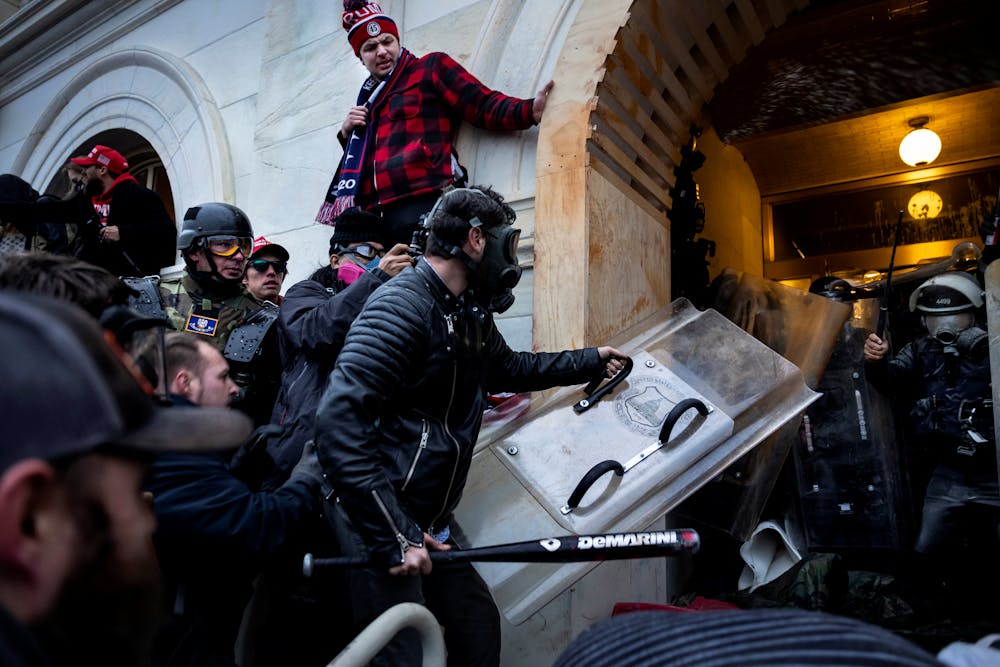
With some wielding weapons and wearing protective gear, rioters clash with police on the steps of an entrance to the U.S. Capitol.
Trump supporters storm the U.S. Capitol on Jan. 6, 2021. Brent Stirton via Getty Images News

More than crazy bluster

This rhetoric may seem like crazy bluster, which is no doubt why many people appear prepared to ignore it. But put in its historical context, what Trump is doing is echoing views that are part of a long tradition of illiberal and outright fascist thought. For fascists have always seen the use of violence as a virtue, not a vice.

First, this is the natural result of the way that fascist communities define themselves. According to Carl Schmitt, a prominent Nazi and for a time the official legal theorist of the party under Adolf Hitler, one builds and maintains a community by identifying and vilifying its enemies. And in this kind of highly polarized environment, the threat of violence always hangs in the air.

Second, among fascists, machismo is much admired. Former Brazilian President Jair Bolsonaro, whose own outrageous rhetoric has also encouraged violent behavior by his supporters, simply “beamed” when Russian President Vladimir Putin praised him for his masculinity.

Trump often acts as a sycophant for Putin too, and machismo also is a big part of Trump’s own public persona.

Third, fascists are obsessed with purity. They long for a world where they can live among their own racial, ethnic, religious and ideological kind on land they view as exclusively theirs.

But in the real world, people are too intermixed for this to occur naturally. True purity of community is an aspiration that can be made real only through violence and subjugation. Hence the Holocaust,genocide and ethnic cleansing, and other more limited attacks on minority and immigrant populations.

Violence as noble and intoxicating

Fascists, then, see violence as noble and intoxicating. For example, Julius Evola, a far-right intellectual active in Italy from 1920 to 1970 and the author, among other things, of “Fascism Viewed from the Right” and “A Handbook for Right-Wing Youth,” writes that violence “offers man the opportunity to awaken the hero that sleeps within him.”

Today, Evola is a favorite of the alt-right, and he suggests that a hero’s death is preferable to a life built on liberal compromise. “The moment the individual succeeds in living as a hero,” Evola writes, “even if it is the final moment of his earthly life, weighs infinitely more on the scale of values than a protracted existence consuming monotonously among the trivialities of cities.”

The ultraconservative Catholic authoritarian and opponent of the French Revolution Joseph de Maistre, who is recognized as one of the intellectual forefathers of fascism, goes even further.

“The whole earth, perpetually steeped in blood, is nothing but a vast altar upon which all that is living must be sacrificed without end, without measure, without pause, until the consummation of things, until evil is extinct, until the death of death,” Maistre writes. Indeed, without an executioner, the man who kills other men, Maistre claims society could not exist. For violence is necessary to satisfy “men’s natural desire to be destructive,” he writes; it leaves them feeling “exalted and fulfilled.”

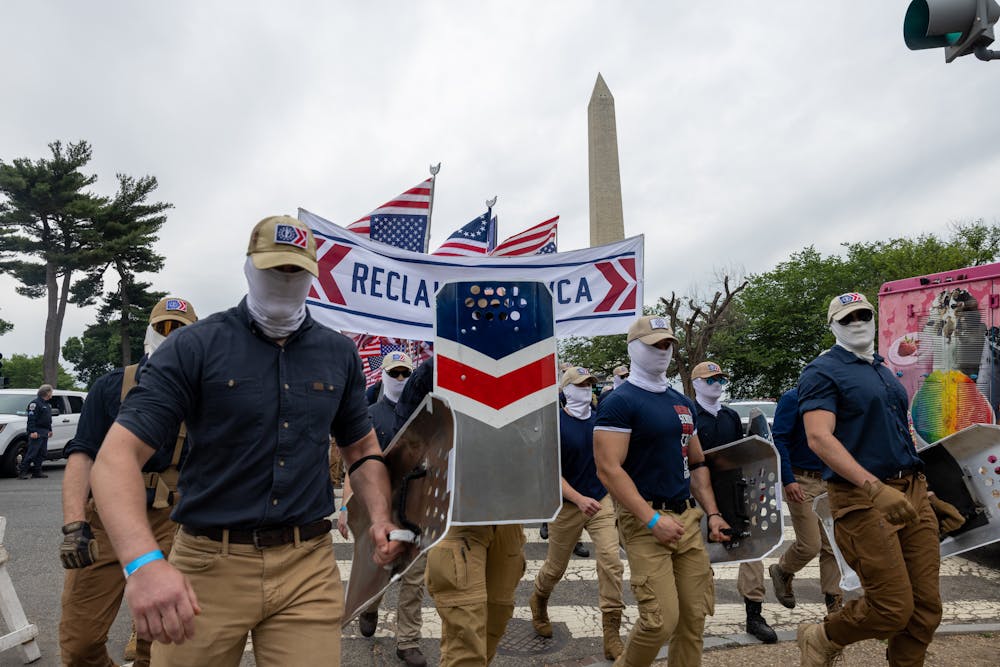
With the Washington Monument in the background, a group of protesters march.
Patriot Front – labeled a ‘white supremacist group’ by the Anti-Defamation League – marches in Washington, D.C., in May 2023. Nathan Posner/Anadolu Agency via Getty Images

Social disruption and destruction

These comments make clear that fascists see violence as something to be used for more than just personal retribution and intimidation. It is to be used to create wider social disruption and destruction. Not only are individuals to be subject to attack, but institutions and norms as well.

Consider “The Fourth Turning: An American Prophecy,” a work by two amateur historians popular on the far right.

The book is actually a restatement of Evola’s theory of historical regression, set forth in his “Revolt against the Modern World.”

The idea is that history moves in cycles, the first one being the best and each one thereafter representing a further decline. The fourth cycle is the worst, and it ends only when all existing social institutions are destroyed. This, in turn, is an application of the philosopher Friedrich Nietzsche’s idea that “one can build only in a space which has been previously razed to the ground.”

Then history will reset and cycle once again.

Trump’s former adviser Steve Bannon admires these ideas so much he made a movie about them.

Trump appears to embrace these ideas too. “When the economy crashes, when the country goes to total hell, and everything is a disaster, then you’ll have riots to go back to where we used to be, when we were great,” he says.

Viewed in this context, not taking Trump’s violent rhetoric more seriously seems dangerous indeed.

The Conversation

Mark R. Reiff is a registered Democrat. He does not work for, consult, own shares in, or receive funding from any company or organization that would benefit from this article, and has disclosed no other relevant affiliations beyond his academic appointment.

03 Nov 19:16

Endometriosis afflicts millions of women, but few people feel comfortable talking about it

by Kristina S. Brown, Professor and Chair of Couple and Family Therapy, Adler University
Endometriosis pain can be so severe that it impairs a person's ability to keep up with school, succeed at work or have a satisfying sex life. Kinga Krzeminska/Moment via Getty Images

Endometriosis causes physical, sexual and emotional pain. About 190 million people around the globe have endometriosis, including one in 10 American women, but there has historically been a deafening silence about the disease and the pervasive impact it can have on a person’s life.

While endometriosis is a chronic gynecological illness that can affect anyone with a uterus – women, transgender men and nonbinary individuals – it often goes undiagnosed because its symptoms can be attributed to other physical or psychological concerns. Patients presenting with this pain are often told it is “all in your head.”

However, endometriosis is becoming a more visible illness, thanks in part to celebrities such as Lena Dunham, Chrissy Teigen, Amy Schumer, Whoopi Goldberg and others who have begun sharing their stories publicly. After going undiagnosed for 23 years, Padma Lakshmi, a popular cookbook author, actress and host of the TV show “Top Chef,” founded EndoFund, previously Endometriosis Foundation of America, in 2009 so that others do not have to go through what she did.

I am a couple and family therapy professor, clinician and researcher. My own endometriosis diagnosis at the age of 19 has inspired my work exploring how this illness affects others beyond the physical symptoms.

To better understand the impact of endometriosis on relationships, I interviewed 10 couples about their experiences of diagnosis, treatment and living with this disease. Through their stories of how endometriosis-related pain can affect every aspect of daily life, including their intimate relationships, I provide some specific recommendations. The quotes I have included in this article are from my doctoral dissertation research.

The basics of endometriosis

When a person has endometriosis, the endometrial cells that line their uterus “implant” in places outside the uterus, such as the ovaries, fallopian tubes and the lining of the abdomen — called the peritoneum. At the end of each menstrual cycle, the uterus sheds its lining, which exits the body via the cervix and vagina. The “misplanted” endometrial cells also shed, but they have no place to go – resulting in internal bleeding, inflammation and pain.

An endometriosis diagnosis is described in stages related to the visual presence of the disease, from minimal, or Stage 1, to severe, or Stage 4. However, there is no connection between the stage and the experience of pain.

One symptom of endometriosis is intense pain during the menstrual cycle. Another is pain with sex. Because pain with menses or sex can be attributed to “normal” pain, a history of sexual abuse or psychiatric reasons such as a dislike of sex, some people with endometriosis wait an average of seven years for diagnosis, which can be visually confirmed only through a procedure called laparoscopy.

In addition to these and other types of severe pain, endometriosis can also cause infertility, and patients who want to have children must often undergo medical or surgical interventions to conceive.

Dr. Megan Wasson of the Mayo Clinic explains what endometriosis is and how it can be treated.

Impacts on school, work and sex

Physical pain from endometriosis can be debilitating. Adolescents with endometriosis may struggle to keep up with their classes, friends, homework or extracurricular activities when the pain becomes too severe. They may shift to home-schooling or virtual learning to complete their studies.

The pain can also deeply affect a career trajectory. “I almost lost my job because of time off,” one interviewee told me. “In fact, when I had to get my hysterectomy, I walked in to tell my manager and he goes, ‘Well, I hope you’re not going to tell me that you have to have a hysterectomy and have to be out for six weeks!’ And I just broke down in tears.”

All of my participants shared experiences where doctors dismissed complaints of sexual pain – called dyspareunia – from endometriosis. This can delay diagnosis and treatment.

Sex and intimacy often become nonexistent, while some couples shared that they have come to accept that pain is part of sex. One woman shared with me: “I don’t want to be touched or have my naked body seen because I feel bloated and ugly and I’m in horrible pain!”

Partners can also be affected emotionally. “I just feel horrible,” one told me. “There are times when we are having sex that I actually feel guilty that I know that I am hurting her and I know she is going to be in pain and it makes me unhappy.”

These experiences of pain, of not being believed by doctors and professionals, of negative effects on education and career and of intimacy destroyed create a heavy emotional burden on individuals and relationships.

Breaking the silence around endometriosis

When I was diagnosed with endometriosis, it changed the course of my life. My partner and I learned to expand our definition of intimacy and to redistribute household responsibilities when I was incapacitated. As the risk of infertility only increases without intervention, we started conversations about having children earlier than anticipated. My diagnosis also led me to focus my professional identity as a medical family therapist to help others deal with endometriosis and chronic illnesses.

Based on this experience, here are some ways to break this silence:

  • Learn about endometriosis. It directly helps when one’s support systems are educated.

  • Separate the person from the disease. When the pain you are experiencing from endometriosis is debilitating, help those around you who are also affected to understand that it is because of your endometriosis and it is not personal.

  • Speak from your own experience, saying, “I …” rather than “You …” When we do this, it decreases the other person’s defenses and opens up the communication, making space for connection.

Social work researcher Brené Brown describes how to create a genuine empathetic connection with another person.

Recommendations from people living it

My research participants shared their own recommendations with me, especially the importance of believing that their pain is real; accept that what they are sharing is their very real experience, and let them know that they are believed.

Bestselling author and social work researcher Brené Brown has said, “Empathy fuels connection, sympathy drives disconnection.” Approaching someone with endometriosis from a position of empathy sends a message that you want to work with them collaboratively.

By practicing these important relationship skills, we can break the silence around endometriosis.

The Conversation

I continue to be grateful to the ten couples who shared their experiences of painful sex with endometriosis for my dissertation research.

02 Nov 21:07

AI Will Lead Us to Need More Garbage-subtraction.

by Todd A Carpenter

Generative AI wants to make information cheap, but will people want to read it? Are we ready for more productive writers?

The post AI Will Lead Us to Need More Garbage-subtraction. appeared first on The Scholarly Kitchen.

30 Oct 19:55

Living legacy of Dred Scott

by Judy G. Russell

Scott descendant to keynote at RootsTech 2024

There’s often reason for a bit of skepticism over the selection of most keynoters at RootsTech, the huge annual genealogy conference in Salt Lake City.

It’s often more a matter of celebrity than genealogy or family history.

But the announcement today of one of the keynoters for the 2024 RootsTech has The Legal Genealogist dancing in the aisles.

History, family, stories of America’s past — come to life, in the person of Lynne M. Jackson, author, educator and lifelong St. Louis resident, revealed today as the first announced keynoter for the upcoming conference, scheduled for February 29 through March 2, 2024.1

And the living breathing legacy of one of the turning points in American history.

Lynne M. Jackson

Lynne M. Jackson — who will keynote on Friday, March 1, 2024 — is President and founder of the Dred Scott Heritage Foundation.

Yes, that Dred Scott.

The Dred Scott who — with his wife Harriet and their two children Eliza and Lizzie — was at the center of the 1857 decision generally regarded as the single worst decision ever of the United States Supreme Court: the decision that no person of African descent, whose ancestors were brought to America enslaved, could be a citizen of the United States, entitled to the privileges of citizenship including the right to sue in court for recognition of freedom.2 The decision was worse than that: it also held that longstanding bars on the spread of slavery into the territories were unlawful.3

The case history is astounding. The National Archives describes it this way:

In 1846, an enslaved Black man named Dred Scott and his wife, Harriet, sued for their freedom in St. Louis Circuit Court. They claimed that they were free due to their residence in a free territory where slavery was prohibited.

The odds were in their favor. They had lived with their enslaver, an army surgeon, at Fort Snelling, then in the free Territory of Wisconsin. The Scotts’ freedom could be established on the grounds that they had been held in bondage for extended periods in a free territory and were then returned to a slave state. Courts had ruled this way in the past.

However, what appeared to be a straightforward lawsuit between two private parties became an 11-year legal struggle that culminated in one of the most notorious decisions ever issued by the United States Supreme Court. Scott lost his case, which worked its way through the Missouri state courts; he then filed a new federal suit which ultimately reached the Supreme Court.

On its way to the Supreme Court, the Dred Scott case grew in scope and significance as slavery became the single most explosive issue in American politics. By the time the case reached the high court, it had come to have enormous political implications for the entire nation.

On March 6, 1857, Chief Justice Roger B. Taney read the majority opinion of the Court, which stated that enslaved people were not citizens of the United States and, therefore, could not expect any protection from the federal government or the courts. The opinion also stated that Congress had no authority to ban slavery from a federal territory. This decision moved the nation a step closer to the Civil War.

The decision of Scott v. Sandford, considered by many legal scholars to be the worst ever rendered by the Supreme Court, was overturned by the 13th and 14th amendments to the Constitution, which abolished slavery and declared all persons born in the United States to be citizens of the United States.4

So… what happened to Dred and Harriet Scott? To their two children named with them in the court papers? What’s the significance of the case, the history, this family?

This keynote speaker will share with us details of the Scotts’ personal and family history that have not previously been known.

We’re going to hear about it from a very personal perspective.

Because Lynne M. Jackson is the great-great-granddaughter of Dred and Harriet Scott.

Don’t miss this keynote. Friday, March 1, 2024.

In person and online.

At RootsTech 2024.

I can’t wait.


Cite/link to this post: Judy G. Russell, “Living legacy of Dred Scott,” The Legal Genealogist (https://www.legalgenealogist.com/blog : posted 30 Oct 2023).

SOURCES

  1. No, that’s not a typo. 2024 is a leap year.
  2. See Scott v. Sandford, 60 U.S. 393 (1857).
  3. Ibid., at 452 (“the act of Congress which prohibited a citizen from holding and owning property of this kind in the territory of the United States north of the line therein mentioned, is not warranted by the Constitution, and is therefore void”).
  4. Dred Scott v. Sandford (1857),” Milestone Documents, U.S. National Archives (https://www.archives.gov/milestone-documents/ : accessed 30 Oct 2023).
30 Oct 13:31

USF’s response to letter disbanding pro-Palestinian student groups still unclear

by Julia Saad, Staff Writer
SJP member Serene Abulhaija said Western media controls a narrative over Palestine, and she encourages students to do their own research. ORACLE PHOTO/JEISLIAN QUILES-SIERRA

USF is still reviewing the order to dismantle chapters of the National Students for Justice in Palestine (NSJP), according to Director of Media Relations Althea Johnson.

The university’s vague statements have left students confused.

A letter from State University System (SUS) Chancellor Ray Rodrigues was sent on Tuesday to university presidents saying that NSJP has made statements classified as “harmful support for terrorist groups.”

Related: Florida orders pro-Palestinian USF group to disband

The University of Florida has stated it will evaluate its registered student organizations to verify if any actions mentioned in the letter were carried out by their students, according to the Tampa Bay Times.

Dean of Students Danielle McDonald did not respond to The Oracle’s request for comment at the time of the publication. 

Student Government (SG)  President Cesar Esmeraldi said that everyone in the university is working “hard to protect all students.”

“I am not gonna speak for all Student Government, but I think one of my main missions is to protect all students and for all students to be able to express their First Amendment right,” Esmeraldi said.

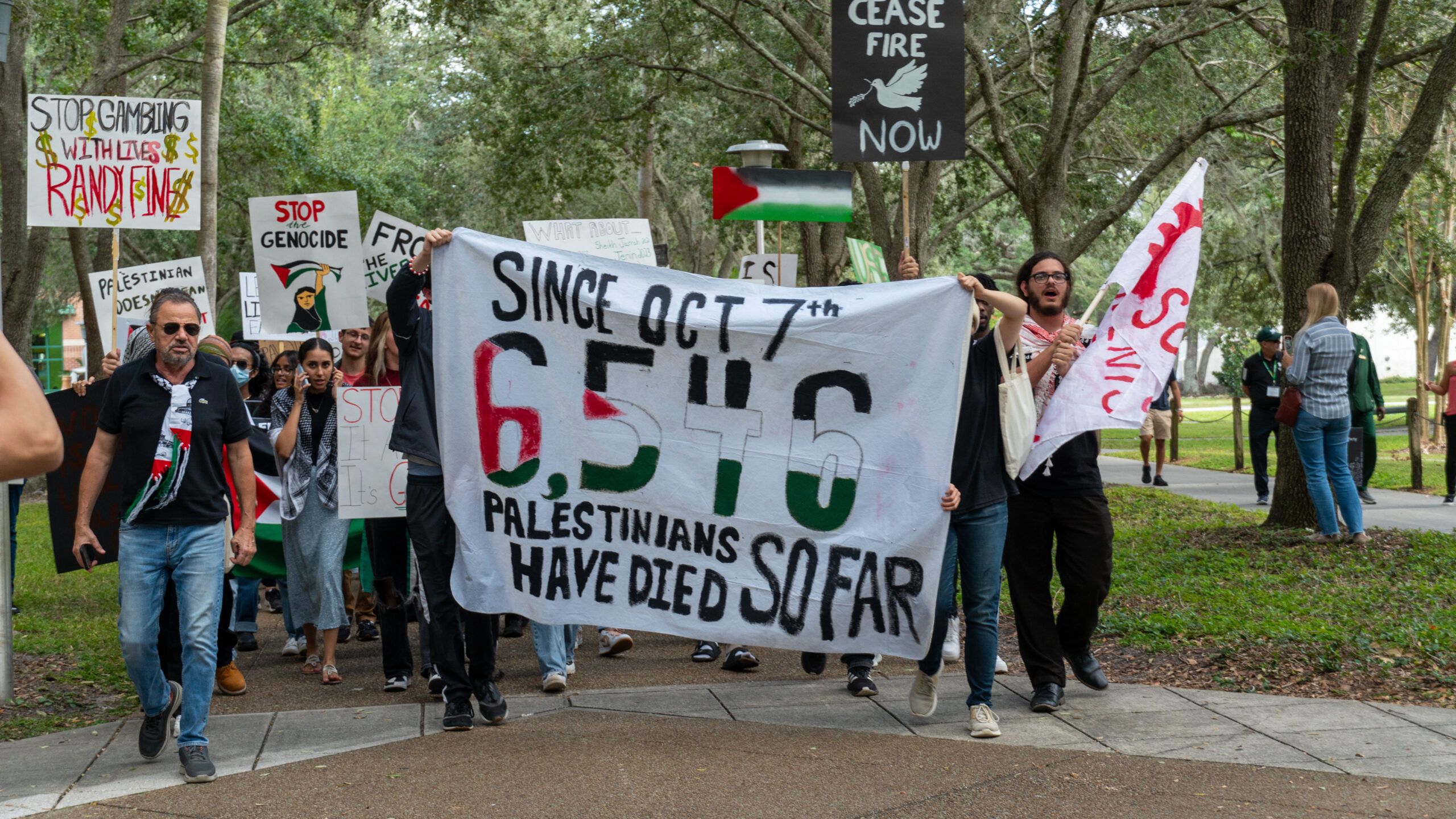
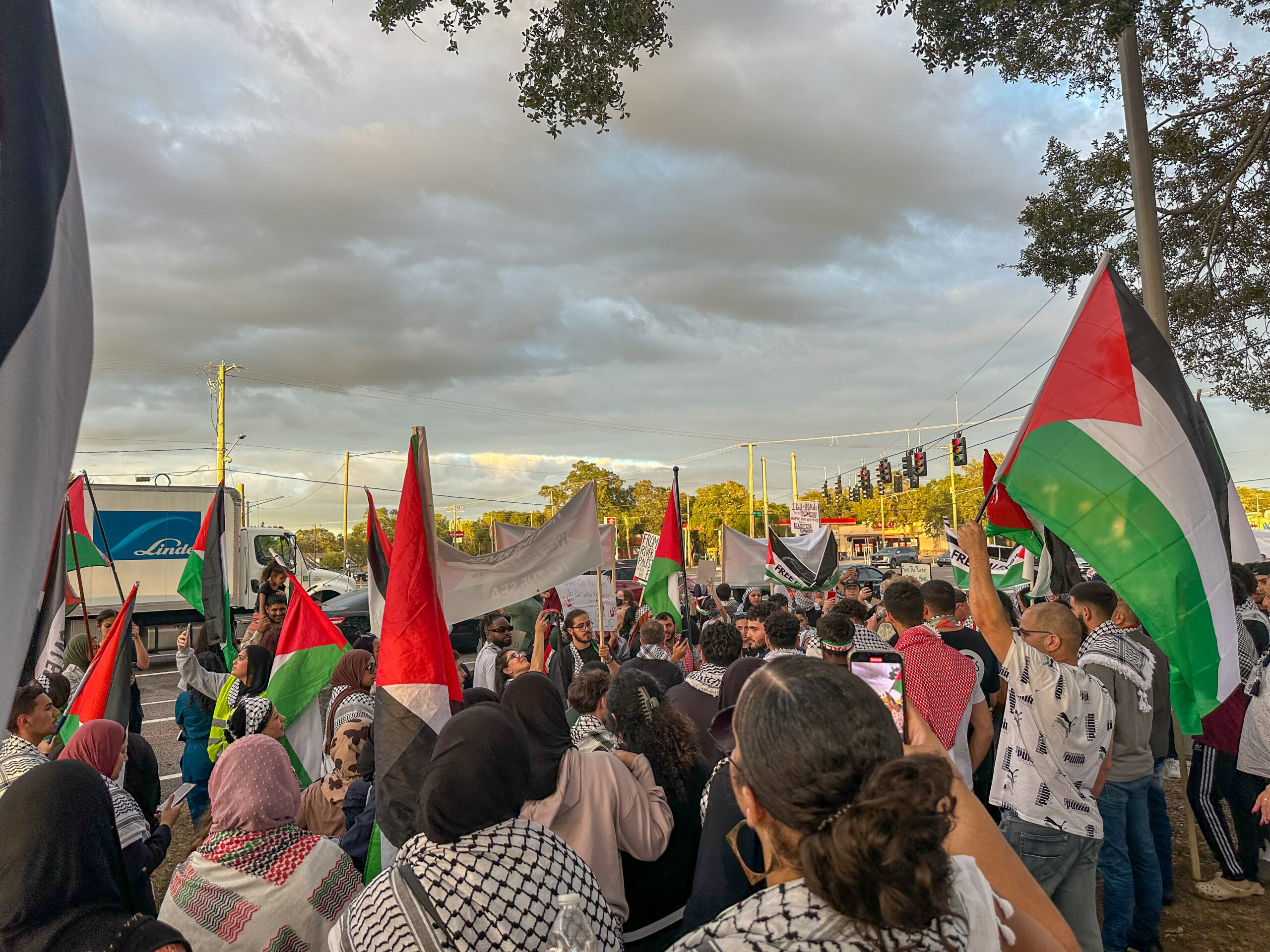
Students gathered at the corner of Genshaft Drive and Alumni Drive for a pro-Palestine march to the Martin Luther King (MLK) Plaza on Thursday at 2 p.m. 

USF chapters of Students for Socialism (SFS), Students Organize 4 Syria (SOS), Students for Justice in Palestine (SJP), Muslim Students Association (MSA) and Sister United Muslim Association (SUMA) jointly organized the march. 

Extra signs and flags were brought by the first members of student organizations to arrive at the assigned meeting corner. Passing cars honked horns in support of the demonstration while passing the traffic light.

One student organizer, who asked to remain anonymous, instructed all attendees not to engage if they were met with “counter protests” or retaliation. They said “this protest will remain peaceful.”

Related: PHOTO GALLERY – Student organizations March for Palestine

USF employees and University Police were present throughout the march. 

During the address, another student organizer said that the “genocidal rhetoric” can not be allowed.

“We have to stand up as white people. We have to stand up. We have to use our privilege that we have in this country as a shield,” the student said.

“1, 2, 3, 4, occupation no more,” “Free, free Palestine” and “Not another nickel, not another dime, no more money for Israel’s crimes,” were chanted. Around 70 students made their way down USF Alumni drive, stopping at the MLK plaza. 

Freshman political science major Ivan Steagall was one of the speakers. Although Steagall is not Palestinian or part of any student organizations, the Brazilian student said they had to show up.

“I was scared to come today… But if I didn’t come, I would be betraying myself and what I believe in,” Steagall said.

Steagall said the biggest issue with how Palestinians are characterized in the media is that people consume it without further research. 

“There seems to be not many people that are specifically against Palestine or Gaza, but the same people will read something on facebook and go ‘Oh, Hamas decapitated babies,’” Steagall said.

Palestinian student and SJP member Serene Abulhaija said she encourages people to do their own research beyond media consumption. 

“Listen to both sides,” Abulhaija said. “Look into the history of both places, instead of just listening to the narrative that this has anything to do with religion, because it absolutely does not.” 

Abulhaija said students should continue to speak up for those who can’t in Palestine. Although she said students have the privilege to speak up, Abulhaija said she feels USF has not provided help to the cause.

Senior studio art major Caín Lima said that they have read about the occupation in Palestine since middle school. Lima, who is from Peru, said they related the treatment of Palestinians to that of South Americans pre-colonialism.

“I think there is a history of oppression in different parts of the world,” Lima said. “It is important to find parallels in the way oppressed people are treated.”

Lima said that these marches’ purpose is to show unity in the community.

“Sometimes moving people emotionally will get them to see things and organize in different ways,” they said.

26 Oct 19:42

Florida orders pro-Palestinian USF group to disband

by Clinton Engelberger, Editor in Chief
An Emergency Rally for Gaza was held shortly after Wednesday’s announcement at Fowler and 56th St. that saw over 100 attendees. ORACLE PHOTO/CLINTON ENGELBERGER

Florida is cracking down on the National Students for Justice in Palestine (NSJP) – which includes USF’s own chapter – after the organization made statements that were classified as “a harmful support for terrorist groups.”

University leaders were directed to terminate the pro-Palestinian student groups in a letter sent to SUS presidents on Wednesday from Ray Rodrigues, State University System (SUS) Chancellor. The decision was coordinated with Gov. Ron DeSantis’ administration. 

Hamas, designated as a terrorist group by the U.S., launched an attack on Israel on Oct. 7. The attack prompted the Israeli cabinet to declare war against Hamas, according to the Council of Foreign Relations.

RELATED – ‘We knew we had to do something’: USF students rally to show solidarity with Palestine

Rodrigues said Hamas called their attacks on Israel “Operation Al-Aqsa Flood.” He said NSJP released a “toolkit,” which referred to Operation Al-Aqsa Flood as the resistance.

It stated that “Palestinian students in exile are part of this movement, not in solidarity with this movement.” Rodrigues said NSJP’s actions of identifying with Operation Al-Aqsa Flood is a felony under Fla. Stat. 775.33 (3)

The statute states that “a person who knowingly provides material support or resources to a designated foreign terrorist organization, or attempts or conspires to do so, commits a felony of the first degree.”

School administrators who support the student groups could face suspension, according to the letter.

An Emergency Rally for Gaza was held by the Resistance of Tampa Bay shortly after Wednesday’s announcement. 

What began as a crowd of 20 people chanting and holding signs evolved into an over 100-person march that stopped traffic. The march ended where the rally started at Fowler and 56th St., as protesters continued to chant and wave Palestinian flags.

Tiffany Mclane, who attended the protest with her 10-year-old daughter, said USF’s chapter of NSJP, Students for Justice in Palestine (SJP), holds a special place in her heart. Mclane and her sister, a USF alum, were both part of the organization and have been protesting for Palestinian support since hearing about the conflict in 2010.

She said DeSantis’ move to disband pro-Palestinian student groups in Florida is disheartening.

“The fact that DeSantis is trying to shut us down, stop our protesting and just try to silence our voices is not going to happen,” Mclane said.

Mclane said she visited Palestine in 2011 and witnessed the “torment” Israel was causing. After hearing stories of her mom’s experiences, Isabella Mukherjee said she wanted to stand alongside her at Wednesday’s rally.

“I want to be here with this journey so that I can be with her and be part of history,” Mukherjee said. 

Also in attendance with her child was 31-year-old Rayza Sanchez. She said being at the rally with her son, Zahir Mejia-Sanchez, meant everything to her.

“It means I’m planting the seed of love. I always tell him to stand up for what’s right. It doesn’t matter if everyone else is quiet,” she said.

Tensions were high as some drove by and honked in support, while others rolled their windows down to argue with protesters. Sanchez said there needs to be more unity so real change can happen.

“We need unity. And you don’t need to be from the same religion, you just need to be a human,” Sanchez said. “I’m Mexican. I’m a Christian. But right now, I’m here with them.”

Another protester, 27-year-old Jessica Awwad, said DeSantis’ decision was “disgusting” and “ridiculous.”

“There should be pro-Palestinian Americans standing up,” Awwad said. “Innocent people are being scrutinized for just simply existing.”

USF and SJP did not respond to The Oracle’s request for comment at the time of publication.

SJP along with Muslim Student Association, Sisters United Muslim Association, Students for Socialism, and Students Organize for Syria, is holding a march on Thursday at 2 p.m. “for the children of Gaza.”

This march comes shortly after an Oct. 12 rally held by SJP saw around 50 students attend to express their solidarity with Palestine.

The University of Florida is one of the only other public universities in the state to have an NSJP chapter.

This story has been updated.

26 Oct 19:38

OPINION: Feed-A-Bull is apparently not Fund-A-Bull

by Rachel Beaird, Opinion Editor
USF needs to allocate more funding to the food pantry, as it is struggling to keep up with increasing demand from a growing student population. ORACLE PHOTO/JUSTIN SEECHARAN

USF’s Feed-A-Bull food pantry receives no financial help from the university, even though increased housing and meal plan prices are part of the reason so many students have to rely on the program in the first place.

The pantry is already nearing the number of visits they typically see after an entire school year. The program is struggling to keep up with the demand.

RELATED: Feed-a-Bull pantry sees increasing demand from past years

Feed-A-Bull currently has no budget from USF, said program director Katie Webster in an Oct. 23 interview with The Oracle. The pantry has run entirely on food and monetary donations since it opened in 2015. However, as the population of students in need has grown, Webster says Feed-A-Bull has been exploring options for additional funding.

This funding could allow the pantry to undertake new initiatives, such as opening locations in different areas across campus or even opening a mobile food bank to make the program more accessible for those living off-campus.

The university needs to allocate funding to Feed-A-Bull to support the mental, emotional and academic well-being of students. Since USF has raised the costs of meal plans and housing, putting students under more financial strain, they need to step up.

Dorm rates at USF are currently between $3,070 to $6,130 per semester and are set to increase annually by 4.5% for the next five years. Many students are struggling to afford these increased rates along with tuition, food and other expenses.

RELATED: Is USF affordable? Students say they can barely pay for food, housing

Students struggling to pay rent or who cannot afford to purchase a meal plan have less security when it comes to stocking their cupboards, and may even be forced to go hungry.

Food insecurity – or inconsistent access to sufficient food – is common among college students.

In the 2019-20 academic year, graduate students from the USF College of Public Health, Renee Wallace, Cody Brown, Nicole Wenstrom and Mariam Badru, investigated college food insecurity for a class project.

They found that one in five USF students are food insecure, but acknowledged that the real number is likely even higher. With such a significant number of students in need, the school needs to focus on providing them with the resources to stay physically and mentally healthy.

USF has a large population of students from lower-class backgrounds. About one third of all students qualify for the Pell Grant, which is a financial aid program for lower-income families. These students are significantly more likely to struggle with food insecurity.

Food insecurity drains students both mentally and emotionally. College is already a time of major change for students, and they shouldn’t have to worry about whether or not they can afford to eat. This stress will likely lead to anxiety and depression, also hurting students’ self-image and self-esteem.

This issue also affects academic performance. When students are not able to consume enough nutrients, they are not going to be able to concentrate, making it significantly harder for them to succeed academically, according to a 2021 study published in the National Library of Medicine. 

Feed-A-Bull was supposed to expand to a larger space last semester, but they were not able to because “space on campus is in high demand by colleges and departments.” Webster said the pantry will continue to operate out of their current space for as long as necessary, but it is not ideal for efficiency. 

While the pantry that feeds struggling students has no funding, USF has been able to allocate plenty of money toward other areas of the school.

The university is currently in the midst of multiple expensive projects. One of these is the $340 million dollar football stadium scheduled to open in 2026. While much of this money is coming from loans and grants, $140 million is from USF itself.

Rather than spending so extravagantly on the new stadium, some of that money would be better used to ensure that the university’s students have consistent access to nutritious food. The extra funding could also be used to help Feed-A-Bull open other locations on and around campus or even open a mobile food bank.

Funding for Feed-A-Bull needs to be at the top of the university’s priority list in order to keep students thriving mentally, emotionally and academically. The food pantry has done amazing work with the donations they have been given, but funding from USF could help them go much farther. 

The university’s recent price increases have left many students struggling to afford groceries and now USF needs to step in and provide funding for this program to make sure no one in the community has to go without a meal.


26 Oct 19:33

Poisoning the AI Well

by Jonathan Bailey

Researchers at the University of Chicago have developed Nightshade, a tool that it claims can poison AI training data. Here's how it works.

The post Poisoning the AI Well appeared first on Plagiarism Today.

26 Oct 19:23

A Melting Cauldron: The Book of Hallowe’en (1919)

The first book-length history of Halloween, written when the author was a mere twenty-six years old.

26 Oct 18:55

Access to Law Should Be Fully Open: Tell Congress Not to Be Fooled by the Pro Codes Act

by Corynne McSherry

It’s Open Access Week in the United States, which means it’s a chance to celebrate the accomplishments of the Open Access movement—and reinforce the need to keep fighting. We’ve come a long way, with governments, universities, and research funders all successfully pressuring publishers to improve access to knowledge and finding ways to do it themselves

TAKE ACTION

Tell Congress: Access To Laws Should Be Fully Open

At EFF, we are especially proud of the work we have done helping our client, Public.Resource.Org (PRO), improve public access to the law. Public Resource’s mission is to make all government information available to the governed. As part of that mission, it posts safety codes such as the National Electrical Code, on its website, for free, in a fully accessible format—where those codes have been adopted into law by reference.  

You didn’t learn about incorporation by reference from Schoolhouse Rock, but it’s one of the key ways policymakers create law. A huge portion of the regulations we all live by (such as fire safety codes, or the National Electrical Code) are initially written—by industry experts, government officials, and other volunteers—under the auspices of standards development organizations (SDOs). Federal, state, or municipal policymakers then review the codes and decide whether the standard is a good broad rule. If so, it is adopted into law “by reference.” In other words, the regulation cites the code by name but doesn’t copy and paste the entire thing into law (useful when the code is long and detailed). For example, if a regulation requires compliance with the National Fire Safety Code, it might simply refer to specific provisions or the code as a whole, rather than copying it in directly. But that doesn’t make compliance any less mandatory. 

When a pipeline bursts, journalists might want to investigate whether the pipeline complied with federal regulations, or compare federal, state, and local rules. When a toy is recalled, parents want to know whether its maker followed child safety rules. When a fire breaks out, homeowners and communities want to know whether the building complied with fire safety regulations. Online access to safety regulations helps make that review—and accountability—possible.  

The rub: the SDOs claim to own copyright in these rules, even after they become law, and that they are therefore allowed to sell and otherwise control access to them. Based on that claim, they sued Public Resource for copyright infringement. 

But court after court has recognized that no one can own the law.  The Supreme Court held as much in its very first copyright case, and recently reaffirmed it: if “every citizen is presumed to know the law,” the Court observed, “it needs no argument to show . . . that all should have free access to its contents.” And in September 2023, after a decade of litigation, a federal appeals court held that Public Resource’s database was a lawful fair use.  

Which brings us to the latest threat. Having lost in court, the SDOs are now looking to Congress to shore up their copyright claim, via the Pro Codes Act. It’s a tricky bit of legislation that seems innocuous if you don’t know the context. 

Pro Codes’ main provision requires that: 

An original work of authorship otherwise subject to protection under this title that has been adopted or incorporated by reference, in full or in part, into any Federal, State, or municipal law or regulation, shall retain such protection only if the owner of the copyright makes the work available at no monetary cost for viewing by the public in electronic form on a publicly accessible website in a location on the website that is readily accessible to the public.

Sounds good, right? In fact, it sounds obvious: mandatory regulations should be made available online, for free, so people can more easily know, share, and comment on them. Here’s the trick: this language would effectively endorse the claim that SDOs can “retain” copyright in the law, as long as they let the public read it online.  

There are many problems with this approach. First and foremost, “access” here means read-only, and subject to licensing limits.  We already know what that looks like: currently the SDOs that make their codes available to the public online do so through clunky, disorganized, siloed websites, largely inaccessible to the print-disabled, and subject to onerous contractual terms (like a requirement to give up your personal information). The public can’t copy, print, or even link to specific portions of the codes. In other words, you can look at the law (as long as you aren’t print-disabled and you know what to look for), but you can’t share it, compare it, or comment on it. As multiple amici who filed briefs in support of Public Resource explained, the public needs more.  

Second, it doesn’t really make sense. The many volunteers who develop these codes neither need nor want a copyright incentive. The SDOs don’t need it either—they don’t do anything creative (convening volunteers is important work, but not creative work), and they make plenty of profit though trainings, membership fees, and selling standards that haven’t been incorporated into law.  

Third, it’s unconstitutional under the First, Fifth, and Fourteenth Amendments, which guarantee the public’s right to read, share, and discuss the law.  

Finally, there is no need for this bill. It simply mandates that SDOs do badly what Public Resource is already doing, better, for free.  

The Pro Codes Act is a deceptive power grab that will help giant industry associations ration access to huge swaths of U.S. law. Tell Congress not to fall for it. 

 EFF is proud to celebrate Open Access Week. 

TAKE ACTION

Tell Congress: Access To Laws Should Be Fully Open

26 Oct 17:28

Biological sex is far from binary − this college course examines the science of sex diversity in people, fungi and across the animal kingdom

by Ari Berkowitz, Presidential Professor and Director of Graduate Studies, Biology; Director, Cellular & Behavioral Neurobiology Graduate Program, University of Oklahoma
Biological sex comes in many more forms than just male or female. Yifei Fang/Moment via Getty Images
Text saying: Uncommon Courses, from The Conversation

Uncommon Courses is an occasional series from The Conversation U.S. highlighting unconventional approaches to teaching.

Title of course:

Diversity of Biological Sex Characteristics

What prompted the idea for the course?

Most people view biological sex, or the physical features related to reproduction, as simple and binary – either male or female. Even those who recognize that gender – referring to cultural norms around biological sex, or a person’s internal feeling of being masculine, feminine or both – can be complex and nuanced don’t see biological sex in the same way. Many also regard variability in sex and gender as exclusive to people – not found in nonhuman animals.

I am a behavioral neurobiologist who has been teaching human physiology since 1998. Over the past several years, I have focused my reading and writing on the biology of sex. It struck me that many of my students had misguided assumptions about sex characteristics, including that all people are physically either 100% male or 100% female.

A course on biological sexual diversity in both nonhuman animals and people could challenge these assumptions.

What does the course explore?

First, we examine why sexual reproduction evolved in any species. This question is still hotly debated among biologists because sex is inefficient. It requires time and energy to find a suitable mate and unite your sex cells, plus it allows you to pass on only half your genes to your offspring.

In comparison, asexual reproduction – essentially cloning yourself – is much more efficient. You don’t have to find a mate, and everyone can produce offspring themselves because there are no males. In biology, “male” refers to an individual that makes small sex cells like sperm, and “female” refers to an individual that makes large sex cells like eggs.

Next, we explore nonhuman sexual diversity, including fungi that have thousands of sexes and aphids that reproduce asexually most of the year but sexually once each fall. Among many others, we also learn about fish that are male or female at different times of their lives; intersex crayfish; and female spotted hyenas that have a penis.

Sex characteristics manifest in different ways across the animal kingdom.

We then transition from nonhuman animals to people, via the brain. We learn about a few small brain structures in vertebrates that likely have reproductive functions and are differently sized in females versus males on average. We also learn that most people have some brain structures that are more typically male, others that are more typically female and still others that are intermediate – in other words, most people are mosaics of female-typical and male-typical brain sex characteristics.

Finally, we focus on the biological sex characteristics of intersex people. The chromosomes and reproductive organs of intersex people have some typically female and some typically male characteristics or are intermediate between them.

Students then build on their knowledge of the diversity of biological sex characteristics to discuss whether intersex infants should have surgery to “correct” their genitals, as well as who should be allowed to compete in girls and women’s athletics.

Why is this course relevant now?

Perhaps more than ever, there is a debate about how to treat people who do not fit neatly into a female or a male box. Many assume that biological sex is binary and regard transgender and nonbinary people as mistaken or confused. In addition, for many decades, intersex infants have undergone surgical procedures to make them appear more typically male or female. Even those who support transgender, nonbinary and intersex people often assume that biological sex is binary. But this assumption is not anchored in evidence.

What will the course prepare students to do?

Students often say that before they took this course, they had no idea biological sex characteristics could be so diverse, despite having taken several biology courses.

An improved awareness of the complexity of biological sex may help shape the research and teaching of future biologists. This will help them design experiments that take account of the diversity of their subjects and be more inclusive in their teaching. It may also help all students ask better questions and make better judgments about social and political issues related to sex and gender.

The Conversation

Ari Berkowitz receives funding from the Oklahoma Center for the Advancement of Science and Technology and has received funding from the National Science Foundation and the National Institutes of Health.

26 Oct 17:20

Israel-Hamas conflict: what young Palestinians think about four key issues that affect their lives

by Erika Jiménez, Leverhulme Early Career Fellow at the School of Law, Queen's University Belfast
Anas-Mohammed/Shutterstock

On the eighth day of the current intensification of hostilities between Israel and Hamas, I saw a tweet that said that there would be more uproar in the west if “2.2 million golden retrievers [were] being bombed to extinction in an inescapable cage” instead of Palestinian civilians in Gaza.

This tweet took me back to interviews I conducted with 96 young Palestinians and their teachers in the West Bank in the aftermath of the 2014 invasion of Gaza and published in a journal recently. We talked about issues that affected their daily lives, not least their awareness of human rights as well as how the rest of the world perceives the Palestinians’ struggle.

I wanted to find out about the different ways Palestinian youth in grades nine and ten (aged 13-15) across a range of public, private and United Nations schools understood, talked about and used human rights – especially when the ideals they learned about at school contrasted with their struggles for rights in their daily life. In my conversations with these young people, they opened up to me about a range of issues that they confront in their daily life.

1. Dehumanisation of Palestinians

The young people I spoke with, who were from a range of different socioeconomic and religious backgrounds, often described how they felt dehumanised in discourse on Israel-Palestine relations. This failure to see them as fellow humans with the same wants, needs and – importantly – human rights as every one else, they felt, has come to be accepted globally.

But they also often used similar language to describe how they live under occupation. Hiba, a girl in grade nine studying at a private school joked that: “It’s funny how animals have more rights than the humans in Palestine”. Then, more seriously, she added: “We’re not equal, we are different from other children in the world.”

The idea that the value of a Palestinian life is ranked lower than the lives of others was another talking point. Anwar, a grade nine female refugee student at a school run by the UN said that: “In western countries if someone dies they make a massive issue of it. But if we Palestinians were killed whether it was 100 to 1,000, then it’s normal and OK. Palestinians are numbers.”

The rhetoric displayed by Israeli officials over the past fortnight shows this dehumanisation at work. Israeli defence minister Yoav Gallant in announcing the complete siege of Gaza asserted that: “We are fighting human animals.” His words were echoed by Israeli Major General Ghassan Alian who said to Palestinians in Gaza that “human animals must be treated as such”.

Scholars have shown in the past how this sort of dehumanising rhetoric often precedes acts of genocide.

2. Their parents’ and leaders’ generation

Many of the young people I spoke to were critical of how their elders – especially the leadership of the Palestinian Authority (PA) – appeared to have come to accept the occupation. Talking about the 2014 war in Gaza, Camilla, who was studying at a private school, told me: “Our government acts like they don’t care whether we are occupied or not … Israelis are killing kids and the government is not letting [sic] Israel pay for it.”

This week, Palestinians across the West Bank have joined protests against Israel’s bombardment of Gaza. But they have also been highly critical of the PA. In response PA security forces have cracked down on and fired live ammunition at demonstrators, killing young people like Razan Nasrallah, a 12-year-old girl from Jenin who was shot and killed in the West Bank city on October 17 while protesting at the attack on a Gaza hospital which killed hundreds of Palestinians.

Although some young people were also cynical about the prospect of seeing an end to the occupation in their lifetime, most were optimistic. Anwar, a grade nine pupil at a UN school told me that while “adults feel that it is over … as young people, we still have hope because we have a future”.

3. Israelis: even occupiers deserve human rights

Many of the young people I interviewed in 2015 were keen to make a distinction between most Jewish people living in Israel and those whose vision of a Zionist Jewish homeland involves the displacement of native Palestinians. As Jiries, a grade nine pupil at a private school told me:

Some people say that Jews are the one who are Zionist … but they’re wrong because there are a lot of Jews that support us … I just want to make sure that everyone who reads about “Jews” or “Zionists” can separate between the two.

The students were also keen to stress that not all of the Jewish community supports the state of Israel’s policy towards Palestine – and during the current conflict there are many Jewish groups around the world standing in solidarity with them:

The young people I interviewed lived in areas of the West Bank controlled by the Palestinian Authority (PA), which are officially off limits for Israelis. So, most of the young people’s encounters with Israelis would have been with settlers or soldiers either at checkpoints or during military raids. Young people held different views on their perceptions of the Israelis they’d encountered. Lina, a girl in grade nine at a UN school for refugee children stressed the difference between soldiers and citizens, meanwhile her classmate Nadiya, said:

In the Gaza war they didn’t differentiate between civilians and soldiers, Israelis target civilians and most of those who were killed were children, women and old people.

But when I asked this group of refugee girls if they thought an Israeli young person their age should enjoy the same human rights as them, they unanimously agreed.

4. Hope for the future

The occupied Palestinian territories have a young population: the median age in the West Bank and Gaza Strip is 19.6 years and in Gaza more than 40% of people are 14 or younger. Since October 7 2023, a Palestinian child has been killed about every 15 minutes.

For those who survive, military attacks can leave children with life-changing disabilities, without parental care, and can have long-term adverse impacts on their mental health. Other children may yet die because they can’t access food, water, or life-saving medical treatment because of the siege.

Despite being disproportionately affected by the violence, the views of young people are rarely consulted and their voices are largely missing in commentaries and decision-making processes that will affect their lives. Young people in society do not necessarily reproduce the views of adults around them. And often adults don’t listen when the young speak.

As Marwan, one of the young people I spoke to put it: “[adults] don’t understand that we are mature enough to understand our world”. Young people in Gaza and those in exile have addressed the international community calling for an immediate ceasefire.

The question is, who will listen and act upon these young people’s calls? They are the future of Palestine and their voices must be heard.

The Conversation

Erika Jiménez received funding for the research for this article from the Department for Employment and Learning.

26 Oct 17:07

Antisemitism has moved from the right to the left in the US − and falls back on long-standing stereotypes

by Arie Perliger, Director of Security Studies and Professor of Criminology and Justice Studies, UMass Lowell
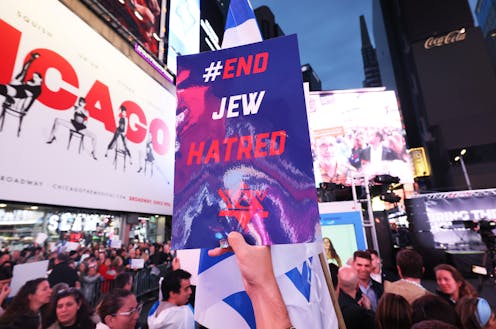
An Oct. 19, 2023, rally in New York City's Times Square demanding the freeing of hostages taken in the Oct. 7 attack by Hamas. Michael M. Santiago/Getty Images

The U.S. is currently experiencing one of the most significant waves of antisemitism that it has ever seen. Jewish communities are shaken and traumatized.

Jewish and civil rights organizations both in the U.S. and in other Western countries reported a rise in antisemitic incidents following the Oct. 7, 2023, Hamas attack on Israel and the subsequent Israeli military response. The Anti-Defamation League reported that in the first week after Hamas’ deadly attack, in which 1,400 Israelis were killed, antisemitic incidents in the U.S. tripled in comparison to the same week last year.

Similarly, London police recorded a 1,353% increase in antisemitic crimes compared with the same period a year earlier.

In addition, antisemitic symbols and rhetoric seem to be part of a growing number of protests that erupted around the globe following the escalation of the conflict between Israel and Hamas.

Most scholars agree that the term “antisemitism” describes animosity and discrimination against Jews. Broader definitions, such as the one adopted by the International Holocaust Remembrance Alliance, include the singling out of Israel and the demonization of its character, such as the claim that “the existence of a State of Israel is a racist endeavor.”

My team of researchers at UMass Lowell and Development Service Group, a Washington, D.C.-based think tank, compiled and analyzed a comprehensive dataset of antisemitic incidents in the U.S. between 1990 and 2021. We wanted to understand what factors led to antisemitism. We covered violent antisemitism as well as incidents of antisemitic intimidation and vandalism. We included any attacks against Jews which were motivated by the religious identity of the victims – even if it was motivated by anger about Israeli policies.

Our study, which will be published soon, found a startling new phenomenon: The ideology underlying antisemitism in the U.S. now encompasses both sides of the political spectrum. And it allowed us to develop three other insights regarding the intensifying linkage between the Israeli-Palestinian conflict and antisemitism in the U.S.

1. Antisemitism is not exclusive to the far right

Traditionally, antisemitism in the United States was promoted by far-right organizations and movements, such as the Ku Klux Klan, neo-Nazi groups and skinheads. Such groups focused on propagating traditional antisemitic narratives alleging Jews’ racial inferiority, their control of the financial sector and their role in global cabals aiming to undermine America and Western civilization.

More recently, progressive and left-leaning movements that are critical of Israel’s policies – especially with regard to the Palestinian population in the territories occupied by Israel in 1967 – have become linked to antisemitic practices, too.

In a survey conducted in 2018 in 12 European Union countries among victims of antisemitism, 21% indicated that they were physically or verbally attacked by what participants called “left-wing” activists. In the U.S., our data shows that 95% of antisemitic incidents motivated by Israel’s policies were perpetrated by far-left or unidentified activists. Just 5% were perpetrated by known far-right activists.

Further indication that antisemitic violence is no longer the sole domain of far-right extremists can be gleaned from an analysis of our data that looked at the geographic characteristics of antisemitism.

We find that antisemitic hate crimes are occurring especially in politically progressive areas of the country. The New York metropolitan area and the Northeast in general, and urban centers in Florida, California, the Northwest and the Midwest are experiencing the majority of antisemitic incidents.

While these regions of the U.S. were usually considered hospitable to minorities, our data reflects that in the past decade they are the most substantial hubs of antisemitic violence.

2. US antisemitism is strongly correlated to escalation in the Israeli-Palestinian conflict

The outbreak of violence between Israel and Palestinians seems to inflame antisemitism in the U.S. and is exploited to amplify long-standing antisemitic tropes.

Rigorous analysis of our dataset found conclusive evidence that these escalations in the Israeli-Palestinian conflict – such as the violent clashes between Hamas and Israel in the Gaza Strip in the past few years – are accompanied by an increase in antisemitic incidents in the U.S.

For example, in the months leading up to the Israel-Hamas war of May 2021, there was a gradual increase in antisemitic attacks that peaked in May 2021 and gradually declined in the following months.

3. Israel’s policies and antisemitism abroad are connected

The growing connection between Israel’s policies and antisemitic violence abroad, and especially in the U.S., reflects the view among many Americans that American Jews unquestioningly support Israel’s government.

The Anti-Defamation League’s leader put it bluntly when he stated following the May 2021 Israel-Hamas war that “the violence we witnessed in America during the conflict last May was shocking … it seemed as if the working assumption was that if you were Jewish, you were blameworthy for what was happening half a world away.”

Thus, it is not surprising that following the Oct. 7, 2023, Hamas attack, Jewish organizations on American campuses became the main targets of violent activism by Palestinian rights supporters. Nor was it surprising that the first reaction of U.S. law enforcement agencies in the wake of the Hamas attack was enhancing the protections of Jewish schools and communal facilities.

Demonstrators carrying signs that include one equating Zionism to Nazism.
Thousands of demonstrators waving Palestinian flags and signs denouncing ‘Israeli apartheid’ march in support of Palestinians in Los Angeles on Oct. 14, 2023. David Swanson/AFP via Getty Images

4. Antisemitism today exploits long-standing antisemitic tropes

American Jewish communities had traditionally strong links to the state of Israel, and many extended their support in various ways. They included contributing money to Israeli cultural, educational and social institutions, as well as advocating for U.S. support. This was explicit acknowledgment of the importance to the Jewish people of having a homeland.

In recent years, however, many Jewish communities, especially their younger members, became increasingly critical of Israeli policies and the country’s ongoing military control of the occupied Palestinian territories.

Despite such developments within the Jewish community, efforts by organizations sympathetic to the Palestinian cause to link American Jews as a whole to Israel’s policies seem to have intensified. Such linkages reflect an extension of one of the most resilient and long-standing antisemitic tropes, in which American Jews are portrayed as having a dual loyalty and a preference to support Israel’s interests over American ones, especially in times in which they may conflict.

In the past, sentiments regarding American Jews’ alleged dual loyalty were mainly exploited by extremists on the far right. Lately, it seems also to be manifested in left-wing discourse and actions that support or legitimize marginalization of Jews in the U.S. by blaming them for Israel’s policies.

Examples of this new manifestation of antisemitism include the exclusion of American Jewish organizations from progressive campaigns and events and the exclusion of Jewish activists from progressive associations.

Combating the new antisemitism

The reactions to the recent escalation in the Israeli-Palestinian conflict illustrate a profound change in the ideological roots of antisemitism in the U.S.

The many cases in which professional and student associations as well as political organizations were quick both to legitimize Hamas terrorist attacks on Israeli civilians and direct their animosity toward U.S. Jews showing solidarity and sympathy with Israeli victims are prime examples.

That means any effort to combat antisemitism in the U.S. must take into consideration the growing ideological diversity behind contemporary incidents of antisemitism.

Those efforts will need to understand the nuances that shape American Jews’ relationships with Israel – and recognize that despite the substantial progress U.S. Jews experienced in the U.S. in all aspects of public life, antisemitism is still a part of the American political landscape.

The Conversation

Arie Perliger receives funding from the National Institute of Justice

26 Oct 17:03

Israel-Hamas war: six key moments for the Gaza Strip

by Anne Irfan, Lecturer in Interdisciplinary Race, Gender and Postcolonial Studies, UCL

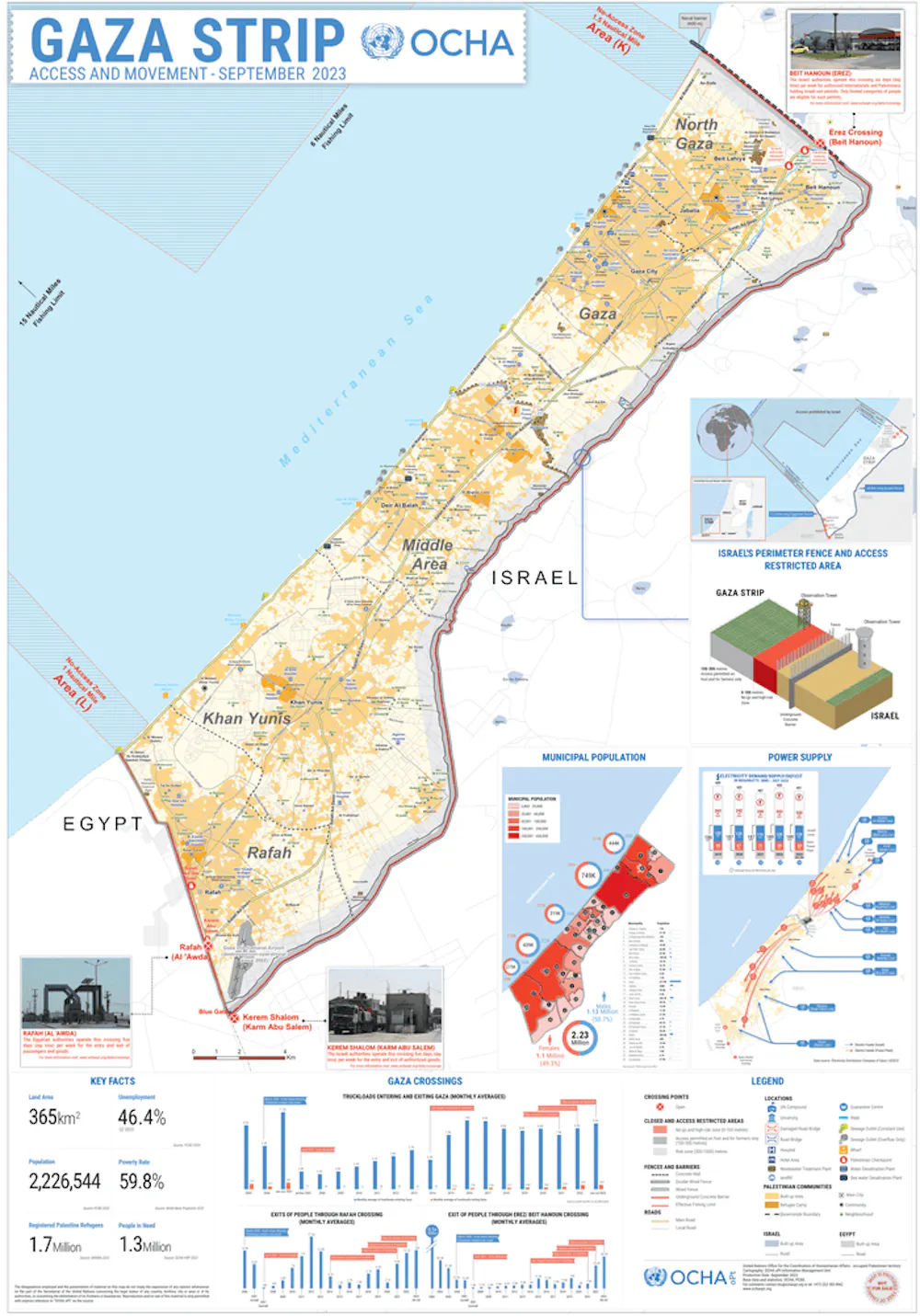
Once again, the Gaza Strip is at the epicentre of violence in the Middle East. This tiny 41km-by-13km band of territory on the Mediterranean, sandwiched between the often hostile neighbours of Israel and Egypt, has faced repeated rounds of violence in recent history – but the current war is the deadliest by a long way. More than 5,700 people in Gaza have been reportedly killed by Israeli airstrikes in two weeks of relentless bombardment – at least 2,000 of whom are children.

The aerial assault on Gaza has followed Hamas’s brutal attack on Israel on October 7, in which it crossed the Gaza border in several places, attacked towns and settlements, and killed around 1,400, people, mainly civilians – including an unspecified number of children. More than 200 more people, including women, children and elderly people, were seized and taken into Gaza.

Analysts are now warning of the danger of a full regional war, which could involve Iran and Lebanon as well.

UN map of the Gaza Strip with associated statistics.
‘The world’s largest open-air prison’: the Gaza Strip at September 2023. Ocha

How has such a tiny strip of land – less than half the size of Berlin – become so critical to the politics of an entire region? Over the past 75 years, the Gaza Strip has frequently been the focal point of the conflict between Israel and Palestine. Here are six key moments that led up to the current crisis:

1. 1948: Palestinian dispossession

In 1948, the state of Israel was established. While the United Nations had recommended the previous year that 55% of Palestine be designated for a Jewish state – causing controversy as only a third of the population of Palestine was Jewish at the time – Zionist militias and the Israeli army ultimately took 78%, displacing and expelling large numbers of Palestinians. After Jewish Agency leader David Ben Gurion declared the establishment of Israel on May 14, neighbouring Arab states refused to recognise the new state and instead declared war on it in solidarity with the Palestinians.

In 1949, Israel signed armistices agreeing its borders with neighbouring Arab states. By this time, more than 750,000 Palestinians – around three-quarters of the population – had been turned into refugees. Their dispossession became known in Arabic as the Nakba (catastrophe). Many refugees fled to the two parts of Palestine not absorbed by Israel: the West Bank (which was subsequently annexed by Jordan in 1950) and the Gaza Strip (which came under Egyptian control).

The Nakba transformed the entire Middle East, but it had the biggest demographic impact on the Gaza Strip. A tiny area of land with a population of around 80,000 absorbed more than 200,000 refugees. The Strip’s famously dense population today can be traced directly to the dispossession of 1948.

2. 1956: First Israeli occupation of Gaza

As Gaza was administered by Egypt after 1948, it became a key battleground in the 1956 Suez crisis. After Egyptian president Gamal Abdel Nasser nationalised the Suez Canal Company, Britain, France and Israel launched an attack on Egypt. As part of this, Israel occupied Gaza with evidence of plans for long-term occupation.

A crippled tank with other damaged military vehicles.
A crippled Israeli tank in the Sinai, destroyed during the Suez crisis, 1956. US Army Heritage & Education Center/Wikimedia Commons

In the event, due to US intervention, Israel and its allies were defeated and Washington forced Israel to withdraw its troops early in 1957. But this would not be the last time it occupied the Strip.

3. 1967: Israel begins long-term occupation of Gaza and the West Bank

Over six days of war in June 1967, Israel defeated the Arab coalition of Egypt, Jordan and Syria. It captured the Golan Heights from Syria, the West Bank from Jordan, and the Gaza Strip and the Sinai desert from Egypt. This began its long-term military occupation of the two parts of Palestine not taken in 1948: the West Bank and Gaza Strip.

As Gaza had a reputation for being more “radical” than the West Bank – due to its poverty levels and high proportion of refugees – Israel targeted it for further population dispersal and displacement. During the 1970s, it deployed a combination of carrot and stick measures designed to compel Palestinians to leave Gaza for the West Bank, Egypt, Jordan, and even the Americas.

Successive Israeli governments also moved their own citizens into illegal settlements in both the West Bank and the Gaza Strip. Ariel Sharon’s government would eventually withdraw all 21 settlements in 2005, but Israel retained control over the Strip’s land, sea and air borders.

4. 1987: First intifada begins

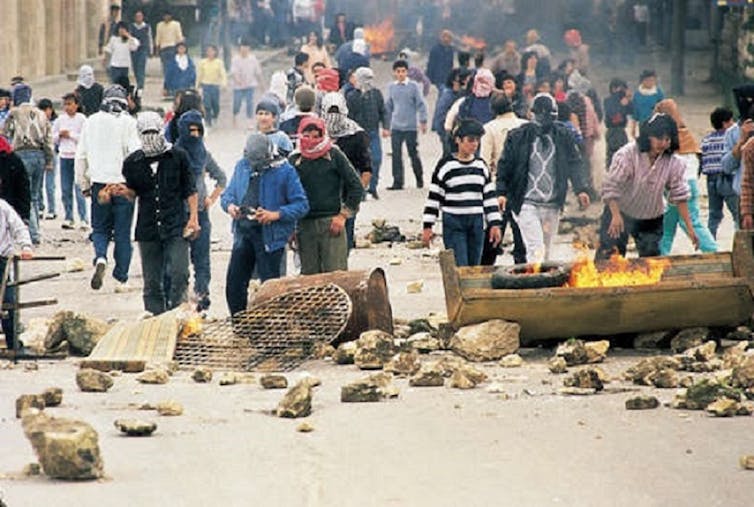
In December 1987, an Israeli army truck crashed into a car in Gaza, killing four Palestinians. The incident sparked the beginning of the first intifada (uprising), which would eventually spread across the whole of the Gaza Strip and the West Bank.

Palestinian youths making street barricades in Gaza during the first intifada 19087 to 1993
Unrest: the first intifada in Gaza, 1987 to 1993. Abarrategi/Wikimedia Commons, CC BY-NC-SA

Palestinians in both occupied territories boycotted Israeli goods, refused to pay taxes, and withdrew their labour from Israeli employers. There was also widespread stone-throwing at Israeli army vehicles and soldiers.

The intifada shook up longstanding Israeli assumptions that most Palestinians were passive in the face of the occupation, and is credited as a key factor in forcing negotiations in the early 1990s.

5. 1994: Yasser Arafat sets up the Palestinian Authority in Gaza

From 1993-95, the Israeli and Palestinian leaders, Yitzhak Rabin and Yasser Arafat, signed the Oslo Accords, a set of agreements designed to pave the way for a full peace deal. Oslo allowed for limited Palestinian autonomy in parts of the occupied territories.

Israeli prime minister Yitshak Rabin shakes hands with Palestinian leader Yasser Arafat as US president Bill Clinton looks on.
The 1993 Oslo Accords, signed by Palestinian leader Yasser Arafat and Israeli prime minister Yitzhak Rabin, paved the way for the establishment of a Palestinian Authority in Gaza. Vince Musi/The White House/WIkimedia Commons

In 1994, Arafat was instrumental in establishing the Palestinian Authority (PA) in Gaza City, from which Israeli forces partially withdrew. While this was intended as a five-year interim agreement ahead of final negotiations between the PA and Israel, it would last much longer than this in reality.


Read more: Inside the Oslo accords: a new podcast series marks 30 years since Israel-Palestine secret peace negotiations


6. 2007: Hamas takes power in Gaza

As many Palestinians became increasingly disenchanted with the PA’s corrupt and ineffectual leadership, Hamas gained prominence as a rival to Arafat’s Fatah party.

Again, the Gaza Strip was at the centre of this. In 2006, Hamas won Palestinian parliamentary elections, taking 44% of the vote. The result was rejected by the US and much of the western world, which backed the Fatah-led PA.

Following intra-Palestinian fighting in 2007, Hamas took full control of the Strip. In response, Israel imposed a blockade on it, ramping up measures that had first been imposed at the end of the first intifada. Egypt largely supported the blockade, meaning that Gaza’s people were hemmed into a tiny stretch of land, with a dying economy and no access to the outer world.

Since then, Palestinians in Gaza have faced continual violence, with particularly intensive Israeli bombing campaigns in 2008-9, 2012, 2014 and 2021.

But the current war has already exceeded all of them in bloodshed, meaning that Gaza unfortunately looks set to retain its place at the heart of the region’s violence and displacement.

The Conversation

Anne Irfan receives funding from the British Academy

25 Oct 19:38

Shopapalooza brings 350+ vendors to St. Pete for a waterfront holiday market

by Andrew Harlan

Taking place over Thanksgiving weekend, the annual Shopapalooza Festival is one of the biggest shopping events in the Tampa Bay region, and this year promises to be better than ever. Held on Saturday and Sunday, November 30 and December 1, from 10 a.m. to 5 p.m. at Vinoy Park (701 Bayshore Drive NE), the event is free to attend and offers an amazing opportunity to support local businesses. Plus, you can skip the drive and take the CrossBay Ferry for easy access.

Kicking off on Small Business Saturday, this year’s Shopapalooza brings together over 350 local vendors, many of whom have been affected by recent hurricanes. Organized by LocalShops1 Founder Ester Venouziou and supported by the City of St. Pete, the festival is a celebration of small businesses.

In addition to an impressive lineup of vendors, the event features outdoor food halls, live entertainment, family-friendly activities, food trucks, beer and wine gardens, and a glamorous seating lounge—all with no admission fee, so you can save your money for shopping! Well-behaved, leashed pets are also welcome.

People relax on modern white outdoor seating at a busy festival with tents and vendors in the background on a sunny day.

Shopapalooza: The biggest local shopping event of the season

Each food hall will feature snacks, drinks, entrees and desserts for everyone to enjoy. Selections include options for vegans and those with more carnivorous sensibilities.

Each food hall will offer a variety of snacks, drinks, entrées, and desserts, including options for vegans and meat lovers alike.

The kids zone will feature crafts, play and learning stations, photo ops with princesses, Ms. Florida, and Santa, as well as yard games, a crafts table, and more. The section also includes food and dessert trucks, animal rescues, and vendors specializing in gifts for children and parents.

While RSVP is not required, those who register in advance can win exciting prizes like personal shopping assistants, shopping sprees, and more. Learn more and register (for free) here.

Attendees can also enter for a chance to win a $500 shopping spree by registering in advance on Eventbrite—one winner will be selected each festival day. This year’s nonprofit partners are Jump for Kids and St. Pete Youth Farm. The event is co-sponsored by the City of St. Pete.

Food halls, kid zones, and more at Vinoy Park

“Every year, Shopapalooza Festival kicks off the holiday shopping season by celebrating the great independent businesses that make Tampa Bay such an amazing place,” says Ester Venouziou, founder of LocalShops1 and Shopapalooza. “These past couple of years, especially, have shown how much we rely on small businesses to keep our communities thriving. This year’s Palooza is the biggest one yet: 11.3 acres filled with local awesomeness and plenty of surprises.”

Vinoy Park is located at 701 Bayshore Drive NE in St. Petersburg. Parking is available at garages across downtown St. Pete, with free trolley rides to and from Shopapalooza at the Southcore Parking Garage, located on 2nd Street South between Central and 1st Avenues.

For more information about the vendors and event details, visit the Shopapalooza Festival website or the Facebook event page. Stay updated with LocalShops1 by visiting their website!

The post Shopapalooza brings 350+ vendors to St. Pete for a waterfront holiday market appeared first on That's So Tampa.

25 Oct 19:37

A huge international shopping event dedicated to “oddities & curiosities” is coming to Tampa

by Andrew Harlan

This whole world is wild at heart and weird on top. Thank you for that sentiment, David Lynch. A shopping and experiential extravaganza dedicated to all things strange will return to the beautiful Tampa Convention Center on November 11 from 10am-6pm. General Admission tickets are $11.55 and can be reserved online.

The Oddities & Curiosities Expo brings together a curated array of vendors, dealers, artists, and unique small businesses, each specializing in the wonderfully weird. Attendees can peruse taxidermy, preserved specimens, original artwork, horror and Halloween-inspired creations, antiques, handcrafted oddities, eerie apparel, unusual jewelry, animal skulls, bones, funeral collectibles, and much more. Every item featured is both legally owned and sourced sustainably.

This Expo offers a haven for those seeking to explore new artists, forge connections, and immerse themselves in a vibrant community of kindred spirits. The event prides itself on its entirely “DIY” operation, a labor of love from beginning to end. Providing a space where attendees can feel completely at ease, surrounded by fellow enthusiasts, is a source of immense joy for the organizers. It’s a gathering for the wonderfully weird in Tampa.

There are additional passes available in addition to general admission. Interested attendees can purchase tickets for a taxidermy class, or pay extra to see the curious collection of a mad clown. Learn more about the event on the official Facebook event page.

an aerialist hangs upside down from the cieling

What to read next:

The post A huge international shopping event dedicated to “oddities & curiosities” is coming to Tampa appeared first on That's So Tampa.

25 Oct 19:33

‘USF is afraid to support us’: Black enrollment decrease fuels demand for representation

by Clara Rokita Garcia, Correspondent
Six protesters interrupted President Rhea Law’s inauguration ceremony in January and demanded an increase in Black enrollment at USF. ORACLE PHOTO/JUSTIN SEECHARAN

Though USF advertises itself as a diverse college, junior humanities and cultural studies major Gabrielle Whyte said Black student enrollment seems to be a convenient topic for it to leave out when discussing diversity.

Whyte said she noticed an apparent lack of Black students in classrooms. She said that each of her classes has a maximum of three Black people, which affects the perspectives students from her major can explore.

“Having diverse perspectives represented in my major is very important because we learn about people, cultures and politics. I would not blame Black students in my field of study if they didn’t feel represented because we definitely aren’t,” Whyte said.

Related: ‘Increase Black enrollment now’: Protestors interrupt Law’s inauguration

Black enrollment has been on a slow decline at USF, according to USF Fact Books. The number of Black students enrolled at USF over the past few years are:

USF’s Strategic Enrollment Planning Council is working with higher education consulting firm Ruffalo Noel Levitz (RNL) to complete the Strategic Enrollment Plan, according to Director of Media Relations Althea Johnson. 

The plan will include recommendations for enhancing the university’s current enrollment management practices and infrastructure to “remove barriers to students, faculty and staff,” said Johnson. It will be delivered to university leadership in December 2023.

Project plans that gain approval will be implemented starting 2024, Johnson said.

One of USF’s goals is to focus more on outreach and access pathways. Admissions Leader Malcolm Randolph was promoted to Director of Special Populations so that he could invest more time in expanding outreach efforts, according to Johnson.

Related: USF developing plan to increase Black enrollment

To hear that the Black student enrollment has decreased is unfortunate because there is already a small number of Black students in the higher-level classes for her major, said senior accounting major Feyi Ogbeibu. 

Senior English major Abrionna McMillan said she notices the lack of Black representation on campus, making her worry about diversity and inclusion in USF’s classes.

“I’ve noticed that even in the African American Literature classes, there are very few Black people in attendance. I’m probably one of two in each class,” McMillan said.

Whyte said she feels like increasing the enrollment of Black students would help because there is “tone-deafness” in classes. She said she doesn’t always feel comfortable asking questions or sharing her opinions because she is usually one of the only Black people in the classroom.

“If you feel uncomfortable because you’re the only Black student in the room, you won’t want to stay. You will leave, but somebody else who comes after you will have the same problem, which will start a loop process,” Whyte said.

One issue related to professors that Whyte identified was the Western European way of teaching. She said that USF should prioritize lectures with alternate perspectives because feeling excluded from your course of study is unacceptable.

“Even if there are other Black people in the classroom, if you’re being taught from a perspective that excludes you and your experience, that will make Black students not want to study at USF,” Whyte said.

Whyte said she hasn’t had a Black professor in any of the classes from her major. Having more Black faculty at USF would make Black students more comfortable in classrooms, especially when taking certain types of classes with touchy topics, according to Whyte. 

“White faculty members do try their best, but I think representation creates a sense of safety and familiarity for students who already feel like what they’re talking about is dangerous waters for them,” Whyte said.

The Diversity, Anti-Racism & Equity (DARE) Dashboard for fall 2022 states that the number of USF faculty during that period was:

  • White: 1,791 (65% of total faculty population)
  • Black: 156 (6% of total faculty population)

When the Black community is represented at USF, McMillan said she feels it’s done poorly. 

“I remember one of the dining halls once had a ‘Black culture’ themed meal, which was just poorly made soul food. It was kind of embarrassing, and many people walked out,” McMillan said.

The Black community could also benefit from events outside of Black History Month, according to Whyte.

“Having events primarily during Black History Month makes it seem like USF only pays attention to the Black community once a year for activism purposes,” Whyte said.

Whyte said that affordability is also a big issue at USF. She said that it is already expensive enough to go to college, and then it’s also costly to stay on campus.

“USF offers scholarships to assist Black students financially, but that is where the support stops. It is very covert, almost as if USF is afraid to support us,” Whyte said.

Related: Is USF affordable? Students say they can barely pay for food, housing

McMillan said USF should adjust its outreach methods and its target audience. Representatives should look at the demographics of specific neighborhoods to bring more Black students in.

Ogbeibu said it’s essential for USF to focus on increasing Black student enrollment as a matter of respect and to help stop microaggressions.

“The decrease in Black student enrollment is unfortunate because it gives people of other groups an advantage, and it makes them feel like they can say or behave differently toward us because we become the minority,” Ogbeibu said.

24 Oct 19:47

Tampa named one of the top Halloween towns in the US

by Andrew Harlan

It’s the spookiest time of the year, and Tampa knows how to celebrate. Haunted ships, ghost tours on a water taxi, a giant horror theme park, and a Nightmare on Franklin Street are just some of the ways you can celebrate the Halloween season in Tampa. For this, and myriad other reasons, Tampa was named one of the top cities to celebrate Halloween by Wallethub in 2023.

The survey looked at Trick-or-Treater friendliness, abundance of Halloween-related events for kids and adults, and Halloween weather. When you consider the fact that you can visit the largest pumpkin in Florida at Bearss Groves, and watch spooky flicks under the stars in a pumpkin patch, it’s not hard to see why Tampa placed in the top 30.

Aerial view of Scream A Geddon Horror Park with large red entrance with a clown face over the door
Photo via Scream A Geddon

Wallethub compared 100 of the most populated cities across three categories to determine these rankings. Trick-or-treater friendliness refers to walkability, pedestrian safety, population density, and range of potential trick-or-treaters.

The study also looks at amusement parks per capita, pumpkin patches per capita, the number of candy/sweet shops in town, and forecasted Halloween precipitation. The forecast calls for trick-or-treating along the Tampa Riverwalk.

a group of people enjoy a movie I the park at night
Photo via Friends of the Tampa Riverwalk

The post Tampa named one of the top Halloween towns in the US appeared first on That's So Tampa.

20 Oct 18:42

‘We’re not getting respect’: USF Education majors fear future as teachers amid book bans

by Clara Rokita Garcia, Correspondent
Some of USF’s education majors feel like they will be affected by the new legislation once they become teachers. ORACLE PHOTO/MIKAYLA WILINSKY

For Juliana Pinho, a freshman elementary education major, Florida’s recent book bans are disappointing because they may limit what kind of educator she can be.

“There are things that I wish kids would learn at school, and it is sad to see that I won’t be able to do anything about it. If this is the way book bans look like right now, how’s it going to be in the future when I am a teacher?” Pinho said.

She said she believes banning books is taking away educational opportunities from kids and narrowing educators’ teaching abilities.

“Book bans limit educators because they have more rules to follow, and it makes everything very limited. They have to really pay attention to what they are teaching and even filter some topics,” Pinho said.

Related: Some faculty, students consider leaving state due to DEI legislation

During the 2022-23 school year, book bans were put into effect in 153 districts in 33 states. Florida school districts accounted for more than 40% of all book bans. When compared to other states, Florida had the most book bans and the most school districts (33) that removed books, according to the Pen America Website.

The bans can be traced back to House Bill 1467, which went into effect on July 1, 2022. Per the law, each book accessible to students at a school library must be chosen by a school district worker with an approved educational media specialist credential, according to the Florida Senate Website.

Some titles that have been removed are multiple novels with LGBTQ+, religious and historic themes, with some including:

  • “All Boys Aren’t Blue,” a story about Black queer boys
  • “Gender Queer,” an autobiography about a self-identity experience
  • “Beloved,” a Puliter prize-winning novel about enslaved people
  • “The Fixer,” a story about a Jewish handyman
  • “The Testaments,” a sequel to “The Handmaid’s Tales”

Some of USF’s education majors said that while they are not directly affected by the book bans as college students, they felt it will impact them when they become educators.

Junior elementary education major Grace Haerther said her professors have been discussing the book ban topic in class. 

Haerther said it’s an interesting time to get a degree in education. Book bans have at least helped her understand that there are many different opinions on the topic.

“The conversations we have in class about the book bans are very informative. Our professors give us information on both sides, and I think it is really important for us to look at it that way,” Haerther said.

Teachers are being affected by the book bans, according to freshman education major Regan Williams – whose mother is a middle school history and government teacher. 

Williams said that when it comes to certain topics such as slavery, it’s difficult for her mom to teach.

“It’s hard for my mom to teach the kids because some parents have this idea that white people are being blamed for causing slavery, and therefore, they think they are the victims when they are not the victims at all,” Williams said.

Senior elementary education major Morgan Manigold said it seems like Florida doesn’t trust its teachers. Having to scan every book that teachers put into their in-class library discourages literacy in the classroom, according to Manigold.

“Even though Florida has some of the best programs in the U.S. for education, it feels like we aren’t given that badge of trust anymore and that we’re not getting respect as educators. We can pick books that are appropriate for students,” Manigold said.

Haerther said she still isn’t sure she is going to teach in Florida because she has many concerns regarding the new legislation, especially while Florida is leading the country in book bans.

“I don’t see the book ban situation changing anytime soon. I’m going to be graduating in a year and a half, so I doubt that our government is going to do a complete 180 by that time,” she said.

Williams believes that the book ban puts a wall up between students and their teachers that blocks their abilities to learn, she said.

It takes away many of the ideas that kids need to learn at a young age so they can start to understand how the world works, Williams said.

The book ban will affect education majors once they graduate and find themselves in a classroom setting, according to Williams.

“I’ll have to be careful with what I say and what content I can show my students. If I can’t share certain views or ideas with the kids, I don’t know how I will be able to speak freely and be comfortable in a classroom setting,” Williams said.

Students need to make their own opinions based on their own knowledge and experiences, according to Harther. As students grow up in school, they form their own views, and banning certain books on certain topics deprives them of the power of knowledge, Haerther said.

“As educators, it’s our job to give students the skills to form their own opinions to be their own functioning members of society. If they want to read certain books, let that be their way of educating themselves,” Haerther said.

20 Oct 14:14

Israel-Hamas war: history shows the dangers of a creeping occupation

by Asaf Siniver, Professor of International Security, University of Birmingham

The US president, Joe Biden, has warned Israel that occupying Gaza “would be a big mistake”. The warning seemed to be aimed directly at voices within the Israeli government who are calling for Israel to not only destroy Hamas, but also to occupy the Palestinian territory.

Biden supports Israel’s right to defend itself and to destroy Hamas’s military capabilities. But, if history is anything to go by, then occupation – as a strategy to destroy Hamas – seems doomed to fail.

The Gaza Strip was under Israeli military occupation following the June 1967 war (previously it was occupied by Egypt) until Israel unilaterally withdrew from the territory in 2005. This included the removal of 21 settlements comprising 8,500 Israeli civilians who were living amid 1.4 million Palestinians.

The realities of occupation

The occupation of Gaza required the diversion of significant military and economic resources to protect the settlers in a land with which most Israelis did not feel a sense of kinship. Polls from 2004 and 2005 of Israeli public opinion showed that between 53% and 60% supported the disengagement plan.

Indeed, the recent Hamas attacks serve as a painful reminder of the costs of occupation.

In response to rising tensions in recent weeks in the West Bank and East Jerusalem (both occupied by Israel since 1967 and previously under Jordanian occupation), the Israeli army diverted its entire Gaza division to protect Israeli settlers in the West Bank and to prevent a deadly escalation there over the Jewish holidays. This left the Israeli military significantly under-equipped and under-manned to respond immediately and decisively to the Hamas attacks from Gaza.

Already burdened by policing missions around Jewish settlements in the West Bank, and with the ever-present threat of a military confrontation with Hezbollah (the Iranian-backed Shiite militia group established in the early 1980s) along its northern border, the notion of a military reoccupation of Gaza by Israel would probably see its resources stretched not only beyond capacity, but beyond its long-term interests.

The stated aims of the Israeli government for its current operation have so far been vague. “Destroying Hamas’s military capabilities” may mean different things to different people – from the precise targeting of its weaponry and the killing of its military leaders, to destroying Hamas as an idea.

Military occupation is unlikely to kill the violent Hamas ideology. Indeed, it was the first Palestinian popular uprising (intifada) against the Israeli occupation in the West Bank which gave rise to Hamas in 1987, as a younger, Islamist alternative to the Fatah leadership.

The Fatah party, the dominant faction of the Palestinian Authority which administers the Palestinian areas in the West Bank, is a secular, nationalist party that recognises Israel – whereas Hamas does not.

So any sustained military occupation of Gaza is likely to garner more support for Hamas, rather than eradicate it. It is also highly unlikely that the Palestinian Authority in the West Bank would be eager to assume the power vacuum which would be created in the unlikely event that Israel successfully eradicates Hamas altogether, for fear of being depicted as Israeli collaborators by the Palestinian people.

Moreover, an occupation brings with it the responsibility of administering the daily lives of 2.3 million Palestinians. This is something that neither Israel nor the Palestinian Authority want or can do in the current circumstances.

Lessons from 1982

Israeli leaders should also learn the lessons of the last time the country tried to eradicate a terrorist group and impose regime change.

In 1982, the Israeli military invaded Southern Lebanon to remove the threat of the Palestine Liberation Organisation (PLO) to its northern towns. It ended with a failed alliance with the Christian Phalanges party in Lebanon, which directly led to the Sabra and Shatila massacre and an 18-year Israeli occupation of Southern Lebanon, ending with a “chaotic” withdrawal in 2000.

None of Israel’s options to achieve its aim of destroying Hamas’s military capabilities are easy. Relying solely on air strikes is certain to lead to a large number of civilian casualties, and is unlikely to destroy Hamas’s tunnels or kill its military leaders.

A ground operation is certain to not only bring about a humanitarian catastrophe of unprecedented proportions, but is also likely to start a creeping, short-term occupation which would soon lead to a permanent occupation – as the history of the June 1967 and 1982 Lebanon wars shows.

Since its military and civilian withdrawal from Gaza in 2005, and following Hamas’s takeover of the territory from Fatah in 2007, Israel has blockaded the strip for security reasons by air, land and sea, effectively controlling who and what is allowed to enter and leave. Egypt has similarly blockaded the southern border of the Gaza Strip by Rafah.

While Israel no longer occupies Gaza – inasmuch as it is not responsible for the daily lives of Gazans – the continuous blockade has significantly contributed to the deteriorating humanitarian situation in the strip. That Hamas has proven to be a more capable terrorist organisation than an effective government has only set the Palestinian quest for freedom and statehood back even further.

The Conversation

Asaf Siniver does not work for, consult, own shares in or receive funding from any company or organization that would benefit from this article, and has disclosed no relevant affiliations beyond their academic appointment.

20 Oct 14:02

We fact-checked residential school denialists and debunked their 'mass grave hoax' theory

by Sean Carleton, Assistant Professor, Departments of History and Indigenous Studies, University of Manitoba

Recently a politician from a village in Prince Edward Island displayed an offensive sign on his property in which he proclaimed there is a “mass grave hoax” regarding the former Indian Residential Schools in Canada. Although many have called for him to resign, he is just one of many people who subscribe to this false theory.

A hoax is an act intended to trick people into believing something that isn’t true. Commentary that a “hoax” exists began circulating in 2021 around the time of public announcements from First Nations across the country that — through the use of ground penetrating radar and other means — the remains of Indigenous children are suspected to be in unmarked graves at or near some former residential schools.

Commentators circulating allegations of a “hoax” contend journalists have misrepresented news of the potential unmarked graves, circulating sensational, attention-grabbing headlines and using the term “mass grave” to do so. They also contend some First Nations, activists or politicians used this language for political gain — to shock and guilt Canadians into caring about Indigenous Peoples and reconciliation.

Like the councillor in P.E.I., many people — in Canada and internationally, fuelled partly by misinformation from the far-rightare accepting and promoting the “mass grave hoax” narrative and casting doubt on the searches for missing children and unmarked burials being undertaken by First Nations across Canada.

There is no media conspiracy

As two settler academic researchers, we decided to investigate the claims of a media conspiracy and fact-check them against evidence.

What did Canadian news outlets actually report after the Tk’emlúps te Secwépemc First Nation made their public announcements about their search for missing children?

To find out, we analyzed 386 news articles across five Canadian media outlets (CBC, National Post, the Globe and Mail, Toronto Star and The Canadian Press) released between May 27 and Oct. 15, 2021.

What we found, according to our evidence from 2021, is that most mainstream media did not use the terminology “mass graves.” Therefore, we argue that the “mass grave hoax” needs to be understood as residential school denialism.

‘Preliminary findings’ of ‘unmarked burials’

After some public confusion over the specific details of the May 2021 Tk’emlúps te Secwépemc First Nation announcement, which named “preliminary findings” regarding “the remains of 215 children,” the First Nation clarified the findings as the confirmation of “the likely presence of children, L’Estcwicwéý (the Missing) on the Kamloops Indian Residential School grounds” in “unmarked burials.”

The National Centre for Truth and Reconciliation had already identified 51 student deaths at the Kamloops school using church and state records.

A National Centre for Truth and Reconciliation Memorial Register has to date confirmed the deaths of more than 4,000 Indigenous children associated with residential schools.

But the Truth and Reconciliation Commission (TRC) noted its register of missing children was incomplete, partly due to a large volume of yet-to-be-examined and destroyed records. The TRC’s Calls to Action 71-76 refer to missing children and burials.

The Tk’emlúps te Secwépemc First Nation — responding to these calls — initiated further research to learn the full truth to facilitate community healing.

Countering harmful misinformation

In the two years since, a number of commentators, priests and politicians, including the P.E.I councillor with his sign, have downplayed the harms of residential schooling — or questioned the validity, gravity and significance of the the Tk’emlúps te Secwépemc First Nation’s announcement.

One National Post commentator wrote that the account of a “mass grave” was reported “almost universally” adding that this narrative, and subsequent “discoveries” preceded a descent into “shame, guilt and rage …”

Despite the Tk’emlúps te Secwépemc First Nation’s announcement never mentioning a “mass grave,” and Chief Rosanne Casimir saying in a news conference, “this is not a mass grave, but rather unmarked burial sites that are, to our knowledge, also undocumented,” some have even wrongly suggested the First Nation “announced the discovery of a mass grave” and this was a “fake news story.”

In response, the independent special interlocutor for missing children and unmarked graves and burial sites associated with Indian Residential Schools has amplified calls for Canadians to take responsibility for countering such harmful misinformation.

We hope that our research can contribute to this work and that our report helps to debunk the “mass grave hoax” narrative specifically.

Cherry-picked ‘evidence’

Our report reveals that most Canadian news outlets did not use the language, “mass grave.” The idea that a “mass grave hoax” exists is a myth.

Myths, however, are not pure fiction; they often contain a kernel of truth that is exaggerated or misrepresented.

This selective representation of evidence is commonly referred to as cherry-picking, and it’s easy to see how those spreading the “mass grave hoax” narrative rely on cherry-picked evidence.

Of the 386 articles reviewed in our study, the majority of the articles (65 per cent, or 251) accurately reported on stories related to the location of potential unmarked graves in Canada.

A minority (35 per cent or 135 articles), contained some inaccurate or misleading reporting; however, many of the detected inaccuracies are easily understood as mistakes and most were corrected over time as is common practice in breaking news within the journalism industry.

Of the 386 total articles, only 25 — just 6.5 per cent of total articles — referred to the findings as “mass graves,” with most of the articles appearing in a short window of time and some actually using the term correctly in the hypothetical sense (that mass graves may still be found).

That means that 93.5 per cent of the Canadian articles released in the spring, summer and fall of 2021 that we examined did not report the findings as being “mass graves.”

It appears that some journalists and commentators misunderstood a large number of potential or likely unmarked graves for mass graves in late May/June 2021. By September, denialists were misrepresenting the extent of media errors to push the conspiratorial “mass grave hoax” narrative online.

Our research shows that the “mass grave hoax” narrative hinges on a misrepresentation of how Canadian journalists reported on the identification of potential unmarked graves at former residential school sites in 2021. And we hope our report sparks a national conversation about how important language is when covering this issue.

Media needs to be precise with language and also acknowledge its errors (and avoid future ones), or clarify details in a way that feeds truth, empathy and more accurate reporting — not denialism, hate and conspiracy.

Challenging Residential School denialism

The “mass grave hoax” narrative cannot be reasonably seen as just skepticism. Rather, it should be understood as an expression of residential school denialism.

According to Daniel Heath Justice and Sean Carleton (one of the authors of this story), residential school denialism is not the denial of the residential school system’s existence. Nor do denialists, for the most part, deny that abuses happened.


Read more: Truth before reconciliation: 8 ways to identify and confront Residential School denialism


Residential school denialism, like climate change denialism or science denialism, cherry-picks evidence to fit a conspiratorial counter-narrative. This distorts basic facts and the overall legacy of the Indian Residential School System (IRSS) to alleviate settler guilt and block important truth and reconciliation efforts.

Truth before reconciliation

Our research shows how detailed analysis can be an effective tool in confronting the growing threat of residential school denialism and other kinds of misinformation and disinformation, as called for recently by many Indigenous communities.

Instead of directing ridicule and outrage at denialists — which can give them a larger platform — what is needed is deep and reasoned analysis of their discourse to show why they are wrong or misleading.

This is the strategy of disempowering and discrediting residential school denialism advocated by former TRC Chair Murray Sinclair.

We hope others will join us in this type of research to help Canadians learn how to identify and confront residential school denialism and support meaningful reconciliation.

Our full findings can be read in our new report for the Centre for Human Rights Research at the University of Manitoba.

As the Truth and Reconciliation Commission said in its final report, without truth there can be no genuine reconciliation.

For those who may be experiencing trauma or seeking support, here are some resources:

— The Indian Residential School Survivors Society’s 24/7 Crisis Support line: 1-800-721-0066

— The 24-hour National Indian Residential School Crisis Line: 1-866-925-4419

The Conversation used the term “mass graves” in a story published in the days following the announcement by the Tk’emlúps te Secwépemc First Nation. The article has since been updated to use the term “unmarked graves.”

The Conversation

Sean Carleton receives funding from the Social Sciences and Humanities Research Council of Canada and Centre for Human Rights Research at the University of Manitoba.

Reid Gerbrandt receives funding from The Centre for Human Rights Research at the University of Manitoba.

20 Oct 13:44

Hamas was unpopular in Gaza before it attacked Israel – surveys showed Gazans cared more about fighting poverty than armed resistance

by Nathan French, Associate Professor of Religion, Miami University
Who speaks for the Palestinians of Gaza? Mohammed Abed/AFP via Getty Images

Amid the escalation of the Israel-Hamas war, observers in the region and internationally continue to make assumptions about Gazan public support for Hamas.

Mistaken assumptions such as those by U.S. presidential candidate Ron DeSantis, claiming that all Gazans are “antisemitic,” or those that blame Gazans for “electing Hamas” may shape debates not only on how the war is perceived, but also over relief plans for Gazans in the months ahead.

Any reconstruction efforts or aid distribution might be weighed against fears of Hamas insurgents within the Gazan population.

In my own research into Jihadi-Salafism and Islamism, I found that militant movements provoked military interventions to exploit the chaos that ensues. Moreover, such groups often claim to govern in the “legitimate” interests of those they dominate even if those populations reject their rule.

As several commentators have observed, Hamas likely hopes to not just encourage a disproportionate response from Israel, but also to use the violent aftermath of intervention to cultivate continued Gazan dependence upon it and to distract from its own domestic policy failures.

Politicians and Gaza

Leaders on both sides of the conflict have tried to make justifications for their actions. Often, they use their own perception of Gazan public opinion to support their own policy objectives.

For example, Ismail Haniyeh, chief of Hamas’ political bureau, claimed that Hamas’ actions represented Gazans and “the entire Arab Muslim community.” For Haniyeh, Hamas’ usage of violence was on behalf of Palestinians who had been assaulted in the Al-Aqsa Mosque compound in September 2023, or have suffered at the hands of Israeli security forces, or for the settlers in the West Bank.

Israeli President Isaac Herzog, meanwhile, suggested that all Gazans bore collective responsibility for Hamas. As a result, he concluded, Israel would act to preserve its own self-interest against Gaza and its people.

The Biden administration, careful not to condemn the Israeli bombardment, has sought a broader approach toward the escalation. In an interview and on social media, U.S. President Joseph Biden observed that “the overwhelming majority of Palestinians had nothing to do with Hamas’ appalling attacks, and [instead] are suffering as a result of them.” Such suffering, Biden noted, required the eventual lifting of the “complete siege” implemented by Israel against Gaza.
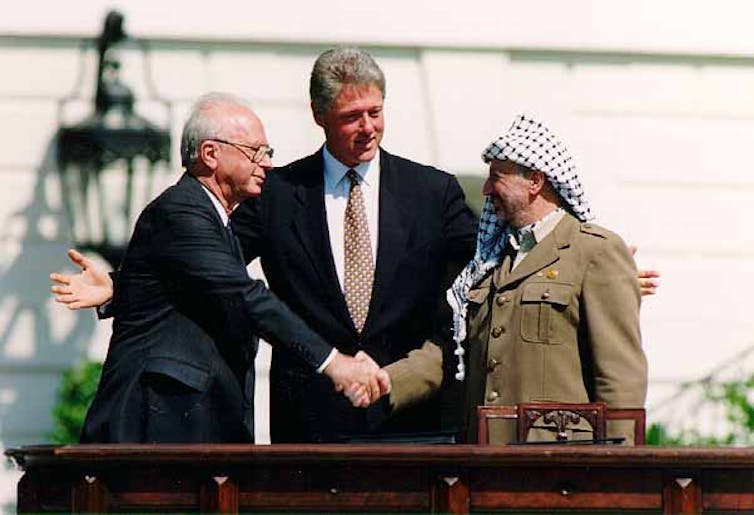
In each example, politicians used their assumptions about Gazans to support their policies. But the people in Gaza experience these policies far differently.

Gazans hold mixed views of Hamas

Reviewing Gazan public opinion over time reveals an ongoing sense of hopelessness living under the Israeli blockade.

A June 2023 poll conducted by Khalil Shikaki, professor of political science and director of the Palestinian Center for Policy and Survey Research, indicated that 79% of Gazans supported armed opposition to Israeli occupation of Palestinian territory. A Washington Institute poll from July 2023 found that only 57% of Gazans held a “somewhat positive” opinion of Hamas.

Further reading of those polls suggests a more nuanced story. Consider that in 2018, some 25% of women in Gaza risked death in childbirth, 53% of Gazans lived in poverty, and essential health care supplies were stretched thin. That same year, Shikaki found an increasing number of Gazans dissatisfied with Hamas’ government, with almost 50% hoping to leave Gaza entirely.

In the June 2023 Washington Institute poll, 64% of Gazans demanded improved health care, employment, education and some sense of normalcy instead of Hamas’ claimed “resistance.” Over 92% of Gazans expressed outright anger at their living conditions.

Additionally, as Shikaki reported, over 73% believed the Hamas government to be corrupt. Yet, Gazans saw little hope for electoral change. With no election since 2006, a majority of Gazans alive today were not old enough to have voted for Hamas.

Support of armed resistance was not always present. When Hamas openly fought the Palestinian Authority – which governs the West Bank and questioned the legitimacy of Hamas’ victory – and seized control over the Gaza Strip in 2007, over 73% of Palestinians opposed that seizure and any further armed conflict.

At that time, fewer than one-third of Gazans supported any military action against Israel. Over 80% condemned kidnapping, arson and indiscriminate violence.

Gazans’ shift in support for Hamas

If read over time, polls of Gazans from 2007 to 2023 tell a story. They help make clear that Gazan support for armed resistance grew alongside increasing frustration, anger and a sense of hopelessness with any political solution to their suffering.

In 2017, scholar Sara Roy, studying the Palestinian economy and Islamism, explored Gazan tolerance of Hamas, noting “what is new is the sense of desperation, which can be felt in the boundaries people are now willing to cross, boundaries that were once inviolable.”

Gazans, Roy argued, particularly the 75% under the age of 30, felt widely varying affinities toward Hamas’ ideology or claims to Islamic legitimacy. Hamas, they noted, paid salaries when few others could. Risking targeting by Israeli soldiers was a calculated and tolerable hazard of hire if it meant a paycheck.

A man in a cap paints the word Hamas in large letters on a wall.
A supporter of Hamas shows his support in Gaza ahead of the 2006 elections. Mahmud Hams/AFP via Getty Images.

In 2019, 27% of Gazans blamed Hamas for their living conditions. In that same poll, 55% supported any peace plan that would include a Palestinian state with East Jerusalem as a capital and an Israeli withdrawal from all occupied territories.

By 2023, when Gazans polled by Shikaki expressed their support for armed resistance, they did so in the belief that only such resistance – not electoral politics – would provide relief from the Israeli blockade and siege. At the same time, however, those polled expressed exhaustion with the corruption of Hamas and the ongoing unemployment and poverty of Gaza.

Palestinian desperation and Hamas’ objectives

Any chance for a simple return to normalcy seems lost for many Gazans, as Hamas claims to act as their “legitimate resistance.”

With peace negotiations stalled in Gaza since 2001, elections postponed, movement out of Gaza impossible, and now an escalating humanitarian crisis, an entire generation of Gazans is left with few options.

Several people, including women and children, running out of their homes. Behind them are some partially damaged buildings.
Palestinian families rush out of their homes after Israeli airstrikes targeted their neighborhood in Gaza City, central Gaza Strip, on Oct. 17, 2023. AP Photo/Abed Khaled

There is death everywhere,” said 33-year-old Omar El Qattaa, a photographer based in Gaza, “and memories erased.”

Though 2023 polling indicated that a majority of Gazans were opposed to breaking the ceasefire with Israel, Hamas moved forward with its October attacks against their popular will. The sense of desperation felt by El Qatta, and millions of other Gazans, risks becoming instrumentalized by Hamas. As Matthew Leavitt, a scholar and researcher of Hamas writes, Hamas sees politics, charity, political violence and terrorism as complementary and legitimate tools to pursue its policy goals.

As Khaldoun Barghouti, a Ramallah-based Palestinian researcher, notes, the ongoing bombardment by Israel has softened Gazan frustration with Hamas – at least in the short term. Such attacks “turned blame to Hamas (over the attacks in Israel) into more anger toward Israel.”

How this will translate into support for alternatives to Hamas in the months ahead remains to be seen. Much will depend on how international stakeholders regain the trust of Gazans while assisting them with finding meaningful alternatives to a government and militant movement they once considered corrupt and unable to meet their basic needs.

The Conversation

Nathan French does not work for, consult, own shares in or receive funding from any company or organization that would benefit from this article, and has disclosed no relevant affiliations beyond their academic appointment.

20 Oct 13:43

Biden in Israel: How U.S. foreign policy has played a big role in the Israel-Hamas war

by Shaun Narine, Professor of International Relations and Political Science, St. Thomas University (Canada)

U.S. President Joe Biden is in Israel to lend support to the country in the midst of an already bloody war between the Israelis and Hamas, including the bombing of a Gaza City hospital that has left hundreds dead.

Following Biden’s meeting with Israeli Prime Minister Benjamin Netanyahu in Tel Aviv, it’s worth looking back at American foreign policy and profound U.S. mismanagement of ongoing crises in the Middle East over a period of decades. It illustrates how badly American domination has served international peace and stability.

Some have argued that Hamas’s attack on Israel is an indication of the chaos and disorder that will follow in an emerging “multipolar world,” meaning one in which the U.S. is no longer firmly in control of international affairs.

But let’s look at how that U.S. control has worked out for the Middle East in the past. The current war in Gaza is a direct product of the failure of American foreign policy. It’s an argument in favour of a multipolar world, one in which the U.S. has less influence and other powers can act as countervailing forces.

Destabilizing influence

The U.S. has a long history of destabilizing the Middle East, a critically important region of the world. In 1953, the U.S. and the U.K. engineered a coup against democratically elected Iranian Prime Minister Mohammed Mossadegh and strengthened the shah of Iran.

The shah’s hated regime fell to the Iranian revolution in 1979. The result was the Islamic Republic of Iran, a state that has bedevilled the U.S. and its allies ever since.

In 2003, the U.S. illegally invaded Iraq, killing more than 300,000 people, and spreading chaos across the region. The so-called War on Terror has raged on, killing millions more, directly and indirectly, for years.

The American mishandling of the Israeli-Palestinian conflict is another substantial failure. Given its enormous leverage over both parties, the U.S. could have taken more neutral steps to bring about a just end to the conflict long ago. Instead, it catered to increasingly radical Israeli governments, facilitating the brutal subjugation of the Palestinians and creating the pressure cooker that has now exploded.

Pressure cooker erupts

The United Nations has called Israel’s occupation of Palestinian territory “unlawful under international law.” For many decades, Israel has built settlements in the West Bank that amount to the de facto annexation of Palestine. Israel has also annexed East Jerusalem. Today, the Israeli settler population in occupied Palestine stands at 700,000.

The settlements violate Article 49 of the Fourth Geneva Convention. They are the single greatest obstacle to the “two-state solution” to the Israeli-Palestinian conflict.

The U.S. formally opposes Israeli settlements, but has done nothing to actually stop them. Instead, it’s provided Israel with weapons and financial support and protected Israel from facing the consequences of its violations of international law in the United Nations and other international institutions.

This protection has apparently instilled in Israel an attitude of impunity. Israel builds settlements and oppresses Palestinians; the U.S. either helps it do so or defends Israeli actions.

In 2021, the international NGO Human Rights Watch issued a report that said Palestinian “deprivations are so severe that they amount to the crimes against humanity of apartheid and persecution.” Other groups like Amnesty International say Palestinians are subject to regular violence and humiliation from the Israel Defense Forces (IDF) and Jewish settlers.

The current Israeli government encourages and protects settler violence and has expressed an intent to annex what remains of Palestine. Indeed, its push for controversial judicial reform is connected to its designs on Palestinian land.

‘Open-air prison’

Gaza has been described as an open-air prison. For 17 years, it’s been under an illegal blockade that violates Article 33 of the Fourth Geneva Convention that bans what’s known as collective punishment.

Youth unemployment is 60 per cent; 97 per cent of the water is undrinkable; child malnutrition is rife.

Had the U.S. used its global leverage to push Israel to adhere to international law, the situation might have been avoided. Instead, it enabled Israel’s expansionist ambitions while undermining international law.

The former Donald Trump administration abandoned any American pretense of even-handedness in the Israel-Palestine conflict, implementing the Abraham Accords, which were designed to sidestep the Palestinian issue altogether by creating economic ties between Israel and neighbouring Arab states.

Biden’s administration has doubled down on Trump’s efforts by pushing the normalization of relations between Saudi Arabia and Israel, again sidestepping the Palestinians.

Region on edge

There is no excusing Hamas’s incredibly violent actions on Oct. 7. But the attack has been linked to Israeli efforts to build ties with Arab nations like Saudi Arabia.

As Biden spends time in Israel, it’s a stark reminder that the U.S. is no longer qualified to mediate the conflict.

As the war claims thousands of Palestinian civilians, the region is in danger of exploding. Arabs are enraged; Hezbollah may intervene. The cost of oil may spike, further damaging the fragile world economy.

China helped re-establish diplomatic relations between Iran and Saudi Arabia because it gets more than 50 per cent of its oil from the Middle East and has a powerful interest in regional peace.

Even so, it apparently has no desire to insert itself into a quagmire the U.S. helped create.. Other powers that rely on Middle Eastern oil have to endure the consequences of unbalanced and inept American policy.

The United States causes and exacerbates many of the problems and conflicts that it later seeks to manage. American strength has meant the rest of the world has had to accept this reality. But the sooner a true multi-polar world emerges, the better it will likely be for global stability — and maybe even for the rule of law.

The Conversation

Shaun Narine has contributed to Canadians for Justice and Peace in the Middle East, J Street and Jewish Voice for Peace.

18 Oct 18:18

OPINION: ‘Don’t Say Gay’: Do say fascist.

by Marcelene Pilcher, Managing Editor
The DeSantis administration justifies prejudicial policy with bigoted, fear-mongering rhetoric. SPECIAL TO THE ORACLE/FLICKR

When explaining why he believes the U.S. should not accept refugees at a Saturday speaking engagement, Gov. Ron DeSantis said that all refugees from Gaza are antisemitic.

DeSantis is no stranger to baseless, sweeping statements about minority groups. From calling drag queens and transgender people child groomers to saying that slavery was beneficial to the enslaved, demonizing and dehumanizing subjugated groups has become his modus operandi.

The DeSantis administration’s verbiage intentionally dehumanizes marginalized communities to validate its prejudiced policies and encourage voting by fear, both staple tactics of authoritarian leaders. It’s critical that young adult voters, who are most vulnerable to radicalization, educate themselves on these groups of people before falling prey to scare tactics.

DeSantis’ legislature has codified a slew of anti-LGBTQ policies into law as of late. The March 2022 ‘Don’t Say Gay’ Bill, which banned discussions of sexual identity or orientation in the classroom, is one of the most controversial. Florida’s latest piece of anti-trans legislation is the Aug. 23 Florida Department of Education policy, which penalizes trans college students and staff for using a bathroom not fitting their assigned gender at birth. 

Notably, when discussing these laws, DeSantis refrains from referring to the very real people they affect.

“He doesn’t talk about transgender people. You’ll never hear him humanize transgender people,” said USF professor of higher education Michael Denton in a Sept. 27 interview with The Oracle. Denton also conducts research into the experiences of intersectional groups in education.

“Very often, DeSantis will refer to transgenderism, which is not really a recognized word, it’s purely used in conservative speech and rhetoric. And the point of calling it transgenderism, like he talks about injecting transgenderism as if it’s a disease or something that can be taught…It’s the idea that it’s something that can infect your children.”

This rhetoric has an impact on real people, including many transgender members of the USF community.

“I think another narrative that the state is pushing is that transgender identity is inherently sexual or inherently perverse or predatory. I think that’s interesting. Honestly, sometimes I don’t know how to answer such vitriol,” USF Trans+ Student Union Officer Andy Pham told WUSF on Feb. 8 in response to the state’s request for transgender health records.

The sexual demonization of LGBTQ people has become a staple of GOP rhetoric. In defense of the ‘Don’t Say Gay’ Bill, DeSantis’ press secretary Christina Pushaw went so far as to relate LGBTQ people to groomers.

“The bill that liberals inaccurately call ‘Don’t Say Gay’ would be more accurately described as an Anti-Grooming Bill,” Pushaw wrote in a March 2022 tweet.

Pushaw continued the tirade in another tweet.

“If you’re against the Anti-Grooming bill, you are probably a groomer or at least you don’t denounce the grooming of 4-8 year old children.”

In another instance, at a June 30 Moms for Liberty convention, DeSantis himself alleged that he witnessed drag queens threatening to “come for your children”.

Research has shown time and time again that LGBTQ people do not assault children at a higher rate than heterosexuals. In fact, less than 20% of registered sex offenders are LGBTQ, according to a 2022 study by UCLA’s Williams Institute of Law.

This is age-old rhetoric used to justify discriminatory policies against LGBTQ people by accusing them of the worst crime imaginable.

“There’s been an increase, particularly around trans people, with language that dehumanizes, objectifies, makes trans and other LGBTQ people less than human. And that’s a really important tactic of authoritarians…you want to dehumanize certain groups to make an intergroup alliance,” said Denton.

By making members of the LGBTQ community look subhuman or demonic, DeSantis not only justifies discriminatory policies, but instills fear in the population that encourages them to keep him in office. With his 2024 presidential bid coming up, the governor is campaigning at the expense of minorities, a tactic used by fascist leaders throughout history.

“The goal is to target ideological enemies and remove restraints in combating them. Fascism dehumanizes segments of the population, trying to reduce empathy and justify inhumane treatment of them. Truth, civility and decency cease to matter,” wrote Yale professor of philosophy Jason Stanley in his 2018 book “How Fascism Works”.

Vigilance against radical fear mongering is especially crucial for young adult voters, who are more impressionable to politically radical ideas than any other group, according to a 2022 study

Don’t outright believe generalizations, especially about groups that have a greater barrier to defending themselves. A quick Google search could quickly dispel the bigoted myths being spread for political gain.

While just a political tool for the Florida legislature, these policies and the rhetoric backing them have very real consequences for their subjects.

18 Oct 18:15

Tampa takes next step toward improving transit between USF and downtown

by Clinton Engelberger, Editor in Chief
The grant approval is less than the $4 million the city requested. SPECIAL TO THE ORACLE/UNSPLASH

USF students are one step closer to accessible transportation to downtown Tampa.

The city of Tampa received a $1.75 million grant from the federal government on Tuesday to open a new accelerator office dedicated to improving public transit, according to a press release.

Those in the office include city mobility director Vik Bhide, chief budget officer Mike Perry and sustainability and resilience officer Whit Remer.

One of the goals for these funds is to build rapid transit between USF and downtown Tampa, according to the city’s grant application obtained by the Tampa Bay Times.

The project would look similar to the SunRunner in St. Pete, which provides bus transit for citizens.

The city requested $45 million for that project but is still waiting on approval. The project is estimated to cost around $50 million and take two years to complete.

Tuesday’s grant approval, which was administered by the U.S. Department of Transportation’s Build America Bureau, is less than the initial $4 million the city requested, according to the application.

The office will also focus on expanding walking and biking routes in downtown Tampa. Other goals it hopes to achieve include:

  • Offering transportation between Tampa International Airport and downtown Tampa
  • Modernizing and expanding the routes of the yellow streetcars in Ybor and downtown Tampa
  • Preparing Brightline rail routes to link to Tampa
  • Upgrading the CSX South Tampa corridor
  • Improving safety standards for cyclists
16 Oct 14:42

How the 'laws of war' apply to the conflict between Israel and Hamas

by Robert Goldman, Professor of Law, American University
Warring parties are duty-bound to minimize civilian casualties. Ahmad Hasaballah/Getty Images

The killing of Israeli civilians by Hamas and retaliatory airstrikes on the densely populated Gaza Strip by Israel raises numerous issues under international law.

Indeed, President Joe Biden made express reference to the “laws of war” in comments he made at the White house on Oct. 10, 2023, noting that while democracies like the U.S. and Israel uphold such standards, “terrorists” such as Hamas “purposefully target civilians.” Speaking the same day, the European Union’s top diplomat Josep Borrell condemned Hamas’ attack but also suggested that Israel was not acting in accordance with international law by cutting water, electricity and food to civilians in Gaza.

But international law and the very nature of the conflict itself – along with the status of the two sides involved – is a complex area. The Conversation turned to Robert Goldman, an expert on the laws of war at American University Washington College of Law, for guidance on some of the issues.

What are the ‘laws of war’?

The laws of war, also known as International Humanitarian Law (IHL), consist of the four 1949 Geneva Conventions, their two Additional Protocols of 1977, the Hague Conventions of 1899 and 1907, as well as certain weapons conventions.

Simply put, these instruments seek to spare civilians and others who are no longer active combatants from the effects of hostilities by placing restrictions and prohibitions on the conduct of warfare.

It is important to understand that modern IHL is not concerned with the reasons for, or the legality of, going to war. Rather, that is governed by the United Nations Charter and member state’s own practice.

It is also important to note that violations of the laws of war are notoriously hard to prosecute and can be frustrated by lack of cooperation by the parties involved.

What is the nature of the conflict between Israel and Hamas?

The answer to this question is by no means clear.

Many humanitarian law experts would argue that Hamas and Israel are engaged in what is known as a “non-international armed conflict.” In other words, it would be classified the same way as a civil war that pits the armed forces of a state against an armed non-state actor, rather than a international conflict between two or more sovereign states.

If that were the case, the conflict would not be governed by the entirety of the laws of war, but instead by the more limited Common Article 3 of the Geneva Conventions along with numerous customary law rules, which derive from general practices accepted as law. Common Article 3, which applies to civilians and those no longer fighting, prohibits practices such as torture, summary execution and denial of a fair trial. But Prisoner of War status only applies to conflicts between states, so would not apply.

But some international observers, including the United Nations, view Israel as, in effect, occupying Gaza – a view predicated on the fact that Israel controls Gaza’s borders and airspace and it supplies most of its electricity.

If that is the case, then the recent outbreak of hostilities between Hamas and Israel would trigger the entirety of laws of war.

That said, I do not believe that Israel is an occupying power in Gaza under a strict reading of the law. This is because Israel ceased governing and pulled its forces out of Gaza in 2005. Since 2007, Hamas, after expelling the Palestinian Authority, has in effect governed Gaza.

Is the bombing of Gaza illegal under international law?

Today the rules governing the conduct of hostilities in both international and non-international armed conflicts are essentially the same.

The foremost requirement in all conflicts is that combatants must always distinguish between civilians and combatants, and that attacks can only be directed at combatants and other military targets.

Protecting civilian populations caught in warfare essentially depends upon three factors:

  1. Civilians must abstain from fighting;
  2. The party in control of the civilian population must not place them at heightened risk of harm by using them as human shields; and
  3. The attacking force must take precautions to avoid or minimize excessive civilian casualties when attacking lawful targets.

Not only are civilians in Gaza not lawful targets, they are also protected under IHL by the rule of proportionality. This rule prohibits an attack against a military target which foreseeably could cause civilian casualties that are excessive, or disproportionate in relation to the advantage anticipated from the target’s destruction.

In the case of Gaza, this rule requires that before launching an attack, the Israeli military analyze and determine the likely effect on civilians. If it appears that such an attack will cause disproportionate civilian casualties, then it must be suspended or canceled.

Given Gaza’s urban density, it will be extremely difficult for the Israelis to avoid substantial civilian casualties even when using precision weapons.

And this task will be nearly impossible if Hamas, as it has consistently done in the past, uses it civilians and now hostages to shield military targets.

While Israel bears primary responsibility to avoid excessive civilian deaths in its bombardment of Gaza, Hamas’ ability to claim the bombardment constitutes a war crime would be weakened if it deliberately places its own people in harms way.

And while Israel is complying with its duty to give an advanced warning of an attack in north Gaza, the problem remains: Where do 1 million people go to seek safety when borders are closed and military targets are being hit throughout Gaza?

Is Israel’s siege of Gaza illegal?

Unlike in the past, total siege warfare now is unlawful regardless of whether the warring parties are involved in international or non-international hostilities.

Blocking the entry of all food, water, medicines and cutting off electricity – as appears to be happening in Gaza – will disproportionately affect civilians, foreseeably leading to their starvation. This is a banned method of warfare under customary and conventional IHL.

No matter how horrific the actions of Hamas, IHL does not permit an aggrieved party to respond in kind. Violation of the law by one party cannot, in principle, justify or sanction actions by the other that violate established prohibitions in international humanitarian law.

What are the status and obligations of Hamas under IHL?

IHL rules apply equally to all the warring parties irrespective of the nature of the conflict. This means that Israeli and Hamas combatants have the same rights and duties.

If, however, the conflict is non-international, then Hamas will be regarded as an armed non-state actor and its combatants ineligible for Prisoner of War status upon capture. Accordingly, Israel can try them for all their hostile acts whether or not Hamas complies with the laws of war.

Masked men in black hold aloft rifles.
Masked militants from the Izzedine al-Qassam Brigades, a military wing of Hamas. AP Photo/Adel Hana

But even if the conflict is an international one, then Hamas’s fighters would still be debarred from Prisoner of War status. They are not the armed forces of Palestine – which is recognized as a state by 138 nations and has the Palestine Authority as its government.

Rather, Hamas combatants are an irregular armed group. To be eligible for Prisoner of War status under Article 4A(2) of the Third Geneva Convention, members of an irregular armed group must adhere to very strict standards, both collectively and individually. These includes distinguishing themselves from civilians and complying with the laws of war. Manifestly Hamas has not and do not meet these standards. As such, Israel could lawfully deny them Prisoner of War status upon capture.

Israel, the U.S. and others label Hamas fighters as terrorists. Hamas’s recent acts – indiscriminately firing thousands of rockets into Israel, targeting, killing and taking civilians as hostages – are acts of terrorism in warfare and qualify as war crimes.

The Conversation

Robert Goldman does not work for, consult, own shares in or receive funding from any company or organization that would benefit from this article, and has disclosed no relevant affiliations beyond their academic appointment.

16 Oct 14:26

USF Professor Changes Course in Response to AI Chatbots

by Staff

An assistant professor at USF is using results from his new study on artificial intelligence chatbots to rework how he’s assigning homework in his class. The rise of chatbots has raised concern among teachers and students alike. If these programs can churn entire written papers—then how are teachers going to sort out what’s original and what’s AI?

Luckily Matthew Kessler, assistant professor in the Department of World Languages, has rearranged his course to combat the oncoming AI storm.

“For instance, instead of asking students to produce short summaries on different readings, something that ChatGPT can do quite easily, I’m giving my students more integrated, hands-on assignments that ask them to blend traditional academic readings with personalized, experiential learning projects,” said Kessler.  

For example, in one of the assignments, Kessler’s students will be required to use a mobile app of their choice to learn a foreign language and document the ways they use the app to immerse themselves in the language for five weeks. 

Getting beat by AI chatbots

These changes are inspired by Kessler’s new research just published in the ScienceDirect journal Research Methods in Applied Linguistics. The research revealed even experts from the world’s top linguistic journals have difficulty differentiating AI from human-generated writing. Kessler asked 72 experts in linguistics to review research abstracts to determine if they were written by AI or humans. 

“We thought if anybody is going to be able to identify human-produced writing, it should be people in linguistics who’ve spent their careers studying patterns in language and other aspects of human communication,” Kessler said.

Related: AI Created by USF Can Detect Diseases Using Voice

The findings revealed otherwise. Despite the experts’ attempts to use rationales to judge the writing, such as identifying certain linguistic and stylistic features, they were largely unsuccessful. They had an overall positive identification rate of less than 39 percent.

“What was more interesting was when we asked them why they decided something was written by AI or a human,” Kessler said. “They shared very logical reasons, but again and again, they were not accurate or consistent.”

Outsmarting ChatGPT

Based on this, Kessler and Casal concluded ChatGPT can write short genres just as well as most humans. In some cases, AI writes better than humans, given that AI typically does not make grammatical errors. 

The silver lining for human authors lies in longer forms of writing. “For longer texts, AI has been known to hallucinate and make up content. Making it easier to identify that it was generated by AI,” Kessler said. 

USF sophomore Max Ungrey is taking Kessler’s course through. He says he occasionally uses ChatGPT before raising his hand with a question in class.

“Obviously ChatGPT is detrimental if used as a replacement for learning, rather than a tool. I’ve absolutely noticed changes in school due to ChatGPT. Both due to my own use and the use of others,” Ungrey said. “I can certainly see myself using ChatGPT and other language models in day-to-day work. For example, some web browsers have built in AI which can summarize large bodies of text, and I think I will end up using tools like that.”

Kessler hopes this will start a conversation to establish the ethics and guidelines when using AI in research and education.

The post USF Professor Changes Course in Response to AI Chatbots appeared first on ModernGlobe.

13 Oct 17:00

Israel-Gaza conflict: when social media fakes are rampant, news verification is vital

by Mitali Mukherjee, Acting director of the Reuters Insitute for the Study of Journalism, University of Oxford

As news of Palestinian militant group Hamas launching a deadly attack on Israel and Israel’s threat of retaliation began to filter across news networks and social media platforms, a wave of misinformation and fake videos rose alongside.

In a “tech-first” society, it is increasingly difficult to differentiate between authentic information and false claims or deliberately misleading video content. It is clear that numerous videos, social media posts and images purportedly about the Israel–Hamas conflict are deliberately misleading.

This problem highlights why the verification efforts of journalists reporting on conflicts are vital. And understanding how they work is important for ensuring the public can have confidence in what they read and see from media publishers.

The Digital News Report 2023 from the University of Oxford’s Reuters Institute, of which I am acting director, surveyed people from 46 countries about their news consumption habits. It found 56% said they were worried about identifying the difference between what is real and fake on the internet when it comes to news – up from 54% in 2022.

There is heightened concern among audiences in areas close to violent conflict. As our survey found, in Slovakia, one of the countries bordering Ukraine, almost half the sample said they had seen misinformation about the Ukraine conflict in the previous week. That’s double the proportion that said this in the UK, United States or Japan.


Read more: To stop hoaxes on WhatsApp, Line and Telegram, fact-checking must go beyond social media


Several media reports have pointed to a surge of fake posts around the Israel-Hamas conflict on Twitter (now known as X), which has recently made significant changes in how it operates. The Guardian pointed to data from Israeli monitoring firm Cyabra, which covers US election disinformation and tracks bot accounts on Twitter, to demonstrate the levels of fake posts.

Cyabra claimed that many were coming from fake accounts – using automated bots – which were very active on Twitter, TikTok and other platforms. Cyabra scanned over two million pictures, posts and videos. Out of 162,000 profiles, 25% were fake, it claimed.

How verification can work

In the last few years, many traditional media outlets had robust factchecking arms that were flagging fake news and videos quickly. An example of that is BBC Verify. Started in 2023, BBC Verify aims to build audience trust by showing how its journalists know what they are reporting is accurate. The team of journalists use advanced editorial tools and techniques to investigate, source and verify information, video and images.

BBC Verify has been flagging videos and social media posts about Israel and Gaza that they have found to be either untrue or misleading. In the case of the attack by Hamas on the Supernova festival in a remote area of southern Israel, factchecking arms including BBC Verify pieced events together to check accuracy of claims using video and social media posts, dash cam footage from parked cars and facial recognition technology such as Amazon Rekognition software.

I would stress that, although there are many useful tools that can help with this work, it’s important for humans to ultimately review automated factchecking apps and tools.

AP Fact Check and Reuters have also been addressing misinformation online. A recent example is how Reuters factchecked a clip being circulated online with the false claim that the video showed how Israel or Palestine was attempting to create fake footage of deaths. The news agency had previously highlighted the origins of this film clip when it was previously shared in 2022.

In its analysis, Reuters said: “Claims that the clip shows Israelis or Palestinians faking death footage are false, however. Reuters previously addressed the clip when it was shared in 2022 with claims it showed Palestinians staging a fake killing and reported that it shows behind the scenes footage of a Palestinian production.” It added that what the clip actually shows is the filming of Empty Place, a short movie released in 2022 on YouTube.

Long-standing challenges around social media platforms, and people’s reliance on them as news sources, do seem to have an impact on how confident people feel about the information they come across. So more than ever before, there is a need for verifiable, clear and fact-based news gathering. Violent conflict needs responsible, sensitive and timely attention and communication from journalists across the world.

In the words of the pioneering American broadcast journalist Edward Murrow: “The speed of communications is wondrous to behold. It is also true that speed can multiply the distribution of information that we know to be untrue.”

The Conversation

Mitali Mukherjee does not work for, consult, own shares in or receive funding from any company or organization that would benefit from this article, and has disclosed no relevant affiliations beyond their academic appointment.

13 Oct 12:44

Dumbing down or wising up: how will generative AI change the way we think?

by Sarah Vivienne Bentley, Research Scientist, Responsible Innovation, Data61, CSIRO

Information is a valuable commodity. And thanks to technology, there are millions of terabytes of it online.

Artificial intelligence (AI) tools such as ChatGPT are now managing this information on our behalf – collating it, summarising it, and presenting it back to us.

But this “outsourcing” of information management to AI – convenient as it is – comes with consequences. It can influence not only what we think, but potentially also how we think.

What happens in a world where AI algorithms decide what information is perpetuated, and what is left by the wayside?

The rise of personalised AI

Generative AI tools are built on models trained on hundreds of gigabytes of preexisting data. From these data they learn how to autonomously create text, images, audio and video content, and can respond to user queries by patching together the “most likely” answer.

ChatGPT is used by millions of people, despite having been publicly released less than a year ago. In June, the addition of custom responses made the already-impressive chatbot even more useful. This feature lets users save customised instructions explaining what they are using the bot for and how they would like it to respond.

This is one of several examples of “personalised AI”: a category of AI tools that generate content to suit the specific needs and preferences of the user.

Another example is Meta’s recently launched virtual assistant, Meta AI. This chatbot can have conversations, generate images and perform tasks across Meta’s platforms including WhatsApp, Messenger and Instagram.

Artificial intelligence researcher and co-founder of DeepMind, Mustafa Suleyman, describes personalised AI as being more of a relationship than a technology:

It’s a friend. […] It’s really going to be ever present and alongside you, living with you – basically on your team. I like to think of it as like having a great coach in your corner.

But these technologies are also controversial, with concerns raised over data ownership, bias and misinformation.

Tech companies are trying to find ways to combat these issues. For instance, Google has added source links to AI-generated search summaries produced by its Search Generative Experience (SGE) tool, which came under fire earlier this year for offering up inaccurate and problematic responses.

Technology has already changed our thinking

How will generative AI tools – and especially those personalised to us – change how we think?

To understand this, let’s revisit the early 1990s when the internet first came into our lives. People could suddenly access information about pretty much anything, whether that was banking, baking, teaching or travelling.

Nearly 30 years on, studies have shown how being connected to this global “hive mind” has changed our cognition, memory and creativity.

For instance, having instantaneous access to the equivalent of 305.5 billion pages of information has increased people’s meta-knowledge – that is, their knowledge about knowledge. One impact of this is the “Google effect”: a phenomenon in which online search increases our ability to find information, but reduces our memory of what that information was.

On one hand, offloading our thinking to search engines has been shown to free up our mental reserves for problem solving and creative thinking. On the other, online information retrieval has been associated with increased distractibility and dependency.

Research also shows online searching – regardless of the quantity or quality of information retrieved – increases our cognitive self-esteem. In other words, it increases our belief in our own “smarts”.

Couple this with the fact that questioning information is effortful – and that the more we trust our search engine, the less we critically engage with its results – and you can see why having access to unprecedented amounts of information is not necessarily making us wiser.


Read more: Both humans and AI hallucinate — but not in the same way


Should we be ‘outsourcing’ our thinking?

Today’s generative AI tools go a lot further than just presenting us with search results. They locate the information for us, evaluate it, synthesise it and present it back to us.

What might the implications of this be? Without pushing for human-led quality control, the outlook isn’t promising.

Generative AI’s ability to produce responses that feel familiar, objective and engaging means it leaves us more vulnerable to cognitive biases.

The automation bias, for instance, is the human tendency to overestimate the integrity of machine-sourced information. And the mere exposure effect is when we’re more likely to trust information that is presented as familiar or personal.

Research on social media can help us understand the impact of such biases. In one 2016 study, Facebook users reported feeling more “in the know” based on the quantity of news content posted online – and not how much of it they actually read.

We also know that “filter bubbles” created by social media algorithms – wherein our feeds are filtered according to our interests — limit the diversity of the content we’re exposed to.

This process of information narrowing has been shown to increase ideological polarisation by reducing people’s propensity to consider alternative perspectives. It’s also been shown to increase our likelihood of being exposed to fake news.

Using AI to wise up, and not dumb down

Generative AI is, without a doubt, a revolutionary force with the potential to do great things for society. It could reshape our education system by providing personalised content, change our work practices by expediting writing and information analysis, and push the frontiers of scientific discovery.

It even has the potential to positively alter our relationships by helping us communicate and connect with others and can, at times, function as a form of synthetic companionship.

But if our only way to judge the future is by looking to the past, maybe now is the time to reflect on how both the internet and social media have changed our cognition, and apply some precautionary measures. Developing AI literacy is a good place to start, as is designing AI tools that encourage human autonomy and critical thinking.

Ultimately, we’ll need to understand both our own and AI’s strengths and weaknesses to ensure these “thinking” companions help us create the future we want – and not the one that happens to be at the top of the list.

The Conversation

Sarah Vivienne Bentley works for CSIRO, which receives funding from the Australian Government.

Claire Mason and Einat Grimberg do not work for, consult, own shares in or receive funding from any company or organisation that would benefit from this article, and have disclosed no relevant affiliations beyond their academic appointment.

13 Oct 12:36

Cars are a 'privacy nightmare on wheels'. Here’s how they get away with collecting and sharing your data

by Katharine Kemp, Associate Professor, Faculty of Law & Justice, and Deputy Director, Allens Hub for Technology, Law & Innovation, UNSW Sydney
Shutterstock

Cars with internet-connected features are fast becoming all-seeing data-harvesting machines – a so-called “privacy nightmare on wheels”, according to US-based research conducted by the Mozilla Foundation.

The researchers looked at the privacy terms of 25 car brands, which were found to collect a range of customer data, from facial expressions, to sexual activity, to when, where and how people drive.

They also found terms that allowed this information to be passed on to third parties. Cars were “the official worst category of products for privacy” they had ever reviewed, they concluded.

Australia’s privacy laws aren’t up to the task of protecting the vast amount of personal information collected and shared by car companies. And since our privacy laws don’t demand the specific disclosures required by some US states, we have much less information about what car companies are doing with our data.

Australia’s privacy laws need urgent reform. We also need international cooperation on enforcing privacy regulation for car manufacturers.

How do cars collect sensitive data?

Apart from data entered directly into a car’s “infotainment” system, many cars can collect data in the background via cameras, microphones, sensors and connected phones and apps.

These data include:

  • speed
  • steering, brake and accelerator pedal use
  • seat belt use
  • infotainment settings
  • phone contacts
  • navigation destinations
  • voice data
  • your location and surroundings
  • and even footage of you and your family outside your car. (Between 2019 and 2022, Tesla employees internally circulated intimate footage collected from people’s private cars for their own amusement, according to reports.)

A lot of these data are used, at least in part, for legitimate purposes such as making driving more enjoyable and safer for the driver, passengers and pedestrians.

But they can also be supplemented with data collected from other sources and used for other purposes. For instance, data may be collected from your website visit, your test drive at a dealership, or from third parties including “marketing agencies” and “providers of data-collecting devices, products or systems that you use”.

The latter is very broad since our TVs, fridges and even our baby monitors can collect data about us.

Mozilla points out these combined data can be used “to develop inferences about a driver’s intelligence, abilities, characteristics, preferences and more”.

Connected cars transmit data in real time

While cars have been collecting large amounts of information since they became “computers on wheels”, this information has generally been stored in modules in the vehicle and accessed only when the car is physically connected to diagnostic equipment.

Now, however, vehicles are being sold with connected features “in the sense that they can exchange information wirelessly with the vehicle manufacturer, third party service providers, users, infrastructure operators and other vehicles”.

This means your connected car can transmit data about you and your activities, generally via the internet, to various other companies as you go about your life.

Your internet-connected car can collect a range of data about you. Shutterstock

Where do the data go?

In Australia, we have little information about how our information can be used and by whom.

In its US-based study, Mozilla found data from consumers’ cars was being disclosed to other companies for marketing and targeted advertising purposes. It was also sold to data brokers.

Mozilla was able to uncover highly detailed information, largely because the laws of California and Virginia require specific disclosures about who personal data is disclosed to and for what purposes (among other higher privacy standards).

Australian privacy law doesn’t require such specific disclosures. This is one reason car brands often have separate privacy policies for Australia.

A look at the privacy policies of various companies supplying connected cars in Australia reveals several vague, broad statements. Aside from using your data to provide you with connected services, these companies will:

Some may disclose your information to law enforcement or the government even when not required by law, such as when they believe “the use or disclosure is reasonably necessary to assist a law enforcement agency”.

Trust us – we invented a ‘voluntary code’

It’s safe to say car manufacturers generally don’t want privacy laws tightened. The Federal Chamber of Automotive Industries (FCAI) represents companies distributing 68 brands of various types of vehicles in Australia.

During the recent review of our privacy legislation, the FCAI made a submission to the Attorney General’s department arguing against many of the privacy law reforms under consideration.

Instead, it promoted its own Voluntary Code of Conduct for Automotive Data and Privacy Protection. This weak document seems designed to comfort consumers without adding any privacy protections beyond existing legal obligations.

For example, signatories don’t say they’re bound by the code. Nor do they promise to follow its terms. They only say its principles will “drive their approach to treatment of vehicle-generated data and associated personal information”. There are no penalties for ignoring the code.

It even states signatories will “voluntarily notify” consumers of certain matters when the Privacy Act already requires this as a matter of law.

The code also notes third parties are increasingly interested in accessing and using consumers’ data to provide services, including insurance companies, parking garage operators, entertainment providers, social networks and search engine operators.

It says companies making data available to such third parties “will strive to inform you” about this.

We need privacy law reform

The government recently proposed important and wide-ranging privacy law reforms, following the Privacy Act Review which began in 2020. These changes are long overdue.

Proposals such as an updated definition of “personal information” and higher standards for “consent” could help protect consumers from intrusive and manipulative data practices.

The proposed “fair and reasonable test” would also assess whether a practice is substantively fair. This would help avoid claims data practices are lawful just because consumers had to provide consent.

The FCAI points out many cars aren’t specifically designed for Australia’s relatively small market, so increased privacy standards might result in some vehicles not being released here. But this isn’t a reason to carve out vehicles from privacy law reform.

Privacy laws are also being upgraded in numerous jurisdictions overseas. Australia’s government agencies should coordinate with their international counterparts to protect drivers’ privacy.


Read more: To steal today's computerized cars, thieves go high-tech


The Conversation

Katharine Kemp receives funding from the UNSW Allens Hub for Technology, Law and Innovation. She is a Member of the Expert Panel of the Consumer Policy Research Centre, and the Australian Privacy Foundation.