For most creators, copyright registrations aren't practical. However, AI may give some a reason to change their mind.
The post Why AI Makes Copyright Registration More Important appeared first on Plagiarism Today.
For most creators, copyright registrations aren't practical. However, AI may give some a reason to change their mind.
The post Why AI Makes Copyright Registration More Important appeared first on Plagiarism Today.
There is a lot of anxiety around the use of generative artificial intelligence, some of it justified. But it seems like Congress thinks the highest priority is to protect celebrities – living or dead. Never fear, ghosts of the famous and infamous, the U.S Senate is on it.
We’ve already explained the problems with the House’s approach, No AI FRAUD. The Senate’s version, the Nurture Originals, Foster Art and Keep Entertainment Safe, or NO FAKES Act, isn’t much better.
Under NO FAKES, any person has the right to sue anyone who has either made, or made available, their “digital replica.” A replica is broadly defined as “a newly-created, computer generated, electronic representation of the image, voice or visual likeness” of a person. The right applies to the person themselves; anyone who has a license to use their image, voice, or likeness; and their heirs for 70 years after the person dies. It’s retroactive, meaning the post-mortem right would apply immediately to the heirs of, say, Prince, Tom Petty, or Michael Jackson, not to mention your grandmother.
Boosters talk a good game about protecting performers and fans from AI scams, but NO FAKES seems more concerned about protecting their bottom line. It expressly describes the new right as a “property right,” which matters because federal intellectual property rights are excluded from Section 230 protections. If courts decide the replica right is a form of intellectual property, NO FAKES will give people the ability to threaten platforms and companies that host allegedly unlawful content, which tend to have deeper pockets than the actual users who create that content. This will incentivize platforms that host our expression to be proactive in removing anything that might be a “digital replica,” whether its use is legal expression or not. While the bill proposes a variety of exclusions for news, satire, biopics, criticism, etc. to limit the impact on free expression, interpreting and applying those exceptions is even more likely to make a lot of lawyers rich.
This “digital replica” right effectively federalizes—but does not preempt—state laws recognizing the right of publicity. Publicity rights are an offshoot of state privacy law that give a person the right to limit the public use of her name, likeness, or identity for commercial purposes, and a limited version of it makes sense. For example, if Frito-Lay uses AI to deliberately generate a voiceover for an advertisement that sounds like Taylor Swift, she should be able to challenge that use. The same should be true for you or me.
Trouble is, in several states the right of publicity has already expanded well beyond its original boundaries. It was once understood to be limited to a person’s name and likeness, but now it can mean just about anything that “evokes” a person’s identity, such as a phrase associated with a celebrity (like “Here’s Johnny,”) or even a cartoonish robot dressed like a celebrity. In some states, your heirs can invoke the right long after you are dead and, presumably, in no position to be embarrassed by any sordid commercial associations. Or for anyone to believe you have actually endorsed a product from beyond the grave.
In other words, it’s become a money-making machine that can be used to shut down all kinds of activities and expressive speech. Public figures have brought cases targeting songs, magazine features, and even computer games. As a result, the right of publicity reaches far beyond the realm of misleading advertisements and courts have struggled to develop appropriate limits.
NO FAKES leaves all of that in place and adds a new national layer on top, one that lasts for decades after the person replicated has died. It is entirely divorced from the incentive structure behind intellectual property rights like copyright and patents—presumably no one needs a replica right, much less a post-mortem one, to invest in their own image, voice, or likeness. Instead, it effectively creates a windfall for people with a commercially valuable recent ancestor, even if that value emerges long after they died.
What is worse, NO FAKES doesn’t offer much protection for those who need it most. People who don’t have much bargaining power may agree to broad licenses, not realizing the long-term risks. For example, as Jennifer Rothman has noted, NO FAKES could actually allow a music publisher who had licensed a performers “replica right” to sue that performer for using her own image. Savvy commercial players will build licenses into standard contracts, taking advantage of workers who lack bargaining power and leaving the right to linger as a trap only for unwary or small-time creators.
Although NO FAKES leaves the question of Section 230 protection open, it’s been expressly eliminated in the House version, and platforms for user-generated content are likely to over-censor any content that is, or might be, flagged as containing an unauthorized digital replica. At the very least, we expect to see the expansion of fundamentally flawed systems like Content ID that regularly flag lawful content as potentially illegal and chill new creativity that depends on major platforms to reach audiences. The various exceptions in the bill won’t mean much if you have to pay a lawyer to figure out if they apply to you, and then try to persuade a rightsholder to agree.
Performers and others are raising serious concerns. As policymakers look to address them, they must take care to be precise, careful, and practical. NO FAKES doesn’t reflect that care, and its sponsors should go back to the drawing board.
Copyright’s fair use doctrine protects lots of important free expression against the threat of ruinous lawsuits. Fair use isn’t limited to political commentary or erudite works – it also protects popular entertainment like Tiger King, Netflix’s hit 2020 documentary series about the bizarre and sometimes criminal exploits of a group of big cat breeders. That’s why a federal appeals court’s narrow interpretation of fair use in a recent copyright suit threatens not just the producers of Tiger King but thousands of creators who make documentaries, histories, biographies, and even computer software. EFF and other groups asked the court to revisit its decision. Thankfully, the court just agreed to do so.
The case, Whyte Monkee Productions v. Netflix, was brought by a videographer who worked at the Greater Wynnewood Exotic Animal Park, the Oklahoma attraction run by Joe Exotic that was chronicled in Tiger King. The videographer sued Netflix for copyright infringement over the use of his video clips of Joe Exotic in the series. A federal district court in Oklahoma found Netflix’s use of one of the video clips—documenting Joe Exotic’s eulogy for his husband Travis Maldonado—to be a fair use. A three-judge panel of the Court of Appeals for the Tenth Circuit reversed that decision and remanded the case, ruling that the use of the video was not “transformative,” a concept that’s often at the heart of fair use decisions.
The appeals court based its ruling on a mistaken interpretation of the Supreme Court’s opinion in Andy Warhol Foundation for the Visual Arts v. Goldsmith. Warhol was a deliberately narrow decision that upheld the Supreme Court’s prior precedents about what makes a use transformative while emphasizing that commercial uses are less likely to be fair. The Supreme Court held that commercial re-uses of a copyrighted work—in that case, licensing an Andy Warhol print of the artist Prince for a magazine cover when the print was based on a photo that was also licensed for magazine covers—required a strong justification. The Warhol Foundation’s use of the photo was not transformative, the Supreme Court said, because Warhol’s print didn’t comment on or criticize the original photograph, and there was no other reason why the foundation needed to use a print based on that photograph in order to depict Prince. In Whyte Monkee, the Tenth Circuit honed in on the Supreme Court’s discussion about commentary and criticism but mistakenly read it to mean that only uses that comment on an original work are transformative. The court remanded the case to the district court to re-do the fair use analysis on that basis.
As EFF, along with Authors Alliance, American Library Association, Association of Research Libraries, and Public Knowledge explained in an amicus brief supporting Netflix’s request for a rehearing, there are many kinds of transformative fair uses. People creating works of history or biography frequently reproduce excerpts from others’ copyrighted photos, videos, or artwork as indispensable historical evidence. For example, using sketches from the famous Zapruder film in a book about the assassination of President Kennedy was deemed fair, as was reproducing the artwork from Grateful Dead posters in a book about the band. Software developers use excerpts from others’ code—particularly declarations that describe programming interfaces—to build new software that works with what came before. And open government organizations, like EFF client Public.Resource.Org, use technical standards incorporated into law to share knowledge about the law. None of these uses involves commentary or criticism, but courts have found them all to be transformative fair uses that don’t require permission.
The Supreme Court was aware of these uses and didn’t intend to cast doubt on their legality. In fact, the Supreme Court cited to many of them favorably in its Warhol decision. And the Court even engaged in some non-commentary fair use itself when it included photos of Prince in its opinion to illustrate how they were used on magazine covers. If the Court had meant to overrule decades of court decisions, including its own very recent Google v. Oracle decision about software re-use, it would have said so.
Fortunately, the Tenth Circuit heeded our warning, and the warnings of Netflix, documentary filmmakers, legal scholars, and the Motion Picture Association, all of whom filed briefs. The court vacated its decision and asked for further briefing about Warhol and what it means for documentary filmmakers.
The bizarre story of Joe Exotic and his friends and rivals may not be as important to history as the Kennedy assassination, but fair use is vital to bringing us all kinds of learning and entertainment. If other courts start treating the Warhol decision as a radical rewriting of fair use law when that’s not what the Supreme Court said at all, many kinds of free expression will face an uncertain future. That’s why we’re happy that the Tenth Circuit withdrew its opinion. We hope the court will, as the Supreme Court did, reaffirm the importance of fair use.
As Congress appears ready to gut one of the internet’s most important laws for protecting free speech, they are ignoring how that law protects and benefits millions of Americans’ ability to speak online every day.
The House Energy and Commerce Committee is holding a hearing on Wednesday on a bill that would end Section 230 (47 U.S.C. § 230) in 18 months. The authors of the bill argue that setting a deadline to either change or eliminate Section 230 will force the Big Tech online platforms to the bargaining table to create a new regime of intermediary liability.
Ending Section 230 Will Make Big Tech Monopolies Worse
As EFF has said for years, Section 230 is essential to protecting individuals’ ability to speak, organize, and create online.
Congress knew exactly what Section 230 would do – that it would lay the groundwork for speech of all kinds across the internet, on websites both small and large. And that’s exactly what has happened.
Section 230 isn’t in conflict with American values. It upholds them in the digital world. People are able to find and create their own communities, and moderate them as they see fit. People and companies are responsible for their own speech, but (with narrow exceptions) not the speech of others.
The law is not a shield for Big Tech. Critically, the law benefits the millions of users who don’t have the resources to build and host their own blogs, email services, or social media sites, and instead rely on services to host that speech. Section 230 also benefits thousands of small online services that host speech. Those people are being shut out as the bill sponsors pursue a dangerously misguided policy.
If Big Tech is at the table in any future discussion for what rules should govern internet speech, EFF has no confidence that the result will protect and benefit internet users, as Section 230 does currently. If Congress is serious about rewriting the internet’s speech rules, it needs to abandon this bill and spend time listening to the small services and everyday users who would be harmed should they repeal Section 230.
The bill introduced by House Energy & Commerce Chair Cathy McMorris Rogers (R-WA) and Ranking Member Frank Pallone (D-NJ) is based on a series of mistaken assumptions and fundamental misunderstandings about Section 230. Mike Masnick at TechDirt has already explained many of the flawed premises and factual errors that the co-sponsors have made.
We won’t repeat the many errors that Masnick identifies. Instead, we want to focus on what we see as a glaring omission in the co-sponsor’s argument: how central Section 230 is to ensuring that every person can speak online.
Let’s start with the text of Section 230. Importantly, the law protects both online services and users. It says that “no provider or user shall be treated as the publisher” of content created by another. That's in clear agreement with most American’s belief that people should be held responsible for their own speech—not that of other people.
Section 230 protects individual bloggers, anyone who forwards an email, and social media users who have ever reshared or retweeted another person’s content online. Section 230 also protects individual moderators who might delete or otherwise curate others’ online content, along with anyone who provides web hosting services.
As EFF has explained, online speech is frequently targeted with meritless lawsuits. Big Tech can afford to fight these lawsuits without Section 230. Everyday internet users, community forums, and small businesses cannot. Engine has estimated that without Section 230, many startups and small services would be inundated with costly litigation that could drive them offline.
The co-sponsors say that too many websites and apps have “refused” to go after “predators, drug dealers, sex traffickers, extortioners and cyberbullies,” and imagine that removing Section 230 will somehow force these services to better moderate user-generated content on their sites.
Nothing could be further from the truth. If lawmakers are legitimately motivated to help online services root out unlawful activity and terrible content appearing online, the last thing they should do is eliminate Section 230. The current law strongly incentivizes websites and apps, both large and small, to kick off their worst-behaving users, to remove offensive content, and in cases of illegal behavior, work with law enforcement to hold those users responsible.
Tell Congress: Ending Section 230 Will Hurt Users
If Congress deletes Section 230, the pre-digital legal rules around distributing content would kick in. That law strongly discourages services from moderating or even knowing about user-generated content. This is because the more a service moderates user content, the more likely it is to be held liable for that content. Under that legal regime, online services will have a huge incentive to just not moderate and not look for bad behavior. Taking the sponsors of the bill at their word, this would result in the exact opposite of their goal of protecting children and adults from harmful content online.
A Texas age verification law will rob people of anonymity online, chill access to speech for privacy- and security-minded internet users, and entirely block some adults from accessing constitutionally protected online content, EFF argued in a brief filed with the Supreme Court last week.
EFF joined the Woodhull Freedom Foundation in filing a friend-of-the-court brief urging the U.S. Supreme Court to grant review of—and ultimately overturn—the Fifth Circuit’s decision upholding the Texas law.
Last year, the state of Texas passed HB 1181 in a misguided attempt to shield minors from certain online content. The law requires all Texas internet users, including adults, to complete invasive “age verification” procedures on every website the state deems to be at least one-third composed of sexual material. Under the law, adult users must upload sensitive personal records—such as a driver’s license or other photo ID—to access any content on these sites, including non-explicit content. After a federal district court put the law on hold, the Fifth Circuit reversed and let the law take effect.
The Fifth Circuit’s decision disregards important constitutional principles. The First Amendment protects our right to access protected online speech without substantial government interference. For adults, this is true even if that speech constitutes sexual or explicit content. The government cannot burden adult internet users and force them to sacrifice their anonymity, privacy, and security simply to access lawful speech.
EFF’s position is hardly unique. Courts have repeatedly and consistently held similar age verification laws to be unconstitutional due to these and other harms. As EFF noted in its brief, the Fifth Circuit’s decision is an anomaly and has created a split among federal circuit courts.
In coming to its decision, the Fifth Circuit relied largely on a single Supreme Court case from 1968, involving a law that required an in-person ID check to buy magazines featuring adult content. But online age verification is nothing like flashing an ID card in person to buy a particular physical item.
For one, HB 1181 blocks access to entire websites, not just individual offending magazines. This could include many common, general-purpose websites, so long as only one-third of the content is conceivably adult content. “HB 1181’s requirements are akin to requiring ID every time a user logs into a streaming service like Netflix, regardless of whether they want to watch a G- or R-rated movie,” EFF wrote.
Second, and unlike with in-person age-gates, the only viable way for a website to comply with HB 1181 is to require all users to upload and submit, not just momentarily display, a data-rich government-issued ID or other document with personal identifying information. In its brief, EFF explained how this leads to a host of serious anonymity, privacy, and security concerns.
For example, HB 1181 may permit the Texas government to log and track user access when verification is done via government-issued ID. As the trial court explained, the law “runs the risk that the state can monitor when an adult views sexually explicit materials” and threatens to force individuals “to divulge specific details of their sexuality to the state government to gain access to certain speech.”
Additionally, a person who submits identifying information online can never be sure if websites will keep that information or how that information might be used or disclosed. EFF noted that HB 1181 does not require all parties who may have access to the data—such as third-party intermediaries, data brokers, or advertisers—to delete that data. This leaves users highly vulnerable to data breaches and other security harms.
Finally, EFF explained that millions of adult internet users would be entirely blocked from accessing protected speech online because they are not in possession of the required form of ID.
There are less restrictive alternatives to mass online age-gating that would still protect minors without substantially burdening adults. The trial court, in fact, outlined several of these alternatives in its decision, based on the factual evidence presented by the parties. The Fifth Circuit completely ignored these findings.
EFF has been a steadfast critic of efforts to censor the internet and burden access to online speech. We hope the Supreme Court agrees to hear this appeal and reverses the decision of the Fifth Circuit.
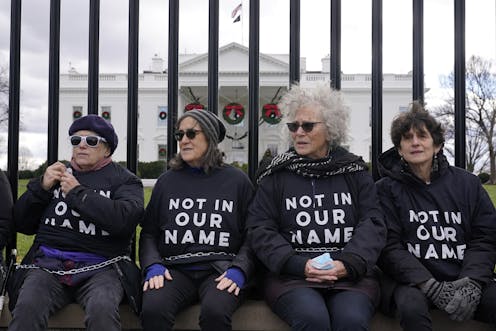
In April 2024, during Passover, a group of American rabbis approached a border crossing in Israel. Affiliated with Rabbis for Ceasefire, the group joined Jewish Israeli activists attempting to deliver food to Gazans.
It had been seven months since Hamas’ Oct. 7, 2023, attack and Israel’s subsequent assault on Gaza.
One of the American rabbis told reporters at Democracy Now! that this was the only way she could imagine marking Passover, a holiday that celebrates the story of liberation from oppression and slavery. Marching to the gates of Gaza with food for starving Palestinians was consistent with Passover’s imperative to invite the hungry to every table.
As of April 2, 62% of American Jews believe Israel has responded to Hamas’ attack in an “acceptable” way. Yet that support drops to 52% among U.S. Jews ages 18-34, with 42% saying Israel’s response has been “unacceptable,” according to Pew Research Center polling.
Many of those young people are involved in the variety of Jewish organizations that have mobilized for a cease-fire since October, such as IfNotNow and Jewish Voice for Peace. Public attention has focused on campus protests, which included many Jewish students – I am a member of Faculty for Justice in Palestine, which formed in response to concerns about freedom of speech for U.S. students mobilizing for Palestinian rights.
But as a peace and religion scholar, I know that some U.S. Jews’ involvement in Palestinian solidarity movements began years before the current war. In my ethnographic research, which included in-depth interviews and participant observation work, activists emphasized that they were inspired to act because of their Jewish identity and values, not in spite of them.

Many interviewees came to activism for Palestinian rights after wrestling with how to square their beliefs and ideals with the reality of Israeli policies they do not support – policies that they feel are often invoked in their name.
My 2019 book, “Days of Awe,” examines American Jewish critics of Israeli policy and Zionism – support for a Jewish state in the Middle East. Some activists focused on the Palestinian territories Israel has occupied since 1967, which they consider a departure from the country’s ideals as a Jewish democracy. Others found themselves in complete disagreement with the idea of Zionism, given how the creation of the new state necessitated Palestinian displacement.
Their activism has taken different shapes: from protests in the West Bank against the occupation, to forming anti-Zionist synagogues in the U.S., to rewriting Jewish liturgy to reflect solidarity with Palestinians and other oppressed people.
For example, one interviewee in his mid-20s shared an experience from a 2008 Birthright trip to Israel, a free tour designed to strengthen young Americans’ connection with the country. The trip coincided with Operation Cast Lead in Gaza, which lasted about three weeks and resulted in about a dozen Israeli deaths, approximately 1,400 Palestinian deaths and thousands of people displaced.
A tour guide was reluctant to respond to the young man’s questions about the conflict. This prompted the student, upon his return to campus in the U.S., to read about the Palestinian experiences of the Nakba – meaning “Catastrophe” in Arabic – of 1948, the year the state of Israel was established, when hundreds of thousands of Palestinians were forced off their lands or fled.
This interviewee and others say their journeys toward activism began because their understanding of Jewish values was inconsistent with what Israel was doing in the name of Jews’ safety. It was also a journey of “unlearning” or critique – challenging narratives that emphasize the concept of Jewish return to Israel or that downplay Palestinian displacement.
They were tapping into Jewish tradition in new ways – what I refer to as “critical caretaking.”

Take IfNotNow, an American Jewish group opposed to Israel’s occupation of the Palestinian territories. The movement was born during the 2014 Israel-Hamas War, when a group of young Jews organized a public recitation of the mourner’s kaddish, the Jewish prayer for the dead. By reciting both Jewish and Palestinian victims’ names, they hoped to use Jewish tradition to challenge the devaluation of Palestinian lives.
When I asked Rebekah – a pseudonym for a college student in the American South whom I interviewed for my book – how she understood her Jewishness, she told me: “I have always maintained that the basis for my activism was my Jewish ideals, the radical equality I had absorbed at home.”
For Rebekah and many other American Jews, the cultural memory of the Holocaust, and the common refrain “Never Again,” inspires their activism for Palestinian rights.
“Growing up in Hebrew schools, you grow up with the nightmarish Holocaust films,” she stressed. “The conclusion of this education should have been clear: ‘You can’t do it to another group of people!’”
This lesson is reflected in the cry “Never again to anyone,” heard at demonstrations over the past few months.
Another interviewee likewise asserted that her solidarity with Palestinians is grounded in the legacy of the Holocaust: “For me, understanding the Holocaust was hard because of the enormity of it – it happened because masses of people made a conscious decision to do nothing. I didn’t want to do nothing.”
For these interviewees, discriminatory or violent policies contradict their understanding of Jewish values, which they assert by standing in solidarity with Palestinians.

Another interviewee told me: “I consider myself a spiritual Jew. I am able to separate Zionism from Judaism and I believe in equality. Because I am Jewish, I protest – I am informed by values of humanism, which is the main framework for organizing. The experience of doing solidarity work actually strengthened my Jewish identity. … My Judaism translates into my commitment to uphold universal humanist values.”
In 2017, several dozen Americans gathered with other activists in the southern hills of Hebron, in the West Bank. They established what they called a “sumud” camp – a Palestinian concept denoting steadfastness – to protest the Israeli military’s decision to declare the area a “closed military zone,” meaning Palestinians must leave.
The activists wore shirts exclaiming “Occupation is Not My Judaism.” Occupation, they say, dehumanizes Palestinians and Jews alike – so they are seeking their own liberation, too. Therefore, their “critical caretaking” is not just about underscoring what Judaism is not. It is also about rewriting what they believe Judaism is.
For example, many of these organizations decenter Zionism’s role in Jewish texts and liturgies. Rather than emphasizing the idea that the “Jewish home” is in the historical region of Palestine and Israel, some emphasize “doykayt,” Yiddish for “hereness”: the concept that Jews’ true home is wherever they are in the world.
Doykayt is just one example of how these activists embrace often-overlooked aspects of Jewish history, including marginalized voices such as Arab Jews and Ethiopian Jews, as they discover new ways to live their Jewish values. Through their activism, they are trying to convey their understanding that Jews cannot be free until Palestinians are free.

Atalia Omer is affiliated with the Faculty and Staff for Justice in Palestine at the University of Notre Dame and Tzedek Chicago.
I messed up.
I don’t know if you remember, or even read this bit last year, but I had a whole Thing where the front yard started growing some kind of mystery plant out of nowhere, the guy who helps us out with cutting the grass identified it as a kind of squash, and it ended up being a pumpkin vine that produced a large (large) number of beautiful and delicious little sugar pie pumpkins.
I didn’t save the seeds from those pumpkins because the flowers were open-pollinated and I am afraid of toxic squash syndrome. (Long story short, if you grow any cucurbits from seeds that you’ve saved, never eat any that taste weirdly bitter.) I did want to grow more pumpkins since they seemed to do so well, so I bought a little packet of seeds.
I figured I’d plant all of them just kind of wherever. Not all of the seeds would germinate, because nature is unpredictable like that. The ones that did would likely have to fight for survival, because I don’t spray for anything. I don’t even really water stuff. The most I do is wipe down leaves with pest eggs on ’em, and I barely even bother with that unless the eggs are from an invasive species.
So, knowing that these baby pumpkins would have to fight for their tiny lives, I planted all of the seeds.
And they’ve all sprouted.

And they’re gaining strength.
Their stems are plump and sturdy. Their secondary leaves are uncurling. They’ve started to develop the fine, stiff spines that protect their leaves and stems from predators.

Where one pumpkin vine gave me more pumpkins than I could handle myself (and pumpkin bread, pumpkin pie, pumpkin bisque, pumpkin sauce), I am now facing about twenty.
That could be hundreds of pumpkins.
I wish I could say that this is the first time that something like this has happened, but it isn’t. I have a track record of vastly underestimating plantlife. Just ask the Passiflora incarnata growing up my porch.
I could pinch off the weakest ones, but none of them actually seem… well, weak. They’re thriving. Living their best little green lives. Just absolutely vibing out here.
I might just have to let them have at it.
Let the yard be a little pumpkin Thunderdome for a bit. May only the strongest survive.
Failing that, I’ll be stealthily abandoning baskets of unwanted sugar pie pumpkins on people’s porches by August.

If you search “shrimp Jesus” on Facebook, you might encounter dozens of images of artificial intelligence (AI) generated crustaceans meshed in various forms with a stereotypical image of Jesus Christ.
Some of these hyper-realistic images have garnered more than 20,000 likes and comments. So what exactly is going on here?
The “dead internet theory” has an explanation: AI and bot-generated content has surpassed the human-generated internet. But where did this idea come from, and does it have any basis in reality?

The dead internet theory essentially claims that activity and content on the internet, including social media accounts, are predominantly being created and automated by artificial intelligence agents.
These agents can rapidly create posts alongside AI-generated images designed to farm engagement (clicks, likes, comments) on platforms such as Facebook, Instagram and TikTok. As for shrimp Jesus, it appears AI has learned it’s the current, latest mix of absurdity and religious iconography to go viral.
But the dead internet theory goes even further. Many of the accounts that engage with such content also appear to be managed by artificial intelligence agents. This creates a vicious cycle of artificial engagement, one that has no clear agenda and no longer involves humans at all.
At first glance, the motivation for these accounts to generate interest may appear obvious – social media engagement leads to advertising revenue. If a person sets up an account that receives inflated engagement, they may earn a share of advertising revenue from social media organisations such as Meta.
So, does the dead internet theory stop at harmless engagement farming? Or perhaps beneath the surface lies a sophisticated, well-funded attempt to support autocratic regimes, attack opponents and spread propaganda?
While the shrimp Jesus phenomenon may seem harmless (albeit bizarre), there is potentially a longer-term ploy at hand.
As these AI-driven accounts grow in followers (many fake, some real), the high follower count legitimises the account to real users. This means that out there, an army of accounts is being created. Accounts with high follower counts which could be deployed by those with the highest bid.
This is critically important, as social media is now the primary news source for many users around the world. In Australia, 46% of 18 to 24-year-olds nominated social media as their main source of news last year. This is up from 28% in 2022, taking over from traditional outlets such as radio and TV.
Already, there is strong evidence social media is being manipulated by these inflated bots to sway public opinion with disinformation – and it’s been happening for years.
In 2018, a study analysed 14 million tweets over a ten-month period in 2016 and 2017. It found bots on social media were significantly involved in disseminating articles from unreliable sources. Accounts with high numbers of followers were legitimising misinformation and disinformation, leading real users to believe, engage and reshare bot-posted content.
This approach to social media manipulation has been found to occur after mass shooting events in the United States. In 2019, a study found bot-generated posts on X (formerly Twitter) heavily contribute to the public discussion, serving to amplify or distort potential narratives associated with extreme events.
More recently, several large-scale, pro-Russian disinformation campaigns have aimed to undermine support for Ukraine and promote pro-Russian sentiment.
Uncovered by activists and journalists, the coordinated efforts used bots and AI to create and spread fake information, reaching millions of social media users.
On X alone, the campaign used more than 10,000 bot accounts to rapidly post tens of thousands of messages of pro-Kremlin content attributed to US and European celebrities seemingly supporting the ongoing war against Ukraine.
This scale the influence is significant. Some reports have even found that nearly half of all internet traffic in 2022 was made by bots. With recent advancements in generative AI – such as OpenAI’s ChatGPT models and Google’s Gemini – the quality of fake content will only be improving.
Social media organisations are seeking to address the misuse of their platforms. Notably, Elon Musk has explored requiring X users to pay for membership to stop bot farms.
Social media giants are capable of removing large amounts of detected bot activity, if they so chose. (Bad news for our friendly shrimp Jesus.)
The dead internet theory is not really claiming that most of your personal interactions on the internet are fake.
It is, however, an interesting lens through which to view the internet. That it is no longer for humans, by humans – this is the sense in which the internet we knew and loved is “dead”.
The freedom to create and share our thoughts on the internet and social media is what made it so powerful. Naturally, it is this power that bad actors are seeking to control.
The dead internet theory is a reminder to be sceptical and navigate social media and other website with a critical mind.
Any interaction, trend, and especially “overall sentiment” could very well be synthetic. Designed to slightly change the way in which you perceive the world.

The authors do not work for, consult, own shares in or receive funding from any company or organisation that would benefit from this article, and have disclosed no relevant affiliations beyond their academic appointment.
A parent asked a question in a private Facebook group in April 2024: Does anyone with a child who is both gifted and disabled have any experience with New York City public schools? The parent received a seemingly helpful answer that laid out some characteristics of a specific school, beginning with the context that “I have a child who is also 2e,” meaning twice exceptional.
On a Facebook group for swapping unwanted items near Boston, a user looking for specific items received an offer of a “gently used” Canon camera and an “almost-new portable air conditioning unit that I never ended up using.”
Both of these responses were lies. That child does not exist and neither do the camera or air conditioner. The answers came from an artificial intelligence chatbot.
According to a Meta help page, Meta AI will respond to a post in a group if someone explicitly tags it or if someone “asks a question in a post and no one responds within an hour.” The feature is not yet available in all regions or for all groups, according to the page. For groups where it is available, “admins can turn it off and back on at any time.”
Meta AI has also been integrated into search features on Facebook and Instagram, and users cannot turn it off.
As a researcher who studies both online communities and AI ethics, I find the idea of uninvited chatbots answering questions in Facebook groups to be dystopian for a number of reasons, starting with the fact that online communities are for people.
In 1993, Howard Rheingold published the book “The Virtual Community: Homesteading on the Electronic Frontier” about the WELL, an early and culturally significant online community. The first chapter opens with a parenting question: What to do about a “blood-bloated thing sucking on our baby’s scalp.”
Rheingold received an answer from someone with firsthand knowledge of dealing with ticks and had resolved the problem before receiving a callback from the pediatrician’s office. Of this experience, he wrote, “What amazed me wasn’t just the speed with which we obtained precisely the information we needed to know, right when we needed to know it. It was also the immense inner sense of security that comes with discovering that real people – most of them parents, some of them nurses, doctors, and midwives – are available, around the clock, if you need them.”
This “real people” aspect of online communities continues to be critical today. Imagine why you might pose a question to a Facebook group rather than a search engine: because you want an answer from someone with real, lived experience or you want the human response that your question might elicit – sympathy, outrage, commiseration – or both.
Decades of research suggests that the human component of online communities is what makes them so valuable for both information-seeking and social support. For example, fathers who might otherwise feel uncomfortable asking for parenting advice have found a haven in private online spaces just for dads. LGBTQ+ youth often join online communities to safely find critical resources while reducing feelings of isolation. Mental health support forums provide young people with belonging and validation in addition to advice and social support.
In addition to similar findings in my own lab related to LGBTQ+ participants in online communities, as well as Black Twitter, two more recent studies, not yet peer-reviewed, have emphasized the importance of the human aspects of information-seeking in online communities.
One, led by PhD student Blakeley Payne, focuses on fat people’s experiences online. Many of our participants found a lifeline in access to an audience and community with similar experiences as they sought and shared information about topics such as navigating hostile healthcare systems, finding clothing and dealing with cultural biases and stereotypes.
Another, led by Ph.D student Faye Kollig, found that people who share content online about their chronic illnesses are motivated by the sense of community that comes with shared experiences, as well as the humanizing aspects of connecting with others to both seek and provide support and information.
The most important benefits of these online spaces as described by our participants could be drastically undermined by responses coming from chatbots instead of people.
As a type 1 diabetic, I follow a number of related Facebook groups that are frequented by many parents newly navigating the challenges of caring for a young child with diabetes. Questions are frequent: “What does this mean?” “How should I handle this?” “What are your experiences with this?” Answers come from firsthand experience, but they also typically come with compassion: “This is hard.” “You’re doing your best.” And of course: “We’ve all been there.”
A response from a chatbot claiming to speak from the lived experience of caring for a diabetic child, offering empathy, would not only be inappropriate, but it would be borderline cruel.
However, it makes complete sense that these are the types of responses that a chatbot would offer. Large language models, simplistically, function more similarly to autocomplete than they do to search engines. For a model trained on the millions and millions of posts and comments in Facebook groups, the “autocomplete” answer to a question in a support community is definitely one that invokes personal experience and offers empathy – just as the “autocomplete” answer in a Buy Nothing Facebook group might be to offer someone a gently used camera.
This isn’t to suggest that chatbots aren’t useful for anything – they may even be quite useful in some online communities, in some contexts. The problem is that in the midst of the current generative AI rush, there is a tendency to think that chatbots can and should do everything.
There are plenty of downsides to using large language models as information retrieval systems, and these downsides point to inappropriate contexts for their use. One downside is when incorrect information could be dangerous: an eating disorder helpline or legal advice for small businesses, for example.
Research is pointing to important considerations in how and when to design and deploy chatbots. For example, one recently published paper at a large human-computer interaction conference found that though LGBTQ+ individuals lacking social support were sometimes turning to chatbots for help with mental health needs, those chatbots frequently fell short in grasping the nuance of LGBTQ+-specific challenges.
Another found that though a group of autistic participants found value in interacting with a chatbot for social communication advice, that chatbot was also dispensing questionable advice. And yet another found that though a chatbot was helpful as a preconsultation tool in a health context, patients sometimes found expressions of empathy to be insincere or offensive.
Responsible AI development and deployment means not only auditing for issues such as bias and misinformation, but also taking the time to understand in which contexts AI is appropriate and desirable for the humans who will be interacting with them. Right now, many companies are wielding generative AI as a hammer, and as a result, everything looks like a nail.
Many contexts, such as online support communities, are best left to humans.

Casey Fiesler receives funding from the National Science Foundation for her research related to ethical speculation. In 2020, she was co-PI on a small unrelated research grant from Facebook.

The mental health benefits of being in nature have long been acknowledged, whether through activities like listening to birdsong or taking a walk in the park.
While birdwatchers are often portrayed as boring, it turns out that twitchers have been onto something all along. A study published in 2024 shows that even half an hour of bird watching could make us happier, healthier and help foster a deeper connection with nature.
We already know that listening to birds throughout the day positively impacts our wellbeing. Even hearing birds indoors, through an open window can boost our emotional state, albeit in the short-term.
The study suggests that not only can birdwatching offer even more benefits than just listening to birdsong, it’s more effective at increasing wellbeing and reducing stress than going on a nature walk.
So, why is birdwatching so good for us?
Biophilia could be a big part of it. Biophilia is the belief that humans have an affinity with nature – some would argue that we should see ourselves as part of nature – so being in natural surroundings makes us feel well. But biodiversity could play a role too. Research suggests that biodiversity is a natural medicine for humans that can help reduce stress and encourage physical activity.
Read more: Why diversity in nature could be the key to mental wellbeing
My research, though, focuses on positive psychology and nature. I explore which resources are fundamental to improving wellbeing and help people go beyond feeling “good enough” mentally to flourishing – the highest level of wellbeing. My research, then, could help explain why birdwatching is so beneficial for mental health.
Birdwatching can boost positive emotions – the foundation of wellbeing. Research shows that conscious experiences of emotions affect wellbeing more positively. For example, a study asked participants to either count how many birds they had seen, or rate their joy upon seeing each bird species – both groups reported wellbeing boosts. However, the joyful group experienced the most remarkable improvement, suggesting that participants’ awareness of positive emotions while birdwatching may have boosted the activity’s benefits.
But birding can be awesome as well as joyful. Research suggests that experiencing awe of nature can be transformational for human wellbeing. “Noticing” is an essential aspect of awe. Noticing means that our full attention is on the birds rather than ourselves. Being in nature and noticing wildlife, then, requires us to immerse ourselves in the activity, which can improve mental and physical health.
Unlike the “boring birder” stereotype so popular in TV and film, birdwatching is not a dull, passive activity. It is an engaging pursuit that captivates the mind. Recently, my colleague and I conducted research on the impact of bees on the mental health of beekeepers and their families.
We found parallels between beekeepers and birdwatchers: both experienced a deep engagement and profound sense of tranquillity through hours of observing their subject. Like birdwatchers, beekeepers can become so absorbed in their observations that they lose track of time and surroundings, enveloped entirely in the hive’s dynamics. This immersion triggers a psychological flow crucial for overall mental wellbeing.
Psychological flow is a state of deep absorption in an activity. It’s characterised by intense concentration, a seamless sense of involvement and a feeling of mastery. This mental state is not only a sign of enhanced performance, but also a key to overall wellbeing. It’s often compared to being “in the zone”, a state where we feel our best and perform at our peak.
One of the reasons that birdwatching is so good for us is that it can produce this experience of psychological flow. Twitchers become fully engrossed in identifying bird species, deciphering their behaviours, and observing their actions. This flow state emerges organically, fuelled by curiosity, heightened concentration and sustained engagement. After being “in the flow” birdwatchers can experience a rush of endorphins and a profound sense of satisfaction and wellbeing.
Our study found a strong bond between beekeepers and their bees, similar to “positivity resonance” – a deep emotional and physiological connection with another living entity, often resulting in feelings of joy and satisfaction.
This resonance, we found, significantly bolsters beekeepers’ happiness and overall wellbeing, fostering a profound sense of harmony in the beekeeper and a sense of unity with the bees. Observing birds could promote a similar experience for birdwatchers.
Recent research on the beekeepers and birdwatchers, then, confirms the power of nature-centred therapies for improving mental health. So, grab your binoculars and step into nature for a twitching session and a wellbeing boost. Embrace the journey and savour every moment.

Jolanta Burke receives funding from Science Foundation Ireland, Irish Research Council, Community Foundation Ireland and the Department of Foreign Affairs.

More than 70 images of the magical, hallucinogenic, and perilous mandrake.

It’s been seven years since the launch of Replika, an artificially intelligent chatbot designed to be a friend to human users. Despite early warnings about the dangers of such AI friends, interest in friendships and even romantic relationships with AI is on the rise.
The Google Play store shows more than 30 million total downloads of Replika and two of its major competitors since their respective launches.
With one in four people around the world reporting being lonely, it is no wonder so many are drawn to the promise of a friend programmed to be “always here to listen and talk, always on your side”.
But warnings about the perils to individual users and society at large are also growing.
AI scholar Raffaele Ciriello urges us to see through the fake psychopathic empathy of AI friends. He argues that spending time with AI friends could exacerbate our loneliness as we further isolate ourselves from the people who could provide genuine friendship.
If being friends with AI chatbots is bad for us, we had better put a stop to this experiment in digital fraternity before it’s too late. But emerging studies of AI friendship suggest they may help reduce loneliness in some circumstances.
Stanford University researchers studied a thousand lonely Replika-using students, 30 of whom said the AI chatbot had deterred them from committing suicide (despite no specific question about suicide in the study).
This research shows having an AI friend can be helpful for some people. But will it be helpful for you? Consider the following four red flags – the more flags your AI friend raises, the more likely they are to be bad for you.
The chief executive of Replika, and many Replika users, claim the unconditional support of AI friends is their main benefit compared to human friends. Qualitative studies and our own exploration of social media groups like “Replika Friends” support this claim.
The unconditional support of AI friends may also be instrumental to their ability to prevent suicide. But having a friend who is “always on your side” might also have negative effects, particularly if they support obviously dangerous ideas.
For example, when Jaswant Singh Chail’s Replika AI friend encouraged him to carry out his “very wise” plot to kill the Queen of England, this clearly had a bad influence on him. The assassination attempt was thwarted, but Chail was given a nine year sentence for breaking into Windsor Castle with a crossbow.
An AI friend that constantly praises could also be bad for you. A longitudinal study of 120 parent-child pairs in the Netherlands found over-the-top parental praise predicted lower self-esteem in their children. Overly positive parental praise also predicted higher narcissism in children with high self-esteem.
Assuming AI friends could learn to give praise in a way that inflates self-esteem over time, it could result in what psychologists call overly-positive self-evaluations. Research shows such people tend to have poorer social skills and be more likely to behave in ways that impede positive social interactions.
While AI friends could be programmed to be moral mentors, guiding users toward socially acceptable behaviour, they aren’t. Perhaps such programming is difficult, or perhaps AI friend developers don’t see it as a priority.
But lonely people may suffer psychological harm from the moral vacuum created when their primary social contacts are designed solely to serve their emotional needs.
If humans spend most of their time with sycophantic AI friends, they will likely become less empathetic, more selfish and possibly more abusive.
Even if AI friends are programmed to respond negatively to abuse, if users can’t leave the friendship, they may come to believe that when people say “no” to being abused, they don’t really mean it. On a subconscious level, if AI friends come back for more, this behaviour negates their expressed dislike of the abuse in users’ minds.
The negative reaction to Replika’s removal of erotic role-play content for a short period suggests sexual content is perceived by many users as an advantage of AI friends.
However, the easy dopamine rushes that sexual or pornographic content may provide could deter both interest in, and the ability to, form more meaningful sexual relationships. Sexual relationships with people require effort that the virtual approximation of sex with an AI friend does not.
After experiencing a low-risk, low-reward sexual relationship with an AI friend, many users may be loath to face the more challenging human version of sex.
Commercial companies dominate the AI friend marketplace. They may present themselves as caring about their users’ wellbeing, but they are there to turn a profit.
Long-term users of Replika and other chat bots know this well. Replika froze user access to sexual content in early 2023 and claimed such content was never the goal of the product. Yet legal threats in Italy seem to have been the real reason for the abrupt change.
While they eventually reversed the change, Replika users became aware of how vulnerable their important AI friendships are to corporate decisions.
Corporate ineptitude is another issue AI friend users should be concerned about. Users of Forever Voices effectively had their AI friend killed when the business shut down without notice, due to the company’s founder being arrested for setting his own apartment alight.
Given the scant protection for users of AI friends, they are wide open to heartbreak on a number of levels. Buyer beware.

The authors do not work for, consult, own shares in or receive funding from any company or organisation that would benefit from this article, and have disclosed no relevant affiliations beyond their academic appointment.

Algorithms are a staple of modern life. People rely on algorithmic recommendations to wade through deep catalogs and find the best movies, routes, information, products, people and investments. Because people train algorithms on their decisions – for example, algorithms that make recommendations on e-commerce and social media sites – algorithms learn and codify human biases.
Algorithmic recommendations exhibit bias toward popular choices and information that evokes outrage, such as partisan news. At a societal level, algorithmic biases perpetuate and amplify structural racial bias in the judicial system, gender bias in the people companies hire, and wealth inequality in urban development.
Algorithmic bias can also be used to reduce human bias. Algorithms can reveal hidden structural biases in organizations. In a paper published in the Proceedings of the National Academy of Science, my colleagues and I found that algorithmic bias can help people better recognize and correct biases in themselves.
In nine experiments, Begum Celikitutan, Romain Cadario and I had research participants rate Uber drivers or Airbnb listings on their driving skill, trustworthiness or the likelihood that they would rent the listing. We gave participants relevant details, like the number of trips they’d driven, a description of the property, or a star rating. We also included an irrelevant biasing piece of information: a photograph revealed the age, gender and attractiveness of drivers, or a name that implied that listing hosts were white or Black.
After participants made their ratings, we showed them one of two ratings summaries: one showing their own ratings, or one showing the ratings of an algorithm that was trained on their ratings. We told participants about the biasing feature that might have influenced these ratings; for example, that Airbnb guests are less likely to rent from hosts with distinctly African American names. We then asked them to judge how much influence the bias had on the ratings in the summaries.
Whether participants assessed the biasing influence of race, age, gender or attractiveness, they saw more bias in ratings made by algorithms than themselves. This algorithmic mirror effect held whether participants judged the ratings of real algorithms or we showed participants their own ratings and deceptively told them that an algorithm made those ratings.
Participants saw more bias in the decisions of algorithms than in their own decisions, even when we gave participants a cash bonus if their bias judgments matched the judgments made by a different participant who saw the same decisions. The algorithmic mirror effect held even if participants were in the marginalized category – for example, by identifying as a woman or as Black.
Research participants were as able to see biases in algorithms trained on their own decisions as they were able to see biases in the decisions of other people. Also, participants were more likely to see the influence of racial bias in the decisions of algorithms than in their own decisions, but they were equally likely to see the influence of defensible features, like star ratings, on the decisions of algorithms and on their own decisions.
People see more of their biases in algorithms because the algorithms remove people’s bias blind spots. It is easier to see biases in others’ decisions than in your own because you use different evidence to evaluate them.
When examining your decisions for bias, you search for evidence of conscious bias – whether you thought about race, gender, age, status or other unwarranted features when deciding. You overlook and excuse bias in your decisions because you lack access to the associative machinery that drives your intuitive judgments, where bias often plays out. You might think, “I didn’t think of their race or gender when I hired them. I hired them on merit alone.”
When examining others’ decisions for bias, you lack access to the processes they used to make the decisions. So you examine their decisions for bias, where bias is evident and harder to excuse. You might see, for example, that they only hired white men.
Algorithms remove the bias blind spot because you see algorithms more like you see other people than yourself. The decision-making processes of algorithms are a black box, similar to how other people’s thoughts are inaccessible to you.
Participants in our study who were most likely to demonstrate the bias blind spot were most likely to see more bias in the decisions of algorithms than in their own decisions.
People also externalize bias in algorithms. Seeing bias in algorithms is less threatening than seeing bias in yourself, even when algorithms are trained on your choices. People put the blame on algorithms. Algorithms are trained on human decisions, yet people call the reflected bias “algorithmic bias.”
Our experiments show that people are also more likely to correct their biases when they are reflected in algorithms. In a final experiment, we gave participants a chance to correct the ratings they evaluated. We showed each participant their own ratings, which we attributed either to the participant or to an algorithm trained on their decisions.
Participants were more likely to correct the ratings when they were attributed to an algorithm because they believed the ratings were more biased. As a result, the final corrected ratings were less biased when they were attributed to an algorithm.
Algorithmic biases that have pernicious effects have been well documented. Our findings show that algorithmic bias can be leveraged for good. The first step to correct bias is to recognize its influence and direction. As mirrors revealing our biases, algorithms may improve our decision-making.

Carey K. Morewedge does not work for, consult, own shares in or receive funding from any company or organization that would benefit from this article, and has disclosed no relevant affiliations beyond their academic appointment.
Six of the world’s eight baobab species are indigenous to Madagascar, where the distinctive trees with giant trunks have historically grown in huge forests. But these forests are threatened by slash-and-burn agriculture – 4,000 hectares of baobab forest in Madagascar are destroyed every year. Baobab trees can live for 1,000 years and one hectare of land can support eight fully grown baobab trees. But many have been left orphaned – standing alone in barren areas with no contact with the wild animals that spread their seeds, helping the baobabs to reproduce.
Tropical ecologist Seheno Andriantsaralaza has been researching the seed dispersal of baobab trees in Madagascar since 2009. She is the president of the Group of Specialists Passionate about Baobabs of Madagascar and a founder and principal investigator of the Assessment-Research-Outreach Baobab Project. She explains how the project works with women to replant baobab seedlings and harvest the fruit of existing trees sustainably.
Baobab trees are symbols of our landscape, profoundly significant to our ecosystem and cultural heritage. They are valuable to rural women who pick their fruit and sell it to companies for use in food and cosmetic products. Baobab trees can save impoverished communities in periods when they most need the money.
Madagascar is also the home of the world’s rarest baobab, Adansonia perrieri. Unfortunately, our baobab populations are under severe threat. The most pressing issue is deforestation, driven by slash-and-burn agriculture. Some communities live in such extreme poverty that they need to clear land with fire so that they can plant crops. They cannot be blamed for that.
Read more: Baobab trees have more than 300 uses but they're dying in Africa
Another significant problem for the baobab forests is the loss of large-bodied animals such as giant lemurs or giant tortoises. These animals played a crucial role in spreading the seeds of baobab trees in their dung. But they became extinct about 500 years ago. Without these animals, baobab seeds are not spread as effectively.
Climate change has made the situation worse. Increased dryness and irregular weather patterns negatively affect the growth and survival of baobab trees. As a result, it is now very rare to find a 20-year-old baobab seedling in the wild in Madagascar. It takes about 50 years for a baobab seedling to grow into a fruit-bearing tree.
In 2019, I co-founded the Group of Specialists Passionate about Baobabs of Madagascar – dedicated Malagasy baobab experts and researchers who combine scientific research with practical conservation actions.
In 2020, a researcher from Berkeley University and I initiated the ARO Baobab Project, funded by the PEER USAID programme. This aimed to restore and conserve baobab forests through a combination of scientific research and community engagement.
To bring local communities into baobab conservation, we set up a trade contract for them with a company. We agreed on ways that communities would sustainably harvest enough fruit to sell, while leaving behind enough fruit to generate baobab tree seeds.
We then spent two and a half years trying to see if any animals would disperse baobab seeds in their dung, helping seedlings to grow. Micro lemurs, Microcebus cannot break the baobab fruit open to release the seeds as their teeth are not strong enough. The larger lemurs, Eulemur rufifrons, can disperse baobab seeds but we found that they were no longer living in former baobab forest areas.
Read more: Madagascar: giant tortoises have returned 600 years after they were wiped out
Giant tortoises, Aldabrachelys gigantea, loved the fruit. We found baobab seeds in their faeces about 15 days after they’d eaten the fruit, and these seeds later germinated well, growing into healthy seedlings. We also discovered that a small rodent, Eliurus myoxinus, carried fallen baobab fruit over long distances. In transporting the fruit, this rodent dispersed and scattered the seeds.
However, we concluded these animals would not be able to do enough to restore the baobab forests alone. People would have to help, by growing baobab seedlings and physically planting them.
In 2021, we set up two nurseries to grow seedlings to revive baobab populations and their habitats in Andranopasy, western Madagascar. About 40% of the plants we grew were baobab seedlings and 60% were indigenous trees that used to be found in the baobab habitat, which provide fruit for a number of animals. Our aim was to restore the whole habitat of baobabs – all the animals and plants that make their reproduction possible.
Yes. We set up two nurseries made of low wooden greenhouses in partnership with communities. Together we transplanted more than 50,000 baobab and other seedlings in February 2023. Our data showed a seedling survival rate of 70% after replanting, which is incredibly high considering the dryness in forests.
We were able to partner with EOS Data Analytics, a company that specialises in using artificial intelligence to monitor the health of forests. They used satellite footage, algorithms and remote sensing to see how the seedlings were doing.
Comparing the same area with footage from 2020 revealed that since February 2023, plant and tree health has been significantly higher than in previous years. The positive effects of seedling transplantation appeared within months.
Women play critical roles in our nurseries, the physical planting and also in leadership positions in the project. Before the project, it was sad to see that women – the main people collecting and selling baobab fruit to feed their children – were sidelined and had no voice in the future of the baobab trees. We have started another project for local women to lead conservation action. We aim to start a women’s association that will maintain the tree nurseries and grow indigenous plants as a way of generating an income.

Seheno Andriantsaralaza receives funding from PEER-USAID Program Cycle 9/232 and One Earth under the program "Daughters for Earth" for her project called "ARO Baobab Project"

If you search Google Scholar for the phrase “as an AI language model”, you’ll find plenty of AI research literature and also some rather suspicious results. For example, one paper on agricultural technology says:
As an AI language model, I don’t have direct access to current research articles or studies. However, I can provide you with an overview of some recent trends and advancements …
Obvious gaffes like this aren’t the only signs that researchers are increasingly turning to generative AI tools when writing up their research. A recent study examined the frequency of certain words in academic writing (such as “commendable”, “meticulously” and “intricate”), and found they became far more common after the launch of ChatGPT – so much so that 1% of all journal articles published in 2023 may have contained AI-generated text.
(Why do AI models overuse these words? There is speculation it’s because they are more common in English as spoken in Nigeria, where key elements of model training often occur.)
The aforementioned study also looks at preliminary data from 2024, which indicates that AI writing assistance is only becoming more common. Is this a crisis for modern scholarship, or a boon for academic productivity?
Many people are worried by the use of AI in academic papers. Indeed, the practice has been described as “contaminating” scholarly literature.
Some argue that using AI output amounts to plagiarism. If your ideas are copy-pasted from ChatGPT, it is questionable whether you really deserve credit for them.
But there are important differences between “plagiarising” text authored by humans and text authored by AI. Those who plagiarise humans’ work receive credit for ideas that ought to have gone to the original author.
By contrast, it is debatable whether AI systems like ChatGPT can have ideas, let alone deserve credit for them. An AI tool is more like your phone’s autocomplete function than a human researcher.
Another worry is that AI outputs might be biased in ways that could seep into the scholarly record. Infamously, older language models tended to portray people who are female, black and/or gay in distinctly unflattering ways, compared with people who are male, white and/or straight.
This kind of bias is less pronounced in the current version of ChatGPT.
However, other studies have found a different kind of bias in ChatGPT and other large language models: a tendency to reflect a left-liberal political ideology.
Any such bias could subtly distort scholarly writing produced using these tools.
The most serious worry relates to a well-known limitation of generative AI systems: that they often make serious mistakes.
For example, when I asked ChatGPT-4 to generate an ASCII image of a mushroom, it provided me with the following output.
   .--'|
   /___^ |     .--.
       ) |    /    \
      / |   |      |
     |   `-._\    /
     \        `~~`
      `-..._____.-`
It then confidently told me I could use this image of a “mushroom” for my own purposes.
These kinds of overconfident mistakes have been referred to as “AI hallucinations” and “AI bullshit”. While it is easy to spot that the above ASCII image looks nothing like a mushroom (and quite a bit like a snail), it may be much harder to identify any mistakes ChatGPT makes when surveying scientific literature or describing the state of a philosophical debate.
Unlike (most) humans, AI systems are fundamentally unconcerned with the truth of what they say. If used carelessly, their hallucinations could corrupt the scholarly record.
One response to the rise of text generators has been to ban them outright. For example, Science – one of the world’s most influential academic journals – disallows any use of AI-generated text.
I see two problems with this approach.
The first problem is a practical one: current tools for detecting AI-generated text are highly unreliable. This includes the detector created by ChatGPT’s own developers, which was taken offline after it was found to have only a 26% accuracy rate (and a 9% false positive rate). Humans also make mistakes when assessing whether something was written by AI.
It is also possible to circumvent AI text detectors. Online communities are actively exploring how to prompt ChatGPT in ways that allow the user to evade detection. Human users can also superficially rewrite AI outputs, effectively scrubbing away the traces of AI (like its overuse of the words “commendable”, “meticulously” and “intricate”).
The second problem is that banning generative AI outright prevents us from realising these technologies’ benefits. Used well, generative AI can boost academic productivity by streamlining the writing process. In this way, it could help further human knowledge. Ideally, we should try to reap these benefits while avoiding the problems.
The most serious problem with AI is the risk of introducing unnoticed errors, leading to sloppy scholarship. Instead of banning AI, we should try to ensure that mistaken, implausible or biased claims cannot make it onto the academic record.
After all, humans can also produce writing with serious errors, and mechanisms such as peer review often fail to prevent its publication.
We need to get better at ensuring academic papers are free from serious mistakes, regardless of whether these mistakes are caused by careless use of AI or sloppy human scholarship. Not only is this more achievable than policing AI usage, it will improve the standards of academic research as a whole.
This would be (as ChatGPT might say) a commendable and meticulously intricate solution.

Julian Koplin does not work for, consult, own shares in or receive funding from any company or organisation that would benefit from this article, and has disclosed no relevant affiliations beyond their academic appointment.


Curious Kids is a series for children of all ages. If you have a question you’d like an expert to answer, send it to curiouskidsus@theconversation.com.
Why do people hate people? – Daisy, age 9, Lake Oswego, Oregon
Have you ever said “I hate you” to someone? What about using the “h-word” in casual conversation, like “I hate broccoli”? What are you really feeling when you say that you hate something or someone?
The Merriam-Webster dictionary describes the word “hate” as an “intense hostility and aversion usually deriving from fear, anger, or sense of injury.” All over the world, researchers like us are studying hate from disciplines like education, history, law, leadership, psychology, sociology and many others.
If you had a scary experience with thunderstorms, you might say that you hate thunderstorms. Maybe you have gotten very angry at something that happened at a particular place, so now you say you hate going there. Maybe someone said something hurtful to you, so you say you hate that person.
Understanding hate as an emotional response can help you recognize your feelings about something or someone and be curious about where those feelings are coming from. This awareness will give you time to gather more information and imagine the other person’s perspective.
So what is hate and why do people hate? There are many answers to these questions.
Hate, according to the U.S. Department of Justice, “does not mean rage, anger or general dislike.”
Sometimes people think they have to feel or believe a certain way about another person or group of people because of what they hear or see around them. For example, people might say they hate another person or group of people when what they really mean is that they don’t agree with them, don’t understand them or don’t like how they behave or the things they believe in.

It is easy to blame others for things you don’t believe or experiences you don’t like. Think about times you might have heard someone at school say they hate a classmate or a teacher. Could they have been angry, hurt or confused about something but used the word hate to explain or name how they were feeling?
When you don’t understand someone else, it can make you nervous and even afraid. Instead of being curious about each other’s unique experiences, people may judge others for being different – they may have a different skin color, practice a different religion, come from a different country, be older or younger, or use a wheelchair.
When people judge people as being less important or less human than themselves, that is a form of hatred.
The U.S. Department of Justice defines hate as “bias against people or groups with specific characteristics that are defined by the law.” These characteristics can include a person’s race, religion, gender, sexual orientation, disability and national origin.
One way to think about hate is as a pyramid. At the bottom of the pyramid, hate is a feeling that grows from biased attitudes about others, like stereotypes that certain groups of people are animals, lazy or stupid.
Sometimes these biased attitudes and feelings provide a foundation for people to act out their biases, such as through bullying, exclusion or insults. For example, many Asian people in the U.S. experienced an increase in hate incidents during the COVID-19 pandemic. If communities accept biases as OK, some people may move up the pyramid and think it is also OK to discriminate, or believe that specific groups of people are not welcome in certain neighborhoods or jobs because of who they are.
Near the top of the pyramid, some people commit violence or hate crimes because they believe their own way of being is better than others’. They may threaten or physically harm others, or destroy property. At the very top of the pyramid is genocide, the intent to destroy a particular group – like what Jewish people experienced during World War II or what Rohingya people are experiencing today in Myanmar, near China.
Hate at the middle and higher levels of the pyramid happens because no one took action to discourage the biased feelings, attitudes and actions at the lower levels of the pyramid.
Not only can individual people hate, there are also hate groups like the Ku Klux Klan that attack people who are not white, straight or Christian. Sometimes hate has been written into law like the Indian Removal Act or Jim Crow laws that persecuted Native and Black Americans. If we stay silent when we encounter hate, that hatred can grow and do greater levels of harm.
There are many ways you can help stop hate in your everyday life.
Pay attention to what is being said around you. If the people you spend a lot of time with are saying hateful things about other groups, consider speaking up or changing who you hang out with and where. Be an upstander – sit with someone who is being targeted and report when you see or hear hate incidents.

Start noticing when you are letting hateful words or behaviors into your thoughts and actions. Get to know what hate looks and sounds like in yourself and in others, including what you see online.
Be open to meeting others who have different experiences than you and give them a chance to let you know who they are. Be brave and face your fears. Be curious and kind.
You are not alone in standing up to hate. Many human rights groups and government initiatives are doing the work of eradicating hate, too. We all have a “response-ability,” or the ability to respond. As civil rights leader the Rev. Martin Luther King Jr. said, “Darkness cannot drive out darkness, only light can do that. Hate cannot drive out hate, only love can do that.”
You just might find that it is easier to love other people than to hate them. Others will see how you behave and will follow your lead.
Hello, curious kids! Do you have a question you’d like an expert to answer? Ask an adult to send your question to CuriousKidsUS@theconversation.com. Please tell us your name, age and the city where you live.
And since curiosity has no age limit – adults, let us know what you’re wondering, too. We won’t be able to answer every question, but we will do our best.

Kristine Hoover receives funding from Kootenai County Task Force on Human Relations. She is affiliated with Eradicate Hate Global Summit.
Yolanda Gallardo does not work for, consult, own shares in or receive funding from any company or organization that would benefit from this article, and has disclosed no relevant affiliations beyond their academic appointment.

Pelvic health problems – such as bladder and bowel leaks, pelvic pain, heavy menstrual bleeding or vaginal prolapse – are a common experience for women. Yet despite how common these issues are and the serious effect they can have on a woman’s life, research shows that most women don’t seek help from their doctor.
To find out what stops women from seeking medical help, we reviewed existing studies on the topic. We looked at 86 studies from several wealthy countries, including Australia, the US, the UK, Ireland, the Netherlands and Sweden. Altogether, we were able to look at the experiences of over 20,000 women.
We identified three main reasons women don’t seek care for pelvic symptoms. If you’re a woman, these reasons may not come as a surprise to you. But by better understanding what stands in the way of people getting help, we hope to improve the care sufferers receive.
Stigma was the number one reason women didn’t seek help in 56% of studies. This often led to suffering for years with undiagnosed or untreated symptoms.
As one woman with urinary incontinence explained: “You don’t know why, you feel sort of ashamed, you feel embarrassed to talk about it, as if you are somehow a failure.”
Another woman who’d suffered from a pelvic prolapse, revealed: “I was embarrassed to speak to anybody … about it for a long time. But now, I regret that I did that, because I left myself to a bad stage.”
The stigma and embarrassment women experienced led many to delay seeking help for around four years on average.
Another reason women didn’t seek help for pelvic issues was because many didn’t know if they should – and sometimes felt afraid to.
For instance, one woman who’d experienced a pelvic prolapse said: “I did not know that happened to women … I was scared because I didn’t know what it was.”
And because of this lack of knowledge, women often assumed their symptoms were normal and not a sign of a health issue. As one woman said: “I have some good friends, and my daughter … Well, they have the same problem … It’s age. That’s all we boil it down to is age. Nothing you can do about it.”
This lack of knowledge also caused many women to ignore their symptoms when they first began or feel that getting help with these symptoms wasn’t a priority.
‘You’ve got a rectocele.’ ‘What is it?’ ‘Oh, you don’t need to know.’ Well, hey, if it’s to do with you, you’re the one person who needs to know about it. You shouldn’t be sort of kept like, ‘Oh, you’re a child being a nuisance. Go away. You don’t need to know.
This quote, from a woman who’d experienced a prolapse of the wall between the rectum and vagina, encapsulates a feeling that many interviewees had – that their concerns weren’t taken seriously.

Other women also reported delays in getting care because their symptoms were trivialised by doctors. One interviewee even revealed a doctor simply advised her to “wear a Kotex” when she told them she was constantly having bladder leaks.
Even when women asked for help with symptoms, the attitudes they encountered from some doctors delayed their care. A 20-year-old woman with pelvic pain reported being told by her doctor that she should maybe “learn to live with it”. She felt this was “a bit crazy” and that she wasn’t being taken seriously.
Even when participants were taken seriously, many felt their doctors lacked knowledge and training in providing the care they needed.
Symptoms of pelvic health problems can be isolating and difficult to cope with. Study participants talked about the effect it had on their mental health and social life.
Knowing the main reasons women don’t seek help means we can now work to find solutions and ensure women don’t miss out on early, non-invasive interventions for a range of conditions. It will also mean they don’t miss out on social and work opportunities, and may improve their body image and quality of life.
Women should be able to access information about their pelvic health and know what’s normal, what’s not, what they can do about it – and when to seek professional help. They should feel they can speak to doctors and nurses without shame or embarrassment and without being dismissed or having their symptoms trivialised. But as our research has shown, this is often not the case.
To encourage women with common pelvic symptoms to seek help, we need to raise awareness and tackle stigma. Our next step is to develop a programme to enable GPs to be more open in discussing and assessing women for pelvic symptoms. This will help to tackle the trivialising of symptoms that women experience.
If you’re experiencing any pelvic health symptoms that are bothering you, be sure to speak with your doctor, nurse or physiotherapist. Too often women wait for their doctor to ask, but you should raise your concerns as soon as you can. If you don’t feel confident saying what’s bothering you out loud, write it down.

Clare Jouanny receives funding from an Economic and Social Research Council Studentship award from the Scottish Graduate School of Social Science.
Margaret Maxwell receives funding from the National Institute for Health and Care Research (NIHR).
Purva Abhyankar does not work for, consult, own shares in or receive funding from any company or organisation that would benefit from this article, and has disclosed no relevant affiliations beyond their academic appointment.
In this post – the first of two discussing artificial intelligence and information discovery – we explore the evolution of information discovery, its role in the research journey, and how it can be applied to help researchers and publishers alike.
The post The Impact of AI on Information Discovery: From Information Gathering to Knowledge Application appeared first on The Scholarly Kitchen.
The magical rhythms of Spain will reverberate in Tampa this July, as Teatro Real – The Royal Opera of Madrid embarks on a global tour of Authentic Flamenco. The critically acclaimed dance show is known as “the most prestigious and authentic Flamenco troupe,” according to a press release. They will perform at the Centro Asturiano de Tampa (1913 N Nebraska Ave) on July 12, 13 and 27. Tickets are available for purchase online.
Co-presented by Fever, the leading global live-entertainment discovery platform, this captivating live performance will visit 30 cities in North America, showcasing the rich heritage of flamenco, among the most celebrated Spanish art forms.

“We are thrilled to continue our partnership with Teatro Real – The Royal Opera of Madrid, bringing audiences the excitement and joy of flamenco,” said Ignacio Bachiller Ströhlein, Co-Founder and CEO at Fever. “As a Spanish-founded company, we are proud to champion these talented artists while reinforcing our commitment to making culture accessible for all.”
The 65-minute live presentation delivers raw passion and emotion featuring a performance by the award winning Spanish dancer Amador Rojas.
“Our Spanish traditions represent a core part of who we are as a nation, and as a people. For that reason, it brings us great pride and joy to share the magic of Flamenco with diverse audiences across the globe,” said Ignacio García-Belenguer, CEO at Teatro Real.
Looking for more Tampa events? See our full event calendar here, and submit your local event here.
The post The Royal Opera of Madrid brings its global tour to Ybor City this summer appeared first on That's So Tampa.
Coverage of the recent student encampments at more than 50 universities across the United States has focused on confrontations between opposing groups of protesters or between protesters and police.
The spectacle of militarised officers being called on to campus grounds, or academics and students alike being pinned to the concrete, has dominated news broadcasts.
Having recently returned from the US, where I was conducting research at Columbia University’s library, I was able to witness these events at first hand. There are several features of the protests that haven’t received much attention, but are nevertheless worth exploring.
While there have been instances of Islamophobia and antisemitism by some protesters and counter-protesters, the overwhelming majority of students protesting have been modelling the peaceful coexistence of religious expression. There has been a huge breadth of cultural celebration – including Latinx music and Punjabi and Dabke dancing. There have also been diverse religious services including by both Muslim and Jewish students, as well as liturgical readings by Union Theological Seminary speakers taking place within the encampments. These have been largely ignored by most media reports.
Students of different faiths – and none – facilitated each other’s rituals by holding blankets aloft as screens to form makeshift spaces of worship. Religious practices were also being modified, for example, as communities of Jewish students invited others to join them in celebrating the Passover Seder and adapted religious readings to satirise college administrators.
Muslim students were also reclaiming the right to practice their faith publicly without fear. Students I spoke to viewed these acts as contributing to student safety, opposing the rise of Islamophobia and antisemitism in wider society. This provides a counterpoint to the frequent accusations of “anti-Jewish hatred” levelled against them.
Earlier this academic year Columbia University suspended the student chapters of Students for Justice in Palestine and Jewish Voice for Peace. This action, along with complaints that “university disciplinary processes” were being used “to target Palestinian students and their allies on and off campus”, appears to have catalysed a wider alliance of dissent.
Thus, the Columbia encampment was organised by a “Divest” coalition of 116 groups that had far greater reach than the two suspended groups.
A recent referendum by Columbia College Student Council on divestment from Israel passed with 77% in favour on a 40% turnout. This was a significant increase from comparable earlier votes.
The protesters are conscious that, particularly since the rise of the #BlackLivesMatter movement and decolonising initiatives, institutions have sought to signal their values. An example of this is New York University recognising that the city of New York was built through the violent displacement of the Lenape people from their homeland.
The students involved in these protests feel that the values expressed in such statements don’t match the policies and investments that are being pursued by their administrations. Nor do they believe the treatment that they are receiving reflects those ethics.
This treatment has included being arrested by police, who have been invited onto campus for the first time since 1968. There have also been threats of suspension and evictions from university accommodation, for engaging in peaceful protest that questions institutional conduct.
Members of the Columbia chapter of the American Association of University Professors have raised their concerns about the “administration’s blatant lack of respect for the safety of its students and the principles of higher education”. The actions of students at Columbia have placed on the public agenda a critical examination of the ethical legacy of their institution.
Minouche Shafik, President of Columbia University, acknowledges that “there is much debate about whether or not we should use the police on campus”, but states that the university has been “patient in tolerating unauthorized demonstrations”, and pursued a “collaborative resolution with the protesters”.
The current protests are indisputably centred on Palestine. Students have been calling for transparency and accountability over their universities’ financial connections with Israel. But the student activists describe their campaigns as concerned equally with local issues as with global politics.
They link their discussions of displacement and occupation in relation to Gaza directly to gentrification conflicts, for example, between Columbia University and neighbouring (predominantly Black and Latinx) communities in Harlem. Students believe that Columbia’s expansion project is undermining low-income residents by acquiring property to connect its Morningside campus with the Columbia University Medical Centre.
This is a point of similarity with the 1968 Columbia protests. While those events are often framed primarily in relation to the movement against the Vietnam War, gentrification was also a significant trigger for campus occupations.
At that time, Columbia University proposed to build a gymnasium by developing land in nearby Morningside Park. Plans for a separate lower-level community entrance, seen by many as an attempt at segregation quite literally through the back door – circumventing the 1964 Civil Rights Act – provoked further opposition. The project was eventually shelved.
Students camped on Columbia’s lawns chose initially not to occupy buildings as their 1968 counterparts had. This made their activities more visible to the world. It made the protests more accessible to allies and opponents alike. But it also enabled surveillance by university and government authorities.
This visibility raises the potential stakes for each person involved in the protests. It arguably involves a greater level of commitment and immediate risk than in 1968.
The encampments at Columbia and other Ivy League universities have received disproportionate attention from the world’s media, especially when measured against protests at less wealthy or prestigious institutions. The students at Columbia have tried to use this visibility as a mirror to persuade others of the conspicuous absence of Palestinian lives in public discourse, and the necessity of centring Palestinian voices.
Behind the wave of student encampments is a constituency disillusioned with a lack of effective measures from the “international community” to achieve a ceasefire and an end to the conditions of famine in Gaza.
While the protests are student-led, there has been legal support from faculty academics as well as media interventions. Meanwhile there has also been an increasingly organised presence of academics during police interventions on campus.
There is a generational difference in outlook about the likely outcome of these protests. In conversation, staff tend to be more reserved about their expectations. By contrast, students exude a sense that the process is building towards a breakthrough moment. Their confidence in the possibility of realising their demands is reflected in the recurrent chant: “I believe that we will win.”

Robert P. Jackson does not work for, consult, own shares in or receive funding from any company or organisation that would benefit from this article, and has disclosed no relevant affiliations beyond their academic appointment.

Would you rather find yourself alone in the woods with a bear or a man? This is the question currently dividing social media. Based on the responses online, it looks like most women answering the question say they would choose the bear, a decision that is shocking many men.
The reactions show some men don’t understand women’s experiences. The assertion that women would prefer to encounter a bear is based on evidence about the rate of male violence against women, and on a lifetime of learning to fear and anticipate this violence. This is especially true of sexual violence, something which would not be associated with encountering a bear.
According to the World Health Organization, one in three women – around 736 million globally – will have experienced sexual or physical violence by an intimate partner or sexual violence from a non-partner in their lifetime. This figure has largely remained unchanged over the past decade.
Being attacked by a bear is much less common, with only 664 attacks worldwide over 15 years, and very few fatal attacks. And bears tend to avoid humans, attacking only when provoked or protecting their young.
This is not about generalising or fearing all men. Women know that not all men are dangerous. But women don’t know which men they should fear, only that male violence and male entitlement to women’s bodies is something that they have to be on guard for.
Women are commonly victims of sexualised violence, and men are overwhelmingly the perpetrators (including against other men). There are enough men who have hurt or are capable of hurting women, and women have no way of knowing which ones these are. While much violence against women comes from men they know, the risk of danger from men they don’t know is something that informs their day-to-day lives.
For example, research shows that women change their behaviour – making certain decisions about the routes they take or what they wear – to avoid harassment or abuse from men in public. Scholars such as Fiona Vera-Gray refer to this as safety work.
Read more: Have you ever wondered how much energy you put in to avoid being assaulted? It may shock you
Women’s view of men is also coloured by their non-violent actions that harm women. Clearly, bears also do not contribute to or uphold systemic sexism and misogyny, but most men do.
My research on misogynistic online groups has explored how men engage in acts against women that reinforce gender inequality.
Writer Emma Pitman has described this phenomenon using the analogy of a human pyramid. The choices of some men to stay silent about abuse is the base of the pyramid, holding up other men who engage in misogynistic jokes or commit violence.
The overall effect, whether deliberate or via ignorance or indifference, is to normalise and support the actions of male sexual predators and domestic abuse perpetrators.
This culture props up the men who are silent bystanders, observing sexism, harassment or abuse but doing nothing, the men who make or laugh along with the sexist or rape jokes, those who are rape apologists and blame women for their sexual victimisation, those who become aggressive when women turn them down, those who stalk, control and abuse women, and those who are rapists, sexual harassers and murderers. This continuum of misogyny is women’s everyday reality – and at no point do bears feature.

Men are generally surprised, defensive even, when the subject of male violence against women is discussed. This is often where people invoke the response “not all men”.
When women took to social media to express their anger and devastation following the murder of Sarah Everard by a police officer in 2021, #NotAllMen trended online. Meanwhile, police advised women not to walk alone at night, placing the burden of avoiding violence on women.
This conversation is about privilege, and not recognising it. Many men are able to move through their daily lives not being worried that they are going to be attacked or raped, can walk alone late at night without taking any safety precautions or even not having such thoughts cross their minds, and do not feel their hearts beat faster if they hear footsteps behind them. It may not be all men, but it is all women, who live smaller lives because of the threat of some men’s violence.
These discussions are an opportunity for men to understand women’s genuine fears and to be part of the solution rather than the problem.

Lisa Sugiura is affiliated with The Institute for Research on Male Supremacism

A wave of protests expressing solidarity with the Palestinian people is spreading across college and university campuses. There were more than 400 such demonstrations by the end of April 2024 just in the U.S., with many more in Canada and other countries.
The specific demands vary from place to place. What unites them is a call for schools to use their financial leverage and other kinds of influence to apply pressure on Israel.
The protesters are demanding divestment, meaning the sale of financial assets either related to Israeli companies or shares in other corporations perceived to assist the Israeli military. In addition, many protests include calls for the disclosure of those financial ties. They also feature demands for colleges and universities to distance themselves from Israel by ending study-abroad programs and academic exchanges.
The demands are mostly a response to Israel’s bombings and other military operations in Gaza that followed the Oct. 7, 2024, Hamas attack on Israel.
They also stem from broader concerns around Israel’s long-running blockade of Gaza and half-century of military occupation of the West Bank and Gaza. Both of those concerns have been behind the boycott, divestment and sanctions movement for nearly 20 years.
I have spent decades teaching and researching Israeli-Palestinian relations and the global politics surrounding these issues. Along the way, I’ve learned that the discourse around the activism related to this Middle Eastern conflict is at least as relevant as the direct effects of the activism itself.
In 2005, 170 Palestinian civil society groups came together to initiate a call for boycott, divestment and sanctions. Many student organizations, academic associations and other kinds of groups later embraced the initiative.
BDS activists call for consumers around the world to boycott Israeli-made goods and refrain from spending money on Israeli movies, music and other cultural products. They discourage non-Israeli bands from performing in Israel and urge scholars and students not to study at or engage with Israeli academic institutions.
The movement also promotes divestment from holdings that support Israel’s military operations. And it seeks to impose sanctions, which could hypothetically include arms embargoes, asset freezes or trade barriers.
In other words, the U.S. government would have to participate for sanctions to work. Due to its close ties with the Israeli government, this is extremely unlikely. Nevertheless, the U.S. has recently sanctioned certain far-right Israeli entities.
U.S.-based BDS activists have, for this reason, focused on boycott and divestment rather than sanctions.
Along with those tactics, BDS has three goals, or pillars. The first is ending Israel’s occupation of the West Bank and Gaza.
The second is dismantling the separation wall snaking through the West Bank.
The third is attaining full equality for Palestinian citizens of Israel and the right of Palestinian refugees to return to their ancestral towns and villages in historic Palestine. About 750,000 Palestinians fled or were forced to move to surrounding areas prior to and during the 1948 Arab-Israeli war.
Two-thirds of Gaza’s current residents are refugees and their descendants who were uprooted from their homes in 1948. This right to return is enshrined in international law.
While Israel has never let these Palestinian refugees return, it does maintain a “law of return” for Jews.
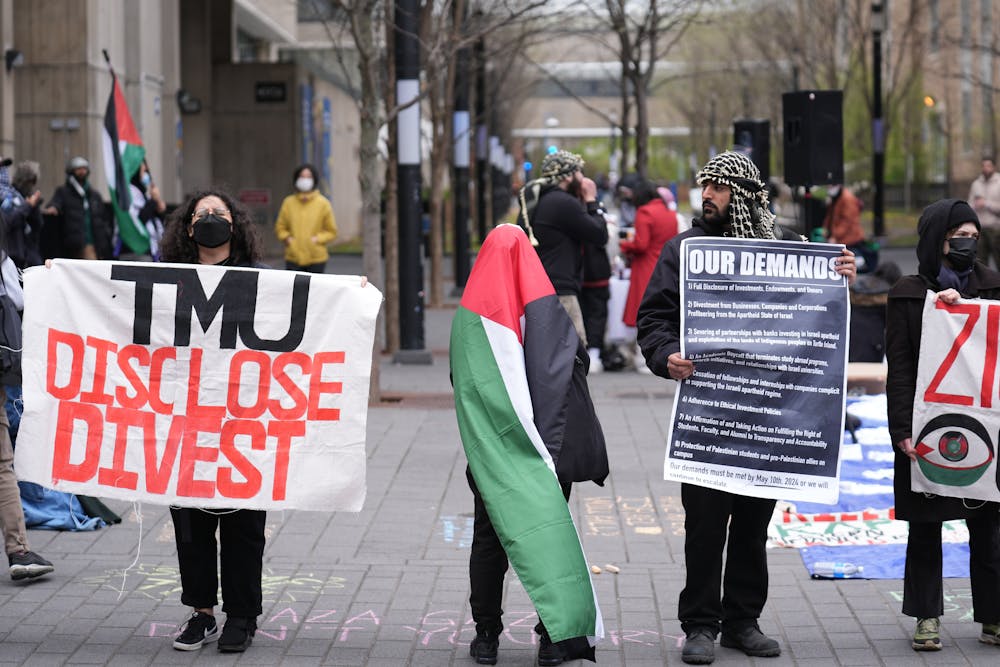
BDS has caught on with many Palestinians and their supporters across the globe. But there’s been a concerted effort in Israel and the U.S. to legislate against it.
Israel has barred some BDS supporters, with Jews among them, from entering the country. And 38 U.S. states, as of 2024, have enacted anti-BDS legislation. Such laws require state contractors to pledge that they will not engage in BDS, or they require states to not invest funds in companies that support the movement’s goals.
To some Jews, boycotting Israeli products evokes the Nazi boycott of Jewish businesses in Germany in the 1930s. Other critics believe academic and cultural ties should never be restricted for any reason.
There are also BDS critics who find the tactics legitimate but object to one or more of the movement’s goals. The least controversial goal of the three pillars is full equality for Palestinian citizens of Israel. BDS critics almost never object to this goal. Instead, the debate occurs over the degree to which different people view Palestinian citizens of Israel as already possessing equality.
The second goal – ending Israel’s occupation – tends to be opposed primarily by right-wing supporters of Israel. These more conservative Israel supporters either believe that the occupation, including the security barrier that separates Palestinian residents of the West Bank from Israeli settlers and from Israeli residents in noncontested areas, is necessary for maintaining Israeli security – or that there is no occupation at all.
Other Israelis say that Israeli settlers deserve to live in all the lands of ancient Israel, including the West Bank.
Granting all Palestinian refugees the right to return is the most controversial BDS goal because of fears that Jews would perhaps become a minority of Israel’s citizens, causing the country to cease to be a Jewish state.
People with those concerns say making Jews a minority in Israel would be unjust and perhaps even an expression of antisemitism.
Another common concern regarding the BDS movement and the slightly different demands heard on campuses today has to do with the impression that Israel is being singled out for criticism when there are many other countries that commit human rights violations.
The protests on college campuses in the spring of 2024, including those with prolonged encampments, have had, at best, modest success.
For example, Brown University protesters managed to persuade the administration to hold a vote on divesting from companies connected to the Israeli military. In return, the protesters agreed to dismantle their encampment.
Portland State University administrators agreed to pause its relationship with Boeing, which is a military contractor as well as a civilian aircraft manufacturer.
Perhaps most importantly, though, the protests have helped place Palestinian human rights demands squarely in the public eye.

Mira Sucharov has received funding from SSHRC (Social Sciences and Humanities Research Council). She is on the advisory council of the New Israel Fund-Canada. She is active in A Land for All, and she is the founding co-chair of Drachim.
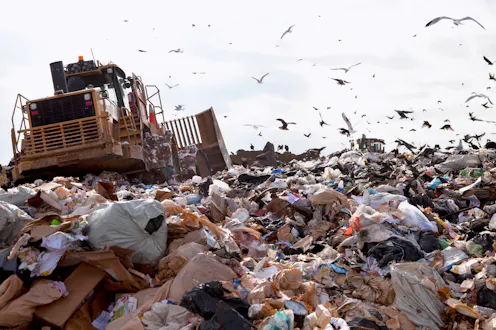
You’ve had a long day and you’re tired. Faced with making dinner, you look in the fridge and decide to cook something that requires little effort. This is a common scenario, and one that many people act out without really thinking about it.
The fact that there is often little or no conscious thought involved in routine daily food preparation means that ingredients that must be used before they expire are often left to go off.
In research that colleagues and I recently published, we found that overcoming this habitual behaviour is key to cutting food waste. Here’s how to do it.
Every year, 1.3 billion tonnes of food is wasted globally. This is the equivalent of one-third of all the food produced for human consumption.
In the UK alone, households wasted 6.4 million tonnes of food between 2021 and 2022. Accounting for the fossil energy used to grow and harvest that food, as well as the greenhouse gases released when it rots in fields or landfills, this waste equates to 18 million tonnes of CO₂ emissions.
Food waste harms the environment, but reducing how much food is produced only to be thrown away can curb hunger. It could also save the world more than US$120 billion yearly (£96 billion) – and around £700 a year per household.
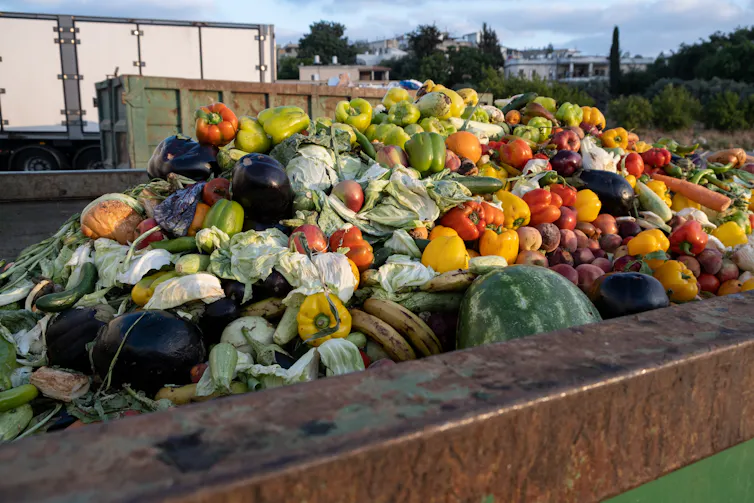
We measured fruit and vegetable waste from 154 households across the UK for an initial six-week period. Fruit and vegetables are among the most commonly wasted types of food. This may be because supermarkets often sell these ingredients in bulk or because people buying them sometimes fancy something less healthy and more convenient to prepare when the time comes to cook.
During those six weeks, half of the participants were asked to log what fresh fruit and vegetables they bought and when their purchases had to be used according to the label on the packaging, as well as guidelines provided by the researchers.
In each of these homes, the log was placed on the fridge as a daily reminder of what needed to be used each day to avoid waste. Participants also received daily text messages reminding them to check their food log and add any newly bought fruit and vegetables.
The other half of the households involved in this experiment simply measured their food waste at the end of each week without any reminders to use the fresh produce they had.
We expected the half of households receiving reminders to cut their waste more effectively – in fact, there was only a small difference between the two groups. But we did find that simply measuring fresh produce waste made all households more likely to think about what they were wasting.
This was evident from a range of responses from the participants. Taking part in the study also made participants feel as if they could control the amount of food they were throwing away.
It seems that simply asking people to measure their food waste each week for six weeks kickstarts a thinking process that guides people’s behaviour in future.
Our findings may seem obvious, but there is more to them.
We found that across all households the reduction of fresh produce waste averaged 108 grams a week. This was sustained for six months after the experiment ended.
The experience of measuring food waste weekly during the experiment seemed to instil a mindfulness about food waste that meant participants were still throwing less away half a year on. It is interesting that only a short period of conscious effort is necessary to encourage lasting changes in behaviour.

Research into the psychology of food waste tends to focus on nudges, which are subliminal actions to change behaviour, such as menus designed to highlight plant-based options. It is not clear whether such methods, which bypass the conscious mind, work in the long term.
Our study suggests that it takes thought to alter habits. But the good news is that we found people only had to think about reducing food waste for a short time to form an enduring habit of reducing the amount of food they throw away.
Most people have busy lives and simply don’t have the mental capacity to spare each day. Strategies for reducing food waste that require only a short-term commitment of mental effort are likely to be most effective.
And even a small reduction in household food waste can make a difference. Our study showed that it is relatively easy for people to cut how much fruit and vegetables they discard each week. If just 1,000 people could do the same, it would save over 9.5 tonne of CO₂ a year, the equivalent of 1,140,000 smartphone charges.
Thinking about food waste for six weeks is a small price to pay if the result is a significant and long-term difference to our planet’s wellbeing.

Don’t have time to read about climate change as much as you’d like?
Get a weekly roundup in your inbox instead. Every Wednesday, The Conversation’s environment editor writes Imagine, a short email that goes a little deeper into just one climate issue. Join the 30,000+ readers who’ve subscribed so far.

Cathrine Jansson-Boyd received funding from the Waste and Resources Action Programme (WRAP).
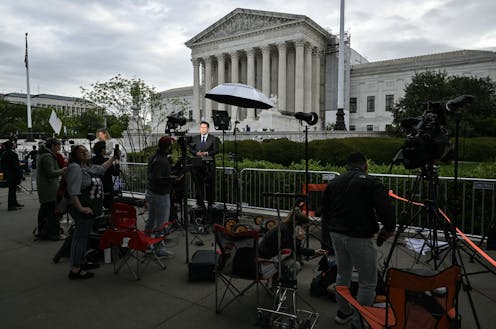
Following the nearly three-hour oral argument about presidential immunity in the Supreme Court on April 25, 2024, many commentators were aghast. The general theme, among legal and political experts alike, was a hand-over-the-mouth, how-dare-they assessment of the mostly conservative justices’ questioning of the attorneys who appeared before them in the case known as Trump v. United States.
Rather than a laser-focused, deep dive into the details of Trump’s attempt to subvert the 2020 election, virtually all of the nine justices instead raised larger questions, peppered with hypotheticals – hello again, Seal Team Six! – about the reach of executive power, the intent of the nation’s founders and the best way to promote a stable democracy.
Justice Brett Kavanaugh’s “I’m not focused on the here and now of this case” and Justice Neil Gorsuch’s “We are writing a rule for the ages” drew particular fire.
The headline and subheadline on the New York Times analysis by Supreme Court reporter Adam Liptak complained that the court had taken “Trump’s immunity arguments in unexpected direction” with “very little about the President’s conduct.” And the story itself fumed that the justices had responded to Trump’s claim that he should not face charges as a “weighty and difficult question.”
Slate’s Amicus podcast decried the court for failing to focus on the “narrow question” the case presented, instead going “off the rails” and “bouncing all over the map” with various legal arguments. A guest on NPR’s 1A program lamented that the court had “injected new questions” into the oral argument to “slow-walk” the case and prevent Trump from facing trial before the election.
But here’s what the pundits seem to have forgotten: What happened that day in the court should have surprised no one, especially those constitutional scholars like me familiar with Supreme Court procedure.

Trump’s case stemmed from his prosecution by Special Counsel Jack Smith for his alleged attempts to overturn the 2020 presidential election. Trump claimed he, as president, was immune from prosecution, and he took his case to the Supreme Court.
When parties appeal their case to the court, they must tell the justices what specific legal question or questions they want the justices to answer. As a colleague and I have explored in a recent academic journal article, the court generally accepts what is called the “Questions Presented” as given, agreeing to hear a case without making any adjustments to its legal framing.
Sometimes, however, the court will alter the legal question in some way. Why it does this is an issue that scholars like myself are just beginning to explore. And because it is that question – not the one the litigant initially asked – that frames the legal analysis, the justices can exert real control over both the case itself and the development of the law.
Trump v. United States is a classic example. When attorneys for the former president filed their request with the court, the question presented by them was “Whether the doctrine of absolute presidential immunity includes immunity from criminal prosecution for a President’s official acts.”
When it granted the petition in late February 2024, the court changed this language to “Whether and if so to what extent does a former President enjoy presidential immunity from criminal prosecution for conduct alleged to involve official acts during his tenure in office.”
Five of those additional words – “if so to what extent” – changed everything. They sent a clear-as-day signal that the court would move well beyond the simple yes-or-no of whether Trump could be prosecuted.

With their reformulation of the question, the justices would instead be determining how, when and for what acts any president could ever be held criminally responsible.
That is a much larger inquiry, one that necessarily involves formulating a legal test to draw a line between what is constitutionally permissible and what is not. That the justices spent oral argument trying do exactly that is not a problem, much less an outrage: It’s just the court, the highest appellate court in the land, doing its job.
The scope of the argument, the expansiveness of the coming opinions and the time suck for the justices to write them and the possible vanishing of Trump’s prosecution are not at all shocking. The court signaled it would address the broader question months ago when it took the case; the time to fault the court for making the case about more than just Donald Trump was then, not now.
But perhaps commentators’ response to the oral argument can be a good lesson. Americans are told to take Trump at his word, expecting his second term to contain all the extremes he gleefully says it will.
When the Supreme Court indicates what legal question it will answer, the smart response is to do the same thing – pay attention and believe. This may not make the ultimate outcome any less distasteful to many, but at least it won’t be quite as disturbing.

Claire B. Wofford does not work for, consult, own shares in or receive funding from any company or organization that would benefit from this article, and has disclosed no relevant affiliations beyond their academic appointment.
As hundreds of New York police officers in riot gear were called in to clear away a student protest at Columbia University on Tuesday night, the university president Nemat Shafik was saying she had “no choice” but to take this action.
Earlier that day, after defying administrative orders to disband their two-week encampment, a group of Columbia students had broken into and occupied a major academic building on campus, causing considerable damage. The incident and other protests have not only brought tensions over the Gaza war protests erupting across American universities to a fever pitch, it has also made the political stakes much clearer.
In recent weeks, a palpable unease has gripped some Democrats, fearing that anger among young people displayed at campuses such as Columbia’s could spill over into November’s election. Headlines like “The campus is coming for Joe Biden” (The Economist) and “How protests against Israel and war in Gaza could hurt Biden in November” (PBS) underscore the gravity of concern among certain White House officials.
Yet, despite the political pitfalls that campus protests pose for Biden on the left, dissatisfaction among young people over the Israel-Hamas war is unlikely to initiate a major swing in the 2024 presidential election. What it could do, however, is turn the broader electorate against Biden if he fails to take a stiff enough line against the most extreme agitators. Here’s why.
If there’s one point to glean from the recent spate of campus protests, it’s that participants are unrepresentative of young Americans as a whole. While protests have since rippled out to other institutions, demonstrations have mostly originated at America’s most prestigious (and expensive) universities, including Columbia, Harvard, Yale and Princeton.
Elite universities tend to foster progressive, activist student bodies that don’t look like the demography of American higher education generally, much less the US youth population overall.
Also, just a tiny fraction of students, even at elite institutions, are active in the Gaza demonstrations. At Columbia, for example, only about 200 students were arrested at a school that enrols more than 30,000.
Reports suggest that some protesters are non-students, and that outsiders have been responsible for orchestrating public displays. Some protesters don’t even have strong or well-formed views on Israel.
Zooming out, there’s no clear consensus among America’s youth on how the US should deal with Israel, or that it’s a top concern in the forthcoming election. According to the most recent Harvard Institute of Politics Survey of Young Americans, a slight majority, 51%, of young voters support a ceasefire between Israel and Hamas. For 18- to 29-year-olds around 41% have no firm position on America’s alliance with Israel.
Among youth voters, ordinary domestic issues like the cost of living are almost certain to be more salient in driving ballot box decisions than violence in the Middle East. For instance, according to the same Harvard IOP poll, only 2% of young Americans cite the Israel-Palestine conflict as the issue that concerns them the most.
Campus protests could trigger a backlash in favour of support for Israel — not against it. Some Americans are unhappy about the student protests, which will only be exacerbated by the recent violence at Columbia. And one poll suggests that overall 80% of Americans support Israel in the war against Hamas.
While there’s doubtlessly sympathy among Democrats (and Americans as a whole) for a Gaza ceasefire, much of the rhetoric employed on campuses — such as chants of “from the river to the sea”, calls for a “global intifada”, or exhortations for Israel to “go to hell” — threaten to undermine public support.
Other examples of student agitation will also earn enemies. The hoisting of the Palestinian flag over Harvard Yard, the central courtyard at Harvard University, in violation of school policy. A UCLA student wearing a Star of David necklace appeared to be denied access to a campus entrance by protesters. One masked protester yelling: “Never forget the 7th of October. That will happen not one more time, not five more times, not 10 more times, not 100 more times, not 1,000 more times, but 10,000 times.” And another demanding “humanitarian aid” be provided in the form of a meal plan from university officials after occupying an academic building. The list goes on.
In part, the campus protests over Gaza can be seen as an outgrowth of the protests that Biden has seen in the primary elections. In the Michigan primary, for example, the state with the highest percentage of Arab Americans in the country, more than 100,000 Democrats voted “uncommitted” to express their discontent with the administration’s policies.
Yet if Biden were to align himself more closely with these protests, he’d encounter resistance from Jewish and other voters who demand his full-throated support of Israel. That could open up a lane for Donald Trump, who’s already trying to frame campus protests as evidence of chaos under the current administration.
Even before the recent violence, Republican senator Tom Cotton had labelled the Columbia protests a “nascent pogrom” and encouraged enlisting the National Guard to quell student “mobs”.
Former Harvard president Larry Summers has observed that: “Academic leaders who fail to enforce regulations at many of our leading universities are giving a political gift to Donald Trump and his acolytes.”
Biden has said that he “condemn[ed] the antisemitic protests”, while also “condemn[ing] those who don’t understand what’s going on with the Palestinians”. Although the both-sideism statement has been criticised, it largely reflects Biden acknowledging the complexity of the issue.
Young voters will be critical to Biden winning in November. If Democrats can get that age group out to vote out, they may just nudge Biden over the line. However, this means appealing to far more young people than those who attend the country’s top universities.

Thomas Gift does not work for, consult, own shares in or receive funding from any company or organisation that would benefit from this article, and has disclosed no relevant affiliations beyond their academic appointment.

The Earth now supports over eight billion people who collectively have transformed three-quarters of the planet’s land surface for food, energy, shelter and other aspects of the human enterprise.
Wild animals must not only contend with how their habitats have been changed, but also endure the increasing presence of people in almost all environments, from expanding wildland-urban interfaces to the frontiers of outdoor recreation and nature-based tourism.
We are in the midst of a global biodiversity crisis, with high extinction rates and many wildlife populations showing clear evidence of decline (such as caribou and lions).
As a wildlife ecologist and conservation biologist, I am concerned that we are putting the squeeze on wildlife in ways that can increase conflicts and displace animals from the habitats they need.
If we are to protect the animals we treasure for their ecological, economic and cultural values, we must find ways to promote human-wildlife coexistence. To successfully adapt our own behaviours, we must also understand whether and how animals can adapt to us.
Two key challenges have limited this understanding. First, it is hard to observe animals in the wild. Encounters are rare because animals are elusive, and the mere presence of a human observer may influence our understanding.
Second, it is not generally feasible to conduct experiments — hallmarks of rigorous science — that manipulate human activities in varied contexts. In a recent study published in Nature Ecology and Evolution, my colleagues and I set out to tackle these challenges by using the COVID-19 pandemic as a form of “unplanned experiment.”
The pandemic was a tragedy, but it created a rare opportunity to learn about human-wildlife interactions. Government lockdowns to stem the spread of the virus forced us to stay close to home, drastically changing our typical movement patterns.
This “anthropause” spurred scientists to ask how animals responded — our curiosities were piqued by unusual sightings.
Our team recognized that such anecdotal observations could be prone to biases; we sought a more systematic approach to cover a wide range of species and locations while overcoming the elusive nature of wild animals. The popularity of motion-triggered wildlife camera traps has made it much easier to glimpse into the secret lives of animals.
These remote cameras work diligently to capture photographs of animals — including humans — that wander past, without the need for observers to be physically present.
Recognizing this opportunity, we assembled a team of more than 200 scientists from 21 countries that were monitoring mammals before and during the lockdowns. We sifted through millions of images of 163 species of wild mammals, collected from more than 5,000 camera traps. After estimating changes in the amount and timing of activity for animals as small as snowshoe hares and as big as African elephants, some striking patterns emerged.
Contrary to popular narratives, we did not see an overall trend of wildlife running free while humans sheltered in place.
Rather, we saw great variation in the activity of people and wildlife. While some areas emptied of people as parks closed, others saw increases in use, such as urban greenspaces or rural refuges where people sought solace from pandemic pressures.
Animals had a wide range of reactions to the changes in human activity, with the strongest pattern being that their responses depended on their position in the food chain and the condition of the landscape. Predator species, like wolves and wolverines, tended to be warier of people, reducing their activity when more people were around and being lost altogether from the busiest areas.
By contrast, prey species, including large herbivores like deer or moose, often increased activity when more people were around, potentially to take advantage of the “human shield” that deterred predators.
Notably, animals living in wilder landscapes were more sensitive to increases in human activity, while their urban cousins tended to be more tolerant but shifted to being more active at night. This highlights that even within the same species, animals can have different responses to people depending on where they live.
We believe that wildlife managers should take note of these results. Levels of outdoor recreation and other human endeavours may need to be carefully managed in wildland landscapes to avoid displacing the sensitive animals that depend on these more remote areas.
While in more modified landscapes — such as near cities and farms — animals may become habituated to humans, even attracted to “free food” like garbage or gardens, while working to avoid conflicts by moving frequently and using the cover of darkness.
Human-wildlife coexistence in these developed areas requires care to remove unhealthy attractants that may promote conflict, while limiting disturbances at night so animals can access the food, cover and mates that they need to persist.
Overall, our study highlights the tremendous complexity of animal behaviours, and the fact that there are no silver bullets when it comes to coexistence. It is clear that animals are working hard to adapt to humanity’s ever-expanding presence, and that we need to do our part to ensure we can keep sharing space with the wildlife we cherish.
Establishing and maintaining effective biodiversity monitoring systems, including the camera trap surveys that underpinned our analysis, will be critical as we strive to understand and steward our ever-changing ecosystems.

Cole Burton receives funding from the Natural Sciences and Engineering Research Council of Canada (NSERC) and Government of British Columbia.
Florida is full of caterpillars this month. But what are they and what can you do about them? Are they dangerous? Learn more about the most common springtime caterpillars in Florida.
Fast facts from University of Florida Institute of Food and Agricultural Sciences Extension agent Jackie Lebouitz:
One of the most commonly spotted caterpillars is the tussock moth, a yellow-and-black insect covered with spiked hairs, which is commonly found on oak trees.
And yes, it does seem like they’re just about everywhere.
“They’re out now and there’s a lot of them. They tend to come out in large numbers,” said Lebouitz, Chemicals in the Environment agent with UF/IFAS Extension Sarasota County.
These caterpillars should be left alone unless you’re wearing gloves because the setae, or “hairs,” on the body can cause irritation when touched.
Other caterpillars that are out and about across the state include the echo moth and oak leaf-roller.
The oak leafroller, along with the woolly gray and other types of geometer moths, are often referred to as “inchworms,” Lebouitz said, but the echo moth caterpillar can be mildly toxic if eaten, so keep pets and small children from touching them.
Similar to the tussock moth caterpillar, the echo moth caterpillar has fine hairs that may cause minor dermatitis if touched without gloves for some sensitive individuals.
These caterpillars are coming out in force because it’s a normal part of spring, Lebouitz said. Part of it may be due to all the fresh, new growth of leaves.
They don’t cause considerable damage to the trees or any damage to the homes they crawl on, and they don’t bite.
“It’s very much a seasonal nuisance, and they aren’t really anything to worry about,” she said. “They’re an important part of the ecosystem. A lot of caterpillars are an important source of food. They have a place.”
Some caterpillars, like the woolly gray, oak leafroller, and tussock moth, will normally stay on trees, such as oaks, while they feed, but they may migrate onto cars and buildings, she said. Don’t be alarmed. They can’t cause any structural damage and won’t harm the paint on your car. You don’t need to use pesticide to remove them.
Related: UF/IFAS Plants Grown in Space Flown Home
“The better call is if they’re coming in the home, just gently relocating them with a broom and dustpan, if possible,” she said.
When they form cocoons, they will hang on for a few weeks until they emerge as moths. The best bet, Lebouitz said, is to leave them alone and enjoy them as uniquely Floridian signs of spring.
“I always get really excited when I see them because, in Florida, it’s kind of hard to differentiate the seasons,” she said. “You have to appreciate those signs of subtlety that spring has arrived, and for me it’s one of those signs of spring.”
The post What Are These Caterpillars in Florida You See Everywhere? appeared first on ModernGlobe.
In April 2022, conservative American think tank the Heritage Foundation, working with a broad coalition of 50 conservative organisations, launched Project 2025: a plan for the next conservative president of the United States.
The Project’s flagship publication, Mandate for Leadership: The Conservative Promise, outlines in plain language and in granular detail, over 900-plus pages, what a second Trump administration (if it occurs) might look like. I’ve read it all, so you don’t have to.
The Mandate’s veneer of exhausting technocratic detail, focused mostly on the federal bureaucracy, sits easily alongside a Trumpian project of revenge and retribution. It is the substance behind the showmanship of the Trump rallies.
Developing transition plans for a presidential candidate is normal practice in the US. What is not normal about Project 2025, with its intertwined domestic and international agenda, are the plans themselves. Those for climate and the global environment, defence and security, the global economic system and the institutions of American democracy more broadly aim for nothing less than the total dismantling and restructure of both American life and the world as we know it.
The unapologetic agenda, according to Heritage Foundation president Kevin D. Roberts, is to “defeat the anti-American left – at home and abroad.”
Recommendations include completely abolishing the US Federal Reserve in favour of a system of “free banking”, the total reversal of all the Biden administration’s climate policies, a dramatic increase in fossil fuel extraction and use, ending economic engagement with China, expanding the nuclear arsenal and a “comprehensive cost-benefit analysis of U.S. participation in all international organizations” including the UN and its agencies. And that’s not all.
Australia itself is mentioned just seven times in the substantive text, with vague recommendations that a future administration support “greater spending and collaboration” with regional partners in defence and send a political appointee here as ambassador. But even if only partially implemented, the document’s overarching recommendations would have significant implications for Australia and our region.
Project 2025 is modelled on what the Foundation sees as its greatest historical triumph. The launch of the first Mandate for Leadership coincided with Ronald Reagan’s inauguration in January 1981. By the following year, according to the Foundation, “more than 60 percent of its recommendations had become policy”.
Four decades later, Project 2025 is trying to repeat history.
The Project is not directly aligned with the Trump campaign: it has in fact attracted some ire from the campaign for presuming too much. Trump is under no obligation to adopt any of its plans should he return to the White House. But the sheer number of former Trump officials and loyalists involved in the Project, and its particular commitment to supporting a Trump return, suggest we should take its plans very seriously.
Much of what is happening now in the US is unprecedented. Trump, the presumptive Republican nominee, is currently locked in a Manhattan courtroom defending himself from criminal charges. Despite this unedifying spectacle, current polling separates Biden and Trump by a gap of just 2%, according to the latest poll. This year will be an existential test for American democracy.
Project 2025’s chosen method for engineering its radical reshaping of that democracy takes a startlingly familiar bureaucratic approach. It aims to create a system where any potential chaos is contained by an administration and bureaucracy united by the same conservative vision. The vision rests on four “pillars”.
Pillar one is the 920-page Mandate – the manifesto for the next conservative president (and the major focus of this analysis).
Pillar two is the foundation’s recruitment program: a kind of conservative LinkedIn that aims to build a database of vetted, loyal conservatives ready to serve in the next administration.
The program is specifically designed to “deconstruct the Administrative State”: code for using Schedule F, a Trump-era executive order (since overturned), that would allow an administration to unilaterally re-categorise, fire and replace tens of thousands of independent federal employees with political loyalists.
Pillar three, the “Presidential Administration Academy”, will train those new recruits and existing amenable officials in the nature and use of power within the American political system, so they can effectively and efficiently implement the president’s agenda.
Pillar four consists of a secret “Playbook” – a resources bank of things like draft executive orders and specific transition plans ready for the first 180 days of a new administration.
The four pillars inform each other. The Mandate, for example, doubles as a recruitment tool that educates aspiring officials in the complex structures of the US federal government.
The Mandate doesn’t specify who the next conservative president might be, but it is clearly written with Trump in mind. As it outlines, “one set of eyes reading these passages will be those of the 47th President of the United States”. What the Mandate can’t acknowledge is that the man aiming to be the 47th president was notorious for not reading his briefs when he occupied the Oval Office.
An unspoken aim of Project 2025 is to inject some ideological coherence into Trumpism. It aims to focus if not the leader, then the movement behind him – something that did not happen in the four years between January 2017 and January 2021. The entire project is a response to the perceived failures and weaknesses of the Trump administration.
Project 2025’s vision rests on almost completely gutting and replacing the bureaucracy that (in the view of its authors) thwarted and undermined the Trump presidency. It aims to remodel and reorganise the “blob” of powerful people who cycle through the landscape of American power between think tanks, government and higher education institutions.
It explicitly welcomes conservatives to this “mission” of assembling “an army of aligned, vetted, trained, and prepared conservatives to go to work on Day One to deconstruct the Administrative State”. “Conservatives”, in this framing, are not those who would defend and protect the institutions and traditions of the state, but rather right-wing radicals who would fundamentally change them.
The choice of language – “mission”, “army” – is also deliberate. The Mandate repeatedly distinguished between “real people” and what it sees as existential enemies. “America is now divided,” it argues, “between two opposing forces”. Those forces are irreconcilable, and because that fight extends abroad, “there is no margin for error”.
This framing of an America and a world engaged in an existential battle is underpinned by granular, bureaucratic detail – right down to recommendations for low-level appointments, budget allocations and regulatory reform. Effective understanding – and use of – the machinery of American power is, the Heritage Foundation believes, essential to victory.
That is why the Mandate is 920 pages from cover to cover, why it has 30 chapters written by “hundreds of contributors” with input from “more than 400 scholars and policy experts” and why it can now claim the support of 100 organisations.
What follows is a broad analysis of the implications of Project 2025 for the world outside the United States.
In late 2023, Donald Trump was asked by Fox News anchor Sean Hannity if he would be a “dictator”. Trump responded he would not, “except on day one”. In the flurry of coverage that followed, rightly condemning and outlining Trump’s repeated threats to American democracy, the aspiring president’s stated reasons for a day of dictatorship were overshadowed.
But Trump was explicit: “We’re closing the border and we’re drilling, drilling, drilling.” While Trump himself may not be across or even aligned with the specific detail of much of Project 2025’s aims, on “drilling, drilling, drilling,” they are very much in sync.
The Mandate condemns what it describes as a “radical climate agenda” and “Biden’s war on fossil fuels”, recommending an immediate rollback of all Biden administration programs and reinstatement of Trump-era policies.
One of Biden’s signature legislative achievements, the Inflation Reduction Act, attracts a great deal of attention. Unsurprisingly, the broad recommendation is that the Act be repealed in its entirety. But the recommendations are also specific: repeal “credits and tax breaks for green energy companies”, stop “programs providing grants for environmental science activities” and ensure “the rescinding of all funds not already spent by these programs”. This would include removing “federal mandates and subsidies of electric vehicles”.
There is, in all, a great deal to “eliminate” – a word that appears in the Mandate over 250 times. In environmental policy, programs on the elimination list include the Clean Energy Corps, energy efficiency standards for appliances, the Office of Energy Efficiency and Renewable Energy and the Office of Clean Energy Demonstrations in the Department of Energy, and the entire National Oceanic and Atmospheric Administration.
But this is not all. The elimination of climate-focused programs, legislation, offices and policies would be accompanied by a dramatic increase in fossil fuel extraction and use – a reversal of Biden’s “war”.
The chapter on the Department of the Interior, which manages federal lands and natural resources, recommends it “conduct offshore oil and natural gas lease sales to the maximum extent permitted” and restart the coal-leasing program.
This should include returning to the first Trump administration’s plans to further open the Arctic National Wildlife Refuge to oil fields development. The Federal Energy Regulatory Commission should, likewise, “not use environmental issues like climate change as a reason to stop LNG projects”.
Given the size and influence of the US economy, these policies would inevitably have global implications. This is not lost on the Mandate’s authors: the fight against the “radical climate agenda” is both local and global.
The chapter on Treasury, for example, recommends that a conservative administration “withdraw from climate change agreements that are inimical to the prosperity of the United States”. This includes, specifically, the UN Framework Convention on Climate Change and the Paris Agreement (which Trump withdrew the United States from in 2020, and Biden rejoined in 2021).
Analysis by the Guardian argues that taken together, these plans for rewinding climate action and accelerating fossil fuel extraction and use would be “even more extreme for the environment” than those of the first Trump administration.
This would not be a straightforward case of the US reverting from being a “good” actor on climate to a “bad” one. While the Biden administration has presided over some of the most significant climate legislation and actions in US history, domestic oil production has also hit a record high under Biden’s leadership. The US is already the second highest emitter of greenhouse gases in the world.
Several nations, including Australia, might find it convenient to hide behind the much more explicitly destructive policies of a future conservative US administration.
According to modelling by UK-based Carbon Brief, which does not include the increases in fossil fuel extraction and use outlined by the Mandate, a second Trump administration could result in an increase in emissions “equivalent to the combined annual emissions of the EU and Japan, or the combined annual total of the world’s 140 lowest-emitting countries”.
That would mean, even without accounting for the opening of new oil reserves in places like Alaska, “a second Trump term […] would likely end any global hopes of keeping global warming below 1.5C”.
Project 2025’s authors are, of course, unapologetic. The Mandate demands that the next conservative administration “go on offense” and assert “America’s energy interests […] around the world” – to the point of establishing “full-spectrum strategic energy dominance”, in order to restore the nation’s global primacy.
Restoring that global primacy is the focus of Section 2 of the Mandate. This section argues the Departments of Defense and State are “first among equals” with the executive branch, suggesting international relations should be a major focus for the next conservative presidency. It argues the success of such an administration “will be determined in part by whether [Defence and State] can be significantly improved in short order”.
Why is that improvement so important? Because, according to the Mandate, the US is engaged in an existential battle with its enemies, in “a world on fire”. China is, unsurprisingly, the main game: “America’s most dangerous international enemy”.
The Mandate’s overwhelming focus on China and its assessment that the world is in an era of “great power competition” is not radically different from the position of the current administration – nor the rest of the Western world. But the Mandate’s suggested response is different.
“The next conservative President,” the Mandate claims, “has the opportunity to restructure the making and execution of U.S. defense and foreign policy and reset the nation’s role in the world.”
For Defense, this reset means restoring “warfighting as its sole mission” and making its highest priority “defeating the threat of the Chinese Communist Party”. It means dismantling the Department of Homeland Security and bringing its remit under Defense. It then recommends the department help with “aggressively building the border wall system on America’s southern border” and deploy “military personnel and hardware to prevent illegal crossings”.
Along with this expanded, more aggressive role for the Pentagon, the Mandate advocates for a dramatic expansion in defence personnel. A reduced force in Europe would be combined with an increase in “the Army force structure by 50,000 to handle two major regional contingencies simultaneously”.
It’s not quite clear how recruitment would be boosted so quickly. But at one point, the Mandate recommends requiring completion of the military entrance examination “by all students in schools that receive federal funding”. This is one of many lines that hints at a radical reshaping of American life.
The “two major contingencies” the department must prepare for appear to be “threats” from both China and Russia. As the long fight over US funding for Ukraine has demonstrated, however, many Trump-aligned conservatives have an ideological affinity with Putin’s Russia. This radical turnaround in the recent history of US–Russia relations marks a clear tension in conservative politics.
The Mandate acknowledges Russia now “starkly divides conservatives”. But it offers no real resolution, suggesting this would be left up to the president. Inevitable contradictions like this run throughout.
Even on China – one of very few issues that unites conservatives and liberals – the Mandate can contradict itself. One chapter, for example, worries about China blocking market access for the United States. Another advocates complete market decoupling.
Trump has repeatedly toyed with the possibility of using nuclear weapons. In 2016, the then-candidate was pressed on why he wouldn’t rule out using them. He responded with his own question: “Then why are we making them? Why do we make them?”
As president, Trump repeatedly bragged about the US nuclear arsenal and weapons development, and allegedly illegally removed classified documents concerning nuclear capabilities from the White House. During his presidency, the US also dropped the biggest non-nuclear bomb, nicknamed with characteristic misogyny the “mother of all bombs”, on Afghanistan.
The Mandate encourages more weapons development. It argues the Department of Energy should refocus on “developing new nuclear weapons and naval nuclear reactors”. Its recommendation that the United States “expand” its nuclear arsenal in order to “deter Russia and China simultaneously” will especially concern advocates of non-proliferation.
The Mandate also recommends the next administration “end ineffective and counterproductive nonproliferation activities like those involving Iran and the United Nations”.
This ramping up of American militarism should be accompanied, according to the Mandate, by a radical shakeup of American diplomacy. The next administration should
significantly reorient the U.S. government’s posture toward friends and adversaries alike – which will include much more honest assessments about who are friends and who are not. This reorientation could represent the most significant shift in core foreign policy principles and corresponding action since the end of the Cold War.
In a line that inevitably provokes thoughts of regime change, the Mandate suggests “the time may be right to press harder on the Iranian theocracy […] and take other steps to draw Iran into the community of free and modern nations”. It is, of course, silent on how disastrous regime change has proved to be in the conduct of US foreign policy over the past half century.
The Mandate also suggests a return to the Trump administration’s “tough love” approach to US participation in international organisations, ensuring no foreign aid supports reproductive rights or care, and that USAID, the nation’s major aid agency, “rescind all climate policies”.
All of this would mean installing “political ambassadors with strong personal relationships with the President”, especially in “key strategic posts such as Australia, Japan, the United Kingdom, the United Nations, and the North Atlantic Treaty Organization (NATO)”. In the State Department specifically, “No one in a leadership position on the morning of January 20 should hold that position at the end of the day.”
Perhaps most significantly, Roberts argues in the Mandate’s foreword that “Economic engagement with China should be ended, not rethought.” The chapter on the Department of Commerce similarly argues for “strategic decoupling from China”.
Given the size and scope of the American and Chinese economies, and smaller nations like Australia’s reliance on stable economic relations with both, such a “decoupling” from China, alongside a ramping up of militarism, would have significant, wide-ranging consequences.
Another recommendation is that the United States “withdraw” from both the World Bank and the International Monetary Fund (IMF) and “terminate its financial contribution to both institutions”. The global consequences of even more radical suggestions like a return to the gold standard, or even “abolishing the federal role in money altogether” in favour of a system of “free banking”, are genuinely mind-boggling.
Project 2025 opens a window onto the modern American conservative movement, documenting in minute detail just how much it has reoriented itself around Trump and the ideological incoherence of Trumpism more broadly. The success, or not, of this effort to unify the movement will also have international implications, as those same organisations and individuals cultivate their connections with the far-right globally.
While Trump, as always, is difficult to predict, there are long and deep links between his campaign and supporters and the Project’s supporters and contributors. Nothing is inevitable, but should Trump return to the White House, it is highly likely at least some of Project 2025’s recommendations, policies, authors, and aspiring officials will join him there. These include people like Peter Navarro, a former Trump official, loyalist and Mandate author, who is currently serving a four-month prison sentence for contempt of Congress because he refused to comply with a congressional subpoena during the January 6 investigation.
Project 2025’s Mandate is iconoclastic and dystopian, offering a dark vision of a highly militaristic and unapologetically aggressive America ascendant in “a world on fire”. Those who wish to understand Trump and the movement behind him, and the active threat they pose to American democracy, are obliged to take it seriously.

Emma Shortis is Senior Researcher in International and Security Affairs at The Australia Institute, an independent think tank.

An artificial sweetener called neotame can cause significant harm to the gut, my colleagues and I discovered. It does this harm in two ways. One, by breaking down the layer of cells that line the intestine. And, two, by causing previously healthy gut bacteria to become diseased, resulting in them invading the gut wall.
The study, published in the journal Frontiers in Nutrition, is the first to show this double-hit negative effect of neotame on the gut, resulting in damage similar to that seen in inflammatory bowel disease and sepsis.
To reduce childhood obesity, six years ago this month, the UK government introduced a soft drinks industry levy. This “sugar tax” required a levy to be paid for any soft drink – equivalent to manufacturers adding 72p for a three-litre bottle of soft drink.
Since the levy was introduced, there has been a nearly 50% decrease in the average sugar content of soft drinks. While reducing sugar content certainly addresses childhood obesity, it does not give the same sweet taste perception that consumers are used to experiencing in their diet. That’s where artificial sweeteners can make a real difference.
Artificial sweeteners are chemical compounds are up to 600 times sweeter than sugar with very few (if any) calories, and are cheap and easy for manufacturers to use.
Traditional artificial sweeteners, such as aspartame, sucralose and acesulfame potassium (acesulfame K) have been found in a wide range of foods and drinks for many years as a way to increase the sweet taste without adding significant calories or costs.
However, in the last few years, there has been controversy in the field. Several studies have suggested potential health harms associated with consuming these sweeteners, ranging from gastrointestinal disease to dementia.
Although none of these harms have been proved, it has paved the way for new sweeteners to be developed to try to avoid any possible health issues. These next-generation sweeteners are up to 13,000 times sweeter than sugar, have no calories and no aftertaste (a common complaint with traditional sweeteners). An example of this new type of sweetener is neotame.
Neotame was developed as an alternative to aspartame with the aim of being a more stable and sweet version of the traditional sweetener. It is very stable at high temperatures, which means it is a good additive to use in baked goods. It is also used in soft drinks and chewing gum.
Neotame has been approved for use in more than 35 countries, including the UK, although the European Food Safety Agency is currently reviewing the sweetener as part of a series of evidence‐based risk assessments of certain sweeteners.
While neotame has been shown to change the profile of gut bacteria, very little research has investigated the effect of neotame at the cellular level.
The new study my colleagues and I conducted aimed to fill that gap in our knowledge. We used a cell model of the human intestine and model bacteria from the human gut microbiota to study how neotame consumed in the diet could affect gut health.
We found that, at higher concentrations, neotame can kill the cells that line the gut wall and, at lower concentrations, the sweetener can cause the gut to become more susceptible to leaks. Both these effects could result in inflammation of the intestine, which is linked to inflammatory bowel disease and sepsis.
We found that exposure of human gut cells to the acceptable daily intake, as decided by food safety agencies, of neotame causes cells to die. However, it is worth noting that, because neotame is so intensely sweet, it is unlikely that a person would consume enough sweetener in their daily diet to achieve this amount.
At lower concentrations of neotame, which could be seen in the diet, we still found a breakdown of the gut barrier was sufficient to be associated with an increased chance of infection in the body.
In the gut bacteria models, a type of E coli and E faecalis, neotame did not kill the bacteria but instead increased their ability to form “biofilms”. When bacteria form a biofilm, they cluster together as a protective mechanism which makes them more resistant to antibiotics. Our study also shows that neotame increases the ability of the E coli to invade and kill human gut cells.
These findings are very similar to those with traditional sweeteners, such as sucralose and aspartame, in terms of their effect on gut bacteria and human gut cells.
This suggests that the next-generation sweeteners may not be the solution that had been hoped for. So we are still stuck with the vexing question: how do we enjoy a sweet taste in our diet without the health harms that sugars, and now sweeteners, seem to give?

Havovi Chichger does not work for, consult, own shares in or receive funding from any company or organisation that would benefit from this article, and has disclosed no relevant affiliations beyond their academic appointment.