Shared posts

27 Sep 14:13

“Put your Buyers’ Needs Before your Own” {Sales Leader Video} w/ Mike Pici, HubSpot

by Greg Klingshirn

SalesLeaderHeader-01

Meet Mike Pici.

As a Partner Strategist at HubSpot and the creator of Sell Inbound, Mike is a perfect role model for the next generation sales professional.

Listen below as he shares the ‘inbound mentality” that’s made HubSpot one of the strongest marketing and sales companies ever to exist (generating over 30,000 leads/month and millions for their clients.)

If you care about the future of sales, then carve out a few minutes to soak this in:

21 Sep 16:53

Can You Use Twitter To Find Sales Leads? It Depends How You Use It.

by Niall Kennedy

Spam. Unsolicited email or phonecalls. Adverts out of context.

We’ve all experienced the irritation as another irrelevant message or ad interrupts our business day.

So, I was taken aback by the approach I received recently.

Spammy, sneaky, misguided or clever? You decide.

I received a personal tweet complimenting me on a recent blog post and asking if the tweeter (let’s call him Archie) could contact me and ask me a question. According to Archie’s biography he was an MBA student. I thought, yes. If I could help the polite young man then why not? I followed Archie and sent my email address.

Later I received Archie’s email. He introduced a company and the new social media tool that they had developed.

A bit sneaky, I thought, but I admired the innovative approach. He had clearly identified me as a prospect from the article I had written, and identified Brightfire as a company that could use the tool, based on our portfolio of clients. This was a targeted communication.

Can You Use Twitter To Find Sales Leads? It Depends How You Use It. image sneaky cat 1

However, we already have a tool that appeared to do a similar job. I scoured Archie’s website to do a comparison, or at least review an in-depth features list. I emailed back and asked if he had literature that indicated the differences between my tool and his. Even if it wasn’t available on demand I’d be able to educate myself.

Archie’s response? “No I don’t but I can set you up with a phone call or a meeting with the head of sales”.

In my situation this was entirely the wrong approach. In inbound marketing parlance I was at the top of the funnel. Having only been introduced to the product, I was merely doing research to understand a product that had been unknown to me five minutes earlier. I wasn’t at a ‘talk to sales’ stage.

Might I reach a point where I would want a call with a salesman? Possibly, but at that moment I was kicking tires. A call with sales would be a time waster for both parties, and Archie’s Head of Sales would soon get tired of the flow of worthless leads.

I had been digitally door stepped. Was this any different to an unsolicited email or phone call – classic outbound tactics?

As an inbound marketing consultant what would I do different?

Of course there are plenty of alternative ways to the market. This initial approach was friendly, and innovative. Mining Twitter or other social platforms for prospects, then following up with a sales offer immediately, wasn’t a tactic I had come across.

If I was Archie, after that initial contact, I would have ensured potential customers could self-serve themselves with information to learn about my product. Content that spoke about the issues and pain points my product solves.

I would filter the prospect into a list so that I delivered content specific to their needs, using a tool which allowed me to automatically follow up with further content and continued to tell the story of how my product would help. Use cases of businesses similar to mine using the software, blog posts or webinars, continuing to educate and show that I understood the issues facing the industry are all examples of content that I might use.

As the process continued I would be scoring the prospect based on their consumption of content and only when they had reached a score that indicated that they had consumed enough content to make them a better prospect for sales to talk to would a salesperson get their details. A better prospect being someone who had qualified themselves as a prospect interested in the product rather than someone little more qualified than a random person found during a Google and Twitter search.

This is a process which can take longer than a traditional outbound approach, but done correctly can generate a supply of warm and informed leads that your sales team will thank you for.

If you prefer this process to Archie’s, then Brightfire would be delighted to talk to you about how it might apply to your products or services.

Title image by Paul Stevenson

21 Sep 16:52

Business eBooks: The New Sales Tool?

by Miriam Hara

The proper definition of an ebook is: A publication consisting of text, images or both in a digital format. No longer is the publishing world restricted only to the print medium! In the business world, the launch of ebooks is a daily occurrence. They’re quick and easy reference tools that give a top-line view on various topics and channels, providing business managers with additional learning resources. Social media and Inbound Marketing (AB testing) opened the door to how-to ebooks for business. After all, as a business manager, if you don’t have the knowledge or understanding you need, then you can’t be expected to manage properly. Two of my favourite ebook resources are Hubspot and Optify. Both offer some good examples of ebooks that are quick, easy reads… and provide knowledge.

Business eBooks: The New Sales Tool? image Ebook1

In today’s world, all you has to do is google ”ebooks” to discover the potential for knowledge is just a click away! You’ll likely find a free ebook on exactly what you were curious about, just waiting for you to download and expand your knowledge base. From a business perspective, you can find ebooks on marketing, social media, design, sales, even human resources… they’re all out there! The proliferation of self published, free ebooks online is astounding. I get an email notification at least once every two days promoting another ebook of some sort.

Writing an ebook is no small task… so you need to ask yourself, “Why do it?”. Here are the reasons:

  1. Perception is reality.
    Consultants, corporations and all types of businesses are out there promoting the services they offer to further establish themselves as experts in their industry. And, they’re providing the information freely. That’s a solid reason for businesses to consider writing ebooks.
  2. Gathering and generating leads.
    It stands to reason that if that if a business is giving out knowledge and information freely, it can minimally ask for an email address, name, company name and coordinates. In cases where the business offering ebooks becomes reputable at providing good, sound information, sales questions can be added to the form that visitors need to fill out in order to download.
  3. Building on-site traffic.
    Just creating and launching an ebook is not enough. You need to promote it. You can do that through LinkedIn by including it in your updates and in the promotions tab of the Groups you are following. Also, don’t forget to use your Twitter account or Facebook Page. Doing all of this and leading it back to your site, assists in building traffic, increasing the profile of your business and providing a good first impression to potential clients. And of course, you need to make sure that your website is up to par as well!

At the risk of sounding self promotional, we at 3H already have a complete “Understood” ebook series. And stay tuned, soon we’ll be launching the first ebook in our new series “re:design” – providing insight into the world of design.

Do you have any favorite ebooks? Share them here!

21 Sep 16:52

Perfect is the Enemy of Performance in Sales Hiring

by peaksales

We are big fans of being patient and very selective in sales hiring. We don’t advocate  settling for mediocre sales people when it comes to building sales teams, because that simply isn’t the path to great sales results. Market leading sales teams dominate by attracting exceptional talent.

What is exceptional sales talent?

Most of the time our customers are seeking very hard to find sales candidates to hire – those with exceptional track records, a certain set of skills, the right sector and account experience, strong sales DNA, good cultural fit and earnings expectations in line with what is being offered. And that is what we find.

Having said that, there are times when very good is good enough. Consider this: you will pass over many gems searching for that perfectly cut diamond. Being focussed on hiring a 10 out of 10 vs the hiring criteria could mean waiting a long time. It takes time to find exceptional sales talent and for some companies, that search could be endless (not if Peak is involved). In the meantime, sales are not being made and business is going to the competition.

Few sales managers can afford wait an extended period of time to hire what they view as the perfect candidate, but many do just that. The cost in terms of results can be enormous.

On the other hand, savvy sales leaders, know that a smart sales professional with the right DNA can quickly acquire the missing skills and knowledge and deliver exceptional results.

Mandatory vs. Non-Mandatory Criteria

Every company’s situation is different in terms of hiring needs and how patient they can afford to be in finding a perfect match. Successful sales leaders confront the balance between absolute vs. nice to have qualities in a sales hire and make tradeoffs where necessary.


20 Sep 15:37

How to Make Your Entire Internet Life More Secure in One Day

by Thorin Klosowski

How to Make Your Entire Internet Life More Secure in One Day

We talk a lot about both privacy and security here at Lifehacker, and while it's relatively easy to be more secure than you are right now, it often feels like it'll take a lot of work. So, we decided to run through a few of the most popular security and privacy measures, from chat encryption to secure backups, and find the easiest ways to make your online life secure without causing too much inconvenience.

Read more...

20 Sep 15:31

How to Post to Facebook, Twitter, and Google+ at the Same Time

by Alan Henry

How to Post to Facebook, Twitter, and Google+ at the Same Time

Google doesn't make it easy to crosspost from other networks to Google+, but that's okay—turn it around and use Google+ as the feed for your other social networks instead! Here's how to funnel all of your Google+ posts (or just the posts you want) over to Facebook or Twitter using IFTTT.

Read more...

20 Sep 15:28

Seven Types of Sales Managers-Harvard Business Review

by Steve Martin
7 Types of Sales Managers - Harvard Business Review

Harvard Business Review is arguably the most prestigious publication for business leaders and management thinkers. Here’s one of my recent Harvard Business Review articles titled the SEVEN TYPES OF SALES MANAGERS.


Over the past decade, I’ve worked closely with hundreds of vice presidents of sales, and like all of people, each has a unique personality. Some are gregarious. Some are assertive. Some are action-oriented. But even as I observe their individual differences, I have recognized patterns of behavior, which have allowed me to catalog their styles of sales management.

I have found that seven management styles are most prevalent: mentor, expressive, sergeant, Teflon, micromanager, overconfident and amateur. Most likely, a sales leader will use several different management styles and move from one style to another depending on the situation.

To better understand these sales management styles, I asked more than 60 top vice presidents of sales from leading high technology and business services companies to estimate what percentage of their time they used a particular management style, and then to rank the applicability of the style to the success in their role on a scale of 1 (least important) to 5 (most important). Below, you will find a description of each style and the average results for the study group.

Mentors

Mentors are charismatic leaders and sales experts who measure their success using three criteria: exceeding revenue goals, creating an environment where the entire team can succeed, and helping all team members realize their individual potential. Mentors are confident in their own abilities and possess the business insight to know what needs to be done and how to do it. On average, study participants reported they used the mentor management style 26 percent of the time. In terms of importance as a driver of success, they gave mentor management style the highest ranking of all the styles at 4.3.

Expressives

Expressive managers are people-oriented with a flair for sharing their emotions and amplifying the emotions of those around them. They have a natural ability to put people at ease but are also quite comfortable extolling or admonishing the team. Expressive managers create an environment where a considerable amount of energy is focused on how their organization is thought of and perceived within the company. Study participants indicated they used the expressive management style 30 percent of the time on average and ranked the style’s importance at 4.

Sergeants

The sergeant is named after the field sergeant in a military organization. Sergeants develop an intense loyalty to their team, perhaps even greater than their personal loyalty to their company. They are hard workers who are constantly worrying about their “troops.” They will even sacrifice their own best interests and tolerate personal hardships if they feel it will benefit their team. The sergeant management style is used 18 percent of the time on average and its importance was ranked at 3.2.

Teflons

Teflon managers are pleasant, agreeable, and polite people. However, unlike sergeants, they tend not to have deep personal relationships with their sales team members. Another characteristic of Teflon managers is their ability to stay above the daily fray of politics. Regardless of the situation, Teflon managers are even keeled and rarely frazzled. The Teflon management style is used 10 percent of the time on average and its importance was ranked at 2.

Micromanagers

Micromanagers are the most organized and methodical of all the management types. They have a strong sense of responsibility to their company and they pride themselves on achieving their revenue goals. They tend to be all-or-nothing thinkers who want things done their way. The micromanager style is used 7 percent of the time on average and its importance was ranked 3.3.

Overconfidents

Overconfident managers tend to be more self-centered. They are charming and gregarious in public, excellent on sales calls. They tend not to be open to feedback and will get the job done their way and succeed at any cost. The overconfident management style is used 6 percent of the time on average and its importance was ranked at 1.8.

Amateurs

The amateur management style should not necessarily be equated to someone who is new to sales management. Rather, the style reflects that the person is outside of their comfort zone in a new management role, working with an unfamiliar product at a new company, or in a new industry. As a result, their management style may suffer an identity crisis until they are able to build back their practical sales experience. Study participants indicated they experienced the amateur management style 3 percent of the time on average and ranked the style’s importance at 1.

The structure and effectiveness of the sales department will mirror the sales management style of its leaders. This is because sales leaders naturally imprint themselves on their organization. Therefore, it can be argued that the vice president of sales is the most important person within a company because this person is in charge of an organization’s most critical assets: customers and the revenue they generate.

Click Here if you would like to read other Steve W. Martin Harvard Business Review Sales Articles

20 Sep 15:27

Sales Prospecting Rule: If in Doubt, Make the Call!

by TheSalesHunter

5243071 medium 300x225 Sales Prospecting Rule: If in Doubt, Make the Call!  photoFar too many salespeople have been conditioned to believe they need to have everything perfectly prepared before making a prospecting phone call.

I am very much opposed to that belief.

Yes, I agree we need to be prepared when we are making any type of prospecting call, whether it be in person or on the phone.

Problem is that sometimes the level of preparation we would prefer is just not possible.

In other words, there are times when you just need to make the call.

Remember, the vast majority of phone calls wind up in voicemail anyway, which significantly decreases the risk.

The way you make a call when you’re in doubt is by simply asking questions.   If you have been selling for any length of time, then you have developed great questions you can ask.

Use one or two of your great questions should you wind up in a discussion the person.  If, on the other hand, the call goes into voicemail, then your objective is to leave one of your standard voicemail messages.

If you look at the call you were afraid of making by using the ideas listed above, then you have nothing to worry about.

If salespeople made the call when in doubt all the time, I know more sales would be made.   Not only would there be more sales made to the prospects being called, but salespeople also would be making more sales to other customers.

The reason is simple: Confidence creates confidence, which in turn creates more sales. 

Sales managers who are reading this should implement this strategy, and the way to do it is by making sure each salesperson has a standard voicemail message ready to go and a couple of questions they can ask anytime.

Copyright 2013, Mark Hunter “The Sales Hunter.” Sales Motivation Blog.

button receive a free9 300x51 Sales Prospecting Rule: If in Doubt, Make the Call!  photo

20 Sep 15:27

How Gamification Will Impact Your Sales Initiatives

by Ryan Tognazzini

If you are like most of corporate America, your year is ending soon. You have started planning for next year. Part of that may include reviewing the success of some of your initiatives.How Does Gamification Work resized 600 Perhaps you:

  • Rolled out a new sales process
  • Changed your sales compensation plan
  • Improved your new hire onboarding

Taking stock of this year’s initiatives begs the question: What was the impact?

This article will give you the best practices to implement impactful sales initiatives. To assist you further, sign-up for SBI’s Sales & Marketing Research Review here. At no cost, an expert from SBI will present the full research findings. You will have access to guides, templates and tools to help your sales efforts. Included in this is the Sales Gamification Overview.

Sales Gamification Overview

The Challenge with Determining Impact

As the CEO, the impact question might be difficult to answer. You are busy driving the strategy of your organization. When you invest in your sales force, you’d like it as money well spent. When you ask your leaders, their responses can leave you feeling uncertain. Here’s why.

Most sales initiatives have 3 steps:

  1. Concept – determine what will get done and why
  2. Design – create the contents and processes
  3. Launch – train the team

There is a key step missing: Impact.

Launches are almost always one-time events. Your sales team is brought into a room and hooked up to the proverbial fire hose. Information overload ensues. Your sales managers check the “launch” box. Your sales reps leave excited. Within a month, the team is distracted by something else. Your investment is at risk of failure.

There’s something you can do differently next year.

Gamify Your Sales Initiatives

Sales Gamification is a type of sales compensation, known as a sales contest. It is meant to modify the behavior of your sales team.

Gamification is not a new concept. Google the term and you can read for hours on end. Its application to improve ROI on sales initiatives is increasing, however. The reason for this is because CEO’s want an impactful return on sales investments.

Gamification allows your sales leaders to retain the attention of an increasingly distracted sales team.

4 Game Types

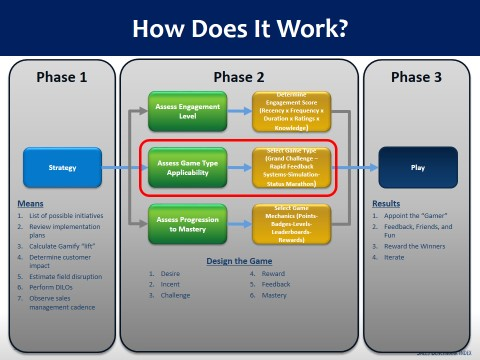
To learn more about sales gamification, register for our annual research session to get the Sales Gamification Overview. There are 3 phases to successful gamification. Today’s post provides you with “Game Types,” a component of phase 2 (see red box).

 describe the image

There are 4 primary game types you can deploy to impact your sales initiatives. Selecting the right one is important to ensure success.

  1. Grand Challenge– These are highly publicized competitions usually awarding cash prizes. They are designed to solve a complex problem. An example of this would be a “competitive replacement contest.” You might put a bounty on a certain competitor’s accounts, who are very hard to displace.
    1. Use For – competitive replacements, new product launches
    2. Rapid Feedback Systems– These are gamified initiatives whereby feedback-such as scoring- shapes behavior in real time. An example of this would be adding real time quizzes to sales training. You’re scoring these quizzes and stack ranking the team based on their performance.
      1. Use For – sales training events, field adoption checkpoints
    3. Simulation– Principally designed for educational purposes, these games allow for the exploration of new scenarios. Think of this as moving the old-school role play online. Your reps are given scenarios and measured based on their responses.
      1. Use For – new process launches, such as: sales process, social selling, lead management
    4. Status Marathon– These games use status ladders and rewards. Think of frequent flier programs in the airline industry. The “game” is deployed over time and you’re keeping track of each rep’s status.
      1. Use For – quarterly/annual sales contests, new logos opened, new products sold

What to Do Now

Through gamification, you can impact the results of your sales initiatives. Your sales leaders can attract and retain the focus of your reps. You will remove the “flavor of the week” theme many sales initiatives have. This will, in turn, protect your investments.

To learn more about how to make an impact on your next sales project, register for our research session here.

We will cover things like:

  • How to get your sales team engaged
  • Driving field adoption
  • Celebrating quick wins

If you’re going to spend on sales initiatives next year, consider including gamification.

Author: Ryan Tognazzini

sbi on linkedin

Follow @RyanTognazzini

Follow Sales Benchmark Index @MakingTheNumber

If you enjoyed this post, never miss one again by subscribing your Email Here and/or subscribing to the RSS.

20 Sep 15:26

A Basic Structure for a VP, Sales Comp Plan: 50/50/25+

One key post I missed on the VP Sales journey was how to pay this critical role.  I don’t think it’s necessarily as nuanced and interesting a topic as how to pay and scale the sales team itself, or how to hire for this role. But incentives are critical, and the VP Sales will likely […]

CloudAve is sponsored by Salesforce.com and Workday.

20 Sep 15:26

Top 40 under 40; Power of Hyper-specialization; favorite sales tip; Oisin Brown's book; Oct 10 Topgrading

by Verne Harnish

"...keeping you great"

HEADLINES:

Top 40 Under 40 -- Fortune released their latest Top 40 under 40 people rocking the business world. Marissa Mayer, CEO of Yahoo!, tops the list, one of three women to make the top 10. FYI, Yahoo!'s stock is up 86% since her arrival. Zuckerberg came in at #3. Here's a link to the list.

Hyperspecialization -- Quoting Tim Williams from his LinkedIn article, "what's the top reason marketers search for a new advertising agency? If you guessed 'creative differences,' 'cost' or 'poor service,' you'd be citing some of the reasons that do in fact show up on top 10 lists. But the key driver today in agency searches is the desire marketers have to work with 'best-in-class specialists.'" Williams, a consultant to marketing agencies, has jumped on the hyperspecialization bandwagon, a term popularized by a recent HBR article by the same name. Case in point -- CJ Advertising which only works with personal injury law firms. As competition increases globally you are better off to focus your expertise on as narrow a niche as you can and then follow that niche around the globe rather than try to be everything to everybody locally.

Five Ideas for Driving 4th Quarter Sales -- "the lazy days of summer are over and everyone is back serious about business," notes Caryn Kopp whose firm generates sales leads for companies. She suggests 5 strategies for driving revenue in her blog post. One of my favorite "out of the box" ideas:

  1. Showcase your clients. Remember, your clients and prospects are people who are working toward personal goals within their companies. If they want to be promoted, the last four months of the year are critical for reminding management of the game changing initiatives they started. Be a hero by helping decision makers "toot their horns" internally for initiatives you worked on together.

I also like her idea of getting larger companies to use unspent 4th quarter budget to fund a 1st quarter pilot/initiative. Take 2 minutes to read through her five ideas. I find Caryn's info to be very practical and effective.

100 Sales Tips -- if Caryn's five sales tips aren't enough, grab a copy of Oisin Browne's book called The Binman's Guide to Selling: Top 100 selling techniques, words, strategies, tips, scripts & inspirations. Oisin drives sales and marketing for Galway-based The City Bin Co. owned by YPOer Gene Browne. During the past two tumultuous years in Ireland, the company has doubled its revenue, testament to Browne's techniques. As I note in my enthusiastic endorsement of his book:

"Words matter!! And Browne's book provides the precise language and approaches to ramp-up your sales effectiveness - one bite-sized piece at a time. Commit 60 seconds per day to read one tip and apply it and experience the positive impact it has on your sales."

Sales Coach -- Brown's book is the perfect resource for sales coaches (new name for sales manager per last insight). With roughly 100 days left this year, grab one of the tips each day and email it to the sales or rep team. Each tip is a short paragraph or two, so very easy to send and read.

Topgrading Master Practitioner Certification -- Hiring is back and the new online Topgrading Class is proving popular as the war for talent continues to heat up. A New Topgrading Class Launches Oct/10. For details including:

a.     Two case studies (Healthcare and Services)

b.    Review the full outline of the class including learning objectives for each of the six sessions

c.     Experience the class discussions

Visit: http://growthinstitute.com/topgrading/.

Online class includes one-to-one coaching; 9 hours of online learning; and peer group sessions via webinars - the next hybrid model of education that saves travel time and money. Price is $1997/leader. More information here: or contact Juan Gonzalez at juan@growthinstitute.com or call him at 1 800 975 5108 x.2.

COACHING:

Need help implementing the Rockefeller Habits?

20 Sep 15:25

Top Reasons Marketing’s Content isn’t Used by Sales

So, your company is moving quickly with a Content Selling strategy. Congratulations! You’re creating content and collateral materials, but running into a few roadblocks. In particular, you find that some of your content is ignored. It’s a serious problem, since un-used content = zero ROI.

If you’re experiencing this challenge, you’re not alone. A recent KnowledgeTree survey found that 87 percent of marketers believe they provide the right content needed to win sales. When asked the same question, only 66 percent of salespeople agree.

There are a number of reasons why your content is simply never used. Once you learn to spot the pitfalls, you can improve your content and get back on track. Here are the top challenges:

Can’t find it

One of the biggest reasons that sales teams don’t use the best marketing collateral is because they simply can’t find it. Whether it’s saved in an obscure location on a network drive or just lost in a sea of uncategorized files, salespeople can’t use what they can’t find. And when you’re trying to win a customer, timing is everything. Salespeople grab collateral they can locate quickly, and your content is getting overlooked again and again.

Missed the memo

In many cases, simple lack of communication is to blame.

The post Top Reasons Marketing’s Content isn’t Used by Sales appeared first on KnowledgeTree.

20 Sep 15:21

Sales Training Article: Top Sales Tool for 2014

by Customer Centric Selling

Sales Training Article: Top Sales Tool for 2014

By John Kearney, Sales Benchmark Index (SBI)

Image courtesy of Frame Angel at FreeDigitalPhotos.net

sales training companiesAs a Sales Operations leader, you have 3 major challenges heading into 2014.

1. Identifying which of the ever-evolving stream of data points will help determine success

2. Understanding how your customers are evolving and determining whether your sales team is keeping pace

3. Persuading the executive team to make necessary strategic shifts to hit next year's targets

The Buyer Process Map (BPM) will help you tackle these challenges. This tool has been around for a few years now. It has never been more necessary than it is heading into 2014. To assist you further, sign-up for SBI's Sales & Marketing Research Review here. You will get a copy of the Buying Process Map Template when you sign-up. At no cost, an expert from SBI will present the full research findings. You will have access to guides, templates and tools to help your BPM drive revenue. The organizations that have adopted early have seen 3 main benefits:

  • They're engaging with customers and prospects earlier in their buying process
  • Marketing is creating relevant content that the sales team can leverage throughout sales campaigns
  • Cost of sales is decreasing as the sales team only engages with informed, prepared buyers

Let's look at a few examples of how the BPM has been used in 2013. It may serve as inspiration for your 2014 strategic planning.

Data Monitoring
Jesse runs Sales Operations for a Value Added Reseller. His team conducted buyer research over the course of Q2. Win-Loss reviews were implemented and conducted. A customer survey was launched and aggregated. Each of his 80 sales reps 'listened' to their customers through LinkedIn and Twitter. Since July, Jesse's team has analyzed the findings and created a BPM. His customers stated, overwhelmingly, that ease of doing business is their main concern. They weren't interested in each component in the product. They didn't care about each Original Equipment Manufacturer (OEM). Instead they were eager to hear how the product would be delivered. Was this a trusted vendor and how could I be sure?

The sales team quickly altered course. They put down their product pitches. They stopped handing out collateral on all the bells and whistles. Instead, they produced case studies from top clients. They asked those top clients to recommend their sales rep on LinkedIn. They changed their messaging to focus on customer care. They picked up 2 new clients in Q3 that were drawn to the customer service approach.

Download a copy of SBI's Buyer Process Map Template. It includes an introduction to buying phases, buyer actions and micro-questions. You can get a copy by signing up for SBI's Sales & Marketing research review here. One core area of focus in the research review is on the BPM. Here you will get free access to all of our guides, templates and tools to help facilitate the BPM creation.

Customer Evolution
Luis runs Sales Enablement for a Fortune 250 sales enterprise. They instituted BPMs at the end of last year. Since then, they've reduced the length of the sales cycle significantly. More importantly, the sales team freed up more time in their week to simply sell. I asked Luis why this was the case. He explained that before, they wasted cycles on buyers they thought were ready to buy. Buyers were turned off by the constant selling the reps were engaging in. They preferred to do the research on their own. They were buying from the vendors that facilitated their buying experience the best.

The BPM allows them to quickly tell where a buyer is in their buying journey. Luis' team knows the questions they are asking early in their journey. They know the types of content that appeal to buyers with different maturity levels. Their sales team is not running around to prospects until they are ready to engage. In the meantime, the sales reps are nurturing them along their buying process. They are sharing relevant content and staying top of mind. This has helped win more deals and reduce time thrashing.

Persuading the Executive Team
Sally recently told me her biggest challenge was persuading her CSO to act. We could write an entire blog on persuading the CSO. Instead, I asked another Sales Ops leader how he handles that conversation. He told me the key is to make it simple. The BPM is a simple tool, which is why his VP of Sales jumped on board. The buyer is changing. Social Media allows buyers to research and get the opinions of peers. We live in a transparent world. To align with the buyer, we must give the buyer what he wants.

The BPM is a great illustration of what goes on in the mind of a buyer. A sales rep can quickly review the BPM. They can find content in the content library that answers questions the buyer has. They can create presentations that address needs buyers might not even realize they have. The investment in creating the BPM is minimal compared to the reward. It's low hanging fruit for 2014. A year later, it will be business as usual.


sales training companyNeed some help with your sales performance? Take a look at the sales training workshops available to you and improve sales performance.

Read more sales training articles from CustomerCentric Selling® - The Sales Training Company.

20 Sep 15:21

Seasonal Sales Tactics: Fall

by Tibor Shanto
CoC Sep 13

The Pipeline Guest Post - Megan Totka

The fall season brings to mind lots of different imagery – changing leaves, beautiful colors, pumpkins, Halloween, and holidays like Thanksgiving and Christmas on the proverbial horizon. Fall and the subsequent holiday season are a huge time of year for sales. People are buying all kinds of things, from school supplies to gifts to housewares to new services, you name it, and people are likely to buy it.

So how do you tailor your sales tactics to the season of buying? Here’s a few ideas about ways to increase your online presence and subsequently your revenue during the fall season:

  • Run social media campaigns that are seasonally-themed. For fall, you could run giveaways that are tailored to the season. You could even do something as simple as change your cover or profile photo on Facebook or Twitter to something that is fall-themed.
  • Think ahead to the looming holiday season. Consider starting your holiday sales strategies early. Let your followers and customers know what you will be up to during the holiday season. Letting them know ahead of time can give them time to plan and incorporate holiday spending at your company into their budget.
  • Take the opportunity to work on some philanthropic efforts for the year. The fall and the holiday season are prime time for giving back to your community. Consider sending employees to do volunteer work. You can also make a monetary contribution to a charity if your company is in the position to do so.
  • Take the time to see what is trending this fall. Whether it is fashion or technology trends, you can research what exactly people are being predicted to purchase this season. This gives you the opportunity to cater to exactly what people are going to be looking for during the season. For example, if a fashion trend watch says that people are looking for things that are jewel-toned this year, consider using these types of colors in your marketing collateral or your products.
  • Track what your customers like. When you run a seasonally-themed marketing campaign, try your best to keep track of where your sales leads are coming from. You’ll be able to work to hone your campaigns from year to year to make sure that you are maximizing your marketing abilities.

Take the opportunity to use seasonal sales and marketing tactics to your advantage. Doing a little bit of research as to what is trending in sales for each season will help you to make even more sales.

(Photo Source)

About Megan Totka

Megan Totka is the Chief Editor for ChamberofCommerce.com. She specializes on the topic of small business tips and resources. ChamberofCommerce.com helps small businesses grow their business on the web and facilitates connectivity between local businesses and more than 7,000 Chambers of Commerce worldwide.

20 Sep 15:21

50 Call-to-Action Templates to Help You Convert Leads in Style [Free Download]

by ahussain@hubspot.com (Anum Hussain)

free-cta-templatesWant to earn money for your business? Want to generate leads for your sales team? Want to accelerate sales for your online store? Want to do anything for your business that actually matters?

Well then you need calls-to-action. Without them, we wouldn't be converting our websitevisitors or social media fans into actual leads for our sales team. Without them, we wouldn't be calling on our audience to take any action in their lifecycle that actually benefits them or the growth of your business.

But just because they're important doesn't mean we all have a professional designer at our disposal --whether due to budget limitations, resource restrictions, or just lack of design skill. That's why we created 50 free call-to-action (CTA) templates in PowerPoint for you to customize and use. The template will teach you how to customize your new CTAs effectively, so don't let fear of DIY design stop you.

This post will give you a sneak peek into a large set of designs available in the template. Download it now and follow along!

1) Basic Calls-to-Action

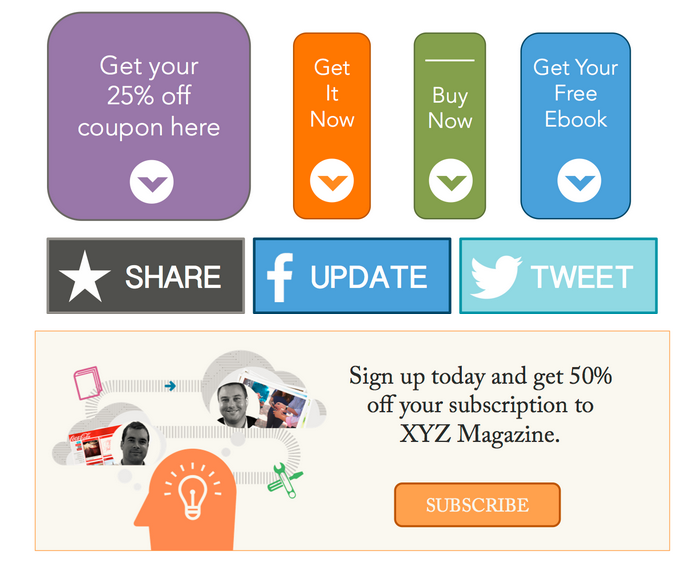
Sometimes you just need a quick and clean button that helps drive conversion. Building a landing page that needs a customized submit button? Working on a website page that needs to drive visitors to a coupon? Drafting a blog post that needs a "read more" button after the summary? We've got you covered. The first set of 22 CTA designs in our set of templates are basic buttons. Here's a sampling of six:

CTA-basic-buttons

Bonus Templates:

For the Photoshop users of the world, we've also included some basic call-to-action buttons in Photoshop alongside the PowerPoint template. You can use these to further style your CTAs in a design-focused software.

2) Social Media Share and Sentiment Calls-to-Action

Data from Dan Zarrella shows that specific diction in your social calls-to-action help drive engagement, but another great way to drive social engagement is through social CTAs on other assets of your website, landing pages, blog posts, and so on. This set of ten templates provides you with two types of designs: social share buttons and social sentiment buttons. Let's take a look at a sample of both.

Social Share CTAs

As you can see in the sample of share buttons below, these buttons are helping drive social actions from your content. Making these buttons clickable is as simple as generating the right code to hyperlink it to. This blog post walks you through how to do so step-by-step.

CTA-social-share

Social Sentiment CTAs

Social sentiment CTAs are those that include public testimonials -- often from social media users. As you can see in the example below, we built a CTA in PowerPoint and attached a screenshot of a publicly posted Facebook comment. Be sure to test the use of such social sentiment on your content and explore how their inclusion benefits your conversion rates.

CTA-social-sentiment-1

3) Contextualized Calls-to-Actions

You’ve seen some basic CTA options thus far. The next set of nine options call on you to include more context. These designs are created with the intention of further explaining the value of taking action. Just be sure to keep the overall layout of the button simple so that users can easily see the action you’re calling on them to take. Here are two sample designs available in the template:

CTA-context-CTA

4) Photo and Mobile Device Calls-to-Action

Photos can serve as a great asset when creating your calls-to-action. Not to mention it's super easy because all you have to do is overlay some text! Photos make it easy to humanize and customize your messages for your brand and audience. Similarly, mobile and desktop devices can help make your action "pop." Rather than including a screenshot of your product, try putting that screenshot on a kindle to show it in action! If you have trouble locating copyright-free photos to use, you can download our set of 160 free photos. No attribution required, just download and use! Here are three sample CTA designs from the bunch of nine.

CTA-photo-mobile-device

5) Qualifying Calls-to-Actions

When you’re trying to nurture a lead further down the funnel, you want to ensure you’re presenting CTAs to qualify them for your sales team. For these CTAs, it’s important that they are welcoming and not pushy. Having a great design can help can help you naturally move your leads further down your marketing funnel. Here are three examples from the templates you could customize to help convert a lead to marketing qualified lead:

CTA-marketing-qualified-lead

Not sure how to exactly save and use these templates? Don't worry, your download of these 50 templates will include step-by-instructions on how to save and use these templates on your website. Enjoy!

free call-to-action templates in ppt

subscribe to the hubspot marketing blog

20 Sep 15:21

Who Needs 160 Million New Leads?

by Julia Borgini

LinkedIn has approximately 200 million registered users, with 2 new users signing up every second. Yes, every second. LinkedIn says that Company Pages are “a more powerful way to build relationships with your target audience on LinkedIn”, as they’re extremely visual and let you display relevant content easily.

For companies, this means a more powerful way to build relationships with your target audience on LinkedIn. – Mike Grishaver, LinkedIn

While browsing LinkedIn, users are discovering who is employed by what company and where other industry professionals have worked. They’re professionals looking for other professionals. This means that if you’re looking to connect with other industry professionals and generate leads for your B2B Technology business, you better have a Company Page on LinkedIn.

Who Needs 160 Million New Leads? image LinkedInCoPg

Building relationships with audiences is key to a B2B marketer, since so many people are involved in the sales cycle of your products. A LinkedIn Company Page helps you target multiple B2B audiences at once, while at the same time building and fostering relationships with that audience.

Why do you need a company page?

Well, over 80% of LinkedIn members want to connect with your company page. That’s about 160 million people who are ready to connect with you on LinkedIn. One hundred and sixty MILLION.

You can’t afford NOT to have one, right? But how is a LinkedIn Company Page different than any other webpage out there?

Why is it so good at building relationships with an audience?

It’s so good because it allows you to deliver continuous and relevant content to your audience. Remember, being frequently present and helpful are two keys to building a relationship. You give them relevant and engaging content, and they’re compelled to read it and follow you.

One thing to remember as you build and foster relationships: you’re not just doing it with prospects and people who don’t know you. You’re also fostering and deepening the relationship with your existing employees. Your employees on LinkedIn have already connected to you by listing you as their employer. They’re helping to connect and extend your reach throughout LinkedIn.

So, is my Company Page both a marketing AND a human resource tool?

Yes it is! In fact, combining the two end goals is an easy thing to do on it. You share relevant marketing, company, and industry knowledge through Updates, company data through the About Us page, job info on a Careers page, and finally marketing information through the Products & Services page.

Company Pages are very SEO-friendly

LinkedIn built them to be very SEO-friendly, so search engines pick up the content easily.This is another way to stay known to your audience.

What info should be on my B2B Company Page?

At a minimum, your Company Page should have the following sections: Home, Careers, Products & Services, and Employee Insights. These four pages give visitors some basic information about you and what you do, as well as open a window onto the human aspect of your company (the Employee Insights).

Your updates will appear on your company page, so that visitors will see what’s been going on for the last while. When visitors follow you, these updates appear directly in their News Feed.

How do I engage with my followers?

Just like engaging with an audience elsewhere online, you’ve got to interact with your followers.

  • Post updates regularly
  • Share engaging, compelling content
  • Reply to their comments and questions on your updates
  • Answer questions, don’t sell your products or services

Amplify your reach

When you amplify your reach, you’re simply encouraging likes, shares, comments, and connections with your audience. It’s a way for you to extend your company out and towards new audiences. People like to read what their connections have shared, in fact, about 70% of people follow links posted by their friends, family, and colleagues. That means they’re seeing how many people recommend your company, or your B2B product. It can be hard to get that kind of targeted brand awareness.

Generate leads naturally

Remember when I said earlier that LinkedIn users are influential and professional? That means that when they share one of your updates, it carries weight with their connections. You’re immediately put in that coveted Trusted Advisor spot because that influential person shared your content. It all goes back to the adage of being known, liked, and trusted. These influential and trusted people are sharing your content with others who are influential and trusted by others, and so on.

Visitors are invited to your Company Page by your shared Update, and are compelled to action by the trusted recommendations on the Products page. It’s an automatic lead gen funnel for your B2B Technology company, and all you did was fill out some information on LinkedIn.

Don’t believe me? Check out this stat from HubSpot: Companies who have set up Company Pages on LinkedIn have 277% more effective lead generation than Facebook or Twitter. Yes, 277% better lead gen! That’s incredible.

So, are you convinced that your B2B Technology company needs a LinkedIn Company Page? I’m sure you are.

19 Sep 14:46

How to Capture Buyers' Attention

Photo by Dave SmithPut yourself in the buyer's position for a moment. When you begin the search for a new service provider—lawyer, accountant, plumber, electrician, etc.—how do you feel?

If you're like me, you feel overwhelmed. Unless you're given a referral or recommendation, your first stop is Google where you are met with pages and pages of options. How do you decide which one to call to begin the process, let alone which one to hire?

The providers that capture your attention will be those that stand out from the pack—distinguishes themselves from the hundreds of others vying for your business.

19 Sep 14:25

5 Essential Tips for Doing Business in Europe

by Ian Newcombe

OK, Europe’s economy may not be in the healthiest of states right now. But make no mistake, the ‘Old Continent’ is still a hotbed of economic activity. Imports by EU member countries continue to rise in spite the recession, totalling over $2.2 trillion (€1.7 trillion) by recent calculations.

5 Essential Tips for Doing Business in Europe image shutterstock 146297792 300x225

Powerhouses like Germany are leading the charge, while the UK has returned to growth, and Eastern Europe is buoyant. Even in the struggling Southern economies like Spain and Italy, consumer uptake of high-tech products and services is higher than in many other parts of the world.

And of course, Scandinavia’s prosperous economies show very little sign of flagging.

So for small businesses, large companies and retailers looking to get a piece of the Continental pie, here are 5 essential guidelines to follow… 

1. Money Matters – Watch your currency processing

How many currencies are there in Europe? Not one, not two, but 12.

Wherever you sell in Europe, your customers will want to pay in local currency. Handling multiple currencies can be complicated, and potentially expensive.

How currency costs can drain your profits:

  • Upgrading your systems to handle multiple currencies.

  • Exchange rates moving against you between taking the order and making delivery.

  • Time spent by your staff processing currency transactions.

Tip: Exchange rates can move up to 10% in just a few days.

2. Successful selling demands mastering your market

There’s no substitute for thorough market research. Demographic, cultural and economic factors vary from region to region, so local knowledge is vital.

There are 733 million consumers in Europe.

You need to find out:

  • Who your products appeal to.

  • What marketing messages will reach them.

  • How you’ll handle customer service in a different culture.

Good news: there may also be grants and help available. For example, UK companies with under 250 employees could get help from the government’s Export Marketing Research Scheme. Companies coming from outside the EU may also be eligible for assistance or advice, so it’s worth contacting both EU and local government departments dealing with commerce.

3. Local buy-in means buying locally

To get customers on your side, you need to understand their culture.

Hiring locals, or even buying into local businesses, speeds up the transition from outsider to insider.

Prior to its German launch, UK-based global retailer Marks & Spencer hired 17 German managers. From them they learned that high quality customer service would offer M&S competitive advantage in a market where they were unknown.

Use local knowledge to avoid getting stung by too many local taxes. In Italy, the tax man could take as much as 68.6% of your profits.

Or you could use Amazon/eBay integration to get a foothold overseas without encountering problems in translation. Here’s a guide that tells you how to do that.

4. Tidy profits come through neat paperwork

Successful selling in Europe means getting all your documentation ducks in a row. Some countries, for example Italy and France, have notoriously bureaucratic or complex processes. Having someone local who understands the system (and knows one or two people!) may help to speed up the process sometimes.

Different local rules will apply to:

  • Tax (income, business, VAT)

  • Registering and running a business

  • Planning rules

  • Import and export

  • Hiring and firing of staff

Tip: Each European Union (EU) country has its own VAT (value-added tax) rate, and standard rates in the EU range between 15 and 25 percent.

5. Don’t get lost in translation

The quality of your communication can make or break your European ambitions. They don’t all speak English, and even if they do, research shows customers are far more willing to engage with messages in their own language.

Take care to communicate clearly and avoid translation gaffes like these by using a good translation firm and running the completed work past native speakers.

If someone complains about your advertising:

  • In the UK, you may get a warning from the ASA (Adverstising Standards Authority).

  • In Belgium, you may have to pay to publish a correction.

  • In Germany, you may be hit with a large fine.

Successfully translating your business is a challenge, but done right, it can deliver huge rewards.

Warning! Achtung! Attenzione!

  • Think about currency and exchange rates – don’t let currency costs drain your profits.

  • Master your market – what appeals at home might not have the same effect in a different culture

  • Get Local – no one knows the place better than the people who live there, so use them to your advantage.

  • Get your paperwork in order – make sure you’re aware of local tax rules

  • Communicate clearly – get the right message across in your advertising. And don’t just rely on Google Translate…

Extra tip: One way for non-European businesses to gain a foothold in the lucrative market is by integrating with already-established online buying platforms.

Here’s a How-To guide about how businesses can integrate with Ebay and Amazon for international sales.

“Bon courage!”

19 Sep 14:25

Is Google+ Linked To Rankings?

by Katherine Stott

There has been a little bit of a scuffle taking place on Hacker News following a very interesting, seemingly insightful, but possibly somewhat misleading post by Cyrus Shepard from moz.com. The post was about the SEO benefits of Google+ and actual data that supports some claims that Matt Cutts (Google Head of Spam) is trying to debunk. As an outsider, it’s incredible watching these industry heavyweights battle it out with wit and words, but even after a healthy debate, there were a few points that were left unresolved, some that were debunked and those that had us wanting to find out more.

Here’s a summary of what went down.

The Lowdown

Every two years, moz.com does an in-depth study into the specifics of pages that display ranking prowess in Google, and this year they had a closer look at Google+. They looked at factors such as Page Authority, Google+1s, the number of linking domains and social shares and appreciation. Their findings were not necessarily indicative of cold, hard fact, but more likely correlations between data and activity on Google+.

The following image depicts some of these findings, indicating that aside from Page Authority, Google+1s are the highest factor supporting rankings.

Is Google+ Linked To Rankings? image Screen Shot 2013 09 17 at 4.22.22 PM

This was the claim that Matt Cutts was very quick to refute, and I think we all tend to agree with him. Following the post, the conversation continued on Hacker News and edits were added to the post. It was then that Mark Traphagen – who is probably best known for his insight into Google Authorship – summed up the data, rebuttal and logic behind both, perfectly: “It is not the +1′s themselves that are causing the high rankings of posts but the fact that most +1′s on a site result in a shared post on Google+, which creates a followed link back to the post. It’s instant organic link building.”

Followed link? Now that’s the interesting part, and a slice of information that Matt Cutts skirted around during the debate.

Google+ Content

Aside from the claims about Google+1s, Cyrus went on to discuss the things we do know about Google+ that can be backed up with proof. These two had me do a little happy dance on the spot:

  • Google+ posts are crawled and indexed very soon after they’ve gone live. Instant shares on social media are an exceptional way to get up-to-the-minute news, but Twitter links are nofollow and Facebook privacy control is too strict for Google to gain insight from. Enter Google+ where all information posted is almost readily available in search soon after being posted.
  • The other juicy gem was that Google+ post links are follow links. Cyrus backed this up with a screenshot of his G+ page using the follow highlighter on the moz toolbar. I did the same on the Northcutt page, and alas – he’s correct.

If you refer back to Mark Traphagan’s quote earlier in the post, it all falls so perfectly into place. While +1s are certainly not the measure of ranking success, the correlation between the content, it’s popularity and the likelihood of it being shared is. Links need to be follow links so that Google can index the information as fast as it’s being produced, offering users the most optimal experience and information they can, using the most valued tool at their disposal.

By linking your site up with rel=author or rel=publisher, you’re adding another means of exposure through Google+ and perhaps a ranking factor in the future? There are, however, no facts to support this claim at this stage.

Use Google+ To Your Advantage

The only way to test these claims is to try them out for yourself and see if you experience any joy. The two points that you can bank on are the fact that your posts will be indexed fairly rapidly and your post links will be follow links, so try and leverage that to see if you can make Google+ work for your SEO.

Cyrus’s advice included a list of points to act on and although it’s stuff we already know, it takes on a different light when you realize the potential behind actively pursuing it:

  • Connect with industry professionals, like-minded groups and people and make connections, build relationships
  • Post GREAT content that people will want to share or +1
  • Add rel=author to your online information and any blogs you contribute to
  • Connect your Google+ brand page to your website using rel=publisher
  • Make your posts public
  • Make it as easy as possible for people to add you to their circles and for them to share your content – from your site or from your G+ page

Go forth and conquer Google+!

Image courtesy of: http://socialmediaweek.org/newyork/2012/01/16/seo-vs-google/

19 Sep 14:24

Keep Address Fields Out of Your CRM

by Prialto

Simplicity is the key to early CRM adoption. That means being merciless in hacking away at the fields in your Salesforce.com setup – and you can start with your contacts’ mailing address fields. This is, after all, a corporate CRM intended to increase sales, and not your grandmother’s little floral address diary. In an age when post offices are going bankrupt and phone calls are made through computers, there is no excuse for maintaining a costly, large database of mailing addresses.

Why Mailing Addresses are Unnecessary

  1. If your company has a CRM, it’s probably safe to assume that your primary method of communication with others is via email - not snail mail or courier delivery.
  2. Most of today’s companies have multiple physical locations, and their employees are increasingly working remotely or online. That creates the quandary of which address to archive in your CRM. In many cases, you may not even find a company’s employees at their physical address anymore.
  3. On the rare occasion that you need to know someone’s physical location, it’s not likely to be up-to-date in Salesforce, given the regular CRM maintenance that this would require.
  4. Keep Address Fields Out of Your CRM image Home Depot Google Search 300x179Even if your company’s service involves washing customers’ windows or maintaining their onsite servers, it’s much easier (and often more accurate) for you to jump in the car and type the company’s name into Google Maps than to hunt through your CRM to find the address. After all, Google gives it to you right on the main search results page, and before you even finish writing the company’s name into the search bar!

There are really only three conceivable reasons that you might need to keep an extensive database of your business contacts’ precise mailing addresses:

  1. Conducting door-to-door sales or sales by mailer (spammers!);
  2. Sending physical holiday cards (tree-killers!); or
  3. Selling the lists (something I’m sure your reputable company would never REALLY consider…right?)

Why Cluttering your CRM with Mailing Addresses Can Be Harmful

What’s wrong with just leaving the default address field in your database?

For starters, long, unformatted mailing addresses take up prime real estate on your contact and account pages in the CRM. That pushes more relevant data – notes or activities, for example – further down the page and out of sight.

Secondly, as we said at the beginning, simplicity is key to CRM adoption. Fields should be scrubbed in an effort to ensure that your sales associates don’t have to become data clerks. The more unnecessary fields you include, the bigger a hassle it seems to be to your employees.

Thirdly, addresses change quickly and are difficult to maintain as current. Including them in your database means more data that needs to be scrubbed clean even more often. And cleaning up mailing addresses is no easy feat. Your CRM administrator would need to search for the new address, format it correctly, look up zip codes, etc. etc. Is that really worth the time?

An Alternative to Mailing Address Fields in CRM

Let’s be clear that we’re not advocating that there be no geographic data at all in your CRM. Your CRM is intended to help hone your targets, and being able to do that geographically is key. If you’re flying out to Tucson, for example, you should maximize on that trip by scouring your CRM for other contacts in the area that you can catch up with at the same time.

That’s why we advocate including a single field – metro area – in place of long mailing addresses. Metro Area is a picklist field based on your company’s contacts. It will save your staff having to hunt around for zip codes or specify counties, countries or districts. Instead, it focuses on keeping the key information front and center. Knowing your prospects’ time zones and city is important. Knowing their street address and suite number is not.

19 Sep 14:23

3 Reasons Why Financial Services Lag Behind Other Sectors in Adopting Social Strategies

by Jay Palter

Most financial services companies lag far behind mainstream consumer businesses when it comes to embracing social strategies for client engagement.

There are three main reasons for this:

1. Compliance dominates the social conversation in financial services because it’s wrongly perceived as the greatest risk.

Non-compliance with the many laws, regulations and guidelines governing financial services businesses represents serious risk and potential cost to many companies. On this, we agree.

We could probably also agree that compliance ought to be a means to an end – not an end in itself. However, the tail seems to be wagging the dog when it comes to the discussion of the compliance risk posed by social networking in many financial organizations.

3 Reasons Why Financial Services Lag Behind Other Sectors in Adopting Social Strategies image not listeningFor the compliance department, the greatest threat posed by social networking is the risk of non-compliance. Yet, smart business leaders and communication professionals recognize a greater threat posed by social media: the risk of becoming irrelevant if your organization and its field staff are not socially literate, and effective and engaged social networkers.

Being non-compliant in some of your social networking communications is an undesirable, but manageable business risk. On the other hand, being ignored in social networks will at best damage your credibility and competitiveness and at worse become a disruptive force that undermines your very business model.

2. The risk aversion culture in many financial services organizations is detrimental to competitiveness.

A culture of risk aversion has taken root in many financial services organizations.

The chill of non-compliance combined with an increasingly regulated business environment tends to produce marketing departments whose primary objective is not to make the company more competitive, but to be the guardians of brand compliance.

In these organizations, brand ceases to be a framework for inspiring differentiation and engagement in the marketplace, but instead becomes an asset whose value must be defended against all risks or attacks.

This leads to lots of talk about “best practices” and in-the-box thinking by people who are neither empowered nor incented to do anything that rocks the boat. (See Which best practice is ruining your business in HBR.)

But the irony is this: radical risk aversion has it’s own risks. (See: The perils of being a social media holdout.) That’s because there’s risk at both ends of the competitiveness spectrum: leaders assume the risks of being the first to try something, while laggards face the risk of being left behind by their peers.

The result is a pronounced, though often unspoken, preference in financial service organizations for being smack dab in the mediocre middle, buffered from the risks of either leading or lagging.

But no one ever gained competitive advantage by hiding behind “best practices” and averting all risk. You must assume risk in order to reap the reward. Such is the case in any business.

No one is advocating non-compliant behavior or careless risk-taking in how financial service companies embrace social networking. However, if you want to gain competitive advantage in your space, you need to be willing to get out ahead. You need to be willing to embrace social and lead.

And the window for leading is rapidly closing.

3 Reasons Why Financial Services Lag Behind Other Sectors in Adopting Social Strategies image peloton leader

3. Aging demographics do not favour new ways of doing things.

The average age of a US financial advisor is 51.5 as of 2012 and 50 percent of all advisors are older than that, according to a report by Cerulli Associates. The senior leadership in many financial services organizations can be assumed to be at least this age and likely older.

These advisors and business leaders are from a different era and social technologies don’t have the same natural appeal as they do for a younger generation of digital natives. They enjoy pressing the flesh and are confident in a face-to-face client meetings. They have a hard time seeing that anything is broken with the way they’ve always done things or how online social networking can enhance relationships.

Moreover, many of these professionals are at or near the latter stages of their careers and have much bigger concerns than their firms’ competitiveness. They are focused on the value of their practices and books of business as their clients enter the “de-accumulation” phase of their wealth building. They’re focused on recruiting the next generation of junior partners and engineering their own exit strategy.

3 Reasons Why Financial Services Lag Behind Other Sectors in Adopting Social Strategies image divider

Fortunately, the winds of change are blowing.

Roughly half the workforce will be Gen Y by about 2020 and Millennials are much more comfortable conducting their relationships in online spaces. And as events such as Finovate plainly demonstrate social-local-mobile technology is in the process of disrupting financial product sales and distribution.

The question for any leader in the financial services space is:

Are you doing everything you can to avoid these waves of change from hitting you or are you trying to get out in front and ride them?

19 Sep 14:23

The Cost of Bad Customer Service

by Najwa Lyons

Bad customer service is possibly one of my biggest pet peeves next to people not washing their hands after using the bathroom – but that’s another topic. I think we can all relate to receiving horrible customer service at some time or another whether in a restaurant, telecommunication, retail store, online retailer, hospital, and so on.

After a recent experience, I started wondering what the actual cost of bad The Cost of Bad Customer Service image custservice copy1customer service is. After shopping at one of the top wireless providers, I was sent a survey via text. My response caught the attention of the General Manager for the district and he called to apologize and to offer me a token in the form of a $60 item from the store. That made we wonder about all the times I received a compensation here, a free gadget there, and all those FREE items to retain me as a customer. How many times do they do this? Who is paying for this?

My $60 item equates to a full day’s pay (8.27 hours) in NY since the minimum wage here is $7.25/hour (Labor standards, 2013). Now let me enlarge this scope with some interesting stats:

  1. Since 2009, the overall cost of poor customer service in the US averages about $338.5 billion per year, (CSM, 2009)
  2. $289 is the average value of every lost business relationship per year, (Kissmetrics, 2013)
  3. About 86% of consumers ended their business relationship due to a poor customer service experience (Rightnow customer experience, 2011)
  4. 61% of consumers take their business to a competitor, (Kissmetrics, 2013)
  5. 51% of consumers will only give you one chance, (Rosales) – first impressions last
  6. Only 4% actually complained about bad service, (Rosales)

With the advent of social media, poor customer service is no longer a “behind-the-scenes” issue companies can keep a secret. Everything is public. I am known for posting my experiences on Facebook.

Customer-facing employees are capable of making a company a success or simply destroying it. Poor service is one of the most immediate impacts on your bottom line. Here are a few suggestions you can use to make improvements:

  1. Understand and measure the direct business impact of customer service.
  2. Identify the gaps between the customer experience and the expectations.
  3. Hold customer-facing employees accountable. This I find to be lacking. Until they are held accountable, they will continue to not care about their actions.

Companies need to personalize their overall treatment of consumers by integrating consumer data and developing processes that recognize the value and history of each customer. You should see this as an opportunity to enforce your customer satisfaction; this could very well translate into grabbing a bigger piece of the pie in your niche.

19 Sep 14:22

Your Business Competitor May Be Defaming You Online

by Steven R. Andrews

Online defamation has increased exponentially with different review sites such as Yelp and websites like Ripoff Report whose stated purpose is “By consumers, for consumers.”[1] You will see that Internet trolls are able to attack companies, your brand, and even individuals while appearing to remain anonymous.

My firm has had many clients come to us for these exact issues. Sometimes the client tries to contact the website directly, only to find that the website posted the desperate plea of our client to remove the offensive and defamatory content. Now the client’s problem is compounded.

Your Business Competitor May Be Defaming You Online image Depositphotos 8357879 xs

Law firms across the United States have tried to sue websites, including Ripoff Report and Pissed Consumer, for offensive and defamatory content posted on their websites. Each time the case is thrown out because the host website is immune under §230 of the Communications Decency Act (“CDA”).[2] The CDA shields these websites and their owners from liability for Internet postings if they meet the following criteria:

  1. The website an interactive service provider;
  2. The legal claims are based on a posting that neither the website or its owner posted; and
  3. The claims would treat the website as the “publisher or speaker” of such information.[3]

Many people have tried to sue Ripoff Report and its owner Ed Madgeson, but neither have been held liable for the Internet postings/content of others because of the CDA’s immunity provision.[4]

Online Reputation Management is a excellent way to clean up your online reputation, but we also find that our clients want to discover who posted the offensive and defamatory materials and sue them for damages. Generally, the only company or person which can be found liable for the offensive and defamatory postings/content is the one who actually posted it to the website.

This is Part 1 of a two part series. Part 2 will explain how we help our clients discover who is behind the anonymous Internet postings and sue them for the damage that they have caused our clients. The process begins with suing a “John Doe” (the anonymous person) and serving subpoenas to discover the IP address linked to the posting. Then, the IP address identifies who created the defamatory content, which allows our client to sue the author of the defamatory content.

[1] http://www.ripoffreport.com.

[2] 47 U.S.C. § 230.

[3] See Doctor’s Assocs., Inc. v. QIP Holders, LLC, No. 06-cv-1710, 2007 WL 1186026, at *2 (D. Conn. Apr. 19 2007)(citing Universal Commc’n Sys., Inc. v. Lycos, Inc., 478 F.3d 413, 418 (1st Cir. 2007)).

[4] Xcentric Ventures, L.L.C. v. Borodkin, 908 F. Supp. 2d 1040 (D. Ariz. 2012).

19 Sep 14:22

Your Brand is in Your Customers’ Hands

by Tricia Morris

Your Brand is in Your Customers’ Hands image customershands“The customer’s perception is your reality….”

There is an extreme power shift happening right now between brands and consumers, fueled by human emotion and the convergence of disruptive technologies. In the past, big businesses and organizations have always been privy to a Wizard of Oz type of respect from consumers, where the brand could uniformly broadcast its sales and marketing messages to all without question or much public dialogue. Customers wanting to speak with the man behind the curtain reached out via channels closed to the general public’s view, controlled by scripts which standardized the service process and ensured predictable outcomes. But the time of the brand controlling its image from behind the curtain is no more.

The Power Shifts to the Customer
Through the power of search, social media influence, multichannel hyper-connectivity and the increased use of crowdsourcing and consumer reviews, the customer’s knowledge, opinion, voice and choice of words now equally determines the perception of a brand and its products and services. Even the most polished and creative messaging will not be well-received unless the consumer believes it to be true or connects with it on a personal level.

The shift from CRM to VRM (where the customer chooses and maintains their relationships with vendors on their own terms) will continue, as consumers and customers not only determine if, when and where they engage with brands, but also if they will share the brand or customer experience with others. Those companies that have the capabilities to monitor and view the customers’ social influence will be even more quick to answer when the individual with 50,000 Twitter followers tweets or posts a question.

Knowledge as Power
Through the incredible amount of product and service data and reviews now available online and via search engines, many consumers will now come to the customer service and support, or social media table, armed with more knowledge than the CSRs or other public-facing marketing and sales staff.

Companies and organizations will need to adjust in many ways: by giving their agents and staff the same or better real-time access to information through well-maintained internal knowledgebases, making current and consistent readily available on multiple channels, and being as transparent as possible.

Inviting and Engaging the Customer Conversation
Customer service and engagement can no longer be deftly scripted and controlled by brands. With social and mobile’s convergence especially, the balance of power has shifted to the consumer who can contact and question an organization at any time, call it out, compare it to others, advocate or abdicate – and take their friends, family, neighbors and other connections with them.

Organizations must be able to react both professionally, and humanly, to this new customer power and voice, and in a timely manner to inhibit a groundswell of other social consumers voicing similar concerns and complaints.

Your brand is not your own. It is now shared with your customers, and their perception is your reality.

New Parature Whitepaper Details 8
Megatrends Evolving Customer Service

Parature’s new whitepaper, Customer Service: The Next Generation, covers the power shift to the customer and seven (7) additional megatrends evolving customer service and the customer experience. The whitepaper features a wealth of new statistics and key insights from Forrester and Gartner analysts on best practices and the trends that demand every brand’s immediate attention.

Click Here to Download this Free Whitepaper.

19 Sep 14:22

How Lifestyle Businesses Can Use Social Media

by Apeksha Harihar

Social Media is an open playground for lifestyle brands. In view of everything, social media ultimately boils down to conversations about people’s lifestyles.

Where are you eating today? What have you shopped for at the sales? Which hotel are you staying in during your holiday? These are the kind of updates that conversations revolve around on Social Media. Judging by that, lifestyle businesses have potential to tap into social media to popularise their business within this ecosystem.

There are various ways in which you use Social Media to your advantage, and I am going to discuss some of them in this article.

Offer discounts on Check-ins on Facebook or Foursqaure

Check-in is a very popular feature offered by two social networking sites, namely Facebook and Foursqaure. Users love to check-in as a way to let their friends know their whereabouts. Lifestyle businesses can use this feature, and users’ impulses to check in, by increasing their visibility and offering perks to motivate users to check-in.

A restaurant can run a contest where they ask people to write one line along with a check-in, during any particular month where they offer the best three lines a free meal. The contest is veyou only have to imagine its reach, to understand how potent it will be.

Rude Lounge is a suburban restaurant in Mumbai and has over 1 lakh fans on Facebook. It offers a 10% discount to its customers when they check-in on Facebook.

Posting Offers

Facebook has developed another useful feature called Offers, which can be posted on your page, specifying a deadline, along with a minimum number of claims, and allows you to link to your website if you have an online store too. You have to have a minimum of a 100 likes on your page to be eligible to avail Offers, and you need to keep in mind that posting an offer is a paid option on Facebook.

However you can make use of it successfully by attaching an attractive image and having a simple, easy to understand discount. Remember, users do not have the patience for understanding complicated things. They will just skip through.

How Lifestyle Businesses Can Use Social Media image facebook offers

Alternatively, you could also keep them informed about an in-store discount which is being offered until a specific date through post updates. For instance, on National Cupcake Day, a cupcake outlet might announce free mini cupcakes to the first 50 customers who walk in.

Users who love cupcakes and your store are already your fans and they will spread the message among friends who love cupcakes too, thereby increasing the visibility of the offer and your store.

Integrate all social media platforms as much as possible

Conversations on Twitter might not reach Facebook and vice-versa, which is why, integrating all platforms is a splendid idea. For instance, when a user recommends a service on Twitter, it can be posted on the Facebook page. It not only acts as a customer recommendation but also leads Facebook fans to become Twitter followers. To see a successful example of this, you should look at how Sahara Star uses this feature frequently.

How Lifestyle Businesses Can Use Social Media image sahara star facebook post

Using Plobal to Reply to Questions Related to Your Business

Plobal is a new social discovery platform where users and brands ask and answer lifestyle related queries in real time. It is the latest social networking site, apt for lifestyle businesses to take advantage of ongoing conversations among several users. Users post either general or specific questions and all you have to do is jump into the conversation and start engaging with them.

For instance, the image below shows you what the questions look like. A user enquired about Sizzlers at a restaurant called Out of the Blue. The representative from this restaurant could reply to the user with an offer, informing about an event if relevant etc. or just throw some light on the variety of sizzlers.

How Lifestyle Businesses Can Use Social Media image social media platform plobal

This is how brands are jumping into conversations.

How Lifestyle Businesses Can Use Social Media image plobal ask now

How Lifestyle Businesses Can Use Social Media image lets talk social media platform plobal feature

Plobal has also integrated the concept of the Top User, who is recognised as the user who has gained the most number of points. Brands can use their influence to target other such users. To register on Plobal, you have to fill out a small form which registers your business and the Plobal team gets in touch with you. You can fill the form here.

Each brand has a separate page where it can make updates. This keeps their customers who have favourited their page, updated about the latest happenings, new product launches, events, schemes, store launches or just pure play engage.

Make use of applications on Facebook

Applications can be used in several different ways to encourage likes, to run promotions and even to take feedback/reviews from customers.

Aura Thai Spa is using an application called ‘Lovely August’ to encourage users to like their page, and in return the salon is offering a free manicure session. This is a great example of a business that is not generating random likes, but instead capitalizing on these likes to turn users into customers.

How Lifestyle Businesses Can Use Social Media image aura thai spa and saloon facebook post

Post important updates about your business

This could be in the form of sharing albums of pre and post event activities or announcing store openings etc. Your fans follow you because they love you and it helps to keep them posted about any important announcements. For instance, if you have opened a new salon, always make sure you take a picture and post it along with the announcement.

By doing this, you are recreating the experience your fans had or can have at the salon with an added glamor factor. For instance, Juice Salon opened a unisex salon and announced it with a pretty picture of the new outlet.

How Lifestyle Businesses Can Use Social Media image juice saloon facebook post

Also, The Little Door, a popular restaurant in Mumbai promotes its Special Sunday Drunch event through tempting Facebook posts. This update gives a sneak peek into the event, thereby spreading the word among fans and friends of fans.

How Lifestyle Businesses Can Use Social Media image The little door facebook post

Turn customers into brand ambassadors

Social Media is all about about storytelling, and how well you can do it. These stories should be so compelling and interesting, that they become viral in nature. It is obvious that your fans love your restaurant and are therefore following you for updates, so the trick is to maintain this interest.

Tell them a story about the most popular recipe at your diner in 140 characters with a unique photo or introduce them to the chef who creates the magical food at their favourite restaurant. It should be an interesting read and will be shared. In short, be exclusive. Offer a sense of novelty to your fans. This turns your customers into your brand ambassadors on social media.

How Lifestyle Businesses Can Use Social Media image cream centre facebook post

Do not forget to post signage of signs to follow on Social Media, offering them a little discount to encourage them.

Another way to tell stories is through making milestones on Facebook. For instance Starbucks India posted about its first store in the world.

How Lifestyle Businesses Can Use Social Media image startbucks india facebook post

Use Twitter to jump into discussions related to food, travel, beauty

Day in and day out, innumerable conversations take place on Twitter. People are talking about various topics related to food, beauty, fitness, travel etc. This offers brands an opportunity to jump into these conversations and directly talk to users, making them aware of brand products and services.

For instance a user posted a query about gyms in a particular area. If a fitness centre was searching for such updates, they could have easily led the discussion.

How Lifestyle Businesses Can Use Social Media image tweets for gym

A query related to shopping was posted by a user but no brand used the opportunity here.

How Lifestyle Businesses Can Use Social Media image burrp tweet

On Youtube Lifestyle businesses have a lot of creative scope

KFC launched the promotional campaign of Krushers, its new product, on Youtube. This interactive campaign asks users to drag the product to two bored students in a library and observe the effect on them. The activity definitely tempts the user to run to KFC and try out the product.

How Lifestyle Businesses Can Use Social Media image kfc youtube video

Using Youtube can give your brand very good results results if you think long term. Quick videos on how to recreate a certain hairstyle, or a certain star’s makeup etc. for instance, can be created by Salons to reach out to potential customers. Video content is now being shared extensively on Social Media.

Salons can also record customer testimonials and post them on the channel, sharing the links on Facebook, Twitter etc. offering reviews of real experiences to users.

Revlon India makes quick 30 second videos about their products and teaches fans about new trends. This is a massive hit with users since they share, comment and like, increasing the virality of the video.

How Lifestyle Businesses Can Use Social Media image revlon india facebook video

The Supporting Cast

Instagram

Instagram can be used instantly to click and edit pictures for followers to see. It could be about a dish, a dress or even discount creatives at a store. Instagram has recently launched videos which can be shared on platforms.

Vine

Vine was created to share quick 6 second videos on Twitter. You can use this tool to promote your business by letting users get a feel of any service or product.

Pinterest

Pinterest is very popular among lifestyle businesses since users love to pin fun things onto their boards. You can use Pinterest, start a campaign and integrate it with Facebook and Twitter.

Yelp

Yelp is one of the best sites you can get onto since users leave company reviews there. Personal reviews can make or break your business.

As you can see, there are countless ways that lifestyle businesses can use social media to ramp up their businesses effectively. All that is required is a proper understanding of the channels and definite objectives.

The post How Lifestyle Businesses Can Use Social Media appeared first on Social Samosa | Indian Social Media Knowledge Storehouse.

19 Sep 14:19

How To Import Data From Other Google Spreadsheets

by Angela Alcorn
spreadsheet-import

The Google Spreadsheet is an incredibly powerful piece of software, yet it seems most users only know and use a small fraction of its potential. For instance, do you know how to get information from one Google Spreadsheet into another? Did you even know it was possible? Perhaps this is due to the documentation side of things. Google documents things quite well, yet to find what you are looking for you often have to wade through that documentation. There doesn’t seem to be a user-friendly guide written by Google on how to use these things. You either understand the tech jargon and...

Read the full article: How To Import Data From Other Google Spreadsheets

19 Sep 13:49

Why Your Leads Don’t Convert

by Corey Mull

Having trouble getting qualified leads to Sales? Join us for a webinar to learn why.

It’s a massive problem: in the last 10 years, most B2B marketing departments have used their new digital capabilities to build elaborate lead pipelines. We set up lobster traps all over the web – register to download this whitepaper! Register for these webinars! We count how many people register, count the ones that have registered for something else before, and we give those names to our Sales teams to contact. Makes sense, right?

In theory, it does – but in practice, it’s all wrong. 79% of marketing-qualified leads never converteven if they have strong purchase intent. Let that sink in a little bit. You’ve got leads that are consuming your content and want to buy – and you’re only converting 21% of them!

Why? It’s because marketers, in general, have the wrong idea about how buyers make purchases. Our model for thinking about the buying process is broken – which means that we have no real way of predicting when a purchase is imminent.

Luckily, there are some things you can do to fix it. We’re not going to give away the store, but you can start the journey by joining us for a webinar on October 1. CEB’s Brent Adamson will lead the call, and talk about what’s standing in the way of your buyers converting, and what you can do about it.

18 Sep 18:44

18 Amazing Facts About The Human Body

by enragedqueen

The femur is about 4 times stronger than concrete. A cubic inch of bone can bear a load of 19,000lbs.
18 Sep 18:44

BlackBerry to Slash Its Workforce by Up to 40% (Will Connors/Wall Street Journal)

Will Connors / Wall Street Journal:
BlackBerry to Slash Its Workforce by Up to 40%  —  TORONTO—BlackBerry Ltd. is preparing to make deep staff cuts by the end of the year via layoffs that could cost up to 40% of its employees their jobs, people familiar with the matter said.  —  The layoffs will cut across all departments …

18 Sep 18:43

GOLD EXPLODES HIGHER AFTER FED BOMBSHELL

by Joe Weisenthal

Boom. Gold is surging after the Fed declines to "Taper" The pace of Quantitative Easing.

Screen Shot 2013 09 18 at 2.03.26 PM

Join the conversation about this story »