Shared posts

27 Nov 16:10

Premiere TV Episode! “The Tim Ferriss Experiment” — Online for Free

by Tim Ferriss

The_Tim_Ferriss_Experiment__Watch_The_Series_Premiere__-_upwave

You asked, and I heard you.

To those outside of the US, and to those of you who don’t own TVs — we’ve done two things:

- All episodes of The Tim Ferriss Experiment will be available on iTunes.
The first full episode is entirely free and available everywhere online! This includes…

Just for this post, I’ve disabled comments below.  Please let me know what you think of Episode One on this page!  This has been a labor of love, and I hope you enjoy it.

ALSO:  For the TV premiere — 8pm ET (5pm PT) this Sunday on HLN — I will be live tweeting (#TFX) from about 7:30-9pm ET (4:30pm-6pm PT), including Q&A, giveaways, and behind-the-scenes goodies.  Please join me!

Much more to come… :)

27 Nov 16:03

Who’s Running Your Business in China?

by James McGregor

Nearly every prospective Chinese employee who I met with in the 1990s shot out the following sentence once — if not multiple times — during their job interviews:

“I will do my best!”

Young people were extremely eager to work for multinationals, to be associated with famous brand names, and to learn from the best companies in the world.

Today, the “I will do my best” attitude still prevails. But Chinese employees have learned that the management skills and systems in multinationals in China come in many flavors, from the exceptional to the abysmal. So they are very demanding that their multinational employers also “do their best” and “be the best.” And that means providing world-class training, clear and lucrative career paths and, increasingly, a work-life balance that allows people to enjoy the fruits of their success.

I have lived in Beijing since 1990 and hired and managed many hundreds of Chinese people over the years. When I was running Dow Jones’ businesses in the 1990s, the predominant trait of Chinese staff was an insatiable hunger to learn, and an impatient drive to move up fast. In the 2000s, when I ran a research and consulting company and worked with a variety of advisory firms, Chinese employees retained those earlier traits, but were also quick to engage in job-hopping, as the red-hot China market’s demands outpaced the available professional talent.

Today, as chairman of APCO Worldwide’s China operations, I have a deep view into the China operations of dozens of multinationals, and through that I can see that management in China is going through yet another phase. The work ethic of Chinese employees is still fierce. Their ambitions remain formidable. But, like the Chinese economy itself, multinationals in China are in need of “rebalancing” their work force.

The days when Goldman Sachs and McKinsey threw piles of money at overseas-educated returnees are long gone. MBAs are a dime a dozen in China today, and people who invested $100,000 or more for graduate degrees are settling for annual salaries in the $30,000 range. So the truly talented in this group need to see that they have a future, or they will find one elsewhere. Multinationals also are littered with highly compensated employees who were promoted beyond their experience and skill levels during the boom years. One further complication: by increasing the number of annual college graduates from 2 million to 6.5 million between 2000 and 2010, China is churning out a workforce with an inconsistent quality of education and with white-collar expectations in an economy most in need of top technicians, skilled production workers and executives who can run global operations.

For multinationals in China, it is time to cultivate and cull. Companies need sophisticated and sustainable programs to identify their most talented employees, and they need to focus on training and retaining them. Grow-Your-Own is still the best way to instill the company culture and integrate China management into global operations. Hiring senior Chinese managers from other multinationals or state-enterprises often carries with it a “culture bomb” of dictatorial and secretive practices that still pervade the China management world.

Culling your management ranks should include expat and local managers. Top talent in China will run away from companies with muddled management systems and mediocre managers very quickly. Chinese employees can recognize in a nanosecond if they have joined a company in which top managers are discards from headquarters, or if those in the middle are uninspired bureaucrats clinging to titles they don’t deserve. They will shrewdly grab whatever money and titles they can — while professing undying loyalty — to prepare for their next company.

Top talent in China is in search of mentors. They want capable leaders who they can learn from, and whom they can truly trust to look out for them — both in their professional and personal lives, as the workplace in China is more often than not a person’s main social circle. Multinationals that send their sharpest managers to China, and keep them in China for a long time, will attract and retain the best Chinese talent. Multinationals willing to cull their ranks of mediocre middle managers and corporate political players and replace them with enlightened Chinese managers and mentors will have a stable work force that integrates well with global operations.

This all starts at the top. Determining who runs your China operations is the most important decision a CEO can make. A leader who possesses equal parts IQ and EQ, and a thorough understanding of your business, is a good start. A decisive person who is steeped in integrity, humility and humor is also helpful in order to work in the very unpredictable and challenging Chinese business environment.

China’s new leadership this month has unveiled an agenda of wide-ranging economic reforms that will undoubtedly present new opportunities as well as considerable uncertainty for multinationals as the detailed policies emerge and unshackled local competitors gain strength. Nimble companies with enlightened managers and unified management systems will have the best shot at success.

China’s Next Great Transition An HBR Insight Center
27 Nov 16:03

Managing People on a Sinking Ship

by Amy Gallo

As the continued bad news from Blackberry reminds us, no company’s future is secure. When your business is facing declining sales, a potential buy-out, or even certain closure, how do you manage people who are likely panicking about their future? Can you keep your team’s motivation and productivity up? The short answer is yes: Even when it’s clear that a company’s in trouble, there are ways to help team members stay focused, deliver results, and weather the storm.

What the Experts Say
In a crisis, you may think you need a whole new set of management approaches. But don’t throw out your Management 101 book quite yet. Kim Cameron, a professor at Michigan’s Stephen M. Ross School of Business and author of Positive Leadership: Strategies for Extraordinary Performance, has studied organizations that are downsizing or closing and he says that, instead of abandoning best common practices, the most skilled leaders reinforce them. “Good management is good management. Treating people well, helping them flourish, and unlocking potential are all good practices regardless of the environmental circumstances,” he says. Amy Edmondson, a professor at Harvard Business School and author of “Strategies for Learning from Failure,” says that of course it’s not easy to “keep people enthused, engaged, and working hard when they know the company may not be around.” But it’s not impossible either. Here are six principles to follow when your organization starts to feel like a sinking ship.

Look for opportunities to turn things around
Sometimes it’s clear that the end is near. Your manufacturing plant is slated to close. A larger company has bought your business unit. But in other situations, there may be a glimmer of hope. “There is often a short window of opportunity to do something differently,” Edmondson says. If there’s a chance of saving the company, focus your team on doing two things. First, seek input from customer-facing employees. Their front-line perspective could provide valuable insight into how your company needs to change. Second, do small experiments with alternative business models. Edmondson suggests you ask, “What kinds of products and services would customers welcome that we don’t offer?” The goal is to alter the organization’s course away from the one that got you into this mess.

Give your team a larger purpose
To keep people focused, give them something to work toward. “Identify a profound purpose that is more important than the individual benefit,” says Cameron. People want to believe their work matters in any situation. This can be tough when the company’s success is no longer the goal but you might select something that employees value personally — leaving a legacy or proving critics wrong. Cameron studied the manager leading a GM plant that was going to close in two years. To inspire employees who knew the end of their time with GM was near, he told them to do their very best so that senior leaders would be sorry when closing day came.

Provide reasonable incentives
Find ways to reward good work. After all, if the company is failing and employees are going to collect a paycheck anyway, why wouldn’t they spend their last three months on Facebook? “It’s the leader’s job to answer the question: What’s in it for me?” says Edmondson. Make clear what they will get if they do their best in this trying time. Will they learn a skill that will help them find their next job? Will the acquiring company be keeping some staff? How will the experience help them grow professionally? “If you can’t find a way to truthfully explain why they should help you get the job done, you’re out of luck,” says Edmondson.

Show people they matter as individuals
Don’t just offer the same things to everyone, however. People want to still be seen as individuals. Tailor your message and the incentives to specific team members. Whenever possible, give them personal attention and care. When news of the crisis hits, meet with your employees one-on-one. Cameron suggests you say something like, “We want you to flourish and will do our best to take care of you even though we may not be here in the future.” Find out what matters most to them and do your best to meet those needs. There may be some people who can’t handle the uncertainty; in those cases, do what you can to help them find a position at another company.

Be honest and authentic — always
Both Cameron and Edmondson are adamant that being transparent is crucial in these circumstances. “Whatever you know, share it with your employees,” says Cameron. Edmondson agrees: “Be as honest as you possibly can.” Don’t try to protect people from the truth or ignore what’s happening. “You can’t not talk about reality,” says Edmondson. And don’t say anything you don’t mean. In tough situations like these, people are on high alert for lies and inauthentic messages.

Don’t ignore emotions
People are going to be upset, afraid, and angry. Don’t pretend that these feelings don’t exist. Instead, make room for them. “You don’t want to dismiss emotions. It only drives them underground and makes them more deeply felt. It’s important to acknowledge feelings, especially negative ones,” says Edmondson. Tell people that you’re available to talk whenever they want. Encourage people to get together without you so that they can say things they might not want to express in front of a boss.  “The best practices I’ve seen are lots of huddles — people getting together and just having conversations about what’s going on,” says Cameron. Don’t play the role of psychologist though. If people need more specialized support to deal with what’s going on, refer them to outside help, such as trained outplacement counselors.

Principles to Remember

Do:

  • Focus people on a meaningful goal
  • Be 100% honest about what you know — share any information you can
  • Encourage your team to get together without you to talk about what’s happening

Don’t:

  • Expect that people will perform if you’re only giving them a paycheck — give them more meaningful incentives such as professional growth
  • Treat people the same — remember they’re individuals with different needs and goals
  • Pretend that something bad isn’t happening — be transparent and welcome expressions of emotion

Case study #1: Take care of your team
For thirteen years, Michael Feeley worked as a recruiter at a staffing firm in New York City. He managed a small sales force and a temporary staffing division and he loved his job. “The company came first for me. I was a loyal and trusted employee,” he says. However, soon after the economic crisis in 2008, the company struggled to maintain its hiring fees and retain clients. Senior leaders decided to cut salaries in the hopes of keeping the operation afloat. They looked for a company that could possibly acquire them.

During this crisis, Michael took a transparent and supportive approach with his team. “Honesty was the only way to live and work through it,” he says. He told his team everything he knew and did his best to support them. He spent time listening to their fears and trying to give them confidence and comfort. “I wanted them to feel good about themselves and the work they had to do every day,” he says. To keep them motivated, he was clear that he was living through the same thing. “We were all in the same boat and the people I worked with wanted to know that I was right there with them — fears and all,” he says.

As a manager, Michael felt compelled to take care of his team. “I had a deep and sincere obligation to be useful and to know what they thought, felt, and wanted to do in this emergency,” he says. He focused on the facts that he thought would help them stay engaged: the company delivered a product that was well respected in the marketplace; the owner had always looked out for his employees; and the organization had survived difficult times in the past.

Despite all best efforts, however, the office did eventually close. Michael and his team members were lucky. “We were fortunate, even in a tough job market, to transition into work pretty quickly,” he says. And many, including Michael, were able to find jobs that better suited them. “That is one of the positive things that came out of the situation — people were clear about what they did and did not want to do,” he says.

Case study #2: Create an “us vs. the world” attitude
Marc Lawn was managing a global team of 100 people when sales at the company started declining. He says the business, which sold products to companies in the tech and media space, had lost touch with its customers and had ignored important changes in the way they made purchases. When it became clear that the company was in real trouble, Marc spent time with each person on his team explaining the situation and determining who might be incapable of handling the ambiguity. “Some people don’t cope well with uncertainty,” he says, so he helped those people — 12 total — find new roles outside the company.

For the people who stayed, Marc cultivated an “us vs. the world” attitude. He explained that this was an unprecedented challenge for the company and that they would not be able to succeed without all of them. “The objective of the group was to prove everyone wrong and show that we could save this thing,” he says. He focused his team’s attention on the near-term and encouraged them to accomplish specific tasks in small, manageable chunks. To ensure momentum, he celebrated successes and rewarded every job well done. When he spoke with members of his team, he conveyed a message: “Anything is possible, no matter how grim the situation, with the right skills, and with a team ready to fight for each other.”

The company was able to survive by getting rid of one part of the company and acquiring a new business unit. “Last year, the business had a record year, which shows that you can make it work with a ‘no regrets’ attitude,” he says.

27 Nov 16:01

7 Examples of Successful Reddit Marketing

by Jesse Aaron

The goal of this month’s column is multipurpose, as I hope to: provide examples of how a variety of businesses and people successfully marketed on Reddit explain and highlight exactly what made their marketing campaigns successful stress key takeaways as a model for success spark ideas on your end If you have any questions about … Continue Reading

7 Examples of Successful Reddit Marketing by Jesse Aaron - Maximize Social Business - Maximize Social Business - Your Social Media for Business Resource . This copyrighted content was originally published on Maximize Social Business and may not be republished on any other website or in any other format without explicit permission from the publisher.


Related Stories

27 Nov 16:01

The “Double Opt-In” {Sales Email Strategy}

by Kyle Porter

double-dragonWe’ve stumbled upon a solid new email tactic and wanted to share it with you all. It’s currently producing 2x response rate than our previous methods.

We’re calling it the “double-opt-in cold email”

Before I get to the new idea, let’s start by defining our goal. We want to schedule a meeting, demo or phone call with a cold contact through email. Here’s is how we do it (hint: you’ve probably seen most of these steps except #4)

#1 Crafty subject Line

Be sure to put in some work on this one.  Your goal is two fold: make them open the email and not be annoyed with you. We’ve had success with the following:

  • Reference news that’s occurred with the prospect’s company
  • Reference their product name or feature (one they would definitely know but many wouldn’t)
  • Reference one of their recent tweets (stay away from Facebook references)
  • Reference a group of which they’re associated

You’re looking for anything else that pertains to THEM. Keep it creative, quirky, humorous, or even outlandish. Then tie it into the opening…

#2 Finish your subject as the first line in the body

Give a small reference to why the topic in the subject line caught your attention. Still all about them.

#3 Simple intro and present hypothesis

Let the prospect know you are working to understand them and think you can be of value but aren’t sure (only they would know). The last part is vital because it makes this still all about them (their favorite topic)

#4 The Ask (here’s the opt in part)

Your ask is for permission to email them again. That’s it. Not a phone call, or a face-to-face, but just one more email. You’re looking to get a yes out of them in the simplest way possible. You want them to buy-in to hear from you again so it’s no longer cold a “cold” discussion.

Here’s how it would look. Imagine I’m emailing the Director of Sales at Infusionsoft cold. Here’s what I might send:


Subject: “The Sales Whisperer” <—this is the nickname of Infusionsoft’s top reseller

Bill –

Any product with a reseller this passionate is worth getting behind. Kyle Porter with SalesLoft here. Given your aggressive growth strategies, I’ve got a hypothesis that we can improve your prospectors numbers through our simple list building tool.

Do you mind if I send you 2-3 simple questions in email to explore whether it’s worth your time?

Sincerely,
Kyle


I didn’t go straight for the meeting, I’m incorporating a sort-of ‘double opt-in”. What do you think?

27 Nov 16:01

Inside Sales Power Tip 142 – Distraction Plan

by Lori Richardson

sales distraction plan - stay on targetAre you in sales and get distracted easily?

Among entrepreneurs, we call it the “bright shiny object syndrome”.

For people with ADD or ADHD it can be an extremely difficult situation.

Most salespeople have some degree of “easily distracted syndrome” or as I like to call it, EDS.

It is particularly rampant before holidays, in-between holidays, and after holidays as well as before warm weather, during warm weather, and after warm weather. From a calendar view, it can destroy days of your selling time.

It creeps in when a sales rep goes to look up one thing online, sees something else, goes there, sees something else, and eventually you don’t get done what you originally set out to do.  I believe some people waste from 30 minutes to hours a week just from this one activity alone.

What to do if this is describing you?

Decide on some quick wins during a distracting time, then take action.

For example, Sarah is planning a wedding and trying to also focus on hitting her quota for the year in the next four weeks. The wedding is much more interesting than selling right now.

Joe has a difficult family situation over the holidays and seems to have been on endless calls and texts with family members about it.

For both of these sales reps, they need to immediately set goals for what they can accomplish toward sales.  They need some realistic activity goals and a couple of real stretch goals to work toward attaining.

If you do create goals, create ones that can be measured, such as:

  • Reach 3 c-level executives from potential prospect companies this week
  • Have 12 conversations at any level to learn the answers to questions to determine if we may have opportunities at the prospect company
  • Learn about the political landscape at ____  (a prospect company of yours)

Create an actual “to do” list and put these action items on it.

Check them off when accomplished.

If you do this, then at the end of the day, and the end of the week, you can evaluate how focused you are at working on growing sales at your company. You may have metrics being generated within your CRM tool, such as in Salesforce.com. You may have some sort of gamification at your company which shows a leaderboard on the wall so that you can see where you stand for some of the things being measured.

I always liked focusing on goals and reaching them because it gives a sales rep who may have not sold something today the recognition of setting 3 great meetings for later this week. It keeps you going, and encourages you to do more.

If you only have a giant revenue goal it is difficult to stay motivated.

Have some smaller, reachable goals for this week and through the end of the year.

Stay tuned for more ideas on what can be accomplished by the end of the year.

Here are 3 other blog posts that will help you keep your focus:

How do you keep from being distracted?

Lori Richardson - Score More SalesLori Richardson is recognized as one of the “Top 25 Sales Influencers for 2013″ and one of “20 Women to Watch in Sales Lead Management for 2013″. Lori speaks, writes, trains, and consults with inside and outbound sellers in technology and services companies. Subscribe to the award-winning blog and the “Sales Ideas In A Minute” newsletter for sales strategies, tactics, and tips in selling. Increase Opportunities. Expand Your Pipeline. Close More Deals.

email  lori@scoremoresales.com | View  My LinkedIn Profile

The post Inside Sales Power Tip 142 – Distraction Plan appeared first on Score More Sales.

27 Nov 16:01

For LinkedIn Holdouts – 30 Day Action Challenge

by Lori Richardson

LinkedIn 30 Day Action ChallengeAre you one of those sales people or company leaders who has resisted LinkedIn but now you want to learn more? Do you have a profile but you have no strategy in place to leverage LinkedIn as one of the ways you build visibility and ultimately revenues? Every week I run into executives who are saying to me, “OK, I’m ready to put up my profile” or “I have a profile but don’t really know what to do next”.

The biggest reasons that you should be on LinkedIn now if you are in sales or in a company that sells products or services are:

Your LinkedIn profile acts like an “on-line” trade show booth – 365 days a year, 24 hours a day, 7 days a week.

You will be in the company of 260 million or more colleagues (with 84 million in the U.S. alone) – it’s like the biggest networking party ever. There are over 3 million business pages.  This is a professional community, intended for people to connect with people they know and trust.  Like going to a trade show or Chamber of commerce meeting, it won’t benefit you unless you interact in smart ways on an ongoing basis.

Your profile can serve as inbound marketing for you – in other words, the key words and phrases you use in your profile are all searchable. For free.

You will be able to see and participate in conversations that those in your targeted industries are sharing. It is a simple way to learn more about your target markets and about specific individuals in those markets. You could even grow visibility as an expert in those market niches – all depending on what your goals are.

Are you Ready for the 30 Day Challenge?

It is simple – make a time investment of 15 minutes a day, 4 days a week (more if you have the time) for the next 30 days. Consider it an experiment (that’s how I first approached Twitter use). You will see as you dive in more that there are serious advantages to using LinkedIn – such as InMail, advanced searches, and daily reminders about your ever-growing network.

First of all, make sure you have created a strong LinkedIn profile

If you have a profile, make sure you’ve done the key steps to maximize it – professional headshot, strong headline, helpful, customer-focused summary, and your contact information are the basics.

This first step – creating or improving your profile is the foundation to success. Don’t move on to the next steps until this is done. This is you on the web – make it good.

Now decide what days you can put 10-20 minutes into LinkedIn business building. Put this in your calendar so you don’t forget and so that you honor the time – this is what Covey would call, “Quadrant 2 time” – relationship building and referral building time that is “important not urgent” – and really priceless.

In 15 minutes a day, four days a week, you can:

  • further improve your profile (because most sellers’ profiles are not great)
  • join groups in the industries your customers and prospective buyers belong to
  • set up advanced searches
  • work to connect with at least 400-500 professionals (so you have more 2nd and 3rd degree connections)
  • review daily LinkedIn email that shows which of your connections has a birthday, a work anniversary, or trigger events / news happening. These are perfect opportunities to say hi, happy birthday, congratulations, or other note which keeps you top of mind.

Being visible online is like when, in outside sales, you drop by a client’s location – or see them at a trade show.  It is often not until suddenly the customer SEES you and remembers something they want to buy or want to tell you. Replicate this phenomenon through being socially visible. It works!!

If you struggle with any of these areas, contact us and we’ll show you how.

There are a least a dozen good ebooks about how to leverage LinkedIn – for starters check out Jill Konrath and Ardath Albee’s Cracking the LinkedIn Sales Code which gives examples of sellers who have benefited by leveraging LinkedIn as a business tool.

Other LinkedIn post to take a look at:


IBMThis post was written as part of the IBM for Midsize Business program, which provides midsize businesses with the tools, expertise and solutions they need to become engines of a smarter planet. I’ve been compensated to contribute to this program, but the opinions expressed in this post are my own and don’t necessarily represent IBM’s positions, strategies or opinions.

Lori Richardson - Score More SalesLori Richardson is recognized as one of the “Top 25 Sales Influencers for 2013″ and one of “20 Women to Watch in Sales Lead Management for 2013″. Lori speaks, writes, trains, and consults with inside and outbound sellers in technology and services companies. Subscribe to the award-winning blog and the “Sales Ideas In A Minute” newsletter for sales strategies, tactics, and tips. Increase Opportunities. Expand Your Pipeline. Close More Deals.

The post For LinkedIn Holdouts – 30 Day Action Challenge appeared first on Score More Sales.

27 Nov 16:00

7 Principles for Successful Sales Leadership

by Donal Daly

One of the perks of my job is the interaction I am privileged to have with so many great sales leaders. During the beta phase for a new solution we just launched (to help sales managers understand the potential vulnerabilities in the sales performance of their teams), I had more intensive interaction than usual with a number of sales leaders.  Going beyond the challenges of the front-line sales manager, which is really the problem that Dealmaker Sales Performance Insight helps with, I was struck by some common principles that seem to be consistently applied by those sales leaders who are at the top of their game.  Here is my synthesis of those conversations.

1.    Lead with Purpose:  Your team cares less about what you are telling them to do, but more about why you are asking them to do it. With a shared understanding of where you are headed together, you can more easily collaborate and communicate.  If you can articulate a higher purpose than just hitting the targets – they know they have to do that without you telling them – they will understand the ‘why’ you are taking the direction you are taking, and that is always more powerful than the ‘what’.  When ‘why’ is understood, the team has a better chance of figuring out the ‘how’.

2.    Set High Standards – Hold Everyone Accountable:  Inspire your team to execute to the best of their ability – every time. Every single internal and external interaction matters.  It reflects on your values if you let poor practices develop without instant intervention. Slow response to a customer, casual email communication, bad manners to internal colleagues, poor quality proposals to customers, or arriving late or unprepared to a meeting, all let you (and the whole team) down.

3.    Write the Plays – and then Play them Right: Sales strategy is relatively easy. Constant execution and sales discipline is harder, and separate the great from the mediocre.  From business development through follow-up after the sale, the overall sales process (or go-to-market strategy) will contain milestones, trigger points, best practices, disciplines, and specific recommended tactics. Writes the plays, and then ensure that they are rigorously adopted, every day.

4.    Be the Role Model: As a sales leader you will undoubtedly have other things on your plate distracting from your core task. De-prioritize these time thieves.  Spend your time on exhibiting to your team how you are holding yourself accountable to the high standards that you have set.  Lead from the front. Execute your plays. Remember, you are in charge.

5.    Be Prepared to Rebuild: If you don’t have the team you need, you must be prepared to re-build. Always be recruiting and building a bench. Just like nurturing prospects for future business, the sales people that you want to hire are probably not immediately available the first time you connect with them. Start the conversation early.

6.    Prepare to Win: Winning doesn’t happen by accident. It usually happens when you are better prepared than your competitor.  Methodology helps, but systematic planning will equip you to deal with situations that arise without warning.  Deal reviews, account plans, sales process refinement, smart sales software, are tools you might use. Once the game starts they are usually on their own and it is then too late to help your team.  You need to prepare them in advance to win.

7.    Embrace Change Methodically:  The business world continues to evolve. Buyers change. New competitors emerge. Economic stability fluctuates.  Responding to change is never easy – particularly when things are already going well. When things are going badly you might feel the need to press the restart button. In either case you must accept two constants; (1) you need to make this quarter’s number working with what you have today and (2) what you have today will need to change just in time to serve your needs tomorrow.

Post to Twitter

27 Nov 16:00

How to Create a Lead Nurturing Campaign Guaranteed NOT to Deliver Results

by Craig Rosenberg
Backstory: I asked Matt Heinz to write a post on lead nurturing. He told me to look at some posts on the Heinz Marketing blog and I found 10 steps to a terrible lead nurture campaign. I enjoyed it,...
27 Nov 16:00

The Prize in Customer Surprise

by info@sharondrewmorgen.com (Sharon Drew Morgen)

My friend Chip Bell is THE go-to-guy when you need a speaker on the Customer Experience. I’m delighted he’s agreed to write an article for us on taking care of customers effectively and with integrity. In case you don’t know Chip, he’s the author of 20 (count em) books on how to make customers for life (my favorite is Wired and Dangerous: how your customers have changed and what to do about it but he tells me his latest book The 9½ Principles of Innovative Service is equally terrific). Enjoy this terrific article. His contact details are at the end.

The Prize in Customer Surprise
by Chip Bell

Confession, they tell us, is good for the soul. So, here’s one of me mine. When I was ten years old, I did a very naughty thing on Easter. I secretly watched my parents hide the Easter eggs. As my cousins and siblings excitedly rushed into our backyard on the hunt, I calmly went straight to all the hiding spots! I “found” a lot more eggs! But, they had a lot more fun. They squealed and grinned when they found an Easter egg; I was far less enthused.

Customer service for many years had more than its share of “squeals and grins.” My hometown grocer would give my brother, sister and me a free fireball when my parents were there to buy groceries. Fireballs were a super popular cinnamon flavored hard candy that turned your mouth red for a while! It was not that long ago the mechanic would repair something he spotted defective when my vehicle was on the rack and fix it without a fee. Today, such generous, unexpected behavior is extremely rare.

HOW CUSTOMER SERVICE DIFFERS FROM PRODUCT SALES

What has made customer surprise in such a scarcity? Some can be blamed on expense-cutting in the face of ever-diminishing profit margins. Value-added got pricey. Rising customer expectations can be cited as another culprit. After a great customer experience with Amazon, Nordstrom, or Zappos, our grading criteria for an A in service gets raised for every service provider. But, one subtle perpetrator of surprise theft is an organization’s insistence on applying production thinking to customer experience.

Making stuff and making memories are substantively different! When you buy a product, you receive a physical object; when you buy a service, you get an outcome plus an experience surrounding that outcome. It is the manufacturer that controls the quality of product-making and all the processes that yield efficiency, not the buyer. Customers don’t show up at the factory to help! The reverse is true for service—the buyer judges the quality of memory making.

Since the product-buyer is not a participant in product making, the manufacturer’s focus is largely on the efficiency of internal processes. With service, however, the buyer participates in creating the service experience with the service provider. Consequently, the focus must be on the quality of the relationship. And, in the end, the receiver of a service owns nothing tangible—thus the value of the service depends solely on a satisfactory outcome and a positively memorable experience.

ENHANCING THE CUSTOMER EXPERIENCE

The core property of a product is form; the core property of a service is a feeling or emotion. Just as uniformity is a virtue of a product, so uniqueness is a virtue of a service. Six sigma black belts taught the world to eliminate variance in processes so manufacturing could yield greater productivity and thus higher revenue. The service paradigm, while honoring efficiency and frugalness, recognizes the importance of the human dimension and thus focuses on empowered employees able to adjust, adapt and custom-fit the service experience to match the unique requirements of a customer.

So, what happens when you apply variance eliminating thinking to the delivery of service experiences? Especially since the very nature of surprise is variance. The most obvious examples are front-line scripts. Remember, “Thank you for shopping at J-Mart, next?” or “Would you like fries with that?” Rather than rely on a consistent pattern—always warmly greet, put a smile in your voice, thank the customer—some organizations require a precise script. Unless the call center operator is a world-class thespian, customers experience robotics instead of authenticity. The memory that is made is so plain vanilla it is essentially no memory at all.

Application of affinity programs is another way the management of processes now trumps the leadership of frontline ambassadors. There was a time the front desk clerk or gate attendant made decisions on hotel room or seat upgrades. Now, the computer, with its programmed rule-based fairness, makes the upgrade decision. In fact, in the airport, frequent flyers watch the board to see if they received an upgrade—there is no connection with a person. Consequently, the formerly surprised guest or passenger is today non-plused by the dull procedurally-driven event and the hotel or airline’s quest for an emotional connection that creates customer advocacy is completely lost.

Today’s customers expect experiences to be sparkly and glittery with a cherry on top. Meeting the challenge of rising expectations requires rethinking the role of those employees who are face-to-face, ear-to-ear and click-to-click with customers. It means leaders trusting front-line employees to create not just execute. The more they are resourced and freed to be generous and ingenious, the more they bring their high esteem to the service provider-customer co-creation resulting in customers who feel enchanted and eager to tell others.

Chip R. Bell is a customer loyalty consultant and the author of several best-selling books. His newest book is The 9½ Principles of Innovative Service (www.simpletruths.com). He can be reached at www.chipbell.com.


The Prize in Customer Surprise is a post from: SharonDrewMorgen.com

27 Nov 15:59

VIDEO SALES TIP: What is Your Most Critical Asset?

by TheSalesHunter

What is your most critical asset?

TIME!

Sadly, too many salespeople are not using their time wisely.  Properly using time is what separates average salespeople from those who really excel.  You have to understand how to use your most critical asset.

To see what I mean about valuing time, check out this video:

Copyright 2013, Mark Hunter “The Sales Hunter.” Sales Motivation Blog. 

27 Nov 15:59

It’s Not a Short Week! It’s a GREAT Week!

by TheSalesHunter

1154617 medium 300x199 Its Not a Short Week! Its a GREAT Week! photoThis is Thanksgiving week in the United States, and for most people, that means it is a  short work week.

Just because it’s short doesn’t mean it isn’t going to be productive.  In fact, I’ve found it to be a perfect week for salespeople to turn it into an outstanding week.

Reason I like this week for salespeople is because typically there are fewer business meetings.  Talk to anyone in the travel industry and they will tell you this week there are far fewer business meetings being held and business people traveling.

That is music to my ears!

That means the majority of people are going to be in their offices, which means it’s a perfect time to be making telephone calls.

Use this week to make as many telephone calls as possible. I know for me, I’ve been able to get a number of conference calls set up with people who I normally would not be able to connect with.  Reason I’m able to connect with them is because they’re in the office.

If you work Monday, Tuesday and Wednesday right, you can wind up with a slew of productive conversations.

Don’t waste the week cleaning things up, organizing your files and other stuff that really winds up being nothing more than “make work.”  Instead, go out and make some real work by making stuff happen.

As you make your phone calls and talk with people, keep the conversation timely.

Don’t put your foot in your mouth and say something like how it would be so nice to get together after the first of the year and when things quiet down after all the holidays.  To me that is simply too far in the future.

Be talking about stuff now!  There are still many things you can do this year. There is still a lot of business to be had in 2013.

Copyright 2013, Mark Hunter “The Sales Hunter.” Sales Motivation Blog.

button receive a free9 300x51 Its Not a Short Week! Its a GREAT Week! photo

27 Nov 15:59

6 Things NOT to Do When Leaving a Voicemail

by TheSalesHunter

5252249 medium 198x300 6 Things NOT to Do When Leaving a Voicemail photoVoicemail messages are a powerful tool if done right!

There are 6 things you should definitely not do when leaving a voicemail message, regardless of whether it is a prospecting voicemail or a message for your best customer.

Definitely DON’T:

1.  Speak with a bland voice.

It’s amazing the number of voicemail messages I hear where the person leaving the message has zero energy and a totally bland voice.

2.  Drone on without any real purpose to the message.

If in doubt as to what you’re going to say, then write it out ahead of time.

3.  State your phone number so fast the other person has to listen to the message twice.

When giving your phone number, do it slowly and distinctly, regardless of whether you expect the person to return the call or not.

4.  Make the call while you’re standing in the middle of a wind tunnel or highway.

If the person you’re calling is important, then doesn’t it make sense to make sure they can hear your message? Remember, audio quality is going to be lost anyway just by the mere fact the other person is listening to a recording of it.

Don’t make the quality any worse by being in a location where there is background noise.

5.  State how you will call them back in a couple of minutes.

If that’s the case, then why are you leaving them a message to begin with?  Saying you will call them back means the message you’re leaving them now is a waste of your time and theirs.

6.  Not leave your name and who you are.

Surprising the number of messages that get left where the person leaving it doesn’t leave both their first and last name.   Just because you know who you’re calling doesn’t mean they know who you are.

Voicemail messages are an effective tool if used properly and it starts by not doing the stupid stuff.

Copyright 2013, Mark Hunter “The Sales Hunter.” Sales Motivation Blog.

button receive a free9 300x51 6 Things NOT to Do When Leaving a Voicemail photo

27 Nov 15:58

The Challenge with The Challenger Sale

by Drew Zarges

It’s been two years since The Challenger Sale was published. The book's premise is simple: the most successful reps are not relationship builders, but “Challengers”.  Challengers have a deep understanding of their client’s business and industry. They are comfortable questioning conventional thought and provoking new ideas.  Since this publishing, many B2B sales organizations have embraced this methodology. The thesis of The Challenger Sale is sound.  However, it is not a magic pill for every struggling sales organization.

The Challenge with The Challenger Sale resized 600

The allure of Challenger is easy.  Sales VPs think my guys have become comfortable with “How ya doin?” and lunch.  They want their customer interactions to deliver more value.  But changing this behavior requires more than just an Oprah Book club mass-reading.  An isolated week of training won’t work either.  A Sales Methodology is only effective if it is reinforced.  It must be ingrained in the company culture, from executives to the field.

The challenger sale requires a big investment in money, resources, and time. Sales Leaders should assess if their organization is ready to adopt this complex methodology.  Download our Sales Methodology Guide and learn if your organization is ready.

Challenger Readiness Guide

Here are five big questions to ask:

Is my sales team structured appropriately to handle The Challenger Sale?

Many sales organizations have a Hunter-Farmer/Geographic structure. Hunters assume a generalist role in a territory.  They are calling on a huge swath of customers with different industries and maturities.  Yet Challengers are supposed to “know the industry better than the customer themselves”.  Some reps are calling on so many customers they can’t remember names.   Good luck with industry thought leadership.  To deliver commercial insight Challenger Reps should only cover a small number of industries.

Can my current talent become challengers?

Let’s face it.   Most sales reps don’t have “Challenger” DNA.  They are comfortable farming accounts without “rocking the boat”.  A “Challenger” sale requires a shift in mentality that many will find unsettling.  Even if they are comfortable, think of the capabilities required.  The challenger sale requires reps to build advocacy by messaging to each unique role.  This means tailoring their message to each stakeholder (eg CEO, CIO, CFO, COO, etc). Now cross reference that with industry expertise.  The level of knowledge required is immense.  Do your reps have the will and skill to learn it?

Is my Sales Management team capable of coaching this?

The Challenger Sale stresses the importance of coaching.  Many managers we see are “A” Reps, but struggle to coach.  Your managers will have to know the Challenger Sale better than reps themselves.  They will need access to industry specific insight to coach their reps.  They’ll need training and reinforcement on coaching.  Assessment sheets should be populated for every joint sales call.  Last, an auditor should follow up to ensure these sessions aren’t just “box checking”. 

Is marketing aligned with this new methodology?

All the insight you’re asking sales to deliver needs to come from a centralized source.  This would be marketing. Presentations, sell sheets, and demand generation all need to be updated with Challenger messaging.  Marketing also needs to research and produce the industry-specific insights that sales will teach.  They need to break these specific insights down by role to create advocacy. If you don’t coordinate with marketing, you’ll need to produce this content yourself.  Don’t expect reps to generate groundbreaking insight in addition to all their other responsibilities.

Can you iterate it quickly?

The Challenger Sale is not a “one and done” strategy. You need to take an agile approach.  Insights need to be continually updated as industries and products evolve.  Initial teachings and prototypes may fail out in the field.  Throw these out.  Find out what is working and emphasize it.  Build call and sales sheets, then seek feedback. You’ll need to shift to ensure Challenger fits your organization.  Not everything will be perfectly aligned at launch.

The Challenger Sales is a solid framework, but it’s not a silver bullet.  Adopting a new sales methodology requires a significant investment across sales and marketing.  Download our Sales Methodology Guide and become familiar with all questions you’ll need answered.  If you decide to proceed, understand three things:

  1. You’ll need to devote significant time, money, and resources.
  2. Your team will struggle and resist at first.  They’ll only buy-in when they see results.
  3. Have a process to measure progress, share “Win” stories, and coach to ensure traction.

Readers, have you adopted the Challenger Sale? Did you get the results you expected?

Author: Drew Zarges

sbi on linkedin

Follow @DrewZarges

Follow @MakingTheNumber

If you enjoyed this post, never miss one again by subscribing your Email Here and/or subscribing to the RSS Here.

27 Nov 15:58

How Marketing Fails by Failing to Market Itself

by Vince Koehler

One of the most difficult responsibilities for a B2B marketer is sales enablement. What makes it difficult is the lack of adoption and rejection by sales. The sales field is often critical of any marketing effort. Marketers can feel like they are in a can’t-win position. Even when you do everything sales asks for it’s never enough, never right, or simply forgotten. 

Marketing efforts at sales enablement

Marketing teams begin to resent their peers in sales. Sales teams think their marketing peers are not up to par.

What would happen if we as Marketers took this same attitude with our primary customer target audience? We don’t talk about how unfair it is when our primary customer target audience rejects our message. Instead we work our tails off to find our way through the barriers. We use customer research creative briefs, and outstanding create execution to reach our audience.

agile process

But when it comes to our internal audience of Sales, we assume interest. Why? With an internal audience they should be on our team. Marketing teams don’t believe they should have to ‘sell’ to sales. We get frustrated that we have to ‘sell’ them.

It’s time to set pride aside and invest in our selling of marketing services.

True Story – How I learned to execute Sales Enablement on a field ride in 2001

In 2001 I was an Account Supervisor at VML, a marketing agency. My client was the Less-than-Truckload (LTL) trucking firm Yellow Transportation. At the time Yellow was slugging it out with Roadway Express for leadership in the industry. Yellow ended up crushing Roadway Express and bought them a few years later. The effectiveness of new product launches (Sales Enablement) played a role in that win.

The CMO of Yellow encouraged field rides with sales to gain insights. There was one particular sales rep that I had a great deal of respect. His name was Chad. He was an enterprise rep who knew how to reach the C-Level suite of decision makers. While competitors were talking to decision makers at the dock, Chad was upstairs talking to CFO’s.

Chad always gave me great feedback and I made sure I rode with him often. The CMO needed sales enablement to be effective with the C-Suite and Chad was my guy. I went over my notes from the previous field ride before going on my next one. I recalled his previous feedback;

“Vince, this brochure is wayyyyyy too long. Cut this 4 pager back to a single page.”

I was excited to see Chad. I was eager to find out how he liked the single page brochure I had produced based on his feedback. I pulled it out and was surprised by his instant feedback;

“Vince, this brochure doesn’t get the job done. We need something with more meat.”

I started laughing and reminded Chad that the single pager was inspired by his feedback the previous quarter. He laughed when he realized he had contradicted himself. Chad jokingly said;

“Hey, you’re the marketing expert… I don’t know why you’re asking me what makes a great brochure.”

Chad was right. I knew what made a great new product brochure. What I needed from Chad was input into how the audience made decisions. I needed his insights into key drivers about the audience. I didn’t need Chad to get into the weeds of execution. For that I needed to trust best practices.

Too often marketing teams lose focus. With an internal audience we set aside the fundamentals of marketing. We forget best practices. We don’t ‘market’ to our internal sales peers.

Three Keys to Impactful Sales Enablement

The following are three keys to successful Sales Enablement:

1. Internal Sales Persona – Market Your Marketing Services

CMO’s don’t hesitate for a second to create Personas for our end customer audiences. However, when executing sales enablement efforts the internal sales audience persona is overlooked.  Develop a persona for your sales reps.  

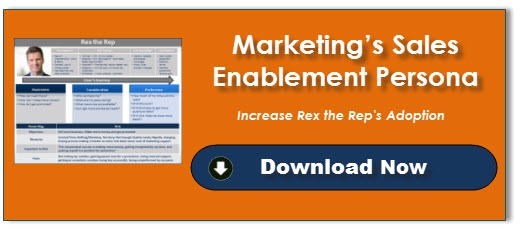
Meet Rex the Rep.

Rex persona looks at Rex as ‘user’ no different than how we use creative briefs.  For example, here are Rex’s top 3 drivers for usage of sales enablement materials;

•Ease of implementation (time & effort)
•Connects use to hitting number
•Take lead from top sales producers

Are you leveraging to top reps to help you sell adoption?  This can be done by involving them in expert panels and piloting groups.  Is what you’re asking Rex to do simple and easy to duplicate call after call?  Is your sales enablement overview training hitting on key value points that are important to Rex vs. company platitudes? 

When communicating with sales, leverage a Persona of the sales rep. The Rex the Rep Persona provides valuable insights;
• Gain awareness into Rex as a user and how he adopts Sales Enablement tools
• Guide your efforts to connect with the sales rep's What is in it for me?
• Understand the key goals and obstacles impacting sales

Download Marketing’s Sales Enablement Persona (Rex the Rep) to increase adoption.

Marketing’s Sales Enablement Persona

2. Validate with Best Practices

Marketers don’t realize that Sales simply may not know what ‘good’ looks like. Take the appropriate time to share best practices when rolling out a new product. For example; Sales Enablement: The Missing Piece to the New Product Launch.  Explain how World Class sales organizations perform sales enablement. Then connect the dots with what your marketing team has created.

The Rex the Rep Persona shows that reps want to keep up with their peers.  Frame best practices in light of how marketing supports reps in world class sales organizations.

Without a frame of reference, don’t expect sales to recognize a quality marketing deliverable. Sales reps typically only have their past experience to compare. Invest time in sharing best practices and how your efforts align. Name the best practices of world class sales forces and how your sales enablement hits the mark.

3. Test Prototype – An Agile Approach

Sales Enablement deliverables should be tested before rolling out company wide. Developing a ‘prototype’ early draft and getting field feedback is paramount to success.

Select a small team of trusted reps to test new product release materials and messaging. Get feedback early and use that to fine tune your Sales Enablement rollout.

Gain speed to market by releasing a solid early draft as a prototype. This agile approach relieves the tremendous stress of trying to be perfect. Move quickly and allow the customer interaction to guide the fine-tuning of sales enablement materials.

Summary

In summary, CMO’s can increase the effectiveness of sales enablement through great marketing. Simply apply the processes and craft of marketing externally to inside stakeholders.


Author: Vince Koehler

Vince Koehler

Google+ Vince Koehler on Google+

If you enjoyed this post, never miss one again by subscribing your Email Here and/or subscribing to the RSS Here.

27 Nov 15:57

7 Signs Your Sales Rep Should Be Promoted

by Dan Perry

sales rep promotedPreparing for the New Year requires decisions to be made.  As a Sales VP, putting the best people in the correct positions is critical.  Making your number next year means promoting, keeping and terminating certain sales reps.  Knowing who to promote is the first step.  They can help you make the other decisions.  But which person on your team has the best chance for success?

Download our Sales Rep Promotability Scale.  It will allow you to:

  • Objectively evaluate your team
  • Determine who is most likely to succeed in the promoted role
  • Develop others to get promoted in the future
Sales Rep Promotability Scale

You don’t have time to afford a long onboarding process.  Plus, you only have a limited amount of time to coach them.  And promoting from within has proved more successful than hiring from the outside.   What do you look for on your current team?

7 Signs Your Sales Rep Should Be Promoted:

  1. Making the Number Properly:  Ultimately, fulfilling your sales job description is exceeding your quota.  But to get promoted, the rep must do it correctly. For example, making the number by discounting heavily hits your goals.  But selling value allows not just revenue but margin to be considered.  That’s profitable and good business.
  2. Get Extra Credit:  The great ones make the number while helping you.  Training, piloting or even taking on extra responsibility (i.e. open territory) is met in stride.  Somehow they figure out how to do it.  And make it look easy. They are the ones who in school got the extra credit.
  3. Be the Informal Team Leader:  Watch for the team turning to this person subtlety.  They don’t ‘promote’ themselves yet get all the questions.  In meetings, others want their opinions.  They don’t usually voice them by their own.  Most of the time people ask them specifically.  And their view usually sways the decision.
  4. Creates Social Debt:   The promotable rep does something valuable for their peers without being asked.  This could be going on a sales call, helping with deal strategy or running a sales meeting.  They consistently ‘pay it forward’ always providing value.  Yet they do it without any real benefit to them.
  5. Displays Constructive Criticism:  They don’t complain.  The best provide professional, mature constructive criticism.  Things aren’t always right.  But how you voice your opinion matters.
  6. They Don’t Cost any Political Capital:  You never have to give an excuse for this person.  They always get it done no matter what obstacle.  You rely on them consistently without defending their actions.  And you don’t waste any valuable energy ‘talking them up’ with the boss.  The boss notices them on their own.
  7. Extreme Coachability:  They actually listen and take action on your coaching. This means your coaching and feedback help them sell.  Helps them develop.  And helps them get promoted.
Recognizing these signs in your reps takes time.  You must attend multiple sales meetings.  Go on field rides.  Attend customer meetings with your reps.  If you just listen to your sales manager, the critical interactions will be missed.  And the signs of a promotable rep will be missed. Unfortunately, this happens quite often.  When it does, the sales rep that endears themselves to the boss is promoted.   Don’t let this happen in your sales organization.

Call to Action:

  • Be Present at the Weekly Sales Meetings and Field Rides:  Attending all of them across multiple teams is impossible.  But having a regular cadence is necessary.  Observing the reps over time allows the necessary visibility to watch and listen.
  • Watch and Listen for the above Signs:  Promotable sales people don’t do every sign.  But they accomplish most.  Making the number but not being the informal leader doesn’t cut it.  Displaying constructive criticism but having to defend the accounts they sell is a problem.  The next Sales Manager completes most the signs weekly.
  • Develop those Reps who Display Some Signs but not all:   Noticing the signs is one thing.  Devoting time to develop the others in a future sales manager is another.  Construct an Individual Promotion Plan for the great ones.  Invest time so they exhibit most of the signs.

It is worth the time and energy to develop promotable sales reps.  Those that display the above 7 signs onboard quicker with less effort.  This leads to quickly making the number. Download the tool and work on developing people for promotion. You will receive the rewards now and later.

Author: Dan Perry

sbi on linkedin

Follow @DanPerrySBI

Follow @MakingTheNumber

If you enjoyed this post, never miss one again by subscribing your Email Here and/or subscribing to the RSS Here

27 Nov 15:57

5 Characteristics of Top Salespeople

by Bob Sullivan

Sales_Marketing_ResourcesEvery organization wants as many top performers as they can get, for obvious reasons. The trouble is they may be hard to find. There is hope though -- top performers have common, attainable characteristics.

Top-performing salespeople get more sales cost effectively and in less time than their colleagues do. Here are the five characteristics that set top performing sales reps apart form the rest:

  1. Set big goals that are challenging, motivational, achieveable, measurable, and specific in terms of results and time. Envisioning their targets, they initiate their sales goals and quotas rather than waiting for management.
  2. Ask many high-value questions to fully determine their customer's situation and buying needs. They know that the most effective way to present their product or service is to uncover their customer's goals, objectives, concerns, and hesitations. In addition, they choose to focus on the positive elements instead of allowing themselves to be dragged down. 
  3. Stay positive with a contagious enthusiasm. They seldom talk poorly of a company or the business. When faced with unpleasant or negative situations, they choose to focus on the positive elements instead of allowing themselves to be dragged down.
  4. Work harder than others, often starting work earlier and working later than their colleagues. With less social chit-chat; top performers make more calls, prospect more consistently, talk to more people, and give more sales presentations than coworkers.
  5. Keep in touch with their customers and prospects. For example:
  • They make more phone calls and have regular "keep in touch" breakfast and lunch meetings.
  • Keep their name in clients' minds by sending articles of interest, "Thank You" notes, birthday cards, and anniversary cards.

To keep in touch with their customers and prospects, to make more calls to customers and prospects on a given trip; to save time, lower costs, and to perform more effectively. Top salespeople use a Customer Relationship Management (CRM) System.

This profile of top performing salespeople is from Kelley Robertson who writes for Future Simple's Growth University. Mr. Robertson says that all sales personnel can acquire the characteristics of top performers and achieve more successful sales. It is worth the time and effort for the large rewards that lie ahead.

To discover more tips on how to make your sales reps, top performers, schedule a meeting on my calendar.

27 Nov 15:56

Guest Article: “Developing New Business–6 Best Practives,” by Dr. Richard Ruff

by Paul McCord

Developing new business – 6 best practices
by Richard Ruff

In today’s B2B market a sales person needs an array of skills to be a top performer – they need to know more and know it at a higher level of proficiency than ever before.

But if you asked a whole lot of sales people from all over the world what is the one a competency they think they could most benefit from if they knew how to do it better?

A Survey of Sales Effectiveness: Global Research on what Drives Sales Success addressed that question.  The skill set that sales people felt was most challenging was: Developing New Business. As an aside, it was interesting that Establishing Relationships and Uncovering Needs was the area where the sales people reported they were having the most success.

Since developing new business has, as one might expect, surfaced before as an area that deserves attention, let’s look at some of the best practices for getting that done which have emerged from our work with B2B clients.

As to the nature of the problems and the best practices it’s necessary to pinpoint whether you are talking about new business with new customers or new business with existing customers.  For this discussion, let’s focus on the large B2B complex sale situations where one is developing new business with existing customers.

In the way of recognition, we would like give a tip of the hat to our colleague Mike Smith of Ohio State University who helped us develop these ideas.

Particularly when you are working with an existing customer you may be ahead of the customer in seeing an unfolding situation that would drive a new business opportunity. As a matter of fact this is one of the skill areas where top performers differentiate themselves from the pack.

In these situations, you can provide value by helping the customer see a future challenge.  You may also be able to help them formulate the need and response thereby putting yourself in a strong competitive position.  The most important skill in identifying future opportunities is the ability to see the relationship between observable events and knowing what actions and results they are likely to lead to and when.

For identifying these types of new opportunities, some specific perspectives and 6 best practices are:

  • Look at the current situation through the lens of the existing work effort. From time to time when you are reviewing an implementation – think back about the situation as it was preceding your solution. What things did you observe? What situations were present? Who did what just preceding the opportunity? New opportunities are a response to something.  What things were in motion before the opportunity occurred?
  • Look at how your customers are fairing against goals, objectives and metrics. With knowledge about goals, objectives and metrics, and a sense of how the customer is performing, what would you do to reach these if you were in their place?  What could your do that would enhance the customer’s success?  How will they demonstrate success to their leadership and stakeholders?

If you can see where you can add value, they may as well. If they don’t, but you do, it puts you in the best position of all, namely you are helping a customer understand an unforeseen challenge.

  • Assess organizational changes for clues. Whether a company is preparing to implement a planned strategy, merging groups or responding to a problem or opportunity, very often organizational structures are put in place before new work is made visible to the outside world. Teams of required skills are assembled, specific skills are reassigned or grouped, and units are disbanded or reduced.

Look at new and expanded organizations and what kinds of skills, and in what quantity, are being added.  Here it important to leverage the insight of your staff with a historical perspective of the customer, they can provide meaning to what specific changes may mean and not mean.

  • Observe what is happening in overall ongoing expense management. New efforts inside the customer organization cost money.  Is the customer experiencing any changes in spending patterns you can observe? Are expenses being restricted, or expanded?  Look for work that may foreshadow future work.
  • Don’t forget to tell your story. Be able to subtly, but clearly reinforce just what it is you do that is of value to customers. They don’t spend much or any time pondering what you do. They worry about what they need and when they do, only the organizations that are top of mind, come to mind.

Too often, if you do not share the range of things you do well, a customer might say, “Oh, I wish I had known you can do X, because you did such a great job on Y and, had we known, we would have used you.” Always have an up-to-date value proposition about your core capabilities and a new story about how those capabilities have been used by others.

  • Bring in fresh thinking. Think about leveraging literature, speeches, research, stories you’ve heard that relate to the customer agenda or you know are of particular interest to the individual.  Even if they don’t produce a lead today it builds relationships and often creates leads in the future.

Developing new business is one of the areas where top performers clearly differentiate themselves – they know it is hard to do and they learn how to do it.  It is also an area where creating best practice profiles based on what your top performers do makes extraordinary sense.

Dr. Richard Ruff and Janet Spirer launched Sales Horizons in 2011. The idea behind Sales Horizons is to leverage the lessons learned working with market leaders to create sales training programs that are effective and affordable for mid-size and small companies.


27 Nov 15:56

5 Things You Need to Know NOW to be More Successful Next Year

Recently in a client meeting, I was asked by a salesperson what they needed to know to help them be more successful next year.
It’s a great question and one that we should be asking ourselves on a regular basis, not just about next year but about next quarter and next month.
Here’s what I told the salesperson and the rest of the team assembled in the room”
1.  If you can’t raise your level of sales effectiveness by at least 15%, you’ll wind up losing ground to the competition.
There is not one company out there that is not demanding more of every employee with each passing year.  This means every competitor you have is going to be looking to become more efficient in how they sell. Yes, some will stumble, but many will be successful.
To you, it means one thing. Doing the same thing next year is simply not going to be good enough.  You must find ways to streamline your sales process.
2.  The pool of prospects next year is going to grow.
There will be more prospects than ever, and the good news is more of them will actually buy.  The internet continues to open up new areas and this means prospects can come from more places.  Yes, it’s good news, but it also means competitors can come from more places.
In the end, it means you have to be able to adapt how you sell to be more flexible than ever.  If you’re reading between the lines, you are now able to see how #2 very much lines itself with #1.
3.  Prospects are going to engage you later than ever in the process.
The internet is an amazing tool in how it allows prospects or, as I like to say, “internet stalkers” to review how you might be able to assist them with what you sell.   Each year, thanks to the capabilities of search engines, prospects are able to do more, learn more and ultimately draw more conclusions without the aid of a salesperson.
4. Time will become even more important for you, your prospects and your customers.
Because prospects can engage with the salesperson later, they will be looking to make their decision faster in regard to the time you have with them.   If you sell in the B2B market, this same thing holds true for the customers your customers sell to.  The entire sales process is going to continue to shrink in regard to the level of time it takes to complete the sale.
5. Customer loyalty will continue to decrease.
Why should a customer stay loyal to you?  There is so much information on the internet and the number of competitors is so robust, it only makes sense for even the most loyal customer to look around.
If you’ve been reading between the lines with each one of the 5 points I’ve listed, you’ll notice something.  They are all interconnected! At the core is the ever growing level of information available to the prospects and customers.  Just as the level of information is growing, so is the number of competitors you have.
In the end, the big take away is this: If you think you can be successful doing the exact same thing you did this year, you’re kidding yourself.  You might be successful for a while, but ultimately your business will erode and chances are you won’t notice it until too much has eroded away.
So take to heart what you can learn from these 5 things so that you will be more successful next year than this year!

Recently in a client meeting, I was asked by a salesperson what they needed to know to help them be more successful next year.

It’s a great question and one that we should be asking ourselves on a regular basis, not just about next year but about next quarter and next month.

Here’s what I told the salesperson and the rest of the team assembled in the room”

1.  If you can’t raise your level of sales effectiveness by at least 15%, you’ll wind up losing ground to the competition.

There is not one company out there that is not demanding more of every employee with each passing year.  This means every competitor you have is going to be looking to become more efficient in how they sell. Yes, some will stumble, but many will be successful.

To you, it means one thing. Doing the same thing next year is simply not going to be good enough.  You must find ways to streamline your sales process.

2.  The pool of prospects next year is going to grow.

There will be more prospects than ever, and the good news is more of them will actually buy.  The internet continues to open up new areas and this means prospects can come from more places.  Yes, it’s good news, but it also means competitors can come from more places.

In the end, it means you have to be able to adapt how you sell to be more flexible than ever.  If you’re reading between the lines, you are now able to see how #2 very much lines itself with #1.

3.  Prospects are going to engage you later than ever in the process.

The internet is an amazing tool in how it allows prospects or, as I like to say, “internet stalkers” to review how you might be able to assist them with what you sell.   Each year, thanks to the capabilities of search engines, prospects are able to do more, learn more and ultimately draw more conclusions without the aid of a salesperson.

4. Time will become even more important for you, your prospects and your customers.

Because prospects can engage with the salesperson later, they will be looking to make their decision faster in regard to the time you have with them.   If you sell in the B2B market, this same thing holds true for the customers your customers sell to.  The entire sales process is going to continue to shrink in regard to the level of time it takes to complete the sale.

5. Customer loyalty will continue to decrease.

Why should a customer stay loyal to you?  There is so much information on the internet and the number of competitors is so robust, it only makes sense for even the most loyal customer to look around.

If you’ve been reading between the lines with each one of the 5 points I’ve listed, you’ll notice something.  They are all interconnected! At the core is the ever growing level of information available to the prospects and customers.  Just as the level of information is growing, so is the number of competitors you have.

In the end, the big take away is this: If you think you can be successful doing the exact same thing you did this year, you’re kidding yourself.  You might be successful for a while, but ultimately your business will erode and chances are you won’t notice it until too much has eroded away.

So take to heart what you can learn from these 5 things so that you will be more successful next year than this year!

27 Nov 15:55

The Trend That is Changing Sales - Harvard Business Review

by Steve Martin


Percent of Salespeople Making QuotaMy latest Harvard Business Review article titled The Trend That is Changing Sales was based upon in-depth research with over one-hundred vice presidents of sales at leading high technology companies and business services providers. Please click here if you would like to receive the full 29 page report on the latest sales organization strategies and key sales performance metrics.


Over the past several decades the structure of sales organizations have remained largely the same. They have been primarily based on outside field salespeople who make face-to-face sales calls with prospective customers and current clients. In turn, the field salespeople would be supported by inside sales representatives who helped them complete their daily tasks. 

Today, the traditional sales organization structure is undergoing a significant change. Many sales organizations are transitioning from a field sales model to an inside sales model, where the inside salespeople work independently from the field and are directly responsible for closing business. In order to understand the magnitude of this trend, in-depth interviews and extensive surveys were conducted with over one-hundred vice presidents of sales at leading high technology companies and business services providers. The resulting researchprovided detailed insights about the evolution of sales organizations along with the following key finding:

Over the past two years, forty-six percent of study participants reported a shift from a field sales model to an inside sales model. Twenty-one percent reported a shift from inside sales to a field sales model. More than twice as many study participants reported moving to an inside sales model.

There are three key factors that determine when a sales organization will utilize a field or inside sales model. They are the sales organization’s stage of development, the complexity of the products that are sold, and to a lesser extent, the sales leader’s perception of inside and outside sales model effectiveness.


Sales Organization Development Stage

Every sales organization can be classified into a "Build," "Compete," "Maintain," “Extend,” or "Cull" stage based upon its development. The Build stage is when the sales organization is first establishing itself.  If successful, it will proceed to a high-growth Compete stage and then to Maintain stage that is contingent upon predictable success. As the sales organization ages, it will enter either the Extend stage and enjoy longevity or the Cull stage, where it declines and is forced to reduce its size. The ratio of outside or inside salespeople changes as the organization moves from the Build to Compete to Maintain development stages.

The challenges sales organizations face is dependent upon the stage of their development. The top sales challenge in the Build stage is creating sufficient sales coverage to push the product into the market. The Compete stage challenge revolves around quickly scaling the sales organization so it can compete effectively against larger established competitors. The focus shifts to maximizing sales productivity by lowering the cost of sale and increasing the average sales price in the Maintain stage. The Extend stage challenge is to attain widespread customer adoption so their solution becomes the de facto standard. The Cull stage challenge is to revitalize a demoralized and marginalized sales force. These challenges directly influence the sales organization’s structure and whether a field or inside sales model will be deployed.  


Sales Cycle Complexity

The complexity of the sales cycle determines the evolution of the sales organization and at what point outside field or inside-based sales models will be implemented. Sales cycle types can be classified by complexity as Enterprise, Platform Cloud-based or Point-specific. Each of these sales cycles vary in complexity depending upon the number of individuals and departments involved in the selection process, the size of purchase, and sophisticated nature of the solution offered.

Enterprise sales typically are large capital expenditure purchases that involve long sales cycles. Multiple departments of a company and all levels of the organization (C-level executive, mid-level management, and lower-level personnel) are needed to approve the solution’s functionality and its purchase. A point-specific sales cycle is usually targeted to solve the business problems of single department within an organization and the purchase decision is made by a small number of decision-makers usually at the lower-level of the organization. The Platform Cloud-based sale provides a turnkey business solution for the customer over the internet and is sold directly to the business users of an organization. There is a preferential field and inside sales model strategy for each of the sales cycle types.  For example, a field sales model is preferred for enterprise sales cycles and an inside sales model is preferred for Platform Cloud-based sales cycles.


Sales Leaders Perception of Field and Inside Sales Models

While the goal of this study was to gather quantifiable metrics based on surveys and interviews with sales leaders, there is another aspect of sales model decision making that cannot be ignored. Ninety-eight percent of study participants responded that the characteristics between inside and outside salespeople are significantly or somewhat different.

Most sales leaders believe that outside salespeople have superior sales skills and the most accomplished sales professionals are in the field as evidenced by the sales leader comments below. This in turn can influence their decision and whether they implement a field or inside sales model. 


“Field Sales is more strategic, meeting with C-level executives and developing strategic business innovation to help them grow their business versus inside which is more quantity and not as in depth majority of the time.”

“Inside Sales is a transactional engagement and the focus is on opening opportunities.  Outside teams are solution and relationship based.”

“Outside sales requires far more emotional intelligence, situational awareness and planning. Our inside sales, while equally demanding, requires persistence, research, and back end work.”

Furthermore, many sales leaders have a personal bias toward deploying outside salespeople over inside sales. In some cases, this inclination was based on their own experience from many years ago when they were in field sales. However, this historical disposition is being offset by the changing nature of how customers buy today. Customers are smarter and information is not only easier to find, but available in greater detail than ever before. In addition, technology has become a way of life and completely disrupted the buying process. Via the Internet, customers can research products, prices, and opinions. 

This situation is driving more sales leaders to consider and then deploy an inside sales model. For example, study participants were asked to rank the influential factors that are responsible for the migration from field to inside sales. Sixty percent responded that it was due to the increasing pressure on business performance and profitability. Fifty-four percent said it was due to technology advancements. Forty-seven percent felt that buyers more readily accept the remote selling process and thirty-four percent believed it is because of societal changes such as a mobile workforce and personal online purchasing habits.  

Study participants also cited the following advantages of an inside sales model compared to field sales model. Eighty-four percent believe it is easier to onboard new salespeople and share best practices. Seventy-nine percent responded that inside sales allows the organization to scale faster. Increased call activity and selling volume was cited by seventy-eight percent of responders. Seventy-six percent acknowledge that inside sales provides a better strategy to penetrate small businesses and mid-markets.

Today, there is a changing perception among sales leaders about the strategic role inside sales performs. This change is due to the benefits that sales leaders believe the inside model provides in terms of scaling activity, growing the organization, and attacking specific markets.


CLICK HERE TO RECEIVE THE  FREE SALES ORGANIZTION STRATEGY  AND KEY PERFORMANCE METRICS REPORT

REGISTER FOR THE SALES ORGANIZATION STRATEGY WEBINAR - DECEMBER 10th


27 Nov 15:55

How to Know You’re Interviewing an “A” Player

by Keenan

You want a killer way to know if you’re talking to an “A” player during an interview? There is one thing that the best of the best sales people do during an interview that others don’t. They ask the questions that matter.

Let’s stop and think about it for a minute. What is an interview? An interview is a way for an employer to evaluate the ability of a candidate to do a job. In this case sell or lead sales teams.  Therefore, if the objective of the interview is to evaluate the ability of the candidate to do the job, the best candidates ask questions that will help them understand what it will take to get the job done.  “A” players, those great candidates who you desperately need to find, are like business analysts. They look at opportunities as investments. They understand that success is predicated on what they know or can learn about the position; the goals and expectations, the environment, the challenges, the competitors, product readiness, market placement and more.

“A” players understand employers have a problem and that’s why they are looking to hire someone.  They understand, many times better than the hiring manager, that understanding what the problem is and having a clear understanding of what it is going to take to fix the problem is the only way to ensure the job will get done.  “A” players dig into the job. They want to understand what it is the employer needs to accomplish. They want to understand the goals of the position and how they affect the rest of the organization. “A” players want to know what the challenges are. They dig in order to ferret out all the hurdles and barriers to success. “A” players are like analysts or consultants probing to understand the business and the critical paths to success.

Why? Why do “A” players do this?

“A” players dig deep because they are evaluating the position in terms of their ability to deliver.  “A” players are trying to determine what it will take for them to deliver on the employer’s goals. They are trying to determine how realistic the objectives are. They are evaluating where the opportunities for success lay and what challenges they will need to navigate. “A” players are probing with the vision of themselves in the position. They are trying to ascertain what it’s going to take to successfully execute against in the role. Simply put, “A” players are trying to determine what it’s going to take to win and if they can be the catalyst to success.

“A” players understand that the traditional interviews circumnavigate the position being hired for and that behavioral questions regarding how one has done something in the past provides little insight into what the employer is specifically trying to accomplish.  Questions such as; “Tell me about a specific time you struggled with an underperforming rep and how you handled it,” do a great job of providing insight into how a candidate would address that tactical element of the job but it gives little insight to the ability of the candidate to deliver on the overall goals of the job. Unless the job is for an H.R. position or for someone who has a shitty team and will constantly have to deal with underperforming reps, this type of question is too myopic.  Instead, “A” players want to talk shop. They are looking to brainstorm on ideas, strategy, vision, goals, deliverables, challenges, resources, and opportunities. They are sizing up the opportunity in terms of deliverability and want you to be able to give it to them.

You want to know if you have an “A” player? Listen for questions like:

  • Tell me what the goals of this position are, how do these compare over the last two years? Has the organization or my predecessor been successful in delivering on these goals?
  • Besides reaching the goals, how will success in this role be measured one year from now? What will have been accomplished?
  • How do we stack up against the competition, do we know our win rate against them?
  • How would you rate the current team in its ability to reach the goal?
  • What is the quota attainment distribution? Is everyone making quota or a just a few bringing in most of the revenue?
  • How much do you expect your current market to grow in the next 1-3 years?
  • Can you tell me about the product roadmap and how prepared are you to deliver on it?
  • What have been the 3 biggest challenges to reaching the goals the organization has been struggling with?
  • Do you currently have a structured sales process in place? Can you share it with me?
  • What’s the average sale cycle length, has it been getting longer, shorter, or stayed the same?
  • Can you share the current organizational structure and how it relates to the goals?
  • Does the team currently complete account plans, can you share one with me?
  • Do you have sales team strategy; can you share it with me?
  • Etc.

“A” players ask questions that allow them to ascertain what is going on in the organization and what it’s going to take to meet the goals the employer is hiring for. “A” players are “A” players because they execute. They know how to deliver and delivering requires a solid understanding of the environment, the goals, challenges, required resources etc. They have excellent assessment and analysis skills and bring them to bear in the interview.

“A” players want to know if they can be successful before they ever take the job. Therefore, to them the interview is an assessment, an evaluation. You can see “A” players a mile away. They are the ones trying to understand and then solve your problems before they even start the job.


26 Nov 18:57

Why Your Salespeople Need to Learn to Listen Laterally…

by Bob Apollo

I introduced the phrase “lateral listening” into a recent blog article, and had quite a few people ask me what I meant. In this short article, I’d like to explain in a little more detail what I mean by lateral listening and why I believe that it’s an important skill for anyone in a customer-facing role – and particularly for salespeople.

The idea stemmed from observing sales people in a series of prospect role-plays and real-line customer calls. The sales people usually went into the discussion with a clear goal to advance the sales process. But for many of them, this goal was standing in the way of their truly understanding the prospect.

The problem with listening for the answers you want to hear

Why Your Salespeople Need to Learn to Listen Laterally... image Darts Missing TrimmedThe problem was particularly apparent when sales people were following a prescribed sales process. What seemed to be happening was that these salespeople asked questions and evaluated the prospect’s answers in order to further qualify the opportunity and advance the sale. They asked questions knowing what answers they were hoping to hear.

Unfortunately, this single-minded mission meant that they often ignored answers or statements from the prospect that did not appear to contribute to these somewhat over-simplistic objectives. But to an outside observer, it was obvious that the prospect was sharing invaluable insights – they just weren’t being picked up.

Now, I’m all in favour of having a clear plan in mind in advance of every conversation. But it seems that sticking too rigidly to the plan can have a really detrimental effect on the quality of the conversation. By listening too hard for the expected, and reacting too quickly upon hearing it, sales people can miss out on uncovering the really valuable insights.

Learning from the unspoken

The issue is compounded by the fact that much of what can be learned from a sales conversation isn’t restricted to what the prospect has said – thinking about how they say it, why they chose to say what they say and the things they don’t talk about is often fundamental to really understanding them.

Having said all this, there’s obviously a sub-set of sales people who manage to do a rather better job, and I believe they share some common characteristics. In particular, they seem to think and ask “why” a lot more than their less adept colleagues:

    • They seek to understand why the prospect might be motivated to do anything other than stick with the status quo (“why change?”)
    • They try and determine why the prospect might be motivated to act now, rather than later, and what would happen if they didn’t (“why now?”)
    • They try and uncover the prospect’s relationship with their managers and peers, and their ability to mobilise their colleagues to action
    • They try and understand not just what the prospect has said, but also how they said it and why they might have chosen to say it
    • They regard what the prospect hasn’t said or is unwilling to talk about as being just as significant as what they have said
    • They hold back from proposing any solutions until they believe they have truly understood what the prospect actually needs

And this is where the concept of “lateral listening” comes in: really effective listeners pick up much more than the obvious from conversations. They try and put what they have just heard into context, and they are prepared to adapt and react and go “off piste” in order to pursue a particularly interesting insight.

Plan, prepare, and then be prepared to abandon your plan

When it comes to preparing for a sales conversation, they go along with Dwight Eisenhower when he memorably remarked, “the plan is nothing, but planning is everything”. From the moment the discussion starts, it’s all about listening, reacting and adapting.

Now it’s clear that some sales people just have a gift for lateral listening, but experience suggests that they represent a minority of the population. So can the less naturally gifted improve their skills in this area?

Lateral listening can be developed

The evidence suggests that they can, through a combination of training, role-plays and on-going coaching and mentoring. It requires a certain amount of effort, and a reasonable amount of intelligence and genuine curiosity on the part of your sales people.

But the results have got to worth it, when you consider the alternative: the huge amount of wasted effort that follows from missing vital clues and pursuing false trails. It’s a no-brainer, unless you’re unfortunate enough to be able to apply that description to the majority of your sales people.

But if things really are that desperate, you’ve probably got more urgent things to attend to than reading this blog…

26 Nov 18:55

Google adds airports, more to Google Street View

by Konrad Krawczyk

Ever wish you could take a sneak peek at the inside of the airport you'll need to sprint through when trying to catch your flights this holiday season? Google Street View just added a bunch of airports, a prominent train station and more.

The post Google adds airports, more to Google Street View appeared first on Digital Trends.

26 Nov 18:55

Andy Paul "Buyers search for information to make decisions in the least time possible. The 1st seller with the answers wins #sales"

Andy Paul "Buyers search for information to make decisions in the least time possible. The 1st seller with the answers wins #sales"
26 Nov 18:54

How Google Convinced Its Engineers That Managers Matter

by Max Nisen

Google Dublin Office

Google is well known for an intensely data-focused human resources and management strategy. Yet one of its biggest tasks has been convincing its many engineers that their bosses are valuable. 

A fascinating new feature in the Harvard Business Review explains in depth how Google's HR employees answered a question that's dogged the company since its founding: Do managers matter?

The reflexive position for engineers, Google's key internal constituency, is that managers are unnecessary, adding layers of bureaucracy, slowing down great ideas, and taking away from "real work."

But when the company experimented with having no engineering managers whatsoever in 2002, it just didn't work. Small personal issues often went all the way to the CEO's level. On the other hand, micromanagement drives people away from companies, since they tend to find it stifling and belittling. 

At the end of the day, after a massive multi-year research project called "Project Oxygen," which measured key management behaviors and their impact using exit interviews, surveys, and performance reviews, the company found that good managers do matter — a lot. Their teams have lower turnover and score higher on metrics measuring happiness.

Google found that the best managers share these eight traits:

1. Is a good coach.
2. Empowers the team and does not micromanage.
3. Expresses interest in and concern for team members’ success and personal well-being.
4. Is productive and results-oriented.
5. Is a good communicator — listens and shares information.
6. Helps with career development.
7. Has a clear vision and strategy for the team.
8. Has key technical skills that help him or her advise the team.

No. 2 might be the most important at a company chock full of engineers. People who already doubt managers' utility and are used to working on discrete goal-oriented tasks don't want to feel smothered.

It carries through in the way the whole company is organized. Google has more than 37,000 employees, but only 5,000 managers, 1,000 directors, and 100 vice presidents. Engineering managers can have as many as 30 direct reports, according to the HBR article.

“There is only so much you can meddle when you have 30 people on your team, so you have to focus on creating the best environment for engineers to make things happen,” Google engineer Eric Flatt says.

The article describes how Google approaches each of those traits, breaking them down into specific behaviors and best practices that managers are measured, advised, and trained on.

So it isn't just about avoiding micromanagement; it's that the highest-rated managers also balance freedom with being available for advice, give assignments that let people stretch, make it clear that they trust their reports, and advocate for them with higher-level people.

Here are some best practices in Google employees' own words from the piece:

On avoiding micromanagement:

"He doesn't micromanage me, is very logical, and is willing to listen to you and not run an evil agenda. He is very respectful …. I would not think about leaving Google as long as he is my manager."

On balancing freedom and advice:

"He encourages people to run with ideas but knows when to step in and offer advice not to pursue a failing issue."

On trust:

"She cultivates a culture of accountability while not losing sight of the fact that we can enjoy work. She knows she hired an excellent team, and she shares the fact that she [trusts] us."

And though engineers might not like lots of input on their work, they love it when managers are deeply involved in the close management of their careers. Particularly at Google, which is relatively flat, managers have to spend a lot of time figuring out how to create career development beyond promotion, like the opportunity to take on and take ownership of bigger projects.

Identifying the best traits and behaviors of managers is just one step. Managers aren't just given the eight rules listed above. They also get feedback from the People Operations department on employees' assessments of their performance on each trait, information on best practices, and suggestions on classes they can take to improve any areas of weakness.

Though the project succeeded in both convincing people of the necessity of management, and getting them to contribute to constantly improving it, Google plans to continue its research.

According to Prasad Setty, who leads analytics for the People Operations department, the company is now trying to analyze the managers' assessment scores by their personality types to find more patterns and more areas to improve.

Join the conversation about this story »

26 Nov 17:43

Learn Over 60 Google Now Commands with This Infographic

by Melanie Pinola

Learn Over 60 Google Now Commands with This Infographic

There are a ton of cool things you can do with Google Now, but with Google constantly adding more voice commands (and integrating Google Now even more with Android KitKat), it's easy to forget all your options. This graphic shows many of the latest instructions available if you just say "Okay Google..." or tap the microphone.

Read more...

26 Nov 17:27

6 Human Sales Traits that Technology Cannot Replace

by Monika D'Agostino

Everything in today’s business environment seems to be about technology, the latest developments, content marketing, microblogs, engagement, SEOs, etc.

Some companies have become over-systematized, as I call it. Everything and I mean everything is left to automation. Once the database is set-up and your name is entered you get emails on a regular basis whether they are relevant to your current need or not.

In a consultative sales environment technology should only be utilized to support the sales process, but never to replace it. People want to feel special and they don’t want to be viewed as a mass target.

Here are some examples of what technology lacks.

Common Sense

Common sense is the least common of the senses. I love that saying and it is so true. The more technology focused we become, the less we use our common sense. Why is that? Because we rely on it too often and feel that everything we need can be found on the internet. There are statistics that show that we are getting dumber and dumber. I would argue that we are also getting lazier. An argument over dinner that used to take hours to resolve (sometimes it wasn’t even resolved that night) can now usually be settled in a couple of minutes by somebody pulling out their smart-phone.

The Human Touch                                                                  

And by that I mean exactly that. The human touch. When you call on a prospect you can apply nuances to your voice, you can be compassionate and you can adjust your language.

Mass messages, even if they are targeted to specific audiences will always be static. Yes, you can add images and videos and animations, but the will never be personal. I get mass emails and messages all day and some of them are more relevant to my business than others, but they are never exactly what I am looking for, because I am one of many to receive them. There is also the trend to over-systematize and sales people rely on technology to help them make a sale rather than picking up the phone and talking to people.

Human Persuasion

In sales it is very important to overcome objections and to add value to your customer/client so they buy from you and choose your product or service. Content marketing is important for people to find out about your product/service and to make it easy for customers to find you. It is important to get your message out and to build brand awareness, but it cannot replace human interaction.

Most people today will research a product/service before they make a buying decision, but I would argue that people still like to buy from people and they will most likely buy from people they trust. Building trust takes time and it is a process that cannot be rushed or replaced by technology.

Quality Content

With all the hype about content marketing, we sometimes seem to forget that it’s actually content that drives content marketing. Guess who provides content? People! As I am sitting here writing this article I am wondering if there will ever be a technology that will produce quality content. I sure hope not. Not for self serving reasons but for the nuances which human beings can provide. I can’t help but think that computer or technology generated content would lack the subtlety of human writing. Who would be able to develop headlines that crown the New York Post (a newspaper that I hardly read beyond the headline) such as “Here We Ho Again” in response to Eliot Spitzer running for office again. Could a computer really come up with such a clever (although offensive) phrase? And what about sarcasm? I can tell you that I have yet to find a computer program that translates effectively, especially when it comes to humorous phrases or idioms.

Rationale

And by that I mean applying logic and knowledge. Let’s talk about database management, because to me it’s key to effectively engaging with prospects and customers. CRM systems are only as good as the data that is fed into them (which is the truth for all technology enabled solutions). GI-GO – Garbage in – garbage out, which brings me to over-systematizing without applying rational thinking and feedback. When managing a database you need to know who your target audience is, whether they are a client, a prospect  or a partner. If you don’t tag your contacts properly, your messaging will be off and it really doesn’t matter what technology you use.

Decision Making

Although, we all think that technology has made it so easy for us to do almost everything by itself, it’s really important to remember that making a decision is still something that humans need to do. While technology can help us build an opinion or stay informed, it’s still humans who make the decision to buy and people who are signing checks.

In closing, I want to add that I love technology. I really do. Like most of us, I would be lost without my computer, Smartphone and all the technology solutions that come with it. What we shouldn’t forget though is that technology doesn’t replace humans. Not yet, anyway and hopefully not any time soon.

26 Nov 17:27

Use Your Sales Force’s Competitive Intelligence Wisely

by Joël Le Bon

The vast majority of your marketing data, whether from purchases or surveys, tells you about your business customers’ past behaviors. But the past is over. Your job as a manager is to know what your customers will do next month or next year. Who has data about the future?

Your salespeople, that’s who.

The sales force has abundant information about the initiatives and products that your competitors are planning and, therefore, the kinds of choices that your customers will be facing in the near future. That competitive intelligence can not only help individual salespeople become more effective, it can also help your company make better strategic decisions.

But research I conducted with Douglas E. Hughes of Michigan State University and Adam Rapp of the University of Alabama shows that in the wrong hands, competitive intelligence can have a negative impact on sales and market share. So if you acquire information from customers, you’d better use it well, or it may hinder, rather than help, your sales efforts.

My colleagues and I have seen numerous examples of sales forces gaining important competitive knowledge. In one case, the salespeople for a consumer-goods company got a good look at a newly designed soft-drink bottle that a competitor was planning to introduce. In other cases, sales reps found out about competitors’ plans to introduce new types of cooking oil and mayonnaise before the products went to market. In each instance, the companies were able to act quickly on the information to introduce their own products and avoid losing weeks’ worth of sales.

Business customers are the source of this kind of information. They hear from manufacturers’ reps not only about new forms of packaging and new products, but also about such things as planned pricing, discount policies, and marketing initiatives. They release this well-guarded information judiciously, however. The reps who are most likely to receive it are those who have formed strong customer relationships and engage in customer-oriented extra-role behaviors.

Being customer-oriented means focusing on long-term customer satisfaction and placing the customer’s needs first while actively endeavoring to develop solutions that enable the customer to reach its goals. That might mean, for example, assisting a customer in its negotiations with another supplier, if that kind of help is requested. Engaging in extra-role behaviors means going above and beyond to help the customer.

It’s easy to see how in the context of this type of high-trust relationship, a customer would be willing to divulge proprietary information picked up from another supplier’s rep. But that’s not to say customers release information just to be nice. They provide knowledge in the expectation of some sort of benefit. They might expect the salesperson who receives it to offer better terms, for example, or to provide greater levels of effort and commitment.

That’s why the salesperson’s response to the information is critically important. Our research has found that reps who are able to make the best use of competitive information are those who are highly adaptive — that is, they’re able to interpret the information and adjust their selling approach accordingly.

The flip side is that salespeople with low adaptability run into trouble when they acquire competitive information. They fail to respond to the intelligence gleaned from the customer, either because they don’t care enough to use it or they’re unable to. When low-adaptive sellers fail to use customer-supplied information to more strongly position a product to meet the customer’s needs, the customer gets a negative impression of the company’s products.

Salespeople who make use of customer information for the customer’s sake tend to be more successful in selling, and they get more information. Those who don’t make good use of it find that their sources dry up. Customers ask themselves, “Why should I share any more information with that rep?”

The strategic value of competitive intelligence can be far-reaching. But we all know that information doesn’t always flow freely between sales reps and the rest of the company. To open up that flow, encourage salespeople to participate in the decision-making process. That will help the reps see the importance of the information they glean from customers. Your marketing people may be surprised at just how much the sales force knows about competitors’ prices and discount policies, as well as about the concerns your customers are voicing about your and competitors’ products.

Companies with poor information about competitors are stuck being reactive, lurching from defensive tactic to defensive tactic as new products appear, seemingly out of nowhere. Cultivating a rich source of intelligence on competitors’ projects and products, as well as any new market segments they’re targeting, gives you time to be strategic in your responses.

From Data to Action An HBR Insight Center
26 Nov 17:26

Andy Paul "Prospects hold up a sales decision when they can't decide which one has the biggest downside risk in case they make a mistake."

Andy Paul "Prospects hold up a sales decision when they can't decide which one has the biggest downside risk in case they make a mistake."
26 Nov 17:26

Andy Paul "Not all objections are meant to be handled. Some objections should disqualify prospects. #sales"

Andy Paul "Not all objections are meant to be handled. Some objections should disqualify prospects. #sales"