Shared posts

27 Nov 16:14

Why Company Leaders Should Always Take Good Notes

by Alison Griswold

taking notes

Leaders are constantly at the center of communications: meetings, negotiations, private conversations.

With so much information being thrown at them, it can be all too easy to forget who said what, and when, and what the details of a discussion were. That's why Mark Sanborn, president of Sanborn & Associates Inc., says its important for leaders to take good notes.

"No matter how hard you try, you can't remember everything," he says. "Leaders deal with much information and many details, and need to remember what was discussed, said, and decided."

In addition to helping your memory, keeping good notes will also go a long way toward preventing arguments and miscommunication, since you'll have a record of what happened in meetings. 

"Too many leaders can't recall what actually was said or happened, so try to paraphrase or rely on others for details," Sanborn says. "This weakens their position, especially in a negotiation."

Want your business advice featured in Instant MBA? Submit your tips to tipoftheday@businessinsider.com. Be sure to include your name, your job title, and a photo of yourself in your email.

Join the conversation about this story »


27 Nov 16:14

The 25 Most Creative Companies In The World

by Jenna Goudreau

Creativity draw whiteboard

Move over, Google. According to a new ranking, Sanofi, FedEx, and Apple are among the world's most creative companies.

The analysis was done by ViewsOnYou, a site for employees and hiring departments to match up personality fit in businesses. Users log in with their LinkedIn and Facebook logins, review themselves by key personality traits — including measures of creativity, ambition, and appetite for risk — and then invite their peers to review them, too. Several standard psychological models are used to assess employees, such as the five-factor OCEAN model that measures openness, conscientiousness, extraversion, agreeableness, and neuroticism.

Tens of thousands of professionals around the world have reviewed themselves, creating employee snapshots for hundreds of large companies, including Google, Goldman Sachs, KPMG, and Walmart.

According to ViewsOnYou, the following 25 companies have the most creative employees in the world:

1. Sanofi 
Industry: Drug manufacturer
Headquarters: Paris, France

2. Toyota Motor Corporation 
Industry: Auto manufacturer
Headquarters: Toyota City, Japan

3. Grant Thornton 
Industry: Accounting services
Headquarters: Chicago, Ill., U.S.

4. Qualcomm
Industry: Communication equipment
Headquarters: San Diego, Calif., U.S.

5. FedEx Corporation 
Industry: Delivery services
Headquarters: Memphis, Tenn., U.S.

6. Apple 
Industry: Electronics
Headquarters: Cupertino, Calif., U.S.

7. CBC Television 
Industry: Media 
Headquarters: Toronto, Canada

8. Universal Music Group 
Industry: Music
Headquarters: Santa Monica, Calif., U.S.

9. Viacom 
Industry: Media/Entertainment
Headquarters: New York, N.Y., U.S.

10. Qatar Airways Company 
Industry: Travel services
Headquarters: Doha, Qatar

11. Costco Wholesale Corporation 
Industry: Discount goods
Headquarters: Issaquah, Wash., U.S.

12. Smith & Nephew
Industry: Medical equipment
Headquarters: London, U.K.

13. Verizon Communications 
Industry: Telecom services
Headquarters: New York, N.Y., U.S.

14. Cathay Pacific 
Industry: Travel services
Headquarters: Lantau, Hong Kong

15. Virgin Group
Industry: Diversified travel, telecom, financial services
Headquarters: London, U.K.

16. Intel Corporation 
Industry: Technology
Headquarters: Santa Clara, Calif., U.S.

17. Colgate-Palmolive Company
Industry: Consumer goods
Headquarters: New York, N.Y., U.S.

18. Marks and Spencer
Industry: Department stores
Headquarters: London, U.K.

19. The Boeing Company 
Industry: Aerospace and defense
Headquarters: Chicago, Ill., U.S.

20. Eli Lilly and Company 
Industry: Drug manufacturer
Headquarters: Indianapolis, Ind., U.S.

21. Warner Music Group 
Industry: Music
Headquarters: New York, N.Y., U.S.

22. News Corp
Industry: Media
Headquarters: New York, N.Y., U.S.

23. Volvo Car Corporation 
Industry: Auto manufacturer
Headquarters: Gothenburg, Sweden

24. Alcatel-Lucent 
Industry: Communication equipment
Headquarters: Paris, France 

25. Merck & Co.
Industry: Drug manufacturer
Headquarters: Whitehouse Station, N.J., U.S.

SEE ALSO: The 50 Most Innovative Companies In The World

Join the conversation about this story »


27 Nov 16:14

The Best And Worst Colors To Wear To A Job Interview

by Vivian Giang

career jump woman jumping up

What you choose to wear communicates a lot about who you are and how you see yourself. So in the all-important job interview, what color should you wear to make a great first impression?

According to 2,099 hiring managers and human resource professionals who participated in CareerBuilder's recently published survey, blue and black are the best colors to wear to a job interview, and orange is the worst.

Conservative colors, such as black, blue, gray, and brown, seem to be the the safest bet when meeting someone for the first time in a professional setting, whereas colors that signal more creativity, like orange, may be too loud for an interview. 

Below, hiring professionals who participated in the survey explain how they view different colors worn by job candidates. We've also included a brief analysis of color psychology and what messages these colors send to the world.

Black: Leadership

Black can be seen as unapproachable, but if you wear it correctly, it can also "communicate glamour, sophistication, exclusivity," says branding expert Karen Haller. Black is a color that is taken seriously. Consider brands such as Chanel and Yves Saint Lauren using black to communicate that they are the leader in their industry.

elon musk ignition conference 2013Blue: Team Player

Blue is one of the best colors to wear on a job interview because is exudes trust and confidence. Lisa Johnson Mandell at AOL Jobs writes: "Studies show that navy blue is the best color for a suit to wear to a job interview, because it inspires confidence. You are more likely to get the job when you wear navy blue to an interview than any other color."

Marissa Mayer

Gray: Logical/Analytical

Wearing gray communicates independence or isolation. This doesn't have to be a bad thing, as long as you show that you're confident. Since gray is somewhat of a lonely color, this may say to others that you're very much an individual, who is self-sufficient and capable of thinking on your own.

david beckham blonde hairWhite: Organized

Wearing white and beige is a safe bet, but you may be considered "dull and lacking in self confidence." Hiring managers think that white means you're "organized" since any chaos at all and you may find yourself with a stain on that white outfit. Mandell at AOL Jobs advises wearing white or beige for a job where everyone else wears loud colors.

richard branson

Brown: Dependable

This earthy color means warmth, safety, reliability, and dependability, says Haller. Think of brands that use brown in their logo, such as UPS and the original M&Ms.

sheryl sandberg, facebook

Red: Power

Red conveys passion and power and is the best color to wear when you're trying to persuade or impress someone, says Kenny Frimpong, brand marketing and development manager at Italian menswear brand Eredi Pisano. Red is also linked to courage, excitement, and energy.

angela merkel champagne

Green, Yellow, Orange, and Purple: Creative

These louder colors communicate that you're fun and attract attention, but they don't necessarily elicit feelings of trust or commitment, which may not be the best message to send in a job interview. However, wearing these colors would work great for happy hour gatherings or in-house meetings, says Frimpong.

Barbara Corcoran Interview

SEE ALSO: How To Sell Yourself In 30 Seconds And Leave People Wanting More

Join the conversation about this story »


27 Nov 16:13

10 Etiquette Rules For Meetings That Every Professional Should Know

by Vivian Giang

Meeting Etiquette

Even if you dread them, meetings put you in front of coworkers and bosses who you may not work with on a regular basis. That means how you conduct yourself in them may leave a lasting impression.

Is it acceptable to eat during a meeting, or check your phone? Should you be the person asking questions at the end? If broken, the unwritten rules of meeting professionalism may damage your reputation.

To get a better idea of how to maintain a positive, professional image while in a meeting, we reached out to Barbara Pachter, career coach and author of the book "The Essentials Of Business Etiquette," who gave us 10 rules you should know:

1. Be on time.

Make sure you come on time and prepare for the meeting ahead of time, says Pachter. You don't want to waste anyone else's time by not being punctual.

"Leaders need to start on time so people can depend on that," she tells us.

2. Make introductions.

If everyone doesn't know one another in the meeting room, you need to make introductions. You should do this by starting with the person of the highest rank first, says Pachter.

For example, "Ms. Greater Importance, I would like you to meet Mr. Lesser Importance."

3. Have a strong agenda.

This is part of being prepared, but you should have a good, strong agenda so that you can stay on track. If you do get off track, you should have a strong facilitator to get you back on track, says Pachter.

4. Sit appropriately.

If it's a sit-down meeting, you need to adjust your chair so that you're at equal height with everyone else at the table. "Some people don't adjust their chairs, so they end up being the little kid in the meeting," says Pachter.

5. Speak up.

When people speak in meetings they need to speak loudly enough so that everyone hears what they're saying. "Many men and women, especially women, do not speak loudly enough. And speaking softly is a subtle nonverbal action that can affect your professionalism," says Pachter.

6. Understand the unwritten speaking rules.

It's not polite to interrupt others, but in some meetings, you have to interrupt at some point or you won't be heard. Understand the rules so that you can have a productive meeting.

7. Do not have your phone out.

A lot of people keep their phones on the table during meetings, says Pachter. Don't do this. Even if you aren't looking at your phone, it can get distracting if it starts lighting up or making noises. 

"Put it in your pocket, keep it on vibrate, and leave the room if you have to take the call or return a text," says Pachter. "It's really, really rude to be texting during a meeting."

8. You can drink coffee, but you need permission for anything else.

If you're going to eat, it needs to be OK with the entire group, says Pachter. "You can make noise or give off smells" that are disruptive, so it needs to be OK with everyone.

9. Clean up after yourself.

This is especially true if you were drinking or eating during the meeting. You need to clean up after yourself and leave things the way you found them, says Pachter. Otherwise, it's not professional.

10. Don't save all your questions for the end.

Ask your questions at the appropriate time. Do not be the person who starts "asking questions and adding stuff that doesn't need to be added" when everyone's getting ready to go, warns Pachter.

SEE ALSO: 15 Business Etiquette Rules Every Professional Needs To Know

Join the conversation about this story »


27 Nov 16:13

How Marissa Mayer Once Convinced This Exec To Work At Google

by Vivian Giang

Jess Lee

While finishing up her studies at Stanford, Jess Lee, now the CEO of fashion website Polyvore, received an engineering offer at Intuit that she was planning on taking.

That is, before she got a call from a recruiter at Google to interview for the associate product manager program. 

Lee tells Adam Bryant at The New York Times that she didn't know what a product manager did and went to the interview at Google with no plans to work for them. Lee ended up meeting with the now Yahoo CEO Marissa Mayer and told the former Googler: "I don’t know if I want to work here. I have this other offer. I think I’m going to be an engineer."

At the time, Google was not as well-established as Intuit.

Here's what Mayer told her: "The best advice I can give you is that when I had to make a choice between two paths, I always chose the more challenging one, and that has always been the correct decision. So you should think about that."

That's how Lee ended up at Google for four years, which led her to Polyvore in 2008. She became chief executive of Polyvore in 2012.

Want your business advice featured in Instant MBA? Submit your tips to tipoftheday@businessinsider.com. Be sure to include your name, your job title, and a photo of yourself in your email.

Join the conversation about this story »


27 Nov 16:04

Lean In — To a Balanced Life

by Scott Behson

Last year, in my junior-level management class, I showed Sheryl Sandberg’s TED talk, in which she presents the main ideas from her book Lean In. Aside from the fact that very few of my business undergrads knew who she was (seriously? Grrr), it was a great class experience. We had an in-depth discussion about gender and career choices.

We discussed Sandberg’s now-famous observation that many young women choose fields, employers, and career paths with less upside in terms of financial rewards and advancement opportunities because they are thinking ahead about lifestyle. Even though most are still 10-15 years away from marriage and children, they make choices with an eye to leaving room in their lives for their future families.

By doing so, Sandberg argues, they limit their abilities to earn or to rise to positions of leadership – and ironically, many fail to establish the career trajectory that would allow them to better control their work lives.

I believe Sandberg is right. Many of the 19-year-old female business students I have taught have made their future families a major driver of their career plans. Most end up in pretty good jobs, but I wonder whether, by “leaning out,” these talented young women are unnecessarily settling for lower career trajectories. And in our class discussion, it also became clear to me that most of my male 19-year-old business students hadn’t spent five minutes thinking about their future families when deciding on majors and careers. The vast majority were looking at financial success and advancement potential as their key considerations.

There’s nothing wrong with choosing a lucrative path, but I wondered if these young men were setting themselves up for work-family conflict and other challenges later in their lives.

It seems to me that it is just as important that young men learn to appreciate the truth that so many women spot early: that, once one commits to excelling in a demanding career, it becomes hard to scale back without jeopardizing all that one has worked and sacrificed for. Partner tracks and corporate ladders are not known for accommodating those who try to revise the deal. Big-time income also often means financial commitments to such expenditures as private schools or jumbo mortgages on houses requiring upkeep and landscaping. It is easy to get stuck on auto-pilot and continue pursuing a track, even after our lives change and it is no longer what is best.

So, while it is true that neither young men nor young women should close themselves off to certain career paths prematurely, it is equally true that neither should fall unthinkingly into careers that make it far more difficult to pursue other life goals.

As I realized that all my students would benefit from a balanced approach to initial career planning, I also recognized that the need wasn’t limited to them. The rest of us, too, would benefit from a balanced approach to the ongoing management of our careers. Whether it’s the first major step on the career path or the tenth, we should think about the implications for all the factors that have to balance out for a successful life, and whether those in fact need recalibrating. Making a move in light of the full range of considerations would mean thinking about:

  • Short- and long-term earning potential
  • The location of the job and whether relocation or a long commute is required
  • Opportunities for skill development
  • Career networking opportunities
  • How psychologically motivating the work is (e.g., does it offer autonomy, meaningfulness, and challenges)
  • Job security and benefits
  • Schedule flexibility and reasonable time demands
  • The match with one’s talents and interests
  • How personally fulfilling the work is

These last two may be the most important of all, and the most neglected. In fact, during my class discussion of career choices, the idea that one should look for the best match with one’s talents, interests, and sources of personal fulfillment was simply not raised (until I brought it up, towards the end). Of course, smart students know that they can’t eat fulfillment, and financial considerations are important. But many of us would be happier, perform better, attain more career success, and have a more well-balanced life if we were working in a career that we felt more passionately about and that brought us more fulfillment.

So talk to the young people in your life about the need to lean in, but also about the need to have their eyes open, as they embark on certain paths, to what they are signing on for. And keep thinking, too, about your own choices. Spend an hour or two every six months to take stock of your career and how it enhances or strains the rest of your life. Evaluate where you are, and start making conscious career decisions. Don’t let the sheer force of momentum keep you on a path that no longer leads to the life you will love most.

27 Nov 16:01

The C-Suite Prepares for the Future

by Lori Richardson

IBM 2013 Midmarket C-Suite SurveyOn October 7, IBM released their annual CxO study identifying opportunities for C-level executives in companies of all sizes. Since we talk about midmarket companies here, I’ll focus on the results from the midmarket portion of the study.  See the whole study here.

Three major takeaways from the study include:

  1. How CxOs are opening up to customer influence
  2. Thoughts on moving forward in the digital to physical world
  3. How CxOs are crafting engaging customer experiences

Since there will be lots of interpretations of this data I am going to focus on just a few things that really stood out – specifically:

Influence

The C-suite has the most influence in a company – we all know that. But who is next in line? The study showed that customers are next in line in influence – even before the corporate board or non-executive employees. Also, companies who were classified as “outperformers” in the global study more intensively collaborate with their customers.

9 out of 10 midmarket CxOs are going to involve customers even more in the future. The phrase that used to be tossed around, “customer-centric” is being replaced with “customer-activated”.

How is your company collaborating with customers? Are you listening to them?

Digital Transformation

CxOs see digital innovation – such as 3D printing as being critical to future competitiveness. Leaders want to overhaul integration with customers using technological advances.

Interestingly, more than ½ of the companies surveyed do NOT have an integrated digital physical strategy so there is a lot of work ahead.

In the midmarket, there are big hurdles, with lack of a cohesive social media plan being a big one (65% of respondents said this), better understanding of ROI from these efforts needed, and many competing priorities and initiatives going on.

Creating Engaging Customer Experiences

The third big area, crafting better experiences for customers seems to be one that every C-level executive wants to help push forward. It is a surprise that the CIOs responding want to be more involved in this too – 54% said they’d like to be more involved over the next 3-5 years.

In creating better customer experience the midmarket sector is lagging – only 36% currently engage in this way. Better digital strategies and planning can help bridge this gap.

Does your c-suite mesh together or clash with each other?

Tie a Bow on It

How to bring all of this together is the million dollar question for each of the 312 companies that IBM talked with.

The companies surveyed who are considered outperformers think that the members of their C-suite work well together. Companies with disjointed C-suites will need to improve in order to have competitive advantage.

Another key factor about the outperformers studied is that they work more closely with partners and suppliers.

What do you think?

How is your company working with partners and suppliers? Same as always?

What do you see changing for your business in 2014 and beyond?

Also of interest:

IBM State of Marketing Study 2013

IBM State of Marketing Study 2012


</p> <div class=”statcounter”><a title=”godaddy analytics” href=”http://statcounter.com/godaddy_website_tonight/” target=”_blank”><img class=”statcounter” src=”http://c.statcounter.com/7488706/0/7e950e5c/1/” alt=”godaddy analytics”></a></div> <p>


IBMThis post was written as part of the IBM for Midsize Business program, which provides midsize businesses with the tools, expertise and solutions they need to become engines of a smarter planet. I’ve been compensated to contribute to this program, but the opinions expressed in this post are my own and don’t necessarily represent IBM’s positions, strategies or opinions.

Lori Richardson - Score More SalesLori Richardson is recognized as one of the “Top 25 Sales Influencers for 2013″ and one of “20 Women to Watch in Sales Lead Management for 2013″. Lori speaks, writes, trains, and consults with inside and outbound sellers in technology and services companies. Subscribe to the award-winning blog and the “Sales Ideas In A Minute” newsletter for sales strategies, tactics, and tips. Increase Opportunities. Expand Your Pipeline. Close More Deals.

The post The C-Suite Prepares for the Future appeared first on Score More Sales.

27 Nov 15:58

How Sales VPs Can Thrive During an Acquisition

by Tony Albachiara

Thrive during AcquisitionIf your company has been acquired, you can expect change. Change is often good, but not always, and usually not for everyone. At the level of VP Sales, you need to evaluate your future within this change. Do you anticipate the new management keeping you where you are? Promoting you? Is there a chance they terminate you or your position? What about the team you manage? All of these scenarios should be analyzed from a variety of angles.

In this blog, I’ll help you evaluate your future with your company post-acquisition. There are a few different ways you can do this. Each can provide great insight. The first step is to get a feel for what your future with the company holds. Then you’ll be able to make the best decision for your own career.

Get started with your preparation by downloading the Sales Leader Acquisition Preparedness Guide. This will help you stay focused and aligned as you prepare for change.

Sales Leader Acquisition Preparedness Guide

1) Do Your Research

Even before changes start to take place, you need to know what to expect. Study the company that acquired you. First of all, have they said anything via a press release? This may give you a hint as to their goals and future initiatives.research with Google

History can also give you a great indication of how the acquisition will go. Does this company have any patterns that they follow? If they often buy companies and grow them, your future may hold new opportunities. If they quickly reduce costs and redundancies, many people will experience a quick exit.

Were you a competitor of the acquiring company? If so, it’s possible that they’re simply after your customers. If you can quickly prove your value you may find a role. However, it’s also very possible that they’ll clean house early on.

Try and get a copy of the new company’s current corporate structure. Can you get any information that shows the organizational structure before the last acquisition? Compare it to the current structure.  Will you have a spot? Jeffery Krug wrote in his book, Mergers and Acquisitions: Turmoil in Top Management Teams, that “target companies can expect to lose 40% of their top management within 2 years of an acquisition.” Think critically and determine where you’re likely to fall.

2) Leverage LinkedIn

This is yet another scenario in which a wide LinkedIn network proves valuable.

Screen Shot 2013 11 21 at 10.07.32 PMFor starters, do you know anyone at this new company? If so, connect with them. Engage in as many conversations as possible. Try and get a better view of the organization’s culture, people, and overall vision. Use 2nd and 3rd degree connections to connect. You need “inside” information from trusted sources to get a feel for the future.

Secondly, are you connected with any recruiters who have done business with this company? They will have great insight into the way the company operates in these circumstances. Pump them for any and all info.

Lastly, look for connections from companies they have acquired previously. Are you connected with anyone who would have inside information? If so, reach out and speak with them. They have gone through the process you are prepping for. Is there anything you should do? Or not do? Learn from their experiences.

3) Be Prepared

There are certain facts about your current situation you can’t ignore. One of them is that you may not have a job in the near future. In that case you need to be prepared.

how to find a job

The first thing to do is update your LinkedIn account. Clean up and update your Profile. Examine your Reach for both Quality and Quantity. Utilize both of these elements to start productive conversations. Contact people that could potentially open doors and new opportunities if you are let go (or dislike the new management / structure).

You should also clean up any other job-hunting assets you have. Resume. Networking. Old connections. All of these elements should be revisited. Determine their value in the event that you need to utilize them for new career opportunities.

4. Continue to Drive the Business

Regardless of how the situation plays out, you’ll position yourself best by continuing to drive business. You still have a job to do. That can’t be overlooked just because a new company has come to town. So, don’t stop managing. Don’t stop contributing. Don’t let your level of engagement falter. Be a team player. Cooperate and do all that you can to make the organization successful.

It’s very possible that the new company notices this and keeps you around. If they don’t, you’ll have built a reputation for yourself for your new employer. The acquiring company will also be more likely to act as a reference. Don’t forget that it’s a small world. That world gets even smaller when you stay within the same industry. Represent yourself accordingly.

If you’re about to be acquired, don’t panic. It’s probable that change is on the horizon. But if you cover these 4 categories, you’ll be well prepared. Whether you stay or go, you’ll be sure to land on your feet. Leverage the Sales Leader Acquisition Preparedness Guide to help get you to where you need to be.

The FT Management blog is offering ten tips from Scott Moeller. He is a professor at Cass Business School, and author of Surviving M&A: Make the Most of Your Company Being Acquired. He knows a few things about how to thrive in post-merger cubicle land:

  • Find ways to add value.
  • Don't rely on your boss – in a merger everyone looks out for themselves.
  • Be patient – don't make rash decisions about your role. But also don't wait too long.
  • Don't be a complainer. Be perceived as a team player.
  • Expect change and don't resist it. Adapt to the new dominant culture.
  • Use your network, both professional and social.
  • Understand the new partner's objectives, not just your own company's.
  • Promote your capabilities and accomplishments.
  • Volunteer to serve on an integration team.
  • Prepare a contingency plan.

Many of these points are simply good advice for getting along in the corporate world generally. They're doubly worth keeping in mind if you're facing uncertain times after an acquisition. Does anyone who's been through a difficult M&A transition have any tips for those facing the prospect of company-wide upheaval?

Author: Tony Albachiara

sbi on linkedin

Follow @TonyAlbachiara

Follow @MakingTheNumber

If you enjoyed this post, get free updates and daily free tools by subscribing by Email or RSS.

27 Nov 15:57

Sales Training Article: Sales Call Preparation

by Customer Centric Selling

Sales Training Article: Sales Call Prep Technique Your Team Needs to Know

By Scott Gruher, Sales Benchmark Index (SBI)

Soon you will receive your quota for next year. As a Sales Leader you'll ask, "How can I make this number?" This article will help you make quota one sales call at a time. We are going to discuss a simple sales call preparation technique. Sales Leaders that implement it will get better results.

Sales people don't typically do a good job preparing for tough questions in calls. They understand the goal of the call. They plan out the opening of the call. But a curve ball question catches them off guard. And if they aren't good a hitting curves, sales calls go sideways fast.

As a Sales Leader, you can't be present during every sales interaction. Your role is to ensure your team is prepared. Try this technique to help with call preparation.

Have your sellers write down 5 questions they don't want to get asked. Then discuss the plan to address each question.

By signing up for our Annual Research Tour here, you'll get the 5 Question Coaching Tool. This tool will help your sales people gain advances in sales calls. In addition you will receive access to a number of other useful resources. Dashboards, metrics and reports that will help you and your team execute.

Here are examples of tough questions Sales People get asked:

  • What is your 5 year product roadmap?
  • Can you provide references from our industry and company size?
  • Can you give me a cost estimate? (early stage)
  • Why is your competitor less expensive?
  • Can we do a proof of concept?

Your customer is asking these questions to determine the level of personal risk. They are trying to determine if you and your solution are credible. Failing to have a confident response can heighten the risk the customer feels. This can lead to a stalled or lost deal. With a little planning, this result is avoidable.

Make the five questions test a part of your sales leadership routine.

Have your team follow these steps:

1. Review the buyer persona for each buyer that will be in the meeting. Look at their objectives, issues, fears, and what influences them. This will help your reps anticipate what questions will be surfaced.

sales training workshops 

2. Identify where the buyer is in their buying journey. Use a Buyer Process Map (BPM) to do so. As illustrated below, you need to identify the stage and key buyer action. Then you review the micro-questions in that key buyer action. This will help you narrow in on the questions you may be asked in the meeting.

sales training workshops

3. For major interactions, have your Rep note the top 5 tough questions they anticipate. Ask that they send the 5 question coaching tool to you before the meeting.

4. Rep sets a 15-30 minute call with you to discuss responses prior to the call. Go question by question and challenge the response. Play devil's advocate and ensure the Rep is prepared.

5. Rep discusses the questions and responses with any internal resources attending the call. Each resource should know who will respond to each question and how. One cavalier response by an overlay resource could discomfort the customer.

6. Post Call: review what questions were surfaced and how the Rep responded. This will help the Rep pinpoint the buyer's location on the BPM. It will also prepare them for future calls with the customers.

Ensuring your team is prepared for tough questions will keep them from losing credibility. In every sales call you either decrease or increase the risk each buyer feels. Deals stall or get lost when the risk outweighs the perceived benefit. Ensure your team is not heightening risk and they will win more deals.


sales training companyNeed some help with your sales performance? Take a look at the sales training workshops available to you and improve sales performance.

Read more sales training articles from CustomerCentric Selling® - The Sales Training Company.

22 Nov 14:13

8 Little Tricks to Make Your Emails More Clickable

by nshah@hubspot.com (Niti Shah)

email-clicksGood inbound marketing means sending emails to people who actually want to hear from you. But oftentimes, your emails still end up getting lost in the inbox clutter -- or worse, in the spam folder. And then, when someone actually opens your email, they don't actually click through. You may often think to yourself, "Ugh. I just can't win."

I've got your back, though. Here are eight little things you can start doing immediately to improve the open rates, clickthrough rates, and lead generation for your emails.

1) Send your email from a person, not the company.

When you send email from a real person, your email open rate increases -- plain and simple. This is because -- based on past tests we've conducted -- recipients are typically more likely to trust a personalized sender name and email address than a generic one.

During several A/B tests we ran on over 50,000 recipients, we found that personalizing the sender name and email address increased the open rate an average of 3%. So:

It may be best to do this ...
Sender Name: Paul Smith
Sender Email Address: psmith@company.com

... and not this:
Sender Name: Marketing Team
Sender Email: marketing@company.com

Note: Our tests showed personalization works, but we've also found that a combination of a person's name and a company name together in the sender name works well too. You've just got to A/B test what works best for your particular company, brand, and industry as well as what's ideal iwhom you're sending emails.

2) Pre-set the preview text.

This is the text that follows the subject line in most email client inboxes. Preview text sounds like exactly what it is -- a text preview of the content inside the email. Use it to provide a short, to-the-point synopsis of what you're offering (keep it to 50 characters or less).

When you don't set the preview text, the client will automatically pull from the body of your email, which not only looks messy, but is also a wasted opportunity to engage your audience.

Here's an example of what my Gmail inbox looks like with:

1) Short, pre-set preview text
2) Run-on, pre-set preview text
3) No pre-set preview text

Which email would you be most likely to open?

What your inbox looks like.

3) Modify the plain-text version.

Not every recipient is going to see the beautiful, HTML, rich-text version of your email. Some clients don't support HTML-rich emails, while other times, a person may simply choose to only view messages in plain text.

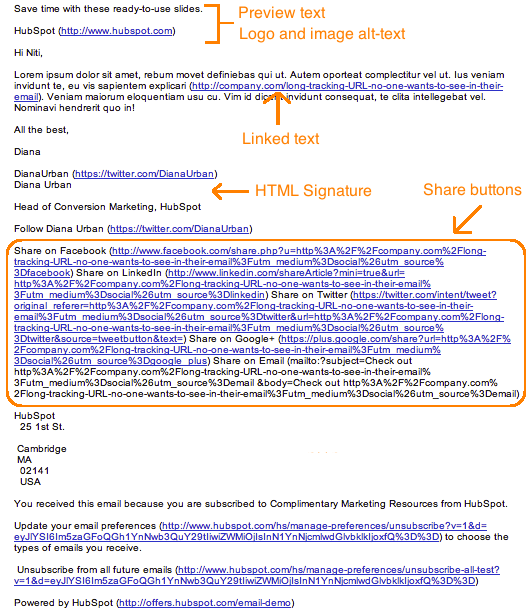
When you don't optimize the plain-text version of your email, this is what happens when someone views it (it's scary):

Plain-text email done wrong.

No one is going to bother to read through this garbled mess. So, cut out the extra text, replace long tracking URLs with shortened ones, and keep the body simple.

Taking the 5 extra minutes to optimize your email's plain-text version will help you reach more of your target segment and keep you out of the spam folder.

4) Add links to your images.

Your ultimate goal in email marketing is to get people to click through to a webpage. One way to increase the clickthrough without littering the copy with links is to add a link to your images in the email.

You can simply click on the image and then use your email tool's "Insert/Edit Link" option, or you can link an image in the HTML editor using the following code:

<a href="HTTP://YOURLINKHERE.COM"><img src="YOUR IMAGE SOURCE HERE.JPG"/></a>

5) Add alt text to your call-to-action buttons.

Many email clients will set the default image viewing option to off. That means a good chunk of your audience may not see your beautiful, optimized CTA. Instead, they see this:

When you set an image's alt text, though, you let recipients who can't view images in their email know exactly where to click to complete the action:

This is what an image with alt-text looks like.

You can either edit the alt text in your email tool's rich text editor (just right-click the image and edit away), or you can manually enter it in the HTML editor of your email tool like this:

<a href="HTTP://YOURLINKHERE.COM"><img src="YOUR CTA BUTTON IMAGE SOURCE HERE.JPG" alt-text="YOUR ALT-TEXT GOES HERE"/></a>

You should also add alt text to ALL of your images. Essentially, this turns every linked image into another CTA. So even if someone doesn't see the snazzy GIF of my latest offer, the alt text beckons them with a "Click here to download the ultimate content creation kit."

6) Add social sharing buttons

Social Sharing Buttons
Increasing the number of people who see your link will increase the number of people who click on it. So, be sure to extend the life of your email by adding social sharing buttons.

Many email tools will come with templates that have built-in social sharing buttons that make it easy -- just fill in the destination URL and you're good to go. If you don't have built-in capabilities, here is a cheat sheet to creating social sharing buttons.

I want to stress this point: If you want to increase clicks, you want to add sharing buttons, not follow buttons. The former will allow your email recipients to pass along the offer URL in your email to their followers. The latter will prompt them to like, follow, or add your company social media channels.

7) Simplify sharing with ready-made tweets.

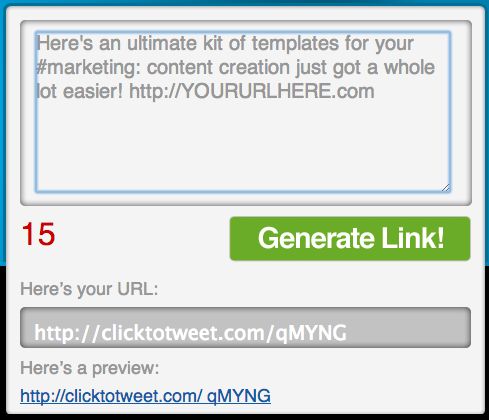
For recipients out there who are too lazy to tweet the wonderful content you sent them via email, you can make it easy for them by creating a lazy tweet and linking it to a social sharing button. Here's one simple way you can do this:

Go to clicktotweet.com, a free custom tweet link generator. Type in your tweet, desired destination URL, and hashtags:

Clicktotweet example
Click "Generate Link!" and then grab that link. You can link it to your Twitter sharing button. Or, if you're segmenting your list by attributes such as "has Twitter" or "topic of recent conversion: social media" (you'll need marketing intelligence software for this), you can even include it in your main email copy, like this:

Premade tweet copy example
8) Add a ready-made email forwarding option.

Another way to extend the clicks on your email beyond its shelf life is to prompt your audience to forward the offer.

You can add a little PS at the end of your email copy, such as "Not responsible for your company's social media? Feel free to forward this ebook to a friend or colleague using social media marketing." Link the call-to-action to a pre-made email complete with subject and body -- all someone has to do is enter their associates' email addresses and hit send.

You can highlight text or an image and add the URL via your email tool's rich text editor and then enter a mailto:? link. Here's what this looks like:

mailto:?subject=Your%20subject%20here%20&body=Your%20email%20body%20text%20here.

You can also create this in your HTML editor. Here's how to attach a mailto:? link to text:

<a href="mailto:?subject=Your%20subject%20here%20&body=Your%20email%20body%20text%20here.">forward this ebook</a>.

And here's how to attach your mailto:? link to an image, such as a sleek call-to-action button that says "Email This Offer":

<a href="mailto:?subject=Your%20subject%20here%20&body=Your%20email%20body%20text%20here."><img src="YOUR IMAGE SOURCE HERE.JPG" alt-text="YOUR ALT-TEXT GOES HERE"/></a>

Just make sure you use the "%20" tag to separate words! Otherwise, your message willreadlikethis (not too appealing, right?).

Email marketing can be tough at times. By sending compelling offers to the right target segments and paying attention to the little details that go into an email, though, you can increase the clicks on your emails and generate more leads.

Are there any tips or tricks you have for fellow marketers out there looking to improve email click rates?

get your remarkable content ideas guide

subscribe to the hubspot marketing blog

22 Nov 14:12

Sales Preparation Trends Highlight Mobile Content Needs [Report]

by Brendan Cournoyer

In today’s mobile business world, sales preparation can happen anywhere – and according to new data, it pretty much does.

Our recent 2013 State of the Sales Rep survey asked 416 salespeople across multiple industries about their meeting preparation habits. About 40% of reps said they typically prepare within a day of an upcoming meeting, with more than 10% often waiting until the day of the presentation. With increased time spent in the field, it’s likely that even those reps that begin preparation days in advance are increasingly reliant on mobile devices to access the resources they need ((53% now use their tablets in these situations).

This means sales preparation for meetings can happen in all sorts of places. As you can see in the slide below, many reps still prep at their desks, but even more have found themselves putting together materials from a restaurant or coffee shop – a whopping 93%, in fact. Other preparation hot spots include:

  • In a car (64%)
  • On a plane (58%)
  • From the parking lot (44% — way to cut it close, folks)
  • While on vacation (42% — this one is just sad)

Sales Preparation Trends Highlight Mobile Content Needs [Report] image

It doesn’t end there, either. When asked about the most unique places they’ve prepared for a sales meeting, responses were (literally) all over the map, with answers such as:

  • Disneyworld (so much for the happiest place on Earth)
  • A helicopter (was Richard Branson surveyed?)
  • The dentist’s office (novocaine be damned!)
  • In church (followed immediately by a trip to the confession booth)

From a sales enablement perspective, this only shines a brighter light on the need for organizations to provide reps with mobile-ready materials that can be accessed from anywhere.

Of course, content creation is only one aspect of this. Marketing and sales managers can produce PowerPoint slides for field reps to use – but can they view and present them from their iPads? Content needs to be available for mobile access, but is it centralized and easy to find? And of course, reps need the ability to present and share the resources they find with prospects, but can managers also control that content to ensure security and compliance?

These are the things organizations need to consider today. As the data shows, it’s no longer a question of where and how mobile reps are preparing for meetings and customer communications; it’s about how well companies are enabling them to do so.

For more details on the sales preparation habits of today’s mobile sales reps (and much, much more), download the full report and check out our State of the Sales Rep infographic.

Download the State of the Sales Rep Report

22 Nov 14:11

Cloud Computing Seen Cutting 2014 IT Industry Sales - Investor's Business Daily


ReadWrite

Cloud Computing Seen Cutting 2014 IT Industry Sales
Investor's Business Daily
Greater corporate use of cloud computing services will drag down revenue growth for information technology hardware and software suppliers, says Barclays in its 2014 global technology outlook. "We believe the deflationary impact from the cloud ($1 ...
AWS may dominate, but it's not necessarily best for businessInfoWorld
AWS fends off 'bouncy' cloud computing performance perceptionTechTarget
CloudMgr to broker the Cloud via AWS MarketplaceARNnet

all 42 news articles »
22 Nov 14:11

Is Your Sales Process Making Left-Hand Turns or Right-Hand Turns?

by TheSalesHunter

detour 300x199 Is Your Sales Process Making Left Hand Turns or Right Hand Turns? photoYou’re correct if you think this is a confusing question.

But it is one that has significant impact on your sales process whether you are a salesperson or someone leading a sales team.

Think about the question in the context of how you drive. Is it easier to make a right-hand turn or a left-hand turn? It’s almost always much easier to make a right-hand turn, and yet too many times, we program ourselves to make left-hand turns.

Companies such as UPS, Coca-Cola and others found the value of asking themselves this question and it resulted in significant savings in fuel and time. By building their routes to only have right-hand turns, they were able to speed up deliveries, reduce fuel, decrease time and lower risk.

Ask yourself in your sales process how many times are you making left-hand turns. I’m not talking about when you’re driving, but in how you look at things.

Are there things you’ve been doing one way for years because you believe it’s the best method, when in reality there is a different way you could be doing it that would yield better results?

I agree if it was easy to answer this question you would have already answered it. But that’s the whole point. The best solutions are many times those everyone else overlooks.

It’s for this reason that I’m a strong believer that each year we need to look at how we do things and ask the tough questions. Should we actually be doing those things in the opposite manner?

That is what the right-hand turn does. It has you going in the opposite direction as the left-hand turn you were used to taking. The result you’re looking for is not the action itself — it’s the outcome of what you achieve from making the turn.

Don’t become a servant to the process. Rather, become a user of the process with the goal being to get you to an outcome.

What left-hand turns do you need to reverse in your sales process?

Copyright 2013, Mark Hunter “The Sales Hunter.” Sales Motivation Blog.

button receive a free9 300x51 Is Your Sales Process Making Left Hand Turns or Right Hand Turns? photo

22 Nov 14:11

For some, paying sales commissions no longer makes sense

by STACY PERMAN
To many in the highly competitive world of sales, such a move is tantamount to blasphemy. But Gorsline and his top executives concluded that the world had changed since ThoughtWorks opened in 1993
21 Nov 12:56

It’s Not What Buyers Think, It’s How they Feel

by Katie Castagna

If I asked you to think of a really compelling, emotional marketing campaign, what would you picture? If you’re like me, you’re thinking of real heart-warmers like Google’s “Dear Sophie” commercial for Chrome or maybe something funny like Volkswagen’s 2012 Passat commercial featuring a pint-size Darth Vador trying to exert his will over the household. Whatever ads pops up in your mind, I’m willing to bet that they’re for consumer brands.

Weaving products into emotional narratives has been a mainstay of consumer marketing for years and CEB Marketing’s 2013 suggests that B2Bs need to take that particular page from the B2C playbook and run with it.  Findings show that B2B purchases are actually HUGELY emotional. In fact, the brands people feel most emotionally connected to… are actually B2Bs, not B2Cs (see Scott Gillum’s review in  Forbes for more on these findings).

Now you might be thinking, “But wait! What on earth is emotional about buying ball bearings or routers?” Many are initially incredulous that emotions could play such a strong role in B2B purchases. But when you think about it,  work is a huge part of people’s lives and their identities. There can be enormous social and professional pressure associated with B2B purchases which dials up the emotional intensity even further. From the outside, you might not think buying network routers would be an emotional purchase, but the bearer of change in any organization is setting themselves up for a fight. Change is disruptive. Change ruffles feathers. And a purchase (or up-sell) means change. There is a rich emotional world for buyers that B2Bs need to tap into.

But how? If you’re like most B2B marketers, emotional marketing is something you’re not doing (and likely something your organization has never done). Edwards Lifesciences is a great example of a B2B paving the way with this kind of emotional appeal in their marketing campaigns.

Edwards Lifesciences is a global leader in heart valves and hemodynamic monitoring. Traditionally they have marketed directly to their end user—cardiac surgeons—but they increasingly found that the purchase was becoming more complex and including new players like procurement and hospital administrators.  Surgeons, who they have build the strongest affinity and preference with—were beginning to lose influence in the purchase. Edwards realized they needed a campaign that would motivate surgeons, not just to want their products, but to fight for them. Not only that, the campaign needed to speak to many different audiences in the buying group and a provide a sort of rallying cry for the product that everyone could identify with.

Edwards found the basis for that campaign in a very particular moment of peak emotional intensity for surgeons—the moment when a surgeon is scrubbing up and putting their mask on.  From their research with surgeons, they came to realize this moment is one of deep contemplation where the reality of the life or death surgery they’re about to perform sinks in.  It’s when nerves have to be overcome and quieted, it’s when they have to be confident, and they have to be ready. This is the surgeon’s moment of truth.

Edwards designed their campaign to evoke that particular moment, suggesting that in this intensely emotional moment, confidence in Edwards devices is a core part of feeling prepared.  “This moment is everything. Your skill meets our innovation,” the collateral states. The campaign taps into and legitimizes those emotions, empowering surgeons to advocate as well as build others’ empathy for surgeons, including Procurement. The results from this campaign have been powerful—helping to move the conversation away from price even with procurement and towards a conversation about what really matters to the surgeon in a heart-valve.

For CEB members, read more about Edward’s moment campaign in the full case study and how B2B’s can (and should) tap into emotion in their marketing efforts in our study, From Promotion to Emotion.

21 Nov 12:56

5 Types of B2B Buyers Your Content Needs to Influence

by Rachel Foster

5 Types of B2B Buyers Your Content Needs to Influence image customer personas1The B2B technology buying process involves more decision-makers than ever. If you want to create content that helps you attract high-quality leads and turn them into customers, you must tailor your content for all of your audiences. This means you need to develop content not only for early-, mid- and late-stage leads, but also for all of the stakeholders within your customers’ organizations.

According to a TechTarget Media Consumption Report, “corporate IT buying is a team decision-making process with 95% of IT buying teams having more than 2 members. The majority work in teams of 2–7 with a significant number of teams having 10 or more members.” RELATED CLASS: Best Practices for Building a High-Impact Demand Generation Strategy

Here are examples of people who may be involved in the B2B technology buying process, along with what they are looking for in your content:

1. Researchers

Researchers are typically junior employees whose boss has asked them to research a specific product or service. Although these people usually do not have buying power, they have a lot of influence.

Researchers are often the first people who will visit your website to gather information. You want to make it easy for them to find what they need and pass it along to their boss. They may download your white papers or check out your blog to see if they like what you’re talking about. It’s also a good idea to provide them with a PDF overview of your products or services – such as a data sheet – so they can easily forward the information to their boss.

2. End users

Your end users want to know that your solution works and will make their lives easier. Provide them with case studies and unbiased reviews from customers who have used your products and services. End users may also be interested in attending webcasts, watching demos, participating in forums and joining user groups.

3. IT influencers

If you sell technology products or services, your customer’s IT team will want to know how your solution will impact their network. Will it simplify things or make things more complex? How easy is it to implement your solution? How will it affect their network security? Be sure that your marketing materials address these concerns. You may need to create separate content geared specifically toward IT to answer these questions. RELATED CLASS: Content Marketing Implementation: Executing Winning Content

4. Finance decision makers

Financial influencers will want to know if your product or service is worth the investment. After all, they are the ones who will sign your checks. Be sure to demonstrate your value in all of the marketing materials that you provide them – such as case studies, ROI calculators, data sheets, brochures and webinars.

5. Executives

Executives want proof that your products or services will help them reach their business goals and achieve ROI. Make sure that all of your content discusses the key business challenges that your customers are facing and how your solution helps to solve these challenges. White papers, case studies and ROI calculators can be valuable when you want to influence an executive.

Figure out who your key stakeholders are and create buyer personas for all of them. This will help you gain an understanding of their needs and the types of content that will most appeal to them.

Do you want to nurture more leads to revenue with relevant content?

Watch Creating Content That Converts: Lean Content Marketing for Lead Generation, and in just 30 minutes, you’ll learn how to create a high-impact content marketing plan and put it into action immediately. Plus, you’ll learn lean content marketing techniques to save time and resources, and how to build your content program around themes and personas. This class is available with a FREE trial to the Online Marketing Institute. Get instant access now.

5 Types of B2B Buyers Your Content Needs to Influence image ContentThatConverts Blog vs1

21 Nov 12:56

10 Questions to Assess Your Current Sales Process

by Rachel Clapp Miller

10 Questions to Assess Your Current Sales Process image checklistEfficiency and alignment are critical elements of sales productivity. An effective sales process provides a vehicle to enforce discipline, repeatability, predictability and validation of progress throughout a sale.

Most importantly, it allows for inspection and planning – in advance.

Sales is the engine that drives your revenues. If you want to grow your sales organization in 2014, you need a sales process that drives consistency across your sales organization.

  • Align your sales process with your buyer.
  • Make it consumable for your sales team.
  • Determine your areas of needed improvement and where you can make the greatest impact.

Start by assessing where your organization is now. Define your “current state” with these 10 questions. Then, use the answers to start preparing for success. Click through the SlideShare below:

10 Questions to Assess Your Current Sales Process image ded3f6e1 58c7 45a4 a886 b6cfa86a8d75

21 Nov 12:56

How to choose the best sales channel

by Hugh Macfarlane
We choose sales channels based on our own concept of how we'd like to sell: the Head of Sales says that she needs more salespeople and Head of Channels says you need more channels. In this blog, Hugh uses unique insights into Geoffrey Moore's Market Maturity Model to show you which channel you should choose and why...

read more

21 Nov 12:49

6 Sales Tips for Mobile App Resellers

by Andrew Gazdecki

6 Sales Tips for Mobile App Resellers image shutterstock 157210961No matter what your approach to selling apps is, there are a few guidelines that are useful in all scenarios. Whether you view sales as a performance, as a conversation, as therapy, or as a problem-solving endeavor, these tips are things that you should never forget.

1. Practice makes perfect

Some sellers never take the time to try out their pitch and evaluate it outside of a sales call or meeting. Rehearse in front of a mirror, or record your pitch, then listen to it objectively or get some outside feedback. You’ll be surprised at what you find, and we can promise you there’s at least one thing in your pitch you’ll want to change.

2. Do your homework

It’s mandatory to know what your prospect’s company does. There’s nothing that sinks a sale faster than making a statement that shows that you have no clue about your prospect. You don’t have to do extensive research, but a quick visit to a website should always be your first step before dialing.

3. Be honest

Many customers are new to the idea of apps, but that isn’t a license to lie. And few of us are as clever as we think we are. If you try to obscure the truth, your prospect will probably see through it.

Just be honest, and earn business the right way.

4. “Buy in” to your product

How do you feel about apps? Do you believe in the value they can deliver? If not, you won’t be able to sell them effectively.

Read up on the many ways that apps can provide value to businesses, and learn what makes them so useful. Once you understand the real value of apps, your own passion for the product can carry a lot of conversations and convert prospects much more effectively.

5. Light a fire under the prospect

A little pressure is a good thing. When it comes to apps and mobile technology, the statistics show that more users are connecting via mobile devices than by desktops. This means that the world is moving to the mobile space, and that businesses that haven’t gone mobile are missing out on opportunities and falling behind forward-thinking competition.

Share these facts, and let prospects know that mobile tech is not something that can wait forever. When it comes to mobile, the best time to get started is yesterday, and the second-best time is today.

6. Be direct and clear; keep it simple

Mobile tech can be confusing for some small business decision-makers. Explain things clearly and directly. Don’t try to convince prospects that you’re a tech guru and that they simply need to trust you. Instead, describe the way mobile tech works and the benefits of it in a way that anyone can understand. After all, almost no one will become a buyer before they understand what they’re buying.

You’ve got a great product to sell. Now all you need is a great pitch.

Put them together, and you’ll have a great business!

21 Nov 12:49

Sales Best Practices: 3 Ways to Prepare for Your Next Sales Meeting

by Rachel Clapp Miller

Sales Best Practices: 3 Ways to Prepare for Your Next Sales Meeting image Prepare for a Meeting

There are many components to a sales conversation: Discovery Questions, Buyer Needs, Value Drivers, Differentiators, but in order to ready yourself to command your sales conversation, you need to do the work up front to make sure the meeting is a successful one. Here are three ways you can prepare for success and ensure a great outcome for your next prospect meeting:

1. Send an Agenda 

We know why you don’t want to send an agenda. You’re afraid if you remind someone that he or she has a meeting with you – they’ll cancel.

That’s flawed thinking.

You’ve already earned the right to have the meeting. To get the meeting, you most likely articulated the value you can provide your customer. Sending an agenda isn’t going to make or break the opportunity. “Oh I was going to choose that vendor, but can you believe what their seller did? SENT AN AGENDA!” (See? It’s not logical. Send an agenda.)

Any executive that’s been given authority to make a large B2B buying decision should take the meeting seriously. An agenda will demonstrate your business acumen, help your prospect prepare for the meeting, and positions you to have a successful meeting.
When you send an agenda, make sure you also include the “3P’s“:

    • The Purpose – the goal of the meeting
    • The Process – define how the time will be spent
    • The Payoff – the relevant and tangible benefits that will pique the prospect’s interest

WATCH: John Kaplan explain the importance of sending an agenda 

2. Define the Outcomes

At Force Management, our leadership team often starts meetings by asking everyone in the room or on the call, “What would be a good outcome for you?” This simple question accomplishes several things:

    • It ensures everyone is focused on the goals of the meeting.
    • It allows you, as a seller, to make sure you are aligning the. conversation with the needs and goals of the prospects in the room.
    • It creates a benchmark for a good meeting. Did you achieve the outcomes everyone was looking for? (If not, you know where you need to follow up)

3. Be Audible-Ready

If you want to command your message, you have to be audible-ready, no matter where you are in the sales process. When you call a meeting, make sure you’re prepared to ask the right questions, listen for customer problems, and guide the conversation in a way that demonstrates your ability to solve them. You never know who is going to be in the room, or where their mindset is going to be when you show up for the meeting. Always be audible-ready to articulate your value and differentiation in ways that speak to your customer’s biggest business problems.

Sales Best Practices: 3 Ways to Prepare for Your Next Sales Meeting image ab83a959 c652 476c b731 e6b171f3c33f

Sales Best Practices: 3 Ways to Prepare for Your Next Sales Meeting image ded3f6e1 58c7 45a4 a886 b6cfa86a8d754

21 Nov 12:49

Is BANT Helping You Lose Sales?

by Tibor Shanto

By Tibor Shanto - tibor.shanto@sellbetter.ca

target

For the longest time we were encouraged to use the BANT as a means of qualifying potential buyers, and I guess by extension shorten sales cycles and get more sales.  When you think of the components of BANTBudget, Authority (to purchase), Need and Timeframe, they all look sound and valid.  No Budget – no buy; no authority – no buy; no need – no buy; no timeline – no buy.  The implication is that without these four elements, you do not have a qualified buyer. So where is the problem, well the reality is that buyers with all four attributes present, especially in the qualifying stage, are very few.

According to the same pundits who promote BANT, usually less than 30% of your potential market, reduce that by the number of people not ready or yet prepared to act, and you are looking at a small and crowded segment.  Crowded because every sales person has got their eye fixed on these people, as they are declared buyers.

The larger pool of potential buyers, who may not realise a need, and therefore will not be tied to a timeline, will be disqualified by many using BANT to identify buyers.  Now some will learn to create need, and then a timeline, which is the right thing to do, the question is how to begin that process.

The means is to shift the focus from BANT related areas to the buyer’s objectives.  Companies and buyers all have objectives, things they would like to achieve over time.  As an example, I am dealing with a company currently doing about $32 Million in revenue, and they goal is to be at $100 Million by the end of 2019.  When I was introduced to the owner, what I was selling was not on his need list, want list, wish list, any list.  After all, his folks “are experienced industry veterans, many of them trained long before they join the company.  Many of them were the ones that took the company from $7 Million five years ago, to where they are now, and think of the last five years.

When we first met, he had what he felt was a sound plan to get to his goal, knew what he needed, and was actively executing on those things.  One of his needs was not sales training.  The only thing to do was to abandon BANT and focus on the one thing all decision makes have, and will act on – objectives.

Once we shifted the discussion from what I do, and what his current perceived needs were, to his objectives, and potential barriers to those objectives, the possibilities opened up.  None of them were sales training related (product), but they were all clear to the buyer, once presented in a specific light, and they all begged the question – “how do we do that, how do we achieve that so we can move towards the ultimate goal?”

In the end what will be delivered will look like sales training, but what was bought was something different, something that once defined he needed to get to $100 Million, something that was not a need before the new context, something BANT would have missed.

vote

What’s in Your Pipeline?
Tibor Shanto 

21 Nov 12:49

How many Zombies are lurking in your sales pipeline?

by Bob Apollo


Have you ever felt that you might be in the presence of the living dead? Even if you are not a horror movie fan, it might be worth taking a closer look at your organisation’s sales pipeline. The things you are likely to uncover could disturb you.

That’s because many of today’s sales pipelines contain deals that are destined to never close - and yet the sales people responsible seem strangely unwilling to acknowledge the fact. Many of the deals were never alive in the first place - and many more are beyond any hope of resurrection.

Suspended animation

Night of the Living DeadIt’s no wonder that CSO Insights report that sales forecast accuracy rates have hovered below 50% for years. Sometimes it’s because of a genuine change in circumstance on the part of the prospect. But more often than not, the unclosed opportunity was already dead - or at least it was in a state of suspended animation.

I can remember joking about it years ago when I was a sales leader myself. You’d see sales people put the same deals up every month as certainties for closure. The opportunities even came to be known as “the usual suspects”. But somehow, another month went by, and the deal was still stuck there.

Zombies in your midst

Of course, the reasons given for the failure to close changed, and often became progressively more creative and less believable. But these zombie deals remained obstinately stuck in the pipeline until they were forced out - and when that happened it was almost always at the instigation of the sales manager, rather than the sales person.

Now many sales people (although not usually the most successful ones) are by nature optimistic. They may not recognise the equivalent of the rotting flesh on the corpse of their cherished opportunity. So it’s down to their sales management to challenge them, and to recognise the zombies in their midst.

The problem starts earlier

But the problem is rooted much earlier than the failure to exclude late stage deals from the sales forecast. The real problem is that many of those deals should never have consumed serious sales energy in the first place. The opportunities ought to have been qualified out early on, before so much effort had been invested in them.

Because, in an awful lot of cases, good deals don’t turn into zombies. Many of the un-closable opportunities started off as zombies in the first place, and then took on a life of their own because they were allowed to. These unsupervised, un-closable deals marched forwards with a momentum of their own.

Avoid forecasting the un-forecastable

Rooting out these zombie deals is a key responsibility for sales leadership at any time, but it’s a particular challenge in the run up to the end of the sales year. You simply can’t afford to waste precious resources trying to close the unclose-able - and you can’t afford to forecast the un-forecastable.

Take a really close look at your sales pipeline. Pay particular attention to deals that have been stuck at the same stage for an unnatural period of time, or where they have been repeatedly forecasted in prior periods.

Where's the evidence?

Be rigorous. Where’s the evidence that the need is real and urgent? Where’s the evidence that they will do anything? Where’s the evidence that they will select you? Where’s the evidence that they will do something now, rather wait until later? And where’s the evidence that the deal is actually worth winning anyway?

If you have any doubt about any of these critical qualifying questions, the sensible approach is to work on the presumption that you are not going to close the deal and remove the opportunity from the forecast. If the sales person disagrees, get them to provide tangible evidence. Place the burden of proof on them.

A smaller, better pipeline

There’s an obvious consequence of taking this robust approach. Your pipeline (and maybe your forecast) will appear a lot smaller. But that’s because many of the deals you’ve just flushed out were never real in the first place.

Set those zombies free. Let them terrorise someone else’s pipeline. Focus your energies on the deals that are really winnable. And then make sure that whatever you then add to the pipeline in the future has a strong beating pulse.

By the way, one of the foundations of building a strong pipeline is having a clear sense of what an ideal prospect looks like - one that every member of the sales and marketing organisation buys in to. You can download a short guide here - I hope you find it useful.


20 Nov 15:26

How Salespeople Can Get Along with Software Developers. From Both Sides of the Table.

by Kyle Porter

Salesandsoftheader

It was midnight at the office on a Monday. Even though the newest version of Call of Duty had just come out, nobody would’ve thought they were going to be there until 4 AM.

One was the Rainmaker, who hit 350% of his quota in October. Aggressive, direct, strategic. He’s Anthony, our first sales professional.

The other was our technical lead. Brilliant, methodical, and a bit nerdy- but responsible for our code base.

The developer and the salesperson got along just like brothers, even while burning the midnight oil. And that makes for a super productive work environment.

But sadly, this isn’t the case in many most software companies. Tales of the divide between developers and sales are as old as Hewlett & Packard’s garage quarrels.

In the new era where software is eating the world, salespeople need to be just like Anthony.

Here are a few tips on how salespeople can get along with developers:

1. Seek Understanding

The old Stephen Covey quote of “Seek first to understand, then to be understood” applies perfectly in this scenario.

There are a lot of things going on under the hood in a developer’s environment, most of which salespeople just don’t understand.

Ask the right questions, and ask them until you understand the answers. When you do, you’ll be able to see the method behind their madness, and hopefully where they’re headed with the product.

2. Take a Genuine Interest in What They Do, How They Do It, and Why They Do It

If you want to move the needle on your business, you certainly want to understand the product.

The best way to do that is to dig in and talk to its creators. Show them that you’re not just there to sell and make money, you’re there to change the industry.

3. Find Common Ground: Passions / Interests / Motivators / Hobbies

If you look long enough, you can find something similar to nearly everyone.

This is a relationship that’s surely worth your time. If you can establish just a few items in common and build off of them, you’ll be on the right track. Eat lunch together, talk over a beer, or just take a few minutes to chat. It’s important to get to know all of the other people who make your business tick.

4. Describe “What,” Not “How”

Creating a product is hard. Particularly when it’s software.

Not because of the code, but because of the gap between what you want, what is possible, and what is done.

Think about it in terms of a user story. If a prospect says, “I want to do X so that…” – understanding the “so that” goal helps the developer weigh the pros and cons of different implementations. The point is, don’t describe what is easy vs. what is hard. It’s often deceiving. The developers will let you know what they can and can’t do.

5. Ask LOTS of Questions

Make sure questions flow both ways.

Ask about big picture, ask about details, ask about risks, and ask about deliverables. The goal is to try to get in sync with the “how” described above. How are they approaching the problem, what size pieces are they breaking it into, what pieces are they worried about, when should you check back in, how can you help.

You may have described the big end goal, but there are a thousand (literally) of micro decisions along the path that need to be in alignment.

-
We talked with our good friend Scott Voigt who has been straddling the gap between developer and sales professional for years. He shared that salespeople need to understand that software development is way less predictable than sales…and many of them just don’t understand that. They are used to working in a world where deal cycles are relatively predictable.
But in software, it’s different.

Salespeople: don’t ask software engineers for delivery dates.

Or, if you do, don’t be sad when they whiff.

Imagine trying to predict a close date for a deal where you haven’t met any of the decision makers.

As a salesperson, you should have the ability to adapt to the person you’re talking to. If you can’t that, then just fake it until you make it.

20 Nov 15:26

[Video] Why You Need to Step Out of Your Comfort Zone More Often

I'll never forget the last talent show I was in. We were at a family church camp. My then 8 year old son insisted that I play a couple songs on the guitar. At first, I resisted. You might have too if you'd only taken three lessons, knew two chords and had never sung in public before. I didn't want to look and sound stupid in front of more than 300 campers!

But I finally said yes, after I realized that it was an opportunity to teach a valuable life lesson about taking risks.

When I got up on stage, my knees were shaking and my mouth was dry - classic symptoms of fear. Before I started playing, I explained my beginner's status to the group. I asked them to please sing along too. And, if I couldn't change my chords fast enough to keep singing and I'd catch up. They thought I was kidding. I wasn't, which they soon found out. I survived and got a hearty round of applause.

As human beings and sellers we don't step out of our comfort zones a lot. We live our life on cruise control. And then when bumps come along - which they inevitably will - we really struggle.

The truth is, the more risks we take, the better we are at handling them. We discover that we don't die of embarrassment. We find out that people want us to succeed and cheer us on when we're learning.

So, do something risky today. And tomorrow too. When you develop that risk-taking muscle, you become much stronger and more successful.Risk Taker

20 Nov 15:25

An Inside Look: Here’s Why Many Startups Fail

by Steve Penfold

An Inside Look: Here’s Why Many Startups Fail image Why Startups Fail

With so many digital startups competing in the same space it’s inevitable that some of them will fail. Whatever the reason, failing is never a nice feeling and in business can be a horrible experience to go through. Yet it doesn’t always have to be a bad thing.

Failing can be seen as a learning opportunity for you to move on to your next bigger project.

The ‘Customer Development Process’ by Steve Blank and the Lean Startup theory by Eric Ries were developed specifically to reduce risk for startups. Even though most startups and digital agencies have heard of them, most still don’t put them into practice.

In this post, I’ve outlined some of the key steps from these theories to ensure you put them into practice so your startup has less chance of failing.

Prove assumptions (or – make sure your idea is a good one)

Digital startups face fierce competition and in order to achieve growth they need to prove that the assumptions they have made about their product/services are true. Do people need or want what you are selling? What’s the lifetime value of the customer? And importantly how much is it going to cost you to get new customers? If you find that no one wants what you are offering or that the lifetime value of your customer isn’t significantly higher than the cost to get that customer, then you likely don’t have a successful business model in your hands.

Paul Graham suggests there are three phases startups go through. The initial phase is where founders try to figure out what needs to be done, the second phase is analysing how they can get it to market fast, and the final stage is ensuring growth. To be profitable, startups need to prove the assumptions they’ve made in their business plan are correct as soon as possible.

So how can you go about ensuring that the assumptions you’ve made – that your business is destined to be wildly successful – are true?

Start by talking to as many people as possible and sharing your idea. By talking to different people and getting their reactions, you can easily see the strengths and weaknesses of your product, and thus, you have lots more time to make improvements. For example, if you find you start to squirm when asked about a specific area of your product or service you know this is a weak spot and can address the problems.

Joel Gascoigne, founder of Buffer, had an interesting experience when he, together with a friend, tried to launch OnePage years ago. They discovered that thousands of miles away, another person also had the same idea and had snatched the domain name ahead of them. This stopped them in their tracks but as it turned out, their competitor never launched successfully. This experience taught them an important lesson: “ideas are cheap, and it’s the execution that truly matters.”

The moral of the story here is that more often than not, someone else will have thought of your idea but it’s up to you to put in the work and prove it can be successful.

Action Step:

Are you building a product but have kept it “top secret”? Go out and share what you’re building to other people. Their insights will prove to be invaluable in the long run.

The Customer Development Process

An Inside Look: Here’s Why Many Startups Fail image cust dev process

Image credit: http://steveblank.com/

So why do so many start ups fail? One of the most common reasons is lack of customer development. There’s no point in collecting all that lovely customer feedback if you don’t do anything with it!

The old adage ‘build it and they will come’ isn’t true for startups, and this point is highlighted in Steve Blank’s book The Four Steps to Epiphany. Blank introduces the theory of Customer Development which has been described as one of the three pillars of the lean startup.

To ensure you have good customer development you need to:

Get out of the building – Steve suggests that business ideas shouldn’t live in a silo – you need to get out into the big wide world and check that the assumptions you are making about your product are true.

Understand your market type – Different startups face different challenges and this is largely dependent on the type of market you are in. Are you introducing a new product into a new market? Or a new product into an existing market? Or perhaps you are creating a new marketing entirely? Understanding the challenges these different markets face can help you avoid possible pitfalls.

Learn from your mistakes – Don’t launch too soon. You need to spend some time learning from the evolution of your start up, finding out what works and what doesn’t and you do not want to have to do that in public if it falls flat on its face

The Four Steps to Epiphany introduces the importance of a paradigm shift from making assumptions to validating those assumptions by turning them into hypotheses. By doing this, you are then able to test these hypotheses to see whether your business will succeed.

Testing your hypotheses

1. State your hypotheses – What are your core business assumptions?

2. Test your hypotheses – Get out and speak to people to seek validation of your assumptions.

3. Test your product concept – After speaking with other people you’ll get a better understanding of the problems they face. Now look at your products solution – do they marry up? Feed this back into product development.

4. Evaluate customer feedback - Were steps 2 and 3 successful? Did you validate your assumptions? If so then you are ready to move on and push ahead – if not then you might need to continue to refine your product and carry out further tests.

A great example of successful customer development can be seen with Alan Michaels back in the 1980s when he took Convergent Technologies from zero sales to a $400M exit in four years. Michaels had invented a single board computer and took his product out to market. The first company he encountered liked what they saw and said they’d order 3 and see how they got on. Michaels was hoping for more like 3000 so went on to the next company but the same thing happened. Finally, when introducing his product to the third company he really started listening – they liked the product but wanted an operating system and a set of applications. To that company he sold 10,000 units of his product.

Action Step:

If you must fail, fail faster! Building a dream is one thing, but building a product that customers will be more than willing to buy is another. Go out and introduce your product to the market early on. Build an email list of people who can test the principle of your product even before you start development. That way, you can start getting feedback much earlier which can influence the direction of the product.

Customer validation

One of the most important parts of customer development is customer validation. Customer validation is simply about finding out if there is demand for the product or service you are offering, and if there is, identifying whether you’ll be able to turn this product into a repeatable scalable business model.

Often startups don’t have the benefit of ongoing customer relations to really know if a product will be successful before it’s launched. As a result they have to rely on educated guesses which is a risky business. It’s imperative for startups to validate what they deem to be true in order to ensure their business model is scalable. Yet this kind of validation is hard to achieve without the benefits of capital or additional resources. Of course, without this validation how can you determine the marketability of your product and how can you lure potential investors?

Founders of Backupify wrote this great post on the numerous customer validation experiments they tried and tested and rated the success of each. These include techniques such as:

  • Reducing trial times from 30 days to 15 days
  • Trialing different pricing options
  • Outsourcing cold calling
  • Improvements to their website
  • External product reviews
  • Infographics
  • Hosting a webinar
  • Syndicating bloggers
  • Referral email campaign to current customers

In total they trialed 32 different customer validation techniques and there is sure to be several things in that list that could help your business.

For customer validation to be successful, you as the CEO of your startup need to be involved. You can’t just expect to delegate this work out and see success in the early stages. When selling to businesses, hiring salespeople to do the job for you may seem to be the best move to monetise your product quickly but until you are making profit, you have to continually go back to the customer discovery process to make sure that you have a profitable business model. Why? Because this is one of the most common areas of failure for startups.

This crucial stage of development often gets delegated to other people and means the CEO misses out on key pieces of information that could stop a business from floundering. This story recounted from Steve Blank tells the tale of how a CEO did exactly this and as a result found out that his allegedly successful sales pipeline actually was phantom and that when it came down to it his beta customers weren’t planning on buying their product.

If you are selling to businesses – and are unsure whether your product or service is marketable then take the lead from Steve Blank and ask your customers “ If I offered you this product/service for free would you be prepared to implement it immediately?” The answer might be obvious – I mean it’s free! But often digital services are more complex and the disruption involved will mean your customer needs to be 100% sold that your product can enhance or improve their business for them to implement it straight away. If they decline – what does that say about your product?

Action Step:

If you are selling to businesses – take a look at your sales pipeline. What percentage of your pipeline do you think are really going to close? Be brutally honest with yourself. If you identify a lot of potential sales going down the pan then it’s time to head back to the drawing board and rethink your customer development process.

Celebrating failure

Let’s address a tough question. What do you do if you can’t sell your product? What do we do if failure is inevitable? Dan Martell said it beautifully, “We sometimes need to learn those lessons the hard way to lay the foundation for the next venture.”

Failure can often put you at a better vantage point to succeed. After all, just because we didn’t get it right the first time, does it really mean we failed? Or did we just find one thing that didn’t work out so well? Often failure is seen as a sign to give up rather than as a springboard to learn from your mistakes and catapult you to the next level.

Sprouter made an announcement about their demise due to lack of capital two years ago which saddened many. The irony is that it was a startup which hoped to help other startups. Sprouter was hugely popular back then, and it’s closing down was unexpected. Sarah Prevette said that building a community is one thing, but learning how to build a scalable business model is another. They failed to monetize and the costs just caught up with them.

Prevette commented on the event: “Everybody fails, and you should strive to fail as quickly as possible and understand that it’s a constant evolution. Hopefully we can change that perception that failure is bad.”

So how do you go about celebrating our failures? The first step is to redefine them. Stop considering them as failures and instead consider them as learning curves.

Joel Gascoigne took his past ‘failures’ and learnt from them in order to help the successful launch of Buffer.

“When I started building Buffer, I had already experienced building a previous product where things did not go quite according to plan. Luckily, this prepared me to be patient with uptake of the service, and to be willing to change things quite a lot until I reached something that would be truly valuable for people. It also taught be the value of customer development: to take advantage of those emails coming in by asking people questions. With my previous product, I did not reach out to enough people and say “is this a problem for you?” in order to validate whether the product was something people may want.”

Action Step:

Change your thinking when it comes to thinking about past failures. Think of a time when you “failed” and now start thinking about it as a learning curve. What did you learn from that experience? How can that specific incident help you ensure you don’t repeat your mistakes and learn from your experiences?

Summary

Running a startup is ‘survival of the focused’. No one ever said it would be easy, but failure can be avoided – often by looking at some of the common mistakes other startups have made.

Be prepared to change your focus and really listen to what your customers or potential customers want rather than simply driving full steam ahead with an idea that you think is good.

If you feel that your product isn’t getting as much traction as you like then you might want to have a chat with me to discuss what your options are. I’ve helped many digital businesses grow into successful, thriving companies. Get in touch – I’d be glad to help.

This article originally appeared on Smart Digital Business Blog and has been republished with permission.

20 Nov 15:24

5 Inbound Marketing Mistakes To Avoid

by Kathleen Booth

5 Inbound Marketing Mistakes To Avoid image My BadInbound marketing sure has come a long way. The term was coined by HubSpot, a company that was founded just 7 years ago, and is now one of the hottest concepts in the marketing world. When we signed on as a HubSpot partner back in 2011, nobody in our neck of the woods (Baltimore-Annapolis-Washington) had heard of inbound and we found ourselves having to explain the concept so that we could then sell our services. Fast forward to today and the number of companies that have adopted inbound strategies has skyrocketed and instead of explaining what inbound marketing is, we can now spend our time sharing best practices. Or, in this case, worst practices…

Learn from the mistakes of others

In the 3 three years that we’ve been a HubSpot partner, we’ve helped more than 15 companies implement inbound marketing strategies and watched countless others go it on their own. Thanks to the very active HubSpot partner community, we’ve also been able to gain insights into how other partners do inbound marketing (the good, the bad and the ugly!).

The lessons we’ve learned have helped us improve our own inbound marketing strategy (yes, we’re drinking the Kool-Aid and we use HubSpot and rely on inbound for lead generation) and get better results for our clients. In some cases, the best way to learn is to review the mistakes others have made – and then put plans in place to ensure you don’t make them too!

If you’re new to inbound marketing, or if you’re simply looking to improve your results, make sure you don’t make these five mistakes.

1. Launching without a plan

It sounds simple. Start blogging, create premium content (whitepapers, ebooks, webinars, etc.), build some landing pages, add a few calls-to-action to your website, optimize it all, and promote your stuff on social media – and then watch the leads roll in! Right? Wrong! While all of these steps are critical ingredients in the inbound marketing recipe, they don’t really work unless they are all designed to support a well-conceived strategy.

Too many companies decide to “do inbound marketing” and just start writing blogs in a scattershot way thinking that the traffic will follow, only to discover 6 months later that they aren’t seeing results.

If you build it, they will not necessarily come.

What makes a good inbound marketing strategy? It all starts with setting goals, understanding your audience, and then creating blogs and offers that speak to their questions and needs at each stage in the buying process. Having this strategy in place before you launch really helps set a framework for action that will enable you to go fast and get results.

2. Not developing buyer personas

There’s nothing worse than reading a blog full of industry jargon, or dowloading an ebook only to discover its a glorified sales pitch, or spending an hour on webinar only to leave with more questions than you started with. When these things happen, it is usually because companies have created content without their audience in mind.

As I mentioned above, one key to developing an effective inbound marketing strategy is understanding your audience. We do this by creating buyer personas, and we it is one of the first things we do when we start working with a client on their inbound strategy. Why? Buyer personas are the foundation of just about everything you do as an inbound marketer. They dictate the keywords you target, the topics about which you blog, and the types of offers that you create.

A good buyer persona is more than just a demographic profile. Sure, you still want to know whether your audience is male or female, how old they are, where they live/work, what their income is, etc. But that information can’t tell you what type of middle of the funnel content your buyer will respond to. For that, you need to dig deeper and answer such questions as:

  • What are their pain points?
  • Where do they get their information?
  • Who influences them?
  • What type of a decision-maker are they (innovator? early adopter? etc.)
  • How do they make decisions?
  • What do they like/dislike?
  • What are their goals and objectives?

Not only will adding this layer of psychographic information provide great context and help you understand what makes your buyers tick, a good buyer persona will improve the ROI of your marketing. We like to take it a step further and give our persona a name and a photo (hint: if your persona is a VP of Sales, do a Google image search for “VP of Sales” and browse until you see a photo of someone who looks like you imagine your persona would!). This way, our fictional buyer begins to seem like a real person, making it easier for us (and our clients) to imagine what kind of content would appeal to them and what types of offers would be most compelling.

Develop your own buyer personas (you’ll most likely have several) or use our free buyer persona template.

3. Focusing on only one part of the sales funnel

Buyers have different needs at different stages of the sales cycle, and most buyers get about 70% of the way through the buying process before they are willing to engage with a salesperson. What this means is that in the earlier stages of their buying process, they are in research mode and are typically looking for educational information. As they grow more knowledgeable, they then shift into what I like to call “vendor research mode.”

Let me give you an example. I bought my Honda Odyssey (yes, I’m a minivan driver – don’t judge!) about four years ago. When I realized I was in the market for a new car, I started by going online and researching the type of car I should get (a minivan? sports car? SUV? hybrid? station wagon?).

This phase of the buying process is what we call “top of the funnel” and good inbound marketing content should be purely educational in nature and answer the question “what do I need.” In my case, I learned from the content I consumed that I needed a minivan (sigh).

Once I narrowed that down and determined I was in the market for a minivan, I began researching which makes and models were best for large families (imagine me in my minivan with my husband, four kids, and two dogs – yikes!) and had great safety ratings and maintenance records. I quickly narrowed my search to the Odyssey and the Toyota Sienna. The next step was to sit in each of them. The Odyssey won out when my tall husband (he is 6′ 4″) sat in the Sienna and deemed it too cramped.

This phase – the aforementioned “vendor research mode” – is the “middle of the funnel.” At this point, buyers know what they need (ex. minivan) and are now trying to determine who they should get it from (in my case, Honda). Content, therefore, should be designed to answer this question. A good way to do this is through case studies, online reviews, testimonials, analyst reports, or webinars. In the case of my car search, I found online reviews particularly helpful.

Once buyers know what they need and who they need to get it from, its all about getting the to pull the trigger and make a purchase. Here – at the “bottom of the funnel” – you can stop educating and informating and start selling. Great bottom of the funnel content includes coupons, free trials, demos, etc.

In my car buying journey, I discovered I needed a Honda Odyssey minivan and immediately went online to dealers’ websites and requested price quotes. That then enabled me to walk into my local dealer armed with all the knowledge I needed to make a great deal and buy my car. The dealer who won my business offered a good trade-in value, a demo, and the best price.

What lesson does this hold for you as an inbound marketer? Make sure you have offers for every stage of the sales funnel. Your buyers are out there researching your product or service. You may not have made contact with them yet or even know who they are, but they are educating themselves and doing their vendor research. Unless you’ve got content aimed at their buyer persona and designed to address their needs at each stage in the buying process, chances are you will lose out to the competition.

5 Inbound Marketing Mistakes To Avoid image sales funnel with offers resized 600

Map out your content strategy for each stage in the sales funnel with our free, downloadable Buying Process Stage Template.

4. Lack of a lead nurturing and scoring strategy

Here’s one mistake I made and from which you can learn. When we first started doing inbound marketing for ourselves, we produced a ton of content. From our Guide to Mastering Social Media (one of the first ebooks we created!) to handy tools like our Instagram for Business Checklist, we created content and promoted it through social media, and the leads started pouring in.

The chart below (courtesy of our HubSpot dashboard) shows how our leads grew in the first 7 months of implementing inbound marketing. During that time period, we went from just 5 leads a month from our website, to more than 65!

5 Inbound Marketing Mistakes To Avoid image HubSpot Sources Leads resized 600

Those were giddy days and we were very excited at the results that our efforts were producing. But after a while, we began to realize that while it feels nice to watch your leads grow, its kind of meaningless unless those leads start to turn into customers.

We did a little soul searching, spent a lot of time on the phone with our HubSpot consultant, and learned that we were missing a couple of key elements of inbound marketing – lead nurturing and lead scoring.

Lead nurturing involves taking your leads through multiple touch points in order to stay top of mind with them as they travel through their buying journey and, hopefully, help them along that journey by providing them that great top, middle and bottom of the funnel content at the right time. Once your visitors convert into leads, what is the next step? Do you send them a follow-up email? Now that you know what offer they’ve converted on, what other types of content can you offer that would entice them to come back? By setting up a series of timed emails with additional offers or information, you stay engaged with your buyers and develop relationships that position you as a preferred provider.

Lead scoring is a good compliment to lead nurturing in that it helps you to identify the most qualified leads and determine when they should be passed to your sales team for follow up. Every company will have a different lead scoring methodology that is unique to their audience and corporate strategy, but you can learn more about lead scoring in our blog on the topic or you can download our free lead scoring template, which will help you to get started on creating your own scoring methodology.

5. No service level agreement with sales

Maybe you’ve nailed inbound marketing and you’re a lead generation machine. What happens when you drum up all those leads and send them to your sales team? Do they close them? How many of your leads are really turning into customers? I think the dirty little secret of the inbound marketing industry is that in most cases, the lead to customer conversion ratio is quite low. Don’t get me wrong – this isn’t an indictment of inbound marketing. It’s a failure to link inbound marketing with sales that’s to blame.

My husband has a saying to describe this phenomenon. “Time kills all deals.” If you’ve taken the time to nurture those leads and use lead scoring to weed out the good ones, it would be a real shame to let them languish in your sales team’s inbox. Instead, we suggest putting in place a Service Level Agreement (SLA) between your marketing and sales team. This isn’t meant to be a complicated contract. Instead, it can be a simple promise that any marketing qualified leads that are handed over to sales will be contacted within “x” amount of time. That’s the most basic form of SLA. Some companies get more sophisticated by adding things like “the sales person will have three touch points with the lead in two weeks” etc.

My advice? Don’t make this overly complicated. Start with a simple SLA that sets out your expections for how soon sales will contact your leads. See how that works. Over time, if you’re able to acheive that initial objective, then you can add more layers to it. But if you try and impose a complex SLA from the start, you will find you’ve got a rebellion on your hands!

Do you feel smarter now?

Want to be a genius inbound marketer? Take my advice and don’t make the mistakes outlined above! With these five simple tips, you’ll have a super-effective inbound marketing strategy that should start producing results pretty quickly.

Have you made some inbound marketing mistakes worth sharing? What advice would you offer someone just getting started? Share in the comments – we’re pretty sure it will earn you good karma points!

5 Inbound Marketing Mistakes To Avoid image 60d20d98 7d27 4b80 8aa9 303ea19d0a7b

5 Inbound Marketing Mistakes To Avoid image 322fc259 a20a 4470 b3e4 123b4d5a155a2

20 Nov 15:24

Content Strategy + Consumer Engagement = ROI

by Karen Ticktin

Arguably a decade into this brave new world of marketing in which we now live, there are two very clear lessons.

To wit, there’s no faking it. And, there are no short cuts.

Today’s Engaged Consumer

Consumers are in control and they can smell deception a mile away. Long gone are the glory days of consumers buying our brands as a result of our one-way marketing? With all due respect to advances like native advertising and crowd sourcing, today’s consumer wants more from us.

Today’s consumer wants to not only like your brand but they also want to like you and that for which you stand. They want to align themselves with brands with which they share values and have a real relationship. They want—no they demand—access behind the corporate curtain where they are privy to your brand, warts and all.

Consumers have a voice and they want it to be heard. If you won’t listen and respond, perhaps your competitor will. And, guess what, that very consumer will document their experiences across their social footprints which are almighty. So when a friend or stranger starts doing their due diligence—and they will—it’s there for all to see.

The Path to a Successful Content Strategy

Inside this dark cloud is a very shiny silver lining. By accepting this new realityContent Strategy + Consumer Engagement = ROI image Content Marketing Management and honestly opening your brands up to consumer scrutiny, you can succeed. And succeed big. It’s not hard if you’re willing to actively listen, share your love of your brand, and cede control. But remember, there’s no faking it. And, there are no short cuts.

That said, there are tools available to you to keep you on the straight and narrow. Your social communities are a treasure trove of intelligence. Don’t assume the intern or employee who is managing these all important assets is gleaning all the nuggets.

The first tools are your own eyes and ears. Are you paying attention to the conversations taking place? Is the conversation on brand or are your consumers trying to tell you something? Is your brand voice consistent across platforms? Are you robotically pushing out marcom messages? Are you responsive? Are you posting too much? Are you strategically looking at your entire social ecosystem as a whole or is each platform treated separately? Are you faking it?

Next up are the analytics provided by the various platforms. For example, Facebook’s algorithm determines what news feed is worthy. Their recent revamping of what was once known as EdgeRank is clearly a ploy to extract more advertising revenue from brands. Sure you can buy reach but this is a “short cut” as in the end it is compelling content that determines sustained reach.

Bottom line, it has become even harder to ensure that your brand’s content is seen by your fans as the algorithm determines what content actually ends up in your fans’ news feeds based on actual engagement. On average only 16% of your fans see your content.

And, just because a fan does comment on your post, it is not automatic that this engagement will turn up in their friends’ feeds which would further extend your reach. The algorithm also looks at the second generation user’s proclivity for the content and thereby determines whether it is visible to them.

And, did you know that Facebook now penalizes you for deploying short cuts like asking your community to “like” a photo. This standard operating procedure designed to up engagement is now deemed unacceptable.

Your Facebook analytics give you terrific insight into what content is garnering engagement, what day parts your community is most active, what stories get “bumped,” and what posts get dumped. Ask to be walked through this feedback—it is invaluable.

You will also want to be tracking what consumers are saying about your brand vs. what you are saying about your brand. There are a plethora of social listening tools that provide this data. Again, dig deep and relish the feedback albeit sometimes not what you want to hear. But again, it’s priceless.

All of this intelligence should be optimized as you craft your content strategy which clearly is more important than ever. Your content strategy needs to be constantly monitored and tweaked depending upon engagement. At the end of the day, you want to be following a content strategy that drives commerce, but remember this is a slow burn. If you fake it or rush it, your content strategy will show and your consumers will not only abandon you but spread the news.

When we analyze prospective clients’ brands, we see lots of faking it and short cuts. Sometimes it takes the form of “Instagram profile—check” or “PR agency sent out a digital press release to bloggers—check.” Other times it’s “we reached (bought) 1MM Facebook fans—check” or “promotional editorial calendar—check.”

These are all terrific achievements to float up the corporate flagpole; however, the ROI is illusive. The real long term ROI comes from creating strategic partnerships with the best partners ever—consumers—they talk straight, give credit where credit is due, share your passion, and pay the bills.

20 Nov 15:24

How Would You Answer “Why Does Most Marketing Stink?”

by Michael Brenner

How Would You Answer “Why Does Most Marketing Stink?” image seek truth 300x272I wrote this article on Forbes recently and it was completely unplanned. But my daughter smacked me in the head with a question about my career that I knew I had to write about. It includes some components of things I’ve covered recently so apologies if it’s a repeat for some of you, but here it is…

Last night I was watching TV with my oldest daughter. And after shaking our heads at a really bad commercial, she asked me the question we’ve all asked many times: how did that commercial ever get made?

She continued by asking me a number of questions which all boil down to:

Why Does Most Marketing Stink?

The statistics do not paint a pretty picture:

  • Consumers are bombarded with over 5,000 marketing messages a day, up from around 2,000 just a few years ago
  • Two-Thirds of us are on the “Do Not Call List” to avoid telemarketing
  • 86% of us skip TV ads
  • 44% of direct mail is never opened and goes straight to the trash
  • 90% of emails are never opened and 99.5% of emails receive no clicks
  • 99.9% or more of banner ads receive no clicks
  • Recent eye-tracking studies show 18-34 year-old millennials do not look at banners on the web pages they visit 

For those of us in marketing and business leaders everywhere, these figures can serve as a kick in pants. But the bigger question is “why?”

It’s Time For Brands To Become Publishers

How Would You Answer “Why Does Most Marketing Stink?” image Its Time For Brands To Act Like Pubishers 300x171Many years ago, David Ogilvy advised marketers to concentrate on the “content of your advertising, not its form.” Now we’re seeing marketing leaders support for the approach of publishing content instead of advertising.

Last month, the Association of National Advertisers (ANA) held it’s annual “Masters of Marketing” conference in Phoenix. More than 2,200 people attended to listen to the advertising secrets and predictions from leading brands like Walmart, Chrysler and GE.

According to AdAge’s Antony Young, one of the main takeaways of the ANA event was for marketers to “consider content over advertising.”

GE’s CMO Beth Comstock was one of the speakers at the ANA event supporting this approach. She challenged the assumption that B2B Marketing is boring and advised the audience to take innovative approaches to storytelling.

According to Beth, their content efforts are all part of a grand scheme to “shout louder then we spend.” And regarding challenges to so-called “native advertising“, Beth responds: “It almost doesn’t matter who produces this content, as long as it’s good.”

How Would You Answer “Why Does Most Marketing Stink?” image newspaper advertising revenue 300x20149

73% of consumers surveyed recently said they “could care less if the brands they use disappeared.”

To see the impact of this trend, all business leaders should check out “the one chart everyone in marketing needs to understand.”

This is not just about newspapers. Ineffective marketing is having an effect on every aspect of the business. That is why so many marketing leaders are suggesting that content is the new advertising.

Businesses that succeed in the future will transcend product messages that we all ignore and will start consistently creating content as a product.

They will realize that marketing is about creating an emotional connection with their consumers. And the best way to do that is to serve their information needs.

How Can Businesses Publish Marketing That Doesn’t Stink

  • Realize that customers will continue to tune out promotional marketing in traditional channels. So stop creating marketing that stinks.
  • Because Marketers have been slow to respond, we should quantify the gap between customer behaviors and the marketing mix and shift to a customer-centric marketing culture.
  • Define Content marketing and social media strategies that meet customer needs!
  • Publish content that informs and entertains customers through a content strategy that holistically considers audience content and channel needs.

So what did I tell my daughter? Why does so much marketing stink?

I explained to her that the decisions made by a businesses are a complex thing to understand. Fortunately, she’s too smart for this half-baked answer. And she pressed me further…

I told her that too often we create marketing that we think will make the people inside the business happy instead of what will make the customers happy. She pointed out that if it stinks, it won’t make the business people happy and eventually things will get better.

So it seems that she’s an optimist, like me. But what do you think? Will we stop creating so much crap and start acting like publishers?

Let me know what you think in the comments below.

20 Nov 15:24

Why China’s Reforms Could Mean Big Business for U.S. Investors

by George Leong

Why China’s Reforms Could Mean Big Business for U.S. Investors image Big Business for U.S. InvestorsI’m calling it; that’s enough talk about Janet Yellen and the Federal Reserve’s likely strategy to continue printing money until the economic renewal picks up steam.

America has spent trillions to save its housing, financial, and auto sectors, and in the process, it has likely crippled the future generations with its massive build-up of national debt.

Yet at the same time, across the Pacific Ocean, China has seen decades of economic growth that has driven the country to surpass Germany and Japan to become the second-largest economy in the world, trailing only the United States. But unlike good old America, the Chinese have also managed to build up reserves of over $3.5 trillion.

And while there are still many in the United States who dish on China, I’m not in that camp. Having traveled to China, I can tell you the growth there has been staggering and it is reflected in the building of massive super cities that make New York City look small.

The money and wealth creation in China from the rural areas to the urban centers has driven the domestic consumption, and I expect this trend to continue.

And while the focus here was on the Federal Reserve and its suspect quantitative easing strategy, the Communist Party in China was meeting to discuss the future of the country.

At the core of the massive reforms in China will be major changes to its current policies as the country gets set for what will likely be another 20 years of growth superior to the United States and other Western countries. China doesn’t want its economic engine to stall.

First, the one child policy will be adjusted to allow couples in which one of the partners came from a one-child family to be allowed to have two children. This is a major change in Chinese policy, and it’s one that I feel will help to drive the economy in the future. With the expected population growth, the demand for domestic consumption will accelerate and drive the Chinese economy in the future generations. The allowance of multiple births is also in response to the country’s aging population and the understanding that maintaining a stable population will be critical to drive the massive economic engine in the future.

The expectations that China will become the top economy in the world within 20 years will be realized, like it or not.

Moreover, the most significant reform in the country’s history will be the opening up of competition to the current state-owned companies to domestic private competitors along foreign investment. The reforms are said to cover a wide range of industries and include the massive e-commerce segment, where there’s incredible potential.

The economic reforms are significant, as they may allow more foreign and U.S. companies to enter into the Chinese market—albeit, likely regulated by strict Chinese rules for engagement. The Chinese social media space, for instance, will be a big attraction. Major Internet services companies like Google Inc. (NASDAQ/GOOG) and Facebook, Inc. (NASDAQ/FB) need to be in China and with the new reforms, perhaps the possibility is more realistic.

The bottom line is: with the reforms, you really need to shift some capital to China. This could be done via the multitude of Chinese stocks or exchange-traded funds (ETFs) listed in the U.S., such as the iShares China Large-Cap (NYSEArca/FXI). You can also buy into companies that may be more likely to break into the Chinese market. Apple Inc. (NASDAQ/AAPL) is another big winner if it can expand into China through a major deal with China Mobile Limited (NYSE/CHL).

This article Why China’s Reforms Could Mean Big Business for U.S. Investors was originally published at Investment Contrarians

20 Nov 15:23

6 Quotes About Failure

by Jonathan Becher

A few years ago I wrote a series of posts with quotes about Performance Management (Feb 2009, Sept 2009, May 2010). Last week the Global Language Monitor announced that ‘404’ and ‘fail’ are the two most popular words of 2013. Given the popularity of failure, I thought I would catalog a few of my favorite quotes about failing:

“I have not failed. I’ve just found 10,000 ways that won’t work.”
Thomas Edison, American inventor

“Success is not final, failure is not fatal: it is the courage to continue that counts.”
Winston Churchill, British politician

“Have no fear of perfection – you’ll never reach it.”
Salvador Dalí, Spanish painter

“You may encounter many defeats, but you must not be defeated. In fact, it may be necessary to encounter the defeats, so you can know who you are, what you can rise from, how you can still come out of it.”
Maya Angelou, American author

“Go on failing. Go on. Only next time, try to fail better.”
Samuel Beckett, Irish novelist

“It is hard to fail, but it is worse never to have tried to succeed.”
Theodore Roosevelt, 26th President of the United States

And one that I’ve been using in talks:

Failure is the new black.

What are your favorite quotes about failure?

- See more at: http://jonathanbecher.com