Shared posts

15 Jan 15:59

Why Marketers Are Keeping B2B Buyer Personas In the Closet

by Ardath Albee

[Editor's note: Happy Holidays! This week, the editorial team at Content Marketing Institute wanted to share some of the best content marketing blog posts we've seen from the experts who are taking part in our soon-to-be-launched CMI Online Training and Development program. Today's post originally appeared on Ardath Albee's Marketing Interactions blog on February 9, 2013.]


b2b keyMany of the projects I do for companies start with buyer personas. After all, it’s a logical place to start, as it’s next to impossible to develop a content strategy without a keen understanding of the people involved in buying complex B2B product offerings. But I’m noticing a trend I hadn’t foreseen:

Marketers are keeping buyer personas in the closet. Yep, it’s true.

I talk with a lot of marketers who insist they have buyer personas, and some who have no clue that they do but find them lurking in a file somewhere once they start looking. In the latter case, it’s usually because a past marketer had them created.

What’s curious to me is that the personas aren’t being used. At all. I even had one marketer admit to me that she had no idea what to do with them, but she’d checked the box since she’d heard all the gurus telling her she needed them.

That’s a plain disservice, in my opinion.

But here’s the real kicker. In nearly every case, once I saw the personas in question, I understood why they were in the closet. They were simply unusable in a B2B complex sale situation.

A perfect example of this is found in a blog post by Vince Giorgi that I’ve been thinking about since I read it. In the post, Confessions of a Buyer Persona Skeptic, he writes:

Ever worked through a persona exercise and found your team spending inordinate amounts of time arguing over whether to name the primary persona Jane or Joanne? Have you seen examples of buyer personas and wondered how somebody decided Jim owns the Jack Russell terrier, but Jasmine has the three cats and two kids (or was it two cats, three kids)? I have this nagging sense that, when personas do get developed, many end up being more suitable as backstory for an actor preparing for a movie role than as firm footings on which to base strategy and creative work.

Which is my point about unsuitable personas in a nutshell.

Let me ask you this: When you develop content for a buyer of a complex B2B solutions, how would the knowledge that your buyer had a Jack Russell terrier apply?

Don’t strain yourself. It doesn’t.

What does apply are insights to the work life, objectives, orientation, and obstacles your buyer faces that could be addressed by whatever you sell. I don’t care if he lives in a tent, a sprawling rambler in the suburbs, or a cramped apartment in the city. That’s not going to influence how he builds consensus with his team to buy cloud storage, beef up his network to enable mobility, or decide to virtualize his company’s call center.

The problem with personas is that people don’t understand what to do with them, so they create them based on their interpretation of getting to know someone and what you might learn about them as you become acquainted on a personal basis. They may look pretty once completed, but they are utterly useless as a tool to inform content strategy.

For personas to become useful tools, they must be based on interviews gathered from salespeople, customer service interactions and the buyers (customers) themselves.

And not just any kind of interview will do. The conversations must be focused on what the buyer is trying to achieve.

  • What’s important to them and what’s driving the change?
  • What’s impeding or speeding their need to change?
  • How do they go about change?
  • What do they need to know to embrace change?
  • Who do they turn to for advice or information?
  • What’s the value they visualize once they make a decision?
  • Who do they have to sell change to in order to get it?
  • What could cause the need for this change to lose priority?

In essence, personas must help us identify how we can help buyers manage and expedite change. That’s really what buying is all about.

If we build personas in this way, then they become instrumental in the development of our content strategies and marketing programs. But there’s another bonus to be had from the intentional development of buyer personas as a tool.

They’re useful to customer service, to salespeople, to lines of business, to product development and R&D. And, if you involve them in the process, they’ll have an investment in helping to apply them to the business in ways that count.

As Vince questioned in his post:

Is ‘personas’ one of the buzzwords we toss around to feel and sound like cutting-edge marketers? Or are we cutting to the chase, doing the good and hard work, and making the investments of time and resources necessary to research, refine and buy into meaningful, actionable buyer personas?

Very good questions, indeed.

Are your personas in the closet? Or are they front and center driving your content strategy and customer-facing business processes?

Stay tuned for more details on the CMI Online Training and Development program. And if you are looking for more guidance on creating buyer personas, read CMI’s eGuide on Audiences.

Cover image via Bigstock

06 Jan 15:26

Amazon's Kindle Fire Shows The Tech World That It's Not All That Important To Profit From Device Sales

by Mark Hoelzel and Emily Adler

BII Jumptap Tablet Traffic ShareLike with so much else Amazon does, profit comes second to bringing in users. That's especially true when it comes to the Kindle Fire. The tablet will never be the most popular one out there, and Amazon has admitted that they sell the devices at cost. But that's not really the point.

Instead, Amazon generates revenue from Kindle Fire users by encouraging them to download from Amazon's vast digital library of apps and media, view ads, access related Internet services like e-commerce, and join its Amazon Prime all-in-one loyalty service. This is an important model that the tech industry should be paying attention to: Amazon's Kindle Fire shows how you can deeply discount your hardware, lag behind competitors in terms of market share, and win in revenue terms. There are signs Google-owned Motorola may be moving toward a similar strategy with its inexpensive $179 Moto G smartphone. 

In the future, most hardware may intentionally be sold at cost or for a loss in order to encourage uptake of online services, advertising, and commerce. In a recent report from BI Intelligence, we dig into available data on Amazon's unique mobile strategy. Amazon has achieved respectable results in terms of app downloads and app revenue on Kindle Fires, and yet is often left out of mobile platform analyses that focus on Apple, Google, and Microsoft. 

Access The Full Report And Data By Signing Up For A Free Trial Today >>

Here are some of the key numbers behind Amazon's Kindle Fire ecosystem: 

The report is full of charts and data that can be easily downloaded and put to use

In full, the report: 

For full access to the report on The Amazon Kindle Ecosystem sign up for a free trial subscription today.

Join the conversation about this story »

06 Jan 15:25

The 100 Sales Tips You Won’t Want To Miss

by TheSalesHunter

salesforce The 100 Sales Tips You Wont Want To Miss photoI’m excited to tell you about a new eBook Salesforce has available that includes 100 sales tips to make 2014 your best year ever.

Just cruise on over to this link:

Yes! I Want 100 Sales Tips from Salesforce!

06 Jan 15:25

Social Sales: Tips For ‘Dating’ Your Prospects

by Shannon Johnson

Social Sales: Tips For ‘Dating’ Your Prospects image Dating Your ProspectsIn 2001, George Akerlof, Michael Spence, and Joseph E. Stiglitz (OBA), were awarded a Nobel Prize in Economics for their work on the “analysis of markets with asymmetric information”.

11 years later, on November 29th, 2012, it was Dave Evans, Cisco’s Chief Futurist, who brought asymmetric information to life with his brief on the “Internet of everything” (IOE).

For a complete mind melt, lock yourself away for the holiday, and read how IOE will usher asymmetric information into our deal flow for the 21st century. Or, you can read my spin on the combination of these concepts, and what I am doing to solve for the challenge of the ever-connected customer of the 21st century.

It is time for sales to start dating our prospects again

Dating did not come easily to me in my personal life. I cannot hear well when I am in large groups of people. As a result, I spent most of my time in my early 20’s with the pistol hand move and wink at the bar, which resulted in a less then favorable return. I got lots of smiles, but much like sales, acknowledgement doesn’t go far. I was also a serial monogamist, and with a relationship being my end goal, the bar scene was way too noisy of an atmosphere for me to sell why I was ‘the one’ to any particular young lady.

Ironically, when I started selling software, I was dealing with the same challenges I had experienced in my personal life. Noise! If I reached out to see if I could kindle something with a prospect via email, I was competing with 250 other vendors in their inbox. Voicemail! I tried Sundays, which has the same return as hunting at a church service for a date. There were months where marketing would give me some leads, but nothing steady. Similar to a referral from a sister or brother, 80% of them were no good. I decided to apply some basic principles I learned in dating to my pipeline of prospects, with the end goal of consistency.

  • Be persistent and never settle – Physical attraction matters, the bigger the logo, the sexier the deal. Do the work and leave the voicemails, send the emails, faxes, FedEx a COL, and attend the same parties. Push prospects to hear you, and ensure you stand out in the crowd! (Broadcast URS!)
  • Buy a new outfit – The uniform shirt works, but it might start looking like everyone else’s. Present yourself differently; Social Sites are a great place to learn more about your prospects, and vice versa. LinkedIn & Twitter are great places to start. Adopt a social strategy that is centric to sales! (rFactr)
  • Ask for a second date – First impressions are important. If a case study, white paper, webcast, tradeshow, or referral are how you met, the prospect might have already formed an opinion about your offering. Utilizing a unique method to establish a strong first impression will increase your likelihood of another meeting. You will close many more deals if you get a second date. Be different! (Blue Ocean Strategy)
  • Be a serial monogamist – Trust matters in relationships and prospects will quickly pick up on your level of commitment. By solidifying relationships, you build value throughout the lead nurture phase. (Challenger Sale)

In information asymmetry, we learn that during contract negotiations when a customer is preparing to make a future purchase, they are already much further along in the sales funnel than they were a decade ago. With our marketing departments’ content rich with digital assets, our future buyers have everything they need to learn about our various services and product offerings at their fingertips. This concept of the ever-connected customer is further explained in “The Internet of Everything” by Dave Evans. As a result, it is much more difficult for us to manage the decision making process. By ‘dating’ our prospects, we create stronger relationships earlier in the sales funnel, enabling us to build the vision of a future business challenge that our solutions solves for.

Happy ‘dating’, and best wishes in the new year!

06 Jan 15:23

The Anatomy of a Highly Effective Sales Call

by Trent Dyrsmid

The Anatomy of a Highly Effective Sales Call image call

I love content marketing and marketing automation and have created a lot of content here on my blog to share what I have learned. I have even written a book about it.

When done correctly, content marketing and marketing automation are extremely effective at capturing leads and nurturing them towards the point where a lead becomes a customer. With that said, if your business requires more than “add to cart” to make a sale, content marketing alone is not going to increase your revenue.

You still need to know how to actually talk to your prospect and ask them to buy.

The one thing that I haven’t written a single post about is how to sell; which, given that I have 20+ years of B2B selling experience, is pretty hilarious.

Today, that changes. As wonderful as content marketing is, it doesn’t land clients. Talking to people is what does that.

How I Persuade a Qualified Lead to Buy

The headline I wrote is kind of a joke. The truth is that I don’t have some magic potion to persuade anyone to do anything they don’t want to do.

Noticed that I italicized that last bit, did you?

When I talk to a lead, I do have a very specific framework for the discussion because within 90 minutes of saying hello for the very first time, my goal is to close the sale and get paid.

I don’t want to write proposals and I don’t want to make follow up calls.

Experience has taught me one simple concept: qualified leads, if given answers to their questions, are generally ready to make a purchase decision in a very short period of time.

The Anatomy of a Highly Effective Sales Call image get a yesVirtually every time I have reached the end of my first sales call and not got a yes, I don’t end up getting the yes, no matter how many follow up calls that I make (note: throughout my career I’ve sold primarily to small business and there is almost never a committee involved in the buying process).

The Framework for Success

So….what does this framework look like? Good question.

It’s not complicated, but it is highly effective. Out of the last 4 times I’ve used it, 3 have said yes, and one is still thinking about it. I’ll bet he doesn’t buy from me.

Before I get into the details of the framework, I want to stress something incredibly important.

During a sales interview (what some would call a “sales call”), I almost never make a statement. Instead, virtually everything that comes out of my mouth is a question. Only when I get to the end of the conversation, assuming I have built a high level of trust, do I dare to make a statement or two.

Why is that? Simple. If I say something to you, you can (and will) doubt it. But, if you say it, it has to be true. Right?

Ok, so, with that said…let’s dive into the frame work.

Phase 1 – Setting up the Call

In the first part of the call, I want to accomplish a few things:

  • demonstrate to them that I’m not like every other nitwit who just starts verbally puking all over the place
  • let them know what to expect (so they will let their guard down and relax)
  • get a feel for their needs/wants/desires and motivation to change

Here’s what I generally say…

Mr X, thanks for getting on the call with me today. What I’d like to do, if it’s ok with you, is begin by asking you enough questions to help me understand what you are trying to accomplish, why it is important, and why you might want to change what you are doing now. Once I have gained a better understanding of your current situation, I’m going to introduce you to a framework for growing a business, and if you agree that this framework applies to your business, we’re going to use it to guide the remainder of our discussion today. Does that sound ok to you?

By setting expectations and giving them an idea of what is going to happen next, I have helped my prospect to:

  • relax (I’m not going to push anything on them)
  • be open to my questions and understand why I’m asking them
  • be curious about how I can help them

Before we move onto phase 2, I want to remind you of one thing: I can start a call like this because the prospect has contacted me to ask for the call. That’s where the content marketing part really pays off. If I didn’t do all the content marketing, they wouldn’t have ever found me in the first place!

The Anatomy of a Highly Effective Sales Call image upside down sellingAs a side note, if you’d like to learn more about the approach that I’m describing, I highly recommend a book called Upside Down Selling by Ian Altman.

Phase 2 – Ask Why They Took the Call

Once I have set the stage for where I plan to take the conversation, the next thing that I want to get a feel for is how motivated someone is to solve their problems. To accomplish this, I usually ask, “Why did you book this call with me today?” and then I follow that one up with “What are you hoping to get out of today’s call?

Based upon the answers to these questions, I generally have a pretty good feel for what their agenda is, as well as how motivated they are to make a change. If I feel the motivation is low, I will most likely ask more probing questions until I find what their hot button is (a hot button is the pain they are trying to solve).

Phase 3 – Conduct a Self Assessment

Now that I know what they want and how motivated they are, I need to gain a deeper understanding of how they feel about their business now. This is where I use my Lifecycle Self Assessment tool.

As all my meetings are done online (why drive to go see someone when you can do a face to face meeting online?), I direct them to the web page above and ask them if they are at all familiar with the concept. Most have heard of it because they have usually consumed a fair amount of my content (see…there’s that content marketing stuff helping out again).

The Anatomy of a Highly Effective Sales Call image LifecycleMarketing

I then take a few minutes to walk them through the seven steps shown on the image above and ask them if they feel that this is a suitable framework for growing their business. Thus far, no one has ever said no.

When you go to the Lifecycle Self Assessment page, you’ll notice that I have a form under the image with a rating scale of 1 to 10 beside each of the seven steps. The goal here is to get my prospect to rate themselves on each of the seven steps. Each time I do this, plenty of discussion ensues, and, most often, their self assessment results in fairly low scores for the first three steps.

Can you image what would happen if, instead of asking them what their score was, I told them what I thought their score was, based upon looking at their website? It would probably be a short call…and they would very likely try to defend their sub-standard marketing.

The reason the self assessment works so well is because they are the ones doing the rating.

That isn’t the only reason it works so well though. The other reason this approach is so effective is that it affords me the opportunity to ask a lot of questions, and the more intelligent questions I ask, the more likely they are to continue to trust that I know what I’m doing.

Smart people don’t generally ask dumb questions, right? (oh, look… I just asked you a question instead of making a statement)

What Do You Want to Do Next?

Once we’ve completed the self assessment, we are normally 20 to 40 minutes into the sales interview and, by way of my questions, I have had numerous opportunities to display my “marketing smarts” to my prospective client.

The other thing that has been happening is that my prospect’s apprehension has largely been replaced with a desire to improve upon the areas where they scored themselves poorly.

At this point, I will usually say something like this, “Now that we have identified the areas of most need and I’ve given you a few examples of how I and past guests on my show have addresses these challenges in our businesses, we need to come up with a game plan to solve these challenges for you, right?”

They say yes.

Ok, well, what would you like to do next?

These 9 words, if used at the right time in a sales interview (trust has been built, needs have been identified, motivation is present) are incredibly powerful because it puts the onus on my prospect to give me an answer that will help them to move forward.

No one ever gets to this point in the call and says, “I want to think about it“. While I suppose they could say that at this point, I have never had anyone do it.

The Anatomy of a Highly Effective Sales Call image logic and emotionTheir response almost always is to ask me what the first step of working together is.

When they do that, they have made an emotional decision to work with me. Now we just need to create the logic to support the emotional decision.

Getting Agreement to Proceed

Earlier in this post, I made this statement: qualified leads, if given answers to their questions, are generally ready to make a purchase decision in a very short period of time.

A big part of being qualified is being able to afford what I’m offering. Rookie salespeople leave the price to the very end because they feel that they need to sell hard prior to announcing the price.

This is the wrong approach.

Instead of waiting to the end, once I have established that they have a need and are motivated, I will, at the earliest opportunity, let them know what working with me usually costs. By getting the price out in the open early on, you are removing it from being a possible objection later on.

So, with that said, here’s how I usually wind up the call…

When they tell me what they want to do next, I respond by telling them what phase one normally includes and ask them if they are ready to proceed. If they say yes, I send them a payment link and they pay by credit card.

It’s just that simple and, as I mentioned before, 3 of my last 4 presentations have ended this way.

If this sounds too easy to you, remember a few things about how my business works:

  • I produce a lot of content to position myself as an expert
  • People find me because we are good at promoting our content
  • They read or watch a lot of my stuff before they call me
  • They already know they have a need and have probably completed 60% or more of the buyer’s journey before we speak
  • When we do speak, I follow a proven framework (proven over my 20+ years of selling) to move them from “interested” to “ready to proceed”

Making a sale is the natural conclusion of a meaningful discussion with a qualified prospect. If they aren’t qualified, my chance of closing the sale are somewhere near zero.

Additional Resources

What Do You Think?

Do you have questions or comments? Do you agree or disagree? I want to hear your thoughts!

The Anatomy of a Highly Effective Sales Call image DMH Book Offer

03 Jan 16:47

A 4-Minute Workout Is All It Takes to Keep You Fit

by Melanie Pinola

A 4-Minute Workout Is All It Takes to Keep You Fit

"Not enough time" is our biggest excuse for not exercising. A recent study suggests, however, that you can maintain your fitness or improve your health in just four minutes. That's right, four.

Read more...

03 Jan 16:38

Marketing Clean-Up Ahead of Your Sales Kick-Off

It’s That Time of Year for a Marketing Program Refresh

Ah, the New Year!  A time for renewal, reflection, and sales kick-offs.  How do these things come together?  I think Sales Kick-Offs are a great way for marketing teams to refresh tools, processes, content, and messaging.  Not change for change’s sake.  But since for many companies this is a once a year opportunity to present to the entire sales organization, it’s too good to miss.

Lead Programs

No surprise that lead development will be one of the top items on the agenda when you speak to sales.  You’ll want to update the team on what changes have been made to your programs, and especially what are the new initiatives that are going to bring more Marketing Qualified Leads to the team.

I think it is important here to also reflect on feedback from sales.  Were the leads you sent well qualified?  Did they convert, and at what rate?  Were different programs more effective than others?  Giving sales teams insight into the metrics your marketing teams uses to measure lead development programs helps get you on the same page.

Messaging

Over the course of the past 12 months you’ve added features, brought new products to market, and more.  

The post Marketing Clean-Up Ahead of Your Sales Kick-Off appeared first on KnowledgeTree.

03 Jan 16:38

Jan 2: Is Your Sales Game Ready?

by TheSalesHunter

1154617 medium 300x199 Jan 2: Is Your Sales Game Ready? photoIt’s a new year! Congratulations on the opportunity to make it happen for your customers.

Don’t waste it getting ready. Don’t waste it laying out strategies and goals for the year.  Don’t waste it organizing the office.

It’s January 2, and the one thing you must do today is make some sales calls!

Go ahead and let your competition spend January 2 on vacation, recuperating from New Year’s celebrations or merely wasting time getting organized.  For you, the objective is one thing — make sales calls!

Use today to your advantage and as a way to get a leg up on everyone else.  The calls you make today will be totally bonus. In fact, the calls you make tomorrow will be a bonus too.   Reason is simple: Most salespeople will be blowing these two days off.

When you spend January 2 and 3 making sales calls, you’re not only getting the jump on business, but you’re also getting the jump on conditioning yourself to make sales calls.  This is the part I like: Getting in the groove to make it a big year.

If you choose to blow off January 2 and maybe even January 3, then what you’re saying is you’re most likely blowing off the fist full week of the new year.  Why?  It’s simple.

Come Monday Jan 6, you’ll just be starting to think about making sales calls, but you’ll wind up thinking you can’t make them because everyone else is  just getting back into the office, too.

Result is you won’t make any decent calls until Tuesday, meaning the chances of making any sales that first week is greatly diminished.

It’s your choice.

You can spend today getting organized or “planning” the year or you can spend it making calls.

One thing I also suggest you do right now is sign up to receive my Monday Sales Motivation video.  If you’re serious about the year ahead, you need to take 45 seconds each Monday to watch a Sales Motivation video.  Here’s the link:

Yes! I want the Monday Sales Motivation Video!

Copyright 2014, Mark Hunter “The Sales Hunter.” Sales Motivation Blog.

button receive a free9 300x51 Jan 2: Is Your Sales Game Ready? photo

03 Jan 16:38

The Anatomy of a Perfect Sales Follow-Up

by Lauren Licata

The Anatomy of a Perfect Sales Follow Up image 750x240xHow to make the perfect sales follow up.png.pagespeed.ic .IFf5PrZKzi2

We all know that follow-up is a critical component in securing new business and that the easiest way to lose is a sale is to fail to follow up.  After all, potential clients and sales prospects will only stay on the line for so long.  Great follow-up is equally critical to maintaining current clients and obtaining repeat business. Expert salespeople are adept at follow-up and follow-through on every potential lead.  Here are some techniques to polish up your follow-through.

1. Maintain all information about the client or prospect

Use a sales tracking and customer relationship management tool.  That way when you need a name, phone number or other information about a client or prospect it will be easily accessible.  When you run into a client on the street, and you’ve only got your cell phone handy, you’ll be glad this information is right at your fingertips!

2. Document all follow-up actions

It may sound like common sense, but be sure to track every item and complete each action accurately, totally and within the agreed timeframe.  A client will feel more secure in making a purchase if you’re well organized.  Providing information that is inaccurate, incomplete or untimely won’t help your current or prospective client in their business, and definitely won’t help you in yours.  Make sure that you understand how the information requested will be used by the client.  Do they want to better understand the features of your product or service?  Do they need a quote that must be below a certain figure?  Don’t make assumptions or guesses—talk to the customer!  Make sure you’re providing exactly what they need.

3. Within a reasonably short time period, contact the client or prospect

Ask if they have any questions regarding the information provided.  Cover your bases and ask if they‘d like any additional information.  This might give you an in to clear up any potential misconceptions they have.  It’s also a key opportunity to find out if you’re still in the running!  Perhaps your client is stuck on a comparable feature on another product.  Maybe they received a lower price quote from a competitor and would welcome a second quote.  You can’t always predict which way they’re leaning, so don’t be afraid to let them take the lead once.

4. Don’t let the prospect get away if ‘no’ is the answer to the questions above.

Since you understand why the information was requested and how it will be used, offer to provide additional information or services the client will find valuable.  Does your contact need approval from others up or across the chain of command?  It might be beneficial to schedule an in-person meeting with technical representatives from your company – or a phone meeting with the higher-ups in your client’s company.  Maybe the key is a tête-à-tête with your market pricing specialist?  Do whatever you can to make it easy for your contact to sell your product internally at his or her business.

 5. Ask for the sale.

Once you’ve come this far, don’t skip the most important step! And if you’re able to solidify your relationship with a contract or order, don’t forget to say ‘thank you’.  It’s common to fire off another e-mail for this, but a card or personal note will make you more memorable every time.   And if your contact does say ‘no’, take the time to find out why.  Did you provide the information too late?  Was the quoted price too high?  Who is the competition – what are they doing for the prospect? Don’t let one lost sale discourage you.  This is a great opportunity to find out how to improve your follow-up techniques and your company’s business strategy.

Importantly, at each of the above steps track follow-ups required, record the prospect’s response in your CRM.  This information is critical in managing your relationship with a customer or prospect.  Even if you don’t make the sale, the  information can be valuable and provide a guide next time the prospect knocks.

03 Jan 16:38

7 Sales and Marketing Resolutions for 2014

by Bob Apollo

7 Sales and Marketing Resolutions for 2014 image New Year Resolution 200It’s that time of the year again. The start of a new calendar year often coincides with the start of a new financial year, but even if not, it still offers an invaluable opportunity to review the lessons learned from 2013, pause for reflection, and resolve to do even better in 2014.
I’d like to share 7 popular initiatives that many of my clients have resolved to implement (or in many cases, refine and reinforce) in 2014. I hope you find some of the ideas useful in establishing your own resolutions.

1: Clean up your data

Unless you’ve been exceptionally disciplined about data quality during the year, you’ll probably need to clean up your data. It may well prove to be the single best investment you could make. Measure the quality and completeness of the data you hold both on your key target organisations and the key roles in the buying decision process. Document the results, set clear targets for improvement, and measure your progress on a monthly basis.

2: Review your wins and losses

Get your top sales people together and review all the significant wins, losses and “no decisions” during the year. What were the common factors? What can you learn from the experience? Could you have qualified out deals you were never likely to win earlier?  Could you have adopted more intelligent strategies in the opportunities that ended in losses or “no decisions”? What can you learn from you top sales performers? Document the key lessons learned and resolve to act upon them this quarter.

3: Update your Perfect Customer profiles

Drawing on the insights gleaned from your win-loss analysis, review and update your perfect customer profiles. If you’ve never tried to document the common characteristics of your ideal prospects, resolve to complete the exercise ASAP. You can download our recently updated guide here. Armed with these updated profiles, make sure that you review your target account priorities, and update your marketing campaign briefs and sales opportunity qualification guidelines. Make sure everyone puts the new focus into action.

4: Identify and Obliterate Sales Obstacles

Here’s another way in which you can leverage your win-loss analysis: while you have your sales people together, encourage them to identify the key reasons why apparently promising opportunities either stalled or dropped out of the pipeline. Narrow the feedback down to the top three obstacles (measured by lost sales value), brainstorm the root causes and potential solutions, and resolve to implement specific programmes that are designed to help eliminate or obliterate the obstacles.

5: No Content without Context

If you’re like most B2B marketing organisations, you’ve probably already resolved to invest more in content marketing for 2014. But I’d urge you to add a supplementary resolution: “no content without context”. As Doug Kessler graphically pointed out in his powerful presentation, your prospects are about to drown a deluge of dodgy content. As well as following Doug’s advice about creating compelling content, also make sure that every piece of content is accompanied by talking points that allow your sales people to put the concepts in the context of their prospect’s situation.

6: Rebalance Inbound and Outbound Marketing

You’re probably also already determined to invest more in inbound marketing, but it’s important to take the opportunity to review the balance – and the inter-relationship – between inbound and outbound marketing tactics. Don’t believe the social media charlatans who claim that traditional outbound marketing is dead, but integrating the two disciplines together could dramatically improve the outcomes generated by your marketing investments.

7: Embrace Social Selling

Last, but by no means least, resolve to get the whole organisation to embrace social selling. In too many organisations, LinkedIn is primarily restricted to researching sales opportunities, and Twitter the sole preserve of the marketing department. These isolated approaches serve to dramatically reduce the potential for social marketing and selling. Resolve to create a social selling playbook, and educate and engage every member of the sales, marketing and executive teams to truly practice social amplification.

So there you have it: 7 deceptively simple resolutions that could each have a measurable impact on your revenue growth in 2014. What are your New Year Resolutions?

03 Jan 16:38

B2B Businesses Are Adopting a B2C Sales Approach

by fbelzer@kurlanassociates.com (Frank Belzer)

b2ckeyThis post originally appeared on the Sales section of Inbound Hub. To read more content like this, subscribe to the Sales blog.

Remember when sales leaders used to brag about shortening their sales cycle? It seemed as if every sales manager and VP wanted to boast to their CEO or executive board about how they had been successful at shortening the amount of time that someone spent in the funnel, by days or weeks (or if they preferred, some percentage).

But now that we finally have CEOs and boards trained to ask about “sales cycles,” things are changing. It's become a topic many try to avoid rather than promote. Why? Because sales cycles are not what they once were in B2B.

B2B sales now look a lot like B2C sales.

Things have changed, and the culprit is this thing called "inbound marketing." Rather than buying lists and cold calling everyone, inbound marketing is introducing this idea of inbound sales -- that is, calling inbound leads (those who show interest in your business first) who are entering your buying cycle at different stages.

In the B2C space, we never really tracked sales because we recognized that so many buyers were different. Here's an example of this, showcased through two women ordering at the same restaurant:

Scenario 1: Lucy

Lucy goes online to peruse the menu, read some reviews, and makes a decision based on recommended dishes. By the time she shows up to the restaurant and actually places her order, three weeks have passed.

Scenario 2: Laura

Laura, on the other hand, only looks at the menu the same day she walks in. She then decides what she wants a few seconds after skimming the options.

So, what was the length of each sales cycle? Anywhere from five seconds to three weeks.  

This example is seen over and over again when we think about how we buy today. Amazon, Zappos, Netflix, and even brick-and-mortar retailers are used differently by everyone. Everyone has their own sales cycle.

Now when we look at the B2B side of business, we see the same thing. Rather than nailing prospects down to an arbitrary 60 days, we are noticing cycles from 10 days to 240 days.

How has the sales cycle changed?

This changing sales cycle is illustrated by the above analogy. In the past, salespeople started and outlined the process and then controlled the information and flow of the sale. But now, many of these “milestones” happen in secret -- or simply without the involvement of the salesperson.

Rather than having a solid “average sales cycle,” we simply know how long we've been engaged with them (not how long they've been in the process of buying).

This is an important distinction. Although the data on how long we've been engaged with someone might be interesting, that is all it is. It can't be used as a touch point to turn on the pressure. It can't dictate that someone is “ready to close by now” -- something by which many salespeople were managed in the past.

I discuss this topic of sales becoming more difficult in my book Sales Shift, because it indeed has become more difficult. Think about the new skills with which salespeople must be able to execute in today’s market:

  • Salespeople need to manage multiple buyers with different personas.
  • Salespeople need to sell to teams and influencers as opposed to one mysterious, ultimate decision-maker.
  • Salespeople need to manage different buying patterns and timelines.
  • Salespeople probably need to handle more people in the pipeline.  

Does this mean that it doesn’t matter how long someone is in the pipeline? Does it mean that there is no advantage to shortening the cycle? Does it mean that urgency is no longer important? Of course not. However, it does mean that the way we feel about it, and communicate those feelings, might need to change.

We need to become very skilled at working with someone else’s process (that of the buyer) in order to have an effect on any of these. Buyers simply don’t care about our sales cycle. Then again, who does?

marketer's field guide to salesforce

subscribe to inbound sales
03 Jan 16:37

All Of The Big Automakers Are Reported Weak Sales In December (F, GM, TM)

by Sam Ro

mercedes auto dealer

According to Autodata, U.S. auto sales came in at a seasonally-adjusted annualized rate of 15.6 million units in December, which was well below the 16.0 million expected by analysts.

Detroit's big three automakers all fell short of expectations.

Chrysler reported that sales climbed 5.7% to 161,007 units. This missed analysts expectation for an 8.4% gain.

Ford sales increased by just 1.7% to 218,058. Analysts were looking for a 4.3% increase.

GM sales unexpectedly tanked, falling 6.3% versus an expected gain of 1.5%.

Like GM, Toyota saw its sales unexpectedly fall. Sales declined 1.7% versus expectations for a 3.1% gain.

Here are some other December stats that have been reported (via Wards Auto):

  • Volkswagen: -19.4%
  • Hyundai: +10.2%
  • Nissan: +15%
  • Jaguar Land Rover: +4%
  • Audi: +19.2%
  • Suburu: +14%
  • Mitsubishi: +62.4%
  • Porsche: +14.4%
  • Honda: +5.9%
  • Mazda: -12.4%

"After a strong end to November over Black Friday weekend lifted sales for the month to six-year high of 16.3 million units annualized, initial mid-month industry surveys observed some slowing in sales in the first half of December, reflecting the pull forward into November as well as a drag from December winter storm," said Morgan Stanley's Ted Wieseman before the reports came out. "Renewed upside was expected in the second half of the month, but overall December sales may show a 5% pullback after jumping 8% in November."

SEE ALSO: The 18 Best-Selling Cars In America

Join the conversation about this story »

03 Jan 16:34

Marketers: Supercharge the Sales Team with Big Data and Social Selling

by Glen Gow

Marketers: Supercharge the Sales Team with Big Data and Social Selling image supercharge

Because buyers are self-educating early in the sales process, the traditional relationship between buyer and sales rep has been turned completely on its head. Today’s buyer knows what products and services are out there, and what people are using to solve their problems. With all of this information at his or her fingertips, buyers have done their research and made their decisions long before a sales rep even enters the picture.

Because of this role reversal, today’s sales reps need to be extremely well-prepared when they finally talk to the buyer. If they aren’t, they will quickly find that the buyer knows more than they do–which makes your company look bad. And it’s marketing’s job to educate the sales reps and provide them with the information they need to impress the buyer and show thought leadership.

Marketing Has What Sales Reps Need

As a marketer, you know what your target buyer wants, how he or she behaves, and what he or she knows. If you’re using marketing automation, you’ve probably got more data and insight than you know what to do with.

Feeding market research to your sales reps is wonderful, but it’s not enough. If your sales reps hope to talk about products and needs on the same level as today’s buyer, they need to not only be well-informed, but socially savvy. As a marketer, you have the big data and insight your sales reps need to keep up-to-date, establish thought leadership, and connect with well-informed buyers.

You can empower your sales reps by arming them with the same or better information than the buyer. Marketers can also help teach sales reps how to use social channels (like LinkedIn and Twitter) to engage with buyers, curate great content, and establish thought leadership.

Follow the Buyer on His Journey

Most buyers put a lot of thought into the purchase process. Once your sales team is armed with the right information, they can connect with buyers at each step of a 3-stage process, which is often called the Buyer’s Journey.

1) Trigger

The buyer’s journey begins with what is known as the Trigger stage. Something has to compel the buyer to look for a solution to his problem. This is typically in the form of a problem or a pain point. With the right info, the sales rep can be the one to help the buyer find that solution. By providing the buyer with content related to solving a problem (e.g. an article about a new tech trend, a success story), the sales rep can spark the buyer’s attention and compel the buyer to start looking for a new solution to his or her problem. As a marketer make sure you are not only providing valuable content to your sales rep, but you are also training them on messaging and how to use that content.

2) Research

Once the buyer absorbs information during the trigger stage, he or she starts doing research. The sales rep should become as knowledgeable about customer problems, solutions, and the stage of the competitive landscape as possible. It’s not the job of the sales team to conduct research to keep up with buyers; it’s marketing’s job to provide the critical information to the sales team. This can be done through doing detailed buyer persona and buyer journey exercises to come up with a content plan that addresses questions at each stage of the buyer’s research. Armed with the right data, the sales rep will be ready to talk on the same level as the buyer.

3) Purchase

Once the buyer reaches the third and final stage of the Buyer’s Journey – the Purchase stage – your sales rep should be armed to the teeth with data and insight. The sales rep needs to position himself as a knowledgeable expert, not just a salesperson. One surefire way to establish thought leadership and be seen as a trusted adviser is for marketing to provide the sales rep with great content that demonstrates a thorough understanding of the buyer’s needs. Also encourage your sales reps to become thought leaders themselves through blogging, being active on social channels, and content creation.

By following the buyer on his journey and soaking up all of the same information, your sales rep will be more than ready to prove his expertise and make the sale.

Social Selling Takes Teamwork

Social selling can help you establish equal footing with today’s buyer, but you’ve got to get sales on board before that can happen. Sales and marketing need to work side-by-side to make social selling a success.

In order to make social selling work, the following needs to happen:

  • Marketing needs to train reps that are open to social media

This is simple. You won’t do yourself any good trying to convince a salesperson stuck in his ways to add Tweeting to his list of duties — it’s just not going to happen. You need to train sales reps who are open to using social media in a professional capacity. Provide sales reps with a social media rules-of-engagement policy so that they know what they can and can’t tweet, and do a formal training.

  • Marketers need to share data and insight with sales reps on a regular basis

In order for sales reps to connect with social users, they need quick summaries of the big data you have mined. The sales team doesn’t have time to conduct research and comb through all the information available to marketing. Marketing needs to feed them just the right amount of information that can help them move buyers through the buyer’s journey. Set up monthly meetings to go over details. Also, many CRMs now have integration functionality with social sites so that data can available directly in a prospect’s contact record.

  • Sales reps need to provide insight too

Marketing might have all the big data and social media skills, but sales reps have an insider view of buyers, their problems, and common solutions. Sales reps should share their own observations, helping marketing fine-tune the information they summarize and provide. This is highly useful, especially as marketers craft messaging and create relevant content.

Set Sales Up for Success

Today’s buyer is more informed than ever before, but sales reps still have the power to convince and convert.

By helping your sales reps present themselves in the right light, guiding them in establishing relationships and authority, and feeding them the information they need to contribute to the conversation, marketing can set sales up for success.

If you want to find out how you can use big data and social selling to supercharge your sales team and boost revenue, I encourage you to download my latest book, “Revenue and the CMO: How Marketing Will Impact Revenue Through Big Data & Social Selling.“ It’s a fun read and chock-full of actionable info that any brand can use to connect with and sell to today’s buyer.

03 Jan 16:33

3 Steps to Closing Sales Faster

by TheSalesHunter

5358441 medium 300x263 3 Steps to Closing Sales Faster photoWe all want to be able to close more sales and do it faster.

Problem is too many salespeople wind up spending all of their time chasing sales that simply take too long to close.

Let’s look at 3 things you can do now that will help you close more sales faster.

First, only spend time with those people who can buy.

Makes sense, but too many times the salesperson finds out too late that the person with whom they’ve been talking is only an intermediary who must ultimately gain approval from someone else.

Best way around is by asking, “How have you bought things like this before?”  Asking this way is non-threatening, and by asking in a non-threatening approach, the customer won’t feel intimidated by the question.

Second, put the element of time into the sales process very early.

When we’re talking time, we’re looking at it from both your end as the salesperson and the customer’s end.  The easiest manner is again by asking questions to get the customer thinking that buying now or earlier than they initially expected is going to help them.

Once they provide you with a fact, run with it by asking a follow-up question — with the idea to begin magnifying the importance of buying soon.  A few sample questions you can ask early might include:

“What is the benefit for you to have this now?”

“If we can get this early, how would it help you with everything else you have going on?”

The same goes for how you express urgency. Don’t hesitate to bring things up such as “the calendar is filling fast and I want to make sure we have enough time.”

Third, ask for the order now.

Make it simple and easy. Offer the customer the means to step into the buying process in a way that require minimum risk on their part.

Your goal here is to gain the initial sale, which you can then leverage into the next sale. It is always far easier to gain a second sale from a customer who has already bought once from you than it is to find a totally new customer.

With that being said, the easier you make the first sale, the easier and even faster it will be for you to secure the next sale.

Copyright 2014, Mark Hunter “The Sales Hunter.” Sales Motivation Blog.

button receive a free9 300x51 3 Steps to Closing Sales Faster photo

03 Jan 16:33

The 11 Things Great Sales Leaders DON’T DO!

by Keenan

This is a follow up to the 11 Things Great Sales People Don’t Do. There are two sides to sales. The sales people and the those that lead them. Each of them has a distinct and different role. Sales people go and sell. They are the front lines. The sales leaders, they have to support, direct, lead and motivate the sales team. Like the best sales people, it’s what sales leaders don’t do that makes them great. Knowing what to do AND what not to do is critical to driving optimal sales teams. Great sales leaders don’t do the following and it’s why they’re great.

1) Sell

Great sales leaders don’t sell. Yeah, I know this one is going to torque a lot of you, because I see sales leaders out selling in the field all the time. But, I’m gonna be clear on this. It’s not sales leader’s job to sell. It’s their job to support the sales people to sell better. Great sales leaders know it’s not their job to do the selling. They know that they are no longer an individual contributor and that their job has changed. They recognize it’s not their job  to do the selling but to find killer people who can sell and then support them with everything they can to be successful. Average sales leaders sell. The sell to make up for their inability to identify good talent, to effectively coach sales people into great sales people or/and an inability to adequately support their team. This is a problem. Great sales leaders don’t have this problem so they don’t have to sell for their people.

2) Micromanage

Telling everyone how to do their jobs is the fastest way to destroy a good sales team there is. People want to own their success. They want to feel empowered. People want to feel they have a say and are able to control their own destiny. Great sales leaders understand this and don’t micromanage. They empower their people to make decisions for themselves. They build organizations that allow people to create their own work and approaches. Great sales leaders are not prescriptive, they don’t tell people what to do, when to do it, or how to do it. They allow their teams to leverage their own creative ideas, talents and skills to develop and attack their territories and accounts. They understand their teams need to feel empowered and be given the opportunity to succeed or fail on their own merit. Great sales leaders let their people do their job.

3) Act Like Assholes

Great sales managers don’t yell and scream, threaten or bully their sales people. You’d think this goes without saying, but the old school sales world is still alive and well in too many organizations. Great sales leaders recognize that ultimatums and threats don’t make the number, but just creates high-turnover. Great sales leaders see the character from Glenngarry Glenn Ross is a stain on selling. The old school culture of make quota or hit the road is dying and great sales leaders know this. Great sales leaders are anything but assholes. Don’t be an asshole.

4) Pass the Buck

As a leader, when something goes wrong under your watch, it’s your responsibility. Great sales leaders don’t pass the buck. They don’t blame others, they take responsibility for their team and what happens under their watch. There is no finger pointing with great sales leaders. They take full accountability for their teams actions. They understand if it happens under their watch it is their responsibility — period. They don’t pass the buck.

5) Take Credit

When things go bad, it’s the sale leaders fault. When good things happen, it’s because the sales team got it done. Great sales leaders don’t take credit from their team. They give credit everywhere they can. Great sales leaders know regardless of how much effort they put into something, credit always goes to their team. Great sales are good at giving credit and not taking it.

6) Have Lots of Useless Meetings

Hmmm, how often do we see this? Sales leadership inundates their people with useless meetings designed to keep them up to date. The meetings offer little value to the sales people, particularly in helping them sell. They are most often the result of management needing more information or control of the selling process. Great sales leaders know that more meetings WILL NOT help sales people sell more or be more successful. They recognize it’s their job to get the data and information they need in as non-disruptive way as possible. They don’t let their needs get in the way of selling.

7) Create too Many Non-Selling Tasks

Sales people can get sucked into too many non-selling activities. They get stuck with status updates, emails, reports, and more. Great sales leaders understand that the more time sales people spend selling, the more they will sell. Great sales leaders don’t create too many non-selling activities. They do their best to give sales people as much selling time as possible. The know it’s their job to clear their teams plates so they can just sell.

8) Ignore their Team

When a sales says, quota’s are too high, the product doesn’t meet the customers needs, the competition is getting an edge, the product is too expensive, the territories are weak, they need more marketing support, great leaders listen. Too often sales leadership blames sales people for poor revenue performance and they should. It’s sales job to sell. But, great sales leaders recognize that sales is on the front lines and see things before anyone else. They recognize the sales team can be a leading indicator and therefore they don’t ignore them when they bring forward concerns. Great sales leaders don’t assume that when sales says the product is too expensive or if their losing because they don’t have a feature it’s because they can’t sell. Great sales leaders listen to their team, recognizing that they see things the rest of the organization doesn’t and that is valuable information. Great sales leaders never ignore their team.

9) Hire “C” Players

Hiring “C” players is the tell tale sign of a week and poor sales leader. Average sales leaders hire people below them, those that aren’t as good. They feel threatened and don’t want the competition. Great sales leaders want people on their team better than them, more talented. They understand the only way to win is to have the best people and if you can hire people more talented than you, you’re headed in the right direction. Great sales leaders understand that “C” players hurt the organization and ultimately them. Great sales leaders only hire “A” players and “B” players they believe can be “A” players.

10) Tolerate Mediocrity

How often have you asked yourself, “How is it Bob keeps getting promoted and is a V.P.? Almost every organization has that guy or girl that no on can understand why they are in the position they are. They aren’t very good, but they keep getting moved up. They aren’t “bad” but they aren’t great. They’re just average at best and everyone knows it. Great sales leaders don’t tolerate mediocrity, therefore they don’t promote people who are mediocre. Great sales leaders don’t accept average, they don’t allow people to do the bare minimum. Great sales leaders push and push hard. They push their people to be great, to be “A” players and promote them. Great sales leaders don’t surround themselves with average, they look to surround themselves with exceptional. There is no room for mediocrity on a great sales leaders team.

11) Allow Disfunction

This is probably the most distinguishable trait of great leaders. In today’s corporate world, dysfunction dominates. Fear of being fired, H.R. violations, infighting, backstabbing, aggressive corporate ladder fighting, etc. all undermine the organization and too many leaders are oblivious to the problem, don’t know how to solve it or just don’t care, but great sales leaders do. Great sales leaders don’t allow dysfunction to thrive. They are keenly aware of their teams dynamics and intercede at any moment to prevent the seeds of dysfunction from growing. They understand that if not careful, they can also be the cause of dysfunction and do everything they can to make sure they don’t cause it. Great sales leaders are very proactive, they overly communicate, they embrace a strong coaching cadence and  are very close to the pulse of the organization. Great sales leaders are masters at establishing highly functional teams and win because of it.

Running sales teams is hard. There is a lot you must do, but there is equally a number of things you shouldn’t do. If you’re a sales leader, in addition to the things you do, are you paying attention to the things you shouldn’t do? Don’t get caught doing any of these things. It’ll set you back, if they haven’t already.

Do more of the good stuff and less of the bad. It’s a good recipe for success.

02 Jan 15:56

Year-End Questions for Sales Professionals as the Sun Sets on 2013

by Mike

Post image for Year-End Questions for Sales Professionals as the Sun Sets on 2013

I spent the past week reflecting back on 2013 and reviewing plans for the year ahead. Yesterday, some dear friends provided a tour of their favorite spots in the Florida Keys. While the Lobster Rueben sandwich, beaches and chocolate dipped frozen Key Lime Pie on a stick were beyond fantastic, the sunset pictured above (taken last night at the west edge of Marathon Key) was the highlight of the day and inspired this post.

Sales leaders and sales professionals, as the sun sets on 2013, here are a few questions for reflection:

1.  If you were truly honest, what percent of your work time did you truly own in 2013? Said differently, how much of your time was spent on your highest payoff revenue-creating activity vs. the amount of time doing everything else? And how did this allocation of time effect your results?

2.  Which strategies you tried to implement in 2013 failed to produce the desired outcome? Would you be wiser to abandon those strategies or recommit to them going forward?

3.  What were your biggest “time-suckers” in 2013? Who or what is draining your energy, stealing your time or filling up your calendar with the wrong things? And how can you prevent the same from occurring in 2014?

4.  Who were your go-to resources in 2013? Who was on your team? Or who should’ve been? Michael Hyatt, in his book Platform, talks about the importance of his Pit Crew. That concept really challenged me last year. Who should be on your Pit Crew?

5.  What time were you waking up this past year? Did you spend your early mornings feeding your brain and body, and tackling high-value activities, or responding to emails? I’ve been studying how many high-performers spend their early mornings and was intrigued how almost all of them have a similar routine. (And that routine looks nothing like how most sales managers and salespeople spend their mornings.)

6.  Did you write and regularly refer back to an Individual Business Plan for 2013? Were your specific goals in writing along with key strategies and activities you committed to executing?

7.  How did you invest in your own personal and professional development in 2013? As my old business partner would say, “if you are not growing, then you are dying.” If you consider yourself a professional, there is zero excuse to not invest in your own growth.

8.  Regarding your own new business development sales process in 2013, did you have…

a)  A finite, focused, written, workable Target List (of prospects, accounts, customers, clients, referral sources, etc.)?

b)  A succinct, compelling, customer-issue-focused, differentiating sales story?

c)  Time in your calendar blocked for prospecting and proactively pursuing new pieces of business?


I am asking myself and those around me these questions, and I hope you are, too. Thank you, again, for a fantastic 2013. Wishing you and yours a truly happy, joy-filled, productive, profitable and meaningful New Year!


02 Jan 15:56

How to Kill a Sales Team in 90 Days

by Dan Perry

Hanging up from your recent round of Sales Manager weekly meetings you realize something.  The sales process you rolled out mid-year to increase sales isn’t working.  In as little as one quarter, sales and morale are down.  You are considering abandoning the process.  Yet last year the sales management program you did implement is producing results.  You followed the same program with sales process as you did with sales management.  Sure some things are different on your team this year than last year. But how can it turn bad so quick?  So you ask yourself:

Why do some solutions work and others don’t?

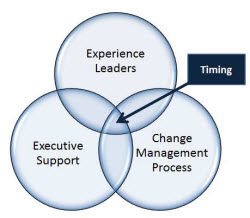
Kill Sales TeamThe answer:  It is all about the timing. 

  • Timing of the sales organization to accept the change
  • Timing of having the right support from the correct roles
  • Timing of getting the experienced leaders in the organization to back your initiatives

Download our Solution Timing Assessment.

It asks and answers the following questions:

  • Can your company actually accept and implement a change? 
  • Do you have executive support to drive it through the organization?
  • Are the sales leaders talented enough to implement the change needed?
Solution Timing Assessment

There are three criteria every Sales VP must have to ensure the proper timing:

  1. Executive Support:  The most important part of any initiative is executive support. In most organizations this means the CEO.  We have witnessed repeatedly how real change falls flat without top down support.  Involving the executives requires setting up the project to succeed.  Establishing an Executive Sponsor, a daily project manager and an overriding steering committee are critical. This involves multiple people who have a stake in the initiatives success.  The Solution Timing Assessment explains these in detail.  Remember, if it’s a big deal to them it has a chance to be successful.
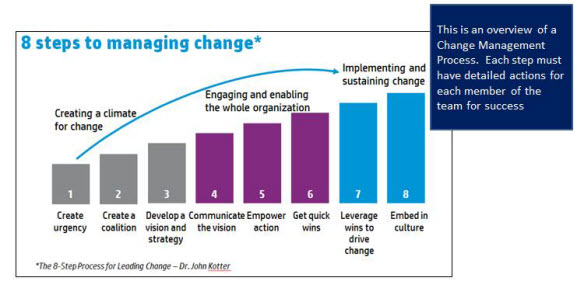
  2. Follow a Strict Change Management Process:   Too many times projects fail because of the execution.  Adopt a change management   process like the picture below. It helps make sure each step is sequenced and timed properly.   Make sure each role on the project team has defined tactics for the steps.  And identify when you advance from one step to the other. You don’t want to go to fast.  Trying to speed through the change is where most projects fail.managing changes sales
  3. Pick Strong Leaders:  Initiatives’ take on lives of their own.  Most of your experienced sales people don’t want to change. Having a strong executive sponsor and project leader will get the solution adopted. Some of the advocate’s key roles:
  • They can run the game plan for the project and complete their day jobs
  • They can fix something quickly that’s not working
  • They will lead by example by using the solution everyday
  • They are accountable to the solutions success

Pick them to be not only on the team but in the field.  The adoption comes in the everyday activities between sales reps and customers.

Look at these three criteria as you assess the timing of your project. Missing one can sink any project or initiative.  As the Sales VP, your number depends on it.

Case Study

A well-established $2 billion dollar manufacturing company needed to improve revenue.  Their industry was shrinking. The current organization structure was not matched to the changing market conditions.  As a result, they were shrinking with the industry.  The CEO and Sr. VP of Sales decided they needed to reorganize the sales team.

They established 5 major project team roles to increase the success of this project:

  • Steering Committee:  This team makes go-forward decisions and provides strategic direction of the project.
  • Executive Sponsor:  This person owns the project and reports directly to the Steering Committee.
  • Project Manager:  Manages the day to day activities of the project.  They make sure all activities and resources are available.
  • Project Members:  A mix of sales and marketing people in the organization who execute.
  • Quality Assurance Team:  They review the work quality and adoption metrics ensuring success.  They also provide guidance if actions need to change.

One year later over $2 million dollars had been spent.  Win Rate and Average Deal Size increased.  Sales Cycle Length decreased.  Revenue was up despite continued industry shrink.  The key success was an adopted solution.  That was the result of a successful project that helped sales people sell more business.

Factor your timing and roles of key player into all sales improvement efforts. Resist the urge to start a new project without considering the three criteria above.  It might not only cost you sales.  It can kill your sales team within 90 days.

Download our free Solution Timing Assessment.

Author: Dan Perry

sbi on linkedin

Follow @DanPerrySBI

Follow @MakingTheNumber

If you enjoyed this post, never miss one again by subscribing your Email Here and/or subscribing to the RSS Here

02 Jan 15:55

Nick Saban and Sales: the Importance of Coaching

by Keith Stoneman

Nick Saban and Sales: the Importance of Coaching image importanceofcoachingAll through this past college football season, there was a constant buzz about the University of Alabama and their remarkable record of multiple national championships in the last several years. During the season, there were many articles in a variety of publications (see two news stories: one from Sports Illustrated and another from the Wall Street Journal), on the course of action Alabama’s head coach Nick Saban used to create this highly successful program. Saban refers to it as “The Process,” while the press often refers to it as “Sabanization”.

The Process looks beyond football tactics and strategy. And while those points are certainly important, Saban’s Process focuses on much more: nutrition, strength training, mental training, and recruiting. He brings in speakers who emphasize character and accountability. In short, The Process focuses on every aspect on and off the field that contributes to the success of the team. It’s both simple and complex: The simple is the forehead slap, “Duh! All of those aspects of training contribute to the team’s success!” It’s complex in that it’s difficult to coordinate all of those training components and keep focused on the task of winning football games (not to mention the investment the University of Alabama has to undertake to make all of these activities happen).

When I talk with sales managers who want Coach Saban/Alabama-type results from their sales teams, it puzzles me how many of those managers don’t do what Saban actually does: coach his players, and have them practice (train them). How can you reach a winning goal if you don’t practice and coach, coach and practice?

The two really go together:

  • Training without coaching gives knowledge and skills, but no reinforcement.
  • Coaching without training gives reinforcement, but you have no model to coach to.

Saban has created “The Process” to ensure the continued success of his team. While it doesn’t guarantee a national championship each year, it has created the most highly successful program in recent college football history.

So, what’s your process for your team or your organization? Have you thought or developed a road map for success? Are you investing in coaching your people? How can your team win without a plan, and the accountability and resources to coach them to success? Now is the time to invest in training and coaching your salespeople, to move them to championship performance.

02 Jan 15:55

7 Sales and Marketing Resolutions for 2014

by Bob Apollo


New Year Resolution 200It’s that time of the year again. The start of a new calendar year often coincides with the start of a new financial year, but even if not, it still offers an invaluable opportunity to review the lessons learned from 2013, pause for reflection, and resolve to do even better in 2014.

I’d like to share 7 popular initiatives that many of my clients have resolved to implement (or in many cases, refine and reinforce) in 2014. I hope you find some of the ideas useful in establishing your own resolutions.

1: Clean up your data

Unless you’ve been exceptionally disciplined about data quality during the year, you’ll probably need to clean up your data. It may well prove to be the single best investment you could make. Measure the quality and completeness of the data you hold both on your key target organisations and the key roles in the buying decision process. Document the results, set clear targets for improvement, and measure your progress on a monthly basis.

2: Review your wins and losses

Get your top sales people together and review all the significant wins, losses and “no decisions” during the year. What were the common factors? What can you learn from the experience? Could you have qualified out deals you were never likely to win earlier?  Could you have adopted more intelligent strategies in the opportunities that ended in losses or “no decisions”? What can you learn from you top sales performers? Document the key lessons learned and resolve to act upon them this quarter.

3: Update your Perfect Customer profiles

Drawing on the insights gleaned from your win-loss analysis, review and update your perfect customer profiles. If you’ve never tried to document the common characteristics of your ideal prospects, resolve to complete the exercise ASAP. You can download our recently updated guide here. Armed with these updated profiles, make sure that you review your target account priorities, and update your marketing campaign briefs and sales opportunity qualification guidelines. Make sure everyone puts the new focus into action.

4: Identify and Obliterate Sales Obstacles

Here’s another way in which you can leverage your win-loss analysis: while you have your sales people together, encourage them to identify the key reasons why apparently promising opportunities either stalled or dropped out of the pipeline. Narrow the feedback down to the top three obstacles (measured by lost sales value), brainstorm the root causes and potential solutions, and resolve to implement specific programmes that are designed to help eliminate or obliterate the obstacles.

5: No Content without Context

If you’re like most B2B marketing organisations, you’ve probably already resolved to invest more in content marketing for 2014. But I’d urge you to add a supplementary resolution: “no content without context”. As Doug Kessler graphically pointed out in his powerful presentation, your prospects are about to drown a deluge of dodgy content. As well as following Doug’s advice about creating compelling content, also make sure that every piece of content is accompanied by talking points that allow your sales people to put the concepts in the context of their prospect’s situation.

6: Rebalance Inbound and Outbound Marketing

You’re probably also already determined to invest more in inbound marketing, but it’s important to take the opportunity to review the balance - and the inter-relationship - between inbound and outbound marketing tactics. Don't believe the social media charlatans who claim that traditional outbound marketing is dead, but integrating the two disciplines together could dramatically improve the outcomes generated by your marketing investments.

7: Embrace Social Selling

Last, but by no means least, resolve to get the whole organisation to embrace social selling. In too many organisations, LinkedIn is primarily restricted to researching sales opportunities, and Twitter the sole preserve of the marketing department. These isolated approaches serve to dramatically reduce the potential for social marketing and selling. Resolve to create a social selling playbook, and educate and engage every member of the sales, marketing and executive teams to truly practice social amplification.

So there you have it: 7 deceptively simple resolutions that could each have a measurable impact on your revenue growth in 2014. What are your New Year Resolutions?

Here are those links again:


02 Jan 15:55

A Sales Process Worth Following

by John Kearney

This much is clear.  Last year you missed the number. What’s not clear is why.  At the end of Q2 your pipeline was healthy.  You were on pace to hit your goals.  Somehow the pipeline collapsed.   By the end of the year 40% of your reps hadn’t made quota.  So how were your forecasts so far off?  As a Sales Operations leader, you use the pipeline to build budget and allocate resources. key to success1

Chances are, poor adoption of your sales process played a part.  Last year, companies made significant investments in training.  The trend looks to continue this year.  During onboarding, new hires were walked through the sales process.  They all received a copy of the sales playbook. Now, that playbook is collecting dust on the rep’s shelf.  Download the Guide for Creating an Adoptable Sales Process.  It is intended to create a relevant sales process.  One that will be seen as valuable. 

The problem with a typical Sales Process is it is not buyer focused.  In these cases, organizations focus on the activities of their reps.  It’s a math equation.  If they make this many calls and set that many appointments, they’ll win. This has been the method of top sales forces for decades.  It has worked.  Until recently.  The process no longer helps your reps.  It’s obsolete and no longer is driving revenue.   Here’s a great example:

Sales Process Objectives: “Enter 10 new opportunities in the CRM every month.  Have a pipeline with 5X your quota.  Advance 5 opportunities to the quoting stage.  Close 30% of your opportunities. 

Sales Rep Activities: “Enter the last 10 calls you’ve made, regardless of the contact’s buying authority.  Overestimate potential deal size to grow your pipeline.   Generate enough quotes to keep the boss off my back.  Rely on my killer instinct to close business.  If I miss, call in a few favors with my customers.  Get a few change orders and hit my number.”

This typical scenario brings 3 results:

  1. Lower win rate on new opportunities
  2. Longer sales cycle on new opportunities as the focus shifts to easy wins
  3. Smaller average deal size as reps focus on smaller opportunities

This is a recipe for forecast inaccuracy.  If the process is not followed, it cannot be properly analyzed.  How can you create a system that your team will actually follow?

  • Create a buying centered sales process: Customer surveys and interviews are helpful here.  Find out what parts of the sales process they find valuable.  Identify how they prefer to communicate.  Ask where they go for information and who helps them make the decisions.      
  • Align the sales process to the buying process.  Rework the Sales Process.  Take out the steps the customer doesn’t find valuable.  Add in the tools that help them make a buying decision. 
  • Automate the sales process:  Make the sales tools and process are mobile friendly.  Reps need to be able to pull them up quickly in the field.  The process must be able to move as quickly as the reps and buyers.   

An adopted sales process is a relevant sales process.  An adopted sales process leads to forecast accuracy.  An adopted sales process allows a sales team to focus on its challenges.  Ensure that your sales organization has a sales process worth following.

Download the Guide for Creating an Adoptable Sales Process.

Guide for Creating an Adoptable Sales Process

 Author: John Kearney

sbi on linkedin

Follow @MakingTheNumber

If you enjoyed this post, never miss one again by subscribing your Email Here and/or subscribing to the RSS Here.

02 Jan 15:55

Sales Training Article: An Overlooked Source of Revenue

by Customer Centric Selling

Sales Training Article: An Overlooked Source of Revenue

By John Holland, Chief Content Officer, CustomerCentric Selling® - The Sales Training Company

Image courtesy of Stuart Miles at FreeDigitalPhotos.net

Most couples would be better served not to think of the ennui that has settled into their lives. Over time there is a tendency to take certain things for granted. The relevance of the expression: "The honeymoon is over." awaits most newlyweds.

View our updated calendar of 2014 sales training workshops.

sales training workshopsThe same analogy can apply to new vs. existing customers. When going through buying cycles with prospects, sellers are careful to ensure they gain access to Key Players that will be involved in making buying decisions. After buying decisions are made, most of the contact with the account will be with middle to lower levels. Sellers may also believe that if any requirements arise, customers will contact them.

Within CustomerCentric Selling® we define prospecting as taking Key Players from latent to active need for a business outcome that can be achieved through the use of an offering. The vast majority of sellers view business development as an activity for finding new accounts. Whether prospects or customers, there are far more Key Players with latent needs than those that are actively looking to make buying decisions.

Prospecting within the customer base offers several advantages:

1. Key Player contacts are already established.

2. Contact with Key Players within your accounts (whether or not new buying cycles start) is important.

3. Contracts/legal agreements are already in place.

4. Buying cycles should be shorter.

5. Win rates for add-on business will be higher than for new accounts.

In determining how you'll make this year's quota, be sure to factor in business that can be gotten from your install base.


sales training companyNeed some help with your sales performance? Take a look at the sales training workshops available to you and improve sales performance.

Read more sales training articles from CustomerCentric Selling® - The Sales Training Company.

31 Dec 21:51

Are You Reaching Your Potential? Get Your Marketing Score and See

by pvaughan+paulroetzer@hubspot.com (Paul Roetzer)

marketing-scoreHave you ever wondered how you stack up against other marketers? Whether your marketing is underachieving based on your potential? Whether you're even measuring the right things to assess your performance? 

We recently released the 2014 Marketing Score Report (you can read it here -- it's form-free, though the file's large) that shares how marketers, executives, and entrepreneurs rate their organizations on things like annual revenue, revenue goals, marketing budget, sales cycle, and more.

One of the most pertinent insights for this time of year was around growth goals -- 64% of organizations have aggressive (<20%) or moderately aggressive (15-20%) growth goals for the next 12 months.

But are they all going to hit those goals?

I think the ones that start with an honest assessment of their marketing as it stands at the end of 2013 -- and with a concrete plan for how they'll meet those growth goals by the end of 2014 -- are the best poised to hit those targets. This SlideShare combines the information you need to do just that: assess your marketing, see how you stack up against the rest, and figure out how you'll hit your growth goals in 2014. It's a long read, but it should give you the tools you need to start the next year off right.

When 2014 hits, be prepared to make some changes to help hit your growth goals. Depending on how your own marketing assessment went, you may have to make some changes to your team, processes, or even your approach to getting things done. Consider some of the following:

What will our goals be to help us reach our growth targets? Identify the right metrics to watch to assess your progress, and assign yourself and your team monthly and quarterly goals to hit. 

Where in my performance assessment were my weakest points? Conversely, where did my core strengths lie? Identifying these gaps will help you hire properly, invest in skill development for your current team, and figure out where you can shift resources around so your core competencies remain in tact while you address weak points.

Hire and nurture the best. Whether you're outsourcing, bringing new people in-house, or developing existing talent, invest in A-players. Having a team that understands full-funnel marketing, a diverse skill set, and an agile approach to marketing -- we like to call these people prototype marketers -- will be key in reaching your growth goals in 2014.

Good luck in the new year, and share your initiatives in the comments below.

free marketing report template

subscribe to the hubspot marketing blog

31 Dec 21:50

Why the Digital CMO Is Already Obsolete

by rpuri09@gmail.com (Ritika Puri)

business-pathIt’s an understatement to call a CMO’s role exciting. We live in a time when the heart of marketing has transformed from static broadcasts to engines driven by two-way customer communications and real-time data. What was once as simple as a billboard or park bench ad is now a blend of attribution models, behavioral retargeting, continuous testing, and direct connections to revenue.

As Jake Sorofman, research director with Gartner for Marketing Leaders, writes for the Harvard Business Review, the multibillion-dollar online advertising economy is giving rise to a new type of marketing leader. Sorofman describes these individuals as "digital CMOs," the guys and gals who are leading corporate entities from their analog pasts to data-driven, cross-platform futures.

Digital CMOs are left-brain-meets-right-brain growth engines for their organizations. They wholeheartedly believe that everything is measurable and experimentation is key to driving pipeline and revenue. They sit at the intersection of social, mobile, and analytics, and they’re not afraid to venture into new territory.

Sorofman aptly characterizes these leaders as relentless learners: "They have the humility to admit what they don’t know, the courage to toss out the old playbook, and the confidence to allow digital metrics to illuminate the results."

Digital is only the first step -- CMOs need to dig deeper.

Sorofman makes a powerful argument: that the digital era is defining the role (and persona) of the enterprise CMO. I’m going to go out on a limb, however, to say that his argument doesn’t go far enough.

The shift in marketing is more than a straightforward transition from analog to digital. Commerce -- as we’ve known it -- is dead. Gone are the days when a brand’s best moves are to hire expensive PR agencies, ramp up ad budgets, and recruit commission-hungry enterprise sales reps. The bigger your company’s advertising arsenal, the more your consumers will feel the need to fight back.

According to Google Trends, searches for the term "ad block" have doubled in the last year. Marketing emails are responsible for 70% of ‘this is spam’ complaints. Numerous studies, including this one, show that online banner ads go unnoticed and ignored.

These findings beg the question: Why in the world would brands want to fight for their buyers’ attention? Instead, business need to earn those connections, not push-comes-to shove sales quotas.

As easy as it is to fast-forward through a TV commercial via TiVo, it’s even easier to delete an email or 'x' out of an aggressive interstitial ad.

What businesses need is a pull mechanism to keep audiences interested, engaged, and delighted -- and that’s inbound marketing.

The digital CMO needs to evolve into an inbound CMO.

Rishi Dave, Dell’s executive director of global marketing, recently pointed out that consumers are 60% through their buying journeys before reaching out to a sales rep.

They’re researching products in-depth. They’re sourcing peer-to-peer product reviews on YouTube. They’re educating themselves about their professions and core passions.

In an online world chock-full of noise, CMOs have a rare opportunity to position their brands as hubs for the resources and education that customers want.

That’s where inbound marketing -- in-depth content and resources crafted for the purpose of adding value and educating audiences -- comes in. It’s a strategy (really a methodology) that makes rational sense, emotional sense, and business sense.

A recent HubSpot study found that twice as many marketers say inbound marketing delivers below average cost per lead in contrast to outbound strategies like paid channel advertising and that inbound marketing is estimated to deliver 54% more leads into the marketing funnel than traditional outbound methods.

Being an inbound CMO is about changing ones mindset in how you marke, not just where you market.

Inbound marketing is a philosophy, not a tactic.

Direct response is a tactic for driving immediate conversions. Display retargeting is a tactic for ramping up sales. Purchasing an email list for the intent of driving lead volume is a tactic for customer acquisition.

The thing about implementing tactics like these is that they usually generate minimal returns. It’s like throwing spaghetti at the wall and relying on sheer probability for something to stick. Sometimes it works, but more often than not, it doesn't.

Inbound marketing is grounded in psychology. It’s thoughtful, tested, and measurable. It's about building trust and embracing the philosophy that when your customers love you, they’ll become your advocates for life. It’s a timeless idea that transcends the online world and takes us back to our roots as human-to-human relationship builders.

Scott Roen, vice president of digital marketing and innovation at American Express, calls this idea "reciprocal altruism” -- the idea that when brands give something for free, they get much more in return. Give your content away for free, and you’ll see a long-term boost in health to your business.

Remember that behind every algorithm is a set of eyes -- and a heart. As fixated as digital marketers are with conversion rates, unique visitors, and clickthrough rates, we’re ultimately appealing to human beings. That’s the core mission and vision of the inbound CMO.

What inbound marketing plans do you have entering 2014? Share your thoughts on how inbound will be utilized by your organization in the comments below.

inbound marketing advice experts social media email blogging

subscribe to the hubspot marketing blog

31 Dec 21:47

How to Write a Super-Compelling Sales Email

by Pat Owings

SMarketing Communications

How to Write a Super Compelling Sales Email image ID 100153440 resized 600Writing compelling emails has gotten more and more difficult in today’s world.  As marketers around the world have exploited the creation of content and technology has bombarded our lives with too much information, the real question is how you get your sales message across.  Technology has increased people’s access to information from anywhere in the world, and the volume of email we receive on a daily basis has increased even faster.  Your content has to stand out, or it will just wind up being another unwanted message headed for a spam folder.

Know Who You’re Writing to

Any form of content marketing you produce should be targeted. Identify your buyer persona, and spend some time developing a profile on them. The more you know about who you’re trying to reach, the better-focused your final product will be  All marketers strugle to sufficiently target their communications – “everyone” is definitely not your market. Let’s be honest – we’d all like to acquire “everyone” as a customer. You cannot be all things to all people, and it is a waste to try.  It is better to close one sale than to chase 100 leads with no results. Sales emails are about quality and not quantity.

Build Relationships

Relationships are the key to being successful in sales – people buy from people.  Automation can be used, but your content needs to be from the heart.  Consumers have become very sophisticated at being able to determine insincerity.  Also, keeping your message clear and concise is appreciated.  Nothing is worse than getting a rambling email that you just can’t hack the message of.  Likewise, a good clear call to action of what you would like them to do always helps keep the reader focused, and at least brings them to a decision of whether or not to engage.

If you are dealing with a mailing list that you are close to, the message will be very different than if it is to a group of prospects that you have met once or twice along the way.  It is important that if it is people who are further removed from you to demonstrate credibility to your audience.  This can be done quietly, and does not need to be the prominent message.  Linking to your website and testimonials is always a great way to help show your work ethic and how others view you.

Don’t Forget Your UVP!

One of the most underutilized tools is your ability to demonstrate your unique value proposition.  I am cautious with using this terminology because people are so numb to business jargon speak.  But let’s start with your value proposition.  People are willing to pay for goods and services.  Not only that, but they are willing to a fair price for it as well.  The key is are they getting value?  Consumers are not naïve to the fact that everyone in the supply chain needs to make money, and none of them are not-for-profits.  However, they also do not want to be taken advantage of.

You need to demonstrate how you justify your services for the price for which you charge.  But here is the big, and toughest, point – your value proposition needs to be unique.  Every car dealership out their uses the same old marketing messages to sell and none of their messages tell me what is different and why I should use them.  For all their promotions I choose my vehicle based on model, make, style and location long before I listen to their message.  So take a moment and sit back and think about what it is that you offer that makes you unique.  You would be surprised how hard this is for some people to answer.  Yet they expect people to just buy from them.  If you, as the owner of your business, cannot tell me what makes your service unique, how can you expect the casual consumer to make an informed decision to use you?  If you rack your brain and still cannot come up with anything, turn this into an exercise of what changes you need to make in your business to make it unique.

The key with any email is to convey your message to the reader.  Everyone looks for the secret to have it outperform everything that you have done prior.  The answer is there is no secret.  Spend some time prepping, put your heart into what you write and show them why you would purchase your goods or services over someone else’s.

Lastly, never give up.  If you do all of this and it is less than successful, change things up and try it again.  You never know how it will be received and if the time is right for a given email.

How to Write a Super Compelling Sales Email image 753d4b47 aa80 4af1 8e66 9bbc7c252f383

31 Dec 21:47

7 Steps for Building a Successful Sales Process

by Young Entrepreneur Council

7 Steps for Building a Successful Sales Process image sales1At ElasticSales, we’ve had the privilege of working with dozens of early-stage startups, helping them establish their sales processes. Some ask us to build their process from the ground up. Many come to us solely looking for guidance as they develop their own sales processes and teams. In both cases, the best campaigns are those in which the founders are actively involved with developing the process, or have conducted their startup’s early sales themselves.

For tech entrepreneurs without sales experience, here’s how you build a sales process for your startup from the ground up.

Begin Customer Outreach as Early as Possible

The best thing you can do to develop your sales process is to get out there as early as possible. That Lean Startup mentality works just as well in sales as it is for development. Spend a week, even a few days, picking up the phone and cold-calling your customers. During these early calls you’ll get a sense of their challenges, objections you might face, and direct customer feedback about your product. You might even realize a key aspect of your product that needs to be tweaked before you push hard into the market.

As a founder, YOU absolutely need to do this before handing it off to someone else. Conducting preliminary outreach to your customers will help you better understand them, their needs and your market place. You can then refine your product as you develop your sales process.

Do a Full Walk-Through

Walk through simulated conversations. Begin by finding the lead and travel through the complete sales process. End by handing the customer off to your support team. Do this with colleagues who understand your space, then try your pitch out on someone who doesn’t. (Outsiders quickly notice problems and inefficiencies.) These scenarios not only give you great practice before implementing your process, they’ll help you identify gaps in it. Say on your first call you get a customer’s credit card — then what? How do you process the payment? Who do they speak to next? Mock calls are a great way to practice your pitch and refine the logistics of a sale.

Establish Qualifying Criteria

Qualifying criteria are a list of traits that make someone a good fit (qualified) to buy your product. It sounds easy enough, but lots of young companies have no idea what they need to know about a customer to make a sale.

So how do you develop qualifying criteria and track them?

Common criteria for leads are:

  • Does your product solve their pain point?
  • Does your product save them money/cost?
  • Does your product save them time?
  • Is your product in their budget?
  • Are they using a competitor’s product and paying for it?
  • How fast can they make a buying decision?

It’s best to develop just five criteria based on what you THINK you need to know about a buyer, and then reach out to a subset of customers. Identify those five criteria in the customers, and then see if the criteria need to be expanded, or even cut down, to identify whether they would be a good fit.

DO NOT get into the habit of marking every lead qualified because “you had a nice conversation.” Remember, a qualified deal is very different than an active opportunity. An active opportunity is a qualified lead with a value attached to it. This means that you have communicated the cost of the product/service to the prospect, they understand it, and have expressed that it is in within their budget.

Establish a Sales Script

A good call script is a method for you to guide a customer through your sales process from start to finish, while showing them the value of your product/service.

A call script typically has the following sections:

• Introduction
• Qualifying Questions
• Q&A About Features, Pricing and Next Steps
• Asking for the Close
• Managing Customer Objections
• Establishing Next Steps

Developing a script is an iterative process, but it begins with research. Know your product and how it fits into the market, and convey that as simply as possible to the customer. Your script needs to incorporate your qualifying questions (so you know they’re a good fit), common pain points, and benefits around which to position your solution.

Establish a Conversion Funnel

A conversion funnel should be built with a “reverse” approach. Establish a range of deals you’d like closed over the course of a week or even a month. Then ask yourself how many active opportunities/deals you need to qualify in order to achieve that goal. This is called a conversion rate.

But how many scheduled calls or demos do you need to perform each week to in order achieve the desired amount of qualified opportunities? Using the conversion rates you’ve estimated (be conservative), determine how many calls/emails, or leads generated, you need each week in order to schedule that target amount of calls.

The amount of calls or emails you need to send each week is pretty large – this is the top of the funnel. In turn, this might mean that your “closed deals” goal might be too large. Start with a number you believe to be attainable but aggressive. Work through the entire process and reach the goals you set out at the beginning of the week.

Once you’ve done that, start increasing your goal by 10 percent each month. You need to have 10 percent month-over-month growth to really have a healthy funnel as a startup.

Optimize Implementation

Sales doesn’t end with the close. As a sales person, you need to make sure that the customer is successfully integrated. This means a clean handoff to your support team. As a founder, you’ll quickly find out ways to improve your process and ensure that your customers stick around. This is also crucial in order to secure customer references — integral in bringing in new business down the road!

Iterate, Iterate, Iterate

Just because something works, doesn’t mean it’s the best way to do it. Make sure you are constantly stress testing your process to figure out what’s broken. Maybe your script is still a bit clunky, emails don’t generate the response rates you’d like, or your conversion rates too low. Don’t get stuck doing something because it works well enough. Lack of iteration is what prevents companies from making a good sales process great!

It’s crucial that you, as the founder, conduct some of this early outreach and help develop your company’s sales process. Early customer engagement can provide some of the best insights as you look to improve your product or service. Only once you’ve developed this repeatable process, and know it works, can you confidently hand off sales to a director that can refine the process even more.

Steli Efti is the Co-Founder / CEO of Close.io and ElasticSales and an advisor to several startups and entrepreneurs.

31 Dec 21:44

3 Mistakes CMO's Make at Sales Kick-off

by Vince Koehler

Marketing leaders should feel great about having a solid marketing plan locked in.  Deep down CMO's know they won’t get past January without changing the plan.  Requests from sales leadership will alter the plan. Proactively embrace sales kick-off to validate and generate momentum for the plan.

 Quick Start

For most B2B companies the annual sales kick-off occurs in January.  This is the first major interaction between sales and marketing.  Don’t sit it out.  CMO’s should be heavily involved to gain a strong start to the year. 

The Top 3 Mistakes for Marketing at Sales Kick-off

  1. Reactive Order Taking – This happens when CMO’s allow their team to serve the sales organization through outdated sales support.  This is done in the name of giving sales what they want.  However, this approach misses the greater opportunity.  What sales needs is a balance of prescription and responsiveness to their needs.
  2. Meek Marketing Involvement – Marketing staff participating in SKO meetings are passive. Outside of the marketing presentation there is little engagement. The marketing staff at Sales Kick-off are no more than multi-tasking observers. Sales team stereotypes of marketing are reinforced.
  3. Change Management Opportunities are Missed - Marketing personnel aren’t actively leveraging the sessions to collaborate.  Sales field needs aren't linked to marketing plan deliverables.  Valuable collaboration time is wasted.  

These approaches damage credibility and miss opportunities for collaboration.

World Class CMO’s leverage sales kick-off to build momentum for the year.  They validate the 2014 marketing plan for the Sales Leader and CEO.  They proactively identify gaps and adjustments required to hit the ground running.

This post provides marketing leader guidance for world-class Sales Kick-off (SKO) involvement.  In preparation, download the CMO’s Guide to Impact Sales Kick-off.  

CMO Impact at Sales Kick-off

Marketing must help sales by prescribing solutions to the biggest challenge faced by sales today.    The role of marketing has changed significantly in the past two years.  More than half the prospect’s buying process is completed before engaging a sales rep.   Marketing’s role is no longer confined to behind the scenes support. 

Marketing is now vital to the front end of the sales pipeline.  Lead Generation involvement is an accepted reality.  Equally important is marketing’s role connecting with a prospect early in the buying process.   

World-Class CMO Leadership at SKO

The key to success at Sales Kick-off is deeper marketing team involvement.

The marketing presentation is a solid opportunity to have face time with sales.  Use the time wisely to present through the lens of “what’s in it for me?” for sales.  Put yourself in the shoes of sales leaders, managers and reps.  Have the discipline to complete a Creative Brief to guide the presentation.

The largest opportunity for marketing at SKO is meaningful involvement throughout the agenda. 

There are two key aspects:

Marketing Involvement

The CMO must be actively involved in discussions throughout the SKO.  This behavior is first modeled by the CMO, and then replicated by the marketing team. 

Select key marketing staff to be active participants in breakouts.  This builds credibility with sales.  Preparation in advance to set expectations is important to their success.

While in the sessions begin to identify individual managers or reps to tap for knowledge.  Take notes of which reps you want to gain feedback.  Express to those reps that you want to reach out to them in the future.  This builds an informal expert panel, an invaluable communication link with sales. 

Take action immediately following SKO sessions.  Provide the head of sales with implications from the sessions.  Later, formally circle back with the sales leader on key implications.

Require each member of the marketing team at SKO to formally report on insights.  The insights can include validation of existing efforts or gaps to plan. 

Leverage Unique Insights

Sales Kick-off is the perfect event to validate and identify gaps in key assumptions.  Throughout SKO, look for common insights across multiple points of view.  This is now your chance to enrich and sharpen buyer research.  

The goal is to constantly improve the mapping of the buying process to the sales process.  Listen closely to key interactions. These real life examples sharpen understanding to build and update marketing’s understanding of the buyer. 

Greater context helps marketing to connect the dots on why things may have failed in the past.  You will see common trends that increase the importance of change management. 

Summary

View Sales Kick-off as a tremendous springboard to greater credibility with sales.   Proactively increase engagement with sales leaders.

CMO’s Guide to Impact Sales Kick\u002Doff

 Author: Vince Koehler

Vince Koehler

Google+ Vince Koehler on Google+

If you enjoyed this post, never miss one again by subscribing your Email Here and/or subscribing to the RSS Here.

31 Dec 21:42

5 Things You Need To Stop in 2014 – Or Any Year – Sales eXchange 232

by Tibor Shanto

By Tibor Shanto - tibor.shanto@sellbetter.ca

Five

As we headlong in to the New Year, and wipe the slate clean, symbolically in or in actual ways, you are going to face two certain things. First an endless barrage of meaningless awards shows meant to squeeze the last bit of sales out of last year’s products. And an even greater number of post and articles telling you all the things you should do in 2014, most of which are retreads of things they advised you to do in 2013.

Here are two things you need to do, first capture all that advice on your favourite cloud storage area. This way you can revisit it next Christmas see who had insights that paid off, and who was stinking out the joint. Second, rather than focus on what you should do, why not try not doing some things that have prevented you from being more successful than you are. Here five things to consider, there are probably others, try these, or three of these, but before you start new things, and coming more skills and talents, start by shedding some to make room for the new. So in 2014 Stop

  1. Being Trendy – There is always a new trend, a new tool, a new way, to be successful, but new is not always better, it’s just new. Successful sales people master things that work and then stick with them till they stop helping them succeed. Sales skills, like any skills, aren’t tied to a calendar, or product releases, they are tied to effectiveness, so focus on how effective something is in helping you sell better, and sell more. There are always new offerings, but will they help you achieve new levels of success, or just help the people peddling them find a new follower?
  2. Fixing Things – Most sales people these days remind me of solutions running around the country side looking for a problem, wearing t-shirts that read “I never met a prospect whose problem I couldn’t fix”. Well a lot of prospects don’t have “problems”, and therefore don’t see the need for a solution. But they all have objectives, focus on that, and you engage with more potential buyers, and sell more. Don’t be that shmuck who described his role as a sales person as “I find the soft underbelly of the prospect, stab it, then offer up the cure”.
  3. Talking – Yes, you’ve heard this before, but did you listen. Ask good questions – tough questions – questions they haven’t heard from the shmuck above, and herds like him. Questions about their business, not your “solution”, then shut up, listen – don’t finish their sentence for them. I was out with another sales trainer recently, and if I had a dollar for every sentence the prospect was not allowed to finish, I would have had a financially rewarding day, but as it is he talked us out of the sale. Take notes, have follow up questions, but let them do the talking.
  4. Listening – To everyone other than the buyer, for one simple reason, they are the ones who will write the check from whence your commission comes! If they can’t directly contribute to your sale, they are wasting your time, and time is a precious resource.
  5. Hesitating – There are a million things that can hold you back, but the worst is you. What’s the worst that can happen, you learn something and have to try again. What’s the best, you act and get results. Yes, hesitating does have more predictable outcomes, but usually less desirable than executing your well thought-out plan decisively. Don’t second guess yourself into to the safety of mediocrity.

Happy New Year!
Tibor Shanto

31 Dec 21:42

Introducing the “SIMPLE” Framework To Increase Your Sales Effectiveness

by Mukesh Gupta

In the recent past, there has been a lot written about the fact that the entire buying process has undergone a sea change and due to which selling is becoming more and more difficult.

I am herewith suggesting a process if when followed can still help sales teams succeed.

S — Surprise: This is the first step in the process and also the most important step. In order to be able to do this, you need to understand your customers business better than they themselves know and find an insight which will surprise them. You can uncover these insights by any one of the below steps:

  • Network across layers of the organization: Most organizations are really complex and it is almost impossible for CxO’s to have access to their own front-line staff. If you are able to connect with both and the folks in-between, you have a good possibility to uncover insights that the CxO’s might not otherwise find.
  • Talk to their customers or suppliers or partners: Depending upon the stated objectives of your customer, go talk to their customers or suppliers or partners. For example, if your customer is focused on top line growth and has taken up agressive revenue growths, you could go and talk to their customer/prospects. Try and understand from their perspective, what is their expectations from their supplier and see if you are able to uncover a blindspot for your customers.
  • Industry Swaps: Think if there is something that they could learn from other industries, which when adapted in their organizations could give them an edge over their competitors.

I — Inspire:

  • Paint a picture for your customer about what their future could be, if they act on the insight that you have uncovered for them.
  • At this stage, average or good sales people build a business case to support whatever they are trying to sell and start pushing for a close. However, Great sales people will not do that yet. They will paint a bigger picture of the future. They will try and inspire their customers to go after that future.

M — Motivate:

  • Once, they have inspired their customers about the possibilities in the future, they will motivate their customers to act on the insight.
  • In most cases (if not in all), this involves getting your customers to set-up internal meetings, sharing the insight with their colleagues and start discussions internally about the insight and by doing so, own the vision. This ownership keeps them motivated to build consensus within their organization to act on the insight.
  • It is the role of the sales executive to ensure that the level of motivation does not go down.

P — Position:

  • Once there is consensus built within the customer organization, great sales executives will them position themselves to be the best partner to help their customers to realize their vision.
  • This is the time when they actually start talking about their product or service or solution and how they can help realize the vision.

L — Lead:

  • Once they have positioned themselves well, they will then lead their customers during the discussions around the negotiations.
  • Instead of negotiating with their customers, they will consistently lead their customers to a situation wherein everyone is happy with what they got.
  • This is when they close the deal and get the order.

E — Execute:

  • Great sales people do not stop there. They will continue to work with their customers to ensure that the execution of the product or service or strategy is executed so that their customers realize their vision of the future they had started out with.
  • This one step along increases their value and trust on them so much that the next round of sales becomes much easier and faster. This is also the step where most of the average or good sales executives falter.

At the engage phase, they again start looking at ways to surprise their customers again and re-start the cycle.

Now, if you follow the SIMPLE framework, I think you will end up not only meeting your sales quotas but exceeding your quotas, year-after-year. You will also have a list of customers who might even give you a chance by going out of their way, just to do business with you.

What do you think about this framework? Do you think this will work for you? Share your thoughts and comments.

Introducing the “SIMPLE” Framework To Increase Your Sales Effectiveness image Simple Framework for SellingV2

31 Dec 21:42

Overcoming Common Mobile App Sales Objections

by Andrew Gazdecki

Overcoming Common Mobile App Sales Objections image screen568x5685Sometimes, being an app reseller puts you in a strange position. On the one hand, the popularity of mobile is exploding. The world can’t get enough. Apps, mobile websites, and everything on the small screen seem to be the hottest things around. Millions of users are taking billions of actions each day. It’s a mobile, mobile world, right?

And then you try to sell that idea to a small business owner.

And they aren’t convinced.

To prevent that from happening, this post will discuss some common objections and provide some basic responses that might help you overcome them. When you have a good product, but have difficulties selling it, the problem is often one of education and explanation. If you can help your prospects understand the value of your offering, you’ll have a much easier time signing them up.

Here are some of the most common misconceptions:

They cost too much.

A cost objection is really a value objection in disguise. Apps don’t cost a million dollars – our apps cost a very affordable amount each month. But if this seems like too much, it’s probably because the prospect thinks that they won’t see any returns on the expense.

At that point, your job is to help them understand how apps and mobile websites generate returns:

Mobile sites increase revenue. A huge percentage of Internet traffic is now coming from mobile devices. If a business doesn’t have a mobile-optimized site, they could be missing out on hundreds and thousands of site visits. And when it comes to local businesses, those site visits tend to be from people who want to visit a local location. This means that not having a mobile-optimized website directly reduces the number of visits to a business, and therefore lowers revenue.

Apps increase revenue. In so many ways! Mobile orders, mobile reservations, social referrals, push notifications about events and deals – the list goes on and on. An app offers a variety of ways to increase customer engagement, satisfaction, and purchases, and therefore can pay for itself very easily when deployed in a way that is tailored to the user base.

The key is that not going mobile is expensive. Going mobile, on the other hand, is a profitable venture.

They’re hard to manage.

In the early days of apps, maybe, but not anymore. From a single, simple dashboard, anyone can manage a Bizness Apps app with a few clicks of a button. And we also have a very dedicated support team available to help users get through any difficulties and answer any questions. No one will be left to deal with issues on their own.

A website is enough.

No way. Huge amounts of visitors are now coming via mobile device, and a mobile-optimized site is a must. And apps deliver so many robust functions that can’t be matched by websites. If a business really wants to make the most of its customer base, it needs an app.

No one uses them.

This is nuts. A recent post by Flurry revealed that the monthly number of people using apps now exceeds the number of people using desktops and laptops. Each month, roughly 224 million people now use apps, as opposed to 221 million people that use desktops and laptops. Apps are hugely popular, and users are spending hours and hours using apps every week. Not every one of a business’s customers will download and use an app, of course but for the users that do, the rewards to the business are well worth the expense.

Which brings us around to the key message – the cost of an app is far outweighed by the returns it brings. Encourage business owners to experiment with apps! There’s very little to lose, and a very bright mobile future to be gained.

31 Dec 21:41

Connecting Sales, Marketing and CRM for Actionable Customer Insight in 2014

by James Rogers

Marketing teams today are faced with an increasingly dire problem – there is a fundamental lack of knowledge about who their customer is, and what their needs are. The inability for companies to articulate who or what will benefit most from their product or service damages a company’s corporate reputation with customers and prospects, delays projects, and reduces profitability and productivity.

What is the source of this problem? For one, the environment in which marketing teams operate has drastically changed. Over half of respondents to a survey sponsored by OneSource throughout November 2013 said that their company’s marketing strategies have changed, “Very much so” over the past five years. As we begin 2014, we must now assess what processes are in place to help companies efficiently target customers and sell their product or service.

Since the 1980s, CRM technology has enabled companies to easily track business contacts, radicalizing the way prospecting is done. The drastic increase in the amount of content available for both companies to research and prospects to sort through, however, has changed the playing field.  According to the survey, the degree of online information available to decision makers has had the greatest impact on marketing departments at companies. A need to aggregate this imperative data has brought CRM shortcomings to the forefront; however, these can be rectified through use of insight from marketing analytics and automation technology.

The survey found that only 31 percent of companies have a unified database for marketing, sales and CRM relationships, and 26 percent rely on databases that are not connected. We have already seen these numbers begin to rise, and as more companies consider implementation of sales enablement technology, there are several things to keep in mind in order to maximize its use:

  1. Establish where the disconnect lies, and choose a solution that fits your needs: Every business will have different requirements. Therefore, when finding a marketing automation solution that satisfies your sales and marketing challenges, simply selecting “out of the box” tools and features may not work for your company.  Come up with a specific set of requirements so that you get what you need, but don’t overspend on tools that aren’t useful to your business.
  2. Align IT knowledge with insight form marketing: Marketing has not always been considered a major revenue driver for organizations. This discrepancy often prevents marketing and sales departments from implementing the most relevant tools that will help them develop customer understanding. There is data that suggests that by 2017 CMOs will gain an increased percentage of the purchasing budget and spending more on IT than CIOs. That means that marketing is going to become a greater part of the entire organization and other departments must tie in more closely in order to meet end to end goals.
  3. Align sales and marketing on critical prospecting insight: From the November 2013 survey, 33.5 percent of those surveyed responded that, “Marketing owns more than 50 percent of the responsibility for getting leads.” In comparison, only 14.2 percent surveyed said that, “Sales owns 90 percent of the responsibility.” Despite variations across companies, sales and marketing must work together to identify requirements and implement the appropriate tools.  Because lead and customer nurturing is becoming more of a shared responsibility, it is essential that goals, processes and IT purchases are jointly discussed.
  4. Set up real-time triggers that facilitate traction: Including an analysis of what live content is available on a timely basis enables sales teams to quickly apply tangible business insight that can successfully secure timely prospects. Actionable information leads to greater efficiency in prospecting, and differentiation from competition.
  5. Don’t forget about social or contributed content: The survey showed that social networking sites such as LinkedIn and Twitter ranked second to search engine data when uncovering information on prospects. This underscores the need for sales and marketing teams to be equipped with tools that constantly monitor social data that can be used for prospecting. Most people are now familiar with Google’s “Zero Moment of Truth” study, which shows that the majority of the buying process is complete before salesperson interaction. In order for companies to influence this key time, they must utilize social data plug-ins for marketing automation systems and CRM platforms to engage prospects earlier in the decision making process.

Stronger customer connections can be achieved through next generation sales enablement technology that aggregates business insight from multiple sources in an integrative system with CRM. Companies that can quickly adapt to use of this technology will reduce prospecting inefficiencies through less back-end research. In this manner, marketing departments can play a greater role in facilitating a comprehensive understanding of the customer, ultimately leading to stronger revenue for their business.