Shared posts

31 Dec 21:47

Inside Sales: The Rise of the Machines

by Sherry Lamoreaux

Inside Sales: The Rise of the Machines image Robot on phone with caption and lipstick iStock 000027629337SmallOn December 10th, TIME Magazine’s website published a story by Zeke Miller and Denver Nicks titled “Meet the Robot Telemarketer Who Denies She’s A Robot.”

It all began when TIME Washington Bureau Chief Michael Scherer got a phone call from a pleasant woman offering a deal on health insurance. Scherer sniffed out that something wasn’t right, and when he asked the caller “point blank if she was a real person, or a computer-operated robot voice, she replied enthusiastically that she was real, with a charming laugh. But then she failed several other tests. When asked ‘What vegetable is found in tomato soup?’ she said she did not understand the question. When asked multiple times what day of the week it was yesterday, she complained repeatedly of a bad connection.”

TIME reporters got busy trying to verify who – or what – the caller was. As a reporter relates it: “Her name, she said, was Samantha West, and she was definitely a robot, given the pitch perfect repetition of her answers. Her goal was to ask a series of questions about health coverage –‘Are you on Medicare?’ etc. – and then transfer the potential customer to a real person, who could close the sale.”

You can listen to a few of the calls here: http://newsfeed.time.com/2013/12/10/meet-the-robot-telemarketer-who-denies-shes-a-robot. The caller has a pleasant voice, and yes, the laugh is charming. And the script is pretty good.

In a subsequent story published December 17, Denver Nicks gives us Part 2: It turns out that Samantha West “functions much like a remote-controlled car, directly operated by a real person working in a call center outside the United States.” A representative of the company that deploys Samantha said “she” is a computer program that lets telemarketers outside the U.S., who may have non-American accents, qualify leads and send good prospects to native speakers in America. The rep explained:

“When Samantha West calls, there is a person on the other end of the line … who is an active participant in the conversation. That the person was limited to communicating through a machine with pre-recorded utterances did not change the fact … that there was another human participating in the conversation.”

What readers thought

The comments following the posts ranged from rants against robocalls to a spirited discussion of whether tomatoes are vegetables or fruits, to “The robots are sentient now, but the only jobs they can get are in telemarketing. One commenter’s thoughts sound informed:

“I have to agree with (name). This is too smooth for synthesized voice and too coherent for automated scripts. It is likely prerecorded responses punched up by an attendant. This allows a smoother pitch and cheaper labor, than for ‘live voice’ attendants. So Samantha was not lying. ‘She’ is a human choosing each response, and ‘her’ voice is/was human. Though the script is well read, and well managed, it is inherently inauthentic. It also is necessarily limited in response options and vocabulary.”

Renaissance man Ray Kurzweil is a director of engineering at Google, and an expert on text-to-speech synthesis, artificial intelligence, and electronic keyboard instruments (among many, many, many other things). He’s probably the world’s foremost champion of the “singularity” – which Slate describes as a point in human progress at which our machines become as smart as we are. When we get there (assuming we do), will those machines be calling to sell us something? And will they be smart enough to contact us only about the things we really want to buy? Will they actually be drones operated by live persons?

It’s probably a great savings to use semi-automated robocalls such as the Samantha program, but I wonder: is the trade-off for authenticity worth it? And what happens when these programs get so sophisticated that we can’t tell that they aren’t real people speaking in real time?

What do YOU think?

30 Dec 18:06

Keys to Getting Sales Hiring Right – from Miller Heiman

by peaksales

Miller HeimanThis year, sales training company Miller Heiman, published Best Practices in Sales Management: A Resource Guide for Sales Managers. In the guide, Miller Heiman shares its three keys to getting sales hiring right and looks at common missteps in sales hiring, long-term impact on sales, qualities of top sales people and revealing interview questions.


All Sales Roles Are Different

The guide begins by pointing out that different sales positions call for a different skills and experience and more importantly, different cultural and attitudinal traits. We couldn’t agree more and it is safe to say that many organizations have poor clarity where these last two intangible traits are concerned. It is simply much easier for organizations to use sector experience or years of selling as the basis for selecting a sales person.


The Cost of Failure in Sales Hiring

According to research firm Leadership IQ, 46% of all new hires fail within 18 months of being hired, primarily due to attitudinal factors. On the other hand, employees that fit their position and company produce 250% compared to those who do not, tend to stay longer, and contribute to more of a positive environment.

Ramifications of getting it wrong spread beyond lost revenue. Your company’s credibility and your personal reputation are on the line. The monetary impact of getting it wrong includes actual losses in revenue generation, wasted salary for the salesperson, plus the loss of production during ramp up. Sales force churn also creates customer uncertainty, potentially lowering customer confidence, and can impinge upon your company’s overall reputation and credibility.

Miller Heiman asserts that “World-Class Sales Organizations” exercise discipline in their sales hiring efforts. They first benchmark their successful sales people to identify critical traits, they use psychometric assessments to assess candidates rather than depending upon unreliable gut feelings about candidates and they exercise patience in waiting for the right mix of traits before making a hire. Again we couldn’t agree more. We know from direct experience that the more structure in the sales hiring process, the better the hiring record.


“Not everybody who is fantastic at selling is right for your company,” said Chris Ainslie, a Miller Heiman Sales Consultant and ex-VP for a global company


Common Errors in Sales Hiring

The guide identified several common sales hiring errors made by sales organizations:

1. Hiring from only one source - Many companies favor candidates with industry experience and/or contacts over candidates who have the right traits for success.

2. Corporate neglect - Requiring new sales people to “figure it out” on their own.

3. Lack of clarity on salesperson attributes - Many organizations focus on skills or experience versus the more critical and intangible traits of successful sales people.


Qualities of Top Salespeople 

According to Miller Heiman the basic traits of top performers include persistence, curiosity and empathy. While we agree that these are important factors, this is by no means an exhaustive list and these alone will not guarantee success. Peak’s own recruiting experience over the years indicates that  sense of urgency, ambition, competitiveness, optimism, and confidence are also critical traits.


The long term upside.

Experienced, tenured salespeople are a vital asset of any enterprise, clearly outperforming those with less experience.

Turnover is not only costly, it hurts sales production in many ways. “World Class Sales Organizations” take sales hiring very seriously and invest as much in the hiring effort and strategy as other critical company functions, and consequently when combined with other important factors such as sales on-boarding, sales process and strong management, these organizations reap the rewards in terms of higher sales.

To read the full report, click here.

To your success!


30 Dec 18:06

The Data Behind What Makes an Effective Sales Process

by KISSmetrics

We all know how important a sales team is to any organization. And we also know that fine tuning a sales team for optimal performance does wonders for the health and culture of a business. Here are some key insights to get your sales process delivering above par results for years to come.
30 Dec 18:06

6 Ways to Get More Leads With Mobile Marketing

by gsoskey@hubspot.com (Ginny Soskey)

mobile_marketing_copyThis post is an excerpt from our ebook How to Generate Leads with Mobile Marketing. Download this free guide to learn about generating leads from mobile marketing and discover best practices from real brands. 

Most lead generation tactics are straightforward. You create a piece of content to live behind a form on a landing page -- also known as an offer -- and then you promote the heck out of it through your blog, social media accounts, and email marketing. People fill out the form, get the offer, and ta-da! They become a lead. 

But we're missing a piece of the puzzle that makes lead generation not as straightforward: mobile visitors.

Because of the way that people behave on their mobile devices, your lead generation strategy has to be adjusted. You don't necessarily need to create brand new content for a mobile-only audience -- you just have to tweak what you already have for desktop for mobile experiences

To help you figure out what to tweak, check out the six tactics below you can implement to optimize your content for mobile lead generation. 

1) Employ Progressive Profiling Forms

Filling out forms while on a mobile device can be extremely frustrating. The fields are usually too small, and you end up clicking the wrong line. Also, the forms are usually much longer than you want them to be. And let’s be honest, as a user, because of these limitations, you will likely turn to another website that doesn’t require such an intensive user experience

But as marketers, we don’t want to get rid of a form, so what should we do? That’s where progressive profiling comes in.

Progressive profiling allows you replace form fields that have already been filled out the next time a lead visits your website. That way, you can space out how much information you're collecting at once and make your forms shorter. Bonus: By hosting progressive forms on your web content, you optimize your mobile presence for higher conversions.

2) Create Simple Calls-to-Action

When creating CTAs for your website, think about how they will appear on different devices. From a design standpoint, you may not want something visually heavy as that could be distracting on the small screen of a mobile device or tablet. But you do want an image with clear, readable text. The text itself should also be short yet action-oriented -- like all CTAs -- so that it's not taking up too much of the page on a small screen. 

Check out IMPACT Branding & Design's new homepage below to see great mobile call-to-actions in action. The CTAs have concise and actionable copy, and they are easy to notice and click on -- even with my chubby, uncoordinated fingers. 

impact_example_1

3) Provide Discounts and Customer Loyalty

Another way to optimize your mobile presence is through discounts and promotions that will be redeemed through mobile devices. This can be in the form of promo codes, customer loyalty discounts, or even on-location specials.

Let’s take Kings, an entertainment facility with bowling lanes, pool tables, bars, and a full-service restaurant in Boston, as an example. Kings makes it clear to customers entering the facility that if they like the Kings Facebook Page, they will receive free shoe rentals for that day. So of course, many customers pull out their mobile device, go to Facebook, and like the Kings page.

With this strategy, Kings created a small, but effective, sense of loyalty with its customers by having them like its Facebook page with their mobile devices. After they do that, the Kings social media team can nurture their new Facebook leads and keep them coming back to the business.

4) Optimize Content for a Mobile Screen

Think about the situations and places you've been in when you pull out your phone to read an article or check your email.

Typically, you only have a few minutes and are trying to kill time. You may be waiting for the next subway to come or at the doctor’s office. Either way, you only have a short period of time to consume the content, and you don’t want the content flooded with filler words and fluff. When you know you are writing for a mobile audience, there are a few rules to live by.

First, frontload your content with links to lead generation content in case people do not get to the bottom of the article. Don’t put the punch line of the article in the last line. Make sure people understand the purpose of the article from the start.

Next, make the content easy to digest. Bold your headlines. Make them short and tweetable. Do not write for the purpose of writing flowing, lengthy prose -- write concisely.

Finally, test different content types to see what performs best on mobile. Does your audience like lists? Do they like “how-to” articles? What are they most likely to fully read, especially on a mobile device? Gather results, and then ramp up creating more content that your mobile visitors like. 

5) Make Your Phone Number Clickable

When someone picks up their mobile phone, they are going to take an action. Whether that’s opening an app, searching for a company, or simply texting a friend, they are much more action-oriented when on their phone versus a tablet or desktop computer where they can casually browse. 

Knowing this, consider how you can get your potential visitors to the point of conversion faster and easier. One technique is making sure your phone number is clickable on your website. By doing so, your customers do not have to copy and paste or memorize your phone number -- they just click on it and are instantly dialing.

Remember that the fewer clicks you need to complete an action, the more likely you will have someone complete an action rather than bouncing off your site.

If I want to call the Cheesecake Factory, for example, all I need to do is click the number on their website, shown below. The option to call immediately pops up, making it easier for me to complete the call.

cheesecake_factory

6) Try a Simple Text Campaign

In addition to optimizing your experience for mobile, mobile devices also open the opportunity to start text message campaigns. While marketers have grown accustomed to channels such as email or apps for mobile marketing, there is still room for growth in the SMS channel.

Let’s take Van Heusen as an example. I was in the store with my mom when I saw a sign to automatically get $5 off my purchase if I just texted them. My mother then asked me to text the number so she could get the discount. Since then, Van Heusen has been alerting me once a month (which isn’t a lot) when it has a new discount or deal.

As someone who had never shopped there, these texts continue to nurture me and even led to me to go back and buy from them for the first time. While I was once a prospect simply in the store because of my mother, the company’s text message campaign converted me into a lead and, soon after, a customer. Pretty cool, right?

Generating leads through mobile isn't impossible. By modifying your marketing slightly, you can make your mobile experience enjoyable for your users, and maybe even bring more leads into your business. What's not to like?  

Want more mobile marketing tips and real-life examples from brands? Download our free guide on How to Generate Leads With Mobile Marketing.

mobile marketing lead generation roi guide

subscribe to the hubspot marketing blog

30 Dec 18:06

Inside Sales Power Tip 146 – Strengths

by Lori Richardson

focus on strengths to grow salesAs a seller it is pretty safe to say that you are under-utilizing your skills, strengths and talents for utmost success. I say that because of meeting rep after rep who is not focusing on their most important goal or task at any given time.

To be more effective and productive you need to understand your strengths. What are you good at?

Since we are in a society who always wants people to perform better, our reviews focus much less on what we are doing right and more on what we are doing wrong. Here’s a message – focus first on your strengths.

To the top producer who is not good at paperwork – get someone to help you with it! Your best and highest use of your time is NOT to be doing that.

To the seller who can talk well with c-level prospective buyers – work your schedule to DO THAT – and get support for the other things. That is your greatest gift and the best use of your time.

Sure there are updates to be made, research to be done, and administrivia to take care of. I’m simply saying this -

Identify what you are strongest at -

  • talking to decision makers?
  • connecting to strategic referrers who can help you with many more opportunities than a single one?
  • reigniting and moving forward stalled opportunities?
  • getting ON the phones and talking to multiple potential buyers and potential coaches in prospect companies?

Next, find ways to increase the time you spend doing those things by just 5%, then 10%.

Learn creative ways to off-source and out-source the activities you are NOT strong at – such as sharing a resource who can help with researching prospects or updating your CRM system or creating lists or reports that have to be done.

You’d be surprised at how many others who ARE strong at the things that are not your strengths would be happy and able to help you.

Marcus Buckingham, author of Now, Discover Your Strengths describes a strength as something that you have consistent, near perfect performance at.

So the seller on your team who is the BEST closer you’ve ever seen should be doing that primarily.

Sales teams that perform the best tend to have specialists at every part of the sales pipeline.

How can you focus on your strengths to grow your pipeline and ultimately your sales?

Lori Richardson - Score More SalesLori Richardson is recognized as one of the “Top 25 Sales Influencers for 2013″ and one of “20 Women to Watch in Sales Lead Management for 2013″. Lori speaks, writes, trains, and consults with inside and outbound sellers in technology and services companies. Subscribe to the award-winning blog and the “Sales Ideas In A Minute” newsletter for sales strategies, tactics, and tips in selling. Increase Opportunities. Expand Your Pipeline. Close More Deals.

email  lori@scoremoresales.com | View  My LinkedIn Profile

The post Inside Sales Power Tip 146 – Strengths appeared first on Score More Sales.

30 Dec 18:05

How Prepared Are Your Sales Teams to Articulate Value?

by Rachel Clapp Miller

How Prepared Are Your Sales Teams to Articulate Value? image prepare post itMeasuring your effectiveness as a sales organization is a critical component to becoming best-in-class. One of the most important ways to benchmark the success of an entire sales organization is to gauge your sales team’s preparation for high-level business conversations with prospects.

In fact, recent research by Steve W. Martin published in Harvard Business Review’s blog demonstrates the importance of sales preparedness. Martin found that more than 80 percent of those surveyed thought their outside sales teams were well-equipped to exceed quota, compared to 57% of their inside sales team and just 40% of their channel sales.

Inside Sales and Channel Sales provide critical support to the success of a sales organization. If one of these departments doesn’t drive their revenue numbers, the whole organization suffers. The salespeople in these areas need to be just as prepared to communicate value and articulate differentiation, as their field sales counterparts.

How does your sales team articulate the value and differentiation of your offerings?

The ability of your sales team to effectively tie your solutions to business problems and demonstrate how those solutions are better than your competitors’, is a critical component to driving success in complex B2B sales. A fortified value message enables your sales team to uncover complex needs and effectively articulate how your solutions meet those needs, no matter what type of customer they encounter.

Tight alignment behind that value message across a company’s various departments enables consistency during the customer conversation, and throughout the sales process. It lays the groundwork for success within the entire sales organization.

The best way to drive alignment is to make the value message sales consumable and demonstrated in a way that sellers can readily use it in real-world customer conversations, whether they be in outside, inside or channel salespeople. If you don’t have a mechanism that enables your sales team to repeatedly articulate value and differentiation, your sellers will falter in a complex sales environment.

Is there consistency in your value message across your sales teams?

How audible-ready are your inside, outside and channel sales teams to answer the following questions?

  1. What problems do you solve for your customers?
  2. How do you specifically solve these problems?
  3. How do you do it differently than your competition?
  4. What’s your proof?

If you’re not confident that your salespeople can deliver consistent answers to these questions, it’s time to make a change. Drive impactful sales conversations by investing in the preparedness of your sales team.

How Prepared Are Your Sales Teams to Articulate Value? image 0af20216 9ebb 4e72 82c5 65f1a668ef90

How Prepared Are Your Sales Teams to Articulate Value? image ded3f6e1 58c7 45a4 a886 b6cfa86a8d753

30 Dec 18:05

Sales Training Article: 2014 Resolutions

by Customer Centric Selling

Sales Training Article: 2014 Resolutions

By John Holland, Chief Content Officer, CustomerCentric Selling® - The Sales Training Company

Image courtesy of Danilo Rizzuti at FreeDigitalPhotos.net

sales training workshops2013 winds down, people think about prospects for the New Year. As with most recent years, it has been a good year for buyers (lookers?) that want to learn about offering but don't want to talk with salespeople.

View our updated calendar of 2014 sales training workshops.

If you're looking for suggestions for making 2014 resolutions, here's an edit of a blog I posted a year ago:

1. Use the term buying (rather than sales) cycle. It should be more about the buyer and less about you.

2. Do a search and replace to use the term transaction rather than deal when discussing opportunities with your manager. It minimizes the chance of using the term in front of buyers.

3. Review your company's collateral. If none of it is relevant to executive levels, make people aware that business-focused material is needed. Executives are most concerned with usage and results.

4. Do thorough diagnoses before discussions about your offerings.

5. If a buyer has done research via the Internet and social networking, begin calls by finding out what they've learned and what requirements they have established.

6. Withdraw proposals that are more than 60 days old. Unlike fine red wine, they don't improve with age. Holding onto them gives seller false hope in distorting views of the pipeline.

7. Refrain from negotiating unless you are the vendor of choice.

8. Help customers quantify the results they've achieved by using your offerings. It's good reinforcement of their making good decisions and you can leverage their results with prospects.

9. Don't close until buyers have everything needed to make decisions. Until reaching that point, you're pressuring them.

10. If you can't answer the question: "Why would the prospect buy?" realize you don't have a qualified opportunity.

Best wishes for the holidays and for 2014! 


sales training companyNeed some help with your sales performance? Take a look at the sales training workshops available to you and improve sales performance.

Read more sales training articles from CustomerCentric Selling® - The Sales Training Company.

30 Dec 18:05

Sales Prospecting In The New Year With A Data Scientist

by Amanda Maksymiw

Sales Prospecting In The New Year With A Data Scientist image SetWidth700 Data ScientistWith a handful of days left to impact sales goals, it’s no wonder that some sales professionals are feeling the heat and starting to sweat. According to a 2013 study from CSO Insights, two-thirds of companies are struggling with lead generation.  More than 65 percent of companies surveyed are looking to improve new customer acquisition as a key driver for the year. And sadly, less than two-thirds are making quota. Sales professionals admittedly are raising their hands, asking for help with prioritizing and researching new accounts.

Many of us have been hearing about big data and the data deluge that both sales and marketing professionals are facing day in and day out. Heck, I’ve created a lot of content about big data and our CEO opened up about our transition away from hyping up ‘big data’. What’s more important, especially for sales leaders, is how the influx of data available is providing an opportunity to be much more informed about customers and prospects in ways that weren’t possible before. The insight that can be gleaned from the data is what sales professionals are looking for. Let’s take a look at a few sales prospecting tactics and the impact of data science to ensure success in the New Year.

The End of Random Smiling and Dialing

Some companies rely on hammering the phones and cold calling as many prospects as possible. Instead of dialing without a strategy, develop a call plan that leverages data science and can help the inside sales rep pinpoint who to call and the best time to call. Setting up trigger events is an excellent way to accomplish this.  For e.g. say a company just opened a new office and hired one hundred new people. That company will most likely be more apt to purchase goods or services from a company that sells office supplies or technology. Setting up a trigger that lets the inside sales rep know that this is a good time call and inquire, makes the most out of both the inside sales rep’s and prospect’s time.

The Magic Formula for Email Success

Another popular acquisition tactic is to blend cold calling with email marketing in order to stand out from the pack. Sales professionals will ping their prospects, then follow up with a call or voicemail. An approach enriched by data science could help ensure that the emails that are getting sent are highly relevant and engaging. Andy Yeoman of LexisNexis (a Lattice partner) recently shared great advice on tapping news sources to be able to include hot topics and relevant talking points within sales reps emails.

Automated Marketing That Works

The foundation of marketing automation is the alignment of your marketing programs with your audience. Some campaigns could carry a mega price tag and marketers will want to ensure that they are investing those dollars with the prospects that are most likely to covert. By focusing on this, companies can ensure that the best dollars are being spent against the hottest opportunities and that they are nurturing everyone else within their database for sales to reach out to at a later time. This critical alignment of people to programs is something that data science can solve. For example, a company that is expanding will be opening new offices and have a need for new office supplies, IT equipment, etc. The standard marketing automation program would not provide this insight, but coupled with data science and predictive analytics, companies can take an advanced approach to lead scoring to ensure their marketing automation efforts are targeting the prospects that are most likely to buy.

What new sales prospecting tactics will you be experimenting with next year?

Sales Prospecting In The New Year With A Data Scientist image c17a1fad 214b 489a bbab 89fa577bd13a

30 Dec 18:05

Sales Managers – Leverage the 3-Idea Rule to Convert Complaints to Solutions

by Janet Spirer
Sales Managers – Leverage the 3 Idea Rule to Convert Complaints to Solutions image innovation 1

Sales coaching and the 3-idea rule

Salespeople often raise problems with their sales managers that require fixing. There is more than one way to “fix”problems and one way is more effective than the other.

Here are two approaches for this problem-fix type discussion:

Approach 1 – Some salespeople raise problems with their sales managers salestraining with the conversation culminating in the salesperson simply “tossing the ball” to the sales manager. The “so what do you want me to do” approach.

This approach can be viewed in a couple of ways. Some may see the salesperson as seeking help. On the other hand, some may view this as the salesperson simply raising a complaint or as the old poker expression goes “passing the buck.” Regardless of the point of view, the salesperson is looking to the sales manager to solve the problem but providing no insight into possible solutions.

Approach 2Jennifer Dulski, COO of Change.org recently summarized an alternative approach in a NY Times interview. Although Dulski was talking about management in general, we thought her insights were particularly appropriate for Sales.

With this approach, when a salesperson raises a problem with a sales manager, it is accompanied by three ideas for solving it – the 3-idea rule. By using the 3-idea rule, the salesperson is not ceding responsibility for solving the problem and the sales manager is not accepting the total responsibility for solving it.

What are the benefits of following 3-idea rule? Offhand, there are three:

  • The salesperson maintains “ownership” of the problem and therefore is ultimately responsible for solving it. The sales manager provides assistance in thinking through the problem, generating options, and providing parameters for deciding what works best. This appears to us to be putting the responsibility where it belongs and it helps the salesperson to learn how to handle future problems.
  • As Dulski points out it avoid simply complaining – “if all you bring me is a problem, the it’s just you complaining to me.” Sales managers usually have 10 or so sales reps reporting to them. It is particularly easy to develop this “complaint” perspective if the behavior is repeated time and time again. Imagine the difference in the sales manager’s day if all ten sales reps used Approach 2 vs. Approach 1 – talk about having a better day.
  • By bringing 3 ideas to the table, the likelihood increases that the solution the salesperson and sales manager identify is better than if the salesperson simply relied on a sales manager for the soluton. Plus, by advocating the 3-idea rule, the sales manager helps the salesperson to “think through options.”

Building a productive relationship between sales managers and their teams is a big deal. One step in that journey is creating a set of expectations that can provide a roadmap for the trip. This 3-idea rule is just one small step in the right direction.

If you found this post helpful, you might want to join the conversation and subscribe to the Sales Training Connection.

30 Dec 18:05

Sales Tactic: Using Your Own Brand

by Tibor Shanto
CC Dec 2013

The Pipeline Guest Post - Megan Totka

Does everyone in your company, whether in the sales arena or not, use the products and services that your company offers? If they aren’t, they should be. If you want your customers to use a product, you’ve got to be a strong brand representative and utilize your products in your everyday life as well.

Now, if you are in sales for a wine company, am I saying that you should drink that wine exclusively? No. But if you are selling this type of wine, you need to be able to talk about its features honestly, and it’s best if personal experience is where you’re getting your information from.

I came across an interesting article that talked about salespeople who were pitching CRM software to companies. At the end of each sales pitch, the company that was hiring the CRM firm would ask the potential hire to input the sales report from their mobile device into their CRM system. Only 5 out of the 7 could actually input the information – it seems that the other two, while probably a good face for the company, couldn’t actually use the software.

So how do you avoid being one of the companies to fail the test of using your own product or service? Here are some ways to make your sales pitch stand out by using your product and services yourself:

  • Make sure that all of your salespeople are well-versed in your product’s everyday uses. This is the most important thing to consider – what do you sell. While it may be tempting to let someone who is really good at sales just do the pitch, they really do need to know how to use the product and service themselves as well. Plus, if they know the product, they’ll be better suited to answer questions on your products uses – making the sale more personal and less salesy/rehearsed.
  • Consider putting together a list of the features that your product has that other don’t. Then when you give this list to prospective clients, remind them to compare other companies that they interview to make sure that they have all of the same abilities. Or to make it really easy on prospective clients, compare what your product has with your competitors and show what they’re missing that you have.
  • Encourage your sales force to be honest if they don’t know something. Instead of trying to come up with an answer on the fly, have them tell potential customers that they would like to get them a more thorough answer. While it’s best to have everyone know everything about how your product or service works, memorizing every last detail can be tough.

If you want to easily sell customers your product, it’s best to start using it yourself. How has using your product or services helped your sales?

(Photo Source)

About Megan Totka

Megan Totka is the Chief Editor for ChamberofCommerce.com. She specializes on the topic of small business tips and resources. ChamberofCommerce.com helps small businesses grow their business on the web and facilitates connectivity between local businesses and more than 7,000 Chambers of Commerce worldwide.

30 Dec 18:05

Top Priority: Retaining Top Sales Reps

by John Kenney

Top_PerformerTop sales performers share a common trait – relentless time management. This is the story of my day last week with the #1 sales rep for a B2B technology firm.  It started at 6:15 a.m. with an email from Jerry confirming our rendezvous at Starbucks. This post will reveal what makes Jerry successful. And what prevents him from even greater success.
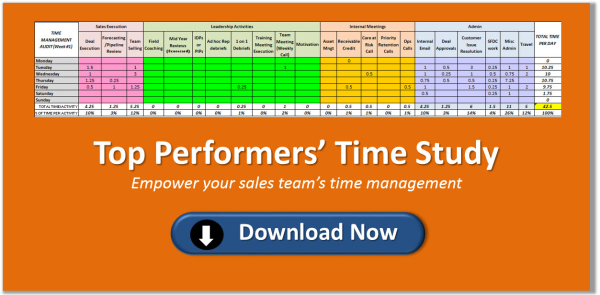
This post will also help HR and Sales leaders answer a vexing question: “What do we need to do to retain and empower our top sales talent?” It also provides a free tool to diagnose your top performers’ challenges.

"The war for talent is over, and the talent won."

This is a quote from Josh Bersin's annual Ten Predictions for HR published last week. In this 2014 edition he predicts that “HR organizations will shift their focus from cost reduction to retention and engagement.” Bersin explains:

"This year the power will shift: high-performing employees will start to exert control. Top people with key skills will be in short supply. Thanks to the US healthcare laws, people will feel more free to change jobs.

More than 60% of organizations tell us one of their top priorities is dealing with “the overwhelmed employee.”

What does this mean for Jerry and the top performers in your organization?

Overwhelmed is the Enemy of Overachievement

Jerry’s day was extremely productive. Not a moment was wasted. His calendar was packed with customer interactions. Between sales calls, he ceaselessly worked his smartphone. Email and phone conversations filled the day. He set reminders to himself in his calendar for follow-up actions. Before the day started, he had stocked his calendar with tasks. Jerry wasn't reacting to emails, he was executing on his priority list.

I asked Jerry to name the biggest challenge to his success. He said, “40% of my time is spent doing other peoples’ jobs.” By his own estimate, Jerry works 60-75 hours per week. Forty percent of his time equals 24 hours. That's 3 days each week.

Imagine how productive Jerry could be if his time was dedicated to selling.

Whose Job Is It Anyway?

Jerry said, “Our company’s growing rapidly. We’ve added a lot of new support people to implement our solutions and care for our customers. But, in the short term, it’s killing me. The new hires don’t have the skills to the do the job yet. So, I have to constantly follow up. I’m project managing my project managers.”

Reporting is another time drain. Jerry leverages his CRM system to manage his opportunities. But the bi-weekly forecast is done on a spreadsheet. Instead of relying on the data in the system, Jerry wastes time updating the same information in Excel.

Pricing exceptions are another killer. Technology firms face intense price competition. Jerry’s finance organization has implemented an internal process to manage discounts. Although the process protects margins, it saps valuable selling time from his day. He estimates that 90 minutes a day are lost to paperwork and internal processes.  

Where Does the Time Go?

Elite sales performers are excellent at time management. They are also overwhelmed. Failure to manage the demands on their time makes them a turnover risk.

Companies are also constantly squeezing costs. Administrative and support roles have no direct ROI, so they are easy targets for elimination. But the work still needs to be done. So, it often falls to Sales.

HR and Sales leaders need to understand how sales people spend their time. This knowledge allows leaders to attack the root causes of role corruption. Simply knowing that 40% of the day is non-selling isn’t enough. Figuring out how to win back that time is the key.  A time study can pinpoint the activities that drain hours from sales efforts.

How Do Top Performers Spend Their Time?

There are many ways to determine where selling time goes. Direct observation, like my day with Jerry provides a comprehensive view. But a simple time study be just as effective. Here’s how:

Top Performers’ Time Study

  1. Download the free SBI Time Study Template
  2. Explain to the sales team that this will pinpoint areas to reduce time pressure on them
  3. Launch a 2-week time study
  4. Review the reports at the end of Week 1 to ensure there are no issues
  5. Close the study at the end of Week 2 and publish the results for the participants to see
  6. Launch initiatives to fix the most wasteful time drains
  7. Communicate the status of the initiatives to the sales force and celebrate success

Top sales reps want to maximize their time efficiency. They understand the value of every selling minute. Helping them be more effective improves retention. Make your Number in 2014 by protecting and expanding your top sales reps' selling hours.

Author: John Kenney

sbi on linkedin

Follow @jdkenney

Follow @MakingTheNumber

If you enjoyed this post, never miss one again by subscribing your Email Here and/or subscribing to the RSS Here.

30 Dec 18:05

Recipe for Business Disaster: Marketing and Sales Silos

by Matthew Ranger

Recipe for Business Disaster: Marketing and Sales Silos image 2013 12 17 14.25.03

Today’s post comes courtesy of Matthew Ranger of Maximizer Software How has the sales landscape changed and what does that mean for 2014?

The start of another year, and new targets are on the board. So just how are we going to hit those (increased) targets for 2014?

Once upon a time, sales teams were the gatekeepers of product knowledge. If a prospect wanted to know about a product, they’d ask about it. Now, the customer typically knows the answers to these questions even before talking to a salesperson. They’ve done their research and in many cases, they’re fully briefed and fully aware of your product or service set. It’s time for sales to shift into a new mindset and work alongside marketing to take advantage of this new situation and improve sales conversions – dramatically.

How to Increase Sales Conversions in 4 Steps

Nurture the Leads

There are two “W”s to look at here – who and what. The question is – “who is reading what” – and this is for marketing to answer and analyze. Marketing produces a raft of content aimed at their target market, bringing people back to the website through landing pages, e-mail campaigns, organic search, paid search or paid social, and ensures that contact activity is logged.

The key is to understand your personas – know who your ideal customers are in the first place, and build that content around what they like to read. For instance, if your ideal customer is the time-hungry Marketing Director, information about productivity and time efficiencies would be welcomed.

Define Who Is Ready and Who Is Not

This is where sales & marketing really have to sit down and define where this threshold lies between “ready” and “not ready”. It’s no use marketing defining what is sales-ready, or sales defining what is not. That threshold is a joint decision.

There is software on the market that helps define the quality of a lead. Obviously, someone who has read the above-mentioned article on productivity would not be primed for a sales call. However, if they came back twice, read a couple of product or service pages, and downloaded a White Paper, you may want to define them as sales-ready.

The opportunity is to define where these triggers lie – and therefore ensure that the leads that come through to sales are of the highest quality.

Track, Communicate, & Know Your Customer

The modern-day CRM is more than just a database with a few bells and whistles added on. It should be pumping out social information in a concise stream so that you can view & act quickly.

For instance, if you’ve got a sales lead that you’ve been working on for the last few weeks, but have been struggling to close – a social interaction from that client might be the trigger to start the conversation again. It’s good to know what’s going on outside of the sales bubble – and how you can be of any potential assistance.

Listening is the new talking. The trick is to learn how to listen for the right things. Your CRM should be the one doing all the talking.

Know Your Data

Let’s be honest. Sales have never been the best at handling spreadsheets full of data. For some reason, sales always looks at the bottom line first.

There’s nothing wrong with that, but knowing the ins and outs of the data is going to be essential as we move into the world of inbound marketing. Understanding which leads are most valuable is not the realm of one person alone, it’s a business view. Getting accurate, deep insight into the data allows you to cross-reference and measure more precisely.

We can even take this back to content and ask ourselves which pieces of content produced the highest value leads? It’s a good question to ask and it’s not one that will spring out immediately at you unless you’re good at creating pivot tables in Excel.

Know your data – know it inside out – and you’ll develop insight into the inbound marketing process that gives you a serious competitive edge.

Inbound marketing isn’t just about throwing out some content and calling people who’ll look about it. It’s all about having an informed discussion with the right people at the right time. The content is just the means to defining who is the right person, and what they might be interested in.

Your job is to use your sales skills – just like you always have done – but with significantly better levels of insight and information than ever before.

All of a sudden, those 2014 targets don’t look so far-fetched do they?

30 Dec 18:04

Grow Sales – Weekly Sales Dashboard

by Lori Richardson

Weekly Sales DashboardHeading into a new year, most every seller wants to be more organized than they were previously – it is one of the top issues that always comes up when we poll sellers about what one issue in selling they’d like to improve upon.

What if you had a sales dashboard?

Some of you do – if you work for a company that has created a custom dashboard in your CRM system or other app.

If you are not one of those sellers, and would like a very simple way to get your week off to a great start, consider downloading our free Weekly Sales Dashboard – Generic version free download here. We customize these for clients based on what is important to the flow of their process, their sales methodology, and specific tools they use.

The Weekly Sales Dashboard is an overview document – it gives you a single visual for all that you are doing. It can help you in 12 ways – here is the quick overview, and you can hire us to help you implement it to create an ROI like you wouldn’t believe. It is sales methodology agnostic, meaning that we are not pushing any one sales training program when we offer a tool like this – it simply allows you to print out a form you can immediately use to help organize your thoughts and make every sales minute count.  We like those kinds of tools, don’t you?

Morning routine – this is the place to jot down the 3-5 things that you’ll do all week to stay on track as soon as you start at your desk.

Top prospects to call this week – you probably have a massive Excel spreadsheet, or CRM system – but who specifically do you want to make sure you reach this week? If you can’t tag that in your CRM system, use the Dashboard for that.

LinkedIn contacts to make or follow-up with – Easily jot down names as you are going about your calls here, then later you can look them up to connect or to get more insight on them. It keeps you moving on the calls when you can research multiple names at one time.

Client to-do’s this week – most sellers have existing clients – jot down the handful you need to talk with this week and why. You won’t forget them this way.

Professional Development – what book are you reading to expand your selling world? What videos or blogs? Jot them down.

Prospecting Time Blocks this week – write down specifically WHEN you will be making outbound calls in time blocks

Top 25 Target Prospects – typically sellers have a massive list of prospects – but do you have a short list of companies you’d really like to get into? We consider this a target list, and it could be just 5 companies of 25 – but jot down 2 or 3 for this week.

Top 5 emails to write – quick, short note for any very important quote or note you need to get out this week.

5 handwritten notes this week – do 3 if you can’t find time to do 5, but for every great conversation with a buyer, or for the top 3 outstanding conversations, draft a 3 sentence note and put it in the mail, along with your business card. It’s appreciative, not pushy.

3 potential referral partners – if you can get connected to more people with large communities of your probable prospective customers, you can leverage these relationships by helping them and keeping in touch with them. You’ll stay on their minds this way too. Who are they? Reach out to several each week. You may end up with 50 of these key strategic contacts.

Last week’s success – Rate how successful you feel you were last week, on a scale of 1-10, with 1 being very poor and 10 being exceptional. We help sales teams create this scale based on a number of criteria – you can do whatever you like, as long as it is consistently used to measure – such as factoring in how many actual conversations with actual potential buyers, etc.

Miscellaneous – You may have a category specific to your team or industry that we don’t – you can add it here, or just put comments about overall effort, strategy, and success.

You will be amazed and astounded with the results achived by putting something SO SIMPLE as a dashboard in place in 2014. We’d love your thoughts if you already have a tool like this or if you find this to be helpful.

Get at it, and good selling!

Weekly Sales Dashboard FREE DOWNLOAD click here

Lori Richardson - Score More SalesLori Richardson is recognized as one of the “Top 25 Sales Influencers for 2013″ and one of “20 Women to Watch in Sales Lead Management for 2013″. Lori speaks, writes, trains, and consults with inside and outbound sellers in technology and services companies. Subscribe to the award-winning blog and the “Sales Ideas In A Minute” newsletter for sales strategies, tactics, and tips in selling. Increase Opportunities. Expand Your Pipeline. Close More Deals.

email  lori@scoremoresales.com | View  My LinkedIn Profile

The post Grow Sales – Weekly Sales Dashboard appeared first on Score More Sales.

30 Dec 18:04

What Every Sales Professional Should Do Before Pitching a Prospect

by Ross Simmonds

What Every Sales Professional Should Do Before Pitching a Prospect image research research research

One of the key elements of driving business success is ongoing education. The best organizations know their customers interests and frustrations. Further, they also understand their competition and recognize a combination of both threats and opportunities. More than anything though, a great organization is built on a sales team that understands their target audience and prospects.

When you’re looking to close new business, the first thing you need to do is understand your prospect. You need to gather data and determine the best approach for closing a particular deal. It’s not the most glamorous part of a sales job, but it’s one that can make or break you.

Over the last few months, we’ve worked closely with a handful of businesses to better understand how they conduct prospecting in their organizations. Beyond that, we’ve also taken our own experience to put together a list of three things that every sales professional should do before pitching a prospect:

Research, Research, Research!

You research papers in school. You even research holiday destinations. Are you researching prospective clients before pitching your product or service? Do you know who your clients should be? Who they are now? You should. It’s a key part of the sales puzzle that is too often overlooked.

To kick things off, it’s best practice to create a customer persona or profile that can be used to better understand your target audience. This is a practice that we’ve used in the past and one that the folks at National Federation of Independent Business (NFIB) strongly recommend. It’s a practice that can drive real results for your business and help your marketing team craft more effective messages.

Once your marketing team understands the persona, it’s time to get down to making the sale. It’s time to start bringing in leads and diving deep into understanding them as individuals. This is where the best sales professionals thrive, as they spend a lot of time understanding their prospects and using a combination of research and data to help them.

A few simple tips and tricks that can help you with your prospecting include:

  • Look for them on LinkedIn, Facebook, Twitter, Google+ and any/all other social media they use
  • Search their websites to find their profile and read their biography for insights
  • Use apps like Rapporative to uncover details surrounding their social profiles
  • Use searches to find any conferences, events, or publications they’ve been involved in over the last few years
  • Use technology like ours to uncover existing relationships within your organization and theirs to make introductions or gather more intelligence

Give Yourself A History Lesson

There’s a reason your customers need you. To best know that reason, talk to your existing clients and better understand this need, and how your product has helped them over time. As a wise scholar once said, you cannot predict the future without taking time to better understand the past. Take time to understand what gaps are in the market, what triggers their purchases and what role in a specific industry tends to make the buying decisions. When you know this, you’re better equipped to make the sale and communicate a compelling value proposition to your prospects.

You’re probably wondering where to start this history lesson. Well, thanks to technology, researching and uncovering trends has never been easier. With social media analytics, CRM technologies like ours, combined with several free online tools available, you can better understand your audience.

Also, ask! There’s nothing wrong with finding out what your customers have purchased in the past, and why. Make it worth their while to give this information.

Watch Don’t Stalk The Competition

Who’s next to you, waiting to grab your potential customers? It should go without saying, but you need to know your competition and monitor what they’re up to once in a while. It’s completely fine to monitor what your competition is up to on LinkedIn and see whom your clients are adding.

That said; don’t get too creepy or too obsessed. I’ve worked with some paranoid people over the last few years and clients hate it. Instead of being obsessive, take the time to simply understand their business and who their clients are. Understand their sales strategy and take a glance at what they’re doing to generate new leads and prospects.

Some great suggestions, from entrepreneur.com, include keeping an eye out for competitor names in trade publications and monitoring your competitors’ updates. Thanks to the internet, you can track names of your competition on search engines and see what’s said about them online. On social media, look at who is following your competitor’s updates.

Because social media is fairly open and public, you can look at what other products/services/companies have their attention, and start to figure out why you may be exactly what these potential customers need.

With this newfound education on your competition, prospects, and existing clients, you should now feel more confident about pitching prospects. With these insights and research, you can take your entire sales team to the next level and drive meaningful results.

A lot of businesses talk about social selling, but not many of them know how to make it real. Through a combination of technology, social media, and data, you can establish a competitive advantage that is difficult to match.

Anything you’d like to add to the conversation? Comment, tweet or share this post on Facebook!

30 Dec 18:04

5 Year-End Sales Leadership Tips

by TheSalesHunter

5392109 medium 300x300 5 Year End Sales Leadership Tips photoOnly a couple of days left in the year.

This means everyone is spending at least a few minutes reflecting back on the year and, at the same time, looking forward.

Here is my list of 5 quick sales leadership tips that make a difference:

First, personally thank each person you lead for their contributions.

It’s easy to thank those who have done a great job, but that’s not enough. Thank everyone.  You want everyone coming out of the year feeling good and looking forward to an even better upcoming year.

Second, take the time to acknowledge not only those you lead, but also their families and/or closest loved ones.

Am I asking you to get personal?  Yes and no.  What I’m saying is take the time to realize the performance of any person you lead is impacted by the support they receive from their family and social circle.

It doesn’t take much to acknowledge this. It can be as simple as stating to an employee how you hope they are able to spend some quality time with their family, etc.

Third, call out and recognize those who did an outstanding job.

Don’t forget to recognize those who may have had some incredible success in the 1st quarter of the year.  Too many times, year-end recognition winds up going to those who achieved success the last couple of months.

Fourth, communicate to everyone how much you’re looking forward to next year.

Do this one-on-one to allow you to personally share how much you see them as being a key part of the upcoming year.  People will always do far more when they feel a personal connection to what their leader is expecting of them.

Fifth, take the time to reflect back on your accomplishments and use them as a guide to helping you to set your leadership goals for next year.

When I say “leadership goals,” I’m referring to how you see yourself communicating and dealing with those you lead.

There you have it:  5 leadership tips every leader should do right now at the end of the year.

The really question is… Will you do these tips?

Copyright 2013, Mark Hunter “The Sales Hunter.” Sales Motivation Blog. 
button receive a free9 300x51 5 Year End Sales Leadership Tips photo

30 Dec 18:03

10 Most Popular Sales Source Posts of the Year

by Geoffrey James

Here are the posts readers liked the best and shared the most in 2013.

The "Sales Source" blog had a great year in 2013, reaching more readers than ever before. Here are the columns that you, the readers, liked the most last year:

Have a great End-of-Year and an even better New Year. I've got lots of cool stuff ready for next month, so stay tuned!

Like this post? If so, sign up for the free Sales Source newsletter.


30 Dec 18:03

9 Steps to Boost Sales in 2014 Part 3 Execution

by Lori Richardson

elephant in the roomIn the first two posts in this series we talked about gaining visibility to grow sales as well as putting a plan in place. Now how are you going to make this happen?

Through taking action. You will take big action, but it usually happens through many small steps.

What is the Best Way to Eat an Elephant?

US Army general Creighton Abrams famously said,

When eating an elephant, take one bite at a time.

Your “elephant”, in this case,  is all that is ahead of you. Haven’t you had a situation where the work ahead of you seems so daunting and unachievable that it is difficult to see how it will ever get done?

If this is your new quota, or new list of contacts or achievements you must accomplish in your position, we’d just encourage you do to one step at a time, with forward motion going every day. If it is a new plan, or new territory – find the upside to it and see how you can make it work for you. Then, and only then, can you break it down into smaller pieces.

Once Insurmountable, Progress Becomes Noticeable

You have to dive in and make things happen with noticeable progress always seeming to lag behind.  The funny thing is that it doesn’t seem to matter how many times you’ve had seemingly insurmountable tasks – they still seem overwhelming even when you’ve had success getting other projects done. It’s human nature, so don’t dwell so much on how overwhelmed you feel – instead start thinking about how you can break the project down.  Eventually you start to see real differences.

Example: Ridding Your Office of Paper in Favor of Digital Documents

Do you have thousands of documents that you or your company wants to convert digitally to be more organized in the coming months? That could be extremely overwhelming until you think about how you’ll do it (what options) and then start with a bit of the whole project and delegate to get it done. The pros – being in a clear space so that you can focus on “net new” sales will far outweigh the chore of getting stacks of papers scanned and organized digitally. There are services that do it which you can get to pick the documents up at your door, or you can bring in a temp or a student to do this at your offices.

The point is that one step after the other, without stopping makes things happen.

You Cannot Improve What You Don’t Measure

The science aspect of selling needs to be measured so that you can course correct and change as you move forward. Too many sellers are not aware of their sales conversion rate (how many qualified deals do I normally close?) or their prospecting conversion rates (how many decision makers do I need to talk to in order to set up a next meeting / demo / conversation)? This is critical information that once you know it will help you know what your paycheck will ultimately become. Is that important to you?

What projects are you going to commit to get done which will lead you to more sales in the coming year?

How can you tackle them one at a time?

What tolerations – little things – are slowing you down that you could put an hour of time into that will knock them out?

Download the summary tip sheet for these ideas (Part 3) here click here

Download the summary tip sheet from Part 1 of this series click here

Download the summary tip sheet from Part  2 of this series click here


IBMThis post was written as part of the IBM for Midsize Business program, which provides midsize businesses with the tools, expertise and solutions they need to become engines of a smarter planet. I’ve been compensated to contribute to this program, but the opinions expressed in this post are my own and don’t necessarily represent IBM’s positions, strategies or opinions.

Lori Richardson - Score More SalesLori Richardson is recognized as one of the “Top 25 Sales Influencers for 2013″ and one of “20 Women to Watch in Sales Lead Management for 2013″. Lori speaks, writes, trains, and consults with inside and outbound sellers in technology and services companies. Subscribe to the award-winning blog and the “Sales Ideas In A Minute” newsletter for sales strategies, tactics, and tips. Increase Opportunities. Expand Your Pipeline. Close More Deals.

The post 9 Steps to Boost Sales in 2014 Part 3 Execution appeared first on Score More Sales.

30 Dec 18:03

VIDEO SALES TIP: How to BLOW It When You Give Your Price

by TheSalesHunter

When you put your price across the table, do you then start compromising? Talking?! Squirming?

Stop it! You’re blowing it!

There’s a better way to give your price.  The right way.  With confidence and competence.  And silence!

To see what I mean, check out this video:

Copyright 2013, Mark Hunter “The Sales Hunter.” Sales Motivation Blog. 

button receive a free9 300x51 VIDEO SALES TIP: How to BLOW It When You Give Your Price photo

30 Dec 18:03

4 Tips for Inside Sales Reps to End Q4 Strong

by Samantha Goldman

4 Tips for Inside Sales Reps to End Q4 Strong image shutterstock 49956259 resized 600Ah yes, it’s that time of year again. Lines at the mall are out the door, parking lots are jammed, and calories don’t matter (right?). With the holiday season comes the end of the fiscal year for the majority of companies. And for inside sales reps here at AG, it can be a stressful time, as they try to pass qualified leads while prospects are taking vacation time to spend with their family. We can use this time to plan for the New Year while also nurturing accounts and catching prospects live. Last week, Craig gave some tips from a director’s point of view, and this week I’m giving some tips from a sales rep standpoint.

1. Target more senior level employees. It is true that less people are around to answer their phones and emails in December, but if you happen to speak with a prospect live, you are more likely to pass them. There are some interesting stories floating around the office from years past at AG with sales reps passing C-level prospects. You have to be persistent and try to target those higher level employees, but it will pay off.  I have spoken to many prospects who have told me their organizations are having a partial shutdown for the holidays, which means many workers will not be in the office. However, the necessary workers will be there, so this is a great time to target higher level employees. Don’t be afraid to ask those prospects who are still in the office during the holiday season if they could direct you to the correct contact.

2. Circle back to your list of nurtured or interested accounts. One thing that has helped me throughout tough months is creating a list of your nurture and interested accounts to circle back to every few months. It’s worth trying to have a quick discussion with these prospects before the holidays and set up a time to either check in with them in Q1 of 2014 or have an intro call if they are ready. You should always be pulling in contacts to your current pipeline, but December is a good time to focus on interested accounts from that calendar year. And when you do speak with someone live, it helps to say you wanted to check in and try to get some time on their calendar in the New Year before schedules get hectic after everyone returns from holiday vacation. I have had prospects appreciate the fact that I circle back with them to schedule time either right before the holidays or immediately after.

3. Connect on a personal level. Another thing that helps around the holidays is your tone. Be cheerful and happy; it is okay to say “Happy Holidays” in emails and voicemails. It will make you stand out from the automated messages prospects get from many salespeople. When leaving messages, try to mention that you wanted to try to speak with them before the holidays to see when their schedule would allow for a discussion, since a lot of people are taking time off to spend with their families and enjoy the holiday season. This will help you connect on a personal level as well as on a business level.

4. Think ahead. Finally, you also need to be thinking of the year ahead. While December is a tough month for many, you need to look at January as well and create a strong pipeline for when you return to the office after the glitter and champagne wears off. This is why it is important to always be pulling in new contacts and getting availability from interested contacts for follow up discussions.

You can tackle the holiday season both in an out of the office and be successful. It just takes planning and organization. My best advice would be to start in the beginning of Q4 and plan ahead then, but if you are unable to plan that far in advance, just stay persistent and you will be able to uncover qualified opportunities.

4 Tips for Inside Sales Reps to End Q4 Strong image c3d9e769 c3ae 4116 b4a8 6d0e19bf9fd54

4 Tips for Inside Sales Reps to End Q4 Strong image 07f0bf66 1dcb 40ea acd9 7c4ff5605ab013

30 Dec 18:02

10 Questions Every Sales VP Candidate Should Ask the CEO

by Drew Zarges

Interviewing for the VP of Sales requires a lot of preparation.  Many candidates spend hours honing interview responses. However, surprisingly few candidates spend enough time developing questions they should ask. This a big mistake. Sometimes the VP of Sales position is a great new opportunity.  Other times, it is a role destined for failure.  To understand whether the job is suitable, candidates must ask the right questions. 

10 Questions To Ask Sales VP

The interview is your opportunity to understand the company and boss.  Throughout the interview, the VP candidate should look for these three qualities:

  • Performance Conditions:  Does the current environment allow the Sales VP to be as effective as possible?  If not, would the Sale VP have authority to change these conditions? Be cautious of any role where every decision must be approved by your boss.

  • Culture Fit: Do you like your would-be boss? Is this company aligned with your beliefs? Does their pace of work and appetite for change match yours?  Don’t overlook this—this is one of the biggest reasons for failure.

  • Job Expectations: Are the expectations of the VP role reasonable? Do they align with your expertise?   CEOs have very different expectations of this role.  Some expect the VP of Sales to be a “Super Rep”.  Others want somebody who can increase productivity and capability throughout the department.

Download our guide, 10 Questions for The CEO.  We’ve included 10 Total Questions, Good Responses, and “Red Flag” answers.

10 Questions for VP of Sales

Here are three critical questions a VP of Sales Candidate should be prepared to ask. 

What happened to the last guy?

Don’t accept blasé answers like, “He resigned because he wanted to spend more time with his family”.  VPs leave when they

  • feel unappreciated

  • are overwhelmed

  • have limited authority

  • hate their boss

  • miss their number

Demand on honest answer.  Ask yourself if this exit reason can be avoided.  If not, look elsewhere.

Red Flags:  CEO complains about entire sales department as a cost center.  Talks about previous VP of Sales in completely negative terms.  Fires the VP after a limited time horizon (1 year or under).    Gives you the BS “family time” line.

What would your colleagues say about working with you?

Research has shown that asking someone to self-assess gives you unreliable information.  A “tell me what X would say about you” paints a clearer picture.

If the CEO only talks about the positives, ask for shortcomings. 

Red Flags:  Anything about being super detail oriented, a control freak, or untrustworthy.  Any grandiose responses about how great he is.  Unable to acknowledge opportunities for improvement.

What was the quota and actual performance last year?  What is the quota this year?  How did you decide on that number?

Alright, this is really three big questions. But the follow up questions are critical.  Every candidate is promised an On Target Earnings (OTE) figure.  This is contingent on how accurately the quota is set.  If you can’t hit it, you’re not getting the incentive pay promised.

Red Flags: Big gap between performance and quota. Pie-in-the-sky market share figures determines quota.  Board of directors looks to Wall Street estimates for your quota.  No historical performance, account penetration, or product maturity calculated in quota.

The best way to avoid failure is to decline a role with impossible expectations.  Get the necessary information by asking the right questions. We speak with many Sales VPs.  Many have one short stint on their resume. Something “didn’t work out” because they sped past the red flags.  Download our 10 Questions for The CEO Sheet, and get these and more questions for your interview.  

Readers: Is there any question you wish you had asked before accepting a Sales VP position?

Author: Drew Zarges

sbi on linkedin

Follow @DrewZarges

Follow @MakingTheNumber

If you enjoyed this post, never miss one again by subscribing your Email Here and/or subscribing to the RSS Here.

30 Dec 18:02

Beat the Brain Fog and Think Outside the Sales and Marketing Box

by Megan Toohey

Beat the Brain Fog and Think Outside the Sales and Marketing Box image LookOutsideTheBox resized 600… or if you’re me, cut it up, douse it with glitter and make a star instead

Everyone suffers from groggy redundancy within their job.  Whether you’ve written the same email 10 times already that day, you’ve said the same exact thing on every single phone call, or you’re at the point where you’re just staring at your computer screen, you need a break, a breather, and some inspiration.

Within the sales and marketing profession, at times you need to think differently by looking at an issue from a unique perspective or delivering a message with personality in order to captivate your audiences.  You need more brainpower to communicate more effectively.

Here are four tips on refreshing your thoughts and fighting brain fog.

1.) Play to your strengths

If you need to communicate to a prospect and you find that you’re rambling in an email but you know you communicate more precisely on a phone call, pick up the phone!  There’s nothing wrong with an old-fashioned conversation.  If you’re afraid of public speaking in a sales meeting, but can consult like nobody’s business via email, then type up talking points and walk yourself through your speaking portion.  Not everyone is built the same way, and we all have different strengths. Use yours to your advantage!

2.) Take a break and read

No, I don’t mean read your crazy college friends’ Facebook updates and “like” your way through your Facebook feed. Instead, read relevant content and posts from thought leaders.  Sometimes you get too caught up in your own rituals and the way that you habitually think that it becomes difficult to get out of your own way.  If you brush up on ideas from individuals who have an altered way of thinking or read up on why their process is different, then that may allow you to open your mind.  As Robert Frost states: “Two roads diverged in a wood, and I- I took the one less traveled by, And that has made all the difference.”

3.) Chat with a fellow employee for a few minutes

If you’re feeling stuck in the same old same old, it might be time to take a break.  Walk around the office and talk to a co-worker and see what they’re working on. Remove your mindset from your current project and focus on something else.  Even better: talk to someone outside your company for a little while.  Let’s face it, if you removed yourself from your specific job and were placed in a completely different company doing the “same job,” you would most likely be up against different challenges and would need to create different solutions.  It’s always good to talk to other people within your industry to see how their approach may differ from yours or your company’s.

4.) Do something different

If you’re struggling to think, find an answer to a question, or create a closing presentation and you’re at the point of almost no return, stop.  Take a different approach; change your focus and mental process to something “different.”  Focus your mind on something dear to you, perhaps a picture of your family, your crazy lazer-eyed cat, something that for a few seconds soothes your blood pressure.  Change the music you’re listening to.  If you’re on your way back from lunch and need to jump right into a project, but the only thing you’ve thought so far was, “How many hours until I can put my sweat pants on?,” do something different. Take a different route back to the office, grab coffee from somewhere new, sit somewhere and people-watch.  Reset your mindset; wipe your slate clean and find a different inspiration to complete your task outside of the pressure related to the deadline.

Let’s face it, we’re all human and we all fall into a brain fog.  It will happen.  The challenge is learning how to escape the brain fog and create a mentality that will allow you to produce your best work by thinking outside of the box.  Think a little differently, continue to learn, grow your curiosity, find new inspirations, oh and don’t be a work hermit.

30 Dec 17:49

Adding context to content to create sales magic

by David Meerman Scott

I recently had an excellent conversation with my friend Greg Alexander, CEO of Sales Benchmark Index, about how marketing and sales can work together more effectively.

I spent most of my career in business-to-business marketing, although for four years I was in B2B sales. So I've seen both sides.

Back in the mid-1990's it was hard to find evidence of love between marketing and sales. At many B2B companies the relationship was downright adversarial. Often, the tension extends all the way up to senior management.

It all stemmed from the sales process involving a "handoff." Marketing generated leads, handed them over to sales, and then the sales team owned them until close.

So Greg and I chatted about how sales and marketing work effectively together. We discussed the new buying process and what that means for salespeople, marketers, and their management teams.

In my simplistic first stab at this, I offered that marketing must create the content that salespeople need to be successful in the selling process. It could be in some repository somewhere where salespeople could access it or it could be free on the web. But the salesperson knows how to get it where it’s located.

This means that what the marketing team does is important for the entire sales process, not just for the top of the funnel as was true just a few years ago, because salespeople are using content all the way to closing the deal.

It is, I said, the salesperson’s job is to understand each individual buyer or existing customer so well that they know precisely which bits of content should be pointed to them.

Adding context to generate magic

But Greg took it much further.

“What the salesperson has to do is implement context,” Greg said. “This is where contextual content marketing actually happens. The marketing department is doing everything you just said, which is huge because salespeople don’t have the time to do all that. And sometimes they don’t have the skills.”

In Greg’s view, the salesperson, as the expert in the customer, takes what the marketing department creates and then personalizes it for each buyer or existing customer and passes it on in whatever method is best: LinkedIn, Twitter, email, or even the good old telephone. It is a reason to make contact.

“Sales reps take the information and say: 'How does this idea, this theme, this concept apply to my account and my decision-makers inside those accounts?',” Greg says. “'How do I make this real them? How do I provide context for it?' That’s where the magic happens.”

Are you making magic?

23 Dec 17:36

Track Emails Without Responses in Gmail with this Script

by Thorin Klosowski

Track Emails Without Responses in Gmail with this Script

There are plenty of tools out there to help you with email management, but if you want to do it yourself, blogger Jonathan Kim has created a Google Script that automatically shows you which emails you've sent out that haven't received replies.

Read more...

23 Dec 17:36

Parents May Be Your Secret Weapon For Recruiting and Retaining Millennials

by Karie Willyerd

A recruiter at a well-known Fortune 10 company told me this story: She was getting ready for a phone interview with a new college graduate. But when she dialed into the conference number at the scheduled time, instead of the candidate, there was an older woman on the line.

The female caller identified herself as the applicant’s mother and said, “I know you were expecting a call with John (not his real name), but he’s tied up in another interview at the moment. Fortunately, I know him so well that I can do the interview for him. Do you mind?”

The recruiter understandably replied that she did mind and asked John’s mom to have her son call when he was available.

If you suspect this conversation is an anomaly (and a shocking one at that!), think again. I speak with large groups of HR executives several times a month and when I ask the question, “How many of you have had a parent get involved in the hiring process?” at least half raise their hands, sometimes, two thirds.

I often follow up by asking how many have had a parent intervene in the performance review process. About a third raise their hands to this question. Rather than being surprised by all the hands in the air, the executives seem comforted knowing that others are in the same boat when it comes to recruiting and retaining Millennials.

This is a new reality: Parents are increasingly involved in their Millennials’ decisions. According to one study, more than a third of Millenials with a mentor say a parent fills that role. In another study, when asked to list the most influential people in their lives, 61% named their parents ahead of political leaders, news media, teachers, coaches, faith leaders, and celebrities. Pew Research reports that 36% of Millennials still live with their parents.

In a sense, knowing that a single group yields so much influence with Millennials makes your job designing strategies for attracting and retaining them easier. Parents may very well be your secret weapon in convincing Millennials to join or stay at your organization.

Here are five ideas for integrating parents into your talent strategy:

  1. Invite parents in. College recruitment has long included parental visits and open houses the first week of school. Some Indian companies, recognizing the importance of family, are doing the same: welcoming parents to new employee orientation (a few have even taken it a step further and offer benefits to dependent parents, strengthening the employee bond). Why not invite parents to your employee orientation or onboarding program? You might let them visit during an open house or join a conference call to ask questions about benefits, understand the employee value proposition, and link them emotionally to your brand.
  2. Offer free training for parents.  Since mentoring is the number one way Millennials choose to learn, and the parent is frequently chosen as a mentor, consider preparing mom and dad for the role. Give them mentoring skills as well as training on problem solving, interpersonal skills, communication, leadership, or even the performance review process. The idea is that if you give parents these skills, they will hopefully transfer what they learn to their child — your employee.
  3. Hold a “Take Your Parents to Work” dayLinkedIn held their first Bring in Your Parents Day this past November. It was “designed to help bridge the gap between parents and their professional children.” According to their research: 35% of the parents they surveyed are not completely familiar with what their child does for a living; 59% of parents want to know more about what their child does for work; and 50% of parents say they could be of benefit to their offspring by having a better understanding of their careers.
  4. Use parents to recruit.  Again, universities are already doing this, so it’s not new but consider interviewing parents and including their stories on your Facebook recruiting site (you do have one, don’t you?). Or put them on your open house agenda and ask them to share their stories as an employee parent.
  5. Include parents in your communication strategy.  Allow parents to subscribe to your newsletter or other communications that engage them in the company culture. All new Qualcomm employees are automatically registered to receive an online story each week for their first year. The stories start with the founding of the company and go all the way to present day, describing the history of the company’s technology successes and failures, as well as the rationale behind key decisions, all while memorably conveying the company’s culture. Parents might enjoy reading this as much as — or even more than — their children, and again they might use it while mentoring or advising their children.

None of these strategies are expensive and yet they can go a long way in attracting and retaining Millennials. Simply acknowledging the importance of moms and dads in their lives will help you stand out from other companies. Instead of shaking your head at this trend of increasing parent involvement in your employees’ work lives, embrace it.

Talent and the New World of Hiring
An HBR Insight Center
23 Dec 17:36

How Marketers Can Avoid Big Data Blind Spots

by Jesko Perrey

If you were looking for a theme song that captures marketing today, you could do worse than pick Queen’s anthem “Under Pressure.” Marketing is under pressure to show results, cut costs, and drive growth. Marketers should welcome it. That’s because marketing has a big opportunity to drive above-market growth and demonstrate its value to the C-suite and the boardroom. In our experience, marketing can increase marketing ROI (MROI) by 15 – 20 percent. That kind of value can turn plenty of heads in the C-suite.

How? The explosion of data about consumers and the analytics techniques now available have made marketing a much more precise science.

All this wonderful Big Data created by the digital revolution, however, has created a serious problem for marketers. Just because the data and analytical techniques are available doesn’t mean they provide complete insights. This is very much what Albert Einstein meant when he said, “Not everything that can be counted counts.”

Blind spots

Consumer decisions are driven also by many stimuli outside the digital realm (e.g. TV ads). This results in a number of issues, not the least of which is misattribution of cause and effect based on a tendency to measure what is easy to measure, ie. giving credit where credit isn’t necessarily due.

One energy company, for example, observed that their customer losses were closely correlated to the intensity of customers’ Google searches for an energy supplier. They built a customer churn econometric model in which search was responsible for 65% of churn. However, in-depth analytics revealed that customers’ decisions to switch energy providers were driven by their and competitors’ prices, advertising and company’s position in in social media, TV, print and other mass media. When all these additional explanatory factors were included in the customer churn model, search was not the cause of customer churn since people had already made up their minds by the time they were searching.

Most recently we’ve seen a lot of companies with claims about the ability of their analytical tools to provide a silver bullet set of answers to any marketing question. In our experience, those claims are hard to back up in the real world. What we see that’s most effective is having the right combination of tools and capabilities with as clear a sense of what they cannot do as what they can.

Overcoming “short-term-ism”

One major blind spot for marketers to be aware of is “short-term-ism” that most analytics engender. The reality is that the majority of marketing activities have both a short- and long-term impact on sales. The short-term impact is typically responsible for 10-30 percent of total sales while the long-term impact (called also the “base” or brand-building impact) is 1-3 times greater than the short-term effect. Big data-based analytical approaches, however, such as econometric and digital attribution modeling, for example, can detect only the short-term impact of marketing. What this means in practice is that the majority of data and analytics provide marketers with a short-term picture and can lead to short-term decisions that are detrimental to the long-term sales performance.

Given this reality, marketers need to overlay their Big Data models with analysis of the longer-term brand equity effect responsible for the remaining “base” of 70-90 percent of sales. Without ongoing investment in the brand, the value of this base erodes over time and creates a stiff head wind for future sales.

To understand long-term effects, companies first need to create a baseline by estimating the potential decline in base sales if all marketing activities would be stopped. Reviewing marketing investments and brand performance of multinational companies across regions is a good place to start since that data often yields a useful set of measurements of the impact of “brand leakage” (ie. how much base sales is lost and at what rate). That estimate then needs to be tested and adjusted systematically based on the unique situation of the company using the experience and judgment of marketing and sales managers, as well as other internal data (e.g. customer surveys).

These estimates can then help determine the Net Present Value (NPV) of the long term effect of marketing in terms of future sales. This NPV provides marketers with a reasonable understanding of the long-term implications of marketing in addition to the short term impact measured by Big Data and help make necessary trade-offs when it comes to making spend decisions. Although this is not a perfect science, we think it’s better to be “roughly right” than “precisely wrong.”

One consumer food brand almost fell into this short-term trap. It launched a campaign using Facebook advertising, contests, sponsored blogs, photo-sharing incentives, and shared shopping list apps. The approach paid off, delivering sales results similar to those generated by more traditional marketing (which included heavy TV advertising and significant print), at a fraction of the cost.

Given the overwhelming success of this effort, the brand considered shifting significant spend from TV and print advertising to digital and social media channels. When the long-term effects were included in the calculations, however, the proportion of impact of digital dropped by half because most of digital activities (search, display, etc.) typically are short-term calls to action and contribute little to building the brand and consumer loyalty. Significant cuts to TV spend as suggested by traditional econometric modeling would have reduced the net present value of the brand’s profit.

Marketing analytics is far from a monolithic approach. It’s actually a collection of approaches and techniques that, when systematically applied across a specific set of issues, delivers useful insights for making marketing investments that pay off. The latest wave of data combined with the right models can illuminate a lot. But smart marketers will spend just as much time looking for their data’s blind spots.

23 Dec 17:35

To Use Technology Effectively, Ask the Tough Questions

by Ron Ashkenas

Over the years I’ve talked with hundreds of managers about the reasons for complexity in their organizations — and in almost all cases they cite “technology” as one of the main culprits.  But in the next breath, they also acknowledge that technology has revolutionized the way they work, increased personal productivity, and given them a whole new world of capabilities.  It’s an odd dichotomy: the notion that technology is a blessing and curse, a driver of improvement, and a source of frustration.  This often leaves managers wondering what they can do to increase the benefits and minimize the pain, both for themselves and their organizations.

To tackle this question, we first need to understand what’s behind this perception of technology as a paradoxical phenomenon.  In my experience, there seem to be two main issues: the accelerating rate of technological change and the often-unrealistic expectations that technology creates.

The exponential increase in the speed of technological introduction and commercialization was first described by Alvin Toffler in his 1970 book Future ShockAlthough primarily considered as a harbinger of the virtual society, one of Toffler’s key insights was that the cycle time between technological discovery and widespread commercialization was continually shrinking, which would force people to deal with continuous, rather than episodic, change.

For example, after the invention of the telephone, it took more than 80 years for much of the world to be connected (and even more in rural and economically depressed areas).  In contrast, the cell phone was invented in 1973, became commercially available within a decade — and now, only 40 years later, there are more than five billion such phones being used around the world.  Moreover, mobile phones these days are not just used for making calls, but for a host of other applications — with new ideas and technology being introduced almost daily.

The pace of these changes presents challenges across industries. Not long ago, I was facilitating a customer advisory board meeting for one of my technology clients, and the main recommendation was to slow down the introduction of new features because their organizations could not absorb them fast enough.  In other words, from their perspective, the continual onslaught of new technology was making things more complex and harder to manage.

On the other side is an increasingly unrealistic set of expectations about what people can accomplish with technology. Yes, we have the capacity for instantaneous, global communication, search, and transaction processing. But does that mean that all business should be conducted at warp speed? Many managers seem to report that this is what their customers, partners, and senior executives seem to expect, which drives them to work longer hours and continue business processes (e.g. emails and texts) while traveling, being with family, or on vacation.  This leads to a lack of time to think, reflect, recharge, or step back, which not only creates more complexity but also doesn’t allow managers to get control over their time.

Managers who want to minimize the complexity caused by technology therefore may need to think about the following two sets of questions:

  1. What technological innovations should we actually adopt in our business, and what could we defer or delay?  And if we do accept new technologies, how can we absorb them without creating confusion or complexity?  The key here is to make sure that new technologies — or even new features and functions of old technologies — actually produce business value.  All too often we adopt new stuff because it is “cool” or sounds good, but we don’t examine whether it will actually provide a return on the investment.  And sometimes we don’t stop to ask how well our existing structures can support these innovations.  Unfortunately, if it doesn’t drive business value, than the only thing it might produce is more complexity.
  2. How can we create more realistic expectations with our customers, clients, partners, and each other about the pace of work?  Are there ground rules that we can institute or ways that we can at least make the expectations more transparent and understood? Questions like these can help make it possible to be more explicit about the differences between handling high priority work and everything else. One easy mistake to make in our world of instantaneous communication is  treating all activities as being of equal value. If you are clear on what types of projects or questions warrant a quick response, it will help the rest of your team prioritize.

Obviously answering these questions won’t immediately reduce technologically-driven complexity.  But they might be a good place to start.

23 Dec 17:21

9 Steps to Boost Sales in 2014 Part 2 Planning

by Lori Richardson

plan well to grow sales in 2014Now that you are working to grow visibility as a seller and think like a publisher, work to craft a plan to make sales increases happen.

Over many years and hundreds of sales teams, I’ve seen the most successful sellers work a plan and plan their work. As I think back to the years I sold technology and financial services and professional services – my best successes were those where I felt I knew where I was headed. I crafted plans to work hard to keep myself on track.

What Plans do I Need?

Start with a big overview – how do you see yourself benefiting from this sales position and your career? Actually write out a paragraph or two describing your life in a few years. What is it that you would like to attain and how would you like to be thought of? Write in the present tense. Here’s an example:

I enjoy my job helping companies with technology and have been rewarded handsomely for it. Last year I was able to buy the home I wanted which is on the train line into the office. I’ve put up enough consistent numbers that in the summer I work 4 days with three off during July and August. I’m adding to my retirement fund and plan to buy a vacation home in 5 years.

Next, take your compensation plan and from that, understand what sorts of activities you need to accomplish every month to make those numbers happen. If you don’t have a consistent or formal plan, ask for one. If you do, you should be able to determine exactly what you need to do to hit your revenue targets, including how many prospects and deals you need based on your conversion rate.

Your Most Important Plan

Daily planning is critical to your success. Even without the vision toward the future, you can gain so much by working on the most productive and important things at any given time during your sales day.

In your day you need a block of calling time. This varies depending on what your role entails, how full your pipeline is, how many opportunities you receive from referrals, and what your sales numbers are.  If you are newer or not hitting your numbers yet, that block of time needs to be the biggest block of all. Consider breaking it up in two. This will help you to not feel like you have to make calls every minute of the day. You’ll be able to focus on more if you have specific blocks of time segmented out.

In your day you need time at the end of the day to review your day and determine what didn’t get done that will be carried over to the next day. This thinking time is critical.

I do a series of things every morning as a habit to get my day going. They include:

LinkedIn: See my LinkedIn email update to determine who has a birthday or a job change or is in the news. This is invaluable, and takes minutes.

You may have other data sources such as iSell by Onesource or InsideView – if you do, you’ll get a daily email (or twice daily) to quickly view other moves and changes in who you are following. This directly helps you set up new calls and contacts.

CRM: Your CRM system will have to do’s for you (assuming you are setting next actions in your CRM system) – if not, START THIS in 2014. It’s critical that you not keep cobbling together a combo of  Excel spreadsheets and Outlook and other sources to know how and when to follow-up with prospective new clients.  There is an easier way now – all leads in CRM.

Inbound: Your inbound marketing program, if you use one, will offer you insight as well. We use Hubspot so I get a “Social Media Notification” twice a day showing me who in my world (prospects, partners, industry counterparts, and clients) has interacted with us through social channels so it is easy to quickly respond, thank, or just see the activity.

Calendar: I always check my calendar to better understand how my day – and the rest of the week – will look. I’m more visual so even though I saw it as I put calendar items in, I review to get a fresh view and know where to put in prospecting or other calls. Hopefully you have prospecting calls blocked out in your calendar on a regular basis – 2 blocks daily – with an early morning block to get you started with success as soon as you are in.

Summary

Benjamin Franklin said it so well: By failing to prepare, you are preparing to fail.

Download the summary tip sheet for these ideas here – FREE Download


IBMThis post was written as part of the IBM for Midsize Business program, which provides midsize businesses with the tools, expertise and solutions they need to become engines of a smarter planet. I’ve been compensated to contribute to this program, but the opinions expressed in this post are my own and don’t necessarily represent IBM’s positions, strategies or opinions.

Lori Richardson - Score More SalesLori Richardson is recognized as one of the “Top 25 Sales Influencers for 2013″ and one of “20 Women to Watch in Sales Lead Management for 2013″. Lori speaks, writes, trains, and consults with inside and outbound sellers in technology and services companies. Subscribe to the award-winning blog and the “Sales Ideas In A Minute” newsletter for sales strategies, tactics, and tips. Increase Opportunities. Expand Your Pipeline. Close More Deals.

The post 9 Steps to Boost Sales in 2014 Part 2 Planning appeared first on Score More Sales.

23 Dec 17:21

6 Sales Tips to Help You Land More Clients

by Andrew Gazdecki

6 Sales Tips to Help You Land More Clients image shutterstock 156188501People are always looking for ways to get better at selling. After all, developing your sales skills is as good as money in the bank! But for every good piece of sales advice out there, there are two crazy or downright wrong ones.

Here are six classic sales tips that won’t let you down.

1. Get criticism

Either record yourself and review the video, or have someone watch your pitch and critique it. This way, you’ll get a clear look at how your pitch is received, and some mannerisms you might not be aware of. The best sales pitches are natural and delivered without artifice, and criticism will help you root out the behaviors and words that you might think are solid gold, but that are actually hurting your sales pitches.

Be honest with yourself, and be open to change, and your pitch will continually improve. And so will your conversion rate!

2. Study your product

Many salespeople know what they want to say about their product, and leave it at that. But the best salespeople keep up with studying their product and industry. This can mean reading reviews, catching up on innovations, testing competing offerings, and more.

In short, be a master of your topic.

This will help you in several ways: 1) you’ll rarely be surprised in a sales meeting, 2) you’ll rarely be without a response to a prospect’s comment, and 3) you’ll understand the true value of your offering. All of these things will help you sell more effectively.

3. Focus on the prospect

Sales is a performance, but the star of the show isn’t you – it’s the prospect! Be keenly attuned to how they react to your pitch, and tailor your pitch to what interests them. Don’t bowl them over with points that you think are stellar. Instead, have a two-way conversation driven by their needs. And don’t use canned re-directions that take the conversation back to your favorite points. Put yourself in their shoes and actually work to solve their problems. If you can, you’ll probably make a sale.

4. Ask for honest feedback

If they show you the door and don’t seem interested, ask for a candid reason why. Tell them your feelings won’t be hurt, and you want to make your offering better in the future. Often, a prospect will use a cover reason to end things neatly. Ask for the ugly truth, and no presentation will ever be a total loss. You’ll walk out with valuable, useful information, more often than not.

5. Don’t get discouraged
When trying to sell, you’ll suffer a ton of rejection, unfortunately. But you’ll have to thicken your skin and be ready to keep pushing on. Sales is a numbers game – if you contact enough prospects, you’ll eventually find people who are interested in your offering. And if you contact a huge amount of prospects over time, in the end, you’ll have a successful business!

6. No tricks

Instead of finding clever ways to coerce people into saying, “Yes,” make them actually want to say “Yes.” This means figuring out how to actually demonstrate the value of your offering to various prospects. Get rid of the gimmicks, and focus on solving problems.

That’s a winning approach.

23 Dec 17:21

Finding Leads – A Sales Essential

by Warren Wooden

Finding Leads – A Sales Essential image Finding Leads A Sales Essential

Leads refer to people who have the potential to add to the sales or become part of the entrepreneur’s network of sales people. For many home businesses, the constant flow of leads greatly increases success, especially if the nature of marketing is multi-level. Without generating leads, the entrepreneur will not increase his commissions and sales.

Thus, it is important for a home business entrepreneur to find leads. Some of them get stumped on where to find leads. When they keep hitting a blank wall, their sales go down. And some simply give up the home business, throwing away the invested capital and time.

There is no 100% absolute positive method of getting good leads. But there are ways of generating leads that have been known to provide additional sales and recruits to the home business entrepreneur. Here are three of the most popular methods of finding leads.

·Buying leads from the industry

The chosen industry of the home business may be in the area of health and wellness, or personal care and grooming, or E-commerce. Whichever industry it will be, there are companies that have lists of leads for it. These companies specialize in procuring lists of leads which are sold to entrepreneurs involved in multi-level marketing.

The cost of one lead may range between one to five dollars. Newly acquired leads are more expensive than old leads. Leads that have more information are worth more than leads with scarce information.

The usual data that accompany a lead are the following:

- Full name or legal name

- Address (usually the current address)

- Contact number (usually the conventional telephone number)

- Email address

Some companies include their estimate on how much the client is interested in a particular industry. The entrepreneur must be certain that the leads come from a reputable company.

·Getting leads from the Internet

Leads may come from the Internet. There are ads in the Internet that offer certain free items, called freebies, if a person will just fill up a form. The information from these forms are collected and then sold to companies who wanted to find people interested in their industries.

The downside to this is that the persons filling up the form may be children using the name of their parents. Thus, the preferred industries clicked do not reflect good choices. This is why leads obtained from the Internet are less credible.

The home business entrepreneur must be certain that the leads are new and, if possible, he is the only one who has access to these leads. But most of the time, other home businesses also tap into this certain information. Thus, being prompt in contacting the leads is vital.

·Networking

Every city has its own business networking organizations. The bigger is the city, the more network groups. These groups can be contacted through the city or state economic development departments, the Chamber of Commerce, and several private economic organizations.

The entrepreneur must also look into newspapers for announcements of meetings of different organizations, clubs, and interest groups. Then, he should actively participate in network groups which interests are closely related to his home business industry.

A home business entrepreneur may use any of the above methods in finding leads. Then he must follow-up his prospects for several times. If there are questions, clarifications, and even objections given by a prospect, the entrepreneur must be ready with answers. All these may be just what he needs to increase his sales and recruitment.

23 Dec 17:21

Social Media Is Starting To Become Competitive With Search As A Source Of E-Commerce Sales

by Cooper Smith

Social media is finally becoming competitive with search in terms of e-commerce conversion rates. 

Our thesis is supported by Monetate's third quarter report, which is based on a random sample of over 600 million online shopping sessions. 

  • Nearly 1.1% of people referred to an e-commerce site by social media turned into paying customers during the third quarter. 
  • For comparison, roughly 1.8% of people referred by search converted into customers. 
  • Email remains the most effective referral channel for e-commerce, with a 2.95% conversion rate in the third quarter. 

Analyzing Monetate's data going back a few years, the vast improvement in social media-referred conversion rates comes into clearer focus. 

In the second quarter of 2011, email had an impressive conversion rate of roughly 3.7%. Search wasn't far off with a 2.6% conversion rate. Conversions from social sources was a dismal .4% at the time. 

It's worth noting that Monetate's sample of e-commerce sites changed halfway through 2012, and perhaps the sample has become more weighted toward merchants that rely on social media referrals. However, Monetate's sample of over 600 million online shopping sessions is large enough to give us a fairly reliable indication of the broader trend. 

Retailers are doing an increasingly better job at leveraging social media to acquire new customers. Meanwhile, shoppers are being conditioned to use sites such as Pinterest to discover new consumer products and inform their shopping decisions. 

Download the chart and data in Excel. 

BII social conversion rates

Join the conversation about this story »