Shared posts

18 Nov 15:38

What It Means to Name a Forgotten Murder Victim

by Sarah Zhang
IKEA Monkey

What an incredible story

The dead girl had perfect teeth.

That’s what so many of the strangers who obsessed over her case online noticed, and one of the few things that could even be noticed. Her body was burned so badly as to be unrecognizable when she was found in the early hours of October 29, 2006, near Longview, Texas.

The two men who saw her thought, at first, that they had stumbled across a mannequin set on fire, perhaps as an early Halloween prank. It was the smell that alerted them to something more sinister in the woods—a smell like charred hot dogs. When they stepped closer, they realized the awful and obvious truth. A human being had been killed, then doused in gasoline and set on fire, and probably only minutes before: Her body was still ablaze.

When law enforcement came, the officials began making note of the few facts that would come to encompass her entire identity. She was young, between 17 and 25. She had semen inside her. She had blond hair with strawberry highlights. There was $40 in the pockets of the clothes she wore, a pale-purple shirt and jeans, size 7-8, branded One Tuff Babe. “Sadly ironic, considering her fate,” a commenter remarked on the true-crime discussion forum Websleuths. That same commenter would later give her a nickname of “Lavender Doe”—chosen for the color of her shirt.

Days passed, then weeks, and then years. No one who knew her name ever came forward. No friends or family called the sheriff’s office in Texas. No one filed a missing-person report. Lavender Doe, bestowed by an online stranger, was the only name she had.

This past November, 12 years and a month after she was found dead, I went on a road trip to Longview, Texas, with volunteers who believed they had just uncovered Lavender Doe’s real name. Seven months earlier, a genetic genealogist had led police to a suspect in the infamous Golden State Killer case, and volunteer genealogists with a fledgling nonprofit called the DNA Doe Project had helped Ohio law enforcement identify a murder victim previously known only as the Buckskin Girl.

Cold cases have always attracted amateur sleuths—and psychics and self-proclaimed forensics experts—often to the irritation of actual law enforcement. Genetic genealogy is different: It works. Once this combination of traditional genealogy and DNA tools led to the arrest of the suspected Golden State Killer, the floodgates opened wide. Self-taught genealogists were helping police identify criminals and victims almost by the week. Suddenly, it seemed, anyone with the right savvy and an internet connection really could solve cold cases from their living room.

The three genealogists I met in Texas were all volunteers for the DNA Doe Project: Kevin Lord, a 35-year-old with scraggly black beard then studying to be a private investigator; Missy Koski, 55, a “search angel” who helps other adoptees find their birth parents; and Lori Gaff, 49, a genealogy enthusiast with an encyclopedic memory and a particular recall of true-crime shows on Investigation Discovery. “I've seen almost all of them now,” she says, “so I’ve moved to the Food Network.”

The three had been feverishly exchanging Facebook messages—with one another and with a handful of other volunteers on Lavender’s case—but none had met in person until we convened in a parking lot outside Austin. Kevin and Lori both live near the city; Missy had driven up the night before from San Antonio. As they got out of their cars, they did the will-we-shake-hands-or-will-we-hug dance of strangers who were not quite strangers. They opted for hugs. “It’s so weird,” Missy said. “We stay up all night on our laptops and everything. My husband’s like, ‘Who are you talking to?’” She laughed. So this is what it’s like to meet the people you stay up late discussing murders with.
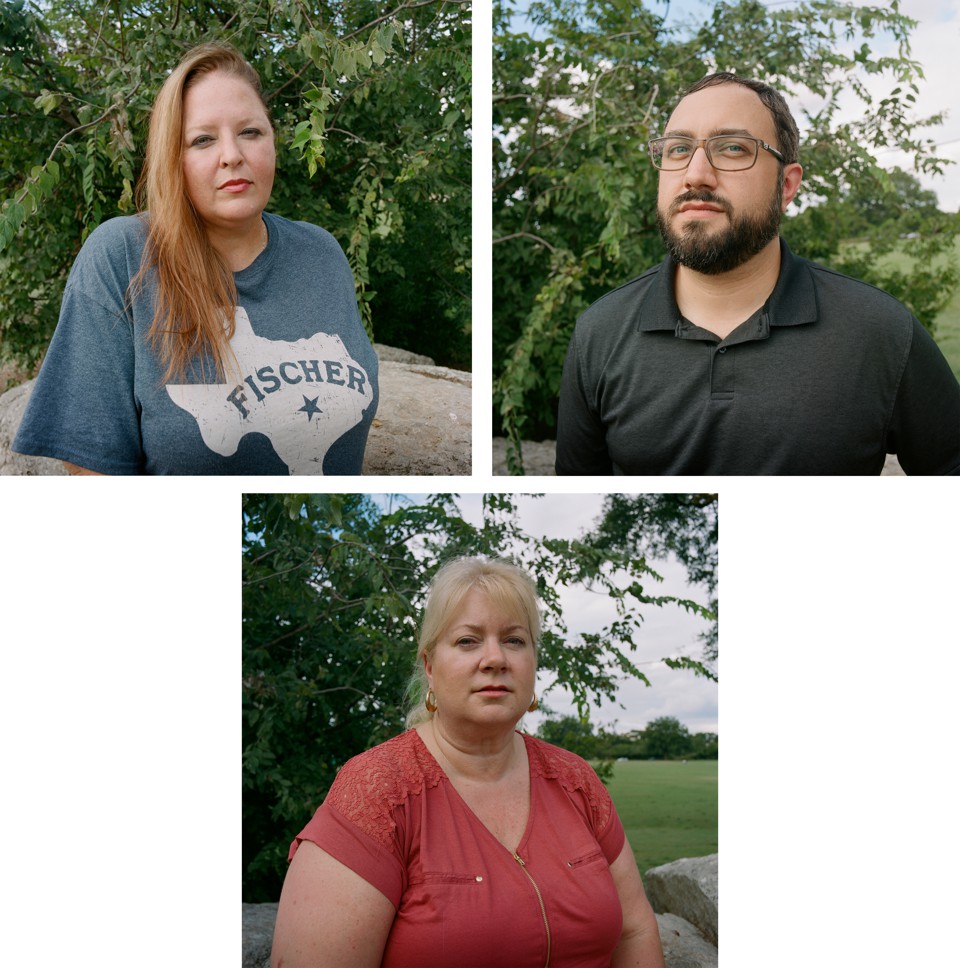
Clockwise from top left: Lori Gaff, Kevin Lord, and Missy Koski are all volunteers with the DNA Doe Project, a nonprofit that uses genetic genealogy to find names for unidentified bodies. (Miranda Barnes)

Over the past six weeks, the volunteers had traced the origins of the young woman they believed to be Lavender Doe back more than a century, all the way to Europe. They had traced the outlines of her life, too, by digging through public records and MySpace profiles. They had done all that from living rooms and cafés—and now they were going to Longview to retrace the final steps of this woman they had come to know so strangely and so intimately.

From Austin to Longview is 250 miles of flatness. Missy drove while Lori navigated from shotgun, calling out Texas trivia about the small towns that whizzed by: Palestine, where debris from the Columbia space shuttle fell; Mexia, the hometown of Anna Nicole Smith. Kevin and I settled in the back. He had been sending me email dispatches about the case, but now he told the whole story from beginning to end.

He first became obsessed with Lavender Doe’s case in 2017. Back then, he was one of those people watching Investigation Discovery and trying to solve cold cases on his own. He had become especially preoccupied with the separate disappearances of two women not far from where he lived. It was when Kevin tried matching their cases to unclaimed bodies in Texas that he came across the dead woman near Longview known as Lavender Doe. He soon found the Websleuths thread too—the one that gave Lavender her name—and saw the 30-plus pages of speculation about her teeth and her clothes and the circumstances of her death. On Reddit in 2015, a woman began making annual posts about the “Girl with the Perfect Smile” and meticulously crossing off missing persons that had been ruled out. Her perfect teeth made the woman wonder if someone in Lavender’s family was a dentist. Her annual posts never had much new to report, but they kept the case alive in the public imagination.

The teeth were what made Kevin take another look at Lavender Doe’s case, too. Aside from her complete lack of cavities and fillings, Lavender still had two baby teeth—unusual for her age. One of the missing Texas girls had distinctive teeth, too. Kevin posted his theory that the missing girl was Lavender on Reddit. He also brought it to the lieutenant who had inherited her case at the Gregg County Sheriff’s Office, a man named, improbably, Eddie Hope. Hope was used to armchair sleuths sending in long-shot tips, and the missing girl had already been ruled out as Lavender. But he was grateful anyone cared. So little was going on in the official investigation, and the case haunted him. “I’ve probably got five more years before I retire,” he told me. “It will consume you.”
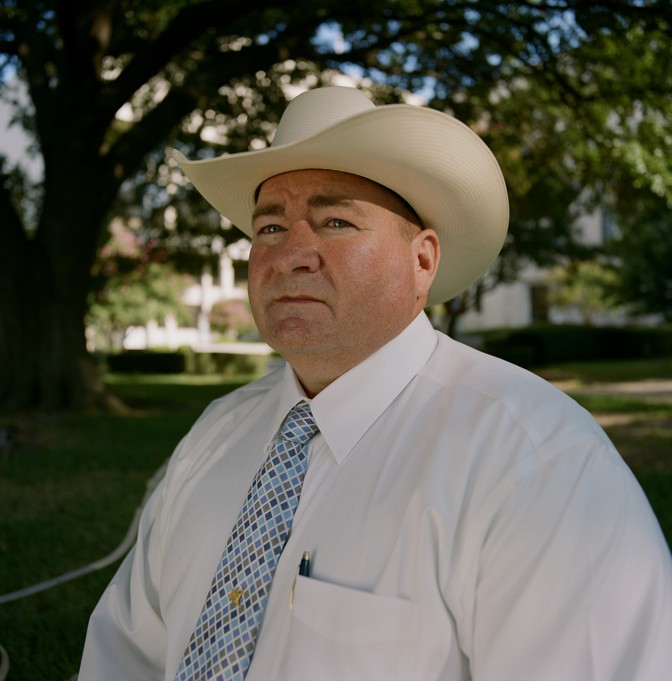
Eddie Hope of the Gregg County Sheriff's Office was the lieutenant responsible for the case of Lavender Doe  (Miranda Barnes)

Kevin couldn’t let the cold cases go either. In his free time, he amassed court documents, filed public-records requests, and even interviewed the friends and family of missing girls. (Some were happy to hear from a stranger who cared, others less so. One mother abruptly blocked him on Facebook.) Since leaving his programming job two years before, Kevin had been selling T-shirts on Amazon, a task that paid the bills but scratched no particular existential itch. He decided a career change was in order and started taking classes to become a PI. He’d had a lifelong interest in genealogy, so when his PI program required an externship, it seemed only natural that he bring Lavender’s case to the DNA Doe Project.

The DNA Doe Project’s volunteers use genetic genealogy to solve cold cases. Margaret Press, an amateur genealogist and crime novelist, came up with the idea while reading a Sue Grafton mystery, and she recruited Colleen Fitzpatrick, a forensic genealogist who had previously worked with police. They co-founded the DNA Doe Project in 2017 to persuade law enforcement to test DNA samples from unidentified bodies, using technology that mimicked popular 23andMe and AncestryDNA tests, which is far more powerful than what forensics labs have had access to.

Law-enforcement DNA databases traditionally look at just 13 to 20 markers in the genome, which can be enough to match siblings or parents and children. In contrast, 23andMe and AncestryDNA look at different types of markers and test for 600,000 to 700,000 of them, which can reveal third and fourth and even more distant cousins who share less than 1 percent of their DNA. With these mere hints of a connection, genealogists can cross-reference census records, obituaries that list surviving family members, Facebook profiles, and other public documents to build out giant family trees.

As Missy drove, she told me that she was adopted and she had found her own birth father this way. That hooked her on genealogy, and she began spending 12 to 16 hours a day helping other adoptees find their birth parents. One of them ended up distantly connected to another DNA Doe Project case linked to West Virginia, which piqued Missy’s interest and obsession. She applied to join as a volunteer genealogist in early 2018—first to work on the West Virginia case, then two other cases, and eventually Lavender Doe, after the nonprofit officially took it at Kevin’s prompting. In August, DNA Doe successfully crowdfunded $1,400 to reanalyze Lavender’s DNA to get those 600,000 markers. Among those who pitched in were the amateur sleuths on Reddit, who had followed year after year the posts about Lavender Doe.

At the same time, the local sheriff’s office had a major and unrelated breakthrough in the case. Back when she was found, according to Hope, the semen inside Lavender Doe had matched—via old-school forensic methods—a man by the name of Joseph Wayne Burnette. He had admitted to picking up a female in the area for sex but admitted to nothing more.

In the summer of 2018, however, a woman living with Burnette disappeared, too. Hope and two of his men found her body, her purple fingernails sticking out of the leaves on the ground. Questioned again, Hope says, Burnette became talkative. Yes, he confessed, he had killed her, and he had killed Lavender Doe, too. But he maintained he had not known Lavender. She was a stranger, unlucky enough to have crossed his violent path in a Walmart parking lot in Texas. (Burnette pleaded not guilty to the two murders. His attorney says they are preparing for a trial in January and declined to comment further.)

Ultimately, this news failed to shake loose any new clues to her name. The murder indictment filed in August 2018 still listed the victim’s name only as Lavender Doe.  The mystery of who she really was only deepened. Girls like her—girls who are blond with perfect teeth—don’t usually disappear without someone noticing.

The highway to Longview passes through a swath of Texas known as the Czech Belt, named for the immigrants who brought polka, folk dancing, and perhaps most important, yeasty pastries called kolaches. Lori made sure we stopped to get some for breakfast, a deliberate gesture, I later realized, in honor of Lavender Doe, whose Czech ancestry was one of the first things the volunteers figured out.

When they got Lavender’s DNA back from the lab in October, they uploaded it to a genealogy database called GEDmatch, the same one that investigators had used to find the Golden State Killer. Lavender immediately had thousands of matches, most of them too distant to be useful. But among the closest were what appeared to be a second cousin once removed and a smattering of third and fourth cousins. (Many months later, in May, GEDmatch would change its terms of service to limit which profiles investigators working with law enforcement could match. This has affected current cases, but did not affect Lavender Doe’s.)

Scenes from outside Longview, Texas, the area where Lavender Doe’s body was found (Miranda Barnes)

The volunteers began building out family trees for the closer matches, trying to see how they connected in order to narrow down Lavender’s identity. They kept finding Czech ancestry. One volunteer even tracked down baptism records in the original Czech, in order to connect two of Lavender’s long-ago ancestors.  A descendant of those same ancestors, a woman then in her late 50s, was still living in east Texas—just 30 miles from where Lavender was found dead.

Kevin alerted Hope. The answer suddenly seemed very close.

When Hope drove out to find the woman, she was hesitant. She did not know of a missing person in her own family—and it was hard to imagine that someone could not know of a missing person in their own family. “It still seems like a lot to be just a coincidence but stranger things have happened,” Kevin wrote to me after Hope’s visit. The woman did warm up to the DNA Doe Project once she fully understood the unusual situation that had brought law enforcement to her door, and she eventually let the volunteers compare her DNA directly with Lavender Doe’s.

The genetic connection was so strong as to be unmistakable: They shared enough DNA to be first cousins once removed. Lavender Doe was probably a child of the woman’s cousin—a cousin she did not know even existed.

Genealogy research is a task of startling intimacy at a great distance. When genetic genealogists started using DNA to find build family trees in the 2000s, they invariably stumbled into family secrets: affairs, previous marriages, children secretly placed for adoption, sperm donations kept hush. The volunteers investigating Lavender Doe’s identity had been working with the remove of internet sleuths. But now they had made contact with her family—albeit family that did not know her—and they had to rummage through that family’s secrets to find her.

They went looking for unknown cousins of the woman. One of her uncles, it turned out, had a daughter named Robin, from a previous marriage that the east-Texas woman also did not know about. Kevin found a death certificate in Indiana for Robin, who had died of an illness at age 50 in September 2006—just a month before Lavender Doe was found dead.

Could Robin have been Lavender Doe’s mother, and could this explain why Lavender had never been reported missing? Robin’s death certificate, along with what the volunteers could piece together from police records and newspapers, told a sad but not unfamiliar story. “We saw that she was not stable, had a lot of alcohol-related arrests, had a bunch of different husbands,” Kevin recounted to me on the drive to Longview. The mood in the car shifted ever so slightly when he said this. We had been enjoying the road trip and the kolaches, and now we were reminded that, at the end, there was always going to be a girl, dead and abandoned.
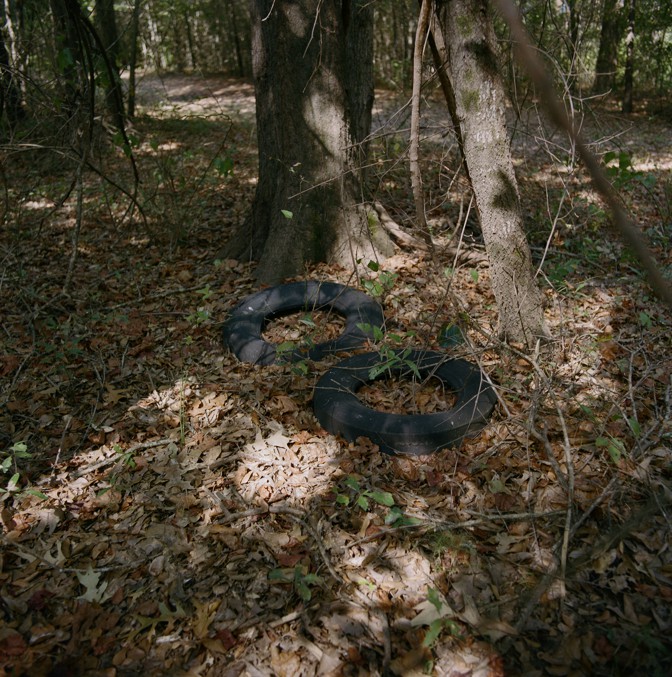
The wooded area near Longview, Texas, where two men in 2006 found the body of the young woman who became known as Lavender Doe (Miranda Barnes)

The volunteers kept researching Robin, and the leads piled up quickly. DNA had helped them zero in on this branch of the family tree, but the rest of the work was digging through newspapers, legal records, social media, and people-finder databases that collect an astonishing amount of personal information. The volunteers found marriage records for two husbands and surmised that she had a third based on a last name, Dodd, occasionally appearing in newspaper articles about her arrests. Kevin put that version of her name, “Robin Wilma Dodd,” in Google and came across a free preview for a people-finder site that listed her as living with a man by the name of Johnny Dodd. The connection was tenuous but it would be enough: Kevin searched the man’s name and found a daughter who seemed to be Lavender’s age.

It was the next search that gave Kevin chills. He put the daughter’s name into Delvepoint, a database for private investigators, and it revealed that her Social Security number was no longer active. In fact, she seemed to have completely dropped off the map right in 2006—the same year Lavender Doe was found dead.

Kevin searched the name in more databases. Dodd had children from another marriage in Jacksonville, Florida, and those children had children. He found a MySpace page that belonged to a nephew of the girl he thought could be Lavender Doe and then very quickly he found another profile that could have belonged to Lavender herself. He pulled it up for me in the car, a time capsule from the early 2000s. There she was hugging a dog. There she was posing in a white miniskirt, her hair long and strawberry blond.

The last place Lavender Doe was probably seen alive was a Walmart parking lot in Longview. When we arrived in town, Hope led us there to retrace her steps. He relayed what Burnette had said in his confession: “She came up to him selling magazines. He didn’t want ’em. Then she tried to try to sell him some lingerie out of a magazine. He didn’t want that. She asked if she could get in the truck with him. He let her in.” She agreed to have sex, according to Burnette, but stole money from him. That’s why he allegedly strangled her but left $40 in her pocket. That was money she had earned, he said.
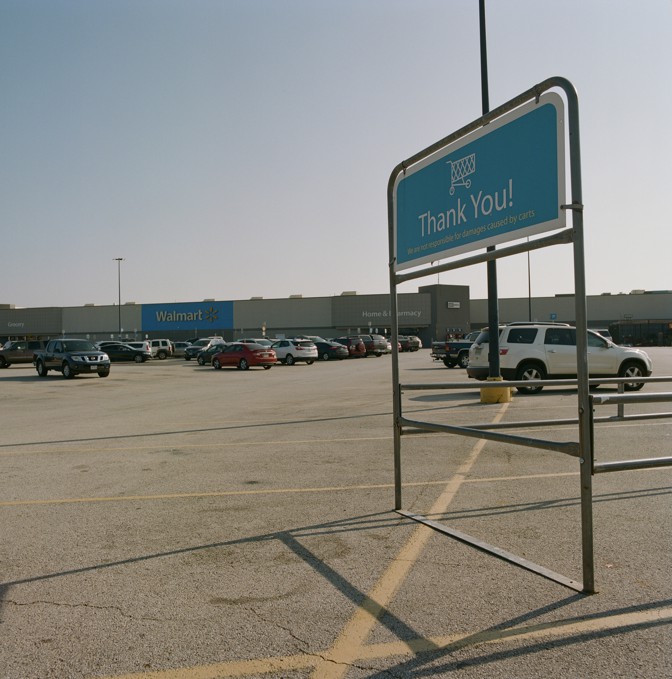
The Walmart parking lot where her alleged killer told police he met her (Miranda Barnes)

From there, according to Hope, Burnette brought her body to a patch of trees where he burned her. The road that he would have taken no longer exists today, so Hope had to lead us through someone’s yard to a wooded area. The oaks and maples had all dropped their leaves for the fall, covering the ground in a thick, rustling blanket. It would not have been so different when her alleged killer carried her body here, 12 years before our visit.

“This is where he burned her.” Hope stopped, just short of a shallow creek that had run dry, and we all stopped too, trying to reconcile the image in our heads with the image before our eyes. “I just expected it to be a little more dense,” Missy said. A house was visible through the bare trees. What about the smoke?, she asked. How could he have thought no one would notice? “Those houses were there,” Hope confirmed. “They’re just right there,” Missy repeated. The girl had been surrounded by people but so alone.

After the autopsy, Gregg County interred her in a small cemetery in Longview on December 23, 2006. Her tiny headstone listed that date, but no birth date. The only name was Jane Doe. By the time we got to the cemetery, it was late afternoon, and the sun was on the wane. The wind that had been bearable under sunlight was now slicing through our thin jackets. But we lingered, no one wanting to be the first to turn away. Missy had brought flowers—mums the color of lavender—to set on her grave.

Hope left after about an hour, but the volunteers stayed by Lavender’s grave. Lori had the idea to do a Facebook Live stream for the DNA Doe volunteers who could not make it on the road trip. She held up her phone, and we huddled behind her. “Not sure if everyone is paying attention in the group, but we are at the cemetery”—and here her voice goes from singsong to hushed and somber—“where our Doe was interred.” She turned the camera toward each of us: “Say hello.” And we each said hello, unsure of whether to smile as one usually does in a greeting on Facebook Live, unsure of the proper protocol for visiting the grave of a stranger whose life you have spent weeks digging through.

Another volunteer who worked on the Lavender Doe case, but who could not come on the road trip, watched the Facebook Live stream and left a comment that so stuck with Lori, she quoted it back to me months later. The volunteer had observed, simply, that we were the first people in all these years to ever stand at the grave and to know her real name.

Dana Lynn Dodd. That was her name. She was barely 21 when she was killed, in the fall of 2006.

In May, after DNA had proved the volunteers were right, I went to Jacksonville, Florida, to meet Dana’s family and high-school best friend. Following Hope’s call to Dana’s family, the DNA Doe Project had mailed her half sister Amanda Gadd an AncestryDNA kit. The results came back a couple months later and confirmed that Dana was the girl found dead near Longview, Texas; the girl on that MySpace page; the girl with perfect teeth.
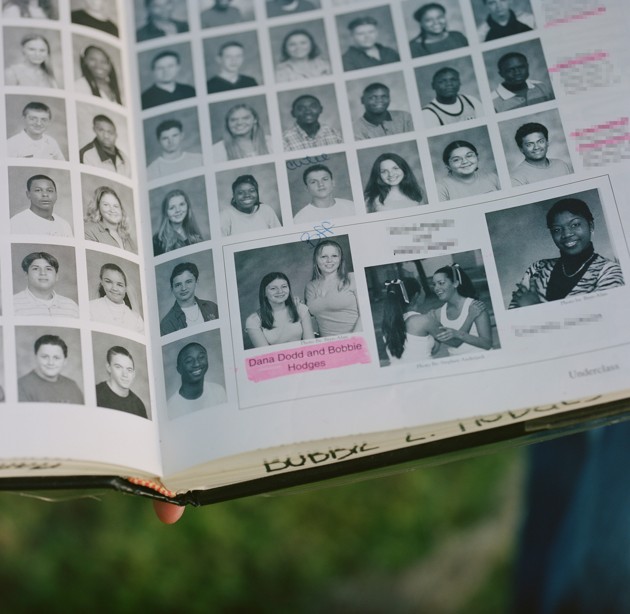
Dana Dodd's best friend, Bobbie Lynn Hodges, holds her high-school yearbook. (Miranda Barnes)

The news provoked an odd mix of elation and sadness for the volunteers. A puzzle, solved! But also a family, now in mourning. “You want to have a party, jumping up and down,” Missy told me. “And, oh wait, wait, we can’t have that kind of attitude.” She struggled to suddenly let go of the case that had consumed her every waking hour for weeks. Missy kept wondering about Dana’s family—about what happened that she would die nearly 900 miles away from home, about what her family thought during all those years, about what they were thinking now.

I wondered about all this, too, and I wondered how much we deserved to know. It had struck me, as I followed the volunteers over the course of their investigation, that their work paralleled the work of journalism. It had unsettled me for the same reason that the work of journalism sometimes unsettles me. Dana’s family had not asked for strangers to dig through their family history, and they had not asked for the hot glare of press attention. Her case had been plucked from obscurity among thousands of unidentified bodies every year—elevated by true-crime obsessives, until it caught the attention of genealogists and then me. When the power of genealogy to solve crimes became apparent last year, my editor’s assignment was, quite literally, to find a murder.

By the time I left for Florida, I knew enough about Dana’s family to know she was certainly not the daughter of a dentist. Her perfect teeth were probably a lucky anomaly. Her mother had died rather young and far away from her. According to police records, her father was homeless. He had been arrested multiple times for public drinking and disorderly intoxication. Neither parent raised Dana, Amanda told me at her kitchen table in Jacksonville. Amanda is nine years older, and the half sisters have the same father. They once shared the same strawberry-blond hair too, but Amanda’s had faded to a paler blonde now and Dana, well, she had been dead for more than 12 years. They were not especially close when Dana disappeared, but the long silence told Amanda something was wrong.
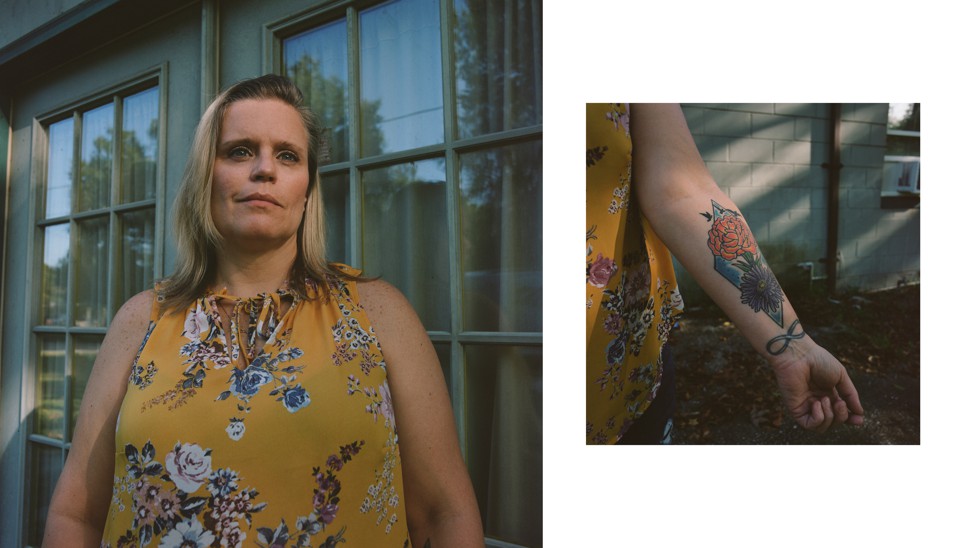
Dana lived with her half sister Amanda Gadd for a while in Jacksonville, Florida. Amanda found out about Dana's death in November 2018, around the same time that Amanda's mother died. She got a tattoo remembering both of them: an aster, Dana's birth-month flower, and a carnation, her mother's favorite flower. (Miranda Barnes)

Dana, her half sister said, had spent her young life bouncing from household to household. Her mother left when she was a baby; her father not long after. She lived with a stepmother in Arizona until age 14, when that stepmother decided to send her to family in Florida. Before then Amanda had met Dana only twice—years earlier—but at 23 she was a young mother herself. She took Dana in. As she remembers it, her younger half sister arrived with a single backpack containing all her possessions in the world. Amanda got her into counseling, and there was stability for a while, she says, but also teenage rebellion. Dana bristled against curfew and chores. She went to live with her older half brother, who was Amanda’s full brother. She didn’t stay long there either.

There were weed and pills, a bad boyfriend, trouble with the police for underage smoking and fighting. Dana dropped out of high school. She moved in with her best friend, and then she skipped town to join a traveling magazine-sales crew, the type of group that often lures workers in with the promise of travel and then traps them with violence and drugs. No one has tracked down the exact crew Dana joined, but other workers have spoken of beatings and denial of food for failing to meet sales quotas. That’s likely how Dana had come to Texas: Burnette told the police she’d tried to sell him magazines first and then lingerie. When he declined both, she asked to get in his car.

The idea that Dana would climb into a car with a stranger, that she would have been so desperate as to do that before asking her family for help, troubled Amanda. “I think, after all the years, she thought she had nobody,” Amanda said. “I think that’s why she didn’t reach out to us.” She said their brother felt he had let Dana down. I asked if she felt that way too.

“I do,” she told me. “I did my best. I feel like I didn’t do enough.”

“I almost wish I never told her to leave,” says Bobbie Lynn Hodges, Dana’s high-school best friend. The two girls first met in 10th-grade health class, and they had bonded quickly over their troubled family backgrounds. When I saw her in Jacksonville, Bobbie pulled out her old high-school yearbook—in which Dana had written an entire page—and a photograph of the two girls in matching T-shirts that read Frick and Frack. She still had the T-shirt to show me, too. She had stopped wearing it when the letters started to fade, but she kept it in her pajama drawer. “I loved her to death,” Bobbie told me. She’d hung on to the T-shirt, all the years after her friend had left.
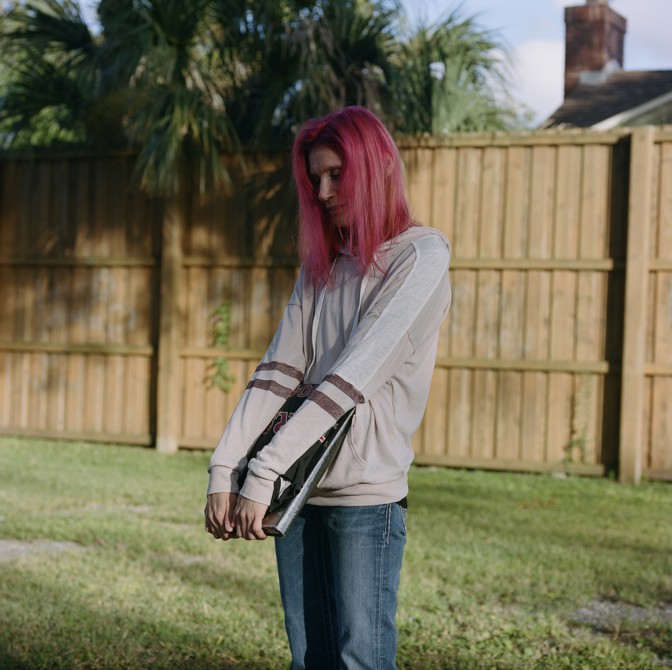
Bobbie holding the yearbook and the matching “Frack” T-shirt she got with Dana. (Miranda Barnes)

According to Bobbie, this is how it happened: They were living in a duplex together when Bobbie found out she was pregnant, after partying and getting high on her 18th birthday. Dana stood right next to her when Bobbie peed on the stick the next morning. This moment of intimacy ultimately became the rupture in their relationship. Bobbie wanted to have the baby and to get clean. Dana didn’t. Bobbie says her friend began injecting heroin, and she stole a PlayStation from their apartment. That’s when Bobbie kicked her friend out. “When she left, she said, ‘You're my last person. Nobody else will help me.’” Dana joined the magazine crew soon after.

Those last words clearly weighed on Bobbie, heavier now that she had learned of her best friend’s death. “If I wouldn’t have kicked her out, like, where would we be now?” she asked. She answered her own question. “I’d be right there with her … I would probably be dead too.” She had spent the past 12 years struggling with drugs herself.

In the intervening years, Dana’s family had searched online and made phone calls to follow up on rumors they heard about her fate. They wondered, in the best days, if she had started a new life. Maybe she had a husband now, a career, and kids. Her nephew—the one whose old MySpace page Kevin found—told me he had messaged countless “Dana Dodds” on MySpace. When Facebook came along, he looked for “Dana Dodds” there, too. They were never her, of course. She had been dead this whole time.
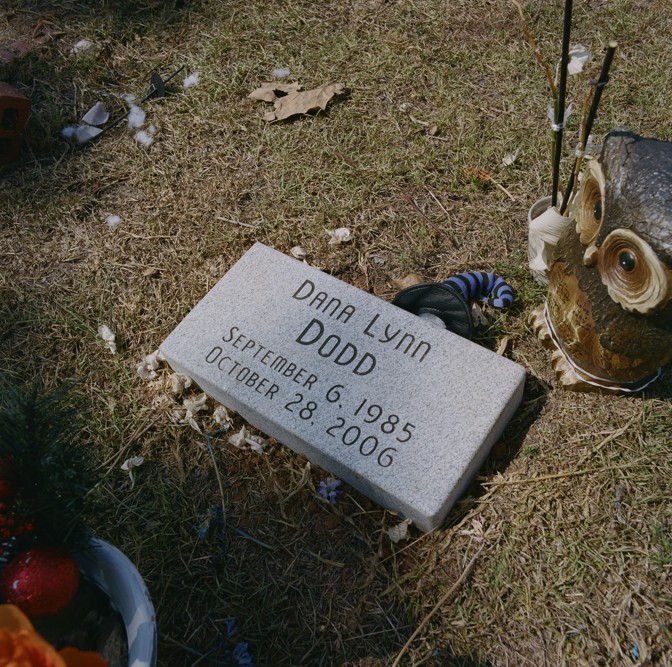
Dana’s family went to visit her grave this September, and they replaced the “Jane Doe” headstone with one that said her real name. (Miranda Barnes)

In September, for what would have been Dana’s 34th birthday, Amanda and a few other members of the family traveled to Texas to visit her grave. They brought flowers, a birthday balloon for all the birthdays they had missed, and a new headstone—this one with her name. “She was given that name when she came into the world,” Amanda said. And she was given that name again in death. It only took 13 years.

As the DNA Doe Project has solved more cases, the volunteers have recognized they have entered into something far more complicated than reuniting grateful families. Some of the Does had no one still alive to miss them at all. Many had mental illnesses or drug addictions. Almost none had been reported missing.

“In my mind,” Missy says of her preconceptions, “it was the girl next door, with the white picket fence, the perfect household, and the two and a half kids. The mom and dad have great jobs, and the parents go to church on Sundays.” Instead, it was the reality of violent crime in America—where the poor and the marginalized disproportionately make up the victims. These are not the stories that make up the genre of true crime. They are the true story of crime.

15 Nov 17:45

U.S. Farm Finances Worsen Despite Trump Trade War Aid

U.S. Farm Finances Worsen Despite Trump Trade War Aid(Bloomberg) -- Terms of Trade is a daily newsletter that untangles a world embroiled in trade wars. Sign up here. Farm finances deteriorated across a swath of agricultural states during the summer and early fall despite the Trump administration’s second round of trade aid payments and slightly higher prices, the Federal Reserve Bank of Kansas City reported Thursday.The report underscores the mounting economic pressure on a key Donald Trump constituency as he confronts a re-election campaign and impeachment struggle while undertaking negotiations with Beijing on a partial trade deal that could provide relief from retaliatory tariffs hitting American farmers. The trade talks have bogged down as Trump seeks assurances that Beijing will deliver on commitments on agricultural purchases.Farm income fell in the third quarter from a year ago in each of the seven rural states covered by the Kansas City Fed, according to its survey of agricultural credit conditions. The report cited the trade war, volatile crop prices and disruptions at a major beef processing facility.Bankers contacted by the Fed said the drop in farm income was sharper than they expected going into the summer. Respondents expect income to decline further and credit conditions to worsen in the coming months despite trade aid payments. The USDA started issuing payments from its 2019 trade aid program in August.“Extreme weather conditions and commodity prices continue to adversely effect the financial condition of our producers,” said one banker quoted in the report, identified only as located in Central Nebraska. “These conditions are potentially setting up a difficult renewal season this fall” for loans.Farmers have responded by cutting back on spending and equipment purchases to preserve cash. Even so, their working capital deteriorated “at a modest pace,” according to the Fed.The Federal Reserve Bank of Chicago, which covers five Midwestern states, also reported Thursday that farm credit conditions “slid yet again” in the third quarter. Bankers participating in the Chicago Fed regional survey also said they expected crop net cash earnings to drop in the fall and winter from levels a year earlier.Farmland values in the Chicago region declined 1% from a year earlier, the bank reported. The Kansas City Fed reported “stable” farmland values in its region.Other indicators also show rising financial stress. U.S. farm bankruptcies in the 12 months through September rose 24% from the same year-ago period to the highest since 2011, according to a report by the American Farm Bureau Federation. That report also highlighted farmers’ and ranchers’ growing dependence on government financial help.Almost 40% of projected farm profit this year will come from trade aid, disaster assistance, federal subsidies and insurance payments, according to the report, which is based on Department of Agriculture forecasts. That’s $33 billion of a projected $88 billion in net income.(Updates with Chicago Fed report beginning in seventh paragraph)To contact the reporters on this story: Mike Dorning in Washington at mdorning@bloomberg.net;Michael Hirtzer in Chicago at mhirtzer@bloomberg.netTo contact the editors responsible for this story: Joe Sobczyk at jsobczyk@bloomberg.net, James AttwoodFor more articles like this, please visit us at bloomberg.com©2019 Bloomberg L.P.


15 Nov 15:12

Woman Knows Husband Just Acting Affectionate Because He Wants Food

WENHAM, MA—Admitting that it was a learned tactic more than a genuine expression of love, area woman Callie Garrett told reporters Thursday that she knew her husband was just displaying affection because he was hungry. “Oh, it’s so sweet when he runs towards me and starts nuzzling and making little happy noises, even…

Read more...

14 Nov 19:19

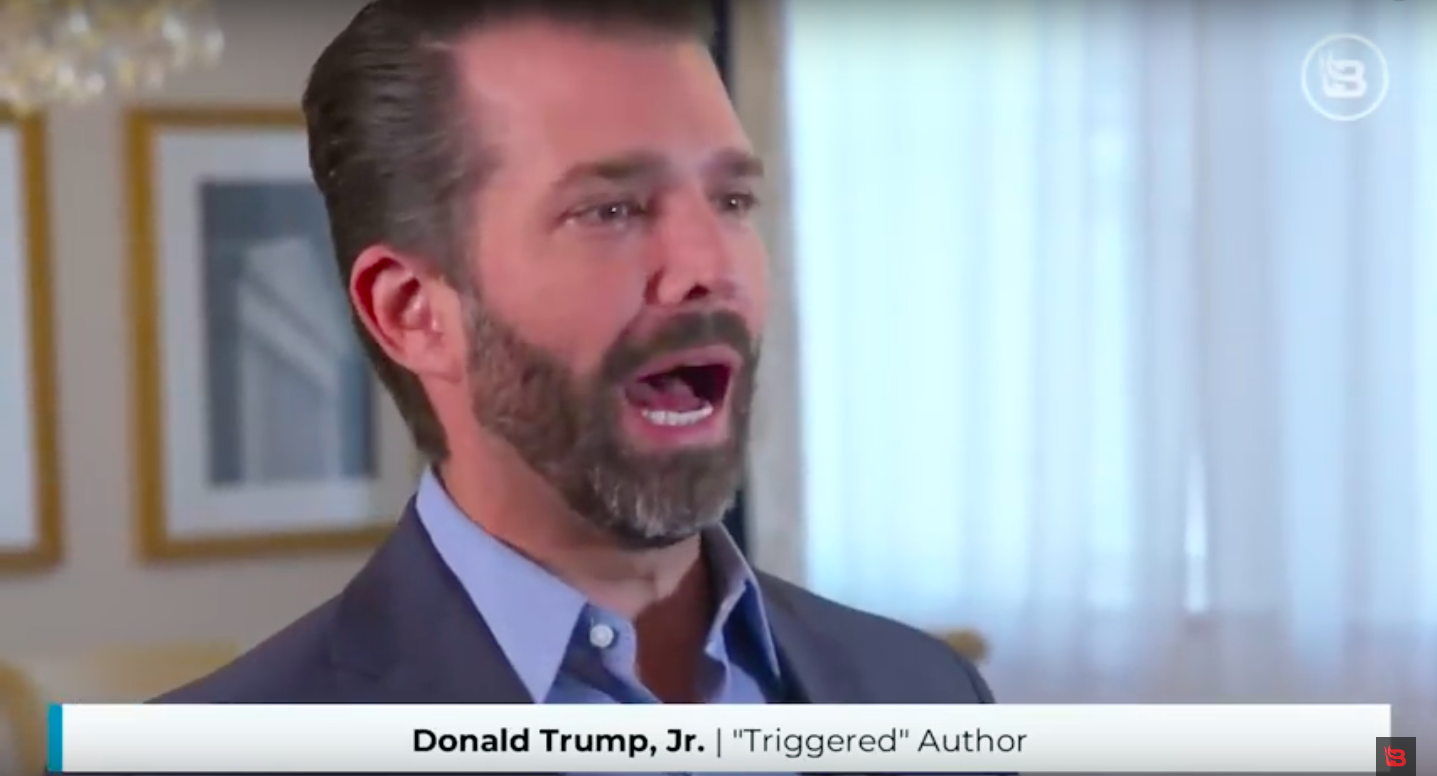
Donald Trump Jr. Now Proud Best-Selling* Author Of Bulk-Purchased Garbage Book

by Stephen Robinson
IKEA Monkey

If you can't win, cheat.


Donald Trump Jr., who by the grace of God is the president's son and not yours, has long hoped his father might someday at least pretend to love him. Unfortunately, the president doesn't like losers, which Trump Jr. is. But all is not lost for the self-described "son of a rich white guy living in 2019." Trump Jr. finally achieved some measurable success that didn't involve his father sending him to Las Vegas to learn the casino business. He "wrote" a whiny ode to white male grievances called Triggered: How the Left Thrives on Hate and Wants to Silence Us, and it's just topped the New York Times bestseller list.

This was good enough for a congratulatory tweet from the president -- suitable for framing and prominent display in Trump Jr.'s house.

I hate to rain on this parade of paternal praise, but there is a slight asterisk-shaped catch. It seems that "institutional, special interest, group or bulk purchases" contributed to the book's strong sales. Yeah, if you thought Trump Jr. couldn't give away copies of Triggered, he's proven your liberal ass wrong. So there!


The Republican National Committee bought enough copies of Triggered to fill a row of porta-potties. The RNC is giving them to donors as thanks for their continued financial support. The lucky folks probably won't read the book, but they'll never have to worry about important papers flying off their desks.

Trump Jr. even demonstrates his writing talent in fundraising emails that claim Democrats are "rooting" for the president to fail. We'd never waste our time this way. It's as pointless as rooting for the Chicago Cubs to fail. Just stand back and watch them collapse under their own incompetence. Suckers, bigots, or a combination of the two (Trump's core base) are promised their very own copy of Triggered if they "act now" and donate at least $50. Trump Jr. will even personalize your copy with a handcrafted, artisanal signature. The only people who truly deserve such a gift are those who'd willingly give their hard-earned money to help a "billionaire" avoid impeachment.

I don't think free copies of Triggered will help Trump remain in the White House. It might even have the opposite effect. Trump Jr. is directly responsible for the impeachment of the University of Florida's student body president. Michael Murphy spent $50,000 of the school's money to bring Trump Jr. and his Fake Melania girlfriend Kimberly Guilfoyle to the campus last month. That's probably less than what the president paid so Trump Jr. could graduate college, but it's still not a bargain. Trump Jr. has no special insight to offer and doesn't even work in the administration like his "job-creating" sister, who his father actually likes. He's a conservative Charo promoting his own book. [Chatcave explodes in fury over CHARO LIBEL, since she can actually play some motherfucking Flamenco guitar. SER is on very thin ice and wisely decides to go with "Paris Hilton" instead.] He should've paid the school himself for the privilege. He has plenty of money from the regular allowance the president still gives him that he calls a "job."

Hundreds of protesters showed up to the university for what amounted to a Trump rally, despite organizers' insistence that it was a "speaking engagement and not a campaign event." If that was true, Guilfoyle should've stayed at the hotel. She's a senior adviser to Trump's re-election campaign. University police also spent more than $10,000 to keep Trump Jr. safe during his visit. That's more than his father would ever pay.

Student representatives introduced the bill to impeach Murphy on Tuesday. If successful, it's only further proof that Trump Jr. brings disaster to anything he touches, just like the gypsies warned Trump and Ivana when he was born.

Follow Stephen Robinson on Twitter.

Yr Wonkette is supported by reader donations. Please send us money to keep the writers paid and the servers humming. Thank you, we love you.

How often would you like to donate?

Just once Monthly

Select an amount (USD)

$2$25$5$50$10$100$15$500$20$1000
Credit cards
14 Nov 10:01

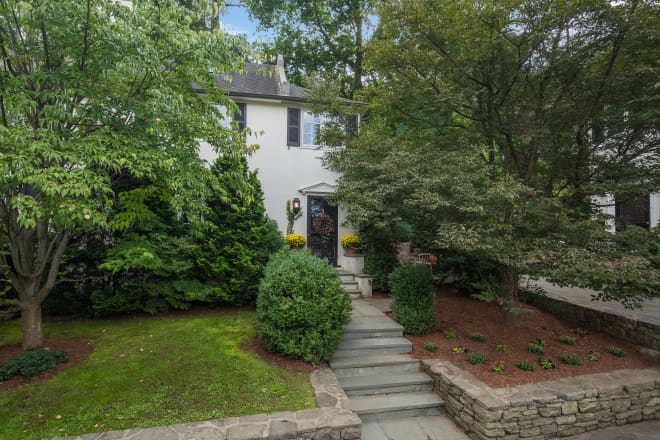
This $1.25M NY Condo Has a Spacious Backyard That Feels Like A Country Retreat

by Anne Roderique-Jones
IKEA Monkey

For that money, I want 1) a fully vented hood in the kitchen, none of this microwave over the over shit; 2) a better bathroom than that mildew pink crap (seriously, CLEAN THE BATHROOM before taking pics?? Maybe???) 3) What is that taped-up thing in the ceiling in the kids room in pic 15? 4) Pic 21 - love 2 have neighbors looking into my "country retreat" ffs NY is stupid

And it's only a 10-minute walk from the commuter railwhere do I sign? READ MORE...
13 Nov 22:35

Nike finally made Sabrina Ionescu jerseys, and they sold out in hours

by Whitney Medworth
IKEA Monkey

Great that Nike is profiting off this woman's success, of which she'll get $0

Yes, it’s good Nike made them, but they clearly did not make enough.

Sabrina Ionescu may be the most popular college basketball player across both the men’s and women’s game right now. She’s back for her senior season in Oregon and is the runaway No. 1 pick for the WNBA Draft next year where she’ll head to Brooklyn to play for the Liberty. Her team also just beat Team USA in a scrimmage. She’s kind of a big deal.

But until this week, it was impossible to buy her jersey anywhere. Yes, Nike sells plenty of college football and men’s basketball jerseys, but a jersey for Ionescu did not exist. And so Ionescu publicly roasted Nike and got them to do the thing they should have done a long time ago. They started to sell Oregon No. 20 jerseys.

The Ionescu jersey timeline

This all started on Nov. 5 when Ionescu tweeted this out:

Then, magically, on Nov. 9, Ionescu tweeted that the jerseys would be available soon. It’s amazing how Nike could turn this around so fast. It’s almost like they should have already been doing this, and that they even have the resources to handle it!

On Nov. 11, the official Oregon Ducks store tweeted at 5:38 p.m. ET that the jerseys were available. They got a response from a user at 7:40 p.m. saying they were sold out. I have no idea how many jerseys Nike made available and that information is not public, but it was clearly not enough.

But in more concerning news, it appears Nike won’t restock the white jerseys. Either Nike is incredibly lame or they’re going to make the upcoming green jersey endlessly available. I hope it’s the latter but I won’t get my hopes up.

We haven’t even gotten to the part where Ionescu will get 0 percent of profit from this, but, hey, I guess we have to fight one battle at a time. Women’s sports are incredibly underserved from a merchandise perspective. Every season WNBA fans beg for more merchandise and jersey options but aren’t given much to work with.

During the 2019 World Cup, the U.S. Women’s National Team home jersey became the No. 1 soccer jersey ever sold on Nike.com within a season. Meanwhile, the NWSL is planning expansion based on the popularity of merchandise and sales. These numbers show the interest is there in case after case.

If Nike believes in equality and change like it claims, it needs to start stepping up its support for women’s sports.

13 Nov 01:02

After 55 years, Days Of Our Lives seems to be on its last legs

by Sam Barsanti on News, shared by Sam Barsanti to The A.V. Club
IKEA Monkey

Another thing Millennials have killed

The world of daytime television might be about to dramatically change, with TV Line reporting that the entire cast of Days Of Our Lives has been released from their contracts, seemingly indicating that the long-running soap’s days are numbered. By the end of November, when production wraps on the show’s 55th year, it…

Read more...

12 Nov 19:43

Lakefront 1980s time capsule asks $8.75M

by Liz Stinson
IKEA Monkey

I want it

The entryway of a 1980s home features a flat overhanging roof, stone wall on the left, and mirrored doors. Courtesy of Fox Mountain Homes

Located two hours from Los Angeles, this Lake Arrowhead home retains all of its bombastic charm

This sprawling home in the luxury resort town of Lake Arrowhead, California, is not one for subtleties. Built in 1982, the home retains plenty of the bombastic charm of the era. Chrome, brass, lucite, jewel toned walls, and carpet—if it was popular in the ’80s, it’s in here.

But what the home lacks in modernity, it makes up for with sheer space. The six bedroom, eight-bathroom home has 11,750 square feet, and its price reflects that—it’s currently asking $8.75 million.

Now before you balk, realize that that the house is full of architectural gems. Sure, there are mirrored fireplaces and a chrome and lucite serial staircase, but there’s also soaring ceilings and walls of geometric windows that cast dramatic light into the cavernous space.

The house is built around intriguing angles—slanted doorways, pitched ceilings, rounded bedrooms. But it also has a softness to it with rose and wine colored carpet, and more sitting areas than you’ll have butts for. Outside in back, there’s a multi-level patio that’s surrounded by trees and looks out onto the lake. And that, at least, is timeless.

An angular living room with mirrored fireplace and floor-to-ceiling windows. There is a large couch and views of the lake outside.
A living room with a chrome and lucite spiral staircase on the left and a round table with velvet green chairs in the foreground.
A bedroom with rose colored carpet, rounded walls with large windows, and a white bed platform with two giant white and gold rounded columns.
A bedroom with mirrored walls, dark mauve carpet, light rose curtains, and a patio outside.
An ornate dining room with wine colored carpet, gold wallpaper, and a circular dining set with upholstered gold and wine chairs.
An angular kitchen with large island, white counter tops, black counters, and wooden floors.
12 Nov 17:37

Trump adviser Stephen Miller injected white nationalist agenda into Breitbart, investigation reveals

IKEA Monkey

Is anyone surprised

Trump adviser Stephen Miller injected white nationalist agenda into Breitbart, investigation revealsEmails to former Breitbart writer show Miller focused on inserting white nationalist talking points to shape 2016 election coverageStephen Miller, senior adviser to Donald Trump, walks across the South Lawn of the White House on 4 November. Photograph: Michael Reynolds/EPASenior Trump adviser Stephen Miller shaped the 2016 election coverage of the hard right-wing website Breitbart with material drawn from prominent white nationalists, Islamophobes, and far-right websites, according to a new investigative report by the Southern Poverty Law Center (SPLC).Miller also railed against those wishing to remove Confederate monuments and flags from public display in the wake of Dylann Roof’s murderous 2015 attack on a black church in Charleston, South Carolina, and praised America’s early 20th-century race-based, restrictionist immigration policies.Emails from Miller to a former Breitbart writer, sent before and after he joined the Trump campaign, show Miller obsessively focused on injecting white nationalist-style talking points on race and crime, Confederate monuments, and Islam into the far-right website’s campaign coverage, the SPLC report says.Miller, one of the few surviving initial appointees in the administration, has been credited with orchestrating Trump’s restrictionist immigration policies.The SPLC story is based largely on emails provided by a former Breitbart writer, Katie McHugh. McHugh was fired by Breitbart over a series of anti-Muslim tweets and has since renounced the far right, telling the SPLC that the movement is “evil”.However, throughout 2015 and 2016, as the Trump campaign progressed and she became an increasingly influential voice at Breitbart, McHugh told the SPLC that Miller urged her in a steady drumbeat of emails and phone calls to promote arguments from sources popular with far-right and white nationalist movements.Miller’s emails had a “strikingly narrow” focus on race and immigration, according to the SPLC report.At various times, the SPLC reports, Miller recommendations for McHugh included the white nationalist website, VDare; Camp of the Saints, a racist novel focused on a “replacement” of European whites by mass third-world immigration; conspiracy site Infowars; and Refugee Resettlement Watch, a fringe anti-immigrant site whose tagline is “They are changing America by changing the people”.McHugh also says that in a phone call, Miller suggested that she promote an analysis of race and crime featured on the website of a white nationalist organization, American Renaissance. The American Renaissance article he mentioned was the subject of significant interest on the far right in 2015.In the two weeks following the murder of nine people at a church in Charleston by the white supremacist Dylann Roof as Americans demanded the removal of Confederate statues and flags, Miller encouraged McHugh to turn the narrative back on leftists and Latinos.“Should the cross be removed from immigrant communities, in light of the history of Spanish conquest?” he asked in one email on 24 June.“When will the left be made to apologize for the blood on their hands supporting every commie regime since Stalin?” he asked in another the following day.When another mass shooting happened in Oregon in October 2015, Miller wrote that the killer, Chris Harper-Mercer “is described as ‘mixed race’ and born in England. Any chance of piecing that profile together more, or will it all be covered up?”Miller repeatedly brings up President Calvin Coolidge, who is revered among white nationalists for signing the 1924 Immigration Act which included racial quotas for immigration.In one email, Miller remarks on a report about the beginning of Immigrant Heritage Month by writing: “This would seem a good opportunity to remind people about the heritage established by Calvin Coolidge, which covers four decades of the 20th century.” The four decades in question is the period between the passage of the Immigration Act and the abolition of racial quotas.Miller also hints at conspiratorial explanations for the maintenance of current immigration policies. Mainstream coverage of the 50th anniversary of the removal of racial quotas in immigration policy had lacked detail, Miller believed, because “Elites can’t allow the people to see that their condition is not the product of events beyond their control, but the product of policy they foisted onto them.”.Miller used a US government email address during the early part of the correspondence, when he was an aide to senator Jeff Sessions, and then announced his new job on the Trump campaign, and a new email address, to recipients including McHugh.As well as McHugh, recipients of his emails included others then at Breitbart who subsequently worked in the Trump administration, including Steve Bannon and current Trump aide, Julia Hahn.


12 Nov 17:32

EXCLUSIVE: America Is Vastly Undercounting the Number of People Being Injured by Guns, Report Finds

by Matt Laslo
IKEA Monkey

If only the CDC was allowed to research gun violence

An average of 100 people are killed daily from gun violence in America, but a new, in-depth study by Everytown Research – the investigative arm of the gun control group backed by Michael Bloomberg —suggests that just begins to describe the problem.

Everytown for Gun Safety found that for every killing in America to gun violence another two people are left injured, maimed or incapacitated. The societal costs of those life-altering injuries are far-reaching, ranging from people becoming reliant on federal health care services for life to them being taken permanently out of the tax-providing workforce.

“Trying to understand what’s really going on with this crisis in the United States is not only about the fatalities, but it's also about the tens of thousands of people who are wounded every year,” Sarah Burd-Sharps, the research director for Everytown, told VICE News. “They're wounded which has a lasting trauma on their life but also has a lasting trauma on their families and their communities.”

The study finds that while more than 36,000 people are killed annually by firearms in America, more than 73,000 are injured each year. That two-to-one ratio is left out of federal policy making in part because no federal agency is reliably doing the counting.

Everytown gathered its data from 30 million discharge records from 950 hospitals and emergency rooms over three years. Among their findings:

  • An average of 200 people in America sustain gun injuries each day;
  • One in six gun injuries involve children or teens;
  • 20 to 24-year-olds are most susceptible to gun violence;
  • Every 40 minutes a child or a teen is hit by a bullet.

Their research also pulls the veil back on the myth that gun violence is a problem confined to inner cities. They show that there are similar nonfatal injuries in rural and urban communities alike, even as they found that half of those bullet and shrapnel wounds in the three-year period they studied occured in the south.

READ: Supreme Court will let Sandy Hook parents sue Remington for the deaths of their children

The reason the federal government continues to fly blind when it comes to the true costs of gun violence in America is because of a 1996 law that had the so-called “Dickey Amendment” tacked onto it. For decades that amendment was thought to prohibit the Centers for Disease Control and Prevention (CDC) from researching gun violence, even as it merely states that the federal government can’t “advocate or promote gun control.”

That provision instilled fear in CDC officials worried about facing penalties for doing their jobs, so in 2018 Congress clarified the narrow scope of the law.

Everytown Research’s new study quantifies how the CDC’s current research is woefully inadequate. The CDC did release data on nonfatal gun injuries for 2105, 2016 and 2017, but they derived their data from a survey of 2% of U.S. hospitals, which experts considered woefully inadequate. Everytown widened the research 16 times more institutions.

“You miss one trauma hospital in a major city and you've missed, you know, the bulk of gunshot wounds,” Burd-Sharps, the research director for Everytown for Gun Safety, told VICE News.

The CDC did not respond to a request for comment.

Burd-Sharps’ research team was forced to purchase government data so they could more fully mine the statistics contained in the Nationwide Emergency Department Sample – the obscure government entity that’s currently the best repository for gun-violence information.

“In the absence of the funding for the CDC, we need this data,” Burd-Sharps said. “We need to know where the injuries are — and how often and who it is — so that we can, you know, start to develop some more custom and more focused solutions.”

Earlier this year, the newly Democratic-controlled Congress did stand up last year and signal to the CDC that they’ve been misreading the 1996 law they thought prohibited them from researching gun violence, and allocated $50 million for gun-violence research. That bill has sat untouched in Majority Leader Mitch McConnell’s Senate since then.

“The Senate's inaction comes with a body count. And it's really important that this report shows really how severe America’s crisis is,” Shannon Watts, the founder of gun-violence prevention group Moms Demand Action, told VICE News. “It's important that when we're looking at this crisis, we're looking at it holistically, and we're not just talking about gun deaths, but also gun injuries.”

Over three months a team of roughly four people at Everytown thumbed through “roughly 30 million hospital discharge records each year,” according to the report.

After scrutinizing the data, they found guns don’t just kill; they also permanently disrupt and upend the lives of those Americans who survive shootings. But even top researchers with Everytown argue this is a topic best tackled by the government.

“We desperately need more funding – the federal government has an incredibly important role to play in understanding what’s happening with this crisis in this country,” Burd-Sharps said. “They have the skills to do it; they don't have the funding to be able to do it.”

READ: We spent a wild weekend with a gun-worshipping church trying to go MAGA

Everytown Research is an arm of former New York City Mayor and potential presidential candidate Michael Bloomberg’s group that was former in 2006 after Moms Demand Action for Gun Sense in America merged with Mayors Against Illegal Guns. But the report was in the works before he started flirting with a long shot presidential bid.

For gun-control advocates like the founder of Moms Demand Action, Shannon Watts, the problem is evident, as they feel tasked with unwinding the misinformation fomented by the NRA and other pro-gun groups. Work that they’re trying to undo after years of it proving effective, like when the gun lobby scared the CDC into halting studies on gun violence since 1996. But newly emboldened gun-control groups are vowing to show the American people the true extent of loose American gun laws.

“The reason they did that was because they don't want us to know the extent of our problem or how to solve it,” Watts said. “It behooves the special interests for gun violence to continue unabated, because the more we know the more that we would probably take steps to address that, through laws. And for a long time the gun lobby has opposed any new laws regardless of whether they’re lifesaving.”

Cover: Visitors look at items well-wishers have left behind along the fence at the Tree of Life Synagogue on the 1st Anniversary of the attack on October 27, 2019 in Pittsburgh, Pennsylvania. (Photo by Jeff Swensen/Getty Images)

12 Nov 17:32

Trump Just Called DACA Recipients 'Hardened Criminals' Hours Before Their Supreme Court Case

by Morgan Baskin
IKEA Monkey

Old racist is racist, news at 11

Want the best of VICE News straight to your inbox? Sign up here.

Hours before the Supreme Court would hear arguments in a case to determine the legal status of nearly 700,000 immigrants who came to the U.S. as children, President Trump tweeted a message for them.

“Many of the people in DACA, no longer very young, are far from ‘angels.’ Some are very tough, hardened criminals,” wrote Trump, referring to immigrants who benefitted from Deferred Action for Childhood Arrivals, or DACA.

The missive came as protestors and activists swarmed the Supreme Court ahead of its hearing on the Obama-era law that gives certain immigrants temporary legal status and a work permit, which they can renew every two years. Recipients need to have come to the U.S. before age 16, graduated high school (or be enrolled), and passed a background check.

Trump’s Tuesday morning tweet echoes the language he frequently uses to describe immigrants. But according to a 2017 report from the libertarian think tank CATO Institute, DACA recipients have lower incarceration rates than people born in the U.S. And to be eligible for the program, applicants can’t have been convicted of a felony — or even a string of misdemeanors.

After he took office, Trump initially waffled on whether his administration would preserve the policy. In February of 2017, Trump called DACA beneficiaries “absolutely incredible kids.” But facing pressure from immigration hard-liners, Trump swiftly changed his tune. By September of that year, he announced that the Department of Homeland Security would end the program completely.

That fight has now arrived at the Supreme Court, which will decide whether it’s lawful for the Trump administration to end the program. Nearly 700,000 immigrants rely on DACA to live and work in the U.S, the vast majority of which are women under the age of 25.

Despite the fact that his own administration is pushing to dismantle the program, Trump has punted the issue to Democrats in Congress. He added in his tweet that, if the Supreme Court rules in his administration’s favor, the White House will work with Democrats on a plan to keep DACA beneficiaries in the U.S.

“President Obama said he had no legal right to sign order, but would anyway. If Supreme Court remedies with overturn, a deal will be made with Dems for them to stay!” Trump wrote.

Cover image: President Donald Trump speaks at the opening ceremony of the New York City Veterans Day Parade in New York, Monday, Nov. 11, 2019. (AP Photo/Seth Wenig)

12 Nov 17:29

Climate Change Is Breaking Open America's Nuclear Tomb

by Matthew Gault
IKEA Monkey

This is fine

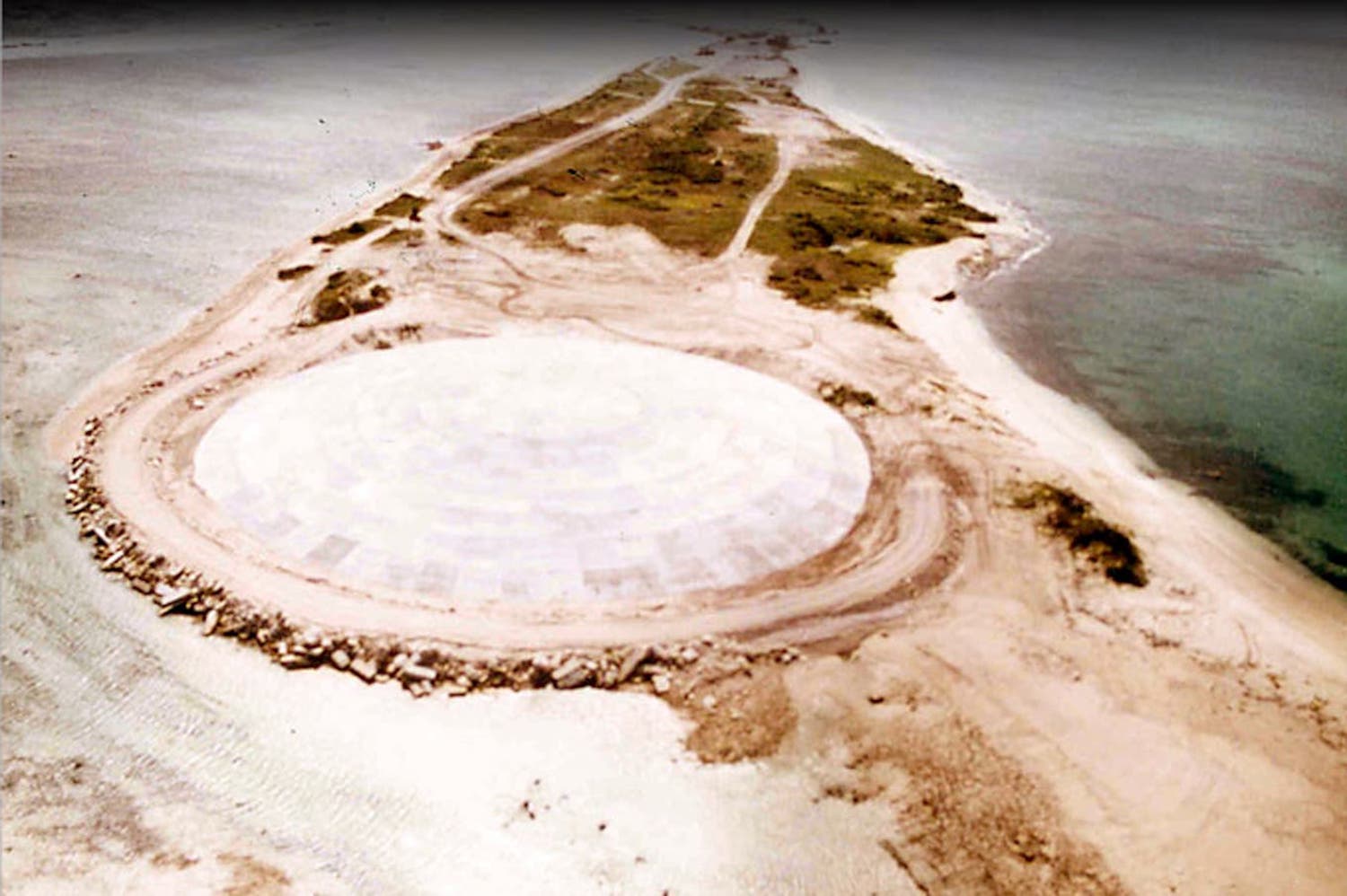
During the Cold War, the United States nuked the Marshall Islands 67 times. After it finished nuking the islands, the Pentagon dropped biological weapons on the islands. Once the U.S. was finished, it scooped the irradiated and ruined soil from the islands, poured it into a crater left behind from a nuclear detonation, mixed it all with concrete, and covered the whole thing in a concrete dome. They called it “The Tomb.” According to a report from The Los Angeles Times, climate change is breaking that dome open. Rising sea levels and temperatures are cracking open The Tomb, threatening to spill nuclear waste into the Pacific Ocean.

The Marshall Islands is a collection of 29 atolls across 1,156 islands. More than 50,000 people live on the islands. From 1946 to 1958, it was a proving ground for America’s nuclear arsenal. On March 1, 1954, the Pentagon conducted Castle Bravo and detonated a 15 megaton thermonuclear warhead over the Bikini Atoll. It was the largest nuclear weapon the U.S. ever detonated.

The fallout from the explosion rained down on the people of the Marshall Islands.

“It was only a matter of two or three years before women on the island started to give birth to things less than human,” a Marshall Islands woman told diplomats on a fact finding mission decades later. Birth defects are so common on the islands that the people have a number of words to describe them, among them marlins, devils, jellyfish children, and grape babies.

The U.S. has largely dismissed its responsibility to the Marshall Islands. It relocated many of its people and claims the cost of relocation and installation of The Tomb at the Enewetak Atoll covers its liability. As sea levels and temperatures rise, however, the Tomb is cracking. As it cracks, water rushes over it, leaching out plutonium and dumping it into the sea.

The U.S. has said The Tomb is now the Marshall Islands’ responsibility.

“I’m like, how can it [the dome] be ours?” Hilda Heine, the president of the Republic of the Marshall Islands, told The Los Angeles Times. “We don’t want it. We didn’t build it. The garbage inside is not ours. It’s theirs.”

"It's hard to imagine that the U.S. would consider its actions sufficient if the roles were reversed,” Alex Wellerstein, a nuclear historian at Stevens Institute of Technology, told Motherboard in a Twitter DM. “That somehow the world's richest nation can't seem to find the political will to make things right with a small, poor nation that sacrificed much in the name of American national security is a travesty. U.S. officials in the Cold War were quick to talk about how important the testing was to American survival, but somehow that importance never translated into a sincere gratitude to the suffering Marshallese."

The Tomb contains not just the irradiated soil and metal scrap from the Pacific proving grounds, but also 130 tons of soil shipped in from Nevada. The Pentagon buried not only the nuclear waste and byproduct of the Marshall Islands, but shipped in extra from out of town. A study by Columbia University researchers in July showed that regions of the Marshall Islands are more radioactive than Chernobyl.

The Nuclear Claims Tribunal, an independent ruling body with the authority to arbitrate legal relations between the United States and the Marshall Islands, awarded the Marshall Islands $2 billion in damages in 2001. Washington has paid only $4 million. At the time of its construction, a Lt. General for the U.S. Air Force said that, should the dome ever fail, it would be America’s responsibility to fix. Terry Hamilton, a researcher at Lawrence Livermore National Laboratory and the Department of Energy’s Marshall Islands expert told The Los Angeles Times that “Under existing living conditions, there is no radiological basis why I or anyone else should be concerned about living on Enewetak.”

“The experts who assert that any given place is safe-enough to live never seem to live in such places themselves,” Wellerstein said. “I think it's easy to be confident about your data and look over the possible uncertainties when you don't personally suffer the consequences if you're wrong.”

Sea levels in the Pacific have risen 0.3 inches every year in the Marshall Islands since 1993. That’s faster than the global average of 0.11 to 0.14 inches. By the end of the century, experts believe the sea levels could rise by four or five feet, submerging the Marshall Islands and The Tomb. Under that kind of pressure, the concrete dome will crack, spilling America’s Cold War waste into the Pacific.

08 Nov 13:49

FKA Twigs Deconstructs the Private Show

by Spencer Kornhaber
IKEA Monkey

This was a really beautiful performance

On The Tonight Show last week, the singer FKA Twigs made use of a new kind of stage. She began singing her ballad “Cellophane” while sitting on top of a piano. Her pose was a crumpled one, with the glorious ruffles of her gown—medieval in shape, but more Lil Nas X–like with its bandana-print pattern—splayed about her. Midway through the song, Twigs got up and walked down a catwalk-like extension down past the piano’s edge. A stripper’s pole waited at the end, and she jumped up on it to execute an elegant in-air ballet.

A classical instrument joined seamlessly with a tool of the nightclub, of sexual gratification, and of feminine performance: This is a very FKA Twigs idea. The 31-year-old Tahliah Barnett sings in highly mannered trills reminiscent of opera and the Renaissance. Her music warps and scars the syncopated grooves, rap flows, and electronic jolts of modern pop. Really, what she does above all else—in sound, in lyrics, in wildly surreal music videos—is quiver. The tension between intimacy and spectacle explains why. Twigs always depicts herself performing for a lover, whom she cajoles for attention and respect via tenderly sung come-ons. She also constantly frets about a wider audience prying in, which might explain her music’s gnarled, jagged textures. Her coos on “Cellophane” capture the dynamic: “They want to see us / Want to see us apart.”

This anxiety of being watched makes sense, given her past as a model and backup dancer, her current fame, and the simple fact of her race and gender. When she began dating the actor Robert Pattinson in 2014, she was subjected to racist comments from his fans. When they broke up in 2017, the gossip press scrutinized and tittered as it always does. The need to project public strength while also nourishing private vulnerability feeds the beautiful conflict of Magdalene, her first release in four years. In one recent video, for “Home With You,” she moves from hazy and chic clubbing scenes to, eventually, a lush forest. Dressed in white, sporting an eyepatch, she fishes a little girl from a well. But, it’s revealed, an eyeball peers from Twigs’s belly button. Does it represent the inescapable gaze? Or her own fiercely protected point of view?

The acclaimed EPs and full-length album that she released from 2012 until 2015 were often tagged as alt-R&B, a label that she argued was more related to her race than her sound. If Magdalene gets classified in the same way, it’ll confirm for many listeners that “R&B” simply means “black person who sings.” Exactly one song, the thumping “Holy Terrain,” featuring Future, comes close to that genre’s conventions. The rest of the nine-track album pushes to new extremities of silence, slowness, and experimentalism. Avant-pop touchstones—Björk, Radiohead, Kate Bush, Frank Ocean—make somewhat apt comparisons. But no one really sounds like Twigs.

Accordingly, Magdalene must make an effort to pull listeners into its world—or, as it more precisely feels, its netherworld. On the hypnotic first song, “Thousand Eyes,” Twigs repeats a circular melody reminiscent of Gregorian chants over chords that step, inexorably, downward. Industrial clanging produces echoes that become instrumentlike elements of their own: The shadows in this cavern seem to be alive. “If I walk out the door, it starts our last goodbye,” goes her refrain, which doubles and triples up in rounds. “If you don’t pull me back, it wakes a thousand eyes.” It’s a breakup conversation made gothic—as usual for her—by the threat of surveillance.

Things only get creepier and more cry-worthy on “Home With You.” At the start, Twigs speaks through some effect that makes her sound like Pennywise the clown. Digital whips crack arrhythmically in a way that resembles Aphex Twins’ nightmarish “Omgyjya-Switch7” (certainly a touchstone for the co-producer Nicolas Jaar, who is known both for experimental soundscapes and techno head rushes). But eventually the ruckus turns into a show tune, with Twigs delivering her most pining cries alongside shrieking clarinets. “I didn’t know that you were lonely,” she sings. “If you’d have just told me, I’d be home with you.” It’s a heavy sentiment made heavier by injecting direct, unavoidable emotion into a song that initially seemed a puzzle.

Twigs has never been weirder; she’s also never been catchier. The songwriter Benny Blanco—a collaborator of Ed Sheeran and Katy Perry, among others—is credited on a few tracks. The industry hands Jack Antonoff, Skrillex, and Sounwave helped on the record’s swing at a pop hit, “Holy Terrain,” in which Twigs’s sense of drama remains intact amid steady trap puttering. That song caps off the exhilarating first half of the album, after which a slew of mid-tempo arias, it must be said, begin to blur into one another. Even then, Twig lands some stunning moments. She swings vertiginously on “Fallen Alien”; she sings patiently, then crests, on “Daybed.”

The fitting finale arrives with “Cellophane,” the single that also kicked off this album cycle. Spare to the point of discomfort—you hear the creaks of the piano pedals—it’s a time-stopping assertion of Twigs as pure singer-songwriter. One final, whispered line ends the album-length saga of love tested by a crowd: “They’re waiting / And hoping / I’m not enough.” It’s a wrenching cliff-hanger. Like a pop diva, an opera’s doomed maiden, or the grieving disciple of Magdalene’s title, Twigs knows that her pain isn’t ever simply her own. But after an album that has bared so much, what could enough mean?

08 Nov 01:57

New Jersey High School Holds Diversity Training After a Student Wore Literal Blackface to a Halloween Party

by Lauren Evans
IKEA Monkey

y i k e s

A high school in New Jersey held diversity training after officials learned that at least two students attended a Halloween party dressed as a slave in blackface and a slave owner. What the actual fuck.

Read more...

08 Nov 01:55

I Have To Admit, I Spoil Dax Shepard

by By God
IKEA Monkey

That explains it

I have a small confession to make. There’s this little thing that, for whatever reason, I just can’t stop Myself from doing. My creation is vast. The Earth these days is home to nearly 8 billion of My precious children—each one special, each created in My image, each worthy of My love. Which makes it all the more…

Read more...

08 Nov 01:46

Instant Pot Chicken and Dumplings

by Coco Morante
IKEA Monkey

Corey

Rich, creamy, and deeply satisfying chicken and dumplings are made even easier in the Instant Pot. The secret to a tender dumpling is using cake flour.

Continue reading "Instant Pot Chicken and Dumplings" »

07 Nov 14:48

Airbnb Promises to Verify All 7 Million Listings After VICE Report Exposes Scam

by Maxwell Strachan
IKEA Monkey

Journalism leads to change

Airbnb is instituting a series of significant changes to its platform and operation in an effort to reclaim its users’ trust following a VICE report that uncovered a nationwide web of deception and led to questions about the company’s broader verification and refund process.

Airbnb CEO and co-founder Brian Chesky said in an email to employees Wednesday that the company would undertake a year-long project to ensure that every home listed on the platform is accurately advertised. As a stopgap measure, the company will completely refund or “rebook the guest a new listing of equal or greater value” starting next month should the rental they booked not meet the company’s accuracy standards.

“Starting now, verification of all seven million listings on Airbnb will commence,” Chesky said. “People need to feel like they can trust our community, and that they can trust Airbnb when something does go wrong. Today, we are making the most significant steps in designing trust on our platform since our original design in 2008.”

This is a breaking news post. Check back for additional updates.

05 Nov 16:32

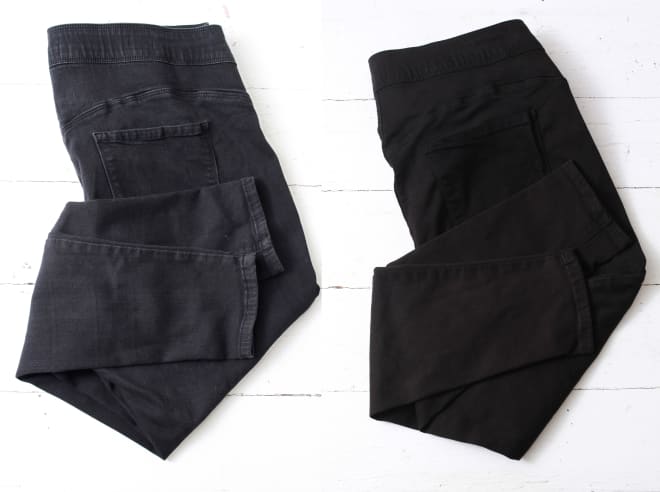
My $3 Secret Potion for Getting Faded Dark Jeans Back to Black in 30 Minutes

by Ashley Poskin
IKEA Monkey

I need to do this

Even if your jeans dont look all that faded, a black dye bath helps fill in worn areas around the seams and pockets, making them look new again in just 30 minutes. READ MORE...
04 Nov 03:14

California Is Becoming Unlivable

by Annie Lowrey
IKEA Monkey

I am so, so glad I left

Right now, wildfires are scorching tens of thousands of acres in California, choking the air with smoke, spurring widespread prophylactic blackouts, and forcing the evacuation of hundreds of thousands of people. Right now, roughly 130,000 Californians are homeless, and millions more are shelling out far more in rent than they can afford, commuting into expensive cities from faraway suburbs and towns, or doubling up in houses and apartments.

Wildfires and lack of affordable housing—these are two of the most visible and urgent crises facing California, raising the question of whether the country’s dreamiest, most optimistic state is fast becoming unlivable. Climate change is turning it into a tinderbox; the soaring cost of living is forcing even wealthy families into financial precarity. And, in some ways, the two crises are one: The housing crunch in urban centers has pushed construction to cheaper, more peripheral areas, where wildfire risk is greater.

California’s housing crisis and its fire crisis often collide in what’s known as the wildlife-urban interface, or WUI, where trailer parks and exurban culs-de-sac and cabins have sprung up amid the state’s scrublands and pine forests and grassy ridges. Roughly half of the housing units built in California between 1990 and 2010 are in the WUI, which has expanded by roughly 1,000 square miles. As a result, 2 million homes, or one in seven in the state, are at high or extreme risk for wildfire, according to one estimate from the Center for Insurance Policy and Research. That’s three times as many as in any other state.

[Read: The toxic bubble of technical debt threatening America]

The bulk of wildfire destruction in California happens in the WUI. The Kincade Fire has burned more than 75,000 acres—roughly five times the size of Manhattan—in rural areas and the WUI north of Santa Rosa. Last year’s Camp Fire killed 85 people and eliminated more than 10,000 homes in Paradise, a town situated in the WUI. The year before that, the Tubbs Fire killed 22 people and destroyed more than 5,000 structures, some in Santa Rosa proper and some in the WUI around it.

Although much of the WUI is naturally vulnerable to fire, human behavior is primarily to blame for the destruction. People start more than nine in 10 fires, according to reliable estimates. Dry trees and dry brush in the WUI might act as natural kindling, but built structures—houses, cars, hospitals, utility poles, barns—act as the most potent fuel, researchers have found. A house burns a lot hotter than a bush does; a propane tank is far more combustible than a patch of grass.

If building in the WUI is so dangerous, why do it? In part because building new housing is so very difficult in many urban regions in California, due to opposition from existing homeowners and strict building codes. The number of people living on the streets in San Francisco and Los Angeles is related to the extreme cost of rent in those cities is related to the statewide housing shortage is related to the pressure to sprawl into the periphery.

So housing sprawls into the periphery. And each time major fires happen—in the WUI, as well as in unpopulated regions and urban areas—the state’s housing crisis gets a little worse. Rental prices surge. Families struggle with displacement and homelessness. Vacancy rates fall to near zero. The cost of homebuilding goes up. And resources for families without stable housing get stretched even thinner.

[Read: The worst is yet to come for California’s wildfires]

One solution to the state’s twin problems is to build more dense housing in urban areas: An aggressive infill-building push would lower rental prices and shift the state’s population to less fire-prone areas, as well as help reduce carbon emissions. California Governor Gavin Newsom has signed a number of measures to boost construction and hold down housing costs, and legislators are pushing many more ambitious policies. But the state is far, far away from satisfying the demand for housing, and the climate is only getting hotter.

In the meantime, California isn’t doing enough to discourage building in fire-prone areas. “I cannot recall any development project that was denied, or where the density was substantially reduced, because of known wildfire hazards,” one now-retired planning director for Sonoma County noted. Even if the state reins in future development, millions of Californians already live in the WUI, at risk of having their homes destroyed and their lives endangered by fire—and at risk of being unable to insure their homes, or of seeing their housing values fall and their economic security imperiled.

California’s housing crisis has exacerbated its wildfire crisis, and its wildfire crisis has exacerbated its housing crisis. That vicious cycle is nowhere near ending.

02 Nov 14:20

Sam Smith Fails at Honoring Donna Summer

by Maria Sherman on The Muse, shared by Maria Sherman to Jezebel
IKEA Monkey

oh whatever, I really like this cover!

Not on your life: Sam Smith “I Feel Love” - This is an attempt at a rather faithful remake of the Donna Summer/Giorgio Moroder/Pete Bellotte 1977 classic “I Feel Love” by Sam Smith and produced by Disclosure’s Guy Lawrence. The original changed music; this version tries to keep it the same. A huge problem with that is…

Read more...

01 Nov 01:58

Aussie vs NZ: How Do You Tell Very Similar Accents Apart?

by Jason Kottke
IKEA Monkey

I knew what the Aussie vs NZ phrase would be!! It's pretty funny to hear in the wild

In this video, dialect coach Erik Singer explains how to tell similar accents apart, like Australia & New Zealand, Philly & NYC, and North England & South England.

For each pair of languages, Singer provides a word or a phrase you can use to tell accents apart. For instance, ask natives from North England and South England to say “cut your foot” and you’ll know right away which is which.

Singer has done several other interesting videos on language and accents for Wired: 4 Amazing Things About Languages, Accent Expert Breaks Down 6 Fictional Languages From Film & TV, Movie Accent Expert Breaks Down 32 Actors’ Accents (and 28 more), and Movie Accent Expert Breaks Down 28 Actors Playing Presidents.

See also people sharing accents from all 50 states.

Tags: Erik Singer   language   video
15 Oct 21:40

Can You Draw a Perfect Circle?

by Jason Kottke
IKEA Monkey

94.4% is my best score so far

This maddening little web toy on vole.wtf challenges visitors to draw a perfect circle and judges them on how well they do. After dozens of tries with a mouse, I could only manage 92.9% perfection (which looks more like 80% tbh).

Perfect Circle

Then I tried it on a touchscreen and got much closer: 95.2%. Several more tries with an Apple Pencil bumped it up to 97.7%, after which I retired so as not to waste the entire rest of my afternoon on this.

And of course, here’s the classic video of Alexander Overwijk drawing a perfect freehand circle on the blackboard in about a second.

I love everything about this video — the way he swings his arm to warm up, his drying-the-blackboard flapping motion, and the ease of his perfection. 100.0%. (via sam potts)

Tags: Alexander Overwijk   video
15 Oct 00:24

New riverwalk and renovated apartments open at historic Lathrop Homes

by Jay Koziarz
IKEA Monkey

Wow. These used to be some real gritty projects.

An elevated pedestrian bridge crives to the left as it passes beneath a steel roadbed of an automobile bridge. The new riverwalk swings out over the water as it passes under Diversey Avenue. | Courtesy Related Midwest

There’s a circular dog run, winding river path, and bright units

The ongoing redevelopment of the historic Julia C. Lathrop Homes is reaching a key milestone this week, officially cutting the ribbon on 414 units of mixed-income housing and a publicly accessible landscaped park along the north branch of the Chicago River.

Completed as public housing in 1938, Lathrop dates back to the New Deal’s Public Works Administration and is listed on the National Register of Historic Places. Because it was built during the Great Depression, a number of notable architects worked on Lathrop such as Robert De Golyer and landscape architect Jens Jensen.

“At the time, it was surrounded by industry, and the river was a toxic waste dump,” explains Sarah Wick of Related Midwest, which partnered with Bickerdike Redevelopment Corporation, Heartland Housing, and the Chicago Housing Authority on the Lathrop project. “So the design faced inward.”

To open the 34-acre site up and embrace the now cleaner and greener Chicago River, the team hired landscape architecture firm Michael Van Valkenburgh Associates—the same group behind Maggie Daley Park, the 606 trail, and Streeterville’s newly completed Bennett Park.

Here, Van Valkenburgh created a new half-mile-long pathway that curves outward away from the shore as it passes under Diversey. The layout brings cyclists and pedestrians beyond the riverbank and provides great vistas of the water and the Chicago skyline in the distance.

A landscaped pathway passes brick residential buildings, old trees, and a river.
The new riverwalk extends northward along the Chicago River and preserves many of the area’s mature trees.
A sign points to a “dog run” and the “great lawn.” A brick building and new trees are visible.
Lathrop’s two-acre “great lawn” remains intact as a public gathering place.
A fenced-in, ring-shaped concrete pad with bench seating around the edges.
The publicly accessible dog run has a circular layout and plenty of seating.
The exterior of a brick residential building with ornamental brickwork and metal framed windows. Jay Koziarz
The four-story historic buildings share many similarities but have their own architectural details.

The boulder-lined pathway snakes north to Lathrop’s existing two-acre “great lawn,” which bridges Clybourn Avenue and the riverfront, as well as other public amenities. There’s a new kayak launch, a children’s playground, and a circular dog run with wooden benches lining its perimeter.

The opening of the riverfront park coincides with the completion of Lathrop’s first phase, which brings a mix of 414 market-rate, affordable, and public housing units to the border of Bucktown, Roscoe Village, and the western edge of Lincoln Park. Residents began moving into the refurbished units last fall, and all of Lathrop’s CHA residents have been moved into either new or restored buildings.

Phase one focuses mainly on the rehabilitation of historic four-story brick buildings on the site’s northern half—each with slightly different architectural details and layouts. Phase one also includes the adaptive reuse of Lathrop’s old administration building into a Hexe coffee shop and the construction of a new six-story residential structure designed by bKL Architecture.

The latter, wrapped in a masonry facade designed to match the look of its historic neighbors, offers full ADA-compliant accessibility. Additional new construction is slated for later phases at the site’s south end, near Lathrop’s decommissioned power plant and a senior housing building that was added in the 1960s.

An interior of an apartment shows a living room with a brown couch, two blue chairs, and three windows. Related Midwest
A model one-bedroom unit showcases the attractive window frames in every apartment.
A bed with white and blue covers next to a wooden dresser and a metal framed window. Related Midwest
A model bedroom fronting Clybourn Street.

When complete, Lathrop’s redevelopment will offer a total of 1,116 residences: 494 market-rate units, 222 affordable units, and 400 apartments reserved for CHA households. All units include the same level of finishes, including well-appointed modern kitchens and handsome metal-framed windows that mirror the originals.

Later phases will also extend Lathrop’s improved riverfront path and landscaping south of Diversey Avenue—and, perhaps one day, beyond. “As the city continues to focus on riverfront improvements, we hope to eventually connect our riverwalk to other sites and projects like Lincoln Yards and the 312 RiverRun,” says Wick. “It’s very exciting.”

07 Oct 02:21

R.I.P. Bruley, Queer Eye’s adorable canine mascot

by Gwen Ihnat on News, shared by Gwen Ihnat to The A.V. Club
IKEA Monkey

Nooooo!!!

Sad news for fans of Queer Eye’s frequent special guest star: Bruley, the adorable French bulldog has died, CNN reports. The four-legged friend, who needed no fashion or beauty assistance due to his own perfection, belonged to Queer Eye producer Michelle Silva, and would occasionally waddle onto the set to nap on…

Read more...

05 Oct 16:20

Sam Darnold’s spleen is the biggest talk of the 2019 NFL season

by Matt Ellentuck
IKEA Monkey

My brother ruptured his spleen when he had an accident while skiing. It is no joke and he nearly died, protect your spleen at all costs. Little spleen helmets or something (he's fine now)

NFL: SEP 08 Bills at Jets

Let’s never stop talking about Sam Darnold’s spleen.

Sam Darnold’s spleen is the most talked-about sports organ of the fall, and for good reason. The New York Jets quarterback is ill with mononucleosis (the kissing disease, or the “I Shared A Cup With My Friend” disease if you’re a teen talking to a parent) and his spleen is enlarged. It’s super dangerous to play any sport with mono, so you can only imagine the caution he’s taking returning to play pro football.

Nobody summed up the situation better than Darnold himself when asked about his health status heading into Week 5 of the NFL season. “It’s a tough thing because you want to stay safe,” the QB who’s missed all but the first game of the season said. “I want to make sure that I’m safe out there and I’m not going to die.”

In case you missed it in the previous sentence, here it is again: “I want to make sure that ... I’m not going to die.”

Somehow, the winless and generally hopeless Jets used Darnold in practice Wednesday and Thursday, and were trying to get him to play against the Eagles on Sunday. They even made him special custom padding to guard his big ol’ spleen. But ultimately, he was declared out on Friday morning after tests revealed that his spleen is still larger than it should be.

Now he’s finally cleared for contact and making his return to the field in Week 6. Darnold will, however, be wearing the football equivalent of a suit of armor.

That (hopefully) puts an end to Darnold’s early season health concerns.

An enlarged spleen is no joke!

An enlarged spleen can rupture upon impact, and that can be extremely painful and life-threatening. Per Sports Health’s study, peak spleen size occurs in the first two weeks, but can last as long as three-and-a-half. Darnold’s felt symptoms since his start in Week 1 on Sept. 8.

The same study reveals that splenic injuries are unlikely to the general population, with just .5 percent of patients with mono experiencing such an event. But Darnold isn’t a regular person. He’s playing in one of the most dangerous contact sports there is.

And remember, he is trying to not die.

Wow, that sounds bad. But what the heck is a spleen anyway?

Good question! Before Darnold (probably) kissed his way out of three weeks of football, I had no clue.

The short answer: The spleen filters blood, recycles red blood cells. stores white blood cells and fights bad bacteria. It’s protected by the rib cage. You can live without a spleen, but you’d become more prone to infection. In fact, in 2006, Tampa Bay Bucs QB Chris Simms had his removed after taking hits during a game.

Darnold’s mono contributed to an all-time NFL meme

The good news is that the 22-year-old QB is going to be OK. The virus that causes mono is so common that 85-to-90 percent of adults have it by age 40. With the proper rest, he’ll be good to throw footballs again soon.

But there’s a mono meme that will persist for years and years and years that he’ll never be able to live it down. Through the ups and downs of his career, this is here to stay.

I present to you: The ESPN Darnold meme:

It’s beautiful:

And produced the following:

We’ve also been privileged to get daily Darnold spleen updates

It’s spleen season for NFL media.

Over the last two weeks, we’ve seen very productive updates such as the following:

And:

Don’t forget:

And also:

And of course the aforementioned instant classic:

This is the hard-hitting journalism sports media needs. And we decided to take it a bit further.

We made some Sam Darnold spleen poems for you

Roses are red,
Their leaves are green,
Protect Sam Darnold,
And his weird enlarged spleen

- James Dator

Roses are red,
The Jets make me hurl,
Sam Darnold might die,
From kissing a girl

- Kim McCauley

Roses are red,
Functional spleens are great,
Unlike Notre Dame,
Who once went 4-8

- Matt Brown

I’m allergic to roses,
Pollen makes me cry,
Please protect my spleen,
I don’t want to die

- Matt Ellentuck

And there you have it. There’s everything you need to know about October’s most mainstream athlete organ.

01 Oct 16:39

Mark Zuckerberg Thinks an Elizabeth Warren Presidency Could 'Suck for Us'

by David Uberti
IKEA Monkey

0 sympathy for billionaires

Mark Zuckerberg sees how antitrust enforcement might look under an Elizabeth Warren presidency, and he’s ready for a legal battle if she wants to break up his company.

“I mean, if she gets elected president, then I would bet that we will have a legal challenge, and I would bet that we will win the legal challenge,” the Facebook CEO told employees in July meetings, ofwhich transcripts were just published by The Verge. “And does that still suck for us? Yeah.”

The Facebook co-founder and CEO made the comments during a pair of staff meetings, where he fielded questions from employees on the troubled rollout of the Facebook cryptocurrency Libra, a rising competitor in TikTok, and his own unchecked power within the company.

But the executive’s comments on a leading 2020 Democratic candidate stand out at a time when Washington has dialed up the heat. As Congress ramped up a web of inquiries into Big Tech in recent months, Warren has surged in the polls in part by arguing for new checks on corporate power. That includes a plan to break up Silicon Valley giants like Facebook.

Warren doesn’t appear fazed by the prospect of a huge legal battle. Soon after The Verge reported Zuckerberg’s remarks Tuesday, the Massachusetts Democrat took aim at his company on Twitter.

“What would really ‘suck’ is if we don’t fix a corrupt system that lets giant companies like Facebook engage in illegal anticompetitive practices, stomp on consumer privacy rights, and repeatedly fumble their responsibility to protect our democracy,” she wrote, linking to her campaign website and fundraising page.

Many Silicon Valley honchos have argued that breaking up tech companies would make problems like user privacy harder to solve. Zuckerberg, whose company acquired Instagram and WhatsApp in moves that are now being scrutinized by federal regulators, panned the idea in his July meetings.

“It’s just that breaking up these companies, whether it’s Facebook or Google or Amazon, is not actually going to solve the issues,” he said. “And, you know, it doesn’t make election interference less likely. It makes it more likely, because now the companies can’t coordinate and work together. It doesn’t make any of the hate speech or issues like that less likely. It makes it more likely because now ... all the processes that we’re putting in place and investing in, now we’re more fragmented.”

“It’s why Twitter can’t do as good of a job as we can,” he added. “Our investment on safety is bigger than the whole revenue of their company.”

Facebook, Amazon, Alphabet, and Apple have already spent more than $26 million this year to shape potential regulations, according to the Center for Responsive Politics. Zuckerberg himself went to Washington last month to add his personal touch to this lobbying push.

And for all the talk of antitrust enforcement by Warren and other lawmakers, Facebook may have a larger warchest for any legal battle than federal agencies. Zuckerberg doesn’t appear afraid to use it.

“I mean, I don’t want to have a major lawsuit against our own government,” he told employees in July. “I mean, that’s not the position that you want to be in when you’re, you know, I mean … it’s like, we care about our country and want to work with our government and do good things. But look, at the end of the day, if someone’s going to try to threaten something that existential, you go to the mat and you fight.”

Cover: Facebook CEO Mark Zuckerberg speaks in San Jose, California, on April 30, 2019. (Kyodo via AP Images) ==Kyodo

01 Oct 15:57

Berserk airport beverage vehicle illustrates man and technology's destructive, cosmic ballet

by Andrew Paul on News, shared by Andrew Paul to The A.V. Club

Werner Herzog’s relationship with the late Klaus Kinski is widely considered one of the most infamous, fucked-up partnerships in cinematic history. On-set tantrums, violent outbursts, terrorizing indigenous peoples, wanton gunplay, non-hyperbolic death threats—someone should really make a film about it, honestly. But…

Read more...

29 Sep 23:46

This is what ancient statues really looked like

IKEA Monkey

this is so neat!!

Artists in classical cultures such as Egypt, Mesopotamia, Greece and Rome were known to paint with a variety of hues -- a practice known as polychromy (from Greek, meaning "many colors.") So why do we always think of antiquities as colorless?
29 Sep 06:38

Rudy Giuliani claims he's 'the real whistleblower' and that no one will know the real story on Trump and Ukraine 'if I get killed'

IKEA Monkey

Yikes

Rudy Giuliani claims he's 'the real whistleblower' and that no one will know the real story on Trump and Ukraine 'if I get killed'Giuliani told Politico he believes he deserves whistleblower protection, but his attempts to defend himself have only further incriminated him.


28 Sep 03:52

Wills and Kate Did A Thing, and Princess Beatrice Got Engaged

by Jessica
IKEA Monkey

Please click through for a very funny pic of Prince William and Boaty McBoatface

What a morning!