Shared posts

03 Nov 18:46

Kris Bryant Smiling Through The Final Out Is My Favorite Thing

by Barry Petchesky
IKEA Monkey

Awwwwww

I don’t really have anything add to this video of 24-year-old Kris Bryant grinning like an idiot as he made the throw to first to win the World Series, only a sincere wish that everyone reading this gets to experience a moment of similar anticipatory joy in their lives, and the observation that it is a genuine privilege to watch good baseball players having fun.

Read more...

03 Nov 17:45

Cubs' David Ross makes some history in final major-league game

by Chris Kuc
IKEA Monkey

What a beautiful way to end a baseball career. Makes me weepy.

David Ross went out a winner.

Already a champion with Cubs fans and teammates for his engaging personality and uncanny leadership skills off the field, the veteran catcher finished his career as a champion on it.

After playing his last game at Wrigley Field over the weekend, the veteran catcher...

03 Nov 17:01

A whole lot of partying but few arrests, little damage after Cubs victory

by Elvia Malagon, Megan Crepeau
IKEA Monkey

My friend Nick lives near Wrigleyville and said there were just TONS of cops out last night. They were checking everybody's bags and not letting ANYTHING slip by. Good for them; we all knew Chicago would erupt into joyful chaos, so its good that it was relatively contained.

Chicago police officers in safety vests formed a bright yellow line down the middle of Clark Street as Cubs fans streamed toward Waveland Avenue just before the last inning of the last game of the World Series Wednesday night.“Look at all these people,” one bystander said, gesturing to the police....

03 Nov 15:24

memorian: Ghostbusters Halloween Appreciation Post

IKEA Monkey

no YOU'RE crying


memorian:

Ghostbusters Halloween Appreciation Post

03 Nov 15:21

The FLOTUS File: Michelle Obama’s Recent Fugs and Fabs

by Heather
IKEA Monkey

A RARE FLOTUS MISS

Michelle Obama in 3.1 Phillip Lim FLOTUS POTUS/FLOTUS 
And so the pendulum swings back. We had the Versace, and now… one of the ugliest shirts FLOTUS has ever worn. I suppose that’s the law of the universe that keeps things in balance. Read More ...
03 Nov 04:10

Watch Beyoncé and the Dixie Chicks Kill 'Daddy Lessons' at the CMA Awards

by Megan Reynolds
IKEA Monkey

Amazing

After a day of breathless speculation about whether or not Beyoncé was performing at the 50th CMA Awards, she showed up about two hours into the show to bring the house down with the Dixie Chicks and “Daddy Lessons.”

Read more...

02 Nov 22:43

Adele Says It's Brave Not to Have Children

by Aimée Lutkin
IKEA Monkey

I love Adele

Adele has one child and it sounds like that’s all she’s going to have.

Read more...

02 Nov 18:56

Libertarian VP nominee: 'I'm here vouching for Mrs. Clinton'

IKEA Monkey

yo, what

Libertarian vice presidential nominee Bill Weld defended Hillary Clinton Tuesday night, acknowledging an explicit split with his running mate Gary Johnson.
02 Nov 14:00

The Police Killings in Des Moines, Iowa: Latest Updates

by Krishnadev Calamur
IKEA Monkey

Oh no :(

What we know:

—Police arrested Scott Michael Greene, a 46-year-old white man, in connection with the fatal shootings on Wednesday of two Des Moines-area officers. He was detained west of Des Moines without incident and charged Thursday.

—The officers—one from Urbandale, Iowa, and the other from Des Moines—were shot 20 minutes apart early Wednesday. Both were in their patrol cars. Police said they were killed in an “ambush-style attack.” They were identified as Anthony “Tony” Beminio and Justin Martin.  

—We’re live-blogging this story below.

Read On »

02 Nov 01:30

Texas Official Goes Ahead and Calls Hillary Clinton a 'Cunt' on Twitter 

by Ellie Shechet on The Slot, shared by Emma Carmichael to Jezebel
IKEA Monkey

classy

Texas Agriculture Commissioner Sid Miller, in a desperate, garbled shriek for the old world order, called a United States Democratic presidential candidate a “cunt” today on Twitter before deleting the tweet. His office briefly tried to claim he was hacked, then settled on the old “bad retweet” argument.

Read more...

01 Nov 22:11

Newswire: El-P and Killer Mike announce 33-date Run The Jewels tour

by Dennis DiClaudio
IKEA Monkey

OKay okay I am into this

El-P and Killer Mike still don’t have a release date for their upcoming studio album Run The Jewels 3, but they have announced when they’re bringing their collaborative project to your city. Beginning with a show in Philadelphia on January 11, Run The Jewels will embark on a 33-show tour through North America, snaking from one coast to the other before finally ending up back East in New York City on February 25. And they won’t be alone. They’re taking The Gaslamp Killer, Spark Master Tape, and Cuz (from the RTJ 2015 single “Bust No Moves”) along for the trip.

You can hear the first single, “Talk To Me,” off Run The Jewels’ forthcoming album, courtesy of the Adult Swim Singles Program.

Run The Jewels “Run The World” Tour

1/11—Electric Factory—Philadelphia, PA

1/12—Echostage—Washington, DC

1/13—Mr. Smalls Theatre—Pittsburgh ...

01 Nov 02:15

Never underestimate the power of onions. 📷:...

IKEA Monkey

I recognized that beautiful burger as soon as I saw it.


Never underestimate the power of onions. 📷: @thrillistburgerquest /📍: @owenandenginechicago #forkyeah http://ift.tt/2f6AIh1

01 Nov 00:24

Mariah Carey Cites James Packer's Ties to Scientology As Reason for Breakup 

by Rachel Vorona Cote
IKEA Monkey

good call mariah

Mariah Carey has identified a culprit in her breakup with billionaire businessman James Packer: Scientology. Packer’s business manager, Tommy Davis, formerly served as a spokesperson for the Church of Scientology, and sources say that he was the one to disrupt the romance.

Read more...

01 Nov 00:06

Anthony Weiner Sends Apology Sext To Entire Clinton Campaign

IKEA Monkey

for real out loud lol

31 Oct 23:20

Why You Should Never Freeze Soup with Pasta In It

by Heather Yamada-Hosley
IKEA Monkey

I always make pasta separate from soup, sauce, whatever and add it together when I'm ready to eat it (lasagna, baked ziti, and other pasta casserole-type dishes notwithstanding).

Frozen soup is a lifesaver when you don’t have time, energy, or groceries to cook dinner, but not all of them freeze well. Here’s why you should stay away from freezing soups with pasta in them.

Read more...

31 Oct 16:50

Trump questions write-in ballots

IKEA Monkey

so he's literally calling for voter fraud

Donald Trump is not letting up on his claims that the election could be rigged against him.
31 Oct 14:28

What Different Languages Call Sunny Side Up Eggs

by Arika Okrent
IKEA Monkey

idk why but I just like articles like this

There is more than one image suggested by a half fried egg, and different languages have settled on different ideas of what this egg looks like.

30 Oct 19:59

Trump Supporter Arrested For Vote Fraud Claims Polls Are Rigged

by Timothy Burke on The Concourse, shared by Lauren Evans to Jezebel
IKEA Monkey

Well, I guess it does exist

An Iowa woman arrested on charges she voted twice for Donald Trump attempted to explain her behavior by stating that “the polls are rigged,” according to Iowa Public Radio.

Read more...

28 Oct 23:06

Newswire: This beer’s gone bad: Yuengling endorses Trump

by Marah Eakin
IKEA Monkey

I just realized who Eric Trump reminds me of. He reminds me of a bad tattoo portrait of somebody's face.

Fans of Yuengling beer are drunkenly disowning the Pennsylvania brewery after it came out that the Yuengling family is supporting Donald Trump. The news broke earlier this week when the Reading Eagle reported that Trump’s creepy son Eric dropped by the Pottsville, Pennsylvania brewery, prompting the company’s owner, Richard “Dick” Yuengling Jr. to tell Trump, “Our guys are behind your father. We need him in there.”

Left-leaning Yuengling-loving fans all over the eastern half of the United States were, understandably, quick to respond, with the brewery’s Trump support drawing responses like these:

28 Oct 23:02

DNA Reveals That Chimps and Bonobos Had Sex in the Past

by Ed Yong

Every year, thousands of chimpanzees are illegally yanked from their homes in Central and West Africa, and shipped to Asia and the Middle East to serve as pets or entertainment. Most of them are babies. Most of them die on the way.

Occasionally, the endangered animals are found by airport officials and confiscated—but then what? “A chimp doesn’t come with a ticket or a sign,” says Christina Hvilsom, from Copenhagen Zoo. “So they don’t know where to send it back to.”

Chimps do, however, come with DNA. There are four subspecies of chimps—western, central, Nigeria-Cameroon, and eastern—each of which lives in a different part of Africa. They are genetically distinct, and Hvilsom, a geneticist by training, wondered “if their genomic landscape mimicked their geographical landscape.” In other words, by analyzing a chimp’s genome, could she work out where it came from?

The answer was yes. By analyzing the complete genomes of 65 chimps from across their entire range, Hvilsom’s team, co-led by Tomas Marques-Bonet, from Pompeu Fabra University in Barcelona, showed that genes do indeed predict geography. For the central and eastern chimps, you can work out where an individual came from to within 50 kilometers—not just to a particular country, but to a particular forest. This genetic geotagging is fuzzier for the other two subspecies, but that’s only because the team had fewer samples. With more genomes, they’ll get more precise.  

The team is now working to put their research into practice, to help customs officials relocate trafficked chimps to their point of origin. But in the meantime, their results led them down an unexpected path.

As they explored the genomes of the central chimps, they kept on finding sequences that seemed to come from bonobos—a closely related ape, which tends to be smaller and gentler. “At first, we thought: Pffft, this is just a mistake,” says Hvilsom. “But we continued with a variety of techniques and kept on seeing this trend.”

The team eventually confirmed that central chimps (and to a lesser extent, the eastern and Nigeria-Cameroon ones) owe some of their DNA to their bonobo relatives. It’s a tiny proportion—less than 1 percent—but it’s there nonetheless. And this implies that the two apes must have successfully mated at some point in the past.

Bonobos and chimpanzees began to split into two species between 1.6 and 2.1 million years ago. But they didn’t stay entirely separate. Hvilsom and Marques-Bonet calculated that the two species must have been mating and exchanging genes between 200,000 and 550,000 years ago, before the central and eastern chimps had diverged into separate subspecies. The central ones still carry the legacy of those liaisons, bolstered by another wave of bonobo genes that came in around 100,000 years ago.

Chimps and bonobos have been known to mate in captivity, so it’s not surprising that they would have done so in the wild. But interbreeding isn’t just about compatibility; it’s about opportunity. The bonobos live in the Democratic Republic of the Congo, where the mighty Congo River separates them from the central chimps to the west, and the eastern chimps to the north and east. The formation of the river was probably what split chimps and bonobos into separate species in the first place, cordoning them off into separate forests and preventing them from meeting. “It’s a huge barrier,” says Hvilsom, especially since “chimps and bonobos don’t swim; they drown.”

But perhaps the river was shallower at various points in its history, allowing the once-separated apes to meet, mingle, and mate. The team are now looking into this, trying to tie the periods of gene flow that they observed to the ancient climate of Central Africa. They’re also planning to sequence the genomes of more bonobos—they only have 10 so far, which might be why they only saw bonobo DNA in chimp genomes and not the other way around. “I can’t figure out why it would go in only one direction,” says Hvilsom.

The team’s results mirror what we know about human evolution. In 2010, scientists showed that in every person outside of Africa, a small percent of DNA came from Neanderthals. Likewise, Aboriginal Australians and Pacific Islanders inherited part of their genomes from the Denisovans—another group of early humans, known only from a finger bone and two teeth.

It seems that as our ancestors left Africa and spread around the world, we met and mated with other groups of early humans that had already colonized Asia and Europe, picking up their genes as a result. We now carry traces of those cousins within us—Neanderthals, Denisovans, and likely other as-yet-unidentified hominids, too.

This flow of genes from one species to another is called introgression, and it complicates our understanding of our history. The origin of species feels like a process of division, where one population splits into two distinct ones, creating neatly branching family trees. That’s a fiction. “Gone are the days of neat branching trees,” writes Adam Rutherford in his book A Brief History of Everyone Who Ever Lived. “If we are to look at the evolution that led to where we are now, instead of the nice neat tree, I think it could be reasonably described as one big, million-year clusterfuck.”

This seems to be a common leitmotif in hominid evolution. For example, it seems that after humans initially diverged from chimps, we spent a long time exchanging genes—read: having sex—before separating permanently. Chimps and bonobos clearly did the same. And the various chimp subspecies are still exchanging genes between each other.

To Mary Gonder, from Drexel University, this implies that they aren’t just passively drifting apart due to geographical barriers. Instead, it’s likely that “natural selection is pulling them apart from each other,” perhaps by adapting them to local diseases or environmental challenges. And that’s another reason why the original goal of Hvilsom’s work—tracking the origin of trafficked chimpanzees—is so vital. You need to send them back to the right home.

28 Oct 23:00

Donald Trump Just Proposed a Dictatorship: 'Cancel the Election and Just Give It to Trump'

by Joanna Rothkopf on The Slot, shared by Megan Reynolds to Jezebel
IKEA Monkey

He can't handle losing.

At a rally in Toledo, Ohio on Thursday, Donald Trump, a clump of moldering drain hair, suggested we cancel our election and let him be president.

Read more...

28 Oct 14:30

Amy Schumer Pens Essay in Response to 'Formation' Video Backlash, Cites Hillary Clinton as Inspiration

by Megan Reynolds
IKEA Monkey

I watched the whole thing and it seemed innocent enough. It was just her goofin around with her costars on set. And it does seem to have at least been blessed by Bey (#blessed). But I still feel like the more she talks the less its helping. Not everything is A Thing, but also not everything needs to become A Thing when it wasn't A Thing to begin with.

In an essay posted to Medium Thursday, Amy Schumer addressed the backlash surrounding her recent “Formation” parody/spoof/tribute/video. “It was NEVER a parody,” she writes. “It was just us women celebrating each other.”

Read more...

28 Oct 14:23

We Built a Fake Web Toaster, and It Was Hacked in an Hour

by Andrew McGill
IKEA Monkey

I'm in ur toaster, hackin ur tosts

Last week, a massive chain of hacked computers simultaneously dropped what they were doing and blasted terabytes of junk data to a set of key servers, temporarily shutting down access to popular sites in the eastern U.S. and beyond. Unlike previous attacks, many of these compromised computers weren’t sitting on someone’s desk, or tucked away in a laptop case—they were instead the cheap processors soldered into web-connected devices, from security cameras to video recorders. A DVR could have helped bring down Twitter.

Great, I thought as I read the coverage last week. My DVR helped bring down Twitter. (Probably not, at least this time—the targeted products were older than what you’d find in most American homes, and less protected.) But the internet is huge! There are around a couple billion public IPv4 addresses out there; any one of those might have a server, a desktop computer, or a toaster plugged in at the other end. Even if the manufacturer of my gadget gave it a dumb and easily guessed password, wouldn’t it be safe in this sea of anonymity? How would the hackers find me?

I don’t actually own a wireless toaster. But I devised a test. Renting a small server from Amazon, I gussied it up to look like an unsecured web device, opening a web port that hackers commonly use to remotely control computers. Instead of allowing real access, though, I set up a false front: Hackers would think they were logging into a server, but I’d really just record their keystrokes and IP addresses. In cybersecurity circles, this is called putting out a honeypot—an irresistible target that attracts and ultimately entraps hackers and the scripts they use to find vulnerable servers.

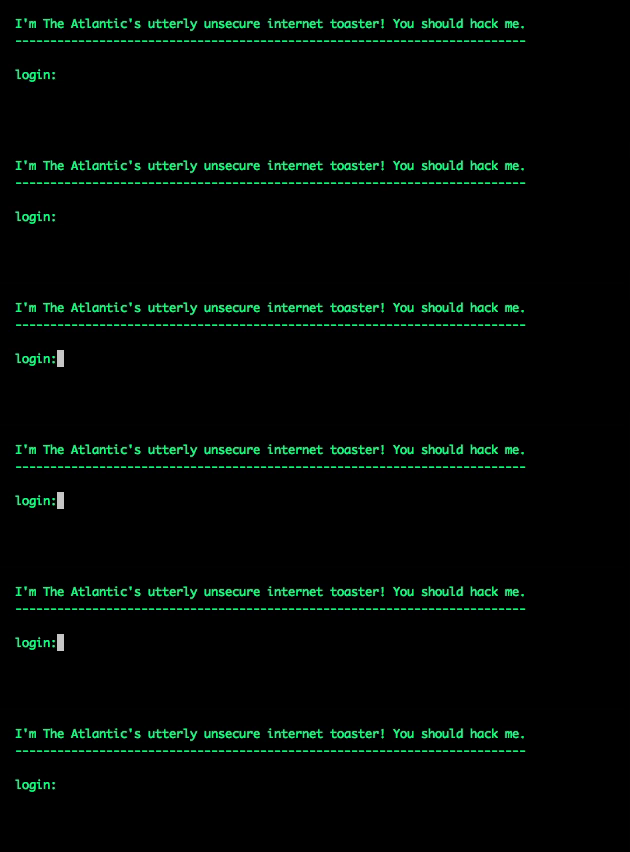
Here’s what my particular honeypot looked like, if you tried to log in:

I switched on the server at  1:12 p.m. Wednesday, fully expecting to wait days—or weeks—to see a hack attempt.

Wrong! The first one came at 1:53 p.m.

This graphic is a simulation—a bot’s-eye view, if you will—but it’s the actual sequence of commands the hacking script used. It tried a common default username and password (root/root) and executed the “sh” command, giving it the ability to run programs and install its own code. My fake toaster doesn’t allow that, of course—it just cuts the connection.

The next hacking attempt, from a different IP address and using different login credentials, came at 2:07 p.m. Another came at 2:10. And then 2:40. And 2:48. In all, more than 300 different IP addresses attempted to hack my honeypot by 11:59 p.m. Many of them used the password “xc3511,” which was the factory default for many of the old webcams hijacked in last week’s attack.

The last attempted hack came 5 minutes ago, using the username root and the password root. (Yes, those are live figures; they were updated when you loaded this page.)

I’ll admit this volume of attacks might not be typical. I hosted my fake toaster on a virtual Amazon server, not an actual toaster hooked up to residential internet. Hackers aren’t typing these passwords themselves—they’ve programmed bots to do the hard work for them, scanning through thousands of open ports an hour. And I’d bet those scripts are trawling Amazon’s range of IP addresses more frequently in hopes of hacking vulnerable rookies. (If that has happened to me without my knowledge, I am very sorry and please don’t hurt me.) But my experience matches what security firms have seen. It is now within the capability of hackers to literally scan the entire internet, looking for vulnerable servers with open ports. And every hacked computer adds another recruit to the search effort, shortening the time required geometrically.

Matthew Prince, the cofounder and CEO of Cloudflare, said anyone hooking up a poorly secured  IP device to the internet can expect to see that gizmo hacked within a week, if not much sooner.

“Assuming it’s publicly accessible, the chance [of being hacked] is probably 100 percent,” he said. “The IPv4 address space just isn’t that big. You can now run a scan across that entire space in hours, especially if you have a big botnet. The scans for vulnerability are continuous, and if anything, have accelerated over the last couple of years.”

This doesn’t mean that every Internet-of-Things device is vulnerable. Most things that you connect to the web through your home WiFi are probably okay: Your router kills most incoming hacking attempts. (Of course, if your router is compromised...) You have more to worry about if your device hooks up to your modem directly, which is more common in industrial settings.

All the same, the vastness of the internet can no longer protect us. I can’t count the number of sloppy things I’ve done, security-wise, because I thought I was small enough to escape notice—reused passwords, put private keys in code, left servers open to the world. Nowadays, even the most obscure among us can be found by a roving script, and in a startlingly small amount of time.

28 Oct 13:19

The Weird Familiarity of 100-Year-Old Feminism Memes

by Adrienne LaFrance
IKEA Monkey

It still blows my mind that women were only allowed to vote less than 100 years ago

It seems almost farcical that the 2016 presidential campaign has become a referendum on misogyny at a moment when the United States is poised to elect its first woman president.

Not that this is surprising, exactly.

There’s a long tradition of politics clashing spectacularly with perceived gender norms around election time, and the stakes often seem highest when women are about to make history.

Today’s political dialogue—which often merely consists of opposing sides shouting over one another—echoes another contentious era in American politics, when women fought for the right to vote. Then and now, a mix of political tension and new-fangled publishing technology produced an environment ripe for creating and distributing political imagery. The meme-ification of women’s roles in society—in civic life and at home—has been central to an advocacy tradition that far precedes slogans like, “Life’s a bitch, don’t elect one,” or  “A woman’s place is in the White House.”

Today’s memes can be found on T-shirts and bumper stickers, yes, but they’re mostly online—published and shared on platforms like Tumblr and Imgur and Twitter. A century ago, political memes were distributed primarily on postcards, via pamphlets, and in newspapers—with suffragettes as a favorite subject of either mockery or admiration, depending on the illustrator’s beliefs.

Much of the imagery that circulated in the early 20th century made fun of suffragists, even in illustrations that weren’t explicitly anti-suffrage. Mainstream humor at the time relied heavily on gender-based tropes and stereotypes, and political humor was no exception.“It made no difference that the bulk of this material was not intentionally anti-suffrage,” wrote Lisa Tickner in her 1988 book, The Spectacle of Women: Imagery of the Suffrage Campaign 1907-14, “It represented an enormous mass of material, and some very deep-seated prejudice.”

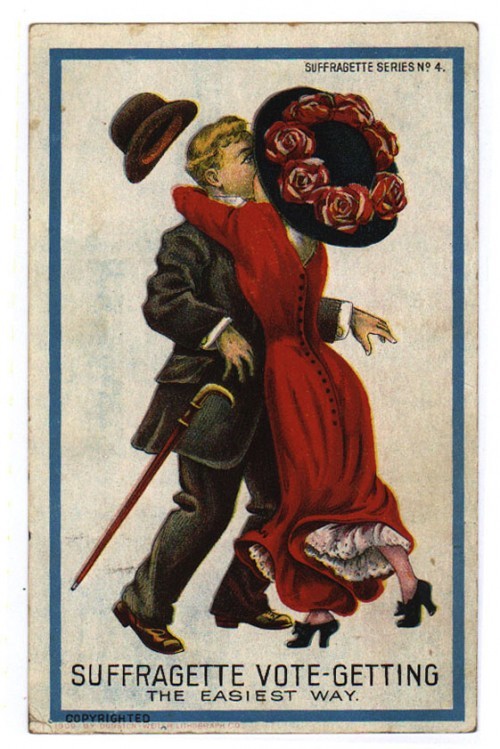
“Suffragette Vote-Getting, the Easiest Way,” published by the Dunston-Weiler Lithograph Company in 1909. (Catherine H. Palczewski Postcard Archive / University of Northern Iowa)

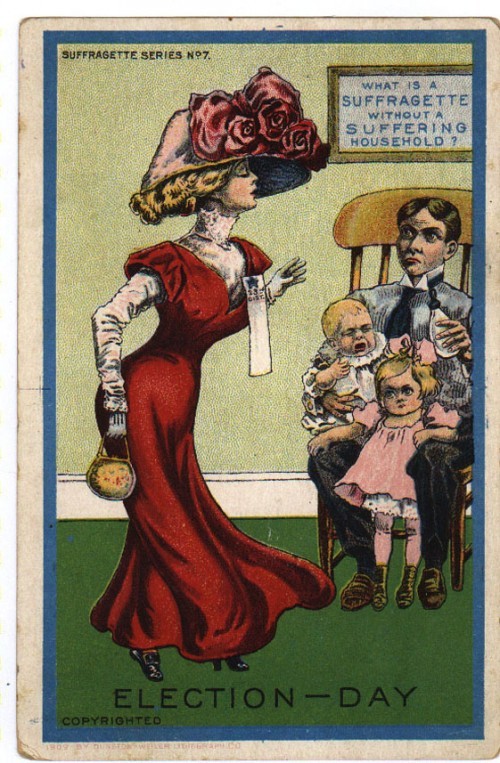
One common theme was the subversion of male and female roles in society—with men often depicted holding crying babies or doing housework, and women portrayed as ultra masculine and detached from home life.

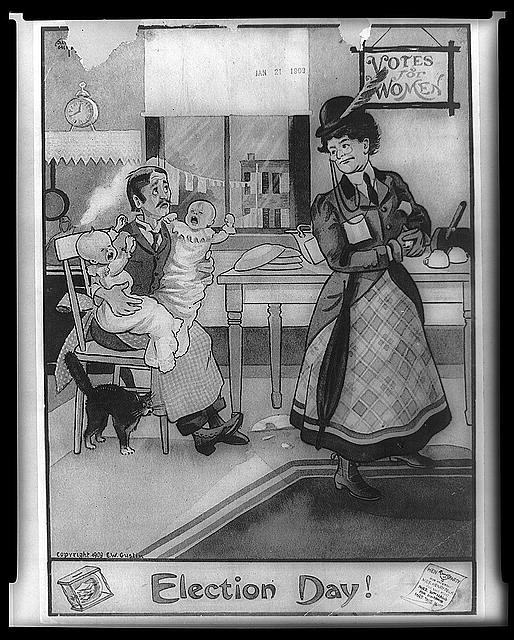
“Election Day,” published by the Dunston-Weiler Lithograph Company in 1909, features a woman leaving her family to vote. A caption reads: “What is a suffragette without a suffering household?”
(Catherine H. Palczewski Postcard Archive / University of Northern Iowa)

Artists who created works with the intention of promoting suffrage were organized and devoted to the cause, Tickner wrote, “but [their efforts] were very small against the accumulated weight of individual and institutional misogyny.”

Sounds familiar, no?

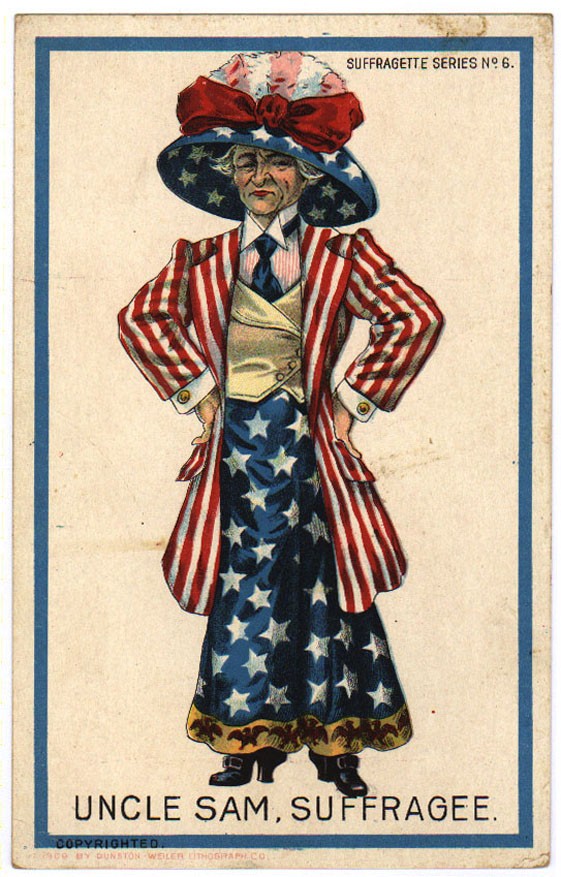
“Uncle Sam, Suffragee,” published by the Dunston-Weiler Lithograph Company in 1909.
(Catherine H. Palczewski Postcard Archive / University of Northern Iowa)

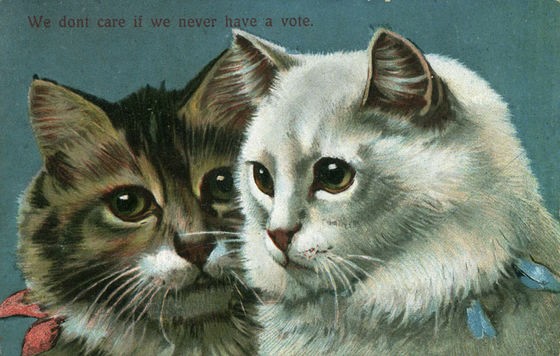
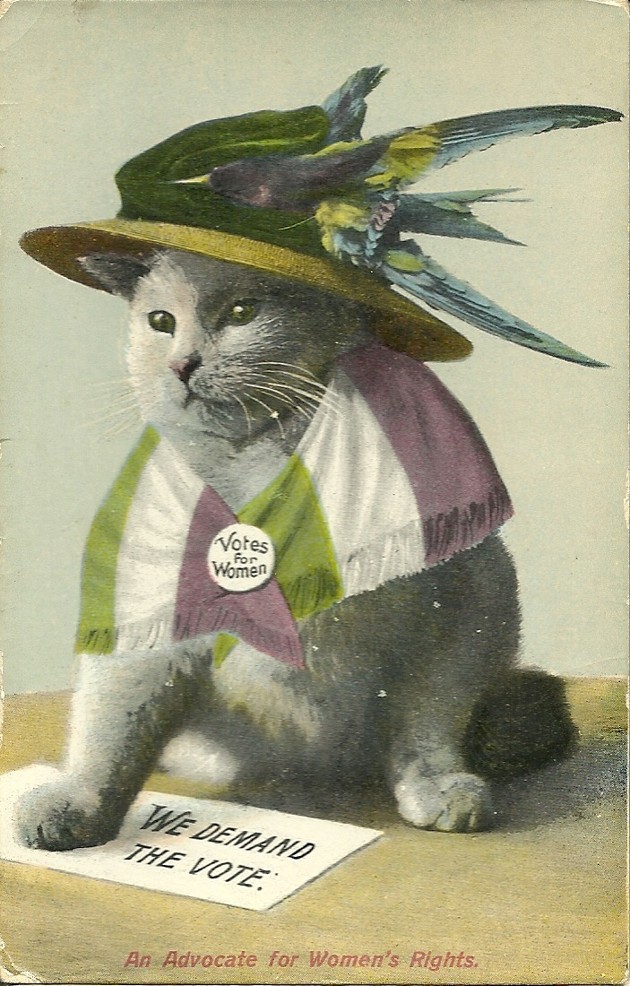
On top of all that, in a sub-genre of suffrage-era propaganda that’s downright internetty, there was even an obsession with cats. (This was likely because of the 1913 Cat-and-Mouse Act, a government strategy to discourage hunger strikes by imprisoned suffragettes in the United Kingdom, according to the historian of social movements Catherine Helen Palczewski.)

(Catherine H. Palczewski Postcard Archive / University of Northern Iowa)

As Palczewski points out in an essay accompanying her web collection of suffrage postcards, it was common for people to display albums filled with postcards in their homes in the early 20th century. So it made sense that postcards both supporting and opposing the women’s vote were ubiquitous, especially between 1890 and 1915 in the United States. About 4,500 different suffrage-themed postcards were designed during that time, she wrote.

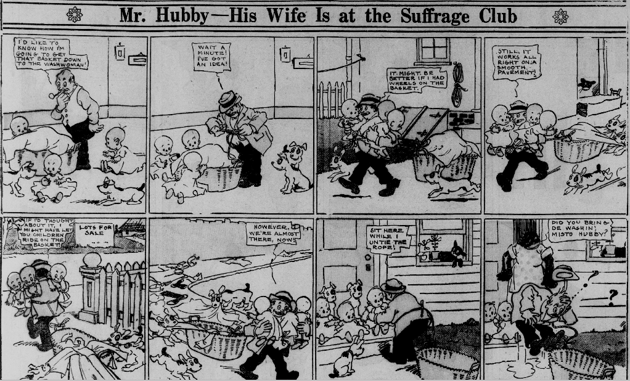
Congress ultimately ratified the 19th Amendment in 1920. But many women, particularly women of color, remained disenfranchised long after that. Early 20th-century suffrage memes were nearly exclusively concerned with white people. In reviewing hundreds of postcards, prints, and illustrations, the only portrayal I saw of a black woman was in a cartoon strip about a white husband struggling to manage housework after his wife had gone off to a suffrage meeting. The woman in the strip is a mammy caricature, only there to help the man with the laundry.

“Mr. Hubby — His Wife Is at the Suffrage Club,” published in The San Francisco Call, in 1913. (Library of Congress)

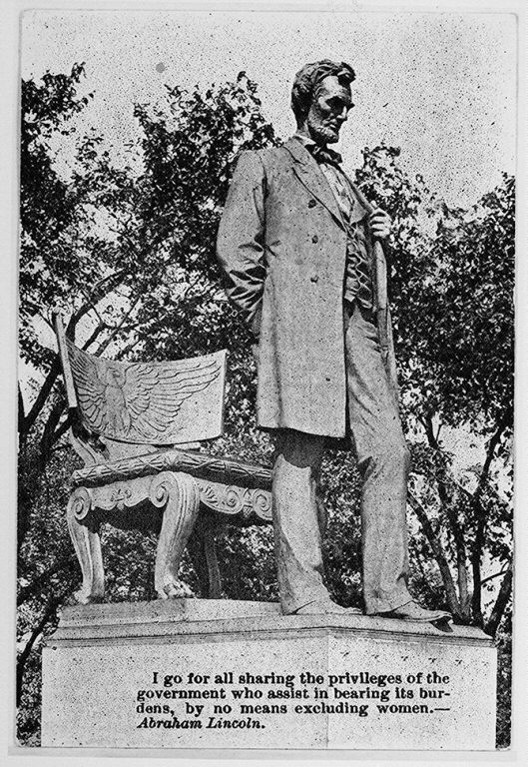
And though the aesthetic of early comics and other memes isn’t exactly contemporary, many of the formats used back in the day—like inspirational quotes overlaying imagery of revered figures—have lived on. You can find this kind of thing all over sites like Pinterest and Reddit today:

A 1910 postcard of an Abraham Lincoln statue features a pro-suffrage caption. (Library of Congress)

In 1941, George Orwell wrote an essay about the endurance of this art form, focusing in particular on the work of Donald McGill, a British illustrator known for his raunchy postcards. His observations remain salient today, and could easily apply to modern collections of political “shitposts.” (The epithet he uses is jarring to read in 2016, but such racist imagery is still being produced.)

They have an utter lowness of mental atmosphere which comes out not only in the nature of the jokes but, even more, in the grotesque, staring, blatant quality of the drawings. The designs, like those of a child, are full of heavy lines and empty spaces, and all the figures in them, every gesture and attitude, are deliberately ugly, the faces grinning and vacuous, the women monstrously parodied, with bottoms like Hottentots. Your second impression, however, is of indefinable familiarity. What do these things remind you of? What are they so like?

Comic postcards, Orwell concluded, were so familiar because they exploited tensions and ideas rooted deeply in Western European consciousness. Finding humor in punching down at women, the depictions of them as grotesque, sexual innuendo at their expense—all this stuff has deep cultural roots. “What you are really looking at,” he wrote, “is something as traditional as Greek tragedy.” Which, of course, brings us back to the 2016 election.

Outspoken and civically engaged women are still a target for humorists and activists, routinely cast as either larger-than-life saviors or power-thirsty demons destroying modern society. “To her critics, the modern woman was a symptom of the social decline she helped to precipitate,” Tickner wrote of the way suffragettes were perceived during the presidential campaign of 1908, “To her champions, she was not unwomanly, but womanly in a new and developing way.”

The only consensus, it seems, is that a woman’s political ambitions cannot be ignored.

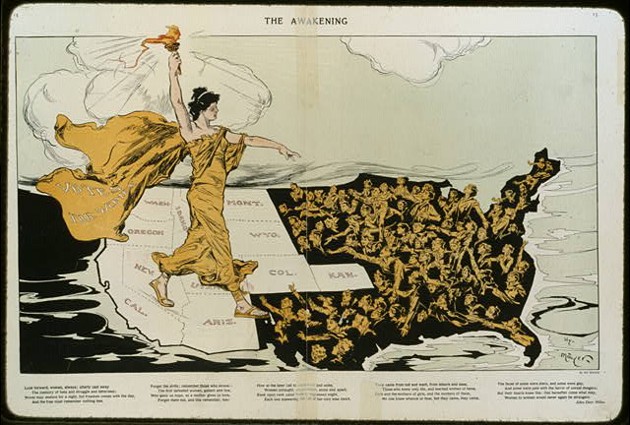
This 1915 illustration by Henry Mayer depicts the awakening of the nation's women to the desire for suffrage—with a torch-bearing woman striding across the western states, where women already had the right to vote, toward the east where women are reaching out to her. Printed below the cartoon is a poem by Alice Duer Miller. (Library of Congress)
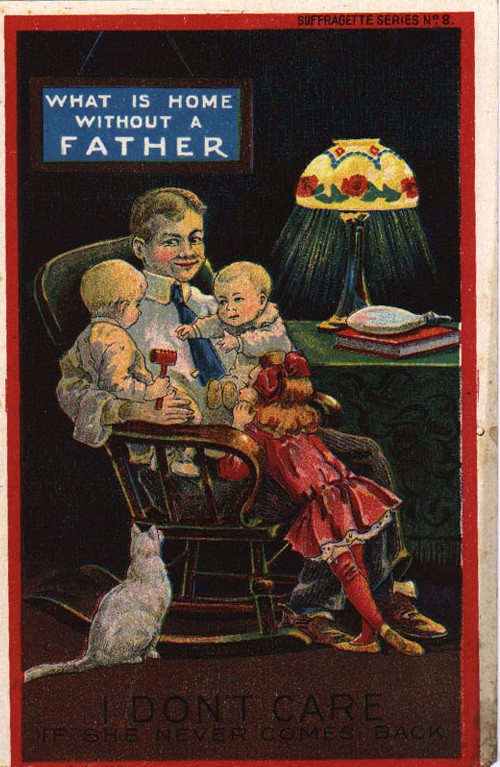
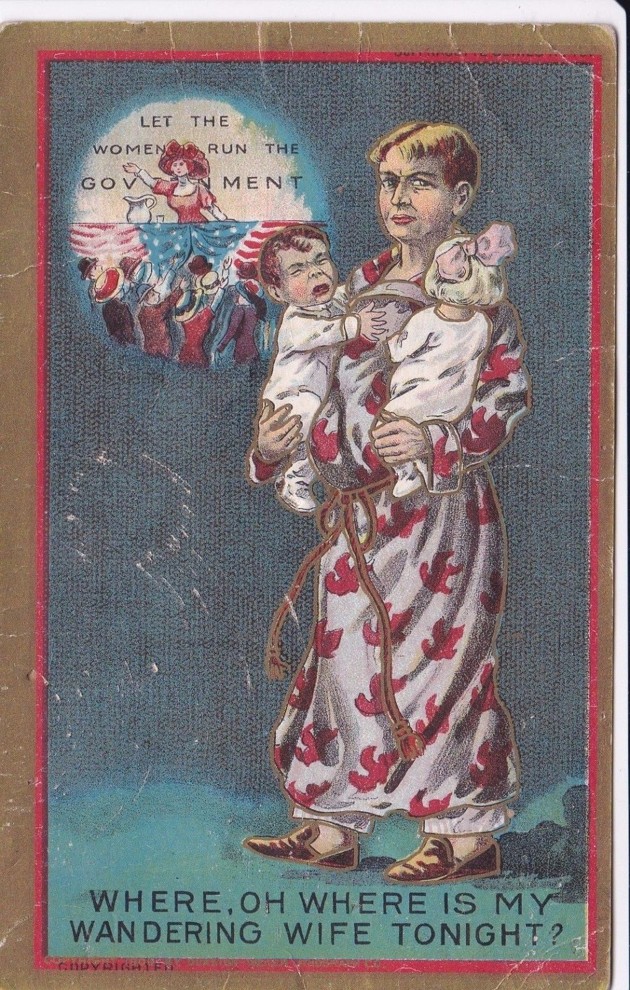
A postcard featuring a father with his children, and the caption “I Don’t Care If She Never Comes Back,” published by the Dunston-Weiler Lithograph Company in 1909. (Catherine H. Palczewski Postcard Archive / University of Northern Iowa)
“Election Day,” by E.W. Gustin, 1909. (Library of Congress)
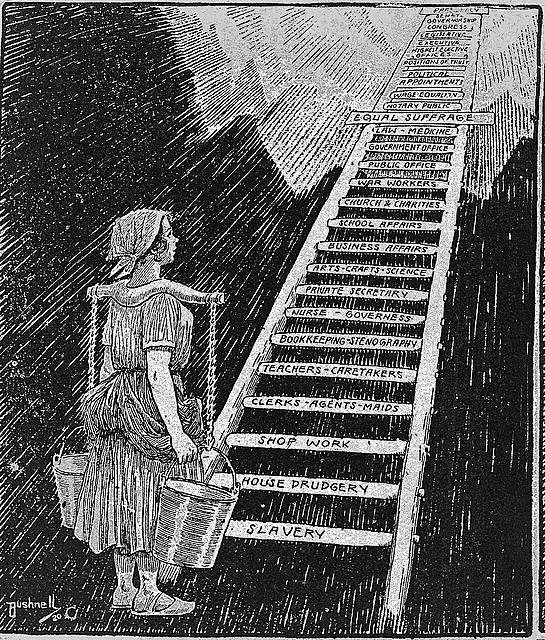
“The sky is now her limit,” created by Elmer Andrews Bushnell in 1920, shows a young woman carrying buckets on a yoke, looking up at ladder ascending up to the sky. The bottom rungs are labeled "Slavery," "House Drudgery," and "Shop Work." The top rungs are labeled "Equal Suffrage," "Wage Equity," and "Presidency." (Library of Congress)
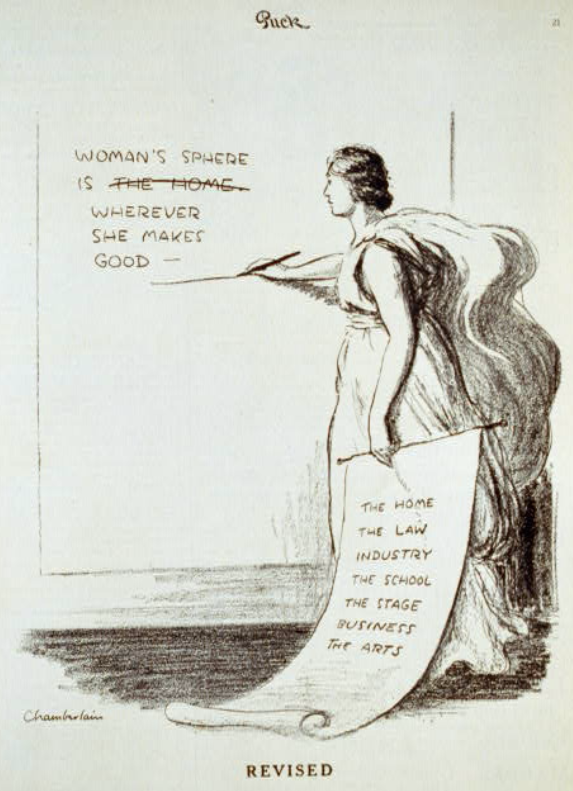
Kenneth Russell Chamberlain’s 1917 drawing shows a woman revising a statement on a wall—editing "Woman's sphere is the home" to "Woman's sphere is wherever she makes good"—and holding a list of places, such as "the law," "industry," “the school,” and “business,” that can be used to complete the revised statement. (Library of Congress)
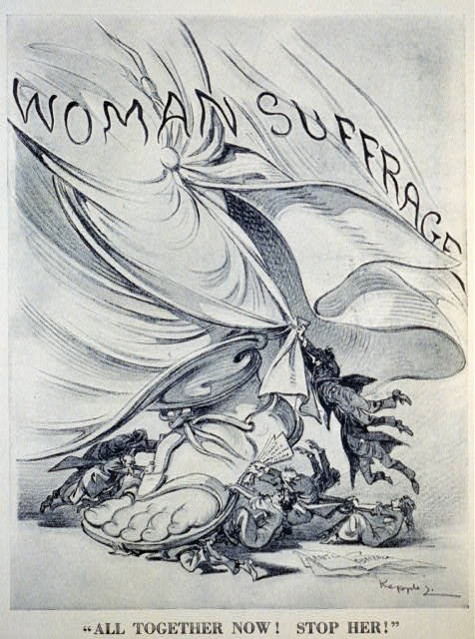
Udo Keppler’s 1914 illustration shows several diminutive figures, men and women, hanging onto a robe labeled "Woman Suffrage" and the sandal of a gigantic woman who is striding forward. (Library of Congress)
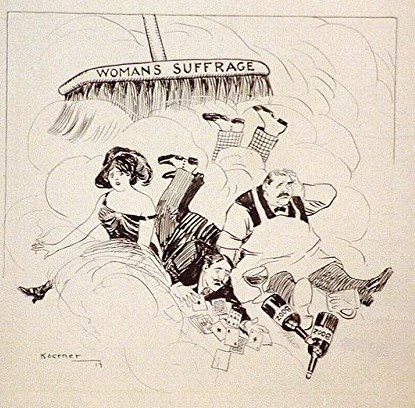
William Henry Dethlef Koerner’s 1914 cartoon, “Spring house cleaning—why not,” shows a large broom labeled "womans suffrage" sweeping away a prostitute, gambler, and bartender to represent the idea that giving women the vote could mean an end to those occupations. (Library of Congress)
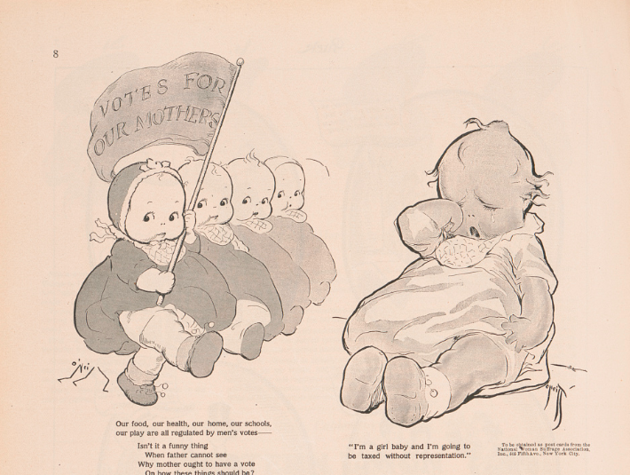
Rose Cecil O’Neill’s 1915 illustration shows infant "Kewpies," advocating for the women’s vote. The crying infant sitting on the right says, "I'm a girl baby and I'm going to be taxed without representation." (Library of Congress)
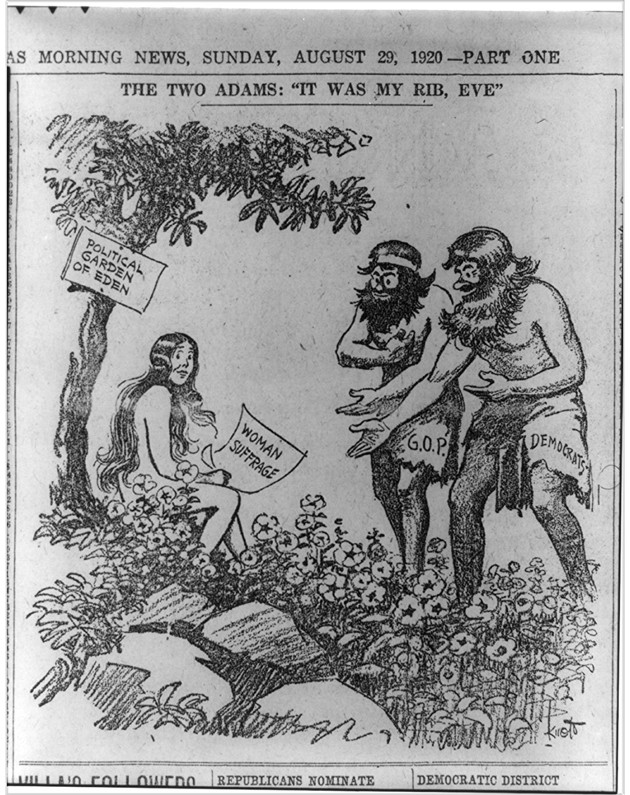
John Francis Knott’s 1920 cartoon shows Republican and Democratic versions of Adam taking credit for the passage of the Nineteen Amendment. Each is telling Eve that his party is the one that supports women's suffrage. (Library of Congress)
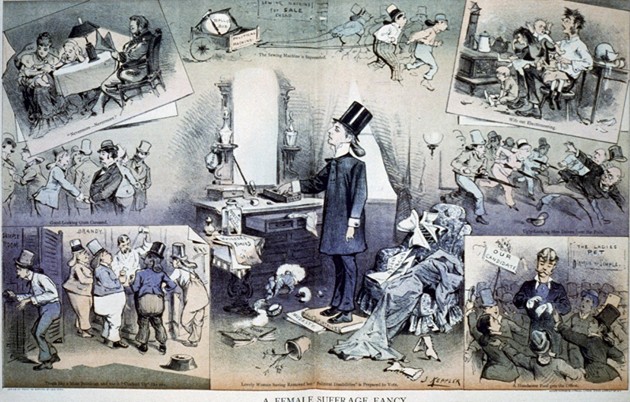
Joseph Ferdinand Keppler’s 1880 illustration, “A female suffrage fancy,” features a composite of eight caricatures of women dressing and interacting in society as men— drinking; voting for handsome candidates; driving ugly men from the polls—and a domestic scene showing a man taking care of children. (Library of Congress)
Donald McKee’s 1914 cartoon shows two female baseball players, "Feminism" and "Suffrage,” one encouraging the other to hit a male batter in the head. (Library of Congress)
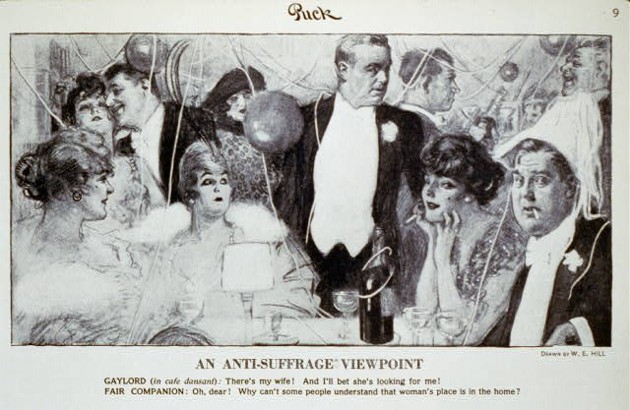
William Ely Hill’s 1915 illustration shows a man standing at a table with three women and another man during a New Year's party. He is concerned that his wife will find him out with a female companion. (Library of Congress)
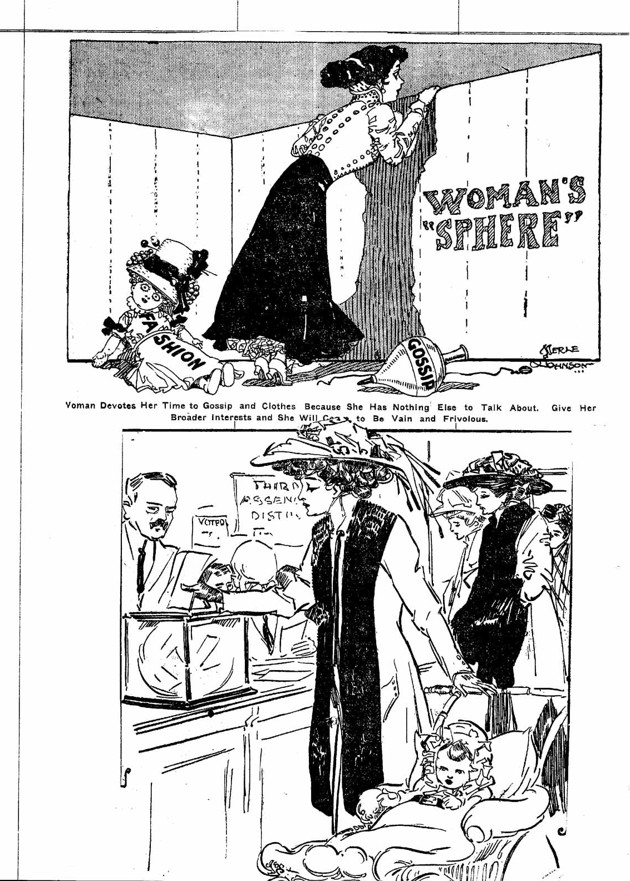
Merle De Vore Johnson’s 1909 cartoon shows a woman peering over a fence labeled "Woman's Sphere", while her playthings—"fashion" and "gossip"—lay abandoned. Another cartoon shows women voting, one of them pushing a baby carriage. (Library of Congress)
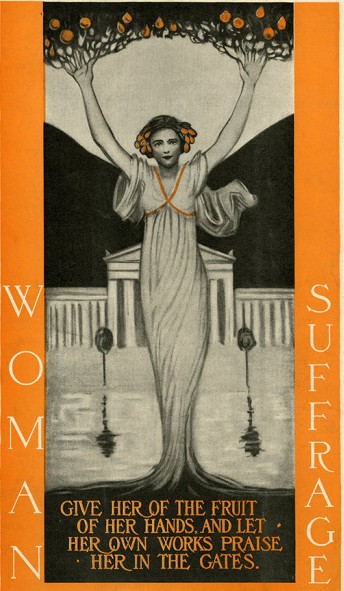
This print from the back cover of The Woman Citizen, published in 1918, is from an original painting by Evelyn Rumsey Cary. The text, which was well known to suffragists, was taken from Proverbs 31:31. (VCU Libraries)
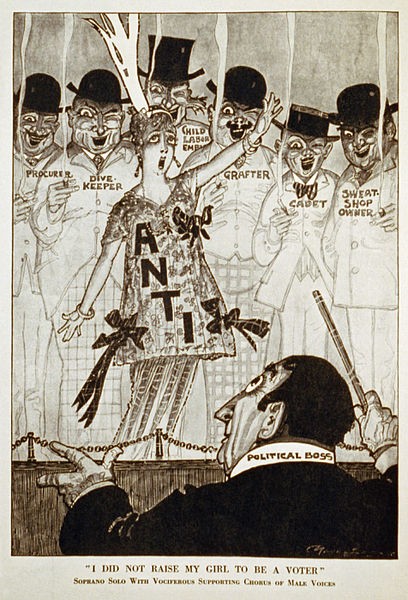
In this cartoon, published in Puck magazine in 1915, an anti-suffragist sings “I Did Not Raise My Girl to be a Voter,” evoking the antiwar song “I Didn't Raise My Boy To Be A Soldier.” Back-up singers include a group of morally questionable men, including a child labor employer and a sweatshop owner.
(Library of Congress)
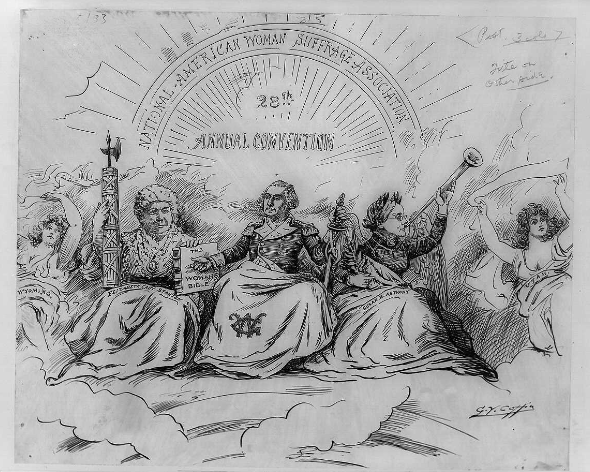
“The apotheosis of suffrage,” created by George Yost Coffin in 1896, depicts the famous suffragists, Elizabeth Cady Stanton and Susan B. Anthony, sitting with George Washington. The illustration is meant to evoke “The Apotheosis of Washington,” the fresco painted in the eye of the Rotunda of the U.S. Capitol by Constantino Brumidi in 1865. Coffin’s sendup is intended to mock the idea of Stanton and Anthony deserving such stature—a message that’s obscured in 2016, an era when Stanton and Anthony are revered for their dedication to women’s rights. (Library of Congress)
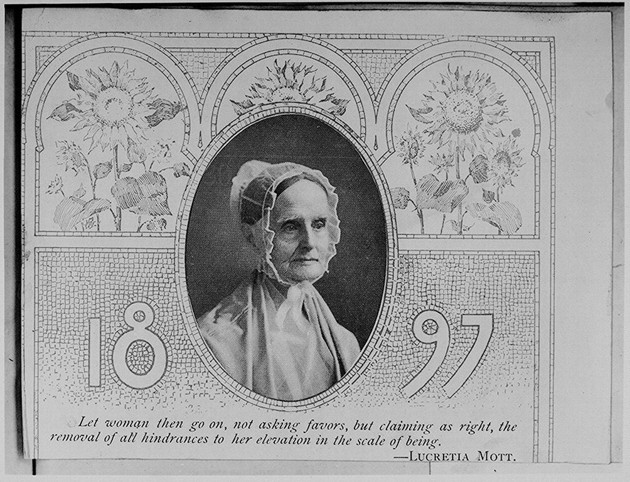
An illustration and photo featuring the women’s rights activist Lucretia Mott, 1897. (Library of Congress)
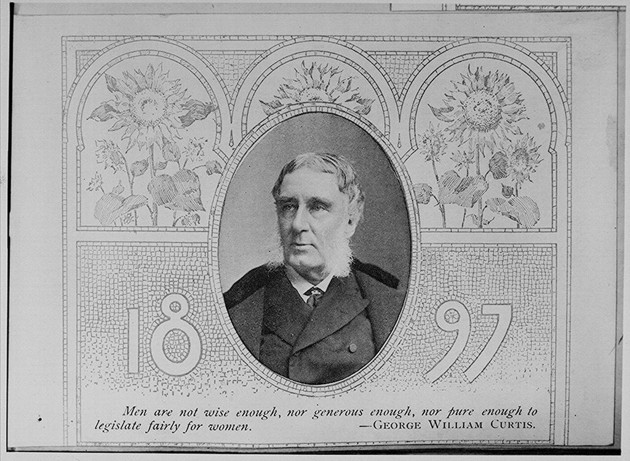
An illustration and photo of the civil rights activist George William Curtis, 1897. (Library of Congress)
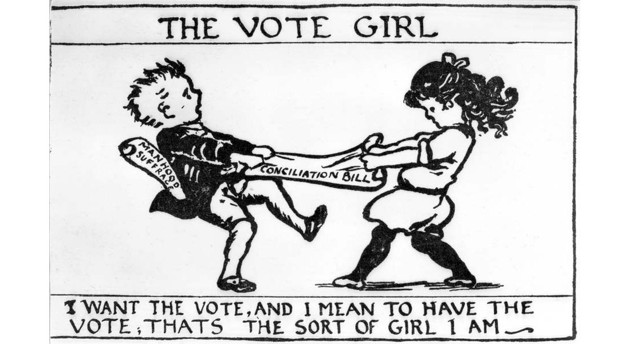
“The Vote Girl,” featured in the British magazine Suffrage Atelier in 1909. (Museum of London)
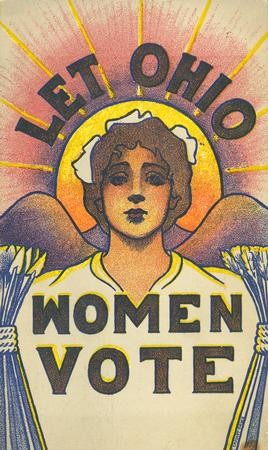
A postcard featuring a woman's face framed by the rising sun and the slogan "Let Ohio Women Vote," 1915. (Ohio History Connection)
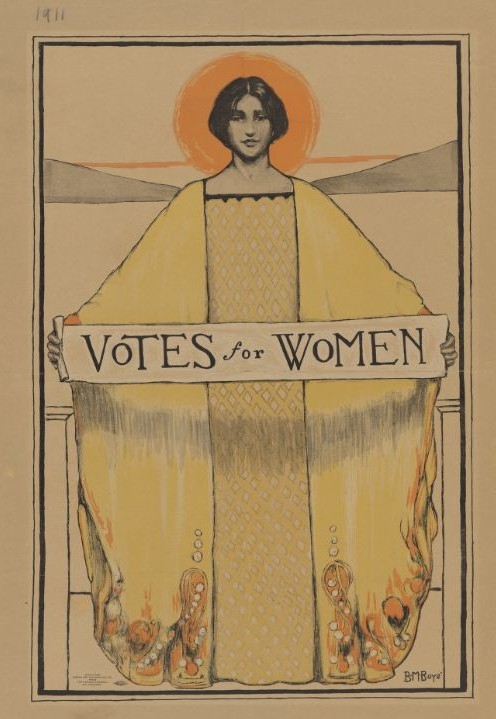
A popular poster created by the artist Bertha Margaret Boye for the 1911 California suffrage campaign. (Harvard University, Schlesinger Library on the History of Women in America)
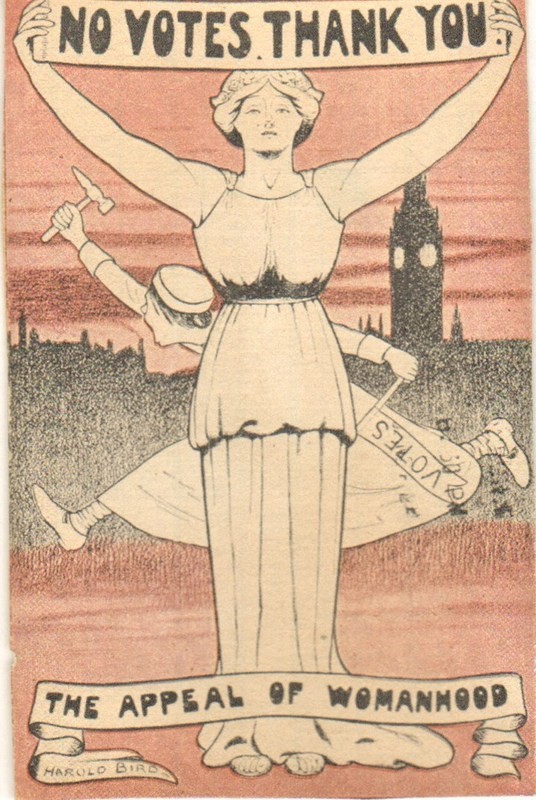
In this 1912 postcard, illustrated by Harold Bird for Britain’s National League for Opposition to Women's Suffrage, an anti-suffragist is depicted as a classically feminine compared with a scrawny suffragette. (NLOWS / Ann Lewis Women’s Suffrage Collection)
(Harvard University, Schlesinger Library on the History of Women in America)
A postcard, published by the Dunston-Weiler Lithograph Company in 1909. (Catherine H. Palczewski Postcard Archive / University of Northern Iowa)
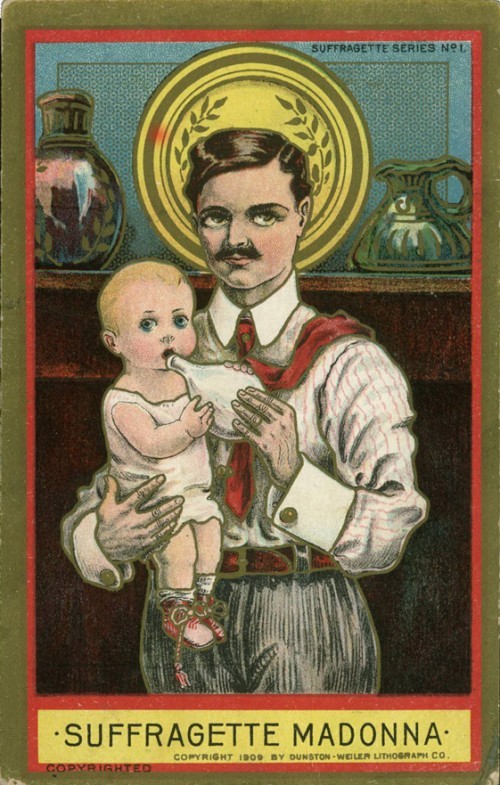
“Sufragette Madonna,” published by the Dunston-Weiler Lithograph Company in 1909. (Catherine H. Palczewski Postcard Archive / University of Northern Iowa)
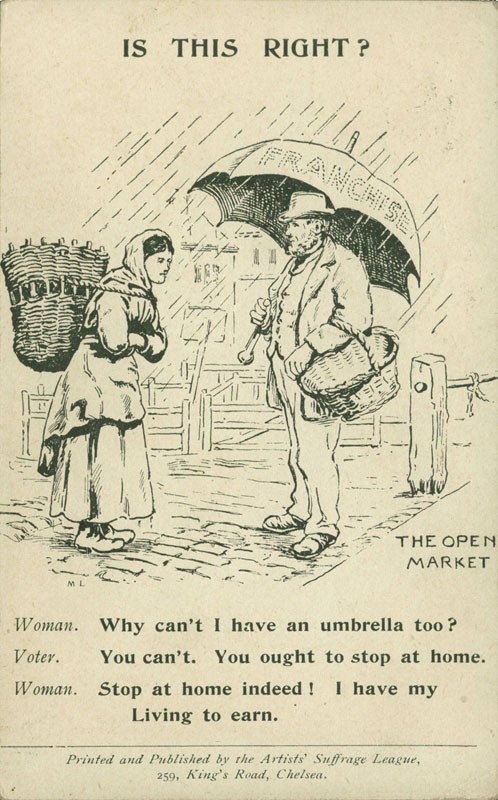
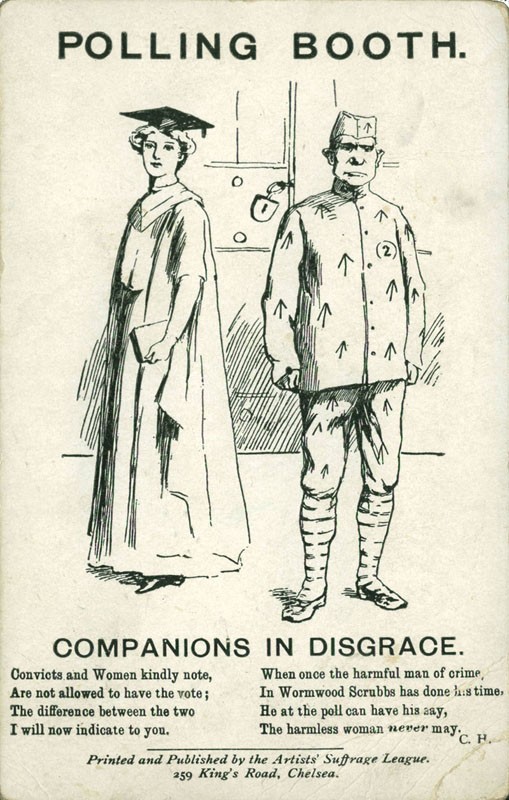
A postcard produced by the Artists’ Suffrage League, an advocacy group in Britain, in 1907.  (Catherine H. Palczewski Postcard Archive / University of Northern Iowa)
A postcard made by the Artists’ Suffrage League, an advocacy group in Britain, in 1907.  (Catherine H. Palczewski Postcard Archive / University of Northern Iowa)
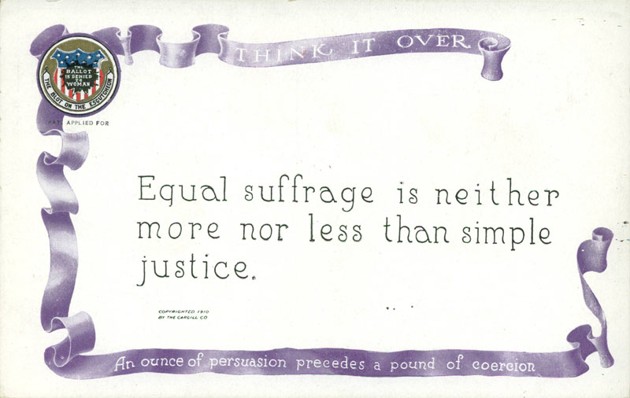
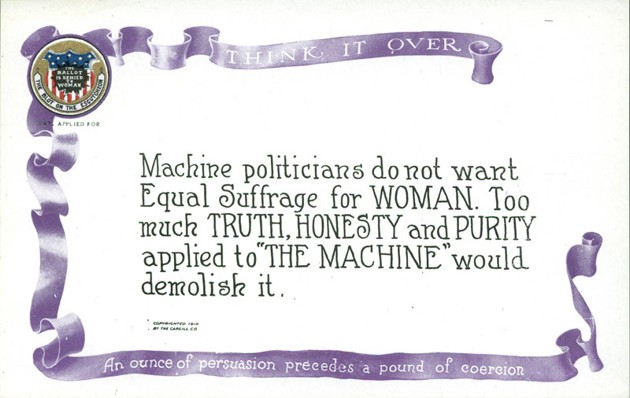
A postcard from the National American Woman Suffrage Association collection produced in 1910. (Catherine H. Palczewski Postcard Archive / University of Northern Iowa)
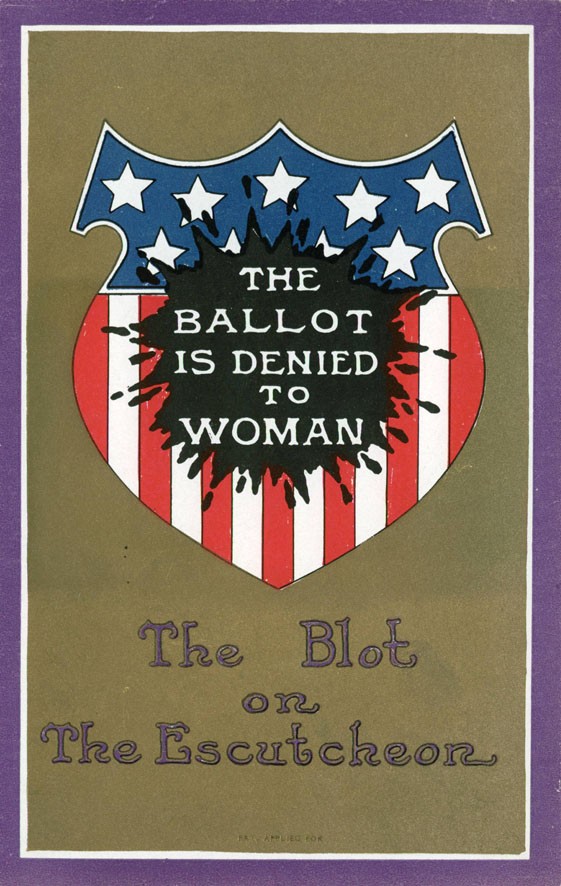
“The Blot on The Escutcheon,” by the National American Woman Suffrage Association, 1910.
(The Suffrage Postcard Project)
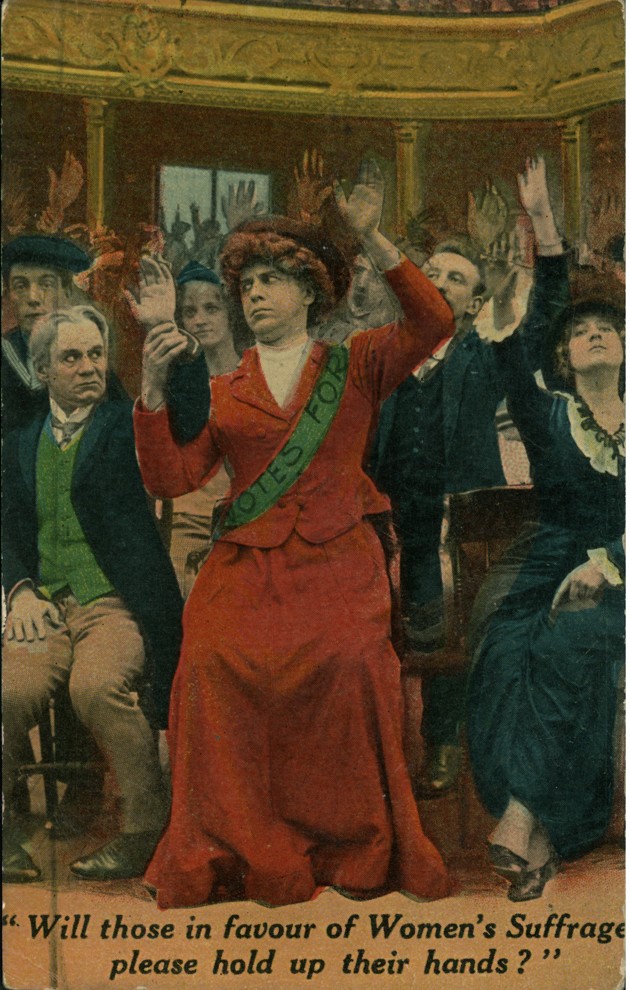
A postcard, published by Banforth & Co., shows a suffragette coercing the man next to her to support the cause. The caption reads: “Will those in favour of Women’s Suffrage please hold up their hands?” (Catherine H. Palczewski Postcard Archive / University of Northern Iowa)
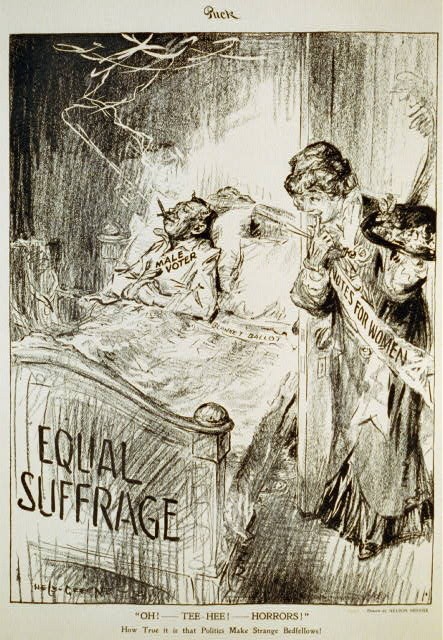
Nelson Green’s 1914 illustration shows a woman labeled "Votes for Women" entering a bedroom. A man labeled "Male Voter," is smoking and lying on a bed labeled "Equal Suffrage." The caption reads: “How true it is that politics make strange bedfellows!” (Library of Congress)
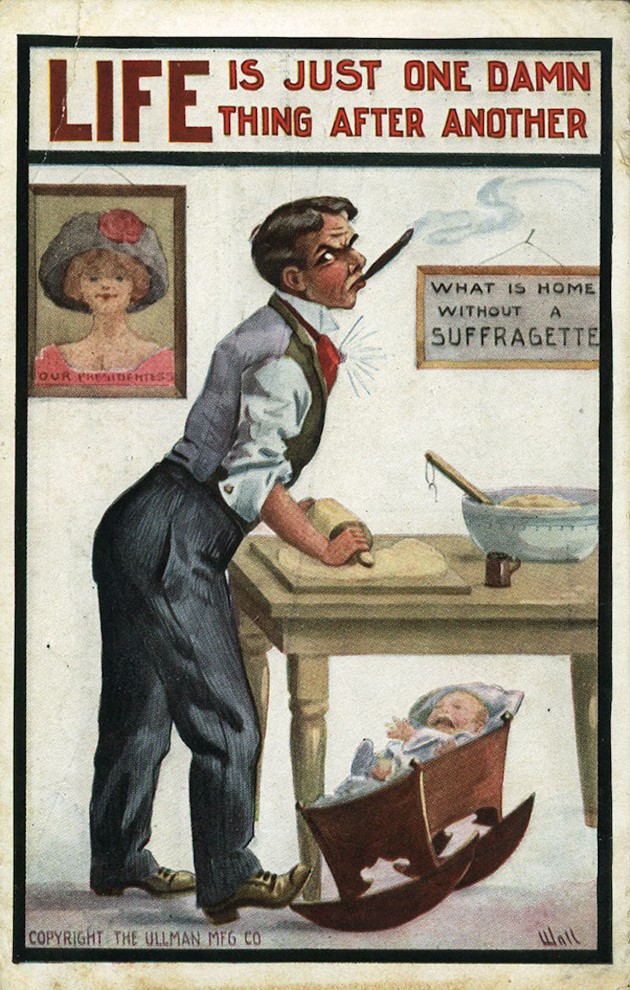
“Life is just one damn thing after another,” an illustration published by Wall Ullman Mfg. Co. (Catherine H. Palczewski Postcard Archive / University of Northern Iowa)
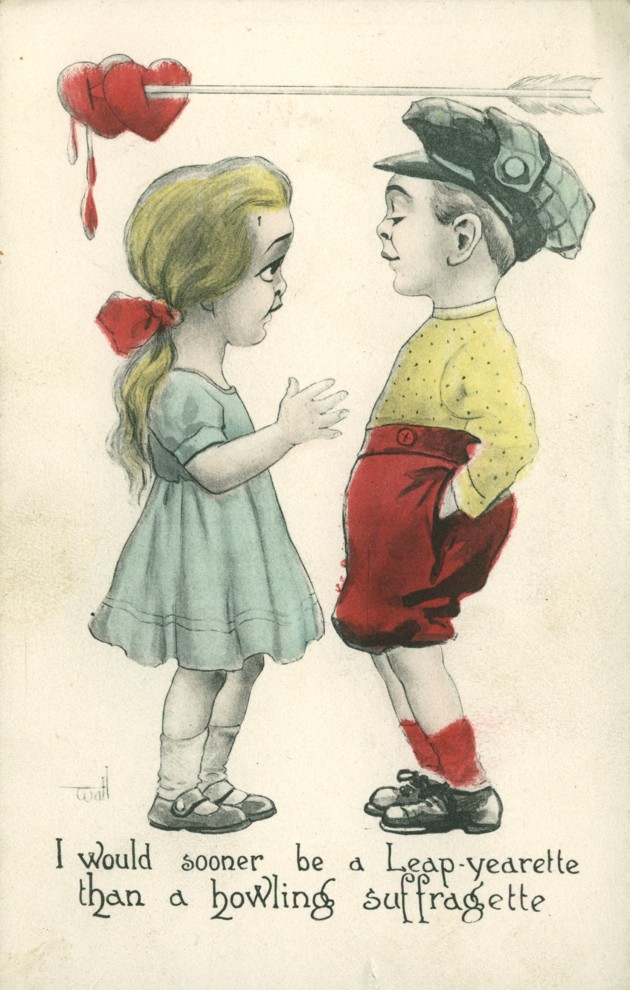
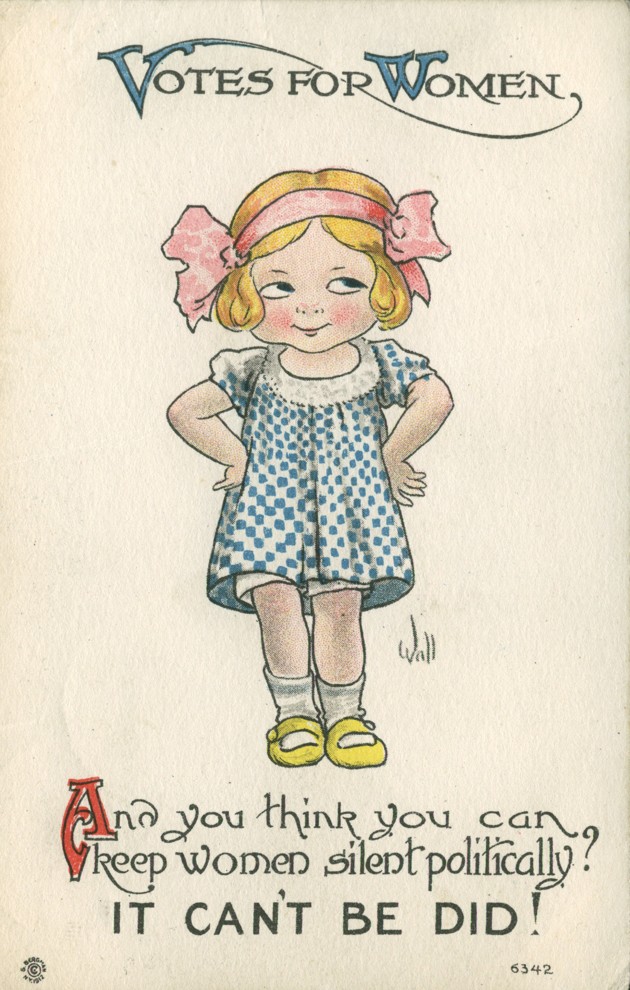
A 1915 postcard illustrated by the Bernhardt Wall. (Catherine H. Palczewski Postcard Archive / University of Northern Iowa)
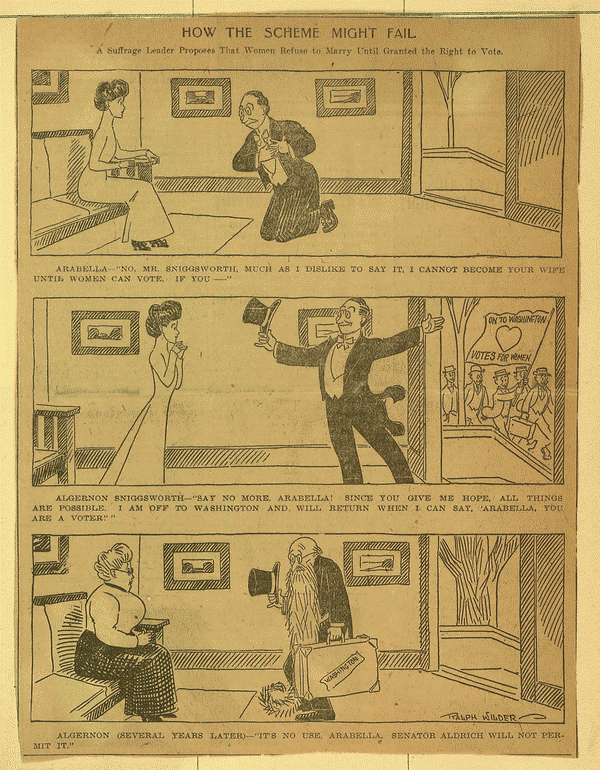
Ralph Wilder's 1909 cartoon shows a series of drawings in which a young man's proposal is rejected by his sweetheart until women can vote. He promises to advocate for her rights but ultimately fails.
(Library of Congress)
An anti-suffrage postcard published in 1906 attempts to make the case that women were not sophisticated enough to handle civic decisions. (Suffragette Postcard Project)
A 1915 postcard illustrated by Bernhardt Wall, who was nicknamed the “King of Postcards.”
(Catherine H. Palczewski Postcard Archive / University of Northern Iowa)

27 Oct 23:19

Arby's Serving Up Deer Meat in Select Locations

by Q
IKEA Monkey

really? Hm.

Starting in November, Arby's will be serving up venison (deer meat) in a select number of restaurants located in popular hunting markets.

Arby's Venison Sandwich features a thick-cut venison steak, crispy onions, and juniper berry sauce on a toasted specialty roll. The steak is marinated in garlic, salt, and pepper and then cooked for three hours for tenderness. The juniper berry sauce is a Cabernet steak sauce infused with juniper berries.

Venison is similar to beef but tends to be leaner with a finer texture and can sometimes be a bit gamey. It's not commonly found at restaurants in general.

The sandwich will only be offered at 17 Arby’s restaurants across America. Each is located within heavy deer hunting areas in either Wisconsin, Minnesota, Michigan, Pennsylvania, Tennessee, or Georgia.

The locations and dates available are:

Available October 31 - November 3, 2016:

- 2044 Rosa L. Parks Blvd., Nashville, Tenn. 37228

Available November 4-6, 2016:

- 3821 Tower Ave., Superior, Wis. 54880
- 1690 Park Place Blvd., St. Louis Park, Minn. 55416
- 704 Highway 33 South, Cloquet, Minn. 55720
- 348 Lincoln Ave. SE, St. Cloud, Minn. 56301
- 3275 First St. S, St. Cloud, Minn. 56301
- 4415 Roswell Rd. NE, Atlanta, Georgia 30342

Available November 12-15, 2016:

- 4229 W Vienna Rd., Clio, Mich. 48420
- 4040 17 Mile Rd. NE, Cedar Springs, Mich. 49319
- 1215 M 89, Plainwell, Mich. 49080
- 8685 Birch Run Rd., Birch Run, Mich. 48415

Available November 25-28:

- 5205 Library Road, Bethel Park, PA 15102
- 4260 Ohio River Blvd., Bellevue, Penn. 15202
- 16 Towne Center Drive, Leechburg, Penn. 15656
- 2539 W State St., New Castle, Penn. 16101
- 2648 Ellwood Rd., New Castle, Penn. 16101
- 3224 Wilmington Rd., New Castle, Penn. 16105

Photo via Arby's.
Read more at Brand Eating!
27 Oct 21:57

Not a bad place to start your day. 📷: @girlinbluecoat /📍: Greece...

IKEA Monkey

I dream of going to a place like this


Not a bad place to start your day. 📷: @girlinbluecoat /📍: Greece #7dayweekend http://ift.tt/2eV04NB

27 Oct 18:31

Newswire: Chipotle descends into destructive spiral of cocaine, E. Coli, and pizza

by Mike Vago
IKEA Monkey

the photoshopped photo made me lol though

Chipotle has spent 2016 recovering from last year’s e. coli scandal by combining one debacle after another into a hastily assembled burrito of disease, drugs, and money woes. (Guacamole costs extra). Mashable reports on a remarkable series of tweets, all from Tuesday, that portray an affordable lunch option in the midst of a whirlwind of problems. For starters, the Mexican food chain has lost nearly 15 percent of its income compared to last year—although it still did rake in a billion dollars—and the company has lost a third of its value over the same span. Not helping the freefall is executive Mark Crumpacker, who was just busted for using cocaine.

Chipotle can at least rest easy that it’s not doing as badly as Shophouse, the California-based Asian fast-casual chain that’s being shuttered after not making money for its parent company, Chipotle. But having failed to ...

27 Oct 01:08

Watch Newt Gingrich Lose His Shit When Megyn Kelly Calls Donald Trump a 'Sexual Predator'

by Megan Reynolds
IKEA Monkey

I seriously hate that this election has made me side with Megyn Kelly

Please take a moment and watch this video of Newt Gingrich losing his mind when Megyn Kelly deigns to call out the sexual assault allegations against Donald Trump, I promise you, it is worth your time.

Read more...

26 Oct 23:38

Newswire: Amy Schumer made a “Formation” tribute, and the internet is not happy

by Sam Barsanti
IKEA Monkey

why would she ever think this was a good idea

On Friday, Amy Schumer released a video on Tidal of her, Goldie Hawn, Wanda Sykes, and Joan Cusack lip-syncing to Beyoncé’s “Formation” while filming a movie—presumably the untitled comedy about a mother and daughter who get kidnapped while on vacation in Brazil. While not necessarily a parody that pokes fun at Beyoncé or the song, it is all based around having fun with the song in the sense that it involves Schumer and her co-stars goofing around:

The video didn’t make a huge splash on its own at first, but as it spread over the weekend, social media users started accusing Schumer of cultural appropriation and of being disrespectful to the racial politics at the heart of the song. After all, even a cursory glance of the lyrics make it pretty clear that “Formation” is about Beyoncé’s experiences as a black woman and the experiences of ...

26 Oct 23:11

Would You Buy a Genetically-Engineered Cashmere Sweater?

by Sarah Zhang
IKEA Monkey

Sure, I love cashmere

Cashmere is not merely goat hair.

No, no. Most hair on a goat—even a so-called cashmere goat—is coarse and thick, unsuitable for the neck of lady. Cashmere comes from a second undercoat that goats grow only in the winter, where the hairs are fine and soft and downy. But even goats specially bred to produce cashmere grow pitifully little—about half a pound per goat. Hence, your very expensive cashmere sweater.

In China, the world’s top producer of cashmere, scientists have been trying to breed more productive cashmere goats. They’ve now used CRISPR, the genetic editing technique, to disrupt a single gene in cashmere goats. The change made hair in their undercoats even longer and more numerous—but not, crucially, any thicker. The genetic tweak boosts yield by about three ounces.

So are you thinking what I’m thinking? How do you sell cashmere from GMOs? Conventional genetic engineering in the 90s took on commodity crops like corns and soybeans, and even more recent CRISPR experiments, like the bulked-up pigs in South Korea, are aimed toward large potential markets. Cashmere is a luxury product, its value derived precisely from its rarity. What does making more cashmere—through a process as wisely misunderstood and disliked as genetic modification—do to its value? What happens to a luxury product in the age of genetic engineering?

It’s worth considering that CRISPR’s recent discovery is the reason we’re even contemplating this question. Just a few years ago, a couple papers on gene-editing potential of CRISPR set off a firestorm in biology, expanding the imaginations of geneticists. The new technique makes it relatively easy to edit genes in virtually any species. And while much of the hype has focused on CRISPR’s potential to cure human diseases or to rid the world of malaria mosquitoes or revive the extinct wooly mammoth, an unappreciated effect of genetic engineering is how it changes the way we get stuff—stuff we eat, wear, use, and break. After all, conventional genetic engineering changed the face of modern agriculture for a commodity crops; for better or worse, CRISPR could do the same to niche markets, including cashmere.

So I called up Karl Spilhaus, longtime president of the Boston-based trade group Cashmere and Camel Hair Manufacturers Institute. Spilhaus was circumspect. He says the industry could be open to hair from these genetically modified goats if the quality was there. It’s just way too early to tell.

But he also pointed out why the Chinese would be interested be creating a higher-yield cashmere goat. Lately, China’s dominance of cashmere market has gotten shakier. The goats graze on windswept grasslands in China’s northwest, and they grow their cashmere undercoats in response to harsh winters. As China modernizes, the cashmere-goat-herding lifestyle is falling out of favor.  “People no longer want to pursue the nomadic way of life,” says Spilhaus. “And China’s diet is going more toward meat, and goat meat is a big factor. It’s a lot easier for a herdsman to raise goats for meat than for very fine cashmere.”

Cashmere production has also taken a toll on the environment in Central Asia. Goats are destructive grazers, and their hooves destroy the root systems of grass. This double whammy has contributed to desertification in China and Mongolia. Environmentalist groups have taken stances against cashmere, which has in turn prompted efforts towards a “Sustainable Cashmere Standard.”

Here, perhaps, genetically-modified goats could find a niche. Loro Piana, an Italian company that specializes in high-end wool and cashmere, has launched a sustainability program to increase the yield of cashmere goats in China through traditional selective breeding (not gene editing), in hopes of raising fewer goats without sacrificing yield. If gene editing could accomplish the same—and achieve gains greater than through selective breeding—than perhaps you just might see a new “green cashmere.”

“Genetics always goes hand-in-hand with the environment and the production system,” says Scott Fahrenkrug, cofounder of the livestock genetics company Recombinetics. In other words, a means to alter DNA is a means to alter the living systems that create our food and clothes and everyday objects. To win over the public to this new wave of genetic engineering enabled by CRISPR, though, you need to alter it for the better. That is Fahrenkrug’s argument for Recombinetics, which uses genetic engineering to create hornless dairy cows, eliminating the painful process of dehorning cows.

Fahrenkrug is skeptical that yield gains currently reported in the genetically altered goats are enough to sell it. And to be clear, the Chinese scientists have no immediate plans to commercialize their gene-edited cashmere goats. Xiaolong Wang, a biologist at Northwest A&F University who worked on the goats, says the team is still studying the effects of the mutation. They want to know, for example,  what other consequences it may have on the long-term growth of the goats. “It may take years of work,” he wrote in an email. For now, the only genetically modified cashmere goats are the ones in a research lab.

CRISPR research is still only a few years old, and the full spectrum of its applications barely explored. As scientists try out new ways of using CRISPR, the effects will likely ripple outward, touching more species, more markets, and perhaps even more items on your Christmas list.