This starts out ordinarily, but give it some time...it gets really good around 90 seconds in. The combination of panning and slow motion creates a powerful sense of energy around almost-still imagery; it's a trippy effect. See also James Nares' Street. (via subtraction)
Shared posts
09 Sep 15:53
New York streets in beautiful slow motion
by Jason Kottke
DzaleznikActually quite cool.
Aguerrera likes this
08 Sep 19:58
East Village, now and then
by Jason Kottke
In 1984, Daniel Root took photos of the East Village in NYC. Root is revisiting the locations of those photos and posting comparisons to a Tumblr.

Wish the images were bigger...370x250 is more of a 1984 resolution.
Tags: Daniel Root NYC photography
05 Sep 19:29
chocolate and toasted hazelnut milk
by deb
DzaleznikUgh.. If only I knew somebody with a Vitamix I'd be in business.


Plus, there was so much that I didn’t understand. First, most recipes call for raw almonds. Have you ever tasted a raw almond before? They taste, to me, terrible, like waxy nothingness. Why stretch this waxy nothingness into a glass of liquid? However, you know that flavor you get when you deeply toast almonds to a nice milky coffee (mm, milky coffee) shade, that incredible flavor which is amazing in pastries as it is on salads and even for a plain snack? Why weren’t we making almond milk out of toasted almonds — was it just the shade? Does beige “milk” unnerve people?

... Read the rest of chocolate and toasted hazelnut milk on smittenkitchen.com
© smitten kitchen 2006-2012. | permalink to chocolate and toasted hazelnut milk | 161 comments to date | see more: Chocolate, Photo, Snack, Vegan
Marva Grossman, gomez.rachel and 2 others like this
31 Jul 16:28

This recipe, from Diana Henry's new cookbook, A Change of Appetite, is not for the faint of heart. A garlicky, slightly sweet marinade with a whopping two-thirds of a cup of spicy grated ginger does not leave the chicken thighs wanting for any flavor, I'll tell you that much. Read More


Japanese Ginger and Garlic Chicken With Smashed Cucumber From 'A Change of Appetite'
by Maggie Mariolis
DzaleznikThis. I want to make this.
This recipe, from Diana Henry's new cookbook, A Change of Appetite, is not for the faint of heart. A garlicky, slightly sweet marinade with a whopping two-thirds of a cup of spicy grated ginger does not leave the chicken thighs wanting for any flavor, I'll tell you that much. Read More
31 Jul 16:27

How a JetBlue flight from Palm Beach turned into a three-week fight over Israel-Palestine
by Max Fisher
DzaleznikOh my God. New York flights to Palm Beach must be the most insufferable places in the world.
There is something about the Israel-Palestine conflict that often turns small moments into metaphors for something much larger. There was, for example, the Palestinian rocket attack that broke up an Israeli peace conference, or the many times that celebrities have made mildly pro-Palestinian statements, only to quickly retreat.
The latest metaphor-in-miniature began as an argument on a JetBlue flight from Palm Beach, Florida, to New York. That argument, which has dragged on now for three weeks and seems to be getting more petty all the time, was and remains a symbol for how even just the abstract idea of the Israel-Palestine conflict manages to turn adults into squabbling children. That phenomenon is well observed, and matters more than you might think.
The incident is complicated and involves conflicting narratives about what happened (I told you it was a good metaphor). Fortunately, unlike the real Israel-Palestine conflict, this incident is entertaining, and inconsequential enough that it's okay to laugh at. Here is a reconstruction of the events as they appear to have happened, based on accounts from the two outlets that have followed it most closely, which are, naturally, the Jewish Telegraphic Agency and the New York Post.
How it all went down
The drama began on July 7 when Lisa Rosenberg, a Queens gynecologist, boarded a flight in Palm Beach bound for New York. As the plane waited at the gate, Rosenberg was on her cell phone discussing the Israel-Palestine conflict, which was already entering some of its worst violence in years. It's not clear what she said, but everyone agrees she was speaking positively of Israel and doing it loudly enough that another woman two rows behind could hear it.
That other woman confronted Rosenberg mid-phone call, identifying herself as Palestinian. The Palestinian woman later explained that Rosenberg was speaking about Palestinians in such a manner that "I couldn't take it any more."
'Her people are all murderers and they murder children'
At this point, there are three versions of events. Rosenberg's version is that the Palestinian woman went on an anti-Semitic rant, calling her a "Zionist pig." The Palestinian woman's version is that Rosenberg "turned on me like a pit bull," saying, "You're a child murderer and a danger to this plane."
The third version comes from JetBlue itself, whose incident report describes Rosenberg as the sole instigator, indicating that she called the Palestinian woman a "Palestinian murderer." Rosenberg allegedly said, "Her people are all murderers and they murder children." The report says that flight attendants stopped Rosenberg, who was trying to "physically move through the cabin" to get nearer to the Palestinian woman.
Everyone agrees on what happened next: a JetBlue complaint resolution official (read: the person who kicks you off the plane) boarded the flight, which was still parked at the gate. Rosenberg's version is that she was asked to leave the plane, which she's implied was based in part on her religion. She recounted later, "When I asked to speak to the pilot, I was told, 'Jews don't make the rules on this plane.'"
JetBlue's version is that Rosenberg refused to stop yelling at the Palestinian woman, at one point implying that the Palestinian woman had explosives in her bag and planned to blow up the plane mid-flight. JetBlue says that Rosenberg, as she was escorted from the plane, pledged to make sure the flight attendant would be fired over the incident. She was re-ticketed on another flight.
The twist ending
You'd like to think the story ended there. But there is a second and far more absurd chapter to the drama, which by this point was already known as "the 7E/9C argument" for the seat numbers of its participants.
Late last week, the Palestinian woman, apparently seeing their argument as unfinished, called Rosenberg at her gynecology office in Queens. She called to chastise Rosenberg further and to reveal that she herself was not actually Palestinian at all — you cannot make this stuff up — but Jewish. Rosenberg recorded the phone call.
'I'm more Zionist than you'll ever be'
In other words, Rosenberg had been shouting at a fellow Jew all along, not a Palestinian. Both women later confirmed the phone call and its contents to the New York Post, which also confirmed the not-actually-Palestinian woman's identity.
"I told you at the time I was Palestinian because I wanted you to stop your rant. If I said I was Jewish, you wouldn't have stopped," the woman said during the call. "I shouldn't have said it, but I did."
It gets better/worse. The not-actually-Palestinian woman told Rosenberg, "I'm more Zionist than you'll ever be. My third cousin was [former Israeli Prime Minister] –Menachem Begin."
For all the terrible, racist things that Rosenberg allegedly told the woman whom she believed to be Palestinian, going by the JetBlue report, this may actually be worse. The woman who had earlier claimed to be Palestinian in order to make a self-righteous point, who used the Palestinian nationality to paint herself a victim, is now claiming to be Jewish and related to a famous Israeli leader in order to make a second self-righteous point. There is something worse than dishonesty at play when you position yourself as a Palestinian and a victim of Israel to win one argument, then claim "I'm more Zionist than you'll ever be" in order to win a second argument.
At least Rosenberg picked a side; the second woman seems to be happy adopting whatever position will make her look most righteous. But that, in a sense, is the pure, uncut core of many Israel-Palestine arguments: look at how much more righteous I am.
Yes, this does have a larger significance
Obviously the great 7E/9C conflict of 2014 could not possibly be any less consequential. And it is not revelatory that talking about the Israel-Palestine conflict makes grown adults behave like children. But the depths to which both sides sank in their fight (again, metaphor) are accurately representative of our larger inability to maintain a civil Israel-Palestine discourse, which matters more than you might think.
There is a body of social science research that helps explain why the Israel-Palestine conversation is so polarizing and pushes people to such extremes. On a human, behavioral level, the argument becomes driven more by a need to seize and hold the high moral ground than by a desire to actually further the interests of Israelis or Palestinians (or, god forbid, both).
talking about israel-palestine can make people even more prone to lunacy than usual
The truth is that both Israelis and Palestinians have done and continue to do bad things, but partisans on either end are often unable or unwilling to fully acknowledge those bad things, because this would compromise their moral high ground. So you end up with two narratives of history that simply do not overlap.
Reconciling your narrative with the truth is not easy and can require some mental contortions, which is part of why when people talk about Israel-Palestine, they can be even more prone to lunacy than usual. That's part of what drives a "pro-Israel" JetBlue customer to accuse a Palestinian woman two rows back of being a "child-murderer," and drives her "pro-Palestinian" adversary to claim both Palestinian and Zionist Israeli status.
Given that the outside world plays such an important role in mediating the Israel-Palestine conflict, the fact that public discourse around it is so broken has real-world implications for the conflict, way beyond just this one silly-but-sad incident.
30 Jul 00:06


Barefoot Running: The Videos
by James Fallows
Over the years I've mentioned the famous and fascinating running-related videos from Daniel Lieberman's Skeletal Biology Lab at Harvard. But I haven't done so in a while, and in the context of recent finger-shoe news it's worth highlighting them again. This is also a way of thanking people who keep sending me links to them.
Videos like the ones below are slow-mo studies of how a runner's legs and feet look, and how the body absorbs stress, with different running styles. The main contrast is between landing on the front part of your foot, as almost anyone naturally does when running barefoot, and landing on the heel, as almost anyone naturally does while walking and which today's thickly padded shoes encourage for running as well.
Here's one of the videos showing the biomechanics of "forefoot strike" running. Its main point is that the impact of landing and pushing off is spread out over a longer period, and buffered in force (mainly by the calf muscles, Achilles tendon, and arch of the foot), compared with the sudden shock of landing on the heel.
Here, for contrast, is the way heel-strike running looks, with padded running shoes.
As part of the explanation on the site says:
Our research indicates that humans were able to run comfortably and safely when barefoot or in minimal footwear by landing with a flat foot (midfoot strike) or by landing on the ball of the foot before bringing down the heel (forefoot strike)...
Most runners who wear standard running shoes usually heel strike, [in which] ... the collision of the heel with the ground generates a significant impact transient, a nearly instantaneous, large force. This force sends a shock wave up through the body via the skeletal system. In forefoot striking, the collision of the forefoot with the ground generates a very minimal impact force with no impact transient.
Therefore, quite simply, a runner can avoid experiencing the large impact force by forefoot striking properly.
There is a lot more on the site, which I will simply steer you toward rather than trying to summarize. The larger point, again, is that barefoot-style running, and the "minimalist" shoes that encourage it, can be easier on your whole system—if you're able to adjust to run that way. The recent no-questions-asked trial offer for the best known minimalist shoe is a chance to find out whether your running style, and these shoes, are a plausible match.
This article was originally published at http://www.theatlantic.com/health/archive/2014/07/barefoot-runningemdashthe-videos/375132/
30 Jul 00:03
 Leave the Teva-footed throngs at American Museum of Natural History and the Met behind. Here are a few lesser-known gems for you to pass the time. [ more › ]


6 Lesser-Known NYC Museums You Should Explore
by Gothamist
DzaleznikOh, I just ran by the Leffert's Historical House the other day... looked cool!
Leave the Teva-footed throngs at American Museum of Natural History and the Met behind. Here are a few lesser-known gems for you to pass the time. [ more › ]
28 Jul 19:49
The new Haruki Murakami novel
by Tim Carmody
Hi, everybody! Tim Carmody here, guest-hosting for Jason this week.
Slate has an excerpt of Haruki Murakami's new novel Colorless Tsukuru Tazaki and His Years of Pilgrimage. It's more or less self-contained, a story within a story. But of course, even within the excerpt, those nesting frames start collapsing:
Haida stopped and glanced at the clock on the wall. Then he looked at Tsukuru. He was, of course, Haida the son, but Haida the father had been his same age in this story, and so the two of them began to overlap in Tsukuru's mind. It was an odd sensation, as if the two distinct temporalities had blended into one. Maybe it wasn't the father who had experienced this, but the son. Maybe Haida was just relating it as if his father had experienced it, when in reality he was the one who had. Tsukuru couldn't shake this illusion.
"I just silently accept everything as it is," says another character, Midorikawa. "That's my basic problem, really. I can't erect a decent barrier between subject and object."
There's also magic, death, and jazz, plus a fair bit of discussion about the value of life and imagination. Just a treat.
Tags: fiction Haruki Murakami
an likes this

16 Jul 12:58

Oxt: The simple new word that will change your life forever
by Joseph Stromberg
What does the phrase "next weekend" mean to you?
According to its definition, it should mean the the nearest or most immediate weekend.
But the nearest weekend is often called "this weekend," leading some people to assume that by saying "next weekend," you might actually mean the weekend after this coming one.
Many people find themselves using a wordy, awkward phrase to try to clear up this ambiguity: "not this weekend but the weekend after."
Luckily, some people on the internet (specifically, Ivan Cash and Jeremy Knight) have come up with a succinct, elegant word to use instead: oxt.
The beauty of oxt
The idea is simple. Instead of asking your friend "do you want to get tacos next weekend?" — to which he or she might reply, "do you mean this weekend, or the one after?" — you can simply ask "do you want to get tacos oxt weekend?" (pronounced something like "oxed.")
"Oxt weekend," in other words, means "not this coming weekend but the one after." "This weekend" still means this weekend. The ambiguous term "next weekend" can be disregarded entirely.
The fine folks who coined oxt weekend also put together a handy interactive to clarify the term's definition in calendar form.
Check out the interactive at Oxtweekend.com
The very first time you use the term with a friend, he or she might be confused and ask for clarification — just as if you'd said "next weekend."
But over time, "oxt weekend" will become much more precise than any word we currently have, and save you literally tens of seconds every week. Think of everything you could do with all that extra time!
And oxt isn't just for weekends
The real beauty of oxt is that it can refer to "not-this-coming-one-but-the-one-after" for all sorts of categories of things.
I'm going to make my own hot sauce oxt Thursday (that is, February 12). Take the oxt left to get to my house. Qatar is hosting the oxt World Cup. I think we should spend oxt Flag Day in Montana!
We could also use the compound "oxtday" to refer to the day after tomorrow. Several other languages, after all, have a particular word that refers to this commonly-used concept, but we don't so far.
I've even begun using a past-tense form of the word — "poxt" — to describe "not this past one, but the one prior." Poxt weekend, in other words, was January 24 and 25. It should be noted, however, that this formulation is experimental and should be used with caution.
So how can we make oxt happen?
Oxt is the life of any party. (Shutterstock.com)
Simple. Start using it.
People might not understand you at first. But over time, people in your social circle will understand it and begin using it themselves, because it's handy.
I know this from personal experience. I started using oxt in 2011. A search of my Gmail account now turns up 88 emails and chats with the word spread out evenly over time, about half of which were written by my friends, not me.
My friends use oxt when making plans because it's simpler than any other option — not because I told them to — and they've since passed it on to their own friends, family, and acquaintances.
Opponents of this idea will probably point out that it's just a random, made-up word. True. But oxt fills a niche, and random, made-up words enter our lexicon all the time.
Just last year, the Oxford Dictionaries Online added srsly, vom, and phablet, among many other words of uncertain utility.
Phablet was coined by marketers to describe devices like the Samsung Galaxy Note — basically, big phones that real people still call their "phone" in everyday life. Vom and srsly are just arbitrarily contracted versions of vomit and seriously. They're slightly faster to write, but don't describe anything new.
There's nothing inherently wrong with these words — they're an example of how language constantly evolves over time based on how we use it. Every single word we say, in fact, was once a weird, made-up novelty, and only became "normal" because it caught on.
And if there's room for phablet, srsly, and vom in the English language, then there's certainly room for oxt.
Correction: this post originally referred to the Oxford English Dictionary, not the Oxford Dictionaries Online.
25 Jun 18:12
Kill Bill as an 8-bit video game
by Jason Kottke
If you took all the fight scenes from Quentin Tarantino's Kill Bill movies and turned them into a Double Dragon-esque video game, this is what it would look like:
(via devour)
Tags: Kill Bill movies Quentin Tarantino remix video games
Shortfatsteve likes this
19 Jun 18:08
frozen coconut limeade
by deb
DzaleznikGood to have Smitten Kitchen lady also deriding my recent life choices. Thank god the Q platforms are outside.



And this summer, we’re going to do it grandly. We are going to embrace the heat. We are going to pretend we are someplace tropical and glamorous. Our summer house awaits… uh, in the blender.

... Read the rest of frozen coconut limeade on smittenkitchen.com
© smitten kitchen 2006-2012. | permalink to frozen coconut limeade | 170 comments to date | see more: Coconut, Drinks, Lime, Photo, Quick, Summer, Vegan
Alisa.wray, José M MC and one other like this
19 Jun 14:38

9 questions about Yo you were embarrassed to ask
by Matthew Yglesias
1) What is Yo?
Yo is a mobile messaging app available for iOS and Android devices. You establish a username. Then a friend who also uses Yo can select your username inside his app and you will receive a push notification reading: "Yo" and featuring audio of a voice stating "Yo."
2) That's it?
Yes.
3) Is this a joke?
No. Yo is very real, I have downloaded it myself and Yo-ed with Vox.com senior UX developer Yuri Victor. According to the Financial Times the company recently raised $1 million in venture capital.
4) A million dollars?
Yep.
5) What are some non-app uses of Yo?
Yo is a popular informal English-language greeting. It's also the title of a Chris Brown song:
6) Who is behind Yo?
Yo is the brainchild of Or Arbel, a former iOS developer at the image-sharing company Mobli. Arbel had left Mobli to work on a not-yet-released product called Stox. Arbel's former boss at Mobli, Moshe Hogeg, asked Arbel to "to make an app with one big button that could call his assistant without having to pick up the phone or compose a text message." Arbel initially refused, pleading a lack of time, but then hit upon the idea of switching the conceit up slightly to the brief greeting that is now the app's namesake. The $1 million investment comes from Hogeg's angel investment fund.
7) Are people using Yo?
According to Tim Bradshaw, as of the end of June 17 "50,000 users have now signed up to Yo and sent a total of 4m messages — 2m of which were in the last month." Bradshaw's article has spurred considerable additional interest in the app so the numbers are surely much higher than that today.
Here are some reviews:

8) Has the world gone entirely mad?
Perhaps. People have been looking for a new tech bubble for years long before there was any evidence of one, and now we have some real evidence — see Judd Legum for the case. Totally ridiculous novelty companies attracting seven figure investments. The smartphone product category in general was badly overestimated during the first couple of years of Apple's iPhone, and a range of smartphone app categories (gaming, messaging, etc.) have also badly outperformed the conventional wisdom. When that happens, the conventional wisdom tends to recalibrate. And now you have people investing a million bucks in an app that just sends "yo" to people.
In a non-novelty context, the idea is that people may want to sign up for ultra-simple notifications. If you add the user WORLDCUP on Yo, it will notify you every time a team scores a goal. Then you can make sure to look up and catch the replay. Arbel says he's hoping to commercialize Yo by turning it into a platform for companies to alert people to when they're running sales. Here's the Yo API for developers:
Some example use cases:
— A blog can Yo the readers whenever a new post is published. Imagine getting a Yo From PRODUCTHUNT.
— An online store can Yo its customers whenever a new product is offered. Imagine getting a Yo From JENNASHOPIFY.
— A football club can Yo the fans whenever the team scores a touchdown. Imagine getting a Yo From THE49ERS.
— An ice-cream truck can Yo the kids when it's around the corner.... Imagine getting a Yo From THEICECREAMTRUCK.Keep in mind each service can only Yo its subscribers once per day and they can unsubscribe at anytime
9) That's the plan?
Apparently. You should probably think of this as a general illustration of the principle that investing in early-stage startups is not really a rational act. Hogeg has the money to spare (apparently), has a relationship with Arbel, probably enjoys this media attention, and stands at least a sliver of a chance of somehow making this investment pay off. So why not?
18 Jun 15:52

This disruptive think piece will change the world
by Matthew Yglesias
As Tim Lee wrote elsewhere, just because "disruption" is often used as an annoying buzzword doesn't mean we should ignore the real value of Clayton Christensen's ideas in The Innovator's Dilemma and elsewhere.
But in an important sense, I think a lot of what bothers people about "disruption" is neither the idea nor the buzzword but the people who use the buzzword.
Some folks, and especially writers, are allergic to annoying buzzwords. Some even like to showily demonstrate their distaste for annoying buzzwords. And annoying buzzwords are very common in high-tech circles, especially among venture-backed startups. So annoyance at buzzwords becomes annoyance at venture capitalists and startup founders and everyone who moves in their circles. Yet it is crucial to understand that the general environment of buzzwords and hype in which the tech sector is shrouded are not signs of bad character. They reflect exactly what's good about high-tech startups.
Here is the issue. If your company (like Vox Media!) is funded by venture capital investments, that means two things are going on:
- You're not profitable enough to finance investment out of retained earnings, and
- You're not creditworthy enough to get a loan from a bank.
Disaster! Why would anyone ever give a company like that money? Well, they would do it because the potential profits in lending to mature creditworthy firms are pretty limited. By contrast, if you get a small ownership stake in the next Google or Facebook you're going to strike it rich.
So how do you think you're going to convince someone to make a long-shot, high-reward investment in your unprofitable, non-creditworthy company? Well, it's hard. And you're definitely not going to do it by being humble and well-mannered. You need to sell the sizzle. This company's going to be bigger than Twitter! And it's even worse than it looks. Not only are you asking people to take a reckless gamble with their money that probably won't pay off, you're asking people who are already rich and don't even really need the money that will come from your company's success. So you need to appeal to their vanity and egomania. This company's going to change the world!
Annoying, right? You're going to change the world with your new messaging app? I don't think so. Call me when you've cured malaria.
And yet the alternative to the buzz economy is even worse. It is definitely A Good Thing that we have Google and its excellent search engine rather than the bad old indexes we used to put up with. Progress in the domain of commercially useful technology does require someone to make risky initial investments in longshot firms with a small chance of getting big. And it's really just not especially rational for people to be making those kind of investments. It takes hustle and great ideas, but it also takes salesmanship and hype and buzzwords. Is it really true that every industry is "ripe for disruption" and golden opportunities to destroy incumbents are everywhere you look? Probably not. But there clearly are some opportunities, and they can only be exploited if there's funding available. And funding requires hype.
12 Jun 22:11
Arizona Congressional Race Devolves Into War Over Hispanic Surnames
by David Weigel
DzaleznikDave Weigel is a damn fine reporter. And these people are clowns.
On Aug. 26, Democratic voters in Arizona will choose a successor to 7th Congressional District Rep. Ed Pastor. It's a safe, blue seat, covering the most liberal parts of Phoenix and Glendale. And it's heavily Hispanic. That's what led a Republican trickster named Scott Fistler to pay $319 to legally change his name, to "Cesar Chavez," and attempt to get on the ballot.
It was difficult to overstate the chintziness of the move. On his website (now offline), Fistler posted pictures of mobs of people marching in "Chavez" shirts—he took them from rallies for the late Venezeulan President Hugo Chavez. When I was in Phoenix last week, it was widely understood that Fistler would face challenges to his ballot petitions. In interviews, he's responded to the challenges by saying "the Cesar Chavez train is smoking and it's not going to stop until the election" and "my campaign is too legit to quit." So we're not talking about a serious person.
Here's where the story veers into pure derp. Ready? OK.
Fistler's "Hispanic" name potentially posed a challenge for 34-year-old former state Rep. Ruben Gallego, the first candidate who entered the race to replace Pastor. An Iraq war veteran and former state House minority whip, Gallego had built a significant power base in the district. In 2013, his wife, Kate—who's not Hispanic, but took his name, obviously—won a seat on the city council. The point is that having a Hispanic name doesn't hurt in a district that's largely Hispanic.
But Gallego's biggest challenge (according to polls) comes from Maricopa County Supervisor Mary Rose Wilcox. She's Hispanic, actually, born Mary Rose Garrido in 1949, and she's endorsed by the retiring Pastor.*
Back to "Cesar Chavez." Gallego (who's endorsed, funnily enough, by the real Cesar Chavez's close ally Dolores Huerta) probably stood to benefit if a challenge to "Chavez" knocked him off the ballot. (Among his other jackasseries, Fistler did not become a Democrat until after circulating nomination petitions for weeks.) Enter Michael Snitz, a fringe candidate for state House who had tangled with Gallego before, after Snitz had attacked a veteran-turned-candidate for lacking "life experience." Snitz challenged Gallego for having changed his name in 2008, from Ruben Marinelarena to Ruben Gallego.
At this point you might naturally ask something like "Why did Gallego change his name?" or "Why would 'Marinelarena' not be a solid name for a Hispanic district?" I can't answer the second question, but as to the first: Gallego legally adopted his mother's maiden name in 2008, after his military service ended. His father had abandoned the family when Gallego was 11 years old; as Gallego's told plenty of reporters, he raised his siblings alongside his mother.
Doesn't seem like an issue you'd attack him with, does it? And yet last night, the Wilcox campaign blasted out this statement in support of the Snitz challenge.
Anyone running for public office has a responsibility to do so in an open and honest way. My campaign fully supports Plaintiff Michael Snitz in this lawsuit because we the people have a right to know who is running to represent us in Congress. My opponent has used the names Ruben Marinelarena, Ruben Gallego, Ruben Gallego Marinelarena, and Ruben Marinelarena Gallego at different times for various purposes since he moved to Arizona, a few years ago. A lot has happened under each of those names, and the voters have a right to know who a candidate really is.
My name is Mary Rose Wilcox, and this community knows who I am.
My opponent, Mr. Marinelarena or Mr. Marinelarena Gallego, whichever it is, has arranged lawsuits to push fellow Democrats off the ballot. I am not trying to push anyone off the ballot, and I am not hiding behind lawsuits filed by others. I am openly calling for Mr. Marinelarena or Mr. Marinelarena Gallego to put his legal surname, including his given name Marinelarena, on the ballot, so everyone has the chance to learn about his experiences and who he really is.
And that's the story of how a female candidate came to attack an opponent for adopting his mother's last name, in defense of a Republican who's pretending to be Hispanic.
UPDATE: That ended quickly. First, the Phoenix New Times quickly debunked the insane name change charges, pointing to public documents about when and why Gallego adopted his mother's surname. Then the Gallego campaign send out a condemnation of the lawsuit from Gellego's mother. Then the Arizona Capital Times's Ben Giles broke the news that the case was dropped.
The Wilcox campaign's response:
Democratic grassroots leader Mary Rose Wilcox released the following statement today:
“It appears that Ruben Marinelarena did officially change his name to Ruben Gallego on August 7, 2008. The record of the name change was hidden from the public due to the name having been misspelled as ‘Lavena’ in the Maricopa County court system. That misspelled record is attached and the lawsuit has been withdrawn.”
Eric Cantor's campaign, you are no longer the most mockable and bumbling team in American politics this week.
*Correction, June 12, 2014: This post originally misstated that Mary Rose Wilcox's last name at birth was Gillardo.
01 Jun 15:10
Here Are the People Who Wanted Shinseki Fired but Didn’t Vote for VA Funds
by Boer Deng
The Atlantic Wire has assembled a list of everyone in Congress who called for Department of Veterans Affairs Secretary Eric Shinseki to resign after reports of gross incompetence at VA hospitals across the country. (“Systematic delays” in veterans’ health services was the polite way of saying veterans died waiting for care.) Members on both sides of the aisle wanted Shinseki’s head.
But some of these hecklers themselves aren’t so blameless. In 2013 many of them voted against the appropriations bill (later passed) that increased funds to the Veterans Benefits Administration, granted money for construction of state extended care facilities, and released funds to operations of Defense Department/VA medical facilities. Though this was part of a larger bill that covered other sectors, it contained significant appropriations for VA spending. It provided $133.9 billion in budget authority for the VA as a whole, including $72.9 billion in mandatory funding and $61 billion in discretionary funding. It confirmed a 2009 pledge to provide $54.5 billion in “advance appropriations for the three medical care accounts (medical services, medical support and compliance, and medical facilities)” for the 2014 fiscal year.
Of the 14 Republican senators who have called for Shinseki’s ousting, 11 voted “no” on the bill. (All Democratic senators but one voted in favor.) This was true even though the bill’s House sponsor was Kentucky Republican Hal Rogers. Among Rogers’ Republican colleagues, Rep. Scott DesJarlais, who has called for Shinseki to step down, voted “no,” as did Democratic Reps. Tammy Duckworth, Derek Kilmer, Bruce Braley, Jerry McNerney, and Rick Nolan. (Reps. Kilmer, Duckworth, McNerney, and McCarthy voted for a subsequent version of the bill the increased VA funding several weeks later.)*
Veterans groups have been decrying that the VA has been chronically underfunded for years. Though there’s a slew of reasons for the VA’s awful failures on this front, one can’t help but think that voting against giving the agency much-needed resources, then crying bloody murder over Shinseki’s role, smacks of hypocrisy.
Update May 30, 2014: Here is the list of Senators who voted nay:
Richard Burr (R-NC), Jeff Flake (R-AZ), Rob Portman (R-OH), John McCain (R-AZ), Tim Scott (R-SC), Marco Rubio (R-FL), Jerry Moran (R-KS), Pat Roberts (R-KS), Deb Fischer (R-NE), Dean Heller (R-NV), Kelly Ayotte (R-NH)
*Update June 2, 2014: This post has been updated to clarify that Reps. Kilmer, Duckworth, McNerney, and McCarthy later supported the bill in a subsequent vote taken on March 21, 2013.
29 May 01:24
Should Citi Bike Pay New York City $1 Million in Parking Fees?
by Alison Griswold
Flat tires and split seats. Docks roughed up from the harsh winter. These are a few of the more obvious signs that Alta Bicycle Share, the private company behind New York City's Citi Bike, is hard up for cash. The popular bike-share program is losing money and, as Felix Salmon writes, that's largely because of Alta's initial vision for a cross-subsidy model: "The annual memberships would be underpriced, at $95 per year, with all the profits coming from the daily and weekly renters," he explains. "Certainly CitiBike is losing money on me: I’ve taken over 250 trips in the past year, which works out to roughly 37 cents per trip."
The business model itself was not crazy. In Washington, D.C., and other major cities, bike-share programs tend to be used most by tourists and other one-time riders paying the higher fees, says Mitchell Moss, director of the Rudin Center for Transportation at NYU's Wagner Graduate School of Public Service. But in New York, Citi Bike proved less popular with tourists while also opening up parts of the city to locals that were previously inaccessible through mass transit. Alta's unique existential crisis is that its very usefulness for city dwellers has stymied its profitability.
There's another contributing factor in Alta's financial woes. Its contract requires the company to reimburse New York City for parking revenue lost to its docking stations, the Wall Street Journal reported Monday. According to the city, this could cost Alta about $1 million for 2013, a hefty fee that is roughly equivalent to 10 percent of what Citi Bike brings in from yearly memberships. The Journal also points out that this kind of parking reimbursement arrangement is highly uncommon in the bike-share world.
Since people who live and work in New York City so heavily use Citi Bike and benefit from it, would it be unreasonable for the city's government to cut the program some slack on the fees? A recent New York Times column by Eben Weiss proposed that Citi Bike essentially is a form of public transit and should be subsidized by the government. The program is convenient, environmentally friendly, and a healthy transportation option. Research by the Rudin Center shows that 72 percent of stations are located within a five-minute walk of a subway station centerpoint and that Citi Bike is often used as a "last mile" solution for commuters.
Mayor Bill de Blasio has said he is bent on keeping city money out of Citi Bike, though he would like to see the program grow. But that doesn't mean that local transportation officials are ceding all influence over it. The Journal suggests that New York City is using the $1 million in owed parking revenue as a bargaining chip in negotiations with Alta over where to expand the program. Then again, considering how valuable Citi Bike has been for New York in a relatively short span of time, it seems unlikely that the city would actually let the program cave over lost parking revenue. The city, as Salmon notes, is "stuck with Alta."
Moss says one possible solution to Alta's financial troubles would be to vary its payment models for customers beyond short-term passes and yearlong memberships. He also thinks that the combination of fitness-crazed New Yorkers and rapid expansion in areas like Astoria that aren't well-serviced by public transit will continue to create demand for Citi Bike. As for getting tourists to sign up? That will probably be a bigger marketing puzzle. If only they could catch the fitness bug, too.
21 May 21:17

That time Henry Kissinger was a literal comic book villain
by Zack Beauchamp
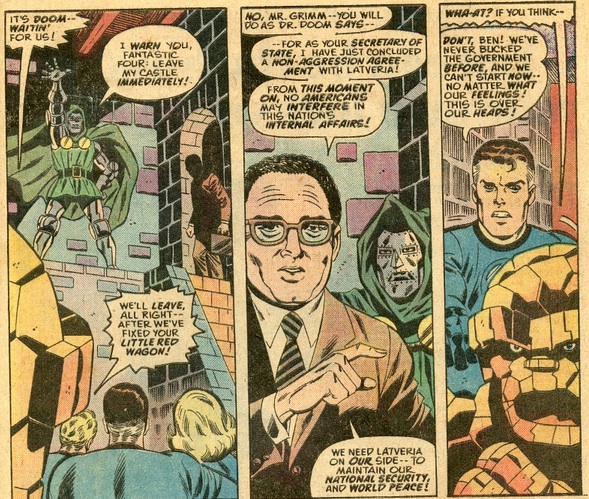
In 1976, then-Secretary of State Henry Kissinger was a comic book villain. That's not a metaphor for his penchant for international scheming. Kissinger was featured in a Fantastic Four comic that year — and he sided with the bad guys.
In this 1976 issue of the aptly titled Supervillain Team-Up, the Fantastic Four are battling arch-nemesis Dr. Doom. After fighting an army of robots and even the brainwashed superhero Namor, the heroes break into Doom's castle in Latveria (a fictional European country he runs). They're about to lay down one of those traditional super-hero smackdowns, but the Four are stopped by an enemy they can't fight with fists — Henry Kissinger:
Marvel Comics
Yep. Henry Kissinger allied the United States with Latveria, a super-villain-run puppet state, in the name of American "national security."
It's actually a pretty apt satire of Kissinger's policy agenda. The comic was recently dredged up by Gary Bass, a Princeton scholar whose widely acclaimed new book documented evidence that Kissinger was complicit in Pakistan's 1971 genocide in Bangladesh. At the time, Kissinger was in the middle of his ultimately successful campaign to open up relations between the US and China. Kissinger was using Pakistan as a go-between for communications, and didn't want to jeopardize what he saw as critical cooperation by pressuring the Pakistanis to stop killing Bengalis en masse. Bass sees things somewhat differently.
So Kissinger's guest spot in Fantastic Four comic isn't just a cute piece of trivia. It's a neat testament to the way that comic books and other fantasy worlds can put some moral truths about our world in appropriately stark terms.
19 May 18:43
Met puts huge digital image trove online
by Jason Kottke
DzaleznikSuper cool!
NYC's Metropolitan Museum of Art has made a whopping 400,000 high-resolution digital images of its collection available for free download. You can browse the collection here.
In making the announcement, Mr. Campbell said: "Through this new, open-access policy, we join a growing number of museums that provide free access to images of art in the public domain. I am delighted that digital technology can open the doors to this trove of images from our encyclopedic collection."
The Metropolitan Museum's initiative-called Open Access for Scholarly Content (OASC)-provides access to images of art in its collection that the Museum believes to be in the public domain and free of other known restrictions; these images are now available for scholarly use in any media.
For instance, here's a 12-megapixel image of Rembrandt's 1660 self-portrait...you can see quite a bit of detail:


(thx, fiona)
Update: Wendy Macnaughton on why the high-resolution images released by the Met are such a big deal for art students and art history fans.
Tags: art Met Museum museums NYC RembrandtFor someone who went to art school being able to do this is a revelation. I used to go to the museum with my sketchpad and copy the old masters. I'd get as close as I could to understand the brush strokes, colors, lines. The guards knew who to watch out for and would bark suddenly when we stuck our faces over the imaginary line.
As class assignments we were required to copy hundreds -- literally hundreds -- of the masters drawings and paintings. for those we mostly worked from images in books -- a picture the size of a wallet photo.
Which is one of the many reasons this new met resource is fucking phenomenal.
You can get so, so close -- far closer than one could in real life.
Matthew McCormick, Shortfatsteve likes this
15 May 19:03


A Tree Grows In Africa
by Andrew Sullivan
But really, just one tree. Or so it would seem from this roundup of book covers from Africa Is A Country:

Michael Silverberg explains:
The texts of the books were as diverse as the geography they covered: Nigeria, Zimbabwe, South Africa, Botswana, Zambia, Mozambique. They were written in wildly divergent styles, by writers that included several Nobel Prize winners. Yet all of books’ covers featured an acacia tree, an orange sunset over the veld, or both. …
I asked Peter Mendelsund—who is an associate art director of Knopf, a gifted cover designer, and the author of a forthcoming book on the complex alliances between image and text—to help me understand how the publishing industry got to a place where these crude visual stereotypes are recycled ad nauseam. (Again and again, that acacia tree!)
He points first to “laziness, both individual or institutionalized.” Like most Americans, book designers tend not to know all that much about the rest of the world, and since they don’t always have the time to respond to a book on its own terms, they resort to visual cliches. Meanwhile, editors sometimes forget what made a manuscript unique to begin with. In the case of non-Western novels, they often fall back on framing it with “a vague, Orientalist sense of place,” Mendelsund says, and they’re enabled by risk-averse marketing departments.
13 May 03:59

Big Cable says broadband investment is flourishing, but their own data says it's falling
by Matthew Yglesias
DzaleznikLook at that chart! Those villains!
The broadband industry, like other industries I am familiar with, does not like the idea of government regulations that would make it less profitable. In search of a more persuasive argument than that, Tom Downey, a lobbyist for the National Cable Telecommunications Association, is circulating a letter to members of congress arguing that "in the years that broadband service has been subjected to relatively little regulation, investment and deployment have flourished and broadband competition has increased, all to the benefit of consumers and the American economy."
So is broadband investment flourishing? Not according to the NCTA's own data which shows investment booming in the years before the Great Recession and declining more recently:
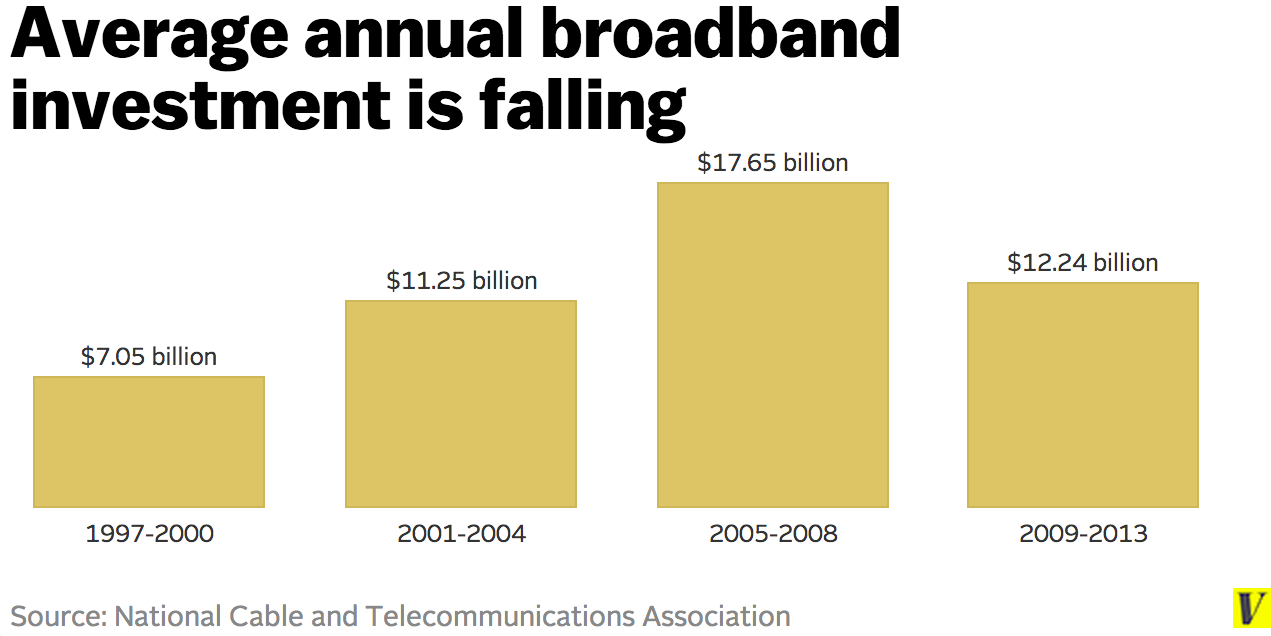
Of course, since NCTA wants to argue the reverse the actual graphic they have on their website looks quite a bit different from this.
Specifically, here's how they would like you to see broadband investment:
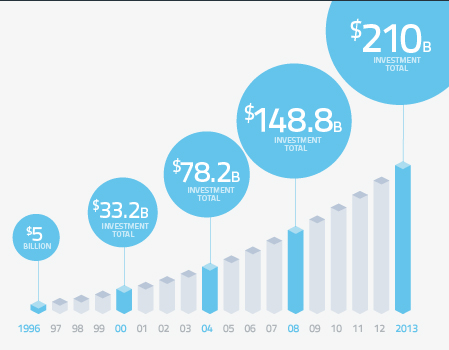
The key trick here is that they looked at cumulative gross investment so that literally any possible state of the world will show an upward slope. Even if all the broadband industry did was repair lines that were downed in storms, cumulative investment would go up over time. But they threw in a bonus trick of using four-year periods (1996, 2000, 2004, 2008) and then switching to a five-year period for the last one.
acting like a low-competition industry, scaling back investment and plowing its profits into dividends and share buybacks
My chart properly shows annual average investment during these periods and shows clearly that investment is down. I didn't even adjust for inflation, since it's hard to calculate that without NCTA giving us specific annual figures.
Now needless to say the fact that investment is falling doesn't prove that NCTA is wrong about net neutrality regulations. But if you think the light regulatory touch is working because it's leading to an investment boom, you are mistaken. The industry is acting like a low-competition industry, scaling back investment and plowing its profits into dividends and share buybacks and merger efforts.
12 May 21:36

How Big Cable is organizing against net neutrality
by Timothy B. Lee
Federal Communications Commission chairman Tom Wheeler is under intense pressure from both sides as he crafts a new set of network neutrality rules. Over the weekend, the Wall Street Journal reported that Wheeler was revising rules he released last month in response to lobbying from liberals who regarded them as too weak. Network neutrality proponents have been pressuring Wheeler to reclassify broadband as a telecommunications service, a legal category that would give the FCC broader authority to regulate internet access.
Now network neutrality skeptics are mobilizing to stop such a reclassification. The liberal advocacy group Free Press tells me that Rep. Gene Green (D-TX) is asking colleagues to sign onto a letter urging Wheeler not to reclassify broadband. "In the years that broadband service has been subjected to relatively little regulation, investment and deployment have flourished and broadband competition has increased," the letter argues.
The letter warns that reclassification could open the door to a "wide array of regulatory burdens and restrictions" that could halt progress toward improved broadband service. "I respectfully urge you to consider the effect that regressing to a Title II approach might have on private companies’ ability to attract capital," it concludes.
This is a tactic network neutrality opponents have used before
Free Press also says that Tom Downey, a former member of Congress and current cable lobbyist, is contacting members of Congress and urging them to sign on. Brian Dietz of the National Cable and Telecommunications Association declined to comment on that report, but he didn't deny that the group was "making our views known as widely as possible". In Dietz's view, reclassification would have "ruinous consequences, limiting the hopes of getting broadband to every American, slowing the growth of broadband speeds, and impeding efforts to improve adoption."
This is a tactic network neutrality opponents have used before. When Wheeler's predecessor, Julius Genachowski, considered reclassification in 2010, he got an earful from Congress. A letter signed by 74 House Democrats warned that reclassification would "jeopardize jobs," while 37 Republicans blasted what they saw as "heavy-handed 19th century regulations" of the internet.
That congressional pressure helped convince Genachowski not to reclassify. Instead, Genachowski tried to strike a compromise, trying to impose network neutrality regulations without first declaring broadband to be a telecommunications service. Unfortunately for Wheeler, the courts ruled Genachowski's gambit illegal earlier this year.
That means Wheeler faces a stark choice. He can stick to the weak network neutrality rules he first proposed last month. Or he can reclassify, permitting stronger network neutrality rules but potentially provoking a backlash from network neutrality opponents and their industry allies. And he has only three days to decide; he is scheduled to release his proposal to the public ahead of a Thursday FCC meeting.
12 May 15:54


The View From Your Window
by Andrew Sullivan

Denver, Colorado, 8.10 am. “Middle of May. 30 degrees. Sigh.” Similar scenes after the jump:

Boulder, Colorado, 6.40 am

Denver, Colorado, 10.48 am. “That’s the setup for America’s Ninja Warrior in Civic Center Park, along with May snow.”

Frisco, Colorado, 8.24 am. “Happy spring from a loyal reader in Colorado!”
09 May 16:55

Why cyclists should be able to roll through stop signs and ride through red lights
by Joseph Stromberg
If you've looked around a city lately, you might've noticed that many cyclists don't obey many traffic laws. They roll through stop signs, instead of coming to a complete stop, and brazenly ride through red lights if there aren't any cars coming.
research and common sense say slowly rolling through a stop sign on a bike shouldn't be illegal
Cyclists reading this might be nodding guiltily in recognition of their own behavior. Drivers might be angrily remembering the last biker they saw flaunt the law, wondering when traffic police will finally crack down and assign some tickets.
But the cyclists are probably in the right here. While it's obviously reckless for them to blow through an intersection when they don't have the right of way, research and common sense say that slowly rolling through a stop sign on a bike shouldn't be illegal in the first place.
Some places in the US already allow cyclists to treat stop signs as yields, and red lights as stop signs, and these rules are no more dangerous — and perhaps even a little safer — than the status quo.
This is called the "Idaho stop"
There are already a few places in the US that allow cyclists some flexibility in dealing with stop signs and red lights. Idaho has permitted it since 1982, which is why this behavior is known as the Idaho stop.
Idaho's rule is pretty straightforward: for bikers, a stop sign is a yield
Idaho's rule is pretty straightforward. If a cyclist approaches a stop sign, he or she needs to slow down and look for traffic. If there's already a car or another bike there, then the other vehicle has the right of way. If there's no traffic, however, the cyclist can slowly proceed. Basically, for bikers, a stop sign is a yield sign.
If a cyclist approaches a red light, meanwhile, he or she needs to stop fully. Again, if there's any oncoming traffic, it has the right of way. If there's not, the cyclist can proceed cautiously through the intersection. Put simply, red light is a stop sign.
This doesn't mean that a cyclist is allowed to blast through an intersection at full speed — which is dangerous for pedestrians, the cyclist, and pretty much everyone involved. This isn't allowed in Idaho, and it's a terrible idea everywhere.
This video, produced when Oregon was considering a similar law in 2009, has some nice visualizations of the Idaho stop at around one minute in:
Apart from Idaho, this is the law in a few Colorado cities (Dillon, Breckenridge, and Aspen), along with Paris and a few other cities in France.
Several states have similar "Dead Red" laws, which lets cyclists (and motorcyclists) ride through a red light if there's no traffic, if the cyclists have stopped for set periods of time, and if the light isn't changing because its sensor doesn't register bikes.
Proposals to allow the Idaho stop have been proposed in a few other states, but they haven't been approved.

Why so many cyclists do this illegally already
So many cyclists do these things on their own — without even knowing they're enshrined in law anywhere — because they make sense, in terms of the energy expended by a cyclist as he or she rides.
Unlike a car, getting a bike started from a standstill requires a lot of energy from the rider. Once it's going, the bike's own momentum carries it forward, so it requires much less energy.
Getting a bike started from a standstill requires a lot of energy
In 2001, physics professor Joel Fajans conducted tests on California Street in Berkeley — an official bike route with tons of stop signs — and found he was able to maintain an average speed of 10.9 miles per hour without breaking a sweat. On a parallel street without stop signs, he could cruise about 30 percent faster — 14.2 miles per hour — with the same amount of energy.
He also calculated that a cyclist who rolls through a stop at five miles per hour instead of stopping fully needs to use 25 percent less energy to get back to full speed.
This explains why many cyclists roll through stop signs so often. Of course, the simple fact that people often do something that's against the law doesn't mean the law should be changed — but here are a few reasons why it really should:
The Idaho stop isn't more dangerous — and might even be safer
Spencer Platt/Getty Images
For drivers, the idea of cyclists rolling through an intersection without fully stopping might sound dangerous — but because of their slower speed and wider field of vision (compared to cars), cyclists are generally able to assess whether there's oncoming traffic and make the right decision. Even law-abiding urban bikers already do this all the time: because of the worry that cars might not see a bike, cyclists habitually scan for oncoming traffic even at intersections where they don't have a stop sign so they can brake at the last second just in case.
There are even a few reasons why the Idaho stop might even make the roads safer than the status quo. In many cities, the low-traffic routes that are safer for bikes are the kinds of roads with many stop signs. Currently, some cyclists avoid these routes and take faster, higher-traffic streets. If the Idaho stop were legalized, it'd get cyclists off these faster streets and funnel the bikes on to safer, slower roads.
The idaho stop could funnel bikes on to safer, slower roads
The Idaho stop, if legalized and widely adopted, would also make bikes more predictable. Currently, when a bike and a car both pull up to a four-way stop, an awkward dance often ensues. Even when cars gets there first, drivers often try to give bikers the right-of-way, perhaps because they think the cyclist is going to ride through anyway.
If the cyclist logically waits, both parties end up sitting there, urging the other to go on. In the opposite (and rarer) scenario, both people assume the other will wait, leading to a totally unnecessary accident.
An Idaho stop would put an end to this madness: the first vehicle to come to the intersection always has the right of way, giving bikers a rule they'd actually follow, making them more predictable for drivers.
If all this sounds far-fetched to you, look at the data. Public health researcher Jason Meggs found that after Idaho started allowing bikers to do this in 1982, injuries resulting from bicycle accidents dropped. When he compared recent census data from Boise to Bakersfield and Sacramento, California — relatively similar-sized cities with comparable percentages of bikers, topographies, precipitation patterns, and street layouts — he found that Boise had 30.5 percent fewer accidents per bike commuter than Sacramento and 150 percent fewer than Bakersfield.
Stop signs and traffic lights weren't designed for cyclists

Tim Graham/Getty Images
Cars are 2,000-pound machines that, on most roads, travel at 30 miles per hour or faster. In most cases, a driver can't safely decelerate from this speed to yield to oncoming traffic at an intersection without coming to a full stop first.
Because of the dangers posed by cars, stop signs and traffic lights were invented in the early 20th century to bring order to roads increasingly filled with them. Nowadays, stops signs are often used not only to make intersections safe, but to slow down traffic in residential areas.
Stop signs were invented in the early 20th century to bring order to car-filled roads
Bikes are different — they don't go fast enough to merit this sort of traffic calming, and don't have a problem just slowing down for an four-way stop, only stopping if a car's coming. Oftentimes, they don't trigger traffic lights to change, because many run on weight sensors buried in the road (the reason for all the "Dead Red" laws in the map above).
Some cyclists oppose the Idaho stop because of an idea they believe is central to gaining respect for cycling and encouraging good relations with drivers: "same road, same rules." Because both bikes and cars are wheeled vehicles that use roads, the principle goes, they should always abide by all of the same rules.
This sounds great, in theory, but it doesn't describe the reality of current traffic laws. Most interstate highways don't allow bicycles, for instance. Many cities have bike lanes that cars can't enter. They're clearly two different sorts of vehicles, and we have rules that apply to one but not the other.
Consider another group of road users that stop signs weren't designed for: pedestrians. Like bikes, pedestrians don't need to come to a complete stop to avoid accidents at intersections, which is why you don't see them weirdly freezing in place when they arrive at one. In most areas, skateboarders, Segway riders, inline skaters, and people in electric wheelchairs aren't required to stop at stop signs either.
Ultimately, a cyclist occupies a space somewhere in between a pedestrian and a car (faster and more dangerous than the former, but smaller and slower than the latter), so the laws that apply to bikes should be somewhere in between — exactly like the Idaho stop.
Laws that serve no purpose (and aren't followed) shouldn't exist
This is a principle that's frequently brought up in support of marijuana legalization, and it's relevant here as well.
Given that this behavior is common among cyclists, the current laws mainly criminalize something strongly associated with cycling. This might even enflame drivers' resentment of bikers more than if by rolling through stop signs, they weren't breaking the law. The laws also divert police from cutting down on actual unsafe biking behavior — like the jerks who fly through intersections at full speed when they don't have the right of way.
We even have precedent for a logical, forward-thinking regional movement to ease restrictive traffic laws going nationwide. In 1947, California became the first state to allow drivers to make a right turn on red. During the 1970s, when gasoline prices skyrocketed, dozens of states adopted similar laws, largely because of Federal Highway Administration findings that it saved a lot of gas.
In an era when lots of towns and cities are actively trying to get more people biking — to reduce traffic, if not carbon emissions — you'd think they'd want to remove any hurdles to biking that don't need to be in place.
So let's do it. Let's follow Idaho.
09 May 02:28

Snapchat lied: your snapchats don't actually disappear
by Alex Abad-Santos
On Thursday, Snapchat settled with the Federal Trade Commission over charges that the company lied when it claimed the service's messages disappeared forever. Having messages that disappear forever is Snapchat's defining feature, one that made it worth a reported $3 billion in Facebook's eyes.
The FTC spelled out a variety of ways that Snapchat's deletion process was bungled. One of them was as simple as not updating your iPhone's operating system. "In fact, any recipient with an Apple device that has an operating system pre-dating iOS 7 can use a simple method to evade's the app screenshot detection, and the app will not notify the sender," the FTC explained.
The FTC also highlighted the lack of security and privacy for its Find Friends feature, which opened the app to a data breach a few months ago that exposed 4.6 million usernames and phone numbers to hackers. FTC Chairwoman Edith Ramirez explained:
If a company markets privacy and security as key selling points in pitching its service to consumers, it is critical that it keep those promises.
Snapchat's explanation is that the app's deletion feature was just something they forgot to pay attention to. The company glosses over the FTC settlement and released a statement saying that the core feature of their app was one of the things "that didn’t get the attention they could have."
Saying these key features were something they overlooked while building other things, would kinda be like if the fire department showed up to your burning house empty handed and apologized for forgetting the water.
"One of the ways we learned was by making mistakes, acknowledging them, and fixing them," the company also said. "We are devoted to promoting user privacy and giving Snapchatters control over how and with whom they communicate. That’s something we’ve always taken seriously, and always will."
Snapchat won't have to pay anything in the settlement, but "if Snapchat is found to violate the agreement, the company could end up paying a civil penalty of up to $16,000 for each violation," the AP reports.
06 May 14:22

Is Brooklyn getting poorer?
by Tyler Cowen
At the median, yes, according to Daniel Kay Hertz:
I recently ran across a post from data-crunching blog extraordinaire Xenocrypt, which noted that from 1999 to 2011, median household income in Brooklyn fell from $42,852 to $42,752…
Furthermore in large parts of Brooklyn real estate prices are falling. You can read more here, with interesting pictures.
The pointer is from Hugo Lindgren.
30 Apr 19:57


The Best Affordable Lunches in Midtown West
by Rabi Abonour
DzaleznikUseful!

We've already shown you the best cheap lunches in Midtown East, but we didn't want to leave our readers on the other side of 5th Avenue hungry. To that end, check out some of our favorite lunch spots in Midtown West.
Cuban Deli: Margon

Cuban sandwich and Margon [Photograph: Robyn Lee]
This hole in the wall diner is a great bet for classic Cuban sandwiches like the cubano and media noche—none of which will run you more than $7.50. The restaurant also serves hot entrees. Check the specials board for dishes like tripe soup, shrimp ceviche, and oxtail. The lines can get long, but it's well worth the wait.
Margon: 136 West 46th Street, New York, NY 10036 (map); 212-354-5013; margonnyc.com
Korean and....a Reuben: HIT Deli & Korean Food

Bibimbap at HIT Korean Food & Deli [Photograph: Robyn Lee]
A restaurant serving Korean food and deli staples in a Chelsea office building sounds like a joke, but HIT's food is serious. The deli food is fine, but you're better off going with the Korean dishes like bibimbap and kimchi pancakes. Owner Kevin Kim makes his own kimchi—pick up an order even if you come for a sandwich.
HIT Korean Food & Deli: 150 West 28th Street, New York, NY 10001 (map); 212-633-1530; hitdeli.tumblr.com
Indian Street Food: Biryani Cart

Kati rolls at Biryani Cart
The Biryani Cart serves its namesake, a pile of tender, spiced basmati with slivers of juicy chicken, a whole egg korma, and a mango pickle, and chicken tikka masala, but you really want are the kati rolls, flaky flatbread stuffed with spicy fillings. Try the fiery, mint-habanero Spicy Buradi roll, spiced chicken tikka King Koti roll, or the Pune roll, flavored with a far milder chaat masala.
Biryani Cart: 46th Street and 6th Avenue, New York, NY 10003 (map); 917-628-3269; biriyanicart.com
Loading Dock Latin Lunch Counter: El Sabroso

Bistec Encebollado at El Sabroso [Photograph: Craig Cavallo]
Tony Molina opened this lunch counter in a Midtown loading dock in 1996. There's a long menu of dishes such as Bistec Encebollado, a well-seasoned steak dressed with buttery onions. Your best bet, though, is to ignore the menu and do as the regulars do: approach the counter and ask Molina what's good today. He'll give you a dish that's been simmering away all morning, served on a styrofoam plate with rice and beans.
El Sabroso: 265 West 37th Street, New York, NY 10018 (map); 212-284-1118
Turkish Snacks: Mmm...Enfes

Ayvalik Toast at Mmm...Enfes [Photograph: Ben Jay]
Mmm...Enfes sells a variety of quick-service Turkish breads and snacks (go for the sigara burek and simit), but if you're looking for a sandwich you should try the Ayvalik Toast. This unusual creation features sucuk sausage, tomato, pickles mozzarella... and hot dogs, pressed into a fairly compact double decker. It all ties together nicely into a simple, cheap, and satisfying lunch.
Mmm...Enfes: 70 West 39th Street, New York, New York 10018 (map); 212-827-0801; facebook.com/MmmEnfes
Mexican Sandwiches and Tacos: Tehuitzingo Deli & Grocery

Chicken torta at Tehuitzingo [Photograph: Scarlett Lindeman]
Tehuitzingo is an unassuming little taqueria in the back a Hells Kitchen bodega. There is a range of taco fillings, from meat options like barbacoa and oreja (pig's ear) and vegetarian ones like huitlacoche and squash blossoms. The tortas are demure but tasty, made better with spears of pickled jalapenos from the well-stocked condiment bar that also offers salsas, limes, escabeche, radishes, and a full line-up of bottled hot sauces.
Tehuitzingo: 695 10th Avenue, New York, NY 10036 (map); 212-397-5956; tehuitzingo.net
Great Slice: Pizza Suprema

Upside Down pizza at Pizza Suprema [Photograph: Adam Kuban]
Pizza Suprema's Upside Down pizza is essentially a Sicilian pie, but with sauce on top of the cheese as opposed to the other way around. The pizza is about more than novelty—it's a very satisfying slice. The restaurant makes its own mozzarella, which you can find on its Fresh Mozzarella with Basil Pizza. Perhaps the best slice in the neighborhood.
Pizza Suprema: 413 8th Avenue, New York, NY 10001 (map); 212-594-8939; nypizzasuprema.com
Italian Deli: Sergimmo Salumeria

The Lazio Panini at Sergimmo Salumeria [Photograph: Eunice Choi]
This Italian deli makes fairly simple classic Italian hero sandwiches, but high-quality ingredients make them shine. You won't go wrong looking for the salumi, mozzarella, and ricotta, all of which are made made in-house. The Marche features the salumi and mozzarella paired with herb-marinated artichokes and arugula.
Sergimmo Salumeria: 456 9th Avenue, New York, NY 10018 (map); 212-967-4212; sergimmo.com
Portuguese-Italian Sandwiches: City Sandwich

The Dave at City Sandwich[Photograph: Robyn Lee]
City Sandwich traces its roots to chef Michael Guerrieri's native Naples and one-time home of Lisbon. The sandwiches are served on crusty Portuguese baguettes and stuffed (but not overstuffed) with ingredients from both places. Try the Dave, which is filled with sausage, tomato, melted mozzarella, peperoncini, and a satisfying bundle of broccoli rabe.
City Sandwich: 649 9th Avenue, New York, NY 10036 (map); 646-684-3943; citysandwichnyc.com
Not Your Average Chinese Takeout: Xi'an Famous Foods

Lamb burger at Xi'an [Photograph: Robyn Lee]
With locations all around the city, Xi'an Famous Foods has become a destination for Chinese food. The noodle dishes and dumplings are all great, but for something more portable, try the lamb burger. The sandwich isn't a burger at all, but rather chunks of cumin-spiked lamb with onion and jalapeño stuffed into a flat roll. You can also get the "burger" with pork or beef—they're cheap enough to try them all.
Xi'an Famous Foods: 24 West 45th Street, New York, NY 10036 (map); xianfoods.com
Mexican Street Food: El Rey del Sabor

Torta al pastor at El Rey del Sabor [Photograph: Robyn Lee]
People across midtown deserve good Mexican food, so El Rey del Sabor has a cart in Midtown West as well as Midtown East. Owned by siblings Ofelia and Vilio Cardoso, El Rey del Sabor puts out the food from their youth in Puebla, made fresh to order. Overstuffed tortas are delicious—bursting with meat and various fixings. Fat quesadillas, topped with homemade salsa, are a great choice too.
El Rey del Sabor: 43 Street and 6th Avenue, New York, NY 10036 (map)
Cambodian Sandwiches: Num Pang

Pulled Duroc Pork at Num Pang [Photograph: Robyn Lee]
New Yorkers looking for a good sandwich on 48th Street should head to the Midtown West location of Num Pang, which features sandwiches inspired by chef-owner Ratha Chaupoly's native Cambodia (though authenticity is definitely not the shop's main concern). These are big, meaty sandwiches, Americanized if you want to think of them that way. The produce gets lost on the Pulled Duroc Pork, but the massive pile of tender, moist marinated pork belly more than makes up for it. Picky eaters beware—Num Pang has a strict "No Modifications" policy.
Num Pang: 148 West 48th Street, New York, NY 10036 (map); 212-421-0743; numpangnyc.com
Seafood Shack: Luke's Lobster

Lobster roll at Luke's Lobster [Photograph: J. Kenji Lopez-Alt]
A $15 lobster roll might not be the most affordable lunch, but sometimes you need to treat yourself. Luke's recently placed as having one of our favorite lobster rolls in the city. It's made with sweet claw and knuckle meat served in a top-split griddled bun with nothing but a thin swipe of mayo and a sprinkle of lemon butter, along with a shake of their "special seasoning." At $3.75 per ounce of lobster, Luke's serves the best value for a lobster roll in New York.
Luke's Lobster: The Plaza Food Hall, 1 West 59th Street
New York, NY 10019 (map); 646-755-3227; lukeslobster.com
Gonzo Sandwiches: Certé

Lobster French Toast at Certé [Photograph: Robyn Lee]
We're big fans of the slices at Pizza by Certé in Midtown East, but just down the street at their other location it's all about the sandwiches. Certé does soups, salads, and sandwiches, as well as catering. We're consistently impressed by the often-gutsy sandwich of the month special, which has included offerings such as Lobster French Toast and a stellar pambazo torta.
Certé: 20 West 55th Street, New York, NY 10019 (map); 212-397-2020; certenyc.com
30 Apr 18:00

Here's why you shouldn't take extra-strength Tylenol
by Joseph Stromberg
Many over-the-counter and prescription drugs contain potentially harmful levels of acetaminophen — the active ingredient in Tylenol and other painkillers.
The FDA is now warning people against taking prescription drugs that include more than 325 milligrams of acetaminophen per pill — and it's a good idea to stop taking the over-the-counter drugs that contain this much, too.
The fda's told doctors to stop prescribing painkillers with more than 325 mg per pill
Acetaminophen has been widely used for decades, and it surpassed aspirin in popularity sometime during the 1980s. Even though the FDA became aware of the risks posed by the drug as early as 1977, it delayed taking action until recently. In the meantime, 150 Americans have died annually and tens of thousands have gone to the emergency room each year due to overdoses.
This occurs because when the body breaks down acetaminophen, it produces tiny amounts of a toxic byproduct called NAPQI. Normally, a natural antioxidant produced in the liver neutralizes this NAPQI, but excessive amounts of the toxin — produced by extra-large doses of acetaminophen — can overwhelm the liver, causing permanent damage, and in rare cases, death.
This past January, the FDA put out a safety alert for acetaminophen. Apparently, they felt that many people missed the memo, so they put out a reminder earlier this week.
The FDA safety alert applies specifically to prescription drugs: it tells doctors and pharmacists to avoid prescribing opioid-based painkillers (such as Vicodin and Percocet) that include more than 325 milligrams of acetaminophen per pill, because they're no more effective than low-dose formulations and can be dangerous. Many of these prescription products have already been voluntarily recalled, and in the future, the FDA plans to ban them, but for now, it's relying on health professionals to stop recommending and providing them.
Many over-the-counter drugs have potentially dangerous levels of acetaminophen too
There are dozens of products in any pharmacy that contain more than 325 milligrams of acetaminophen per pill — such as extra strength Tylenol (500 mg per pill), Tylenol cold and sore throat liquid (500 mg per dose), and even some drugs with as much as 625 mg per dose. Over the counter products make up about 80 percent of the $2.6 billion acetaminophen market.
It's smart to stop taking over-the-counter products with more than 325 mg as well
The FDA says it'll address them in a future regulation, but the organization ProPublica — which conducted an extensive investigation into acetaminophen last year — alleges that pharmaceutical companies, such as McNeil (the maker of Tylenol) successfully pressured the FDA to exclude these products from the new 325 mg limit. Extra strength 500 mg pills make up about 92 percent of their acetaminophen sales.
Given the research and the FDA warning for prescription pills, it's smart to stop taking them anyway, and stick to lower-dose products (like regular Tylenol, which has 325 mg per pill) or acetaminophen alternatives, such as ibuprofen, the active ingredient in Advil.
To minimize liver damage and the chance of an overdose, the FDA also recommends that you avoid taking multiple acetaminophen-containing products (such as headache relief pills and cough syrup) at the same time, take more doses than the package recommends in a 24-hour period, or mix any acetaminophen-based medicine with alcohol.
Update: it's worth noting that for people with reduced kidney function, ibuprofen can also cause problems. If you have kidney problems, you should consult a doctor before taking it.
29 Apr 18:44
Soaring Coffee Bean Prices Threaten Even Starbucks
by Alison Griswold
Don't be surprised if your morning cup of joe gets more expensive soon. Coffee beans are now so pricey that even Starbucks has ratcheted back its purchases, the Wall Street Journal reports. The cost of arabica beans, the variety used by Starbucks and other upscale roasters, has surged roughly 90 percent this year due to a drought in Brazil, the world's largest producer of the beans. Arabica-coffee futures have lately approached $2.15 a pound.
Starbucks has locked in order prices through this fiscal year and some of the next, which begins Oct. 1, and Starbucks' head of coffee Craig Russell told the Journal the company is "confident we'll get our coffees." They might get what they need, but they'll almost certainly have to pay for it. Volcafe Ltd., a coffee trader cited by the Journal, predicts a worldwide shortage of 11 million 60-kilogram bags of coffee beans this season.
This is far from the first we've heard about escalating coffee prices. In February, Bloomberg Businessweek reported that Starbucks, in an effort to stave off the bean shortage, had purchased a 600-acre coffee farm in Costa Rica. In addition to the drought in Brazil, arabica production has been hampered by a fungus known as roya and climate change in general. Researchers at the Kew Royal Botanic Gardens consider arabica to be "vulnerable" to extinction.
For the moment, Starbucks says it doesn't plan to raise prices on its coffee drinks. "Our strategy is stability," Russell told the Journal. "To have stability, you don't chase the market." The company is trying to get around the shortage in Brazil by purchasing more beans out of Colombia, the world's second-largest producer. If that strategy doesn't pan out, though, your sticker price on that caffeinated brew might be going up.
25 Apr 01:22
Live Más Expensively: Taco Bell Is Launching a Fancy New Chain
by Jordan Weissmann
DzaleznikI don't know if anybody subscribes to Moneybox, but it used to be Matt Ygglesias' blog and he has a Taco Bell hobbyhorse.
Jordan Weissmann has taken over, and the last three posts, over 3 days have all been about Taco Bell. It's an economics blog with a Taco Bell focus.
The Taco Bell Economics Blog niche, like a quality taco, needed filling.
Taco Bell seems to have resigned itself to life as Chipotle’s middle-aged, junk-food-loving cousin, so the company is starting fresh in the battle for Mexican-ish food supremacy by launching a new, upscale fast-casual concept called U.S. Taco Co. and Urban Taproom. According to Nation’s Restaurant News, the first location will be in Huntington Beach, California, with a menu of Americanized tacos using higher-quality ingredients than what you’d find in a Crunchwrap Supreme.
Sample tacos, as reported by Restaurant News: There’s the “Winner Winner,” which involves fried chicken breast topped with gravy, roasted corn pico de gallo with fresh jalapenos, and fresh cilantro. Then there’s the “One Percenter,” with “fresh lobster in garlic butter,” red cabbage slaw, and pico de gallo. The menu will also include steak fries with habanero chili dust, milkshakes, and craft beer. You know, stuff upwardly mobile millennials like.
Here’s Taco Bell CEO Greg Creed explaining the launch:
Creed said U.S. Taco Co. was born of a segmentation study conducted on Taco Bell that revealed a fairly large demographic that was not likely to use quick-service restaurants at all. Rather than spend millions trying to lure those potential diners into Taco Bell, Creed’s team decided to design a new concept that would appeal to that demographic, which includes an eclectic mix of generally higher-income foodies who are “edgy in how they live their lives but not necessarily in how they eat,” he said.
I think this illustrates a very simple lesson about marketing. It can be incredibly profitable for upscale brands to slum it by releasing a line of mass-market merchandise. Just think about every time a famous designer does a line for Target, or when superstar chefs start churning out cookbooks and frozen food. However, it is much, much harder for a downscale brand to suddenly act posh and reach out to wealthier clientele, which is pretty much what Taco Bell tried to do when it launched its Cantina menu in the face of Chipotle’s competition. There was no way that a chain whose single greatest recent innovation was turning Doritos into taco shells was ever going to successfully pick off somewhat more discerning customers who are into goodies like sustainably raised pork. Once you’re stuck in the public’s consciousness as the Bell Labs of stoner food, it’s tough to shake the reputation.
Ben Kossak likes this