Shared posts
The Menu
“Diabolical Thoughts” Lineup Announcement
DP FICTION #93A: “The Restaurant of Object Permanence” by Beth Goder
Ziv W"Outside the archives, there’s a strange flyer on the bulletin board. It’s an invitation to the Restaurant of Object Permanence. To go, one is instructed to eat the flyer."
State of the Ziv, Tweepocalypse Edition
I don’t know how long Twitter’s going to be sticking around and semifunctional, but there’s no question my trust in the platform has dropped to nil.
So, here’s other places to find me on the web.
First and foremost — right here, on my website. Big things I’m involved in go here. Links to things I do elsewhere, also go here.
My Twitter account is remaining active, but I’m optimistic about Mastodon being nice; you’ll find me here.
The RSS feed for this blog is here, and here’s my Twitter thread about how to use an RSS Reader — they’re fantastic, and I’m glad to help people get started.
My YouTube channel has been quiet since my story structure videos, but I have a LOT of great material coming up for it really soon.
That’s it, folks. See you after the end of the world.

Magazines: More Than The Sum Of Their Stories
This post adapted from my Twitter thread, here.
I often urge readers to read entire issues of magazines. Even better, to read the same magazine on the regular. A thread about reading, popularity, and curation. Also about how you how awesome The Deadlands is, but we'll get to that.
An overwhelming bias in publishing is: popularity begets popularity. The easiest way to have something noticed, is for it to be by someone people are already paying attention to.
Broadly speaking, this is a great thing. Popular stuff is popular for a reason. And having your favorites, and following them, is the number one way to read great stuff that you enjoy.
But.
There's an insularity to it. If the barriers to getting published are high, then the barriers to being buzzy, to semi-virality, to being The Thing You Keep Hearing About, are phenomenal. And there's a lot of randomness to them (except inasmuch as marketing $$$ is involved).
Consider how this bias influences what you read in oh-so-many ways:
A solid story by a favorite vs. something amazing by someone unknown.
A quick read vs. a long one.
A piece with a great elevator pitch vs. something quiet, unexpectedly poignant.
A showstopper vs. a charming oddity.
Well, all right, you might be thinking to yourself. But how can you read things you haven't heard about?
One way — probably the easiest way — is by trusting a curator.
An editor crafting an issue, or an anthology, isn't trying to hook you on each story individually. They're building something that works as a whole. They're giving you a tour, weaving to and fro, pointing you at big exhibits and curious niches alike.
There's fantastic value and power in having different stories bundled together, large and small. It's one way to make sure that you're never limited merely to what's already on your radar. You are always, always trying something new.
(And while any one curator certainly brings in biases and preferences of their own, those are very different than the biases of "stuff I already like" and "stuff I hear about organically.")
To me, that's part of the amazing value of a magazine.
Will I like every single story?
Probably not.
But I'll be trying new stories, new authors, new styles, all the time.
And if it's an editor whose taste I like, I'm going to like a whole lot of those.
Now, if you want to see this difference between a story and a magazine, if you want to feel it in your bones, may I direct your attention to The Deadlands.
"a journal of ends and beginnings."
An issue of The Deadlands is an entirely different experience than simply "sitting down and reading a story."
The art, the poetry, the columns on undertaking and burial customs. And a dazzling range of stories; the macabre from angle after fascinating, unexpected angle.
![Ff7C_vmXwAQ_EcB[1].jpg](https://images.squarespace-cdn.com/content/v1/5e6e029380da441d9dd66208/1667145001602-FEI5V7EEDZGUI9HXWNWA/Ff7C_vmXwAQ_EcB%5B1%5D.jpg?format=1000w)
![Ff7DcxeXgAEoamL[1].jpg](https://images.squarespace-cdn.com/content/v1/5e6e029380da441d9dd66208/1667145042603-KCZL37ZVBBCNU3OOVDJJ/Ff7DcxeXgAEoamL%5B1%5D.jpg?format=1000w)
Without the context of a magazine, I would not be reading most of those.
Honestly, I would probably not be reading *any* of those. Not even my absolute favorites. How would I get to them?
The magazine bundles them together. It promises me, not "one good story (and some other stuff)", but a crafted, tailored visit that's full of new and unusual vibes, and so strong on variety and verisimilitude.
It's a magazine with so much voice, with a specific, dedicated vision. It's a magazine that does one unique, beautiful thing. Does it marvelously well. Shows that the one thing, the topic, the focus, the style, is bigger on the inside.
(This is no surprise, since Shimmer, also helmed by E. Catherine Tobler, had such a distinct, magnificent feel to it. In slush comments, I still sometime make a note saying, "this feels like a Shimmer story," and that says almost everything.)
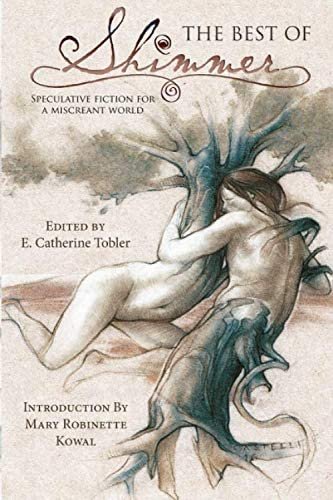
In our current state, with a vast, untameable ocean of wonderful fiction, it's so important to have these venues that promise its readers something specific, distinct, thrilling. It's what lets us sail far from the shore.
I think all magazines do this,
if you read your favorite cover to cover,
if you trust your editor enough to try at least a taste of each thing.
But in The Deadlands, that element is so clear, so visible, so distinct. It's got my admiration, and I've learned a lot from it.
I wrote this as the magazine was crowdfunding for Year 3. They’ve made their goal, but whenever you read this, consider checking them and and considering giving them a little support.
More than that, I hope you'll actually read the magazine, because it's something really special.
Don’t Start With A Bang
People often think stories are supposed to open with a bang, with excitement, something that’ll grip the reader by the throat.
But not all stories are bang-y; or exciting; or go for the throat.
Often what you really want is simply this: to tell the reader what kind of story this is.
That’s enough for the right readers to decide to dive right in.
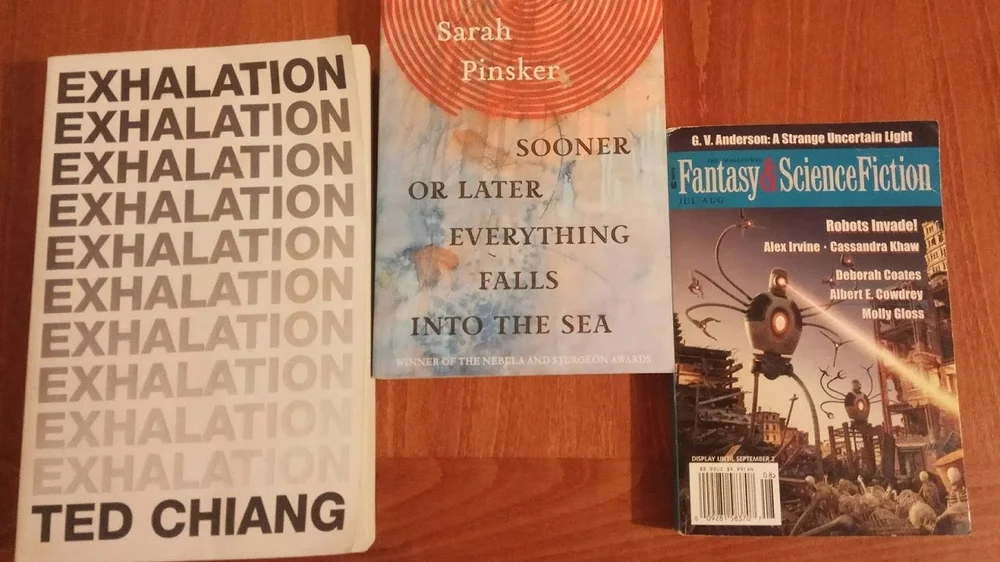
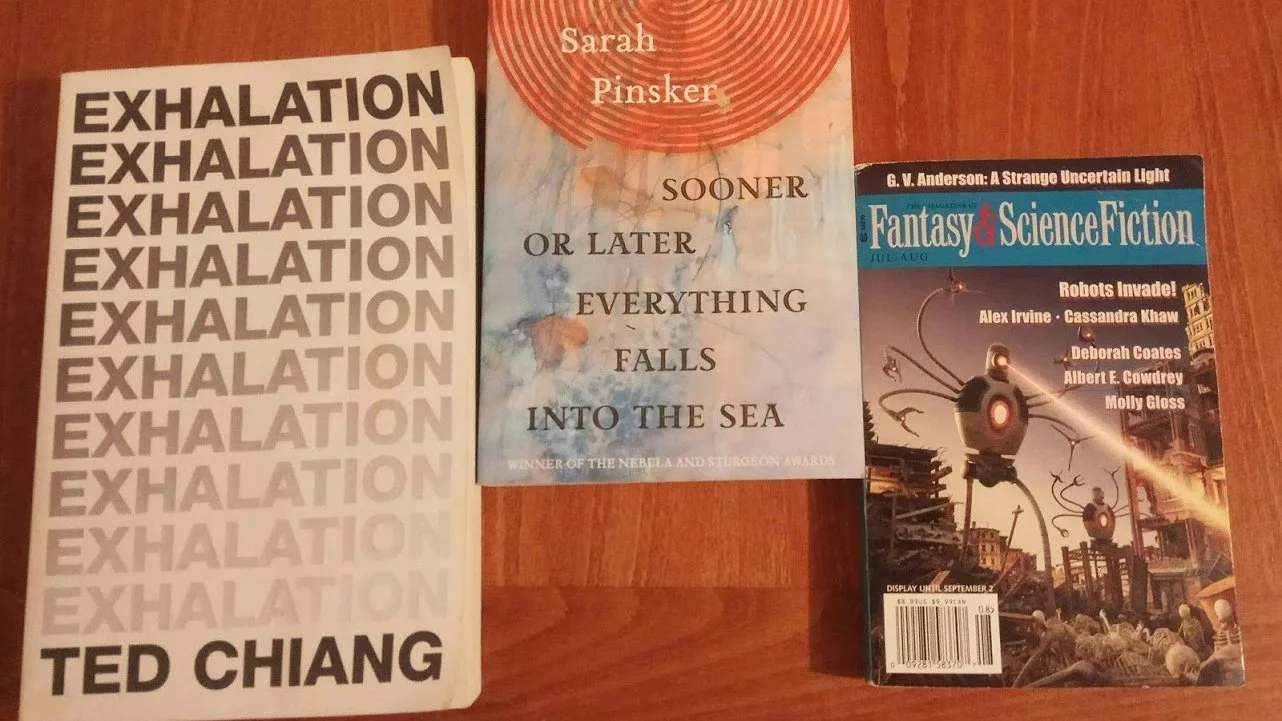
Some observations on openings -- originally written in 2019, courtesy of my first slushreading stint at Diabolical Plots , plus the very excellent collections I was reading at the time.
Consider, if you will, these three story openings.
"The Merchant and the Alchemist's Gate,” by Ted Chiang:
"O Mighty Caliph and commander of the faithful, I am humbled to be in the splendor of your presence; a man can hope for no greater blessing as long as he lives. The story I have to tell is truly a strange one, and were the entirety to be tattooed at the corner of one's eye, the marvel of its presentation would not exceed that of the events recounted, for it is a warning to those who would be warned and a lesson to those who would learn."
"Wind Will Rove," by Sarah Pinsker:
"There's a story about my Grandmother Windy, one I never asked her to confirm or deny, in which she took her fiddle on a spacewalk. There are a lot of stories about her. Fewer of my parents' generation, fewer still of my own, though we're in our fifties now; old enough that if there were stories to tell the would probably have been told."
"A Strange Uncertain Light," by G.V. Anderson:
"Anne twirled the thin, dull wedding band around her finger, quite loose. In their rush to be married, they'd failed to have it fitted properly."
These are three fantastic opening lines. But notice that none of them, by any stretch, is a "start off with a bang" opening.
Nothing's happened—yet.
What is it that they *do* accomplish, then?
In film, you'd generally open with an establishing shot. In a story, it's not entirely dissimilar—the question is, what is it that's being established?
It’s not necessarily a place. It’s not necessarily a scene. The three examples we’re looking at here don’t spend a word, yet, on where we are or what’s happening (although each one has its hints). Let’s see what they each do establish:
"Alchemist's Gate" establishes a straight-up promise: "The story I have to tell is truly a strange one."
This is going to be WEIRD. You are going to be AMAZED. Hey, here's a strange thing I made up -- this is going to be STRANGER THAN THAT."Wind Will Rove" does something entirely different: a whirlwind tour of the story's key elements.
This story has spacewalks, and fiddles, and quirky grandmothers. And, a melancholy insinuation that every generation is just getting duller."A Strange Uncertain Light" packs a whole relationship into a pointed symbol: the marriage is so rushed; will it fit?
I want to repeat: Nothing's happened yet. Characters haven't been introduced. We don't know the situation. Absolutely zero plot has occurred.
Nothing's happened yet.
What has happened is simply this: We, the reader, have been told what kind of story we're reading.
THIS story is going to make you feel amazed.
THIS story will be about strangeness and uncertainty.
THIS one will be "oh wow, my grandmother was WAY more awesome than me."
And here’s what was really interesting to me as a slushreader: A lot of submissions? Didn't really have that.
I'm not talking about did they manage to accomplish it really well, condensing the core strengths of the story beautifully and compellingly into a punch of an opening paragraph.
I mean, 500 words into the story, I still wasn't clear on what kind of story it was meant to be.
Things were happening, but that didn't mean I knew why they were interesting. Or things weren't happening -- probably in order to build up detail, for later, when things would happen.
Now, the Diabolical Plots submission system does something I found remarkably helpful and eye-opening on this: It puts a mark in, at precisely 500 words.
Like so:
==500==
When you next read a story -- try pausing for a moment at about 500 words.
It's not very much. But also, not so little.
At 500 words -- what do I know about this story I'm reading?
Usually, you won't know the plot. It's only just started.
You'll have a sense -- but not much more -- of characters, setting, voice, stakes.
That sense, though, is your map and guide to the story.
It literally tells you what in the story is important. And feeling that something in the story is important—well, that's what makes it a story, right?
That's why my point here is: Wanting the first line of the story to “grab me by the throat” is a high bar.
And for a lot of stories, that kind of intensity isn't even what I want.
Instead, what's important is the signal.
“Here's what you're in for.” “Here's where you should be looking.” “This, right here, is going to be the important bit.”
You’ll notice this places a certain requirement on the story: It needs to have an important bit. It needs to have answers for “what am I getting out of this,” or “what am I looking for here.”
And that'll be hard or impossible if your story is mostly "well, this is what happens next," even if the individual elements are individually great.
That's what makes openings so interesting to me:
They need to get across why the story is interesting, what it's about, what it is,
they need to do that BEFORE the story has played out and gotten there.
By the same token, if the opening doesn’t give me any hints about why the story is interesting, or what its heart is, that's often a signal that it hasn't cohered around anything in particular. (Or, of course: It's simply cohered around something that I personally don't connect with! That certainly happens too.)
At any rate, the experience has given me some new things to think about, and a new side of the craft to appreciate.
And hey, if it’ll help,
I’m happy to scribble some helpful "==500==" marks in any books you've got handy.
On Reading Your Rejections’ Entrails (Please Don’t)
This post adapted from my Twitter thread, here.
Last week I read an interesting piece on the SFWA blog: “Transparency in Slush,” by AJ Cunder.
It’s a piece that lays out how opaque, sometimes downright shrouded in mystery, the whole system of going through the slushpile can often be.
That opacity begs so many questions. Who really read my story? Was it considered fairly? How far did they get before rejecting? Did the editor read it? What does it mean if they have?
It’s a fascinating topic, and I empathize deeply with all those pain points and uncertainty. I read story submissions for both Diabolical Plots and for PodCastle, and I had some thoughts of my own in response. Including a word of caution, of sorts.
At Diabolical Plots, every story goes through one of our three editors (David, Kel, or I). Most (but not all) first get comments from two of our First Readers, which helps prime us and give us a wider perspective. At PodCastle, First Readers send rejections, so a First Reader might be the only reader. (That's no coincidence, I suspect, with PodCastle maximal wordcount being twice Diabolical's!)
Reading for two magazines, I can see how each place sets up what works for them. Part of that is style and preference; part of that is just managing capacity and submission load.
But along with sharing the details and demystifying the process, I also have this to say: Understanding the process will tell you very very little about your submission. Please, please, do not try to read the entrails of your holds and your rejections.
That kind of rejectomancy is mostly looking for the "why" for your particular "no, thank you." And that's a problem, because (a) there isn't a clear "why"; not really, and (b) the barriers to communicating any "why" are TERRIBLE.
There isn’t a clear “Why”
It would be nice to think of rejections as having a "why."
You know. A clear flaw which, if amended, could change the no to a yes. A well-argued justification, which laid out where precisely where you stand.
Problem is, readers and editors don't necessarily have such a justification. Our job isn't to dissect stories and offer criticism. It's to find stories we love, and think our readers will, too. This means we can reach "not for me" without laying out any orderly rationale.
And more than that: we can, generally, point at where we lost interest, or something that rubbed us the wrong way. But that is by no means, "the thing that, were it fixed, we'd like the story."
Let’s not forget, the goal isn't "the editor doesn't dislike anything." It's "the editor should love it."
Imagine you have read a 400 page anthology. I ask you, which story was your favorite, and you enthusiastically tell me.
Then I ask you, well, what about this other story? Why wasn't that one your favorite?
Why?
You might well have some answer, if you actively disliked that story. But your choice was because of all the reasons you DID love your favorite. Which have very little to do with anything intrinsic to the other piece.
(I really do like “read an anthology and pick your favorite” as a thought exercise, as intuition for slush.
If you and I pick different favorites, that doesn’t mean either of us is wrong — although, if we do happen to pick the same one, that might mean something, too!)
That's for there being no clear "why."
The terrible traps of explaining the “why”
The other reason I promised you is because communicating anything approaching a "why" has a lot of insidious barriers.
Starting with this: Rejections have a power dynamic to them, that IMO requires a lot of care.
An editor telling a fledgling author something like, say, "I didn't find this character believable", can fuck. them. up.
It can be demoralizing.
It can be unclear, confusing.
It can be wrong.
To repeat, our job is to find stories we love. That doesn't mean our opinions should be treated as Pronouncements From On High.
...but they can be. They often are. Because we're the ones sending the rejection notes.
Another huge barrier here is that giving helpful, constructive criticism is a LOT of work. You want to be clear. You want to be encouraging.
You want to explain intuitions and reactions and hand-wavy writing craft, without even knowing if you have any terminology in common.
There's no way around it: Editorial comments are always going to be deeply subjective, and extremely brief. And that puts sharp limitations on what can be communicated.
I would have a far easier time writing a long-form essay about why I did and didn't like a story, than I would filling out a rubric, or choosing from a canned set of explanations.
But of course, I can't be writing essays for the whole slush pile.
All of which is to say: A rejection letter is a crappy medium for communicating criticism.
"How many stages did this get past," or "Did this reach the Editor in Chief," or "how long was this held," are all crappy proxies.
That being said, these crappy proxies are also, kiiind of, the best we've got. Writers’ only way of gleaning some insight into editorial opinion.
But never, never forget how crappy, unreliable, uninformative, and misleading they are.
Don't use rejectomancy to judge your story, your worth. That way lies madness.
NONE OF WHICH is to detract from all of AJ Cunder's excellent insights about the process of slushreading, and the importance of transparency! But I think it helps to think of slushreading as an entire system, rather than focus on one individual's submissions (specifically, yours!).
How, then?
OK, how else can you get a sense of where a magazine is at, whether your submissions are being handled well?
I’d offer that you can learn a lot by how the magazine itself is doing.
Is it publishing compelling work?
Does it have a distinct voice?
Is it publishing the same great pros over and over? Or is it focused on new voices? Maybe a mix?
Which groups is it representing well? Which isn't it?
If you're happy with the answers, then that magazine's slushreading system is probably working pretty well, however it's set up!
If you're not, the criticism might make more sense at that larger scope, than at "I don't know if my submission specifically was taken seriously."
And I'll close on this: To authors, I'll say, remember the slushpile is a big system. Trying to make sense of it as one individual might mislead you.
But to staff, to first readers, it's exactly the opposite: Always remember that every single story comes from an individual.
Sure. We need to work in bulk. We need to move fast. We need to get through stories in hundreds or thousands. But each yay or nay we send, is something someone cares about deeply. And while we can only do so much to honor that, we will do all we can.
Understanding the Reader Without Pandering to the Reader
Ziv WThis is such a key observation in craft, and as usual, Lincoln explains it wonderfully.
A few days ago I tweeted a pithy bit of writing advice that, like most tweets, was only half-thought out:

Yet I think it’s also right. Or at least as right as right as vague writing advice can be.
At the most basic level, writing is form a communication in which ideas in one person’s mind are transferred to another’s mind via the medium of text. Certainly it’s more complicated than that—e.g., readers actively bring their own ideas and interests to a text and don’t absorb it passively—but that’s the gist. I think up a story and write it down on dead paper. You read it and the story comes alive again in your mind. Not in exactly the way I dreamed it, sure, but with a healthy amount of my dream’s DNA.
The point is the text is all the reader has to go on. While your novel/poem/story/whatever with all it’s great characters, important themes, deep symbolism, and thrilling events lives as a lush, wild jungle in your mind, the reader doesn’t have access to that. They only have the text. So the key—or at least a key—to writing is learning how to experience your text as the reader experiences it. That is, with nothing else. Just the words.
Yes, this is somewhat basic. But the older I get the more, the more I find the basics are the most important things. Writers spend a lot of time focused on the beauty of their language, the uniqueness of their voice, or the depth of their worldbuilding—all good things of course—but can sometimes gloss over the fundamentals. So in this post I’ll try to elaborate on this advice.
Not Pandering to the Reader
I’m going to start with the last part of that tweet. In recent years, I’ve noticed a shift away from talking about “the reader” in creative writing classes for some good reasons. Namely, many authors and critics with marginalized identities have rightly pointed out the way that creative writing classes can pressure writers to shape their work toward a very specific audience. Basically, well-off straight white people with a Western understanding of story structure. Students might be told to make a book less queer or more exoticized or in countless other ways to make their work less personal and more formulaic for this assumed audience.
That is one way to pander to the reader. And one sure to give us less interesting and more flattened works of art.
Another way to pander to the reader is to write towards your worst reader, fearfully trying to anticipate every bad faith reading and hedge off any possible offense. This makes for watered-down, anemic work. And it doesn’t work anyway. Someone somewhere will take offense no matter what you do.
When I say you should understand “the reader,” I don’t mean any specific audience. Nor do I mean the most bad faith reader eager to ding you on Goodreads and cancel you on Twitter. I also don’t mean your “ideal reader” or best reader, the one who will give you the benefit of the doubt on everything. What I mean is simply another mind which is not your mind. A mind that knows nothing except the words in the order they appear on the page.
Understanding the Reader
As writers, we (hopefully) know what we want to say in a story, even if we inevitably can’t fit it all in. We know more about our characters, more about our settings, and more about themes and points. It takes active work to understand how someone else will experience our stories without all that extra knowledge. When I teach workshops, I often suggest students begin their feedback letters with a summary of any given story. The reason for this is so the writer can learn what other readers took from the reading. What stood out or didn’t. What made sense or left questions. Often, the writers are quite surprised.
Here are some specific areas that often stand out to me along these lines:
Repetition:
Unless your book becomes part of some rabid geek fanbase or a English lit staple, few if any readers are going to read your stories with the Talmudic scrutiny you write and revise them. Readers are distracted. We read a story on a loud, crowded subway. We put a novel down midchapter and don’t get back to it for weeks. We read a chapter sleepily late at night. We miss things. What writers fear is beating their reader over the head is often doing the bare minimum to tap them on the shoulder.
This is a lesson even famous and award-winning authors can forget. I remember hearing a favorite writer give a craft talk and mention how in their first draft of a novel they had a line from chapter 1 repeated near the end of the book. “Aha, everyone will snap their fingers at the connection and realize the true identify of this character!” they thought. But then their editor, they said, quite rightly pointing out no one was going to remember that line 250 pages later. The novel needed to repeat that line four, five, or more times spaced out across the text for the reader to notice.
Order of information:
Outside of some experimental works, most stories are read lineally from start to finish and the reader only gets information in the order it appears in the story. Ask yourself if the information in the right order? If a reader isn’t told the relationship between two characters (lovers? rivals? former best friends?) until chapter 10, then their interactions in chapters 1-9 might not be as interesting as they could be. Certainly there are times in which withholding information is done for a specific effect, but far too often beginning writers don’t think about when information is revealed. They’re focused on the beauty of their sentences and not about whether the reader knows what they need to know when they need to know it.
Space on the page:
Repetition is one way to emphasize important elements, but not the only one. In general, the reader pays more attention to what is given the most space. Are the most pivotal scenes given the most space? Or are all scenes written with similar pacing and similar emphasis? Do the major characters appear the most? Does your main character think about the story’s important themes and ideas? Etc.
These are the kind of larger structural questions I ask myself when I’m revising my work. There are many smaller, line-level questions here too. I’ve written before about the “metaphor pile-up” when writers include several metaphors back-to-back without thinking about how these visual images will work in the reader’s mind. Even if you have several great lines, one strong metaphorical image might be more impactful than five contradictory ones piled up together.
To try and sum this up, the point is just that as writers we should try as much as we can to experience the text as another reader would. As just a text. Only the words on the page in the order they appear on the page. Ask yourself if the information in the right order for the reader to understand what you want them to understand? Are the important elements emphasized? Is the reader being directed toward the things you want to direct them to?
Sure, there are some experimental works that want to be an open field for the writer to frolic in whatever direction they desire. But for most stories, the text is a path in the woods the reader walks through from beginning to end. You have to give them the necessary signposts and directions if you want them to reach the right destination.
As always, if you like this newsletter, please consider subscribing or checking out my recently released science fiction novel The Body Scout, which The New York Times called “Timeless and original…a wild ride, sad and funny, surreal and intelligent” and Boing Boing declared “a modern cyberpunk masterpiece.”

Counter Craft is a reader-supported publication. To receive new posts and support my work, consider becoming a free or paid subscriber.

for yesterday’s @guardian review

for yesterday’s @guardian review
Magic Beans
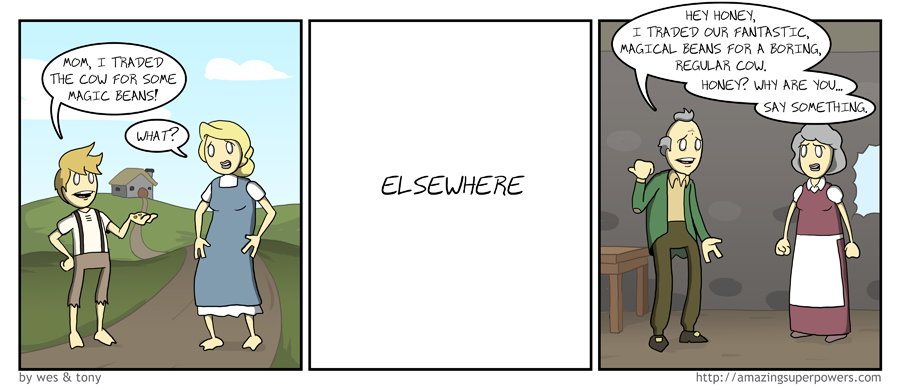
I once read a story about a guy who started with a single paperclip and over time was able to trade up to a car or an aircraft carrier or something. Everyone was really impressed, but the joke’s on him! Sure, he was swapping for more and more valuable items, but do you know what else he was getting? Responsibility!
Owning a car/aircraft carrier comes with a lot of maintenance and worry, so ultimately he was trading away freedom with every step. I bet that if he’d offered someone to trade his paperclip for their newborn baby they’d jump on the offer. Does a paperclip ever cry all night then ruin its pants just because? No paperclips I know!
As they say, the man with only a paperclip has nothing to lose (Not counting the paperclip).
-wes
