Get fucked!!!!!
wowowowow
I saw Maria on Great Australian Bake Off do something kind of similar, but this is gorgeous.
Get fucked!!!!!
wowowowow
I saw Maria on Great Australian Bake Off do something kind of similar, but this is gorgeous.


Over three years James Mollison photographed fans outside different concerts for his project The Disciples. ”As I photographed the project I began to see how the concerts became events for people to come together with surrogate ‘families’, a chance to relive their youth or try and be part of a scene that happened before they were born.”
- Oasis
- Morrissey
- Björk
- The Cure
“Study: 1 in 10 men in parts of Asia have raped”
That’s the original Associated Press headline for an article about a study that found that about 1 in 4 men in Bangladesh, China, Cambodia, Indonesia, Sri Lanka and Papua New Guinea committed rape, as Slate reports. The 1 in 10 number refers specifically to stranger rape. So that headline’s wrong. And it suggests the AP doesn’t consider rape by an intimate partner to be rape.
The original article does mention the actual stats, but frames them in a way that advances the notion that partner rape numbers are in addition to actual rape statistics:
About 1 in 10 men in some parts of Asia admitted raping a woman who was not their partner, according to the first large studies of rape and sexual violence. When their wife or girlfriend was included, that figure rose to about a quarter.
The AP has since changed the headline and flipped around the framing of that paragraph (without acknowledging the original error) – though they still think stranger rape should be singled out. But AP articles spread to other publications quickly, and the original headline and article are still out there, published without corrections. And there is no excuse for the AP ever putting out this article with its original framing.
Besides the blatantly inaccurate reporting, the AP is advancing a dangerous myth. There’s a widespread idea that rape is committed by a stranger hiding in a dark alley. This is used to protect people who rape intimate partners from prosecution, to make survivors of partner rape feel illegitimate, to erase the majority of rapes, which are actually committed by acquaintances.
While it’s important to look at the realities of rape everywhere in the world, the framing of this study on “Asia” (actually 6 countries in Asia), which was largely funded by European countries, could lead to problematic assumptions. So it’s worth highlighting that these numbers are basically the same as those from studies in the US.
To contact the AP and let them know that rape is rape, you can call them at 212.621.1500, email info@ap.org, or tweet @AP.
Every time I see that WHAT SOUND DOES A FOX MAKE video I think of this.
The fox say “Ooroorooroorooroo!”
I LOVE IT
Excess under age-60 female mortality in less developed countries is estimated to add up to 3.9 million missing women worldwide (World Bank, 2011). A large proportion of this is due to sex-selective abortion practices. The practice occurs most commonly among poorer families in societies where boy children are given greater economic and social status than girl children. In such a context, the transition to smaller families can lead parents to choose boys over girls. Notably, female fetuses are most likely to be aborted when the first child born is a girl.
The table below shows the countries with the most skewed ratios at birth in the world. While there is naturally a slightly higher sex ratio of boys to girls — between 1.04-1.06 — ratios above that are considered to be altered by technology due to gender preferences for boy children.
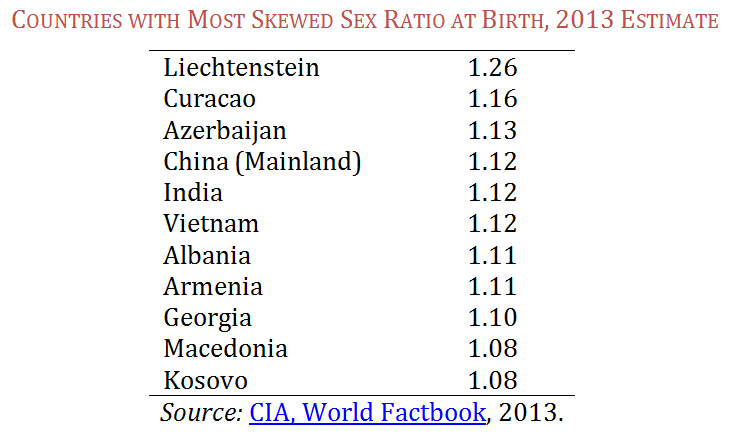
The reason we find this newest 2013 data of particular interest is that, despite the popular Western focus on Asia, the practice occurs in more European countries. Perhaps most striking is the central European country that ranks at the top of the list—Liechtenstein. This strikes us as odd, given that Liechtenstein has never made this list in the past. Perhaps this is a data collection error (in very small populations, as also in Curacao, the results can be skewed). But we are surprised that no journalists have picked up on the fact that the worst offending son-preference country in the world is now, allegedly, a European country. We contacted the CIA to ask them about this possible data anomaly but have not yet heard back.*
On the other hand, if the Liechtenstein data is accurate, this would be a very interesting story indeed, especially since Liechtenstein has the most restrictive laws against abortion in Europe. A quick scan of gender equity policies in Liechtenstein shows that women there were not legalized to vote until 1984, indicating that it is not the most gender egalitarian of European countries.
In any case, whether Liechtenstein’s inclusion in this disreputable list is a data error or not, the other European countries on the list are legitimate. They have been high for many years, and a recent report on Armenia, for example, documents longstanding norms in gender preference. The disproportionate focus on birth sex ratios in China and India no doubt reflects their status as the #1 and #2 most populous countries, which means a much greater overall impact in sheer numbers. Nevertheless, our point stands. Why has the disproportionate inclusion of non-Asian countries on the above-list gone virtually unmentioned by journalists?
Do Developed Western Countries Prefer Boys?
Americans often think of parental sex preference as a thing of the past, or a problem in developing countries. After all, the U.S. sex ratio at birth falls in the normal range, at 1.05. This is in spite of the curious American cottage industry in sex-identification home use kits, such as the Intelligender, the GenderMaker and the Gender Mentor.

In surveys, American parents report an ideal of two children and equal preference for boys and girls. However, American gender preferences manifest themselves in more sneaky ways. A 2011 Gallup poll showed that, if they were only able to have one child, the highest preference was for a boy. These results are little changed from the same Gallup question asked of Americans in 1941.
To return to a point made in an earlier post on skewed sex ratios, Americans may not be so different, after all, in their gender preferences from the countries in the above table. The crucial difference, she noted, is that some Asian countries are more enabled to act on their boy preference than others. It appears we should now be including some European countries in that “enabled” group as well.
* Neither the United Nations, Population Reference Bureau, nor the World Bank have published 2013 statistics yet for comparison to the CIA data.
Jennifer Lundquist is an associate professor of sociology at the University of Massachusetts, Amherst who specializes in stratification and social demography.
Eiko Strader is a PhD student in sociology at the University of Massachusetts, Amherst who studies inequality in labor markets and the welfare state.
(View original at http://thesocietypages.org/socimages)


A few retweets from the Everyday Sexism twitter page, a project that aims to highlight the daily slights that women and girls suffer.
today i learned that the first use of “omg” occurred in 1917 in a letter to winston fucking churchill
in case you think im fucking with you:
Fergus NoodleDibblers


Dibbler (Parantechinus apicalis)
…A species of marsupial that is restricted to a small area in southwest Australia and some offshore islands. Dibblers are mainly active at dawn and dusk and will feed on insects and other small invertebrates, although they are also known to feed on small vertebrates as well. Dibblers are well adapted for foraging in the undergrowth and have sharp teeth and claws and grooves on their feet which help them climb.
Currently the dibbler is listed as endangered as it has lost 90% of its former range. It faces threats from habitat loss and predation from introduced animals.
Phylogeny
Animalia-Chordata-Mammalia-Marsupialia-Dasyuromorphia-Dasyuridae-Dasyurini-Parantechinus-P.apicalis
Images: Perth Zoo


Illustrations from The Function of Colour in Factories, Schools and Hospitals, (1930)
Today is Love Your Body Day and is this is our favorite body positive post of the year, re-posted in celebration. Enjoy these seven beautiful minutes in which Kara Kamos explains that she is ugly and she couldn’t care less (most of the time):
What’s more important than being beautiful?
Personally, I really identified with the discussion that starts at 3:51 about not letting how she looks get in the way of her doing things. Often when I’m asked to do public speaking or appear on video, a part of me silently asks the question, “Am I attractive enough to deserve to do this?” The question is absurd. Not because I AM pretty enough, but because the question assumes that, if I weren’t, I would turn down an opportunity on that basis alone. And that is plain silliness.
See all of our body loving posts from the archive!
Lisa Wade is a professor of sociology at Occidental College. You can follow her on Twitter and Facebook.(View original at http://thesocietypages.org/socimages)
 This week the feminist internet has been fuming about Bustle, a new “website for women” made by Bryan Goldberg, a mansplaining man who didn’t seem to realize that, you know, there are already a couple sites for ladies/feminists out there. His defense? Bustle will set itself apart from the rest of these earnest attempts at significance due to its absurd wealth: the website is launching with $6.5 million in venture capital funding, which is approximately $6.5 million more than Feministing has ever seen, as Jos noted in Wednesday’s DCFS and our recent fundraising appeal.
I could be mad that Goldberg assumes the only measure of a publication – even an expressly feminist enterprise, as he labels Bustle – is its profitability. I could be bitter that neither Goldberg nor his investors thought to fund an existing, woman-led effort rather than start a new own. I could be insulted that, as Goldberg has stated, he thinks what sets a women’s site apart from the default male online destination is inclusion of celebrity gossip about the “Real Housewives of New Jersey.”
But, as I wrote about a few months ago, I am an underemployed 23-year-old trying to make it as a writer in the Real Big Kid World, so I’m looking for bylines wherever I can find them.
Mr. Bryan Goldberg, here are my pitches for Bustle:
Write Your Way to Love
The low wages paid to female writers is a controversial, newsworthy issue – and one on which a Bustle writer like me would have a particularly valuable perspective. As Julie Gillis noted, Bustle’s womanly writers will “make approximately $16 per hour with NO insurance or benefits and that’s not a liveable wage in cities like Austin, NY, SF, LA or hell, smaller towns with writerly types.” Sure, that sounds rough, but ladies, remember that work shouldn’t be about money – it should be about pursuing something you love so much you’d do it for free (so the founding CEO can pursue a $100,000,000 acquisition value). As a writer you are birthing words, and motherhood is the most joyous form of labor, too exquisite to be quantified. As a writer you are an artist, and artists don’t need dental plans.
Naming Things 101
Are you looking for a spot-on name for your next business venture? Consider something edgy, like a clear symbol of the oppressive social conditions your project purports to reject but from which you, personally, benefit daily! Don’t worry – everyone will know it’s ironic. You are so hip. Ideally, this name should be just a few letters away from the name of a competitor that has been doing similar but better work for two decades. Also, because Bustle is for ladies, and Mr. Goldberg has promised Lady News alongside the Real News, can I also say I really like the name Isobel for a girl and Jonah for a boy, and here’s a pretty sparkly thing to look at, too!

QUIZ! Do You Need to Know the Difference Between Mascara, Eyeliner, and Concealer?
As the Bustle Patron Saint Mr. Goldberg noted in an interview, “My job, as CEO, is to hire the right people. My job is to know a lot of engineers, editors, venture capitalists, and salespeople — and to bring them together. Knowing the difference between mascara, concealer, and eye-liner is not my job.”
In the world, there are two types of people: the serious thinkers who can hire and manage a team of trained experts, and the insignificant trollops who need to distinguish between types of make-up. I will write a fun, sassy quiz to determine which kind of person you are — and what that means for your sex life!
Sample question:
Are you reading Bustle?
a) Yes
b) No
Bustle is for women so if you answered “Yes” then you need to know types of make-up.

 Start Your Business NOW!
In this article, I will propose some FREE start-up ideas for lady entrepreneurs that you will not BELIEVE haven’t been claimed yet. Here, just off the top of my head: what if you started a chain of stores that mostly sold coffee, but you also had some pastries and free internet? Or, ok, what if you had like an ice cream store, but instead of ice cream you froze YOGURT? Oh man, you could also take two pieces of bread, and put some other food like cheese and meat inside them, and sell THOSE.
 Counting by Capitalism! Measuring the Success of Your Radical Action Dollar by Millionth Dollar
Working on this one, argument coming.
A History of Greatness: All Those Times White Men Have Done a Great Job “Pioneering” Feminism on the Internet
Ditto.
Lean In: How to Succeed in Business When You Already Have 6.5 Million Dollars
You know the best way to make it in the harsh, sexist professional world? Already have a boatload of cash. And I mean that literally: you should have a boat, and it should actually be filled with cash.

 The short answer? No.
Law professor Osagie K. Obasogie interviewed a series of people who had been blind since birth about their understanding of the concept of race. Counter-intuitively, he found that race was as meaningful to them as it was to sighted people and that their descriptions and biases were largely in line with cultural norms. The article includes really striking quotations from the interviewees and what Obasogie describes as an “empirical assessment of the metaphor of colorblindness.” He’s also published a book based on the research: Blinded By Sight.
In this three minute interview, he explains some of his findings:
Lisa Wade is a professor of sociology at Occidental College. You can follow her on Twitter and Facebook.(View original at http://thesocietypages.org/socimages)

I am being carved in butter - life-sized! That’s never happened to me before (I think). Cool!

my flatmate just sent me this from ontario, who knew canadian supermarkets are like a work of art??
Wow