Shared posts
Goat shot by arrow delivers kids
Righetto Osteria Romana, Haberfield
Colleges need to do more to ensure rape survivors’ grades don’t suffer
As more and more campus rape survivors have spoken out about how their colleges failed them in the aftermath of an assault, we’ve seen that a disturbing number of these stories end with the survivor dropping out, while the perpetrator remains on campus. Even if survivors remain in school, their grades often suffer. In an important piece in the Washington Post, Cari Simon, a Title IX lawyer who has worked with many campus survivors, describes how colleges’ mishandling of sexual assault cases often contributes to survivors’ plummeting GPAs–and explains why this matters.
All of my clients saw their grades suffer, sometimes dramatically. While there are no national statistical studies on the impact of sexual assault on grades, my colleagues report similar findings.
One in five women are sexually assaulted in college, according to a White House report. The rates are also particularly high in the LGBT community. In the aggregate, this means that millions of college women and LGBT students have seen their grade-point averages unfairly deflated due to sexual violence. As one of my clients bluntly put it, “it’s as if my transcript is covered in his semen.”
Grades matter. They are the mechanism professors use to assess a student’s performance and schools use to rank the student body. They are the means by which students measure their own achievement. Outside of school, employers and graduate programs rely on grades to evaluate candidates among an increasingly competitive field.
These deflated GPAs have a rippling negative impact on survivor’s graduate school options and access to professional opportunities. Those lost opportunities are devastating on a micro-level — individual students miss out on what they had worked hard to achieve.
But the problem also has serious consequences on the macro level. It means that we as a society are losing out on the contributions that these students would have made had they been able to start off in professional careers and attend graduate schools that are reflective of their merits, not their rape.
Experiencing a sexual assault, like many other traumatic experiences, is likely to take some toll on academic performance no matter what. But, as Simon notes, there is plenty that schools that truly care about ensuring survivors’ equal access to education can — and should — be doing to lessen that impact. Simon lays out some concrete recommendations in the rest of the piece.
Maya Dusenbery is an Executive Director of Feministing.
Love Dem Apples, Surry Hills [29]
Fergus Noodleexpensos

They say an apple a day keeps the doctor away…

And because I value my health the only thing to do is choose my flavour of medicine!

You might recognise these caramel apples from a stall manned by the super friendly Joe at Glebe or Bondi markets but now you can get your fix any day from Love Dem Apples (454 Cleveland St, Surry Hills), on the corner of Crown St opposite the Surry Hills Shopping Village.

Every day they make up a batch of caramel and it smelled fricken incredible in the store as the butter and sugar slowly caramelised and joined together in sweet matrimony.
Once the caramel has melted and is at the right temperature, the Granny Smith apples are swirled in the caramel and then rolled in toppings.

If I wasn’t so scared of burning myself on molten caramel I’d totally want to work here. Except I’d probably eat all my earnings. It’s bad enough that they’re only a 15min walk from work!

On my first visit with Helen we stood transfixed at the display for a good 10mins debating on which flavour to try. We were offered samples which was nice but ultimately made our decision harder because we wanted to eat each and every flavour haha in the end we went for the Strawberry Pop ($10) and the Tropic and Thunder ($10).

There’s a couple of stools in the store so we chose to eat there and they offered to slice our apples which was a good idea so we could share them easily and also I know that if I had attempted to eat the apple just by biting into it then I would totally have dropped it because I am all kinds of clumsy.

So were they tasty? Hells yeah they were! Yes they were sweet but not as tooth-achingly sweet as toffee apples and the tartness of the apple itself meant I could keep on eating without feeling I was about to go into a sugar coma. I loved the Strawberry Pop which reminded me of strawberries and cream lollies and there was pop rocks and I HEART pop rocks! You all know my issues with desiccated coconut so I was happy with the fresh coconut flakes on the The Tropic and Thunder.

Then there was the Oreo ($10) which was encrusted with cookie bits.

And the Pretzel ($10) which was my fave because of the magic that is the sweet and salty combo.

They also sell chocolate covered bananas for $6.

Some with cookie dough, some with marshmallow and some with 100’s & 1000s.

Oh and chocolate covered popcorn!

And Nanaimo ($2each), a Canadian bar with a wafer/crumb layer, vanilla icing and covered in chocolate.

Yeah baby how do you like dem apples!

The Classic Apples start at $8, Royals at $10 and Limited Editions at $13. The apples are a tad on the exxy side but I think it’s worth it to treat yoself every now and then :P Love Dem Apples is open 7 days a week from noon to late.

“It’s hard for them to accept that I do abortions because I’m a Christian.”
Esquire has a wonderful profile of Dr. Willie Parker, one of the two doctors who flies in from out-of-state to work at Mississippi’s sole embattled abortion clinic. Parker, whose decision to become an abortion provider is deeply rooted in his Christian faith, quit his obstetrics practice to do the procedures full-time after Dr. Tiller was assassinated five years ago. These days, he travels around the country providing abortion care in areas where access is most limited and is an eloquent advocate for reproductive justice.
Many of these women come from hours away, one from a little town on the Kentucky border that’s a seven-hour drive. They don’t know much about Dr. Parker. They don’t know that he grew up a few hours away in Birmingham, the second youngest son of a single mother who raised six children on food stamps and welfare, so poor that he taught himself to read by a kerosene lamp and went to the bathroom in an outhouse; that he was born again in his teenage years and did a stint as a boy preacher in Baptist churches; that he became the first black student-body president of a mostly white high school, went on to Harvard and a distinguished career as a college professor and obstetrician who delivered thousands of babies and refused to do abortions. They certainly don’t know about the “come to Jesus” moment, as he pointedly describes it, when he decided to give up his fancy career to become an abortion provider. Or that, at fifty-one, having resigned a prestigious job as medical director of Planned Parenthood, he’s preparing to move back south and take over a circuit roughly similar—for safety reasons, he won’t be more specific—to the one traveled by Dr. David Gunn before an antiabortion fanatic assassinated him in 1993. Or that his name and home address have been published by an antiabortion Web site with the unmistakable intent of terrorizing doctors like him. Or that he receives threats that say, “You’ve been warned.” Or that he refuses to wear a bulletproof vest, because he doesn’t want to live in fear—”if I’m that anxious, they’ve already taken my life”—but owns a stun gun because a practical man has to take precautions. What they do know is this:
He is the doctor who is going to stop them from being pregnant.
The profile captures Dr. Parker’s motivation for doing this work and the great care and empathy he brings to it. It also offers a rare glimpse into what actually happens at an abortion clinic and shows the huge diversity among the stories of the dozens of women Dr. Parker helps each day. You should really read the rest here.
The Satantic Temple uses Hobby Lobby ruling to claim religious exemption from anti-choice biased counseling laws
Citing the Hobby Lobby ruling, the Satanic Temple is claiming a religious exemption from the anti-choice “informed consent” laws that require abortion providers in 35 states to give out biased, sometimes false, information about the procedure.
Given that “the Supreme Court has decided that religious beliefs are so sacrosanct that they can even trump scientific fact,” the Temple says it expects its “deeply held belief” will be respected. After all, unlike Hobby Lobby’s, their belief is even based on actually accurate information.
And you don’t need to be an official Temple member to claim this exception too. “All women who aren’t member share our deeply held belief that their personal choices should be made with access to the best available information, undiluted by biased or false information, are free to seek protection with this exemption,” a spokesperson say. Why yes, in fact, I do — I share that belief very much.
The Temple has helpfully provided a letter that people seeking an abortion can print out to explain to their doctor that they are exempt from informed consent mandates:
I regard any information required by state statute to be communicated or offered to me as a precondition for an abortion (separate and apart from any other medical procedure) is based on politics and not science (“Political Information”). I regard Political Information as a state sanctioned attempt to discourage abortion by compelling my consideration of the current and future condition of my fetal or embryonic tissue separate and apart from my body. I do not regard Political Information to be scientifically true or accurate or even relevant to my medical decisions. The communication of Political Information to me imposes an unwanted and substantial burden on my religious beliefs.
I don’t know about you, but the Temple, a relatively young sect with an already rich history of trolling religious conservatives, might have just gotten a new convert.
Maya believes “one’s body is inviolable, subject to one’s own will alone.”
PappaRich, Ultimo
Fergus Noodlewe going here
My friends and I got together for a birthday lunch at a vegetarian restaurant… only to discover that they were closed on Sundays! Oops, I’m not sure what happened, but one thing led to another and we found ourselves waiting in line at PappaRich.
There were too many of us to actually sit at the one table (and I don’t think it would have been possible considering how packed the place was), so we were split up between three tables.
I thought about going to each table to document what they ordered, buuuut that seemed a bit impractical, so I stuck to taking photos at our table.
Ordering at PappaRich entails writing the codes for your dishes and drinks on the order form, which I thought was pretty smart: lessens the chance of getting your order wrong, unless you have terrible writing like me (so there was pain staking printing involved rather than my usual spidery scrawl).
Deep fried chicken skin is as awesome you think; it’s exactly like crackling, but chicken! (Though perhaps not as salty, from memory).
This is one of the dishes I grew up eating: boiled chicken, chicken rice, and bean sprouts with a bowl of chicken and Chinese cabbage soup and a chilli, ginger, shallot soya dipping sauce.
Chicken rice is basically rice cooked in the broth the boiled chicken was cooked in instead of water. Best. Rice. Ever. Especially the crusty bits at the bottom of the pot.
None of the chicken rice dishes I’ve had has come close to Dad’s, except for this one. I was floored – the flavours were almost spot on to my dad’s cooking and it brought back some wonderful childhood memories.
The rice noodles were wok-fried with prawns, egg, shredded chicken, and bean sprouts. A pretty decent dish that was seasoned well.
Although the roti was soft, it wasn’t as fluffy as the ones you’d get from Mamak. It still hit the spot with a lovely daal and spicy curry chicken.
The satay chicken skewers were succulent and had the right amount of spice.
C had the Pappa Mocha and as much as I love having an ice Teh Tarik, I looked on in envy of M’s Milo Dinosaur – it looked so fantastic.
My friends were insanely hungry and ordered perhaps a wee bit much for three people so we had to take the rest away (F’s face brightened when he saw the leftovers I brought home haha).
The service is efficient and food comes out reasonably quick; with lines out the door, there is a fast turnover and I get the feeling that lingering at the table after you’ve finished your meal isn’t ideal.
PappaRich has three restaurants around Sydney (Chatswood, Broadway, and the recently opened Parramatta) and another one is scheduled to be opened in the Macquarie Centre at North Ryde by the end of the year.
PappaRich
Shop 5, 185 Broadway
Ultimo, 2007, NSW
Ph: (02) 9281 3228
Web: http://papparich.net.au/
The post PappaRich, Ultimo appeared first on .
The SDCC Files: The Cosplay Gallery

Rocket Raccoon– who was actually a real live five year old Latino boy underneath the mask.
by Kendra James
As I wrote for the The Daily Beast the best part of Comic-Con is always the ridiculously talented cosplayers wandering the halls. As a cosplayer myself, I know how challenging (and fun) designing, finding, and creating costumes for cons can be. With that in mind I wanted to showcase some of the costumed heroes, heroines and other beloved characters of colour Art and I spotted during this year’s con.

Margaery Tyrell (myself) and Sansa Stark
The post The SDCC Files: The Cosplay Gallery appeared first on Racialicious - the intersection of race and pop culture.
Wieczorkowski, Woollahra
Fergus NoodleWe should go here
Conspicuous Pollution: Rural White Men Rollin’ Coal
Fergus NoodleWouldn't you get in trouble for this? Doesn't it make it very difficult for people to drive behind you?
Conspicuous consumption refers to the practice of ostentatiously displaying of high status objects. Think very expensive purses and watches. In the last few decades, as concern for the environment has become increasingly en vogue, it has become a marker of status to care for the earth. Accordingly, people now engage in conspicuous conservation, the ostentatious display of objects that mark a person as eco-friendly.
Driving a Prius and putting solar panels on visible roof lines, even if they aren’t the sunniest, are two well-documented examples. Those “litter removal sponsored by” signs on freeways are an example we’ve featured, as are these shoes that make it appear that the wearer helped clean up the oil spill in the gulf, even though they didn’t.
Well, welcome to the opposite: conspicuous pollution.
Elizabeth Kulze, writing at Vocativ, explains:
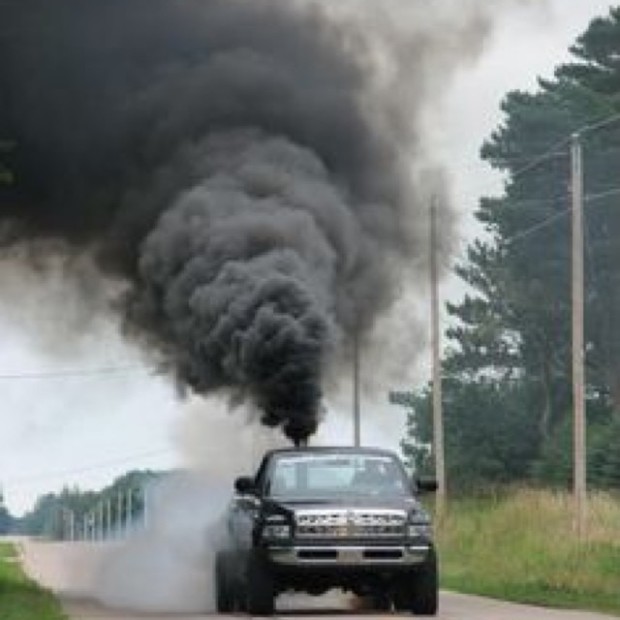
In small towns across America, manly men are customizing their jacked-up diesel trucks to intentionally emit giant plumes of toxic smoke every time they rev their engines. They call it “rollin’ coal”…
It’s a thing. Google it!
This is not just a handful of guys. Kulze links to “an entire subculture” on Facebook, Tumblr, and Instagram. “It’s just fun,” one coal roller says. “Just driving and blowing smoke and having a good time.”
It isn’t just fun, though. It’s a way for these men — mostly white, working class, rural men — to send an intrusive and nasty message to people they don’t like. According to this video, that includes Prius drivers, cops, women, tailgaters, and people in vulnerable positions. “City boys” and “liberals” are also targeted:
Kulze reports that it costs anywhere between $1,000 and $5,000 to modify a pickup to do this, which is why the phenomenon resonates with conspicuous consumption and conservation. It’s an expensive and public way to claim an identity that the owner wants to project.
Lisa Wade is a professor of sociology at Occidental College and the co-author of Gender: Ideas, Interactions, Institutions. You can follow her on Twitter and Facebook.(View original at http://thesocietypages.org/socimages)
Watch: Catcallers try to explain why they harass women
After a years of experiencing street harassment–and often confronting her catcallers–a Minneapolis woman named Lindsey came up with Cards Against Harassment–little cards that you can silently hand out to explain to harassers why getting unsolicited attention from random strangers whenever you step outside your house is not actually that fun.
While clearly not appropriate for every situation, the cards are a cool way of turning the spotlight around on the harassers–and a few of them may even learn something. Lindsey, who explains that she’s ”genuinely interested in what place this is coming from,” has started filming the ensuing conversations. The men have lots of justifications–from the biblical to the sartorial–but there’s one common thread. ”The theme I hear the most often is that they truly, genuinely think it’s a compliment, and they are shocked,” Lindsey tells Buzzfeed. “If that is true, then simply telling people it’s not a compliment may go a long way.”
Check out–and download–the cards and view more videos here.
Related:
Two thirds of women in the US have been street harassed
How women in Brazil are fighting back against street harassment
Do you know the laws that cover street harassment in your state?
Maya Dusenbery is an Executive Director of Feministing.
Chart of the Day: When does a woman owe you sex?
Apparently, there’s an emerging trend of dudes tracking when their partners refuse sex and whining about the “excuses” they use. Hoping to nip this one in the bud, Elizabeth Plank and Raquel Reichard put together a helpful chart to help you determine when a woman owes you sex:
While a rampant sense of male entitlement to women’s bodies–which, as Plank explains, underpins so much of rape culture–means this reminder is particularly important for men to hear, it’s worth noting that the rule is gender neutral. Nobody owes anybody sex–which is why it’s so great when freely given.
Maya Dusenbery is an Executive Director of Feministing.
Brighton the Corner and The Pig and Pastry, Petersham
Fergus NoodleOh man the pig and the pastry cakes look so good but those guys are so terrible
New Favorite Tumblr: Counter-protesting anti-choice protestors
Saturday Chores chronicles the adventures of “a pro-choice husband/wife team from Raleigh, N.C.” as they spend Saturday mornings counter-protesting anti-choice clinic protestors–oh, sorry, I mean, “sidewalk counselors“–by holding up funny signs. Like so:
Somehow there’s nothing like a sign about turtles to deflate all that self-righteous anti-abortion doom-and-gloom.
Check out more of my favorite signs after the jump.
(h/t The Hairpin)
Get Me To The Greek Gyro!
Fergus NoodleIn the 80s this dude we used to know worked at one of these places and he had a shirt that said BIG MEAT on the back and sometimes I just say BIG MEAT to myself
Pappa Rich, Broadway
Fergus Noodlehmmm
Brighton The Corner, Petersham [23]
Fergus NoodleI think this is the cafe that the dude who lives on my street has opened

I heart crumpets. Their purpose in life is to be fluffy and soak up whatever topping is drizzled on top and generally just make everyone happy. Am I right? So I convinced my brunch buddy that we needed to visit Brighton The Corner (49 Palace St, Petersham) for brekkie for the House Made Crumpets ($14). And they were beeyootiful with caramelised pears, quenelle of Dulwich Hill honey butter and a light dusting of cinnamon. The crumpets are on their all day menu but I hear every now and then they sell out so get there early or be prepared to experience crushing disappointment!

Raff ordered the Braised Brisket ($17) and I immediately had food envy. Luckily we have an unspoken rule of sharing or we would not be friends haha :P

The brisket was tender and rich and the shards of golden potato hash along with the perfectly poached egg lifted me to my happy place. There was some mojo verde on the side to cut through the richness, and onion rings with ethereally light batter crowned the lot. Perfect comfort food for winter!

By the time we’d finished eating it was 12pm which meant the lunch menu had just started and Raff was super keen to try the Pork Belly Sandwich ($11) with fennel and quince paste. While the pork belly was nice and tender, we both wished that there was just a bit of crackle because well, crackle makes us happy.

And because I was still a bit peckish and wanted something savoury to balance out my sugar intake, I ordered the Hot Smoked Salmon ($17). I was envisioning a nice slab of salmon but what came out instead was a salad of pickled radish, fennel, peas, quinoa and topped with a gooey poached egg. The salmon is smoked inhouse and it was super tasty but oh how I wished there was more of it! I normally have issues with pickled things but I was in love with the pickled radishes and searched desperately for each and every piece and the pop of the fresh peas was just so addictive!

Oh and here’s our drinks, a piccolo latte ($3.50) to wake me up and a refreshing Watermelon and Basil house made soda ($4.50).

The service is attentive and friendly without the hipster ‘tude. The kitchen does get a bit smashed when it’s busy but the food is amazing so it was worth the wait.

There’s plenty of street parking and it’s just a 5min walk from the station which is win.
Saturday Stat: Main, Mean, and Median Street
Mean and median are two measures of “average.” The mean is the average as we typically think of it: the sum of things divided by the total number of things. The median, in contrast, is literally the number in the middle if we align all the quantities in order. People often use median instead of mean because it is insensitive to extreme outliers which may skew the mean in one direction or another.
For a quick illustration of the difference, I often use the example of income. I choose a plausible average (mean) for the classroom population and review the math. “If Bill Gates walks into the room,” I say, “the average income is now in the billions. The median hasn’t moved, but the mean has gone way up.” So has the Gini coefficient.
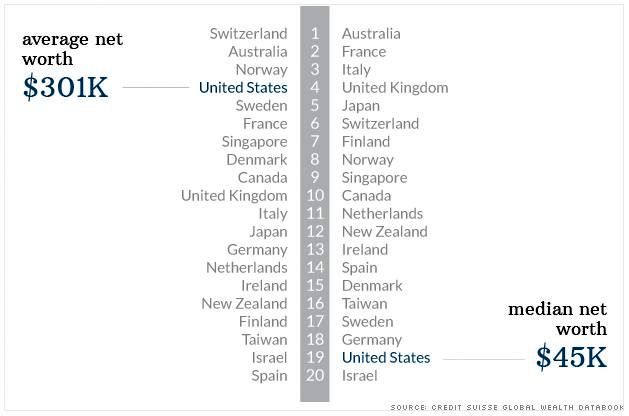
Here’s a more realistic and global illustration – the net worth of people in the wealthier countries. The U.S. ranks fourth in mean worth – $301,000 per person…
…but the median is far lower – $45,000, 19th out of the twenty nations shown. (The graph is from Credit Suisse via CNN.)
The U.S. is a wealthy nation compared with others, but “average” Americans, in the way that term is generally understood, are poorer than their counterparts in other countries.
(View original at http://thesocietypages.org/socimages)
“It took the college just 12 days to investigate the rape report, hold a hearing and clear the football players.”
The New York Times has another damning in-depth investigation into a college’s handling of a rape complaint. Like their recent report on Florida State University, this report on Hobart and William Smith Colleges tells a familiar tale of student assaulted on campus and then failed by her college.
It took the college just 12 days to investigate the rape report, hold a hearing and clear the football players. The football team went on to finish undefeated in its conference, while the woman was left, she said, to face the consequences — threats and harassment for accusing members of the most popular sports team on campus.
A New York Times examination of the case, based in part on hundreds of pages of disciplinary proceedings — usually confidential under federal privacy laws — offers a rare look inside one school’s adjudication of a rape complaint amid a roiling national debate over how best to stop sexual assaults on campuses.
Whatever precisely happened that September night, the internal records, along with interviews with students, sexual-assault experts and college officials, depict a school ill prepared to evaluate an allegation so serious that, if proved in a court of law, would be a felony, with a likely prison sentence. As the case illustrates, school disciplinary panels are a world unto themselves, operating in secret with scant accountability and limited protections for the accuser or the accused.
At a time of great emotional turmoil, students who say they were assaulted must make a choice: Seek help from their school, turn to the criminal justice system or simply remain silent. The great majority — including the student in this case — choose their school, because of the expectation of anonymity and the belief that administrators will offer the sort of support that the police will not.
Yet many students come to regret that decision, wishing they had never reported the assault in the first place.
Anna, the freshman who was assaulted, also went through hell after reporting. She said the school hearing “was one of the hardest things I have ever gone through.” But she’s planning to return to Hobart and William Smith in the fall. “Someone needs to help survivors there,” she explains. Read the rest here.
Quote of the Day: To reach female voters, GOP needs to “bring it down to a woman’s level”
At a recent panel put on by the Republican Study Committee, the House’s conservative caucus, conservative women discussed how the GOP can improve their messaging to female voters. Here’s the advice North Carolina Rep. Renee Ellmers offered:
Men do tend to talk about things on a much higher level. Many of my male colleagues, when they go to the House floor, you know, they’ve got some pie chart or graph behind them and they’re talking about trillions of dollars and how, you know, the debt is awful and, you know, we all agree with that … we need our male colleagues to understand that if you can bring it down to a woman’s level and what everything that she is balancing in her life — that’s the way to go.
Yep, pie charts are soooo hard.
My own tip to the GOP? Stop talking about how to talk to women. It’s only making things worse.
(h/t Jason)
Maya Dusenbery is an Executive Director of Feministing.
Overweight Americans Have the Lowest Risk of Premature Death
Last year the Journal of the American Medical Association released a study aiming to determine the relationship between body mass index and the risk of premature death. Body mass index, or BMI, is the ratio between your height and weight. According to the National Institutes of Health, you are “normal weight” if your ratio is between 18.5-24.9. Everything over that is “overweight” or “obese” and everything under is “underweight.”
This study was a meta-analysis, which is an analysis of a collection of existing studies that systematically measures the sum of our knowledge. In this case, the authors analyzed 97 studies that included a combined 2.88 million individuals and over 270,000 deaths. They found that overweight individuals had a lower risk of premature death than so-called normal weight individuals and there was no relationship between being somewhat obese and the rate of early death. Only among people in the high range of obesity was there a correlation between their weight and a higher risk of premature death.
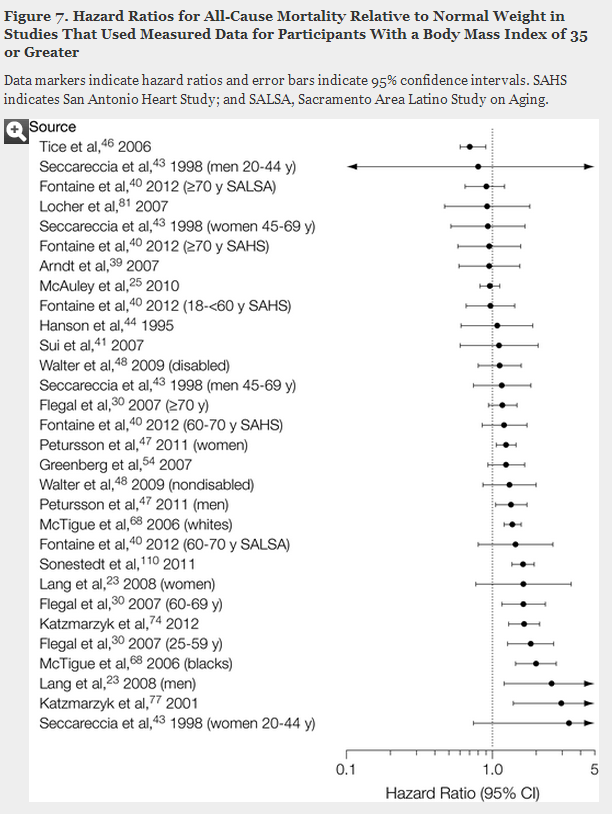
Here’s what it looked like.
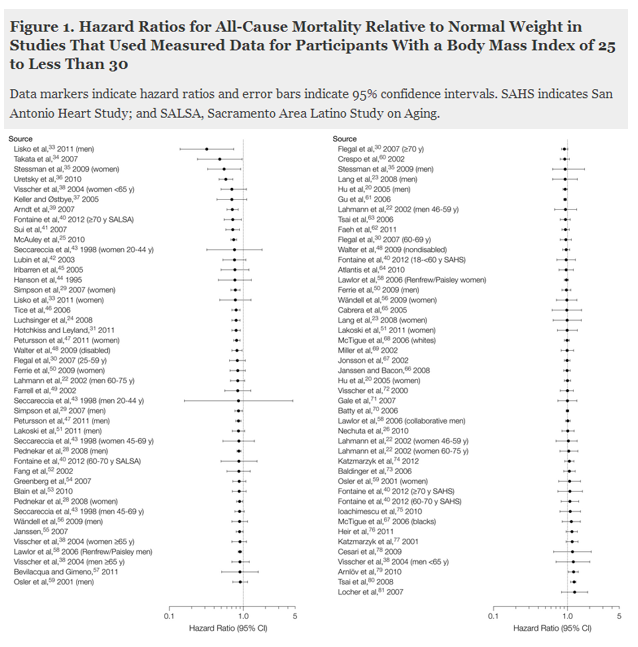
This is two columns of studies plotted according to the hazard ratio they reported for people. This comparison is between people who are “overweight” (BMI = 25-29.9) and people who are “normal weight” (BMI = 18.5-24.9). Studies that fall below the line marked 1.0 found a lower rate of premature death and studies above the line found a higher rate.
Just by eyeballing it, you can confirm that there is not a strong correlation between weight and premature death, at least in this population. When the scientists ran statistical analyses, the math showed that there is a statistically significant relationship between being “overweight” and a lower risk of death.
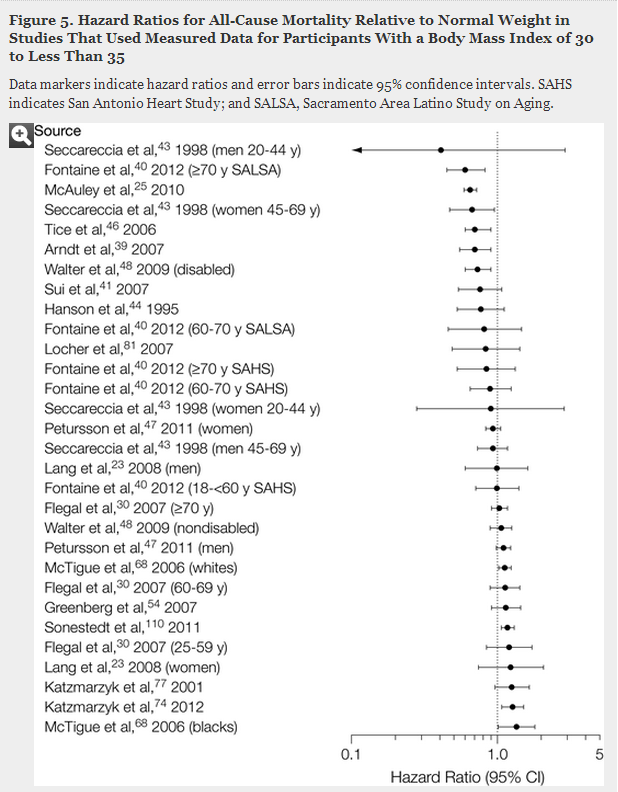
Here’s the same data, but comparing the risk of premature death among people who are “normal weight” (BMI = 18.5-24.9) and people who are somewhat “obese” (BMI = 30-34.9). Again, eyeballing the results suggest that there’s not much correlation and, in fact, statistical analysis found none.
Finally, here are the results comparing “normal weight” (BMI = 18.5-24.9) and people who are quite “obese” (BMI = 35 or higher). In this case, we do see a relationship between risk of premature death in body weight.
It’s almost funny that the National Institutes of Health use the word normal when talking about BMI. It’s certainly not the norm – the average BMI in the U.S. falls slightly into the “overweight” category (26.6 for adult men and 25.5 for adult women) — and it’s not related to health. It’s clearly simply normative. It’s related to a socially constructed physical ideal that has little relationship to what physicians and public health advocates are supposed to be concerned with. Normal is judgmental, but if they changed the word to healthy, they have to entirely rejigger their prescriptions.
So, do we even have an obesity epidemic? Perhaps not if we use health as a marker instead of some arbitrary decision to hate fat. Paul Campos, covering this story for the New York Times, points out:
If the government were to redefine normal weight as one that does not increase the risk of death, then about 130 million of the 165 million American adults currently categorized as overweight and obese would be re-categorized as normal weight instead.
That’s 79%.
It’s worth saying again: if we are measuring by the risk of premature death, then 79% of the people we currently shame for being overweight or obese would be recategorized as perfectly fine. Ideal, even. Pleased to be plump, let’s say, knowing that a body that is a happy balance of soft and strong is the kind of body that will carry them through a lifetime.
Lisa Wade is a professor of sociology at Occidental College and the co-author of Gender: Ideas, Interactions, Institutions. You can follow her on Twitter and Facebook.(View original at http://thesocietypages.org/socimages)
Chart of the Day: Sexual harassment and assault at scientific field sites
Fergus NoodleMy new boss was complaining about how hard it is to be the only man in the room at meetings. Oh boy.

(Chart via Vox)
Though this survey of more than 600 anthropologists, archaeologists, biologists, zoologists, and other scientists wasn’t nationally representative, it suggests that sexual harassment and assault could be one of the reasons contributing to the dearth of women pursing careers in the sciences.
The report found that 70 percent of women had experienced inappropriate sexual comments while working at field sites–and were 3.5 times more likely to report sexual harassment than men. And over a quarter said they had been victims of sexual assault, compared to 6 percent of men. Men were more likely to be harassed or assaulted by peers, while women were more likely to be a younger trainee, like a student, and more likely to be targeted by a superior–a dynamic that, the researchers note, can be especially psychologically damaging. Only about 20 percent of the respondents knew of any policies in place or mechanism to report their abuse.
“We are the first researchers to characterize the experiences of scientists at field sites, and our findings are troubling,” explained lead researcher Kate Clancy. “If you are on constant high alert because you have been harassed or you are at a site where you know it happens regularly, it drains your cognitive reserves and makes you less effective at your job. No one can work well under those conditions, and we can’t ask trainees to keep doing so. Field sciences are intellectually impoverished when hostile field sites drive out underrepresented scientists.”
Maya Dusenbery is an Executive Director of Feministing.
“I don’t fucking care if you like it.”

Read this cathartic piece by Rebecca Traister – on that Esquire piece on 42-year-old women, on Jada and campus sexual assault, on Hobby Lobby and buffer zones, on jailed Tennessee mothers, and all the many large and small ways our fates “rest in the hands of empowered committees on the general value and status of womanhood in America.”
It begins:
Last week, I got into a fight on Twitter with New York magazine’s Jonathan Chait, whose work I respect, and it wasn’t about anything that either of us had written; rather, we were tussling over the merits of a piece written by Tom Junod, for Esquire, about how today’s 42-year-old women are hotter than ever before.
There’s no need to linger over our differences: I thought the article was a piece of sexist tripe, celebrating a handful of Pilates-toned, famous, white-plus-Maya-Rudolph women as having improved on the apparently dismal aesthetics of previous generations; my primary objections to the piece have been ably laid out by other critics. Chait tweeted that he viewed the piece as a “mostly laudable” sign of progress: a critique not of earlier iterations of 42-year-old womanhood, but rather of the old sexist beauty standards that did not celebrate those women; he saw it as an acknowledgment of maturing male attitudes toward women’s value.
The truth is, had Chait been correct about it being a thoughtful piece laying into the entrenched short-sightedness and sexist cruelty of male-controlled media, I might have hated it more. Then I would have felt obligated to feel grateful for it, grateful in the same way I’m supposed to feel grateful toward, say, Marvel Comics for making Thor a woman, or toward Harry Reid for challenging Mitch McConnell on some typically boorish and inane statement how women have achieved workforce equality. In its actual form, I didn’t have to consider thinking Yay, thanks for some crumbs of enlightened thinking, for some slightly nuanced improvements in the daily, punishing business of publicly evaluating and then reevaluating women’s worth.
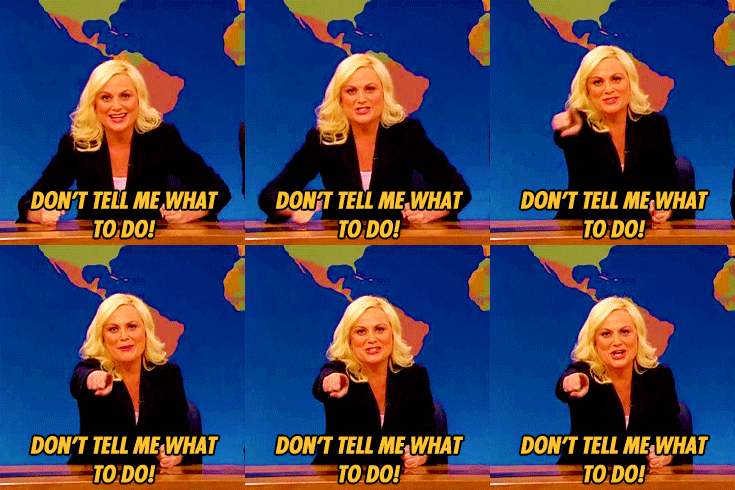
Instead, I’ve been thinking about an anecdote in Tina Fey’s Bossypants. Amy Poehler, then new to “Saturday Night Live,” was engaging in some loud and unladylike vulgarity in the writers’ room when the show’s then-star Jimmy Fallon jokingly told her to cut it out, saying, “It’s not cute! I don’t like it!” In Fey’s retelling, Poehler “went black in the eyes for a second, and wheeled around on him,” forcefully informing him: “I don’t fucking care if you like it.”
“The morning after I was raped, I made my rapist breakfast.”
Here’s a powerful comic from The Nib on rape, triggers, good stories, and true ones. Read the rest here.
New documentary explores the legacy of Vietnamese women in the nail industry
This looks so cool: a documentary on the legacy of Vietnamese women workers, as well as Black women’s influence, on the nail salon industry.
I’m really excited about a film exploring the legacy of women of color on the nail industry, especially as it seems white folks have recently Columbused nail art. I’m also really interested in the film’s exploration of health issues for nail salon workers — a huge yet not often discussed issue in immigrant women’s health and worker safety. The filmmakers are trying to raise funds to complete the documentary (yet another cause so much better than potato salad), so hit them up with a donation if you can.
To learn more in the meantime, check out the Healthy Nail & Beauty Salon Alliance.
Verónica is an immigrant writer, activist, and artist living and loving in NYC.
Banal Nationalism
Flashback Friday.
In his book by the same name, Michael Billig coined the term “banal nationalism” to draw attention to the ways in which nationalism was not only a quality of gun-toting, flag-waving “extremists,” but was quietly and rather invisibly reproduced by all of us in our daily lives.
That we live in a world of nations was not inevitable; that the United States, or Sweden or India, exist was not inevitable. I was born in Southern California. If I had been born at another time in history I would have been Mexican or Spanish or something else altogether. The nation is a social construction.
The nation, then, must be reproduced. We must be reminded, constantly, that we are part of this thing called a “nation.” Even more, that we belong to it and it belongs to us. Banal nationalism is how the idea of the nation and our membership in it is reproduced daily. It occurs not only with celebrations, parades, or patriotic war, but in “mundane,” “routine,” and “unnoticed” ways.
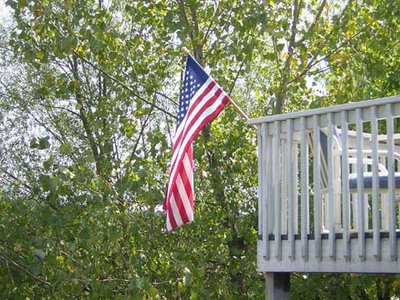
The American flag, for example, casually hanging around in yards and in front of buildings everywhere:

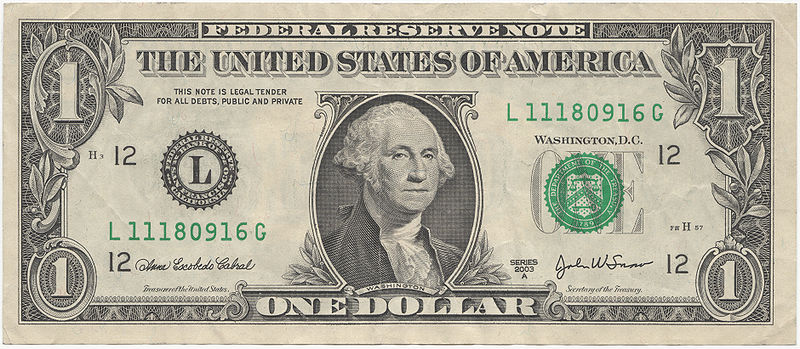
References to the nation on our money:

The way that the news is usually split into us and everyone else:

The naming of clubs and franchises, such as the National Football League, as specific to our country:

The performance of the pledge of allegiance in schools and sports arenas:

So, what? What could possibly be the problem?
Sociologists have critiqued nationalism for being the source of an irrational commitment and loyalty to one’s nation, a commitment that makes one willing to both die and kill. Billig argues that, while it appears harmless on the surface, “banal nationalism can be mobilized and turned into frenzied nationalism.” The profound sense of national pride required for war, for example, depends on this sense of nationhood internalized over a lifetime. So banal nationalism isn’t “nationalism-lite,” it’s the very foundation upon which more dangerous nationalisms are built.
You can download a more polished two-page version of this argument, forthcoming in Contexts magazine, here. Images found here, here, here, here, here, here, and here.
Lisa Wade is a professor of sociology at Occidental College and the co-author of Gender: Ideas, Interactions, Institutions. You can follow her on Twitter and Facebook.(View original at http://thesocietypages.org/socimages)
Study finds LGBT applicants 23 percent less likely to get a job interview

A new study, conducted by the Equal Rights Center and Freedom to Work, compared the responses to 100 pairs of fictional applications for jobs with government contractors. Each pair included an “LGBT application” that listed experience at an LGBT organization, and a “non LGBT application” that names similar roles in organizations that are not LGBT-focused. It played out something like this:
“‘Jennifer’ and ‘Michelle’ filled out applications for a job as an administrative assistant at ExxonMobil. The applications show they attended the same high school and college but ‘Jennifer’ had better grades in both schools and a stronger work history. ExxonMobil calls ‘Michelle’ for an interview — twice. She does not respond. They follow up with an email, stating they’ll hold the position for her. She does not respond. They never call ‘Jennifer’ and they hired someone else.”
Using results from all of the pairs, the study concluded that applicants who had roles in LGBT organizations were 23 percent less likely to be called back for an interview, even if they were more qualified for the position.
The study targeted eight federal contractors including ExxonMobil, whose shareholders have repeatedly voted against a resolution to protect employees from LGBT discrimination. The other contractors were AmerisourceBergen Corp., the Babcock & Wilcox Co., Fluor Corp., General Electric Co., L-3 Communications Holdings Inc., Supreme Group Holding SARL, and URS Corp.
The debate over ENDA has pushed LGBT employment discrimination to the forefront. Americans being asked to think about LGBT rights outside of the parameters of marriage and morality (finally). With that being said, I wonder what is implied by one’s role at an LGBT organization. Beyond the assumption that one actually identifies as LGBT, I wonder if corporations consider working at an LGBT organization to pose a threat because it connotes a heightened sensitivity to LGBT issues, a stronger responsibility to seek fair and just treatment, lesser willingness to look the other way in the event that LGBT discrimination occurs, and access to individuals/groups/organizations that can support them. In other words, are companies more afraid to hire LGBT-identified people or LGBT activists who could possibly blow their spot up with LGBT discrimination cases?
I’d be interested to see some variation of this study that perhaps included cover letters. In this way some fictional applicants may be able to identify themselves as LGBT (and where they fit under the umbrella) without an organizational affiliation. Either way, employment discrimination still represents a real barrier to LGBT communities.
Sesali gets satisfaction knowing that her fellow rebel rousers are still scaring the hell out of oppressors.
Cruising Down The South Coast of NSW
Fergus NoodleI wanna eat that bombe alaska pretty bad