U.S. sanctions mean that any citizen or business wanting to buy stuff from North Korea has to send a letter to the U.S. government asking for special permission. A few months back, we submitted a Freedom of Information Act request, asking for those letters.
Our request was granted: We recently received a packet of 18 letters from Americans who wanted to do business with the most isolated nation on the planet. We've posted all of the letters online.
We also managed to track down some of the people who wrote the letters. Here's what we learned:
Stamps
Donald Sundman, president of Mystic Stamp Co. in Camden, N.Y., asked for permission to buy postage stamps from North Korea. Some North Korean stamps show pictures of dogs. There's at least one that, weirdly, has a picture of Princess Diana. Another, less weirdly, has a picture of a unified Korean peninsula.
Sundman told me he wanted to get the stamps because, basically, they're hard to get — which makes them appealing for some collectors.
This is one theme in the requests to do business with North Korea: People don't want North Korean stuff because it's cheap or well-made; people want the stuff because it's hard to get. They want special permission to buy stuff because the sanctions make it hard to buy stuff.
Jeans
Patrick Forster, CFO of a Coca-Cola bottling plant in Tennessee, asked for permission to buy a pair of $220 jeans that were made in North Korea. He told me he thought they'd make a nice birthday present for his wife, whose father escaped from North Korea during the war. The government granted his request.
"She's only worn them one time," he said. "They didn't fit quite right."
The jeans are called NoKo jeans, and they're the brainchild of a few young Swedish guys who, on a whim, managed to get 1,100 pairs of jeans made in North Korea — despite the fact that jeans are seen as a symbol of imperialism in the country.
"We didn't use the word 'jeans' during the production," Tor Kallstigen told me. "The company was called Pants Provided."
Beer
One guy wanted to import North Korean beer. I couldn't track him down, but I did find a guy who had tasted it. Josh Thomas, a graphic designer in Hong Kong, told me it tastes just like Anchor Steam. He said North Korea bought a brewery in the U.K. and brought it over to North Korea.
I don't know whether the request to import North Korean beer was granted, but I've never seen North Korean beer in this country. Thomas says he tried to bring some back to Hong Kong with him. The bottles weren't very well-made, and when the barometric pressure dropped, they burst.
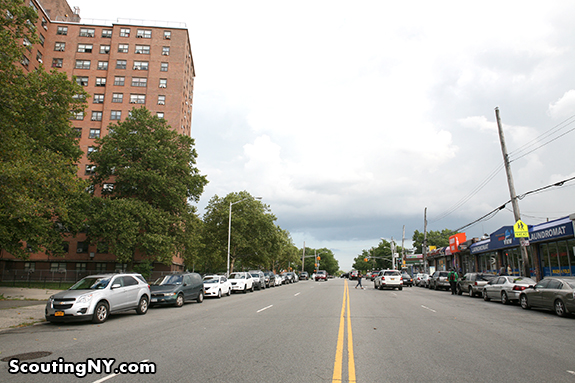
Last week, I was driving around in a southeastern area of the Bronx…
…when the road I was following came to an abrupt end, with a series of signs forcing me to turn right. I turned…
…and all of a sudden, it was like I was in a completely different world.
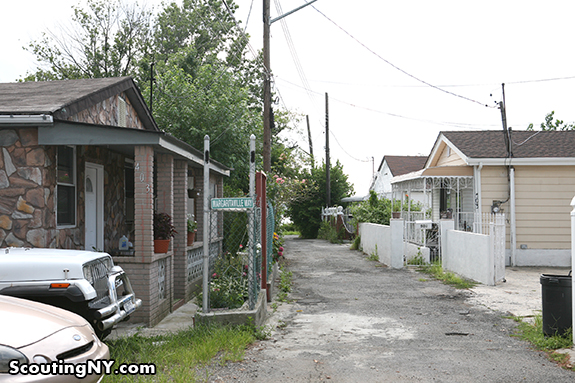
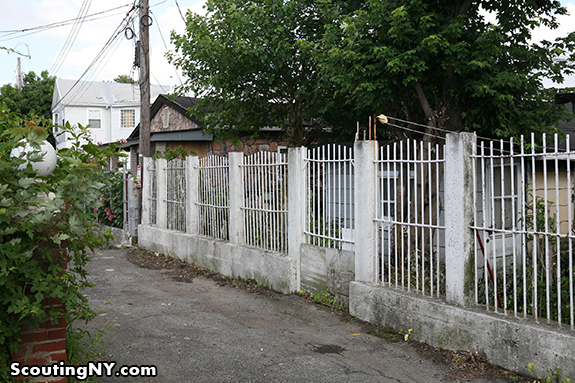
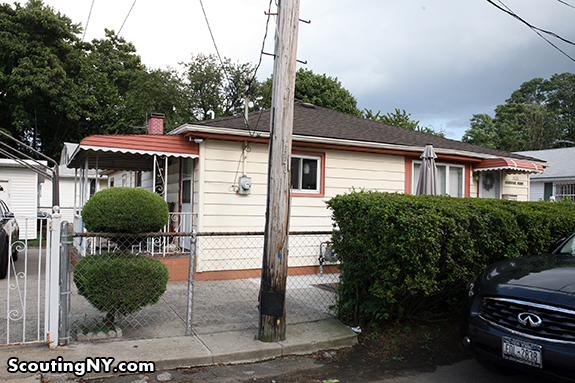
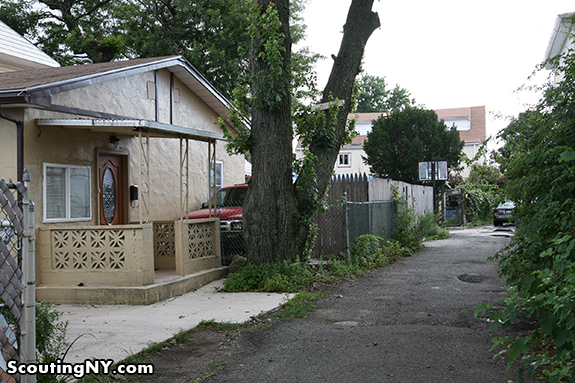
The streets had become insanely narrow, barely wide enough for a standard car width.
Some even appeared to be in a state of abandonment, with overgrowth suggesting that it had been a long time since anyone had driven down them.
I continued exploring, expecting this to just be a fluke, but the next road was the same…
…and so was the next.
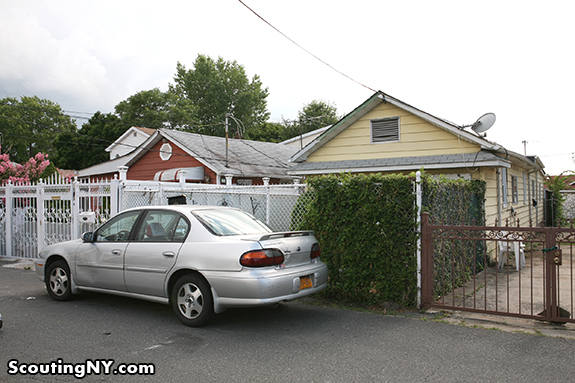
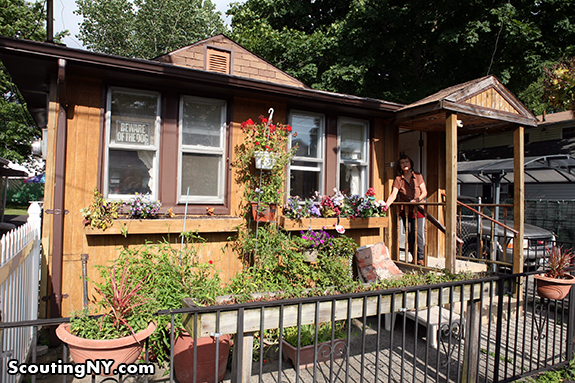
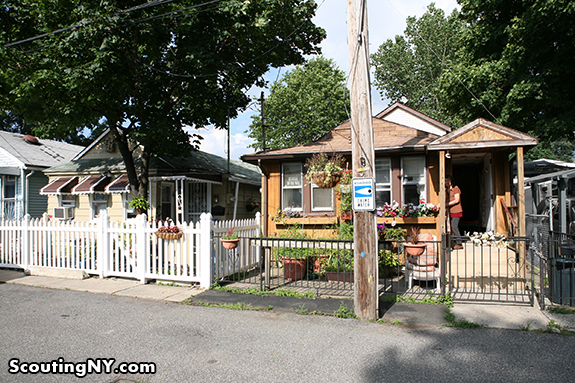
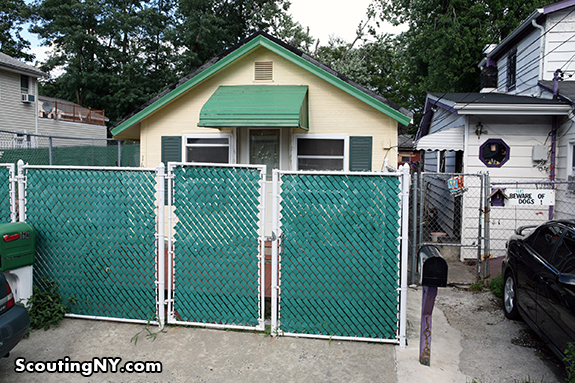
Meanwhile, the streets seemed to be uniformly lined with squat little houses, especially unusual for the Bronx.
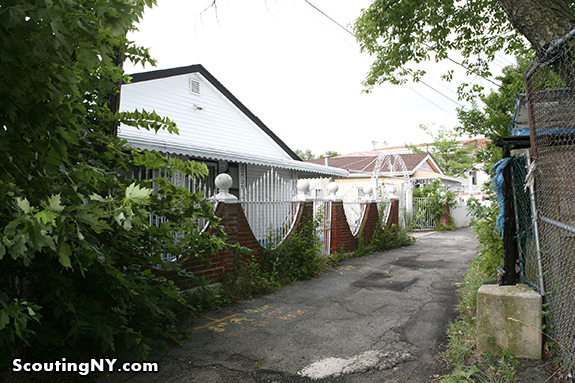
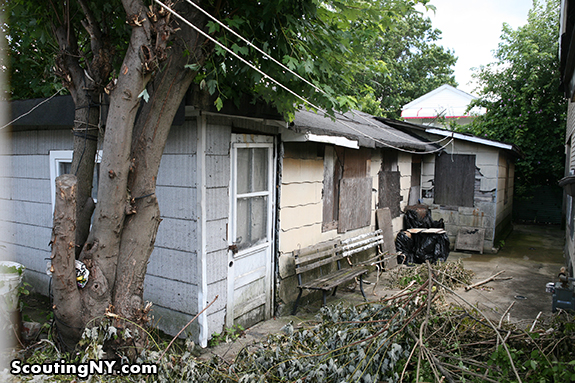
Some appeared to be abandoned…
…though flowers continue to grow at this one:
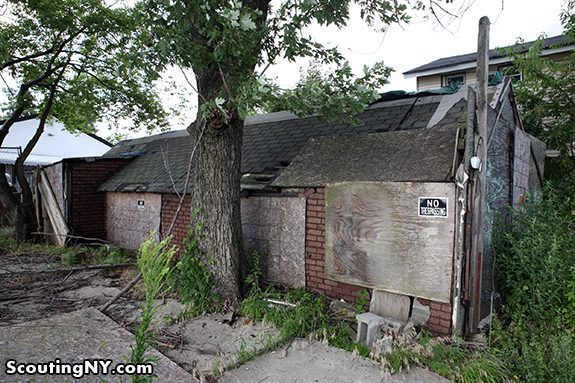
Here’s another that seems to have been boarded up for a while.
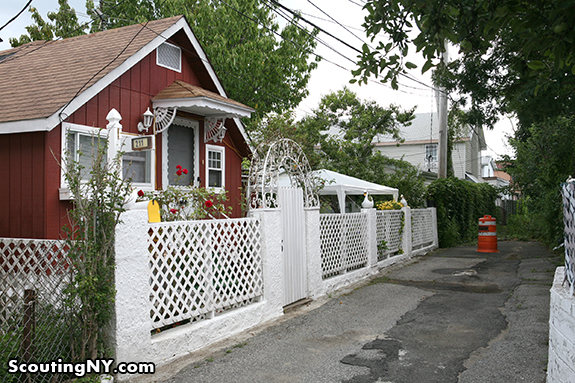
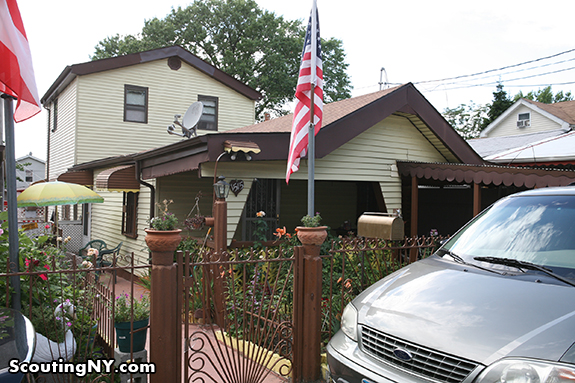
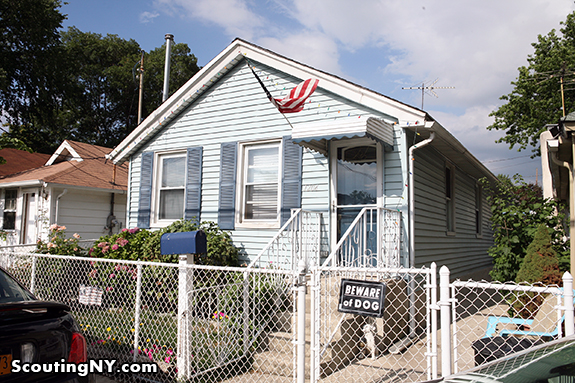
Others were very nicely maintained…
…and in fact, if you were able to step back far enough, it all began to take on the feel a beachfront community.
As I was taking pictures and wondering what I’d stumbled onto, a woman came over to see what I was up to, and explained that I had found the curious neighborhood of Harding Park.
Harding Park began its modern life in the early 1900s as a summer resort community for New Yorkers looking to escape the city. The primary land owner at the time was one Thomas Higgs, who owned an amusement park on the western side of the point. In the 1920s, he began dividing his land up and created a series of tightly packed bungalows for rental, many of which still exist today. These became permanent residences following World War II.
Some seem untouched from the days when a tourist would take the ferry over from College Point for an overnight stay away from the city:
Others have been updated in a variety of ways. For example, the neighbor I was speaking to had expanded her house to double the standard bungalow width.
Here’s a pretty extreme way of turning a bunglow into a larger house (you can still sort of see it in there).
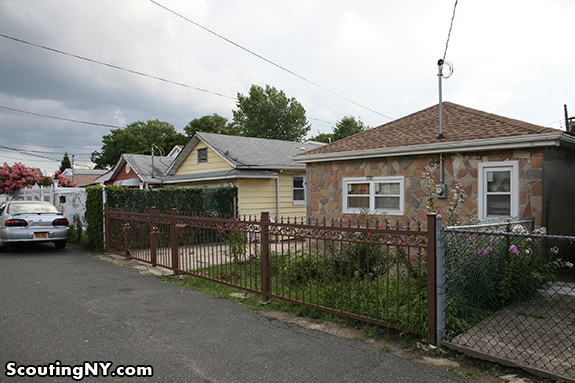
Others still have only been moderately updated.
Driving around Harding Park feels like an otherworldly experience for more reasons than its narrow streets and miniature houses. For one thing, this is the first time I’ve ever seen a family of roosters walking openly on a New York City road.
Here’s another, hanging out on a fence.
Then, every twenty minutes or so, a plane heading into LaGuardia will fly over at ridiculously low altitudes.
And some of the neighbors have some pretty quirky items in their yards.
But please don’t take “strange” to be a negative in any sense. There’s something extremely charming about the Cape Cod-like feel of Harding Park.
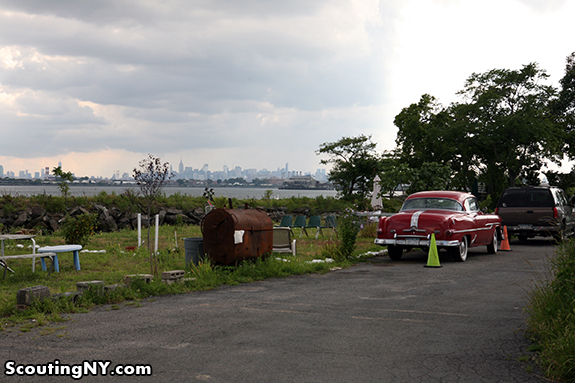
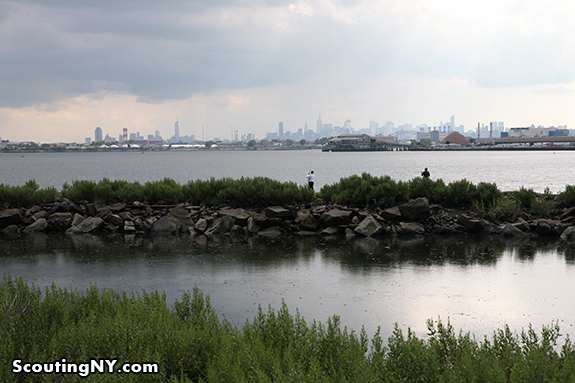
The perimeter road offers gorgeous views of Manhattan…
…and some prime fishing spots as well.
Finally, as if to cap the unexpectedness of it all off, as I was heading out, I passed what I can only assume is the only desert in New York City.
Is this redesigned plan of the city’s subway system easier to navigate?
The perfect transit map is a slippery creature. A scale model of the world is terrible for navigation, with twisty intersecting train lines and stations names competing with their neighbors. A hybrid, hewing to reality but cleaning up irregularities--like the current, standard NYC subway map--risks being deceptive. “A map that pretends to be geographical but isn’t quite correct is potentially misleading, implying to people greater distances than exist in reality,” says Max Roberts, a map critic and mapmaker based in the U.K. “The more geographical a map looks, the more people might be fooled into taking its distortions literally.”
Finally, at the other end of the spectrum, are maps that are less “map” than diagram--representing the network rather than reality. This is what Roberts had in mind with his “circle maps” for New York City and London: diagrams that transform cities’ transit systems into a series of concentric circles.
In his book on subway maps, Roberts scores alternatives based on simplicity, coherence, balance, harmony, and avoiding geographic distortion. “These circles maps score poorly for simplicity: the line trajectories have lots of twists and turns, but score well for coherence: the city is forced into an unprecedented level of organization,” says Roberts. It’s clearly geographically distorted, but for this map that’s not part of the goal (and the current subway map is the same way, Manhattan is not actually that wide when compared to Brooklyn). “It’s not trying to show where the network is,” says Roberts. “It’s trying to show how the elements of the network relate to each other.”
For comparison, the current map.
As those network relations become clear through better organization, and map becomes diagram, it may actually become easier to navigate. Later this year, Roberts plans to put this prospect to the real-world test with usability studies.
But regardless of navigational usability, there’s a practical value to being new and eye-catching. “If a map is striking and people like to look at it, then this is half the battle won for a designer,” says Roberts. “It makes people less likely to give up and ask a computer for help instead.”
The domain of visually striking transit maps is much bigger than circles. Once you throw out geography, the world is your design palette. “My ambition is to create a periodic table of maps, different cities and different rules, systematically exploring each city for each of the possibilities,” says Roberts. “That way, I hope to understand how network structure and design rules interact to create a usable (or less usable map).” For New York City alone, he envisions creating at least 10 different maps.
Even among circles, the possibilities are endless, with a new map for any chosen center (not all of them useful). In the case of New York City, Roberts picked a point in the ocean, halfway between Liberty Island and Governor’s Island. “If I had chosen a center higher up (Canal Street station complex was my first hunch) then the lines in the north of Queens might have been straighter, but mid and Lower Manhattan would have been nasty,” says Roberts. “This would be a lovely project for graphic design students: give each one a different center and see what they come up with!”
Imagine if Warhol’s place was The Sausage Factory. A Berlin photographer links tubes of meat with iconic artworks.
“Everything started with The Scream,” Karsten Wegener says. While grocery shopping one day in his Berlin neighborhood, the photographer stumbled across the familiar face of distress, immortalized by Edvard Munch--now in front of him in ham. “The packaging, the shape of the ham, and the arrangement of egg, cucumber, and carrot were just perfect.”
This flash of pareidolia (the psychological phenomenon of seeing faces in random shapes) led to a larger project for Wegener. He, along with designer Silke Baltruschat and food stylist Raik Holst, represents nine iconic works (mostly paintings) in the Sausage in Art series as still lives of--you guessed it--the quintessential German bratwurst and its brethren.
“We recognized pieces of art in the different appearances of sausage and meat," Wegener tells Co.Design. "For some pictures, the appearance of the food itself was the connection to the artwork. For others it was the combination or arrangement of different foods, the packaging or the name of a dish.”
The series sausage-strings together styles and eras, from Vincent Van Gogh to Damien Hirst. Each piece shows off the kind of painstakingly specific set design that we recently saw in Wegener’s Ricetarrio: A Balanced Diet project. But the narrative arc for each sausage-y image is wildly different. Some, like a hot dog translation of Jeff Koons’s Poodle, are softballs (meatballs?). But others, such as the interpretations of Albrecht Dürer’s Young Hare, offer a grisly, more metaphorical take on the museum-caliber pieces.
Sausage in Art is designed to get you thinking--perhaps about the beauty of the everyday or the ubiquity of commercial supermarket goods, or maybe about the life cycle of animal to hot dog. Or maybe about grilling more this summer. Or maybe it’s just worth a laugh. Or a link.
Welcome back to Camera Obscura, Curbed's series of photo essays by Nathan Kensinger. This week, as part of a series on soon-to-change neighborhoods, Kensinger visits Long Island City's new development hotbed Court Square.
[In the Court Square area of Long Island City, older industrial warehouses and businesses are rapidly being replaced by new residential towers. All photos by Nathan Kensinger]
In the past decade, the Queens neighborhood of Long Island City has been glutted with dozens of new residential towers along its waterfront. Now the redevelopment is marching inland, overtaking the Court Square area. Along Jackson Avenue, shuttered businesses are being prepared for demolition, as new luxury towers rise to take their places. Warehouses, garages, restaurants and theaters have all been closed down, making way for new buildings but leaving few amenities behind for the rapidly growing population. "It's all residential. No businesses. Whatever businesses were here, they got the money they were looking for and retired or moved away," said Greg Biel, who works at Century Rubber Supply on Jackson Avenue, a business that his father started in 1949. "As long as people can continue to move in, they'll keep building until they reach a saturation point," said Biel. "That's America, I guess."
Several major new projects are being built in the area, including four projects from Rockrose Development that will cost "almost $1 billion," according to the Daily News. Yet the contrast between old and new in this part of Long Island City is already stark. Two-story homes are overshadowed by 30-story towers. Homeless squatters live in abandoned warehouses just a block away from luxury penthouse apartments. New art galleries and cocktail lounges share the street with empty storefronts that once housed businesses from the 1930's. And even the newcomers lament the loss of small businesses in the area. "It's a shame that everything is disappearing. There's not even a hardware store," said Hugue Dufour, the chef and owner of M. Wells Dinette, which moved to MoMA PS1 in 2012. "There's no cinema, no theaters, no nothing. Only restaurants can afford the rents." Dufour is planning to open a new restaurant in an old garage that formerly housed an auto body shop. The interior of his new establishment won't pay homage to the past residents. "I don't want it to be industrial."
All along Jackson Avenue, the striking contrast between older industrial and residential buildings and the neighborhood's new towers is evident.
Greg Biel has watched the neighborhood change from the front counter of Century Rubber Supply, ever since the area was rezoned in 2001. "That's what happened?they rezoned and everyone went gaga," said Biel. "It's been going on for 5, 6 years now."
This tower across the street from Biel's business is 12 stories high. "It will be interesting to see what happens in the next five years," said Biel. "Just on this block alone they are planning over 1,000 new apartments."
Biel's neighbors on Jackson Avenue include the new See.Me Exhibition Space, a two story gallery which opened in January. Workers there say that there are no plans to tear the building down.
The gallery's old space, located in a former bank at the end of the block, is currently being demolished by Rockrose Development to make way for a 50-story, 975-unit building that will be "the tallest residential building in Queens," according to the Commercial Observer.
Rockrose is also building Linc LIC (right), a luxury residential tower with over 700 units. The building will open sometime in August, according to employees at the site.
As part of their redevelopment plans for the neighborhood, Rockrose has made an old garage across the street from the Linc building available to the restauranteurs who run the M. Wells Dinette.
Hugue Dufour, the chef and owner of M. Wells, is working on the property now. "That's going to be a steakhouse," said Dufour, while standing outside his new garage. "The neighborhood is slightly underserved when it comes to restaurants."
"There's a lot of construction in the neighborhood?it's changing a lot," said Dufour, whose new restaurant is dwarfed by the Linc building and the Citibank building. "When I first moved here 6 years ago, there was nothing around."
North of Dufour's new restaurant, many small industrial businesses have been sold off and closed down in the last few years. This empty garage sits in front of a new luxury residential tower named 27 on 27th.
27 on 27th was recently named one "of the ritziest, glitziest apartment buildings in NYC" by AM New York. Its first tenants arrived this February, according to a doorman. It contains 142 apartments.
Besides facing several abandoned buildings and empty lots, the building is also bordered by the elevated subway tracks at Queens Plaza and three construction sites. This lot located next door will soon become a 30 story residential tower.
A tower across the street from 27 on 27th is well underway, dwarfing its neighbors. These include a building that once housed the Queens Dance Center. The warehouse is now for sale.
Other closed down businesses in the neighborhood include Papa Johnny's Restaurant on Jackson Avenue, which is located next door to a shuttered hardware store.
An empty theater near Jackson Avenue at Queens Plaza once housed Roka Studios and is now for sale.
Nearby, an overgrown gas station sits at the edge of an empty lot, awaiting redevelopment plans.
This abandoned warehouse in the neighborhood has been closed down for at least 10 years, according to a neighbor. "It was a good building. Now its all dry rot. The roof is out, the floor is out."
There are no plans to demolish this warehouse yet, according to the neighbor. "It's just waiting. I hope it never comes down. Because where are all the rats gonna go?"
?Nathan Kensinger
· Nathan Kensinger [official]
· Camera Obscura archives [Curbed]
When was the last time a museum made you laugh and cry without having to take a single step in any direction? Though its entire collectionwhich includes crudely counterfeited cash, rocks from Mars, tip jars, and one of the shoes thrown at George W. Bush by an Iraqi journalist in 2008is located inside a sweltering elevator shaft in a tiny alley in Lower Manhattan, the confines of Museum's display serve to magnify the power each artifact has on you. It's a dizzying combination of art and human history viewed through the quiet nobility of our everyday ephemera, and it is awesome. [ more › ]
M. Wells, the acclaimed Long Island City restaurant that closed in the summer of 2011, will be opening a steakhouse in July.
“We’ll be opening in about a month out of a former auto body repair,” said Chef Hugue Dufour, who was flipping burgers at the LIC Flea & Food market on Sunday.
The new restaurant, to be called M. Wells Steakhouse, will be located at 43-15 Crescent Street. It will be a “meat temple,” Dufour said, adding that it will serve steaks and “European-style” cuts of meat.
He said that the restaurant will seat 80 people and he will be using part of the space to build a catamaran with the help of some friends. However, the catamaran will be a work in progress and will not be completed by the time the restaurant opens.
He said that he is also constructing a 24 sq ft. concrete trough where he will keep live trout for eating.
The focus, nevertheless, will be on meat and poultry. “It won’t be pretentious,” the Canadian native said.
M. Wells has been operating a dinette out of a MoMA PS1 (22-25 Jackson Ave.) since the fall of 2012. The dinette pays homage to the building’s former identity as a schoolhouse with communal tables.
However, the dinette’s hours are limited—open Thursday-Monday from 12- 6 pm.
“It’s a small operation and we need to make a living,” Dufour said, who operates the business with his wife. “It’s hard to live when all you can provide is lunch (given the limited hours).”
Dufour has no plans to close the dinette when he opens the restaurant.
M. Wells built a huge following in Long Island City when it operated a tin-can diner at 21-17 49th Avenue.
It closed and the owners blamed its demise on a rent increase.
Former M. Wells location, at 21-17 49th Avenue, LIC
Project Loon will use these solar-powered giant devices hovering 12 miles above the ground to beam down Internet to places where they can’t lay cable.
How do you deliver Internet access to the entire planet? The world could continue on its current course, gradually laying down the infrastructure and leaving large pieces of the planet without access (or at least access outside of a cell phone). But that could take decades. Google revealed this month that global Internet access is one of the "moonshot" programs the company is working on at the Google[x] lab, which is also working on self-driving car technology.
Project Loon’s goal is to build a ring of solar-powered, high-pressure balloons that hover 12.5 miles above the ground--twice as high as airplanes fly. The balloons deliver Internet access (at 3G-like speeds) on open-frequency radio bands. Anyone on the ground who’s in a building equipped with a special antenna can log on.
Google explains the mechanics behind a balloon-powered Internet network on its blog:
…the idea we pursued was based on freeing the balloons and letting them sail freely on the winds. All we had to do was figure out how to control their path through the sky. We’ve now found a way to do that, using just wind and solar power: we can move the balloons up or down to catch the winds we want them to travel in. That solution then led us to a new problem: how to manage a fleet of balloons sailing around the world so that each balloon is in the area you want it right when you need it. We’re solving this with some complex algorithms and lots of computing power.
Google has already begun trials around Canterbury, New Zealand, where 50 testers in the area are trying to connect to 30 balloons. Next up: pilot testing in areas that have the same latitude as New Zealand.
Cynics may say that this is just an incredibly elaborate way for Google to grow its display ad business. But in the end, who cares? The Internet provides endless opportunities for education--and for places that are struck by disaster, it would be invaluable to have a back-up Internet system available for when the traditional lines go down.
Good explanation of the 50% rule for real estate investing in multifams
As if I haven’t caused enough controversy this week (see my recent post Is it a Lie to Tell the Tenant I’m Not The Owner?) today I wanted to make a video explaining something that has caused a good deal of debate over the years here on BiggerPockets:
The 50% Rule.
In the following video, I explain what the 50% Rule is, and how you can use it to quickly estimate the cash flow you can receive from a buy and hold real estate investment.
The 50% Rule is:
Over time, 50% of your real estate investment’s income will be spent on expenses, not including the mortgage.
It’s just a simple way to determine cash flow – and something I use every single day, dozens of times.
Now, for those of you who are immediately up in arms about this “rule” – let me be the first to say it:
This is just a rule of thumb.
It’s use is not for deciding with 100% certainty if a property is going to be a worthwhile investment. For one thing, no one can ever know this 100% for sure. Secondly, I’m not going to take the time to analyze every single property that crosses my desk with my spreadsheet – like I did in my post How to Buy a Small MultiFamily Property: A Step by Step Case Study.
So the 50% rule is largely about speed and convenience, but it’s also about one more very important thing:
The 50% Rule is About Being Conservative
You see, when you normally run the numbers on a property (or when you get the pro forma numbers from a real estate agent) the expenses are FAR less than 50% of the property. However, most of these calculations don’t account for the “Oh crap, the furnace just went out” or the “Oh crap – the tenant is late again and now I have to evict.” So even if the 50% rule is “too conservative” – in my book, that’s just fine with me.
When I do an investment analysis, I always look at three expense figures:
The historical expenses – what the expenses actually were
My opinion of the expenses – my spreadsheet of what I expect the expenses to be once I buy
The 50% rule – well… just watch the video below.
Then, I simply look at the highest number and use that in my calculations, being the most conservative in my estimates as possible by being the most liberal with my expense assumptions.
I’d rather miss out on a few deals for being too conservative than buy some deals that sucks more money out of my wallet than a Tall 180 Degree Non Fat Peppermint Hot Chocolate with Whip and 1 Pump Vanilla from Starbucks.
Mmmmmm.
So why you are all watching the following 4 minute video, I’m going to head to Starbucks and get my little drink from heaven. Don’t judge me or my goofy look in the video photo below!
Thoughts? Leave your questions and comments below!
A few years ago I downloaded speed dating data from experiments conducted by Raymond Fisman, et al. (2005), which represents about 8,000 dates by 551 people. On each date, people scored each other on attractiveness, intelligence, ambition, and some other things, along with a yes or a no to seeing the other person again on a regular date.
Fisman, et al. noted gender differences in mate selection, such as: "Women put greater weight on the intelligence and the race of partner, while men respond more to physical attractiveness." And this: "Men do not value women's intelligence or ambition when it exceeds their own." Seemed like data worth checking out.
(Side note: Do people even speed date anymore?)
Three sections:
How the speed dating worked
What women and men want in a partner
Dating up the social ladder
How the speed dating rounds worked
In case you're unfamiliar with the speed dating process, here's how it works. There are two groups. Typically one group is women and the other is men. The point of it all is to match every woman with every man for a short period of time so that by the end, every one has gotten a chance to quickly know each other. The assumption is that you can learn a lot about a person in a short period of time.
In these speed dating sessions, the women stayed seated, and the men shifted each round. The pairs chatted for four minutes and then the men shifted again.
People scored each other on a 1-to-10 scale and indicated whether or not s/he wanted to date the other. So a few things can happen:
Man wants to date woman, but woman is not interested.
Woman wants to date man, but man is not interested.
Both are not interested.
Both are interested, so information is exchanged.
This also presented interesting dating styles. I won't go too in depth here, but it's fun to take a quick look.
Some people said yes to almost everyone, casting a wide net, whereas others were more stingy with their yeses. Some got a lot of yeses but only returned the favor a couple of times. Some people were really likable and ended up with a lot of mutual yeses.
For example, here are the one-way connections for the first dating session:
These are the mutual connections from the same session:
What women want vs. what men want
So what made one person more dateable than another? We can look at the pre-date surveys that asked others what they looked for in a partner and what they thought the opposite sex looked for. It was a 100-point scale, and participants were asked to divide those 100 points between attractiveness, intelligence, fun, sincerity, ambition, and shares the same interest.
The chart on the right compares the medians of what women said they want and what men said they want.
Women weighted the attributes more evenly than the men did, with intelligence on top and ambition on the bottom. In contrast, men weighted attractiveness more heavily. Ambition was also weighted lowest by the men but a few points lower, which matches the results in the paper.
There's nothing unexpected here. Although I thought sharing the same interest would be higher.
The contrast between what one group says it wants versus what the opposite thinks the other group wants is interesting. For example, women think men place attractiveness much higher in priority at the expense of intelligence and sincerity. And men think women actually weigh attractiveness more highly, also at the expense of intelligence and sincerity.
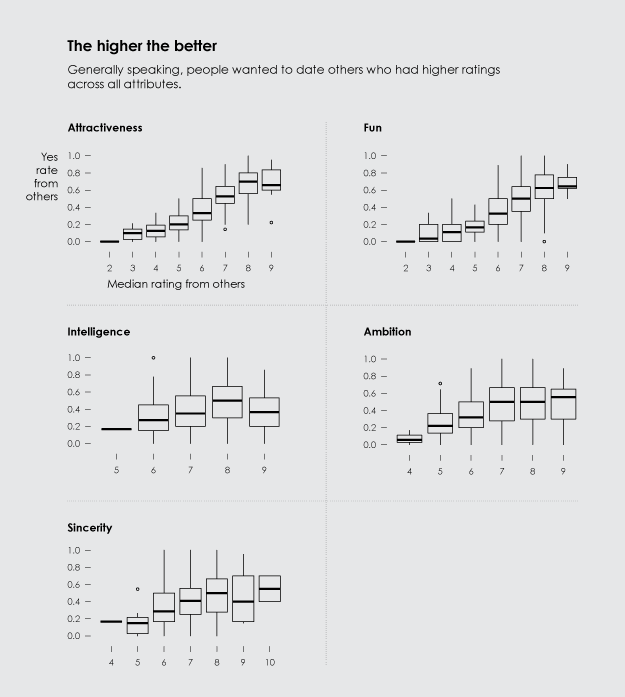
This is just what people said they wanted though. Is that what they actually wanted? As you might expect, the higher the ratings for all attributes, the higher the yes rate (the proportion of daters who said yes at the end of a round).
The trend is most clear with attractiveness and fun, which are easier to judge than the others in four minutes. The yes rates kind of level off for ambition and sincerity towards the higher ratings.
Look at intelligence though. There was a slight drop in yes rate when someone was rated with a 9 in intelligence by their peers. I suspect this was partially due to the relatively low number of people with this rating (only 26 of them), and the small group of high-intelligence people collectively had lower attractiveness ratings.
The trends are roughly the same when you split the results by gender. Although I would have expected women's yes rates towards men to continue upward given women ranked intelligence higher than attractiveness. Instead, that's how the men's yes rates towards women look.
Dating up (and down) the social ladder
We see this in sitcoms and movies all the time. There's a character who is less (traditionally) attractive interested in someone more attractive. His or her friend who is a genius in relationships launches into a speech about how said character has no chance because he or she can't date up the social ladder. Some might say s/he is undateable.
How does this "rule" pan out?
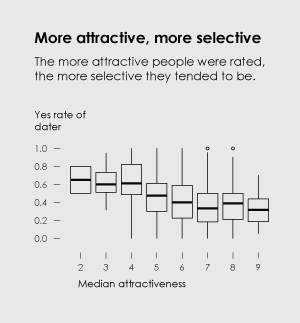
In the previous distributions, people got higher yes rates when they were rated more attractive by their partners. Flip this around. The more attractive someone was, the more selective they got. It's like the dating pool decreased for an individual the more attractive s/he was.
This doesn't stop people from trying though.
We only really see the change in selectivity with attractiveness (and kind of with fun) when you look at the full distributions, but we see a little more when we compare dating up versus dating down. As shown below, for every attribute, the median yes rate was higher when daters scored their partners higher than themselves. For example, the yes rate was much higher given a dater thought the partner was more fun than her or him.
Again, the difference is most obvious with attractiveness and fun, which makes sense because those are easier to judge in four minutes. You can see the wider spread between the points. However, there's still a spread for intelligence, sincerity, and ambition.
You can also see that the women were more selective than men. It's hard to say from the data alone if this is because the women were actually more choosy, because the men were less desirable, or a little bit of both. I'm guessing it's the women being more selective.
If we go back to the pre-date survey, the actual dating for men is similar to what they said was desirable in a partner. For women though, the speed date results are fairly different from their pre-survey responses. Again though, I suspect the difference comes from the challenge of judging a person in four minutes. Or not. If the former, speed dating seems better suited for men, and if the latter, well, I'm not sure what to do with that, so I'll let the ladies weigh in.
Back to the original findings in the paper. It looks like women do put slightly more weight on intelligence than men, and men put slightly more weight on attractiveness. However, the chart above seems to go against the results that men don't value women's intelligence or ambition when it exceeds their own. If it didn't matter, the yes rates for less ambitious and more ambitious would be near equal. I'll have to dig a little more into the discrepancy, but I suspect we might see something closer to the results when you control for the other variables (mainly attractiveness).
In any case, it's definitely not a straightforward decision.
Another way to look at it is that we don't see any yes rates of zero in the chart above. At the end of the day, even if you are less attractive, less intelligent, less fun, and less ambitious, just remember: There's still a chance.
The Fourchu Lobster (labeled the Rolls Royce of Lobster) has returned to New York City. The rare creatures—which hail from the freezing cold waters off the tiny village of Fourchu on Cape Breton Island in Nova Scotia—are rich and delicious, and have been compared to delicacies like Wagyu Beef and Italian White Truffles. [ more › ]
Hello - ah yes, closet real estate is scarce in the city.
I actually installed some rolling shelves in my closet. These are usually used for kitchen pantries, but I found that they would be perfect for me to take advantage of every inch of closet depth and height to store my shoes.
It isn’t very hard to DIY really; you just need to make sure that you take the measurements very carefully before ordering the rolling shelves.
Here’s a pictures that can give you an idea of how these work:
And a gratuitous extra couple of shots of my favorite shoes in the world: Vass ;)
I've noticed these, but not in this detail. Pretty cool.
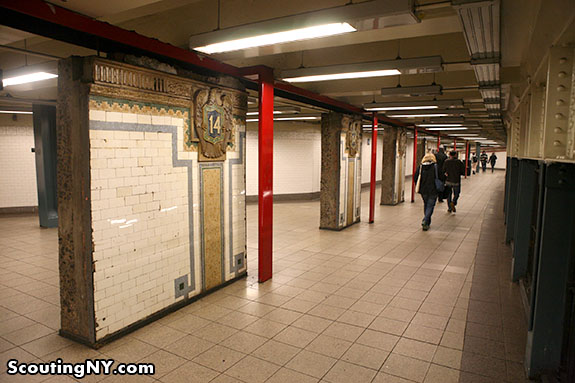
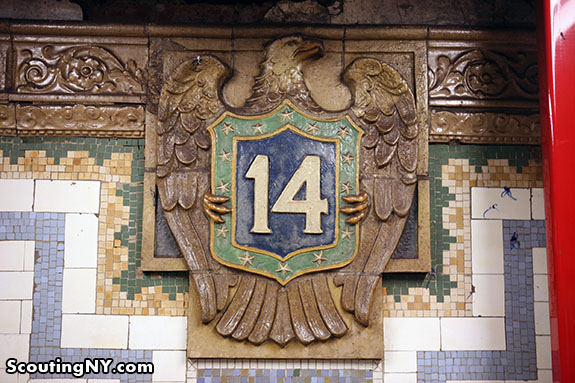
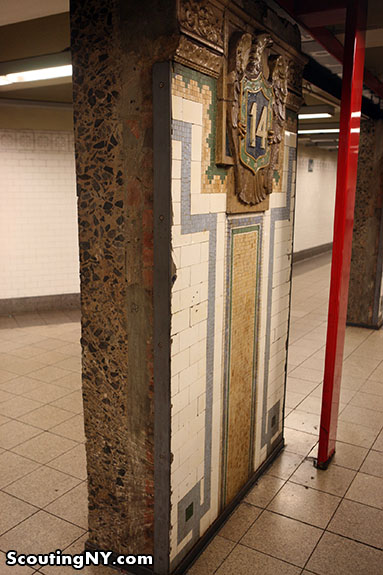
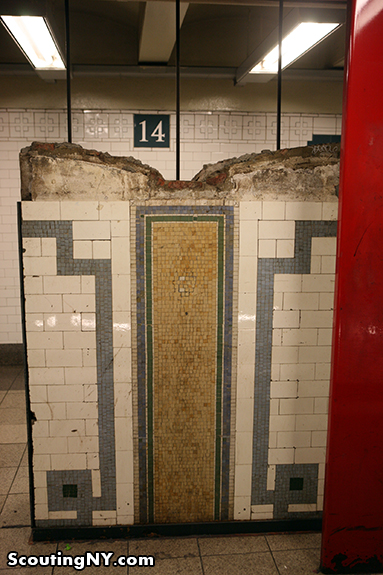
A couple of weeks ago, I was taking pictures in Union Square for my article on The Warriors filming locations, when I happened to pass by these six crumbling columns on the mezzanine level near the 4-5-6 train.
Now, I’ve walked by these things a zillion times in my travels across New York City, but it suddenly occurred to me that I’d never actually stopped to look at them.
I’ve always just assumed them to be remnants from the old Union Square station, one of New York City’s original 28 subway stations, and it turns out that this is correct.
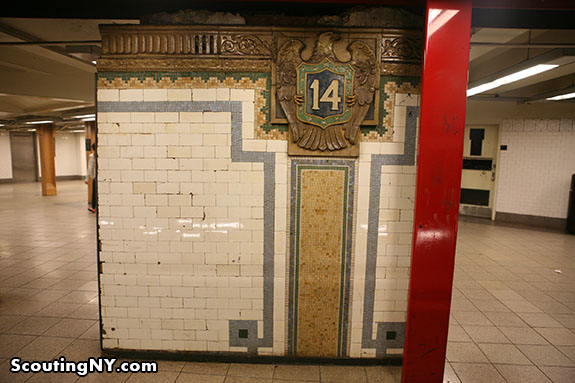
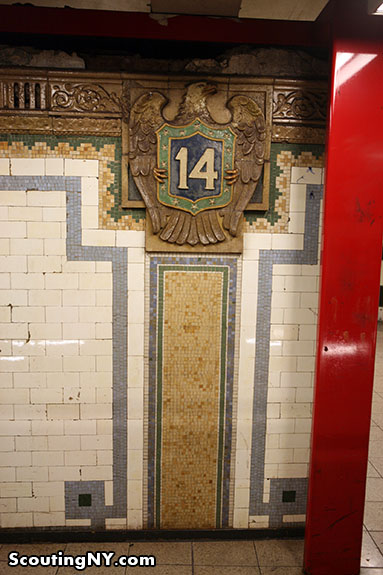
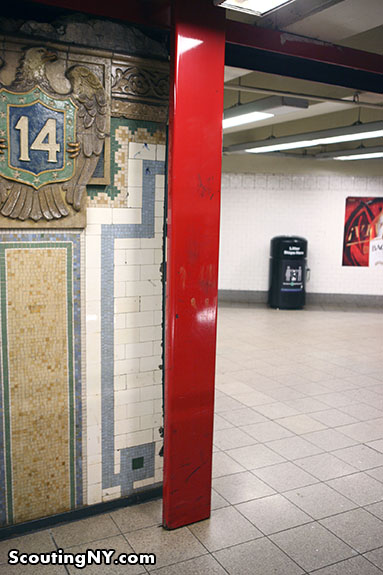
Dating to the Union Square of 1904, the station’s walls were once adorned with these fantastic terracotta eagles, along with some beautiful mosaic work:
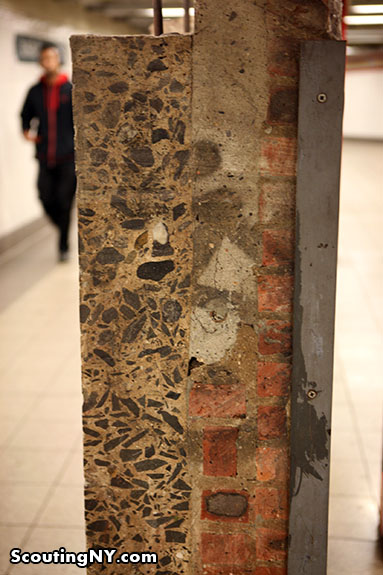
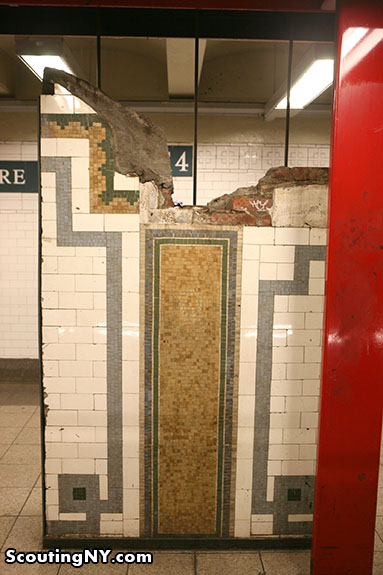
The walls were uncovered and saved during one of Union Square’s many renovations, and installed as an art installation by Mary Miss in 1998. I love how the innards of the walls have been included in the display…
…showing a sort of geological strata of a New York City subway station wall:
The wall portions are arranged so that they steadily deterioriate…
…perhaps signifying the death of the old Union Square?
Now, here’s the thing – I’ve always known about these wall portions.
What I didn’t know about are the red frames.
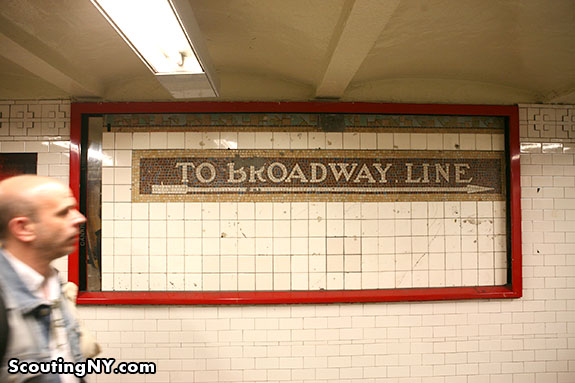
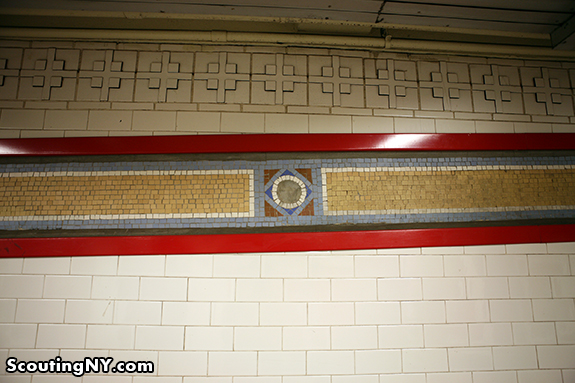
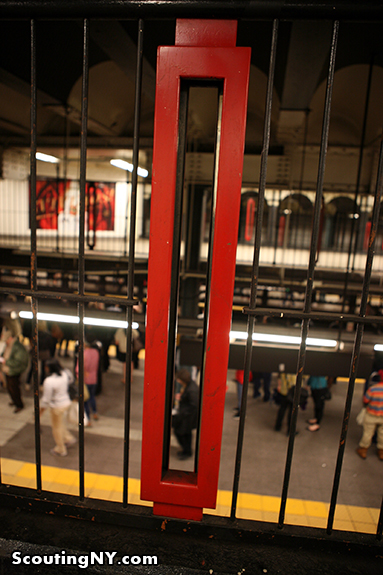
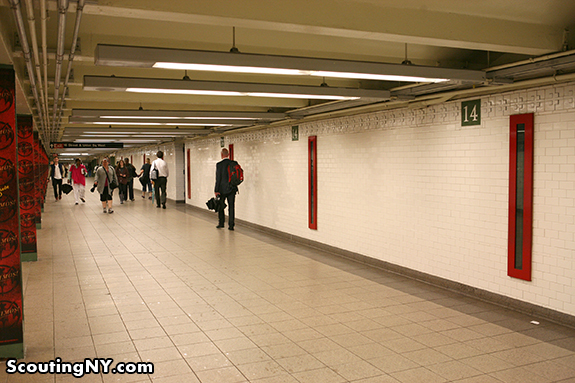
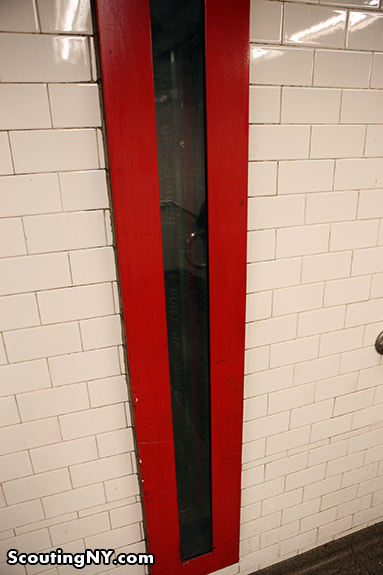
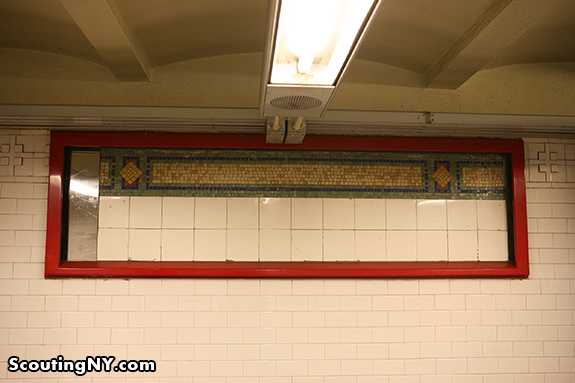
See, as it turns out, the wall portions are just a small part of Miss’s installation. In fact, there are dozens of relics from the old Union Square strewn all over the station, all of which can be found enclosed by a red frame. And once you start looking for them, you’ll suddenly see them everywhere.
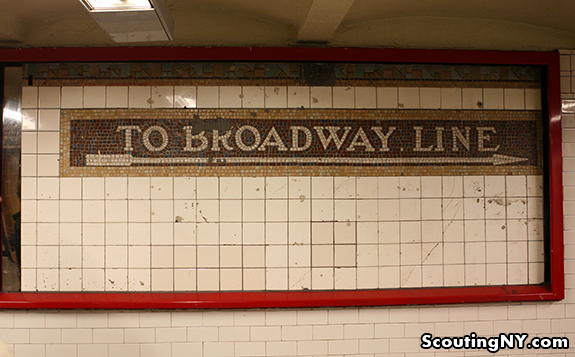
For example, I never thought twice about this Broadway Line directional arrow – but looking at it again, I now realize how incongruous its design is to the rest of the station. In addition to the mosaic Broadway text, note how the surrounding white tiling is in the old square style, while an additional mosaic strip runs along the top – all stopping abruptly at the red border.
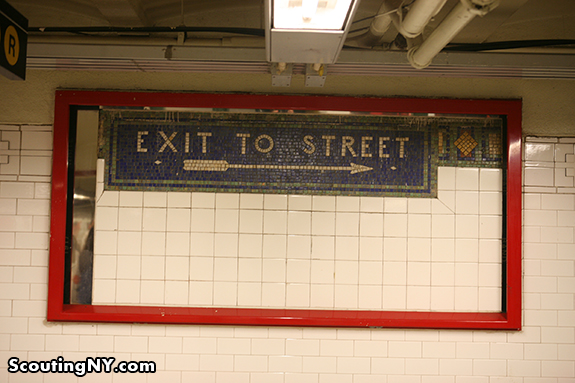
Ditto this great old “Exit To Street sign.” Again, I’ve noticed it countless times before, but never stopped to consider how out of place what’s within the red frame is to what’s outside. In a way, each is literally like a window into the past:
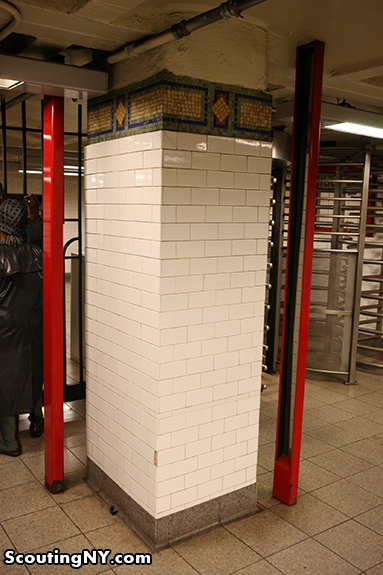
Wandering around Union Square, I started finding red frames in more places than just the walls. Here’s a column you’d never think twice above – but wait! There are those red frames, and between them, we find a white-tiled column topped by a tiled stripe, an all but extinct creature in modern Union Square:
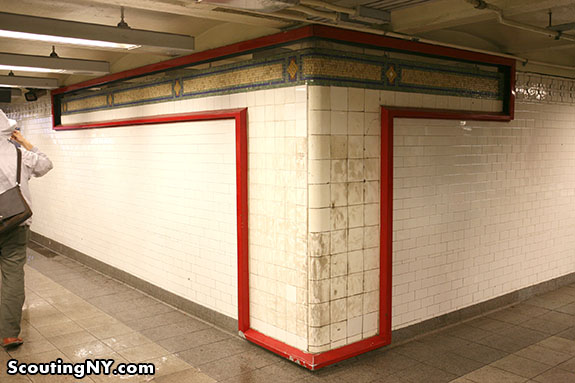
Here’s another red frame, one of my favorites, again highlighting not only the mosaic stripe along the top, but the difference in the old white wall tiling vs. new (and is that authentic old-fashioned New York City grime?):
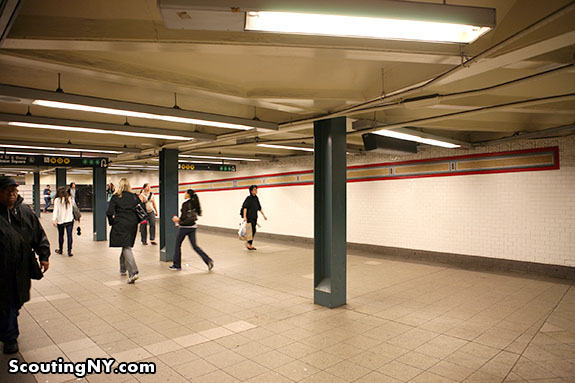
Along one of the connecting passages…
…a very long mosaic stretches the entire run:
It gets even crazier, as the red frames turn up in the most unexpected of places. Here’s one looking down from the mezzanine above the 4-5-6 train…
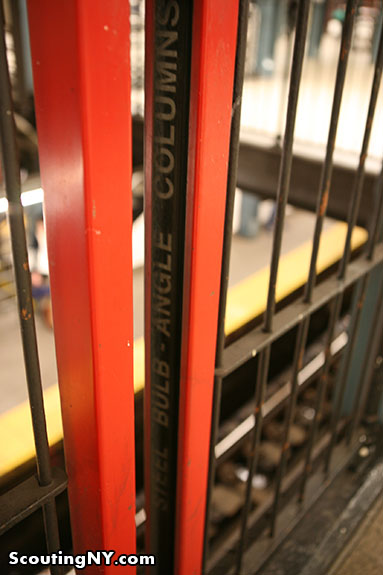
…and if you look in at the right angle, you’ll see it’s highlighting “steel-bulb angle columns.”
In the corridor running north toward the 17th Street entrance, there are a bunch of slits cut into the wall…
…which offer a slightly more abstract window into Union Square:
For example, a tangle of telephone wiring:
I’m sure this is old news to a lot of you. But for anyone else like myself who’s been to Union Square a million times and never stopped to look, learning about the red frames is an eye-opening experience, as you suddenly realize you’re basically surrounded by a museum exhibit for the Union Square of old.
Ha, and all this time, I just assumed there was a fire extinguisher on the other side of that red frame.
In what might be the greatest plug of all time for the forgotten borough, Game of Thrones author Geroge R.R. Martin revealed that Staten Island played a role in his creation of Westeros, one of the central locations in his ridiculously popular books. The author appeared on Conan last Wednesday to discuss his novels and the series—especially last week's dramatic episode—when the host asked him how he came up with such a rich, fantastical world when he'd grown up in Bayonne, New Jersey. Martin then united fanboys and guidos forever, explaining: [ more › ]
Most construction projects aren’t much to look at. New York’s new 2nd Avenue under-construction subway line is an exception--a truly impressive monument to human ingenuity.
Contemporary construction projects may lack the glamour of old New York’s Gilded Age--like, for example, the original construction of the train lines that eventually became the subway system. But images of some of the work being done right this moment under bustling streets on Manhattan’s East Side should still make you pause for appreciation.
Photos released by the MTA of construction for a new station at 72nd Street for the new 2nd Avenue line reveal a bustling hive of machinery, tarps, and scaffolding. No wonder that the line, which has been part of the system’s growth plan in some form since 1929, is expected to cost more than $17 billion.
While ground was officially broken in 2007, the system’s complicated route, zigzagging for 8.5 miles around preexisting tunnels, cables, and other infrastructure, will finally bring service to the island’s subway-free Eastern edge, supposedly by 2016. The line will also bring a new letter to the alphabet of train lines: T.
PriceSpotter is Curbed's asking price guessing game. We provide you with some details and pictures from an apartment listing, and you take a crack at the price in the comments. Tomorrow we reveal the answer. And hey, no cheating!
What/Where: A 2BR/2BA condo in Hunters Point Square feet: 957 Maintenance: $647
The Skinny: This home is located on the top floor of a 12-story building, and it features a 27-foot-long balcony with views of Manhattan. Inside, there is a master bedroom with an en suite bathroom, plus another bedroom and full bath. It has large windows, hardwood floors, a Bosch washer/dryer, and an open kitchen with a Fisher & Paykel stainless steel appliances and granite countertops. Building amenities include a gym, residents' lounge, garden, and doorman. Additional storage and indoor parking are available at an extra cost. How much do you think the seller is asking?
Interesting. From the article: This turns out to be a serious question: Because the bark of a trained canine suggests the presence of an illegal drug, it can be used to justify searches and acquire warrants. But when that drug stops being illegal, that alert could lose its reliability--and its legal status.
Police in states where marijuana is legal are facing an interesting conundrum: How to tell their dogs that pot is okay, but to keep smelling for the heroin and cocaine.
Here’s a side-effect of marijuana legalization I hadn’t thought of: What do you do with the drug-sniffing dogs?
This turns out to be a serious question: Because the bark of a trained canine suggests the presence of an illegal drug, it can be used to justify searches and acquire warrants. But when that drug stops being illegal, that alert could lose its reliability--and its legal status.
The Associated Press reports that Washington--which joined Colorado in legalizing recreational marijuana use last November--is changing its standards for training dogs to ignore the whiff of weed.
Police say that having a K-9 unit that doesn’t alert to pot will lessen challenges to obtaining search warrants because the dog won’t be pointing out possible legal amounts of the drug. Traditionally, dogs are trained to alert on the smell of marijuana, heroin, crack cocaine, methamphetamine and cocaine. They can’t tell which one it is or how much of each there is.
You can see Dusty, the first pot-ignoring police dog of Bremerton, in this video by the local Fox News affiliate.
But what about the old dogs with outmoded skills? Contrary to the cliché, some departments are trying to teach their old dogs new tricks.
[Fred Helfers of the Pacific Northwest Detection Dog Association] is helping departments who want to go through the “extinction” training, which he said is a common method to change what substances dogs alert to. It takes about an initial 30 days plus every day reinforcements to modify the dog’s behavior.
Helfers and others point out that even in legal-weed Washington, there are still marijuana crimes--from growing to selling to possessing over an ounce--and recommend dogs continue to sniff it out. Illustration: Kelly Rakowski/Co.Exist
There’s no good, standardized way for users to reclaim their data from all these devices, combine it, and see a holistic picture of their personal data all in one place. Now, several ambitious hackers are looking to liberate this data from its corporate silos and give it back to users to remix and manage on their own.
Ivy, this is a pretty good deal. Imagine how much pernil we could put in here!
The New York State Office of Mental Health is auctioning off a morgue refrigerator on eBay and the bid is right now at the low, low price of $10. It's a steal.
[ more › ]
In Vertical Horizon, photographer Romain Jacquet-Lagrèze shows just how tiny humans are in the context of the Chinese city’s cluttered skyline.
The built environment of Hong Kong, a true megalopolis, never ceases to provide inspiration and creative fodder to photographers. We recently covered Architecture of Density, the photo project by Michael Wolf showing the mesmerizing patterns created by Hong Kong’s concrete apartment blocks.
The latest book project to cross our paths is Vertical Horizon, a collection of photographs of Hong Kong’s skyscrapers by French photographer and graphic artist Romain Jacquet-Lagrèze. The buildings that appear in the book’s pages include gleaming office towers as well as shabbier residential units, but what unites the images is the photographer’s perspective, staring up at the man-made structures from the ground, with glimpses of the sky in the background.
In Jacquet-Lagrèze’s words, "Vertical Horizon is a reminder on how we are nothing more than a bee in the big beehive, chipping in our bit into the greater realm of society. The angles in which I make the shots emphasize the large scale of the structures around us in contrast to our own little being. Being conscious of our humble condition, to me, is the first step to move to our full potential and reach for our vertical horizon."
Hong Kong is home to two of the world’s top twenty tallest buildings. Jacquet-Lagrèze adds that the project’s name serves as "an obvious reminder of our competitive Hong Kong skyline where each building is trying to be the tallest, the boldest, the most beautiful, the youngest, the oldest or the most famous."
Unlike other cities, life in Hong Kong is truly vertical, "where elevators leading us to restaurants, shops, home or our working place should deserve their own street names." Vertical Horizons is an attempt to capture that sense of man reaching for the sky.
Cicada lust may have given way to The Great Cronut Craze of 2013 over the last week, but we haven't forgotten about our hump-happy insect overlords. Billions of them emerged across the East Coast recently after 17 years dormancy underground, biding their time until high top fades made a comeback. We may not have gotten to see many outside of Staten Island, but who needs to see things in real life when there are gorgeous documentaries to watch! [ more › ]
Yes, sitting is killing you. We told you it was killing you! And we even offered helpful advice about how you can sneak in a few extra minutes of exercise on your commute to work. But this isn't what we meant. Now you've twisted our words all around. And what happened to your shirt? Are you the reason we are all inhaling human skin underground? In short, please refrain from using the subway escalator as your StairMaster: [ more › ]

9())











 When was the last time a museum made you laugh and cry without having to take a single step in any direction? Though its entire collectionwhich includes crudely counterfeited cash, rocks from Mars, tip jars, and one of the






 So what made one person more dateable than another? We can look at the pre-date surveys that asked others what they looked for in a partner and what they thought the opposite sex looked for. It was a 100-point scale, and participants were asked to divide those 100 points between attractiveness, intelligence, fun, sincerity, ambition, and shares the same interest.
 In the previous distributions, people got higher yes rates when they were rated more attractive by their partners. Flip this around. The more attractive someone was, the more selective they got. It's like the dating pool decreased for an individual the more attractive s/he was.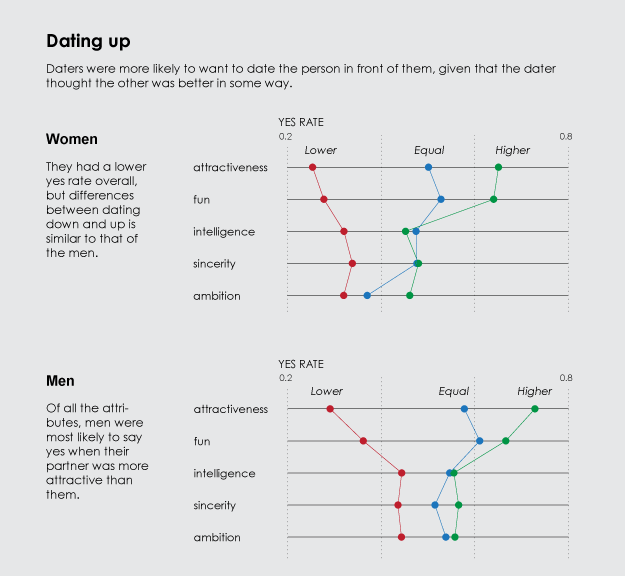
 The Fourchu Lobster (labeled




 In what might be the greatest plug of all time for the forgotten borough, Game of Thrones author Geroge R.R. Martin revealed that Staten Island played a role in his creation of Westeros, one of the central locations in his ridiculously popular books. The author appeared on Conan last Wednesday to discuss his novels and the series—especially


 The New York State Office of Mental Health is auctioning off a morgue refrigerator on eBay and the bid is right now at the low, low price of $10. It's a steal.
[
The New York State Office of Mental Health is auctioning off a morgue refrigerator on eBay and the bid is right now at the low, low price of $10. It's a steal.
[ 


 Yes, sitting is killing you.