Shared posts

21 May 15:03

A Gorgeous Manhattan Loft

by Nadia
Lindsaycdavison

i want it

It's been a while since I showed you pictures of a gorgeous home ...

Cela fait un bout de temps que je ne vous ai pas montré de photos d'un superbe intérieur...

Preciously Me blog : Manhattan Loft
So I catch up today with this loft located in Manhattan. It's not surprising that this apartment is stunning since it belongs to a couple of 'people of the profession' so to speak. He is an architect and she is interior designer. They created here the perfect interior for their family, a home both modern and elegant. My favorite, the beautiful living room fireplace!

Alors je me rattrape aujourd'hui avec ce loft situé à Manhattan. Pas étonnant que cet appartement soit magnifique puisqu'il appartient à un couple de gens du métier si je puis dire. Lui, est architecte et elle, décoratrice d'intérieur. Ils ont créé ici l'intérieur idéal pour leur famille, un foyer à la fois moderne et élégant. Mon coup de coeur, la splendide cheminée du salon !

Preciously Me blog : Manhattan Loft
I love the bathroom with this big round mirror!

J'aime la salle de bain avec ce grand miroir rond !

Preciously Me blog : Manhattan Loft
This loft even has a beautiful outdoor space in the heart of Manhattan ... What a dream! Really Gorgeous is not it?

Ce loft possède même un bel espace extérieur en plein coeur de Manhattan... Le rêve ! Vraiment superbe n'est-ce pas ?

Nadia


Images DHD Architecture Design via Sukio

21 May 05:12

fatmanatee: pc america strikes again, when will it stop strike...

by nickdivers
Lindsaycdavison

i agree ...this was weird


fatmanatee:

pc america strikes again, when will it stop

strike back against haters and bloggers

21 May 05:11

why is no one talking about pat sajak’s twitter background

by nickdivers


why is no one talking about pat sajak’s twitter background

20 May 00:01

Savory Mortadella, Garlic, and Caper Puff-Pastry Waffle

by Daniel Gritzer
Lindsaycdavison

for our waffle makers...

20140513-puff-pastry-waffle-mortadella.jpg

Inspired by garlic bread, this mortadella-stuffed puff-pastry waffle is loaded with flavor. [Photograph: Robyn Lee]

We've been going crazy with puff-pastry waffles this week, and today's waffle is no less nuts.

It started as a simple garlic-bread flavor, but when I was out shopping, I kept thinking of new things to add. First, This sure would be tastier with parsley mixed in. Then, This sure would be better if I also added some capers. Finally, This really would be boss if I threw some mortadella in there.

After all that, it didn't really make sense to keep calling this a garlic-bread puff-pastry waffle.

To make it, I followed the same basic method Kenji used for his pizza waffle (this one, not this one), rolling out the puff pastry to a roughly 16-inch square, then topping it with the filling, rolling it up, and twisting it into a spiral.

For a visual guide on forming the waffles, check out Kenji's original article, which provides step-by-step photos.

Get the Recipe!
16 May 18:06

Free outdoor movies in NYC for summer 2014

by Jason Kottke

NYCgo has an extensive list of all free movie screenings happening around NYC this summer. Most of them are outdoors. Some highlights:

June 22: Coming to America, Habana Outpost
July 9: Jurassic Park, Museum of Jewish Heritage
July 30: The Princess Bride, Riverside Park
July 31: The Hunt for Red October, flight deck of the Intrepid
August 6: The Big Lebowski, McCarren Park
August 8: Groundhog Day, Hudson River Park at Pier 46

Someone should make an iCal/Google Calendar calendar of these screenings.

Update: Tim made a calendar of all the free movie events. (thx, tim!)

Update: And here's a Twitter account you can follow for summer movie reminders: @nycsummerfilms. (via frank)

Tags: movies   NYC
16 May 15:46

Console Wars

by Jason Kottke

From Grantland, an excerpt from Console Wars, a new book by Blake J. Harris about the video game console battles of the 1990s between Nintendo and Sega. The excerpt is about the rise of Nintendo.

And just like that, the North American videogame industry ground to a halt. Hardware companies (like Atari) went bankrupt, software companies (like Sega) were sold for pennies on the dollar, and retailers (like Sears) vowed never to go into the business again. Meanwhile, Nintendo quietly glided through the bloody waters on a gorilla-shaped raft. The continuing cash flow from Donkey Kong enabled Arakawa, Stone, Judy, and Lincoln to dream of a new world order, one where NOA miraculously resurrected the industry and Nintendo reigned supreme. Not now, perhaps, but one day soon.

Harris is also working on a documentary based on the book. And Sony is making a "feature-film" adaptation of the book as well. Cool!

Update: Medium has another excerpt from the book.

Maybe this Sonic could sell in Japan, but in America he belonged inside a nightmare.

Kalinske got off the phone with Nakayama and took the fax to Madeline Schroeder's office. "I have good news and I have scary news." He handed her the artwork. "What do you think?"

She looked it over. "I think we'll be the first videogame company whose core demographic is goths."

"Nakayama loves it."

"Of course he does," she said. "It's so weirdly Japanese. I'm surprised the girlfriend's boobs aren't hanging out of a schoolgirl outfit."

Despite his sour mood, Kalinske laughed. "Her name is Madonna."

Schroeder put the drawing on the desk. After a long silent inspection they both spoke at the same time, saying the exact same thing: "Can you fix it?"

Tags: Blake Harris   books   Console Wars   Nintendo   Sega   video games
16 May 15:32

Wise Words From Jean Cocteau

by Maxwell Tielman
Lindsaycdavison

@rudy? not sure what that says about the soul of your apt

jeancocteauquote


16 May 11:43

Create Your Own "Bike Airbnb" With This New Networked Lock

by Sydney Brownstone

With the Skylock, you could share your bike with a friend or even a stranger by granting them access through an app.

Over the last few years, American cities have started to take cyclist infrastructure seriously. New ridership has bloomed in some unlikely places. That's also coincided with the exponential growth of self-tracking wearables, like the Fitbit. Velo Labs, a startup founded by two former aerospace engineers, proposes adding some of those features to a stainless steel lock--one that can alert the owner to attempted theft, identify itself by GPS on a map, notify friends in the event of a crash, and unlock itself based on the proximity of the owner.

Read Full Story


16 May 11:41

Animated Map Visualizes NYC's Raging Workaholism

by Carey Dunne

The city that never sleeps inhales and exhales like a single giant organism, in this animated map of hourly populations in Manhattan--at work and home.

A new animated map, Breathing City, beautifully visualizes the cliché of New York as the "city that never sleeps." The map displays a 24-hour cycle of Manhattan's populations at work and home. The slightly lung-shaped island appears to breathe as it reflects hourly changes, flaring orange (people working) midday, and cooling into an electric blue (people at home) at night. Times Square and the Financial District, where workers on the graveyard shift are most densely concentrated, glow around the clock.

Read Full Story


16 May 11:36

Jupiter's Great Red Spot is shrinking

by Jason Kottke

Jupiter Spot Shrinking

Jupiter's Great Red Spot is becoming more of a Medium Red Spot. The gas giant's signature beauty mark was recently measured by the Hubble as spanning 10,250 miles across its widest point, down from a high of 25,500 miles across.

Historic observations as far back as the late 1800s [2] gauged this turbulent spot to span about 41 000 kilometres at its widest point -- wide enough to fit three Earths comfortably side by side. In 1979 and 1980 the NASA Voyager fly-bys measured the spot at a shrunken 23 335 kilometres across. Now, Hubble has spied this feature to be smaller than ever before.

"Recent Hubble Space Telescope observations confirm that the spot is now just under 16 500 kilometres across, the smallest diameter we've ever measured," said Amy Simon of NASA's Goddard Space Flight Center in Maryland, USA.

Amateur observations starting in 2012 revealed a noticeable increase in the spot's shrinkage rate. The spot's "waistline" is getting smaller by just under 1000 kilometres per year. The cause of this shrinkage is not yet known.

Tags: astronomy   Jupiter   physics   science   space
16 May 02:09

Ayam Jeruk (Grilled Chicken and Toasted Coconut Salad)

by Bitten Word
Lindsaycdavison

NOM NOM NOM

Saveur (May 2014)

Grilled Chicken and Toasted Coconut Salad

Wanderlust.

We have it.

Bad. 

We blame Saveur, but we want to pass it on to you, too. 

You see, the May issue of Saveur is a bit different from typical editions of the magazine. Titled "A Day of Cooking," it progresses through a 24-hour day following stories of food and people from around the world.

At 6:21 a.m., someone is ordering brioche French toast from room service in L.A.'s Bel-Air Hotel. By 3:34 p.m., we're having afternoon snacks in Abu Dhabi. Later, in the wee hours of the morning, we're in a chef's home making quesadillas as a late night meal. It's an inventive, fresh issue, and each story has a corresponding recipe. 

We fell in love at first read in Indonesia (2:00 p.m.), with the description of Ayam Jeruk, "an addictive warm salad of grilled shredded chicken and roasted coconut tinged a bright yellow from fresh turmeric roots."

If we can't jaunt to Bali, we were at least going to give this recipe a shot. 

But just like we're substituting this dish for a trip to the Indonesian isles, we had to make a lot of substitutions in this recipe itself. 

As you might expect from an exotic recipe, there are several ingredients here that you ain't gonna find at Harris Teeter. In fact, we couldn't find the following ingredients at either Harris Teeter, Whole Foods or the tiny Japanese market in our neighborhood that we always kind of forget is very specifically Japanese and not, in fact, a pan-Asian superstore:

  • Asian shallots
  • Balinese long pepper
  • Candlenuts
  • Galangal
  • Indonesian shrimp paste
  • a Holland chile

On top of that, we accidentally bought two young coconuts at Whole Foods instead of two regular ol' mature coconuts, thinking they'd be interchangeable. They're not. Young coconut meat is more of a soft gel consistency and doesn't shred or toast. So we ran out and bought a bag of unsweetened shredded coconut. (One exotic item we did have on hand was fresh Kaffir lime leaves, thanks to a little potted Kaffir lime tree we bought a few years ago and have somehow kept alive. We love having it -- the leaves add a wonderful flavor to stir-frys and other dishes. And they make a killer martini when muddled with gin.)

Anyway, after all those substitutions, is it even worth making this Ayam Jeruk?

Yes! Yes! A thousand times yes.

Okay, so here's what all we subbed in:

  • Asian shallots -- we used regular shallots, as per the recipe's suggestion
  • Balinese long pepper -- we omitted, as per the recipe
  • Candlenuts -- macadamias, again as per the recipe
  • Galangal -- we used fresh ginger in double the amount, which we read online makes a passable substitution, even though it's definitely not the same
  • Indonesian shrimp paste -- we used 1 tablespoon fish sauce in place of 1/2 teaspoon shrimp paste
  • a Holland chile -- we used two jalapenos
  • fresh coconut -- roughly a cup of dried unsweetened coconut
  • red Thai chiles -- we couldn't find fresh, but we reanimated some dried Thai bird eye chiles

In the end, did we even really make authentic Ayam Jeruk? Eh, maybe not. But what we made was something in the general neighborhood of Ayam Jeruk. 

And more importantly, it was crazy -- crazy -- good.

The prep here isn't hard, but it's a little laborious. There are a lot of steps. And a lot of equipment, including a grill, 2 skillets, a spice grinder and a food processor. If you don't have all those items, should you give up? No way! Substitute! One word of warning: we dirtied just about every dish in our kitchen making this recipe, so it's not a simple endeavor. 

Anyway, the reason for the somewhat-involved prep is that you're building a lot of layers of intense flavor. Like the Malaysian Beef Rendang we made a couple years ago, this Ayam Jeruk has so much complexity of flavor going on. It's savory, sweet, sour, salty, bitter, funky and spicy -- all in one bite.

In fact, we found it quite addictive. (Do yourself a major favor and double this recipe. The leftovers are remarkably good.)

Our advice to you? Do whatever you need to assemble the ingredients you need for this. You can probably find them at H Mart or another large Asian grocery store, and you could certainly source them online. Or make substitutions like we did.

But you definitely ought to try this. We loved it.

It's not quite as good as going to Bali for the real thing. But it's an excellent substitution. 


Print


Ayam Jeruk (Grilled Chicken and Toasted Coconut Salad)
Saveur (May 2014)
Subscribe to Saveur

Grilled-chicken-and-toasted-coconut-salad_i165_800x1200
(This photo: Ingalls Photography for Saveur)

Serves 2 to 4

NOTES FROM ZACH AND CLAY OF THE BITTEN WORD

We made a number of substitutions in this recipe. See above for the full list of what we substituted. 


INGREDIENTS

1½ lb. bone-in, skin-on chicken breasts
2¾ cups canola oil
1 coconut, cracked open and shredded
12 small Asian shallots or 4 medium regular shallots, thinly sliced
¼ tsp. freshly grated nutmeg
¼ tsp. whole black peppercorns
¼ tsp. whole coriander
1 Balinese long pepper (optional)
2 tsp. ground turmeric
16 cloves garlic, peeled
3 candlenuts or unsalted macadamia nuts
1 (½") piece galangal, peeled and thinly sliced
⅔ cup cup coconut milk, preferably UHT from a carton
½ tsp. Indonesian shrimp paste
5 small red Thai chiles, stemmed
1 Holland chile, stemmed
Kosher salt, to taste
4 fresh or frozen Kaffir lime leaves, thinly sliced
Juice of 1 lime
Cooked white rice, for serving

DIRECTIONS

Heat a charcoal grill or set a gas grill to medium-high. (Alternatively, heat a cast-iron grill pan over medium-high.) Rub chicken with 2 tbsp. oil; grill, flipping once, until cooked through, 40–45 minutes. Let cool, then discard bones; finely shred meat and skin. Transfer to a bowl.

Heat a 12" nonstick skillet over medium-high heat. Cook coconut until golden, 12–15 minutes; add to chicken. Add 2 cups oil and ¾ of the shallots to pan; heat over medium. Cook, stirring occasionally, until shallots are golden brown and crisp, 10–12 minutes. Using a slotted spoon, transfer shallots to paper towels to drain; set aside. Discard oil.

Grind nutmeg, peppercorns, coriander, and long pepper, if using, in a spice grinder into a powder; transfer to a small food processor. Add turmeric, half the garlic, the candlenuts, galangal, and 3 tbsp. water; purée into a smooth paste. Add 2 tbsp. oil to pan; heat over medium-high. Cook paste until fragrant, 2–3 minutes. Transfer to bowl with chicken. Add coconut milk to pan; simmer over medium heat until reduced by half, 2 minutes. Let cool; add to chicken mixture.

Add remaining shallots and garlic, the shrimp paste, chiles, and salt to food processor; purée into a smooth paste. Heat remaining oil in a 10″ skillet over medium-high heat; fry paste until golden, 6–7 minutes. Let cool; add to chicken mixture. Stir in half the fried shallots, the lime leaves, and juice; garnish with remaining shallots. Serve with rice.


Print
16 May 01:16

Quesadillas al Pastor

by Kevin Lynch
Quesadillas al Pastor with Pineapple Salsa and Pineapple Guacamole
When I made the tacos al pastor the other week I made a double batch to ensure leftovers for use in quesadillas! The tacos al pastor taste great when filled with fresh ingredients like pineapple, onions and cilantro so they can only get better in quesadilla form with plenty of ooey gooey melted cheese! These quesadillas al pastor are filled with the al pastor pork, pineapple pieces, pineapple salsa, diced onions, cilantro and of course lots and lots of cheese before they are grilled until the cheese has melted and the tortillas a crispy and golden brown. Even if you do not make the tacos al pastor it's definitely well worth making the al pastor pork for these tasty quesadillas!

Read the recipe »
15 May 15:41

Tips for Talking About Money (Calmly!) With Your Significant Other

by Shifrah Combiths
Lindsaycdavison

what's the correlation to divorce around cleanings? Seems to be the only thing andrew and I fight about :)

Pin it button

Money is one of the top reasons couples fight. In fact, a study by Jeffrey Dew published in The Interdisciplinary Journal of Applied Family Studies found that "financial disagreements are stronger predictors of divorce relative to other common marital disagreements." Yikes. No matter your relationship status, here are some ways to avoid altercations over money.

READ MORE »

15 May 11:18

Future Green Homes Will Have Plants in the Walls — Design News

by Tara Bellucci
Pin it button

Future homes may literally be greener. Researchers at Purdue University have created a Biowall that lives inside a home's heating, ventilation, and air conditioning system. The stacked plants filter out airborne toxins, and could even help reduce energy costs.

READ MORE »

15 May 11:06

Happy 125th!

by Eye Prefer Paris

jill jonnes eiffels tower anniversary the paris blogToday marks the 125th Anniversary of the unveiling of the Eiffel Tower. To commemorate the occasion, Jill Jonnes, author of the marvelously entertaining book about the building of the Eiffel Tower, Eiffel’s Tower, has written this post about her two favorite 19th century Eiffel Tower moments.

All of elite Paris sent up a howl when rich railroad bridge engineer Gustave Eiffel actually began erecting what was to be the tallest structure in the world. Eiffel had won the competition to erect a 900-foot-tall tower as the fabulous centerpiece of the 1889 Exposition Universelle.

eiffels tower book cover jill jonnes the paris blogIn a still-famous letter published in Le Temps, forty-seven of the nation’s cultural heavyweights compared the Tower (only its foundation had yet been completed but everyone had seen the drawings) to a “black and gigantic factory chimney, crushing [all] beneath its barbarous mass…When foreigners visit our Exposition they will cry out in astonishment, ‘Is it this horror that the French have created to give us an idea of their vaunted taste?’” To drive home the utter hideousness of “this odious column of bolted metal,” these cultural lions declared in their letter, “even commercial America would not have” this “Eiffel Tower.”

eiffel tower workersIn truth, Americans were deeply jealous and unhappy, for an Old World nation was about to take the technological lead: Eiffel’s Tower would displace the 550-foot-tall Washington Monument as the world’s tallest building.

Deliciously, by the time the Eiffel Tower was finished, Gustave and his creation were world famous and all those snooty Parisian painters and writers had fallen in love with it, and could think of no better place to see and be seen than its fashionable first-platform bistros. Except for Guy de Maupassant, who never came round.

>more

14 May 16:07

Crisp, Flaky, Pepperoni Pizza Puff Pastry Waffles (Are Awesome)

by J. Kenji López-Alt
Lindsaycdavison

ok, it's official. I think I want a waffle maker.

20140510-puff-pastry-pizza-pepperoni-waffle-15.jpg

The waffle iron, some puff pastry, and basic pizza ingredients are all you need to make this delicious snack. [Photographs: J. Kenji Lopez-Alt]

There are times when the fates seem to be working their hardest to bring you down, and it's often at these moments that some of the most gloriously delicious inspiration strikes. Last week, things were not going well for Daniel and me at Serious Eats World Headquarters. After a weekend of brainstorming ideas for a new recipe series, we started the week with trying and failing to pull together a great recipe for stuffed French toast, and finished it up by tag-teaming and tag-failing at perfecting a recipe for pull-apart bread.

One of these days, we're going to publish a post titled "Recipes Ideas That Look Great on Pinterest but Suck in Real Life." I've already got the list in my head.

Fortunately, things took an upturn when we combined the package of puff pastry we had in the freezer with the pizza toppings we had in the fridge, and set them on the waffle iron we keep on the shelf. While the waffle iron might not quite be the magic bullet that turns absolutely everything delicious, it's certainly had a high proportion of success in the crispy-on-the-outside, gooey-and-cheesy-in-the-middle department.

20140510-puff-pastry-pizza-pepperoni-waffle-18.jpg

A few months back, we discovered that the waffle iron is the best way to reheat pizza. Today, we're gonna show you that it's equally good at producing ready-in-15-minute pepperoni pizza-flavored treats as well, and all it takes are four ingredients: frozen puff pastry, pizza sauce, pepperoni, and shredded mozzarella cheese.

Step 1: Roll out Puff Pastry

20140510-puff-pastry-pizza-pepperoni-waffle-02.jpg

Start by rolling out a sheet of thawed puff pastry into a 16- by 16-inch rectangle (it's ok to be rough here, don't bother breaking out the yardstick!)

Step 2: Spread Sauce

20140510-puff-pastry-pizza-pepperoni-waffle-03.jpg

Next up, spread some pizza sauce on there. I used canned tomatoes that I drained carefully and crushed with a pinch of salt, but you can use store-bought sauce or try making up a batch of my New York-Style Pizza Sauce if you're the kind of person who prefers bells and whistles. Make sure to leave a one-inch border all around so that you can seal the puff pastry later on.

Step 3: Spread the Pepperoni

20140510-puff-pastry-pizza-pepperoni-waffle-04.jpg

Spread out a fine layer of pepperoni over the surface. You can use pre-sliced pepperoni, but I prefer to cut my own off of a stick (this was Boar's Head, one of the winners of our taste test).

Step 4: Spread the Cheese

20140510-puff-pastry-pizza-pepperoni-waffle-05.jpg

Next up, I add a layer of shredded mozzarella. Our taste test favorite is Polly-O, but any full-fat, low-moisture mozzarella will do. Just make sure to grate it fresh—pre-grated cheese comes coated in starch that can affect its melting qualities.

Step 5: Start Rolling

20140510-puff-pastry-pizza-pepperoni-waffle-07.jpg

Here's where the fun part comes in. You could just fold the darn thing over and slap it into the waffle iron to make a two-sided, pepperoni-and-cheese-in-the-middle pocket, but what we're gonna do will end up creating dozens of interspersed layers of cheese, pastry, pepperoni, and sauce.

The secret is to take a cue from Chinese scallion pancakes. Rather than simply forming a disk, we start by rolling the ingredients up tight like a jelly roll.

Step 6: Seal the Seam

20140510-puff-pastry-pizza-pepperoni-waffle-08.jpg

Seal the seam with your fingertips to ensure that the fillings don't leak (at least, not too much).

Step 7: Spiral It!

20140510-puff-pastry-pizza-pepperoni-waffle-09.jpg

Here's the real trick. Now, I've tried forming these puff pastry spirals into waffle-able shapes in a variety of ways, from slicing them into disks and flattening them, to simply folding and pinching like an empanada, to laminating them like a croissant. This is the simplest method to get plenty of flaky layers without any difficult rolling or folding.

Take that rolled-up tube, and spin it into a spiral shape, sealing the trailing edge against the outside of the spiral. We now have a perfectly circular shape that has all of the original layers built into the puff pastry, multiplied by three or four times with the rolling process.

Step 8: Waffle It.

20140510-puff-pastry-pizza-pepperoni-waffle-10.jpg

Shove the whole thing into a preheated Belgian waffle iron. If you've stuffed yours as full as ours, you'll have a tough time keeping the lid shut, but do your best.

Step 9: Wait For It...

20140510-puff-pastry-pizza-pepperoni-waffle-11.jpg

Peek in on the waffle periodically. You want it to be a deep, golden brown on both sides, with crispy, near-blackened bits of cheese around the edges. There are few things worse than gummy puff pastry, so make sure that your waffle hits at least, oh, 190°F or so before calling it.

And yes, you'll want to use an instant-read thermometer here.

Step 10: Done!

20140510-puff-pastry-pizza-pepperoni-waffle-13.jpg

It looks a little dark, but trust me here. We're going for flavor, not Pinterest clicks, which means you want to take a cue from Buddy's in Detroit and get that cheese nice and dark.

Step 11: De-Iron It

20140510-puff-pastry-pizza-pepperoni-waffle-14.jpg

Is de-iron a word? If deplane and defenestrate count, I think de-iron should as well.

If your cheese is properly crisped, it should have leaked a bit around the edges and will lift off in a single lacy edge that sticks to the waffle, not the iron.

Step 12: Cut and Serve

20140510-puff-pastry-pizza-pepperoni-waffle-16.jpg

Cut the waffle into wedges with a knife and serve it with more sauce on the side for dipping.

Step 13: EAT

20140510-puff-pastry-pizza-pepperoni-waffle-17.jpg

And let the pulling, flaking, burning-of-fingers, and chowing down begin.

Get the Recipe!
14 May 14:25

belle

by Katie Rose
Lindsaycdavison

i would like to see this...

Have you guys heard about the new movie, Belle?  I hadn't heard much about it until my friend Tiffany showed me the trailer and it looks so good! I'm a huge fan of period pieces and this one is even inspired by a true story.


It's in New York and LA theaters now and opens this Friday everywhere.  Sounds like the perfect rainy-day activity.

-Katie-

14 May 13:52

Please Stop Ideating

by Tom Agan
Lindsaycdavison

I could have written this article. I'm so sick of ideation sessions. ugh.

Sorry, CPG problems :)

Surely it makes sense that the more ideas we have, the better our innovation track record will be. Not true, it turns out.

Firms that hold ideation sessions − those in which a group guided by outside consultants generate ideas for new products and services − generate little additional revenue from new offerings compared to those that don’t. That was a finding of a study of consumer-package-goods companies that I led.

How could this be? Aren’t more ideas better?

Actually, coming up with an idea turns out to be relatively easy; refining a concept until it becomes an economic success is the hard part. Consider this example: The first known claim of inventing a hand-held mobile phone was made in 1906. Yet it took another 70 years of development before one that actually worked was produced.

In fact, most companies have an abundance of ideas. At one firm with a particularly dismal record of innovation, about 800 new product ideas sat frozen at the corporate level.

As a chief marketing officer of an iconic groundbreaking brand once told me, “The hard part of innovation isn’t coming up with an idea; rather it’s picking the right one to develop.”

When working with groups at organizations that face big challenges and enormous pressure to innovate, I tell them, “I’m very certain one of you in this room has the right answer. The problem is the 200 wrong answers also in the room.”

Let’s face it, ideation is fun. It’s a taste of freedom away from the constraints of an everyday job, and it can feel pretty exhilarating. And yet an ideation-fest invariably creates an illusion of generating new ideas that’s followed by disappointment when it becomes clear that none are actually being developed.

Someone will always claim they participated in an ideation session that produced an incredible new breakthrough. But even when true, a few examples of success from the multitude of ill-considered sessions conducted annually around the world hardly constitute an impressive track record justifying the time and money invested.

And it gets worse. Not only might an ideation session fail to improve innovation, it can actually impede the process. Many times I’ve witnessed leadership teams leaving these sessions confused by all the additional new product ideas they need to consider.

Does all this mean ideation sessions are worthless? Not when they have the right focus. Ideation sessions that shift the focus away from creating new ideas to capturing all existing ideas, clarifying, and then prioritizing them enables the organization to begin the critically important task of deciding upon the few powerful ideas they need to develop.

When there are many ideas on the table, how do you prioritize?

It’s time to apply what you’ve learned in the past to develop criteria for whether or not to invest in a given idea in the future. Research shows that learning from past mistakes and successes has, by far, the biggest impact on increasing revenue from new products. For instance, perhaps over the years you’ve discovered that for a new product to flourish, a highly influential customer must commit in advance to incorporate it into its own products. So that becomes a primary consideration in deciding which new products to pursue.

The key is implementing a formal and mandatory review of all successful and unsuccessful new products or services to capture everything learned. Then use this to develop and refine explicit criteria that are religiously followed when selecting the ones to develop and launch.

So think twice before holding that next ideation session. By digging a little deeper you’ll realize that the session will likely produce little of value if its focus is mostly on generating new ideas. Instead, focus your innovation efforts on what will pay off in the long run and relentlessly refine an idea until it becomes the equivalent of the next handheld mobile phone.

14 May 13:50

Erin's Modern Loft — House Tour

by Kim Lucian
Lindsaycdavison

@asd for living room inspiration

Pin it button

Name: Erin of Apartment 34
Location: Mission/Potrero Hill , San Francisco CA
Size: 900 square feet
Years lived in: 1.5 years

Anyone who follows Erin's lifestyle blog Apartment 34 will know that her style is synonymous with clean lines and tasteful restraint, with a touch of glam and global influence. Her loft follows suit with beautiful bones, and airy style and refined textures, with perfectly styled accessories bringing things up a notch or two.

READ MORE »

14 May 12:57

How College Experiences Shape Adult Lives, According to Gallup

by The Daily Stat
Lindsaycdavison

"being extremely active in extra curricular activtiies and orgs..." AKA drinking shaped my life!!! :) thanks fun friends

High levels of well-being and engagement with work in adulthood are linked to 6 experiences in college, according to Gallup: having at least one professor who generated excitement about learning; feeling that professors cared about students as people; being encouraged by a mentor to pursue goals and dreams; working on a project that took a semester or longer to complete; having an internship or job that allowed for the application of ideas learned in the classroom; and being extremely active in extracurricular activities and organizations. Although few people report having had all six experiences, those who had the first three are 2.3 times more likely to be engaged at work and 1.9 times more likely to experience high well-being.

14 May 11:46

club-quiche

Lindsaycdavison

getting ready for morocco?? did i send you my morocco list of restos yet?

14 May 11:44

Dracula's Castle is for Sale — Design News

by Tara Bellucci
Pin it button

Romania's Bran Castle, largely believed to be Bram Stoker's inspiration for the home of Dracula, is on the market. While the 57-room manor on 22 acres doesn't have an official listing price, investors have asked $135 million in the past.

READ MORE »

14 May 11:33

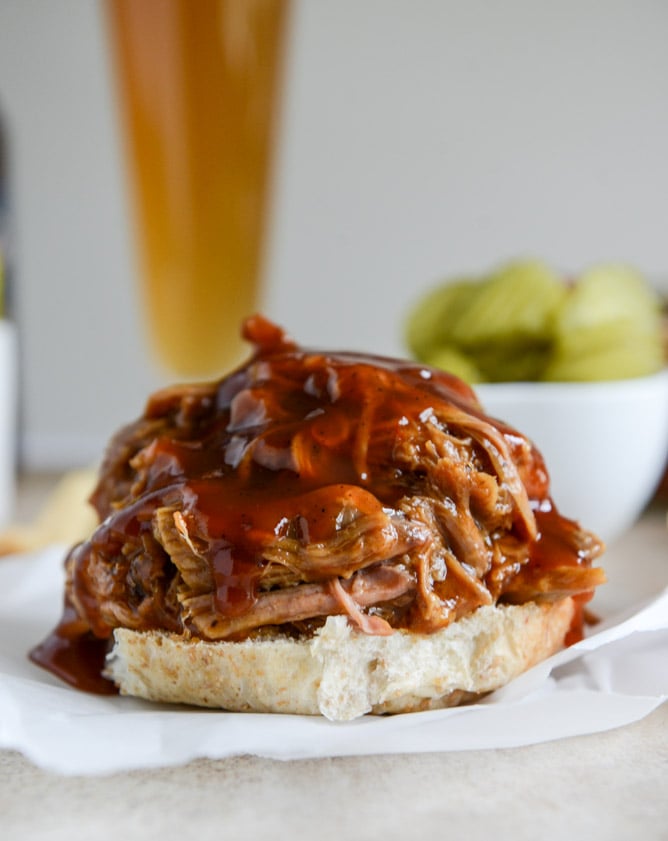
Saucy Pulled Pork Sandwiches.

by Jessica
Lindsaycdavison

@asd...I would like you to make me pulled pork please!

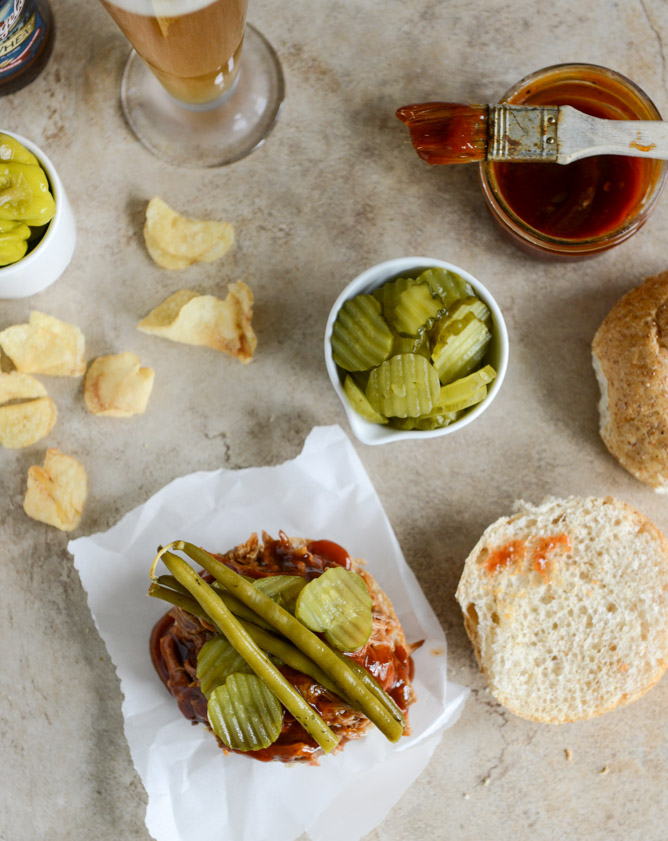
Sometimes you just need some pork. You know?

saucy pulled pork sandwiches I howsweeteats.com

I know. Oh do I know.

This recipe is so totally ME that I can barely stand it.

I know it’s a bit early to start talking Memorial Day party food, but I’m gearing up already. Of course, all I really want is a bacon cheddar hot dog and I might find another way to use that craving to trash up my site, but for now, we’re doing pork.

saucy pulled pork sandwiches I howsweeteats.com

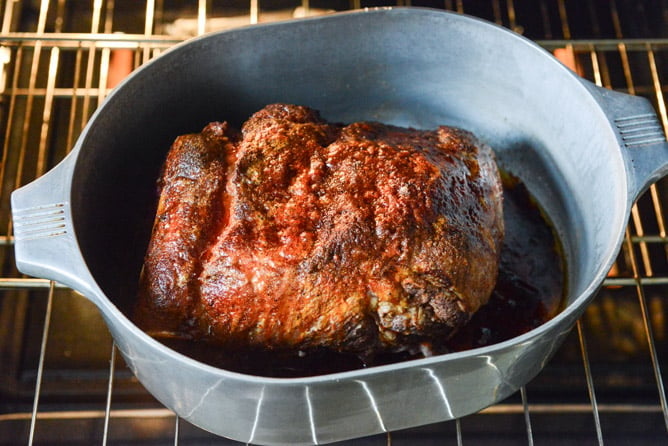
First up, this is oven roasted pork! I almost alllllllways use the crockpot but for some reason I just wasn’t feeling it. I wanted to do an oven-roasted version and I wanted to do it right. Yes, you can still totally do this in the crockpot, because what lunatic wants to have their oven on for eight hours straight? Besides me.

I seared the heck out of this gigantic pork butt right after smothering it in my favorite homemade spice rub complete with tons of brown sugar, smoked paprika, garlic, salt and chipotle chili pepper. Among other thangs.

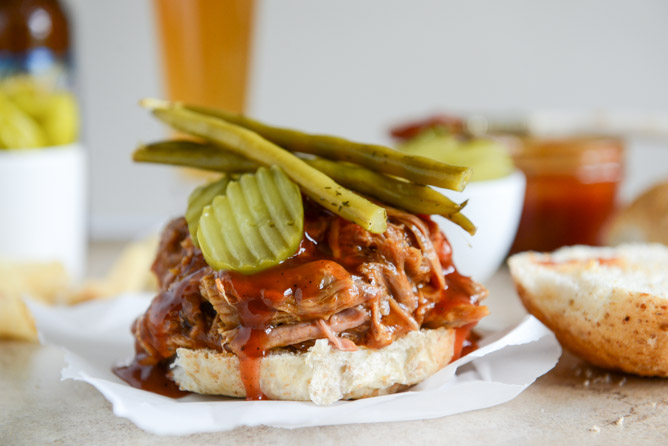
After adding a little liquid to the pot (beer, of course), this baby went to roast all day long until it was falling apart in shreds. Then I doused it in my favorite barbecue sauce (which is still bone suckin’ -  so flipping good) and let it sit and marry all together.

saucy pulled pork sandwiches I howsweeteats.com

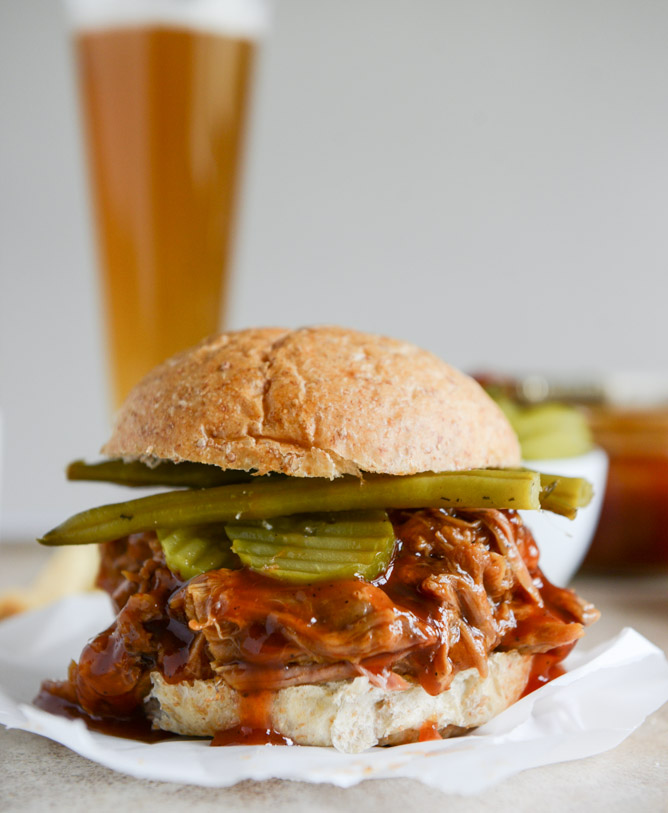
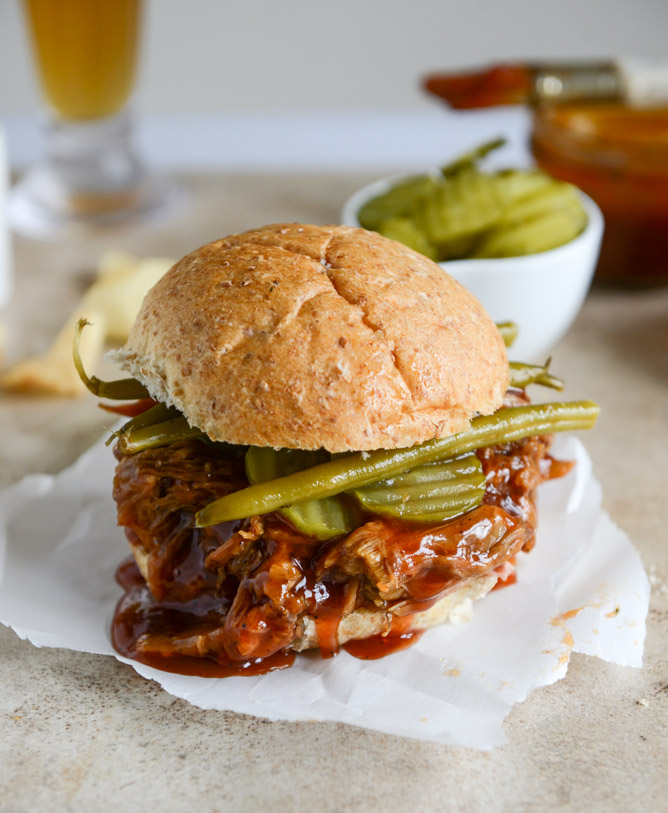
And then! We made these big honkin’ sandwiches on some of my favorite whole grain buns. With lots of pickles. I’ve had a pickle obsession since I was about four years old. I used to dip potato chips in pickle juice. I still might do that. (it’s ridiculously delicious.) Oh and it has to be dill pickles. Bread and butter pickles can go take a hike.

I prefer pickles straight up, but occasionally I like to eat them on sandwiches. On this sweet and saucy pork, they are a must. With tons of pickled green beans too. GAH. They are just way too fantastic. The combo makes me giddy. It’s my new favorite thing in the universe.

saucy pulled pork sandwiches I howsweeteats.com

My mom always serves pulled pork with freshly cut slices of provolone cheese and they melt so perfectly into they meat. I was out (depressing), but any kind of cheese is a winner in my book. Weirdly enough, I reeeeally like these sandwiches with all the pickling going on alone. I might not even need cheese. I don’t even know me anymore.

saucy pulled pork sandwiches I howsweeteats.com

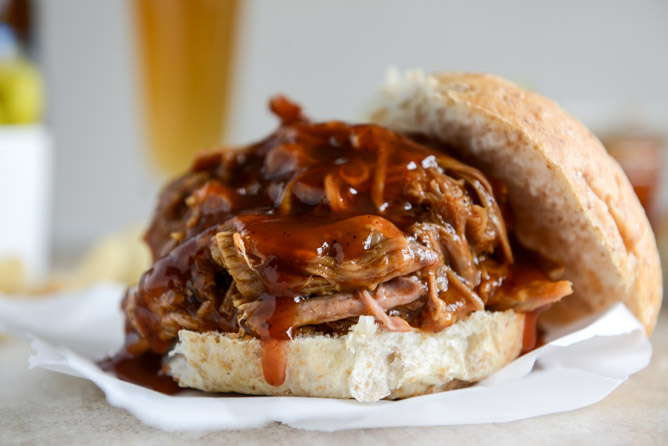
Oh hi perfection.

saucy pulled pork sandwiches I howsweeteats.com

Saucy Pulled Pork Sandwiches

Yield: serves 8+

Total Time: 8 hours

Ingredients:

1 (5 to 6 pound) pork shoulder
1/4 cup loosely packed brown sugar
1 1/2 teaspoons smoked paprika
1 teaspoon garlic powder
1 teaspoon salt
1 teaspoon black pepper
1/2 teaspoon chipotle chili powder
1/2 teaspoon onion powder
1 1/2 tablespoons canola oil
1/3 cup beer (or stock, ginger ale, another liquid)
1 to 2 cups of your favorite BBQ sauce

for serving:
your favorite buns
pickles
pickled vegetables
provolone cheese (my mom's favorite)
potato chips!

Directions:

Preheat the oven to 325 degrees F. Pat the pork shoulder completely dry with paper towels.

In a bowl, combine the brown sugar, paprika, garlic powder, salt, pepper, chili and onion powders. Stir well to mix. Take about half of the mixture and rub it on the outside of the pork.

Heat a large dutch oven over high heat and add the canola oil. Add the pork and sear on all sides, about 1 to 2 minutes per side, until golden brown. Turn off the heat. Pour the beer (or liquid of choice) into the dutch oven and place the pot, uncovered in the preheated oven. Roast for 6 to 8 hours, until the pork is falling apart and shreds easily with a fork. Shred the pork (you can discard any bones at this time) and add in half of the remaining spice mixture. Toss the pork with a cup or so of BBQ sauce, then place it back in the oven for 30 minutes.

Before serving, taste the pork and add the remaining seasoning and sauce if desired or needed. Serve!

You can definitely make this ahead of time and reheat it. You can also make it in the crockpot, as well as reheat it in the crockpot on the lowest/warm setting.

saucy pulled pork sandwiches I howsweeteats.com

Uh and I totally added those chips (salt and vinegar for life) on top of my sandwich. Only way to do. obviously.

©How Sweet It Is.

14 May 09:36

Cook the Book: 'The New Southern Table' by Brys Stephens

by Kate Williams
Lindsaycdavison

@robyn!

20140512-292526-cook-the-book-the-new-southern-table.jpg

When I went to college, I moved just about as far as I could get away from my Southern hometown. I assumed that this transition signaled my permanent departure from that culture, both physically and emotionally. Like many 18-year-olds, I was stubbornly happy to make this change and assured that nothing would draw me back in. But, despite the fact that I still live 3,000 miles away, I now feel a much greater connection to my Southern identity. Why? Food, of course.

The growing popularity of "New Southern" cuisine was a surprise to me at first; I assumed that most people outside of the Southeast would have little interest in the long-cooked collards and crumbly cornbread of my childhood church suppers. Yet this "new" way of preparing Southern foods, as many of you readers know, is about so much more than reinterpreting soul food. It's an embrace of the local crops, both historic and contemporary, and their influence on culturally significant dishes. It's this attention to ingredients that drew me back in, curious to taste and learn more.

Southern ingredients are likewise the inspiration for Charleston-based food writer Brys Stephens's cookbook, The New Southern Table. Smartly divided into chapters dedicated to particular Southern ingredients, Stephens's book demonstrates the versatility of the Southern harvest. Many of the recipes aren't even Southern, per se, as Stephens draws inspiration for his recipes from his travels around the world. However, with each bite of collards, okra, or corn, you can still get a taste of the South underneath Middle Eastern spices or Parisian herbs.

Stephens does a great job of writing recipes that are both simple and easy to execute. Most of the dishes in The New Southern Table can be prepared on a busy weeknight with very little fuss. His palate is bold and upfront; expect lots of spice, lots of fresh herbs, and lots of flavor. It's easy to see why these ingredients captured his excitement.

This week, we'll taste a cornucopia of Southern ingredients, prepared in ways familiar and unexpected. Okra and collards will each get their own Mediterranean spin: we'll toss okra with feta, tomatoes, and marjoram and then stuff the collards full of lamb and bulgur, dolma style. Later, we'll make a Middle Eastern tabouleh studded with fresh field peas and then simmer a pot of saffron chicken and rice layered with golden beets. Finally, we'll finish out the week with a Peruvian ceviche with flounder, corn, and sweet potatoes.

Win 'The New Southern Table'

Thanks to the kind folks at Fair Winds Press, we have five (5) copies of The New Southern Table to give away this week. All you need to do for a chance to win a copy is to tell us your favorite way to use Southern ingredients in the comments section below.
14 May 08:08

How Salty Should Pasta Water Be?

by Daniel Gritzer

Got a question for Serious Eats? Email your questions to AskTheFoodLab @seriouseats.com and please include your Serious Eats user name in your email. All questions will be read, though unfortunately not all can be answered.

[Art: Robyn Lee; Photograph: Daniel Gritzer]

How salty should pasta water be?

I usually just estimate when salting my pasta water, but is there a more precise amount I should be using? Just how salty should my pasta water be?

To be honest, I always estimate too. In fact, I'm not sure I've ever measured the salt in my pasta water. I just add enough to make the water taste well-seasoned, but not too salty. Since I'm being completely honest here, though, I will admit to occasionally overdoing it and ruining my pasta with too much salt, so maybe measuring is a good idea after all.

While I've sometimes over-salted my pasta water, most people I've observed make the opposite mistake, adding far too little. The result is pasta that tastes flat no matter what kind of sauce and cheese is served with it. My guess is that a lot of home cooks get freaked out at the idea of adding a lot of salt to their pot of pasta water, but they 're forgetting one important detail: Most of the salt ends up going down the drain with the pasta water. Add a tablespoon of salt to a quart of cooking water and you'll never ingest that whole tablespoon unless you chug all of the water. (To read about how much water you really need to cook pasta, check out our article here...the answer may surprise you.) Add too little, and the pasta has no hope of being properly seasoned.

But that still raises the question, how much is the right amount? The answer won't be an absolute quantity of salt, but rather a ratio of salt to water.

To find out what it is, I did some side-by-side tests. Before moving on to them, though, it's worth a small disclaimer: Salt preferences are highly personal, and what I found to be my sweet spot won't necessarily be to everyone's taste. Some people may want more salt, some less. That said, I did find a workable range that I think most people will agree on.

The Test

Setting up this test was easy: All I had to do was cook pasta in several pots of water, each with a different amount of salt, then taste them to see which I liked best. The only question was which salt percentages to try.

I flipped through several Italian cookbooks and online sources, and found a range of possibilities. Paul Bertolli, in his excellent book Cooking by Hand, suggests 5 teaspoons of salt per gallon. Mario Batali, in Molto Gusto, says to add 3 tablespoons for every 6 quarts of water. Online I saw some folks advocating for as much as 1 tablespoon salt per quart of water. But what percentages are these?

One of the difficult things about salt is that different types (kosher, fine sea, coarse sea, table) vary in terms of density, which means that a tablespoon of fine sea salt will contain a different amount of NaCl than a tablespoon of kosher salt. Even two different brands of the same type of salt, like Morton and Diamond kosher salt, will not be the same. Working with weight instead of volume is the best way to eliminate this issue for testing purposes.

Without knowing the exact types of salt Bertolli, Batali, and everyone else uses, I decided to use fine sea salt, since many Italian experts recommend it. After measuring out teaspoons of salt and weighing them on my precise jeweler's scale (and also converting the quarts and gallons into liters to make calculations easy), I found that Bertolli was suggesting roughly .8% salt by weight (or 8 grams per liter); Batali was advocating about .95% salt (9.5 grams per liter), and the one-tablespoon-per-quart folks were pointing towards a roughly 1.8% salt solution (18 grams per liter).

Now, some of you may have come across a rule-of-thumb for salting pasta water that says to make the water as salty as the sea. I've heard that one more times than I can count. How salty is the sea? On average, about 3.5% by weight. That's 35 grams of salt in a liter of water.

Knowing all of this, I decided to cook dried penne pasta in water with the following salinity levels:

  • .5% (roughly 3/4 teaspoon fine sea salt per liter)
  • 1% (roughly 1 1/2 teaspoons per liter)
  • 2% (roughly 1 tablespoon fine sea salt per liter)
  • 3% (roughly 1 1/2 tablespoons fine sea salt per liter)
  • 3.5% (roughly 2 tablespoons fine sea salt per liter)

35 grams of salt per liter, which is the average saltiness of the sea, is way too salty for cooking pasta.

Let me start by telling you one very important thing. Never, ever, ever make your pasta water as salty as the sea. That is the worst advice anyone can give. It is repulsively, inedibly salty. Frankly, 3% salt is also way too salty.

Below that, I found the other options work, depending on your salt tolerance. For me, 2% salt by weight was the top end of what's tolerable, tasting very well seasoned but also noticeably salty.

1% (right around where Bertolli and Batali were suggesting) was the sweet spot for me: seasoned without a strong salt flavor. For those who are more sensitive to salt, .5% still manages to do the trick. (I later tried a few batches below the .5% level and found them all under-seasoned.)

Conclusion

Depending on your salt tolerance, anywhere from .5% to 2% salt by weight will work, with 1% being my preferred level. 2% may work for those who love salt, but keep in mind that it is precariously close to tipping into the too-salty zone. Depending on how salty your sauce and cheese are, and also whether you use the pasta-cooking water to finish the dish (which will concentrate the salt as the water evaporates), 2% could easily put you over the line, so proceed with caution.

Here's a conversion chart to help figure out approximate volumes of salt for most of the major types:

Salt per Liter of Water
.5% Salinity 1% Salinity 2% Salinity
Fine Sea Salt 3/4 tsp 1 1/2 tsp 1 TB
Table Salt 3/4 tsp 1 1/2 tsp 1 TB
Morton Coarse Kosher 1 tsp 2 tsp 1 TB plus 1 tsp
Diamond Crystal Kosher 1 1/2 tsp 1 TB 2 TB

And remember: Under no circumstances should you salt your water as much as the ocean. That's just gross.

14 May 07:50

Control Your Smart Home With This Ring — Design News

by Tara Bellucci
Pin it button

As our homes get smarter and more connected, Nod envisions being the universal remote for all our devices and services. The stainless steel, bluetooth-connected ring is a controller for swiping, rotating, multi-finger, and 3D gestures that can operate compatible devices. Available for preorder, Nod currently works with Google Glass, Nest, Hue, GoPro, WeMo, LG TVs, Roku, and Windows 8 computers.

READ MORE »

13 May 23:20

What's the Best Way to Brew Iced Coffee?

by Daniel Gritzer

Got a question for Serious Eats? Email your questions to AskTheFoodLab @seriouseats.com and please include your Serious Eats user name in your email. All questions will be read, though unfortunately not all can be answered.

[Art: Robyn Lee; Photographs: Daniel Gritzer]

What's the best way to brew iced coffee?

I keep hearing conflicting answers about the best way to brew iced coffee. First everyone was excited about cold brew, but now I'm hearing otherwise. Should I just go back to doing it like my dad did, pouring yesterday's leftover hot coffee on ice?

For something as simple as cold coffee, you'd think there wouldn't be much debate about how to make it. Shouldn't it be as easy as brewing some coffee and then chilling it with ice? For some it really is that simple, yet for those of us who obsess about perfect iced coffee it can feel like a never-ending pursuit. As an iced-coffee lover, I have to admit that much of the iced coffee I buy, and even a lot that I make myself, tastes pretty mediocre. There's something about chilled coffee that exposes bad flavors even more than when it's hot.

In recent years, many have advocated cold-brewed coffee, in which grounds are left to steep for several hours in room temperature water before being strained out.

But there's been a backlash against that method, with proponents saying that cold water isn't capable of extracting certain desirable coffee flavors, no matter how long it steeps. Instead, they point to what's become known as the Japanese method, which involves brewing highly concentrated coffee directly onto ice, chilling it instantly while diluting it just the right amount.

With no clear resolution in sight, it seemed like it was time to put the major brewing methods to the test with a blind tasting. And, because setting up a blind side-by-side coffee tasting can be difficult without a whole lot of pro-gear, I called up my pals at Counter Culture Coffee's New York Training Center to see if they'd be willing to help.

The Tasting

Coffee pros, like my friends over at Counter Culture, tend to have pretty strongly formed opinions about what the best iced coffee method is, so, to get a broader range of tasters who hadn't yet chosen sides, I brought along my Serious Eats coworkers Tracie, Paul, and Ben.

The plan was to do a blind, silent tasting, with the coffee served in identical, unmarked glasses—no communication or talking about the coffees while the four of us picked our favorites. Once we had all made up our minds, we'd compare our impressions.

In front of us, barista (and 2013 World Brewers Cup Champion) Erin McCarthy set out four cups of black iced coffee made with the same Ethiopian bean in the following ways:


  • Pour-over brewed directly onto ice

  • Immersion (in this case the Clever coffee brewer) poured onto ice right after steeping

  • Cold-brewed coffee

  • Coffee that had been brewed hot, then left in the refrigerator overnight (I'll call this Diner Style).

20140501-iced-coffee-tasting2.jpg

The four iced coffee samples. Due to a scale snafu, the second one from left was too weak and was quickly replaced with a corrected version.

Without knowing which was which, all four of us picked the pour-over onto ice (A.K.A. Japanese style) as our favorite, with a bright, clean flavor.

20140501-iced-coffee-tasting3.jpg

Japanese-style coffee, which involves brewing pour-over coffee directly onto ice, was the unanimous winner in our blind tasting.

Tracie, Paul, and I agreed that the diner-style was our least favorite, with Tracie describing it as bitter and me calling it muddy. Ben wasn't as unhappy with it, naming the immersion method his least favorite (Paul and I weren't thrilled with that one either, finding it unpleasantly funky and metallic).

20140501-iced-coffee-tasting1.jpg

While similar in method to pour-over directly onto ice, using an immersion method (like the Clever brewer here) and then releasing it over ice once fully steeped, produced coffee that none of us were crazy about: funky and metallic.

None of us loved the cold brew, finding it weirdly sour and somewhat viscous (people often say that cold brew's advantage is that it's less acidic, but according to McCarthy, sourness is a common problem with cold-brewed coffee, possibly because the cold water tends to under-extract the beans).

Then Paul made a key observation. "The Japanese style is the one you want to drink by itself," he said. "The cold brew and diner-style make you want to put cream and sugar in them."

With that, we busted out the milk, added it to all the coffees, and tasted them again. And with that, everything shifted. With milk, the diner-style and cold brew tasted the best, whereas the Japanese style and immersion-over-ice were terrible, their bright flavors clashing with the creamy dairy, giving them the flavor of curdled milk.

Conclusion

Coffee is a tricky subject because there are so many variables at play. In this tasting, for instance, we only tried one type of bean, so it's definitely possible other beans and other roasts might have led to different results. And personal preference can't be dismissed: Some people honestly love the heavy, bitter flavor of diner-style black coffee, and there's nothing wrong with that. But within the limits of this tasting, our panel's feelings were almost totally unanimous: pour-over coffee directly onto ice and served black won our hearts, while your everyday, run-of-the-mill diner-style or cold brew is what we'd do when adding milk, or milk and sugar.

The best news is that, of all the iced-coffee brewing methods, pour-over directly onto ice is also the absolute easiest one to do. It requires no advanced planning, like cold brew and diner-style do, and it's ready right away. For a quick-and-easy guide on how to do it, check out our method here.

13 May 17:34

21 Times You Found Serenity

In Captain Malcolm Reynolds that is.

That time Malcolm Reynolds flexed his inner thighs like Beyoncé.

That time Malcolm Reynolds flexed his inner thighs like Beyoncé.

Fox

That time he looked deep into your eyes and complimented you.

That time he looked deep into your eyes and complimented you.

Fox

When Captain Reynolds made exploding seem like a good option.

When Captain Reynolds made exploding seem like a good option.

Fox

That time when he was the fastest draw.

That time when he was the fastest draw.

But only when you need him to be.

Fox


View Entire List ›

13 May 15:30

Zoë's Room for Self-Expression — My Room

by Carrie McBride

Name: Zoë (2.5)
Location: Bethesda, Maryland

While decorating Zoë's room I made an effort to mix colors (neutrals/brights), patterns and textures. I made sure to shop at a variety of differently places so nothing would look the same. Also I collected fun items and art while traveling to add diversity to her special space. The chalkboard wall allows her to express herself.

READ MORE »

13 May 12:39

Get the Right Data Scientists Asking the “Wrong” Questions

by Josh Sullivan

Wouldn’t it be great to catch the next Bernie Madoff well before his pyramid scheme collapsed around us?

That’s not a rhetorical question. Advances in the field of data science have brought us to the point where it’s reasonable to expect that an ongoing program of fraud could be identified in its early stages by people with access to the right data to cross-reference and query. And more than ever before, organizations and even ordinary citizens have access to massive data sets; they can draw on publicly available information in dispersed domains such as social media, open source projects, government statistics, and even weather patterns.

But data by itself is meaningless. It’s the skill of the data scientist that makes the difference. The best of them allow us to see the data in a set, to visualize relationships between data points, to ferret out insights, to turn expectations topsy-turvy — and ultimately, to solve previously unsolvable questions for businesses.

So, what makes an exceptional data scientist? When I first started practicing what we now call data science, I thought anyone attempting this job had to be classically trained in scientific method, statistics, math, or computer science – which was how I got into the field. I now recognize that while those are important skills, that list is by no means exclusive. Moreover, it’s possible to have all of these, and still not be able to pioneer what can be done with the numbers.

Fundamentally, what sets a great data scientist apart is fierce curiosity – it’s the X factor. You can teach the math and the analytical tools, but not the tenacity to experiment and keep working to arrive at the best question – which is virtually never the one you started out with.

And even that insanely curious data scientist, if he or she insists on working alone, won’t be able to produce the most valuable insights. Those come from high-performing teams combining individuals who are individually curious and naturally creative, but also collaborative in their approach to the art and science of experimentation. A great data science team is like a jazz quartet, where individuals are always riffing off of one another, and each takes the music to a new and unexpected place. In fact, my team actually includes a musician – and also a forestry major – as well as statisticians and computer scientists. The cognitive strengths that enable creative minds to see patterns in Bach fugues or in tree growth rates lend themselves elegantly to seeing patterns in, say, genetic code or disease markers for pharmaceutical effectiveness.

Along with my changing sense of who are the “right people” for data science, I’ve also developed an appreciation for the value of the “wrong questions.” The idea that a team should start off on the wrong foot might sound counterintuitive, but our data science team at Booz Allen spends a lot of time asking, and experimenting with, “wrong” questions in order to get to the better questions that yield solutions for clients.

This happened recently with a large financial system we studied. Our task was to find a way to detect fraud earlier, which would prevent much of it and save our client money. The fraud had manifested itself in hundreds of different ways, but there was so much of it and the fraudsters moved so quickly that we couldn’t keep up with the patterns needed to track it. Working with ten years of data and 400 variables, we were trying to model what “bad” looks like in order to detect it and stop future perpetrators.

So we changed the nature of the question we were asking. Instead of, “How do we model bad?” we asked “What if we modeled good?” And as we found out, modeling what a good person taking compliant actions looks like is a far more effective way to detect and prevent fraud. In practice, that meant going beyond individual transactions to focus on patterns of behavior by people who are, for example, very consistent in terms of where they live and what income they have. In light of “good” behavior patterns, interesting anomalies are easier to detect and take action on. And “bad” behavior and the inconsistencies associated with it (such as a Madoff-style Ponzi scheme) stand out strongly. Starting with this wrong question ultimately enabled us to identify more than $1 billion in massive, widespread fraud for our client.

As companies look to data to solve increasingly complex challenges, they will become ever more reliant on their data scientists’ curiosity, tenacity, and refusal to accept the status quo. Learning to ask – and answer – bigger questions using data science starts with an organization’s openness to starting data experiments, repeatedly asking the “wrong” questions, and learning in fast iterations. Once you begin to ask why your analytics are yielding certain results, you’ll uncover the most relevant question: “How does this help me get to the problem I want to solve?”

The true nature of data science consists of asking a series of questions – and accepting analytic failures, which ultimately lead to the bigger questions, the better insights, and the more valuable decisions. So why not ask a question like: “How can we catch the next Bernie Madoff before his pyramid scheme collapses around us?” It might not turn out to be exactly the right question, but it’s exactly the kind of challenge that gets a great data scientist thinking.