Russian Sledges
Shared posts
Sesame Street: Geometry of Circles
Russian Sledgesfeaturing the music of philip glass
Drinking the Bottom Shelf: Is $10 Exclusiv Vodka As Good as Grey Goose?
Russian Sledges'I'd never heard of Exclusiv until their publicist emailed me a couple weeks ago to announce that this up and coming import focuses on quality and value rather than flash and packaging, which allows Exclusiv to be "on par with competition like Grey Goose and Ketel One." She called Exclusiv one of the "highest quality vodkas on the market" and noted that it won Double Gold in the 2012 San Francisco World Spirits Competition.'
1. this is what every press release for every vodka says
2. the world spirits competition is obligated to award medals even if everything in a given category blows

I got a flu shot the other day, even though I am a paragon of health and I have very little contact with the short and sneezy subset of humanity that spreads disease via finger paint snot art and sociopathic disregard for personal space. I'm not a kindergarten teacher, an emergency room nurse, or any other sort of virus magnet, but I still got flu-proofed the other day because Bottom Shelf research director Emily told me to, and I do what I'm told when all it requires is a 5-minute pit stop on the way to the ham store.
Even though I'm not likely to catch the flu and I try to limit my exposure to needles and bureaucracy, I didn't mind filling out a couple of forms and getting shot in the arm, because I try to do my part for herd immunity. And, like I said, Emily told me to, and I figured I should listen to her because she is definitely my wife and possibly a doctor.
I'm not entirely certain what Emily does all day. I know she works at a hospital, and she's not the janitor or the accountant, but I don't think she's a doctor—or at least not a doctor-doctor—either. She went to grad school for a hundred years and she wears those doctor sweatpants to work sometimes, which would seem to argue in favor of physician-hood, but then that doesn't explain why my Lexus is short a couple wheels and says Schwinn down the side. Beats me. All I know is she works at a hospital with her buddy Jessica.
Jessica went to our wedding, where she met our friend Alex. Emily and I usually aren't big on arranging romantic matches, because we're selfish and because most of our friends are either picky or undateable, but we thought Jessica and Alex might make a nice team because they both have the good sense to like us and liquor. They are now happily drinking together several nights a week. Jessica favors tequila, as do most honest women, while Alex is more of a Jameson kind of fellow. But he'll drink high-end vodka in his Red Bull from time to time, and he's from Russia, and this is a story about vodka, so let's take this opportunity to address Exclusiv, a newish wheat vodka from Moldova.
It turns out Moldova doesn't even border Russian (Romania and Ukraine), but I don't have any Moldovan friends I do have a deadline, so we're sticking with the Alex theme here. Alex makes a good living but I'd still like to find him a cheaper substitute for his Grey Goose, because Jessica likes boats and yet for some reason does not own a boat. I'm not one to tell a man how to run his relationship, but I will note that I got a flu shot just to keep my wife happy, because sometimes you have to indulge your partner's desire for luxuries such as rudimentary walk-in health care and boats.
I'd never heard of Exclusiv until their publicist emailed me a couple weeks ago to announce that this up and coming import focuses on quality and value rather than flash and packaging, which allows Exclusiv to be "on par with competition like Grey Goose and Ketel One." She called Exclusiv one of the "highest quality vodkas on the market" and noted that it won Double Gold in the 2012 San Francisco World Spirits Competition. Sounds like Jessica better start thinking of boat names, right?
Sadly, no. Exclusiv isn't bad, and it's certainly worth the $10, but when I tasted it blind next to Grey Goose (both are wheat-based), it was depressingly easy to tell the difference from the first whiff. Grey Goose smells like very little, with light pine and a hint of citrus astringency the only clues that it's not water. Exclusiv smells like cheap vodka: predominantly nail polish remover, albeit with an admittedly pleasant undercurrent of vanilla.
The good news for bargain-hunters and Moldovophiles is that the difference is less pronounced where it counts: Exclusiv's bark is worse than its bite, as the chemical notes are muted in the drinking. Exclusiv is eminently drinkable, and I will keep my free sample around for Bloody Marys and what not. It is not, however, "on par with competition like Grey Goose."
About the author: Will Gordon loves life, particularly the parts of life that involve bourbon and Totino's Pizza Rolls. You can eat and drink with him in Boston or follow him @WillGordonAgain.
A Sophisticated Theologian explains why theology doesn’t progress
Russian Sledgesaw;dr
Thanks (I think) to John Loftus, I’ve become acquainted with a half-dozen books on science and religion that I didn’t know. All of them are written by Christians and either attack science or defend the proposition that science and Jesus are compatible.
I’ve just finished the first one, and it’s dire: J. P. Moreland’s Christianity and the Nature of Science (1989, Baker Book House, Grand Rapids, MI). Moreland, who has collaborated with the odious William Lane Craig, is a philosopher and theologian at that hotbed of LOLzy creationism and baraminism, Biola University in California. (“Biola” is a contraction of its previous name, The Bible Institute of Los Angeles.)
The book is dire. Its thesis is that science and theology are not only compatible methods of inquiry, but the same method of inquiry. They are said to use precisely the same methods to find truth.
The book also attacks scientism (on no good grounds), contains tedious philosophical disquisitions about whether there’s a real universe out there, and about whether it’s even possible to understand it if it does exist, and in the end touts creationism as not only a scientific view, but one that’s well supported. In other words, the book is replete with what comes out of the south end of a horse facing north. When you open the book and see all the symbolic logic and equations, you know you’re in for a grueling and unrewarding read, for symbolic logic is what religious accommodationists use when they’ve run out of arguments.
But Moreland presented one argument that was new to me, despite my extensive incursions into theology and science. When lecturing on their incompatibility, I always mention that although science has progressed enormously in the past few hundred years, theology has not. That is, we know no more about the nature or existence of God than we did in, say, 800 C.E. Hell, theologians aren’t sure whether there’s one god or many gods (as Hindus believe), or a red-horned devil, not to mention more trivial issues like whether the wine and crackers at communion are wholly Jesus’s blood and body (“transubstantiation”) or only partly Jesus’s blood and body (“consubstantiation”). The only “progress” theology has made has been forced upon it by science, which made it abandon time-honored tenets of belief like Adam and Eve, Noah’s Flood, and the Exodus. Theology is like postmodern lit-crit: it wobbles from pole to pole but never arrives anywhere. And of course it can’t, because there’s no way to test whether you’re getting closer to reality.
Well, Moreland contests that in his book. In his last chapter, “The scientific status of creationism,” Moreland gives the first long discussion I’ve read about why theology doesn’t seem to progress. I say “seem” because he first admits that it doesn’t progress like science, but then asserts that it has progressed—to a near-complete understanding of God! He gives several reasons; here are a few of them from pages 238-239:
Second, theology and especially philosophy tend to operate a higher levels of generality than does science. So, in general, we should not expect theology or philosophy to progress as science does. Progress is not an appropriate standard for rational comparisons between two theories or disciplines when they operate at different levels of generality.
. . . Fifth, if some philosophical or theological view is true, or some scientific one for that matter, we should not expect further progress in that area. Thus progress can only be a sign of approximate truth at best, not of truth itself. . . . The slow progress in philosophy and theology may indicate not that they are less rational than science—that is, that they have progressed less toward truth—but that they are more rational. Why? Because the slow progress could be an effect of their already having eliminated proportionately more false options in their spheres of study than science has eliminated in its. If this is true, it means that they have already come closer to a full, well-rounded true world view than science has come.
In sum, philosophy and theology may not progress because they may have already arrived rationally at some truth concerning the world. This means that a philosopher or theologian has the right to be sure about this conclusion, not in the sense of terminating inquiry or being closed to new arguments, but in the sense of requiring a good bit of evidence before abandoning the conclusion and not being able to use it to infer other conclusions.”
. . . Sixth, it is not true that philosophy and theology do not make progress.
As an example of philosophical progress, Moreland gives the increasing refinement of the ethical principle of utilitarianism. As an example of theological progress, he gives. . . nothing.
Now let me first agree that philosophy has progressed, at least in areas I’m familiar with, like ethical philosophy, where bad arguments have been weeded out and questions have become clearer.
But that doesn’t apply to theology. One need consider only this: if theology has arrived at “some truth concerning the world,” then that “truth” is flatly denied by adherents of other faiths. There is in fact no unanimity among religions about how many Gods there are, what God is like, what God’s commands are, whether there’s a hell or an after life of any sort, how you get saved, whether you’re reincarnated, and so on. There are, for example, more than 34,000 denominations of Christianity alone, and that doesn’t include all those other religions. And all of them differ not only in claims about the nature of God and how one is saved, but about things like divorce, sex, gay rights, and birth control. If you think that religion has arrived at the truth, first have a look at this truncated phylogeny of Christianity (which of course leaves out the thousands of other religions).

There is, of course, no schism like this in science, which would be pretty much a straight line. There is no Hindu science, no Muslim science, no Catholic science—there’s just science, which does apprehend real truths (albeit, of course, provisional ones), and ones agreed on by scientists of all stripes, faiths, and ethnicities. The speed of light, or the molecular formula of benzene, is the same to a Catholic or Jewish or atheist physicist or chemist. But whether the cracker turns totally or only partially into Jesus’s body differs for a Lutheran and a Catholic. To an evangelical Christian, you go to hell if you don’t accept Jesus as savior. To a devout Muslim, you go to hell if you accept that. For many Jews there is no afterlife, and Hindus believe you can come back as another person, or as a cat (blessed existence!). So what is the theological “truth”?
Theology is like postmodern lit-crit: it is a game that never progresses to any real understanding. It bounces around from fad to fad, blown by the winds of secular thought, but has no way within itself to arrive at a real understanding of the universe.
It takes real chutzpah for a person like Moreland to claim that theology has eliminated most of the false alternatives. When the faithful, as they are wont to do, urge scientists to show some humility, they might try looking in the mirror first!


Consumer Electronics Show 2013: Booth Babes And Baudrillard | The New Republic
The Just Crust to Open in Former Upper Crust Space in Cambridge's Harvard Square
The Harvard Crimson is reporting that attorney Shannon E. Liss-Riordan (who is a Harvard Law School graduate) plans to open The Just Crust on Brattle Street in the Harvard Square section of Cambridge, bringing to the area a pizzeria that will be partly owned by its workers and will "focus more on providing superior food and service than on merely turning a profit." The article says that Liss-Riordan teamed up with Haluk Ozek of Monella Boutique on Brattle Street to purchase the shop at an auction that was held last month, with Liss-Riordan possibly looking to purchase other locations of the Upper Crust chain in the future.
It appears that The Just Crust could be open by March, according to the Crimson.
The address for this upcoming pizzeria in Harvard Square is: The Just Crust, 49 Brattle Street, Cambridge, MA, 02138.
Thanks to Eater Boston for bringing this to our attention.
[Earlier Article]
Upper Crust Pizzeria Locations Head to Auction
Tweet
“I’m your twin sister and also River from another timeline and...

“I’m your twin sister and also River from another timeline and a skinny Adipose and your eleventh self and K-9 in an alternative universe and Stormageddon’s governess and Captain Jack’s wife and Donna Noble’s granddaughter and a secret spy for the Master and the human essence of your sonic screwdriver and the moderator of the Doctor Who tumblr and Sue from catering and Stefanie Moffat and my name is Clara Oswin Plus-Eighty-Four-Other-Middle-Names-That-I’ll-Slowly-Reveal-to-You-Over-Time Oswald. You killed my father, Rory, prepare to die.”
“WHAT?!”
Why Hypercolor T-Shirts Were Just a One-Hit Wonder
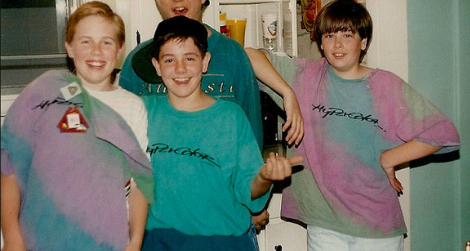
It was 1991: “Roseanne was on TV, Terminator 2 was on the big screen, Color Me Badd was on the radio and Hypercolor t-shirts were on the backs of millions of middle- and high school-age kids across America.
The Hypercolor fad gripped the nation that year, thanks to the Seattle-based sportswear company that created them, Generra. In fact, in a brief three-month span, between February and May 1991, the company sold a whopping $50 million worth of color-changing, heat-sensitive T-shirts, shorts, pants, sweatshirts and tights.
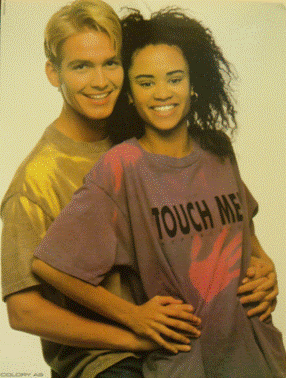
Touchable Hypercolor T-shirts in action.
In addition to its color-morphing cool factor, the “mood-ring of the ’90s” also had game-changing potential for a young adult brimming with hormones. Imagine: You could walk up to your crush in the hallway between classes, take note of the shirt he or she was wearing emblazoned with “Hypercolor,” casually place your hand on him or her, and the warmth of your touch would change the shirt’s color before the eyes of both of you. Let the sparks fly!
Besides functioning as a flirtation device, Hypercolor was a mysteriously rad technology you could wear on your back for about $20. But how simple was it?
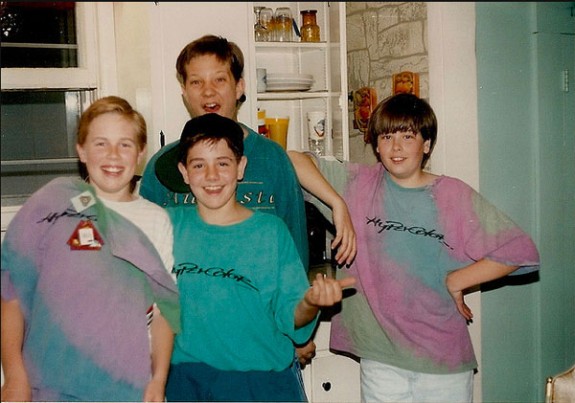
The “Metamorphic Color System,” as Generra cryptically called the manner in which body heat (or excessive perspiration, for those unfortunately prone to sweaty armpits) changed the fabric’s color using thermochromatic pigments as its special sauce. Mental Floss explains that the shirts were dyed twice: first with a permanent dye and again with a thermochromatic dye. The thermochromic dye is usually a mixture of a leuco dye, a weak acid, and salt. (Leuco dye is also used on the side of a Duracell battery to see if it’s still charged or on food packaging to gauge temperature.)
When the shirt heated up or cooled down, the molecules in the dye changed shape and shifted from absorbing light to releasing it, making the color transform, as if by magic!
Sadly, though, after a handful of washes, or one laundering misstep in too-hot water, the magic powers faded and the shirt froze permanently into a purple-brown mushy color.
But that wasn’t Hypercolor’s only misfortune. As a result of mismanagement and overproduction, Generra couldn’t handle its overnight success and declared bankruptcy only a year later, in 1992. An article in the Seattle Times in 1992, Generra: Hot Start, Then Cold Reality—Company Reflects Industry’s Woes, recounts company principal Steven Miska saying, ”We tried to make too much product available in too short a period of time.” If he could do it again, Miska said, he would have limited distribution, “which would have done a lot to prolong the life of the product.”
Hypercolor went the way of Color Me Badd: from Casey Kasem’s Top 40 to a one-hit wonder.
Attempts to reinvigorate the brand, the concept or the lifestyle—if you were a real Hypercolor fanatic—never quite gained the momentum of the initial early ’90s fad. Around 2008, Puma, American Apparel and other indie designers dipped their toes into the color-changing concept with sneakers, T-shirts and scarves, but the “special effects garments” as Body Faders calls current-day Hypercolor have nowhere near the cachet they had a couple decades ago.



3D printed house to emerge
Russian Sledgesneed to start dont3dprintthat.tumblr.com
hoots mon
1/4 Lillet (3/4 oz Cocchi Americano)
1/4 Sweet Vermouth (3/4 oz Cocchi Vermouth)
Stir with ice and strain into a cocktail glass. I added an orange twist to complement the Lillet and vermouth.
After the On the Boulevard, I decided to pick the Hoots Mon off of the Anvil's new 100 Drink list. In searching for some history on this Scotch drink, I accidentally swapped which word had the "s," and the search engine asked if I was looking for "hot moms." The proper spelling avoided this, and I learned that it was a Scottish phrase for "hey man" with some definitions including a sense of impatience or dissatisfaction. The recipe appears in the 1930 Savoy Cocktail Book, and I had seen it there and other places for years; however, I passed over it each time without giving it a chance. The structure of the drink reminded me of Highland Kitchen's Buckminster with gin and Maurin Quina in place of the classic's Scotch and vermouth; since that was quite delicious, I was game to try the Hoots Mon.
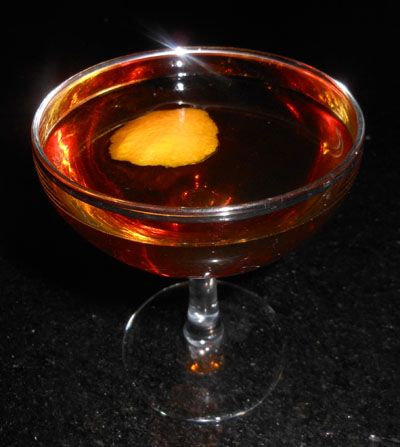 The Hoots Mon presented an orange oil and Scotch aroma that led into a citrus-grape and malt sip. Next, the smoky Scotch and vermouth came through on the swallow. The drink was a bit more sweet vermouth driven when cold, but the Cocchi Americano began to play a larger role as it warmed up. Overall, the Hoots Mon was sort of like a Rob Roy, but the the Cocchi Americano gave the balance a lighter and more citrusy feel. Perhaps this drink would shine with a single malt Scotch that showcased lemon notes from the malted barley such as a Glenmorangie 10 Year.
Study shows red pen corrections bum students out
Russian Sledgesattn overbey

Oh, the dreaded red pen, the scarlet letter of the academic world. Sure it's easier to read where we screwed up, but according to a recent study it erodes any warm, fuzzy feeling we might have about our teachers.
Alcohol can now literally be inhaled. With a...
Russian Sledgeswhy

Alcohol can now literally be inhaled. With a glass bowl, straw, stainless steel ring, and candle, the Vaportini uses an empty standard pint glass, heats alcohol to the point of vaporization, at which point it is inhaled through the straw.
(Want more? See NOTCOT.org and NOTCOT.com)


Cornell University: World’s largest natural sound archive now fully digital and fully online.
“In terms of speed and the breadth of material now accessible to anyone in the world, this is really revolutionary,” says audio curator Greg Budney, describing a major milestone just achieved by the Macaulay Library archive at the Cornell Lab of Ornithology. All archived analog recordings in the…
Australian Library Moves All Lance Armstrong Titles to Fiction Section
Russian Sledgesthat's cute, but, that's a lot of reclassing, recataloging, relabeling, etc
The library was not alone in its reassessment of the numerous printed books about Armstrong. The cyclist's autobiography, It's Not About The Bike has been the target of many disappointed reviews on Amazon this week. "It is now clear that most everything Armstrong says is a lie," wrote online reviewer Jesper. "Most of this book is based on lies and readers should consider a class action lawsuit against Armstrong, Jenkins and the publisher Berkley to get our money back for the book." Do you think the Armstrong titles should not be categorized as fiction? Let us know in the comments.
europeansdomusicalsbetter: saynotohorcruxes: dontdishonorthebarricade: omg guys im cryinG THIS...
Russian Sledgesbilltron, I refrained from sharing this yesterday. thank you for having the courage that I lacked.
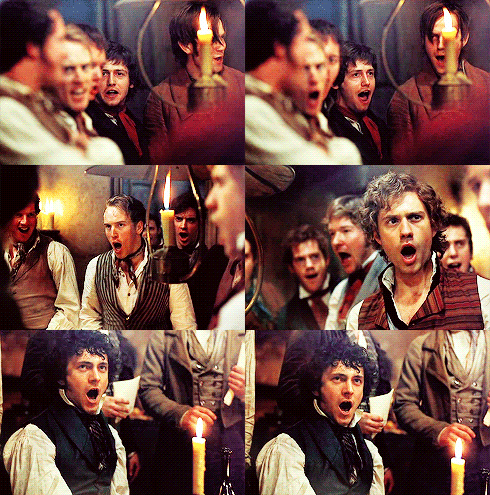
omg guys im cryinG THIS GIF LOOKS LIKE SOMEONE SAID SOMETHING REALLY OFFENSIVE AND THEY’RE ALL JUST SITTING THERE IN *STUNNED SILENCE*
“We’re out of Nutella…”
“Series 3 of Sherlock has been delayed…”
“Moist.”
“I’m NOT going to leave Britney alone.”
“I think Comic Sans is a top-notch font.”



Alexander Ivanovich Pokryshkin.Marshal of the Soviet Air Force...

Alexander Ivanovich Pokryshkin.
Marshal of the Soviet Air Force in 1941.


Microsoft hires designer who presented bold revamp of the company's brand

Last summer designer Andrew Kim's vision for "The Next Microsoft" got a lot of traction online — including on The Verge — for its aggressively minimal rebranding of the company across platforms. The next month Microsoft unveiled its actual new logo, but that doesn't mean it didn't take note — Kim just announced that he's been hired by the company, which got in touch after seeing his designs.
While "countless" other companies apparently followed suit, Kim says that Microsoft was the most obvious choice, and promises to create his "greatest work ever" when he starts in the summer.
Electronic Arts announces 'SimCity' for the classroom

Today, Electronic Arts announced that it is currently developing SimCityEDU, an online educational game based on the latest reboot of the company's popular SimCity franchise. Created in a partnership with GlassLabs, SimCityEDU is intended to be a learning tool for science, technology, engineering, and mathematics, and the game's curriculum will conform with US Common Core Standards. According to EA, teachers will be able to design and share lesson plans for the game online, and students will use the tool to learn important lessons in city planning, environmentalism, and social-economics as their Sims suffer or flourish based on their actions. EA has not yet announced a release date for the new educational platform, but it will likely hit...
Dear Colleague, Put the Notebook Down - Alexandra Samuel - Harvard Business Review
Russian SledgesI like evernote as much as the next person but, holy shit, shut the fuck up
Potential Official Maps? Finalists for the new Moscow Metro...

Lebedev Version

Birman Version

Mizinov Version
Potential Official Maps? Finalists for the new Moscow Metro Map
Further to my post regarding the unofficial “guerrilla” Moscow Metro map, Twitter correspondent @dars_dm has given me links to the maps produced by the three finalists in the official competition for a new Metro Map. I’ve reproduced them here for your edification. In order, they’re produced by Artemy Lebedev, Ilya Birman and Anton Mizinov and are all very strong in their own way.

I’ll confess that I’ve had a huge soft spot for the Lebedev map ever since I first came across it in 2010 and wrote this blog entry about it on my design blog – in what’s basically an embryonic Transit Maps post – wrongly identifying it as a new official map. In particular, I think his circular interchange symbols at major transfer stations are gorgeous, perfectly echoing the main Circle Line, which is such a distinctive feature of the Moscow Metro.
However, I’m interested in your thoughts (via comments, reblogs or answering this entry)… which of these three maps would you pick as your winner?
Being Married Helps Professors Get Ahead, but Only If They're Male
Russian Sledgeswon't read