Shared posts

15 Apr 17:31

Finger limes

by Delphine
Russian Sledges

the nice people at Formaggio Kitchen suggest putting the "caviar" into fizzy drinks (it floats).


"Les agrumes de Finger Limes Australiens sont de petits fruits qui poussent dans les forêts tropicales humides subtropicales de la côte Est de l'Australie près de Byron Bay. À l'intérieur du fruit sont de petites perles de jus aromatique saveur citron qui ressemblent au caviar." via cocktail de saveurs
"Finger limes are a micro-citrus originally discovered growing wild in Australia.  The interior pulp can best be described as citrus pearls, or citrus caviar. " via Shanley Farms
15 Apr 15:44

~Emmanuel Levinas


~Emmanuel Levinas

15 Apr 15:38

Smaller Drinks Means You Can Have More of Them

by Camper English
Someone wrote on Facebook that a trend they'd like to see is smaller cocktails so they could enjoy a larger range of drinks over an evening. I also think that would be pretty cool, so I asked PR folks and Facebook folks if they knew of any. If your bar is doing mini cocktails, feel free to add them in the comments! Pic from Vessel in Seattle. They don't really serve them this small. Canon in Seattle The Negroni Experiment is three Negronis: Original, Boulvardier, Right Hand L2O in Chicago Mixologist: Allison Frey L2O’s Sazerac, served in a 4 ounce Bourbon Glass, is portioned by a bartender and then concocted tableside by the server. Levant in Portland, OR Chamomile Whiskey or Black Lime Rum "At this point the Chamomile Whiskey is a fully developed mini cocktail. It contains house infused chamomile whiskey, honey lavender syrup and orange zest. The Black Lime Rum is just basically just a shot of appleton estate rum infused with black limes." Each cocktail is 2 ounces. Restaurant 1833, Monterey, CA Served in antique glassware that the team has sourced, the cocktails come in at about 3 ounces. Libations include: o Bee Sting – gin, lemon,...

[Visit Alcademics.com for the full post.]
15 Apr 14:48

"What’s the opposite of humbled? We’re Biebered to be standing here."

“What’s the opposite of humbled? We’re Biebered to be standing here.”

- Joss Whedon, accepting Movie of the Year at the MTV Movie Awards (via jennyhenk)
15 Apr 13:27

"Michael from Muckrock sez, “Want to know what guns your neighbor has? Generally public record...."

“Michael from Muckrock sez, “Want to know what guns your neighbor has? Generally public record. What guns your government has? That’s top secret. A recent public records request for the armaments of a local police department in Somerville, MA., was met with a surprising response: Releasing a list of guns the department held ‘is likely to jeopardize public safety,’ and so is exempt from public disclosure. Maybe they’re arming up for an insurrection?”

-

Cops in Somerville, MA: “It would endanger the public to tell you what guns we have” - Boing Boing

meanwhile, in Somerville

15 Apr 13:20

John Smith And The Common Men Out On Disc

by John Bowman
Music heard in the first episode of Doctor Who is to be made exclusively available on vinyl as part of this year's Record Store Day.

Three Guitars Mood 2 is the song that introduces the Doctor's granddaughter Susan, who is listening to it on a hand-held transistor radio when the audience first sees her. It is attributed by her to John Smith And The Common Men, and they are the title artists of a three-track EP, Sounds From The Inferno, which is being released on Saturday 20th April on the Hysterion Records label.

The back cover of the 7-inch EP includes a guide to the hand movements performed to the song by Susan.

The B-side has the tracks Latin Gear and The Eyelash, which are two pieces of music heard in The Inferno nightclub in the season 3 closing story The War Machines.

Hysterion Records' Ronnie Shame said: These tracks were originally recorded as library music. They appeared in numerous television programmes during the 1960s, but they also have a special association with Doctor Who. The EP - or extended play - is a numbered limited edition of 1,000 copies and will only be available from independent record shops. Copies will be sold on a first-come first-served basis and cannot be pre-ordered or bought online. A list of retailers taking part in Record Store Day is available here.

Three Guitars Mood 2 was actually composed by Nelson and Raymond, performed by The Arthur Nelson Group, and originally released on the Conroy label, while The Eyelash and Latin Gear were composed by Johnny Hawksworth and included on the album The Mood Modern, brought out on the Keith Prowse Music label.
Related Articles: Record Store Day 2012 (15 Apr 2012); Record Store Day 2011 (4 Apr 2011)

Doctor Who News
15 Apr 12:55

The History of the Flapper, Part 4: Emboldened by the Bob

by Emily Spivack
Russian Sledges

louise brooks autoshare

Actress Louise Brooks with bob and bee-stung lips, 1920s.

On May 1, 1920, the Saturday Evening Post published F. Scott Fitzgerald’s “Bernice Bobs Her Hair,” a short story about a sweet yet socially inept young woman who is tricked by her cousin into allowing a barber to lop off her hair. With her new do, she is castigated by everyone: Boys no longer like her, she’s uninvited to a social gathering in her honor, and it’s feared that her haircut will cause a scandal for her family.

In the beginning of the 20th century, that’s how serious it was to cut off your locks. At that time, long tresses epitomized a pristine kind of femininity exemplified by the Gibson girl. Hair may have been worn up, but it was always, always long.

Part and parcel with the rebellious flapper mentality, the decision to cut it all off was a liberating reaction to that stodgier time, a cosmetic shift toward androgyny that helped define an era.
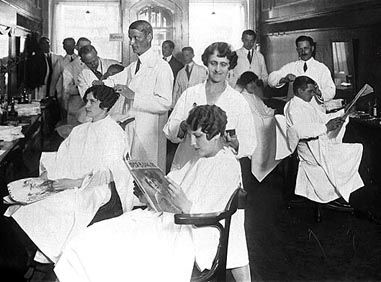
Getting a bob in a barbershop, 1920s.

The best-known short haircut style in the 1920s was the bob. It made its first foray into public consciousness in 1915 when the fashion-forward ballroom dancer Irene Castle cut her hair short as a matter of convenience, into what was then referred to as the Castle bob.

Early on, when women wanted to emulate that look, they couldn’t just walk into a beauty salon and ask the hairdresser to cut off their hair into that blunt, just-below-the-ears style. Many hairdressers flat out refused to perform the shocking and highly controversial request And some didn’t know how to do it since they’d only ever used their shears on long hair. Instead of being deterred, the flapper waved off those rejections and headed to the barbershop for the do. The barbers complied.
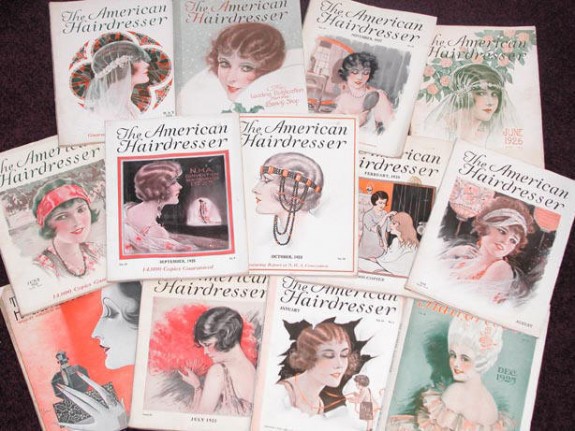
A collection of American Hairdresser magazines published in 1920s.

Hairdressers, sensing that the trend was there to stay, finally relented. When they began cutting the cropped style, it was a boon to their industry. A 1925 story from the Washington Post headlined “Economic Effects of Bobbing” describes how bobbed hair did wonders for the beauty industry. In 1920, there were 5,000 hairdressing shops in the United States. At the end of 1924, 21,000 shops had been established—and that didn’t account for barbershops, many of which did “a rushing business with bobbing.”

As the style gained mass appeal—for instance, it was the standard haircut in the widely distributed Sears mail order catalog during the ’20s—more sophisticated variations developed. The finger wave (S-shaped waves made using fingers and a comb), the Marcel (also wavy, using the newly invented hot curling iron), shingle bob (tapered, and exposing the back of the neck) and Eton crop (the shortest of the bobs and popularized by Josephine Baker) added shape to the blunt cut. Be warned: Some new styles weren’t for the faint of heart. A medical condition, the Shingle Headache, was described as a form of neuralgia caused by the sudden removal of hair from the sensitive nape of the neck, or simply getting your hair cut in a shingle bob. (An expansive photograph collection of bob styles can be found here.)
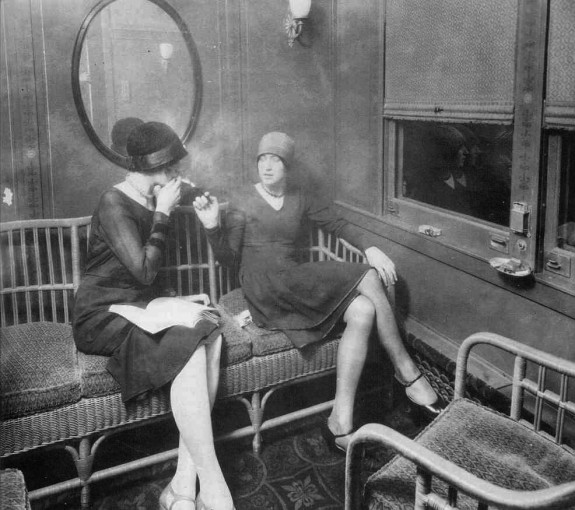
Women wearing cloches in smoking car, 1920s.

Accessories were designed to complement the bob. The still-popular bobby pin got its name from holding the hairstyle in place.  The headband, usually worn over the forehead, added a decorative flourish to the blunt cut. And the cloche, invented by milliner Caroline Reboux in 1908, gained popularity because the close-fitting hat looked so becoming with the style, especially the Eton crop.

Although later co-opted by the mainstream to become status quo (along with makeup, underwear and dress, as earlier Threaded posts described), the bob caused heads to turn (pun!) as flappers turned the sporty, cropped look into another playful, gender-bending signature of the Jazz Age.

Has there been another drastic hairstyle that’s accomplished the same feat? What if the 1990s equivalent of Irene Castle—Sinead O’Connor and her shaved head—had really taken off? Perhaps a buzz cut would have been the late 20th-century version of the bob and we all would have gotten it, at least once.


15 Apr 12:55

The History of the Flapper, Part 5: Who Was Behind the Fashions?

by Emily Spivack

Ballerina Desiree Lubovska in a dress by Jean Patou. Photography by Adolf de Meyer, c. 1921.

Have a look at the paintings of Georges Braque, Pablo Picasso, Fernand Léger and other Cubist painters whose work included hard, geometric forms and visible lines. As these artists were working in their studios, fashion designers, particularly those in France, were taking cues from their paintings. With la garçonne (the flapper, in French) in mind, the designers created fashions with the clean lines and angular forms we now associate with the 1920s-and with Cubism.

The styles we’ve come to connect with Louise Brooks, Norma Talmadge, Colleen Moore and other American actresses on the silver screen in the Jazz Age can be traced back to Europe, and more specifically, a few important designers.

  • Jean Patou, known for inventing knit swimwear and women’s tennis clothes, and for promoting sportswear in general (as well as creating the first suntan oil), helped shape the 1920s silhouette. Later in the decade, he revolutionized hemlines once again by dropping them from the knee to the ankle.
  • Elsa Schiaparelli’s career built momentum in the ’20s with a focus mostly on knitwear and sportswear (her Surrealism-influenced garments like the lobster dress and shoe hat came later, in the 1930s).
  • Coco Chanel and her jersey knits, little back dress and smart suits, all with clean, no-nonsense lines, arrived stateside along with Chanel No. 5 perfume and a desire for a sun-kissed complexion in the early 1920s.
  • Madeleine Vionnet made an impression with the bias-cut garment, or a garment made using fabric cut against the grain so that it skimmed the wearer’s body in a way that showed her shape more naturally. Vionnet’s asymmetrical handkerchief dress also became a classic look from that time.
  • Jeanne Lanvin, who started off making children’s clothing, made a name for herself when her wealthy patrons began requesting their own versions. Detailed beading and intricate trim became signatures of her designs.

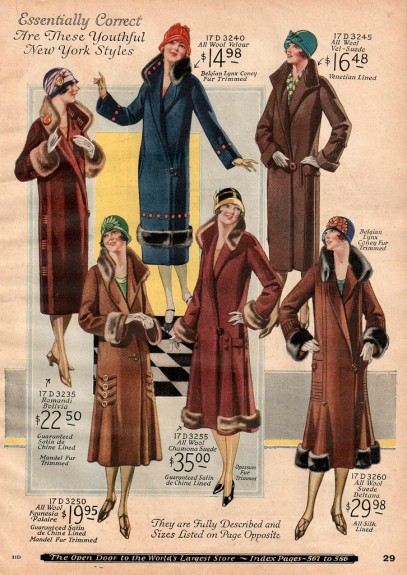
Sears catalog, 1925. via HA! Designs – ArtbyHeather on Flickr.

As these designers were breaking new ground (and for some, that began in the 1910s), their looks slowly permeated mainstream culture and made their way across the pond. One of the best ways to see how these couturiers’ pieces translated into clothing with mass appeal is to look at a Sears catalog from the 1920s, which was distributed to millions of families across the United States. As Stella Blum explained in Everyday Fashions of the Twenties:

. . . mail-order fashions began to fall behind those of Paris and by 1930 the lag increased to about two years. Late and somewhat diluted, the style of the period nevertheless touched even the cheapest wearing apparel. The art movements in Paris and the Exposition Internationale des Arts Décoratifs of 1925 managed eventually to make their influence felt on the farms of Iowa, Nebraska and Kansas, and in the ghettos of the large cities.

Ordinary Parisians were almost completely over wearing the knee-length, dropped-waisted dresses by the mid- to late 1920s, but in the United States, the style was increasing in popularity. In Flapper Jane, an article in the September 9, 1925, issue of the New Republic, Bruce Bliven wrote:

These [styles] which I have described are Jane’s clothes, but they are not merely a flapper uniform. They are The Style, Summer of 1925 Eastern Seaboard. These things and none other are being worn by all of Jane’s sisters and her cousins and her aunts. They are being worn by ladies who are three times Jane’s age, and look ten years older; by those twice her age who look a hundred years older.

Flapper Fanny Says, 1926.

The flapper look was ubiquitous enough to make its way into illustrations and comics. The comic strip “Flapper Fanny Says” tracked the trials and tribulations of the eternally young and somewhat androgynously stylish Fanny. The invention of cartoonist Ethel Hays in 1924, the strip remained in print into the 1940s under different artists.

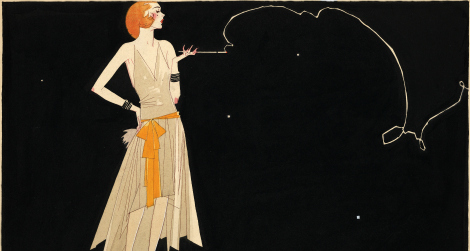
“Where there’s smoke there’s fire” by Russell Patterson, 1920s.

Around that time, John Held Jr.’s drawings of long-legged, slim-necked, bobbed-haired, cigarette-smoking flappers were making the covers of Life and the New Yorker. His vibrant illustrations, along with those of Russell Patterson and Ralph Barton, captured the exuberant lifestyle–and clothing style–of the time.

Looking back, we can now see how art inspired the decade’s fashion trends and how those fashions fueled a lifestyle. That, in turn, came just about full circle to be reflected in yet another form of visual representation—illustrated depictions of the freewheeling flapper culture—that kept the momentum of the decade going.

Read Parts I, II, III and IV of our History of the Flapper series for more great back story on the fashion icon.

15 Apr 12:54

Lilly Pulitzer: Remembering the ‘Queen of Prep’

by Emily Spivack
Russian Sledges

I have a floral polo dress that I found at a vintage store

Lilly Pulitzer fits a model with one of her creations. Carlo Allegri / Getty Images

Anything is possible with sunshine and a little pink!
—Lilly Pulitzer

It all began with an orange juice-stained dress. American fashion designer Lilly Pulitzer, who died this weekend at age 81, started her iconic clothing line out of necessity. She had moved to Palm Beach, Florida, in the early 1950s after eloping with her then-husband, Peter Pulitzer, who owned citrus groves in the area. She opened an orange juice stand and while working there, discovered that squeezing juice was a messy business. To camouflage the inevitable stains, she said, she designed brightly printed sleeveless dresses. The style was a hit with customers who began to request their own dresses, and she began selling the vibrant floral shifts in addition to O.J. Her short, easy-to-wear pieces took off and she left the juice biz to focus on fashion design.

Two Lilly Pulitzer dresses on the far right along with Vested Gentress dresses. Image by iwantamonkey via Flickr.

The “Queen of Prep” (as in preppy) as she became known, became the president of Lilly Pulitzer Inc. in 1959. Her iconic jungle and floral prints in shades of pinks, orange, blues and greens were manufactured by the Key West Hand Print Fabrics company in Key West, Florida.

Because of her pedigree—her mother came from the Standard Oil fortune and she married into the Pulitzer publishing family—Lilly Pulitzer seamlessly situated her brand amongst the blue-blooded set. From the 1960s to the ’80s, her Florida-vacation-in-a-dress shifts were worn by her former high school classmate Jacqueline Kennedy Onassis, socialite and artist Wendy Vanderbilt Lehman and anyone aspiring to a Lilly lifestyle. Lilly herself summarized that lifestyle when she said, “The Lilly girl is always full of surprises. She lives everyday like it’s a celebration, never have a dull moment, and make every hour a happy hour.” Basically, her clothes were worn by the antithesis of any Molly Ringwald character from a John Hughes movie.

Lilly Pulitzer-branded Jeep. Image from katyrlynch via Flickr.

The brand hung on until 1984 when Pulitzer closed its struggling operation, but it was reborn when Sugartown Worldwide Inc. purchased the rights to use the company’s name in 1993. Today, Lilly’s legacy can be found in dresses, maternity clothes, stationery and bedding in department stores and Lilly Pulitzer stores around the country. (Apparently, as pictured above, Lilly prints can be found on Jeeps.) And they’re also on the backs of sorority sisters, as indicated by the special-edition Lilly Pulitzer collections made exclusively for them.

Image by vintspiration on Flickr.

15 Apr 12:52

GOD IS A KILLER.


GOD IS A KILLER.

15 Apr 07:05

Discourse on the Otter

by russiansledges
Russian Sledges

new favorite tumblr

with apologies to michel de certeau
15 Apr 04:50

Father's Day: Rolled Hem Handkerchiefs - Rolled Hem Handkerchiefs - the purl bee

by russiansledges
14 Apr 21:20

An inn run by one family... for 1,300 years

by Minnesotastan

Hōshi is a ryokan (Japanese traditional inn) in Japan.  The hotel has been operated by the same family for forty-six generations (since 717 A.D.)

The fascinating explanation is in comments at the Reddit discussion thread:
It should be noted that Japan has a tradition of adopting adult heirs if it seems like there is nobody in the family that would be suitable/wanting to run the family business. Over 90% of adoptions in japan are of adult males in their 20s and 30s, and japan has one of the highest adoption rates in the world.

Because of this family businesses in japan are more successful than in other countries, which tend to die out due to blood lines or become other kinds of businesses.

Suzuki, Toyota, Kikkoman, and Canon are all family businesses. The current head of Suzuki was adopted, and the heir that will replace him will also be adopted.
and -
It's not a strange concept when you look at history. Some societies that placed a big importance on family (and there are many) allowed for the "adoption" of an adult. It's more about welcoming someone into the family and taking the family name than it is about providing for someone.

For example, the Roman Republic/Empire frequently engaged in adult adoption, even posthumously. Caesar adopted Octavian/Augustus after his own death as a way of having an heir. Quite a few of the Roman emperors were adopted by the previous emperors simply as a way of choosing an heir if there was no suitable or capable son that could take the job.
You learn something every day.

14 Apr 20:04

The Jew in the plastic bag revisited

by whyevolutionistrue
Russian Sledges

oh, okay

Two days ago I posted this picture of an Orthodox Jew in an airplane, wrapped up in a plastic bag.  The picture came from The Gothamist, which explained that the man was a “kohen,” or a member of the priestly tribe of Jews, and kohens are forbidden from flying over cemeteries. The bag was apparently meant to protect this man from religious pollution as his plane passed over the graveyard.

41112plane1

I must say that this picture got a lot more attention than I expected, with a lot of humor of the “get-in-the-fooking-sack” variety, but it wasn’t explained to my satisfaction. Now, in a comment on the original post, which I’ve put above the fold here, alert reader Michael proffers an explanation. Being only a secular Jew, I can’t vouch 100% for its accuracy, but it sounds plausible, so here you go:

As a Kohen and also an orthodox Jew who lives in Israel and occasionally flies to the states I can clearly state that this is not normative behavior. The explanation is correct. However, we Jews do have some practices which can appear odd, it’s not exactly legitimate to take such a rare case of over-zealousness to make that case.

Here it is in more detail as posted on a friend’s Facebook, if anyone is interested:

A huge area of Jewish law involved ritual impurity. It’s complex, and to the modern mind a little weird. Almost all of it was made irrelevant with the destruction of the 2nd temple 2000 years ago. Only one aspect of ritual impurity persisted, that which relates to Kohanim (“priests”, ie those descended patrilineally from Moses’ brother Aaron. They’ve actually identified a Kohen gene!) Basically a Kohen cannot come in contact with a dead body. With the exception of his close relatives or a body that has no one else to bury it. “Contact” includes direct contact and also being in proximity of the impurity. Proximity includes being under the same roof as a corpse or being over the corpse, like walking over a grave. The “roof” does act to stop the impurity.

So how do we get to airplanes? Basically you have the ingredients of the problem. A Kohen can’t be “over” a dead body. The Rabbis of the Talmud determined that the impurity emanating upwards from a corpse has no end. Except, of course if a structure interferes. So if you build a tree house over a grave the Kohen would be safe inside it. But isn’t an airplane such a structure that would impede the impurity? Well, the rabbis of the Talmud raised such a issue. They brought up the case of a Kohen being transported over a cemetery in an enclosed coach, say by being carried. Since the impurity goes all the way up it becomes irrelevant whether the “coach” is 5 feet off the ground or 35,000 ft (and is first class ). So, Joan, they didn’t need to know about airplanes to create a law that is applicable to them.

Now to our friend in the bag. As with many, most, issues discussed in the Talmud there are differing opinions. (I mean really, what do you expect with a book of Rabbis’ opinions?) One Rabbi held that the travelling coach does block the impurity just as if it was stationary and another held that because it’s in motion the blocking effect is not there. A thousand years later Maimonides (a doctor by the way) compiled the first organized codification of Jewish law which remains largely authoritative today. He decided this law in favor of the Rabbi in the Talmud who said that the moving coach does not block the impurity.

Since, for a time, all planes departing Israel’s only international airport flew over a huge cemetery directly West of the airport it was a certainty that Kohanim on the plane would be “exposed” to this impurity. (There is a lot of room for leniency in Jewish law if something is not “certain”.) Without getting into a whole other discussion, accept for now that a way to block the impurity, even while in motion is to have a material in very close proximity to the object you want to block. Thus the plastic bag.

All that said, as a Kohen myself, I certainly do not do this when I fly from Israel as it true with most Kohanim. There are two reasons, first the government ceded to requests to change the flight path, so that most of the time flights do not go over the cemetery. Second, and more import to me, there’s a general concept that, when possible, Jews shouldn’t do things that make Judaism look foolish. So since in the case there was a Talmudic opinion that the moving coach does block the impurity that can and should be relied on here.

Well, I guess there won’t be any orthodox Jewish astronauts in the ISS. They’d have to be constantly covered!

As for “Jews not doing things that make Judaism look foolish,” I could give a whole list of Orthodox practices, including shabbos goys, the 18-minute, rabbinically-ordained time limit for making Passover matzos, the eruv, and so on.


14 Apr 18:46

Justin Bieber's camp mum amid outrage over Anne Frank remark - CNN International


CBS News

Justin Bieber's camp mum amid outrage over Anne Frank remark
CNN International
(CNN) -- While his comment about Anne Frank drew criticism from around the world, pop star Justin Bieber and his camp have remained silent on the issue -- and plan to keep it that way. There will be no official statement from Bieber or his representatives, ...
Anne Frank House describes Bieber's visit as 'positive'USA TODAY
Justin Bieber defended by Anne Frank museum over 'belieber' commentThe Guardian
Justin Bieber's 'Belieber' Comment No 'Big Deal' To Anne Frank House, Howard ...MTV.com
Hollywood Life -Washington Post (blog)
all 397 news articles »
14 Apr 17:10

protejam-se: S-O M-U-C-H F-U-N J-A-N


protejam-se:

S-O M-U-C-H F-U-N J-A-N

14 Apr 17:05

Officials don't let cold and damp stop them from cutting ribbon on new water bubbler

by adamg

Fountain will supply water even in the dog days of summer. Photo by DCR.Fountain will supply water even in the dog days of summer. Photo by DCR.

Officials from the state Department of Conservation and Recreation and New Balance gathered in Artesani Park on the shores of the Charles this morning to cut a ribbon and official open a new year-round, three-faucet bubbler that will let thirsty runners, walkers and animals rehydrate, both through individual sips and by refilling their water bottles:

DCR Commissioner Ed Lambert fills 'er up. Photo by DCR.DCR Commissioner Ed Lambert loves that clean water. Photo by DCR.

14 Apr 17:04

In Cambridge, turkey is friendly, mellow

by adamg
Not like the pugnacious poultry of Brookline. Lorcasaur photographed Swifty the Homeless Turkey with a new friend in Central Square this morning. Susan Zalkind took some video: src="//platform.vine.co/static/scripts/embed.js" charset="utf-8">
14 Apr 16:25

"russian sledges likes this" - Google Search

by russiansledges
14 Apr 14:06

Historical Map: Circular London Underground Map Sketch, Harry...


Historical Map: Circular London Underground Map Sketch, Harry Beck, c. 1964

For those who thought that the two circular London Underground diagrams I featured earlier this year — by Jonny Fisher and Maxwell Roberts — were a completely modern twist on an old classic, here’s a reminder of just how forward-thinking Harry Beck really was.

This is a sketch, dated to 1964 at the earliest (due to his adoption of Paul Garbutt’s dot-in-a-circle device for main line interchange stations), that presents the Circle Line as a perfect ellipse. Quite a stunning contrast to his usual rigidly rectilinear diagrams, if perhaps ultimately not a huge improvement — much as the two modern maps are exercises in design, rather than a replacement for the original. Note also that this beautiful sketch is entirely hand-drawn: not a computer to be seen in it’s creation.

(Source: Scanned from my personal copy of Mr. Beck’s Diagram by Ken Garland, Capital Transport Publishing, 1994)

14 Apr 13:44

Arguably the world's worst novelist

by Minnesotastan

Amanda Kittrick Ross (pen-name Ros) is considered by many to have written the worst novels ever published.  Here's the Smithsonian's description in 2009:
Ros, who died in 1939, abused (some would say, tortured) the English language in three novels and dozens of poems. She refers to eyes as "globes of glare," legs as "bony supports," pants as a "southern necessary," sweat as "globules of liquid lava" and alcohol as the "powerful monster of mangled might." The Oxford literary group "The Inklings," which included C. S. Lewis and J.R.R. Tolkien, held competitions to see who could read her work aloud longest while keeping a straight face.

Mark Twain considered her first book, Irene Iddesleigh, as "one of the greatest unin­tentionally humorous novels of all time." Consider this passage: "Speak! Irene! Wife! Woman! Do not sit in silence and allow the blood that now boils in my veins to ooze through cavities of unrestrained passion and trickle down to drench me with its crimson hue!"..

And Ros' penchant for alliteration resists restraint: The villainous Madame Pear, she wrote, "had a swell staff of sweet-faced helpers swathed in stratagem, whose members and garments glowed with the lust of the loose, sparkled with the tears of the tortured, shone with the sunlight of bribery, dangled with the diamonds of distrust, slashed with sapphires of scandals...."
The BBC has a brief biography with a report of a renewed competition to read her work witihout laughing:
Now Culture Northern Ireland has challenged "lovers of awful literature" to see if they can read the longest passage from McKittrick Ros's work while keeping a straight face. Her expectation was that she would "be talked about at the end of 1,000 years" and the organisation hopes the unique nature of her verse can match that.
But this is worthy of note for those who browse library/estate/auction book sales:
As of 2004, none of her works are in print. Her books are rare and first editions command prices of $300 to $800 in the used-book market.
Photo: REUTERS/Linen Hall Library/Handout
14 Apr 12:43

"Surprisingly, my poster and essay was selected from the top ten in the country and was test marketed..."

Surprisingly, my poster and essay was selected from the top ten in the country and was test marketed in Washington, D.C. I was the original creator of the Woodsy Character, name and slogan. However, I had just a green hat and a red feather on the Woodsy character but in test marketing they put on more clothes on the character and created an anthropomorphic owl. I won the contest and received a congratulatory letter. I also received my certificate of completion for an all expense paid week at the Rushford Conservation camp in Rushford, NY.

Since I was only 12 years old my parents and I signed a contract with the US Forest Service and the US Attorney General so that the US Forest Service could use the Woodsy Character, name and slogan that I had created for the campaign (reference: contract, US Attorney General and US Forest Service,USDA) I was sponsored by camping group in Buffalo called Ken-Tonawanderers which is a group associated with the national camping group called National Campers and Hikers Associatio ( NCHA) which is now called Family Campers and RVers (FCRV) in which the national headquarters is in Depew, NY (near Buffalo,NY).


- Guys, the talk page for the Woodsy Owl Wikipedia article is full of conflicting, incoherent claims from multiple people who say they created Woodsy Owl and IT IS AMAZING (via joshreads)
14 Apr 12:37

Robocycle Playing Cards | Duct Tape and Glitter

by sogoodtalkintoya
14 Apr 12:22

dudeforscale: From David Saunders (1974) Sea Birds: Knowledge...

by ushishir


dudeforscale:

From David Saunders (1974) Sea Birds: Knowledge through Color Series Bantam.

via Julian Montague Book Projects Blog.

14 Apr 04:08

Doctor Who, “Cold War”

by Alasdair Wilkins
Russian Sledges

every time I've seen this promotional still I think of this other photograph http://cdn.americansongwriter.com/wp-content/uploads/2012/10/Byrne+StVincent.jpg

Should've brought a banana.

Modern Doctor Who has made a particular virtue out of the show’s infinitely versatile format, its ability to flit between wildly different genres on a weekly basis. But that hasn’t necessarily always been the case; indeed, some eras of the show’s original, 26-year run proudly defined themselves in terms of their mastery of certain specific genres. Jon Pertwee’s tenure was associated with UNIT and weekly alien invasions, Tom Baker’s early years became all about the gothic horror, and William Hartnell’s time in the TARDIS was a mix of purely historical adventures and bug-eyed monsters. But perhaps no Doctor is more indelibly linked with a particular story type than Patrick Troughton and the so-called “base under siege.” At least half of Troughton’s stories—including pretty much his entire second season—found his Doctor defending an isolated base from an invading horde of monsters, including ...

Read more
14 Apr 04:08

Is This The Subway Car Design Of The Future?

Russian Sledges

traaaaiiiiins

Is This The Subway Car Design Of The Future?Everyone likes to people-watch in the subway (just don't make eye contact!), but some get paid to do it: Researchers from the NYC Transit Authority observed straphangers over three weeks last year to glean insights into the seating and standing behavior of subway riders. Now, they're publishing the findings in a study in which they offer some suggestions on how to improve our trains. [ more › ]

Add to digg Email this Article Add to Facebook Add to Google
14 Apr 04:04

Nobody Could Have Anticipated

by Scott Lemieux

So, putting armed policemen in schools is pretty much the best idea ever. I mean, I assume that when they’re not dealing with exceptionally rare school shootings I assume they just kinda mind their own business, and would never try to justify their existence by turning trivial disciplinary issues into criminal charges, right?

Yet the most striking impact of school police officers so far, critics say, has been a surge in arrests or misdemeanor charges for essentially nonviolent behavior — including scuffles, truancy and cursing at teachers — that sends children into the criminal courts.

“There is no evidence that placing officers in the schools improves safety,” said Denise C. Gottfredson, a criminologist at the University of Maryland who is an expert in school violence. “And it increases the number of minor behavior problems that are referred to the police, pushing kids into the criminal system.”

Oh. That’s surprising! But I assume once affluent suburban parents get sick of having their kids dragged away in handcuffs for sassing back at the teachers, it will all stop?

Nationwide, hundreds of thousands of students are arrested or given criminal citations at schools each year. A large share are sent to court for relatively minor offenses, with black and Hispanic students and those with disabilities disproportionately affected, according to recent reports from civil rights groups, including the Advancement Project, in Washington, and the NAACP Legal Defense and Educational Fund, in New York.

Wow, this discretion is enforced in a selective and arbitrary manner against the relatively powerless? You learn something new every day! I wonder what freedom-hating states are taking the lead here — Vermont? Massachusetts?

Such criminal charges may be most prevalent in Texas, where police officers based in schools write more than 100,000 misdemeanor tickets each year, said Deborah Fowler, the deputy director of Texas Appleseed, a legal advocacy center in Austin. The students seldom get legal aid, she noted, and they may face hundreds of dollars in fines, community service and, in some cases, a lasting record that could affect applications for jobs or the military.

In February, Texas Appleseed and the Brazos County chapter of the N.A.A.C.P. filed a complaint with the federal Education Department’s Office for Civil Rights. Black students in the school district in Bryan, they noted, receive criminal misdemeanor citations at four times the rate of white students.

Ah, a state where they really understand what freedom means.

14 Apr 04:03

Billionaire William Koch wins $12m in courtroom wine fraud battle

Wealthy wine collector says he will use the money to further his campaign to highlight counterfeiting of bottles

A jury has awarded the Florida billionaire Bill Koch $12m in his long-running dispute over phony vintage wine. Vowing to do more to expose wine frauds, Koch proclaimed the court win on Friday to be his happiest day since winning the America's Cup in 1992.

"Out of sight. Over the moon," he said as he described his feelings after emerging, giggling with glee, from a courtroom in US District Court in Manhattan. "We weren't even expecting any damages and we got $12m. Unbelievable."

The verdict went against the businessman Eric Greenberg, who insisted that he had not intentionally sold a fake bottle of wine in auctions that generated about $42m for him over an eight-year period. The trial involved alleged that counterfeit bottles of Bordeaux were labeled as if they were made from 1864 to 1950. In a statement, Greenberg called the verdict "a disappointment because I believed all the consigned wine to be authentic". Outside court, Greenberg declined to comment further.

Koch's lawyer, John Hueston, suggested that a criminal investigation of Greenberg was underway, saying: "We're co-operating with the FBI." He declined to elaborate.

In a chilly drizzle outside court, the 72-year-old Koch celebrated with his lawyers, posed for pictures and met briefly with at least one of the eight jurors who decided on Thursday that Koch had been defrauded, awarding him $380,000 in compensatory damages.

Jurors returned Friday to hear Koch and Greenberg testify again and deliberate over punitive damages. "I'm very sorry I had counterfeit wine," Greenberg told them. "It's a horrible thing. Both of us have lost millions of dollars." The verdict was another blow to Greenberg, a former billionaire who built two internet consulting companies before the 2000 collapse of those stocks reportedly reduced his net worth by as much as 90%.

Koch said he planned to use the $12m to continue his crusade to clean up the wine auction industry, including by creating a website that highlights fake wines and who sells them. He said he would include in the list the 421 bottles he had identified in his own collection as fake after buying them for $4.4m.

"I'm sad at the amount of fakes," he said. "That's why I stopped buying very old wines."


guardian.co.uk © 2013 Guardian News and Media Limited or its affiliated companies. All rights reserved. | Use of this content is subject to our Terms & Conditions | More Feeds

14 Apr 03:54

University of Virginia Rotunda fire: 1895 via Retronaut


University of Virginia Rotunda fire: 1895 via Retronaut

13 Apr 20:27

If you can look at this picture and tell me that this...

by 820cbaby


If you can look at this picture and tell me that this isn’t one of the sweetest photos of a dude with a ‘stache that you’ve ever seen, then you obviously need to learn a little something about facial hair and being awesome.  This picture alone makes the guy badass, even if you didn’t know the story behind it. Fridtjof Nansen decided he was going to become the first person to reach the North Pole.  He developed a pretty ingenious tactic for doing so – he built the famous, ultra-hard wooden ship Fram, lodged it into the ice pack off the coast of Siberia in 1893, and let it drift in the ice while the tides of ocean carried him across the pole.  This was a tactic that would be used by great explorers from Scott to Shackleton to traverse both Arctic and Antarctic climes, and this guy pioneered that shit.

Nansen and his crew drifted for 18 months, somehow surviving in the freezing-ass cold temperatures, but unfortunately the tides of the Arctic Sea decided not to cooperate with Nansen’s plan, no matter how good it was or how intensely he tried to stare it down.  Realizing that he was drifting too far from the pole and wouldn’t cross it, Nansen obviously did the badass thing – he and one other guy jumped out of the drifting boat, jumped on a dog sled, and rushed 140 miles across open ice to get there.