Shared posts

17 Oct 14:42

Secret Wars

by Tom

Seven thoughts on Marvel: The Untold Story by Sean Howe

1. It’s a miracle any good comics ever get published by big companies. The book paints a picture of an industry where at a certain power level or higher almost everyone involved despises the product. This is dysfunctional even by media standards: obviously dealmaking and money count for more than art at the top of the film and music industries but you can still basically imagine label and studio bosses getting some level of enjoyment from a film or album. Not so in comics (though the situation may have changed – understandably, we don’t get the optics on the current Disney ownership we do on anything else). A closer parallel – from fans to owners – might be English football.

2. That “certain power level” turns out to be Stan Lee, who doesn’t come out of Untold Story very well. The book is even-handed on the vexed question of who created what in the Marvel Universe – and whether you frame it in terms of marketing, verbal dynamism or great character ideas, Stan had an undeniable hot streak in the early 60s. But before and after that he gives no great impression of liking comics except as the bedrock of his own dubious celebrity: he spends the bulk of the book flitting in and out of the story as a Hollywood wannabe, ineffectually trying to get films made in between hob-nobbing with celebs and grouching that he could have been a novelist.

3. The book has more to say about Marvel office politics – the Merry Marvel Marchin’ Papers – than Marvel art. The occasional bits of comics criticism are incisive, but the book doesn’t suffer for its skew: there’s plenty out there on the comics and less on the working conditions and personalities of the men and women behind them. The corporate culture is subject to fascinating swings. In the 60s, a drab understaffed office is painted as a whirling hive of zany creativity by Lee. In the 80s, while Jim Shooter puts the company in a creative straitjacket, the culture goes in the other direction as staffers work consciously to create the happy Bullpen Camelot that Stan dreamed up. Meanwhile the body count (non-metaphorical) keeps rising.

4. Minor lacunae (1): The book is candid about some of the main influences on 70s Marvel – pot and acid. No surprise or shame there, of course – the comics appealed to college kids, the drugs appealed to college kids, some of those college kids ended up writing the comics, and by logical means one arrives at The Beast reading Carlos Castaneda. What is interesting is the way drugs (& hedonism in general) drop entirely out of the story after the 70s. After all, the 80s had its signature drugs too, and the comics business was still being staffed mostly by young guys, and there was a lot of money sloshing around, blah blah. So I’m guessing there are other sides to some of the decisions (creative and business) on show here. On the other hand, this isn’t Marvel Babylon, and the early 70s stoner culture at Marvel is important because of the bleedthrough into the comics: 80s Marvel was fiercely anti-drug, even if the drugs were always made up.

5. Minor lacunae (2): The jump between “Marvel constantly fucks up Hollywood deals” and “Marvel is the darling of Hollywood” is very sudden indeed. To be honest, I’m not sad about this – details of the failed deals were mostly utterly tedious with the occasional LOL (following the implosion of disco and the failure of its transmedia plans for Dazzler, Marvel attempted to sell a country superhero called “Denim Blue”). And the rights situation was notoriously complicated so simply saying “the rights issues were a massive problem until they weren’t” is basically fine. But the picture of Marvel at the end of the 90s is SO grim that the turnaround needs more space: OK, it’s down to Perlmutter, Avi Arad etc. but why? What did they do right? (Unless it is all because of Bill Jemas insisting on recap pages) It’s too easy with hindsight to just accept that superhero films – and in particular Marvel films – were always going to be enormous once somple finally made them. Howe doesn’t, in fact he points out why stuff like the FF and Spider-Man were tough pitches, so the sudden success comes as even more of a “whuh?”

6. I had heard some of the stories in the book before but they’re well told and there is plenty new here with lots of great incidental detail: Alan Weiss and his harem of stewardesses, Jim Shooter’s plan to kill off Captain America and replace him with an investment banker, the transcript of Todd MacFarlane’s answering machine message firing Rob Liefeld from Image, and so on. Plus one of the best snapshots of the 90s boom insanity: Tom DeFalco getting pre-orders back on a title starring eighth-stringer Silver Sable and realising the game was up because they’d only – only! – sold half a million.

7. In the end it’s a very readable, very recommendable book which only runs out of steam to the degree its subject does. Like the comics, the book keeps telling the same story: creativity sparks, flames on, and gets snuffed out. Not all the creativity is good, not all the snuffers are unsympathetic, but broadly that’s the story. Quality at Marvel seems to be as permanent as character death at Marvel – find a book you like and, if you wait long enough, someone will screw it up. But it keeps bubbling through nonetheless.

17 Oct 14:40

Opinion: Who’s the odd one out?

by Charles Beaumont

Name the odd one out: Timothy Edmonds (convicted paedophile), Hussain Osman (convicted terrorist), Julian Assange (Wikileaks founder wanted for questioning by Swedish police) and Abu Hamza (Egyptian-born militant Islamist now facing terrorism charges in a New York court). Not too difficult – it’s Abu Hamza, who was extradited to the USA after an eight-year legal battle.

The other three are currently, or have been in the past, the subject of European arrest warrants. All of them, if Theresa May gets her way, would have been able to evade justice for as long as they could frustrate bilateral extradition arrangements (assuming any were in force).

May’s proposal is for the UK to opt out of 130 EU justice and policing measures and then to opt back in with those areas deemed to be politically expedient, a sort of a la carte crime-fighting. Opting back in will require all 26 member states to agree to our proposals and will probably cost the UK hundreds of millions. It seems fair to ask whether all states will readily accede to this and what will be their quid pro quo. This, after all, comes at the same time as the UK is seen as blocking an urgently-needed European banking union, as well as threatening to veto an enlarged EU budget. Whatever your view of these policies, anyone with experience of complex negotiations will tell you it’s the wrong moment to be picking fights.

Which points to an intriguing question– with Michael Gove and Phil Hammond already suggesting that the UK leave the EU and a significant proportion of the Tory cabinet in support of this idea, will the next general election effectively be the ‘in or out’ referendum, with Liberal Democrats and Labour on one side of the debate and the Tories on the other? Whilst Europhilia has never been popular in this country (whatever we Liberal Democrats might wish), the practical flaws in the “let’s just have free trade like Norway” argument would probably not survive the scrutiny of an election campaign (this is a huge topic, but the simple point is that there is no motive for the other 26 members of the EU to make it easy for us to negotiate an exit followed by a free trade deal). If the big question in 2015 turned out to be one on which we were aligned with Labour that might be good news for the Liberal Democrats. Then the Tories would be the odd ones out.

17 Oct 12:34

Signal Boost: Lib Dems Against Secret Courts

One of the things I am sad I missed at the recent conference was the vote on the Tories' secret courts proposal; I would have liked to have been there to see the leadership given a bloody nose over it. The problem is: the leadership HAVE been given a bloody nose, what happens now? How does the grassroots keep pressure on the leadership to say we're not going to stand for this illiberal measure?

That's where Lib Dems Against Secret Courts come in. I've signed their petition, and I hope you will too.

comment count unavailable comments
17 Oct 10:51

Please don’t sign this petition on Trans rights

by Zoe O'Connell

There’s a petition doing the rounds at the moment on pathologisation of Trans people in medical classification.

Please don’t sign it.

The petition misses some important caveats that are critical to ensuring Trans folk continue to get healthcare and it is not clear if the authors of the petition realised this.

Many people believe that if being homosexual could be removed as a disorder, so can gender dysphoria. But you don’t need a doctor to be gay. I don’t need a doctor to be Trans either, but access to surgery and HRT makes life liveable. If Gender Dysphoria is no longer recognised by the WHO, Health Services will see less need to provide services. In many countries, including the UK, health care for Trans folk is already poor to non-existant in places.

For an example of the details have a look at the European Parliament motion they reference on the same topic: they asked the WHO “to withdraw gender identity disorders from the list of mental and behavioural disorders while ensuring a non-pathologizing re-coding in the 11th version of the International Classification of Diseases (ICD-11).

The latest petition misses the nuance and just calls for “ICD 11…to stop considering transexuality as an illness.

17 Oct 09:29

Opinion: Open standards: a liberal approach to technology

by Dave Page

As we look at how we use technology to campaign as Liberal Democrats, we should consider the use of open standards.

Most people know something very basic about the World Wide Web – it was invented by Tim Berners-Lee. But the key to its success was not just the skill of its inventor; the standards behind the web were open, meaning that anybody could write a web server, web browser or web page. Dozens of programmes sprung up, all of them able to talk to each other.

A decade before, the Internet itself was developed collaboratively around open standards. People like Jon Postel and Vint Cerf (not Al Gore) collated and published them for anyone to implement. This gave us a global network of networks, independent from any one vendor or platform.

Open standards allow freedom from conformity. It doesn’t matter what platform people use, whether it’s an iPhone, a Windows desktop or a Raspberry Pi, or what programme you use on it, so long as you’re using the same standard for your data files or network conversations.

Open standards thus allow a free market. If you don’t like the software you’re using, you can swap to another one. Web browsers even advertise how closely they conform to the open standards of the web! Systems that involve closed standards mean that users are “locked in” to the vendor, who could withdraw support or up their prices. What was once the best solution to a problem may not remain so.

There are, of course, some problems with this decentralisation. Some standards are vague which causes problems with interoperability. The existence of many programmes to do the same job can cause confusion. But Liberal Democrats accept comparable problems in other decentralised structures, and believing that the benefits outweigh the difficulties.

For example, Skype is popular video-conferencing software, which uses a closed standard. Only Microsoft can create Skype programmes; it is only supported on the platforms that Microsoft choose, and only as well and for as long as Microsoft choose. If somebody wished to create a new Skype program, either because one wasn’t available for their platform, or because they had problems with the one that was, they’d be dependent on Microsoft for permission and details.

In comparison, the open Session Initiation Protocol standard for video-conferencing allows anybody able to run their own server yet still interoperate with others. Consider how that might tie in with the existing Liberal Democrat Account login. There are dozens of servers and clients available, both free and proprietary, zero-cost and commercial, hardware and software. If somebody wants to support SIP on a new platform, they have both the information and the legal ability to do so. It’s easy to create SIP software which does new things, such as an answerphone which e-mails recorded messages to you.

The Liberal Democrats were trend-setters in using technology to campaign, but its potential to help us is ever expanding. As we move forward, we should strongly consider the open standards which will help us remain free from conformity, and free from “lock-in” to particular vendors.

17 Oct 09:12

Electoral Precedent

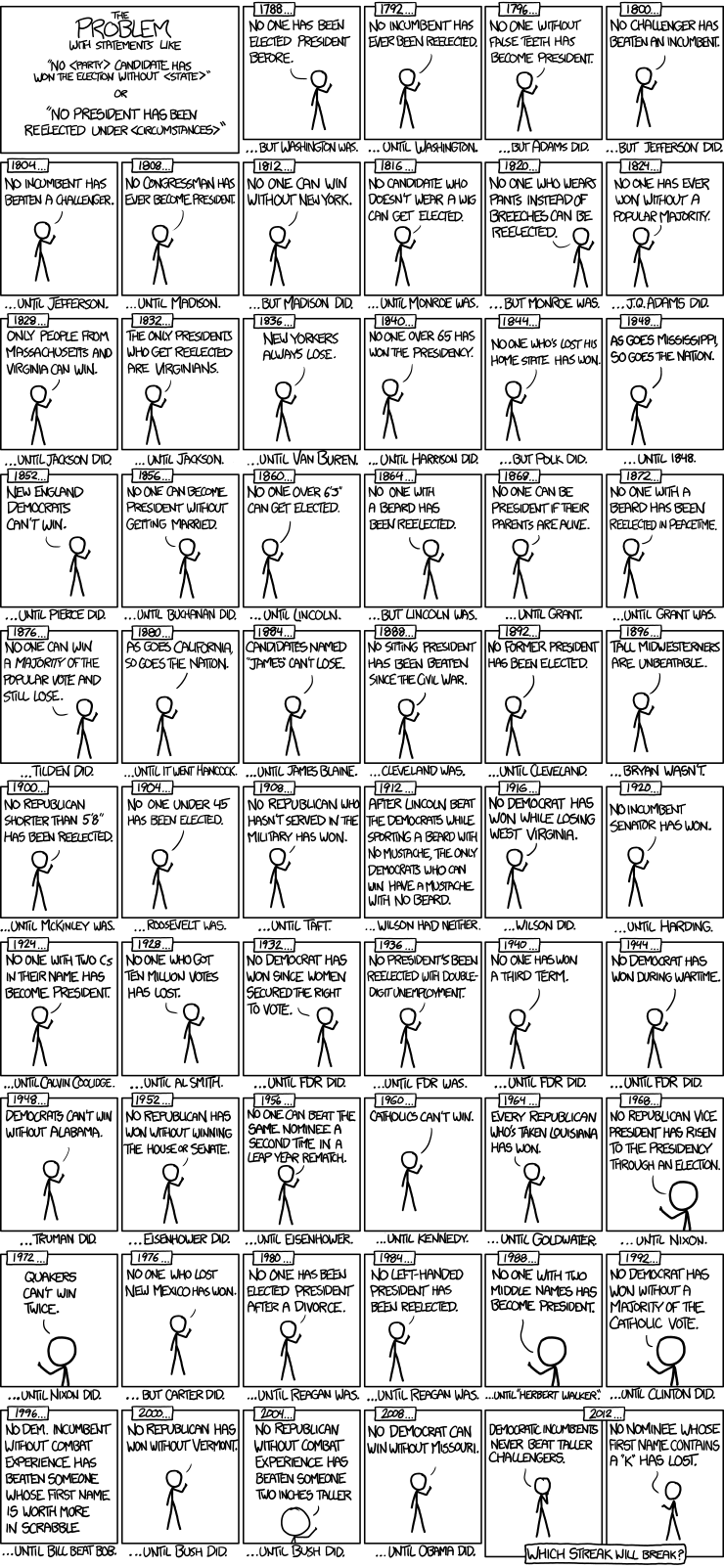
No white guy who's been mentioned on Twitter has gone on to win.
17 Oct 00:08

http://whenwillthehurtingstop.blogspot.com/2012/10/this-is-not-tardis-youre-looking-for.html

by Tim O'Neil
This is not the Tardis you're looking for


Historically Dr. Who was always defined by the interaction of two competing factors: the first factor was the strict budgetary limitations of producing a weekly sci-fi show on the BBC during the sixties, seventies and eighties; and the second was the great wealth of good actors available in the BBC's talent pool. The latter factor often succeeded in elevating the show far beyond the impediments imposed by the former. The fact that Doctor Who was produced so cheaply for the length of its first run can only be seen, in hindsight, as a positive factor in the show's success. Unable to fall back on superfluous special effects, the show's creators built a franchise that was buoyed for 26 years on the strength of a small army of (mostly) superb character actors.

For the most part, the new Who - which, seven years into its run, is only "new" in relation to the previous forty years of Who continuity - has followed in this tradition. Although the special effects are unquestionably better, they're still not "great" by Hollywood standards. But if you're complaining about the special effects you don't have any business watching Who, anymore than the original series Star Trek. It is now more or less as it has always been - Who floats on the strength of its actors. The three actors who have played the Doctor since 2005 have all been very good, and most of the companions as well - although every viewer obviously has their most and least favorites. It's a cycle as old as time - every time an old companion cycles out in favor of a new, the fans scream bloody murder, until a year or two passes and they become so attached to that companion that the new companion is an utter betrayal. And so on. And, of course, whenever there's a new Doctor the entire world threatens to crumble into multiple little pieces because the old Doctor was so well beloved that the show simply won't be able to continue afterwards - until the new one starts up and quickly becomes acclaimed as the "best Doctor ever." (Good rule of thumb: fan polls usually place whomever the most recent Doctor - not the current, but the next-to-current as the #1 Doctor ever, with Tom Baker as a perennial #2. So, in two or three years when Hugh Laurie or whomever is the next Doctor, Matt Smith will be [briefly] universally acclaimed as Best of All Time, with Baker as always in poll position.)

This is a good formula and it works well for the BBC. Most shows fall apart after a certain number of years because the cast costs too much money and no one wants to continue being the same character for decades, regardless of success. Who manages to avoid ever becoming too big for its budget by simply rotating its cast - its a neat trick, replacing actors while retaining the same protagonist for almost fifty years.

The problem with Doctor Who as it exists now has nothing to do with the actors, and even less to do with the effects or any other factor (although every iteration of the post-2005 theme song still sucks). The problem is that the writing is terrible. And the funny thing is that this isn't just the opinion of a small coterie of long-term die-hards with memories stretching all the way back to William Hartnell. In the aftermath of this last mini-season, the assertion of modern Who's dodgy writing has surpassed the domain of mere opinion to become a widely-accepted fact. Although the series has struggled with poor writing since the beginning of its revival, this last set of five episodes - the first third or so of the seventh series - seems to represent something of a nadir. Every episode was poor, a series of interesting ideas and images strung together with gigantic plot holes, leaps in logic, baldfaced dodges, and a more or less total willingness to ignore storytelling sense at a moment's notice. Every episode was saved from being completely terrible by the presence of likeable and talented actors. But it's getting harder and harder with every passing episode to remain enthusiastic for a show that remains doggedly resistant to producing an episode that actually makes sense.

The climax of this latest mini-season, the appropriately-titled "The Angels Take Manhattan," offers a handy encapsulation of everything wrong with the current incarnation of Who. We begin with the return of a familiar monster in an unfamiliar context, doing something that only vaguely makes sense if you don't stop to think about it for more than two seconds. You have multiple very important plot points passed over with assertions that something critical is happening / has happened without taking any time whatsoever to linger on how or why such things may be happening / have happened. Add in very good actors doing their best with the material they've been given even though the episode requires them to change plots multiple times and run off in arbitrary directions at the behest of the writer. Then top it all off with emotional arcs that seem blatantly unearned simply because the story itself is so ridden full of holes that the only reason we have to believe that the important things we are seeing are actually important is simply because the main characters tell us they are. The difference between "important" episode of Who and "normal" episodes is that, in the "important" episodes, things which would in other circumstances have been momentary obstacles for a clever character to overcome are suddenly insurmountable challenges that result in a massive change in the status quo. And - let us not forget - any and all previously established characterization and foreshadowing can be abandoned at the drop of a hat if the opportunity for a fake-out "sacrifice" presents itself.

All well and good, you say, and certainly, you can't accuse Who of playing more fast-and-loose with these things than, say, Batman comics. Sure, Batman and Robin can escape the Joker's death-traps dozens of times . . . until the one time they don't, and then the sidekick dies, and suddenly the entire tone of the story changes. But usually when heroes suffer and fail the writers have to do a good job of presenting reasons why the obstacles in their path are more severe than any they have previously faced. This is problematic for any character who has been around for longer than a few years, because after a while you are forced to write stories about heroes who are sufficiently competent that the only legitimate threat they can face are existential threats to the existence of the universe, or other similarly cosmic notions. When was the last time Batman foiled a series of bank robberies? We all know Batman can do that, so (according to logic) the only interesting Batman stories will be stories that up the stakes accordingly.

The difference between Batman and the Doctor in this instance is that while Batman's powers and abilities are now and have always been fairly well-defined - at least to the degree that any situation that requires him to surpass his physical or mental limitations has to be carefully explained - the Doctor basically only has whichever limitations the writers feel like acknowledging in any given story. Traditionally (and by that I mean for the series' first run), the biggest restriction on the Doctor's abilities was less a restriction on his power than a restriction on the type of stories Doctor Who could tell. To be more precise, Doctor Who was a story about a time-traveler that was never really about time-travel. Time-travel was what the Doctor did in order to hop from here to there, a different setting for a different adventure every week. But he didn't often time-travel in the context of each adventure. It was accepted as canon that he simply couldn't double back on his own timeline except in the most unusual of circumstances - once he was on the ground in a certain time and experiencing his adventures, he couldn't double back and undo anything. (This also provides a handy explanation for why he so rarely meets himself.) So, if he is in a room and sees a man get shot, he can't hop in the Tardis and undo the man getting shot, because he already experienced that shot occurring. Of course, he (and the writers) can get around this in any number of clever ways - I know a number of fans thought that the resolution of "The Wedding of River Song," for instance, was a cheat. It certainly was, but it was most importantly a clever cheat that, I think, ultimately played fair with the audience by ensuring that nothing we had "seen" was undone, merely that what we saw wasn't exactly what we thought we had seen.

A major problem with NuWho is that they actually do quite a few stories about time-travel, not just a few. And one of the problems with that is that time-travel stories are very hard to write, especially within the confines of the Doctor's previously-discussed limitations. The reason they are hard to write is that, as I said, the way you get out of things like paradoxes and "set timelines" is by utilizing clever cheats. And once you start utilizing clever cheats to get around every obstacle - which, let's be frank, is basically the Doctor's whole métier - it becomes harder and harder to establish scenarios that the audience can't themselves imagine a cheat for. You can see why, either through explicit or implicit agreement, the writers of the original series decided to steer clear of any overt reliance on time-travel as a plot device - the potential story complications are simply too much work for nowhere near enough payoff. It's not that it can't be done, but that it is very hard to do.

So when Amy & Rory are trapped in 1938 New York and the Doctor says he can't go back to 1938 New York to retrieve them, the audience immediately thinks, well, why not go back to 1938 Hartford or 1938 Beijing or wherever is sufficiently far away, take a bus and retrieve them the hard way? Or why not wait until 1940 and retrieve them after they've had a good couple years' vacation? Or any number of other work-arounds of the kind that appeared across the internet moments after the episode was finished. The answer was, of course, that there wasn't going to be any kind of work-around because we all know this was the duo's final appearance (for now), and they were being written out permanently.The Doctor couldn't do those things because we have to take his word for the fact that he can't or, barring that, he is a petulant dick and simply doesn't want to be bothered exerting any more than the minimal amount of time in the care and upkeep of his pets (this last interpretation, while not particularly charitable to the Doctor, is actually not that far off from what the actual text of the episode and season-to-date would have us believe).

This was, of course, a gigantic wet fart of an anticlimax for Amy & Rory considering that this entire run of episodes was pointing to the inevitable conclusion that their departure from the Doctor would come after they realize they had grown up and couldn't keep dropping their lives every time the Doctor came calling. I imagined it would coincide with them either overcoming Amy's infertility or adopting a child, something that would require them to settle down for good. It was going to be sad and weepy and it would reinforce the Doctor's status as an eternally lonely Peter Pan-type figure who ultimately can't keep his friends from growing up and moving on, ending with the bittersweet but still happy image of the Ponds walking off arm-in-arm into the proverbial sunset. But what we got instead was a last-minute MacGuffin in the form of the Weeping Angels.

People seem to like the Weeping Angels, at least to judge by the fact that the monsters have already proven themselves to be the most enduring original foe of the NuWho era. Personally, I find my patience growing thinner every time they show up. Although it cannot be argued that their debut, "Blink," was one of the best episodes of the current series and probably one of the best Who stories ever (a fact also due to the presence of the seconds-away-from-superstardom Carey Mulligan), the things that made "Blink" such a good episode did not actually make a good argument for the Angels as recurring foes. For one thing, the Angels' gimmick is that they're statues. They don't move. They can't talk, they can't communicate in any way whatsoever. Although they are very intelligent, they are also unavoidably static. So while they are undeniably great monsters, they make for piss-poor villains. "Manhattan" is a great example of why they just don't work very well in this role: they can't talk, so they can't exposit. Because they can't exposit, they just do things in an arbitrary fashion and we are left to depend on the Doctor to explain just what it is we're seeing. And when they do things like, oh, setting up an apartment building on Manhattan's skid row and supposedly keeping it furnished and all the guests fed and occupied for decades at a time - or something? - I'm not really sure what that was about, to be honest. The premise of the episode doesn't make a damn bit of sense if you think about it too hard, or at all. Were the people allowed to leave the apartments? Did they have normal lives, or were they under house arrest? And just why would the Angels care what happened to these people once they sucked out their time energy? Since the folks who put this fiendish plot together - the Angels themselves - can't explain just what the hell they think they're doing, it all seems rather random.

"Blink" worked despite the fact that it was a time-travel story because it was extremely well-plotted and smoothly executed. Subsequent Angels stories have not been so lucky. Because the Angels' gimmick relies on time travel, it can sometimes (often, er, almost always) be difficult to keep track of just what they're doing and when they're doing it. The Angels' previous two-parter, "The Time of Angels" / "Flesh and Stone," had some serious legibility issues, not to mention the fact that the events of the episode were supposedly undone by a time paradox, even though the events weren't really undone because everyone remembered them. "Manhattan" ended in a similar paradox, only this time the tangled timelines got even more complicated, looping around into a Primer-level state of confusion. I like to think I'm not a stupid person, but these episodes are naturally confusing. The increasingly baroque illegibility of these Weeping Angel adventures tells me that perhaps the monsters aren't nearly as effective as the producers would like to believe. Doctor Who is at its core a kids' program, after all, and if someone with decades' experience watching and reading sci-fi stories has a hard time following these episodes, maybe that should tell them something.

All of which points to the single greatest problem at the heart of NuWho, bigger even than the writing (perhaps even a symptom of the poor writing), I'd argue: the shortage of villains. Name a top-shelf villain created for the new series since 2005. OK, name one who recurred. Lots of little villains and monsters-of-the-week, but the Doctor's two greatest single villains remain the Master and Davros, both of whom were created in the 1970s. The Daleks and the Cybermen and the Weeping Angels are races who possess little or no individuation. There have been a few very promising candidates in the new series, but none have stuck. The Family of Blood were credible foes who were dispatched in their first appearance but who by rights should have returned by now. For whatever reason they have not. I remain shocked that the Beast from the two-parter "The Impossible Planet" / "The Satan Pit" has not returned - I would have bet money they were setting up that demon as a serious recurring villain. Additionally, there are still a few very good villains from the original series who have never appeared in the current series. I am amazed by the fact that we haven't yet seen the return of the Black Guardian, who would seem to be perfectly suited to the kinds of long-game story arcs the current series favors. And while it's become something of a humorous cliche that old-school Who fans spend a disproportionate amount of time pining for the Rani, it's worth mentioning that the reason why long-term Who fans might be anxious to see the return of old favorites from the first series is that that the new series has done such a piss-poor job of creating and maintaining interesting villains of its own.

At this point, I regard the Angels in much the same way that I do the Daleks: once beloved fan-favorites who have become maddeningly obligatory, defined by increasingly vague motivations and convoluted backstory. I hope we don't see them again for a very long time, because this story was unabashedly terrible. (Also, I should mention in passing a pet peeve of mine concerning the Angels: since their very first appearance, it has been established that when they are seen they are transformed into literal stone. My question question has always been, why don't they just shatter the statues when the Angels are frozen? The Doctor is never above killing when the monsters in question are unrepentant predators. Grab a sledgehammer and go to town.)

By coincidence I also happened to catch up with the second series of Sherlock on Netflix the other week. Sherlock is also produced and primarily written by current Who show-runner Steven Moffat. And, perhaps not coincidentally, it shares many of the same problems as Who. The primary actors for Sherlock are incredibly talented and possess a natural rapport. The show is shot well (if a tad bit overblown) with excellent effects. The problem I noticed as I watched series 2 was that the stories were, how do I say this nicely? terrible. Series 1 was excellent, but the plots in Series 2 started off ropey and proceeded downwards to dire. "The Hounds of Baskerville" was not terrible, but both "A Scandal in Belgravia" and "The Reichenbach Fall" were awful. Perhaps the movie-length format just doesn't flatter Moffat's writing, but all three of these stories seemed patchy, episodic, veered from scene to scene with a distinct lack of focus, oftentimes almost insultingly arbitrary. A number of times during the second season I could be heard to ask, "do you know what's even happening anymore?" after the the story continued to plow on in six directions at once, blithely indifferent to whether or not any of these six directions made a lick of sense. The 90-minute format means stories that simply, for lack of a better phrase, refuse to die.

And yet, I still found myself somewhat entertained, if only by the quality of the performances. The stories themselves - cruel distortions of Doyle's tightly-plotted tales - simply refused to make sense when seen from a distance. Usually somewhere around the 50-60 minute mark the episodes devolve into people running around town in cabs doing things that aren't well explained for reasons only Sherlock knows, and which will still remain somewhat foggy by the end of the episode.

And yet people love it. Just completely eat it up. Just like with NuWho - despite the fact that the writing is less credible than your average episode of NCIS. Don't take my word for it, I'm hardly the only one saying these things - Dorian and Andrew beat me to it. The writing is just terrible. It's sapping the juice out of what could otherwise be one of the all-time great sci-fi television runs. In some ways it's a blessing that the show remains so popular - as I said Doctor Who is designed to run for decades, and a bleak patch can always be covered over when a new showrunner takes over and changes the status quo. The show's success means it gets the luxury of weathering its rough patches. Part of being a "fan" means taking the bad with the good - you like the show, you like the show's world for better or for worse, and you learn to take enjoyment out of it when it's bad almost as much as when it's good. If you don't like Who now, come back next week and you might find it more to your liking. If you don't think the writing is very strong, watch for the actors. I just wish we didn't have to make that choice.

16 Oct 19:29

DINOSAURUS!

by The Beast Must Die!

Done for my nephew’s birthday -if anyone says Barney they get a slap.


16 Oct 19:11

Identity

Not sure why I just taught everyone to flawlessly impersonate me to pretty much anyone I know. Just remember to constantly bring up how cool it is that birds are dinosaurs and you'll be set.
16 Oct 16:20

New and Improved

by Alex Wilcock
For some people, it’s ‘Danger: high voltage’; for others, ‘This won’t hurt’, or ‘For the children’. For me, the most threatening three-word combination in the English language is ‘New and Improved’. Usually, it heralds that sinking feeling when you return from your local Giant SupermarketTM to find your favourite korma sauce, scotch eggs or even shower gel suddenly cheap and tasteless, with whatever it was you liked about them jettisoned to cut costs.

After five decent-ish years with Waitrose Broadband, Richard and I returned from Brighton to the new and improved John Lewis Broadband. Can you guess what happened next?

John Lewis Broadband Plus Plusnet Equals No Internet

I remember the shopping around we did after several terrible ISPs to find Waitrose Broadband, and it had mostly worked for us since, the odd problem and the odd oh-dear-we’ve-gone-over-our-download-limit-and-it-costs-how-much? aside. But it couldn’t last. They’re winding up the service into a new one. Improved, of course. And who are the new providers for our forced upgrade to an alleged cheaper, faster, unlimited service?

John Lewis Broadband, the epitome of respectable reliability, actually supplied if you look carefully at the small print by Plusnet, which claims to be good, honest broadband from Yorkshire. What could possibly go wrong?

Everyfuckingthing.

Us having made the shift in early September and them having taken a few weeks to action it, despite promises (warning signs there), we got home from Conference to eight days of zero internet and increasingly weary phone calls to find out what the hell was wrong. And they don’t even play Heaven 17 on hold.

As it happened, Richard had become very ill while we were away at Conference in Brighton, and once he’d recovered just enough to drive us home, I came down with it and was, as my rather too frequent saying goes, much more ill than usual. So things were quite fraught to begin with (and not being able to get online to NHS Direct. Obviously).

Imagine, then, the timbre of our phone conversations when we rang them three times on our first day back, for a total of two and a half hours, including the 45 minutes on hold after which they just hung up and made us go back to the start.

Imagine doing that – ringing them every single day for the next week for between one and three hours – each time having to slowly explain the problem all over again to a new munchkin, and do exactly the same tests because obviously it must be us, and not them… Until they admitted that they’d detected 2361 rejected (by their end) attempts by our correctly programmed (by us) router to connect, not all of them manual but by God it felt like it, and that it was in fact their fault after all.

They just couldn’t identify that fault correctly. Worse, they kept making promises. Here are just a few of them that we made a note of:
  • Switch your router off for 65 minutes and it will reset, after which you will be able to connect. No, that was a lie.
  • We have reset your details at our end and it will be ready in the morning. No, that was a lie.
  • Our faults team has identified the fault and I have actioned a modify order that will apply the fix and have you fully online in exactly 24 hours. No, that was a lie.
  • That modify order was incorrect, but I have actioned a new modify order that will have you online in the morning. No, that was a lie.
  • It is your fault after all – our faults team has identified that you can’t receive Broadband on your number. In that case, can we have a full refund for all the money we spent on what was therefore imaginary Broadband from you for the past five years? No, because that was a lie.
  • We will ring you within 24 hours because I have personally made sure it will be corrected with the faults team and my line manager. No, that was a lie.
  • I apologise that you’ve had to ring because we failed to call you back, and I won’t lie to you, I can’t fix it myself because I can see that they’ve been making the change you need on our server and for some reason our server won’t accept it, but I will call our faults team if you will wait on hold for just two minutes. Seventeen minutes later: no, that was yet another lie, probably not best for our blood pressures after using the words “I won’t lie to you”. At least on that particular day we were only on the phone for 47 minutes, because we were weary and fatalistic rather than icily polite in a furious way.
  • And, of course, when I staggered out to our local library (which, being a Labour-and-Labour-Splitters Council, randomly blocks most of the sites I read) in a vain attempt to plough through hundreds of emails that were backing up, finding daily “Your broadband service is ready” emails from John Lewis Broadband. No, that was, very demonstrably and supremely aggravatingly, a lie.
At long last, Richard got a short and sheepish phone call to say that they’d found a workaround that involved reversing several things they’d said they’d done and that they’d told us to do from the start, and that it would be working in the morning.

Imagine my genuine gobsmackery when, at long last, on merely the ninth day, this turned out to be the truth.

We’ve now had a connection back for a week, and I’ve caught up with most of the things I wanted to catch up with; it’s remarkable how something as simple as being internetless makes me feel crazed, depressed and as if I’d been exiled to Flatland. And I’m still physically very washed out, but mostly only as ill as normal.

Now I just need to gather my strength for the bills, and to ask, ‘Shouldn’t you be paying me?’


New and Improved Labour

On the bright side, during our week of never-ending phone lies, at least we weren’t at the Labour Party Conference in which they attempted to rebrand themselves as Nineteenth Century Tories. Well, I can see a direct line in my own party and philosophy from the ones who were opposed to the Tories in the Nineteenth Century and are still, despite everything, far less conservative than Labour, so I can’t say I was impressed. Still less that it wasn’t even genuine Disraeli, who despite being an utter shit at least paid lip service to “One Nation” meaning that everyone had to get on: only the hollow marketing exercise that is today’s Labour Party could rebrand as One Nation founded on class war and hating the rich and not spot the contradiction in that.

But what do you expect, with Ed Balls boasting on the Today Programme that thirteen years of disastrous Labour Government left literally no economic problems at all? Or with Ed Miliband calling the Lib Dems “accomplices”, an accusation so ‘brave’ (as Sir Humphrey would say) that it would be a delight to see Mr Miliband’s face when charged as an accomplice to the Labour Government’s illegal war, illegal war crimes, illegal rendition, illegal collusion with Murdoch, and mostly legal but amazingly stupid total financial collapse. Accomplices? Bring it on, Inspector Knacker.

None of which meant there will ever be any chance of me switching to New and Improved Labour.


This morning, to come briefly up to date, I see that the Tories are out to demonstrate that they have not improved, and that they’re still at their old tricks. With the Conservatives having teamed up with Labour to protect the interests of the Tory Nineteenth Century and stop democracy coming to the Lords, the Lib Dems told them they could go fuck themselves over their preferred changes to Parliamentary Boundaries. This morning, it’s reported that the Tories have a brilliant idea to get the Lib Dems to change our minds: no, not actual democracy. That would be madness.

That Tory plan in full: ‘We’ll slip you a few million quid, and you change your vote. Deal?’

That’s not new (and certainly not improved). It’s exactly the way the crooked Tory Government in the Nineties – and the crooked Labour Government in the Noughties – were open for business, but unlike the other two, Lib Dems have never been for sale. If we move an inch on this, I’ll eat my blog.
16 Oct 16:03

What sort of country sends someone to jail for wearing a T shirt?

by The Heresiarch
Adam Wagner is good on the inappropriate use of the law to enforce what should properly be considered matters of politeness in online discourse:

 The problem is that once the state starts policing speech and thought, this tends to be the thin end of the wedge. People become frightened to say what they feel and instead say what they think they ought to say. Such a climate would undoubtedly place a chill on the wonderful, bizarre, entertaining, sometimes concerning but always interesting world of social media. And that would be bad for everyone.

High-profile recent cases include that of Azher Ahmed, who was convicted for writing on Facebook that British soldiers should "die and go to hell" - an opinion that many people will not agree with, but which surely struggles to reach the threshold of "grossly offensive" under s 127 of the Communications Act, which was the law used against him. Ahmed was "let off" with community service, because he apologised and deleted the comments soon after they were made. The district judge, however, suggested that the remarks in themselves were sufficient to send him to jail and that Ahmed had "failed to live up to" the "responsibility" that comes with freedom of speech. His culpability was increased, in the judge's view, because someone else had taken it upon themselves to circulate the address of someone else with a similar name, and various thugs had intimidated an innocent family at home as a result.

Meanwhile, 20 year old Matthew Woods has been jailed for twelve weeks for making tasteless jokes about missing five-year-old April Jones. Not a nice thing to do, but it seems to have amounted to much more than "a moment of drunken stupidity. When the comedian Justin Lee Collins gets community service for conducting a sustained campaign of violent harassment against his former partner it seems hugely disproportionate. But perhaps it's a different rule for comedians. As Adam Wagner notes, Frankie Boyle hasn't yet had his collar felt for any of his outrageous "jokes", the latest of which suggested that the reward for all Jimmy Savile's charity work will have been "the opportunity to shag Madeleine McCann in heaven".

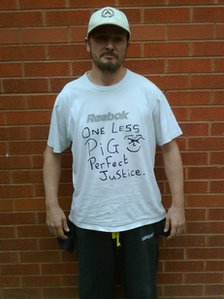
The DPP is currently (with some help from Twittering lawyers) consulting on new guidelines on where to draw the boundary of "acceptable speech" online. The problem doesn't just concern the exciting new world of social media, though. Sections 4 and 5 of the Public Order Act 1986 is still with us, criminalising any behaviour liable to cause "harassment, alarm or distress", a provision which would appear to be a stranger to the entire concept of free speech. Barry Thew has today been jailed for eight months under the POA for wearing an offensive T-shirt.

Thew, whose son died in police custody three years ago, was seen sporting a T-shirt with the hand-scrawled slogan "one less pig - perfect justice" in Radcliffe town centre hours after the murder of policewomen Fiona Bone and Nicola Hughes, an act which chief inspector Bryn Williams, speaking after the trial, described as "morally reprehensible". The sentence worked out at four months for the T-shirt, and a further four months for breaching his bail conditions. It's not clear what the breach entailed, but it could well have been getting himself arrested, in which case the whole sentence was T-shirt related. But whether it's four months or eight, it's still a ridiculous sentence.

Prosecutions for "offensiveness", whether they involve Facebook messages or slogans worn on t-shirts, amount to a legal doctrine that people have a right not to have their feelings hurt, indeed that it should be a crime to cause another person emotional distress. That, of course, is the argument made by those who want further restrictions on free speech where religous sensibilities are involved, something akin to a new law of blasphemy. In that case, the danger of protecting religion from criticism has, so far, remained sufficiently obvious to keep the the opponents of free speech at bay. But it's surely inconsistent to deny the deeply felt religious convictions of people the legal redress offered to the more immediate emotions of bereaved relatives and colleagues of soldiers or police officers. It's certainly inconsistent to lock up "offensive" T-shirt wearers while condemning Russia's treatment of the punk band Pussy Riot for upsetting Orthodox worshippers at the Cathedral of Christ the Saviour.

Chief Inspector Williams made a point of noting that "the overwhelming response from the public, who have inundated us with messages of support and condolence, proves that Thew is the exception and not the rule and our communities were right behind us at our darkest hour." This is obviously true; but it's not obviously a reason to prosecute and jail someone for not sharing the general opinion. On the contrary, the existence of a social consensus of acceptable behaviour is more than adequate in itself without recourse to the law. If bereaved relatives are upset by isolated incidents of unpleasantness, are they not also comforted by the support and good-will offered by many thousands of people unknown to them, and do not messages of the latter sort outnumber the former many, many times?

I find it especially disturbing that in many of these cases prosecutions have been brought after members of the public reported the offensive conduct to the police. Rather than demonstrating their personal distaste for the sentiments by condemning the culprit to his face, people preferred to do so by demanding criminal sanctions. Wagner notes that a group of around 50 members of the public cheered when Woods was sentenced for his Facebook message. Free speech is not particularly popular in modern Britain. The public here has never been terribly liberal, but I think we're also dealing with the erosion of the idea of social space as something self-policing and independent of the state, just as politicians in recent years (not just New Labour ones) have often been unable to distinguish between disapproving of something and wanting to ban it. The gap between "I don't like X" and "people who do X should go to jail" should be a lot wider than it seems to have become.

© 2012 Heresy Corner, all rights reserved.
16 Oct 15:36

Day 4306: The Problem with the Four Pledges Test

by Millennium Dome
Monday:


"What four pledges would you put on the front of the next Lib Dem manifesto?"

If you're following the Liberal Democrats internal elections at all, you'll have been reading closely the answers submitted to Jennie Rigg's questionnaire for candidates, and that is the second question.

But there's a problem with this approach: those pledges have to do two jobs – they have to DIFFERENTIATE us but they also have to be DELIVERABLE.

The need to have "red lines" that we can be sure the other Parties will agree to is making us pick BLAND, CAUTIOUS, "MORE OF THE SAME" policy.

We like to see it as a Lib Dem TRIUMPH that we can flourish: look at the four big pledges on the cover! We DELIVERED them all! (To a certain value of "delivered" when it comes to political reform.)

But look at what happened to us over the unofficial "fifth" pledge: tuition fees. Sure, it wasn't on the cover, but signing those pledge cards went and made it co-equal. And we had no chance of agreeing it with either Labour (authors of the Browne Report and who had form on bringing in tuition fees in the teeth of their own broken promises) nor Conservative (who were highly unlikely to disagree with making people pay for something they technically already owned).

We were completely burned for selling out one "red line".

But it makes you realise how carefully "gamed" those other pledges were: they were different enough to make a splash, but close to what the other Parties would agree.

Count Packula puts it best when he answers Jennie with:

"The best set of pledges need not only clearly represent our values, they must be electorally useful in winning support, distinguish us from the other parties and be plausible to deliver in any hung Parliament negotiations."

So I'm seeing a lot of times "keep increasing the personal allowance" and "keep investing in pupil premium" (yes, that one's on mine!), and the lack of ambition is slightly beginning to depress me.

Or to put it another way: let's have "more of the same", because "more of the same" is making us SO POPULAR AND DISTINCTIVE, isn't it.

The alternative is seeing genuinely BRAVE and INNOVATIVE policy and reacting warily to it for fear that it's going to be another bruising, busted pledge.

For example, Mark Thompson – who is an excellent candidate who I would be delighted to see on the FPC – includes in his four: "A pledge to legalise and regulate all currently illegal drugs"

Of course this is absolutely the right policy: he's done much more research into the evidence than me, but what we'd both tell you is that the so-called war on drugs is a massively expensive failure that boosts the profits of criminal gangs while putting many lives in danger from cut drugs and crossfire. Legalisation would save police time and money; allow users some certainty they were getting what they paid for and not chalk cut with horse tranquilisers or rat poison; and allow us to treat addiction medically without stigma. The levels of harm from cannabis or ecstasy (see Jennie's question one) are not nothing but are tiny compared to the levels of harm that we accept from drinking or smoking. It's obviously the liberal thing to do. And, hell, it might even boost the economy.

But Labour and the Conservatives will join forces to block it, just as they did with Lords Reform, because the status quo is in there interest – namely playing to the "law and Order" gallery for the support of certain newspapers in their ever more insane bids to outflank one another on the right.

They'll beat us up for suggesting it and then beat us up AGAIN for not delivering it!

Another example is where Prateek Buch – also an admirable (not to mention ubiquitous – how does he fit in all those speeches?) candidate who I'd be very happy to see elected – includes "coalition compromises would not cross red lines of increasing gap in wealth and power between top and bottom".

We all know that Liberalism is about dispersing power, breaking up vested interests and returning opportunity to individuals. And anyone who has read "The Spirit Level" will be familiar with the benefits, to health and happiness as well as growth, which appear to come from a more equal society. But at the same time you must see the hostage to fortune: even if you DON'T consider that an automatic ruling out of another coalition with the Conservatives, whichever Party ends up in opposition, they will immediately start looking for measurements to show that the wealth or "power" gap (however it's measured) HAS increased and that we've "sold out".

Similarly, my own manifesto includes the Citizen's Income suggestion.

Now, "raise the personal allowance" is a policy that we can sell to either other Party – the Tories would buy a tax cut; Labour would buy help for workers on the lowest incomes – but a radical change to the tax and benefit system, abolishing huge swathes of bureaucracy (read "Whitehall power")? It's too big, too radical, too scary.

So you see the problem. This need to be able to compromise AND show we've not broken our "headline policy promises" means that far from breaking the mould, we're now moulding ourselves to fit with policies that are acceptable to the old status quo of the Labour/Conservative axis. When people are crying out "you're all the same" we are literally making ourselves "more of the same".

We make a TRAP for ourselves if we say our HEADLINES are also our RED LINES.

Red lines should be the absolute MINIMUM acceptable to us. If our headlines are no higher than our absolute minimum then what are we saying? Either we are too radical to ever form a coalition with either old Party or we're already too compromised.

With Labour and the Conservatives BOTH retreating to Nineteenth Century One Nation-ism, I think we need to be braver about offering a REAL transformation, not just tinkering with the current broken system, but a genuine promise of a new direction.
16 Oct 14:28

The New World of Publishing: Maybe You Wrote a Good Book

by dwsmith

This is sort of a continuation of the last promotion post, but a ton of words shorter I promise. And if you haven’t read the comments on the last promotion post, I would suggest you do so. Some wonderful discussion there.

I saved this part of the promotion post to stand alone because I knew if I didn’t, it would get lost. So here is my thesis statement:

Maybe your book is selling because it’s a great book. Not because you promoted it.

I know. Shock! Am I trying to tell you that good storytelling sells?

Yes, I am. Because readers have this scary ability to hear about and go find good writing and good stories they want to read.

And a bad or amateur story doesn’t sell no matter how much you Twitter and Facebook and blog tour about it. Sorry.

I was stunned in the last post that I only got one comment “But what about Amanda Hocking?”

Amanda Hocking has a blog with a lot of followers where she talks about her life in general and sometimes her books. But why her books sold as much as they did and why New York stepped in and offered her millions was not because of her blog. Nope. The readers and New York did not buy her blog. It was because she wrote some damn fine books that readers wanted to read.

It really is that simple.

But putting the responsibility squarely back on the writer’s shoulders to write better stories is scary. Especially to new writers who really don’t understand what it takes to write a quality story that hundreds or thousands or millions will want to read. New writers don’t even know what they don’t know. They just don’t have the study or the practice or the words under their fingers yet.

Writing good stories is a skill that takes time to learn. It can be learned. It’s not a talent, it’s a craft that can be studied and learned with enough effort and drive and practice.

But writing and learning need to be the focus.

So if you are out promoting your third novel and wondering why it’s not selling, maybe your time would be better served to learn how to write a better story. Just maybe.

Just saying…

Attitude is Everything!!

A mentor of mine once told me a secret about writing that really, really hit home.

He and I were in a workshop and he told some young beginning writer (with a horrid attitude) to turn a story into a novel. That was his entire critique of the story which was so poorly done that it had no hope at all in my opinion. And the writer was so full of himself, he wasn’t going to listen to anything negative about the story anyway. He thought his one story a masterpiece and he was going to make sure the world knew it was. In fact, the only reason he had submitted it to the workshop was to impress my mentor friend.

So as we were walking away from the workshop, I asked my mentor why he had told the young writer to turn that awful story into a novel.

My mentor just smiled and said, “With someone like him who has a pile of crap, tell them to make it into a bigger pile of crap and they go away happy.”

Folks, sorry, but if you have only written one novel or few short stories, promoting a pile of crap just won’t help you.

And trust me, I wrote some really heaping, steaming piles of crap when I started out. We all do. And my piles of crap were pretentious because I came from a poetry background and thought I knew everything about writing. They were rewritten to death because I believed that was the way to create art. They had zero thought to the art of storytelling or what a reader on the other side might be thinking when reading it.

They stank up the place and I had no idea at the time.

Looking back, I have no idea what would have happened to me at that point in the 1970s when I wrote those early stories if I had the modern world of easy access to publishing. I imagine I would have published and promoted them to death and wondered why readers were so stupid as to not understand my great art.

Luckily I didn’t, so I just sent them to editors who paid no attention and sent me form rejections.

Writing good stories readers want to read is a craft that can be learned, but it takes time. And a ton of practice and learning combined with the practice. Focused practice.

Attitude is everything. And that attitude needs to be a hunger to learn and to become a better storyteller.

So my suggestion: Put your story out on the market either to editors or readers and forget it and focus forward on learning and writing more stories. It can’t hurt you to have them out. No one will read them if they are a stinking pile of crap. So no big deal.

And if you happened to have gotten close to a story that works, then readers will pay you money for it without you doing a thing to push them. And you will then know and can take credit for writing a good story.

And when that happens, take the credit. You will deserve it.

Keep writing and learning and writing and learning and writing and learning.

There will be enough time down the road for promotion of the right book.

And keep having fun.

————————————————

Copyright © 2012 Dean Wesley Smith

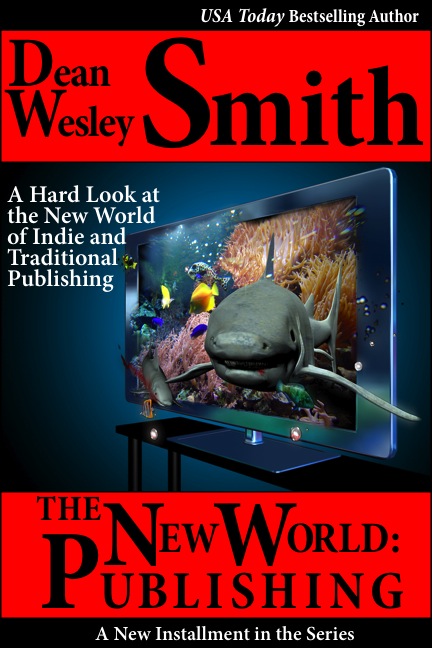
Cover art copyright Philcold/Dreamstime
————————————————–

16 Oct 14:25

NHS Reform, the bill "no one voted for"? No, not really. | Mat Bowles

by andrewhickeywriter
16 Oct 14:24

Yes, being pro-life does make you less of a lefty | Kelly Hills | Comment is free | guardian.co.uk

by andrewhickeywriter
16 Oct 11:47

Fresh Eyes

by plok

Good evening Bloggers, and all the ships at sea! It’s been a while, hasn’t it? I’ve been back from Denmark and Manchester and Glasgow since June, but I’ve been caught up in plenty of other things…you know that feeling when you get back from a trip, and you want to carry some parts of the trip with you, back into your ordinary life? That was me, for sure…it’s been fifteen years since I’ve travelled anywhere much further than a ferry ride away, and it’s been a couple years now of upending all my old routines, as well as a couple years’ worth of failed attempts at crafting new routines to replace them, and oh my goodness did I ever need a bit of a change. So the blog was suffering already, mostly from what I thought was ennui but what was really preoccupation with other projects…I see that now…and, okay, maybe a little bit of ennui, but when I came back it wasn’t ennui but it was beauty, beauty, beauty what killed the beast. You see, when you’re in your twenties and you’re travelling, you can leave the trip behind you when you return because you’re not yet finished building your life back home; but when you travel in your forties and you haven’t travelled since your twenties, life at home is mapped and known to the extent that either you toggle right back over to it, or you naturally seek to — somehow — flip that switch even farther over the other way.

And that was me. I lost so many routines, you know, that I just couldn’t find agreeable substitutes for…the history of this blog is the history of a life in perpetual flux, I guess…oh, damnit, that’s true, isn’t it?…that I guess returning to routine had a hollow feeling to it. And so for the foreseeable future, I’ll be trying to act as though I’ve taken early retirement at least a couple times each year, trying to wing off to distant climes…there to see new things and be new people…

Not that I kid myself this can ever pass for routine either. For if nothing else is true, it’s true that life is discovered in tensions between warring states of mind, inclinations that can never be followed wholeheartedly without reservations, and so it is that even novelty can pale. “I miss the freedom of life in the desert.” “I miss the companionship of life in the desert.” Coyote, even Steve Englehart’s Coyote, isn’t made to be satisfied by the mere accomplishment of his wishes…for like each of us, he’s a liminal sort of a figure, with one foot in Being and the other in Becoming, and therefore destined by his character to both succeed brilliantly, and screw up hilariously, often at the same time.

But, over time…it’s interesting what comes of the successes and the screw-ups, I think. In the first book of Carla Speed McNeil’s Finder, yellow-eyed Jaeger refuses to watch a program on TV that involves all the natural tropes of TV drama, because he says he sees that sort of stuff all the time in real life, and if he’s lucky he can do something about it and if he’s unlucky he can’t, but he’s not going to sit there and watch things he can’t change go to shit for fun. And it’s a marvellous encapsulation of the sensation I always get when I return from various kinds of absences, to re-enter the routine I laughably refer to as “real life”…to look around and ask oneself, of an object or an activity previously accepted on face value, “just what the HELL is this pathologically-repetitive soul-draining thing, and why the hell do we put up with it?” Of course most of the time we put up with it because we must — because not to put up with it would be to be driven crazy by it — but every once in a while, to see it with fresh eyes

Well, I guess I’m saying it’s salutary. Salutary to aggressively distinguish once again between shit and Shinola, salutary to be able to eschew basing oneself in the things around oneself, and instead look upon those things with a cold, clean eye…to see, to find out, what you can do-or-not-do about the parts of them that are no damn good to anyone

…Which is not all that much of a revelation, I’ll admit it. But it’s interesting to me in the light of reading Finder, because in physical terms Jaeger’s life is not exactly mine — Jaeger stands on top of telephone poles and sleeps on girders and hops over rooftops, the sort of fellow not like me who never saw a reason to use a front door when there was a second-story window handy to a drainpipe instead — but it’s more like mine, it seems to me, then it’s like that of the real-life people I know who do do stuff like that. Mentally, it’s more like me; and I’m more like it. Because…

Finder is really all in the head. You really don’t see this stuff very often, actually: the idle construction of personal fantasy, built over years and years in stray or stolen moments, usually stays locked up in the imagination of the person to whom it is personal, I should guess. Maybe because it starts from something else, some fancy that’s in some part derivative of someone else’s work…hmm, I have more than a few of those, myself…so in a certain way more the creation of a reader than a writer, and then by the time it grows bigger than that, it’s already gotten too big. Too big to be made as itself, out in the real world! Of too complex a pattern, that just accreted around little dramatic set-pieces full of flair, that meant (to begin with) nothing really, but that dragged meaning and texture to themselves over time, and then kept doing it, and never stopped, and never became…hmm, perhaps…a proper story? Not really a proper story, maybe. Maybe something one might guiltily cannibalize bits of, for one’s other “proper stories”, once one had some of those. But not usually, in my experience, something that could in practical terms be realized as itself, in a piece of artwork. I think I can recognize these things, you see, because my own hold so much meaning for me, even though — or maybe because — in the end they’re just mental doodles. Private little things, private little worlds, private little bits of drama and humour and names just so-chosen, but never really intended for public consumption, and never really destined for it. Oh, proper stories, I have those as well…but my little solo flights to imagination aren’t about the joy that comes with doing the job, they’re about the joy that precedes the job. So likely none of you will ever hear anything about them.

And that’s what’s so special about Finder, you see: because it actually is such a world, made as itself. People talk a lot about metatextuality, stories that are about stories, and that’s fine stuff…but it’s not of the same order as the stuff that’s genuinely personal, of the person as a person moreso than of the person as some separate and secondary thing, some separate and secondary role, called an “artist”. Because stories-about-stories don’t just come in Metatextual Flavour, they also come in Psychological Flavour, and in Finder the hints and the clues are all over it, swirling all around it constantly, telling you as clearly as anything that’s clear: this is not primarily an exercise in formal cleverness. This is not just the author as writer at work, but the author as reader as well. The author as the reader of the writer? The author as the person in whom reading and writing and dreaming-up live as components of character, not subsets of aptitudes.

“Follow the path. Waking or sleeping.”

“Follow the path.”

In her copious endnotes, Carla tells us that Jaeger always dreams about mazes and puzzles. And as it turns out we actually do need to know this, as much as we need to know what picture Brig throws away (blink or you’ll miss it!), because Finder is too large to dwell entirely on the drawn page. It isn’t just a wittily-Brechtian parenthetical device like Jack Vance’s footnotes, or a Derridean cosmological experiment like Nabokov’s tunnelled arrays of mutually-mirroring hints …Carla’s internal world really is just too big, too big already, to just be simply set down in inked panels and dialogue, and (as the vivacious Vary would tell you) it’s got a lot less to do with theory than with practice. Suivre our good friend Old Albert: matter is subtle where theory is crude? Hmm, well reading it for the first time you do sense it: the complete image is far too big for you to see. There’s so much you need to know about the Clans; there’s so much you need to know about the people who move around in them and in-between them. And I haven’t even mentioned the Ascians. So, “endnotes” maybe, but hardly “annotations” as we commonly think of them…and I guess maybe that isn’t too writerly?

The story should be the story, should be the story? Self-contained?

Sure, I guess. For a writer. But not for a reader! So this isn’t what we sometimes call these days “back-matter”, it’s much more integral than that, and it’s far from being after-the-fact, far from being simple post-story schematic. And anyway why do writers have to only do it this way or that way anyway, huh Dad? Why does writing have so damn many rules…!

Finder. It’s all in the head, and it’s all of a piece. So you pick up on it, and you pick up on it, and it takes a while. Myself, I didn’t know for sure, not really for-sure for sure, what I was looking at until I read the “Talisman” story. And if you’re so unlucky as to be as dense as I am, you won’t either. But once the dominoes start to fall, they really fall, and the pattern becomes clear…the nature of this particular quest becomes clear, and more importantly it becomes clear as a quest. What are internal landscapes made out of, anyway? How are they crafted, and what purposes do they follow? The world of Finder is a very large one, unusually capacious in both space and time, a galaxy in a planet. But its capacity is not capricious…at least, not now. Maybe long ago, when Carla first thought of it, it might’ve been…

But it isn’t now, so even though you can’t see the big picture all at once, you know that’s because there is one, not because there isn’t. So obviously the first comparison that leaps to mind is Cerebus, because it most famously begins (as all great long-form comics art does, perhaps?) with simple posturing made from rough sketchwork, and immediate goals like poorly thought-out punchlines — thus what it will be about is not what it starts out as. Yet Cerebus may not be the best match, here, if we’re talking about that stuff; Carla clearly learns on the go, but the act of portraying her world is already very well-rehearsed by the time she gets to Page One of “Sin-Eater”, and the skill she brings to the performance is quite as well-developed too. So it’s a little less Dave Sim, and a little more Jaime Hernandez: as the “learning as you go” thing doesn’t just apply to the artist, but the reader learns as well — learns to see confidence and deep intent in something that only looks like it’s being assembled on the fly, and learns to discern the constant aiming at the pattern of a sculpture that was always deeply-felt as implicit in the stone. No epiphanies, but then the process of revelation doesn’t necessarily depend on those, does it? SHOCK, WHOA! is a lovely thing when you can get it, but it doesn’t all actually have to be “shock whoa”, honestly, to be a story. Not when there are more sustaining notes to be sounded. Maggie the Mechanic dances at the tavern by the dinosaur corpse while Hopey reads her letters back in Hoppers, and…you see? Already the SF conceit is emptied, and the characters have taken over, and we’ve barely begun. Like smoking creepy pot, the characters suddenly have always mattered, they’re the only things that have always mattered…somehow they’ve been the only things that matter about the story, for longer even than the story has been available for telling. So their world is very large, and full of strange unseemly familiar things, but the weird world they live in isn’t what counts: Jaeger solves a murder mystery in a minute, in three chilling frames, but it isn’t about the mystery of the unknown, but about that other thing instead. The known: that most bottomless of pools, wherein all meaning is contained, that mystery only ice-skates over the top of. For mysteries are only abstract paradigmmatic creations, after all: the locked rooms all merely indicators, pointing at things the compass misses as it spins. Negative space: it’s the notes you don’t hear, whether we’re talking about American jazz or Japanese calligraphy…and there’s perhaps a reason its creator calls this work “aboriginal SF”? Any edifice of world-building in some way is built to totter, I suspect, when it encounters not just mystery-solution but truth; therefore where this world comes from, and what exactly it is, is a puzzle, a puzzle, a puzzle…but then so is any world, and it always will be, and at the end of the day you have to allow that this is perfectly fine, or at least acceptable, or anyway there’s no point standing around and complaining about it, when you’re either capable of changing it or you’re not. Puzzles, yeah, but we don’t need to concern ourself with the puzzles

The puzzles can wait…!

…But while we’re alive, it’s the problems that we need to deal with as best we can. And the thing about problems, is that they’re always about people. People: the cosmologies that you can touch, and on your own scale too: neither under microscope nor through telescope, but free of theoretical abstractions and displeromatic renditions and oneiratic satisfaction and cleverly symmetrical thematic direction, and perhaps awfully hard to locate the perfect consistency of a locked-room compass-point in, but real, right? Real: and even if impenetrable, still at least not distant. So no matter how chaotic the world and the people in it may be, and however defeating of plan or prophecy, deep still calleth unto deep as far as the observer at X called you goes, and so if the meaning that’s resident in our metatextual fiction is a meaning that means anything at all, it certainly doesn’t mean that “all is fiction” but instead that almost nothing is, and that training wheels are useful when you’re learning to ride, but they’re only a hindrance once the learning is done…and at some point the learning really is done.

Still fun to play with? Yes, of course.

But even play is not meaningless, though to be play it must remain play. Waking or sleeping we follow the path, but sometimes we’re thinking and sometimes we’re dreaming, and those aren’t the same things, they’re not the same kinds of activities…so God help us if we confuse ourselves into accepting that they are the same things, despite everything we experience telling us they’re not, because then the tension of opposed states in our lives is not something we can get the good from, because it isn’t something we can learn to properly flip through to wherever we’re going. I miss the freedom of life in the desert! I miss the companionship of life in the city. But city or desert, thinking or dreaming, Being or Becoming…

We follow the path.

And just so for me, when I returned from my trip. It really had been so long since I was away, you see? Like Jaeger in Anvard, before I left I had to scourge myself every so often to keep from going crazy. I had to seek inordinate stimulation: booze, women, gambling, butter and sugar. It’s like that for many, I think, and it’s far from completely unhelpful. But sometimes the therapy becomes an obstacle: out past the towers downtown is a blue sky tinted pink and purple…and you want to be there, out past the towers, over the mountains, down on the flats, to see it do its thing. You want that, but occasionally it’s hard to remember that’s what you want. Oh, and how many times in my life have I concluded that the shortest route between me and what I want, is the consumption of a lump of hash in a basement apartment with the curtains drawn at six a.m. to sustain the note of night! And sometimes a visit to the government office afterwards to pick up a cheque to keep it going, never mind that I’ve somehow gotten the basics of my desire wrong, and so am just throwing good time after bad. But eventually, I think, the training-wheels fall off no matter what you do…no matter what you do, at some point you are no more the kid in the back of the car who’s moved by nothing but the stimulation of a brand-name at the other end of the too-long highway, but you are the grown-up looking at the plaque on the side of the highway in something like astonishment at the passage of time it’s been set there to mark, and you’re content to let the road get as long as it wants to. And the hell with all brand-name stimulations! But just give me something that’s solidly nameless and real, something that goes further than the feeling of just labelling all the knots in this notional net. Hey, at the risk of derailing the derail, I’ve got to tell you that my good friend Noah B. said he couldn’t get past “the Wolverine thing” with Jaeger…but I have a peculiar notion that’s the very last piece of Wolverine that’s Canadian, that he couldn’t get past. Because surely the featureless fucker that emerges from the ecstatic D&D storm of the frustrated lives of both readers and writers that now typifies the Big Two comics biz, wouldn’t have a sufficient spattering of character to make him specifically distinguishable as “Wolverine”, as a character different from the general swarm of fan-favourite mush that’s worn the hood of some name or set of attributes associated with a name, that’s swept over superhero comics like a tide of one-minute oatmeal w/ skim milk in the last quarter-century or so? And maybe there really is no such character as “Wolverine”, anymore? Just a niche for a specific type of anger or lust, or incipient sexual frustration, or combination of all three, to lodge in: “NAME”? “SUPERHERO FIGURE X”?

And also for some reason I have to put up with that “bub” shit.

Honestly, I ask you.

But past all that, and maybe thanks to no one but Len Wein and Dave Cockrum and my own Canadian gaze (just added on to by Claremont and Byrne a tiny bit, even if an unusually effective bit), somehow there is something, even if it was only ever the slightest thing, in Wolverine that connects with my life. First he was a sawed-off little shit, who always jumped too soon and landed too hard; then he was a man with a past, that he felt apologetic for, and on occasion was rescued from by an “animal” awareness and sense of self. That “animal” stuff, by the way, that’s not really too good to be throwing around if you’re not a Native guy, and especially a white guy like me must always feel indeed faintly apologetic for even thinking of it as a Thing — ’cause it’s just too close to the Noble Savage stuff, you know? — yet the body goes on, and the wind and sky are real in a way that the chequebook and the dry-cleaning are not, and one’s physicality remains the indispensible cornerstone of identity, so an “animal” self, sure…well, everybody has to be from somewhere, right?  In Canadian high schools, we are educated (even if perhaps not very well) in the idea that our country is one whose history is all about kicking the shit out of people who got here before you: the Inuit pushing on the Thule pushing on the Dorset, the English pushing on the French and the Spanish, and the Americans on the Canadians and the “Indians” all on one another willy-nilly all the way from the time of glaciation, and of course everybody hates the Jews…so pretty soon if you’re following along you do manage to hear the bell ringing, even if it’s somewhat faint and far away at times, and what it’s tolling for is the idea that anybody in this place is empowered to disregard the fact that some sort of dirt got done to somebody else in their name, somewhere along the way, for nothing but pure territory. So nobody really owns this place; but as a general rule if your claim to it is better than someone else’s, then you probably have less of it than they do. And you get shit kicked in your face because of that.

But then…just possibly…

SNIKT!

“Now it’s my turn”. It is actually possible, to turn things around and work for the positive, or if you can’t find the positive then you can try to make it up. Wolverine was never so much a Canadian fantasy-figure as in his famous first spotlight issue — the bullshit Vegan deerstalking in X-Men #108 (?) (can’t be bothered to check right now) a run-up to that take-off — and after that it was all (uh…) downhill, down and down to being a ninja or a soldier or a cowboy or an elf or WHATEVER, but whatever he was he was never really Canadian again, but just a citizen of the corporate world, all things to one demographic once (uh…) liftoff was achieved: a slow-walking bad-ass, a warrior-poet, a pinky-swearing BFF, a Manager’s Special Philip Marlowe…an imbecile, I guess? A poseur? All things to no people?

For a moment, though, he was kind of awesome. The short runty white dude with a temper who’s always on the end of a beatdown, well that’s at least a reasonable metaphor for me and others like me…yet Wolverine’s white runtiness’ worm-turn in the sewer does carry with it some echoes from the deeper strata of the Canadian laminate, all the shitkicked people who were Here Before Whomever perhaps ham-fistedly summarized just a little in the dude who was evolved up from the woodland creature, most ferocious of the weasel family? Ah, the “animal self”, well of course the animals were Here Before Everybody, and they’re still here…

Although, yeah…it’s pretty goddamned clunky, and as even an accidental political statement it doesn’t smell so fine, no matter how it sat with me back in the early Eighties. Well, of course it comes out of the superhero formula in which character is found in Things External…which for anything thicker than a cigarette paper doesn’t work so well, is faintly horrid…because Hero-Man can have a big punch-out session with the evil Self-Doubt-A-Tron, and that’s okay, but it doesn’t work so well when you change the names of the combatants to things like Captain Blackface and Dr. Holocaust or whatever, because this thing depends on a certain amount of innocence, perhaps concomitantly on a certain amount of ignorance…

However…still

Wolverine could’ve been a Native guy underneath that funny yellow mask, you know, or a little Quebecois junkyard dog for that matter, or even just a guy who says “eh” instead of “bub”, and the thing is that he might have been, and almost sort of was, in a way I’m sure needs no explaining to you, Bloggers, with your encyclopediac knowledge of X-history…so although he wasn’t any of those things in the end, at that moment he almost signalled them, and the externalized character things all around him did seem to spell out that sentence even if the spelling was all garbled

But, absolutely: clunky. So see how much more authoritatively Carla deals with the very same welter of influence and possibility in Jaeger’s character, and how it makes him very much Not-Wolverine…or at least, not him as he became. This is SF and fantasy, so there are plenty of Things External in it as well, but the superhero formula of hyperaggressive externalization isn’t applied, the set-pieces aren’t so set and the politics is less unpolitical, and most importantly of all Jaeger is a person, and thinking or dreaming he has a point of view. Which is, I suppose it hardly needs saying, a whole lot more interesting than merely being a point of view…surrounded only by other points of view, that’ve been embodied in cowl and cape…

…And definitely superior by miles and miles to not even being a point of view, condemned to stand shoulder-to-shoulder with other signifiers as hollow as yourself, against nothing but drearily-unspecified cosmic menace ’til un-time itself comes to an end…

Just posing, and after I returned from the Northern Circuit it did come to me how much posing I’d been wont to do back here at home, just to get along and anaesthetize the days, that I wasn’t at all comfortable with. Oh, I don’t mean to blow it up out of proportion! Don’t worry about me, Bloggers, I’m not suffering…! But I did feel a bit like maybe I’d expended some effort in avoiding the path rather than following it, and that I did this by pretending — on occasion — that I couldn’t see it. Like any of us I suppose, I’ve got a certain number of gaps in my life, that the smooth process of routine very helpfully makes invisible most of the time. Blind spots: the brain just fills in the details for you, gives the illusion of continuity when really there’s only pattern. Negative space is everywhere, but you blip over it because it’s negative space, and the whole point (so you’ve always been told) is to go on through life by drawing the knots closer together in the net, forging a plenum, approaching a singularity of convenience and reward, after the experience of desire and effort…going through the gaps in order to dispose of them. And don’t get me wrong: I don’t say there’s anything wrong with that, not anything at all. Why would I, when it’s perfectly natural, and something everybody does including me? But this year — and perhaps it’s that strangest of things talking, my age — I’ve found myself more interested in locating the gaps again, that I have in previous years papered over.

Don’t really know why?

But it seems to be working. Anyway, putting all that aside…hey, yeah, why don’t we?…and returning to Finder

Perhaps my personal musings are a bit out of place, in a discussion of it, but it’s hard not to feel the personality of the thing. It’s a worked-out world, but it’s as much dreamed-out as thought-out in its workings: very much like a dreamscape, with damaged logic that on waking stimulates the creation of necessary connective tissue, that otherwise would never have been conceived. Well, does anybody really leave their dreams completely behind them when they wake? Does anyone simply shake their head and dismiss a lingering vivid image as “something irrelevant”? How did Jaeger get up there on that telephone pole, anyway? Obviously I can’t answer any of these questions because I don’t know the answer to any of them, but it does seem to me as though every reverberating dream-image that dogs your morning walk to work, exerts a pull as you cross the road, colours the scene as you sit on the train, also demands a tribute: a thought to equal the dream’s intensity, to balance it and resolve it, and if you are inclined in a certain way you will deliver that thought. This, I think, is the kind of interior movement that has its fingerprints all over Finder…the feet pick out the door you’re to walk through and on the elevator the fingers find the right button to push for your floor, but the mind is elsewhere, and busy, with more important matters. Things Internal? All psychology is metatextual, but not all metatextuality is psychological, and I think we can tell that difference when we see it…anyway I think I can see it in Carla’s work, which to my eyes reads just like a dream-diary…

Yah.

It reads like my dream-diary. Hell, it’s got my own dream-self in it, and everything.

Jesus, how does she do that?