I wondered when it would happen.
The huge drop in opinion poll support during the first months of the coalition didn’t do it.
The decision to break the pledge on tuition fees in the autumn of 2010 didn’t do it.
The terrible results in the local elections of 2011 and 2012 didn’t do it.
The Tories’ awful NHS reforms – which were not in the coalition agreement – didn’t do it.
The failure of the coalition’s austerity policies – which the Liberal Democrat 2010 manifesto correctly predicted would fail – didn’t do it.
But somehow, Monday night’s vote in the House of Commons on secret courts – in which all but seven Liberal Democrat MPs backed the government – has done it. The party has finally fallen out of love with the coalition. And it has probably fallen out of love with Nick Clegg as well.
Why should secret courts be a watershed when other issues were not? There are two likely reasons. First, secret courts is an issue that unites grassroots Liberal Democrat members from left to right – it is not a controversial government policy for which one faction has a sneaking regard. Second, it is a fundamental issue of civil liberties – and liberty is the basic raison d’être of Liberals.
It is not yet clear how the party’s disillusionment will play out. There will probably be an emergency motion at next weekend’s spring conference in Brighton. Otherwise, members are still gathering their thoughts, as Caron Lindsay’s post on Liberal Democrat Voice indicates.
Meanwhile, as Richard Morris suggests, the parliamentary party seems almost to have wilfully mismanaged the situation and done everything it can to alienate the membership.
Nick Clegg has mishandled the secret courts debate throughout, pretty much as he did last spring with the proposed bill on interception of communications. He has not alienated party members for the usual reason leaders do it (a stage-managed attempt to pick a fight with the grassroots to show who’s boss). He has done it because he has a tin ear for the party’s culture, the result of being fast-tracked into the leadership without serving a sufficient apprenticeship.
For now, we can only guess Clegg’s precise motives. As Jonathan Calder points out, the leader (who has recently grown fond of sending regular e-mails to the membership) has been curiously silent since Monday’s vote.
Andrew Hickey
Shared posts
09 Mar 13:25
The day the party fell out of love with the coalition
by noreply@blogger.com (Simon Titley)
09 Mar 12:53
Friday 8th March 2013
Andrew HickeyFull entry is worth reading. Last paragraph is:
"I actually feel sorry for the people (there were some women) asking why we don't have an International Men's Day (when we do). They are the most oppressed minority of all. Which is why I am proposing that we make today, "International Wassock Day" a day for all the wassocks who ask when International Men's Day is and also all the people who say "It's Adam and Eve, not Adam and Steve." And for this one day no one is allowed to mock them or tell them that it's November 19th or point out how stupid, self-centred and childish they are. "
On Twitter at least International Women's Day has become "International Idiot Men Asking "When's International Men's Day?" Day". And it's also become "People Then Responding "November 19th" Day". The kind of idiots who feel the need to question the concept of International Women's Day don't even know that there is already a day for men (an official one, rather than the regular kind where they get more money, power etc). But even if there wasn't an international men's day then if that really bothered you you could set one up.
09 Mar 10:07


A Contract From Alibi
by John Scalzi
So, don’t ask me how, but I have in my hands (from what I consider a reputable source) a contract from Alibi, which is the sibling imprint of Hydra, the Random House imprint that I thumped on roundly in the previous entry. You will recall that I thumped on Hydra because its contractual terms were so heinous to authors (including, but not limited to, offering no advances). Well, it appears that Alibi’s standard boilerplate contract is no less horrible than — or, more accurately, it appears to be exactly as horrible as — Hydra’s contract was reported to be. This suggests to me that the contracts for Flirt and Loveswept, Random House’s other two eBook imprints in this grouping, are likely to have similar boilerplate.
Shall we dive in? Oh, let’s!
But before we do, just to have this out there:
THIS IS A HORRIBLE AWFUL TERRIBLE APPALLING DISGUSTING CONTRACT WHICH IS BAD AND NO WRITER SHOULD SIGN IT EVER.
I’m so not kidding on this, people. This is New Coke-level badness. Everyone involved in this contract needs a time out to think on what they have done. It’s genuinely shameful that a publisher is willing to offer this contract — and for that matter, to defend it.
Got it? Great. Here we go.
0. No advance. None (which is why this is point zero, rather than point one). And already I’m all fuck this contract, for reasons I’ve noted in the previous entry.
1. Right here on the first page, the contract notes that Alibi takes the exclusive right to print, publish, sell and license the contracted work, in every possible format, in whole or in part, in every language, in the entire world, for the full term of copyright.
I would note that my agent would probably not get through this paragraph without his head actually, literally exploding, Scanners-like, all over the paper. Why? Because this is an egregious rights grab, breathtaking in its scope.
To give you some context, most (US) book contracts I sign ask for North American English Language rights — which is to say, the publisher wants the right to publish and sell the book primarily in the US and Canada, in English. This leaves me the ability to sell English language rights in the UK/Commonwealth if I want to (which is what I did for Redshirts, for example), and also to sell the book in other languages to other publishers (which is why, for another example, Old Man’s War now has 20 foreign language editions). I don’t have to share that income with the North American English-language publisher; it’s all mine.
Sometimes, I will grant worldwide English rights to a publisher — for example, as I did for The Human Division. However, when I do that, it’s for specific business reasons and I (or more accurately my agent) negotiates an advance and other compensation that reflects that I am giving up financial opportunities to by allowing my publisher worldwide English rights. That’s right! My agent makes sure I get more for letting a publisher keep those rights! As opposed, to, oh, handing them over for nothing up front. And even then, I still keep the foreign language rights. Because those foreign language rights have the potential to add up to a whole bunch of money in my pocket.
There is nothing in the Alibi contract that says that Alibi is going to do anything with those foreign rights in itself (I’m guessing it does not have a bank of translators on call, slavering to translate your work) or that it’s going to make an active attempt to sell those rights to foreign publishers (including Random House publishers across the world). It’s just… taking those rights. Because, why not? If you’re stupid enough to give them your work for nothing up front, you’re stupid enough to give them your work in every single possible language and in every single possible territory.
It’s a big enough rights grab that I’m actually surprised that the language stops with “the world.” I guess there’s a lawyer at Random House who realized that “throughout the universe” might just be tipping the hand a bit.
2. The contract says that the author and the publisher will equally share in net proceeds — which is defined as gross billings after subtracting “Net Billings,” plus amounts received from licensing (some of which are carved up differently). So what are the Net Billings?
A fee to cover sales, promotion, publicity and marketing, calculated to 10% of Net Billings (which seems self-referential and confusing; more reason to have an agent look at this thing); “title set-up costs” including plant cost, conversion fees and other expenses; and expenses relating to any possible legal actions. Likewise, if Alibi decides to publish a print version — which it totally can! You said they could! — then also in Net Proceeds are paper, printing and binding; reserves against returns (i.e., money held back while copies move about from warehouse to store) and freight and distribution expenses. Oh, and, hey: If Alibi decides to make an audiobook (it totally can!), you pick up plant costs for that, including paying the narrator.
Let’s be clear about this: With the exception of the reserve against returns (which is a complicated entity that is eventually supposed to zero out, with you getting the money you’re owed), all of those things above are things that real, actual publishers cover as part of their ordinary cost of doing business. The fact that Alibi is shifting those costs to the author is hugely significant, for reasons noted in the previous entry (i.e., Alibi is shifting an extraordinary portion of the risk of publishing onto the author’s back). But it’s also worrying to the author for two other reasons:
One, it puts the author in the hole to the Alibi for an amount which the author has almost no control over — it’s Alibi choosing how much to spend on the services and expenses which constitute the Net Billings. All the author is empowered to do (at least as I read the contract) is pay for them. It should be noted that Random House probably owns warehouses and printing presses (or has long-terms arrangements which represent sunk costs), so in effect the publisher will be charging the author for services it provides, i.e., it’s taking money from the author and putting it into its own pocket — payment for services publishers are supposed to provide as their part of the publishing equation. The contractual language does note that some expenses are to be “mutually-agreed” upon, but this just brings up another problem:
Two, it transfers the cost of these services onto the most ignorant partner in the contract — which is to say, the author. Yes, authors, I know. You are smart. But — can you tell me what “plant costs” mean? What about “conversion fees?” Can you give me a sum that you know with certainty to be in the ballpark, in terms of what those costs and fees should be? Do you know how much it costs to print and bind a book? Are you sure? Is Alibi printing them individually or in one large print run? How will that affect unit cost? What’s a reasonable sum for warehousing? You better know because the contract won’t tell you — or at least the one I have in front of me sure as hell doesn’t.
And here’s another thing to consider: When it’s the publisher fronting the costs for printing, warehousing, plant fees or whatever, it will, out of its own self-interest, they will try to lower the cost as much as possible, because not doing so will cut into its profits. But authors, when you are fronting the fees, the printing, warehousing, plant fees and everything else becomes a potential profit center for the publisher.
What impetus does Alibi have to keep those costs down? What impetus will it have to keep those costs high? And how will you know the difference? Well, if you are like most authors, you won’t — and thus, you’ll be at the mercy of Alibi in terms of what costs you owe. This is, I will note, a fine way for Alibi (or any publisher under such a scheme) to make mischief and engage in the sort of accounting that ends up making the publisher a profit and the author, well, pizza money.
3. Author copies? You get one copy, on your preferred platform. Sorry, mom! Gotta pay Amazon! Seriously, that’s just a dick move.
4. Publication rights, as noted, pretty much cover the gamut of all known printed and electronic formats (including audio) – and also the ones which may become known in the future , and also covers a bunch of subsidiary rights, including serial, book club and merchandising (i.e., toys and the like). Oh, video games? Covered. It’s up to Alibi to license these, so if they lose interest, sucks for you. This is another place where my agent, having recomported his head into something resembling its previous form, has it explode all over again. Basically, it’s all covered; Alibi gets a cut — and will get a cut for as long as the copyright exists.
5. Oh, and the next thing you write? Alibi gets to option to take that, too, for the same terms as this contract (i.e., nothing up front, charging you for all sorts of crap on the back end). If Alibi doesn’t want it, you can shop it elsewhere but cannot accept an offer that’s equal or less than Alibi’s offer. Since that offer is “nothing up front, plus we charge you for shit we’re supposed to pay for,” you should probably be fine.
6. The contract has an out-of-print clause, which could allow an author an escape route, but it doesn’t define what “out of print” means in this case — a problem because a publicly accessible file can sit on a retail server somewhere, and as long as it’s there, the book is technically for sale. This is, again, the sort of thing a good agent would flag in an instant.
Things that don’t suck about this contract? One, it doesn’t require arbitration rather than access to the courts, which vaguely surprises me. Two, it allows for auditing, which is good. Please note, however, that these are standard contract points; Alibi doesn’t get credit for having them in there. Also, it does not appear that this contract specifically requires the author to pay for editing, cover art, book design and such, but they could be covered by the nebulous “set-up costs” contract point, with its tricky “including, but not limited to” phrasing. Given everything else that’s awful about this contract I wouldn’t put it past Alibi.
And there you have it.
I want to be clear: I can say, without reservation, that this is the worst book contract I have ever personally encountered. Not only would I never sign it — which should be obvious at this point — I can’t imagine why anyone whose forebrain has not been staved in by an errant bowling ball would ever sign it. Indeed, if my worst enemy in the world was presented with it and had a pen poised to scratch his signature on it, I would smack the pen out of his hand and say to him, “I hate you, but I don’t hate you this much.”
Another way to put it: There is no way I can conceive of any minimally competent literary agent looking at this contract without wanting to immediately set it on fire and then piss on the ashes. So much would have to be changed in this contract that I don’t see a competent agent bothering; they’d just send it back with the note “please send me a contract written by someone who is not currently mainlining Nyquil.”
A third way to put it: THIS IS A HORRIBLE AWFUL TERRIBLE APPALLING DISGUSTING CONTRACT WHICH IS BAD AND NO WRITER SHOULD SIGN IT EVER. Yes, I’m aware I’ve already said this. It bears repeating. It doesn’t matter whether it’s from Alibi, Hydra or anyone. Run away from it, as fast as you can, arms flailing like a Muppet’s. It’s the only rational response.
I will note that at the moment I have in my email queue a letter from Random House, written in a “more in sorrow than anger” style, which expresses disappointment that I (for one) didn’t talk to them before writing my piece on their terrible regrettable insulting Hydra deal terms, and waxing rhapsodic about their bold new business model. It’s profit sharing, you see, not like apparently any of those other book contracts out there, which comes as a surprise to me, considering how much of Tor’s and Subterranean’s profits I’ve shared in over the years.
I am speaking for myself and only for myself when I say that I looked at the letter that the folks at Random House sent me and wondered just how incredibly stupid they must think I am to believe that just because they sent a letter that read as all reasonable and nice sounding, that would somehow change the fact that the business model of their new eBook imprints is predicated on preying on writers — and preying on the writers most at risk for being preyed upon, the new and the desperate. I’m wondering in what world I would think paying authors no advances and shoving publishing expenses onto them is somehow a reasonable business model for those authors. I’m curious why they think I wouldn’t see it for what it is: A publishing imprint built to skim the slimmest of margins off the most vulnerable of writers.
So what I will say to them is this:
Dear Random House: Today I received two pieces of writing that you created. One was a letter. One was a contract. I want you to guess which of one of them better told me what you actually think of writers.

09 Mar 08:22
Ready for Liberal Democrat Conference this weekend? To challenge and inspire you, here are eight more people’s rallying cries on What the Lib Dems Stand For to add to mine. How are they all for you? Can you do better, if you want to contribute to the meme too? They’re not all the same, and several of them offer greater insight as they discuss our philosophy on their own blogs – though a recurring theme is that the Liberal Democrats stand for Freedom, and many start with the Preamble to the Lib Dem Constitution. Read, think, and please join in. And, if you like them, try them in your local party or on the doorstep or your leaflets and speeches!
I’ve been working on my versions of What the Lib Dems Stand For for a while, with the aim of something that feels like a consensus across the party. On Sunday, I explained why I started it, and how it’s developed over the years. On Monday, I challenged other people to come up with their own, and offered my latest – hopefully, a synthesis of the Preamble, the party’s achievements in government and the party leadership’s latest messaging. Plus a bit of me, of course. Here it is:
Between them, Richard Flowers and The Very Fluffy Diary of Millennium Dome, Elephant have come up with a short form and a (preferred) long form, both reacting to and critiquing my own:
Caron’s Musings hurried to get this ready and would have preferred to take time to make it shorter. I explained why I’d chosen to self-impose a limit of around 150 words for my own piece, but I’ve also published much shorter and much, much longer statements of my values, so don’t worry, Caron, it wasn’t a rule for anyone else. And I feel guilt that I imposed such a strict deadline (when usually I hear them whooshing past) in order to post this before Conference. Caron, if you want to have another go – or if anyone else wants to join in – I’m sure I can do another round-up in a week or so if there are more to quote.
Caron sees the essence of Liberalism as a deep respect for the uniqueness of every individual, and thinks you can’t get a better form of words than the opening to the Preamble, explaining why she doesn’t turn the words round in the way I do…
Liberal Bureaucrat The Lady Mark quite rightly didn’t wait to be tagged – I did invite everyone, and I’m delighted he leapt in (your turn!).
The Rambles of Neil Monnery also found the challenge interesting and implores “all Lib Dems to sit down for a few minutes and think about their values and how they mesh with the party”.
Lindylooz Muze constantly quotes the Preamble to our constitution, and offers a degree of critique to the party’s new ‘core message’. I agree with her up to a point, but I’d argue that ‘Could anyone disagree with it?’ is a useful test, but not the only one – it’s also about what you choose as your priority. That message prioritises being a centre party, which has its own problems, but that’s another story… Linda is very firm that our beliefs must define us and determine our priorities:
I’ve also been sent another view from a Lib Dem who’s read my piece but was wary of proclaiming it among their peers…
Allen Hurst left his version in a comment on my Challenge post, finding my negative freedom less inspiring than positive freedom and the party’s message grey and unexciting…
And @geekofhearts Joe Jordan tweeted a shorter ideal:
Alex’s Archives hasn’t actually had a go of his own yet, but contributes to two debates – the one started by Julian Huppert on the Preamble, and mine, agreeing that we need medium-length slogans to explain ourselves to people in everyday use. Though, Alex, if you get round to your own version, you might take another look at my name…
That’s the start – as I’ve said, if I receive more, I will happily post another round-up. I know that Chris Richards, Charlotte Henry and Liberal Youth Co-Chairs Kavya Kaushik and Sam Fisk are all interested, but didn’t have the time to respond straight away (though Liberal Youth has an interesting related project: Why I’m Still A Liberal Democrat).
I’d like to say a very big thank you to everyone who’s taken part. Thank you very much, and I hope you encourage and inspire many others not just to read but to think and come up with their own versions of What the Lib Dems Stand For in turn. I’d also like to say a particular thank you to Anders Hanson, whose comment on my first piece cheered me up and made it seem worthwhile.

The Liberal Democrat What Do We Stand For Challenge 2013.3 – Eight Answers (so far) #LibDemValues
by Alex Wilcock
Ready for Liberal Democrat Conference this weekend? To challenge and inspire you, here are eight more people’s rallying cries on What the Lib Dems Stand For to add to mine. How are they all for you? Can you do better, if you want to contribute to the meme too? They’re not all the same, and several of them offer greater insight as they discuss our philosophy on their own blogs – though a recurring theme is that the Liberal Democrats stand for Freedom, and many start with the Preamble to the Lib Dem Constitution. Read, think, and please join in. And, if you like them, try them in your local party or on the doorstep or your leaflets and speeches!
Alex Wilcock – “Freedom From Poverty, Ignorance And Conformity”
I’ve been working on my versions of What the Lib Dems Stand For for a while, with the aim of something that feels like a consensus across the party. On Sunday, I explained why I started it, and how it’s developed over the years. On Monday, I challenged other people to come up with their own, and offered my latest – hopefully, a synthesis of the Preamble, the party’s achievements in government and the party leadership’s latest messaging. Plus a bit of me, of course. Here it is:
The Liberal Democrats stand for freedom for every individual – freedom from poverty, ignorance and conformity.One day I’ll challenge myself to be less on-message and consensual, and just do what several contributors have done – say what their Liberalism is by instinct, speaking straight from the head and heart. I’d still be interested to hear any critiques of how well I’ve synthesised the party’s three key sources of ideas!
To make that freedom real needs both fairness and economic responsibility: an economy that works, that encourages enterprise, and where everyone pays their fair share.
So freedom from poverty requires responsible spending, not debt, built on fairer taxes where lower earners pay less tax and the wealthiest pay more, and building green jobs for the future.
Freedom from ignorance needs better education and training, so people have the opportunity to realise their potential.
And freedom from conformity, supported by freedom from poverty and ignorance, means everyone should have the liberty to live their lives as they choose – without harming others; with equality before the law; with a better say, because no government always knows best.
That’s why Liberal Democrats are working for a stronger, greener economy in a fairer society, enabling every person to get on in life.
Millennium Dome, Elephant and Richard Flowers – “The Freedom To Live Your Life”
Between them, Richard Flowers and The Very Fluffy Diary of Millennium Dome, Elephant have come up with a short form and a (preferred) long form, both reacting to and critiquing my own:
The Liberal Democrats stand for the freedom to live your life enjoying the rewards for your own endeavour, governed by your own choices – with equality before the law; without harming others.Millennium explains in detail on his blog the thinking behind each version (including how changing two words to synonyms turns ‘obvious’ Marxism into ‘obvious’ conservatism), and I’d advise you to read through it – on ever-expanding circles starting with the individual, moving through time as well as space, and looking back both to the Preamble and to William Beveridge. Here’s their full statement of beliefs:
The Liberal Democrats stand for freedom.
Freedom from poverty, ignorance and conformity.
Freedom for every individual, family, group, community, society or nation.
Freedom from inheriting the financial and environmental mistakes of earlier generations.
Freedom to live your life enjoying the rewards for your own endeavour, governed by your own choices – with equality before the law; without harming others.
To make that freedom real needs both fairness and practicality; opportunity and compassion: an economy that works, but where everyone also pays their fair share.
The Liberal Democrats believe in a better future. That’s why Liberal Democrats are working to build a fairer, greener society and a stronger economy, enabling every person to live the life they want.
On Government:
Liberal Democrats believe that government should act to protect these freedoms, but cannot be a blanket solution to solve all problems. We also accept that government itself can be a threat to freedom, that no government always knows best, so everyone must have a better say in decisions.
On Taxes:
We accept that governments need to raise taxes – in order to relieve poverty, to supply education, to provide a safe and supportive society, to nurture and sustain the environment, and to encourage personal growth and freedom of expression – so we say these should be raised as fairly and as simply as possible, with a tax system that is progressive, understandable and works to release locked up wealth to work for the nation.
On Welfare:
We believe that everyone should be treated with dignity, protected when circumstances mean that they are unemployed, supported when they are unable to work, through age or disability, healed when they are sick. The Welfare State should free people to live lives free from the tyranny of dependence on their employer, making the labour market work for the individual while protecting from any failures of the free market, and enabling society to flourish by not wasting the potential of any individual.
Caron Lindsay – “We Aim To Break Down The Three Major Barriers Which Hold People Back”
Caron’s Musings hurried to get this ready and would have preferred to take time to make it shorter. I explained why I’d chosen to self-impose a limit of around 150 words for my own piece, but I’ve also published much shorter and much, much longer statements of my values, so don’t worry, Caron, it wasn’t a rule for anyone else. And I feel guilt that I imposed such a strict deadline (when usually I hear them whooshing past) in order to post this before Conference. Caron, if you want to have another go – or if anyone else wants to join in – I’m sure I can do another round-up in a week or so if there are more to quote.
Caron sees the essence of Liberalism as a deep respect for the uniqueness of every individual, and thinks you can’t get a better form of words than the opening to the Preamble, explaining why she doesn’t turn the words round in the way I do…
The Liberal Democrats are about freedom for every individual to live as they wish so long as their choices don't harm others. We aim to break down the three major barriers which hold people back: poverty, ignorance and conformity.
We believe in carefully managing the resources we have, mindful that generations to come deserve the same freedoms as we have. That means that safeguarding our environment and making sure that we don't over-spend, amassing huge debts for the future, are essential.
The cost of running an effective, liberal state must be met in a fair and sustainable way with those who earn the most contributing the most and those who have least being protected as much as possible That is why we have ensured tax cuts for the lowest paid, taking many people out of tax completely while increasing taxes for those who can afford it.
We believe that education, knowledge and a curious, enquiring mind are essential to get on in life. A person's ability should determine their progress in life, not their background. That is why we are giving extra money to help disadvantaged children learn both at home and abroad.
We believe that quality of life and wellbeing are also vital to ensuring that people are truly free. That is why we gave given mental health equal status in the NHS mandate and put extra money into providing the most effective therapies for half a million people.
We recognise that people have individual needs. That means that public services should as far as possible be flexible enough to meet the needs of the people who use them. We believe that the criteria for having your relationship recognised by the state should be that you love each other which is why we are giving same sex couples the right to marry and have a long record of fighting for LGBT equality.
We believe in working with others to meet our aims. That can be to provide a Liberal Democrat influence in a local or national government but we are also a proudly internationalist party. We believe in the principles of international co-operation, whether that be within the EU or further afield. A world where 1 in 3 women experience violence, abuse or rape is not acceptable to us and only by working on a global level can we eradicate this and give women and girls the freedom they are entitled to.
We believe that the purpose of the state is to serve the people, not the other way around. That is why we will not tolerate unnecessary restriction of people's freedom. The state should not hold DNA or fingerprints of innocent people unless there is a very good reason, nor should it restrict movement or protest. Freedom of expression, the right to effectively challenge authority are essential parts of a liberal society. The state has no business intruding into your lawful activities.
Commercial organisations should be forced by effective national and international action to behave responsibly both to the environment and their customers so that they can not abuse the power and influence that they have.
We believe in decisions being taken at the lowest practical level. Communities should be able to influence the services available to them.
We do not believe in quick fixes. We believe in looking carefully at the challenges our society faces and providing sustainable solutions.
Mark Valladares – “The Freedom of The Individual Against an Overmighty State”
Liberal Bureaucrat The Lady Mark quite rightly didn’t wait to be tagged – I did invite everyone, and I’m delighted he leapt in (your turn!).
A liberal bureaucracy should bolster the freedom of the individual against the danger of an overmighty state.
It should respond, not react, to the established needs of the individual, enabling them to make informed decisions in their lives, participate in their society to the extent desired and take advantage of the full range of opportunities available to our society.
It should enable, rather than proscribe, protect, rather than abuse, and encourage, rather than place obstacles in the way of, innovation and diversity.
It should encourage imagination in problem solving rather than impose blunt conformity by its methodology, and should be prepared to justify the decision reached.
It should seek efficiencies such as to enable elected officials the widest possible range of options in making public policy, and be aware of the burden of compliance when designing processes, seeking to minimise it where possible.
Neil Monnery – “The Same Opportunities In Life To Pursue Their Dreams”
The Rambles of Neil Monnery also found the challenge interesting and implores “all Lib Dems to sit down for a few minutes and think about their values and how they mesh with the party”.
The Liberal Democrats stand for ensuring that every single person has the same opportunities in life to pursue their dreams without the fear of being treated unfairly or unlawfully.That’s Neil’s key belief, in bold. However, I’d urge you to look at his full post if you read any of them, because just picking out his conclusion doesn’t do it justice. He, too, has a lot to say about his instinctive values and how they come out of his own life before putting them into a set of party principles (and I should challenge myself to do that sometime, too). From his starting point that everybody should be treated as an equal, through education and opportunity burning a fire in his belly, to people paying their fair share, he takes us on a tour of what inspires him and how it should affect politics.
Linda Jack – “Everyone Should Have the Opportunity To Thrive and Make The Most Of Their Lives”
Lindylooz Muze constantly quotes the Preamble to our constitution, and offers a degree of critique to the party’s new ‘core message’. I agree with her up to a point, but I’d argue that ‘Could anyone disagree with it?’ is a useful test, but not the only one – it’s also about what you choose as your priority. That message prioritises being a centre party, which has its own problems, but that’s another story… Linda is very firm that our beliefs must define us and determine our priorities:
We believe that everyone should have the opportunity to thrive and make the most of their lives, free to do as they choose so long as it doesn’t harm others, free from those obstacles that prevent them from enjoying their lives such as poor health, discrimination, injustice, living in poverty or fear. We believe that the state’s role in this is three-fold. Firstly to be a safety net, protecting us by providing public services such as the health, fire and police services, the welfare state, adequate regulation to protect us as consumers, employees and employers, access to justice whoever you are. Secondly to provide a ladder – through education and other opportunities to develop our full potential. Thirdly by ensuring the right infrastructure is in place, through for example road and transport networks, housing, or the right environment for business to develop. That is why as Liberal Democrats we are committed to policies that achieve those ends, that ensure those with the most contribute more, recognising that a fairer, more equal society is good for all of us.
Another View – “The Right of Every Person To Do Whatever They Wish, So Long As They Cause No Harm”
I’ve also been sent another view from a Lib Dem who’s read my piece but was wary of proclaiming it among their peers…
Liberal Democrats should stand for the right of every person to do whatever they wish, so long as they cause no harm to others.They also supplied a second section contrasting this with the Lib Dem Parliamentary Party; if I write a post on secret courts I may add it there. It’s not part of this article, which is a round-up of what the Lib Dems positively stand for.
Liberal Democrats should stand for open and transparent decision-making, both in government and dispute resolution.
Liberal Democrats should stand for the right of those harmed by others to get a fair hearing, and for the accused to get a fair hearing too. Nobody is too important to face justice, and nobody is so unimportant that they don't deserve justice when wronged, whether that wrong is done by an individual, a corporation, or a state body.
Liberal Democrats should stand for freedom. For the right of every person to be free from poverty, ignorance, and conformity.
Allen Hurst – “Freedom Of Every Kind: Social, Economic And Personal”
Allen Hurst left his version in a comment on my Challenge post, finding my negative freedom less inspiring than positive freedom and the party’s message grey and unexciting…
Liberal Democrats place the highest value on freedom of every kind: social, economic and personal.
Social freedom means that your potential is not defined by the circumstances of your birth. It means that education, healthcare and public safety are available to all people, no matter where or how they live.
Economic freedom means a country that can afford its own standard of living and that the public good requires us all to pay our fair share. Economic freedom means that the country will not fall under the power of a narrow interest group or industry.
Personal freedom rests on the simple proposition that the government should not intrude or regulate the private lives of citizens. Political systems should ensure that the people’s voice is heard.
That is why Liberal Democrats are working for a fairer society built on a stronger economy, enabling everyone to be the best they can be.
Joe Jordan – “Safety And Prosperity”
And @geekofhearts Joe Jordan tweeted a shorter ideal:
Government should ensure safety & prosperity, deliver real meritocracy, & align the law with the Harm Principle.
Alex Marsh – “More Important Than Ever”
Alex’s Archives hasn’t actually had a go of his own yet, but contributes to two debates – the one started by Julian Huppert on the Preamble, and mine, agreeing that we need medium-length slogans to explain ourselves to people in everyday use. Though, Alex, if you get round to your own version, you might take another look at my name…
“Today Alex Wilcox at Love and Liberty has attempted to shape a new statement of What the Lib Dems stand for in 2013. He’s also started a meme, inviting the Lib Dem blogosphere to offer their own versions. One of the first to respond, perhaps not surprisingly, was the mighty trunked one.
“I’m not sure I’ve got the gumption to come up with my own version over the next day or so. I will if I can make the brainspace to think about it. But, even if I can’t, I think it is both welcome and of profound importance that people are talking seriously about values. The party is going to have to renew itself, whatever the outcome of the 2015 General Election. Having a clear sense that its values are relevant – and speak to the pressing issue of the day – is going to be essential in that task. Without that there is little chance that people will rally to the cause.
“The aspiration to building a fair, free and open society in which no one shall be enslaved by poverty, ignorance, or conformity is more important than ever.”
That’s the start – as I’ve said, if I receive more, I will happily post another round-up. I know that Chris Richards, Charlotte Henry and Liberal Youth Co-Chairs Kavya Kaushik and Sam Fisk are all interested, but didn’t have the time to respond straight away (though Liberal Youth has an interesting related project: Why I’m Still A Liberal Democrat).
I’d like to say a very big thank you to everyone who’s taken part. Thank you very much, and I hope you encourage and inspire many others not just to read but to think and come up with their own versions of What the Lib Dems Stand For in turn. I’d also like to say a particular thank you to Anders Hanson, whose comment on my first piece cheered me up and made it seem worthwhile.
09 Mar 08:09
 We should begin with context. The Adventuress of Henrietta street was released in November of 2001. Songs to reach number one in the charts that month included Afroman’s “Because I Got High,” Westlife’s “Queen of My Heart,” and Blue’s “If You Come Back,” while other artists to chart included Kylie Minogue, Michael Jackson, Britney Spears, Alicia Keys, Jennifer Lopez, Cher, the Dandy Warhols, Destiny Child.
News stories over the few months before the book came out included the execution of Timothy McVeigh in the US, the sentencing of Jeffrey Archer, the launch of Windows XP, 9/11, and the introduction of the iPod. The month the book came out, on the other hand, the Police Service of Northern Ireland replaced the Royal Ulster Constabulary, and, actually, that’s about it - not a terribly exciting month.
The Adventuress of Henrietta Street is a uniquely problematic novel, and a proper understanding of it is only possible through consultation with the various drafts of it that exist. These drafts are at times obscure and difficult to find, but taken together present a considerably more complete portrait of the work. Some things, for instance, can be ruled out decisively. The rumors, for instance, that there exists a fully narrative draft that discards the novel’s conceit of being written as a historical study of surviving documents is wholly false. Although Miles did, as is popularly reported, fail to mention this detail to Justin Richards when pitching the book, it is clearly a part of his basic concept. Simply put, the occult goals of the book would not be possible without such a conceit.
Ah yes. The occult goals. This is, after all, a novel in which the Doctor literally finds a whore to be his Scarlet Woman, and uses her in a grand alchemical wedding to root himself in the Earth. To accomplish this without the ambiguities and gaps introduced by the pseudo-historical would be a challenge, whereas the structural conceit allows Miles considerable leeway to work his spell by giving him considerable ability to leave things unsaid and to create moments of potent ambiguity. The false history, as a format, allows for fundamental manipulation of the nature of things.
Within the magical context of 2001, of course, to conduct such dramatics without at least some consultation with the dominant magical figures of the age would be foolish in the extreme. The earliest surviving manuscript of The Adventuress of Henrietta Street, in fact, survives in Alan Moore’s papers. Moore, who was in the final stages of producing The League of Extraordinary Gentlemen when the manuscript crossed his desk, was none too pleased with aspects of the book, and wrote Miles a detailed account of his objections.
Moore’s letter to Miles, at a mere twenty-nine pages, is uncharacteristically perfunctory, betraying a deeper sense of frustration than his public comments, or lack thereof, would indicate. It is evident that Moore took Miles’s manuscript extremely personally, and that his reservations were substantial. A representative passage:
The expansion focuses primarily on the subject of the nature of the universe, and provides further details on the man’s claim that “our little duels would be utterly meaningless.” In the published text, of course, this line is fraught with ambiguity. After all, the very appearance of the man with the rosette shows the extent to which their little duels remain pregnant with meaning. The draft text allows the Doctor a reply to this observation: “And yet you’re here.” The man’s reply, “only the heart of me,” is double-edged. It alludes, of course, to the novel’s larger focus on the matter of the Doctor’s second heart as a diseased artifact of the novels’ previous continuity. But it also alludes to the way in which the man with the rosette is never named as such, even though his nature is obvious. In a real sense it is only the heart of the Master that appears here, as opposed to the character himself.
The subsequent conversation renders much of this explicit. The Doctor admits that he cannot actually remember the substance of their feud. The man comments that there are new feuds to be had, then trails off before, as in the original conversation, asking if the Doctor has met Sabbath. The tacit connection between Sabbath and “the substance” of their feud is more cutting than Miles should have been able to know, especially as this draft predates Richards’s request to use Sabbath in subsequent novels. And yet it is an almost perfect skewering of Sabbath’s role in the bulk of the subsequent Eighth Doctor Adventures, most particularly the way in which he steadily deflates into a cut-rate Master clone.
To what extent was Miles aware of the irony involved in this exchange, however? The Adventuress of Henrietta Street was, after all, touted as his great return from retirement. Ostensibly this was just a cynical grab for money, but Miles readily admitted in interviews that having decided to do a Doctor Who book for the money he was going to try for the best Doctor Who book ever. But Miles’s retirement was always an odd thing, given that he spent it writing the Faction Paradox audio series for BBV and, subsequently, starting work on the series for Mad Norwegian. To say that Lawrence Miles ever left Doctor Who is fundamentally misleading. And in this regard the strange persistence of the Master within his thought is revealing.
Tacit in this omitted discussion about the heart of the Master is the fact that were the character to appear under his own name it would have put the lie to his basic premise of a universe that has moved on from the underlying principles of pre-Ancestor Cell Doctor Who. Even in the published version, as “the man with the rosette” it’s clear from the book’s reception that his appearance sucked the oxygen from the rest of the book. The revelation of four surviving Time Lords proved, in the book’s reception, to be the bit everyone paid attention to. Which is to say that the book, in that scene, proved the inadequacy of its own efforts. But how much is this, like the anticipating of Sabbath’s later role, Miles admitting to the extent to which he cannot do the work he wants apart from Doctor Who.
The language Miles uses to describe Doctor Who is in this regard revealing. He has referred several times to Doctor Who as his “native mythology.” The idea of a mythology as a homeland suggests a sort of narrative Sapir-Whorf hypothesis. That Doctor Who can’t escape the narrative gravity of the Doctor/Master conflict is unsurprising. More telling is that Miles can’t escape it - that his storytelling, no matter how experimental it attempts to be, is not only stuck in Doctor Who’s orbit, it’s forced to constantly reinforce the underlying tenets of that mythology. For all that he is feted as a visionary writer, and for all that he enjoys questioning the mythology of Doctor Who, he cannot push his mythos outside the constitutive terms of its native homeland.
Nowhere is this clearer than in terms of Miles’s difficulties with the notion of time, and particularly his continual obsession with the possibility of a new form of time or history. The idea that the non-existence of the Time Lords has altered the nature of time is a basic premise of The Adventuress of Henrietta Street, and this hues close to his depiction of the Enemy in his writings on the War. That said, he has always remained problematically coy about the nature of the Enemy. In The Book of the War he describes them only as “a process” and “a new kind of history,” and essentially no entries of the book focus on their nature or what they do. Much like the alternate concept of time in The Adventuress of Henrietta Street, he never manages to expand on what this new sort of history actually is. It is tempting, in fact, to suggest that he doesn’t actually know, and that “new kind of history” is just a terribly attractive phrase that he’s embraced more for its conceptual heft than for any actual idea based on it.
Miles elaborates somewhat on the issue in his reply to Alan Moore’s objections. As is characteristic of Miles the reply is over the top in its willful petulance, and, for at least some tastes, hilariously funny. After several paragraphs of extremely suggestive jokes about his beard, Miles gets down to business:
It should be stated clearly that the draft sent to Moore is not particularly invested in this approach. None of the drafts are, in fact. This makes sense: Miles was, in all of his correspondence and writings about the book, intensely conscious of the fact that his was the first book to really return to the question of the pre-Ancestor Cell continuity as something to be engaged with instead of run from in a variety of ways. Which is to say that the underlying stability of the universe is, for Miles, a central concern. In fact, it is to a large extent the point of the book as Miles saw it: seeing the Doctor restore some amount of balance to the nature of time. For all that the book, in any of its drafts, stresses the possibility of altering, to quote the published draft, “the human psyche’s relationship to time, space, and the environment of mankind,” it is important to note that in every version it reaffirms the original structure of the universe.
Is Miles, in the final analysis, actually this conservative? Is the larger point of his work really the immutability of time? Does he really view the Doctor as primarily a force pursuing the stasis of the universe? Well, yes, at least in part. Miles has long complained about his own decision to render the Doctor as a fetish object in Alien Bodies. And virtually all of his Doctor Who work since that has been struggling against that. Not, notably rejecting it. Miles may have, in later interviews, professed his intensive dislike of the legacy of Alien Bodies, but one must read between the lines of his comments, in which he frames his regret as an apology for the ways in which Steven Moffat has expanded on his ideas.
Is it overly deconstructive to note the anxiety implicit in this complaint? As much vitriol as Miles hurls at Moffat’s work, his complaint is ultimately that he deserves credit for large swaths of it. Miles layers this with a savvy self-deprecation, which is typical of his style. But the result is still puzzling - ultimately Miles argues that one should dislike his work because of how bad Moffat’s work, which he takes credit for, is. But this isn’t quite disowning his own work. It never has been - all of his subsequent books reiterate the basic point he takes himself (via Moffat) to task for. In Interference the Doctor, or at least the past continuity of Doctor Who, becomes the fetish object on which a vast upheaval of the cosmic balance is predicated. In The Adventuress of Henrietta Street, the Doctor almost single-handedly rescues a vision of history.
Despite Miles backing down from the most extreme vision of the novel, we must not understate the novel’s ambition, conservative as it may be. Miles is engaging in an explicit act of magic with this novel - a point he sets up within it through a lengthy passage reflecting on the equivalence of magic and fiction. Yes, Miles ultimately acceded to Moore’s decree and declined to target the real world with his ritual. But he still targets Doctor Who, and the effects are profound. The Adventuress of Henrietta Street is, it appears, a consciously constructed magical working intended to repair Doctor Who’s lurch into conceptual ambiguity. Miles wills that the nature of Doctor Who should be fixed, not just as a cultural phenomenon but internally. He reshapes the Doctor Who universe so that there is a limit on the degree to which it can be transformed.
But, of course, as with any magical working there is the danger of unintended consequences. Miles did fix the nature of Doctor Who, yes. He intended this as an exorcism - a delineation of where Doctor Who gave out so that he could take his own alternative further. But he failed. By charting a firm border for his native mythology he ended up charting the point beyond which he could not go. The central metaphor of his book ended up piercing himself. He asserts that the ability to travel in time requires a firm anchoring in a home, hence the Doctor’s elaborate ritual to tie himself to Earth. But Miles could not see the consequences of the ritual he was weaving for himself. He failed to realize that he was tying himself immutably to his native mythology. Like the vision of vampires that dictate that they cannot sleep without the presence of their native soil, Miles made himself a prisoner of Doctor Who, unable to stray too far from it. And so The Book of the War, for instance, is notable in part because of the extent to which it simply cannot carve a space far enough from Doctor who to present an alternative.
But worse, Miles saves Doctor Who from itself. By fixing its core concept he sets the stage for its return. The damage done to the core concept by the shenanigans of The Ancestor Cell is, symbolically at least, healed. Miles, in effect, has put the central principles of Doctor Who outside the reach of the Time War, creating a space in which it can return. In this regard Miles’s claim of credit for large parts of the new series is more true than he realizes. It is not that the central iconography of his stories is actively nicked as such. (This book, for instance, uses the same TARDIS/wedding line out of which Moffat crafts the ending of The Big Bang.) It is that Miles has symbolically fixed Doctor Who’s concepts, and thus his work and doing are strewn throughout it, reincarnated and distorted. Even this concept is stored within Doctor Who - what, after all, are the Remote if not a metaphor for Miles’s own relationship with Doctor Who?
There is, however, one puzzling footnote to the matter of The Adventuress of Henrietta Street that we ought resolve - a line seemingly without author. In the published version of the book the Doctor requests as a wedding present “six glass phials containing liquid mercury, of the type which might be used to forge the link between the worlds.” This may seem a small matter, but given that it concerns the material components of the Doctor’s mystical ritual, and thus, by extension, the details of what is written as the essential core concept of Doctor Who the oddity of its appearance seems worth commenting on. The line appears in none of Miles’s drafts, including the final copy he sent to Justin Richards. Furthermore, none of the records of copyediting or editorial revisions show it being added. Even the final camera-ready copy does not contain the line. And yet in the final book it appears, a strange ghost event.
This is, of course, bizarre. Indeed, the entire camera-ready copy ends up with subtly different pagination than the published book, due purely to the addition of these extra twenty words, which in turn alter the remaining pages of Chapter Five. The only possible clue is a hand-written note found in a filing cabinet containing the instruction to “use alternate proofs” for Chapter Five. The note is signed “Editor DW,” presumably a reference to Justin Richards’s title as editorial consultant for the line. And yet the note is not in Richards’s handwriting, and he, in interviews, has insisted that he has no memory of any such substitution.
The identity of this “Editor DW” remains impossible to determine.
Time Can Be Rewritten (The Adventuress of Henrietta Street)
by noreply@blogger.com (Philip Sandifer)
 We should begin with context. The Adventuress of Henrietta street was released in November of 2001. Songs to reach number one in the charts that month included Afroman’s “Because I Got High,” Westlife’s “Queen of My Heart,” and Blue’s “If You Come Back,” while other artists to chart included Kylie Minogue, Michael Jackson, Britney Spears, Alicia Keys, Jennifer Lopez, Cher, the Dandy Warhols, Destiny Child.
 News stories over the few months before the book came out included the execution of Timothy McVeigh in the US, the sentencing of Jeffrey Archer, the launch of Windows XP, 9/11, and the introduction of the iPod. The month the book came out, on the other hand, the Police Service of Northern Ireland replaced the Royal Ulster Constabulary, and, actually, that’s about it - not a terribly exciting month.
The Adventuress of Henrietta Street is a uniquely problematic novel, and a proper understanding of it is only possible through consultation with the various drafts of it that exist. These drafts are at times obscure and difficult to find, but taken together present a considerably more complete portrait of the work. Some things, for instance, can be ruled out decisively. The rumors, for instance, that there exists a fully narrative draft that discards the novel’s conceit of being written as a historical study of surviving documents is wholly false. Although Miles did, as is popularly reported, fail to mention this detail to Justin Richards when pitching the book, it is clearly a part of his basic concept. Simply put, the occult goals of the book would not be possible without such a conceit.
Ah yes. The occult goals. This is, after all, a novel in which the Doctor literally finds a whore to be his Scarlet Woman, and uses her in a grand alchemical wedding to root himself in the Earth. To accomplish this without the ambiguities and gaps introduced by the pseudo-historical would be a challenge, whereas the structural conceit allows Miles considerable leeway to work his spell by giving him considerable ability to leave things unsaid and to create moments of potent ambiguity. The false history, as a format, allows for fundamental manipulation of the nature of things.
Within the magical context of 2001, of course, to conduct such dramatics without at least some consultation with the dominant magical figures of the age would be foolish in the extreme. The earliest surviving manuscript of The Adventuress of Henrietta Street, in fact, survives in Alan Moore’s papers. Moore, who was in the final stages of producing The League of Extraordinary Gentlemen when the manuscript crossed his desk, was none too pleased with aspects of the book, and wrote Miles a detailed account of his objections.
Moore’s letter to Miles, at a mere twenty-nine pages, is uncharacteristically perfunctory, betraying a deeper sense of frustration than his public comments, or lack thereof, would indicate. It is evident that Moore took Miles’s manuscript extremely personally, and that his reservations were substantial. A representative passage:
As you of all people must know, when someone writes about an incident after it’s happened, that is history. But when the writing comes first, that’s fiction. In my own League of Extraordinary Gentlemen project I have adhered carefully to one side of this, restricting myself entirely to pre-existing parcels of idea-space. Your novel, however, crosses this line dangerously. For the most part it stays on the other side of the line, asserting the pre-existence of events wholly of your own creation. To tie Sabbath so directly to the literary tradition, then, risks making the entire thing real, and thus bringing about the radical transformation of the very nature of time in 1782. This may be acceptable with the Scot, but it won’t wash with me.The Scot, one assumes, is Grant Morrison, whose evaluation of the manuscript was entirely more succinct:
Evil time gorillas!The missive was enough to at least partially alter Miles’s plans, as Sabbath was redesigned to be less obviously based on Captain Nemo and more independent as a character. More troubling, however, is the matter of the man with the rosette. He is, of course, intended to be the Master. But this, by its nature, begins to blur things. The published version of the book itself gives four separate accounts of the meeting between the Doctor and the man with the rosette, and the earlier manuscripts offer at least two more, although the one in which the character is named “Steve” and goes on about editing can probably be set aside as a joke. The other, however, is altogether more interesting, in that it features a much-expanded version of the conversation.
The expansion focuses primarily on the subject of the nature of the universe, and provides further details on the man’s claim that “our little duels would be utterly meaningless.” In the published text, of course, this line is fraught with ambiguity. After all, the very appearance of the man with the rosette shows the extent to which their little duels remain pregnant with meaning. The draft text allows the Doctor a reply to this observation: “And yet you’re here.” The man’s reply, “only the heart of me,” is double-edged. It alludes, of course, to the novel’s larger focus on the matter of the Doctor’s second heart as a diseased artifact of the novels’ previous continuity. But it also alludes to the way in which the man with the rosette is never named as such, even though his nature is obvious. In a real sense it is only the heart of the Master that appears here, as opposed to the character himself.
The subsequent conversation renders much of this explicit. The Doctor admits that he cannot actually remember the substance of their feud. The man comments that there are new feuds to be had, then trails off before, as in the original conversation, asking if the Doctor has met Sabbath. The tacit connection between Sabbath and “the substance” of their feud is more cutting than Miles should have been able to know, especially as this draft predates Richards’s request to use Sabbath in subsequent novels. And yet it is an almost perfect skewering of Sabbath’s role in the bulk of the subsequent Eighth Doctor Adventures, most particularly the way in which he steadily deflates into a cut-rate Master clone.
To what extent was Miles aware of the irony involved in this exchange, however? The Adventuress of Henrietta Street was, after all, touted as his great return from retirement. Ostensibly this was just a cynical grab for money, but Miles readily admitted in interviews that having decided to do a Doctor Who book for the money he was going to try for the best Doctor Who book ever. But Miles’s retirement was always an odd thing, given that he spent it writing the Faction Paradox audio series for BBV and, subsequently, starting work on the series for Mad Norwegian. To say that Lawrence Miles ever left Doctor Who is fundamentally misleading. And in this regard the strange persistence of the Master within his thought is revealing.
Tacit in this omitted discussion about the heart of the Master is the fact that were the character to appear under his own name it would have put the lie to his basic premise of a universe that has moved on from the underlying principles of pre-Ancestor Cell Doctor Who. Even in the published version, as “the man with the rosette” it’s clear from the book’s reception that his appearance sucked the oxygen from the rest of the book. The revelation of four surviving Time Lords proved, in the book’s reception, to be the bit everyone paid attention to. Which is to say that the book, in that scene, proved the inadequacy of its own efforts. But how much is this, like the anticipating of Sabbath’s later role, Miles admitting to the extent to which he cannot do the work he wants apart from Doctor Who.
The language Miles uses to describe Doctor Who is in this regard revealing. He has referred several times to Doctor Who as his “native mythology.” The idea of a mythology as a homeland suggests a sort of narrative Sapir-Whorf hypothesis. That Doctor Who can’t escape the narrative gravity of the Doctor/Master conflict is unsurprising. More telling is that Miles can’t escape it - that his storytelling, no matter how experimental it attempts to be, is not only stuck in Doctor Who’s orbit, it’s forced to constantly reinforce the underlying tenets of that mythology. For all that he is feted as a visionary writer, and for all that he enjoys questioning the mythology of Doctor Who, he cannot push his mythos outside the constitutive terms of its native homeland.
Nowhere is this clearer than in terms of Miles’s difficulties with the notion of time, and particularly his continual obsession with the possibility of a new form of time or history. The idea that the non-existence of the Time Lords has altered the nature of time is a basic premise of The Adventuress of Henrietta Street, and this hues close to his depiction of the Enemy in his writings on the War. That said, he has always remained problematically coy about the nature of the Enemy. In The Book of the War he describes them only as “a process” and “a new kind of history,” and essentially no entries of the book focus on their nature or what they do. Much like the alternate concept of time in The Adventuress of Henrietta Street, he never manages to expand on what this new sort of history actually is. It is tempting, in fact, to suggest that he doesn’t actually know, and that “new kind of history” is just a terribly attractive phrase that he’s embraced more for its conceptual heft than for any actual idea based on it.
Miles elaborates somewhat on the issue in his reply to Alan Moore’s objections. As is characteristic of Miles the reply is over the top in its willful petulance, and, for at least some tastes, hilariously funny. After several paragraphs of extremely suggestive jokes about his beard, Miles gets down to business:
I am not at all certain why you are so hung up on the idea that 1782 happened, however. Unless, of course, you’ve been there? But this seems unlikely. Surely 1782 is notable in a large part because of the decline of the Whigs and their view of history. If ever there is a period in which rejecting the established line of history in favor of the possibilty of new futures it is surely the period to go for. If anything I’m surprised to see a supposed anarchist adhering so slavishly to the idea of a fixed timeline. Surely the overthrow of the idea that there’s a authoritarian order to history is worth pursuing.Despite his adamance, however, we should note that he did, in fact, tone down the Captain Nemo aspects of Sabbath as per Moore’s requests. This is in some ways typical of Miles, whose performative offensiveness has always had a complex relationship with his actual art. That he did, in fact, back down on the implicit linking of Sabbath with the fictional tradition suggests that, for all his bluster, he was sensitive to the potential complexities of an overly entangled engagement. Simply put, there’s a clear limit to how much he wanted to destabilize the basic order of history and imagination.
It should be stated clearly that the draft sent to Moore is not particularly invested in this approach. None of the drafts are, in fact. This makes sense: Miles was, in all of his correspondence and writings about the book, intensely conscious of the fact that his was the first book to really return to the question of the pre-Ancestor Cell continuity as something to be engaged with instead of run from in a variety of ways. Which is to say that the underlying stability of the universe is, for Miles, a central concern. In fact, it is to a large extent the point of the book as Miles saw it: seeing the Doctor restore some amount of balance to the nature of time. For all that the book, in any of its drafts, stresses the possibility of altering, to quote the published draft, “the human psyche’s relationship to time, space, and the environment of mankind,” it is important to note that in every version it reaffirms the original structure of the universe.
Is Miles, in the final analysis, actually this conservative? Is the larger point of his work really the immutability of time? Does he really view the Doctor as primarily a force pursuing the stasis of the universe? Well, yes, at least in part. Miles has long complained about his own decision to render the Doctor as a fetish object in Alien Bodies. And virtually all of his Doctor Who work since that has been struggling against that. Not, notably rejecting it. Miles may have, in later interviews, professed his intensive dislike of the legacy of Alien Bodies, but one must read between the lines of his comments, in which he frames his regret as an apology for the ways in which Steven Moffat has expanded on his ideas.
Is it overly deconstructive to note the anxiety implicit in this complaint? As much vitriol as Miles hurls at Moffat’s work, his complaint is ultimately that he deserves credit for large swaths of it. Miles layers this with a savvy self-deprecation, which is typical of his style. But the result is still puzzling - ultimately Miles argues that one should dislike his work because of how bad Moffat’s work, which he takes credit for, is. But this isn’t quite disowning his own work. It never has been - all of his subsequent books reiterate the basic point he takes himself (via Moffat) to task for. In Interference the Doctor, or at least the past continuity of Doctor Who, becomes the fetish object on which a vast upheaval of the cosmic balance is predicated. In The Adventuress of Henrietta Street, the Doctor almost single-handedly rescues a vision of history.
Despite Miles backing down from the most extreme vision of the novel, we must not understate the novel’s ambition, conservative as it may be. Miles is engaging in an explicit act of magic with this novel - a point he sets up within it through a lengthy passage reflecting on the equivalence of magic and fiction. Yes, Miles ultimately acceded to Moore’s decree and declined to target the real world with his ritual. But he still targets Doctor Who, and the effects are profound. The Adventuress of Henrietta Street is, it appears, a consciously constructed magical working intended to repair Doctor Who’s lurch into conceptual ambiguity. Miles wills that the nature of Doctor Who should be fixed, not just as a cultural phenomenon but internally. He reshapes the Doctor Who universe so that there is a limit on the degree to which it can be transformed.
But, of course, as with any magical working there is the danger of unintended consequences. Miles did fix the nature of Doctor Who, yes. He intended this as an exorcism - a delineation of where Doctor Who gave out so that he could take his own alternative further. But he failed. By charting a firm border for his native mythology he ended up charting the point beyond which he could not go. The central metaphor of his book ended up piercing himself. He asserts that the ability to travel in time requires a firm anchoring in a home, hence the Doctor’s elaborate ritual to tie himself to Earth. But Miles could not see the consequences of the ritual he was weaving for himself. He failed to realize that he was tying himself immutably to his native mythology. Like the vision of vampires that dictate that they cannot sleep without the presence of their native soil, Miles made himself a prisoner of Doctor Who, unable to stray too far from it. And so The Book of the War, for instance, is notable in part because of the extent to which it simply cannot carve a space far enough from Doctor who to present an alternative.
But worse, Miles saves Doctor Who from itself. By fixing its core concept he sets the stage for its return. The damage done to the core concept by the shenanigans of The Ancestor Cell is, symbolically at least, healed. Miles, in effect, has put the central principles of Doctor Who outside the reach of the Time War, creating a space in which it can return. In this regard Miles’s claim of credit for large parts of the new series is more true than he realizes. It is not that the central iconography of his stories is actively nicked as such. (This book, for instance, uses the same TARDIS/wedding line out of which Moffat crafts the ending of The Big Bang.) It is that Miles has symbolically fixed Doctor Who’s concepts, and thus his work and doing are strewn throughout it, reincarnated and distorted. Even this concept is stored within Doctor Who - what, after all, are the Remote if not a metaphor for Miles’s own relationship with Doctor Who?
There is, however, one puzzling footnote to the matter of The Adventuress of Henrietta Street that we ought resolve - a line seemingly without author. In the published version of the book the Doctor requests as a wedding present “six glass phials containing liquid mercury, of the type which might be used to forge the link between the worlds.” This may seem a small matter, but given that it concerns the material components of the Doctor’s mystical ritual, and thus, by extension, the details of what is written as the essential core concept of Doctor Who the oddity of its appearance seems worth commenting on. The line appears in none of Miles’s drafts, including the final copy he sent to Justin Richards. Furthermore, none of the records of copyediting or editorial revisions show it being added. Even the final camera-ready copy does not contain the line. And yet in the final book it appears, a strange ghost event.
This is, of course, bizarre. Indeed, the entire camera-ready copy ends up with subtly different pagination than the published book, due purely to the addition of these extra twenty words, which in turn alter the remaining pages of Chapter Five. The only possible clue is a hand-written note found in a filing cabinet containing the instruction to “use alternate proofs” for Chapter Five. The note is signed “Editor DW,” presumably a reference to Justin Richards’s title as editorial consultant for the line. And yet the note is not in Richards’s handwriting, and he, in interviews, has insisted that he has no memory of any such substitution.
The identity of this “Editor DW” remains impossible to determine.
09 Mar 08:09
 How to handle 9/11 is, from a writerly perspective at least, a tricky business. It’s too big to shove into an “oh yes, this happened too” paragraph in another story. We’re not doing City of the Dead, the book that came out in September of 2001, and even if we were, it would derail that entire entry. And yet it’s too hard to get one’s thought around it to give it its own post as such. We’ve finally hit the point where the events we’re trying to cover are too recent. There isn’t enough distance to historicize. There are still too many different 9/11s to talk about its impact.
There are two ways of looking at this. The first is that this means that 9/11 hasn’t been wrapped up in the comforting bunting of fiction yet. We can still remember the actual event. I was still in undergrad at the time. It was two days after my birthday. I remember calling airlines for a friend who was scared that her uncle was on one of the flights. I remember taking the substantial leftovers from my big birthday dinner two nights earlier and heating them up for the people gathered around the television in the basement. I remember my roommate calling me to wake me up with the news, and clambering out of bed to put on the news and start sifting through the Internet. I remember mentally collating data from a dozen websites, trying to find out what was going on. The visceral feeling of the information starting to flow. The separate track of news as it emerged from my parents in Connecticut: how were they telling students at my sister’s school? The texture of 9/11 as a lived event, outside the master narratives.
But to say that it’s not historicized yet isn’t quite true. It’s been historicized. It’s just that its master narrative is still too hotly contested. 9/11 is still the justification underpinning a host of arguments, both from the right and from the neoliberal consensus. We’re still reeling in the affect of it. Still, let’s sketch out the basic Guardian-reader perspective, if you will. The basic illusion that the world is a stable, safe place was eviscerated. The idea that the systems that hold up the world are a secure foundation on which to build one’s life crumpled. Which, admittedly, they do on a regular basis for large portions of the world, but this was America. New York. The New York City skyline felt like one of the most immutable and permanent images in existence. And yet a couple bastards with box cutters turned out to be able to level it.
This, of course, led to horrifying overcorrection. It does that. Reveal to people that the structures that keep their world running are fragile and easily severed and they begin to create a bunch more to make themselves feel safe. London did it in 1992 in the wake of years of IRA disruption, whacking up a bunch of CCTV cameras that do little to actually secure the city and lots to make it a paranoid police state. The US, of course, is compelled by its nature to do everything bigger. And so instead of working up a nice domestic surveillance system we decided on a permanent state of war against a hazily defined enemy that justified extraordinary domestic law enforcement measures essentially in perpetuity because we were in an eternal state of emergency and crisis.
Which is exactly what you’d expect the cowboy aristocracy of George W. Bush to give us. It was the larger fear about the idea of a Bush Presidency come up against what was, in essence, the worst possible situation for him to be in. Every one of the plethora of worst instincts and worst tendencies of his particular notion of power and duty was exacerbated by the need to respond to 9/11. The result was, in fact, disastrous on a global scale.
The relationship between 9/11 and the eschatological obsession of the 1990s is difficult to evade. If nothing else, there’s the fact that it coincides so well with the millennium. Everyone expected the world to end for the millennium, and they were only twenty-one months off. For the grumpy folks who wanted to insist that the millennium was 2001, it was even closer. It is in a strange sense the payoff to a decade of fruitlessly searching for an end of the world: a searing, defining historical moment in which the shape of the world comes crashing down forever. One of those events where the world divides cleanly into a before and after. But we still don’t have the shape of after. We’re still reeling around in the affect of the tragedy, even as we’ve allowed the details to blur into a master narrative. The jury is still out.
So let’s return to first principles. One of the major threads of this blog has been the history of utopianism since 1963. And 9/11 marks a major shift in that. In one sense, obviously, its effects were to further batter utopianism. It was the pretext for an aggressive ramping up of paranoia and suspicion. A sense of perpetual disquiet settled over large swaths of the world. And it’s yet to go away. Every time you drives across a major bridge in America you see signs exhorting you, “if you see something, say something.” We are all informants now, all with a duty to raise a flag if anyone or anything suspicious happens. The reaction now to any tragedy is “more security.” There are those who were surprised by the right’s response to the Sandy Hook shootings, namely calling for armed guards in schools. But really, it’s the exact response you’d expect after 9/11. It is, after all, the way we responded to every single tragedy or threat. Or, for a UK example, consider the missile batteries on tower blocks for the Olympics. What, exactly, these missiles were intended to accomplish was never clear. Nor were how snipers were going to aim properly from helicopters. It didn’t matter. The Olympics were coming to town, and that was unthinkable without a militaristic presence. The paranoia implicit in that formulation dwarfs anything from the 1990s. The X-Files is almost a parody in the face of post-9/11 America - and indeed, it limped to an unsatisfying conclusion in 9/11’s wake.
But there was, if you will, a counter-reformation that went on around the same time. It had pre-existing momentum, to be sure. Frustration with the eschaton started bubbling up in the mid-90s. But 9/11 changed the landscape here. Partially because some reaction against the pessimism implicit in security fetishism was necessary. Partially because waiting for an apocalypse seemed silly somehow after one had already happened. Or possibly because in the wake of the world not ending at the end of 1999 a rejection of eschatology was inevitable, and 9/11 wasn’t enough to kill it in its cradle.
In the past, this is how we’ve handled historical events like this: we’ve bundled them into television shows. So let’s invert that slightly. Having set up 9/11 as something that the tools of this blog just aren’t capable of tackling, let’s quietly move into the realm of television reacting to 9/11. Specifically, let’s go ahead and do The West Wing, a show whose four seasons straddle 9/11 exactly.
We should actually talk about The West Wing first and foremost from a technical perspective, as it went a long way towards confirming the utility of some televisual techniques that Doctor Who absolutely depends on in the new series. The main one is a fundamental realization about the way in which viewers parse dialogue. And it’s a big one that’s had huge impact on what you can do with television. The gist of it is this: it’s actually not a big deal if the audience has no clue what people are talking about so long as it’s clear what the characters themselves are doing.
In The West Wing this results in a barrage of quickly-delivered dialogue among people who know what they’re talking about, or, at least, know as much about what they’re talking about as Aaron Sorkin does. By default Sorkin tends to spend a fair amount of time with characters talking about a thing without explaining it before finally getting to an exposition scene, and even with an exposition scene the show’s ostensible content assumes that its audience not only passed high school civics, but remembered the bulk of it. And even if this rather high-context dialogue does parse, you’re still dealing with the fact that it’s all going at an unusually high speed of delivery.
And yet it works. And not just in a high-level “it’s aesthetically successful” sense, but in the sense that this was massively popular television that millions of people watched. And in working it illustrates an important principle: the audience doesn’t need to understand something, they just need to be persuaded that it makes sense and be able to tell how all of the characters feel about it. This is how The West Wing typically dealt with its peculiar method of revealing plots. Before it’s explained what a given crisis actually involves you get several scenes of characters talking about it, revealing who’s stressed about it, who’s being blamed, and who’s on what side of the issue. This, it turns out, is the important material.
Likewise, when the exposition does come up it sounds like it’s sensible. This is a particularly key trick. Because The West Wing consistently acts like it’s making any sense the audience assumes that it does, and is perfectly willing to paper over any seeming gaps in the narrative by just saying “Oh, I bet that would make sense if I had seen the last few episodes/knew more about American government.” It turns out you can understand a story without understanding all of the component parts.
A secondary consequence of this is that you can dramatically increase the density of what’s going on. Because, of course, it doesn’t really matter if the audience understands all of it. What you need is the illusion of sense and coherence. The actuality of it is an optional extra. And so you can ratchet up how much dialogue and how much event you have more or less with impunity, because audiences are far, far better at filling in narrative gaps than people give them credit for. This, as a technical matter, is absolutely crucial to modern Doctor Who, which goes terribly fast and relies on pseudo-explanations all the time. (Indeed, under Moffat the practice of speeding up the narrative has become de rigeur, with the show often seeming to try to figure out just how far it can go in this direction.)
But beyond the technical matters, The West Wing is telling in terms of how it handles the idea of utopianism. Fundamentally, The West Wing is a show that is more interested in exploring the idea of things working out than in things going wrong. It’s an intensively utopian show inasmuch as it portrays a fundamentally optimistic world. And, tellingly, it doubles down on this in the wake of 9/11. It introduces a terrorism plot and gives Bartlet an obvious Bush clone to run against for re-election. And then it has Bartlet clean up on both fronts. He takes bold and controversial action against the terrorists, showing that just because he’s an exceedingly liberal man he’s not soft, and then he trounces his Bush-clone opponent because it’s better to be smart and capable than dumb and charismatic. It’s pure wish fulfillment.
But it’s telling that in the wake of 9/11 one of the most popular shows on television was doing “it really could all be OK.” Yes, there are problems. It really is just an endorsement of the center-left flavor of the neo-liberal consensus. It fetishizes the institutional structure of American democracy, falling into exactly the same sort of American exceptionalism that provided the moral justification for Bush’s worst excesses. And it values compromise as inherently worthwhile practice in a way that is problematic to say the least. But the basic nature of the show is still tremendously optimistic.
It is, of course, impossible to credit a reaction to 9/11 for this optimism. The West Wing, after all, predated 9/11 by two years. The move towards a new sort of optimism and utopianism was already underway. But as much as 9/11 prompted a new spike in paranoia, it didn’t interfere with the turn against apocalyptic obsession that was taking place. If anything, it fitted well with the turn away from eschatology and paranoia, inasmuch as it made the post-apocalyptic the day-to-day norm of things instead of something looming over the future. Who cares about the eschaton after it’s happened? Well, lots of people. But equally, lots of people didn’t. The West Wing was hardly alone here. Grant Morrison spent 2001 writing New X-Men, a comic with a decidedly credulous view of the prospect of a utopian future. Alan Moore was in the midst of Promethea, which would eventually actually bring about the end of the world, only to then have everybody wake up and still have to go to work the next day. And, you know, barely two years after 9/11 the BBC would decide to revamp a ropey but rather pleasantly utopian sci-fi show that petered out in the 1980s.
And for our purposes, at least, this is the more interesting legacy. Not the depressing slide into paranoia and police states, but the way in which utopian optimism unexpectedly sat up on the slab in the face of that slide.
Pop Between Realities, Home in Time for Tea 56 (The West Wing, 9/11)
by noreply@blogger.com (Philip Sandifer)
 How to handle 9/11 is, from a writerly perspective at least, a tricky business. It’s too big to shove into an “oh yes, this happened too” paragraph in another story. We’re not doing City of the Dead, the book that came out in September of 2001, and even if we were, it would derail that entire entry. And yet it’s too hard to get one’s thought around it to give it its own post as such. We’ve finally hit the point where the events we’re trying to cover are too recent. There isn’t enough distance to historicize. There are still too many different 9/11s to talk about its impact.
There are two ways of looking at this. The first is that this means that 9/11 hasn’t been wrapped up in the comforting bunting of fiction yet. We can still remember the actual event. I was still in undergrad at the time. It was two days after my birthday. I remember calling airlines for a friend who was scared that her uncle was on one of the flights. I remember taking the substantial leftovers from my big birthday dinner two nights earlier and heating them up for the people gathered around the television in the basement. I remember my roommate calling me to wake me up with the news, and clambering out of bed to put on the news and start sifting through the Internet. I remember mentally collating data from a dozen websites, trying to find out what was going on. The visceral feeling of the information starting to flow. The separate track of news as it emerged from my parents in Connecticut: how were they telling students at my sister’s school? The texture of 9/11 as a lived event, outside the master narratives.
But to say that it’s not historicized yet isn’t quite true. It’s been historicized. It’s just that its master narrative is still too hotly contested. 9/11 is still the justification underpinning a host of arguments, both from the right and from the neoliberal consensus. We’re still reeling in the affect of it. Still, let’s sketch out the basic Guardian-reader perspective, if you will. The basic illusion that the world is a stable, safe place was eviscerated. The idea that the systems that hold up the world are a secure foundation on which to build one’s life crumpled. Which, admittedly, they do on a regular basis for large portions of the world, but this was America. New York. The New York City skyline felt like one of the most immutable and permanent images in existence. And yet a couple bastards with box cutters turned out to be able to level it.
This, of course, led to horrifying overcorrection. It does that. Reveal to people that the structures that keep their world running are fragile and easily severed and they begin to create a bunch more to make themselves feel safe. London did it in 1992 in the wake of years of IRA disruption, whacking up a bunch of CCTV cameras that do little to actually secure the city and lots to make it a paranoid police state. The US, of course, is compelled by its nature to do everything bigger. And so instead of working up a nice domestic surveillance system we decided on a permanent state of war against a hazily defined enemy that justified extraordinary domestic law enforcement measures essentially in perpetuity because we were in an eternal state of emergency and crisis.
Which is exactly what you’d expect the cowboy aristocracy of George W. Bush to give us. It was the larger fear about the idea of a Bush Presidency come up against what was, in essence, the worst possible situation for him to be in. Every one of the plethora of worst instincts and worst tendencies of his particular notion of power and duty was exacerbated by the need to respond to 9/11. The result was, in fact, disastrous on a global scale.
The relationship between 9/11 and the eschatological obsession of the 1990s is difficult to evade. If nothing else, there’s the fact that it coincides so well with the millennium. Everyone expected the world to end for the millennium, and they were only twenty-one months off. For the grumpy folks who wanted to insist that the millennium was 2001, it was even closer. It is in a strange sense the payoff to a decade of fruitlessly searching for an end of the world: a searing, defining historical moment in which the shape of the world comes crashing down forever. One of those events where the world divides cleanly into a before and after. But we still don’t have the shape of after. We’re still reeling around in the affect of the tragedy, even as we’ve allowed the details to blur into a master narrative. The jury is still out.
So let’s return to first principles. One of the major threads of this blog has been the history of utopianism since 1963. And 9/11 marks a major shift in that. In one sense, obviously, its effects were to further batter utopianism. It was the pretext for an aggressive ramping up of paranoia and suspicion. A sense of perpetual disquiet settled over large swaths of the world. And it’s yet to go away. Every time you drives across a major bridge in America you see signs exhorting you, “if you see something, say something.” We are all informants now, all with a duty to raise a flag if anyone or anything suspicious happens. The reaction now to any tragedy is “more security.” There are those who were surprised by the right’s response to the Sandy Hook shootings, namely calling for armed guards in schools. But really, it’s the exact response you’d expect after 9/11. It is, after all, the way we responded to every single tragedy or threat. Or, for a UK example, consider the missile batteries on tower blocks for the Olympics. What, exactly, these missiles were intended to accomplish was never clear. Nor were how snipers were going to aim properly from helicopters. It didn’t matter. The Olympics were coming to town, and that was unthinkable without a militaristic presence. The paranoia implicit in that formulation dwarfs anything from the 1990s. The X-Files is almost a parody in the face of post-9/11 America - and indeed, it limped to an unsatisfying conclusion in 9/11’s wake.
But there was, if you will, a counter-reformation that went on around the same time. It had pre-existing momentum, to be sure. Frustration with the eschaton started bubbling up in the mid-90s. But 9/11 changed the landscape here. Partially because some reaction against the pessimism implicit in security fetishism was necessary. Partially because waiting for an apocalypse seemed silly somehow after one had already happened. Or possibly because in the wake of the world not ending at the end of 1999 a rejection of eschatology was inevitable, and 9/11 wasn’t enough to kill it in its cradle.
In the past, this is how we’ve handled historical events like this: we’ve bundled them into television shows. So let’s invert that slightly. Having set up 9/11 as something that the tools of this blog just aren’t capable of tackling, let’s quietly move into the realm of television reacting to 9/11. Specifically, let’s go ahead and do The West Wing, a show whose four seasons straddle 9/11 exactly.
We should actually talk about The West Wing first and foremost from a technical perspective, as it went a long way towards confirming the utility of some televisual techniques that Doctor Who absolutely depends on in the new series. The main one is a fundamental realization about the way in which viewers parse dialogue. And it’s a big one that’s had huge impact on what you can do with television. The gist of it is this: it’s actually not a big deal if the audience has no clue what people are talking about so long as it’s clear what the characters themselves are doing.
In The West Wing this results in a barrage of quickly-delivered dialogue among people who know what they’re talking about, or, at least, know as much about what they’re talking about as Aaron Sorkin does. By default Sorkin tends to spend a fair amount of time with characters talking about a thing without explaining it before finally getting to an exposition scene, and even with an exposition scene the show’s ostensible content assumes that its audience not only passed high school civics, but remembered the bulk of it. And even if this rather high-context dialogue does parse, you’re still dealing with the fact that it’s all going at an unusually high speed of delivery.
And yet it works. And not just in a high-level “it’s aesthetically successful” sense, but in the sense that this was massively popular television that millions of people watched. And in working it illustrates an important principle: the audience doesn’t need to understand something, they just need to be persuaded that it makes sense and be able to tell how all of the characters feel about it. This is how The West Wing typically dealt with its peculiar method of revealing plots. Before it’s explained what a given crisis actually involves you get several scenes of characters talking about it, revealing who’s stressed about it, who’s being blamed, and who’s on what side of the issue. This, it turns out, is the important material.
Likewise, when the exposition does come up it sounds like it’s sensible. This is a particularly key trick. Because The West Wing consistently acts like it’s making any sense the audience assumes that it does, and is perfectly willing to paper over any seeming gaps in the narrative by just saying “Oh, I bet that would make sense if I had seen the last few episodes/knew more about American government.” It turns out you can understand a story without understanding all of the component parts.
A secondary consequence of this is that you can dramatically increase the density of what’s going on. Because, of course, it doesn’t really matter if the audience understands all of it. What you need is the illusion of sense and coherence. The actuality of it is an optional extra. And so you can ratchet up how much dialogue and how much event you have more or less with impunity, because audiences are far, far better at filling in narrative gaps than people give them credit for. This, as a technical matter, is absolutely crucial to modern Doctor Who, which goes terribly fast and relies on pseudo-explanations all the time. (Indeed, under Moffat the practice of speeding up the narrative has become de rigeur, with the show often seeming to try to figure out just how far it can go in this direction.)
But beyond the technical matters, The West Wing is telling in terms of how it handles the idea of utopianism. Fundamentally, The West Wing is a show that is more interested in exploring the idea of things working out than in things going wrong. It’s an intensively utopian show inasmuch as it portrays a fundamentally optimistic world. And, tellingly, it doubles down on this in the wake of 9/11. It introduces a terrorism plot and gives Bartlet an obvious Bush clone to run against for re-election. And then it has Bartlet clean up on both fronts. He takes bold and controversial action against the terrorists, showing that just because he’s an exceedingly liberal man he’s not soft, and then he trounces his Bush-clone opponent because it’s better to be smart and capable than dumb and charismatic. It’s pure wish fulfillment.
But it’s telling that in the wake of 9/11 one of the most popular shows on television was doing “it really could all be OK.” Yes, there are problems. It really is just an endorsement of the center-left flavor of the neo-liberal consensus. It fetishizes the institutional structure of American democracy, falling into exactly the same sort of American exceptionalism that provided the moral justification for Bush’s worst excesses. And it values compromise as inherently worthwhile practice in a way that is problematic to say the least. But the basic nature of the show is still tremendously optimistic.
It is, of course, impossible to credit a reaction to 9/11 for this optimism. The West Wing, after all, predated 9/11 by two years. The move towards a new sort of optimism and utopianism was already underway. But as much as 9/11 prompted a new spike in paranoia, it didn’t interfere with the turn against apocalyptic obsession that was taking place. If anything, it fitted well with the turn away from eschatology and paranoia, inasmuch as it made the post-apocalyptic the day-to-day norm of things instead of something looming over the future. Who cares about the eschaton after it’s happened? Well, lots of people. But equally, lots of people didn’t. The West Wing was hardly alone here. Grant Morrison spent 2001 writing New X-Men, a comic with a decidedly credulous view of the prospect of a utopian future. Alan Moore was in the midst of Promethea, which would eventually actually bring about the end of the world, only to then have everybody wake up and still have to go to work the next day. And, you know, barely two years after 9/11 the BBC would decide to revamp a ropey but rather pleasantly utopian sci-fi show that petered out in the 1980s.
And for our purposes, at least, this is the more interesting legacy. Not the depressing slide into paranoia and police states, but the way in which utopian optimism unexpectedly sat up on the slab in the face of that slide.
06 Mar 22:11


On A Dark Desert Highway
by plok
So, did you see this?
Ideological tech companies whose visionary founders were raised on a diet of SF cautionary tales and shabby reading comprehension skills are conspiring, Bloggers, to make me sound like a conspiracy nut about half the time I open my mouth. But from a camera that is always there, to a camera that is always on…
…Is quite a serious change, and so I’m forced to get quite serious about it. And I guess the first thing I really should say, just as preamble to the seriousness, is:
Forgive me, Joss Whedon. You were right, and I was wrong: Dollhouse was a really good show. Oh, not when it aired! But now the world has caught all the way up to it, you have been proved prescient indeed: right about the whorehouse and right about the phones and right about all the rest of it, and therefore not just a guy with an excellent, some would say “white-knuckled”, grasp of the fundamentals of screenwriting who enjoys putting pretty actresses in danger and lopping off the heads of fan-favourite characters, but a true and fully-fledged SF writer in the old classic style! A man of ideas!
Sir, I salute you!
But man, I wish I didn’t have to. You know? Hell, I bet you wish that too.
Man, does it ever suck to be us.
So here’s a little story, Bloggers, about the greatest land general in all of human history, the one-and-only Impossible Man, who could never be beaten…and how he was defeated anyway, despite that. Hey, write this one down in the book of boxing, I’m telling you! Because Hannibal simply conquered the hell out of everyplace he went, was a single man fit to go toe-to-toe with entire nations and whip them decisively — Hannibal could have conquered Spain if he’d wanted to, for heaven’s sake! — but he couldn’t conquer Rome, because Rome wasn’t a country so much as it was a machine. A soldiery machine, wherein children were given spears to play with instead of toys! Where if anyone was coming down your chimney, it must’ve been the Great God Mars! Like Disney movies, every seven years Rome cycled out one army and cycled in another, and sent them against Hannibal, and they died…but the new audiences just kept coming up, and up, and up, and eventually Hannibal was simply outlasted by them. “But most of all, the paymaster/ Loved to hear John Henry’s hammer ring, Lord Lord!” Loved to hear John Henry’s hammer ring, but in the end King Steam always wins, doesn’t he, and that was always the secret of Rome’s success: not organization per se, but the astonishing fecundity that organization — even fairly lousy organization, before Augustus — could put to use. In today’s TED-talk terms, they were just so awfully good at monetizing, you see; they just monetized and monetized all the live-long day, and Hannibal could crush armies and smash nations right enough, but he just couldn’t beat all those people! All those families, all that cottage industry turning out all those guys with gladii, all that decentralized military-agricultural activity, all that sheer bacterial growth! To stop it, he would’ve had to stoop from slaughtering armies to just plain killing people, killing them wherever he found them, finding all of them and killing each of them…and far be it from me to speculate on the reasons why, but since this was something he didn’t do then this (they all tell me) was the reason he lost. Or, more accurately: the reason he had to lose, having not done anything to neutralize Rome’s ability to put their breeding program on a war footing. He might still have won, if he’d obliterated the City itself — mastering its civil government as he mastered its military forces, he could’ve taken its ability to organize away from it, but I guess that just wasn’t how they used to operate in the old days. I don’t know; I am still reading about Hannibal, and Rome in general, and I don’t know a tenth of a hundredth of nothing about the subject — hey, I am pretty good on Augustus, though! — so I don’t know how to judge what Hannibal did wrong, but what Rome did right answers readily enough to some good ol’ textual analysis…because Rome, that first of modern countries, just plain outproduced Hannibal, didn’t they?
Today, Google must be hoping for a similar success. They just keep on pushing on that ownership/privacy envelope, don’t they? But they didn’t win against the courts when it came to publishing rights, and it’s hard for me to see how they can win against them in the nightmare scenario of privacy violation described by the link up above, and Google is very good at making money and drafting in a user-base…but are they as good at that, as Rome was at having little soldier-babies? A court ruling can do what Hannibal couldn’t: it can find everyone and require compliance from each person it finds. It can go door-to-door if it has to. It can — if necessary — cause Google Glass to vanish from the face of the Earth, and all its accumulated data, too. It can sack the City of Google and dismantle its entire system of organization, if it comes to that.
Though in my judgement it probably won’t come to that, but what it will certainly come to is a very large matter of money that surely — you’ve got to think! — Google stands to lose, because let me tell you in my country we are not going to be very forgiving about an American company absorbing ever-vaster stores of data on us, that are then made easily, even trivially available to an ever-more secretive and sinister U.S. federal government…and, I daresay we ain’t alone in that “not-forgiving” sentiment, and furthermore since the U.S. Trade Department is an indefatigable protector of America’s number one cultural export — “hardball”, if you’re wondering — it isn’t like we’re going to be able to ban Google Glass, so…
I foresee a lot of time spent in all kinds of different courtrooms, for Google: paying top dollar to lose, and you’ve got to think that the matter of rectification is not going to be a small or inexpensive one. Not that Google cares, about any of that. Google simply doesn’t care! Google wants to write new law, as though software engineers were the unacknowledged legislators of the world, and everybody’s in the syndicate so everybody has a share.
Stinkin’ utopians, am I right?
They’ll bury us all, if they get their way…
But fortunately it really does not look to me as if they will get it. What will happen to Google, when they finally overreach? They are overreaching right now, all around you, so it’s a good time to consider the matter of that fallout…can they survive the catastrophic collapse, that the successful pursuit of Google Glass seems to me to make inevitable? In all these books they misapprehend the meaning of, the forces of repression go down the same way, because their mistakes are already sown in the ground in the moment they begin to succeed…they simply don’t see it coming, because they simply won’t, but if you questioned them under hypnosis they’d probably allow as how they always knew, and indeed they had to know because it was the exact bargain that they made, and the rest was always all just bullshit. Can Google survive its own success?
You have to think that they’re not really, so to speak, planning on it. Which means “no”. So.
I wrote a story like this myself, once. Actually it was a TV show: nine scripts about the Canadian experience writ large across the stars, a Galactic Empire story with rebels and dictators and alien invaders and the whole box o’ wax, but because it was about Canada it was also (necessarily) about trade relations with the United States, and so I had to find a science-fictional device for representing the character of those relations. And, hey, I might’ve just as well called the device “Google Glass”, you know? Because it pretty much worked the same way! So maybe I am already one up on Google, because I’ve already imagined what their encounter with the wheel of fortune will end up looking like…not that I would’ve had to write anything about it to get that way, since I could’ve just read any old SF story of about the last seventy years or so that in any way treated on Galactic Empires, from Isaac Asimov to Iain M. Banks, but as it happens I did write something about it, and what I wrote described (because it was Canadian) how to deal with cultural and economic products you don’t want, when you can’t use tariffs or quotas to keep them out…
…And as it turns out, the method’s rather effective, but I won’t spoil it for you now, since I’m sure you’re going to see it all around you before too much more time passes. Behind Google stands America, with its unparalleled military might, but as someone pointed out on the Internet so long ago that I don’t even remember who it was, despite America’s massive military apparatus it’s no empire of the sword as Rome was…rather it’s an empire of the robe, an empire of trade, and the sword is there primarily to back up the robe’s access to markets. By which I mean, it is not the sword that expands the hegemony, and it isn’t the robe that flows in afterwards! But the robe itself is the instrument of hegemonic expansion…
And thus, even though behind Google stands America, Google is still vulnerable because, well, it’s standing in front. In a way, it’s a minor miracle they’ve lasted as long as they have, even though they’ve sure had a lot of help — well, but they sure needed it, too, because they’re much more a threat to American national security than Wikileaks is: all Wikileaks does is reveal secrets, after all, where Google changes the whole map of information, secrets and non-secrets alike. It’s actually a pretty destabilizing kind of project they’ve got going! The one-to-one map; the world knowledge depository. Everything, everywhere. Wars — many wars — have been fought over much less, you know? And even Apple can’t touch the nastiness of Google Glass — Apple only surveils you, but Google Glass makes you the surveiller of everybody else…!
And Hannibal, having learned his lesson, would perhaps see it: if you can’t actually keep up production, then you can’t overproduce anybody out of kicking your ass for you…even, and maybe even especially, if this has always totally worked for you in the past. So to me, the basic rundown is like this: roughly speaking, the more people there are who are doing something of value online in an unremunerated way, the more money all the various new-style tech companies make…the more blog-posts, the more tweets, the more useless-in-practice Yelp! reviews, the more likes and faves and uploads and downloads and links and clicks and God only knows what will be next, but the more everything that gets done the more little green George Washington soldiers you can raise on those informational acres. And it makes me wonder sometimes: is this really the entire key to a successful business, now? I mean, forget the talk about goods and services and retail mark-ups, is it not really that any given business is an equation of inputs with outputs, and only whatever you get to take in without cost at the front end, comes out the other as profit? Exxon likes oil because it doesn’t have to make it, it just has to get it…if it had to make it as well as get it, it would go do something else. Pave a rainforest, possibly. Whatever’s cheap, which is to say: whatever’s at least partly free.
Right?
So throw out your John Locke: the value isn’t in the labour that turns an empty field into a farm, the value’s in the fact that empty fields exist to be claimed as property by the addition of labour to them! And the less stuff that’s already owned by somebody else, the more potential profit there is in the world, and vice versa. Polonyi said it better than I can, but what the hell: market fundamentalism is useless utopianianism, because once you drop the hammer on the ground its potential energy is used-up. Resources are finite, and not everything under the sun can be rightly thought of as a commodity. People, for example, are not commodities: we can always make more, but we can always run out too, and anyway we cannot make there be more people than there actually are, at any given time. Which is, parenthetically, why we need decent social services provided by government, because without them a rise in unemployment equates to a die-back, and the cost of people goes up, and you can never get it back down. You know, once I had a class in school where the question was raised: how come when inflation started to hit the feudal lordlings of Europe (around the end of the 15th century, when more “free stuff” was found), they didn’t modernize? Why didn’t they build more aqueducts, more windmills? The answer that was given was one that still interests me today:
“Because the peasants wouldn’t build them.”
Well, for one thing they didn’t really have time, did they? But for another, it was simply not a thing they could be compelled to do. The feudal bargain, rather obviously unforgiving on the peasants themselves, proved also in rarer cases to be equally as unforgiving when it came to those who were intended to benefit from it. When it came to war, for example, it was the aristocratic class that had the duty to fight: the peasantry was what was being fought over, as attributes of the contested land. And, when it came to operating in a money economy (which is what you have, if anyone in your economy happens to be using money), it was the aristocratic class that was thrown into dire straits, while the “attributes of the land” continued to think exclusively about non-financial, non-virtual, “weather”.
We may have something much the same going on, these days: as I think I mentioned just a little while ago, we have a thing today — a most curious and remarkable thing! — called “neo-feudalism” (I know, I was shocked too), in which tech companies fight one another over profits proceeding from the unpaid work done by you and me, the “attributes of the Internet”. And doesn’t it also seem, these days, as though a good deal more than half of all the products and services out there are meant not so much to be useful things in themselves, but merely delivery systems, vehicles for Terms And Conditions? As though the real point of every new product is to provide yet another way to entangle its users legally with the interests of a large corporation?
“Facebook, n., a way to teach children how to click on buttons marked ‘I Agree’.”
Tied to the land, tied to the land and fought over, that’s what we are…but if neo-feudalism deserves its name, perhaps it is as doomed as its predecessor, and for the same reasons. I fancy I can see a certain circling of the wagons, myself, among the tech companies: some sort of inflation threatens, and they are desperately trying to avoid being tagged by it. What if “user-generated content” stops being free?
What if people stop using Facebook and Twitter?
What if the blogs go West?
Me, I’m hoping that this is exactly what’s going to happen. Again as I’ve said before, so much of the written web is run on a sort of loose adapatation of the publishing model, where opportunities for payment are scarce and competition for them is fierce…and quality is secondary…and it doesn’t actually have to be that way. Another loose adaptation of something else, the ubiquitous Terms And Conditions, don’t have to be the way they are, either. It’s a big Internet out there, after all…plenty of places to hide from Big Social…
And Big Data doesn’t necessarily have it any easier. You know I turned down a store card the other day, not for my usual reason of “fuck you” but instead because I suddenly couldn’t believe how much information they wanted, for their piddly discounts? My name, for heaven’s sake! Now what on earth do they think they need that for, and what makes them think they can get it so damn cheap? My address, good God! For what, for 20% off a box of Corn Flakes? “Store,” I thought, “you’re gonna have to do a lot better than that…”
Goodness gracious, I mean just the anonymized buying-habits stuff, that’s not enough for them! Ludicrous…
So it made me think, too, about what Google wants: which is EVERYTHING, right? They want everything. Their project is a Babel Tower, and it will never be finished…
Unless, that is: it is finished, by dint of nobody wanting to work on building it anymore.
But…will the end come soon enough? In a post-Enron, post-Goldman Sachs world, it isn’t like there’s much doubt anymore that the fondest wish of a large commercial enterprise is usually to short the stock of the society it lives in, and if the tech companies really are getting nervous then we might expect them to behave in increasingly aggressive ways: trying to get more unmonetized information, and more, and more, faster and faster to beat the closing bell. Remember what I said about the gross misapprehension of science fiction?
You know that movie from the Eighties and Nineties, about the dastardly computer company CEO’s Trojan Horse?
The one they just kept making and making?
Well, this is that movie; except it won’t do any good to Get The Disk To The Congressman or whatever…it won’t do any good to tell the New York Times…because the NYT already knows all about it, and the congressman’s on the payroll. About twenty years into the mass-market explosion of the World Wide Web no one really knows anything yet, except that if they were well-served by Phase Two (the bit where they figured out how to get their money) they’d rather not gamble on Phase Three (the bit where they might lose it), and so it’s the time of ring-fencing and end-running and the hearty Welcome To The Dollhouse, where of course you may check out any time you like. To go back to my oft-ridden hobby-horse about science fiction’s ironical indications (and, no foolin’: more on that soon), the Evil CEO’s Master Plan was never really about someone taking over, taking secret control of the universe with back-door access to all the power-plants and air-traffic control systems. Why, after all, would someone who’s a billionaire already need such a power? If everything’s going fine…
But, aha…what if everything’s not going fine?
We might consider what the threat actually is, in That Eighties And Nineties Movie About Computers. What will happen in that fictional world, if the bad guy wins? That it’s never stated is no accident: the bad guy may make some noises about an end to war and poverty, but he’s the bad guy, so it’s just noise. Often we get the hero saying something like “it’s too much power for one person to have”, but if the power’s never really used then what really can be the threat?
Well, just flip it over, folks…
…Because the nature of the threat is that the power will never be used!
Because when one person has it, then nobody else can do anything with it. That’s the slightly more antique pattern that the Eighties And Nineties Movie is really following, you see: the evil developer makes the music school into the condominium, and Old Man Potter gets hold of the Savings & Loan. Computers really have nothing to do with it; that’s why that old movie’s so ridiculous. It’s just about Big Business vs. the Commons.
Which is not quite like this movie here: where privacy, not power, is the thing at issue, so it isn’t the commons that’s under threat…!
But instead, naturally, it’s the individual. “Dude, I’m not gonna sit with you while you’re wearing those fucking Borg-glasses“, is what I plan to say to anyone I may meet who’s wearing them, and I invite you to do the same…because it’s all just too much power for no one to have, you know? Which, huh, if you think about it…
…Is a complaint that goes all the way back to the Romans.
And we all know what happened to them.
06 Mar 22:04


YOU THINK YOU ARE A CONSUMER BUT MAYBE YOU HAVE BEEN CONSUMED
by Adam Curtis
One of the guiding beliefs of our consuming age is that we are all free and independent individuals. That we can choose to do pretty much what we want, and if we can't then it's bad.
But at the same time, co-existing alongside this, there is a completely different, parallel universe where we all seem meekly to do what those in power tell us to do. Ever since the economic crisis in 2008, millions of people have accepted cuts in all sorts of things - from real wages and living standards to benefits and hospital care - without any real opposition.
The cuts may be right, or they may be stupid - but the astonishing thing is how no-one really challenges them.
I think that one of the reasons for this is because a lot of the power that shapes our lives today has become invisible - and so it is difficult to see how it really works and even more difficult to challenge it.
So much of the language that surrounds us - from things like economics, management theory and the algorithms built into computer systems - appears to be objective and neutral. But in fact it is loaded with powerful, and very debatable, political assumptions about how society should work, and what human beings are really like.
But it is very difficult to show this to people. Journalists, whose job is to pull back and tell dramatic stories that bring power into focus, find it impossible because things like economic theory are both incomprehensible and above all boring. The same is true of "management science". Mild-mannered men and women meet in glass-walled offices and decide the destinies of millions of people on the basis of "targets" and "measured outcomes".
Like economics it pretends to be neutral, but it isn't. Yet it's impossible to show this dramatically because nothing happens in those glass-walled offices except the click of a keystroke that brings up another powerpoint slide. It's boring - and it's impossible to turn it into stories that will grab peoples imaginations - yet hundreds of peoples' jobs may depend on what is written on that slide.
I want to do a series of posts that will go back and reveal the forgotten roots of some of this fake objectivity that surrounds us today. They will be a series of stories that show how over the past fifty years both the political Right and the Left have gnawed away at the idea of objective truth. Sometimes almost colluding together to help bring about today's uncertainty and confusion about where power and influence really lies in our society.
The first is an odd story - with a very strange character at its heart. It is about how in the 1950s the richest man in the world, an oil billionaire in Texas, invented a new form of television journalism. It pretended to be objective and balanced but in fact it was hard core right-wing propaganda. It was way ahead of its time because, in its fake neutrality, it prefigured the rise of the ultraconservative right-wing media of the 1990s - like Fox News, with its copyrighted slogan, "Fair and Balanced"
The billionaire was called H. L. Hunt - Haroldson Lafayette Hunt. He made his fortune in the early 1930s by getting hold of one of the biggest oil fields in America - in the pine forests of East Texas. He was a ruthless, driven man and from early on he became absolutely convinced that he had superhuman qualities that made him different from other humans.
Here is a picture of Mr Hunt which gives you a sense of his conviction about himself.
From the 1920s onwards Hunt was a bigamist. He married two women and raised two families that were oblivious of each other. He told his second wife, Frania, that he was called Major Franklyn Hunt. There was a rocky moment when his picture was on the front page of all the Texas papers because of his spectacular oil deal. Frania asked Hunt if that was him - he told her no, that it was his uncle who had been so clever.
Hunt was part of a group of extreme right-wing oil men in Texas who had enormous influence because of their wealth. There is a brilliant book written about this group - The Big Rich by Bryan Burrough. Burrough describes how they had first risen up in the 1930s because they loathed President Roosevelt - "a nigger-loving communist", as one oil man called him. They were convinced that Roosevelt's New Deal was really run by Jews and communists - or "social vermin" as they politely put it.
A Texas congressman called Sam Rayburn summed up this group of right-wing oil men. "All they do is hate" - he said.
After the Second World War H L Hunt did two things. He added another, third, family to his bigamist's collection. And he also turned to the new medium of television to promote his ultraconservative views. In 1950 he wrote a pamphlet putting forward the idea of what he called an "Educational Facts League" - its purpose, Hunt wrote:
"will be to secure a impartial presentation of all the news through all the news channels concerning issues of public interest"
It would, said Hunt, be an organization where ordinary Americans would be supplied with the true facts of political life.
Hunt announced that the organization would be called "Facts Forum" - and he found a man called Dan Smoot to be its public face. Smoot had been an FBI agent - and he was smooth and reasonable. Starting on radio, but then moving to television, Smoot presented a show called Facts Forum which every week would give you, the audience, a balanced presentation of the facts behind the news. Very reminiscent of the later catch-phrase on Fox News - "We Report, You Decide".
In fact this declaration of balance and fairness was rubbish. Smoot would begin by presenting the left or liberal viewpoint on a subject in a dull, bland way. Then would enthusiastically put forward the alternative, or what Hunt called, the "constructive" view. This view was simple - all government was bad, business should be left alone - and anyone who disagreed was a communist trying to take over the world. And was probably a Jew as well.
The programmes were radically skewed to promote an ultraconservative agenda while pretending to be neutral and balanced.
There was lots of implied racism in the shows. In his book Bryan Burroughs quotes from one episode where Smoot argued against fair employment legislation - and said:
"Remember that the negroes when first brought to America by Yankee and English merchants were not free people reduced to slavery. They were merely transferred from a barbaric enslavement by their own people in Africa to a relatively benign enslavement in the Western Hemisphere."
Facts Forum became a successful media enterprise - with two syndicated radio shows and three TV shows produced from their own studios in New York. They were backed up by books and pamphlets paid for by Hunt. One was called "We Must Abolish the United Nations" - written by Joseph Kamp. His previous "balanced" books had included one called "Hitler Was a Liberal".
Here is a wonderful documentary profile of H. L. Hunt. It was made in 1968. By now his first wife had died, the second had got fed up and moved away, and Hunt was now left with only his third wife - Rita Ray.
You get a very good sense of Hunt's obsessive drive to promote his conservative views - sending out endless pamphlets, training young men and women to become part of his League of Youth Freedom Speakers, and even insisting that his whole family sit at the dinner table to listen to one of his new radio shows. It was called LIFELINE. Again Hunt was ahead of his time - because the show fused right-wing anti-communism with fundamentalist religion.
What you don't see is the tragedy of Hunt's life - his eldest son Hassie. He had originally followed his father into the oil business, but had then become violent and paranoid. Hunt had tried his own treatment - bringing in lots of women for Hassie to have sex with. But what had worked for the father didn't do much for the son. Doctors tried ECT - but that didn't work. In the end Hunt was persuaded to let them give Hassie a prefrontal lobotomy and his son spent the rest of his life wandering the Hunt estate like a strange ghost.
At the end of the film Hunt and his wife get up in their living room and sing together "We're just plain folks". It's very spooky. And it's not true.
In order to see this content you need to have both Javascript enabled and Flash Installed. Visit BBC Webwise for full instructions. If you're reading via RSS, you'll need to visit the blog to access this content
Hunt's Facts Forum was the model for much of what was later to come with the rise of the right in the media in the 1990s - both in radio and TV. But Hunt didn't just shape the future of the right, he also had a profound effect on the way the Left too attacked and corroded the idea of objectivity and neutrality in journalism.
It happened because of some pieces of paper that were found in the jacket pocket of Jack Ruby - the man who shot Lee Harvey Oswald. Two of them were scripts from Hunt's radio programme called LIFELINE. The third had a telephone number of one of Hunt's sons.
Many of Lifeline's programmes had attacked John F. Kennedy as a communist dupe who was destroying America - and Jack Ruby had apparently been outraged by such vicious propaganda against Kennedy.
Then it was discovered that a full page advertisement placed in the Dallas Morning News on the day of the assassination had been partly paid for by another of Hunt's sons - Bunker Hunt. It was surrounded by a black, threatening border - and was titled sarcastically "Welcome Mr Kennedy to Dallas"
Like his father, Bunker Hunt was an ultraconservative - and the advertisement was placed under a title that echoed Facts Forum. It was called "The American Fact-Finding Committee" who described themselves as "An unaffiliated and non-partisan group of citizens who wish truth". And it accused JFK of all sorts of treasonous acts against America - including:
"Why have you ordered your brother Bobby, the Attorney General, to go soft on communists, fellow-travellers and ultra-leftists in America, while permitting him to persecute loyal Americans who criticize you, your administration, and your leadership?
We DEMAND answers to these questions, and we want them NOW."
As a result newspapers across America attacked Hunt's operations for creating the "climate of hate" in Texas that might have contributed to the President's death. And Hunt and his sons became targets in the FBI investigation that would then become part of the Warren Commission.
And it got worse. In 1967 the ambitious District Attorney in New Orleans, Jim Garrison, opened a new investigation into Kennedy's killing. Garrison started talking about how there had been a conspiracy that might have included certain unnamed Texas oilmen.
Hunt's head of security managed to get hold of a diagram drawn out by Garrison's team where "H L Hunt" was at the heart of a complicated network of lines drawing connections between the Dallas police, Ruby, Oswald, plus all kinds of small-time players in Dallas. And although Garrison's investigation folded in 1969 - it, and its diagrams, became the template for the growing conspiracy theories from the left.
One of the earliest - and most powerful - expressions of this was a film called Rush To Judgement made in 1967 by a left wing filmmaker called Emile de Antonio and a lawyer-turned-investigator called Mark Lane. De Antonio is a fascinating character - he came out of the avant-garde art world, and had worked with Andy Warhol and Robert Rauschenberg - and he shared their knowing distrust of the media world of two-dimensional images that was then becoming so prevalent.
Rush to Judgement sets out to propose an alternative explanation for Kennedy's assassination. At the heart of this other story is the idea that there is a group of powerful, shadowy men in Texas who used their wealth and power to create a distorted fiction - Oswald the lone nut - to disguise their conspiracy. A fiction that the public then believed.
The film interviews a whole host of extraordinary bit players from the Texas world and builds up a very powerful mood of uncertainty and suspicion. Underlying this is a message that says these hidden forces in America will never allow you to know the truth. Which means that what you are told by the media may be a lie. That you are being manipulated.
Just as H. L. Hunt himself was gnawing away at the idea of objectivity and truth through his own TV programmes, so too were the left also using a demonic caricature of H L Hunt to do the very same thing. He and other shadowy figures, the left said, will never let you know the truth.
Here is a section of the Rush To Judgement film. It had its world premiere in 1967 on BBC television - broadcast for an hour and a half at prime time. The section starts with the presenter in the studio introducing it - and framing how the viewer should interpret it. Then I have cut straight to the latter part of the film - which is all about how intertwined Jack Ruby was with the Dallas police and establishment.
It is long, but I have left it like that deliberately, because I think it is important to see how Emile de Antonio uses a particular technique to persuade you that he is presenting the real truth. The interviews are held long, and an archive interview with the Dallas police chief is used repeatedly to counterpoint them. It has a cumulative power that feels real and also feels like it is allowing you to judge the characters. That technique would rise up and become central to many of the more mainstream liberal documentaries of the last thirty years.
But it is also very much a technique borrowed from avant-garde cinema and in that sense is as artificial a language as anything you see on Fox News.
We report. You decide.
In order to see this content you need to have both Javascript enabled and Flash Installed. Visit BBC Webwise for full instructions. If you're reading via RSS, you'll need to visit the blog to access this content
Mark Lane went on to help write a film in 1973 called Executive Action. It was about how a group of Texas oilmen kill President Kennedy. It was the same idea that resurfaced in Oliver Stone's JFK. But the best, and earliest, caricature of Hunt is in the film Billion Dollar Brain - also made in 1967. It was written by Len Deighton and directed by Ken Russell. The villain is a raving right-wing Texas oilman called General Midwinter who runs an organisation called Crusade For Freedom - modelled on Facts Forum and Lifeline - and wants to use his giant computer to bring down the Soviet Union.
Here's a short clip of General Midwinter in full-on Hunt mode.
In order to see this content you need to have both Javascript enabled and Flash Installed. Visit BBC Webwise for full instructions. If you're reading via RSS, you'll need to visit the blog to access this content
But H L Hunt was far more than a caricature right-wing nutbag. The roots of so much of the distrust of the media today lie back with him and his ideas - with his Facts Forum in the 1950s and the strange role he played in Dallas in the 1960s.
In later posts I want to trace how what Hunt started, spread out from the dark pine forests of East Texas and began to develop into a much more powerful force undermining the idea of neutrality and objectivity in our age.
starstuffharvestingstarlight and -1 others like this
06 Mar 20:53
6th March 1857 – the Dred Scott Decision
Dred Scott
On this day in 1857, African-Americans were delivered a conclusive and seemingly fatal blow to their prospects for freedom. It was official. The United States Supreme Court – the highest bastion of law and morality – ruled that ‘Negroes’ were not people. They were property. And this was their truth wherever they stood on American soil, even in so-called “free” states. Dred Scott v. Sandford is more than a landmark case in America’s history. The decision would prove to be a catalytic event with catastrophic consequences. With this ruling, six justices decided that the fate of America would lead inexorably to civil war.
Eleven years earlier, Dred Scott – an illiterate slave – had sued for his liberty in a Missouri court, holding that he had by rights become free after residing for a decade in the free North with his now deceased master before being returned to the slave state of Missouri. So contentious was this case that it eventually went all the way to the Supreme Court for its ruling on three critical issues: (1) whether Scott was a citizen of Missouri and thus entitled to sue in a federal court; (2) whether his sojourn in free territory had made him legally a free man; and (3) the constitutionality of the Missouri Compromise – the agreement passed in 1820 between the pro-slavery and anti-slavery factions in the United States Congress to regulate slavery in the western territories.
On March 6th 1857, Chief Justice Roger B. Taney delivered the majority opinion of the nine justices – five of them southerners – of the U.S. Supreme Court in the case of Dred Scott v. Sandford. By a majority of seven to two, the Court ruled that – as a Negro – Scott was not a citizen Missouri or indeed the United States, and therefore had no right to bring suit in the federal courts on any matter; Scott had never been free because slaves were personal property; and, furthermore, the Missouri Compromise of 1820 had in fact been in violation of the Fifth Amendment to the Constitution: a person’s right to life, liberty and property. Except the rights being violated were not a black person’s right to life and liberty; but, rather, a white person’s right to property, i.e. slaves.
Delivering this crushing verdict, Chief Justice Roger B. Taney did not stop there. In one of the most odious and shocking statements ever recorded in an American Supreme Court decision, the slaveholding chief justice from Maryland declared that blacks were “beings of an inferior order, and altogether unfit to associate with the white race, either in social or political relations; and so far inferior, that they had no rights which the white man was bound to respect; and that the negro might justly and lawfully be reduced to slavery.”
In deciding the fate of one man’s claim for freedom, the Supreme Court delivered a verdict on the entire – and highly divisive – issue of slavery. This broad decision, largely engineered by the recently inaugurated President James Buchanan, gave the South everything it had hoped and long argued for. Henceforth, the Federal government would have no authority to exclude slavery from any U.S. territory. The North, however, responded in outrage. Northern abolitionists – utterly astonished that the court had invoked the Bill of Rights to deny a man his freedom – refused to accept the ruling against African-American citizenship and its denial of congressional authority over the territories. For African-Americans, the devastating verdict was met with hopelessness and – as Frederick Douglass put it – “manifold discouragements.” But for the fledgling Republican Party coalition of the North, the decision served to crystallise their purpose. Founded in 1854 to prohibit the spread of slavery, the Republicans now renewed their fight to gain control of Congress.
And in Illinois, Abraham Lincoln – a relatively obscure railroad lawyer and one-term Congressman – was compelled to re-enter politics solely to denounce the ruling. Lincoln was far from an abolitionist; early on in his career, he famously held his own racist views. But he, like the rest of the Republicans, could not abide the Dred Scott decision. Abraham Lincoln no longer had a choice. John Brown no longer had a choice. As Civil War historian Professor David Blight explains:
“[The decision] destroyed any conception of consensus or compromise … and that’s when you see danger in American political history … when the side that loses a debate cannot accept the result.”
06 Mar 20:11
Christian college fires woman for not getting abortion
by Fred Clark
San Diego Christian College allegedly fired an employee for not getting an abortion.
The school says its “community covenant” forbids employees from having extramarital sex, but the school also seems to want everyone to know it doesn’t actually care about that.
 See, what happened was an unmarried employee of San Diego Christian turned up pregnant, so they fired her, allegedly for violating the “community covenant.”
But then they allegedly offered her old job to her fiancé – the expectant father-to-be.
So if a woman has sex and gets pregnant, SDCC says she must be fired, because people can see that. But if a man has sex and gets his girlfriend pregnant, that’s fine, because penis.
If this woman had gotten an abortion, she’d still have her job. That’s what San Diego Christian College apparently wanted her to do. That’s certainly the incentive they’ve built into their “community covenant.” And that incentive is doubly reinforced by the double-standard in how that “covenant” is enforced for women as opposed to for men.
The lesson here is to be careful taking a job with those “pro-life” Christian types. They really mean it when they say they’re not pro-choice. They’ll fire you for choosing not to get an abortion.
It’s fascinating to contrast the Feministing post linked above with the coverage of the same story from Christianity Today.
Feministing understands the key to the story:
The real kicker here is that the very same school that fired [the employee] once she became visibly preggers, offered a job to her then fiancé (the two are now married and he said no) who was, presumably, engaging in the very same premarital sex.
Christianity Today chose not to notice that. They focus, instead, on the fact that the former employee is being represented by “high-profile lawyer Gloria Allred.”
CT readers are expected to boo and hiss at the mention of Allred’s name. Hence the title of the CT piece, “Gloria Allred’s Latest Target: Christian College That Fired Pregnant Employee.” She’s one of those feminists, you know, and it’s always “Target: Christian” with those people.
CT’s reflexive anti-feminism leads them to side against Allred and her ideas about women having the right to control their own bodies. And so, just like San Diego Christian College, CT ends up siding against a woman due to her choosing not to have an abortion.
Given the chance to choose between “saving babies” and controlling women, both the magazine and the college instinctively opt for controlling women.
Women who have sex must be punished. Men who have sex — the very same sex — can be rewarded.
And what about all that “saving babies” business? Meh, whatever — as long as the women who have sex get punished, that really doesn’t seem to matter to these folks.
06 Mar 20:10
9 years ago: Plastic Handcuffs IV
by Fred Clark
March 6, 2004, on this blog: Plastic Handcuffs IV
A low credit score can mean many things.
It may mean that you are an unreliable and irresponsible person and therefore the unelected-yet-very-powerful credit reporting agencies have determined that you are not to be trusted with loans of large sums of money.
It’s far more likely, though, that it means you simply don’t have large sums of money at your disposal, and therefore the almighty CRAs are simply noting that you would not have the means to repay such loans.
The former is a matter of character. The latter is a matter of circumstance. Credit scores are not designed to distinguish between the two, yet increasingly they are being used as though they were solely a measure of character.
Credit scores aren’t just for lenders anymore. Now employers are using these scores to screen potential employees. This is only slightly less arbitrary and foolish than if they were using phrenology or astrology.
One factor that can drastically lower a person’s credit score is if they are unemployed. This means that the mere fact that you need a job is now considered, by some companies, to be a reason not to give you one. Didn’t poor people face enough Catch-22s already without these idiots having to invent a new one?
06 Mar 19:30
let's invent a new form of life that doesn't feel pain, and then beg them to take us with them
Andrew HickeyI am T-rex, again.
| archive - contact - sexy exciting merchandise - cute - search - about | |||
 |
|||
| ← previous | March 5th, 2013 | next | |
|
March 5th, 2013: Here is an interview with me on Bookslut! – Ryan 
| |||
06 Mar 18:40
Keeping secrets secret.
by septicisle
There's a scene in the film Liar Liar (this will almost certainly be the only time I quote from a Jim Carrey film other than the Truman Show or Eternal Sunshine of the Spotless Mind approvingly) in which Carrey's character, compelled to tell the truth after a wish made by his son, screams down the phone at a long-term client once again seeking his legal advice that he should "STOP BREAKING THE LAW, ASSHOLE".
A similar scene ought to have been repeated a long time ago when it came to the intelligence agencies and their active collusion both with the US rendition programme, and indeed as we now know, MI6's own escapades in delivering opponents of Gaddafi back into his torture system, I mean prison system. Of course, this could never have happened as, we also now know, it was Jack Straw who was signing the paperwork that authorised the rendition in the first place.
The misfortune of the coalition is that they've been the ones left to deal with the mess created by years of litigation from former detainees who believe, rather justifiably considering what's come to light as well as from their own experiences that both MI5 and SIS were up to their neck in rendition. The government, desperate to ensure that hundreds of thousands of pages of documents detailing what was going on at the time the former Guantanamo detainees were either being transferred or in the odd case, actively handed over to the Americans remain secret, has in the aftermath of the "seven paragraphs" and a ruling by the Court of Appeal that allegations of wrongdoing must be heard in public, instead resorted to large cash settlements, accepting no culpability for what happened to the men. The latest, a massive payout to Sami al-Saadi, one of the two men sent back to Gaddafi's holiday camps, was for £2.2 million.
An obvious solution to this unpleasantness would be, you would have thought, to not get involved in illegal conspiracies where "terrorist suspects" are flown to various black sites around the world, or as the rendition programme has since ceased, to not actively conspire with authoritarian states over the detention of opposition figures, regardless of the business interests involved. This doesn't mean not working with states that we regard as having poor records on human rights whatsoever, when such relationships are vital to protecting our own citizens and interests, rather it means just not helping them with the things that our own courts would reject.
But no. No, what we need instead to placate both foreign intelligence agencies and to protect our sources on the ground is closed material procedures in civil cases, similar to the current Special Immigration Appeals Commission process, where claimants (or defendants, in SIAC's case) are represented by special advocates who can only give a "gist" of the evidence against their clients to them. Passed yesterday in parliament, the system will allow justice to be done, the claimants either vindicated or the intelligence agencies cleared of wrongdoing, the taxpayer no longer giving money to suspected terrorists to fund future missions, as Ken Clarke implied at one point, and our allies who have threatened to stop sharing intelligence due to a supposed breach of the "control" principle will be satisfied.
As Henry Porter (as an aside, it's worth noting the lack of outrage from the vast majority of those who condemned ZaNuLiarBore for their constant attacks on civil liberties this time round) and Richard Norton-Taylor have pointed out, these arguments might carry more weight if we didn't know all too well this part of the Justice and Security Bill only exists because of lobbying from the intelligence agencies. The fact is that the courts were getting far too close to the truth: that despite all of the claims to the contrary, the security services are still involved in practices that are either incompatible with basic human rights or which rather than making us more safe, do the exact opposite. While the Guantanamo detainees all decided to settle, as has al-Saadi since, it's more than possible that someone would emerge who had suffered either at their hands or indirectly who wouldn't, and would take the case all the way. The seven paragraphs were enough to get ministers hyperventilating; some of the material contained in the documentation of the war on terror could be enough to alter the perception of the security services for a generation.
The row over the control principle was always secondary to this. The Americans may well have been angered by the release of the seven paragraphs, but they were only ever released by our courts because the American courts had already let even more damning evidence on the treatment of Binyam Mohamed out into the public domain. In any case, as David Davis pointed out during the debate, the Americans are more than willing to let intelligence out when it shows them in a good light, and to say their own levels of security were previously wanting considering Bradley Manning and Wikileaks is an understatement. While it's certainly true that SIAC does not always find in the government's favour, as demonstrated in how Abu Qatada has been granted bail and in Ekaterina Zatuliveter's successful appeal against deportation as a spy, unless there are absolutely exceptional reasons justice must be open, and seen to be open. Closed material procedures were designed to protect the blushes of the security services, and the amendments to the legislation haven't done anything to change this.
No surprise then that Jack Straw himself stood up in the Commons yesterday and argued against his own party. Not for him a quiet life while the allegations against him continue to be investigated, and as the civil case from Mr Belhaj remains unresolved (Straw didn't take the opportunity to respond to Belhaj's offer of a settlement for a token sum and an apology), this was a case which required his expertise. Never mind that it's that exact expertise which has seemingly led to the need for this bill, for as Straw reminded us, it's not scaremongering to say that to carry on in the position we are in is the equivalent of abandoning the intelligence agencies, and with it their ability to protect us. Just as Straw once said it was a conspiracy theory there was any such thing as a rendition programme, so it would be deeply unwise to regard him as discredited now.
A similar scene ought to have been repeated a long time ago when it came to the intelligence agencies and their active collusion both with the US rendition programme, and indeed as we now know, MI6's own escapades in delivering opponents of Gaddafi back into his torture system, I mean prison system. Of course, this could never have happened as, we also now know, it was Jack Straw who was signing the paperwork that authorised the rendition in the first place.
The misfortune of the coalition is that they've been the ones left to deal with the mess created by years of litigation from former detainees who believe, rather justifiably considering what's come to light as well as from their own experiences that both MI5 and SIS were up to their neck in rendition. The government, desperate to ensure that hundreds of thousands of pages of documents detailing what was going on at the time the former Guantanamo detainees were either being transferred or in the odd case, actively handed over to the Americans remain secret, has in the aftermath of the "seven paragraphs" and a ruling by the Court of Appeal that allegations of wrongdoing must be heard in public, instead resorted to large cash settlements, accepting no culpability for what happened to the men. The latest, a massive payout to Sami al-Saadi, one of the two men sent back to Gaddafi's holiday camps, was for £2.2 million.
An obvious solution to this unpleasantness would be, you would have thought, to not get involved in illegal conspiracies where "terrorist suspects" are flown to various black sites around the world, or as the rendition programme has since ceased, to not actively conspire with authoritarian states over the detention of opposition figures, regardless of the business interests involved. This doesn't mean not working with states that we regard as having poor records on human rights whatsoever, when such relationships are vital to protecting our own citizens and interests, rather it means just not helping them with the things that our own courts would reject.
But no. No, what we need instead to placate both foreign intelligence agencies and to protect our sources on the ground is closed material procedures in civil cases, similar to the current Special Immigration Appeals Commission process, where claimants (or defendants, in SIAC's case) are represented by special advocates who can only give a "gist" of the evidence against their clients to them. Passed yesterday in parliament, the system will allow justice to be done, the claimants either vindicated or the intelligence agencies cleared of wrongdoing, the taxpayer no longer giving money to suspected terrorists to fund future missions, as Ken Clarke implied at one point, and our allies who have threatened to stop sharing intelligence due to a supposed breach of the "control" principle will be satisfied.
As Henry Porter (as an aside, it's worth noting the lack of outrage from the vast majority of those who condemned ZaNuLiarBore for their constant attacks on civil liberties this time round) and Richard Norton-Taylor have pointed out, these arguments might carry more weight if we didn't know all too well this part of the Justice and Security Bill only exists because of lobbying from the intelligence agencies. The fact is that the courts were getting far too close to the truth: that despite all of the claims to the contrary, the security services are still involved in practices that are either incompatible with basic human rights or which rather than making us more safe, do the exact opposite. While the Guantanamo detainees all decided to settle, as has al-Saadi since, it's more than possible that someone would emerge who had suffered either at their hands or indirectly who wouldn't, and would take the case all the way. The seven paragraphs were enough to get ministers hyperventilating; some of the material contained in the documentation of the war on terror could be enough to alter the perception of the security services for a generation.
The row over the control principle was always secondary to this. The Americans may well have been angered by the release of the seven paragraphs, but they were only ever released by our courts because the American courts had already let even more damning evidence on the treatment of Binyam Mohamed out into the public domain. In any case, as David Davis pointed out during the debate, the Americans are more than willing to let intelligence out when it shows them in a good light, and to say their own levels of security were previously wanting considering Bradley Manning and Wikileaks is an understatement. While it's certainly true that SIAC does not always find in the government's favour, as demonstrated in how Abu Qatada has been granted bail and in Ekaterina Zatuliveter's successful appeal against deportation as a spy, unless there are absolutely exceptional reasons justice must be open, and seen to be open. Closed material procedures were designed to protect the blushes of the security services, and the amendments to the legislation haven't done anything to change this.
No surprise then that Jack Straw himself stood up in the Commons yesterday and argued against his own party. Not for him a quiet life while the allegations against him continue to be investigated, and as the civil case from Mr Belhaj remains unresolved (Straw didn't take the opportunity to respond to Belhaj's offer of a settlement for a token sum and an apology), this was a case which required his expertise. Never mind that it's that exact expertise which has seemingly led to the need for this bill, for as Straw reminded us, it's not scaremongering to say that to carry on in the position we are in is the equivalent of abandoning the intelligence agencies, and with it their ability to protect us. Just as Straw once said it was a conspiracy theory there was any such thing as a rendition programme, so it would be deeply unwise to regard him as discredited now.
06 Mar 07:47
Has anyone heard from Nick Clegg?
by Jonathan Calder
I got home about an hour ago expecting to find an email from Nick Clegg explaining why the parliamentary party voted in favour of secret courts.
Nothing.
There was an email from Sal Brinton urging me to come to Brighton for the Spring Conference, but nothing from Nick Clegg.
Like Paul Walter I am puzzled by his decision and want an explanation.
I am puzzled by the politics of this. What has been gained by adding civil libertarians to the list of people who feel that Nick Clegg has courted them and then let them down, I cannot imagine.
There is some suggestion that a deal has been done, trading Lib Dem support for secret courts for the Conservatives cutting back on the plans for competition in the NHS.
But that is puzzling too. If we Lib Dems were the kind of person who was relaxed about secret courts and determined to defend the status quo in the public sector we would have joined Labour long ago.
Unlike Paul, I am angry too. Not angry that the MPs went against a Conference decision - Conference does not always get it right and MPs must be free to exercise their judgement in the light of events.
But I am angry that they voted for secret courts at all. Opposition to such proposals should be hard-wired into every Liberal Democrat. Clearly, it is not.
Nothing.
There was an email from Sal Brinton urging me to come to Brighton for the Spring Conference, but nothing from Nick Clegg.
Like Paul Walter I am puzzled by his decision and want an explanation.
I am puzzled by the politics of this. What has been gained by adding civil libertarians to the list of people who feel that Nick Clegg has courted them and then let them down, I cannot imagine.
There is some suggestion that a deal has been done, trading Lib Dem support for secret courts for the Conservatives cutting back on the plans for competition in the NHS.
But that is puzzling too. If we Lib Dems were the kind of person who was relaxed about secret courts and determined to defend the status quo in the public sector we would have joined Labour long ago.
Unlike Paul, I am angry too. Not angry that the MPs went against a Conference decision - Conference does not always get it right and MPs must be free to exercise their judgement in the light of events.
But I am angry that they voted for secret courts at all. Opposition to such proposals should be hard-wired into every Liberal Democrat. Clearly, it is not.
05 Mar 23:57
The Finkbeiner test for profiles of scientists.
The Finkbeiner test for profiles of scientists.
05 Mar 22:32
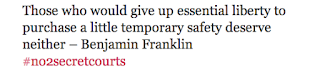
So it seems that we are doomed to have secret courts after all.
We still have the Third reading to go - helpfully scheduled for Thursday so it's safely out of the way before the horror of Spring Conference. I asked Twitter last night when was the last occasion a bill was defeated at third reading. A C McGregor was able to fill me in...

Here is the said bill. It's a wowser.
So here are a few posers:
1. What is the point of conference anymore. Here's a comment from LDV from Alex Marsh that I think sums up the situation rather well...
As a couple of commenters have already noted, this vote raises important questions about the relationship between Conference and the Parliamentary Party. It isn’t the first time since 2010 that Conference has very clearly voted one way and Parliamentary Party has voted the other. But in the other cases it would be possible for supporters of the parliamentary party’s position to justify this (however unconvincingly) on the basis of dealing with the deficit etc (eg on WCA and the welfare reform bill) and the compromises of coalition. But the secret courts bill is different. It isn’t about dealing with the deficit. It isn’t in the coalition agreement. It is in conflict with core principles of the party and conference signaled clearly that it was against it. The message to the Parliamentary Party couldn’t have been more obvious. Yet it was (largely) ignored. We all know that the Parliamentary Party is not absolutely bound by Conference votes. But there needs to be good reason for departing from party policy. Is someone going to explain what the good reason is here? As it is, the leadership seems to be saying pretty clearly that Conference motions, the views of the membership – the principles of liberalism? – are pretty much an irrelevance to whatever they want to do. I’m going to Brighton this week as a voting rep. But I increasingly wonder whether there is any point. Is anyone working on a book entitled “How we killed a long established and honorable political tradition over a few months of coalition”? If not then they should be.
2. Why do our parliamentarians think anyone from the grass roots is going to turn up and campaign for them a la Eastleigh if the wishes of the party are so singularly ignored?
3. Lord Bonkers sums it up beautifully
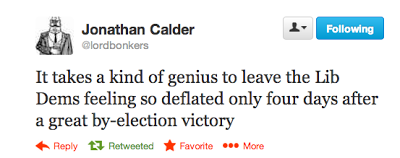
And finally - thanks to those MPs who did support conference policy..
#No2secretcourts; Is there hope? Not much
by noreply@blogger.com (Richard Morris)

So it seems that we are doomed to have secret courts after all.
We still have the Third reading to go - helpfully scheduled for Thursday so it's safely out of the way before the horror of Spring Conference. I asked Twitter last night when was the last occasion a bill was defeated at third reading. A C McGregor was able to fill me in...

Here is the said bill. It's a wowser.
So here are a few posers:
1. What is the point of conference anymore. Here's a comment from LDV from Alex Marsh that I think sums up the situation rather well...
As a couple of commenters have already noted, this vote raises important questions about the relationship between Conference and the Parliamentary Party. It isn’t the first time since 2010 that Conference has very clearly voted one way and Parliamentary Party has voted the other. But in the other cases it would be possible for supporters of the parliamentary party’s position to justify this (however unconvincingly) on the basis of dealing with the deficit etc (eg on WCA and the welfare reform bill) and the compromises of coalition. But the secret courts bill is different. It isn’t about dealing with the deficit. It isn’t in the coalition agreement. It is in conflict with core principles of the party and conference signaled clearly that it was against it. The message to the Parliamentary Party couldn’t have been more obvious. Yet it was (largely) ignored. We all know that the Parliamentary Party is not absolutely bound by Conference votes. But there needs to be good reason for departing from party policy. Is someone going to explain what the good reason is here? As it is, the leadership seems to be saying pretty clearly that Conference motions, the views of the membership – the principles of liberalism? – are pretty much an irrelevance to whatever they want to do. I’m going to Brighton this week as a voting rep. But I increasingly wonder whether there is any point. Is anyone working on a book entitled “How we killed a long established and honorable political tradition over a few months of coalition”? If not then they should be.
2. Why do our parliamentarians think anyone from the grass roots is going to turn up and campaign for them a la Eastleigh if the wishes of the party are so singularly ignored?
3. Lord Bonkers sums it up beautifully

And finally - thanks to those MPs who did support conference policy..
- Mike Crockart
Tim Farron
John Hemming
Simon Hughes
Julian Huppert
Greg Mulholland
Sarah Teather
05 Mar 22:25
 I'm off down to Brighton on Friday.
I really like the Sussex seaside town and I am sure I will find plenty to do while I am there. There's the pier, the Laines, the beach, the Royal Pavilion and lots of nice restaurants.
While I'm down there I may pop into the Lib Dem conference which is on. That is ostensibly the reason I am actually going to be there to get involved in debates and vote on party policy. Although after last night's vote where the parliamentary Lib Dems were whipped to vote for the Secret Courts bill against the clear expressed will of the party membership in conference votes I am thinking it might well not be worth it. After all if our ministers in government can just completely ignore what its members think despite the fact that we are supposed to be a democratic party then why should I bother?
I suspect plenty of others will be wondering this today. I also suspect in the light of the Eastleigh by-election result that many will be questioning whether it is worth campaigning so hard for the party in future too. Thousands of activists poured into the seat in the last few weeks in order to help us secure the by-election victory. Now as it happens Mike Thornton had not been sworn in in time for the division last night so he couldn't vote. I'll be generous to Mike and assume there is a good reason for this. Although I will say that if I had been elected MP for Eastleigh last week I'd have made damn sure I was sworn in in time and then voted against the bill along with the 7 other Lib Dem "rebels" who actually voted the way the party membership wants. But it is a real kick in the face for all of those activists who fought so hard to deliver the "stunning victory" that has so boosted Clegg in recent days. I was one of them and I have to say that I will not be as keen to go out and fight for our party on the doorsteps in future if we don't see a real change in how our internal democracy is accounted for in government.
What's even more infuriating about this is that it appears the timing of the vote was scheduled precisely to avoid an "embarrassing" vote at conference that would put further pressure on Clegg and our ministers to vote against this bill. So our leadership has connived with the Tories to deny its own membership on this key piece of legislation.
I understand it is difficult for Lib Dem ministers to get their way on things all the time but liberty is a fundamental precept of our party. Secret Courts are diametrically opposite to what we should be doing. We need an urgent review into how to fix our broken democracy. This weekend's conference is the place to do it.
And if we don't then perhaps next time conference is in Brighton all the other attractions may prove too tempting for me. Let's face it, wandering around the Laines and the Pavilion may be time better spent if our votes on key issues like this count for nothing.
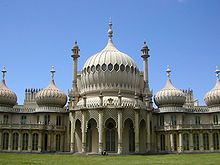
The Lib Dem leadership are treading a dangerous path
by Mark Thompson
 I'm off down to Brighton on Friday.
I really like the Sussex seaside town and I am sure I will find plenty to do while I am there. There's the pier, the Laines, the beach, the Royal Pavilion and lots of nice restaurants.
While I'm down there I may pop into the Lib Dem conference which is on. That is ostensibly the reason I am actually going to be there to get involved in debates and vote on party policy. Although after last night's vote where the parliamentary Lib Dems were whipped to vote for the Secret Courts bill against the clear expressed will of the party membership in conference votes I am thinking it might well not be worth it. After all if our ministers in government can just completely ignore what its members think despite the fact that we are supposed to be a democratic party then why should I bother?
I suspect plenty of others will be wondering this today. I also suspect in the light of the Eastleigh by-election result that many will be questioning whether it is worth campaigning so hard for the party in future too. Thousands of activists poured into the seat in the last few weeks in order to help us secure the by-election victory. Now as it happens Mike Thornton had not been sworn in in time for the division last night so he couldn't vote. I'll be generous to Mike and assume there is a good reason for this. Although I will say that if I had been elected MP for Eastleigh last week I'd have made damn sure I was sworn in in time and then voted against the bill along with the 7 other Lib Dem "rebels" who actually voted the way the party membership wants. But it is a real kick in the face for all of those activists who fought so hard to deliver the "stunning victory" that has so boosted Clegg in recent days. I was one of them and I have to say that I will not be as keen to go out and fight for our party on the doorsteps in future if we don't see a real change in how our internal democracy is accounted for in government.
What's even more infuriating about this is that it appears the timing of the vote was scheduled precisely to avoid an "embarrassing" vote at conference that would put further pressure on Clegg and our ministers to vote against this bill. So our leadership has connived with the Tories to deny its own membership on this key piece of legislation.
I understand it is difficult for Lib Dem ministers to get their way on things all the time but liberty is a fundamental precept of our party. Secret Courts are diametrically opposite to what we should be doing. We need an urgent review into how to fix our broken democracy. This weekend's conference is the place to do it.
And if we don't then perhaps next time conference is in Brighton all the other attractions may prove too tempting for me. Let's face it, wandering around the Laines and the Pavilion may be time better spent if our votes on key issues like this count for nothing.
05 Mar 19:42
Day 4446: The Liberal Democrat What Do We Stand For Challenge
by Millennium Dome
Monday:
Daddy Alex has challenged Daddy Richard to come up with a brief statement of Liberal Democrat belief in fewer than a hundred and fifty words.
But stuff that, it's MY diary, so I'M having a go...
At a pinch, I THINK I can trim our core message down to:
(*and before anyone else has a go, that's "fruits of your labours" translated into language a Conservatory might understand!)
But I would wrote MORE than that (slightly) because... well. that's what I DO.
Okay, but here are reasons too:
(a) when Daddy Alex wrote “freedom for every individual”, I immediately thought of the way he always says that Liberalism works in EVER-EXPANDING CIRCLES, starting with the individual, but linking to family and community and wider and wider to the whole world. So I wanted to add that in.
(b) I wanted to make those circles go through TIME as well as SPACE, because that means including protection for the next generation, which is where the need for GREEN ACTION and FIXING the DEFICIT both come from.
and (c) I definitely wanted to include that bit from the Preamble about "poverty, ignorance, and conformity", because that in turn is a kind of a reference to Mr Beverage's evil “Five Giants”: Squalor, Ignorance, Want and Dec, Idleness, and Disease.
Though I suspect that NOWADAYS we combine into "Poverty" the giants of "Squalor" and "Want" and "Idleness" (by which of course Mr B meant "Joblessness" not "Laziness", little clue for Conservatories like Master Gideon "workers v shirkers" Osborne and Hard Labourites like Mr Liam "strivers v skivers" Byrne there); that "Sickness" means supporting the NHS which all Parties did at its creation and which all Parties still do (no matter what Hard Labour hubristically think about it being "theirs"); and I'm rather glad that we've added the evil of "Conformity" to the list.
So, I end up with:
I’d also add the following riders as “derived” beliefs that follow logically from the above:
So, the shortest form is 30 words, but the full thing has cut down Daddy's 158 words to, er, 323.
That WAS what he wanted, wasn't it?
Right, now I TAGSIE...
Auntie Jennie (Chaotic Good) for passion and heart;
Mr Mark Reckons (Lawful Neutral – for his saintly forbearance on House of Comments) for rock solid pragmatism and unshaking principle;
and I WAS going to tag Auntie Caron (Lawful Lovely) for the biggest smile and the soul of the Lib Dems... but Daddy got there first, so I will pick Uncle Andrew Hickey (Chaotic Sensible) for wisdom and sticking with the least worst Party instead!
Daddy Alex has challenged Daddy Richard to come up with a brief statement of Liberal Democrat belief in fewer than a hundred and fifty words.
But stuff that, it's MY diary, so I'M having a go...
At a pinch, I THINK I can trim our core message down to:
“The Liberal Democrats stand for the freedom to live your life enjoying the rewards for your own endeavour*, governed by your own choices – with equality before the law; without harming others.”
(*and before anyone else has a go, that's "fruits of your labours" translated into language a Conservatory might understand!)
But I would wrote MORE than that (slightly) because... well. that's what I DO.
Okay, but here are reasons too:
(a) when Daddy Alex wrote “freedom for every individual”, I immediately thought of the way he always says that Liberalism works in EVER-EXPANDING CIRCLES, starting with the individual, but linking to family and community and wider and wider to the whole world. So I wanted to add that in.
(b) I wanted to make those circles go through TIME as well as SPACE, because that means including protection for the next generation, which is where the need for GREEN ACTION and FIXING the DEFICIT both come from.
and (c) I definitely wanted to include that bit from the Preamble about "poverty, ignorance, and conformity", because that in turn is a kind of a reference to Mr Beverage's evil “Five Giants”: Squalor, Ignorance, Want and Dec, Idleness, and Disease.
Though I suspect that NOWADAYS we combine into "Poverty" the giants of "Squalor" and "Want" and "Idleness" (by which of course Mr B meant "Joblessness" not "Laziness", little clue for Conservatories like Master Gideon "workers v shirkers" Osborne and Hard Labourites like Mr Liam "strivers v skivers" Byrne there); that "Sickness" means supporting the NHS which all Parties did at its creation and which all Parties still do (no matter what Hard Labour hubristically think about it being "theirs"); and I'm rather glad that we've added the evil of "Conformity" to the list.
So, I end up with:
“The Liberal Democrats stand for freedom.
Freedom from poverty, ignorance and conformity.
Freedom for every individual, family, group, community, society or nation.
Freedom from inheriting the financial and environmental mistakes of earlier generations.
Freedom to live your life enjoying the rewards for your own endeavour, governed by your own choices – with equality before the law; without harming others.
To make that freedom real needs both fairness and practicality; opportunity and compassion: an economy that works, but where everyone also pays their fair share.
The Liberal Democrats believe in a better future. That’s why Liberal Democrats are working to build a fairer, greener society and a stronger economy, enabling every person to live the life they want.”
I’d also add the following riders as “derived” beliefs that follow logically from the above:
On government:
Liberal Democrats believe that government should act to protect these freedoms, but cannot be a blanket solution to solve all problems. We also accept that government itself can be a threat to freedom, that no government always knows best, so everyone must have a better say in decisions.
On taxes:
We accept that governments need to raise taxes – in order to relieve poverty, to supply education, to provide a safe and supportive society, to nurture and sustain the environment, and to encourage personal growth and freedom of expression – so we say these should be raised as fairly and as simply as possible, with a tax system that is progressive, understandable and works to release locked up wealth to work for the nation.
On Welfare:
We believe that everyone should be treated with dignity, protected when circumstances mean that they are unemployed, supported when they are unable to work, through age or disability, healed when they are sick. The Welfare State should free people to live lives free from the tyranny of dependence on their employer, making the labour market work for the individual while protecting from any failures of the free market, and enabling society to flourish by not wasting the potential of any individual.
So, the shortest form is 30 words, but the full thing has cut down Daddy's 158 words to, er, 323.
That WAS what he wanted, wasn't it?
Right, now I TAGSIE...
Auntie Jennie (Chaotic Good) for passion and heart;
Mr Mark Reckons (Lawful Neutral – for his saintly forbearance on House of Comments) for rock solid pragmatism and unshaking principle;
and I WAS going to tag Auntie Caron (Lawful Lovely) for the biggest smile and the soul of the Lib Dems... but Daddy got there first, so I will pick Uncle Andrew Hickey (Chaotic Sensible) for wisdom and sticking with the least worst Party instead!
05 Mar 07:25
"Liberalism is trust of the people tempered by prudence. Conservatism is distrust of the people tempered by fear" William Ewart Gladstone
The Liberal Democrats on principle oppose secret courts. Our party conference has repeatedly pointed out that no government can be above the law. It is an article of faith that we must oppose any executive authority that seeks to place itself outside the normal rule of law. Nor is this a purely theoretical issue: the information coming out of Libya after the fall of Gadaffi suggests prima facie evidence that agents of the British government sanctioned criminal activity- including torture and even murder- of those the government deemed arbitrarily and often without evidence to be guilty of enmity against the British state.
The executive can not even give a number for how many such secret trials might take place under the proposed legislation, still less give any assurance as to the integrity of the judicial process without public scrutiny. Even senior members of the security services have expressed scepticism as to the need for secret trials.
It is not merely Liberal Democrat policy - duly voted for at the last conference- to oppose the establishment of secret courts, it is a basic foundation of Liberal principles, Liberal ideology and Liberal faith.
So why in God's name did only seven Liberal Democrat MPs vote against the establishment of such secret courts last night?
Our Federal Spring conference begins shortly. Some, notably Liberal Democrats against Secret courts, will presumably be asking serious questions of our Parliamentary party. I am not able to attend this year. I will, however, be watching closely. I will not be alone, as the Guardian pointed out in December, this really is a litmus test of Liberal principles.
What is the point of working so hard to get Mike Thornton elected as MP for Eastleigh, if- the very next week- the Liberal Democrats are prepared to abandon a core principle of Liberalism?
I believe in the fundamental value of Liberalism as a political ideology. It is a pretty poor look out when David Davis turns out to be a more genuine liberal, not just than Ken Clarke, but than Nick Clegg, and the bulk of the Liberal Democrat Parliamentary party.
It is a very bleak day for liberals of all stripes when those we trust to represent liberal values renege on that trust in the name of political expediency. The Parliamentary party owes the long suffering Liberal Democrat membership at least an explanation and probably an apology.
A Democracy can not compromise its fundamental principles without weakening the very fabric of democracy itself and essentially giving in to its enemies- whether the criminal terrorists we most fear, or the criminal state tyrannies like Putin's Russia. We are better than our enemies only for so long as we maintain our better nature and adhere undaunted to the political, indeed the moral, principles of a liberal democratic state.
Last night was a vote to weaken those principles and it is a vote that must not go unchallenged.
Trust and Distrust
by noreply@blogger.com (Cicero)
"Liberalism is trust of the people tempered by prudence. Conservatism is distrust of the people tempered by fear" William Ewart Gladstone
The Liberal Democrats on principle oppose secret courts. Our party conference has repeatedly pointed out that no government can be above the law. It is an article of faith that we must oppose any executive authority that seeks to place itself outside the normal rule of law. Nor is this a purely theoretical issue: the information coming out of Libya after the fall of Gadaffi suggests prima facie evidence that agents of the British government sanctioned criminal activity- including torture and even murder- of those the government deemed arbitrarily and often without evidence to be guilty of enmity against the British state.
The executive can not even give a number for how many such secret trials might take place under the proposed legislation, still less give any assurance as to the integrity of the judicial process without public scrutiny. Even senior members of the security services have expressed scepticism as to the need for secret trials.
It is not merely Liberal Democrat policy - duly voted for at the last conference- to oppose the establishment of secret courts, it is a basic foundation of Liberal principles, Liberal ideology and Liberal faith.
So why in God's name did only seven Liberal Democrat MPs vote against the establishment of such secret courts last night?
Our Federal Spring conference begins shortly. Some, notably Liberal Democrats against Secret courts, will presumably be asking serious questions of our Parliamentary party. I am not able to attend this year. I will, however, be watching closely. I will not be alone, as the Guardian pointed out in December, this really is a litmus test of Liberal principles.
What is the point of working so hard to get Mike Thornton elected as MP for Eastleigh, if- the very next week- the Liberal Democrats are prepared to abandon a core principle of Liberalism?
I believe in the fundamental value of Liberalism as a political ideology. It is a pretty poor look out when David Davis turns out to be a more genuine liberal, not just than Ken Clarke, but than Nick Clegg, and the bulk of the Liberal Democrat Parliamentary party.
It is a very bleak day for liberals of all stripes when those we trust to represent liberal values renege on that trust in the name of political expediency. The Parliamentary party owes the long suffering Liberal Democrat membership at least an explanation and probably an apology.
A Democracy can not compromise its fundamental principles without weakening the very fabric of democracy itself and essentially giving in to its enemies- whether the criminal terrorists we most fear, or the criminal state tyrannies like Putin's Russia. We are better than our enemies only for so long as we maintain our better nature and adhere undaunted to the political, indeed the moral, principles of a liberal democratic state.
Last night was a vote to weaken those principles and it is a vote that must not go unchallenged.
04 Mar 23:27
Please stop looking for the ‘original sin’ gene
by Fred Clark

Think Christian has been running a mini-forum on the question of a “historical Adam.”
Dennis Venema’s contribution was quite helpful for squarely stating that science finds the idea of a single “Adam and Eve” couple as the ancestors of all of humanity to be extremely, and increasingly, unlikely.
I liked Venema’s piece a lot, particularly this bit:
Some Christian groups are beginning to require denying these findings as part of their theology. In particular, there is a concern that moving away from the view that the entire human race descends from one ancestral couple threatens the doctrine of original sin. … These sorts of moves put scientifically knowledgeable believers in such groups in a difficult position – do they deny the science to remain theologically “on side,” or do they risk membership in their faith communities by accepting the science?
As the information coming out of the various genome-sequencing projects trickles down to the pew level, these difficulties are only going to increase.
That’s wise and true. But I’d go further to argue that those insisting on a “historical Adam” are not “on side” theologically, either.
Show me someone who thinks Genesis teaches a “historical Adam” and I’ll show you someone who doesn’t understand Genesis — the genre of it, the title of it, or anything else about it.
Once upon a time a man named mankind was the father of the human race even though he only had three sons despite living to be 930 years old.
If I seriously have to explain to you that this does not constitute a historical claim, then sit down, because we’re apparently also going to have to talk about how Frodo, Miss Marple, Ulysses, Cuchulain, and Amelia Bedelia are not historical figures either.
But what baffles me completely is this bit from Deborah Haarsma’s concluding post in the Think Christian series:
This scientific picture of a group of early humans raises many questions, including particularly difficult ones related to the Fall. Plantinga and pastor Daniel Harrell both suggest a possible solution: perhaps Adam and Eve were two individuals within the group of early humans. This would preserve Adam as a real historical figure and the Fall as a real historical event. However, the spread of sin to the rest of the group is problematic, since it would take many generations to spread genetically through a population of thousands.
Wait, sorry … for a second there I thought she said that sin spreads “genetically.” (Rubs eyes.) Let me read that again:
However, the spread of sin to the rest of the group is problematic, since it would take many generations to spread genetically through a population of thousands.
OK, yeah, she really said that.
You’ve got to hand it to Augustine. Anybody can be a little wrong once in a while, but to be so spectacularly wrong that 1,500 years later people are still saying stuff like this … well, that’s impressive.
I appreciate the concern and the intent of stuff like this, but I think it’s possible to make sense of the book of Romans without resorting to hallucinogenic science and delirious theology that ponders the “genetic” spread of sin.
We can only make sense out of the idea that sin is “genetic” if we’re also willing to make nonsense out of the ideas of justice, mercy, redemption, atonement, and forgiveness. And I’m rather fond of those. So please, let’s stop looking for an “original sin” gene, thanks.
04 Mar 23:14


Flashback! To “The Time-Traveller’s Wife…!”
by plok
This will be a short one, but true.
None of my friends think this is funny.
…So I was flicking channels on the TV one day, and came across “The Time-Traveller’s Wife”, which was a bit more than half over by then. Though I can’t fathom Rachel McAdams’ predilection for such stuff, I figured since she’s Canadian I might as well support the team and have a look…also I don’t hate Eric Bana, do I, because he played Bruce Banner in “Hulk” and also Watered-Down Khan in “Star Trek: Nemesis” or whatever it was.
So I turn the thing on, and it’s this awful tearjerking scene where their marriage (or whatever) is falling apart, because they’re experiencing things in a different order and IT’S A METAPHOR and honestly I already get this, I get all of it, one glance is enough to tell me what I need to know. So I turn it off. But then…
I can’t help wondering, you see, just how they suck people in to the narrative, to the point where what I just saw could be bearable. Where do they begin? They can’t start out with all this goopy stuff right away, can they?
So when it gets replayed around midnight, I decide to check out how it starts…and you know the beginning of it isn’t half-bad?
I can see why people would choose to get some popcorn and watch the rest?
But having already lived through the future of this movie, I know what’s coming, and decide to spare myself the pain of getting too involved with it.
…
That’s it. That’s the joke. But it really happened!
I think maybe someone OD’ed on some Alan Moore a bit, before making this thing…surely any experienced SF reader must’ve seen, after just a few minutes, the whole plan of it floating entire before their eyes, a crystalline time-solid? Yes, Veidt killed Blake, and half New York…hold on, Laurie, I’m explaining it to Rorschach five minutes from now…anyway…
Uh…
…Happy Valentine’s Day?
04 Mar 23:12
 Nicola Edgington was an accident waiting to happen. In 2005, suffering from severe mental illness she killed her mother, stabbing her nine times in the face, neck and chest with a kitchen knife. She was sent indefinitely to a secure mental hospital where she was diagnosed with paranoid schizophrenia, but was released after just four years with what seems like inadequate supervision. Two years later, she murdered 58 year old Sally Hodkin in the street with a stolen butcher's knife and attempted to kill another woman, 22 year old Kerry Clark.
Just prior to these attacks, Edgington made repeated attempts to get help. First she contacted the police, who accompanied her to Queen Elizabeth Hospital in Woolwich in the early hours of 10th October 2011. Despite her professed desire to be detained under the Mental Health Act, hospital staff told her to wait. Increasingly worried about what she might do, she then made no fewer than five 999 calls from the hospital asking for further help from the police. The calls were replayed during her recent trial for murder.
Here's a selection of her pleas:
"I need to go to a mental hospital. I need the police to come now. I done a murder five years ago."
"I need for the police to come because I have had a nervous breakdown before and I killed someone."
Could you please send a car here now please this is very important.'
I don't want to start hurting anyone. I want to hand myself in now before I start hurting anyone else.
Do you want me to hurt someone here, I'm telling you if you don't come to Queen Elizabeth Hospital I'm gonna end up hurting someone
'I'm a very dangerous schizophrenic and if you don't come and help me I'm gonna end up hurting someone.
'I'm having a nervous breakdown. I'm really really not well.
You know the last time I was feeling like this I killed someone, the last time I was feeling like this I killed, I killed my mum.
'I have got very strange ideas, I think I'm at the gates of heaven, I think.'
Nevertheless, it was deemed that the hospital waiting room was a "place of safety", so there was no need to involve the police further. Eventually, some attempt was made to arrange a specialist assessment, but shortly before seven in the morning Edgington simply walked out of the hospital, found a suitable knife and selected her victims.
Much of the attention tonight is on the failures of the police, detailed in an IPCC report, for example the failure to carry out a police national computer check which would have alerted them to Edgington's conviction for manslaughter on the basis of diminished responisbility. Other, more striking failures might be laid at the door of hospital staff who failed to give Edgington the help she plainly needed, or indeed the decision to release her from the secure hospital two years before. It might be asked what kind of care she was receiving in the community. But I'd like to focus on the outcome of the trial and the sentencing remarks of Judge Brian Barker, which betray an outrageous and profound ignorance of the nature of severe mental illness and display attitudes quite astonishing in a supposedly advanced and civilised society.
That Edgington was charged with murder at all, given the strong evidence of her long-term psychosis and previous hospitalisation, is remarkable enough. It is especially remarkable since, it turns out, the trial had been postponed because Edgington, who has been detaine in a secure mental hospital since the tragic events of that October day, was at first considered too ill to stand trial. The CPS argued, against all logic and the medical consenus, that she was suffering merely from a borderline personality disorder - and that she was therefore in full command of her faculties. Why they should have come to this conclusion is a mystery, though Edgington's conviction for intentional murder might be said to take some of the blame for her crime away from the failures of the NHS, the police and the criminal justice system. The defence was able to produced two senior psychiatrists who said it was almost impossible for Edgington to have been misdiagnosed as schizophrenic.
When the jury, who were perhaps influenced by a sense of outrage at the barbarity of the slaying, returned a verdict of murder, the judge had no choice but to impose a life sentence. But he had considerable discretion as to tariff and remarks. He proceeded to use that discretion to ignore all the evidence before him of Edgington's condition and of her attempts to get help before it was too late, preferring instead to treat her as fully responsible for the crime, almost as though she had no mental illness at all.
In his sentencing remarks (pdf), judge acknowledged that Edgington had been diagnosed in 2005 as suffering from "paranoid schizophrenia with a prominent mood component" and that despite the apparent improvement that had enabled her early release she subsequently suffered "a relapse of some sort". He also stated that "it may well be" that both before and after the attacks she was "experiencing some form of transient psychosis". In other words, she was not in control of her actions. Yet he went on to describe her as "manipulative" as well as "exceptionally dangerous" and concluded that she had pursued "a consistent and calculated course of criminal conduct." Barker noted the submission made on Edgington's behalf by her barrister, John Cooper QC, that she "had a significant condition and at the time were a woman in crisis trying to comply with directions in the care plan." He then dismissed this self-evidently true proposition:
He went on:
He then sentenced her to a minimum term of 37 years. In prison, presumably, although she clearly belongs in a hospital.
A tragic and senseless murder of an innocent woman, whose profound misfortune it was to cross the path of someone in the grip of profound psychosis, inevitably produces anger and a desire to blame the perpetrator. But I cannot see how justice is advanced by a legal fiction that treats such a troubled individual no differently from the most sane and cold-blooded killer. It is evident, or should be, that in moments of lucidity before her descent to homocidal actions she had attempted to get help: that is scarcely the behaviour of a pre-meditated and "manipulative" criminal.
Besides the profound injustice of sentencing a mental patient as though she were at all material times fully compos mentis, and the unforgivable ignorance and prejudice displayed in Barker's remarks, there's also a demonstrable failure of logic. If, in the judge's view of the evidence, Edgington was suffering from "transient psychosis" at the time of the murder, it surely follows that she cannot be held fully responsible for her actions.
This is a truly appalling judicial decision.
© 2013 Heresy Corner, all rights reserved.


Nicola Edgington, mental health and the failure of justice
by The Heresiarch

Just prior to these attacks, Edgington made repeated attempts to get help. First she contacted the police, who accompanied her to Queen Elizabeth Hospital in Woolwich in the early hours of 10th October 2011. Despite her professed desire to be detained under the Mental Health Act, hospital staff told her to wait. Increasingly worried about what she might do, she then made no fewer than five 999 calls from the hospital asking for further help from the police. The calls were replayed during her recent trial for murder.
Here's a selection of her pleas:
"I need to go to a mental hospital. I need the police to come now. I done a murder five years ago."
"I need for the police to come because I have had a nervous breakdown before and I killed someone."
Could you please send a car here now please this is very important.'
I don't want to start hurting anyone. I want to hand myself in now before I start hurting anyone else.
Do you want me to hurt someone here, I'm telling you if you don't come to Queen Elizabeth Hospital I'm gonna end up hurting someone
'I'm a very dangerous schizophrenic and if you don't come and help me I'm gonna end up hurting someone.
'I'm having a nervous breakdown. I'm really really not well.
You know the last time I was feeling like this I killed someone, the last time I was feeling like this I killed, I killed my mum.
'I have got very strange ideas, I think I'm at the gates of heaven, I think.'
Nevertheless, it was deemed that the hospital waiting room was a "place of safety", so there was no need to involve the police further. Eventually, some attempt was made to arrange a specialist assessment, but shortly before seven in the morning Edgington simply walked out of the hospital, found a suitable knife and selected her victims.
Much of the attention tonight is on the failures of the police, detailed in an IPCC report, for example the failure to carry out a police national computer check which would have alerted them to Edgington's conviction for manslaughter on the basis of diminished responisbility. Other, more striking failures might be laid at the door of hospital staff who failed to give Edgington the help she plainly needed, or indeed the decision to release her from the secure hospital two years before. It might be asked what kind of care she was receiving in the community. But I'd like to focus on the outcome of the trial and the sentencing remarks of Judge Brian Barker, which betray an outrageous and profound ignorance of the nature of severe mental illness and display attitudes quite astonishing in a supposedly advanced and civilised society.
That Edgington was charged with murder at all, given the strong evidence of her long-term psychosis and previous hospitalisation, is remarkable enough. It is especially remarkable since, it turns out, the trial had been postponed because Edgington, who has been detaine in a secure mental hospital since the tragic events of that October day, was at first considered too ill to stand trial. The CPS argued, against all logic and the medical consenus, that she was suffering merely from a borderline personality disorder - and that she was therefore in full command of her faculties. Why they should have come to this conclusion is a mystery, though Edgington's conviction for intentional murder might be said to take some of the blame for her crime away from the failures of the NHS, the police and the criminal justice system. The defence was able to produced two senior psychiatrists who said it was almost impossible for Edgington to have been misdiagnosed as schizophrenic.
When the jury, who were perhaps influenced by a sense of outrage at the barbarity of the slaying, returned a verdict of murder, the judge had no choice but to impose a life sentence. But he had considerable discretion as to tariff and remarks. He proceeded to use that discretion to ignore all the evidence before him of Edgington's condition and of her attempts to get help before it was too late, preferring instead to treat her as fully responsible for the crime, almost as though she had no mental illness at all.
In his sentencing remarks (pdf), judge acknowledged that Edgington had been diagnosed in 2005 as suffering from "paranoid schizophrenia with a prominent mood component" and that despite the apparent improvement that had enabled her early release she subsequently suffered "a relapse of some sort". He also stated that "it may well be" that both before and after the attacks she was "experiencing some form of transient psychosis". In other words, she was not in control of her actions. Yet he went on to describe her as "manipulative" as well as "exceptionally dangerous" and concluded that she had pursued "a consistent and calculated course of criminal conduct." Barker noted the submission made on Edgington's behalf by her barrister, John Cooper QC, that she "had a significant condition and at the time were a woman in crisis trying to comply with directions in the care plan." He then dismissed this self-evidently true proposition:
I disagree that responsibility for these acts can be laid at the door of others. You made a choice and the fact is these were terrible acts, and you must take responsibility for what you did. I cannot ignore the fact that you have killed before and that overall you have come as near as can be to having three deaths at your hands.
He went on:
The main mitigating feature is that you suffer from a mental disability, but on the particular facts of this case there is no convincing case to conclude that the abnormality reduced your culpability to any significant extent.
He then sentenced her to a minimum term of 37 years. In prison, presumably, although she clearly belongs in a hospital.
A tragic and senseless murder of an innocent woman, whose profound misfortune it was to cross the path of someone in the grip of profound psychosis, inevitably produces anger and a desire to blame the perpetrator. But I cannot see how justice is advanced by a legal fiction that treats such a troubled individual no differently from the most sane and cold-blooded killer. It is evident, or should be, that in moments of lucidity before her descent to homocidal actions she had attempted to get help: that is scarcely the behaviour of a pre-meditated and "manipulative" criminal.
Besides the profound injustice of sentencing a mental patient as though she were at all material times fully compos mentis, and the unforgivable ignorance and prejudice displayed in Barker's remarks, there's also a demonstrable failure of logic. If, in the judge's view of the evidence, Edgington was suffering from "transient psychosis" at the time of the murder, it surely follows that she cannot be held fully responsible for her actions.
This is a truly appalling judicial decision.
© 2013 Heresy Corner, all rights reserved.
04 Mar 23:08
the Final Mind bends its will towards simulating a lot of CRAP that i have to put up with at WORK
| archive - contact - sexy exciting merchandise - cute - search - about | |||
 |
|||
| ← previous | March 4th, 2013 | next | |
|
March 4th, 2013: Thank you to everyone who came to ECCC! It was awesome. Let's do it again sometime! – Ryan 
| |||
04 Mar 23:04
http://whenwillthehurtingstop.blogspot.com/2013/03/whos-afraid-of-fleetwood-mac-you-will.html
by Tim O'Neil
Who's Afraid of Fleetwood Mac?

You will wake up one day and realize that you are being followed. You are being stalked across the streets and through the forests, trailed at every step by a stomping shadow that appears just outside your peripheral vision, hunted by a beast whose hot breath raises the white hairs on the nape of your neck. And then one day you catch a familiar tune coming from a nearby radio, and you turn your head without thinking and come face to face with that elusive specter: you come face to face with Fleetwood Mac, and you realize they had already been there all this time.
We all know Fleetwood Mac, and I'm equally confident in asserting that the vast majority of us under a certain age are perfectly content to dismiss them out of hand. After all, weren't they just overproduced, glossy dad-rock - as in, literally, the music your dad listened to, maybe even the music your dad and you mom had on the turntable when you were conceived? Weren't they exactly the kind of rockstars - no, scratch that, not the "kind of" rockstars, the specific rockstars who had inspired such disdain and wrath from the first generation of punks? Weren't they obsessed with cocaine and infidelity and overdubs, all the worst excesses of the 1970s rolled up into one big ball along with a closet full of diaphanous scarves?
Yes, yes, yes, and yes, to all the above - Fleetwood Mac were terrible for all these reasons, but they were also something more.
When you look back and see Fleetwood Mac staring you down, you realize that you've never really listened to them. Oh, you've heard all the songs. Not a track off Rumours is new, they've all been done to death (well, maybe not "Oh Daddy"), played a million times on a thousand radio stations and heard in the soundtracks to a hundred movies. Hell, the President of the United States himself picked Fleetwood Mac for his own personal anthem. But even though you've heard it all before, you've never really heard it. There comes a time when you find yourself actually listening to the music, listening to the words, all the sounds you've heard on the radio for thirty-five years but never really understood. Maybe it'll be a rhythm - the way Mick Fleetwood and John McVie get intense in the last minute and a half of "The Chain." Or maybe it will be a voice - the way Christine McVie sounds more vulnerable on "Songbird" than you could ever imagine any human ever being. But something will happen and you will realize that there is depth far past the most obvious, easily dismissed surface surface charms. And you will realize that that "Don't Stop" is actually a monumentally grim song, a song about happiness sung from the position of people in the grip of tremendous depression in the here and now. Today is actually a pretty terrible proposition: "Why not think about times to come, / And not about the things that you've done . . ."
And then you hear "Go Your Own Way" and you realize that this is basically what every rock record for the last three decades has been trying to sound like. Did you ever really hear this song before? The way those drums come in with the acoustic guitar after the electric scratches out the opening chords, the way the acoustic guitar hits like percussion, the way the bassline carries the melody and the harmonies don't quite completely fit, but sound just slightly off and ragged enough to sell the song's urgency? Everything fits, everything counts: the tension in the verse building to the explosive bridge and chorus, the way the song somehow makes Buckingham's voice sound intimate even when it's raging in a tornado, the way it finally detonates when the acid guitar solo hits in the last minute - wait a minute, there's a guitar solo this angry in a Fleetwood Mac song? Where was my mind the last hundred times I heard this on the radio, that I'm just now hearing this?
It's simple, really: Fleetwood Mac were never complex songwriters. Their best material doesn't carry any kind of conceptual heft (Tusk notwithstanding), their lyrics were straightforward, their playing was - while accomplished and sophisticated - hardly ever idiosyncratic. All of the ingredients are there on the table for Fleetwood Mac to be the most awesomely generic rock band ever. And yet, and yet . . . together, they seem honest in a way that I don't think I ever really appreciated until this moment. "Honest" doesn't mean "authentic," this isn't about any kind of credibility. Fleetwood Mac don't have any credibility, despite the fact that their sound is all over contemporary indie rock (and I mean all over, as any examination of Pitchfork's end-of year lists for the last decade should provide ample evidence). They were too popular to ever really be cool, they made too much money, did too much coke, were just too damn pleased with themeselves in the flush of their success. They represented an ideal of mid-to-late 70s rock culture for punk in opposition to which punk crafted its own creation myth. Even though punk is far from the dominant sound in rock these days most rock is still created with punk as the default ideological stance, and there's no way a band like Fleetwood Mac can ever get past that historical bias.
The good news is that they don't need to. They sold some forty million copies of Rumours. That means they get to be the influence that no one wants to acknowledge - or, now that enough time has elapsed, they get to be the influence that everyone pats themselves on the back for thinking was cool when no one else did. The point is, they're always going to be there, and the reason why they're going to be remembered when similar mega-selling acts from the same era have faded to irrelevancy is that they're still pretty good. It's hard to move past the fact that every song on this damn album sounds as good as some bands entire careers. What they lacked in imagination they made up for in a maniacal attention to detail and a scrupulous willingness to sit in the studio and say the most hurtful things to one another with a tape recorder on. They're not reprehensibly smug like the Eagles or quite so dated as the (disco era) Bee Gees. Despite the fact that they were briefly the biggest rock band on the planet they still sound like basket cases. It's the precise combination of emotional brutality and studio shine that makes the album so fascinating.
It's the same reason why Let It Be isn't the best Beatles album but it's by far the saddest, you know? It's devastating.
There reached a point for me, while listening to "The Chain," where instead of just taking the song for granted as an FM radio staple I listened to the words, maybe for the first time. And what I heard was Buckingham saying, "And if you don't love me now / you will never love me again." And I realized that this wasn't the kind of sentiment a kid could sing. This was something only a full-grown adult could say and mean. It's a simple and direct statement of painful experience. It's a grown-up emotion. There's nothing about youth here - there's no youthful energy or spirit, no rebellion or even sex, no interesting metaphor or poetic imagery. This is music for mortgage payments and divorces, all those terrible quotidian things that aren't really very glamorous when you're fifteen but seem frightfully important when you're thirty. But that doesn't make it hurt any less - on the contrary, it hurts even more because it's that much harder to romanticize. When you're a kid you wonder how anyone could ever be so old as your parents, and then one day you stop to look and realize that you're as old, no, you're older than your parents were when you were born.
Listen to "You Make Loving Fun." I'm convinced that this is the lynch-pin for the album, even if it's not the one you hear more frequently on the radio. If you listen closely, you realize that, yes, like most of the album this is a remarkably sad song. But it also cuts to the heart of exactly why Rumours is such a strong album: it's a sad album written by a group of grown adults who are old enough to know better, but who nevertheless can't help but remain hopeful despite themselves. When Christine McVie sings, "I never did believe in miracles, / But I've a feeling it's time to try," she takes a few words that might in another context sound sad or even sardonic, and somehow manages to sell them as purely sweet. Put on the headphones and crank up the volume and you'll hear that the melody for this track isn't actually the guitar or even McVie's voice, it's the bassline, John McVie's loping bassline dancing around Fleetwood's crisp snares and serving as counterpoint to his ex-wife's singing. Buckingham and Nicks aren't even necessary for this song, if you edited out their harmonies and guitars and just kept the two McVies and Fleetwood, you'd still have the same song, a sad song sung by one of the most beautiful voices in rock history to her ex-husband and given rock-solid support by their best friend. Next to McVie's contributions, Nicks' two solo vocal outings ("Dreams" and the deathless "Gold Dust Woman") can't help but seem callow. Buckingham likewise, despite his later outsized contributions to the band, only contributes three solo compositions. It's McVie's album, really, she's just gracious enough to let the others tag along.
Rumours is an album for grown-ups, by grown-ups, about grown-ups. If you were in your early teens in 1964 when the Beatles played the Ed Sullivan Show, you were in your late twenties when Rumours hit the shelves. You had grown up with rock and roll, and to a degree rock and roll had grown up with you. And as far as that goes, Rumours was as real as it got: this was grown-up disappointments and heartbreak, love without lust and regret without the consolation of youth. But then, a reaction was not merely inevitable, it was necessary. I like to think of Rumours as the last album of the "classic" rock period (I guess you'd say rock's "Silver Age"), basically the end point of the narrative arc kick-started by the Beatles right after Kennedy was killed. (Remember, rock was already a dying fad in the States when "Please Please Me" hit the airwaves.) Rumours hit shelves on 4 February 1977. Two weeks later the Damned's Damned Damned Damned was released, on 18 February, and suddenly everything old was new again, and the old folks with their silver spoons and magic crystal visions were escorted off the stage, never to be cool again. I like the neatness represented by those numbers, and in my own mind that's how rock history should run: the final notes of "Gold Dust Woman" on the B-side of Rumours fading into the aggressive rumble of "Neat Neat Neat" on the A-side of the first actual punk LP (notwithstanding Ramones in 1976, an outlier if ever there was one). Given enough time the punks would produce their own Fleetwood Mac. All to the good.
You will wake up one day and realize that you are being followed. You are being stalked across the streets and through the forests, trailed at every step by a stomping shadow that appears just outside your peripheral vision, hunted by a beast whose hot breath raises the white hairs on the nape of your neck. And then one day you catch a familiar tune coming from a nearby radio, and you turn your head without thinking and come face to face with that elusive specter: you come face to face with Fleetwood Mac, and you realize they had already been there all this time.
We all know Fleetwood Mac, and I'm equally confident in asserting that the vast majority of us under a certain age are perfectly content to dismiss them out of hand. After all, weren't they just overproduced, glossy dad-rock - as in, literally, the music your dad listened to, maybe even the music your dad and you mom had on the turntable when you were conceived? Weren't they exactly the kind of rockstars - no, scratch that, not the "kind of" rockstars, the specific rockstars who had inspired such disdain and wrath from the first generation of punks? Weren't they obsessed with cocaine and infidelity and overdubs, all the worst excesses of the 1970s rolled up into one big ball along with a closet full of diaphanous scarves?
Yes, yes, yes, and yes, to all the above - Fleetwood Mac were terrible for all these reasons, but they were also something more.
When you look back and see Fleetwood Mac staring you down, you realize that you've never really listened to them. Oh, you've heard all the songs. Not a track off Rumours is new, they've all been done to death (well, maybe not "Oh Daddy"), played a million times on a thousand radio stations and heard in the soundtracks to a hundred movies. Hell, the President of the United States himself picked Fleetwood Mac for his own personal anthem. But even though you've heard it all before, you've never really heard it. There comes a time when you find yourself actually listening to the music, listening to the words, all the sounds you've heard on the radio for thirty-five years but never really understood. Maybe it'll be a rhythm - the way Mick Fleetwood and John McVie get intense in the last minute and a half of "The Chain." Or maybe it will be a voice - the way Christine McVie sounds more vulnerable on "Songbird" than you could ever imagine any human ever being. But something will happen and you will realize that there is depth far past the most obvious, easily dismissed surface surface charms. And you will realize that that "Don't Stop" is actually a monumentally grim song, a song about happiness sung from the position of people in the grip of tremendous depression in the here and now. Today is actually a pretty terrible proposition: "Why not think about times to come, / And not about the things that you've done . . ."
And then you hear "Go Your Own Way" and you realize that this is basically what every rock record for the last three decades has been trying to sound like. Did you ever really hear this song before? The way those drums come in with the acoustic guitar after the electric scratches out the opening chords, the way the acoustic guitar hits like percussion, the way the bassline carries the melody and the harmonies don't quite completely fit, but sound just slightly off and ragged enough to sell the song's urgency? Everything fits, everything counts: the tension in the verse building to the explosive bridge and chorus, the way the song somehow makes Buckingham's voice sound intimate even when it's raging in a tornado, the way it finally detonates when the acid guitar solo hits in the last minute - wait a minute, there's a guitar solo this angry in a Fleetwood Mac song? Where was my mind the last hundred times I heard this on the radio, that I'm just now hearing this?
It's simple, really: Fleetwood Mac were never complex songwriters. Their best material doesn't carry any kind of conceptual heft (Tusk notwithstanding), their lyrics were straightforward, their playing was - while accomplished and sophisticated - hardly ever idiosyncratic. All of the ingredients are there on the table for Fleetwood Mac to be the most awesomely generic rock band ever. And yet, and yet . . . together, they seem honest in a way that I don't think I ever really appreciated until this moment. "Honest" doesn't mean "authentic," this isn't about any kind of credibility. Fleetwood Mac don't have any credibility, despite the fact that their sound is all over contemporary indie rock (and I mean all over, as any examination of Pitchfork's end-of year lists for the last decade should provide ample evidence). They were too popular to ever really be cool, they made too much money, did too much coke, were just too damn pleased with themeselves in the flush of their success. They represented an ideal of mid-to-late 70s rock culture for punk in opposition to which punk crafted its own creation myth. Even though punk is far from the dominant sound in rock these days most rock is still created with punk as the default ideological stance, and there's no way a band like Fleetwood Mac can ever get past that historical bias.
The good news is that they don't need to. They sold some forty million copies of Rumours. That means they get to be the influence that no one wants to acknowledge - or, now that enough time has elapsed, they get to be the influence that everyone pats themselves on the back for thinking was cool when no one else did. The point is, they're always going to be there, and the reason why they're going to be remembered when similar mega-selling acts from the same era have faded to irrelevancy is that they're still pretty good. It's hard to move past the fact that every song on this damn album sounds as good as some bands entire careers. What they lacked in imagination they made up for in a maniacal attention to detail and a scrupulous willingness to sit in the studio and say the most hurtful things to one another with a tape recorder on. They're not reprehensibly smug like the Eagles or quite so dated as the (disco era) Bee Gees. Despite the fact that they were briefly the biggest rock band on the planet they still sound like basket cases. It's the precise combination of emotional brutality and studio shine that makes the album so fascinating.
It's the same reason why Let It Be isn't the best Beatles album but it's by far the saddest, you know? It's devastating.
There reached a point for me, while listening to "The Chain," where instead of just taking the song for granted as an FM radio staple I listened to the words, maybe for the first time. And what I heard was Buckingham saying, "And if you don't love me now / you will never love me again." And I realized that this wasn't the kind of sentiment a kid could sing. This was something only a full-grown adult could say and mean. It's a simple and direct statement of painful experience. It's a grown-up emotion. There's nothing about youth here - there's no youthful energy or spirit, no rebellion or even sex, no interesting metaphor or poetic imagery. This is music for mortgage payments and divorces, all those terrible quotidian things that aren't really very glamorous when you're fifteen but seem frightfully important when you're thirty. But that doesn't make it hurt any less - on the contrary, it hurts even more because it's that much harder to romanticize. When you're a kid you wonder how anyone could ever be so old as your parents, and then one day you stop to look and realize that you're as old, no, you're older than your parents were when you were born.
Listen to "You Make Loving Fun." I'm convinced that this is the lynch-pin for the album, even if it's not the one you hear more frequently on the radio. If you listen closely, you realize that, yes, like most of the album this is a remarkably sad song. But it also cuts to the heart of exactly why Rumours is such a strong album: it's a sad album written by a group of grown adults who are old enough to know better, but who nevertheless can't help but remain hopeful despite themselves. When Christine McVie sings, "I never did believe in miracles, / But I've a feeling it's time to try," she takes a few words that might in another context sound sad or even sardonic, and somehow manages to sell them as purely sweet. Put on the headphones and crank up the volume and you'll hear that the melody for this track isn't actually the guitar or even McVie's voice, it's the bassline, John McVie's loping bassline dancing around Fleetwood's crisp snares and serving as counterpoint to his ex-wife's singing. Buckingham and Nicks aren't even necessary for this song, if you edited out their harmonies and guitars and just kept the two McVies and Fleetwood, you'd still have the same song, a sad song sung by one of the most beautiful voices in rock history to her ex-husband and given rock-solid support by their best friend. Next to McVie's contributions, Nicks' two solo vocal outings ("Dreams" and the deathless "Gold Dust Woman") can't help but seem callow. Buckingham likewise, despite his later outsized contributions to the band, only contributes three solo compositions. It's McVie's album, really, she's just gracious enough to let the others tag along.
Rumours is an album for grown-ups, by grown-ups, about grown-ups. If you were in your early teens in 1964 when the Beatles played the Ed Sullivan Show, you were in your late twenties when Rumours hit the shelves. You had grown up with rock and roll, and to a degree rock and roll had grown up with you. And as far as that goes, Rumours was as real as it got: this was grown-up disappointments and heartbreak, love without lust and regret without the consolation of youth. But then, a reaction was not merely inevitable, it was necessary. I like to think of Rumours as the last album of the "classic" rock period (I guess you'd say rock's "Silver Age"), basically the end point of the narrative arc kick-started by the Beatles right after Kennedy was killed. (Remember, rock was already a dying fad in the States when "Please Please Me" hit the airwaves.) Rumours hit shelves on 4 February 1977. Two weeks later the Damned's Damned Damned Damned was released, on 18 February, and suddenly everything old was new again, and the old folks with their silver spoons and magic crystal visions were escorted off the stage, never to be cool again. I like the neatness represented by those numbers, and in my own mind that's how rock history should run: the final notes of "Gold Dust Woman" on the B-side of Rumours fading into the aggressive rumble of "Neat Neat Neat" on the A-side of the first actual punk LP (notwithstanding Ramones in 1976, an outlier if ever there was one). Given enough time the punks would produce their own Fleetwood Mac. All to the good.
04 Mar 21:58
What the Lib Dems Stand For 2013.2 – a Challenge and a Meme #LibDemValues
by Alex Wilcock
Liberal Democrats! What would you say the Lib Dems stand for? How would you inspire members to stay with us? How would you persuade voters to agree with us? How would you link our philosophy to our achievements in government – and make it clear which bits of government are distinctly Lib Dem? Here’s my go at saying what we stand for. Does it make sense to you? Inspire you? Irritate you? Is it good enough, or could you do better? Then look below and join in the meme, sharing your own vision, your own enthusiasm in time for Conference.
Yesterday, marking the Lib Dems’ twenty-fifth anniversary, I offered an older version of my ‘What the Lib Dems Stand For’ and explained in detail what the idea was about and how I’d used and changed it. So, today, I’m just giving the main ideas, and a challenge to you.
OK, Lib Dems – can you tell me what I’ve got right, or got wrong? More importantly, can you do better?
So I’m starting a meme. Blog it. Put it in the comments below. Email me (contact in the sidebar). Tweet it (hashtag #LibDemValues). If you come up with your own version by Wednesday evening and let me know, I’ll do a round-up post with all of them on Thursday, to give us all something to go off to Conference with, inspired.
And if you blog your own version – please do – then please also tag three other people to take part. The more the merrier. And should you wish to nudge any MPs, Peers or other party grandees…
I hope you’ll think about What the Lib Dems Stand For just from reading this and not need a personal invitation, but to get the ball rolling I’m tagging not just three but six people:
But that’s enough from me. Over to you – what do you say the Lib Dems Stand For?
The Liberal Democrats stand for freedom for every individual – freedom from poverty, ignorance and conformity.
To make that freedom real needs both fairness and economic responsibility: an economy that works, that encourages enterprise, and where everyone pays their fair share.
So freedom from poverty requires responsible spending, not debt, built on fairer taxes where lower earners pay less tax and the wealthiest pay more, and building green jobs for the future.
Freedom from ignorance needs better education and training, so people have the opportunity to realise their potential.
And freedom from conformity, supported by freedom from poverty and ignorance, means everyone should have the liberty to live their lives as they choose – without harming others; with equality before the law; with a better say, because no government always knows best.
That’s why Liberal Democrats are working for a stronger, greener economy in a fairer society, enabling every person to get on in life.
Yesterday, marking the Lib Dems’ twenty-fifth anniversary, I offered an older version of my ‘What the Lib Dems Stand For’ and explained in detail what the idea was about and how I’d used and changed it. So, today, I’m just giving the main ideas, and a challenge to you.
The Meme
OK, Lib Dems – can you tell me what I’ve got right, or got wrong? More importantly, can you do better?
So I’m starting a meme. Blog it. Put it in the comments below. Email me (contact in the sidebar). Tweet it (hashtag #LibDemValues). If you come up with your own version by Wednesday evening and let me know, I’ll do a round-up post with all of them on Thursday, to give us all something to go off to Conference with, inspired.
And if you blog your own version – please do – then please also tag three other people to take part. The more the merrier. And should you wish to nudge any MPs, Peers or other party grandees…
I hope you’ll think about What the Lib Dems Stand For just from reading this and not need a personal invitation, but to get the ball rolling I’m tagging not just three but six people:
-
Richard Flowers (and Millennium Dome, Elephant), because he’s the person whose judgement I most trust in all the world, and a brilliant Liberal writer, and I love him.
-
Charlotte Henry and Linda Jack, because I sometimes agree with each of them and sometimes not, and because they’re both talented Liberals with firm ideals, and because they’re about as far apart from each other as any two people in the Lib Dem family. So, Linda and Charlotte, if you can come up with a ‘What the Lib Dems Stand For’ that’s distinctive, and has some consensus across the party, and that the other can still agree with… Well, I’ll be quite surprised, but I’d be delighted!
-
Caron Lindsay, because she’s sensible and thoughtful, and needs a special present of more work to do to mark her ascension to Co-Editor of Lib Dem Voice (congratulations!).
-
Chris Richards, because he’s got a keen Liberal eye and has often written (previous site) about the Lib Dems’ need to hone our Liberal message.
- And, OK, the sixth person is two co-people: Liberal Youth Co-Chairs Kavya Kaushik and Sam Fisk, because their ideas are bound to be fresher than mine.
What’s It For?
-
To offer something short and simple that Lib Dems members can look at and think, ‘Yes, that’s some of why we bother’, and that other people can look at and think, ‘Oh, that’s what the Lib Dems are for, and I like it’.
- It’s easy to lose track of what we stand for when we’re in not just government but Coalition Government. So this is my attempt to bring together our lasting values, and our priorities in government, and the party leadership’s own new ‘core message’ – not changing the principles, but showing why they’re still relevant to what we’re doing in power. Can you manage to combine all three?
- Be as long or as short as you like, but I’ve kept this ‘What the Lib Dems Stand For’ to about 150 words. That’s long enough to make a case, not just a soundbite – but short enough to use as part of something else. It can fit on a Focus leaflet in a medium-sized box, or in a speech in around a minute.
The Bits I Think Work Best
- I love the line from the Preamble to the Lib Dem Constitution that says we want to build a society “in which no-one shall be enslaved by poverty, ignorance or conformity.” It’s a great poetic flourish, and sums up the three biggest barriers to liberty, the heart of the Lib Dems for me.
- I’ve rewritten it so it works on its own. As part of a longer paragraph in three sets of three it’s fine, but taken out of that it’s too passive. So by making it “Freedom from…” it becomes positive, a rallying cry for active politics.
- To say what you stand for, it’s useful to say what you stand against as contrast. I wrote yesterday why I didn’t want to slag off Labour and the Tories (moving targets, and some of them sometimes liberal allies against poverty or ignorance, though rarely conformity) – freedom’s enemies aren’t other parties, but real-life evils.
The Bits I Think Probably Need More Work
- I like the structure I’ve got now. My first go at this update mostly shoved in new bits while still trying to keep the word count down, and turned into an ugly mash-up of buzzwords with no real narrative. The one I’ve published here flows, it’s easy to follow, and makes logical sense – not quite a story, but at least an argument. It’s a bit repetitive, though that does get the message across.
- More problematic is that it suggests a ‘shopping list’ list approach – for each type of freedom, I’ve just picked out a couple of examples that chime with our priorities, but it could suggest that’s all there is, and prompt people to ask ‘But what about…?’ The one I’m most unsure about would be part of “Freedom From Poverty”. By putting it first and saying it supports other freedoms, I think it’s implicit that people need to be free from poverty, and talk instead about how the big economic decisions can make that possible. Should I have stated explicitly that we must ensure everyone has the basics on which most other freedoms depend? And where would that fit?
- My main problem comes from the bit that works best – in structuring it around the three freedoms, filled out with our current priorities, it squeezes out some ideals close to the Lib Dem heart. I don’t see a way to get them in without either rewriting the whole thing or adding a lot more words. There’s nothing about internationalism, it only hints at political reform, and the environment only fits in on the economy. If you’re doing your own, I’d be interested to see if you can manage each of those.
Stronger Economy, Fairer Society: The New ‘Core Message’
-
I wrote last week about the ‘official’ new Lib Dem ‘core message’ from Nick Clegg and Ryan Coetzee –building a stronger economy in a fairer society. You can read the whole thing on the Liberator blog, where Simon Titley overdoes his dislike of it. There’s no extermination if campaigners don’t use it; it’s simply an attempt to establish some sort of identity when pretty much every Lib Dem knows most people have trouble saying what we stand for. I know when I was a candidate, the facts and figures would have been useful, even though I was very capable of summing up our beliefs. So, for me, it’s a useful start – and I suspect Simon would have been less hostile to the concept if he’d agreed with what it said…
- What’s good about it is that someone’s thought about how to get our message across with some basis in what we’re actually doing, a great improvement on our recent vacuous slogans. Essentially, it’s back to the ’80s: a sharper, more priority-driven version of the Alliance’s ‘Head and the Heart’ message, saying we can split the difference between Tories and Labour and give you only the good bits of each. The full briefing trumpets our achievements, but is heavily based on attacking Labour and Tories equally over different ‘rubbish on the economy’ / ‘rubbish on fairness’ issues. It gets across our priorities in government.
- Where it’s not sufficient is in communicating our ideals as well as our immediate practical aims, let alone joining them up. There’s only the faintest whiff of ideology, in “Fairer”. That has three problems. Without being distinctively, positively us, but more of a reaction to the other two, we’re looking for a very bland, centrist gap in the market – which leaves us vulnerable if anyone else gets their act together to fill it. “Fairness” is part of our message but, as shown when that being our only principle in the last Election came back to bite us on the bum, in a time of austerity people don’t think it’s “Fair” if they suffer at all – even if the suffering’s shared equally, it doesn’t feel like it, so they don’t believe us. And with nothing green, or about freedom, it not only fails to inspire the idealists we need to do all the hard work, but means that if we try to kick up a fuss in government about the green or freedom issues that we really care about (and which themselves strongly distinguish us from the other parties), voters might well say, ‘But why? You haven’t mentioned them, so they can’t be that important’.
But that’s enough from me. Over to you – what do you say the Lib Dems Stand For?
04 Mar 07:31

Night of the Living Doctors...!
by noreply@blogger.com (Paul Magrs)

| Just realised how I would solve the past-Doctors-looking-older-than-they-used-to-be quandary for a 50th Anniversary Special. I would have them all coming back from the dead as zombies and vampires...! All the previous Doctors return from the grave in order to devour their many companions and enemies and menace the current team. A little more macabre than celebratory, perhaps... but it could be a lovely, Gothic-tinged story... And couldn't that fit with Gallifreyan legend, perhaps... that previous incarnations brought back out of time become undead..? |
04 Mar 07:31
That UKIP manifesto in full
by noreply@blogger.com (Simon Titley)
Ask anyone to name UKIP’s policies and they would probably struggle to produce more than this:
So if you hear any Liberal Democrat ‘strategists’ argue that, to deal with the rise of UKIP, we must trim to the right, have them taken outside and shot.
- Britain should leave the European Union
- Er...
- ...That’s it.
If Ukip had a name that truly reflected its priorities, it might be called the UK Immigrationphobe Party. Ostensibly the anti-EU party, an obsession with immigration and exit from Europe as a means to close Britain’s doors is its prevailing motive. The word immigration runs through its policy statements like red lettering in seaside rock, and its proposed five-year ban on entries to the UK is the message it rams home on every doorstep.But there is more to UKIP than xenophobia. Its policies are a saloon-bar bore’s wet dream; a catalogue of the sort of prejudices you would expect from a bunch of cantankerous old gits:
[UKIP] is deeply sceptical of global warming, wants to abolish inheritance tax, employers’ National Insurance contributions, aims to partially reverse the recent hunting and smoking bans, and would increase defence spending by some 40 per cent. It is, in thought if not yet in personnel, the extreme right-wing of the Conservative Party in exile; a party run in the main by self-made businessmen with an agenda to match. And it has a record of defections, internecine squabbles and acrimony, plus scandals that have led two of its former MEPs to jail.Sunshine is the best disinfectant, so the most effective way to deal with UKIP is to expose it to scrutiny. There is a risk that publicising UKIP’s wackier and uncosted proposals may inadvertently rally more cantankerous old gits to its cause. That is a risk we can cope with.
So if you hear any Liberal Democrat ‘strategists’ argue that, to deal with the rise of UKIP, we must trim to the right, have them taken outside and shot.
04 Mar 07:22
Happy 25th Birthday, Liberal Democrats – and What the Lib Dems Stand For 2013.1
by Alex Wilcock
The Liberal Democrats were founded twenty-five years ago today. It’s a relief that the party’s just had such an impressive present to celebrate (if you can call the result of such hard work a present). But winning elections isn’t the only thing that matters – I joined that month in 1988, and like most Lib Dems, if all I wanted was to win I’d never have chosen this party. So, especially now we’re sharing power, it’s important to assert our values. What makes us different, and makes us stay? How does that join up to what we’re doing in government? And how can we best express it in language that feels natural to us and anyone listening to us?
I don’t think every Lib Dem should say the same thing all the time – as if we could. It’s helpful, though, to communicate some of the same ideas and some of the same words, and for those who aren’t fussed enough to think through and distil our philosophy, but want one handy if they need it, here’s my contribution from half a dozen years ago:
That’s the important bit – my go at summing up the party’s soul, if you like, something that Lib Dems members can look at and think, ‘Yes, that’s some of why we bother’, and that other people can look at and think, ‘Oh, that’s what the Lib Dems are for, and I like it’.
If you read down, you’ll see how I came to it, how I made use of it, and why you should come back tomorrow and read my follow-up – because it needs a rewrite, not least because Lib Dems are now in government and because of the work on the new ‘core message’ under Nick Clegg and Ryan Coetzee: not changing the principles, but showing why they’re still relevant. It’s easy, in government, to get stuck in the mechanics and lose sight of why we’re doing it, and as policies change to reflect changes in real life, it’s all the more reason to plant a clear image of the sort of party we are, to inspire people to stick with us through thick and thin.
I last wrote to celebrate the Lib Dems’ birthday when we turned twenty, talking more about my experience of what had enthused and supported me over the years (and how, early on, we were at 4% in the polls, near-bankrupt and coming a very distant fourth in elections, with no-one knowing what our name was, including us – all without being in government). Quite a bit’s changed since then. But one of the things I think I can help with today is joining up our lasting philosophy with the party in action, today.
Julian Huppert MP has a similar thought – he’s written today about “The Preamble, 25 Years On”. That’s the Preamble to the Liberal Democrat Constitution – a long statement of beliefs and policies that theoretically underpin the party as a whole. It’s usually reduced down to its most famous passage (40 words out of 800), quoted on every Lib Dem membership card, which doesn’t convey everything but which encapsulates the heart of our philosophy for many of us:
So why are we so bad at doing that?
It’s immensely frustrating that of all the strong, clear, often excellent messages Lib Dems put out at so many levels – on local issues, on policy after detailed policy, and now struggling towards what we’re achieving in the LiberaTory Coalition – the one thing that we’ve never paid much attention to, and that even some Manifestos have left out, is what links it all together. Not everyone’s only interested in single issues, but inspired by a wider vision – and because unforeseen events always force parties to react without warning, doesn’t it make sense to give people an impression of your general philosophy, so they can be confident about what sort of reactions you’ll make?
I remember the clarity of our 1997 General Election campaign: that with Labour set on sticking to the Tories’ public spending plans, only the Lib Dems would make a real difference. Standing for Parliament for the first time, I campaigned hard on the investment in schools and hospitals that only we were committed to. But even then, I was dissatisfied with increased public spending (even saying how we’d pay for it) being our only message, and knew that if Labour did increase taxes (or, as it turned out, mostly mortgaged the future instead with massive, irresponsible borrowing even in a boom) and delivered on public services, which they eventually did, or if Labour sent the economy totally pear-shaped, which they eventually did, that message just wouldn’t cut it.
Though Liberalism provides a far more coherent and consistent philosophy for the Lib Dems than whatever shifting melanges animate other parties, it can be a hard task to sum it up, in detail or in brief – and I have to admit my series of in-depth ‘What the Liberal Democrats Stand For’ posts on this blog has mostly gone unwritten or in fits and starts, and I’ve not even finished republishing my original 1999 Love and Liberty pamphlet on here. What I did buckle down to communicating, though, was not the grand vision but the short story.
Sometime between the 1997 and 2001 General Elections, I decided to come up with something that summed up both what we stood for and how that explained our current priorities. Something that wouldn’t be wiped out by economic circumstances, or that by contrasts to other parties that meant ‘our core message’ would have to change when they did. Something that satisfied me – and, I hoped, other people. I aimed for about 150 words, in reasonably approachable language – something that didn’t just sound like a stretch from a textbook or a policy paper. Every year or two through most of the 2000s, I’d take another look at it and slightly update it to incorporate the party’s latest policy priorities or slogans, so that it flowed from our philosophy to the party’s current message and helped make sense of both.
At only about 150 words, my ‘What the Liberal Democrats Stand For’ was long enough to tell something of a narrative to follow, and short enough to use in all sorts of ways and places. Here are some of them:
One thing all my versions of this statement did was be positive. From the start, I made a definite decision not to put anything in it about Labour or the Tories – even though it’s much easier to define ideas by contrast, and even though it’s always fun for partisan politicians (and I am one) to knock the opposition. But there were three very good reasons I banned myself from falling back on the easy way. First, this is about us. We’ve got a clear, strong, Liberal identity – so no statement of values should just split the difference between other parties and have to be rewritten not if we change, but if they do. Second, it puts people off. It can be very satisfying within your own tribe to slag off your opponents… But people wavering between your lot and another understandably recoil if you tell them one of their possible choices is evil, and I laugh when the only message one of the other parties can offer at elections is ‘We’re rubbish, but they’re worse!’ I want to have something positive to say instead. And third – this is meant to be a short, simple summary of what we stand for, which has already got quite enough to cram in to very few words. Why give space in that to your opponents?
My health has gone downhill more sharply than ever over the past half-dozen years, so I’ve not been standing for any elections, making fewer speeches, and – writing longer articles mostly in the same place that it would be silly to repeat the same message in every time – haven’t been updating my 150 words during that time.
The last time I remember doing so was in 2006, which is the version I’ve published above. Our three campaigning priorities had been Education, the Environment and Health (see each of them in there); our three key words from the previous year’s Manifesto had been Freedom, Fairness and Trust (a word against which, even then, I’d argued against as a ‘Kick me’ sign, so look above for how warily I used it); and I was kicking against what was supposedly the new agenda for that Parliament. I felt an acute sense of frustration bordering on rage at an unforgivably dull policy paper that was meant to set out our aims and priorities – every word of it now long-since forgotten, an utterly missed opportunity to be the lasting rallying cry it should have been. Even at the time, it was barely noticed. I analysed that paper in detail for the newly created Lib Dem Voice, including my alternative ‘What the Lib Dems Stand For’, that latest version limited to 140 words not in anticipation of the creation of Twitter but because that happened to be the length of the piss-poor excuse for a statement of principles at the start of the paper, and I wanted to make a direct challenge to it, and to spur anyone else to see if they could do better. I also made an unkind speech taking the piss out of the paper to the mostly empty hall that summed up the enthusiasm the paper had generated; eventually, it went through by a large majority cast by all the people who’d filled in at the end for the more interesting next item on the agenda, but this Pyrrhic victory for the empty managerialists who’d written it was soon forgotten, just as most of those voting barely heard a word of the debate even at the time.
The next time that a major paper made any such attempt was 2009. It did so far more coherently in its detail and setting out our priorities, but was even worse in its philosophy: as I wrote in another fisking for Lib Dem Voice, it didn’t even have a piss-poor summary of what we stand for, instead referring to certainty about our values and being guided by them without ever stating what they are, making it the first completely value-free statement of values. I stood up and told Nick Clegg and Danny Alexander that I was deeply worried when they’d written a draft Manifesto in our name that stopped talking about “Freedom” and replaced it with “Safety” and “Strength”. You can watch my speech in which I pointed out just who that sounded like (you might think ironically, in hindsight). And, afterwards, I was told I had a point, and they’d listened, and the real Manifesto would be better – and it was, a bit, though I might have hoped that when it came to the first Manifesto since 1992 that I hadn’t been on the Policy Committee to write bits of it, I wouldn’t be proved to be the only member of the FPC who remembered to put in a little thing like “Freedom”. But ever since, that word’s been lost in the focus groups, and the concept too often lost in practice. So it’s definitely time.
My ‘What the Lib Dems Stand For’ needs updating. It needs to show how we still stand for the same Liberalism – but how it relates to the current ‘core message’, and how it inspires our approach in government. It needs all three to answer the question ‘What are we about?’ Without being recognisably the same Liberal philosophy we’ve always stood for, why did we bother all these years? Without relating it to the message the national party’s putting out, how’s it going to catch on? Without relating it to what we’re doing in power, why listen, in the real world? I don’t believe in ‘Campaign in poetry, govern in prose’, which is just a fancy way of ducking the question.
That’s why I’ve been making a few attempts, in the last few weeks, at the biggest overhaul of my 150-or-so-word ‘What the Lib Dems Stand For’ since I first wrote it – because I believe it needs to do several things at once, and several more than it’s done before. And my first bash at it (as I knew even before I sent it to some of the Lib Dems I most trust, who shook their heads) was an ugly mash-up and just didn’t work. I don’t think I’ve got it right yet – but my latest version’s good enough to risk publishing.
So, please come back tomorrow, where I’ll set out my latest attempt at ‘What the Lib Dems Stand For’, and challenge you not only to tell me what’s good and bad about it, whether it inspires or irritates you, and, most importantly, challenge you to do better.
What the Lib Dems Stand For – 2006 Version
I don’t think every Lib Dem should say the same thing all the time – as if we could. It’s helpful, though, to communicate some of the same ideas and some of the same words, and for those who aren’t fussed enough to think through and distil our philosophy, but want one handy if they need it, here’s my contribution from half a dozen years ago:
The Liberal Democrats stand for freedom for every individual – freedom from poverty, ignorance and conformity.
Everyone should have the liberty to live their lives as they choose, without harming others.
For freedom to be real for everyone, it needs fairness: equality before the law, with public services funded fairly and the people they affect trusted to control them.
Freedom comes from good education, so people can make their own choices and realise their potential.
Freedom needs good health, which must be safeguarded by a decent environment both for people today and for future generations.
A free democracy needs open decisions, with as many people as possible having a say. Governments must trust the people before people will trust them.
To build freedom, fairness and a green future, we must pool our efforts in effective communities, locally, nationally and internationally.
That’s the important bit – my go at summing up the party’s soul, if you like, something that Lib Dems members can look at and think, ‘Yes, that’s some of why we bother’, and that other people can look at and think, ‘Oh, that’s what the Lib Dems are for, and I like it’.
If you read down, you’ll see how I came to it, how I made use of it, and why you should come back tomorrow and read my follow-up – because it needs a rewrite, not least because Lib Dems are now in government and because of the work on the new ‘core message’ under Nick Clegg and Ryan Coetzee: not changing the principles, but showing why they’re still relevant. It’s easy, in government, to get stuck in the mechanics and lose sight of why we’re doing it, and as policies change to reflect changes in real life, it’s all the more reason to plant a clear image of the sort of party we are, to inspire people to stick with us through thick and thin.
The Liberal Democrats’ 25th Anniversary and Our Founding Principles
I last wrote to celebrate the Lib Dems’ birthday when we turned twenty, talking more about my experience of what had enthused and supported me over the years (and how, early on, we were at 4% in the polls, near-bankrupt and coming a very distant fourth in elections, with no-one knowing what our name was, including us – all without being in government). Quite a bit’s changed since then. But one of the things I think I can help with today is joining up our lasting philosophy with the party in action, today.
Julian Huppert MP has a similar thought – he’s written today about “The Preamble, 25 Years On”. That’s the Preamble to the Liberal Democrat Constitution – a long statement of beliefs and policies that theoretically underpin the party as a whole. It’s usually reduced down to its most famous passage (40 words out of 800), quoted on every Lib Dem membership card, which doesn’t convey everything but which encapsulates the heart of our philosophy for many of us:
“The Liberal Democrats exist to build and safeguard a fair, free and open society, in which we seek to balance the fundamental values of liberty, equality and community, and in which no-one shall be enslaved by poverty, ignorance or conformity.”You can see, by comparing the two passages, how this excerpt from the Preamble has inspired my own statement of ‘What the Lib Dems Stand For’, but how I’ve also aimed to relate it to our policy priorities and how best to deliver those principles in practice. Some people respond to ideals, but others more to practical proposals – and that’s why we need to get across both. More, we need to show how each depends on the other.
So why are we so bad at doing that?
Why Bother Saying What the Lib Dems Stand For? And How Did I Go About It?
It’s immensely frustrating that of all the strong, clear, often excellent messages Lib Dems put out at so many levels – on local issues, on policy after detailed policy, and now struggling towards what we’re achieving in the LiberaTory Coalition – the one thing that we’ve never paid much attention to, and that even some Manifestos have left out, is what links it all together. Not everyone’s only interested in single issues, but inspired by a wider vision – and because unforeseen events always force parties to react without warning, doesn’t it make sense to give people an impression of your general philosophy, so they can be confident about what sort of reactions you’ll make?
I remember the clarity of our 1997 General Election campaign: that with Labour set on sticking to the Tories’ public spending plans, only the Lib Dems would make a real difference. Standing for Parliament for the first time, I campaigned hard on the investment in schools and hospitals that only we were committed to. But even then, I was dissatisfied with increased public spending (even saying how we’d pay for it) being our only message, and knew that if Labour did increase taxes (or, as it turned out, mostly mortgaged the future instead with massive, irresponsible borrowing even in a boom) and delivered on public services, which they eventually did, or if Labour sent the economy totally pear-shaped, which they eventually did, that message just wouldn’t cut it.
Though Liberalism provides a far more coherent and consistent philosophy for the Lib Dems than whatever shifting melanges animate other parties, it can be a hard task to sum it up, in detail or in brief – and I have to admit my series of in-depth ‘What the Liberal Democrats Stand For’ posts on this blog has mostly gone unwritten or in fits and starts, and I’ve not even finished republishing my original 1999 Love and Liberty pamphlet on here. What I did buckle down to communicating, though, was not the grand vision but the short story.
Sometime between the 1997 and 2001 General Elections, I decided to come up with something that summed up both what we stood for and how that explained our current priorities. Something that wouldn’t be wiped out by economic circumstances, or that by contrasts to other parties that meant ‘our core message’ would have to change when they did. Something that satisfied me – and, I hoped, other people. I aimed for about 150 words, in reasonably approachable language – something that didn’t just sound like a stretch from a textbook or a policy paper. Every year or two through most of the 2000s, I’d take another look at it and slightly update it to incorporate the party’s latest policy priorities or slogans, so that it flowed from our philosophy to the party’s current message and helped make sense of both.
When Would You Say What the Lib Dems Stand For?
At only about 150 words, my ‘What the Liberal Democrats Stand For’ was long enough to tell something of a narrative to follow, and short enough to use in all sorts of ways and places. Here are some of them:
- I put it in a box on an election leaflet when I stood for Parliament again in 2001 – alongside local issues, because some people would be stirred by practical action on their street, but others would respond to ideals.
- Appalled by so many manifestos for election to the Lib Dem Federal Policy Committee being utterly devoid of philosophy or principles, I regularly stuck it down one column of my own (and each time was elected near the top of the poll).
- I was often asked to make speeches to various Lib Dem groups and other groups on Lib Dems’ behalf, and would place it near the start to make my pitch – short enough to say within about a minute, and instinctively the starting point for any speech about the Lib Dems.
- I’d even include it in my speeches introducing the FPC Report to Conference in the four years that I was the Committee’s Vice-Chair, because I believed that if any Lib Dem body should be concerned with what we stand for and communicate it to people, it should be the one that’s responsible for the Manifesto. So my speeches established the FPC as about policy and philosophy, not just vacuous managerialism (and I was occasionally complimented on it by some of the few people who’d turn up at dead o’clock on a Sunday morning to listen).
One thing all my versions of this statement did was be positive. From the start, I made a definite decision not to put anything in it about Labour or the Tories – even though it’s much easier to define ideas by contrast, and even though it’s always fun for partisan politicians (and I am one) to knock the opposition. But there were three very good reasons I banned myself from falling back on the easy way. First, this is about us. We’ve got a clear, strong, Liberal identity – so no statement of values should just split the difference between other parties and have to be rewritten not if we change, but if they do. Second, it puts people off. It can be very satisfying within your own tribe to slag off your opponents… But people wavering between your lot and another understandably recoil if you tell them one of their possible choices is evil, and I laugh when the only message one of the other parties can offer at elections is ‘We’re rubbish, but they’re worse!’ I want to have something positive to say instead. And third – this is meant to be a short, simple summary of what we stand for, which has already got quite enough to cram in to very few words. Why give space in that to your opponents?
My health has gone downhill more sharply than ever over the past half-dozen years, so I’ve not been standing for any elections, making fewer speeches, and – writing longer articles mostly in the same place that it would be silly to repeat the same message in every time – haven’t been updating my 150 words during that time.
The last time I remember doing so was in 2006, which is the version I’ve published above. Our three campaigning priorities had been Education, the Environment and Health (see each of them in there); our three key words from the previous year’s Manifesto had been Freedom, Fairness and Trust (a word against which, even then, I’d argued against as a ‘Kick me’ sign, so look above for how warily I used it); and I was kicking against what was supposedly the new agenda for that Parliament. I felt an acute sense of frustration bordering on rage at an unforgivably dull policy paper that was meant to set out our aims and priorities – every word of it now long-since forgotten, an utterly missed opportunity to be the lasting rallying cry it should have been. Even at the time, it was barely noticed. I analysed that paper in detail for the newly created Lib Dem Voice, including my alternative ‘What the Lib Dems Stand For’, that latest version limited to 140 words not in anticipation of the creation of Twitter but because that happened to be the length of the piss-poor excuse for a statement of principles at the start of the paper, and I wanted to make a direct challenge to it, and to spur anyone else to see if they could do better. I also made an unkind speech taking the piss out of the paper to the mostly empty hall that summed up the enthusiasm the paper had generated; eventually, it went through by a large majority cast by all the people who’d filled in at the end for the more interesting next item on the agenda, but this Pyrrhic victory for the empty managerialists who’d written it was soon forgotten, just as most of those voting barely heard a word of the debate even at the time.
The next time that a major paper made any such attempt was 2009. It did so far more coherently in its detail and setting out our priorities, but was even worse in its philosophy: as I wrote in another fisking for Lib Dem Voice, it didn’t even have a piss-poor summary of what we stand for, instead referring to certainty about our values and being guided by them without ever stating what they are, making it the first completely value-free statement of values. I stood up and told Nick Clegg and Danny Alexander that I was deeply worried when they’d written a draft Manifesto in our name that stopped talking about “Freedom” and replaced it with “Safety” and “Strength”. You can watch my speech in which I pointed out just who that sounded like (you might think ironically, in hindsight). And, afterwards, I was told I had a point, and they’d listened, and the real Manifesto would be better – and it was, a bit, though I might have hoped that when it came to the first Manifesto since 1992 that I hadn’t been on the Policy Committee to write bits of it, I wouldn’t be proved to be the only member of the FPC who remembered to put in a little thing like “Freedom”. But ever since, that word’s been lost in the focus groups, and the concept too often lost in practice. So it’s definitely time.
Where Next? For Tomorrow
My ‘What the Lib Dems Stand For’ needs updating. It needs to show how we still stand for the same Liberalism – but how it relates to the current ‘core message’, and how it inspires our approach in government. It needs all three to answer the question ‘What are we about?’ Without being recognisably the same Liberal philosophy we’ve always stood for, why did we bother all these years? Without relating it to the message the national party’s putting out, how’s it going to catch on? Without relating it to what we’re doing in power, why listen, in the real world? I don’t believe in ‘Campaign in poetry, govern in prose’, which is just a fancy way of ducking the question.
That’s why I’ve been making a few attempts, in the last few weeks, at the biggest overhaul of my 150-or-so-word ‘What the Lib Dems Stand For’ since I first wrote it – because I believe it needs to do several things at once, and several more than it’s done before. And my first bash at it (as I knew even before I sent it to some of the Lib Dems I most trust, who shook their heads) was an ugly mash-up and just didn’t work. I don’t think I’ve got it right yet – but my latest version’s good enough to risk publishing.
So, please come back tomorrow, where I’ll set out my latest attempt at ‘What the Lib Dems Stand For’, and challenge you not only to tell me what’s good and bad about it, whether it inspires or irritates you, and, most importantly, challenge you to do better.