Shared posts

04 Mar 07:22

THE MAGIC BAND/ CALEXICO/ RICHARD THOMPSON (GIG-GOING ADVENTURES)

by Gavin Burrows
THE MAGIC BAND
Concorde 2, Brighton, Fri 1st March


As I wrote in my little obituary to him a couple of years ago, I would find it hard to overstate how much I am a fan of Captain Beefheart and his deranged blend of blues, free jazz and psychedelia. As Tom Waits said "Once you've heard [him],it's hard to wash him out of your clothes. It stains, like coffee or blood."

But when the Magic Band reformed without their Captain a decade back (after Beefheart had abandoned music), some fans were skeptical. What's the point, they asked, the backing band without the star turn? Which is to misconceive the whole thing...

Because they were associated people assume Beefheart and Zappa worked in similar ways. And true, both treated their musicians like the hired help. But Zappa treated the Mothers like a modern employer – demanding greater and greater efforts from them, then finally replacing them with machines. Beefheart was more feudal, like a King imagining his servants to be dependent on him when it was all the other way around.

Ironically even here a poster's on sale of the defining Beefheart image, the 'fish-face' front cover of 'Trout Mask Replica.'Whereas my favourite photo has always been the back cover of that album – which features the whole band (both below). 


A somewhat creative interpreter of the truth Beefheart told a litany of lies around this over the years, including the entirely bogus claim that he taught various band members to play from scratch. Yet he wasn't band leader or composer so much as a guru of sound – conjuring up impossible poetic notions, then expecting those around him to come up with the tiresome business of translating his vision into actual music.

The chief translator of these astral visions into actual recordings was probably the then-drummer John French (aka Drumbo), now stepping up to be the front man. In short, these guys were not session musicians and have the perfect right to perform the music they did so much to create. (Disclaimer: while alongside Drumbo old hands Rockette Morton and Feelers Rebo are on board, the line-up's buttressed by newbies Eric Klerks and Craig Bunch.)

Of course, there's limitations. However good a singer and engaging a stage presence Drumbo is, he can't really match the charismatic derangement of the Captain. And the Captain's absence does lead to indiscipline in the ranks. Without him, these master players can concentrate on being musicians over and above playing the music. Alas, why is it that “would you like to hear a bass solo?” always turns out to be a rhetorical question. (Me, I don't even like guitar solos!) On top of which, mindful of a venue curfew but keen to provide a meet-and-greet, they split their set in half. This works against momentum and means things don't really get going until towards the end.

But when it works, it truly is magic. Sensibly the set circles the more difficult peaks of their repertoire such as 'Trout Mask', offering audiences a soft ascent and concentrating more on later albums such as 'Spotlight Kid' and 'Clear Spot.' (Though with surprisingly few tracks from the early years, not even 'Electricity'.) When two of my favourite tracks, 'Owed t'Alex' and 'Moonlight in Vermont' were played near-back-to-back, I truly thought my little heart might burst for joy.

That same day, the Guardian ran an interview with Steve Reich – commenting how his compositions were innovative and original without being elitist and citing how he'd recently wowed a rowdy rock festival audience in London. The Magic Band's music isn't much like Reich's - but in that way maybe it is. Simultaneously free and beat-driven, it's the left-field music you can dance to.

And what could be better than that?

From Preston about a year ago, tearing through 'Circumstances'. (Looks like pretty much that whole gig is YouTubed, for those who'd like to check it out.)


CALEXICO
The Corn Exchange, Brighton, 19th Feb


One of the axioms of Lucid Frenzy is that art breeds best on the borderlands. It works like cooking. Rustling up a meal, you don't go searching for the perfect carrot or ideal onion. You mixthe ingredients, stir things up to get a good taste going.

So Calexico are onto a good thing by naming themselves after a Californian town on the Mexican border. They blend country and Americana with Tex Mex, with several numbers sporting mariachi horns and even a cover of Love's 'Alone Again Or' thrown in. (Okay, Tex Mex doesn't hail from California. The band's actually from Arizona. These are musical borders they're based in, okay?) Band members swap instruments with such impunity you wonder if it's all some sort of pass-the-parcel game, where you play whatever you're passed once the music starts.

It all ticks so many boxes, yet I find myself wanting to like it all slightly more than I do. There are points which strike you straight between the eyes. But there's other points which don't. There's points where things roll amicably along and while you likeit enough you feel it's within them to make you loveit. You can't really predict when those moments will strike next, with several tracks running on neutral then suddenly breaking into the most enthralling coda. The result is a set which kept grabbing at your attention without ever quite keeping hold of it. It's a band you only really need to hear the best of.

The band do seem to excel in design and packaging, check out their websiteto see what I mean.

Afraid this clip does break off before the end of the track...


RICHARD THOMPSON
Brighton Dome, 22ndFeb


Four Eyed Gav went to see folk legend Richard Thompson again. Four Eyed Gav loved Richard Thompson just as much as any other time he's been to see Richard Thompson. But Four Eyed Gav felt there wasn't really much extra for him to say after the last time.So please just watch the clip instead.

03 Mar 16:05

Eastleigh shows why the Tories and Labour should now support PR in local elections

by Stephen Tall

imageIf only, if only… Instead of holding out for a referendum on the Alternative Vote the Lib Dem negotiators had secured proportional representation for all local council elections instead.

Hindsight’s easy, I know. At the time of negotiating the Coalition Agreement, electoral reform at Westminster was the party’s deal-breaker. The Lib Dem vote had gone up by a million, our number of MPs down by five. The public were in favour, or so the polls said. It’s possible the party wouldn’t even have approved entering the Coalition if the Westminster voting system had been left untouched.

And yet, and yet… Proportional representation at a local council level would’ve been a far more transformational way of shifting the power dynamics in this country, of introducing genuine electoral competition into contests up and down the country. Eastleigh shows us how.

One lesson all parties appear agreed on is this: the Lib Dems’ local strength in Eastleigh – the only constituency in the country where one party controls every single district and county council seat – was crucial to the party’s victory in last week’s by-election. The Tories’ Platform 10 blog summarises why it matters so much:

Elections are not about the election time, they are about the infrastructure you have put in place in the previous years. The Lib Dems became and remained strong locally because they worked hard at a long-term plan. For a number of years the Council leader dictates that each Lib Dem councillor has to canvass two streets every weekend. This knowledge is retained so they know who their voters are and what the undecideds main concerns are. Such organisation allowed the Lib Dems to get almost half their voters to vote early, by post. Maria Hutchings was an enthusiastic local candidate but she had no infrastructure until the by-election was called, and by then it was too late. The Conservative’s lack of local intelligence led to incidents like Boris Johnson – a great campaigning asset – being sent blind into areas to canvass people who were never going to vote Conservative.

Eastleigh: a case study in gaming first-past-the-post

Let’s look at the results of Eastleigh’s council elections in May 2012. The Lib Dems won an astonishing 86.7% of the seats up for grabs (13 out of 15). Yet in not a single one of the wards which were contested did the Lib Dem vote exceed 50%. The Tories came second in all but one of them, polling up to 37% of the vote, but were left almost empty-handed.

In Eastleigh, the Lib Dems have succeeded, triumphantly so, in gaming the electoral system to the party’s advantage.

That works well for us, at least in this one seat. But it doesn’t work so well for the more-than-half the public which voted for parties other than the Lib Dems and saw their votes ignored by a winner-takes-all system.

Eastleigh is, of course, an exceptional seat for the Lib Dems. But its characteristics – one-party rule at council level with local MP of the same stripes – are far from exceptional. What inevitably then happens is, as both the Tories and Labour have found in Eastleigh, your local supporter base withers, and you find you cannot mount a winning challenge to the incumbent. Even when, as the Lib Dems were, they’re mired in the most unfavourable circumstances imaginable.

As a result of this process, of which Eastleigh is just one microcosm, the main three parties have begun to hunker down: retreating from areas they know they can’t win, focusing all their efforts instead on defending their fortresses with occasional incursions into near-by enemy territory.

How can we make politics competitive again?

Ballot paper

The result of the next election will hinge on some 120 seats, which will be roughly the same 120 as it hinged on last time. Tough luck if you’re a voter who lives in one of the 530 seats which aren’t competitive. You may as well sit out the next election, and the one after that.

Politics in the UK has become dead-locked, stuck. The parties know it, the voters know it. So it’s hardly surprising they’re looking for any other way, including Ukip, of disrupting that status quo.

I’m not pretending, by the way, that proportional representation at local level is some sort of panacea for the problems facing all three main parties. But what it would achieve is three things:

1) Give all parties a real incentive to fight for every vote, not just the votes in the marginal areas that ‘matter’;
2) Give all voters a reason to back their first choice party and know that their ballot will count;
3) Re-connect the parties and the voters: parties will have local elected representatives drawn from around the country; voters will be able to turn to the elected representative of their choice.

What next?

There is no prospect of electoral reform at national level, at least for the next decade. The public’s backing of first-past-the-post (or rejection of AV: whichever) was simply too overwhelming.

There is, though, a desperate need to re-inject some competitiveness into our electoral system. And there is every reason for both the Tories and Labour to force themselves out of their electoral comfort zones into parts of the country they normally write-off.

Eastleigh was a wake-up call to the Tories of what happens if your activist base is hollowed-out. But it was equally a warning to Labour of quite how far away it is from being a ‘One Nation’ party.

I’m sure there are Tory and Labour supporters who’ll continue to dismiss proportional representation as Lib Dem special interest pleading. They think it’s still possible to turn the clock back to the 1950s and simple two-party politics. It’s not going to happen: fragmentation is the new normal. Smart Tory and Labour supporters need to start thinking how to deal with this new reality, broadening their support, reaching out to all voters – not just your core support.

* Stephen Tall is Co-Editor of Liberal Democrat Voice, a Research Associate for the liberal think-tank CentreForum, and also writes at his own site, The Collected Stephen Tall.

03 Mar 15:59

We Found Our Son in the Subway - NYTimes.com

by andrewhickeywriter
03 Mar 15:59

Procrastination Is Not Laziness | Thought Catalog

by andrewhickeywriter
03 Mar 15:59

kaberett | On autism spectrum conditions & anti-harassment

by andrewhickeywriter
03 Mar 11:29

Passwords, Hashing, and Salt

by MarkCC

Over on twitter, some folks were chatting about the latest big security botch. A major service, called Evernote, had a security breach where a password file was stolen. Evernote has handled the situation quite well, being open about what happened, and explaining the risks.

In their description of the breach, they said that the stolen passwords were "both hashed and salted". Apparently this sounds funny to people outside of software. (Amazing how jargon becomes so ingrained that I didn't even notice the fact that it could be interpreted in a funny way until it was pointed out to me!)

Anyway, since discussion of this is going around, I thought I'd explain just what password hashing and salting means.

Let's start at the beginning. You're some kind of system that wants to have password security. Obviously, you need to save the passwords somewhere, right?

As we'll see, that's only partially correct - but let's go with it for now. You need to store something that lets you check if a user supplied the right password, so you need to store something.

The most naive approach is create a file (or database, or whatever) that contains the usernames and passwords of all of your users. Something like:

 
alice:abc
mark:pass
joe:123
jen:hello

Suppose you were a thief, and you wanted to crack this password file, what would you do? You'd try to steal that file! If you can get hold of that password file, then you'd have all of the passwords for all of the users of the system.

That means that this is a terrible way of storing the passwords. One step, and a thief has completely breached your system. We don't want that. So what should we do?

First, we could encrypt the file.

This might seem like a good idea at first. If a thief were the steal the file, the wouldn't be able to find your user's passwords without figuring out the encryption key! It's going to take a lot of work to figure out that key!

The first problem with this is that any password can be cracked given enough time and power. If there's only one encryption key for the entire file, then it's worth investing a lot of time and power into breaking it - and once it's broken, then everything is revealed.

The second problem is: how does your system check a user's password? It needs to decrypt the file! That means that the encryption key must be available to your system! So all that a thief needs to do is figure out where your system is getting the key from. You've got your entire security system for all of your users set up with a single point of protection, and somewhere in your system, everything that you need to break that protection is available!

What can we do to improve this? The answer is something called crypto graphic hashing.

Cryptographic hashing is a combination of two concepts: hashing, and one-way functions.

A really simple example of a not-very-good hash function of a string would be something like: convert all of the characters in the string to their numeric values, and exclusive-or the binary representation of those bits. With that hash function, you could take a string like "ABCD", and convert it to the numeric values of the characters ([65, 66, 67, 68]), and then x-or them together (1000001 xor 1000010 xor 1000011 xor 1000100 = 0000100) for a result of 4. Real practical hash functions are more complicated.

For example, at least some versions of Java use the following as the default hash for a string of characters:

\text{hash}(s) = \left(\sum_{i \in \text{length}(s)} 31^{length(s) - i - 1}*s[i] \right) \mod 2^{32}

There's a class of mathematical functions called one-way functions. A one way function is a function f, where given x, it's easy to compute f(x), but given f(x) it's extremely difficult (or even impossible) to compute x.

If we combine those two, we have what's called a crpytogrphic hash function: a function that takes an arbitrary input string, and converts it to a number, in a way where it's very difficult to figure out what the input string that produced the number was. That's great for storing passwords! We don't store the password at all. We just store the hash-value produced from the password. Then when a user comes and logs in, we take their password, hash it, and compute the result to the stored hash.

Instead of the file with explicit passwords, we get something like:

alice:7a2d28fc
mark:dfd4e1c6 
joe:ed849ee1
jen:bb76e739

This is much better than storing the encrypted password. There is no encryption key that a thief can use to decrypt the password. Even if a thief knows the hash values of your user's passwords, they can't get in to the system! And your system actually never stores the actual values of the user's passwords - just their hashcodes!

So again, let's look at this from the perspective of a thief. How can a thief break into a system with hashed passwords?

If they don't know what hash function you're using, then they're completely stuck. Sadly, they can probably figure it out. Designing new crpytographic hash functions is hard. Implementing cryptographic hash functions correctly is hard. As a result, most people just use a hash function from a library. That means that for a thief, it's usually pretty easy to figure out what hash function is being used by a system.

Once they know what hash function you used, their only choice to break your system is to try to guess the passwords. That is, they can guess passwords, compute their hash codes, and search through your password file to see if any of the users password hashes matches. If they find one, they're gold!

In fact, there's a common strategy based on this idea called a rainbow table. A rainbox table is a list of common passwords, and the numeric value that they hash to with a common crptographic hash value. Something like:

Password String Hash value
pass 1b93eb12
password a4532c47
abc 7a2d28fc
... ...

If you can somehow steal the passwords file, then with a rainbow table, you can find users with common passwords. For example, in the table above, you can see that the hashcode "7a2d28fc" occurs in the passwords file for the username "alice", and it's also in the rainbow table for the password "abc". So a thief could determing that alice's password was "abc". Even with the best crpytographic hash, all it takes is one idiot user who uses "password" as their password, and your system's security is breached.

Salting passwords addresses that problem. In a salting strategy, you don't hash a user's password by itself: you combine it with some additional data, and then hash that combination. The additional information is called the salt..

You can use lots of different things for the salt. There's a complex set of tradeoffs in the exact salting strategy, which are beyond the scope of this post, but a few examples include:

  1. Always use a fixed salt string. This is weak, but better than nothing. It's got a similar weakness to the encrypted password system: you only need one salt to give you a handle on breaking all of the passwords, and that one salt needs to be in the system.
  2. Add a random piece of data for each password. The catch here is that you need to store the salt data for each password. This is what unix passwords used to use. They added 12 random bits to each password. In the passwords file, they stored the salt and the hashed password. The weakness of this is that the salt is right there with the password entry. But because each user has a different salt, that means that any attempt to breach the system needs to look at each user separately.
  3. Salt on metadata: that is, take information about the user that isn't part of their username, and use that as the salt. For example, you could use a person's birthday as the salt for their account.

If each user has a different salt, then even if you've got terrible passwords, a thief needs to do a lot of work to try to break your system. Even with a rainbow-table like strategy, they can't compute the hashcode for a given common password once, and then search the password hash list for that code - they need to recompute it for each possible salt value!

What salting does is, effectively, increase the amount of effort needed to break the passwords. If you add 12 bits of salt, then a rainbow table needs 4096 times more entries to find common passwords! If your salt is long enough, then it can make it effectively impossible to create a rainbox table at all. If they try to attack you without a rainbow table, a 12 bit salt means that your attacker needs to attack the passwords of each of your users seperately! Even if they know the value of the salt, you've made it much harder for them to breach your security.

Share

03 Mar 11:12

Here's One For TV Tropes

by Prankster
Charlize Theron, Snow White and the Huntsman

So here's an annoying pop culture cliche I've recently become aware of: the Older Woman as Vampire.

Obviously this is something that goes back to Snow White and similar myths, but it's something which I notice modern Hollywood has had no problem embracing recently. Including in the two recent Snow White adaptations. The place where I first noticed it, though, was (God help me) the Halle Berry Catwoman movie. In my defense, I haven't watched this all the way through, because it was pretty much unwatchable. But I saw enough to register that Sharon Stone's villain was apparently drawing some kind of superpower (stone skin? WTF?) from the cosmetic products she was trying to sell, which were also apparently going to mutate everyone who used them, or some such nonsense. It was clearly meant as an oh-so-satirical takedown of the beauty industry and how desperate some women are to hold onto their looks and blah blah blah.

It popped up again in Stardust, with Michelle Pfeiffer as the evil aged witch who wanted to cut out Claire Danes' heart to restore her youth (and her sisters'), and then, of course, in Mirror Mirror and Snow White and the Huntsman. There are other, similar examples, and echoes of it that don't follow the trope exactly, but the gist of it is: older woman who resorts to horrific, unnatural means to keep her looks, which puts her at odds with a younger, naturally pretty girl. The former is the villain, the latter is the hero.

Like, for instance, the "Magical Negro", this is a trope that might not actually be so bad if it didn't keep popping up over and over again, to the point of cliche. I mean, vanity is a bad thing, and people have indeed resorted to unpleasant means throughout history to stave off their own mortality. Obviously heart-eating is to be frowned on. But the problem here is where the dart of empathy is aimed: always at the young. The cumulative effect is to value young and "naturally" pretty girls over older women, whose looks are fading and who, thus, have less value in their own eyes...and the people telling the stories don't do much to suggest that they disagree, frankly.

I don't think I'm breaking any radical new ground here; I'm sure any feminists reading this are thinking "Wow, such dazzling insight, Adam! Now do you have any thoughts in re: the wetness of water?" But I do think it's worth commenting on how much Hollywood seems to exaggerate this effect. There's a pretty clear hierarchy at work here: if you're a young, hot starlet, you get to play the heroine; if you've been able to drink for a decade, it's time to start relegating yourself to villainous roles. Yes, yes, I know, twas ever thus, but it seems like there's a renewed meanness to it of late, particularly the Sharon Stone bit. All of these women are still gorgeous, particularly Theron, who isn't even fucking 40 yet, but here they are playing decaying hags, and worse, evil decaying hags who only exist to make life hard for some vapid pretty girl.

"Yes, Adam, and FIRE HOT," chant the feminists.

I know, I know. And I am used to women being valued only for their looks in the movies. But even in this superficial context, can't we at least get some movie producers capable of recognizing female beauty in someone over 30? I mean, it's not rocket science. You don't have to use some kind of formula. Yet it kind of seems like that's what's being used to determine what makes a woman "hot", as opposed to, y'know, looking.

And the end result is that not only are women being treated as if only the young ones matter, but women are written as if they themselves believe it. At the end of the day, I think this is one of the more inherently pernicious concepts in storytelling, far more than simple sexualization. There's no inherent reason a sexualized woman in a movie can't be an interesting, well-fleshed out character (I mean, they usually aren't, but there's no reason they can't be). But relying on the "evil queen" who's jealous of a younger woman--no matter how subtly it's played--automatically reduces women to the status of objects. It'd be nice if more people in the media paid attention to what they're saying with their stories.
03 Mar 11:01

Autistic people are...strong

by Neurodivergent K
This is a post for the flashblog in response to google's autofill suggestions to complete the query "autistic people are". Clearly they need some better ideas, since what is there now is offensive and horrific.

You know the saying "what doesn't kill you makes you stronger"? Well, if that's true (which I will debate another time), autistic people are the baddest asses around.

Autistic people are born into a world that doesn't want us. Even if we don't have a diagnosis, we know from a very early age that who we are is not who those around us want us to be.

If we are not diagnosed, we go through torture, only they call it bullying and say if we don't want to be bullied we'll act normal. If we are diagnosed, we go through torture, only they call it therapy, and say it is to help us act normal.

And yet here we are. Here we are standing strong, together, saying we are people, we are worthy as we are, and we do not deserve to be hated just for being.

Autistic people are strong. We endure. We are resilient. We may take damage, yet here we stand, even so. We may have come through bruised and broken, but still we stand, and still we stand fighting.

Because we are strong.

We are so strong, that here we stand together against google and against a huge majority-we're only 1 in 88, after all, and many of our number old enough to have blogs don't know the word "autism" applies to them, or they don't have access to computers because of poverty or because they live in institutions. So here we stand, a tiny minority of the population, with precious few allies who belong to the majority, saying "you need to stop this".

Because we, Autistic people, are incredibly, amazingly, strong.
03 Mar 10:15

Dear Lib Dem MPs; you remember all those activists who helped win Eastleigh...

by noreply@blogger.com (Richard Morris)
Caron Lindsay has written a fantastic blogpost posing the question..... 


Will we still like Mike after Monday's secret courts vote? #no2secretcourts


which is a tough one for Mike Thornton to answer. In a nutshell, Caron says...
"The activists from all over the country who poured into Eastleigh or spent hours on phone banks at home will really, really love him, though, if he does what Conference asked and voted to get rid of unfair and illiberal secret courts.Let's get to filling his inbox. Don't write loads - we don't want to overwhelm him - but do write. His first vote could be his most important"
Now, Mike is no doubt pondering this and cursing his luck that day one on the new job has bowled this particular googly at him.
But I'd like to widen the question to all our MPs. Yes we know Julian H and Mike C have done a stalwart job in trying to water down this bill - and voted against part 2 of the bill in committee. But it's still there, and after all the heat and noise, its suddenly become our (much better but still awful) bill. As I said the other day, it's the NHS bill, all over again.
Now, the estimable Jo Shaw has made an excellent case why we should firmly turn our faces away from this bill (her latest pieces, over at Lib Dem Voice and an even better piece over on the campaign website are must reads). 
So come on Lib Dem MPs. The grass roots did you proud in Eastleigh. Monday afternoon gives you a great chance to repay the favour.
Say NO to secret courts.

UPDATE

Just saw this tweet. Says it all


02 Mar 22:30

A response to Julian Huppert’s analysis on the Justice and Security Bill

by Jo Shaw

A response to Julian Huppert’s analysis of the Justice and Security Bill

We learned on Wednesday this week that the Justice and Security Bill is being rushed into Report Stage in the Commons. The government has now published its latest proposed amendments to the Justice and Security Bill. Astonishingly I have been told that Conservatives are saying the Bill has been moved forward to conclude in the Commons on 7th March to avoid a further motion at our Spring Conference.

Julian Huppert and Mike Crockart worked very hard during the Committee stage of the debate, and voted (supported by Labour) to defeat secret courts when their attempts at amendments were unsuccessful. Yesterday Julian wrote about his views of the Bill. I disagree with him about the current shape of the Bill, about the reasons we have opposed it for the past year, and about what should happen now.

As a starting point, the autumn Conference decision to oppose secret courts specifically and to call for the withdrawal of Part II generally was not based on the lack of safeguards within the legislation. The rejected amendment proposed by party leaders was about safeguards and last resorts. For Liberal Democrat members the issue was one of our core values trampled upon by this Bill and we voted against it entirely on that basis. I would suggest Julian is wrong to hint that this Bill might ever be in any way acceptable to the Liberal Democrat membership.

Current position

The last set of government amendments removed the following sensible and clear safeguards which were passed with overwhelming majorities, by the Lords after the JCHR report recommended them:

  • That Judges should refuse CMP’s where the public interest in the fair and public administration of justice outweighed the likely damage to national security.
  • A provision that CMPs should be a measure of last resort.
  • That the judge must first consider PII before ordering a CMP.
  • That the citizen must have the same right to apply for a CMP as the State.

The position now is no different, save that it appears that CMPs may now be made available on the same terms for any party. This is welcome but does not make this is anything other than a bad Bill.

A new government amendment (in clause 6(7)) appears to give the government the ability to rely upon evidence not relevant to the proceedings as the basis for its application for a CMP (closed material procedure – or secret court). This is shocking.

It is essential that our MPs vote the right way on this Bill. Labour’s position is hardening after months of dithering. It is unimaginable (isn’t it?) that we would vote to the right of Labour on an issue of civil liberties. Principled Conservatives and some nationalists are also voting against this Bill. Amendments have been tabled by MPs from other parties which delete Part II altogether. Are our MPs going to find a red line?

To respond directly to Julian’s points from his post yesterday:

PII / last resort

The government amendment to the Bill does not require a judge to consider whether the PII process is more appropriate. The only thing it requires is for a judge to be satisfied that the Secretary of State has considered whether PII should be used. This is not using CMPs as a last resort or anything close to it.

The Joint Committee on Human Rights called for the use of CMPs to be as a “last resort” in both of its reports. This safeguard has been deleted from the Bill and must, if nothing else, be restored. The government say this measure is only for an exceptionally small number of cases – so then the last resort provision should be stated on the face of the Bill.

The “Wiley test” – the balancing exercise of the public interest in protecting national security and the public interest in the open and fair administration of justice – has been removed and must be restored. Again this is one of the JCHR recommendations. Judges are well used to having their decisions guided by statute. If this is what the government intends by the Bill again it should say so, both at the point of deciding whether a declaration permitting a CMP should be made (section 6), and at the point of the proceedings when the use of a CMP has to be considered specifically (section 8).

Review “every five years” ?

There is no commitment to a review of the legislation every five years. By the government’s new clause there would be a review once, five years after the Bill is enacted. There is no provision for review after that. Given the extremely serious implications of this Bill, at a minimum there should be an annual sunset clause. The JCHR called for the Act to lapse every year unless parliament decides to renew it. That would ensure proper scrutiny of legislation with such far-reaching constitutional effects.

Return to open court provision

This is a welcome change, but is not the same as retaining the principle of open justice and the ability to know the case one is facing. In other words, the fair trial guarantees that have existed in our legal system since the Civil War.

Conclusion

The Joint Committee on Human Rights reported again on 28th February 2013. The Report reminds the reader that “In our first Report we were unpersuaded that the Government had demonstrated by reference to evidence that there are a significant and growing number of civil cases in which a closed material procedure (“CMP”) is essential for the issues in the case to be determined.” This remains the case.

As the Special Advocates (the security cleared lawyers who work in secret courts that exist in very limited cases) said in their paper to the JCHR we “reaffirm our view that no compelling justification for the proposals in Part 2 of the Bill has been made out”. They reiterated “CMPs are inherently unfair” and that there is “No case for CMPs”.

Julian Huppert is right to say that the Bill is not one we Liberal Democrats would want. We didn’t before and we don’t now. It was not part of the coalition agreement, was not in any party’s manifesto and it is not necessary. It runs contrary to Liberal Democrat core values which prompted most of us to join the party and become involved with campaigning. Our parliamentarians must lead the fight against this Bill, as we would be in opposition, before it is too late. Currently some parliamentarians’ reaction appears to be “We’ve done all we can.” I respectfully disagree with this. To me, it seems the most parliamentarians can do, and what we are entitled to expect, is to vote against this Bill.

The Justice and Security Bill was, is and will always remain a bad Bill. No amount of amendment will make it anything other than a full assault on fair trials in this country. It must be defeated, and we are watching Liberal Democrat parliamentarians, including Mike Thornton, to see they do everything they can to defeat it at every opportunity.

02 Mar 18:32

Hacking the Papal Election

by schneier

As the College of Cardinals prepares to elect a new pope, security people like me wonder about the process. How does it work, and just how hard would it be to hack the vote?

The rules for papal elections are steeped in tradition. John Paul II last codified them in 1996, and Benedict XVI left the rules largely untouched. The "Universi Dominici Gregis on the Vacancy of the Apostolic See and the Election of the Roman Pontiff" is surprisingly detailed.

Every cardinal younger than 80 is eligible to vote. We expect 117 to be voting. The election takes place in the Sistine Chapel, directed by the church chamberlain. The ballot is entirely paper-based, and all ballot counting is done by hand. Votes are secret, but everything else is open.

First, there's the "pre-scrutiny" phase.

"At least two or three" paper ballots are given to each cardinal, presumably so that a cardinal has extras in case he makes a mistake. Then nine election officials are randomly selected from the cardinals: three "scrutineers" who count the votes; three "revisers" who verify the results of the scrutineers; and three "infirmarii" who collect the votes from those too sick to be in the chapel. Different sets of officials are chosen randomly for each ballot.

Each cardinal, including the nine officials, writes his selection for pope on a rectangular ballot paper "as far as possible in handwriting that cannot be identified as his." He then folds the paper lengthwise and holds it aloft for everyone to see.

When everyone has written his vote, the "scrutiny" phase of the election begins. The cardinals proceed to the altar one by one. On the altar is a large chalice with a paten -- the shallow metal plate used to hold communion wafers during Mass -- resting on top of it. Each cardinal places his folded ballot on the paten. Then he picks up the paten and slides his ballot into the chalice.

If a cardinal cannot walk to the altar, one of the scrutineers -- in full view of everyone -- does this for him.

If any cardinals are too sick to be in the chapel, the scrutineers give the infirmarii a locked empty box with a slot, and the three infirmarii together collect those votes. If a cardinal is too sick to write, he asks one of the infirmarii to do it for him. The box is opened, and the ballots are placed onto the paten and into the chalice, one at a time.

When all the ballots are in the chalice, the first scrutineer shakes it several times to mix them. Then the third scrutineer transfers the ballots, one by one, from one chalice to another, counting them in the process. If the total number of ballots is not correct, the ballots are burned and everyone votes again.

To count the votes, each ballot is opened, and the vote is read by each scrutineer in turn, the third one aloud. Each scrutineer writes the vote on a tally sheet. This is all done in full view of the cardinals.

The total number of votes cast for each person is written on a separate sheet of paper. Ballots with more than one name (overvotes) are void, and I assume the same is true for ballots with no name written on them (undervotes). Illegible or ambiguous ballots are much more likely, and I presume they are discarded as well.

Then there's the "post-scrutiny" phase. The scrutineers tally the votes and determine whether there's a winner. We're not done yet, though.

The revisers verify the entire process: ballots, tallies, everything. And then the ballots are burned. That's where the smoke comes from: white if a pope has been elected, black if not -- the black smoke is created by adding water or a special chemical to the ballots.

Being elected pope requires a two-thirds plus one vote majority. This is where Pope Benedict made a change. Traditionally a two-thirds majority had been required for election. Pope John Paul II changed the rules so that after roughly 12 days of fruitless votes, a simple majority was enough to elect a pope. Benedict reversed this rule.

How hard would this be to hack?

First, the system is entirely manual, making it immune to the sorts of technological attacks that make modern voting systems so risky.

Second, the small group of voters -- all of whom know each other -- makes it impossible for an outsider to affect the voting in any way. The chapel is cleared and locked before voting. No one is going to dress up as a cardinal and sneak into the Sistine Chapel. In short, the voter verification process is about as good as you're ever going to find.

A cardinal can't stuff ballots when he votes. The complicated paten-and-chalice ritual ensures that each cardinal votes once -- his ballot is visible -- and also keeps his hand out of the chalice holding the other votes. Not that they haven't thought about this: The cardinals are in "choir dress" during the voting, which has translucent lace sleeves under a short red cape, making sleight-of-hand tricks much harder. Additionally, the total would be wrong.

The rules anticipate this in another way: "If during the opening of the ballots the scrutineers should discover two ballots folded in such a way that they appear to have been completed by one elector, if these ballots bear the same name, they are counted as one vote; if however they bear two different names, neither vote will be valid; however, in neither of the two cases is the voting session annulled." This surprises me, as if it seems more likely to happen by accident and result in two cardinals' votes not being counted.

Ballots from previous votes are burned, which makes it harder to use one to stuff the ballot box. But there's one wrinkle: "If however a second vote is to take place immediately, the ballots from the first vote will be burned only at the end, together with those from the second vote." I assume that's done so there's only one plume of smoke for the two elections, but it would be more secure to burn each set of ballots before the next round of voting.

The scrutineers are in the best position to modify votes, but it's difficult. The counting is conducted in public, and there are multiple people checking every step. It'd be possible for the first scrutineer, if he were good at sleight of hand, to swap one ballot paper for another before recording it. Or for the third scrutineer to swap ballots during the counting process. Making the ballots large would make these attacks harder. So would controlling the blank ballots better, and only distributing one to each cardinal per vote. Presumably cardinals change their mind more often during the voting process, so distributing extra blank ballots makes sense.

There's so much checking and rechecking that it's just not possible for a scrutineer to misrecord the votes. And since they're chosen randomly for each ballot, the probability of a cabal being selected is extremely low. More interesting would be to try to attack the system of selecting scrutineers, which isn't well-defined in the document. Influencing the selection of scrutineers and revisers seems a necessary first step toward influencing the election.

If there's a weak step, it's the counting of the ballots.

There's no real reason to do a precount, and it gives the scrutineer doing the transfer a chance to swap legitimate ballots with others he previously stuffed up his sleeve. Shaking the chalice to randomize the ballots is smart, but putting the ballots in a wire cage and spinning it around would be more secure -- albeit less reverent.

I would also add some kind of white-glove treatment to prevent a scrutineer from hiding a pencil lead or pen tip under his fingernails. Although the requirement to write out the candidate's name in full provides some resistance against this sort of attack.

Probably the biggest risk is complacency. What might seem beautiful in its tradition and ritual during the first ballot could easily become cumbersome and annoying after the twentieth ballot, and there will be a temptation to cut corners to save time. If the Cardinals do that, the election process becomes more vulnerable.

A 1996 change in the process lets the cardinals go back and forth from the chapel to their dorm rooms, instead of being locked in the chapel the whole time, as was done previously. This makes the process slightly less secure but a lot more comfortable.

Of course, one of the infirmarii could do what he wanted when transcribing the vote of an infirm cardinal. There's no way to prevent that. If the infirm cardinal were concerned about that but not privacy, he could ask all three infirmarii to witness the ballot.

There are also enormous social -- religious, actually -- disincentives to hacking the vote. The election takes place in a chapel and at an altar. The cardinals swear an oath as they are casting their ballot -- further discouragement. The chalice and paten are the implements used to celebrate the Eucharist, the holiest act of the Catholic Church. And the scrutineers are explicitly exhorted not to form any sort of cabal or make any plans to sway the election, under pain of excommunication.

The other major security risk in the process is eavesdropping from the outside world. The election is supposed to be a completely closed process, with nothing communicated to the world except a winner. In today's high-tech world, this is very difficult. The rules explicitly state that the chapel is to be checked for recording and transmission devices "with the help of trustworthy individuals of proven technical ability." That was a lot easier in 2005 than it will be in 2013.

What are the lessons here?

First, open systems conducted within a known group make voting fraud much harder. Every step of the election process is observed by everyone, and everyone knows everyone, which makes it harder for someone to get away with anything.

Second, small and simple elections are easier to secure. This kind of process works to elect a pope or a club president, but quickly becomes unwieldy for a large-scale election. The only way manual systems could work for a larger group would be through a pyramid-like mechanism, with small groups reporting their manually obtained results up the chain to more central tabulating authorities.

And third: When an election process is left to develop over the course of a couple of thousand years, you end up with something surprisingly good.

This essay previously appeared on CNN.com, and is an update of an essay I wrote for the previous papal election in 2005.

02 Mar 18:15

The contested Barbie: what happens to marginal subcultures as the web becomes popular:

The contested Barbie: what happens to marginal subcultures as the web becomes popular:
02 Mar 18:12

Lord Rennard allegations: the processes now in place

by Tim Gordon

I want to keep you informed on where we stand in the various processes that have started following the allegations against Lord Rennard.

There are now three processes in place:

  • Inquiries by the Metropolitan Police to ascertain whether criminal activity might have taken place. This is still at an early stage and there is no set time limit on when they must decide whether or not a criminal investigation should take place.
  • An internal investigation by the Party, headed by Alistair Webster QC, to establish whether disciplinary action under the Party’s rules is due. This whole process must take no longer than 14 weeks, but could be put on temporary hold should there be any risk of overlap with police enquiries.
  • An independent investigation to review our procedures and to thoroughly examine how allegations made in the past have been handled. We are working to finalise the appointment of the independent Chair and I will update you when there is an announcement.

In order to assist those with information, the Party has asked Public Concern at Work, a leading whistle-blowing authority to provide witnesses with independent and confidential advice and to help advise where they should go to in the context of the reviews and investigations. I would strongly encourage those with information to come forward under this arrangement. You can do so by calling: 0207 404 6609 or by sending an email to helpline@pcaw.org.uk.

If you have information that may help the police with their inquiries as to whether criminal activity has taken place I would also strongly encourage you to contact them. You can do so by calling: 0208 721 4601. The initial call will be taken by clerical staff, and will then be followed up by specially trained officers.

While the police establish whether criminal activity has taken place we will continue with the two inquiries set up by the party.

Finally, we are looking into how to best provide support to those affected and I will update on this next week.

Thank you to everyone who has contacted me on ceo@libdems.org.uk with both information and advice.

* Tim Gordon is Chief Executive of the Liberal Democrats.

02 Mar 14:24

On Camels Failing to Pass Through the Eyes of Needles

by noreply@blogger.com (Lawrence Burton)


A moral high ground is so often adopted where Stuff is concerned, specifically the possession of large quantities of Stuff. We see someone whose shelves sag with the bulk of whatever crap they've accumulated over the years, so we frown and shake our heads. Conversely, we greet the same person sat smiling beatifically in a bare room whilst contemplating a grain of corn with contemplative one-handed applause. We admire their wisdom, their having shaken off the need of material distractions, and then we go home and listen to John Lennon telling us how fab it would be if we could just live without Stuff, just like he did. You can't take it with you when you die, well-wishers remind us, as though anyone in the entire history of the human race with the possible exception of certain Pharaohs ever failed to grasp that particular clause of the mortality contract.

Of course, there are those who really do have too much Stuff, who make compulsive purchases in the doomed hope of achieving an elusive happiness, who accumulate vast libraries of overpriced tat they will never read or watch because, having failed to develop critical faculties, they are obliged to assess value by the criteria of whether or not something has a Doctor Who logo printed on the cover - to specifically identify one road I might have travelled but for the grace of having become a fully grown man. There are those who really, really don't need a jet-ski, or another pair of shoes, or two houses, or books explaining what J. Michael Straczynski was trying to say with Babylon 5. Having long known that neither the simple purchase nor possession of an object has ever done much to raise my spirits during times of sorrow, I'm pretty sure I am not one of those people. At least I hope I'm not one of those people, even though it's true that I do have one hell of a lot of Stuff.

I justify my ton of Stuff - mainly records, compact discs, cassettes, books, and comics - by periodically getting rid of anything I have in my possession just for the sake of it. If I'm unlikely to look at or listen to some vaguely cultural artefact again, there's not a lot of point in keeping it, and I try to avoid buying anything through either boredom or habit; but that said, I still have a lot of Stuff. The occasional purge is okay, but there's no point in getting rid of things just for the sake of a purge. I've done this before, mainly with books, and only ended up buying them again, which has at least helped refine my sense of what I can live without.

Girlfriend number three was a big fan of getting rid of Stuff, or decluttering as she called it, having presumably read the term in one of her four million self-help books. She was also a big fan of television programmes like How Clean is Your Arse? and Well, I Just Hope You're Satisfied in which self-proclaimed advice gurus hector and bully regular people into feeling worthless for the sake of ratings.

'Oh Doctor Gillian,' number three would chortle, inadvertently commending a bum-faced snake oil peddling televisual quack for reducing a fat person to tears over a bag of sodding Maltesers. 'What are you like, Doctor Gillian?' number three would titter at the screen as though sharing in some private joke communicated by means of long-distance telepathy, simultaneously earning the dubious distinction of being the last person in the entire Milky Way galaxy to believe in Gillian McKeith's medical qualifications. For whatever reason, somewhere along the line, girlfriend number three had learned to associate distress and abuse with self-improvement, apparently missing the crucial point that telling somebody off is never really an end in itself and is more productive when there's a subject. Of course, she saw all my shelves of books and comics and, unable to appreciate the skips full of cranky UFO-related literature that I had already Joseph Stalined from my own personal timeline, she helpfully set me a challenge. Each week I was to pick five books I didn't need and give them to Oxfam, and she would be checking up on me.

One week later she checked up on me and found that I had failed to pick five books or to give any away. I explained that this was because I had no intention of accepting her idiotic challenge regardless of what conversations may have transpired inside her head. Besides, I didn't exactly need any of them, I just liked having them. It didn't strike me as difficult to understand.

By the time I fled the house and my nonsensical entanglement with girlfriend number three, aided and abetted by a genial chain smoking Irish motorist and his van, I was painfully aware of just how much Stuff I had accumulated, having moved three times in as many years. The fourth move was to my mother's house in Coventry, an undertaking distinguished by the additional task of my having to carry all that Stuff up a flight of stairs.

By this time I'd met Bess, and we had drawn up tentative plans to marry and live together in Texas, so I spent eighteen months selling half of my Stuff on eBay in order to afford shipping costs for the other half. I suppose the point of my describing all this is to set forth the thesis that by 2009, if I owned a particular book, record, comic book or whatever, then I owned it for a reason other than pure sentiment. After twenty years of carting Stuff around, you tend to hang onto the things that repay your investment.

Anyway, to gradually approach the purpose of all this, in 2011, I had sold about as much as I could on eBay, and all the immigration papers had come through, so I crammed a couple of suitcases with books and compact discs and flew to San Antonio, Texas. For nearly two years I lived with access to just a small percentage of my Stuff, specifically that which I was able to bring back as luggage following two return visits to the United Kingdom. As for the rest of it, I hadn't even started the process of packing and shipping before I left England, there having been too much else to do; and Bess and I had not at the time agreed upon where we would live once married, so there hadn't even been an address I could have given the shipping company. After a year, I went back for a few weeks and discovered that this wasn't really sufficient time to sort out the shipping, so I ended up spreading all the paperwork, handshakes, and shoving things in boxes over two visits, the second of these occurring in November 2012. As it happened, I didn't actually get all of my Stuff in those forty boxes of approximately 20kg each, but I got most of it, enough for what remains at my mother's house to constitute luggage following the next few visits.

So after nearly two years of getting by on a bare minimum of Stuff - just a few essential Ice Cube albums and Clifford D. Simak novels - the van has been and gone, dropping off forty boxes packed three months earlier in cold, wet England. I haven't yet built the shelving to accommodate all of this Stuff, so it remains in the garage for the moment. So far I've opened just one box out of curiosity, mainly to assess the chance of everything still being in one piece, and so this week has been soundtracked by old favourites not heard for at least two summers: Dandy Warhols, Dizzee Rascal, DJ Rap, DMX, Tha Dogg Pound, Dresden Dolls, Električni Orgazam, El-P, Eno, Eminem, and Eels - who for some reason I've only just identified as being Nirvana directed by Tim Burton, which probably accounts for why I was never too sure about that album, but anyway...

It's been great having all my Stuff once again under the one roof, although at the same time it's been quite strange. Another one of those massive jobs that has been years in the planning no longer requires my attention, and at the same time, I realise there's no longer anything like so much of me left back in the old country; and strangest of all, opening up just that one box felt somehow like going through the house of somebody who died. Whoever I was two years ago, there's probably an argument for my now being someone slightly different, and certainly less pissed off.

At a push, Stuff might be considered an extended phenotype of sorts. Ownership of No Limit compact discs or the novels of D.H. Lawrence probably isn't encoded in my DNA, but it might be possible to trace a line back in that general direction, at least allowing for a major diversion through nurture and the like. Birds make nests, and chimpanzees poke sticks into holes in the ground, and as my mental faculties aren't quite up to eidetic recall and replay of the entire Scarface back catalogue, I have these material extensions of memory which I carry around from place to place.

This is what I meant by there no longer being much of me left back in England. If I am by some definition comprised of all this Stuff, most of it's now here in Texas.

To possess Stuff is only human nature. We like to have things around us, and anyone who regards that as necessarily bad is probably an idiot, or at least not someone with whom you would want to spend an entire weekend. I appreciate love, friendship, wildlife, cats, thought, a beautiful sunset and all of those things that you can't stick on a credit card without feeling the need to use my appreciation to score points; but I can also appreciate a lovingly maintained vinyl copy of Led Zeppelin's Physical Graffiti album, or Philip K. Dick's novels arranged in chronological order; and if you can't understand that, then you have my pity.

Like water being wet and the rest room facilities of which bears traditionally avail themselves, it always struck me as self-evident that a man lacking qualities beyond the contents of his wallet cannot, by definition, enter the kingdom of heaven; although as for why anyone would wish to thread a camel through the eye of a needle - I never really got that one.
02 Mar 13:14

Circling the Bowl

by Peter Watts

From “The Island” (2009), by me:

“Because you can never predict the behavior of a system more complex than you. And if you want a project to stay on track after you’re gone, you don’t hand the reins to anything that’s guaranteed to develop its own agenda.”

From Bowl of Heaven (2012), By Gregory Benford and Larry Niven, p302:

“I suppose the message here is, just remember that you can never predict the behavior of a system more complex than you. And if you want a project to stay on track after you’re gone, you don’t hand the reins to anything that’s guaranteed to develop its own agenda.”

They say it’s the sincerest form of flattery, but I’d regard this as homage rather than imitation; you don’t cut’n'paste something word-for-word  if you’re trying to obscure the source material. I’ve chatted with these guys at cons; my wife even went on a date with Larry over in Nantes. So, yeah. I’m going with homage.

Either way, I’m more than a little invested in this title, and not just because it’s a collaboration between genre giants. Bowl of Heaven resonates with me, not so much as a work of fiction but as an artefact of the publishing industry. If you look at the jacket copy you’ll see a blurb from me (I’m described as the “Author of Starfish” — perhaps Blindsight is still a bit of a sore spot with Tor’s publicity department) — and it is, in fact, the only blurb I have ever negotiated, on conditions.

It didn’t start out that way. When I was first approached to blurb the Bowl my reaction was nothing short of ecstatic:

For this I’ll make time. I seriously doubt that those two need my stamp of approval to sell — kind of like getting some small-town southern preacher to blurb a collaboration between Jesus and Mohammed — but if it gets me an advance peek at the damn thing, sign me up.

Having actually read the ARC, though, my reaction was a little more muted.

My misgiving is embedded in the second-last line— because the subtitle notwithstanding, this isn’t a complete novel. There’s no dramatic resolution of any of the plot lines. It doesn’t end; it just stops.

I’ve had a bit of a bumpy history with you guys over this exact same thing: Tor split my book Behemoth into two volumes. We reached an accord insofar as I was allowed to put an author’s note at the beginning of each volume, clearly explaining that the reader was only getting part of the story and they’d have to buy another volume to get the complete tale. But barring such a PSA, readers could have easily felt cheated after buying what they thought was a complete story, only to find out they’d have to pay all over again to find out how it concluded. Tor had made a habit of doing that, and I had to fight for those author notes. I think I burned a bridge or three in the process.

I grew up on Benford and Niven. I’m happy to praise The Bowl of Heaven (even though the title is dangerously vulnerable to a certain scatological typo, especially with that “knothole” thing at the back end). And of course, it’s not my place to dictate (or even suggest) what Tor’s marketing strategy should be. But the cover of this book does say “a novel”, and I’d look like quite the hypocrite if I jumped on a bandwagon that did the same thing I raised such a fuss over in the past. So you’re more than welcome to use that quote, and even to edit it for greater punchiness if you like — but if you do, I’d ask that the line about waiting to see how it turns out remains intact. I’ve phrased it in a positive can’t-wait-for-the-next-book kinda way, while at the same time conveying that the story continues. I hope this works for you.

Also, I hope I’m not coming across as a complete dick. Nobody expects the Spanish Inquisition over a stupid blurb, and in all honesty I feel kind of stupid even bringing this up. I’d much rather not. But, you know. It’s kind of a matter of principle to me.

As you might have noted, Tor accommodated; my blurb, while effusive about alien biology and alien technology (and strangely mute on the subject of character development), appeared with caveat intact. But I kept an eye on Amazon, curious as to how this half-novel would go over following its October release.

The results have been telling.

Bowl of Heaven seems to have done just fine with the advance reviewers. Associated Press, the Wall Street Journal, Analog, Locus, Library Journal, Publisher’s Weekly — they all rave. And I’m not the only author (or the most prominent, by a long shot) to pimp the product: David Brin, my (intermittent) buddy Karl Schroeder, and old-wave maestro Rob Sawyer all weigh in on the jacket.

Everyone seems to love it except the actual readers.

As of this writing, Bowl of Heaven nets a mean score of 2.5 stars from 109 customer reviews. That’s a pretty dismal return for something written by not one but two genre giants. Almost two thirds of the reviews listed within the first month of release gave the book 1 or 2 stars. Of those, almost half complained explicitly about the fact that Bowl of Heaven was, well …

“…a trick to get people hooked on a series”

“…witten[sic] or[sic] one purpose, to sell the sequel.”

“Publisher and/or Amazon should have had the decency to tell us…”

“One half of one real book.”

“Nothing about the book description, nothing in the dust jacket flaps, nothing on other book selling sites … suggests that this is anything but a complete story except the last page which proudly announces that volume two will appear soon.”

“For crying out loud, let people know what they’re buying ahead of time.”

“A novel without a climax…This Bowl should be flushed.”

“I wanted to like this calibration between Niven and Benford. If this had been had been release as one volume instead of two I would have. As it stands, I feel ripped off by either the authors or the publisher or maybe it was a joint decision to shaft their fans.”

“It suddenly dawns upon the reader that this is intended as book one of some series, but the publisher decided to withhold that tidbit from us buyers. There’s not even a cliffhanger.”

“…perhaps you could warn us during the purchasing procedure that this is not a complete novel…”

“…if we are going to spend money on your products, you need to tell us when A BOOK IN [sic] UNFINISHED”

“This book rips people off by not telling them up front that it is volume one of who knows how many sequels.”

You get the idea.

It’s not the only complaint folks express about the book. Thirty percent of Bowl’s Amazon reviewers complain about poor character development, which is hardly surprising — Niven was hardly hailed as a master of subtle characterization even at the top of his game — but by that very token, the fans should have known what to expect. (You don’t go to a vegan restaurant and then complain about the lack of bacon-wrapped sirloin on the menu.) More seriously, in terms of reader expectation — in terms of what readers have a right to expect — 27% of the reviews complain about sloppy editing and continuity errors. I noticed this myself when reading the ARC — it was rife with typos, and there’s at least one spot where a character appears to be in two places at once — but I chalked it all up to the inevitable rough edges in any prerelease manuscript. It never occurred to me that those errors would end up in the final product.

That practice of stealth-splitting, though — that’s a piss-off, with me as well as all those Amazon readers. I suspect the antipathy is even stronger than the raw numbers would suggest. A number of folks reported themselves unable to finish Bowl of Heaven, for various reasons; if they had, I’m betting that the number complaining about the fact that the novel itself didn’t finish would be even higher.

Speaking of Behemoth, here's the cover of the just-released Polish translation. Pretty gorgeous, huh?

Tor has defended their policy — to me at least, and to the New York Times — as an unavoidable necessity of hardcover publishing in the current economic climate. There’s a certain balance between price tag and page count; it just isn’t profitable to sell a big hardcover novel by a small author. (The “small author” in this case was me. Obviously, neither Niven nor Benford are small authors — which to my mind, makes the decision to split even less defensible.) Back when βehemoth was on the table I suggested releasing it as a trade paperback — after all, other publishers weren’t feeling compelled to split their books, so maybe it all came down to Tor’s pricey everything-in-hardcover policy. My suggestion didn’t fly. βehemoth came out in two hardcover volumes, and it tanked. Maybe it was just a crappy book; certainly a lot of folks regard it as the weakest of the trilogy. I did, however, note that critics who treated the novel as a single work tended to return more favorable reviews than those who reviewed each volume separately. I think it made a difference then; I think it might be doing that now.

I consider myself a long-time fan of Niven and Benford. I obviously liked Bowl of Heaven well enough to blurb it, and the thing I primarily liked was the artefact at its heart. Half a Dyson sphere beedling through space using a tame star as its engine? A literal stardrive? Don’t tell me that’s not cool. They got my blurb just on the strength of the thought experiment.

At the same time, though, I came to the Bowl from a different perspective than the average fan. I could brush off the “terrible to nonexistent” editing as an ephemeral production artefact. I’d mentioned the whole to-be-continued thing in my blurb, so I didn’t feel like I was misleading the readers — and besides, I didn’t shell out a penny to read the damn thing, so there was no reason to feel ripped off.

I’m pretty obviously in the minority on that score, and you can see it in more than pull quotes from the reader reviews. There’s something odd about Bowl of Heaven’s rankings over time.

The standard pattern I’ve come to expect for online reader ratings is that they start high and then decline. This makes sense; the earliest sales are predominantly to fans who know your stuff and are jazzed for your next title. There’s a favorable bias in those early returns as a result.

Eventually the book starts getting read by people who aren’t fans, but who were lured in by all those glowing early reviews. They may not know who Peter Watts is, but they’re willing to take a chance based on how much everyone else seems to like him. And of course a higher percentage of those people won’t like the product, may in fact be repelled by the very meat-hooks and chrome that draw in hardcore fans like moths to a bug-zapper. So these later reviews tend to be less flattering; the mean rating goes down.

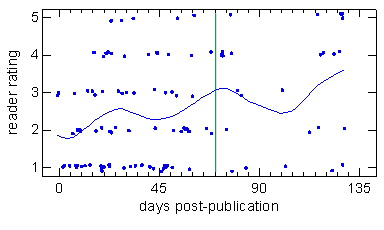
The exact opposite happened to Bowl of Heaven. It started out with largely shitty reviews, which gradually improved over time. (The line represents a distance-weighted least-squares nonlinear fit whose confidence limits tend to wobble depending on where you are along the axis — but a quick-and-dirty linear regression confirms that the overall slope is significant at P=0.05.)1 There’s a bump in positive reviews about 25 days post-pub, and another around Christmas (the green line). A few Amazonian cynics, commenting on some of the more effusive reviews, have suggested that these represent Tor plants bent on damage control, but the numbers don’t really support that. The total number of 4- and 5-star ratings actually goes down over time; it just doesn’t decline as fast as the number of 1- and 2-star reviews.

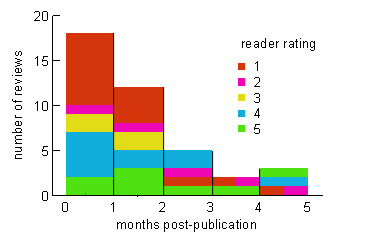
Basically, the haters really piled on for the first couple of months and then just — went away. The likers, in contrast, plodded steadily along near the X-axis, also posting less frequently over time but without that precipitous decline after the second month. Of the 48 ratings that appeared in the first month of release, bad outweighed good by more than 3:1 (ignoring 9 tepid 3-star reviews). Four months later overall activity had plummeted and a measly seven people weighed in either way — but five of them waxed positive. (The bars to the right are overlayed, by the way, not stacked: meaning that, for example, 18 people wrote 1-star reviews in the first month, not 18-minus-ten.)

How to explain this inversion of the usual trend? At first I thought that maybe Tor’s zealous promotion — contests, a book tour, a payoff that saw BoH squeak briefly onto the NYT Bestsellers list — might have backfired, drawn in early (and less forgiving) readers from beyond the usual fan base. But rifling through reviews from those first two months I see that 49 out of 81 — 60% — make explicit mention of their familiarity with the authors’s previous work, frequently describing Niven and/or Benford as personal favorites.

Maybe the field has moved on. Maybe in this post-punk New-Weird YA slipstream age there just isn’t the interest in yesterday’s classic old-wave science fiction. But no, these reviews weren’t tendered by fans of the Dresden Files who’d wandered onto the wrong page; these are folks who like the old ways, who long for them. Some of the most excoriating reviews hailed from self-declared longtime fans.

So the usual bias seems to have manifested after all. The early reviewers were largely fans who sought this title out, who were wetting themselves at the prospect of collaboration between two of their favorite authors. But something happened when they got there. It wasn’t just disappointment. Disappointment is one thing; even giants underperform sometimes, and both these guys are in their seventies. But reading the comments you can tell these fans aren’t just disappointed. They’re feeling angry, they’re feeling used.

They’re feeling betrayed: by a trusted publisher who couldn’t be bothered to ensure that its product was ready for prime time before foisting it on an unsuspecting world at $25.99; by bean-counters who tricked them into shelling out for a complete meal, only to give them half of one. It wasn’t cool back in 2004, it isn’t cool now, and I guess people are just pissed.

I can’t say I blame them.


1 I’ve jittered the data points to give a sense of density; otherwise a single datapoint at a given X/Y would be visually indistinguishable from a dozen points at the same coordinates, since they’d all line up behind one another.

02 Mar 12:00

The Eastleigh reaction: Marf and Henry G Manson

by Mike Smithson

Marf thinks it is time to “Hug a Tory”

To Henry the lesson is that many voters still hate the Tories

David Cameron was chosen to lead the Conservative Party in 2005 because he was seen as a winner. Yet he has not won. He may be Prime Minister but he failed to win an election majority, as did Michael Howard and William Hague before him. We have to go back almost 21 years to the last Conservative majority from John Major a man from such a modest background that he would feel completely out of place and with today’s ‘Cameroons’. Major polled the highest number of Conservative votes ever yet remains a strangely peripheral figure in comparison to the shadow cast by Baroness Thatcher.

Cameron was selected in the good times. “Let sunshine rule the day” he proclaimed. The godfather to his children George Osborne was made Shadow Chancellor and both pledged to follow Labour’s spending plans until the financial crash in 2008. Yet the Bullingdon Boys were not ideally suited to preach restraint and austerity to a sceptical nation. A once commanding 20%+ poll lead was blown away and coalition with the Lib Dems ensued. The yellow party lost over half of their support as a consequence and u-turned on a swathe of policies. Yet one thing never changed. Many voters simply cannot stand the Tories.

18 months ago the Institute for Public Policy Research flagged this up. Despite Labour’s ejection after 13 years of government, the Conservative Party was seen as the most toxic party. In a poll of voters by YouGov, 42% said that they would never vote Conservative while only 36% said they’d never vote Liberal Democrat and just 30% would never vote Labour. My guess is that the figures would be even worse for the Tories right now. Which brings us to Eastleigh.

    Every man and his dog will draw different conclusions from the Eastleigh result. Mine is that is shows that even now anti-Tory sentiment remains stronger than anti-Lib Dem feeling. The Tories are still toxic.

Whatever the misgivings people have with the role of the Liberal Democrats and the Coalition, in a number of areas they’d still rather vote for them that the Conservatives. The Lib Dems will struggle in the North precisely because the anti-Tory feeling is so strong. Simply joining the Coalition was an unpardonable betrayal. But in Lib Dem & Conservative battles in the South the yellow team have a real fighting chance of saving seats and if they’re savvy, they will be more confident and assertive with their partners.

Eastleigh showed that despite a whole range of negative factors, voters are still open to voting tactically to keep out the Conservatives. The tactical voting conundrum should be a far greater concern to Conservatives than how to respond to UKIP. It’s what makes me begin to wonder if that blues can ever win a majority again. Rather than harking back to Margaret Thatcher, thinking Tories should perhaps be looking back at John Major in 1992. Even if it pains some of them to do so.

Henry G Manson

  • If you would like to purchase one of Marf’s prints or originals, please contact her here.
  • 02 Mar 11:40

    Dancing Queen

    by mike

    Last week Jimmy Fallon released a modestly funny, very interesting segment from his show. The bit, titled “the history of mom dancing,” features Fallon, dressed as a mom, and First Lady Michelle Obama, sort of dressed as a mom, dancing to a generic light club  beat.

    if for some reason the video won’t embed–try this link

    dancingTheir moves are labled variously as “go shopping, get groceries,” “the hip bump” and “just the hands part of single ladies.” At the end, Obama does “the dougie” and Fallon, unable to follow, walks off in consternation.

    While it’s not that funny the bit is remarkable in a lot of ways, and point sto the ways the Obamas are transformative figures. Michelle Obama has described herself as “first mom” and the Obamas themselves are a high bourgeois couple, with advanced educated from elite colleges; prosperous and successful. They have two young kids. She had a career before being First Lady, and she’s managed an aura of glamour and style along with her first mom image. She’s also black, no kidding, and at a various times the right tried to depict her as a some kind of radical white-hating black nationalist (see The Whitey Tape and the thesis.)

    The clip casts her as a mom, doing the kind of dancing moms do at weddings. The video minimizes the difference between “mom” and black mom, by locating terpsichorial lameness across racial lines. But it ends by comically reaffirming the old idea that black people are better dancers. Michelle Obama dances well: she’s a bourgeoise mom who can dance “the dougie” well.

    The clip normalizes blackness; “the dougie” is fun and bourgeoise rather than threatening and “other.” But the fact that it’s called “the evolution of mom dancing” suggests that Michelle Obama represents an evolutionary progression, an improvement: mom dancing is getting better.

    The clip might be accused of simply playing up old stereotypes about black people having “natural rhythm.” But that’s undercut by the fact that Fallon is in drag. He’s a great mimic, and him being in drag sets up the whole thing as performance, not fact. The fact that Fallon in drag gives up and walks away undercuts the essentialist piece. Fallon could do the dougie, his mimicry already makes that clear. Fallon in drag suggests that Michelle Obama is also “in drag,” playing a character. Her dancing is a character, not some kind of essence or natural rhythm. It’s play, not genetic destiny.

    It reminded me of “Master Juba,” born William Henry Lane, an african American dancer who frequently mimiced famous white dancers. Juba would deliberately copy the style of his rivals in public contests. The Wikipedia entry on Juba is excellent; historian James Cook has also written about him. Juba’s career and the Fallon clip are both examples of  how jokes shift meaning. Ralph Ellison described it as the way African American tricksters “change the joke and slip the yoke.” It’s very much like the phenomenon Amy Wood describes in her book Lynching and SpectaclePhotographs of lynchings were aimed at a white audience. When black newspaper and magazines published them, they changed the audience and thereby the meaning of the photographs. It’s what Dave Chapelle tried to do in his Rick James clip: change the joke and slip the yoke.

    The Fallon clip alone isn’t that interesting in and of itself, but it prompted a strange rejoinder from conservative pundit Michelle Malkin, who offered her own clip, “the evolution of liberal dancing.” She’s in a wig, with bangs, a reference to Michelle Obama’s recent haircut.

    videos still not embedding?

    malkinI found it painful to watch, not because the satire was effective but precisely because it wasn’t. Malkin can’t dance–her movements are awkward and out of time. (I can’t dance either–I’m a terrible dancer. But as Ta-Nehisi Coates commented, I don’t make videos satirizing other peoples’ dancing.) But also there’s nothing  “liberal” about the Fallon clip, except for the fact that it normalizes blackness and makes black dance the province of normal moms. And that’s what set Malkin off. What activated Malkin is the fact that Michelle Obama can be depicted as “just like your mom” and also “a slightly cooler version of your mom.”

    But to satirize something you have to understand it, you have to be familiar with it. Malkin doesn’t understand how to dance; or the beat; she doesn’t understand poking gentle fun at “mom” dancing. What’s being gently satirized in the Fallon clip is “moms.” Malkin on the other hand wants to attack Michelle Obama. Malkin can’t satirize the dancing, because she doesn’t understand it. In her clip the music is “blacker:” it’s kind of a generic hip hop beat, instead of the bland vaguely techno sound of Fallon’s clip. But her movement is stiff and out of time. Is she satirizing Michelle Obama? But Michelle Obama can dance. Is she satirizing liberal positions? But there’s no tradition of dancing in support of single payer health care. Malkin’s video doesn’t make any sense. There’s plenty to satirize about liberalism. But Malkin can’t figure out how to satirize the normalization of blackness.


    02 Mar 11:27

    Getting Your Priorities Right

    by JHSB

    Featured on Liberal Democrat VoiceThis was going to be titled “Why You Shouldn’t Campaign for Mike Thornton”, but I was too busy campaigning for Mike Thornton to do it earlier. Now you shouldn’t campaign for Mike Thornton because the polls have closed for the Eastleigh by-election so there’s not much point. I’ve written this before the count finishes, so my prediction is Lib Dems, UKIP, Tory, Labour in that order and none losing deposits. By the time you read this you’ll know if I was right and can laugh at me.

    Bisexual and Lib Dem mugs on a Bi Pride flag

    Bi activists learn the benefits of mutually supportive tea making.

    Politics will take as much of your time and energy as you can give it. There’s no real point in politics at which you have achieved all your aims – or if there is, it’s usually beyond the capacity of any one person. While some people can dedicate their entire lives to politics, others have different commitments and interests – whether it’s education, a day job, a partner, caring responsibilities, a hobby or just taking some time to chillax. It’s important to realise that it’s OK to have a life outside politics. Indeed, given the complaints about identikit politicians with no experience outside politics, it’s positively encouraged. Doing something unrelated to politics gives you some distance and perspective. Similarly, identifying full time as a politician means you put a lot of pressure on yourself to be a politician. This is why I took the Lib Dem reference out of my Twitter username and started using it for less political ends.

    It’s also important to set reasonable expectations for yourself, and for others about you. We can achieve nothing if we take on more than we can handle. As a party we rely on too few shoulders bearing the load (which is why I’m also a fervent believer in recruitment and engagement – find people who want to do some of the stuff you feel obliged to!) One of the hardest skills is learning what you have time to achieve. Many people take on multiple responsibilities and then fail to do any of them well; since I stepped down from one Executive at the start of the year, I’ve done a lot more on aggregate for the Lib Dems as a whole. And my replacement should do more for the body I left than I could. One or two people have made negative comments about my stepping down, which is a shame, but I don’t feel guilty for it.

    A pint of beer at a Liberal Drinks social

    Socialising, relaxation and membership engagement by the pint.

    And finally, it’s important that we look after each other. One of my favourite tips from the world of bisexual activism is one piece of activism that you can do in five minutes – make a cup of tea for another activist. Organising Liberal Drinks social events is one of my favorite things. A night in the pub relaxing with friends, and yet somehow it’s a Lib Dem thing too which makes it look like your local party is active and encourages newcomers out of the woodwork! During one particularly tense polling day row in the committee room, I ordered the candidate and agent to separate rooms away from the activists, got the delivery rounds out, made tea and toast for the candidate and agent and told them not to come out until they’d finished. I spent quite a bit of time that day refuelling hardworking pavement-pounders to help them get back out faster. When I see a friend struggling, my first questions are whether they’ve had enough food, drink and sleep – and whether whatever they’re struggling with is honestly as urgent as they’ve convinced themselves it is.

    These techniques can be applied inwardly. We’re all terrible at taking our own advice, but sometimes I consciously ask myself what I’d advise a friend to do in the situation I find myself in. I have studied mindfulness and meditation at the Manchester Buddhist Centre, and have a reasonable handle on how my brain works and its failure modes. I have friends who look after me and show me the same love and concern as I show them. I’ve suffered medically from stress in the past due to having more day-job work thrust upon me than I could cope with, and it’s not something I’d wish on anybody. Years later, I still don’t have as much energy for politics as I used to, and I’m grudgingly coming to accept that that’s OK too. The odd evening at home cooking dinner mindfully, or chilling out with a movie with the activism-filled laptop folded shut, is OK.

    It’s OK to cut down on your activism. It’s OK to take a break entirely until you’re ready to come back. It’s OK to put your energy into making things easier for yourself and others. It’s OK to have not made it to Eastleigh because you couldn’t spare the time, money or energy. It’s OK to strike a balance between doing enough to avoid feeling guilty, and not doing so much you burn out. It’s OK to try and avoid feeling guilty in the first place – we shouldn’t feel bad about doing for the party only what we can spare time and energy for.

    During Eastleigh, the party has relied heavily on e-mails, phone banking and SMS to encourage activists to come and help. This works out well for the party – I probably donated more money and time to the campaign as a result than I otherwise might. And it was great to be there with friends old and new, enjoying the buzz of the headquarters, running a canvassing board one minute and taking direction from a colleague the next. The quiet canvas round on my own and the group of 7 running up and down terraces. Driving around farmhouses with a bemused city dweller. Phonebanking upstairs with campaign staff. People’s favourite crisps. Spending a naughty ten minutes on one doorstep explaining why the Lib Dems and Labour couldn’t have formed a workable coalition. Night driving through the New Forest, full beams picking out sleepy donkeys. These are all good memories I will cherish.

    But I went down when it worked for me, a fortnight before polling day; I could in theory have taken more days off work and gone down today, but it would have caused more stress and hassle than I could reasonably spare, so I did a spot of phone banking after work instead. And that’s OK too. I know people who didn’t contribute any time or money to Eastleigh, and that’s OK too – they had their reasons and priorities, and I respect that and don’t demand that they justify themselves to me. They are good people and good Lib Dems and they will do what they can when they can.

    To summarise then – let’s be a party of enthusiastic, mutually-caring part-timers that people might want to join, rather than being guilt-tripped into self-flagellating martyrs competing to deliver more Focus. It’ll be better for us, but it might just be better for the party too. Be excellent to one another.

    PS: If you liked this post, you really should be reading Louise’s blog. She’s great at this kind of stuff.


    02 Mar 01:19

    What worries me about the revised Justice and Securities Bill Update...

    by noreply@blogger.com (Richard Morris)
    Julian Huppert has written an update on where things stand on the Justice and Securities Bill. As you might expect from Julian, it is clear, detailed and intelligent. And as you might hope, progress has clearly been made.

    But when I read it, I was left with a very uncomfortable feeling that I'd been here before. It all feels a little like the post conference responses to the NHS Bill. We've seen what the Tories wanted to do, said no, revised it, and ended up in a much better place. But still not a place we've have ever got to, or tried ever to get to, on our own.

    And having spent so long on those revisions - you start to take ownership of the bill. It's not the Tories Justice and Security Bill anymore - somehow, because we've done all the pushing and revising - it's become ours. And I don't think we want it...

    Now, of course I need to ponder Julian's piece and decide whether we're now in a good enough place to let things progress, or if I want to throw toys out of prams, or most likely) somewhere in between. And I will listen to the wise counsel, like Jo Shaw , of folk who know more about this than I do.

    But still. It does feel like it's become the Lib Dems bill now. And I don't think that's a good thing.
    01 Mar 22:56

    The Big Book of Potrzebie

    by evanier

    madidw01

    Boy, do I like this one. I’ve seen a lot of great books lately reprinting classic comic books with reproduction worthy of the material…and not to belittle the desirability any others but IDW’s “Artist’s Edition” of MAD is the best one I’ve seen. Some of that, of course, is because the material itself is so wonderful — twenty whole stories and a number of covers and loose pages from the comic book issues of MAD, back when it was written and edited by Harvey Kurtzman and drawn by the likes of Wally Wood, Jack Davis and Will Elder. But a lot of the wonderfulness has to do with what IDW and editor Scott Dunbier have done with it.

    The big thing they did right was to track down the original art itself and scan directly off it…so you see every erasure, every white-out, every stray pencil marking that didn’t get erased. Then they printed the art the size it was drawn. Now, this has its drawbacks because the resultant book is roughly the size of Penn Jillette. It’s 15½” by 22¼” and will fit on no shelf in your home or anyone else’s. You can’t hold the thing in your lap either. You need to open it flat on a table. I’ll be storing mine in a wide art drawer I have. That is, when I’m not hauling it out to show everyone who comes by and doesn’t have their own yet.

    One thing that stands out is that not only does the reproduction live up to the work but the work lives up to the reproduction. Davis, Wood and the others drew this material for dime comics printed on crappy paper and they had no reasonable expectation that it would ever be reprinted once, let alone dozens and dozens of times, eventually full-size and crystal-clear. They could have put a lot less work into the pages and all would have looked fine in what they then thought would be the one and only printing.

    They didn’t. The panels are loaded with detail and nuance that wasn’t visible the first time around — or the second or the third or the ninth. I know these stories real well and I’m seeing things in them I never saw before, not even in Russ Cochran’s excellent hardcover reprints. You know how wonderful Wally Wood’s art for MAD was? Well, it turns out, it was even better than we thought. Same with Davis, same with Elder, etc. (One minor quibble: John Severin is unrepresented. You may also regret that your particular favorite MAD story didn’t make the cut…but there wasn’t room for everything and not every story’s original art could be located.)

    I am similarly impressed with what Harvey Kurtzman did. Years ago, I had the chance to study the original artwork to Marvel’s Not Brand Echh #1, which was more or less their attempt to do Kurtzman’s MAD. Some very talented people worked on it including Stan Lee and Jack Kirby and even John Severin but the effort fell leagues short of Kurtzman & Company. Looking at the originals, you could see one reason why: Almost every panel had retouches and relettering and patches to indicate they passed it around the office and let everyone take a crack at adding silly signs and gags.

    The pages of MAD in this volume show very few examples of relettering or pasteovers or of anyone going through the work after it was completed, trying to make it funnier. Kurtzman was notorious for fussing over pages and redoing his own roughs over and over, spending whole days on one page to make it 1% better. But the stories in IDW’s splendid collection have sparse evidence of after-the-fact renovations. The pages really demonstrate that these guys knew what they were doing and did what they wanted to do. I never felt the sheer professionalism so strongly in any other book reprinting great comic art.

    The book lists for $150 and it would be a bargain if you paid that. Right this moment, there’s one dealer selling it via Amazon for $85.10 and I’ll bet that price doesn’t last long. I’ll further bet that when this book is outta-print, you see copies going on eBay for $300 and up, maybe way up. If this material interests you in the slightest and you can find a place in your home for a copy, don’t delay.

    In case you can’t tell, I kinda liked it.

    01 Mar 21:28

    Eastleigh – Proof There’s No Such Thing As a Perfect Storm

    by Alex Wilcock
    In short…

    Five Lessons From Eastleigh:

    1  Partial winners: the Liberal Democrats, UKIP
    2  Total losers: the Conservatives, the Labour Party, the entire British media
    3  Voters trust or like none of the above
    4  Hard work and authenticity can still win
    5  All politics is local. Thank fuck.

    Two Questions After Eastleigh:

    1 With a neo-fascist party on the rise, will British politics get nastier and more illiberal?
    2 Will the entire UK media change their narrative about the Lib Dems now? Or will they just hold up two fingers to the voters?

    …It’s the two fingers, isn’t it?


    Just the other day, I put yesterday’s by-election in the context of the previous one in 1994. So how did the comparison go? Last time, the incumbents (Conservative) was pushed into third place, while the main challengers (Lib Dems) won – now Lib Dem and Tory starting points are reversed, the Lib Dem incumbents were punished by staying in first place and the Tory main challengers soared from second to third. Again.

    Last time, Labour began the process of Tony Blair’s coronation by leaping from third place to second and gaining 28% of the vote, showing they were on their way to government. Ed Miliband’s Labour Party leapt from third place to fourth and less than 10%, showing he’s on his way down the toilet.

    And after the most sustained, hysterical venom from the entire British media against any party in the by-election history, they showed that they still don’t quite have the power they thought they have, but that hysterical venom does help the rise of neo-fascist parties.


    The Biggest Loser: The Media

    One thing that, surprise, none of the headlines tell you this morning is that the entire British media establishment believed, wanted and actively did all their power to ensure that the Liberal Democrats were dead, and they all failed. Instead, the only mention is an outraged ‘How can they still have won?’

    I’ve been an active and detailed watcher of UK Parliamentary by-elections ever since the Lib Dems were formed in 1988. The sheer, destructive hailstorm of hate in the last week – was it five screaming front-page attacks on the Lib Dems in a row from the Daily Hate Mail alone? – is literally unprecedented. There are no Lib Dem-supporting media outlets, and even the BBC (terrified after its own failings into becoming identikit hatemongers) lost all sense of proportion.

    And it didn’t work.

    Out of hate for Liberalism, out of fear of Leveson, out of outrage that so many voters had the temerity not to listen to them last time – in their hunger to pervert the course of this by-election, the establishment was utterly determined that the Lib Dems must be destroyed and the voters put back in their box.

    The sane reaction would be for the media narrative about the Lib Dems to have to change.

    The almost certain actual reaction is that, now confronted with the fact of their impotence even when at their most brutal and determined, throwing everything at us with a following wind behind them – the media will hate and fear both the Liberal Democrats and the voters even more.

    So expect ever-greater hysteria and evil authoritarianism.

    Paddy Ashdown, as ever, has wise words: “Don’t panic, Lib Dems. All this manure just makes us grow stronger” goes into the pain, the problems and the press’ ravenous feeding frenzy. Millennium Dome, Elephant puts things in perspective, too.


    The Main Winner: The Liberal Democrats

    Congratulations to Mike Thornton – reassuringly calm, local, knowing his stuff and answering questions honestly, unspun and without a hint of shrill hysteria… Yet, against the two most virulently far-right challengers in by-election memory, sticking quietly to Liberal guns on issues like equal marriage. He was exactly what the Lib Dems in Eastleigh, and the voters, needed for what Jonathan Wallace has termed this morning “The Lib Dems’ Battle of Stalingrad”. And congratulations to all the valiant volunteers carrying out that street by street battle.

    Without Mike and all the troops, the hurricane of hate would surely have consumed us. With them, it showed that even a “perfect storm” isn’t perfect. While the Tories and UKIP competed to see who could make Britain the littlest by excluding the most people from it – gays, ethnic minorities, Europe, poor people, people who go to state schools, immigrants – and Labour struggled and fell short of being the One-Tenth-of-a-Nation party, at least the Liberal Democrats felt authentically British: complaining about the storm, but still going out in all weathers and not letting it stop them.

    All this shows that the Liberal Democrats can’t be assumed to be a write-off at the next election, holding a by-election in the depths of mid-term blues and with the full fury of the establishment bent on annihilating us, aided by terrible real news stories. Even the Daily Telegraph – shellshocked and angry that their attempt to bludgeon the voters into obedience failed – this morning admits, calling UKIP the hammer of the Tories and us the anvil (I wonder if the Torygraph’s Deputy Political Editor actually knows what happens, respectively, to the anvil and hammer?):
    “It’s the ‘sheer bloody resilience’, as one Tory put it earlier this week. ‘They just won’t lie down and die.’
    “Eastleigh is yet more proof of an old adage: in the event of a nuclear holocaust, all that will remain of life on earth will be cockroaches, and Lib Dem activists handing out Focus leaflets attacking the cockroaches for not being local.”
    When you’ve been in the wilderness for ninety years, still not being all that popular but actually being in government and getting something done is hardly going to make Liberal Democrats give up. There’s a massive relief to be had that, even under the worst possible conditions, the fall in the Lib Dem vote was limited and hard work held the seat. In future seats, we can hope for similar hard work, now given a morale boost by a slogging victory, and that neither real news stories nor the screaming hate of the establishment can repeat such force. There’s hope based on reason that this is the worst they can do to us, and we’ve withstood it. But that’s not enough. We still took a battering, though we stood up to it. There’s a strong likelihood that our anti-establishment vote is gone, leaving us competing for the much more crowded ground of dull, respectable governing parties. The good news is that this win can’t be called a protest vote, but a successful defence by Lib Dems as a governing party. The bad news is that that’s what you say when you’ve lost a shedload of what were very useful protest votes.

    The last few weeks have seen the first concerted use – allied to all the local depth – of the new Liberal Democrat message:
    “Only the Lib Dems can be trusted to build a stronger economy in a fairer society, enabling every person to get on in life.”
    Nick Clegg used the line when campaigning and in victory. We saw “Stronger Economy, Fairer Society” on posters – something I heartily approve of, as it’s about time national messages were consistently and succinctly integrated with local campaigning. It gives the lie to those who say we won only on local issues. And it clearly reflects the party leadership’s desire to compete as a dull, respectable governing party: it’s a new – and sharper, more priority-driven – version of the Alliance’s ’80s ‘Head and the Heart’ message, saying we can split the difference between Tories and Labour and give you only the nice bits of each.

    Is this message right?
    If it is, is it our priority?
    Is it sufficient?
    Will it help to enthuse – or even win back – any of the idealists we need to do all that hard work?


    I’ll return with the answers to such questions (not all of which are “No”, not all of which are “Yes”; I can split the difference, too) and more answers on what the Lib Dems’ core message should be next week.

    Update: So, from the following week, What the Lib Dems Stand For Part 1 and What the Lib Dems Stand For Part 2 – 2013.


    The Loser That Looks Like A Winner Because the Media Can’t Bear To Give Credit To Lib Dems: UKIP

    There’s no doubt about what UKIP, the party with the clearest messaging, stands for. Three things, two the obvious vileness of neo-fascists, one less specific and more tempting. Between them, they show UKIP’s appeal particularly to some former Tory and some former Lib Dem voters.

    UKIP’s explicit priorities: The Double Racism. No to Europe! No to immigrants!

    Yes, we know what you mean.

    UKIP’s handy new market opportunity: the anti-politics, ‘none of the above’ protest.

    It’s clear that the Twenty-First Century has created one opportunity, with angry old privileged people feeling left behind now that everyone else is getting uppity and equal (hence other policy priorities of kicking the gays back down, Mr Farage’s incredible misogynistic sneering, and so on). Even Andrew Neil – so utterly shit as a host of the BBC By-election Special that he made you pine for a pompous but competent Dimbleby – managed to expose UKIP’s man last night by asking “Why run so hard on immigration with so few immigrants in Eastleigh?” and leaving him floundering for any answer than wasn’t the obvious ‘Because we’re racists’. It’s unfortunately clear that, though in most respects the Lib Dems are UKIP’s polar opposite, for the visceral anti-establishment voter the Lib Dems’ transformation into a dull, respectable governing party has opened the other flank – though I doubt very much if UKIP would have succeeded in peeling votes equally from Tories and Lib Dems yesterday were it not for the hailstorm of hate. But then, hate breeds hatemongers.

    The media establishment will love to talk up UKIP, and have been doing nothing but all day. They’re the establishment’s wet dream of an ‘anti-establishment’ party: viciously prejudiced, nearly all white, male defenders of privilege. It’s like a party of newspaper editors. The Labour Party has already shown its usual commitment to principle by rushing to the far, far right of the Coalition, again, with John Denham now promising Labour will shameless pander to racism on immigration to compete with UKIP as a trailer for his Leader’s next cynical courting of the crumbling BNP vote in the hope that those ex-Labour voters won’t go to the middle-class purples.

    All this mixture of gloating viciousness and craven pandering will, too, unfortunately move British politics in a more nasty and authoritarian direction, but UKIP really isn’t worth it. I’d assumed before the last election that if Mr Cameron won, UKIP would do very well. With the LiberaTory Coalition handing him a brilliant opportunity to get the anti-politics vote as well as the disgruntled Right, I expected UKIP to be regularly scoring 20+% in the polls – as Lib Dems always did against a Tory Government in dire straits – and to take several seats from the Conservatives in by-elections. To look at their adoring press coverage and the craven panic of both Labour and Tories, you’d think that was where they are. Instead, they’ve been underperforming to an amazing degree – something that shows the voters aren’t as stupid or as nasty as the whole media establishment likes to think they are.

    Can you believe that UKIP’s greatest ‘success’ so far is to still be on just 20+% in their best ever by-election, and still never to have won one? Even George Galloway’s taken more people in than that. Can you believe that, with all the massively orchestrated press hyperbole, UKIP still struggles to break double figures in the opinion polls? If they’re supposed to be the ‘replacement’ for the Lib Dems as the party that makes the sort of protests the establishment likes to hear, just imagine if in the ’80s, ’90s or ’00s the best the Lib Dems ever managed was squeaking a second place but never winning, squeaking to 10% but never staying there, not having a single MP, not having more than forty-three elected local councillors in the entire UK – rather than four thousand? Imagine what the media would have said about that as a bandwagon, and you’ll see how much, much further down UKIP would be without the heavy support given by the media establishment’s bias to neo-fascism.


    The Other Big Loser: The Conservative Party

    What can you say? It’s as bad as it could possibly be for them. If they couldn’t win yesterday, then when? As the Daily Mash puts it:
    Tories beaten by perfect storm’ of Huhne, Rennard and nutjobs
    The Conservatives chose a candidate to give their Leader the finger, a far-right ideologue who disagreed with Mr Cameron on every single issue. That, in itself, was arrogant stupidity when they needed to appeal to Lib Dem voters. And then the candidate made the implicit message that they took the seat for granted explicit with her spectacular arrogance, incompetence and snobbery, from slagging off every state school to turning her nose up at the prospect of any voter talking to her and hiding from most of the hustings. She surely was the worst mainstream party by-election candidate for at least a decade.

    And then, despite being identical to a UKIP candidate in all her views, she lost even to them when UKIP managed to find a candidate who seemed more competent. Yes – UKIP seemed more competent and less insanely illiberal than the Tory.

    And despite the Tory being so far from Mr Cameron’s position that it’s hard to believe they’re in the same party, the wet dream candidate of the Tory Right who believe that all the electorate needs is shrill attacks on gays, ethnic minorities, Europe, immigrants, poor people, state schools and so on to come to the Tories in droves but which actually drives them away, all of which reason suggests Mr Cameron’s attempts to detoxify his party are right and the Right are wrong… Despite all of that, all the narrative is that poor Mr Cameron is in trouble and the Tories, totally rejected with their most extreme candidate in recent by-election memory, were beaten only because they weren’t extreme enough.

    This proves how stupid Mr Cameron was to pander to his extremists on Europe and other issues – feeding them only makes them hungrier. Making the Tories sound like UKIP only makes UKIP seem a respectable choice – and choosing a Tory less competent than UKIP’s choice suicidal. And, of course, it proves again that the media establishment love to talk up neo-fascism and hate not just Liberalism but reality.


    The Other Other Big Loser: The Labour Party

    Oh dear. Poor Ed. Again. Eastleigh is only the latest result to put the Mili into humiliation.

    Only a few weeks ago, Labour were talking of Eastleigh as a test for Mr Miliband’s “One Nation” idea. Failed. When Tony Blair was headed into government he went from third to second here – now Labour goes from third to fourth, just scraping a third of Blair’s vote share (but not scraping into even double figures).

    But then, everyone always knew John O’Farrell would have a Weak Ending. It’s only by being awarded points for turning up that he rises above the level of the Tory hustings-dodger as a terrible, incompetent, foot-in-mouth candidate.

    Labour had two messages last night:
    • They will try to be as racist as UKIP, because being as shockingly anti-immigrant as Gordon Brown’s disastrous campaign wasn’t far-right enough
    • They talked to tens of thousands of people in Eastleigh, which shows they’re making contact! Though, er, it also shows that the more people hear from Labour, the less they vote for them.
    • And, er, that’s it.
    I’d say more about Labour, but there’s not much I can fit in less than 10% of the space and, on the results, why bother?


    Featured on Liberal Democrat Voice


    01 Mar 15:15

    The source of the Tories’ problems

    by noreply@blogger.com (Simon Titley)
    The Tories’ poor result in Eastleigh last night is a manifestation of a deeper problem: the party no longer knows what it is for.

    As Robin McGhee points out in a perceptive blog for Prospect magazine, the basic issue isn’t the split over Europe:
    Conservatism in 2013 faces an existential problem: how can it reconcile free markets with traditional values? As the Conservative party shuffles meekly towards electoral demolition, this intellectual imbalance can only become more damaging.
    A evidence for the prosecution, McGhee examines a recent pamphlet Britannia Unchained, written by five MPs (led by Kwasi Kwarteng) from the Tories’ young, thrusting, market-fundamentalist wing:
    In common with many political works that purport to be patriotic, Britannia Unchained displays an amazing contempt for the average British citizen. They are stupid, selfish, indolent, lazy and ignorant. They drink, eat, sleep and die too much. Conservatism, in anything resembling its traditional form, embraces all Britons with its respect for the traditions of liberty that have benefited them. Kwarteng & co only seem to be interested in squeezing every atom of productivity from the beleaguered population so that we can “compete” with countries like India and China, which benefit from vastly greater resources of land and labour. “Too many people in Britain prefer a lie-in to hard work,” the MPs claim. Well, good. That shows they are human and able to enjoy life.
    The creative destruction of life’s pleasures for the good of economic indicators is not a conservative position. It is the opposite: completely without regard for traditions that do not hasten the advance of capitalism. Kwarteng and his co-authors are apparently unable to grasp this.
    A conservative “moral idea” has been abandoned in a ruthless drive for economic competition. So much so that one wonders whether there are any conservatives left in the Conservative Party at all. Certainly a traditional conservative no longer has much moral incentive to vote Conservative.

    This is what happens when political parties abandon their guiding principles for managerialism or economism. But then one suspects that politicians like Kwasi Kwarteng and his co-authors – who know the price of everything and the value of nothing – don’t really mind. After all, political ideology is so twentieth century.
    01 Mar 09:17

    They found their son in the subway!

    They found their son in the subway!
    01 Mar 09:15

    Google Glass

    by Michael Leddy
    John Gruber, on Sergey Brin’s claim that Google Glass is a way beyond the antisocial smartphone:
    I can see the argument that dicking around with our phones in public is not cool, that we should pay more attention to our companions and surroundings, and less to our computer displays. Strapping a computer display to your face is not the answer.

    You’re reading a post from Michael Leddy’s blog Orange Crate Art. This work is licensed under a Creative Commons 3.0 License.
    01 Mar 09:14

    Virus Venn Diagram

    Within five minutes of the Singularity appearing, somebody will suggest defragging it.
    28 Feb 23:36

    The Make White People Behave Act

    by mike

    Yesterday’s blog post concerned Antonin Scalia’s grotesque reconstruction of the Voting Rights Act, which insures that everyone gets to vote, as an example of “racial entitlement.”

    But when Justice Roberts took his turn questioning the Voting Rights Act yesterday, he asked:

    Is it the government’s submission that the citizens in the South are more racist than the citizens in the North?

    I hope it’s not, because it’s a dumb thing to maintain.

    I love beating up on the South as much as the next Yankee, but only a fool would ignore the persistent and entrenched racism that plagues the North (and the west, and the midwest). The history of institutional and political racism in the north is extremely well documented. Southerners are entirely right to complain when smug northerners overlook this.

    But of course racism manifested differently in the two places. The North abolished slavery. The North didn’t establish formal legal segregation. And in the north, black people could vote after 1865.

    vtegeorge

    The act they are debating is called the Voting Rights Act, not the “Make White People Less Racist Act.” The Act was never imagined to end racism, it was always imagined as a way to protect the right to vote, which was being suppressed because of racism. The right to vote itself is color blind. The South may or may not be “more racist.” But the South has a long long particular history of denying black people the right to vote, which is why the Act targets the South specifically. That’s where the right to vote was being systematically denied.

    Robert’s language, like Scalia’s reveals how it isn’t really about voting rights, or is only secondarily about voting rights. What’s being fought out here is the recognition of the history and fact of racism. Roberts wrote briefs against the Voting Rights Act as a young attorney in the Reagan administration; it’s long been a target for him. This is the GOPs “southern strategy” writ large, the strategy of capitalizing on white resentment of civil rights and racial equality. If you can do what Roberts wants, which is insist that there is no difference between north and south in terms of who is “more racist”, then you can legitimate measures designed to restrict voting everywhere, because racism is over. Or rather, racism only appears wehen the rights of racial minorities are being protected.

    The GOP has embraced the idea of voter suppression not just in the South, but in PA, Michigan, Wisconsin, and Ohio among other states. True, it’s thinly disguised as measures to prevent nonexistent voter fraud. But the intent is clear, to find ways to suppress populations likely to vote Democratic, eg. populations more likely to include persons of color. So it’s reasonable to ask “why not apply the law to northern states considering voter suppression?” And I agree, why not? The Constitution clearly gives congress this authority. I’d like every eligible voter regardless of race creed or color or age of economic status to be able to vote with minimal inconvenience and trouble. 

    I’m inclined to agree with Justice Roberts, the north is no “less racist” than the South, and to suggest that they should strike down the key parts of the Voting Rights Act. Then Congress could replace it with a new Act designed to establish federal oversight of every election, in every state, so that no one’s constitutional right to vote would be infringed. Sign me up.

    But we all know that’s not going to happen. Federalizing the right to vote in that way would amount to recognition that we’ve always maintained a regime of perpetual racial entitlement for white people, which would be crushing blow to the self esteem of many white people and would serve, of course as the entering wedge of a notion of equal citizenship. And we can’t have that.

    28 Feb 23:33

    Politics: Harrassment

    by Iain Donaldson

    A number of female colleagues I have spoken with in the past few days have complained that they have been harassed by journalists following up on the allegations made against Lord Rennard.

    I have no intention of commenting publicly on this issue as I have no direct information one way or the other, but I am publishing here the contact details for the press complaints commission.

    If any women Liberal Democrats (or indeed any of my readers) feel that they have in any way been harassed by journalists on this or any other issue then please ensure that you make a complaint to:

    The Press Complaints Commission
    Halton House
    20/23 Holborn
    London
    EC1N 2JD

    Telephone: 020 7831 0022
    http://www.pcc.org.uk/


    28 Feb 21:46

    Brain-to-Brain Communication

    by Sean Carroll

    Over at Nature, Ed Yong reports on a new study by Miguel Pais-Vieira and collaborators, in which mental activity in the brain of a rat living in Brazil is communicated directly to the brain of a rat living in North Carolina, which responds accordingly (sometimes; at least greater than by chance). Ed was able to find another researcher to give the mandatory curmudgeonly response, comparing the work to a “poor Hollywood science-fiction script.” To which the rest of us respond: we want to see that movie!

    This isn’t my bailiwick, obviously, so check out Ed’s article or the original paper. The basic idea is that the Brazil rat sees a light, and presses a lever that it has been trained to when that light goes on. An implant records activity in the rat’s motor cortex (in charge of pressing levers), which is then encoded and sent to the North Carolina rat, which presses the corresponding lever itself. At least, about 64% of the time. Which is a pretty noisy signal, but a signal nonetheless.

    Direct mental communication won’t be replacing email any time soon. But unlike our skeptical commentator, I think experiments like this are important. They prod people’s minds in the direction of thinking about what might someday be possible.

    Share

    28 Feb 21:34

    Doctor Who 50 Great Scenes – 42: Day of the Daleks

    by Alex Wilcock
    Counting down towards the fiftieth birthday of Doctor Who with Fifty great scenes… Today’s is Doctor Who’s first major use of the “timey-wimey” – back in 1972, as a one-off key dramatic turning point with consequences. It’s also the first scene in my Fifty to be a really massive spoiler, so I’m warning you before this gripping revelation. In a dystopian future Earth controlled by the Daleks, human freedom-fighters are desperate to change time with an assassination… And, in addition to all the avenues that sends me down, I have a small tribute to Ray Cusick, creator of the Daleks.
    “You went back to change history – but you didn’t change anything. You became a part of it.
    “…You’re trapped in a temporal paradox! Styles didn’t cause that explosion and start the wars. You did it yourselves.”


    Mysterious figures have been appearing out of nowhere to try and kill top diplomat Sir Reginald Styles before a crucial peace conference. The Doctor (Jon Pertwee), still exiled to Twentieth Century Earth and working with UNIT, is called in to investigate – who are the real villains? The combat-clothed would-be assassins? The brutal Ogrons pursuing them? Or, perhaps, in a story called “…of the Daleks”, could there be some other force behind it all…? Well, no, the involvement of the Daleks isn’t the big spoiler. The Doctor and his companion Jo are both drawn forward in time to a ruined 22nd Century Earth that’s little more than a giant Dalek slave-camp. The human resistance have utterly failed in taking the fight to the Daleks on an already shattered Earth… But their history tells them that Sir Reginald was a murderer who destroyed his own peace conference and triggered the world wars that left Earth easy pickings for the Dalek invasion. Using stolen Dalek time-travel technology, they’ve been travelling back to kill him first. Before you ask, this was a decade before The Terminator (and Harlan Ellison wrote an introduction to the US edition of the Doctor Who and the Day of the Daleks novel rather than an instruction to his lawyers, so clearly it was differently creative to the way The Terminator arrived at its plot). Though I do wonder if its starting point might not have been 1984 – that to control the past is to control the future, and not just by altering the textbooks?

    It’s a story of contrasts: exciting and flat; intelligent and flawed. The final episode deploys the most of both, its first half largely made up of brilliantly escalating, compelling dialogue scenes that bring out the best in the actors, its second half the big action finish that director and budget fail to deliver perhaps most conspicuously out of all Who stories (something which the Special Edition tries hard to overcome, with limited success). I was first gripped by the novelisation Doctor Who and the Day of the Daleks some years later, which avoids some of the flaws of the television version and carefully walks the line between the human assassins being ‘terrorists’ or ‘freedom-fighters’ by generally terming them “guerrillas”. And while it’s easy to think of them as ‘freedom-fighters’ once their initial ambiguity is resolved into the knowledge that they’re fighting against the Daleks, at the story’s finest moment – a scene running from about seven minutes into Episode Four to a climax about five minutes later (or at the end of Chapter 12), in effect a perfect mid-episode cliffhanger – we come to question their fight all over again. They’re careless of human life and have little objection to killing or abandoning the Doctor – until learning that the Daleks fear him makes him in their eyes a weapon to be utilised. It’s the Controller of this sector of Earth, a Dalek-appointed bureaucrat, who shows the most humanity in his haunted tale of the wars that ruined Earth, and the brutalised fighters who’ve only ever known a Dalek Earth who show mercy only at the Doctor’s urging when they burst in to rescue our hero from Dalek suckers. Jon Pertwee’s Doctor and the Controller (Aubrey Woods (the Controller)) are both grandstanding performances at their best when suddenly focused down into quiet, intense dialogue scenes, and it’s the Controller’s despair more than the guerrillas’ determination that moves the Doctor, setting him on a vital train of thought once taken to the guerrillas’ base.

    Once held by the human suckers, the Doctor’s given a simple proposition: they’ll send him back to the Twentieth Century, and he can kill Sir Reginald for them. But a lot of this makes the Doctor uneasy, and it’s not just the implicit feeling that murdering people in cold blood is the sort of thing the Daleks do and not him. Impatiently, the guerrilla leader tells him that, improbably, people still wrote history books through the wars, pinning all the blame on a power-hungry Sir Reginald, and that, improbably, they’d managed to find out that the Daleks had time travel and steal some of their devices, both a portable time machine and a large bomb. How convenient. Having met Sir Reginald and formed the impression that, while a dick, he’s no dictator, Jo and the Doctor each put their fingers on potential problems with this. He breaks it gently:
    “But your history [No good for me – na, na, na na] could be wrong, you know?”
    She’s more blunt:
    “But if this is true, Sir Reginald Styles must be completely round the bend!”
    It is notable that no-one seemed ever to have found any cells of fanatical Stylesists around the world ready to seize power as the bombs fell – in fact, the only cells of fanatics who might in some way be being manipulated by fascist dictators are the ones the Doctor is sitting in, and he’s already observed that
    “Changing history is a very fanatical idea”.
    So, which fascistic fanatics who want to rule the world and have the power to change history do we know of, readers? Fortunately the dialogue is better-written than that and builds the drama to a peak rather than dropping quite such explicit hints, but Doctor Who’s deep-grained suspicion of ‘The ends justify the means’ (paraphrased in this scene by the Doctor) gives a very satisfying philosophical steer to the direction of the dramatic revelations. As the Doctor slowly brings out the truth with his questions, we’re reminded that one of the assassination cell was wounded and left for dead in the last attempt on Sir Reginald – both in dialogue, and in cross-cut images of him slipping into the cellar of the government mansion where the peace conference is due to take place… Complete with the bomb, taken along as a last resort.

    If there’s no reason to think that Sir Reginald got his hands on some terrible new explosive and used it to blow up the peace conference – incompetently killing himself in the process – then somebody else must have done it. And, though it’s never made explicit, isn’t history always written by the winning side? While some of the story disappoints in the TV version, for me both on the page and on screen it’s one of Jon Pertwee’s finest moments as he pushes the logic of the guerrillas’ plans to its remorseless conclusion – a last suicidal attempt to carry out orders that doesn’t defeat the Daleks, but creates their future for them.

    Always a favourite scene of mine, it’s relatively recently that it’s come to redeem what was one of those slight disappointments for me about the story: that it sets up what could be an intriguing mystery of motives as well as of time travel, but blows it too early. Presented with two apparently violent, villainous groups, camouflaged assassins taking orders from the moustached leader of their terror cell vs brutal ape-like aliens taking orders from an icy Controller (known only as the Controller), it not only offers a visual pun – guerrillas vs gorillas – but, in their mutual antagonism, a puzzle of which are the real ‘baddies’. Almost immediately, though, it’s revealed which side is working for the Daleks, and with that the mystery collapses into obviously evil Ogrons and quisling Controller vs misunderstood or misguided freedom fighters, making Jo seem dumb for clinging throughout to the opposite interpretation. And yet, the last time we watched the story, Richard wisely observed that this climactic scene and the ones following (which you’ll have to watch yourself) not only reverse everything the guerrillas know, but everything the audience knows about who’s really doing the Daleks’ evil work:
    “All through this, Jo thinks that the Controller is the goodie, and the guerrillas are the baddies. And it turns out she was right all along.”
    It’s not without some controversy. This whole scene’s a major point of disagreement in the principal DVD documentary (of several). Lead writer of the time Terrance Dicks is quite right to say that the story needed it – arguing that if strange things happen, the viewers are unsatisfied if they don’t get an explanation. Barry Letts, often spot-on with his instincts as producer, here gets it entirely wrong, claiming that it shouldn’t happen in the last episode – the last episode should be action. So Tinker Tailor Soldier Spy should start by saying who the mole is, then just make time until an extended shootout? Particularly when the ‘action’ climax of this story is so infamously thin, it’s great to have such a memorable a mid-episode climax that depends on concept and actors rather than budget. As Ben Aaronovitch says, otherwise there’d be nothing of substance in Episode Four, though even he seems to wish there was somewhere else to put it. Not at all. I didn’t come to the story as a middle-aged, thoughtful Liberal, but a boy who drew ray-blasts all over my books because there were never enough in the illustrations (and it was one of Doctor Who and the Day of the Daleks’ pictures that taught me how to draw explosions). And even then, I was gripped by the big twist even more than by the fabulous Dalek battle in my head.


    Day of the Daleks and the Time Paradox

    This was really the first time that Doctor Who had brought together the philosophical and practical sides of time travel into what would now be called a “timey-wimey” story – previously, the Doctor had talked about the impossibility or undesirability of changing time, rather than us being shown its effects, while stories featuring more time travel than just ‘TARDIS arrives at beginning, TARDIS leaves at end’ had effectively made time a different form of space to chase about in. This moment of this story was the first time that time was really used as intelligent drama – as well as providing in itself a warning that getting stuck in timey-wiminess is bad, and that trying to resolve it by getting deeper into timey-wiminess is worse, and that you’ll have a miserable life in which everything becomes meaningless. I always took this as proof that, while if you came up with a really good one-off story in which it had consequences that would work as drama, you couldn’t possibly do it every week. Some might argue that Doctor Who later doing it every week disproves that rule – but probably not if they’ve watched it. Notably, the next time that the Doctor is pitched against the Daleks in a story about changing history, the Time Lords position him on the wrong side, leading to deeper philosophical argument, the Doctor no longer having a get out of jail free card for a moral dilemma, and arguably the start of the Time War which consumes both Time Lords and Daleks. Again, drama means consequences.

    There have been many heated debates across the years about exactly how the ‘Dalek future’ that the Doctor averts comes about (not least round at a couple of leading fan-writers’ place one Christmas, when Richard and one of them debated it to the death while I and the other partner kept our heads down in the kitchen). I won’t go into it in metaphysical or philosophical depth, nor detailed temporal physics, but here are a few thoughts. When I was a boy, reading the story, it always made sense to me, possibly because my religious upbringing prepared me for the conceptual leap of some exterior cause with different, Creator’s rules. A lot of essays I’ve read seem to assume that the Daleks do the hard work of invading, then the guerrillas accidentally use Dalek time travel to create a paradox which spares them the trouble, after which the Daleks retrospectively doss about just protecting the new timeline; or that it’s a parallel universe, which nobody ever mentions (this is, instead, explicitly the time-travel version of the sort of story Inferno was, with Pertwee again at his best up against it); or that the Daleks just ‘found’ the wrecked Earth or that in some other way the paradox just started by itself and the Daleks found themselves a part of it.

    The forty-one-year-old me has much the same reaction, albeit with longer words and paragraphs, to what I’m confident the seven-or-so-year-old me who first read the book would: that’s silly, far too complicated, and missing the point. Obviously, the Daleks are the baddies, and are almost as good at time travel as the Time Lords, and as the Doctor can’t change history then obviously this isn’t how history is supposed to go (unlike the Daleks’ first invasion, in about the same spot, but that’s another story). So the reason the Doctor can put a spoke in this particular timeline must be that the Daleks intervened to set it up in the first place.
    “We have changed the pattern of history.”
    The time paradox is a closed system which goes round and round perfectly, once the Daleks somehow from outside the closed system just gave it a little starting push. As a boy, I pictured (perhaps in a mixture of science fiction, perpetual motion and theology) the Daleks lifting out a section of history as a bubble, intricately joining bits of it together and then setting it back in place to spin round and round. I can’t to this day explain the mechanics of that, but the conceptual image still makes perfect sense to me: the Daleks used their extremely clever time-travel engineering to bootstrap it and can then stand back while it circles for ever. It doesn’t matter that we don’t know exactly how it works, because the logic of the story and everything we know about the Daleks is that they’re behind it all, and unlike all those other ‘explanations’ that require there to be all those extra and often contradictory elements added to the story, my instinctive understanding has an Occam’s Razor about it and credits the Daleks with being clever. As well as appropriately making them the authors of their own destruction, as it’s only when they fearfully identify the Doctor as their enemy that makes the humans pay attention to him.

    Richard wrote a more detailed and carefully considered analysis of what he sees as time paradoxes when considering What Does Timey-Wimey mean? in reviewing 2011’s Doctor Who – The Girl Who Waited on Millennium’s Fluffy Diary, as well as revealing that while a timey-wimey story may have been conceptually exciting to me as a one-off, when given nothing but so that no event means anything any more and Doctor Who disappears up its own timeline, my response is… Well, I may have given a hint there. But my Fifty aims to be positive, so I’ll stick to pointing you in Richard’s direction where, fascinatingly, despite having more of a head for high-level temporal physics than I do, he sees Day of the Daleks as philosophical rather than temporal engineering, driven by a plot in which the Daleks symbolise determinism and the Doctor free will. Rather brilliantly, this makes Day of the Daleks a battle between The Dalek Factor and The Human Factor, and a thematic sequel to The Evil of the Daleks after all. So the Doctor’s paradox trumps the Daleks’ not just dramatically but allegorically, when both quisling and terrorists – each thinking the other the enemy, but each raised with a Dalek mind-set – believe the ends justify the means and are equally surprised when the Doctor has compassion for the individual instead, in different ways the salvation of each of them (and of the world). Have a read.


    Ray Cusick and the Daleks

    Writing about any Dalek story this week is going to have a touch of melancholy, following the death of Raymond P Cusick. Doctor Who has been so extraordinarily lucky in so many of the people who’ve worked on it over the last half-century – actors, writers, designers of sound and landscape, and more – that even a shortlist of ‘If it weren’t for these people, the series wouldn’t be around today’ couldn’t be very short. But Ray Cusick would always be in the top tier: the man who designed the Daleks. There were others who were vital to them, too, including Terry Nation, Peter Hawkins and Brian Hodgson, but Mr Cusick created that iconic look and propelled the series to its first great success. He was an immensely talented designer, whether working on planets, historical periods or giant suburbia (and that’s just his Doctor Who work), yet he’ll always be remembered for creating the series’ first and still one of its most visually striking and coherently imagined alien worlds and Doctor Who’s first big monster.

    There’s a touch of guilt for fans, too, in that the other thing he’s remembered for is as ‘Laughing Ray Cusick’, a way to cope with the reason that his interviews about the series were always unsmiling and with unhappy undertones, what became almost the series’ original sin – that while other people and the BBC itself made an awful lot of money out of the Daleks, the person who most deserved to didn’t. I hope he still found some pride in them. And it’s notable that in all the minor redesigns of the Daleks that have followed, to take them too far from the logic of Mr Cusick’s originals is to invite disaster. Bringing them into colour for the first time in the TV series, Day of the Daleks at least makes the right choice in making some of its Daleks gun-metal grey for a lasting suggestion of one-being tanks, yet it not only robs them of much effect by directing them very feebly but ignores the work of the original actors and sound engineers, as a result proving that messing up the vocal design can be almost as big a mistake as throwing out Mr Cusick’s shape. Notably, it’s the only DVD for which an alternative Special Edition completely redubs every Dalek line rather than just changing the special effects…


    Bonus Great Doctor Who Quotation – The Trial of a Time Lord: The Mysterious Planet

    I’ve always been curiously fond of the opening for the prosecution in the Doctor’s big Trial, and gave The Trial of a Time Lord: The Mysterious Planet as near to a rave review as it’s likely to get for the DVD, there choosing a Golden Moment of existential crisis. And there’s more to come in the Fifty, too. But one of the things I particularly like about it is that it lets Colin Baker really blossom as the Doctor, not just through him finding interesting things to do to distract you from the script, as in too many, but simply writing well for him – giving him good speeches and a good relationship with Peri. It was the last full script from Robert Holmes, master of the speech, the scary bit and the one-liner and probably the greatest Doctor Who writer of them all, here in the first of what will be quite a few of his lines featuring in my countdown.

    It’s half-way into Part One, and the Doctor (Colin Baker) and Peri have discovered that the mysterious planet is, inevitably, a familiar one: ours, and two million years in the future, it’s gone down the Tubes. So, it’s another dystopian future Earth, but at least this one wasn’t created by the intervention of a bunch of Time-Warring superbeings with a magnetron. Er… Anyway, confronted with the ruins of Marble Arch Station, Peri is distraught; the Doctor, sympathetic but worldly (it’s not that long since he was faced with his own gravestone). It’s a beautifully elegiac scene for both of them, her reacting at the human level to the loss of her world, him taking the long view.
    “Planets come and go. Stars perish. Matter disperses, coalesces, reforms into – other patterns. Other worlds. Nothing can be eternal.”

    Extra Bonus Great Doctor Who Quotation – Father’s Day

    The Doctor (Christopher Eccleston) has wise words about putting things in perspective.
    “The past is another country. 1987’s just the Isle of Wight.”

    Next Time… Duelling futures (it’s more timey-wimey, I’m afraid).


    28 Feb 21:23

    It's the sugar, folks.

    It's the sugar, folks.