Andrew Hickey
Shared posts
24 Mar 13:13
The New World of Publishing: A New Slush Pile
by dwsmith
The slush pile is dead. Long live the reformed slush pile.
Or some mangled old saying like that.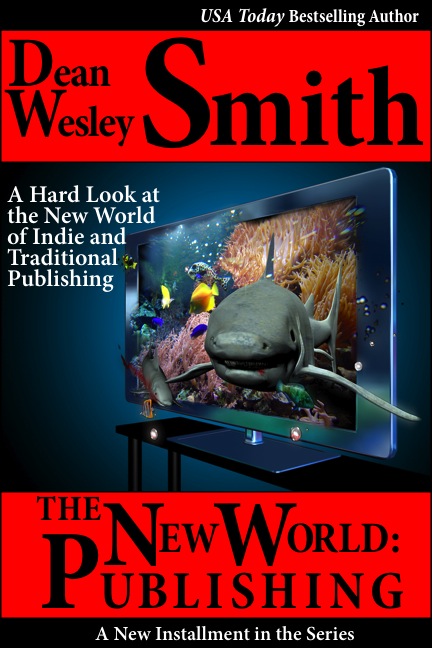
Lots and lots of things have changed in publishing over the last five to ten years, and the slush pile for publishers certainly hasn’t missed that change. In fact, I would wager there are young editors in traditional publishing houses that have no idea what the term “slush pile” even means. And if ever explained to them, they would shriek in horror at the very idea.
Slush piles were where writer’s manuscripts went to sit and wait for a baby editor to take a look at them, and maybe buy them for their publishing line. Some small slush piles still exist, but not in the old traditional sense by a long ways.
So I figured it was time to give the term “slush pile” a quick update and let you know where the manuscripts are piled these days.
Some History
The term “slush pile” came about way back, after the Civil War, when editors got all their stories directly and personally from writers. You had to live close to the magazine or book line you were writing for, or visit it frequently. During the pulp era of 1920-1950, editors would be in these old office buildings in New York without air-conditioning. Over the top of the door was a transom and a window that could be opened to help cool the room. So when writers went to see the editor and the editor wasn’t in, they would toss their manuscript “over the transom” through the window.
If the editor was gone for any length of time, he would come back and push his door open to find a pile of white paper with black typing on his floor. It looked like dirty New York slush, thus the term “slush pile” came about.
When I came into publishing in the early 1970s, New York publishers had vast rooms for manuscripts arriving from all over the county. They would hire young editors to cull through the massive piles hoping to find something of value. If the young editor found something in the slush pile, it often meant a promotion out of the slush pile reading and to a real editing job.
But going into the 1990s, the expense of having rooms and young editors living in New York and only culling through slush became too much for many traditional publishers. But they had a problem: Their guidelines of “No Unsolicited Manuscripts” just didn’t hold back the flood.
So near the end of the 1990s, the traditional publishers switched to “No Unagented Manuscripts” and shut down the few slush rooms that were left. In other words, they outsourced the slush to the writer’s own employees. A really, really bad idea since it had the appearance of putting an employee in charge of the employer.
This outsourcing also dried up a lot of the publisher’s new, creative work. At the same time the distribution system that had been in existence since the late 1950s was collapsing and thus publishers didn’t notice the lack of new creative work since they were also cutting back book lines and only looking for bestsellers. (Realize this was still ten years ahead of the ebook revolution.)
Young editors laid off in the cutbacks flocked to become agents. Most of those editor/agents have failed since, buried under the piles of slush and the desire to be an editor and rewrite everything they saw. No income that way. The older, established agencies just ignored it all and only took on new clients in the old traditional way of referral from an established client.
And the same writers who had figured out a way to ignore the previous road block suddenly (for unknown reasons) bought into the myth of needing an agent to sell books and things turned even uglier for an entire generation of new writers. The new writers were blocked completely (or so they thought. Reality has nothing to do with anything in publishing, remember? I’ve done entire articles on how the “agent-only guideline” is just false.)
Then in 2009, as midlist writers and new writers were fleeing the ugliness that was traditional publishing for real world jobs, here comes the ebook revolution. Suddenly, with very little learning and almost no money, writers could get their work directly to the readers.
Traditional publishers, too locked down in their huge corporate problems at the time, ignored the fact that they had lost their monopoly on the distribution system thanks to the KDP program, the Pubit program, and places like Smashwords.
The indie publishing revolution had started.
Writers were not only able to sell e-books, but because of the advent of POD publishing, indie publishers could do paper books as well very cheaply and with little or no upfront costs. And just this spring, with the start of Ella Distribution (and possible other indie paper books distributing companies coming), indie writers can offer their books directly to indie bookstores.
The reasons to go to traditional publishing have vanished. And with the reputations of traditional publishing being tarnished by traditional publishers like Simon and Schuster and Random House going into vanity press scams, even going to traditional publishing for a rubber-stamp of quality has vanished.
Add all that to the fact that many, many writers have made a lot of money and are hitting the major bestseller lists with their indie published books means there is no clear choice for a writer anymore. Go traditional or go indie?
At least writers have a choice now.
But because of the slush pile aspect of things, that choice for many writers now seems to be what many call a “hybrid” model for writers. In other words, do both indie and traditional publishing.
So Where is the Slush Pile Now?
The slush pile is broken up into parts, actually. But mostly it has evolved into a brand new form.
Tiny parts of the old-style slush pile are sitting in editor’s actual offices in traditional publishing. Those manuscripts are the ones by writers who ignored guidelines or met editors at a conference. In most editor’s offices, it’s not much of a pile. Usually less than twenty or so, since they cull out the ones that don’t fit on the day they arrive in most cases.
Tiny parts of the old-style slush pile are sitting in a few genre-publishing electronic-submission programs. These submission programs are as bad as the old slush rooms. It usually take a year or more to get a manuscript through, and are not, in my opinion, worth a writer’s time or energy.
Tiny parts of the old-style slush pile are sitting on agent’s desks that allow such things. These agents are not really an agent you would want if they did like your book because editors know them as slush readers. Usually these types of agents have no clout and wouldn’t know a good contract if it nipped at their high heals. Of all the methods to try to break into traditional publishing, sending a manuscript unsolicited to a slush pile in an agency is the silliest. Agents can’t write checks. And any agent who would take an unsolicited manuscript to look at isn’t an agent you want if you get an offer from a publisher.
So Where Did Most of the Slush Go?
The slush pile morphed into a brand new form, a brand new way for traditional publishers to see work and have it be tested before they even made an offer.
The slush piles of old are all now indie published. And the readers decide what is good or bad.
Instead of costing a writer money to mail it to a huge room in New York as we did in my early years, or send it to an agent, writers now can indie publish their work both electronic and in paper and make some money in the process. It might not be a lot, but it is some money. And if the book starts to sell, it will draw the attention of traditional publishers and they will come calling with an offer.
In other words, if you wrote a good book, readers will find it and then traditional publishers will come calling.
It puts the responsibility squarely on the writer to tell a great story in a great fashion.
And if traditional publishers come calling, the writer has a good bargaining position and can get decent contract terms. And the writer knows the money they are making with their indie book, and how much of an offer would make the writer switch over to traditional publishing.
In other words, there is hard sales data for both sides. Win. Win.
And a win for the readers, because unlike the decade from 1999 to 2009, great books are not getting lost to the stupidity of an old and antiquated system.
Summary
I’m going to be blunt now, so hold on.
If you follow an old model, you send your manuscript to either an editor or an agent:
In essence, this is what you are doing: Imagine yourself standing at the door of a restaurant in ragged clothes, hat-in-hand, begging for some food. You have no bargaining power, no position to try to get a decent contract (meal). And if you are with a slush-reading agent, imagine that you now only get a part of what little bit of food they are willing to toss you.
If you follow the new, indie-publishing model:
In essence, this is what you are doing: Imagine you own your own business. You have money coming in the door, have customers, and a growing list of products. A representative of a major corporation shows up in your store and asks to buy some of your product for their company. You know what the product is worth and you know you can get decent contract terms. They have come to you, into your business, and it is an even bargaining position for both of you, business to business. They want what you are selling. You can decide if the money and terms are worth you selling it.
I have no idea in this new world, with constant reports of indie writers being approached and getting great money and contracts from traditional publishers, why anyone would even think of sticking with the old model of begging at a publisher’s door with a manuscript in a slush pile.
I have no idea why any writer would spend so much time writing a book and then not allow that book to earn for them while it was being looked at by traditional publishers.
I have no idea why any writer would (in 2013) send any manuscript into a traditional, old-style slush pile.
Just as we had to learn how to do cover letters and synopsis of novels that would help our books sell, the writers of today need to learn how to do covers and cover blurbs and tag lines that will help their books sell.
The slush pile is dead.
Long live the new system of getting books to traditional publishers. And making some money in the process.
As a person who has lived with both the old and the new systems, trust me, the new is a ton more fun.
————————————————
Copyright © 2013 Dean Wesley Smith
Cover art copyright Philcold/Dreamstime
————————————————–
This chapter is now part of my inventory in my Magic Bakery.
I’m now getting back to writing fiction, so every word I write here takes time from that. And I have to justify this column somehow in how I make a living.
So, if you feel this helped you in any way, toss a tip into the tip jar on the way out of the Magic Bakery.
If you can’t afford to donate, please feel free to pass this chapter along to others who might get some help from it.
And I would like to thank all the fine folks who have donated over this last year. I seldom get a chance to respond, but the donations and the comments both after the posts and privately are really keeping me going on this. Thanks!
Tip Jar: Go To Paypal


24 Mar 13:05
The permanent revolution
by Charlie Stross
(I just felt the need to lift a comment I posted on an earlier thread up here where it belongs.)
Quoth a commenter, to whom I felt the need to reply:
Things change. Technology accelerates it. The only thing up for debate is the timing.
This is a statement of ideology, not of fact.
For most of the duration of the human species, change has not been an overriding influence on our lives. In fact, it's only since roughly 1800 that you couldn't live your entire life using only knowledge and practices known to your mother and father. We are undeniably living through the era of the Great Acceleration; but it's probably[*] a sigmoid curve, and we may already be past the steepest part of it.
An interesting point is that this ideology works very well as a match for the political ideology of revolutionary republicanism which emerged in the 18th 17th century, and which pretty much everyone reading this blog[**] is in complete agreement with — the ideology that replaced the Divine Right of Kings and the Great Chain of Being as an organisational paradigm with "Liberte, Egalite, Fraternite" (or, in bastardized form, Freedom, Equality of Opportunity [to make money], and Patriotism).
The doctrine of continual change through technology is not value-neutral; it feeds into the continual disruption that enables the permanent revolution of the anti-monarchists to roll forward, and prevents the oligarchs who sit astride the juggernaut from becoming too comfortable. It is in principle possible to suppress change; the problem is that suppression is a sub-optimal strategy in a polycentric world with competing interests. But once the capital imbalances that are driving development in the developing world and immiseration of the proletariat in the post-democratic first world subside, stasis will become an increasingly attractive policy to the oligarchs. (When the Great Acceleration stops, my guess is that the oligarchy will ossify into a nobility, and eventually a monarchical-system-in-all-but-name, within a century at most. And there are already worrying signs that this is happening.)
Please don't deny that you are a believer in this revolutionary ideology — and it is revolutionary; so much so that Republican Democracy, Fascism, and Communism are just minor doctrinal disputes within it. It's okay to admit it here; I'm a supporter of this ideology, too. None of us are supporters of feudal monarchism; we're all the inheritors of the early Jacobins. Which makes us revolutionaries.
But it's important to understand that virtually the entire mainstream of political and social discourse today is radical and revolutionary by historical standards. (Hell, the concept of sociology itself is a construct of the revolutionary philosophers.) This is not an historically normative set of touchstone ideas to run a society on. We're swimming in the tidal wave set running by an underwater earthquake two centuries ago — and like fish that live their entire lives in water, we are unable to see our circumstances as the anomaly that they are, or to know whether it's all for the best.
And, as Oliver Cromwell put it, "I beseech you, in the bowels of Christ, think it possible you may be mistaken."
[*] I'm discounting singularities here.
[**] Except you, Moldbug.
Evenson.not.org and -1 others like this
24 Mar 12:52
Nick Clegg and the politics of immigration
by noreply@blogger.com (Simon Titley)
Yesterday, Nick Clegg made a speech about immigration. Since it has been the subject of much misinterpretation and anger, it is advisable to read the actual whole speech before going any further.
At first, the speech seems quite reasonable. In the face of extremism, Clegg wants to move the debate onto “practical and sensible ground”, talks about wanting to maintain “an open and tolerant Britain”, and promises “the Liberal Democrats will never seek to outflank our opponents because we think that’s what people want to hear”.
Yet the more you study the speech, the more it reveals fundamental flaws in not only Clegg’s thinking but also his whole strategic approach. Taken together with the recent dispute about secret courts, both the speech and the reactions from within the party suggest that the party is falling out of love with its leader and that the feeling is mutual.
So far as the question of immigration itself is concerned, others have already criticised the speech in detail. On Liberal Democrat Voice, Caron Lindsay tried to be even-handed in a post titled ‘the good, the bad and the ugly’ but concluded there was more bad and ugly than good. Her LDV colleagues Stephen Tall and Nick Thornsby had no inhibitions, making the case against Clegg in no uncertain terms. They were joined in a thorough demolition job by Lester Holloway.
It was a fortunate coincidence that Liberal Democrat Voice conducted a poll of party members on this very topic a few days before the speech. It showed that these hostile reactions to Clegg’s speech were not the views of an unrepresentative minority but that the membership’s view of immigration remains highly liberal.
Rather than repeat what others have said about the issue of immigration per se, I want to look at the politics of this speech and what it tells us about the party leadership.
The first problem with Clegg’s speech is that, although it purported to show leadership, it did the opposite. Clegg was ostensibly critical of the anti-immigration agenda but, by debating the issue on anti-immigration terms, he effectively validated that agenda. He made little attempt to tackle the popular myths about immigration, let alone enthuse about the positive things immigration brings to society. This approach makes anti-immigration sentiments more respectable and shifts the debate from morality (“right or wrong”) to management (“how much?”).
Most mainstream politicians are in a flat panic about popular opinion on immigration (recall the fiasco during the 2010 general election when Gordon Brown encountered the “bigoted woman”). Hostility to immigration is not a new problem nor is it unique to Britain. What has made the problem more acute is the recession (resentment of outsiders always grows in hard times) and the rise of UKIP.
As Nick Thornsby argued in the Independent, it is at times like these that we look for true leadership, even when the liberal position risks unpopularity. Unfortunately, we live in an era when politicians tend to be driven by opinion polls and focus groups. If politicians had thought like that during the 1960s, we would never have had the abolition of capital punishment or the legalisation of homosexuality.
This brings us on to the second problem, which is the concept of the ‘centre ground’. Tory MP Bernard Jenkin recently criticised this idea:
Anti-immigrant sentiment cannot be ignored, of course. Many voters say they are against immigration, although on closer inspection it is hard to disentangle whether they are concerned more about new immigrants or the ethnic minorities already settled here, and whether immigration directly affects them or is merely something they’ve read about in the papers.
There is a valid non-racist argument that immigration must be managed, but management does not seem to be a major source of popular concern. The one occasion in recent years when the volume of immigration threatened to overwhelm local services was the large influx of Poles following Poland’s accession to the European Union in 2004, yet Polish people have rarely been the target of racist sentiment. If you want to tout for racist votes, you would be more successful calling for the repatriation of black and Asian people than Poles. I am sure Nick Clegg would baulk at that, even if the polls and focus groups said it would be popular.
The third problem is Clegg’s attitude to the party and its policy-making process. His speech follows on closely from the notorious vote in favour of secret courts in the Commons earlier this month. Party members are starting to see a pattern of top-down policy-making that contradicts their wishes.
Strictly speaking, Clegg’s speech has not changed party policy. Policy is developed by the party’s Federal Policy Committee (FPC) and approved, democratically, by the party’s Federal Conference. In terms of the party constitution, Clegg was doing no more than kite-flying and, to be fair, he actually only called for existing policy to be “reviewed”. Try explaining that to the media. The Guardian talked of Clegg “abandoning” existing party policy on an amnesty, the Telegraph of him “dropping” it, the Mail of him “ditching” it. So far as the outside world is concerned, an ex cathedra statement by the leader is enough to change party policy – and Clegg and his media advisers must have known it.
Worse, Clegg’s new policy to replace an amnesty is half-baked. His big idea is that visa applicants from ‘high risk’ countries should pay a ‘security bond’ in the form of a cash deposit (Clegg mentioned no specific amount in his speech although the sum of £1,000 is being bandied about), which would be repaid when they leave the UK. This obviously hasn’t been thought through, as various knowledgeable people in the party could have told him if he had bothered to consult anyone beforehand. It’s not as if Clegg lacked the time or the opportunity; the speech was originally due to have been delivered in mid-February but was postponed (presumably because of the Eastleigh by-election), so a draft of the speech has been sitting around on his desk for over a month.
The lack of consultation is particularly inept, since the FPC recently appointed a policy working group on immigration, asylum, and identity, chaired by Andrew Stunell MP. This working group has so far met twice and is due to report to the spring 2014 party conference. Clegg’s speech was not presented to the working group at all, while the Federal Policy Committee was made aware of the speech’s existence but not its contents. Which is all a bit odd when you consider that Clegg, expressing his dissatisfaction with the current party policy on an amnesty, said in his speech, “I have asked Andrew Stunell, the former Integration Minister, to lead a review of this and our other immigration policies in the run up to 2015”. It is unclear whether Clegg was announcing the setting up of a working group that already exists or announcing the appointment of Stunell to conduct a separate review in parallel with the working group.
Of course, the reason for Clegg’s failure to consult the working group might be that he is unhappy with it for some reason. If so, he could have discussed his reservations with the chair of the FPC, Duncan Hames MP, who also happens to be Clegg’s Parliamentary Private Secretary. Or since Clegg is a member of the FPC himself, he could have come along to a meeting and expressed his views in person. He did neither.
Meanwhile, any outsider puzzled about what current Liberal Democrat policy on immigration actually is should consult the motion (‘Immigration in the 21st Century’) debated at the party’s 2007 autumn conference. It was proposed by the party’s then Shadow Home Secretary – one Nick Clegg.
Postscript (1): Nick Barlow has written a very perceptive blog post, which questions whether the arguments for remaining in coalition still hold water, and ponders what depths Nick Clegg will next plumb.
Postscript (2): Several members of the party’s FPC and policy working group on immigration have written an open letter to protest about the speech.
At first, the speech seems quite reasonable. In the face of extremism, Clegg wants to move the debate onto “practical and sensible ground”, talks about wanting to maintain “an open and tolerant Britain”, and promises “the Liberal Democrats will never seek to outflank our opponents because we think that’s what people want to hear”.
Yet the more you study the speech, the more it reveals fundamental flaws in not only Clegg’s thinking but also his whole strategic approach. Taken together with the recent dispute about secret courts, both the speech and the reactions from within the party suggest that the party is falling out of love with its leader and that the feeling is mutual.
So far as the question of immigration itself is concerned, others have already criticised the speech in detail. On Liberal Democrat Voice, Caron Lindsay tried to be even-handed in a post titled ‘the good, the bad and the ugly’ but concluded there was more bad and ugly than good. Her LDV colleagues Stephen Tall and Nick Thornsby had no inhibitions, making the case against Clegg in no uncertain terms. They were joined in a thorough demolition job by Lester Holloway.
It was a fortunate coincidence that Liberal Democrat Voice conducted a poll of party members on this very topic a few days before the speech. It showed that these hostile reactions to Clegg’s speech were not the views of an unrepresentative minority but that the membership’s view of immigration remains highly liberal.
Rather than repeat what others have said about the issue of immigration per se, I want to look at the politics of this speech and what it tells us about the party leadership.
The first problem with Clegg’s speech is that, although it purported to show leadership, it did the opposite. Clegg was ostensibly critical of the anti-immigration agenda but, by debating the issue on anti-immigration terms, he effectively validated that agenda. He made little attempt to tackle the popular myths about immigration, let alone enthuse about the positive things immigration brings to society. This approach makes anti-immigration sentiments more respectable and shifts the debate from morality (“right or wrong”) to management (“how much?”).
Most mainstream politicians are in a flat panic about popular opinion on immigration (recall the fiasco during the 2010 general election when Gordon Brown encountered the “bigoted woman”). Hostility to immigration is not a new problem nor is it unique to Britain. What has made the problem more acute is the recession (resentment of outsiders always grows in hard times) and the rise of UKIP.
As Nick Thornsby argued in the Independent, it is at times like these that we look for true leadership, even when the liberal position risks unpopularity. Unfortunately, we live in an era when politicians tend to be driven by opinion polls and focus groups. If politicians had thought like that during the 1960s, we would never have had the abolition of capital punishment or the legalisation of homosexuality.
This brings us on to the second problem, which is the concept of the ‘centre ground’. Tory MP Bernard Jenkin recently criticised this idea:
Politicians often talk about “the centre ground” of British politics, as though there is some big bell curve of voters in the middle where we have to be in order to get elected. The three main parties are crowded there in the facile belief that being anti-immigration, anti-EU, pro-business, tax cuts and tough on crime is “right wing”; while more spending, concern about the poor, pro-EU, pro-human rights and CND is “left wing”, and therefore sensible moderate people weigh up these “extremes” and finish up somewhere in between. And, of course, most people are sensible.
The Clinton/Blair people called it “triangulation”. The architects of Conservative modernisation copied it and made David Cameron in this respect the “heir to Blair”, but the result is that all the parties are now losing to “extremes”. Eastleigh showed there is no such thing as the centre ground – a great pile of voters in the middle waiting to be harvested by politicians’ cynical positioning. Nor is there a magic bullet labelled “immigration” or “Europe” either.Clegg frequently bangs on about the ‘centre ground’ (indeed, he would have you believe that he is a non-ideological pragmatist) and this latest speech merely underlines the fact that he sees the voters in terms of Jenkin’s ‘bell curve’. His speech can therefore be seen as an attempt at triangulation. But as Jenkin pointed out, this won’t make him more popular or respected. You can only do that by standing up for what you believe in and accepting that this risks making as many enemies as friends.
Anti-immigrant sentiment cannot be ignored, of course. Many voters say they are against immigration, although on closer inspection it is hard to disentangle whether they are concerned more about new immigrants or the ethnic minorities already settled here, and whether immigration directly affects them or is merely something they’ve read about in the papers.
There is a valid non-racist argument that immigration must be managed, but management does not seem to be a major source of popular concern. The one occasion in recent years when the volume of immigration threatened to overwhelm local services was the large influx of Poles following Poland’s accession to the European Union in 2004, yet Polish people have rarely been the target of racist sentiment. If you want to tout for racist votes, you would be more successful calling for the repatriation of black and Asian people than Poles. I am sure Nick Clegg would baulk at that, even if the polls and focus groups said it would be popular.
The third problem is Clegg’s attitude to the party and its policy-making process. His speech follows on closely from the notorious vote in favour of secret courts in the Commons earlier this month. Party members are starting to see a pattern of top-down policy-making that contradicts their wishes.
Strictly speaking, Clegg’s speech has not changed party policy. Policy is developed by the party’s Federal Policy Committee (FPC) and approved, democratically, by the party’s Federal Conference. In terms of the party constitution, Clegg was doing no more than kite-flying and, to be fair, he actually only called for existing policy to be “reviewed”. Try explaining that to the media. The Guardian talked of Clegg “abandoning” existing party policy on an amnesty, the Telegraph of him “dropping” it, the Mail of him “ditching” it. So far as the outside world is concerned, an ex cathedra statement by the leader is enough to change party policy – and Clegg and his media advisers must have known it.
Worse, Clegg’s new policy to replace an amnesty is half-baked. His big idea is that visa applicants from ‘high risk’ countries should pay a ‘security bond’ in the form of a cash deposit (Clegg mentioned no specific amount in his speech although the sum of £1,000 is being bandied about), which would be repaid when they leave the UK. This obviously hasn’t been thought through, as various knowledgeable people in the party could have told him if he had bothered to consult anyone beforehand. It’s not as if Clegg lacked the time or the opportunity; the speech was originally due to have been delivered in mid-February but was postponed (presumably because of the Eastleigh by-election), so a draft of the speech has been sitting around on his desk for over a month.
The lack of consultation is particularly inept, since the FPC recently appointed a policy working group on immigration, asylum, and identity, chaired by Andrew Stunell MP. This working group has so far met twice and is due to report to the spring 2014 party conference. Clegg’s speech was not presented to the working group at all, while the Federal Policy Committee was made aware of the speech’s existence but not its contents. Which is all a bit odd when you consider that Clegg, expressing his dissatisfaction with the current party policy on an amnesty, said in his speech, “I have asked Andrew Stunell, the former Integration Minister, to lead a review of this and our other immigration policies in the run up to 2015”. It is unclear whether Clegg was announcing the setting up of a working group that already exists or announcing the appointment of Stunell to conduct a separate review in parallel with the working group.
Of course, the reason for Clegg’s failure to consult the working group might be that he is unhappy with it for some reason. If so, he could have discussed his reservations with the chair of the FPC, Duncan Hames MP, who also happens to be Clegg’s Parliamentary Private Secretary. Or since Clegg is a member of the FPC himself, he could have come along to a meeting and expressed his views in person. He did neither.
Meanwhile, any outsider puzzled about what current Liberal Democrat policy on immigration actually is should consult the motion (‘Immigration in the 21st Century’) debated at the party’s 2007 autumn conference. It was proposed by the party’s then Shadow Home Secretary – one Nick Clegg.
Postscript (1): Nick Barlow has written a very perceptive blog post, which questions whether the arguments for remaining in coalition still hold water, and ponders what depths Nick Clegg will next plumb.
Postscript (2): Several members of the party’s FPC and policy working group on immigration have written an open letter to protest about the speech.
24 Mar 12:46
Counting down towards the fiftieth birthday of Doctor Who with Fifty great scenes… This one’s from 2011 and the Twenty-Second Century, and it’s one of my favourite moments for Matt Smith’s Doctor – an almost perfectly formed cliffhanger. So expect rather large spoilers, deep themes, and the enemy within…?
It’s the answer to accidents at work. Working in a dangerous environment? Worried you might fall into a pool of seething acid and bubble to a hideous dissolution? Robots too expensive and covered by pesky artificial intelligence regulations? Then meet the Flesh: reformable, reusable, disposable, and you. Just sit back in comfort and control your Flesh “Ganger” self through all the sticky bits, and if you’re a bit more careless than you would be with your usual body and it happens to die in screaming agony, just withdraw your consciousness from it and form another from the vat of gloop. It’s not as if anyone’s hurt, right? And if you get it wrong, you can just be born again. Again.
The Rebel Flesh / The Almost People is the 2011 Doctor Who story that felt most traditional to me – that is, of all the many, many thematic traditions of Doctor Who, this chimed with those that most deeply speak to me. Traditional, then, though not at all reassuring. The Flesh vat from which life can rise at will – eventually, its own, after a spark from the heavens – is only the font of the religious imagery, housed, of course, in the old Chapel. Free will and the created rebelling against the creator? Frankenstein is positively a modern influence in that context, here given a kick by a solar storm as its lightning. There are existential crises, cruelty begetting cruelty, conflicts between people who are basically (and never more so here) the same, all shot in dark, shadowy corridors. And with Matt Smith’s Doctor arriving to investigate and the actor’s love for Patrick Troughton’s time in the role, it’s not inappropriate that the story evolves into one of base under siege.
The cliffhanger brings all of this to a head in a way that’s predictable if you’ve been watching, yet deeply satisfying, a terrific ‘What’s going to happen next?’ moment of horror, revelation and just a little of challenging the viewer. On arrival, the Doctor (Matt Smith) scans the Flesh pool and finds himself disconcerted – as if it’s scanning him in return. It pulls his hand down to touch it, and they share a moment of understanding when
Events approach crisis. The humans see the Gangers as nothing. The Flesh rebel. The TARDIS sinks beneath an acid mulch. The greatest solar storm of all is building to baptise all with fire. There’s a thrilling, throbbing, backwards pulse of music as people run down dark stone passageways. And a figure staggers from the vat, muttering “Trust me…” as its clammy hand holds itself up against the wall…
The TARDIS crew splits apart as Rory rushes out in concern for the team member-Ganger-person he’s been talking to – perhaps showing himself (while everyone here clearly passes the Turing Test) the only ‘human’ of either creation capable of passing a Voight-Kampff Test – while Amy’s left behind, fearing the unlike and the too-alike, shocked that Rory is with another woman. And the Doctor can’t hold her together now, because he’s heard a voice from the shadows of the Chapel, asking “Why?” “Show yourself!” the Doctor commands, but whose self is it (and hasn’t a son of the Doctor asked “Why?” before)? His face the bloated Flesh of a not-quite-controlled Ganger, the Doctor (Matt Smith) steps forward to reassure Amy just as he always does, characteristically straightening his bow tie and giving that crooked smile. Trust him. He’s the Doctor.
I did warn you there were spoilers, didn’t I?
In this especially fine sci-fi short story of a Doctor Who episode, the Doctor (Toby Jones) is much less friendly an other Doctor than the Doctor (Matt Smith) above is going to be to the Doctor (Matt Smith). Introducing himself as “the Dream Lord”, he flits between the Doctor, Amy and Rory’s confusing, conflicting realities of the happy, domestic life that Rory’s always wanted, settled as a doctor, or of the scary, exciting life in the TARDIS, settled with the Doctor. He tells them to pick the real one, or die. But which is Amy’s dream outcome? And what a sly other self the Doctor has – where Rory dreams of at last drawing equal as a proper doctor, this one promotes himself to Consultant to put him down again:
This is arguably the best Doctor Who story since it returned to TV in 2005, but not for John Smith (David Tennant). He spends the first half of it happy with his life as a teacher, his burgeoning relationship with Joan the Matron, and his exciting dreams of adventure, though his faithful maid Martha seems to be getting a little strange. But in his Journal of Impossible Things we see for the first time all his past selves, and everything turns inside-out when he finds those dreams are real and his life’s become a nightmare. The local dance ends in death. People he thought he knew become an uncanny Family led by a pupil with wild eyes now styling himself Son of Mine, and they want something from him he doesn’t know he has. Martha’s become an unsettling mixture of protector and threat, and she, too, wants something from him he doesn’t know he has. To him, he’s an ordinary man, with unreliable memories but real feelings. To both pursuers and protector, he’s a walking placeholder, not the Doctor but just an inferior mind and body walking around in exactly the form and place the Doctor would usually occupy, all of them for different reasons looking forward to his erasure. He despairs that even the woman he hoped to marry thinks he’s not enough – though she’s the only person who sees him for who he feels he is. At the story’s half-way point, as people suddenly demand the Doctor of him, there’s a “Next Time…” trailer in which he declares “I am not the Doctor.” It’s a sign of how little control he has of his life that he doesn’t get to say that in the second episode – even his denial just gets written out. And yet his plight prefigures not only the sinister echoes of his role (and Martha’s) in the three-part season finale, but the existential crises and self-loathing of the other Doctors above.
John Smith runs from the Family, but they call him back, holding the TARDIS the Doctor loves as hostage. Martha loves the Doctor and tries to wake him into his dream to save them – and doom him. Joan loves John Smith and tries to reassure – but can’t lie to him. And poor John breaks under the responsibility all of them put on his human shoulders.
And there might just be more dodgy Doctors to come (though another, much as I enjoy this scene half-way down, doesn’t quite make the Fifty). The next scene up’s not just a but the man who is not the Doctor, though…
Next Time… Hiding behind… Oh, no, hiding from…
Doctor Who 50 Great Scenes – 40: The Rebel Flesh / The Almost People
by Alex Wilcock
Counting down towards the fiftieth birthday of Doctor Who with Fifty great scenes… This one’s from 2011 and the Twenty-Second Century, and it’s one of my favourite moments for Matt Smith’s Doctor – an almost perfectly formed cliffhanger. So expect rather large spoilers, deep themes, and the enemy within…?
“This is insane. We’re fighting ourselves.”
“Yes, it’s insane, and it’s about to get even more insanerer. Is that a word? Show yourself, right now!”
“Doctor, we are trapped in here and Rory’s out there with them. Hello? We can’t get to the TARDIS and we can’t even leave the island!”
“Correct in every respect, Pond. It’s frightening, unexpected, frankly a total, utter splattering mess on the carpet, but I am certain, one hundred per cent certain, that we can work this out. Trust me. I’m the Doctor.”

It’s the answer to accidents at work. Working in a dangerous environment? Worried you might fall into a pool of seething acid and bubble to a hideous dissolution? Robots too expensive and covered by pesky artificial intelligence regulations? Then meet the Flesh: reformable, reusable, disposable, and you. Just sit back in comfort and control your Flesh “Ganger” self through all the sticky bits, and if you’re a bit more careless than you would be with your usual body and it happens to die in screaming agony, just withdraw your consciousness from it and form another from the vat of gloop. It’s not as if anyone’s hurt, right? And if you get it wrong, you can just be born again. Again.
The Rebel Flesh / The Almost People is the 2011 Doctor Who story that felt most traditional to me – that is, of all the many, many thematic traditions of Doctor Who, this chimed with those that most deeply speak to me. Traditional, then, though not at all reassuring. The Flesh vat from which life can rise at will – eventually, its own, after a spark from the heavens – is only the font of the religious imagery, housed, of course, in the old Chapel. Free will and the created rebelling against the creator? Frankenstein is positively a modern influence in that context, here given a kick by a solar storm as its lightning. There are existential crises, cruelty begetting cruelty, conflicts between people who are basically (and never more so here) the same, all shot in dark, shadowy corridors. And with Matt Smith’s Doctor arriving to investigate and the actor’s love for Patrick Troughton’s time in the role, it’s not inappropriate that the story evolves into one of base under siege.
The cliffhanger brings all of this to a head in a way that’s predictable if you’ve been watching, yet deeply satisfying, a terrific ‘What’s going to happen next?’ moment of horror, revelation and just a little of challenging the viewer. On arrival, the Doctor (Matt Smith) scans the Flesh pool and finds himself disconcerted – as if it’s scanning him in return. It pulls his hand down to touch it, and they share a moment of understanding when
“I felt it in my mind. I reached out to it, and it to me.”There’s no such awe for the creators. They simply don’t care. They pile their personalities and lives directly into it, yet they don’t expect it to be alive. Naturally, the Doctor’s feelings are with the exploited Flesh, urging one of the team whose face suddenly slides into incoherence – revealed as Ganger – to trust him, appealing to bridge the gap between natural and new human as the differences between the bodies and personalities of each become ever more indistinct, only for the ever-careless human team leader to do what she’s always done and ‘dispose’ of Gangers in her way… Prompting the Gangers to decide on the same strategy of “us or them”. Where once they touched, now he’s guilty by association of betrayal and death, how can even the Doctor become an intercessor between creators and created? Though, racing about the place as he does, he did pop back into the Chapel alone to scan – or prompt – the pool of Flesh once more, the vat forming lips in reaction, and practicing the words: “Trust me.”
Events approach crisis. The humans see the Gangers as nothing. The Flesh rebel. The TARDIS sinks beneath an acid mulch. The greatest solar storm of all is building to baptise all with fire. There’s a thrilling, throbbing, backwards pulse of music as people run down dark stone passageways. And a figure staggers from the vat, muttering “Trust me…” as its clammy hand holds itself up against the wall…
The TARDIS crew splits apart as Rory rushes out in concern for the team member-Ganger-person he’s been talking to – perhaps showing himself (while everyone here clearly passes the Turing Test) the only ‘human’ of either creation capable of passing a Voight-Kampff Test – while Amy’s left behind, fearing the unlike and the too-alike, shocked that Rory is with another woman. And the Doctor can’t hold her together now, because he’s heard a voice from the shadows of the Chapel, asking “Why?” “Show yourself!” the Doctor commands, but whose self is it (and hasn’t a son of the Doctor asked “Why?” before)? His face the bloated Flesh of a not-quite-controlled Ganger, the Doctor (Matt Smith) steps forward to reassure Amy just as he always does, characteristically straightening his bow tie and giving that crooked smile. Trust him. He’s the Doctor.
Bonus Great Doctor Who Quotation – Amy’s Choice
I did warn you there were spoilers, didn’t I?

In this especially fine sci-fi short story of a Doctor Who episode, the Doctor (Toby Jones) is much less friendly an other Doctor than the Doctor (Matt Smith) above is going to be to the Doctor (Matt Smith). Introducing himself as “the Dream Lord”, he flits between the Doctor, Amy and Rory’s confusing, conflicting realities of the happy, domestic life that Rory’s always wanted, settled as a doctor, or of the scary, exciting life in the TARDIS, settled with the Doctor. He tells them to pick the real one, or die. But which is Amy’s dream outcome? And what a sly other self the Doctor has – where Rory dreams of at last drawing equal as a proper doctor, this one promotes himself to Consultant to put him down again:
“Now then, the prognosis is this: if you die in the dream, you wake up in reality. Healthy recovery in next to no time. Ask me what happens if you die in reality.”Toby Jones is deliciously bitchy as he sneers that he could always see through the Doctor; Matt Smith matches him secret smile for secret smile, knowing only one person could hate him that much. But is he a person in his own right, like both Doctors above? I think Richard’s talked me round, in his review for Millennium’s Fluffy Diary. And what about the next one…?
“What happens?”
“You die, stupid. That’s why it’s called reality.”
Extra Bonus Great Not Doctor Who Quotation – Human Nature / The Family of Blood
This is arguably the best Doctor Who story since it returned to TV in 2005, but not for John Smith (David Tennant). He spends the first half of it happy with his life as a teacher, his burgeoning relationship with Joan the Matron, and his exciting dreams of adventure, though his faithful maid Martha seems to be getting a little strange. But in his Journal of Impossible Things we see for the first time all his past selves, and everything turns inside-out when he finds those dreams are real and his life’s become a nightmare. The local dance ends in death. People he thought he knew become an uncanny Family led by a pupil with wild eyes now styling himself Son of Mine, and they want something from him he doesn’t know he has. Martha’s become an unsettling mixture of protector and threat, and she, too, wants something from him he doesn’t know he has. To him, he’s an ordinary man, with unreliable memories but real feelings. To both pursuers and protector, he’s a walking placeholder, not the Doctor but just an inferior mind and body walking around in exactly the form and place the Doctor would usually occupy, all of them for different reasons looking forward to his erasure. He despairs that even the woman he hoped to marry thinks he’s not enough – though she’s the only person who sees him for who he feels he is. At the story’s half-way point, as people suddenly demand the Doctor of him, there’s a “Next Time…” trailer in which he declares “I am not the Doctor.” It’s a sign of how little control he has of his life that he doesn’t get to say that in the second episode – even his denial just gets written out. And yet his plight prefigures not only the sinister echoes of his role (and Martha’s) in the three-part season finale, but the existential crises and self-loathing of the other Doctors above.

John Smith runs from the Family, but they call him back, holding the TARDIS the Doctor loves as hostage. Martha loves the Doctor and tries to wake him into his dream to save them – and doom him. Joan loves John Smith and tries to reassure – but can’t lie to him. And poor John breaks under the responsibility all of them put on his human shoulders.
“You recognise it, don’t you?”
“Come out, Doctor! Come to us!”
“I’ve never seen it in my life.”
“Do you remember its name?”
“I’m sorry, John, but you wrote about it. The blue box. You dreamt of a blue box.”
“I’m not – I’m John Smith. That’s all I want to be. John Smith. With his life – and his job – and his love. Why can’t I be John Smith? Isn’t he a good man?”
“Yes. Yes, he is.”
“Why can’t I stay?”
“But we need the Doctor!”
“So what am I then? Nothing. I’m just a story.”
And there might just be more dodgy Doctors to come (though another, much as I enjoy this scene half-way down, doesn’t quite make the Fifty). The next scene up’s not just a but the man who is not the Doctor, though…
Next Time… Hiding behind… Oh, no, hiding from…
24 Mar 02:58


On Stewart Lee and the art of stand-up comedy
by Mike Taylor
In the last week or two, I’ve become obsessed by the comedy of Stewart Lee. He’s an English stand-up comedian, originally famous as half of the Lee and Herring duo in the 1990s, making Fist of Fun and This Morning With Richard Not Judy for television. His career has taken a lot of twists and turns since then, but in the last few years he’s emerged as a unique voice with a series of shows that don’t really resemble anything else I’ve seen.

His stated goal is an unusual one for a comedian: “Within a few years these “jokes” as we comedians call them, will have been entirely purged from my work in favour, exclusively, of grinding repetition, embarrassing silence and passive-aggressive monotony”. He refers to this process as “refining my audience”.
This may not seem like good way to sell a comedy act. Yet the result is, I think, the funniest act I’ve ever seen. Many times in the last week, I’ve spontaneously burst out laughing in the middle of supermarket or while cooking or something, when I happen to remember a particularly surprising part of a Lee routine. I’ve watched the same routines repeatedly: they have a re-watch value that I’ve not previously seen in comedy, and which reminds me more of good music.
“Sounds great, Mike, where can I see some?”, I hear you ask. Well, hypothetical interlocutor, it’s not quite as simple as that. There are lots of clips on YouTube, but it’s in the nature of a Lee routine that it builds into a coherent whole through the full 30 or 90 minutes, so that decontextualising any part of it robs it of much of its significance. That said, a decent shortish introduction would be this eleven-minute routine which seems to be about American attitudes to the death of Osama Bin Laden.

So my point is that you should all rush out and buy Stewart Lee DVDs — you’ll thank me. I’d especially recommend the second series of Stewart Lee’s Comedy Vehicle (six half-hour sets), and his two most recent full-length shows If You Prefer a Milder Comedian Please Ask For One and Carpet Remnant World.
Except …
And stop me if you’ve heard this before …
You can’t buy these DVDs in America. Or, at least, you can at great expense get imports, but they’re region-2 encoded, so won’t play on legal American hardware.
And I have to ask once more, whose benefit is this for? Being the huge Stewart Lee fan that I am, and having a lot of American friends, it’s a dead cert that I would by now have bought multiple DVDs as gifts for my friends in the States. I want to know how Lee or his distributors benefit from the unavailability of his work outside of Europe.
In the mean time, the only recommendation I can make to my American friends is that you go and download Lee’s shows from The Pirate Bay.
But really.
Come on.
24 Mar 02:56
Not All the Way With L.B.J.
by evanier

A lot of people think newsman Dan Rather’s a bit of a kook. That’s been true a long time and I remember that back when he published his first autobiography, a number of people thought that because of something he said in it. He was talking about the 1968 Democratic Convention in Chicago which, as you surely recall, had no incumbent running because then-President Lyndon Johnson had withdrawn as a candidate. So it came down to Hubert Humphrey versus anti-war candidates like Eugene McCarthy and George McGovern, and the entire party looked to be coming apart at the inseams.
In his 1977 book, The Camera Never Blinks, Rather insisted that L.B.J. had a plan he was unable to make work. It was to make a surprise appearance at the convention where some sort of carefully-engineered spontaneous outcry would insist that he accept the nomination for a second term after all. For the good of America and to bind the party together, he would accept and then sail to a landslide victory. Moreover, claimed Rather, Johnson would dump Humphrey from the ticket and replace him in a gesture of cross-party loyalty with the Republican (!) governor of New York, Nelson Rockefeller. It all seemed so outrageous that no one believed Rather and I recall more than a few journalists and historians suggesting he was loco in the cabeza.
Well, Mr. Rather has been at least partially vindicated in the new release of some hitherto-classified tapes of L.B.J. phone calls. There appears to be no mention of the Rockfeller factor but there is conversation about the plan for President Johnson to make an unexpected appearance at the convention and to snatch back the nomination he had foregone. They say it didn’t happen because Chicago Mayor Richard Daley couldn’t assure L.B.J. he’d actually get that nomination and the Secret Service couldn’t ensure Johnson’s safety if he did plunge into that riot-filled, angry event. So there’s an interesting twist in U.S. history that didn’t happen.
This revelation is so far being ignored by the U.S. press because, you know, we care nothing about the past in this country except when we can use it against our enemies in the present. But the B.B.C. is doing stories about it and on this page, you can read the tale and hear excerpts from Johnson’s recorded phone conversations. And the story I just told you isn’t even the most shocking revelation.
It’s the claim — supported by much evidence though I’d still like to see more — that Richard Nixon feared his ’68 candidacy would be derailed if Johnson managed to end the Vietnam War so he secretly sabotaged the peace talks. Johnson thought Nixon had committed treason…and if he did what they say he did, that seems like a fair accusation. That was one of the amazing things about Nixon: Just when you thought your opinion of the man couldn’t get any lower, he’d always surprise you. It’s somehow comforting to see he’s still at it.
24 Mar 02:55
From The Onion…
by evanier
David Ferguson writes one of those articles that some folks won’t “get” as parody/sarcasm. It starts like this…
I have always been a big proponent of following your heart and doing exactly what you want to do. It sounds so simple, right? But there are people who spend years — decades, even — trying to find a true sense of purpose for themselves. My advice? Just find the thing you enjoy doing more than anything else, your one true passion, and do it for the rest of your life on nights and weekends when you’re exhausted and cranky and just want to go to bed.
To make a serious comment on an article that is non-serious, at least at face value: I was amazed at the number of friends I re-encountered at my 25th high school reunion who said things not unlike, “I’m just trying to decide what I want to do with my life.” “I’m trying to get my shit together” was uttered by a few. A general rule of thumb is that if you don’t have your shit together a quarter-century after you got out of high school, you’re using the wrong sorting system.
I am not a big believer in the philosophy, “You can be anything you want to be in life.” I didn’t have the practical option to play for the Lakers, sing opera at Lincoln Center or ride the winning horse in the Kentucky Derby. I did have a range of realistic choices wherein I easily found something I did love to do. It was around age ten that Satan (you know: that guy who looks like Barack Obama) came to me and offered me the following deal: That I would become a professional writer and always earn a living at it but I would never be anything else. I have never regretted signing that one in blood. But the time to make those deals if at all possible is before you have to go out and get your first job.
I think one of the reasons more people don’t figure out What They Want To Be When They Grow Up is that they think there’s a much thicker catalog from which to pick than there is. Or their first choice is, like, President of the United States or Richest Person in the World or Hugh Jackman…and anything short of that seems like a sign of failure.
My father, as I’ve written on many occasions, hated his occupation. It was a job he took because he needed to pay rent and he told himself it was just until he found something better…but he stayed in it until he hit retirement age. Apart from his near-ideal marriage, the happiest thing in his life was that his son didn’t make the same mistake. I’ve made most of the others but just out of dumb luck, not that one. Don’t you.
23 Mar 23:12

I've been thinking about it a lot... and i've just updated my status on facebook and surprised myself by nailing *exactly* what i think about my vague resistance the new Bowie album (as well as the fact it's missing Mike Garson on piano - and really, any tinkling, extravagant campery altogether..!)
here's my sudden thought this morning...
I'm still just not getting into The Next Day. And I've been obsessed with Bowie since I was 15. I feel a little like... when the rest of the world rediscovered Dr Who in 2005. They were going on and on and i was thinking... but, but... 'happiness patrol', 'lungbarrow', 'crystal bucephalus'... just like now i'm thinking... but ... but! ... 'thursday's child' and 'strangers when we meet' AND 'everyone says hi'...! Where were you then, you sheep? you dafties..?!
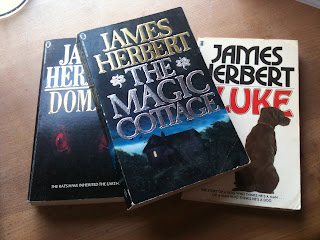
James Herbert died.
He wrote the first bit of gay fiction i ever read - and memorised! A surprisingly touching chapter in The Rats, believe it or not. It ends badly, obviously, but not because they're gay. Just because it's The Rats and *everyone* gets eaten, whatever their preferences. Herbert was always surprising and wrote very much about the world we live in - which is more that can be said for many contemporary novelists.
The book of his I loved most was The Magic Cottage, which I read when I was sixteen. I might have loved it because my secondhand copy smelled very strongly of cigarettes. At the time though, I thought he was much better than Stephen King, because he was *here* and wrote about people you saw everyday.
thinking about the Next Day... and about James Herbert
by noreply@blogger.com (Paul Magrs)

I've been thinking about it a lot... and i've just updated my status on facebook and surprised myself by nailing *exactly* what i think about my vague resistance the new Bowie album (as well as the fact it's missing Mike Garson on piano - and really, any tinkling, extravagant campery altogether..!)
here's my sudden thought this morning...
I'm still just not getting into The Next Day. And I've been obsessed with Bowie since I was 15. I feel a little like... when the rest of the world rediscovered Dr Who in 2005. They were going on and on and i was thinking... but, but... 'happiness patrol', 'lungbarrow', 'crystal bucephalus'... just like now i'm thinking... but ... but! ... 'thursday's child' and 'strangers when we meet' AND 'everyone says hi'...! Where were you then, you sheep? you dafties..?!

James Herbert died.
He wrote the first bit of gay fiction i ever read - and memorised! A surprisingly touching chapter in The Rats, believe it or not. It ends badly, obviously, but not because they're gay. Just because it's The Rats and *everyone* gets eaten, whatever their preferences. Herbert was always surprising and wrote very much about the world we live in - which is more that can be said for many contemporary novelists.
The book of his I loved most was The Magic Cottage, which I read when I was sixteen. I might have loved it because my secondhand copy smelled very strongly of cigarettes. At the time though, I thought he was much better than Stephen King, because he was *here* and wrote about people you saw everyday.
23 Mar 15:10
Day 4462: Gideon Adopts Plan P for Placebo
by Millennium Dome
Wednesday:
The mission: cure the patient without spending any money at all. Time to roll out the sugar pills!
Yes it's Budget time again and Master Gideon's set himself the very high bar of not repeating last year's omnishambles.
So it was a very Gordon Brown Budget, I'm afraid.
Lots of hand-waving to "prove" the government's hitting its borrowing targets (by massaging the timing of a few payments and - quite rightly actually - clamping down on the end of year "we've got to spend the budget" splurge); a bit of rearranging the deckchairs; and a rabbit-from-the-hat ending.
It's possible that the Budget might be more interesting in the detail (or even unravel the way last year's did) but so far the story is that it's a non-story. People are more enervated by the fact that it got "leaked" to the Standard. Or rather the Standard broke the embargo - comparisons with the "leak to an evening paper" as the BBC coyly puts it are silly: this came out minutes before the Chancellor stood up rather than 24 hours ahead, and was hardly going to trip the markets or cause a rush on beer!
Unlike Mr Frown, of course, Master Gideon doesn't have the benefit of a universally benevolent economic climate (haha) and so had to take it on the chin a couple of times for yet again reducing the expected growth for 2013 (halved to a mere 0.6%) and yet another year's deferral in the time when the debt mountain hits its peak.
The main measures for growth were:
(a) unifying the Corporation Tax rates at the 20% level. Does very little for home-grown start-ups but is designed to lure bigger corporations to move or stay here;
(b) a bit of Enron-style off-balance-sheet accounting, where the government guarantees the deposits for buyers of new build houses (quite clever that - costs almost no money, apart from a few cases where they default in negative equity, but presses the banks to lend for new construction, rather than merely driving more money into existing houses); and
(c) an extra three billion for capital investment programmes (although that's rather more Brownian smoke and mirrors, because in order to not spoil the progress on the borrowing front - and in order not to give the tedious Bully Balls another stick to beat him with - that money doesn't start until 2016, which is a bit late in the cycle if the economy is supposed to be in full recovery by 2017!).
The additional help for childcare (announced before the Budget) is welcome and might help get parents who want to work back into the economy. And (couple of smaller wins for the Lib Dems) no further cuts in the welfare budget and we will keep to the international aid target.
The magician's rabbit this year came in the form of a £2000 off Employer's National Insurance (paid for in a robbing Peter to pay Paul way by increased National Insurance payments arising from the abolishing of "opting out" of the state second pension that comes with the new flat rate universal pension). In a reverse of the main beneficiary, this time he is giving more to small business, since two grand from a company the size of Starbucks or Amazon or Royal Bank that We Own of Scotland is peanuts off their NI bill, but could be quite significant to someone employing just one or two people.
And he bought some - literally - cheap popularity by taking a penny off a pint. (Actually it costs more like 7p off because he cancelled the +6p escalator.) That's surely a nod of apology for last year's "pasty tax" fiasco. 'Cos Gideon's deffo got the "common touch" back now. Sigh.
Likewise, he cancelled the 3p rise in duty on fuel. (Though bear in mind that increasing fuel prices pay a windfall in VAT so he's most likely getting the extra revenue anyway – after all, why screw the public yourself when you can let the energy companies do it for you.)
The tragedy is that even after all the austerity (or at least the whining about austerity - where "cuts" mostly mean below inflation rises, so "less" really is "more"!) there is still a gap - a deficit - of £108 billion. For an idea of the scale of the problem, that's about as much money as the government raises in VAT. Or in National Insurance. So, a VAT rate of 40% or +10% on the NI should cover it(!)
Mr Milipede responded with just another tiresome rant about economic failure. And a childish five minutes where he stood there saying "hands up if you don't benefit from the millionaire's tax cut" (and "no, it's not about me" when challenged on his own earnings by hecklers). I think I'm right in saying that the Cabinet DON'T benefit from the 50% to 45% tax cut because the first thing the Coalition did on coming to power was to cut ministers' salaries so now none of them earn more than £150 grand plus they're all banned from moonlighting while they're in the Cabinet.
Labour really are gambling on their recession continuing indefinitely now. The time for them to develop any other rational critique or alternative plan is fast running out. If the economy does start to upturn before the election then Labour will have not left themselves time to introduce or explain what their plans in response to the economy getting better would be. Mr Balls had a piece in the Standard last week which he introduced with that old saw about "the definition of insanity is doing the same thing over and over and expecting a different outcome" and then went on without irony to suggest once again the same "plan for jobs and growth" that he's been pushing since 2008 (i.e. "cut VAT, borrow more, go on a spending spree").
Within the bounds of what is possible given the state of the economy and amount of debt and deficit that we inherited, the Coalition actually HAVE been trying to vary the response to the ongoing lack of recovery, trying to shift spending around to invest where we can. It's millions rather than billions, of course, because unlike Labour we don't have the money to splash.
The idea, I'm sure you remember, is to try to find that ELUSIVE SPARK that will relight the economic fire, to hit that MAGIC FORMULA where confidence starts to return, and once confidence returns then we get the growth and recovery.
In that way the house guarantee scheme "Help to Buy" is more than just a clear echo of the "Right to Buy" slogan; it's an attempt to repeat the accidental success of the Eighties policy that started the yuppie revolution. Get more people buying new houses, meaning more people BUILDING new houses, maybe that will get the money circulation pumping again.
Oh, and there was something about achieving a key Liberal Democrat promise a year early.
Next stop: raising the personal allowance so that no one on minimum wage pays any income tax at all.
(Mind you, and I'll just float this out there, I might prefer to start pushing people back into paying tax by RAISING the minimum wage to the level of the LIVING WAGE. There's certainly evidence that the minimum wage is so low that raising it won't hit jobs, and an increase in minimum wage is of more benefit to the very lowest paid than raising a tax allowance that they don't earn enough to reach. Plus sharing the proceeds of that increase 80:20 with the government might improve tax receipts and so help close that deficit a bit too.)
The mission: cure the patient without spending any money at all. Time to roll out the sugar pills!
Yes it's Budget time again and Master Gideon's set himself the very high bar of not repeating last year's omnishambles.
So it was a very Gordon Brown Budget, I'm afraid.
Lots of hand-waving to "prove" the government's hitting its borrowing targets (by massaging the timing of a few payments and - quite rightly actually - clamping down on the end of year "we've got to spend the budget" splurge); a bit of rearranging the deckchairs; and a rabbit-from-the-hat ending.
It's possible that the Budget might be more interesting in the detail (or even unravel the way last year's did) but so far the story is that it's a non-story. People are more enervated by the fact that it got "leaked" to the Standard. Or rather the Standard broke the embargo - comparisons with the "leak to an evening paper" as the BBC coyly puts it are silly: this came out minutes before the Chancellor stood up rather than 24 hours ahead, and was hardly going to trip the markets or cause a rush on beer!
Unlike Mr Frown, of course, Master Gideon doesn't have the benefit of a universally benevolent economic climate (haha) and so had to take it on the chin a couple of times for yet again reducing the expected growth for 2013 (halved to a mere 0.6%) and yet another year's deferral in the time when the debt mountain hits its peak.
The main measures for growth were:
(a) unifying the Corporation Tax rates at the 20% level. Does very little for home-grown start-ups but is designed to lure bigger corporations to move or stay here;
(b) a bit of Enron-style off-balance-sheet accounting, where the government guarantees the deposits for buyers of new build houses (quite clever that - costs almost no money, apart from a few cases where they default in negative equity, but presses the banks to lend for new construction, rather than merely driving more money into existing houses); and
(c) an extra three billion for capital investment programmes (although that's rather more Brownian smoke and mirrors, because in order to not spoil the progress on the borrowing front - and in order not to give the tedious Bully Balls another stick to beat him with - that money doesn't start until 2016, which is a bit late in the cycle if the economy is supposed to be in full recovery by 2017!).
The additional help for childcare (announced before the Budget) is welcome and might help get parents who want to work back into the economy. And (couple of smaller wins for the Lib Dems) no further cuts in the welfare budget and we will keep to the international aid target.
The magician's rabbit this year came in the form of a £2000 off Employer's National Insurance (paid for in a robbing Peter to pay Paul way by increased National Insurance payments arising from the abolishing of "opting out" of the state second pension that comes with the new flat rate universal pension). In a reverse of the main beneficiary, this time he is giving more to small business, since two grand from a company the size of Starbucks or Amazon or Royal Bank that We Own of Scotland is peanuts off their NI bill, but could be quite significant to someone employing just one or two people.
And he bought some - literally - cheap popularity by taking a penny off a pint. (Actually it costs more like 7p off because he cancelled the +6p escalator.) That's surely a nod of apology for last year's "pasty tax" fiasco. 'Cos Gideon's deffo got the "common touch" back now. Sigh.
Likewise, he cancelled the 3p rise in duty on fuel. (Though bear in mind that increasing fuel prices pay a windfall in VAT so he's most likely getting the extra revenue anyway – after all, why screw the public yourself when you can let the energy companies do it for you.)
The tragedy is that even after all the austerity (or at least the whining about austerity - where "cuts" mostly mean below inflation rises, so "less" really is "more"!) there is still a gap - a deficit - of £108 billion. For an idea of the scale of the problem, that's about as much money as the government raises in VAT. Or in National Insurance. So, a VAT rate of 40% or +10% on the NI should cover it(!)
Mr Milipede responded with just another tiresome rant about economic failure. And a childish five minutes where he stood there saying "hands up if you don't benefit from the millionaire's tax cut" (and "no, it's not about me" when challenged on his own earnings by hecklers). I think I'm right in saying that the Cabinet DON'T benefit from the 50% to 45% tax cut because the first thing the Coalition did on coming to power was to cut ministers' salaries so now none of them earn more than £150 grand plus they're all banned from moonlighting while they're in the Cabinet.
Labour really are gambling on their recession continuing indefinitely now. The time for them to develop any other rational critique or alternative plan is fast running out. If the economy does start to upturn before the election then Labour will have not left themselves time to introduce or explain what their plans in response to the economy getting better would be. Mr Balls had a piece in the Standard last week which he introduced with that old saw about "the definition of insanity is doing the same thing over and over and expecting a different outcome" and then went on without irony to suggest once again the same "plan for jobs and growth" that he's been pushing since 2008 (i.e. "cut VAT, borrow more, go on a spending spree").
Within the bounds of what is possible given the state of the economy and amount of debt and deficit that we inherited, the Coalition actually HAVE been trying to vary the response to the ongoing lack of recovery, trying to shift spending around to invest where we can. It's millions rather than billions, of course, because unlike Labour we don't have the money to splash.
The idea, I'm sure you remember, is to try to find that ELUSIVE SPARK that will relight the economic fire, to hit that MAGIC FORMULA where confidence starts to return, and once confidence returns then we get the growth and recovery.
In that way the house guarantee scheme "Help to Buy" is more than just a clear echo of the "Right to Buy" slogan; it's an attempt to repeat the accidental success of the Eighties policy that started the yuppie revolution. Get more people buying new houses, meaning more people BUILDING new houses, maybe that will get the money circulation pumping again.
Oh, and there was something about achieving a key Liberal Democrat promise a year early.
Next stop: raising the personal allowance so that no one on minimum wage pays any income tax at all.
(Mind you, and I'll just float this out there, I might prefer to start pushing people back into paying tax by RAISING the minimum wage to the level of the LIVING WAGE. There's certainly evidence that the minimum wage is so low that raising it won't hit jobs, and an increase in minimum wage is of more benefit to the very lowest paid than raising a tax allowance that they don't earn enough to reach. Plus sharing the proceeds of that increase 80:20 with the government might improve tax receipts and so help close that deficit a bit too.)
23 Mar 14:58
Day 4465: DOCTOR WHO: It's That Time Again...
by Millennium Dome
Saturday:
There's a week to go until the new series of Doctor Who is on the tellybox, and you're THRILLED with anticipation. Will it be another "Rose"? Or another "Time and the Rani"?
Well, to spare you the agonies... we're reviewing "Time and the Rani".
It occurred to me that – though you'd never want to do such a thing – if they were to even write the really final end of the Sixth Doctor then the final Sixth Doctor story should be called – not "Spiral Scratch" with all due respect to Gary Russell, nor even "Time's Champion" pace Craig Hinton – "Time and the Doctor".
There's a week to go until the new series of Doctor Who is on the tellybox, and you're THRILLED with anticipation. Will it be another "Rose"? Or another "Time and the Rani"?
Well, to spare you the agonies... we're reviewing "Time and the Rani".
I just don't get why this story is so reviled.
Yes, sure, at times it's almost literally batshit crazy; it's by Pip'n'Jane Baker so the dialogue's practically unsayable; the Rani's plot is off-the-scale berserk; there's another tedious collection of (all human) geniuses; and it's set in a quarry.
But it is quite a nice quarry.
Seriously, it's visually interesting to look at, full of unusual shapes and colours, caves and pools of water. And the Rani's deathtraps are exciting and make sense (yes, they bounce you around and make a lot of unnecessary-seeming sound and fury – she's keeping the local population intimidated and these are a terror weapon). The special effects used to create the Rani's laboratory/fortress (never mind what it looks like) are pretty convincing, and okay maybe it does look like she's subcontracted Hammer for the architecture, but at least the Castle Dracula look is in keeping with her batty assistants.
Seriously, though, "Time and the Rani" is fast, colourful, never short of plot developments. The Rani clearly likes to "drezzz for the occasion", and can apparently do so in next to no time. It keeps moving, even when it's moving in circles to pad out the third episode. Above all it's hilarious.
From the immensely quotable opening line – oh you know which one – to the fact that Sylv is clearly having a whale of a time from scrambling his proverbs to jangling his spoons but head and shoulderpads above it all, Kate O'Mara as the Rani in disguise as Bonnie Langford.
Fresh from the glamour of playing Joan Colins' super-bitch sister Caress Colby on "Dynasty", dressed in white leg-warmers and an enormous orange wig, and doing a bouncy, perky walk to match the bouncy perky accent, she is an absolute hoot. Yes, it may be very low humour – slapstick, boss-humiliation and puns ("Not frilled?") – but I happen to like low humour and I'll forgive a show a lot if it makes me laugh as much as this does.
Most of the first two episodes see the Doctor in the Rani's power, under the influence of her amnesia drug, believing her to be his companion (and the innocent Melanie to be the amoral Time Lady).
Or does he? (Clue: he really does.)
However, especially with hindsight, given what we know about the arch-manipulator the chess-player on a thousand boards, it's terribly tempting to suppose that the Doctor sees through the Rani's simplistic substitution... damn, this alliteration must be catching! I'm so sorry ...sees through her plan at once and spends the rest of his time winding her up until he can work out what she's up to. Or possibly just because he thinks it's funny Perhaps his subconscious mind is thinking for him – or even his autonomic brain – while is consciousness is a bit frazzled?.
Certainly, the humour of "mop my brow" and him playing slapstick with the spoons over her pastel-bloused chest depends largely on the humiliation of the evil genius having put herself in this position. Mind you, "outsmarted by her own disguise" is straight out of "Carry On... Don't Lose Your Head". Come to think of it, so are the various iterations of "trussed-up by her own sidekick".
I mean, the alternative is that he behaves like a moron for two episodes because that's the way that Pip'n'Jane think he should be characterised...
#tumbleweeds
...but alas, Alex points out that he treats Mel with suspicion and (clumsily inept) hostility. Why would he do that if he'd cottoned on to the truth? Actually, he carries it way beyond what's reasonable. Once she starts claiming to be Mel, Melanie! he could at least consider giving her the benefit of the doubt rather than continuing to insist she must be the Rani. He's clearly already got doubts about the false Mel ("Why was she dressed like you?"). But although he's the one to suggest putting it to the test, it's by way of proving his point not settling the argument, and he's visibly surprised that Mel has only a single, human pulse.
Clearly, the joke is on him.
So this is "Carry On Doctor Who?", a bowdlerised, humorous version of the popular television show from the BBC, a bit like that "Curse of the Fatal Death" (whatever happened to the writer of that?), taking the clichés of the series and repeating them because it's funny to see the same things over and over again, isn't it? Isn't it?
The regeneration, thanks to Colin Baker's dignified refusal to play patsy (and/or his justifiably stroppy suggestion that Michael Grade could go try one of the more challenging tantric positions), is almost a deconstruction of the process. We all know that what the lead actor is replaced, the Doctor "dies" and comes back so BANG there he is gone. With, charmingly, that wretched exercise bike lying in pieces on the floor behind him (suggesting that (a) this is immediately following on from "Carrot Juice Carrot Juice Carrot Juice" no matter what Big Finish tell you and (b) it was the exercise wot killed him. Think on!).
The way that the "new costume scene" is played like an old gag that we'll be pleased to see again, it's almost like it's commenting on the way that the show has been trading on its own form and legend. It's funny because of how badly unfunny it is(!).
"It looked like you were losing control!"
In fact, I think it's only Tom who does the whole dressing up in silly outfits game; the first three never bothered, while Peter took it much more seriously, Paul and Matt follow Twerpee in stealing from a hospital, and Davy T has just the most fabulous wardrobe imaginable short of Narnia. Nevertheless, it's rolled out with the inevitability of that double-taking bloke with the wine bottle in the Roger Moore Bond movies.
If it was deliberate it would be genius worthy of sticking in one of the Rani's damn collections.
What is it with Pip'n'Jane and walk-on parts for extras dolled up as "geniuses"? If they were actually meeting the Doctor and bouncing off him, showing that he's even smarter than they are... yes, like, er, "The Shakespeare Code"... then there might be a point, but they never even have lines. And it's not like Einstein is short of an understanding of time... or if he is then what he needs to unlearn makes even Bristol from "Shada" look smart and would surely screw up the Rani's big red rubber time brain more than the Doctor does.
Oh yes, the big red rubber time brain. Job lot going spare on the Ood Sphere was there?
And speaking of the Tetraps – who at least don't speak backwards as they do in the novelisation – they are interestingly conceived, a race of oleaginous but ambitious Uriah Heeps (as referenced by lead Tetrap Urak's name). Okay so most of them spend their time just literally hanging about or shuffling menacingly, or eat pink, frothy "plasma". Okay, the man-in-furry-suit execution leaves a little to be desired. But the quadri-ocular vision is a neat idea well realised.
In fact, both "alien" races (okay, non-human-looking, in a story where the only human character is Melanie Bush. If you can call her human. Or a character.) have something interesting to say about them. There's a hint that the Lakertyans are indolent, basking reptiles, like upright iguanas if their crests were furry. A more competent script could have developed that, possibly connecting it to Beyus' (Donald Pickering) dignified if vaguely inexplicable policy of doing nothing. Or strengthened the satire: why does ultimate Eighties Girl Mel never end up in the Lakertyan Leisure Centre – sorry, Centre of Leisure? Surely the place is crying out for a collision between their masterly inactivity and her aerobicize mania?
But if we're talking taking the biscuit for missing the bleedin' obvious: the story starts with the Rani shooting down the TARDIS using her enormous great Chekov's Navigational Distortion Gun. She then attaches it to her console table, literally slap in the middle of every scene set in the laboratory, which is most of the rest of episodes one, two and three, and then when it comes to the climax and it's vital that the Doctor prevents the Rani's missile from striking the Strange Matter asteroid... for some reason he leaves it stuck to the tables and dickers about with a random circuit-board and crosses his fingers.
And these people were seriously in charge of the British writers' guild?
And yet, for all this, it's very clearly a Seventh Doctor story. The politics isn't subtle – the Rani as big Randian archetype, a huge monomaniac exploiter who's buggered up the local culture through her self-serving self-sufficient ego trip (the clue is the big red rubber time brain) – but it wears its heart on its sleeve with pride. All that goofing around may just be goofing around, but you can see in it the origins of the Seventh Doctor's misdirection and gamesmanship. And at the end, he doesn't just blow up his enemy... he talks to her.
"Time and the Rani" is not the worst Doctor Who ever got. It is the point where the series looked at the worst it could be and said "NO!"
The worst excess of the Saward era was not the violence or the grinding machismo or the bleak nihilism or the undermining of the Doctor's character at every opportunity and against every best effort of two fine actors. No, the worst of it was that it was so boring. Po-faced, slow-paced, crushingly banal amorality plays with – yes, I realise the irony for old Sixy – no colour.
"Time and the Rani" is at least determined to be fun, exploding with energy from the first instant with Technicolor CGI which looks cartoonish today, and even at the time looked technically inferior to the opening space station of the previous year, but the difference is it was experimentally cutting edge, risk-taking and out there again. Then the stunning CG title sequence ("Don't wink!") and a version of the theme (oh dear god Keff, I haven't even touched on what this story sounds like, and yet somehow, somehow... it's so crazy it somehow works) that tells us to forget any trialroom longeurs, this is going to be all pace and energy.
Yes, it's anarchic. Sometimes it's so chaotic it descends into gibberish. And god knows the writers are certifiably gaga. But there is so much creativity sparking here, from the sharpness of the script editor, to the ambition of the direction to the enthusiasm of the special effects team to the designer to the insane bombast of the musician to through it all and weaving it all together the performance of the lead actor who is visibly pulling this show up out of the dirt as we watch him do it.
And everything, everything that has happened since comes out of what they start to make in this story. New series via New Adventures, it all begins here. Reviled? This story should be revered.
Getting the finest modern writer in Britain and a budget of a million pounds, the enormous talents of Christopher Eccleston and pulling a stunning surprise Billie Piper out of the bag to make "Rose" turn out okay... yeah, fair enough mate.
But making "Time and the Rani" even work at all... if you can do that you can do anything. If you can do that, then you can do everything. Sylvester Percy James Patrick Kent-Smith McCoy, I salute you.
Next Time: That face rings a bell. Jenna-Louise Coleman finally jumps aboard as Clara the Third as the Golden Anniversary half-season opens with "The Bells of St John"
PS:
I recently listened to the start of the latest Big Finish trilogy, staring the ever-wonderful Colin alongside Bonnie in "The Wrong Doctors", a tale of tangled timelines and how time changes Doctor number six.It occurred to me that – though you'd never want to do such a thing – if they were to even write the really final end of the Sixth Doctor then the final Sixth Doctor story should be called – not "Spiral Scratch" with all due respect to Gary Russell, nor even "Time's Champion" pace Craig Hinton – "Time and the Doctor".
23 Mar 00:40
Antioxidants and Cancer
by radicalascorbate
New Scientist magazine has just reported the claim by James Watson that antioxidants promote cancer growth (Nobel-winner Watson: Do antioxidants promote cancer?). They did not mention that these ideas are out of date. James Watson recently claimed an important idea that antioxidants can promote cancer growth. This idea is not new, though his version is incomplete and misleading. The relationship between antioxidants and cancer was described several years ago. Antioxidants prevent cancer but only specific antioxidants are useful for treatment.

We do not consider Watson’s limited description and understanding helpful. Steve Hickey and Hilary Roberts have been reporting the actual mechanism for almost a decade, while being careful not to misrepresent the idea as “antioxidants promote cancer.” The process is explained in terms of redox signaling, redox being a term used for reduction and oxidation. Redox signals and the antioxidant/oxidant state of a cell are important in both prevention and proliferation of cancer. Healthy cells are in a relatively quiescent reduced (low oxidation) state. Increasing the oxidation level will signal the cell to grow and divide more frequently. Benign tumor cells are slightly more proliferative and have a higher oxidation level than healthy cells. Malignant cancer cells are more oxidizing still and proliferate uncontrollably. The effect of antioxidants depends on the current redox state of the cell.
In 2004, Hickey and Roberts provided a schematic of the relationship between the levels of antioxidants/oxidants and cancer proliferation, in their book Cancer: Nutrition and Survival. In the diagram, healthy cells and benign cancer cells (left tail) proliferate as the oxidation level increases. By contrast, malignant cells (right tail) proliferate when antioxidants are added.

Redox Cancer Signaling
While Hickey and Roberts were careful to avoid misleading generalizations about antioxidants and cancer proliferation, their description was clear, for example:
“The action of antioxidants on cancer cells is far from simple: it may depend upon the cells’ redox state and the stage of the cancer. Some cancers may find an external supply of antioxidants beneficial. For example, in healthy mouse cells, the antioxidant supplement, NAC, can decrease growth, by lowering the oxidant level. However, in cancer cells, another antioxidant, the enzyme thioredoxin, stimulates growth and prevents cell suicide. This apparent paradox may be explained if we consider that the levels of oxidants in some malignant cells are so high as to be almost fatal to the cell. Thioredoxin may lower these levels enough to restore the cell to relative health and stimulate growth. Increased levels of thioredoxin occur in many human cancers and are a sign of resistance to therapy.”
Also Andrew Saul and Steve Hickey explained the relationship between membrane redox potentials and proliferation briefly, in their book Vitamin C: The Real Story. We find Watson’s claims inexplicable as we thought everyone with an interest in antioxidants and cancer knew this stuff!
Antioxidants Prevent Cancer and Some May Even Cure It
Orthomolecular Medicine News Service, January 24, 2013
Commentary by Steve Hickey, PhD
(OMNS Jan 24, 2013) It is widely accepted that antioxidants in the diet and supplements are one of the most effective ways of preventing cancer. Nevertheless, Dr. James Watson has recently suggested that antioxidants cause cancer and interfere with its treatment. James Watson is among the most renowned of living scientists. His work, together with that of others (Rosalind Franklin, Raymond Gosling, Francis Crick, and Maurice Wilkins) led to the discovery of the DNA double helix in 1953. Although his recent statement on antioxidants is misleading, the mainstream media has picked it up, which may cause some confusion.
Antioxidants: What’s Going On
Dr. Watson claims to have discovered that antioxidants promote the growth of late stage metastatic cancers. He says that this is “among my most important work since the double helix.” [1] We agree that the finding is fundamentally important, although it was not uniquely Watson’s discovery. Rather, it is standard orthomolecular medicine and has been known for years. [2,3] Within the body, antioxidant levels act as a signal, controlling cell division. In healthy cells and benign tumors, oxidants tend to increase cell proliferation, whereas antioxidants inhibit it. By contrast, the malignant tumor environment can be so strongly oxidizing that it is damaging and triggers cell death by apoptosis. In this case, antioxidants may help tumor cells proliferate and survive, by protecting the cells against oxidation and stimulating the malignancy to grow. For this reason, antioxidants may sometimes be contraindicated for use with malignant tumors, although there are particular exceptions to this.
And Oxidants?
The balance between oxidants and antioxidants is a key issue in the development of cancer, as has been known for decades. Watson appears to be behind the times in his appreciation of nutritional medicine and, surprisingly, to have misunderstood the processes of oxidation and reduction as applied to cancer. He correctly asserts that reactive oxygen species are a positive force for life; this is basic biology. They are also involved in aging, chronic illness, and cancer. Oxidants also cause free radical damage, thus the body generates large amounts of antioxidants to prevent harm and maintain health.
Back in the 1950s Dr. Reginald Holman treated the implanted tumors of experimental rats, by adding a dilute solution of hydrogen peroxide to their drinking water. [4] Hydrogen peroxide, an oxidant, delivers a primary redox (reduction/oxidation) signal in the body. The treatment cured more than half the rats (50-60%) within a period of two weeks to two months, with complete disappearance of the tumors. Holman also reported four human case studies, concerning people with advanced inoperable cancer. Two patients showed marked clinical improvement and tumor shrinkage. (Please note: we are not suggesting that people should consume hydrogen peroxide.) He published his findings in Nature, one of the most prestigious scientific periodicals of the day and, of course, the same journal that had presented Crick and Watson’s double helix papers, just four year earlier.
Orthomolecular medicine has advanced since those days; we now have safer and more effective techniques with which to attack cancer. Intravenous vitamin C is a good example. [5] Nevertheless, both modern orthomolecular and conventional treatments often rely indirectly on increasing hydrogen peroxide levels, and thus deliberately causing free radical damage within the tumor. Watson correctly identifies oxidation and free radical damage as primary mechanisms through which radiation and chemotherapeutic drugs slow cancer growth. He also states that cancer cell adaptation to oxidation is the method by which it becomes resistant to such treatment, although once again, this has been standard in cancer biology for decades. We agree with some of Watson’s assertions: that cancer research is overregulated; that a primary aim should be to cure late stage cancers; and that a cure for cancer could be achievable, given 5-10 years of properly targeted research. [6] However, we think he should become more familiar with progress in orthomolecular medicine, which is currently leading the way.
How Does Cancer Grow?
Cancer develops when cells multiply in the presence of oxidation and other damage. According to micro-evolutionary models, cells become damaged and change their behavior, growing uncontrollably, and act like the single-celled organisms from which they originally evolved. The cancer cells’ individualism overwhelms the cooperative control processes that are essential to a complex multicellular organism. Importantly, antioxidants limit oxidative damage and thus inhibit early benign cancer growth, preventing cancer from developing.
As cancers become malignant, they exhibit incredible genetic diversity. Whereas a benign tumor is like a colony of similar abnormal cells, a malignant tumor is a whole ecosystem. At this late stage, some (but not all) antioxidants can indeed promote cancer cell growth. Thousands of different cell types coexist: cooperating, competing, and struggling to survive. A consequence of the anaerobic conditions that prevail during the early development of a malignancy is that cancer cells differ from healthy cells, in that they have been selected for the way they generate energy (i.e. anaerobically, using glucose). This is the well-known Warburg effect [7], another finding from the 1950s. [8]
How Does Cancer Stop?
Certain “antioxidant” substances, such as vitamin C, are able to exploit the differences between cancer and healthy cells; they kill cancer cells while helping healthy cells. [9] Such substances have the ability to act either as antioxidants or as pro-oxidants, depending on their environment. In tumors, they act as pro-oxidants, producing hydrogen peroxide that attacks the cancer; whereas, in healthy cells they act as protective anti-oxidants.
The dual nature of these substances is crucial, because standard chemotherapy or radiation harms healthy cells almost as much as it does cancer cells. The idea of a drug with a limited selective activity against cancer cells has apparently impressed Watson, who suggests that “highly focused new drug development should be initiated towards finding compounds beyond metformin that selectively kill [cancer] stem cells.” [10] Metformin is an antidiabetic drug that acts against cancer by lowering blood glucose levels. Interestingly enough, carbohydrate reduction and other methods of “starving the cancer” are standard methods in orthomolecular cancer therapy. [2]
Selective anticancer agents of the kind Dr. Watson advocates are already known to exist: they include vitamin C, vitamin D, vitamin K, alpha-lipoic acid, selenium, and others. A research agenda to investigate the synergistic operation of such substances in cancer treatment is required urgently. It is time for conventional medicine to come to terms with their failure in cancer research and embrace selective orthomolecular methods. The public should stick with nutritional therapies while we wait, perhaps for some time, for medicine to focus on patients rather than profits. Don’t be warned off the very substances that can most help you.
References:
1. Watson J. (2013) Nobel laureate James Watson claims antioxidants in late-stage cancers can promote cancer progression, The Royal Society, latest news, 09 January, http://royalsociety.org/news/2013/watson-antioxidants-cancer.
2. Hickey S. Roberts H. (2005) Cancer: Nutrition and Survival, Lulu Press.
3. Hickey S. Roberts H.J. (2007) Selfish cells: cancer as microevolution, 137-146.
4. Holman R.A. (1957) A method of destroying a malignant rat tumour in vivo, Nature, 4568, 1033.
5. http://www.doctoryourself.com/RiordanIVC.pdf, http://www.riordanclinic.org/research/research-studies/vitaminc/protocol/ and http://www.doctoryourself.com/Radiation_VitC.pptx.pdf
6. Lettice E. (2010) James Watson: ‘cancer research is over regulated’ The Guardian, Friday 10 September, http://www.guardian.co.uk/science/2010/sep/10/james-watson-cancer-research.
7. Gonzalez M.J. Miranda Massari J.R. Duconge J. Riordan N.H. Ichim T. Quintero-Del-Rio A.I. Ortiz N. (2012) The bio-energetic theory of carcinogenesis, Med Hypotheses, 79(4), 433-439.
8. Warburg O. (1956) On the origin of cancer cells, Science, 123(3191), 309-314.
9. Casciari J.J. Riordan N.H. Schmidt T.L. Meng X.L. Jackson J.A. Riordan H.D. (2001) Cytotoxicity of ascorbate, lipoic acid, and other antioxidants in hollow fibre in vitro tumours, Br J Cancer, 84(11), 1544-1550. http://www.nature.com/bjc/journal/v84/n11/abs/6691814a.html
N.H. Riordan, H.D. Riordana, X. Menga, Y. Lia, J.A. Jackson. (1995) Intravenous ascorbate as a tumor cytotoxic chemotherapeutic agent, Med Hypotheses, 44(3), 207-213, http://www.sciencedirect.com/science/article/pii/030698779590137X
10. Watson J. (2013) Oxidants, antioxidants and the current incurability of metastatic cancers, Open Biology, January 8, doi: 10.1098/rsob.120144.
22 Mar 23:43
 Caron's Musings claims that today is Twitter's seventh birthday.
However, Lord Bonkers wrote as follows in June 2011:
Lord Bonkers on the early history of Twitter
by Jonathan Calder
Caron's Musings claims that today is Twitter's seventh birthday.However, Lord Bonkers wrote as follows in June 2011:
For some inexplicable reason, the belief that Twitter is a recent invention is now widely entertained. Nothing could be further from the truth. Though of late it has made use of the latest technology, the service was in widespread use as early as the 1920s.
Several times a day, the Twitter boy would bicycle up the drive here at the hall in his buttoned suit and peaked cap, bringing a short message from one of my friends: "OMG Winston Churchill has rejoined the Tories", "WTF is the Commonwealth Party??? LOL", that sort of thing. Then there was the role of the notorious “Zinoviev Tweet” in Labour’s defeat in the 1924 general election. Truly, there is nothing new under the sun.
There is, however, one important difference between Twitter now and then. Back in the twenties, someone like your diarist, who had many followers and a great deal to say for himself, kept simply dozens of Twitter Boys in useful employment, crisscrossing the country on their bicycles. Today those self-same messages go by electric interweb while the youths sit in bus shelters drinking white cider.
I shall draw this to my fellow ministers’ attention at the next Cabinet meeting.
22 Mar 08:06
The worst memorial in the country
by mike
It’s the WWII memorial, which occupies a tragically central place on the national mall. It’s awful.
Good art is hard, and rare. Thankfully, public art this bad is rare as well. I’m not alone in thinking it’s a really terrible piece of work, but maybe I can explain why.
For a historian, the first problem with the memorial is the columns, one for each state plus six territories. As my colleague Christopher Hamner pointed out, if there was ever a “Federal” experience in American history, an example of big central government in action, it’s WWII. Sixteen million people in uniform, massive federal spending–it’s fair to say that directly or indirectly, virtually every working American was employed by the govenment during WWII. The degree of centralized control over the economy was unprecedented. So to organize the memorial to emphasize the individual states completely distorts the experience of the war.
On the right some tourists from South Carolina are posing next to their states’s column. None of them are old enough to have served in WWII. They are celebrating their present residence in South Carolina, not coming to any understanding of WWII.
The “federal” quality of WWII is obvious when you think of the military. In past wars, the Army had organized itself by state. In the Civil War, for example, you might serve as a member of the 54th Massachusetts infantry, or the 11th Pennsylvania: state citizenship was extremely important and was reflected in the way the army organized itself.
By WWII all that had changed. You showed up at a local induction center, and that was pretty much the end of your State experience. You might be happy to meet a fellow Kansan while working your way up the Italian Peninsula; you might long for home, but the experience of soldiers in WWII was an experience of regional and ethnic and state differences being combined. All those movies where the platoon has an Italian guy from Brooklyn, a pole from Chicago, a midwestern farmer, an appalachian hunter, a jew and a catholic? That’s not an accident: it’s part of Hollywood’s cooperation with the federal govenment, and it’s also an accurate account of individual soldiers’ experience.
But the memorial emphasizes State citizenship, not national citizenship. You often see veterans who visit the memorial being photographed in front of a state piller. What would you do if you were born in PA, but now live in Florida? Neither PA nor Florida were particularly relevant to your experience in WWII. What if you grew up in a military family, with no particular state allegiance? You didn’t fight as a Californian or a Vermonter, you fought as an American.
The place to memorialize Kansans who fought in WWII is Kansas. This is a national memorial to a national effort. You can’t look at the fifty plus columns and not think of fifty congressmen demanding representation and perks for their state, or 50 ideologues advancing “states’ rights.” The thing reflects not the history of WWII, but the political reality of Congressman jockeying for pork and press.
Then there’s the general architectural style of the memorial, which recalls nothing so much as, incredibly, Albert Speer, Hitlers’s state architect. There’s a quality of gloomy teutonic moderne to it which is “un-American,” to use a hackneyed phrase. It’s heavy, severe, streamlined, intimidating: strongly reminiscent of what the Nazis called “stripped classicism.” The “Nazi architecture” thing isn’t something only overeducated professors notice. You hear it from visitors as you walk around.


In each of the two towers are eagles holding wreaths. They are almost but not quite good, oversize and looming, nazi-ish.
 You would think that anyone designing art around WWII would stop and think: “hmmm.…who liked to use the iconography of eagles and wreaths?” Yes, eagles and wreaths are common symbols in western art, but this is a memorial to WWII. Which side used the eagle and the wreath as its symbol? 1



It’s astonishing and revolting that the memorial pursues a style most associated with the fascist dreams WWII veterans fought against.
The memorial departs from this tuetonic severity in the wall of gold stars, one for each 500 Americans who died in the war. It’s behind a fountain, on a semi circle set back a bit from the plaza. Really, it’s hard to describe where it is because there’s no architectural point or focus to it. You aren’t drawn towards it: it isn’t impressive or compelling. Notice, in the image below, how you can barely find the stars, and how no one is looking at them?
If you go to the nearby Vietnam memorial, and walk along the wall, you very powerfully feel the weight of the death of all those young men. It’s sobering and moving to see just how many people died in what would have to be judged a minor war. But at the WWII memorial, you come away puzzled, with a vague sense that not that many people died in the war. The “one for every 500″ idea entirely fails to convey that tragic scale of the war, just as the state pillars fail to convey the national character of the war effort, and the teutonic architecture fails to convey American traditions. Even worse, the gold stars trivialize it–they look like nothing so much as the gold star stickers elementary school teachers used to hand out.
We are supposed, I guess, to remember “gold star mothers,” whose children died in the fighting? That would be a good memorial, a memorial that combined the soldiers’s agony with the agony of his loved ones waiting helplessly at home. But it doesn’t do that–instead, off to the side by the steps, there’s a small bronze plaque showing people gathered by a radio. Nearby, there’s an identically sized relief showing nurses, and another showing journalists: it’s hard not to look at these and think “wow, they should have had better lobbyists.”
The stars themselves compete with a huge fountain, which sprays jets of water in the air in a gay effect entirely out of keeping with the nazi solemnity of the rest of the thing. Are you supposed to feel a sense of triumph? Or a sense of gloom? Look at how the fountain dwarfs and further trivializes the gold stars. Having no center, no coherence, the memorial is a bland mass of cliches.
Consider the spooky and effective Korean war memorial, also nearby. That memorial doesn’t list the names of all the dead, but it confronts you with near life size statues of a platoon moving through a field, and on a polished granite wall, their ghosts.
The effect is pointed, solemn and eerie. The Korean war memorial includes a pool, and fountain, but it’s still, and tranquil, not vaulting and festive. It’s coherent. If anyone doubts my reading of this, the Korean memorial and the Vietnam memorial are a few 100 yards away from the WWII memorial. I’m confident that virtually any vistor will find them deeper, more thought-provoking, and far more moving than the huge WWII memorial.
Here’s the best thing about the WWII memorial, hidden away near a maintenance shaft. During WWII American soldiers would scrawl this graffito, “Kilroy was here,” everywhere they went.

Soldiers from WWII recall over and over how they saw this in the most unusual and astonishing places. It’s part of the folklore of the war, a sign of the culture of soldiers, their irreverence, their sense of humor in the face of grim reality. “Kilroy” wasn’t from any state; he wasn’t solemn and pompous: he was exactly the opposite, a public proclamation of the shared humanity of common soldiers. The memorial hides two of these graffito on its “back” side. You’d never find them unless you knew where to look. Once again, the memorial is grossly wrong about the history and experience of the war: it’s entirely counter to what “kilroy was here” expressed. If you were marching into a newly liberated French town, you’d see “Kilroy was here” scrawled on a fountain in the town square, or on the side of city hall. The people who liberated Italy proclaiming themselves in a playful way. It was a proclamation, not some furtive secret. At the WWII memorial, a piece of folk culture GIs scrawled everywhere to proclaim their presence is hidden. What was most present is concealed, and what was least present–the states–is put forward.
Maybe some day, when the generation of WWII veterans is gone, we can tear this terrible piece of banality down, and build a more fitting memorial.
- I’m told that the nazi bird is actually a phoenix, technically. But no one knows what a Phoenix looks like, since they don’t exist, and anyone who looks at this sees an eagle. ↩
22 Mar 07:54
Why I don't self-publish
by Charlie Stross
In the previous thread, one of the commenters noted: Of course, OGH has previously estimated that disaggregating the publisher's job would land him with 0.5-equivalent of management work, leaving us (and him) with only 0.5-equivalent of an author. That doesn't mean it can't be done, but there'd have to be a pretty good reason...
Let me expand on that, in case anyone isn't convinced.
Left to my own devices, in a good year with no major disruptions (which, alas, don't come along as often as I'd like) I can write around 200-240,000 words of finished fiction — a pair of 330 page novels or one big doorstep plus a novella. This assumes I'm working on lightweight novels that flow easily, or that my drill sergeant muse is standing on my shoulder shouting "gimme chapters, worm!" in my ear through a megaphone. (A tough one can flow at half the speed — "Rule 34" took 18 months to write, for example.)
The specialist SF trade fiction publishers I know have a production ratio of roughly 6 novels/year for direct employed members of staff. That is: Baen (10 folks) produce 60-odd novels, Tor (50 folks) produce 300-odd books.
However a modern trade-fic publisher is an organization dedicated to handling the work-flow of book production. Over the past 30 years they've ruthlessly outsourced everything that isn't a core part of the job of publishing — including many tasks that an outsider might think were core competencies. Copy editors work freelance, paid by the book. Proofreaders ditto. Typesetting is carried out by DTP agencies. Printing is the job of a printer, not a publisher.
The stuff that remains in-house is editorial, marketing, accounting, and (occasionally) sales. "Editorial" in this context means workflow management — someone to ride herd on the pool of copy editors and proofreaders and to make acquisition decisions (in their spare time). "Marketing" includes book design, blurb writing, ARCs/review copies, presence at trade shows, glad-handing the big chain buyers, commissioning advertising, organizing signing tours and author promotion, and so on. (There's also a "production" side, sometimes subsumed under editorial, whose job it is to organize typesetting and printing and the business of turning the manuscript into a physical product. Generating ebooks slots into this workflow in place of "send PDF file to printer, order x thousand copies").
Part of the workflow involves running the copy-edited manuscript past the author for comment, and letting the author rub their bleeding eyeballs over the page proofs. This isn't part of the 6 books/year/employee, but goes on the author's side of the balance sheet in addition to "write the book in the first place".
So, I estimate a book takes roughly 2 months of publishing company employee labour to produce. Plus another 4 weeks of author eyeball time (which is that part of the publisher workflow the author undertakes — see previous paragraph).
When you add it all up: if I'm as efficient as a trade publisher, it would take me roughly 3 months to produce a book that also took me 6 months to write. More realistically, I'm likely to be less streamlined and efficient than a publisher who specializes in this job. This supposes I'm sufficiently plugged-in to commission my own copy-editor, book designer, cover artist, and typesetter. I then have to handle the contractual, accounting, and tax side of things. Ebooks are not VAT-exempt in the UK, so there's quarterly VAT accounting. Sales through Amazon.com outside the UK are liable for US tax withholding unless I jump through various international tax-treaty related hoops. HMRC are likely to sit up and pay attention if I suddenly switch from being a trade supplier to a direct seller, so I'd better have my books ready for inspection at any time.
I reckon 3 months of management time per self-published book is probably an optimistic, low-ball estimate. I should also note that, as a worker, my strength lies in generating crazy new ideas and hacking out new stories, not in sales accountancy, project management, and attention to fiddly details. (This is probably true for many if not most authors of fiction.)
Anyway: this is why I don't self-publish. Yes, I could do it. But it'd suck up a huge amount of time I would prefer to spend doing what I enjoy (writing) and force me to do stuff I do not enjoy (reading contracts, accounting, managing other people). The only sane way to do it would be to hire someone else to do all the boring crap on my behalf. And do you know what we call people who do that? We call them publishers.

20 Mar 18:51
Things publishers can't do (yet)
by Charlie Stross
(Caution: here lies crazy speculation. For a backgrounder, the casual reader should probably read my Common Misconceptions about Publishing series of essays; otherwise you're going to fundamentally misapprehend what I'm talking about.)
Trade fiction publishing is a supply chain business. At the back end, out of sight, a trade fic publisher takes raw inputs from a large number of small businesses (mostly sole traders). It transforms these inputs, packages them, and then—at the other end of the business—distributes them via wholesale and retail channels. You or I then buy the products, which are micro-branded and highly idiosyncratic. The author is the micro-brand; despite centuries of striving there are few sub-sectors of trade fic publishing where a reader might go to a store and buy half a kilo of a particular publisher's product range without reference to the authorial brand.
Like all supply chain businesses, trade fiction publishing is dominated by contracts—contracts with suppliers (such as authors, copy editors, typesetting bureaux, print shops, cover artists), and contracts with customers. (You and I are not these customers: I'm talking about Amazon, Barnes and Noble, Waterstones, et al.)
These contracts lock in certain types of business practice. And the first contracts in the chain are author/publisher contracts. And so it occurs to me to ask: what new business models might be possible if author/publisher contracts were drafted differently?
An author sells the publisher a limited license to reproduce their work in a given language, in specific territories, usually for an open-ended but finite (and terminable) period. (That's misconception #1 right there: I never sell my copyright to a publisher. Period. In fact, I would view any publisher who tried to buy the copyright to a piece of my work as negotiating in bad faith. This point differs in some other sectors—journalism and technical writing come to mind—but is pretty much standard in trade publishing.)
The contract enumerates the sales channels through which the publisher may reproduce the work, and specifies how the author will be paid for each copy sold through each given channel, and also how the publisher will account for sales (including the author's right to audit their books on demand to ensure they're not hiding anything).
The big sales channels are: hardcover (shipped to booksellers on 90 or 120 days' rolling credit—at the end of that time the seller must either return the product to inventory undamaged, or pay for it), mass market (sold like newsstand magazines, i.e. essentially disposables: at the end of the credit period unsold stock must be destroyed and the stripped covers returned as proof, and sold stock must be paid for), trade paperback (sold like hardcovers), audiobooks, and so on.
(Ever wondered why mass market paperbacks are all the same size, and trade paperbacks are a different size? It's so that bookstore clerks don't accidentally rip the covers off trade paperbacks in order to claim them for credit—to get credit for a trade book you have to return it intact; if you destroy it, you bought it. Oh, and this channel imploded in the UK about 20 years ago; all British paperbacks are trade books now. Some are just smaller than others because that's what customers expect, is all.)
The big new sales channel is: ebooks. These are sold as trade. There's no credit, as I understand it, because there's no physical print run and no stock: a customer clicks "buy the book", the retailer takes their money and forwards a request to the publisher's server to send back a DRM-locked copy encrypted with the customer's public key, and the retailer forwards the ebook to the customer before they have time to notice what's going on in the back office. Alternatively, some (Amazon springs to mind) act as re-publishers who license re-publication rights (on a specific platform) from the initial publisher; they handle the DRM themselves and account and pay for sales monthly.
Right now the ebook sales channel is still growing. It's eating away at the "disposable reading" niche that for three quarters of a century was occupied by the cheap mass-market paperback. But in another couple of years it will probably stabilize. The US mass market paperback will die, but trade paperback distribution will still exist for beach-side reading and technophobes; hardcovers will still exist for bibliophiles: but ebooks will dominate casual reading.
Author/publisher contracts specify royalty rates in the craziest way imaginable. This is because they consist of archaeological strata of legal boilerplate, accumulated over decades and haggled over by publishers' lawyers and authors' agents. Contract law is essentially a defensive scorched-earth battleground where the constant question is, "if my business partner was possessed by a brain-eating monster from beyond spacetime tomorrow, what is the worst thing they could do to me?"
And so we have constant re-use of legal boilerplate that's decades old. "For sales under 10,000 copies, a royalty of 10% will be assigned based on the undiscounted suggested retail price. From 10,001 to 15,000 copies, a royalty of 12% will be allocated ... from 15,001 up, a royalty of 15% will be allocated ... for copies sold at less than 40% discount off SRP, the full royalty will be paid; for copies sold at discount of 41-50% 80% of royalties due will be paid: from 51%-65% 50% of royalties will be paid: above 65% 40% of royalties will be paid." You can think of it as a stack of IF () THEN () ELSE () statements switched off the number of copies sold and the discount the wholesaler extorted for taking them off the publisher's hands.
Now, here's my question:
What if ebooks weren't just a sales channel?
There is stuff we can't do while this sort of rigid, mechanistic contract is in force: business models that are inapplicable to paper books, but that could work on electronic downloads.
* Books are sold today by reverse auction—the newer the title the more you pay for it. But the reverse auction only has a couple of price points, which correspond to sales channels: paperbacks are released a year after hardbacks, for example. And because the bindings are different, consumers mistake these for physical goods, not price points in a reverse auction. In contrast, we could do a direct reverse auction of ebooks: start at $20, then drop the price by 5% per month until it bottoms out at a floor of $2. For added fun: if you want my new novel but are only willing to pay $10, then I'll take your $10, give you the first half of the book right now, and email you the entire book when the price drops to match your payment.
* Publishers angst a lot about DRM and piracy. But a wired-up publisher could in principle be their own Kickstarter. At launch, you can buy a DRM'd copy of a book. Your payment goes into a pool. Once a set profit threshold is exceeded, the DRM on everyone's copy is released and copies sold thereafter are DRM-free. Or they could make the title 100% DRM-free but run it as a straight kickstarter, releasing the book when pledged pre-sales hit the profit point: implementing Bruce Schneier's Street Performer Protocol (for how to sell IP safely in a world with ubiquitous, instantaneous piracy).
* Books are the length they are because of binding and printing overheads. But in an ebook world it's perfectly straightforward to sell short stories ... or 2000 page doorstops. And to put different covers on them. In the world of ebooks, book covers persist as advertisements that show up first in thumbnails (Amazon's are 120x80 pixels) on storefront websites. Why not use animated covers?
* Why don't we do A/B testing on covers to work out what sells?
We don't see much A/B testing on the covers of physical paper books today because it costs money and time and can lose you a place on the bestseller charts. Books have occasionally been sold with multiple covers in the past—"Skyfall" by Harry Harrison springs to mind, as does the first Harry Potter novel—but they're usually on course to go bestseller before they get the high-budget launch. You can only really justify that kind of market research technique if the potential profits from, say, a 10% uptick in sell-through is going to justify the work of preparing a second cover and setting up the test. For most anything short of a novel from an A-list author that is hopefully going to go bestseller, the profits to carry the work just ain't there.
The snag with A/B testing such breakout-hopeful works is that books are sold as SKUs identified by an ISBN specific to the binding and distribution mechanism for the channel in question. That is, a hardcover has a different ISBN from a trade paperback or mass market paperback of the same book. Bookscan, from which bestseller charts are compiled, tracks book sales by ISBN of the item sold at the cashier's desk. To do A/B testing you'd have to issue two different ISBNs (or ASINs on Amazon). This splits your sales figures, thus almost guaranteeing that your hopefully-going-to-go-bestseller title won't make the charts.
However, ebooks need cover art which is legible even when iconized; this simpler graphical elements, which may reduce production costs. And if they're not being sold as SKUs through the normal distribution channels, either they're not being tracked by the bestseller chart compilers in the first place, or a new and hopefully more flexible sales capture system can be deployed. If we can combine cheaper covers with A/B testing we might actually end up getting somewhere.
* What about the first sale doctrine? Under the first sale doctrine, if you buy a paper book you own it and can do what you like with it—read it, warehouse it, burn it, give it away or sell it. Right now, most publishers are petrified by the question of what happens if the first sale doctrine is applied to electronic content, because ebooks are so easy to duplicate. This isn't an abstract concern; following a recent German court ruling, resale of second-hand software is legal in the EU. To avoid resale issues, early ebook publishers decided to license Ebooks as software products rather than selling them like physical books; looks like in the long term this gambit failed. But there may be ways to deal with the question of ebook sales that generate multiple readers if we can step outside the current licensing frameworks. Or if we steal a leaf from Artists' Resale Rights. (Authors to customers: "you own your ebooks. You can give them away to someone else with no strings attached. You can even re-sell them. But if you resell them for more than [insert reasonable amount here], you owe the creators a 10% commission on your proceeds.")
* What about libraries? This is a subset of the first sale problem; publishers (US publishers in particular) generally hate the idea of selling a single copy of an ebook to a library who then lend it to all their customers. As it happens, there's a solution to the library loan question in much of the world: Public Lending Right. Libraries track loans, so can in principle pay a [tiny] kickback to authors (or publishers) every time a book registered with them is loaned out. How you fund a PLR system is an open question—the UK one is paid for out of central government funds, but the Conservatives seem to be on track to abolish it (along with libraries).
Summary: The issues here are enormous and gnarly. But I suspect a chunk of problems currently facing the publishing industry may go away entirely, or look very different, if we could only tear up our existing contracts that view ebooks as a distribution channel and figure out a better way of accounting for success.
20 Mar 18:46
In government, in elections, in just wondering why we bother, Liberal Democrats must be inspired by what we stand for. So today I’m writing about just two things. First, what my short declaration of ‘What the Lib Dems Stand For’ means, how it explains our beliefs, our priorities in government and our message, as set out by Nick Clegg:
I hope some of you will find my own version of ‘What the Lib Dems Stand For’ useful. My aim is to bring together our philosophy, our heart and soul, with what we’ve brought to the Coalition and with what the party leadership’s now encouraging everyone to get across as our key message.
If you want to use my declaration in any way – leaflet, speech, newsletter, website – please do. If you drop me a mail to say so (email link on the sidebar), I’d be interested, and if you give me a credit, I’d be delighted. But it’s free for you to use whether you give me any mention at all – the reason I wrote it is to help get the Lib Dem message out, and the more it spreads, the happier I’ll be.
I deliberately made it short, but not just a soundbite, so it can be used simply, snappily and comprehensibly in all sorts of places. But several contributors to my first appeal to join in the meme not only set out their own declarations but explained how they came to them, so I thought I would, too. Below, I’ve published not just each line of my short version, but explained just what each bit of it means. If you use it, I hope that’ll help you with the context if anyone asks you any questions. Even if you don’t use it, I hope it answers any questions of your own about it!
I put freedom first, and freedom in two very definite contexts that make clear what’s different about the Liberal Democrats. We start with the individual, which is crucial: it means we’re not a class-based or nationalist party. It means we’re for everybody, not a divided society. Any party that puts a particular group first obviously discriminates against anyone who’s not in that group, which is for me an entirely wrong approach to politics. More subtly, that also limits even people in the ‘favoured’ group, because the party sees them as ‘one of them’ first and foremost, whatever that person thinks is most important about themselves, their relationships, their hopes and choices. Start with the individual, and you understand that people combine in many ways and have many different identities – perhaps part of a class or nation, yes, but also a family, a local community, a workplace, an ethnicity, a sexuality, a fandom, a religion… And it’s up to them which is the most important for them to define themselves, not for a political party to instruct them in what’s the point of their lives. The other crucial context for freedom is that Liberal Democrats see some problems not just as probably bad things that are box-ticking targets to reduce, but as evils because they’re barriers to people having freedom over their own lives. That’s why standing for freedom from poverty, ignorance and conformity makes us different: they’re bad because they hurt and hold back individual people.
Expanding on what freedom means, obviously it needs fairness to underpin it – not everyone has the same chances to start with, so not everyone has the same freedom, and it’s the job of a Liberal party to help raise people up. That goes hand in hand with a successful economy – fairness isn’t much of a virtue if it just means pushing everyone down equally, or if it’s an excuse to stifle people being creative and generating financial success, because government’s too often tempted to see itself as the owner and source of all money. So economies are at their best when they’re sustainable, when there’s plenty of opportunity to innovate, and when some of that success is shared.
If you’re in desperate need for the basics of life, it’s very difficult to exercise any other freedoms, even if you’ve got them in theory. As Winston Churchill – not often seen as on the red-hot lefty side of Liberalism – said:
You don’t look after our children by giving more money to international bankers in debt interest than we spend on education and then stiffing those kids with the ever-growing bill for this generation’s financial failures when they grow up. It’s not fair to make them pay for our environmental failures, either, so as the economy is rebuilt it has to be with green growth, not just repeating old mistakes. That’s why each government should be paying its own bills, but shared fairly by changing the balance of taxes, as the Lib Dems have done in government by massively reducing the tax bill for ordinary people, lifting the lowest-paid out of Income Tax altogether after Labour doubled their tax, and at the other end, making the wealthiest pay much more than they did under Labour (not least by raising Capital Gains Tax on the wealthy after Labour cut it), and holding back the Tories’ desire to give extra to the rich (not least by keeping a top rate of Income Tax that’s still higher than Labour had for 155 months of their 156 in power).
Education and training have for a long time been at the heart of Liberal Democrat policy priorities. All forms of learning give people the skills and opportunities to widen their chances in life, and the knowledge and freedom to make their own choices. From the 1990s, Paddy Ashdown championed extra investment in education as the single most important way to get the economy working, by helping unlock every individual’s potential. From the 2000s, perhaps the issue Nick Clegg has been most passionate about is investment in early years education to help increase social mobility and help prevent people being held back by inequality from an early age. In government, the Liberal Democrats have made these passions into realities, especially through the Pupil Premium that targets more schools money to pupils from deprived backgrounds, and through a huge increase in apprenticeships to open up real training and work opportunities.
Freedom from conformity is the most distinctively Liberal of all freedoms. It’s important to have the material basics and not be held back by poverty – but it’s not enough. It’s important to have the opportunities and skills and the ability to make your own informed choices that free you from ignorance – but it’s not enough. It’s crucial that you have the freedom to live your own life as you see fit, not as others tell you to, not as the government orders you to, nor even as well-meaningly bossy people want you to ‘for your own good’. No-one else knows best for you, because everyone’s best is different.
Liberal Democrats believe you’ll be able to contribute best if you’re free to be creative, be individual, and make your own life. It’s not government’s job to order you about. Instead, government should be making sure you’re not pushing other people about, and making sure everyone gets the same playing field in society, with the law not tilted to rich or poor, big or small, or against any particular sex, race, sexuality, religion or other part of who you are. And the best way to hold government to all that is to make it much more accountable, letting you see more of what’s going on, making democracy more representative, breaking up big government, spreading power to different levels so more people can get involved and stop absolute power making absolutely wrong decisions.
So that brings everything down to the core of the Liberal Democrat message. For everyone to do well, rich or poor, entrepreneur or ordinary worker, and not least those who need help to get by, the economy needs to get stronger and more sustainable, built to last with green growth and paying its way. For everyone to do well, society has to be for everyone, with everyone getting better chances and not being held back by poverty and ignorance, and everyone paying their fair share. And perhaps most importantly, everyone should be able to do well in their own way, not just conform to how government or any other bully thinks they ought to, because you’ll not just be happier and more fulfilled, but you’ll always work harder and do better and be more successful – and more able to share that success, too – the more you get the opportunity to live your life in your own way.
I wrote last month that I’d helped Mark Pack with a new Infographic he’s designed with Kath Harding. It sums up his idea of “What Liberal Democrats Believe,” too, and he’s published it today in an exciting new form that you can print out as a poster.
Mark’s aim, like my ‘What the Lib Dems Stand For’, is to come up with something that’s a consensus across the party on our beliefs, but it’s more than that. It’s a mixture of history, philosophy, controversy and current priorities, the story of the Party and its soul, if you like, for information and for inspiration. I think it does pretty well, and I’ll be proud to have it on my wall. Mark’s done a brilliant job of bringing together an awful lot into something simple and striking, and putting up with several competing ideas from several competing people, and perhaps most of all with very many nagging emails from me. I think where I made the biggest difference is in building on others’ ideas on the differences between Liberals by then saying what brings all Liberals back together again, as for me it’s important not to lose sight of how all Liberals agree as well as how, being Liberals, we naturally think for ourselves and argue, too.
You can find the Infographic in both small and poster-or-publication-printable versions here, along with Mark’s own setting it in context.

The Liberal Democrat What Do We Stand For Challenge 2013.4 – What It’s All About #LibDemValues
by Alex Wilcock
In government, in elections, in just wondering why we bother, Liberal Democrats must be inspired by what we stand for. So today I’m writing about just two things. First, what my short declaration of ‘What the Lib Dems Stand For’ means, how it explains our beliefs, our priorities in government and our message, as set out by Nick Clegg:
“The Liberal Democrats are building a stronger economy in a fairer society, enabling every person to get on in life.”And second, Mark Pack’s new Infographic poster version of what Lib Dems believe. You’re still invited to write your own, too! Thank you to everyone who has. When enough of you have come up with your own ideas on ‘What the Lib Dems Stand For’, and I’ve already seen a few since the last time I republished several contributions, I will do another round-up to boost the debate and meme.
I hope some of you will find my own version of ‘What the Lib Dems Stand For’ useful. My aim is to bring together our philosophy, our heart and soul, with what we’ve brought to the Coalition and with what the party leadership’s now encouraging everyone to get across as our key message.
If you want to use my declaration in any way – leaflet, speech, newsletter, website – please do. If you drop me a mail to say so (email link on the sidebar), I’d be interested, and if you give me a credit, I’d be delighted. But it’s free for you to use whether you give me any mention at all – the reason I wrote it is to help get the Lib Dem message out, and the more it spreads, the happier I’ll be.
I deliberately made it short, but not just a soundbite, so it can be used simply, snappily and comprehensibly in all sorts of places. But several contributors to my first appeal to join in the meme not only set out their own declarations but explained how they came to them, so I thought I would, too. Below, I’ve published not just each line of my short version, but explained just what each bit of it means. If you use it, I hope that’ll help you with the context if anyone asks you any questions. Even if you don’t use it, I hope it answers any questions of your own about it!
What My ‘What the Lib Dems Stand For’ Means
The Liberal Democrats stand for freedom for every individual – freedom from poverty, ignorance and conformity.
I put freedom first, and freedom in two very definite contexts that make clear what’s different about the Liberal Democrats. We start with the individual, which is crucial: it means we’re not a class-based or nationalist party. It means we’re for everybody, not a divided society. Any party that puts a particular group first obviously discriminates against anyone who’s not in that group, which is for me an entirely wrong approach to politics. More subtly, that also limits even people in the ‘favoured’ group, because the party sees them as ‘one of them’ first and foremost, whatever that person thinks is most important about themselves, their relationships, their hopes and choices. Start with the individual, and you understand that people combine in many ways and have many different identities – perhaps part of a class or nation, yes, but also a family, a local community, a workplace, an ethnicity, a sexuality, a fandom, a religion… And it’s up to them which is the most important for them to define themselves, not for a political party to instruct them in what’s the point of their lives. The other crucial context for freedom is that Liberal Democrats see some problems not just as probably bad things that are box-ticking targets to reduce, but as evils because they’re barriers to people having freedom over their own lives. That’s why standing for freedom from poverty, ignorance and conformity makes us different: they’re bad because they hurt and hold back individual people.
To make that freedom real needs both fairness and economic responsibility: an economy that works, that encourages enterprise, and where everyone pays their fair share.
Expanding on what freedom means, obviously it needs fairness to underpin it – not everyone has the same chances to start with, so not everyone has the same freedom, and it’s the job of a Liberal party to help raise people up. That goes hand in hand with a successful economy – fairness isn’t much of a virtue if it just means pushing everyone down equally, or if it’s an excuse to stifle people being creative and generating financial success, because government’s too often tempted to see itself as the owner and source of all money. So economies are at their best when they’re sustainable, when there’s plenty of opportunity to innovate, and when some of that success is shared.
So freedom from poverty requires responsible spending, not debt, built on fairer taxes where lower earners pay less tax and the wealthiest pay more, and building green jobs for the future.
If you’re in desperate need for the basics of life, it’s very difficult to exercise any other freedoms, even if you’ve got them in theory. As Winston Churchill – not often seen as on the red-hot lefty side of Liberalism – said:
“To have a little freedom, you must have a little money.”So ensuring everyone has a material baseline is crucial to Liberal Democrats, but it’s only the start of freedom. It’s all the more reason to make sure, too, that the whole economy works, not just to pay for supporting those in need but so as many people as possible can make a success of themselves, as well. Just pretending government can always be a source of goodies and that all money comes from and belongs to it sounds lovely to some people, but turns into a disaster. Labour irresponsibly borrowed much more money on top of what the real economy was bringing in even at the height of a boom – meaning that, when the terrible crash came, the national debts were already piling up again and the Labour Government was already committed to so much spending it couldn’t afford that the deficit between spending and income was so much worse than any reaction to the crisis alone.
You don’t look after our children by giving more money to international bankers in debt interest than we spend on education and then stiffing those kids with the ever-growing bill for this generation’s financial failures when they grow up. It’s not fair to make them pay for our environmental failures, either, so as the economy is rebuilt it has to be with green growth, not just repeating old mistakes. That’s why each government should be paying its own bills, but shared fairly by changing the balance of taxes, as the Lib Dems have done in government by massively reducing the tax bill for ordinary people, lifting the lowest-paid out of Income Tax altogether after Labour doubled their tax, and at the other end, making the wealthiest pay much more than they did under Labour (not least by raising Capital Gains Tax on the wealthy after Labour cut it), and holding back the Tories’ desire to give extra to the rich (not least by keeping a top rate of Income Tax that’s still higher than Labour had for 155 months of their 156 in power).
Freedom from ignorance needs better education and training, so people have the opportunity to realise their potential.
Education and training have for a long time been at the heart of Liberal Democrat policy priorities. All forms of learning give people the skills and opportunities to widen their chances in life, and the knowledge and freedom to make their own choices. From the 1990s, Paddy Ashdown championed extra investment in education as the single most important way to get the economy working, by helping unlock every individual’s potential. From the 2000s, perhaps the issue Nick Clegg has been most passionate about is investment in early years education to help increase social mobility and help prevent people being held back by inequality from an early age. In government, the Liberal Democrats have made these passions into realities, especially through the Pupil Premium that targets more schools money to pupils from deprived backgrounds, and through a huge increase in apprenticeships to open up real training and work opportunities.
And freedom from conformity, supported by freedom from poverty and ignorance, means everyone should have the liberty to live their lives as they choose – without harming others; with equality before the law; with a better say, because no government always knows best.
Freedom from conformity is the most distinctively Liberal of all freedoms. It’s important to have the material basics and not be held back by poverty – but it’s not enough. It’s important to have the opportunities and skills and the ability to make your own informed choices that free you from ignorance – but it’s not enough. It’s crucial that you have the freedom to live your own life as you see fit, not as others tell you to, not as the government orders you to, nor even as well-meaningly bossy people want you to ‘for your own good’. No-one else knows best for you, because everyone’s best is different.
Liberal Democrats believe you’ll be able to contribute best if you’re free to be creative, be individual, and make your own life. It’s not government’s job to order you about. Instead, government should be making sure you’re not pushing other people about, and making sure everyone gets the same playing field in society, with the law not tilted to rich or poor, big or small, or against any particular sex, race, sexuality, religion or other part of who you are. And the best way to hold government to all that is to make it much more accountable, letting you see more of what’s going on, making democracy more representative, breaking up big government, spreading power to different levels so more people can get involved and stop absolute power making absolutely wrong decisions.
That’s why Liberal Democrats are working for a greener, stronger economy in a fairer society, enabling every person to get on in life.
So that brings everything down to the core of the Liberal Democrat message. For everyone to do well, rich or poor, entrepreneur or ordinary worker, and not least those who need help to get by, the economy needs to get stronger and more sustainable, built to last with green growth and paying its way. For everyone to do well, society has to be for everyone, with everyone getting better chances and not being held back by poverty and ignorance, and everyone paying their fair share. And perhaps most importantly, everyone should be able to do well in their own way, not just conform to how government or any other bully thinks they ought to, because you’ll not just be happier and more fulfilled, but you’ll always work harder and do better and be more successful – and more able to share that success, too – the more you get the opportunity to live your life in your own way.
What Do the Lib Dems Believe? A New Poster!
I wrote last month that I’d helped Mark Pack with a new Infographic he’s designed with Kath Harding. It sums up his idea of “What Liberal Democrats Believe,” too, and he’s published it today in an exciting new form that you can print out as a poster.
Mark’s aim, like my ‘What the Lib Dems Stand For’, is to come up with something that’s a consensus across the party on our beliefs, but it’s more than that. It’s a mixture of history, philosophy, controversy and current priorities, the story of the Party and its soul, if you like, for information and for inspiration. I think it does pretty well, and I’ll be proud to have it on my wall. Mark’s done a brilliant job of bringing together an awful lot into something simple and striking, and putting up with several competing ideas from several competing people, and perhaps most of all with very many nagging emails from me. I think where I made the biggest difference is in building on others’ ideas on the differences between Liberals by then saying what brings all Liberals back together again, as for me it’s important not to lose sight of how all Liberals agree as well as how, being Liberals, we naturally think for ourselves and argue, too.
You can find the Infographic in both small and poster-or-publication-printable versions here, along with Mark’s own setting it in context.
The Complete ‘What the Lib Dems Stand For’ Challenge
-
2013.2 – My Version, and making the Challenge. Now it’s your turn!
-
2013.3 – The first Eight Answers to the Challenge. What’s yours?
20 Mar 18:43
UKIP to fight every Leicestershire County Council seat
by Jonathan Calder
Not content with their two recent, er, colourful recruits by defection, UKIP says it is to fight every county seat here in Leicestershire in May.
The party's 'East Midlands constituency manager' Paul Oakden told the Leicester Mercury:
I suppose you might vote to allow or ban hunting on council-owned land, but I doubt if that is what Mr Oakden has in mind.
The impression that UKIP's policy platform was drawn up by listening to a lot of angry men in pubs grows ever stronger.
The party's 'East Midlands constituency manager' Paul Oakden told the Leicester Mercury:
"In 2009, UKIP did not stand a single candidate in Leicestershire.
"We don't want a situation this time where people come to us after May 2 and say "I would have voted for you but you didn't have a candidate.
"Every day, we are gaining fresh people so it is an achievable goal to have a candidate in every seat.
"Will we take control at County Hall? Probably not, but we will take votes from the other three parties and that will play a major part in the results."Anything that will put the wind up the Tories has to be welcomed, but I share the puzzlement of my old friend, Simon Galton, the leader of the Lib Dem group at County Hall:
"I don't understand what their appeal is for councils.
"They want to take us out of Europe but they can't do that by winning seats at Leicestershire County Council."And I am not convinced by the response to this:
Mr Oakden said UKIP had policies relevant to local politics, such as opposition to raising council tax and holding county-wide referenda (sic) on issues such as the hunting ban.But what is the point of a Leicestershire referendum on hunting? It couldn't repeal the law.
I suppose you might vote to allow or ban hunting on council-owned land, but I doubt if that is what Mr Oakden has in mind.
The impression that UKIP's policy platform was drawn up by listening to a lot of angry men in pubs grows ever stronger.
19 Mar 19:22
are YOU a dracula? our editors present the 15 weirdest ways to find out that you doctor WON'T tell you
| archive - contact - sexy exciting merchandise - cute - search - about | |||
| dinosaur comics runs mon / wed / fri this week! we're recording the TBoNTB audiobook and it takes a lot of time :0
|
|||
| ← previous | March 18th, 2013 | next | |
|
March 18th, 2013: Galaga comic today! GALAGA COMIC TODAY! TEENS IN SPACE, YOU GUYS – Ryan 
| |||
19 Mar 19:15
From Iraq to the deficit
by noreply@blogger.com (Simon Titley)
Q: What do the Iraq war in 2003 and economic policy in 2013 have in common?
A: An illusion of consensus.
As Paul Krugman observes in the New York Times:
A: An illusion of consensus.
As Paul Krugman observes in the New York Times:
The really striking thing, during the run-up to the war, was the illusion of consensus. To this day, pundits who got it wrong excuse themselves on the grounds that “everyone” thought that there was a solid case for war. Of course, they acknowledge, there were war opponents — but they were out of the mainstream.
The trouble with this argument is that it was and is circular: support for the war became part of the definition of what it meant to hold a mainstream opinion. Anyone who dissented, no matter how qualified, was ipso facto labeled as unworthy of consideration. This was true in political circles; it was equally true of much of the press, which effectively took sides and joined the war party.A similar process is happening today with the policy of fiscal austerity:
...now as then we have the illusion of consensus, an illusion based on a process in which anyone questioning the preferred narrative is immediately marginalized, no matter how strong his or her credentials. And now as then the press often seems to have taken sides. It has been especially striking how often questionable assertions are reported as fact. How many times, for example, have you seen news articles simply asserting that the United States has a “debt crisis,” even though many economists would argue that it faces no such thing?Krugman concludes:
What we should have learned from the Iraq debacle was that you should always be skeptical and that you should never rely on supposed authority. If you hear that “everyone” supports a policy, whether it’s a war of choice or fiscal austerity, you should ask whether “everyone” has been defined to exclude anyone expressing a different opinion. And policy arguments should be evaluated on the merits, not by who expresses them; remember when Colin Powell assured us about those Iraqi W.M.D.’s?Whatever the political issue, war or economics, never trust people who begin with “everybody thinks that...” or end with “there is no alternative”.
19 Mar 00:33
Today might have marked the start of the LAB-LD coalition
by Mike Smithson
Will today be seen as the start of the LAB-LD coalition? Good piece by the FT’s Janan Ganesh on.ft.com/YmUynn twitter.com/MSmithsonPB/st…
— Mike Smithson (@MSmithsonPB) March 18, 2013
Janan Ganesh has a good piece for tomorrow’s FT in which he suggests that the key political development that today symbolises is the bringing together Miliband and Clegg. He writes:-
“…The news that Labour politicians are revising their low opinion of Mr Clegg will not surprise senior Tories, who mocked him in opposition only to lament his effectiveness at getting his way in government. But it should perturb them, as should the alacrity with which Mr Clegg spun Monday’s agreement on press regulation as a victory for himself and Mr Miliband against the prime minister.
If the next election results in a hung parliament – still the most likely outcome, despite Labour’s current poll lead – there will be few obstacles to a red-yellow deal. Until now, Mr Clegg’s determination to remain leader of his party beyond 2015 has been interpreted as a problem for Labour, not least by Labour themselves. Their self-pitying notion that he chose to govern with the Tories out of brazen ideological choice is giving way, as the wounds heal, to a grudging, unspoken recognition that cold parliamentary arithmetic limited his options….
I still think that LAB is heading for a majority and that there’ll be no need for a LAB-LD coalition. The electoral challenge for the red team is that much easier.
Mike Smithson
For the latest polling and political betting news
18 Mar 19:26
Independence for everyone
by noreply@blogger.com (Simon Titley)
The secret courts controversy was not the only item on the agenda of last weekend’s Scottish Liberal Democrat conference in Dundee.
Today’s Guardian reports that the conference also called for greater independence for Shetland and Orkney:
If Scotland wins independence, there will be consequences south of the border. It is usually assumed these will be increased demands for Welsh independence and an English parliament. But in England, is it not more probable that demands for county autonomy will be boosted? Outside Greater London, the English tend to identify most strongly with their county. They are unlikely to feel much enthusiasm for an English parliament (a parliament in London – no change there) or the contrived ‘English regions’. They are more likely to prefer greater autonomy for Cornwall or Yorkshire or any other county with a strong identity that feels hard done by.
In England over the past decade, there has been a noticeable resurgence in county pride, with a revival of local food specialities and folk customs. If this trend continues, it will eventually find political expression.
In my home county of Lincolnshire, latent demands for autonomy could be unleashed by a trend to independence. An independent country? Think about it. Lincolnshire is rich in resources. It has more top-grade agricultural land than any other county in the UK and produces 20% of Britain’s food. The Grimsby-Immingham port complex is Britain’s largest in terms of tonnage (more than 10% of the UK total), which in turn generates about 25% of all Britain’s rail freight. The county is energy-rich, with two of England’s five oil refineries, the UK’s second-largest onshore oil field, a major North Sea gas terminal and a large offshore wind farm. It is militarily important, home to more RAF bases than any other county (Lincolnshire is to the RAF what Aldershot is to the British Army or Portsmouth to the Royal Navy). Yet average income levels are among the lowest in the country. This means that the county’s wealth is leaching out. The more the locals realise this, the greater the effect on their political consciousness.
We should remember that the movement for Scottish independence took off only in the late 1960s and early 1970s with the boom in North Sea oil and a resentment that this windfall would be enjoyed elsewhere. If Scotland wins independence, other parts of the UK may look at their local balance sheets and reach similar conclusions.
This trend is not unique to the UK but can be seen throughout Europe. The European Union will probably be boosted as home to an increasing number of autonomous regions and big cities that no longer identify with their nation states but have a greater need for the solidarity and protection offered by a European federation. (There are already two EU member states with a smaller population than Lincolnshire: Luxembourg and Malta).
Nation states and nationalism have not existed forever but are relatively recent concepts. They are essentially nineteenth-century inventions and the logic behind them is disappearing. Even when the nation state was at its zenith, national borders were not inviolable. In an essay on nationalism and our sense of belonging, Michael Meadowcroft quoted the late Rabbi Hugo Gryn, a holocaust survivor, who told a wry anecdote to demonstrate the absurdity of nationalism:
county town capital city.

Later... News that the US Department of Justice received a 68-page report last week on the possibility of independence in Catalonia, Scotland and Flanders, and a discussion of how the EU will change to accommodate this trend.
Today’s Guardian reports that the conference also called for greater independence for Shetland and Orkney:
Activists at the Scottish Lib Dems’ spring conference in Dundee agreed unanimously that the islands should develop their own relationship with central government – regardless of the outcome of the independence referendum next year.
They also agreed that Shetland and Orkney had a separate right to self-determination.This decision is a reminder that demands for independence and self-determination are more complex than is generally imagined. People’s identities cannot always be accommodated within neatly drawn national borders. Most people have multiple identities and their local identities are usually more powerful than national ones.
If Scotland wins independence, there will be consequences south of the border. It is usually assumed these will be increased demands for Welsh independence and an English parliament. But in England, is it not more probable that demands for county autonomy will be boosted? Outside Greater London, the English tend to identify most strongly with their county. They are unlikely to feel much enthusiasm for an English parliament (a parliament in London – no change there) or the contrived ‘English regions’. They are more likely to prefer greater autonomy for Cornwall or Yorkshire or any other county with a strong identity that feels hard done by.
In England over the past decade, there has been a noticeable resurgence in county pride, with a revival of local food specialities and folk customs. If this trend continues, it will eventually find political expression.
In my home county of Lincolnshire, latent demands for autonomy could be unleashed by a trend to independence. An independent country? Think about it. Lincolnshire is rich in resources. It has more top-grade agricultural land than any other county in the UK and produces 20% of Britain’s food. The Grimsby-Immingham port complex is Britain’s largest in terms of tonnage (more than 10% of the UK total), which in turn generates about 25% of all Britain’s rail freight. The county is energy-rich, with two of England’s five oil refineries, the UK’s second-largest onshore oil field, a major North Sea gas terminal and a large offshore wind farm. It is militarily important, home to more RAF bases than any other county (Lincolnshire is to the RAF what Aldershot is to the British Army or Portsmouth to the Royal Navy). Yet average income levels are among the lowest in the country. This means that the county’s wealth is leaching out. The more the locals realise this, the greater the effect on their political consciousness.
We should remember that the movement for Scottish independence took off only in the late 1960s and early 1970s with the boom in North Sea oil and a resentment that this windfall would be enjoyed elsewhere. If Scotland wins independence, other parts of the UK may look at their local balance sheets and reach similar conclusions.
This trend is not unique to the UK but can be seen throughout Europe. The European Union will probably be boosted as home to an increasing number of autonomous regions and big cities that no longer identify with their nation states but have a greater need for the solidarity and protection offered by a European federation. (There are already two EU member states with a smaller population than Lincolnshire: Luxembourg and Malta).
Nation states and nationalism have not existed forever but are relatively recent concepts. They are essentially nineteenth-century inventions and the logic behind them is disappearing. Even when the nation state was at its zenith, national borders were not inviolable. In an essay on nationalism and our sense of belonging, Michael Meadowcroft quoted the late Rabbi Hugo Gryn, a holocaust survivor, who told a wry anecdote to demonstrate the absurdity of nationalism:
A man from Berehovo/Beregszász arrives in heaven and they say to him that before you can come in you have to tell us your life story.
“Well”, he says, “I was born in the Austro-Hungarian Empire, educated in Czechoslovakia, started work in Hungary and was for a time in Germany, spent most of my adult life in the Soviet Union and the end of my retirement, just before coming here, in the Ukrainian Republic.”
“My goodness,” they said, “You must have done a lot of travelling in your lifetime.”
“Not at all,” says the man, “I never left Berehovo.”So my advice is to familiarise yourself with this flag, the flag of Lincolnshire. It might one day be flying from an embassy in your local
Later... News that the US Department of Justice received a 68-page report last week on the possibility of independence in Catalonia, Scotland and Flanders, and a discussion of how the EU will change to accommodate this trend.
18 Mar 13:40
Same Sex Marriage Bill Passes Committee Stage... Sadly Unamended
by noreply@blogger.com (Jae Kay)
The rather flawed Marriage (Same Sex Couples) Bill has been sent back to the House without a single successful amendment. Whilst some have crowed about how all the "wrecking amendments" failed (yes, I'm looking in Stonewall's direction as always) I'm deeply disappointed that not one of the issues I have with the bill has been resolved.
I felt the House of Commons committee stage was the most likely place amendments could be successfully made to make this same sex marriage bill into an equal marriage one. It is not the end of the battle for a better bill but it is certainly a blow to the chances of improving it.
It is weird, if not quite unexpected, that the more popular marriage equality has become and the closer to reality it is, the less happy I become. Perhaps because I had hoped I could finally put this thing behind me and move on with my life and I find that as soon as I stop paying attention the clever people I thought had this in hand have dropped the ball.
I do not want to still be moaning about this for another 10 years so I shall return to the fray and get on with lobbying the Lords anew in the hopes of putting this to bed once and for all. I might be a tiny little insignificant armchair campaigner, but at least I'll be an agitated one for the next few months.
I felt the House of Commons committee stage was the most likely place amendments could be successfully made to make this same sex marriage bill into an equal marriage one. It is not the end of the battle for a better bill but it is certainly a blow to the chances of improving it.
It is weird, if not quite unexpected, that the more popular marriage equality has become and the closer to reality it is, the less happy I become. Perhaps because I had hoped I could finally put this thing behind me and move on with my life and I find that as soon as I stop paying attention the clever people I thought had this in hand have dropped the ball.
I do not want to still be moaning about this for another 10 years so I shall return to the fray and get on with lobbying the Lords anew in the hopes of putting this to bed once and for all. I might be a tiny little insignificant armchair campaigner, but at least I'll be an agitated one for the next few months.
17 Mar 18:30
Corn, Ethanol, Farms, Food and the Logic of the Granary
by David Brin
I haven't said much political in a while. Moreover, amid all the talk of budget balancing and sequesters, I'd like to shift attention to a topic that may - at first sight - seem a bit wonkish and detached: farm subsidies. In fact, they are an area where Blue America remains frightfully ignorant and where the flood of entitlement spending merits closer attention, in times of near bankruptcy.
 Of course, in some of these cases, what we're seeing is another example of "leaders" following the public, rather than the other way around. Still, after the century's first decade (the Nasty Oughts) featured intransigent Culture War, is it possible we are witnessing a gradual return to the other, classic American pattern? That of even-tempered pragmatism? Finally shaking off a bad case of Future Shock that swept America, along with that fearsome "2" in the millennium column. I guess we'll find out, if (as predicted by my friend, the renowned business pundit John Mauldin) Democrats and republicans astonish everyone with a sensible compromise budget deal.
 First a little history, of the biblical kind. Remember Joseph? He of the technicolor coat, who wandered into Egypt and interpreted a Pharaoh's dream? Seven fat cows, followed by seven skinny ones. These, Joseph announced, forecast a time of bumper harvests, followed by one of devastating famine. That is, unless sufficient stocks were bought and stored away. Which the forewarned Pharaoh did, whereupon he ultimately thanked Joseph for saving the nation.
 Take the U.S. Great Depression, a time when urban populations went hungry, while farmers poured excess milk into sewers, because the price was too low to be worth shipping. Under the New Deal, various methods were tried, for helping rural populations hard beset by market ructions... as well as dust bowls, foreclosures, bank failures, disease and bad land mismanagement. Some of the solutions -- e.g. roads, schools, electrification, farm-science and thousands of farm bureau offices, subsidized post, phone and internet -- seem proper tasks for government, even from a conservative perspective. (Now, that is; though all of these sensible measures were bitterly fought by the same shortsighted folks who today equate FDR with Satan.)
 Only progress follows progress. With all that education and infrastructure and investment, farmers got a whole lot better at their business. There came a time when US agriculturalists could not be stopped from producing too much! Domestically, at least, there was no longer a "famine" side of the cycle, for the government to dump its stockpiles into. And sure, the government tried making this a win-win by sending massive amounts of food overseas, as foreign aid. But, while some of this was genuinely life-saving, we now know that another result was -- just as often -- to undermine local agricultural systems and wreck a developing nation's ability to feed itself. Beware of unforeseen consequences.
 But then, we are a nation where political power was deliberately tilted, from the beginning, toward rural states. And, as one might expect, there came pressure for change. It began to occur to clever people that governments can be arm-twisted into giving, without getting anything in return. (After all, look at the dams and highways and schools.) So, polemical tricks were used. For government to buy land and surplus produce was "socialistic." On the other hand, simply paying farmers to keep their land, but not to grow anything on it, well, that somehow made sense and was not socialistic at all!
 In recent years, a heavy and generous federal subsidy has created a vast corn-to-ethanol industry whose effects are causing a lot of public debate. Environmentalists claim that it takes more than a gallon of imported oil to actually create a gallon of ethanol fuel. The greenhouse gas benefits are negligible and possibly negative. According to Mauldin, the price and energy balance would be much better if we imported Brazillian sugar cane, which seems made for ethanol production. But farmers in Idaho apparently have a veto over anything sensible like that.
 Instead, let the taxpayers buy excess corn whenever its price is worrisomely low, convert the surplus into storable form, and sell the alcohol later, when the price seems right. That is the exact equivalent of the Pharaoh's storehouse. And let the government's profit go to maintaining this reserve capacity, when it is un-needed.
Are we entering a new era of negotiation?
Amid the flux of rapid change, new alliances and alignments are being made, as we speak. Some conservative pastors are reversing what had been standard dogma, speaking out for "creation-tending" and action on climate change. Meanwhile, the Sierra Club and other environmental groups are cautiously easing (even in the wake of Fukushima) their once-rigid opposition toward nuclear power. While Barack Obama and the democrats show flexibility toward cautious offshore drilling, a few Republican legislators showed a willingness to pursue more stringent gas mileage standards and cap-and-trade methods for curbing greenhouse gases.

If so, it has to be only the beginning. After immigration reform and modest sensibility on assault weapons, there are some other sticky matters badly in need of a fresh look.
(Note: this posting is an updating of a "classic" that got a lot of buzz some years ago.)
The History and Common Sense of Farm Subsidies... and What Happened
Let's zero in on one area where logic and pragmatism have been in short supply -- the question of farm subsidies, and how they lately spurred a giant biofuels industry -- one that could have been set up sensibly, but for the simplemindedness of all sides, leaving in place little more than a wasteful scam.
Let's zero in on one area where logic and pragmatism have been in short supply -- the question of farm subsidies, and how they lately spurred a giant biofuels industry -- one that could have been set up sensibly, but for the simplemindedness of all sides, leaving in place little more than a wasteful scam.
First a little history, of the biblical kind. Remember Joseph? He of the technicolor coat, who wandered into Egypt and interpreted a Pharaoh's dream? Seven fat cows, followed by seven skinny ones. These, Joseph announced, forecast a time of bumper harvests, followed by one of devastating famine. That is, unless sufficient stocks were bought and stored away. Which the forewarned Pharaoh did, whereupon he ultimately thanked Joseph for saving the nation.Historians now verify that the Egyptian state used to do this sort of thing often, in a routine and simple way. Whenever crops grew abundant and grain prices were low, the government bought and stored grain, both assisting farmers hit by low prices and creating a stockpiled reserve. When supplies ran thin and prices ran high, the caches were opened and stores sold, softening price swings, letting both farmers and consumers have a little predictability in life. Any resulting profit to the government helped to maintain to the granaries. A simple system. Everyone benefited. Farmers weren't bankrupted by too-good harvest years. The people weren't starved and taken advantage of in lean times. Taxpayers got their money's worth. The state's useful role paid for itself.
Now, there were a few special circumstances that helped Pharoanic Egypt master this trick. The dry climate allowed grain storage for extended periods. Also, there are a few things that simple-minded kingdoms do really well, such as repeating the same working pattern, over and over. Pivotally, those ancient farmers did not have a powerful voting bloc, able to sway government policy and alter the arrangement in shortsighted ways -- a failure mode of later, more sophisticated nations.
Take the U.S. Great Depression, a time when urban populations went hungry, while farmers poured excess milk into sewers, because the price was too low to be worth shipping. Under the New Deal, various methods were tried, for helping rural populations hard beset by market ructions... as well as dust bowls, foreclosures, bank failures, disease and bad land mismanagement. Some of the solutions -- e.g. roads, schools, electrification, farm-science and thousands of farm bureau offices, subsidized post, phone and internet -- seem proper tasks for government, even from a conservative perspective. (Now, that is; though all of these sensible measures were bitterly fought by the same shortsighted folks who today equate FDR with Satan.)Notably, urban taxpayers never demanded payback for a cent of all that rural infrastructural support -- a tradition that continues today, as rivers of tax dollars continue to flow from Blue to Red. Nor should they. (Nor should rural folk brag about how "independent" they are.) We need each other. E pluribus unum.
How did Farm Policy Leave Common Sense Behind?
Infrastructure is an easy decision, but how to damp those pesky swings in market price? Of course, a direct approach for achieving rural assistance, and one that involves the most market-meddling, has been direct farm subsidy payments and price supports. And, way back in the 1930s, the first recourse looked pretty darn traditional. The government simply bought up extra food and gave it to poor people. Some of the grain and milk got turned into storable items, like flour and cheese, to serve as a national reserve before getting recycled through food stamps and school lunch programs. And, yes, the government bought grains when they were cheap and sold them later, when the price was high. All very logical. Almost Egyptian.
Infrastructure is an easy decision, but how to damp those pesky swings in market price? Of course, a direct approach for achieving rural assistance, and one that involves the most market-meddling, has been direct farm subsidy payments and price supports. And, way back in the 1930s, the first recourse looked pretty darn traditional. The government simply bought up extra food and gave it to poor people. Some of the grain and milk got turned into storable items, like flour and cheese, to serve as a national reserve before getting recycled through food stamps and school lunch programs. And, yes, the government bought grains when they were cheap and sold them later, when the price was high. All very logical. Almost Egyptian.
Only progress follows progress. With all that education and infrastructure and investment, farmers got a whole lot better at their business. There came a time when US agriculturalists could not be stopped from producing too much! Domestically, at least, there was no longer a "famine" side of the cycle, for the government to dump its stockpiles into. And sure, the government tried making this a win-win by sending massive amounts of food overseas, as foreign aid. But, while some of this was genuinely life-saving, we now know that another result was -- just as often -- to undermine local agricultural systems and wreck a developing nation's ability to feed itself. Beware of unforeseen consequences.So the idea arose simply to pay farmers not to produce on some of their land. On occasion this has been done, in some countries, by purchasing some of the farmland outright, leaving it fallow or converting it to other uses, even parks. Farmers benefit from higher prices or collateral value for their land. Farmers also get higher income from their crops, since less land is in production overall. And taxpayers get something tangible, in return for this help. They get that land. It can be banked, just like that Egyptian grain. Only much better-preserved and with ecological benefits, too,
But then, we are a nation where political power was deliberately tilted, from the beginning, toward rural states. And, as one might expect, there came pressure for change. It began to occur to clever people that governments can be arm-twisted into giving, without getting anything in return. (After all, look at the dams and highways and schools.) So, polemical tricks were used. For government to buy land and surplus produce was "socialistic." On the other hand, simply paying farmers to keep their land, but not to grow anything on it, well, that somehow made sense and was not socialistic at all!This is an old, old argument, and I am neither qualified, nor interested in getting down to the actual fight over farm supports, per se. Or the way giant agribusinesses now collect the lion's share of subsidies that were designed to preserve family farms. Or the way opponents of socialism nevertheless have managed to rationalize demanding that the taxpayers' government never get anything direct and tangible, in return! (Socializing and externalizing costs while privatizing profits -- that's the new version of "capitalism." And Adam Smith is spinning in his grave.)
Only let's get back to Joseph; note how the second half of the ancient cycle is now almost completely missing. When the government used to stabilize low prices by buying something material (grain or land) it acquired a palpable reserve that it could then use in emergencies, or sell when prices were high. But, today, there are no large federal stocks of food pouring forth to ease the skyrocketing supermarket prices, nor stocks of reserved land being nurtured in fallow-recovery, or else offered to young, suburban couples to try their hand, as new farming pioneers. Nor are the direct-payment subsidies being cut back, now that floods of profit are pouring into agribusiness.
It is no longer a matter of cycle balancing. It is an entitlement. Indeed, one sees some very "non-egyptian" things going on... like a US government hurrying to fill the National Strategic Petroleum Reserve with high priced oil. The same government that (does anybody at all recall?) sold out of the reserve, years ago, when prices were low. Buy high and sell low. Very "non-egyptian," indeed.
(Note, that particular scandal happened under the George W. Bush Administration, when this article first posted. Nor was it alone. The Bushes sold off most of the US helium reserve - to friends at low prices - and now a helium scarcity is growing dire. We all need to become better at detecting such scams.)
What Does Any Of This Have To Do With Biofeuls And Ethanol?
Good question. But first, let's have some more historical perspective, provided (in 2008) by economic analyst John Mauldin:
Good question. But first, let's have some more historical perspective, provided (in 2008) by economic analyst John Mauldin:
"North America has experienced great weather for the last 18 consecutive years, which, combined with other improvements in agriculture, has resulted in abundant crops. According to Donald Coxe, chief strategist of Harris Investment Management , you have to go back 800 years to find a period of such favorable weather for so long a time. Yet food stocks in corn, wheat, rice, etc. are dangerously low. We are just one bad weather season from a potential worldwide food disaster. And Dennis Gartman has been pointing out almost daily how far behind US farmers are in getting their corn crops planted, due to bad weather:" Further. “… the corn crop really is behind schedule. Corn is not like wheat. Wheat can survive drought; it can survive cold; wheat, as we were taught by our mentor, Mr. Melvin Ford, many years ago, is a weed. It is an amazing, resilient plant. But corn is temperamental; it needs rain when it needs rain; it needs dry conditions when it needs dry conditions. It needs to not be hit by early season frost, or it will suffer, and it needs a rather archly set number of days to grow. Each day lost at the front end of the planting/growing season puts pressure upon the corn plant to finish its job before the autumn frosts, and puts increased soybean acreage and decreased corn acreage before us. Meanwhile, ranchers are reducing their herds, as they cannot afford to feed them due to high grain prices.The same thing is happening with chickens. This means sometime this fall supplies of meat of all types are going to be reduced. Maybe someone will point out that using corn to produce ethanol has the unwanted and unintended consequence of driving up food prices all over the world."
As usual, economic wisdom from one of the best analysts in our generation. (Note that in the years since, our US grain belt has been struck by a devastating, multi-year drought.)
So, then, let's bring in ethanol.
In recent years, a heavy and generous federal subsidy has created a vast corn-to-ethanol industry whose effects are causing a lot of public debate. Environmentalists claim that it takes more than a gallon of imported oil to actually create a gallon of ethanol fuel. The greenhouse gas benefits are negligible and possibly negative. According to Mauldin, the price and energy balance would be much better if we imported Brazillian sugar cane, which seems made for ethanol production. But farmers in Idaho apparently have a veto over anything sensible like that.Of course, never mind the blatant silliness of pouring food into our gas tanks, while poor people around the world riot over skyrocketing prices and we, here, feel a sharp pinch in the store. Clearly, we are witnessing democracy at its almost-worst. (Wherein hypocritical oligarchs who keep citing the infamous "largesse" diss upon the common citizen, are by far the worst offenders.)
Today, the special interests are vast and well-entrenched, so don't expect them to enter into negotiations to find a logical way out of this mess. Indignant rationalizations abound, and every person seems convinced that their own version of government-suckling is not socialism. It is patriotism.
The Situation in 2013
As I updated this article, studies have revealed that much of the shine is coming off of America's love affair with ethanol. (Well, the GOP's love affair, as ethanol allowed the party to offer an "alternative" that both sounded plausible and poured billions toward their friends.)
Now, things are changing, and not just because scientific studies show ethanol fuels to be at-best a breakeven proposition, doing nothing for energy independence or reduction of environmental damage. Beyond that - according to a New York Times report, "Nearly 10 percent of the nation’s ethanol plants have stopped production over the past year, in part because the drought that has ravaged much of the nation’s crops pushed commodity prices so high that ethanol has become too expensive to produce. A dip in gasoline consumption has compounded the industry’s problem by reducing the demand for ethanol." Advanced biofuels from waste like corn stalks and wood chips have also yet to reach commercial-level production as some had predicted they would by now.
The Right Way to Apply Hard Liquor...
The Situation in 2013
As I updated this article, studies have revealed that much of the shine is coming off of America's love affair with ethanol. (Well, the GOP's love affair, as ethanol allowed the party to offer an "alternative" that both sounded plausible and poured billions toward their friends.)
Now, things are changing, and not just because scientific studies show ethanol fuels to be at-best a breakeven proposition, doing nothing for energy independence or reduction of environmental damage. Beyond that - according to a New York Times report, "Nearly 10 percent of the nation’s ethanol plants have stopped production over the past year, in part because the drought that has ravaged much of the nation’s crops pushed commodity prices so high that ethanol has become too expensive to produce. A dip in gasoline consumption has compounded the industry’s problem by reducing the demand for ethanol." Advanced biofuels from waste like corn stalks and wood chips have also yet to reach commercial-level production as some had predicted they would by now.
The Right Way to Apply Hard Liquor...
But now I plan to surprise you. I will speak up not only for government price intervention to help farmers, but also for subsidized biofuel alcohol!
Though not as it is being done today.
Though not as it is being done today.
Perhaps it is time to take a look back at the Egyptians of old, and go back to the root of the problem, so to speak. Farmers (especially giant agribusinesses) do not deserve automatic subsidies as some kind of birthright. On the other hand, the ancients were onto something. We are all better off if farmers are cushioned from wild market swings and get the kind of predictability that can let them invest in what is, after all, a business vital to us all.
Back when the New Dealers and Great Society folks tried to balance the cycles by buying cheap-excess bumper crops and storing for lean days, they ran into a problem. A vast, continental nation can only store up so much grain and cheese. In part, the move to simple cash grants came out of despair over how to do the job effectively, the Egyptian way.
But here is where alcohol comes in! Because alcohol can be stored.
In fact, it can be stocked away indefinitely, cheaply and beautifully.What was done poorly under Lyndon Johnson... turning excess farm production into mountains of wasted cheese... can now be accomplished logically and efficiently.... if we make biofuel ethanol a seasonal or occasional way to absorb and store, and later use, surges in excess grain production.
What should we do? Let the ethanol subsidy go away. It is an insane market interference, choosing a market winner and a dumb one, at that.The money could be far better used making up for years of deliberately-sabotaged research into energy independence. Stop the gasohol mandate now! But don't shut down the gasohol plants completely.
Instead, let the taxpayers buy excess corn whenever its price is worrisomely low, convert the surplus into storable form, and sell the alcohol later, when the price seems right. That is the exact equivalent of the Pharaoh's storehouse. And let the government's profit go to maintaining this reserve capacity, when it is un-needed.
We need to stop thinking of ethanol as an alternative to imported oil. That's just silly and a crutch for those diverting us from real solutions for energy independence. Nevertheless, ethanol can be viewed as a wonderful way to store the excess produce of America's fertile fields, in a form that will be easily convertible, at some future date, into fuel or money... and thus even back into food.
And yes, chuckle at the image that is brought to mind. Nearly all of the American founders - especially George Washington - distilled their own moonshine. It often served as cash and currency for farmers, when money was scarce. Alcohol flows through our national blood, in a sense. And if we view it properly, it can answer the modernized Riddle of Joseph, offering a way to damp the waste of fat years and help us prepare for the lean one that will surely come.
.
.
...a collaborative contrarian product of David Brin, Enlightenment Civilization, obstinate human nature... and http://davidbrin.blogspot.com/ (site feed URL: http://davidbrin.blogspot.com/atom.xml)
17 Mar 15:50
Paul Burstow: It's time to end the NHS bias against mental health
by Jonathan Calder
Paul Burstow, who has been notably and valuably outspoken since being sacked as a health minister last year, had an article in the Daily Telegraph this morning calling for mental health to be as much a spending priority as physical health is.
He wrote:
In the article Paul announced that he will be chairing a commission set up by Centre Forum to examine the state of mental health care provision in England.
He wrote:
Mental health has traditionally been vulnerable in the NHS – the last to benefit in times of plenty and the first to suffer when things get tough.
And depressingly, in 2011/12 spending fell by 1%. Crisis resolution and assertive outreach both saw reduction, and while half the country protected spending, the other half made deep cuts. This is short sighted penny pinching that is condemning people to a lifetime of mental ill health.However, Paul did welcome the anti-stigma Time to Change campaign, the Improving Access to Psychological Therapies programme and the new recovery colleges that are being piloted.
In the article Paul announced that he will be chairing a commission set up by Centre Forum to examine the state of mental health care provision in England.
17 Mar 15:49
Time for the Lib Dem leadership to come clean on secret courts
by Jonathan Calder
At the Liberal Democrat Spring Conference Nick Clegg's advisers decided the best way to win party members over on the question of secret courts was to send Tom McNally out to insult them.
It did not give you a great deal of confidence in Nick Clegg's advisers.
Fortunately, they soon changed their approach and first Ming Campbell and then Tom McNally wrote reasoned articles for Lib Dem Voice putting the leadership's case.
Today David Howarth, MP for Cambridge before the last election, replied to Tom McNally. If it were a boxing contest the referee would have stopped it long before David got to the end.
I do urge you to read David Howarth's article yourself as it makes the case against secret courts so forcefully. Academia's gain is certainly Westminster's loss.
The arguments the leadership has deployed in favour of secret courts are so weak - not just Tom McNally's speech in Brighton but also Nick Clegg's treatment of the subject at his question-and-answer session there - that one suspects we are not being told the real reason.
Is it that Nick does not feel confident enough to turn down the advice of the intelligence establishment? Is it that the American government is threatening not to share intelligence with us unless we change our legal procedures?
Whatever the reason, I think it would be much better for the atmosphere within the Liberal Democrats if our leaders came clean and told us their real reason for supporting secret courts.
It did not give you a great deal of confidence in Nick Clegg's advisers.
Fortunately, they soon changed their approach and first Ming Campbell and then Tom McNally wrote reasoned articles for Lib Dem Voice putting the leadership's case.
Today David Howarth, MP for Cambridge before the last election, replied to Tom McNally. If it were a boxing contest the referee would have stopped it long before David got to the end.
I do urge you to read David Howarth's article yourself as it makes the case against secret courts so forcefully. Academia's gain is certainly Westminster's loss.
The arguments the leadership has deployed in favour of secret courts are so weak - not just Tom McNally's speech in Brighton but also Nick Clegg's treatment of the subject at his question-and-answer session there - that one suspects we are not being told the real reason.
Is it that Nick does not feel confident enough to turn down the advice of the intelligence establishment? Is it that the American government is threatening not to share intelligence with us unless we change our legal procedures?
Whatever the reason, I think it would be much better for the atmosphere within the Liberal Democrats if our leaders came clean and told us their real reason for supporting secret courts.
17 Mar 15:48


Truth, Inconvenient Truth and Statistics
by lanceparkin

Oh good grief. OK. I’m not a climate scientist. I’m not a statistician. I don’t really want to enter into a wider debate about climate change. I haven’t verified who drew this graph or when, or whether the information on it is correct. I just want to point out that this graph, which appears in the Mail on Sunday today, which is purported to ‘finally show’ that scientists are wrong about global warming, taken on its own terms, makes the following prediction: ’5% of the time, the black line will fall outside the pink area’. The black line is consistently in the pink area. 100% of the time. The graph says the exact opposite of what the story says it does.
A quick google of the ‘Global Warming Policy Foundation’ quoted in this story suggests – if the forum, headline and general tone of the article didn’t – that this isn’t simply a case of innocent idiocy.
Here’s the point, though. You can generally prove anything you want with statistics – just add some data or take away some context, or spin the result with some emotional language. Did you know that over 99% of immigrants to the UK have a higher than average number of feet? That’s true. Yesterday, the Nike Air Jordan 13 Retro sold out after just a few hours of release. The headline ‘Are Immigrants Leading to a Shoe Shortage Crisis?’ practically writes itself, doesn’t it?
That graph is meant to be ‘irrefutable’. That’s the best shot. That’s the proton torpedo they think will zoom down the reactor shaft and blow up the whole climate change edifice. It’s an argument presented entirely in their own terms, using only data they presented, framed in language of their choosing. It’s been spun and distorted and shaped as much as they possibly can to get the result they want to get and it still says that the scientists who have consistently and accurately predicted that the world is warming were right. That’s their best shot? It’s rubbish.