Evenson.not.org
Shared posts
Narrow-ridged finless porpoises are more social than assumed, study finds
Sources: SpaceX, OpenAI, and Anthropic could all go public in 2026; those three deals alone would outstrip the total proceeds from the ~200 US IPOs in 2025 (George Hammond/Financial Times)

 George Hammond / Financial Times:
Sources: SpaceX, OpenAI, and Anthropic could all go public in 2026; those three deals alone would outstrip the total proceeds from the ~200 US IPOs in 2025 — Three biggest US private tech groups plan listings as early as this year, raising hopes of windfall for banks, lawyers and investors
On the Tracks to Translating Indigenous Knowledge
A team of researchers will journey by railway to Lac Seul First Nation in Canada to better understand alternative ways of seeing the world.
OUTSIDERS PREPARE TO VISIT INSIDERS
Next year, a team of Indigenous and non-Indigenous researchers will travel 27 hours by train from Toronto, Canada, to Lac Seul First Nation in the northwestern part of Ontario to engage with Knowledge Keepers. For two years, they have been meeting over Zoom as part of a seven-member Teaching Circle.
Imagine joining the team as they journey from Toronto’s Union Station. They will leave behind a vast urban world of more than 6 million people as they savor the last stretches of the lush Carolinian forest.
The mission of the Teaching Circle, envisioned by Lac Seul First Nation co-author George Kenny, is to articulate a worldview held by Indigenous cultural Insiders. Insiders are people like George who practice the worldview called Ahnishinahbayeshshikaywin (pronounced Ah-nish-in-ah-bay-esh-shi-kay-win), which Outsiders—such as many anthropologists—tend to define as “animism.” The term Ahnishinahbayeshshikaywin encompasses practices that establish a relationship between places and people; these reflect a belief in souls, spirits, and the existence of human souls through eternity. Since mountains, rivers, land, plants, and trees are animate, all of these have souls.
In traveling, team members will not only cross physical landscapes. They will also achieve a deeper understanding of that parallel world inherent in the knowledge Lac Seul Elders hold. This knowledge has survived and been adapted amid settler-colonial efforts to manage Indigenous communities and create a viable Canadian state out of a patchwork quilt of settler communities and Indigenous peoples.
But first, team members will go within to prepare for their destination.
The team’s Outsiders will engage with Ahnishinahbayeshshikaywin on its own terms. Through direct experience, Outsiders will come to see the relevance and significance of what Lac Seul community members have to share. As part of this journey, the circle will consider how Insider worldviews can be translated for Outsiders, listening in a way few Outsiders have done.
ASKING “THE GODDAMN INDIAN”
In March 2021, I (co-author Alicia) met with George and his son, Mike, over Zoom. George told me he’d chosen me to work with since I’d trained as a field archaeologist with the late C.S. “Paddy” Reid, formerly the Ontario Regional Archaeologist in Kenora, northwestern Ontario, and as an archaeologist and ethnohistorian with the late Bruce G. Trigger at McGill University.
George said he liked the way Paddy and Bruce explained complex ideas clearly, were rigorous, and demonstrated strong ethical codes of conduct in working with Insiders. Bruce had worked with the Huron-Wendat and Paddy with Algonquian-speaking peoples (Cree, Ojibwa, and Oji-Cree). George wanted me to help him explain his ideas to Outsiders.
Most Outsiders never bothered to “ask the goddamn Indian,” he said. He wanted Insiders to be heard on their own terms.
To do so George subsequently enlarged his Teaching Circle to include other Outsider members. He invited them to come to Lac Seul to understand the worldview that frames, structures, and communicates knowledge.
The Teaching Circle is cast wide. It includes a biologist, medic, intellectual historian, and experts in Indigenous literature, sports studies, and jurisprudence. Members will embark on a train ride next year for Lac Seul. Zoom will be replaced by in-person conversations.
PRESERVING TRADITIONS AMID COLONIALISM
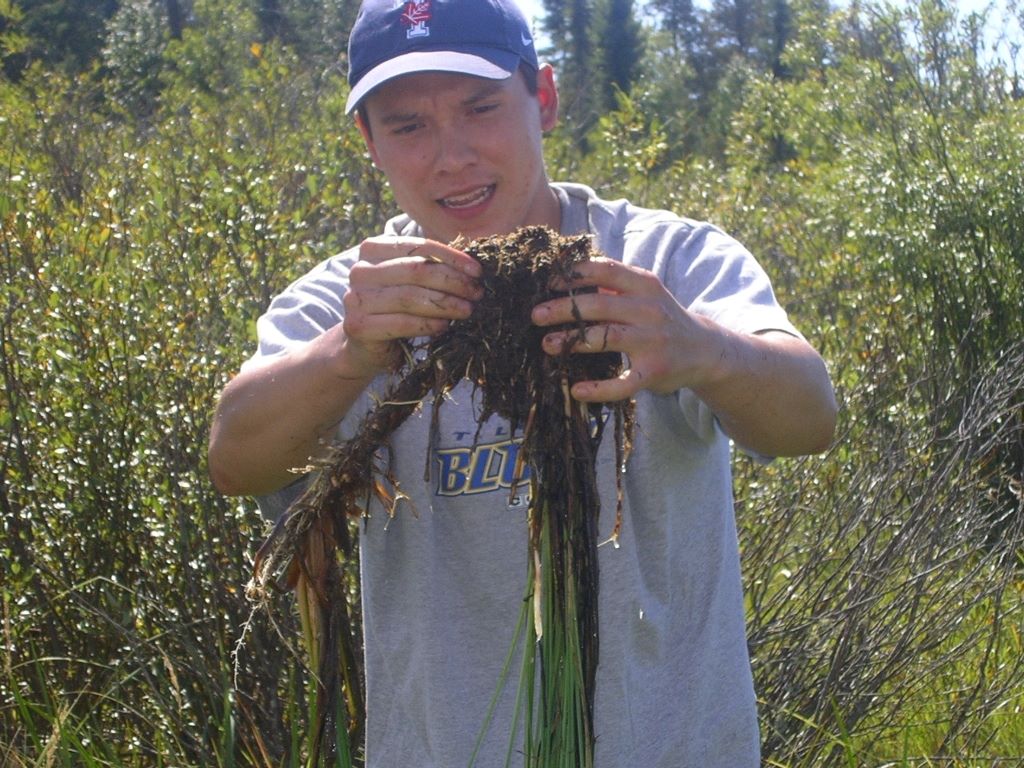
The team’s destination, Obishikokaang (Lac Seul), known as the place “where the white pines grow,” is the territory of the Anishinaabeg (called Ojibway by Outsiders who often label them as “hunter-gatherers”). With an on-reserve population of 934, people manage their wild rice, berry-pick, harvest plant medicines, and hunt local game. Some families originate from farther north, where Cree and Ojibway languages comingle. They speak a dialect of Oji-Cree.
Obishikokaang comprises the communities of Frenchman’s Head, Whitefish Bay, and Kejick Bay. Construction of hydroelectric dams in the 1930s flooded a fourth community called Canoe River and destroyed burial grounds, homes, berry patches, fields, and pictograph sites. This increased tensions with Outsiders.
For knowledge of the area’s history, Outsider researchers naturally draw on ethnographic, historic, and archaeological data—but their knowledge of the details is patchy. Typically, they rely on King George III’s Royal Proclamation of 1763 as evidence of British occupation. This decree acknowledged First Nations as sovereign entities and affirmed their land titles. Outsider researchers also rely on Peter Pond’s map of 1785, where Lac Seul first appears as “Lake Alone.” Pond, the first White person to map from the Great Lakes and Hudson Bay westward to the Rocky Mountains and northward to the Arctic, opened this region to Outsiders—many of whom exploited the fur trade until logging and mining became the prominent industries.
Starting in the 1820s, British officials began legislating to create a viable administrative system, in part to defend the area against U.S. incursions. For the Lac Seul First Nation, the community was swept into the administrative arrangements that accompanied the birth of the Canadian Confederation in 1867. On June 9, 1874, Grand Chief John Crow Marten (a.k.a. John Cromarty), my (George’s) great-grandfather and other chiefs signed Treaty No. 3. ( In Anishinaabemowin, his name was Andeggwabbishhazhi, which roughly translates as Crow Marten Who Sits on the Land.) The Nation understood the Treaty as existing between the U.K.’s Queen and their People for all time.
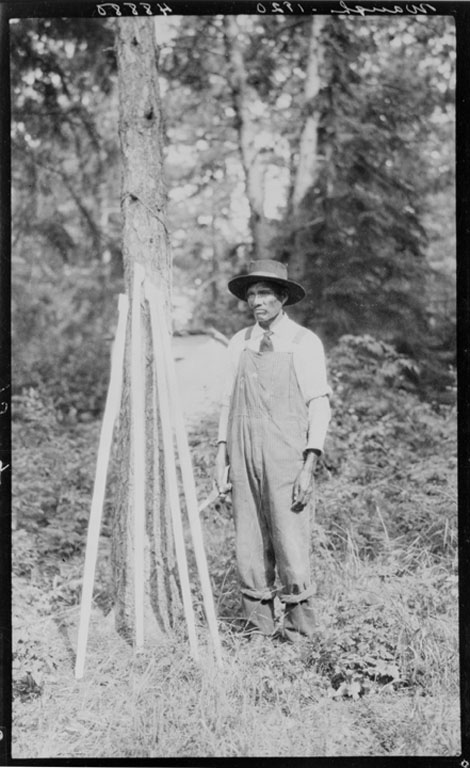
Fur trade declined, and Outsiders dominated. Armed by a sense of inevitable “progress,” Outsiders brandished formidable legal and cultural weapons: Their interpretation of the Indian Act of 1876 delegitimized First Nations by depriving them of a sense of self-worth. Many spiritual ceremonies were banned. Nevertheless, my (George’s) father, an apprentice shaman, told me that ceremonies such as the Vision Quest and the Feast of the Dead continued to be practiced through the 1870s and into the early 1930s.
John Kenny Keesic, my father, was an apprentice shaman to Allen “Amoo” Angeconeb, one of many medicine people (Anishinaabeg Mushkikiewak) who were teachers (Kekinoamaged). (“Shaman” is an Outsider imposition.) My father taught me aspects of Ahnishinahbayeshshishikaywin from my birth until close to the time of his passing in 1980.
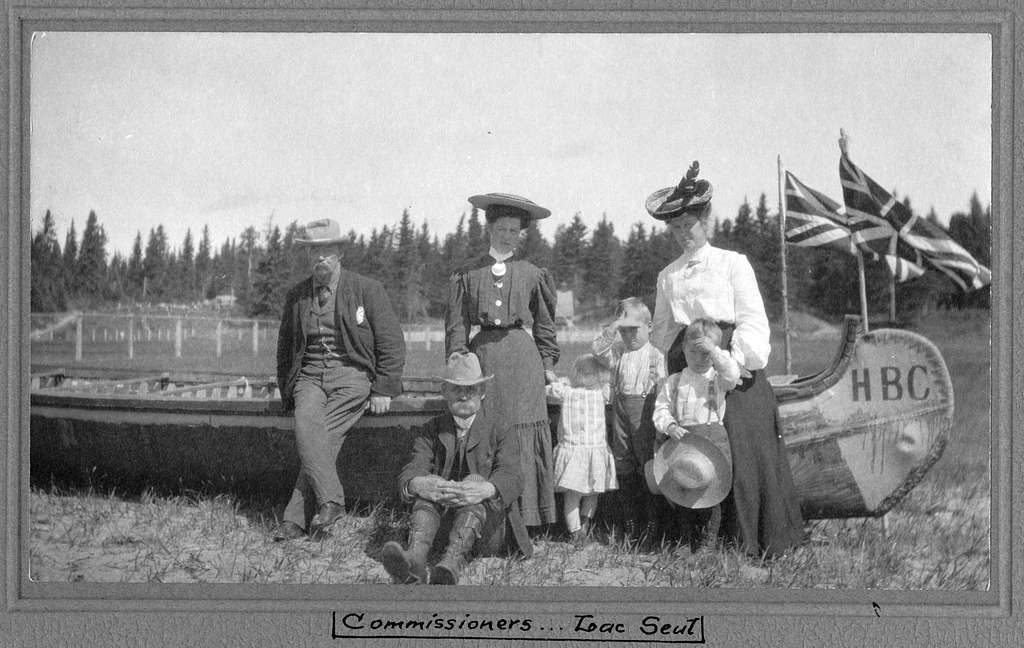
From the 1870s into the ensuing decades, White settler-colonial supremacy inspired the Indian residential school system, land planning, the registered trapline systems for Indigenous trappers, and the Scoop (trafficking of Indigenous children). By the 1920s, the country celebrated First Nations’ hinterlands as Canadian “wilderness” in landscape paintings of the Group of Seven artists. Though these legal and cultural efforts relentlessly chiseled away at the dignity and sovereignty of people in Obishikokaang, the community continued to preserve traditions and speak for themselves alone.
JOURNEYING TO LAC SEUL FIRST NATION
VIA Rail’s Number 1, the “Canadian,” running between Toronto and Vancouver, British Columbia, is touted as “a great way to see the country.” When the team boards, they will notice how Toronto’s imposing Union Station screams “Empire.” It sits squarely on the Toronto Purchase of 1787, lands obtained by Outsiders from the Mississauga Insiders.
On its northwestern route, the Number 1 crosses a landscape of rivers, lakes, and swamps, with oceans of pine, poplar, and birch forests. Often referred to as “cottage country,” that Anglophone settler-Canadian term for small wooden cabins on “pristine” lakes erases millennia of Indigenous history. The team will find itself reflecting on this obliteration while whirring past wooden docks with red-painted canoes, the ever-present loon, and people fishing, canoeing, and hanging out in small boats.

The train’s route provides an illusory plushness of trees. Yet the trees hide the region’s industrial past, reflected by the persistent smattering of logging camps, mines, and tailings also visible. The forests also hide the many highways, those long gray snakes connecting networks of unpaved roads used by logging trucks and linking small communities, settler and First Nations alike.
The train’s 15-minute halt at Sudbury Junction will serve as a reminder of Canada’s real muscle. Sudbury was nicknamed “nickel capital” of a world that had needed bullets during WWI and WWII.
Fifteen hours out from Union Station, the train will pass through Oba, the closest train station to the former railway town of Marathon, located adjacent to unceded Indigenous territory, the Biigtigong Nishnaabeg, and Pukaskwa National Park, one of Ontario’s six national parks.
In due time, the team will disembark at Sioux Lookout, their final train destination. They will see the Front Street train station and airport, which currently serve as the travel hub for many of the 77 First Nations that constitute Grand Council Treaty No. 3 and James Bay Treaty No. 9.
A mere 40 kilometers down a paved road lies Lac Seul First Nation. The team will stack their bags in the pickup of George’s nephew, Jesse, and turn from the tracks receding to the east and stretching out to the west.
CEREMONIAL WITNESSES, LINEAGE GUARDIANS, AND WALKING IN TWO WORLDS
Teaching Circle members are prepared. For two years, George has generously shared aspects of Ahnishinahbayeshshikaywin with them. His descriptive storytelling of the solar system, a core component of the Insider worldview, revealed sacred locations Insiders see as integral to their present, past, and future spaces.
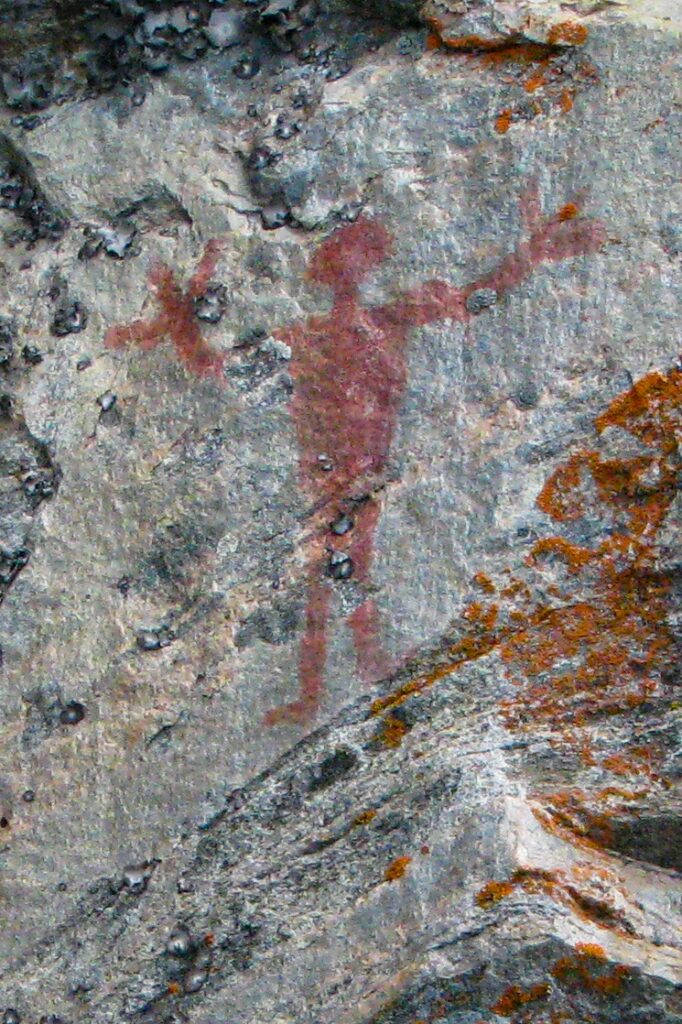
Among circle members, George explained the meanings of pictographs on the cliff face of Route Lake created by his father, John. Others had painted on the cliffs prior to his father. The pictographs on the vertical cliff faces remain as mute witnesses, he said, to Ahnishinahbayeshshikaywin, or ceremonial practice—places where the physical and nonphysical worlds meet.
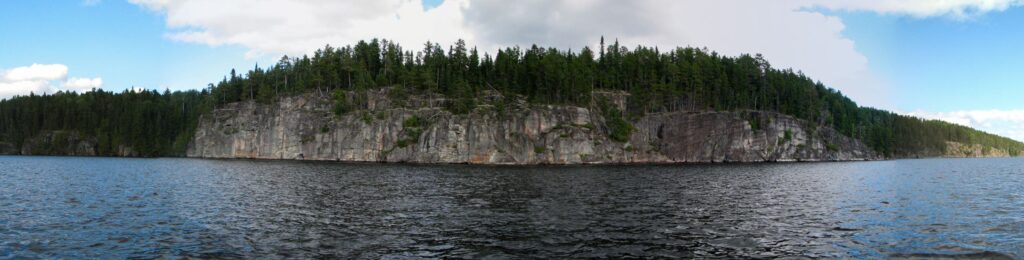
Though laws prohibited medicine people from practicing Ahnishinahbayeshshikaywin and missionaries endeavored to convert Anishinaabeg people, John had participated in a meaningful transfer of knowledge from Amoo, which in turn, was shared with George. Amoo and other medicine people had hidden their equipment away.
For me (George), the pictographs are neither “art” nor “rock art,” for such categories do not exist in Ahnishinahbayeshshikaywin. Nor are they “symbols,” as everything is interconnected—nothing is separate (individual). Though variations in practices exist among the 77 Northern Ontario First Nations, the world is seen as a single system.
I taught the Teaching Circle my father’s recipe used for pictograph creation and provided the instructions on how to make it. Despite the 1876 Indian Act, our community’s medicine people have preserved their knowledge: It is themselves.
I was born in April 1952. Around the age of 5 or 6, I was apprehended and sent to faraway Shingwauk Indian Residential School near Sault Ste. Marie, Ontario. I escaped and ran away, riding the rails. At age 11, labeled “a flight risk,” I was sent to Pelican Lake IRS near Sioux Lookout.
Over time, upward of 150,000 children were enrolled in the assimilationist residential schools. Later the government removed 20,000 Indigenous children from their homes in what was called the ’60s Scoop and placed them in non-Indigenous households with a similar goal of assimilation. I finished my secondary schooling at Queen Elizabeth High School in Sioux Lookout.
By reflecting on this history, the circle’s Outsiders recognize that George and others in his community have been the authentic guardians of their lineage and of their spaces on the landscape, with an unsurpassed connection to the Earth’s biodiversity in the region. In the process, they have served humanity through their sustainable use of biodiversity for generations, pro bono, often at great peril.
My (co-author Mike’s) role in this work is that of the unifier. That is quite close to the role I also played in my hockey career. As a Toronto-born Anishinaabe-Estonian doctoral student and a son of George, the theme of walking in two worlds, once a space of internalized unbelonging, has since revealed countless avenues of self-discovery and opportunities to share all that I have come to learn.
TRANSLATING INSIDER WORLDVIEWS
Once in Lac Seul, the Teaching Circle, completed by the presence of the Lac Seul leadership, Elders, and younger community members, will attempt to combine two strands of thinking: the Insider Elders’ polymath and holistic perspective, expounded through “storytelling,” and the Outsider methods of field observation and the quantitative and qualitative methods of classifying flora, fauna, weather, and physical landscapes. They will help translate “animist” Insider worldviews for Outsiders.
For Insiders, the aim is to change the mindsets of anthropologists, researchers, and the public. Insiders have much to say, and some of it will never be easy listening for Outsiders. Tensions are all too prevalent, and the resulting loss of knowledge just deepens a shared predicament.
For these Outsiders, they’ll learn to read landscapes differently, listen to the “goddamn Indian”—and act accordingly.
The post On the Tracks to Translating Indigenous Knowledge appeared first on SAPIENS.
ABCL 1.6.1 Springs Forth
The ABCL 1.6.1 binaries and signatures are now available with their associated CHANGES.
Thanks to everyone involved in continuing to further the progress of our implementation.
Corona – Norway is now on 3.place by population (Tot cases/1M pop)
Evenson.not.orgReasonable looking CORVIR19 statistics
Worked on 12FEB2020; not responding 14FEB2020
Fitbit posts a net loss of $2.1M in Q3, down from $113.4M a year ago, on revenue of $393.6M, as smartwatches accounted for 49% of company's total revenue (Brian Heater/TechCrunch)

Brian Heater / TechCrunch:
Fitbit posts a net loss of $2.1M in Q3, down from $113.4M a year ago, on revenue of $393.6M, as smartwatches accounted for 49% of company's total revenue — Fitbit is slowly righting its financial ship, courtesy of a successful push into smartwatch category.
Researchers create 'time crystals' envisioned by Princeton scientists
ABCL 1.4.0
Evenson.not.org#abcl #lisp
With abcl-1.4.0, CFFI now works reliably allowing cross-platform linkage to native libraries to be initiated dynamically at runtime. Examples of using CL-CUDA to follow as their authors have time to publish.
Considerable work and testing led by Elias Pipping with contributions from Olof-Joachim Frahm has led to a reasonable basis for UIOP/RUN-PROGRAM compatibility.
We have taken the time to learn enough of Maven to publish binary artifacts for both abcl.jar and abcl-contrib.jar that allow developers everywhere to more easily incorporate the Bear into their local Java build tool chains.
And we have tentatively surrendered to the current fashion by establishing GIT bridges to the ABCL source at https://gitlab.common-lisp.net/abcl/abcl and https://github.com/easye/abcl to more easily facilitate contributions from the community.
Version 1.4.0
=============
http://abcl.org/svn/tags/1.4.0/
http://abcl.org/trac/changeset/14892
https://gitlab.common-lisp.net/abcl/abcl/commit/6737f6f0d71d89aff9003a9bcf2983b4f768b4d3
https://github.com/easye/abcl/commit/6737f6f0d71d89aff9003a9bcf2983b4f768b4d3
08-OCT-2016
Enhancements
============
* Consolidated RUN-PROGRAM fixes (ferada, pipping)
* Upstream consolidated patchset (ferada)
** [r14857] Support `FILE-POSITION` on string streams.
** [r14859] Add multiple disassembler selector.
** [r14860] Add EXTERNAL-ONLY option to APROPOS.
** [r14861] Fix nested classes from JARs not visible with JSS.
* [r14840-2] (Scott L. Burson) Introduced "time of time" semantics for
{encode,decode}-universal time.
* EXTENSIONS:MAKE-TEMP-FILE now takes keyword arguments to specify
values of the prefix and suffix strings to the underlying JVM
implementation of java.io.File.createTempFile().
* [r14849] EXT:OS-{UNIX,WINDOWS}-P now provide a pre-ASDF runtime check on hosting platform
Fixes
-----
* [r14863] RandomCharacterFile et. al.
* [r14839] (JSS) Ensure the interpolation of Java symbol names as strings (alan ruttenberg)
* [r14889] Fix ANSI-TEST SXHASH.8 (dmiles)
Updates
------
* asdf-3.1.7.26
* jna-4.2.2
Removed
-------
* [r14885] ASDF-INSTALL was removed
ABCL Dev: ABCL 1.4.0
Evenson.not.org#abcl #lisp
With abcl-1.4.0, CFFI now works reliably allowing cross-platform linkage to native libraries to be initiated dynamically at runtime. Examples of using CL-CUDA to follow as their authors have time to publish.
Considerable work and testing led by Elias Pipping with contributions from Olof-Joachim Frahm has led to a reasonable basis for UIOP/RUN-PROGRAM compatibility.
We have taken the time to learn enough of Maven to publish binary artifacts for both abcl.jar and abcl-contrib.jar that allow developers everywhere to more easily incorporate the Bear into their local Java build tool chains.
And we have tentatively surrendered to the current fashion by establishing GIT bridges to the ABCL source at https://gitlab.common-lisp.net/abcl/abcl and https://github.com/easye/abcl to more easily facilitate contributions from the community.
Version 1.4.0
=============
http://abcl.org/svn/tags/1.4.0/
http://abcl.org/trac/changeset/14892
https://gitlab.common-lisp.net/abcl/abcl/commit/6737f6f0d71d89aff9003a9bcf2983b4f768b4d3
https://github.com/easye/abcl/commit/6737f6f0d71d89aff9003a9bcf2983b4f768b4d3
08-OCT-2016
Enhancements
============
* Consolidated RUN-PROGRAM fixes (ferada, pipping)
* Upstream consolidated patchset (ferada)
** [r14857] Support `FILE-POSITION` on string streams.
** [r14859] Add multiple disassembler selector.
** [r14860] Add EXTERNAL-ONLY option to APROPOS.
** [r14861] Fix nested classes from JARs not visible with JSS.
* [r14840-2] (Scott L. Burson) Introduced "time of time" semantics for
{encode,decode}-universal time.
* EXTENSIONS:MAKE-TEMP-FILE now takes keyword arguments to specify
values of the prefix and suffix strings to the underlying JVM
implementation of java.io.File.createTempFile().
* [r14849] EXT:OS-{UNIX,WINDOWS}-P now provide a pre-ASDF runtime check on hosting platform
Fixes
-----
* [r14863] RandomCharacterFile et. al.
* [r14839] (JSS) Ensure the interpolation of Java symbol names as strings (alan ruttenberg)
* [r14889] Fix ANSI-TEST SXHASH.8 (dmiles)
Updates
------
* asdf-3.1.7.26
* jna-4.2.2
Removed
-------
* [r14885] ASDF-INSTALL was removed
Wilfred Hughes: Searching A Million Lines Of Lisp
Time for another Emacs adventure!
In Emacs today, there’s no way to find all the callers of a function or macro. Most Emacsers just grab their favourite text search tool. Sadly, dumb text search knows nothing of syntax.
We can do better. It just wouldn’t be Emacs without a little fanatical tool building. Let’s make this happen.
Parsing
Everyone know how to parse lisp, right? It’s just read.
It turns out that a homoiconic language is hard to parse when you want to know where you found the code in the first place. In a language with a separate AST, the AST type includes file positions. In lisp, you just have… a list. No frills.
I briefly explored writing my own parser before coming to my senses. Did you know the following is legal elisp?
;; Variables can start with numbers:
(let ((0x0 1))
  ;; And a backquote does not have to immediately precede the
  ;; expression it's quoting:
  `
  ;; foo
  (+ ,0x0))
Cripes.
Anyway, I totally ripped off was inspired by similar functionality
in el-search. read
moves point to the end of the expression read, and you can use
scan-sexps to find the beginning. Using this technique
recursively, you can find the position of every form in a file.
Analysing
OK, we’ve parsed our code, preserving positions. Which forms actually look like function calls?
This requires a little thought. Here are some tricky examples:
;; Not references to `foo' as a function.
(defun some-func (foo))
(lambda (foo))
(let (foo))
(let ((foo)))

;; Calls to `foo'.
(foo)
(lambda (x) (foo))
(let (x) (foo))
(let ((x (foo))) (foo))
(funcall 'foo)
;; Not necessarily a call, but definitely a reference to
;; the function `foo'.
(a-func #'foo)
We can’t simply walk the list: (foo) may or may not be a function
call, depending on context. To model context, we build a ‘path’ that
describes the contextual position of the current form.
A path is just a list that shows the first element of all the
enclosing forms, plus our position within it. For example, given the
code (let (x) (bar) (setq x (foo))), we build a path ((setq . 2)
(let . 3)) when looking at the (foo).
This gives us enough context to recognise function calls in normal code. “Aha!”, says the experienced lisper. “What about macros?”
Well, elisp-refs understands a few common macros. Most macros just evaluate most of their arguments. This means we can just walk the form and spot most function calls.
This isn’t perfect, but it works very well in practice. We also
provide an elisp-refs-symbol command that finds all references to a
symbol, regardless of its position in forms.
Performance
It turns out that Emacs has a ton of elisp. My current instance has loaded three quarters of a million lines of code. Emacs actually lazily loads files, so that’s only the functionality that I use!
So, uh, a little optimisation was needed. I wrote a benchmark script and learnt how to make elisp fast.
Firstly, avoid doing work. elisp-refs needs to calculate form positions, so users can jump to the file at the correct location. However, if a form doesn’t contain any matches, we don’t need to do this expensive calculation at all.
Secondly, find shortcuts. Emacs has a little-known variable
called read-with-symbol-positions. This variable reports all the
symbols read when parsing a form. If we’re looking for function calls
to some-func, and there’s no reference to the symbol some-func, we
can skip that form entirely.
Thirdly, use C functions. CS algorithms says that building a hash
map gives you fast lookup. In elisp-refs, we use assoc with small
alists, because C functions are fast and most lists weren’t big enough
to benefit from the O(1) lookup.
Fourthly, write impure functions. Elisp provides various ways to
preserve the state of the current buffer, particularly
save-excursion and with-current-buffer. This bookkeeping is
expensive, so elisp-refs just creates its own temporary buffers and
dirties them.
When all else fails, cheat. elisp-refs reports its progress, which doesn’t make it faster, but it certainly feels like it.
Display
We have something that works, and we can search in all the code in in the current Emacs instance in less than 10 seconds. How do we display results?
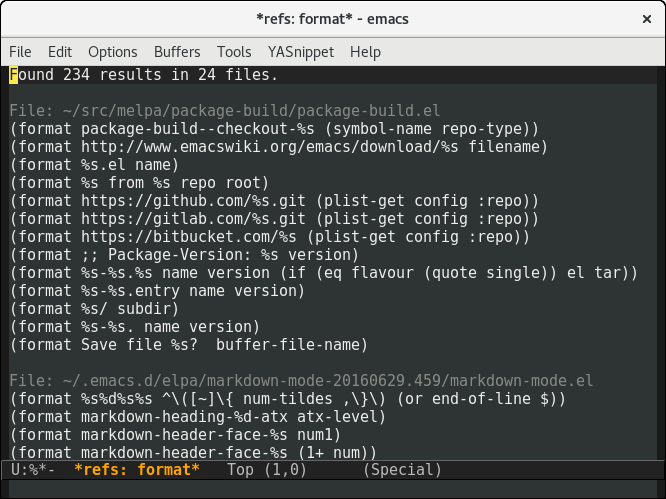 first prototype, showing the matching forms in isolation
Initially, I just displayed each form in the results buffer. It turns out that the context is useful, so added the rest of the matching lines too. To avoid confusion, I underlined the section of the code that matched the search.
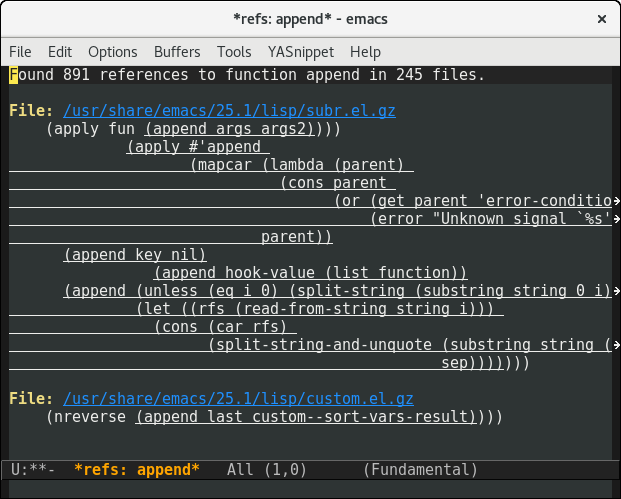 second prototype, adding context and custom faces
The second prototype also had some custom faces for styling. This was an improvement, but it forces all Emacs theme authors to add support for the faces defined in our package.
It still didn’t work as well as I’d hoped. When I get stuck with UI, I ask ‘what would magit do?’. I decided that magit would take advantage of existing Emacs faces.
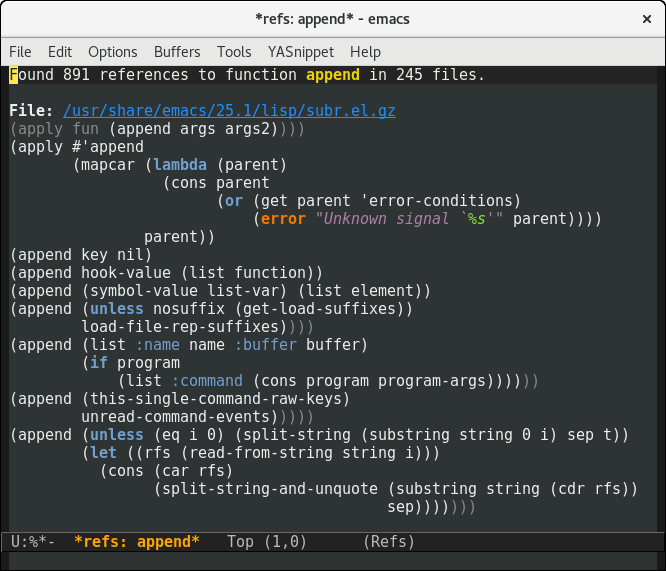 final UI, using normal syntax highlighting
The final version uses standard elisp highlighting, but highlights the surrounding context as comments. This means it will match your favourite colour scheme, and new users should find the UI familiar.
I added a few other flourishes too. You can see that results in the second prototype were often very indented. The final version unindents each result, to make the matches easier to read quickly.
Wrap-Up
elisp-refs is available on GitHub, available on MELPA, and it’s ready for your use! Go forth, and search your elisp!
Y Combinator's Xerox Alto: restoring the legendary 1970s GUI computer
Evenson.not.org#computer #archaeology
The Cuneiform Tablets of 2015 [pdf]
Evenson.not.org#digital #preservation Neat idea to encode a simple VM specification for "playing" the archived material
A FreeBSD AMI Builder AMI
Evenson.not.org#freebsd #ec2
Some people are happy with simply having a virtual machine which runs the base FreeBSD system; for them, the published FreeBSD/EC2 images (which, as of FreeBSD 10.2-RELEASE, are built by the FreeBSD Release Engineer) will be sufficient. For users who want to use "stock" FreeBSD but would like to have some extra setup performed when the instance launches — say, to install some packages, edit some configuration files, and enable some services — I wrote the configinit tool. And for users who need to make changes to FreeBSD itself, I added code for building AMIs into the FreeBSD source tree, so you can take a modified FreeBSD tree and run make ec2ami to generate a reusable image.
There was one group for whom I didn't have a good solution yet, however: Users who want to create FreeBSD AMIs with minor changes, without wanting to go to the effort of performing a complete FreeBSD release build. Ironically, I am exactly such a user: All of the EC2 instances I use for my online backup service make use of spiped to protect sshd and provide encrypted and authenticated tunnels to my mailserver and package server; and so having spiped preinstalled with the appropriate keys would significantly streamline my deployment process. While it's possible to launch a FreeBSD EC2 instance, make some changes, and then ask EC2 to create a new AMI out of it, this rarely produces a "clean" AMI: A lot of code runs when an EC2 instance first launches — creating the ec2-user user, installing the appropriate SSH public key, creating SSH host keys, growing the root filesystem if launched with a larger root disk, downloading and installing updates to FreeBSD, downloading and installing packages... — and much of this needs to be manually reverted before a reusable AMI can be created; not to mention command histories and log files written during the configuration process, which the more fastidious among us may wish to avoid publishing. To solve this problem, I present the FreeBSD AMI Builder, now available as ami-28682f42 in the EC2 US-East-1 region.
Semantic Interpretation of Structured Log Files
Evenson.not.org#rdf

Log files comprise a record of different events happening in various applications, operating systems and even in network devices. Originally they were used to record information for diagnostic and debugging purposes. Nowadays, logs are also used to track events which can be used in auditing and forensics in case of malicious activities or systems attacks. Various softwares like intrusion detection systems, web servers, anti-virus and anti-malware systems, firewalls and network devices generate logs with useful information, that can be used to protect against such system attacks. Analyzing log files can help in pro- actively avoiding attacks against the systems. While there are existing tools that do a good job when the format of log files is known, the challenge lies in cases where log files are from unknown devices and of unknown formats. We propose a framework that takes any log file and automatically gives out a semantic interpretation as a set of RDF Linked Data triples. The framework splits a log file into columns using regular expression-based or dictionary-based classifiers. Leveraging and modifying our existing work on inferring the semantics of tables, we identify every column from a log file and map it to concepts either from a general purpose KB like DBpedia or domain specific ontologies such as IDS. We also identify relationships between various columns in such log files. Converting large and verbose log files into such semantic representations will help in better search, integration and rich reasoning over the data.
Those Who Aspire to Solaria
Evenson.not.orgStross on #sf #dystopia
A certain mindset sees the movie Aliens and thinks it would be awesome to be a Space Marine. Because it’s like being a Marine, but in space.
A certain mindset skims a bit of cyberpunk fiction and thinks the future will be amazing, because Ruby-coding skills will clearly translate to proficiency with katanas. You know, katanas.
A certain mindset learns a little about the Victorian era and is instantly off in a fantasy of brass-goggled Gentlemen Aviators, at once dapper and wind-swept, tending the Tesla apparatus on their rigid airship. All art in the genre carries the tacit disclaimer in its caption, “(Not pictured: cholera.)” In the designation steampunk, the -punk has nothing to do with anarchy (in the UK or elsewhere), the suffix having been conventionalized into a mere signifier of anachronism. A steampunk condo development promises units for the reasonable price of 2 to 7.5 million dollars apiece.
[To be fair, Gibson and Sterling’s The Difference Engine (1990), which is in some part responsible for the whole wibbly-wobbly steamery-punkery, did spend some of its time with the run-down and the passed-over. It also, I’m guessing unintentionally, underscored the incoherence of the premise, when in its final pages, Ada Lovelace describes a fanciful notion of the late Charles Babbage, whose fictional version dreamed of doing computation with electricity. The fictional Babbage’s never-implemented plan relied on such hypothetical devices as resistors and capacitors. The book’s plot begins in 1855; the Leyden jar was invented 110 years earlier. Carl Friedrich Gauss built a working telegraph years before the historical Babbage even designed his Analytical Engine. But our aesthetic can’t allow that, of course.]
It is against this background that we should read “Silicon Valley is a Science Fictional Utopia,” a recent piece in Model View Culture. I have enjoyed and appreciated MVC quite a bit in the past few months, which is why I was rather flummoxed to find a statement in that essay that just refused to parse. The overall thesis sounds roughly right to me, but not all the examples seem to fit as written. Here’s the part that jumped out at me:
Awesome things, and great ideas. This is what SF is all about.
This is also the drive behind Silicon Valley culture. It’s about a better future through human industry, like the Cyberpunks.
It’s a better future through ingenuity, risk-taking, and a rock-solid belief that technology is humanity’s best chance at a better future.
Cyberpunk—cyberpunk!—is “about a better future through human industry”?
Cyberpunk, the genre in which multinationals own everything and humans have to fight over what’s left; cyberpunk, which saw the Campbellian heroes of the Golden Age, staring at the stars with wonder and ambition, and said, “Fuck you, you get rain.” A cyberpunk future is a prosthetic heel grinding into a human face, if not forever, at least until the owner of the heel gets bored. The idea that success flows to the privileged was wired into the genre from the beginning. Technology can be incorporated into our bodies, but never trusted. “Progress” in the Sprawl means moving a little hot RAM. The Los Angeles of the Tyrell Corporation is no Utopia, and it never pretended to be.
But after a couple decades of the genre being reduced to ZOMG trenchcoats and mirrorshades, perhaps it’s not so surprising that looking back at the stories themselves can be a bit of a shock. It’s so easy to geek out over the superficial trappings, and so much harder to see ourselves complicit in the systems that the stories railed against.
In Blade Runner, Captain Bryant tells Deckard, “If you’re not cop, you’re little people.” Escaping into a story about being the cop has a much more obvious appeal than escaping into one about being the little people. As a friend of mine once noted, nobody reads Atlas Shrugged and says, “Why, I must be one of the unproductive slobs who are everything that is wrong with humanity.”
To say that cyberpunk fiction was “about a better future through human industry” is absurd; to say that of the aesthetic, of “cyberpunk” recoined by back-formation from “steampunk,” is rather less so.
Among the other SF stories mentioned in the MVC piece is one that I’ve thought a fair bit about: Asimov’s The Naked Sun (1957). This novel is, in spirit, an Agatha Christie yarn in space. A man is bludgeoned to death at his isolated country estate. His wife discovers the body. The murder weapon is missing. A detective comes from the big city to investigate, and everyone the detective meets had a motive to kill the victim. At the climax, the detective gathers all the principals to listen as he solves the crime.
Asimov greatly admired Christie and the “cozy mystery” genre, and I don’t doubt that this structure was intentional. The unintended consequence has to do with another novel published in 1957: in building the setting for his perfect murder, Asimov created Galt’s Gulch—with the crucial difference that Asimov’s version has the robot labor force necessary to keep everyone from dying in a couple weeks.
The planet Solaria was settled by wealthy people who wished to avoid the regulations of their home planet. Personal autonomy is sacrosanct. On Solaria, everyone is either the best or the only practitioner of a trade.
And, incidentally, their society is stagnant and moribund. Once something goes wrong, they have to call a cop from New York to fix it. At the end, the detective spells out what he has learned:
Baley said, “The Solarians have given up something mankind has had for a million years; something worth more than atomic power, cities, agriculture, tools, fire, everything; because it’s something that made everything else possible.”
“I don’t want to guess, Baley. What is it?”
“The tribe, sir. Cooperation between individuals. Solaria has given it up entirely. It is a world of isolated individuals and the planet’s only sociologist is delighted that this is so. That sociologist, by the way, never heard of sociomathematics, because he is inventing his own science. There is no one to teach him, no one to help him, no one to think of something that he himself might miss. The only science that really flourishes on Solaria is robotics and there are only a handful of men involved in that, and when it came to an analysis of the interaction of robots and men, they had to call in an Earthman to help. […] Without the interplay of human against human, the chief interest in life is gone; most of the intellectual values are gone; most of the reason for living is gone. […]”
The final message is that Earth and Solaria are both stagnating, in mirror-image ways. But more to the point is that vintage male-as-default language: “a handful of men,” “robots and men,” “call in an Earthman.” Aren’t we glad that casual sexism is a thing of the past? There’s more that one could dissect in that scene, including some talk of the evils of “ectogenesis,” a suggestion that gestating fetuses anywhere other than women’s bodies is dehumanizing. One really ought to unpack that at greater length, but for now, let’s step back and consider the novel more broadly. The “accusing parlor” scene, in which Baley presents the solution to the mystery, contains two women and five men, along with one robot, who is coded male in both the social and technological senses of the word. Three other male characters appear at various points, not counting the murder victim and assorted robots, all of whom are treated as male. Two women out of eleven characters—for this writer and that era, that’s practically Madoka Magica!
Earlier, we touched on how self-congratulation can enter the act of reading science fiction. There’s another angle to that: When one grows up reading books full of robots, it’s easy to say, “I’m willing to bestow my empathy upon artificial intelligences. I can think of these robot characters as human, in the ways that matter. Surely, then, from my enlightened perspective, the petty differences among flesh-and-blood humans must shrink to insignificance!” With this kind of thinking, it is simple to convince oneself of one’s own freedom from bias. Even though the books which inculcated this enlightened philosophy are replete with biases themselves!
Likewise: The Federation in Star Trek is largely a meritocracy. For the most part, promotions in Starfleet seem to happen on the basis of professional competence. I like that. Civilization triumphing, day by day, over its own worse elements—that’s a good story. But there’s a flipside. “I grew up watching Star Trek, where progress is based on merit,” I say to myself, “and so I learned to judge people fairly. Therefore, when I evaluate a person’s potential as a scientist or as a programmer, I will do so on their merit alone. Any suggestion that I might not is an insult against my character, made by someone who doesn’t understand people like me.” Psychology is probably seldom as straight a line as that, but at the very least, it’s a mental trap we should look out for. The more admirable our fiction makes our ideals sound, and the more we identify ourselves as devotees of that fiction, the harder it is to admit when we fail to live up to those standards.
Subway map of the solar system
Evenson.not.org#Delta-V map for #sol

This is a thumbnail version of a large, high-resolution image by Ulysse Carion. Thanks to Aleksey Shipilëv (@shipilev) for pointing it out.
It’s hard to see in the thumbnail, but the map gives the change in velocity needed at each branch point. You can find the full 2239 x 2725 pixel image here or click on the thumbnail above.
Will Computers Redefine the Roots of Math?
Evenson.not.org#math #computers #homotopytypetheory
The role of proofs in mathematical writing
Evenson.not.org#math proofs
This post outlines the way that proofs are used in mathematical writing. I have been revising the chapter on Proofs in abstractmath.org, and I felt that giving an overview would keep my mind organized when I was enmeshed in writing up complicated details.
Proofs are the sole method for ensuring that a math statement is correct.
- Evidence that something is true gooses us into trying to prove it, but as all research mathematicians know, evidence only means that some instances are true, nothing else.
- Intuition, metaphors, analogies may lead us to come up with conjectures. If the gods are smiling that day, they may even suggest a method of proof. And that method may even (miracle) work. Sometimes. If it does, we get a theorem, but not a Fields medal.
- Students may not know these facts about proof. Indeed, students at the very beginning probably don’t know what a proof actually is: “Proof” in math is not at all the same as “proof” in science or “proof” in law.
A proof has two faces: Its logical structure and its presentation.
The logical structure of a proof consists of methods of compounding and quantifying assertions and methods of deduction.
- The logical structure is usually expressed as a mathematical object.
- The most familiar such math objects are the predicate calculus and type theory.
- Mathematical logic does not have standard terminology (see Math reasoning.) Because of that, the chapter on Proofs uses English words, for example “or” instead of symbols such as $P\lor Q$ or $P+Q$ or $P||Q$.
- For beginning students, throwing large chunks of mathematical logic at them doesn’t work. The expressions and the rules of deduction need to be introduced to them in context, and in my opinion using few or no logical symbols.
- Students vary widely in their ability to grasp foreign languages, and symbolic logic in any of its forms is a foreign language. (So is algebra; see my rant.)
- The rules of deduction do not come naturally to the students, and yet they need to have the rules operate automatically and subconsciously. They should know the names of the nonobvious rules, like “proof by contradiction” and “induction”, but teaching them to be fluent with logical notation is probably a waste of time, since they would have to learn the rules of deduction and a new foreign language at the same time.
- I hasten to add, a waste of time for beginning students. There are good reasons for students aiming at certain careers to be proficient in type theory, and maybe even for predicate calculus.
Presentation of proofs
- Proofs are usually written in narrative form
- A major source of difficulties is that the presentation of a proof (the way it is written in narrative form) omits the reasons that most of the proof steps follow from preceding ones.
- Some of the omitted reasons may depend on knowledge the reader does not have. “Let $S\subset\mathbb{Q}\times\mathbb{Q}$. Let $i:S\to\mathbb{N}$ be a bijection…” Note: I am not criticizing someone who writes an argument like this, I am just saying that it is a problem for many beginning students.
- Some reasons are given for some of the steps, presumably ones that the writer thinks might not be obvious to the reader.
- Sometimes the narrative form gives a clue to the form of proof to be used. Example: “Prove that the length $C$ of the hypotenuse of a right triangle is less than the sum of the other two sides $A$ and $B$. Proof: Assume $C\geq A+B$…” So you immediately know that this is going to be a proof by contradiction. But you have to teach the student to recognize this.
- Another example: in proving $P$ implies $Q$, the author will assume that $Q$ is false implies $P$ is false without further comment. The reader is suppose to recognize the proof by contrapositive.
Translation problem
- The Translation problem is the problem of translating a narrative proof into the logical reasoning needed to see that it really is a proof.
- Many experienced professional mathematicians say it is so hard for them to read a narrative proof that they read the theorem and the try to recreate the proof by thinking about it and glancing at the written proof for hints from time to time. That is a sign of how difficult the translation problem really is.
- Nevertheless, the students need to learn the unfamiliar proof techniques such as contrapositive and contradiction and the wording tricks that communicate proof methodology. Learning this is hard work. It helps for teachers to be more explicit about the techniques and tricks with students who are beginning math major courses.
References
Added 2014-12-19
- There’s more to mathematics than rigour and proofs. Post by Terry Tao. The comments on Terry’s post are extraordinarily interesting. Thanks to David Roberts for this reference.

This work is licensed under a Creative Commons Attribution-ShareAlike 2.5 License.

The Next Battleground In The War Against Quantum Hacking
Evenson.not.org#quantum #cryptography measurements of vulnerability to side channel attacks.
Ever since the first hack of a commercial quantum cryptography device, security specialists have been fighting back. Here’s an update on the battle.
Quantum hacking is the latest fear in the world of information security. Not so long ago, physicists were claiming that they could send information with perfect security using a technique known as quantum key distribution.
Dynamic Provenance for SPARQL Update. (arXiv:1408.0926v1 [cs.DB])
Evenson.not.org#sparql #arxiv #provenance .
While the Semantic Web currently can exhibit provenance information by using the W3C PROV standards, there is a "missing link" in connecting PROV to storing and querying for dynamic changes to RDF graphs using SPARQL. Solving this problem would be required for such clear use-cases as the creation of version control systems for RDF. While some provenance models and annotation techniques for storing and querying provenance data originally developed with databases or workflows in mind transfer readily to RDF and SPARQL, these techniques do not readily adapt to describing changes in dynamic RDF datasets over time. In this paper we explore how to adapt the dynamic copy-paste provenance model of Buneman et al. [2] to RDF datasets that change over time in response to SPARQL updates, how to represent the resulting provenance records themselves as RDF in a manner compatible with W3C PROV, and how the provenance information can be defined by reinterpreting SPARQL updates. The primary contribution of this paper is a semantic framework that enables the semantics of SPARQL Update to be used as the basis for a 'cut-and-paste' provenance model in a principled manner.
The Ugly Truth About Electronic Health Records
Evenson.not.org#ehr critique
100 Petabytes of Cloud Data
The Amplituhedron and Twistors
Evenson.not.orgShort writeup of #physics Nima @ Columbia.
Yesterday Nima Arkani-Hamed was here at Columbia, giving a theory seminar on the topic of the Amplituhedron, which is a characterization of the integration region in a calculation of scattering amplitudes by integrating over regions in the so-called positive Grassmannian. This is a modest advance in mathematical physics, one that for some reason a few months ago garnered a lot of hype (see here for more about this).
As seems to often be the case, the Arkani-Hamed talk was a bit bizarre as an event. Scheduled to start at noon, people soon settled in with the sandwiches provided by this seminar, and he started talking about 12:15. About an hour and a half into the talk, people were reminded that he doesn’t mind if they leave while he’s speaking. Two hours into the talk, soon after he said he was only a quarter of the way through his material, I had to leave in order to do some other things. I don’t know how long the talk actually went on. It’s too bad I didn’t get a chance to stay until the end, since he promised to then explain what the current state of progress on these calculations is.
What is being calculated are scattering amplitudes in a conformally invariant theory, with the simplest example the planar limit of tree-level amplitudes of N=4 super Yang-Mills. One wants to extend these methods to loops, to higher order terms in 1/(number of colors), and to non-conformally invariant theories like ordinary Yang-Mills (at the tree level, ordinary and N=4 super YM give the same results).
As usual, Arkani-Hamed was a clear and very engaging speaker. Also as usual though, it’s unclear why he thinks it’s a good idea to not bother trying to fit his talk into a conventional length, but just keep talking. One reason for the length was the extensive motivation section at the beginning, which had basically no connection at all to the topic of the talk. There was a lot about quantum gravity of an extremely vague sort. In a recent talk I wrote about here, he explains one reason why he does this, that he’s describing the motivation he needs to keep doing this kind of mathematical physics. I suspect another related reason is that this kind of vague argument about quantum gravity and getting rid of space-time is all the rage, so if you’re not working on the firewall paradox, you have to justify that somehow.
Once he got beyond the motivational stuff (and a complaint about BRST: “almost anytime you hear BRST, there is something formal and complicated going on”) the talk was worthwhile and I learned a fair amount. The main thing that struck me was just how much the whole story has to do with Penrose’s twistor program. Penrose developed twistors also with a quantum gravity motivation: they provide a very different set of basic variables, with usual space-time points not the fundamental objects. Of course I was aware of some of the twistor part of the amplitudes story (see for instance here), but I was unaware of the important role played by Andrew Hodges, of Penrose’s twistor group at Oxford, in these recent developments. Hodges, besides writing a fantastic biography of Alan Turing, has worked on twistor theory for about forty years, and some of his innovations have been crucial for the recent advances on gauge theory amplitudes. One example is his “twistor diagrams”, and for more about this and how other work of his has contributed to the emerging story, see his up-to-date Twistor Diagrams website. Hodges is a wonderful story of someone who didn’t follow fashion, but stuck to pursuing something truly worthwhile, it’s great that he has now been getting attention for this, as his work has become useful for more popular research programs.
For those who keep asking about interesting, promising ideas about fundamental physics to work on, twistors are something they definitely should look into. The recent amplitudes work is one specific application of thinking in twistor variables, but the whole question of how to do quantum field theory in twistor space seems to me to still be wide open. Twistor theory involves some wonderfully different ways of thinking about four-dimensional geometry, and these seem far more likely to play some role in future advances in the direction of unification than any of the tired ones (GUTs, SUSY, string theory) that have dominated the field for so long.