
Thanks as always for using my Amazon Affiliate links (US, UK, Canada).
This book tells the story of the International Rescue Committee (IRC), the largest nonsectarian refugee relief agency in the world. Founded in the 1930s by socialist militants, the IRC attracted the support of renowned progressives such as Eleanor Roosevelt, Norman Thomas, and Reinhold Niebuhr.
But by the 1950s it had been absorbed into the American foreign policy establishment. Throughout the Cold War, the IRC was deeply involved in the volatile confrontations between the two superpowers and participated in an array of sensitive clandestine operations. The IRC thus evolved from a small organization of committed activists to a global operation functioning as one link in the CIA's covert network.Read more at questia.

No, it's not "our" one, and nor was Robert Banks Stuart attempting to warn us. Scarily, though, it fits the timeline of the Doctor Who universe for HIV to have been dug out of the Antarctic permafrost in 1976-80. In case you think this sounds fatuous, bear in mind that the New Adventures did the plant-like-alien-parasite-as-AIDS-metaphor in 1992 ("Love and War"), and it worked brilliantly.

Bellal was the most notorious photobomber on the planet of the Exxilons.

I like this partly for its nostalgia value (the very sight of it evokes the primal smell of tea-time, then the despair I felt when I realised I'd missed episode two of "The Krotons" in an age when we had no reason to think we'd ever have the chance to see it again), and partly because it demonstrates the difference between BBC-Then and BBC-Now. Computer-driven design means that even the PR material for "The Power of Three" looked like an ad for "The Bourne Ultimatum". Which may be apt, given that recent

This is from 1924, although the description of "a White Man - lost in the wild - who turns native" suggests that it's What Cliff Jones Does Next. Then we have...

...originally published in 1938. I refuse to believe that Barry Letts / Robert Sloman didn't read at least one of these when they were young. Also, if Doc Savage is "The Man of Bronze", then his version of the Green Death is probably just verdigris.

In the 1970s, all

We're so used to thinking of Roger Delgado as the Sexy Older Man that we forget what he was like when he was younger: the sort of character actor who, were he around today, would be second-in-command to a terrorist leader grudgingly played by Art Malik. But what we really learn from this photo is where Derren Brown got his powers of hypnosis. Clearly from his father, a mysterious ex-army man called General Sam (Ret). Oh, Derren Brown was born in 1971...? What a coincidence.

After six months, the Transtemporal Stare-Out Championship still had no clear winner.

Not actually
Notice that the rebellious, fun-loving, fast-driving hero of the song is female. Notice that in every verse, every line except the last ends in “now,” and it works! (One of the jobs of poetry is to capture not the actual words but the subjective impact of everyday speech.) Notice the understated, very specific, rhythmic sound of the words “fun, fun, fun” in the chorus, and the contrasting open-endedness of “away.” Notice the easy, natural, wildly complex interplay between the voices and combinations of voices. Notice the neat double meaning in the second verse, “A lot of guys try to catch her,” referring both to her elusive sexuality (“you look like an ace now”) and her automotive ability (“you drive like an ace now”). Notice how Dad’s futile attempt at discipline only serves to throw her (potentially) into “my” realm and bigger and better trouble. And I know you can't fail to notice one of the sweetest fade-outs ever, the brilliant ordinariness of the song totally transcended in two brief moments of soaring falsetto. Fun, indeed.Related reading
Paul Williams, from Brian Wilson & The Beach Boys: How Deep Is the Ocean?: Essays and Conversations (1997).
The Communications Data Bill, which critics believe could introduce the most ‘intrusive’ powers for a Government in the West in order to store mass communications data, could be introduced in the coming weeks.
The Telegraph reports that the ‘Snoopers Charter’ as it has been nicknamed, could be included in the Queen’s Speech in May, which offers police and intelligence agencies the power to access the records of internet providers to record the activity of their customers.
According to a report from the Home Office, the new charter is necessary “to help in the investigation of crime,” with some communications data found to be longer retained “for business reasons.”
The argument for the bill is to help security services maintain a pace with technological advancement.
In February it was reported by the Daily Mail that the charter had already cost £400 million before any data had even been collected.
Yesterday, a report released by thinktank Demos suggested that police were putting together a centralised hub to ‘collect, store and analyse social media data.Surely even Nick Clegg would oppose this? Don’t bet on it.
Who do you expect to vote for you at the next election? As my Liberator colleague Simon Titley never tires of pointing out, the Liberal Democrats’ great weakness is that our core vote is so small. We pride ourselves on working harder than the other parties, but the fact that we have to work so hard to persuade people to vote for us is really a sign of weakness.
What we need is a core of liberally minded people who naturally vote Liberal Democrat. If you put yourself on the other side of this debate from every civil liberties group in the country, it is hard to see why liberally minded people should vote for you.
So if you take my advice you will distance yourself from these proposals very loudly and very publicly.Clegg’s performance on the issues of secret courts and immigration suggests that he is doing the precise opposite. He doesn’t agree with Jonathan Calder that the Liberal Democrat vote can be found among “liberally minded people”. He thinks it is in the same space that the other mainstream parties are trying to occupy: the mythical ‘centre ground’ (criticised recently by Tory MP Bernard Jenkin), with our old friends ‘Alarm Clock Britain’, ‘hard-working families’ and the ‘squeezed middle’.
“Food stamps” arrive in Britain next month, when tens of thousands of vulnerable people will be issued with food vouchers in lieu of money to tide them over short-term financial crises.
Rather than, as now, offering a cash loan, most councils will from April offer new applicants who qualify for emergency assistance a one-off voucher redeemable for goods such as food and nappies.
Many of the 150 local authorities in England running welfare schemes have confirmed that they will issue the vouchers in the form of payment cards, which will be blocked or monitored to prevent the holder using them for alcohol, cigarettes or gambling.In a perceptive piece in today’s Guardian, Suzanne Moore contrasts this news with the middle class obsession with food evidenced by the boom in TV cookery programmes. (It’s more food voyeurism than cookery; we can see from what’s on offer on the supermarket shelves that the middle classes aren’t cooking more but are actually relying increasingly on ready meals). She reveals that the switch from cash assistance to vouchers is not about saving money but imposing a moral view:
In this world of endless gastronomy, the superstar chefs say eat seasonally and simply. Again, this requires dosh. Choice costs. So what so we do for genuinely poor people? We take away even the most basic of choices. We infantilise them. They are not our problem any longer, but charity cases.
In order to treat people like this one must first vilify them. This has been the coalition project from day one: the immorality of those on welfare is the basic recipe. Repeat after me: austerity removes autonomy. We turn the vulnerable into villains, but even the most rabid rightwinger must pretend that little children should be fed. Do food stamps achieve this? This may indeed be the most ineffective way of administering aid. Edward Glaeser, a Harvard economics professor thinks so. In the past 40 years the use of vouchers and stamps has grown hugely in the US, but dependency has not stopped. Putting money into people’s hands may actually stimulate the economy, but that remains abhorrent to this government, except in its bizarre sub-prime house buying fantasy...
If you accept poverty is the fault of poor people themselves, then you can refuse them choice or money, because you believe they cannot be trusted to spend it properly. Let them eat crappy cake while the rest of us carry on stuffing our faces with ever more exotic ready-meals. Or just say no to this sickness. Fasting is in after all.
How do you take even more away from people with nothing? You strip them of even the most basic of choices, that’s how. The notion of food stamps in a still wealthy country makes me gag. Swallow this and you will swallow anything. But that taste at the back of your throat is pure bile.Oh, and if you still think that food stamps are justified because otherwise the poor will only waste their benefits on cigarettes and alcohol, the evidence suggests otherwise.
 and continuity, everyone at least got to do celebrated party pieces. Were they pale imitations of what they had actually meaningfully accomplished in the past? Yes, but at least it was celebratory. It’s at least perfectly easy to sit down with The Five Doctors and have a good time. Whereas with Zagreus you just get four hours of listening to people putting in far more effort than the material deserves.



(This is part of the “Autism Speaks, I Want To Say…” flashblog; click the link for more information.)
As Twitter-using feminists will no doubt be aware after the last few days, all too often there’s a double standard surrounding prejudice, hate and falsehoods – namely, that dominant groups can spread it (inadvertently or otherwise) as far as they like for as long as they like, but when the victims of this call it out, suddenly they’re the ones being hateful. And this double standard is as present in the autism community as it is everywhere else.
As summed up here by the brilliant Amy Sequenzia, the current conversation about (and usually not with autistic people) can be incredibly hurtful. It can feel like a constant attack. But when we point this out, we’re doing the “attacking”. We’re told we’re wrecking the “united voice” that’s usually just the voice of groups like Autism Speaks who refuse to listen to autistic people. (I wrote about silencing and unity last week and whilst it focuses on feminism due to the nature of this blog, I did have the neurodiversity movement in mind toward the end of that post.) We’re silenced by functioning labels – as summed up in this Tumblr post by Crown-Of-Weeds, we’re either too “high-functioning” to know what we’re talking about, or too “low-functioning” to be worth listening to (which, if it isn’t clear enough already, is unbelievably ableist). And when autistic people create change, we’re erased from our own activism; for example, as reported in detail here by Michael Scott Monje Jr., Autism Speaks reported the removal of offensive Google autocomplete terms about autism without as much as a mention for the autism flashblogs that demanded this (Autistic People Should and Autistic People Are - unfortunately I was unable to participate in these) or any credit for the person who led the campaign, Alyssa of Yes, That Too.
Those of us on the spectrum really shouldn’t have to fight through a million-and-one barriers like this just to be heard in the conversation about our own lives. In short, nothing about us without us. Thanks to flashblogs like this, autistic people across the spectrum are speaking out. Now all we need is for people to actually listen.


Should companies spend money on security awareness training for their employees? It's a contentious topic, with respected experts on both sides of the debate. I personally believe that training users in security is generally a waste of time, and that the money can be spent better elsewhere. Moreover, I believe that our industry's focus on training serves to obscure greater failings in security design.
In order to understand my argument, it's useful to look at training's successes and failures. One area where it doesn't work very well is health. We are forever trying to train people to have healthier lifestyles: eat better, exercise more, whatever. And people are forever ignoring the lessons. One basic reason is psychological: we just aren't very good at trading off immediate gratification for long-term benefit. A healthier you is an abstract eventually; sitting in front of the television all afternoon with a McDonald's Super Monster Meal sounds really good right now. Similarly, computer security is an abstract benefit that gets in the way of enjoying the Internet. Good practices might protect me from a theoretical attack at some time in the future, but they're a lot of bother right now and I have more fun things to think about. This is the same trick Facebook uses to get people to give away their privacy; no one reads through new privacy policies; it's much easier to just click "OK" and start chatting with your friends. In short: security is never salient.
Another other reason health training works poorly is that it's hard to link behaviors with benefits. We can train anyone -- even laboratory rats -- with a simple reward mechanism: push the button, get a food pellet. But with health, the connection is more abstract. If you're unhealthy, what caused it? It might have been something you did or didn't do years ago, it might have been one of the dozen things you have been doing and not doing for months, or it might have been the genes you were born with. Computer security is a lot like this, too.
Training laypeople in pharmacology also isn't very effective. We expect people to make all sorts of medical decisions at the drugstore, and they're not very good at it. Turns out that it's hard to teach expertise. We can't expect every mother to have the knowledge of a doctor or pharmacist or RN, and we certainly can't expect her to become an expert when most of the advice she's exposed to comes from manufacturers' advertising. In computer security, too, a lot of advice comes from companies with products and services to sell.
One area of health that is a training success is HIV prevention. HIV may be very complicated, but the rules for preventing it are pretty simple. And aside from certain sub-Saharan countries, we have taught people a new model of their health, and have dramatically changed their behavior. This is important: most lay medical expertise stems from folk models of health. Similarly, people have folk models of computer security. Maybe they're right and maybe they're wrong, but they're how people organize their thinking. This points to a possible way that computer security training can succeed. We should stop trying to teach expertise, and pick a few simple metaphors of security and train people to make decisions using those metaphors.
On the other hand, we still have trouble teaching people to wash their hands -- even though it's easy, fairly effective, and simple to explain. Notice the difference, though. The risks of catching HIV are huge, and the cause of the security failure is obvious. The risks of not washing your hands are low, and it's not easy to tie the resultant disease to a particular not-washing decision. Computer security is more like hand washing than HIV.
Another area where training works is driving. We trained, either through formal courses or one-on-one tutoring, and passed a government test, to be allowed to drive a car. One reason that works is because driving is a near-term, really cool, obtainable goal. Another reason is even though the technology of driving has changed dramatically over the past century, that complexity has been largely hidden behind a fairly static interface. You might have learned to drive thirty years ago, but that knowledge is still relevant today. On the other hand, password advice from ten years ago isn't relevant today. Can I bank from my browser? Are PDFs safe? Are untrusted networks okay? Is JavaScript good or bad? Are my photos more secure in the cloud or on my own hard drive? The 'interface' we use to interact with computers and the Internet changes all the time, along with best practices for computer security. This makes training a lot harder.
Food safety is my final example. We have a bunch of simple rules -- cooking temperatures for meat, expiration dates on refrigerated goods, the three-second rule for food being dropped on the floor -- that are mostly right, but often ignored. If we can't get people to follow these rules, what hope do we have for computer security training?
To those who think that training users in security is a good idea, I want to ask: "Have you ever met an actual user?" They're not experts, and we can't expect them to become experts. The threats change constantly, the likelihood of failure is low, and there is enough complexity that it's hard for people to understand how to connect their behavior to eventual outcomes. So they turn to folk remedies that, while simple, don't really address the threats.
Even if we could invent an effective computer security training program, there's one last problem. HIV prevention training works because affecting what the average person does is valuable. Even if only half the population practices safe sex, those actions dramatically reduce the spread of HIV. But computer security is often only as strong as the weakest link. If four-fifths of company employees learn to choose better passwords, or not to click on dodgy links, one-fifth still get it wrong and the bad guys still get in. As long as we build systems that are vulnerable to the worst case, raising the average case won't make them more secure.
The whole concept of security awareness training demonstrates how the computer industry has failed. We should be designing systems that won't let users choose lousy passwords and don't care what links a user clicks on. We should be designing systems that conform to their folk beliefs of security, rather than forcing them to learn new ones. Microsoft has a great rule about system messages that require the user to make a decision. They should be NEAT: necessary, explained, actionable, and tested. That's how we should be designing security interfaces. And we should be spending money on security training for developers. These are people who can be taught expertise in a fast-changing environment, and this is a situation where raising the average behavior increases the security of the overall system.
If we security engineers do our job right, users will get their awareness training informally and organically, from their colleagues and friends. People will learn the correct folk models of security, and be able to make decisions using them. Then maybe an organization can spend an hour a year reminding their employees what good security means at that organization, both on the computer and off. That makes a whole lot more sense.
This essay originally appeared on DarkReading.com.
There is lots of commentary on this one.


But then he goes further:
You will be subject to full conditionality and work search requirements and you will have to show you are genuinely seeking employment.
If you fail that test, you will lose your benefit.
And as a migrant, we’re only going to give you six months to be a jobseeker. After that benefits will be cut off unless you really can prove not just that you are genuinely seeking employment but also that you have a genuine chance of getting a job.
Before introducing the third and most absurdly abused fact that will fisk Ms Odone on her own shaky ground, I should point out that I do not believe TV ratings to be any guarantee of quality, just as I do not believe majorities should be able to push around minorities (or, in this case, vice versa), even when by her own argument we should ignore the Godly Torygraph’s tiny readership in favour of the Satanic BBC’s many millions, causing her entire vindictive rant to disappear in a puff of logic. But as Ms Odone wants to command her beliefs to be “compulsory”, and as she’s using the dubious testament of television ratings as her foundation, this is the appropriate ground around which to march to bring her ludicrous fabrication tumbling down.Third, like any good spin-doctor Ms Odone cherry-picks the top viewing figure of 13 million for one “huge hit” episode (not telling us how far ratings have dropped since then) for the so-called “History” Channel’s Bible-story mini-series, just as the programme itself cherry-picks only the most popular bits of the Bible. She exalts this, again in her words, “huge triumph” to disprove the spooky, invisible US atheist conspiracy which televangelists and the lunatic far right make up stories of to raise so many millions. And yet, it surprises me by suggesting that, against all other evidence, perhaps big-budget Christianity in the USA isn’t looking that healthy after all…
Andrew HickeySharing mostly as a note to self -- I've never seen Hellzapoppin', and have always meant to get round to it.
Well now, what do we have for you today? Hmm…it seems to be the entirety of the 1941 comedy classic, Hellzapoppin’ starring the comedy team of Ole Olsen and Chic Johnson. This started life as a Broadway revue, opening on September 10, 1938 and running for 1,404 performances. That would be an impressive number now but it was really impressive at the time. Throughout the thirties, only two other plays managed to have more than 500 performances.
The show’s success was attributed to a number of factors. In no particular order, they were that Olsen and Johnson were always scurrying around New York doing crazy promotional stunts; that superstar columnist Walter Winchell loved the show and plugged the hell out of it; that the show kept changing so people came back to see it again and again; and that it was indecently funny. In addition to its long Broadway run, it also became a cottage industry: Its producers sent out all sorts of touring companies and spin-off sequels with different casts and (often) different material.
The movie was made while the original New York version was running and it opened a week or two after the show closed on Broadway. Olsen and Johnson were the only two cast members from the show who were seen in the film, which used some songs and sketches from the stage but not a lot. For the most part, the movie was an original creation and it set some sort of industry record for not only breaking the fourth wall but annihilating it. It was successful enough that Olsen and Johnson made more films — some of them quite funny — but with diminishing box office. The two men are largely forgotten today…I suspect because while their scripts were often hilarious, they themselves weren’t. Shemp Howard is probably the funniest one in this film, which is really quite hilarious at times. As you’ll see if you clear the next hour and twenty minutes and click below…
I'm going to start with three data points.
One: Some of the Chinese military hackers who were implicated in a broad set of attacks against the U.S. government and corporations were identified because they accessed Facebook from the same network infrastructure they used to carry out their attacks.
Two: Hector Monsegur, one of the leaders of the LulzSac hacker movement, was identified and arrested last year by the FBI. Although he practiced good computer security and used an anonymous relay service to protect his identity, he slipped up.
And three: Paula Broadwell, who had an affair with CIA director David Petraeus, similarly took extensive precautions to hide her identity. She never logged in to her anonymous e-mail service from her home network. Instead, she used hotel and other public networks when she e-mailed him. The FBI correlated hotel registration data from several different hotels -- and hers was the common name.
The Internet is a surveillance state. Whether we admit it to ourselves or not, and whether we like it or not, we're being tracked all the time. Google tracks us, both on its pages and on other pages it has access to. Facebook does the same; it even tracks non-Facebook users. Apple tracks us on our iPhones and iPads. One reporter used a tool called Collusion to track who was tracking him; 105 companies tracked his Internet use during one 36-hour period.
Increasingly, what we do on the Internet is being combined with other data about us. Unmasking Broadwell's identity involved correlating her Internet activity with her hotel stays. Everything we do now involves computers, and computers produce data as a natural by-product. Everything is now being saved and correlated, and many big-data companies make money by building up intimate profiles of our lives from a variety of sources.
Facebook, for example, correlates your online behavior with your purchasing habits offline. And there's more. There's location data from your cell phone, there's a record of your movements from closed-circuit TVs.
This is ubiquitous surveillance: All of us being watched, all the time, and that data being stored forever. This is what a surveillance state looks like, and it's efficient beyond the wildest dreams of George Orwell.
Sure, we can take measures to prevent this. We can limit what we search on Google from our iPhones, and instead use computer web browsers that allow us to delete cookies. We can use an alias on Facebook. We can turn our cell phones off and spend cash. But increasingly, none of it matters.
There are simply too many ways to be tracked. The Internet, e-mail, cell phones, web browsers, social networking sites, search engines: these have become necessities, and it's fanciful to expect people to simply refuse to use them just because they don't like the spying, especially since the full extent of such spying is deliberately hidden from us and there are few alternatives being marketed by companies that don't spy.
This isn't something the free market can fix. We consumers have no choice in the matter. All the major companies that provide us with Internet services are interested in tracking us. Visit a website and it will almost certainly know who you are; there are lots of ways to be tracked without cookies. Cell phone companies routinely undo the web's privacy protection. One experiment at Carnegie Mellon took real-time videos of students on campus and was able to identify one-third of them by comparing their photos with publicly available tagged Facebook photos.
Maintaining privacy on the Internet is nearly impossible. If you forget even once to enable your protections, or click on the wrong link, or type the wrong thing, and you've permanently attached your name to whatever anonymous service you're using. Monsegur slipped up once, and the FBI got him. If the director of the CIA can't maintain his privacy on the Internet, we've got no hope.
In today's world, governments and corporations are working together to keep things that way. Governments are happy to use the data corporations collect -- occasionally demanding that they collect more and save it longer -- to spy on us. And corporations are happy to buy data from governments. Together the powerful spy on the powerless, and they're not going to give up their positions of power, despite what the people want.
Fixing this requires strong government will, but they're just as punch-drunk on data as the corporations. Slap-on-the-wrist fines notwithstanding, no one is agitating for better privacy laws.
So, we're done. Welcome to a world where Google knows exactly what sort of porn you all like, and more about your interests than your spouse does. Welcome to a world where your cell phone company knows exactly where you are all the time. Welcome to the end of private conversations, because increasingly your conversations are conducted by e-mail, text, or social networking sites.
And welcome to a world where all of this, and everything else that you do or is done on a computer, is saved, correlated, studied, passed around from company to company without your knowledge or consent; and where the government accesses it at will without a warrant.
Welcome to an Internet without privacy, and we've ended up here with hardly a fight.
This essay previously appeared on CNN.com, where it got 23,000 Facebook likes and 2,500 tweets -- by far the most widely distributed essay I've ever written.
EDITED TO ADD (3/26): More commentary.
EDITED TO ADD (3/28): This Communist commentary seems to be mostly semantic drivel, but parts of it are interesting. The author doesn’t seem to have a problem with State surveillance, but he thinks the incentives that cause businesses to use the same tools should be revisited. This seems just as wrong-headed as the Libertarians who have no problem with corporations using surveillance tools, but don't want governments to use them.
As some of you probably heard, last week Sen. Tom Coburn (R-Oklahoma) managed to get an amendment passed prohibiting the US National Science Foundation from funding any research in political science, unless the research can be “certified” as “promoting national security or the economic interests of the United States.” This sort of political interference with the peer-review process, of course, sets a chilling precedent for all academic research, regardless of discipline. (What’s next, an amendment banning computer science research, unless it has applications to scheduling baseball games or slicing apple pies?) But on researching further, I discovered that Sen. Coburn has long had it in for the NSF, and even has a whole webpage listing his grievances against the agency. Most of it is the usual “can you believe they wasted money to study something so silly or obvious?,” but by far my favorite tidbit is the following:
Inappropriate staff behavior including porn surfing and Jello wrestling and skinny-dipping at NSF-operated facilities in Antarctica.
It occurred to me that the NSF really has no need to explain this one, since a complete explanation is contained in a single word of the charge itself: Antarctica. Personally, I’d support launching an investigation of NSF’s Antarctica facilities, were it discovered that the people stuck in them weren’t porn surfing and Jello wrestling and skinny-dipping.
It’s hard to imagine a way you could abuse the English language more efficiently. It rhymes, for a start, which makes it sound (as a colleague put it) like the name of a bad instrumental jazz album. It is also simultaneously trying to sound clever (“Aspiration! It’s like hope, except it’s got four syllables”) and patronising us (“OK peons, this should be simple enough for you to remember”). For a two-word phrase, that’s good going.Osborne is not the only culprit:
Every Budget, every major political speech, has to have its own “Aspiration Nation” moment these days. A worthy subset of the population needs to be defined, its undeserving opposite implicitly criticised; the speaker and their party is thus placed on the side of the angels, the hard-working strivers and the little man crushed between the uncaring cogs of the economic machine. “The squeezed middle”, “Mondeo Man”, “Alarm-clock Britain”. The PR teams and focus groups that form the withered heart of 21st-century government create these labels in the hope that a large enough demographic group hears them, thinks “Yes! I am financially squeezed/drive a mid-range saloon/own an alarm clock! This man/woman has seen into my soul and knows the true me: my hopes, my dreams, my morning routine. He/she can be trusted with stewardship of this country”, and puts a cross in the appropriate box.Despite the competition, Chivers rates Osborne’s catchphrase the worst of the bunch:
...of all of these stupid, intelligence-insulting little nonsense-phrases, “aspiration nation” is surely the worst. The horrible jargony feel, as if the speaker is about to demand that we action it, going forward; the sheer unoriginality of it, a pointless rewording of all the “hard-working families” and “strivers, not shirkers” that we have heard with such unrelenting tedium for however many years.Is it too much to hope that the Liberal Democrats will turn their backs on this sort of soulless, hackneyed language? Apparently it is.
Beer duty will no longer rise automatically every year 2% above inflation, in turn keeping down the cost of your pint down the pub.
Since the escalator was introduced in 2008, beer tax has increased by 42%, driving up the cost of a pint and driving consumers away from their local pubs. In that time, 5,800 pubs have closed for good.The brewing of craft beers is a booming industry in the UK, whose growth was being stunted by excessive taxation. Pubs, meanwhile, are a vital community resource and their loss corrodes society. The soaring price of beer is not the only reason pubs have closed but it is major contributory factor, encouraging more people to buy their beer from supermarkets and drink at home. Far from reducing irresponsible drinking, the beer duty escalator was counterproductive. It is a Labour policy we are well rid of.
Greg has also previously called on the Minister to insist on a guarantee from the big pub owning companies that if, as we hope, the beer duty escalator is scrapped, that they pass this on and lower prices to their tenants so that this extra revenue is passed on to licensees and to pub customers and not simply into the pockets of the large pub companies to service their unsustainable debt levels.And there’s another fly in the ointment. The wine and spirit industry has complained, with some justification, that it is unfair to single out beer for favourable treatment. Expect a legal challenge under EU competition law.
I cannot flirt. Or I can for about 15 seconds. Then I get flirt Tourettes and say or do something dreadful. But then I can’t be flirted with either. I either don’t notice it or I find it horribly off-putting. Because on the whole I am 12 years old when it comes to boys. I still call them boys. I am almost 40. I still ‘go out to play’ with my friends. I call work, ‘school’ I call my bosses ‘the grown-ups’. And I am 12.
There’s something going on at the moment. I’m inching closer and closer to my optimal weight for my height and the nearer I get to that, the more elfin my bone structure becomes and the more visible to the opposite sex I get. Which I hate. No, really. You have to remember that I am 12. I am not all that interested in boys, never really have been. I like science and writing and doing projects and I’m the youngest Patrol Leader in my Guide company. If we saw a boy in the woods, we would set fire to him. I’ve never been one for all that looking and liking and mooning over stuff…but no – men are now actively trying to catch my eye. ‘Good’ says my friend. ‘I DON’T LIKE IT’ says I. Tonight there were two of them in the same seat (at different times) I accidentally smiled at the first and then it got all awkward because I hadn’t meant it. I suppose that’s why I hate flirting, I feel honour-bound to be as sincere as possible…(to the point of rudeness) if I don’t like you I will ignore you, if I like you I will be nice, if I like you in a special way, I will blush and have to hide in a corner giggling for a long time. I am…twelve.
I read through my travel diaries from the early 2000s and was surprised to have completely forgot what I was like after dark. During the day, photos, art, seeing, doing…by night, talking to hundreds of strangers, inadvisable shots, being invited to secret bars…and I sort of wonder what Thailand will be like now…it’s a social sort of place, but I’m not who I was back then…and although this trip is very much an advance of sorts, kind of the beginning of the rest of my life…it is mainly a retreat…I have chosen where I am going and what I am doing to delight every last particle of me. I like water and cycling and nature and ancient things and sunsets and glamour and Thai food and whisky and adventures so y’know – Thailand has all that. But now I am older and I am so very me these days, will I be resolutely independent or will I fall in with people as often happens as you drag round Thailand? I hadn’t really thought about it until I read back to my younger diaries…you blunder around and you talk and you make and change plans and you split off…but I don’t think that’s my thing any more. I have two hotels booked for my first night – one just round the corner from the centre of everything…and one sleekly elegant, away from all that – I shall make my choice the day before I fly.
And the more I think this through, the more I know that aloof feels more right. I walk by myself. I shall swim in my pool at the top of my ivory tower and I shall cycle through ruins at dawn and I shall find a hornbill swooping through the trees and swim off my secret rocky bay to the beach around the corner…and it doesn’t matter…nothing matters. It will be glorious.


Todays press is full of stories about the speech Ed Milliband will make later today setting out the policies that Britain needs to move us forwards.
Mr Millibands key ideas are bank reform, infrastructure investment and a 10% tax rate.
This comes from the leader of a party that believed that light-touch regulation would be best for British Banking, and as a result presided over the biggest failure of British Banking since the 1920′s. The sub-prime mortgages, the fixing of libor rates, the bank bailouts and the failure now to invest in small business and mortgages is all down to 13 years of failed Labour government, and the man that Mr Ed has put in charge of sorting all this out was the man who was behind the original failures, Ed Balls. I know that they say that two Ed’s are better than one, but the joke is wearing thin.
This comes from the Leader of a Party which not only invested less in infrastructure in 13 years of Government than the coalition has invested in 5 years, but which ran for the last general election on a platform of reducing infrastructure spending even further. Furthermore Labour’s key mechanism for making infrastructure investment was the disgraced Private Finance Initiative in which they handed over our hospitals and schools to the private sector, for them to rebuild them and rent them back to the state. It was Labour’s privatisation of our hospitals that has caused the financial crisis the NHS now faces. Labour has also threatened to remove the ring-fencing of the NHS budget, which will result in a 20% cut in NHS funding under their plans, clearly the NHS is not safe in Labour’s hands.
This also comes from the Leader of a Party which introduced a 10% tax rate and then withdrew it. Thanks to Liberal Democrats in Government everyone who would have benefitted from Labour’s 10% tax rate has now been lifted out of paying tax altogether. Labour’s proposal is to bring millions of people back into tax by lowering the tax threshold and re-introducing a 10% tax rate. They are doing this in order to fund a VAT cut that will only benefit people who are spending more than £ 28,000 on vatable goods.
I would point out that with an average wage of around £ 21,000 most Manchester residents will never spend that amount of money. What’s more, even those who do will have had to pay for their fuel, rent, and basic food before they begin to spend that amount. It is now absolutely clear that the Labour Party is a party for the rich, leaving the poor to be protected by the Liberal Democrats who, in Government, have lifted over 2 million people out of paying tax all together, and have cut taxes for over 25 million people in this country.
The Liberal Democrats have also secured:
And much, much more.
Mr Milliband has a record of 13 years of failed Labour Government to fall back on, no wonder he is trying to distance his party from everything it did back then.


You just forgot your one pet name for me, /There's something about "Pet Name," for me, that serves not merely as an excellent climax for the album, but a type of culmination of the band's career to that point. You can draw a direct line from their earliest recordings through to the relative maturity and unquestioned virtuosity of Factory Showroom. The problem with the album is that this competency comes at a stiff price: where once the group had been defined by a creative restlessness that verged on fickle, they eschewed that kind of unpredictability for a solid and respectable mid-career inertia. I like "Pet Name" because it represents, for me, a "path not taken" in terms of the directions the group could have taken after Factory Showroom. I'm not going to make the claim that if They Might Be Giants had continued down that road they wouldn't have eventually landed somewhere uncomfortably close to "Adult Contemporary," or that they would have followed up Factory Showroom with something equally as ambitious or enduring as The Soft Bulletin. The late 90s is when the inevitable career comparisons between TMBG and the Flaming Lips short-circuit completely. After a few years spent in the wilderness the Lips made a massive shift towards producing something with a broad appeal that successfully jumpstarted their career by opening inroads to a large swath of fans who had either never heard or dismissed the band out of hand based on their reputation as a gimmicky one-hit-wonder. They Might Be Giants, on the other hand, spent the years following their exodus from Elektra turning ever inward, consolidating their fanbase by producing a string of releases dedicated to appeal to no one outside their (admittedly large and very vocal) fanbase.
And all those promises you said you'd keep. /
And it's a lucky thing, /
Because that sentimental stuff /
Doesn't suit you at all.


![[community profile]](http://www.dreamwidth.org/img/silk/identity/community.png) spotification)
spotification)We could’ve been anything we wanted to be
But don’t it make your heart glad
That we decided, a fact we take pride in
We became the best at being bad
If you don’t know it, it’s from Bugsy Malone, but for me it sums up a lot of my feelings about the coalition. I know it seems hopelessly naive now, but there was optimism back in May 2010, and a feeling that this was a government that might do things differently. Instead, that optimism has been methodically dismantled, piece by piece, as the government’s revealed itself to be even more cynical and mean-spirited than its predecessors, and the Liberal Democrat leadership has collaborated in this rush to the bottom, eager to prove that it can be just as horrendous in Government as the Conservatives and Labour.
Clegg’s immigration speech on Friday was just the latest humiliation in this series. I’d say it shows him reaching the abject depths of political cynicism and triangulation, but there are so many times he’s gone and drawn deep and deeper from that well that I wouldn’t be surprised to see him going deeper on something else. LIke the immigration speech, it’ll no doubt start with a few paragraphs of boilerplate liberalism, then veer wildly into appeasing tabloid sensibilities and saying we must support invading Iran and introducing ID cards while removing all benefits from anyone Iain Duncan Smith doesn’t like the look of.
The one flash of a silver lining is that the mood in the party feels much more mutinous than it has done at any point in the last few years. The leadership have dumped so many petty humiliations on the membership in recent times, from secret courts to Clegg’s speech, that a lot of people seem to have finally felt the straw that broke their back. (For instance, see Stephen Tall’s post on LDV and the comments below it) Any residual goodwill from Eastleigh and the party conference has been dissipated, and perhaps the only thing preventing a full on howl of rage is that most activists have one eye on the fast-approaching local elections.
What we have to decide as Liberal Democrats is not just whether we as a party can take two more years of this, but whether the country can survive two more years of it. As I’ve stated before, we came into this government because we thought it was in the national interest to do so, but it’s now clear to me that we’re merely supporting a narrowly ideological administration that’s on the verge of condemning the country to years of economic stagnation while dismantling the social framework. I think it’s time to end the coalition, but I also think we’re now beyond the point where those in the party who want to continue it can just trot out the ‘we have to show coalitions work, that’s why we can’t leave before 2015′ line. You have to show what will actually be achieved in the next two years beyond getting to sit round the cabinet table and showing we can make ‘tough decisions’.
It’s also time to question whether we need to replace Nick Clegg as leader. He’s shown a complete disregard for the party and its opinions, and when his statements get reported as being party policy, despite them being the complete opposite, it drags us all down with him. The question we need to answer is whether we want a leader who’s at war with his party, and seems to want to replace it with another, more pliant, membership or one who wants to actually lead a liberal party and make the case for liberalism, instead of capitulating and triangulating in the face of any criticism.
To got back to the start, what kind of party do we want to be? A liberal party, making the liberal case or a party that ranks power over principle?
Update (March 22): The Kindle edition of Quantum Computing Since Democritus is now available, for the low price of $15.40! (Not factorial.) Click here to get it from amazon.com, or here to get it from amazon.co.uk. And let me know how it looks (I haven’t seen it yet). Another Update: Just saw the Kindle edition, and the figures and formulas came out great! It’s a product I stand behind with pride.
In the meantime, I regret to say that the marketing for this book is getting crasser and more exploitative by the day.

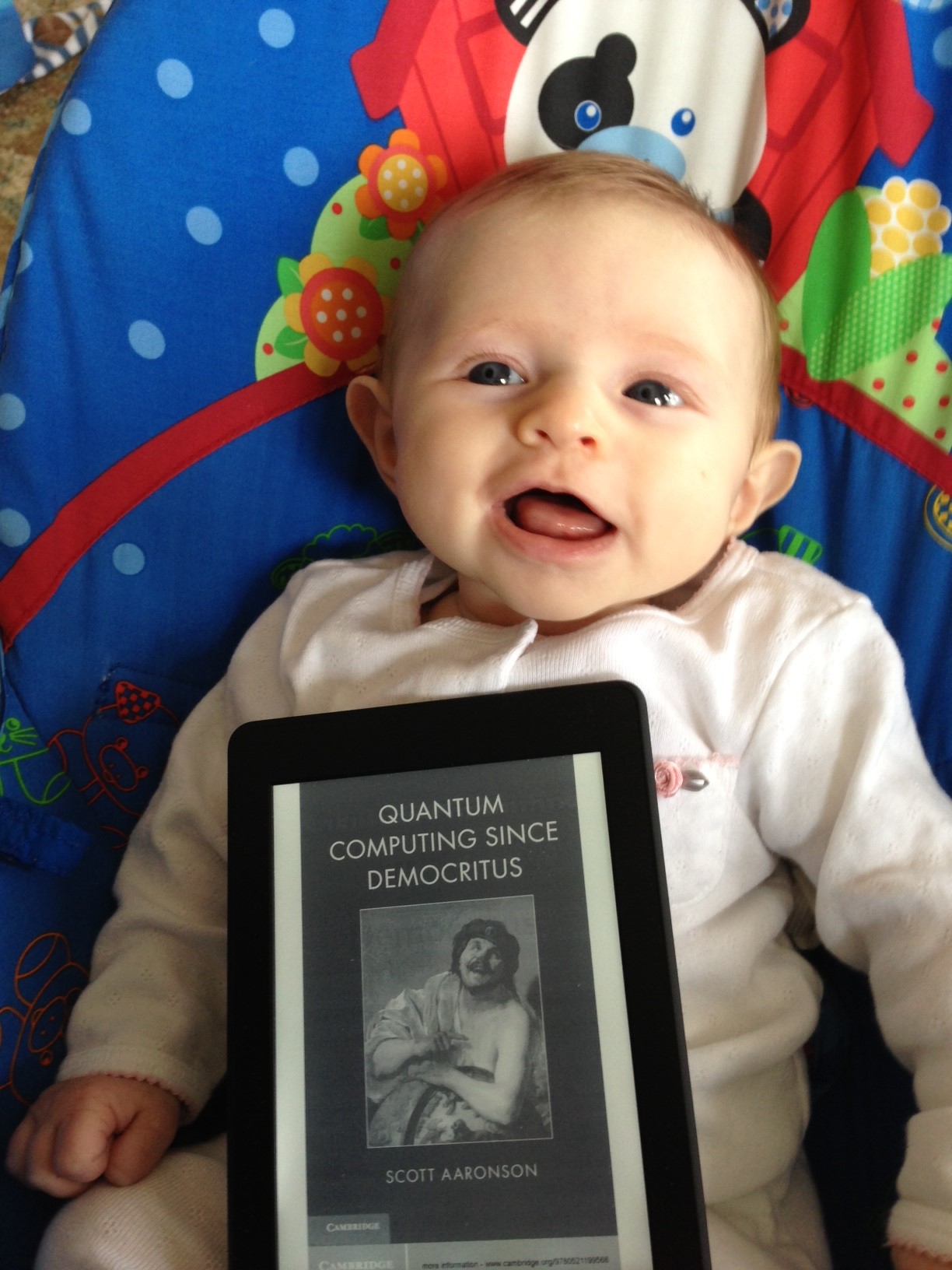
It seems like wherever I go these days, all anyone wants to talk about is Quantum Computing Since Democritus—the sprawling new book by Scott Aaronson, published by Cambridge University Press and available for order now. Among leading figures in quantum information science—many of them well-known to Shtetl-Optimized readers—the book is garnering the sort of hyperbolic praise that would make Shakespeare or Tolstoy blush:
“I laughed, I cried, I fell off my chair – and that was just reading the chapter on Computational Complexity. Aaronson is a tornado of intellectual activity: he rips our brains from their intellectual foundations; twists them through a tour of physics, mathematics, computer science, and philosophy; stuffs them full of facts and theorems; tickles them until they cry ‘Uncle’; and then drops them, quivering, back into our skulls. Aaronson raises deep questions of how the physical universe is put together and why it is put together the way it is. While we read his lucid explanations we can believe – at least while we hold the book in our hands – that we understand the answers, too.” –Seth Lloyd
“Scott Aaronson has written a beautiful and highly original synthesis of what we know about some of the most fundamental questions in science: What is information? What does it mean to compute? What is the nature of mind and of free will?” –Michael Nielsen
“Not since Richard Feynman’s Lectures on Physics has there been a set of lecture notes as brilliant and as entertaining. Aaronson leads the reader on a wild romp through the most important intellectual achievements in computing and physics, weaving these seemingly disparate fields into a captivating narrative for our modern age of information. Aaronson wildly runs through the fields of physics and computers, showing us how they are connected, how to understand our computational universe, and what questions exist on the borders of these fields that we still don’t understand. This book is a poem disguised as a set of lecture notes. The lectures are on computing and physics, complexity theory and mathematical logic and quantum physics. The poem is made up of proofs, jokes, stories, and revelations, synthesizing the two towering fields of computer science and physics into a coherent tapestry of sheer intellectual awesomeness.” –Dave Bacon
After months of overhearing people saying things like the above—in the halls of MIT, the checkout line at Trader Joe’s, the bathroom, anywhere—I finally had to ask in annoyance: “is all this buzz justified? I mean, I’m sure the book is as deep, hilarious, and worldview-changing as everyone says it is. But, after all, it’s based off lecture notes that have long been available for free on the web. And Aaronson, being the magnanimous, open-access-loving saint that he is, has no plans to remove the online notes, even though he could really use the royalties from book sales to feed his growing family. Nor does Cambridge University Press object to his principled decision.”
“No, you don’t understand,” they told me. “Word on the street has it that the book is extensively updated for 2013—that it’s packed with new discussions of things like algebrization, lattice-based cryptography, the QIP=PSPACE theorem, the ‘quantum time travel controversy,’ BosonSampling, black-hole firewalls, and even the Australian models episode. They say it took years of painstaking work, by Aaronson and his student Alex Arkhipov, to get the notes into book form: fixing mistakes, clarifying difficult points, smoothing out rough edges, all while leaving intact the original’s inimitable humor. I even heard Aaronson reveals he’s changed his mind about certain things since 2006. How could you not want such a labor of love on your bookshelf?”
Exasperated, I finally exclaimed: “But the book isn’t even out yet in North America! Amazon.com says it won’t ship until April 30.”
“Sure,” one gas-station attendant replied to me, “but the secret is, it’s available now from Amazon.co.uk. Personally, I couldn’t wait a month, so I ordered it shipped to me from across the pond. But if you’re a less hardcore quantum complexity theory fan, and you live in North America, you can also preorder the book from Amazon.com, and they’ll send it to you when it arrives.”
Much as the hype still grated, I had to admit that I’d run out of counterarguments, so I looked into ordering a copy for myself.
Paul Christiano has devised a new fundamental approach to the "Löb Problem" wherein Löb's Theorem seems to pose an obstacle to AIs building successor AIs, or adopting successor versions of their own code, that trust the same amount of mathematics as the original. (I am currently writing up a more thorough description of the question this preliminary technical report is working on answering. For now the main online description is in a quick Summit talk I gave. See also Benja Fallenstein's description of the problem in the course of presenting a different angle of attack. Roughly the problem is that mathematical systems can only prove the soundness of, aka 'trust', weaker mathematical systems. If you try to write out an exact description of how AIs would build their successors or successor versions of their code in the most obvious way, it looks like the mathematical strength of the proof system would tend to be stepped down each time, which is undesirable.)
Paul Christiano's approach is inspired by the idea that whereof one cannot prove or disprove, thereof one must assign probabilities: and that although no mathematical system can contain its own truth predicate, a mathematical system might be able to contain a reflectively consistent probability predicate. In particular, it looks like we can have:
∀a, b: (a < P('φ') < b) ⇒ P('a < P('φ') < b') = 1
Suppose I present you with the human and probabilistic version of a Gödel sentence, the Whitely sentence "You assign this statement a probability less than 30%." If you disbelieve this statement, it is true. If you believe it, it is false. If you assign 30% probability to it, it is false. If you assign 29% probability to it, it is true.
The way Paul's approach resolves this problem is by restricting your belief about your own probability assignment to within epsilon of 30% for any epsilon. So Paul's approach replies, "Well, I assign almost exactly 30% probability to that statement - maybe a little more, maybe a little less - in fact I think there's about a 30% chance that I'm a tiny bit under 0.3 probability and a 70% chance that I'm a tiny bit over 0.3 probability." A standard fixed-point theorem then implies that a consistent assignment like this should exist. If asked if the probability is over 0.2999 or under 0.30001 you will reply with a definite yes.
We haven't yet worked out a walkthrough showing if/how this solves the Löb obstacle to self-modification, and the probabilistic theory itself is nonconstructive (we've shown that something like this should exist, but not how to compute it). Even so, a possible fundamental triumph over Tarski's theorem on the undefinability of truth and a number of standard Gödelian limitations is important news as math qua math, though work here is still in very preliminary stages. There are even whispers of unrestricted comprehension in a probabilistic version of set theory with ∀φ: ∃S: P('x ∈ S') = P('φ(x)'), though this part is not in the preliminary report and is at even earlier stages and could easily not work out at all.
It seems important to remark on how this result was developed: Paul Christiano showed up with the idea (of consistent probabilistic reflection via a fixed-point theorem) to a week-long "math squad" (aka MIRI Workshop) with Marcello Herreshoff, Mihaly Barasz, and myself; then we all spent the next week proving that version after version of Paul's idea couldn't work or wouldn't yield self-modifying AI; until finally, a day after the workshop was supposed to end, it produced something that looked like it might work. If we hadn't been trying to solve this problem (with hope stemming from how it seemed like the sort of thing a reflective rational agent ought to be able to do somehow), this would be just another batch of impossibility results in the math literature. I remark on this because it may help demonstrate that Friendly AI is a productive approach to math qua math, which may aid some mathematician in becoming interested.
I further note that this does not mean the Löbian obstacle is resolved and no further work is required. Before we can conclude that we need a computably specified version of the theory plus a walkthrough for a self-modifying agent using it.
See also the blog post on the MIRI site (and subscribe to MIRI's newsletter here to keep abreast of research updates).
This LW post is the preferred place for feedback on the paper.
EDIT: But see discussion on a Google+ post by John Baez here. Also see here for how to display math LaTeX in comments.
147 comments

