Shared posts

16 Jul 00:07

"Put Down Old People At Birth" Conservative Party campaign leaflet, 1979

by About me
With the funeral of ex-prime minister and hobby taxidermist Margaret Thatcher underway, it is perhaps appropriate that this item from the archive is posted today.

This leaflet was distributed throughout Scarfolk during the 1979 Conservative Party campaign. With such clear policies and faultless logic, it's little wonder that the Tories won the election. The Labour Party had pushed Britain into a deep recession following numerous strikes by miners, postal workers and the royal family who, throughout 1976, refused to politely wave on Tuesdays, weekends and bank holidays.

However, under the Tory government, Scarfolk lost several of its community covens, and the council's plans to convert Scarfolk Towers, the site of a series of occult killings, into a children's nighttime playground were thwarted. Additionally, Scarfolk residents were vexed that mystical phenomena became taxable, which led to an increase in back-street astral projections.

20 Apr 22:16

4 years ago: One cheer for Fred Phelps

by Fred Clark

April 20, 2009, on this blog: One cheer for Fred Phelps

It turns out that the litigious old bastard has at least one useful social purpose. The unimpeded, undiminished work of his infamously evil  anti-gay “ministry” emphatically disproves every Scary Story promoted by anti-gay religious groups who claim that recognizing marriage equality or including sexual orientation in existing hate-crime or anti-discrimination legislation will lead to Christian ministers being thrown in jail for saying they believe homosexuality is a sin.

“My freedom will be taken away,” says one woman in the NOM ad.

How so? She doesn’t say. But Fred Phelps’ freedom hasn’t been taken away, so we have to assume that this otherwise pleasant-seeming woman must be referring to her “freedom” to harass, slander and berate with greater intensity than anything Phelps has done.

… Fred Phelps is a free man, so if you think your freedom is going to be restricted, you must be planning to outdo Fred Phelps.

20 Apr 22:14

David Herdson says the next general election could still be wide open

by David Herdson

What we could have is an anti-unpopularity contest

The YouGov poll last month which showed that a Boris Johnson-led Conservative Party would be neck-and-neck with Labour in vote share was perhaps not too much of a surprise.  After all, Johnson is among the most popular of current politicians and outpolled his party by some 20% in the London elections last year.  Whether such hypotheticals would translate into reality were Johnson PM is a different matter.  He currently holds a role that plays to his strengths and mitigates his weaknesses; leading a political party would be a very different proposition.

Perhaps a much more unexpected result was an ICM poll, released earlier this week, which claimed that were Margaret Thatcher the Conservative leader, the current Labour lead of 6% would be transformed into a Conservative one of 3%.  That’s interesting enough about what is says of the public’s opinion of the recently departed ex-PM but it’s even more interesting because of what is implicitly says about all of today’s leaders.

What both polls demonstrate is the lack of faith that the public has in any of the three leaders of the main parties – something borne out in their personal ratings both in that poll and one release by Ipsos-Mori, also last week.  All remain stuck well into negative territory, as does the government as a whole.

It’s not so much that the electorate would swing to a Johnson- or Thatcher-led Conservative Party; it’s more the kind of vote for ‘none of the above’ that is currently producing such historically sky-high polling shares for Others that UKIP have had to be separated out.

Another feature that the hypotheticals bring out is the softness of Labour’s lead and vote share.  They too are currently a repository for protest votes but their supporters’ opinion of both party and leader as ready for government remains reserved.  34% of Labour supporters are dissatisfied with his performance as leader (better than Nick Clegg’s rating from his own supporters but worse than Cameron’s from his), 37% don’t think he is ready to be PM, while 34% of would-be Labour voters don’t think the party is ready for government.

The overall figures are well behind where Blair and Cameron were at the equivalent points before the 1997 and 2010 elections, though a little better than the current scores for the government and PM.

All of which keeps open an opportunity for the coalition in general and the Conservatives in particular.  Governments can win elections by default if they can paint their opponents as unfit.  1992 remains the classic example – won in no small part by the ‘Labour’s Tax Bombshell’ campaign – and 2015 will be decided in no small part by the effectiveness of the Tory negative campaigning.  While yesterday’s credit downgrade is not ideal news for the government, nor does it particularly help a party whose only apparent response to the problem of the deficit is to insist on borrowing more.

After three years of this parliament, the floating voting sector of the public doesn’t trust any of the parties to solve the country’s ills and as such the next election remains very much open.  The winners – if winners there are to be – will be the first time party which can convince the electorate that it can.  Or which can convince them that its principal opponents can’t.

David Herdson

20 Apr 01:09

The eternal mainframe.

Andrew Hickey

"We must establish as many precedents as we can to preserve the right to buy, build, use, sell, donate, and keep fully functional, general purpose, standalone computers. Plenty of activists are already doing that. This is good.

What I have not heard those activists say — what I advise — is that we should second-guess ourselves as well as our masters. The point of this essay is that it's not only advancing technology that has recreated the mainframe and the abuses to which it is prone; the very desire for absolute freedom has done its part, as well. The good intentions of our fellow nerds who promised to not be evil has brought us to this."

The eternal mainframe.
20 Apr 00:15

World of Wax

by Unmann-Wittering

In 1962, the wonderful Harold Baim made a short film called 'World of Wax'. The film mainly focuses on Madam Tussauds, with particular reference to a new addition, a wax model of Stirling Moss.


Don Thompson*; Stirling; Kenneth More.

Regular readers will know I have a bit of a thing for waxworks. In particular, I have a bit of a thing for old waxworks and, specifically, past models. It absolutely fascinates me to know who was once famous enough to have an effigy made of them; I find it equally interesting to see models I don't recognise or know are no longer in place. The removal of a waxwork version of yourself must be a fairly devastating blow to the ego, I expect, especially if they melt you down because they're sure you're never coming back.

So, a few glimpses at who was in vogue in 1962. Let's start with perhaps the most ephemeral of all types of exhibit - the showbusiness models.


Here's the lad 'imself, one of the greatest comics Britain has ever produced, Anthony Hancock. By rights, he should still be there. Anyone up for a petition?

Pre Poppins, pre Maria, Julie Andrews is featured because of her stage fame in 'My Fair Lady'.

An interesting tableau. I get Tommy Steele, Leslie Caron in the centre, Bob Hope to the right. I have absolutely no idea who the man filling his pipe is, and the ginger fellow in the corner is actually quite creepy. Any ideas on the second left?

Peter Sellers, looking as difficult and pompous in image as he apparently was in real life. Fab Di Dors to his left, five years before appearing on the front of a Beatles album, you know, the famous one about condiments and the army.

Apparently, it's Harry Secombe. This series will run and run.
* Don Thompson was the only British male athlete to win a gold medal at the 1960 Olympics in Rome, for the 50km walk. 
20 Apr 00:13

Sightseers

by Unmann-Wittering


20 Apr 00:13

Death Has A Ginger Beard

by Unmann-Wittering

‘Sightseers’ is, in many ways, the perfect ‘Island of Terror’ film. It’s dark and funny and its locations are camp sites, roadside cafes, ruined abbeys, viaducts, slate mines, owl sanctuaries, tram and pencil museums, show caves and stone circles. I got excited just typing that. It’s also very good, not perfect, but something that I am more than happy to recommend to anybody who likes the idea of a film that combines sudden death and National Trust properties.


Angry Tina and ginger faced Chris are a couple of downtrodden misfits who set out on a ‘sexual odyssey’/ road trip across the North of England.  In a caravan. Compulsive knitter Tina (Alice Lowe) is happy to escape her oppressive and manipulative mother, who blames her for the death of their beloved dog, Poppy. Heavily bearded plastics nerd Chris (Steve Oram) is apparently writing a book, and Tina is to be his muse. As they set off, Tina says ‘show me your world’, barely realising that Chris’ world is a strange and violent one, and that he uses murder as a way of getting his own back on litterers, snobs and people who are more successful than him.


Mordantly funny, extravagantly bloody, the film was scripted by Lowe and Oram but many of the scenes are improvised, and this lends immediacy and realism to the film, an approach consolidated by director Ben Wheatley, who shoots on the hoof, capturing some wonderful scenery and, in particular, some truly awful weather, both of which add immeasurably to both the veracity and the atmosphere (it never rains, but it pours, and when it isn’t pouring, it’s hailing). It’s rare to see Britain presented like this, but I like it: the banality and beauty of our sceptered isle in all its damp glory – an ancient and primeval landscape criss crossed by motorways and studded with brown heritage road signs indicating points of (selective) interest.  


If you’ve ever wanted to see a woman write a letter with a four foot long pencil, or see crotchless knitted lingerie, then you won’t be disappointed. A great little film, I love it.


Incidentally, Ben Wheatley’s next film is called ‘A Field In England’, and is, apparently, a tale of hallucogenic drugs and necromancy set during the English Civil War. I can’t wait.

19 Apr 21:52

Unacceptable in the 80s.

by septicisle
Seeing as we've spent pretty much the last ten days going over old wounds, it seems a shame to break the pattern now.  Let's strike a slightly different note though: of all the myriad of things that Thatcher and Reagan inflicted on their respective countries, one thing neither did was authorise or condone the use of torture.  While it's certainly true that Reagan for one had no qualms about participating in the most dirty, even treasonous (as would be alleged by the opposite side if it was the other way round; they almost got Clinton impeached for having his dick sucked, for comparison's sake) underhand dealings, as evidenced by his administration's funding of the Contras by the secret selling of arms to Iran, 25 years ago today the US signed the UN Convention Against Torture.  On sending it to the Senate a month later, Reagan commented that the treaty "clearly express[es] United States opposition to torture, an abhorrent practice unfortunately still prevalent in the world today".

Quarter of a century on, the record of Thatcher and Reagan's heirs is starting to be laid bare.  We already knew much about the extraordinary rendition programme and how "enhanced interrogation techniques" were authorised in the aftermath of 9/11, but the Task Force on Detainee Treatment report, commissioned by the Constitution Project, is the best effort yet to draw together how the policy progressed and was instituted, starting with the opening of Guantanamo and following on to its practice in Iraq.  Their key finding is that "it is indisputable that the United States engaged in the practice of torture".  No fudging, no moving of the goal posts; torture, whether directly authorised or not, was used.  Nor do they shy away from the argument of some that such harsh techniques had results.  They conclude that there is "substantial evidence that much of the information adduced from the use of such techniques was not useful or reliable".  Views are mixed as to whether the film Zero Dark Thirty actively suggests that the testimony given by one tortured detainee helped the CIA find Osama bin Laden (the report says that it does; I haven't seen it so can't judge), but it most certainly is not the "first draft of history" as claimed by Kathryn Bigelow.

The Constitution Project set up its own panel to investigate the treatment of detainees after the Obama administration decided not to take any further action or open any investigation into what went on during the first phase of the "war on terror".  Back here in Blighty, where there is nothing to suggest that torture was ever sanctioned by a minister but plenty of evidence that collusion with the US in the rendition programme most certainly was authorised, the Gibson inquiry was meant to provide answers.  Instead it was unceremoniously abandoned, ostensibly on the grounds that the police needed to investigate the involvement of the security services and ministers in the rendition to Libya of two former members of the LIFG, which had links to al-Qaida, although one suspects the boycott by human rights groups at the limited scope of the inquiry also had something to do with it.

Nonetheless, Gibson and his team wrote up a report on the evidence they had sifted through and handed it over to the government.  That was nine months ago, and there is as yet no indication as to when it might be published.  Seen alongside the fight over the closed material procedures section of the justice and security act, designed to stop the courts from ever releasing material such as that which confirmed the security services knew about the torture of British resident Binyam Mohamed and did nothing to stop it, it more than implies that the coalition, having been lobbied extensively by both MI5 and SIS, has now decided upon a similar course to that of the US.

We could undoubtedly give too much credit to both Reagan and Thatcher over their stance, although Simon Jenkins was right yesterday to highlight how the latter's response to nearly being killed by the IRA was to carry on almost as if nothing had happened.  Both cuddled up to regimes that most certainly did and continue to torture their own citizens, while at the funeral yesterday were such noted humanitarians as Henry Kissinger, Dick Cheney (arch defender of waterboarding) and Benjamin Netanyahu. There can be little doubt however as to which administrations will be judged most harshly on their foreign policies by history.
19 Apr 17:05

Yet another myth busted: “A competitive tax system is a better tax system”

by noreply@blogger.com (Simon Titley)
You’ve heard the arguments: Having a ‘competitive’ tax system is a good thing for the UK. Trying to tax the wealthy and corporations just stifles economic performance and puts off investors. If business and wealthy people are taxed too much, they will desert Britain for countries with a more ‘competitive’ tax system.

Does this belief in a ‘competitive’ tax system have any evidential basis?

nef (the new economics foundation) has produced another of its useful mythbusters. The evidence shows what happens when you pursue a competitive’ tax policy:
  • Only big, multinational companies can afford to shift operations to take advantage of different tax regimes, so that when governments lower business taxes, local businesses face unfair competition.
  • A race to the bottom means that, as countries respond to one another’s policies, everyone ends up where they started, except more impoverished and with greater inequalities of wealth.
  • There is no evidence that differences in the tax take have any impact on GDP growth.
  • Genuine investors are not deterred by tax regimes. They are attracted by a good infrastructure, a healthy and educated workforce, and the rule of law – all of which rely on tax.
 Oh dear. Another of those tired old right-wing tropes bites the dust.
19 Apr 17:04

Integration by Parts

If you can manage to choose u and v such that u = v = x, then the answer is just (1/2)x^2, which is easy to remember. Oh, and add a '+C' or you'll get yelled at.
19 Apr 17:03

The Unwoken Princess

by Lawrence Burton


I have a short story called The Unwoken Princess in The Obverse Book of Detectives, currently on pre-order but available soon so far as I understand. Esteemed fellow contributors include Chantelle Messier, Thomas H. Pugh, Jamie Hailstone, Paul Hiscock, and Mark Manley with the emphasis on unconventional efforts to stretch the boundaries of detective fiction. My story, for example, is set in fifteenth century Mexico (which admittedly probably won't come as too much of a surprise) and presents a much earlier tale in the life of Icnopilli from Against Nature, one which draws stinking great chunks of inspiration from Terry LaBan's excellent strip Muktuk Wolfsbreath - Hardboiled Shaman from a few years back.

Should be good, and you can pre-order the print version by recontextualising your computer mouse in proximity to this here link: http://obversebooks.co.uk/product/2-4-the-obverse-book-of-detectives/
19 Apr 10:32

#931; The Adventures of Currency

by David Malki !

Statistically, every dollar bill in the world has a tiny but microscopically detectable amount of butt on it

19 Apr 09:22

The Business Rusch: Book As Event

by Kristine Kathryn Rusch

Business Rusch logo webI finished my second novel (as an adult) on the day my best friend from high school gave birth to her second child. My friend called me from the hospital to tell me the great news and then, because she was a sweet woman and because she was from the upper Midwest, she reflexively asked how things were going for me.

Even though I am not what anyone would call sweet and wasn’t even then, I was raised in that same Midwestern community. So I gave my friend the best answer I could.

“Oh, I’m fine, and everything is going well here,” I said before turning the attention back to her. Where it belonged, I might add. She had given birth to the second of her two daughters, and fulfilled a lifelong dream of having a family.

I had different dreams. I never wanted children. All I wanted was to be a fulltime professional fiction writer. My friend and I were about as different as two people could be and still be friends. I hung up the phone that day with mixed emotions. I wanted to see her and her daughters, something I wouldn’t get to do for another year (and, sadly, that would be the last time I would ever see her, although I didn’t know it at the time).

I also realized that finishing my second novel was as important for me as having that second child had been for her.

I never told anyone that, though. I rarely talked about my writing because non-writers didn’t understand it. Finishing the first novel had felt like a fluke. I managed to get it done and it felt daunting. The second novel felt less daunting, but much more important.

Before I had believed that if I could do it once, then I could do it again. After I finished the second book, I knew I could do it again. And proceeded to do so more than a hundred times. (Believe me, that number freaks me out more than it freaks you out. Seriously.)

Finishing my first novel had been an event. A mountain climbed. A life goal achieved. It felt more important to finish than it did to publish the book. And the second novel, well, it felt even more important.

It did feel on par with giving birth to a wanted child.

Now, not so much. I’m still proud when I finish a novel, pleased at myself, pleased that something I imagined has become reality. But I also know there are more novels to write and more stories to tell and so much more to do. I’m actually more afraid of dying before I can finish writing all the projects I carry around in my head, and those projects increase exponentially as each year goes on. (See my Popcorn Kittens post. You’ll understand.)

Books sometimes are events and sometimes they aren’t. Before the rise of indie publishing, prolific writers understood this. Some books got published well; others got anti-published to use Carole Nelson Douglas’s term. (Or the term that apparently gets used in the Tor offices, which came to me via Beth Meacham on Facebook, “privished” not “published.” Privish, as in private, as opposed to publish as in public. [She had to explain it to dumb little ole me.])

The most prolific traditionally published writers (back in the day) were in the romance genre, and most of them could manage about six new books per year. I know that some tie-in writers did more—Dean famously wrote five in one month, but he didn’t sleep and then he rested for the next two months. In the old, old days of publishing, a lot of pulp writers wrote two novels a month, but those books averaged about 40,000 words, less than half of what the average midlist novel is right now.

I looked at Nora Roberts’ publishing schedule for 2013, and she will have five new titles this year, all of which are probably a maximum of 100,000 words. That’s still half a million words per year in print, not counting how much she wrote on the side or blogged or did in anticipation of future projects. I know that my finished word count is very different from my actual word count because I toss chapters and write background material and make copious notes to myself. I’m sure she does something similar.

When you look at her new releases site, also note that her publisher will release eleven new reprints in 2013. If Nora handles her own copy edits and proofs, she will work on sixteen different titles in the United States in 2013. That doesn’t count subsidiary rights, such as foreign editions or audio versions, movie options, a game or anything else that will come her way.

It’s a lot of work for one person. I know she rarely takes more than a day between novels, so she’s busy writing and doing writing related things most days of the year. She outlines her average day here.

Three new books with her name on them came out in the first quarter of 2013, one of them a brand new, never-before-published JD Robb hardcover. In the second quarter, when her big new Roberts hardcover is coming out, she will have her name on four books. In the third quarter, her next big hardcover—a JD Robb book, will appear along with four paperback reprints. And in the fourth quarter, you’ll find two brand new books for the holiday season—one a mass market and one a trade, as well as two reprints.

A Nora Roberts book (or JD Robb, which everyone knows is Nora Roberts) will appear every month in 2013, either as a never-before-published book or as a reprint in a brand new package.

Roberts rarely tours. Usually, any appearances she does are related to RWA National, where she goes mostly to see her friends. She’s a working writer (albeit on a very high sales level), and I have a hunch if you ask her which book she considers an “event” book in 2013, she’ll look at you like you’re crazy.

Oh, she might have a favorite book. All writers do. Or a book that was so hard to finish, so wonderful to get off the plate, that it’s worth celebrating. But most people don’t celebrate going to work every day as an achievement, and working writers don’t either.

We write. We finish what we write. We start something new. We finish that. It’s our job.

That we enjoy it immensely, that we wouldn’t or can’t do anything else, is entirely beside the point.

I was flashing on this attitude difference last Saturday night as I sat with the spectacular group of writers who had come to the weeklong Character, Voice, and Setting Workshop that Dean taught. This is an advanced-level workshop, designed for writers with a work ethic, not people who believe they have one great novel in them and they’ll write it one sentence per year as God intended.

Still, these writers who are either already established or who have professional habits that have for some reason (usually the long [and stupid] wait times in traditional publishing) not yet started to make a living at writing. And still, most of these writers have that myth engrained in them that every piece of writing they commit is an event, something to be workshopped, discussed, promoted, and revisited, over and over and over again.

When you’re a beginner, like I was, finishing a novel is an event. It’s not an event like giving birth; it’s really not. With each birth, a parent signs up for a lifelong journey with their child. With each finished novel, a writer moves onto the next (rather like a cat and kittens, I guess, if you’re going to stretch that birth analogy).

But as a professional, writing is what you do. Finishing is what you do. Go back to the beginning of Nora Roberts’ career, and you’ll see that she was publishing between six and eight category romances each  year. That brought her published word count then, at the beginning of her career, between 330,000 and 440,000 words annually. (Categories then were about 55,000 words. Some larger, some smaller.)

In other words, her great work ethic was already there, and she was in a genre that allowed her to write that many books per year for a traditional publisher.

The reason I thought of all this on Saturday is this: the last night of any workshop we do the big reveal. In that moment, we tell these writers how many tens of thousands of new words they finished in that busy week. Many of them get upset; that number can’t be true. Some of them can’t finish that many words in a month. Yet they did it under pressure, and often sold (or will sell) what they write, while going to class and maintaining a very full schedule.

I love to watch the faces as writers realize that treating each finished product as an event is hurting them rather than helping them. It’s a very deliberate mind shift, one that we do on purpose. Because we have to show writers that everything they learned in school about writing, all those myths about the importance of treating each thing they write as something that can be perfected over years, hurts them rather than helps them.

Obviously, I think about this at the end of every workshop. I wrote about it last summer in a series of blogs starting with one called “Perfection,” and then collected them in a book called The Pursuit of Perfection, earlier this year.

But this past week, I had a secondary realization. It comes from indie publishing and it will take a bit of an explanation.

I’ve worked in publishing on all sides of the desk (except as an agent), so I can tell you about the other side of Nora Roberts’ career. Her publisher’s attitude toward those sixteen books.

One of the hardcovers—one in February, one in April, and one in September—is an event book. That’s the April Nora Roberts title. It came out this week, and I have seen promotion for this baby everywhere. The book will turn up in the pitiful book rack at my grocery store, when the two JD Robb hardcovers did/will not. The JD Robb books are top-of-the list books.

The two paperbacks, the trade and the mass market, are the top of a smaller list. They’ll come in the holiday season, and they’re priced perfectly for gift-giving. It’s brilliant, and they’ll get some holiday promotion, either alone or with some other romances that the publisher wants to promote. These books will piggy-back on everything else.

The reprints are there so that Roberts’ readers don’t forget her over the three weeks between books. They’re also in the slot to pick up new readers who weren’t alive when those books were first published (by another company, I might add). In addition, last year’s hardcovers will get their paperback releases, which will then promote the new hardcovers. Many cost-conscious readers wait that year plus to buy the new book, so that they save the ten to fifteen dollars per copy. The new reissues will have the first chapter or two of the new release hardcover to entice the reader to start the opening of the new book, and then hurry out (or online) to buy it and finish it.

This all took a lot of work at the traditional house to get this planning in place, and it was just one author for that house, in one particular product line. A lot of people, from the head of the sales force to the publisher (of whatever division Roberts writes for) to an editor to a mountain of assistants to bring this plan to fruition.

In addition, these people are working on dozens of other books at the same time. Some are “event books.” Others are top of the list books, like the JD Robb’s. They get a different level of promotion. And the rest get published to fill out the lists.

Want to see what I mean? Click the bookseller tab on the Penguingroup website, then click on the catalog link on the left (or hit this link here) and look at all the catalogs you can download. I would suggest downloading them and viewing them online. You’ll see the monthly output of one imprint is more than Roberts’ entire publishing schedule in 2013.

This is important to understand. Because this is why books get anti-published (or privished), why many books disappear, and why all traditionally published books get treated like produce. They are produce. They do spoil, in a company’s collective hive mind, because the company is moving on to other things all the time.

For example, G.P. Putnam, which is Roberts’ and Robb’s hardcover imprint (the trades come out of Berkeley, a different imprint), is also publishing a new Clive Cussler in September, the same month it’s publishing the Robb. It’s also publishing a new Catherine Coulter, a new “Robert Parker” (actually the guy who has taken up the books now that Parker has passed away), a new Randy Wayne White, a new “Dick Francis” and some really impressive nonfiction.

What’s the event book for September? You  have to look for the first listing in the Fall catalogue, which is…Sue Grafton. She’s going to get all the attention in the publishing house, the bulk of the ad dollars, and most of the promotion. You can see that from the listing on the right hand side, the listing that tells you what the company will be doing to support that book.

I can guarantee that everyone in the G.P. Putnam side of the building knows exactly what’s going to happen with Grafton’s book in September. There were placement meetings and discussions on how to do the best job possible with that book. They’re doing a little less work, but not much, on A.Scott Berg’s nonfiction biography of Woodrow Wilson. A. Scott Berg’s books are events in the nonfiction world, and G.P. Putnam is (rightly) treating the book that way.

The amount of promotion the JD Robb is getting compared to those two is relatively minimal for a multiple New York Times bestseller. Some of that is because Roberts doesn’t do media, but most of it is because Roberts’ readers come to her books without a lot of promotion.

The Dick Francis, co-authored by his son? A lot less work by the publisher. There are a lot of bigger names who sucked up the oxygen in the room long before we get to the Francis in the September part of the catalogue.

The event book in October? Bobby Orr’s autobiography. Yes, hockey fans read. (And let me give those of you who think otherwise a big fat raspberry.) November’s event? Patricia Cornwell’s next novel.  But the other books get a bit more promotion than normal because November’s a big deal month in traditional publishing. That’s the holiday buying season. And Roberts isn’t even in G.P. Putnam’s catalogue.

She’s in Berkeley’s catalogue. Same company, different imprint. Whole different line-up of authors.

But the sales force might or might not be the same, the editor is the same, and the assistants working on the books in the editing side are the same.

Only their focus is always on the event book. Yes, they’re doing their best to keep the big names like Roberts satisfied, but they’re doing the most work on the really, really, really big books.

This is important to know, because beginning writers who sell their first novels to commercial publishers expect their books to be an event. We jaded pros know better. We considered ourselves lucky when it went right, and it rarely went right.

Scott Turow, to touch on last week’s topic, has always been more than a bestseller. He’s always been an event writer. He doesn’t understand anything different.

Please poke around these catalogs. Realize this is one gigantic corporation with lots of imprints. Realize that a lot of the people who work on one book in September for one imprint will work on books for other imprints. And also realize that for some of the authors and books listed, these catalogs are the only promotion they will see from their traditional publisher.

If something goes wrong with one September book, oh, well. There are dozens, maybe hundreds, of others. The only books that nothing should go awry on are the event books. Someone will sacrifice their entire career to prevent that. Even the top-of-the-list books can be sacrificed to prevent a disaster with the event book.

How does this apply to indie writers? Well, most indie writers have the attitude I had when my friend called. Not only is it hard to finish a novel, but then the writer has done all the production too. It feels like an event, and for a newer writer, it is an event.

But for readers, it is not. A subset of readers might be happy that your first book is out (family, friends) but most will never notice, and promotion won’t help that hardly at all.

What helps the new writer become a success is word of mouth, and publishing the next book.

Marie Force did a non-scientific survey of indie writers, their sales over the past few years, and their income. To a person, the writers who treated each new book as an event were 1) new and 2) not selling very many copies.  (I am [somewhat snobbishly] saying that selling 1000 copies of one title is not as impressive as, say, the 25,000 copies and up listed in this list by people who are doing no promotion or minimal—hey my book is out there!—promotion.)

The writers who write a lot of books every  year are doing infinitely better. And these are just digital numbers, not print at all. In fact, as Courtney Milan pointed out, her digital historical romance numbers are much better than the digital historical romance numbers listed in Publisher’s Weekly’s survey.

Now, granted, this is a self-selected group of writers who are reporting. But not everyone is selling 200,000 copies of their most recent e-book. Some are selling as few as five copies. And kudos to them for reporting! They’re all trying to build. The biggest difference—the most obvious difference—is between those who believe their job is writing, and those who think that each book is an event.

It wasn’t just the class that made me think of the events. I’m guilty of it too. When you publish four new books per year, it’s an event to have a book out. It’s unusual.

But this year, WMG Publishing has made incredible headway on getting my backlist up. Every week, I am looking at cover concepts, going over copy edits and page proofs, and dealing with the next book to appear. Between those backlist titles going up in e-book, or in e-book and trade, and the short stories that are appearing from my traditional publishers, I am getting behind on my announcements for the reprinted material here on this website. Either I write or I promote, and even making an announcement takes writing time.

I thought of that as I forgot that I have a new frontlist title debuting this month. We’re going to be doing something I’ve wanted to do with that book from the beginning: we’re going to serialize it for free on WMG’s website. That book is Spree. The first chapter will go live on Tuesday, April 23, along with links so that you can order the rest of the book immediately if you want to. WMG will serialize the book chapter by chapter, leaving the previous chapters up, each week.

The reason I forgot is twofold. First, Spree is not WMG’s top priority next week. Next week, WMG’s first event book will appear. We’ve all been preparing for this release since last August. Fiction River #1: Unnatural Worlds will hit the stands that day. By then, subscribers should have their copies. (They shipped today.)

Dean and I have worked very, very, very hard on this project from the editing side to the publishing side. Even though we try to stay hands-off at WMG, we were the ones with publishing knowledge on anthologies, magazines, and subscriptions, on how to contact readers, how to deal with authors, contracts—oh, we’ve had a million meetings. And the review copies went out (later than we hoped) and the covers got approved (earlier than we hoped) and people have supported the project in a big way that can only grow.

The event continues for WMG because its audio arm, headed by Jane Kennedy, is doing a multicast audio book of Unnatural Worlds which will be available in the summer. WMG will do an announcement of that. I read my own nonfiction, but not my own fiction. Other people kept coming in and out of the office to do their parts, and Jane has spent the last week plus locked in the editing booth, quietly tearing out her hair.

I noted that event, remembered how every publishing company always has event books, and realized that for publishers the event books are the unusual ones, not the everyday books.

Longtime professional writers rarely have event books. But I’m working on one now. I’m finishing the next Smokey Dalton novel, Street Justice. I had so much trouble with this series from my traditional publisher, from the casual racist assumptions expressed by the sales force (“but there are no black people in the Midwest”) to forgetting to send books to bookstores while I was on a publisher-mandated book tour. (If you want to see how ugly book tours are for writers, see Kevin J. Anderson’s recent blog, here.)

I tried to move the Dalton books to a new publisher, but couldn’t because, by this century, publishers wouldn’t buy a series in the middle unless it was top of the list worthy which, because of the previous publisher’s dumbass mistakes, the Smokey books were not. (Despite the acclaim and the demand; booksellers couldn’t get the books they ordered.)

I figured I’d never get the chance to write this book, so the very act of writing it is an event. It makes me alternately joyful and terrified, which event books do. I have to remember that while this book is an event for me, it is not an event anywhere else, and once I release it into the wild, it will simply be the seventh Smokey Dalton novel.

Which is what it’s designed to be.

I have to keep my expectations in line with that designation, instead of the event book designation. Because if I expect the world to fall at my feet because I finally completed a book that’s been in my head for six years, then I have forgotten my job.

I write books. I write a lot of books. I finish books and move onto the next book.

Right now, WMG is focused on Fiction River 2: How To Save The World. By April 24, that will become the next big focus, although probably not an event. The company’s first real event novel will be my book, Snipers, which has been turned in since January. The staff at WMG is doing all kinds of event-oriented promotion, behind the scenes and according to what the company can afford. But it’s bigger than anything they’ve done before.

Blowback got top of the list promotions. Skirmishes, the next diving book, will get the same. WMG is talking about doing either event or top of the list promotion with Dean’s thriller, tentatively titled Dead Money. And there will be event promotion on Fiction River 4: Christmas Ghosts, as well as the upcoming special edition, Crime.

A small company can handle only a few events per year because they’re expensive in time and money. Writers, who are small companies in and of themselves, should look at their books in the same way. Can the writer afford to do books as event, focusing on promotion and getting readers, or should the writer write the next book?

I urge you to look at the Penguin Group catalogs again, and remember that event books aren’t even company-wide events in traditional publishing. They’re just imprint events.

Then I urge you to review the numbers in Marie Force’s blog and note all the mention of series, number of books published versus numbers of books sold.

I started this by talking about Nora Roberts, who doesn’t kill herself on book tours like Kevin just did. She’s published more than 200 titles in her career, and she’s still publishing five to six new books every year.

Makes my 100 books, under various names (and some media tie-ins), look paltry. I have some catching up to do. And I like doing the short fiction as well. And the editing. And—oh! Squirrel!

Okay. “Squirrel” was my 7,718th word for the day. I still have some writing to finish before I call my workday complete. So I’m declaring this blog done. Not because I’ve said all I can. Not even because I said it as eloquently as I’m probably capable of.

But because it’s 10:48 p.m. and I usually have posted the blog by now. I got some work ahead of me still. So I have declared the blog finished because, to paraphrase Tina Fey in Bossypants, it’s show time.

I’ve already used up more words than usual in this blog, so I won’t keep you. Thank you folks for all the comments, e-mails, links, and support. I have put up a donation button so I keep doing this blog every week. If you’ve learned something or felt inspired, please leave a tip on the way out.

Thanks!

Click Here to Go To PayPal.

“The Business Rusch: Book As Event” copyright © 2013 by Kristine Kathryn Rusch.

Send to Kindle

19 Apr 08:17

Carmine Corrections

by evanier

carminefacts

There have been a number of wonderful things written about Carmine Infantino since his sad passing. There have also been a few in need of some straightening-out…

  • Carmine did not create or even co-create Adam Strange. That character first appeared in Showcase #17-19 and Infantino had nothing to do with those issues, the interiors of which were drawn by Mike Sekowsky with inkers Bernard Sachs and Joe Giella. The covers were penciled by Gil Kane but reportedly, the visual image of the hero was designed by Murphy Anderson when he drew a cover for Showcase #17 which was not used. Infantino took over the artwork when Adam Strange was teleported into DC’s Mystery in Space comic as of #53. Carmine became the artist most closely identified with the feature but he was not in on its creation.
  • Many folks are repeating Wikipedia which says at the moment that "In late 1966/early 1967, Infantino was tasked by Irwin Donenfeld with designing covers for the entire DC line. Stan Lee learned this and approached Infantino with a $22,000 offer to move to Marvel. Publisher Jack Liebowitz confirmed that DC could not match the offer, but could promote Infantino to the position of art director." For what it’s worth, I don’t believe that offer, which was about as much as Jack Kirby was getting at the time. That was largely a measure of how many pages he produced and I don’t believe Infantino could have matched Kirby’s output. He hadn’t in his work for DC. Moreover, Stan had tried a number of seasoned pencilers who had not been able to give him the kind of work he wanted for the current Marvel line, some "bombing out" as of their first attempt. Infantino hadn’t drawn one page yet for that line. Can we really imagine Marvel — then, a notoriously frugal outfit — giving someone a contract the equal of Kirby’s when that someone had yet to prove he could work the way Stan insisted his artists work? I sure can’t, though I can theorize Infantino told DC he had such an offer to pressure them into countering.
  • Some obits say that it was Irwin Donenfeld who promoted Infantino to editorial director and the date is given variously as 1966, 1967 and 1968. It was the middle of 1967 and it was not at the choice of Donenfeld. Donenfeld had been editorial director. He was fired. Liebowitz, who was then ascending to the Board of Directors of the corporation that was then acquiring DC Comics, recommended Infantino for the position. Infantino was promoted to publisher in 1971. Also, Infantino did not bring in Dick Giordano as a DC editor. Donenfeld brought Dick Giordano in as a DC editor. Infantino got rid of Dick Giordano as a DC editor. The two men never did get along very well and one of the things Carmine was angry about after he was let go as publisher was that Giordano was later brought in to fill a job roughly equivalent to his old Editorial Director position.
Lastly: You see the cover to Flash #165 up atop this item? People keep reprinting that as an example of Infantino’s superb work as a cover artist on that comic…and I think it’s the only cover from the period when he was drawing the comic that he didn’t draw. It was penciled and inked by Murphy Anderson. And you see the cover to Batman #180 right next to it? Infantino didn’t draw that, either. That’s Gil Kane and Murphy Anderson. Carmine may have done rough sketches for one or both of these covers but if they’d been signed, they wouldn’t have been signed by him.

19 Apr 08:15

The Rings of Akhaten (Doctor Who series 7, episode 8)

by Mike Taylor

There’s lots to like in The Rings of Ahkaten, starting with the decidedly Star Wars cantina-ish marketplace full of outlandish aliens all getting along perfectly well together. It feels sort of like a place, rather than a set. (my wife and I both spotted the cantina homage immediately, and it’s since been confirmed.)

doctor-who-series-7b23

But on the other hand …

I am afraid I am really starting to lose patience with Clara. When we first met her as a human, in The Snowmen, her defining quality was her quick intelligence and articulate speech. This time, we get:

So we’re moving … through actual … Time. So what’s it made of? Time? I mean, if you can just row through it it’s got to be made of stuff like jam’s made of strawberries, so what’s it made of?

It’s incoherent and ignorant, all at once. That is not the Clara that the Doctor was so delighted by. And then this terrible, terrible anti-climax:

OK. So … so … so. So … I’d like to see, I would like to see, what I would like to see is … [looong pause; Clara spins on the spot an looks straight at the camera] Something awesome.

The poverty of imagination and intellect is palpable.

So that’s a problem with the writing. Unfortunately the acting is no better. Coleman perpetually addresses the camera, preens, mugs, and generally behaves more like children’s TV presenter than an actor. When she cracks a joke, she stops to feel pleased with herself. It’s “look at me” acting.

It’s taken four episodes for me to reach this conclusion — partly just because I am trying to be charitable but also for another reason. In Asylum of the Daleks, Clara wasn’t human, so Coleman was playing a character impersonating her own idea of what she’s like — a subtle challenge. In The Snowmen, she was playing a character who led a double life, and so who we needed to see to be acting. In The Bells of Saint John, she spent quite a bit of time being dead, so can be forgiven for not quite feeling her usual self. But this time, there is no excuse: Coleman’s job is to play the role of Clara, to play it straight, and to show us a person we can believe in. And we don’t.

clara-and-the-doctor

Am I being harsh by going on so much about Clara’s deficiencies of writing and acting (and for that matter direction)? Maybe. But the companion is a hugely important character. Doctor Who is a series in which only two characters recur from week to week, so when one of them  is below par that’s 50% of the recurring cast. That’s bad. When Riley was not particularly compelling in Buffy series 4 and 5, that was unfortunate but not disastrous, because he was one of an ensemble cast of ten (Buffy, Joyce, Willow, Tara, Xander, Anya, Giles, Spike, Dawn). But if Clara’s character doesn’t pick up soon, it’s going to undermine the whole of the rest of the series (and likely the next one, too).

All right, I am done criticising Clara now. Let’s move on …

rings12

As a morality tale, Rings has something going for it. As I noted above, all the different alien species seem to get on fine together. They’re in a functioning society, and that is a valuable thing. (It’s more than you can say for most purely-human societies in Doctor Who.) But as is so often the case with fictional ideal societies, a dark secret lies beneath the surface. This time, it’s that peace is bought at the price of a periodic sacrifice: a young girl, The Queen of Years.

Now this is a fascinating setup. It parallels Ursula Le Guin’s famous short story The Ones Who Walk Away from Omelas, in which (to quote Wikipedia) “Everything about Omelas is pleasing, except for the city’s one atrocity: the good fortune of Omelas requires that a single unfortunate child be kept in perpetual filth, darkness and misery.” (I seem to remember reading something similar as an in-passing part of Neil Gaiman’s American Gods, but I wouldn’t swear to it.) In Doctor Who, the situation is simplified by killing the sacrifice outright, or at least handing her over to the evil god to be killed; in some respects The Beast Below more closely parallels the Omelas situation.

Much could be done with this. Sadly, not much is. The situation is rather thrown away because of the crowd’s complete non-reaction when the Queen, who we’d been led to believe would merely be required to sing, is taken by the evil god. Is that what the crowd expected? Is it what they wanted? Are the horrified? Are they complicit? If so, do they feel guilty? It’s impossible to tell, because they all just go on singing.

Now it would be possible to interpret this charitably, as indicating that the production team wanted to leave the crowd neutral to provide a blank moral canvas that we could project out own attitudes onto. Done well, this could draw us to think more intentionally about our own choices — buying clothes made cheaply in far-East sweatshops, for example. But in fact the effect was one of moral abdication. The civilisation, and so the programme, just didn’t seem to have a stance.

doctor-who---series-7b_final_3991103_3991093

Once the girl is sucked into the Pyramid Of Doom, the Doctor and Clara go off to rescue her on a flying motorbike (a motif appearing for the second consecutive week). Jolly japes ensue with some Tusken Raiders armed with blue light. The Queen is rescued, and so needless to say a vampire breaks out of a fish-tank and a nearby planet turns into a giant pumpkin — I hate it when that happens.

Once the Giant Pumpkin starts making faces, the only way to defeat it is with a leaf, which happily Clara has to hand.

3955724-low-doctor-who-series-7b

Now all of this sounds much more negative than it really is. Despite my apparent scorn for the plot, I did throughly enjoy the episode — not least for its powerful use of genuinely beautiful diegetic music. It’s always fun to see the places and things, and the Doctor himself remains a delight (though perhaps less so in this episode than in most).

Still, Rings of Akhaten feels like two thirds of a great episode: rich setting, beautiful visuals and sound, fascinating moral dilemma, and … then nothing much. Just some running around and shouting. It feels like the production team did all the groundwork, then went for lunch when they should have been building an actual structure on that foundation.

I’m going to leave you with a link: the bizarrely named Millennium Dome, Elephant does such a good job at taking apart the specific failings of plot that it would be redundant for me to attempt something similar. Go and read his article. (Then come back here and comment on this one!)


18 Apr 20:59

Michael Gove talks nonsense on the history of school holidays

by Jonathan Calder
From the Independent website this evening:
Schoolchildren must have shorter holidays and spend more time each day in the classroom so Britain is not disadvantaged in the global economic race, Michael Gove demanded yesterday. 
The Education Secretary warned that the current school timetable is out of date and only fit for the agricultural economy of the 19th century – where children had to have long summer holidays to help in the fields
I have more time for Gove than is usual in Liberal Democrat circles. I support the idea of allowing new providers to open state schools and the teaching unions' arguments against his idea that children should, you know, acquire knowledge from their schooling were merely embarrassing.

But a moment's thought will show that Gove's claim about the origin of the long summer school holiday is nonsense. The schools go back in early September (and even late August here in Leicestershire) just as the harvest is taking place.

An article by Adi Bloom from the TES back in 2009 fills in the details:
It is as regular a fixture of the school calendar as results day: the annual outcry over the length of the summer holidays. Each year, critics bemoan the irrelevance of a system based on farmers’ need to have their children free to help with the harvest. 
But Jacob Middleton, a historian at London University’s Birkbeck College, said this is myth: school summer holidays have nothing to do with the agricultural calendar. 
By the late 18th century, English farms were largely mechanised. Smallholdings were increasingly rare, and inventions such as the threshing machine made it easier to harvest hundreds of acres. “There wasn’t enough work for all the adult men,” Mr Middleton said. “And the Factory Act in the 1830s put increasing restrictions on children in work. So it’s extremely unlikely that children were working.”
It's almost as if the man who thinks himself qualified to dictate what every schoolchild should learn about history hasn't bothered to do any research and just repeated a tired and invalid old argument!

This determination to abolish the long summer holidays has never been attractive to me - we heard a lot of it in the early days of New Labour too.

It arises from two unhealthy trends in modern British society. The first is a lack of faith in our own culture and institutions. Just as David Cameron told us we had to give Margaret Thatcher a state funeral or other countries would think it strange of us, so we have to look over our shoulder at other countries as we decide when our children should go to school.

A robust belief in British institutions and the British people used to be on of the more attractive features of Conservatism. That belief is long dead - as the bright young Tory things who wrote Britannia Unchained demonstrated.

The other unhealthy trend is that children cannot possibly fill their time constructively unless they are marshalled by adults. Left to their own devices they will get into trouble, turn feral or be abducted,

So the argument that we should have long summer holidays because children enjoy them is nowhere heard.
18 Apr 19:15

Cold War

by Dorian

Online reaction to Mark Gatiss episodes always seems very mixed, which surprises me in this case because, to my mind, this was the first genuinely good episode of the current half-season.

I think a big part of the reason why this episode worked, when so many haven’t, is that it’s a very simple story. In a lot of ways, it’s a call back to the original series. At it’s heart, this is a “base under siege” story, with a small group of humans in a single location dealing with an incursion by an extra-terrestrial threat. In this case, it’s a Soviet sub in the North Atlantic during the early 80s, which makes the mistake of thawing out an Ice Warrior just as the Doctor and Clara arrive. The Ice Warrior picks off the crew until a small band of survivors make their final stand. The only thing different from an original series story (and, to be honest, most of the new series) is that the Doctor, for once, actually reasons with his enemy instead of setting up an elaborate death trap.

The Ice Warriors are an interesting choice for a returning monster. While they have a handful of appearances and a good visual design, they’re not exactly a top tier monster. So it’s impressive that relatively few changes to update them were made and took the form of expanding on the original appearances rather than offer us a “new subspecies” or “parallel universe versions.” They’re an interesting choice as well because they are of the small handful of classic series monsters that escape the “evil race” presentation that most sci-fi shows exploit. Ice Warriors are usually “bad” but not necessarily so; it depends entirely on the needs of the story.

The only real weak spots in the story are that Jenna Louise Coleman isn’t given much to do and the jokey and forced references to 80s music. Clara is just sort of…around, which is nice in that we’re spared any blatant foreshadowing about what her big secret is. But after turning in such a good performance in the previous episode, seeing her reduced to the standard companion-in-peril role is disappointing. Giving her a more active role would have been more satisfying than a little question and answer session about whether or not she passed the Doctor’s test. The 80s music references feel somewhat like a necessary evil to establish time and place; a shorthand way to remind the audience that “hey, this is the 80s” given that a good chunk of the audience wasn’t born yet.

I think I’m going to end this on the semi-depressing realization that the 80s were far enough back in time that they now qualify for a historical story…

18 Apr 19:09

Warren Street and the Murder of Stan ‘The Spiv’ Setty by Brian Donald Hume in 1949

by nickelinthemachine

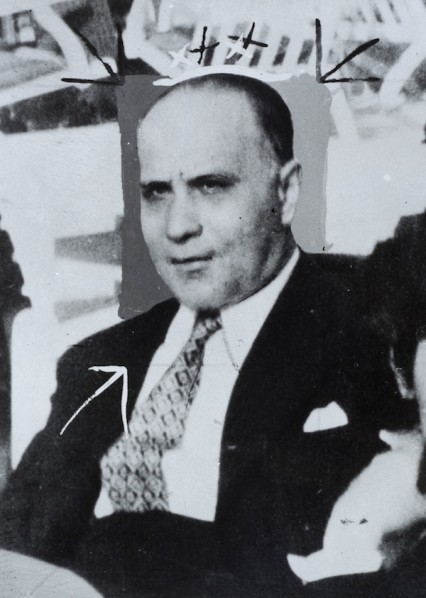
Stan ‘The Spiv’ Setty in 1949.

On March 8 2013 Camden Council permanently closed Warren Street to cars. The road had long been used, presumably for decades, as a rat-run for drivers hoping to avoid the congestion that would often build up at the junction between Tottenham Court Road and the Euston Road.

Closing a road to traffic in central London is hardly unusual these days but in this case there was a certain irony. For much of the 20th century Warren Street had been the centre of the used-car trade in London and was the oldest street car market anywhere in Britain.

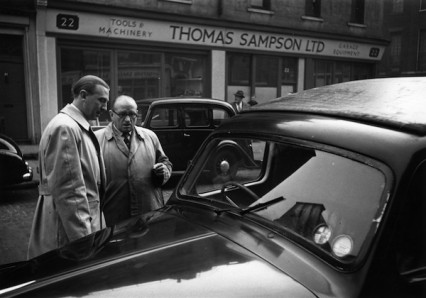
“It’s a nice little runner” – Two car dealers on Warren Street in November 1949.

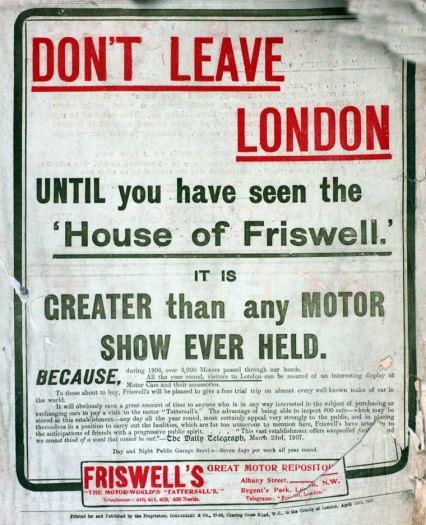
It all started in 1902 when Charles Friswell, an ex-racing cyclist and successful engineer,  astutely hopped on the running board of the new burgeoning car industry and opened Friswell’s Automobile Palace at 1 Albany Street on the corner of the Euston Road. It was a five-storey building that could accommodate hundreds of vehicles in garage and showroom spaces, with repair and paint shops, accessory sales and auction facilities. It was known as ‘The House of Friswell’ and ‘The Motor-World’s Tattersalls’ and was a huge success.

Friswell’s Great Motor Repository at Albany Street.

Friswell’s in Albany Street by the Euston Road.

Smaller car dealers started to open along the Euston Road but as the traffic got busier it became harder and harder to park cars outside their main showrooms. Many of the premises, however, had entrances or exits that opened up on the parallel Warren Street (the road was actually built in the 18th century as an access road for the newly built properties on Euston Road).

By the start of the First World War most of the car sales were actually now taking place in Warren Street. The main dealerships were soon joined by ‘small-fry’ or ‘pavement dealers’ – men who bought and sold cars of questionable provenance on street corners, cafes, milk-bars and pubs. Frankie Fraser described Warren Street in his book Mad Frank’s London:

They’d have cars in showrooms and parked on the pavement. There could be up to fifty cars and then again some people would just stand on the pavement and pass on the info that there was a car to sell. Warren Street was mostly for mug punters. Chaps wouldn’t buy one. People would come down from as far away as Scotland to buy a car. All polished and shiny with the clock turned back and the insides hanging out. And if you bought a car and it fell to bits who was you going to complain to?

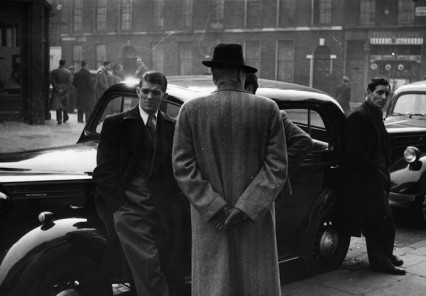
Car dealers on Warren Street in November 1949.

Warren Street March 2013. Photograph by Lucy King.

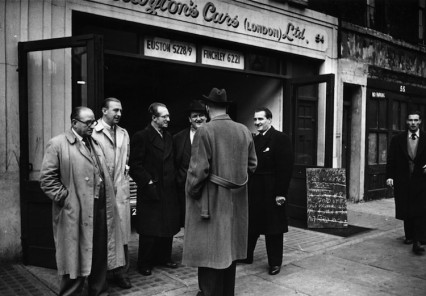
Dodgy car-dealer spivs outside 54 Warren Street in 1949.


54 Warren Street today. Photograph by Lucy King.

In December 1949 the magazine Picture Post published an article about the used-car market in Warren Street. They described the road as the northern-most boundary of Soho (Fitzrovia is actually a relatively recent construct and only really been used since the fifties) and explained that was the reason why, “ it attracts a fair amount of gutter garbage from the hinterland.” The reporters feigned shock at the numerous cash-deals that were going on;

Bundles of dirty notes were going across without counting…there is nothing illegal about a cash sale unless, of course, the Income Tax authorities can catch them – which they cannot – or thieves fall out and pick each other’s pockets – or unless, of course, someone gets killed.

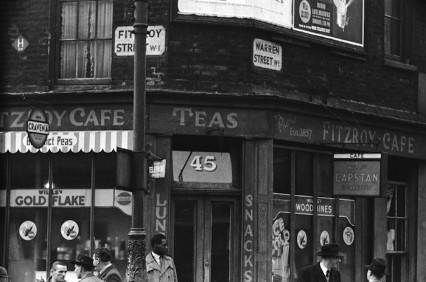
And someone did get killed. His name was Stanley Setty, a shady Warren Street car-dealer, with a lock-up round the corner in Cambridge Terrace Mews . He hadn’t been seen since 4 October when he had sold a Wolseley Twelve saloon to a man in Watford for which he received 200 five pound notes. The next day Setty’s brother-in-law called at Albany Street Police station to report him missing but it also didn’t take long before Setty’s fellow traders and black-marketeers noticed his absence from his usual patch outside the Fitzroy Cafe on the corner of Fitzroy Street and Warren Street.

Car dealers loiter outside the Fitzroy Cafe on the corner of Warren Street and Fitzroy Street in London, 19th November 1949. Stan Setty used the cafe as his personal office.

The former stamping ground of Stanley Setty on the corner of Fitzroy Street and Warren Street today. Photograph by Lucy King.

Stanley Setty’s Citroen parked outside his garage in Cambridge Terrace Mews just north of the Euston Road and west of Albany Street.

Stanley Setty had been born in Baghdad of Jewish parents and arrived in England at the age of four in 1908. Twenty years later he received an eighteen month prison sentence, after pleading guilty to twenty-three offences against the Debtors’ and Bankruptcy Acts. In 1949 he was still an undischarged bankrupt and thus unable to open a bank account. Despite this, or more likely because, Setty dealt in large amounts of cash and he was what was called a ‘kerbside banker’.

It was widely known that, on his person, he never carried anything less than a thousand pounds, and, if he was given a couple of hours notice, he could produce up to five times that amount. His real name was Sulman Seti but to many he was known as ‘Stan the Spiv’.

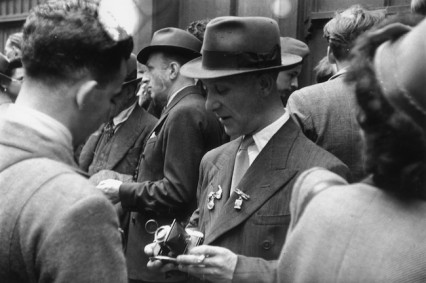
A spiv in 1945 with a Voigtlander camera for sale on the blackmarket in London. The brooches on his lapels are also for sale.

Spiv is a word that’s almost non-existent today and a couple of years ago there were more than a few blank faces when Vince Cable showed his age when describing the City’s much-maligned bankers as ’spivs and gamblers’. After the Second War, however, the word was almost ubiquitous. It was used to describe the smartly-dressed black-marketeers that in a time of controls and restrictions lived by their wits buying and selling ration coupons and sought after luxuries.

When the war had come to an end in the summer of 1945 it was estimated that there were over 20,000 deserters in the country and 10,000 in London alone. These deserters, all without proper identity cards or ration books, had only one choice to make (if they didn’t give themselves up and receive a certain prison sentence) and that was to be part of the huge and growing black market underground.

The word ‘spiv’ had been used by London’s criminal fraternity at least since the nineteenth century and meant a small time crook, con-man or fence rather than a full-time and dangerous villain. The exact origin is lost in the London smog of thieves’ cant, and is etymologically as obscure as the derivation of the goods the spivs were trying to sell. In The Cassell Dictionary of Slang, Jonathon Green suggests the word originally came from the Romany spiv, which meant a sparrow, used by gypsies as a derogatory reference to those who existed by picking up the leavings of their betters, criminal or legitimate.

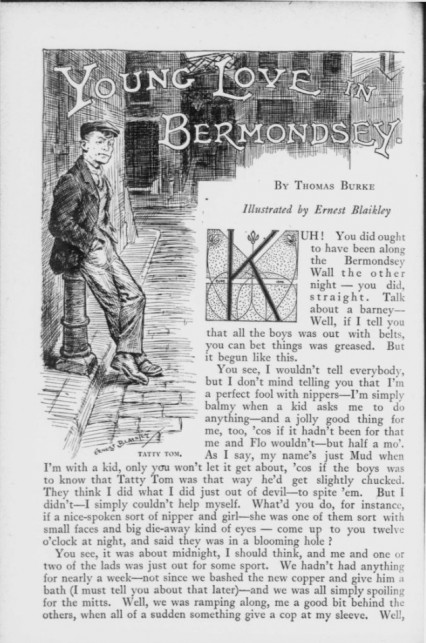
In 1909, the writer Thomas Burke, in a short story featured in the Idler magazine entitled ‘Young Love in Bermondsey’ mentions ‘Spiv’ Bagster, the ‘Westminster Blood’ who can ‘do things when his dander’s up’. Henry’ Spiv’ Bagster actually existed and was a newspaper seller and petty-thief. His many court appearances for selling counterfeit goods and illegal street-trading were occasionally mentioned in the national press between 1903 and 1906.

Thomas Burke wrote about characters from and around Bermondsey including Barney Grierson who was ‘always handy in a scrum’; Hunky Bottles, ‘captain of the Walworth Whangers’, Battlng Bert, Jumbo Flanagan, Greaser Doodles as well as ‘Spiv’ Bagster.

Another theory about the word ‘spiv’ is that it could well have come from the slang term ’spiff’ meaning a well-dressed man. This turned into ’spiffy’ meaning spruced-up and if you were ‘spiffed up’ you were dressed smartly.

Over time the two meanings of ‘spiv’ seemed to have mysteriously combined and in 1945 Bill Naughton, the playwright and author brought up in Bolton but best known for his London play and subsequent film – Alfie, used the word in the title of an article he wrote in September 1945. Written for the News Chronicle, just a few weeks after the end of World War Two, Meet the Spiv began:

 Londoners and other city dwellers will recognize him, so will many city magistrates – the slick, flashy, nimble-witted tough, talking sharp slang from the corner of the mouth. He is a sinister by-product of big-city civilisation.

James Agate in the Daily Express reviewing Naughton’s article described the spiv as:

That odd member of society… a London type. Which would be a Chicago gangster if he had the guts.

The word ’spiv’ caught the imagination of the public of all classes. People who would have normally described themselves as law-abiding, appreciated, albeit grudgingly, what the spivs had to offer. During the war many people would have felt that without the black market it was almost impossible to have any quality of life at all and the spivs offered an escape from the over-whelming and suffocating strictures of austerity, rationing and self-denial. The sympathetic acceptance of the men with the flashy suits with the wide lapels and narrow waists only increased when the war came to an end. The wartime restrictions were now just restrictions, and the diarist Anthony Heap summed up the mood of much the country at the end of 1945:

Housing, food, clothing, fuel, beer, tobacco – all the ordinary comforts of life that we’d taken for granted before the war and naturally expected to become more plentiful again when it ended, became instead more and more scarce and difficult to come by.

By 1946 the archetypal spiv character was more well known, the columnist Warwick Charlton in the Daily Express wrote in November of that year:

The spivs’ shoulders are better upholstered than they have ever been before. Their voices are more knowing, winks more cunning, rolls (of bank-notes) fatter, patent shoes more shiny. The spivs are the “bright boys” who live on their wits. They have only one law: Thou shalt not do an honest day’s work. They have never been known to break this law.

When war came they dodged the call-up; bribed sick men to attend their medicals; bought false identity cards, and, if they were eventually roped in, they deserted. War was their opportunity and they took it and waxed fat, sleek and rich. They organised the black market of war time Britain. Peace had them worried but only for a moment. Shortages are still with us, and the spivs are the peace-time profiteers.

Seventeen days after Stan ‘the Spiv’ Setty went missing, on the 21 October 1949, a farm labourer named Sidney Tiffin was out shooting ducks on the Dengie mud flats about fifteen miles from Southend when he came across a large package wrapped up in carpet felt. He opened it up with his knife to reveal a body still dressed in a silk cream shirt and pale blue silk shorts. The hands were tied behind the back but the head and legs had been hacked roughly away.

It was estimated that the truncated body had been immersed in the sea for over two weeks and without the head it was thought almost impossible to identify. But the celebrated, not least by himself, Superintendent Fred Cherrill of Scotland Yard’s fingerprint department managed to remove the wrinkled skin from Setty’s fingertips which he then stretched over his own fingers to produce some prints. Prints that turned out to be a match for those of Setty’s.

Within a few days the police found more evidence after they had instructed bookmakers around London to look out for the five pound notes they knew Setty had on his person the day he went missing. Five pounds was a lot of money in 1949 (worth over £150 today) and at that time any five pound note withdrawn from a bank would have had its number noted by the clerk along with the name of the withdrawer.

On the 26th October one of the Setty fivers was found at Romford Greyhound Stadium and on the next day five more were traced back to a dog track at Southend. The police were closing in and on 28 October a man was arrested and taken to Albany Street. Not long after a flat was searched at 620B Finchley Road near Golders Green tube station.

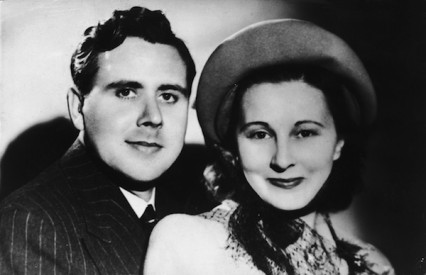
Brian Donald Hume with his wife Cynthia. At the time of his arrest in October 1949 they had a three month old son. She was a former night-club hostess and went on to marry the crime reporter Duncan Webb.

The man arrested was Brian Donald Hume who had originally met the physically imposing Stanley Setty two years previously at the Hollywood Club near Marble Arch. Hume had been impressed with Setty’s expensive-looking suit with the flamboyant tie and his general overall wealthy appearance: “He had a voice like broken bottles and pockets stuffed with cash,” Hume later recalled.

Setty realised that Hume could be useful for his illegal operations and they became ‘business’ partners dealing with classic ‘spiv’ goods such as black market nylons and forged petrol coupons but also trading in stolen cars which Hume stole for Setty to sell on after a quick re-spray. Hume was also useful as he had qualified for a civilian’s pilot’s licence after the war and had been getting a name for himself within London’s underworld as ’the Flying Smuggler’.

Hume was born illegitimately in 1919 to a schoolmistress who gave her son to a local orphanage to bring up. He was retrieved after a few years and brought up by a woman he knew as ‘Aunt Doodie’ but who actually turned out to be his natural mother. According to Hume she never properly accepted him as she did her other children and he would later comment: “I was born with a chip on my shoulder as big as an elephant.”

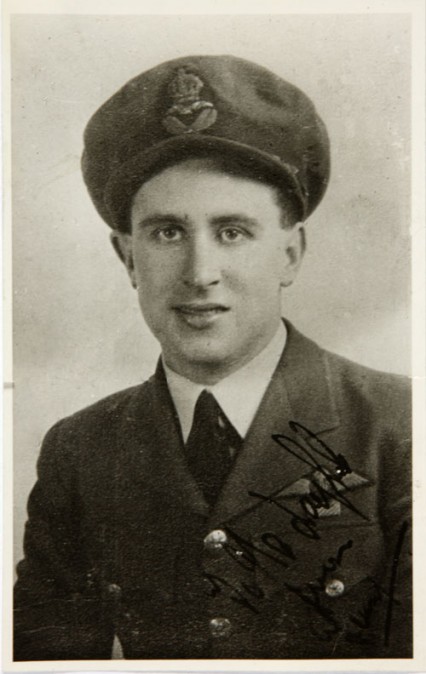
In 1939 he joined the Royal Air Force Volunteer Reserve as a pilot but left in 1940 after getting cerebrospinal meningitis. An RAF medical report at the time, however, described him as having ‘a degree of organically determined psychopathy’.

Hume as RAF Officer c.1943

During the war he bought an RAF officer’s uniform and used his knowledge to masquerade as Flying Officer Dan Hume, DFM. Hume passed off forged cheques at RAF stations around the country (“it was a great thrill to have everyone saluting a a bastard like me”) but he was soon caught and in 1942 he was bound over for two years.

On 1st October 1949, Setty and Hume’s thin veneer of friendship was stripped away during an argument at Hume’s Finchley Road flat. Setty had recently upset Hume by kicking out at his beloved pet terrier when it had brushed up against a freshly re-sprayed car and the confrontation soon became physical. Hume, not a person who particularly found it easy to control his temper, was now in a violent rage and reached over and grabbed a German SS dagger that was hanging on the wall as decoration. He later told a reporter:

I was wielding the dagger just like our savage ancestors wielded their weapons 20,000 years ago . . . We rolled over and over and my sweating hand plunged the weapon frenziedly and repeatedly into his chest and legs . . . I plunged the blade into his ribs. I know; I heard them crack.

Hume stabbed Setty five times after which he lay back and watched his victim’s last breaths. He wrote later: “I watched the life run from him like water down a drain”.

Hume dragged Setty’s hefty thirteen stone into the kitchen and hid the body in the coal cupboard. The next day, while his wife was out, he started to dismember the body with a linoleum knife and hacksaw, eventually wrapping the body parts in carpet felt adding some brick rubble for additional weight.  The following morning Hume arranged to have his front room redecorated, and had the carpet professionally cleaned and dyed to get rid of any stray blood stains. What upset him most was having to burn £900 worth of bloodstained five pound notes.

Later that day Hume took the carpet felt parcels to Elstree airport and hired an Auster light aircraft to dump Setty’s remains over the English Channel. It took several attempts, and broke the plane’s window in the process, before Hume was successful in getting the parcels to slide out of the small side-door. As it was now getting dark Hume decided to land at the closer Southend airport and had to hire a car home for which he paid, of course, with one of Setty’s left-over fivers.

The actual Auster light aircraft used by Brian Hume to dispose of Setty’s body.

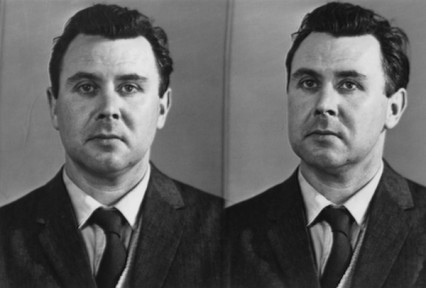
Brian Donald Hume, 1949.

A week after his arrest on 5t November Hume appeared at Bow Street Magistrates’ Court charged that he:

Did, between 4th and 5th October, 1949, murder Stanley Setty, aged 46 years. Against the Peace.

By now there was so much evidence collected by the police including fingerprints, identified torsos, blood-stains found in the flat of the accused, hire cars paid by the victim’s proven money and so on that anyone involved in the case thought that realistically there could only be one verdict.

The trial at the Old Bailey started on the 18 January 1950 and Hume’s defence was based around a story that he had originally contrived for the police. Essentially, it was that he had been paid £150 to dump some heavy parcels over the English Channel by three former associates of Setty called Max, Greenie and The Boy. Hume’s descriptions of the three men seemed so accurate and detailed that the story sounded credible to many in the courtroom.

The defence also called on Cyril Lee – a former army officer who lived within earshot of Setty’s lock-up for three years. He was no friend of Setty’s and admitted that he disliked the sort of men that had been habituating the garage at Cambridge Terrace Mews. He told the court that although that they weren’t ‘the sort of people I would like to see round my doorstep,’ he had heard two people that were called ‘Max’ and ‘The Boy’ and also acknowledged that he had seen a man who looked like Hume’s description of ‘Greenie’.

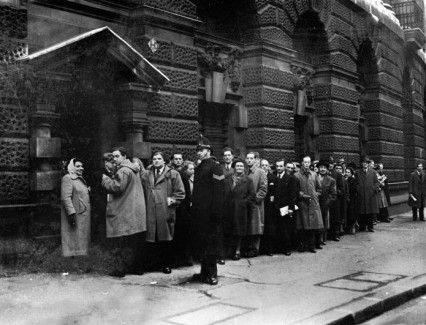
Queues for Brian Hume’s trial at the Old Bailey, 18th January 1950.

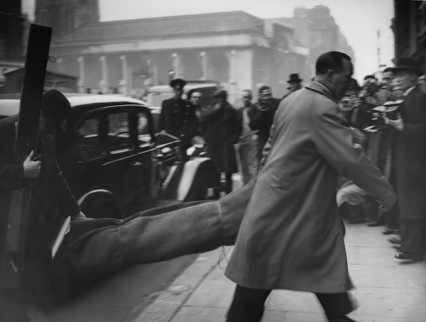
Police officers carry bloodstained carpet and floorboards from the home of Brian Hume into the Old Bailey at his trial, London, 18th January 1950. A week later, Hume was convicted as an accessory to the murder of his business associate Stanley Setty.

The Judge, Mr Justice Sellers, spoke to the jury about the inferences and assumptions they had to make but also told them that if there was any doubt about what had happened then they were compelled to return a verdict of not guilty.

The jury were ready in less than three hours to return their verdict and to most people’s surprise, it was that they had failed to agree on one. Hume was retried, and on the 26th January 1950, and after the judge had instructed the new jury to return a not-guilty verdict for the charge of murder, he was found guilty of being an accessory after the fact.  Hume was sentenced to just twelve years in prison but he didn’t hide from the courtroom that he had expected less.

Three years before the case of Setty’s murder caught the imagination of the British public in 1946, George Orwell wrote the essay ‘Decline of the English Murder’. What he thought of the Setty murder case we will never know as on the very same morning that Brian Hume was taken to begin his sentence at Dartmoor Prison, Orwell’s funeral was taking place at Christ Church on Albany Street. The church was situated just round the corner from Stanley Setty’s lock up in Cambridge Terrace Mews and on the very same road where Friswell’s grand Automobile Palace once stood and where Hume was originally taken in for questioning at Albany Street Police Station.

Brian Hume was released from Dartmoor Prison on 1st February 1958. It was almost certainly the only time in Hume’s life that his behaviour was described as ‘good’ but it was for this reason he was released four years early. Because of the law of double jeopardy Hume was secure in the knowledge that he could no longer be retried for murder and he brazenly sold his story to the now defunct Sunday Pictorial. The front page splash began:

I, Donald Hume, do hereby confess to the Sunday Pictorial that on the night of October 4, 1949, I murdered Stanley Setty in my flat in Finchley-road, London. I stabbed him to death while we were fighting.

For the benefit of the Sunday Pictorial newspaper Brian Hume was photographed celebrating his release from prison with champagne. It didn’t go down well with the public.

Hume admitted in the article that he had murdered Setty alone and Max, Greenie and The Boy was just figments of his imagination. The astonishing detailed accuracy of the descriptions of the trio that had successfully fooled some of the jury were actually based on the three policemen who had originally interviewed him.

In May 1958 Hume, complete with a false passport and what was left of the money he had received from the Sunday Pictorial, fled to Zurich in Switzerland. To raise more money he started committing bank robberies back in England that were cleverly synchronised with flights at Heathrow enabling him to flee the country before the police had even started their enquiries. Eventually Hume’s luck ran out when he shot and killed a taxi driver after another attempted bank robbery. This time it was in  Zurich and Hume was ignominiously captured by a pastry chef before being rescued by the police from a gathering angry crowd.

Hume was at last found guilty for murder and he received a life sentence with hard-labour. In 1976 he was was judged to be mentally unstable by the Swiss authorities and this gave them the excuse to fly Hume back to England where he was incarcerated at Broadmoor Hospital. Hume was eventually released in 1998 but it was just a few months later when his decomposing body was found in a wood in Gloucestershire. The body was identified as Hume’s by it’s fingerprints.

Not unlike the Manson Family killings in 1969 that seemed to bring an end to the peace-loving hippy era and the summer of love, the shocking Stanley Setty murder changed the public perception of the typical Spiv as a loveable rogue forever. There was always something slightly comical about the Spiv and indeed the exaggerated clothes and manners lent themselves to caricature. The spiv-like comedy characters continued to be part of British popular culture for the next couple of decades or so – notably Arthur English’s Prince of the Wide Boys, George Cole’s ‘Flash Harry’ in the St Trinian films, and Private Walker in the early Dad’s Army episodes.

London, 1950. British actor and comedian Arthur English dressed as the spiv known as ‘Prince of the Wide-Boys’.

But it was rationing that gave spivs a major reason to exist and during the General Election of 1950 the Conservative Party actively campaigned on a manifesto of ending rationing as quickly as possible. The issuing of petrol coupons ended in May 1951 while sugar rationing finished two years later and finally in 1954 when the public were allowed to buy meat wherever and whenever they wanted, it brought an end to rationing completely.

By the time Brian Hume was released from prison in 1956, the era of the Spiv had essentially come to an end.

 Baby Wren Films

Share

18 Apr 18:37

Two super-Earths found in habitable zone orbits around Kepler-62

by Tobias Buckell

Dude!

“Scanning the heavens, you might very well miss the star Kepler-62. It’s a rather typical star, slightly smaller, cooler, and more orange than the Sun, much like tens of billions of other stars in our galaxy. But it holds a surprise: It’s orbited by at least five planets… and two of them are Earth-sized and orbit the star in its habitable zone!

The two planets, called Kepler-62e and Kepler-62f, are both bigger than Earth, but not by much; they are 1.6 and 1.4 times the Earth’s diameter, respectively. Kepler-62e orbits the star every 122 days, while Kepler-62f, farther out, takes about 267 days.”

(Via Earth-sized planets: Two super-Earths found orbiting the same star..)

18 Apr 18:07

We are all bourgeois now.

by septicisle
As unhappy coincidences go, today's announced rise in unemployment seems as fitting a tribute to Maggie as anything else.  We all Thatcherites now, says David Cameron, and while you can't level the accusation against him that he believes unemployment an acceptable price to pay for his overall reforms, especially considering no government since has believed in full employment, his government is going way beyond Thatcher's obstinacy on economics.  She after all did relent to an extent when monetarism sent the economy into free fall; Cameron and Osborne seem likely to ignore the advice of the highest priests of neoliberalism, the IMF, to scale back on austerity, such is the way they've made it impossible to do so without humiliating themselves.

Just as I didn't watch the royal wedding (and why on earth would anyone, for that matter?), I somehow managed to avoid the funeral.  Quite why so many find something to admire in our ability to put on pageantry when required equally escapes me; authoritarian nations also tend to be pretty good at putting on a show, and yet with the exception of the opening ceremony at the Beijing Olympics, we usually make fun of them precisely on that basis.  Just as the only reasonable reaction to goose-stepping soldiers is to laugh at them, so the pomp and circumstance that surrounds the monarchy and also now the chosen few regarded as being the equivalent of royalty ought to be mocked.  It is utterly ridiculous, almost everyone except for the dewy-eyed few know it to be ridiculous, and so undoubtedly this ridiculous tradition will continue to be rolled out for every major state event, such are our ways.

If nothing else, today has at least been revealing of how politicians regard each other in private.  Both Tony Blair and Gordon Brown were first elected to parliament in 1983 on "the longest suicide note in history" manifesto, but neither it seems had any objection to Thatcher being given a quasi-state funeral.  Indeed, it seems the only major thing the Tories added to the plans drawn up under the last government was the military aspect.  They might not have known that the right would take the opportunity of her death to attempt to portray her as second only to Churchill in the great national figure stakes, yet if they've had any such concerns since they certainly weren't on display today.  Nor has the week of hype and eulogising left the Mail drained; if anything, it's reached such a peak that you doubt they'll be able to top it when Liz pops her clogs.  "A journey's end", the front page read, while below they claim up to 250,000 were lining the route of the procession (since changed to a more realistic 50,000).  Just as you have to multiple the figures given by the police for any demonstration other than one by the Countryside Alliance by the power of 4, so it now seems you have to divide the numbers given by the Mail by the same amount.

Nor was the ceremony itself beyond critique.  Today wasn't the time and place to discuss her politics, said the Bishop of London, Richard Chatres, who then decided at the end that it actually was as he defended her over the infamous "no such thing as society" comments.  She did believe in society, and the interdependence of people, he said, which is almost certainly true; what went unsaid was that however you read her remarks, she clearly said people shouldn't even expect to be housed by the state. I don't think anyone disputes that first and foremost our responsibility is to look after ourselves; it's that a majority of us still believe that the state should provide an adequate safety net, whether that be in housing or benefits. Society is not the state, as the Tories said at the last election, but Thatcher's government did more to fray the threads that tie communities together and make up society than any since the war.

The real irony of today is that for all their tributes to her, not to forget George Osborne's solitary tear, Cameron spent his first years as Conservative leader trying to repair the damage her overthrow did to the party. Arguable as his overall success has been, the last week has been a reminder to everyone that her legacy is still inescapable.  To suggest this is unlikely to go down well in those places that the Tories need to win to get a majority next time out is to put it too lightly.  The overwhelming mood might be apathy rather than anger, such as that in Leeds and Edinburgh rather than Goldthorpe, yet you shouldn't bet against Labour using a few of the images of the past week come in 2015, hypocritical in the extreme or not.

This said, Cameron was right in saying we are all Thatcherites now.  At least he was if he was meant the political class, as they clearly are all Thatcherite in one sense or another.  A significant number of the population by contrast remain in favour of an alternative, it's just they aren't so much as offered one. Nor are they likely to be. And eventually, something is going to break.
18 Apr 17:25

None of the world’s biggest bussiness would be profitable with externalities priced in

by Tobias Buckell

Wow:

“The notion of ‘externalities’ has become familiar in environmental circles. It refers to costs imposed by businesses that are not paid for by those businesses. For instance, industrial processes can put pollutants in the air that increase public health costs, but the public, not the polluting businesses, picks up the tab. In this way, businesses privatize profits and publicize costs.

While the notion is incredibly useful, especially in folding ecological concerns into economics, I’ve always had my reservations about it. Environmentalists these days love speaking in the language of economics — it makes them sound Serious — but I worry that wrapping this notion in a bloodless technical term tends to have a narcotizing effect. It brings to mind incrementalism: boost a few taxes here, tighten a regulation there, and the industrial juggernaut can keep right on chugging. However, if we take the idea seriously, not just as an accounting phenomenon but as a deep description of current human practices, its implications are positively revolutionary.”

(Via None of the world’s top industries would be profitable if they paid for the natural capital they use | Grist.)

18 Apr 17:09

Killing the Sacred Cows of Publishing: Writing Fast

by dwsmith

Years ago I did this series called Killing the Sacred Cows of Publishing. I stopped doing this because I hoped for a time that indie publishing would murder a few of the myths on its own, but sadly, it hasn’t. In fact, indie publishing created some new ones to go along with the old ones.

Since I am going to blog about a ghost novel I’m writing here, I figured why not bring this forward to make sure everyone is on the same page as I go into this writing week. And maybe after I get the book done I’ll start back updating and bringing forward all these and get them into a book.

But for now, how am I going to write this ghost novel in seven to ten days? Spend more time in the chair.

If you don’t understand that, read this article.

—-

Speed of writing…

Or said in myth fashion: WRITING SLOW EQUALS WRITING WELL.

Or the flip side: WRITING FAST EQUALS WRITING POORLY.

This comes out of everyone’s mouth at one point or another in a form of apology for our work. “Oh, I just cranked that off.”

Or the flip side… “This is some of my best work. I’ve been writing it for over a year.”

Now this silly idea that the writing process has anything at all to do with quality of the work has been around in publishing for just over 100 years now, pushed mostly by the literature side and the college professors.

It has no basis in any real fact when it comes to writers. None. If you don’t believe me, start researching how fast some of the classics of literature were written.

But don’t ask major professional writers out in public. Remember we know this myth and lie about how really hard we do work. (Yup, that’s right, someone who makes stuff up for a living will lie to you. Go figure.) So you have to get a long-term professional writer in a private setting. Then maybe with a few drinks under his belt the pro will tell you the truth about any project.

My position:

NO WRITER IS THE SAME. NO PROJECT IS THE SAME.

And put simply:

THE QUALITY OF THE FINAL PRODUCT HAS NO RELATIONSHIP TO THE SPEED, METHOD, OR FEELING OF THE WRITER WHILE WRITING.

That’s right, one day I could write some pages feeling sick, almost too tired to care, where every word is a pain, and the next day I write a few more pages feeling good and the words flowing freely and a week later I won’t be able to tell which day was which from the writing.

How I feel when I write makes no difference to the quality of what I produce. None. Damn it, it should, but it just doesn’t.

And I just laugh when a myth like this one attempts to lump all writers into the same boat and make us all write exactly the same way book after book after book.

No writer works the same, even from book to book or short story to short story.

Talk to any writer, and I mean privately, getting them to tell you the truth, not the public line, and you will discover that one of the writer’s books was written quickly, maybe even in a few weeks, while another book took the writer a half year to finish and he was deathly ill during half the writing time. And you, as a reader, reading the two books, would never be able to tell the difference.

But yet, traditional publishing, college professors, and just about anyone who even thinks about the writer behind the words has a belief system that words must be struggled over to be good.

Well, yes, sometimes.

And sometimes not.

Sometimes a writer gets into a white-hot heat and a book flows faster than the writer can type, getting done in just a number of days or weeks. And sometimes it just doesn’t work that way.

Sometimes a writer has a deadline to hit and pushes to hit it, spending more hours in the chair, thus calling it writing fast. Some writers think and research a book for a few months, then write it in a few weeks. Some writers spend a month or two on a detailed outline, then take a month to actually write the book. Some writers start with a title, some write chapters out of order and then put it all together like a puzzle.

And on and on and on.

Every writer is different. Every writer’s method is different

There is no correct, mandated way to write a book. Juts your way.

The myth of writing slow to write better actually hurts writers.

There are two sides of our brains. The creative side and the critical side.

The creative side has been taking in stories since the writer started reading, knowing how to put words together at a deep level. The critical side lags far, far behind the creative side, learning rules that some English teacher or parent forced into the critical mind.

The creative side is always a much better writer than the critical side. Always. It never switches, no matter how long you write.

Long term (20 years and up) professional writers have learned to trust that creative side and we tend to not mess much with what it creates for us. Of course, this lesson for most of us was learned the hard way, but that’s another long chapter for another book.

A new writer who believes the myth that all good fiction must be written slowly and labor-intensive (called work) suddenly one day finds that they have written a thousand words in 35 minutes. The new writer automatically thinks, “Oh, my, that has to be crap. I had better rewrite it.”

What has just happened is that the top writing the creative side of the mind has just produced is then killed by the critical side, dumbed down, voice taken out, anything good and interesting removed.

All caused by this myth.

And professional editors in New York are no better, sadly. I once got a rewrite request on a major book from my editor. I agreed with about 9/10′s of the suggestions, so I spent the next day rewriting the book, fixing the problems, and was about to send the manuscript back when Kris stopped me.

The conversation went something like this:

“Don’t send it, sit on it a few weeks,” Kris said, looking firm and intense, as only Kris can look.

“Why not?” I asked, not remembering at that moment that the myth was a major part of traditional publishing.

“The editor will think you didn’t work on it and that it is crap,” Kris said.

“But I agreed and fixed everything,” I said, starting to catch a clue, but not yet willing to admit defeat.

Kris just gave me that “stare” and I wilted, knowing she was completely correct.

I held the rewrite for three weeks, sent it back with a letter praising the rewrite comments and a slight side comment about how hard I had worked on them, even though I wrote most of another book in the period of time I was holding the rewrite. Story ended happily, editor was happy and commented on how fast I managed to get the rewrites done, all because Kris remembered the myth and how it functions.

Now, let me do something that just annoys people, especially in the master classes we teach. I’m going to do the math. (Stop laughing, former students.)

The Math of Writing Fast

This chapter when finished is going to be around 2,000 words. That is about 8 manuscript pages with each page averaging 250 words per page.

So say I wrote only 250 words, one manuscript page per day on a new novel.

It takes me about 15 minutes, give-or-take (depending on the book and the day and how I’m feeling) to write 250 words of fiction. (Each writer is different. Time yourself.)

So if I spent that 15 minutes per day writing on a novel, every day for one year, I would finish a 90,000 word plus novel, about a normal paperback book, in 365 days.

I would be a one-book-per-year writer, pretty standard in science fiction and a few other genres.

15 minutes per day equals one novel per year.

Oh, my, if I worked really, really hard and managed to get 30 minutes of writing in per day, I could finish two novels in a year.

And at that speed I would be considered fast. Not that I typed or wrote fast, just that I spent more time writing.

God forbid I actually write four pages a day, spend an entire hour per day sitting in a chair!!!!  I would finish four novels a year. At that point I would be praised in the romance genre and called a hack in other genres.

See why I laugh to myself when some writer tells me they have been working really, really hard on a book and it took them a year to write? What did they do for 23 hours and 45 minutes every day????

The problem is they are lost in the myth. Deep into the myth that writing must be work, that it must be hard, that you must “suffer for your art” and write slowly.

Bull-puckey. Writing is fun, easy, and enjoyable. If you want hard work, go dig a ditch for a water pipe on a golf course in a steady rain on a cold day. That’s work. Sitting at a computer and making stuff up just isn’t work. It’s a dream job.

Spend More Time in the Chair

Oh, oh, I just gave you the secret to being a “fast” writer or a “prolific” writer. Just spend more time writing.

I am the world’s worst typist. I use four fingers, up from two, and if I can manage 250 words in fifteen minutes I’m pretty happy. I tend to average around 750-1,000 words per hour of work. Then I take a break. I am not a “fast” typist, but I am considered a “fast” writer because I spend more time writing than the myth allows.

That’s the second thing that makes this myth so damaging to writers. It doesn’t allow writers to just spend more time practicing their art. In fact, the myth tells writers that if they do spend more time working to get better, they are worse because they produce more fiction.

Writing is the only art where spending less time practicing is considered a good thing.

In music we admire musicians who practice ten or more hours a day. Painters and other forms of art are the same. Only in writing does the myth of not practicing to get better come roaring in. We teach new writers to slow down, to not work to get better, to spend fewer and fewer hours at writing, to not practice, and then wonder why so many writers don’t make it to a professional level.

We No Longer Have to Wait for Traditional Publishers

For the last few decades, unless a writer wrote under many pen names, we were forced by the market to write fewer books per year. But now, with indie publishing, we can once again write as much as we want.

And we can write anything we want.

We can sell some books to traditional publishers, we can indie publish other books and stories.

The new world has lifted the market restrictions on speed of writing. Now those of us who actually want to sit and write for more than 15 minutes per day can publish what we write in one way or another.

And being fast, meaning spending more time writing, is a huge plus with indie publishing. We are in a new golden age of fiction, especially short fiction, and just as in the first golden age, writing fast (meaning spending more time at your art) will be a good thing also for your pocket book.

Writing Slow Equals Writing Better is a complete myth, a nasty sacred cow of publishing that hurts and stops writers who believe it.

— The truth is that no two writers work the same and no book is the same as the previous book or the next book.

— The truth is that writing fast is nothing more than spending more time every day writing.

— The truth is that there should be no rule about speed relating to quality.

— The truth is there should be no rule that lumps all writers into one big class. There should only be your way of writing.

Be Careful!!

Sadly, this myth is firm in the business, so writers who spend more time in the chair and who write more hours have to learn to work around the myth. We must learn to play the game that teachers, editors, book reviewers, and fans want us to play.

And if you decide you can spend more hours every day writing and working on your art, be prepared to face those who want you to write the way they do. Be prepared to face those who want to control your work. Be prepared to face criticism from failed writers (reviewers) who can’t even manage a page a day, let alone more.

This speed myth is the worst myth of an entire book full of myths. Caution.

The best thing you can do is just keep your speed and your writing methods to yourself. You’re an artist. Respect your way of doing things and just don’t mention them to anyone.

So please don’t do the math about my age. I sold my first novel when I was 38 and have published over 100 novels. At one book per year, I must be at least 138 years old.

After my hard, single-page-of-writing every day, I sometimes feel that way.

Yeah, right.

But I stand by that story.

————————————————

Copyright © 2013 Dean Wesley Smith
————————————————–
Because of the new world and technology, my magic bakery got a lot more valuable lately. This is now part of my inventory in my bakery. I’m giving you this small slice as a sample. I’m giving you a taste, but not selling any of the pie.

If you feel this helped you in any way, toss a tip into the tip jar on the way out of the Magic Bakery.

And I would like to thank all the fine folks who have donated. Once this book is done, I will send you a copy. The donations and the comments both after the posts and privately really kept me going on this. Thanks!

If you can’t afford to donate, please feel free to pass this chapter along to others who might get some help from it.

Thanks, Dean

18 Apr 15:08

Do Not Let Your Happiness Depend On Something You Have Quoted Out of Context

by Andrew Rilstone


What the internet says C.S Lewis said

"Do not let your happiness depend on something you may lose."
C.S Lewis

"Do not let your happiness depend on something you may lose. If love is to be a blessing, not a misery, it must be for the only Beloved who will never pass away."
C.S Lewis


What C.S Lewis actually said.

In words which can still bring tears to the eyes, St. Augustine describes the desolation into which the death of his friend Nebridius plunged him. Then he draws a moral. This is what comes, he says, of giving one’s heart to anything but God. All human beings pass away. Do not let your happiness depend on something you may lose. If love is to be a blessing, not a misery, it must be for the only Beloved who will never pass away.

Of course this is excellent sense. Do not put your goods in a leaky vessel. Don't spend too much on a house you may be turned out of. And there is no man alive who responds more naturally than I to such canny maxims. I am a safety-first creature. Of all arguments against love, none makes so strong an appeal to my nature as "Careful! This might lead you to suffering."

To my nature, my temperament, yes. Not to my conscience. When I respond to this appeal, I seem to myself to be a thousand miles away from Christ. If I am sure of anything I am sure that His teaching was never meant to confirm my congenital preference for safe investments and limited liabilities. I doubt whether there is anything in me that pleases Him less. And who could conceivably begin to love God on such a prudential ground -- because, so to speak, the security is better? Who could even include it among the grounds for loving? Would you choose a wife or a friend -- if it comes to it, would you choose a dog -- in that spirit? One must be outside the world of love, of all loves,  before one calculates. Eros, lawless Eros, preferring the Beloved to happiness, is more like Love Himself than this.

I think that this passage in the Confessions is less a part of St Augustine's Christianity than a hangover from the high-minded Pagan philosophies in which he grew up. It is closer to Stoic "apathy" or neo-Platonic mysticism than to Charity. We follow One who wept over Jerusalem and at the grave of Lazarus, and who, loving all, yet had one disciple whom, in a special sense, he "loved". St Paul has a higher authority with us than St Augustine -- St Paul who shows no sign that he would not have suffered like a man, and no feeling that ought not so to have suffered, if Epaphroditus had died. 

The Four Loves (p110 - 112)


Please consider buying my book about Lewis and Tolkien
http://www.andrewrilstone.com/p/buy-my-stuff.html


18 Apr 07:16

Against Nature Not Too Bad, Claims Bloke

by Lawrence Burton


Well, I'm hugely gratificated and enhumbled to have received the first full review of Against Nature by someone who actually shelled out for a copy. James Douglas Burton - to whom I should probably stress I am not knowingly related - posted this on the Gallifrey Base bulletin board on Wednesday 17th April. Whilst I have a few minor quibbles here and there, I have to say he really seems to get what the book is about, and I'm greatly pleased to learn that for the most part it reads as I hoped it would read.

Without further ado, here's what he wrote:
 
All right, I finally just finished reading Against Nature this morning. Took me a week to read - mostly because I have been working an awful lot and been extremely exhausted. And when a book is as complex as this one, reading when your brain is at the refusing to take in what is on the page stage of consciousness, you definitely have to just put the book down.

But I finally had the time to complete the novel, and what an excellent book it is. I am going to attempt to present some of my thoughts in a very random order here, so bear with me. It also may be less thorough than many of my book ramblings, because as sophisticated and complex as the book is, we end up in such a different place from where we started, with so much having gone on inbetween, that I find my initial thoughts gone by now. I will try to retrieve one or two of them.

I guess I'd better preface this by stating what ought to be obvious: the following is, of course, my opinion. Not just my opinion, but a specific description of the way I personally reacted to the text. My experience of it is likely to be different than the next person's - and I certainly don't want to suggest that it is reflective of the author's intent. Anything I take away from it is just that: what I take away from it.

Keeping that in mind, much of what I write here is likely to be nonsense. So be it.

Speaking of personal reactions, and of nonsense, I should state that my knowledge of Central American culture and history is so limited (to basically nothing) that I cannot tell how much of what Lawrence Burton writes makes sense and how much doesn't. (I refer specifically to the twists and turns of the mythology and culture as it applies to the events of this story, by the way - not to his prose in general!) I approach it all (including all of the long Nahuatl words) the same way I approach the Homeworld-related stuff - as a bunch of things I cannot possibly understand, so just roll with it.

Hopefully my approach is close to that which is expected by the book and its author - taking the wrong angle at this material is likely to end up with your experience of it being quite wrong. So I hope mine isn't too far off course.

Basically, whether I am reading the passages about the gods and history of the native Central Americans, or the technobabble of House Meddhoran, I read through it and try to take in the gist of what is going on, hoping I have gleaned enough for it all to make sense, and don't bother trying to fully understand every little piece of what is being presented.

If anyone here ever watched the TV series Alias from a few years back, the writers there had an interesting approach. They would begin by hitting the viewer over the head with fragments of backstory presented in a way that was impenetrable, then rattling off complicated explanations of who was on what side, in relation to whom, and the plot would usually unfold quickly with much back-and-forthing on motives and loyalties. Basically, the creators of the program presented the viewers up front with things they couldn't possibly understand completely - and in doing so were attempting to reassure the viewer that they were not going to fully comprehend the details and that we should just go with it.

In that context, it was possible for the approach to have the unfortunate effect of switching off one's brain and simply enjoying the ride. That wasn't quite what was intended, but I think it was the way most viewers would experience the show.

Here, obviously, that isn't even close to what ought to be experienced. But some of the same mindset had to be taken by me. Rather than try to parse every sentence, grasp the significance of every Nahuatl word, or Homeworld jargon, I try to grasp the implication of what is occurring, to get a sense of the situation and the motives of those involved, and accept that some things I simply will not understand. In the land of Faction Paradox it is usual, after all, to be unable to grasp the entire situation.

I'm also reminded here of a failed attempt at the same kind of thing. K.W. Jeter's novel Noir (set in a strange cyberpunk future that doesn't make much sense at all) opens with a chapter that deliberately throws every piece of nonsensical terminology native to this future world at the reader. It is deliberately unreadable, designed to throw the reader in at the deep end and say this is the world you're going to be in, folks - deal with it. There (partly due to the world's unrealistic nature, partly due to the author's lack of skill) it was merely off-putting and failed to have any positive effect.

Lawrence Burton is, of course, much more capable than Jeter. Rather than throwing these things out there as a challenge, or a warning, or a test, or whatever purpose such a technique may be designed for, Burton merely presents the world in which his characters live. No thought is given to the uneducated reader - but neither are terms and references tossed at us in order to specifically affect us one way or the other. Whether the character is from modern day America, seventeenth century Mexico, or the Homeworld of the Great Houses, the text is presented as one natural to the lead character of that segment. Terms that the protagonist would be familiar with are presented matter-of-factly, whether the alien reader will understand it or not.

This approach helps to give the feeling of a real world - not one created for our consumption, but one which exists with all its complexity, regardless of our reaction to it or conception of it. As much as I may be confused by it at times (and I use the term loosely - my favorite filmmaker is David Lynch and I enjoy the way one can fully experience something without necessarily understanding it) the novel always feels genuine and sincere and solid. Three-dimensional. Four-dimensional. Real people, in a real world.

Now, that's not necessarily to say that the book is centered on real people and how the events affect them. Burton has clearly put some work into making these into fully-developed people - but the complexity and fluidity (and mythicality) of the story take the focus away from how would these people react to this situation and more on the unfolding of the legend and the greater themes, and what happens to the world. Many novels focus their stories on the inner progress of their characters; some see the characters as simple game pieces to move about on their board to create the plot. (Both of these can be equally valid ways of storytelling). Against Nature is neither of these, and is more about the unfolding of a myth and the recreation of the characters' realities. Unfortunately, I'm not very good at explaining what I mean, so you will have to read the book itself to get a sense of the approach it takes.

Because of the mythical tack the book takes, I'm not sure a plot is something I can say it has. But allow me to briefly describe the premise of the novel:

Structurally, each chapter is split into five, describing five points of a quincunx. East, North, West, South, and Center. Each segment focuses on a different protagonist - though their lives overlap significantly and they will appear in each other's segments as the story unfolds. East focuses on Primo - a Mexican youth who is beset by a mysterious ailment. North is about Todd, a man whose recent history begins to unravel. West we see House Meddhoran and its Kithriarch - Emiousha - as they encounter the nebulous Netherweald in which they are stranded. South is for Momacani in ancient Mexico as he moves toward what will be a very important ceremony for everyone. And in the center of everything is Goralschai from the Homeworld, whose motives are impossible to comprehend.

The whole tale is rooted in Central American culture. It shapes the Homeworld segments as much as it does the Earth-bound ones. Mictlan, the underworld, becomes the most important location in the universe as the story progresses, being entwined with the paths and fates of all parties.

Anyone who has read Lawrence Burton's work before knows that he is a ridiculously good author. This novel shows that particularly well. The amount of work that went into this is plain to see, and the talent that causes it to come into being is immense.

That's not to say that I have no issues with it. I don't believe I have ever read a book that I had no problems with. Against Nature can at times be vague. It is deliberate, of course, but can be off-putting. Never more so than at the climax of the book - which I didn't even realize was the climax until after the fact. As I say, it is intentional (Whatever had happened back there had apparently been for the best, but no one seemed clear about what that might have been, the book says of this event) but can be frustrating - for me at least.

And we all have out little bugbears, right? This author's fellow Lawrence (Faction-creator Lawrence Miles) has a tendency to present things that he thinks are profound statements about life and the universe, but which are often inane. But I am able to ignore the things that bug me about an author's work (again: nothing and no one is perfect). With Lawrence Burton, I have discussed before how the way his extreme dislike of the current direction of Doctor Who gets into so much of what he writes gets a bit wearisome for me. His Señor 105 novella (The Grail - a very good story indeed) devoted a large part of its plot to being an allegory of the way he feels modern Doctor Who has been ruined, and of its fans' attitudes.

He hasn't done much of that lately (I mean, he still hates modern Who but it doesn't usually pervade his writings either here, on facebook, or wherever) but I admit that when I read this comment (about a tapestry from the Homeworld) I groaned a little:

It told of some minor President, a record of his later years, a narrative that had turned garish and vulgar; of interest only to an addlepate.

As I said, though, this is just a little bugbear of my own, and not a black mark against the novel, or its author.

While I am commenting on little details, I wish I had made more highlights on the text to discuss now. There are a lot of lovely little touches in the text, but one humorous aside tickled me particularly. One character has just been tested by having another character attack him unexpectedly - the attacker loses an arm in the process of this little test.
Had someone simply thought to ask have you or have you not recently found yourself tainted by sacred forces? he might simply have answered yes and Chitilma would still be blessed with a plurality of arms.

One of my favorite quotes of the book, that...

There is an awful lot of attention to detail in this book. The author's knowledge of Central American history and culture is obviously great, and I imagine the specific research for this story must have been immense, but his realization of the people from the Homeworld and their technology and society is wonderful as well. I am actually a little surprised at how much of Marc Platt's House structure Burton was able to use (looms, Drudges, Kithriarch - the word cousin is not used in the House, since in this universe the term is too tied to Faction Paradox) but there is a lot of the West segment that has been fleshed out by Burton himself. I don't pretend to understand the technology, or the way the Netherweald works (even after later revelations as to its nature) but it all feels very much of a piece. The actual denizens of House Meddhoran are not fully realistic individuals, but there are reasons for this. Besides being Homeworlders (and largely unknowable therefore) they are newly-loomed childrene, and deliberately unique ones at that. Some of them are more individual than others, and the way the House works (or doesn't) is fascinating to me.

Goralschai, the center-piece of the novel, as it were, is a less interesting character than the others. His motivations are unclear (deliberately) and even his specific intent is something I am incapable of understanding (and hopefully everyone else is as well - I wouldn't like to think I am just being stupid here). Worst of all (for me) is the finale (in which he and the other characters are, of course, involved) which comes and goes without the reader (or, at least, this reader) realizing that it even was a finale.

The resolution is disappointing (to me) but not crushingly so. It fits in with the mythological approach of the novel, and works exactly as I am sure it was meant to. (Commentary on the event afterwards makes it appear that the characters feel the same way about it that I do.) I refuse to spoil the events of the novel by explaining what about it seemed unsatisfactory to me, but would be interested in seeing if others experience this in the same way that I did, or if their way of seeing it is dramatically different.

You may or may not have noticed that I have mentioned no specifically Faction Paradox-related characters or events yet. In fact, there is one such in the book, who has a distinct hand in events. Called variously Yaotl or Lorraine Conti she is (or was) an agent of Faction Paradox who takes a specific interest in events and ends up really stirring things up. She is, I suppose, the only real outsider to this tale - and while not one of the primary forces in the book, her actions are central to several of the story strands.

But the whole story is very "Paradoxical" - even without the Conti character this book would sit right at home among the Faction Paradox works. One of my favorites of the series (This Town Will Never Let Us Go) doesn't even have any real members of the Faction either. It is the themes of the book, the way they weave together, as well as the complex way they are told, that make this a very Faction novel.

As I seem to have waffled on for ages without actually saying anything (I look at the clock ticking away in the corner of my screen and wonder where the morning went to) let me briefly mention some nice little allusions in the book that tickled my fancy.

I mentioned already an oblique reference to Burton's dislike for modern Doctor Who. I may groan at the intrusion of the sentiment into this novel, but it is amusingly and slickly done. And frankly, all of the Lungbarrovian allusions in House Meddhoran make me smile.

In one character's dream-vision early on, he sees a masked wrestler speaking to a young boy selling chiclé - an obvious reference to Señor 105 and Rodrigo.

There is a face-painted Aztec priest called Tlohtoxcatl, and one reference to an exile named Yauhtloc. Are these more accurate renditions of characters from the Doctor Who serial The Aztecs?

I'm sure there are lots more references to other things that I either missed or forgot, but those are some that amused me personally.

Obverse Books has produced an awful lot of wonderful stuff. For my money, Against Nature is the best so far; the bar has been raised, and I hope someone sees this as a challenge and is ready to step up to the plate. To mix my sports metaphor even further: this one's a knockout.

Thanks to James for taking the time and effort to set down his thoughts, and for conceding to my reproducing them here, and also to Cody for the strangely philosophical illustration...

Against Nature is available from Obverse Books in print form here or as an eBook here, just in case I didn't already mention that five billion times.
18 Apr 07:12

Day 4486: DOCTOR WHO: Ice Hot

by Millennium Dome
Saturday:

At last Mark Gatiss delivers on years of promise, turning in his best Doctor Who story since the glorious early New Adventure “Nightshade”. Perhaps not quite as rich in character as the ripe and fruity Dickens of “The Unquiet Dead”, but without the unfortunate accidental “bogus asylum seekers”. And, in the setting of a Cold War warship, who’s going to notice the (companion aside) complete absence of roles for women.

There’s actually much less plot, much less creativity to explore, than in “The Rings of Akhaten”, but – hooray! – we get to run up and down some corridors!


There's a tonne of “fan lore” about the Martians, a lot of it straight out of the New Adventures, where NA companion Benny Summerfield was a (kind of) Professor of Archaeology specialising in the excavation of the Red Planet. And she had one or two Ice Warrior mates as well. It was in the New Adventures that we were introduced to the idea that the Ice Warriors' armour and "clamps" was attire, something previously only inferred from the divergent forms of the “Warrior” and “Ice Lord” classes seen from "The Seeds of Death" onwards. I must say, I was tickled by Grand Marshal Skaldak's long, skinny fingers – hinting that at least this much of the Martians physiognomy is shared with the War of the Worlds Martians (’50s movie and sequel TV series version, of course). And then, blow me, if he doesn't take his helmet off and turns out to be another New Adventures stalwart: a Chelonian, a bionic giant tortoise.

Actually we can run through a whole list of other monsters that the Ice Warriors “are”:

Like the Daleks they can come out of their shells;

Like the Cybermen they're cyborgs because their world was slowly freezing to death

Like the Rutans they dissect their enemies to find their weaknesses;

As well as the Chelonians, like the Selachians from Steve Lyons’ BBC books (and a Big Finish or two) they're actually skinny little things inside of their big, butch armour

And, like the Silurians, they're reptiles awoken from a long slumber by inferior “apes”. And in fact, had this been set in 1984 rather than 1983, it would have been an even better re-tread of 1984’s “Warriors of the Deep” – it could even have had that title – done, as everyone always says, “right”, by turning down the lights and having the monster lumber through dark and dank and confined (well a bit) corridors...

(One theory that Mark doesn’t “borrow”, though it’s not contradicted either, is the one where the Ice Warriors are, like the Sea Devils, another offshoot of the Silurian species, one who – rather than burying themselves in survival chambers – took to the rockets to escape the believed-impending doom of elder Earth and flew off to colonise Mars. Thus allowing the Quatermass continuity – which sees Mars home to an insect species who, maybe under the influence of the Fendahl, wipe themselves out in a frenzy of civil war – to fit into Doctor Who canon, as implied by “Remembrance of the Daleks”.)

None of that detracts, however, as these characteristics – and a sense of honour (I’d have added the Draconians to that list, but this is more the Star Trek Klingons’ idea of martial honour than the Japanese-in-drag system of chivalry to which the Draconians conform) – add up to a complex and credible yet alien civilisation, which is exactly what we expected of the Ice Warriors after their more nuanced turn in “The Curse of Peladon” and its sequels in books and audios. And of course that's entirely right in this setting where the Russians are a complex yet alien civilisation.

As an aside, I like the idea of the Martian civilisation occupying – and defending – the Solar System in the just-prehistoric past. With Earth in a busy part of the galaxy, surrounded by hostile alien Empires – Daleks, Sontarans, Rutans and the rest – it’s a wonder that we are not an occupied planet already, and a powerful Solar Empire would help to explain that. (Similarly, in the books, David A McIntee writes about the Tzun, your basic X-Files greys, whose Empire controlled our area of space but recently collapsed.) Perhaps 10,000 years ago would have been slightly better than 5,000, as that would push it back to before the start of human civilisation and, more importantly, into the last glaciation period of the current Ice Age – if the Ice Warriors abandon Mars due to the cold, it begs the question why they didn’t go all War of the Worlds and invade Earth. It would be a neat answer if the Earth had been a snowball at the time, and tie in with Varga, the original Ice Warrior, being frozen since “the last Ice Age”. (Although actually, I suspect that that 5,000 years is itself a fanboy’s nod to the supposed dating of “The Ice Warriors”.)

Pastiche and montage clearly work very well as tools for Mark Gatiss’s writing. His best includes: “Nightshade” (Quatermass with the serial numbers scratched off); “Poirot” and “Sherlock” (after Christie and Conan Doyle, obviously); and his M R James inspired “Crooked House” series. “Cold War” clearly takes much of its inspiration from “Dalek” and “Alien” (as well as the likes of “Das Boot”, “The Hunt for Red October” and “Grey Lady Down” obviously).

But there’s no shame in that. When hasn’t Doctor Who borrowed? Or indeed, received off the back of a lorry at midnight no questions asked. Gatiss manages to retell these stories with a new twist and extra polish, and that’s worthy of some praise in itself.

Yes, there is less plot, but you cut your coat according to your cloth (as the sixth Doctor almost certainly would not have put it). If you’ve got only got forty-five minutes, then I’d rather see those forty-five minutes used well, with less story spread more evenly over the episode, than have a well-developed opening spoiled by cutting straight to a rushed ending.

Which is, in précis, my complaint of the last two weeks.

In my review of “The Rings of Akhaten”, I talked about the lack of an “episode three”. Of course it’s more complicated than that; Andrew was quite right when he said “But the problem is actually that there’s no episode two or four either”. (Do go and read the rest of his piece, as he makes some very good points about how the modern conception of the series is forcing episodes to do triple time with “character growth” and “story arc” material on top of their own stories, overloading more into less story time.)

There was a series of excellent articles in Doctor Who Magazine – “The Adventure Game” (issues 296, 298, 300 and 302, if you want to track them down) – that set out how a serial could do worse than follow a template that runs: inciting incident, progressive complications, crisis, climax, resolution, (aftermath).

Or in Doctor Who terms:

“episode one – where are we?”;
“episode two – what’s really going on?”;
“episode three – nozink in ze vorld can schtopp me now!”;
“episode three cliffhanger – scream in the key of F”;
“episode four – something immensely clever”;
(“end of episode four – I can’t stand long goodbyes”).

The “exploration” of an episode one was particularly important in the Hartnell era (think “The Dead Planet” or “The Web Planet” or, particularly, “The Space Museum”) and again in the second Baker era in a variation where the Doctor was often totally excluded from the main action for a long time in order to let the viewers do the exploring of the world he was about to collide with (especially “Vengeance on Varos” and notoriously “Revelation of the Daleks”).

The classic example of the “complications” would be “Enlightenment” where the episode one cliffhanger overturns all that we think we’ve learned and we virtually have to start again; similarly “Kinda” asks us to re-evaluate what we think we’ve learned about who is “sophisticated” and who is a “barbarian” over the course of the story; while “Carnival of Monsters” shows us two separate stories in part one and then cliffhanger reveals how they are related, allowing us to re-examine the relationship in part two. Or at the crass end of the spectrum, Terry Nation would introduce the Daleks at the end of the first episode. (Though, to be fair, this really works in both “The Daleks” and “The Dalek Invasion of Earth”.)

Here Gatiss goes through the stages swiftly, and with ruthless efficiency. His episode one: “we’re on a Russian submarine and it’s sinking” is overturned with the forgivably Nation-esque reveal that there’s an Ice Warrior standing behind the Doctor; his episode two see the Doctor delivering rapid-fire info-dump to bring the audience up to speed – essentially “we’re in a remake of ‘The Ice Warriors’ and you’ve thawed out an alien” (Matt delivers this very well and hangs a charming lamp on it with the “you see, I’m telling you all about them and there isn’t time!” line). But that’s just so we can get more quickly into the more interesting confrontation between Clara and Skaldak and the reveal – and she’s clever enough to spot there’s something wrong – that he’s slipped away!

(Come on, all those people complaining “why did he do that if the armour could break free on its own”: clearly he slips out and then loosens the chains so that the armour can come when called; it’s not rocket science.)

And the crisis arrives when the Grand Marshall decides he can end the world and has reason to do so.

Less does turn out to be more. Although the plot is thin, and there’s hardly any character development, there is this decent-enough conceit at the heart of the episode on which to hang a story: the “who blinks first” analogy between the superpowers’ stand-off and the final confrontation between the Doctor and the Ice Warrior.

This is, essentially, the “Morgaine gambit” from the end of “Battlefield” but (again) done right – i.e. appealing to an honourable enemy to behave with honour.

“Are these the weapons you would use” is a powerful argument, it’s just that in “Battlefield” – as Alex points out – coming from the Doctor who nuked Skaro to a crisp the year before and delivered to the Witch-Queen who just minutes earlier literally unchained the Destroyer of Worlds it is a bit:

“Are these the weapons you would use like wot I did?”

“Yes, weren’t you paying attention five minutes ago?”

“Oh bugger!”

Ka-BOOOOM!

I should like to add that Alex also suggested a particularly good refinement of this story: with the Martian’s making so much importance of Clan, he was sure Skaldak should have taken issue with the “Clan” of the Russians’, rather than mankind as a generic whole, with the intention of launching the missiles against Moscow specifically. Global annihilation would have followed anyway – the “just one launch would trigger a war” is heavily played up in the episode as is – so the threat level would have been the same, but the added piquancy of the Doctor saving the Russians – because he loves and defends all humanity – would have been played up. (Particularly apt in the week of Cold Warrior Mrs Thatcher’s funeral.)

The Doctor of course has a deeper empathy with Skaldak, appreciating the feeling of “he’s got nothing left to live for”, drawing on his own experience with a death-wish in his ninth incarnation. Along with the reference to the Time War in his big speech to the vampire planet last week, is this a sign that Moffat-age Who is now comfortably referencing the Russell years along with the rest of the classic canon? It turns out, in a nice twist, that Skaldak is not the last of his species (well, it’s a twist in story, though not if you recall the future setting of every other Ice Warrior story, and particularly the Peladon ones – especially since that reverses what the Doctor did to the Martian invaders in “The Seeds of Death”, and better not to dwell on that.)

Saving the word by appeal to an honourable warrior's honour works for me better than last week's power of lurve. The solution is emotional, but it’s the use of emotion as emotion and not as magic fairy pixie dust. Skaldak decides not to end the world because the Doctor appeals to him not to be a dick about this, and because Clara reminds him of his lost daughter. Yes, there’s another song, but any comparison between Clara nervously singing the half-remembered words of an old Duran Duran hit to give herself courage in the face of Armageddon and the sing-along-a-max love in at the end of “Akhaten” is clearly ridiculous.

With the plot already pared down to a minimum, there’s almost nothing to add to the season’s Clara-arc story this week, and all the better for it. No time is wasted having the Doctor picking her up again; we just go straight into the action with them travelling together. To Vegas, obviously. There are just a few slightly-odd moments in the scene between Clara and Professor Grisenko, where she seems to be appraising her own performance as a companion. Now it might just be a case of having a bit of a post-trauma shock, as it sinks in how incredibly dangerous it was to go in there with Skaldak, now that she’s seen what he leaves behind when he’s in a less-than-chatty mood. Or it could mean something about how “real” she is. Jenna-Louise continues to impress as the sympathetic and enthusiastic (too sympathetic too enthusiastic?) “perfect” travelling companion.

Lovely performances from David Warner, Liam Cunningham and especially Matt Smith – and a different voice for Briggsy – all add to the overall satisfaction.

Warner, in particular, has long been overdue in Doctor Who on the telly, as his many appearances for Big Finish attest (and also as Steel in their sadly no long in production “Sapphire and Steel”). His light and whimsical performance as the Professor is almost Doctor-like in the way that he wanders onto the submarine conn singing Western tunes or how he cheers and chivvies Clara in their scenes together, and shows what an awesome Doctor he could have been.

Alongside Richard E Grant’s Shalka Doctor, he’s another “alternative Doctor” (this one from two of the Big Finish Unbound stories: “Sympathy for the Devil” and “Masters of War”, both very worth checking out) to appear this year. It’s probably a coincidence: two others, Derek Jacobi and Arabella Weir have already appeared in the post-millennial series; and of course Geoffrey Bayldon and David Collings had already been in stories in the original series as had, self-evidently, Michael Jayston as the Valeyard; and Nick Briggs, of course, has been an alt-Doctor several times over, and is all over the new series. Including here! But it would be nice to think they’re including all the Doctors in the anniversary. Perhaps we could have Peter Cushing appearing by synthespian technology (cue “Daleks vs Mechons”).

It would be nice to see him return. There are hints that the Russians are not totally ignorant of extra-terrestrial affairs, as indeed, the West via UNIT are not. It would be intriguing and open up some new and interesting plot lines to have Grisenko “seconded” to a Russian UNIT.

Less to do for Liam Cunningham other than bring some world-weary solidity to Captain Zhukov, in contrast to his rather more apocalypse-eager subordinate Stepashin (Tobias Menzies – one of those actors we’re always seeing in things – from “The Thick of It” to “Eternal Law” to even “Casino Royale” – and going “oh it’s… him”; pity his story didn’t go further). You can catch both of them again in season three of “Game of Groans Thrones”.

And of course again Matt Smith, the best thing the series has going for it by a mile at the moment. I’ve already praised his delivery of info-dump, but I’d really like to single out the ending where he confesses that – this being a Troughton tribute episode – he lost the TARDIS because he reset the Hostile Action Displacement System or HADS introduced in the Krotons, arguably seen last in “Voyage of the Damned” when the Ship, cast adrift, headed off back to Earth under her own steam. Everyone else has a jolly end-of-episode Scooby Doo laugh... and the Doctor laughs along with them and then turns his back and starts grousing to himself about the stupid humans. Lovely touch.

There’s something very “old school” about “Cold War”, a flashback to the ’Eighties in more ways than one, and that’s possibly borne out by the comparison of the audience appreciation index, or AI, of 84 – still respectable, but actually down on “The Bells” and “The Rings” – and the ratings on Gallifrey Base where it currently polls an average 7.6 out of 10 slightly up on “The Bells” and substantially up on “The Rings”. And as a grumpy old-school curmudgeon, it probably explains why I like it too.

On the strength of those figures – and final ratings still comfortably in the 7½ to 8 million range that the series has enjoyed pretty much since it returned, exceptionally performing episodes, usually Christmas, aside – it’s still Moffat who has the knack of bridging the divide between what the public want and what the fans want. But, on the strength of this episode, and his Sherlock work, I’d be less wary of a future Mark Gatiss taking on the showrunner role. So long as he doesn’t cast himself as the twelfth Doctor.

Next Time... Another chance for Neil Cross to show us what his Who is made of. It’s actually his first go, but also it’s the one he actually wanted to pitch. From classic base under siege to classic haunted house, and it’s time for the scary stuff. Get ready to “Hide”.
17 Apr 19:30

Electoral reform – Coming sooner than you think?

by TSE

A few days ago, Simon Hughes speaking in the Financial Times, about potential future coalition negotiations in 2015, said

“If the time did come for more coalition negotiations, the experience of coalition the first time will be clearly taken on board when we think through what we would do a second time.

“The constitutional reform agenda and particularly reform of the Lords would have to be a part of the package.”


Now a hung parliament is a possibility, especially if the polls continue to narrow as has ICM recently. I wonder if the price for a referendum on Europe for the Tories will be to allow House of Lords reform and a referendum on the electoral system, such as STV?

Perhaps Tory backbenchers and High command will accept this as the cost of doing business?

In the event of a hung parliament with Labour as the largest party, Labour might be inclined to acquiesce to the Liberal Democrat plans for electoral reform, especially if Scotland votes for Independence in September 2014, as England in the last two general election, a plurality have voted Tory, there maybe a desire on the centre-left for a realignment in the remainder of the UK once Scotland has departed, and taken away fifty two Labour and Lib Dem MPs.

In the event of a Labour majority, that would be wiped by the departure of Scottish MPs, Labour may also offer a referendum on the electoral process, we could be potentially a couple of years away from Electoral reform.

Paddy Power have a market up on electoral reform

Applies to the ‘first past the post’ system in us for Westminster parliamentary elections being amended to allow more proportional representation. Must be passed and effective before the first day of 2021.

Yes 7/1

No 1/20

TSE

17 Apr 19:29

It's Alright, It's Okay, Another Gay Sunshine Day

by noreply@blogger.com (Jae Kay)
You know it has been a long time since I've been out on the scene or even been to watch a Pride march (let alone be in one). And since leaving London I don't even have a work LGBT group to conspire with attend. With my singular focus on the fight for marriage equality, my views of LGBT normality have become somewhat skewed as I wade through the hate thrown at us by our opponents. Thus it is good to sometimes get my head out of the mud and remember that being LGBT is fantastic.

Thankfully this is helped by scenes like the one seen in New Zealand's Parliament today when they successfully passed a marriage equality bill.


What a wonderful moment and a touching celebration of love. And that is what this is all about. Our love for those we love and our wish to ensure their full protection under the law should the worst happen to us.

Well done New Zealand, with Uruguay also passing marriage equality and France nearly there it has been a busy month! We've equaled the best year ever for equal marriage (2010) with 3 countries legalising it (yes I'm counting France early, shame on me) and the serious prospect of a few more to come, including if we're lucky England and Wales plus Scotland!

Onwards and upwards!
17 Apr 18:30

Concerning Burial of the Dead

by Gavin Robinson

From ‘An Ordinance for taking away the Book of Common Prayer, and for establishing and putting in execution of the Directory for the publique worship of God’ passed by the Long Parliament in January 1645 (in Acts and Ordinances of the Interregnum):

When any person departeth this life, let the dead body, upon the day of Burial, be decently attended from the house to the place appointed for Publique Burial, and there immediately interred without any Ceremony.

And because the customes of kneeling down, and praying by, or towards the dead Corps, and other such usages in the place where it lies, before it be carried to Burial, are Superstitious: and for that praying, reading, and singing both in going to, and at the Grave, have been grosly abused, are no way beneficial to the dead, and have proved many wayes hurtful to the living, therefore let all such things be laid aside.

Howbeit, we judge it very convenient, that the Christian friends which accompany the dead body to the place appointed for publique Burial, do apply themselves to meditations and conferences suitable to the occasion: And, that the Minister, as upon other occasions, so at this time, if he be present, may put them in remembrance of their duty.

That this shall not extend to deny any civil respects or differences at the Burial, suitable to the rank and condition of the party deceased whiles he was living.

These rules were observed at Oliver Cromwell’s funeral on 23 November 1658. Although his effigy was brought from Somerset House with an ostentatious procession accompanied by cannon salutes, there was no ceremony once it reached Westminster Abbey (Ian Gentles, Oliver Cromwell: God’s Warrior and the English Revolution, pp. 196-7; Cromwell’s body had actually been buried in secret shortly after he died in September).

History shows that things were different in the past, so they could be different again in the future.

17 Apr 17:09

Waterboard of Education

by evanier

So…a nonpartisan, independent panel has reviewed interrogation and detention programs in the years after 9/11 and concluded that “it is indisputable that the United States engaged in the practice of torture” and that the nation’s highest officials bore ultimate responsibility for it. Moreover, they say the use of torture has “no justification” and that it “damaged the standing of our nation, reduced our capacity to convey moral censure when necessary and potentially increased the danger to U.S. military personnel taken captive.” They found there was “no firm or persuasive evidence” that such interrogation yielded info that could not have been obtained by other means and that much of what was extracted via such means was “unreliable.”

It’s pretty damning but there will be no prosecution of those who did it. Instead, we’ll have a lot of people saying, “Yeah, well, but if there’s even a remote chance it would prevent a Boston Marathon-style bombing in my neighborhood, we have to do more of it.”

16 Apr 22:25

Nick Clegg's outspoken opposition to libel laws as deputy prime minister

by Jonathan Calder
Yesterday I wrote a post contrasting Nick Clegg's opposition to our current libel laws with this week's partial retreat on reform.

If you were Nick's defence counsel you might argue that since becoming deputy prime minister he has found that these matters are more complicated than he once thought. After all, the article I quoted was written back in January 2010.

But this evening I came across an article that Nick wrote for the Guardian in March 2011 when he had been deputy PM for almost a year.

And if anything, it is more outspoken still:
These are laws that tip the balance in favour of vested interests, that allow journalists and academics to be bullied into silence, to be kept quiet by the fear of ruinous legal battles with big business or wealthy individuals. 
London is the number one destination for libel tourism, where foreign claimants bring cases against foreign defendants to our courts – even when the connection with England is tenuous at best. It is a farce that has prompted Barack Obama to legislate to protect his citizens from rulings in our courts. 
These laws make a mockery of British justice. They kill debate and smother scientific inquiry. They undermine our moral authority as we seek to promote the values of an open society in other parts of the world. 
And it is ordinary people who really suffer: protecting their interests means ensuring corruption can be unearthed and charlatans exposed. Of course, individual citizens must be able to protect their reputations from false and damaging claims, and we cannot allow companies to be the victims of damaging, untrue and malicious statements. 
But from the humble blogger to the consumer watchdog, corporate whistleblower, medical researcher, or roving reporter, public-spirited voices must be heard.
I am genuinely puzzled by Nick's retreat on civil liberies and, in particular, puzzled at how he imagines he appears to the voters who care about such issues. As I argued yesterday, he once went out of his way to attract their support.

Once again, backbench Lib Dem MPs are doing honourable work trying to limit the damage to the law and to the reputation of the party. But we need leadership on these issues, and Nick Clegg appears to have gone missing in action.