Shared posts

08 May 21:26

Carry on snooping

by The Heresiarch
The Snoopers' Charter is dead, right? Nick Clegg killed it the other week, putting an end to the Communications Data Bill, the latest incarnation of the Home Office's long-term plan to store details of everyone's website visits and email communications. Instead Her Maj today announced some modest-sounding (though in practice rather tricky) idea about solving "the problem of matching internet protocol addresses". But lest this lull people into thinking that the grand design of the CDP had been ditched after its original draft was ripped to shreds last year by a Parliamentary committee, the Home Office was soon spinning that the Snoopers' Charter was very much still in play.

A superficially vague assertion that the government was "committed to ensuring that law enforcement and intelligence agencies have the powers they need to protect the public and ensure national security" raised many reporter's suspicions, and the Home Office has done nothing to disabuse them. Thus the BBC's Jane Wakefield writes of the "government's determination to increase surveillance powers to take account of new technologies such as social media, web mail and internet phone calls". Meanwhile, a Home Office spokesperson "confirmed to Techworld that the government is still looking closely at ways to provide law enforcement and intelligence agencies with the information they need to ensure public safety, and this may involve legislation".

Says Emma Carr of Big Brother Watch:

It is beyond comprehension for the Home Office to think that this gives them licence to carry on regardless with a much broader bill that has been demonstrated as unworkable and dangerous by experts, business groups and the wider public. It is not surprising that some officials may want to keep trying, having already failed three times under two different governments, to introduce massively disproportionate and intrusive powers, but that is quite clearly not what Her Majesty has put forward today.

But is it really "beyond comprehension". Is it not rather just what one would expect?

As Mark Wallace notes, this is "a classic example of a policy which the Civil Service has decided to pursue at all costs, hence the fact it crops up so regularly, regardless of which party is in power, and is proving so hard to shake." Indeed. It's worth digging up an old quote from Henry Porter, who used to be the Guardian's civil liberties guru during the dark days of New Labour (whatever became of him), and who wrote in April 2009 of what was then called the Interception Modernisation Programme,

The civil servants behind the scheme have a very long horizon indeed – an agenda that is designed to survive cuts in public spending and any change of government. They will argue the urgent necessity of the case with force and plausibility to inexperienced Conservative ministers, as they have done to the co-operative second raters in the present government."

Theresa May, despite a promising start, has proved to be both abject and gullible when it comes to Home Office advice, to the extent of making it seem to all the world that the Communications Data Bill was her own baby. This of course suits the simple-minded approach of the political commentariat, who can only conceive of such measures in terms of jockeying for position between the Conservatives and the Lib Dems. (The Telegraph, for example, heading its account of today's Home Office spin as "'Snoopers' charter' resurrected by Conservatives".) More cannily, Mark Wallace points to the role played by the ex-spook Charles Farr, described as the architect of the grand design and as the "Home Office's top securocrat." Farr, who is also said to be the brains behind the recent secret courts legislation, happens to be the partner of Theresa May's special adviser Fiona Cunningham, something that is rumoured to have stymied his chances of becoming Permanent Secretary at the HO, but which is unlikely to have prevented his advice getting through to May herself.

The Snoopers Charter may be both intrusive and impractable, as well as hard to justify in terms of cost, not to mention bad for the economy, but all the signs are that the permanent government remains enormously committed to it. In opposition, the Conservatives were as solidly opposed to the plans as Nick Clegg (with much prompting from the grassroots) latterly turned out to be, but that didn't stop them falling for the Home Office schtick. Labour are barely even going through the motions. "Labour has missed a huge opportunity to redefine itself as a party of civil liberties" complains Ed Paton-Williams (there's a nice proletarian name for you) on Labour List; they "remained silent" when they should have been a leading voice against the Bill and "started the process of positioning itself as the party of civil liberties that Ed Miliband clearly wanted to lead."

Indeed. Given how easy it would be for Labour to discover, once they won the next election, that there was after all for a pressing need for the Snoopers' Charter, there's no reason for them to oppose it so half-heartedly now (unless, of course, they're still in thrall to Blairite fears of being found anywhere to the left of the Tories on questions of law and order). But then we remember how genuinely enthusiastic Labour was about pursuing an authoritarian agenda when in government; it would be expecting too much for them to change now.


© 2013 Heresy Corner, all rights reserved.
08 May 09:29

You Were Expecting Someone Else 20 (The Book of the World)

by noreply@blogger.com (Philip Sandifer)
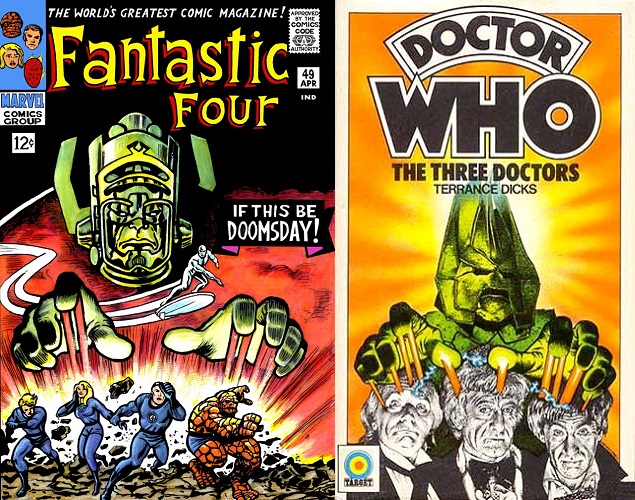
Well, it's almost the right cover.

The Book of the World was, in essence, Lawrence Miles showing off that he could write a good Doctor Who script for the modern series. He put it up on the web for a week before taking it down, but you can still track down copies with only a little bit of dedication because nothing vanishes from the Internet. The script  actually dates to late 2007, making it a Tennant-era concern, and it wasn’t actually released until just before Silence in the Library, so actually is virtually a Moffat-era concern. But, to be perfectly honest, I don’t want to keep Lawrence Miles around as a theme that long. He’s a wilderness era theme, and the nature of his point here applies just as well as it would closer to the time of composition. Better, in many ways, as The Book of the World is very much an attempt at showing how Lawrence Miles would have rebooted the series, and holding that discussion back until 2007/2008 would have seemed strange. The script’s concerns are very much 2005 sorts of concerns, wherever it came from.

So in the wake of Lawrence Miles’s last moment of any major significance to the course and direction of Doctor Who, let’s look at him as a whole. One of his most steadfast assertions, which carries through virtually everything he says about or in Doctor Who - and even if I’ve not covered it all, I’ve read virtually all of it - is that he is not a science fiction person. This claim must come off strangely to anybody who is not Lawrence Miles, since reading his material it’s self-evident that he is, in fact, a science fiction person. Surely only a science fiction person would ever come up with the premise of Alien Bodies, in which a time traveller discovers that his own body’s “biodata” is being used as a weapon in a futuristic war. I mean, it sounds like something only a sci-fi person could ever come up with.

Certainly his fanbase is overwhelmingly comprised of sci-fi people. I mean, this goes without saying, yes? Someone whose writing credits exist entirely in spin-off media of a sci-fi show, and, at times, spin-offs of those spin-offs, and who is buried neck deep in the cult television paratext is clearly and self-evidently a sci-fi person, right? Well, sort of right.

See, the real point Miles is making when he says he’s not a sci-fi person and Doctor Who isn’t a sci-fi show is that in his view Doctor Who is a fantasy show in the tradition of magical realism. Which, again, he’s not wrong. The logic of Doctor Who is, as we’ve said before, really a traditional British one of eccentric spaces and portals to other worlds that has as many roots in Alice in Wonderland and Chronicles of Narnia as it does in, say, Quatermass. That’s not the only tradition Doctor Who comes out of, of course - it also owes a lot to the tradition of literary science fiction that the BBC was invested in. But in essence it’s always been science fiction with the attitude of Narnia.

And yet something about Miles’s point rankles. Less because of the very savvy point that Doctor Who is not a straightforward science fiction show is somehow incorrect, but because of his claim that Doctor Who is not for sci-fi people. Which actually may be the even stranger thing to be thrown by simply because it’s so self-evident in the wake of the new series that, in fact, Doctor Who has a massive appeal well beyond the cult television ghetto. But wait. We’re conflating two things here - sci-fi and sci-fi people.

At the heart of this is a relatively complex interplay between the idea of science fiction as an iconography and as a genre. Because science fiction as a genre - I.e. As a narrative structure with a given set of conventions - is actually a relatively narrow thing that existed in the early-to-mid 20th century. And it’s a weird little beast based on problem-solving and manipulation of ideas. And it was very much a product of the technological expansion and role of science in that part of the century. It’s all very interesting, but it’s largely dated and the last time Doctor Who did anything even remotely like it on a regular basis was the Bidmead era.

As we’ve observed before, since Star Wars science fiction has really been a set of images and ideas. If it’s not too much to look ahead, let’s think about Journey to the Center of the TARDIS, especially as it’s the episode most similar to Book of the World. One of the most interesting things about that episode was the way in which the interior of the TARDIS swung back and forth between being understandable in sci-fi terms and being understandable in “the land of fairy” terms, and the way in which these competing iconographies were used as a source of tension.

That’s what sci-fi usually is these days. I mean, there are occasional exceptions whereby sci-fi in the golden age style still happens - Duncan Jones’s rather fabulous film Moon springs to mind as an absolutely lovely example over the last decade or so. But for the most part science fiction is simply a set of images - a particular flavor we put on a broader action-adventure genre. Which is fine, and I’m not going to say that the sorts of stories you can do with various flavors doesn’t matter tremendously, but the flavor isn’t the story in much the same way that the map is not the territory.

Except for sci-fi people. If we’re going to suggest what the fundamental flaw that separates cult sci-fi readings from anything that can possibly thrive in the mainstream (or should thrive, for that matter) is that even in the face of a world in which science fiction has stopped being a genre and sci-fi concepts have become flavorings and accents for other stories they persist in holding to the golden age model whereby the substance of the sci-fi ideas actually matters. They think that sci-fi is about the particulars - that the mark of a good sci-fi story is the nature of the idea. And that’s just not the way it works, except in marginal cult shows that cater to those sorts of people. (This hermeneutic also explains all sides of the question “was the ending to Battlestar Galactica any good.”)

And the thing is, for all that Miles rails against sci-fi people, he blatantly is one. In all of his work it’s the big ideas he cares about. Which, fine. I mean, I’m not going to knock it, being, by any reasonable definition, a bit of a sci-fi person myself. But it remains the case: Lawrence Miles cares about big, cool ideas. It comes through in every review, every novel, everything. So why does he declare that he hates sci-fi people? Well, mainly because he isn’t quite one. Yes, he’s got all the trappings, but there’s one teensy detail: he doesn’t like science fiction very much, and prefers magical realism.

So what we have is a writer who acts like a sci-fi person in every significant sense, except that he happens to be really attracted to magical realist ideas instead of sci-fi ones. And he’s attracted to them in a very fundamental, abiding sense such that he builds vast metaphorical labyrinths that rival the vast expanses of ideas that one could find in golden age sci-fi, except they’re built out of symbols and magic. But at the end of the day… he has the same relationship to cool magical realist concepts that Ian Levine does to references to the Troughton era.

This is, in a nutshell, what reading The Book of the World is like. It’s not that the book doesn’t have good ideas. The idea that the Earth was stolen and hidden as a book, or of the TARDIS turning into books is… astonishing. It’s a fantastic idea, and would make for an amazing episode. Nor is it that the storytelling is off. The decision to introduce the Doctor the way they do is marvelous. The gimmick of him counting how many times people have said various things to him is cute, and pays off marvelously when he gets to look at a character and just say “one.” But…

It’s a mystery with no payoff, which, fine, that’s what first episodes are, but let’s look back at the long list of times in which Lawrence Miles has actually paid off one of his high concept plot threads. Which is to say that Miles doesn’t exactly have anything you could call a stockpile of good will that makes unexplained mysteries seem viable from him. And, of course, it’s unfilmable. Miles has fallen into the trap of believing that CGI is free, and so writes a script with jaw-dropping visual excesses that are almost as bad as the infamous “night shoot of Wembley Stadium full of cats” script that caused The Invasion of Time to get made. The plot is Doctor Who by Numbers in a way that not even Mark Gatiss scripts usually manage.

But the biggest problem isn’t any of that. It’s that there’s nothing to it beyond the ideas. Lawrence Miles, by all appearances, seems to think that the heart and soul of Doctor Who is nothing more than really cool ideas and a vaguely anti-authoritarian bent. There are no character arcs here. The two proposed companions are the heights of blandness. Note in particular the mystery surrounding Marissa. Now, as someone who is thoroughly non-bothered by Clara I’m certainly not going to complain about a character who is, in effect, Generic Companion only with a mystery. But at least with Clara the mystery is very explicitly “who is she.” With Marissa? “What planet is she from” and “what species is she?” The difference is subtle, but marked. Miles’s script ultimately thinks having a cool idea is sufficient, and doesn’t care about piddly little things like character drama.

None of this would have been surprising in 2003. But in 2007 it’s bizarre, simply because it’s a rejection of so much of what demonstrably worked in favor of what didn’t. I mean, we’re still early days in the new series, and I’ve not really gotten around to a post where I just talk about character arcs and emotional storytelling and why it’s so brilliant, but can we at least take as by this point read that one of the central tenets of the Davies era is the realization that you can use sci-fi flavoring to merge together wildly different things so that, for instance, you get an action-adventure soap or a costume drama zombie flick, yes? That is, part of what Doctor Who did that was so utterly transformative was realizing that you could do the emotional drama sort of storytelling that was dominating absolutely every other sort of television imaginable by 2005 in sci-fi, or, at least, in Doctor Who.

And so it’s tempting to throw Miles onto the same pile as far too many idiots on message boards who genuinely believe that the secret to Doctor Who’s success (because, of course, a show that’s reliably in the top ten programs for the week needs help succeeding) would be if it would just act more like it were still the 1970s. But that’s not quite fair either. And there’s plenty of time in the next year or so to talk about those sorts of people. So let’s stick with Lawrence Miles in his sublime weirdness.

Because the thing we have to remember is that the “sci-fi people” approach isn’t bad in some absolute sense. The golden age of science fiction happened and was terribly important. There really was a period where Quatermass and The Space Museum were legitimate mainstream entertainment. Yes, that time is in the past, but it happened. The obsession with ideas for their own sake had a period of real creative relevance, and it coincided with a set of specific historical concerns. And what we have in Lawrence Miles is something of a one-man movement to create a golden age of magical realism - a period where the manipulation of symbols and culture is to be considered as important and seriously as rocket ships were in the 1960s. And, to boot, he was going to do it with Doctor Who.

He was wrong. Spectacularly so. But for reasons too obvious to mention, it’s a project I have more than a small measure of sympathy for. One that was not so much misguided as too weird and paired with someone too difficult to work with for massive success. This doesn’t erase its value - the fact of the matter is that Lawrence Miles is by some margin the most consistently interesting detractor of the new series, and his ideas for Doctor Who remain fascinating. The Book of the World is a lovely read. So is Faction Paradox. Really, you’re cheating yourself if you don’t read his stuff - I can’t imagine many people who like this blog who wouldn’t love Miles’s work.

But this is where his influence on the story ends, and thus where we’ll leave him - if only because he’s so quick to delete his comments on Doctor Who these days that it seems rude to analyze them at great length after this. He doesn’t want to be part of Doctor Who’s story anymore. So we’ll leave him out of it from here.

But let’s be clear. We are not leaving him in any sort of failure or ignominy. No, no. Lawrence Miles gets the proper send-off; the farewell to one of Doctor Who’s great minds. Because he had a vision of Doctor Who that still fascinates, even if it does not consistently appeal. Because there was never anyone like him before, and will never be again. Because, in his own way, he was closer to the spirit of David Whitaker than anyone else who ever wrote for Doctor Who. And because even though he’s staggeringly, epically wrong about what successful Doctor Who in the 21st century would look like, even in his wrongness he remains impeccably fascinating.

So farewell Lawrence Miles. You were Doctor Who’s greatest weirdo.
08 May 08:52

Ray Harryhausen, 1920-2013

by Dave

When I was a kid, the Sunday Morning Movie was must-see TV. It was your delivery system for old horror and adventure movies. It’s where I first got scared of The Crawling Eye, Fiend Without a Face, Black Sabbath, and that thing with the people getting turned into underwater creatures. (I was an easily-scared kid; Crawling Eye and Fiend Without a Face were both razzed by Mystery Science Theater 3000.)

But it’s also where I saw Jason and the Argonauts, and that was an absolute must-see movie every time it came on. Non-stop action with all kinds of amazing scenes: Talos, the harpies, the hydra, and of course, the skeletons.

It all came to life through the skills of Ray Harryhausen, who was responsible for special effects in that movie and hundreds of others throughout his long career. His talent and imagination brought things to life that riveted us in our seats. Harryhausen died today at the age of 92, but he leaves behind not only an incredible body of work but all of the people he inspired through his career.

It’s been a long time since I’ve seen anything in a movie that made me really wonder, “how did they do that?” I have to admit, when I used to watch Jason and the Argonauts, I also didn’t think that. What I thought was, “How is Jason going to defeat this thing?”

08 May 08:51

Why do people keep asking when will UKIP have it's first MP? They've already had one...

by noreply@blogger.com (Richard Morris)
I keep reading speculation about who will be UKIP's first MP - from  very well respected commentators as well. Cathy Newman was up to it again in The Telegraph today, suggesting it may well be Nadine Dorries...

"Now the Tory high command is in the crazy position of being held to ransom by a backbencher - terrified of the prospect that UKIP might claim its first Commons scalp. "

...and of course there is frequent speculation that Nigel Frage - who of course was UKIPs first ever by election candidate, in Eastleigh in 1994, could 'take the title' of first UKIP MP.

But actually he can't; nor can Nadine, nor can Diane James, nor can Neil Hamilton. They can only be second. Because there has already been a UKIP MP.

Bob Spink, A Tory MP, defected to UKIP in April 2008. Now, it wasn't a happy state of affairs. He left UKIP in November 2008 having disagreed with the leadership on a number of issues, and continued to sit as an Independent before losing at the 2010 General Election. I believe he even disputes if he took the UKIP whip now.

But none the less, he maintains the record of being the first UKIP MP. But sadly (for him at least) he appears to be something of a forgotten man of politics.


08 May 08:50

Cameron: a hostage to fortune.

by septicisle
Although it feels like aeons ago, it was only back in January that David Cameron delivered his Bloomberg speech, pledging an in/out referendum on EU membership should his party win the next election. At the time it must have seemed a good idea, and initially it looked like it had had its desired effect: his restive backbenchers cheered him to the rafters, it seemed to have trapped Labour, and surely it would have some impact on the increase in support for Ukip.

Less than six months later and it's as though the jaws of the trap have snapped back. To further mix metaphors, it always seemed as though Cameron was setting himself up as a hostage to fortune. The man he so wanted to be the heir to never gave in to his backbenchers; instead he thrived on picking fights with them. True, Cameron failed where Blair succeeded, which partially explains the backbencher ire in the first place, yet Dave caved in at first sign of trouble.  Rather than being sated, they've demanded ever since that Cameron move faster, to the point where it looks as though legislation may be forthcoming in this parliament as a further sop.

Nor has it had the desired effect on Ukip. Indeed, they've been emboldened by it, as was predicted. As counter-intuitive as it seems, support for Ukip isn't about Europe, as is now hopefully apparent. It can be overstated just how far the popularity, such as it is, for Farage is down to a state of mind, and it'd be great to quantify how many of those saying they'd vote for the party would still do so if there was to be a vote on the EU tomorrow.  Total disaffection and/or sending a message of protest nonetheless explains much of it.  It's possible that some of those who've decamped could be won back if Cameron shifted slightly further to the right, or better yet, recruited some advisers from outside his own social milieu, but it's deeply dubious as to whether those voicing their discontent beyond a mere protest can be so easily persuaded to return.

Thankfully, it does seem as though those making clear that much of Ukip's support is irreconcilable are now in the majority.  As easy as it is to fall into stereotype, it's difficult not to meet the odd person that fits all the descriptions of being a Kipper, and they usually aren't shy in venturing their views on Britain as it is in 2013.  They might not be racist, but they certainly don't like immigrants even if they don't mind those they know of locally; they blame the EU at the first opportunity; and they are invariably complaining about something or other.  They don't have to read the Mail/Express/Telegraph, but it helps, and they regard things as being much better at some point in the past, even if they can't say exactly when.

The obvious point to make is that plenty of people also hold one or more of the above things to be self-evident, yet they either don't let everyone else know about it or would ever dream of voting for a party other than the main three.  Nor are any of these things irrational or wrong; rapid change in local communities as happened post-2004 was bound to lead to a backlash, while even those of us who would stay in the EU hardly regard it as being anything close to an unmitigated force for good.  Nostalgia also has to be taken into account: reading the Graun's pieces today on 1963 you can't help but think that was a pretty good year on the whole.  Would any of us who weren't around at the time actually want to live in that period were such a thing possible though?  Almost certainly not.

Those who have moved to Ukip also realise they can't turn the clock back.  They might want to, and they want to make clear that they do, but they know full well that Ukip isn't going to win a general election, nor necessarily would they want Farage to be the prime minister.  This is the conundrum facing the Tories: in almost every way, the party would be a better vehicle for their discontent, as many of their MPs also hold Ukip voters' prejudices, yet for any number of reasons they've lost faith in them and so would rather register their anger elsewhere.  This can't all be put down to Cameron or the detoxification strategy, nor can it be easily explained by all three parties fighting over the same territory.  It is more, as Max Dunbar writes, a lashing out at the present while coming over all rose-tinted about the past.  Perhaps it can be best explained thus: whereas the young disenchanted simply don't vote, those who feel much the same but who were brought up with the importance of the franchise drilled into them regard putting an X in the Ukip box the least worst option.

Lord Lawson's call for us to leave the EU immediately doesn't really change things much.  The EU is the least of most people's worries, although should the Tories increasingly fight over just how soon the referendum should be they might become excised at the amount of attention something arcane is receiving.  Cameron's problem is that a move that was designed to buy him more time and hopefully damage the other parties has so spectacularly backfired.  He doesn't want us to leave the EU, businesses on the whole don't want us to leave, and nor I'd wager would the electorate should the vote be held tomorrow.  He can't however take such a risk, and so the uncertainty that is so damaging will continue instead.  And all the time the boneheads within his party continue their rattling.
08 May 08:17

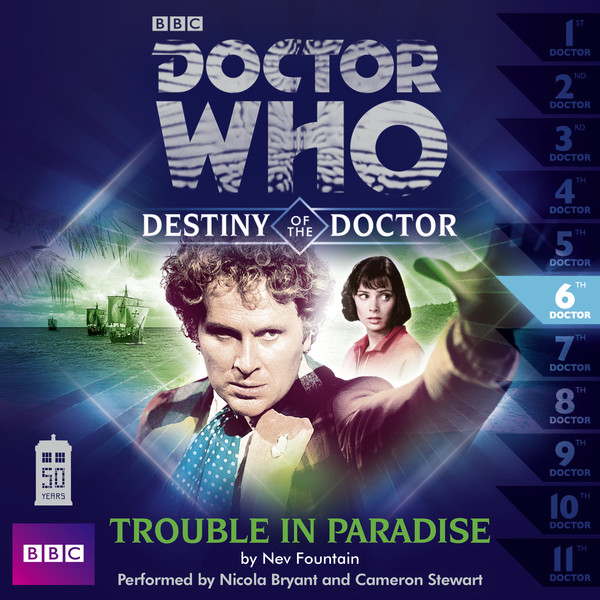
In 1492, The Doctor sailed the TARDIS blue…

by nevfountain

As well as ‘The Axeman Cometh’ I also have this coming out in June, as part of Doctor Who’s birthday celebrations:

There are five things ye should know about Doctor Who historicals, sire…

I like doing Doctor Who stories in history; it appeals to the lazy writer in me, to do without all that tedious process of inventing stuff.  None of those head-scratching mornings, pecking at the keys on the computer at random, trying to come up with space age character names that don’t sound like brands of suppositories.

I also love  mucking around with cliches in my stories, and your typical Doctor Who historical is full of them.  Finding cliches in a Doctor Who Historical is like shooting fish in a barrel (did you see what I did there?).  Now I’m thinking about it, I’m not sure how ‘shooting fish in a barrel’ became so ubiquitous that it entered the lexicon as a cliche; did they have massive international Piscine execution tournaments that went on for ages and ages, in huge arenas covered with splintered wood and fish guts?  I bet it was probably the national sport for about a week in the eighteenth century, before they found tobacco sponsorship on the side of the barrel, or there was a fish doping scandal, and they had to resort to snooker.

Any Doctor Who story gives you the expectation of a collection of things that’s ‘supposed’ to happen (corridors, monsters, villains, threat of oozing death), but a Doctor Who historical gives you ANOTHER set of things that are ‘supposed’ to happen, to put on top of all the other things.  The result being there are so many elements you feel you ought to put in that it’s tempting to write it like a pantomime; ticking the boxes as you go.   Over-familiar characters and set-pieces jump up and demand their voices be heard, like a strangely amorphous crowd of oddly articulate peasants.

Here are five, but there are many more…

1.  The Doctor gets pally with/threatened by a famous historical figure, who usually talk a bit like they’re from a Shakespeare play or, if it’s after the renaissance, like they’re in a Dickens novel.

‘If you insult my beard, sirrah, then mayhap you insult the whole make up department of the BBC.’

2. The Doctor says something enigmatic about the future which we as a modern audience understand, but none of the historical characters get.  This comment is directed at no-one in particular, and usually makes you want to punch him.  Yes, Doctor, you’re a time traveller.  You’d think the buzz would have worn off by now.

3. The Doctor discovers a villainous alien bent on changing history, but in a very fiddly way, like unscrewing Edison’s lightbulb or replacing Newton’s apple with an orange.  You never get the Master stopping the industrial revolution in its tracks by simply destroying the north of England, probably because the Thatcher estate would have sued for breach of intellectual copyright.

‘If we could just get George Stephenson to call his steam transportation machine ‘Thomas’, then we would create a franchise that could rule the universe.’

4. The Doctor, companion or his adversary inspires/causes a famous moment in history, which the Doctor thinks is hilarious, despite frantically stopping everyone else from mucking about with history for the other 99% of the time.

5.  The companion gets separated from the Doctor and gets locked up, usually by another faction from the ones they met when they first arrived, and always with inferior dental hygiene.

Tell me more about this thing called ‘flossing’, of which you speak, Doctor…

You only have to fiddle with one of the above to look incredibly clever, and look like you’ve re-invented the wheel, which co-incidently, is what the Master attempts in my next story, when he rips the fabric of the universe apart by telling Ug about dual suspension.

‘Trouble in Paradise’ is available here:

http://www.bigfinish.com/releases/v/trouble-in-paradise-853


07 May 22:43

Speed-Crankery

by MarkCC

A fun game to play with cranks is: how long does it take for the crank to contradict themselves?

When you're looking at a good example of crankery, it's full of errors. But for this game, it's not enough to just find an error. What we want is for them to say something so wrong that one sentence just totally tears them down and demonstrates that what they're doing makes no sense.

"The color of a clear sky is green" is, most of the time, wrong. If a crank makes some kind of argument based on the alleged fact that the color of a clear daytime sky is green, the argument is wrong. But as a statement, it's not nonsensical. It' just wrong.

On th other hand, "The color of a clear sky is steak frite with bernaise sauce and a nice side of roasted asparagus", well... it's not even wrong. It's just nonsense.

Today's crank is a great example of this. If, that is, it's legit. I'm not sure that this guy is serious. I think this might be someone playing games, pretending to be a crank. But even if it is, it's still fun.

About a week ago, I got en mail titled "I am a Cantor crank" from a guy named Chris Cuellar. The contents were:

...AND I CHALLENGE YOU TO A DUEL!! En garde!

Haha, ok, not exactly. But you really seem to be interested in this stuff. And so am I. But I think I've nailed Cantor for good this time. Not only have I come up with algorithms to count some of these "uncountable" things, but I have also addressed the proofs directly. The diagonalization argument ends up failing spectacularly, and I believe I have a good explanation for why the whole thing ends up being invalid in the first place.

And then I also get to the power set of natural numbers... I really hope my arguments can be followed. The thing I have to emphasize is that I am working on a different system that does NOT roll up cardinality and countability into one thing! As it will turn out, rational numbers are bigger than integers, integers are bigger than natural numbers... but they are ALL countable, nonetheless!

Anyway, I had started a little blog of my own a while ago on these subjects. The first post is here:

http://laymanmath.blogspot.com/2012/09/the-purpose-and-my-introduction.html

Have fun... BWAHAHAHA

So. We've got one paragraph of intro. And then everything crashes and burns in an instant.

"Rational numbers are bigger than integers, integers are bigger than natural numbers, but they are all countable". This is self-evident rubbish. The definition of "countable" say that an infinite set I is countable if, and only if, you can create a one-to-one mapping between the members of I and the natural numbers. The definition of cardinality says that if you can create a one-to-one mapping between two sets, the sets are the same size.

When Mr. Cuellar says that the set of rational numbers is bigger that the set of natural numbers, but that they are still countable... he's saying that there is not a one-to-one mapping between the two sets, but that there is a one-to-one mapping between the two sets.

Look - you don't get to redefine terms, and then pretend that your redefined terms mean the same thing as the original terms.

If you claim to be refuting Cantor's proof that the cardinality of the real numbers is bigger than the cardinality of the natural numbers, then you have to use Cantor's definition of cardinality.

You can change the definition of the size of a set - or, more precisely, you can propose an alternative metric for how to compare the sizes of sets. But any conclusions that you draw about your new metric are conclusions about your new metric - they're not conclusions about Cantor's cardinality. You can define a new notion of set size in which all infinite sets are the same size. It's entirely possible to do that, and to do that in a consistent way. But it will say nothing about Cantor's cardinality. Cantor's proof will still work.

What my correspondant is doing is, basically, what I did above in saying that the color of the sky is steak frites. I'm using terms in a completely inconsistent meaningless way. Steak frites with bernaise sauce isn't a color. And what Mr. Cuellar does is similar: he's using the word "cardinality", but whatever he means by it, it's not what Cantor meant, and it's not what Cantor's proof meant. You can draw whatever conclusions you want from your new definition, but it has no bearing on whether or not Cantor is correct. I don't even need to visit his site: he's demonstrated, in record time, that he has no idea what he's doing.

Share

07 May 21:57

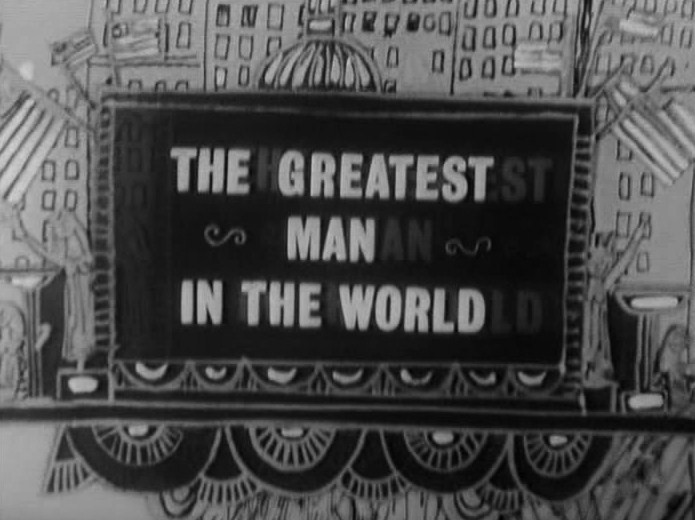
Armchair Theatre: The Greatest Man In The World

by Unmann-Wittering
Andrew Hickey

shared for myself for when I have bandwidth


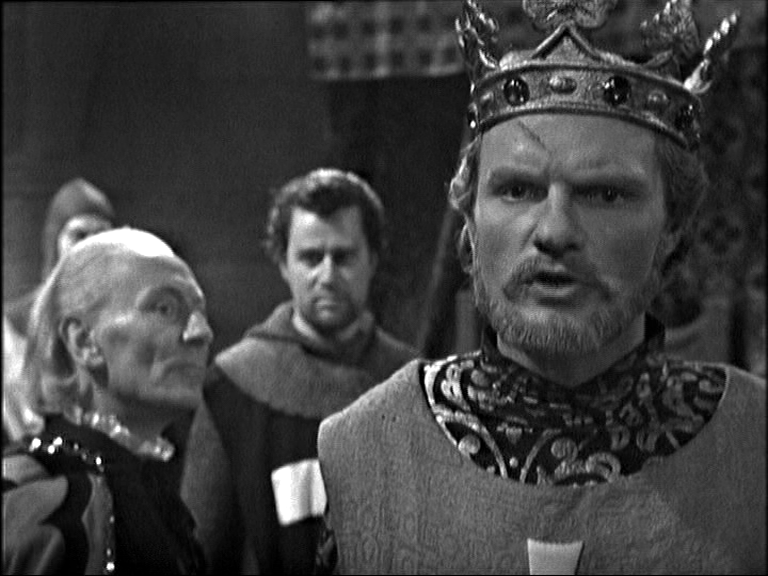
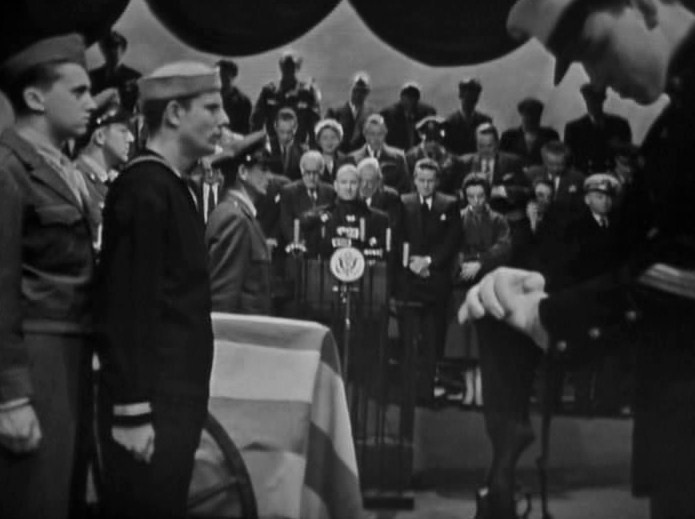
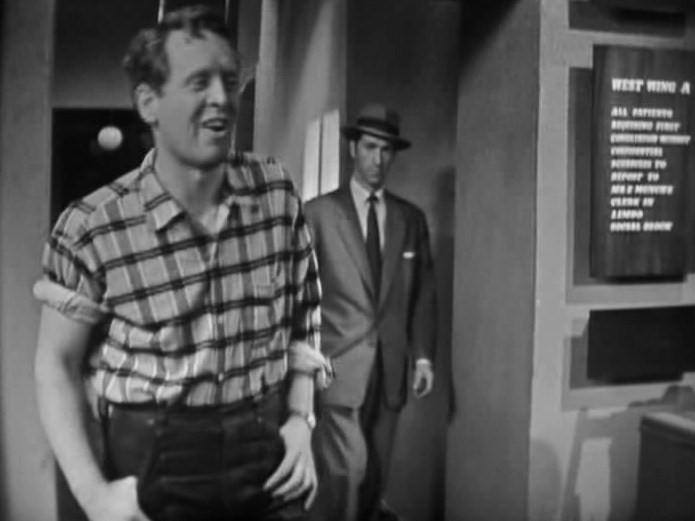
‘The Greatest Man In The World’ is an ‘Armchair Theatre’ presentation from 1958.


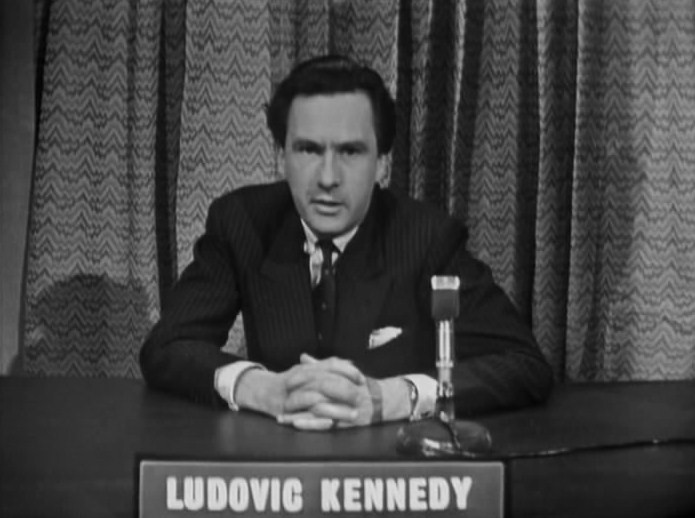
It opens with familiar TV face Ludovic Kennedy introducing a live link from Washington, where the state funeral of Jack ‘Pal’ Smurch is taking place. Smurch, it appears, was the most revered hero in the history of mankind, ‘the greatest man in the world’, and his death has caused an outpouring of national and international grief.  The President (Donald Pleasence), his face taut with emotion, gives a touching eulogy to the enormous crowd that has gathered but, as he observes a moments silence, we hear his private thoughts: ‘it’s a good job they don’t know what the lousy bastard was really like’…

Smurch’s fame is based on a single amazing thing: he piloted a spaceship to the Moon, got out and walked around a bit, threw up (he was drunk) and then came back. The rocket was designed by a dipsomaniac high school teacher, and was developed entirely independently on a tiny fraction of the huge budget the government has expended on not getting to the Moon. Naturally, the President orders that everything possible is done to ensure that this incredible story is rewritten to include the full support of the US government, and the Press are briefed that, if they want to keep their jobs, they help keep the secret.


The big problem, however, is Smurch himself, who is the most incredible arsehole (he’s described as a ‘congenital hooligan' but there are much shorter words). Lazy, dishonest, violent, lascivious, cruel, astoundingly obnoxious, Jack Smurch is universally hated by everyone he has ever come into contact with. His High School teacher shows off a six inch scar Smurch gave him; his Army Sergeant admits that he put him on point while on patrol in the hope he might get shot. His own mother, when told that he is attempting re-entry, says ‘I hope he gets blown to bits’. When he finally arrives in person, he more than lives up to expectations: he’s unbearable – a gum chewing, aggressively ignorant braggart. He’s also played by Patrick McGoohan which, is wonderful and, although his accent is a bit hit and miss (to say the least, he sounds like Jimmy Cricket auditioning for ‘Guys & Dolls’) McGoohan makes Smurch a truly loathsome character, the sort of bloke you want to keep hitting until your fists are worn down to the wrists.


What’s worse, of course, is that everybody has to put up with his shit: the President, the Press, the F.B.I, the Army, the Air Force – they’re all committed to the lie that he is an inspirational person, a man of the highest courage and calibre, simply because of the enormous benefits of ‘the greatest man in the world’ being an American.  

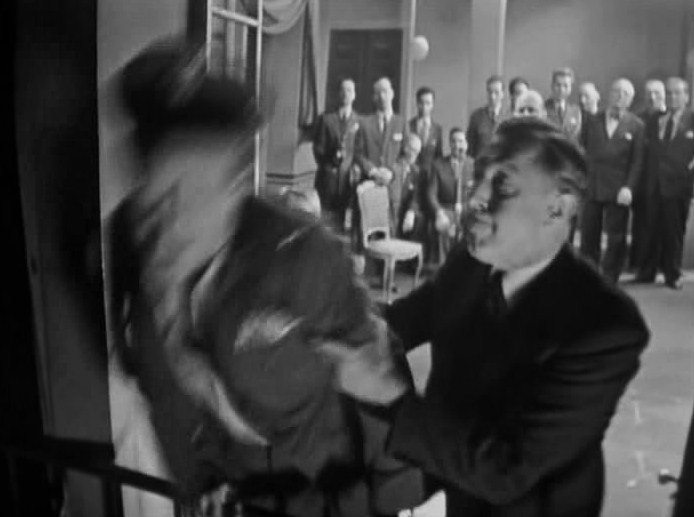
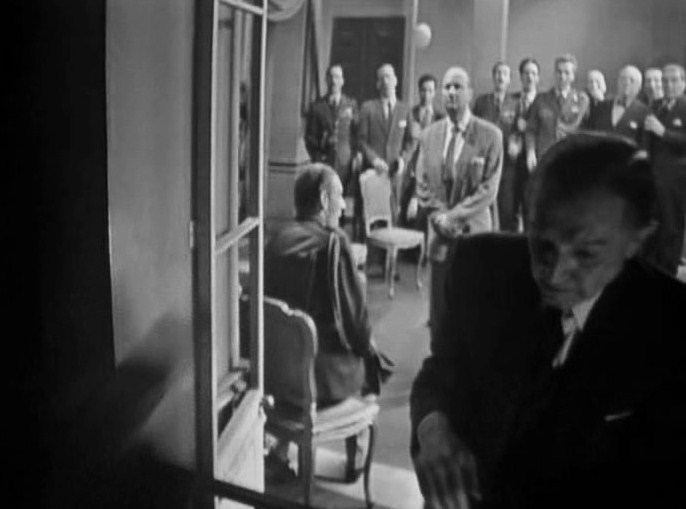
At an official reception a few days after landing, General Smurch (as he is now) is holding forth on his own genius and courage whilst making crude moves on the waitresses and other female guests and showing everybody the nude lady he has tattooed on his chest. When he is told that he is to embark on a World Tour, visiting China and Russia to spread the American message, he starts to rant about how much he hates the Chinks and the Commies, and how he can't wait to tell them that he’d like to drop a bomb on them all. The President and the Secretary of State exchange glances and, realising that Smurch will always be a diplomatic timebomb waiting to explode, the President nods and the Secretary of State calmly pushes Smurch out of an open eighteenth storey window. I wonder if Mr. Mc remembered this scene when he did exactly the same thing to somebody else in 'Braveheart'?


From a story by American satirist James Thurber, ‘The Greatest Man In The World’ is a bitumen black comedy that benefits enormously from a careful, considered turn from Donald Pleasence and a scenery chewing tour de force of infuriation from McGoohan that you really have to see for yourself --


07 May 20:24

"Now we can sit back and watch the Tories go mad" - an apology

by Jonathan Calder
When the Liberal Democrats won the Eastleigh by-election in the small hours of 1 March, I got rather carried away on Twitter:
Congratulations to @mike4eastleigh - now we can sit back and watch the Tories go mad #libdemandproud
— Jonathan Calder (@lordbonkers) March 1, 2013
Later that morning I was quoted on the Today programme as a "prominent Liberal Democrat blogger".

But I was wrong. In the aftermath of Eastleigh the Conservatives kept their nerve and behaved sensibly.

Two months later, however, following UKIP's performance in the local elections, they have indeed gone completely hatstand.
07 May 19:44

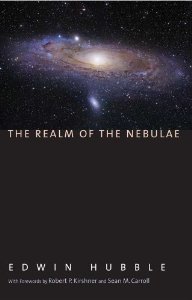
The Realm of the Nebulae

by Sean Carroll

41CF7V31PmL._SY300_ Edwin Hubble never really liked the word “galaxy.” He was the one, of course, who was most responsible for making the word an important one, by showing that (at least some of) the fuzzy patches in the sky called “nebulae” were actually collections of billions of stars in their own right, far outside our Milky Way. (That was his second-most important discovery, after the distance-redshift relationship that reveals the expansion of the universe.) It’s possible that Hubble didn’t want to do any favors for Harlow Shapley, his rival, who coined the term “galaxy.” But for whatever reason, when in the 1930′s he gave a series of prestigious lectures at Yale which he later turned into a book, Hubble’s chosen title was The Realm of the Nebulae. Near the end of his introductory chapter, he sniffs, “The term nebulae offers the values of tradition; the term galaxies, the glamour of romance.”

In the court of popular opinion, romance will usually be a heavy favorite over tradition, and these days we use “galaxies” to refer to large collections of stars, gas, dust, and dark matter. But Hubble’s book became a classic, and is a great treat to read these many decades later. Cosmology has marched on quite a bit, of course, but the insights Hubble offers into the practice of doing science are timeless. The guy was a smart cookie, and a better-than-decent writer, to boot.

So it’s great to have a new edition of the book recently published by Yale University Press. Precisely because science has been advancing in the intervening years, publishers have found it useful to commission new prefaces to keep the reader updated on cosmological progress, and these prefaces (or Forewords, I can never tell the difference) have been accumulating over time, all of them contained in the new version. There’s one by Allan Sandage, from 1958; another by James Gunn, from 1981; and now our Golden Age of Cosmology requires not one but two new contributions, one by Robert Kirshner and one by me. Given the extraordinarily high quality of my companion contributors to the front of the volume, I tried hard to make my offering both interesting and useful. Readers can judge that for themselves, but it’s certainly an honor to be in such esteemed company.

Hubble was an unforgiving empiricist; he didn’t worry too much about the theoretical implications of his discoveries, preferring to leave that to others. But he knew about them, and his last chapter discusses the different world models to emerge from Einstein’s general relativity, and the implication that we will only ever be able to observe a small part of the much larger universe.

Thus the explorations of space end on a note of uncertainty. And necessarily so. We are, by definition, at the very center of the observable region. We know our immediate neighborhood rather intimately. With increasing distance, our knowledge fades, and fades rapidly. Eventually, we reach the dim boundary — the utmost limits of our telescopes. There, we measure shadows, and we search among ghostly errors of measurement for landmarks that are scarcely more substantial.

The search will continue. Not until the empirical resources are exhausted, need we pass onto the dreamy realms of speculation.

Fortunately, and contrary to the metaphorical implication, the dreamy realms of speculation aren’t a location where we have to remain once we arrive. Progress in science requires cooperation between speculation and observation. The dreamy realms are an important place to visit, even if Hubble wouldn’t have wanted to live there.

Share

07 May 19:41

JEFF KEEN vs. ROY LICHTENSTEIN (aka WHEN IS APPROPRIATION APPROPRIATE?)

by Gavin Burrows


“The immature artist imitates. The mature artist steals.”
- Lionel Trilling
”Plagiarism is necessary. Progress implies it.”
- Guy Debord

Sometimes these things have a way of working out.

Back in June, after Brighton-local maverick artist and DIY film-maker Jeff Keen died, I posted a short, somewhat-hastily-written obit in which I commented his work was “not pop art in the Lichtenstein sense of isolating images from pop culture and making them contemplative... there's an engagement with pop culture, even if sometimes a critical one.”

Then what should happen but Keen receive a retrospective at Brighton Museum at almost exactly the same time as the Tate devote a show to Lichtenstein!

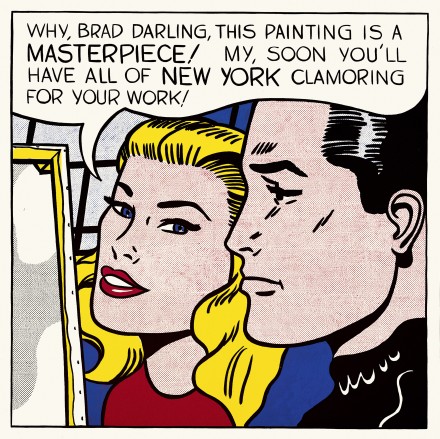
Lichtenstein's appropriation of panels from American comics into his paintings has traditionally had us fans in uproar – and this has been no exception. At a specially convened panel at the most recent Comiket critic Richard Reynolds and artist/designer Rian Hughes took him to task, while David Gibbons has produced a parody of one of his more famous works (both below). Comica's Paul Gravett has provided this handy summary.


In general I feel that comics folks correctly smell something off about Lichtenstein - but are not always great at converting their gut feelings into words. Keen provides a useful comparison for, while his work also made frequent use of comics panels and motifs, I don't think it would produce as hostile a reaction.

In some literalist sense, both Keen and Lichtenstein are plagiarising the work of others. Of course it's true that comic artists took from each other all the time. Yet we're no longer talking about jobbing artists swiping the easier to hit deadlines, the equivalent of borrowing a fiver until pay day. Lichtenstein (if less so Keen) gained cash and acclaim for his copycatism.

To which I'd counter with Led Zeppelin, who infamously stole numerous old blues numbers which they reaccredited to themselves. While it was common practise in blues for practitioners to pinch licks and filch lyrics from one another, it's clearly another for a million-selling white rock band to turn up and claim to have written those songs.

Yet this is an ancillary critique - of the band's business practise alone. It doesn't prevent blues fans such as me likingwhat their music actually did when it took up those blues tunes. We just wish the credits on the cover read differently. Meanwhile, I have not the slightest intention of seeing the Lichtenstein show in London. Not while there's something so much better on here in Brighton.

To see Keen in the same light as Led Zeppelin, let's try taking Pop art at it's word. Meadows and haywains aren't really part of our daily life like they once were, so art has to respond to what's replaced them. Pretty much every day, I must walk into a newsagents. So pretty much every day I'm confronted with a cluster of magazines, each using dynamic layouts, gaudy colours and shouty fonts to try and win my attention. Its an ever-escalating arms race.


Lichtenstein abstracts one panel from that melee, and blows it up on the gallery wall (above). He puts it somewhere safe where it can be contemplated. (See this comparison site for how he systematically drained the dynamism and expression from the images he took, the very things which you think might draw someone to comics.)

While with Keen, let's look to the covers he produced for his “secret comic”'Rayday', for a kind of shorthand summary to the direction of his work. No. 2 (below) is dynamic enough, peppered with starbursts and sound effects. Yet look ahead to No. 4 (below below) for the gutters between text and image to be well and truly burst, a riot of overlaid images. Keen's work is about looking at that vibrant, cacophonous display and saying “let's make it louder, let's make it faster.” He's not cool but fevered, his foot's on the accelerator not the brake.


There's an old Wodehouse story where Bertie Wooster sings a blues song in his strangulated English, correcting the grammar as he goes. And we've all heard clueless clods singing the blues that blues-less way. Similarly, Lichtenstein drains all that is blue from blues while Keen gets in the spirit of it. Lichtenstein is appropriating. Keen, even as he borrows, is contributing.

More on that Jeff Keen show here...
07 May 19:36

Another bi-erasing "Academic"

by Jen
An American professor has partly retracted bi-erasing and homophobic comments about the economist John Maynard Keynes.

Niall Ferguson, who at the time of writing remains linked to Harvard University in the USA, commented last week that Keynes' famed remark on economic issues that "in the long run we are all dead" reflected that Keynes' homosexuality and childlessness meant he had no interest or concern for society in the long term.

However, Keynes was not gay and his wife miscarried on at least one occasion, rendering Ferguson's remarks not only tasteless and factually lacking, but actively and deliberately erasing of bisexuality.

In a half-hearted apology on his blog he has now stepped back slightly from those comments - but in observing that "colleagues, students, and friends – straight and gay – have every right to be disappointed in me," he continues his determined bisexual erasure and rewriting of history.

Harvard University was founded in 1636 and was a respected academic institution for many years.
07 May 19:11

Ray Harryhausen, R.I.P.

by evanier

rayharryausen01

Stop-motion animation would seem to be a dying art in the era of CGI. That it was ever an art had a lot to do with Ray Harryhausen, who died today in London at the age of 92. He didn’t invent the technique; just fell in love with it after seeing King Kong…and returning to see it something like eighty jillion times. By the fifties when he supervised special effects for films like The Seventh Voyage of Sinbad, he was the Rembrandt of stop-motion or maybe the Van Gogh or Picasso. Whoever he was, he was the master and everyone else who’s done it since has acknowledged him as such.

Details of his career can be found in obits like this one…so I’ll just brag that I was able to meet and dine several times with Mr. Harryhausen, usually because we were both hanging around Julius Schwartz and/or Forrest Ackerman. He was a delightful man who was serious about his accomplishments but at the same time, humble about them. I always asked him if he had any plans to animate Julie or Forry who, in their later years, could have used the treatment he gave to other kinds of dinosaurs.

When I was around him, I observed something that I assume was a constant in his life. Guys (always guys, no girls) around my age would approach him, pay him the deserved compliments, then say, "When I was ten, I made a film in my backyard and I animated…" and here they would describe admittedly-dreadful attempts to replicate what Harryhausen did, only with an 8mm camera, a cheap and inadequate model of some kind, and only the vaguest clue as to how to make that model move. For those of you who don’t even have the vaguest clue: What you need to do is to train a camera on your model, lock it down on a tripod, then take one frame of film, move the model slightly, take another frame, move it ever-so-slightly, take another frame, etc. It takes a long, long time and doing it in your backyard is Mistake #1 because it can take all day to achieve a few seconds of finished film and the lighting is never consistent when you’re outside.

One time, I told Ray that I’d tried it, too — and I said to him, "I learned a new technique and I wondered if you’d mind if I told you about it…because it might help you in your work." He looked at me like I was completely out of my mind. Believe me: I know that look. This was like a kid who’d learned how to remove a splinter presuming to give advice to a top brain surgeon…but Harryhausen was polite and willing to hear me out. I said, "I find that it enhances the animation if you can manage to accidentally get your hands into the shot every seven or eight frames." I then experienced one of those horrible "Uh-oh, he doesn’t get it" moments before he threw back his head and laughed. He had a good laugh.

He said, "You’d be amazed how many kids come up to me and tell me they tried to do what I do." I wasn’t amazed because even in our limited time together, I’d seen it. He then said something I wish I could quote here verbatim about how people said his legacy was all those great movies but he thought maybe it was all those kids. Few of them went on to actually do stop-motion for a profession but a lot became animators in other senses and a lot became writers or other kinds of filmmakers. You have to admire a guy who inspired so many creative people…and who was just about the best at what he himself did.

07 May 15:58

Remembering Conrad Russell

by Gavin Robinson

Over at Love and Liberty, Alex Wilcock has been reminiscing about his friendship with Conrad Russell, and discussing the influence of Russell’s The Liberal Cause. So I thought I’d join in with the name-dropping. I only met Professor Russell (as historians knew him: the title that he’d actually earned seemed more important to him than the earldom he inherited) once, in 1997. I was in the first year of my PhD, and I went to the Tudor and Stuart research seminar that he organized at the IHR, to hear Peter Edwards speaking about arms imports in the civil wars. It was in the old local history room in the IHR library, which was huge before they chopped it up to make the Wolfson and Pollard rooms. When Pete’s paper was finished and the discussion was about to begin, Elizabeth Russell passed around ash trays, and although it seems endearing now, at the time I was shocked to see Conrad, Elizabeth and several students lighting up – the only time I’ve ever seen anyone smoking in a library! I guess that’s what the IHR rules meant by ‘privileged occasion’. I was privileged to be briefly introduced to him afterwards, which was enough to confirm that he was a very nice person as well as a brilliant historian and politician.

But enough of the anecdotes. As Alex’s post makes clear, Conrad Russell helped to ensure that Liberalism is the most intellectually rigorous set of principles on offer in British politics. Nick Clegg’s view of history  in The Liberal Moment has some problems, but it’s quite impressive for the leader of a political party to write something that intelligent (Natalie Bennett could probably do better because she knows an awful lot about feminist history). Although I disapprove of many things that the Lib Dems have done in the coalition, I still want to vote for them because they’re the party whose principles I most agree with (although the Greens are the only other party that really has any principles at all).

But considering that Conrad Russell’s politics were so liberal, why was his historical writing so conservative? I still think he was absolutely right to destroy the Whig and Marxist models of 17th century history, because they offered very simplistic explanations and didn’t fit the facts (and were more similar to each other than they would admit). But revisionism had its limitations too. Russell’s work was mostly about the political elite. That’s fair enough to a certain extent because it’s what interested him and what he was good at. We all have to exclude more from our research than we include, and there’s no point forcing people to write about things they find boring. The problem is that if you take this approach in a book boldly titled The Causes of the English Civil War, with a definite article, it implies that there’s nothing more to the story. John Adamson has improved on Russell’s approach by showing that you can focus on high politics and still have a revolution. Adamson acknowledges that although the Lords started the revolution, they couldn’t achieve much without material help from lower levels of society, and he’s left space for other people (including me) to show how that worked in practice (and he might well add to that himself when he publishes the next volume – not this year but surely next year). Russell and Adamson both failed to analyse the implications of both houses of Parliament being exclusively male. Like many histories written by men, Russell’s analysis of Queen Henrietta Maria’s influence over Charles I was a bit misogynistic. For example, the Queen wrote to her husband in October 1646 “in tones more appropriate to a son than to a husband”, and the impression of Charles that emerges from her letters “could easily have been signed ‘Lady Macbeth’” (Conrad Russell, The Causes of the English Civil War (Oxford, Clarendon Press, 1990), pp. 205, 206; Frances Dolan may have made this point before but I can’t find a reference to it).

07 May 13:22

Dear God, Hope You Got the Letter

by LP

GEN. 1:1. Dear Diary, Mr. Phillips wants us to create a whole planet by next Thursday. This is totally unfair. Like I have time to do all this. I’m not on the Scientific Decathlon team. Why should I have to create a planet? I just want to cheer. I shouldn’t even have to take biology. This is gay. Plus my lab partner is Lucifer and he totally hates me after I got him kicked off of Pep for refusing to be at the bottom of the human pyramid. Like it’s my fault that he has really broad shoulders. Well I guess I better get started on this. If I have to take bio again I’m totally going to vom.

GEN. 1:5. So last night when I went to bed I shut the lights off on the planet because I want Adam to get used to day and night cycles. Im like whatever, but Mr. Phillips says it’s important that he have a ‘diurinal calender’ or something. Anyway, when I got home from cheer today I started working on the project again, and I noticed, I completely forgot to make the sun and the stars! So how did I get nighttime? I must have been so wasted. Also, I forgot to make a girlfriend for Adam. And believe me, he’s going to need one, because, I mean, he is not a hottie. So sue me, Adam, I was in a hurry when I made you. Lots of people get by with only two arms, Mr. Ungrateful. I could have made a cat-man, you know.

GEN. 3:6. Okay, so, I don’t get people like Lucifer. I mean I’m not Miss Perfect Student or anything but that guy, it’s like he wants to fail or something. He totally ruined the project and now I don’t know what I’m supposed to do. Okay, so I put a tree down there that would tell them…well, I said fruit would tell them the difference between good and evil, but really it was just a nice-looking tree and I figured if I put a bunch of window dressing on the thing Mr. Phillips would give me a better grade. You know, for presentation. So I didn’t want them to mess it all up by eating the fruit. But Lucifer goes in there and tells them oh, eat it, it’s cool! It’s really good fruit. Like, not even caring that they’re ike decorative oranges and shit. (Lucifer said that it would spruce up the place if I put in some apple trees, and I’m like, forget it! The last thing this dump needs is more green. God doesn’t make little green apples, okay?) Anyway, of course they ate it and now it’s all just green, like a big pile of mold. I kicked them out of the little garden habitat. Mom said I was being cruel but the fact is I was super pissed, and besides, if I hadn’t stopped them next thing you know Lucifer would be feeding them the immortality sprouts. He’s already talked about it. I was all, “As if! The last thing I want is those assholes  to live forever. When the semester ends I’m totally swatting them all with a shoe. You think I want to take care of them all summer? No way, José.” Lucifer is such a jerk. I don’t know why I couldn’t get a lab partner who’s interested in the grade, or at least who’s cute. Like that guy Krishna.
GEN. 4:5. Oh, great. The things are breeding now. Adam and Eve had a couple of kids. That’s awesome. I eve gave them a box full of tiny condoms (which it totally took me forever to make) and a bunch of abstinence pamphlets and I guess they didn’t even read them. I mean, okay, I didn’t teach them to read, but that was supposed to be Lucifer’s job. And fucking Adam was wearing the condoms on his fingers the last time I saw him, because he’s pretty much an idiot. Anyway, on the upside, one of the kids killed the other one, so I gave him a special reward and moved him to a different part of the planet. I guess I shouldn’t worry too much, since there’s no women besides his mother so there’s no way he can breed unless he’s completely gross.

GEN. 6:2. Oh, no way. Gross.

GEN 6:13. Well, we got a ‘C’ on the project. I’m kinda pissed that Lucifer got the same ‘C’ that I did when I’m the one who did all the work, but at least it’s over now and I don’t have to depend on his lazy ass anymore. Also, Krishna asked me to the Spring Fling Dance! We’re going to win the game against Multiverse North this weekend if I have to rub my throat raw cheering, or strike their quarterback with chilblains. Last night I went ahead and flushed the planet I made, because like I said, total pain in the ass and no way do I want to have to keep checking on it all summer. One of the little people heard me say I was going to flush it and I kinda got embarrassed, so I gave him some bullshit story about how the world had become too violent and I was going to punish everyone with a flood. I said he could save himself by gathering up his family and putting them on a boat. Yeah, good luck with that, dude, I’m sure that’ll save you from the toilet.

GEN. 8:4. Holy shit. My dad came in after I got home from school and he’s got this old shoe box. He’s all, “God, I think this is yours. I’ve been keeping it in the garage over the old water heater, but I thought you might want it.” And inside is the planet I made for biology class. And I’m all, “Dad, I flushed this. The project is over.” And he’s like “Well, I pulled it out of the toilet because it didn’t go down all the way and then I just forgot about it.” Yeah, you forgot! That was forty days and forty nights ago, Dad. Anyway, I told him to just put it in the dumpster, and he gives me this big lecture about responsibility and says he thinks it would be a good lesson to take care of my pets because I’m getting to be a young adult and adults have obligations. So now I have to look after all of these stupid things all summer, and a ton of them (there’s, like, five hundred now) are already building temples to me. I hate my parents.

07 May 13:17

The Imaginary Ombudsman

by LP

ATLANTIS. First of all, it’s Atlantis. Not Atlantis City. The minute you guys open your mouths and say “Atlantis City”, we know you’re just some fish-gilled, gawking tourist from Lemuria or something. Second, we don’t have gambling here. That’s Atlantic City.

METROPOLIS. There’s more to see here than fucking Superman, okay? There are six million people in this city.

SWEETHAVEN. God help you’re prone to seasickness. Go to Topeka or something, because we want you to leave behind tourist dollars, not piles of puke. Not that the money will do any good because it’s just going to end up in the Commodore’s slush fund, anyway.

SPRINGFIELD. The thing that makes me furious is all the government inspectors. That’s the curse of being a medium-sized city: you need help because you don’t have the resources of a New York or a Chicago, but the strings attached are a bunch of meddling bureaucrats. “Your town smells awful.” “Your nuclear plant has been cited for critical safety violations seven hundred and twenty-nine times.” “You have the lowest average IQ of any city in America and at least a dozen third-world nations where they couldn’t even read the test.” Blah blah blah! Just give me my matching funds.

FROSTBITE FALLS. I work at the ice plant. So do all of my friends, half of my family, and, well, pretty much everyone I know. That’s what we have here: an ice plant. Why we have Soviet agents crawling all over the place I’ll never know.

WESSEX. There’s no way ’round it, squire. This place is bloody depressing.

YOKNAPATAWPHA COUNTY. It’s 2013 and we don’t even have a traffic light yet. Last week I was down at the Hall of Records — which, I would like to point out, is actually a low-hanging shelf in Gerry Sue Praetorius’ spare outhouse — and do you know what? The Rural Electrification people left us off their survey. It’s like someone wants us to be this stereotypical tragic rural southern-gothic ruin. I have to drive all the way to Biloxi just to get a decent wi-fi signal.

EL DORADO. Oh, of course, señor, everyone is happy here. We are all rich, you know, with the streets being paved with gold and all. None of us have any complaints, unless you feel like walking someplace, or opening your eyes while the sun is shining. And I’ll leave it to you to figure out how rich we really are. Look at it this way: how valuable would dirt be, if dirt was your local currency?

TOONTOWN. Don’t talk to me about Boston or Birmingham. You want to know what the most racist city in America is? Right here, baby. You try being non-animated in this burg. My daughter went out on two dates with one of those crows in a bowler hat; I buried her in an envelope from the gas company.

FREEDONIA. Sure, it looks fun, but you try getting a zoning bill passed.

07 May 13:14

Babies Shootin’ Babies

by LP

The longer the seemingly intractable confrontation over what is euphemistically termed “gun rights” in America drags on in these bloodied days, the more it becomes clear that what is really in play is the classic American dichotomy of Libertarian vs. Prohibitionist.  The rhetoric coming from both sides, from gun-control liberals and gun-enthusiast conservatives, is so detached from the actual realities of the gun debate that it is, to a gun-owning leftist like myself, downright alienating:  are these people even talking about the same thing?  But when you realize that these are two wet ends of the same all-or-nothing mentality, it seems much more comprehensible, if no more tractable.

The world is, of course, a terrible place, filled with terrible things that do terrible harm to terrible people, or something like that. Firearms, mixed blessing that they are, are certainly more terrible than most, having conferred on mankind the power, formerly confined to the community of the gods, to kill one another effortlessly from a distance.  But then, we have let the genie out of its bottle with all sorts of things that cause death in massive numbers:  tobacco, alcohol, automobiles, and…well, capitalism, not to put too fine a point on it.  It has generally been well-meaning liberals, not conservatives, who have approached these issues from a prohibitionist standpoint, and I don’t need to tell anyone with an awareness of history how poorly it’s turned out.  We’re not going to get rid of guns in America any more than we’re going to get rid of cars or fatty foods, so we shouldn’t even try.

That, however, is an easily solved problem.  Even liberals who know they’re arguing a prohibitionist approach are usually willing to admit it won’t go anywhere.  The bigger issue, predictably, is what’s bearing down on us from the other end of the tunnel:  the right-wing approach that throws up an absolutist libertarian pose on the issue of guns.  Using the largely imaginary specter of prohibition and seizure to scare their constituency, the gun lobby makes the expected, and expectedly stupid, argument that if we can’t (and shouldn’t) eliminate guns, we can’t (and shouldn’t) even try to control them.  In one wide, panicky hand gesture, they perform the eternal power move of all bosses everywhere:  if you can’t stop something, they argue, you shouldn’t even try to shape it.  Land reform, industry regulation, checks on corporate power, flaws in the electoral process, health care, worker’s rights:  if everything cannot instantly be made perfect and acceptable to everyone, then it is better that nothing whatsoever be done.  If you can’t stop floods from happening, you’re better off drowning than you are building a dam.

That this is a cynical ruse is easy to see; that it s a cynical ruse on the part of entrenched and moneyed power structures is not much harder.  The people who claim they need guns to protect against overweening government force are the same ones who advocate for a stronger military and more police powers, thus making their precious guns more useless.  The people who claim they need guns to defend against crime are the same ones who vote against public funding and police unions, making crime more likely to proliferate.  The people who claim they need guns to hunt are the same ones who vote to turn public lands over to private profiteers, ensuring that there’ll be nowhere for them to do their hunting.  And most cynically of all, the National Rifle Association, one of the most profoundly evil lobbying groups in existence, poses as a defender of the little guy and a champion of the Constitution, when it is simply a supremely successful bribery machine designed to protect and enrich a single, wealthy industry.

All of this has become painfully clear in the recent gnawing of teeth over the ‘accidental’ shooting of Caroline Sparks, a 2-year-old Kentucky girl killed by her 5-year-old brother Kristian last week*.  The usual suspects have patiently explained how this was unintentional; how there will likely be no charges, as the poor parents have suffered enough from the loss of their daughter and the likely psychological trauma to their son; and how, especially, this should not provoke us to rash action like reviving the gun control debate.

Where to begin with such a chain of nonsense?  Caroline Sparks’ death was unintentional in the same way that a dog dying of heatstroke after being locked inside a sweltering car in the summertime or a toddler drowning after being left unattended next to a swimming pool is unintentional:  maybe no one exactly wanted it to happen, but anyone with even a sliver of good sense could have seen it coming and taken simple steps to prevent it.  The idea that the parents will receive no punishment makes sense only from the perspective that it will break up the family entirely, but what they did — and it will have to be explained to me in excruciating detail how it differs in even the least bit from negligent homicide — was so egregious that it’s hard to imagine a situation in which Kristian would not be better off.  And this isn’t just a good time to talk about gun regulation; the Sparks case could not be more perfect an example of why we need gun regulation if the most liberal anti-gun activists had scripted it ahead of time.

We’ve heard a lot of bafflegab in the papers about how shooting is a part of America’s rural ‘culture’, and that denying kids the right to go hunting with their pops would reduce the grand old traditions of real America to so much over-regulated hash.  That’s all well and good, but there are other things once sacred to the so-called rural culture — bootlegging, dueling, slavery — that we’ve had no problem going after with the full weight of the law.  More practically, car culture is part of the American way of life as well, but we don’t find anything particularly outrageous about making kids wait until they’re 14 or 15 to get behind the wheel of a motor vehicle.  Among many other things, we have found it reasonable to keep out of the hands of children such items as liquor, airplane glue, spray paint, the lever of a voting booth, and the genitals of a willing sex partner, and none of those are capable of blasting a hot piece of metal through someone’s skull at the speed of sound.  Frankly, it doesn’t seem all that culturally destructive to say that, until your age hits double digits, you should probably just stick to fishing.

Surely it is not hard for us to comprehend the fact that a five-year-old boy — a child of an age where it would be considered criminally negligent to leave him alone in a room containing a hot iron, a fork and an electrical socket, even a goddamn plastic bucket — cannot possibly possess the moral and intellectual capacity to be able to safely operate a firearm.  Surely it is beyond question that when you leave a loaded rifle in reach of a child still not fully in control of his bowels, you have done something easily as dangerous as racing around on the freeway at 90 per with a child of the same age bouncing around with no safety restraints.  Kristian is blameless insofar as he is a blank cultural slate; give any boy anywhere in the world a crooked stick, and he’ll aim it at his sister and go “PEW!  PEW!”  His parents, irrespective of their suffering, are beyond culpable, as they handed that boy a crooked stick loaded with a .22 cartridge and primed to kill.

And look, I understand why Keystone Sporting Arms, the company that manufactures the Crickett rifle with which Kristian killed his sister, wants to market firearms to children, complete with bright pink finishes for your little princess and cartoon insects urging you to have fun with “your first rifle”.  The reason is that most corporations would sell Baby’s First Cyanide Capsule if there was two cents of profit in it, and if they were allowed to do so.  It’s this last part that’s so hard to suss.  Citizens of the United States have no trouble at all working themselves into a frothing spit-storm of moral panic over the least little thing.  We sell televisions designed to block out violent content, and place warning labels on record albums.  We pull ‘controversial’ books out of libraries.  We won’t let children under the age of 17 see certain movies.  We have gone after cigarette manufacturers (Camel) and alcohol vendors (4Loko) for allegedly marketing their products to children.  We are a country that actually believes baggy pants are a threat to the social order.  We collectively shit our meals when Janet Jackson’s nipple appeared on television for a microsecond.  Shit, we even require the regulation of toy guns — they must bear a neon-colored plastic gewgaw on the barrel so they are not mistaken for the real McCoy.  We raise our children in a thick, soft cocoon of panicky overprotection.  So how is it that we find ourselves seized with paralysis when it comes to keeping America’s most common murder weapon off limits to people who haven’t yet made it to junior high?

The answer is that it’s a swindle, and it has been a swindle since the grandees of the NRA realized how much money there was to be made off of it.  Gun owners are being taken for a ride because they believe the gun lobby actually gives a shit about firearms ownership, when their real agenda is the same as any other lobbying group:  a purely libertarian opposition to any regulation that might cut into the profit margins of the industry they represent.  And the rest of us are being taken for a ride because those same lobbyists have hijacked the discussion to the degree that no conversation about sensible regulation is possible**.  As long as we let the worst, most degraded elements of the gun lobby dictate the terms of the conversation, we will keep being shocked when children kill children, when the only real shock is why it doesn’t happen more often.

*:  I use the term “accidental” with grave reservations.  In my first firearms class, the instructor, having painstakingly explained and demonstrated the numerous safety features built into all modern guns, told us that there was no such thing as an accidental shooting.  Shootings, he said, occur for only one reason:  someone picks up a loaded gun, aims it at another person, and pulls the trigger — and there’s nothing accidental about that.

**:  What form that regulation might take is a subject for an honest debate that isn’t really taking place on either side.  Prohibition is a bad idea, but liberals are largely arguing from a place of ignorance, while their foes across the aisle in the gun lobby are doing so from a place of deception and malice; the fight isn’t fair.  As for me, I’d make the obvious analogy:  consider how heavily we regulate automobiles, the only piece of technology we use that kills more people than firearms.  To drive a car, you must learn how to do so and pass a test administered by the government, for which you receive a license that places you in a federal database.  To own a car, you must register it with the government, receive a federally tracked vehicle identification number, maintain it according to government safety regulations, and pay liability insurance should you injure anyone with it.  The number of cars in the U.S. is nearly  equal to the number of guns, and the guns are in far fewer hands; would a similar baseline of regulation be so unthinkable?

07 May 12:13

First Past the Post helps elect extremists like Collin Brewer

by Mark Thompson
During the AV referendum campaign a couple of years ago great play was made by the "No" campaign of how a preferential system would "allow BNP voters to dictate the result".

This was always a highly dubious claim. Indeed the BNP actually opposed AV, presumably because they realised that under a system where a candidate needs to get broad support they would likely get no seats at all. At least under FPTP they can occasionally win, usually where the barrier is often considerably lower than 50%.

One of the results from the recent local elections amply demonstrates this point.

Collin Brewer was an independent councillor in Cornwall who before the elections attracted a lot of publicity having made some highly offensive comments about disabled children and how they cost too much money so should be "put down". He resigned at the time but decided to stand again for the Wadebridge East ward and to the consternation of many was actually re-elected.

There is an online petition at the moment trying to get him to resign again which has gathered hundreds of signatures.

But it is worth bearing in mind how he managed to get re-elected. Here is the breakdown of the 2013 results for Wadebridge East taken from the Democracy Cornwall website:


Wadebridge East - results
Election Candidate Party Votes %
Collin William Brewer Independent 335 25% Elected
Steve Knightley Liberal Democrat 331 25% Not elected
Roderick Harrison UK Independence Party 208 16% Not elected
Adrian Darrell Jones Labour 161 12% Not elected
Brian Aubone Bennetts Conservative 150 11% Not elected
Sarah Hannah Maguire Independent 146 11% Not elected


As you can see Collin only got 25% of the vote. Now I don't know how many of those who voted for him were aware of his remarks but even if most of them were, 75% of voters voted for a candidate who does not have those views. And yet because of First Past the Post Collin was allowed to take the seat on only a quarter of the vote.

Far from preventing extreme candidates from being elected, FPTP actually allows it to happen by simply taking the candidate with the plurality of votes and giving them the seat no matter how low the vote share is. Elsewhere in Cornwall another candidate was elected on less than 20% of the vote.

We aren't going to get AV or any other form of electoral reform any time soon I suspect but we have to accept that keeping FPTP means as a country we reap what we sow.

07 May 11:47

Classic Neurodivergence: The Cancer Comparison. AGAIN.

by Neurodivergent K
 This is a new thing I'm doing, where I go back through my previous blog & post shit that is still relevant in its original form. I don't have the spoons to spit out content all the time, & some stuff I have been saying for way. too. long.
Original publication date of this one? May 9, 2006. Almost exactly 7 years ago.

"Like cancer, autism is probably many diseases with many causes". (Time, May 8 2006)

Mkay. I have a few problems with that statement. First, I do not have a disease. Second, the comparison is crap. Not the "many causes" part-the part where they put a neurological difference in the same realm as a deadly disease. It's also disrespectful, but I'll get to that after the bit about suggesting alternatives to the c-word.

For all journalists writing about autism: here is a list of conditions that are much more similar in cause and how much they can screw up your life (i.e. none of them are intrinsically deadly, though a lot of people have been killed for being autistic and for some of these other conditions too):
migraines
epilepsy
depression
ADHD
bipolar
motor difficulties (fine & gross, includes mobility)
arthritis
genius
mental retardation
learning disabilities
and probably many many others. Things that don't cause death. This list is not exhaustive.

Now, why I feel the autism/cancer comparison is disrespectful. First, it's disrespectful to autistic people. We don't have something growing in us attempting to kill us. We don't have a "devastating disease" which, let's face it, cancer usually is. We don't require painful chemotherapy to stay alive. The cancer comparison is nothing but lazy writing and a way to promote funding to people trying to get rid of us.

You know who else it disrespects? People affected by cancer. Ask anyone who lost a child to cancer-they'd have that child back, autistic, cognitively challenged, it wouldn't matter. Their child would be changed (in some cases almost to someone not the kid they remembered) but they would have their baby back. Ask anyone going through chemotherapy if there's anything worse than this. Hell no. Cancer is expensive, cancer is exhausting, and cancer KILLS. Give the families a little respect. Give the people who actually HAVE cancer a little respect.

Is it really that hard to respect autistics? And families dealing with cancer? Or are we just having a vocabulary failure by all our journalists at once? Regardless of the cause, time to fix it. Get Google Health (it's the handy directory). And an apology wouldn't be overdoing it either.

The Mothers On A Mission for Hysteria* do this too, but asking reasonable comparisons of them just gets you physically attacked. We can expect, request, and even get journalists to change. Extremists, they don't. They aren't worth my effort.

*note from the future: I would no longer use the word "hysteria", instead go with "irrational fear" or somesuch. But unaltered content is unaltered.
07 May 10:16

Stop worrying about UKIP and learn to love Liberalism

by noreply@blogger.com (Simon Titley)
So Nigel Farage thinks last Thursday’s local elections are a “game changer”? As any Liberal Democrat with a rueful memory of ‘liberal revivals’ could remind him, one swallow doesn’t make a summer.

To capture around 25% of the vote from a standing start is very good going. But to put that in perspective, the turnout, as usual in local elections, was only about 25 to 30%. 25% of that is only about 7% of the whole electorate. The fact that 7% hate foreigners, gays, wind farms and everything else that’s happened since 1963 is neither remarkable nor a threat – the only surprise is that this percentage isn’t higher.

What UKIP did well was to give that 7% a reason to vote. In marketing parlance, UKIP has a clear USP (described by Stephen Tall on Liberal Democrat Voice as “stop-the-world-I-want-to-get-off-pull-up-the-drawbridge-nothing-against-them-personally-but-we’re-full-and-another-thing-health-and-safety-some-of-my-best-friends-are–all-the-parties-are-the-same-I’d-emigrate-if-I-could”). This USP may be just a mishmash of bar-room prejudices but it chimes with the gut feelings of a substantial minority of voters. Furthermore, such voters were not deterred by the Tory-inspired media hatchet job on UKIP candidates – if anything, the disapproval of the political establishment would have spurred them on.

But UKIP has done more than simply provide an outlet for Daily Express readers’ prejudices. Nigel Farage is surely onto something when he says:
“People have had enough of the three main parties, who increasingly resemble each other. The differences between them are very narrow and they don’t even speak the same language that ordinary folk out there, who are struggling with housing and jobs, speak.”
Voters have been offered little real choice since the fall of the Berlin Wall and the ‘end of history’, which cemented a neoliberal consensus (TINA). The replacement of ideological conflict by managerialism paved the way for the rise of the identikit professional politician and the adoption by such politicians of triangulation. And these politicians speak in an abnormal language of party mantras and robotic slogans.

In contrast, UKIP is not afraid to use plain language, challenge the consensus or stand up for what it believes in. The question for Liberal Democrats is why they don’t display a similar level of assertiveness and pride in their values, which would enthuse and mobilise their own base. The answer is that their leader Nick Clegg firmly believes in the old consensus, as his latest appeal to the ‘centre ground’ demonstrates. This is all of a piece with his increasingly technocratic and managerialist approach, his insistence that he is above ideology and ‘pragmatic’, and the repeated implication that his views are somehow obvious or inevitable and therefore beyond argument.

This is a far cry from the 2010 general election campaign, when Clegg openly criticised the fundamental failings of the political system and promised not just change but that the Liberal Democrats would be that change. In a complete reversal, he now rejects that approach as nothing more than being a ‘party of protest’ and therefore part of a history that must be jettisoned. Instead, he presents the act of assimilation with the old establishment consensus as a sign of political maturity.

Clegg’s ‘centre ground’ strategy could not be more wrong. As Tory MP Bernard Jenkin recently pointed out:
Politicians often talk about “the centre ground” of British politics, as though there is some big bell curve of voters in the middle where we have to be in order to get elected. The three main parties are crowded there in the facile belief that being anti-immigration, anti-EU, pro-business, tax cuts and tough on crime is “right wing”; while more spending, concern about the poor, pro-EU, pro-human rights and CND is “left wing”, and therefore sensible moderate people weigh up these “extremes” and finish up somewhere in between. And, of course, most people are sensible.
The Clinton/Blair people called it “triangulation”. The architects of Conservative modernisation copied it and made David Cameron in this respect the “heir to Blair”, but the result is that all the parties are now losing to “extremes”. Eastleigh showed there is no such thing as the centre ground – a great pile of voters in the middle waiting to be harvested by politicians’ cynical positioning. Nor is there a magic bullet labelled “immigration” or “Europe” either.
Public opinion is both diverse and changeable – it is neither clustered round a settled consensus nor immutable. Hence converging on an illusory ‘centre ground’ does not increase the Liberal Democrats’ appeal but makes them seem indistinguishable from the other mainstream parties. Clegg’s claim to be more centrist than the other centrists is not a USP but merely competing in the blandness stakes. Worse than that, the dominant consensus of the past thirty years has been fatally damaged by the financial crisis and is due for replacement. By clinging to that sinking ship, Clegg risks taking his party down to the bottom with all hands.

The alternative is not to realign with UKIP. As Mark Pack’s bar chart demonstrates, of the three mainstream parties in the local elections, the Liberal Democrats suffered least at the hands of UKIP. The Liberal Democrats have no tactical need to trim on issues like Europe or immigration (even if to do so were morally acceptable, which it isn’t).

There is only one way forward for the Liberal Democrats, and that is to stop banging on about the ‘centre ground’, stop apologising for being liberal, stop trimming and, instead, come out, loud and proud, for enlightened, cosmopolitan and tolerant values. Only then can the party build its base and provide supporters with a compelling reason to get off their arses and vote with the same enthusiasm that UKIP supporters did last Thursday.


Postscript (1): Max Dunbar’s blog post about UKIP is well worth reading (with thanks to Jonathan Calder).

Postscript (2): See Anthony Wells’s analysis of UKIP at UK Polling Report.

Postscript (3): See Chris Dillow’s blog post, which explains why UKIP is not the anti-establishment force it purports to be.

Postscript (4): See A Very Public Sociologist (writing just after the Eastleigh by-election), in particular the quotation from Lord Ashcroft’s analysis of UKIP voters. They are driven by outlook rather than policies.
07 May 10:15

Thatcher and UKIP – the ‘patriots’ who hate Britain

by noreply@blogger.com (Simon Titley)
Nigel Farage likes to boast that UKIP rather than the present-day Conservative Party represents the true spirit of Margaret Thatcher.

And he is right, but probably not in a way he would like you to think. Because the dirty secret about Thatcher and UKIP is that, for all their flag-waving jingoism, both dislike their own country.

Thatcher’s contempt for much of Britain emerges clearly in a remarkable essay by Andrew O’Hagan in The New York Review of Books:
...by the end she left Britain a greedier and seedier place. Despite the pomp and circumstance of her funeral and the many plaudits she has garnered since her death, her great experiment actually didn’t work: the people who could get rich got richer, of course, but she and her followers had no plan to relieve the economic misery that befell the others, the people who were now forced to live on state benefits, which continued to grow. It is the communities of the other—where no new investment took hold, where no new jobs came to replace the ones that were scrapped—that continue to fester in modern Britain.
There was a country that died, the one in which the classes felt a little responsible for one another, survived wars together, a country in which young people used to have options outside the service industry or the gambling fraternity. And you can still see that country dying every day of the week on television. Gap-toothed and overlagered, unemployed and proud of nothing, the great-grandsons and daughters of the respectable working class are seen screaming at each other on The Jeremy Kyle Show, a tribute to Thatcher’s legacy and her impact on British social cohesion.
It was an impressive work of social engineering but ultimately a dreadful one. She created a population that is more dependent and less productive. She made us more individual but less cooperative. It must have looked heroic on paper or in the essays of Milton Friedman. But what she did was incredibly coarse in practice: she ground the unions down but left workers with no alternative form of self-esteem or protection, and the result, today, is a workforce of the alienated. She boasted of setting people free but British working people have never been more enslaved to the whims of fashion, corporate greed, and agism than they are now. A young person from a former mining community where there might have been classes in the evenings and a sense of propriety, decency, modesty, and community can now only hope for a place in “the zone”—the world of the “haves”—by winning a celebrity contest or by thriving on the black market.
Thatcher was a divisive figure because she governed only for her own kind:
She couldn’t hold the nation together, indeed she drove it apart, and that is because she didn’t really believe in the nation except as a sentimental or martial entity. That’s the strangest legacy of all about Maggie: if you listen to those who loved her and thought she was manifestly right, you find, after a while, that you are with people who don’t know their own country and don’t like it either. They think they like it because they don’t like Europe, but in fact, they abjure both. They like their own lives, of course, and their own kind, but they imagine the rest of Britain is mainly an unspeakable place of aliens and scroungers. This feeling borrows heavily from Thatcher and her notion that there is no such thing as society. We heard it recently from George Osborne, the chancellor of the exchequer, when he spoke about people who are dependent on housing benefits, and you can find the same stuff every day in those apocalyptic screeds against the poor that adorn the Daily Mail...
None of her acolytes will grasp the irony of her political life: that, with Thatcherism, she set out to save the soul of the nation and ended up selling it off to the cheapest bidder.
Thatcher’s contempt for Britain and the British thrives in the present-day Conservative Party. It can be found in the recent book Britannia Unchained, in which a group of new Tory MPs condemned British workers as “among the worst idlers in the world”, adding that “too many people in Britain prefer a lie-in to hard work”.

This tirade of abuse prompted Robin McGhee to ask in Prospect magazine, “Conservatism in 2013 faces an existential problem: how can it reconcile free markets with traditional values?”. The authors of Britannia Unchained, like Thatcher, have clearly resolved this dilemma in favour of the former, and have thus ceased to be ‘conservative’ in the true sense of the word.

Ironically, UKIP has made a similar choice. Despite its claims to patriotism, UKIP actually has little time for most British people or the Britain of today. This emerged in a recent article in the Observer by Andrew Rawnsley, where he recounts a telling anecdote about UKIP voters:
All the main parties have cause to be anxious about Ukip and so all have been trying to understand the rise of the Farageists. One way they do this is to put together focus groups of voters who have switched to Ukip to try to fathom why these people are attracted to Nigel Farage’s gang. One senior party strategist says he listened in some wonderment as his focus group of Ukip voters spent an entire 90-minute session wailing and gnashing their teeth about the state of Britain. Not a good word did they have to say about the country today. At the end of the session, he thanked them for their time, and said he had one more question. Was there anything about Britain that made them feel proud? There was a silence. Then one man leant forward and said: “The past.” The rest of the group nodded in agreement.
The past they yearn for is imaginary, of course – a rose-tinted view of the 1950s. One suspects that if most UKIP voters were plonked down in the real 1950s, they would soon baulk at the thick smog, Teddy Boys and lack of choice in the shops – that is, if they weren’t already dead because of the retarded state of medical science.

Admittedly, they would not be as angry as they are with the Britain of today. Like Thatcher, they hate everyone who isn’t like them. And you cannot call yourself a patriot if you hold most of your fellow countrymen in contempt.

But there’s another irony about UKIP. The profound sense of loss that elderly UKIP voters feel is rooted in the erosion of society, an increasing sense of insecurity and a decline in traditional values. Those destructive trends are the result of Thatcher’s economistic values, where nothing matters anymore apart from the bottom line.

What has UKIP to say about this destruction? Far from wanting to rebuild social cohesion, UKIP supports precisely the sort of extreme laissez-faire policies that destroyed so much of the traditional Britain its elderly supporters mourn. It is doubtful that many UKIP supporters’ sense of security would be enhanced if UKIP stripped them of the welfare state, employment protection or health and safety regulations, and gave big business even more freedom to let rip.

Daniel Trilling made a similar observation in the New Statesman. Although UKIP appeals to “a more profound feeling of disenfranchisement”, its policies would make that problem worse:
The irony is that the kind of “independence” Ukip offers – opening Britain further still to the ravages of market forces – would intensify the process. Far from being anti-establishment, Ukip’s leaders want the same as the elite they condemn, only more so.
Is it patriotic to want a Britain organised for the benefit of a wealthy few and where everyone else is left to sink or swim? So long as Nigel Farage can keep the level of debate closer to the gut than the brain, it is a question he will not have to answer.
07 May 09:05

"BEHOLD THE FINGERS OF OMEGALACTUS!"

by Lawrence
Not all betrayals from the 1970s are covered by Operation Yewtree.

I honestly didn't know. If I'd been more active or more nosey on newsgroups, then it would've been pointed out to me years ago. But it was sodding obvious and I never even noticed.

I have a new flatmate. You can expect us to end up collaborating on something monumentally obsessive before long, but while we both grew up with Doctor Who (in his case, in a way I find pleasantly curious, since he's ten years younger than myself and has nostalgia for the original video release of "The Daleks" rather than seeing "The Talons of Weng-Chiang" first time around), we're separated by this: I'm instinctively DC, he's instinctively Marvel. Obviously, Marvel was better when I was little. But, y'know. The 1980s. Swamp Thing and such.

So of course, within two days of his moving in, the conversation turned to Galactus.

My point was, and still is, this: the original Galactus Trilogy (Fantastic Four #48-50, true believers!) was massively influential. Not just "a cult thing that might get made into a movie one day", like comic-books are nowadays, consarnit. It was Stan Lee at his most f***-you and, more importantly, Jack Kirby at his most cosmic. It changed comics, but it also had a ripple effect on pop-culture that spread through the minds of those late-'60s counterculturalists whom we now like to imagine were all on drugs, but were actually just part of a post-WW2 generation that had every reason to see the world in blistering colour. If you doubt its impact, or doubt that even the most widely-circulated comic-book would have been noticed beyond a niche readership in 1966, then look it up and find out how many college-stroke-university students - granted, mostly boys - had it passed on to them. On both sides of the Atlantic. Remember, I knew who Galactus was before I'd ever heard of John Lennon.

Bob Baker and Dave Martin saw Omega as Atlas in a mask. Godlike power, yes, but their script described something more classical than pop-art. I have absolutely no evidence that Roger Liminton, designer on "The Three Doctors", had ever picked up a Marvel comic. I haven't even been able to establish how old he is / was, although I tried, in the hope that he might have been just the right age to know what anyone familiar with Jack Kirby now knows: a god in the twentieth or twenty-first century needs a bloody great helmet that looks like architecture, a presence as unshakable as whole cities. "Look at it," I told my new flatmate. "Seriously. just look. Omega's even got the same crenelations at the top."

And then he pointed out to me that people on-line have been noticing this for years, but at second-hand.

When I was four years old, I had a copy of The Doctor Who Monster Book. I cut it to pieces and stuck bits of it on my bedroom wall. With black-and-white photographs being less than hi-def in those days, many of the illustrations were taken from Target covers, so I had Chris Achilleos' "Three Doctors" image opposite me every night while I slept.

I was, as reported in my "1979" blog entry, trained in the details of the Marvel universe. I understand the significance of the Galactus Trilogy, and have done for many years.

Yet until today, I never noticed.

Many of you will already know what I'm talking about. If you don't, then here's the evidence in a single JPEG.

Chris Achilleos! Achilleos the God! Achilleos, whose work defined what I thought Doctor Who was actually supposed to be like once you took it out of the box in the corner of the living room that couldn't contain it! Achilleos, the... no, wait, is this really a problem? So he liked Jack Kirby. So do we all. I'm fairly sure Star Wars wouldn't be as good if it had just fed on Flash Gordon without picking up any traces of The New Gods, and I'm on George Lucas' side to a degree which is nowadays seen as pathological. Fair do's, I should have noticed sooner, but it's not as if the man who gave us KKLAK! was a massive plagiarist.

Then I found this two-year-old blog entry by Paul Scoones. If you haven't seen it (and it increasingly seems that I'm one of the last to do so), then here's the full horror:

http://paulscoones.blogspot.co.uk/2011/08/dalek-design-origins.html

Achilleos the tracer...?

Let's be clear on this. We knew Achilleos, shall we say, "rendered" publicity photos from the TV series into his (unquestionably majestic) Target art. "Rendering" other people's drawings is a different matter. Many people have left comments on Paul's page, but perhaps out of politeness, none of them has pointed out the other thing I should have noticed if I were anywhere near as Aspergic as I like to pretend: the Daleks on the cover of "Day of the" are left-handed. Since the images taken from the TV-21 strip have been reversed, the plunger and the gun are on the wrong sides.

Chris Achilleos. Creator of '70s Doctor Who as I used to imagine it. An undoubted genius at graphic design, but also a dab hand at the Sketch-a-Graph. And just to prove it's not all about the Daleks, there's the crippling detail in the Omegalactus affair. One of the readers who's left comments on Paul's blog has pointed out that the "Three Doctors" cover took "inspiration" from Kirby, but - again, maybe out of politeness - this is something of an understatement.

Just look at their hands.

If it turns out that there's a late-'60s comic-book with a big KKLAK! sound effect, then it'll be far closer to my Savile Moment than anything in JN-T.

06 May 20:21

Argonauts of the incredibly specific: anthropological field notes on the Liberal Democrat animal.

Argonauts of the incredibly specific: anthropological field notes on the Liberal Democrat animal.
04 May 19:32

The (sigh) Psychopath Brain

by Neuroskeptic
Neuroscience has revealed that Lady Gaga's song Born This Way is probably about a psychopath. Or something. HuffPo says - Psychopathic Brain 'Lacks Basic Hardwiring' To Feel Compassion, Research Suggests Meanwhile, the Daily Mail report - Is this proof evil killers are born not made? Psychopaths' brains 'lack basic wiring that triggers empathy' Last week the Mail borrowed one of my posts. Well, they can take this one as well. Copy the whole blog. Anything to stop articles like that.
04 May 19:20

How Old Is Bugs Bunny?

by Jerry Beck
bugsbunny344 bugs_evolution

This weekend, Leonard Maltin and I will be presenting a tribute screening, at the TCM Fest in Hollywood, to the 75th anniversary of Bugs Bunny. But if you ask Warner Bros. today they’ll tell you Bugs Bunny began in 1940 – and that’s IF they’ll admit to any birth dates at all!

Major international conglomerates will do what they have to do to protect their corporate assets. “Bugs Bunny”, as far as they are concerned, looks a certain way, acts a certain way and says certain things (“What’s Up, Doc?”) in a certain sounding way. That certain way began in 1940 – with Tex Avery’s A Wild Hare.

Bugs_comic_page

However, Warner Bros. themselves (and Leon Schlesinger before them) had traditionally pointed to 1938 as the birth year of the wabbit. The inside cover of the vintage Bugs Bunny comic book above attests to that. The copyright sheets below (courtesy of David Gerstein) were all prepared prior to the release of A Wild Hare, all three identify the zany rabbit as “Bugs Bunny”. (Bugs was first named on-screen in 1941′s Elmer’s Pet Rabbit). Heck, even in a 1939 Schlesinger merchandising manual (below, at right), ‘Bugs’ Bunny is identified as such a year before his “official” birth in A Wild Hare.

Click thumbnails below to enlarge and read. Below that is the “Any Bonds Today” short mentioned in the comic page above. Oh – and Happy Birthday, Bugs – You don’t look a day over 73!

Hare-um_Scare-um-copyright_synopsis Elmer's_Candid_Camera-copyright_synopsis Wild_Hare-copyright_synopsis looneybook14

03 May 20:05

Final Word before Defriending

by noreply@blogger.com (Paul Magrs)


Here's a nice picture of the magnolia blossom in our garden.

Because the rest of my post ain't gonna be pretty.

It consists of my last words before defriending someone on Facebook.

"Don't make phobic jokes on Facebook that turn up in my newsfeed. I won't defriend you. Not right away. I'll spend ages trying to explain why what you've posted is offensive. Then you won't get it. You'll get defensive and cross and intransigent. You'll have friends turn up, convincing you you're being 'bullied' because someone is telling you not to be silly, and to think of the feelings of others. And then you'll revel in the attention and insult people and drag the argument on, tossing out insults and irrelevant remarks way after most people have stopped listening. And then I'll defriend you. And wish I'd done so straight away and never bothered trying to explain in the first place. Some people just can't learn."


03 May 08:48

Stuff to make you feel OLD!!

by David Malki !

Here are a few facts to BLOW YOUR MIND if you want to feel OLD!!!

  • Latvia’s post-Cold War declaration of independence happened closer to the moon landing than the present day.
  • The release of New Coke happened closer to Alaska becoming a U.S. state than the present day.
  • The Bay of Pigs invasion happened closer to Mussolini’s assumption of power in Italy than to the capture of Saddam Hussein in his spider hole.
  • The Los Angeles Summer Olympics happened closer to the founding of the Republic of Bangladesh than to the release of Windows 98.
  • The premiere of the first film featuring Donald Duck happened closer to the present day than to the succession of King Johann to the throne of Saxony.
  • The Battle of Guadalcanal happened closer to the ratification of the Twenty-Third Amendment than to the birth of Russian lexicographer Vladimir Dal.
  • Venezuela’s declaration of independence from Spain happened closer to the same declaration by Paraguay than to the present day.
  • The formation of the universe happened closer to the Cretaceous–Paleogene boundary than the present day.
  • The succession of Osman III (1754–1757) as Ottoman Emperor, replacing Mahmud I, happened closer to John Flamsteed’s initial sighting of Uranus than to my graduation from high school.
  • The first flight of the Space Shuttle happened closer to the present day than to the Battle of Agincourt.

Ha ha, you’re OLD!!!

02 May 23:22

Kyle Cassidy talks about women’s clothes, and why they don’t have pockets

by Tobias Buckell

I had no idea:

“A few weeks ago trillian_stars and I were out somewhere and she asked ‘Oooh, can I get a cup of coffee?’ and I thought ‘why are you asking me? You don’t need permission.’ But what I discovered was that her clothes had no pockets, so she had no money with her.

Mens clothes have pockets. My swimsuits have pockets. All of them do, and it’s not unusual, because, what if you’re swimming in the ocean and you find a fist full of pirate booty in the surf? You need somewhere to put it. Men are used to carrying stuff in their pockets, you put money there, you put car keys there. With money and car keys come power and independence. You can buy stuff, you can leave. The idea of some women’s clothes not having pockets is baffling, but it’s worse than that — it’s patriarchal because it makes the assumption that women will either carry a handbag, or they’ll rely on men around them for money and keys and such things.”

(Via if you can’t be witty, then at least be bombastic – What we talk about when we talk about pockets.)

02 May 21:25

spending as much time thinking about ghosts as i assume ghosts spend thinking about me

archive - contact - sexy exciting merchandise - cute - search - about
← previous April 29th, 2013 next

April 29th, 2013: Reminder that there are but ten colossal T-Rexes left available for sale, and that these bad boys are so big a) you can sleep on them and b) we can't ship them outside of the continental United States (that is pretty big you guys)

One year ago today: this is based on a true story that happened to me, if this dude is out there let me say: i still don't really speak polish, lol, :(

– Ryan

02 May 20:43

#469 Discomfort Food

by noreply@blogger.com (treelobsters)

Rejected items: "Gourd Of The Wings", "Taters Of The Lost Ark", "Frankly My Deer, I Don't Give Edam", "Penne For Your Thoughts", "Avocado Be Me", "Hummus Be Dreamin'", "Chick'n The Bucket", "Six Cheese Of Seven Bacon", "Ears Lickin' At Ewe, Kid", "Alpaca Lips Chow"