
Andrew Hickey
Shared posts
03 Jun 08:50
CYP = HTT*
Excellent post by  pw201
pw201
Originally posted bypw201 at Yep, it’s still there
Originally posted at Name and Nature. You can comment there. There are currently comments.
*Holier Than Thou
pw201 Originally posted by
pw201 at Yep, it’s still thereA friend on Facebook linked to Louise Mensch vs Laurie Penny on the “check your privilege” thing. He went on to say he hadn’t come across that phrase, and wondered if it’s anything more than thinly veiled argumentum ad hominem. I done a comment, which seemed long enough to blog:
It’s jargon from the Internet social justice warrior subculture, as far as I can tell, so if you haven’t heard it, hang out on Tumblr, LiveJournal or bits of the feminist blogsphere (or, you know, don’t). It’s becoming more mainstream, if those articles are anything to go by.
The injunction to “check your privilege” means different things at different times. Sometimes it means “you are not in a position to know that”. For example, if I claimed “there is no homophobia in Cambridge”, someone could rightly point out that I’m not that likely to be a victim of homophobia. Saying that continues the argument by undercutting my claim.
Sometimes it does seem to act as what Suber calls “logical rudeness“, that is, saying “CYP!” insulates a theory from argument by attributing some fault to those who do not believe it, stopping the argument about the theory by switching it to an argument about the unbeliever. As Suber says, though, it’s not clear that there’s a general duty to respond to would-be debunkers of theories we hold, and claiming that, say, feminism is nonsense because so many feminists are fans of privilege checking is itself rude. However, Suber doesn’t seem to address the point that, if we’re interested in having accurate beliefs, we should debate those with the strongest counter-arguments: our rudeness should not allow the opposition to conclude we are mistaken, but it should worry us.
Using “CYP!” a single line response (on Twitter, or in a comment box, say) is just blowing off steam or cheering for your team, as far as I can tell. It doesn’t actually mean anything other than “yay for us and boo for you!”
Originally posted at Name and Nature. You can comment there. There are currently
*Holier Than Thou
02 Jun 17:30
Examining the IWF's claim that 1.5 million adults have stumbled across child porn online.
Examining the IWF's claim that 1.5 million adults have stumbled across child porn online.
02 Jun 13:50
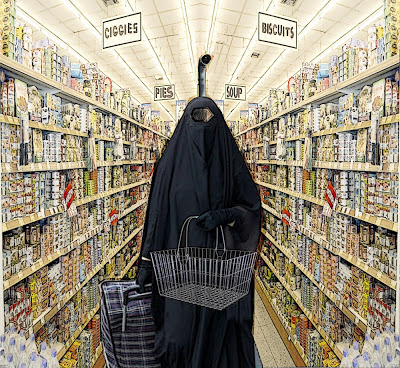
It's always been a great little community here in Lighter Piddle, folks helping each other out, aunts playfully squeezing the cheeks of well-meaning ruffians and so on, although of course no-one has forgotten that Dennis Johnson of Plover Close almost certainly saw a Sikh gentleman buying a packet of Toffos at the all-night garage on the Kimpton Road last June, although admittedly it was dark and the motorist in question may simply have been wearing a red hat rather than a turban, but then there are no racists here let me assure you and we don't let such petty matters trouble us, as I myself was saying to Peter Mayhew up at the Manor only the other day as we enjoyed his Bob Marley album.
Of course, it's all a very different oven of gefilte fish over in Higher Piddle where things have gone somewhat to pot of late. A close friend of mine knows a person who met someone who described what I can only call an incident which occurred in the Spar supermarket on the high street. The person who met the acquaintance of my close friend was politely and humbly stood in line with a bag of carrots which she had intended to purchase in order to feed some orphans and homeless kittens, when a Muslim woman dressed in a three full length burkhas with only a snorkel protruding from the top rudely pushed in with her basket full of British sausages which she had planned to take home and disrespectfully sacrifice to Yahweh as a blatant insult to pork-loving Brits everywhere, even those living harmlessly and respectfully on the Costa del Crime in France.
'Infidel dog,' the lady foreigner exclaimed to the startled cashier who was just innocently minding her respectful English business, 'I demand also a disposable lighter with which I will set fire to that worthless Union Flag you love so dear, those infidel stripes that so closely resemble the Y-fronts of the devil George Bush.'
'That will be fifty pence,' said the cashier respectfully and democratically, because she loved free speech and knew there was no shame in being proud of your country because it's definitely not racist or anything.
'Under glorious Sharia Law which the most excellent and revered George Galloway and his fellow conspirators will soon be introducing to this island that is shaped like a toilet and which is filled with similar contents, I would not have to pay such a price for this inferior British lighter. But luckily a payment of fifty million pounds has just come through following my application for status as an illegal asylum seeker, and so I will grudgingly stump up your required fifty pence.'
At that point the person who met an acquaintance of my close friend couldn't help but notice that the impolite alien woman had dropped a bit of paper. Being English, before she even knew what she was doing she had politely picked up the piece of paper so as to return it to this person against whom she bore no resentment whatsoever, despite the influx of her kind stealing British jobs and the English Isles now comprising a population of 98% illegal immigrants and a mere 3% of honest and respectful white people, and she noticed that it was a picture of Del Boy and Robbie Williams from The 1977 Morecambe & Wise Christmas Special beneath which were scribbled in blood red ink the words all infidel Eengleesh peegs must die, and the words English and pigs were actually spelled that way as though spoken by a foreigner.
At that point an elderly gentleman standing in the queue stepped forward and interrupted with a calm, respectful voice like that man on the Werther's Originals advert, saying unto the Muslim woman, 'excuse me, but millions of noble and respectful British Tommies, just like the young man this lady would have been had she undergone gender reassignment, have fought and sacrificed their lives so that people just like you can stand here on Britain, the land which gave the world Bob Marley and Cat Stevens so it isn't racist, and blatantly accuse an innocent fifty pence piece of sickening paedophilia when the very same Queen for whom I voted served respectfully in three world wars just so we may all enjoy and share the freedom to dress our fingers as innocently sexy youngsters, and yet you see fit to come in here with your vile accusations. It is my belief that if you were allowed to be so outspoken in France or wherever the hell it is you people come from, then our brave boys wouldn't be fighting there today. Gutless moral cowardice, I call it.'
My close friend was told by her acquaintance that the person she had met told her that the queue then cheered and respectfully applauded, which wasn't racist because Mrs. Baxter who was stood at the very back waiting to pay for a packet of custard creams once sat next to one in a doctor's waiting room, and anyway there's my own very close personal friend, Mr. Patel whom I met that one time when I went to that London. I recall asking him how much the fare would cost for Piccadilly Circus as though it were yesterday.
'One pound twenty,' he quipped without looking at me before dinging the bell thing and making the bus go, and anyway it's not even about race, it's about culture. Some of them just don't want to watch Strictly Come Dancing.
So anyway, this definitely really happened and any resemblance to a four year old boy telling you he's just seen a dinosaur or the sort of tripe spouted by imbeciles in the belief that a transparently fictitious account of an ethnic minoritarian getting up to the sort of dastardly moustache-twirling evil which readers of the usual newspapers genuinely seem to believe constitutes the national character of anyone with a bit of a tan, is purely coincidental.
Like if you agree.
Or just respond with here here or something.
Drooling Facebook Idiocy
by noreply@blogger.com (Lawrence Burton)

It's always been a great little community here in Lighter Piddle, folks helping each other out, aunts playfully squeezing the cheeks of well-meaning ruffians and so on, although of course no-one has forgotten that Dennis Johnson of Plover Close almost certainly saw a Sikh gentleman buying a packet of Toffos at the all-night garage on the Kimpton Road last June, although admittedly it was dark and the motorist in question may simply have been wearing a red hat rather than a turban, but then there are no racists here let me assure you and we don't let such petty matters trouble us, as I myself was saying to Peter Mayhew up at the Manor only the other day as we enjoyed his Bob Marley album.
Of course, it's all a very different oven of gefilte fish over in Higher Piddle where things have gone somewhat to pot of late. A close friend of mine knows a person who met someone who described what I can only call an incident which occurred in the Spar supermarket on the high street. The person who met the acquaintance of my close friend was politely and humbly stood in line with a bag of carrots which she had intended to purchase in order to feed some orphans and homeless kittens, when a Muslim woman dressed in a three full length burkhas with only a snorkel protruding from the top rudely pushed in with her basket full of British sausages which she had planned to take home and disrespectfully sacrifice to Yahweh as a blatant insult to pork-loving Brits everywhere, even those living harmlessly and respectfully on the Costa del Crime in France.
'Infidel dog,' the lady foreigner exclaimed to the startled cashier who was just innocently minding her respectful English business, 'I demand also a disposable lighter with which I will set fire to that worthless Union Flag you love so dear, those infidel stripes that so closely resemble the Y-fronts of the devil George Bush.'
'That will be fifty pence,' said the cashier respectfully and democratically, because she loved free speech and knew there was no shame in being proud of your country because it's definitely not racist or anything.
'Under glorious Sharia Law which the most excellent and revered George Galloway and his fellow conspirators will soon be introducing to this island that is shaped like a toilet and which is filled with similar contents, I would not have to pay such a price for this inferior British lighter. But luckily a payment of fifty million pounds has just come through following my application for status as an illegal asylum seeker, and so I will grudgingly stump up your required fifty pence.'
At that point the person who met an acquaintance of my close friend couldn't help but notice that the impolite alien woman had dropped a bit of paper. Being English, before she even knew what she was doing she had politely picked up the piece of paper so as to return it to this person against whom she bore no resentment whatsoever, despite the influx of her kind stealing British jobs and the English Isles now comprising a population of 98% illegal immigrants and a mere 3% of honest and respectful white people, and she noticed that it was a picture of Del Boy and Robbie Williams from The 1977 Morecambe & Wise Christmas Special beneath which were scribbled in blood red ink the words all infidel Eengleesh peegs must die, and the words English and pigs were actually spelled that way as though spoken by a foreigner.
At that point an elderly gentleman standing in the queue stepped forward and interrupted with a calm, respectful voice like that man on the Werther's Originals advert, saying unto the Muslim woman, 'excuse me, but millions of noble and respectful British Tommies, just like the young man this lady would have been had she undergone gender reassignment, have fought and sacrificed their lives so that people just like you can stand here on Britain, the land which gave the world Bob Marley and Cat Stevens so it isn't racist, and blatantly accuse an innocent fifty pence piece of sickening paedophilia when the very same Queen for whom I voted served respectfully in three world wars just so we may all enjoy and share the freedom to dress our fingers as innocently sexy youngsters, and yet you see fit to come in here with your vile accusations. It is my belief that if you were allowed to be so outspoken in France or wherever the hell it is you people come from, then our brave boys wouldn't be fighting there today. Gutless moral cowardice, I call it.'
My close friend was told by her acquaintance that the person she had met told her that the queue then cheered and respectfully applauded, which wasn't racist because Mrs. Baxter who was stood at the very back waiting to pay for a packet of custard creams once sat next to one in a doctor's waiting room, and anyway there's my own very close personal friend, Mr. Patel whom I met that one time when I went to that London. I recall asking him how much the fare would cost for Piccadilly Circus as though it were yesterday.
'One pound twenty,' he quipped without looking at me before dinging the bell thing and making the bus go, and anyway it's not even about race, it's about culture. Some of them just don't want to watch Strictly Come Dancing.
So anyway, this definitely really happened and any resemblance to a four year old boy telling you he's just seen a dinosaur or the sort of tripe spouted by imbeciles in the belief that a transparently fictitious account of an ethnic minoritarian getting up to the sort of dastardly moustache-twirling evil which readers of the usual newspapers genuinely seem to believe constitutes the national character of anyone with a bit of a tan, is purely coincidental.
Like if you agree.
Or just respond with here here or something.
02 Jun 11:41
Hate is what you do, not what you feel
by Fred Clark
AZspot highlights an insightful, helpful post from Danny Coleman in which Coleman argues that toxic theology motivates “Christian” opposition to LGBT people more than personal animus does.
Here’s the core of his point:
[Christians who oppose LGBT equality] do not hate or fear LBGT people. They fear God. They carry a perception of the wrathful Old Testament God who will destroy cities or nations if “sin” is found in the camp. … Attempts to reconcile this ancient God of wrath with the God of love and inclusion that Jesus represented tend to create a sort of congitive and spiritual dissonance. And so, most Christians don’t hate and fear gays — they really want to love them. What they fear is God’s wrath and what they hate is the idea of the destruction God will bring down if LGBT people are accepted — if “sin” is allowed. There is also an earnest desire to be faithful and obedient to what they perceive God’s will to be.
The distinction Coleman makes is accurate, and it can be helpful in shaping how we go about trying to reach such Christians, to persuade them to change, and to liberate them from the toxic theology* they’re trapped in — the one that leads them to behave hatefully toward people “they really want to love.”
The problem with Coleman’s post is that the accurate distinction he makes about the source of these Christians’ opposition to LGBT equality doesn’t mean everything that Coleman wants it to mean. “I do not like it when Christians who oppose LGBT equality are accused of ‘hating’ or being ‘homophobic,’” he begins. “They do not hate or fear LBGT people.”
 Well, no. They actually do hate and fear LGBT people. That hate and fear may not be their starting point, but it’s where they end up. I’m not accusing them of hating or being homophobic to annoy you. I’m accusing them of these things because they are guilty of them.
Let’s deal with the fear first. These Christians do, in fact, fear LGBT people. They have to because, as Coleman notes, they believe God requires them to do so. This fear may be an indirect side-effect, but that doesn’t mean it isn’t real or that it somehow doesn’t matter.
This fear is the inevitable byproduct of the theology Coleman describes: God will punish me if I allow the human dignity and legal equality of Group X. To be safe, then, from the temptation of allowing such dignity and equality, I must avoid Group X. I must flee Group X.
That’s fear.
The fear of God’s wrath becomes, for these Christians, fear of association with those who might bring such wrath down upon them. And fear of association with such people brings with it fear of those people themselves.
This is much like the dual fear of bystanders in any context of ethnic cleansing. Their first fear is of the mob or the secret police. They understandably are frightened of incurring the lethal wrath that is sure to befall anyone who might appear to be giving aid or sympathy to the minority being targeted. And thus that first fear prevents bystanders from assisting, sheltering or defending the population being persecuted. The bystanders may feel bad about this, but they cannot or will not risk doing otherwise.
And thus bystanders never only fear the mob or the secret police. They also fear the knock at the door. I don’t mean the loud knocking of the mob or the police — they have obediently done nothing to have to dread such an inspection. No, the knock that they fear is the furtive knock of a neighbor in need. They come to dread this more than anything.
And that dread, ultimately, becomes resentment. Guilt always leads to resentment. And so those in need — the minority being targeted by the mob and the secret police — become both feared and hated by the bystanders.
So too, inevitably, these Christians come to fear and hate the people whose equality they oppose, however reluctantly and regrettably at first.
We only sometimes do wrong to those we hate, but we will always come to hate those whom we have wronged.
The core problem, I think, is that Coleman wants to limit hate to a feeling. And hate is not what you feel, it’s what you do.
Think of what the book of James says:
If a brother or sister is naked and lacks daily food, and one of you says to them, “Go in peace; keep warm and eat your fill.” and yet you do not supply their bodily needs, what is the good of that?
Or this, from 1 John:
How does God’s love abide in anyone who has the world’s goods and sees a brother or sister in need and yet refuses help?
Consider this hypothetical case of Bob and Ted.
Bob hates Muslims — hates them with a visceral, fiery hatred that burns in the pit of his stomach and keeps him up at night. He feels hatred toward them.
So Bob supported the successful campaign that convinced the county zoning board to reject a local Muslim group’s bid to build an Islamic community center on the same block as two local churches.
Ted, on the other hand, does not feel any such visceral hatred toward Muslims. On the contrary, he says, he loves his Muslim neighbors. It causes him real grief, he says, that they have been deceived by a false religion. Ted thus believes that it would be wrong to allow an Islamic community center to promote this deceptive false religion, endangering and ensnaring the souls of even more of his neighbors. And he fears that America will be punished if it tolerates false religions, just as Israel was punished in the days of Gideon.
So Ted supported the successful campaign that convinced the county zoning board to reject a local Muslim group’s bid to build an Islamic community center on the same block as two local churches.
Now, if “hate” refers only to a feeling in the gut — to a palpable sensation of animosity, abstracted from any deed or action or tangible consequence — then I suppose we could say that Bob “hates” Muslims while Ted does not.
But so what? Their gut feelings may differ, but their actions do not. Only Bob feels hatred, but both of them behave hatefully.
The difference between Bob and Ted is meaningful as far as how we might go about trying to persuade them to change — to repent and be liberated — but it means nothing in terms of the real-world damage and harm that both are doing to their actual neighbors. Ted does not earn bonus points for not feeling animus while acting in a hostile manner. He does not get a cookie as a prize for not “hating” the people whose human dignity and legal equality he opposes.
Is Ted “better” than Bob? I guess, perhaps, maybe — but who cares? Being better than Bob is a dismayingly low standard. Better than Bob can still be a long, long way from being good.
When Christians oppose the equality of LGBT people or of any other minority, I don’t care about their feelings. I care about their opposition to equality.
Hate is what you do, not what you feel.
- – - – - – - – - – - – -
* Just how toxic that theology is becomes clearer if we polish up the parallelism in Coleman’s post. He says these anti-gay Christians shouldn’t be “accused of ‘hating’ or being ‘homophobic’” because “They do not hate or fear LGBT people. They fear God.” Hate & fear, hate & fear. Fear.
Correct the parallelism, balance the equation, and you’ll notice that the logic of Coleman’s distinction shows us that these folks don’t just “fear God.” They hate God.
And of course they do. They resent God for forcing them to strangle their conscience by treating neighbors more poorly than they wish they could. They resent God for requiring them to behave hatefully to those “they really want to love.” They resent this God for making them worse people than the people they might otherwise be.
02 Jun 11:28
Patrick Mercer and the right to recall MPs
by Jonathan Calder
Patrick Mercer's reaction after being exposed by Panorama and the Daily Telegraph was to announce that he was resigning the Conservative whip but would remain as MP for Newark until the next general election.
Eric Joyce was suspended from the Labour Party when he was charged with assault after an incident in Strangers' Bar but is still voting in the lobbies.
This is surely the wrong way round. The moral hurdle for being a member or parliament cannot be lower than the one for being a member of a party.
It would be more fitting for these MPs to resign their seats but remain as members of their parties. All parties include members you would not dream of putting forward as parliamentary candidates but who can contribute usefully in other ways.
And I suspect the worse thing for someone like Joyce, who appears to have personal problems, is to be cut adrift in this way.
One clear moral of the events of the last few days is that we need the long-promised reform of lobbying.
But do we need the power to recall errant MPs too? Morally, they ought to resign, but should they be forced to?
I am not a great fan of recall powers because I don't think they would be good for our politics.
It is easy to imagine a party that loses in a Westminster constituency devoting its efforts, not to winning the next election, but to refighting the last one. Dig up dirt on your new MP, get up petitions against him or her locally, don't talk about policy at all.
It is what happened in the US when, faced with the popularity of Bill Clinton, the Republican right decided to concentrate on his character and campaign for impeachment instead.
You can even imagine a future government trying to use recall powers to force a particularly annoying critic out of the Commons.
No doubt it would be possible to make the offence required to trigger the power of recall sufficiently serious to avoid most of these dangers, but I am still not convinced that a right of recall would be good for British politics.
Like many measures designed to restore the reputation of MPs, it could end up making us think less of them.
Eric Joyce was suspended from the Labour Party when he was charged with assault after an incident in Strangers' Bar but is still voting in the lobbies.
This is surely the wrong way round. The moral hurdle for being a member or parliament cannot be lower than the one for being a member of a party.
It would be more fitting for these MPs to resign their seats but remain as members of their parties. All parties include members you would not dream of putting forward as parliamentary candidates but who can contribute usefully in other ways.
And I suspect the worse thing for someone like Joyce, who appears to have personal problems, is to be cut adrift in this way.
One clear moral of the events of the last few days is that we need the long-promised reform of lobbying.
But do we need the power to recall errant MPs too? Morally, they ought to resign, but should they be forced to?
I am not a great fan of recall powers because I don't think they would be good for our politics.
It is easy to imagine a party that loses in a Westminster constituency devoting its efforts, not to winning the next election, but to refighting the last one. Dig up dirt on your new MP, get up petitions against him or her locally, don't talk about policy at all.
It is what happened in the US when, faced with the popularity of Bill Clinton, the Republican right decided to concentrate on his character and campaign for impeachment instead.
You can even imagine a future government trying to use recall powers to force a particularly annoying critic out of the Commons.
No doubt it would be possible to make the offence required to trigger the power of recall sufficiently serious to avoid most of these dangers, but I am still not convinced that a right of recall would be good for British politics.
Like many measures designed to restore the reputation of MPs, it could end up making us think less of them.

02 Jun 01:28
Shamefully, I never thought I’d get back to this. And maybe I still won’t (my reviews elsewhere have fallen off rather, too). But just in case you’ve happened to come by this way, here’s a little bit of Bill Hartnell fun. I was so utterly delighted to see him in prime time, palely colourised and all, in The Name of the Doctor a fortnight ago that I popped on An Unearthly Child straight afterwards. Then The Daleks (Richard being away for the weekend). And I enjoyed them enormously. The Edge of Destruction, too, and Marco Polo since.
Marco Polo, though, is something very different to those three.
It’s the first Doctor Who story that you can buy on CD.
You know, you can buy two-thirds of all the William Hartnell stories on CD – and all but three of those in which Patrick Troughton stars as the Doctor. So what, you might ask, has the BBC got against those left out, and especially those first three stories that I’ve told you are so brilliant?
Well, if you’re reading this obscure blog, you almost certainly know the answer already – that it’s nothing the BBC has against those three terrific stories I’ve already written about here, but that it’s got next to nothing of many of the rest of the Sixties. More than one in eight of all Doctor Who episodes made to this day – specifically, nearly half of those made in the ’60s, and more than half of those starring Patrick Troughton – no longer exist in most meaningful senses, which is why you can buy the first three stories on DVD but the fourth is primarily available on CD instead.
There were 253 episodes of Doctor Who made and broadcast in the 1960s. Only 148 still exist as TV episodes. Out of the six Doctor Who seasons starring William Hartnell and Patrick Troughton as the Doctor, three are almost but not quite complete; three are skeletal wrecks with the vast majority of their episodes “lost”. Accounts of this distressing phenomenon tend to use the euphemisms “lost” or “missing”, particularly accounts from the BBC, when more accurate words might be “burnt” or “taped over”. In fact, the original video of every single 1960s episode was taped over, though that’s marginally less appalling than it sounds. For a more in-depth account, I recommend Doctor Who Magazine Special Edition 34: The Missing Episodes – The First Doctor, which was released a couple of months ago and copies of which can still be found in some shops (or, inevitably but less visually, Wikipedia). For my partial account of the strange and wonderful ways of experiencing what’s left, read on.
It wasn’t just Doctor Who. The BBC’s archiving policy with many pieces of great television from the 1960s was literally to toss them into a skip and burn them. Film was thrown away or torched, while video was wiped over. In the days when there were just three TV channels, an actors’ union dead-set against repeats and videotape highly expensive (and long before home video), as well as many TV bosses seeing their medium as an ephemeral one of no lasting artistic significance, it’s easy to see why so much early television was destroyed, though to understand the terrible mixture of snobbery, false economy and lack of foresight that led to such mass vandalism is not to excuse it. The simplest way was just to re-use the huge and hugely expensive videotape spools again to record new programmes. And that’s why no Doctor Who episode from the ’60s exists in its crisp, first-generation original format. It wasn’t until Tom Baker’s first season in 1975 that every episode’s master tape was kept.
The good news is that a surprising number of other formats – official and unofficial – mean that a surprising number of episodes survive, even if none survive precisely as they started. The biggest reason is that the BBC made film copies of almost every episode for overseas sales. While these didn’t quite capture the full picture or frame rate of the originals, there were a great many more copies struck: film was the international standard, and Doctor Who was successful enough to be exported to more than sixty countries. These copies were also in black and white – most countries’ TV stations not switching over to full colour until well in the ’70s – which is why for many years several episodes starring Jon Pertwee as the Doctor could only be seen in monochrome, despite all of them having been made in colour. Thanks to finds, technological advances and sometimes painstaking and expensive hard work, now all of them are back to at least watchable if not perfect colour: on Monday, the last of these, The Mind of Evil, will be released on DVD and those like me who weren’t born when it was broadcast in 1971 will be able to see it in colour for the first time.
Many episodes were “lost” for a second and final time when the BBC helpfully insisted that all export copies were destroyed once the rental period was up. Thankfully, some were kept in the BBC’s own film archive and others have since turned up in TV stations and far more peculiar places all over the world. Since the BBC changed their policy and started keeping rather than destroying their television archive in the late 1970s, more than thirty episodes have been recovered, though with fewer than ten of those turning up in the last twenty years, each discovery seems like it might be the last.
If you know any film collectors with mysterious cans of any pre-1970s television programmes, the hunt is still on: this Radio Times article tells you how to get in touch in the unlikely but blessed event that you think you’ve found any “lost” Doctor Who or other piece of TV history.
When I was growing up, you got to see Doctor Who once – perhaps twice, with a couple of lucky stories from each year repeated the following summer – and that was it. The only two ways to experience a story again were, as I’ve written before, nightmares and Target Books, both thrilling if only partially reliable recreations of Doctor Who on TV. Almost every TV Doctor Who story from the original 1963 to 1989 run was novelised, which immediately put the series way ahead of most television. But even without the filmed copies held, or not, by TV stations which were as far as anyone knew never to be seen again, there were strange underground multimedia alternatives.
By the early 1990s, at last we could read novels of every 1960s Doctor Who story, including the “lost” ones. More surprisingly, by the early ’90s we were able to start hearing them, too. Doctor Who had so gripped the imagination of some viewers from the very first that they wanted to experience it again and again, and these home entertainment pioneers put microphones to their tellies and recorded the soundtracks. Between several different people’s collections later supplied to a BBC that decided it did want them after all, every single story exists at least in sound from – again putting Doctor Who in a far more fortunate position than many other TV series of the period. And over the last twenty years, all those soundtracks have been released.
There’s a curious crossover between the first and second waves of mainstream, purchasable versions of the missing stories, and it’s for me the best of all “lost” stories – The Evil of the Daleks. It was the final Target novelisation, released in 1993; in 1992, it was also the joint first release of a complete “missing” soundtrack. I recently wrote about The Evil of the Daleks on my main blog, having guest-reviewed it for a friend; by an odd quirk, the other soundtrack released with it was The Macra Terror, which also became a firm favourite and which between them are arguably the series’ most strongly Liberal stories. And it’s as part of my review of The Macra Terror that I first wrote about its rather fabulous Reconstruction and just what that phenomenon means, of which more shortly.
The first commercial soundtrack releases from the BBC were of ropy quality, on cassette, and were given both sparse and eccentric linking narration to explain what was going on in the absent pictures. I still have a great fondness for them, though I can no longer play my dusty cassettes – if anyone has decent MP3s of 1992’s first four cassette releases, please do get in touch – but today’s comprehensive CD collection is of far greater quality. The soundtracks have been painstakingly restored by cross-matching multiple sources and remastering each of them; the narration is considerably more precise, if sometimes intrusively verbose; and the discs themselves are a far clearer listening experience than the cassettes ever were. Though most of them are available as single releases, I recommend the five-box series Doctor Who – The Lost TV Episodes Collection, which collects all the missing stories into boxed sets (shop around for the best deal).
Though the soundtracks are the most accessible and comprehensive representations of the 106 “lost” episodes, they’re far from the only ones. A man called John Cura made a living by photographing early TV programmes and selling them on to the likes of BBC directors so they could have records of their work – as a result, around 60 Tele-snaps per episode rather than 25 frames per second exist for the majority of the Doctor Who stories where the moving pictures were junked. You can see Tele-snaps assembled into perfunctory photonovels on the BBC website for stories such as, again, The Evil of the Daleks and The Macra Terror.
At the less officially sanctioned end, a few tiny film clips exist from people with wind-up cine-cameras, though no full episodes (or even full minutes!) were recorded in the same way that the soundtracks were. Most ironically and hilariously, some of the ‘scarier’ scenes survive because the censors in New Zealand cut them out before stories were transmitted over there, but being good bureaucrats, carefully stored the ‘unsuitable’ bits. So all we now have of some stories are the bits they didn’t want us to see. One DVD release, Doctor Who – Lost In Time, is entirely a collection of ‘orphaned’ episodes, film clips and censored fragments where some but not all of the story exists.
The most ambitious recreations of the missing episodes are cartoon animations paired to the soundtracks, now available on DVD to supplement the existing episodes of The Invasion and The Reign of Terror – expensive and exciting, these return the complete stories to moving pictures, and there are more on the way.
The next most ambitious recreations of the missing episodes are back to that less officially sanctioned end – the Reconstructions. These fabulous labours of love match the soundtracks to the Tele-snaps, and more recently film clips, CGI and anything else to hand, with occasional explanatory captions, for a strange but compelling experience somewhere between the audio drama of a soundtrack alone and a TV show. Some Recons are essentially slide shows; others mount ambitious CGI sequences, such as highly effective animated Daleks or unintentionally comical juddering Yeti. And not only are these available for free, they must be available for free: the BBC appear to turn a blind eye to them as long as they don’t use the remastered CD soundtracks and as long as no-one makes a penny from them, so don’t let anyone charge you for them.
The best and most comprehensive range of Recons are made by Loose Cannon, and you can find their website here. Their work offers increasingly ambitious approximations of missing sequences and a remarkable array of extra features, particularly interviews with actors and others who worked on the stories they’re aiming to reconstruct.
To finish by returning to my opening flipped point of view, there are other Doctor Who CDs available than just the “lost” adventures. Quite a few stories which exist in their entirely have also been released on narrated soundtrack CD, particularly as the DVD range has taken a long while to bring everything out, not least by painstakingly restoring each story to the best quality they can. As a result, the audio range jumped ahead to make several stories available on CD before they were out on DVD, with the result that even though there are still a handful of DVD releases to come, every ’60s Doctor Who story has now been available for quite some time on at least one variety of shiny silver disc, and most of them on both (last year’s DVD release of Planet of Giants, perhaps ignored on CD for its very visual nature, belatedly completing the decade three years after all the others). The colour episodes from the ’70s on have taken slightly longer to catch up but, excitingly, after Monday’s release of The Mind of Evil, there will be only one story broadcast to date from 1970 to 2013 still to come on DVD, either*.
The most recent new form of making Doctor Who stories available combines two of the oldest: talking books of the Target novels, available on CD and download. Most of them are rather marvellous, and taken with the soundtrack releases mean that many stories from the “lost” decade of the ’60s are now officially available in three quite different formats (and, for many missing stories, two official ones and the Recons that you’re not supposed to mention). Taking the audiobooks of the Target novels into account, only one Patrick Troughton story is so unloved as not to be available on CD so far – The Seeds of Death does, however, have two separate DVD releases (and, way back in the 1980s, one of the first videos) to its credit. At present, four William Hartnell stories are in the same boat, though as this is an ever-expanding range, it was announced last week that one of them is on its way later this year. The very first story, An Unearthly Child, is to have an audiobook release to celebrate the series’ fiftieth anniversary. It will also be only the third Doctor Who story to have two separate official novelisations, as this will not be a reading of Terrance Dicks’ 1981 book but of a newly commissioned one by Nigel Robinson. Perhaps if demand for Doctor Who CDs continues, one day for completism’s sake there will not only be a narrated soundtrack but a reading of the ‘retro’ novelisation, so you can enjoy it not only on DVD but on CD, CD and CD. I’d buy them.
For me, the most marvellous Recon I’ve yet seen isn’t quite the two much-adored stories I’ve mentioned several times above, but one made up only of old-fashioned photographs and text captions, and not even any Tele-snaps… Yet they’re photographs with a difference. They’re not in pale, fuzzy colours but bold, glorious colour throughout, and it never fails to excite me to see the only story starring William Hartnell as the Doctor that doesn’t exist in full… But does exist in full colour.
Should I ever return here properly, it’s on next. Should I not, I’ve just enjoyed it all over again and by going to this site, so can you.
*The sole Doctor Who story which, after Monday, will still not be available on shiny silver disc is 1975’s Terror of the Zygons, which despite a recent reissue of its novelisation (a massive childhood favourite of mine for personal reasons) hasn’t even had its own audiobook yet. Except… That it does have the esoteric distinction of having been among only a handful of Doctor Who stories to be released on each of two other sorts of shiny silver discs that I’ve not mentioned yet. No, not Blu-rays. We have in our obsessively completist collection not the soundtrack in the sense I’ve used it above – the complete sounds originally broadcast along with the visuals to a story – but in the more conventional for a movie but unusual for a Doctor Who story sense of the Doctor Who – Terror of the Zygons Official Sound Track. Yes, it has a music CD. Still more rarely and improbably, as well as being one of the first video releases in the ’80s, it was one of the only laserdisc releases. So we have it on silver disc that is not only shiny, but enormous.
William Hartnell and Patrick Troughton’s Doctor Who: Now You See It…
by Alex Wilcock
Shamefully, I never thought I’d get back to this. And maybe I still won’t (my reviews elsewhere have fallen off rather, too). But just in case you’ve happened to come by this way, here’s a little bit of Bill Hartnell fun. I was so utterly delighted to see him in prime time, palely colourised and all, in The Name of the Doctor a fortnight ago that I popped on An Unearthly Child straight afterwards. Then The Daleks (Richard being away for the weekend). And I enjoyed them enormously. The Edge of Destruction, too, and Marco Polo since.
Marco Polo, though, is something very different to those three.
It’s the first Doctor Who story that you can buy on CD.
You know, you can buy two-thirds of all the William Hartnell stories on CD – and all but three of those in which Patrick Troughton stars as the Doctor. So what, you might ask, has the BBC got against those left out, and especially those first three stories that I’ve told you are so brilliant?
Well, if you’re reading this obscure blog, you almost certainly know the answer already – that it’s nothing the BBC has against those three terrific stories I’ve already written about here, but that it’s got next to nothing of many of the rest of the Sixties. More than one in eight of all Doctor Who episodes made to this day – specifically, nearly half of those made in the ’60s, and more than half of those starring Patrick Troughton – no longer exist in most meaningful senses, which is why you can buy the first three stories on DVD but the fourth is primarily available on CD instead.
There were 253 episodes of Doctor Who made and broadcast in the 1960s. Only 148 still exist as TV episodes. Out of the six Doctor Who seasons starring William Hartnell and Patrick Troughton as the Doctor, three are almost but not quite complete; three are skeletal wrecks with the vast majority of their episodes “lost”. Accounts of this distressing phenomenon tend to use the euphemisms “lost” or “missing”, particularly accounts from the BBC, when more accurate words might be “burnt” or “taped over”. In fact, the original video of every single 1960s episode was taped over, though that’s marginally less appalling than it sounds. For a more in-depth account, I recommend Doctor Who Magazine Special Edition 34: The Missing Episodes – The First Doctor, which was released a couple of months ago and copies of which can still be found in some shops (or, inevitably but less visually, Wikipedia). For my partial account of the strange and wonderful ways of experiencing what’s left, read on.

Why 1960s Doctor Who Was Destroyed
It wasn’t just Doctor Who. The BBC’s archiving policy with many pieces of great television from the 1960s was literally to toss them into a skip and burn them. Film was thrown away or torched, while video was wiped over. In the days when there were just three TV channels, an actors’ union dead-set against repeats and videotape highly expensive (and long before home video), as well as many TV bosses seeing their medium as an ephemeral one of no lasting artistic significance, it’s easy to see why so much early television was destroyed, though to understand the terrible mixture of snobbery, false economy and lack of foresight that led to such mass vandalism is not to excuse it. The simplest way was just to re-use the huge and hugely expensive videotape spools again to record new programmes. And that’s why no Doctor Who episode from the ’60s exists in its crisp, first-generation original format. It wasn’t until Tom Baker’s first season in 1975 that every episode’s master tape was kept.
The good news is that a surprising number of other formats – official and unofficial – mean that a surprising number of episodes survive, even if none survive precisely as they started. The biggest reason is that the BBC made film copies of almost every episode for overseas sales. While these didn’t quite capture the full picture or frame rate of the originals, there were a great many more copies struck: film was the international standard, and Doctor Who was successful enough to be exported to more than sixty countries. These copies were also in black and white – most countries’ TV stations not switching over to full colour until well in the ’70s – which is why for many years several episodes starring Jon Pertwee as the Doctor could only be seen in monochrome, despite all of them having been made in colour. Thanks to finds, technological advances and sometimes painstaking and expensive hard work, now all of them are back to at least watchable if not perfect colour: on Monday, the last of these, The Mind of Evil, will be released on DVD and those like me who weren’t born when it was broadcast in 1971 will be able to see it in colour for the first time.
Many episodes were “lost” for a second and final time when the BBC helpfully insisted that all export copies were destroyed once the rental period was up. Thankfully, some were kept in the BBC’s own film archive and others have since turned up in TV stations and far more peculiar places all over the world. Since the BBC changed their policy and started keeping rather than destroying their television archive in the late 1970s, more than thirty episodes have been recovered, though with fewer than ten of those turning up in the last twenty years, each discovery seems like it might be the last.
If you know any film collectors with mysterious cans of any pre-1970s television programmes, the hunt is still on: this Radio Times article tells you how to get in touch in the unlikely but blessed event that you think you’ve found any “lost” Doctor Who or other piece of TV history.
The Survivors and the Ghosts: From CDs To Censors, Reading To Recons
When I was growing up, you got to see Doctor Who once – perhaps twice, with a couple of lucky stories from each year repeated the following summer – and that was it. The only two ways to experience a story again were, as I’ve written before, nightmares and Target Books, both thrilling if only partially reliable recreations of Doctor Who on TV. Almost every TV Doctor Who story from the original 1963 to 1989 run was novelised, which immediately put the series way ahead of most television. But even without the filmed copies held, or not, by TV stations which were as far as anyone knew never to be seen again, there were strange underground multimedia alternatives.
By the early 1990s, at last we could read novels of every 1960s Doctor Who story, including the “lost” ones. More surprisingly, by the early ’90s we were able to start hearing them, too. Doctor Who had so gripped the imagination of some viewers from the very first that they wanted to experience it again and again, and these home entertainment pioneers put microphones to their tellies and recorded the soundtracks. Between several different people’s collections later supplied to a BBC that decided it did want them after all, every single story exists at least in sound from – again putting Doctor Who in a far more fortunate position than many other TV series of the period. And over the last twenty years, all those soundtracks have been released.
There’s a curious crossover between the first and second waves of mainstream, purchasable versions of the missing stories, and it’s for me the best of all “lost” stories – The Evil of the Daleks. It was the final Target novelisation, released in 1993; in 1992, it was also the joint first release of a complete “missing” soundtrack. I recently wrote about The Evil of the Daleks on my main blog, having guest-reviewed it for a friend; by an odd quirk, the other soundtrack released with it was The Macra Terror, which also became a firm favourite and which between them are arguably the series’ most strongly Liberal stories. And it’s as part of my review of The Macra Terror that I first wrote about its rather fabulous Reconstruction and just what that phenomenon means, of which more shortly.
The first commercial soundtrack releases from the BBC were of ropy quality, on cassette, and were given both sparse and eccentric linking narration to explain what was going on in the absent pictures. I still have a great fondness for them, though I can no longer play my dusty cassettes – if anyone has decent MP3s of 1992’s first four cassette releases, please do get in touch – but today’s comprehensive CD collection is of far greater quality. The soundtracks have been painstakingly restored by cross-matching multiple sources and remastering each of them; the narration is considerably more precise, if sometimes intrusively verbose; and the discs themselves are a far clearer listening experience than the cassettes ever were. Though most of them are available as single releases, I recommend the five-box series Doctor Who – The Lost TV Episodes Collection, which collects all the missing stories into boxed sets (shop around for the best deal).
Though the soundtracks are the most accessible and comprehensive representations of the 106 “lost” episodes, they’re far from the only ones. A man called John Cura made a living by photographing early TV programmes and selling them on to the likes of BBC directors so they could have records of their work – as a result, around 60 Tele-snaps per episode rather than 25 frames per second exist for the majority of the Doctor Who stories where the moving pictures were junked. You can see Tele-snaps assembled into perfunctory photonovels on the BBC website for stories such as, again, The Evil of the Daleks and The Macra Terror.
At the less officially sanctioned end, a few tiny film clips exist from people with wind-up cine-cameras, though no full episodes (or even full minutes!) were recorded in the same way that the soundtracks were. Most ironically and hilariously, some of the ‘scarier’ scenes survive because the censors in New Zealand cut them out before stories were transmitted over there, but being good bureaucrats, carefully stored the ‘unsuitable’ bits. So all we now have of some stories are the bits they didn’t want us to see. One DVD release, Doctor Who – Lost In Time, is entirely a collection of ‘orphaned’ episodes, film clips and censored fragments where some but not all of the story exists.
The most ambitious recreations of the missing episodes are cartoon animations paired to the soundtracks, now available on DVD to supplement the existing episodes of The Invasion and The Reign of Terror – expensive and exciting, these return the complete stories to moving pictures, and there are more on the way.
The next most ambitious recreations of the missing episodes are back to that less officially sanctioned end – the Reconstructions. These fabulous labours of love match the soundtracks to the Tele-snaps, and more recently film clips, CGI and anything else to hand, with occasional explanatory captions, for a strange but compelling experience somewhere between the audio drama of a soundtrack alone and a TV show. Some Recons are essentially slide shows; others mount ambitious CGI sequences, such as highly effective animated Daleks or unintentionally comical juddering Yeti. And not only are these available for free, they must be available for free: the BBC appear to turn a blind eye to them as long as they don’t use the remastered CD soundtracks and as long as no-one makes a penny from them, so don’t let anyone charge you for them.
The best and most comprehensive range of Recons are made by Loose Cannon, and you can find their website here. Their work offers increasingly ambitious approximations of missing sequences and a remarkable array of extra features, particularly interviews with actors and others who worked on the stories they’re aiming to reconstruct.
To finish by returning to my opening flipped point of view, there are other Doctor Who CDs available than just the “lost” adventures. Quite a few stories which exist in their entirely have also been released on narrated soundtrack CD, particularly as the DVD range has taken a long while to bring everything out, not least by painstakingly restoring each story to the best quality they can. As a result, the audio range jumped ahead to make several stories available on CD before they were out on DVD, with the result that even though there are still a handful of DVD releases to come, every ’60s Doctor Who story has now been available for quite some time on at least one variety of shiny silver disc, and most of them on both (last year’s DVD release of Planet of Giants, perhaps ignored on CD for its very visual nature, belatedly completing the decade three years after all the others). The colour episodes from the ’70s on have taken slightly longer to catch up but, excitingly, after Monday’s release of The Mind of Evil, there will be only one story broadcast to date from 1970 to 2013 still to come on DVD, either*.
The most recent new form of making Doctor Who stories available combines two of the oldest: talking books of the Target novels, available on CD and download. Most of them are rather marvellous, and taken with the soundtrack releases mean that many stories from the “lost” decade of the ’60s are now officially available in three quite different formats (and, for many missing stories, two official ones and the Recons that you’re not supposed to mention). Taking the audiobooks of the Target novels into account, only one Patrick Troughton story is so unloved as not to be available on CD so far – The Seeds of Death does, however, have two separate DVD releases (and, way back in the 1980s, one of the first videos) to its credit. At present, four William Hartnell stories are in the same boat, though as this is an ever-expanding range, it was announced last week that one of them is on its way later this year. The very first story, An Unearthly Child, is to have an audiobook release to celebrate the series’ fiftieth anniversary. It will also be only the third Doctor Who story to have two separate official novelisations, as this will not be a reading of Terrance Dicks’ 1981 book but of a newly commissioned one by Nigel Robinson. Perhaps if demand for Doctor Who CDs continues, one day for completism’s sake there will not only be a narrated soundtrack but a reading of the ‘retro’ novelisation, so you can enjoy it not only on DVD but on CD, CD and CD. I’d buy them.
Next Time…?
For me, the most marvellous Recon I’ve yet seen isn’t quite the two much-adored stories I’ve mentioned several times above, but one made up only of old-fashioned photographs and text captions, and not even any Tele-snaps… Yet they’re photographs with a difference. They’re not in pale, fuzzy colours but bold, glorious colour throughout, and it never fails to excite me to see the only story starring William Hartnell as the Doctor that doesn’t exist in full… But does exist in full colour.
Should I ever return here properly, it’s on next. Should I not, I’ve just enjoyed it all over again and by going to this site, so can you.
*The sole Doctor Who story which, after Monday, will still not be available on shiny silver disc is 1975’s Terror of the Zygons, which despite a recent reissue of its novelisation (a massive childhood favourite of mine for personal reasons) hasn’t even had its own audiobook yet. Except… That it does have the esoteric distinction of having been among only a handful of Doctor Who stories to be released on each of two other sorts of shiny silver discs that I’ve not mentioned yet. No, not Blu-rays. We have in our obsessively completist collection not the soundtrack in the sense I’ve used it above – the complete sounds originally broadcast along with the visuals to a story – but in the more conventional for a movie but unusual for a Doctor Who story sense of the Doctor Who – Terror of the Zygons Official Sound Track. Yes, it has a music CD. Still more rarely and improbably, as well as being one of the first video releases in the ’80s, it was one of the only laserdisc releases. So we have it on silver disc that is not only shiny, but enormous.
01 Jun 09:28
The Name of the Doctor (7.14)
by Andrew Rilstone
There's something forgotten I want you to know
The freckles of rain are telling me so
Oh it's the old forgotten question
What is that we are part of?
What is it that we are?
The Half Remarkable Question
"You could have taken you hand out of the cuff at any time?"
"No, not at any time. Only when it was funny."
Who Framed Roger Rabbit?
It looks great. Many of us have imagined the Doctor's flight from Gallifrey in our heads, and the little scene looks exactly how we imagined it. If the Doctor has a final resting place then the weird graveyard stretching to infinity is what it ought to be. The Great Big Scene, in which we see the Mysterious Man and a caption confirms his identity, is undeniably powerful. But nothing leads up to it or follows from it. It just is. [**]
"But Andrew," you ask "What about the people who don't ask questions about Doctor Who? What about the ones who, you know, just watch it. What will they have to say about this episode?"
Well, they are mainly saying that they didn't understand it. But then, that is what they always mainly say about episodes of this kind. I don't understand what they mean when they say they don't understand it.
Are they complaining that there is too much sci-fi jargon: that when someone says "crossing my own time-line" their brain switches off, in the same way my brain switches off when someone says "but first, sport"?
"After all, you were with him from the beginning"
Citizen Kane
Clyde: "Can you change color or are you always white?
The Doctor: "No
Clyde: "And is there a limit? How many times can you change?
The Doctor: "Five hundred and seven"
Clyde: "Oh."
The Sarah-Jane Adventures
Who is the Bad Doctor?
"Good. One more thing. Your name." "What about my name?"
"It's too long. By the time I've called 'Look out...what's your name?'"
"Romanadvoratnelundar."
"By the time I've called that out, you could be dead. I'll call you Romana."
"I don't like Romana."
"It's either Romana or Fred."
"All right, call me Fred."
"Good. Come on, Romana."
The freckles of rain are telling me so
Oh it's the old forgotten question
What is that we are part of?
What is it that we are?
The Half Remarkable Question
It didn't have to be like this.
I think that before 2005, most of us imagined that New Who would be Doctor Who: the Next Generation, or Ultimate Doctor Who. We imagined that it would be be like the Paul McGann movie or the infinite number of New Adventure. We expected someone to take all those years and years of disconnected storylines and build a modern TV SF universe out of them. We thought it would be like Firefly, only with jelly babies.
Some fans believe that that is what we got. But then some fans believe that is what we already had. Give a fan three wildly inconsistent dots and he will always be able to draw a line between them; and believe that the line he has drawn was there all along; and that the line is good deal more interesting than the dots themselves.[*] If you are one of those fans -- if you don't quite see why I think Star Trek: The Next Generation and New Who have radically different relationships to their source material (and that Star Trek and Doctor Who were very different beasts to begin with) then you'll probably be happier ignoring what I have to say here and remaining lost in miasma of your self-created universe.
And I really do mean happier. I really do wish I could take the blue pill, or possibly the red pill, and rejoin you inside the collective hallucination. But I can't. I can only watch what's been put in front of me.
And I really do mean happier. I really do wish I could take the blue pill, or possibly the red pill, and rejoin you inside the collective hallucination. But I can't. I can only watch what's been put in front of me.
"No, not at any time. Only when it was funny."
Who Framed Roger Rabbit?
I began this series of digressions by claiming that people ask three questions about Doctor Who: "What does this mean to me?" "What does this mean?" and "What is this like?" None of them can ever really be answered. That's why they are such good questions.
People who ask "What does Doctor Who mean to me?" may very well embrace "The Name of the Doctor" as a validation, as the fulfilment of a promise, as proof that there really is some continuity between this show and the one which their ten or twelve year old self fell in love with. But they may just as well denounce it as a horrible violation of all their childhood memories; a trivial piece of graffiti scrawled across a sacred text. Clara -- Clara, who we only met last Christmas! -- watches the Doctor and Susan -- the Doctor and Susan! -- leave Gallifrey and cracks a joke. What next? Children's entertainers at the Last Supper? Lawrence Miles response to the episode was to post a colour photograph of a man's bottom on his website. You sort of see his point.
People who ask "What does Doctor Who mean?" will certainly be fascinated by "The Name of the Doctor". It's about as meta-textual as you can get, and it gives us dozens of hermeneutic knots to unravel. It reaches back to a point before Doctor Who started and forward to a point after Doctor Who has ended and sideways to a part of Doctor Who we have never seen before. It contains the whole of Doctor Who, including itself. At the same time, it undermines and destabilizes and changes everything which has gone before. God knows how much "canon" is left when you have had a Time War which changed history, a crack in time though which bad ideas like the giant Victorian Cyberman seem to have leaked out, and the literal, story-internal "rebooting" of the entire universe. But whatever canon is left has been overwritten. All the Doctor's victories are retrospectively revealed to have been caused by the self-sacrifice of Wonderful Clara. The Doctor has always had plot immunity -- we know that he can't ever be killed off 'cos he's the good guy and the programme's got his name on it. But that plot immunity is now part of the fictional meta-story: he can't be killed because Wonderful Clara will always and has always been there to save him. (The whole premise of Doctor Who, that the Doctor ran away from Gallifrey in a malfunctioning TARDIS, is revealed to be the result of a last minute whim of Wonderful Clara's.) The last 50 years are now to be understood as a manichean conflict, like Blake's angels struggling over a new-born child, where the Angel of Light is a Victorian baddie in a frock coat, and the Angel of Light is a Victorian nanny with a liking for egg products.
"I was born to save the Doctor" says the Ultimate Final Archetypal Companion to End All Companions. To save the him? Isn't that getting everything a little bit back to front?
"I was born to save the Doctor" says the Ultimate Final Archetypal Companion to End All Companions. To save the him? Isn't that getting everything a little bit back to front?
These are relatively easy questions. It's the third one I have the problems with. "What is the 'Name of the Doctor'? What is it like?"
I think "Name of the Doctor" is like one of those playground puzzles in which the convict rubs his hands together until they are sore; uses the saw to cut the table in half; puts the two halves together to make a whole; jumps through the hole and shouts until he is hoarse and then jumps on the horse and rides away. Like that Salman Rushdie story where the car breaks down and everyone has to stand round it being really really quiet because it goes without saying. It is driven by the logic of language, the logic of puns, the logic of dreams, not the logic of science or the logic of logic. It is a world where things work if they sound as if they ought to work. Clara's Mum's leaf brought Clara into existence, in a manner of speaking, because if not for the leaf her Mum would never have met her Dad. Presumably, the world is full of magic bunches of flowers and magic banana skins and magical delays due to scheduled engineering works outside Didcot. But we are inside a dream and once you have spoken in that manner, it becomes somehow literally true and the Doctor can use that leaf to magically call Clara back from the wibbly wobbly time-world.
I think that "Name of the Doctor" is like a cubist painting. where you can see the shape of the woman and the colour of her dress, but where any suggestion that a portrait might resemble its subject has been abandoned in favour of a celebration of pure form. There is no cause and effect in "Name of the Doctor", nothing resembling a normal narrative. It's just scenes and images. Condemned men bargain for their lives; there is seance in a dream world; there is a gothic graveyard in no particular place. Richard E Grant is allegedly playing the Great Intelligence, who is tangentially connected to a villain who appeared in two lost, or at any rate mislaid, black and white episodes. But he isn't really playing the Great Intelligence, or Dr Simeon, or anyone else. He stands at the Doctor's grave in his Victorian costume and demands the Doctor tells him his greatest secret. It's not a beat in a story. It's a scene that stands by itself, like a piece of fan art: the Doctor facing down a sort of generic universal spirit of our impression of what a Doctor Who villain should probably be like. The final moments of the episode are pure, abstract mindscape.
I think that "Name of the Doctor" is like a cubist painting. where you can see the shape of the woman and the colour of her dress, but where any suggestion that a portrait might resemble its subject has been abandoned in favour of a celebration of pure form. There is no cause and effect in "Name of the Doctor", nothing resembling a normal narrative. It's just scenes and images. Condemned men bargain for their lives; there is seance in a dream world; there is a gothic graveyard in no particular place. Richard E Grant is allegedly playing the Great Intelligence, who is tangentially connected to a villain who appeared in two lost, or at any rate mislaid, black and white episodes. But he isn't really playing the Great Intelligence, or Dr Simeon, or anyone else. He stands at the Doctor's grave in his Victorian costume and demands the Doctor tells him his greatest secret. It's not a beat in a story. It's a scene that stands by itself, like a piece of fan art: the Doctor facing down a sort of generic universal spirit of our impression of what a Doctor Who villain should probably be like. The final moments of the episode are pure, abstract mindscape.
It looks great. Many of us have imagined the Doctor's flight from Gallifrey in our heads, and the little scene looks exactly how we imagined it. If the Doctor has a final resting place then the weird graveyard stretching to infinity is what it ought to be. The Great Big Scene, in which we see the Mysterious Man and a caption confirms his identity, is undeniably powerful. But nothing leads up to it or follows from it. It just is. [**]
"My name is Slartibartfast."
"I beg your pardon?"
"Slartibartfast."
"Slartibartfast?"
"I said it wasn't important."
The Hitchhikers Guide to the Galaxy
"But Andrew," you ask "What about the people who don't ask questions about Doctor Who? What about the ones who, you know, just watch it. What will they have to say about this episode?"
Well, they are mainly saying that they didn't understand it. But then, that is what they always mainly say about episodes of this kind. I don't understand what they mean when they say they don't understand it.
Are they complaining that there is too much sci-fi jargon: that when someone says "crossing my own time-line" their brain switches off, in the same way my brain switches off when someone says "but first, sport"?
Are they complaining that too much is left unexplained at the end of the episode? Soap operas have questions in them too, I suppose, but I imagine that the questions are more clearly signposted. When a character you thought was dead walks into the Rovers Return in Ambridge someone says "Oh my god! It is Bruce, former lover of Sheila who we all believed died in a bizarre sheep shearing accident five years ago but who's body was never found! How can he possibly be here?” Mysteries and loose ends and unexpected twists there can certainly be, but they must all come with neat, safe, friendly labels marked "mystery", "loose end" and "unexpected twist". [***] Doctor Who, bless it's hearts, still expects the audience to do some work.
We know -- because Joseph Campbell told us -- that all moviefilms must begin at the very beginning and go though to the very end and leave no unresolved issues. This is the reason that we keep getting reboots and prequels. The Origin of Spider-Man fits, and the Origin of Batman can be made to fit, into the Journey of the Hero. We see Spider-Man before he was a crime fighter, we see the point of crisis which made him decide to become a crime fighter, and then we see him actually fighting some crime. If there was a scene in which he decided that he was finished with crime fighting, we would have the perfect circular narrative. That is why the Spider-Man franchise ended, which is to says started all over again, after only three movies. Spider-Man becomes a crime fighter is a Story. Spider-Man fights some crime is not a story. (The latest Batman series had to be presented as a limited three part trilogy, with instalments that were very nearly called Batman Begins, Batman in the Middle and Batman Ends.) There were, depending on how you count them, twelve Tarzan movies in the 1930s and 1940s. They never "rebooted". Even when Johnny Wiessmuller got too old to swing around the jungle in his knickers, they just wheeled on a younger man whose name escapes me and everyone else and carried on as before. They didn't feel any need to perpetually revisit the shipwreck and that landed little Lord Greystoke in the jungle. A fresh adaptation of Edgar Rice Burroughs book is on the cards, but a new series is unthinkable. Modern audiences would claim not to understand it. "We don't care about these sinister Nazi ivory hunters who are trying to rob the pretty lady of her inheritance" they would say "We want to know why there is a white man living in the jungle, how he learned to talk to the animals, if he will ever leave, and what it says about the human condition." [****]
But I think it is most likely that when the ordinary viewer complains that he doesn't understand "Name of the Doctor", he is making the same complaint that I am making when I talk about "magical realist" construction.
Why can some of the Doctor's friends sniff a magic candle and meet up in a dream world; and if they can do this, why have they never mentioned it before? There isn't an answer, of course, any more than there is a physiological or genetic reason why Peter Pan never grows up. I don't think that the ordinary viewer can accept this. I think that the question occurs to him, and he assumes that there must be answer, but that the writer is withholding it from them for some reason. That's what a question without an answer usually means, isn't it? That someone is hiding something from you?
"Why don't Mummy and Daddy love each other any more?"
"Why does God allow suffering?"
"Why was it necessary to invade Iraq?"
Hush child. Just because.
"Why does God allow suffering?"
"Why was it necessary to invade Iraq?"
Hush child. Just because.
"After all, you were with him from the beginning"
"From before the beginning, young fellow. And now, it's after the end."
Citizen Kane
"Just because" is used far too much in New Who, and far, far too much in "The Name of the Doctor". But, compared with the narrative-free "Hide" and "Journey to the Centre of the TARDIS", "Name of the Doctor" is actually relatively easy to "understand". As a public service, I shall therefore spend a few moments explicating it:
The Doctor's Enemy knows that the means to destroy the Doctor is hidden in his tomb.
The Doctor knows this too, but also knows that his own tomb is the one place he must never go.
Why? Well, if the Doctor could keep meeting up with himself then Doctor Who would get very complicated and very silly, so there is a rule that says that the Doctor can never meet himself, except in special anniversary stories. "Crossing my own time line" is a rather more sciencey way of saying "being in two places at once". We've all spent 50 years convincing ourselves that "being in two places at one is taboo" so it makes a kind of sense to say that "being at the place of my own death" is super dooper taboo.
The Doctor's Enemy kidnaps the Doctor's friends and takes them to the place he mustn't go, so of course he goes there.
It turns out that the Doctor's tomb is the TARDIS itself, grown to massive size.
It turns out that the Doctor's tomb is the TARDIS itself, grown to massive size.
Why? Well, the TARDIS has always been the biggest "just because" in the whole programme.
"Why is it bigger on the inside than the outside."
"Because it's dimensionally transcendental."
"What does dimensionally transcendental mean?"
"It means it's bigger on the inside that the outside."
Inside the dream-world, it makes perfect sense that when the TARDIS dies, the magic should leak out and make it bigger on the outside as well.
"Why is it bigger on the inside than the outside."
"Because it's dimensionally transcendental."
"What does dimensionally transcendental mean?"
"It means it's bigger on the inside that the outside."
Inside the dream-world, it makes perfect sense that when the TARDIS dies, the magic should leak out and make it bigger on the outside as well.
It turns out that it -- the tomb, the TARDIS -- can only be opened when someone says the Doctor's name.
Why? Up to now the Doctor has always opened the TARDIS with a yale key, or a strange alien key, or occasionally with a snap of the fingers or a magic ring. Just as the series increasingly fetishizes the Doctor himself, so it is starting to fetishize his name. It isn't just a thing which we don't know, or even a thing that we can't know. It's a thing which no-one knows, the biggest secret in the Universe. When Ace asked the Doctor "who are you" she was presumably asking what is identity was, what is role was in the universe, expecting an answer like "Omega", "The Other", or "Time's Champion". But it isn't the Doctor's identity which we are supposed to be worrying about. The name itself has become a Word of Power. Granted that, it makes dream-sense for it to be the magic word that opens the TARDIS.
Now it gets complicated. Several seasons ago the Doctor met a lady called River Bloody Song, who knew his true name, almost definitely. From this, we were supposed to infer that she was his wife, even more almost definitely. He didn't know her at all: they would meet in his future, but her past. (There is a book called The Time Traveller's Wife, which I have never read.) She apparently died, but the Doctor kept a sort of a copy of her in the computer in the Biggest Library in the Universe. He has met her several more times since then, always in the wrong order, and at the end of the last season, he married her, sort of. She also turns out to be the daughter of one of his companions, but that's not important right now, probably. She is one of the friends who is summonsed to the dream world, and it's the version of her from the after-life in the library computer which has arrived at the Doctor's tomb. At first it seems that only Clara can see her (Why? Because they are "telepathically linked".) Then it turns out that the Doctor can see her as well. (Why? This is a classic example of what I'm calling "magical realism". The Doctor says that "you are always here to me...I can always see you" which is, of course, the sort of thing which lovers say to each other, but it's only true in a manner of speaking. But in the dream world which is Doctor Who "you are always here because I am always thinking of you" becomes literally true..)
In order to save everyone's life, River Bloody Song says that Doctor's name and opens up the TARDIS. However, the Doctor's body is not in the tomb: instead we find a wiggly line representing all his journeys through time and space. But at some level this line actually is the journey itself, or the Doctor himself ("my own personal time tunnel"). So the Doctor's Enemy can physically jump into the line and appear in every place the Doctor has ever been, and either tempt him to do bad things or just interfere so he loses. This changes history (again) so the Doctor never existed (again) and the universe starts changing (again) — planets he would have saved blink out of existence, the good Sontaran turns back into a bad Sontaran, and so on. (Which is, being interpreted "Look after the universe for me, I've put a lot of work into it"; and in another place, it is written "Maybe the universe itself can't bare to be without the Doctor.")
But Clara realizes that she can save the day by throwing herself into the timey wimey line as well, so she will also appear at every place the Doctor has ever been, but to help him, not harm him. Copies of her appear all through history: the original is destroyed. It isn't exactly clear if she counteracts the bad things the Doctor's enemy did and returns things to the status quo, or whether she retrospectively changes things for the better.
So, Clara gives her life to save the Doctor and becomes a sort of a godlike being, the lynchpin of history, in the same way that Rose and Donna and sort of Amy did. (Never mention Martha Jones, who only became the most important person on earth, and an alternate earth, at that.) However, she isn't really dead as long as we remember her, so the Doctor steps into his own Timeline (whatever that means) and uses the magic leaf to stop her from dying (whatever that means.) The timeline now appears as a sort of wibbly wobbly dimension, populated by force-ghosts of all the Doctor's previous selves. Through the magic of TV we see Hartnell, Troughton, Pertwee, Davison, Colin Baker's clothes, a little bit of Eccleston, lots of Tennant, but no McGann. Then we see another person who Amy Clara doesn't recognize. The Doctor says that his name isn't important, because the Doctor is the name he chose, but this is a version of himself who disgraced that name -- the Doctors worst secret. We are left knowing that there is a twelfth version of the Doctor who will someday do a bad thing, but not when or what or why.
This is a cliffhanger, like "Who killed Laura Palmer" or "Will Dick Barton arrive in time to save Jock and Snowy from the bomb."
I honestly don’t see why anyone would find any of that hard to understand.
Clyde: "Can you change color or are you always white?
The Doctor: "No
Clyde: "And is there a limit? How many times can you change?
The Doctor: "Five hundred and seven"
Clyde: "Oh."
The Sarah-Jane Adventures
Who is the Bad Doctor?
I see three options.
1: He is the 12th Doctor -- Smith's potential replacement.
At some point after he regenerates, the Doctor will do a Terbil Thing. We have been warned many times that the Doctor is only a slither away from turning into his enemy: well, it's finally going to happen. This could provide a recurrent bad guy to replace the Master. More likely, it could provide a running theme for season 8 (particular if Smith expects to have had enough by 2015) — the Eleventh Doctor trying to avoid taking the steps which turned him into the Twelfth. The Evil Twelfth Doctor will not be specifically identified with the Valyard, because only Doctor Who fans remember Trial of a Time Lord, and they think it was shit. On the other hand, and I realize that tenses are vague when you travel in time, the Doctor seemed to be talking about the Terbil Thing as something which he Has Done, not something which he Will Do.
2: He is the 8.5th Doctor — the one in between McGann and Eccleston.
We never saw the regeneration, after all, and we already know that the Doctor did Terbil, Terbil Things during the Time War. The trouble is, we know what he did -- he ended the war by destroying the Daleks and the Time Lords all at once. And although he regrets having dones this, it isn't a secret: he told Rose and Martha (at least) what he did, and and even boasted about it in "The Doctor's Wife." I can't believe that the Big Secret That The Doctor Will Take To His Grave And It Is Discovered is something we already know.
3: He is the 0th Doctor: the person the Doctor was before we met him in 1963.
In which case the Terbil Terbil thing he did was done on Gallifrey, and very possibly it was the reason that he ran away to start with. (His explanation "because I was bored" has always lacked a certain...gravitas.) Hints were dropped in the last days of Old Who that the Doctor had a dark secret related to the dark times and ages of chaos on Gallifrey, and indeed from the Baker era onwards the whole point of the Time Lords was that they had closets full of skeletons. I don't know how a Minus Oneth Doctor can be made to fit in with all the other things we have pieced together over the years about his pre-TARDIS life — his mysterious Mentor, his relationship with the Master, his not especially stellar academic career — and with the fact that the Time Lords themselves have referred to "Hartnell" as "the First". I imagine that the answer will be "by cheating".
"Good. One more thing. Your name." "What about my name?"
"It's too long. By the time I've called 'Look out...what's your name?'"
"Romanadvoratnelundar."
"By the time I've called that out, you could be dead. I'll call you Romana."
"I don't like Romana."
"It's either Romana or Fred."
"All right, call me Fred."
"Good. Come on, Romana."
The Ribos Operation
What would have happened if Doctor Who had not been cancelled in 1989?
Well, it would have been cancelled in 1990 or 1991. 1993 would have been the best time to cancel it, on the 30th anniversary. But if, somehow, it had limped on, as fixed a point on the BBC schedules as The Archers and Blue Peter and very little else, you can be pretty sure that Season 49 would have been as unlike Season 26 as Season 26 was unlike season 2. If Doctor Who had not been cancelled, it is quite likely that we Very Old Fans might be sitting around lamenting those almost forgotten days when the TARDIS was still shaped like a Police Box, and smiling at the young whipper snappers who assume that the Doctor had always been a lady.
I suppose those changes would have been incremental; I suppose that successive producers would have put their stamp on the show, one deciding that it was too scary and the next deciding that it was too silly. We would have been unable to pin-point the moment when it stopped being as good as it used to be. It would -- like Superman or Bond or Catholicism -- have carried on being a process, a tradition, a tree which gives out new shoots from time to time. But the seventeen off-air years gave it a chance to freeze and harden in everybody's memory, to become something more than a television programme. It's a holy icon; the lovingly embalmed body of the Dear Leader. You can genuflect to it; you can get whip up a cheap sensation by desecrating it; but you can't bring it back to life.
I suppose those changes would have been incremental; I suppose that successive producers would have put their stamp on the show, one deciding that it was too scary and the next deciding that it was too silly. We would have been unable to pin-point the moment when it stopped being as good as it used to be. It would -- like Superman or Bond or Catholicism -- have carried on being a process, a tradition, a tree which gives out new shoots from time to time. But the seventeen off-air years gave it a chance to freeze and harden in everybody's memory, to become something more than a television programme. It's a holy icon; the lovingly embalmed body of the Dear Leader. You can genuflect to it; you can get whip up a cheap sensation by desecrating it; but you can't bring it back to life.
People will pay good money to hear good musicians doing good recreations of Beatles songs. If the musicians look and dress like the Beatles, so much the better. I think that being a tribute act is probably an honourable trade. But it doesn't leave much space for artistic development. I suppose that some clever musicians could try to imagine what John Lennon and George Harrison would look like if they were alive today, and dress like that; try to imagine what a group of elderly Beatles might have sounded like if the were headlining Glastonbury 2013; try to write a pastiche of what the Lennon and McCartney partnership might come up with it if it came back together. It might be an interesting thing to do. It might produce some clever tunes, or an interesting contribution to Beatles scholarship. But it obviously wouldn't be the same thing as a Beatles reunion. It is impossible to step into the same river twice.
What is Doctor Who like?
It isn't a programme in it's own right. It isn't a continuation of Old Who. It isn't a conjecture about what Doctor Who would have been like if it had never been cancelled. It isn't a critical comment on the old show. It isn't even a tribute act.
What, in the end, is it?
And why is it so very full of questions which cannot be answered?
And why is it so very full of questions which cannot be answered?
[*] Where the dots are Dead Planet and Genesis of the Daleks and the lines are War of the Daleks and Legacy of the Daleks, obviously.
[**] It may very well go somewhere in the anniversary special, of course, and it may even go somewhere as interesting as some of the constructs which fans are building up in their heads. More likely, it will be a huge let down, like that-was-most-definitely-the-Doctor-and-he-is-most-definitlely-dead
[***] I have no idea if this is how soap opera are actually written. It is certainly how Harry Potter is written, and I think it is how Dan Brown writes.
[****] Did I mention Solomon Kane? Good movie, actually, based on a set of Bob Howard pulps that are rather better than Conan, probably because Kane was never as popular as Conan so Howard never had a chance to get bored with him. Like Conan, Kane is something of an existentialist, always look for the heroic acte gratuit, always in media res, always referring to previous, unseen adventures. Where Conan loves fighting for its own sake and is a mercenary, Kane is a Boy Scout, always in the middle of saving a lady he hardly knows from pirates or dusky skinned natives or devil worshippers or indeed dusky skinned devil worshipping pirates. We don't know why; we don't know how he comes to be a Puritan holy man and a magician, but when he claims to have helped Francis Drake sink the Armada and been at Flores in the Azores with Sir Richard Grenville we are inclined to believe him. (There is a poem in which he quits adventuring and goes home to Devon.) The unique selling point of the character is his mysteriousness. The movie concluded that cinema audience would not understand a character who did not have a motivation or an origin, and gave him one. The whole film was his origin. He only turns into Robert E Howard's Kane in the final frame. Nice movie, actually, if what you felt the world most needed was Pirates of the Caribbean with sex and demons in it. I believe there is an American TV series about what Sinbad was doing before he became a sailor.
[****] Did I mention Solomon Kane? Good movie, actually, based on a set of Bob Howard pulps that are rather better than Conan, probably because Kane was never as popular as Conan so Howard never had a chance to get bored with him. Like Conan, Kane is something of an existentialist, always look for the heroic acte gratuit, always in media res, always referring to previous, unseen adventures. Where Conan loves fighting for its own sake and is a mercenary, Kane is a Boy Scout, always in the middle of saving a lady he hardly knows from pirates or dusky skinned natives or devil worshippers or indeed dusky skinned devil worshipping pirates. We don't know why; we don't know how he comes to be a Puritan holy man and a magician, but when he claims to have helped Francis Drake sink the Armada and been at Flores in the Azores with Sir Richard Grenville we are inclined to believe him. (There is a poem in which he quits adventuring and goes home to Devon.) The unique selling point of the character is his mysteriousness. The movie concluded that cinema audience would not understand a character who did not have a motivation or an origin, and gave him one. The whole film was his origin. He only turns into Robert E Howard's Kane in the final frame. Nice movie, actually, if what you felt the world most needed was Pirates of the Caribbean with sex and demons in it. I believe there is an American TV series about what Sinbad was doing before he became a sailor.
31 May 15:36
The Jackpot
by Tom
A Brief History Of Teen Superhero Comics, Part 4
It’s probably the most famous panel in 60s Marvel history. A gag, a cliffhanger, a revolution. A young woman standing in a doorway, smiling, in total amused confidence, at the boggle-eyed kid she’s just been introduced to. “Face it, Tiger… you just hit the JACKPOT!”
It’s Amazing Spider-Man #42, a half-dozen issues into John Romita’s run on art. It’s the debut of Mary-Jane Watson, and a defining moment for the teen superhero comic. For the first three years of Spider-Man – under Steve Ditko – he’s been an awkward, put-upon nerd: teen frustration sometimes pushed into farcical territory. Then Romita replaced Ditko, long-running plot threads were put to rest, and Peter Parker could suddenly get a life. A love life. A complicated love life.
 But it goes further. In one panel Romita changes the comic’s premise as much as any “everything you know is wrong” move. It’s a one-frame “The Anatomy Lesson” (Easy now, Tiger). Because MJ isn’t just beautiful, she’s fashionable. Well-dressed. Hip. Or a Stan Lee approximation of it. Peter Parker has hitherto been adrift in a world of tragic or psychopathic grown-ups: his peers show up mainly to shun or bully him. In an instant, that changes, and suddenly superhero comics aren’t just about typical teens, or outcast teens, or nerd teens. They can be about the cool kids. Cool? Well, maybe not cool exactly – though MJ is. But the possibility of adjusting well to life is suddenly a real one.
You can theorise about why this shift occurred. On the one hand, Marvel’s magazines were selling on campus, and Stan loved that. On the other hand, if you have Johnny Romita on staff, you don’t waste him drawing geeks.
Romita had a reputation for drawing beautiful women. In the 60s that implied something a little different from what it does now, when “drawing beautiful women” in superhero books means tracing porn stars’ O faces, or in the 90s, when it meant posing bodies to flex like an eel that’s swallowed some beach balls. Look up, o reader! Why are people beautiful, in the real world? So many reasons, but confidence and attitude and clothes are a big part of it – and I say this as someone who’s never dressed well in my life. “Drawing beautiful women” the Romita way meant being able to draw people out of costume, people who dressed well. He made it look clean and simple, but Romita cared about clothes and hairstyles in a way most long-underwear merchants don’t, and it meant his characters did too. After all, suggesting through art that a character thinks about what they wear is a way of giving characters some degree of implied autonomy and, yes, ‘strength’.
There’s a peculiar pop culture magic that happens in comics when a writer who cares deeply about representing a particular scene or culture meets an artist (or is an artist) with this genuine sense of style and appreciation for fashion. Arguably, it happened on Spider-Man back then – it depends how sincere you think Stan ever was. But it definitely happened on Jaime Hernandez’ Locas, and on Sandman as soon as Mike Dringenberg starts drawing it**, and on Gillen and McKelvie’s Phonogram too, and surely you can think of others.
Now this isn’t what’s happening in Young Avengers, and I wouldn’t ask it to, Young Avengers is terrific in other ways. Style is vital to this comic, but fashion and superheroics are often uneasy bedfellows, for the simple reason that superheroes are smart, hot young people who, er, hardly ever change their outfits. Superheroes are almost all Steve Jobs in that sodding black polo neck. So you can do a lot with hair, and gestures, and poses – and Jamie McKelvie, as Hazel just pointed out, is incredible with hair and gestures and poses. You can also do a lot with accessories – I recently stumbled upon this marvellous blog post about Milligan and McCarthy’s Paradax, almost unread but a milestone in super-couture, being the first hero to wear a jacket over his spandex.
But the superhero idiom makes it hard to represent a specific style, and Kieron Gillen wisely sidesteps the risks inherent in rooting his characters in specific cultures: superheroics is their subculture, an idea that works really well. Even so, every modern superhero comic starring attractive young things – particularly when they’re drawn as people, not blow-up dolls and action figures – owes some kind of debt towards Romita, and that November ’66 Spider-Man, and the panel that changed teen superheroes forever. The difference now – it’s a good difference – is that nobody would single out Jamie McKelvie’s women as beautiful.
*Are the Young Avengers cool? No, for the most part. None of them would call anybody Tiger, either. But they’re attractive with flashes of confidence, at least. Compared to early 60s Peter Parker, they’re sharp as hell. Though who isn’t?
**I’m re-reading Sandman at the moment, for the first time since the series ended. So it was “top of mind”. I should write about it.
31 May 14:51
Nigel Farage to take on Nick Clegg in Sheffield Hallam?
by Jonathan Calder
There is a rumour going round cyberspace this evening that Nigel Farage is planning to stand against Nick Clegg at the next general election.
[Later. I now know where this rumour came from.]
I don't believe a word of it.
Research on this month's local elections showed that UKIP polled badly amongst graduates. And Sheffield Hallam is one of the constituencies with the most graduate voters.
But I do think I know what is behind this.
In 2008, before the last general election, I blogged about a rumour that Jeremy Clarkson was to be the Tory candidate in Hallam.
This is an example of Calder's Fourth Law of Politics: The more extreme a person's views, the more certain he or she will be that the majority of voters share them.
The fruitcakes, whether they are Conservative or UKIP activists, hate Nick Clegg. So, despite his 15,000 majority, they reason that everyone else must hate him too. And that all they need do to win Hallam is put up someone who shares their views.
If Farage stands anywhere, it will be somewhere like rural Lincolnshire not in sophisticated Sheffield Hallam.

[Later. I now know where this rumour came from.]
I don't believe a word of it.
Research on this month's local elections showed that UKIP polled badly amongst graduates. And Sheffield Hallam is one of the constituencies with the most graduate voters.
But I do think I know what is behind this.
In 2008, before the last general election, I blogged about a rumour that Jeremy Clarkson was to be the Tory candidate in Hallam.
This is an example of Calder's Fourth Law of Politics: The more extreme a person's views, the more certain he or she will be that the majority of voters share them.
The fruitcakes, whether they are Conservative or UKIP activists, hate Nick Clegg. So, despite his 15,000 majority, they reason that everyone else must hate him too. And that all they need do to win Hallam is put up someone who shares their views.
If Farage stands anywhere, it will be somewhere like rural Lincolnshire not in sophisticated Sheffield Hallam.
31 May 14:34
The Finite Fall
Your friend falls towards a black hole. How quickly do you need to respond before it's physically impossible to rescue them?
31 May 14:34

 Send to Kindle
The Business Rusch: The Changing Playing Field
by Kristine Kathryn Rusch
 Let’s start with some really cool statistics. The first is reliable. It’s based on daily data received from 70 million retail locations all over the United States. Here it is:
In the first quarter of 2013, brick-and-mortar bookstores saw a 27% increase in foot traffic over the same period in 2012. Combine that with the number of independent brick-and-mortar booksellers increasing for the past four years, and you see an actual trend. People are going back to bookstores, including a return to Barnes & Noble brick-and-mortar stores, which moved 8 spots up the list of most visited stores in the U.S. In Q1 of 2012, Barnes & Noble was the 25th most visited retail store. In Q1 of 2013, it’s the 17th most visited retail store. Note, people, that a bookseller is in the top twenty of all stores that received foot traffic in the United States. Pretty damn neat-o, huh?
Maybe, just maybe, some of the massive decline we saw in brick-and-mortar retail book sales had nothing to do with e-books. Maybe it had to do with the closing of Borders locations (and contrary to what you believe, Borders closed because it was mismanaged, not because of the growth of digital) and with the recession. As the recession is easing in various parts of the country, consumers have returned to actual stores, including the bookstore.
Great news for all of us who write and read, in my opinion. The print book, which still remains anywhere from 70-90% of the market for book sales (depending on which statistic you’re looking at this week), is alive and well and its death has been greatly exaggerated.
The second really cool statistic isn’t nearly as reliable because it’s based on e-book sales. The two of the biggest e-book vendors, Amazon and Apple, will not release actual information on their sales figures, calling that information proprietary. (And they don’t have to release that stuff, y’all. So go fight with them about this, not me.) Here’s that second statistic:
In the past five years, e-book sales in the United States have gone from zero to (conservatively) 706 million, with no sign of slowing down.
And, here’s the third really cool statistic, from the same article:
About 30% of those e-book sales come from independent (self-published) authors. That’s about 210 million ebook sales that did not come out of traditional publishing. The bulk of those sales, as we all know, came in the last few years, not in the early years.
Here’s the conclusion from that article which gave us our second and third really cool statistics. The article, by the way, comes from The Bookseller’s blog Futurebook, and was written by Sam Missingham. Missingham writes:
The expanding use of the phrases “ebook plateauing” or “ebook slowdown” are signs of a negative narrative that many in the industry seem to be pursuing – a narrative that is simply not backed up by the data. Show me any other area of publishing that has seen 43% revenue growth year on year. In fact, show me any area of any industry that has. Growth is good. We are in a booming market. Exciting? Positive? I’d say unequivocally YES.
Our industry is growing. We are getting new bookstores, new readers, new writers, and we haven’t hit the peak of the market yet. Why not? Because traditional publishers dropped the ball decades ago. Traditional publishers forgot that they sell books to consumers. Instead, they changed their business model to sell books to bookstores. When the independent bookstores declined at the turn of this century, traditional publishers started marketing to the big distributors and to the chain bookstores, which was why you heard such industry-wide panic when Borders went down. It wasn’t because the readers went away; it was because traditional publishers had no idea how to sell their books to people other than the ten to twenty buyers for national distributors and chain bookstores.
In the early 2000s, I had books rejected by big publishers with these comments. We love it, but we know we can’t sell this title to Walmart. We love it, but we checked with the buyer for Borders, and he doesn’t think the book will sell so we must decline. I’m not the only writer who experienced such things. When your business model is based on selling to ten or twenty people who act as the only gateway to millions of consumers, then those ten or twenty people wield a disproportionate amount of power.
That power is dissipating because of the rise in online book sales. As we discussed two weeks ago, by online book sales, I don’t just mean e-books or books sold on the big chain store sites like Amazon or Barnes & Noble. Small booksellers are also putting their inventories online, and they’re using online catalogues from the big distributors to introduce flexibility into the brick-and-mortar stores.
Let me give you an example.
Pretend you own a small bookstore that rents 500 square feet of space in the local strip mall. You cram as many bookshelves in that space as possible and maybe, like one of our local used bookstores, you use floor space as well.
Five years ago, when you ordered books, you ordered them in groups. If you thought John Q. Writer’s relatively thin Newthriller would sell well, you’d order five copies, and put them all on the shelf. If you thought Susie Fantasist’s fat fantasy Seriesbook12 would sell well, you’d order three copies because that would be all that could fit in the slot you had designated for new fat fantasy novels.
If you gambled wrong on Newthriller, you could return four copies of that book for full price at the end of the month or six weeks. But for that month, Newthriller wasted shelf space you could have used for other books.
Now, you would put one copy of Newthriller on the shelf. You might order two copies of Seriesbook 12 because, the previous year, Seriesbook 11 sold fifteen copies from your store over the space of two months. If you sell one copy of Seriesbook 12, you can order two more and get those books with a day or two from your favorite distributor.
This way, you have room for Karl Kid’s Debut, and Megan Unknown’s Attempt. You only have one copy of those books and you have no idea how they’ll sell, but you figure you can devote a little shelf space to writers whose work has never appeared in your store before.
Unfortunately for John Q. Writer and Susie Fantasist, you have just ordered fewer copies of their books. It doesn’t matter that you would have returned four copies of the five you’d ordered for John Q. Writer. Those books would have appeared in a different portion of John Q. Writer’s royalty statement nearly a year away.
Right now, what John Q. Writer and Susie Fantasist see is that the initial print orders for their books have declined precipitously. It doesn’t matter that they are probably selling the same number of actual copies. Because John Q. Writer and Susie Fantasist are bestsellers, they publish at least one book per year, and have been trained to look at initial print orders instead of actual sales.
Why? Because actual sales can’t be determined for years. Some high-volume bookstores can return books after six months and receive full credit. In the old system, no one knew how well a book actually sold for at least three years after publication. By then, the hardcover was off the shelf, the mass market was doing its thing, and bestselling writer was looking at initial print orders for the mass market, if she was even looking at initial print sales for a book that was three books back. Most bestsellers don’t look back that far.
This change, which favors the newer writer, the midlist writer, and the bookstore itself, is why you will hear so many long-time bestselling writers complain about the decline in book sales. It’s also why you’ll hear traditional book editors, who don’t see the long-range sales figures, make that same claim. They base all of their decisions on initial print orders, not on actual sales.
The fact that other writers are now going to have brick-and-mortar shelf space also means that readers will discover writers they’ve never heard of. As we discussed in the comments of the last three blogs, readers now have the option of picking the exact book they want to read when they want to read it. Instead of buying the latest James Patterson in the airport bookstore while running to catch a plane because you finished the book you’d brought with you and he was the only author there who you marginally liked, you can download a dozen books on your e-reader. Or, you might find someone new on the shelves, because this new ordering system means that a lot of writers who are new to you will share physical shelf space with the bestsellers.
I know you’re all familiar with this, because I’ve been discussing it for the past few weeks. But here’s a chart (scroll down to the bottom of the page) that shows you exactly how this change will impact the major bestsellers, and through them, traditional publishers.
Those of you who clicked on the link were probably surprised to see that I just gave you a Wikipedia chart of Top-rated TV programs throughout the history of Nielsen ratings. But the parallels are instructive.
Back in the 1950s, there were only three television channels, which meant that only three programs competed with each other in the prime time slots. From 1952 to 1955, I Love Lucy cornered anywhere from 49.3% of available viewers to 67.3% of available viewers.
As you calculate available viewers, remember this statistic (from livinghistoryfarm.org):
Between 1949 and 1969, the number of households in the U.S. with at least one TV set rose from less than a million to 44 million…. Between 1959 and 1970, the percentage of households in the U.S. with at least one TV went from 88 percent to 96 percent.
This is actually important, because if you think about it, most non-urban areas within the United States do not have a bookstore of any stripe within 1 hour driving distance. The book suppliers to those places were grocery stores or places like Walmart, which in the last decade, cut back the number of books they carried. Many readers went without new books at all. Some used local libraries. Others found different forms of entertainment.
The brilliant thing about Amazon and other online print booksellers is that they started to tap that unseen book market. Metaphorically, they’re increasing the number of book buyers across the U.S. just like the drop in TV prices (and rise in local stations) increased the number of television viewers in the 1960s.
As viewership increases, as deregulation happened, and cable channels proliferated, allowing such a rise in programming that in prime time, a television viewer now has hundreds of choices, you’ll note that the top-rated program for 2013, NCIS, got 21.3% of total television viewers. Let’s compare that to All in The Family, the top-rated show in the early 1970s when there were still three main channels and 96% of homes had a TV. All in the Family never got less than a 30% viewership in its time slot. An average episode drew 21 million people. A recent NCIS episode brought about 17 million viewers to CBS. Add to this the fact that the United States has about 100 million more potential viewers than it did in 1970.
I know, I’m throwing a lot of numbers at you. And if I knew how to draw, I would give you a chart that shows how—with increased choices and viewership reaching all markets—the “bestselling” or most popular shows have fewer viewers than they did in television’s heyday.
This is because of choice. When you only have a choice of three programs, and you want to watch television, you watch the best of the three. When you have a choice of 200 programs, and you want to watch television, you watch the show you want to watch. And this doesn’t even count recording an episode for later or live-streaming or all those other things that are changing viewership patterns as I write this.
What happened to the big TV networks and the major producers of TV programs over the last 35 years is what’s happening to the big traditional publishers and their major bestselling writers right now.
Readers used to have a choice of the books on a brick-and-mortar store shelf or, if they were lucky, the thousands of titles (some old) in their local library. Now, readers can choose from millions of books at touch of a button, and receive those books in any format they want, from audio to e-book to print. (And those of you who are new to this blog who now want to ask me how to get discovered, please look at last week’s post.)
Traditionally published writers–whether they are bestsellers or not–are watching their initial print orders shrink. Bestsellers will see their actual sales decline, while midlist writers might see an increase in actual sales. Why? Because of that brick-and-mortar shelf space thing. Now shelf space that used to house ten Nora Roberts novels now holds only five, and the remaining five slots go to one copy each of a new writer (or new-to-you) writer that the bookstore deems worthy of inclusion in its small store.
Readers don’t care what business published a writer. Readers want a good story. Readers want easy access to the writer’s entire backlist. Readers now want books at their fingertips.
If you’re a traditionally published writer, you have already heard about smaller print runs and how that’s “worrisome” for the business. Publishers are asking their writers to take pay cuts, smaller royalties, tiny advances, and draconian contract terms because “the readers just aren’t there.”
Most traditional publishers do not understand how the change in ordering from brick-and-mortar store has impacted their bottom line. They don’t understand why readers have turned fickle and aren’t buying the Big Names in as big numbers as before. Traditional publishers think they need to advertise more or push harder, when in fact, they’re seeing that same leveling that the TV networks started to see in the 1980s.
With the exception of one or two cultural phenomenon books per year (think the last episode of M*A*S*H), few books will sell at the numbers they commanded at the beginning of the century. Yes, the number of readers is growing, and yes, the numbers of books being bought (in all formats) is increasing dramatically, but not all sales will go to traditional publishers.
Remember, 30% of ebook sales are, conservatively, going to indie writers. When those writers get their print publishing programs going, with this new change among the big distributors, the print sales for non-traditional publishers will also rise.
So if you’re traditionally published, your royalty statements for the next few years will look dismal, especially if you’re publishing a series. You’ll see that initial print order will have gone way down and it’ll look like you’re selling fewer books. The ebooks on your royalty statements won’t cover the difference between that initial print order from a few years ago and the one you’re seeing now.
Wait, you say. My royalty statement doesn’t have an initial print order.
Yes, it does. It lists books shipped. Then it has a place for returns. Those returns happen long after the book has been published. Once all the returns are in, you will see what your book actually sold.
The difference now is that your initial print order and your actual sales will be relatively close. In the past, the initial print order was usually double (and sometimes triple) the actual sales number.
The problem here for the traditionally published writer is this: All of traditional publishing’s systems, from deciding an advance to how many copies of a book to print, are based on the initial print order of the author’s previous book.
With initial print orders going way down due to increased efficiency in bookstores, advances will go down and some writers will get bumped from their publisher because their sales fell “dramatically.” No one ever looked at the returns.
So yes, traditionally published writers, it looks like you’re selling fewer copies of your book when you see your initial royalty statements. In truth, you might be selling more actual copies than you ever did, because your returns have been cut in half (or more. In some genres, returns were as high as 70% at one point.)
Traditional writers are going to have to survive a very ugly transition as traditional publishing companies change their systems from working off initial print orders and ignoring returns to working from actual sales.
I don’t expect this transition to happen any time soon. Traditional publishers are wedded to ancient ways of conducting business, as Kevin J. Anderson pointed out in a funny and sad post on his blog this week.
I have no idea how to tell you traditionally published writers how to survive this change except to understand that it’s happening. You should also police your contracts well so that you can get out of your traditional publisher quickly. Even if you move to another traditional publisher, you need to make sure that your options are open.
The next two or three years in traditional publishing will see a lot of casualties. Writers will have to take smaller advances. (This is already happening.) Writers will also find themselves without a publisher much quicker than before. Traditional publishers won’t change their accounting practices quickly, and that too will hurt writers. It’s hard to negotiate from a position of strength when you have no idea if your actual book sales this year compare well or poorly to the book sales for your previous titles. Right now, royalty statements aren’t giving you (or the publisher) that information.
Hang on. Explore your options. Remember that indie publishing is getting easier and might be a good stop-gap between traditional publishers. Or it might be where you end up. Because other numbers are trickling in, numbers that are very startling (rather like that 30% figure above) which show that indie (self-published) writers are actually getting traction in the marketplace.
This next week, as the news comes out of traditional publishing’s biggest annual party, you’ll hear a lot of negativity about the state of publishing. Remember, for many in traditional publishing, the sales decline is very real. If you’re traditionally published, brace yourself for a bumpy few years.
If you’re indie-published, ignore the negativity. It doesn’t concern you. Your business is very different from that of traditional publishing. Facts and figures support the case that publishing is dying and the case that publishing is thriving.
It all depends on where you stand, how you define publishing, and what kind of business you’re actually in.
But do remember this: for readers, we’re heading into a new golden age. We have more choices than ever before. Have you asked yourself why television has had so many excellent programs these last ten years? It’s because of competition. And the best programs usually aren’t on the networks. The groundbreaking shows, the beloved shows, the scripted shows that are still water-cooler topics, have migrated to cable and premium channels.
Yeah, those shows might not have the initial viewership that All in the Family did. But many of them have the same cultural impact that All in the Family had.
Personally, I think choice is a good thing. Readers can now choose between a small subgenre novel that will never sell in the tens of millions of copies and the latest blockbuster. I don’t know about you, but I have both on my to-be-read pile. And that’s different from ten years ago. Ten years ago, I could only choose the blockbuster. Now I can read what I want to read when I want to read it.
It’s a new world.
I love it.
One part of this new world is this blog. I can write it at my desk, hit “publish” on my website, and within seconds, people from all over the world can read it. Right now, the blog has more readers than major magazines that I edited in the 1990s. That astonishes me and makes me very grateful.
Thank you for coming. I put this blog up for free so that you can have the information, but I do need to have these words pay at least a little bit toward my writing income.
So, if you’ve learned something or are getting something from this blog, please leave a tip on the way out. Thanks!
“The Business Rusch: The Changing Playing Field” copyright © 2013 by Kristine Kathryn Rusch.
Send to Kindle
31 May 14:15
Exactly as they intended.
by septicisle
There is some news that simply isn't welcome. If you want to read the full, gory details about the shocking murder of a child by a stranger, then you're spoilt for choice. We don't know what Mark Bridger did with the body of April Jones, but we can read the full spectrum of gruesome speculation from the police, who don't believe his almost confession to a priest in prison that he left it in the swollen river Dyfi. That might make their extraordinary 7-month long unsuccessful search for April's remains look questionable.
If on the other hand you'd like to know that we've now reached the point at which 500,000 people have used food banks over the past year, then there's far fewer places where you can do so. Sure, it made the front page of the Independent, the Graun covers it on its second page, and the BBC news website has a "feature" on the report by Church Action on Poverty and Oxfam, if not an actual piece on its front page, but elsewhere you'll look in vain. There's no mention of it on the Telegraph website's front page, nor on the Mail's. The Mail does by contrast have space for a story on the "jobless mother of 4" who "screamed racist abuse at her OWN children", the truly important news that Nick Clegg has put on weight, and a report on a "lesbian benefit cheat", all clearly far more relevant to the average Mail reader's interests.
Easily forgotten is that just a few years ago there was much discussion and worry at the report by Unicef that the UK came bottom of a league table measuring child wellbeing, below even the United States. It was about the same time as the number of shootings carried out by teenagers in London seemed to be spiralling, and both issues were woven together to criticise Labour, justifiably enough on the former issue. And now? A big fat nothing from the right-leaning press.
Certainly, we can question some of the conclusions of the Walking the Breadline report. The benefit cap is still being trialled and the "bedroom tax" has only just been introduced, so neither can be blamed as yet. Inflation also needs to be taken into account: food prices have risen by 35% in 5 years, and are likely to increase further following the harsh winter and late spring. It's also rather facile to home in purely on tax avoidance, or "tax dodging" as the report refers to it, as something that can be easily cracked down upon.
Their wider point though remains. It is unquestionable that this government's policies, both directly through cuts to welfare and indirectly through wider austerity have increased the number of people who are having to rely on handouts from charities. Also unquestionable is that the increased use of sanctions, whether down to league tables and pressure on Jobcentre Plus workers or not, is having an effect, as has the abolition of crisis loans.
Moreover, things are likely to get worse, both with the full rolling out of the benefit cap and then the introduction of universal credit, which could yet make other government IT failings look benign by comparison. Something else that has received no attention other than in the latest Private Eye is the slipped out research from the DWP on the changes to housing benefit which came into effect in 2011: rather than landlords bringing down rents as the government claimed the cap would, the burden has predictably fallen on tenants. Meanwhile, house prices are once again increasing, the average cost in London having reached £500,000. The gap between the comfortably off and those struggling looks increasingly like a chasm.
The quandary is whether or not this increase of those in such desperate need will be tolerated, and the sad answer is most likely that it will. We've moved from being a society where sympathy for those without work rises during recessions to one where the opposite is now the case. We hear from a former senior doctor at ATOS, the firm that carries out the government's reassessments of those on sickness benefits of the pressure they are under to declare people fit for work, from those administering the work programme of people referred to them who should clearly be on ESA rather than JSA, and yet all the while these stories of the harsh reality of welfare reform are shouted down by the reports of those few caught cheating the system, or the striver vs scrounger rhetoric that the government reached for at the start of the year. We see and hear all about the outrage of the European Commission taking the UK to court over restrictions on payments to those from other EU countries who have worked here and should be entitled to benefits and have instead been refused, but not that 500,000 people have taken the drastic step of having to rely on the charity of others to eat. The answer to John Harris's question of what sort of country are we becoming seems to be: the one that most people want.
If on the other hand you'd like to know that we've now reached the point at which 500,000 people have used food banks over the past year, then there's far fewer places where you can do so. Sure, it made the front page of the Independent, the Graun covers it on its second page, and the BBC news website has a "feature" on the report by Church Action on Poverty and Oxfam, if not an actual piece on its front page, but elsewhere you'll look in vain. There's no mention of it on the Telegraph website's front page, nor on the Mail's. The Mail does by contrast have space for a story on the "jobless mother of 4" who "screamed racist abuse at her OWN children", the truly important news that Nick Clegg has put on weight, and a report on a "lesbian benefit cheat", all clearly far more relevant to the average Mail reader's interests.
Easily forgotten is that just a few years ago there was much discussion and worry at the report by Unicef that the UK came bottom of a league table measuring child wellbeing, below even the United States. It was about the same time as the number of shootings carried out by teenagers in London seemed to be spiralling, and both issues were woven together to criticise Labour, justifiably enough on the former issue. And now? A big fat nothing from the right-leaning press.
Certainly, we can question some of the conclusions of the Walking the Breadline report. The benefit cap is still being trialled and the "bedroom tax" has only just been introduced, so neither can be blamed as yet. Inflation also needs to be taken into account: food prices have risen by 35% in 5 years, and are likely to increase further following the harsh winter and late spring. It's also rather facile to home in purely on tax avoidance, or "tax dodging" as the report refers to it, as something that can be easily cracked down upon.
Their wider point though remains. It is unquestionable that this government's policies, both directly through cuts to welfare and indirectly through wider austerity have increased the number of people who are having to rely on handouts from charities. Also unquestionable is that the increased use of sanctions, whether down to league tables and pressure on Jobcentre Plus workers or not, is having an effect, as has the abolition of crisis loans.
Moreover, things are likely to get worse, both with the full rolling out of the benefit cap and then the introduction of universal credit, which could yet make other government IT failings look benign by comparison. Something else that has received no attention other than in the latest Private Eye is the slipped out research from the DWP on the changes to housing benefit which came into effect in 2011: rather than landlords bringing down rents as the government claimed the cap would, the burden has predictably fallen on tenants. Meanwhile, house prices are once again increasing, the average cost in London having reached £500,000. The gap between the comfortably off and those struggling looks increasingly like a chasm.
The quandary is whether or not this increase of those in such desperate need will be tolerated, and the sad answer is most likely that it will. We've moved from being a society where sympathy for those without work rises during recessions to one where the opposite is now the case. We hear from a former senior doctor at ATOS, the firm that carries out the government's reassessments of those on sickness benefits of the pressure they are under to declare people fit for work, from those administering the work programme of people referred to them who should clearly be on ESA rather than JSA, and yet all the while these stories of the harsh reality of welfare reform are shouted down by the reports of those few caught cheating the system, or the striver vs scrounger rhetoric that the government reached for at the start of the year. We see and hear all about the outrage of the European Commission taking the UK to court over restrictions on payments to those from other EU countries who have worked here and should be entitled to benefits and have instead been refused, but not that 500,000 people have taken the drastic step of having to rely on the charity of others to eat. The answer to John Harris's question of what sort of country are we becoming seems to be: the one that most people want.
31 May 14:13


The Keys of Marinus
by Iain Coleman
I wouldn’t think of asking you to travel in such an absurd way.
Teleportation – moving from place to place near-instantly, without having to travel through the intervening space – has long had a hold on the human imagination. From the Arabian Nights to the Ring Cycle, it appears as a magical ability to disappear here and reappear there, and is still invoked in this way by various mystics to this day (as well as, bizarrely, being studied seriously by US military intelligence). Even when it comes into science fiction, it is at first as a mystical or psychic power, whether as John Carter’s sudden trip to Mars or Gully Foyle’s jaunting.
But science fiction inevitably seeks to translate mystical marvels into technological devices, and teleportation is no exception. It’s most famous from Star Trek, of course, and apart from a few sad fans no one knows or cares that Doctor Who got there first.
So how could the technology of teleportation work?
Naively, you could imagine doing teleportation by measuring the position and all the other properties of every particle in the body, then transmitting that information to somewhere else where the body is reassembled. This is the usual explanation of Star Trek-style teleportation. It is, unfortunately, impossible. It’s generally said that this impossibility is due to the Heisenberg Uncertainty Principle, which says that physical variables at the quantum level come in matched pairs, such as position and momentum, and the more accurately you measure one the less accurately you can know the other. This is quite true, and in itself a fatal blow to this model of teleportation (one which later Trek series hilariously handwaved away by invoking “Heisenberg compensators”), but there’s a deeper version of this idea that we need to understand before going on to see how quantum teleportation can work.
In quantum mechanics, systems of particles exist in quantum states, which cannot be measured directly. A single measurement only gives us partial information, and it destroys the quantum state in the process. If you have a load of systems in the same quantum state you can measure all of them, and build up an approximate description of the underlying state – the more of these systems you measure, the more accurate the description. What you can’t do is directly measure the complete quantum state of a single system, such that you could then transmit that information somewhere else and recreate the system.
Quantum teleportation solves these problems, but with some restrictions and subtleties. It involves the use of particles that have been made to interact in some way so that they are each part of the same quantum system, then separated such that they are still part of the same quantum state even though they are some distance apart. This is called entanglement.
Imagine a setup where two people, let’s call them Arbitan and Barbara, share in advance a pair of particles that have been put into an entangled state. Now Arbitan has a third particle, that is in some quantum state of its own. This is the particle he wishes to teleport. By making certain cunningly-contrived measurements on this third particle in conjunction with his entangled particle, Arbitan manages to extract a set of information about his combination of particles, which he sends to Barbara by conventional means. Barbara can then use this information to put her half of the entangled pair into the same state as the particle that Arbitan wanted to teleport. So the net effect is that the quantum state of Arbitan’s particle is destroyed, and transferred to Barbara’s particle. Crucially, it is the complete quantum state that is transferred, not just the partial information that Arbitan could glean by measuring his particle’s quantum state directly. That’s really the clever bit.
An interesting philosophical wrinkle here is that it is not quite right to say that a quantum state is transferred from one particle in Arbitan’s possession to a different particle in Barbara’s possession. Elementary particles are indistinguishable from one another. Electrons aren’t like cars. Even though cars are mass-produced and come in production runs of apparently identical cars, there is a real sense in which my dark blue Vauxhall Astra is not the same as your dark blue Vauxhall Astra, even before they get scratched and grimy and the passenger sides covered in the muddy footprints of our respective spouses. Electrons are different. They don’t have number plates or identifying marks. If we each have an electron, and we swap them, the electrons remain in the same physical state: as far as the laws of physics are concerned, nothing has changed. This is really, really important. The behaviour of matter depends on how electrons and other particles behave as a statistical aggregate, and those statistics become very different if this isn’t true. Among the many, many things that depend on this are semiconductors, such as the chips that drive the computer or phone or whatever device you’re using to read this blog.
The upshot of this, as far as teleportation is concerned, is that there’s no sense in saying “you haven’t teleported the particle, you’ve just transferred its quantum state to another particle far away”. These two things are identical.
We also don’t need to worry about this apparent duplication process giving rise to multiple identical copies. Arbitan’s measurement destroys the quantum information in his version of the system – there is only ever one copy at a time.
There is still the question of - assuming we can scale this up from the spin state of one particle to the entire quantum ensemble of 1029 particles that make up your typical living, breathing human in such a way that the teleported person is still living and breathing at the end of the process – whether the teleported person (let’s call her Susan) is copied as a single, continuous entity or whether she is killed by Arbitan and resurrected by Barbara as a new person with only the memories of the original Susan. The argument that the particles are indistinguishable, so she should just chill out, might not seem so compelling to the Susan in Arbitan’s clutches, as she experiences her quantum information being destroyed. It’s as much a question of philosophy as physics, and it’s philosophers we turn to for an answer.
In a recent survey of 931 philosophers, one of the questions they were asked was precisely this: does teleporting Susan result in her death and the creation of a copy, or her survival in Barbara’s far-off location? The results were as follows:
Survival: 36.2%
Death:31.1%
Other:32.7%
I guess that’s why they get paid the big bucks.
Now there are three big restrictions on this kind of teleportation. The first is that Arbitan still has to send the results of his measurements to Barbara before she can perform the teleportation at her end. That’s maybe not such a big deal, but it does mean that you can’t use this to travel faster than light. The second is that Barbara has to have a suitable supply of appropriate particles to complete the teleportation. Easy enough if we’re talking about individual electrons, but quite how you would store and use the raw material for a complete Susan is a trickier question.
The biggest problem of all, though, is that this can only work at all if Arbitan and Barbara have previously shared between them enough particles in entangled quantum states to allow them to do the teleport at all. And each entangled pair is a one-use, disposable item – when they’re gone, they’re gone and Barbara has to go back to Arbitan the slow way so they can share another batch. This means you can only teleport between pre-arranged locations that have been visited by someone carrying entangled particles from the home station, and these need to be resupplied or else they will run out of entangled particles and become useless.
Let’s be honest, it’s starting to sound a bit shit.
Could there be another way?
In the post for An Unearthly Child, we talked about distorting spacetime with the use of exotic matter. We can do something similar for teleportation.
The idea, basically, is to cut out a small region of spacetime at the departure point, and an identical region of spacetime at the arrival point, and join them together so that they become one. You then have a portal in spacetime through which you can simply step from one region into another.
Physicist Matt Visser has done a lot of work on these sorts of traversable wormholes. In one of his papers he lays out a simple design: a cuboidal frame into which the traveller can step and be instantly transported to another place. The edges of the frame are made of exotic matter, and the clever bit is that all the immense stress-energy needed to rupture spacetime in this way is concentrated along these edges: as long as you just step through the faces of the cuboid, you should feel no ill effects.
This is a crucial piece of progress. Most wormholes, such as those that may be created by rotating black holes, subject anyone who comes near them to such overpowering tidal forces that the hapless traveller becomes, in general relativity jargon, spaghettified. Which is about as pleasant as it sounds. If any wormhole is to be actually useful for travel, it must be set up so as to avoid this danger.
That said, it’s still not something that we have any idea how to set up in practice. How to manufacture exotic matter with negative mass is still an open question (though one that we may return to for The Evil of the Daleks), as is the amount of such matter that would be needed to create this frame. Visser’s earlier calculations suggest that making a human-sized frame would require a quantity of exotic matter roughly comparable to the mass of Jupiter, though he reckons he has since come up with a way to do it with much less.
These niggling technical details aside, this kind of travel through wormholes – let’s call it “classical teleportation” – has real advantages over the trendier quantum teleportation. There are no questions of whether you are killed in the process, for a start: you simply step through the portal as if you were stepping through a door, and any philosophical questions about whether you are the same person on the other side of the teleporter become no more pressing than the question of whether the you that gets off a bus is the same as the you that got on it. (In other words, actually quite a tricky philosophical problem if you think about it, but not one that keeps most people awake at night.) Also, we don’t have to worry about continually replenishing the supply of entangled particles to keep the process going: once the wormhole is set up, you can go back and forth as much as you please, and if you want to close it and reopen it somewhere else you just need your original supply of exotic matter.
So perhaps we should assume that the travel dials that Arbitan provides to our time travellers somehow generate a frame of exotic matter that punches a hole in spacetime that opens out onto the destination. To my mind it’s a more pleasing solution: having teleportation work along similar scientific principles to the Tardis gives a pleasing sense of coherence to this science-fictional world. Which, let’s face it, is more than can be said for Terry Nation’s plots.
31 May 13:53
GMO Wheat Found Growing Wild In Oregon, Japan Suspends Import From U.S.
by Soulskill
An anonymous reader writes "NPR reports that an Oregon wheat farmer found a patch of wheat growing where he did not plant. After RoundUp failed to kill the plants, he sent them to a lab for testing. Turns out the wheat in question is a GMO strain created by Monsanto but never sent to market. Oregon field trials for the wheat ended in 2001. 'Nobody knows how this wheat got to this farm. ... After all such trials, the genetically engineered crops are supposed to be completely removed. Also, nobody knows how widely this genetically engineered wheat has spread, and whether it's been in fields of wheat that were harvested for food.' The USDA is currently investigating and says there is no health-risk. Meanwhile, Monsanto has released a statement and Japan has suspended some wheat imports from the U.S. 'The mystery could have implications on wheat trade. Many countries around the world will not accept imports of genetically modified foods, and the United States exports about half of its wheat crop.'" 


Read more of this story at Slashdot.
31 May 11:22
Another Traditional Publishing Saga
by dwsmith
This wonderful three-part post by Judith Tarr just came to my attention. She’s been around as long as I have and is very sharp when it comes to surviving in publishing.
In her essay “Escape from Stockholm: An Epic Publishing Saga” she really lays it out like it is. Read ALL THREE PARTS. Worth it.
Folks, I have zero issue with any writer going into traditional publishing or doing indie publishing. It’s all about choice and that’s what I have been saying here for two years now. We have the freedom and the choice. And that’s what Judy is saying as well. Just be informed as to your choice. Worth the read, no matter which world you are writing in.
31 May 10:54
The NRA's end: a real gun control movement has arrived.
The NRA's end: a real gun control movement has arrived.
31 May 10:47
Why DIY fecal transplants are a thing (and the FDA is only part of the reason).
Why DIY fecal transplants are a thing (and the FDA is only part of the reason).
31 May 10:47
 I could never have written this post as well as Richard Jones, and so I asked him to step in for a guest post. This is one of the best decisions I have made in the course of this project.
Pop Between Realities, Home in Time for Tea 61 (Big Brother)
by noreply@blogger.com (Philip Sandifer)

In 2009 everyone was hard at work writing blog articles in anticipation of ‘The End of Time’, the grand finale to Doctor Who’s Davies era. io9’s contribution took an interesting approach, offering a list of the errors the production ran the risk of making.
“Though there's absolutely no denying Davies has successfully forged a massive popular (and, to a slightly lesser extent, critical) success with his revival of Doctor Who,” wrote Alasdair Wilkins, “I'm sorry to say that I'm still not entirely convinced he's all that good at writing episodes of Doctor Who.” Yet hope remained. Perhaps Davies could learn from the mistakes the article identified and seize this last chance to convince? A key point on this syllabus of errors was the way Davies’ Big Climactic Epics interacted with pop culture. The article made it clear that it didn’t “have anything against Richard Dawkins having a cameo on Doctor Who” but that it’s “kind of a shame that Christopher Eccleston's final appearance will forever be linked to Big Brother.”
For Wilkins, timelessness and obtrusiveness were what made Dawkins okay and Davina not, but for some who find Big Brother’s role in the 2005 finale to be a thing of shame there may be a few more cultural value judgements weighing down. Many fans have a lot invested in the idea that Doctor Who is one sort of television and Big Brother is another. For them to be occupying the same space so brazenly is a challenge. This is the Ninth Doctor’s regeneration story. This will be in lists. This grants “a Dalek plot involving Big Brother” the same eternally iconic status as “falling off a big telescope.” What are we supposed to do with this?
The BBC have on three occasions obtained the rights to broadcast shows using the Big Brother format. Two of them made it very clear how they felt about it. Extras was tediously and hypocritically anti, while Celebrity Big Brother was so uncritical that it found itself reabsorbed as an enduring stand of Big Brother, the fact that it was once a strand of Comic Relief quietly forgotten. If the very thought of Big Brother makes you angry then you’re going to get on fine with Extras and have no truck with Celebrity Big Brother. But what are you supposed to make of ‘Bad Wolf’?
It feels like it should be a showdown. The ratings demolition of ITV’s Celebrity Wrestling is such a part of the 2005 season’s industry mythology that it almost feels like that’s the arc here. Scripted Family Drama returns to a broadcasting landscape dominated by Reality TV! Scripted Family Drama casts down the Wrestley Champion sent by Reality TV to oppose it! Scripted Family Drama arrives at the Castle of Reality TV to do final battle with Big Brother, UNHOLY SIRE OF THE DARK POWER THAT HOLDS THE LAND IN THRALL!
This story could be that. It is, after all, a story where the Doctor and his friends arrive in Reality TV Land and find it to be murderous, numbing and a dastardly Dalek plot. It’s massively dishonest television if it is that though. If a writer who schedules his interviews in such a way as not to miss Big Brother launch nights and who has modelled this whole season after Pop Idol has offered us the story of how Doctor Who will save us from the horrors of Reality TV then that's a big swizz. Which it might be. Davies, just about the only person in the media who’ll speak up to congratulate Blue Peter when they fake a competition, doesn’t seem to hold honesty as the prime virtue of television. I don’t think it is a big swizz though.
There’s little affection for What Not To Wear or The Weakest Link here, but ‘Bad Wolf’ clearly likes Big Brother and wants us to be into Big Brother things happening where they shouldn’t. We’re asked to be excited at the initial incongruity as we head into the credits and to be delighted by the familiarity as the housemates trot out all the tropes. The Doctor’s positioned not as someone opposed to Big Brother, in its murder-free iterations, but as someone who’s watched plenty of it, knows how it works and is a bit fed up now. Cherishing fond memories of classic TV moments like that bit with the bear in the bath, he’s ending the season the casual heat reader he came in as. The narrative also makes it clear that this isn’t a clash between two fundamentally different species of television. This is something the Doctor caused, something he’s a part of. Following the defeat of news broadcasting, this is an internal dispute within light entertainment. But what is that dispute?
There are ways in which Doctor Who and Big Brother are natural enemies. For one thing they’ve got very different ideas about boxes. Which matters in 2005 because televisions still are boxes at this point; People are still buying cathode ray toobs and will be until the end of 2006. Even in the many houses where the flatscreen has gone up on the wall, the imagination lags behind the physicality. The television is still ‘the box’ in the mind. Nobody’s received a memo telling us we all have to start mythologizing them as magic windows or anything. Boxes. And we know what Doctor Who thinks boxes are for. They’re for transporting us places. We love ‘behind the sofa’ so much because it accords with Doctor Who being fundamentally about how our furniture works. Doctor Who is a game we play with the way objects in our lounge create and maintain spaces.
Big Brother is a more static and literal fantasy. It doesn’t need to invent the TARDIS because it taps into an idea we’ve all already had – What if this box is full of little people?
Big Brother takes the puppet theatre daydream and works to make it real. It builds the airless, finite, sealed world that would exist inside your telly and then puts it in there. I’ve always thought the ‘Robots of Death’/Father Dougal “faraway box inside the near one” explanation of the TARDIS is rubbish for the imaginative game of Doctor Who, but it’s spot on for what’s happening here with Big Brother. We’ve performed just that operation in order to take a magical misapprehension of television and make it more or less true. The Big Brother house is the space inside your television. Doctor Who is interested in where the box is taking us and Big Brother is interested in what’s in the box.
And what is in the box? Well, it’s a lot of very desperate people concerned with what’s going on outside. That’s how it works in most countries, anyway. America’s Big Brother has, by this point, become a closed system in which ruthless, Machiavellian game theorists trade alliances and betrayal as they manoeuvre for victory. Big Brother US occurs largely within the bounds of its box and its winners needn’t care if you like them or not – their success depends upon their strategic choices and ruthless pursuit of self-interest. That alone wouldn’t get you far in the British version, which is a popularity contest.
Or rather it’s two different popularity contests that compel housemates seeking victory to play two contradictory games. I shall now share with you the basic mechanics of Big Brother UK. These have been fiddled with a lot in order to produce SHOCK TWISTS and have been radically changed since the show moved to Channel Five, but this is the iconic format and the state of play in 2005. So pay attention.
A load of people go into a house and are denied contact with the outside world. After they’ve had a while to get to know each other, they each individually nominate two housemates they’d like to see the back of. These nominations must be, or must be seen to be, the housemates’ own choices for their own personal reasons.
When Big Brother began on British television it was very interested in the idea of being some form of psychological/social experiment. Nowhere is the legacy of that more enduring than in the strange mystique that surrounds the sacrament of nomination. Big Brother is a game where you win a load of cash if you’re the last person left in the house and where the only mechanism you have for getting shot of anyone demands you pretend you’re not playing a game in which that’s the case. If you want someone out then the only valid reasons are interpersonal. Strategic reasons are disallowed and discussing nominations amongst yourselves or attempting to influence the nominations of others is strictly forbidden. The one point where you have potential power over the game is one where you must act as if you hadn’t noticed there was a game going on.
What happens next? I’ll tell you. It’s thrilling. The housemates with the most nominations face the public vote. The world outside the box comes into play and the world outside the box has settled and eccentric ideas about what it wants to see in there. We’re voting to evict, voting to banish the nominee who has incurred our wrath, and our criteria are deliciously frustrating to Big Brother US fans who, once into the YouTube era, look on in horror as the British public shoo off what they’d consider the most worthy winners.
Here are the worst crimes a Big Brother UK contestant can commit –
- Not being ‘real’/‘genuine.’
- Being two-faced.
- “Having a game plan.”
- “Wanting to win.”
As the weeks roll by and the process repeats, these accusations are made only in hushed tones or in the heat of anger. Nobody speaks lightly of the crime of wanting to win.
There’s a solid historical reason for this. In Big Brother UK’s first season a confrontation between Craig (working-class hero and paragon of honesty) and Nasty Nick (smug posho who was attempting to direct nominations) became the series’ first true moment of drama and pop hit. It was Big Brother’s Daleks. And as the success of the Daleks locked in Doctor Who as a show about monsters, the success of ‘Craig Versus Nick’ locked Big Brother UK in as a show which celebrates straightforwardness and selflessness and punishes cunning and self-interest.
So the game of Big Brother is one where you must win a popularity contest outside the house dependant on you doing none of the things necessary to influence the equally crucial popularity contest inside the house. It’s a subtle and sophisticated super-double-Zen game which you much both play and not play in order to win. So subtle and sophisticated that it’s unwatchable as a gameshow. You can’t follow along and assess who is playing well because, if they are, it’s invisible. So nobody does watch it as a gameshow. It’s enjoyed like a soap, a sitcom or a game of The Sims, with the fact that it’s ultimately a competition used to provide structure or fuel for such. This way of watching determines the qualities the world outside the box is prepared to reward. Give us the drama and comedy we’re after and, so long as you don’t seem to know you’re in a gameshow, we’ll help you win it.
You know what Big Brother’s all about now. It’s about the relation of the internal and the external. What’s seen and what’s unseen, revealed and concealed, inside and outside. And it’s about the social process of rejection by which something moves from inside to outside. Which is where Doctor Who finds it, takes it and associates it with other shows based on that process to build up a picture of the Television of Rejection. While the Doctor finds himself in Big Brother, Rose is given to the simpler and crueller world of The Weakest Link which runs purely on the mechanic of rejection and on Anne Robison’s pretend-but-actually-real contempt for all human life. Jack’s up against the most sinister expression of the principle – television that encourages you to reject yourself, to vote your own identity out of the house – but is hilariously immune, playing along happily until his identity is in real danger and then flouncing off with a line about his ultimate ownership of it. The wickedness shared between the Bad Wolf shows we see up close is utterly consistent.
Which would have suited Big Brother’s 2004 season, the run ‘Bad Wolf’ is a direct response to. It so badly wanted to be wicked. The previous season was, and shall forever be remembered as, a disaster. When Channel Four eventually staged a funeral for Big Brother in 2010, accurately predicting that Channel Five’s would be some sort of shambling cadaver, the eulogy included the words, “You were never boring…except for Big Brother 4.” Four years in there was no pretending this was any kind of experiment and there was no drama to extracted from a niceness competition that gave the crown to the man with the best manners. Going into Big Brother 5, Channel Four were determined that it wouldn’t be like that this time. This time it would be evil.
The relationship between the show, the viewer and the housemates would be changed. “Why are there little people inside my television?” was a question we were previously encouraged to answer with “to see what happens when you put little people in a television.” In 2004 then the BIG BROTHER TURNS EVIL trails, the tone of launch night and the sheer amount of cackling involved made it clear that the answer was now “to suffer for our amusement.”
The concept runs into a few problems. The first being that by this, the fifth season, the housemates have all arrived with their own stories ready to construct. In the first season the producers bore the burden of turning footage into stories; The housemates had all sussed out that they should probably try and do some entertaining things now and again, but this was of the order of “let’s get naked and throw our mud-painted bodies against the walls to make SHAPES!” rather than of the order of “let’s fashion narratives!” But Big Brother 5, which Russell Brand considered ‘the end of innocence’ saw people walk in the door with stories in their suitcases. They knew who they wanted to play, what they wanted to gain and what story they wanted to tell.
Those stories were responses to the Big Brother they’d seen rather than to the evil Big Brother they were in, or were supposed to be in. Because the first week was utterly dominated by the story of Kitten, a radical who was unsure if she considered herself a Marxist or an Anarchist but whose modest personal goal for her time in the house was the overthrow of the government and the abolition of the monarchy. Her plan for achieving this seemed to be standing on roofs and interfering with fixtures and fittings until the Establishment just gave up and called it a day.
Kitten’s attack on Big Brother was founded on her having successfully identified that a program in which an all-seeing Big Brother lords it up over a bunch of housemates represents a patriarchal power structure. She hoped she could bring us to this understanding by inventing a rival power called ‘Big Sister’ with whom she’d have imaginary conversations, eventually organising revolutions against both Big Brother and Big Sister, and forming some sort of cult around one of the statues in the garden. It was all very exciting, but not only did it misunderstand that the audience already know perfectly well that Big Brother is a patriarchal power system but it interacted poorly with the way this series was attempting to define the relationship between the show and the housemates. This year was meant to let us delight in the format being about sadism and persecution rather than simply about authority itself, but until Kitten left the house then the show was about what Kitten wanted it to be.
The killing blow to Evil Big Brother would be its one great success. It actually managed to but its housemates in real physical danger to the extent that a criminal psychologist who’d worked with Charles Bronson walked off the show deciding that it was all a bit much. Situations were being increasingly designed to provoke conflict and alcohol was being liberally provided at times when perhaps in nice mug of cocoa would have been better. Twenty days in then the housemates learned that two of their number they’d thought evicted had rather been placed in a ‘bedsit’, a second box from where they could watch all that transpired in the house, and from which they returned. Their understanding of boundaries of their world had been challenged and, watching the escalation of events that night, it’s scary how much that’s rattled them. The sense of being inside or outside is powerfully dramatised as the laughter and celebratory antics of those pleased at this turn of events becomes physically painful to those outside that group. By two in the morning, actual violence is happening and the live feed has been cut. By three the police are in the house. Mario Winans (featuring P.Diddy and Enya) is at number one with I Don’t Wanna Know.
From that point on, with all the eyes of Offcom and the Hertfordshire Constabulary on the show, we hear quite a lot less about it trying to be evil. Kitten returned it into being a show about authority and the producers are now left desperately trying to make it look like the responsible exercise of that authority.
Fortunately, the housemates have evil covered amongst themselves. By this point the house has, for the first time, cleanly separated into two tribes that’ve named themselves and understand themselves to be both social groups and unspoken voting blocks; The Jungle Cats and the Lipgloss Bitches. Not only is the separation distinct but so is the way in which they represent the values the audience responds to. The Jungle Cats present themselves as diabolical schemers out to scheme their way to victory and the Lipgloss Bitches as kooky funsters out to enjoy their time in the house and bring mirth into our weary lives. In the moral terms that Big Brother UK has developed we’ve got a clear battle of good versus evil.
Which plays out perfectly. The Jungle Cats endure in the house longer than gameplayers typically do, thanks to one of them being so entertainingly diabolical and the other being a rare example of a sinister mastermind who’s good at it, and so we reach a situation where a representative of each group is the only person remaining in the house. The series that set out to offer us the decadent pleasures of evil has turned into a heroic fantasy where IT… ALL…COMES…DOWN…TO…THIS between the goodies and the baddies. Which the goodies won, of course. In the final week Big Brother moves from ‘vote to evict’ to ‘vote to win’ and the narrative moves from one of rejection to one of acceptance. The winner was a transwoman to whom that acceptance meant a great deal and we got a big memorable finale in which we all got to imagine we’d been instrumental in some sort of social change, fireworks went off and everything felt lovely.
The movement from being about rejection to being about acceptance was always jarring in Channel Four’s Big Brother, but much smoother in the Talent Show strain of Reality TV that was becoming dominant. There we start by dismissing hilarious losers and glide towards the point where we’re desperate to see our favourites survive. The 2005 season of Doctor Who sticks close to that Cowell format, offering the open audition of the “you wanna come with me?” trails and the dismissal of the Mikeys and the Adams before filling the screen with Jacks, Lyndas and Roses and asking us to stress about which will be left standing. There’s no criticism of the television of rejection in ‘Bad Wolf’ because it runs on the same rules by which it produces memorable telly. The Doctor achives his heroic apotheosis by owning this and becoming Davina.
Which the Big Brother of Satellite Five is not doing. It’s shown to be incapable of producing stories or memorable moments. Bears in the bath are long behind us. With scores of simultaneous Big Brother houses and a homeostatic society there’d be no way to watch the Bad Wolf Big Brother and imagine anything was happening. Nadia’s win wouldn’t matter. Kitten wouldn’t amuse. Fight Night wouldn’t horrify. All that’d be left is all that we see – people doing the Big Brother catchphrases. 2004 was the year that Big Brother tried to be evil and failed. In 2005, Doctor Who tried to work out what it would have to do to be properly evil and arrived at a very Davies conclusion. To be evil, it would have to be bad television.
31 May 10:30
Finally.
After weeks of stumbling half-starts, frustratingly retrograde moves and absolutely awe-inducing spectacles of catastrophic, system-wide failure, we at last have the very first episode of Star Trek that can be unambiguously called an absolute masterpiece. “Balance of Terror” is an unmitigated triumph on all accounts and is exactly what the series needed to make up for the misfires of the past few episodes. In a bit of actually lovely irony, this still doesn't save this incarnation of the show. Not only does it not save it, it gives even stronger evidence that it should be killed off and retooled as quickly as possible: Far from redeeming the Star Trek we've been watching since “The Corbomite Maneuver”, everything that makes “Balance of Terror” work as well as it does is something that decisively proves Gene Roddenberry's original version of Star Trek is completely unworkable. We're nine episodes in and we already have the show's definitive deconstruction.
“Balance of Terror” is almost the inverse of “The Corbomite Maneuver”: While that episode went out of its way to glorify militaristic bravado and the chain of command, this one shows us in stark, terrible detail the tragic consequences of this way of thinking at a very intimate, personal level. Where Balok was an unseen Other throughout the majority of “The Corbomite Maneuver” before being revealed as friendly baby Clint Howard at the last minute, half of “Balance of Terror” is dedicated to the Romulan crew. We get to know each and every person on the Bird-of-Prey personally, especially Mark Lenard's commander, and their tired, beaten down and world-weary demeanor bleakly, and all too well, foreshadows their ultimate fate.
Ah yes, the Romulans. A reveal so historic it threatens to overshadow the rest of the episode (though perhaps not as much so as that of the Klingons will to their debut episode later in the season). As one of the pre-eminent alien cultures in Star Trek, it would be beneficial to spend some time talking about them, although in this sentence I've already touched on the first important thing about them: The Romulans are a culture, and that's a significant milestone for the series. Up 'til now, aliens in Star Trek have been portrayed as blunt metaphors for the show's moral-of-the-week: The Talosians are an extension of the Platonic cave theme of “The Cage”, Gary Mitchell was absolute power incarnate, Charlie Evans embodies the troubles of puberty and Salt Vampire was...a Salt Vampire. Or a buffalo. “The Man Trap” wasn't especially clear about that. Anyway, if they weren't straight metaphors, they were Deus Ex Machina: The Thasians exist primarily to provide a convenient way to get Charlie Evans off the Enterprise so he wouldn't blow it up. We don't get any sense of what their culture or lifestyle is. Balok is just an Other for Kirk to practice his manly command skills with, albeit one who happens to be friendly We get no idea of what the First Federation is like, though the design of the Fesarius is certainly imaginative.
But the Romulans are actual people, and within the span of one episode we learn pretty much everything we need to know about them. Firstly, and most obviously, the Romulans are the Roman Empire extrapolated into outer space. More to the point though, they're the Roman Empire past its pinnacle and entering into a decline: Though his crew seem eager to secure a Glorious Victory for their emperor, the commander himself seems from another age, openly questioning the value of imperialistic expansion, war for the sake of war and the cost in lives it demands. The Centurion sympathizes, but feels too bound by duty and tradition. The primary reason this works and the reason the Romulans are so memorable and easy-to-read is because the show gives us three different individuals (four if you count the subspace radio operator) and each one has a distinct personality: We see how the culture plays out across an actual group of people. What this means is that without really needing a bunch of exposition, “Balance of Terror” gives more depth and characterization to the Romulans than any episode of Star Trek has for its aliens-of-the-week before and, arguably, will after. There is absolutely no question why they get brought back.
But there's also another side to the Romulans' imperialism: “Balance of Terror” explicitly makes it clear the Romulan commander and Kirk are, for all intents and purposes, the same person and furthermore, that the Bird-of-Prey is just a reflection of Enterprise. There are numerous scenes where the two captains remark on how similar their thought process are (i.e. “that's what I would have done were I in his place”), how both are forced to work in dangerous, dehumanizing situations because they're at the behest of duty and circumstance and how neither desires to take the other's life because of how much they respect each other as equals.
The editing jumps back and forth between the Enterprise and the Bird-of-Prey, taking care to point out how each character has a compliment on the other side. The ensuing pointlessly destructive battle thus becomes a reiteration of an ancient scenario two groups of likable people are forced to act out against their will that prevents them from moving on to greater, happier things. Arguably the most moving scene comes in Act 3 as the Bird-of-Prey attempts to hide itself in a comet's tail: The commander gets a lovely line where he remarks on the comet's beauty, “shining in the dark”, before his crew presses him to explain its strategic merits. The majestic wonders of the universe must take a backseat to the mission. We're not explorers, we're conquerors, soldiers and policemen.
This is not an entirely original concept: Indeed, this episode is pretty much an exact shot-for-shot remake of the 1957 World War II movie The Enemy Below which concerned a US destroyer crew hunting down a German U-Boat (a fact which allegedly caused Harlan Ellison to flip out and refuse to speak to writer Paul Schneider). Certainly just taking a superficial look at both texts this seems obvious, and the Bird-of-Prey is a more than fitting stand in for a submarine with its small array of windows and cramped, self-contained bridge helping to craft an appealingly claustrophobic atmosphere. Indeed, it's the best bit of model work on Star Trek so far: With all due respect to legendary designer Matt Jeffries (and apologies to the generations of fans who will surely hunt me down for this remark), I never found the original Enterprise an especially inspiring bit of design. The Fesarius was provocative in a kind of Asimov Golden Age sense, but given how little of it we actually saw its effect is muted somewhat. The Bird-of-Prey is amazing though: Designer Wah Ming Chang gives us a truly evocative and iconic look, bringing together elements of raptors, rocket ships and flying saucers to produce something immediately distinctive and memorable.
But I'm going to make a bold claim here: “Balance of Terror” is actually a far more effective telling of this story than the movie on which it's based. Part of this is the acting; William Shatner, DeForest Kelley and Mark Lenard are all absolutely chilling, each one delivering what has got to be a career high water mark performance. But the bigger reason is the setting: In The Enemy Below the German U-Boat captain is shown to be in some sense “special” because he isn't a Nazi and is in fact quite hostile to Hitler's regime, he's just following orders and doing his job which makes him easier to compare with the destroyer captain. “Just following orders” has always been a flimsy excuse however: The Romulans are culturally obligated to valorize duty and glorious conquest and the crew of the Bird-of-Prey are just products of their time. It's much easier to sympathize with them than it is a bunch of Nazis. Furthermore, The Enemy Below is historical fiction, and in my view, this is a genre with a very noticeable limit on how emotionally compelling it can be.
I've never found the fictionalized past effective as a setting because the cinematic tradition's pretenses of realism at once require us to take it seriously as a work of representationalism while at the same time accepting it's weaving a yarn. Also, as history books are inevitably written by the “victors” (i.e. authority and hegemony) works of fiction based on them almost always wind up with a glorification of master narratives that inevitably marginalize certain viewpoints. Like, say, for example, the idea that the Europeans were the bold discovers of the Americas and thus “exploration” becoming equated with “European colonialism” when pretty much all historical evidence points to the Polynesians being familiar with the shores centuries beforehand but not settling them because they were already inhabited and the fact the ancient navigators were more interested in free exchange of goods and ideas and weren't imperialist assholes.
But as speculative fiction “Balance of Terror” doesn't have any of these problems, and what this also does is really highlight the theme of reiteration: What, exactly, makes the Romulans so very different from us? Yes, they crossed the Neutral Zone and launched an unprovoked attack against the Earth Outposts, but Stiles was also chomping at the bit to cross into Romulan space and exact vengeance on them for the pain his family endured during the Romulan War and one could imagine an alternate scenario where Earth made the fist move. No, if the commander and Kirk are the same, as are the Enterprise and the Bird-of-Prey, then so are the Romulan Star Empire and Earth Command.
Schneider is making an impossibly strong claim here, and I'll be honest: The fact this episode got greenlit under Gene Roddenberry is utterly shocking, Because “Balance of Terror” is nothing if not a gravely serious treatise on imperialism in all its forms and the devastating cost it extorts from everyday people and a definitive claim that Star Trek is absolutely imperialistic. The episode just revels in showing us the ugly reality of military bravado: The very first scene has Kirk about to preside over a wedding and he gives a heartfelt speech about how one of his “happier duties” is officiating shipboard weddings. All of a sudden he's interrupted by Uhura, who informs him Outpost 4 is under attack. The tone shifts suddenly and dramatically like a switch has been flipped. We get a painfully graphic scene of the outpost's complete destruction, with its last survivor dying in brutal agony live on camera before the entire bridge crew. As the Enterprise trails the Bird-of-Prey it slowly dawns on the crew a battle is imminent and unavoidable and Kirk informs the crew that should the conflict break out into war, in the eyes of his superiors they, him and the ship are all considered expendable. The show plays this as a tragedy with the music swelling dramatically and various low-angle shots of Kirk which, combined with Shatner's wonderfully expressive acting that displays every single iota of his exaggerated pensiveness and guilt-wracked consciousness, makes Kirk look for all the world for a man walking to his death.
Once the two ships finally do engage, we don't get some glorious and thrilling action set-piece where the Enterprise and the Bird-of-Prey exchange a manly amount of firepower, we get an excruciatingly drawn out cat-and-mouse game where the ships take turns brutally crippling each other and maiming each others' crew. First the classic scene where the Romulans turn out to be an offshoot of the Vulcans, immediately casting doubt onto Spock's loyalty and bringing Stiles' generations of pent-up trauma and rage to the surface (which results in one of Kirk's best lines so far: “Leave any bigotry in your quarters. There's no room for it on the bridge.”). Then the Enterprise picks away at the Bird-of-Prey with proximity blasts, each one tearing into the ship and causing the bridge to visibly collapse around the commander with each successive charge, ultimately resulting in the death of the centurion. The Bird-of-Prey responds by unleashing its plasma weapon, capable of vaporizing entire planets in one shot, which also saps its own energy reserves. As the bridge crew watch helplessly while the plasma blast overtakes them, Kirk and Rand get what they expect to be their first, last and only moment of intimacy as they hold each other close, fully prepared to face death together. The Enterprise gets lucky: It's out of range enough that it doesn't get hit by the blast at full power and is merely rendered immobile with its electrical systems overloaded, but that just as easily might not have been the case.
On the Bird-of-Prey the situation is considerably more dire. With the ship in critical condition and his officers perishing one by one, leaving him the sole survivor of his ship as much as the doomed Command Hanson was the last left alive on Outpost 4, we can not only see, but *feel* the moment where the Romulan commander realises his mission is forfeit and, more to the point, that he'll never see the skies of his home again. Mark Lenard plays this with absolutely gut-wrenching conviction, depicting a person fully ready to take his death and those of his crew upon himself, but deeply saddened that he has to. And with that we get the horrifically tragic emotional climax-The single greatest line in the episode, arguably all of the Original Series. As Kirk contacts the Bird-of-Prey and asks for their terms of surrender, the commander politely turns him down and, just before he destroys himself and his ship in a nuclear explosion, looks Kirk dead in the eye and says:
And then he's gone. The Enterprise has ended the battle and prevented another Romulan War, but Earth hasn't won anything. All this has accomplished is the deaths of four people who were no different from us: People just as motivated by a desire for peace, love and cooperation, but who, just like the crew of the Enterprise, were never allowed to find it in their lifetimes. And the cost on “our” side is no less devastating: In its closing moments “Balance of Terror” helpfully reminds us we began by interrupting a wedding as McCoy tells Kirk the only fatality among the Enterprise crew was Lieutenant Tomlinson in the phaser wing, who was supposed to get married today.
Kirk tries to console Angela Martine, Tomlinson's fiance by saying "It never makes any sense. We both have to know that there was a reason”. Martine briskly tells Kirk she's “fine” and walks away. She's not convinced. We're not convinced. Neither is Kirk. There was no reason for this, for any of this: There was no reason for the Praetor to order the Bird-of-Prey to attack the outposts and violate the nonaggression pact, there was no reason for Earth to demand a swift militaristic response from the Enterprise and there was certainly no reason for people to sacrifice their lives in a bloody, messy conflict to prove nothing except why it's pointless to fight this way at all. It's far beyond the days where empire building was considered the norm, if indeed those days ever existed.
Rome is in decline: It's time we stopped looking to the city on the hill for guidance and instead looked to it as a monument for the tragic, failed and misguided aspirations of generations long since departed.
"But I remember his words as though they were yesterday.": Balance of Terror
by noreply@blogger.com (Josh Marsfelder)
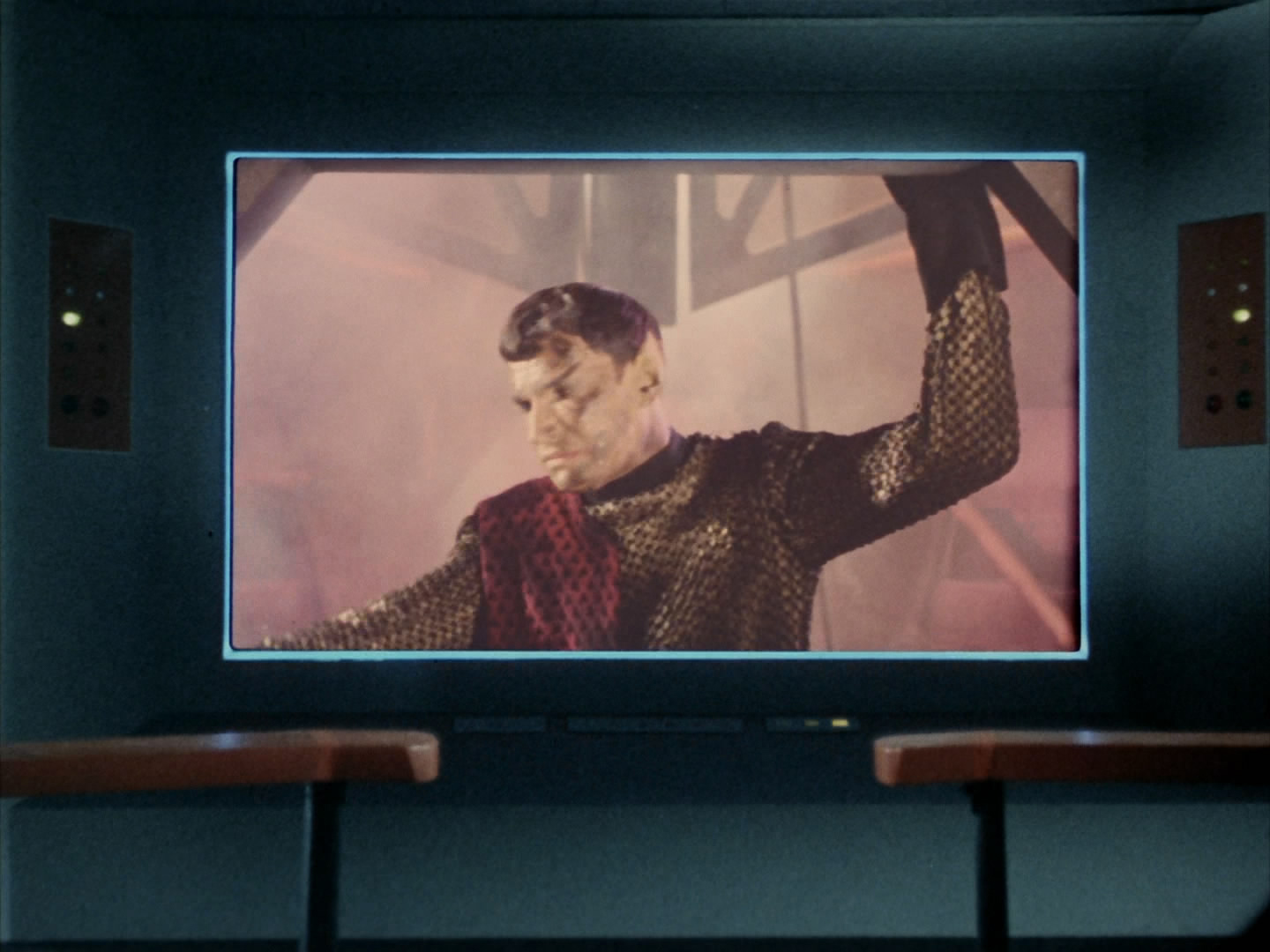 |
| "I've just seen it happen too many times." |
After weeks of stumbling half-starts, frustratingly retrograde moves and absolutely awe-inducing spectacles of catastrophic, system-wide failure, we at last have the very first episode of Star Trek that can be unambiguously called an absolute masterpiece. “Balance of Terror” is an unmitigated triumph on all accounts and is exactly what the series needed to make up for the misfires of the past few episodes. In a bit of actually lovely irony, this still doesn't save this incarnation of the show. Not only does it not save it, it gives even stronger evidence that it should be killed off and retooled as quickly as possible: Far from redeeming the Star Trek we've been watching since “The Corbomite Maneuver”, everything that makes “Balance of Terror” work as well as it does is something that decisively proves Gene Roddenberry's original version of Star Trek is completely unworkable. We're nine episodes in and we already have the show's definitive deconstruction.
“Balance of Terror” is almost the inverse of “The Corbomite Maneuver”: While that episode went out of its way to glorify militaristic bravado and the chain of command, this one shows us in stark, terrible detail the tragic consequences of this way of thinking at a very intimate, personal level. Where Balok was an unseen Other throughout the majority of “The Corbomite Maneuver” before being revealed as friendly baby Clint Howard at the last minute, half of “Balance of Terror” is dedicated to the Romulan crew. We get to know each and every person on the Bird-of-Prey personally, especially Mark Lenard's commander, and their tired, beaten down and world-weary demeanor bleakly, and all too well, foreshadows their ultimate fate.
Ah yes, the Romulans. A reveal so historic it threatens to overshadow the rest of the episode (though perhaps not as much so as that of the Klingons will to their debut episode later in the season). As one of the pre-eminent alien cultures in Star Trek, it would be beneficial to spend some time talking about them, although in this sentence I've already touched on the first important thing about them: The Romulans are a culture, and that's a significant milestone for the series. Up 'til now, aliens in Star Trek have been portrayed as blunt metaphors for the show's moral-of-the-week: The Talosians are an extension of the Platonic cave theme of “The Cage”, Gary Mitchell was absolute power incarnate, Charlie Evans embodies the troubles of puberty and Salt Vampire was...a Salt Vampire. Or a buffalo. “The Man Trap” wasn't especially clear about that. Anyway, if they weren't straight metaphors, they were Deus Ex Machina: The Thasians exist primarily to provide a convenient way to get Charlie Evans off the Enterprise so he wouldn't blow it up. We don't get any sense of what their culture or lifestyle is. Balok is just an Other for Kirk to practice his manly command skills with, albeit one who happens to be friendly We get no idea of what the First Federation is like, though the design of the Fesarius is certainly imaginative.
But the Romulans are actual people, and within the span of one episode we learn pretty much everything we need to know about them. Firstly, and most obviously, the Romulans are the Roman Empire extrapolated into outer space. More to the point though, they're the Roman Empire past its pinnacle and entering into a decline: Though his crew seem eager to secure a Glorious Victory for their emperor, the commander himself seems from another age, openly questioning the value of imperialistic expansion, war for the sake of war and the cost in lives it demands. The Centurion sympathizes, but feels too bound by duty and tradition. The primary reason this works and the reason the Romulans are so memorable and easy-to-read is because the show gives us three different individuals (four if you count the subspace radio operator) and each one has a distinct personality: We see how the culture plays out across an actual group of people. What this means is that without really needing a bunch of exposition, “Balance of Terror” gives more depth and characterization to the Romulans than any episode of Star Trek has for its aliens-of-the-week before and, arguably, will after. There is absolutely no question why they get brought back.
But there's also another side to the Romulans' imperialism: “Balance of Terror” explicitly makes it clear the Romulan commander and Kirk are, for all intents and purposes, the same person and furthermore, that the Bird-of-Prey is just a reflection of Enterprise. There are numerous scenes where the two captains remark on how similar their thought process are (i.e. “that's what I would have done were I in his place”), how both are forced to work in dangerous, dehumanizing situations because they're at the behest of duty and circumstance and how neither desires to take the other's life because of how much they respect each other as equals.
The editing jumps back and forth between the Enterprise and the Bird-of-Prey, taking care to point out how each character has a compliment on the other side. The ensuing pointlessly destructive battle thus becomes a reiteration of an ancient scenario two groups of likable people are forced to act out against their will that prevents them from moving on to greater, happier things. Arguably the most moving scene comes in Act 3 as the Bird-of-Prey attempts to hide itself in a comet's tail: The commander gets a lovely line where he remarks on the comet's beauty, “shining in the dark”, before his crew presses him to explain its strategic merits. The majestic wonders of the universe must take a backseat to the mission. We're not explorers, we're conquerors, soldiers and policemen.
This is not an entirely original concept: Indeed, this episode is pretty much an exact shot-for-shot remake of the 1957 World War II movie The Enemy Below which concerned a US destroyer crew hunting down a German U-Boat (a fact which allegedly caused Harlan Ellison to flip out and refuse to speak to writer Paul Schneider). Certainly just taking a superficial look at both texts this seems obvious, and the Bird-of-Prey is a more than fitting stand in for a submarine with its small array of windows and cramped, self-contained bridge helping to craft an appealingly claustrophobic atmosphere. Indeed, it's the best bit of model work on Star Trek so far: With all due respect to legendary designer Matt Jeffries (and apologies to the generations of fans who will surely hunt me down for this remark), I never found the original Enterprise an especially inspiring bit of design. The Fesarius was provocative in a kind of Asimov Golden Age sense, but given how little of it we actually saw its effect is muted somewhat. The Bird-of-Prey is amazing though: Designer Wah Ming Chang gives us a truly evocative and iconic look, bringing together elements of raptors, rocket ships and flying saucers to produce something immediately distinctive and memorable.
But I'm going to make a bold claim here: “Balance of Terror” is actually a far more effective telling of this story than the movie on which it's based. Part of this is the acting; William Shatner, DeForest Kelley and Mark Lenard are all absolutely chilling, each one delivering what has got to be a career high water mark performance. But the bigger reason is the setting: In The Enemy Below the German U-Boat captain is shown to be in some sense “special” because he isn't a Nazi and is in fact quite hostile to Hitler's regime, he's just following orders and doing his job which makes him easier to compare with the destroyer captain. “Just following orders” has always been a flimsy excuse however: The Romulans are culturally obligated to valorize duty and glorious conquest and the crew of the Bird-of-Prey are just products of their time. It's much easier to sympathize with them than it is a bunch of Nazis. Furthermore, The Enemy Below is historical fiction, and in my view, this is a genre with a very noticeable limit on how emotionally compelling it can be.
I've never found the fictionalized past effective as a setting because the cinematic tradition's pretenses of realism at once require us to take it seriously as a work of representationalism while at the same time accepting it's weaving a yarn. Also, as history books are inevitably written by the “victors” (i.e. authority and hegemony) works of fiction based on them almost always wind up with a glorification of master narratives that inevitably marginalize certain viewpoints. Like, say, for example, the idea that the Europeans were the bold discovers of the Americas and thus “exploration” becoming equated with “European colonialism” when pretty much all historical evidence points to the Polynesians being familiar with the shores centuries beforehand but not settling them because they were already inhabited and the fact the ancient navigators were more interested in free exchange of goods and ideas and weren't imperialist assholes.
But as speculative fiction “Balance of Terror” doesn't have any of these problems, and what this also does is really highlight the theme of reiteration: What, exactly, makes the Romulans so very different from us? Yes, they crossed the Neutral Zone and launched an unprovoked attack against the Earth Outposts, but Stiles was also chomping at the bit to cross into Romulan space and exact vengeance on them for the pain his family endured during the Romulan War and one could imagine an alternate scenario where Earth made the fist move. No, if the commander and Kirk are the same, as are the Enterprise and the Bird-of-Prey, then so are the Romulan Star Empire and Earth Command.
Schneider is making an impossibly strong claim here, and I'll be honest: The fact this episode got greenlit under Gene Roddenberry is utterly shocking, Because “Balance of Terror” is nothing if not a gravely serious treatise on imperialism in all its forms and the devastating cost it extorts from everyday people and a definitive claim that Star Trek is absolutely imperialistic. The episode just revels in showing us the ugly reality of military bravado: The very first scene has Kirk about to preside over a wedding and he gives a heartfelt speech about how one of his “happier duties” is officiating shipboard weddings. All of a sudden he's interrupted by Uhura, who informs him Outpost 4 is under attack. The tone shifts suddenly and dramatically like a switch has been flipped. We get a painfully graphic scene of the outpost's complete destruction, with its last survivor dying in brutal agony live on camera before the entire bridge crew. As the Enterprise trails the Bird-of-Prey it slowly dawns on the crew a battle is imminent and unavoidable and Kirk informs the crew that should the conflict break out into war, in the eyes of his superiors they, him and the ship are all considered expendable. The show plays this as a tragedy with the music swelling dramatically and various low-angle shots of Kirk which, combined with Shatner's wonderfully expressive acting that displays every single iota of his exaggerated pensiveness and guilt-wracked consciousness, makes Kirk look for all the world for a man walking to his death.
Once the two ships finally do engage, we don't get some glorious and thrilling action set-piece where the Enterprise and the Bird-of-Prey exchange a manly amount of firepower, we get an excruciatingly drawn out cat-and-mouse game where the ships take turns brutally crippling each other and maiming each others' crew. First the classic scene where the Romulans turn out to be an offshoot of the Vulcans, immediately casting doubt onto Spock's loyalty and bringing Stiles' generations of pent-up trauma and rage to the surface (which results in one of Kirk's best lines so far: “Leave any bigotry in your quarters. There's no room for it on the bridge.”). Then the Enterprise picks away at the Bird-of-Prey with proximity blasts, each one tearing into the ship and causing the bridge to visibly collapse around the commander with each successive charge, ultimately resulting in the death of the centurion. The Bird-of-Prey responds by unleashing its plasma weapon, capable of vaporizing entire planets in one shot, which also saps its own energy reserves. As the bridge crew watch helplessly while the plasma blast overtakes them, Kirk and Rand get what they expect to be their first, last and only moment of intimacy as they hold each other close, fully prepared to face death together. The Enterprise gets lucky: It's out of range enough that it doesn't get hit by the blast at full power and is merely rendered immobile with its electrical systems overloaded, but that just as easily might not have been the case.
On the Bird-of-Prey the situation is considerably more dire. With the ship in critical condition and his officers perishing one by one, leaving him the sole survivor of his ship as much as the doomed Command Hanson was the last left alive on Outpost 4, we can not only see, but *feel* the moment where the Romulan commander realises his mission is forfeit and, more to the point, that he'll never see the skies of his home again. Mark Lenard plays this with absolutely gut-wrenching conviction, depicting a person fully ready to take his death and those of his crew upon himself, but deeply saddened that he has to. And with that we get the horrifically tragic emotional climax-The single greatest line in the episode, arguably all of the Original Series. As Kirk contacts the Bird-of-Prey and asks for their terms of surrender, the commander politely turns him down and, just before he destroys himself and his ship in a nuclear explosion, looks Kirk dead in the eye and says:
“I regret that we meet in this way. You and I are of a kind. In a different reality, I could have called you friend.”
And then he's gone. The Enterprise has ended the battle and prevented another Romulan War, but Earth hasn't won anything. All this has accomplished is the deaths of four people who were no different from us: People just as motivated by a desire for peace, love and cooperation, but who, just like the crew of the Enterprise, were never allowed to find it in their lifetimes. And the cost on “our” side is no less devastating: In its closing moments “Balance of Terror” helpfully reminds us we began by interrupting a wedding as McCoy tells Kirk the only fatality among the Enterprise crew was Lieutenant Tomlinson in the phaser wing, who was supposed to get married today.
Kirk tries to console Angela Martine, Tomlinson's fiance by saying "It never makes any sense. We both have to know that there was a reason”. Martine briskly tells Kirk she's “fine” and walks away. She's not convinced. We're not convinced. Neither is Kirk. There was no reason for this, for any of this: There was no reason for the Praetor to order the Bird-of-Prey to attack the outposts and violate the nonaggression pact, there was no reason for Earth to demand a swift militaristic response from the Enterprise and there was certainly no reason for people to sacrifice their lives in a bloody, messy conflict to prove nothing except why it's pointless to fight this way at all. It's far beyond the days where empire building was considered the norm, if indeed those days ever existed.
Rome is in decline: It's time we stopped looking to the city on the hill for guidance and instead looked to it as a monument for the tragic, failed and misguided aspirations of generations long since departed.
30 May 15:56
Graph of the staggering drop in the cost of solar power per watt
by Tobias Buckell
The staggering drop in the cost of solar power since 1977 (right before I was born):

(Link snagged via Ramez Naam on twitter).
30 May 15:51
Great Britain as a multi-party state
by TSE

If the opinion polls hold up then at the next election we’ll have four parties polling at least 10% of the vote for the first time in almost a century (the last and only time it previously occurred was in 1918, with the two Liberal factions alongside the Conservatives and Labour all achieving double figures, with 1922 being the only other election to come close).
So what would this new state of affairs look like? In deference to Harry Hayfield’s article I’m shying away from declaring this a four-party system, it’s certainly a rarity for four parties to have this kind of vote and what you call this state of affairs is not hugely relevant.
In some way, it might not look much different, the likelihood is that UKIP’s realistic potential is in low numbers of seats, the Lib Dems will fall back and the make-up of the House of Commons will look more like a two party system than it has for many years.
This is going to lead to further talk about a change in the voting system, but little action. More than ever the two largest parties will want to hang on to their inbuilt advantages and talk about the issue being settled for a generation. Where I think there will be shifts is in a re-visiting of House of Lords reform, not least as a way of deflecting talk of wider reform but also while the opportunity is there for it to be done in a way that suits them reasonably well.
The battle for media attention will intensify, and a shift away from front-bench spokesman (particularly opposition ones and minor roles) and towards party leaders and small cadres covering everything and fighting for airtime.
In this crowded marketplace, the struggle for policy ownership is going to be fiercer and less meaningful. The media will enjoy asking front-benchers if their policy isn’t really the same as what another party will announce, and then watch them try and make chasms out of split hairs.
Plagiarism accusations will be thrown around, along with hints that (for one example) some Tory backbenchers prefer UKIP policy. With a competitor close by there’s less room for straying before questions about defection are asked at every turn and if not outright defection, then the possibility of joint candidates will be brought up.
Ultimately the feel is far more important than the reality, the general public’s knowledge of individual policy is small, it’s something they pay little attention to, and even less about whether someone else had the idea first. What will be much more important is the impression they choose to give (and the media take on that) whether the Conservatives will continue to distance themselves from UKIP or claim them as pointless imitations.
In seat numbers the House of Commons will have a more traditional two party dominated look to it than it has in a long while while vote-wise it’ll be more spread than ever; and while how we are governed will be defined by the seats, how it is covered and talked about will change with the votes.
Corporeal
30 May 14:53
Traditional Publishing And Their March to the Future
by dwsmith
Okay, I have tried to not beat on how slow traditional publishers are moving forward in this new world, and how some seem to be going backwards in the face of all these changes. But this, today, from Kevin J. Anderson was just too priceless to not tell you all about.
That’s right, you read that right… He decided to fight some contract terms. He had to fight to get them to take out of his contract that he be required to turn in a print manuscript with a carbon copy and that he be required to deliver an electronic file on a computer floppy diskette.
That’s right, he had to fight to get those out of a modern contract.
If I hadn’t seen this on a recent contract myself, I would be laughing. I’m just amazed he was able to win such a major battle for authors.
You folks see why so many of us who have dealt with traditional publishers for decades are so happy about doing indie publishing?
30 May 14:43
The BBC has once again shown its unquestionable political neutrality with tonight’s fair and balanced Question Time line-up. A BBC Spokesperson said:
With the biggest story of the week being the authoritarian Labour Party teaming up with the authoritarian Conservative Party to say they must go much further right – again – the BBC’s decision to exclude the Liberal Democrats from yet another Question Time beggars belief. By pretending that only the traditional party of the right, the party that’s urging them to be more right-wing, and the party that’s scaring them to death by being amazingly right-wing have anything to say about the Snoopers’ Charter they are gravely unbalanced.
This isn’t just about excluding the Liberal Democrats – again – who the BBC used to ignore because ‘They’d never get into government’ and now ignore because ‘They’re in government’. It’s about giving a completely one-sided view on major issues on which all the other parties range from deeply authoritarian to would-be totalitarian.
Labour’s former Home Secretary Alan Johnson called on Sunday for the Conservatives to reintroduce the Snoopers’ Charter with Labour support, clambering eagerly onto a soldier’s dead body to use as a platform. He is, of course, one of the guests tonight. And if you think “totalitarian” is hyperbole, he explicitly told Nick Robinson on The Andrew Marr Show that “these things are so much easier in China”. Your guess is as good as mine as to whether Mr Johnson’s eye-boggling totalitarianism is because he’s a former communist or a former associate of Mr Blair. Perhaps even his heavy-breathing desire to pry into the e-mails of every single person in the land comes from his time as a postman and a frustrated desire to open up everyone else’s post, now grown to maniacal proportions. Who can say? But whatever inspired his twisted psychological desire for control-freakery, that it’s there is a proven fact from his own mouth.
As Millennium Dome, Elephant said the other day about Mr Johnson’s disgusting opportunism in using a murdered soldier to feed his own neo-fascist wet dreams, he is not only wildly irresponsible to call for new powers before anyone’s been able to fully investigate what happened – but the security services themselves have admitted that they knew the suspects were suspicious and already had all the powers they needed to monitor them but didn’t have the person-hours to make them a priority:
Only the Liberal Democrats opposed the Snoopers’ Charter and the sticky-fingered urges of securocrats to peek into and keep every electronic communication, followed naturally by every phone call, every item of post and ultimately every telescreened bedroom in Britain. The only thing that stopped it was that Liberal Democrat Deputy Prime Minister Nick Clegg directly vetoed the Snoopers’ Charter. The Conservatives wanted it. The Labour Party is gagging for it. By silencing the only voice that is not identically securocrat, the BBC is not merely being ‘unfair to the Lib Dems’ but simply not doing their job for the public.
Fossilised relics of previous completely fair and balanced Question Time line-ups can be found here , here and here.
The BBC complaints form can be found here. For viewers who aren’t Daleks, if you want to complain directly to the BBC about their consistent and outrageous political bias, obviously they’re frightened of their viewers being able to get in touch, you can’t do so by e-mail – though if anyone wishes to supply me with the personal e-mails of, say, the director and producer of Question Time, the head of BBC1, the Director-General or the BBC Trust, I will very happily republish them here – and must instead jump through five pages of hoops on their website.
EXCLUSIVE: BBC Defends Question Time Panel As Reflecting All Shades of Political Opinion
by Alex Wilcock
The BBC has once again shown its unquestionable political neutrality with tonight’s fair and balanced Question Time line-up. A BBC Spokesperson said:
‘No right-thinking person could disagree with the security industry having absolute power over every corner of our lives, so two panellists from the Snoopers’ Charter-supporting Labour Party and two from the Snoopers’ Charter-supporting Conservative Party, with UKIP for balance, reflects the views of all right-thinking people from neo-fascist to fascist. No Liberal view is possible (so we’ve refused to invite any). Any disagreement means you’re clearly a terrorist and, with our detector vans, we know where you live.’

With the biggest story of the week being the authoritarian Labour Party teaming up with the authoritarian Conservative Party to say they must go much further right – again – the BBC’s decision to exclude the Liberal Democrats from yet another Question Time beggars belief. By pretending that only the traditional party of the right, the party that’s urging them to be more right-wing, and the party that’s scaring them to death by being amazingly right-wing have anything to say about the Snoopers’ Charter they are gravely unbalanced.
This isn’t just about excluding the Liberal Democrats – again – who the BBC used to ignore because ‘They’d never get into government’ and now ignore because ‘They’re in government’. It’s about giving a completely one-sided view on major issues on which all the other parties range from deeply authoritarian to would-be totalitarian.
Labour’s former Home Secretary Alan Johnson called on Sunday for the Conservatives to reintroduce the Snoopers’ Charter with Labour support, clambering eagerly onto a soldier’s dead body to use as a platform. He is, of course, one of the guests tonight. And if you think “totalitarian” is hyperbole, he explicitly told Nick Robinson on The Andrew Marr Show that “these things are so much easier in China”. Your guess is as good as mine as to whether Mr Johnson’s eye-boggling totalitarianism is because he’s a former communist or a former associate of Mr Blair. Perhaps even his heavy-breathing desire to pry into the e-mails of every single person in the land comes from his time as a postman and a frustrated desire to open up everyone else’s post, now grown to maniacal proportions. Who can say? But whatever inspired his twisted psychological desire for control-freakery, that it’s there is a proven fact from his own mouth.
As Millennium Dome, Elephant said the other day about Mr Johnson’s disgusting opportunism in using a murdered soldier to feed his own neo-fascist wet dreams, he is not only wildly irresponsible to call for new powers before anyone’s been able to fully investigate what happened – but the security services themselves have admitted that they knew the suspects were suspicious and already had all the powers they needed to monitor them but didn’t have the person-hours to make them a priority:
“WHY, if the security services seem like they're saying that monitoring the THOUSANDS of people they ALREADY have powers to monitor is TOO DIFFICULT, WHY is the solution to monitor MILLIONS of people?!”The Conservatives are desperate to move to the right because they’re terrified of UKIP. The Labour Party have a long and disgusting record of being far to the authoritarian right in government, and are now calling in Opposition for government to be far more illiberal still. But then, everyone should remember what the Labour Party did with thirteen years of war-mongering, evidence-sexing, amnesia-promising, freedom-crushing, LGBT-hypocrisising, rich-brownnosing, poor-taxing, crony-bribe-swallowing shameless absolute power.
Only the Liberal Democrats opposed the Snoopers’ Charter and the sticky-fingered urges of securocrats to peek into and keep every electronic communication, followed naturally by every phone call, every item of post and ultimately every telescreened bedroom in Britain. The only thing that stopped it was that Liberal Democrat Deputy Prime Minister Nick Clegg directly vetoed the Snoopers’ Charter. The Conservatives wanted it. The Labour Party is gagging for it. By silencing the only voice that is not identically securocrat, the BBC is not merely being ‘unfair to the Lib Dems’ but simply not doing their job for the public.
Fossilised relics of previous completely fair and balanced Question Time line-ups can be found here , here and here.
The BBC complaints form can be found here. For viewers who aren’t Daleks, if you want to complain directly to the BBC about their consistent and outrageous political bias, obviously they’re frightened of their viewers being able to get in touch, you can’t do so by e-mail – though if anyone wishes to supply me with the personal e-mails of, say, the director and producer of Question Time, the head of BBC1, the Director-General or the BBC Trust, I will very happily republish them here – and must instead jump through five pages of hoops on their website.
30 May 12:53
Opinion: It’s time to prioritise electoral reform for local government
by Crispin Allard
As Liberal Democrats, we all know First Past the Post is a terrible voting system. But in this year’s local elections it has sunk to new depths.
With the arrival of genuine four-party politics in England, the proportion of votes that actually make a difference to the result has reached an all-time low. And of the 16 county councils that returned a single party majority, not one of those ruling parties gained a majority of votes – in fact most got less than 40%.
This is not just a dry academic point or a moan about unfairness. It makes a real difference to the quality of local government and its responsiveness to the people it is supposed to serve. After all, why should councils bother to pay any attention to voters if their votes don’t matter?
Meanwhile, in Scotland a quiet revolution is under way. Forget independence, the real change is in local government and it’s due to electoral reform – a reform that only happened because Scottish Liberal Democrats made it a red line issue in the Lib-Lab coalitions of 1999 and 2003.
Using the Single Transferable Vote (STV), over three quarters of Scottish voters got their first preference as a councillor in last year’s elections (and if you count lower preferences almost everyone has someone they voted for). After just two elections using STV, the impacts are already starting to be felt. Single party fiefdoms are a thing of the past, scrutiny has become more effective and councils more responsive.
We now have an excellent opportunity to deliver electoral reform to local government in England and Wales. Here are my top 10 reasons why:
1) With the difficulty Labour and the Conservatives face in gaining an overall majority and Lib Dem support holding up in our held seats, a hung parliament in 2015 continues to look likely.
2) In the eyes of national politicians it is lower profile than reforming the system for the Commons, so would be easier for Labour or the Conservatives to concede in any coalition negotiations.
3) We can give good reasons for the other parties to support reform; it would breathe life into their parties in their current electoral deserts as well as helping to address problems they have with certain local parties that have held unchallenged power for decades (this was a significant argument for Labour in Scotland).
4) Traditional arguments used against proportional representation such as the “need for strong government” are even less relevant when it comes to local government.
5) We can point to the successful introduction of STV in Scottish local government (as well as its beneficial use in Northern Ireland for over 40 years).
6) Many English local authorities already have multi-member wards, which would facilitate the introduction of STV; we could start by using existing wards, then at a subsequent boundary review allow ward sizes to vary to align wards more closely to natural communities.
7) It is the only tier of government for which electoral reform has not yet been actively considered by Government; no-one can claim it’s been dealt with.
8) Unlike reforms relating to Parliament, it does not directly affect MPs, so they are less likely to rebel against a coalition agreement (we will not be asking turkeys to vote for Christmas).
9) It is easy to argue that it doesn’t need a referendum (unlike a change for the Commons where there is a good argument that MPs should not be able to choose their own electoral system).
10) It is increasingly seen as a priority by cross-party democratic reformers – for example, the Electoral Reform Society has recently launched its “Rotten Boroughs” campaign.
So, as we start to debate the 2015 Manifesto, let’s make electoral reform in local government our top priority for constitutional reform, and a red line policy for any coalition deal.
* Dr Crispin Allard is Chair of Liberal Democrats for Electoral Reform
30 May 12:34
EFF Makes Formal Objection to DRM In HTML5
by samzenpus
The Electronic Frontier Foundation (EFF) has filed a formal objection to the inclusion of DRM in HTML5, saying that a draft proposal from the W3C could hurt innovation and block access to people around the world. From their press page: '"This proposal stands apart from all other aspects of HTML standardization: it defines a new 'black box' for the entertainment industry, fenced off from control by the browser and end-user," said EFF International Director Danny O'Brien. "While this plan might soothe Hollywood content providers who are scared of technological evolution, it could also create serious impediments to interoperability and access for all."' 


Read more of this story at Slashdot.
firehose, Wiedzmin.conrad and one other like this
30 May 10:20
Looking Askance At Cognitive Neuroscience
by Neuroskeptic
Yesterday, I read a paper that, to my mind, embodies what’s wrong with cognitive neuroscience: Changes in the Amygdala Produced by Viewing Strabismic Eyes

I have no wish to attack the authors of the piece. This post is rather unfair on them: their paper is no worse than a hundred others, it’s just a clear case of a widespread disease. My own research over the years has certainly not been immune.
So I’m not claiming to be without sin, but equally, someone has to cast the first stone at the elephant in the room.
First a summary. The authors showed 31 volunteers two sets of photos, all of which focused on the eye region of human faces. Half of the pictures showed people with healthy eyes, while half featured eyes suffering from strabismus (aka “cross-eye” or “walleye”), a defect in which the two eyes are not aligned properly, and seem to point in the wrong directions.
All this took place in an MRI scanner, where the volunteers’ neural activation was measured using fMRI. The results showed that looking at strabismus caused increased brain activity, compared to normal eyes, in areas such as the amygdala, hippocampus and fusiform gyrus.
Interpreting this finding, the authors write:
Because the amygdala is the fundamental structure in the processing of negative, fearful, and aversive emotions, the results of this study strongly suggest that healthy individuals are reacting in a negative fashion to strabismus.
This sentence reveals a philosophical confusion.
Firstly, the premise that amygdala activation = negative emotion, is a serious oversimplification. The amygdala is activated by almost any emotionally meaningful stimulus, compared to an unemotional baseline. While it’s true that it is most strongly activated by negative stimuli, amygdala activation just cannot be read as being negative. It might be positive, or just surprising.
This is an example of the dangers of reverse inference – trying to infer psychological events from neural activations. It’s a very common problem in fMRI. As is also very common, the authors selectively draw conclusions from those areas of the brain that most readily fit their theory. The hippocampus was activated more strongly than the amygdala, but this area is less ‘emotional’, so is hardly discussed.
So the papers’ conclusion, that healthy individuals react in a negative fashion to strabismus, doesn’t follow from the fMRI data. However, the conclusion is true anyway, because, look:

Which looks better?
A glance at those pictures tells you more about how strabismus is perceived than any amount of brain scanning. ‘How do people react to strabismus?’ is a psychological question, not a neurobiological one.
I’m sure the photo on the left does activate the negative emotion circuits of the brain (whatever they are) more than the one on the right. But I know that because I know its psychological effects, not the other way around.
Now, 30 out of the 31 volunteers’ amygdalae lit up in response to the strabismus images, but only 23 of them reported feeling an emotional response on a questionnaire. The authors note this, and suggest that the ‘missing’ 7 people might have denied feeling anything in an effort to be politically correct.
This is the popular argument that when brain and behaviour seem to disagree, ‘the neural data is more sensitive’ – it can reveal what behaviour conceals. But what if it’s just less specific? That’s not talked about.
So this paper tells us nothing about strabismus.
However, it might change the way we think about strabismus. The authors write:
This study demonstrates for the first time the organic effect of strabismus on the observer… Strabismus correction surgery can improve quality of life by improving interpersonal relationships by virtue of its organic effect on both parties.
The implication is that other people’s aversion is as much an ‘organic’ feature of strabismus as the misaligned eyeball itself. One that only surgery can correct.
Maybe it is, but these data don’t tell us. It might be (say) that the unpleasantness we feel is aversion to the unknown, and if our society were only better educated about strabismus, we’d be more comfortable with it. There are lots of other possibilities.
Talking about something in a neurobiological way sends the message that this is a neurobiological issue. In this way, many fMRI papers serve to spread the idea that this is an issue that only neuroscience can solve and, therefore, create a demand for more fMRI studies. The authors of this paper are victims of this mentality, a widespread confusion about what neuroscience is for.
fMRI is a great way to approach neuroscientific questions. It’s a bad (and terribly expensive) way to do psychology. This study is about psychology, and should not have involved an MRI scanner.
 Berberat J, Jaggi GP, Wang FM, Remonda L, & Killer HE (2013). Changes in the Amygdala Produced by Viewing Strabismic Eyes. Ophthalmology PMID: 23706702
30 May 09:45
 Some of you may have had the "luck" of seeing the media shitstorm whipped up around Intellect Books's forthcoming anthology Doctor Who and Race, edited by Lindy Orthia. If not, it's exactly what you'd expect; the Daily Mail got a copy and decided to run a typical Daily Mail article in which the bizarre leftist intellectual attack on an upstanding British tradition is exposed to reveal the menace of the... whatever, really. (Obviously the Daily Mail likes Doctor Who today, since attacking academics is more important than making the BBC look bad. They can always go back to hating Doctor Who later, after all.)
I was one of the peer reviewers for the anthology, and while it would be inappropriate for me to offer a full review of the book, not least because I saw an older draft of it, I am in a position that virtually nobody else commenting on this kerfuffle is in that I've actually read the thing, as opposed to just the Daily Mail article. So after checking with Ms. Orthia that opening my mouth would be OK, I figured I'd weigh in.
First of all, absolutely every story on this is a retread of the original Daily Mail story, which if you really want to read you can find here, but be sure to swab your monitor down after. To be fair, pissing off the Daily Mail is the very definition of picking the right enemies, and I'm frankly jealous of Ms. Orthia for pulling it off. So the bulk of this should surprise exactly nobody. Still, let's make a few observations. First of all, let's note that the two essays singled out in the Daily Mail article are, in fact, the first two in the book. It's not even clear the Mail received the entire book - the first ten percent of it would be sufficient to write the takedown they mustered. So actually, maybe I actually am the only person in this kerfuffle who's read the book.
The Daily Mail's screed objects to two essays, both in the first four of the book. The first, by the blogger Fire Fly, is admittedly problematic. In fact, at least in the version I read, I found it a terribly weak essay that systematically overstated its claims. It's a reworking of a blog post, and it reads like one - a polemical screed of the sort that's perfectly sensible as a discussion-starting bomb lobbing on the Internet. As the opening chapter in a pop-academic anthology presumably aimed in part at Doctor Who fans, it's a... poor choice, and one that absolutely everybody should have expected to cause exactly this reaction.
But crucially, it's one essay, and the only one that's anywhere near so polemical. The other essay criticized, Amit Gupta's look at the use of cricket as a signifier in the Davison era, is utterly tame, and it's almost funny to see the Daily Mail lay into it. It is, in effect, a primer on the status of cricket as a cultural signifier in the early Thatcher years, and something it is nearly impossible to work up any meaningful objection to.
And, of course, there's a requisite out of context quote from Lindy Orthia herself that is made to sound as though she is saying the whole of Doctor Who is "thunderingly racist" when in fact she is asking how to love the show in the specific moments in which it is, in fact, thunderingly racist - moments which unequivocally exist.
The book is not, in other words, some takedown of Doctor Who on the grounds that it is racist. It's a book that was inevitably going to be misrepresented that way - and this is something I brought up in my peer review. But the book isn't that. It's a bunch of people, most of whom love Doctor Who, working through what are, in fact, some serious issues with the program. Of course a show about a white man with a British accent who explores alien civilizations and fixes their problems for them is going to have some serious race issues. Because, you know, so did white British men who explored and "fixed" the problems of foreign cultures.
Let us, in other words, remember that the only people with something to gain by treating criticism of racism and colonialism as an outright and no-holds-barred denunciation of British culture are the people who want British culture to remain racist and colonial. Which is to say, yes, the Daily Mail. And here we get an awful moment of allying them with the fannish tendency to resist criticism of the thing they love. Because, of course, that's fandom all over - desperate to be allowed to love Doctor Who without complication. So we have a desperately ugly alliance designed to shut down all consideration of the book before anyone reads it.
Tragically, this is a book that a lot more people should read than actually will. And if anyone had the sneaking suspicion that the Daily Mail was viciously poisoning the well with outright misrepresentations, well, congratulations. You called it. This is actually a book that tries to move beyond the knee-jerk desire that we all have to defend Doctor Who. It's a book that exposes what it is that those of us who want to offer redemptive readings have to redeem. It's a good book. It deserves a fair hearing and an intelligent debate. And I'm gutted to see that it's going to spend months where the only people talking about it are the Daily Mail and people copying it.
So I'd like to end by talking about an absolutely wonderful essay in it. Unsurprisingly, it's Kate Orman's. The book is a mix of fan and academic contributors, and Orman's is notable for being a fan essay that's as well-argued and meticulously footnoted as the best academic contributions. It's eminently publishable in a proper academic journal, and is the most thorough archeology of the racial issues in The Talons of Weng-Chiang I've seen to date. It doesn't spare the story - and why should it, given that Talons is, in fact, thunderingly racist. But it also gives the story real and searing criticism that goes beyond the yellowface performance of John Bennett and instead looks at the entire cultural tradition that Talons comes out of, locating the racism not in a dodgy and ill-advised prosthetic but in an entire literary tradition. It's intelligent. It's significant. It's critical, but eminently fair. And it's written by someone whose love of the program is beyond question.
That's the book I peer reviewed. And fuck the Daily Mail for lying about it.
Shockingly, The Daily Mail Is Evil
by noreply@blogger.com (Philip Sandifer)
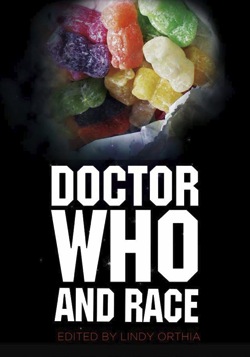
I was one of the peer reviewers for the anthology, and while it would be inappropriate for me to offer a full review of the book, not least because I saw an older draft of it, I am in a position that virtually nobody else commenting on this kerfuffle is in that I've actually read the thing, as opposed to just the Daily Mail article. So after checking with Ms. Orthia that opening my mouth would be OK, I figured I'd weigh in.
First of all, absolutely every story on this is a retread of the original Daily Mail story, which if you really want to read you can find here, but be sure to swab your monitor down after. To be fair, pissing off the Daily Mail is the very definition of picking the right enemies, and I'm frankly jealous of Ms. Orthia for pulling it off. So the bulk of this should surprise exactly nobody. Still, let's make a few observations. First of all, let's note that the two essays singled out in the Daily Mail article are, in fact, the first two in the book. It's not even clear the Mail received the entire book - the first ten percent of it would be sufficient to write the takedown they mustered. So actually, maybe I actually am the only person in this kerfuffle who's read the book.
The Daily Mail's screed objects to two essays, both in the first four of the book. The first, by the blogger Fire Fly, is admittedly problematic. In fact, at least in the version I read, I found it a terribly weak essay that systematically overstated its claims. It's a reworking of a blog post, and it reads like one - a polemical screed of the sort that's perfectly sensible as a discussion-starting bomb lobbing on the Internet. As the opening chapter in a pop-academic anthology presumably aimed in part at Doctor Who fans, it's a... poor choice, and one that absolutely everybody should have expected to cause exactly this reaction.
But crucially, it's one essay, and the only one that's anywhere near so polemical. The other essay criticized, Amit Gupta's look at the use of cricket as a signifier in the Davison era, is utterly tame, and it's almost funny to see the Daily Mail lay into it. It is, in effect, a primer on the status of cricket as a cultural signifier in the early Thatcher years, and something it is nearly impossible to work up any meaningful objection to.
And, of course, there's a requisite out of context quote from Lindy Orthia herself that is made to sound as though she is saying the whole of Doctor Who is "thunderingly racist" when in fact she is asking how to love the show in the specific moments in which it is, in fact, thunderingly racist - moments which unequivocally exist.
The book is not, in other words, some takedown of Doctor Who on the grounds that it is racist. It's a book that was inevitably going to be misrepresented that way - and this is something I brought up in my peer review. But the book isn't that. It's a bunch of people, most of whom love Doctor Who, working through what are, in fact, some serious issues with the program. Of course a show about a white man with a British accent who explores alien civilizations and fixes their problems for them is going to have some serious race issues. Because, you know, so did white British men who explored and "fixed" the problems of foreign cultures.
Let us, in other words, remember that the only people with something to gain by treating criticism of racism and colonialism as an outright and no-holds-barred denunciation of British culture are the people who want British culture to remain racist and colonial. Which is to say, yes, the Daily Mail. And here we get an awful moment of allying them with the fannish tendency to resist criticism of the thing they love. Because, of course, that's fandom all over - desperate to be allowed to love Doctor Who without complication. So we have a desperately ugly alliance designed to shut down all consideration of the book before anyone reads it.
Tragically, this is a book that a lot more people should read than actually will. And if anyone had the sneaking suspicion that the Daily Mail was viciously poisoning the well with outright misrepresentations, well, congratulations. You called it. This is actually a book that tries to move beyond the knee-jerk desire that we all have to defend Doctor Who. It's a book that exposes what it is that those of us who want to offer redemptive readings have to redeem. It's a good book. It deserves a fair hearing and an intelligent debate. And I'm gutted to see that it's going to spend months where the only people talking about it are the Daily Mail and people copying it.
So I'd like to end by talking about an absolutely wonderful essay in it. Unsurprisingly, it's Kate Orman's. The book is a mix of fan and academic contributors, and Orman's is notable for being a fan essay that's as well-argued and meticulously footnoted as the best academic contributions. It's eminently publishable in a proper academic journal, and is the most thorough archeology of the racial issues in The Talons of Weng-Chiang I've seen to date. It doesn't spare the story - and why should it, given that Talons is, in fact, thunderingly racist. But it also gives the story real and searing criticism that goes beyond the yellowface performance of John Bennett and instead looks at the entire cultural tradition that Talons comes out of, locating the racism not in a dodgy and ill-advised prosthetic but in an entire literary tradition. It's intelligent. It's significant. It's critical, but eminently fair. And it's written by someone whose love of the program is beyond question.
That's the book I peer reviewed. And fuck the Daily Mail for lying about it.
30 May 09:44
.avi_snapshot_00.00.12_%5B2013.02.23_17.27.01%5D.jpg)
.avi_snapshot_00.01.05_%5B2013.02.23_17.27.18%5D.jpg)
.avi_snapshot_00.46.19_%5B2013.02.23_17.35.32%5D.jpg)
.avi_snapshot_00.03.39_%5B2013.02.23_17.27.59%5D.jpg)
.avi_snapshot_00.42.20_%5B2013.02.23_17.39.41%5D.jpg)
.avi_snapshot_00.47.29_%5B2013.02.23_17.31.52%5D.jpg)
.avi_snapshot_01.33.12_%5B2013.02.23_17.37.47%5D.jpg)
Never Too Young To Rock
by Unmann-Wittering
.avi_snapshot_00.00.12_%5B2013.02.23_17.27.01%5D.jpg)
.avi_snapshot_00.01.05_%5B2013.02.23_17.27.18%5D.jpg)
.avi_snapshot_00.46.19_%5B2013.02.23_17.35.32%5D.jpg)
.avi_snapshot_00.03.39_%5B2013.02.23_17.27.59%5D.jpg)
.avi_snapshot_00.42.20_%5B2013.02.23_17.39.41%5D.jpg)
.avi_snapshot_00.47.29_%5B2013.02.23_17.31.52%5D.jpg)
.avi_snapshot_01.33.12_%5B2013.02.23_17.37.47%5D.jpg)
How can one describe ‘Never Too Young To Rock’ without using the term ‘rubbish’? Actually, let’s just get it out of the way: it’s rubbish. That said, it’s not offensive, just shoddy and cheap and scruffy and worn out, the perfect snapshot of Britain in 1975, in fact.
For all that, the story is set in the near future, and provides a dystopian vision of a world that looks and feels and smells exactly the same apart from the fact that pop music is now banned. One man (Peter Denyer: thick gypsy Dennis out of ‘Please Sir!’; nerdish Ralph from ‘Dear John’) wants to challenge this, and so sets out in a ‘group detector van’ to locate bands for a concert that will prove to the powers that be that they are wrong and that pop is mindless fun. Yes, you’re right, it’s ‘It’s Trad, Dad!’ with moonboots on.
Interestingly, the detector van is driven by Freddie Jones - yep, our Freddie Jones. I honestly don’t know what his character represents, but he has a fair amount of fun with the role and it’s nice to see him enjoying himself under what must have been difficult circumstances for him.
As you might have already guessed, the film exists purely as a way to present lots of performances from the country’s most popular groups (or at least the most popular groups who would agree to appear in something like this) so we get Mud, The Rubettes, The Glitter Band and Bob Kerr’s Whoopee Band (no, me neither, but they're in 'Side By Side' as well). With the exception of the up and coming Midge Ure fronted Slik (who immediately came and went), these are old lag’s bands, made up of men who had been knocking about the music scene since the sixties and finally found success in a period where standards weren’t quite so high. Mud are an undemanding but likeable enough group, for instance, but three of them look like a plasterers on their way to a Bill Haley concert (the fourth, Rob Davis, takes gender bending to a level Bowie could only dream of); The Glitter Band, no doubt traumatised by what they have seen while on the road with The Leader, just look indescribably weary, and all the Bacofoil and mascara in the world can’t disguise their exhaustion and disgust as they unconvincingly pump their fists to one of their repetitive and clumsy hits. These are the damned.
The finale, in which all the groups unite after a triumphant concert to sing a simplistic ditty (about never being too young to rock) is just awful in its arms around shoulders, leg kicking bonhomie, and, much like the end of ‘Side By Side’ shows just how old fashioned these glittery hipsters are. Tatty, tacky, and best tolerated in the company of friends and a crate, no, two crates, of Bass.
If you wish to do that now, by the way, you can watch the whole thing on You Tube here. Good luck, especially as the person who put it there seems to be the world's biggest Gary Glitter fan.
If you wish to do that now, by the way, you can watch the whole thing on You Tube here. Good luck, especially as the person who put it there seems to be the world's biggest Gary Glitter fan.