Shared posts

30 May 09:34

Doctor Who: 1978

by 0tralala
After episode 491 (The Stones of Blood, part 4)
22 November 1978
<< back to 1977

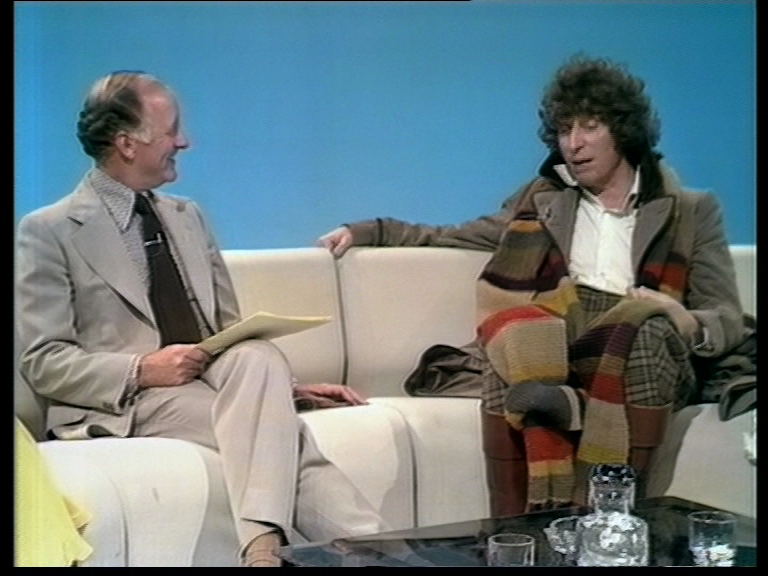
Frank Bough interviews Tom Baker
Nationwide, BBC1, 22 November 1978
In the early evening of 22 November 1978, the BBC's live news magazine Nationwide (basically, The One Show but without the view out the window) celebrated the 15th birthday of Doctor Who. It was, in the best traditions of a show about a rackety time machine, a day early.

Nationwide spoke first to the show's original producer, Verity Lambert, and then to actress Carole Ann Ford, who'd played the Doctor's first companion (and granddaughter), Susan. Then presenter Frank Bough spoke to Mary Tamm - the Doctor's current companion, Romana. Finally, he turned to Tom Baker, who sat brooding beside him.

What happens next is fascinating. You can watch it as an extra on The Stones of Blood DVD or, ahem, on YouTube. Tom seems in a garrulous mood, or bored, and his answers brusque, even combative.
Frank:
Of course, you are Doctor Who aren't you?

Tom:
Well, yes I am. I am.

Frank:
I mean, all the time - aren't you?

Tom:
Well, I mean I'm not as benevolent as... Doctor Who is not really an acting part but I mean I'm not as benevolent as the character and as kind as the character and even-tempered as the character. But yes, it's just me. That's all I suppose.

Frank:
But you have to be Doctor Who all the time, I'm told. People regard you totally where they see you as Doctor Who and nothing else. Do you see that?

Tom:
Well I don't have to be Doctor Who any more than you have to be Frank Bough!

Frank:
Yes, but I am Frank Bough!

Tom:
Yeah, I know you are. I'm Doctor Who because I only have a fictional image.

Frank:
But I don't have a fictional image. I am me.

Tom:
Of course you do. People don't really believe you exist. They only see you on the television. I mean, I see you at cricket games and things like that. But it's true, people have a televisual impression of you as they have of me. In my case, of course, I play a heroic figure whereas you're associated with rather terrifying -

Frank:
They want to talk to me about sport but they want to regard you as Doctor Who. Now, can't you stop being Doctor Who and become Tom Baker occasionally?

Tom:
Well, of course I can. I do that at home or I do it in the bar with Mary Tamm or somebody like that. But the point is when I meet anybody who's interested in Doctor Who there's no point in presenting Tom Baker because they find Tom Baker very dreary.

Frank:
Tell me a bit about how people regard you and the effect you have on the audience, who are convinced you are Doctor Who. What sort of way do people behave when they see you?

Tom:
Well, I mean mostly the reaction is one of cheerfulness and happiness because they associate me with the children being vastly amused by me or interested in what I do as the character of the Doctor. And they also ascribe to me - such is the gullibility of the public and the potency of television – they ascribe to me all the virtues of Doctor Who. For example, I don't need anything boring like a bank card, for example. I don't even need money now because people make the assumption because I play this benevolent fictional character that I am, you know, that my probity is totally beyond question.

Frank:
So you have to work very hard – if you're not very nice as Tom Baker then you have to be very nice as Doctor Who when the occasion demands it.

Tom:
Ah ha! Yeah, it's not difficult. I get on all right with people – superficially.
Bough failing to appreciate the difference between his real self and his televisual image would ultimately cost him his career. Wikipedia quotes Paul Connew, formerly of The News of the World, saying that the 1988 sex and drugs scandal,
"caused a sensation at the time, given Bough's public image as the squeaky clean frontman of breakfast and sports television."
It's fascinating to see Tom address the power that television gives him over members of the public in the light of the awful revelations about other TV stars of the time. Television was much more influential back then - with fewer channels, fewer alternatives to telly, and bigger, less media savvy audiences. Tom clearly saw the impact of that influence in his daily dealings with the public - and he took his responsibilities to them seriously.

He was certainly no angel - his autobiography is candid about booze and sex and being difficult on set - and yet he tried not to let children see him with a cigarette or beer, or being ordinary and dreary. Even when adults spotted "the Doctor", he tried not to disappoint them by merely being himself. It's striking that Bough seems amazed he'd make that effort.

Playing the Doctor is more than just an acting job, it also involves a public-facing role: you're expected to charm and entertain children off-screen as well as on, there are conventions, signings, charity things. Even years after you leave the role, it's the first thing people will mention. There are all the many people who, thrilled by your adventures, feel kinship, ownership, entitlement (look at how I blithely refer to my childhood hero as "Tom", when I've met him fleetingly a handful of times...).

Is it different from other leading roles? I suspect the presenters and stars of children's TV are the ones most likely to cause offence by not appearing as they seem on screen. But I'd love to know from David Tennant, for example, how much his dad's job as Moderator of the Church of Scotland, served as a model for how to conduct himself as the Doctor. Tom, after all, was once a monk...

Next episode: 1979
30 May 09:32

‘Pro-life’ groups still not speaking up for pregnant workers

by Fred Clark

The Pregnant Workers Fairness Act has been re-introduced in the U.S. House and Senate. Bryce Covert has a good summary of what the bill does and why it is important:

The Pregnant Workers Fairness Act … would require employers to “make reasonable accommodations to employees stemming from pregnancy, childbirth, or related medical conditions, unless the accommodation would impose an undue hardship on the employer,” according to the National Women’s Law Center (NWLC).

… While it may sound outrageous, women can be fired today for being or becoming pregnant. Despite the Pregnancy Discrimination Act of 1978 barring discrimination based on “the basis of pregnancy, childbirth, or related medical conditions,” pregnant workers can be forced out of their jobs or denied accommodations that would allow them to keep working. Some of these might include modifying a policy prohibiting food and drink on the job, providing a stool, assigning heavy lifting duties to other workers, or giving a light-duty position to a pregnant employee.

Without this legal protection, thousands of American women are forced to choose between keeping their jobs or keeping their pregnancies.

At the end of the day, anti-abortion politics seem to boil down to controlling and punishing those wicked, wicked women because they can’t be trusted.

And for most people, not keeping your job is not a choice you can afford to make.

So let me be very clear: If you claim to be “pro-life” and yet you don’t support this bill, I have to conclude you are, at best, a sanctimonious hypocrite and not someone whose proclamations on “morality” are deserving of any attention or respect.

I will be forced to conclude that your loudly self-trumpeted moral superiority is nothing — nothing — more than a pretext for binding heavy burdens, grievous to be borne, and laying them on women’s shoulders while you yourselves aren’t willing to lift a finger to move them.

And, also too, I will have to conclude that you’re kind of a jerk.

I’m still impressed by the number of Good Christian People who loved the recent movie adaptation of Les Miserables, but who, at the same time, have based their entire political and religious identity on making sure that every real woman in Fantine’s situation suffers as miserably as she did.


30 May 09:32

‘You’re a slacker, McFly’: Vice Principal Strickland is always with us

by Fred Clark

I remember back when all of the exact same kids-these-days articles now being written about the Millennial generation were being written about my generation — “Generation X.”

Not much has changed. These articles still mostly trade in sweeping generalizations that communicate far more about the writers than about the purported subjects. They’re all still written with that “Here’s what you need to know about these weird kids” perspective — presuming that “you” are and must be, like all legitimate people, not one of them. Most of these pieces never realize, let alone overcome, this insider/outsider, us/them framing, and thus never seem to realize that their central theme tends more to be congratulating their intended readers for not being like these kids today than about actually trying to understand whatever generation they claim to be describing, interpreting, or pinning to a board like a lepidopterist collecting specimens.

The olds and scolds who made “Generation X” the nickname for people my age traced that term back to Douglas Coupland’s 1991 novel — but no further. Given that they never actually read that book, and that they weren’t particularly interested in finding out anything more about how or why Coupland might have chosen that title, they wound up using the name clumsily, like someone who’d selected an unfamiliar word from out of a thesaurus. They used the term with no sense of layers, of reference, allusion or connotation as to why “wild, wild, wild youth” might have embraced it.

The same was true of the favored pejorative used for Gen-X: “slackers.” The olds and scolds seemed to think this term originated with the 1991 Richard Linklater movie they never watched. And since they never bothered to figure out why Linklater chose that term, or what he meant by it, they never learned to use the term correctly. Despite cranking out endless iterations of the same article lamenting the supposed “ironic detachment” of Generation X, it never seemed to occur to them that the term “slacker” might be one that could only be understood ironically.

Richard Linklater didn’t invent the word “slacker.” Like most people my age, he appropriated it from Back to the Future.

Click here to view the embedded video.

Hill Valley High School’s vice principal, Mr. Strickland, berates that movie’s Gen-X hero, Marty McFly, by repeatedly calling him a “slacker.”

You got a real attitude problem, McFly. You’re a slacker. You remind me of your father when he went here. He was a slacker, too.

The whole point of that scene — and of Strickland’s existence as a character in the movie — is that he’s wrong. He’s wrong about Marty, and he’s wrong about young people in general. Strickland is a cruel clown whose words are not intended to be taken at face value. This is made very clear in the scene above, in which Strickland is angry with Marty for entering his band in the school’s dance audition. “Why even bother, McFly?” Strickland says, “No McFly ever amounted to anything.”

In other words, Strickland calls Marty a “slacker” because he’s too ambitious — because he refuses to settle, because he’s not apathetic, complacent and compliant.

Thus Back to the Future tells us that this shallow, literal-minded “definition” of the word slacker cannot be taken seriously. Strickland’s definition of “slacker” as a pejorative dismissal for young people, the movie says, is simply wrong. (This is why I find it particularly grating when people cite Strickland as a credible authority to justify their redefinitions of my word.)

As with many pejorative terms, the nominal definition of the word “slacker” is less important than what the use of the word signifies. The word provides little descriptive information about its target, but it reveals a great deal about the person wielding it. “You’re a slacker, McFly,” tells us nothing trustworthy about Marty, but it tells us all we need to know about Vice Principal Strickland.

All of which is to say this to those of you in the “Millennial Generation”: Don’t listen to Vice Principal Strickland, or to Time magazine, or to any of the other olds and scolds desperate to categorize and dismiss you because of your age.


30 May 09:29

Liberal Democrat statement on Mike Hancock MP

by Jonathan Calder
Paul Waugh on Politics Home says the party has issued the following statement this evening:
“Following Mike Hancock’s receipt of legal papers in a High Court civil action, Nick Clegg has asked the Chief Whip to convene an urgent meeting under the disciplinary procedures of the parliamentary party between Nick Clegg, Mike Hancock, Simon Hughes and the Chief Whip. 
“Mike Hancock strenuously denies the accusations. We are not pre-judging the outcome of the case, but given the seriousness of the allegations, Nick Clegg has instructed the Chief Whip to invoke the disciplinary procedures of the party.”
30 May 09:21

Syria: where do you even begin?

by septicisle
For those taken with the question set for 13-year-olds seeking a scholarship to Eton, asking them to write a speech for a future prime minister justifying the shooting of unarmed rioters, here's another hypothetical situation:

For over two years, a foreign nation has been beset by a crisis. The emergency began when protests, inspired by regional upheaval, called for political reform. The authoritarian government responded by ordering the army to shoot the demonstrators. What then had began as a peaceful uprising morphed into an armed uprising, with those who had originally called for incremental change becoming increasingly marginalised and religious extremists taking their place. Adding to the problems is the religious background of the regime, which despite being secular, is predominately made up of those who belong to a minority sect. The conflict has now reached such a peak that it threatens the stability of the entire region, with a neighbouring country experiencing an upturn in intercommunal violence, a militia from another state intervening on the side of the regime and two other authoritarian states openly funding and supplying the rebels. What do you do to try and put an end to the conflict?

If your answer is anything other than make a concerted push for negotiations between the two sides moderated by a neutral third party, then you probably would have fit right in at Windsor. William Hague of course didn't attend the school of the choice for the children of the ruling class, he merely works alongside those who did. Thankfully, he did manage to pick up a degree in PPE from Oxford, and only someone blessed with those credentials could have come up with such a utter dog's breakfast as his policy on the above extremely thinly disguised non-hypothetical situation, aka Syria. It takes real courage and effort to come up with an approach that simply makes no sense whatsoever, and that's something you simply don't get from attending lesser establishments.

Never let it be said then that we don't at times get our own way in the EU. Despite the objections of 25 of the 27 member states, as we were backed only by France, Hague succeeded in getting the arms embargo on Syria lifted, or it will at least be allowed to lapse come the end of the July. Yet If we're to believe Hague this doesn't necessarily mean that we'll be arming any rebels any time soon. No, the intention behind our move was designed to put more pressure on Assad, who clearly has far more to fear from "moderate" forces than he has from the likes of the al-Nusra front or the myriad bands of Islamists, both of whom are far more heavily armed thanks to the largesse of our erstwhile allies Qatar and Saudi Arabia. The only problem with this argument is that, err, it's been subtly changed over the last week. Previously, threatening to arm the rebels was designed to bring the regime to the negotiating table. When the regime then did agree to a meeting with the rebels in Geneva with hardly any prompting, something the rebels have not yet signed up to, we had to make the change. I don't think anyone noticed.

It would somewhat help if Hague was to outline exactly who these "moderates" are that so desperately need our weapons. We don't know whether they're moderate Islamists, believers in liberal democracy, moderate leftists, just that they aren't extremists. The suggestion seems to be that we're thinking of someone like Salim Idris, the commander of the Free Syrian Army. Considering that the FSA is neither free nor an army in the usual sense of the term, more a loose network of local militias, all of which will have different priorities and outlooks, this doesn't really inspire confidence that any supplied weapons wouldn't soon be in the hands of "extremists" also. Nor does Idris himself instantly strike as a model, err, "moderate": as well as warning today that the FSA would "take all measures to hunt Hezbollah, even in hell", he's also called for Lebanon itself to bombed.

Then there's another teensy problem. Exactly what in the way of weaponry is Hague proposing we supply? He presumably doesn't mean simple small arms, as Syria is awash with rifles and ammunition, despite the rebels having been complaining bitterly for months that there wasn't enough to go round. No, what they want and have been crying out for is heavy weaponry, manpads, anti-tank guns and the like. The very idea of this understandably alarms Israel, having twice already attacked convoys allegedly taking long-range missiles to Hezbollah. It should also alarm us: are we seriously thinking of sending weapons that can down planes into the middle of a civil war and hoping for the best? We've just spent the past week reacting in exactly the way extremists want to the murder of a single person. Should such weapons get in the hands of al-Qaida affiliates, it really would be something to worry about.

On almost every level I can think of, Hague's determination to at least get in a position where we can supply weaponry utterly baffles me. Previously when it looked as though the Ba'athist regime was slowly but surely on its way to extinction I cynically wondered if it was a ploy to get weapons into the hands of "moderates" so they would then be in a stronger position for a battle with the extremists for overall control of the country. With Assad now looking in a stronger position thanks to the continuing backing of Russia and the open intervention of Hezbollah, that seems less likely. It doesn't seem to be meant to ingratiate ourselves with either Qatar or Saudi Arabia, both of whom have no qualms about their weapons going to the extremists rather than the "moderates". It also isn't about weakening Iran, as the above kleptocracies had hoped, as Assad again seems unlikely to fall any time soon. It also can't be an attempt to show we aren't at war with Islam itself through supplying weapons to "good" Muslims to fight "bad" ones, as the only word it seems possible for Hague and friends to use to describe "our" rebels is moderates. Nor is it about protecting the civilians in the country who haven't fled, who we seem to have completely forgotten in all of this. The only thing that even slightly explains how we've ended up here is our continued riding on the coat-tails of US foreign policy; indeed, our role in this instance seems to be to make the running for open arming of "our" rebels as part of the process of persuading the American people it's a swell idea. Either that, or the Tories have become even more crazed in their neo-conservative yearnings than we'd imagined.

After all, you might have thought it would've dawned on the government by now that the invocation of the "responsibility to protect" in Libya was a disaster of a magnitude only slightly less than that of Iraq. Our determination to assist in the overthrow of Gaddafi not only emboldened Russia (and to a lesser extent China) to block any recurrence of the abuse of the UN process, it made abundantly clear to the remaining tyrants in the region that their only chance of remaining in power was through crushing any and all opposition. It also didn't help that we looked the other way as Bahrain destroyed the opposition movement there with the help of troops from such paragons of democracy as Saudi Arabia and the UAE. While the instability in Libya has spread to surrounding countries, the conflict has for the most part been non-sectarian. In Syria, the opposite has become the case. What may have began as an attempt to weaken Iran on the part of the Saudis and Qataris by funding Sunni rebels has metastasised into a full blown civil conflict which is having a devastating impact on both Iraq and Lebanon.

Despite all of this, or rather in spite of it, we still propose to send more weapons into a region which is overflowing with them and where hundreds of people are being killed every day, whether in car bombings in Iraq or in Aleppo, Homs, or Qusayr in Syria. Somehow, this gesture is meant both to persuade Assad to take negotiations seriously whilst also enabling our pet moderate rebels to "protect" civilians. Somehow, we've ended up on the same side as the jihadists we've spent the past 12 years fighting a "war" against, and yet we're claiming to be acting on the side of moderates and in the pursuit of freedom. Somehow, we've ended up pushing for the same policy as John McCain, who seems to want to be this decade's Charlie Wilson and who has at one point or another advocated bombing almost every single Middle Eastern state. Somehow, and most incredible of all, our representatives have learned absolutely nothing.
30 May 09:09

They Call Me Mr. Chipped

by LP

V-CHIP THEATRE PRESENTS:  THE GREAT FILMS

1. The Godfather (1971; Francis Ford Coppola, dir.) An Italian-American family struggles to thrive in an extremely competitive business environment.

2. Vertigo (1958; Alfred Hitchcock, dir.) San Francisco police detective investigates confusing identity theft, fails to take medication to control phobia.

3. The Seven Samurai (1954; Akira Kurosawa, dir.) Seven samurai, officially designated Men Friday to the emperor, enjoy wacky hijinks. In Japanese.

4. Lawrence of Arabia (1962; David Lean, dir.) British subject engages in Middle Eastern adventure, has romantic encounter with Turkish official.

5. The Passion of Joan of Arc (1928; Carl Theodor Dreyer, dir.) A young French woman defends her controversial thesis in front of a deeply skeptical review board.

6. Touch of Evil (1958; Orson Welles, dir.) Charlton Heston plays a Mexican. Orson Welles has difficulties following a diet. Jazz music plays.

7. The Night of the Hunter (1955; Charles Laughton, dir.) Itinerant preacher attempts to convert elderly woman, children; theological disagreement follows.

8. Apocalypse Now (1979; Francis Ford Coppola, dir.) Martin Sheen stars as a semi-retired soldier who vacations in southeast Asia and disputes with a fellow officer over management techniques.

9. The Terminator (1984; James Cameron, dir.) The practical difficulties of time travels are explored in this Los Angeles travelogue.  A robotic muscleman searches for a properly fitting suit of clothes.

10. Chinatown (1974; Roman Polanski, dir.) Los Angeles private detective attempts to quell marital strife; interacts with Chinese-American population.

11. The Searchers (1956; John Ford, dir.) A young girl becomes lost in the American desert, and a robust gentlemen attempts to find her with the assitances of the local Indian population.

12. The Wild Bunch (1969; Sam Peckinpah, dir.) Retirement-age friends in the New West consider whether or not to make business arrangements with the local railroad.

13. Taxi Driver (1976; Martin Scorsese, dir.) Robert DeNiro stars as Travis Bickle, a hard-working cabbie who is plagued by insomnia and bad taste in movies.

14. The Silence of the Lambs (1991; Jonathan Demme, dir.) An FBI agent in training seeks the advice of an educated former psychiatrist in matters of cuisine, tailoring, wordplay.  Importance of skin lotion is emphasized.

15. Battleship Potemkin (1925; Sergei Eisenstein, dir.) Legendary film documenting labor struggle in early days of the Soviet Union; note Odessa Steps sequence, featuring coordinated folk-dancing.

16. Breathless (1959; Jean-Luc Godard, dir.) Unemployed athlete and companion enjoy romantic escapades, upper respiratory problems. In French.

17. Triumph of the Will (1935; Leni Riefenstahl, dir.) Celebrated former ski instructor creates intriguing documentary about regional carnival sponsored by local businessmen, political figures.

18. Once Upon a Time in the West (1968; Sergio Leone, dir.) Epic tale of land rights, water issues, farming and ranching in the American West. Possibly in Italian.

19. Schindler’s List (1994; Steven Spielberg, dir.) Government official and factory manager push for increased efficiency; manager makes list of less productive employees for official’s consideration.

20. The Shining (1980; Stanley Kubrick, dir.) Handyman and family face problems over loneliness, mental illness, boilers. One of the greatest films ever made about hotel management.

30 May 07:22

Jo Swinson visits the Home for Well-Behaved Orphans

by noreply@blogger.com (Jonathan Calder)
I am delighted when Jo Swinson arrives at the Hall this morning, passing through Rutland on ministerial business. After insisting that she join me for a second breakfast, I take her to visit my own Home for Well-Behaved Orphans.

The boys are full of the vaulting horse they have just made and will brook no delay in trying it out, so Jo talks to the girls. This, I reason, is no bad thing: we Liberal Democrats do not have half enough women MPs and I hope that some of her audience will find that they have a vocation as a result of her address.

I have to report that I am somewhat surprised by Jo’s approach. “Blimey,” she says to one girl, “you’ve been stirred in the ugly wok, haven’t you?” before describing another as “a bit of a munter”. Others are dismissed as “mingers”, “butters” and “complete double-baggers”.

One wonders whether this is quite the way to attract the fairer sex into politics. I suspect the first Lady Bonkers would have clocked Jo one if she had addressed her like that.

It is lucky that I have a bag of jujubes in my pocket to smooth things over.

Lord Bonkers was Liberal MP for Rutland South-West and Jonathan Calder is his literary secretary.
30 May 07:21

Busted: the greatest authoritarian myth of all

by noreply@blogger.com (Simon Titley)
The Communications Data Bill would not have prevented last week’s murder in Woolwich. I know that. You know that. Even MI5 knows that.

But here’s another authoritarian myth busted: The greatest authoritarian myth of all – that Mussolini made the trains run on time. In fact he didn’t. Brian Cathcart explained why in the Independent in 1994:
Say what you like about Mussolini, he made the trains run on time. That was the famous last excuse for Fascism, conveying the idea that while dictatorship might not be very nice, at least it got things done.
It is an argument we may hear again following the election triumph of Silvio Berlusconi’s Forza Italia and its allies, who include neo-Fascists. After all those years of chaotic politics and corruption, perhaps what the country needs is the smack of firm government. Mr Berlusconi, people may be tempted to say, could be just the man to instil punctuality in those recalcitrant Italian train drivers.
But did Mussolini really do it? Did Il Duce, in his 20 years of absolute power, really manage to make the railway service meet its timetable? The answer is no.
Like almost all the supposed achievements of Fascism, the timely trains are a myth, nurtured and propagated by a leader with a journalist’s flair for symbolism, verbal trickery and illusion.
Cathcart goes on to cite several eyewitness accounts of the unpunctuality of Italian trains in the 1930s. And we now know what a shambles Berlusconi turned out to be.

But why dredge up an article written in 1994 about events before the Second World War? It is because the article concludes with an important lesson:
Typically, [Mussolini] fell victim to his own propaganda. Mussolini’s biographer, Denis Mack Smith, points out that Italy usually imported its coal by sea, but after the Second World War broke out this was no longer possible and it had to come overland. The Duce’s railway system, however, was not up to the job.
“Only two of the nine railroads through the Alps had been provided with double tracks and their capacity was estimated as equal to little more than a quarter of Italy’s peacetime needs,” writes Mack Smith.
“As the trains running on time had become one of the accepted myths of Fascism, and as Mussolini had never charged anyone with the task of planning communications in the event of war, the matter had gone by default.”
Authoritarianism simply doesn’t work, and it’s the same whether the dictatorship is in politics or business (as Jonathan Calder explains here and here). Without the benefits of an open society, poor decision-making is never open to scrutiny or tested by criticism. That is because there is no tolerance for critical thinking and people are afraid to admit failure or suggest improvements. Hence bad decisions go unchallenged. Indeed, the spectacular failure of Fred Goodwin at RBS was largely the result of his dictatorial methods and the climate of fear he created.

Despite this, authoritarianism remains fashionable in certain quarters. In a period of uncertainty, there is a temptation to believe that the answer to all our ills is a “smack of firm government” – just look at the wistful hankering for a messianic leader that surfaced after Mrs Thatcher died. Meanwhile, the television shows The Apprentice and Dragons’ Den ignore the example of Fred Goodwin and continue to encourage the idea that management is basically about being macho and shouting at people.

In our age of impatience, instant gratification and shortened attention spans, it is harder to argue for such time-consuming processes as critical deliberation or rational problem solving. So politicians assert their authority through ill-thought-out ‘initiatives’. What matters is getting things done, without stopping to ask whether these things are any good. The difference nowadays is that, whereas Mussolini declaimed to huge crowds from a balcony, today’s managerialist politicians read out a press release in a branch of Morrisons.
30 May 07:19

Fun With Numbers

by evanier

My right-wing friend Roger thinks CNN has a liberal slant. At times, he thinks anything to the left of him is not only liberal but intentional liberal bias. To him, a news source that skews left is one that announced Obama had won instead of Romney.

Personally, I have two opinions of CNN. One is that their reporting is often just plain not very good. This is not to say that I think Fox News or MSNBC are a whole lot better. Secondly, I think CNN hasn’t given up on the notion that they can lure some of the Fox News audience away by actually seeming "fair and balanced" — and their idea of balance is to occasionally skew stories in both directions.

Kevin Drum flags a good example of them spinning to the right. The headline says, "Poll Shows Majority of Americans Oppose Obamacare." That would make you think a majority of Americans want to repeal it, which means it’s misleading. 43% supports it. 35% wants to get rid of it. 16% thinks it should be changed to do more. CNN adds the 35% and the 16% to get a majority…but "oppose" is not an accurate way to describe the feelings of the 16%. Just as "news organization" is not an accurate way to describe CNN.

30 May 07:14

i'm kinda really interested in how the last panel would be translated into german

archive - contact - sexy exciting merchandise - cute - search - about
← previous May 28th, 2013 next

May 28th, 2013: Reminder that NOT ONLY will I sell you a stuffed T-Rex and stuffed Utahraptor, but that I will TOTALLY SAVE YOU MONEY if you buy them in a best-friends discount pack because HELLO, BEST FRIENDS

One year ago today: t-rex's story egg-ceeded my minor egg-spectations

– Ryan

30 May 07:12

Terror and June

by nevfountain

I told you June was going to be busy.  As well as my ‘Mervyn Stone’ and ‘Dr Who’ audios, I’m also heading to Bristol for this:

‘Crimefest’ is a splendid convention for fans of murder in all its forms.  I’ve visited both sci-fi and Crime Conventions now, as ‘Mervyn Stone’ rather clumsily straddles both genres, and the differences are quite marked.  There’s less cosplay in a Crime convention, which is a bit of a shame as I’d quite like to see a fat Moriaty duke it out with a female Sherlock Homes in a deer-stalker themed corset outside the hotel restaurant.

I’m interviewing Mark Gatiss, Sue Vertue and Steven Moffat about ‘Sherlock’ on saturday.  It’s very interesting when you think about that picture; there’ll be four people up there on that stage who started in comedy, and who somehow ended up working in crime fiction.  Start making a list of others, and you’ll be going ‘ooh!  And him/her too!’ for the rest of the day (Mark Billingham, Hugh Laurie, Ben Elton…)

I don’t know about the others, but comedy and murder stories don’t seem that different to me.  I do love the fact that structure is king in both genres.  Just as there is a ‘three act tragedy’ in crime, there is also a rule of three in joke-telling.  Any gag that contains three individuals from various parts of the United Kingdom entering a pub is an excellent example of a thriller in microcosm.

There is a comfortable familiarity about the style of joke  (three stereotypes going for a drink), combined with a gag, which – hopefully – provides a surprise at the end.  Even though we know the Irishman is going to say or do something daft, we don’t know what kind of daftness it’s going to be.  It’s that tension between familiarity and surprise that makes the best kind of crime thrillers.   Take the climax of any Poirot; we know a Belgian, some Englishmen and a Policeman are going to walk into a drawing room, that much is certain, but the punchline is tickling the back of our brains, just out of reach.

And why was it you, Colonel Merryweather, who happened to walk into the drawing room wiz the crocodile under the arm?

At the moment I’m making a circuitous route to ‘proper’ crime.  I’m writing a serious thriller at the moment (my first), but up ’til now I’ve written that curious hybrid, the ‘comedy crime novel’.    I do enjoy putting those two elements together, I like that tension; the one you get in your face for trying not to laugh at funerals.

It is the ultimate irony for humorous crime-mystery fiction; the act of murder should never be shown.  Read any murder book, not just comedy crime, anything that isn’t steeped in grimness, and the murder isn’t there.  The victim walks into a room, the murderer is behind the door and…End of chapter, and five pages later someone opens up an ottoman and there’s a body.

It’s exactly like sex in a ‘Mills and Boon’ romance.  Murder/sex is the whole point of the book, the element by which, if removed, the reason the book exists disappears, yet if you actually dwelt this act too much ( like writing a chapter depicting a murder/a sexual act in graphic detail) it would destroy what you’re trying to do.  The moment the murderer gets his knife out, just like the moment the ‘Mills and Boon’ hero unsheathes his pork sword, is the moment you have to pan away quickly to a crackling log fire.

Both incredibly important things, sex and death.  Both can be the most serious things in the world, that can be wielded as the most terrible weapons against a person, and yet shine the kaleidoscope of human attitudes on top and they can both be utterly hilarious.  Just watch a fat Moriarty fight a lady Sherlock Holmes in a deerstalker corset in a hotel foyer; if fat Moriarty suddenly clutches his chest and dies, then of course it will be terrible at the time, but at the same time you will be definitely thinking ‘this is going to be the bloody best ever anecdote for me to tell for ever and ever.’

It’s quite comforting that in amongst the parts of the brain that’s bred for fight-or-flight, for survival, for cruelty, there’s an equally big chunk devoted to taking the piss.


29 May 18:58

You Were Expecting Someone Else 23 (Only Human)

by noreply@blogger.com (Philip Sandifer)
When the writers for the first series of Doctor Who were announced, they were a fairly sensible lot. It was, by and large, a particular social circle of Doctor Who fans who entered television writing in the years immediately following the series’ cancellation. All had written either for Virgin or Big Finish, and they were all only one or two degrees of separation from each other in terms of being close friends or colleagues. They reflected, in other words, a particular generation of Doctor Who creators. For the most part they were of the Virgin generation, although, as noted, all but Moffat and Davies himself had written for Big Finish as well (and Moffat had been invited to write for Big Finish, but declined because he didn’t want to write past Doctors). But for the most part they represented the writers on the good half of the Wilderness Years, and their departure as the major creative figures in Doctor Who coincided with the post-TV Movie decline.

Given all of this, there was a name whose absence from the first series writing credits stuck out a bit: Gareth Roberts. He was, after all, one of the acclaimed figures of the Virgin years, had a number of high profile Big Finish audios, many with regular co-conspirator Clayton Hickman, and, more to the point, had worked with Davies previously on Springhill and had scads of television credits to his name. But for whatever reason he wasn’t. He’s said in interviews that this saddened him, and that he took on writing Only Human for the New Series Adventures line in part to show that he should have been asked to contribute.

The first thing we should say, then, is that it worked. Roberts wrote a raft of auxiliary material for the second season, including the interactive Attack of the Graske and the prequel TARDISodes, before managing the feat of getting tapped for a script in five consecutive production years of Doctor Who - a streak only equalled (not surpassed) by Russell T Davies himself. If Only Human was his audition piece, it was massively, phenomenally successful.

The second thing we should say is that this is tragically unusual. Gareth Roberts is the only person to have written for both the New Series Adventures line and the television series. This fact means that the New Series Adventures are not able to function in one of the most obvious ways that they could function, which is as a sort of minor league where new talent can be cultivated. We talked with The Monsters Inside about the relative purposelessness of this line, and how it existed seemingly without an audience, for the relatively cynical reason of selling stuff to young Doctor Who fans, or, more accurately, their parents.

One thing that could alleviate that - and not just in the sense of “giving the line a non-cynical reason to exist” but in the sense of making it a line that people write non-cynically for - would be if it were meaningfully possible to go from writing for it to writing for the television series. This is, after all, what the Virgin line in hindsight turned out to be: a proving ground where a future generation of Doctor Who writers developed their vision of Doctor Who. Sure, all the writers might well have made it onto television and then eventually to Doctor Who without writing for Virgin, but it remains the case that the writers who went from Virgin to the TV series by and large wrote the most acclaimed and beloved of the Virgin books. It was, in other words, a terribly good way of sorting out who was any good at writing Doctor Who.

But much of why the Virgin line excelled was because it was Doctor Who. It wasn’t the Doctor Who novel spin-offs. It was the Right and Proper Doctor Who of its era. It’s the only line in the wilderness years that had any sort of unambiguous claim to that for the bulk of its run. And so people reliably brought their A-Game to it. And while it’s certainly the case that plenty of writers of later lines (Paul Magrs, Lawrence Miles, Kate Orman, Jon Blum, Lance Parkin, to give an incomplete list) did too, there were also no shortage of writers who wrote for the paycheck. Which is to say that if your ambition for a line of books is mainly “tie-in fiction for obsessive fans,” that’s something of a cap on quality.

Unfortunately, the New Series Adventures are hobbled by what appears to be an ironclad rule for the new series, which is that you do not get to write for it unless you have other television credits. (Actually, this series it seems to have gotten even harsher - all but two episodes were written by people who not only have television writing experience, but who have been showrunners on some other series.) This is, to be clear, not something I’m complaining about. Much as I’d love to see episodes by Kate Orman and Paul Magrs, I have to admit that the basic logic of “let’s not turn over our most expensive drama production to people who have never written an episode of television before” is largely sound.

But there’s a price that’s paid here. The new series of Doctor Who is a Major BBC Production. Whereas historically Doctor Who was something beloved but marginal that was basically lashed together by a strange combination of crazy visionaries and people who just wanted to get paid and go home. (And often by people who were themselves strange combinations of both) It was a shoestring production at times, and while that often led it into trouble it also meant that we could get things like Andrew Cartmel bursting onto the scene out of nowhere to suddenly be in charge of all of the scripts, or people like Ben Aaronovitch, Marc Platt, or Andrew Smith, all of whom had their first (and in some cases last) television credits with absolutely phenomenal Doctor Who stories. Because Doctor Who was a weird and marginal program that was a sensible place to sell your first script.

But these days Doctor Who is only for established television professionals. And there’s a sense of the ladder getting pulled up, as a result. Doctor Who belongs to the people less than it used to. There are still benefits to it - first and foremost that despite it being a Major BBC Production you’ve still got the sort of manic energy of people trying to be more ambitious than their actual budget and means allow. Which makes for a fantastic bit of television, albeit at the price of, for instance, burning out Christopher Eccleston after one season. And there wasn’t any other way to make Doctor Who - there’s not room on a modern television schedule for a weird sci-fi program with bubble wrap monsters. It has to be done as an absolutely huge program to exist in the first place.

But that doesn’t mean we can’t mourn for what’s been lost. The wilderness years stumbled an awful lot, but any sort of open pool where anyone can take a shot at creating their vision of Doctor Who is going to. There’s something exciting about the vast possibility of what is, at least partially, a community owned text. And while the BBC obviously maintained plenty of control over it, the reality of the wilderness years was that the brain trust of Doctor Who could be found every month at the Fitzroy Tavern, and anybody who wanted to could wander in. It was a meritocracy with no real barrier to entrance. And what we have with Only Human is the last example of that at present. It’s the last time someone tried to storm the castle.

All of which said, it’s a belter - the most successful audition since Timewyrm: Revelation. It lacks the iconoclastic, revolutionary sweep of that story, but that would be inappropriate in 2005. Roberts is auditioning for Davies’s series. And so instead he goes for a sort of hyper-dense version of Davies’s already fast paced series. Roberts does not let a scene go by without at least some cleverness (I think I doubled the filesize of my ebook with the number of fun bits I highlighted), and delights in the cheeky audacity of things. Sure, Steven Moffat gets credit for creating a bunch of mad jokes of what the sonic screwdriver can do (mend barbed wire, light candles), but Gareth Roberts has the Doctor tame a horse by using psychic paper to convince it he’s a horse god.

And what’s astonishing is that this isn’t even unambiguously the best moment of the book. In fact, I think I prefer “so it isn’t the whole universe in danger this time, just the whole of north Kent,” although the joke about Captain Jack’s “big distraction” is pretty wonderful as well. And that’s just the bits where Roberts is working in his main wheelhouse of comedy - he’s also got sublime visual set pieces like a headless Rose. And he nails all three of the characters, including nailing Eccleston’s Doctor specifically, as opposed to writing Generic Doctor. All told, this is a madcap, inventive story that takes everything Davies’s Doctor Who does and just turns it up to eleven.

And that includes focusing on a human element. Indeed, in this regard Only Human works as a commentary on the Davies era and its fascination with human drama. Roberts explores the nature of what human drama is, taking a pair of extreme cases (a Neanderthal and emotionless people from the far future) and exploring what human drama can and can’t do. It is, generally speaking, effective, with the bits involving Lene being particularly brilliant. This is, first and foremost, a story about what it means to be human and why we care about people - a sort of justification of the Davies era at large.

Crucially, however, Roberts doesn’t just write a novelization of a story that doesn’t exist. Large parts of this book could only ever work as a book. The scenes in which Jack attempts to teach a neanderthal how to be a twenty-first century man are absolutely hilarious, but work because of the parallel diary structure used where we get to see two comically different takes on the same events. Likewise, the portion of the book narrated from the perspective of a nurse who gets briefly caught up in the Doctor’s plans is wonderful, capturing in a way television never could what the experience of being swept away by a madman with a box is like. Similarly, the sections of a drugged and mind controlled Doctor work because we get the Doctor’s obviously wrong internal thoughts in a way that can’t really be portrayed by acting.

Which is as it should be. Roberts is a skilled television writer, but this isn’t television, and the book would be harmed if he just wrote an unfilmed TV story. Instead he does something far more charming - he uses the books to expand on what the television series can be. As they should be, really. These are books. If they pretended to be television stories they would clearly be just that - stories too marginal and too shallow for the small screen, to adapt a phrase. That’s part of what’s so impressive about the book - the fact that it treats its status as a book with such respect while not hiding its larger ambitions.

And in doing so it makes a damn compelling case. It’s tough not to think that it would have been nicer to see a Gareth Roberts story than either The Long Game or Boom Town - indeed, he manages to make better use of Captain Jack here than Davies did in Boom Town, and that’s despite Jack having a plot that feels like it was added late (though the book would be far, far poorer without it). It’s a tour de force, made all the more wonderful by the sad knowledge that it is, for the foreseeable future, the last of its kind.

29 May 14:04

Day 4530: BioShock: Finite

by Millennium Dome
Monday:

This may be a bit of a departure from the usual PG movie and telly reviews you find on here: an ultraviolent console game.

But this is a game that has won all sorts of awards and much critical praise for the way that it deals with themes of freedom and conformity, American Exceptionalism, racism and white supremacy, religion gone berserk, and the many worlds interpretation of quantum mechanics. All the sorts of things that I bang on about, in fact. Plus LOTS of shooting.

The game I'm talking about is Bioshock: Infinite. And it's actually not very good.

For a game that is supposed to be about the infinity of possible choices, it is incredibly linear.

Oh, there's a decent, interesting story in there, with good plot twists, some telegraphed, others only obvious if you have the stomach to replay the game and pick up on them, and the setting – a floating city called "Columbia" after the spirit of America (Columbia is to the US what Britannia is to the UK) – is remarkable and beautiful, mixing above-the-clouds sunlit American mainstreet with the darker recesses of capitalist exploitation.

And of course it's all too good to be true. You may find yourself cast into the role of Serpent in this new, flying Eden, but as your investigations continue you soon learn that Columbia is a haven for White Supremacists who have made an insane religion out of the Founding Fathers of America (Washington, Franklin and Jefferson, with Lincoln as their Devil figure for freeing all those slaves), and then seceded from the Union after bombing the Boxer Rebellion in China. This comes over as a mash-up of Mormonism and Big Finish's "Minuet in Hell", and that's never a good sign…

The problem, though, is that the game consists of discovering this one plot development at a time, wandering from each plot point to next in strict sequence, shooting, mauling or otherwise magically zapping the usual ever-increasing hosts of bad guys and collecting the usual ammo, health packs and power-ups along the way. Each level, in spite of distractions, backtracks and three-dimensional leaping around, is a pretty straightforward walkthrough from beginning to end with cul-de-sacs off the sides where the collectibles are hidden. There's no option to hop on a skyline and go flying off to explore Columbia the way you want to see it. And there are no consequences to the choices you make along the way.

Phil Hartup writing in the New Statesperkin identifies the problem:

This is what a game as scripted as Bioshock: Infinite comes down to: an interactive movie where the totality of the player capacity for interaction is our old friend, violence.

Now, I'm not here – and neither is Phil – to complain about the sex and violence.

For a start, there isn't any sex. And not really any sexism beyond the first-person character being a man: aside from being set in 1912 America-land, where all the fashions are thoroughly buttoned-up and non-exploitative, there are three main female characters (Elizabeth, the girl you're notionally there to rescue but who turns out to be far more in control that you are; Daisy Fitzroy, leader of the rebel Vox Populi faction; and Rosalind Lutece, who used to be a world-class physicist and now appears to have evolved into one of Sapphire and Steel) who are all characterised as clever, competent, confident women who need your help mostly in the fish/bicycle fashion.

As for the violence, well the initial instance is a bit of a hand-brake turn from a walk in the park contemplating the unpleasantness of miscegenation to sawing off a policeman's head with some kind of hand-held mechanical grapple. But he's not a very nice policeman!

(Sorry! If you're not familiar with the BioShock franchise, the "shock" element is as much to do with the predictably splattery results of abruptly interposing steampunk weaponry with vulnerable human bodies – usually with the excuse that they're "mutants" or in this case "racists" – as it is with the notionally shocking alteration of DNA though what are effectively "magic potions". You can pretty soon pick up a pistol if you want tidier assassination, or the ability to throw fireballs, electricity or the hilarious "Murder of Crows" if you want it even messier.)

The game is very violent – notwithstanding the odd unintentionally comic moment where you are urged to pause between slaughtering Columbia's population of policemen, religious zealots, and mechanically and genetically enhanced warriors, to not murder innocent bystanders because they might turn out to be working for the underground anti-slavery front. If that's not your thing then this really isn't for you.

But Phil is bang on the money about the interactivity.

The big twist of the game – pause for major spoilers – is that your character, Booker de Witt, and the principal villain, Zachary Hale Comstock, the Prophet and Founder of Columbia are... one and the same person, from alternate quantum-state universes, whose lives differ by one crucial choice. Elizabeth, who has the ability to open tears between the many different universes, eventually reveals a multiverse of different universes based on different choices.

So it's either some kind of ironic commentary or a major league missing of the point that the choices you make during the game have so little effect on the outcome.

There are three main explicit onscreen moments where you are asked to make a moral choice:

First, near the start of your visit to Columbia when it becomes clear what sort of people you've found yourself among, you're offered a baseball to throw at a mixed race couple – you have the choice to do so, or to throw it at the sneering compere instead.

Second, as you begin the second stage of the game, having rescued Elizabeth from Monument Island where she was being kept prisoner, you're offered two possible brooches for her to wear – you have to choose a bird or a cage (it don't get less subtle than that).

Third, after a major battle midway through the game, you have crazy General Slate at your mercy, only it turns out he's been trying to provoke you into killing him because he hates what Columbia has become and wants an honourable death – you have the choice to give it to him or spare his life.

Now the outcomes of these choices are – spoilers again – whether you get given a useful piece of kit by one person... or by another person; whether you find the General again and get another chance to shoot him; and, most egregious of all, what brooch Elizabeth wears for the rest of the game. Really!

You see, to me, these three choices ought to be the most important part of the game.

The first, which obviously is a very easy choice to make in the comfort of your Twenty-First Century home, is between the safety of conformity or the danger of taking a stand against something that is wrong.

The second, which since I'm a Liberal is for me the most important, is the choice between control and freedom.

The third, probably the most difficult, is about sacrifice and mercy, because if you spare the General you later find that he's been captured and tortured.

These choices ought to have consequences; it's basic "Choose Your Own Adventure" stuff, and I've been writing "Choose Your Own Adventures" since I discovered "The Warlock of Firetop Mountain" when I was eleven.

All that shooting and frying of the wacky citizenry of Columbia is the equivalent of having to roll the dice every now and then to deal with the wandering monsters; the real meat of the game is choosing the right path through the maze so you can defeat the Warlock at the end.

For example, there's a minor choice at a point shortly after Elizabeth joins you, when you find yourself in a situation where you suspect a trap and can chose to pull your gun or not – not results in you getting heftily stabbed, which really just means you get to wear a bandage for the rest of the game. But it could have been set up that if you pull the gun you avoid damage but Elizabeth trusts and respects you less. Or you let yourself get stabbed and take a permanent reduction in your ability to shoot straight but Elizabeth is more inclined to help you and becomes a more useful ally. So it would be a trade-off. Except it wasn't.

Three binary choices means up to eight possible outcomes, and these really, really should materially alter the direction of the game, even to the point of changing your goals as a character.

Let me explain by way of suggesting how I might have written the final levels and conclusion of the game:

If you choose conformity and control, then you are Comstock, and the last few levels ought to be about you seizing control of the city and of Elizabeth and beginning your reign of terror.

If you choose conformity and freedom, then you are Songbird, Elizabeth's guardian and keeper, and the endgame would see you transformed into the bio-mechanoid and rescuing her and returning her to the tower.

If you choose rebellion and control, then you're Booker the Revolutionary, and your mission becomes to take charge of the Vox Populi and overthrow the Founders, and see Elizabeth gets to Paris.

Finally, only if you choose rebellion and freedom do you get to become Booker the Martyr and complete the game as the version delivered plays out.

Success or failure should probably be, in part, determined by how you answer the third question (and indeed, might be different in the different endings I describe – e.g. if you're Comstock, you should spare him and let him be taken for torture!).

Now the "Choose Your Own Adventure" is a pretty crude format, especially as outlined with only four storylines. But it would still have made for a better game, more replayable with four campaigns for the price of one, but also more in keeping with the many worlds philosophy that the developers seem to want to express.

The earlier BioShock games did have conclusions that at least slightly reflected the choices you made along the way, mainly whether to spare or harvest the "little sisters" who were the basis of the genetic alterations/magic powers in the underwater Randian dystopia of Rapture, and it is a shame that the developers have stepped away from that, in contrast to, say, Batman Arkham City or the Assassins Creed series where, although there is a main linear plot, extensive side missions and enormous open-world environments lead to a far more satisfying feeling of freedom to explore and choose.

If you happen to like shooting tin ducks... or electrocuting them, exploding them, tossing them in the air or flushing them off the side of a city in the sky, then this is great fun and looks magnificent. Along the way it might give you a falsely-reassuring warm feeling that racism was BAD and we're over that now.

But it's far from Infinite.
29 May 10:29

The glory days of Channel 4: Remembering "After Dark"

by Jonathan Calder


"Channel 4 in the 1980s is widely credited with breathing fresh life into British television, particularly in comedy, drama, youth programming and scheduling," says Mark Duguid, Senior Curator (Archive Online) of the BFI National Archive.

As quoted on the Open Media website, he continues:
Less often acknowledged is the extent of innovation in the channel's non-fiction output, which included opinionated current affairs documentaries .... One of the most successful innovations was also the simplest: a late-night, open-ended discussion programme treating a single topic in detail, with no filmed reports, aggressive interviewers, studio audience, political soundbites, computer graphics or video effects.
If this show is remembered at all, it is for a drunken appearance by Oliver Reed. But that is a travesty. Because the programme Duguid is talking about, "After Dark", was proof that talking heads can make the most thrilling television of all.

Open Media shows that the series ran on Channel 4 between 1987 and 1991, with specials being shown as late as 1997. There was also a revival of the format on BBC4 in 2003.

It wasn't just that the format was exciting: it was that the participants were so good. Surfing through them, my favourite is the programme on football screened on 15 May 1987. Its participants included both the philosopher A.J. Ayer and John Fashanu.

The show above on freemasonry last three hours - I do not suggest you watch it all - but it is worth sampling the contributions of T. Dan Smith. He was the Labour boss of Newcastle upon Tyne who ended up in prison and was one of the inspirations for the television drama "Our Friends in the North". You can read about him in an old issue of Lobster.

In the days when I was on the Liberal Democrat federal policy committee I was invited to a Channel 4 breakfast. I took the opportunity to remark what a shame it was that "After Dark" was no longer running.

"Oh," he said airily, "we like to end formats before they become jaded" and I let it pass.

What I should have said, of course, was something like:
"Jaded? Jaded? I suppose those stupid programmes you show on Saturday evenings now aren’t jaded? Britain’s 100 greatest comedy sketches. Britain’s 100 greatest reality outtakes. Britain’s 100 greatest 100 greatest programmes. A load of comedians you have never heard of saying things like “Spacehoppers: What were they about?” and “Blue Peter was for posh kids: We watched Magpie.” And Paul bloody Ross too! Do you think that isn’t jaded, you with your poncy Oxbridge education and your achingly fashionable clothes? Well, do you? Do you?"
Then I could have forced one of his own croissants up his nose.

It is annoying how often one thinks of a witty retort only when it is too late to use it.

Thanks to The Needle for the link to the episode of After Dark.
29 May 10:27

Nassim Nicholas Taleb on Risk Perception

by schneier

From his Facebook page:

An illustration of how the news are largely created, bloated and magnified by journalists. I have been in Lebanon for the past 24h, and there were shells falling on a suburb of Beirut. Yet the news did not pass the local *social filter* and did [not] reach me from social sources.... The shelling is the kind of thing that is only discussed in the media because journalists can use it self-servingly to weave a web-worthy attention-grabbing narrative.

It is only through people away from the place discovering it through Google News or something even more stupid, the NYT, that I got the information; these people seemed impelled to inquire about my safety.

What kills people in Lebanon: cigarettes, sugar, coca cola and other chemical monstrosities, iatrogenics, hypochondria, overtreament (Lipitor etc.), refined wheat pita bread, fast cars, lack of exercise, angry husbands (or wives), etc., things that are not interesting enough to make it to Google News.

A Roman citizen 2000 years ago was more calibrated in his risk assessment than an internet user today....

29 May 10:04

Who the f*** is in charge of Lib Dem election campaigns?

by noreply@blogger.com (Simon Titley)
Members of the Liberal Democrats today received an e-mail from Nick Clegg, informing them that party president Tim Farron MP has been put in charge of the party’s 2014 local and European election campaign.

His appointment has been added to that of Paddy Ashdown (in charge of the party’s 2015 general election campaign); Martin Horwood MP (in charge of the party’s 2013 local election campaign); James Gurling (chair of the party’s Campaign and Communications Committee, a sub-committee of the Federal Executive); and Hilary Stephenson (no.2 at party HQ and in charge of the HQ directorate for ‘Elections and Field’). Meanwhile, much of the party’s real election campaign organisation actually takes place at ALDC’s HQ in Hebden Bridge Manchester.

It is not clear whether this byzantine arrangement has any logic, how it works, or who is accountable to whom. One sign of the confusion is that Gurling was not consulted about Farron’s appointment, even though the former’s committee supposedly oversees election campaigns of all kinds.

This is no way to run a railway.
29 May 10:04

The Golden Box

by LP

Harken, she who is called ‘Sue’!

Conan has no need of your foolish tonics and potions. Is this the way of civilization? Are all the men here so weak and womanly that they must anoint their steel with herbs and magics in order to please their women-folk? Bah! A pox on the degenerate habits of your kind! Conan is a warrior of Cimmeria, not some perfumed fop of Aquilonia! A thousand harlots and trulls have fallen before Conan’s manhood and have all been satisfied without the use of any of your Cialis! Begone from the inbox of Conan, foolish woman, and peddle your quackery elsewhere, lest I teach you life’s final lesson!

Yours,
Conan T. Barbarian

***

Look ye, he who is named ‘Ratio Q. Respiration’!

Since Conan left his homelands in the north, he has always heeded the words ingrained upon him on countless fields of battle. What is good? To crush your enemies. To see them driven before you. To hear the lamentation of their women. Nowhere have I heard it said that what is good is discounted software! By Crom, I am a warrior! Life for me is the clanging of steel, the spilling of blood, the heat and rush of combat! Valor and courage are my strengths! What cares Conan for PhotoShop, Microsoft Project and Final Cut Pro X at well below retail costs? If Conan has need for such magical trickery, he will simply take it! Or download it from BitTorrent! Ply your wiles on me no more, Ratio Q. Respiration, or I shall split you like a Pictish dog!

Yours,
Conan T. Barbarian

***

Greetings, he who is hailed as Dr. Mseke Bronson!

At first, Conan was intrigued by your letter. While Conan has nothing but scorn for a man who once possessed his throne and then lost it — for what is a fallen king? He is no better than his lowliest slave! — your offer of gold held my ear. Aye, the gold of a toppled monarch spends just as well as the gold of a reigning pretender! The purse of Conan makes no distinction between one and the other. But rather than offering to buy my sword and thews, so as to slaughter those who deposed you and bring you the heads of all who conspired to rob you of your birthright, you rather wish me to engage in the creation and transfer of a number of bank accounts, whatever those are. What civilized trickery is this? Conan is a warrior, a slayer of rogues and a shedder of blood, not a fully licensed and bonded financial representative! Grovel in the dust elsewhere, disgraced one! Do not contact me again, or feel the wrath of Conan’s junk filter!

Yours,
Conan T. Barbarian

***

On your guard, o wizard Thulsa Doom!

How did you get my address? Stop bothering me! Seriously.

Yours,
Conan T. Barbarian

29 May 10:03

How to Learn from Other People's Experiences

by Scott Meyer

There is a new Asking the Wrong Guy column available. If you have a problem, and you don't need practical advice, please, send him an e-mail!

Thank you for checking out my novel Off to Be the Wizard, (Available for Kindle (USUK),Nook, old-school, dead tree form, DRM-free on Smashwords, and as a free sample), and for using my Amazon Affiliate links (USUKCanada).

29 May 09:45

Soft Interception

Andrew Hickey

One thing I like about Greg Egan is that he definitely does all the work, unlike pretty much all other SF authors right now. Here's the maths behind a spaceship boarding in his forthcoming novel. There are several pages of it.

If you want to board a runaway spacecraft as quickly as possible, what path should you take?
29 May 08:59

Is sugar toxic?

Is sugar toxic?
29 May 08:28

Unlicensed code: movement or madness?

Unlicensed code: movement or madness?
28 May 18:34

The Name of the Doctor

by Dorian

There are two things this episode did right that I’m quite happy with. The first is actually provide a resolution to the forced mystery of “who is Clara” that, while not entirely satisfying, pays off and makes a certain degree of narrative sense, while also giving a nice nod to the show’s history. Yeah, it’s a bit forced as far as resolutions go and there’s no convincing arguments that it was properly seeded within the stories themselves, hinging as it does on a rather convenient catch-phrase.

The second thing the episode did well was actually make me like River Song again. Granted, it did this by pretty emphatically drawing a line under her character’s time with the show, but here she was the foil for the Doctor that she was always clearly meant to be. She also gets the single best exit for a companion in the new series since that brief and shining moment when we actually thought Rose was gone for good.

But then there’s the rest of the episode, which to be precise, was an incoherent mess. It’s not just that using the Great Intelligence as the villain is completely unsatisfying. He/it/they have only had one prominent appearance this season, and only appeared twice during the original series, so as a villain willing to hound the Doctor to his tomb to undo time, it just doesn’t fit. The Whispermen are a horrific visual, but that’s all they are; they’re a gimmick in search of a story to hang on, only Moffatt didn’t even bother to do that much. I can forgive the use of Vastra, Jenny and Strax as the hostages to force the Doctor to open his tomb, because given the logistics of television production, these are the actors available. But storywise we just haven’t seen that the Doctor has a strong enough connection to these characters to make their peril seem legitimate. We’re told he does, but it’s never been shown to us.

The big fake-out with the Doctor’s name I can forgive as well; there’s no real reason to suspect the show would actually have been willing to go there. What I have a harder time forgiving is the complete abandonment, again, of dangling plot threads from the past. We were given repeated warnings of how important Trenzalore was, and how dangerous it would be for the Doctor to go there. An entire species organized a religious movement to somehow prevent him from getting there by killing him before he could (we’ll ignore that this would apparently create an even worse paradox, because the Silence were apparently idiots). And when the moment finally comes it’s because…a minor villain was thwarted a couple of times, and the people trying to prevent this are nowhere to be seen. I know Moffatt gets grief, deservedly, for dropping plot points that much is made of (like, say, a TARDIS exploding while an ominous voice drops prophetic hints), but if this was his attempt to tie storylines of the past three years together, it really comes off as a rush job. As if he just threw together a resolution for the sake of having one.

As for the final reveal, I won’t lie: I groaned. It’s too early to say what this previously unknown version of the Doctor actually means for the show. Fake outs shouldn’t surprise anyone at this point. Mostly I’m tired of the “everything you know is wrong” school of revelations for long running stories. It doesn’t make me excited for what you have planned (Moffatt has taught me that anything important won’t be followed up on meaningfully in any case), it frustrates me that a lazy retcon is being presented as something to be excited by.

28 May 15:46

Crib sheet: Accelerando

by Charlie Stross

I've written about the origins of Accelerando a lot, so let me try and say something new and different. (You can find my earlier Accelerando origin story here)

It's May 27th, 2013 -- roughly the year in which Accelerando was set, when I began writing "Lobsters" on a rainy day in 1998. I was sitting in the cafe In de Wildeman in Amsterdam, on Kolksteeg, being depressed by work (a first generation dot com where the workload was growing at a compound 30% rate per month, and the revenue wasn't -- yet). It was pissing down outside, and my then girlfriend (now wife) and I were taking a long weekend break because I was so stressed out by work that the alternative was to quit my job. And then I got some good news by phone (here's the whole grisly story) and sat down to get merrily drunk, and for some reason I pulled out my portable computing appliance and began to type.

Manfred's on the road again, making people rich ...

I typed those words on a Psion 5. A perfectly-formed miniature computer with keyboard and screen, 8Mb of RAM, a 16Mb CF card, and a 22MHz ARM processor running an operating system called EPOC32, which was the missing link ancestor behind Symbian. It has a serial port and an infra-red interface by which it could talk to my mobile phone, a tri-band Motorola GSM device that had an infrared modem that supported the dizzy data rate of 9600 bits/second over the air.

Fifteen years pass.

I am sitting in de Wildeman, drinking a pint of very nice De Molen single hop Chinook cask ale, and typing on an iPad Mini. 1024Mb of RAM, 65,536Mb of flash storage (equivalent to that CF card except non-removable), and a dual-core 1024MHz ARM processor. It's running something cute and shiny that sits like a reflective plastic film across the inscrutable depths of a UNIX system as powerful as a 1990-vintage Cray supercomputer. The more things change ...

The air is, indeed, full of unpaired bluetooth devices shrieking their loneliness and asking if anyone will claim them. (Only now the pub has wifi as well -- who, in 1998, expected wifi to get this big? -- and I have roaming HSPA+ 3G bandwidth that's as fat as wifi circa 2001.)

We live in a networked world, but the paint on the ceiling and the wooden bar furniture seem unchanged, and the beer would still be more or less recognisable to a neolithic brewer.

On the other hand, the pub now has an app. It's in the iOS store. It has beer launches, too, and while tweeting from it I was noticed by a local bookstore and invited to drop in for a flash signing. Verily, things sometimes do change -- this would never have happened in 1998.

We are, in fact, living through the earlier moments of "Accelerando", because that part of the novel the story "Lobsters" -- was set in the predictable near-future. But "Accelerando" as a whole doesn't seem to be coming true, and a good thing too. In the background of what looks like a Panglossian techno-optimist novel, horrible things are happening. Most of humanity is wiped out, then arbitrarily resurrected in mutilated form by the Vile Offspring. Cspitalism eats everything then the logic of competition pushes it so far that merely human entities can no longer compete; we're a fat, slow-moving, tasty resource -- like the dodo. Our narrative perspective, Aineko, is not a talking cat: it's a vastly superintelligent AI, coolly calculating, that has worked out that human beings are more easily manipulated if they think they're dealing with a furry toy. The cat body is a sock puppet wielded by an abusive monster.

The logic of exponential progress at a tempo rising to a vertical spike is a logic that has no room in it for humanity. It's also a false apprehension based on the assumption that the current state of affairs will persist indefinitely. We've had these exponentiating progress spikes in the past; they generally turn out to be a sigmoid curve, and the rate of exponentially increasing progress suddenly flips upside-down, converging slowly with a plateau.

Still, it's fun to ask the thought-experiment, once in a while, "but what if it happened for real this time?"

Other random thoughts:

Writing the series of nine novelettes that constituted the Accelerando arc was hard work. So hard that at one point, rather than work on "Router" (the middle story) I took a couple of months off to distract myself with an evasion activity. The evasion activity in question has just been republished in something close to its original form as "The Bloodline Feud", so it was worth pursuing, but: how often do you hear of authors taking time off from a short story to write a novel, because writing the novel is easier?

Final assembly of the stories into the novel happened in 2004. I will confess to having become completely burned-out on the project by the time I got there. "Accelerando" was not the longest novel I have written in terms of words, but it was by far the longest in terms of time (1998-2004) and by far the hardest at that point. If the narrative feels a little disjointed, it's because these were originally written as separate stories and I didn't have the energy and enthusiasm to take the entire thing (all 145,000 words of it!) apart and re-write from scratch as an integrated whole. Nor do I have the energy (or the level of naive belief in the posthuman project, to be honest) to go back and do the job again (as I did with The Merchant Princes, about which I should probably write next).

28 May 15:21

Easy MS IE VMs under Linux.

Easy MS IE VMs under Linux.
28 May 15:15

Snoopers' charter: how you can stop it coming back ... again.

Snoopers' charter: how you can stop it coming back ... again.
28 May 12:54

Essential liberties and temporary safety

by Jock

No sooner had the flowers begun to accumulate by the side of the road in Woolwich where drummer Rigby was slain last week than an unholy alliance of current and former Home Secretaries, Labour and Conservative, issued their siren calls urgently to implement new, and to many oppressive, security and surveillance powers that have been previously blocked in Parliament.

We should hardly be surprised: without even considering ideological or political motives, mere economic incentives for public sector providers of security as well as for politicians make this a likely response to such a tragedy, especially while it is uppermost in the public's minds. Let me explain how it works.

As with most public services, there is no market mechanism that can help determine objectively how much security "the public" demands nor how much it is prepared to pay for it. In fact, with security, it is potentially open ended: demand for security services may not be sated until every individual has a personal security guard, for example.

The incentive then for the monopoly state provider of security services is always to oversell itself: to demand the latest technology, the latest information access, more resources. More security is always better security, is it not? The spooks themselves do not have to trouble themselves with philosophical debate about where the balance is struck between liberty and security. The buyers of these offerings, the politicians, are always likely to support more security at least as a precaution: no politician wants to be stuck in the headline "could so-and-so have prevented such and such?"

And so, in the immediate and emotional aftermath of a tragedy such as unfolded in Woolwich last week, politicians will tend to resort to type with the "we must be seen to be doing something" reactionary response. As is the nature of the secret services, a vanishingly small group of only the most senior politicians are trusted with the spooks' sales pitch. And all of a sudden a group of people who, in any other situation, are usually regarded as amongst the least trustworthy, are suddenly trusted with decisions that so fundamentally affect the privacy and security of every last one of us.

Albert Jay Nock, author of "Our Enemy, The State", noted that "every contingency is an opportunity for the increase of state power." Again, note that I'm not even suggesting deliberate malice on the part of any individual or group.  There need not be: the economic incentives alone in a relationship between a monopoly supplier, the spooks, and a monopsony buyer, the political administration, who can in turn charge whatever price they think the taxpayer will bear, will always tend towards expansion.

In economic terms, expansion of the security apparatus is likely to yield diminishing returns: more data, for instance, means a larger haystack in which to find diminishing and evermore sophisticated needles, and you could saturate the population with agents and still miss a determined domestic knife wielding terror micro-cell.  And in political terms, resorting to things like censorship of "extremist" websites threatens to lead us into a minefield of issues such as what counts as "extremist", who decides, and with what scrutiny.

For example I am sure that in many ways what I have to say is more radical than many a "hate-preacher".  I do not just want us to remove our government, as the Woolwich murderer demanded, but never to constitute a new one once we have.  I actively seek the end of the corrupt, state controlled cartel that is our banking system.  I want to implement a legal system that would enable, for example, Muslims to deal with inter-Muslim disputes using Sharia Law if that's what they choose, just as for Jewish communities to operate under Talmudic law amongst themselves.  I'd like to see people able to arm themselves in self-defence, including with fire-arms so long as they can show they know how and when to use them properly.

So, should this blog, say, be censored for these views?  Surveillance and censorship are slippery slopes.  And the calls for urgent implementation of them are shrill and come from important, respected (if not by me) people with, apparently, privileged access to intelligence information they say makes their demands imperative.  With people getting "the knock" from police merely because someone somewhere objected to something they wrote on a website, how long before we are silenced merely out of fear of the repercussions of our words?

Liberals, indeed any defenders of and campaigners for liberty, are going to face an onslaught of opinion demanding they show more concern for collective security than for individual liberty, and should be ready to stand should to shoulder with Benjamin Franklin in saying "they who can give up essential liberty to obtain a little temporary safety, deserve neither liberty nor safety."

Advertisement:

read more

28 May 12:37

ComRes online Westminster VI poll

by TSE

Following on from the release of the ComRes’ European Election VI for Open Europe yesterday, today Open Europe have released the Westminster voting intention poll that was carried out at the same time.

The changes are from the last ComRes online poll for The Independent on Sunday and Sunday Mirror,

The Conservatives will be worried that their polling has slipped into the mid 20s, only six points ahead of UKIP, those survation polls with the Conservatives only 2% ahead of UKIP are looking less like outliers.

Labour will be delighted with their lead nearly doubling from 6% to 11%.

This is UKIP’s joint highest poll rating, and their highest rating with a pollster that past vote weights.

This is UKIP’s highest  ever polling with ComRes.

Baxtering this poll, would lead to a Labour Majority of 110, with Labour on 380 seats, a net gain of 122, The Tories losing a net 94, and ending up with 213 seats.

The Lib Dems would fall from 57 seats to 31.

UKIP would end up with zero MPs.

I have to admit, I’m struggling how to reconcile how this VI matches up with the European Election VI published yesterday.

The differences between Westminster and European intentions are:

Lab -14

Con -5

UKIP +7

LD +8

Others +4

Nick Palmer on the previous thread  wrote

“That’s really the strangest poll I’ve ever seen. With the same sample”

We will have a better idea once ComRes put the full data tables on their website.

Methodology Note:

ComRes interviewed 2,003 GB adults online between 22nd and 24th May 2013.

Data were weighted to be representative British adults aged 18+. Data were also politically weighted to past vote recall.


TSE

Note: Mike Smithson is currently on holiday

28 May 11:30

Painting the Gods of Mexico

by noreply@blogger.com (Lawrence Burton)
Artistically speaking, I've always been drawn to work which defines and is in turn described by its own unique semiotic language, art which seems to inhabit its own distinct interpretation of the universe running parallel to that occupied by the rest of us; paintings and images which in declaring a divergent view of consensus reality may sometimes appear quite extreme. Here I refer to a philosophical process which leads one to an alternate view of the world as much as to the associated imagery, regardless of whether the philosophy in question is compatible with one's own beliefs, because it's always good to step back and take a look from a different angle.

This is initially what drew me to the Italian Futurist painters, and particularly to Fortunato Depero - one of the lesser-known second wave members of an expanding group whose reputation - despite a recent resurgence of interest and reevaluation - remains somewhat tarnished through varying degrees of association with Italian fascism of the 1920s and 1930s. Depero, for what it may be worth, was at least not a fascist by our contemporary understanding of the term, and certainly not enough for such unfortunate brainfartery to taint his art or diminish its power:


Fortunato Depero - Il ciclista attraversa la città (1945)


I discovered the work of Depero in the early 1980s when my mother would take me to Warwick University - at which she was then a student - leaving me to wander around its library in search of obscure books by William Burroughs or pertaining to my developing interest in painting. The library had a copy of the notorious Depero Futurista, a facsimile of the 1927 edition bound with two huge metal bolts in the spine, which obviously proved irresistible; and the art of Depero came as a revelation to me - bright, funny, childish, brash, excitable, and yet somehow uncompromising. For whatever reason, I felt I had an immediate and intuitive understanding of what the artist - and in this instance quite an unconventional artist - had been trying to do, and this was what inspired me to take up painting in earnest, at least beyond the level of the customary pictures of skulls and space rockets I'd churned out at school. Happily I discovered that the skill of a Velasquez or a Titian were not essential for the production of my own Depero inspired efforts, and so I managed to scrape my way through art college without developing any conventional representational drawing ability, or skill as it is sometimes termed by fussy traditionalists.


Semi-Sex Act (1985)

Having always felt somewhat rootless in certain respects, as though I never really belonged to any one place, I believe that many of my artistic endeavours have represented attempts to define a personal psychological territory, to build myself a private universe or at least a set of references amounting to the same. Quite aside from anything else, this possibly relates to why I've moved around so much during the last thirty or so years, up and down the length of the British Isles before ending up here in Texas, somewhat like Alan Moore's Halo Jones pacing the galaxy, trying to get out I told myself during my more pompous moments of introspection.

Event One (1986)

As the 1980s drew to an end, my pseudo-Futurist style began to expand and evolve - at least within the limits of my admittedly narrow ability - incorporating aspects of Surrealism, Dada collage, and the iconography of ancient Egypt. I'd spent a few months reading up on the ancient Gods and Goddesses and found the mythology fascinating, it having been very much its own distinct version of the universe running parallel to that occupied by the rest of us, as I saw it. I had a vague notion of these symbols and hieroglyphs rendered as part of a living system, as opposed to mere copies of something that had died thousands of years before - an idea of the symbols as having some inherent quality beyond the subjective understanding of a viewer. Immersing myself in this work, I felt I was conducting something akin to a thought experiment, although I probably wouldn't have been able to express it as such at the time. In hope of articulating something that lacked coherent intellectual content, I was trying to understand a theological environment from the inside, roughly speaking, to see if this was possible without pulling the wool over my own eyes through effrontery to either common sense or the laws of physics. Having said that, I'm not sure why I was quite so picky considering all the other crap I used to fall for hook, line and sinker. But as the next decade rolled in and I slipped sideways into cartooning, my urge to paint burned itself out. All those mythologies mashed together had made for interesting pictures, but it hadn't really gone anywhere.

Some time in 1994, intrigued by a title which sounded to me like that of an unreleased Nurse With Wound album, I picked up a book by Kate Orman called The Left-Handed Hummingbird. It was science-fiction, A Doctor Who novel set in pre-Hispanic Mexico which instilled in me an emergent fascination with Aztec culture. Within the week I had raided the local library in search of further material. It was the first time since the Futurists that something had taken such a profound hold on my imagination. It seemed like a lot of loose strands had all converged at once, and I had found something which at least resembled a sense of purpose - that for which I had apparently been searching without even realising it. I was no longer pacing the galaxy, trying to get out. My interest in ancient Egyptian lore had turned out to be only another passing indulgence, but - regardless of how much of a berk I will seem in making such an admission - Mesoamerica made perfect intuitive sense, and on some level it spoke to me. It was a language I could appreciate as language, even if the precise meanings were not always immediately clear, and it seemed by some definition alive.

I threw myself into reading up on the subject, for the first time in my life really getting into the details of a subject; and the more I read, the more my fascination grew, until I'd reached the point at which I was beginning to notice contradictions, and even to consider that I in my arrogance might have better interpretations for certain aspects of the mythology. I began to take notes, to set down thoughts and observations, encouraged when my own independently deduced interpretations of certain aspects of the mythology were borne out by further reading with surprising frequency. 

Ultimately of course I realised that there is only so much to be learned from the material available in your regular bookshop, particularly when you've either bought everything you can find and borrowed the rest from the local library. So, coming at the subject from a slightly different angle, I took up painting once more. I'd built up a goodly head of obsessive steam and needed to get it out. With hindsight I would consider this as being something along the lines of intuitive research, an effort to think in Mesoamerican terms and which you could probably justifiably call ritual if you felt so inclined.

Having failed to reincarnate as Fortunato Depero five or six years earlier, I'd tried and failed to make a living as an underground cartoonist in the vein of Robert Crumb or Bill Griffiths, which had at least taught me how much I had yet to learn about representational art. My figures were terrible, which probably wasn't too surprising as I'd steered clear of life drawing classes at art college, unable to imagine myself in the same room as a naked person without exploding with embarrassment. Nevertheless, I began to labour away at a few of these new Mesoamerican themed paintings depicting individual Gods and mythological figures, but soon realised I had fallen into the old trap of running before I could walk, aiming no higher than something which just looked kind of cool but lacked substance, and I had limited myself through avoiding the depiction of any visual element which might betray my obvious lack of skill; so aside from anything else, I also had to learn to actually paint.

I started again, stepping up the reading and writing to an exhaustive level, setting down page upon page of notes and observations before approaching my canvas. Through this process it became apparent that in order to remain true to the subject I would need to attempt to paint at least partially in the language of that subject - a perspective from the inside looking out rather than yet another predictable Western take on feathered Gods as either demons of pulp horror or new-age gurus. Not having been born in fifteenth century Tenochtitlan, I realised it might seem dishonest to pretend that I had, or that perspective was somehow beneath me; and with an aesthetic grounded in Futurism and cartoon strips it seemed I might be best to start off from what I knew whilst striving to elevate my art beyond these origins, to raise it towards something approaching the religious paintings of previous centuries. It seemed unlikely that I would ever rival the work of Delacroix, I told myself, but it didn't seem like there was any harm in trying; and aspiring towards the art of subject rather than the knowing postmodern object, it at least felt good to distance myself from any present day obsession with contemporaneity.

Ultimately, I began to conceive each piece as though it were a map, with each part of the painting carrying a specific potential according to the symbolic import of each of the five cardinal points of the Nahua universe - thus East (at the foot of the image) tends to refer to origination; North (the right) to death, cold, and inertia; West (the top) to fertility; and South (left) to penitence and sacrifice, with subtle variations upon these themes as the subject demands. The great majority of my Mexican paintings therefore adhere to an aesthetic built upon a roughly consistent framework of symbols and pictograms running through most of the various series, even if it is not always directly expressed. The entire Nahua-Mexica mythology is founded upon the metaphysics of balance and symmetry, and so I have striven to use this as a foundation upon which to build these images. I like images which oblige the viewer to work towards an understanding, paintings which reward those who make the effort to figure them out.


The Left-Handed Hummingbird (1997)

Accordant with this emphasis on symmetry, my first cycle of work comprised 104 paintings in total - 52 male Deities and 52 female Deities, both 52 and 104 being multiples of 13 and thus ritually significant in Nahua lore. This cycle was ostensibly produced for a mammoth volume of text comprising both paintings and pages of my notes turned into essays with most of the bum jokes taken out. At the time of writing, I'm still not too sure about how this will develop or whether I will ever complete the undertaking. A great number of newer versions of individual paintings were produced after I'd finishing the initial cycle, due to my realising that some of the earlier efforts looked shite or were otherwise rendered symbolically redundant by my improving artistic ability and increased understanding of the subject. So I have a feeling this may ultimately be one of those hopefully great works which, like the painting of the Forth Bridge, will never achieve completion, but I guess we'll see.

The process of producing these paintings has felt very much like a prolonged act of defining something, of calling something into existence, bringing it back to the world; and yes, I am aware of how that sounds. Nevertheless, I prefer science and physics to a world of wood goblins and spirit guides, but for reasons to which I will return I find little in Mesoamerican culture to contradict the empirically established foundations of our universe. Irrespective of whether or not I am depicting - or even calling back - something that is real, the ideas themselves are real and that for me is the crucial detail. Additionally, the process of painting was in itself at least as important as the result, simply as a point of focus. When working on a specific image for nine or ten hours, particularly one laden with symbols, you tend to get a lot of thinking done, and so each piece might even be deemed the result of a prolonged meditation - if you'll pardon the associations.

I will conclude by attempting to illustrate some of this cognitive process with a brief discussion incorporating some of the ideas developed during the course of painting, with specific reference to the Gods Xipe Totec and Itztapal Totec.

To clarify just who I'm talking about here, the term Aztec is obviously the most widely understood, and is thus generally used in discussion of a wide range of peoples encompassing the Mexica, Acolhua, Tecpanecs, Culhua and many others, all speaking variants of Nahuatl and sharing numerous cultural traits and beliefs; although it is also perhaps a little misleading. The Aztecs were the ancestral tribe who mythically left their island home somewhere in the north of Mexico some two hundred years prior to the founding of the city of Tenochtitlan. Shortly after embarking upon this great migration - delineated in Codex Boturini amongst other sources - the group adopted the name Mexica, reputedly after Mexi Chalchiuhtlatonac, a tribal leader - although other accounts give a different origin to the name. After many years of nomadic life, high spirited battles and generally enthusiastic acts of good natured violence, the Mexica settled in the Valley of Mexico and forged dynastic ties with the Culhua of Culhuacan on the western shore of the great lake, shortly afterwards founding Tenochtitlan upon the largest island of the lake. Therefore from at least 1325 onwards they would have referred to themselves either as the Tenochca after their city, Mexica, or Culhua-Mexica.

By 1325 the term Aztec was only used in an historical context, and in an historical context exclusive to the Mexica. A Tecpanec or an Acolhua person would therefore be no more an Aztec than I myself am Celtic. Aztec as a generic reference was first popularised in W.H. Prescott's mammoth two volume The Conquest of Mexico published in 1843. Prescott's book wasn't the first narrative end-to-end account of the conquest, although it was possibly the first to be read by a wide audience, and it employed the term Aztec in order to avoid the confusion of Mexica with Mexicans in the wider post-Conquest sense of nationality. As a general term, I prefer Nahua which at least refers to the language spoken by all of those concerned.

The Nahua held to a belief in matter as having inherent qualities which could be discerned in its behaviour and properties, qualities such as strength, weakness, warmth, cold, even a tendency to stick to other objects. In illustration of this last example, one passage of the Codex Florentino records how the Nahua considered it unwise to eat a tortilla which had stuck to the hot stone during cooking for the reason that one might become infected by this sticky quality, and hence find oneself similarly stuck in some sense. A better known example might be the period of five Nemontemi days occurring at the end of the solar year. These five days fell outside of the regular festival calendar (12th through 16th March Julian time) and were distinguished by the suspension of activities for the duration. Each person strove to do as little as possible for fear of any activity which might allow for the occurrence of any mishap or accident. If one stumbled and fell during Nemontemi, it was believed that one had been infected with the character of the accident quality and would thus continue to stumble and fall throughout the coming year.

So keeping in mind that we have inherent forces, abstractions which influence the interaction of base substance, and as such seem reminiscent of certain ideas surrounding Plato's ideal forms - perfect spiritual templates which prescribe the form and properties of physical matter - for which I coined the term ixihtec in my novel Against Nature - let's move on.

Having studied the broader subject of Nahua-Mexica culture until it's coming out of my ears, it has struck me as likely that what we mean by God, and what the Nahua-Mexica meant by God may be two entirely different concepts. From a western perspective, the image of spear chucking types jumping up and down in front of an idol that would have made Picasso wince presents the lazy assumption of belief in something real by the same terms as belief in the reality of the chair on which I am presently sat, some strange superbeing perched upon a cloud with a frown and one ear cocked towards the prayers of the devoted. Whilst this assumption might not necessarily be untrue of every single individual living in a pre-technological society, the Mesoamerican example appears to contain numerous Deities who can be more properly compared to the inherent forces described above, inherent forces which have been historically described in anthropomorphic terms simply because this was the language by which such ideas were discussed rather than any literal statement of substance.

Nahua supernaturals tend to be portrayed as discreet self-contained individuals only depending upon the context of the account. Quetzalcoatl, for example, is a human ruler of the city of Tollan in one tale, although at the close of that particular legend he ascends into the heavens as Tlahuixcalpantecuhtli the God of the Morning Star. In another tale, the same Tlahuixcalpantecuhtli is pierced with arrows fired from the sun which effect his transformation into Itzlacoliuhqui, the Frost God. At this point of the theological arc we find something very curious, for in turn Itzlacoliuhqui is elsewhere identified as an aspect of Tezcatlipoca - the Fate God and thematic opposite of Quetzalcoatl - a transformation analogous to that of Christ into his own infernal counterpart. Surviving codices are similarly rife with Deities presented as having characteristics which more commonly identify other, often quite different supernatural figures, even to the extent of changes in gender. It therefore seems possible that in the instances described, Nahua Deities are used for the purpose of illustration, different concepts juxtaposed in order to forge some third meaning lacking in the individual components. Their fluidity is pronounced, sometimes with little to distinguish related Deities from one another, sometimes with different aspects of the same Deity each having qualities that seem incompatible with the other; none of which does much for the idea of this pantheon as a group of superbeings neatly lined up on a cloud like an archaic version of the Justice League of America.


The Flayed God (1996)

Xipe Totec (Our Lord, The Flayed One) presents a particularly vivid illustration of this conception of Gods as ideas personified as Deities. Xipe Totec is a maize God, one of a group comprising the Centeotl cluster, and as such he personifies the ripening corn just as others represent said corn at earlier stages of development. During the yearly Tlacaxipehualiztli festival, Xipe Totec's devotees would be sewn into the flayed skins of their sacrificial victims and go begging for alms. They would remain encased head to ankle within these grisly hides for twenty days - forty by some accounts - by which time the skins would have rotted away or else fallen apart through wear and tear, thus revealing the living and presumably somewhat aromatic person inside. This is in essence a symbolic re-enactment of the corn husk drying out and coming away to reveal the ripe cob within. Taking the allegory a stage further, it may also be viewed as a fairly explicit illustration of the cyclical nature of life and death, or even - if you'll pardon my flippancy - no pain, no gain.

The function of Xipe Totec therefore seems to be the summation of this idea, or perhaps it might be more accurate to suggest that Xipe Totec is the idea; and once we have the idea, do we really need to argue the reality of a disembodied supernatural intelligence working behind the scenes, or might that not be missing the entire point? One is not required to believe in ghosts in order to understand that Xipe Totec is real in so much as the idea of Xipe Totec - as a bundle of concepts regarding the cycle of life and death - is real. So if this assertion is valid, a God in Nahua-Mexica terms might just as well be viewed as an inherent force written large, even a law of the universe in terms of human experience.

A lesser known member of the pantheon is Itztapal Totec (Our Lord, The Stone Slab), generally regarded as an aspect of Xipe Totec, although arguably with enough distinct qualities to distinguish him as having at least a degree of autonomy. Xipe Totec, when mentioned in those short-on-detail Big Bird's Book of Mythology affairs usually gets one sentence amounting to Fertility God of Ripened Corn and patron Deity of Metallurgists. Given what I've written about Xipe, the metallurgy aspect may appear somewhat arbitrary as it initially did to me when I first came to consider this figure, and so I will attempt to elaborate.

Xipe Totec was alternately known as Yopi, and as such was honoured at dedicated temple in the main square of Tenochtitlan, the Yopico temple - meaning Place of Yopi - which was famously used as a repository for the captive idols of foreign Deities, in other words those of conquered peoples. The element of foreign Deities may be significant here for Xipe Totec himself appears to be an imported form of an earlier God of western Mexico, a Deity of the Tlappanecs whom the Mexica regarded as nomadic savages with little in the way of culture. Further to this, and returning to the subject of metallurgy, Tenochtitlan was a great importer of goods from neighbouring tribes and city-states, not only tools and precious objects, but also Gods, various crafts, and those who practiced them. Tenochtitlan itself was not renowned for its own metallurgical practice and seemed to prefer to bring in specialists from amongst its neighbours. There was, for example, a Mixtec ghetto in Tenochtitlan where migrants from coastal Oaxaca forged many of the more spectacular gold objects with which Hernán Cortés later supplemented his income. The Mixtecs innovated or were at least famed for the lost wax method of casting which produced small and beautifully intricate objects of the kind that would eventually help make Erich von Däniken rich. Other metalworking techniques found in the Mexica capitol bear comparison to those of western Mexico, beyond even the Tlappanec territories.

So we have an imported corn God and imported metalworking practices, both originated from the same general direction. There would seem to be an association there at least in terms of geography, but perhaps we can take this a stage further.


Our Lord, The Stone Slab (2001)

The name Itztapal Totec translates as Our Lord, the Stone Slab. Which stone slab, you might quite rightly ask. Given the the God's patronage of metalwork and the fact of not absolutely every aspect of Mesoamerican symbolism being about human sacrifice, I'm ruling out the stone slab as sacrificial altar for the sake of argument and looking to the stone upon which one might beat metal - copper or gold thinned to workable sheets, such as those from which much surviving Mesoamerican jewellery is formed.

At this point it seems relevant to return to the theme of inherent qualities of matter as dictated by incorporeal forces or essences, for the two Totecs may be viewed as essentially the same idea expressed in different media. Xipe embodies the corn husk, the template which is stripped away to reveals its perfectly formed fruit. Itztapal Totec may therefore represent the husk analogue in the metallurgical counterpart, itself a similarly generative process and the culmination of work upon a substance likewise born from the soil.

So there, for what it may be worth, are some associative observations regarding two particular Deities who might initially seem to have little in common, and whose relationship had struck me as a bit of a non-sequitur prior to my focusing upon the issue during the research and execution of the painting. Furthermore, there are another hundred or so Deities to whom I have given similar consideration by similar means, and several fat binders full of the accompanying notes. It is my intention that one day I will have all of this work assembled in a more coherent form, but for the time being I am content to have gone through the process, and to have learned that the process turned out to be of significance at least as great as that of the destination.

This essay constitutes an extensive revision of material previously posted on the Ishtar's Gate message board back in February 2009.

28 May 11:13

Farewell to Academia

by noreply@blogger.com (Philip Sandifer)
At the end of my last class of the semester, one of my best students - one who, out of some tragically misguided instinct, actually took a class with me a second time because he enjoyed it - came up to tell me that he’d had a good semester but didn’t think he was going to re-enroll next semester. I asked why, and he explained that he had a job lined up in the family business and just couldn’t justify the loans.

Years of defending academia and the value of a college education reared up inside of me, ready to make an impassioned speech. I wanted to tell him not to. And… I couldn’t. I just couldn’t. Because he was right. I could not in good conscience tell one of my best students that it was worth the loans. And in hindsight, that was the moment I decided I was well and truly done with academia.

I had been going to take one last stab at the job market this fall. With the Flood book done and maybe one or two more articles in process, and maybe even a book deal on an edited version of my dissertation. Just to answer the question, one last time, of whether I could make it in academia.

Which is, as it happens, terribly silly. Academia is not a meritocracy. It’s a lottery, in which the grand prize - a tenure track position - is dangled over the heads of everybody so that we agree to work for the appalling wages that adjunct faculty get. I’ll use numbers from the University of Akron, since I have them ready to hand: adjuncts make up 70% of the Univeristy of Akron faculty, and teach 62% of freshman and sophomore classes. They make up 15% of the faculty budget. The annual income for a lecturer teaching a 4/3 load - i.e. the equivalent of full time - is $20,038, which isn’t even $2000 more than the median income for fast food workers in Ohio.

Meanwhile, the odds on tenure track appointments are astonishingly grim. It’s not unusual for a job to get five hundred applicants. There were, last year, maybe two dozen jobs in my field. This is, to be clear, a change. Academia was not always dominated by part time labor. There has been an active decision at multiple universities to move away from full-time tenured faculty and towards cheaper adjuncts. There has been an active decision to expand PhD programs because PhD students provide extremely cheap labor. There has been an active decision to allow skyrocketing administrative salaries and increased bloat of administration while refusing to expand faculty. There’s been an active decision to favor MOOCs and other such solutions, often prepared by for-profit companies, for the sheer cheapness of them.

This creates a difficult dualism. On the one hand, the only way to describe the overall labor conditions of universities is “sickeningly abusive and corrupt.” On the other, the fact of the matter is that most faculty are pretty decent folks. My mentors at both my PhD program and my Masters program were wonderful people who I admire. And yet the institutional corruption infected both. It was simply expected of PhD students in certain fields that they would devote substantial amounts of time to propping up aging faculty members unable to handle their job responsibilities anymore, and nearly impossible to avoid losing at least a year of one’s graduate study to such tasks. I watched in bemused horror as students were quite literally expected to help faculty members clean their houses, all in the name of mentorship. And again, this wasn’t consciously abusive or exploitative. These were all good people. It’s just that the system they were working within compelled such structures. In the end, that’s what graduate students are for: the stuff too menial for real scholars to do.

My Masters program was no better - a one year program at the University of Chicago that offered no scholarships, essentially no hope of getting into a PhD program straight out of it (since your applications are due before you’ve even finished a quarter, and thus have no graduate school training), and cost $30k plus living expenses. The result is over $50k of debt that cannot be discharged in bankruptcy and that cripples my finances even at the reasonably high combined wages my partner and I make. One might reasonably ask why I signed up for such a program. The answer is simple: I was a senior in college and it never occurred to me that an institution as respectable and renowned as the University of Chicago would run what is essentially an elaborate con on me.

Which is perhaps as good an explanation as I can offer. I cannot bring myself to work in a field where one of the leading institutions habitually cons twenty-one-year-olds to the tune of tens of thousands of dollars that can, in all likelihood, never be paid off. Because that’s the new normal. And given that I did get into academia out of an interest in a job that constituted public service, it’s not a normal I can live with.

One might ask how the situation got this bleak. Academia, after all, has been thrashed disproportionately in the Great Recession. One explanation - and a reasonably compelling one - is that it was an appealing target for the political right. Education and leftist voting patterns correlate, so dismantling the education system ought provide dividends for them at the ballot box. But this ignores the degree to which academia was always set up to fail at the task of providing a compelling educational opportunity to the vast majority of students.

Let us not forget that the ancient and august university system is first and foremost a tool of the gentry. Its original purpose is to provide wealthy white men with a culturally designated body of knowledge that  “educated gentlemen” should have. This body of knowledge has only partially shifted. Last semester I taught “Classics of Western Literature,” a course where the majority of your syllabus is pre-determined. As courses on “The Western Canon” went, it wasn’t that bad; there were two whole women on it. And I taught it fairly well, if I may say so myself, in part by being open about the nature of the course and treating its premises as up for debate. So we would often discuss the sensibility of teaching random excerpts from The Divine Comedy to a bunch of working and middle class teenagers.

But the fact remains that there just isn’t a compelling reason why a first generation college student working at Best Buy to afford tuition needs to read Horace’s odes. It’s not something every twenty-something should know. And the effect of it - particularly on a campus with a large working class and minority population - is to demand assimilation to the standards of an ossified upper class. In effect my job was to teach second generation immigrants from Brazil how to act like white men from the 1920s.

Actually, it’s worse than that. San Jose State University’s philosophy department recently penned a letter objecting to the adoption of a for-profit MOOC using a lecture from a Harvard professor. In it, they point out the staggering perversity of a majority-minority campus watching rich white Harvard students engage in dialogue with a professor while they have no access to said professor for questions. This in a course that is supposedly about social justice. The lesson isn’t how to act like an aristocrat - it’s realizing your place on the social ladder.

This is the sad and tragic fact of teaching. The bulk of the curriculum is obedience and the toleration of monotony - the primary skills needed for the bulk of jobs students at lower level state universities are ever going to have. The value of a college degree is proof that you have the personal responsibility necessary to navigate four years of courses. In the end little more than doing the assignments is necessary. Even the grade structure in American universities points towards this. When the line for failure is put at roughly 60% it means that any student who is actually completing the work is likely to pass a class so long as not everything they do is completely execrable. Failure is for people who don’t do the work. Students are simultaneously taught to chase the grade and that the grade is achievable through empty labor. The result is students who are extremely good at school, a process visibly distinct from intellectual thought. My students are better at passing reading quizzes without doing the reading than they are at actually reading and analyzing literature, and it’s difficult to blame them for their chosen skillsets.

And I just can’t participate in a system that gouges those students with crushing debt just to teach them the art of drudgery. Especially in an economy where jobs have become tight enough that the middle and working class is as dependent on networking and the game of “who you know” as the gentry used to be. It’s one thing to teach the curriculum of drudgery when the end degree is actually useful. That’s worth subverting. It’s quite another to do so for a functionally useless degree. Yes, I can teach something other than drudgery, and do, but it’s swimming upstream, pointlessly, and for shitty pay to boot.

I could comment on academic publishing and its hilarious insularity - on the fact that the least read and most mediocre blogposts I’ve ever written have had wildly more impact on the world than any academic article, and that the process of revising articles to fit the arbitrary standards of peer reviewers (the vast majority of peer reviews consisting of little more than a note saying “but you didn’t cite my favorite theorist!”) incentivises writing for as narrow an audience as possible. Seriously, academic publishing consists so heavily of writers who compose marginal works that nobody will read while consuming next to nothing anyone else is writing that it makes fanfiction look good. I could note how this furthers the art of drudgery, making professors who are actively uninterested in the question of what their students are interested in or find helpful. I could go on for ages.

But let’s instead note that for anyone seeking the actual ostensible purpose of a college degree - i.e. an education - that the Internet is, for the most part, far better. I’ve never seen a class on narrative structure more thorough and informative than TV Tropes. A few hours on Tumblr can teach feminism and various social justice topics covered more thoroughly than any intro class in the world. The digital divide exists, but Internet access is terribly affordable. For anyone who actually wants to learn there have never been more or cheaper opportunities to do so. And freed from the institutional structures of universities the dictatorship of the grade is finally removed. This sort of education isn’t about assimilation into a class structure, or, at least, the ways in which it is are limits it hasn’t run horribly up against yet.

And these opportunities have the delightful additional value of having to actually work for their audiences. We - because let’s face it, what I’m doing is as much freelance teaching as freelance writing - have to actually find topics people want to read about, and angles that people actually find interesting and edifying. We don’t get to just insist that everybody has to read The Aeneid without us having to make an argument for it that goes beyond "your grade depends on it." There’s a democratization here; a requirement that we interest people without the benefits of a power relationship.

And it’s more satisfying than academia ever has been. I wanted to take one more swing at the job market because I had something to prove. Frankly, making it at the level where I could support myself, albeit meagerly, entirely on my writing income constitutes proving myself. I’m a working writer. I don’t feel like I have anything else to prove in terms of my skills at that point.

Yes, I’m lucky. I hit the jackpot on a different lottery - the “make it as a writer” one. I have a partner who makes good money such that the relatively low income of a self-published writer can supplement it into a solid middle class existence. I had the ability to devote the time to writing as a near full-time job for two years while I built up an audience. And now I can afford to walk away, which makes it easier to decide to. And much as I decry it, it’s not like I’m giving up my part-time adjuncting, in part because the $10k I make a year at it is rather nice, in part because it gets me out of the house (not to mention out of my own head), and in part because I do actually enjoy teaching as an activity and students as a population.

But academia in 2013 isn’t the career I went to school for. It’s not the career I fell in love with. And it’s not the career I want to be in. However many good people there are in it - and there are lots, including dear friends - it is a corrupt and abusive snake pit, and I don’t want to play anymore.

I quit.

28 May 11:07

Day 4529: No New Powers for the Security Services At Least Until They Explain Why They Failed to Use the Ones They've Got!

by Millennium Dome
Sunday:

World War Z is upon us this summer – not the Brad Pitt monster flick, but the return of ZOMBIE LEGISLATION that we thought Cap'n Clegg had laid to rest with his trusty Silver Veto in the Quad (or Crus-he-fix).

Let's hammer this point hard: reports suggest that the security services KNEW about the murderers in advance and had all the powers they needed to find out what they were up to but just DIDN'T.

And there is a REPORT being prepared to EXPLAIN what went wrong.

Until we've had that report, calling for NEW powers is WILDLY IRRESPONSIBLE!


Normally, we ROUNDLY CONDEMN people who use the MURDER of a soldier to further their political agenda through a CAMPAIGN OF TERROR... so why do we let the Home Secretary and the alliance of Sinister Ex-Ministers from Hard Labour and Mr "something of the night" Howard to get away with it?

Watching the FAWNING Mate-of-Dave Nick Robinson standing in for Andy Marrmite (POOR Ms Facility Kendal must have needed at least two showers afterwards), we were "treated" to the vile former Hopeless Secretary and even more Hopeless Shadow Chancellor Mr Alan "I'm Selling A Book You Know" Johnson & Johnson appearing to agree with Mr Eric Pickled (and how have we come to such a pass when we have to say, "Hurray for Eric Pickled"?!) that it was "difficult in a free country" to surviel every citizen 24/7... only to go on to expound "these things are so much easier in CHINA".

Well OF COURSE massive intrusion on ordinary folks and trampling on their civil liberties is "easier" in China – China is a FLUFFING COMMUNIST DICTATORSHIP WITH THE WORST HUMAN RIGHTS RECORD ON THE PLANET.

What a NUMPTY!

But, alas, Mr Johnson & Johnson was not alone in the NUMPTY stakes, as Nick Mate-of-Dave soon demonstrated with his penetrating line of questioning:

"So, Home Secretary, are there any other ways in which we can roll over and let you PROBULATE us for our own good?"

Yes, Mrs Theresa Nuts-in-May (coincidentally it IS May and she is...) was on to say how she had ALWAYS been in the "I want to open your every private letter and know every person you ever meet or talk to" camp.

We'd HOPED Mr Mate-of-Dave had set up the opening questions about the inquiry into the FAILINGS of the security services so he could follow through with the OBVIOUS line of "How can you ask for MORE powers when you can't even operate the EXISTING legislation?"

Sadly, he seemed to prefer a line of: "Isn't it true that we'd all be much safer if you knew what colour KNICKERS we were all wearing, oh SAINTLY Theresa?!"

What an EVEN BIGGER NUMPTY!


If someone crashes the car, you DON'T reward them with a faster car. They've shown they cannot control the car they've got.

If someone blows a fortune on the gee-gees, you don't reward them with a BIGGER fortune. NO, Mr Oboe, you don't. They've shown they cannot handle the money they've got.

So why if someone is a failure with the powers they've got should we even THINK about giving them extensive and intrusive new powers? It's MADNESS.

Captain Clegg needs to be answering the question FIRMLY and FAIRLY: the Home Secretary should be EXPLAINING why her department FAILED before making ANY power grab for MORE legislation.

He should ask her WHY, if the security services seem like they're saying that monitoring the THOUSANDS of people they ALREADY have powers to monitor is TOO DIFFICULT, WHY is the solution to monitor MILLIONS of people?! And she'd better have a good answer!

In fact, Liberal Democrats should go further and say there is now a BIG case for Parliament to conduct POST-LEGISLATIVE scrutiny on some of those DRACONIAN laws that the Home Office have had passed in the last few years – remember R.I.P.A? – and ask some SEARCHING QUESTIONS about where those powers have been used, have they made us any safer and have they gone FURTHER than Parliament intended when MPs were told that those laws too were "necessary" to fight the War on Terra too.

World War Z says that if we can trace their zombies back to where it started we can put a STOP to it.

Time Parliament was doing the same!