On 'The Mind Robber'. A regurgitation of something originally buried in the middle of an old post.
1. The Review
Just one of the best things ever, this story is a gloriously trippy metafictional journey into Doctor Who's own status as a text.
'Robber' picks up the Troughton era handbook for writers, stamps on it, scrawls insulting and anarchistic slogans upon its pages, rips it up and sets fire to the pieces. There is no isolated base, no croaky computer, no catalgue of disposable characters who are laser-beamed to death, no unstable authority figure, no creeping infiltration, no standard fight sequence for Jamie, no scene where someone goes into a bonkers tirade and storms out of a control centre... instead we have a deeply trippy ride through sheer weirdness; a totally unpredictable variation of content, style and pace from episode to episode; an intelligently created elllision of symbolism and literalism; a classic surreal quest narrative drawing on Wizard of Oz and Alice in Wonderland yet beholden to neither.
The Doctor and his friends leave their universe and enter a non-spatial, non-temporal buffer zone... and this buffer zone is a world of fiction. An empty nothingness until imagination works upon it, it soon fills with robots and unicorns and princesses and forests of words.
They've landed in a metaphysical space instead of a physical one, and the threats they encounter are metaphysical too - they run the risk of being translated into other identities, of losing their faces, of being turned into bit players in other people's stories, of being made into fiction themselves (which, as this story constantly reminds us by constantly saying the opposite, they already are).
They are stalked by the ultimate variety of faceless, functional, baddie goons: toy soldiers. As if to swipe at the mechanical nature of so much scriptwriting, these goons have got dirty great wind-up keys sticking out of their backs. In this story, the ultimate threat is to become the functional plaything of the desperate hack writer. The soldiers not only hunt our heroes, they also represent what our heroes are threatened with (both literally and figuratively): being clockwork cyphers who just 'go' when the lazy writer winds them up and sets them off.
And this is the central threat, even of the somewhat contrived Earth-invasion plot that surfaces towards the end. Mankind would become fiction. Ironically enough, via the creative imagination, we'd all be stripped of our free will. We'd be crushed inside the pages of a book by a domineering Master Brain that controls even the writer with a stentorian bark that is channelled through his own mouth. That's what it would be like to be a character in someone else's book, or a fact pushed around by someone else's editor, or a mortal pushed around by a god (which is exactly what a writer looks like from the point-of-view of a character).
This is Doctor Who investigating its own nature as part imagineering stream-of-consciousness fantasy, part lumbering and mechanical genre hack-work. This is Doctor Who investigating its own origins in myth and legend, in children's fiction and historical romance, in satire and allegory. The Doctor wanders around in a pseudo-Narnia. The Doctor solves the kinds of puzzles to be found in kid's annuals. The Doctor becomes Perseus. The Doctor co-writes a face-off between a succession of heroes and villains who are part historical reality and part fictional confabulation (Blackbeard, Cyrano, etc). And the Doctor meets Gulliver.
It cannot be an accident that Gulliver is one of the Doctor's own antecedents in fiction: a restless traveller who finds himself banked on foreign shores where he encounters strange people and uncanny creatures representing human foibles and political follies. Swift's story is often mistaken for pure escapism for kids, but is packed with the bitterest and darkest satirical comments on human politics and behaviour... very much like Doctor Who, though ironically enough not for most of the Troughton era up until this point.
Perhaps, above all, the thing to admire most about 'Robber' is that it triumphantly makes the best of its behind-the-scenes problems. An extra episode needed at the last minute? Just get Derrick to write a new Episode 1 featuring only the regular cast! Result? One of the most unusual and sinister openings of the show's history. Frazer's got the lurgy? No trouble, just write a temporary change of actor into the script! Result? One of the most amusing, memorable and strangely unsettling events ever depicted by the series.
Now that, we must surely all agree, is the sheerest of sheer class.
2. The Attempt at Marxist Analysis
It occurs to me that 'The Mind Robber' can also be read as being about aliention and reification in the Marxist senses of those words.
The Master of the Land of Fiction is clearly offering the Doctor a job when he asks him to take his place. He even refers to it as a "responsible position". He (the Master) is clearly the servant or employee of the Master Brain. He was also a paid employee of Ensign magazine, churning out thousands and thousands of words for them to print and sell. In other words, he was (and still is) a worker. He toiled to produce a product, was paid a wage and (presumably) watched as others pocketed the profits. Whatever the Master Brain (and the power it represents) gets out of running the Land of Fiction, the Master clearly doesn't see any of the coin.
You can argue about whether writing stories constitutes "socially necessary labour" (I'd say that it does, personally... human culture is in many ways based on stories and it's pretty clear that we need them in order to be fully human... they're part of what the young Marx called our "species-being"... which is something that the Land of Fiction implies by its very existence) but clearly the Master spends much more time than he really needs to churning out all those words. His labour creates a surplus which is pocketed by the publishers... or a profit of some kind that is taken by the Master Brain.
Moreover, the necessities of the market demanded that he write a certain type of story, commercial adventure stories which may not really express his full creativity. (Certainly, the story as a whole strongly hints at a feeling that trite adventures involving handy swords and with-one-bound-he-was-free endings are highly unsatisfactory. It hints at this in an ironic and self-aware way, as it must.) Similarly, in the Land, the Master tries to construct a story about the Doctor and his friends that pleases the power he serves... a story that the Doctor resists being a part of, partly by rejecting handy swords.
On Earth, his stories would have risen up to confront him as a vast block of printed type, as piles of magazines, as things outside of himself or his control... that's what happens when workers make things under capitalism. They are not expressions of his creativity exercised for its own sake; they are not the produce of an unexploited person and a free producer... unless the person happens to be lucky enough to be a financially independent artist or something like that. Similarly, the work he does in the Land is not an expression of his unalienated self-expression. He works for the Master Brain and works to produce the effects it desires. (You could almost see the Master Brain as a personification - thus a reification, in the Marxist sense - of the market itself, which is so often treated or spoken of as a kind of infallible god which should be allowed to rule society for our own good.)
In short, the Master fits (broadly) the Marxist picture of the worker who is alienated from his species-being and from the products of his labour.
He is clearly a slave to the Master Brain. As such, he's really as menaced by the Land of Fiction as the Doctor. He is confronted by products of human intellectual labour in the form of books, characters from books, characters from folklore (the telling and retelling of legends is a human production as much as anything else), wind-up soldiers, etc. In the Land, words (themselves human productions) confront humans as things outside of human control, as trees and forests. Books - commodities produced by labour - attack and threaten to swallow you. If that isn't a way of depicting alienation, of humans estranged and menaced by the products of their own labour, then I don't know what is.
Capitalism materialises the labour of humans into commodities with use-values and exchange values (i.e. books and magazines), thus reifying human labour time. The Land of Fiction takes it further, continuing the process of reification until the characters (themselves commodities and products of labour) are fully materialised, to the point where they walk about and speak for themselves. Again, alienation is depicted when the product of human labour materialised in the form of the Karkus attacks the Doctor and Zoe.
Alienation appears in another way when Zoe and Jamie are "turned into fiction" and appear before the Doctor as blank, empty cyphers who get stuck in the grooves of their dialogue. They've been alienated from their human nature by being made into a commodity (fiction being a commodity, remember). They start behaving like stuck records, like people on an assembly line suffering from line hypnosis.
All this might seem like a helluva stretch... but you have to bear in mind that all the books alluded to, all the legends invoked, all the proverbs cited, all the characters who appear in the story... they're all products of human labour of one form or another.
Andrew Hickey
Shared posts
15 Jun 00:30
Helena Morrissey has produced a balanced and insightful report into the way in which the Liberal Democrats dealt with (or, rather, did not deal with) complaints about sexual harassment within the party. She also draws out some fascinating observations on the party, which ring true with my research findings which cover the whole century to 2010.
Morrissey and why the LibDems are short of women
by noreply@blogger.com (Alun Wyburn-Powell)
Helena Morrissey has produced a balanced and insightful report into the way in which the Liberal Democrats dealt with (or, rather, did not deal with) complaints about sexual harassment within the party. She also draws out some fascinating observations on the party, which ring true with my research findings which cover the whole century to 2010.
My interest is in the broader picture, but I have just one observation on the specific allegations. Over the years I have had minimal contact with the BBC, other than occasional interviews, but I have been aware of the Jimmy Savile allegations for, perhaps, 25 years. On the other hand, I have been involved with the Liberals and LibDems in one way or another for over 50 years (man and boy, I hasten to add) and I had never heard anything of the allegations surrounding Lord Rennard until they surfaced on Channel 4 News. Whether this is significant, I am not sure. It says nothing of the rights or wrongs of the allegations, but it probably does reinforce one of Helena Morrissey’s overall conclusions that the Liberal Democrat Party is diffuse, complicated, without clear lines of communication and that news or gossip does not necessarily travel as far as you might expect.
Morrissey suggests that the Lib Dems (and, to a greater or lesser extent, other parties) behave more like a family or a religion than a business, tending to pull together in times of difficulty, which encourages members not to complain and to suffer in silence for the greater good.
The report also highlights how a key figure can be the ideal leader for certain circumstances, giving them power and influence, but that when circumstances change, power needs to move on. Margaret Thatcher after 1987, Lloyd George after 1918 and Churchill after 1945 were all previous examples.
Another observation is that political parties are never fully in control of their own destiny. However good a leader and his or her policies are, voters and competing political parties will always have a greater influence on party fortunes. The Liberals/Lib Dems have had to adapt more than most parties over the last century, from the party of government before the First World War to a rump of 5 MPs in the 1950s, followed by a slow and fairly steady recovery, which now amounts to over 50 MPs and a share of government again. This has involved huge changes in reputation, personnel and finance. That the party survived at all, is perhaps the most surprising aspect of the story, but here the religious-style beliefs and the diffuse nature of the organisation played a significant part.
My research into all the MPs and former MPs who defected to or from the party between 1910 and 2010 shows that over half the defectors left for better prospects after the Liberal Party declined in the 1920s, that a smaller number left due to policy disputes and that only 3% left due to a personality clash. Of those who left over a policy dispute, many remained on friendly terms with their former party leader, suggesting that the ties were more familial than businesslike.
Only 21 of the 707 Liberal and Lib Dem MPs over the century (just 3.4%) were female, which says a lot about the very slow progress towards equality, but interestingly, the few female MPs were much less likely to defect from the party than their male colleagues.
Political parties are not gender-equal organisations. They are more equal than most religions and many industries, such as banking or architecture. But, they lag way behind professions such as journalism or academia. Even during the Liberals’ darkest years, MPs on average sat for over 10 years, so some inertia is to be expected. But there are cultural reasons why the Lib Dems, despite their genuine belief in equality, have been slow and clumsy putting it into practice. Suffering discrimination in silence is one reason, but the party is a trusting and laissez-faire organisation, much more so than the Labour Party and to a lesser extent than the Conservatives. A trusting and relaxed culture is a positive thing in many ways, but not when it means that half of the population is not able to make a full contribution, because of their gender.
15 Jun 00:26
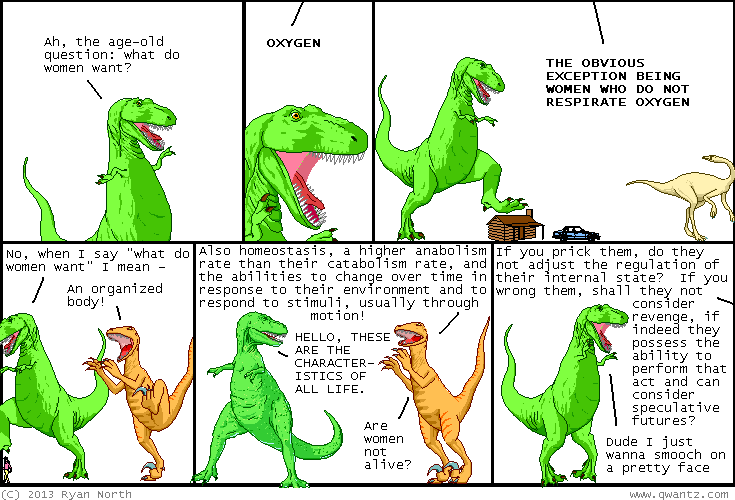
what do women want? also where. and when. and how. and i guess why??
| archive - contact - sexy exciting merchandise - cute - search - about | |||
|
MY FACE IS UP HERE: dang a special-edition shirt available only for 7 days! :o dinosaur comics returns monday!
|
|||
| ← previous | June 13th, 2013 | next | |
|
June 13th, 2013: Yesterday night I went to a nice dinner party where I knocked a rack of sticky ribs into my lap and then for dessert knocked a nice piece of pie into my lap, in case you were wondering what it's like to be an internet cartoonist / all around cool guy One year ago today: did I build this whole comic around the last line? perhaps, perhaps – Ryan 
| |||
Maniczak and -1 others like this
15 Jun 00:25
If “Miri”, “The Conscience of the King” and “The Galileo Seven” were about pushing the boundaries of what Star Trek was and could do, than “Court Martial” is about taking a long, hard look at what the show was originally conceived of being and the implications of that central concept and running with it to its logical limit.
This isn't like “Balance of Terror”, which was about firmly putting its foot down and loudly, overtly protesting the show's militaristic roots (not that there was anything wrong with that): Instead, “Court Martial” feels like Gene Coon and his team doing a lot of introspection and putting a lot of thought into what a show about the Space Air Force (or indeed the Space Navy, which seems to be increasingly the more accurate description, especially in this episode) would actually be about and what the world of that show might look like. This likely wasn't the original intent, given as this story's genesis came about by Coon approaching writer Don M. Mankiewicz to come up with a money-saving script that could be filmed with one new set. The extent to which this was successful can be easily deduced by observing that this episode features four new sets, a slew of new uniforms, some new matte paintings and the fact the next episode is a two-part clip show.
While it fails rather spectacularly at being a bottle show, “Court Martial” is a significant episode in several other regards, in particular, it's a canon compiler's dream as it introduces numerous new world building elements that will quickly become beloved parts of the “Star Trek Universe”. Most important of these from a modern perspective has got to be the debut of Starfleet and Starfleet Command. This is, to understate things considerably, the single most important development in the series so far from the perspective of the future, and indeed it's so titanic a moment there's only one more that can top it (but we have to wait a bit longer for that). For the first time we have an actual name for the service the Enterprise is a part of and that of the body that governs it. It may seem surprising to those who haven't seen Star Trek in awhile, but this is the first time anything resembling the word “Starfleet” has been mentioned in the show, two years and 14 weeks in. Previously we'd occasionally heard references to Earth or an Earth Command, but with the introduction of the phrases “Starfleet Command” and “United Star Ship”, Star Trek has expanded its scope considerably.
Although primarily a nomenclature change, this does alter the way we look at the world of Star Trek a bit. In the past the Enterprise seemed to have been representing the interests of some kind of colonial power based on Earth: While that reading is still possible, this new terminology encourages a more nuanced and complex way of interpreting the version of the galaxy this show takes place in-This is also helped by having the entire episode basically be devoted to world building, showing exactly the way Starfleet's chain of command and and governmental organisation works. We have a Commodore, who is a retired starship captain, operating a planetary starbase designed for resupplying and refitting passing ships, we have a legal system in place that holds officers accountable for their actions and a bureaucracy supervising all of it. It's very clearly an extension of the United States naval tradition into outer space, and it's a perfectly logical extrapolation of the setting Gene Roddenberry put in place, except far more detailed and sophisticated than he could ever have made it.
That said it's worth keeping in mind we're operating from hindsight here: We know what Starfleet becomes so it's easy to latch onto this as “the way it was supposed to be from the beginning”, but remember Star Trek has a noticeable lack of consistency and continuity at this point. It would been just as easy for a viewer in 1967 to figure all of these fancy world trappings would be tossed out the next episode. After all, that's the way the show's operated before now, and there's no reason to suspect it won't continue to do so. That Coon doesn't throw this out, retains these parts of the setting and indeed continues to expand upon them is something we should return to when he does. What this all ultimately comes down to is that no matter how exciting the reveal of Starfleet Command might be for us, at the moment there's no reason to believe it's anything more than the new name for the Space Naval Service, and that's exactly how “Court Martial” treats it.
In that regard, making “Court Martial” a legal drama is an incredibly sensible idea: If you're going to do an episode about a lot of world building involving bureaucracy and military service, it only follows you'd want to tell a story about a court martial so you can show how that all works together. It's about as far away as you can get from Exploring Strange New Worlds or, for that matter, Gulliver's Travels in space, but it's a perfectly reasonable thing to expect a show about the Space Air Force or the Space Navy to do. The only problem is “Court Martial” isn't an especially *good* legal drama-It's utterly in love with its own jargon, protocol and procedures which, again, makes sense, but there's isn't much actual *drama* per se to be had here. We know right from the beginning Kirk is innocent: He has to be, he's an established character and straightforwardly the series' hero, kicking him off the show 13 episodes into the first season would be actually insane.
This would be alright if the episode was about how Kirk proves his innocence against almost insurmountable odds, and while the show does hint at this direction it never really gets there. Establishing Shaw as Kirk's ex-lover and also the prosecutor is an easy way to drum up tension in theory, but all it does in practice is to further cement Kirk's innocence because she very obviously doesn't believe in her case even if she's good at arguing it. The episode further tries to go this route by having the primary evidence about Kirk be the supposedly “infallible” automatic ship's record and giving him Cogley as his defense attorney, a man defined almost exclusively by being a boisterous old-fashioned bibliophile and humanist who has no time for this newfangled, highfalutin' computer stuff. There's a secondary thread here about how much mechanization should be acceptable and whether computers can be trusted, but after the episode halfheartedly builds it up in the first few acts it turns out to be irrelevant to the actual plot as Finney is discovered to be still alive and playing hide-and-seek on the engineering deck (and anyway there's another really famous episode that deals with these themes better and far more overtly so I'll save my critique of them until we get up to it).
The other big complaint I have with “Court Martial” is its general attitude. This is an episode all about honour, duty, command and service. The overall plot is already about protocol and procedure, and the key scene comes when Kirk first takes the witness stand: He gives a big, pompous monologue about how he “did what he had to do-by the book!” and how all the things he did “and the order in which I did them!” he did for his ship and his duty, as those are the most important things to him. It's right out of the military drama textbook and is pure C.S. Forester and Aubrey-Matarin material and really just not to my tastes at all. However, to William Shatner's credit, he sells the hell out of this, going into a big, overplayed piece-to-camera and doing the entire soliloquy in one take, immediately reminding me of the Shakespearean embellishments of “The Conscience of the King”. And even this isn't a fault I'm finding with the episode (it's quite well done space military drama) it's me drawing a philosophical line marking the boundary of what I like Star Trek to be about.
Additionally, even here it's worth comparing “Court Martial” with its nearest Roddenberry-era analogue, “The Corbomite Maneuver”. That episode was an action-packed thriller with a twist ending that was clearly banking on us being really excited by the back-and-forth bluffing and tense countdown to potential Armageddon. This episode, by contrast, is a more complex courtroom piece that takes its time to explain and establish its setting and actually examines themes like valour, honour and duty instead of tossing them out as buzzwords: We see quite clearly how this affects the characters of Kirk, Stone, Shaw and Finney and how they interpret those concepts, which also builds off of the character studies we saw in “The Galileo Seven”. This is still Gene Coon expanding what Star Trek can be about, only now instead of bringing in other genres to play with, he's beginning to turn his attention to the fundamental pitch of the series itself, and he'll only continue to do this more and more as his tenure progresses. Granted, the end result of this (for the moment at least) is a show that's still overtly militaristic, but at least it's militaristic in a bit more of a nuanced way now.
None of this to say that “Court Martial” is a bad bit of television: With the exception of the few inconsistencies I've mentioned already, it's certainly watchable and far more solid a production than many of the other episodes I've covered so far. My big issue with it is that it represents a version of Star Trek I've never been drawn to and am even less so now. I don't like military drama and I especially don't like it when that's what Star Trek becomes, which I guess should say something about how I feel about the franchise given I'm doing a Star Trek blog. However, there's another side to this: What Gene Coon and Don M. Mankiewicz realised is that a show about the Space Air Force or Space Navy is eventually going to end up here. If nothing else, that's what “Court Martial” is demonstrating-That this is the logical endpoint of a specific, formative thematic thread that's been a part of Star Trek since the beginning. That Star Trek becomes something more than this is evidence Coon knew this wasn't really all the show was capable of, and now that he's found the show's original idea and taken it as far as it can go, he can start to reshape it and push it into the beyond. But Coon has one more act to perform, and what he's about to do next is turn his lens back onto the show's most primal form itself.
“The penal code! The penal code!”: Court Martial
by noreply@blogger.com (Josh Marsfelder)
 |
| "Ladies and gentlemen, this is Chewbacca. Chewbacca is a Wookiee from the planet Kashyyyk. But Chewbacca lives on the planet Endor. Now think about it; that does not make sense!" |
This isn't like “Balance of Terror”, which was about firmly putting its foot down and loudly, overtly protesting the show's militaristic roots (not that there was anything wrong with that): Instead, “Court Martial” feels like Gene Coon and his team doing a lot of introspection and putting a lot of thought into what a show about the Space Air Force (or indeed the Space Navy, which seems to be increasingly the more accurate description, especially in this episode) would actually be about and what the world of that show might look like. This likely wasn't the original intent, given as this story's genesis came about by Coon approaching writer Don M. Mankiewicz to come up with a money-saving script that could be filmed with one new set. The extent to which this was successful can be easily deduced by observing that this episode features four new sets, a slew of new uniforms, some new matte paintings and the fact the next episode is a two-part clip show.
While it fails rather spectacularly at being a bottle show, “Court Martial” is a significant episode in several other regards, in particular, it's a canon compiler's dream as it introduces numerous new world building elements that will quickly become beloved parts of the “Star Trek Universe”. Most important of these from a modern perspective has got to be the debut of Starfleet and Starfleet Command. This is, to understate things considerably, the single most important development in the series so far from the perspective of the future, and indeed it's so titanic a moment there's only one more that can top it (but we have to wait a bit longer for that). For the first time we have an actual name for the service the Enterprise is a part of and that of the body that governs it. It may seem surprising to those who haven't seen Star Trek in awhile, but this is the first time anything resembling the word “Starfleet” has been mentioned in the show, two years and 14 weeks in. Previously we'd occasionally heard references to Earth or an Earth Command, but with the introduction of the phrases “Starfleet Command” and “United Star Ship”, Star Trek has expanded its scope considerably.
Although primarily a nomenclature change, this does alter the way we look at the world of Star Trek a bit. In the past the Enterprise seemed to have been representing the interests of some kind of colonial power based on Earth: While that reading is still possible, this new terminology encourages a more nuanced and complex way of interpreting the version of the galaxy this show takes place in-This is also helped by having the entire episode basically be devoted to world building, showing exactly the way Starfleet's chain of command and and governmental organisation works. We have a Commodore, who is a retired starship captain, operating a planetary starbase designed for resupplying and refitting passing ships, we have a legal system in place that holds officers accountable for their actions and a bureaucracy supervising all of it. It's very clearly an extension of the United States naval tradition into outer space, and it's a perfectly logical extrapolation of the setting Gene Roddenberry put in place, except far more detailed and sophisticated than he could ever have made it.
That said it's worth keeping in mind we're operating from hindsight here: We know what Starfleet becomes so it's easy to latch onto this as “the way it was supposed to be from the beginning”, but remember Star Trek has a noticeable lack of consistency and continuity at this point. It would been just as easy for a viewer in 1967 to figure all of these fancy world trappings would be tossed out the next episode. After all, that's the way the show's operated before now, and there's no reason to suspect it won't continue to do so. That Coon doesn't throw this out, retains these parts of the setting and indeed continues to expand upon them is something we should return to when he does. What this all ultimately comes down to is that no matter how exciting the reveal of Starfleet Command might be for us, at the moment there's no reason to believe it's anything more than the new name for the Space Naval Service, and that's exactly how “Court Martial” treats it.
In that regard, making “Court Martial” a legal drama is an incredibly sensible idea: If you're going to do an episode about a lot of world building involving bureaucracy and military service, it only follows you'd want to tell a story about a court martial so you can show how that all works together. It's about as far away as you can get from Exploring Strange New Worlds or, for that matter, Gulliver's Travels in space, but it's a perfectly reasonable thing to expect a show about the Space Air Force or the Space Navy to do. The only problem is “Court Martial” isn't an especially *good* legal drama-It's utterly in love with its own jargon, protocol and procedures which, again, makes sense, but there's isn't much actual *drama* per se to be had here. We know right from the beginning Kirk is innocent: He has to be, he's an established character and straightforwardly the series' hero, kicking him off the show 13 episodes into the first season would be actually insane.
This would be alright if the episode was about how Kirk proves his innocence against almost insurmountable odds, and while the show does hint at this direction it never really gets there. Establishing Shaw as Kirk's ex-lover and also the prosecutor is an easy way to drum up tension in theory, but all it does in practice is to further cement Kirk's innocence because she very obviously doesn't believe in her case even if she's good at arguing it. The episode further tries to go this route by having the primary evidence about Kirk be the supposedly “infallible” automatic ship's record and giving him Cogley as his defense attorney, a man defined almost exclusively by being a boisterous old-fashioned bibliophile and humanist who has no time for this newfangled, highfalutin' computer stuff. There's a secondary thread here about how much mechanization should be acceptable and whether computers can be trusted, but after the episode halfheartedly builds it up in the first few acts it turns out to be irrelevant to the actual plot as Finney is discovered to be still alive and playing hide-and-seek on the engineering deck (and anyway there's another really famous episode that deals with these themes better and far more overtly so I'll save my critique of them until we get up to it).
The other big complaint I have with “Court Martial” is its general attitude. This is an episode all about honour, duty, command and service. The overall plot is already about protocol and procedure, and the key scene comes when Kirk first takes the witness stand: He gives a big, pompous monologue about how he “did what he had to do-by the book!” and how all the things he did “and the order in which I did them!” he did for his ship and his duty, as those are the most important things to him. It's right out of the military drama textbook and is pure C.S. Forester and Aubrey-Matarin material and really just not to my tastes at all. However, to William Shatner's credit, he sells the hell out of this, going into a big, overplayed piece-to-camera and doing the entire soliloquy in one take, immediately reminding me of the Shakespearean embellishments of “The Conscience of the King”. And even this isn't a fault I'm finding with the episode (it's quite well done space military drama) it's me drawing a philosophical line marking the boundary of what I like Star Trek to be about.
Additionally, even here it's worth comparing “Court Martial” with its nearest Roddenberry-era analogue, “The Corbomite Maneuver”. That episode was an action-packed thriller with a twist ending that was clearly banking on us being really excited by the back-and-forth bluffing and tense countdown to potential Armageddon. This episode, by contrast, is a more complex courtroom piece that takes its time to explain and establish its setting and actually examines themes like valour, honour and duty instead of tossing them out as buzzwords: We see quite clearly how this affects the characters of Kirk, Stone, Shaw and Finney and how they interpret those concepts, which also builds off of the character studies we saw in “The Galileo Seven”. This is still Gene Coon expanding what Star Trek can be about, only now instead of bringing in other genres to play with, he's beginning to turn his attention to the fundamental pitch of the series itself, and he'll only continue to do this more and more as his tenure progresses. Granted, the end result of this (for the moment at least) is a show that's still overtly militaristic, but at least it's militaristic in a bit more of a nuanced way now.
None of this to say that “Court Martial” is a bad bit of television: With the exception of the few inconsistencies I've mentioned already, it's certainly watchable and far more solid a production than many of the other episodes I've covered so far. My big issue with it is that it represents a version of Star Trek I've never been drawn to and am even less so now. I don't like military drama and I especially don't like it when that's what Star Trek becomes, which I guess should say something about how I feel about the franchise given I'm doing a Star Trek blog. However, there's another side to this: What Gene Coon and Don M. Mankiewicz realised is that a show about the Space Air Force or Space Navy is eventually going to end up here. If nothing else, that's what “Court Martial” is demonstrating-That this is the logical endpoint of a specific, formative thematic thread that's been a part of Star Trek since the beginning. That Star Trek becomes something more than this is evidence Coon knew this wasn't really all the show was capable of, and now that he's found the show's original idea and taken it as far as it can go, he can start to reshape it and push it into the beyond. But Coon has one more act to perform, and what he's about to do next is turn his lens back onto the show's most primal form itself.
15 Jun 00:06
This is one of those things which is as baffling as it is annoying, to me. I mean no-one thinks this was built by aliens:
No-one thinks this was built by aliens:
No-one thinks this was built by aliens:
No-one thinks this was built by aliens:
No-one thinks this was built by aliens:
HOLY SHIT, ALIENS MUST HAVE BUILT IT!!!!
HOLY SHIT, ALIENS MUST HAVE BUILT IT!!!!
No-one thinks this was built by aliens:
I just don't get how you can miss the progression here.
Why Aliens Didn't Build the Pyramids
by noreply@blogger.com (Lawrence Burton)
The question of whether the Egyptian pyramids were really built by mysterious visitors from beyond the stars has puzzled humanity since the dawn of time, specifically that small section of humanity who shun conventional wisdom on the subject for fear of being misled by the truth of the so-called facts. Aside from those people, I'm not entirely sure it has puzzled anyone else, and certainly not anyone you would want to know or meet in a social situation. In other words, it's one of the most stupid arguments ever set forth, the stupidity of which was rather neatly illustrated by my friend Urizen (possibly an alias but who knows?) on a bulletin board from which he was subsequently banned for controversially posting a Gilray cartoon, and which is reproduced here with his kind permission:
This is one of those things which is as baffling as it is annoying, to me. I mean no-one thinks this was built by aliens:
 |
| Tomb U-j, belonging to King Scorpion [I], c. 3150 BC, at Abydos. |
No-one thinks this was built by aliens:
 |
| Tomb of King Den, 1st Dynasty, Abydos. |
No-one thinks this was built by aliens:
 |
| Pyramid of Djoser, 3rd Dynasty, Saqqara. |
No-one thinks this was built by aliens:
 |
| Maidum Pyramid, built either by Huni or Sneferu, 4th Dynasty. |
No-one thinks this was built by aliens:
 |
| Bent Pyramid, built by Sneferu, 4th Dynasty. |
HOLY SHIT, ALIENS MUST HAVE BUILT IT!!!!
 |
| Pyramid of Khufu, 4th Dynasty. |
HOLY SHIT, ALIENS MUST HAVE BUILT IT!!!!
 |
| Pyramid of Khafre, 4th Dynasty. |
No-one thinks this was built by aliens:
 |
| Pyramid of Unas, 5th Dynasty. No-one thinks this was built by aliens: |
 |
| Pyramid of Sahure, 5th Dynasty. |
I just don't get how you can miss the progression here.
This was originally posted over at Ce Acatl but has been moved here in order to make more room for exciting conversation about the brilliant Doctor Who Man Telly Show.
14 Jun 23:25

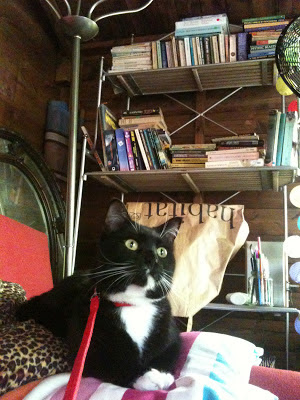
I've written before about loving libraries - and about the periods in my life when I was borrowing books and records a lot (from the refuge of Newton Aycliffe's small, now-demolished library, or from Lancaster's sweet, ancient town library, or Manchester's grand old Central library, where I sat and wrote every morning for months on end ) and there were other times when I drifted away from libraries altogether. When we lived in Norwich it was terrible - since their central library burned down in the mid Nineties and there was nothing to use apart from the university library (which was never much fun...). Then they opened some kind of Millenium glass-walled nightmare in the year 2000 and it was all open-plan and a bit like a glitzy version of a Poundshop or Dorothy Perkins...
What I like about living round here is that we have the choice between the small and perfectly formed (and reprieved!) Levenshulme library - but there's also Longsight up the road, too. It's quite a different experience - but with a bigger stock and interesting potential for people-watching, it's well worth a visit. It's quite noisy - with all the various impromptu social gatherings going on - and people giving the computers a good clattering - and some solitary, crazy-looking souls sitting on futuristic armchairs glaring at you as you peruse the stacks... but the staff are terribly friendly.
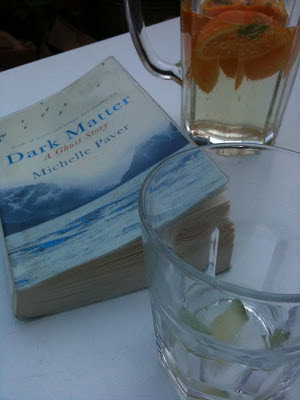
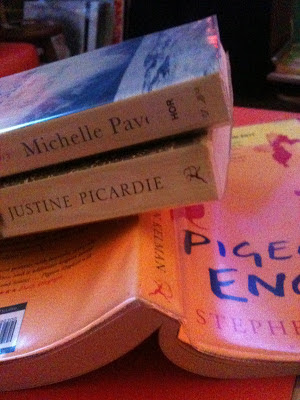
I've spent the last week devouring library loot. 'Dark Matter' by Michelle Paver is a ghost story I've meant to read for ages. I don't know how I failed to - but anyway - the blazing heat of our back garden was perfect for reading this tale of terror in the arctic tundra circa the 1930s. It's a wonderful book - perfectly judged in delivering its scares and the way it slowly, horribly ramps up the tension.
Justine Picardie's 'Daphne' was something i was keen to read, too - and had forgotten about. It's pretty good. I think it's hampered by sticking too close to the research and the real-life source material. It could be shorter, snappier, and less reverential. And what a terrible bunch of characters! The literary researcher characters in the contemporary bit seem to come from central casting. They're like the same snobby lot that you get in any old novel about literary detective work - not very engaging at all. The real heat of the book comes with the collision of the shady old man who hordes the Bronte manuscripts in his decrepit house in Leeds and Daphne du Maurier's fictionalised correspondence with him. The scene where she actually goes to visit - and he pretends to be someone else and not the man who invited her - is actually quite chilly, uncanny and sad. I wanted more of that sort of thing and less of the tiresomely self-regarding Hampstead brigade, really.
And now i'm on with Stephen Kelman's 'Pigeon English' - which is sweet, slangy, ramshackle and very successful in grounding us in this London council estate. I love the little interludes from the pigeon - these little feathery diatribes at the start of some of the chapters. It reminds me a bit of that tv show 'Mongrels'. Still halfway through this one, where I'm feeling the need of greater forward momentum, i think... but I'll let you know how it goes.
Seems like the books i was choosing at Longsight last week are things that were from two or three years ago - the Richard and Judy's, the Booker listees and the things that book bloggers were slogging through back then. I didn't see *very* much that was bang up to date - and that's no surprise, given the cuts.
I don't mind being a couple of years behind with this contemporary stuff!
Isn't that what reading's always like? Having that feeling of forever catching up? Which is just another way of saying - thankfully - that we'll never run out of good things to read..?
Library Books
by noreply@blogger.com (Paul Magrs)

This week has seen the announcement that Levenshulme library has been saved! here's the Manchester Evening News report. I'm so proud of everyone - and Jeremy especially - for making this happen. It's a brilliant combination of ideas and practical solutions. It's a fantastic act of collaboration by everyone involved meaning that the library can stay alive until the new one opens up for business. I think everyone's ending up with more than they bargained for with the way things have turned out - and it's all down to the creativity and commitment of those working on this for the past few months.

I've written before about loving libraries - and about the periods in my life when I was borrowing books and records a lot (from the refuge of Newton Aycliffe's small, now-demolished library, or from Lancaster's sweet, ancient town library, or Manchester's grand old Central library, where I sat and wrote every morning for months on end ) and there were other times when I drifted away from libraries altogether. When we lived in Norwich it was terrible - since their central library burned down in the mid Nineties and there was nothing to use apart from the university library (which was never much fun...). Then they opened some kind of Millenium glass-walled nightmare in the year 2000 and it was all open-plan and a bit like a glitzy version of a Poundshop or Dorothy Perkins...

What I like about living round here is that we have the choice between the small and perfectly formed (and reprieved!) Levenshulme library - but there's also Longsight up the road, too. It's quite a different experience - but with a bigger stock and interesting potential for people-watching, it's well worth a visit. It's quite noisy - with all the various impromptu social gatherings going on - and people giving the computers a good clattering - and some solitary, crazy-looking souls sitting on futuristic armchairs glaring at you as you peruse the stacks... but the staff are terribly friendly.
I've spent the last week devouring library loot. 'Dark Matter' by Michelle Paver is a ghost story I've meant to read for ages. I don't know how I failed to - but anyway - the blazing heat of our back garden was perfect for reading this tale of terror in the arctic tundra circa the 1930s. It's a wonderful book - perfectly judged in delivering its scares and the way it slowly, horribly ramps up the tension.
Justine Picardie's 'Daphne' was something i was keen to read, too - and had forgotten about. It's pretty good. I think it's hampered by sticking too close to the research and the real-life source material. It could be shorter, snappier, and less reverential. And what a terrible bunch of characters! The literary researcher characters in the contemporary bit seem to come from central casting. They're like the same snobby lot that you get in any old novel about literary detective work - not very engaging at all. The real heat of the book comes with the collision of the shady old man who hordes the Bronte manuscripts in his decrepit house in Leeds and Daphne du Maurier's fictionalised correspondence with him. The scene where she actually goes to visit - and he pretends to be someone else and not the man who invited her - is actually quite chilly, uncanny and sad. I wanted more of that sort of thing and less of the tiresomely self-regarding Hampstead brigade, really.
And now i'm on with Stephen Kelman's 'Pigeon English' - which is sweet, slangy, ramshackle and very successful in grounding us in this London council estate. I love the little interludes from the pigeon - these little feathery diatribes at the start of some of the chapters. It reminds me a bit of that tv show 'Mongrels'. Still halfway through this one, where I'm feeling the need of greater forward momentum, i think... but I'll let you know how it goes.
Seems like the books i was choosing at Longsight last week are things that were from two or three years ago - the Richard and Judy's, the Booker listees and the things that book bloggers were slogging through back then. I didn't see *very* much that was bang up to date - and that's no surprise, given the cuts.
I don't mind being a couple of years behind with this contemporary stuff!
Isn't that what reading's always like? Having that feeling of forever catching up? Which is just another way of saying - thankfully - that we'll never run out of good things to read..?

14 Jun 23:25

Have you listened to 'Hammer Chillers' yet?
It's a new spooky anthology series from Hammer films, working in collaboration with Bafflegab Productions. They're available for download, one a week, on Fridays - with a cd release coming later in the year.
There are some wonderful writers and performers involved - and a wide range of scary stories that span the genre. I'm dead chuffed to have my work appearing alongside writers such as Stephen Volk and Christopher Fowler. My episode is number three - and it's a very nasty domestic thriller called 'Spanish Ladies'. Available from next Friday, it's very much a homage to the old 'Hammer House of Horror' TV show from 1980.
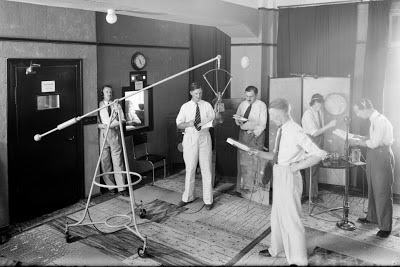
I've been thinking a lot about horror stories on radio, and how the audio medium is the best place for scary stuff. I guess that's because it all goes back to ghost stories and terror tales being primarily an oral tradition - whether they're being told around a campfire or in front of a blazing hearth. There's also that amazing tradition of radio serials and anthology series of the 1930s and 40s, especially in the US. For several years I was completely obsessed with crackly, bootlegged copies of shows such as 'The Strange Doctor Weird' and 'Lights Out'. All of those shows went out live, with actors all standing round microphones together - and someone doing all the sound effects live in the studio. It always sounds like radio in those days was masses of fun. I love the stories about people like Arch Obler - radio horror writer extraordinaire - splitting open cabbages and various other vegetables with kitchen knives to get the grisly sound effects just right...!
In the 1980s i remember recording 'Fear on Four' so I could listen to them again and again... getting to learn what made these brilliantly compressed, succinct and spiky stories work so well.
Radio does full justice to tales of terror because it makes the listener complicit with what's going on. When you're in the dark, or wearing headphones, and sitting on your own... the story is happening inside your skull. And without visuals, you're creating your own. You're doing half the work. And so you are half-responsible for how much you're scaring yourself. And you become invested and involved in the language in a way that TV or film never lets you. You're in the dark with just a few voices - and at the mercy of what they're telling you...
Anyway - go and check them out! You can buy episodes individually, or as a series of six. Mark Morris's episode is released today!
I think Bafflegab have done a beautiful job on these, and I'm honoured to be a part of them.
Hammer Chillers..!
by noreply@blogger.com (Paul Magrs)

Have you listened to 'Hammer Chillers' yet?
It's a new spooky anthology series from Hammer films, working in collaboration with Bafflegab Productions. They're available for download, one a week, on Fridays - with a cd release coming later in the year.
There are some wonderful writers and performers involved - and a wide range of scary stories that span the genre. I'm dead chuffed to have my work appearing alongside writers such as Stephen Volk and Christopher Fowler. My episode is number three - and it's a very nasty domestic thriller called 'Spanish Ladies'. Available from next Friday, it's very much a homage to the old 'Hammer House of Horror' TV show from 1980.
I've been thinking a lot about horror stories on radio, and how the audio medium is the best place for scary stuff. I guess that's because it all goes back to ghost stories and terror tales being primarily an oral tradition - whether they're being told around a campfire or in front of a blazing hearth. There's also that amazing tradition of radio serials and anthology series of the 1930s and 40s, especially in the US. For several years I was completely obsessed with crackly, bootlegged copies of shows such as 'The Strange Doctor Weird' and 'Lights Out'. All of those shows went out live, with actors all standing round microphones together - and someone doing all the sound effects live in the studio. It always sounds like radio in those days was masses of fun. I love the stories about people like Arch Obler - radio horror writer extraordinaire - splitting open cabbages and various other vegetables with kitchen knives to get the grisly sound effects just right...!
In the 1980s i remember recording 'Fear on Four' so I could listen to them again and again... getting to learn what made these brilliantly compressed, succinct and spiky stories work so well.
Radio does full justice to tales of terror because it makes the listener complicit with what's going on. When you're in the dark, or wearing headphones, and sitting on your own... the story is happening inside your skull. And without visuals, you're creating your own. You're doing half the work. And so you are half-responsible for how much you're scaring yourself. And you become invested and involved in the language in a way that TV or film never lets you. You're in the dark with just a few voices - and at the mercy of what they're telling you...
Anyway - go and check them out! You can buy episodes individually, or as a series of six. Mark Morris's episode is released today!
I think Bafflegab have done a beautiful job on these, and I'm honoured to be a part of them.

14 Jun 19:56
Lawsuit claims "Happy Birthday" is not in copyright, and Warner owes hundreds of millions in improperly collected royalties.
Lawsuit claims "Happy Birthday" is not in copyright, and Warner owes hundreds of millions in improperly collected royalties.


13 Jun 14:28
Goin’ to a Town Where Nobody Knows Me
by LP
From the 2014 edition of my book series, Frontage Road U.S.A.: Adventures Just Off the Superhighway, I am pleased to present the chapter entitled “Oddest-Named Cities in America”. Special thanks to Jug-o’-Shine Publishing for permission to excerpt this material.
Nipples, FL. Originally planned as a cultural and intellectual haven in the theme-parks-and-outlet-malls wasteland of central Florida and meant to be called Naples, this planned community was doomed from the start after a misunderstanding involving the county record-keeper, whose poor spelling was legendary, and the city planner, a Swiss immigrant with a pronounced Teutonic accent. Far from becoming a mecca of learning and art, it in fact attracted record numbers of pornography stores and gentlemen’s clubs. And, although there are an above-average number of museums, they commemorate not local folklore or ethnic pride but such subjects as “The History of the Tit”.
To Be Determined, MT. A note scrawled on the town charter by Mitchell Ormand, the thoughtful founder of this former mining camp, illustrated his determination not to make a hasty decision with something as important as the name of the growing settlement that would bear his legacy into the future. Unfortunately, he was hit by a train only three days later, and his son and heir proved to be rather literal-minded. “We always meant to get around to changing the name of the place to Ormand or Mitchelltown or something,” says five-term mayor Frances Keller, “but after all of this time, it sort of seems pointless.” Visitors are encouraged to visit the To Be Announced Festival, time and date pending.
Ass Munch Loser Town, MI. Struck by hard times in the 1980s, when the auto industry that supported it began sending jobs out of the country, the city of Springdon held a widely publicized contest in1986 in which entrants would pay a substantial fee in the form of a special tax to enter a raffle. The winner would be granted the right to rename the town, and the municipal coffers would receive a much-needed infusion of cash. However, the public relations firm which engineered the raffle neglected to include a number of critical limitations and restrictions in the entry rules, and Carl Burroughs, the then 14-year-old son of a wealthy oil industry executive, won the right to saddle Springdon with its regrettable current name. Town elders hoped that after the young man matured, he might reconsider his decision, but much to their chagrin, Burroughs, now 41 and a wealthy oil industry executive himself, refuses to allow any name change. “I think it’s fuckin’ hilarious,” he says. “After all, you have to admit, that town is full of ass munch losers.”
Almost Hitler, NC. A small town in the north-central part of the state largely occupied by small farmers and tobacco growers, Almost Hitler (formerly Scovil) is the home of the Brande family, real estate magnates and the wealthiest citizens in the area. In the 1957, patriarch Kendall Brande, then the mayor of Scovil and a notorious gambler, lost ready cash to the tune of over $350,000 in a poker game to his rival, Henry Joiner, the mayor of nearby Coverdell. Desperate to recoup his losses, Brande offered Joiner a unique bet: if Brande won the next hand, he would get back all the cash he’d dropped that night. If he lost, Joiner would win the right to alter the town charter and give it the worst name he could think of. Fortunately, Brande won the round. Unfortunately, he stumbled home the next morning, still drunk after his late night of gambling, and imperfectly attempted to communicate to the city registrar that the name of the town was almost Hitler.
13 Jun 14:14
Crib Sheet: Glasshouse
by Charlie Stross
"Glasshouse" happened by accident, through a collision of unexpected intersections. But it was a happy accident, in the end.
Rewind to 2003. I'm still working on the last stories that went into "Accelerando", still unsure what comes next, and (I think) working on "The Clan Corporate". To distract myself from going mad hitting magazine deadlines (I'm writing 3-4 magazine articles a month to keep the wolf from the door, for novels at this point only amount to about 50% of my income) I'm fitfully poking at a colony of Sims. (It's amazing how much fun the Sims are, once you chuck the suburban dream narrative out of the window and start getting into surreal architecture, shark pools, and walling your virtual victims up in dungeons.)
And then a book by one of my favourite SF writers is announced—a new title by John Varley. As it happens, I've been waiting about seven years for "Steeltown Blues", the third in the trilogy of Eight Worlds novels that started with "Steel Beach" and "The Golden Globe". So when it transpires that he's written a book about time-traveling mammoths instead, I'm ... well, I'm about as pissed off as those Charles Stross fans who keep bugging me for a third Eschaton novel.
Varley's "Eight Worlds" universe was one of the most interesting and innovative deep space SF settings of the 1970s and 1980s; he tackled the whole bioengineering-rather-than-terraforming nexus way before it became popular, and asked questions about the meaning of identity and gender in a future where biology was as mutable as clothing is today. Sometimes he got things wrong, very wrong indeed (there's something to be said for the assertion that in the seventies everyone was a bit creepy), but sometimes he hit the nail square on the head, at a point when everyone else was trying to invent the screwdriver.
This was also the early 21st century. Post-9/11 security state, post Iraq invasion. Abu Ghraib was in the news. I was reading up on the psychology of abuse, coercion, and obedience to authority: on the work of Stanley Milgram and Philip Zimbardo's Stanford Prison Study. These experiments suggested that atrocities are in many ways situational: rather than arising from the behaviour of corrupt individuals, phenomena like the prisoner abuse at Abu Ghraib happened because the environment itself is inherently corrupting and most people will obey what they perceive to be lawful instructions emanating from a legitimate source of authority even if those instructions are themselves illegal or inappropriate.
(With hindsight I should also have read up on Altemeyer's theory of authoritarian followers, but I didn't know about it at the time.)
So. One rainy Tuesday afternoon in April 2004, I am sitting in the splendid main hall of "The Standing Order" in Edinburgh (a pub in the Grade A listed interior of a former bank headquarters), moaning about the lack of a new Eight Worlds novel in the direction of a friend, when a weird idea inserts itself into my head: why don't I write one?
And then another weird idea dogpiles the first: why not take the Stanford Prison Study protocol and apply it to gender roles among a bunch of posthumans who'd be at home in an Eight Worlds type environment—one in which physiology and gender and biology are mutable? What happens if you pin them down at random, frozen in one form or another, and give them incentives to conform to arbitrary roles, as a way of interrogating the assumptions and stupidities we take for granted?
Of course, this was such a juicy chew-toy that working on it was inevitable. I shambled home, wrote up some notes, and resolved to sit on it for six or nine months, until I was due to write another novel. And then ... then ... I managed to hold it back for almost ten days.
The first draft of "Glasshouse" poured out in 21 days flat, ran to 91,000 words, and was terrible. Or rather, the first two thirds worked okay; then it ran right off the rails. You do not emit the equivalent of a 260 page novel in three weeks of non-stop insanity without suffering some damage, and with 20/20 hindsight I overran my initial creative vision. I had a flawed hero/ine, Robin/Reeve, waking up in the classic white room setting with faceless enemies trying to kill him—enemies rendered even more ominous by Robin's awareness of having undergone memory excision surgery. The Glasshouse is presented to him as a refuge, but in reality it's a snare and a trap: the Stanford Prison Study in space, with a three year duration and oppressive flaws he doesn't recognize at first. For one thing, it's a Panopticon, a Benthamite tool of universal surveillance. And for another: the Glasshouse was the prototypical military prison in Aldershot, England, an ominous resonance which, alas, I didn't make clear enough in the novel (it was entirely deliberate but seems to have been missed by most readers).
But what was going on? Why was Robin on the run, and from who? It took me a bit longer—and a major redraft, ditching everything after the first 60,000 words and writing another 60,000 words of fresh material to finish the novel—to work out the background; the Censorship wars, Curious Yellow, Robin's own past as a war criminal no better than the odious administrators of the prison experiment. To realize that if you have a posthuman polity of immortals, then the only thing they can reasonably fight over is their memory of the past ("he who controls the past controls the present; he who controls the present controls the future", as George Orwell put it) and the only way you can rehabilitate their past crimes is to project them so far into the future that they are no longer relevant.
And so I ended up with a novel narrated in the first person present tense by the ultimate unreliable narrator (if your first person narrator is murdered two thirds of the way through the story then it's a fair clue that nothing in the story should be taken at face value, right?). Who in turn thinks they're being injected into a prison designed to rehabilitate war criminals, on a mission to expose the administrators' complicity in atrocities ... except that the narrator has a remarkably dodgy background, and indeed fits all the criteria for being incarcerated there himself. And nothing is what it seems, in this panopticon, and indeed our hero/ine may be the worst villain in the plot—or alternatively an innocent in search of redemption: as are they all, hopeful monsters on a one-way journey into a future where their sins can be forgotten.
Final notes ...
Firstly: yes, I have plans for a sequel (provisionally titled "Ghost Engine") set 200 years later, when the slower-than-light colony ship harboring the Glasshouse arrives at its destination to discover that the Censorship Wars are still in fact continuing. It's a coming-of-age story and a loss-of-innocence story. But it's probably not going to get written, because I'm told "Glasshouse" is my slowest-selling SF novel in the US market, and a sequel wouldn't justify much of an advance. So writing this one is on the back-burner until such time as I win the lottery.
Secondly: accidentally burping up a spare novel in 2004 really helped. It meant I had a spare book in the can when, a year later, a family member was taken critically ill—and then I lost six months' of working time while getting my hypertension meds adjusted. (That brain-fogging experience sucked, and took a long time to get over.) Alas, I don't knock out novels in three weeks very often—it's a once or twice a decade thing, and leaves me wrung out like a dish-rag. So by late 2006 the ace in the hole was spent, probably never to be replaced. But it saved me from a gap year in the publishing schedule along the way.
13 Jun 14:04
 I have not actually read any Iain Banks. I recognize that this is a problem. I just went and got the Culture books, and I'm hoping to squeeze some time in for them, but let's be honest, there's well over a dozen things trying to squeeze into a finite amount of media consumption time, and life's too short to read everything. Still, The Also People was marvelous, and I really do want to look at the truck it was bought off the back of, no questions asked.
In any case, here's the thing that struck me. And, I mean, I know why it struck me. Between having lived through an absolutely searing bereavement a few years ago after the fabled "worst 48 hours ever" in which my wife left me and my father had a massive stroke and being now married to an oncology nurse who previously worked at a hospice, the fact that death is a thing that happens is something I am largely speaking intimately aware of. Things have endings. Sometimes the ending is far away, and other times it's close, but things end. Change happens. Mercury has its price.
And so what struck me about Banks was the way in which he announced his terminal cancer. The line in the announcement about asking his wife to do him the honor of being his widow. The bit in his last interview where he notes that he was 87,000 words into his last book, which features a main character dying of cancer, when he got his diagnosis, and remarked, "I've really got to stop doing my research too late. This is such a bad idea."
My wife and I have, shall we say, similar senses of humor. A ways into our first date, realizing that things were going well, but also that she was a hospice nurse, I made one of the higher risk decisions of my single life. See, I really liked her. She was cute and funny and a Doctor Who fan and we were just hitting it off. But she was a hospice nurse. Which, I mean, what a job. But it struck me that there were two things that could mean. One was that she was going to be very... serious. And I have a love of dark humor that would put Robert Holmes to shame. The other was that she was the sort of person who had developed a similar sense of humor to deal with that life.
And I figured I was going to have to know, so I told her the absolutely grimmest and bleakest funny story in my family's history; a story so massively and sickly wrong that it is not so much "told" within my family as whispered about in hushed and awe-struck tones. It is not one I can repeat here - even putting it in some future work of fiction would be too much. It is an honest story about death, and those are too revealing and too luridly and horribly true stories to actually tell. Like sex, we require pornographies of death to pretend that the real thing does not exist.
But it is the sort of story that comes out in life. And given what her job was, she was either going to think it hilarious or she was going to be mortified and storm out. Because either you learn to live in the world where everybody's life ends horribly, one way or another, and most of us die slowly and wetly and awfully, or you lie and tell yourself you live in a different world.
And She cracked up, and has been with me ever since. So when I saw a great Scottish writer dying hilariously of cancer the first thing I did was tell her. Because I knew she'd see in that so perfectly bleak joke about doing your research too late somebody who had done the truly unmentionable in our world and told a real story about death.
So let's talk about that death.
Iain Banks: fifty-nine years, twelve classic science fiction books, and fifteen equally beloved "literary" books. Plus one about scotch. He got paid to drive around Scotland, drink Scotch, and write a discursive book about his feelings. That, right there, is the marker of a brilliant career. And he got to control his own ending and face it on his own terms. No, he didn't get to pick the schedule for his ending, but none of us do.
But he got to face it with grace. He got to frame his goodbye as he wanted to. And he had a life full of making wonderful things.
There was a staff meeting at my wife's hospital after her floor had a really hard death - someone only twenty-seven, who had been on and off the ward throughout her entire illness. It was brutal on everyone, and they had a meeting, and one of the things they talked about was the set of emotions that come up as caregivers. And at the end my wife piped up and suggested one final emotion: peace. And that emotion, more than anything, is what strikes me about Iain Banks.
I think I'm going to really enjoy his books.
A Brief Rumination on Iain Banks
by noreply@blogger.com (Philip Sandifer)

In any case, here's the thing that struck me. And, I mean, I know why it struck me. Between having lived through an absolutely searing bereavement a few years ago after the fabled "worst 48 hours ever" in which my wife left me and my father had a massive stroke and being now married to an oncology nurse who previously worked at a hospice, the fact that death is a thing that happens is something I am largely speaking intimately aware of. Things have endings. Sometimes the ending is far away, and other times it's close, but things end. Change happens. Mercury has its price.
And so what struck me about Banks was the way in which he announced his terminal cancer. The line in the announcement about asking his wife to do him the honor of being his widow. The bit in his last interview where he notes that he was 87,000 words into his last book, which features a main character dying of cancer, when he got his diagnosis, and remarked, "I've really got to stop doing my research too late. This is such a bad idea."
My wife and I have, shall we say, similar senses of humor. A ways into our first date, realizing that things were going well, but also that she was a hospice nurse, I made one of the higher risk decisions of my single life. See, I really liked her. She was cute and funny and a Doctor Who fan and we were just hitting it off. But she was a hospice nurse. Which, I mean, what a job. But it struck me that there were two things that could mean. One was that she was going to be very... serious. And I have a love of dark humor that would put Robert Holmes to shame. The other was that she was the sort of person who had developed a similar sense of humor to deal with that life.
And I figured I was going to have to know, so I told her the absolutely grimmest and bleakest funny story in my family's history; a story so massively and sickly wrong that it is not so much "told" within my family as whispered about in hushed and awe-struck tones. It is not one I can repeat here - even putting it in some future work of fiction would be too much. It is an honest story about death, and those are too revealing and too luridly and horribly true stories to actually tell. Like sex, we require pornographies of death to pretend that the real thing does not exist.
But it is the sort of story that comes out in life. And given what her job was, she was either going to think it hilarious or she was going to be mortified and storm out. Because either you learn to live in the world where everybody's life ends horribly, one way or another, and most of us die slowly and wetly and awfully, or you lie and tell yourself you live in a different world.
And She cracked up, and has been with me ever since. So when I saw a great Scottish writer dying hilariously of cancer the first thing I did was tell her. Because I knew she'd see in that so perfectly bleak joke about doing your research too late somebody who had done the truly unmentionable in our world and told a real story about death.
So let's talk about that death.
Iain Banks: fifty-nine years, twelve classic science fiction books, and fifteen equally beloved "literary" books. Plus one about scotch. He got paid to drive around Scotland, drink Scotch, and write a discursive book about his feelings. That, right there, is the marker of a brilliant career. And he got to control his own ending and face it on his own terms. No, he didn't get to pick the schedule for his ending, but none of us do.
But he got to face it with grace. He got to frame his goodbye as he wanted to. And he had a life full of making wonderful things.
There was a staff meeting at my wife's hospital after her floor had a really hard death - someone only twenty-seven, who had been on and off the ward throughout her entire illness. It was brutal on everyone, and they had a meeting, and one of the things they talked about was the set of emotions that come up as caregivers. And at the end my wife piped up and suggested one final emotion: peace. And that emotion, more than anything, is what strikes me about Iain Banks.
I think I'm going to really enjoy his books.
13 Jun 11:19
The key thing to note, I feel, about the second third of the Original Series' first season is that it can in many ways be read as a systematic attempt to reconceptualise the show by redefining the kind and broadening the scope of stories the show can do. Gene Roddenberry had a fairly straightforward pitch for the show: Gulliver's Travels with the Space Air Force. Gene Coon, by contrast has from the beginning set about making overtures to change this, and this will eventually culminate in his two most memorable and defining episodes at the back end of the year. For the time being we still have the setting we inherited from Roddenberry, but Coon is starting to tweak and refine it a little and “The Galileo Seven” takes some of the most clear and obvious steps forward we've seen yet.
Following up on the implications of the teaser and opening act of “Miri”, we have the Enterprise going out of its way to investigate a quasar phenomenon for purely scientific reasons, Kirk claiming he has standing orders to do so whenever he has the opportunity to. This seems like an unusual thing for Earth Command to take an interest in, as it certainly falls outside the jurisdiction of interplanetary patrol and law enforcement. Indeed, this is actually literalized in the narrative, at least from the bridge crew's point of view, as the Enterprise is torn between first investigating the quasar, then rescuing the crashed shuttlecraft, and getting the supply of vaccinations to Makus III on time. Although this plot point obviously exists primarily to give the episode dramatic tension, it is also a clear move away from the sorts of things the show was doing less than a month ago.
While “The Galileo Seven” doesn't take the exploration theme any further, the main thrust of the plot, the marooned science crew and Spock's attempts to command from a purely logical perspective, is new territory for the show in its own way. This episode marks the first real time Star Trek has attempted a story where proper character development is the primary driving force. Under Roddenberry we frequently had episodes dealing with main character's emotions and relationships, but the very structure of the show forced them to be extremely superficial and disposable: Kirk's friendship with Gary Mitchell in “Where No Man Has Gone Before” is there purely for drama and is never followed up on. The same is also true of McCoy's history with Nancy Crater in “The Man Trap”, and while that episode did play with soap opera tropes, with the exception of Rand and Sulu all of those moments were between random extras, most of whom get death-suckered by Salt Vampire not long after they showed up. Plus, Rand's gone now so in hindsight the effectiveness of that scene is dampened.
In this episode, however, the interpersonal conflicts and connections between characters are central to how the whole story works: The entire plot hinges on the fact Spock is determined to handle the situation with disaffected logic as he feels it is the self-evidently correct way to run a command, and the specific situation he's in forces him to see the limitations of his philosophy because not everything in the universe operates according to logical principles. This puts him at immediate odds with McCoy and Boma and is directly responsible for the deaths of Gaetano and Laitmer as well as the attack from the Tauren natives (and incidentally imagine for a moment how horrific these scenes would have been had this been Number One instead of Spock). While it's true this is yet another iteration of the logic versus emotions theme, this episode handles it with more complexity and nuance than we've seen in the past: There's a genuine debate going on here-While Spock's choices do cause measurable harm to the team, he's also very clearly the best person suited to being in command and it's his leadership that eventually helps pull them through. Furthermore, the episode is explicitly *about* this debate: There's no moral to be told and no lawbreaker to be perpetrated, “The Galileo Seven” is entirely about how Spock deals with a crisis situation and how his friends and co-workers respond to that.
It's the addition of the word “friends” to the end of that last paragraph that's another way this episode expands Star Trek: There's a sense of friendship and camaraderie here for the first time. We got hints of this in things as early as “The Man Trap”, but “The Galileo Seven” is really the first time we've seen the show embrace it as an important part of what it is. Kirk comes right out and states that he refuses to abandon the search even when things look hopeless not only because he doesn't want to feel responsible for seven deaths, but because the people in the survey team are his friends. Similarly, even when Spock pushes McCoy to the point of explosion, he remains more exasperated and frustrated than offended. DeForest Kelley's inimitable believability and humanness sells this perfectly, and we really do get the sense from him that McCoy understands Spock and can read him like a book. In the past, the main characters, especially Kirk, Spock and McCoy, were mostly there to articulate sides in a debate, hence the popular interpretation of them as standing in for the id, ego and superego, but here they seem more like actual characters for the first time. This is very much to the show's benefit and it's all Coon, as it comes naturally right out of Kirk's compassion for Miri and Spock's and McCoy's concern for Kirk in “The Conscience of the King”.
If there's one criticism to be had of this episode, it's that the version of Spock the story seems written for occasionally comes across as a different one than the version of Spock Leonard Nimoy actually seems to want to be playing. The central conflict relies in some sense on Spock operating like an unfeeling logic machine and this alienating his shipmates to the point of open hostility. But ever since at least “The Naked Time”, it's been clear that Spock isn't a purely logical automaton, but someone defined by his internal turmoil brought upon by his mixed Vulcan and human ancestry. Whether or not Spock's climactic choice to jettison the Galileo's fuel supply is to be seen as an “act of desperation” as McCoy and Kirk read it or a logical option to take when all others have been exhausted (I personally think a compelling case could be made for either), every other move Spock makes is one of discreet logic, down to his “overflow error” brought upon by realising his logical decisions have resulted in the deaths of two people and the ire of the Taurens.
But Nimoy's not exactly playing the character that way: He infuses Spock's orders with a fundamental tension and stress, most noticeable when he snaps at Boma and Gaetano about their desire to hunt down the Taurens and his smug statement to them later on that “Fortunately, I am in command”. It's clear McCoy is right and that Spock is eager to use this mission as an opportunity to prove perhaps not his own natural superiority in making command decisions, but that of logic as a guiding principle, and that he's getting progressively more irritated when it doesn't work out for him. Certainly there's some of this to be found in the script as well; the denouement can't really be seen as anything less than the show flatly telling us Spock was wrong and this episode was rewritten by Shimon Wincelberg, who has already shown himself to be good at injecting Star Trek with some much-needed complexity, but I still get the sense that the original idea here was a straight logic versus intuition conflict. However, with some fine-tuning from people like Coon, Wincelberg and especially Kelley and Nimoy, it becomes a character study about Spock, and the first such story proper in all of Star Trek.
Elsewhere “The Galileo Seven” demonstrates further growth in other areas. Kirk's linking narration in this episode is some of the most pensive, dramatic and poetic dialogue he's been given yet, and William Shatner sinks his teeth right into it:
Shatner's portrayal of Kirk here is one of my favourites in the series so far, building off of the Shakespearean gravitas established in “The Conscience of the King” and depicting his overstated, unwavering resolve to find the crew of the Galileo any way he can. The scene on the bridge at the end is also something really special: After McCoy catches him up on what happened on Taurus, Kirk actually teases Spock about making an impulsive, emotional move, after which Spock agrees he's stubborn and everyone laughs the show to fadeout. It's a charming scene, and something that absolutely could not have been done before now. Pike would never do something like that, and his crew didn't feel at all close enough to joke around in this way. The laughter itself is consciously overstated and overacted, almost to the point of feeling insincere, but it fits with the show's newfound theatrical bombast perfectly.
Also stellar in this episode is, actually, Nichelle Nichols, who gets more to do as Uhura here then she's ever had before. It's wonderful that without Spock, McCoy or Scott around Kirk turns to her as his trusted second in command, as Uhura is seen doing double duty as both her regular post as communications officer and filling in the science station in Spock's absence. The scenes where Kirk asks her for updates on the sensor and transporter issues are lovely, as Nichols plays Uhura deeply empathetic with Kirk's pain and his frustration at being unable to take any real action, and it's clear her presence is a comfort to him. There's more friendship, loyalty and support between Kirk and Uhura in these brief vignettes than there were in eleven episodes between Kirk and Rand under Roddenberry. This is Coon's Star Trek taking an unmistakeable stand, as is the character of Boma, who, despite, becoming one of the biggest sources of the episode's conflict, is portrayed as being unchangeably honourable, competent and loyal. Under Roddenberry we had women and nonwhite characters as background extras; under Coon they've become lead roles.
“The Galileo Seven” isn't perfect, but it's easy to see why it became an early fan favourite. We've had more noticeable steps toward improving the show and making it work on a regular basis in the past two episodes then we have in the entirety of the previous eleven. There's no way even a few weeks ago we could have predicted Star Trek was going to be able to do Shakespearean drama or an egalitarian character study. That said, while Gene Coon and his staff have made great leaps in improving Star Trek's progressiveness already, some worrying aspects do still remain, mostly in regards to the show's inherent militarism and fixation on the chain of command. While the show may be a far friendlier place to women and nonwhite people now, this is going to be the biggest challenge it's going to have to overcome. It seems Coon knew this, however, because his next few episodes tackle these issues head on.
“I cannot-Yet I must! How do you calculate that?”: The Galileo Seven
by noreply@blogger.com (Josh Marsfelder)
 |
| Little known fact about Taurus II: It is actually the Bigfoot homeworld. |
The key thing to note, I feel, about the second third of the Original Series' first season is that it can in many ways be read as a systematic attempt to reconceptualise the show by redefining the kind and broadening the scope of stories the show can do. Gene Roddenberry had a fairly straightforward pitch for the show: Gulliver's Travels with the Space Air Force. Gene Coon, by contrast has from the beginning set about making overtures to change this, and this will eventually culminate in his two most memorable and defining episodes at the back end of the year. For the time being we still have the setting we inherited from Roddenberry, but Coon is starting to tweak and refine it a little and “The Galileo Seven” takes some of the most clear and obvious steps forward we've seen yet.
Following up on the implications of the teaser and opening act of “Miri”, we have the Enterprise going out of its way to investigate a quasar phenomenon for purely scientific reasons, Kirk claiming he has standing orders to do so whenever he has the opportunity to. This seems like an unusual thing for Earth Command to take an interest in, as it certainly falls outside the jurisdiction of interplanetary patrol and law enforcement. Indeed, this is actually literalized in the narrative, at least from the bridge crew's point of view, as the Enterprise is torn between first investigating the quasar, then rescuing the crashed shuttlecraft, and getting the supply of vaccinations to Makus III on time. Although this plot point obviously exists primarily to give the episode dramatic tension, it is also a clear move away from the sorts of things the show was doing less than a month ago.
While “The Galileo Seven” doesn't take the exploration theme any further, the main thrust of the plot, the marooned science crew and Spock's attempts to command from a purely logical perspective, is new territory for the show in its own way. This episode marks the first real time Star Trek has attempted a story where proper character development is the primary driving force. Under Roddenberry we frequently had episodes dealing with main character's emotions and relationships, but the very structure of the show forced them to be extremely superficial and disposable: Kirk's friendship with Gary Mitchell in “Where No Man Has Gone Before” is there purely for drama and is never followed up on. The same is also true of McCoy's history with Nancy Crater in “The Man Trap”, and while that episode did play with soap opera tropes, with the exception of Rand and Sulu all of those moments were between random extras, most of whom get death-suckered by Salt Vampire not long after they showed up. Plus, Rand's gone now so in hindsight the effectiveness of that scene is dampened.
In this episode, however, the interpersonal conflicts and connections between characters are central to how the whole story works: The entire plot hinges on the fact Spock is determined to handle the situation with disaffected logic as he feels it is the self-evidently correct way to run a command, and the specific situation he's in forces him to see the limitations of his philosophy because not everything in the universe operates according to logical principles. This puts him at immediate odds with McCoy and Boma and is directly responsible for the deaths of Gaetano and Laitmer as well as the attack from the Tauren natives (and incidentally imagine for a moment how horrific these scenes would have been had this been Number One instead of Spock). While it's true this is yet another iteration of the logic versus emotions theme, this episode handles it with more complexity and nuance than we've seen in the past: There's a genuine debate going on here-While Spock's choices do cause measurable harm to the team, he's also very clearly the best person suited to being in command and it's his leadership that eventually helps pull them through. Furthermore, the episode is explicitly *about* this debate: There's no moral to be told and no lawbreaker to be perpetrated, “The Galileo Seven” is entirely about how Spock deals with a crisis situation and how his friends and co-workers respond to that.
It's the addition of the word “friends” to the end of that last paragraph that's another way this episode expands Star Trek: There's a sense of friendship and camaraderie here for the first time. We got hints of this in things as early as “The Man Trap”, but “The Galileo Seven” is really the first time we've seen the show embrace it as an important part of what it is. Kirk comes right out and states that he refuses to abandon the search even when things look hopeless not only because he doesn't want to feel responsible for seven deaths, but because the people in the survey team are his friends. Similarly, even when Spock pushes McCoy to the point of explosion, he remains more exasperated and frustrated than offended. DeForest Kelley's inimitable believability and humanness sells this perfectly, and we really do get the sense from him that McCoy understands Spock and can read him like a book. In the past, the main characters, especially Kirk, Spock and McCoy, were mostly there to articulate sides in a debate, hence the popular interpretation of them as standing in for the id, ego and superego, but here they seem more like actual characters for the first time. This is very much to the show's benefit and it's all Coon, as it comes naturally right out of Kirk's compassion for Miri and Spock's and McCoy's concern for Kirk in “The Conscience of the King”.
If there's one criticism to be had of this episode, it's that the version of Spock the story seems written for occasionally comes across as a different one than the version of Spock Leonard Nimoy actually seems to want to be playing. The central conflict relies in some sense on Spock operating like an unfeeling logic machine and this alienating his shipmates to the point of open hostility. But ever since at least “The Naked Time”, it's been clear that Spock isn't a purely logical automaton, but someone defined by his internal turmoil brought upon by his mixed Vulcan and human ancestry. Whether or not Spock's climactic choice to jettison the Galileo's fuel supply is to be seen as an “act of desperation” as McCoy and Kirk read it or a logical option to take when all others have been exhausted (I personally think a compelling case could be made for either), every other move Spock makes is one of discreet logic, down to his “overflow error” brought upon by realising his logical decisions have resulted in the deaths of two people and the ire of the Taurens.
But Nimoy's not exactly playing the character that way: He infuses Spock's orders with a fundamental tension and stress, most noticeable when he snaps at Boma and Gaetano about their desire to hunt down the Taurens and his smug statement to them later on that “Fortunately, I am in command”. It's clear McCoy is right and that Spock is eager to use this mission as an opportunity to prove perhaps not his own natural superiority in making command decisions, but that of logic as a guiding principle, and that he's getting progressively more irritated when it doesn't work out for him. Certainly there's some of this to be found in the script as well; the denouement can't really be seen as anything less than the show flatly telling us Spock was wrong and this episode was rewritten by Shimon Wincelberg, who has already shown himself to be good at injecting Star Trek with some much-needed complexity, but I still get the sense that the original idea here was a straight logic versus intuition conflict. However, with some fine-tuning from people like Coon, Wincelberg and especially Kelley and Nimoy, it becomes a character study about Spock, and the first such story proper in all of Star Trek.
Elsewhere “The Galileo Seven” demonstrates further growth in other areas. Kirk's linking narration in this episode is some of the most pensive, dramatic and poetic dialogue he's been given yet, and William Shatner sinks his teeth right into it:
"Captain's Log, stardate 2821.7. The electromagnetic phenomenon known as Murasaki 312 whirls like some angry blight in space. A depressive reminder that seven of our shipmates still have not been heard from. Equally bad, the effect has rendered our normal searching systems useless. Without them we are blind, and almost helpless." '
"Captain's Log, stardate 2822.3. We continue to search. But I find it more difficult each moment to ward off a sense of utter futility, and... great loss."
Shatner's portrayal of Kirk here is one of my favourites in the series so far, building off of the Shakespearean gravitas established in “The Conscience of the King” and depicting his overstated, unwavering resolve to find the crew of the Galileo any way he can. The scene on the bridge at the end is also something really special: After McCoy catches him up on what happened on Taurus, Kirk actually teases Spock about making an impulsive, emotional move, after which Spock agrees he's stubborn and everyone laughs the show to fadeout. It's a charming scene, and something that absolutely could not have been done before now. Pike would never do something like that, and his crew didn't feel at all close enough to joke around in this way. The laughter itself is consciously overstated and overacted, almost to the point of feeling insincere, but it fits with the show's newfound theatrical bombast perfectly.
Also stellar in this episode is, actually, Nichelle Nichols, who gets more to do as Uhura here then she's ever had before. It's wonderful that without Spock, McCoy or Scott around Kirk turns to her as his trusted second in command, as Uhura is seen doing double duty as both her regular post as communications officer and filling in the science station in Spock's absence. The scenes where Kirk asks her for updates on the sensor and transporter issues are lovely, as Nichols plays Uhura deeply empathetic with Kirk's pain and his frustration at being unable to take any real action, and it's clear her presence is a comfort to him. There's more friendship, loyalty and support between Kirk and Uhura in these brief vignettes than there were in eleven episodes between Kirk and Rand under Roddenberry. This is Coon's Star Trek taking an unmistakeable stand, as is the character of Boma, who, despite, becoming one of the biggest sources of the episode's conflict, is portrayed as being unchangeably honourable, competent and loyal. Under Roddenberry we had women and nonwhite characters as background extras; under Coon they've become lead roles.
“The Galileo Seven” isn't perfect, but it's easy to see why it became an early fan favourite. We've had more noticeable steps toward improving the show and making it work on a regular basis in the past two episodes then we have in the entirety of the previous eleven. There's no way even a few weeks ago we could have predicted Star Trek was going to be able to do Shakespearean drama or an egalitarian character study. That said, while Gene Coon and his staff have made great leaps in improving Star Trek's progressiveness already, some worrying aspects do still remain, mostly in regards to the show's inherent militarism and fixation on the chain of command. While the show may be a far friendlier place to women and nonwhite people now, this is going to be the biggest challenge it's going to have to overcome. It seems Coon knew this, however, because his next few episodes tackle these issues head on.

12 Jun 10:36
The Lib Dem narrative dilemma: forget about 2010, start looking forward to 2015
by Stephen Tall
 We Lib Dems are past masters of the squeeze message. “The Tories can’t win here: vote Lib Dem to keep Labour out”; “Labour can’t win here: vote Lib Dem to keep the Tories out”.
But since 2010 we have become the victims of a just-as-vicious squeeze message. Labour says: “Lib Dems are propping up a toxic right-wing Tory government pushing through disgraceful policies (which we will quietly sign up to later — viz cutting child benefit for wealthier parents — once we’ve capitalised on public anger).” The Tories say: “Lib Dems are stopping us from pushing through a full-throated right-wing agenda (even though when we do pursue it — viz cutting the top-rate of tax — we antagonise a large part of the electorate).”
(They don’t tend to say the bits in brackets out loud, though the more honest of them will admit it’s fair comment.)
That squeeze message has had two main, negative impacts.
First, it’s hit the party’s popularity. Attacked by all sides, and with a national press enjoying kicking us with the relish they once devoted to ignoring us, our poll ratings have halved. Those voters previously sympathetic to our message, but by no means hard-core Lib Dems, have peeled off, mostly to Labour because we’re in coalition with the Tories (the reverse would have happened if we were in coalition with Labour).
Secondly, it’s confused our message. We’re all of us still getting used to the idea that a party can be in government and not always agree with everything that government does. Instead we’re in the fuzzy world of percentages (“I agree with 65% of it so I’ll swallow the other 35%”) and trade-offs (“I think that policy’s deluded but at least we’re getting this one through”).
Fuzziness is a very pragmatic response — the only response possible, I’d argue — to a situation in which no one party can claim majority support. But it doesn’t make for crystal clarity.
It means that on many big issues I’m genuinely confused what Lib Dem policy is. Are we as a party in favour of the ‘bedroom tax’, or against it? Would we aim to reduce net immigration, or be relaxed about it? Would we cut legal aid, or maintain it? Would we repeal ‘secret courts’, or continue with them?
I know what the Coalition Government view is on those issues. And I understand that Lib Dem MPs may have to vote to approve such policies in the name of fuzziness. But I’m not sure what the Lib Dem position is. And I pay quite close attention to these things; a lot closer, certainly, than most voters will.
On some issues, most notably ‘secret courts’, there is a party position which the leadership has ignored. On other issues, like the ‘bedroom tax’, there is a leadership position on which the party hasn’t been given a say (yet). The unsurprising result of Coalition fuzziness is a fuzziness in our message.
For sure we all know the on-message-in-volume-over-time mantra by now: “A stronger economy, a fairer society, enabling everyone to get on in life.” But that’s not (as Neil Stockley would be the first to point out) a narrative. It’s fine as a slogan and I’m not claiming I could better it. But I strongly suspect that if you blind-tested it with voters they would be unable to distinguish it from the Labour or Tory slogans.
And in lieu of this narrative — and as a defensive reaction against the pummelling we’ve taken in the past three years — there’s a tendency for our MPs and ministers to default to a litany of facts-and-figures.
We cleave to the front page of the 2010 manifesto and tell people we’re doing just what it said. Tax cuts for the low-paid! The pupil premium! A Green Investment Bank! And, erm, political reform mumble mumble.
And then we’re disappointed in the voters that they don’t appreciate our efforts on their behalf. The public, eh? Why can’t they remember lists like we do?
Sorry, but it just doesn’t work like that. Our narrative may still be overwhelmed by the ruthless squeeze message we’ve faced these past two years. But we need to quit believing in our opponents’ narrative quite so much, and start believing in ourselves again.
We need to stop fighting the 2010 election in the rear-view mirror and build our own narrative… the lessons we’ve learned by being in government, the growing up we’ve done as a party, the resilience we’ve shown, our commitment to fairness and the national interest, a buffer against Tory heartlessness and Labour soft-headedness… that shows why people should vote for us in 2015.
* Stephen Tall is Co-Editor of Liberal Democrat Voice, a Research Associate for the liberal think-tank CentreForum, and also writes at his own site, The Collected Stephen Tall.
12 Jun 09:52
A style guide for the music biz
by Michael Leddy
Now there’s a style guide for the music biz:
I especially like these sentences from the guide:
[Merriam-Webster spells hip-hop with an apostrophe.]
You’re reading a post from Michael Leddy’s blog Orange Crate Art. This work is licensed under a Creative Commons 3.0 License.
Don’t use ampersands when two artists collaborate, the guide cautions, unless they are as inseparable as Hootie & the Blowfish. Beware excessive description when identifying artists, such as “Jimmy Page of Led Zeppelin,” or “Jimi Hendrix (Guitarist).” Avoid using “random capitalization” in song titles such as “a TIMe to love.”Despite the Wall Street Journal article’s title and opening reference to Strunk and White, the Music Metadata Style Guide makes no mention of grammar or punctuation. NONe. Or none. It covers the more mundane matters of capitalization, spelling, and metadata entry. See for yourself: fill out a form to get a free copy.
Grammar Rocks: These New Punctuation Rules Are fo’ Realz (Wall Street Journal)
I especially like these sentences from the guide:
Genres must not be egregiously misclassified (for example, Hip Hop in place of Children’s Music). For a complete list of acceptable genres, contact your Digital Merchant Store.Yep, it’s a business.
[Merriam-Webster spells hip-hop with an apostrophe.]
You’re reading a post from Michael Leddy’s blog Orange Crate Art. This work is licensed under a Creative Commons 3.0 License.


11 Jun 10:58

Our destination was the Texas State Aquarium. Junior finds sea creatures fascinating, and has long insisted that he wants to be a marine biologist when he grows up. This is an interest we try to encourage, although personally I'm happy to go almost anywhere in Texas because it's always an adventure, and I'm always sure to encounter something astonishing. Being from England, I sometimes only have to step out into the garden to encounter some creature of improbably exotic constitution; so the prospect of a road trip, even with the certain knowledge of it being mostly mile after mile of highway, seemed loaded with potential, besides which it was a good excuse to make corned beef sandwiches.
We set off in the morning, and after an hour or more, Junior finally gave up repeating the word pandemonium over and over in a portentous voice to what he clearly considered hilarious effect, at which point we passed the turning for a town called Swinney Switch. I was thinking about the name when my wife announced that she had been there whilst serving as a pork judge.
I looked at her, wondering if I'd heard right. 'You were what?'
'I was a pork judge at Swinney Switch,' she repeated.
To my ears, pork judge sounded lurid and strangely futuristic - a creature that mutant bounty hunter Johnny Alpha would have encountered in the pages of 2000AD comic.
My wife's previous husband is something big in the world of barbecue, which in Texas is as much spectator sport as setting meat on fire in the back garden. I first became aware of this when I moved here and learned that Byron, the first husband in question, had his own barbecue team, this being a bunch of guys who take a trailer around various outdoor events, cooking up ribs and beans for whoever happens to be hungry. Barbecue teams regularly compete to see who can come up with the best marinade and that sort of thing; and Byron has achieved the accolade of having his beans judged the mightiest in all Texas - or something along those lines. Bess told me the details, but it's difficult to remember things for which you have no frame of reference. Barbecue in England is a miserable pastime where people stand around shivering as they dutifully gnaw on undercooked Walls sausages on the understanding that it's fun because it's outside and there will probably be beer. In Texas it's closer to a way of life, sort of like the force in Star Wars.
Anyway, Byron's barbecue beans were declared the finest out of around three hundred submissions from other contestants. I still have no idea of the criteria by which the beans would have been judged, and assume that really tasty would probably be my taking an overly simplistic view. I can't even imagine what the judging process would entail other than someone eating dangerous quantities of beans and gradually narrowing it down by a process of elimination. Suffice to say, I would think you have to really know what you're doing to get ahead in a competition of this sort.
So Byron's team were competing in one of these events at Swinney Switch, and for some reason they were lacking a pork judge. Bess explained to me that a pork judge was, quite logically, a person who judged the pork prepared by the various contestants. Assuming that judging pork was roughly the same deal as judging beans I asked how she managed to reach a consensus.
'Well, you don't eat every last piece,' she told me. 'Some of that pork looks pretty funky, still with the hairs on and everything.'
'So you just pick an entry that seems okay?' I was distantly aware of potential double entendres all backed up, but the subject already seemed too bizarre to fritter away on lavatorial humour.
'Yeah.' My wife shrugged. 'I mean whatever.'
I realised that the role of pork judge might not require quite the same level of commitment as I had anticipated, and it really isn't such a big deal for those born here in Texas. Nevertheless, for those of us who weren't but got here just as soon as we could - as the bumper sticker has it - it's one of those textural details that makes life in this land so interesting. Texas is brimming with this sort of thing, sights which leave me once again struggling to scrape my eyeballs off the glass of the passenger window. Even the most unremarkable landscape seen from the monotony of the interstate seems somehow bigger than anything I ever saw in England; the plants and animals are stranger, more exotic, and there's more of them. Life in Texas happens in full technicolour, as distinct from the apologetic and dripping wet mid-grey of the old and seemingly forever cold country. My state of perpetual wonder is perhaps typified by how even under the potentially dullest of circumstances, an innocuous observation from my wife can open up a whole new world so weird as to require a good two or three minutes of explanation.
Having received the daily expansion of my horizon, there wasn't much more to be said about the work of the pork judge. As we drove on towards Corpus Christi our conversation wandered off in other directions like a pig questing for truffles, and I wondered why my life couldn't have been more like this for the first forty or so years.
The Pork Judge
by noreply@blogger.com (Lawrence Burton)

Our destination was the Texas State Aquarium. Junior finds sea creatures fascinating, and has long insisted that he wants to be a marine biologist when he grows up. This is an interest we try to encourage, although personally I'm happy to go almost anywhere in Texas because it's always an adventure, and I'm always sure to encounter something astonishing. Being from England, I sometimes only have to step out into the garden to encounter some creature of improbably exotic constitution; so the prospect of a road trip, even with the certain knowledge of it being mostly mile after mile of highway, seemed loaded with potential, besides which it was a good excuse to make corned beef sandwiches.
We set off in the morning, and after an hour or more, Junior finally gave up repeating the word pandemonium over and over in a portentous voice to what he clearly considered hilarious effect, at which point we passed the turning for a town called Swinney Switch. I was thinking about the name when my wife announced that she had been there whilst serving as a pork judge.
I looked at her, wondering if I'd heard right. 'You were what?'
'I was a pork judge at Swinney Switch,' she repeated.
To my ears, pork judge sounded lurid and strangely futuristic - a creature that mutant bounty hunter Johnny Alpha would have encountered in the pages of 2000AD comic.
My wife's previous husband is something big in the world of barbecue, which in Texas is as much spectator sport as setting meat on fire in the back garden. I first became aware of this when I moved here and learned that Byron, the first husband in question, had his own barbecue team, this being a bunch of guys who take a trailer around various outdoor events, cooking up ribs and beans for whoever happens to be hungry. Barbecue teams regularly compete to see who can come up with the best marinade and that sort of thing; and Byron has achieved the accolade of having his beans judged the mightiest in all Texas - or something along those lines. Bess told me the details, but it's difficult to remember things for which you have no frame of reference. Barbecue in England is a miserable pastime where people stand around shivering as they dutifully gnaw on undercooked Walls sausages on the understanding that it's fun because it's outside and there will probably be beer. In Texas it's closer to a way of life, sort of like the force in Star Wars.
Anyway, Byron's barbecue beans were declared the finest out of around three hundred submissions from other contestants. I still have no idea of the criteria by which the beans would have been judged, and assume that really tasty would probably be my taking an overly simplistic view. I can't even imagine what the judging process would entail other than someone eating dangerous quantities of beans and gradually narrowing it down by a process of elimination. Suffice to say, I would think you have to really know what you're doing to get ahead in a competition of this sort.
So Byron's team were competing in one of these events at Swinney Switch, and for some reason they were lacking a pork judge. Bess explained to me that a pork judge was, quite logically, a person who judged the pork prepared by the various contestants. Assuming that judging pork was roughly the same deal as judging beans I asked how she managed to reach a consensus.
'Well, you don't eat every last piece,' she told me. 'Some of that pork looks pretty funky, still with the hairs on and everything.'
'So you just pick an entry that seems okay?' I was distantly aware of potential double entendres all backed up, but the subject already seemed too bizarre to fritter away on lavatorial humour.
'Yeah.' My wife shrugged. 'I mean whatever.'
I realised that the role of pork judge might not require quite the same level of commitment as I had anticipated, and it really isn't such a big deal for those born here in Texas. Nevertheless, for those of us who weren't but got here just as soon as we could - as the bumper sticker has it - it's one of those textural details that makes life in this land so interesting. Texas is brimming with this sort of thing, sights which leave me once again struggling to scrape my eyeballs off the glass of the passenger window. Even the most unremarkable landscape seen from the monotony of the interstate seems somehow bigger than anything I ever saw in England; the plants and animals are stranger, more exotic, and there's more of them. Life in Texas happens in full technicolour, as distinct from the apologetic and dripping wet mid-grey of the old and seemingly forever cold country. My state of perpetual wonder is perhaps typified by how even under the potentially dullest of circumstances, an innocuous observation from my wife can open up a whole new world so weird as to require a good two or three minutes of explanation.
Having received the daily expansion of my horizon, there wasn't much more to be said about the work of the pork judge. As we drove on towards Corpus Christi our conversation wandered off in other directions like a pig questing for truffles, and I wondered why my life couldn't have been more like this for the first forty or so years.
11 Jun 10:55
Government Secrets and the Need for Whistle-blowers
by schneier
Yesterday, we learned that the NSA received all calling records from Verizon customers for a three-month period starting in April. That's everything except the voice content: who called who, where they were, how long the call lasted -- for millions of people, both Americans and foreigners. This "metadata" allows the government to track the movements of everyone during that period, and a build a detailed picture of who talks to whom. It's exactly the same data the Justice Department collected about AP journalists.
The Guardian delivered this revelation after receiving a copy of a secret memo about this -- presumably from a whistle-blower. We don't know if the other phone companies handed data to the NSA too. We don't know if this was a one-off demand or a continuously renewed demand; the order started a few days after the Boston bombers were captured by police.
We don't know a lot about how the government spies on us, but we know some things. We know the FBI has issued tens of thousands of ultra-secret National Security Letters to collect all sorts of data on people -- we believe on millions of people -- and has been abusing them to spy on cloud-computer users. We know it can collect a wide array of personal data from the Internet without a warrant. We also know that the FBI has been intercepting cell-phone data, all but voice content, for the past 20 years without a warrant, and can use the microphone on some powered-off cell phones as a room bug -- presumably only with a warrant.
We know that the NSA has many domestic-surveillance and data-mining programs with codenames like Trailblazer, Stellar Wind, and Ragtime -- deliberately using different codenames for similar programs to stymie oversight and conceal what's really going on. We know that the NSA is building an enormous computer facility in Utah to store all this data, as well as faster computer networks to process it all. We know the U.S. Cyber Command employs 4,000 people.
We know that the DHS is also collecting a massive amount of data on people, and that local police departments are running "fusion centers" to collect and analyze this data, and covering up its failures. This is all part of the militarization of the police.
Remember in 2003, when Congress defunded the decidedly creepy Total Information Awareness program? It didn't die; it just changed names and split into many smaller programs. We know that corporations are doing an enormous amount of spying on behalf of the government: all parts.
We know all of this not because the government is honest and forthcoming, but mostly through three backchannels -- inadvertent hints or outright admissions by government officials in hearings and court cases, information gleaned from government documents received under FOIA, and government whistle-blowers.
There's much more we don't know, and often what we know is obsolete. We know quite a bit about the NSA's ECHELON program from a 2000 European investigation, and about the DHS's plans for Total Information Awareness from 2002, but much less about how these programs have evolved. We can make inferences about the NSA's Utah facility based on the theoretical amount of data from various sources, the cost of computation, and the power requirements from the facility, but those are rough guesses at best. For a lot of this, we're completely in the dark.
And that's wrong.
The U.S. government is on a secrecy binge. It overclassifies more information than ever. And we learn, again and again, that our government regularly classifies things not because they need to be secret, but because their release would be embarrassing.
Knowing how the government spies on us is important. Not only because so much of it is illegal -- or, to be as charitable as possible, based on novel interpretations of the law -- but because we have a right to know. Democracy requires an informed citizenry in order to function properly, and transparency and accountability are essential parts of that. That means knowing what our government is doing to us, in our name. That means knowing that the government is operating within the constraints of the law. Otherwise, we're living in a police state.
We need whistle-blowers.
Leaking information without getting caught is difficult. It's almost impossible to maintain privacy in the Internet Age. The WikiLeaks platform seems to have been secure -- Bradley Manning was caught not because of a technological flaw, but because someone he trusted betrayed him -- but the U.S. government seems to have successfully destroyed it as a platform. None of the spin-offs have risen to become viable yet. The New Yorker recently unveiled its Strongbox platform for leaking material, which is still new but looks good. This link contains the best advice on how to leak information to the press via phone, email, or the post office. The National Whistleblowers Center has a page on national-security whistle-blowers and their rights.
Leaking information is also very dangerous. The Obama Administration has embarked on a war on whistle-blowers, pursuing them -- both legally and through intimidation -- further than any previous administration has done. Mark Klein, Thomas Drake, and William Binney have all been persecuted for exposing technical details of our surveillance state. Bradley Manning has been treated cruelly and inhumanly -- and possibly tortured -- for his more-indiscriminate leaking of State Department secrets.
The Obama Administration's actions against the Associated Press, its persecution of Julian Assange, and its unprecedented prosecution of Manning on charges of "aiding the enemy" demonstrate how far it's willing to go to intimidate whistle-blowers -- as well as the journalists who talk to them.
But whistle-blowing is vital, even more broadly than in government spying. It's necessary for good government, and to protect us from abuse of power.
We need details on the full extent of the FBI's spying capabilities. We don't know what information it routinely collects on American citizens, what extra information it collects on those on various watch lists, and what legal justifications it invokes for its actions. We don't know its plans for future data collection. We don't know what scandals and illegal actions -- either past or present -- are currently being covered up.
We also need information about what data the NSA gathers, either domestically or internationally. We don't know how much it collects surreptitiously, and how much it relies on arrangements with various companies. We don't know how much it uses password cracking to get at encrypted data, and how much it exploits existing system vulnerabilities. We don't know whether it deliberately inserts backdoors into systems it wants to monitor, either with or without the permission of the communications-system vendors.
And we need details about the sorts of analysis the organizations perform. We don't know what they quickly cull at the point of collection, and what they store for later analysis -- and how long they store it. We don't know what sort of database profiling they do, how extensive their CCTV and surveillance-drone analysis is, how much they perform behavioral analysis, or how extensively they trace friends of people on their watch lists.
We don't know how big the U.S. surveillance apparatus is today, either in terms of money and people or in terms of how many people are monitored or how much data is collected. Modern technology makes it possible to monitor vastly more people -- yesterday's NSA revelations demonstrate that they could easily surveil everyone -- than could ever be done manually.
Whistle-blowing is the moral response to immoral activity by those in power. What's important here are government programs and methods, not data about individuals. I understand I am asking for people to engage in illegal and dangerous behavior. Do it carefully and do it safely, but -- and I am talking directly to you, person working on one of these secret and probably illegal programs -- do it.
If you see something, say something. There are many people in the U.S. that will appreciate and admire you.
For the rest of us, we can help by protesting this war on whistle-blowers. We need to force our politicians not to punish them -- to investigate the abuses and not the messengers -- and to ensure that those unjustly persecuted can obtain redress.
Our government is putting its own self-interest ahead of the interests of the country. That needs to change.
This essay originally appeared on the Atlantic.
EDITED TO ADD (6/10): It's not just phone records. Another secret program, PRISM, gave the NSA access to e-mails and private messages at Google, Facebook, Yahoo!, Skype, AOL, and others. And in a separate leak, we now know about the Boundless Informant NSA data mining system.
The leaker for at least some of this is Edward Snowden. I consider him an American hero.
EFF has a great timeline of NSA spying. And this and this contain some excellent speculation about what PRISM could be.
Someone needs to write an essay parsing all of the precisely worded denials. Apple has never heard the word "PRISM," but could have known of the program under a different name. Google maintained that there is no government "back door," but left open the possibility that the data could have been just handed over. Obama said that the government isn't "listening to your telephone calls," ignoring 1) the meta-data, 2) the fact that computers could be doing all of the listening, and 3) that text-to-speech results in phone calls being read and not listened to. And so on and on and on.
Here are people defending the programs. And here's someone criticizing my essay.
I'm sure there are lots more things out there that should be read. Please include the links in comments. Not only essays I would agree with; intelligent opinions from the other sides are just as important.
Sbkr.sbkr.sbkr and -1 others like this
11 Jun 10:46
Mix A Tonic
by LP
Dear Ben,
The news is nothing but good! Finally got a tenure-track gig, and at a school on the east coast, too! Miskatonic — ever heard of it? Their sciences departments are supposed to be top-rate, but I don’t know a lot about their liberal arts school. Ah well; a job’s a job. I’ll see you in three weeks!
Love,
Flavia
—
Dear Ben,
It was terrific to see you last month! How’s everything in New York? Well, I hope. I’m settling in pretty well here at Miskatonic; the literature program is actually terrific, although there’s a lot more language requirements than I had anticipated. Which would not be so bad, because I have always had quite a facility with languages, but I haven’t actually heard of most of these. I tried to get some guidance out of the Dean, but no one seems to know what his name is. Either that, or they do know and won’t tell me for some reason — you know how it is in these insular New England private schools. At any rate, his door just says “DEAN WHO SHALL NOT BE NAMED”, and he’s never there even during his posted office hours. Tenured professors, I tell you. He’s probably in Tahiti someplace. Anyway, the classes themselves are great; my students are bright and eager if a bit jittery, the pay is fantastic, the classrooms are outstanding, and the library is incredibly well-stocked (at least the parts of it that aren’t sealed off with iron bars).
I know what you’re saying: if everything’s so great, how come I was so happy to come down to New York? Well, as with a lot of college towns, the school is great but the lifestyle leaves a lot to be desired. The townies are really resentful of us and often as not will have a real lynch-mob attitude even when you’re just trying to get a cup of coffee. Like, the other day I stopped at the grocery store to pick up a couple of filet mignon (I can afford it now, and besides, the all-fish diet is really starting to bug me), and the butcher called me a foul cultist who wanted to unleash horrid aquatic demons on the face of an unsuspecting globe. I told him I taught contemporary French literature and was he talking about Céline? He just looked at me like I was nuts. Massachusetts! Am I right?
Anyway, I’m sure I will adjust. I don’t want to end up in the big nuthouse they have just north of here! The bursar says the place has over 16,000 residents, but that can’t be right.
Love,
Flavia
—
Dear Ben,
Of course I’m looking forward to seeing you next weekend! I really wasn’t expecting to make the trip, but it turns out that for a small school with a mostly scientific focus, Miskatonic U. has a pretty great basketball team. The players are huge! It’s really un-P.C. of me to say this, but for a school with hardly any black guys, we do very well in athletics. Of course, we don’t have a lot of white guys either. I’m not really sure what they are. They’re sort of bluish-green, I guess, and I can’t pronounce any of their names. At any rate, I like our chances against Syracuse! Go, Black Goats of the Woods with a Thousand Young! (Yeah, weird, I know, but at Oregon, they had the Ducks, so who am I to complain?)
Love,
Flavia
11 Jun 08:54
The Northern Wild: How to Save New York?
by Joan Slonczewski
Your perennial Ohio-exiled New Yorker returns, on an urgent mission: To save our beloved New York City.
For decades, somebody or other has been out to destroy New York. From King Kong to The Day after Tomorrow, the aim has proved irresistable--in fiction, and in fact. 9/11 didn't succeed, nor did Hurricane Sandy (although thousands of mice were lost to science.) But what of the inexorable greenhouse-fueled march of sea level?
Since the hurricane, serious people are taking seriously the inevitable and actually talking real solutions. Before we get to that, I'd like to offer my own.
Relocate the city to Ohio.
When Mayor Bloomberg visited Kenyon College to receive his honorary degree (which I presented in Latin--that's me at right, behind), he must have got a good look at our bucolic inland campus. His speech on gun control and gay marriage drew enthusiastic applause. Why can't the mayor return--and bring the rest of the city with him? We'd love to have New York next door, with Indian restaurants and Kinky Boots and all.
After Katrina (Beasts of the Southern Wild), persuasive arguments were advanced against rebuilding New Orleans. It's ecologically unsound, the people are poor, the public schools are a failure. If New Orleans was geographically unsound, what of New York? Been to Battery Park lately? I took extensive notes before The Highest Frontier.
I still favor this option, but for any two New Yorkers you'll have three opinions, so here are alternative scenarios reported by NPR.
Replace streets with wetlands.
This too was a promising recommendation for New Orleans--rebuild the wetlands that act as shock absorbers, scrubbers, and garbage filters. New York, too, is built on landfill, and the Statue of Liberty on what should have been wetland. Let's built streets of absorptive materials that respond flexibly to storms, sponge up the excess water and channel it off. More parks instead of buildings would help too.
Admirable plans, should definitely pursue. But, getting back to that sea level rise, we may be too late to stop with created wetlands.
Build offshore floodwalls.
The Dutch approach; they're expert, it works for them. This approach made it into The Highest Frontier. A SUNY professor envisions a "set of barriers that would span the harbor between New Jersey and Long Island, and another between Queens and the Bronx." This idea is most likely to appeal to the American engineering spirit. A barrier tall enough to keep out anything, and it adds to the skyline.
But can any barrier be tall enough to keep out the rising seas? Or does it just stave off disaster, and make it worse?
Move up, above the floodplain.
Like "the bathtub" in Southern Wild, why not abandon the lower floors? Effectively build on stilts? Eventually steer gondolas down the canals? Some businesses have already chosen this approach, moving "essential equipment" to upper floors. The NYU lab where the mice died won't house mice there again. Maybe Hushpuppy's dad had the right idea. Although it reminds me of that haunting scene of post-human NY at the end of Spielberg's AI.
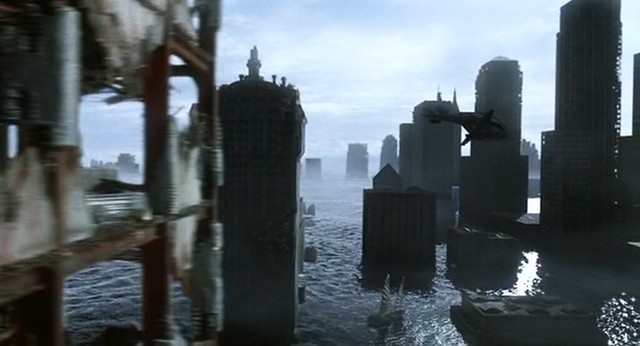
If you have thoughts, now's the time, probably past time. How shall we save New York? And London, and Shanghai?
10 Jun 22:01


“I'LL EXPLAIN LATER”: BELATED THOUGHTS ON THE MOST RECENT SERIES OF 'DOCTOR WHO'
by Gavin Burrows
Yes, okay, this is terribly late. And bits 'n' bobs from it first surfaced in mailing comments left hither and yon. Apologies who gets a 'watching Dave' sense while reading any of it. A slightly more sensible look at 'Name of the Doctor' resideshere.
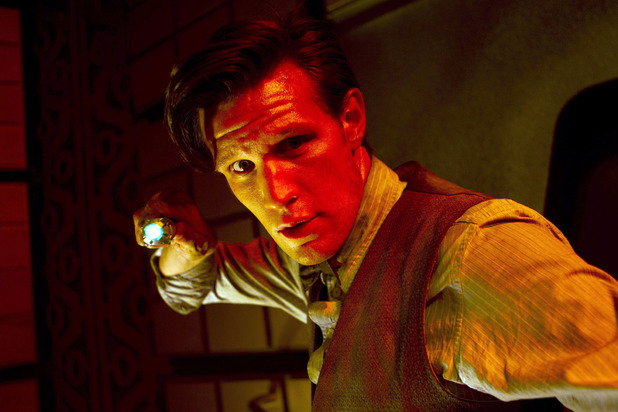
Even now, there's points where it resembles a show I might want to watch.
For I would be happy to tune into some free-form thing, a kind of ideas generator on overdrive, throwing out a succession of surreal incidents which you're never sure whether to find funny or creepy. An updated 'Avengers', a jazzier, poppier 'Twin Peaks' rejigged for teatime, a less sketch-showy 'League of Gentlemen.'
I would then have watched a girl phoning the IT helpline and getting through to the Middle Ages, or a Victorian street urchin giving directions like Satnav, and not worried about what any of these strange segues actually meant. They were just there to taste. And there's times, when you're trying your damnedest to make it add up, you feel the show looking at you disdainfully – like that's so squaresville, daddy-o.
But then five minutes later we're being nudged in the ribs and asked “did you see that bit, eh? Are you gettingit?” There's clues to watch out for, mysteries to be resolved and prophecies to be fulfilled. (Prophecies, always plenty of prophecies.) I mean, it's called Series 7B for heaven's sake! What sense would Series 7B have made in the old days? When a new series meant it was on the telly, and not-a-new-series meant it wasn't. Some time ago Moffat coined the phrase “I'll explain later.” At the time we all thought he meant it as a gag. Now I'm not so sure.
In wanting it both ways I can't help but feel that it ends up neither place. It's wrongfooting itself. And a lot of it's branches stem from those snapped roots.
Think of those infamous cop-out endings, when everything gets sorted out with the discovery of a magic leaf that can helpfully save planets or a handy reset button lobbed aboard the Tardis. Maybe they don't only do it to annoy or because they know it teases. Maybe things now have to have some sort of stitch-up anti-resolution like that. How else can you escape from a painted corner, except decide you were never really in one in the first place? Nothing can be satisfactorily clicked shut because nothing fitted together to start with.
One persistent advantage of the new show is the way it's consistently avoided entangling itself in it's historical continuity and cutting itself off from new fans. Take for example the return of the old adversary the Great Intelligence. It's not only those who have seen the old Second Doctor episodes who will know what he's up to. True, nobody knows what he's up to, as he chops and changes arbitrarily from one scene to the other. But at least that's levelling.
However, in a classic case of out-of-the-frying-pan, Moffat's through lines have instead been threatening to entangle it in it's newcontinuity. Thankfully, there's a welcome reigning-in of these. Each episode is mostly self-contained; only's Clara's mystery is kept running, threaded through things, only occasionally coming out on the surface before burrowing down again. Unlike River, Clara herself is innocent of any of this, so can fulfil the old assistant role of saying “what's that Doctor?” a lot, rather than “spoilers”. A casual viewer stumbling across the show, however befuddled by the gobbledegook thrown at him from within that episode, would at least not suffer too much from what surrounded it.
But pruning back that bindweed also serves to expose how repetitive each episode is becoming. The best episodes in Series 6 were the incidental ones – 'The Doctor's Wife', 'The Girl Who Waited' - who slipped through the through-lines' grip. To take the second example, it didn't explore Amy's back story or develop her relationship with the Doctor. But it was never intended to. Instead it reframed it, it saw something already existing from a fresh angle, and then...most importantly of all... it left. Now it seems any notion, once coined, has to be absorbed into the DNA of the show. Wasn't there an episode recently where we found out more about the Tardis? Did that go down well? Then, hey, let's have ourselves to another one!
And worse, those repetitions are becoming unmoored from their original context and made as shufflable as cards. We're being told things we've been told before, only this time (like Eric Morecambe's piano playing) not necessarily in the right order. I seriously considered taking the sentences from my previous reviews and rearranging them so they no longer make sense. For that's pretty much what's happening on the screen.

Take for example that Tardis episode, helpfully titled 'What It Says On the Tin.' (Actually, it may have been called 'Journey to the Centre of the Tardis.') However sympathetic I am to noted Who sage Andrew Rilstone when he argued such a journey is a fool's errand undertaken by a know-nothing, I'd have to concede a salvage crew invading the Tardis is in itself quite a good idea.
It's still taking incongruous elements, but this time getting them to work for you. Like creative miscasting, the salvage crew think they're in they're in some 'Dark Star'dirty SF universe, blue-collar blokes getting their overalls mucky in some space truckstop. But they're actually in a fairy story, and when they try to steal the magic object (made of stuff not meant for man to hold, and all that) the magic house responds by losing them in a labyrinth. Tooled up with hardware, they can blow down any door. They just can't find one. It also effectively underlines what kind of show we're watching, and even works in an in-joke over those repetitious corridors of old. (I'm not sure how I feel about it being black guys who don't belong inside the fairy tale world, but aside from that...)
But then the sub-plots arrive as if they've been double-booked. The human/android schtick is not only filched from 'Blade Runner', but apparently by someone who has had no more contact with 'Blade Runner' than having it recounted to him by a pub drunk. Who probably hadn't seen 'Blade Runner' himself...
Even if we were to accept it cohabiting with a fairy story, 'Blade Runner' is emphatically not about replicants becoming human but humans becoming replicants. (Remember how the original release had a happy ending? Remember how that turned out to be grafted on by the studio? Remember how that surprised absolutely nobody?) While we also get ossified creatures on attack mode who are pulled from 'Sunshine'. Similar to above... A shopping list of ideas, told to hold hands, jump on stage and hope for the best.

And this remains true even with a better episode such as 'Cold War.' There are no prizes (not even no-prizes) for noting it's a remix of 'Dalek'. It shares the same concept of armour as mask, the creature finally emerging from within as an objective correlative of it's 'true' nature being revealed. True, the photocopy gets blurry in places. Clara's encounter with the chained foe happens because Rose's did, even though one has a reason to and the other clearly doesn't. But 'Dalek' was a good episode so even a blurry photocopy of it kind of works.
Well... kind of. It then greedily eyes up 'Alien' and tries to combine all the above into the classic base-under-seige story as a bone thrown to fans of the old show. (It foregrounds it's 'old idea updated' by picking an early Eighties setting, a point the old show was not only still on but still popular.)
But, needless to say, none of the pieces really fit together.
That solitary Dalek doesn't skulk in the shadows of some confined space, occasionally striking out. Instead it acts as though it has never seen any Howard Hawks films at all. Inside some vast high-tech complex, It's constantly detectible to well-equipped guards, who get ample time to stake out defensive positions. Yet, though there's a whole lot of everything to stop it with, nothing works and it wheels inevitably forwards. The episode is built around the irony that, with all that power imbalanced its way, the force-fielded Dalek is inside starting to feel self-doubt.
Meanwhile the Ice Warrior kills two men just to work out how they tick, then turns out to be basically a nice guy after all. It's like 'Alien' ended with Ripley and the monster shaking hands and making up. It has, in a literal sense, no integrity because it's not sewn from whole cloth.

Good, even novel ideas can still crop up. The central conceit of 'Hide', that what appears to our senses as a ghost is actually a woman stuck on time-delay, is in itself quite a brilliant one. And like the Tardis corridors it has a metafictional subtext, suggesting the monster-menaced girl is the default setting of the Whoniverse, like the kernel inside the nut. Yet it's not really capitalised on. If we're intended to think of it as the centre of the Whoniverse it's not really the centre of its own episode, but just another passing carriage in the parade.
'Hide'would of course fare much better without that final twist, which was actually more of a compound fracture. I should admit part of my frustration was my being wrongfooted by it. With the heavily underlined Seventies setting, and the clear-cut division of labour between the equipment-fixated science bloke and the psychic, empathic woman, I assumed we were in for some kind of feminist story. And, naturally enough, I liked my idea better. Even so, yet another love story seems very much a second option.
Yet what really galls isn't that they're love stories, so much as the kind of love stories they are. They always seem so instructional, the equivalent of those old public safety films. Much as they laid out the importance of looking before crossing roads or not going swimming where there's no water, these tell you to look the girl in the eye and tell her how much she means to you. It's like the scriptwriters see us the way zoo keepers do pandas, in need of a great deal of coaxing if we're ever going to get breeding. Perhaps they're worried if they don't do this there won't be future generations to watch the show.
Worse, this exemplifies a wider tendency. Watch the old show and you're soon surprised by, for a family show of it's era, how dark it can be. Now there's a kind of feelgood goo which suffuses everything, a goo which acts as a kind of glue intended to stick all these ill-fitting elements together. Did any of that actually make any sense? Never mind, didn't it make you feel gooood? The classic example would be the leaf, but that's so annoying I wouldn't trust myself to start on it.
When I was a lad and all of this was fields, instead of DVD box sets and i-player catch-ups we had Target novelisations. Which had the line on the back cover about “the changing face of Doctor Who.” Let's concede straight away that the old show was forever getting stuck in corridors, for all that the uber-fans don't like admitting it, but there still felt something about change in its DNA.
Which raises the question, with this speeded-up product upgrade, how come we are spending so much time looking at the bloody stuck face of Doctor Who? How can a show whose supposed selling point is it's openness and flexibility, it's ability to renew itself, end up stuck on repeat like this?
My two favourite seasons of New Who have been the very first one and the first Moffat season. And my favourite individual Doctor is the glorious Ninth. Not solely because he had the foresight to depart after just one series. But at the time time it doesn't exactly seem a coincidence.
Much like comics, TV is often the poor relation of other media. It would ape films, hopefully televise plays or expectantly adapt novels, hoping some of the kudos would rub off from that more select company. And now you can catch up with it at any other time, it's become almost in competition with itself. When you can watch it anytime, why bother watching it now, on Saturday night? The solution they've come up with is Event TV, much like an 'X Factor' final is Event TV. You just need to be there.
We've gone from...
“Did you see Doctor Who on Saturday night?”
“Of course I did! It's the Seventies. There's bugger all else to do.”
...to...
“Did you see Doctor who on Saturday night?”
“Well I was going to go down the pub and stream it later. Then they said they'd finally reveal who River Song was, so I stayed in to catch it. Turns out she's what everybody had been saying she was all along. The internet was cross. I wonder who the Silence can be?”
The old Doctor was just some traveller, who journeyed across a rather under-budgeted universe, righting wrongs cheaply. It has just enough mystery, enough sketchy references to bigger contexts at something bigger to entice children with over-active imaginations. But the new show was billed as some sophisticated new thing for our new times, which would be done newly.
It was as if it had grown up in parallel time to us, like an old school friend we met again as an adult. You might reminisce about the old times. (“Remember how 'Trial Of a Time Lord'went on for bloody ages and then just gave up on itself. My, how we laughed!”) But only to underline how new were the new times.
Now it's like we happily agreed to meet for a beer, which ended up with his crashing on our sofa for the past six months. And we can't help noticing he keeps saying the same things over again, in a slightly different order. They don't really sound as clever as they used to.
As I said when the show first came back, they've changed the credit sequence. They've added stuff to the cold electronic beauty of the theme tune, which was perfect and complete the way it was. But the old theme tune was still in there. Now they've changed the credit sequence again. Now they've changed the credit sequence more.There seems less of the old show than ever. Come to think of it, there seems less of the new show than ever...
Coming soon! Plays! Gigs! Visual art! All guaranteed belated...
10 Jun 20:50
sometimes ?butiwouldratherbereading=thelastdinosaurcomicever works TOO well and is also sad
| archive - contact - sexy exciting merchandise - cute - search - about | |||
 |
|||
| ← previous | June 10th, 2013 | next | |
|
June 10th, 2013: Over the weekend I was given a bag of sausage and they were delicious when I cooked them the next morning. If you can ever discover circumstances where new people will give you a bag of raw sausage, I recommend you chase them down. One year ago today: you know that awesome book everyone suspects was ghost-written? i'm going to claim it here. I WAS THAT SPOOKY GHOST – Ryan 
| |||
Maniczak and -1 others like this
10 Jun 20:47
 At the time of the controversy over the naming of the new Blue Peter cat - remember Cookiegate? - I wrote:
BBC News reports:
Liberal England insists: You mark my words: what we are seeing is the decline and fall of Western civilisation - possibly by next Tuesday.
Choosing Blue Peter presenters and the fall of Western civilisation
by Jonathan Calder

In my day the Blue Peter cat would have been called whatever Valerie Singleton damned well said it was and that would have been an end of the matter.Time has moved on. The programme no longer has pets for the nation's children to enjoy, but now they get to choose its presenters.
BBC News reports:
Each episode of Blue Peter - You Decide! will see the contenders tackle a series of challenges reflecting things they may be asked to do as a presenter on the show.
The judges will eliminate one person each week until three make it into the final, where the winner will be chosen by CBBC viewers.As I wrote when Blue Peter announced it was to have no more pets on screen:
In the 1960s Blue Peter's presenters were undoubtedly on your side, but they knew lots of interesting things that you didn't and shared them with you. You don't make good children's television simply by giving children what they think they want - you end up with Tiswas if you do that.A reader replies: Oh come off it! This is just "why oh why oh why?" stuff.
Liberal England insists: You mark my words: what we are seeing is the decline and fall of Western civilisation - possibly by next Tuesday.
10 Jun 20:43
Is the NSA biting off more data than it can chew?
by Fred Clark
It’s very disturbing to open the paper one day to learn that the government is collecting every bit of data it can from the phone records of private citizens. And it’s even more disturbing to open the paper the following day to learn that the feds are also snooping through all of our Internet records as well.
Disturbing, if not terribly surprising. (And the fact that all of this is probably — at least technically — legal makes this more disturbing, not less.)
Maybe it’s time we stopped arguing that our personal data is “private” and instead start referring to it as “classified.” Privacy doesn’t seem to garner much respect anymore, but the government still regards “classified” as a sacrosanct category.
 The massive scale and scope of this data collection makes this even more disturbing but also, perversely, is somewhat reassuring. What I mean there is that it’s very disturbing to learn that the government is collecting every bit of phone and Internet data it can collect on everyone. But it would be even more disturbing to learn that the government is collecting every bit of phone and Internet data it can collect about you — you personally and you exclusively.
Which brings us to one of the many questions I have about all of this: Are the government agencies collecting this massive undifferentiated ocean of data really capable of putting it to any good use?
“Data mining” has been discussed for decades now, but the reality has never lived up to the hype. A lot of the folks claiming to have mastered the dark arts of data mining are little more than the computing equivalents of diviners with dowsing rods. Sorting and filtering and aggregating the massive flood of data being collected from phone and Internet records is no small task. I’m sure that the Pentagon, the CIA or the NSA has access to the raw computing power needed for such a project, but it requires more than just supercomputers. It also takes top-notch programmers to create the algorithms needed to sort through so much data and to find the signal amongst all that noise. And beyond that, it takes people with the wisdom, experience and know-how to define and recognize the difference between signal and noise — or just to know what they’re looking for. This isn’t like looking for a needle in a haystack, but for a particular piece of hay in a haystack.
I’m not saying that the Pentagon, NSA and CIA are especially incompetent, and therefore that they aren’t capable of sorting through all this data in a meaningful way. I’m suggesting, rather, that no one may be capable of sorting through all this data in a meaningful way.
“HQ is watching everything we do,” one of my co-workers says all the time, pointing nervously up at the CCTV cameras on the ceiling of the store/warehouse.
“HQ is recording everything we do,” I tell him. “No one is watching.”
The company has more than 2,200 stores all over the world, with dozens of cameras in each store, all operating 24/7/365. If something happens in any of those stores, they can go back to look at the CCTV footage to get a better idea of what happened, but it would be impossible for the company to “watch” everything that all of its cameras are recording. It would be pointless even to attempt to do so.
I realize that the NSA is better at this than the retail chain I work for — and that it’s far more intent on collecting and “mining” data. A reader at Andrew Sullivan’s Dish site paints a grim picture of the kind of details that might be traced from mining “metadata” from cell phone records — all of which I’m sure is technologically possible (and more efficient than the old methods of doing the same thing with binoculars, unmarked cars and shoe leather). And Bruce Schneier — who knows more about this stuff than just about anyone — paints a truly frightening picture of the NSA’s ambitious plans for near universal data-mining, including its construction of an “enormous computer facility in Utah to store all this data, as well as faster computer networks to process it all.” These agencies clearly possess the capability to collect and to process huge amounts of data, but that’s still not the same thing as them knowing how or why or what to do with it all.
I don’t agree with some of what David Simon writes in his contrarian post on all of this, but I think he’s right to question whether “the NSA and FBI have their shit together enough” to handle this “vast big-data stream of electronic communication.”
“That is tens of billions of phone calls and for the love of god,” Simon writes. “How many agents do you think the FBI has? How many computer-runs do you think the NSA can do?”
The ugly, vacuous graphic above comes from a snarky post by Matt Yglesias in which he notes that “well-run organizations wouldn’t rely on this kind of garbage in their internal presentations.” But it’s even worse than that, actually — the graphic comes from a PowerPoint presentation. That’s what was leaked, alerting the public to the scope of this massive meta-data collecting effort — “a top secret 41-slide PowerPoint presentation.” I’m willing to accept, in theory, that some massive, secretive, nefarious agency might be capable of meaningfully sifting through all of the vast volume of data the government is now collecting. But it’s hard to reconcile such a theoretically omnicompetent agency with the kind of outfit that would use PowerPoint, or that would regard an MS Office application as something appropriate for “top secret” use.
My point here is not to say, “Don’t worry, they don’t know what they’re doing,” but rather to suggest that because they may not know what they’re doing, we might want to worry differently. A secretive, unaccountable, omnicompetent agency poses one kind of threat to civil liberties. A secretive, unaccountable, semi-competent agency poses another.
If the NSA, CIA, et. al., are actually more capable than I suspect of putting all this data to use for “national security” and preventing terrorism and all that, then the much-discussed “debate” about the “balance” between security and privacy really would be an appropriate conversation.
But what if they’re not actually capable of sifting and “mining” all this data? What if they’re simply collecting more data than they’ll ever be able to make sense of? What if those Utah supercomputers wind up being little more than glorified floppy disks filled with the unsearched and unsearchable records of everybody’s phone calls to everybody else?
In that case, we’re talking about agencies which are collecting all this data for little reason other than because they can, without any legitimate “national security” pretext — without any excuse.
10 Jun 12:57
The Ashcroft polling on the leaders
by TSE
From the Lord Ashcroft polling released on Friday, there was focus upon the three established party leaders.
Overall, views of the three leaders have changed remarkably little over time. Asked to choose from a selection of words and phrases that might describe them, participants continue to choose “out of touch” for Cameron, with “stands up for Britain” as a positive counterbalance. Miliband remains predominantly “weak” and “out of his depth”, with no very prominent positives. Clegg contrives to combine the weaknesses of the other two, being “weak”, “out of his depth”, and “out of touch” all at the same time.
This fits in with the Mori leadership ratings which shows all of them consistently with net negative ratings.
Here’s how the word cloud for all three party leaders looks like.
First up, for Dave

Then for Ed
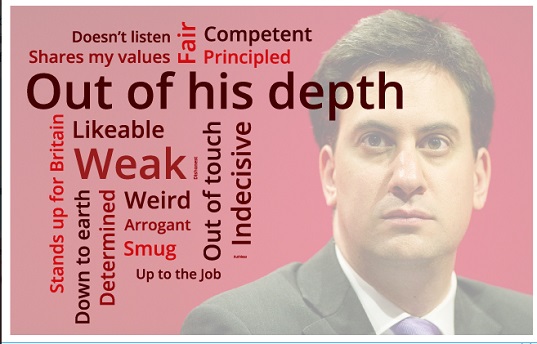
and finally for Nick

Is this a symptom that we live in a cynical, anti-politics era, or is it fair comment on the leaders we have, and thus explains why UKIP are doing so well, as the voters aren’t enthused by the traditional parties and their leaders? Alex Salmond’s net positive ratings in Scotland shows it is possible to viewed positively by the electorate in this era.

TSE
Mike Smithson returns from holiday today.
10 Jun 10:49
"Fuck every cause that ends in murder and children crying" — Iain Banks, 1954-2013
by Charlie Stross
One of the giants of 20th and 21st century Scottish literature has left the building.
I can't really claim to be a friend; my relationship with Iain was somewhere between one of the faceless hordes seen at SF conventions, and "guy I run into at the pub occasionally". However, I've known Iain and chatted with him at times since, I think, 1989 or 1990 or thereabouts. And, after getting over my initial awe of the giant of letters, subsequently discovered that he was a giant in other ways: big-hearted, kind, affable, humorous, angry at injustice.
There is probably no point in my writing an obituary. The newspapers are all over the generalities (for example, here), and if I had anything more intimate to add I wouldn't care to do so in public, out of respect for his family and friends.
However, I'd like to pause for a moment and reflect on my personal sense of loss. Iain's more conventional literary works were generally delightful, edgy and fully engaged with the world in which he set them: his palpable outrage at inequity and iniquity shone through the page. But in his science fiction he achieved something more: something, I think, that the genre rarely manages to do. He was intensely political, and he infused his science fiction with a conviction that a future was possible in which people could live better — he brought to the task an an angry, compassionate, humane voice that single-handedly drowned out the privileged nerd chorus of the technocrat/libertarian fringe and in doing so managed to write a far-future space operatic universe that sane human beings would actually want to live in (if only it existed).
Last night I was talking to a friend who, with Ken MacLeod, had been invited to visit Iain last week at home. Iain was apparently gravely ill even then, and had to retire after half an hour. Purely selfishly, I hoped he'd hang on longer — long enough for me to tell him I intend to dedicate my next (first) trilogy to him. (I can't hold a candle to his versatility as a writer, but it seems to me that we badly need an SF literature that offers hope for the future, and he has provided a compass for me to set my sails by.)
I've spent about 3 months away from home (Edinburgh) this year, so the last time I saw him was back in December or January, before his diagnosis. Purely by accident, I ran into him in the St James shopping centre (up the road from where I live). He was his usual affable, cheery self: and that is how I intend to remember him.
As Paul McAuley tweeted, a big bright bold boisterous light has gone out.
10 Jun 10:47
Blogger's spam filter is being a bit frisky lately, and is catching a lot of legitimate comments by long term posters. If your posts don't appear, that's why. I'm cleaning it out several times a day, and all comments will appear eventually.
It’s December 25th, 2005. We are in the long winter of years in which the winner of The X Factor gets to be the Christmas number one every year, choking the life out of what had previously been a rather pleasant cultural oddity whereby a motley of novelty acts, trash pop, and hit bands would fight it out for the honor of going on a music anorak’s list of Christmas number ones instead gets supplanted by The X Factor winning everything. So for the record, it’s Shayne Ward with “That’s My Goal,” but in this case it’s everything that isn’t number one, which is to say, absolutely every other song in Britain, that matters.
News, then. Doctor Who has been off the air for six months. In those six months, London was awarded the 2012 Olympics the day before a series of terrorist attacks hit the London transportation system, killing fifty-two people, along with the four bombers. Hurricane Katrina hit New Orleans, revealing a staggeringly poor federal response system. Jyllands-Posten published their infamously controversial set of comics depicting the prophet Muhammad, and Saddam Hussein’s trial began. While in the month of December David Cameron becomes leader of the Conservative Party, Harold Pinter wins the Nobel Prize in Literature for his work on The Abominable Snowmen, and the law allowing same sex “civil partnerships” takes effect.
Let’s go back to the issue of music, however. As I noted, the domination of The X Factor over the Christmas charts brought to an unsatisfyingly corporate end to a quaint British ritual. This construction, of course, ignores the fact that the British charts are already corporate, and, more to the point, endlessly prone to manipulation, most famously with what is widely believed to be the deliberate fudging of numbers to prevent the Sex Pistols from reaching number one with “God Save the Queen” in 1977. Nor is it prima facie the case that The X Factor produces worse number one singles than, say, “Mr. Blobby,” which was in fact the number one in 1993. No, what’s depressing here is the loss of the game - the sense that something that once belonged to the British public now belongs to Simon Cowell.
Ah yes, Simon Cowell. Now there’s an interesting figure. What is notable about Cowell is his ability to combine an unsparing ruthlessness with an instinctive grasp of populism. The result is someone who is jaw-droppingly good at engineering hits, and who has absolutely no compunctions about acting like that’s what he’s doing. The result is something aggressively soulless - a sense not just of utter conformity, but of the most mean-spirited and cynical conformity imaginable. Simon Cowell is a bully who believes he can dictate the nature of popular culture, and, infuriatingly, he repeatedly appears to be correct.
Given this, what jumps out most about The Christmas Invasion is the sort of sweetly nostalgic tone of it. Teased with a Children in Need special, and done with an enthusiastically festive tone, The Christmas Invasion is largely designed to be itself a big, slightly sloppy Christmas treat. This immediately opens up an interesting division that the episode has to navigate. On the one hand, Christmas cheer is defined in part by its recklessly sentimental sincerity. On the other hand, the Land of Simon Cowell is anathema to sincerity. Heck, in many ways the Land of Doctor Who seems hostile to sincerity - surely the sort of hyper-aware trope-savvy audience the series asks for is never going to unironically embrace any sort of emotional celebration, instead “savvily” recognizing Christmas as overblown and altogether naff.
It is no great spoiler to observe that Davies would completely reject this division. The entire point of Russell T Davies is that trope awareness does not mandate cynicism. Davies has no patience for loving things ironically. If Davies is going to write a big Christmas special then it’s going to be big and Christmasy, and that’s pretty much that. The tricky bit is going to be how he crafts that to work for an irony-soaked audience. The answer is fairly straightforward, at least in The Christmas Invasion: Davies decides that the audience’s big present is going to be the Tenth Doctor, and proceeds to spend forty minutes building up anticipation of it.
The structure of this is quite interesting. Notably, the tension isn’t whether the Tenth Doctor is going to be any good. We see him twice in the first ten minutes, and each time he’s perfectly entertaining. Add to that the Children in Need sketch and you’ve got more than enough information to conclude that the Tenth Doctor is, broadly speaking, going to work as a character. Instead the tension is one of simple desire: we spend most of the episode wanting the Doctor to appear, but have to sit through a half-hour long segment where he basically doesn’t save for occasional shots of him unconscious.
From a storytelling perspective, there are scads of good reasons to do this. It keeps the focus on the familiar characters - Jackie, Mickey, Rose, and Harriet Jones - and reiterates the ground the program is built on. It reassures the audience that this is the same program they were watching six months ago, even though the lead role has been recast. It grounds the real story - the phenomenon of regeneration - in a human element, namely Rose’s angst and anguish over losing “her” Doctor. And it hedges against the sense that we might not like the new Doctor by, effectively, forcing us to want him. And those forty minutes are fantastic, including a gloriously cheeky shot in which the Sycorax spaceship basically flies over the EastEnders title card in the most literal invasion of soap operas the series has done yet.
But it also means that in many ways the “real” story exists only in the final twenty minutes of the episode. The first forty minutes are really just there to make us fall in love with the last twenty, which are in turn there to get us to tune in four months later for New Earth. The Christmas Invasion is a story with a job to do, and it just gets on with it. But the nature of that job ends up defining the new Doctor in a terribly efficient and definitive way.
Eccleston’s Doctor was characterized in part by how he resisted the audience. From his brusque demeanor to the unorthodox choices of having him be a leather jacket-wearing northerner, Eccleston’s Doctor frequently pushed the audience away. Even in his first appearance this was the case, with him twice refusing Rose instead of allowing her (and us) access to his narrative. Eccleston was defined by the withholding of information and, to a lesser extent, of narrative pleasure. His big moments often involved the Doctor being ugly.
And for the first forty minutes of The Christmas Invasion, Tennant inherits that show. But in the last twenty we get something that we never really saw with Eccleston’s Doctor: twenty minutes of pure showboating. For the last twenty minutes of the episode we are freely invited to just love the hell out of Tennant’s Doctor while he grandstands like its Williams-era Tom Baker. This is not, to be clear, a problem. Like Tom Baker, Tennant has gobs of charisma and presence, and it genuinely is fun to watch him reel around on screen. Unlike Baker, Tennant is an actor and not a performer, and so eats up things like lengthy monologues. Almost as soon as he steps out of the TARDIS he launches into a ninety second monologue in which he’s dazzling, packing in over a dozen distinct moments where he changes what he’s doing with the character. Tennant is a meticulous actor whose modus operandi is making lots of very deliberate and conscious decisions, and accordingly he sparkles with long monologues. (This is part of why he’s so adept with Shakespearean material - he bypasses the difficulty of the language by packing his lines with visible emotional turns and reversals.)
But it is a marked change from Eccleston. Tennant’s Doctor is designed to be adored. Eccleston’s Doctor wasn’t. This is the crux of the difference. This does not, obviously, mean that Eccleston’s Doctor wasn’t adored, nor, for that matter, that everybody in the world loved Tennant’s, but it does mark the basic distinction between the two. Under Tennant, one of Doctor Who’s fundamental pleasures is supposed to be watching David Tennant. The star is himself the object of pleasure.
This risks an almost Cowellian cynicism. Tennant is designed to be loved, so much so that the story gives us no choice but to love him. If you fail to be thrilled and punch the air when Tennant strolls out of the TARDIS with a “did you miss me” then you have fallen outside the implied readership of The Christmas Invasion. The episode does not even consider the possibility that its audience will not be completely sold on the character. And to its credit, it was broadly speaking correct. Obviously with an audience in the millions it wasn’t going to be universally successful, but the fact of the matter is that Tennant’s Doctor hit it off massively with the British public. But so did The X Factor. There’s still something unsettling about being told that this is the new popular character. Under Eccleston the series had to earn our love. Now Tennant gets it gift-wrapped.
But it’s more complicated than that. The twenty minute lovefest culminates interestingly with the most seized upon line of the episode as the Doctor casually kills the Sycorax leader while coldly declaring that this new incarnation gives “no second chances.” It’s an odd moment. It’s smack in the middle of the “we all love the Doctor, don’t we” portion of the episode, and yet it’s also a chilling moment that, when you pause to think about, we really shouldn’t take pleasure in. The Doctor flat-out kills his enemy, with no hesitation and no regret. Yes, he’s provoked. Yes, it’s self-defense. But much like two of the more controversial lines in the Colin Baker era, his “just desserts” line in The Two Doctors and his “you’ll forgive me if I don’t join you” in Vengeance on Varos, the problem is that the Doctor seems to take some pleasure in killing, and to invite us to do the same. Because it’s nestled in amongst twenty minutes of near nonstop squee we don’t notice it, but it’s a jarring moment.
And, of course, it leads thematically into an even more jarring moment, namely his overthrow of Harriet Jones. What is perhaps most significant about this is that in a very real sense, Tennant’s Doctor dooms himself in his first story. The clear implication is that he’s changed history - Britain’s Golden Age isn’t supposed to end this way. This gap in history is subsequently exploited as the Master steps in to become Prime Minister, an event that in turn leads directly to the circumstances of his regeneration. Even beyond the basic plot logic, this sets up this incarnation’s major and canonical flaw: his arrogance. His decision to single-handedly overthrow Harriet Jones is made according to the same logic as the Time Lord Victorious.
Look, after all, at how he revels in it. He doesn’t just overthrow her, he shows off while doing it, demonstrating how effortless the overthrow of the entire government is. The point isn’t just overthrowing her, it’s humiliating her in the process. There’s an angry petulance to it. Indeed, one thing that jumps out is how carefully Davies balances the morality of it. On the one hand there was never any way that the Doctor was going to let Harriet’s action go. Over the course of the episode she goes from Fantasy Tony Blair, telling the President that he’s not her boss, to Thatcher 2.0, re-enacting one of the most infamous moments of her tenure. But so much of it is the Doctor’s fault, both tacitly through his absence and actively, given that he makes a scaremongering speech about how the human race is getting noticed that all but constitutes him telling Harriet that it’s not safe to let the ship flee. The problem is very much of the Doctor’s own making, such that even if we can’t imagine him letting Harriet’s actions slide, we can readily imagine him not screwing up so badly as to cause them in the first place. The tone of the scene is, in the end, more sympathetic to Harriet than the Doctor.
So while we take pleasure in Tennant there’s from the beginning a sense that there is such a thing as too much pleasure to take. We’re invited to love the character, but we’re also made aware that the character can go too far - that the things we love can be turned against us. The result is the most stunning example of starting as you mean to continue that we’ve ever seen in Doctor Who. Nowhere else in the history of the program has a Doctor’s first story matched so perfectly with their last one. This is the main theme of the Tennant era writ large from the start.
And, of course, this doubles as a metaphor for the series. As of the Tennant era Doctor Who is a known hit. It’s the biggest thing on television. (Remembering, of course, that there are always several biggest things on television at any given moment.) It also spent its entire first season being about television. Now, as it enters its second season, it remains about television, albeit with one substantive twist: instead of being about everything else on television, it’s about the fact that it is now a major center of gravity on television. The first portion of the Russell T Davies era was about establishing a place for Doctor Who on television. But now we have what must be, for someone who is as voracious a consumer of television as Russell T Davies, one of the most alarming fates imaginable: he’s found a place for his Doctor Who on television, and it’s the absolute center of it. And now the show makes a turn to being about working through the consequences of that fact.
I Become Part of Events (The Christmas Invasion)
by noreply@blogger.com (Philip Sandifer)
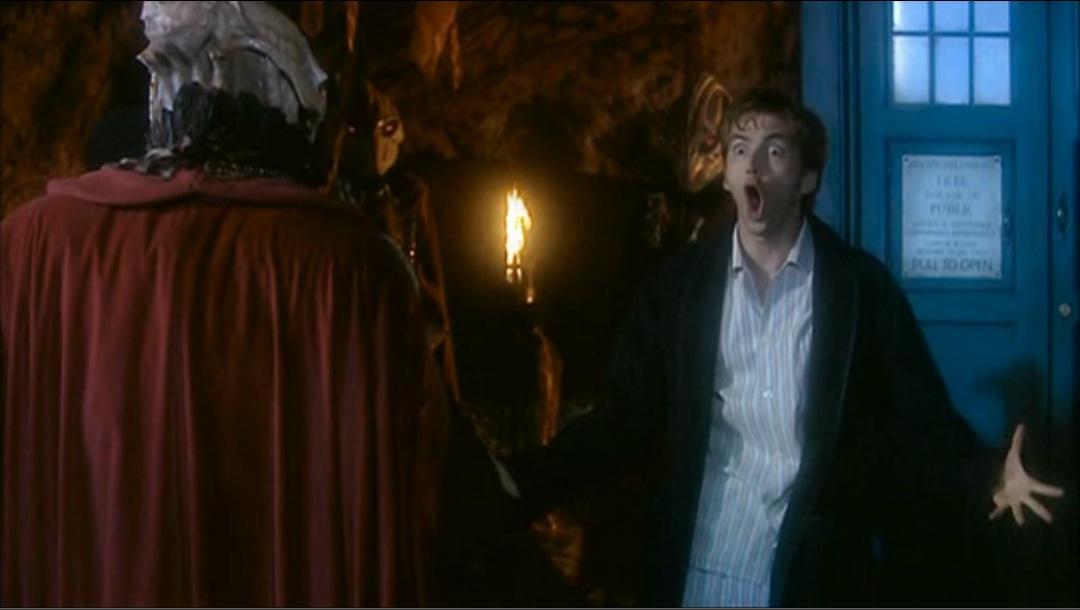 |
| Tennant based his characterization on fellow Scotsman Graham Crowden's nuanced portrayal of Soldeed in The Horns of Nimon |
It’s December 25th, 2005. We are in the long winter of years in which the winner of The X Factor gets to be the Christmas number one every year, choking the life out of what had previously been a rather pleasant cultural oddity whereby a motley of novelty acts, trash pop, and hit bands would fight it out for the honor of going on a music anorak’s list of Christmas number ones instead gets supplanted by The X Factor winning everything. So for the record, it’s Shayne Ward with “That’s My Goal,” but in this case it’s everything that isn’t number one, which is to say, absolutely every other song in Britain, that matters.
News, then. Doctor Who has been off the air for six months. In those six months, London was awarded the 2012 Olympics the day before a series of terrorist attacks hit the London transportation system, killing fifty-two people, along with the four bombers. Hurricane Katrina hit New Orleans, revealing a staggeringly poor federal response system. Jyllands-Posten published their infamously controversial set of comics depicting the prophet Muhammad, and Saddam Hussein’s trial began. While in the month of December David Cameron becomes leader of the Conservative Party, Harold Pinter wins the Nobel Prize in Literature for his work on The Abominable Snowmen, and the law allowing same sex “civil partnerships” takes effect.
Let’s go back to the issue of music, however. As I noted, the domination of The X Factor over the Christmas charts brought to an unsatisfyingly corporate end to a quaint British ritual. This construction, of course, ignores the fact that the British charts are already corporate, and, more to the point, endlessly prone to manipulation, most famously with what is widely believed to be the deliberate fudging of numbers to prevent the Sex Pistols from reaching number one with “God Save the Queen” in 1977. Nor is it prima facie the case that The X Factor produces worse number one singles than, say, “Mr. Blobby,” which was in fact the number one in 1993. No, what’s depressing here is the loss of the game - the sense that something that once belonged to the British public now belongs to Simon Cowell.
Ah yes, Simon Cowell. Now there’s an interesting figure. What is notable about Cowell is his ability to combine an unsparing ruthlessness with an instinctive grasp of populism. The result is someone who is jaw-droppingly good at engineering hits, and who has absolutely no compunctions about acting like that’s what he’s doing. The result is something aggressively soulless - a sense not just of utter conformity, but of the most mean-spirited and cynical conformity imaginable. Simon Cowell is a bully who believes he can dictate the nature of popular culture, and, infuriatingly, he repeatedly appears to be correct.
Given this, what jumps out most about The Christmas Invasion is the sort of sweetly nostalgic tone of it. Teased with a Children in Need special, and done with an enthusiastically festive tone, The Christmas Invasion is largely designed to be itself a big, slightly sloppy Christmas treat. This immediately opens up an interesting division that the episode has to navigate. On the one hand, Christmas cheer is defined in part by its recklessly sentimental sincerity. On the other hand, the Land of Simon Cowell is anathema to sincerity. Heck, in many ways the Land of Doctor Who seems hostile to sincerity - surely the sort of hyper-aware trope-savvy audience the series asks for is never going to unironically embrace any sort of emotional celebration, instead “savvily” recognizing Christmas as overblown and altogether naff.
It is no great spoiler to observe that Davies would completely reject this division. The entire point of Russell T Davies is that trope awareness does not mandate cynicism. Davies has no patience for loving things ironically. If Davies is going to write a big Christmas special then it’s going to be big and Christmasy, and that’s pretty much that. The tricky bit is going to be how he crafts that to work for an irony-soaked audience. The answer is fairly straightforward, at least in The Christmas Invasion: Davies decides that the audience’s big present is going to be the Tenth Doctor, and proceeds to spend forty minutes building up anticipation of it.
The structure of this is quite interesting. Notably, the tension isn’t whether the Tenth Doctor is going to be any good. We see him twice in the first ten minutes, and each time he’s perfectly entertaining. Add to that the Children in Need sketch and you’ve got more than enough information to conclude that the Tenth Doctor is, broadly speaking, going to work as a character. Instead the tension is one of simple desire: we spend most of the episode wanting the Doctor to appear, but have to sit through a half-hour long segment where he basically doesn’t save for occasional shots of him unconscious.
From a storytelling perspective, there are scads of good reasons to do this. It keeps the focus on the familiar characters - Jackie, Mickey, Rose, and Harriet Jones - and reiterates the ground the program is built on. It reassures the audience that this is the same program they were watching six months ago, even though the lead role has been recast. It grounds the real story - the phenomenon of regeneration - in a human element, namely Rose’s angst and anguish over losing “her” Doctor. And it hedges against the sense that we might not like the new Doctor by, effectively, forcing us to want him. And those forty minutes are fantastic, including a gloriously cheeky shot in which the Sycorax spaceship basically flies over the EastEnders title card in the most literal invasion of soap operas the series has done yet.
But it also means that in many ways the “real” story exists only in the final twenty minutes of the episode. The first forty minutes are really just there to make us fall in love with the last twenty, which are in turn there to get us to tune in four months later for New Earth. The Christmas Invasion is a story with a job to do, and it just gets on with it. But the nature of that job ends up defining the new Doctor in a terribly efficient and definitive way.
Eccleston’s Doctor was characterized in part by how he resisted the audience. From his brusque demeanor to the unorthodox choices of having him be a leather jacket-wearing northerner, Eccleston’s Doctor frequently pushed the audience away. Even in his first appearance this was the case, with him twice refusing Rose instead of allowing her (and us) access to his narrative. Eccleston was defined by the withholding of information and, to a lesser extent, of narrative pleasure. His big moments often involved the Doctor being ugly.
And for the first forty minutes of The Christmas Invasion, Tennant inherits that show. But in the last twenty we get something that we never really saw with Eccleston’s Doctor: twenty minutes of pure showboating. For the last twenty minutes of the episode we are freely invited to just love the hell out of Tennant’s Doctor while he grandstands like its Williams-era Tom Baker. This is not, to be clear, a problem. Like Tom Baker, Tennant has gobs of charisma and presence, and it genuinely is fun to watch him reel around on screen. Unlike Baker, Tennant is an actor and not a performer, and so eats up things like lengthy monologues. Almost as soon as he steps out of the TARDIS he launches into a ninety second monologue in which he’s dazzling, packing in over a dozen distinct moments where he changes what he’s doing with the character. Tennant is a meticulous actor whose modus operandi is making lots of very deliberate and conscious decisions, and accordingly he sparkles with long monologues. (This is part of why he’s so adept with Shakespearean material - he bypasses the difficulty of the language by packing his lines with visible emotional turns and reversals.)
But it is a marked change from Eccleston. Tennant’s Doctor is designed to be adored. Eccleston’s Doctor wasn’t. This is the crux of the difference. This does not, obviously, mean that Eccleston’s Doctor wasn’t adored, nor, for that matter, that everybody in the world loved Tennant’s, but it does mark the basic distinction between the two. Under Tennant, one of Doctor Who’s fundamental pleasures is supposed to be watching David Tennant. The star is himself the object of pleasure.
This risks an almost Cowellian cynicism. Tennant is designed to be loved, so much so that the story gives us no choice but to love him. If you fail to be thrilled and punch the air when Tennant strolls out of the TARDIS with a “did you miss me” then you have fallen outside the implied readership of The Christmas Invasion. The episode does not even consider the possibility that its audience will not be completely sold on the character. And to its credit, it was broadly speaking correct. Obviously with an audience in the millions it wasn’t going to be universally successful, but the fact of the matter is that Tennant’s Doctor hit it off massively with the British public. But so did The X Factor. There’s still something unsettling about being told that this is the new popular character. Under Eccleston the series had to earn our love. Now Tennant gets it gift-wrapped.
But it’s more complicated than that. The twenty minute lovefest culminates interestingly with the most seized upon line of the episode as the Doctor casually kills the Sycorax leader while coldly declaring that this new incarnation gives “no second chances.” It’s an odd moment. It’s smack in the middle of the “we all love the Doctor, don’t we” portion of the episode, and yet it’s also a chilling moment that, when you pause to think about, we really shouldn’t take pleasure in. The Doctor flat-out kills his enemy, with no hesitation and no regret. Yes, he’s provoked. Yes, it’s self-defense. But much like two of the more controversial lines in the Colin Baker era, his “just desserts” line in The Two Doctors and his “you’ll forgive me if I don’t join you” in Vengeance on Varos, the problem is that the Doctor seems to take some pleasure in killing, and to invite us to do the same. Because it’s nestled in amongst twenty minutes of near nonstop squee we don’t notice it, but it’s a jarring moment.
And, of course, it leads thematically into an even more jarring moment, namely his overthrow of Harriet Jones. What is perhaps most significant about this is that in a very real sense, Tennant’s Doctor dooms himself in his first story. The clear implication is that he’s changed history - Britain’s Golden Age isn’t supposed to end this way. This gap in history is subsequently exploited as the Master steps in to become Prime Minister, an event that in turn leads directly to the circumstances of his regeneration. Even beyond the basic plot logic, this sets up this incarnation’s major and canonical flaw: his arrogance. His decision to single-handedly overthrow Harriet Jones is made according to the same logic as the Time Lord Victorious.
Look, after all, at how he revels in it. He doesn’t just overthrow her, he shows off while doing it, demonstrating how effortless the overthrow of the entire government is. The point isn’t just overthrowing her, it’s humiliating her in the process. There’s an angry petulance to it. Indeed, one thing that jumps out is how carefully Davies balances the morality of it. On the one hand there was never any way that the Doctor was going to let Harriet’s action go. Over the course of the episode she goes from Fantasy Tony Blair, telling the President that he’s not her boss, to Thatcher 2.0, re-enacting one of the most infamous moments of her tenure. But so much of it is the Doctor’s fault, both tacitly through his absence and actively, given that he makes a scaremongering speech about how the human race is getting noticed that all but constitutes him telling Harriet that it’s not safe to let the ship flee. The problem is very much of the Doctor’s own making, such that even if we can’t imagine him letting Harriet’s actions slide, we can readily imagine him not screwing up so badly as to cause them in the first place. The tone of the scene is, in the end, more sympathetic to Harriet than the Doctor.
So while we take pleasure in Tennant there’s from the beginning a sense that there is such a thing as too much pleasure to take. We’re invited to love the character, but we’re also made aware that the character can go too far - that the things we love can be turned against us. The result is the most stunning example of starting as you mean to continue that we’ve ever seen in Doctor Who. Nowhere else in the history of the program has a Doctor’s first story matched so perfectly with their last one. This is the main theme of the Tennant era writ large from the start.
And, of course, this doubles as a metaphor for the series. As of the Tennant era Doctor Who is a known hit. It’s the biggest thing on television. (Remembering, of course, that there are always several biggest things on television at any given moment.) It also spent its entire first season being about television. Now, as it enters its second season, it remains about television, albeit with one substantive twist: instead of being about everything else on television, it’s about the fact that it is now a major center of gravity on television. The first portion of the Russell T Davies era was about establishing a place for Doctor Who on television. But now we have what must be, for someone who is as voracious a consumer of television as Russell T Davies, one of the most alarming fates imaginable: he’s found a place for his Doctor Who on television, and it’s the absolute center of it. And now the show makes a turn to being about working through the consequences of that fact.
10 Jun 10:38
Another Childhood Memory
by evanier
Back in the sixties, when I lived back in the family home I just sold, there was an elderly couple that lived across the street. They were Mr. and Mrs. Stearn, though at some point they began spelling it "Stern" to feel, I guess, more a part of America. They were as sweet and nice a couple as you could find, though they lived in constant terror. Each night at sundown, they would lock their doors with steel bars, like securing a bank vault from the inside. They would turn off all lights in the house but for a bedroom in the back where the windows were sealed-over such that no one outside could see there were lights on in there. And they would huddle in that room, watching TV with the volume kept low and fighting off the fears that uniformed Nazis were coming to take Mr. Stern away…again.
This was in West Los Angeles in the sixties. There were no reports of Nazis coming to take anyone away…indeed, no reports of Nazis doing much of anything except occasionally shouting in parades. Still, it had happened to Mr. Stern when he was a young Jew living in Germany and he’d never been able to escape the nightmares.
That time he was taken away, he spent more than a year in a Concentration Camp where he was tortured about eleven different ways, including being made to believe each night that he would be executed at dawn. Each morn, someone he knew was indeed executed but his own demise was postponed…and postponed and postponed and postponed. He was moved from camp to camp and finally, the Nazis abandoned the camp he was in at the moment and he was rescued. He and his wife reunited and got the hell out of Europe forever. It was the same wife he now had — the only one he ever had — and she still had her own version of the nightmares.
During the day, Mr. Stern was a charming, friendly man who would occasionally be in the mood to sit and tell me stories of those days. He had a thick German accent and physically, he looked exactly like someone you’d cast to play a Nazi in a World War II movie. He received occasional offers. Casting directors would see him in a store and hear his accent. They’d approach him and ask if he’d be interested in a role on TV or in the movies and he’d recoil in horror and begin screaming at them. There was not enough money in this world to get him to step on a movie set resembling a Nazi encampment…not enough money in the world to get him to don one of their uniforms. He would later feel bad that he’d yelled at someone for innocently making him the offer but it was the hottest of hot buttons. He simply could not control himself on the topic.
One time in a supermarket, someone yelled at him. As I said, he looked like a caricature of a Nazi. Think Otto Preminger but taller. A man spotted him, heard the accent I suppose, and begin screaming at him, calling him a "Nazi bastard" and a war criminal and other such labels. Mr. Stern did not yell back. He merely reached over, unbuttoned his shirt cuff, rolled up his sleeve and showed the man the tattoo he’d been given, I believe, at Ravensbruck. The man stopped yelling, displayed his own tattoo from Treblinka, and the two of them fell into each other’s arms, crying and bonding. They wound up in a nearby tavern drinking ale together all afternoon and discussing the different-but-similar terrors they’d lived with ever since.
The Sterns were good friends of our family and I would often take food (including tuna fish) over to them…but I had to get it there before the sun went down. Once it was dark, they would not answer the door. They would not answer the phone. On Halloween, they could just leave out a big bowl of Tootsie Rolls with a sign that said, "Help yourself." There was a kid down the block named Brett who would usually help himself to all of them.
One night, Mr. Stern got home from somewhere just as the sun was setting. He raced inside and bolted the door…and a half-hour later, I noticed he’d left the lights on in his car. We tried phoning and knocking but that didn’t do any good. So I went over with a wrench, popped the hood open on his old Pontiac and unhooked one of his battery cables from his battery. I left a note on the car telling him what I’d done and said that in the morning, he should phone me and I’d come over and reattach it so he could drive. I have never been thanked for anything I’ve done so much as I was thanked for that. He hugged me. He gave me gifts. He thanked me every time I saw him for the rest of his life. There was a time I thought that when I died, the opening line of my obit would read, "Mark Evanier, who once stopped Michael Stern from having a dead battery, is dead himself tonight at the age of…"
The rest of Mr. Stern’s life after that incident was not a long time. I think it was two or three years…and when he went, we all knew Mrs. Stern would join him before long. I think she lasted about two months.
One evening early in those two months, my mother answered the phone and was startled to hear the voice of Mrs. Stern. It was dark outside and we were used to her and her husband hiding from the entire world when it was dark out. She asked if I could perhaps come over and help her with something. Over I went…and it was an odd feeling going in that front door into a totally dark home. She asked several times if it was me and I had to holler to be heard so she was certain it was. Then came a scene you may recall from The Producers where Zero Mostel is visiting one of the li’l old ladies he hopes will invest in "Springtime for Hitler." He waits and waits while one lock and chain after another is unfastened from within. I waited the same way.
Finally, I got inside and she led me by the hand, holding one tiny flashlight, to the rear bedroom with the sealed windows. This was the only time I ever saw it and the only time in all the years I knew them that I (and probably any neighbor) saw any more of their home than the front hall. She sat me down in a chair which I believe had been his chair and she said, "Please…just talk to me." I did…about anything and everything I could think of. What I said didn’t matter. I just had to get her mind off the feeling that she was alone there because Michael was back in that Concentration Camp. A few days later, she moved out of that house and went to live in another city with relatives…and before long, we heard that she had died.
I wish I’d thought to take a tape recorder over on those occasions when Mr. Stern got to talking about his past. He was rarely in the mood…and never when he was approached by researchers and scholars. I don’t think he ever told his story anywhere and I’m not sure I even remember the details of where was imprisoned correctly. What I will never forget is the horror and passion in his voice…how he shook all over when he told me of things he witnessed, inhuman acts performed on human beings for no rational reason. It was more than two decades earlier but the way he spoke, you would have thought he’d seen it all last night…as perhaps he did.