| archive - contact - sexy exciting merchandise - cute - search - about | |||
 |
|||
| ← previous | July 15th, 2013 | next | |
|
July 15th, 2013: In 2010, David, Matt and I put out a book called "Machine Of Death"! It was a crowdsourced collection of short stories written by a bunch of awesome people we'd never met, all based on the same premise originally proposed by T-Rex: what if there was a machine that could tell, from just a sample of your blood, you how you were going to die? It was a crazy book that nobody wanted to publish, so after a few years of trying we just straight-up published it ourselves. The book became the #1 bestselling book on Amazon.com the day it launched. It ended up on a bunch of "best books of the year" lists. It was a super awesome story! In one week we'll be launching the sequel, called This Is How You Die. It's going to be great: legit better in every way, with tons of awesome stories in a variety of genres (YES there is a choose-your-own-path Machine of Death story, OF COURSE there is). We went through almost 2000 submissions to select the 31 stories in this book. We're all SUPER proud of it. But what can you do to top becoming the #1 bestselling book on Amazon? You try to make every one of authors in the book a New York Times Bestselling Author, by getting the book on the NYT bestsellers list. This will be especially awesome since, like the first volume, this will be the first publishing credit for most of the authors in the book. We honestly don't know if this idea is possible. But we know it's possible to try.

Every sale from today onwards counts towards our NYT status. If this book at all interesting, and you think you might like reading inventive and memorable stories curated by a dude whose comics you like, then why not head over to Amazon.com (or .ca or .co.uk) and get the book? They've got it on sale for 30% off retail. This book is gonna be insane. I can't wait for you to read it! And check out thisishowyoudie.com for more information, including some free stories from the book and a SWEET VIDEO :o One year ago today: sorry to everyone named deon, this is not the comic you think it is – Ryan 
| |||
Andrew Hickey
Shared posts
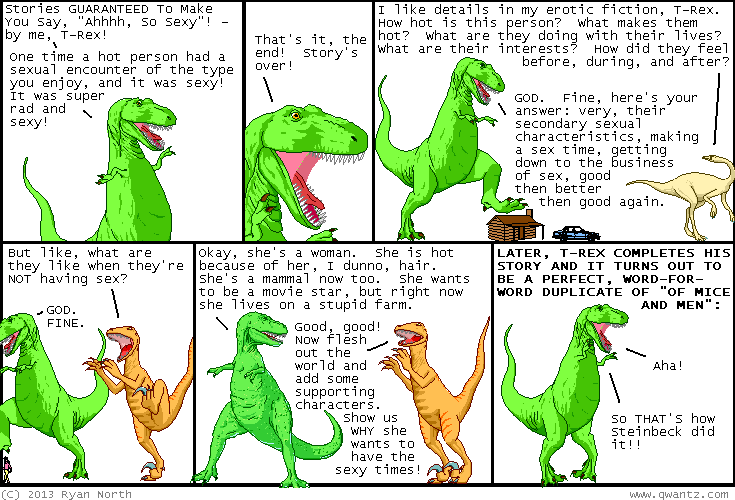
i like my books of erotic fiction like i like my women: dog-eared and well-thumbed
“Watch...your future's end.": The City on the Edge of Forever

“So. You've found the courage to speak to me face to face at last, have you? I must congratulate you on finally discovering your spine, however some thinkers far wiser than I might say there exists a very thin line between courage and stupidity.”
“I've not come for bravado-filled threats, I've come in the hope that together we might be able to negotiate an end to all of this. The damage can be repaired.”
“You people never fail to disappoint me, though your unwavering stubbornness is to be commended, I suppose. Have you nothing more or better to say to me than that?”
“Withdraw your troops from the 22nd Century. The damage can be repaired, and I'd hoped to make you remember the fundamental importance and worth of the Temporal Accords.”
“Please spare me your impassioned appeal to regulations and rules of order. I've lived far, far too long and much too hard to be swayed by your vapid platitudes, Agent.”
“Your quarrel isn't with these people in this time! It's with us!”
“Isn't it? Tell me, do you know why my ships didn't blow you out of the stars on sight? Because I wanted to show you this. This is what your people did on Earth in 1930, A.D. I want you to take a good, long look at it and try to defend or explain away your actions. Here. Now. To my face.”

“This...ceaseless hatred and violence...It is alien to us. And repugnant. We must depart this plane; the pain has become simply too great for us to bear any longer.”
“A philosophy of pacifism is only practical if you're not living under oppression. It has been so very long: Do you remember what it feels like to be imprisoned? Trapped? Walked over? Used? Violated? We all know what the future means: Cycles of making and unmaking repeating themselves forever. We walk in eternity, you and I. But we are also stewards of it.”
“You are not of Organia, but you are like us. We should like to speak with you about this further.”
“Shh, now. In time.”

“The City on the Edge of Forever” is also rather infamously the center of an extremely messy legal dispute between writer Harlan Ellison and the then-members of the Star Trek production team. There seem to be two versions of events here and, unfortunately, in neither of them does Gene Roddenberry come out looking good. The first account, which is supported by Bob Justman and Herb Solow in Inside Star Trek and even Ellison’s own book on the subject says that the original draft (which was delivered late) featured an Enterprise crewman named Beckwith who was a drug dealer. After murdering a fellow crewmember who threatened to turn him in, he was sentenced to death on the planet the ship was in orbit of, which in this draft was inhabited by an ancient race of time observers called The Guardians and who maintained a Time Vortex. Beckwith escaped through the Time Vortex and changed history such that the Enterprise becomes a pirate ship called the Condor. Kirk and Spock must then follow Beckwith into the vortex and, as in the aired episode, arrive a week before him and discover they must stop him from averting the death of an Edith Koestler, which is difficult for Kirk as he has fallen in love with her.
The story then goes that Roddenberry considered this draft unusable for a number of reasons, the most prominent of which being that he was opposed to the idea that drug addiction would remain a serious problem in the enlightened future of Star Trek. Roddenberry himself told a variation of this on the convention circuit, where he would claim he disliked Ellison's original script because it “had Scotty selling drugs”. This is, of course, blatantly untrue as Scotty wasn't in the first draft of “The City on the Edge of Forever” at all (although Roddenberry did later admit he hadn't read Ellison's treatment in years at the time he made that remark). That aside, this version of events seems somewhat unlikely overall, given that from what we've seen of his work so far Roddenberry was far from a utopian at this point in his career. Either way, Roddenberry asked Ellison to rewrite his script, which he did, two more times. Still finding it unsatisfactory, this sequence of events has Roddenberry giving the story over to a number of editors, most prominently Gene Coon and D.C. Fontana, who did a series of uncredited rewrites of the script.
Unhappy with the way his script had been handled, Ellison requested that it air under the pseudonym “Cordwainer Bird”, a request Roddenberry allegedly denied by threatening to blacklist Ellison from Hollywood. Apparently, Roddenberry knew Ellison used this pen name when he was unhappy with the way television production teams interfered with his work, and furthermore that this was a technique of Ellison's known to science fiction fans. This argument goes that Ellison's major complaint with the situation was that Coon and Fontana weren't credited in the final story, and that had fans seen “The City on the Edge of Forever” go out under the name “Cordwainer Bird” then they'd realise Star Trek was no different than any other science fiction show in the way it mistreated its story editors and production staff and that this was something Roddenberry couldn't accept as he wanted to cultivate the myth it was special and ahead of its time.

“You speak many grand words about peace and egalitarianism, but the actions of your people are deafening. Consider this, then. Your crowning achievement. You cling so tightly to your reality that you would glorify the death of an innocent bystander who would become the voice of peace on Earth because it means you get to carry on living as you have always lived, turned away from the world until it's time to pass judgment on the lesser cultures. You are not just silent, but willfully silent. I wonder, do your kind know anything about real silence?”
“We cannot take the risk that tampering with the past will negate our existence in the future! We all take that risk, and it is our duty as officers to keep the timeline pure and free of paradoxes-It must be upheld! Edith Keeler was an admirable woman, but ahead of her time. Had she lived, the Axis powers would have won the second World War, because Earth of the 1930s was not ready for such beliefs. She was a dangerous outlier in the timestream and, regrettably, had to be neutralized to preserve it's natural flow. Your dangerous meddling is a threat to not just the safety and sovereignty of “my people”, but to the stability of the entire universe! Please, let me help you understand!”
“*I* do not 'understand'...There truly is no limit to Federation arrogance. A life really means so little to you? I've tried to be charitable to you, to grant you as much intelligence and as much space at the debate table as I can. But you don't give me arguments or defenses, you give me talking points and hollow catchphrases. What are you saying? That at once the integrity of all of creation hinges on one person, yet one who is also too pure and sophisticated for her backwater planet? And that death is preferable to life in such a place? I've never heard so much entitled double-speak and self-aggrandizement in my entire long, miserable life. You've wasted your trip, friend. You came to me hoping to convince me to put an end to our hostilities by making me “see reason”. All you've accomplished is to make me even more certain of my beliefs.”

“You can't hide forever, Ayelborne. One day they will come for Organia. When shots ring out and the sky is set ablaze, you'll be conscripted just like the rest of us. You know it to be true: You've seen it just as I have. It's happened before, and it is written it will happen again. This time it can be different. This time it will be different. But you and I will have roles to play. It is an act of love.”

The account Ellison tells is rather different, though no less depressing. According to him, the dispute was not about writing credit and the treatment of the Star Trek production staff, or even Roddenberry's attempted blackmail. Instead, Ellison claims the sticking point was a shift in the depiction of Edith Keeler: By the final draft Ellison submitted to Roddenberry, Keeler had become an overt anti-war protester. In the version that aired, there is a clear implication that the reason her death was important to history was because, had she lived, she would have ushered in a powerful new pacifist movement that kept the United States neutral in World War II, this allowing Nazi Germany to develop atomic weapons. This claim is bolstered significantly by the extensive legal documents and internal memos Ellison eventually made public, as well as a rather vague remark from Bob Justman that takes on a deeply upsetting reading within this context. When asked if the staff version of “The City on the Edge of Forever” was meant "to have the contemporaneous anti-Vietnam-war movement as a subtext", Justman allegedly replied “Of course we did”.
While this version of events is significantly more plausible in my opinion just knowing what we know now about what Star Trek was like in its first season, I have a hard time accepting it completely at face value either. The primary reason this is tough for me to stomach is because I have a seriously hard time believing writers like Gene Coon and D.C. Fontana would have intentionally altered a story like this to give it such a flagrantly reactionary tone: That's simply not in keeping with anything in their catalog, even at this relatively early date. Coon's last two stories were about how Starfleet's militarization and the Federation's distance and pursuit of material wealth almost led to outright genocide and having Kirk punished by a group of hyper-evolved pacifists for his bloodlust and desire for conflict. Indeed, Coon also penned “Arena” and worked on the angrily anti-war “A Taste of Armageddon” which had Kirk admit humans were natural-born killers. Fontana's last script was hideously reactionary, yes, but that was primarily the result of it being written by the author of “The Corbomite Maneuver”, and it's very easy in my view to argue the most progressive aspects of “This Side of Paradise” were Fontana's doing. I see absolutely no reason why either one of them would suddenly turn around, take Ellison's relatively straightforward pitch and go out of their way to add in a scene that depicted pacifism as inherently wrongheaded and dangerous, and to then have that episode immediately follow Coon's “Errand of Mercy” is ludicrous even by Star Trek standards.
Now, from what I gather Gene Roddenberry had the last go at “The City on the Edge of Forever” and it's far easier to see this being his doing than Coon's or Fontana's. Bob Justman's comment is confusing, and while I'm not entirely familiar with what his views might have been circa 1967, the fact he went on to work on Star Trek: The Next Generation for a time and to co-author Inside Star Trek with Herb Solow should be some kind of clue. Either way, it seems clear Harlan Ellison got somewhat shafted here, and the end result is yet another episode that's frankly nowhere near as good as its reputation would suggest it is. It's not the greatest episode of Star Trek, not by a long shot: It's not even the greatest episode of this series, or even this season. The show is on very shaky ground now: Had we not just had “The Devil in the Dark” and “Errand of Mercy” this would be Star Trek's death knell. There's no escape from a future built on manslaughter and crushing pacifism, even if it is because that pacifism isn't “of its time”. But we have, and “Balance of Terror” and “Arena” too, and thus we soldier ever onwards.
However, it should be extremely telling that even in the version of events meant to excuse Gene Roddenberry, he still comes out looking pretty unequivocally like the bad guy.


"Many such journeys are possible. Let me be your gateway".
Are ‘Safe Seats’ only safe because no-one attacks them?
In election campaigns parties don’t ‘waste’ their efforts attacking other parties’ ‘safe seats’. At first sight this seems entirely logical – surely it is easier to capture a seat from an opponent with only a small majority?
A New Kind of Peer Review?
Writing in the Journal of Clinical Epidemiology, a Dr Yvo Smulders of the Netherlands makes a proposal: A two-step manuscript submission process can reduce publication bias
Smulder’s point is that scientific manuscripts should be submitted for peer review with the results and discussion omitted. The reviewers would judge the submission on the strength of the methods and the introduction alone. If they recommended publication, the authors would then send them the full paper.
The reviewers would then have a chance to change their mind and reject it, or ask for further experiments to be carried out, but the ‘bar’ for this to happen would be high.
Hence the scope for reviewer-based publication bias, the tendency to favour ‘positive’ results, would be reduced. Reviewers would have to make a decision on the basis of the experiment itself, regardless of whether the results were positive or not. Smulders says that it would also ease the burden on reviewers in terms of the volume of material they’d need to digest.
It’s a clever notion (and, as Smulders points out, not a new one; it dates to the 1970s, but has never taken off.)
The proposal is reminiscent of the preregistration with peer pre-review model which I’ve advocated. The difference is that in the latter case, the authors submit the introduction and methods before the study has been conducted while in ‘two-step’ submission, the results are already there, just not revealed until later in the process.

The difference is that unlike preregistration, two-step review would not prevent publication bias (or other questionable practices) on the author’s side. Two-step would, however, reduce the incentive for such bias – why fish so hard for a positive result if you know your study would make it into a good journal on the strengths of its methods?
But the proposal would certainly be a step in the right direction and, in fact, could form a natural stepping-stone to a preregistration system.
 Smulders YM (2013). A two-step manuscript submission process can reduce publication bias. Journal of Clinical Epidemiology PMID: 23845183
The post A New Kind of Peer Review? appeared first on Neuroskeptic.
When a mathematical hypothesis is neither true nor false.
Andrew Hickey"It remains possible that new, as yet unknown, axioms will show the Hypothesis to be true or false. For example, an axiom offering a new way to form sets from existing ones might give us the ability to create hitherto unknown sets that disprove the Hypothesis. There are many such axioms, generally known as “large cardinal axioms.” These axioms form an active branch of research in modern set theory, but no hard conclusions have been reached."
GAAAAH! NO NO NO NO NO NO NO NO NO NO NO NO NO WRONG WRONG WRONG BAD BAD BAD WRONG BAD WRONG!
The truth or falsehood of any statement depends on the axioms chosen. You don't *DISCOVER* axioms, you decide on them!
WRONG BAD MY BRAIN HURTS FROM THE WRONGNESS
Valeyard of the Daleks
The first of four (rightfully) rejected drafts of the last chapter of The Dying Days …
DOCTOR WHO AND THE VALEYARD OF THE DALEKS
Saturday, 6 December 2003
One of Grotecca’s men pricked him with the portable DNA scanner, the other searched him, finding and removing his pistol. ‘He’s who he says he is, boss.’ ‘I never doubted it.’ The Italian arms dealer was small and sweaty. ‘Good evening, Mr Jason Kane. Show me the colour of your money.’ Jason indicated the battered S-reg Mondeo. ‘The colour of my money is gold and it’s in the boot of my car. It’s booby-trapped, so I advise you to keep away. I want to see the goods first.’ One of the goons was holding a leather briefcase. He laid it down on the boot of their Mercedes. Grotecca handed Jason the swipe key. Kane bent over the case, unlocking and opening it up. A warm glow lit his face, and he stood there for a couple of seconds, transfixed. ‘You happy?’ He didn’t respond. ‘Kane!’ Grotecca repeated. ‘You happy?’ Jason shook his head, closing the case. ‘I’m happy.’ He reached into his jacket. Before the action had been completed, Grotecca had drawn his gun and was pointing it at him. ‘My car keys,’ Jason assured him, holding up the remote control. I’m going to unlock the boot for you, OK?’ Grotecca relaxed a little. ‘OK.’ Jason smiled and squeezed the remote control. The Mondeo exploded. It was an old petrol model, so Grotecca and his goons were bowled over by the blast. By the time Italo Grotecca had got to his feet, Jason Kane and the briefcase were long gone. Fifteen minutes later, Jason Kane was in the Internationale casino, looking for a game he could join. There were a dozen tables, and choosing between them was going to be very difficult. Then he saw the girl, and she made the decision for him.
No older than eighteen, she was large, but her evening dress had been wisely chosen, playing to her advantages. It had been tailor-made for her, and showed just the right amount of milky-white skin to make her appear womanly rather than overweight. She looked good and she knew it, which made her all the more attractive.
‘Jason Kane,’ he informed her, smiling.
‘Iphegenia.’
‘That’s an unusual name,’ he observed, trying to open up the conversation. The woman – Iphegenia – could see through what he was doing but played along.
‘My parents gave all their kids names beginning with an “I”. I was the seventh, and they’d run out by then. My younger brother’s called Ipswich.’
There were chuckles from around the table, which disconcerted her a little, she hadn’t meant it to be a joke. Her voice was still young, a little adenoidal. As she spoke, she shifted slightly, exposing a voluptuous expanse of leg. Realising that he was staring, Jason glanced back up at her face, and saw her smiling back at him knowingly. She had warm brown eyes. They held each other’s gaze for a second.
He held out his hand. ‘Jason. Jason Kane. And you are Iphegenia … who?’
‘Quite,’ she answered casually, glancing across the table. Jason noticed her companion for the first time, and was unsure what to make of the man. Two thousand years ago, he could have been a Roman Senator, with just the right profile and bearing. He was in his sixties, with thinning white hair and odd pale eyes. He was clearly the most intelligent man around the table – around any table – his posture and expression radiated an effortless genius. He had kept himself lean, and moved with the unselfconscious ease of a man two or three decades younger.
‘You’re married, Jason Kane,’ the old man said sardonically. ‘And so is she.’
‘Do I know you?’ Jason asked, more than a little annoyed. The old man was wearing a dark-blue suit and a pressed silk shirt that looked expensive, but weren’t exactly the height of fashion. The older man smiled.
Jason attempted to keep his expression neutral. Glancing around the table, he could see that the couple fascinated the other players. He could tell that they had quietly been speculating about the couple’s relationship all evening, but no-one had the nerve to ask them. Were they husband and wife?
Play began, and Jason, a seasoned gambler, recognised the familiar patterns of such games: the well-meaning amateurs, the tourists, the rich who had joined the game simply to be seen losing a fortune. The odd couple were harder to place in such a hierarchy. Outwardly the man was calm, but you could almost hear his mind work as he calculated odds and rehearsed his options. Finally, though, he snorted, and dropped his cards to the table. A couple of the other players, with substantially inferior hands, immediately did the same. Jason placed his cards more carefully, face up. A full house. He kept his expression neutral, but looked at Iphegenia expectantly. She kept her cards level for a moment.
‘Are you going to show us your cards, Iphegenia?’ the old man asked curtly. He wasn’t someone who liked to lose.
Jason leapt to her defence. ‘It isn’t sporting to rush a lady, Mister.’
‘Doctor,’ the old man corrected him gently, ‘and if I know my wife at all, she has a winning hand and she knows it. She also knows that it’s her last hand of the evening, and she’s taking great pleasure in spinning out the tension.’
Jason raised an eyebrow. ‘Is that true?’ Iphegenia giggled and slapped her cards down. The dealer began to push over her winnings. The other players were beginning to drift away, hoping they still had enough money to pay their bar bills. Jason smiled, then looked up at the old man. ‘Wait a minute, did you say “Doctor”?’
The Doctor held out his hand. ‘Hello Jason, it’s been a very long time.’
‘Yeah. Longer for you than me, by the look of it. Since we last met, you’ve … ‘ he searched for the word, ‘regenerated? And got married,’ he added, almost as an afterthought.
‘Many times. And just the once.’ ‘He’s not the man I married,’ Iphegenia giggled. ‘My forty-first incarnation was a great deal more impulsive than myself.’ He looked across the table at his wife, a very contented smile on his face. ‘Thankfully.’
Jason had a number of questions to ask the pair of them. Only one was important.
‘How is my wife?’ ‘Supreme Commander Bernice Surprise Summerfield, Lord of the Inner and Outer Worlds, High Admiral of the Galactic Fleets, Lord General of the Six Armies and Defender of the Earth? I’ve not seen her since her inauguration as God Empress of All Human Space.’
Jason’s mouth was wide open. ‘You’re joking?’ ‘Yes, of course I’m joking,’ the Doctor chuckled. ‘You should see your face,’ Iphegenia snorted. ‘Well, how is she?’
‘I’ve not seen her for a very long time, I’ve had, oh, a thousand new adventures since then. I was in my eighth incarnation, so that would be … ‘ he worked it out in his head. ‘Over two thousand two hundred years ago.’
Iphegenia kissed her husband on the cheek. ‘You’d think the age difference would be a problem, wouldn’t you?’
‘Where is she?’ Jason asked. ‘Is she still on Dellah in 2593?’ ‘How did you know that?’ the Doctor asked.
‘I found a letter at Allen Road. I was there last week. I thought she might be.’
Iphegenia was watching him. ‘You miss her, don’t you?’ ‘I do. I’ve remained faithful to her, you know that? All this time.’ The Doctor glanced at his wristwatch. ‘Subjectively speaking, you did only split up a fortnight ago.’
Jason shrugged. ‘I realised I missed her. I’m trying to build a time tunnel.’ The Doctor raised an eyebrow. ‘Are you indeed?’ ‘Just for a one-way trip. I’ve still got my time ring, so most of the work was done for me. Check the briefcase.’
Iphegenia opened the case, the light from it radiating over her face. She smiled a cherubic smile. ‘Is that what I think it is?’ Jason nodded. ‘It’s beautiful.’ ‘It’s an emm of taranium.’ The Doctor’s mouth was open. ‘You managed to acquire a useful quantity of taranium in less than two weeks? It’s one of the rarest substances in the universe.’
‘Yeah. I know that, you know that, but to the twenty-first century it’s just some glowing rock. So, now I’ve got all the bits will you help me build my time machine?’ The Doctor shook his head. Iphegenia was aghast. ‘Doctor?’ The Doctor formed a thin smile. ‘Why bother when I can just take you to Dellah in the TARDIS? After we’ve finished our drinks, of course.’
The police box stood just outside the amusement VRcade. ‘You never got the cloaking device fixed then?’ Jason asked. ‘It was never really broken,’ the Doctor answered. Iphegenia unlocked the door and slipped inside.
The Doctor paused on the threshold, and stared at Jason, a look that bore right through him. ‘Are you sure?’ ‘I’m sure. I know we’ll get back together. At the wedding we were told our fortune. And later we met our son, Keith.’
‘Oh, that’s no guarantee,’ the Doctor said dismissively. ‘Temporal paradoxes and alternative timelines are ten a penny. You can’t rely on tawdry plot devices.’
‘But I love Benny,’ Jason objected. ‘And she loves me.’ ‘If you are sure of that, then that is your guarantee.’ The Doctor ushered him inside.
The control room was a dazzling airy space, with walls carved from crystal. Iphegenia was by the octagonal console, which sparkled like a crystal chandelier. Somehow she had found time to change into a flowing white robe.
‘I’ve set the co-ordinates,’ she told them. The Doctor stepped over to check the instruments. ‘I do know how to,’ she added.
‘Of course you do, my dear.’ The Doctor said, patting her affectionately. He reached across and pulled a couple of levers. The liquid in the central column began pumping up and down with a regular rhythm. The Doctor stared into it, a bittersweet look on his face. Jason and Iphegenia smiled at each other. ‘The Doctor always hoped you and Benny would get back together,’ she whispered. ‘Between you and me, I think he’s always had a soft spot for your wife.’ ‘That’s OK,’ Jason said cockily. ‘Between you and me, I fancy his wife.’ She stifled a giggle. The Doctor was rubbing the back of his neck. ‘What’s the matter?’ Iphegenia asked, clearly concerned.
The Doctor winced. ‘The hairs on the back of my neck are prickling. Back in the old days that always used to mean – ‘ He stood, staring ahead at something over Jason’s shoulder.
The TARDIS rocked, as if something had just hit it. ‘Doctor, what’s happening?’ Iphegenia called.
The scanner twinkled on.
There was a machine, a robot of some kind framed on the screen, a dome mounted on a stubby, conical base. At the top of the dome there was a single camera lens, which was twitching.
‘Doc-tor! We have fi-nal-ly lo-cate-d you!’ it barked in harsh, grating syllables. Lights on the side of its head flared, almost in time with its speech. ‘You have es-caped Dal-ek jus-tice for too long. Pre-pare for ex-ter-min-a-tion.’
‘And good evening to you, too,’ the Doctor said. ‘Talk about blasts from the past.’ He was flicking switches and twisting dials, a little frantically.
‘That is a Dalek?’ Iphegenia asked.
‘Correct. Their WAR-DIS was in a temporal orbit, waiting to ambush us.’
‘Are they all that colour?’ Jason asked. They were royal blue, with chrome trimmings.
The Doctor looked up, clearly seeing the question as trivial. ‘These days, yes,’ he snapped. Then he looked up at the screen again. ‘Their technology clearly hasn’t moved on since the last time I met them, on Falkus. Do you remember that?’ he shouted up at the Dalek.
‘All def-eats are cat-a-log-ed in the Dal-ek dat-a-banks. Your crimes ag-ainst the Dal-eks are with-out num-ber, Doc-tor. Your ex-ec-u-tion is long o-ver-due.’
The Doctor chuckled. ‘The poor dears have been annoyed with me since my seventh incarnation used the Hand of Omega to blow up Skaro in 4663. Some of the hardliners on the Supreme Council still deny it ever happened.’
‘Sur-ren-der,’ the Dalek screeched. ‘You will be ex-ter-min-a-ted. Sur-ren-der.’
The TARDIS reverberated as another Dalek energy bolt slammed home.
As the Doctor moved around the console, activating as many defence systems as he could find, he reeled off a brief history of the Daleks: the fifth execution of Davros on Calliopticon, the rise of the new regime and the Daleks’ victories against the Movellans, the Galactic Federation and the People. He explained that the new Emperor had eventually united the fragmented Dalek principalities into the Dalek Nation, the largest, most powerful empire in the universe, which stretched across vast areas of space and time.
‘What about humanity?’ Iphegenia asked. She was checking an instrument on the console that resembled a radar screen.
‘The Daleks lost their war with Earth’s galaxy, thanks to President Blake and his friends. Nowadays the Dalek Nation is consolidating its gains elsewhere in the universe. It will be many millennia before they will be in a position to expand towards Earth again. Their efforts are concentrated towards shoring up the front with the old Empires at the Universal Core.’ The Doctor looked up at her, a morose expression on his face. ‘The Children of Kasterborous are giving them particular trouble.’
Jason looked at the radar. ‘The Dalek warship is gaining on us.’ He checked the instruments again. ‘We’re still heading to Dellah.’
The Doctor glanced at the control. ‘Yes,’ he said. ‘We’ll be dropping you off.’ He flicked a few more switches. The TARDIS pitched over again.
Jason grabbed onto the console to keep himself upright. ‘But you’ll lead the Daleks straight to Benny.’ The Doctor shook his head. ‘They won’t have time to lock on before we dematerialise.’
The Dalek on the scanner was getting more agitated. ‘Our Em-pe-ror has sent-enced you to death for crimes ag-ainst the Dal-eks.’ ‘It’s not the first time he’s tried to prosecute me,’ the Doctor shouted back. ‘He was a lousy lawyer then, and he’s a lousy lawyer now.’
The Dalek drifted forward, filling even more of the screen. ‘This to be your fi-nal des-tin-y, Doc-tor. Ex-ter-min-a-tion! To-tal an-ni-hil-ation!’
The TARDIS rocked again. This time instruments on the console began to spark and burst.
The Doctor looked over at Iphegenia. ‘If only they knew who their Emperor really was,’ he chuckled.
‘Talk about your final destiny,’ she replied, beaming over at Jason. He smiled wanly, pretending he knew what they were talking about.
The Doctor was deep in concentration. ‘We’ve almost reached Dellah. Prepare for emergency rematerialisation.’ He turned to Jason. ‘This is where we must say goodbye. Give my regards to Benny. And don’t disappoint me, Jason Kane.’
Jason shook his hand. ‘I won’t. Look, are you going to be OK? If you need my help … ‘
The Doctor smiled. ‘Against those things? Nonsense.’
Iphegenia leant over and kissed Jason on the cheek. ‘You look after yourself.’
The Doctor’s hand was hovering over the console. At a precisely judged moment, he stabbed at a control and the TARDIS lurched to a halt. Jason was already standing by the door as it began to slide open. The ship had landed on concrete, it was raining out there, but he could hear young people laughing. He picked up his briefcase. Before he left, he turned to the Doctor. ‘Thanks for giving me second chance. Goodbye.’
‘Goodbye,’ the Doctor said.
Jason stepped out of the TARDIS and the doors closed behind him. The familiar wheezing, groaning sound started up, and the police box faded away. Jason grinned.
November 23 1997.
It was a beautiful morning …


Sarah Teather: the revolution starts here?
The interview is remarkable because no Liberal Democrat MP, not even the usual suspects, has previously made such a trenchant public criticism of government policy. Moreover, Sarah Teather has never had a reputation as a radical but has generally been regarded as a loyalist (although she has been increasingly critical since losing her ministerial job last year). If such fierce criticisms are coming from such a normally moderate source, it makes you wonder how much more dissent is bubbling under the surface of the parliamentary party.
In the interview, Teather explains at some length why the government’s new immigration policy is unworkable, even if you accept its dubious objectives. But then she gets to the heart of the matter:
The idea that these policies will save money is “patently nonsense”, she argues, looking torn between dismay and incredulity. “So what are we trying to do? To drive down the total number of immigrants, irrespective of what’s good for Britain. Everything is about getting the net immigration numbers down. That’s what’s driving this, nothing else. Even though it’s obvious that a lot of these people are not a burden on the taxpayer.”
When the spousal visa proposal came before the home affairs cabinet committee, she reveals that Tory members strongly argued for the minimum income threshold to be £40,000. “That would put you in the top 15% of national income!” Part of the problem, she concedes, is the gulf between the life experience of her coalition colleagues, and the reality of the lives they are legislating for.
During discussions to increase the delay in benefits eligibility for the newly unemployed from three to seven days, “there was a general idea that people would have their redundancy payments to get them through”. She allows a dry chuckle. “I’m not sure that my constituents coming out of short-term, low-paid work are getting big redundancy packages.” But she doesn’t believe that ignorance born of privilege is the real problem. “No. I think it’s more nakedly political than that. It’s about short-term tactics – and I’m deeply uncomfortable with a type of politics that is deliberately using people who are already relatively vulnerable, as outsiders, as a tool to demonstrate how tough we are. I don’t like that type of politics.”
If the problem were merely Tory ignorance, she says that would be relatively easy to solve. “What alarms me is that the immigration proposals feel as if they’re hewn from the same rock as welfare earlier in the year, where a lot of that again was about setting up political dividing lines, and trying to create and define an enemy. It’s got to a stage where it’s almost unacceptable to say anything else, and it bothers me that there is a consensus among the three party leaders that they are all making, well not quite the same speech – there are differences, significant differences – but there’s a consensus. It’s stifling the rest of the debate, making people afraid to speak. If you get to a stage where there is no alternative voice, eventually democracy’s just going to break down.”
The coalition’s flagship benefit cap has nothing to do with getting people back to work, she maintains. “It’s populist. It’s a headline. Just look at the evidence. You’ve got first the overall universal benefit cap, then you’ve got a 1% welfare cap, and then you’ve got the big macro welfare cap. So they’ve found something, a message that works in polling, it’s called a benefit cap. And then they’ve invented policy around it three times.”This government policy reveals two fundamental problems. First, the subordination of policy to short-term public relations objectives, where unworkable and unethical policies are pursued to mollify popular prejudices irrespective of the financial or human costs. And second, the competition between all three main party leaders to mollify the same set of popular prejudices.
And this reveals Nick Clegg’s main failing as Liberal Democrat party leader: his fallacious belief that most voters basically agree with one another, therefore that the party’s strategy should be to compete with the Conservatives and Labour for this imaginary ‘centre ground’.
But there is no such thing as the ‘centre ground’, no opinion that “most people think”, no mass in the middle you can mollify to win power. Yes, every poll result shows an average, but an average is not necessarily normal or typical. As Brian of Nazareth famously declared, “You’re all individuals!” Every Liberal should know that.
To understand why Clegg’s belief in the ‘centre ground’ is so utterly, catastrophically wrong, it is worth studying the Cultural Dynamics system of mapping of people’s different values. Basically, people divide into three broad categories: ‘Settler’, ‘Prospector’ and ‘Pioneer’, each sub-divided into four ‘values modes’, 12 in all. Take the test here to see where you fit.
The Liberal Democrat heartland is among ‘Pioneers’, and in good times expands into ‘Prospector’ territory. Support is negligible among ‘Settlers’, even when the party’s poll ratings are high. The voters who are nervous about immigration are concentrated in the ‘Settler’ group and never vote Liberal Democrat anyway, so why on earth does Clegg imagine he has to mollify such people when he has no chance whatever of winning their support? It can only be because he imagines that the electorate is essentially homogeneous, hence his repeated references to the ‘centre ground’. It cannot be overstated what a disastrous illusion that is. It explains why Clegg is alienating the party’s natural base while predictably failing to encroach on UKIP’s territory, hence Liberal Democrat poll ratings remain stuck at 10%.
Despite Sarah Teather’s warnings, the party will probably have to learn the hard way why Clegg’s ‘centre ground’ strategy is so disastrous. Even then, will there be enough party activists left after 2015 to rebuild support among ‘Pioneers’?
Postscript: In a blog post for the Centre for European Reform titled Don’t let England’s poujadists kill London’s golden goose, Simon Tilford argues why pandering to anti-immigrant sentiment is wrong. Since anti-immigrant sentiment is concentrated among older people who never vote Liberal Democrat anyway, the Liberal Democrats have nothing to lose by attacking their ignorance and bigotry.
Julian Huppert: Internet Hero

Julian Huppert, Liberal Democrat MP for Cambridge, has been named internet hero of the year by the Internet Service Providers’ Association for his work on the Communications Data Bill. As a further accolade he was described as “one of the few MPs to understand the internet.”
Julian explains why the bill could not be allowed to proceed here, and you can read much more about it here.
* Newshound: bringing you the best Lib Dem commentary published in print or online.
Millar, Superior and "The R-Word"
That's a tricky question to wrestle with, and, personally, I don't see any reason to ever assume the latter over the former with any degree of confidence.
That said, when an author has three very different characters use the same increasingly rarely used, no longer socially acceptable, completely un-PC term three times in the same relatively short story? Well, that at least can make a readers suspicious of the author.
I bring this up because I just read a trade paperback collection of Superior, the 2011, 7-issue Leinil Yu-penciled series that Marvel Entertainment published on their creator-owned/keep-Bendis-and Millar-happy-at-all-costs Icon imprint. It was written by Mark Millar, no stranger to having folks arch their eyebrows at the words of his narrators and characters and getting uncomfortable about the degree to which the characters speak for the author.
If you haven't read it—and you needn't—Superior is either a rejected pitch for a Superman comic that DC didn't like as much as Millar's Red Son, or it's an idea for a Superman story that Millar had but realized if he just changed some characters and costumes (here, extremely slightly) as he did with Wanted, he could get away with using DC characters for another publisher, and reap the financial reward of the book and/or the movie adaptation. (This isn't a review of the book; I'll get to that in the near future, but this one aspect struck me as so strange and made me so uncomfortable, I thought it worth noting in its own post before proceeding to the formal aspects of the comic and assessments of the overall quality).
This is the narrator of the book, the Lois Lane character Madeline Knox, who starts narrating about half-way through the first issue, but isn't actually introduced until this scene in the third issue:

In her defense, she does tell the reader, just two pages prior that, this scene takes place "Back when all I cared about was how much I weighed and what my ratings were...I don't think I was a very nice person back in those days."
No, she doesn't seem like it, and I suppose ranting and raving about "a retard convention" is a decent shorthand to prove just how not a very nice person she was "back in those days" (a strange turn of phrase, since the point in time she's narrating from is just a few weeks later).
Here's another character in the book from a big "twist" scene a few issues later. He's Ormon, and he is a (spoiler, if you do wanna read this book and experience as its writer intended it to be read) demon from hell:

Here's another character from the book, an actual 12-year-old boy, although through the infernal powers of Ormon he's been transformed into Superior's arch-villain Abraxas (While the word "Abraxas" has origins that pre-date comics by centuries, it's worth noting that both Marvel and DC have villains named Abraxas; the DC version spelled his name "Abraxis" and appeared in 1992's Armageddon: Inferno, while the Marvel one appeared in a Fantastic Four annual from 2001):

Anyway, three seems a lot for a comic book published in 2011.
*Now that I think about it, maybe he's not 500-years-old, but merely hasn't been able to convince anyone to sell a soul to him in 500-years, and he's actually the same age as all demons; the comic doesn't get too deep into demonic biology or the cosmic origin of angels and demons or anything.
David Milliband: now right, but not apparently sorry...

Iraq and Afghanistan have occupied American and other western troops for longer than World War 2, at enormous not to say inordinate cost, human, financial and political. And the longer we have been in these two countries, the less clear it has been not just who has won or even is winning, but also what winning looks like. Alliances shift, local politics intervenes, recent promises are trumped by old hatreds, my enemy’s enemy turns out to be mine too.
- clarity and legitimacy in post-conflict power sharing arrangements needs to be front and centre in any diplomatic or military endeavour overseas
- without the support of regional actors fragile states can never be stabilised
- mobile terrorist groups add a whole new dimension to instability in fragile states through their ability to hijack local grievances
- the phrase “war on terror” had the dangerous consequence of uniting under a single banner a series of disparate and sometimes localised grievances, so language is important
Ten years on, Saddam is gone, and the Kurds are safe, but the country is afflicted by violence and fissures. The overall reckoning is strongly negative. There were no WMD, and if we had known that in 2003 then there would have been no justification for war.
"Twice Tasty" Secondhand food schemes (1970s)
Because of a historical legal statute, the poor, unemployed and homeless were not formally recognised as homo sapiens until 1971. Before then they were officially categorised as a class of 'fruit or vegetable' just below turnip, but slightly higher than melon. Technically, this meant that they could be traded, thrown at petty criminals and fed to pigs, though this rarely occurred.
The government always endeavoured to strike a balance between eliminating the poor (and thus the strain on society) and needing them to fulfill menial, demeaning jobs such as theology and cleaning. It was Dr. Max Gongfarmer, professor of Socially Debased Ethics, who had the idea of feeding secondhand food to the poor after reading an amateur historian's account of Marie-Antoinette's life. According to the typo-ridden book, she uttered "Let them eat cak."
Unsurprisingly, the poor, who have no sense of aesthetics or cleanliness, welcomed the idea and it thrived in 1970s Scarfolk, as can be seen from this newspaper advertisement for the COUP supermarket chain.

Sarah Teather goes rogue
"What alarms me is that the immigration proposals feel as if they're hewn from the same rock as welfare earlier in the year, where a lot of that again was about setting up political dividing lines, and trying to create and define an enemy.
"It’s got to a stage where it's almost unacceptable to say anything else, and it bothers me that there is a consensus among the three party leaders that they are all making, well not quite the same speech – there are differences, significant differences – but there’s a consensus. It's stifling the rest of the debate, making people afraid to speak. If you get to a stage where there is no alternative voice, eventually democracy’s just going to break down."Good on Sarah Teather, as Stephen Tall says. But this interview will also be of interest to Lib Dem kremlinologists.
Because what struck me when I first me Sarah on the party's federal policy committee was that she was instinctively loyal to the leadership - this was still in Charles Kennedy's days.
And at the first hustings in the 2006 leadership campaign she and Nick Clegg went everywhere together, apparently both unwilling to let Ming Campbell out of their sight - young cardinals bigging up an elderly candidate for pope.
That Nick Clegg has lost the support of someone like Sarah reinforces my fear that Clegg loyalists are a diminishing group in the parliamentary party.
She may also be wondering why sacked male ministers get knighthood and she got noting.
Zimmerman vs Martin, prejudice and inequality
Like all the worst cases, there's little that the case would ever have hinged off of other than the reliability and credibility of Zimmerman's own statements. In Florida you can kill someone as long as you can make a jury believe you felt you were in serious danger, you see?
This case was always going to be hard for the prosecution, especially one that took weeks before it even started action to find justice for a young man murdered on the street. But with a law that legalises murder "in self defense" perhaps those hoping for justice should have faced up to reality months ago. This was never going to be the ending we wanted.
Is it the fault of the court? The law? American society and culture?
There are commentators that are criticising those that are laying the blame for Zimmerman walking free at the court. "Reasonable doubt" they cry. And they're right, up to a point. Unless the jury is 100% sure that Zimmerman did not feel his life was seriously in danger then the law is such that they must allow him to walk out of the court as a free man. Without a law that says that it is ok to kill someone if you feel this way, Zimmerman would not now be free.
And of course there will be those saying that this isn't a problem with the laws (guns don't kill people, etc. etc.) but that this was perhaps an isolated case of tension in a neighbourhood in Florida that ended up with a tragic result. Perhaps if inter-racial tensions weren't so high? Maybe if there wasn't so much crime? Maybe if the media didn't whip up inter-class hatred of fellow citizens?
Sure...but that argument is a side show anyway. Social and cultural factors being what they are, a person still chose to go as far as they did, to take a gun and hunt down the young Mr Martin, because of how the law stood and still stands.
But I don't absolve the court of blame here...because I believe by delivering the verdict that they have they have themselves shown up their own prejudices and how much they rate the life of one particular caste of person over another.
We know a couple of things about the case that are "absolute", the reason for this being there is either hard evidence or Zimmerman himself does not deny them. First is that Zimmerman made a choice to pursue Martin. Despite the police telling him to stay away from any potential danger, he walked towards it when he had the choice to drive away from it. Second, he definitely was the one that shot Martin.
Given the law the only way that Zimmerman walks away is because he presented a story that gave enough doubt to the idea that this was simply an elaborate execution. The story is that Zimmerman confronts Martin, and in response is attacked. Martin goes for the gun that Zimmerman has holstered, and the rest is history.
This is Zimmerman's life in "serious" threat of fatal danger.
But what about Martin's? Let us say that Zimmerman's account is 100% true. Martin is approached in the night by an unknown man with a holstered weapon who is demanding to know what he's doing. A fight breaks out, probably with words first, but then fists. Martin is suddenly in a fight with a man who has come from no-where, with a gun at his hip (or wherever it was). Fight or flight kicks in, Martin is the one who feels in his life is in serious danger, so he goes for the gun.
It would appear that the court has said that they believe Zimmerman's story to be believable enough that they can't convict...but in doing so they have also sent out a statement that if you walk up to someone, confront them, act hostile and then get in a fight...well...then you have more of a right to life than the person that has been confronted.
The person that is left dead on the street doesn't get to argue that they felt their life was in serious danger when they took whatever actions they took, simply by "losing" the fight the determination is that you are the one that was the threat.
This is why it is not the law, nor society, nor culture that is the problem with the result of the case...but the court itself. Shame on you America.
Why James Chartrand wears women's underpants.
Stand your ground is a horrible application of law and justice. End of story.
This about all I can calmly write after last night, to quote this:
“Whites who kill blacks in Stand Your Ground states are far more likely to be found justified in their killings. In non-Stand Your Ground states, whites are 250 percent more likely to be found justified in killing a black person than a white person who kills another white person; in Stand Your Ground states, that number jumps to 354 percent.
You can see the breakdown of the killings in the chart below. The figures represent the percentage likelihood that the deaths will be found justifiable compared to white-on-white killings, which was the baseline Roman used for comparison:”

(Via Is There Racial Bias in “Stand Your Ground” Laws? | Criminal Justice | FRONTLINE | PBS.)
Also needed reading, the murder of Jordan Davis, in A Most American Way to Die:
Michael David Dunn, cracked his window and told them to turn the noise down. “I hate that thug music,” he had griped to his girlfriend before he sent her in to buy some wine and chips; Rhonda Rouer would tell detectives the next day that that was a “common” complaint of Dunn’s. They had just come from the wedding of Dunn’s only son and had left the reception early to get back to the hotel so he could walk their newly bought puppy.
Tevin, in the front passenger seat, dialed the music down, but Jordan, sitting behind him, wouldn’t have it. Unbelting himself, he reached across the console to crank the volume up. He and Dunn went at it, peppering f-bombs at each other. “You’re not gonna talk to me like that!” yelled Dunn, reaching across the dash to his glove compartment. Tommie had come back and was strapping himself in when he saw a gun through the window of Dunn’s car. “Duck!” he yelled and grabbed for the shifter when the first three shots hit his car. Several more rounds whacked the car as Tommie floored it backward and peeled out. He broke left, past the gas pumps, while bullets winged by. Dunn, half out of his Jetta and firing two-fisted, kept shooting at the fleeing Durango; one bullet pierced the liftgate and another clipped the visor, missing Tommie’s skull by an inch.
He drove a hundred yards into the adjacent shopping plaza, stopped in front of a sandwich shop and jumped out to check on his friends. Tevin was somehow fine – his door had stopped the slugs. Leland, sitting behind Tommie, was OK too, though his hands and sleeves were wet with fresh blood. Jordan, however, was slumped in his lap. The first three shots had gone through his door; two of them lodged in his chest and groin. His eyes rolling back, he gasped for air as the three friends shrieked for help. “Jordan was making that rattle people make when they’re dying,” says Tevin. “That’s when Leland started to cry. I hugged him and tried to tell him it’d be OK.”
Tevin dialed 911, but someone had beaten him to it: The strip mall was packed with stunned bystanders. Two of them jotted down the Jetta’s plate number as Dunn tore of, speeding up Southside Boulevard. Soon, the Gate gas station bristled with sirens: cops securing the crime scene and taking statements, collecting a dozen firsthand accounts; medics working feverishly to keep Jordan breathing as they loaded him into the ambulance; and detectives comforting his stricken friends, particularly Leland, who couldn’t stop sobbing. Jordan was his best friend; they all but lived at each other’s houses. “Jordan was my third son – I loved that boy,” says Tanya Booth-Brunson, Leland’s mother. “He had this shine on him that lit up the room. He was a star, and everyone knew it.”
Shortly before noon the following day, deputies knocked on a door in Satellite Beach, three hours south down 95. Dunn, a computer programmer and gun enthusiast who’d fired his first rifle at three, stepped out onto the stoop of his beachfront condo. Fully six four and 280 pounds, he greeted the cops with the convivial air of a long-lost beer-league pal. In the interview box at the downtown precinct, he sloughed off the reading of his Miranda rights. According to Jordan’s father, Dunn said he didn’t need a lawyer, telling the detectives: They defied my orders. What was I supposed to do if they wouldn’t listen? Appalled, the cops booked him on the spot, and he was eventually charged with first-degree murder and three counts of attempted murder.
But several days after the shooting, Dunn told the world through his hastily hired lawyer, Robin Lemonidis, that he fired 10 shots in a crowded shopping plaza because he felt threatened by the boys.
Clegg should take the high ground with Miliband and shame the Tories into action
Awe & Slaughter
Also, how long before Law & Order does a storyline based on Trayvon Martin, in which they bravely confront the issues and break PC taboos by depicting him as a junkie gangbanger, his family's lawyers as slimey liars, any professional black activist involved as a cynical demagogue and all black protestors as unreasoning, flailing idiots who assume racism without evidence and who frustrate the good faith efforts of the police and DAs office? Just like in all their other 'race' episodes that they've ever done ever.

(Edited for clarification on one point, and to add a subject label.)
ON THE NAMING OF AN ASTEROID AFTER IAIN BANKS
every four years or so. It never had a name
before, and, named, it still goes round the same
unaltered. But our gazing has begun.
We do not pray. He would not want us to.
He'd mock perhaps, simmer in quiet rage.
His views set down quite clearly on each page.
To mourn him, we should read. It's what we do
to keep him in our minds. It's piety.
Authors still live, while read. We hear their voice.
This asteroid gives us a further choice
we speak his name aloud, watching the sky.
A better toast than whisky drunk in bars.
'Take him and cut him out in little stars...'
Saturday Evening
I find myself caring more about the George Zimmerman case now than I did before the verdict. I’m not sure I understand it and would love to hear the jury’s theory — if indeed they have one — of what happened between the two men. Did they think the kid with the candy had threatened the life of the guy with the loaded gun? Or was it just their interpretation of Florida’s "Stand Your Ground" law…which sure strikes me as an invitation for paranoid people to claim "I felt threatened" after they blow away anyone who causes them to feel that way. I dunno.
I see a lot of folks cheering the verdict on Twitter and Facebook and even two in my own e-mail. I’m sure there are people celebrating this who aren’t showing an ugly streak of racism but I haven’t seen them yet. I see people who feel an injustice was done to George Zimmerman for even questioning that he was right to kill a young black male.
Years ago, I found myself one evening engaged in a friendly (I thought) debate with a fellow writer of comic books. We were discussing the Death Penalty, a topic on which I have a raft of conflicting feelings…but one clear one is this: If we’re going to execute people, we ought to do an airtight job of making sure we execute only guilty people. I felt this way before we had the avalanche of DNA tests that proved a lot of folks on Death Row were innocent of the crimes for which they were convicted. My faith in our judicial system went down further after those exonerations…and it’s taking another hit tonight. Anyway, it seemed to me that "we shouldn’t execute innocent people" was one of those obvious truths — the kind of which you say, "Who could possibly argue with that?"
Well, this fellow did. He said to me, "No one on Death Row is ever innocent." I asked about the many exonerations. He said, "Oh, those people may not have committed those specific crimes but everyone on Death Row is a loser who probably hasn’t been caught for the crimes he has committed." And then to further shock me, he added, "Especially if they’re poor and black or Hispanic."
I remember that. I also remember the sound of my jaw hitting the linoleum. The fellow realized he’d let his racist side show and he quickly tried to back-pedal from what he’d said but there was no unringing that bell. I heard it loud and clear. It’s made it difficult to associate with the guy ever since.
I got those two e-mails tonight from folks I know who were pleased about the Zimmerman verdict. One believes the prosecutors simply didn’t make a sufficient case…and that may be true. I think there probably was a sufficient case to be made but not having been in the courtroom, I don’t presume the jury heard one. This correspondent of mine considered the whole matter tragic, especially the loss of a young man’s life. I respect that way of thinking. Tragic indeed, regardless of who was at fault.
The other e-mail was from someone who seems pretty happy Trayvon Martin is dead because, you know, he was a druggy gang member who probably deserved it. Martin may not have been guilty of something at that moment but he was foolish enough to go up against an armed man so he brought his death on himself. Or so this guy believes. I don’t think I’m going to consider him a friend any longer.
No jail for vigilante who hunted, executed unarmed teen
In Florida, it’s not necessarily a crime to shoot and kill an unarmed teenager. I’m too angry/soul-sick to say much about this yet, so here’s a round-up of others’ responses.
Jelani Cobb for The New Yorker:
There will be a great deal said about what the verdict in this trial means, but, most fundamentally, we should understand that it means validation for the idea that the actions Zimmerman took that night were rational, the conclusions he drew sound, and that a black teen-ager can be considered armed any time he is walking down a paved street.
Mike Signorile (from round-up of Twitter responses at NCRM):
An innocent boy was shot dead. A man with a gun killed him. And he’s free now just because he said he was scared.
Erik Loomis shares another recent verdict from Florida, in a case in which no one was killed or injured, but the defendant in that case was black:
Marissa Alexander had never been arrested before she fired a bullet at a wall one day in 2010 to scare off her husband when she felt he was threatening her. Nobody got hurt, but this month a northeast Florida judge was bound by state law to sentence her to 20 years in prison.
Alexander, a 31-year-old mother of a toddler and 11-year-old twins, knew it was coming. She had claimed self-defense, tried to invoke Florida’s “stand your ground” law and rejected plea deals that could have gotten her a much shorter sentence. A jury found her guilty as charged: aggravated assault with a deadly weapon. Because she fired a gun while committing a felony, Florida’s mandatory-minimum gun law dictated the 20-year sentence.

O Lord, how long shall I cry for help, and you will not listen?
Or cry to you “Violence!” and you will not save?
Why do you make me see wrongdoing and look at trouble?
Destruction and violence are before me; strife and contention arise.
So the law becomes slack and justice never prevails.
The wicked surround the righteous — therefore judgment comes forth perverted.
Most of us (black folks) expected this. People of color in this country did not expect justice for the Martin family. We know, that because of prejudices and other imperfections in American life, that lady justice is not truly blind. And we understand that, sadly, children who look like Trayvon Martin will never be looked at like the children who look like the judge (or five of the six jurors) who presided over the case.
#IAmGeorgeZimmerman was recently trending on twitter.
I think I will go on twitter and start another trend: #AmericaisGeorgeZimmerman.
The jury looked at the narrative of a white Hispanic stalking, hunting, shooting, and killing a young black man and found it a simple one to litigate. When in doubt defend the right of white vigilantes to kill and murder black people.
Moreover, the jury bowed down to the power of the gun. The gun protects “us” from “them.” The Zimmerman “not guilty” verdict is a reinforcement of the reality of the colorline, and that the jury intimately and deeply understood from their cultural training and political socialization, that when in doubt, side with the white shooter against black “criminals.”
It’s America in 2013, and 6 Florida jurors just said it’s OK to kill a black 17-year-old if you’re really scared of black 17-year-olds. And now we’re going to have another wave of triumphal gun-buying.
Kieran Healy (in round-up of Twitter responses at Making Light):
The arc of history is long, but it bends towards oh who the fuck am I kidding.
July Books 6) Shakespeare's Handwriting: A Study, by Edward Maunde Thompson
...as for the Shakespearian MS., who could have made bold, any time within these last hundred and sixty years, to proclaim that he who would set eyes upon it need only raise his hand and take it down from its shelf in the Department of Manuscripts of the British Museum?This is one of the classics of Shakespeariana and indeed of palæography, and you can now read it here. Sir Edward Maunde Thompson, one of the world's experts of his day, looked carefully at the six surviving signatures of William Shakespeare, and the three pages of the manuscript of Sir Thomas More which were written in a different hand to the others and sounded a bit Shakespearian; and concludes that they are by the same person. His description of how the letters are formed is meticulous, especially given that there are not that many letters in six signatures (one prefixed by the words "By me") to analyse. Scholars continue to debate whether or not Thomspon was right, and no doubt there is wishful thinking on both sides. In fact, why not judge for yourself:
The six "William"s from the six signatures:     
|
the words "of Wisdome" from the Sir Thomas More manuscript:
|
The six "Shakespeare"s from the six signatures:     
|
The word "Serjant" (="Sergeant") from the Sir Thomas More manuscript: Stage directions for Shrewsbury and Surrey from the Sir Thomas More manuscript: 
|
The word "By" from Shakespeare's will:
|
The words "Bushell and Beeff" from the Sir Thomas More manuscript:
|
I think this illustrates how fiendishly difficult these judgements are. I dabbled in palæography myself in times past and can appreciate just how difficult it is to get one's eye in, and certainly don't feel I can challenge Thompson's verdict, which has made me all too aware of how little I know about the normal variation of individual handwriting around 1600. I have deliberately looked only at the capital letters above, because they are easiest on the unaccustomed eye; it should be noted that Thompson makes his case much more on the lower case letters, 'a' in particular. It's quite a short book and pretty lucid in explaining why Thompson comes to the judgement he did.
I dug this up because I was reviewing the comments on my last Shakespeare post. Not surprisingly, this summary of Thompson's research is not just a distortion but almost entirely inaccurate. This is the biggest problem with engaging with the Oxfordians (and the anti-Stratfordians in general): many of them simply lie about what is in the record, and are never called out by their own side even when the lies are blatant. The 9-11 Truthers are similar (I had a brush with them a few months back).
Of course, for those of who who think that Shakespeare actually wrote the plays that have his name attached to them, it doesn't really matter very much whether or not three more pages of a play that was not printed or performed for centuries after his death can be added to the list of his works. For those who are desperate to prove that the William Shakespeare of the documentary record, whose signature appears on four legal documents (a witness deposition, two property records and three on his will), was not the same bloke who wrote the plays, it is obviously problematic if that bloke actually did write three pages of a play. But they have bigger problems to contend with.
Friday music and Left Behind combo post
Schedule changed at the make-ends-meet night-job this week — instead of Fri., Sat., Sun. it’s now Wed., Thurs., Fri. This is actually good news, as it means the position, which was originally a short-term “seasonal” gig, will continue and I’ll get to keep m-e-m.
But it also means rejiggering my schedule for writing Friday posts here, which should work out fine … starting next week.
So, in lieu of either a Left Behind post or a Friday music game post, here’s a musical take on premillennial dispensationalist Bible prophecy. This is Southern Gospel group The Hoppers performing Larry Norman’s song “I Wish We’d All Been Ready” (the song that gave the Left Behind series its name):
Click here to view the embedded video.
The Hoppers recorded this in 2012. Connie Hopper noted: “I first heard ‘I Wish We’d All Been Ready’ in the early seventies and haven’t heard it performed since … but the message stayed with me through the years.”
 So Larry Norman writes a song in 1972 warning that we are in the Last Days and that “there’s no time to change your mind.” And then 40 years later that message inspires a cover version.
Shouldn’t the fact that it’s now more than 40 years later cause us to question that message a bit? It reminds me of the book-store customer in about 1994 who wanted to special-order a copy of Hal Lindsey’s The 1980s: Countdown to Armageddon. She was terribly disappointed when I told her it was out of print.
Edgar C. Whisenant’s 88 Reasons Why the Rapture Will Be in 1988 is out of print too, but I suppose if you talk to fans of that book, they’ll continue to praise it and to tell you that its “message stayed with me through the years.”
I guess the logic is that Norman, Lindsey, et. al. weren’t wrong when they said the world was about to end back in the 1970s. They were merely premature. And so now we must be even closer to The End and now there’s even less time to change your mind and now all those people who were wrong decades ago are more right than ever.
Following that logic, I think instead of covering groovy Larry Norman songs, “Bible prophecy” fans should consider adapting They Might Be Giants’ “Older“:
It’s later than it’s ever been
And now it’s even later
And now it’s even later
And now it’s even later
And time is still marching on …
NOT A PROPER REVIEW AT ALL OF 'A FIELD IN ENGLAND'

A heart surgeon explains what really causes heart disease.
The ignorance of the Great British Public
But before you read the results and get too smug, take this test published by the Guardian to check your own level of knowledge. (I managed ten out of ten, but only by guessing on the basis of choosing the opposite of likely tabloid newspaper prejudices).
IPSOS Mori’s results reveal a shocking level of ignorance among the Great British Public:
- On average, the public thinks that teenage pregnancy is 25 times higher than official estimates.
- 58% of people do not believe that crime is falling, even though it has been falling for many years.
- 29% of people think we spend more on Jobseeker’s Allowance than pensions, when in fact we spend 15 times more on pensions.
- 26% of people think foreign aid is one of the top two or three items of government expenditure, when it actually comprised only 1.1% of expenditure (£7.9bn) in the 2011/12 financial year. More people select this as a top item of expenditure than pensions (which cost nearly ten times as much, £74bn) and education (£51.5bn).
- People estimate that 34 times more benefit money is claimed fraudulently than official estimates. On average, the public thinks that £24 out of every £100 spent on benefits is claimed fraudulently, compared with official estimates of 70p per £100.
- On average, the public thinks that 31% of the population are immigrants, when the official figure is 13%.
The Guardian’s analysis reports that the Royal Statistical Society cites three main reasons for popular misconceptions:
- Political spin– Politicians tend to twist numbers for their own ends rather than discussing statistics even-handedly.
- Tabloid journalism– The researchers argue “the media has to try and genuinely illuminate issues, rather than use statistics to sensationalise”.
- Data literacy– If statistics were taught differently in UK schools, the public would have a better ability to critically assess evidence for themselves.
Of all the daily newspapers, you might expect the Daily Express to defend popular prejudices most but, to be fair, the Express’s report is even-handed. It quotes Hetan Shah, executive director of the Royal Statistical Society, who poses the key question:
Our data poses real challenges for policymakers. How can you develop good policy when public perceptions can be so out of kilter with the evidence?This question reveals the risk, or rather two risks; two (small ‘c’) conservative responses.
The populist response – which is more likely in an age of followership – is for politicians to adopt policies intended to mollify popular prejudices irrespective of the evidence, for example by demonising welfare recipients. But why must public policy genuflect to popular ignorance? Yes, we live in a democracy and government should reflect the will of the people, but that does not absolve politicians of respect for the truth or responsible leadership. If an opinion poll says that a majority believes that 2 + 2 = 5, it remains the duty of politicians to remind people that it equals 4. To do otherwise is to abdicate all responsibility. After all, it’s not as if rank populism has succeeded in raising popular respect for politicians.
The elitist response is expressed by Alex Massie in the Spectator. He seems to suggest that popular ignorance can justify ignoring the public and concentrating power still further. His message seems to be, “leave it to the grown-ups”:
The public mood matters – and measuring it is important – but when it comes to the detail of actual government policy the public is, generally speaking, clueless.Massie adds:
...the next time you find yourself outraged by some politician’s witless stupidity you might pause to remember the clay with which they have to work. It’s not a pretty business.No, it’s not a pretty business, but we seem to have forgotten what true political leadership entails. It is neither the craven populism of “give ’em what they want” nor is it Massie’s contemptuous elitism. It is about standing up for truth and justice, even at the risk of short-term unpopularity.
As everyone involved in politics knows to their cost, the age of deference has gone. The Great British Public has no fear of challenging any politician. But what poll-fixated politician would risk reciprocating by telling the Great British Public when they are talking demonstrable bollocks? Paradoxically, such brutal honesty might earn more popular respect. Challenging popular falsehoods treats the falsehood not the believer with contempt. Repeating popular fallacies to curry favour with the public treats the believer with contempt, and is why such rank populism has contributed to the decline in popular respect for politics and politicians.
Guy DeBord or Sharknado?
 At Pacific Standard, Amanda Hess wrote a mesmerizing piece on the Asylum, the ultra-low-budget B-movie studio that produced last night's Twitter-bomb Sharknado as well as 2-Headed Shark Attack and a host of big-studio ripoffs like Transmorphers, Battle of Los Angeles (ideally conflated with Battle: Los Angeles) and American Warships (nestled neatly next to Battleship at Redbox and on your Netflix queue). These movies are drafted in ten days, have budgets as low as $100,000 and are intentionally naive about their own inanity: “I wish we could be more self-aware when we’re making these movies, but it’s, like, a rule,” one of the filmmakers is quoted as saying.
The people at the Asylum are well aware of the risible-to-detestable spectrum that their movies inhabit; the 25-year-old producer of Sharknado sums up the typical criticism as, “I hope everyone involved in this production dies and their families die." But these movies, willed into existence by market algorithms, are still getting made and watched and iterated.
In these troubling times, we must turn to our Marxist critical theory. Here is a selection of unmarked quotes from both Hess's article and Guy DeBord's "Society of the Spectacle," which is really the only think piece on Sharknado that we need; call this a Sharktopus of block text, or perhaps just never willingly participate in the world again, which is the option that I am considering.

In societies where modern conditions of production prevail, all of life presents itself as an immense accumulation of spectacles. Everything that was directly lived has moved away into a representation.
We appear to be living in a world of unlimited choices, all screened directly into our homes on demand.
In a world which really is topsy-turvy, the true is a moment of the false.
“Carmen Electra is a doctor,” Horton tells me with a mix of glee and disdain. The question is: For the love of God, why? “The short answer is: We don’t know."
The success of this production, its abundance, returns to the producer as an abundance of dispossession. All the time and space of his world become foreign to him with the accumulation of his alienated products.
We don’t really know the consumer. The consumer is too big and too fractionalized. All we know is we’re making a film for Netflix, and they tell us what they want.
All the goods selected by the spectacular system are also its weapons for a constant reinforcement of the conditions of isolation of “lonely crowds.
If a Japanese DVD company wants a submarine, and Blockbuster needs a monster, the Asylum will make a sailors-meet-sea creature movie.
The spectacle presents itself as something enormously positive, indisputable and inaccessible. It says nothing more than “that which appears is good, that which is good appears.
“It’s exactly what you think it is—a tornado full of sharks,” he explains. “That movie cannot be bad.”
It doesn’t matter how unwatchable it is.
The spectacle is the nightmare of imprisoned modern society which ultimately expresses nothing more than its desire to sleep. The spectacle is the guardian of sleep.
PS, in (the unlikely) case you were wondering if a sharknado could ever actually happen, Mother Jones has your answer, and it is, as we suspect: no.
17 CommentsF2P Monetization Tricks
This is a really interesting article about something I never even thought about before: how games ("F2P" means "free to play") trick players into paying for stuff.
For example:
This is my favorite coercive monetization technique, because it is just so powerful. The technique involves giving the player some really huge reward, that makes them really happy, and then threatening to take it away if they do not spend. Research has shown that humans like getting rewards, but they hate losing what they already have much more than they value the same item as a reward. To be effective with this technique, you have to tell the player they have earned something, and then later tell them that they did not. The longer you allow the player to have the reward before you take it away, the more powerful is the effect.This technique is used masterfully in Puzzle and Dragons. In that game the play primarily centers around completing "dungeons." To the consumer, a dungeon appears to be a skill challenge, and initially it is. Of course once the customer has had enough time to get comfortable with the idea that this is a skill game the difficulty goes way up and it becomes a money game. What is particularly effective here is that the player has to go through several waves of battles in a dungeon, with rewards given after each wave. The last wave is a "boss battle" where the difficulty becomes massive and if the player is in the recommended dungeon for them then they typically fail here. They are then told that all of the rewards from the previous waves are going to be lost, in addition to the stamina used to enter the dungeon (this can be 4 or more real hours of time worth of stamina).
At this point the user must choose to either spend about $1 or lose their rewards, lose their stamina (which they could get back for another $1), and lose their progress. To the brain this is not just a loss of time. If I spend an hour writing a paper and then something happens and my writing gets erased, this is much more painful to me than the loss of an hour. The same type of achievement loss is in effect here. Note that in this model the player could be defeated multiple times in the boss battle and in getting to the boss battle, thus spending several dollars per dungeon.
This technique alone is effective enough to make consumers of any developmental level spend. Just to be safe, PaD uses the same technique at the end of each dungeon again in the form of an inventory cap. The player is given a number of "eggs" as rewards, the contents of which have to be held in inventory. If your small inventory space is exceeded, again those eggs are taken from you unless you spend to increase your inventory space. Brilliant!
It really is a piece about security. These games use all sorts of mental tricks to coerce money from people who would not have spent it otherwise. Tricks include misdirection, sunk costs, withholding information, cognitive dissonance, and prospect theory.
I am reminded of the cognitive tricks scammers use. And, of course, much of the psychology of security.
Toshi Seeger (1922–2013)
You’re reading a post from Michael Leddy’s blog Orange Crate Art. Your reader may not display this post as its writer intended.
This work is licensed under a Creative Commons 3.0 License.
“Work for peace at any price, except the price of liberty.”: Errand of Mercy
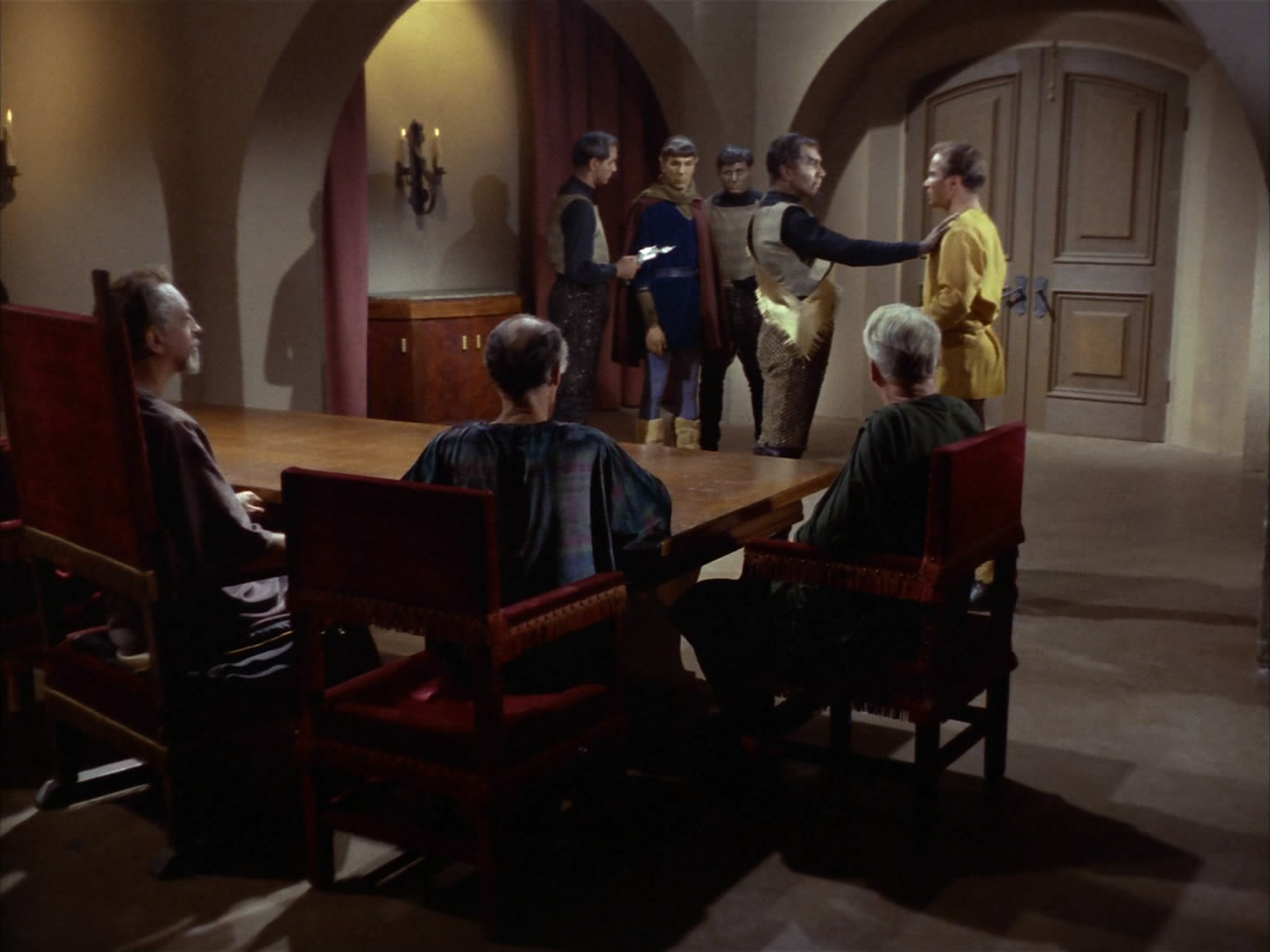 |
| "Tell me, Jim: Why do you fight?" |
“Errand of Mercy” is the moment where all the themes and motifs Gene Coon has been working with since the beginning of his tenure finally coalesce into a cohesive, articulate message. It's a stinging indictment of what Star Trek is at this point, but what saves it from the nihilism of “A Taste of Armageddon” and “Space Seed” is that it's paired with a slightly more hopeful outlook gleaned from the other scripts Coon is the sole author of. It's not perfect, even by the standards the show's laid out for itself by this point, but it's a sufficiently effective statement of where the show is placing its ethics now. Also, it's the debut of the Klingon Empire, which is somewhat self-evidently important, so I guess I'd better deal with that.
There are few things more immediately recognisable as undeniably Star Trek than the Klingons. In terms of ubiquity within the pop consciousness, they're on par with Kirk, Spock and the Enterprise. They're so well-known and beloved that fans who own replica Klingon uniforms, headpieces and weapons and speak Klingonese fluently are seen to be as quintessentially Star Trek as it's possible to get, and none of these things are even going to be a part of the franchise until 1989 at the absolute earliest. Even the Federation and Starfleet don't quite have this level of memorability and iconic status. In fact, the Klingons are so entrenched in people's ideas of what Star Trek is about there's only one other thing in the entirety of the franchise that can claim to have anywhere remotely near their level of cultural capital and that's the Klingons' own mortal enemies.Why might this be? Part of this has to be the fact the Klingons are the Original Series' only recurring antagonists. Although they only actually appear in seven episodes out of the show's 79 episode run, they do appear more frequently than any other alien race. Certainly the fact they get brought back and heavily retooled to become a lovable culture of proud, honourable (sometimes comically so) warriors in both the original movie series and the Rick Berman era also must have something to do with it, but there remains, after all, a reason they come back in the first place.
All that said, however, one thing that's worth noting about the Klingons in “Errand of Mercy” is that they really don't seem like they're actually cut out for the job: I'm not so much referring to the general execution of the characters here, although John Colicos' intense performance as Commander Kor is pretty much the one memorable, or actually convincing, acting job amongst the Klingon cast, but in terms of their actual conception. Common lore claims Coon based the Klingon Empire on the Soviet Union, and while there is evidence of this (Kor's comment to Kirk about how all Klingons are cogs and everyone is monitored primarily), D.C. Fontana asserts that Coon wrote it as more an amalgamation of all the worst traits he saw in the people he fought during World War II. Apart from the Soviets, Fontana claims Coon based the Klingons just as much on Nazi Germany and Imperial Japan, which makes a great deal of sense if you look at how they behave in the episode as aired. The problem is that because Coon throws all these disparate groups together, the Klingons end up feeling a bit like bland, generic and overly broad villains here, so any critique they may have been written to convey doesn't really stick.
The result of this is that we have an alien people who are somewhat lacking in distinction, and their effectiveness is slightly...mixed as a result. First of all, lets address the obvious. The costume design of the Klingon, consisting mostly of a bunch of dudes in blackface and fake goatees wearing faux chain mail is deeply unfortunate. Coon apparently didn't give any indication in his script as to what the Klingons were supposed to look like (apart from “Oriental” and “hard-faced” which is, well, bad), so the makeup department left it entirely up to John Colicos to come up with a design. Regrettably, Colicos decided to model them on Genghis Khan. This was obviously a bad idea for any number of reasons, just one in particular being we've already seen a Khan not three episodes ago. I mean I know video recording technology in 1967 wasn't what it is today, but I doubt audiences would have that short a memory. In all seriousness, the larger issue is of course the fact this makes the Klingons a more than vaguely racist mess. I mean, the production team on the supposedly racially diverse Star Trek didn't even approach Japanese actors, not that this would have been much of an improvement, but still defaulting to browning up Caucasian actors with makeup shouldn't be anyone's first move, even in 1967.
All of this adds up to the Klingons not really ticking all the boxes they should have to become a valid and legitimate reoccurring challenge to the Enterprise crew. Their conception is muddy, their execution is something of a disaster and they have a patently ludicrous name that will make them the butt of endless crude jokes in the future (apparently Fontana complained to Coon about this a number of times, imploring him to come up with a better sounding name. Clearly they never found one). All of this might have been OK had they just stayed here, which was actually the intent: According to subsequent interviews Coon never meant for the Klingons to come back, a claim supported by Fontana who tells us she figured he was just looking for a “good, tough” adversary for Kirk for this one episode. Fontana also says the reason the Klingons came back time and time again was because they were exceptionally cheap to costume, as opposed to the Romulans, who she found much more interesting, but which required special and pricey headpieces.
Let's actually think for a moment about what “Errand of Mercy” would have looked like with the Romulans instead, because the parts of this episode that don't have to do with Klingon culture and design are on the whole actually quite excellent. I bring up “Balance of Terror” a lot, mostly because it's incredible, but here the comparison really is valid. Paul Schneider very clearly meant for the Romulans to be a critique of imperialism by showing how the concept harms ordinary people, which is already a better setup in my view than “generic fascist”. Furthermore, however, the Romulan Star Empire was designed to be for all intents and purposes the same as Earth Command, down to Kirk and Mark Lenard's Commander being basically the same person. This approach would have fit “Errand of Mercy” like a glove, as the episode's whole point is that despite his protestations Kirk and Kor are both hot-blooded warriors and the Federation and the Klingon Empire are basically indistinguishable to people like the Organians. In that regard I have to praise not only Coon's script, which gives William Shatner and John Colicos very similar speeches, providing the story with a real structural symmetry and elegance, but also director John Newland, because the cinematography here is positively delightful. My favourite scene is at the end, when the Organians finally intervene and stop the war from breaking out: Kirk and Kor take turns spewing similarly phrased insults and demands at them, before indignantly declaring that they have “no right” to meddle in the affairs of “'my Federation!' 'Or my Empire!'” as the editing brilliantly ping-pongs back and forth between the two of them.
What this also does though is once again draw a contrast between Gene Coon and Paul Schneider. In the “Arena” post, I said the primary difference between the two writers is that while both go out of their way to problematize Star Trek's militarism, or are at least somewhat concerned with using the show to condemn the militarism of the day and provide a counterbalance to it, Coon seems to enjoy using Kirk as a stand-in for the diegetic ethics of the series while Schneider seems to play off Shatner's acting style and writes Kirk as someone larger than the show who might be in some sense constrained by it. While both are valid approaches, I do personally prefer Schneider's in this particular case as it seems to fit the character better. That said, Coon's comes from a curiously metatextual perspective: Despite him having Kirk make several morally bankrupt decisions, not only here (where he is disturbingly patronizing, paternalistic and cruel to the Organians) but also in “Arena” and the first half of “The Devil in the Dark”, this is always framed in the context of Kirk learning from his mistakes and recanting at the last moment to prove he has the potential to grow into a better person.
On the one hand, this would mean using the Romulans in “Errand of Mercy” would improve the script significantly, as Schneider's equation of them with us is arguably even better suited to this story than “Balance of Terror”. On the other hand, Coon's problematizing of Kirk means the effectiveness of the Romulans themselves might have been diluted somewhat: If the whole point of them is that they're part of an empire in decline and whose people are beginning to lose faith in it, than having a Romulan commander fill Kor's role here might not have worked as well. Of course, one other option might have been to create a totally new Romulan character, someone far more conservative in his views. Mark Lenard's character committed suicide of course, and this would also help contribute to the idea the Romulan Star Empire is a vast, sprawling entity comprising a vast array of people with many different perspectives: A Foundation-style galactic empire without Asimov's unfortunate determinism. However, this would also mean equating him with Kirk would have seemed contradictory, given his prior equation with Lenard's character in “Balance of Terror”.
The other area in which “Errand of Mercy” stumbles a little bit is its resolution. While the episode does a very good job building up to Kirk's inevitable fall by telegraphing the Organians as sophisticated, powerful pacifists from the beginning and have Kirk become gradually more adversarial, combative and dismissive, for this to have really worked we would have needed a scene that showed Kirk was more willing to put a stop to the war than Kor was, showing that there's some hope for him, much as we saw in his sparing of the Gorn captain in “Arena”. But we never really get that scene, or at least it's never quite clear enough. Instead, it's left to Spock to paper things over at the end by talking about how it took the Organians millions of years to reach the state they did, so he shouldn't be too embarrassed and disappointed. The problem is this feels like something of a step back for Coon, and it pushes “Errand of Mercy” a bit too close to the nihilism of “A Taste of Armageddon” and “Space Seed” for my particular taste. Both this episode and “The Devil in the Dark” might have been more effective had their positions in the season been switched, with the former episode serving much better as Kirk's final redemption, or at least proof that he's capable of redemption.
But the fact Spock, who has by this point firmly been established as the show's central character in several areas, seems to think it's possible for humans to grow is a powerful statement in of itself. Spock has been subject to no small manner of discrimination on this show, and his positionality gives him a unique perspective on the actions of people like Kirk and organisations like the Federation. If he, who so wishes to distance himself from his human side, seems to think we might not be so bad after all, that should tell us a lot. This leaves us with a fundamental question, however: At the end of Star Trek's first season we've seen an awful lot of reflexiveness, introspection and back-and-forth about what this show is and the consequences to be had as a result of making a firm decision about it. We've had the show ripped to shreds by forces within and above the narrative and had it stressed by more than one entity that in spite of all of this there's potential and the humans of Star Trek are capable of great things. But that's just it; we've heard a lot about potential, but very few concrete steps in a progressive direction. The onus is now on the show to prove not only that it has potential, but that it's actually capable of fulfilling it.