Shared posts

17 Jul 10:07

The Ballad of Halo Jones

by Lawrence Burton

Alan Moore & Ian Gibson The Ballad of Halo Jones (1986)

I followed 2000AD more or less from the beginning, or at least from prog #21 onwards, simply because that was the first issue I saw in Gibbons' newsagent; but I caught on quick and cashed in a bag of toy cars against the previous twenty issues with some kid at school who is probably still kicking himself. I remained faithful until roughly October 1980 at which point the comic slid into a somewhat shitey period with the advent of unreadable tosh like Meltdown Man and The Mean Arena, although it's probably no coincidence that it was also around this time that I discovered punk rock, Devo, and record shops. Several years later some guy at art college gave me a stack of more recent issues because he didn't want to just throw them away, and my addiction reasserted itself. It would be overly generous to say that the comic had grown up in my absence, but Mean Arena was nowhere to be seen, and it had at least stopped being quite so shit, and there was this story called Halo Jones.

In case it isn't obvious how radical The Ballad of Halo Jones seemed at the time, or at least how radical it seemed to me, here was a strip about urban boredom and shopping trips gone horribly wrong with an almost exclusively female cast smuggled into a comic specialising in stories about tough men who hunt down renegade robots, tough robots who hunt down renegade aliens, renegade men who hunt down tough dinosaurs, alien dinosaurs who...

...well, you get the picture I'm sure.

Meanwhile in the 1990s, I ended up selling my entire stash of progs - about fifteen years' worth - to Skinny Melinks' comic shop in Lewisham for what seemed a slightly insulting sum, probably a fucking tenner or thereabouts, and all because I'd met a girl who had agreed to let me have sexual intercourse with her. This later became a source of regret, at least until history repeated and someone else gave me a free stack of old progs, and once I got beyond the raw nostalgia, I realised that a lot of those stories worked better when you still belonged roughly to the age group at which they were targeted; or you can never go home as both Thomas Wolfe and Mark E. Smith have observed under entirely different circumstances.

Thankfully, not least because this collection was a Christmas present, The Ballad of Halo Jones has endured as a story where Moon Runners and Colony Earth sort of haven't. It comes as a shock reading something so conspicuously episodic requiring a punchline every five or six pages, but it's still pretty damn satisfying despite that. Alan Moore has, I would guess, always had a thing for soap opera, at least if Big Numbers, Top 10, and even Watchmen are anything to go by - his stories as a rule being about people dealing with circumstances rather than the circumstances themselves. To this end Halo Jones is closer in spirit to one of the more eccentric Mexican telenovelas than any of the tales of renegade justice dinobots hunting down tough maverick mutants with which it once shared a cover. The events are massive, but no more massive to Halo than anything experienced by the reader out here in the real world, relatively speaking, and the themes are both timeless and immediately familiar - the uneasy transition to adulthood, the desire to escape from the crushing circumstances of one's childhood environment, the subsequent lack of direction, and the inevitable realisation that things are not going to get better. It's an extraordinarily depressing tale, regardless of it being told by means of jokes, weird aliens, and a ton of fancy ideas. The story - divided into books one to three - is, for my money, encapsulated best by a single caption near the opening of the third book:

Records of her movement over the next few years are incomplete, yet reveal a pattern of increasing desperation... as if she were pacing the galaxy trying to get out.

Yes, I know the feeling, and that's precisely why I ended up in Texas; and just as I bagged a happy ending thank you very much, so too does Halo it seems, which somehow justifies all the preceding crap of the big, horrible journey.

Aside from the conspicuously episodic feel of the first book, I think the only other surprise is Ian Gibson's artwork which definitely worked better on the low quality paper of the weekly comic as I remember. It's not that it's bad so much as that it's often very, very sketchy and overly stylised as though the characters are torn between hasty fashion design and the pouting offspring of Donald Duck. It lacks the clarity of the similarly wavy and otherwise superior Jesus Redondo, although there's a marked improvement in the third and final book for some reason. That said, I still can't imagine this working so well with any other artist at the wheel, although I could have done without hearing about the Halo Jones hamburger shot collector's art that almost went on sale at some convention or other.

Classic is an overused adjective in the crazy biz of comics, but entirely justified in this instance.
15 Jul 11:16

Doctor Who: 1983

by 0tralala
Episode 602: The Five Doctors
First broadcast: 10.30 pm on Wednesday 23 November 1983 (US); 7.20 pm on Friday 25 November 1983 (UK)
<< back to 1982

The Raston warrior robot decapitates a Cyberman -
for Doctor Who's birthday.
The Five Doctors
A lot of our response to Doctor Who is informed as much by how we first see it - who we're with at the time, the mood we (and they) are in, the stuff going on in our lives - as the programme itself. A wise chum told me he'd realised this about a recent season: his least favourite episodes were all the ones he'd watched on his own.

So a lot of the warm, cosy love I have for The Five Doctors is personal and from context. That first evening it was shown was a big event. I was allowed to stay up late to watch it with my siblings, and they drew the curtains and turned off the lights to make the experience more like a cinema. It was the last Doctor Who story we all watched together as it went out.

When I watch it again now, I still feel a thrill of memory for that long-ago evening, that particular, personal circumstance. But it's not just that. As I've grown up, become a writer and tried typing my own Doctor Who stories, I am ever more in awe of the script.

First, consider the brief given to the poor writer. Imagine you're the one that script editor Eric Saward came to.

You have to write a 90-minute TV movie extravaganza, with five leading actors all playing the main hero - so they get 18 minutes each. They all need to drive the plot, be heroic and have the best lines, and you'll need to consider the potential clash of egos on set. Oh, and the fact that one of those actors is dead.

In addition, the story should feature lots of old monsters and companions. The production team can't confirm availability of some of those companions until very late in the day, but each Doctor will need pairing up with a companion from their time on the show. And lastly, it needs to thrill a broad, general audience tuning in for the special event, as well attempting to satisfy fans. (PS the script editor especially likes the Cybermen.)

Bloody hell, that's a lot to cram in - once you've assembled the cast there's hardly room for a story. In fact, it seems to have defeated Robert Holmes, generally regarded as one of Doctor Who's best writers - if not the best. "The brief was too heavy," Saward later admitted of Holmes' involvement. "He didn't think it would work."

Saward is speaking on Terrance Dicks: Fact & Fiction, a 2005 DVD extra on Horror of Fang Rock. The documentary covers Terrance's time on Doctor Who but especially his ability to step in when things went wrong. When two stories collapsed in 1969, he co-wrote the 10-episode The War Games and saw the Second Doctor off in grand style. He then script-edited the next five years of the show - all the Third Doctor's adventures - taking a series facing cancellation and returning it to rude health. In 1977, when the BBC objected to his Doctor-Who-meets-vampires story (because it would look like it was mocking their big adaptation of Count Dracula), he quickly knocked out one of my favourite stories, Horror of Fang Rock. Basically, he's a good man in a crisis.

Terrance himself is modest about his contribution. He says on the Fact & Fiction documentary that he's often asked:
"'Were you aware you were making classic television?' Our main plan was not to have have to show the test card."
He's rightly proud of this unshowy professionalism and recalls a moment from his time as script-editor. A director called from the rehearsal hall to say there was some problem with the scripts. Terrance called back and spoke to the director's PA.
"I said, 'Tell him to ring me when he's free. And tell him not to worry because whatever it is I will fix it.' ... That just came out and I thought that sounds bloody conceited. But I thought after five years, having hit most of the problems on Doctor Who, I'm fairly confident that I can fix it."
When given the brief for The Five Doctors, Terrance's solution was simple, effective and brilliant. He treats the problem as a sort of game, and makes that game the plot. Just as he has to gather Doctors, companions and old enemies, so does the villain in the story.

I've been discussing this with my chum Jim Smith, who says that "Terrance talked once about a game where you have to take objects out of box and extemporise a story around them. The story does that, with all ingredients brought out like the prestige in a magic trick. He also (perhaps unconsciously) works that image into the story, with Borusa's gloved hands pulling the figurines of the characters out of the box and putting them on the board."

But - without disagreeing with Jim - it's far more clever than that simple game supposes. The Doctors all have their own plots to follow and don't meet up until the final scenes (and a single day's filming) which provides a neat structure for the story but also avoided potential spats between the leading men. There are even separate entrances to the Dark Tower so the Doctors don't bump into one another early.

More from Jim: "I love how the Third Doctor recounts an establishment view of Rassilon, the Dark Times and so on ('old Rassilon put a stop to it') while the Second, a more anarchic and less establishment figure, regales the Brigadier with conspiracy theories of how Rassilon invented and played the game before he banned it and how he may still be alive inside his own Tomb. At least some of which turn out to be true."

The Five Doctors is packed with brilliant moments: the Doctors being chased by black triangles; the fizzing insides of a Dalek; the Doctor running away from his own people at the end. There are nice continuity fixes, too: the fact that a Time Lord can be given a new regenerative cycle when his first one is used up; the Third Doctor meeting the Cybermen (the only Doctor at that point not to have done so). And so much of the dialogue sparkles: I particularly love “I am the Master – and your loyal servant”.

Jim says: "I love that the Master takes his mission seriously. When he rages at the end that 'I came here to help you Doctor, a little unwillingly but I came. My offers were scorned! My help refused!' he's actually telling the truth and no one - not even the audience - believes him."

"Then," Jim goes on, "there's Terrance's use of imagery from Browning's Child Roland to the Dark Tower Came - see from versus XXXI. This seems like a stretch until you remember Fang Rock's indebtedness to The Ballad of Flannen Isle."

Terrance dodges round one of the Doctors being dead by having an actor stand in for William Hartnell - but also, tastefully, starts the story with a perfectly chosen clip of the man himself. Midway into the story, the replacement First Doctor is paired up with the current Doctor which again works structurally as well as practically (there's less of a potential clash with a for-one-night-only Doctor). All the Doctors have great moments of wit, intelligence and courage and get some brilliant lines.

Then, after a draft of the script had been completed, one of the Doctors decided not to be involved. That should have spelt disaster but Terrance fixes things deftly, again using archive footage to fill the gap and also reworking the other Doctors' roles. Watching it that first time, I wished Tom Baker had been in it more but never suspected he'd not been there at all.

If the Doctors get the best bits, the companions are less well served, just tagging along in his wake, asking questions that prod the plot along. I wonder how much that's due to them still being swapped round at the last minute, or to the constraints of squeezing in so many people.

There's an effort to mark out their characters but it's all a bit sketched in and glib. Susan sprains her ankle as if that's something she always did (it isn't; she did it once in The Dalek Invasion of Earth). Jim: "Which was, of course, one of only two First Doctor stories Dicks had novelised. Did he flick through it for research? Or just remember novelising that moment?"

Poor old Turlough fares worst, getting very little to do: he draws a picture, worries in the TARDIS then has to stand still not talking. Jim: "I like his 'Die, it seems' gag. And 'Big, isn't it?' about the bomb. Black humour is key to Turlough, I think. So we get that if nothing else."

There's no mention at all of Kamelion, the robot companion introduced in the previous story.

Other things niggle. It's a shame that the Eye of Orion is clearly the same location as the Death Zone (though that's not an issue with the script). A thrilling scene where the Third Doctor rescued Sarah from the Autons was changed to a cheaper one where she falls down a steep slope; a good fix on paper but the way its shot doesn't make it look very perilous (and again not an issue with the script).

Jim drew my attention to one odd script thing in the scene at UNIT HQ: the sergeant doesn't know who the Doctor is and won't let him in, whereas Colonel Crichton tried to have the Doctor invited to the reunion and failed. So he certainly knows of the Doctor. When the Doctor gets into the office, the colonel dismisses the sergeant and lets the Doctor stay because either he knows who this Doctor is by sight (they've never met, but he may have seen pictures or whatever) or he accepts Lethbridge-Stewart's recognition of him as reason enough. Then at the end of the scene the colonel says:
CHRICTON:
What the blazers is going on? Who was that strange little man?

SERGEANT NOT-BENTON:
The Doctor?

CHRICTON:
Who?
Which, as Jim said, completely reverses their positions/knowledge. On the DVD commentary at this point, Terrance says the joke wasn't his but Saward's. And it's not in Terrance's novelisation of the story, either.

Whatever the case in that scene, Saward clearly helped improve the story overall. He suggested that it was too obvious if the villain turned out to be the Master. He also thought the Third Doctor and Sarah Jane needed to face one more obstacle before reaching the Dark Tower. To answer that, Terrance came up with the one new monster in the story, in a scene that typifies what makes The Five Doctors so brilliant.

The Raston warrior robot is a budget-conscious creation - a non-speaking actor in a simple costume. Its sensors are primed to detect any movement, on which it fires arrows and bladed discs. Again, it's making a game of the problem: the Doctor and Sarah Jane end up playing Blind Man's Bluff.
DOCTOR:
Freeze, Sarah Jane. If you move, we're dead.
And then a troop of Cybermen arrive...

Cor. No wonder this scene was most often used to promote the story. Simple, cheap and thrilling, it is perfect Doctor Who.

Next episode: 1984
15 Jul 11:12

The Plotters - the shooting script

by 0tralala
By popular demand (well, Dawn Christoffersen on Twitter asked), here's the shooting script for our short film The Plotters - which got shortlisted in the 2012 Virgin Media Shorts competition, and which you can watch here:

(Full cast and crew for The Plotters at IMDB.)

ETA: and here's the first rough cut of the film:

The Plotters - First Cut from Thomas Guerrier on Vimeo.


THE PLOTTERS 

by Adrian Mackinder and Simon Guerrier 


Based on an idea by 
Adrian Mackinder and Hannah George 

(c) Adrian Mackinder and Simon Guerrier 2012


1 EXT. LONDON, 1605 - NIGHT 

Heroic CGI. The old Palace of Westminster in the background. CAPTION: London, November 1605.

2 EXT. THE TAVERN - NIGHT 

GUY FAWKES - in beard, hat with buckle, cape - hurries to the door, checks he’s not been followed, goes in. 

3 INT. THE TAVERN - NIGHT 

GUY joins a group of other PLOTTERS – all in beards, hats with buckles, capes – at a table. 

GUY FAWKES:
Gentlemen. We are in accord. Thirtysix barrels of gunpowder now sit beneath the House of Lords. When the heretic king is there tomorrow, Robert lights the powder and foom! We ignite a new world! 

The men clank tankards. GUY turns to THOMAS WINTOUR. 

GUY FAWKES (CONT’D):
Robert, did you want to say a few words? 

THOMAS WINTOUR:
Er, Guy... I’m Thomas. He’s Robert. 

He nods at ROBERT CATESBY.

GUY FAWKES:
Oh, er, yes. Robert. Our explosives expert.

ROBERT CATESBY:
What? I’m Robert Catesby. You mean that Robert.

He points at ROBERT WINTOUR. GUY embarrassed.

GUY FAWKES:
Oh yes, we’ve got two Roberts.

ROBERT KEYES:
Er, three.

GUY FAWKES:
Who are you?

ROBERT KEYES:
Robert Keyes. Hi.

GUY FAWKES:
And you’re the explosives expert?

ROBERT KEYES:
Lord no. Horrible stuff, gun powder. Go off in your face! Very nasty.

GUY struggling to make sense of this.

GUY FAWKES:
So we’ve got three Roberts.

ROBERT CATESBY:
It is a bit confusing. Doesn’t help that we all look a bit alike. 

The plotters all glance at one another. He’s right!

ROBERT WINTOUR:
I could pop home, get another hat.

ROBERT KEYES:
You don’t have another hat.

GUY FAWKES:
We just need to know which one’s the explosives expert.

The three ROBERTS all point at one another.

GUY FAWKES (CONT’D):
(sigh) All we want is someone to light the powder. (BEAT) And obviously run away quick. Surely You’re not scared? 

The plotters all gruffly shake their heads. Of course not. 

ROBERT CATESBY:
I’d do it. But they know me from Devereux’s rebellion. I’d never slip past the guards.

ROBERT KEYES:
Bad knee, can’t run. It would be suicide. And that’s a mortal sin.

ROBERT WINTOUR:
Gunpowder makes me sneeze. 

GUY FAWKES:
Well, then. Someone else. Thomas? Are you man enough?

Beat. 

THOMAS WINTOUR:
Sorry, which Thomas?

GUY FAWKES:
What? 

THOMAS WINTOUR:
Thomas Bates, Thomas Wintour or Thomas Percy? 

GUY FAWKES:
Oh, now really. We’ve got three Roberts and three Thomases?

JOHN WRIGHT:
And two Johns. I’d do it, but I’m driving the getaway carriage. Sorry. 

The plotters bicker. 

GUY FAWKES:
Is there anyone who doesn’t have the same name as anyone else? 

ROBERT CATESBY:
There’s Ambrose. And Everard. 

The men snigger.

EVERARD DIGBY:
Shut up! Anyway, isn’t Ambrose a girl’s name? 

More sniggering. AMBROSE is rather burly.

AMBROSE ROOKWOOD:
I’m known from Devereux’s rebellion, too. Why can’t Robert do it? 

ROBERT CATESBY:
Which Robert? 

They all start bickering again.

GUY FAWKES:
(fighting for calm) It only needs one of you. Really! I’ll do it myself if I have to!

They all fall silent, stare at him.

GUY FAWKES (CONT’D):
Fine. If you want a job doing properly... 


FADE OUT. 

4 INT. TORTURE CHAMBER 

GUY is chained up, looking miserable. POLICEMEN – in beards, hats with buckles, capes – come in, carrying instruments of torture. An INTERROGATER stands by.

INTERROGATOR:
He’s given us a description of the other conspirators.

He hands the POLICEMEN a paper. It shows a crude drawing of a man in a beard, hat with buckle.

POLICEMAN:
I see. Did he tell you their names? 

The INTERROGATOR turns the page over. There’s a list: Robert, Robert, Robert, Thomas, Thomas, Thomas, John, John, Ambrose, Everard. 

GUY FAWKES:
(weak) It’s a funny sort of coincidence, but really... 

POLICEMAN:
We’ll get the truth somehow. Fetch the thumb screws. 

GUY FAWKES:
Bother.
14 Jul 13:55

Income inequality at its lowest since 1986 – a good result for the Liberal Democrats in Government?

by Caron Lindsay

The Office of National Statistics has released information showing that income inequality is at its lowest rate since 1986.

From the BBC:

The largest fall during this period was a 6.8% drop for the richest fifth of households. They still had an average income, before tax and benefits, of £78,000 in 2011-12.

This was 14 times greater than the poorest fifth of households, who had an average income of £5,400. However, this group has seen their average income rise by 6.9% since the economic downturn.

After all taxes and benefits were taken into account, the top fifth of households had an income of £57,300, compared with £15,800 for the poorest fifth – a ratio of four-to-one.

The ONS has produced a nifty infographic to show the current situation:

ONS infographic on income inequality


The biggest fall in income inequality in 27 years is certainly progress and would not have happened without the Liberal Democrats ensuring that tax cuts were aimed at people on low incomes, not rich dead people as the Conservatives wanted with their desire to cut Inheritance Tax. To have achieved a fall in a time of economic turmoil is also worthy of credit. You don’t expect the Tories to give two hoots about equality, but Labour, which is supposed to believe in social justice, should have done better in their 13 years in power. This infographic shows that it’s in fact the Liberal Democrats who are starting to turn things around:

Income Inequality

However, this is a baby step or two down a very long road. How on earth do households cope on an income of £5,400 as the poorest fifth must? Our dream of a “fair, free and open society where no-one is enslaved by poverty, ignorance or conformity” is a long way off. We might say that we have done better than Conservatives or Labour governing alone. We’d be right. The raising of the tax threshold and the Pupil Premium have been instrumental in that.  But this is not the time to sit back and relax. These figures show a need to roll up our sleeves and get on with the job of tackling poverty.

* Caron Lindsay is Co-Editor of Liberal Democrat Voice and blogs at Caron's Musings

13 Jul 16:28

Opinion: The best type of electoral reform

by David Hennigan

As a young councillor in Manchester in 1999, I was often suspicious of a postal vote system that allowed people, who couldn’t make it to the ballot box to be able to vote by post.  It’s not that I wanted to curtail anyone’s democratic rights – it was just that I wanted to ensure the system was safe from electoral fraud.

Since 2001, here in the UK – you can vote by post without giving a reason.  ’Bringing the ballot box to your doorstep’, argued some, ‘Putting the convenience back into politics’, said others.  Now, I’ve no problem with the elderly nor the disabled having their vote delivered to them.  After all, they have every right to be involved in our democracy.  A ballot paper delivered through your letter box however needs to be returned to a post box – so it doesn’t quite make sense.  An easy journey there – a difficult expedition back.

Postal Voting ‘on-demand’ is the biggest threat to a democratic Britain for generations.  We’ve seen stories of alleged postal vote fraud on a massive scale.  There have apparently been warehouses set up to fill them in, up to 10 people supposedly living in 2 or 3 bedroom flats and police investigations that have proved inconclusive.

Yes, some people have been caught red handed – look at the case of the ‘Birmingham 3′ in 2005.  They described their guilty verdicts as… wait for it, “A dark day for democracy” – but whose democracy?  Senior judge Richard Mawrey QC proclaimed that it would disgrace a “banana republic”.  In 2010, 5 people were jailed in an ultimately failed attempt to get their candidate elected in Bradford West.

So what has happened since?  Well, err… nothing.  This is despite allegations flying around left, right and centre. Administrations like the one in Tower Hamlets amongst others are dogged by suspicions of electoral fraud. Dead people voting, unfeasibly large households are not uncommon – especially in our urban areas.

Sadly, we’ve not been able to change the electoral system.  A huge defeat to change to a fairer voting system, a failure to reform the undemocratic House of Lords and boundary changes not being implemented.

So what is the best type of electoral reform?  An end to the ‘free for all’ postal voting system would be a good start.  YES, if you are not well enough to get to a polling station… NO – if you can’t be bothered to wander down to your local polling booth between 7am and 10pm on Polling Day!

* Dave Hennigan is a Lib Dem member in Macclesfield (formerly Levenshulme)

12 Jul 21:14

She Carried the Evil Inside Her (Fear Her)

by noreply@blogger.com (Philip Sandifer)
Suck it, Redgrave

It’s June 24th, 2006. Nelly Furtado is at number one with “Maneater.” Shakira and Wyclef Jean, Bon Jovi, and Pink are also in the charts. In news, ummm… the United States celebrates Go Skateboarding Day. This is a real thing. I just looked it up. It’s a boring week, yes. England earn a 2-2 draw against Sweden in their last and largely irrelevant group game, setting them up for a clash with Ecuador the day after this story airs.

This story, of course, is Fear Her, the consensus worst story of the Russell T Davies era (and, I suspect, worst story of the new series were a thorough poll to be run today - I can’t think of any Moffat stories with enough sheer volume of hatred to overcome it). As ever, I don’t find the issue of why it’s bad supremely interesting. The short form is that the story was rushed and misconceived. Stephen Fry’s planned script for the second season had to be abandoned late in the process, so they grabbed Matthew Graham’s planned Series Three script off the reserve pile and put it into production quickly. Graham, for his part, appears to have had a crappy brief - he was told to do Yeti-on-the-loo style local terror with a target audience of seven-year-olds. To say that this is an awkward combination is an understatement, and virtually everything that’s wrong with the story can be traced to the basic inability to decide whether it’s a scary story or a naff cheap one for the kids, and the fact that these are a particularly bad pair of stools to fall between.

But two specific aspects of this tension are worth remarking upon. The first is Murray Gold, or, more accurately, his music. It’s become the populist choice to criticize Murray Gold’s Doctor Who scores in general. I’m not entirely sympathetic to this line of argument, but it’s not incoherent wibbling spat into the void either. Those that dislike Gold’s music usually point to two related problems. The first is that they are simply mixed too loud and too omnipresently. This is probably true, but not actually Murray Gold’s department, as he doesn’t do the final sound mixes for episodes. Still, Gold’s music is particularly prone to becoming overpowering because of the other complaint usually leveled against it, which is that it’s heavy-handed. This is also not inaccurate - Gold’s music exists largely to inform the audience how they should be feeling, and it is usually a bit unrelenting in the pursuit of that. This means that when it’s put a bit high in the mix the effect is more overwhelming even than the usual tendency towards volume over all else within sound mixing these days.

As I said, in the general case, at least, I am hard pressed to find much to complain about in Golds’s music. It’s blatant, but this is not necessarily a vice. One of the things that characterizes the new series is its relentlessly fast pace. This pace is accomplished through narrative shorthand - establishing details of characters and situations in a comparatively sketchy fashion and trusting the audience to fill in the details. Murray Gold’s music is tremendously helpful in accomplishing that, because it provides an extremely efficient means of communicating emotional tone to the audience. A few notes of Flavia’s Theme is sufficient to communicate “this is a spooky and mysterious bit.” The chirpy lilt of Clara’s theme is sufficient to cut through any amount of epic bombast and immediately communicate “and now the perfectly ordinary human is taking charge of things for a bit.” The insistent bass and piano hits at the start of “Doomsday” (the music piece, not the episode) immediately say “we’re building up towards something now.” All of this is accomplished in seconds, and without a moment of dialogue. It’s an invaluable tool to increase the density of the music, and more to the point it’s a solid use of the full scope of television as a medium. The music is often relied upon to communicate vital pieces of information. And since Gold combines that with a reasonable ear for a catchy tune (there’s not a fan alive who can’t hum “I Am The Doctor,” even if they don’t know that that’s the official name of the Eleventh Doctor’s hero theme).

Nevertheless, when it comes to Fear Her we get a bracing demonstration of how it can go all wrong for Murray Gold. His brief was clearly the same as Matthew Graham’s, namely “kids episode,” and so he covers the episode with a sort of plinky music that screams “television adaptation of The Famous Five” and not “otherworldly horror consuming a neighborhood.” And this ends up smothering the episode in its grave, keeping it from ever getting any dramatic tension. The music is working against it at every turn, saying “this is not actually a big deal at all” about every aspect of the drama. This makes the entire episode feel disposable and silly in a way it doesn’t have to. It’s the musical equivalent of that moment in Coupling where Jane declares that being a children’s presenter is easy because “you just have to waggle your head a lot and shout.” It’s making children’s television that doesn’t actually have any respect for children as an audience, and it’s painful to watch.

This brings us to the second odd moment of tension within Fear Her, which is the moment when the entire population of the Olympic Stadium vanishes into thin air, to the only minimal alarm of the television announcers, who blithely go back to covering the torch relay, and who later seem more upset when the torchbearer keels over than they were when, you know, tens of thousands of people vanished into thin air. (Notably, the torchbearer being struck by lightning was not seen as something worth investigating.) Now, I carefully cultivate a reputation for being just about the most permissive person imaginable when it comes to plot holes. On Monday I’m going to side firmly against the idea that the resolution of Doomsday is even remotely out of nowhere. But even I’m forced to admit that the Olympics coverage going on in the background of Fear Her is spectacularly crap.

Why, though? What is it about this particular bit of narrative contrivance that becomes infuriating where others get away with it? You can, at least, see how the series thinks it’s getting away with it. The usual way you paper over a plot hole is by making sure the audience’s attention is somewhere else. So the Olympics stuff is supposed to work because the audience is really paying attention to the drama around Chloe, and if the story is working shouldn’t be thinking about the imaginary Olympics going on. And while the problem might just be that nothing else in the episode is sufficiently compelling to distract from the plot holes, that’s unfair. I can honestly admit the ludicrousness of the Olympics coverage did not jump out at me on a first viewing - the cheesiness of it, sure, but not the fact that they just calmly go back to covering the torch relay after everyone in the stadium vanishes.

On top of that, the story has at least a bit of a built-in hedge, since it firmly establishes that it’s working according to purely symbolic logic. We’ll call this the redemptive reading of the story’s other massive headscratcher of a scene, when the Doctor erases the scribble monster by just touching it with an eraser. This is not, to be clear, a case of getting a bit of reasonably complex science surrounding black holes wrong. This is getting how pencil erasers work wrong. The belief that erasers just casually wipe out material like they do in Photoshop is not some complicated matter that will go over the audience’s head. Everybody knows full well that erasers simply do not work that way. But, of course, this is not how the story is put together. The scribble monster is a child’s drawing. Its relationship with the physical medium of pencil-drawing isn’t based around literal embodiment, but around symbolism. And that’s how everything in the story works, the Olympics included. This is not inherently a problem - if you decide that this is the logic you’re using for a given story, you can in fact get away with it. In which case the fact that the Olympics commenters are just calmly spitting out plot information instead of providing a quasi-realistic portrayal of how the Olympics might reasonably be expected to go is not necessarily a problem. This is the usual way you get around plot holes, after all - by having the hole be in a part of the story that isn’t really the point. Not to get too far ahead of myself, but this is why Doomsday gets away with it - because the resolution isn’t really about how the Doctor gets rid of the Cybermen and the Daleks, but about the fact that he loses Rose doing it.

But more broadly, what works about Doomsday is that the resolution feels like it makes sense within the thematic content of the episode. We’ll discuss that in detail on Monday, but for now let’s note that the real problem with the sloppy plotting of the Olympics broadcast is that it’s there in the first place. I’ll save my curmudgeonly horror at the nature of the Olympics for some later post, but surely it’s non-controversial to point out that they add nothing whatsoever to this story. In fact, they undermine it - the decision to have the ending be the Doctor lighting the Olympic torch moves the plot away from the day-to-day lives of the people on the street and towards the grand national narrative. The ending’s an active refutation of the best bit of The Idiot’s Lantern - the Doctor’s declaration that real history is the street party and not what’s going on on television. Here the restoration of everybody on the street is irrelevant - it’s only the restoration of the Doctor that matters to the ending, and life on a perfectly ordinary street just unfolds silently and without comment in the background. Within the context of Fear Her, this is inexcusable. Fear Her spends its entire runtime trying to be everyday suburban horror, then bombastically sells it out in favor of being about how wonderful the Olympics are going to be.

And that’s why the Olympics announcements are so awful. Because it compounds this error by suggesting that even the apparent death of tens of thousands of people is less important than the image of love and athleticism represented by the Olympic flame, which is just sociopathic. Actually, you could just about rework this episode into something sane if you decided that it was supposed to be about the way in which the Olympics are used as an excuse to completely steamroll ordinary life in favor of a master narrative, but you’d need an ending that isn’t about wallowing in that. Instead we have an element of the story that doesn’t really fit, and whose internal logic is flawed in the exact same way its inclusion in the story is flawed. And that’s not a plot hole you can just swerve around. That’s a plot hole that gets at the heart of what’s wrong with the episode, not one that can be dismissed as “not really the point.”

Beyond that, what is there to say, really? That Russell T Davies’s admirable commitment to racially diverse casting leads him ever so slightly astray when he decides the black family should also be the one with the physically abusive father? That the entire episode might have worked better if the cliffhanger into the credits wasn’t more “Take on Me” than horror? This is, at the end of the day, a story that just doesn’t work. Its fatal decision came too early on, in the decision to do scary television while pandering to seven-year-olds at the same time. There’s more to say about the relationship between the series and children’s television, yes, but since I’ve got a post on Totally Doctor Who planned for next Friday this isn’t even the time for that. Elsewhere in the season weak episodes have at least been weak in interesting ways. This time the episode is weak because it was a rush job that got slapped together without thinking about it. The Russell T Davies era finally has its equivalent of The Dominators, The Monster of Peladon, The Android Invasion, or Warriors of the Deep: a story that sucks because nobody put any effort into making it do otherwise.

Oh well.
12 Jul 14:59

Autismbucks-Guest Post from Grimalkin

by Neurodivergent K
Grimalkin is a mentally ill genderqueer person who lives somewhere in Texas. Alternately Dallas. He eats bipolar II or depression or something with nails for breakfast. He makes art out of metal and sometimes paint and also crafty things out of yarn and tries to do both of those things charitably. When he feels up to it, he eats mens rights activists. And other bigots. Alive. With nails. He also is probably autistic but is 18 and therefor probably too old to be diagnosed, oh well.
    “Well if you have social issues why do you work at a Starbucks?”
     
    This damn question. I get it all the time. Because, you know, jobs are only for able people, especially jobs that require you interact with people. Because disabled people all work... nowhere? I don't know, I'm not entirely sure we exist in this mindset.
     
    But really. Ignoring the fact that this question is awful and flawed to begin with (Why do I have a job at  Starbucks? I don't know, because they offered me a job and I don't have the privilege of being picky with first jobs? Because a disability doesn't destroy your ability to do anything and everything forever?) it does raise an interesting topic. Notably, how I navigate a job that does include a lot of social interaction... and how it's actually not that hard to make my job accessible, and how parts of my job go hand in hand with my disabilities. Also how it's not that hard for my coworkers to make my job shit by being unaccommodating dicks.
     
    First off, I talk in scripts. I remember the right things to say and parrot them out because I can't easily think of things to say- or the proper things to say, anyways. You know who loves the shit out of scripts? Starbucks. Starbucks is all good with telling you to say the same thing to every customer every time and every customer almost always says the same thing as every other customer in response. There's even a set way to call out drinks to people- no need to improvise, just read out the script. The environment is practically a petri dish for script-using.
     
    Because I've become comfortable with using certain scripts in my job, I'm also in the perfect situation to learn social skills as well. I see a huge number of people, and say the same thing to them each time... so I can make little variations each time I have a different customer. I can play with inflection, I can try out different words or phrasing, I can practice more improvised communication in a way that is very forgiving- Worst case scenario, I baffle a customer for five minutes and then forget about them and move on to the next, where I can try a new approach and see what works best. I can learn. It's like a fabulous sandbox for social skills.
     
    There are, of course, issues you run into. Issues in this sentence being synonymous with “coworkers.” Coworkers who expect you to act and be neurotypical, and don't have space in their tiny minds to comprehend that you do things a certain, different way and that that is okay. There are ways that they could be accommodating- giving orders in ways that work with your brain (I am happy to say that I have a supervisor who started off by asking how I take orders best), being clear with instructions for you- seriously, fuck “be thorough. But be fast. You're being too slow, now be more thorough! Now, let's move you on to some other supervisor who has an entirely different idea of how to do things.”- and being actually straightforward and serious with the way they communicate with you. Y'know, professional.
     
    Seriously, that last one is huge for those of us who straight up do not easily comprehend hidden meaning and intent. An example- as I was wiping down tables on the patio, my supervisor came up to me and said, in a concerned tone, “What's wrong? Is something wrong?” To which I answered no... but I became really worried because I do have emotional issues and I can't always tell how I'm acting or how I'm portraying my emotions. “Because... it seems like you don't want to be wiping down tables!” At which point I'm freaking out a little inside because what, no, I don't mind, I mean I don't love it but, just, what, what am I doing, am I in trouble HOLY SHIT, and then all of the sudden “No I mean, it's okay, you can be honest with me about it.” And at this point I've kind of been brain-bludgeoned into stupefaction and am maybe wondering if they are joking but honestly, I'm overwhelmed and just what the fuck. Luckily they left after I hamfistedly made some response that I don't remember but even thinking back now I am utterly baffled at what was going on. The part of me that has kind of learned how people work... to an extent, is thinking it might have been some kind of humor, but jesus. Don't do that.
     
    Along with this issue I have with coworkers, there's the issue of... how I am. How I do things. I move weird and I hold stuff “wrong” and I work best if I can work out my own routine of doing things. Unfortunately, this leads to being told that... you're moving wrong and need to hold something this way because it's better and you need to sequence tasks this way because it's the “best” way and your own way that makes you comfortable is WRONG.
     
    The gist of this? Disabled people can hold jobs. Autistic people and people with social issues can turn their jobs into little paradises of social skills learning. The thing that makes it impossible to keep jobs sometimes is... other people. Welcome to the social model of disability.
12 Jul 12:19

A defence of an 11 per cent increase for MPs in an age of austerity

by Jonathan Calder
From chapter 3 of Animal Farm:
The mystery of where the milk went to was soon cleared up. It was mixed every day into the pigs' mash. The early apples were now ripening, and the grass of the orchard was littered with windfalls. 
The animals had assumed as a matter of course that these would be shared out equally; one day, however, the order went forth that all the windfalls were to be collected and brought to the harness-room for the use of the pigs. 
At this some of the other animals murmured, but it was no use. All the pigs were in full agreement on this point, even Snowball and Napoleon. Squealer was sent to make the necessary explanations to the others. 
"Comrades!" he cried. "You do not imagine, I hope, that we pigs are doing this in a spirit of selfishness and privilege? Many of us actually dislike milk and apples. I dislike them myself. Our sole object in taking these things is to preserve our health.
"Milk and apples (this has been proved by Science, comrades) contain substances absolutely necessary to the well-being of a pig. We pigs are brainworkers. The whole management and organisation of this farm depend on us. 
"Day and night we are watching over your welfare. It is for YOUR sake that we drink that milk and eat those apples."
11 Jul 23:38

My Only Post (probably) About the George Zimmerman Trial…

by evanier

I’m going to postpone the Leno/Conan stuff a day because I feel like writing about the Trayvon Martin case here. Like more of you than will admit it, I don’t know exactly what happened that night. George Zimmerman does seem to have gone after Martin based on some sort of personal assumption that a black guy walking in a high-crime neighborhood was suspicous just because he was a black guy. For all the attempts by some to portray Martin as a bad person, he seems to have been utterly innocent of anything but being the kind of person who’d arouse Zimmerman’s suspicions…and then there was a confrontation in which Zimmerman claims he was forced to shoot in self-defense. His story sounds fishy to me but we don’t convict people in this country because their stories sound fishy.

Guilty people do get off because there just plain isn’t enough hard evidence. Reporters and pundits who’ve been following the trial closer than I have mostly seem to think that’s what’s going to happen here. Maybe so…though I can’t help but note that the results of other recent trials have surprised the commentators. The judge is now allowing the jury to consider Manslaughter as a possible verdict and that may be of value if the six jurors are on the fence. Perhaps one of those civil "wrongful death" suits will follow, regardless.

Here’s kind of what’s on my mind here…

Back when this incident happened, an acquaintance of mine — notice the absence of the noun, "friend" — told me he prayed Zimmerman would be acquitted. The acquaintance, who is white, didn’t really know the details of the case but he lived with a constant fear of violence from minorities — an excessive one, I thought. He admitted to me that he identified with Zimmerman. He was naturally suspicious of non-Caucasians. When I pointed out that even Zimmerman admitted that when he started following Martin, Martin had not done one thing to warrant suspicion, the acquaintance said, "He didn’t have to. He was black." And out of his mouth then tumbled all sorts of dubious stats about how a random black guy is X% more likely than a random white guy to be guilty of something. That, to this guy, was good and sufficient cause to treat Martin as a suspect.

The acquaintance then noted, "If a suspect is stopped by the police and he doesn’t cooperate, he could be hurt or killed." I pointed out George Zimmerman was not a policeman. Just because a guy acts like a cop doesn’t mean we have to treat him like one. The acquaintance said, "If he has a gun, you’d damn well better treat him like one." You can imagine where the discussion went from there.

We (of course) didn’t resolve anything but it bothered me that the reason this fellow wanted to see Zimmerman walk is because, you know, if he treated a black guy as a criminal, his heart and mind were in the right place. That he was confronting an innocent black guy was irrelevant. The acquaintance’s attitude was that we need to reward people who do that kind of thing, not scare them into not stopping other black guys. He thinks we need more George Zimmermans out there.

If Zimmerman walks and he walks because there isn’t enough evidence to prove he broke the law, okay. That’s how the system sometimes works and I would hope people would see that as the reason he went free. What I would really hope is that most folks wouldn’t interpret it the way that acquaintance of mine will. Frankly, I see more to be scared of from the George Zimmermans than from the Trayvon Martins.

11 Jul 23:01

I’m sorry to see Richard Grayson resign, but I’m sticking with the party of liberalism thanks

by Stephen Tall

I was sorry to see Richard Grayson has resigned from the Lib Dems. We’ve met only once. It was at the 2010 Brighton party conference when we were interviewed together for Radio 4′s The Westminster Hour. As I noted at the time:

I felt almost sorry for Richard as we chatted beforehand, a loyal liberal and Lib Dem who finds it baffling to be almost a lone voice making the case against Coalition within the party. … the Coalition — if not always the Coalition policies — is broadly popular across the membership, and across the different sections of the party. True, there is more concern on the liberal-left of the party than there is in the centre, or among those who are economic liberals. But for the moment at least there is large degree of unity. Of course this is the ‘easy’ conference: next year’s, and especially the year’s after, will be the tough ones. By then Richard might not find himself quite such a lone voice.

He isn’t a lone voice. He has chosen, along with thousands of others since the autumn of 2010, to leave the party. The party’s membership has declined over the past couple of years from over 60,000, following the excitement of ‘Cleggmania’ and the Rose Garden, to little more than 40,000.

I’ll be honest: I’ve always respected Richard’s thinking more than I’ve agreed with it. But I like the party being a broad church. An unashamed economic liberal, I think the focus on more equal outcomes of the social liberal wing of the party is an important corrective to the free market self-reliance I favour. A Liberal Democrat party which tilts too far in either direction will be purer, but impoverished.

I like the sparring, the dialectic. It makes us stronger. And that’s why I’m sorry to see Richard, and the many other who agree with him and have already lapsed their membership, depart.

Let me be honest again, though: I think the rationale Richard has constructed for his resignation is deeply flawed.

Richard claims his angst is rooted in his fundamental disagreement with the Coalition’s economic policy. Well, it’s not hard to criticise. The Lib Dems made two major mistakes in May 2010. Agreeing to follow Labour’s plans to cut capital expenditure, and agreeing to put George Osborne in charge of implementing them.

The reality is all three parties signed up to austerity. Yet Richard slates the Lib Dem leadership for noting “savage cuts” would be inevitable whoever won the election, while ignoring Alistair Darling’s pre-election warning of “cuts deeper than Thatcher” even if Labour were to win.

In truth, Richard could never forgive the Lib Dem leadership for agreeing to enter a coalition with the Tories. He’s pretty explicit about that: ‘the Liberal Democrats are a left-of-centre party and should work for a coalition of that nature.’ In other words, we can deal only with Labour.

It’s an absurd argument. Intellectually absurd because the Lib Dems should be prepared to deal with either party if we can deliver liberal policies as a result. And pragmatically absurd because you cannot negotiate effectively unless you have a viable alternative partner.

Politics is a pendulum. Currently the Lib Dems are in coalition with the Tories. It’s quite plausible that in under two years’ time a Tim Farron-led party could be in coalition with Labour. If so, there will (I’m sure) be plenty of economic policies with which I disagree that I will have to swallow.

In that scenario, I’m happy to have these words quoted back at me: I will stick it out because I recognise that coalition requires compromise and until the Lib Dems are a majority we are going to have work with parties with which we disagree and sometimes vote for things we don’t much like. Why? Because that’s what happens if you can’t persuade enough of the public to vote for you.

I’m sorry to see Richard resign. But I’m sticking with the party full of liberals even when I do disagree with it.

PS: do read David Boyle’s superb blog-post: Why Richard Grayson got it wrong.

* Stephen Tall is Co-Editor of Liberal Democrat Voice, a Research Associate for the liberal think-tank CentreForum, and also writes at his own site, The Collected Stephen Tall.

11 Jul 19:29

#EqualMarriage: The Endgame (Sort of) Approaches, Thank You!

by noreply@blogger.com (Jae Kay)
I've been moaning about marriage equality for just under 10 years. Over that time I've evolved from "grumpy with the halfway house solution of civil partnerships" through "passionate marriage equality evangelist" to "grumpy that Government proposals don't meet my rather extensive requirements".

And the response I've got has moved with that. In the beginning I was mainly blocked on Twitter for calling out prominent people (mainly LGBT Labour members) who refused to even acknowledge the subject or insulted by (soon to be ex) followers who felt I was belittling their civil partnerships by arguing in favour of full equality. Sometimes I'm sure I did come across as overly aggressive and single-minded. Then something, somewhere, changed. Prop 8 brought the issue to the attention of the less politically minded people in the LGBT community and slowly different groups and individuals started demanding change. Peter Tatchell (although he had been arguing for it for far longer than any of us), Tom French, various prominent Lib Dems (who orchestrated both the vote in favour at Conference and the shaming of Ben Summerskill), and Pink News really helped take the issue into the political arena. Without them, and without politicians like Lynne Featherstone, we'd never even have reached this point.

2010 was the big year, the year when I did more than just tweet and really started gunning for victory. And along came awesome organisations like the Coalition for Equal Marriage, Out4Marriage and Freedom to Marry who helped lobby those in power.

Our opponents have been surprisingly weak. The intellectual arguments were notable by their absence. They were still fighting the Section 28 and same-sex parenting battles, battles they'd already lost and they have singularly failed to mount a sensible, compelling defense of their views on marriage. Unlike in the USA (and France) our opponents have relied solely on silly arguments like "It wasn't in a manifesto" (That isn't how British Parliamentary democracy works plus it sort of was), "Gay marriage will lead to more abortions" or "What next, people marrying dogs?" The far more high-minded arguments, as expounded in such works as "What is marriage?", barely made a mark on our own "traditional marriage supporters". This has been a boon for us given the often lukewarm support of prominent pro-equality politicians like Chris Bryant and Ben Bradshaw and the reluctance of Stonewall to help out.

Now it is hard to believe that after all this it might finally be approaching reality. On Monday the Third Reading of the same-sex marriage bill in the House of Lords is due which will be followed by "Parliamentary ping-pong". Whilst it is not absolutely certain to pass, and there are still risks of wrecking amendments, previous events tend to suggest that our own version of marriage equality will become a reality next week.

It isn't really the end though. We have reviews of opposite-sex civil partnerships and humanist weddings ahead. And probably a review of pension equality too (hurrah). And this bill has done much to hurt transgendered people and is expressly written to treat them in an incredibly unfair way. So come Tuesday next week I still expect that those of us I like to call "marriage equality enthusiasts" will still be moaning away, but I do hope we can all take a moment to smile at how far we've come.

In 2010 I wrote a blog post where I declared that marriage equality was so unlikely we might as well not get our hopes up. I never expected the results of the 2010 election, obviously. I am so pleased to declare that I was wrong. Marriage equality is possible. It will happen. Here, in the United Kingdom. First same-sex marriage will come to England and Wales. Soon it will come to Scotland too. And I'm sure we can convince our Northern Irish relatives that they need to join the club. And soon we shall overcome the failures of this current bill in Westminster. It is a matter of time. I'm not saying it is "inevitable" and I'm not saying "we're on the right side of history". But I can say I'm a glass half full kind of guy these days.

For everyone who has done anything, no matter how small, towards gaining marriage equality: thank you. Thank you so much. You may well know how much it means, but I can barely describe how happy it will make me.

Thank you!
11 Jul 16:57

Richard Grayson – Not a Typical Defector

by noreply@blogger.com (Alun Wyburn-Powell)


Richard Grayson, formerly the Lib Dem candidate in Hemel Hempstead and one-time director of policy for the party, has set out a long, detailed and reasoned account of why he has left the Liberal Democrats – technically he let his membership lapse, but the net result is the same and Richard is certainly not trying to leave unnoticed.

Having studied the pattern of defections to and from the party over the course of a whole century, I thought it would be useful to try and place Richard’s defection into historical context and see if it fits a pattern.

Historically, most defectors leave to go to another party. Over half of defectors go for better prospects in other parties, slightly fewer defect over policy disagreements and a very small percentage leave due to a personality clash. Most defectors have one over-riding motivation. Defectors usually time their defection around a general election, a change of leadership or a specific event. Most defections are one-off individual decisions, but conform to an overall pattern.

Richard has given us plenty of evidence to consider. His departure seems to be the result of a wide range of policy and personal issues, which have accumulated over several years. From Richard’s earlier articles and comments, it would be no surprise to see him join the Labour Party, but he says that this is just one possibility and not a definite plan. So, Richard’s defection on almost all of these measures is unusual.

Nor does Richard’s defection fit in with the prevailing pattern of political defections. There was a fairly large exodus of support from the Lib Dems to Labour after the coalition was formed, but Lib Dem support now seems to have stabilised. Evidence of this can be seen in defections of councillors and in opinion polls. The prevailing direction of defections nationally is from the Conservatives to Ukip at the moment.

There are at the moment unusually few reasons for defections between parties, with the prospect of another coalition after the next election and almost all parties not being in robust health at the moment.

In response to Richard Grayson’s defection, Tim Bale asks the converse question of Lib Dems – ‘Why stay?’

Apart from the absence of reasons to leave, deep in the psychology of the party is a survivor mentality. It is based on the memory that the Liberals formed famous governments under Gladstone, Asquith and Lloyd George, that the party came very close to extinction in the 1950s, but that it ‘refused to die’. It has been a long, slow, but fairly steady recovery since then – inevitably with some set-backs along the way.

The near-death experience puts today’s situation into context, encouraging a camaraderie and lack of fear for the future, which is very noticeable among surviving Lib Dems these days. With a share of government again and over ten times the number of MPs which the party had in its darkest days, the current position may be uncomfortable, but it is a lot lot better than it was in the 1950s.

Richard Grayson is not a typical defector. In the same way that he does not mirror many earlier defections, I doubt if many others will see Richard’s thinking as a reflection of their own situation, but only time will tell.
11 Jul 14:53

To reduce astronomical waste: take your time, then go very fast

Submitted by Stuart_Armstrong • 41 votes • 47 comments

While we dither on the planet, are we losing resources in space? Nick Bostrom has an article on astronomical waste, talking about the vast amounts of potentially useful energy that we're simply not using for anything:

As I write these words, suns are illuminating and heating empty rooms, unused energy is being flushed down black holes, and our great common endowment of negentropy is being irreversibly degraded into entropy on a cosmic scale. These are resources that an advanced civilization could have used to create value-structures, such as sentient beings living worthwhile lives.

The rate of this loss boggles the mind. One recent paper speculates, using loose theoretical considerations based on the rate of increase of entropy, that the loss of potential human lives in our own galactic supercluster is at least ~1046 per century of delayed colonization.

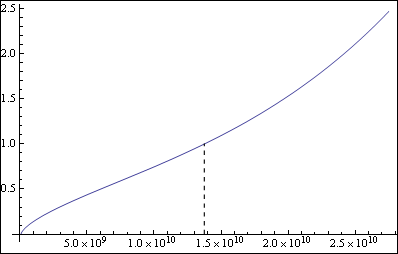
On top of that, galaxies are slipping away from us because of the exponentially accelerating expansion of the universe (x axis in years since Big Bang, cosmic scale function arbitrarily set to 1 at the current day):

At the rate things are going, we seem to be losing slightly more than one galaxy a year. One entire galaxy, with its hundreds of billions of stars, is slipping away from us each year, never to be interacted with again. This is many solar systems a second; poof! Before you've even had time to grasp that concept, we've lost millions of times more resources than humanity has even used.

So it would seem that the answer to this desperate state of affairs is to rush thing: start expanding as soon as possible, greedily grab every hint of energy and negentropy before they vanish forever.

Not so fast! Nick Bostrom's point was not that we should rush things, but that we should be very very careful:

However, the lesson for utilitarians is not that we ought to maximize the pace of technological development, but rather that we ought to maximize its safety, i.e. the probability that colonization will eventually occur.

If we rush things and lose the whole universe, then we certainly don't come out ahead in this game.

But let's ignore that; let's pretend that we've solved all risks, that we can expand safely, without fear of messing things up. Right. Full steam ahead to the starships, no?

No. Firstly, though the losses are large in absolute terms, they are small in relative terms. Most of the energy of a star is contained in its mass. The light streaming through windows in empty rooms? A few specks of negentropy, that barely diminish the value of the huge hoard that is the stars' physical beings (which can be harvested by eg dropping them slowly into small black holes and feeding off the Hawking radiation). And we lose a galaxy a year - but there are still billions out there. So waiting a while isn't a major problem, if we can gain something by doing so. Gain what? Well, maybe just going a tiny bit faster.

In a paper published with Anders Sandberg, we looked at the ease and difficulty of intergalactic or universal expansion. It seems to be surprisingly easy (which has a lot of implications for the Fermi Paradox), given sufficient automation or AI. About six hours of the sun's energy would be enough to launch self-replicating probes to every reachable galaxy in the entire universe. We could get this energy by constructing a Dyson swarm around the sun, by, for instance, disassembling Mercury. This is the kind of task that would be well within the capacities of an decently automated manufacturing process. A video overview of the process can be found in this talk (and a longer exposition, with slightly older figures, can be found here).

How fast will those probes travel? This depends not on the acceleration phase (which can be done fine with quench guns or rail guns, or lasers into solar sales), but on the deceleration. The relativistic rocket equation is vicious: it takes a lot of reaction mass to decelerate even a small payload. If fission power is used, decelerations from 50%c is about all that's reasonable. With fusion, we can push this to 80%c, while with matter-anti-matter reactions, we can get to 99%c. The top speed of 99%c is also obtainable if have more exotic ways of decelerating. This could be somehow using resources from the target galaxy (cunning gravitational braking or Bussard ramjets or something), or using the continuing expansion of the universe to bleed speed away (this is most practical for the most distant galaxies).

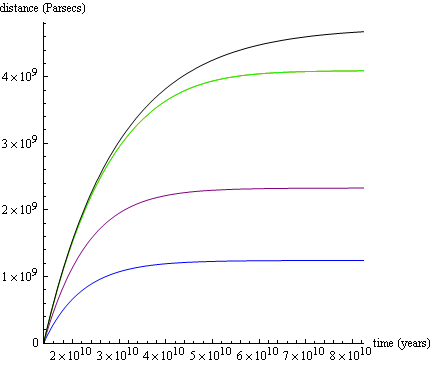
At these three speeds (and at 100% c), we can reach a certain distance into the universe, in current comoving coordinates, as shown by this graph (the x axis is in years since the Big Bang, with the origin set at the current day):

The maximum reached at 99%c is about 4 GigaParsecs - not a unit often used is casual conversation! If we can reach these distances, we can claim this many galaxies, approximately:

Speed Distance (Parsecs)
# of Galaxies
50%c
 1.24x10⁹ 1.16x10⁸
80%c
2.33x10⁹ 7.62x10⁸
99%c 4.09x10⁹ 4.13x10⁹

These numbers don't change much if we delay. Even wasting a million years won't show up on these figure: it's a rounding error. Why is this?

Well, a typical probe will be flying through space, at quasi-constant velocity, for several billion years. Gains in speed make an immense difference, as they compound over the whole duration of the trip; gains from an early launch, not so much. So if we have to wait a million years to squeeze an extra 0.1% of speed, we're still coming out ahead. So waiting for extra research is always sensible (apart from the closest galaxies). If we can get more efficient engines, more exotic ways of shielding the probe, or new methods for deceleration, the benefits will be immense.

So, in conclusion: To efficiently colonise the universe, take your time. Do research. Think things over. Go to the pub. Saunter like an Egyptian. Write long letters to mum. Complain about the immorality of the youth of today. Watch dry paint stay dry.

But when you do go... go very, very fast.

47 comments
11 Jul 14:20

Great News For All Our Clients

by Tom

I was reading this piece on Ernst & Young and it struck me – not for the first time – that growing up reading IPC comics was the best possible preparation for a career in BUSINESS esp. mergers and acquisitions.

Just look at the history of Ernst & Young, or EY as we now call them.

Ernst & Ernst became
Ernst & Whinney became
Ernst & Young became
EY

What does this remind you of? THAT’S RIGHT.

Buster became
Buster & Monster Fun became
Buster with Whizzer & Chips (should really have been Buster, Whizzer & Chips – more gravitas)

& then OK Buster never rebranded itself “B” but we can cross the tracks to DC Thompson and observe how Beano became BEANO MAX to get with the kids, in the same way as hipster accountants everywhere will feel vindicated by EY’s funky rebranding.

i.e. they’re doomed.

11 Jul 13:18

Kissing your posters goodnight: Robotic Seals, Paula Deen, and other Constructed Role Models.

by Sarah Clark

FL Kissing Posters Goodnight CoverOk Folks, let’s set the wayback machine to a typical bedtime in suburban “Pleasant Valley”, Oklahoma circa early 1988.

The 11 year old fangirl who will be calling herself “Camille” in another decade or so has done her typical slapdash job on math homework while spinning More of the Monkees with a Tiffany chaser. She followed that up by devouring the latest Lurlene McDaniel  feel good novel about childhood terminal illness with the speed and reflective nuance of your average wood chipper.  Another day of 5th grade nerdiness and social isolation awaits her, and her Dad’s overdue for a seizure to boot. Before turning out the lights, the girl stands on her bed to reach the 36×24 orange poster that looms over the room, surrounded by other pinups and photos. Under her lips as she kisses four times, the poster feels both slippery from the coating and a little sticky from the dozens of good night kisses before that one. She turns out the light and as she drifts off, she once again wonders why, exactly, life is worth living. She mopes for a few minutes, and then she remembers. Whether on TV, in the songs they sang, or in what little she knows of their real lives, the guys on her wall never gave up, even when they screwed up or the whole world was against them. And somehow things had gotten much better for each of them. If they didn’t quit, then she couldn’t quit either. Holding on to that truth (or at least what she believes is the truth), she drifts off to sleep.

In that way, 24 hours at a time until the moment a year or so later when I abruptly outgrew both that dark space and (for almost 10 years) those 4 guys, I always decided not to quit. And somehow things got much better for me too. But here’s you’re a question to bake your noodle (if I didn’t still ponder it at times, would I be writing a pop culture blog?)—was it, as I believed at the time, really the Monkees (or any of my other early celebrity loves) who saved me from my depression, or was I motivated by four half-real (if even that) symbolic constructions that lived rent-free in my head? If the latter, didn’t I really just save myself?

…It depends.

cast-awaySo right after I enforced a Fandom Hiatus on myself in the wake of the overwhelming reaction to my previous post, I checked in with one of my favorite analysts of current affairs that actually matter in the grand scheme of things, Andrew Sullivan. While skimming the archives, I bumped into this fascinating discussion of a nursing home in Japan that is using therapeutic robotic pets as companions for their residents, and the emotional connections that those elderly men and women appear to be forging with machines. The whole article Andrew linked to is worth reading, but I sort of got stuck on this passage (which proceeded to spark the rest of this post):

Do you find the idea of getting a robot companion when you check into Shady Acres a little unsettling? It shouldn’t, because the choice isn’t between Bernice in room 248 having a robot stuffed animal, and Bernice’s children and grandchildren visiting every day. It’s between the robot and nothing, or if not nothing, at least a rather limited and probably emotionally unsatisfying degree of connection with other people.

Now really, if we’re honest, how different is a holding pen like a nursing home from a holding pen like middle school? You go home from school at 3:00, but the nursing home hopefully has a better cafeteria, so it probably evens out. Between the age of about 9 and 13, I had no (as in zero) friends my age, or at least couldn’t bring myself to trust anyone enough to consider them a true friend. So…I subconsciously improvised with my own self-constructed versions of robotic stuffed animals, built out of the bits and pieces of pop culture that could make me giggle when I really wanted to scream. Accomplished adult though I may be, I still turn to some of those artificial constructions in times of trouble. (see also: 95% of my online activity between May 2012 and early 2013)

Paro10I spend a fair amount of time on Tumblr when real life permits—perhaps more than is healthy for my sanity and/or IQ. Even at its most idiotic (and we all know the Tumblr zeitgeist can get mighty idiotic), it’s a fascinating real-time stream of symbolic interactionism, as you watch adolescent girls make sense of their lives and struggles through the metaphorical frameworks  of Hunger Games or One Direction. However, whatever our age or gender, We ALL use celebrities and fictional characters to view and make sense of our lives—That reflex is probably inevitable given they’re part of the cultural stew of signs, symbols, and metaphors in which we all swim.

That sort of narrative sensemaking is also, according to a long-ago undergrad mythology course, something we’ve done since we started telling stories to each other. Ancient Greeks might not have walked around wearing mass-produced LiveStrong wristbands from the Heracles Foundation, but you can bet they asked themselves some version of “What would Perseus do?” when stumped with a challenging situation. The symbols may change, but the impulse is identical. A common, recurring meme in fan culture (particularly Tumblr) that I find fascinating right now is:

“*insert celebrity name* wouldn’t want me to engage in *insert self-destructive activity*.”

Whatever the negative behavior, a kid has somehow found a way to short-circuit it by invoking their favorite celebrity as a role model to whose standards they want to live up. And you know, really it doesn’t matter whether or not Justin Bieber cares about the bulimia struggles of a 13 year old girl from Albuquerque.  She believes it, and if it keeps her from throwing up lunch, my pragmatic nature (and Pragmatic worldview) leads me to believe that’s all for the good. Of course, I’m speaking as a person who is very grateful that her ten-year-old self followed that similar bit of optimistic “logic” described above.

The problem, of course, is that those constructed personas, built through a combination of the Celebrity-Industrial Complex and our own imaginations as fans, are eternally linked to the real human beings who “perform” their celebrity personas (not to mention whatever fictional roles those people might be portraying on top of their public Personas). That’s a lot of levels of identity to get mixed up, even before we get to the outright misrepresentations in the media that Nez mentioned yesterday in his FREAKING INCREDIBLE ROLLING STONE INTERVIEW (which. by the way, I read AFTER writing 99% of this post). To complicate ontological matters further, said human beings will inevitably behave  in ways that contradict what their fans believe about the celebrity’s constructed public self/selves. And of course, most fans have a much close knowledge of and connection to the Persona than the Person, to the point that they confuse the latter with the former.

Because of this inevitable disconnect between the constructed Celebrity persona and the person themselves, the knives come out whenever a celebrity behaves “badly”, whether in matters large (Lance Armstrong’s doping, or Kevin “Elmo” Clash’s alleged sexual misconduct), Medium (Paula Deen’s nostalgia for a plantation-style wedding staffed by “cute little N—s” in the distant and far less racially enlightened year of 2007), and small (Justin Bieber’s note in the Anne Frank house guestbook, or Michael Nesmith’s “Jimmy Fallon is gonna sing Daydream Believer on the 2012 Monkees Tour!” practical “joke”). While I prefer this sort of Rage Reaction to many fans’ instincts to hide from reality regarding their heroes (see also: the hordes signing up for a Paula Deen cruise as some sort of protest move), I still think the Paula Deen Implosion and many other ritualized public floggings are often over the top, make fans and fan culture look idiotic, and that they sometimes spring from a basic misunderstanding of the difference between the wo/man and the mask.

Via Radar Online

Via Radar Online

(Disclaimer time: I am not demeaning the very serious and real nature of all but one of these misdeeds, particularly Armstrong’s and the allegations facing Clash. They should be investigated to the fullest extent of the law. It also sounds like the Paula Deen empire was a mighty hostile work environment, whether or not she was a premeditated Racist or simply dumber than anyone who’s been in the limelight for 11 years has a right to be. But really—however stupid “Monkee Mike’s” joke was—and even seldom-apologetic Nez ultimately admitted it was MIGHTY idiotic–that pre-tour meltdown by many Monkees fans was self-indulgent, unwarranted, and made me embarrassed for my Once and Future Fandom.)

Those over the top Shaming Rituals also highlight another trait of our interactions with famous people. As fans, we seem to expect a lot from our celebrities in return for what they give to us, even though in reality they don’t have much more “authentic” connection to us than those robotic seals have with the nursing home residents. That impulse is why it’s so hard not to be disillusioned when our role models either act or are accused of acting in ways that go against our images of them. However, I learned something a couple of years ago that might provide a route out of this dichotomy.

In August of 2011, I started one of my favorite PhD classes, Organizational Theory. Davy would still be alive for about another 6 months. Anissa, who was busy with grad school herself, would be with us for almost another year, but I doubt either of them had really crossed my mind since Anissa and I (I think?) shared a Passing Derisive Snort on Facebook when the 2011 tour fell apart. However long it had been since I really thought of either of them, I can guarantee you that Monkeedom was pretty much the last thing on my mind that night. That said, I learned something in my first evening of class that actually inspired the name of this blog, and informed the whole way I moved through and made sense of The Year of our WTF.

After discussing the concept of theoretical lenses and how different ones might be more or less useful for making sense of particular situations we might encounter as administrators, our professor led us in an exercise that helped bring this concept home. She divided the class into thirds, instructed some of us to sit or stand on top of the desks, some to lie on the ground, and the rest to stay seated. After 60 seconds of looking around the room, we took our seats and wrote brief descriptions of what we had seen. (the clock, a mark on one of the ceiling tiles, a chair leg, whatever) As you can imagine, each of the groups described a very different view. Now, I’ve read plenty of cultural theory in my day. On a more pedestrian level, I’ve long been a fan of the “two sides to every story” argument, and even instinctively knew that “the truth” can often appear very different depending on how you look at it. However, for some reason that concrete exercise helped me understand that one doesn’t need to latch on to one way of viewing the world at the time, but rather can use an ever-evolving set of “lenses” through which to view the world, knowing that different things will “light up” depending on the lens you’re using. Using a framework to view the world is not an either/or proposition, but rather a both/and, utilizing the framework(s) that make sense for making sense out of a given phenomenon.

Hence, the name “Fandom Lenses”. I’m sure you always wondered. :-)

Paula deen apology

Why that seeming digression? Because in my opinion, cultivating the ability and insight to view a celebrity as their cultural personality and/or as an inevitably flawed and mundane human being depending on the circumstance can provide a fan with an escape route from a lot of the nonsense at play. I consciously used this approach last week as I struggled to make sense of Eric Lefcowitz’s revisions to Monkee Business, and while I doubt I arrived at “The Answer” regarding his allegations, I did come to a logical conclusion that gave me (and others, from what I hear) some peace about Davy Jones the human being and “Davy Jones” the persona. To use a more well-known recent example, In my opinion, Paula Deen’s mildly racist comments certainly aren’t bad enough to qualify her as a member of the KKK (faint praise indeed) or possibly not even the extent of public excoriation she’s endured (though she absolutely deserved some of it). However, I also think that her ignorant actions from the 1980s up through last year’s (when she publicly lamented that the emancipation proclamation drove her “good slave owner” great-great-grandfather to suicide) have likely destroyed the “Paula Deen” persona’s already-waning power as a brand for selling cookware, Butter, ad space, and anti-diabetes drugs—at least until the celebrity-industrial complex rehabilitates her a la Robert Irvine.

All that said about our responsibility to consider these issues critically, where do a celebrity’s responsibilities as an artist and/or public figure start and end? My go-to knee-jerk response in most cases (because many average fans appear to be entitled beyond all sense of reason) is that stars don’t owe us squat beyond providing us the intellectual property that we pay for at the highest quality they are capable of. But then again, we often pay quite a premium for given intellectual property because it’s from a given person, and not (just) because of their perceived aesthetic talents. For instance, I love Mumford and Sons, rank their work highly from an aesthetic point of view, and would love to see them live.  On a similar note, I catch almost every Weird Al tour that visits Tulsa because I’ve been a fan of his even longer than I’ve been a Monkees fan and he puts on the second most entertaining show I’ve ever seen live. I would NOT however fly my airplane-loathing butt halfway across the US to see either of those acts. Twice. The second time while still getting over some horrible Plague I caught on my flight back home from Manchester after my vacation/conference paper.*

So if I rank Nez, Mumford and Sons, The Monkees and Weird Al as rough equals from an aesthetic standpoint (radically different acts though they may be), why did I react so viscerally to the prospect of seeing Nez play live? Obvious issues of scarcity aside, I flew halfway across the county (twice) in part because of the high-quality music, partly in honor of that kid who kissed that poster good night, but mostly because of the woman I became and the friends I acquired through the process of interacting with four jointly constructed symbols who have evolved dramatically in complexity and nuance over the last 26-ish years.

In other words, the persona (as I understood/constructed it) informs how I react to the person, to the point that I’ll probably never separate them fully even if I ever met the “real” Nez, Alton Brown, Gene Wilder, Peter Tork, Mayim Bialik, or any others of the dozen or so celebrities whose humor, intelligence, and/or creativity I resonate deeply with. Even though I will never “truly” know these people, and occasionally am confused by or disagree with some of their actions or beliefs, I will think of them all fondly, and inevitably through slightly rose-tinted glasses, because of the meaning I was able to make of myself and the world by viewing it through the lens(es) of their public personas.

To bring it back to you all, I’ll wrap with two questions. What have you learned about yourself and/or the world by being a fan? Also, how has fandom made you a better person? I’d love to hear your thoughts in the comments, or on my facebook or tumblr pages. More next time, which might not be until the review of the Tulsa Monkees concert.

~~~~~~~~~~~~

* Insert lame, smartass, (and based on yesterday’s Nez comments quite possibly inaccurate) “Davy Jones’ revenge from beyond the grave” joke here. Never would have thought I’d be so glad to have NOT gotten a Conversation reception pass to meet one of the seminal artistic and intellectual influences of my life. Forget getting a whiff of his cologne (my nose was still closed for refurbishment anyway), I’d have been terrified of breathing on him.


11 Jul 12:32

MAP

by iamjamesward

A while ago, I was looking on eBay for something. I can’t remember what. Maybe I was just a bit bored. I spotted an old postcard of Post Office Tower. I had a look for some more. I thought it would look kind of nice to have three postcards of Post Office Tower in a little frame. The same building, but seen from slightly different angles, three times in a little row. So I bought a few of the postcards, but then I thought that perhaps two rows of three would look better, so I bought a few more. Then I thought that maybe four rows of five would be even better. The mistake I made was to start buying the postcards before I bought the frame.

I’ve created a Flickr set and started scanning the postcards I bought. You can see them here. I’ll add to it as the collection grows.

Some of the postcards had been used. Simple messages sent from trips to London. I like reading old postcards. It gives you a glimpse into someone’s life, but doesn’t feel too intrusive. A letter can contain personal information. It’s private, sealed in an envelope. A postcard is more public. The person writing it knows the postman can read it. They’re often stuck on a fridge or a pinboard where other people can read them. Nothing too personal gets put in a postcard.

I wondered how London had changed since the photos for these postcards were taken. Obviously the Tower is still there, although that itself has changed. The triangular cones replaced by round dishes, then eventually removed. The Billy Butlins Top Of The Tower revolving restaurant no longer there (since its closure, there is now only one revolving restaurant in the UK, at Elveden Forest Center Parcs). The building now closed to the public.

Some of the postcards showed views of the Tower from the air, or from the tops of buildings, but a few of them showed views from the street level. It seemed easy to visit those places and compare how it looked then:

Clipstone Street then

With how it looks now:

Clipstone Street now

There’s something reassuring about the fact that the betting office on the left is still there today.

There seem to be a lot more trees today. This was Charlotte Street in 1966, not long after the Tower opened:

Charlotte Street then

And this is it from more or less the same spot today:

Charlotte Street now

I had to work out where the original was taken based on the pattern of the rooftops on the other side of the road, although you can’t actually see them in the photo because of the trees.

More trees, but fewer phone boxes:

Charlotte Place then

Charlotte Place now

Charlotte Place then and now

I’ve created a Google Map showing the original postcards along with the view today (if possible) and any messages which were written on the back of the postcards, which doesn’t really make sense because it’s not like the person who sent the postcard went to the place where the picture was taken before writing their message. That’s not how postcards work. You might visit the place shown in the picture, but probably not the place the picture was taken from. Anyway, it’s done now.


11 Jul 12:30

This Zen-Crazed Aerial Madman Just Won’t Take No For An Answer (The Last War in Albion Part 4: Michael Moorcock, Luther Arkwright)

by noreply@blogger.com (Philip Sandifer)
“This Zen-crazed aerial madman just won’t take no for an answer”
-Grant Morrison, The Invisibles #18, 1996

[previously] The Cornelius books are characterized by large quantities of philosophical dialogue in amidst the action set pieces, which often fade towards the background. A few chapters after the yowling passenger Cornelius recalls a conversation where “a girl had once asked him, stroking the muscles of his stomach, ‘what do you achieve by the destruction of the odd library? There are so many. How much can one man do?’ ‘What he can,’ Cornelius had told her, rolling on her. ‘It’s History that’s caused all the trouble in the past.’” Moorcock has commented that the Cornelius books are populated by “characters who are aware of the psychological implications of their statements and actions. That is they are as aware of the unconscious as the conscious. In that sense it was a rejection of modernist techniques as found in Joyce, Woolf and so on. My view was that we had moved on from needing to make that sort of observation.” Instead Moorcock’s characters, as he describes it, “tend to anticipate one another's statements and short-cut their own,” engaging in an endlessly anticipated and reiterated philosophical dialogue that plays out over the superficial frame of the heroic fantasy stories.

In this regard the Cornelius line can be thought of as the archetypal Moorcock work - the one that explores the way in which the same basic story structure that underpins all of the iterations of the Eternal Champion changes and shifts as the world around it does. The later Cornelius stories arbitrarily change the frame and rules of the story from chapter to chapter without particular explanation.

Figure 22: Barbarians and Mods juxtaposed in "Time is a
Four Letter Word," from Near Myths #2, 1979 (Click images
to expand)
To suggest that it is possible that a fictional multiverse in which one primary character is a dandy action hero who lives in an eternally shifting world and another - the most prominent, in fact - is a sword and sorcery barbarian figure whose world blends in with the present day at times might have been an influence on the writer of the Gideon Stargrave stories or “Time is a Four Letter Word” seems almost too obvious to be worthwhile. Of course Moorcock was a major influence on Grant Morrison’s earliest comics work, and, more to the point, on much of his subsequent work.

The question of why Moorcock, who was after all usually perfectly happy to let others play with his fictional concepts, lashed out so angrily at Morrison for his Cornelius pastiche is interesting, but not entirely germane at this point in the war’s development. Suffice it to say that Morrison is quite justified in his exasperation when he points to his later works and asks “can anyone tell me from which Michael Moorcock novels Zenith and Animal Man were plagiarized,” but that it is equally clear that Morrison was influenced by the entire new wave literary tradition Moorcock came out of, and that it is in many ways very easy to draw direct links between Moorcock’s work and his. 

Figure 23: Jon Finch's rendition of Jerry Cornelius talks
assassination in an arcade in the 1973 film version of
The Final Programme
But it is also important to realize that for Morrison it is more the interplay of iconography that fascinates Morrison than the actual content. So while Morrison may include a flashback to Stargrave and his sister Genevieve arguing, whereby Genevieve proclaims that “love is a lie! A justification for sex! Sex is all there is! Sex! Sex! Sex! You’re out of synch with the world, love. Obsolete…” - a scene with marked similarities to the sorts of twists the Cornelius books take - this is, for Morrison, just a visual and narrative trope to riff off of. In this regard it is perhaps more significant to look at the degree to which Cornelius had filtered out into the larger culture. Echoes of the concept, after all, can be found throughout 1970s popular culture. Most obvious is the 1973 film The Final Programme, a Moorcock-disclaimed adaptation of the first Cornelius book starring Jon Finch as Cornelius and imbuing Cornelius’s adventures with a genuinely visual aesthetic. The film was a disposable piece of 70s trash cinema, and its execution rarely matched the giddy ambition of the books, but it still grounded Cornelius’s adventures in what seems like their natural environment: the world of cultural images out of which his adventures are built. Morrison, for his part, cites the film as equally important to his aesthetic and self-conception as the books when he mentions them in Supergods.

Figure 24: Jon Pertwee glam action hero third incarnation of the
popular television character Doctor Who was another blatant
Jerry Cornelius ripoff
If the film of The Final Programme was cheap-looking version of the Cornelius stories then it compares sensibly with the other obvious Cornelius analogue in 1973’s popular culture, the Jon Pertwee era of Doctor Who, featuring Pertwee as a ruffled shirt-wearing dandy whose magical blue box moved him rapidly from setting to setting, and who never quite fit in, always seeming more like an alien doing a drag performance of the manly action hero - the sort whose cool car was in fact an antique roadster, and whose action sequences consisted of shouting “Hai!” a lot as people fell over at the hands of his mighty Venusian Akido. This idea of an alien drag performance also describes the glam rock period of David Bowie’s career, which seems in many regards a decade-long real life performance of a Jerry Cornelius story, complete with the inevitable transformation into Pierot the Clown that awaited Bowie in his last magnum opus, the 1980 album Scary Monsters. If Cornelius is less a character than a technique then the technique was a standard approach of 1970s media, and Morrison, who is clearly deeply invested in the visual style of things, would have picked it up from far more places than just some novels. 

Figure 25: Pierot the Clown is a familiar figure from
the Commedia dell'arte
This marks a profound difference between Morrison and Moorcock. Moorcock is aggressively literary in his influences - from his perspective “the Commedia dell’arte,” an Italian style of theater based around stock and trope characters, “has been one of my chief influences, especially in relation to the Cornelius books. I have a large collection of commedia material as well as French and English versions. I have some of those old commedia plot books which can be very stimulating when mulling over the structure of a story.” Elsewhere he lists his influences as Ronald Firbank, a post-decadent British author of the early 20th century heavily inspired by Oscar Wilde, and Burroughs, who he remarks are “two not dissimilar figures in my estimation.”  The difference between this profoundly bookish approach and Morrison, who in 2005 declared that “I haven’t had any interest in science fiction since a brief but inspirational teenage obsession with the ‘New Wave’ generation of Moorcock, Ballard, and Ellison” and that “these days I just read comics and watch DVDs for my fiction dose” is self-evident. However similar the material the two writers treat, in other words, there are fundamental divergences in their interests and approaches.

In other words, rather than focusing on the specific question of direct influence it is more useful to consider the general question of interplay between the new wave that Moorcock and Ballard belonged to - a movement that had demonstrably broad impact on the culture - and British comics in 1979, particularly in the context of Near Myths

If this means going beyond Moorcock’s work to understand the context then it also means going beyond Morrison’s, as Morrison’s work is by and large only the second best Moorcock-indebted work in Near Myths, and Gideon Stargrave is in no way the sole protagonist in the anthology to be inspired by Jerry Cornelius. The other, greater Moorcock riff is Luther Arkwright, eponymous hero of Bryan Talbot’s universe-hopping epic. Talbot is, largely unfairly, the forgotten man of British Comics; unlike both Moore and Morrison, who abandoned drawing their own comics due to their lack of speed and talent, Talbot remained known primarily as an illustrator, as well-known for his work on Nemesis the Warlock for 2000 A.D. and his credits in things like Vertigo Comics’ Sandman, Hellblazer, and Fables. But his solo work is of equal note, particularly Alice in Sunderland, The Tale of One Bad Rat, and The Adventures of Luther Arkwright

Figure 26: Gunplay with nuns in the first appearance of
Bryan Talbot's Luther Arkwright, "The Papist Affair," from
his mid-70swork in Brainstorm Comix...
Luther Arkwright did not begin in Near Myths, but in Brainstorm Comix, a mid-70s underground book put out under the Alchemy Press label and dominated by Talbot’s early work. A seven pager  a not even thinly veiled Cornelius clone, “The Papist Affair” did not bristle with promise, and is not even included in later editions of the story. Still, its mix of motorbikes and period detail in an alternate history in which the villain is the church is a close mirror of Grant Morrison’s “The Vatican Conspiracy.” This fact is not lost on Bryan Talbot, who in 2009 referred to “a kung fu fight with a fascist archbishop - a scene later plagiarized by Grant Morrison in one of his Near Myths strips.” Talbot overstates the case, but more has been made out of narrower similarities in the course of the war.

Figure 27: And in Grant Morrison's second Gideon Stargrave
strip, in Near Myths #4 (1979)
Still, all of this would be an odd footnote were it not for the fact that Talbot resurrected the character for a strip in Near Myths, which debuted in the first issue and continued into issue number five, which Talbot himself edited in a last, desperate, and failed to get the magazine into usable shape. Talbot tried it again in psssst!, when it was interrupted by the magazine folding out from under it again, before the existing material was collected along with several issues of new material by Valkyrie Press from 1987-89, and eventually Dark Horse Comics in a manner not dissimilar to DC/Vertigo handling of Alan Moore’s V For Vendetta. 

Although few would suggest, particularly in the light of the latter’s appropriation by Anonymous and the Occupy movement, that The Adventures of Luther Arkwright has had the same degree of influence as V for Vendetta, the comparison is not entirely inapt. Certainly The Adventures of Luther Arkwright has what might be described as friends where it counts - Michael Moorcock, Alan Moore, Neil Gaiman, Rick Veitch, and Garth Ennis provided fan mail for the letter column of the first issue of Arkwright sequel Heart of Empire. Moore and Moorcock further provided introductions to the Valkyrie press editions of The Adventures of Luther Arkwright, where Moore tipped his hat to Talbot for being “a crucial stepping stone” and positioning Talbot as the genesis of the entire wave of British comics writers and artists that was cresting in 1987 when his introduction was written. Moorcock declares him “one of my own personal favorites,” while Warren Ellis goes so far as to proclaim Arkwright to be “the single most influential graphic novel to come out of Britain to date.” Even Grant Morrison, whose relationship with potential influences can be strained, defends Talbot in a 2002 interview, crediting him over Alan Moore for comics’ abandonment of thought bubbles, and defending him when the interviewer proclaims, “I don’t rate Luther Arkwright,” saying that “I just thought it was fantastic” and “I like Bryan Talbot’s work. It kinda resonated with stuff I was into.” 

Clearly The Adventures of Luther Arkwright is a landmark text, and, by most reasonable standards, more important than the appearance of Morrison’s promising juvenilia. But these proper Luther Arkwright stories follow from what is almost an incidental detail of “The Papist Affair,” which is mostly as Talbot described it in 2009 - “a daft romp.” In the course of its heavily armed motorcycle nun antics the story almost incidentally introduces its premise of parallel worlds. This is sensible enough - “The Papist Affair” is an admitted Cornelius riff, and thus it’s essentially impossible that parallel worlds weren’t in Talbot’s head as he was writing it. But Talbot became intrigued by this concept and decided to develop Arkwright into a character who could anchor a sustained narrative.

Figure 28: Textual artifacts from
within the fictional world and tight,
detailed linework from The Adventures
of Luther Arkwright #1
 (1987, original
from Near Myths, 1979)
In the course of this he moved the character away from his Moorcockian roots. So the Luther Arkwright of Near Myths is a more austere character, still modern, but rendered in a less period-dated style. Talbot also swapped the cartoony, exaggerated style of the Brainstorm Comix iteration of the character in favor of a shadowy style dominated by intricate inkwork and photorealist faces, and abandoned the simple grid he used for his straightforward action romp in favor of an experimental style heavily reliant on layering objects on top of objects and including snatches of documents that exist only within the world of the story. 

Like Morrison’s work there’s a high degree of formal complexity to Luther Arkwright. And like Morrison’s work this complexity is turned towards a specifically psychedelic approach in which the hopping between parallel universes turns into an intensive spiritual enlightenment. This culminates in issue six of the nine-issue Valkyrie Press series, in which Arkwright has a near-death experience that provides psychedelic and spiritual rebirth. Splash pages dominated by blocks of text abound, walls of stream of consciousness and ecstatic visions juxtaposed with Blakean horrors rendered in what Morrison describes as Talbot’s “meticulous drawing style” and compares to Albrecht Dürer. 

Figure 29: Albrecht Dürer was a German Renaissance
printmaker and engraver.

The text becomes a cut-up invocation that puts Burroughs to shame, describing how “in the garden of Gethesemene Kali becomes Miranda take this my ankh the egyptian sign of life renounce the ways of violence Luther the tabla beat faster the star changes to a distant Balalaika Siberian winds howl” against a backdrop of copulating demons drawn in sinewy shadow. [continued

11 Jul 02:33

A Role Model

by Jack Graham
In an age when the suffocating omnipresence of the imperatives of neoliberalism has penetrated every single corner of culture - aggressively colonizing even the formely overlooked, underpoliced nooks and crannies where eccentricity and offbeatitude used to be free to spring up like hardy weed - and even the supposedly nerdy heroes have to be marketably thin, sexy and dressed in geek chic, it might do us all good to remember...


My.  Fucking.  Hero.
11 Jul 01:18

‘I sit on a man’s back, choking him …’

by Fred Clark

Here’s Leo Tolstoy describing the difference between nice and good:

I sit on a man’s back, choking him and making him carry me, and yet assure myself and others that I am sorry for him and wish to lighten his load by all means possible … except by getting off his back.

Tolstoy reveals the hypocrisy  – the impossibility — of trying to exert power over someone else while still regarding oneself as a good person. To become a good person — a just or a loving person — in the scenario he describes requires one thing above all else: getting off the man’s back. None of that other business about assuring everyone “that I am sorry for him and wish to lighten his load” matters in the slightest.

But I think Tolstoy also shows us here part of why this is so difficult for the powerful to do. It’s partly that being carried by the labor of others is easier than carrying ourselves, but it’s also the fear that getting off of the man’s back will allow the man to retaliate. Justice demands, before and above anything else, that I get off the man’s back. But I’ve been riding this man and choking him for too long to think of justice as my friend.

I sit on a man’s back, choking him and making him carry me, and therefore justice is to me a terrifying threat. If the world suddenly became a just place, I’d be the first one up against the wall.

In other words, part of the reason that any form of oppression continues is that the oppressor comes to fear the oppressed. That fear, like the guilt the oppressor dimly still feels (“I am sorry for him”) is in some ways quite reasonable. But both of those also, perversely, tend to reinforce the oppressor’s resolve because we humans tend to resent anyone who makes us feel frightened or guilty — to hate those we fear and to hate those we know we have wronged. And that hate makes it easier to continue sitting on the man’s back, choking him and making him carry me.

This fear is related to the inability to imagine any kind of world in which someone isn’t sitting on top of someone else. If I get off this man’s back, then, it must mean that he will get on my back, choking me and making me carry him. It’s a bit of a chicken-and-egg question as to whether the fear comes from this failure of imagination or if the failure of imagination comes from the fear. A bit of both, probably, and either way the end result is the same: a firmer determination never to get off the man’s back.

David Shelton sees this chicken-and-egg problem and tries to address both the fear and the failure of imagination straight-on. This is Shelton’s 10th point in a long, helpful post on “How to Not Be Viewed as a Bigot“:

10) Understand that we’re not you.

What does this mean? Simple. We are not interested in squelching your rights like you have done to us for decades. We’re not interested in preventing you from getting married. We’re not going to pass a law that makes it legal for someone to fire you because you’re Christian. We’re certainly not going to make Christianity illegal. Our agenda is, and always has been for you to stop doing these things to us.

Frankly, you’ve been punching us on the face for years. It’s not an infringement on your rights to say “stop punching them in the face.” Never has been, never will be.

“We’re not you” has to be said, but I’m not confident that the people Shelton is addressing will be capable of believing him. “We’re not interested in squelching your rights like you have done to us,” he writes — identifying precisely the thing they fear. He’s trying to reassure them that retaliation isn’t his goal. He doesn’t want to sit on their back, he just wants them to get off of his.

But the problem with the message of “we’re not you,” is that it’s addressed to people who are, in fact, “you” — to people who can only imagine what they would do if they were in his shoes and thus what he would do in their shoes. It’s projection — the shriveled, diseased remnant of the empathy that none of us can ever be wholly rid of.

“Understand that we’re not you.”

So in their stunted imagination, somebody always has to be sitting on someone else’s back — somebody always has to be punching someone else in the face and somebody always has to be getting punched. The overwrought fears Shelton aims to dissuade — hysterical fears of impending “persecution” in which fundamentalist Christians will be fired or jailed — reveal these folks’ inability to imagine a world without such persecution. They have a zero-sum understanding that says if they stop punching someone else’s face, their face will become the target.

They can’t believe Shelton when he says “We’re not interested in squelching your rights,” because in their view he’s doing exactly that. He’s trying to squelch their “right” to sit on his back, their right to choke him and to make him carry them. (Or, as Sarah Moon says in a metaphor that parallels both Tolstoy and Shelton, to squelch their “right” to stomp on his foot.)

Here’s where I’d love to be able to conclude this post by explaining the magic solution to all of this — sharing my dazzling epiphany as to how to convince such people to overcome their fear and expand their imagination to allow the possibility of a world in which no one needs to be choked and ridden, punched or stomped. But I’m afraid that epiphany still eludes me.

All that I can think to recommend is that we keep saying what David Shelton and Sarah Moon are saying — keep insisting that no one has the right to sit on another’s back and that everyone has the right not to be ridden, not to be punched in the face or stomped on the foot. And perhaps to find some ways, some gestures, to reinforce what we are saying and to demonstrate that liberation can mean something more and something better than what they fear — a mere rearrangement of who sits on whose back.

That latter point is at the heart of the film Invictus, which tells the remarkable story of Nelson Mandela’s shrewd and saintly decision to embrace the Springbok rugby team beloved by white South Africans. In Anthony Peckham’s screenplay, based on the actual events, Mandela notes that his former jailers “treasure” their Springboks:

If we take that away, we lose them. We prove that we are what they feared we would be.

He was looking for ways to affirm the passions and the culture of his former oppressors, and thereby to demonstrate, in some small way, that they could believe him when he said, in effect, “Understand that we’re not you.” It was one small way of demonstrating that power need not always mean power over.

10 Jul 22:25

The continuing triumph of the political class.

by septicisle
There are two explanations for Labour and Ed Miliband's panic over what happened in the candidate selection process in Falkirk, with Unite widely accused of trying to manoeuvre Tom Watson's parliamentary aide Karie Murphy into place.  Either the party genuinely has lost all self-control on the very first occasion that an accusation against Miliband has stuck, terrified at the prospect of the Tories constantly invoking Len McCluskey as the biggest bogeyman in British politics, his hand firmly wedged in Ed's bottom, or this is a plan that has long been in the works which has duly been dusted down and brought out, designed to deal with the "union problem" as some within Labour have come to see it.  Sunny, not normally prone to seeing conspiracies, points out how Labour seemed to want to stoke up the row with Unite last week rather than calm it down or put in perspective.  Miliband's hastily arranged speech today more than smacks of being a back-up left in reserve.

Quite how this has become a national issue at this precise moment is remarkable.  Local parties are overruled all the time over their choice of candidate, or have apparatchiks parachuted in at the last minute.  There was just such an incident during the selection of Labour's candidate in the Rotherham by-election, while John Harris notes some other recent examples where the leadership's chosen candidate has resulted in grassroots anger.  The only distinguishing feature in Falkirk is that it's Unite that's been accused of trying to influence the selection, through not particularly subtle ways.  It's about as much of a reflection of the influence Len McCluskey has over Ed Miliband as it is of the power the mid-Bedfordshire constituency Conservative party has over Cameron through their continued support for Nadine Dorries.

We shouldn't get carried away, though.  No one wants to see a full break of the link between Labour and the unions, says Robert Philpot, director of the Blairite pressure group Progress.  Just because certain Labour MPs, like Simon Danczuk, think that the Labour left should be treated like the BNP for so much as disagreeing with the party line doesn't mean that they're out to get you personally.  That everyone has instantly reached for the "clause 4" analogy, and Blair himself has popped up to praise Red Ed, saying he wished he'd moved towards an opt-in rather than opt-out system for union affiliation doesn't mean that this was engineered as a "look how Ed is slaying the union dinosaurs and transforming his party" moment.  No, this was clearly cobbled together on the spur of the moment to ensure Ed doesn't go through another PMQ's where Cameron effectively spends the entire session just pointing and saying McCluskey over and over again.

Paradoxical as it seems, the changes set out by Miliband today are ultimately designed to increase the parliamentary party's control even further.  The suggestion of open primaries for the 2016 London mayoral election, for which David Lammy already seems a shoe-in, and other as yet unknown contests are there as window dressing.  As Mark Ferguson points out on LabourList, a spending cap for candidates and the unions/groups backing them sounds wonderful and fair, but it can also have the effect of giving a big advantage to the established/establishment candidates, stopping upstarts or late entrants from spending extra to get their name out there.

The message to the unions also couldn't be clearer: thanks for all the money down the years, but we've decided we don't need you any more. Far from this being about making a break with the "machine", an hysterical proposition when the entire shadow cabinet are products of it, making do with less from the unions has the same reasoning behind it as New Labour itself did. Even if you felt that the party had abandoned you, where else were you going to go? The far left is in even more disarray than usual, while the TUSC is an utter joke. It's us or bust, except now you won't have even the semblance of influence. It might eventually be a good change for both sides, but it certainly won't be initially.

When politicians retreat from offering a vision of a better future and instead only offer years of austerity and the dilution or abolition of hard won rights in order to "win the global race", all we get is the battles of the past, fought over and over again. The Tories are never happier than when recalling their sanitised history of the 80s, and so every union is the NUM, and every leader a baron, a Scargill in the making.  For a certain section of Labour, it will forever be the battle against Militant, with the Graun hilariously describing Neil Kinnock's speech in Bournemouth as one of the "greatest of the post-war period", and as a close second, the shaking off of the old dogma of nationalisation.  Those who otherwise hate Miliband are then naturally applauding what he's done today, even though next week they'll be back to bashing him again. 

While all these former glories are replayed, and as Chris points out, pretty much anyone under 40 now has only hazy memories of the miners' strike, normal people just see three parties that look much alike, against each other purely because they think they could manage things slightly better than their rivals.  It's not that ideology has died, as some would have us believe, or that right and left are now meaningless, it's that those who make up the political class have abandoned such labels because they're a part of the past they don't want to relive, when being either Labour or Tory meant something.  Now we all just pretend it does.
10 Jul 21:42

Wimbledon interrupted by Skagra's mind-sphere: ...

by Lawrence
Wimbledon interrupted by Skagra's mind-sphere: full story, page 3.
10 Jul 17:53

As a barbarian, I will also skip this movie

by Tobias Buckell

If you don’t know who Orson Scott Card is, he’s a science fiction writer who sits on the board of NOM and writes things like this:

Regardless of law, marriage has only one definition, and any government that attempts to change it is my mortal enemy. I will act to destroy that government and bring it down…

Biological imperatives trump laws. American government cannot fight against marriage and hope to endure. If the Constitution is defined in such a way as to destroy the privileged position of marriage, it is that insane Constitution, not marriage, that will die.

and like this:

Laws against homosexual behavior should remain on the books, not to be indiscriminately enforced against anyone who happens to be caught violating them, but to be used when necessary to send a clear message that those whoflagrantly violate society’s regulation of sexual behavior cannot be permitted to remain as acceptable, equal citizens within that society.

He calls his opposition ‘barbarians’ in pieces like this:

The barbarians think that if they grab hold of the trunk of the tree, they’ve caught the birds in the branches. But the birds can fly to another tree.

Today he’s upset that people have labeled him intolerant, and calls people who don’t allow him his difference of opinion to be intolerant of him. He asks for everyone to calm down, you see, because a major motion picture has been made out of his book and he doesn’t want you to think he is a bigot, intolerant, or downright nasty. He’s worried people might boycott his movie.

Make up your own mind, but my feeling is much the same as Chuck Wendig’s:

That’s him doubling down and saying, “You need to tolerate my intolerance.” Which is a classic derailing tactic that smells so strongly of horseshit that when he says it I wonder if I’m actually living inside a horse’s ass. Just because we elected Obama president doesn’t mean I have to tolerate racism. Bigoted ignorant fuck-all is still bigoted ignorant fuck-all.

The movie may still be a rampant blockbuster. The lack of my movie dollars may not make one whit of difference (and given what we saw with Chik-Fil-A, it’s actually safe to assume the opposite of a boycott will occur — right-wing homophobes flocking to the theater to cheer on Ender Scott Wiggins Card as in their minds he eradicates whole planets of little gay bugs).

Still, I won’t pitch my chits and ducats into this bucket.

10 Jul 17:52

Seashell

This is roughly equivalent to 'number of times I've picked up a seashell at the ocean' / 'number of times I've picked up a seashell', which in my case is pretty close to 1, and gets much closer if we're considering only times I didn't put it to my ear.
10 Jul 17:52

On Sunday 30th June, my membership of the Liberal Democrats was due for renewal.

by Iain Donaldson

After 25 years in the party, I am renewing in the clear knowledge that this party has grown to be the party I hoped I had joined 25 years ago.  I have only once in my life not voted Liberal or Liberal Democrat, and that was when a Social Democrat candidate was standing in my area, it was before I got involved in the party and back then I saw the Social Democrats as just being Labour in a different guise.  I have since come to realise that they are far from that.

Before I offer my reasons, I should just explain that renewing your membership (or indeed resigning it with valid reason) are legitimate positive actions normally taken in principle.  That is why if someone tells me honestly that they no longer agree with what the party is doing or standing for then I can respect their decision even if I disagree with it.  If someone just lets their membership lapse then that is to me the product of the indecisive mind failing to concoct a coherent case either way and so trundling off in confusion.

It’s the economy

For the first time in my lifetime I am seeing a Government that recognises that our economy can not survive on services alone, we need to build things.  This Government has kept our ship builders in work by diverting the manufacture of wind-turbine stantions to our shipyards, it has secured the re-opening of our only remaining steelworks in Redcar, it has secured the growth of our car industry to the point at which we are for the first time since 1976 a net exporter of cars, and it is funding major research and development projects into scientific innovations that will put this country in the forefront of global technology.

Of course Governments have got to balance the books, and there are a number of ways in which I would balance them differently, but let’s be clear about this – you don’t base your political philosophy on a few million spent here or cut there, you base your political philosophy on the overall aims.  “A stronger economy in a fairer society enabling everyone to get on in life” seems to me like a very laudable and liberal aim.

And of course there is no point in even trying to create a stronger economy, if you don’t make sure that the children of today are properly educated to do the work of tomorrow.  It is that focus on education that makes this Government, in my eyes, not only the most Liberal in my lifetime but possibly one of the most Liberal in history.

Nursery places for 2 years olds, the pupil premium focussing on the needs of the poorest children in our society, the apprenticeships and youth programme not as poor men’s alternatives to a University education, but up there on an equal footing in terms of their importance to this Government, and above all the restoration of the principle that university education should be free at the point of delivery.  The Cable plan may not have delivered for the richest third, but it has certainly made University accessible again for the poorest third, and what’s, more they know it.  Applications from the poorest third were up 8.5% from previous years this year.

I remember the last General Election, I remember that whilst Darling and Osborne were talking of not needing cuts to be too deep, Vince Cable was warning of the calamities ahead, and he was right.  I also remember how people were saying “We need a coalition, we need the Liberal Democrats in there.”, and when we were asked to the Liberal Democrats stepped up to the mark.

A centre-left party?

Liberals have never believed in the big state of the Labour Party, the nanny state looking after your every need.  This has always been a party that believes that the state is there to enable people to take control of their own lives, not to run their lives for them.  Co-operative economics is embedded in the third paragraph of the preamble to the constitution, and it is co-operative politics that Liberals engage in.  Liberals believe in small business, in strong and dynamic communities and most important of all in helping people to help themselves.

The idea that you should have benefits for this, and benefits for that and everything carefully laid out as to what you can spend on what belongs with the Labour, and more recently the Conservative parties.  It is certainly not the way of Liberal Democrats.  That is why despite the outcry from some to the left of the party, actually the concept of the Universal Credit is fundamentally and unequivocally Liberal in nature.  Yes I oppose the underoccupancy levy, but it is not the principle of it being set to meet need (in this case the number of rooms a family needs) that I oppose; it is the principle of it being retroactive.  I oppose the idea that having moved somewhere on the basis of a promise of support from the state, that support should then be taken away.

There have of course been those who argue that we should have formed a coalition with Labour rather than the Conservatives.  I would advise very strongly against taking seriously any economic case that such people make.  The numbers simply did not stack up.

Party

Seats

Seats needed

Potential coalition partners

Coaltion majority

Conservative

307

19

LD

38

Labour

258

68

LD+SNP+PC+SDLP

1

Lib Dems

57


DUP

8


SNP

6


Sinn Fein

5


Plaid Cymru

3


SDLP

3


Green Party

1


Alliance Party

1


Independant

1


The simple truth is that the decimation that the Labour Party suffered at the hands of the electorate was substantial.  There was of course the option of the Liberal Democrats sitting in opposition, but as Sinn Fein never attends and the DUP are predominantly Conservative there would be virtually no vote that the Conservatives would have lost.

Compromise

All of life is a compromise, and politics is no different.  We can not expect to get all our own way in a Government in which we are the minority partner, but if you look at the four key commitments that we set out on the front page of our manifesto, every single one has been delivered on.

It is often thrown at us that we did not keep the pledge on tuition fees.  Well, actually, I never signed up to that pledge.  Some of our parliamentary candidates did, and some who got elected voted in line with that pledge, but actually as a party member I feel no obligation to answer for a policy I never supported and that was not in my party’s manifesto.

Labourites can call whatever names they want, but I recall them signing up to an ethical foreign policy and then sending our troops into an illegal war that resulted in the deaths of over 200,000 Iraqi civilians including women and children, and many dedicated British soldiers.  I will take no lectures from the Labour Party.

 The Future

 So what of the future, and my future in the Liberal Democrats?

 I am an ordinary working class lad earning somewhat less than the national average wage, living in a two up two down in Manchester with a few years left to pay on my mortgage and all my debts consolidated into one (not so) easy to pay loan.

 The Liberal Democrats in Government have cut my income tax by £ 50 a month, they have frozen my council tax for two years running (Labour in Manchester did not accept the same offer this year) and they have protected the NHS from cuts.  The Liberal Democrats in Government have created over a million new jobs and have enabled my local pub to be able to afford put on live entertainment again.

The Liberal Democrats in Government have enabled the police to cut crime in my local area to the lowest levels in over 30 years, and they have given my mum the biggest rise in her pension ever.  The Liberal Democrats have invested millions in the schools my nieces go to through the pupil premium, and they have made it possible for my nephew and nieces to choose between academia and skills.

 The Liberal Democrats in Government have protected international development monies, are allowing same sex marriage, are encouraging green investment and are on the whole looking after the ordinary working person in a way that I have not seen in my lifetime.

 My vote at the next General Election will go to my party, the party I helped to found and which is now for the first time able to do in Government some of the things I have always wanted to see happen in this country.  Yes the party is hampered at the moment by being in coalition with the Tories, but if this is what the Liberal Democrats can do with both hands tied behind our backs then for me, the future is golden.

 My vote in 2015?  Liberal Democrat.

 Oh and as I am happy to say that aloud I see no reason not to continue to be a member of the party too.


10 Jul 12:20

We Post This Every So Often…

by evanier

fontmessage

10 Jul 11:44

Response to Home Office consultation on stop and search

by stavvers

The Home Office is running a consultation on stop and search powers. You can get involved by filling in the online form here. Yes, I am inciting you to engage with the government. I participated. I didn’t even swear. Here’s my responses.

Q1. 

To what extent do you agree or disagree that the use of police powers of stop and search is effective in preventing and detecting crime and anti-social behaviour?

Strongly disagree

Recent data show that stop and search has a 9% arrest rate, which suggests that the overwhelming majority of stop and searches have no ability whatsoever to detect crime and anti-social behaviour. Furthermore, as I understand it, stop and search powers were granted to stop crime rather than anti-social behaviour so I fail to understand why you have included it in this question.

Q2. 

What are, in your view, the types of crime and anti-social behaviour that can be tackled effectively through the application of stop and search powers? Please give reasons.

This provocative tactic does nothing to alleviate problems caused by social conditions which are often constructed by the privileged as “crime and antisocial behaviour”. In fact, it may exacerbate these conditions.

Q3.
To what extent do you agree that the arrest rate following stop and search events is a useful measure of the power’s effectiveness? (please select one)

Neither agree nor disagree.

It is abundantly clear this question was included to merely attempt to smooth over the fact that stop and searches very seldom result in an arrest, a major indicator of their ineffectiveness. However, it is also true that there are less tangible consequences of stop and search, which also point to how utterly damaging this tactic is: for example, many people who participated in the riots considered police stop and search to be a provocation and incitement, and how many people, particularly people of colour, who view stop and search powers to be abused to harass and intimidate them.

Q4. 

In your view, what other things, beyond the number of resulting arrests, should be considered when assessing how effective the powers of stop and search are? Please give reasons.

The impact on communities of stop and search should be considered, in particular racial harassment perpetrated by a predominantly white and institutionally racist police force.

(re: section 1 and section 23) Q5.
To what extent do you agree or disagree that the ‘with reasonable grounds’ stop and search powers, described in the paragraphs above, are used by police in a way which effectively balances public protection with individual freedoms? (please select one) 

Strongly disagree

“Reasonable grounds” needs to be clearly-defined, as at present it appears to be merely applied to groups of people who are already on the receiving end of harassment by police. It ought to be specified. As it is currently defined, it is left up to the judgment of the institutionally racist police force.

(re section 60) Q6. 

To what extent do you agree or disagree that the ‘without reasonable grounds’ stop and search powers described in the paragraphs above are used by police in a way which effectively balances public protection with individual freedoms? (please select one)

Once again, this “reasonable grounds” must be specified. Furthermore, it is concerning how frequently section 60s are imposed in situations wherein people are dissenting against the state, giving the appearance that they are merely used to quash criticism.

Q7. 

To what extent do you agree that it is right that the police are under a national requirement to record the information set out above in respect of each stop and search? (please select one)

Strongly agree

If anything, the police must be required to go further in setting out their reasons for conducting the stop and search, going into detail as to why they chose to target that specific individual. It ought to be a time-consuming process in order to discourage police from abusing their power.

It is also important that the confidentiality of people who are stop and searched is maintained, and therefore it is important that police conducting stop and searches are honest that people are not required to give names or identifying details. At present, they often lie about this, which can be seen as a method of surveillance.

Q8. 

In your view, should government require police forces to record stop and search events in a certain way (for example, using particular technology) or are individual forces better placed to make this decision? Please give reasons.

As described above, police should be required to give exhaustive reasoning every time they are tempted to conduct a stop and search to discourage abuse of power. Use of technology would be unwelcome, however, as this would further contribute to the view that they are using stop and search as an elaborate data-gathering exercise.

Q9. 

To what extent do you agree or disagree with the following statement: “I am confident that the police use stop and search powers fairly to prevent and detect crime and anti-social behaviour?” (please select one)

Strongly disagree

Given the discrepancy of how many people of colour are searched compared to how many white people are searched, it would appear that stop and search powers are racially-motivated. Furthermore, section 60 powers appear to be used largely to harass dissenters rather than prevent crime. They appear to be provocative rather than preventive.

Q10. 

What would give you greater confidence in the police’s use of stop and search powers? Please give reasons.

If they stopped using them, as apparently they cannot be trusted with this power.

Q11. 

To what extent do you agree or disagree that the current requirement to explain the reasons for the stop and search make the use of the power more fair and transparent? (please select one)

Strongly disagree

As operationalised, police fail to give adequate explanation and also fail to inform citizens of their rights in the face of these searches. Many citizens emerge from stop and searches none the wiser as to why they were targeted and with the strong suspicion they were chosen because the police had taken against them.

Q12. 

Before today, had you heard of the police.uk website? (please select one)

No.

Q13. 

To what extent do you agree or disagree that police.uk should contain information on stop and search in your local area? (please select one)

Strongly agree

The site should contain data on how many people were stop and searched, and how many of these stop and searches resulted in a complete lack of finding anything, so that citizens have better information to make up their own minds about how ineffective at its stated purpose stop and search power is. Broken down at a local level, citizens may also be able to see trends in why searches are conducted in their area and who is targeted and draw conclusions about any possible racial bias.

Q14.
To what extent do you agree or disagree that local communities should have direct involvement in deciding how the police use their stop and search powers? (please select one)

Neither agree nor disagree

It is an unfortunate fact of life that those who are more likely to participate in such civic processes are also those who are least affected by police violence. I agree that those who are most likely to find themselves victims of the police should have a greater say, but in practice, it is likely that it will merely be white middle-class people making these decisions with no knowledge of the realities of how the police behave towards people who are not like them.

Q15. 

In your view, how might local communities be directly involved in decisions concerning the use of stop and search powers? Please give reasons.

In general, the police must be held to account better. It can take decades for accountability to happen through the IPCC: the process is repeatedly stalled and shrouded in secrecy. This must change in order to give communities the ability to get better involved in decisionmaking.

Q16. 

Are there are any other views or comments that you would like to add in relation to stop and search powers that were not covered by the other questions in this consultation?

Ask yourselves: why do so many people think that all coppers are bastards?


10 Jul 11:04

Their Little Groups (Love and Monsters)

by noreply@blogger.com (Philip Sandifer)
I've got your animated version of Shada right here, baby.

It’s June 17th, 2006. Nelly Furtado is at number one with “Maneater,” with Pink, Infernal, Baddiel, Skinner, and the Lightning Seeds, and Tony Christie also charting, the latter two with World Cup-focused songs. Over at the World Cup we’re still in the group stage, but England, having won their second game, are through to the knockout stages, albeit with a game against Sweden to deal with first. Other news is slow - a steady dribble of horrors out of the Iraq War, which has its 2500th US casualty this week, and a video of a marine singing a song about murdering Iraqi civilians.

So. Love and Monsters. Perhaps it was just the wrong story for a kind of cynical week. Perhaps that’s the only reason this plummeted to a 76% AI rating - the joint lowest the series ever attained (it was tied with The End of the World) - it was the wrong story on the wrong week. And surely can’t have been helped by being the Doctor-light story. So there you go. If you want, any negative reception this story has ever attained can be explained away straightforwardly.

Still, it’s not the usual explanation. “Too silly” is the usual explanation, which is perhaps a bit harsh for a story in which just about everybody dies horribly. Certainly it’s misleading to just call this a silly story as though that explains everything about it. It’s a story with a tremendous amount of silliness in its early acts, but one where the point is the abandonment of the silliness. Or, more accurately, the point is that the silliness has teeth. One of the key things about Peter Kay’s rendition of the Abzorbaloff is that it remains an absolutely ludicrous monster. No effort is made to disguise the monster’s status as a Blue Peter contest winner, and Peter Kay just leans into it completely with a gratuitously over the top performance that would be a train wreck if it weren’t contrasted perfectly with his intensely mannered Victor Kennedy performance. The garishly inappropriate scene of the Abzorbaloff chasing Elton down the street is in many ways the point - the inappropriately broad comedy being used to the same effect as the pit last episode, as something that marks the monster as fundamentally alien and not of this world.

Another way of looking at it is that the Abzorbaloff is perfectly sized for Elton’s tiny little world, in which his only two passions in life are an irritatingly catchy ELO song and his friends at LINDA. I mean, sure, and probably some of the other stuff he mentions, but we know Elton. We know that he’s just an ordinary person with an ordinary life that isn’t worth forty-five minutes of television, or, at least, doesn’t seem to be. Wouldn’t be, in fact, if it weren’t for the fact that he exists in the orbit of the Doctor. Again, the episode is leaning into its narrative constraints. Recognizing that the absence of the Doctor is going to create a tangible lack within the story, Davies picks a main character who will feed into that lack, making us want the Doctor. It’s not that Elton is unpleasant to watch - though it’s worth noting that Marc Warren plays “punchable” astonishingly well, and does wonders to make Elton a perfectly pitched mixture of irritating and sympathetic.

We all know Elton. The ever so slightly annoying person in a given social circle - who we want to be happy because he’s a good bloke, but who we would, if we’re being perfectly honest, rather someone else actually be tasked with the business of making him happy. And that’s most of LINDA, done in deft miniature. The last to get chosen. The afterthoughts of our world. Whether through awkwardness or strangeness or damage, the people who, left to their own devices, would probably be alone. Except they’re not, because they found each other.

It is, of course, a story about Doctor Who fandom - the crowning irony of its somewhat rocky reputation among that fandom. It’s a story about the freaks and weirdos who found community and life in the absurd thing that is Doctor Who. It’s about gay workaholics who learned the pleasures of unrequited love from it. It’s about clever Scottish jokesters who learned not to be an asshole. It’s about men who are slightly socially uncomfortable when not in a Victorian ghost story, about self-deprecating playwrights who rely on their honesty about their anxiety being read as a joke, about awkward feminist Anglicans with a pagan streak.

And more than that. It’s about overweight bloggers who washed out of academia, and queer midwestern middle-aged mystics. About trans Google engineers who worship Freija and bisexual Big Brother bloggers who read Avengers comics and pretend they’re about other things. Polyamorous hypnofetishists and southern anarchist philosophy professors. Weirdo visionaries who write about My Little Pony, David Bowie, Star Trek, and the Beach Boys. The entire community, from the cadre of people faithfully reading every day so they can snigger like schoolboys on tiny forums about how much they hate the blog, to the large number of people who only ever read the book versions and whose names I’ll never know.  It’s about all of us, and our strangeness, and our obsessions, and the holy and sacred mystery of getting out of bed every morning. And about weird lip-licking absorption monsters and sex with paving stones. Because that’s how it works.

The episode’s pleasures hinge entirely on the assumption that the audience is going to recognize this sort of love, and thus be moved when Victor Kennedy comes to destroy it all by giving everybody what they ostensibly want. Note how Kennedy’s surveillance tactics amount to what they all already know how to do without knowing that they know: make friends and meet people. And how Jackie, just by being herself, renders all of it irrelevant. Jackie is by this point the stand-in for complete normality in the show. And when LINDA has become an unhealthy, destructive, and, most importantly, not actually very fun organization it’s Jackie, and more to the point the fact that Elton hurts Jackie, and hurts her in a way his later good intentions cannot fix. (And note that the hurt is purely based on Elton’s disingenuity. “Cos it’s never me, is it?”) Enjoying the episode and deciding that it works requires that we invest ourselves in that mundane human interaction and its value - that we care about Jackie and Elton for their very ordinariness.

Contrasting this, both within and without the episode, is Doctor Who. And let’s be clear, the parallel fueling this contrast is consciously designed to be both within and without the episode. Jackie has always been a character the audience is meant to have complex opinions on, because she’s consciously designed both as an impediment to Doctor Who getting up to full speed and as a character who fundamentally rejects a swath of the values of Doctor Who. She doesn’t want a world of aliens and monsters and epic bombast; she wants the peace and quiet of the ordinary. As such, Doctor Who is fundamentally hostile to her. There’s no way to get over the central conflict she introduces to the series, which is that she wants Rose to stay home and neither Rose nor, more importantly, the viewing public agrees. Note how this series has kept her miles from the action as a result. Series One kept her out of things for a while - we didn’t actually see 2005-vintage Jackie at all between World War III and The Parting of the Ways. Here it’s actually starker - after The Christmas Invasion Jackie is reduced to one or two lines at the end of The Age of Steel. We haven’t actually seen her as Jackie Tyler living on the Powell Estates in the present day since then. Because Jackie is a problem for the series. Much like Elton is, as we noted - we know Elton is only on our screen to give Tennant and Piper a bit of a break.

But slowly, over time, the series has been trying to win us over with regards to Jackie. Even as far back as Aliens of London plots have hinged on the assumption that the audience is going to be sympathetic towards Jackie. To some extent this is just a case of faking it until you make it - you can get further than you’d expect by just taking a character and deciding to treat them as one that the audience is going to be sympathetic towards. So the series has mandated that the audience likes Jackie, and a reasonable portion of the audience followed suit. But this isn’t the whole story. An equally large part of it is that Doctor Who invested hard and vocally in EastPowellStreet and its values. This has been a show that has, at least in part, been about the sanctity and value of ordinary life just as much as it’s been about the epic sweep of its sci-fi premise. Jackie and Mickey kept getting fed good bits that established them in the eyes of a great number of viewers. And rightly so. “I’m the tin dog” or Jackie showing up with the truck are both marvelous scenes. And Elton is meant to fit quickly into this paradigm - to be a character we simultaneously recognize as extraneous to Doctor Who and as integral to real life.

It’s too simple, however, to suggest that Elton’s life is ruined when Doctor Who comes into it, since previously Elton’s life had been justified and made interesting by the presence of Doctor Who within it. Rather, it’s ruined when the epic - a concept always at least partially offset from Doctor Who itself - steps into it. This is the central divide of Love and Monsters. Death, monsters, and the epic exist in one realm. Love, humanity, and the personal exist in the other. Death is epic, and love is personal. This isn’t so much the central divide of Love and Monsters as it is the central divide of Doctor Who itself under Russell T Davies. But what’s key is that for the most part Doctor Who doesn’t fall on one side or the other. It’s simultaneously a vehicle for epic death monsters and the vehicle for the celebration of the small and intimate moments of life. Perhaps equally important, or even more important, this divide isn’t Davies’s invention. Davies established it as a central premise of Doctor Who forevermore by taking the idea to television and making a monster hit out of it, but the idea dates back to the Virgin era, and, really, to Andrew Cartmel. (If you really want you can date it back to Davison’s “well-prepared meal” speech in Earthshock, but Earthshock ultimately undercuts that by deciding that it really is about clanking robots killing people and not about flowers and well-prepared meals.)

In other words, it dates back to the same fandom Love and Monsters is about. And the central opposition between the ordinary friendships and meals and bad singing and the impersonal death offered by Victor Kennedy is the real divide within it. In essence, it’s the choice between the Doctor Who of Attack of the Cybermen and the Doctor Who of, well, this. It’s the choice between the absolute fixed monomyth of Whoniverse and Newton’s Sleep offered by Ian Levine and the possibility of both Doctor Who and the world as a weird and strange place. And ultimately, Davies is unsparingly vicious in this. Ian Levine is death. It’s that completely uncompromising. To embrace the world as Victor Kennedy sees it is not just to die, but to die in a way that destroys your entire identity and being. Love doesn’t exist on the epic scale.

Except for two stray details. Because Love and Monsters doesn’t reject the epic. It’s ultimately the desire for the epic that created LINDA in the first place. And the series is still predicated on the desire for the epic - the fact that we want to see, just to use a completely random example with no bearing on the future of the series, a big war between the Daleks and the Cybermen. Rather, Love and Monsters complicates the relationship between the two. First, note that its resolution consists of making the death of Elton’s mother personal and not epic. She may have died in one of the Doctor’s epic adventures, but the Doctor’s return to Elton’s life in this story means that he gets to grieve her personally and intimately. Doctor Who allows us to reclaim death from the realm of the epic.

Second there’s the saving of Ursula. This is, apparently, also controversial because of the throwaway line about Elton and Ursula having “a bit of a love life,” which is of course a joke about blowjobs. Let us pause for a moment to dispense with some of the more obvious things that could be said about this. First, it is not a joke about blowjobs that will even be noticed by anyone unaware of the basic concept of fellatio. “A bit of a love life,” to anyone unaware of the joke, just sounds like, OK, Elton has a relationship with a paving stone. That’s a bit weird. And anyway, in the unlikely event that some kid does learn about oral sex from Doctor Who, quite frankly, do you have a better place in mind? Everyone learns about it some day. Better Doctor Who than the schoolyard, surely. So the idea that it’s “inappropriate” for Doctor Who when it comes in the course of what is already one of the most adult episodes in terms of its basic concerns and interests is… strained.

Then there’s the idea that it’s somehow wrong. This troubles me more. There is perhaps arguably an issue to be had in that Ursula’s preservation as a paving stone is nonconsensual. This is, however, kind of missing the point. Certainly you could do a story about how horrible Ursula’s life is, but that’s not this one. This is a story where the Doctor is able to save one person, albeit through a terribly weird manner. Crucially, we see that Ursula is OK with this. She likes being alive. She’d probably like legs, but, you know, being alive is something. Having a lover is something. Having a life, even a weird one where terrible things have happened, is something. Actually, it’s everything, and that’s the entire point of the episode.

So death gets made personal, and love gets preserved through the intervention of the Doctor’s world of monsters and wonders. Because in the end that’s the thing. The Doctor represents the strange, whether it be the alienating strangeness of cosmic horror and death (represented in its fullest extent this season via the Beast) or the abiding strangeness of life. Doctor Who is the route through which the weird enters, within and without. To focus on life with no understanding of death is naive. To focus on death with no understanding of the gleeful hedonism of life is Ian Levine. Because in the end, death and the epic are the price we pay for a world where something as strange as the love between a man and his paving stone. A world that’s stranger, darker, madder.

Better.
09 Jul 14:44

VDP on the right to fail

by Michael Leddy
Van Dyke Parks, talking in New York recently:
“Just as a personal aside, something that I think is very important to say: You must reserve the right to fail if you’re going to get anything done. You must continue aggressively to reserve the right to fail. You must keep learning from your failures. I see that — I see how shy I was, when I could afford to be shy, because I was a brunet, and I had time to be shy. But soon you’ll tire of being shy, if you are shy at all, if you’re that victimized by the degree of self-loathing coming from your last failure. But you must continue to forgive yourself, and reserve the right to fail.”
Related reading
All Van Dyke Parks posts (Pinboard)
John Holt on learning and difficulty
Learning, failure, and character

[Merriam-Webster: “spelled brunet when used of a boy or man and usually brunette when used of a girl or woman.”]

You’re reading a post from Michael Leddy’s blog Orange Crate Art. Your reader may not display this post as its writer intended.

This work is licensed under a Creative Commons 3.0 License.
09 Jul 11:42

Farron asks Gove to put mental health on the school curriculum

by Caron Lindsay

Last Friday a new charity, providing online counselling to teenagers with mental health issues, launched in London. Mindfull, run by the team behind BeatBullying, built the service after feedback young people themselves. We’re talking about a third of our young people either self-harming or contemplating suicide because they are feeling so bad. The case stories in the report give some idea of how that feels:

Jessica was 14 when she started to feel very down. She didn’t tell anyone about the way she was feeling until she was 15, and even though she started to have suicidal thoughts it took her six months before she was able to talk to her mum and get help.
“People don’t understand the effect that depression has on you – I hate it when people dismiss it as simply teenage angst. Some days I feel so low it can be a struggle to do things that I normally love, like reading and writing. We desperately need more education about mental health issues so young people can spot the signs early.”

It’s horrible to think that young people like Jessica suffer horrendous problems for a long time before they even think about talking to their parents about it. Some, even if they tried to explain how they felt, just wouldn’t be able to articulate it verbally, although they would be able to write it down. The way I see it, this new service could provide a lifeline for them.

Here in Scotland, I’ve been aware of situations where teens with mental health issues can wait 9 months and more for treatment. That’s almost a whole school year before the treatment even starts. The situation in England is improving and we know that Health Minister Norman Lamb is putting £54 million into specifically improving access to services for young people.

Mindfull say in their report that more should be done in schools to educate and support around mental health issues:

The survey also reinforces the need for more information and training in schools. Nearly two thirds of young people believe adding information on mental health to the national curriculum and training teachers would be effective ways to tackle the problem.

MindFull is calling for mental health to be embedded as a core theme in the national curriculum and for schools to provide access to counselling and mentor support for all young people who need it.
I was very pleased to see that Tim Farron has taken this up and has written to Michael Gove to ask him to implement Mindfull’s recommendations. Tim said:
This really is a major issue that politicians have ducked for many years.  The results of this report have actually shocked me.  I will be writing to Michael Gove and asking him to make sure mental health issues are put into the curriculum and that the government acts to deal with this issue.  Children in Cumbria and throughout the UK need to be supported and I think mental health should treated as the same level as physical health.
The advantage of our lot being in Government is that they can get things done, and quickly. Nick Clegg is already on board with improving services for young people and I would be surprised if he wasn’t pushing hard for information and support to be available in schools. Maybe someone might ring him on Call Clegg this week and ask him. What better time than when they are changing the curriculum anyway? Poor mental health holds kids back – I know that for a fact as  Depression blighted my teens and twenties. There was no help available for me and I always wonder if my life would have been different if it had been dealt with sooner. The evidence from Mindfull suggests that it might well have been.
MindFull is a service every young person should be aware of. You can find them on Twitter here and Facebook here.

* Caron Lindsay is Co-Editor of Liberal Democrat Voice and blogs at Caron's Musings

09 Jul 11:02

Opinion: What is the cumulative impact of cuts on disabled people?

by George Potter

With the Conservative ring-fencing of 40% plus of the welfare budget because it goes to a section of society which disproportionately votes Conservative (e.g. pensioners), it should come as no surprise to anyone that the forcing of all welfare cuts onto the remainder of recipients has hurt a lot of people.

Amongst those most badly effected are disabled people. Contributory Employment and Support Allowance (formerly known as incapacity benefit) has been time limited to one year. Disability Living Allowance is being replaced by Personal Independence Payments and will have been cut by 20% by 2015. Social care services are being cut by local councils as the money available from central government reduces. And many other services and forms of support have also been affected – such as the Independent Living Fund and the Social Fund.

Now each of these, on its own, doesn’t necessarily sound too bad. But, to use an analogy, if you take away a schoolchild’s textbook on its on then they could probably still learn from their teacher. Likewise if you were to take away their exercise book, or their desk, alone. But if you take away all of these together then the schoolchild would find it very hard to learn at all.

And this is the problem facing disabled people. If you’re disabled then you might need disability living allowance for transport so you can do things like go to the hairdresser or the social club and to get to your GP and hospital appointments. You might have a carer from social services to help you get dressed and washed each day because you can’t on your own. You might rely on housing benefit so you can afford to live somewhere close to family and friends who can help you with cooking meals when you can’t cope on your own.

Take away any of these on their own and you would struggle, but you could probably cope. Take away all of them together and you’ll end up hungry, isolated and trapped in your own home. And that is what I, and many others fear, is currently happening to vulnerable people who need support and don’t have anywhere to turn to.

When each of the cuts to services and support which disabled people use were made the government conducted impact assessments and, on the basis of these, parliament supported the cuts. But these assessments only looked at each cut in isolation. No one stopped to look at what the combined effect of them all would be.

That’s why I hope Lib Dem MPs will back the motion calling for a cumulative impact assessment of the impact of cuts on disabled people this Wednesday 10th of July at 4pm. This would enable us to properly understand the full combined impact of these changes and give us a better picture of what is happening.

It may be that the cumulative impact of these cuts on disabled people turns out to be something we’re happy with, or something that we can stomach at least. Or it could turn out to be something we consider absolutely unacceptable. But right now we don’t know one way or the other. That’s why we need a cumulative impact assessment – at least then we can look at the whole picture and come to a conclusion one way or another. But right now policy is being made with stabs in the dark. And that can never be wise.

* George Potter is the Policy Officer for the Lib Dem Disability Association (LDDA), writing in a personal capacity. He blogs at the Potter Blogger.