Shared posts

19 Aug 21:32

Why is membership of political parties falling?

It's August, the Westminster Bubble is mostly free of Actual News, so the commentariat turns to navel-gazing. Why, they opine, WHY is poitical party membership falling off a cliff? It's particularly plaintive this year as the Tory party is rumoured to have dropped below 100,000 members - as recently as 1990 they were over a million, down from a peak of nearly 3 million. There are a lot of comment pieces about this in the mainstream media, and most of them seem to me to miss the salient point.

When one joins a poltical party, what does one get for one's money? It seems to me, not very much.

Chance to become elected

You are much more likely to become elected if you are a member of a party than if you are an independent. And yet, the number of us living in safe seats, and the number of seats available in the first place, means that most mmbers of political parties won't get the chance to become elected, and that's even if they wanted to. Lots of people would rather not be. And those who do become eleced still need the supprt structures provided by a party, so there need to be lots of members who are not (and don't want to be) elected to office.

Chance to influence party policy, and thereby the law of the land

This depends on the party. In the Lib Dems, the Greens, and the Pirates there are strong demoratic structures, and party policy is determined by members. I have been very proud to see policies that I have been involved in the formulation of become actual laws (shared parental leave, for example). In Labour and the Conservatives it sees to me that internal party democracy is weaker, although I am sure people will correct me on this if I am wrong. UKIP I have no idea.

The problem is though, that if your party DOES get into government, there's always the chance that the leadership will ignore party policy in favour of whatever the Daily Mail says. I strongly suspect this, or at least the perception of this, to be behind huge amounts of the falloff in Lib Dem membership the last couple of years.

The bottom line is that if you want to influence party policy, and thereby the government, you're much better off if you can afford to spend money directly influencing public opinion in a swing seat, because then all the parties will rush to pander to you. Beating your head against the brick wall of party machinery can sometimes achieve cracks in the wall, but mostly it achieves a sore head.

You can get information from the party about what's going on

This can be quite useful. Although the information is quite partisan, it's still going to give you more than you get from the mainstream press. The thing is you have to sign up for a lot of this even as a member of the party. I get to see this every day at work. My work colleagues are signed up to different email lists to me. We all sometimes get stuff that the others don't. People unaware of how these things work are going to miss out on a lot.

You can help select candidates for office

Well, you CAN, if you're someone who is good at getting in with the local party heirarchies. Most people who join a political party never go to a local party meetng.

You can get to meet famous politicians

See above.

It's a badge of honour

Uh, no. Normal people percieve EVERYONE who joins a political party, of whatever stripe, as weird. This is because, with less than half a milion people (I'm not counting Union affiliate members of the Labour party here, partly because many of them aren't Labour supporters, and partly because union membership is in steep decline too) being card-carrying members of any political party, we ARE weird.

It's a social club, and you can use it for networking

Again, this only really applies to people who go to the local party meetings. It's not a social club for the armchair member. For me, embedded as I am in the party, the Lib Dems are my family. But having kept in touch with various people who have left for various reasons, it's clear that those friendships, once forged, don't die just because someone is not a member of the club any more.

It's a public statement of what you believe in

So is a t-shirt, and a t-shirt is cheaper.


The list above just came from the top of my head, but it's obvious from it that although there are benefits for people who want to be activists, for the armchair member there is very little. And even for those who want to be activists, all too often you pay your subs, turn up to a local meeting, and discover that you have to spend ten years delivering leaflets "voluntarily", all the while paying your subs like a good little soldier, before anyone will listen to a word you have to say. Even those of us who have reached the rarefied position of having something of a voice regularly get told to shut up and deliver leaflets by those higher up the chain.

To me the reason membership of political parties is dwindling is blindingly obvious. For the vast majorty of members, you pay your money and you get nothing at all. The next biggest group are the group who pay their money and get roundly abused and expected to work very hard for the privelege of having paid. For a vanishingly small number, the benefits listed above become worth the money. But for most people? Why in the hell would you hand over hard-earned cash, particularly in today's economic climate, for a big pile of bugger all? You might as well go down the pub (while there's still some pubs left) and spend your money there.

If political parties want to stop the decline in membership they need to offer something that people think is worth spending money on. I don't see it happening any time soon...

comment count unavailable comments
19 Aug 20:36

Liberal Mondays 5: The World’s End Vs Utopia #LibDemValues

by Alex Wilcock

Sometimes you find a Liberal quotation in a book, a speech or a politician you know. Sometimes you find a Liberal quotation in a Dictionary of Liberal Quotations when your a-bit-too-occasional-lately series needs kick-starting. And sometimes you find a Liberal quotation in a cinema and scrabble for a bit of paper while trying not to grind too much popcorn into your pocket. That’s how to go from Lord Dahrendorf to Simon Pegg on a pub crawl, finding they’ve got more in common than you might think. Spoilers for the movie follow later…
“It is our basic human right to be fuck-ups!”
My previous Liberal Monday put together three quotations from respected academic, politician and peer Ralf Dahrendorf into a critique of utopia, a theme close to my heart. On an in-between Friday, Richard and I went to see the new Simon Pegg-Edgar Wright comedy drama The World’s End. I’d loved most of their previous work; I grew up reading and still love the sort of John Wyndham / Nicholas Fisk / John Christopher-esque ‘cosy catastrophe’ that I’d heard the movie was to open up into. And, obviously, I love Cornettos. What I was less expecting was for The World’s End also to morph into ‘Ralf Dahrendorf: The Movie’ (spoiler: may not contain actual Dahrendorfs. Other movie spoilers will be less prominent than my latest move to spoil the concept of utopia).


The World’s End is a less approachable film than, say, Hot Fuzz, and will probably make less money: it might make the audience ask difficult questions of itself, the paradox shared by many ‘cosy catastrophe’ novels that, at heart, they make you uncomfortable. But as far as I’m concerned, that’s another excellent reason for you to go and see it anyway. It’s been called a film about growing up, but it’s less dreary and more complex than that – with themes about consequences, and choices, and that while it may be better for you to grow up and better yourself and that the opportunity to do so is important, when you have all that imposed on you it’s really not worth it. And by the end it’s as explicitly anti-utopian film as any. Which is exactly where it chimes with Liberalism, those Ralf Dahrendorf quotes, and my sudden need to dig out a piece of paper and a pen in front of the big screen.

I left sixth-form in 1990 to a similar soundtrack to the lead characters in the film’s opening flashback, which struck the first of several eerie notes with me (though the flashbacks on grainy film are the sort of flashbacks people having grown up to turn 16-18 at that time would imagine, if it was really a flashback to 1990 it’d be on cheap video. But I digress. The digression in this paragraph is merely a device to separate the spoiler at the end. Honest). Some of you may know that drinking isn’t one of my many vices, so my only pub crawl was a year or three later, in the unlikely circumstances of being stranded in London after a business meeting (due to IRA bombs shutting down London Transport). This involved a friend who I worked with at the time going round a long assortment of pubs he wanted to check out while wearing identical pink ties (Tony was the straight one, and camper), with him sinking pints and me on fruit juices and the occasional absurd liqueur (I’d have thought it rude only to ask for tap water). The point of this anecdote is partly to express the movie-appropriate nostalgia that I’d like to get in touch with him, and the also movie-appropriate worry that he’d give me Nick Frost-face these days. But the main point of the anecdote is that, after a business meeting in Kensington, our crawl wound round Chelsea and Fulham and, inevitably, centred on The World’s End.

Spoilers. Liberal Bits. Ready?


The big reveal towards the end of the film is that the reason our heroes’ home town has been repopulated with very slightly higher-achieving Stepford people is that benevolent but disapproving aliens have decided that Earth is the least civilised planet in the galaxy (with a disapproving Polly Toynbee-esque chart to prove it). They’ve come to give us the opportunity to stop being such a blight on local spiral arm property prices, and to serve Alien Spitting-image Behaviour Orders on us if we don’t co-operate with the opportunity.

Yes – it’s New Labour From Space.
“Face it! We are the human race and we don’t like being told what to do!”
It turns out that we don’t like being forced to conform even if conformity can be shown to make things better against recognised galactic standards – with charts – though I suspect the percentage of those refusing to conform shows a slightly optimistic view of human nature. Less optimistically but chiming right in with my own prejudices, the attempt to impose a top-down utopia and sulky withdrawal causes massively more problems than the fuck-ups it was intended to ‘solve’.

The very end of the coda also displays in hearteningly simple form the difference between Liberals and UKIP: a fuck off to enforced utopia; but emphatically not a fuck off to aliens.


[Additional joke critique: Richard rightly points out that “Fuc-King Gary” would have been funnier, while I couldn’t believe that they didn’t knock over Chekhov’s roundabout sign.]

19 Aug 15:19

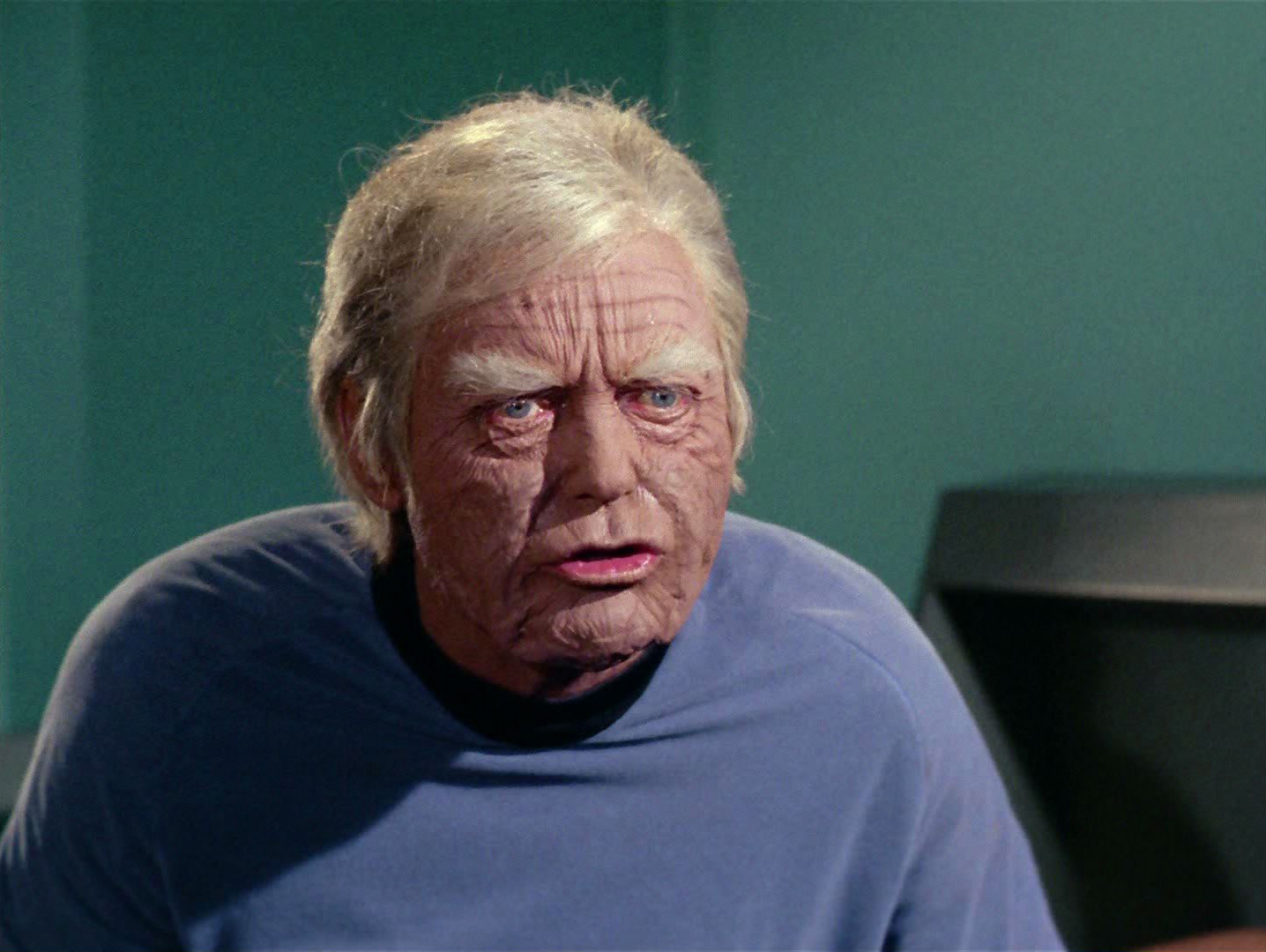
“Galloping around the cosmos is a game for the young”: The Deadly Years

by noreply@blogger.com (Josh Marsfelder)
DeForest Kelley gives us a sneak preview of his next big project.

OK, it's pretty terrible.

Yeah, “The Deadly Years” kinda sucks. Unfortunately from my perspective, it's bad in ways that are obvious and not especially interesting to talk about. It's blatantly ageist, going into a rather frightening level of detail about how funny doddering senile old people are and how they're of no use to anyone and need to get out of the way to make room for younger, more virile people. Trying to redeem this as a tragic story about the effects of growing old is, in my opinion, putting more thought into the premise than the people responsible for it did: If it's sad, it's only sad in a “we need to take the car keys away from grandma and put her in a home” sort of way not a “the way we treat the elderly in our society is monstrous” sort of way.

On the other hand, trying to read this as a statement about youth culture vs. hegemony also runs into problems I feel, as there simply doesn't seem to be any real support for that reading, especially given as it's our heroes who are afflicted, and the script seems on the whole more interested in bemoaning the physical effects of age and the *idea* of youthfulness, not so much youth *culture*, and eventually gives us a glib, tacked-on handwave of a conclusion about “the right man” (and of course it has to be a man) in command of a situation, but that's about as effective as any of Star Trek's denouements are (read: not in the slightest).

It is also full of the expected casual sexism. The first Yeoman-of-the-Week promptly dies midway through the episode for plot convenience, though McCoy tosses out something that sounds suspiciously like “she lost the will to live” (yes, I know it was supposed to be her metabolism. No, that doesn't count). Janet Wallace is very clearly only there to be Kirk's Desilu-mandated Love Interest for this episode, most of her dialog is recycled wholesale and verbatim from other such characters from previous episodes and she's only invested in the plot because she still has a crush on Kirk (to the point the other characters actually comment on this, so minor points for the show's growing awareness of its own tropes, I suppose). At least her expertise in endocrinology contributes to the final resolution, but McCoy obviously would have gotten there eventually, and in time, without her help. It's also unfortunate Wallace's actor, Sarah Marshall delivers, well, kind of a crap performance. She's about the most stilted and monotone guest star we've seen on the show yet.

In fact, this is a changeable week for the actors in general. William Shatner plays Old!Kirk as basically Mr. Magoo, James Doohan just does “tired” and is barely in this episode anyway while Walter Koenig and George Takei give likable and multifaceted turns as Chekov and Sulu whenever they get the chance, but they're always good at this. The only people seeming to be actually trying here are Leonard Nimoy, whose aged Spock is predictably complex and nuanced, and DeForest Kelley, who, because was hired to be “Old and Wise” anyway, just dials down on that and accentuates McCoy's cantankerousness. Actually, Kelley is so good at this it takes some of the ageist edge off “The Deadly Years”: McCoy is clearly just as competent elderly as he is at his regular age and barely changed, except for being a bit slower and less patient.

We also get another fish-out-of-water flag officer, and “The Deadly Years” is just about the most generic “bureaucrats are pampered, paper-pushing desk jockeys who know nothing about real life out in the field” chest-thumping, American Individualist rant yet (indeed I'm actually paraphrasing one of Old!Kirk's actual lines in the episode with this sentence). At least Charles Drake's Commodore Stocker is deeply sympathetic, expressing great concern for a ship and crew he looks up to and is depicted as someone who made the best (albeit naive) decisions he could under the circumstances, which is a minor improvement over previous efforts I guess. Drake's admirable efforts are ultimately wasted on this script, though: This show still has nothing on Raumpatrouille Orion when it comes to empathy. On top of that, the Romulans are back completely disconnected from their original symbolism and written totally out-of-character and are obviously only here so the show can reuse stock footage from “Balance of Terror”, there's a throwaway callback to “The Corbomite Maneuver” (whose airdate is now creeping on its two-year anniversary) for really no reason and the pacing is shot to hell, which all compounds to make us feel every feather of the padding this episode is.

Ultimately though, “The Deadly Years” isn't worth going into one of my signature moaning Requiem for Star Trek rants for. Partially because having it come after “Mirror, Mirror” is just another example of this show's utter lack of consistent baseline quality and thus any real kind of standards, expectations and preconceptions. There's just no way to take this year's spectacular unevenness and reconcile that with the idea of a coherent, self-contained series and fictional world. In my opinion, Star Trek is best seen as a straightforward anthology show, not the first chapter in some grand, oblique unfolding Master Historical Narrative of a fantasy world (not that that approach is ever unproblematic for anything). The show's rules, characterization and basic ethics are changing week-to-week at this point, and it's all dependent on who the writer is, how involved Gene Roddenberry, Gene Coon or D.C. Fontana get and how much effort the actors decide to give. When this show is on-target, it really does have a respectable claim to being one of the best things on TV right now, but conversely when it's not it has an alarming tendency to be one of the *worst*. This really isn't the making of a true Classic television series, though it certainly does have unarguably Classic moments.

Which brings me to my main point for this episode, actually. I just came off of one of the single greatest things this series ever put out, and am about to hit a stretch of episodes that I know for a fact contain at least three oversignified home runs in a row, including the only other episode from the original Star Trek apart from “Balance of Terror” that I will unhesitatingly call a masterpiece. Before then, I just need to get through “The Deadly Years” and, well, the next episode, frankly, neither of which work. But it's just not worth my time and stress levels to get terribly worked up about either one of them. From the vantage point of 1967, “Mirror, Mirror” was enough to build Star Trek a surplus reserve of goodwill and from the vantage point of the future, the looming symbolic singularity is enough to ensure the show actually has a future and is, for possibly the first time, on relatively stable ground for the moment. In that case, “The Deadly Years” is, like “What Are Little Girls Made Of?” last year, an episode that probably shouldn't have been made. However, unlike that first season story, this feels less like a potential derailment of the series and more like straightforward filler. Why might that be?

This gets at the concept of “filler” in television itself. I get the sense modern audiences use the term “filler” to describe an episode that doesn't play into the big, sweeping season-long mythic story arc every single contemporary television show is required to have by law now, but this is at once a dangerous mentality (best suited for exploring when my feelings on Big Damn Myth Arcs start to become more of a concern for this blog) and a recent one, as filler certainly existed before 2004 (or 1997 if you're picky). It can be seen as a peculiarly televisual phenomenon, too: If we were to read a book that had entire chapters or sections that really contributed nothing towards the advancement of the story, or watched a movie that did something similar with its act structure, or played a video game where whole levels, areas or gameplay mechanics felt pointless, shallow and redundant, we would probably complain a lot more, and probably very loudly. However, this is something we've come to expect as a necessary evil of doing something episodic for this kind of broadcast medium. Given the high-stress, labour-intensive way TV production works, we know occasionally teams will need to throw out an episode that might be below their usual standard because you need something, anything to go out that week and the deadline of the airdate ultimately has the final say on what you're doing in a typical work week.

It need not be, though. I think the concept of filler episodes in the classical sense gets at the difference between US television and TV made elsewhere in the world, particularly the UK. In the US, television seasons tend to last from September to May and shows run more or less continuously every week during that period, often with a break around November and December. This means each show, unless it's a mid-season replacement debuting in January, typically accrues 25-30 episodes a season. Simply put, this has the potential to be total overkill. No matter how good a show is, there's only a certain level of momentum it's able to sustain in one sitting, and a convincing argument could be made, I feel, that 30 installments a year may well be too many. Not in the modern sense, born out of the current fetishization of the character drama myth arc, that it muddies and blunts the impact of the year's Big Story, but in the very simple sense that there are only so many clever and workable ideas people can come up with for one project in one single period of time without taking a break from it for a bit.

Despite in many ways pioneering the idea of incredibly long-form television serials and sitcoms with shows like Coronation Street, Last of the Summer Wine, Only Fools and Horses and the original version of Doctor Who, the latter of which was originally on basically year-round, the UK seems to have a better solution here. Television seasons (or series, as is the preferred term there) tend to be much shorter than in the US, often made up of only 6-18 stories a year (in the case of the original Doctor Who, broken down as it was into multiple mini-serials this still averages out to about 24 half-hour episodes a year, but the difference here is that they were all considered part of the same story, and thus the same general idea). Even in 1967, where we're just starting to get a glimpse of how the structure of broadcast television is taking shape, shorter-form concepts were not unheard of, such as one-off, self-contained television plays or miniseries. Recall Patrick McGoohan considered The Prisoner padded at only seventeen episodes and was ultimately unhappy with the way the network handled that show. When taken in this context, 30 episodes a year is insane, and this is likely the reason for the preponderance of so-called “filler” episodes in US television: A more relaxed production schedule would allow a more selective approach to vetting scripts, with more time, money and other resources available for the scripts that do go into production.

But what's interesting here is that we've run across a Star Trek episode that can be described as filler at all. By definition a filler episode is a kind of holding pattern, which implies there's actually somewhere the show is going to touch down in the near future. Almost every other time the show has stumbled backward it's been an almost series-derailing catastrophe, at least this year. This, however, is an episode that doesn't feel like a potential dead end, but merely an off-week, and that alone speaks volumes. Admittedly a great deal of this probably comes from my own ability to see potential timelines and future events and knowing that “The Deadly Years” is in fact exactly that, but even without knowing the episodes that are coming next, it still feels like Star Trek has turned some kind of a corner. Somehow, some way, it's done enough this year so far to set our consciences at ease for awhile and, no matter how forgettable episodes like this may be, it's far, far better to fail and be forgettable then fail and be memorably disastrous.
19 Aug 15:03

The Onanism of ‘teavangelical’ Republicans

by Fred Clark

I referred yesterday to the weird little story of Onan in the book of Genesis.

It’s a weird story for a host of reasons, including that it’s a screaming anachronism for those who attempt a “literal” reading of the Pentateuch based on the non-literal, extra-textual presumption that the book of Genesis was written by Moses as dictated by God.

Here, in its entirety, is the story of Onan, from Genesis 38:

But Er, Judah’s firstborn, was wicked in the sight of the Lord, and the Lord put him to death.

Then Judah said to Onan, “Go in to your brother’s wife and perform the duty of a brother-in-law to her; raise up offspring for your brother.” But since Onan knew that the offspring would not be his, he spilled his semen on the ground whenever he went in to his brother’s wife, so that he would not give offspring to his brother.

What he did was displeasing in the sight of the Lord, and he put him to death also.

That’s quite a bit of smiting for such a brief, four-verse story. Poor Er’s wickedness was so great that he was put to death by a lethal miracle. That’s an extreme punishment, so be sure to learn the lesson of Judah’s firstborn and don’t … er … don’t do whatever it was that Er did. (At least the guy’s name lives on, and to this day we all say it whenever we want to abort a thought just as God cut short the life of poor Er.)

This is what Onanism looks like. God is displeased.

Judah points out to Er’s brother, Onan, that it is now his duty as a brother-in-law to impregnate his dead brother’s widow. Onan takes this as license to have sex with his late brother’s wife, but he always pulls out so that he won’t have to worry about having a new son/nephew and another mouth to feed. That wasn’t the deal with “the duty of a brother-in-law” so Onan is put to death as well.

Alas, Onan’s name has also lived on in a flagrant misreading of this story. “Onanism” became something of a euphemism for masturbation, and this text has been, for centuries, cited as forbidding masturbation. Onan’s name has been invoked in warning juvenile boys not to behave like juvenile boys. If they spilled their seed like Onan did, they were warned, they might go ow-ow-out like a blister in the sun.

That use of the story abuses the text worse than any juvenile boy has ever abused himself. Onan wasn’t masturbating — he was having sex with his sister-in-law. The story cannot be twisted into teaching that masturbation puts one in danger of being put to death by divine intervention. (Apart from contradicting the text, the idea that anyone who masturbates might be struck dead by God is obviously wrong anyway — disproved by the continuing existence of the human race.)

It’s equally mendacious to abuse this story by trying to force it to say something else it refuses to say: that sex must always be for the purpose of procreation. That’s not what the text says. That’s not something the story itself will allow you to say this story “teaches.” The story absolutely does not say that sex must always be for the purpose of procreation. The story says, rather, that sex with your dead brother’s childless widow must always be for the purpose of procreation.

And to understand what that’s all about in this story, we have to discuss the howling anachronism here.

The “duty of a brother-in-law” here refers to the practice of yibbum. This practice is outlined in Deuteronomy 25:

When brothers reside together, and one of them dies and has no son, the wife of the deceased shall not be married outside the family to a stranger. Her husband’s brother shall go in to her, taking her in marriage, and performing the duty of a husband’s brother to her, and the firstborn whom she bears shall succeed to the name of the deceased brother, so that his name may not be blotted out of Israel.

In our story, in other words, Judah instructs his son Onan to do what the law commands — the law as given by Moses centuries after Judah is dead and buried. Er, oops.

Onan’s duty was to continue his dead brother’s line by providing a child for his sister-in-law. That child would be regarded as his brother’s heir, keeping his brother’s share of the land in his brother’s name. That child would also be immensely important for the wellbeing of Onan’s sister-in-law. As a childless widow, she would be utterly dependent in that ancient economy, whereas a second wife with a firstborn son has hope for an economic future.

That’s the whole point of this duty. It’s the one reason that Onan was required to marry his sister-in-law. If she and Er had had children, then the law would have forbidden Onan to marry her (see Leviticus 18:6-16 and Leviticus 20:21 — which also warns that anyone who marries their late brother’s non-childless widow will be unable to have children with her).

This form of marriage, in other words, was part of the safety net for childless widows in this ancient economy. Onan’s sin was not “spilling his seed,” or having sex for reasons other than procreation. Onan’s sin was his exploitation of the helpless and his failure to fulfill his responsibility in the safety net for childless widows.

That passage in Deuteronomy 25 outlining the “duty of a brother-in-law” also lays out the oddly baroque punishment for any brother-in-law who refused this duty:

If the man has no desire to marry his brother’s widow, then his brother’s widow shall go up to the elders at the gate and say, “My husband’s brother refuses to perpetuate his brother’s name in Israel; he will not perform the duty of a husband’s brother to me.”

Then the elders of his town shall summon him and speak to him. If he persists, saying, “I have no desire to marry her,” then his brother’s wife shall go up to him in the presence of the elders, pull his sandal off his foot, spit in his face, and declare, “This is what is done to the man who does not build up his brother’s house.”

Throughout Israel his family shall be known as “the house of him whose sandal was pulled off.”

As unpleasant as that punishment sounds, what with all that face-spitting and sandal-pulling and name-changing, it’s still a much lighter sentence than what Onan was given — being “put to death” by the very hand of God.

Onan was dealt a more severe sentence because he was guilty of a more severe crime. Him Whose Sandal Was Pulled Off was guilty of neglecting his duty to provide for a childless widow. Onan was trying to weasel out of that duty while at the same time exploiting the very woman he was duty-bound to help. HWSWPO failed to play his role in the safety net for childless widows. Onan was attacking the very existence of that safety net.

This is an ancient story. The past is a foreign country, and the farther back we go into the past the more foreign it seems. It can be almost impossible to decipher such an ancient alien world, let alone to derive moral lessons from it that are applicable to our lives in the very different world we live in today.

Yet I still think we can learn something from the weird little story of Onan in the book of Genesis. Neglecting our duty to provide a safety net for those who need it is shameful behavior — a lasting shame so severe it forever alters our very name and how we are perceived throughout the community. But it’s even worse to attack the very idea of such duty while simultaneously exploiting those we are duty-bound to protect.

I think we are on solid biblical footing, in other words, to say that the current effort among House Republicans to gut SNAP is an example of the sin of Onanism. The anti-welfare rhetoric and ideology of the tea party — with its denunciations of “takers” and “moochers,” and the rallying cry of its founding in rejection of mortgage assistance for soon-to-be-homeless families — is a virulent, vicious strain of Onanism,

And this weird little story in Genesis suggests that God takes that sin very seriously indeed.


19 Aug 14:48

GOP congressman calls for legalization of marijuana

by Fred Clark

One of the big themes in the current Republican ideology is the idea that those people – the 47 percent, the blahs, the moochers and takers and illegals — are criminal.

Black voters are therefore treated as guilty-until-proven-innocent of mythical voter fraud. Medicare isn’t a lifeline for American seniors, but rather a hotbed of fraudulent criminality. Every form of anything that can be called “welfare” — from food stamps to unemployment benefits — is denounced as a hand-out to frauds who are only pretending to be poor or pretending to be sick or pretending to be unable to find work.

That’s why it was so startling to hear one right-wing Republican member of Congress tell his constituents that there is no such thing as voter fraud or Medicare fraud or welfare fraud. Even more surprisingly, this conservative congressman called for the legalization of marijuana and prostitution, and for the immediate release of Bradley Manning.

He didn’t say it in so many words, of course, but what else are we to make of this statement from Rep. Tom McClintock, R-Calif.?

For a criminal practice there has to be a gun. It’s pretty simple.

McClintock didn’t really mean to suggest that Timothy McVeigh and O.J. Simpson weren’t guilty of crimes. Nor did he apparently really mean to say that smoking marijuana shouldn’t be a crime, or that there is no such thing as Medicare fraud or voter fraud.

The Republican was simply responding to a constituent’s question about “Wall Street criminal practices,” and McClintock’s belief that Wall Street criminal practices ought never to be prosecuted is so sweeping and extreme that his response was equally sweeping and extreme. It’s not that McClintock really believes that Wall Street can’t have criminal practices because they don’t use guns. It’s that he believes Wall Street can’t have criminal practices because they’re wealthy white men in suits.

Or maybe just because they’re his biggest donors.

McClintock’s staggeringly dumb explanation for his staggeringly immoral views pretty much requires us to end with Woody Guthrie’s “Pretty Boy Floyd,” so here’s Bob Dylan’s version:

Yes, as through this world I’ve wandered
I’ve seen lots of funny men;
Some will rob you with a six-gun,
And some with a fountain pen.

And as through your life you travel,
Yes, as through your life you roam,
You won’t never see an outlaw
Drive a family from their home.

Click here to view the embedded video.

19 Aug 11:24

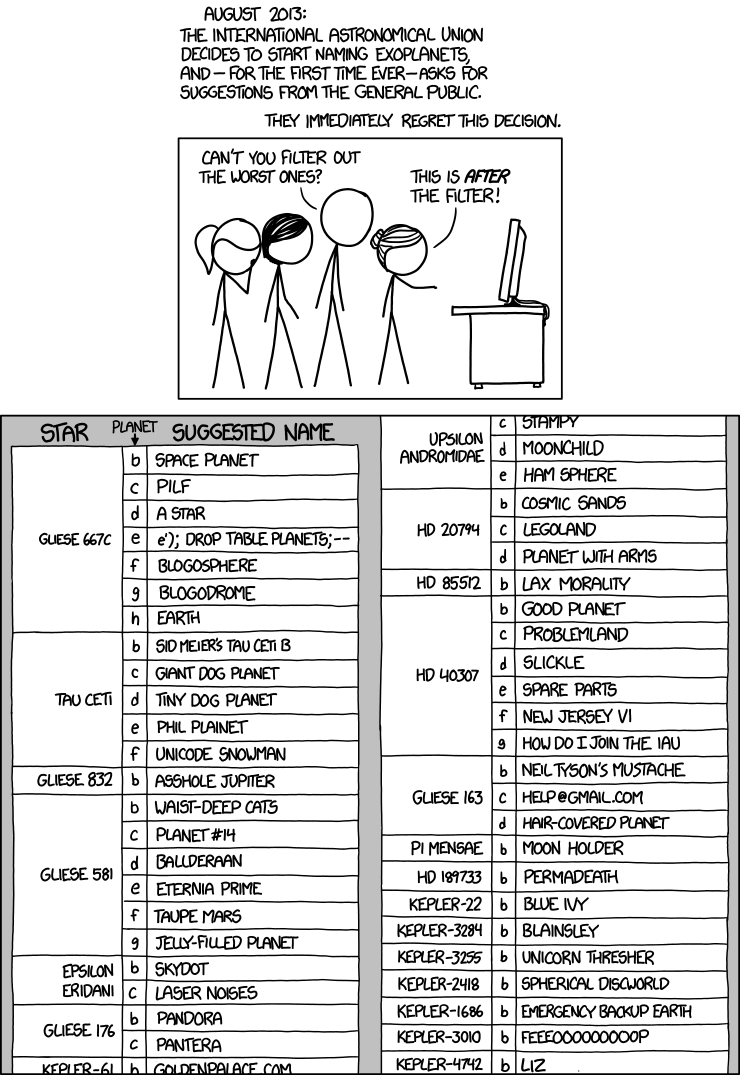
Exoplanet Names

If you have any ideas, I hear you can send them to iaupublic@iap.fr.
18 Aug 21:53

I hate the Pumping Lemma.

I hate the Pumping Lemma.
18 Aug 02:22

The Rocky Road

by evanier

moosesquirrel01

Enough people have now sent me this photo that I figure I might as well put it up here. It’s a license plate from a car in New Hampshire. Too bad it isn’t from Frostbite Falls.

17 Aug 16:38

How Ticketmaster ruined the concertgoing experience, and how it might be saved

by Lydia DePillis
OK Go at the 9:30 Club, which is not a fan of Ticketmaster. (Kyle Gustafson/FTWP)

OK Go at the 9:30 Club, which is not a fan of Ticketmaster. (Kyle Gustafson/FTWP)

Nathan Hubbard, the CEO of Ticketmaster since it merged with Live Nation in 2010, said all the things you’d want to hear from someone trying to reposition one of the most hated companies in America.

“Any artist who cares about this industry would die to be in my chair and try to make sweeping changes,” Hubbard told Fast Company, at the outset of his tenure.  As a singer-songwriter himself, who’ led the entertainment marketing service Musictoday before Live Nation bought it in 2006, he told audiences: “I set out to evolve this company into everything that I wanted it to be as a client and everything I was candidly afraid it might become when I was a competitor.” And he did do some things: Integrated with Facebook, launched dynamic pricing, partnered with Walmart. For his work, Hubbard was given raises and bonuses, making millions of dollars a year.

But on Monday, the news broke: Hubbard was out. Live Nation had installed another executive, and was circulating an expanded version of his job description. What went wrong?

In this case, the consensus explanation works: Thirty-seven-year-old Ticketmaster is still a jankety beast that’s hard to navigate online, and Live Nation wanted a bona fide internet wizard. It needs to be able to target customers by their likes and dislikes as well as any company in Silicon Valley–or as well as possible, given that the terms of the 2009 merger placed a data firewall between the promotions and ticketing sides of the enterprise–which the artist-minded Hubbard failed to deliver.

“It’s dominant in its business, but has 28-plus-year old technology,” says Maxim Group analyst John Tinker. “People are still faxing over seating schedules. Half the time at Ticketmaster, you can’t even find out where you’re sitting…It’s not that [Hubbard] did a bad job. It’s just that you’ve got eBay, you’ve got a bunch of other services that are technologically very proficient. Larry and Sergey are never going to work at Ticketmaster.”

But Hubbard also faced another problem: Ticketmaster didn’t achieve its 2010 high of 83 percent market share by being the most user-friendly interface, or even through the monopolistic lock-in effects of being part of the world’s biggest concert promoter (though things like signing multi-year contracts with Madonna help). It got there by taking the brunt of fan hatred for finding ways to justify exorbitant fees on top of listed ticket prices, half of which would go back to the venues, which would in turn book through Ticketmaster again and again and again. You might feel like you’re getting gouged, but you really want to see Lady Gaga, so you’d put up with Ticketmaster no matter how annoying it was.

“People get so used to one way of doing things,” explains Casey Rae, deputy director of the Future of Music Coalition, which has a great primer on the Live Nation-Ticketmaster merger. “When companies control this much of the marketplace, they’re able to manufacture consumer consent.”

There are, however, limits to that business model. Industry revenue has been rising, but there are many new competitors (most notably StubHub, where people often resell tickets bought in bulk from Ticketmaster, and which recently did a deal with chief concert promotion rival AEG). Plus, the recession put a dent in peoples’ willingness to pay top dollar for giant events.

“What you’ve got is a classic bubble, and I can pretty much guarantee that it will pop, the only question is when,” says Rae. “I don’t think you can run a live music economy on people going to shows once a year because they can’t afford it. ”

And the live music economy is changing. Few artists make much money selling tracks, and therefore have to go on tour–but can’t book the kind of large venue that would be worth Ticketmaster’s while. For those, there’s Brown Paper Tickets, Ticketfly, Tickethorse, and Ticketleap,* all of which are steadily eating into Tickemaster’s marketshare, and are poised to grab more should the giant stumble.

The two-year-old Tikly, run out of Des Moines, Iowa, is surely the most indie. They don’t charge to use the service, and have a simple tiered pricing scheme. Instead of partnering with a live concert promotion business, they’ve buddied up with a Kickstarter-for-albums called Pledgemusic, in a pairing that more closely reflects how musicians support themselves in the digital age–without a major label or expensive touring contract. And it’s the kind of thing that could scale quickly to cover emerging artists around the country, who might stick with them when they make it big.

“We’re the ticketing company for the next Macklemore,” says 23-year-old founder Emma Peterson, who started the company after searching in vain for a platform that would work well for a band she managed. She just passed $1 million in sales, and is in a much better position to match the new musical landscape without the legacy costs of a massive incumbent like Ticketmaster.

“Let’s not pretend like it costs anybody two dollars for you to print your ticket at home,” Peterson says. “I’m sure it’s very difficult to wrap their minds around changing at all, with the amount of costs they have to cover. Am I in an enviable position because I’m a startup? Yeah.”

With actual customer loyalty, she thinks, market domination isn’t necessary.

“We could get out there and try to control the whole world,” Peterson says. “Or we could try to make the seller-focused, buyer-friendly ticket company and challenge how the business has worked for so long, and say none of that matters, or is even necessary.”

An earlier version of this article identified TicketWeb as a rival to Ticketmaster. In fact, it is owned by Ticketmaster. 

17 Aug 15:56

Lord Bonkers' Diary: Why isn't Sarah Teather a knight?

by Jonathan Calder
Thursday

Do you know Sarah Teather? She is a charming young woman, even though I had some sharp things to say about her reaction to the Ofsted report on the Bonkers’ Home for Well-Behaved Orphans.

Like many of the knights I saw off yesterday, she is a former minister, yet she received no gong when given the bum’s rush by Clegg and his 12-year-old advisers.

I am racking my brains to work out why this should be the case.

Lord Bonkers was Liberal MP for Rutland South-West 1906-10.

Earlier this week in Lord Bonkers' Diary
17 Aug 14:25

Toxic grammar advice on Australian radio

by Geoffrey K. Pullum

Toxic grammar alert for Australians: Rodney Huddleston informs me that the ABC Radio breakfast show celebrated International Apostrophe Day on 16 August 2013 with disastrous results. Huddleston reports:

The presenter had brought in someone he called a grammar nerd/specialist and asked her about the use of the apostrophe. She managed to deal with dog's bowl and dogs' bowls, but when he asked her about children she said this was a collective noun, not a strictly plural and that in children's playgrounds and children's dreams the apostrophe should come AFTER the s.

I will not expose the grammar specialist's family to humiliation by naming her; I do have a heart. But this is really staggering misinformation. The apostrophe should never come after the s in cases of irregular pluralization. The genitive suffix is ’s unless the regular plural s immediately precedes it (in which case the genitive marker is simply the apostrophe alone). In irregular plurals like children, oxen, cacti, foci, phenomena, etc., there is no immediately preceding plural s, so the default holds: it's the children’s playgrounds, and likewise the cacti’s watering schedule, and these phenomena’s importance.

Beware of nonlinguists who appear on radio programs as grammar experts; they sometimes simply make stuff up.

The apostrophe is often spoken of as a punctuation symbol or grammatical marker, but I think it is best regarded as a 27th letter of the alphabet—a letter that has a required place in the spelling of various orthographic words but unfortunately has no specific phonetic correlate of its own, which makes it hard for people to remember where it goes (see this Huffington Post collection of photographs of spectacular spelling errors). Even for people who represent themselves to the media as grammar experts.

Double-checking the spelling uniformity against the familiar Wall Street Journal corpus of later 1980s newspaper text gave me a further shock, which certainly emphasizes the unpleasantly unmemorable character of spellings with apostrophes. Although the 732 occurrences of children's overwhelmingly confirm the rule, there are 13 distinct instances of childrens’ in the corpus!

One of them turns out to be simply commenting on the error:

And, inevitably, there are apostrophes appearing consistently at odd places: yours' or childrens' or did'nt. [File name: w7_038]

So that just confirms what I've said about the correct apostrophe placement: *childrens' is wrong. But the remaining dozen (plus repeats of three of them — the WSJ corpus unfortunately has some duplicated passages of text) are egg on face for the Journal: errors by WSJ writers that were (at least initially) missed by WSJ copy editors. This is perhaps sufficiently noteworthy that I should append the full text of the sentences below. I have done that, with the file name at the beginning of each.

w7_010: If parents come to associate national certification with the "best" instructors, they'll insist that their childrens' schools employ such teachers.

w7_064: The circus gala, a benefit for Emanuel Hospital's infants' and childrens' programs, was conveniently situated in a vacant lot next to the hospital.

w7_102: The government plans to establish a national curriculum and give parents greater say in their childrens' education.

w8_003: The transaction calls for the sale of Marvel's comic and childrens' book publishing, as well as licensing and merchandising operations.

w8_004: The company said yesterday that the preliminary agreement with Andrews Group calls for the sale of Marvel's comic and childrens' book publishing, as well as licensing and merchandising operations.

w8_031: Municipal bonds designed to help parents save for their childrens' college education are winning favor among state lawmakers, bond analysts and investors.

w8_039: The publishers have also sought a new "literary" look — more childrens' favorites and classics, less in-house writing and abridgment.

w8_078: The idea of early intervention also has become an issue in the 1988 presidential campaign, with candidates from both parties calling for more spending on childrens' programs. [Also in w8_116]

w8_083: Until recently, Troll Books was known primarily in the childrens' book business — and it still isn't well known to the general public. [Also in w8_120]

w8_085: The group, Friends for Education Inc., of Daniels, W.Va., said the four companies are providing data to parents that makes their childrens' performances on standardized tests appear better than they are relative to others' performances. [Also in w8_122]

w9_020: In addition to naming Mr. Keating, the 160-page suit alleges wrongdoing by his wife, several of their children and their childrens' spouses, many of whom work for American Continental or its Lincoln unit, based in Irvine, Calif.

w9_036: Before the 1986 tax act, many parents made the election for their childrens' bonds, so the interest would avoid tax or be taxed at a low rate, says Kevin Duvall of Ernst & Young, CPAs.

When I pointed this out to Rodney Huddleston, he checked the COCA corpus (450 million words of American English) and found 101 occurrences of *childrens’ there (as against 24,493 occurrences of children’s).

By the way, notice what you are seeing here: descriptive linguists like Huddleston and me, firmly committed to describing the language as it is, alleging clear errors in respectable published prose.

But do not adjust your set. There is no conflict here. The rules for where you put apostrophes are strict and well-known spelling conventions. There is virtually no latitude in them. (You can perhaps spell things like P’s and Q’s as Ps and Qs if you really want, and some people still write Clive James’ books rather than Clive James’s books, as if the final s on proper names like James were the plural s; but that's just about all the flexibility there is.) There is no developing dialect split here; we are looking at slips. Mistakes.

Descriptive linguists base their claims on evidence about how English grammar works, not on dogma; but it is our considered judgment that the examples above do not form part of the evidence. They are better regarded as evidence that (sometimes even in published material) people make spelling mistakes in English. And in the case of the word child, the evidence suggests that the genitive plural of child is probably spelled incorrectly something like 0.4 to 1.8 percent of the time on average (and the rate must be much higher in first drafts, emails, and so on). Spelling errors with the small and phonetically nondistinctive letter are apparently harder to spot than misspellings like *recieve with the 26 other letters (though it should be noted that there are 4 distinct occurrences of *recieve in the WSJ corpus).

So not everything you read in the papers is true, and not everything you read in the papers is grammatical, and in fact not everything you read in the papers is even data bearing on what's grammatical.

[I have added some material and fixed a few errors of wording or editing since this first went up. Thanks to Joan Maling for pointing out the duplicate examples among WSJ examples.]

17 Aug 11:32

#959; In which a Train is taken (Part 4)

by David Malki !

And they just leave trains sitting around! Now I have to keep this thing!!

Continued from Part 1 / Part 2 / Part 3. We’ll leave it here.

17 Aug 11:29

So, I Didn’t Go Last Night

by Dave
Andrew Hickey

This is relevant to me today.

Lately the Internet has been flooded with people trying to explain introversion to you. Here’s something that gets left out.

Introversion is when you have a chance to see your friend perform and you can’t do it because you just had company at your house for a week and your “being-around-people” meter is pegged and the thought of going to some public place, no matter how interested you are and how much you psyche yourself up for it, gives you the shakes. It’s way fun.

I’m sorry, Euge. I’ll try to be better next time.

17 Aug 11:29

Grouch & Kraz 2: Time For Elizabeth

by Matthew Coniam


"If he's the salt of the earth, I'm going on a salt-free diet."


Time For Elizabeth was originally a stage play, and the second writing collaboration of Norman Krasna and Groucho Marx, following their only mildly received King and the Chorus Girl. 

According to Wikipedia, according to Krasna, it took ten to fifteen years to write, and closed after eight days when it was finally mounted, with Otto Kruger in the lead, in 1947. 
(Though never filmed at the time, Warner Brothers apparently bought the rights for a cool five hundred thou, but presumably poured ice water on the project when it bombed on stage.)
A large part of the problem for contemporary reviewers was that while Groucho's hand is clearly visible in much of the writing (vastly more so, incidentally, than in King and the Chorus Girl), the fun just seemed to evaporate when it was somebody other than Groucho delivering it (that's anybody other than Groucho, let alone Otto Kruger).

Groucho did appear in several small-scale productions of it in the late fifties and early sixties with reasonable success, but its days as a serious commercial venture seemed clearly behind it, until it was suddenly revamped as a TV special in 1964 with, heavens be praised, the great man still safely ensconced in the lead role.
At around 45 minutes (to fill an hour slot with commercials), it's obviously an abbreviated version of the original material, and, I think, a somewhat altered one, adapted by Alex Gottlieb, a writer-producer with pedigree in Abbott & Costello movies and the film of Hellzapoppin'

Gottlieb, eh?
The main point of interest at the time was in the fact that Groucho would be appearing alongside the real life Mrs Groucho, Eden Hartford, though in fact she has a small role (that would surely have been snipped if it weren't for the casting) and which seems oddly to mock their real-life status: she plays a seductive gold-digger who fleeces elderly Florida millionaires ("all retired, all with money, all in the frame of mind that life owes them someone like me"), who mistakes Ed for a likely catch.

Groucho and Eden in a publicity shot for the production. (Note to anyone excited by the prospect of seeing him swinging a golf club while stood next to Eden and wearing that costume: in the actual film he does each of those three things separately.)
The show tends to have a very bad reputation on the rare occasions it is permitted any kind of a reputation at all, and I'm not about to make any extravagant claims for it. But I did enjoy it, and I did find it oddly moving, and I'm going to try to explain why.

Firstly, though many will no doubt think me mad, I really like Groucho's performance in this. I like it because it is a performance: though he gets a few chances in the later sections to spread his comedic wings, Ed Davis when we first meet him is pretty much the opposite of the traditional Groucho. He's a harassed executive, at the mercy of his belligerent boss (Roland Winters, the last of the Monogram Charlie Chans), disillusioned with his lot and dreaming of escape. 
At the very end he looks to the camera, wiggles his eyebrows and says, "Tell him Groucho sent you", and it's a lovely moment, almost like a little reward for us. All the rest of the way, for better or worse, he's Ed Davis.
And some of the dialogue nicely conveys the pathos of discovering that realising one's dreams may not always work out how one expects (and may at a push recall The Fall and Rise of Reginald Perrin for British viewers), as in this exchange between Ed and his wife:

- What did you do this morning?
- I went down to the beach and watched the waves come in.
- Were there many of them? (Pause) What did you do then?
- Watched them go out again.
- Well, you came out even on the day.

Nobody would ever seriously suggest the Marx Brothers' movies would have been funnier if Groucho had written them, so there's no grounds for expecting peerless Paramount-era dialogue. But much of it is jolly enough, and should jerk a smile or two, at least, out of all but the most aggressively purist viewer.
I liked this exchange on his arrival in Florida:

Groucho: How far is the ocean?
Neighbour: You mean the distance?
Groucho: Well I didn't mean the width.
Neighbour: As the crow flies, one short mile.
Groucho: What time does the next crow leave?

When they invite their new neighbours round to play cards and Ed offers them a drink, they request papaya juice, sauerkraut juice and prune juice. "Wouldn't anybody be interested in a little scotch?" he asks. "Scotch what?" replies a guest. "Scotch juice!" he snaps back. 
This scene also contains probably the show's funniest moment, as Groucho, stood behind them, tries to tell his wife that she should wrap the evening up by miming throwing them out, in increasingly violent ways as she fails to take the hint. In the event, he brings the evening to a close by saying he has to visit a dying friend. When one of the guests offers condolences, Groucho replies, "He's lucky!"

Amusing though these occasional flashes of the vintage Groucho are, I think I found this so charming overall because it's about ageing, and about disillusionment, and feeling oneself increasingly peripheral, and acknowledging that one is now preparing for the final stage of life. 
And I think of Groucho himself: writing the play when still in his prime (both personally and professionally), but now, nearly twenty years later, returning to it a visibly older man, beginning to feel the departure of that agility and vitality that were such essential tools, and, surely, remarking to himself how much more of a fit the character of Ed Davis has become.
When he was writing the play, the Marxes were all still very much a going concern in films, radio and concert appearances. Now, Chico had been gone for three years, and Harpo would follow just five months after the programme aired. ("Where did those last thirty years go?" Ed asks at one point; "I never had a good look at them.")
It would be Groucho's lot to continue being Groucho, and Groucho he had to be, almost to the end. (No time for Elizabeth for him.) In effect, the production reminds us that even the Marx Brothers get old, and eventually take their leave, and that's a sobering thought indeed.

(Thanks to W. Gary Wetstein for providing the opportunity to see the programme.)
16 Aug 17:48

Recommended Reading

by evanier

Steve Benen points out that we’re now seeing a disinformation campaign about Obamacare, calculated to try and turn the public against it. As Benen notes, the folks behind this crusade apparently can’t find an actual problem with the system so they’re just making things up — i.e., lying. I don’t think these folks really have any problem with Obamacare except that they hate Obama and think they can bring down his popularity by trashing his most important accomplishment. They can’t destroy it but they might destroy the lives of a lot of people who could be saved by signing up…but will see these ads and run in fear from it.

16 Aug 16:05

Snowden leaks: the real take-home

by Charlie Stross

(Before I begin: there are participants in the discourse who would say that we're supposed to natter on about Edward Snowden, and not the contents of his disclosures, because turning it into a personal issue rather than a political one is useful to the machineries of state. But the point I'm about to make here is different ...)

(UPDATE: An extended, reworked, more detailed essay along these lines can be found in Foreign Policy.)

In the 21st century, the NSA (and other espionage agencies) face a big system-wide problem that I haven't seen anybody talking about.

The problem is sociological, and it's going to get worse.

First, a brief re-cap. Here's the BBC's Adam Curtis on why the HUMINT establishment is incompetent by design (hint: we can blame a late 19th century author of technothrillers and the Daily Mail). Here's John le Carre on the relationship between spy fic and fact and, more worryingly, an anecdote from personal experience about an intel officer who made stuff up out of sheer boredom. Now, you might think that ELINT is better; computers don't lie, do they? But as Bruce Sterling has been pointing out snarkily from the sidelines for about 25 years now, the emperor is stark bollock naked. (Note: read that last essay as a sarcastic, irony-dripping rant by a prophet who burned out and gave up all hope years ago and is now luxuriating in a bath of pure schadenfreude.)

Are we ready? All together, now:

The big government/civil service agencies are old. They're products of the 20th century, and they are used to running their human resources and internal security processes as if they're still living in the days of the "job for life" culture; potential spooks-to-be were tapped early (often while at school or university), vetted, then given a safe sinecure along with regular monitoring to ensure they stayed on the straight-and-narrow all the way to the gold watch and pension. Because that's how we all used to work, at least if we were civil servants or white collar paper pushers back in the 1950s.

But things don't work that way any more. A huge and unmentionable side-effect of the neoliberal backlash of the 1970s was the deregulation of labour markets and the deliberate destruction of the job for life culture, partly as a lever for dislodging unionism and the taproots of left-wing power in the west (yes, it was explicit class war by the rich against the workers), and partly because a liquid labour market made entrepreneurial innovation and corporate restructuring easier (I love these capitalist euphemisms: I swear they'd find a use for "final solution" as well, if only some naughty, bad people hadn't rendered that clause taboo two-thirds of a century ago).

Today, around 70% of the US intelligence budget is spent on outside contractors. And it's a big budget — well over $50Bn a year. Some chunks go on heavy metal (the National Reconnaissance Office is probably the biggest high-spending agency you've never heard of: they build spy satellites the size of double-decker buses and have so many Hubble-class space telescopes cluttering up their attic that they donated a couple to NASA in 2012), but a lot goes on people. People to oil the machines. People who work for large contracting organizations. Organizations who increasingly rely on contractors rather than permanent labour, because of buzz-words like "flexibility" and "labour market liquidity".

Here's the problem: they're now running into outside contractors who grew up in Generation X or Generation Y.

Let's leave aside the prognostications of sociologists about over-broad cultural traits of an entire generation. The key facts are: Generation X's parents expected a job for life, but with few exceptions Gen Xers never had that — they're used to nomadic employment, hire-and-fire, right-to-work laws, the whole nine yards of organized-labour deracination. Gen Y's parents are Gen X. Gen Y has never thought of jobs as permanent things. Gen Y will stare at you blankly if you talk about loyalty to their employer; the old feudal arrangement ("we'll give you a job for life and look after you as long as you look out for the Organization") is something their grandparents maybe ranted about, but it's about as real as the divine right of kings. Employers are alien hive-mind colony intelligences who will fuck you over for the bottom line on the quarterly balance sheet. They'll give you a laptop and tell you to hot-desk or work at home so that they can save money on office floorspace and furniture. They'll dangle the offer of a permanent job over your head but keep you on a zero-hours contract for as long as is convenient. This is the world they grew up in: this is the world that defines their expectations.

To Gen X, a job for life with the NSA was a probably-impossible dream — it's what their parents told them to expect, but few of their number achieved. To Gen Y the idea of a job for life is ludicrous and/or impossible.

This means the NSA and their fellow swimmers in the acronym soup of the intelligence-industrial complex are increasingly reliant on nomadic contractor employees, and increasingly subject to staff churn. There is an emerging need to security-clear vast numbers of temporary/transient workers ... and workers with no intrinsic sense of loyalty to the organization. For the time being, security clearance is carried out by other contractor organizations that specialize in human resource management, but even they are subject to the same problem: Quis custodiet ipsos custodes?

We human beings are primates. We have a deeply ingrained set of cultural and interpersonal behavioural rules which we violate only at social cost. One of these rules, essential for a tribal organism, is bilaterality: loyalty is a two-way street. (Another is hierarchicality: yield to the boss.) Such rules are not iron-bound or immutable — we're not robots — but our new hive superorganism employers don't obey them instinctively, and apes and monkeys and hominids tend to revert to tit for tat quite easily when unsure of their relative status. Perceived slights result in retaliation, and blundering, human-blind organizations can slight or bruise an employee's ego without even noticing. And slighted or bruised employees who lack instinctive loyalty because the culture they come from has spent generations systematically destroying social hierarchies and undermining their sense of belonging are much more likely to start thinking the unthinkable.

Edward Snowden is 30: he was born in 1983. Generation Y started in 1980-82. I think he's a sign of things to come.

PS: Bradley Chelsea Manning is 25.

16 Aug 16:00

Opinion: It’s time to restate who we are and what we stand for

by Linda Jack

For those of you fortunate enough to be at the special conference in May 2010, you may remember my visual aid. For those fortunate enough to miss it – my point was that we had had a choice between one clapped out old guy who would never deliver and a bright young thing who was whispering sweet nothings in our ear but before we knew it would have us locked into all sorts of things that would turn our stomachs.  My visual aid?  A pair of pink fluffy handcuffs.

Unsurprisingly my view hasn’t changed, yes Stephen, the bed of roses has turned into a bed of thorns, the pink fluffy handcuffs are beginning to chafe.

Our elders and betters are telling us that “grown up” politics is all about the art of the possible, that “grown ups” compromise rather than retreat to the “comfort of opposition”. This in my view confuses compromise with capitulation.  Ironically these same defenders of our policy in government return to that theme again and again, while ignoring what was the real compromise, the Coalition Agreement. While I didn’t support it, at least it appeared to have some commitment to “protecting the most vulnerable” – how quickly that has evaporated. Pivotal

So the lesson I believe we should take is the need to be true to our values and to ensure that any compromise is firmly rooted in those values. I may compromise with my partner on a choice of sofa; the colour, the pattern, the style; but if I am a vegetarian I will never compromise on leather.

Our party’s capitulation on so many issues, betraying what we say our aims and values are, has done little to further liberal democracy in this country. Government by focus group and/or opinion poll, takes us down the road of discredited Blairism. And the constant mantra about moving to the “centre-ground” appears to be the new objective that has replaced our stated aims. “What do you stand for?” “Oh that doesn’t matter, it’s where we’re standing that’s important.”

I am reminded of the Biblical story of the wise man who built his house upon a rock – the foolish man building on sand. Our values and principles are our rock, abandoning them leaves us on the shifting sand of public opinion, vulnerable to the first big wave.

I am reminded of a pal who used to say, “we need to be tough on values then we can be loose on everything else, all too often we are loose on values and tough on everything else.”

So please, let’s learn the lessons, let’s restate who we are and what we stand for. We all joined this party because we believed in something, we believed in creating a freer, fairer more equal society where “no one is enslaved by poverty ignorance or conformity”, we believed that our party was the only one that could deliver that society, do we believe that still?

* Linda Jack is Chair of Liberal Left

16 Aug 15:58

Ecuador asked the world to pay it not to drill for oil. The world said no.

by Brad Plumer

The tiny nation of Ecuador is sitting on a lucrative oil reserve — some 846 million barrels of heavy crude. But that oil also happens to be right under a large, biodiverse rain forest. There’d be some obvious environmental problems with digging it up.

Ecuador Amazon Oil.JPEG-0da51And so, in 2007, Ecuador President Rafael Correa came up with a rather innovant proposal. He’d ask wealthy countries and donors to pay Ecuador $3.6 billion to leave that oil untouched.

It’d be an elegant way to help tackle climate change, he explained. The carbon would stay out of the atmosphere. Ecuador’s Yasuní National Park, one of the most biologically diverse spots on Earth, would remain unharmed. And Ecuador would be compensated for the billions in foregone oil revenue. (The three oil fields in Yasuní make up about one-fifth of Ecuador’s oil reserves.)

The problem? Those wealthy donors never materialized. Spain chipped in a couple million. So did the Andean Development Bank and the Inter-American Development Bank. The U.N. and other private individuals raised some funds. But in the end, Ecuador only raised $13 million dollars, a far cry from the $3.6 billion Correa had sought.

And so, on Thursday, Correa said he was abandoning the scheme altogether. ”The world has failed us,” he told the country in a televised speech. ”It was not charity that we sought from the international community, but co-responsibility in the face of climate change.”

It wasn’t hard to imagine how Correa’s scheme might have worked. At the U.N. climate talks in 2009, wealthy nations had pledged to mobilize $100 billion a year by 2020 from public and private sources to help poorer nations curb their greenhouse-gas emissions.

Ecuador seemed like a reasonable target for those climate efforts: By the country’s own estimates, keeping the heavy crude underground would avoid some 410 million tons of carbon dioxide emissions. Protecting Yasuní National Park would prevent another 800 million tons of carbon. Add it all up, and that’s like preventing three years’ worth of Brazil’s total emissions.

Yet the plan quickly ran into obstacles. The Green Climate Fund was slow to materialize, with only a fraction of that $100 billion pledged as of July 2013 — mostly to cover start-up costs. (The Obama administration has recently announced that the U.S. would “seek to build” on the $7.5 billion in international climate finance it has contributed so far, but it’s unclear where the money will come from.)

There were also plenty of hard questions about how Ecuador’s plan would work in practice. Where would the money go? What assurances did anyone have that Ecuador would actually keep the oil in the ground? Was this really the smartest way to curb greenhouse-gas emissions?

A State Department cable in 2009, uncovered by Wikileaks, noted that U.S. officials were skeptical about the “lack of clarity on the guarantees that the [Ecuadorian government] will provide; continued pressure to develop the petroleum reserves; and likely Ecuadorian resistance to an internationally managed fund because of sovereignty concerns.” (The government of Ecuador later agreed to set up a joint fund with the U.N. Development Programme and promised to return all outside contributions if the country ever did start drilling for oil in Yasuní, but that didn’t quell the skepticism.)

It’s also worth noting that the United States relies on Ecuador for a stable, friendly source of oil. Ecuador sends about half of the 538,000 barrels of crude it produces each day to the United States — amounting to about 3 percent of U.S. imports.

For now, then, the idea is moribund. On Thursday, Correa said he would propose legislation to begin oil exploration in Yasuní, though he tried to reassure viewers it would be limited to less than 1 percent of the park’s 3,800 square miles.

It’s not impossible to think that the “pay-to-not-drill” idea could resurface again later — if not in Ecuador, then elsewhere. Last year, in a paper in the Journal of Political Economy, Northwestern’s Bård Harstad argued that paying poorer countries to keep their fossil fuel resources unexploited could be one of the most cost-effective ways of tackling climate change. The big hitch, as always, is where the money will actually come from.

16 Aug 15:56

House of Cards vs House of Cards

by 0tralala
For my birthday, Nimbos kindly presented me with the House of Cards trilogy. I felt some trepidation putting it on; having watched the original serial transfixed in 1990, how would it bear up?

It's a majestic bit of television, bold and thrilling and with a perfect cast. The wheeze (as I'm sure you know) is that Margaret Thatcher has just left office as Prime Minister, and the Tory party are in the midst of electing a replacement – as was happening in real life as the first episode was broadcast. The new, safe-bet leader decides not to promote his Chief Whip to ministerial office but keep him in his place. The whip, Francis Urquhart, is not best pleased and begins to take his revenge while also scheming his way to the top job.

Urquhart is written and played as a mix of Macbeth and Richard III, complete with soliloquies direct to the audience that make us complicit in his scheming. Ian Richardson is brilliantly charismatic and sinister, and Diane Fletcher makes for a cool Lady Macbeth. Colin Jeavons is a deliciously grotesque aid to Urquhart, grinning obsequiously as he helps destroy lives.

The story is gripping and twisty, though I felt that someone should have noticed sooner that Urquhart is the only candidate not to suffer calamity.

There are other things that show how much has changed: a Cabinet meeting where there are no women; a candidate for Prime Minister being asked if he's too young at 55; ace reporter Mattie Storin leaving a conference in mid-flow to find a phone box where she can call in her story.

But other things seem still very much on the nose: the stark divide in the Tory party between old money grandees and the upstart self-made men; the queasy relationship between high politics and those who run the press; the sex and drugs and scandal that lurk beneath the veneer. It's cynicism about politics still feels very now.

I was also fascinated by the use of the Palace of Westminster – or rather how the production dodged round not being able to film inside the building. As so often, Manchester Town Hall has enough passing similarity to the corridors of power that most viewers wouldn't notice (and it was conveniently near the old Commons Chamber set at Granada).

The thing that most jarred was the climactic scene. Mattie meets Francis on a secret roof garden supposedly above Central Lobby, and yet it looks out onto the clock face of Big Ben with Victoria Tower just behind. That means it was filmed on the roof of what's now Portcullis House, the other side of the road from the Palace – a realisation which, pedant that I am, rather spoiled the dramatic end.

But it's striking that what makes Urquhart so compelling is not his charm or intelligence so much as his ruthlessness. He can be wrong, he can be monstrous, but we're drawn to him by his determination despite the odds. His soliloquies - where he spells out exactly what he plans to do - make us complicit and, even when in the last episode he commits the most brutal acts, we're completely on his side. The last scene is brilliant: he won't tell us what he's thinking but we don't need him to as we've got under his skin.

The Dr and I then worked our way through the recent American reworking of House of Cards starring Kevin Spacey. It's a slick, thrilling production, again with a very good cast. As it comprises 13 episodes rather than four, it tells a much bigger, more complex story – and yet follows the same beats as the original and shares characters and even whole scenes. At one point we thought they'd abandoned the idea of Congressman Peter Russo following the plot line of Roger O'Neill from the original, but having digressed for a couple of episodes the story made its way back to the old path.

Apart from the running time, I think there are two main differences between the two shows. First, the American version has more women characters and gives them more to do. Urquhart's wife doesn't merely egg him on or make herself scarce as required. Zoe Barnes isn't the sole female journalist on screen, but the latest in a line of plucky women holding those in power to task. In fact, Janine Skorsky,  the older, more experienced reporter, is a brilliant addition: Zoe's development as a character is almost entirely defined by the changing way Janine treats her.

The other difference is that Urquhart and Stamper aren't nearly such clear-cut villains; they're ruthless, yes, but we also see moments of kindness and doubt. They're clearly conflicted about doing what they realise must be done. But it's more than that.

Where the UK show tells us baldly that Urquhart is aiming to be Prime Minister, the US version never quite tells us what he's scheming for. At first it looks like he wants revenge for not getting the job he wanted; then it seems he's merely trying to make a point. We're told about something he wants towards the end of the series – which I won't spoiler here – but the indications are that even that is only a stepping stone.

It ought to be obvious he's aiming to be President, especially if we know the UK version, but Urquhart never says so – not to his wife or mistress or us. That means we're never complicit, and our sympathies are divided between him and the other characters.

In fact, I think the series rather turns us against him in Episode 8. Until that point, we've had little evidence that his schemes and tricks aren't all part of political service – he works hard to get legislation passed that people seem to believe in, and the people he defeats or tricks are shown to be idiots or villains. Yes, he's ruthless but that's how you get things done, and we seem him help or just get on with ordinary everyday folk and that makes him okay.

But in Episode 8, we learn the backstories of Urquhart and Russo. Russo has had a hard life, became a congressman despite that and is still in touch with his roots. Urquhart – again without spoiling things – has been living a lie.

The episode shows that both men are more complex than they appear, but while it explains and almost excuses Russo's shortcomings, it makes us wonder what else we don't know about Urquhart. We learn not to trust him, and as a result the things he does over the next few episodes are done at a distance. That he seems hesitant only makes us less sure of him.

Is this doubt a conscious effort to make Urquhart less black and white? If so, I don't think it's an improvement.

Or, is this uncertainty inevitable given that the US version was devised as an ongoing series not a self-contained serial? Does such doubt lend itself to the greater screen time? The follow-up to the UK series, To Play The King, lost something from Urquhart being in power and seeming unassailable, and a whole season with Spacey as President would merely be a less feel-good West Wing...

So I'm optimistic for the second season if a bit disappointed by the first. But my disappointment is largely because I was very quickly caught up in the US version. It's more realistic, better at showing what politics is and how it affects people's lives, and the women get to be more than just furniture.

I'd not expected to like the translation at all, so how very disloyal is that?
16 Aug 15:12

“The Revolution Will Not Be Televised”: Mirror, Mirror

by noreply@blogger.com (Josh Marsfelder)

"Remind me to re-evaluate my 'Casual Friday' policy."
Absolutely brilliant, this one is.

Once again, Star Trek takes a hard swerve from one of its worst episodes ever to one of its best. “Mirror, Mirror” is just about flawless: I always knew it was good, but it's actually better than I remember, and it couldn't have come at a better time. Between this and “The Apple” we have, and I'm not exaggerating, two polar opposite philosophical viewpoints being expressed. Probably nowhere else have I seen a television show put stories 180 degrees away from each other one after another. “Mirror, Mirror” honestly does not feel like it's part of the same show as “The Apple”, it's that far removed from it. The most minor of nitpicks hold it back from absolute perfection, although I will confess I'm saying this in part so I don't have to totally reconceptualize the post I have lined up for the episode I want to call the second season's high water mark. Either way though, “Mirror, Mirror” is the bold and clear statement we've been waiting for all year, and it not only just about singlehandedly saves Star Trek from the scrap heap, it finally gives it the moral, ethical and political backbone that will make the franchise a legend.

The first thing that begs addressing is the Mirror Universe itself. From what I can gather, this episode is one of the earliest appearances of the idea of a “mirror” or “parallel” universe in mainstream pop fiction. While not the absolute first (at the very least Star Trek beat itself to its own punch with “The Alternative Factor” last year, but nobody except me likes to talk about “The Alternative Factor”) it's arguably the most famous though, as the style of alternate reality Star Trek works with here becomes the model for an incalculable number of homages, parodies and imitators. However, what these followers (including, irritatingly, more than a few future Star Trek works to return to the Mirror Universe) crucially seem to miss about “Mirror, Mirror” is that the reality it postulates is manifestly *not* meant to be simply the one where everyone is bearded and evil. The Terran Empire is not the Evil!Federation, its instead very clearly meant to be a version of the Federation that's largely the same as our own, except for the fact certain motifs and excesses have been been built on to alarming and dangerous degrees.

This is stressed and reiterated numerous times throughout the episode: Upon arriving on the ISS Enterprise for the first time, Kirk and McCoy observe that everything is largely where it should be, and Scotty says the ship is on a technical level identical to their own, and even the star groups are in their correct respective locations. But the real evidence comes from the characters themselves: While Chekov's and Sulu's counterparts are psychotically twisted and demented (with both Walter Koenig and George Takei very clearly relishing the opportunity to play against type-This is in many ways an actor showcase episode for them) the Mirror Spock, as well as the Mirror counterparts of the away team and (it's implied) our version of Marlena Moreau, are obviously meant to be comparable.

This is the clearest with Leonard Nimoy, who, in a truly delightful acting turn, plays the Mirror Spock just as logical, loyal and principled as his double in the regular universe. The only things that really separate the two Spocks are their circumstances and the way in which they apply their logic and loyalty: Mirror Spock is very much what would happen if Spock lived as part of a ruthless empire, but he's still Spock, and this is what ultimately saves the displaced landing party in the climax. Nimoy's performance is so grand it's rightly become the model for all of the best portrayals of Mirror Star Trek characters since, with both Nana Visitor and Terry Farrell, er, mirroring Nimoy in the way they conceive of Intendant Kira Nerys and Captain Jadzia Dax, respectively, in Star Trek: Deep Space Nine's Mirror Universe stories.

What this means is that “Mirror, Mirror” is in truth possibly the most brazenly and straightforwardly anti-imperialist and self-critical Star Trek ever got. This is not an action-packed romp where Our Heroes face off against their Evil Twins from the Other Side, it's a cautionary introspective piece that takes a hard look at what the Federation really is, what it truly stands for and what might happen if it remains unchecked. In this regard, “Mirror, Mirror” is the complete inverse of both “Space Seed” and “The Enemy Within”: It's drawing a very clear path to where the Federation will end up, and it wants us to be very uncomfortable because of this. The key signposts are the Halkans, who are incredibly sceptical of the Federation's motives. In the teaser they express concern that their strict adherence to a policy of total pacifism prevents them from signing mining rights with the Federation, and flatly state this is unlikely to change. Crucially, they're the one thing most obviously unchanged in the Mirror Universe, and they make an argument to the crew of the ISS Enterprise that's about 99% identical, down to their observation the ship has the capability to sterilize their planet and they would be unable to stop it. The only difference between the two universes in this regard is that in the Mirror Universe, the crew pushes the button (or at least has standing orders to) and in ours they don't. Also, I'm not sure whether or not this was an intentional callback, but Mirror Marlena referring to Kirk (or, rather, who she thinks is Mirror Kirk) as “Caesar” is a powerful statement. That's the subtle, lurking horror here: That the Federation could become the Terran Empire at the drop of a hat.

Part and parcel of this holding up of a mirror to Star Trek's ethics is, laudably, a very clear, decisive and scathing reaction against the show's ugly misogynistic tendencies. Mirror Sulu is shown to be (and Mirror Kirk is implied to be) a callous, dominating, abusive male supremacist, and a vital moment in the episode that does much to remind us why our version of these characters are heroes, is Kirk going out of his way to show he respects Mirror Marlena and reminding her she has agency and personhood and that she can achieve anything she wants to in life. It's telling one of Mirror Kirk's signatures is his ability to take whatever he wants by any means he sees fit, and this is revealed during the same scene where Kirk and Mirror Marlena start to fall in love because they respect and admire each other (indeed I remember finding this scene so effective that of all the dalliances Kirk had throughout the Original Series, his relationship with Marlena Moreau was the one I really hoped and wished had stuck). Words cannot describe how refreshing and necessary this scene is, especially after the sexist disaster much of this season has been. Uhura too is in rare form, being treated as a crucial member of the landing party whose special expertise is needed to help return them home, as well as holding her own in a few fight scenes and, memorably, using Mirror Sulu's blind lust and rape culture against him to give Scotty and McCoy the time they need to rig up the energy transfer without him noticing.

If that wasn't clear enough, there's the moment just after the confrontation in sickbay that really drives home the difference between the Mirror Universe and ours: Mirror Spock's coercive Mind Meld with McCoy to extract information. Given the reading we've been building of the Mind Meld's symbolism, what this act is meant to represent should be rather obvious. Unlike what we got a few weeks ago, however, this time the camera holds the shot with Mirror Spock and McCoy centred in the frame throughout the duration, making us focus on the act itself and what it is, instead of leeringly drooling over the perpetrator's dominance and the victim's pain and horror. Although an argument could be raised it remains sexist to portray male-on-male rape matter-of-factually while gawking over male-on-female rape, I think the more helpful way to read this is that it makes clear to straight male audiences how horrifying rape really is. In removing the patriarchally sexualized aspect by making both parties male, not to mention the shock of having the perpetrator be a version of a character we like and admire (who, given the other themes “Mirror, Mirror” works with, is disturbingly not too far removed from our Spock), it reminds us institutionalized rape is very much something that can exist within the structure of the Federation, and drives home the heinous power structures and violations of trust inherent in rape culture for people who probably wouldn't have gotten it otherwise. An alchemical aftershock of “Who Mourns for Adonias?” then, where that episode's casual and glib approach to rape becomes the false enlightenment the Federation would attain by following its darker predilections.

This all comes to a head in the denouement, where Kirk risks missing the window to return to his universe so he can implore Mirror Spock to become a force for change in the Mirror Universe. This is itself a reflection of Bones similarly racing against the clock to keep Mirror Spock alive in sickbay, which helps convince Mirror Marlena to assist the landing party in their escape. This scene just crackles with energy, with Kirk's and Mirror Spock's philosophical debate about change and revolution set against the backdrop of another nail-biting thriller-style countdown. What's the most remarkable about this though is that both Kirk and Mirror Spock are correct: Kirk in the sense that, idealistically and conceptually, revolution can begin with one visionary person with a desire to change the present, and Mirror Spock with the rebuttal that it is impossible for that same person to singlehandedly change the future and that revolutionaries need allies, support, power and voice to truly make a difference. With this, “Mirror, Mirror” addresses both horns of the anarchist dilemma: The idea “the political is personal” and that individual expression is enough to inspire change contrasted with the concept that material social progress more often than not needs to come about through communal action. What “Mirror, Mirror” is declaring then is that these are not actually mutually contradictory notions, and both are necessary to bring about real action. Furthermore, this one scene is a veritable quote generator, throwing out at least four of the best lines in the whole Original Series:

"You're a man of integrity in both universes, Mister Spock."

"I submit to you that your Empire is illogical because it cannot endure. I submit that you are illogical to be a willing part of it."

"One man cannot summon the future." "But one man can change the present."

"In every revolution, there's one man with a vision."

This is also the moment that finally turns the tables on Gene Roddenberry's Two-Fisted Morality approach to Star Trek and takes it as far as it can possibly go: Kirk shows up to deliver a lesson...to the Federation. On top of this, he doesn't beam down from On High and tell people what to think and how to behave, he tries to incite a revolution by acting in accordance with his beliefs and talking to people in hopes they'll take action not for him or because he knows better, but because they're people and have a right to their own agency. This not only blows “The Apple” out of the water, it's better than “The Return of the Archons” too, because “Mirror, Mirror” doesn't deal with abstract conceptualizations of authority of bureaucracy, but rather focuses quite clearly on how imperialism and dehumanizing systems and power structures actually manifest, albeit exaggerated to an appropriately unsettling degree.

“Mirror, Mirror”, much like the rest of season two's highlights so far, changes the game for Star Trek at a fundamental level. However, much like Kirk's attempt to incite an uprising in the Mirror Universe, it ultimately only lays the groundwork, and, just as the fate of the Terran Empire and Mirror Spock remains uncertain, the series still has to prove it's capable of continuing on this path. For one thing the ending of the episode is a bit of a cop-out: Not the technobabble way of crossing the gulf between universes (that's suitably and appropriately papered over because it really isn't important to, well, much of anything, really), but the final scene on our Enterprise where Kirk, Spock and McCoy throw speciesist slurs at each other. It's irritatingly glib and not at all necessary and jars noticeably with the rest of the episode. While it is nice to see Spock get in some jabs of his own instead of just stoically taking the abuse (I suppose if we have to have vaguely racist banter, it's slightly better that victims strike back with loaded language of their own), what he actually comes up with trends dangerously close to nihilism: He mentions it was refreshing to witness the behaviour of the Mirror counterparts of Kirk, McCoy, Uhura and Scotty because they were purely and honestly human. If the point of “Mirror, Mirror” is a call to arms against institutionalized oppression and a paean to human dignity, this is a particularly effective way to scuttle your message, especially coming from Spock.

But the big question left at the end of “Mirror, Mirror” is whether or not the lessons of the Mirror Universe will stick. We can blast off with our Enterprise on our way to our next adventure comforted by the thought we're not like those scary bad Mirror Universe people, but there's still the lingering concern our universe could very easily go down that same path. Can Kirk and the Enterprise continue to be the change the want to see, and that they need to be, in this universe as well? This, at least for now, remains to be seen.
16 Aug 14:23

Opinion: Voters don’t understand coalition government

by Ian Hurdley

Reading the flood of negative comments which greet any mention of the Lib Dems in social media or the press, a small number of themes occur over and over again. The “broken promise on tuition fees” is always well represented, and I hope that we have learned the necessary lessons from that one.

Other common complaints, point to a fundamental lack of understanding of what coalition government involves and how it functions. If we don’t confront this directly and forcefully between now and May 2015, we are simply storing up trouble for ourselves in the event of another hung parliament.

The recurring complaints are:

I voted Lib Dem to keep the Tories out, and you let them in; you let me down.

You could (and should) have formed a coalition with labour.

You are nothing more than crypto-Tories, nodding through their policies.

Each of these concludes: “I will never vote Lib Dem again.”

To an extent we have become the victims of the success of our negotiating team in securing the posts of Deputy Prime Minister and the number two job at the Treasury, giving the impression to many that this is a coalition of equals. If we do not behave like whole-hearted Lib Dems delivering our manifesto promises and opposing divisive Tory measures, it is not because we lack the power to do so – the critics say – it is because we lack the desire to. We have sold our collective soul for the taste of power.

The message that we need to get across is that we are the junior partner with only 15% of the seats held by the Conservatives, and this puts a serious constraint on what we can achieve. In this context, we must more effectively communicate that we are punching well above our weight. How many voters know or care that we lost almost one fifth of our parliamentary seats in 2010, and that this too, adversely affects the power we could wield in government?

We need to address the belief that we could have formed a coalition with Labour. Quite apart from the reluctance of Labour to make any real effort in that direction, and the abuse that would rightly have been heaped upon us for propping up a discredited administration, we need to get the message across that the arithmetic simply wouldn’t permit it. Labour and the Lib Dems together would still have been ten seats short of a scant overall majority, and even by trawling the parties of Northern Ireland, Wales and Scotland we would not have been able to build a comfortable majority.

In practical terms, this is the only British coalition within living memory. People don’t automatically understand the mechanics of coalition. We need to ensure that they acquire that understanding by 2015.

* Ian is member of the Brussels and Europe Local Party and a member of the Executive of Lib Dems In Spain.

16 Aug 13:06

Lord Bonkers' Diary: On the knight bus

by Jonathan Calder
Wednesday

The morning finds me in a clearing in Rockingham Forest. I am surrounded by Liberal Democrat knights and their horses. Here is Sir Bob Russell, though if I am honest I think his brother Earl should have received a knighthood for his services to jazz. Here is Sir Robert Smith, about whom little is known, except that he is a knight. Here are Sir Alan Beith, Sir Malcolm Bruce and Sir Menzies Campbell – Sound men all. And here are Sir Nicholas Harvey and Sir Andrew Stunnell, who are among our newer knights. Indeed, they are so new that I have to ask to see their credentials.

“Gentlemen,” I begin, “it is many years since I last saw the Spirit of Liberalism. I believe I last caught site of it in Ashplant’s day, though I have to admit his elderflower champagne was pretty powerful stuff. Who knows where it has got to today? That is why I am sending you on this quest.”

Sir Alan Beith, who is sitting the wrong way round on his horse and polishing his glasses on its tail, speaks up.

“A quest is a wonderful idea, but some of us aren’t very used to horseback.”

“I have thought of that,” I assure him, “and have laid on mechanised transport for those who prefer it. Think of it as a knight bus.”

Before they set off, however, I lead them to the village green at a smart trot. The judges of the Rutland Best Kept Village competition are due any day and those lances look just the job for picking up litter.

Lord Bonkers was Liberal MP for Rutland South-West 1906-10.

Earlier this week in Lord Bonkers' Diary
16 Aug 10:33

The Third Way

by Jack Graham
There is, in some quarters, an assumption about alternatives.  There is fannish continuity obsession on the one hand and, on the other hand, there is 'the real story' which tends to be to do with families and relationships.  To an extent, this is a straw man... but it sometimes exists, implicitly, even where it is abjured.  And it's a false dichotomy.

There is a Third Way: the investigation of the relationship between the political implications of monster wars and the lives of ordinary people.

This is a Third Way that the classic series hardly ever engaged with.  In its own more ass-covery, fig-leafy way, this is something that the new series hardly ever engages with either.

Whereas the classic series concentrated on the monstrous, and then later upon the fan view of the monstrous, the new series tends to concentrate upon interpersonal relationships with monstrosity as a pretty backdrop.

The difference is that the classic series' logic was pragmatic (i.e. we are making a show about monsters) whereas the new series' logic is openly ideological (i.e. human family and romantic relationships are THE REAL STORY).  If you doubt that this is ideological, look at how it has been iterated again and again.  Look at 'The Empty Child', at 'Father's Day', at 'School Reunion', at 'Army of Ghosts / Doomsday', at 'Closing Time', at 'Night Terrors'.

Neither view is supportable but the former has at least the virtue of non-didacticism.  It's a contrast to the aggressive apoliticism of so much of the new series, even when the new series dresses itself in the clothes of political engagement.


There is, fascinatingly, a similarity to the simplistic view of Blair as a villain.  It is the difference between a wishy-washy reformist liberal/leftyishism ("Blair has betrayed Labour") and a faux-pragmatic panglossian acceptance ("he's achieved modest things that were, realistically, all he could do"). 

There is a Third Way that is invisible to those leftists who complain either that he did what he could or that he didn't do enough, precisely because it is based on the political relationship between personality and wider monstrosity. 

That, weirdly, is why the more RTD moved into an engagement with the problems of New Labour, the more he moved into an acceptance of its premises.  By the time of the uber-cynicism of 'The Sound of Drums' etc, he'd accepted that people are, essentially, horrible and Blair/Saxon is probably about what they deserve.
16 Aug 10:31

Hal Duncan on segregration in our pop culture and art

by Tobias Buckell

Hal Duncan, on segregation in our pop culture and art, a must read:

“Demand desegregation, and all this straw man bullshit is exposed for what it is. As citizens of New Sodom, what we are asking for is only the dismantling of the system’s constraints. This is not a politically correct demand for quotas. We do not want a queer character in every TV show, only to know that we are as likely to find them there as elsewhere, as likely to find them there as in reality, and not in service to the straight white hero, not as second-class citizens of the imagination, but as equals. We do not want a set number of seats allocated for us at the front of the bus. It is simply that we will no longer tolerate being sent to the back. We will not tolerate segregation.”

(Via Notes from New Sodom: Building New Sodom.)

16 Aug 10:12

Obama said the NSA wasn’t “actually abusing” its powers. He was wrong.

by Andrea Peterson
15 Aug 19:09

This chart might make you feel better about American inequality

by Dylan Matthews

If you read Wonkblog and similar sites, you’re probably pretty familiar with the basic stats on U.S. income inequality, and its startling rise. According to the CBO, before-tax/transfer income (including compensation like health coverage) grew by 21.6 percent between 1979 and 2009, and after-tax/transfer grew by 19 percent.

But you’re probably less familiar with data on global inequality. Partly that’s because such data is scarce. The only good source I know of is Branko Milanovic, the lead economist at the World Bank’s research group. But the data Milanovic keeps is extremely sobering.

Here’s the most recent version of my favorite graph he makes, from a working paper last year. The X axis shows individuals’ position in their country’s income distribution. It’s somewhat confusingly in “ventiles,” which are just groups of 5 percentiles. So someone in the first ventile is in the 0th-5th percentile and someone in the 20th is in the 95th-100th percentile. The Y axis shows those individuals’ position in the world income distribution.

global_domestic_inequalityGive that one a good look since at least for me it took a while to fully sink in. What this is telling us is that in India and Brazil, the poorest people are among the poorest people in the entire world, whereas the richest people are either middle-class, globally speaking, as is the case in India, or are for-real rich, as is the case in India. But if you’re in Russia and especially if you’re in the United States, the mere fact that you live there means that you are not (with some exceptions) poor in the global sense. The bottom fifth of Americans are still well above the middle of the world income distribution.

The same pattern exists for most big, rich countries. Here’s what happens when you compare Germany and Italy to Albania, Argentina and Côte d’Ivoire:

global_domestic_inequality_2

The poorest in Côte d’Ivoire and Argentina are really destitute in a global sense. But the poorest Italians are, like the poorest Americans, at the 60th percentile, and the poorest Germans are nearly at the 80th. I personally think this one, which compares Denmark to a slew of poor African nations and the U.S. to India, is the most vivid of the bunch:

global_domestic_inequality_3

So what does this mean? Well, for one thing, it means that global inequality makes inequality between members of the same country look like baby town frolics.

global_giniOn the plus side, it isn’t rising at the rate that it is in, say, the United States. But it isn’t exactly falling either, and its level is nearly double that of the U.S.

This pattern also means that class rank matters far less than location in determining where someone falls in the global income distribution. That’s a big change from the 19th century, where class rank predominated. Milanovic argues this means we live in a “non-Marxian world,” where the relevant cleavage is not between the proletariat and the owners of capital but between those with the misfortune to be born in poor countries and those with the great fortune not to be. “A proper analysis of global inequality today requires an empirical and mental shift from concerns with class to concerns with location,” he writes. “In other words, a movement ‘from proletarians to migrants.’”

location_class_breakdown

But it’s not all bad news. Milanovic notes that most countries, particularly at the lower and middle sections of the income breakdown, have seen income growth between 1988 and 2008. Those in the upper-middle have stagnated — the so-called “middle income trap” — and those at the very bottom haven’t done great, but it’s overall a quite positive picture:

global_income_growthAnd as Laurence Chandy at Brookings and Charles Kenny at the Center for Global Development have noted, this has translated into a remarkable decline in global poverty, one that’s on track to continue in decades to come.

Humans have an unfortunate tendency to care more about those physically and/or socially proximate to them and to severely discount the well-being of those whose pain they don’t see. Milanovic’s data is an important reminder of just how dangerous a blinder that is.

15 Aug 19:08

The case against paying waiters in tips, in one irrefutable paragraph

by Ezra Klein

Jay Porter sums it up in Slate:

Studies have shown that tipping is not an effective incentive for performance in servers. It also creates an environment in which people of color, young people, old people, women, and foreigners tend to get worse service than white males. In a tip-based system, nonwhite servers make less than their white peers for equal work. Consider also the power imbalance between tippers, who are typically male, and servers, 70 percent of whom are female, and consider that the restaurant industry generates five times the average number of sexual harassment claims per worker. And that in many instances employers have allegedly misused tip credits, which let owners pay servers less than minimum wage if tipping makes up the difference.

Porter’s not just speaking abstractly. He ran a restaurant where he abolished tipping. The result, he writes, was that the food improved, the service improved, and everyone made more money. Here’s more on the subject from Slate’s Brian Palmer.

Now, if you’re not having customers pay waiters in tips, you have to actually pay them real salaries. This might sound shocking, but as Porter notes, it’s the norm in pretty much every other profession, and it seems to work pretty well.

15 Aug 19:07

Why the Justice Department blocked the American-US Airways merger

by Steven Pearlstein
Here's what antitrust enforcers were focused on. (Larry Downing/Reuters)

Here’s what antitrust enforcers were focused on. (Larry Downing/Reuters)

For the last decade, the government has given the green light to a series of airline mergers for one basic reason:  the industry had fallen into a pattern of ruinous competition.  So many airlines were competing for passengers and market share that none of the old-line carriers could make any money. The only realistic choice for such “legacy” carriers was either to merge or go through another bankruptcy reorganization.

This week, in moving to block what was thought to be the final merger among the old-line carriers, between American and US Airways, the Justice Department argued that the era of ruinous airline competition had ended—and with it, the public’s tolerance for further industry consolidation.

Make no mistake—ruinous competition was as good for consumers as it was bad for airline shareholders, creditors and employees, as anybody who ever snagged a round-trip, cross-country plane ticket for $200 can attest. But by 2009, there were signs that the industry had begun to stabilize. Fares and fees started to rise, the number of flights—the industry capacity—started to fall.  Most of the legacy carriers had managed to cut their labor costs to the point that they were roughly equivalent to those of the “low cost” carriers such as Southwest and Jet Blue. A rare period of industry profitability ensued.

For American and US Airways, the challenge now will be to convince a federal judge in Washington that, without their merger, the industry as a whole—and American and US Airways in particular—will be back in the soup the next time the economy turns down again or fuel prices spike.  Without that, the court will have no choice but to rule in favor of the government, which in its 56-page suit presents strong evidence that a consolidation has already created an airline oligopoly that allows major competitors to routinely collude on pricing and policies.

One pillar of the government’s case concerns US Airways’ current Advantage Fare program, in which it has defected from the industry practice and prices one-stop trips at a 40 percent discount from the non-stop flights offered by competitors. In a truly competitive market, of course, all carriers would do that, reflecting the significant value passengers assign to non-stop service.  But the other airlines have a tacit agreement not to “undercut” each other’s non-stop fares. US Airways has refused to play along.  The government cites e-mails and analyses from American and US Airways executives suggesting Advantage Fares will go the way of free baggage check once the merger is complete.

The government suit also shines a spotlight on another cute industry practice that goes by the name of “cross-market initiative.”  An example:  Back in 2009, US Airways lowered fares and relaxed restrictions on flights from Detroit, then a Delta/Northwest stronghold, to Philadelphia. Delta responded by lowering its fares on US Airways’ lucrative Boston-Washington route. US Airways’ pricing team got the message loud and clear and concluded it had far more to lose by going ahead with the Philly-Detroit move and walked it back.

Among the more embarrassing documents unearthed by the government was a string of e-mails among US Airways executives from 2010 complaining about a new “triple miles” promotion launched by Delta as it sought to move into new markets and bring some mothballed planes back into service. US Airways chief executive Douglas Parker complains that the aggressive move would hurt the profits not just at Delta but at all the other airlines that would be forced to match it. Then he suggests bringing pressure on Delta by contacting industry analysts to have them criticize the move.  To reinforce the point, Parker even sent the e-mail string to Delta’s chief executive, who quickly remonstrated Parker for his ham-handed attempt at price fixing and forwarded the whole thing to his general counsel.

From their internal memos, it is clear US Airways executives saw the merger as the best way to stop American from expanding its service after emerging from bankruptcy reorganization.  Rather than add capacity, their plan, according to documents cited by the government, is to cut capacity in the merged airline by 10 percent, just as other airlines had done following their mergers.  It was no doubt the prospect of such cuts—and the fare increases that would follow—that prompted the attorneys general of Arizona, Tennessee, Florida, Pennsylvania and Texas to join in seeking to block the merger.

US Airways also figured the merger would generate $280 million in additional annual revenue from “fee harmonization,” meaning that American customers would now be subjected to US Airways’ higher baggage fees and $40 “redemption” fee every time they went to use their frequent flier miles.  In recounting all this, Justice Department lawyers took delight in quoting an e-mail from a senior US Airways executive bellyaching about the “exorbitant” fee that the New York Stock Exchange would charge the company to change its stock symbol after the merger.

The government calculates that one-quarter of the consumer harm from this merger would be felt by passengers in the Washington region that use Reagan National Airport, where US Airways and American now hold 69 percent of the limited number of takeoff and landing slots. The government calculates that, post-merger, there would be only 21 non-stop routes out of National where there would be any competition.  The impact of the merger at National would be so dramatic that even Ken Cuccinelli, Virginia’s pro-business attorney general, felt compelled to join the Obama Justice Department in its suit.

Like many observers, I expected that the companies would have offered to surrender or sell all of American’s slots at National to win government approval of the merger (at the going rate of $2 million a pop)—and that the government would insist that they be sold to airlines such as JetBlue, whose recent entry into the Washington-Boston market forced a US Airways to accept a $700 reduction in the last-minute fare. But, curiously, the companies never offered a National fix and Bill Baer, head of the antitrust division, never asked for one, concluding the merger had too many other problems.

In his court filing and subsequent comments , Baer effectively conceded that the government had made a mistake in approving the earlier mergers, which had made it easier for the legacy carriers to carve up the market and collude on reducing capacity and raising prices.  And while it may seem unfair that American and US Airways be punished for being the last two legacy carriers to merge, Baer is quick to point out that there has long been a “last mover advantage” in merger law, where the focus is on fairness to consumers, not producers.

The Justice Department’s decision to go to court to block further consolidation of the airline industry, along similar tough stances against Budweiser’s hookup with Corona and AT&T’s purchase of T-Mobil, signal a new era in antitrust enforcement.  It’s no longer enough for companies and their lawyers merely to show that their mergers will result in cost savings and economy-enhancing efficiencies, under a presumption that a competitive marketplace will pass the benefits on to consumers.  Given the level of consolidation that has already been allowed in most markets, companies are now on notice that they now have the burden of proving that post-merger efficiencies are likely to translate into lower prices, more choice and better service.

15 Aug 19:03

Frances Brooke, destroyer of English (not literally)

by Ben Zimmer

I don't have much to say about the latest tempest in a teapot over the non-literal use of "literally." It started, as such things often do these days, on Reddit, where a participant in the /r/funny subreddit posted an imgur image showing Google's dictionary entry for "literally" that pops up when you search on the word. The second definition reads, "Used for emphasis or to express strong feeling while not being literally true." That was enough for the redditor to declare, "We did it guys, we finally killed English." As the news pinged around the blogosphere, we got such fire-breathing headlines as "Society Crumbles as Google Admits 'Literally' Now Means 'Figuratively'," "Google Sides With Traitors To The English Language Over Dictionary Definition Of 'Literally'," "I Could Literally Die Right Now," and "It’s Official: The Internet Has Broken the English Language."
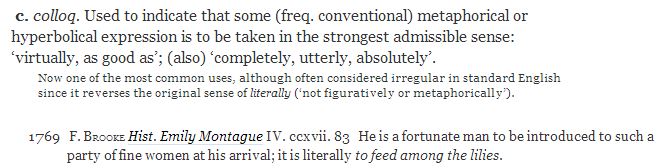
The outrage was further heightened by the realization that (gasp!) pretty much every major dictionary from the OED on down now recognizes this sense of the word. So now we get vitriol directed toward the OED's lexicographers, who revised the entry for "literally" back in September 2011, coming from such sources as The Times, The Daily Mail, The Guardian, and The Telegraph. [Update: As Fiona McPherson points out on the OxfordWords blog, the usage was actually noted in the "literally" entry when it was first published in 1903. The 2011 revision reorganized the entry and expanded the historical record.]

I've previously shared my thoughts on "literally" here on Language Log in a 2005 post discussing a piece on Slate by the OED's Jesse Sheidlower, as well as in a Word Routes column in 2008 ("Really! Truly! Literally!"). If I were pressed to find a silver lining in the latest round of hand-wringing, it would be this: many people are now learning about Frances Brooke, the novelist who is responsible for the earliest OED citation for the hyperbolic sense of "literally," from 1769. I first dug up the citation for the 2005 Language Log post, and it eventually worked its way into the OED's 2011 revision:

(You can read Brooke's History of Emily Montague, an epistolary novel, online here. As Wikipedia informs us, it holds the distinction of being the first novel written in Canada — she lived in Quebec from 1763 to 1768 before returning to England.)

The British press has duly noted that the maligned use of "literally" has been lingering since Brooke's time, but that hasn't stemmed the outrage: it's still wrong, they all say, even if it's been in continuous use for two and a half centuries. But it's a little inconvenient for the peevers, who would much rather blame Google or "the Internet" for the destruction of English. It doesn't make for as good a story to hold an 18th-century novelist responsible for "breaking the English language." Somehow, we've managed to soldier on since the linguistic horror perpetrated by the dastardly Mrs. Brooke.

15 Aug 18:12

Don’t you wish you had a job like mine?

by Passive Guy

Don’t you wish you had a job like mine? All you have to do is think up a certain number of words! Plus, you can repeat words! And they don’t even have to be true!

Dave Barry

Click to Tweet/Email/Share This Post