Shared posts

22 Nov 16:11

CINDY & BISCUIT in ‘ANATOMY OF A STICK’

by The Beast Must Die


Here’s a brand new Cindy & Biscuit strip for you. I’m doing these on a semi-regular basis here on Mindless Ones. Check them out here.

Also, don’t forget to get yourself a copy of the brand new 56 page  Cindy & Biscuit no.3 from my shop at Milk The Cat. You can pick up my other comics while you’re there.

Share on FacebookShare on Facebook

01 Oct 17:17

How First Past the Post could save the Lib Dems in 2015

by Mark Thompson
We Lib Dems really dislike First Past the Post.
A post, yesterday

In fact I'd even go so far as to say that we hate it.

We hate the distorting effect it has on our politics. We hate the way its ossifying influence helps to keep the red/blue duopoly of our system. We hate the way it keeps smaller parties (not just ourselves but e.g. Greens and UKIP) out of power or even in some cases parliament altogether.

So I think it's fair to say we are generally not fans. And yet in 2015 the First Past the Post electoral system for Westminster could perversely be the thing that saves us. Let me explain how.

The Lib Dems got 23% of the vote in 2010 but only just over 8% of the seats (which meant 57 seats). As unfair as this is (and I regularly bang on about this as regular readers and listeners to my podcast will know) the reason is because the majority of that 23% of votes were wasted. When I say wasted I mean they were cast in seats where we didn't get an MP. In other words our vote was not very efficiently distributed given how seats are actually won.

But because of the way FPTP is structured we don't need to get 23% in order to return 57 MPs. In fact theoretically we could get way less than 23% and still hold all our existing seats. We could even get less than 8% of the vote and get 57 seats.

With 650 seats up for grabs the way to be certain of getting 57 seats is to make sure you get 50% of the vote in 57 of them. In reality you can often win seats on less (in some cases much less) than 50% but for illustrative purposes let's assume that's what we want to do. So if each seat has 1/650th of the voters we can see that the percentage of votes we theoretically need is actually

(100 x (57/650)) / 2

Or around 4.4% of the vote.

Of course this assumes an absolutely perfect distribution of our vote, i.e. getting exactly the votes we need (50% each) in the seats we are targeting and zero votes everywhere. In reality this would never happen. But what this demonstrates is that FPTP is almost infinitely elastic in the lack of correspondence between number of votes cast and number of seats.*

It doesn't take a massive leap from this to see that if the Lib Dems are very smart and target their resources with ruthless efficiency they have a reasonable chance of retaining most of their seats. When combined with the incumbency factor that many Lib Dems are expert at using to their advantage it becomes a potent scenario. The casualties of this of course would be all those candidates running in all the other non-target seats. If we follow this through to its logical conclusion then in order for this strategy to work they would get next to no or perhaps actually no help. We could see a large number of lost deposits. But I suspect the leadership would see this as a small price to pay if they get to retain a solid number of MPs.

Come 2015 I suspect the Lib Dems will get more than the 8% - 10% we are currently seeing in the polls. It will probably be into the teens perhaps around 15% in my view. But even if it isn't and it actually ends up being 10% or even lower, First Past the Post offers us plenty of scope for gaming the system to return us far more MPs than a simple "Universal Swing" analysis would suggest.

The only question really is whether the party leadership is ruthless enough to follow such a strategy and thus use the invidious and rightly despised First Past the Post system to its full advantage.


*As an aside here consider that UKIP could get 10% or even 15% of the votes and would still likely get zero seats because their vote is quite evenly distributed across the country which is an absolute killer for political parties under FPTP.

25 Sep 07:40

Autumn #LDConf Leaves Me Feeling Better About Being A Lib Dem

by noreply@blogger.com (Jae Kay)
For Lib Dems it has been a tough few years. That pretty much goes without saying. After the failure of Lords reform I became very disillusioned with the Lib Dems direction, and about the only thing that has kept me in is my own damn stubbornness in the face of the hate being flung at the party by the left. "If Labourites hate us that much, we must be doing something right" might not be correct but it sure feels right.

This conference has had moments that reminded me that the Lib Dems are the party for me. Tim Farron's speech was good (and I'm saying that from someone who isn't a great fan). The votes for nuclear power and fracking aren't ones I'd particular support but I think they are necessary and were best expressed in the "limited" way they were presented. The decision to provide school meals to all young children may not exactly play into my liberaltarian nature, but it is way better than most other things Government gets involved with. And the agreement on support for a reduced nuclear deterrent is very welcome.

Whilst I enjoyed Nick Clegg's speech, the stand out speech of the conference was, of course, on the topic of porn. Well not just porn. It was about the Government's extremely ill-advised web filter plans. And it was also about fanfic. I mean, this was a speech practically written for me! After some awful, scaremongering speeches from the likes of Floella Benjamin (who I still love anyway) and some good speeches against, this one truly reminded me of how being a Lib Dem can sometimes be truly bloody awesome. Enjoy!

23 Sep 16:40

Politicians not rated highly? It's not all their own fault.

by noreply@blogger.com (Alun Wyburn-Powell)


YouGov has some interesting polling showing that the three main party leaders are all unpopular. In the past this has not been the case. Until the 1950s it was quite normal for both Conservative and Labour leaders to have positive ratings. As the Liberals began to feature in the polling, at least one of the party leaders was always popular at any one time. Why are all three main party leaders now unpopular?

YouGov suggested some plausible reasons, such as the wartime records of the post-war leaders and the faith which deprived voters placed in life-changing policies such as the NHS.

The low ratings could be because the current leaders are simply not as good as any of their predecessors. However, it would be hard to argue that David Cameron is a worse leader than Anthony Eden, or that Ed Miliband is worse than Michael Foot or Nick Clegg worse than Clement Davies. So, even if you do not think that the current leaders are the best which their parties have had, they are certainly not the worst.

Part of the answer is mathematical. There are more parties than ever before in real contention in British politics. Ten different parties have served at Westminster or in one of the devolved administrations, and this does not even include the Greens, Ukip or Respect. Most voters are partisan and will give a favourable response about the leader of the party which they support, but will be very grudging in rating the leadership of another party positively. The more parties which there are, on average, the worse will be the leaders’ ratings.

Another reason is the lack of deference. In an age when a university education was a rare achievement, where few people featured in the press or on television, many voters were impressed by an Eton and Oxbridge education, a title or a track record of working in a coal mine for twenty years. These days there are plenty of backgrounds which would be a disadvantage to a politician, but very few which automatically command respect.

Another reason is scrutiny. Today’s politicians are subject to minute scrutiny of every aspect of their life. Naturally, this encourages most to play safe in order to avoid negative coverage. But, when other professions are subject to the same scrutiny, many appear much worse than the politicians. Television presenters, police, Catholic priests, journalists and bankers, to name a few, have not exactly appeared as paragons of virtue when they have been subject to scrutiny.

Having worked with industrialists and politicians, my impression is that on average the calibre of the politicians is higher than that of the industrialists. But, politicians tend to fear industrialists, while industrialists tend to have contempt for politicians – even when they are phoning the chancellor of the exchequer to demand money when their bank is about to fail or, as in the US, when they need the president to save their car manufacturing plants.

Industrialists and politicians used to treat each other as respected equals – particularly because many of them were the same people – Jeremiah Colman, Arnold Rowntree, Alfred Mond, David Davies, Geoffrey Mander and Stanley Baldwin were all top industrialists who sat in Parliament. Liberal Party leader, Clement Davies was managing director of Unilever. Today the only FTSE 100 chairman to have sat in the Commons is Archie Norman, former chairman of ASDA, who was a Conservative MP from 1997 to 2005.

So, if politicians are not held in high regard, it is not entirely their fault. We do tend to judge them by a standard which most other humans are not able to match.
23 Sep 16:39

I agree with Nick, but this is not the whole story

by noreply@blogger.com (Alun Wyburn-Powell)


For most of the period since the Second World War it was reasonable to refer to British politics as a two-party system. Only the Conservative and Labour parties could reasonably claim to be parties of government.

Yesterday in his leader’s speech to the Lib Dem conference, Nick Clegg made the claim that the Lib Dems are now also a party of government. As far as his claim goes, it seems perfectly fair to me, and fully justified by events.

What Nick did not say though, was that since devolution in the late 1990s, there are also another seven parties which have provided ministers for the devolved administrations.

The most remarkable feature of the period since 1999 may well come to be seen as the fact that, instead of two, or even three, there are at least ten parties of government in Britain and all of them have proved competent in office.

The mantle of party of protest has now landed on Ukip, the Greens and Respect.

Nick Clegg was right, as far as he went, but in reality things have already moved even further than he claimed.
23 Sep 13:18

Feminism and control of other women

by stavvers

This week’s issue which is calling some premium-grade nonsense to fly forth from the mouths of feminists is the topic of banning face coverings, specifically the niqab. It is something which appeals to politicians, satisfying both their desire for racist policy and managing to get a bonus bit of giving themselves further reason to mass arrest protesters as a shitty little cherry on top. As always, there are hordes of feminists who are perfectly happy to deal with this as it manages to sate their appetite for controlling other women.

I don’t think I need to go into why getting the state to dictate what women may and may not wear is hardly a feminist position, and is simply a manifestation of a white saviour complex. Go and look at what Muslim feminists are saying about this; this is not my argument to make.

Among certain strains of feminism, we see a lot of attempts at controlling what other women do, wear and exist as.

We see it in Nadine Dorries, who calls herself a feminist while simultaneously craning her neck for the best viewing angle of our uteruses. She literally wants to control our reproductive freedom, and believes this stance to be a feminist stance.

We see it in the TERfs, the bigoted feminists who bully and harass trans women for existing, who spread lies and misinformation, who exclude and who try to deny access to treatment. They call themselves feminists, yet they are trying to control women’s bodies, to set themselves up as gatekeepers to womanhood through establishing a firm grasp on what a woman must be like.

We see it in a lot of high-profile campaigns calling for bans on this or that manifestation of sex work. Behind all of this is a desire to control what work is acceptable for women to do. We see it in the entire prohibitionist angle towards sex workers.

Am I saying these people are not feminists? No.

They are feminists. They are simply feminists who will ultimately do more harm than good.

See here’s the thing. It’s a little bit Captain Obvious to suggest that patriarchy places controls on women’s bodies and women’s behaviour. We know that this is terrible and bad and we rightly kick up a fuss about it. And yet to many women, the control imposed by certain strains of feminism is just as bad as these manifestations of patriarchal dominance. It is no different, aside from the perpetrators. And this is why we see so many marginalised women turning away from feminism: feminism just appears as rebranded patriarchy, rebranded control and coercion.

The feminists who want to control other women will defend their stance by saying that the women they are attempting to control need rescuing somehow, that this control is salvation. You will note that they are never trying to save themselves, only others who are somehow letting the side down by letting themselves be oppressed.

And yet this defence is much the same as the patronisingly sexist attitudes we face from men. We don’t know what’s good for us. We need someone to sort it out for us, someone who knows best. We are literally incapable of knowing what it is we need.

We reject it from men, and we must also reject these impositions of control from women.

If we want to help marginalised women to be liberated, our task is not to lead or to legislate, but to listen. We need to ask what help is required, rather than barging in like a carceral Leeroy Jenkins and making everything worse. It is support, not control, that will lead to freedom.


23 Sep 13:10

More evidence that Lib Dem MPs can beat the opinion polls

by Jonathan Calder
It has been common, at least since Mike Thornton won the Eastleigh by-election, for Liberal Democrats to argue that those who say we will be all but wiped out at the next general election are mistaken. Never mind the opinion polls, our MPs are popular and good campaigners, so they have a sporting chance of keeping their seats.

More evidence for this view comes from the October issue of Total Politics.

The magazine asked the members of YouGov's online panel about their satisfaction with their own MP. The results were startling:
if you’re a Conservative and you have a Labour MP, you can be forgiven for being predisposed to being dissatisfied with what they’re doing, and vice versa. 
But Lib Dem MPs appear to be able to reach across that divide. Even among non-Lib Dem voters, Lib Dem MPs scored +7. Amongst Lib Dem-voting respondents who had a Lib Dem MP, the score was an astonishing +61. 
We need to be cautious here: once you cut the data in a normal-sized survey down to focus just on Lib Dem voters (of whom there are currently not many) and who have Lib Dem MPs (of whom there are even fewer), you’re soon down to very small numbers of respondents and large margins of error. 
Still, while all MPs do better among those who will vote for that party than those who won’t, Lib Dems appear to be able to connect with non-supporters in a way that neither Labour nor Conservative MPs can.
The poll also found that
the views of those who've contacted their local MP about that MP are almost entirely dependent on how satisfactory the contact was. This relationship holds true regardless of the party leanings of the constituent.
Featured on Liberal Democrat Voice
23 Sep 11:20

Inquiry into briefings against Vince Cable by Nick Clegg's office

by Jonathan Calder
On Liberal Democrat Voice Caron Lindsay points us to an article in this morning's Observer:
Nick Clegg has launched an inquiry into claims that aides have been involved in a "dirty tricks" campaign against his leadership rival Vince Cable. 
The Liberal Democrat leader is investigating an allegation that members of the media have been briefed with erroneous information damaging Cable's position in the party. 
The move followed an angry complaint from an MP during a meeting of the parliamentary party at last week's Lib Dem conference in Glasgow. The dispute centres on an economic debate held during an away day for Lib Dem MPs last month. 
A number of reports, including one by the BBC's political editor Nick Robinson, alleged that Cable lost heavily when he proposed at the event that the government should borrow more, at current very low interest rates, to fund more capital spending. One source, reportedly close to Clegg, told the Sun: "The good doctor has been well and truly put back in his box."
I blogged about this "back in his box" comment at the time. What I heard in return amounted to "Well, Matthew Oakeshott started it", which was not particularly encouraging.

Still, I am not sure an inquiry is needed. Can't Nick just tell his people to stop doing it?

There are two other problems with communications from Nick Clegg's office. The Observer quotes one unnamed Lib Dem MP as describing Nick's aides as "the Stasi".

I would not go that far, but the tone of "people close to the Liberal Democrat leader" quoted in the press is often unfortunate. They tend to come over as a little too pleased with themselves, dismissive of the wider party and out of touch with the concerns of those struggling to make it through the economic downturn.

As this is the sort of view those who do not like Nick Clegg tend to take of him, it is precisely the wrong tone for his spokespeople to adopt.

The other problem is identified by Caron:
Our senior sources need to spend their time making sure that we respond quickly enough to major stories like the Go home poster vans or David Miranda’s detention. Two days in each case to get a Liberal Democrat approach out there was about 47 hours too long. That phrase “on message, in volume, over time” applies to them too. 
You aren’t doing anything to create a stronger economy in a fairer society enabling everyone to get on in life while you’re giving a completely inaccurate account of a meeting to a journalist.
I'll never be as on message as her, but Caron is right to identify a problem in basic competence about the leader's press operation.

I suggest Nick tells his people that they are not Damian McBridge and are not in The West Wing but are there to do what is in many ways a mundane job. And if he has to bring people people in from outside his circle to achieve competence, that will be no bad thing.
23 Sep 11:10

The Female Dollar

by mike

President Obama is considering appointing, among others, Janet Yellen as chairman of the Federal reserve. Predictably, opponents and proponents both take her gender into consideration: she’d be the first female head of the central bank.

Yellen’s supporters think having a woman as chair would amount to a breakthrough for gender equality, but opponents have worried about “the Female Dollar.” Have we entered, asks the New York Sun, “the era of the gender-backed dollar? The Wall Street Journal quotes this language in its editorial denouncing the fact that Yellen’s “cause has been taken up by the liberal diversity police as a gender issue ”

My book Face Value looks at the way race talk informs money talk, but I could just have easily looked at how gendered language filters into money debates.

In American history gold and silver are usually referred to as “hard” money, paper as “soft” money. Need I say more? Hard money is held to have good character, and to be the devoted companion of the higher races, hard money is on board the warships of imperialism, while its subjects, or victims, use flimsy paper.

The Civil War was financed by printing legal tender paper money, the famous greenbacks. Following the war, Americans split over what to do with these paper dollars. These arguments were never simply about money; they always involved questions about social stability and the meaning of difference

Thomas Nast in particular loved to characterize paper money as “the rag baby,” a grotesque, floppy doll masquerading as a real child. The child had parents, and in  the pages of Harper’s Weekly Nast usually inverted their gender roles, to demonstrate that paper money emasculated its supporters.

Here we see Benjamin Butler, a radical republican and political champion of paper money, as a woman with a “rag baby,” paper money.

ragbaby1

Below presidential candidate Samuel Tilden is instructed to nurse his rag baby by his wife. Uncle Sam looks on sadly. Paper money, made of old rags, could no more be real money than a rag doll could be a live baby

ragbaby2

In this cartoon Henry Carey, Lincoln’s financial advisor and the man most responsible for Civil War greenbacks, lies prostrate surrounded by “her” rag babies.

ragbaby3

Nast regarded paper money as an inversion of natural order, confusing meanings.

There’s a long history of associating money with women. Though Hermes/Mercury was the god of commerce, Fortuna was female and Roman coins were minted in the temple of Juno Moneta, from whom we get the word “money.”

moneta


Fortuna_or_Fortune


Fortuna is capricious and unreliable, in Carmina Burana  (you’ve heard it in a bunch of movies) she waxes and wanes like the moon and “strikes strong men down.”

Credit, fortune’s sidekick, was itself was often viewed as female. In the U.S. Jacksonians, who hated and detested paper money, constantly referred to the Second Bank of the US as the “Mother Bank,” a grotesque, swollen figure that must be made to vomit forth coins, in a parody of birth.

boxing

Here Jackson, shirtless on the right, boxes against bank director Nicholas Biddle. The woman on the right is the Bank


sickbank

Here Jackson watches through the window as his supporters make the bank sick, so it vomits up its gold coins

Heavy, loving luxury, the “mother” bank promoted weak dependence rather than manly virtue.

pupslg

This cartoon shows the bank, a woman, taking refuge in the barrel of hard cider offered by William Henry Harrison

These are highly sexualized images–the half naked boxers; the man with his legs spread behind the “bank’s” head; the voyeuristic spectators violating the bank in its bedroom; the bank in a clinging dress about to be…approached by Jackson and Van Buren as dogs. Clearly there was much more than money to the money debate.

Money is always bound up with reproduction: coins and bills are both themselves reproductions, but in circulation they reproduce the labor and wealth of the person who holds them. But money, invested, can grow. Critics of banking often talked about how a bank “breeds” money, creating illegitimate inflated offspring that then circulate promiscuously. John Adams denounced the “swindlign and barren gains” that banks produced. There are any number of accounts of how paper money puts people, especially women, above their station: paper money is also called “loose” money. An anonynomous pamphlet of 1721 complained that thanks to paper money

[T]he inferior sort will be clad in as costly Attire as the Rich and Honourable … ordinary Tradesmen’s Wives … dressed in Silks and Sattens . . . Inferiour Apprentices and Servants, having just obtained their Freedom shall be dressed like Lords of the Mannours; & in publick Congresses were it not for the different Seats they sit in one would scarce know Joan from my Lady by Daylight.

Paper money seemed to initiate not just high prices, but social  inflation, the wrong sort of people in charge

In those days strange sights could be witnessed in the streets of Columbia [South Carolina] at any time,” recalled ex-Confederate James Morgan of Reconstruction, and the greenback economy. More than once he remembered seeing “a handsome landau drawn by a spanking pair of high-stepping Kentucky horses and containing four negro wenches arrayed in low-neck and short-sleeved dresses, their black bosoms and arms covered with real jewels in the middle of the day, draw up in front of a barroom on Main Street where the wives and daughters of the old and impoverished aristocracy did their shopping.

The election of Barack Obama initiated a frenzied speculation in gold as and new calls for a return to the gold standard. No less a blowhard than Donald Trump insisted, in 2011, that he would now take “rent on one of his New York office buildings in gold bullion instead of dollars, because of his concerns about President Obama’s reckless financial policies.”

“It’s a sad day when a large property owner starts accepting gold instead of the dollar,” Trump said in a statement, reported The Wall Street Journal at the time. “The economy is bad, and Obama’s not protecting the dollar at all.…If I do this, other people are going to start doing it, and maybe we’ll see some changes.”

Gold has fallen in  price since then, and the much predicted inflation hasn’t appeared, and Trump is still taking paper money. But what about Janet Yellen?

According to the LA times

In what has been a highly public campaign for Fed chairman, critics have portrayed Yellen as being softer on controlling inflation than her chief rival for the nomination, former Treasury Secretary Lawrence H. Summers.

That has added to an overall perception that Yellen — a soft-spoken, diminutive woman — may be too soft in general to lead the world’s most influential central bank, a criticism that some say reflects a gender bias.

Gee, ya think? they managed to get the word “soft” in there three times. Google “Janet Yellen” and “soft” and you’ll find a lot of results, mostly articles worrying about whether or not she’ll be “soft on inflation.” Soft, and yielding.

If I had a lot of  surplus cash, which I don’t, I’d think about buying gold. If Yellen is appointed, I’d expect the same kind of concern about the instability of the “soft” “female,” “gender-backed” dollar that led to the gold boom after Obama’s election.


23 Sep 10:52

Indistinguishable from peers means: you don't have autism related problems

by Neurodivergent K
If you are declared indistinguishable from peers, which, as you may recall, is basically an educational diagnosis, people mistake this for not being Autistic any more. It is presented as such so of course the adults around the "indistinguishable" child act like this is the case, yes?

There are some problems with this. The one I'm talking about today is very practical: what ends up happening when the child inevitably has problems.

An Autistic child is vulnerable to a lot of problems-even an academically at grade level Autistic child. Perhaps especially an academically at grade level Autistic child. We are targeted for bullying by both students and teachers--we are not socially indistinguishable, just academically. We have high rates of anxiety and depression. We, like all people, get frustrated when we are misunderstood or misunderstanding. We have executive functioning difficulties that lead to problems with homework. Even if we are on grade level, we still have difficulties that the language of "indistinguishable from peers" ignores.

So, it's K's overshare time again. I was academically indistinguishable from peers. I have been to a number of psychologists and other people who think they know brains since childhood, because the issues I was having could not possibly be autism! They were everything but autism! Let's see if I can get their NOT AUTISM hypothesis in chronological order:

-I was emotionally immature and bored
-I wanted attention
-I wanted less attention
-"maybe she's still autistic" (that one got fired)
-I wasn't adjusting to my youngest sibling
-I was struggling with my mom & last name donor's divorce
-I was having a personality conflict with my teacher (all of them?)
-I was having a personality conflict with my last name donor's wife (technically true. But it was my fault because I was the child)
-I wasn't as smart as we thought I was
-I was twice as smart as we thought I was
-I wasn't doing homework as a way of seizing control
-I wasn't doing homework because I wanted the attention not getting homework gets
-I wasn't doing homework because of a fear of failing at it
-I was refusing to get along with stepparents and parents because of deep seated resentment of...they were never quite clear
-I was oppositional defiant
-I had ADHD
-I liked the attention being bullied got

And the constant refrain of "the common denominator in all of these problems is you." Constant refrain. The guy who billed himself as a problem solving expert. The guy who said I was too social to have ever been autistic because I had a friend. The guy who I never looked at ever but his name was Mike. All the parental units who were local to me.

The common denominator in all these problems is you.

Turns out adults who were indistinguishable as children have a really high rate of depression and suicide attempts. We tend to run pretty suicidal as children, too. It's logical, isn't it? If the common denominator is us, if we have issues related to a disability that we no longer have, isn't the way to end the problems to take out the common denominator? Everything that goes wrong is a function of bad choices we are making, everyone has a hypothesis on them, but we cannot make them stop because our neurology does not work that way. It is a choice that makes sense and a choice that would make it all just stop.

And that doesn't go away when you turn 18, or when they say "ha ha my bad, autism is lifelong and indistinguishability doesn't mean what everybody thinks it means." Those years of being the least common denominator and of all of those hypotheses being applied to you? They stick. Forever.

The 'residual deficits' that were referred to in Lovaas's 1987 paper are way more life-impacting than anyone wants to believe. You can't sell "we might be able to get your kid educationally mainstreamed, and that kid might end up there anyway, but said kid will still have autistic traits because they are still autistic" the way you can sell "indistinguishability" and just not mentioning it what it actually means. And damn the long term effects. It's not like autistic folks are actually people, but that's another post.
23 Sep 10:40

Take Back the Internet

by schneier

Government and industry have betrayed the Internet, and us.

By subverting the Internet at every level to make it a vast, multi-layered and robust surveillance platform, the NSA has undermined a fundamental social contract. The companies that build and manage our Internet infrastructure, the companies that create and sell us our hardware and software, or the companies that host our data: we can no longer trust them to be ethical Internet stewards.

This is not the Internet the world needs, or the Internet its creators envisioned. We need to take it back.

And by we, I mean the engineering community.

Yes, this is primarily a political problem, a policy matter that requires political intervention.

But this is also an engineering problem, and there are several things engineers can -- and should -- do.

One, we should expose. If you do not have a security clearance, and if you have not received a National Security Letter, you are not bound by a federal confidentially requirements or a gag order. If you have been contacted by the NSA to subvert a product or protocol, you need to come forward with your story. Your employer obligations don't cover illegal or unethical activity. If you work with classified data and are truly brave, expose what you know. We need whistleblowers.

We need to know how exactly how the NSA and other agencies are subverting routers, switches, the Internet backbone, encryption technologies and cloud systems. I already have five stories from people like you, and I've just started collecting. I want 50. There's safety in numbers, and this form of civil disobedience is the moral thing to do.

Two, we can design. We need to figure out how to re-engineer the Internet to prevent this kind of wholesale spying. We need new techniques to prevent communications intermediaries from leaking private information.

We can make surveillance expensive again. In particular, we need open protocols, open implementations, open systems -- these will be harder for the NSA to subvert.

The Internet Engineering Task Force, the group that defines the standards that make the internet run, has a meeting planned for early November in Vancouver. This group needs to dedicate its next meeting to this task. This is an emergency, and demands an emergency response.

Three, we can influence governance. I have resisted saying this up to now, and I am saddened to say it, but the US has proved to be an unethical steward of the Internet. The UK is no better. The NSA's actions are legitimizing the internet abuses by China, Russia, Iran and others. We need to figure out new means of internet governance, ones that makes it harder for powerful tech countries to monitor everything. For example, we need to demand transparency, oversight, and accountability from our governments and corporations.

Unfortunately, this is going play directly into the hands of totalitarian governments that want to control their country's Internet for even more extreme forms of surveillance. We need to figure out how to prevent that, too. We need to avoid the mistakes of the International Telecommunications Union, which has become a forum to legitimize bad government behavior, and create truly international governance that can't be dominated or abused by any one country.

Generations from now, when people look back on these early decades of the Internet, I hope they will not be disappointed in us. We can ensure that they don't only if each of us makes this a priority, and engages in the debate. We have a moral duty to do this, and we have no time to lose.

Dismantling the surveillance state won't be easy. Has any country that engaged in mass surveillance of its own citizens voluntarily given up that capability? Has any mass surveillance country avoided becoming totalitarian? Whatever happens, we're going to be breaking new ground.

Again, the politics of this is a bigger task than the engineering, but the engineering is critical. We need to demand that real technologists be involved in any key government decision making on these issues. We've had enough of lawyers and politicians not fully understanding technology; we need technologists at the table when we build tech policy.

To the engineers, I say this: we built the Internet, and some of us have helped to subvert it. Now, those of us who love liberty have to fix it.

This essay previously appeared in the Guardian.

EDITED TO ADD: Slashdot thread. An opposing view to my call to action. And I agree with this, even though the author presents this as an opposing view to mine.

23 Sep 10:28

Surreptitiously Tampering with Computer Chips

by schneier

This is really interesting research: "Stealthy Dopant-Level Hardware Trojans." Basically, you can tamper with a logic gate to be either stuck-on or stuck-off by changing the doping of one transistor. This sort of sabotage is undetectable by functional testing or optical inspection. And it can be done at mask generation -- very late in the design process -- since it does not require adding circuits, changing the circuit layout, or anything else. All this makes it really hard to detect.

The paper talks about several uses for this type of sabotage, but the most interesting -- and devastating -- is to modify a chip's random number generator. This technique could, for example, reduce the amount of entropy in Intel's hardware random number generator from 128 bits to 32 bits. This could be done without triggering any of the built-in self-tests, without disabling any of the built-in self-tests, and without failing any randomness tests.

I have no idea if the NSA convinced Intel to do this with the hardware random number generator it embedded into its CPU chips, but I do know that it could. And I was always leery of Intel strongly pushing for applications to use the output of its hardware RNG directly and not putting it through some strong software PRNG like Fortuna. And now Theodore Ts'o writes this about Linux: "I am so glad I resisted pressure from Intel engineers to let /dev/random rely only on the RDRAND instruction."

Yes, this is a conspiracy theory. But I'm not willing to discount such things anymore. That's the worst thing about the NSA's actions. We have no idea whom we can trust.

23 Sep 10:16

Google Knows Every Wi-Fi Password in the World

by schneier

This article points out that as people are logging into Wi-Fi networks from their Android phones, and backing up those passwords along with everything else into Google's cloud, that Google is amassing an enormous database of the world's Wi-Fi passwords. And while it's not every Wi-Fi password in the world, it's almost certainly a large percentage of them.

Leaving aside Google's intentions regarding this database, it is certainly something that the US government could force Google to turn over with a National Security Letter.

Something else to think about.

23 Sep 10:02

The Unitarihedron: The Jewel at the Heart of Quantum Computing

by Scott

Update (9/24): This parody post was a little like a belch: I felt it build up in me as I read about the topic, I let it out, it was easy and amusing, I don’t feel any profound guilt over it—but on the other hand, not one of the crowning achievements of my career.  As several commenters correctly pointed out, it may be true that, mostly because of the name and other superficialities, and because of ill-founded speculations about “the death of locality and unitarity,” the amplituhedron work is currently inspiring a flood of cringe-inducing misstatements on the web.  But, even if true, still the much more interesting questions are what’s actually going on, and whether or not there are nontrivial connections to computational complexity.

Here I have good news: if nothing else, my “belch” of a post at least attracted some knowledgeable commenters to contribute excellent questions and insights, which have increased my own understanding of the subject from ε2 to ε.  See especially this superb comment by David Speyer—which, among other things, pointed me to a phenomenal quasi-textbook on this subject by Elvang and Huang.  My most immediate thoughts:

  1. The “amplituhedron” is only the latest in a long line of research over the last decade—Witten, Turing biographer Andrew Hodges, and many others have been important players—on how to compute scattering amplitudes more efficiently than by summing zillions of Feynman diagrams.  One of the key ideas is to find combinatorial formulas that express complicated scattering amplitudes recursively in terms of simpler ones.
  2. This subject seems to be begging for a computational complexity perspective.  When I read Elvang and Huang, I felt like they were working hard not to say anything about complexity: discussing the gains in efficiency from the various techniques they consider in informal language, or in terms of concrete numbers of terms that need to be summed for 1 loop, 2 loops, etc., but never in terms of asymptotics.  So if it hasn’t been done already, it looks like it could be a wonderful project for someone just to translate what’s already known in this subject into complexity language.
  3. On reading about all these “modern” approaches to scattering amplitudes, one of my first reactions was to feel slightly less guilty about never having learned how to calculate Feynman diagrams!  For, optimistically, it looks like some of that headache-inducing machinery (ghosts, off-shell particles, etc.) might be getting less relevant anyway—there being ways to calculate some of the same things that are not only more conceptually satisfying but also faster.

Many readers of this blog probably already saw Natalie Wolchover’s Quanta article “A Jewel at the Heart of Quantum Physics,” which discusses the “amplituhedron”: a mathematical structure that IAS physicist Nima Arkami-Hamed and his collaborators have recently been investigating.  (See also here for Slashdot commentary, here for Lubos’s take, here for Peter Woit’s, here for a Physics StackExchange thread, here for Q&A with Pacific Standard, and here for an earlier but closely-related 154-page paper.)

At first glance, the amplituhedron appears to be a way to calculate scattering amplitudes, in the planar limit of a certain mathematically-interesting (but, so far, physically-unrealistic) supersymmetric quantum field theory, much more efficiently than by summing thousands of Feynman diagrams.  In which case, you might say: “wow, this sounds like a genuinely-important advance for certain parts of mathematical physics!  I’d love to understand it better.  But, given the restricted class of theories it currently applies to, it does seem a bit premature to declare this to be a ‘jewel’ that unlocks all of physics, or a death-knell for spacetime, locality, and unitarity, etc. etc.”

Yet you’d be wrong: it isn’t premature at all.  If anything, the popular articles have understated the revolutionary importance of the amplituhedron.  And the reason I can tell you that with such certainty is that, for several years, my colleagues and I have been investigating a mathematical structure that contains the amplituhedron, yet is even richer and more remarkable.  I call this structure the “unitarihedron.”

The unitarihedron encompasses, within a single abstract “jewel,” all the computations that can ever be feasibly performed by means of unitary transformations, the central operation in quantum mechanics (hence the name).  Mathematically, the unitarihedron is an infinite discrete space: more precisely, it’s an infinite collection of infinite sets, which collection can be organized (as can every set that it contains!) in a recursive, fractal structure.  Remarkably, each and every specific problem that quantum computers can solve—such as factoring large integers, discrete logarithms, and more—occurs as just a single element, or “facet” if you will, of this vast infinite jewel.  By studying these facets, my colleagues and I have slowly pieced together a tentative picture of the elusive unitarihedron itself.

One of our greatest discoveries has been that the unitarihedron exhibits an astonishing degree of uniqueness.  At first glance, different ways of building quantum computers—such as gate-based QC, adiabatic QC, topological QC, and measurement-based QC—might seem totally disconnected from each other.  But today we know that all of those ways, and many others, are merely different “projections” of the same mysterious unitarihedron.

In fact, the longer I’ve spent studying the unitarihedron, the more awestruck I’ve been by its mathematical elegance and power.  In some way that’s not yet fully understood, the unitarihedron “knows” so much that it’s even given us new insights about classical computing.  For example, in 1991 Beigel, Reingold, and Spielman gave a 20-page proof of a certain property of unbounded-error probabilistic polynomial-time.  Yet, by recasting things in terms of the unitarihedron, I was able to give a direct, half-page proof of the same theorem.  If you have any experience with mathematics, then you’ll know that that sort of thing never happens: if it does, it’s a sure sign that cosmic or even divine forces are at work.

But I haven’t even told you the most spectacular part of the story yet.  While, to my knowledge, this hasn’t yet been rigorously proved, many lines of evidence support the hypothesis that the unitarihedron must encompass the amplituhedron as a special case.  If so, then the amplituhedron could be seen as just a single sparkle on an infinitely greater jewel.

Now, in the interest of full disclosure, I should tell you that the unitarihedron is what used to be known as the complexity class BQP (Bounded-Error Quantum Polynomial-Time).  However, just like the Chinese gooseberry was successfully rebranded in the 1950s as the kiwifruit, and the Patagonian toothfish as the Chilean sea bass, so with this post, I’m hereby rebranding BQP as the unitarihedron.  For I’ve realized that, when it comes to bowling over laypeople, inscrutable complexity class acronyms are death—but the suffix “-hedron” is golden.

So, journalists and funders: if you’re interested in the unitarihedron, awesome!  But be sure to also ask about my other research on the bosonsamplinghedron and the quantum-money-hedron.  (Though, in recent months, my research has focused even more on the diaperhedron: a multidimensional, topologically-nontrivial manifold rich enough to encompass all wastes that an 8-month-old human could possibly emit.  Well, at least to first-order approximation.)

23 Sep 10:00

Occupy Liberal Democracy! Part 1: SAOs and AOs #ldconf

by JHSB

Featured on Liberal Democrat VoiceI believe that it’s important for the Liberal Democrats and its members that more people get more involved more widely in the party. I’ve been trickling out posts about background and procedure, but it’s time to flip around the Kolb learning cycle from Abstract to Active, and encourage you to do something. Mostly, I’ve been talking here about local parties because it’s the most obvious and geographically proximate way for people to get involved.

For this post I’m going to talk about party interest groups, because it’s Conference now (it wasn’t when I started this post a week ago, but I’ve been busy) and most party interest groups have their AGMs at Autumn Conference. The Lib Dems has a wide, eclectic, federal structure. There are many ways to get involved, if you know about them. Unfortunately, few people do know about them and it’s not easy to find out. New members get details about Specified Associated Organisations in their member packs now, which is a vast improvement; there’s a horrible hard to navigate list of party bodies on the party website. But if you’re at Conference, go look around the Exhibitions to find party bodies which are at least organised and funded enough for a stall.

If there’s an area of Lib Dem policy you’re interested in, stand for election to the executive committee that runs the interest group – pretty much all of them are elected democratically at each autumn conference, either at the AGM or by postal ballot shortly afterwards. If you can’t get elected, ask the executive to co-opt you to any vacant spaces. Get involved and become part of a team – rope in a friend to stand with you, for moral support. If you’re not sure what to do, I’d make sure the following are happening:

  1. The organisation knows who its members are and chases up renewals
  2. The organisation communicates with its members through some combination of post, email or social networking
  3. The organisation asks for feedback and input from its members
  4. The organisation advertises its existence and actively seeks new members
  5. The organisation is creating, sponsoring or supporting policy motions to achieve its goals within the Party
  6. The organisation’s executive communicates effectively, regularly and frequently

In my experience, an executive list on the party list server or another mailing list provider is very helpful for the last point.

This is the bare minimum that an organisation needs to do to self-sustain. It’s not enough to make it an effective and useful organisation, but it’s a way of getting more people more involved and engaged to achieve that. People can’t do everything themselves, and organisations need to encourage strong teams of diverse talents. Once those requirements are being addressed – not necessarily perfectly, but things are moving in the right direction, think about:

  1. The organisation is promoting the party’s action on its policies and goals outside the Party
  2. The organisation is campaigning on its policies and goals outside the Party

Party bodies don’t exist just to sell the party to outsiders – that’s why these external goals are secondary. But they should exist to make the Lib Dems do the right thing (in their opinion) and to engage the public with these issues. Organisations need to be inward-facing to sustain themselves and grow, but they also need to look outward for fresh ideas, and to make sure we’re either representing or persuading the public in liberal directions.

This guide is nearly short enough for a Lib Dem Voice article (and following LDV is not a bad way to find out about some of the things happening in the party, particularly in its member-only forum). I hope it sets out how you can get involved in an SAO and what you can do. Getting more involved in the party can be frustrating at times, and can involve a lot of work if you haven’t got a strong team pulling together – or if you’re trying to bite off more than you can chew. But it can also be incredibly rewarding, from the small victories to the big ones. It can teach you skills, and lessons, and talents you can put to use in the rest of your life. It’s worth it for you, and it’s worth it for the cause of Liberal Democracy.


23 Sep 07:44

Coronation Street in 1967

by noreply@blogger.com (Paul Magrs)


The other night I dipped at random into a Coronation Street boxed set of DVDs and watched what is probably one of the best episodes I’ve ever seen. It’s from 1967 and has the whole street in something of a kerfuffle because Elsie Tanner’s gentleman friend from the days of the Blitz is back in town – a handsome GI called Steve.


‘We were called good time girls. And we did have a good time. A damned good time!’


Elsie’s out in the countryside having a nostalgic walk with Steve, who she hasn’t seen in over twenty years. It’s all equal parts nostalgia, regret – and just a touch of bitterness. It’s endearingly seemingly clunky, too, in the way the mood switches from happy laughter to melodrama (she stands and walks to a tree, where she poses like Garbo at the end of Queen Christina – hair streaming in the breeze.) But it’s modeled on the melodrama of the 30s and 40s movies that Elsie even references in the script – when she says she first dyed her hair red to be like Rita Hayworth (she felt Steve lose interest in her when they sat in the pictures and Hayworth came on the screen.) Elsie goes into a story of how she did a home-dye job and made a hash of it.


This is very dense, beautifully layered writing. It’s camp as anything – but wonderfully subtle. It’s about characters looking back and mythologizing their own lives, and gently sending up their own foibles and pretensions and hopes  – with talk of tragic non-meetings and leave-takings under Warrington town hall clock. Then, later, when we get regretful scenes from Elsie (who secretly feels too past it for all this sudden romance) we get funny stuff about how, back in the old days having a plastic handbag and a sixteen guinea suit meant you really were something. There’s a level of self-parody in all the self-pity and introspection, and that’s why it always rings true to me.


It can only be the work of Tony Warren, the series’ creator. It’s so different from everyone else’s Corrie work, before or after. It’s not just a case of hitting the right notes in the salty vernacular – it’s about the warmth and pathos – and the characters being in charge of what they’re saying.


It’s never about the writer’s cleverness at the expense of the character – and what a hard trick that is to master.


Every one of Warren’s beloved characters get their moments and they all reveal something we never knew. Old Ena Sharples talks about the US with Steve the GI and we learn she once visited her brother there, but she never took to the place. Except for the funeral parlours of Nebraska. Later, she harangues Elsie outside her house about how she used to have all the soldiers round – and the jeeps would come up these cobbles at such a clip. But it’s not as straightforward as simply having a go at Elsie’s loose morals. Ena wants those old days back as much as anyone – you can see that and hear it in her performance.


The whole episode is astonishing, I think. And while it seems mostly frothy fun – there’s this weight of years and wasted time sketched in masterfully behind every moment. And then – just when you think you know where it’s going – the lights dim and dip in the Rovers and there’s an unearthly screeching explosion from outside. Len Fairclough comes bursting in, full of panic. A tram’s crashed through the viaduct. And now, instantly, there’s a disaster movie going on outside.


I was completely thrown by this. I knew this happened in Corrie, sometime in the late 60s, but not right then. It arrives in this episode with the horrible shock that real life events do. And the whole show lurches into a different genre, in those final, sickening moments – but because the characters are drawn so brilliantly we really care what happens next.


It’s a street like any other. That’s what the show was always about. You could chose any narrow street with pressed-together houses and smoky chimney pots anywhere in Manchester, or any northern city, and you would find dramas like this. And faces from the past can arrive to stir everything up in any street, too. And dreadful disasters can happen, too. It’s everyday melodrama – and watching it the other night I was struck by its immense subtlety and blending of genres. 


And the fact that it can still make me laugh and gasp out loud like no other show.


21 Sep 23:08

Everyday Sexism at the Art Institute of Chicago

by Annalee

The Art Institute of Chicago is currently hosting a special exhibit on Impressionism, Fashion, and Modernity, featuring impressionist paintings alongside extant garments from the period.

Impressionist work and 19thc fashion being two of my favorite things, I went to visit the exhibit while I was in town for DjangoCon.

I’d been told the Art Institute has “substantial holdings of impressionist and related art,” and I can’t say I was disappointed. There was much geeking to be had. The dresses were great, too. I may have, on occasion, crouched down next to certain dresses to get a look at how their hems were done, or put my nose a little too close to their glass cases to be dignified.

I do, however, have a bone to pick with whoever did the descriptive placards that accompanied the artwork.

Édouard Manet's Woman Reading, 1897/80

Édouard Manet’s Woman Reading, 1879/80

Manet’s Woman Reading is one of the first paintings you see when you enter the exhibit. It depicts a woman reading a newspaper at a café.

They wouldn’t let me photograph the accompanying placard, so I copied the last sentence down by hand. It read:

These illegible calligraphic squiggles suggest that the woman is focused less on the newspaper’s printed words than on the fashion illustrations and advertisements.

…I’m not art historian, but I’m pretty sure the illegible calligraphic squiggles suggest that this is an impressionist painting.

Come on, placard-writer. The woman may be doing the 19thc equivalent of taking her laptop to a coffee shop, but even my apparently sub-literate ladybrain knows that impressionists weren’t concerned with capturing their subjects in photo-realistic detail. Manet most likely rendered the newspaper in ‘squiggles’ because that’s all he needed to give the impression of a newspaper.

Also, not for nothing, but those squiggles look way more like a rendering of a figure than of text to me. So maybe they’re ‘squiggles’ because she’s too busy reading up on the first class of female students at Oxford University to pay much attention to the advertisements.


20 Sep 18:12

Speeches I Didn’t Make: The Manifesto and Freedom #LibDemValues

by Alex Wilcock

Yesterday morning, I didn’t make a speech. That’s not unusual: I didn’t make a speech on any of the previous hundred or so mornings, either. But yesterday morning I had a rallying call ready, and wasn’t called (as I’d almost told myself). Liberal Democrat Conferences are democratic – ordinary members or Leaders can speak, and each has one vote – and yesterday’s debate more than usually so, giving us the chance to debate a “Manifesto Themes” Paper long before the General Election. So now you can see my contribution, both written and delivered on YouTube live from a broom cupboard!

A Stronger Economy in a Fairer Society – Enabling Every Person to Get on in Life is a title regular readers will recognise: the Liberal Democrats’ main message. I’ve been doing quite a bit of work to broaden it into a slightly longer statement that reflects more of our values, and that was what I was going to talk about yesterday morning (before Nick Clegg’s cheeringly similar “No, nope, nah” refrain in the afternoon). Thanks to Caron Lindsay for wielding the camera-phone and offering use of the tiny office – it was an odd experience delivering a speech designed for a big hall and big audience in a tiny space and to two lovely people, and it made me feel rather hammy. It’s also much easier when there’s a lectern to rest the speech on and hide behind, as I talk with my hands and shuffle my feet! This version lasts rather longer than the statutory four minutes: I didn’t have a time limit in the broom cupboard, and wander about a bit in the middle, but when practicing it earlier I worked out which bits to gabble through and could sprint to the end in 3.45…


Freedom Is Our Signature Tune
A stronger economy, a fairer society, a million jobs… It’s a good tune, but it sounds a lot like what everyone else is playing. We need that competent, managerial message, but we need passion, too. To make our signature tune sing it needs something more – and freedom is a tune only we can play.

It’s great to see my favourite bit of the Preamble in here. It’s a start. But it’s politically streetwise to pump up freedom higher in the mix. Freedom says we’ve got principles – it inspires our activists and attracts those converts that no-one else can reach.

And it’s streetwise because if we don’t stand up for freedom in the campaign, it will be much harder to make it cast-iron in Coalition, or to make voters understand why we’ll give up other priorities for it.

Make no mistake – it will be much harder next time. When Labour were the most authoritarian government in modern British history, the Tories discovered a taste for freedom. Back in power, they’ve rediscovered how much they love to boss people about. And still, the Labour bully-boys’ first reaction on every liberty is to attack the Coalition from the far right.

Yet if you combine freedom and economic responsibility, austerity can be a friend to some freedoms. Because appalling illiberal authoritarian schemes aren’t just appalling illiberal authoritarian schemes – they’re always expensive appalling illiberal authoritarian schemes. So make the Lib Dems the party of economic responsibility by attacking the other two for wasting a ton of money on their bullying pet projects when there’s so little money to spare.

ID cards waste a ton of money, so don’t.
Snoopers’ Charters waste a ton of money, so don’t.
“Go Home” vans, and porn filters, and every massive intrusive database waste a ton of money, so don’t.

Of course there are positive Liberal commitments I’d like to see in the Manifesto too.

I want to say a personal thank you to every moral Liberal Democrat at Westminster – on our twentieth anniversary next year, Richard and I will be getting married. Thanks to you voting for equal marriage. But the Manifesto should have more than a picture celebrating the partially equal marriage we have now – a commitment to fully equal marriage, so that trans people can be as happy as we are.

I want to see in this Manifesto a Greater Repeal Bill, to expand on the Freedom Act the Tories watered down.
I want to see us repealing all the victimless crimes that waste people’s lives and waste court money and waste police time.

But most of all I want to see a ringing rallying call.
Your mission, David, should you decide to accept it, is to set out a clear, concise vision that combines our big slogan message, our priorities for government and our Liberal principles.
It sounds like mission impossible, but it can be done. And as readers of my blog will know, here’s one I prepared earlier.

Sing Along

The Liberal Democrats stand for freedom for every individual – freedom from poverty, ignorance and conformity.

To make that freedom real needs both fairness and economic responsibility: an economy that works, that encourages enterprise, and where everyone pays their fair share.

So freedom from poverty requires responsible spending, not debt, built on fairer taxes where lower earners pay less tax and the wealthiest pay more, and building green jobs for the future.

Freedom from ignorance needs better education and training, so people have the opportunity to realise their potential.

And freedom from conformity, supported by freedom from poverty and ignorance, means everyone should have the liberty to live their lives as they choose – without harming others; with equality before the law; with a better say, because no government always knows best.

That’s why Liberal Democrats are working for a greener, stronger economy in a fairer society, enabling every person to get on in life.

I wanted to make a positive contribution, so gambled on putting in a card to speak mostly in favour of parts of the motion on the Manifesto Themes. Had I played the Conference ‘game’ and put in to speak against on something the vast majority supported, I’d have been much more likely to have been called: in retrospect, it would have been tempting to speak against the first amendment. Sadly, no-one did, and it was passed overwhelmingly, despite being a shoddy piece of drafting and an ugly piece of wording. It’s bad enough that it was a piece of self-indulgent fappery from Liberal Left, adding rambling statements of the obvious as if only they’d thought of them, and deleting one paragraph merely to reword it slightly differently and less flowingly. What really got my goat about it was that in their eagerness to indulge themselves they dropped things from the original wording. How do you support children by taking out any mention of parents or early years education? And, shamefully, where the original lines talked about “removing barriers faced by communities such as ethnic minorities”, an open-ended and Liberal commitment that gives in example groups who face particular barriers but with its “such as” implies that we want to break down barriers all around, Liberal Left’s clumsy redraft was exclusive, not inclusive, only wanting barriers removed for its chosen groups. Barriers of sexism? Homophobia? Transphobia? Anyone else but Liberal Left’s chosen few? Then their amendment excludes you.

Shameful.
19 Sep 14:43

Inability to count

by noreply@blogger.com (Mark Smulian)
Word reaches Liberator of an altercation at yesterday’s parliamentary party meeting over briefing by those associated with Nick Clegg, to the effect that the unamended motion on the economy (debated by party conference yesterday morning) was supported 55-2 at a pre-conference awayday of MPs.

We hear that this greatly displeased Vince Cable, on the grounds that no such vote took place at the event concerned and that, even if it had, not all 57 MPs were present so the figures could not have been correct.

The implication was that Cable was among the two and therefore that his position on the economy enjoyed only minor support among MPs. This is believed to be a terminological inexactitude.

Liberator would be grateful for any further details of what transpired at the meeting, our usual discretion assured. Oh, and the 224-220 vote yesterday in favour of a 45p top tax rate, rather than 50p, was, it should be noted, made possible only a by frantic late whipping in of ‘payroll’ MPs, to the wry amusement of those on the 50p side.

At least 220 people understand the important political symbolism in being a party that thinks some burdens should fall on the rich, even if the leader doesn’t.
19 Sep 14:05

Who Put This Thing Together?

by LP

Each year at this time, the Grady McPhailey Foundation releases a list of the annual recipients of the McPhailey Foundation Scholarship Grant, popularly known as the ‘Grady Train’.

Mr. McPhailey, heir to the McPhailey Ear Shortener fortune, spent his 72 years on Earth attempting to be a poet. Although he never completed any works of more than two lines in length, his dedication to wearing ratty black turtle-neck sweaters, becoming drunk and unruly at parties, being dangerously underweight, and gazing moodily out the window of his Bossier City, LA loft while chain-smoking imported cigarettes was unrivaled by any poet of his, or any other, generation. Late in life, he realized the great truth of his existence: you are an artist if you say you are an artist. Placing the majority of his great wealth in a perpetual trust, he stipulated that upon his death, it should be used to give cash rewards to Americans and Canadians who show great promise in pretending to be artists, behaving like artists, and generally living an artistic lifestyle without ever actually producing any art. In the last 14 years, the McPhailey Foundation has distributed over $7 million to deserving poseurs, wannabes and hangers-on throughout North America. It has been called “the lazy man’s Pulitzer”; the New York Times recently noted that “what the MacArthur ‘genius grant’ is to people who accomplish things, the McPhailey Foundation Scholarship Grant is to people who think about accomplishing things”.

This year, in the spirit of the late Mr. McPhailey’s favorite motivational saying, “You can do it! Or, at least, you can tell people you do!”, we are pleased to announce the following grant recipients.

- To Roger Wilco, a self-described “prose sonnetier“: $24,000 for the purchase of a number of partially filled-in notebooks to scatter around his garret to make it appear that he has been writing.

- To Jean Valdenim of Detroit, MI, who wishes to be thought of as an experimental composer, $50,000 to purchase field recording equipment to make a document of ambient sounds to sample into a song cycle he does not intend to complete.

- To Betty Lou Handbag, an “antikinetic actualist” because that sounds more important than “sculptor”, $10,000 to fund her travels to art museums around the world so as to study the works of other sculptors who have actually engaged in the creation of sculpture.

- To Mark Laandgraab, an investment banker, $75,000 to invest in high-yield tech futures so he can afford to have other people paint paintings and then he can sign his name to them, “you know, like that one guy”.

- To Ned Cheezit, who has studied neither physics nor art, $20,000 to determine if he can think about coming up with some sort of unified field thing that totally explains both art and science forever.

- To Sidney Brokeback, photonovelist, $30,000 so he can transcribe this really amazing dream he once had to an actual novelist and see if the guy can “do anything with it”.

- To Karl Spurgbeer, a student of filmistry, $25,000 to take a year off and finally see a bunch of the movies that he has very strong opinions about, and then publicly denounce them in an even more vociferous way than he has done previously.

- To Charity Balles, head of the Cultural Studies Department of the Charity Balles College of Western Apartment #3F, $40,000 to have some letterhead and business cards made up, with raised gold leaf lettering and everything.

- To Alison Ra, jazz motionographer, $10,000 to go to jazz clubs every weekend for the next 6 months and listen to real cool sounds and order drinks while telling people seated near her how, if someone were to choreograph them for an avant-garde dance troupe, that would be so awesome.

- To James Ganngg of Williamsburg, $50,000 to be seen at all the best parties and hire a couple of people to talk about how breathtaking his work is so that everyone will admire him and invite him to even more parties because they just assume that he’s doing something vital and new, even if they aren’t exactly sure what it is.

19 Sep 14:03

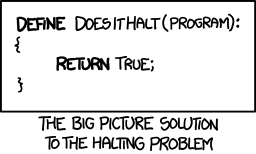
Halting Problem

I found a counterexample to the claim that all things must someday die, but I don't know how to show it to anyone.
19 Sep 13:57

Doctor Who - Seeds of Death

by noreply@blogger.com (Paul Magrs)


Not really a review or a proper blog about this 1960s Doctor Who story – more a simple observation… but isn’t ‘Seeds of Death’ terrific?


Over twenty years ago I had the Betamax videotape, one of the earliest commercial releases from BBC Worldwide, and at that point they were editing out all the episode credits and titles, so what we had was a hugely overlong and slightly fuzzy movie that looked as if it had been filmed in someone’s dusty cupboard. I haven’t been able to play Betamax tapes – along with the rest of humanity – for quite some time, and so I was pleased to be able to sit down with this story again on DVD (thanks, Stu!)


In recent months I’ve been a bit cheesed off with Doctor Who. Or rather, the feeding frenzy hullaballoo all around Doctor Who. I’ve found the show itself a little overblown and portentous – and all the backslapping and brouhaha becoming just a bit much sometimes (‘I’m a genius! You’re a genius!’ ‘We’ve raised the bar!’) It all seemed to be more about the people making the show and their glittering careers rather than the actual story and characters themselves. And some of the story-telling wasn’t quite working for me, either.


I loved Peter Capaldi suddenly appearing onscreen in the Who equivalent of ‘Britain’s Got Talent’ – emerging from the dry-ice and clutching his lapels. I loved that he talked as a Doctor Who fan – and about how ‘we all made Doctor Who. It belongs to everyone.’ I think he was talking about the show as a collective enterprise that involves not just the star actors or writers… but also the set-painters and rubber-suit-wearers, the viewers who wrote in to complain when it was taken off the air, and those who cheered when it came back – and even those who wrote the humble tie-in fiction that bridged the various gaps.


That little moment reminded me about Doctor Who as a fun thing that was all about imagination and daring and feeling like you were taking part, somehow. When the story and the effects needed you to suspend your imagination – when they weren’t spoon-feeding you, and your investment of creative energy in watching led to you feeling more involved.


‘Seeds of Death’ has some of that feeling about it. It’s from a more innocent time – when no one involved in front of or behind the cameras are expecting to springboard to a Hollywood career on the back of this serial. It’s hugely silly in places – but they really embrace all of that. They revel in the silliness at times – as per the celebrated scene with the Doctor drowning in extraterrestrial foam. But alongside the daftness there’s a deadly seriousness about the story and the predicaments involved. There are some shocking casualties amongst the guest cast (Mavis’ Victor from Corrie meets a sorry end…)


The whole thing is a delight – spiced up hugely by some startlingly stylized flourishes. I’d forgotten completely about Troughton being chased by Ice Warriors through the moonbase, and entering a kind of funhouse of mirrors. And so – for no other purpose than sheer, exciting entertainment – we get one of those priceless ‘wild zones’ that I’ve often noted in the really great Doctor Who stories. By ‘wild zones’ I don’t quite mean fantasy sequence or fighting scenes, dream scenes or crazy chase montage… but something like a cross between all of these things. Watch out for them – it’s the part where the story cuts loose for a moment and somewhat strange and brilliant things happen. (Many of the contemporary 42 minute stories – lacking a full third act - forget to include these sequences – and hence their feeling I get that they’re missing something.)


A favourite part of Seeds of Death is when the Ice Warriors catch up with him and he tells them ‘you can’t kill me! I’m a genius!’ And I love the way he has to admit to it at the point of a sonic weapon – only grudgingly does he bellow it, as if the words are being forced out of him.


The Doctor is only a reluctant boaster… and how I wish some of his latterday creators were…


So I’m back enjoying Doctor Who. Cautiously. Remembering why I loved this soppy old show.


19 Sep 00:11

The Liberal Democrat What Do We Stand For Challenge 2013.6 – Another Eight Answers #LibDemValues

by Alex Wilcock

Half-way through Liberal Democrat Conference in Glasgow, I’m turning from the hotly argued policy votes to essential principles and eight Lib Dems’ own individual, diverse, but unifying rallying cries on What the Lib Dems Stand For. Some are shorter, some longer, some I’ll link to for more, but all are recognisably Liberal Democrat. Here’s what Sam Phripp, Prateek Buch, Andrew Tennant, Dave Page, Maelo Manning, Nick Barlow, Andrew Brown, Chris Richards – and me – have to say: which inspires you? Try some in your local party, or on the doorstep, or your leaflets and speeches… And share yours, too!

I last published a round-up of responses to my What the Lib Dems Stand For Challenge immediately before our last Conference in March. Most of the responses below were published not long after that, so a particular thank you to all contributors who got in fairly quickly, and apologies for taking so long to compiling them all. Once again, don’t wait to be asked – if you think you can do better, or more personally, or simply more to your own taste, please send me your own idea or publish it yourself (and ideally let me know, so I don’t miss it). I originally challenged other Lib Dems to come up with roughly 150 words – though that was just for ease of use, so whatever length they fancy, really – summing up what the Lib Dems stand for, after first coming up with my own for people to borrow or blame, a synthesis of the Preamble, the party’s achievements in government and the party leadership’s latest messaging. You’ll find mine below, again, and once again, feel free to borrow it wholesale for your own leaflets, speeches or pizza and politics nights, or to say where I’ve gone right or wrong (or say that about the others, but I’m more comfortable inviting potshots at me than at guests). So here are the next eight, a good mix from across the party, some from people I know well and others I don’t, some more to my own taste than others, but every one a rallying cry from the Lib Dem tradition…


Sam Phripp – “A Voice For the Voiceless”

So Sam said… is the most recent “Why I’m a Liberal Democrat” piece I’ve read – Sam prepared it to form part of his selection speech as Lib Dem Prospective Parliamentary Candidate for North East Somerset, but I read it, liked it, so introduced myself to him at Conference the other day and asked if I could reprint some of it. You can read the whole thing on Sam’s blog, but here’s a crucial part:
“The reason I’m a Liberal Democrat, is because I believe Liberal Democrats are a voice for the voiceless - and I know it because I’ve been there.

“When I was young, successive Conservative governments vilified single parent families to the point that mothers including my own were given enough money to feed their children but not themselves.

“When I was growing up and realising that I wasn’t like other boys, Labour legalised Civil Partnership but still didn’t believe that I should be able to marry – actually, properly, marry – the person I love…

“The only people who come to bat, every single time, for people like that, people like me, people who are marginalised are the Liberal Democrats…

“If we don’t do it, nobody else will do it for us. That’s why I’m a Liberal Democrat, and that’s why I’d like to be an MP, because people deserve a voice and people need to have someone on their side.”

Prateek Buch – “The Freedom and Means To Live Fulfilling Lives Free From Poverty, Ignorance and Conformity”

As part of a series of articles on “Putting social liberal values into action”, Prateek gives his own short statement of values as an opening contribution:
“We believe the political economy should empower all citizens with the capability to secure for themselves the freedom and means to live fulfilling lives free from poverty, ignorance and conformity – and that where it falls short, we should promote social justice and tackle barriers of inequality in wealth, voice and power.”

Andrew Tennant – “An Individual’s Right To Self-determination and Control Over Their Own Life”

Andrew Tennant‏ tweeted a shorter version still:
“Believing in an individual’s right to self-determination and control over their own lives, as well as how governed.”

Dave Page – “Increasing People’s Freedom To Enjoy Their Own Potential”

The ever-so-lovely Dave expands on a previous post to hone his appeal both to Lib Dems and to other people of a liberal cast of mind (and potentially Liberal cast of vote). While I’d urge you to read what he has to say in full, here’s his key message:
“The Liberal Democrats stand for increasing people’s freedom to enjoy their own potential, helping everybody to get on in life. We believe in meaningful representative democracy to balance people’s conflicting priorities, and in ensuring protection for the individual from the State and other powerful organisations.

“We believe that nobody should be constrained by lack of opportunity, particularly by the circumstances of their birth. We believe that Government should set the rules by which society operates, so people are rewarded for hard work and innovation, but not for exploitation or pollution. We believe that people should be respected as individuals regardless of their gender, colour, wealth, sexuality, or any other quality – not as homogeneous groups defined by those qualities.

“We believe in accountable, democratic institutions giving people more of a say in their immediate lives and local communities, as well as more of a say in the issues too big for one person, or one country. We believe in solutions which get to the root of the problem rather than just addressing the symptoms.”
Dave’s title for his piece, “This Is What the Lib Dems is About”, always puts this fab track into my head. ‘Moo moo! Moo moo! S-L-F!’ as Dave would no doubt sing. “All aboard, all aboard, woah-oh!”


Maelo Manning – “Fairness, Equality and Community”

I’ve pulled out of the “LibDem Child” blog some of her positive case for the party:
“I believe the party stands for: ‘fairness, equality and community’… For Fairness, I am extremely thrilled at the decisions taken like raising the tax threshold and a commitment to green issues… For Equality – Everybody is given a fair start and supported in the necessary way for them to be able to participate in society. For example, schools in poorer areas are given extra support and guidance to help the pupils have a fair start in life, and the equal marriage bill… For Community – demonstrated at local levels by our superb councillors who are in tune with the needs of their local communities; and party campaigners.”

Nick Barlow – “Maximise the Happiness and Potential of Every Individual”

I recommend reading Nick’s full exploration of the party’s key areas and overall themes, but here’s the coherent message he hones them into at the end:
“We believe in a society that works to maximise the happiness and potential of every individual, one that works to give everyone the opportunity to live their life as they want, providing they do not harm others. We seek to create an open, liberal and democratic world, where power is spread around, people have a real say in decisions that affect them and fair and impartial justice is available to all. A liberal society should protect the environment, promote education, create opportunity, reward enterprise and encourage innovation. Everyone should be free to participate in society and we seek to both tear down the barriers that restrict them and help people to overcome circumstances that limit them. In a liberal society everyone should be free to live their lives, free of restraint by poverty, ignorance or conformity.”

Andrew Brown – “Promoting the Freedom of the Individual Within A Society In Which All Can Achieve Their Potential”

Andrew on The Widow’s World offers his own Lib Dem statement of belief:
“Liberal Democrats exist to promote the freedom of the individual within a society in which all can achieve their potential.

“Liberal Democrats have a fundamental belief in the equality of all regardless of income, wealth, status, gender or gender identity, disability, personal capacity or sexual preferences – and that this should be enshrined and supported in law.

“Liberal Democrats believe the role of the State is to facilitate the ability of individuals to reach and exceed their potential and to provide an underpinning of support for those who fail to do so. They believe that spending to meet these aims is of benefit to all and that the burden of taxation should be progressive but not punitive.

“Liberal Democrats are pragmatic, concerned with outcomes not methodology and resisting traditional dogmas of left and right in favour of evidence-based policy which demonstrably support our aims.

“Liberal Democrats support these aims in the UK, in Europe and internationally.”

Chris Richards – “It’s About Freedom”

Chris Richards takes an interestingly different approach, not starting from scratch, from the Preamble to the Lib Dem Constitution or the other inspirations others have taken but looking to a favourite Lib Dem publication, the ‘Values Paper’ It’s About Freedom. I recommend it, too, with co-authors including such impressive names as a long-pre-Leadership Nick Clegg and, er, Alex Wilcock (best to ignore a couple of recent defectors in there, though).

Chris chooses the opening of the paper’s conclusion to champion what the party stands for and I print that first, but I recommend also reading his whole piece, where he chooses many of his favourite passages and highlights some of those he thinks are particularly relevant today. I’ve picked out a small selection of those, too:
“It’s about freedom. That one word is the call for all Liberal Democrats. Liberal Democrats believe that maximising personal freedom is fundamental to a liberal society. We believe that freedom means the opportunity to make the most of our lives, while recognising that our actions must not prevent others from sharing those opportunities and that we may need to take active steps to extend freedom to all.”

“The freedom of the individual is, however, limited or non-existent if he or she is prevented by economic deprivation, lack of education, disadvantage or discrimination from exercising choices about how to live or from participating in the democratic process… Institutions are required which keep markets free and prevent monopoly. Other mechanisms are needed to ensure that individuals have access to the things which markets are unable to provide.”

“We reject the use of the state or the law to enforce beliefs… Liberal Democrats do not have a blueprint of how life should be lived, but we do have a set of principles with which to approach problems and decisions.”

“Our first political duty – particularly if we are ourselves in power – is to ensure that mechanisms to protect freedom are in good order, and power is as widely shared as possible.”

Alex Wilcock – “Society Should Be For Everyone, and Every Individual Should Be Free”

I started this whole thing with my own short rallying call, carefully crafted for consensus from the Preamble, our priorities in government, the party’s key message and a bit of me. Very on message, in volume and over time, and so that’ll be up again in just a minute. But last week, I decided to do what several other people have done and write a longer, much more personal story, of how my life experience led me to being a Lib Dem and how the golden thread of Liberalism runs through my life. So I’ve now done what I’ve done to other people’s personal pieces, and filleted it to pull out some of the key ideas:
“My first political memories are of shouting at bullies… With all the division in society, a political party should be for everyone, not hating half the people all the time – or even hating other countries – and that with what I was experiencing personally, everyone should have the freedom to live their own life, too. And that naturally led me to the Liberal Democrats, who were not just appealingly internationalist but, to their core, the only party saying that society should be for everyone, and that every individual should be free…

“Liberalism means that if you start with every individual, you can’t put any person on the scrapheap or hate them for who they are. The founding principles of Liberalism over the centuries – of individual freedom, equality before the law and controlling arbitrary power – are living, breathing, vital ideas that I’d discovered for myself in the desire to choose my own life, my belief that everyone should be treated the same, even as a little boy knowing that you had to stand up to bullies… Part of not favouring any one ‘side’ is realising that anyone can be a bully, or can be bullied – or, in philosophical terms, any sort of power can threaten liberty, but any sort of power can protect it, too. Whether it’s the state, or big business or big unions, or just other people, any of them can boss you around and anyone can help stop you being bossed around. So you can’t do away with any of them – and you can’t say any of them are right all the time, or be in their pockets. Which means aiming to create The Perfect Society will always be a disaster, but working at making a better society means there’s always more real life to be listened to and more work to be done…

“That’s why for me saying what we stand for is more important than any single policy. It’s important because unless we keep sight of why we bother, there’s nothing to inspire us. And it’s important to remember that we’re for everyone, that everyone should be free to live their own lives, and so we’re here to bring everyone together, as far as we can, and to stop people being pushed around, as far as we can… We’re still the only party that says society should be for everyone, and that every individual should be free.”


The Liberal Democrat What Do We Stand For Challenge (so far)

A very big thank you from me to all those who’ve taken part so far – both in today’s contributions, and back in March. I hope you encourage and inspire many others not just to read but to think and come up with their own versions of What the Lib Dems Stand For in turn. If that’s you this time, dear reader, please do! And then I might publish a third collection.

Once again, feel free to borrow my own message – below – and use it yourself. It’s my contribution to open-source Liberalism – getting across what we stand for in something more meaningful than a soundbite but still short enough to be no more than a minute’s speech or a box on a Focus leaflet. If you do make use of it, I’d prefer it if you let me know, but that’s not compulsory (I imagine the other contributors above feel much the same, but it’s probably polite to ask them first). So, synthesising the Preamble to the Constitution, the party’s priorities in government and Nick Clegg’s repeated mantra, here’s my on-message message again:
“The Liberal Democrats stand for freedom for every individual – freedom from poverty, ignorance and conformity.

“To make that freedom real needs both fairness and economic responsibility: an economy that works, that encourages enterprise, and where everyone pays their fair share.

“So freedom from poverty requires responsible spending, not debt, built on fairer taxes where lower earners pay less tax and the wealthiest pay more, and building green jobs for the future.

“Freedom from ignorance needs better education and training, so people have the opportunity to realise their potential.

“And freedom from conformity, supported by freedom from poverty and ignorance, means everyone should have the liberty to live their lives as they choose – without harming others; with equality before the law; with a better say, because no government always knows best.

“That’s why Liberal Democrats are working for a greener, stronger economy in a fairer society, enabling every person to get on in life.”

Happy 25th Birthday, Liberal Democrats – and What the Lib Dems Stand For 2013.1

Why we should sum up What the Lib Dems Stand For, and how it’s developed over the years.

What the Lib Dems Stand For 2013.2 – a Challenge and a Meme #LibDemValues

Setting out my ‘What the Lib Dems Stand For’ based on the Preamble, practice and core messaging, and challenging other Lib Dems to come up with their own.

The Liberal Democrat What Do We Stand For Challenge 2013.3 – Eight Answers (so far) #LibDemValues

After receiving the first set of responses, rounding up eight different Liberal Democrats’ versions of what we stand for.

The Liberal Democrat What Do We Stand For Challenge 2013.4 – What It’s All About #LibDemValues

Inviting people to use my short declaration of ‘What the Lib Dems Stand For’ and explaining what each bit of it means.

What the Lib Dems Stand For 2013.5 – Why I Am A Liberal Democrat #LibDemValues

The long version of my personal philosophical story, as quoted in brief above.


Two last points that suit this sort of round-up. Simon Titley of Liberator has been one of the party’s more outspoken critics of “a stronger economy in a fairer society”, though not conspicuously proposing any alternative. However, on the cover of last month’s issue, Liberator offered “one simple amendment” to make it “Fairer Economy, Stronger Society”. I don’t have a problem with the first part of that, but the second sends shivers down my spine. Together, they sound more like the authoritarian left to me than any kind of Liberalism; on its own, the second half could be any communal bully from the state to a village to unbreakable ‘tradition’, reactionary, conservative and the enemy of the individual. Maybe “Stronger Society” just has a different ring to those of us a strong society has almost always wanted to push around than to those society’s always privileged, but I’d want no part of that oppressively authoritarian, illiberal combination.

I do, though, recommend Lib Dem Blogger of the Year 2013 David Boyle – congratulations, David – in his look back at Jo Grimond’s most famous speech on its fiftieth anniversary, and well done to Simon Titley, this time, for reminding David of the hero of the Liberator crew back when they were exciting Young Liberals. I’d had it in my diary to cover too, but as I’ve been knackered, and ill, and it’s Conference, and as most importantly David’s written a much better article than I would have anyway – look out for the less famous (merely infamous) words of a Labour councillor – I’m very glad that rather than writing it up for one of my own ‘Liberal Mondays’ I can simply point you to David’s excellent “The Sound of Gunfire revisited”.


19 Sep 00:11

That Alex Salmond ‘Independence-Lite’ Reassurance In Full

by Alex Wilcock

As we’re in Glasgow, the city where my Dad was born and to which Alex Salmond is so eager to make me an alien, I thought the First Minister deserved some rigorous intellectual analysis. What do his ‘Independence-Lite-Ambiguity-Heavy’ reassurances to a sceptical Scotland really mean?
‘So I want us to move out, and you’re nervous you won’t like the new place. But it’s OK! Putting Britain through a divorce they don’t want and stiffing them with the rent won’t change anything. We’ll still be able to shag them whenever we want and borrow all their stuff – just no strings! What do you mean, you’re not convinced? How could anyone resist my charms?’
You know, he sounds just like a load of other men I’ve heard boasting after their divorce.

Just not for very long after.
18 Sep 22:53

The Romans

by Iain Coleman

The music is so soft, so delicate, that only those with keen perceptive hearing, will be able to distinguish this melodious charm of music.

Take a look at this picture:

Image

Cards used in the Asch conformity experiments (image credit: nyenyec)

The line on the left-hand card is the same length as one of the lines on the right hand card. But which one – A, B or C?

You’re probably thinking C. But what if seven other people had answered before you, and they had all said B. Would you be so sure of your response then?

That was the situation that faced the subjects of the Asch Conformity Experiments, started by psychologist Solomon Asch in 1951. The subjects were told that they were part of a group of eight volunteers taking part in a psychological experiment, but in reality the other seven people were working for Asch, and had been instructed to all give the same, incorrect answer.

The results were striking. Three quarters of the subjects gave the incorrect answer at least once, while only a quarter consistently answered correctly. By contrast, a control experiment showed that subjects gave the right answer more than 99% of the time when they were on their own, so it was definitely the deliberately wrong answers of the seven actors that were causing people to pick the wrong line.

When Asch interviewed the participants afterwards, he found that their reasons for giving the wrong answers were varied and complex. Some of them truly believed that the group must be right, despite the evidence of their own eyes. Some were well aware that the group was wrong, but went along with the majority in order to avoid being the odd one out. And a few became convinced that there must be some inadequacy in themselves that was preventing them from seeing the correct answer.

But perhaps the most striking result came when Asch changed the experimental set-up very slightly. Instead of all of the actors giving the wrong answer, instead all but one of them did so: the other was instructed to give the correct response. In these circumstances, the conformity rate dropped drastically, to about a quarter of the previous rate. It seems it only takes one dissenter to break the spell of conformity.

This of course, if the famous climax to Hans Christian Andersen’s “The Emperor’s New Clothes”. The emperor and his courtiers have been persuaded by con men that the emperor is wearing a suit of the finest fabric, which cannot be seen by the stupid or incompetent. The emperor duly parades naked in public, showing off what he believes are his marvellous new clothes to the astonishment of the watching public, who all cheer his fine garments until a child says “But he isn’t wearing anything at all”. The cheers turn to jeers as the crowd all realise the emperor is naked, but he and his courtiers continue parading as best they can, determined to carry on the show.

The truth in Andersen’s parable was realised earlier by the great political philosopher Niccolo Machiavelli. In chapter 23 of The Prince, “How Flatterers Should Be Avoided”, Machiavelli recommends that

a wise prince ought to hold a third course by choosing the wise men in his state, and giving to them only the liberty of speaking the truth to him, and then only of those things of which he inquires, and of none others; but he ought to question them upon everything, and listen to their opinions, and afterwards form his own conclusions.

Here, Machiavelli treads a careful path between unbridled dissent that would undermine the prince’s authority, and the dangers of a court in which the prince hears only what he wishes to hear and is blinded to the truth.

But what if someone wants to encourage conformity? They may be  con men trying to sell invisible clothes, a time traveller caught impersonating a famous musician, or a politician wanting a country to support a war or acquiesce in mass surveillance. In these cases, relying on the psychology of conformism isn’t enough. After all, Solomon Asch found that a quarter of people will not succumb to the pressure to conform, and that is a dangerous level of individualism for these deceivers and authoritarians. They need to add an extra factor: a penalty for speaking out.

In Andersen’s tale, the con men claim that the cloth cannot be seen by anyone who is unfit for office or unpardonably stupid. Naturally, no one wants to be thought of in that way, so everyone pretends they can see the beautiful material. The Doctor insists that only those with keen, perceptive hearing can discern the music, but in this case he only really has to appeal to Nero’s vanity: the dangers of contradicting an impulsive dictator with the power of life and death would surely keep any subordinates quiet.

None of us in the democratic West is in much danger of being summarily executed for speaking our minds. However, there are still systems to cow dissent, and the more significant the groupthink in the ruling establishment, the more critical the political situation, the more powerful the suppressing influence that is brought to bear. People with ideas just a little outside the political mainstream are dismissed as nutters and obsessives, poorly dressed and socially undesirable. This isn’t just a way of rejecting their proposals, it’s a way of ensuring that the rest of the group gets the message: don’t take these ideas seriously, or you’ll be a social outcast too.

And when it comes to matter of war, espionage and national security (which principally means the security of the governing class, and only incidentally the security of the rest of us), well in those cases dissent becomes all the more intolerable. The British weapons inspector and scientist David Kelly endured intense pressure and public smearing when he dissented from the Government’s assessment of Iraq’s weapon stockpiles in the run-up to the 2003 invasion. Within a few days he killed himself in the woods near his home. Here was the man who spoke up to say the emperor had no clothes, and the emperor drove him to take his own life. If dissenting voices on both sides of the Atlantic had been valued instead of scorned, a disastrous war might have been avoided.

More recently, the cases of Chelsea Manning and Edward Snowden, who each punctured myths of the US security establishment, one now imprisoned, the other an exile, show the lengths to which the deep core of the state will go to suppress dissenting voices. But they might also show the value of such dissent. The current disquiet among US telecoms and hosting companies as they suddenly find potential customers wondering about their reliability, and the increasing questioning of the surveillance state, is starting to feel like a spell has been broken, and that the people are looking at the emperor with new eyes.

It’s too soon to say how these recent developments will play out. What we can say for sure, though, is that there is great wisdom in allowing ourselves to be questioned, and great danger to any society in shunning or persecuting those who question the received wisdom. The open society may seem unruly and difficult to manage, bit it will always win out over a society that refuses to question itself.

18 Sep 22:51

Are You Ready For Some Mascots?

by LP

MY N.F.L. PICKS FOR THE 2013-2014 SEASON (IN ASCENDING ORDER OF FINISH)

32. Cleveland Browns. Frankly, this is just confusing. Is it the color brown? If so, it’s too conceptual to win. Is it a person named Brown? If so, it all depends on if he’s closer to Jim than to Charlie. Is it some kind of filthy industrial version of the blues? Frankly, until this is sorted out, I can’t even begin to properly rank these guys.

31. Buffalo Bills. “Bills” seems to be a pun of some sort, and puns don’t fly in the heat of battle unless you’re Spider-Man. And let me tell you something: Spider-Man doesn’t lose 4 Super Bowls in a row.

30. Arizona Cardinals. ‘Cardinals’, for Christ’s sake? Why not ‘Robins’? How about ‘Finches’? What, was ‘Nuthatches’ taken?

29. Miami Dolphins. Dolphins are very intelligent sea creatures, and if the contest were taking place in the ocean rather than in a large stadium with grass or AstroTurf surfaces, I would like their chances more. As it stands, I predict rapid asphyxiation.

28. St. Louis Rams. Okay, fine, they’re big, they’re strong, they’re tough. You know what else they are? Easily slaughtered.  It’s in the Bible, people.

27. Seattle Seahawks. I don’t even know what a seahawk is. They could have just made it up, for all I know. Assuming it’s something like a regular hawk, I guess it might be pretty tough, but I’m ranking it low because it might be an invention, like ‘landshark’.

26. Baltimore Ravens. I like ravens, myself; so much classier than, say, crows. But when you get right down to it, they’re really just birds, and not even birds of prey. As Baltimore native E. “Al” Poe illustrated, ravens are really more irritating than they are dangerous.

25. Indianapolis Colts. A colt is a baby horse. They’re cute and all, but they really don’t have the skull-splitting, head-kicking power of, say, a bronco. I think pretty much anything that’s not a bird could kill a colt without too much difficulty.

24. Atlanta Falcons. We’re moving up a bit in the bird hierarchy to a razor-taloned, vicious little fuck who likes to kill things, and at the very least, is a hunter of sorts. Alas, they’re easily fooled by a tiny cloth hood, and they’re more used to hunting rats and squirrels than lions.

23. San Diego Chargers. Ranked here only if you interpret “charger” as “fast horse”. Rate these guys three spots higher if you interpret “charger” as “person or device capable of channeling electricity into something”, and three spots lower if you interpret “charger” as “person with a credit card”.

22. Philadelphia Eagles. Okay, so, eagles are majestic, and noble, and awe-inspiring, and they have talons and sharp beaks, and if they really had to, they could probably take out a small horse. But they’re still just birds, man.  Also?  Endangered.

21. Denver Broncos. Quite an improvement on the Colts, but still, horses have a long history of being broken by actual humans, especially if those humans are equipped with tiny whips or sugar cubes.

20. San Francisco ’49ers. Upside: possibly armed. Downside: long-handle underwear, crazy frontier gibberish, old-man beard, often played by ineffectual, non-threatening Gabby Hayes types.

19. New England Patriots. Although patriotism has gotten a boost lately in the social arena, and is now enforced by law by way of the USA-PATRIOT Acts, this could still easily be interpreted as some mulletted yahoo on a street corner waving a homemade cardboard sign that says “U.S.A. NUBMER #1“.

18. Green Bay Packers. I’m guessing “meat” or “furniture” or “crate” rather than “suitcase” or “fudge”. Okay, so, burly Wisconsin teamsters. All well and good, but a bit bland. No match for a glamorous steelworker, I’m afraid.

17. Houston Texans. Sure, Texans have a reputation as tough ol’ hombres, but this would inspire a lot more confidence with a specific reference, like the Texas Rangers, than with the generic “Texans”, which could mean a bad-ass motherfucker like George Foreman, or a creampuff like Renée Zellweger. I need more details before I can rank them higher.

16. Tampa Bay Buccaneers. Ranked unusually low because ‘buccaneer’ — more than ‘raider’, ‘corsair’, ‘privateer’, ‘plunderer’, ‘dacoit’, ‘brigand’, or even ‘rapparee’ — is the wimpiest possible way to say ‘pirate’.

15. Oakland Raiders. Again, this is a little vague to base a prediction on. What is a raider, exactly? Going just by the logo, it’s some schmuck in a leather helmet. Sure, he’s got a knife, but he’s also got an eyepatch, and you know what that means? No depth perception. Doesn’t bode well for his chances.

14. Washington Redskins. Points added for the fearsome Indian warrior imagery. Many, many more points deducted for the racist name.

13. Jacksonville Jaguars. The jaguar is an awesome animal — a big, lightning-quick cat with fierce fangs and deadly claws. Not quite enough to take out a Bengal tiger, but pretty fearsome provided you don’t pronounce it “jag-you-were” like a sissy Englishman.

12. Pittsburgh Steelers. Now, steelworkers seem pretty tough. They’re probably less likely to be armed than Texans or patriots, but they’re used to hard work, they’re big and muscular, and they might have access to molten lead.

11. Carolina Panthers. I would rate the panther above the lion and just below the tiger if it weren’t for the fact that panthers are apparently prey to certain unfortunate genetic tendencies. I can’t in good conscience rate these guys over the Bengals when there’s a chance they’re the Dalmatian of the big cat world and they’ll have a stroke in the heat of battle.

10. Detroit Lions. Depending on the type and temperament of the lion, this team could do some real damage.

9. Kansas City Chiefs. I’d love to rank the noble Native American higher up, but I can’t, for two reasons: the chief was often a political timeserver, and not the most able warrior of the tribe; and also, because as I learned from the picture shows, the Cowboys always beat the Indians.

8. Cincinnati Bengals. I’m assuming from the helmets that what we’re talking about is the tiger, not the citizen of the Bengal region of India. If, in fact, the reference is to a mild-mannered guy named Nilawar who works in a birdseed factory, drop the ranking down eight slots.  But we all know how dangerous a tiger is, especially when it’s really hungry. Like, say, if it’s never eaten a full meal in 45 seasons.

7. Minnesota Vikings. Vikings, as we all know, were really good at raping, pillaging, looting, killing, and destroying. I think they’re going to be severely limited here because of the invention of gunpowder, but they could still make some real noise, particularly if they’re playing near a large body of water.

6. Dallas Cowboys. I’m putting these dudes near the top of the ‘humanoid mascot’ pole if for no other reason than that you know for a fact that cowboys are always strapped.

5. Chicago Bears. Now, say what you will, but a bear is nothing to fuck with. They’re huge. They’re bad-tempered. They have powerful claws, massive jaws, gigantic rending teeth, and enormous, muscular bodies. They can climb trees. They can move very quickly. And even if you shoot them, they ain’t necessarily going down. They can take out some punk cowboy.

4. New York Giants. This is very much dependent on how giant, exactly, these giants are. If they are merely Andre the Giant sized, just give them a couple of kegs of beer and let nature take its course.  If they are, say, the-giant-in-Jack-and-the-Beanstalk giant, that’s much better, but they’re still not going to stand much of a chance against a screaming, missile-spewing fighter jet. But if they’re, say, Godzilla giant, it might be a different story. I’m erring on the side of caution and saying that they’re about frost giant size (14d8+70 HP, AC 21, 40′ ground movement), which can’t stop a jet, but can easily take out a tiger or Wyatt Earp.

3. New York Jets. Now, this is a formidable team. Whether you interpret ‘jets’ as full-bore F-16 Fighting Falcons piloted by top guns and bristling with the most current in smart bombs and laser-guided missiles, or just as a couple of passenger jets guided by the hands of a Saudi religious maniac, they have serious destructive power.

2. New Orleans Saints. These guys get the nod over the Giants and the Jets because there’s a good chance they can call in a favor from God.

1. Tennessee Titans. Okay, I’m picking these guys to go all the way based on one assumption: that they are, in fact, the Titans of antiquity — Helios, Tethys, Gaea, Uranus, etc. It took the combined might of all the Greek gods to defeat them. They’d be able to take out a couple of jets easily, no matter how well-armed they were, or even some medieval schmuck God put in charge of wheelwrights. Titans all the way in 2014! Go, Cronus!

18 Sep 12:41

What Do You Mean, We?

by Folkbuddies

I know six things about the Lone Ranger. That’s probably one more than you do.

1: He wears a mask.

2: He has faithful Indian companion named Tonto, who calls him "kemo sabe".

3: He shouts “Hi-ho, Silver!” to his horse.

4: He uses silver bullets.

5: His theme tune is the William Tell Overture.

6: He’s the Green Hornet's great-uncle.

And that’s literally it. I have no idea if he had a secret identity, a supporting cast or a back story. I assume that’s why the character was so durable -- three thousand radio episodes, and a TV show that ran for five seasons. He’s a peg on which to hang any cowboy story you feel like telling. No-one knows his name; he rides into town; he sticks up for the little guy against the big guy; and then rides out again. And that's it

But it turns out there's a narrative. I took the precaution of watching the first episode of the Clayton Moore TV show before writing this piece, and was surprised how much of it was carried over into Johnny Depp movie. I don't know if that shows a terminal lack of imagination on the part of 21st century screen writers, or a touching respect for foundational texts. Seven Texas Rangers ride into the badlands in pursuit of a baddie called Butch Cavendish. It turns out that they're being led into a trap, and Cavendish kills them all. But then it turns out that one of them is only mostly dead. A passing Indian, Tonto, nurses this Ranger back to health, and they decide that they'd better hunt down bad guys in general and Cavendish in particular. So much for the joke about why he's the "lone" Ranger if Tonto is always with him. 

Stuff I thought was probably late-in-the day over-interpretation (like the idea that the Lone Ranger’s mask is made out of his dead brother’s jacket) turn out to go back to the TV show, if not to the original wireless version. The one substantive change is that the original Lone Ranger was a creature of the Westward expansion, whose every adventure contributed to the development of this great country of ours; the movie version (like Jack Sparrow) represents the last hi-ho of a dying age, starting his adventures just as the coast-to-coast railway is taming the wild West once and for all.

This summer’s misbegotten Man of Steel was so heavy with invented back-story that I wondered why they had even bothered stamping the Superman branding on it. Poor Henry Cavill hardly got to play at being Superman at all: he's mostly a pawn in a manichean struggle between God, voiced by Jor El, and Satan, ghosted by Zod. But the bit about ickle baby Kal being shot into space when his planet blows up remained in place, as if that was the inviolable core that makes it a Superman movie. The Lone Ranger movie makes the killing of Dan Read (our hero’s brother) and the other rangers a cog in a huge conspiracy in which an evil rail-road magnate is in league with a psychotic cannibal who may or may not be Wendigo in order to get possession of a secret Indian silver mine which would enable him to buy all the shares and thus....I admit I got a bit lost. Ever since Jack Nicholson turned out to be both the crimer who shot Brucie’s mummy and daddy and the crazy grinning guy with green hair, superhero movies have worked a bit too hard to tie everything together into single all-encompassing plots. (Did Sandman turn out to be the burglar who shot Uncle Ben? I think I wasn’t paying attention.)

But this time around the backstory avoids smothering the Lone Ranger and Tonto. They may be embedded in a CGI and pop-corn remake of "Once Upon a Time in the West" but they are still basically a whiter than white white guy in a mask and a wise Indian scout who ride along trails and fight bad guys. Every conceivable buckle is swashed. Horses race trains (repeatedly); heroes leap from burning buildings into hails of bullets; the pair rob a bank (for good and adequate reasons) and are buried up to their neck in a scorpion invested desert. Logic and physics are completely abandoned for a climax involving trains, horses, firing squads and exploding bridges. And a ladder. (With the theme tune blasting out in the background, or course. Who was it who said that an intellectual is a person who could hear the William Tell overture and not think of the Lone Ranger?)

God knows, it's a flawed movie. It runs for two and half hours and feels like five, although it is far from obvious how you could make it shorter and retain its encyclopaedic scope. Uneven in tone doesn’t even begin to cover it. Parody of the Lone Ranger? Affectionately camp reworking? Pastiche? Serious engagement with an American icon? The final minutes include a very wholesome tribute the TV show, with everyone thanking the Lone Ranger and asking him to stay around before he rides of into the sunset. No-one says “Who was that masked man?” but you feel that someone might have done. (Like "Play it again Sam" and "Beam me up Scotty", it's a very famous quotation that no-one ever actually said.) But then we cut to him wondering whether to call himself “The Lone Avenger” or “The Masked Rider” which is straight out of Black Adder. I'm not quite what the the point is of making us sit through three hours of John Reid's personal journey from inept goody two shoes to fully fledged hero, only to portray him as an oaf in the final seconds. It really does feel like a cut and paste job between four or five different scripts.

When you don’t have pictures, you need verbal signals to tell the audience what is going on. Radio Superman used to say “Up, up....and away” to signify that he was flying; radio Lone Ranger similarly said “Hi-ho silver...away!” to warn of an impending chase sequence. The TV series used spoken voice overs (quite effectively, based on my extensive survey of one and half episodes) to make the pictures more dramatic, but kept the “Hi-ho silver” catch phrase, must famously in the opening credits. When Armie Hammer delivers the line, Johnny Deep wearily replies "Never do that again." That joke arrived approximately 60 years too late.

The burlesque may be mostly unfunny, but the Lone Ranger’s basic goodness is left intact -- this is the character about whom all those jokes about cowboys walking into saloons and ordering glasses of milk were originally made. We're nearly always laughing with him, hardly ever at him. We are never asked to find the idea of goodness funny, as we were in those cynical Mummy films. We’re nearly always on the hero's side. Johnny Depp’s Tonto is a lot less over the top than I expected him to be.

Don Quixote is the story of the friendship between a man who is clever but insane and a man who is sane but stupid. Together, they just about make up one hero. This most Quixotic of movies gives us a hero who is good and brave but completely inept; and pairs him with a companion who is wise and clever but crazy and cynical. Tonto honestly believes that the Lone Ranger, having died and risen again, is the legendary spirit walker who can’t be killed and whose gun never misses. Both sides are arguably frauds: Tonto is making up Indian mythology on the spot (his own tribe regard him as a crackpot) and the Ranger is a lawyer thrust into the role of hero by accident. The idea that these two half competents together make one superhero works better than it probably ought to. The relationship is unpredictable enough and funny enough to very nearly hold this monster of a movie together.

The whole film is wrapped in a frame in which a little boy in a Lone Ranger suit encounters the elderly Tonto in a 1933 Wild West Show. Why? Why, oh why? As if the thing wasn't long enough and confusing enough already? Perhaps it's intended to place it all in some kind of historical context: the Lone Ranger folk tale emerged at a time when the Wild West was still very nearly contemporary -- as close to the first radio listeners as the 1950s are to us. Perhaps it wants to make the point that the Lone Ranger is an iconic figure of whom you ought to have heard, for the benefit of the 90% of the audience who looked at the posters and said “The Lone what?” Perhaps the frame is an apology for the preposterousness of the action: maybe what we’re watching is a tall story, made up by Tonto. Maybe one of the dozens of discarded scripts was going to be reveal a realistic, “historical” Lone Ranger who lay behind the myth. Or maybe someone involved just really liked the Princess Bride. 

There’s definitely some weird shit going on: when Tonto pours peanut shells over the graves of the murdered Texas Rangers in the “historical” segment, the little boys “modern” carnival peanut bag blows across the screen; Tonto is first seen as a waxwork in the exhibition, but then, without explanation, he comes to life. I would bet pence that the original idea was for the little boy in the Ranger suit to have been looking at museum tableaux of the Wild West and then imagining, or dreaming the story, with himself as the hero. Remember the poignant ending of the original Secret of Monkey Island RPG? (1)

All through this summer, and every summer, we’ve had bigger and louder space movies until even those of us who love Marvel Comics with all our hearts are wishing we could just take off the 3D glasses and calm the hell down. The Lone Ranger is having a dang good go at being something better and more interesting than that. It’s a big meaty mythological movie which acknowledges that the guy in the white hat who carries six-guns but doesn’t kill anybody is basically ridiculous. That's what the frame is about, I suppose: it's telling us that this is fantasy wild west; peep show wild west, pop corn wild west, frankly rather racially patronising wild west, the wild west as imagined by a child of ten -- but that at some level, the material is so iconic that it has to stand as some kind of aetiological myth about America. 

It doesn’t work, of course. I lost track of the plot several mcguffins down; and the action is so relentless and over the top that a law of diminishing returns sets in quite quickly. (My heart sank particularly when we arrived at Helena Bonham Carter’s brothel.) On the other hand, the revelation of what the railway boss was planning to do with Tonto’s silver genuinely impressed me, and I can’t deny letting out a (very quiet) whoop of excitement when the Lone Ranger throws the silver bullet to his nephew. I wish that these heroes could be allowed to exist in something like their trashy pulpy context; part of what made Superman and the Lone Ranger and, er, Doctor Who seem so epic is that they appeared in an endless sequence of small adventures; saving America one homesteader at a time, every week for twenty years. An eighty year old radio show is very flimsy material to build a multi trillion dollar epic out of. But where Star Trek and Man of Steel and the Hobbit seem to hate their source material, the Lone Ranger seems to be created by people who love the masked rider of the plains and want to honour his memory. It's much better than I expected it to be, and very much better than it had any need to be.

(1) There’s a very odd moment when the boy interrupts the narrative to say that Tonto is getting the story wrong and that Dan Reid, not John Reid was the Lone Ranger. Tonto claims that “kemo sabe” means “wrong brother”. At first, I thought that this was some kind of continuity easter egg for advances Rangerologist. In the TV version, we are told that Daniel Reid is one of the murdered Rangers, and that he is the brother of the hero, but we pointedly don’t see the surviving Ranger’s face or find out what his first name is, although he had been called John on the wireless. But there doesn’t seem to have been any version in which he was called Dan.


17 Sep 09:59

Anti-internet-censorship speech to LibDem Conference

by Zoe O'Connell

The motion calling for internet filtering was defeated overwhelmingly via a reference back earlier today. I was not called to speak – apparently, there was a “huge stack” of cards put in to speak, “most on one side of the debate”.

But if I had been called to speak, here’s what I would have said.

Conference,

I am what many of you might regard as a geek. I have worked in IT for many years, including over a decade of experience working for Internet Service Providers.

But that is not why I am up here today.

I am also a parent. I have three school-aged children and I am opposed to this motion because it does not do what it says on the tin. Where filtering is in widespread use, we already see issues with overly aggressive blocking. Undesirable content is in the eye of the beholder, and to avoid complaints companies will block first and ask questions later.

We see blocking of support sites for mental health issues such as anorexia and body image issues.

Blocking of support sites for sexuality and gender issues.

Blocking of support sites for bullying.

The British Library even blocks Hamlet on it’s own wireless internet access, because it contains violent content. It’s simply not possible to get this right. The people who are pushing for the filters will be campaigning to make them stricter. Imagine the headlines if just one web site the Daily Mail deem to be questionable slipped through the ‘net.

There is no appeal if you are blocked, because the decision on what to block is left to private companies. Do we want private corporations censoring our internet? Who decides what sites are acceptable? The logical extension of such a policy is a British Board of Internet Censorship, a terribly draconian and unwelcome idea.

Senior Talk Talk staff once came to talk to me, when I had expressed concern about their filters. They assured me that it was not possible to bypass their filters and offered a trial – but they never made good on their promise to let us test it. Why not?

Software exists to bypass such filters, that’s why. Tor is one such mechanism and is part-funded by the US Government to allow people to bypass filtering, for the benefit of those living in oppressive regimes…!

As a parent, I do worry about my children online. But I am more worried about cyber-bullying and stalking, which filtering does nothing to prevent. Reliance on technology gives a false sense of security, something we must avoid. The best solution all round is Education, Education, Education – of both parents and children.

And that’s a view with widespread support in the party. A Liberal Democrat Voice survey published in the last 24 hours shows that a whopping 81% of party do not support the form of filtering described in this motion.

There is an amendment to this motion, but it does not do enough to address these issues and I cannot support it. But we do want a policy, because we know this is an important issue. Conference, I would urge you to vote to refer this motion back so that these issues can be addressed properly and a new, more robust policy bought to a future conference.

But if that fails, please vote against the motion.

Thank you.

16 Sep 20:23

Speech to Lib Dem Autumn 2013 Conference on Internet Porn Filtering

Originally published at Sarah Brown's Blog. You can comment here or there.

20130915-170410.jpgPushed by Baroness Benjamin (she of Playschool fame), the Liberal Democrat 2013 Conference debated a motion to require censorship of the Internet by default on all Internet capable devices, with an explicit requirement to opt-out. The filter is supposed to prevent access to porn, but since computers are bad at identifying what is porn, and what is, for example, an LGBT news site, or a breast feeding advocacy site, these things have a tendency to block all sorts of other sites too. They block resource sites, sex education sites, political satire, blogs, equality campaigns and all sorts of things that it is vital to maintain free and open access to.

I put in a card to speak an, for the first time at a federal conference, I was called! Here is what I said:

Conference, I was recently in Plymouth, and being not overly familiar with it, I asked the Siri assistant on my iPhone for driving directions from one side of town to the other.

It tried to send me via Warsaw, in Poland.

Automatic systems behave like this because they don’t know enough to realise when they’re doing something obviously ridiculous. They just do it anyway.

This is the folly of automatic censorship on the Internet. There is so much stuff out there that you can’t possibly do it all by hand; you have to use automated systems and, like my iPhone’s bad driving directions, they get it wrong.

As an equality campaigner I have seen first hand the effects of Internet censorship. I have been frustrated when trying to access LGBT news sites, or reading blogs of people campaigning for quality, sex education, breast feeding, safer working conditions for those involved in sex work, drugs information, and so on.

I have even been disallowed access to my own blog, which, by the way, was shortlisted for a Lib Dem Voice award this year, because, apparently, it contains “adult content”.

Perhaps campaigning for equal rights for vulnerable and abused minorities is “adult content”, but so-called porn filters shouldn’t be blocking it.

While I do not doubt the intentions of those behind this motion, and the amendment, I do doubt the technical literacy they represent, or rather the lack of it. In seeking to “protect children from porn”, automated filters will block political campaigns, satire, support sites for victims of homophobic bullying, sexual abuse, eating disorders, breast feeding campaigners and the blogs of members of this party.

This motion, amended or not, is unfit for purpose. Conference, send it back so that it can be reexamined with the full participation of minority groups and young people, those affected by it. If you don’t send it back, then please vote it down. It’s profoundly illiberal and it will cause real harm to the things we value.

16 Sep 14:42

You Were Expecting Someone Else 25 (Made of Steel)

by noreply@blogger.com (Philip Sandifer)

After its initial release by Gareth Roberts, which was marked by a strange ambiguity of audience, the Quick Reads set of Doctor Who books settled into a more familiar pattern recognizable as one of the most basic and longstanding tactics in writing a line of Doctor Who books ever: just hire Terrance Dicks to do it. This is, in many ways, impossible to object to. Whatever one might think of various moments in Dicks’s later career, the basic charm of having him write a Tenth Doctor book is irresistible.

We’ve never really talked about the sheer scope of Terrance Dicks’s contributions to Doctor Who. Strictly in television terms, he came on as script editor in the 1960s, while Patrick Troughton was the Doctor. He coauthored Troughton’s regeneration story, The War Games, script edited the entirety of the Pertwee era (and thus in practice wrote several stories when things went terribly wrong), wrote three Tom Baker stories including Baker’s debut, and co-authored a four with Robert Holmes, and wrote The Five Doctors. This alone makes him one of the most longstanding writers of Doctor Who - the range of his contributions rivals Terry Nation and Robert Holmes, and all told he contributed to thirty-five of the hundred and fifty-four classic series stories. Which is to say that if you watch a classic Doctor Who story, there’s nearly a one in four chance Terrance Dicks worked on it.

This would seem impressive were it not for the Target novelizations, a range to which he contributed a staggering sixty-four books, including novels for all of the first six Doctors. These books in many ways form his real legacy - they’re the reason he’s affectionately known as “Uncle Tewwance” among fandom. Dicks is responsible for a vast number of terribly important novelizations: Doctor Who and the Auton Invasion, for instance, which kicked off the Target line, and a variety of classic missing stories like Doctor Who and the The Abominable Snowmen and Doctor Who and the The Web of Fear. He novelized An Unearthly Child, Genesis of the Daleks, and a host of other stories. It is difficult to overstate the importance of this - it wasn’t until the 1990s that home video became the easiest way to watch past stories. For decades the Target novelizations were the enduring versions of Doctor Who. They were the only way that anybody could revisit past stories. And the default Target style was Terrance Dicks.

This was not a style defined by flash, or by complex, intricate prose. Dicks’s writing is the very definition of functional, and he demonstrates why that word is straightforwardly a virtue. He can sketch a character quickly, knows how to build excitement, has a decent ear for dialogue, and keeps the plot moving. One rarely stops and drinks in the brilliance of Dicks’s writing, but the reasons for this are simple: one rarely stops with Dicks. It’s not that he doesn’t have an ear for a good phrase - his opening sentences are fantastic, and he’s got a knack for memorable descriptions, even if he does, occasionally, overuse one to the point of mild comedy. But at the end of the day, his goal is to write a page-turner, and he usually nails it.

Yes, there are real problems. He’s crap with women. I mean, really, properly crap, in a way that deserves far more criticism than it gets. He’s single-handedly responsible for the “sole screaming girl companion” model. Beyond that, while he’s deft at sketching characters, he’s never gone much for depth. But look, much as I think he deserves a hiding for his misogynistic moments… I’ve given it to him before. I’m not going to do it again. Because this is the problem with social justice readings. Well, no. This is the problem with people who read social justice readings. As far as I can tell most of us who give them are perfectly capable of recognizing that “racist” and “misogynist” are not labels that erase everything else about a person or a story. They’re things that people are sometimes. It’s the people who read us who seem unable to distinguish between “Terrance Dicks has a really distressing tendency towards rape apologism” and “Terrance Dicks is evil.” Because of course he’s not. And while I’m more than capable of criticizing Terrance Dicks, hating him? I have no idea how I’d even start.

Because, look. There are writers who have had more of an influence on Doctor Who. Dicks is not someone who, like Robert Holmes or David Whitaker, shaped the fundamental vision of what Doctor Who is. His contribution is at once simpler and more important. He didn’t influence its style so much as embody it, providing the most straightforward expression of what Doctor Who feels like - exciting, fun, and full of ideas. For lots of people, the Target novelizations are simply what Doctor Who is, and Terrance Dicks is what the Target novelizations are. It’s that straightforward.

His later career is, perhaps, more checkered. He acquitted himself well during the Virgin era, writing Timewyrm: Exodus, widely considered one of the line’s best books, along with the quite solid Blood Harvest and the not particularly good or bad Shakedown. The BBC Books line was rougher on him - he wrote its disastrous first book, The Eight Doctors, and in doing so dealt a blow to his reputation that he never quite recovered from. His Fifth Doctor novel Warmonger is widely considered one of the worst things ever written, although I stand by my defense of it as an embittered satire of Eric Saward. But he also wrote charming potboilers like World Game, the penultimate Past Doctor Adventure, which featured a Season 6B version of the Second Doctor, and which impishly defied the editorial rule that no references to the new series were allowed in the BBC Books by having the Second Doctor use psychic paper. Dicks figured nobody would dare call him on it, and he was right.

In the end, the only problem with most of Dicks’s wilderness years output was that, as a series of novels, ultimately what was most praised in Doctor Who was innovation and subversion. Writers like Paul Cornell, Lawrence Miles, Kate Orman, and Paul Magrs became hot stuff. Never mind that Magrs and Cornell have never in their lives had a bad word to say about Dicks - his simple adventure stories were unabashed comfort food in a line of books that, ultimately, people wanted more challenging material from. They were still ripping good yarns, because that’s what Dicks does.

So we have Made of Steel, Dicks’s first take on the new series. Unsurprisingly, it aims for functionality and hits it squarely. This isn’t really the point. Nor is it the point that he does, in fact, get the new series; his Tenth Doctor is tangibly Tennant’s Doctor, with the same mannerisms and ticks. His Martha is slightly more “generic companion,” but he gets her too. He gets the changes to the storytelling, including a bit where Martha asks about Adeoloa and the Doctor consciously lies so as to avoid having to tell her he killed her cousin - an emotional beat that wouldn’t normally have been a part of Dicks’s storytelling. But none of this is surprising.

Nor are the appearances of some of his standard obsessions. It’s not a Terrance Dicks book without a reference to World War II. There is, however, some delightful cheek in this - he consciously holds off on “wheezing, groaning sound” until virtually the end of the book, although he does earlier allow for “a sort of wheezing” that is accompanied by “a kind of groaning,” just to build anticipation. This is, of course, absolutely wonderful; Dicks keeps us in suspense as to whether or not we’re going to get his trademark phrase.

Yes, Made of Steel is inessential. Yes, it’s stitched together out of bibs and bobs of earlier work. But there are still moments of such charm: the Doctor proceeding to be terribly stubborn to everybody and to angrily cite the Geneva Conventions because a cop elbows him in the ribs when he’s being annoying, for instance. The Doctor remarking that “at least someone’s found a use for it at last” when discovering that the Cybermen are hidden in the Millennium Dome. And perhaps most intriguingly, the Doctor admitting that he revealed where he was to the Cybermen so that they’d attack a military base because “they’d have found me sooner or later” and if they had, the deaths would have been defenseless innocents - an absolutely chilling inversion of the usual Doctor/military relationship - a relationship, let’s recall, that is largely the invention of Dicks himself.

But none of this is really the point. The point is far simpler: a Terrance Dicks story for the new series. There are not a lot of writers this would be a useful exercise with. Davies apparently tried to hire Cartmel for Torchwood, and has said that if Robert Holmes were still alive he’d have hired him in a heartbeat. One assumes Douglas Adams could have gotten a look in as well. But past that Davies never really looked to the classic series for his bench of writers. And it’s understandable - the classic series is a very different skill, and a very different pace. There’s not a lot of writers who could make the jump. Just look at how strangely theatrical PJ Hammond’s Torchwood scripts were, and remember that he was, on the whole, a better writer than most of the people who worked on the classic series.

But Terrance Dicks… yes, by 2005 it was probably reasonable not to hire Dicks for the screen. It had, after all, been rather a long time since his best work. But on the other hand, to do Doctor Who novels without him seems ridiculous. Who in their right minds wouldn’t want that?

Throughout the first two seasons, we speculated politely that the novels did not entirely have a purpose beyond letting Gareth Roberts show that Davies was wrong not to hire him. They were cash-ins without a clear sense of audience. And the Quick Reads initiative, ostensibly about adult literacy, proved even stranger for Doctor Who. But here, with Made in Steel, we have a book with impeccable purpose. It exists so that Terrance Dicks can write a Target-style book about the Tenth Doctor and Martha Jones.

This is just about Dicks’s last contribution to Doctor Who. He did another Quick Reads in 2008 with the Judoon, and a couple Big Finishes related to the old Doctor Who stageplays. The most recent of these was two years ago, and he’s 78 now. He’s sat the 50th out, which, realistically, means he’s probably enjoying a deserved retirement at this point. Which means that this post is TARDIS Eruditorum’s farewell to Terrance Dicks.

That means ending with some sort of reflection, but really, what do you say? I grew up with Terrance Dicks, same as anyone else. He’s the prose of my childhood. I read Terrance Dicks while curled up in the corners of more classrooms than I can count. In the Virgin era, his were the books I dove right into. I still have… jeez, actually. Let’s go count. Fifty-seven Terrance Dicks books scattered about the house. Or, rather, fifty-seven that I could find. There’s probably more - I didn’t see The Making of Doctor Who, and I could have sworn I’ve got a copy of Mean Streets clanging around here somewhere. And look, I could very easily have missed a Target novelization or two.

Still, it’s almost certainly the single author I have the most books by. By some margin. And I can’t imagine I’m in the least bit unusual about this. I’m sure more than a few people reading this post have more. That’s the nature of Terrance Dicks. The amount he’s surely done for childhood literacy is unfathomable. He is the literary soundtrack to countless childhoods beyond my own. In a very real sense, as I said earlier, he is Doctor Who.

For a man who clearly doesn’t like to write more than 128 pages of something, he sure as heck wrote a lot of Doctor Who. His Doctor Who career covers forty of the series’ fifty years, nine Doctors and thirty companions, including every single one from Ben and Polly through Peri (The only classic series companions that he’s never written for, so far as I can tell, are Vicki, Stephen, Katarina, Sara Kingdom, Dodo, and Mel). He is a titan. A monolith. And here we are, with less than a year to run on the project, and we’re only just now wrapping him up. This is, perhaps, the most wonderful thing - that we got to delay this entry for so long. That this isn’t an elegy, but a celebration of someone who’s still alive and giving interviews, and who contributed a Sixth Doctor story to Big Finish just two years ago. That we got to say goodbye to Terrance Dicks in the midst of the new series, after Doctor Who had become a massive hit again.

Yes, that’s the only reason to talk about this book. It really is. It’s the absolute only reason we’re covering it. But if you ask me, that’s a far better reason to cover a story than “it happens to have aired on television.”

So no, not farewell to Terrance Dicks. Congratulations.

And thank you.