Shared posts

22 Nov 16:30

Comics: An Imaginary Pursuit

by Illogical Volume

The Comics Journal Website is composed of a number of phantasmagorical pages, some of them ordered as blog posts, others as columns or interviews or features, all of them dedicated to an art of uncertain value.

Wars have been fought over the best way to define this paper-thin phenomenon, many of them on previous incarnation of the Comics Journal site.  On quiet Sunday afternoons in the early 2000s gangs of rabid comics scholars could often be found tossing verbal molotovs back and forth: are comics sequential art, made compelling by the gaps between images, or is any attempt to define a medium based on what it *doesn’t* contain doomed to folly?  Does this alleged art form have its roots in ancient tapestry or arcane graffiti?  Are stories that strain to make childhood fantasies relevant for adult consumers really that much worse than stories that are at pains to distance themselves from the same fantasies?

Which is to say: Do you prefer Dan Clowes or the Sex-Men?

Mickey Maus or Krazy Kat?

You could catch many notions while trawling the endlessly, depthless sea of these online arguments, but no matter how long and hard you toiled you would be hard pressed to find a convincing definition of comics that didn’t fall back on the tautological – no one knows what comics are, but everyone trusts that they will know them when they see them.

On 30/08/2013 a comment was posted on The Comics Journal website that came close to explaining the joke:

First off, the word “muslim” is never implied. Second, the terrorists aren’t real. They are cartoons based loosely on the fact that there are people on this planet who will kill you because you don’t believe in their imaginary god. Again, they are CARTOONS. It’s complete fantasy. So, your last line about “justification for the depiction of terrorists” really makes no sense. Are you a censor? Depiction of what exactly? They aren’t real to begin with. The key phrase in your ridiculously reactionary statement is “having not read it”.

Indie cartoonist Jason Karns there, responding to a question about whether or not his small press comic Fukitor was as “insanely racist” as it looked.  Here we see Karns displaying a sort of thinking that transcends Keats’ “negative capability”, tending instead towards a sort of unfathomable emptiness – the ability to hold a jumble of seemingly contradictory ideas in one’s head without grasping the implications of any of them.

And what sort of work does such an ability lead to?

Work that looks a little bit like this, apparently:

If you break Karns’ argument down to its basic elements, the nature of the great comics scam starts to become clear:

  • Since the visual language of comics, so called, cannot communicate meaning on its own, the above illustration cannot be racist because the “people” depicted in it are not adequately labelled as such.
  • The people who aren’t depicted in this panel exist out there in the world, and their abominable behaviour justifies the sort of unpleasant depiction that Karns has failed to provide here.
  • Except that because they are(n’t) depicted in Karns’ comic these characters cannot relate to anything beyond themselves.  They are “CARTOONS”, which means that these all-caps figments are official friends of Gandalf, and as such as real as your prospects of living a meaningful life.
  • To claim to recognise anything from the world in a comic is to raise suspicions that you want to prevent the object in question from being allowed to exist – perhaps because the copy poses some sort of existential threat to the original.

Compelling as all of the above is, it’s only when Karns’ says that the key phrase in the comment he’s responding to is “having not read it” that this careful observer felt assured in his findings.  You see, the truth is that no one has read Fukitor because it does not exist in a form that can be read.  Sure, you can exchange money for a physical object that announces itself to be “Fukitor”, and if you want to pretend to see a “gung-ho, over-the-top gi-joe thing” within then you’ll find plenty of people who’re willing to play along with you, but you’ll be living a lie together all the same.

I’m not denouncing Karns as a snake oil salesman though: to face the truth is to acknowledge that there’s a tradition of make-believe supporting Karns’ behavior, a strange game that most people give up before puberty hits.   The name of the game is comics, and the rules are as easy to understand as they are to lose yourself to: all you have to do is look at collection of squiggles on a page, decorated with the occasional bubble of meaningful text, and pretend to see a story in there.  Once you’ve grasped this it’s easy to explain how Karns’ comic can depict people who exist without referring to reality, or how it can be both tongue-in-cheek and serious at the same time as per Frank Santoro.   You thought Karns’ head was empty, but in the end  he was just straining to articulate the inexplicable blankness of his calling.

Looking at the Fukinator excerpts available on the Comics Journal website with this knowledge in mind, it’s clear that Karns was right, that nothing is being depicted in the comic that the reader has not brought with them to the chaos.

And so, here we have a picture of The Emperor of Ice Cream rising:

Followed by an illustration of The Six of Seven triumphant:

And a 3D diagram explaining the inner workings of Doctor Spock’s left bollock:

The more astute amongst you will have noticed the real danger presented by comics and interpretations thereof.   This threat was hinted at in Karns’ proclamations, but its clearest expression came through in the sheer persistence of his defenders.

Wading into the river of this argument after Karns himself had been washed away by it, Darryl Ayo and David Brothers both made valiant efforts to explain how images like these serve the (racist, sexist) status quo rater than subverting it in any meaningful way.  The fact that their eloquence was met with yet more idiotic honking might seem to suggest that whiteboys are still too damn comfy to get out of the stupid chair, but a more charitable view of Team Karns’ behaviour might reveal the raw panic behind these responses.   To find something from the world in a comic is to beg the question, “If this thing I’m looking at is really just a jumble of lines on a page, is the version of it I know from the world really any different?  Can it really exist?”   Hence, to read about race in a comic by Benjamin Marra is to find oneself in danger of question the reality of black pain, and to read a comic panel depicting  caricatured Arabs is to consign the subjects of these distortions to the same level of reality as martians.  Perhaps martians were real too once, until they were used in one to many comics, who can say?

In the face of this threat, the idiocy of certain Comics Journal becomes easier to understand – after all, who knows what would happen if these guys ever recognised themselves in the mirror -  as do the constant unprompted references to censorship.  In the face of this pernicious threat to life as we know it, this brutalising abuse of the human imagination, censorship is the only sane response.

Ban the comics.  All of them.  Now.  Before we see too much in there and do even more irreparable damage to the world we live in.

Share on FacebookShare on Facebook

14 Nov 12:06

Information retention & processing-classic Neurodivergence

by Neurodivergent K
So something I've caught a lot of crap about lately is that I don't retain everything I perceive. I have a phenomenal memory (as many of us do), but if something is presented in a way that's not very good for me, I don't move all of it from short term to long term memory. That's just the way it is.


However, what the people taking this to mean I cannot learn are not understanding is that I perceive far more than they do. I probably don't catch everything, but not much goes unnoticed. As I sit here now I am aware of the smoothie being made 25 feet away (it has bananas and berries), I am aware of 5 different conversations about 5 different things, I feel and hear the lights, including the one about to die 10 feet to my right, the butt groove in the chair I am sitting in, the crookedness of the table directly in front of me, the grinding of the coffee across the big open space, the smell of the daily special (I think it has sausage). When I go to the hospital or doctor I can remember the names of the nurses because they wear name tags. I notice what hand people prefer.

In other words, remembering even half of what I take in would be remembering more than many people indicate noticing at all. If I remembered absolutely everything I'd have more conflicting information than I can deal with-that threshold is already awfully close. Discarding some of those conflicting details is how I have cognitive capacity to learn new things rather than spending all my time justifying 2 opposite ideas as compatible.

So yeah. I learn just fine, thank you.
18 Oct 09:35

Excess Automobile Deaths as a Result of 9/11

by schneier

People commented about a point I made in a recent essay:

In the months after 9/11, so many people chose to drive instead of fly that the resulting deaths dwarfed the deaths from the terrorist attack itself, because cars are much more dangerous than airplanes.

Yes, that's wrong. Where I said "months," I should have said "years."

I got the sound bite from John Mueller and Mark G. Stewart's book, Terror, Security, and Money. This is footnote 19 from Chapter 1:

The inconvenience of extra passenger screening and added costs at airports after 9/11 cause many short-haul passengers to drive to their destination instead, and, since airline travel is far safer than car travel, this has led to an increase of 500 U.S. traffic fatalities per year. Using DHS-mandated value of statistical life at $6.5 million, this equates to a loss of $3.2 billion per year, or $32 billion over the period 2002 to 2011 (Blalock et al. 2007).

The authors make the same point in this earlier (and shorter) essay:

Increased delays and added costs at U.S. airports due to new security procedures provide incentive for many short-haul passengers to drive to their destination rather than flying, and, since driving is far riskier than air travel, the extra automobile traffic generated has been estimated in one study to result in 500 or more extra road fatalities per year.

The references are:

  • Garrick Blalock, Vrinda Kadiyali, and Daniel H. Simon. 2007. "The Impact of Post-9/11 Airport Security Measures on the Demand for Air Travel." Journal of Law and Economics 50(4) November: 731­–755.

  • Garrick Blalock, Vrinda Kadiyali, and Daniel H. Simon. 2009. "Driving Fatalities after 9/11: A Hidden Cost of Terrorism." Applied Economics 41(14): 1717­–1729.

Business Week makes the same point here.

There's also this reference:

  • Michael Sivak and Michael J. Flannagan. 2004. "Consequences for road traffic fatalities of the reduction in flying following September 11, 2001." Transportation Research Part F: Traffic Psychology and Behavior 7 (4).
Abstract: Gigerenzer (Gigerenzer, G. (2004). Dread risk, September 11, and fatal traffic accidents. Psychological Science, 15 , 286­287) argued that the increased fear of flying in the U.S. after September 11 resulted in a partial shift from flying to driving on rural interstate highways, with a consequent increase of 353 road traffic fatalities for October through December 2001. We reevaluated the consequences of September 11 by utilizing the trends in road traffic fatalities from 2000 to 2001 for January through August. We also examined which road types and traffic participants contributed most to the increased road fatalities. We conclude that (1) the partial modal shift after September 11 resulted in 1018 additional road fatalities for the three months in question, which is substantially more than estimated by Gigerenzer, (2) the major part of the increased toll occurred on local roads, arguing against a simple modal shift from flying to driving to the same destinations, (3) driver fatalities did not increase more than in proportion to passenger fatalities, and (4) pedestrians and bicyclists bore a disproportionate share of the increased fatalities.

This is another analysis.

27 Sep 09:39

#965; In which Anger finds its Roost

by David Malki !

Well I'M mad that they stopped making mint YooHoo and I can't do anything about THAT, either!!

26 Sep 11:24

Simon Schama's misreading of Paul

by Mark Goodacre
I've greatly enjoyed the first couple of episodes of Simon Schama's Story of the Jews currently airing on BBC2.  Schama is a wonderful story-teller and he knows how to make his subject matter compelling and memorable, always very impressive given the constraints of the documentary medium, with the need to summarize,  to simplify, to splice and dice.

Because of my admiration for Schama and the current series, I was disappointed to hear the kind of ignorant caricature of Paul that one would normally only see in a sensationalist documentary.  About fifteen minutes or so into the second episode, Schama looks at Constantine's conversion to Christianity, and begins to explain how early Christians reacted to Jews and Judaism.  This is my transcription of the section:
Born a Jew, like his saviour, was Paul who, within a few years of Jesus' death began the process of liberating Christianity from the claims of Jewish ritual.  Christianity was either universal or it was nothing.  So Paul aggressively de-Judaizes the Christian message and there was no surer way of doing that than insisting on the divinity of Jesus.  That violated the first supreme principle of Judaism which was the indivisible oneness of God.  Echad.  Two: "Father and son" had Jews scratching their beards.  Three: "The holy spirit".  Why not five?

And it was Paul who repeated the sinister note sounded in the early Christian Gospels, -- the Jews as Christ-killers crying out for Jesus' crucifixion -- "his blood be on us and on our children".
There are several problems with this section of the documentary, all of which could have been simply ironed out if Schama had consulted someone competent in the study of Christian origins.  To take them in turn:

(1) Although Schama acknowledges that Paul was "born a Jew", the implication is that Paul converted away from Judaism to something different, called "Christianity".  But Paul never mentions "the Christian message" or "Christianity" and he would have been appalled by the notion that he "de-Judaizing" anything, still less that he did so aggressively.  Paul insists on his Jewish identity and without understanding that, one cannot understand Paul (Phil. 3.4-6, Rom. 9.1-5) or, for that matter, the early Jesus movement.  Schama's misunderstanding is a classic one.  Paul is an eschatological Jew who believes that the Messiah has come and that the Gentiles are now being included in the people of God.  He is not founding a new religion purged of Jewish ritual.

(2) Affirming Jesus as Messiah and God's son did not "violate the first supreme principle of Judaism".  On the contrary, Paul believed that Jesus' appearance was an affirmation of that very principle, and he goes to some pains to stress this in his Christological re-affirmation of the Shema (1 Cor. 8.6, "Yet for us there is one God, the Father, from whom all things came and for whom we live; and there is one Lord, Jesus Christ, through whom all things came and through whom we live").  Nor does Paul talk about "the holy spirit" as a person of the trinity -- this is as anachronistic as "Why not five?" is sarcastic.

(3) No one, apart perhaps from some fundamentalists, think that the Gospels were written before Paul.  The line that Schama is quoting is from Matt. 27.25 and all contemporary scholars date Matthew long after Paul, some by decades.  So Paul is not "repeating the sinister note sounded in the early Christian Gospels", nor is that note found in Paul, who does not have a Passion narrative in his letters.

To reiterate, I think this is a superb documentary and I am a big fan of Schama.  But I think this section falls below his usual standards. One of the reasons that this is important is that getting the history right plays a key role in Jewish-Christian relations.  Given the appalling history of Christian attitudes to Jews and Judaism documented by Schama, it is worth paying careful attention to what Jews like Paul, right at the beginning of the Jesus movement, actually said.

24 Sep 13:38

The TSA Is Legally Allowed to Lie to Us

by schneier

The TSA does not have to tell the truth:

Can the TSA (or local governments as directed by the TSA) lie in response to a FOIA request?

Sure, no problem! Even the NSA responds that they "can't confirm or deny the existence" of classified things for which admitting or denying existence would (allegedly, of course) damage national security. But the TSA? U.S. District Judge Joan A. Lenard granted the TSA the special privilege of not needing to go that route, rubber-stamping the decision of the TSA and the airport authority to write to me that no CCTV footage of the incident existed when, in fact, it did. This footage is non-classified and its existence is admitted by over a dozen visible camera domes and even signage that the area is being recorded. Beyond that, the TSA regularly releases checkpoint video when it doesn't show them doing something wrong (for example, here's CCTV of me beating their body scanners). But if it shows evidence of misconduct? Just go ahead and lie.

23 Sep 16:10

Is Work Necessary?

by Sean Carroll

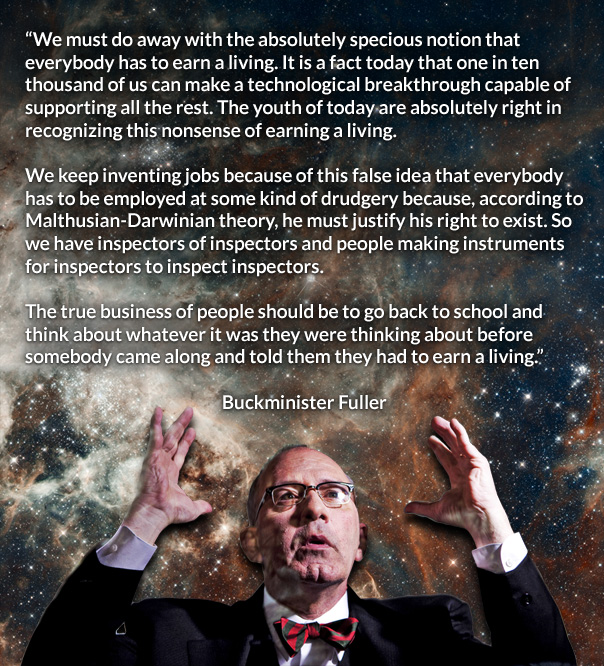
I saw this bouncing around Facebook, and I would like to endorse the underlying philosophy:

bucky

For those of you still using text-based browsers (hey, remember Lynx?), here we have Buckminster Fuller making a point about work and responsibility in a high-tech society. Namely: maybe people don’t have to work. Maybe, if machines become really good at producing the basic necessities of life, rather than bemoaning a loss of jobs we should celebrate our liberation from the toil of labor.

As a practical matter, I recognize that this might be hopelessly utopian. It amounts to saying that we should have fairly high taxes, and redistribute most of the money as a minimal income to every person. Nothing wrong with working and earning additional money, but everyone would get their personal share no matter what, and in principle that might be enough to live on. Maybe John Rawls was pointing toward something like that, but the social will is nowhere near making it happen. I can even imagine a utilitarian argument against it, based on the supposition that letting people learn and loaf and enjoy themselves rather than working for a living would lead to less innovation and competition, which in turn would make the world a less enjoyable place. I’m not sure if that’s right, but it’s at least non-obvious that work should be gradually phased out.

But nevertheless the spirit is admirable, and that’s what I want to endorse. There’s nothing morally wrong with the idea that people should spend their time in non-productive pursuits rather than working to earn extra income. It’s not “socialism,” since we’re not changing the free market or the ownership of the means of production. It would just be nice to live in a world where people did challenging things because they wanted to, not because they were forced to in order to survive. Maybe someday.

23 Sep 13:13

No More

by feministaspie

(CW: Ableism, murder, abuse)

14-year-old Issy Stapleton is currently fighting for her life after her mother tried to gas her in a car. Her own mother. Another autistic person taken before their time by the people we’re supposed to trust the most.

But you can imagine the slant the media are taking. They don’t see Issy as a person, but a burden. A problem to be solved. “Broken”. Again.

Reports of abusive “high intensity treatment” forcing Issy into meltdowns. Then these meltdowns being used to build the “burden” narrative. Again and again and again.

People comparing a 14-year-old attempted murder victim to Adam Lanza purely because they share a neurotype. Okay, so we’re violent burdens. Yet again.

This idea that all autistic children who lash out are better off dead. It’s not on. It’s really not on.

I’m thinking “Could have been me.” “Could have been my ex.” “Could have been all those people online.” Could have been so many people.

Same old story. Again, and again, and again.

On Tumblr today I saw “stop generalising neurotypicals, we don’t all hate you!” The feminists reading this should find that sentence structure very familiar indeed. If that’s your response to a murderous hate crime, you really need to sort your priorities out.

No more.

This fucked-up rhetoric that it’s better to be dead than autistic, the more general rhetoric that it’s better to be dead than disabled, needs to stop.

The near-total exclusion of autistic people from the conversation about our own neurology needs to stop.

Treating human beings as anything less than just that – human beings – needs to stop.

Just… all of it. All of this. No more.


Tagged: ableism, abuse tw, actuallyautistic, autism, issy stapleton, murder tw
23 Sep 10:15

NSA: Possibly breaking US laws, but still bound by laws of computational complexity

by Scott

Update (Sept. 9): Reading more about these things, and talking to friends who are experts in applied cryptography, has caused me to do the unthinkable, and change my mind somewhat.  I now feel that, while the views expressed in this post were OK as far as they went, they failed to do justice to the … complexity (har, har) of what’s at stake.  Most importantly, I didn’t clearly explain that there’s an enormous continuum between, on the one hand, a full break of RSA or Diffie-Hellman (which still seems extremely unlikely to me), and on the other, “pure side-channel attacks” involving no new cryptanalytic ideas.  Along that continuum, there are many plausible places where the NSA might be.  For example, imagine that they had a combination of side-channel attacks, novel algorithmic advances, and sheer computing power that enabled them to factor, let’s say, ten 2048-bit RSA keys every year.  In such a case, it would still make perfect sense that they’d want to insert backdoors into software, sneak vulnerabilities into the standards, and do whatever else it took to minimize their need to resort to such expensive attacks.  But the possibility of number-theoretic advances well beyond what the open world knows certainly wouldn’t be ruled out.  Also, as Schneier has emphasized, the fact that NSA has been aggressively pushing elliptic-curve cryptography in recent years invites the obvious speculation that they know something about ECC that the rest of us don’t.

And that brings me to a final irony in this story.  When a simpleminded complexity theorist like me hears his crypto friends going on and on about the latest clever attack that still requires exponential time, but that puts some of the keys in current use just within reach of gigantic computing clusters, his first instinct is to pound the table and shout: “well then, so why not just increase all your key sizes by a factor of ten?  Sweet Jesus, the asymptotics are on your side!  if you saw a killer attack dog on a leash, would you position yourself just outside what you guesstimated to be the leash’s radius?  why not walk a mile away, if you can?”  The crypto experts invariably reply that it’s a lot more complicated than I realize, because standards, and efficiency, and smartphones … and before long I give up and admit that I’m way out of my depth.

So it’s amusing that one obvious response to the recent NSA revelations—a response that sufficiently-paranoid people, organizations, and governments might well actually take, in practice—precisely matches the naïve complexity-theorist intuition.  Just increase the damn key sizes by a factor of ten (or whatever).

Another Update (Sept. 20): In my original posting, I should also have linked to Matthew Green’s excellent post.  My bad.


Last week, I got an email from a journalist with the following inquiry.  The recent Snowden revelations, which made public for the first time the US government’s “black budget,” contained the following enigmatic line from the Director of National Intelligence: “We are investing in groundbreaking cryptanalytic capabilities to defeat adversarial cryptography and exploit internet traffic.”  So, the journalist wanted to know, what could these “groundbreaking” capabilities be?  And in particular, was it possible that the NSA was buying quantum computers from D-Wave, and using them to run Shor’s algorithm to break the RSA cryptosystem?

I replied that, yes, that’s “possible,” but only in the same sense that it’s “possible” that the NSA is using the Easter Bunny for the same purpose.  (For one thing, D-Wave themselves have said repeatedly that they have no interest in Shor’s algorithm or factoring.  Admittedly, I guess that’s what D-Wave would say, were they making deals with NSA on the sly!  But it’s also what the Easter Bunny would say.)  More generally, I said that if the open scientific world’s understanding is anywhere close to correct, then quantum computing might someday become a practical threat to cryptographic security, but it isn’t one yet.

That, of course, raised the extremely interesting question of what “groundbreaking capabilities” the Director of National Intelligence was referring to.  I said my personal guess was that, with ~99% probability, he meant various implementation vulnerabilities and side-channel attacks—the sort of thing that we know has compromised deployed cryptosystems many times in the past, but where it’s very easy to believe that the NSA is ahead of the open world.  With ~1% probability, I guessed, the NSA made some sort of big improvement in classical algorithms for factoring, discrete log, or other number-theoretic problems.  (I would’ve guessed even less than 1% probability for the latter, before the recent breakthrough by Joux solving discrete log in fields of small characteristic in quasipolynomial time.)

Then, on Thursday, a big New York Times article appeared, based on 50,000 or so documents that Snowden leaked to the Guardian and that still aren’t public.  (See also an important Guardian piece by security expert Bruce Schneier, and accompanying Q&A.)  While a lot remains vague, there might be more public information right now about current NSA cryptanalytic capabilities than there’s ever been.

So, how did my uninformed, armchair guesses fare?  It’s only halfway into the NYT article that we start getting some hints:

The files show that the agency is still stymied by some encryption, as Mr. Snowden suggested in a question-and-answer session on The Guardian’s Web site in June.

“Properly implemented strong crypto systems are one of the few things that you can rely on,” he said, though cautioning that the N.S.A. often bypasses the encryption altogether by targeting the computers at one end or the other and grabbing text before it is encrypted or after it is decrypted…

Because strong encryption can be so effective, classified N.S.A. documents make clear, the agency’s success depends on working with Internet companies — by getting their voluntary collaboration, forcing their cooperation with court orders or surreptitiously stealing their encryption keys or altering their software or hardware…

Simultaneously, the N.S.A. has been deliberately weakening the international encryption standards adopted by developers. One goal in the agency’s 2013 budget request was to “influence policies, standards and specifications for commercial public key technologies,” the most common encryption method.

Cryptographers have long suspected that the agency planted vulnerabilities in a standard adopted in 2006 by the National Institute of Standards and Technology and later by the International Organization for Standardization, which has 163 countries as members.

Classified N.S.A. memos appear to confirm that the fatal weakness, discovered by two Microsoft cryptographers in 2007, was engineered by the agency. The N.S.A. wrote the standard and aggressively pushed it on the international group, privately calling the effort “a challenge in finesse.”

So, in pointing to implementation vulnerabilities as the most likely possibility for an NSA “breakthrough,” I might have actually erred a bit too far on the side of technological interestingness.  It seems that a large part of what the NSA has been doing has simply been strong-arming Internet companies and standards bodies into giving it backdoors.  To put it bluntly: sure, if it wants to, the NSA can probably read your email.  But that isn’t mathematical cryptography’s fault—any more than it would be mathematical crypto’s fault if goons broke into your house and carted away your laptop.  On the contrary, properly-implemented, backdoor-less strong crypto is something that apparently scares the NSA enough that they go to some lengths to keep it from being widely used.

I should add that, regardless of how NSA collects all the private information it does—by “beating crypto in a fair fight” (!) or, more likely, by exploiting backdoors that it itself installed—the mere fact that it collects so much is of course unsettling enough from a civil-liberties perspective.  So I’m glad that the Snowden revelations have sparked a public debate in the US about how much surveillance we as a society want (i.e., “the balance between preventing 9/11 and preventing Orwell”), what safeguards are in place to prevent abuses, and whether those safeguards actually work.  Such a public debate is essential if we’re serious about calling ourselves a democracy.

At the same time, to me, perhaps the most shocking feature of the Snowden revelations is just how unshocking they’ve been.  So far, I haven’t seen anything that shows the extent of NSA’s surveillance to be greater than what I would’ve considered plausible a priori.  Indeed, the following could serve as a one-sentence summary of what we’ve learned from Snowden:

Yes, the NSA is, in fact, doing the questionable things that anyone not living in a cave had long assumed they were doing—that assumption being so ingrained in nerd culture that countless jokes are based around it.

(Come to think of it, people living in caves might have been even more certain that the NSA was doing those things.  Maybe that’s why they moved to caves.)

So, rather than dwelling on civil liberties, national security, yadda yadda yadda, let me move on to discuss the implications of the Snowden revelations for something that really matters: a 6-year-old storm in theoretical computer science’s academic teacup.  As many readers of this blog might know, Neal Koblitz—a respected mathematician and pioneer of elliptic curve cryptography, who (from numerous allusions in his writings) appears to have some connections at the NSA—published a series of scathing articles, in the Notices of the American Mathematical Society and elsewhere, attacking the theoretical computer science approach to cryptography.  Koblitz’s criticisms were varied and entertainingly-expressed: the computer scientists are too sloppy, deadline-driven, self-promoting, and corporate-influenced; overly trusting of so-called “security proofs” (a term they shouldn’t even use, given how many errors and exaggerated claims they make); absurdly overreliant on asymptotic analysis; “bodacious” in introducing dubious new hardness assumptions that they then declare to be “standard”; and woefully out of touch with cryptographic realities.  Koblitz seemed to suggest that, rather than demanding the security reductions so beloved by theoretical computer scientists, people would do better to rest the security of their cryptosystems on two alternative pillars: first, standards set by organizations like the NSA with actual real-world experience; and second, the judgments of mathematicians with … taste and experience, who can just see what’s likely to be vulnerable and what isn’t.

Back in 2007, my mathematician friend Greg Kuperberg pointed out the irony to me: here we had a mathematician, lambasting computer scientists for trying to do for cryptography what mathematics itself has sought to do for everything since Euclid!  That is, when you see an unruly mess of insights, related to each other in some tangled way, systematize and organize it.  Turn the tangle into a hierarchical tree (or dag).  Isolate the minimal assumptions (one-way functions?  decisional Diffie-Hellman?) on which each conclusion can be based, and spell out all the logical steps needed to get from here to there—even if the steps seem obvious or boring.  Any time anyone has tried to do that, it’s been easy for the natives of the unruly wilderness to laugh at the systematizing newcomers: the latter often know the terrain less well, and take ten times as long to reach conclusions that are ten times less interesting.  And yet, in case after case, the clarity and rigor of the systematizing approach has eventually won out.  So it seems weird for a mathematician, of all people, to bet against the systematizing approach when applied to cryptography.

The reason I’m dredging up this old dispute now, is that I think the recent NSA revelations might put it in a slightly new light.  In his article—whose main purpose is to offer practical advice on how to safeguard one’s communications against eavesdropping by NSA or others—Bruce Schneier offers the following tip:

Prefer conventional discrete-log-based systems over elliptic-curve systems; the latter have constants that the NSA influences when they can.

Here Schneier is pointing out a specific issue with ECC, which would be solved if we could “merely” ensure that NSA or other interested parties weren’t providing input into which elliptic curves to use.  But I think there’s also a broader issue: that, in cryptography, it’s unwise to trust any standard because of the prestige, real-world experience, mathematical good taste, or whatever else of the people or organizations proposing it.  What was long a plausible conjecture—that the NSA covertly influences cryptographic standards to give itself backdoors, and that otherwise-inexplicable vulnerabilities in deployed cryptosystems are sometimes there because the NSA wanted them there—now looks close to an established fact.  In cryptography, then, it’s not just for idle academic reasons that you’d like a publicly-available trail of research papers and source code, open to criticism and improvement by anyone, that takes you all the way from the presumed hardness of an underlying mathematical problem to the security of your system under whichever class of attacks is relevant to you.

Schneier’s final piece of advice is this: “Trust the math.  Encryption is your friend.”

“Trust the math.”  On that note, here’s a slightly-embarrassing confession.  When I’m watching a suspense movie (or a TV show like Homeland), and I reach one of those nail-biting scenes where the protagonist discovers that everything she ever believed is a lie, I sometimes mentally recite the proof of the Karp-Lipton Theorem.  It always calms me down.  Even if the entire universe turned out to be a cruel illusion, it would still be the case that NP ⊂ P/poly would collapse the polynomial hierarchy, and I can tell you exactly why.  It would likewise be the case that you couldn’t break the GGM pseudorandom function without also breaking the underlying pseudorandom generator on which it’s based.  Math could be defined as that which can still be trusted, even when you can’t trust anything else.

19 Sep 19:56

History and Faith

by mike

There’s a famous (among academics) essay by Hayden White I often ask suffering students to read, called “the Value of Narrativity in the Representation of Reality,” a ponderous title indeed. White reproduces excerpts from the Annals of St. Gall, a medieval manuscript with multiple authors. It looks like this

709. Hard winter. Duke Gottfried died.
710. Hard year and deficient in crops.
711.
7 12. Flood everywhere.
713.
714. Pippin, Mayor of the Palace, died.
715. 716. 717.
718. Charles devastated the Saxon with great destruction.
7 19.
720. Charles fought against the Saxons.
721. Theudo drove the Saracens out of Aquitaine.
722. Great crops.
723.
724.
725. Saracens came for the first time.
726.
727.
728.
729.
730.
731. Blessed Bede, the presbyter, died.
732. Charles fought against the Saracens at Poitiers on Saturday.
733.
734

Those are years on the left: many of them are blank in the original

The Annals continue this way, till:

1045. 1046. 1047. 1048. 1049. 1050. 1051. 1052.
1053. 1054. 1055.
1056. The Emperor Henry died; and his son Henry succeeded to the rule.
1057. 1058. 1059. 1060. 1061. 1062. 1063. 1064.
1065. 1066. 1067. 1068. 1069. 1070. 1071. 1072.


White asks, assuming you have no other sources available, “what would it take to make this into history?” The answer, he says, is you have to invent some idea which can’t be proven to actually exist. For example, the easiest way to make this history would be to say “imagine a god.” Then all these events could be ascribed to that god, who I shall call “Azoth.” Azoth is displeased, and smites the people; Azoth is pleased, and rewards the people. Individual actors come and go because of their relationship to Azoth, who cannot be proven to exist but who, if we accept as existing, can fill the role of “cause.” Floods, bumper crops, invasions: all ascribed to Azoth. The idea of Azoth makes these random events sensible. Pippin, mayor of the palace, should have prayed harder.

White elsewhere calls this a “metanarrative,” something which is outside of your actual narrative but nevertheless crucial to it making any sense at all. Instead of Azoth, for example, you could substitute “progress,” beloved of freshmen: “progress was occurring.” Or “the rising middle class.” No one can define middle class” with any precision; like my hypothetical god Azoth you can’t interview “the middle class” or look it in the eye, but if you assume it exists, and is rising, you can do all sorts of explanatory work.

midddleclass

None of these are good history, but they could be. I’ve invented a frame, a metanarrative, that can take the chaotic, random events the past leaves us with and make them seem orderly.

I could do the same thing with “industrialization.” We all know what we mean when we say this: we get images of factories and smokestacks and striking workers. “Industrialization” is a well accepted and frequently used metanarrative, but it can’t be proven to exist any more than Azoth. Factories exist: “industrialization” is a concept that frames them. It’s a way of making sense of a set of facts, linking them together in a larger story. “You should understand those smokestacks as part of something called ‘industrialization’.”

White’s argument implies that the world has no inherent order, that it’s chaotic and random, and that all systems of order are arbitrary and imposed. History presents you with a bunch of stuff that happened, and ordering it, making it sensible, requires inventing something outside of history, like Azoth or progress or industrialization. There’s a vast list of these metanarratives, things which don’t actually exist concretely  but can be imagined as existing: they include “the anglo saxon race,” “man’s thirst for freedom,” “self-interest,” “negroes,” “the American mind” “childhood,” etc etc.

I’m not a religious man, or even what’s vaguely called a “spiritual” person. But the interesting conclusion I get from White’s article is that it’s impossible to do historical thinking or writing without making a “leap of faith,” and choosing to believe in something that can’t be proven to exist. If I were a religious man I’d be making an argument about the necessity of faith.

judgepriestThere’s an equally famous essay by Carlo Ginzburg that makes an opposite claim. In “Morelli, Freud and Sherlock Holmes: Clues and Scientific Method,” Carlo Ginzburg and Anna Davin claim that there are real, objectively verifiable narratives in nature, and we see them in diagnostic reasoning and experimentation, what they call “recipe knowledge. “If I do this, that will predictably result.” If I see tracks that look like bear tracks leading towards a tree with bark worn away, then towards a stream, then into a cave, I can construct an objectively true narrative: “there was a bear, it scratched its back on a tree, drank from the stream, and then went into that cave.” If the marks on the tree are old, I can assume the bear scratches regularly; if the stream is muddy and the the bottom disturbed, I can assume the bear was hungry.

Ginsburg and Davin are interested in forensics and detection. They see a connection between the religious tradition of “divination,” reading the signs to determine God’s intent, and a doctor’s ability to diagnose an illness from its external symptoms. In other words, there is pre-existing order, a pre-existing narrative, in events, and we can uncover it.

This is entirely opposite what White claims. And interestingly, if there is order in events already, a real, objective and verifiable chain of cause and effect–then faith is not necessary at all.

Though I’m not a religious man, I find White’s account much more plausible. On a small level, I can deduce the presence of bears or count on baking soda as a rise. But I can’t write a history of either baking or hunting without some kind of metanarrative that links the countless instances of baking and hunting, the many motives and practices, into a coherent story.

Earlier I posted about the value of history: it seems to me both these essays point to the centrality of doubt and skepticism to any practice of history.

19 Sep 00:07

Dining High

by evanier

Matt Goulding sings the praises of airline food. I guess I wasn’t aware there still was airline food…but of course, since there are 22-hour flights to foreign places, there must be. I never fly that far and I’m often on Southwest where "airline food" is a choice of peanuts or pretzels.

When there was airline food on coast-to-coast flights, I was rarely served anything edible. Between my food allergies and my dislike of about two-thirds of the foods I can eat, I usually wound up munching on the dinner roll and maybe the dessert. One time, I was on a flight — I think it was TWA the time they sent me to New York and my luggage to London — where the entrees never made it on board. There was some sort of delay in the hot lunches arriving and the decision was made to leave without them. The crew made apologies but all they had for us to eat on the flight were the frozen Snickers bars that were served as dessert along with the meals. It was fine dining as far as I was concerned.

The first time I ever flew First Class — which of course meant I was not paying — they served a dinner that was allegedly prepared by some four-star, award-winning chef especially for American Airlines. We got a menu first telling us what we’d be eating and I could see there was not one thing on the plate that my stomach would accept.

The menu also listed the cuisine being served in Coach. I think they did this so they could pass the same menu out in both cabins and make the Coach people think, "Gee, I should have spent the $700 more to get a better supper." Anyway, Coach was getting Penne Marinara, which sounded a lot more like Mark Food to me. I called a First Class Flight Attendant over and asked if I could have that instead. She acted like I was asking if I could get out at 30,000 feet and walk the rest of the way. No one, at least on her flights, had ever asked such a thing before.

airlinemeal01

There were sudden huddled conversations by the Flight Crew and they may have radioed to ask someone on the ground if it was permitted or if there was some F.A.A. regulation that said I had to eat the Red Mullet Almondine with hollandaise. She finally reported back that they had only enough servings of Penne Marinara aboard to feed those in the cheaper seats. I asked if anyone back there would like to swap with me and, again, I created a mid-air crisis and much discussion. I can be so much trouble at times asking what to me are simple, obvious questions.

The verdict? American Airlines didn’t want me swapping meals with someone in Coach because then someone else in Coach would be angry that they didn’t get what the person across the aisle got. The solution? The crew on the flight, including the pilots, got the Coach meal to eat. She offered to swap with me. I said fine, done, easy answer.

But then it got more complicated. The senior flight attendant (who outranked her) came over and wondered if protocol demanded that the trade be offered instead to the pilot. But then how would the co-pilot feel if he had to eat pasta while the other guy in the cabin got Red Mullet? And what about the navigator? I had the whole cabin crew debating this in the aisle next to me and I’d occasionally poke my head into the discussion to say, "You know, it might be simpler for everyone if I just didn’t eat." By then though, no one was listening to me. So finally it was decided that the Flight Attendant I’d first asked about this could have my Red Mullet and I could have her Penne Marinara, which I ate and which was okay. At least, it was okay for airline food.

After we’d landed and were filing off the plane, I thanked the Flight Attendant and apologized for causing so much trouble. She said that was all right. I asked her how my dinner was. She said, "Not good. I’d rather have had the Penne." I kinda figured that would be the punch line and was somehow comforted when it really was.

17 Sep 10:00

Talk, Not Tech – 81% of Liberal Democrat members oppose opt-out internet censorship

by Zoe O'Connell

In terms of internal party discussion, one of the more controversial points at the current Liberal Democrat Conference is motion F17, “Protecting Children from Online Pornography“. This calls for opt-out filtering of the internet to protect children from “porn”, something I’m quite opposed to. It’s attracted criticism from mainstream internal groups as well as anti-internet-censorship campaigners – a conference update mailing from Liberal Reform supported calls to vote against this illiberal policy.

Thus was spawned the Talk Not Tech campaign against this motion. And in a survey out today, 81% of Liberal Democrat members agree: only 16% are for opt-out internet filters.

There is an amendment to the motion that would seem to support the most popular option, opt-in filters, but this amendment also calls for pop-up messages if you visit a “bad” site. (For some value of bad that usually includes news, support and political sites on issues surrounding mental health, sexuality and gender) A widely-supported motion that was more liberal in nature was unfortunately rejected by Federal Conference Committee.

As a result, we are asking for delegates to vote to refer the motion back. This is a little bit procedural, but we believe sends a better public message than rejecting the motion overall. We do want policy in this area, just not this policy.

If you are a voting representative, please head to the main hall for 5pm today (Sunday) for this important debate.

(The full breakdown of survey results: 16% opt-out filtering, 39% opt-in, 33% for education instead of filtering, 9% didn’t believe any change was needed, 2% don’t know)

16 Sep 23:00

Day 4641: A Doctor Woo Metaphor for Conference

by Millennium Dome
Sunday:

If the Conservatories are the dastardly DALEKS… and Hard Labour are the soulless CYBERMEN… are the Liberal Democrats:

a) The SILURIANS – green-tinged former rulers of Earth; now caught in a suspended animation time-warp…

b) The SONTARANS – bit shouty; always keen for a fight; treated as a bit of a joke by everyone else…

or

c) The WEEPING ANGELS – kill you with kindness; change position suddenly when you’re not looking; can’t even look at each other…
16 Sep 22:01

The Liberal Democrats at Pooh Corner

by Jonathan Calder
If you were using the Liberal Democrats to cast a dramatisation of Winnie-the-Pooh, Vince Cable would be Eeyore and Paddy Ashdown would surely be Tigger. Ashdown may be advancing into his eighth decade, but the former leader bounces with energy and optimism, even when contemplating the prospects for his party.
writes Andrew Rawnsley, opening an interview with Paddy Ashdown in tomorrow's Observer.

So if Vince is Eeyore and Paddy is Tigger, what about the rest of A.A. Milne's characters?

We lost our Wol when Roy Jenkins died, though I suppose Ming Campbell comes somewhere close today.

And Nick Clegg must be Rabbit, with his busyness and confidence in his own judgement. He even has an office of Friends and Relations to brief against those who question his leadership.

But who are Pooh and Piglet and Kanga and Roo? And where is Christopher Robin?
16 Sep 20:17

Suboptimization

by LP

Let us say that you are an average American consumer, and you have taken it on yourself to purchase a combination shotgun/rod and reel so that you can recreationally kill two kinds of wildlife at once.  During a commercial break near the end of the evening’s episode of Law & Order:  Canine Hangman Squad, you log on to your nearest internet-enabled device and bring up the search engine of your choosing.  Intending to type “fishing rod what shoots people” into the search box, but you only get as far as “f” when you remember that there is still a BBQ Shake-Ups Lunchable in the fridge that your kids might not yet know about.  You hit Return, and instead of pumping $750 into the wavering economy, you spend the rest of the night playing Candy Crush Saga on Facebook.

Yes, as this ironclad scientific scenario proves, Americans are so lazy that they will literally buy the first thing that pops up on their browser rather than take the time to type out an entire word.  That’s why, from a marketing standpoint, it is vitally important to know what various search engines suggest via autocompletion when you enter one single letter int a search field. Which is what I spent today finding out.

A

AOL:  Yes, millions of people — many of them veterans of the First World War — still use America Online as both their internet service provider and their primary search engine.  Unfortunately, AOL’s search algorithms are tied into nebulous, ephemeral current events feeds, and often suggest a currently popular search term rather than one that has accumulated millions of successful hits over the years.  Thus its first suggestion for typing “A” into the AOL search field is “Andrea Sunderlin”, the pot-smoking mom whose period of national notoriety will be over by the time you finish reading this sentence.  AOL is also the first, but not the last, site to not have its own name come up as the most popular search for its initial letter.

Bing:  Despite heroically optimistic advertising campaigns by its parent company, Microsoft’s Bing is still a third-string also-ran to Google, and paid suggestions that we “Bing it!” go over about as well as Chevy Chase’s elderly crank character on Community suggesting Encarta as a fact-finding tool.  Bing does have one up on AOL, however, in suggesting “AOL” as the first hit for “A”.

Google:  The big poppa of the search engine world is the default for billions, to the degree that its brand has become a name — the kind of linguistic drift that’s worth its weight in advertising gold.  Easily locating the side of its bread containing butter, Google suggests “Amazon” as its first “A” hit.

Yahoo!:  Still technically alive despite a series of business decisions substantially less effective and forward-thinking than the one that led to the construction of the Maginot line, the recently rebranded Yahoo! remains a popular search engine, primarily employed by people who aren’t quite sure how to spell “Google”.  It, too, suggests “AOL” when you type “A” into its search field.

Wikipedia:  While Wikipedia is actually an encyclopedia and not a search engine, it is nonetheless very often employed as one, particularly by students who will do anything rather than read a book they have been assigned.  Its primary “A” hit is “animal”; in your faces, vegetables and minerals!

B

AOL:  ”BMW golf tournament 2013″.  A reminder:  AOL subscribers are very old.

Bing:  ”Bank of America”.

Google:  ”Bank of America”.

Yahoo!:  ”Bank of America”.

Wikipedia:  ”Brazil”, thus setting the tone for the theme that most Wikipedia users are extremely lazy geography students.

C

AOL:  ”Colorado flooding”.

Bing:  ”Craigslist”.

Google:  ”Craigslist”.

Yahoo!:  ”Craigslist”.

Wikipedia:  ”Canada”.

D

AOL:  ”dehumidifier recall”.  You can’t eat that!

Bing:  ”Drudge Report”.  It seems impossible that any search engine could have more users who are credulous morons than Yahoo!, but here’s the proof.

Google:  ”dictionary”.

Yahoo!:  ”dictionary”.

Wikipedia:  ”departments of France”.  Could French geography students be even lazier than American ones?

E

AOL:  ”Elizabeth O’Bagy”.  No, I didn’t know either.  Apparently she is a Middle East policy “expert” employed in the Syria war rollout who fraudulated her own credentials.

Bing:  ”eBay”.

Google:  ”eBay”.

Yahoo!:  ”eBay”.

Wikipedia:  ”England”.

F

AOL:  ”Freddy Figuerdo”, a recently deceased firefighter and Hollywood stunt coordinator.  AOL is setting the bar very, very low.

Bing:  ”Facebook”.

Google:  ”Facebook”.

Yahoo!:  ”Facebook”.  There’s no escaping it.

Wikipedia:  ”France”.

G

AOL:  ”German word for time”.  Why so many AOL users are so preoccupied with the word “zeit” is a question I fear the answer to.

Bing:  ”Google”.  How embarrassing for you, Bing.

Google:  ”Google”. Why are people using Google to google Google?  This is too meta even for me.

Yahoo!:  ”Google”.  No respect.

Wikipedia:  ”Germany”.

H

AOL:  ”Holly Madison”.  A professional breast parlayer of some variety.

Bing:  ”Hotmail”.  Who is still using Hotmail?  Is this 1997?

Google:  ”Hotmail”.

Yahoo!:  ”Hotmail”.

Wikipedia:  ”Hispanic (U.S. Census)”.  A bewildering trip through America’s obsession with race, this one.

I

AOL:  ”iPhone 5C”.

Bing:  ”Instagram”.

Google:  ”Instagram”.

Yahoo!:  ”iTunes”.  For the first time, Yahoo! breaks with its slavering devotion to repeating Google’s every suggestion and picks another institution that will never make money for Yahoo!’s shareholders.

Wikipedia:  ”India”.

J

AOL:  ”Julie Chen”.  Yes, the perky Big Brother hostess is perplexingly still alive, and swallowing the bitter pill of her former career as a serious journalist with the cold comfort of being a top hit on AOL.

Bing:  ”JC Penney”.  The low-rent retailer is thriving in low-rent search engines.

Google:  ”John L. Scott”.  Here, Google’s razor-keen demographic targeting algorithms cost it in the universality department, as it suggests a Washington state real estate agency rather than everyone’s favorite less-classy-than-Sears, more-classy-than-Kmart discount department store.

Yahoo!:  ”JC Penney”.

Wikipedia:  ”Japan”.

K

AOL:  ”Knish filling”.  This may seem like an odd choice at first, but remember, 56% of AOL users are elderly Jewish women from West Palm Beach.

Bing:  ”Kohl’s”.

Google:  ”KING-5″.  Locality targeting again, with a Seattle-area TV station.

Yahoo!:  ”Kohl’s”. In the kingdom of the blind, the off-brand retailer is king.

Wikipedia:  ”Keyboard instrument”.  This seems like a weird choice, Wikipedia.  What, nobody wants to learn about Kenya?

L

AOL:  ”Lowe’s”.

Bing:  ”LinkedIn”.  Here we see a major search-engine divide, between people looking for a home improvement chain closer to their house or the local McDonald’s than Home Depot, and people looking for a way to get hired at age 56 after being out of work since Friends ended.

Google:  ”LinkedIn”.

Yahoo!:  ”Lowe’s”.

Wikipedia:  ”List of sovereign states”.  Oh, kids. Crack a book.

M

AOL:  ”Miley Cyrus ‘Wrecking Ball’”. That naked girl on a piece of construction equipment will never get you your fishing gun, Rufus.

Bing:  ”MapQuest”.  My friend Meg used to make fun of me for using ancient, doddering MapQuest instead of sleek, modern Google Maps.  NOW WHO IS LAUGHING, MY FRIEND MEG?  NOT BING!  NOT BING!

Google:  ”MapQuest”.

Yahoo!:  ”MapQuest”.

Wikipedia:  ”Mollusca”.  This is such a bizarre result that I suspect the hand of internet pranksters.

N

AOL:  ”NFL Week 2 picks”.  This would appear to have something to do with the sport of foot-ball.

Bing:  ”Netflix”.

Google:  ”Netflix”.

Yahoo!:  ”Netflix”.

Wikipedia:  ”New York City”.  First in population, first in their own egos.

O

AOL:  ”Orbitz”. Ha ha, what, AOL?  Why are you autosuggesting the ninth-most-popular travel site of 2005?

Bing:  ”Outlook”.  Way to shill, Microsoft.  You keep it subtle like that.

Google:  ”Old Navy”.  The letter O is just an embarrassment all around for the internet.

Yahoo!:  ”OMG”. Oh, Yahoo!, no.

Wikipedia:  ”Ontario”.

P

AOL:  ”Powerball numbers for 9/11/13″.  Not our first hint that AOL is popular with troubled gambling addicts.

Bing:  ”Pinterest”.

Google:  ”Pandora”.  Now here’s a conflict in which I have no interest whatsoever!

Yahoo!:  ”Pandora”.

Wikipedia:  ”Poland”. (“Never forget” — George W. Bush)

Q

AOL:  ”QVC”.

Bing:  ”QVC”.

Google:  ”QFC”.  Just to be different, Google changes the middle letter, driving millions in business to an overpriced Kroger subsidiary in the Pacific Northwest.

Yahoo!:  ”QVC”.

Wikipedia:  ”Quebec”.  Canadian infiltration of Wikipedia should alarm us all.

R

AOL:  ”Rotomontade”.  Okay, now AOL is just fucking with us.  I refuse to believe that anyone, much less everyone, is choking the internet with searches for an obscure synonym of bragging.

Bing:  ”Roblox”.  From this point forward, Bing more or less gives itself completely over to shilling for ad-stuffed online mom games.

Google:  ”Redbox”.

Yahoo!:  ”Redbox”.  Yeah, you just keep sucking up to Google, Yahoo!.  See where it gets you.

Wikipedia:  ”Race and ethnicity in the United States”.  Right now some dude is using this page to bolster his argument that “Irish guys are discriminated against as much as blacks, bro.”

S

AOL:  ”Seaside Heights fire”.  If you live in Seaside Heights, RUN!  THERE’S A FIRE!

Bing:  ”Study Island”.  Located right in between MILF Island and that island where you can hunt people for sport.

Google:  ”Seattle Times”.  A bone of contention, this letter S.

Yahoo!:  ”Southwest Airlines”.  See what I mean? Even the craven Yahoo! is staking a claim with the serpentine letter.

Wikipedia:  ”Spain”.

T

AOL:  ”Thursday Night Football”.  There’s a Thursday night now?

Bing:  ”Toontown”.  This Disney Kids website doesn’t even exist anymore and Bing is whoring for it.  Good ol’ Microsoft.

Google:  ”Target”.

Yahoo!:  ”Target”.

Wikipedia:  ”The New York Times”.  The use of the definite article here instead of “N” for “New” is, uh, interesting.

U

AOL:  ”USPS”.  The dying postal service gets lots of love from the internet.

Bing:  ”Urban Rivals”.  Yet another gamer-crack site.

Google:  ”USPS”.

Yahoo!:  ”USPS”.

Wikipedia:  ”United States”. Aww, patriotic!  Now shelf those Jordan Air 2012s.

V

AOL:  ”Voyager I”  In spaaaaaace!

Bing:  ”Verizon E-Mail”.

Google:  ”Verizon”.  Their online presence is what we call ‘diversified’.

Yahoo!:  ”Verizon Wireless”.  They really do get you going, don’t they?

Wikipedia:  ”Village”.  It takes one to raise hell.

W

AOL:  ”went at full speed crossword”. Olds, folks.

Bing:  ”Webkinz”.  Don’t even ask.

Google:  ”Walmart”.  A Study in Contrasts, that.

Yahoo!:  ”Walmart”.

Wikipedia:  ”World War II”.  Remember that?  Good times.

X

AOL:  ”X Factor”.  What, the blue-hairs don’t like Idol anymore?

Bing:  ”Xfinity”.

Google:  ”Xbox”.  Hey, Microsoft, happy to help, don’t mention it.

Yahoo!:  ”Xbox”.  Yahoo! will always go you one better in the groveling department.

Wikipedia:  ”X”.  Well I’m sure I don’t know what you’re getting at, Wikipedia.

Y

AOL:  ”Yom Kippur”.

Bing:  ”YouTube”.

Google:  ”YouTube”.

Yahoo!:  ”YouTube”.

Wikipedia:  ”YouTube”.  We’d finally have a unanimous decision if it weren’t for that damn Broward County vote.

Z

AOL:  ”Zooey Deschanel”.

Bing:  ”Zwinky”.

Google:  ”Zillow”.

Yahoo!:  ”Zillow”.  I’m going to pretend these are all made up.

Wikipedia:  ”ZIP Code”.

16 Sep 09:02

What the Lib Dems Stand For 2013.5 – Why I Am A Liberal Democrat #LibDemValues

by Alex Wilcock

Another Liberal Democrat Conference starts this weekend, and once again I’m looking at What the Lib Dems Stand For. Before this Spring’s Conference, I published a series of articles challenging us to combine our principles, our priorities in government, and our Leadership’s message to tell other people we’re about and inspire ourselves to be enthusiastic about it. Tomorrow I’ll be publishing some more ideas of what we stand for written by other Lib Dems. Today, it’s something more personal: how did I get here? Why did I become a Lib Dem in the first place? And why do I stay?

If you scroll down below, you’ll find my short rallying cry designed for anyone to use – please borrow mine and use it yourself. Or, ideally if you’re quick, you can send me your own version. But as I’ve prepared to print the next round-up of other contributors’ ideas, I’ve noticed how much more personal many of theirs are, and I’ve been reminded what I said the last time I published that sort of compilation: that one day I’d have to challenge myself to be less on-message and consensual, and say what my Liberalism is by instinct, speaking straight from my head, my heart and my life.

There are lots of passions that make me tick, and lots of experiences that have formed my life and my Liberalism. Sometimes I’d think more of the quirkier elements (not least, Doctor Who), sometimes more of my family or friends. Today’s personal testament looks for the explicitly Liberal line through my life.

My Political Story – Why I Am A Liberal Democrat

My first political memories are of shouting at bullies. I didn’t think of this as political until a long time later, but that’s what it was [1]. With the fearlessness of the very young, I saw much bigger boys being mean and thought it wasn’t fair, and told them so. I didn’t do it often, but it stuck in my head because it seemed to be the right thing to do, standing up for the underdog. Luckily, a small boy shouting at them seemed to shame them rather than get my head kicked in.

I was less brave when I got into my teens and was bullied myself. It’s a quirk of my personality that finding the drive to stand up for someone else has always been far easier than defending myself alone: under personal attack, I tend to crumble into depression and want to hide. What forced me to be braver and brought back that burning desire to stop unfairness was realising I was gay. It was the 1980s, and I didn’t know anyone that was gay – or so I thought at the time. All I knew is that everything about society told me I was wrong and seemed to hate me for something that was simply me. Pretty soon I decided there was nothing wrong with me at all, and that it was the world that had to change, so I came out early and uncompromisingly. I wanted it to get better, for everyone I knew to know at least one gay person, for me never to hide – and I never have for nearly a quarter of a century, from workplace to election, from embrace to rejection. I might have got involved in politics anyway, but that decision made it essential.

At the same time, politics in the 1980s just seemed nasty. Labour had wrecked the economy; the Tories were building back bits of it so it was all right for some, but left a lot of other people on the scrapheap of massive unemployment. And it wasn’t just that both sides seemed like they were only interested in ‘their’ people – they always seemed to me that they just hated the other side, too, and class hate sickened me as much as racism or what I didn’t know yet was called homophobia. It probably helped that I had an American Catholic Mum and a Scottish Baptist Dad, so I’d always understood that people with different beliefs, different ‘tribes’, even different countries, not only could get on but really had to.

Those two feelings came together in a firm belief that with all the division in society, a political party should be for everyone, not hating half the people all the time – or even hating other countries – and that with what I was experiencing personally, everyone should have the freedom to live their own life, too. And that naturally led me to the Liberal Democrats, who were not just appealingly internationalist but, to their core, the only party saying that society should be for everyone, and that every individual should be free [2].

I didn’t have a political background, I didn’t have money, I didn’t have anyone pushing me to get involved. I just felt that I wanted to change the world, and that if everyone just sat around and waited for someone else to do it, it would never get done. So I joined the Lib Dems, and I did everything I could from delivering leaflets to eventually standing for Parliament. And even though when I first threw myself into campaigning for the Lib Dems we were on 4% in the opinion polls, I knew this was the only party that was offering real change, however long it took – why join another party to campaign for things to stay the same? And I kept campaigning for things to change within the Lib Dems, too. It was often an uphill struggle to get heard, and I made plenty of mistakes, but determination and ideas won me influence. Where I often felt I was having the most impact was when I was elected over many years to the party’s Policy Committee. In part, that was writing individual policies that formed part of several election Manifestos, and knowing in particular that I’d contributed to pushing equal treatment, respect and opportunity for lesbian, gay, bisexual and transgender people a bit further every time. But, for me, it wasn’t just the issues that really grabbed me, but the ideas.

I learned how to put my gut instincts into philosophy, and realised I’d been a Liberal all along. That Liberalism meant that if you start with every individual, you can’t put any person on the scrapheap or hate them for who they are. That the founding principles of Liberalism over the centuries of individual freedom, equality before the law and controlling arbitrary power were living, breathing, vital ideas that I’d discovered for myself in the desire to choose my own life, my belief that everyone should be treated the same, even as a little boy knowing that you had to stand up to bullies. It was Conrad Russell (a Liberal Democrat I got to know through the Policy Committee who became a friend and even a mentor) who said the point of Liberalism was to stand up for everyone against bullies, and that just lit up a lightbulb over my head. Suddenly, I could see that Liberal line through my life. It’s not just that a party owned by one group of special interests can never be fair – that it inevitably discriminates against the rest and divides society. It’s that part of not favouring any one ‘side’ is realising that anyone can be a bully, or can be bullied – or, in philosophical terms, any sort of power can threaten liberty, but any sort of power can protect it, too. Whether it’s the state, or big business or big unions, or just other people, any of them can boss you around and anyone can help stop you being bossed around. So you can’t do away with any of them – and you can’t say any of them are right all the time, or be in their pockets. Which means aiming to create The Perfect Society will always be a disaster, but working at making a better society means there’s always more real life to be listened to and more work to be done.

That’s why for me saying what we stand for is more important than any single policy. It’s important because unless we keep sight of why we bother, there’s nothing to inspire us. And it’s important to remember that we’re for everyone, that everyone should be free to live their own lives, and so we’re here to bring everyone together, as far as we can, and to stop people being pushed around, as far as we can.

So when, sometimes, being in government is frustrating or disappointing, and it is, because there’s not enough money to do what we want to do or because the Tories we’re in government with have different priorities, I can see that Liberal line of what we’re getting right, and why we’re doing it. No Lib Dem joins just to get into power. We do it to make a difference. It took perseverance for me inside the Lib Dems, but it took the whole party a whole lot more hard work and struggle to go from 4% in the polls to more than double our number of MPs and win a place in government – not the easy way, and not to do the easy things. No wonder Liberal Democrats take a long term approach on the importance of education to unlock people’s potential, and the environment to lock in fairness for the future – we had to work at it for a long time, so we’ve never gone for quick fixes. I’m deeply proud that this government’s the one that legislated for mostly equal marriage at last, but it’s the bigger ideas that matter still more. Worse than the 1980s, Labour had wrecked the economy again. But despite the damage being deeper and longer than it was when I was growing up, while unemployment is still too high it’s much, much lower than in the 1980s, now that Liberal Democrats are in government and not just the Tories. From apprenticeships to green jobs to tackling the banks, it’s not just rebuilding the economy as ‘all right for some’, but putting it back together differently. You need economic responsibility to make things work – but without fairness, too, society falls apart.

I think the government would be better if it was all Lib Dem and we could do more of what we wanted to do. Well, I would say that. But it’s also good to prove that people with different beliefs, different ‘tribes’, can make it work together as well. I look at the difference we’ve made, not just since the government was elected but compared to the 1980s when I grew up, and I’m proud of how we’ve changed things for the better: unemployment that much lower than the Tories ever cared about before the Lib Dems entered government, taxes for ordinary people that much lower with the Lib Dems while the wealthiest pay more than they did under Labour, green growth and protecting education so that the economy and opportunities will last into the future. I’m proud – but I’m not satisfied. I still want to change the world. But I can see how Liberal Democrats are doing just that, more slowly than I’d like and with a few wrong turns, but we’re still the only party that says society should be for everyone, and that every individual should be free.

The way the party sums that up now is that the Liberal Democrats are building a stronger economy in a fairer society, enabling every person to get on in life. Freedom. Fairness. Being for everyone. I find myself nodding, because the Liberal Democrats are still saying what made me join all those years ago, only now they’re putting a bit – a fair bit – of it into practice.

[1] I had a long conversation about my politics with my Grandma when I was in my twenties. She nodded, and said she could see I’d be political when – and this is one I’d not remembered – I was aged four and strutting about naked on a beach and told a big boy off for kicking down another boy’s sandcastle. I said she was probably right (though I bottled out of adding, ‘And obviously that’s why I’m a naturist now, too’).

[2] If you’ve ever wondered where my blog title “Love and Liberty” comes from, it’s my original two gut instincts distilled into three words. You can read the annotated version of most of my 1999 booklet “Love and Liberty” online too, where my concept of Liberalism is re-expanded into many, many more words.


The Liberal Democrat What Do We Stand For Challenge (so far)

If you’re quick, you can send me your own idea by tomorrow. Or just feel free to borrow mine and use it yourself (I’d prefer it if you let me know, but it’s not compulsory. Think of it as open-source Liberalism). The idea’s an ongoing investigation, collaboration and rallying cry about what the Liberal Democrats stand for, to challenge myself, first, then other Lib Dems to get across what we stand for in something more meaningful than a soundbite but still short enough to be no more than a minute’s speech or a box on a Focus leaflet. And to make things harder, I aimed for broad consensus by synthesising the Preamble to the Lib Dem Constitution, the party’s priorities in government and the party leadership’s latest messaging. Did it work? Here’s my go at that:
The Liberal Democrats stand for freedom for every individual – freedom from poverty, ignorance and conformity.

To make that freedom real needs both fairness and economic responsibility: an economy that works, that encourages enterprise, and where everyone pays their fair share.

So freedom from poverty requires responsible spending, not debt, built on fairer taxes where lower earners pay less tax and the wealthiest pay more, and building green jobs for the future.

Freedom from ignorance needs better education and training, so people have the opportunity to realise their potential.

And freedom from conformity, supported by freedom from poverty and ignorance, means everyone should have the liberty to live their lives as they choose – without harming others; with equality before the law; with a better say, because no government always knows best.

That’s why Liberal Democrats are working for a stronger, greener economy in a fairer society, enabling every person to get on in life.

Happy 25th Birthday, Liberal Democrats – and What the Lib Dems Stand For 2013.1

Why we should sum up What the Lib Dems Stand For, and how it’s developed over the years.

What the Lib Dems Stand For 2013.2 – a Challenge and a Meme #LibDemValues

Setting out my ‘What the Lib Dems Stand For’ based on the Preamble, practice and core messaging, and challenging other Lib Dems to come up with their own.

The Liberal Democrat What Do We Stand For Challenge 2013.3 – Eight Answers (so far) #LibDemValues

After receiving the first set of responses, rounding up eight different Liberal Democrats’ versions of what we stand for – so far…

The Liberal Democrat What Do We Stand For Challenge 2013.4 – What It’s All About #LibDemValues

Inviting people to use my short declaration of ‘What the Lib Dems Stand For’ and explaining what each bit of it means.

Then there’s today’s, and with a bit of luck there’ll be more tomorrow.


15 Sep 01:06

The sound of gunfire?

by noreply@blogger.com (Simon Titley)
Today is the 50th anniversary of Jo Grimond’s famous ‘Gunfire’ speech to the Liberal Assembly (the Liberal Party’s annual conference) on 14 September 1963.

That speech had a remarkable effect at the time, inspiring a generation of Liberals. One effect was that the Young Liberals started a magazine called Gunfire. It was the end of that magazine in 1970 that prompted the creation of Liberator magazine, still with us 43 years later.

At my suggestion, David Boyle blogged yesterday about the anniversary of Grimond’s speech. He is generous to the present leadership but I do not share his generosity.

In 1963, Grimond sought to inspire his members. Nick Clegg has spent the past year slagging them off. It will take more than 5p on plastic bags to inspire them again.
14 Sep 12:23

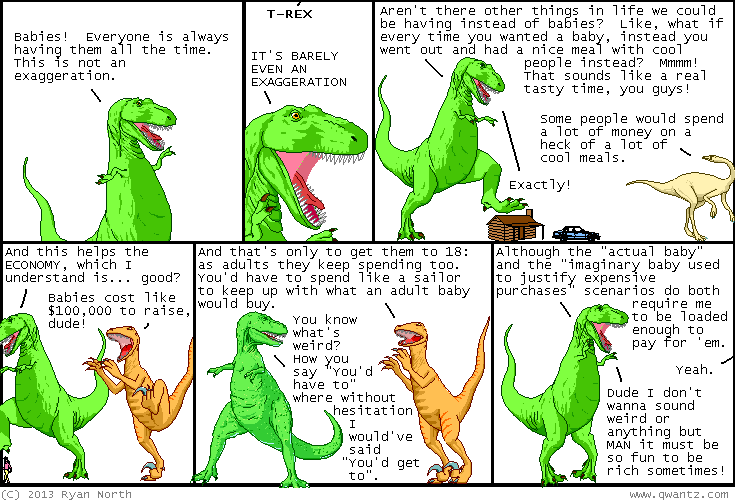
you'd have to spend like a rich uncle pennybags, peanut in a top hat and monocle, or other similar corporate mascot just to keep up!

archive - contact - sexy exciting merchandise - cute - search - about
← previous September 9th, 2013 next

September 9th, 2013: Still big into talktoadog.com over here; not gonna lie!

One year ago today: w3 k4N U23 NUM83R2

– Ryan

13 Sep 21:05

How to Boycott a Company Without Really Trying

by Marc Singer

I tend to roll my eyes, figuratively at least, whenever comics fans call for a boycott of some title or company. These efforts are never organized and they don't seem to be geared towards persuading anybody else to join in. Most of what passes for boycotts in comics fandom are really just individuals attempting to put a moralistic face on their own consumer preferences.

Maybe there were a few people who quit reading Marvel Comics to protest the way the company treated Jack Kirby, but I'm guessing most of them had already given up on Marvel anyway, or were ready to. It's always easier to boycott a product you have no intention of buying. Last spring, the internet was abuzz with people who refused to buy a digital-first Superman comic because noted homophobic bigot Orson Scott Card was scheduled to write for it. And good for them--but how many of them would have bought a digital-first Superman comic anyway? How many of them will be lining up to see Ender's Game this fall?

Comedian

Or take me, for example. I suppose you could say that I boycotted Before Watchmen, although in all honesty I doubt I would have bought those comics even if Alan Moore had given the project the kind of tepid, hands-off blessing bestowed by Dave Gibbons. (The books themselves sound pretty horrible by all accounts.) For me, the appeal of Watchmen has always been inseparable from the talents of Moore and Gibbons, and the idea that you could have one without the other struck me as ridiculous. I never had any interest in reading J. Michael Straczynski's Watchmen, not even in a universe where DC wasn't producing the comics against the original creator's wishes and in violation of its own longstanding agreement.

But there is no question that Before Watchmen changed my relationship to DC Comics. Before the announcement I was--I'm somewhat ashamed to admit--a steady consumer of the company's rebooted "New 52" comics. I tried about a quarter of the line when it first relaunched, and while I was already starting to drop books by last February, I was undoubtedly buying many more DC titles than I had before the relaunch. From DC's perspective, that had to be counted as a success.

The announcement of Before Watchmen changed everything. I won't rehash the 18-month-old arguments against it (David Brothers made the case pretty well at the time). I had no interest in wading into the online discussion. I don't even think I consciously made the decision to wean myself off DC comics. I just started looking for reasons to drop their books, and finding no shortage of them.

Except for one. One, I dropped immediately.

Brian Azzarello, who signed on to write two of the Before Watchmen miniseries, said “[What's key is] that we all get in there and we tell the best possible stories we can and we reconnect these characters. It’s 25 years later. Let’s make them vital again.”

Which is an odd thing to say since the characters of Watchmen, from Walter Kovacs to Joey the cab driver, are vital every time I open the book. Which is more than I can say for most of the product cranked out by an industry that's dedicated to strip-mining its past successes instead of creating new ones. I guess I should be grateful that we never saw Before Watchmen: That Lesbian Cabbie.

When I read that quote from Azzarello, that was the moment, the moment, that I knew I couldn't read any comics by the Before Watchmen creators. If they were going to treat Moore and Gibbons's masterpiece, DC's greatest contribution to the graphic novel movement, as a piece of work-for-hire executed by interchangeable cogs then I would treat them the same way--and exchange them for someone else.

In practice, though, that just meant dropping Brian Azzarello's Wonder Woman. And that was not a moral act--it was an aesthetic preference wrapped up in a sense of moral purpose. Azzarello's Wonder Woman is one of the few New 52 books that still receives praise, in some quarters, as the product of a distinctive artistic vision. I can't imagine why, except that the book's ample flaws (ambling plot, atrocious dialogue, one of those smug know-it-all characters who only exists to explain the backstory to the nominal protagonist, the list goes on) are so idiosyncratic that they cannot be mistaken for anyone else's.

And Cliff Chiang's art--I'll give the fans that. Cliff Chiang's art and Matthew Wilson's colors were so gorgeous that I came back five months in a row for a story I knew wasn't any good. It was their misfortune that Azzarello's self-serving comments hit just a couple of weeks after an issue went out without Chiang's name on it. It was only a temporary absence, but it was enough to remind me what Azzarello was contributing to the book and what else he stood for.

That was the only book I dropped directly because of Before Watchmen, but it wouldn't be the last to go. The creative revolving door takes another spin? Dropped. The steady writer drags out the initial storyline one issue too many? Dropped. Crossing over with another comic I don't read? Dropped. Crossing over with another comic I do read, but have kind of stopped enjoying? Dropped and dropped. By summer they were falling thick and fast. In no case have I come to regret any of those decisions.

There were replacements, at first. I tried most of the second wave of titles that DC launched in May 2012--titles that seemed to offer distinctive creative voices, or at least creators I knew and liked. But fairly soon after the drops were outpacing the additions once again, and then the additions started getting dropped as well. In no case (except Azzarello) did this happen because of Before Watchmen, but it was Before Watchmen that wore away the last bit of good will I had towards DC. Now, with the recent end of Batman, Inc., there are only two DC universe comics I still read. (Plus Astro City, which is Kurt Busiek's copyright.) One of them was already getting a new writer in two months.

The other one is Batwoman.

So in a couple of months, the boycott will be more or less complete. It was never intended to be a boycott. It's just a process of attrition. It is driven first and foremost by bad comics, not immoral business practices. But the result, from the only perspective DC cares about, is the same.

And if it hadn't been for Before Watchmen, I might still be supporting them. So thank you, DC, for picking the one fight you never should have picked. Thank you for making the clearest possible statement that artists and writers don't matter, that you are in the business of producing widgets and not literature.

Thank you for making this so easy.

11 Sep 12:19

A party bigger than its leader

by noreply@blogger.com (Mark Smulian)
One might have thought that a leader who has presided over a catastrophic slump in his party’s membership would have better things to do than insult those who remain.

Yet the media were being briefed assiduously over the summer that the Liberal Democrat conference in Glasgow is the event at which Nick Clegg would confront his party over whether it accepted ‘grown-up’ politics. Translated into English, that means, “will it do what I tell it to?”

Having evaded any real debate on the economy for the past two years – helped by the fiasco over two competing amendments last September – the party leadership has now gone to the other extreme and staged an economy debate that Clegg himself will sum up.

The motion he will commend to conference is a recitation of things the coalition has done, together with some rather uncontentious ideas for limited improvements. This, as the movers well know, faces the party with the choice of publicly repudiating its leader or endorsing the economic record of the coalition, which has seen three years of recession, followed by a tiny upturn in growth paraded as though it were a miracle.

In this situation, Clegg may well get his victory, but it won’t be worth having. Does anyone in his bunker seriously believe that the party will be enthused by, or voters impressed by, a policy that says, “You’ve just been through the longest recession on record; we were right and everyone who disagreed was wrong; now please vote for us and, if we have a coalition again, we’ll knock a few more rough edges off the Tories’ more lunatic ideas”?

When not discussing being ‘grown-up’, Clegg’s usual line is to accuse his Liberal Democrat critics of being uninterested in power and preferring opposition. Entire armies of straw men have been lined up by Clegg to be demolished like this. Who are these people, and why has no-one except Clegg ever met any of them?

The people that Clegg alleges are not ‘grown-up’ or ‘serious’ are the remnants of those who gave him a majority in favour of coalition in 2010 so large that even he described it as ‘North Korean’.

Those who disagree with Clegg do not, with rare exceptions, object to being in coalition at all. They object to the conduct of this one; to Clegg’s failure to use his influence well; to Clegg being too close to David Cameron; to Clegg permitting policy disasters like the Health Act and bedroom tax (which will return to haunt the party’s candidates); and to Clegg appearing altogether far too comfortable in working with the Conservatives.

Clegg would appear to wish to fight the next election on the platform of “didn’t we do well?” A few conversations with most of his MPs, and some pretty senior ones at that, ought to convince him that fighting the next election by offering more of the same is likely to prove inimical to his prospects of continuing as deputy prime minister, because there will be too few Liberal Democrat MPs to sustain a coalition. But then perhaps he thinks his own MPs are not serious.

There is also a hard message for those of Clegg’s critics who have given up and left the party in disgust at something or other the coalition has done. What did you expect? You joined a political party that seeks power and, unless you believed the Liberal Democrats were going to vault from third place to first, it was inevitable that a coalition would arise at some point were the party ever to exercise power.

Undoubtedly, most party members would have preferred Labour as a coalition partner, and things would have been less problematic on economic policy. But since suspicion of civil liberty is part of Labour’s DNA, such a coalition would likely have caused equal if different anguish. Probably a mirror image of those who have left because of this coalition would have left because of one with Labour.

Each social liberal who leaves the party makes life easier for Clegg and the clique of economic liberal extremists around him, and harder for those social liberals who remain. The least helpful of all are those who have left the Liberal Democrats but say they might be back “when it turns into a social liberal party”. By their own actions, they make such an outcome less likely. If the party is to be rescued for social liberalism, it needs social liberals in it. Each of those who leaves does Clegg’s work for him.

No coalition was ever going to be easy. Even a majority Liberal Democrat government would have created its share of anger and disappointments. But the only people with good reason to leave the party are those who have undergone a genuine intellectual conversion to a rival cause.

For lapsed members who remain social liberals, the choice is simple. The party is bigger than Nick Clegg and will be there when he has gone, and it is worth saving. Clegg wants you to leave, which should be reason enough to stay. Or rejoin.

This is the Commentary column from Liberator #361 (September 2013 edition), just sent to subscribers.
11 Sep 10:57

Tim Farron – The Lib Dem leader at the General Election?

by TSE

Since the Syria vote a lot of the attention and comment has been focussed upon the Leadership of Dave and Ed, trying to work who was and will be the winner and the loser from the Syria vote.

But what of Nick Clegg?

He was dealt a damaging blow to his leadership as 24 out of his 57 MPs, including the Party President Tim Farron, revolted over his backing of military intervention in Syria.

Tim Farron has a history of not supporting the party leadership during the coalition, as he was one of the rebels over tuition fees.

With the Lib Dem conference starting this weekend, coupled with Sarah Teather’s announcement that she was stepping down in despair at Nick Clegg’s policies, for those Lib Dems looking to improve their party’s polling, will they conclude removing Nick Clegg with Tim Farron as maybe the best solution for bring back the lost Lib Dem voters, who may be attracted to his opposition to tuition fee increases and intervention in Syria.

Farron replacing Clegg may also Dave’s preferred option, as it might reverse the Lib Dem to Lab switchers, that have been discussed recently, and are on course to put Ed Miliband in Downing Street.

You can get the price of Tim Farron as next Lib Dem leader at 9/4 and it may be worth looking at the 5/1 on Tim Farron being the Lib Dem leader at the next General election


TSE

11 Sep 10:51

The Curious Incident of the Novelette and the Hugo Ballot

by Annalee

Mary Robinette Kowal’s “The Lady Astronaut of Mars.”

Something hinky happened with the Hugo Awards Best Novelette category this year.

The committee responsible for one of Science Fiction literature’s top awards decided to contravene both the award’s rules and its precedent to disqualify Mary Robinette Kowal’s “The Lady Astronaut of Mars” from consideration, without even telling her.

The Hugo Awards are basically the Oscars of Science Fiction literature. They’re awarded every year at WorldCon, and administered under the rules of the World Science Fiction Society’s Constitution. WorldCon members are eligible to nominate Science Fiction or Fantasy stories that appeared for the first time during the previous year, and the five stories in each category to receive the most nominations appear on the Hugo ballot. (More on the voting process here).

Last year, Kowal’s “The Lady Astronaut of Mars” appeared in Audible.com’s RIP-OFF! Anthology, which was an audiobook. In February 2013, she posted the text of the story, exactly as it was turned in to Audible, on her website (incidentally, if you haven’t read The Lady Astronaut of Mars yet, it is freaking awesome and you should probably have it in your life. Go ahead and read it. The rest of this post will still be here when you get back).

When all of the Hugo nominations for the novelette category were tallied up, “The Lady Astronaut of Mars” came in third (see the vote breakdown on page 20 of the 2013 Hugo Awards Statistics Report).

And here’s where things get weird. The story clearly had enough nominations to make the ballot. But the award committee decided to declare the story “Ineligible as the 2012 work was an audiobook.”

Well, let’s have a look at what the World Science Fiction Society’s constitution has to say about eligibility:

Section 3.2.1: Unless otherwise specified, Hugo Awards are given for work in the field of science fiction or fantasy appearing for the first time during the previous calendar year.

So far, so good–The Lady Astronaut of Mars appeared for the first time in an anthology in 2012. Let’s look at the Novelette category:

3.3.3: Best Novelette. A science fiction or fantasy story of between seven thousand five hundred (7,500) and seventeen thousand five hundred (1 7,500) words.

My word processor clocks The Lady Astronaut of Mars in at 8,035 words. Definitely a novelette.

The category rules don’t say the words must be published in print format, and nether do the general rules. They say the work must ‘appear for the first time’ in the year prior to the year in which it is nominated. Going by that, it’s pretty clear that audiobooks are eligible to be nominated in the story categories. In fact, the Hugo Awards website clearly says, in reference to e-book eligibility: “There is no requirement that a work be published on paper.”

There are these two sections of the general rules concerned with moving works from one eligible category to another:

3.2.9: The Worldcon Committee may relocate a story into a more appropriate category if it feels that it is necessary, provided that the length of the story is within the lesser of five thousand (5,000) words or twenty percent (20%) of the new category limits.

3.2.10: The Worldcon Committee may relocate a dramatic pre sentation work into a more appropriate category if it feels that it is ne cessary, provided that the length of the work is within twenty percent (20%) of the new category boundary.

But:

(1) The fact that they wrote one rule for moving stories and a separate rule for moving dramatic presentations rather suggests that they didn’t mean for stories to be moved into Dramatic Presentation, or vice versa; and more importantly:

(2) Audiobooks have previously been declared eligible in the story categories. When the Audible anthology METAtropolis came out in 2008, John Scalzi (who edited the anthology and had a story in it) was told that while the entire anthology was eligible in the Best Dramatic Presentation, Long Form category, the individual stories within it were eligible in the Novella category. Including his novella, “Utere Nihil Non Extra Quiritationem Suis.”

If disqualifying her pretty-obviously-eligible work wasn’t bad enough, they decided not to give her a chance to make a case for its eligibility–or even tell her at all.

Instead, they left her to find out at a party after the awards.

That’s right: they disqualified her story from consideration for one of the genre’s most prestigious awards, and left her to find out about this on awards night, in front of a room full of people.

What, were they afraid she’d make a scene?

Even if they had done the right thing and talked to her privately, that would still leave the question: what makes Kowal’s “The Lady Astronaut of Mars” different from John Scalzi’s “Utere Nihil Non Extra Quiritationem Suis?”

Gee.

I wonder.

I’m not saying they consciously decided to disqualify Kowal’s story just because she’s a woman. I am saying that I don’t believe for one second they would have treated John Scalzi, Patrick Rothfuss, Brandon Sanderson, or any of the genre’s other well-known white men this way.

EDIT TO ADD:

Kowal has her own writeup of the incident here, including the emails she exchanged with the committee about this.

Also, based on the comments sitting in moderation, it’s time to remind folks that we have a comment policy. I specifically want to draw attention to our policy on comments that add nothing to the conversation.

11 Sep 09:07

The King of Free Speech

by Gavin Robinson

[Edit May 2016: I’m much less impressed with Caroline Criado-Perez now I know she’s in with the TERFs and SWERFs. In fact even when I wrote this I wasn’t as impressed with her as I might have appeared. I was really taking issue with some sneering comments she made about ‘liberals’ and I wanted to set things straight without looking like a mansplaining sealion. Jennie Rigg said she approved of this post, so I think I succeeded.]

I’ve been thinking about writing something on liberalism, but I was going to wait until Andrew Hickey had finished his series on it. Now I’ve read Caroline Criado-Perez’s speech, and I know I’d deserve to be cursed if I came not to help the feminists against the mighty. I’m very suspicious of sentimentality (which I might explain in a future post if I have time), so I’m trying very hard not to be angry or heartbroken about what so many men have done to Caroline and other women. Instead, I’ll rigorously apply logical principles to prove why what these men have done is immoral and illiberal (and why these two words mean pretty much the same thing to me).

Liberalism begins with two questions:

  1. Do you want to be free?
  2. Do you want to harm other people?

If you answer Yes to 2, you’re probably a psychopath. Whether you end up in Broadmoor or 10 Downing Street, don’t expect me to come and visit you.

If you answer No to 1, you might still find that liberalism is the only way to get the freedom to be unfree in the way that suits you. If you want to submit to your god, you need freedom of religion so that you don’t have to submit to someone else’s. And perhaps it’s no coincidence that people who are openly into BDSM seem more likely to be in the Lib Dems than any other party.

If you answer Yes to 1 and No to 2, don’t get complacent. ‘The road to hell is paved with good intentions’ is only a truism because it’s true.

Each of these two questions is actually reciprocal, and could be asked either or both ways. If you take away someone else’s freedom, why shouldn’t someone take away yours? If you harm someone else, why shouldn’t someone harm you? It turns out that if you want freedom for yourself, you have to allow the same freedom to everyone else. This leads to the most basic principle of liberalism:

Everyone should be free to do whatever they want, as long as they don’t harm others.

This principle is known for short as the harm principle. It can easily be applied to lots of things to see who is right. Threatening violence against women obviously breaks the principle and is NOT liberal or moral. Nobody can ever claim freedom of speech as a justification for harming people or threatening harm. Anyone who thinks they can is either a woolly thinker who hasn’t realised the contradiction in their own views, or a psychopath who really does want to hurt people.

That bit was nice and simple, but I can already imagine the whataboutists lining up. ‘Does the harm principle justify telling racist or sexist jokes that don’t threaten a specific individual with harm?’ No it doesn’t. ‘But isn’t it illiberal to take away a comedian’s freedom of speech? Aren’t liberals being woolly-minded and hypocritical when they complain about right-wing jokes?’ Again, no.

I insist that any apparent contradictions or failures of liberal principles are really caused by illiberal social structures that are not as natural or inevitable as they might seem. Racial and gender inequality are not natural. They are arbitrary social structures that privilege some people over others. Women and racial minorities are denied opportunities and access to resources, threatened with violence, and actually subjected to violence. People are really harmed by inequality. This is not liberal, and it has to stop before we can call Britain a liberal country. Racist and sexist language feeds into existing inequality, making it seem normal or inconsequential to privileged people, and threatening disadvantaged people with further harm. It’s really the inequality that is already built into society that makes racist and sexist words harmful, not the words themselves or the intentions or emotions of the people using them. If you want the freedom to tell racist or sexist jokes, you must realise that it’s racial and gender inequality that are taking away your freedom of speech, not liberals or feminists. Anyone who wants complete freedom of speech must first work to get rid of all inequality.

‘But if we do that, won’t you still be saying that we can’t say this or that in case it offends someone?’ No I won’t. Now that I’ve qualified it carefully by showing how speech can, and often does, break the harm principle, I can say something that is often misapplied to justify harmful speech: no-one can have the right to not be offended. Simply feeling offended by something that someone has said or done cannot logically count as harm. If it could, no-one would ever have any freedom because someone else could always say ‘please stop’. Allie Brosh has a real example of this: her school’s anti-harassment policy failed because it was founded on a contradiction, not on coherent principles (trying to solve problems by compromise is actually just as futile, but that’s for another time). Right-wingers appear to feel offended by immigration, same-sex marriage, and feminism. Clearly their dislike of something is not a good reason to stop other people from doing it, and this principle must be consistently applied to everyone or it’s no principle at all.

In a truly liberal society, which is only hypothetical because such a thing has never existed, it would be true that ‘words will never hurt me’. I believe we can achieve this if we all try hard enough. People who use ‘freedom of speech’ to justify harming others are not trying at all. Acting as if we already live in a liberal society when we don’t is actually very illiberal. Freedom has to be for everyone or no-one.

(And I really mean everyone, even though I’ve simplified this argument to the extent that it arbitrarily excludes bi, trans and disabled people, and probably lots of other people I haven’t even thought of. But the great thing about principles is that you can apply them to anything as long as you think carefully enough.)

10 Sep 22:01

David Laws: Lib Dem policy announcements "agreed with the Conservatives"

by Jonathan Calder
The BBC News website has a report of a pre-conference briefing by David Laws. It contains this remarkable passage:
The education and Cabinet Office minister said they would use their week in Glasgow to start work on a set of distinctive Lib Dem policies to put before voters in 2015. 
But he stressed that the final decision on what would go in the manifesto would not be made until the second half of 2014. 
And although there will be a string of new policy announcements in Glasgow, they have all been agreed with the Conservatives, reflecting the coalition's desire to continue "right up to the wire".
The BBC's news writing is not always of the best, and what I suspect this means is that Liberal Democrat ministers will be announcing new initiatives and new spending in Glasgow. That is what governing parties do at their conferences.

I am sure the Conservatives will be doing it in Manchester at the end of the month and it sensible if the two parties know what each other's ministers are doing.

And can Liberal Democrat policy be simply "announced" in this way?

But it is a mark of how things have been going in recent months that I would welcome a reassurance from the leadership. We have not given the Conservative Party a veto over our own policies, have we?
10 Sep 22:00

Earl Russell and his Big Band

by Jonathan Calder

Can it really be almost nine years since Conrad Russell died?

In October 2004 I wrote:
Conrad Russell died last week, an irreplaceable loss to the Liberal Democrats and to Liberalism in general. There were worthy obituaries in the Daily Telegraph and the Guardian. I remember his saying once, rather overgenerously, that I did for the party what Matthew Parris does for the country. 
I also remember his asking me, as his wife had always wondered, why Lord Bonkers talked about Earl Russell and his Big Band. I explained that as there were band leaders called Count Basie and Duke Ellington... When I was studying philosophy as an undergraduate, I never dreamed that I would have this conversation with Bertrand Russell's son.
I also recall that David Boyle found the exchange inordinately amusing.

My reason for recalling it - apart from urging anyone who has joined the party in the last nine years to read that Guardian obituary - is that today I discovered there really was an Earl Russell and his Big Band. Or at least an Earl Russell Orchestra.

Harlan Online recalls:
In the 1940s, swing dancing was sweeping the nation. With people flocking to dance halls, bands began springing up, including the Earl Russell Orchestra. Led by George Stoltz, the Earl Russell Orchestra, made up of people primarily in the Shelby County area, played big band and swing music throughout Iowa and parts of Nebraska.
And thanks to that website for the loan of the photograph above.
10 Sep 21:35

Doctor Who – UNIT: Dominion

by Alex Wilcock

Have you heard the Doctor Who adventure with the future Time Lord from The Thick of It? Not that one – the other one. Alex MacQueen stars in UNIT: Dominion as the Other Doctor, alongside Sylvester McCoy as the Doctor and Tracey Childs as fabulous antihero Elizabeth Klein – sometime companion, sometime scientist from an alternate Nazi future. Available in boxed set or download from Big Finish, this is an epic audio drama, not unlike a movie remake of Doctor Who (but which?), and the threat of total dimensional chaos has been cheering me up today.
“Ahhh, the giddy joy.”
I have had an unremittingly crapulent day. Booked to go to a one-day Doctor Who event from Fantom Films, I’ve been horribly ill all the way throughout the night and from dawn to dusk, so I’ve missed out on seventh Doctor-themed excitement and meeting the likes of Lisa Bowerman (Professor Bernice Summerfield), Tracey Childs and Sylvester McCoy. However, having spent much of August catching up with a ton of Big Finish’s Doctor Who audio plays from several years, and particularly those featuring Sylvester – including twenty-six in a fortnight of an especially fine story arc of A Death in the Family and Gods and Monsters – I’ve turned to a special release (and much chocolate) to winch my spirits off the floor. Spoilers follow…


Dr Elizabeth Klein (Take I)


Readers familiar with Big Finish’s CDs or who listen to Radio 4 Extra will have a head start for Elizabeth Klein, the BBC station having broadcast a trilogy of her stories with (or against) the Doctor. There’s more to hear in the Big Finish originals, as well as the story from, goodness me, twelve years ago now that set the whole thing off: Doctor Who – Colditz. In 2001 it seemed a relatively average historical adventure for the Doctor and Ace, but with a twist, and slightly let down by being one of the few Big Finishes where something went wrong in the production (bits sound like they’re recorded in a tin can), it was always a decent enough tale, with the main thing I remembered from it at the time being Klein, an interesting character and concept: when the Doctor and Ace accidentally change history, she’s the dedicated scientist who travels back from the future Nazi timeline they created… And is stranded in our world, determined to single-handedly restore what to her is the ‘real’ history. Clearly, though, only a twist in the story and a loose end they’d never return to. These days, Colditz stands out in story terms as the first Doctor Who to feature the much more substantial figure of Klein – and in production terms as the first Doctor Who to feature the even more substantial figure of David Tennant, though here playing a villain and not another Doctor. And, shh, Tracey Childs’ cold intelligence and charisma made more of an impression then than David’s bullying Nazi…

Tracey Childs later appeared with David Tennant’s Doctor on television, too, in the fantastic The Fires of Pompeii. Colditz was about a future timeline coming back to see you unexpectedly – where Tracey Childs co-starred with David Tennant, the next Doctor but one. The Fires of Pompeii was about predictions of the future – where Tracey Childs co-starred with Peter Capaldi, the next Doctor but one. Keep an eye on her co-stars, that’s all I’m saying. And listen if she suggests you cross her palm with silver.

When Big Finish eventually asked Tracey Childs to return nearly nine years later, they’d put a lot of work into making Klein’s story something special, though, and it shows (not least in the fabulous, furious vignette of that name). A Thousand Tiny Wings reintroduces Klein in 1950s Kenya, never able to go home, with sweltering heat, terrific characterisation and never quite being sure where you stand with anyone. Survival of the Fittest is better still, with both Klein’s point of view and the alien culture well-sketched, building to a great ending. She’s a match for him. The only shame is that there’s only one story with the original Klein as the Doctor’s ‘companion’, as their mutual talent, strong convictions and tendency to knock sparks off each other was something I’d’ve liked to have heard more of. But, no, there’s no time to get comfortable: for both of them, the story drives on into The Architects of History. In this ‘Fall and De-Klein’, not only are a quiet, dangerous Sylvester and a ruthless Tracey clamping down on her underlying despair both terrific, but we even get another companion for the Doctor, in Being Human’s Lenora Crichlow. It’s easy for stories in which time is rewritten to unravel, either shooting up themselves or becoming merely pointless, but this pulls it off in making the events matter by nailing them to the effects on the people involved. There’s just a hint of the subtext of the Doctor as Nazi-hunter and who the looming Nuremberg would be – then I surprised myself by getting a little misty-eyed at the shot at redemption.

Big Finish is in the middle of releasing a new trilogy starring the seventh Doctor and Klein – Persuasion, Starlight Robbery and Daleks Among Us – with the alternative, rewritten re-Klein who doesn’t hail from the Nazi universe; Richard and I are waiting to listen to them all together. But in between the two trilogies, Big Finish last year brought out a new development for the DVD season box age, not monthly single releases but a boxed set containing one big story. UNIT: Dominion isn’t just the Doctor re-united / starting off with a new Klein, but a story so big it has another companion (or more) and an Other Doctor, too. Plus the title protagonists in UNIT, the UN-run special services that sometimes work with the Doctor. The story works better for some of its five competing leads than for others…


UNIT: Dominion – An Epic That Delivers

UNIT: Dominion is something of an epic. It sounds much more visual, if that’s not a contradiction in terms, than most Big Finish plays, and in a boxed set of four hour-long episodes (plus a ‘making of’) it runs to a fairly epic length as well. But while the extraordinary sound design and cast grab your attention, I’d give the strongest praise to the writers Nicholas Briggs and Jason Arnopp: it’s generally a strong story, though as ever I can find flaws along the way, but what’s really impressive about it is that they manage to keep it all together: a four-hour disaster movie teeming with different characters, locations and extradimensional beings could very easily have descended either into incomprehensible mulch or constantly had to stop for the forced dialogue of ‘Look, Doctor, at that [four lines of description] doing that terrible [four more lines of description]!’ Instead, they take a story that seems not at all suited to the intimacy of the audio play and make it work.

There will be spoilers, so I’ll tell you now that UNIT: Dominion is fun, and huge, and in quite a few ways, not what I was expecting – though predictably with Klein and the Other Doctor stealing much of it. I recommend it. But be careful reading on, as the further you get towards the end, the more spoilertastic detail there’ll be.

The first episode is the best, with lots of new ideas; the second’s the weirdest, mainly everyone caught with different extradimensional ooglies which have the feel of very early Twentieth Century weird sci-fi (but Mind Leeches, Skyheads and lava spiders work as terms that instantly sketch in the sort of thing they are), with Sylv entirely sidelined; the third is the most disturbing, as Sylv gets back into the story but someone else forces everyone’s hands; and the fourth, the several big finishes, including shocking codas and Klein’s second and so slightly less effective ‘happy ending’ that sets her up for the new trilogy.

With the Doctor, the Other Doctor, Klein, Raine and UNIT all vying for attention, and four hours for them to play in, there are large stretches for which different ‘lead’ characters are to the fore and others disappear into the background. So which of the five potential protagonists make it?


The Doctor


Sylvester McCoy is the Doctor, and marvellous he is, too. It’s always a pleasure to hear him back again, particularly now he’s a big movie star: in a curious way, he’s one of the actors who always feels most like the Doctor, in his case I suspect because the New Adventures gave him such a long and compelling reign, the actor always in my head even when he wasn’t actually in employment for the role. It’s even true that, while if asked to pick out my favourite arrangements of the Doctor Who Theme Keff McCulloch’s would not be near the top of the pile, Sylvester remained the Doctor throughout such an influential part of my life that his Theme always gives me the shivers when I hear it from Big Finish, far more than others that my head says I prefer.

This time the Doctor – the seventh Doctor – gets his best material in the opening and closing episodes of the story, as the relationship between him and the Other Doctor is so incendiary that they can’t be together too often. That means the one we know is not so much sidelined as stranded in a different dimension and almost a different story. This inevitably means he’s a smaller presence for much of the story, which makes you appreciate him all the more when he breaks back into the narrative – and he finds a terrific resolution in the finale. Along the way, Sylvester rises to some great material, and while the ‘main story’ feels like a major reimagining of one old story in particular, there are subtler echoes of many other stories in this Doctor’s scenes in particular. Like Big Finish’s Project Lazarus, it dodges around making this a ‘two Doctors story’ by mostly keeping them apart and separating the Doctor, too, from the suspicious scientific-military organisation. There’s a hint of Russell T Davies’ early story Damaged Goods in Sylv as sinister Umbrella Man, and of Russell’s late story The Stolen Earth in Ace’s flickering cameo warning messages and all realities breaking down (the idea of Ace being on Gallifrey also having their cake and eating it as regards the Lost Stories, and yet more of the Time Lords’ sinister secrets, if not the Othering Other himself).

There are a few weak points in the treatment of the Doctor too, though; not so much all the time when he’s not in the loop, but the elements where he’s rather behind the audience in working things out, and most of all the weirdly out-of-character moments where he of all Doctors goes on and on about how would never interfere in his own time stream. It’s one of the script’s few jarring failings that, given one of the more complex and morally ambiguous Doctors to set against the Other Doctor, rather than comparing their different attitudes to interference and ruthlessness and using each to illuminate the other, it bottles the difficult questions and – despite Klein’s fear of him – leaves the Doctor a bit… Vanilla. Still, particularly if you can ignore the awkwardly inserted denials of his own methods, the contrast between the master manipulator who keeps everything broodily close to his chest and the swaggering extrovert Other Doctor who knows more than he does is very entertaining (as MacQueen does unto McCoy as McCoy did unto Davison in Cold Fusion). No wonder Sylv’s Doctor follows several other Doctor-Doctor clashes and detests him on sight.


Dr Elizabeth Klein (Take II)

Even though we knew a very different her, at times it seems as if Klein is the only person we know. The Other Klein was raised in a Nazi state and, for all her intelligence, drive and other admirable qualities was ideologically a true believer, the spark for a terrific battle of wills with the Doctor; there was a real danger that this one would seem like she’d been, well, doctored. Fortunately, she’s well enough written to still give her an edge, Tracey Childs is still outstanding, and perhaps most calculatingly she’s put in a position where she has good reason to be deeply suspicious of the Doctor – Sylvester’s in particular. That means that when she’s thrown together with the Other Doctor, while inevitably he steals quite a bit from her, they have a much more interesting if hardly trusting relationship: with her as the brilliant UNIT Scientific Advisor Dr Liz and him an unknown but rather flamboyant quality, it deliberately evokes the abrasive but fabulous rapport between Dr Liz [fascist in an alternate reality] Shaw and Jon Pertwee’s Doctor in the ’70s. Of her colleagues at UNIT, though, there’s much less to be said: they’re far more suspicious of the Doctor, with far less reason, and though in theory you’d expect there to be five competitors for the position of protagonist, with UNIT a better bet than most for having the title, they’re not up to it. Colonel Lafayette is just a comic relief idiot to be killed; Major Wyland-Jones just a cartoon brute. So of all the things UNIT: Dominion works as, a UNIT story isn’t one of them. It’s far less the second series of a new UNIT than a relaunch for Klein, and for someone else, too…


Raine Kreevey

Beth Chalmers’ Raine Kreevey is the Doctor’s travelling companion here. Introduced in a recent series of Big Finish Lost Stories based on scripts that might have gone into TV production had Doctor Who not been cancelled in 1989, her character’s still rather battling to make an impression on me. In part, it’s because she’s not really yet had a story in which she and Sylvester McCoy are the only leads; in part, it’s because Beth Chalmers sounds a bit like Sylv’s earliest companion Bonnie Langford, which makes her less distinctive. Her most notable character trait is that she’s a top thief, giving the Doctor a scene in which he hypnotises her to do some mental safecracking to get out of a dimensional corridor. But even that’s less about her than an illustration of this Doctor’s similarities with the Other Doctor, who also makes much use of hypnosis – though given that the Other Doctor’s hypnosis leads people to box their personalities into safes, it suggests that for all they have in common they have diametrically opposite attitudes about control. Unfortunately for Raine, she’s just nowhere near as interesting as Klein, with whom she comes across as remarkably crass, and not only does she have to compete with all the other four protagonists, but Sylvester’s long-term companion Ace is more immediately memorable in just a distorted cameo.

I’ve said there are spoilers. Last chance, all right?


The Other Doctor


Of the four leads, the anticipation for the Other Doctor has to be the greatest, and Alex MacQueen is hugely enjoyable playing the role. The Doctor he most seems to have modelled himself on is Jon Pertwee, flamboyant, compelling, know-it-all and sometimes a bit of a shit. There’s also more than a touch of another Doctor quite appropriate to a Nicholas Briggs production, but more of that laters.

Puzzling out the character of the Other Doctor, inevitably he called to mind Sylvester’s story Battlefield, in which the master manipulator is manipulated in turn by another Doctor who knows more than he does – like the Other Doctor, identified as a future Doctor but feeling rather more like an alternative. I got a heavy hint of David Collings, too, though, an actor who’s twice played an ‘Other Doctor’. A Doctor who’s forgotten all the details sounded very much like Mawdryn Undead, deeply suspicious from the first, even hinting he might be something like the 517th. And that made me wonder about Big Finish’s own Unbound Doctor story Full Fathom Five, pushing harder at the idea of a Doctor who’s decided that the end can justify the means. Which in turn reminded of that other Doctor Who Unbound story Sympathy For the Devil… Doesn’t this Doctor seem fond of hypnotism – even if we have Sylv doing the same, it’s not to the same extent, and why do we cut away before the words we hear him use…? And why is he so keen to have a set of hypnotised soldiers he can deploy, and then tell Klein he’s abandoned not using guns and killing, while she’s contemptuous of his swimming off to save himself and leave soldiers to die…?

By this point you will have worked out what I worked out long before the Part Three cliffhanger, but while that episode finale wasn’t much of a surprise it was immensely satisfying. The Other Doctor has apparently betrayed UNIT, but as they shoot at him at the drop of a hat you can hardly blame him; the Doctor dives after him into his TARDIS, only to find that he’s not betrayed UNIT after all – that is, not in the way they all think, though answering the accusation that he was going to let them all die with “Tempting, but no” may not be the most reassuring of denials – but that for all its battered police box exterior, the ‘upgraded’ inside is very swish indeed, and just not his TARDIS at all. For all his flamboyance, in this – predictable as ever, but my favourite – scene MacQueen has three little moments where he’s simply at his finest, and they’re all suddenly dialled right down. Two of them are so underplayed that they’re almost subliminal: listen to this while pottering about or doing the dishes and you’ll miss them. While the Doctor is asking so many irritating questions, there’s just a tiny breath of a Muttley laugh; then, as the Doctor realises “You – you’re not me…” the weight of acting up comes off the Other Doctor’s shoulder and “What a relief…” comes out in the tiniest sigh; and while on their meeting in Part One he immediately got the Doctor’s back up with his braying “Hello, you!” and “Laters!” now the Doctor finally recognises the Master he gives a quiet, poisonous and quite brilliantly delivered “Hello, you” to make the spine chill as the music cuts in.

It’s not just that Richard and I keep trying to emulate that intonation when one of us answers the phone to the other, but that now there are two future Time Lords already cast as rivals in The Thick of It, we keep taking our leave of each other with a “Laters!” and a “Fuckettiebye.”

I’ve written before that it was in Sympathy For the Devil that Big Finish previously presented their new casting of the Master – and if you don’t know who he is, I’ve introduced each of his TV incarnations here – and though both of them and both stories are terrific (one actor slightly more here, one story slightly more there), the ‘shock reveal’ nature of each does make them difficult to talk about for fear of spoilers. You’re here now, though. If there’s one little bit of dissatisfaction with Alex MacQueen’s fabulous double portrayal, it’s that although at the reveal he gives a tour de force outmanoeuvring the Doctor from bellowing to near-imperceptible, I was rather surprised to find that his theatrical Doctor impression wasn’t really toned down very much once he was himself, despite an excuse for once for the Master to be the less camp and hammy one. Perhaps it’s just that, as Klein says (and as other Masters had previously proved), he’s envious and loved being the Doctor just a bit too much. And on top of the grandstanding Pertwee affectations (the Doctor seen most as the Master’s other half), the Other Doctor reminded me very strongly of Nicholas Briggs’ incarnation [see below], only with a little more domination and a little less tea. Is it the baldness that brings out that very specific sort of jollity in the Doctor, or just Nicholas Briggs naturally thinking, ‘Now, how would I characterise an Other Doctor…?’


Doctor Who – The Movie Remake
“I made my TARDIS look like yours because I needed everyone to think I was you…”
The biggest single echo of other Doctors in the story is, not unexpectedly after all that, a Pertwee one, too. If UNIT: Dominion is like a Doctor Who movie for audio, it’s almost explicitly like a movie version of 1971’s The Claws of Axos. I don’t mean that as a complaint: this story is far better than The Claws of Axos, and doesn’t just show how you might reimagine an old story on a ‘movie budget’ but how you can take relatively unpromising material and do amazing things with it. If Nick Briggs and Jason Arnopp did take that story as part of their inspiration, their homage to it turns everything about it around. The big flying Sky Heads from the original script are surprisingly friendly, and have fantastically massive voices… The power drain nodes are this time draining the weak aliens who say ‘Help us’ and then turn nasty… The Master again does a brilliant turn as UNIT’s scientific advisor, but it’s UNIT rather than Axos who are blackmailing him by refusing to let him get his TARDIS back… Perhaps most strikingly, at the root of the whole plot is an element that’s always been part of the Master, at its height on TV in The Deadly Assassin but framed here in an especially The Claws of Axos way: the Master hates the Doctor so much that killing him would never be enough, so he wants to humiliate him and destroy what he stands for first. In the 1971 story, the Doctor’s own a short-lived bluff made himself seem like a git who’s flying off to leave everyone to die, but here the Master takes the same idea and (at several points literally) flies with it. Death’s too good for the Doctor; humiliation alone isn’t enough; even endless subservience isn’t enough. The Master’s Doctor plan is tricking him into creating a terrible calamity and then going round as the Doctor being a total bastard on top, to make sure the Doctor’s remembered by the survivors as both responsible for horrors and for being a shit.

Like the more subtle but still clear comparisons the script draws between Klein with the Doctor – and the Other Doctor – and of course between Klein and Klein, this is about both similarities and the choices people make. While the script’s own choices bottle a few of those similarities and contrasts, at heart it’s why UNIT: Dominion works – a thrilling, epic disaster movie that remembers to be about illuminating its central characters for all the Big Giant Heads, Godzilla moments and very loud explosions around it. And between those three fantastic actors all acting as mirrors of each other, I suppose it’s another reason why poor Raine doesn’t get a look in…


The Audio Visuals: When Nick Briggs Was the Doctor

Inspired by last year’s release of Justyce Served – A Small Start with a Big Finish from Miwk Publishing, I’ve also been listening to one of the most obscure Doctor Who series of all, the “Audio Visuals” from the 1980s. As Miwk’s fascinating guidebook details, these were entirely unlicensed Doctor Who audio plays made by fans which, over the course of four seasons, became increasingly ambitious and polished. Unsurprisingly, several of the people involved went on to become the founders of Big Finish and then onto the TV series, most notably Gary Russell and Nicholas Briggs. Today Nick’s known as a writer, director, producer, the voice of the Daleks and more, but to a select group of cassette-listeners in the 1980s he was the Doctor. I was at school when these were produced and only heard of them as tantalising rumours; in the late ’90s, a friend gave me ripped copies which I only heard a few of before upgrading my PC and finding nothing would play that species of audio file any more; but after buying Justyce Served, someone else kindly gave me another set of the Audio Visuals plays that would, well, play. So far I’m three quarters of the way through them, and should I not return to review the lot, each season so far has been a quite remarkable jump in quality from the previous one. The first is a bit ropey in production and acting and all right in terms of stories; the second finds them suddenly finding their feet and producing something much more listenable; the third suddenly sounds professional, with all the stories pretty strong and a persuasive ‘arc’ running through it (though of all the stories, the grand finale is stronger on ideas than coherence). If you come across them in the dark and forgotten lanes of the Internet, there’s a good case for starting at the third series, I’d say. And the strange thing is that of the half-dozen stories remade since with much bigger budgets and more professional casts, mostly by Big Finish, the originals are almost always the most successful…


10 Sep 21:30

How to Adjust to a Change in Your Lifestyle

by Scott Meyer

As always, thanks for using my Amazon Affiliate links (USUKCanada).

10 Sep 09:28

The Observer tells only half the story on Sarah Teather

by Jonathan Calder
I could never quite make Sarah Teather out. When I first came across her on the party's federal policy committee she was a Kennedy loyalist, agreeing with the official line on every question. But she later became one of the first MPs to turn against him.

Then she became very close to Nick Clegg. At the first hustings of the 2006 leadership campaign Nick would not let Ming Campbell, the candidate he was promoting, out of his sight and Sarah would not let Nick out of hers.

Nick Clegg soured the relationship first by sacking her as a minister. Now this evening comes news that Sarah Teather is to leave parliament at the next election.

In an interview with the Observer she says that she cannot support Coalition policies on immigration and social security - though she was less vocal about her opposition when she was a minister.

She tells Toby Helm:
For periods over the past year, Teather thought she might be able to operate alone as a rebel within but, this summer, she took four weeks off, switched off her phone and just thought hard about the future. A fortnight ago, she finally concluded that she hadn't the energy or the will to go on without support, and she felt there was not enough there.
But that tells only half the story.

There are plenty of people in the party who agree with Sarah on immigration and social security. The reason she feels isolated is that she failed to support equal marriage, with the result that many who are her natural allies no longer trust her.

And Toby Helm does not mention that in his article.
08 Sep 23:24

Winning one seat out of six with <s>0.52%</s> 0.22% of the vote

This is quite extraordinary.

We election enthusiasts always watch Australia with interest. Not so much the lower house, which is just the rather dull electoral system rejected comprehensively by British voters in a referendum two years ago; but the Senate, where the states each elect twelve senators, six at a time (and the territories elect two), and where each party is allowed to promise its entire chunk of transferable votes to other parties.

As with many other countries, Australian politics is getting increasingly fragmented. Although the winning coalition will hold a crushing 89 of 150 lower house seats, proportionately the most thumping victory in 30 years, this is on foot of only 45.4% of the vote, a modest gain of 1.6% from the previous election which they narrowly lost. Independents and small parties have won four seats and may narrowly miss a fifth (in the state of Victoria).

Meanwhile in the Senate, the new government is likely to win only 17 of the 40 seats up for grabs, which added to the 16 they held of the 36 not being elected this time leaves them still six short of a majority. The outgoing government will have only 25. 10 of the remainder will be held by the Greens, and the other 8 - one sitting senator, and seven of those elected today - will be from minor parties.

The most stunning results of these is in Victoria, where the Australian Motoring Enthusiast Party got a mere 11,232 first preferences, 0.52% of the total vote, 0.036 of a quota, less than twelve other parties contesting the election. But they appear to have risen from 13th place to 6th, picking up crucial votes from the Help End Marijuana Prohibition (HEMP) Party, the Shooters and Fishers Party, the Rise Up Australia Party, and on the final count the Sex Party. One of the other candidates for the Senate from Victoria was Julian Assange, who started with more than twice as many votes as the Australian Motoring Enthusiast Party but proved rather less attractive for other parties' transfers (there was a little local difficulty as well).

Edited to add: nosaj kindly points out that I missed an even better one. In Western Australia, the Australian Sports Party, with 0.22% of first preferences and 21st in terms of party ranking, have actually won not the sixth seat but the fifth.

The Sydney Morning Herald's blogger, "Truthseeker", sees the result as an indictment of Australian democracy. I'm not so sure. 16.5% of Victorian voters (edited to add: in Western Australia, 24.6%) chose none of the larger parties (counting the Greens) to represent them. The Australian Motoring Enthusiast Party (edited to add: and the Sports Party) look frankly a bit loony, and I imagine that Senator Ricky Muir's political career (edited to add: and Senator Wayne Dropulich's) will last roughly the six years of his mandate as a Senator. But sometimes it's healthy for mainstream politicians to be reminded that "None of the above" is a real alternative.
07 Sep 10:55

NSA access is built into Windows.

NSA access is built into Windows.