Shared posts

22 Nov 16:10

CINDY & BISCUIT in ‘PESTS’

by The Beast Must Die

Here’s a brand new Cindy & Biscuit strip for you. I’m doing these on a semi-regular basis here on Mindless Ones. Check them out here.

Also, Cindy & Biscuit no.3 has been nominated for the Best Young People’s Comic award in the British Comics Awards, amongst some very talented company. I am, needless to say, extremely chuffed. Cross your fingers, toes and everything else people…

Also, also…don’t forget to get yourself a copy of the brand new 56 page  Cindy & Biscuit no.3 from my shop at Milk The Cat. You can pick up my other comics while you’re there.

Share on FacebookShare on Facebook

18 Oct 12:15

A lack of empathy

by Tobias Buckell

I keep thinking about the lack of empathy in a lot of modern conservative thought during this showdown. About Republican leaders who work hard to make life for people who are gay harder, and then only until someone in their family turns out to be gay, do they stop to reassess. The idea that children, who cannot just ‘go get a job’ to get healthcare or food, are being hurt by the slowdown.

It’s a lack of imagination to be unable to understand how horrible things might happen that are outside of a sole individual’s ability to handle.

It’s the same reason I’m stunned when I see conservatives refusing to sign up for ACA (Obamacare) even if it might help their family (I have seen some comments online to that effect), saying they won’t need insurance.

There’s a thread through all that I find interesting.

“The mayor of a Texas town devastated by a fertilizer plant explosion told the Dallas Morning News that the disaster has changed his views on the state’s laissez-faire view of business regulation. Watching his townspeople struggle to hew their lives back together in the six months since the explosion ripped apart the town of West, has given Mayor Tommy Muska a new perspective on government aid.

‘I don’t want government help…but I’m also for the middle-class Joe that just kind of needs a little bit of help,’ Muska said. ‘I don’t know, maybe that’s an oxymoron.’”

(Via Texas mayor: Plant explosion changed how I think about government aid | The Raw Story.)

“For Sen. Rand Paul (R-KY), the government shutdown is just a ‘temporary inconvenience.’ The libertarian lawmaker is right that the shutdown is temporary, but I’d be hard-pressed to label it an ‘inconvenience.’

Among the people affected by House Republicans’ refusal to fund the government are kids with cancer, who have been refused admittance for clinical trials at the National Institutes of Health; kids in Head Start; women who rely on the Supplemental Nutrition Program for Women, Infants, and Children (WIC); shipyard workers; domestic violence counselors; disease and infection trackers at the Centers for Disease Control; college students on federal work study programs; and hundreds of thousands of federal workers, as well as the communities who serve them.

Republicans have offered measures that fund specific areas—in particular, veterans benefits and national parks—but have had little to say about these other functions of the federal government.”

(Via Of Course the GOP Isn’t Worried About Those Affected by the Shutdown – The Daily Beast.)

Kevin Drum puts a finger on it:

I’m tired of conservatives who suddenly decide that Medicaid should be more generous with stroke victims after they’ve had a stroke themselves, or who suddenly decide gay marriage is OK when someone in their family turns out to be gay. Is it too much to ask that they show a little empathy even for people and causes that don’t directly affect their own lives?

But first reactions aren’t always right. I do wish conservatives could demonstrate a little empathy even for people and causes that don’t directly affect their own lives, but it’s not as if this is an exclusively conservative thing. It’s a human thing. Personal experience always touches us more deeply than facts and figures, and in the case of gay marriage we all knew this was how progress would be made. People would see gay characters on TV and shed a little bit of their discomfort. They’d learn that old friends are gay and decide they wanted to stay friends anyway. They’d learn their children are gay, and decide that they still wanted the best for them, even if that means supporting same-sex marriage.

He’s right, it’s very human. And yet, what is it about modern republicanism that means that when it comes to disaster, pollution, child poverty and so forth that evinces so little imagination when it comes to walking a mile in their shoes, and that they only seem to understand these things if a family member is hurt (or will only vote for disaster funds to be released if it is their community that is hit, as Colorado Republicans who refused to vote for East Coast federal funds but voted for their own recently demonstrated?)… it wasn’t always like this. I remember ‘compassionate conservatism.’

That seems to have died. Another reason I feel that, even though I’m politically moderate, I’m repulsed by the republicanism on display over the last 10 years in particular.

14 Oct 16:00

#517 Just Saying

by noreply@blogger.com (treelobsters)
14 Oct 15:55

#972; A Quite Unforgettable Experience

by David Malki !

You have to get the ball in the bowl. Too easy? Well, try it with one hand, or behind your back, or with your feet!! There's no END to the FUN!!

12 Oct 21:34

Round up the usual suspects! It’s time for more sex-negative policing

by Zoe O'Connell

It appears Norman Baker’s arrival at the Home Office in the latest reshuffle has come just in time, given the latest policy to arrive on the public’s doormat. Notably, they got this one out before he had a chance to get his feet under the desk, and in the gap just after Jeremy Browne left. I doubt that’s a coincidence. The policy is one called “Sexual Risk Orders” and I’ll give you the government’s own line on what they involve… (Emphasis mine)

Sexual Risk Orders can be applied to any individual who poses a risk of sexual harm in the UK or abroad, even if they have never been convicted.

In other words, you can have one of these orders slapped on you because the police don’t like you. The restrictions on the person who is unfortunate to receive such an order are quite severe. That’s particularly true in this day and age of the internet use clause as it’s not even possible to claim some benefits without internet access.

…a range of restrictions on individuals depending on the nature of the case, such as limiting their internet use, preventing them from being alone with a child under 16, or preventing travel abroad.

No doubt such an order, or having had such an order in the past, would show up on any checks for future employment as well. Finally, the “safeguards” against such an order are…

The Sexual Risk Order can be made if the police or NCA apply to a magistrates’ court regarding a person who poses a risk of sexual harm. It lasts a minimum of two years and has no maximum duration.

Not exactly encouraging. But unsurprising, given the groups who were consulted in constructing the orders:

There has also been consultation with front-line professionals including the police, the courts, and the Child Exploitation and Online Protection Centre.

And it should go without saying that no government press release with undertones of “WON’T SOMEONE THINK OF THE CHILDREN!” can end without a ministerial quote alone the lines of “We’re already far more draconian than anyone else, but we won’t stop until you have no freedom left”.

The UK has some of the toughest powers in the world to deal with sex offenders. Today, we are going even further by giving police and National Crime Agency officers the power to place greater restrictions on any person they judge to be a risk.

It probably goes without saying that likely targets of such orders include sex workers, those involved in consensual BDSM and anyone trans. (Particularly in the wake of McNally – imagine a “You must out yourself to anyone you meet” order) This would apply even if the activities you engage in would not be considered unlawful by a jury, because the police only need to convince a magistrate you might pose a risk.

Basically, round up the usual suspects.

12 Oct 21:26

“Seduction of the Innocent”: And The Children Shall Lead

by noreply@blogger.com (Josh Marsfelder)
"Does it need saying?"
Bloody hell.

Every time I think this show has bottomed out the floor vanishes from beneath my feet. I haven't been as angry at Star Trek as I was while watching “And The Children Shall Lead” in quite awhile. This is execrable. This is the worst parts of every retrograde story this show has ever done distilled to their core essences. This is “Omega Glory” standards. Actually, no, not even: “And The Children Shall Lead” starts as a third-rate retread of “Miri” and then dovetails into one of the most bald-facedly reactionary and youth-hating things I've ever seen, and it's another sloppy, incoherent and cack-handed production on top of that. This isn't just as bad as the show has ever been it's worse.

Well, where to begin? How about with the absolutely bleeding obvious? Kirk, Spock and McCoy discover a Federation colony where all the adults have died out leaving only their children behind, who are suspiciously unnerved by the mass deaths. When they beam back aboard the Enterprise, it's revealed the children are part of some scary and mysterious cult with strange language and unfamiliar customs built around worship of a “friendly angel” whom it is further revealed is actually another Alien Entity of Pure Evil who has enslaved the children. The being then orders them to commandeer the ship in an attempt to convert more brainwashed slaves for his army, with which he intends to take over the galaxy. In the end, the alien is dispatched by Kirk convincing the children adults always have their best interests at heart and can always be trusted, and demonstrating the Gorgon (which is apparently the alien's name, as Kirk refers to it as such even though at no point in the episode did he ever learn this) requires faith and obedience to live, without which he is revealed as the evil (and, naturally, horrifically disfigured) being he truly is.

I mean, do I really need to spell it out? This couldn't be more transparently an attack on the counterculture if Spock made some comment about how Earth was almost destroyed in the late-1960s by a group of misguided youths who were led astray by an Evil Alien Communist who told them to distrust the United States and protest the Vietnam War as evidence of historical precedence. The Gorgon is even dressed in a flowing, paisley gown and I'd say his design makes him look like a shoddy knock-off of something from the Doctor Who serial “The Mutants” except for the fact “The Mutants” wasn't actually filmed until 1972, which leads me to believe Arthur Singer and writer Edward J. Lakso had some kind of right-wing time machine that could only be fueled by fear, hatred and the tears of children. I'm actually dumbfounded: I thought I'd have to wait until the 2010s and Internet culture to find an example of a show that held as much active contempt and loathing for its fanbase as this one does.

Then there are the illusions. My God, the illusions. Apparently, one of the ill-defined witchcraft powers the kids have is their ability to place illusions in people's minds constructed out of their deepest fears. Kirk freaks out over the possibility of losing command, Chekov panics over potentially having to disobey orders, Uhura, naturally, sees an images of herself ugly and old in the mirror that she has logically bolted to her instrument panel (wimmenfolk and their vanity, amirite?) and Sulu sees spinning rings of Samurai swords and daggers that will destroy the Enterprise if he deviates from the course he's laid in, which is both racist and idiotic. This episode is such a superstorm of hegemonic fear, bigotry and oppression it almost makes me want to apologise to Gene Roddenberry: Roddenberry was merely inept as a creative figure and a totalitarian bean counter. As bad as someone like Roberta Lincoln was, she was still evidence he felt the youth were heading in the right direction, it's just he thought they were too scattered and flaky to get anything done, though they were sexy to look at (which is another issue entirely) Singer, however, seems like he actually, legitimately has an axe to grind against the forces of material social progress and is going out of his way to stamp them out. Either that or he's out to troll everyone, and frankly neither scenario really warms me to him.

On top of all that the production is an absolute shambles. It makes the frenzied disorganisation of “What Are Little Girls Made Of?”, “The Alternative Factor” and “The Menagerie” look like opening night at the Globe Theatre. Major plot developments happen off-camera and go totally unexplained, the entire cast is written badly out of character and, most astounding of all, Fred Freiberger cast criminal defense attorney Melvin Belli as the Gorgon, someone with zero experience in the acting business. I have absolutely no idea what on Earth would have possessed Freiberger to cast someone like Belli instead of, you know, an actual actor. Belli was somewhat famous as an attorney, if for no other reason then the high-profile cases he was involved in (Belli was famous for defending Jack Ruby and The Rolling Stones, and had a minor role in the investigation into the Zodiac murders), but I can't think of anything about him, apart from his minor marquee status, that would have made him a good fit for Star Trek. His son did in fact play one of the children in this episode, but neither that nor the potential ratings boost Freiberger seemed to think Belli's status would yield is really a sufficient justification of his presence here. I mean, I suppose I could try and read this as Freiberger's attempt to redeem “And The Children Shall Lead” by having the corrupting force be a lawyer, and thus a hegemonic establishment figure, except no: Belli defended The Rolling Stones and the guy who killed the guy who killed John F. Kennedy-That doesn't really make him an enemy of the youth. If anything, that somehow manages to make it even worse.

But I'm not done yet. Like all terrible episodes of Star Trek, “And The Children Shall Lead” brings out not only the worst in the show, but the worst in its fans as well. While The Agony Booth (which regular readers will recall panned “The Alternative Factor” in the first season, an episode I thought was marvelous) did in fact agree this was one of the worst episodes of the show (if not the very worst), it was for maddeningly facile reasons: Their major complaint was that the episode “...offers virtually nothing: No suspense, no character development, no intriguing sci-fi premises, and not one memorable line of dialogue.”, as if the superficial structural problems are some kind of unforgivable sin and somehow worse then the appalling and blatant youth-phobic subtext and flashes of casual racism and misogyny. This fetishistic fixation on plot and character development is so typical of contemporary, early-21st Century fandom and I continue to be strongly put off by it every single time I see it.

And of course, The Agony Booth reserve their most potent bile for William Shatner, blaming the vast majority of the episode's woes on him and proceeding to mercilessly mock him with sarcastic dialog such as:

“There's no denying it: This is 100% grade-A pure Shatner here. We have now reached ShatNervana. The Shat goes through his entire range of grotesque, buffoonish facial expressions until Spock finally moves towards him, prompting Kirk to wildly grab him by the throat."

By now I really shouldn't have to lay out my response. Obviously, Shatner is the most enjoyable thing about the episode by light-years. There's no contest. While it is true he's in full-on “Omega Glory” or “Gamesters of Triskelion” mode once again, we firstly shouldn't find this shocking, nor should we blame him. Frankly, the only thing that surprises me about Shatner turning into a scenery singularity is that he didn't also spend the entire third season wearing an ice bucket as a hat like Marlon Brando in The Island of Dr. Moreau. Secondly though, Shatner's particular performance in this episode is so legendarily off-the-wall it had far-reaching consequences that went beyond what anyone was able to predict, or that many people have noticed even to this day. Shatner turns Kirk's meltdown into such a spectacle he's only brought out of it by Spock coming right up into his face and whispering his first name in his ear. This is very possibly the single slashiest scene in the entire Original Series such that I'm willing to bet it was largely responsible for the birth of the entire genre.

Slash fiction, the idea of taking two (or more) characters who were not originally intended to be romantically involved and writing fanfiction about their (typically homosexual) relationship is a massive part of Star Trek's female and feminist fandom. In fact, the concept originates with Star Trek fandom, and despite what an irredeemable mess “And The Children Shall Lead” is, the confluence of factors that comes together in that one scene is an absolutely perfect demonstration of how it came about. While a more thorough examination of the history and development of slash is best saved for the 1970s where it starts to become a very pronounced and irreducible part of the Star Trek pop culture phenomenon, since a lot of the fundamental sources of inspiration are already self-evident, a brief overview is in order.

Essentially, Star Trek provided a very powerful mixture of elements that, when combined, led very straightforwardly to an environment in which slash could blossom: The show was always in some way sexually repressed, going back to Gene Roddenberry's confused conception of gender. But, more to the point, Spock is a character who it is very easy to code as sexual: His suppression of his emotions makes a very convincing metaphor for the closet, in addition to making him seem brooding and mysterious. Kirk, meanwhile, thanks to William Shatner's overt theatricality, comes across as very flamboyant in a way that's very easy to queer up. Furthermore, the fact Kirk isn't allowed to hold down any meaningful romantic relationships with people other than his crew for a number of reasons, and that he considers Spock one of his closest, most personal friends just makes this reading all the easier. The turbolift scene in this episode, then, comes across as just blatant: Previous moments (like the bondage and torture scenes in “The Gamesters of Triskelion” or “Patterns of Force”) could be argued away on any number of qualifiers. This one though, not so much.

But the fact the most positive thing I could come up with to say about “And The Children Shall Lead” is that it helped indirectly create slash fiction really says it all. The only thing this episode has going for it is the way the fans could transform it into something more interesting and less repugnant, reactionary and horrid. This really and truly is one of the worst things this franchise ever did. Amazingly, in five weeks, the new creative team has concretely demonstrated itself to actually be worse and less competent than Gene Roddenberry. Congratulations, I guess.

As a final twist of the knife it's a fitting summary of Star Trek itself: Something that was made great by and large through the hearts and minds of the people whose imagination it captured, not always through the extant bits of Soda Pop Art that were made in its name.
12 Oct 16:22

Complete Zenith: A Review

by James Graham

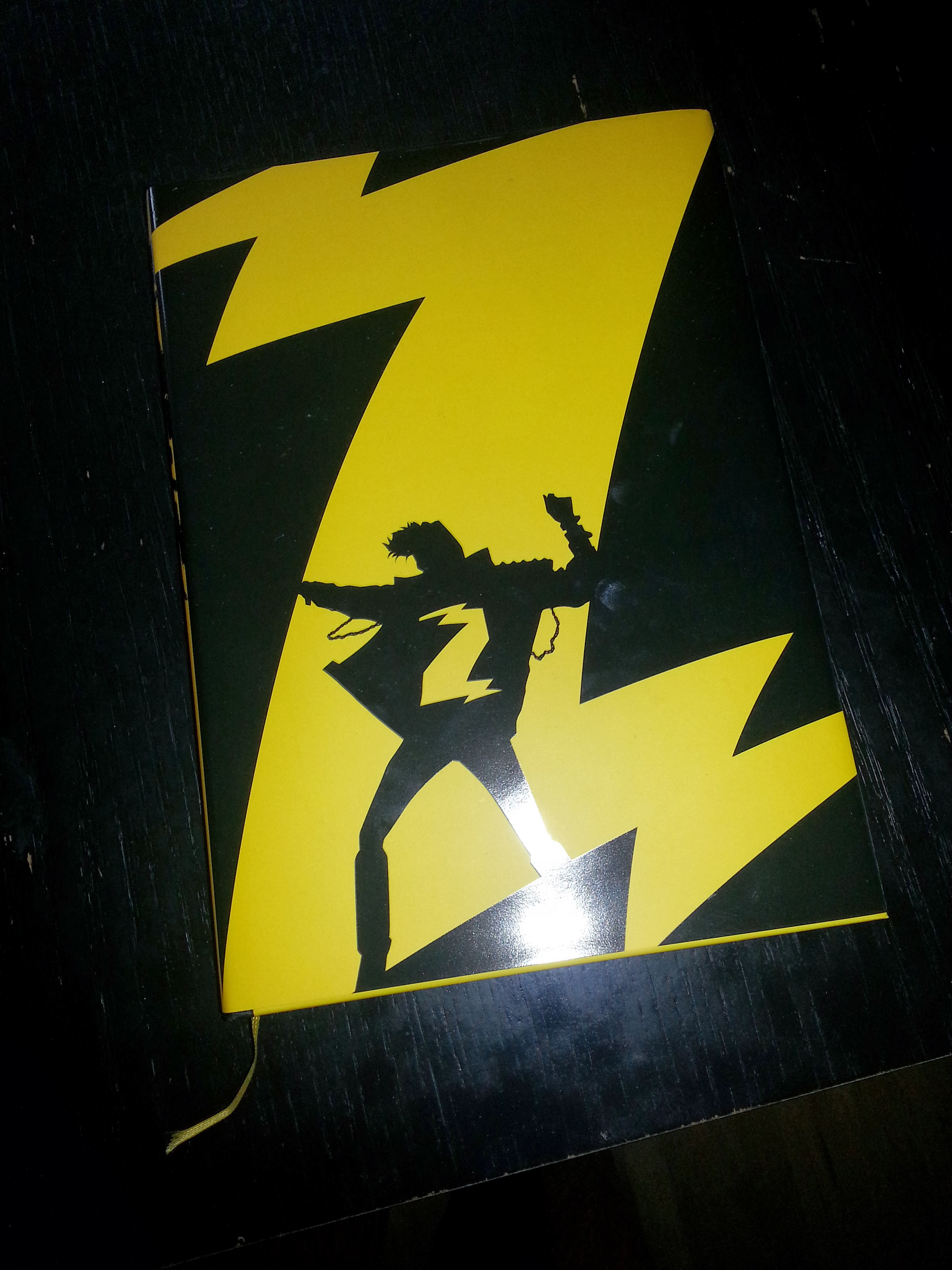
cover to Complete ZenithWARNING: Some minor spoilers in the images, but nothing to get too excited about.

Zenith is a comic strip from “my era” of 2000ad. I first started getting 2000ad from Prog 497 (after already purchasing several Titan reprint albums) and Zenith himself arrived in Prog 520.

In some ways it’s a surprise Zenith was a hit in the comic’s pages. Grant Morrison is one of the few British creators in the 80s who didn’t cut his teeth in 2000ad – his break was in DC Thompson’s Starblazer – and it is fair to say he never really “got” the 2000ad house style as was all too apparent in his work on Judge Dredd and the infamous “summer offensive”. What’s more, 2000ad doesn’t do superheroes. Zenith represented 2000ad’s first non-parodic toe dip into those deep waters.

In many respects, Zenith feels more like a Warrior strip than a 2000ad one and has a lot in common with Alan Moore’s Marvelman and Captain Britain in that it is a very British treatment of a quintessentially American genre. I wouldn’t over emphasise the similarities however, and feed into Alan Moore’s lazy narrative that Morrison is a plagiarist. Indeed, many of the ideas that Morrison plays with in Zenith are ones which he has revisited in his own work many times since, particularly in Final Crisis, Animal Man and his Vertigo trilogy of The Invisibles, Flex Mentallo and The Filth.

Despite Morrison moving rapidly onto bigger things, the story arc of Zenith is complete. The full colour Phase IV came out a few years after Phase III, and Morrison even returned for a one-off in 2000. It has however been increasingly hard to get hold of. Titan Books only reprinted the first three phases and ceased their 2000ad line in the early 90s. There was talk of reprinting it in the early noughties, but it quickly emerged that there were legal disputes preventing this from happening.

What are these legal disputes? Essentially, pretty much everything which 2000ad has ever published has been on the basis of work-for-hire: the company owns the rights in perpetuity (there are actually exceptions to this, but for the most part this is where the comic published work which had been initially commissioned by another publisher, notably Toxic!). However, Grant Morrison maintains that he never signed away his rights to Zenith and it would appear that 2000ad cannot prove him wrong in this respect. They could offer him a new contract or just accept he has the rights, but that would open up a legal minefield which could force 2000ad to revisit its ownership of pretty much everything it published in the 80s. As such it would appear they are at an impasse, the big loser being artist Steve Yeowell for whom this probably represents his most critically acclaimed and commercial work.

2000ad Books’ decision to print the entire run in a single volume earlier this year came out of nowhere. It has been limited to a (quickly sold out) print run of 1,000 and it is entirely possible this is the only time it will ever be reprinted. By all accounts, Morrison was not consulted on this and Rebellion have essentially stonewalled him. The theory goes that this is an experiment to see how he reacts. Either he’ll throw his lawyers at them or he’ll let it pass, in which case their case that he waived his rights and they are free to reprint will be that much stronger. It is far too soon to tell who will eventually win this, but in the meantime those of us willing to fork out £100 get a copy of something they have been dreaming of having in their hands for years.

What can I say about the book? I haven’t read the strip for many years and haven’t had a chance to pore through this edition yet, but I can say that it is very, very lovely indeed.

My shelves have been filling up with 2000ad’s “telephone directory” reprints for quite some time now (yes, I know that telephone directories these days are thinner than a weekly Prog; you get my meaning). I adore them, but they’re a bit of a mixed bag. Some of the reproduction and restoration, especially in the earlier days, is a bit iffy – especially when they are working from degraded copies of the comic rather than from negatives. And some of their choices can be a little odd, such as their decision to not include The Dead Man and America from their Complete Judge Dredd volumes (WHY????? Sigh, it still makes me furious). So I’ll be honest when I say that despite being willing to fork out for this volume I was a little trepidatious.

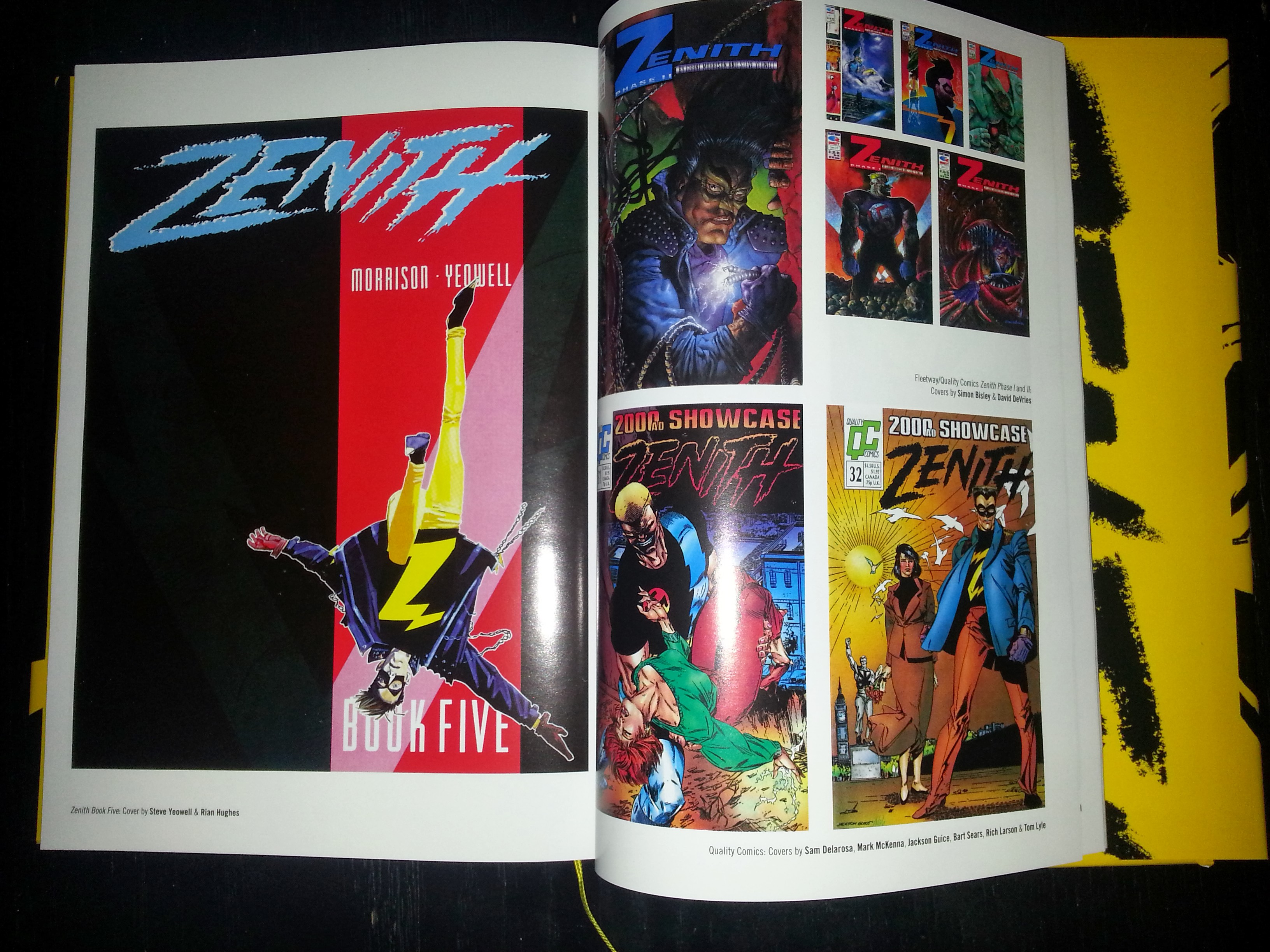
some of the reprint covers which appear in the Complete ZenithBut it has exceeded my expectations in several respects. This may seem obvious, but when they say “complete”, they mean it. It doesn’t just have all the strips, but it includes all the covers. Not just the 2000ad covers but the covers of the Titan reprints (which themselves were Ryan Hughes design classics) and the Quality and Egmont-Fleetway US reprints. I didn’t even know that Simon Bisley drew covers for the latter, although I have to admit that I’m not entirely blown away by them. It even includes a text story that Mark Millar wrote for an old annual, which if I recall correctly was only tangentially related to Zenith and (like many Mark Millar superhero and 2000ad stories) best forgotten about.

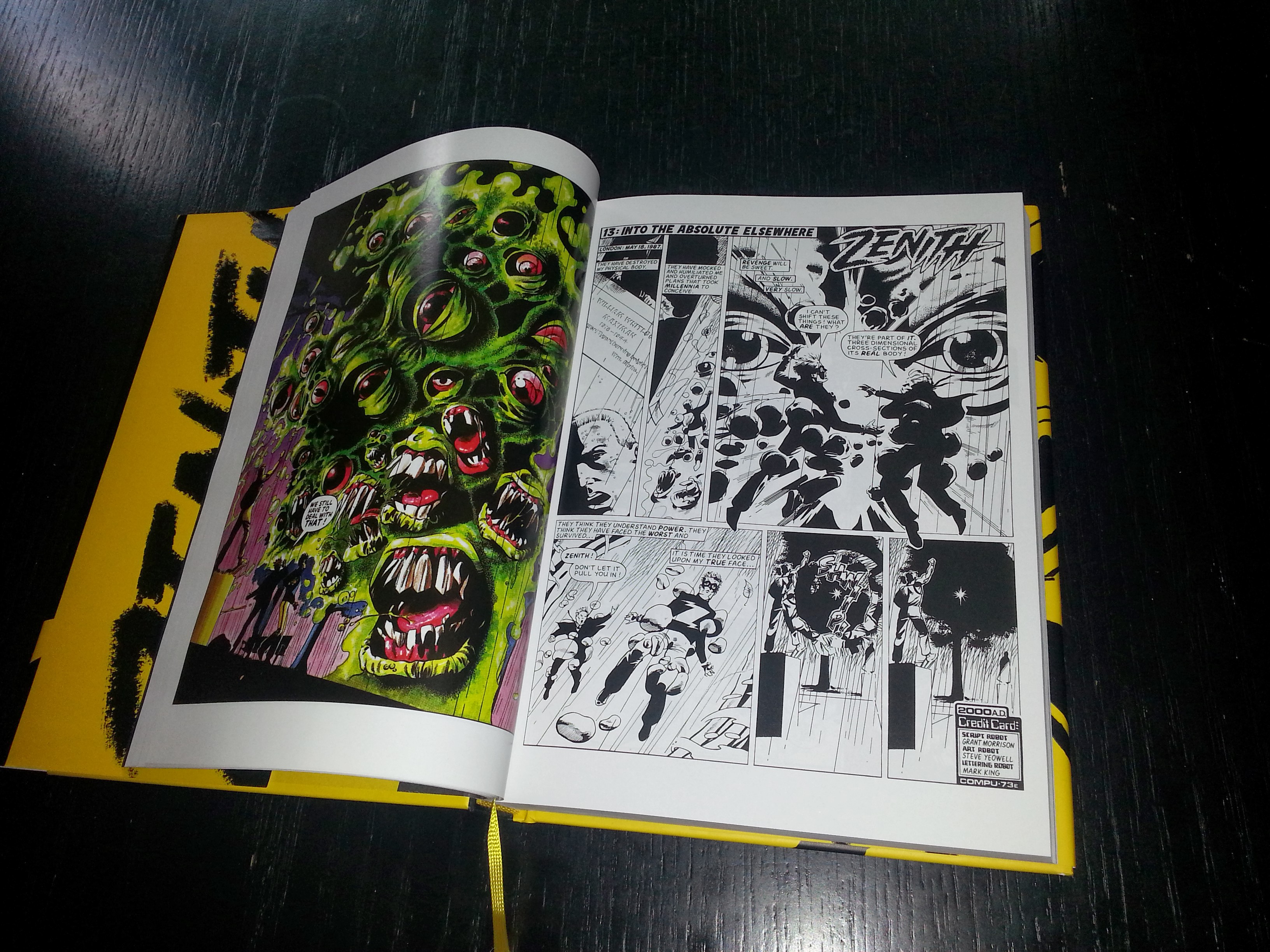
And then there’s the colour. Reprinting 2000ad strips from the late 80s and early 90s can be a bit of a challenge because the comic went from mainly monochrome to full colour in 1990. To keep costs down, book publishers tend to get creative when confronted with things like this by printing half the book in black and white and half in colour, but this can often look awful. On top of this, Phase I of Zenith was during a brief period when 2000ad adopted an odd habit of printing the last page of some of its strips on the back page of the comic itself – often in full colour. Most of the time, the solution to that is to print the page in black and white – and most of the time that means a page which looked gorgeous in the original comic looking muddy and illegible. This has particularly plagued the Judge Dredd and Strontium Dog reprints.

Colour transitions in the Complete ZenithNot so with Zenith. That £100 asking price means that, to their credit, they have spared no expense. So on the two chapters in Phase I where this applies you get a wonderful burst of colour. There is a slight issue which I’ve noticed whereby one of the annual stories, an Interlude, appears to have been printed slightly out of sequence so that it appears between Phases III and IV (when, if I recall correctly, it should be between II and III), but this is not disastrous as the story is out of sequence in any case.

Overall, I’m very happy with this and am content with paying the money. I very much expect an unlimited edition to appear in the next few years, but I don’t think those reprints will be either as comprehensive or include the nice touches that this one does.

And what of the ethics of reprinting this despite the legal uncertainty? Well, as readers of this blog will know, I’m fairly radical when it comes to my views on intellectual property. I think there is a good case for making all publications public domain 20 years after their initial publication – and I suspect that such an approach would have concentrated minds in both the Morrison and 2000ad camps. The existence of 2000ad slightly challenges my opposition to corporations being able to jealously guard their intellectual property because it has to be said that if their archives were worth less to them, it is entirely possible it would have ceased to be a viable publication some time ago (that said, I’m not wedded to 20 years and a somewhat longer period than that would probably fix that). I also have a lot of sympathy for Steve Yeowell and can’t believe that Morrison didn’t know he was working on a work for hire basis at the time. So yeah, I think they are right to test the waters here.

12 Oct 12:19

Polemic: how readers will discover books in future

by Charlie Stross

(Another polemic from Sprint Beyond The Book at the Frankfurt Book Fair ... )

In the future, readers will not go in search of books to read. Feral books will stalk readers, sneak into their ebook libraries, and leap out to ambush them. Readers will have to beat books off with a baseball bat; hold them at bay with a flaming torch: refuse to interact: and in extreme cases, feign dyslexia, blindness or locked-in syndrome to avoid being subjected to literature.

You think I'm exaggerating for effect, don't you?

Today, roughly 40-50,000 books are published commercially each year in the English language. But the number is rapidly rising, as traditional barriers to entry are fading away. Meanwhile, the audience for these works remains stubbornly static. The limits to reading are imposed by its time-rivalrous nature, in conjunction with the size of the English-reading population and the number of hours in the day. Tools that make writing and publishing easier work to increase the volume of work because the creation of books is to some extent an exercise of ego: we are all convinced that we have something of value to communicate, after all. It therefore seems inevitable that in future, there will be more books -- and with them, more authors who are convinced that the existence of their literary baby entitles them to prosper from the largesse of their readers.

A burgeoning supply of books and a finite number of reader-hours is a predictor of disaster, insofar as the average number of readers per book will dwindle. The competition for eyeballs will intensify by and by. Many writers will stick to the orthodox tools of their profession, to attractive covers and cozening cover copy. Some will engage in advertising, and others in search engine optimization strategies to improve their sales ranking. But some will take a road less well trodden.

Historically, publishers attempted to use cheap paperback novels as advertising sales vehicles. Books incorporated ads, as magazines and websites do today: they even experienced outbreaks of product placement, car chases interrupted so that the protagonists could settle down for half an hour to enjoy a warming dish of canned tomato soup. Authors and their agents put an end to this practice, for the most part, with a series of fierce lawsuits waged between the 1920s and 1940s that added boilerplate to standard publisher contracts forbidding such practices: for authors viewed their work as art, not raw material to deliver eyeballs to advertisements.

But we have been gulled into accepting advertising-funded television, and by extension an advertising-funded web. And as the traditional verities of publishing erode beneath the fire-hose force of the book as fungible data, it is only a matter of time before advertising creeps into books, and then books become a vehicle for advertising. And by advertising, I mean spam.

The first onset of bookspam went unnoticed, for it did not occur within the pages of the books themselves. Spam squirted its pink and fleshy presence into the discussion fora of Goodreads and the other community collaborative book reading and reviewing websites almost from the first. And we shrugged and took it for granted because, well, it's *spam*. It's pervasive, annoying, and it slithers in wherever there's space for feedback or a discussion.

But that isn't where it's going to end. An epub ebook file is essentially an HTML5 file, encapsulated with descriptive metadata and an optional DRM layer. The latest draft standard includes support for all aspects of HTML5 including JavaScript. Code implodes into text, and it is only a matter of time before we see books that incorporate software for collaborative reading. Not only will your ebook save your bookmarks and annotations; it'll let you share bookmarks and annotations with other readers. It's only logical, no? And the next step is to let readers start discussions with one another, with some sort of tagging mechanism to link the discussions to books, or chapters, or individual scenes, or a named character or footnote.

Once there is code there will be parasites, viral, battening on the code. It's how life works: around 75% of known species are parasitic organisms. A large chunk of the human genome consists of endogenous retroviruses, viruses that have learned to propagate themselves by splicing themselves into our chromosomes and lazily allowing the host cells to replicate themselves whenever they divide. Spammers will discover book-to-book discussion threads just as flies flock to shit.

But then it gets worse. Much worse.

Authors, expecting a better reaction from the reading public than is perhaps justifiable in this age of plenty for all (and nothing for many) will eventually succumb to the urge to add malware to their ebooks in return for payment. The malware will target the readers' ebook libraries. The act of reading an infected text will spread the payload, which will use its access to spread advertising extracts and favourable reviews throughout the reader communities. You may find your good reputation name taken in vain by a second-rate pulp novel that posts stilted hagiographies of its authors other books on the discussion sites of every book you have ever commented on (and a few you haven't). Worse, the infested novels will invite free samples of all their friends to the party, downloading the complete works of their author just in case you feel like reading them. Works which will be replete with product placement and flashing animated banner ads, just in case you didn't get the message.

Finally, in extremis, feral spambooks will deploy probabilistic text generators seeded with the contents of your own ebook library to write a thousand vacuous and superficially attractive nuisance texts that at a distance resemble your preferred reading. They'll slide them into your ebook library disguised as free samples, with titles and author names that are random permutations of legitimate works, then sell advertising slots in these false texts to offshore spam marketplaces. And misanthropic failed authors in search of their due reward will buy the ad marquees from these exchanges, then use them to sell you books that explain how to become a bestselling author in only 72 hours.

Books are going to be like cockroaches, hiding and breeding in dark corners and keeping you awake at night with their chittering. There's no need for you to go in search of them: rather, the problem will be how to keep them from overwhelming you.

12 Oct 12:13

Why Microsoft Word must Die

by Charlie Stross

I hate Microsoft Word. I want Microsoft Word to die. I hate Microsoft Word with a burning, fiery passion. I hate Microsoft Word the way Winston Smith hated Big Brother. Our reasons are, alarmingly, not dissimilar ...

Microsoft Word is a tyrant of the imagination, a petty, unimaginative, inconsistent dictator that is ill-suited to any creative writer's use. Worse: it is a near-monopolist, dominating the word processing field. Its pervasive near-monopoly status has brainwashed software developers to such an extent that few can imagine a word processing tool that exists as anything other than as a shallow imitation of the Redmond Behemoth. But what exactly is wrong with it?

I've been using word processors and text editors for nearly 30 years. There was an era before Microsoft Word's dominance when a variety of radically different paradigms for text preparation and formatting competed in an open marketplace of ideas. One early and particularly effective combination was the idea of a text file, containing embedded commands or macros, that could be edited with a programmer's text editor (such as ed or teco or, later, vi or emacs) and subsequently fed to a variety of tools: offline spelling checkers, grammar checkers, and formatters like scribe, troff, and latex that produced a binary page image that could be downloaded to a printer.

These tools were fast, powerful, elegant, and extremely demanding of the user. As the first 8-bit personal computers appeared (largely consisting of the Apple II and the rival CP/M ecosystem), programmers tried to develop a hybrid tool called a word processor: a screen-oriented editor that hid the complex and hostile printer control commands from the author, replacing them with visible highlight characters on screen and revealing them only when the user told the program to "reveal codes". Programs like WordStar led the way, until WordPerfect took the market in the early 1980s by adding the ability to edit two or more files at the same time in a split screen view.

Then, in the late 1970s and early 1980s, research groups at MIT and Xerox's Palo Alto Research Center began to develop the tools that fleshed out the graphical user interface of workstations like the Xerox Star and, later, the Apple Lisa and Macintosh (and finally the Johnny-come-lately imitator, Microsoft Windows). An ongoing war broke out between two factions. One faction wanted to take the classic embedded-codes model, and update it to a graphical bitmapped display: you would select a section of text and mark it as "italic" or "bold" and the word processor would embed the control codes in the file and, when the time came to print the file, it would change the font glyphs being sent to the printer at that point in the sequence. But another group wanted to use a far more powerful model: hierarchical style sheets. In a style sheet system, units of text -- words, or paragraphs -- are tagged with a style name, which possesses a set of attributes which are applied to the text chunk when it's printed.

Microsoft was a personal computer software company in the early 1980s, mostly notable for their BASIC interpreter and MS-DOS operating system. Steve Jobs approached Bill Gates to write applications for the new Macintosh system in 1984, and Bill agreed. One of his first jobs was to organize the first true WYSIWYG word processor for a personal computer -- Microsoft Word for Macintosh. Arguments raged internally: should it use control codes, or hierarchical style sheets? In the end, the decree went out: Word should implement both formatting paradigms. Even though they're fundamentally incompatible and you can get into a horrible mess by applying simple character formatting to a style-driven document, or vice versa. Word was in fact broken by design, from the outset -- and it only got worse from there.

Over the late 1980s and early 1990s Microsoft grew into a behemoth with a near-monopoly position in the world of software. One of its tactics became known (and feared) throughout the industry: embrace and extend. If confronted with a successful new type of software, Microsoft would purchase one of the leading companies in the sector and then throw resources at integrating their product into Microsoft's own ecosystem, if necessary dumping it at below cost in order to drive rivals out of business. Microsoft Word grew by acquiring new subsystems: mail merge, spelling checkers, grammar checkers, outline processing. All of these were once successful cottage industries with a thriving community of rival product vendors striving to produce better products that would capture each others' market share. But one by one, Microsoft moved into each sector and built one of the competitors into Word, thereby killing the competition and stifling innovation. Microsoft killed the outline processor on Windows; stalled development of the grammar checking tool, stifled spelling checkers. There is an entire graveyard of once-hopeful new software ecosystems, and its name is Microsoft Word.

As the product grew, Microsoft deployed their embrace-and-extend tactic to force users to upgrade, locking them into Word, by changing the file format the program used on a regular basis. Early versions of Word interoperated well with rivals such as Word Perfect, importing and exporting other programs' file formats. But as Word's domination became established, Microsoft changed the file format repeatedly -- with Word 95, Word 97, in 2000, and again in 2003 and more recently. Each new version of Word defaulted to writing a new format of file which could not be parsed by older copies of the program. If you had to exchange documents with anyone else, you could try to get them to send and receive RTF — but for the most part casual business users never really got the hang of different file formats in the "Save As ..." dialog, and so if you needed to work with others you had to pay the Microsoft Danegeld on a regular basis, even if none of the new features were any use to you. The .doc file format was also obfuscated, deliberately or intentionally: rather than a parseable document containing formatting and macro metadata, it was effectively a dump of the in-memory data structures used by word, with pointers to the subroutines that provided formatting or macro support. And "fast save" made the picture worse, by appending a journal of changes to the application's in-memory state. To parse a .doc file you virtually have to write a mini-implementation of Microsoft Word. This isn't a data file format: it's a nightmare! In the 21st century they tried to improve the picture by replacing it with an XML schema ... but somehow managed to make things worse, by using XML tags that referred to callbacks in the Word codebase, rather than representing actual document semantics. It's hard to imagine a corporation as large and [usually] competently-managed as Microsoft making such a mistake by accident ...

This planned obsolescence is of no significance to most businesses, for the average life of a business document is less than 6 months. But some fields demand document retention. Law, medicine, and literature are all areas where the life expectancy of a file may be measured in decades, if not centuries. Microsoft's business practices are inimical to the interests of these users.

Nor is Microsoft Word easy to use. Its interface is convoluted, baroque, making the easy difficult and the difficult nearly impossible to achieve. It guarantees job security for the guru, not transparency for the zen adept who wishes to focus on the task in hand, not the tool with which the task is to be accomplished. It imposes its own concept of how a document should be structured upon the writer, a structure best suited to business letters and reports (the tasks for which it is used by the majority of its users). Its proofing tools and change tracking mechanisms are baroque, buggy, and inadequate for true collaborative document preparation; its outlining and tagging facilities are piteously primitive compared to those required by a novelist or thesis author: and the procrustean dictates of its grammar checker would merely be funny if the ploddingly sophomoric business writing style it mandates were not so widespread.

But this isn't why I want Microsoft Office to die.

The reason I want Word to die is that until it does, it is unavoidable. I do not write novels using Microsoft Word. I use a variety of other tools, from Scrivener (a program designed for managing the structure and editing of large compound documents, which works in a manner analogous to a programmer's integrated development environment if Word were a basic text editor) to classic text editors such as Vim. But somehow, the major publishers have been browbeaten into believing that Word is the sine qua non of document production systems. They have warped and corrupted their production workflow into using Microsoft Word .doc files as their raw substrate, even though this is a file format ill-suited for editorial or typesetting chores. And they expect me to integrate myself into a Word-centric workflow, even though it's an inappropriate, damaging, and laborious tool for the job. It is, quite simply, unavoidable. And worse, by its very prominence, we become blind to the possibility that our tools for document creation could be improved. It has held us back for nearly 25 years already; I hope we will find something better to take its place soon.


PS: I write for a living. And if you're interested in seeing what I write, my latest novella, "Equoid", goes on sale tomorrow (October 16th). At no point was Microsoft Word involved in its creation; and you can buy it as an ebook from all the usual stores, via the menu here.

11 Oct 09:32

David Heath and Jeremy Browne were victims of an earlier reshuffle

by Jonathan Calder
I was pleased to see Norman Baker moved to the Home Office in the recent Lib Dem reshuffle. And I note that many of those poking fun at his book on the death of Dr David Kelly – step forward Jonathan Freedland and John Rentoul – are Blairite armchair warriors seeking to refight the invasion of Iraq.


But I do feel sorry for Jeremy Browne, who was sacked to make way for Norman Baker. Because in the previous reshuffle, which took place in September 2012, he was moved from the Foreign Office. And he had given every appearance of being at home there, which he never did at the Home Office.


And Jeremy Browne was not the only Lib Dem who was moved from a job where he was at home to one where he was not in that reshuffle and then sacked this week.


David Heath was by all accounts a success as deputy Leader of the House and, as ‘a good House of Commons man’, he certainly looked happy in the role.


But in September of last year he was moved to the Department for Environment, Food and Rural Affairs. 

Fair enough for a rural MP, you may say, but he was given the worst hospital pass of all time and was made the minister for shooting badgers. I don't think anyone could be happy in that role.


Now Dan Rogerson has been appointed to DEFRA in his place. I don’t know if he now has responsibilities for the badger cull – it is possible that they have moved the goalposts.


That September 2012 was not just a misfortune for these individual ministers: it was a misfortune for the Liberal Democrats as a whole. Because, despite everything, I like my party being in government and I was sorry to see us giving up any representation in important, grown-up departments like Defence and the Foreign Office.


Why did we do this? The theory heard most often is that Nick Clegg was so anxious to secure the return of David Laws that he was forced to concede a lot of ground in return.


I hope this is true. If Nick gave that ground of his own free will we really should be worrying.
11 Oct 09:30

THERE IS NO POINT TRYING TO BE SATIRICAL AND ALOOF IN THIS TIME OF ABSOLUTE AND UNBRIDLED NATIONAL CELEBRATION

by Lawrence
But I'd just ask two things...

1. If anyone sees Tat Wood, could you please give him the hug that he'll claim he doesn't want but that he'd obviously really cherish right now?

2. Since Lance Parkin's clearly so ahead of the game (and notoriously obsessed with / bad at 21st-century faux-history), could someone ask him what the date on Swann's newspaper in "Enemy of the World" is? 'Cos based on dodgy photos, Timelink dated the story to 2013, which would be f***ing wonderful if true.

11 Oct 09:30

On the Watching of Old Episodes

by Andrew Rilstone

Thought lost since 2006, this review of a VHS tape of old Hartnell episodes, was discovered in a folder on my hard-drive, along with a letter to the insuance company about my flat in Bollington and some stats for a Pendragon character. It has been painstakingly restored and is republished for free because I am evil and selfish and hate you all.

Fraisier:      Noel, surely you realize that Star Trek is just a TV show.
Noel:          Well, Brideshead Revisited is just a TV show.
Frasier:        You're angry, so I'm going to ignore that.

Doctor Who began in 1963: between, as the fellow said, the end of the Chatterley ban and the Beatles first LP. When I started watching the programme in the middle-seventies the fans regarded Tom Baker very much as an impostor, and William Hartnell as the real thing. Since, for about twenty years after their first transmission, no Bill Hartnell episodes had been seen by anyone outside of the BBC archives, these old stories took on the aura of the most lost and golden of lost golden ages. When, in 1981, the BBC re-showed the first ever story as part of a retrospective, I took the older fans at their word. 'Unearthly Child' is a superb piece of television; so I naturally assumed that every other black-and-white story must have been just as good.

I suspect that the first-generation fans had convinced themselves of this as well. There are, in fact, two different programmes called Doctor Who: 'Doctor Who One' was a rather serious, magical programme about Time Travel and the wonders of the universe which existed in the collective memory of fans who had grown up with it. 'Doctor Who Two' was the sometimes fun but often silly kids TV show that the BBC had actually transmitted. It consisted, from a very early stage, of quarreling alien races, hopeless companions, and chases along corridors. ('The Space Museum' involves chases along corridors and practically nothing else.) Naturally, our faith in Doctor Who One can't survive the widespread availability of videos of the original TV episodes.

Unfortunately, the BBC has undertaken to make every surviving Doctor Who story available on VHS, prior to deleting the whole line and replacing it with DVD. The three-tape "First Doctor Boxed Set" represents the final batch of black-and-white episodes: 'The Gunfighters', 'The Sensorites' and 'The Time Meddler'. The words "barrel", "bottom" and "scraping" come to mind.

It isn't really fair to watch these stories straight through, in a darkened room, on a large TV screen, and judge them as if they were works of 'art' intended for posterity--any more than it is fair to judge The Beatles Live at the BBC alongside the polished studio albums. They were designed to be watched once and then discarded, after all. This isn't TV drama; it's just the fossilized echo of a Saturday tea-time nearly forty years ago.

The restoration team has done such a good job of cleaning the footage that it took me several minutes to stop gawking at the unnatural sharpness of the video and actually pay attention to the story. Old TV means rough and blurry; this genuinely looked as if it had been filmed yesterday. And this, in the long-run, makes it look much older than it is. One looks at the flairs in the Tomorrow People or the mini-skirts in Star Trek and says 'It's the 60s' or 'It’s the 70s'. As I watched 'The Sensorites', the main thought which intruded into my head was, 'This is set on a strange alien planet where women and teenaged girls wear one-piece knee-length dresses and men keep their jackets on!'

I think that the reputation of these old stories depends on the extent to which they can be made consistent with the 'Doctor Who One' mythology. 'The Sensorites' was reasonably well regarded among fans, because, on paper, it fitted in with the wondrous magical series which they thought they remembered. It has elements of 'gothic horror' (humans trapped by telepathic aliens on a space ship) and elements of 'serious sci-fi' (the aliens have a reasonably well drawn culture, and individual personalities.) The Sensorites themselves looked good in the still photographs, and crop up in the first Doctor Who annual, allowing the story to grow into a lost classic in the collective memory of fandom.

The real thing turns out to be all but un-watch-able. It has a few moments of 'historical' interest, such as when the Doctor and Susan briefly reminisce about their mysterious home planet and the reasons for their wandering--but this is perfunctory. (Not nearly as good as the genuinely tear-jerking moment in 'Tomb of the Cybermen' when Doctor Patrick confides to Victoria about his dead family.) The aliens are tolerably well done. Provided you aren't surprised by the fact that they are not really aliens but actually actors wearing masks then you have to admit that they are rather nice, well made masks, and that the actors try quite hard to put the characterization across. It is quite brave in 1964 to have a substantial supporting cast made up of non-human characters. Star Trek never really tried it.

I was looking forward to the appearance of Peter Glaze, the fat comedian who made a catch phrase of 'Doh!' half a century before Homer Simpson did, but under the masks, I couldn't tell which one he was.

The trouble with the story is that it is boring, boring, boring and boring, with a small dose of patronizing for good measure. It turns on the Doctor losing the key to the TARDIS, and having to become involved in a minor intrigue on an alien planet to get it back. Yeah, so the Sensorites are feuding about whether trade with the human is going to interfere with their traditional way of life or not. Hard to care a great deal. There is a small moment of interest in the final episode when the writer, who has clearly run out of things to happen, in desperation comes up with some insane human castaways. But most of the story is an unbearable exercise in exposition in which plot twists which were not very interesting to begin with are spelled out to the kids in words of one syllable.

There is a plague, which is only affecting the lower caste Sensorites. Our heroes are at tea with one of the nobles. The noble insists they try some of the water from the special spring which only the noble caste uses. Ian makes a big thing out of being thirsty, and takes a swig of the lower-caste water. He comes down with the plague. The Doctor spends half an episode wondering why the only crew-member affected by the plague is Ian. I'm sure even eight-year olds in 1965 were yelling 'It's the bleeding water, you dopey old git' at him.

'The Gunfighters', on the other hand, turns out to be an awful lot of fun. It has been universally reviled by Doctor Who fans because there is no way that it can possibly be made consistent with the idea of Doctor Who One. It is, not to put too fine a point on it, silly. It has jokey titles ('A Holiday for the Doctor') and a non-existent story-line ('The TARDIS arrives at the OK Coral just before the Gunfight. Er…that's it, really.') It is not historical drama. It is not, by any stretch of the imagination, a time-travel story showing what would happen if some modern people were landed in nineteenth-century America. It's not one of those mythical 'stories-to-get-kids-interested-in-history' that some people persist in believing in. It's not even really a Western. It's nothing more or less that an excuse for a bunch of grown ups to play cowboys and Indians for 98 minutes.

Few of the supporting cast can actually manage American accents, so we have sheriffs and gunslingers who sound cockney and Australian, sometimes simultaneously. Although the sets are good, there aren't enough extras to make the town look populated. It’s a bit of a drawback when trying to make a western to find out that you can only afford one very brief shot with horses in it.

And then there is the matter of That Bloody Song. Someone decided that, if Doctor Who was going to arrive in the Wild West, then there would jolly well be a ballad. There is wonderful bathos when a song at the level of--

So pick him up gentle
And carry him slow
He's gone kind of mental
Under Earp's heavy blow.

--fades into the familiar Ron Grainger theme and the swirly lines, reminding you that, yes, despite all evidence to the contrary, this actually has been Doctor Who you've been watching.

But that said, the story rolls along at an entertaining pace. It may not make much sense, but it is full of stuff. Stephen gets captured by a lynch mob. The Doctor is (inevitably) mistaken for Doc Holiday. He acts as mediator between the Earps and the Clantons. Stephen and Vicki are forced at gunpoint to do a musical act in the Last Chance Saloon. (Cue: 'Next Episode -- Don't Shoot the Pianist.') The Doctor is surprised that Doc Holiday is going to pull his teeth without anesthetic Stephen wanders around a 'real' Wild West town in a cowboy suit such as you could buy in any Fancy Dress hire shop. The Doctor consistently refers to the sheriff as Mr Werp. At the end of the story, the Doctor accuses Vicki of having fallen prey to every wild west movie cliché in the book. He understood what was going on, if no-one else did.

When I first saw a second season Hartnell story, I found it disconcerting that Peter Purves had taken over Ian's role as Grown Up Male TARDIS passenger. Watching stories like 'The Gunfighters', it seems the most natural thing in the world. "This week, I'll be telling you what happened when I visited the last remnants of the human race on board a generation star-ship. But first, here's Val to show you how to make a fluid link out of an old thermometer and some sticky-backed plastic."

Doctor Who never was about Time Travel. With the whole universe of Time and Space to explore, the TARDIS keeps dumping us in English school-book historical settings, where we can meet Famous Historical Characters. Within the first three seasons, we'd seen the Doctor and his companions playing at being Cavemen, Knights, Romans, Greeks, Cowboys, Pirates and travelers with Marco Polo. The heroes spend long enough in these settings to become naturalized: Ian wears a suit of armour and gets knighted by Richard the Lion-heart; Barbara and Vicki dress up in togas. In this respect, the Doctor has a great deal in common with that other archetypal British swashbuckling hero, MrBen. (Mr Ben never witnesses the Bartholomew Day's massacre or an Aztec human sacrifice; and come to that the Doctor never becomes a clown or a cook; but in other respects, the overlap is striking. )

This is why 'The Time Meddler' though it lacks the seriousness of the early stories, might stand for the archetypal Hartnell yarn. The BBC actors look desperately awkward in their Viking costumes; and the fight scenes are an embarrassment; but Peter Butterworth's naughty, interfering but basically harmless Time Traveler is a wonderful opposite number for the pompous First Doctor. He should surely have become a regular fixture in the series. It was always hard to believe that the godlike Time Lords of later mythos had anything whatsoever to do with the Doctors; but the Doctor and the Monk have a schoolboy-ish rapport which makes us instantly believe they are part of the same world. Surely there was a whole universe of Time Traveling tricksters for us to discover? The climax to episode 3, when Stephen and Vicki stumble into the Monk's very own TARDIS, stands as my second favourite of all Doctor Whocliffhangers. (*)

Where 'Gunfighters' at least allows the cast to play at cowboys, the historical setting for 'Time Meddler' has become a complete irrelevance; simply a backdrop in which the Monk can carry out his mischief and the Doctor can stop him. But the historical setting which is being ignored is, of course, the one which more than any other signifies 'History' to generations of British Schoolchildren. The TARDIS seems to choose landing spots, not because they are important, but because they are Memorable. It was inevitable that the TARDIS should eventually take us to 1066; it had arguably never taken us anywhere except 1066 and All That.

The first time we see Susan in 'Unearthly Child', she is reading a book about the French Revolution. The last story of the first season ends with her, her grandfather and her two favourite teachers wandering around a knock-off Scarlet Pimpernel thriller set during, yes, the French Revolution. If the series had ended there (and maybe it should have done) we might have been tempted to think that the whole 'adventure in space and time' was nothing more than a day-dream created by an over-imaginative school girl.

'Susan, listen to me. Can't you see that all this is an illusion? It's a game that you and your grandfather are playing, if you like. But you can't expect us to believe it.'

But very sadly, we started to.

(*) 1: The Dying Dalek's tentacle emerging from the Thal cloak. =3 "I am the servant of Sutek, he needs no other" =3 "So, we play the contest again, Time Lord" 5: "I've made a terrible mistake. I thought I'd locked the enemy out. Instead, I've locked him in."

10 Oct 19:10

The Cut

by Jack Graham
On 'The Space Museum'


Recently, while tracking some hits this blog received, I discovered a new Doctor Who podcast called Pex Lives.  It's great stuff, well worth listening to... and I'm not just saying that because the guys who make it - Kevin Burns and James Murphy - kindly linked to me and mentioned me in one of the episodes.  Their third and latest podcast is just out, and centres upon 'The Krotons'.  Their second podcast is about 'The Space Museum' and they delve into the piece with lots of wit (in both senses of the word) alongside anarchism, Tolstoy, progress and political change.  Not many Who podcasts touch on stuff like this.  My favourite quote: "we're both ambivalent about violent revolution".  (For the record, so am I.)   It also helps that they both have likeable voices.  Kevin sounds like Terry Gilliam (i.e. he has one of those American voices that sounds as though it is filtered through a permanent grin of enthusiasm) and James sounds like a gigantic, sentient, wryly raised eyebrow that has somehow gained the ability to talk with the voice of a hip-hop DJ.  Even so, I kept on wanting to interrupt them... which I mean as a compliment.  So I made some notes instead, and they turned into this:


1. Freeze Frame

The Doctor, Vicki, Barbara and Ian spend episode one wandering around the museum unseen and unheard, unable to interact with events and apparently seeing glimpses of their own future, culminating in their encountering themselves as exhibits. The explanation for this is that they’ve “jumped a time track” and arrived before their arrival, so to speak. Vicki ponders what this means in a speech that, as the Pexcasters remark, is as poetic as it is scientifically meaningless:

Time, like space, although a dimension in itself, also has dimensions of its own.

However, I think that “time”, as used here, really refers to narrative, particularly TV narrative. One of those inner dimensions of narrative is, of course, metaphor. So when Vicki uses the word “time” metaphorically to refer to TV narrative (hereafter TVN), and thus says that narrative has dimensions of its own, she identifies one of those dimensions by using it.

But let’s look at the moment when the ‘time track’ is ‘jumped’. This happens at the very beginning of part one, which is also a reprise of the cliffhanger at the end of ‘The Crusade’.  This cliffhanger was a sudden and uncanny 'freezing' of the characters.  The Doctor & Co. are still frozen in their medieval duds at the beginning of 'Space Museum'.  They then unfreeze in their regular clothes (Ian in suave catalogue menswear, Vicki in teenybopper pop-socks, Barbara in her oh-so-practical cardigan, and the Doctor in his usual quasi-Edwardian proto-Adam Adamant gear). The Doctor, upon being questioned about this by the baffled Ian, says that the answer is “time and relativity, dear boy”.

This 'jump' occurs at the junction of two stories, one ending and the other starting.  At the start of the new TVN, the characters are still, so to speak, stuck at the end of the last TVN.  They're frozen, despite the fact that a new TVN has begun without them. This is, of course, just a literalization of what always happens: the characters freeze for a week.  But this time we actually see the freezing at the end of one story, continuing into the start of the next.  Indeed, as noted, the freezing was the cliffhanger.  The extra-diegetic business of the freezing of the characters has become a diegetic occurence.  It is an in-narrative effect of which the characters are conscious. 

But boil it down: what have we actually seen? 

We’ve seen a cut.

(Pause to recall the momentous, primal importance of the cut in Doctor Who up to this point… the fact that a cut makes it possible for ‘An Unearthly Child’ - in a moment of pure television amidst what would otherwise look very much like televised theatre - to put the TARDIS console room inside a police box, to move Barbara and us instantly from the junkyard to the alien ship via an apparently instantaneous physical movement through impossible space, to put the latter inside the former, to do something that is possible now that we’ve “discovered television”, i.e. to put the massive building inside a small box.)

The jumping of the time track in ‘Space Museum’ is a cut. Moreover, it is the kind of cut that indicates a temporal gap, the skipping over of a movement through time. It is the moment when the narrative jumps forward, using the grammar of television; snipping out the boring and non-dramatic bits that are not relevant to the audience, slicing away the mundane ‘dead time’ of the characters which we don’t need to see and can happily take on trust. It is the kind of cut (between the reprise of a cliffhanger at the end of one story and the first scene proper of the new story) that represents a movement not only through time but also from one unit of TVN to another. It’s the kind of cut that signifies a dramatic/televisual moment, thus unifying dramatic time and TVN. The break in time is, in this kind of case, also simultaneously a break between stories. Just as the break in time sews together two discrete but separate dramatic moments, so it sews together two narratives.  (In so doing it also undermines the rather dodgy premise that there really is such discreteness in the separation of narratives - a premise that fails to hold up when you delve into the actual behind-the-scenes business of writing and script-editing.)  Thus it is, strangely, both a moment of progress and of stasis.

The cut signifies not only an implied/annihilated fictional half-hour of cleaning-up, wardrobe diving and changing, but also a handover - at least in broad terms - from one story/writer to a new one.  The difference here is that the characters notice it. Or rather, they notice the absence/break that it signifies. They notice the stitching along the join. They notice that this hypothetical half-hour never existed for them. They have moved and not moved.  They notice that strange unity of progress and stasis.  They have not inherited the obliviousness to this that should come with a cut. They notice that their clothes changed in an instant. That isn’t supposed to happen… at least, not in drama. Such moments of meta-awareness are a staple of comedy (and have been long before the 60s when they started to become the vogue in TV comedy) which may be why the moment of awareness in ‘The Space Museum’ is marked by a comedic moment (the “Doctor we’ve got our clothes on!” bit).

In noticing the cut, the characters have noticed the syntax and grammar of TVN which ought to just underly their actions as structure. Just as sentences become nonsensical when you concentrate on their arrangement, or on the brute fact of the arrangement of letters, so a fissure opens up in the story by the characters’ awareness of narrative structure. This single glitch is enough to put them out of proper contact with the story into which they have just hurtled. It is enough to leave them stranded, skewiff in relation to the narrative. Out of phase, out of synch, out of time. The Doctor’s casual dismissal of the moment may be persiflage, but it also gets right to the root of the problem. His words make sense, as long as we take “time” to mean TVN (and, if you think about it, how could “time” possibly mean anything else within a story on TV?).

The Doctor and his friends have been propelled into one of the other interior dimensions of narrative: the relative distance between the characters and the narrative. Their freak moment of awareness of the functioning of the TVN (in which they are trapped like ball-bearings inside a mechanism) has allowed a distance to open up between them and the symbolic order that makes narrative function... and so, because narrative essentially is this symbolic order, the distance is between them and the narrative itself. This is how they can arrive and not arrive… and, really, this is just an extrapolation of what Doctor Who always does by its very nature: it unglues characters within TVN from the conventional causal rules of TVN, allowing them to see the future and the past, allowing them to move freely (more or less) within the interior, relative dimensions of narrative.


2. Empire Hears the Sound of Doctors Toppling

So, thus freed, they see a possible future, a possible - as yet unsettled - narrative conclusion, to which they would not otherwise have advance access... and what they see is their own possible, nay probable, defeat.  I don't buy that they've arrived before themselves.  That doesn't work.  They have arrived on Xeros after themselves, after their probable defeat.  They find the TARDIS and their own frozen selves in the Museum.  They have already arrived, wandered in, been captured and frozen and exhibited.  What they see is the aftermath of this, of the whole trajectory of a Doctor Who story going wrong and being aborted.  And it's not just this story that goes wrong... it's a whole new kind of trajectory for Doctor Who (the Doctor/show with an anti-imperialist and revolutionary energy) being truncated before it can get going.

The skewiff time travellers, detached from their own assigned dimension within the TVN and stuck in a subsidiary one, walk around in the remains of a story after it has ended, in the aftermath of an alternate story, a story that is literally impossible within Doctor Who but which nevertheless seems to have tried to transpire. The version of the museum they wander through in episode one is itself an exhibit of a long-settled past. Like museum exhibits, it is a mute testament to a deactivated, finished, concluded story. In the case of the desynchronised world of episode one, it is a frozen exhibit of the concluded story of the Doctor and his friends being defeated. This story is already over. In that story, Our Heroes were captured and frozen and turned into exhibits, never to travel again, never again to jump from one narrative to a new one.

The great consequence of the Doctor's capture and pickling is that the Xeron revolution never happened.  Vicki never got the chance to bully the Xerons into it.  So, in the version of the last episode that the TARDIS crew get to spectate at during episode one, the Xerons are still slaves and the Moroks are still masters.  The museum endures.  And Doctor Who is over.

You want proof?  There is a Dalek, dead and hollow, displayed as a harmless exhibit, a thing of the past.  Already, by this point, the Dalek was the other part of the dyad that made Doctor Who into itself.  If its dead, so is the show.  (The final proof that the Doctor has won comes at the very end, when a new cliffhanger brings a new TVN... and it features reactivated, reanimated, resurgent Daleks.)

What the travellers see as they wander around the museum in their disconnected state is nothing less than post-Doctor Who.  It is the Doctor Who universe continuing after the character and his show have been destroyed.  It is the universe without the Doctor.  And it manifests not only as a universe of eternally preserved blandness and futurelessness, a universe of frozen entropy (and thus of frozen time and frozen narrative), but also as a universe of eternal empire.  Tyranny will last forever now that the Doctor is just an exhibit in a museum.  The Doctor's failure to foment revolution (by proxy... because we're still feeling our way cautiously into this new energy) is what destroys him and his show.  Empire gets him before he can escape it or topple it.  This is not a connection that the show would ever have made before.

This is new.


3. Strange Matter

All this can happen only because of the material practices of TV production, because of their recursive re-entry into the narrative as a creatively distorting force.  Just as the console room can only be within the Police Box because of the material reality of the cut influencing what is physically possible for the characters within the story, so the time track can only be jumped through use of the same technique. When they walk out onto the surface of Xeros, the time travellers leave no footprints and, when they don’t speak, there is nothing but silence. In being detached from the plot (and TVN and diegetic time) they have become materially detached... or, to look at it from the other side, re-attached to the material reality of production.  They have become diegetically aware of another inner dimension of TVN: the material dimension, i.e. the setness of the set, the studioness of the studio... all this as a follow-on from their awareness of the cuttedness of a cut. I’m surprised they don’t notice their own shadows cast upon the supposedly distant mountains. This is an astonishing intrusion of the material reality of TV production into the diegesis, into the ‘consciousness’ of characters within a television story. Without actually breaking the fourth wall (which is always rather glib and obvious and bathetic whenever it actually happens) there’s very little more that can be done to make material production intrude deliberately into the narrative it produces.

In the time period / narrative dimension that Our Heroes get temporarily stuck in, their feet make no impression on the sand… because it’s a studio floor. The diegetic rationale is opaque. What matters is that the in-narrative consciousness of the material reality of TV production allows the proliferation of TVN’s interior dimensions. That’s also how Vicki’s glass can break and reform: the material reality of film (wind forward, wind backwards) can increase and decrease entropy for the characters (remember, entropy cannot decrease in our universe, which is why we can’t really travel backwards in time… but in the interior dimensions of TVN, it can… hence the possibility of time travel within TVN).  The material reality of TV production is how the characters can inhabit the strange zone of skewiffness in which they spend episode one, even when inside the museum.  This is how Vicki can wave her hand through the exhibits.  It's how the TARDIS can be transparent and insubstantial. 


4.  No Future

Entropy is, of course, a perennial obsession of SF, and decidedly of Doctor Who. Who has an ambivalent relationship with the concept. The ethical value attached to order and disorder swings back and forth, and this oscillation is inherently political in its implications. There is an enormous difference between the imposition of order and stability at the end of ‘The Web Planet’ and the gleeful abandon with which disorder and instability reign at the end of ‘Power of the Daleks’. On Vortis, the Animus (a communist cancer) is defeated, the proper lords of the planet return to rule again and the formerly “militant” beasts of burden resume their due subservience. On Vulcan, various competing forms of political domination are allowed to annihilate each other while the Doctor chuckles. Arguably, the Hartnell era up to this point (’Space Museum’) has the Doctor largely playing the role of a force for entropy-minimisation. He either escapes historical narratives in which disorder is depicted as political ferment (’The Reign of Terror’) or ‘primitivism’ (too numerous to need adumbration, but...), or re-establishes order by catalysing some bourgeois political settlement (’The Sensorites’). Despite his debut as a force of anarchic interruption of bland, post-war, liberal normality in ‘An Unearthly Child’, he soon settles into the role of Guardian of Order in past and future. You can’t rewrite History: not one line. Etc.

However, in ‘The Space Museum’ something changes. Not totally, not for all time and in all instances. But the balance shifts, or begins to. The centre of gravity of the series/character starts to change. At the very least, the potentialities become wider, more open, more radical. (James and Kevin note that, in this story, Hartnell's character becomes, for the first time, something like the Doctor as we know him.)  The threat which catalyses this shift is the threat of the utter foreclosure of potentialities, the loss of future, the doom of becoming an exhibit in a museum.

A museum is, of course, a place built to house objects with no future, objects upon which all potentialities have foreclosed, objects for which all possible destinies (apart from eternal static preservation and display) have collapsed. The threat of the Morok museum is of freezing, of the complete minimisation of entropy, and hence of future time… and hence, as we’ve seen, of the future dimension of TVN. The threat is of No More Stories. To Doctor Who, an anthology series to end all anthology series, this is an existential threat in both senses, i.e. a threat to its meaning and to its continuance. (See section 2, above.)  Such a thing has already been hinted at in the previous story, ‘The Crusade’, in which Saladin interprets Barbara as a member of a troupe of travelling players, casts her in the role of Scheherezade, and tells her that if she runs out of stories to tell, she dies. In ‘The Space Museum’, this threat stems directly from the political project of a declining empire. It goes beyond narrative collapse.  It looks more like narrative annihilation. It is a directly political threat.


5. When the Sky Falls / When it Crumbles / We Will Stand Tall / Face it All Together*

In ‘The Space Museum’, the threat to the Morok’s declining empire is directly the threat of entropy. They fight entropy with stasis.  That the emblem of their empire is a museum is telling.  A museum is, as noted, the place where the future is frozen and stasis eternally preserved.  In order to preserve the exhibits, the Moroks have to literally freeze them, which seems to also freeze them in time, thus arresting entropy (which is, of course, both waste heat and time's arrow).  On Xeros, their colony which they have overwritten with their own history in the form of their museum, all is silence and stillness.  Morok anti-entropy has leaked out and freeze-dried the planet.  The Xerons themselves have been reduced to a race of children.  Nobody seems bothered by the idea that they might grow up.  If they prove to be capable of it, they can always be exterminated - that's Lobos' stated plan.  Meanwhile, frozen at the point of adolescence (a curiously bland and placid adolescence, but with all the essential impotence of that part of life), they hang around doing nothing.  The Moroks hang around doing nothing too.  The exhibits hang around doing nothing. Nobody visits the museum. The Moroks can’t wait to get home. Boredom reigns. It prefigures Doctor Who’s great fixation upon eternal, existential boredom in the 80s. And for the same reason.  Like those 80s episodes, which came during Thatcher's great quest to freeze social progress while dressing her project up as a resurgence of national/imperial status, 'Space Museum' dramatises the calculated and cynical freezing of imperial decay.  As in the 80s stories, in 'Space Museum' it leads to the stunting of progress, the dawn of a bland circularity, a smothering silence and stiltedness, the feeling in everyone that they're rolling a boulder eternally up a hill without ever getting nearer the top.  Just think of Vicki's irritation at the way the Xerons just sit around indulging in melancholy dreaming.  (Vicki, of course - as Kevin and James recognize - is the emblem of a hopeful, Moddish, 60s optimism about the future and about youngsters.)

As the Pexcasters also point out, the Morok empire is, of course, the British empire in decline. But the metaphor actually does the Morok/Brits some favours, depicting them as pitiably bored and mostly-passive, all assuming that their glories are in the past, doing little that is proactive to defend their standing and influence, sitting around bemoaning the way their own people seem uninterested in past glories. They have, the odd bit of half-hearted repression aside, apparently accepted that their empire is over. This at a time when the British (under Harold Wilson) were still fighting a rearguard action to shore up their influence by getting militarily involved in Malaysia (a country pretty much created to serve British tactical interests in that region), and assisting General Suharto’s bloody coup in Indonesia, which entailed displacing the neutralist Sukarno and massacring leftists, and paving the way for Suharto’s genocidal invasion of East Timor. The Moroks are part-and-parcel of the widespread idea that Britain dismantled her empire largely peaceably… forgetting about the bloody rampages against the Mau Mau, and plenty of other sanguinary attempts at holding back the tide of anti-colonial resistance. If Britain sometimes yielded to the the inevitable a bit more easily than other European colonial powers, the underlying reasons were economic rather than moral.

Glyn Jones was, of course, an exile from South Africa, and ‘The Space Museum’ clearly swipes at colonialism… but you have to wonder if he was thinking of British colonialism against the Boers, forgetting that the South African state was built on the bloody, racist colonialist repression of native Africans by the Dutch settlers. The Xerons are often observed to be “kids” but they are also definitely “white kids” (as Ace might put it). In some ways, this is preferable to the attempts at implying ethnic and/or racial difference in the ‘oppressed natives’ in other stories. The Swampies are bad enough (though their portrayal as characters could have been a lot worse, as Avatar proved) but even the Kinda - characters in a much more complex and politically sophisticated story - are problematic, being an example of Whitey taking it upon himself to represent a version of conquered peoples. Even so, the Xerons are white kids displacing, in true settler style, the real victims of Western imperialism and colonialism. They are an echo of very old imperialist stereotypes of ‘natives’ (who were, according to Kipling, “half child”) as helpless, clueless, passive and foolish, while also being a negation of the whole existence of people of colour as victims of colonialism. It might be observed here that programme makers can’t win. They either leave people of colour out completely, thus negating their existence, or put them in and thus practice the inherently imperialistic project of appropriating their experience and representing their stories for them. And it’s true: they can’t win. The necessary response to this isn’t to look harder for ways to square the various vicious circles of liberal media in imperialist, white-dominated societies… the necessary response is to stop society being imperialist and white-dominated. (If pointing out the impossibility of squaring such circles on a little-read blog contributes towards this aim, then I’m doing my part. /irony/)

Of course, the 60s had Vicki as a possibility because, even as it was the era of British imperial decline (often resisted with great savagery) it was also the era of burgeoning social and political struggle, resistance and cultural insurrection.  The link was there between the liberation struggles of the colonised peoples and the struggles of Western students and workers (which is, of course, why the Xerons are both colonised 'natives' and dissatisfied youngsters).  Even outside or before the realms of radicalism, there was a widespread feeling that progress was, if not inevitable, certainly hard to resist.  In the 80s, what radicalism there was was reactive and defensive... and 80s Doctor Who (the odd bit of mordant satire notwithstanding) doesn't really start engaging with this until Cartmel comes along.  Hence the fixation of the pre-Cartmel 80s upon entropy and decline and tedium.

'The Space Museum' is when the show really begins any attempt to engage with these syndromes.  When you start looking for it, the whole of 'The Space Museum' is about entropy stalled and/or reversed, with this minimisation being the central threat and the imperial project. The intersection between the narrative manifestations of this (the jumped time track, the empty museum) and the thematic/political manifestations (The Decline and Fall of the Morok Empire, artificially paused) is what makes this story tick… or rather, not tick.

This is key.  The big threat to our heroes, to their and our presumed values, to the show itself, is not entropy (or its effect/appearance: time).  The threat is no entropy.  The threat is the restriction of entropy, the stopping of the clocks, the freezing of decay.  We want the Morok empire to decay.  The Xerons and the TARDIS crew need entropy in order to liberate themselves via the continued crumbling of Morok power.  The effect of the Morok effort to preserve their tyranny in amber is the creation of a massive system of freezing, of stalling, of pickling, of preserving, of exhibiting.  Their museum is more than just a standard way of imposing imperial power and knowledge over the conquered, using their world as a palimpsest.  Their museum is the ultimate symbol of their attempt to arrest entropy - and thus time, and thus progress (as an anti-imperialist would define it) - itself.

Now, given that we've already established entropy as synonymous with time, and time in a TVN as essentially synonymous with narrative, and narrative as essentially synonymous with the symbolic order that makes it work, so we can now see how and why that time track got jumped.  When the TARDIS - the device that unglues characters from the conventional rules of narrative and allows them to travel within its interior relative dimensions - got too near to Xeros, a world overwritten by the Morok museum - and thus soaked in the toxic by-product of the Moroks' cold, anti-entropy juice - it juddered, stuttered, stammered, faltered and froze along a vulnerable fault-line of TVN - that cut we were talking about earlier, that unity of stasis and progress - thus throwing the characters off at an angle.

The material reality of TV production is the machine, the dimensions of TVN are the product, and the anti-entropic politics becomes a spanner in the works.  The machine lurches and the ball-bearings inside get to see a glimpse of its destruction.

The end of Doctor Who nearly comes about because the machine nearly chokes on the way post-imperial decline and resistance to progress effects it.  Why is it so effected?  Because it's a series so open to radical possibilities.  And why is it so open?  By virtue of all those interior narrative dimensions which proliferate because of the unique way the show harnesses the material methods of TV production!

To stop his entropy being minimised - and thus his future ended - the Doctor must become different… or rather, his show must.  Hence Vicki’s revolution and the story's frank embrace of the idea of revolt, insurrection, violent overthrow, etc.  The show has reached the moment when it must move forward or freeze. 1965. The crux of the 60s.  In many ways, Doctor Who instinctively wants to sit on the fence (it is, after all, the product of a patriarchal, authoritarian, elitest corporation), and this causes it to judder to a halt, to stumble.  It is hardly the first or last institution to trip over such social contradictions.  It falls over the tricky, trippy moment when the narrative dimensions generated by the material conditions of its production bump up against the figure of an entropic empire.  The moment itself demands that the show make a decision.  It's clear - so clear that I might even be tempted to invoke some kind of dialectical law of history - that the show’s survival depends upon the anti-imperial, progressive choice.  Otherwise there is nothing but the freezing, the minimisation of entropy, the defeated embrace of changlessness.  No more history.  No more story.  That's why, for all its faults and failures and compromises, this is the first revolutionary Doctor Who story. To go forward, the show must embrace revolution. This choice unfreezes time, history, progress, narrative, etc.  Like us - then and now - the show must accept the necessity of pulling the communication cord of revolution (as Walter Benjamin put it) to avoid the train crash of history. 

The cut that makes the TARDIS jump a time track is, ultimately, a cut between the show's past and its future. This is, in a way, a conflict that the show - especially the 60s show - goes over again and again and again. Entropy must be released. Time restarted. Progress made possible. Future stories depend upon it.  The battle needs to be constantly repeated.  The superb Vicki becomes the wretched Victoria just a few years later... but then Zoe arrives.  It is partial and imperfect and imprecise and compromised.  It repeatedly fails.  But the process, the dialectic, starts here.  And it opens up the future of the show.  In their podcast, Kevin and James call it "the beating heart of Doctor Who".  This is just a tad romantic and exculpatory for a cynical, Frankfurt School-influenced grump like me... but I know what they mean.  We all do.  And if we don't, we should.

The moral of this story?

Feel free to touch the exhibits.

Come on.

You know you want to.


ADDITION #1:
It can't be insignificant that the Doctor's souvenir of this adventure is a massive television that interprets the entire universe and all of history as TV programming.

ADDITION #2:
In London we have a Science Museum and a War Museum.  As though they're separate things.  Walk around the Imperial War Museum.  It's a museum of science and technology.

10/10/13


*I fucking hate this song.  It is an anthem of British imperial/capitalist values in the face of crisis.  Just like the wretched film it accompanies, it is the heroization of the fallen hero Capital/Empire/Country climbing and clawing its way back to potency and moral authority after a near-fatal collapse/fall/wound/recession.  We're all in this together, etc.  Yeah.  Fuck off.
09 Oct 16:32

Doctor Who missing episodes - so what?

by 0tralala
Doctor Who: The Macra Terror, part 4
One of the 106 missing episodes
At last, after months of rumour, the BBC have announced that an as yet undisclosed number of episodes of Doctor Who have been returned to the archive. So what? Why all the excitement? I've been asked this by a few people, so here's my best effort to explain.

Until this new find, there were 106 missing episodes of Doctor Who.

In the 50 years since Doctor Who began, 798 episodes have been broadcast, so just over 13% of all Doctor Who episodes were missing (798/106).

(The next episode, The Day of the Doctor, to be broadcast on 23 November, will be episode 799, the Christmas one after that episode 800).

Episode 798 was also the 102nd new episode since the series came back in 2005 – so there were more episodes missing than those starring Christopher Eccleston, David Tennant and Matt Smith put together.

(Yes, since it came back the episodes have been longer than they were in the 1960s, but still).

The 106 missing episodes were all from the 1960s, all from the first and second Doctors' adventures. There were 253 episodes broadcast in the 1960s; just over 40% of them were missing (253/106).

  • A third of the first Doctor's episodes (44 of 134) were missing.
  • More than half of the second Doctor's episodes (62 of 119) were missing.

The second Doctor appeared in 21 stories (comprising various numbers of episodes); just six of them were complete – and all but one of those from his last year in the series.

All six episodes of his first story, The Power of the Daleks, were missing, as was the preceding episode - The Tenth Planet part four – in which the Doctor regenerated for the first time.

The last complete story found was the four-episode The Tomb of the Cybermen in 1992; in the 21 years since then, just four more episodes - each from a different story - have been found, plus various brief clips.

Also missing were the first appearance of regular character Brigadier Lethbridge-Stewart, the death of companion Sara Kingdom, the débuts of companions Katarina, Dodo and Jamie, and the departures of companions Vicki, Steven, Polly, Ben and Victoria.

We know an awful lot about the making of Doctor Who – it may be the most painstakingly researched TV show ever. Clips, photographs, scripts and other documents have helped us gain a sense of what missing episodes might have been like. Novelisations, soundtracks and the memories of those who watched or worked on the missing episodes have suggested which ones were particularly good or bad. But nothing compares to seeing the episodes themselves. Of the last two episodes discovered, Galaxy Four: Airlock included a bold speech-to-camera and a flashback scene, while The Underwater Menace part 2 made me entirely reevaluate the story.

We don't yet know how many episodes, or which ones, have been found, or if they include complete stories. That's fuelling speculation and excitement in the run-up to the announcement, which seems due to take place sometime tomorrow afternoon.

So, it's all pretty thrilling. Oh, and here's me on the missing episode least likely to be found.
09 Oct 15:42

The Conservatives look to the Liberal Democrats to save the Union

by Jonathan Calder
Michael Moore is unlucky to lose his Cabinet position today, even if he was lucky to gain it in the first place - Danny Alexander was the Coalition's first Scottish Secretary and moved to the Treasury only after David Laws' resignation. By all accounts he did a good job and his courtesy and reasonableness did much to calm the debate over independence.

But I cannot be anything other than pleased to see the more combative Alistair Carmichael take his place for the referendum campaign. Alistair is one of my favourite Liberal Democrat MPs and I have done my best to mythologise him as the Chief Whip in Ad Lib.

What has gone unremarked today is that, with only one MP in Scotland, the Conservatives are wholly impotent in this campaign. David Cameron is keeping well out of it, concluding that his every intervention would win a thousand more supporters for independence.

So the Conservatives are dependent upon the Liberal Democrats to save the Union.

I hope the more thoughtful members of what used to be the Conservative and Unionist Party are wondering how they have come to this. But I doubt we shall receive any gratitude from that party as a whole.
09 Oct 15:42

Jeremy Browne, Norman Baker and the Home Office

by Jonathan Calder
One of the political arts is to be all things to all people. John Major made it all the way to Prime Minister because the moderate Conservatives were convinced he was one of them and the Thatcherites were equally convinced that the opposite was true.

What John Major's career also shows is that people who have mastered this art may find their luck running out one day.

Which brings me to Jeremy Browne. Because a lot of people are upset at his demise today.

Benedict Brogan, blogging for the Daily Telegraph, is distraught:
Mr Browne was one of the successes of the Lib Dem end of the Coalition, and an exemplar of the party's seriousness in government. His sacking is baffling, but not nearly as baffling as his replacement by Mr Baker.
So is John Rentoul, blogging for the Independent. To him, Jeremy Browne is "a Blairite reformer".

Quite why Jeremy has won these rave reviews I am not sure. It is hard to point to any achievements from his time in government.

True he seemed at home at the Foreign Office, but then as Stephen Tall said earlier today, "unless you accidentally start a war I’m not sure what the criteria for a bad stint are".

I suspect that Jeremy is a victim of Nick Clegg's last major reshuffle when he had to make concessions to David Cameron to ensure the return of David Laws, and giving up a Lib Dem presence in the Foreign Office was one of them. Call it Nick Harvey Syndrome.

Perhaps the moral is that pointed by Stumbling and Mumbling the other day. Quoting Adam Smith, he said we have "a disposition to admire, and almost to worship, the rich and the powerful".

In short, if you wear a good suit and look well brought up then people will assume you are a good minister even in the absence of any tangible achievement.

If, like Norman Baker, you are cutter from rougher cloth it will be harder to win that reputation. Yet everything I hear about him suggests that he is a competent minister and highly thought of by those he works with.

Perhaps there is a Lib Dem inferiority complex at work here. Yes, it is great to be a campaigner like Norman Baker, we reason, but when it comes to being a minister and to leading the party, we think we need someone more like Jeremy Browne.

Some will question Norman's conspiracy theories about the death of David Kelly. To that, I would merely point out that in an age of Prism and Tempora, it is the state that is paranoid not its citizens.

I am pleased to see Norman Baker at the Home Office and wish him well.
09 Oct 14:22

Annals of overgeneralization

by Mark Liberman

Suppose you heard about a study "showing" that Ivy League students are more socially sensitive than students at public universities or students at private colleges not among the Ancient Eight. You'd be skeptical, I hope.

So you take a look at the study, and discover that the authors — themselves Ivy League grads — did five experiments.

In the first experiment, they chose three Harvard students who exemplify, in their opinion, the best characteristics of that fine institution, and three students from the University of Michigan, again selected to represent the authors' idea of what such students should be like. They then subjected these six students to a battery of tests of empathy and social intelligence, and found that the three Harvard students scored a bit better than the three Michigan students.

The other four experiments were similar. In the second experiment, the authors selected three Princeton students from among a few dozen student-government leaders, and compared them to three selected representatives of the University of Oregon football team, and three (in their opinion characteristic) young people who did not attend college at all. Experiment 3 tested six new students, three from Yale and three from the University of Arizona, again selected to represent the authors' opinion of what such students should be like. Experiment 4 re-used four of the students from Experiment 3, but substituted two new choices from the same pools. And Experiment 5 re-used five of the six students from Experiment 4, substituting for one participant who seemed on reflection not to be quite of the Right Kind.

At this point, you should be saying to yourself, Wait a minute, this is a total crock! Where was it published, in one of those fake take-the-money-and-run open-access journals?

No, the study on which I've based this description was published a few days ago in Science, the flagship journal of the American Association for the Advancement of Science.  But I've disguised my description of the conclusions and procedures, to protect the guilty get you to engage your critical faculties. The paper compares "literary fiction" to "popular fiction" and non-fiction, not the  Ivy League students to students at public universities and less prestigious private colleges; and it compares short-term priming effects on readers, not the abilities of group members; but it does base its conclusions on experiments that compared three hand-selected examplars of each general category. This is a design feature that would never be accepted in a competently-taught undergraduate course.

We're talking about David Comer Kidd and Emanuele Castano, "Reading Literary Fiction Improves Theory of Mind", Science 10/3/2013:

Understanding others’ mental states is a crucial skill that enables the complex social relationships that characterize human societies. Yet little research has investigated what fosters this skill, which is known as Theory of Mind (ToM), in adults. We present five experiments showing that reading literary fiction led to better performance on tests of affective ToM (experiments 1 to 5) and cognitive ToM (experiments 4 and 5) compared with reading nonfiction (experiments 1), popular fiction (experiments 2 to 5), or nothing at all (experiments 2 and 5). Specifically, these results show that reading literary fiction temporarily enhances ToM. More broadly, they suggest that ToM may be influenced by engagement with works of art.

Needless to say, this study has gotten considerable media uptake. But what's the basis of the authors' conclusion that "literary fiction, which we consider to be both writerly and polyphonic, uniquely engages the psychological processes needed to gain access to characters’ subjective experiences"?

Here's their account of the selection of materials (from the Supplementary Materials).

Experiment 1:

Six texts (3 fiction, 3 nonfiction) were selected by the  authors. Critical to the selection were the criteria that the works of fiction depicted at  least two characters and the nonfiction primarily focused on a nonhuman subject. These criteria were used to focus on the effects of reading about individuals presented in literature compared to those of simply reading a well-written text. Two of the texts in the  literary fiction condition, “The Runner” by Don DeLillo (38) and “Blind Date” by Lydia  Davis (39), were written by contemporary award-winning authors. The third,  “Chameleon”, was written by Anton Chekhov (40), an early master of the modern short  story. The nonfiction texts were “How the Potato Changed the World” by Charles C.  Mann (41), “Bamboo Steps Up” by Cathie Gandel (42), and “The Story of the Most  Common Bird in the World” by Rob Dunn (43). Participants in each condition were  randomly assigned to read one of the three appropriate texts.

Experiment 2

Excerpts of the first several pages (8-11) of recently  published novels were used as stimuli, with the stipulation that excerpts did not end in the  middle of a scene or paragraph. In the literary fiction condition, participants read an  excerpt from one of three recent finalists for the National Book Award for fiction [The  Round House by Louise Erdrich (45), The Tiger’s Wife by Téa Obreht (46), and Salvage  the Bones by Jesmyn Ward (47)]. In the popular fiction condition, participants read an  excerpt from one of three recent bestsellers on Amazon [Gone Girl by Gillian Flynn (48),  The Sins of the Mother by Danielle Steel (49), and Cross Roads by W. Paul Young (50)].  Participants in the control condition read no text.

Experiment 3

Six new texts, 3 in each condition, were used. The stories in the popular fiction condition were selected from an edited anthology of popular  fiction (29). They were also chosen to represent a range of genres, including science  fiction [Space Jockey by Robert Heinlein], mystery [Too Many Have Lived by Dashiell  Hammett] and romance [Lalla by Rosamunde Pilcher]. Stories in the literary fiction  condition were selected from a collection of the 2012 winners of the PEN/O. Henry  Award for short literary fiction (30). They included Corrie by Alice Munro, Leak by Sam  Ruddick, and Nothing Living Lives Alone by Wendell Berry.

Experiment 4

Four of the texts used in Experiment 4 were the same  as those used in Experiment 3. Two new texts, Jane by Mary Roberts Rinehart (29, popular fiction) and Uncle Rock by Dagoberto Gilb (30, literary fiction), replaced Lalla (29) and Leak (30) from Experiment 3.

Experiment 5

Five of the texts used in Experiment 5 were the same  as those used in Experiment 4, but The Vandercook by Alice Mattinson (30) replaced  Nothing Alive Lives Alone by Wendell Berry (30) in the literary fiction condition because  it was shorter and so closer in length to the other texts.

It would be inappropriate to conclude anything about Harvard students vs. Michigan students based on tests of three representatives of each set, hand-picked by researchers who admittedly wanted to find a way to support their pre-existing belief that Harvard students are superior.  And it's just as inappropriate to conclude anything about literary fiction vs. popular fiction, or literary fiction vs. nonfiction, based on a comparison of a very small number of short excerpts, selected by the researchers to be somehow typical or characteristic of the genre — especially given that the researchers chose the samples in an attempt to get exactly the results that they got.

By the way, despite the authors' care in selecting the rabbits to place into their hat, the resulting effects are rather small:

And the subjects' performance, least in some cases, is overall rather poor — compare these DANVA Norms:

Aside from the breathtaking overgeneralization (to all literary fiction vs. all popular fiction or all non-fiction, based on biased selection of a handful of probably atypical exemplars), there are other problems of interpretation.

Perhaps reading a short passage of self-consciously literary fiction reminded the Mechanical Turk test-takers of the experience of being in school, forced to read things they didn't understand and didn't much care for,  and this put them in a mindset to attend more dutifully to a subsequent test whose goals also seemed arbitrary and mysterious.

Or maybe the Turkers who read non-fiction, popular fiction, or nothing were distracted by what they'd just read, or by intrusive thoughts from their daily life, whereas those who read passages from literary fiction were lulled by boredom into a state of mental blankness in which their responses to tests like RMET and DANVA were a bit more stimulus-driven.

These theories are not very likely, in my opinion, but I feel that they're just about as well supported by the reported experiments as the authors' conclusions are.

The real question here is why Science chose to publish a study with such obvious methodological flaws. And the answer, alas, is that Science is very good at guessing which papers are going to get lots of press; and that, along with concern for their advertising revenues from purveyors of biomedical research equipment and supplies, seems empirically to be the main motivation behind their editorial decisions.

09 Oct 13:55

October Books 5) Catastrophea, by Terrance Dicks

The Doctor smiled. ‘Perhaps not. But it’s an interesting spot all the same. A small colonial city in a state of extreme tension. Oppressed native population, arrogant colonists, uniformed guards – probably some kind of private security force, attached to some big corporation. A military presence as well. Plus a lot of very hard-bitten visitors from off-planet. Something here must be very valuable indeed.’
This is the sixth book by Terrance Dicks that I have read this year, and possibly the 82nd I have read in my life. (I think I have only the Fifth Doctor novel Warmonger and the Benny novel Mean Streets to go, of his contributions to the major Who and spinoff lines.) I can't match Phil Sandifer's eloquence, or Andrew Hickey, or indeed Tat Wood in his essay accompanying The Long Game in the lastest About Time volume; but I too owe a lot of my ability to imagine other places, other times, and most importantly other people's points of view to Terrance Dicks' clear and simple prose; and it's worth taking a moment to say that of an author in his late 70s.

Now, to the meat. Catastrophea is a fascinating engagement with colonialism. Sure, the plot is fairly obvious - the eponymous planet is at the cutting edge of a spheres-of-influence power struggle between humans and Draconians, with the drugged and oppressed natives showing worrying signs of being uppity. Under Dicks' script editorship, Old Who tried similar stories a couple of times with mixed, which is to say poor, results - Colony in Space and The Mutants being the most obvious such stories. Catastrophea, a Third Doctor/Jo novel,which is  feels a bit like reparation: the human colonial adminsitrators, though well-intentioned by their own merits, are clearly Wrong; the Draconians have their own complex internal politics to deal with and are equally clearly Wrong; the native People are ready to retake power once the colonially imposed barriers have been removed, with the Doctor's assistance. There's a certain amount of cliché - and Dicks acknowledges this with an amusing riff on Casablanca in chapter five - but the book's heart is in the right pace, and at the end the invaders all leave, the planet having been restored to its rightful inhabitants, thanks to their own efforts, the Doctor's help, and a Gollum-like intervention by one of the nastier humans. A very interesting Who novel for all kinds of reasons.
09 Oct 13:45

Fresh off the Press …

by lanceparkin

Image

Somewhat to my surprise, I got a copy of my book Magic Words: The Extraordinary Life of Alan Moore yesterday. Here is a very bad photo of it. Seriously, this picture does not do this book any justice at all. I mean, it looks great in this picture, I think, but the actual book is so much nicer.The book is beautiful. I didn’t have anything at all to do with the design of this book, and there were three or four lovely touches I just did not know would be there. It was the work of, I believe, Maeve Healey, Melissa Smith and Mark Swan. I’m embarrassed to say that I don’t know who did what.I’m biased, I know. But I think when you actually see a copy, you’ll agree it’s just a nice item. It sounds really odd to talk about ‘spoilers’ when it comes to the outside of a book, one that’s in that photograph there, but I don’t want to describe it in detail, I want you to go ‘ooh’ all for yourself.

This could easily have been just another hardback book, and Alan Moore writes comics, so there were some really lazy ways to go about the cover, but the design team have created something that’s a little bit weird, something that stands out, but which isn’t gimmicky or intrusive.

The book is out on November 7th in the UK, December 1st in the US. If you’re in the US, you can get advance copies at New York Comic Con this Saturday, and, from next week, at the Strand and Midtown Comics. 


09 Oct 13:35

Today’s Video Link

by evanier

This runs 47 minutes so you might not want to watch all of it…but you might want to watch a little.

In the 1940′s, Groucho Marx and his friend Norman Krasna wrote a play called Time for Elizabeth. Apparently when they started on it, Groucho had in mind to star in it himself. That was when he was worried about having or not having future employment. By the time they finished it, Groucho was starring weekly on radio in You Bet Your Life, which paid a lot better to do one show a week than the play would have earned him to do eight. He also was tethered to Los Angeles where his game show was produced…so he had a good excuse not to star in the play he co-authored.

It was staged without him…with Otto Kruger in the lead. It opened at the Fulton Theater in New York on September 27, 1948, where it lasted for a whopping eight performances, probably due to its tepid reviews. Some suggested Mr. Kruger had committed the unpardonable sin of not being Groucho Marx; that the character’s lines would have sounded right for Groucho but were wrong for Otto. Still, there was a movie sale — reported as $500,000, which sounds awfully high to me for a show that closed so rapidly. There was talk of Groucho starring in the movie but no such film was ever made.

He did tour in it a few times during vacations from You Bet Your Life. Reportedly, he took liberties with his own script, broke character often to chat with the audience, and at the end of each performance delivered a long curtain speech that most audiences preferred to the preceding play. But he only did it once on camera — in an abridged version that ran on April 24, 1964 with his then-wife, Eden Hartford, in a small role. It was an episode of the anthology series, Bob Hope Presents the Chrysler Theater, and that’s the video we have for you today. It’s not wonderful but it is Groucho and he’s pretty funny at times…

09 Oct 13:19

Yet He Never Gave Up Hope...

by noreply@blogger.com (Paul Magrs)


So, with an official announcement from the BBC this afternoon - it seems like it's true after all! And there are, in fact, vintage 'missing' Doctor Who episodes on their way home at last.

Rumours have been going round for an absolute age and I've tried to maintain a healthy scepticism about the whole thing. But now, of course, my mind's racing like everyone else's. Which episodes? How many? And just when can we expect to see them..?


09 Oct 13:04

http://www.andrewrilstone.com/2013/10/ian-levines-twitter-account-is.html

by Andrew Rilstone
Ian Levine’s Twitter account is increasingly puzzling.

He was quite disapointed that the Tuesday press conference got put back to Thursday. “SELFISH FUCKING BBC”, he explained. Now that it has been officially confirmed that “a number” of lost Doctor Who episodes have indeed been found his remarks have become even more cryptic.

One thing I can tell you. If we have ANY hope of seeing any more, each and every fan needs to download those iTunes episodes on Friday...or whenever they become available. If people wait, or try to get them for free, or stick them on YouTube, it will kill any chance of...more. EACH AND EVERY Doctor Who fan needs to download those episodes on Friday. Something like fifteen quid to secure Doctor Who's...treasures - we must stop anyone who tries to illegally abuse this. Please everyone do your bit. We have never had this chance before REMEMBER EVERYBODY !!!!! THE FATE OF THE OTHER MISSING EPISODES IS IN YOUR HANDS.

Can anyone parse this? I believe I am correct in saying that every episode of Doctor Who in the BBC archives has been made available on VHS and DVD, with mostly excellent critical apparatus. Either it's commercially viable for the BBC to do this; or the BBC thinks that it’s worth doing even though it doesn't make them very much money. (The Lost in Time “orphan” episode collection can hardly have been a massive money spinner.) The problem has never been "The BBC won't let us see all the episodes it has got". It has always been “There are some episodes we can't see because the BBC hasn't got them." 

So in what way is Doctor Who’s fate compromised if, on Friday, I say “I don’t think I’ll download the complete Web of Fear today -- I’ll stick the DVD on my Amazon list for Christmas”? How is this different from me not having got around to buying "Reign of Terror" yet? If they published the incomplete "Ice Warriors"; why on earth would they sit on a complete "Web of Fear"?


It sounds very much like a conspiracy theory. The BBC have always known about these missing tapes, but they've been "hoarding" them, because they don't want anyone to see them. I don't know why. Possibly they reveal that Doctor Who was married to Susan Foreman and gave birth to the Merovingian dynasty. Or maybe the idea is that some big name fan has all the tapes, and the money from the downloads is going directly to him, and if he doesn't make enough, he'll take his secret stash back to Ethiopia?

Conspiracy minded Doctor Who fans have long believed in the existence of this Secret Stash. There would, at least, be a motivation for a fan having episodes but not sharing them: consider the prestige you would have at Doctor Who conventions if you had the copy of "Underwater Menace" that no-one else had. I certainly went to DWAS meetings in the 70s at which videos of black and white stories were shown, long before the BBC had officially released them, so the story had a certain narrative plausibility. Recently, a strange man on the internet claimed to have, or have access to, all the lost stories, but said he would only let you see them if you went onto his website and purchased photographs of ladies with no clothes on. (True.) Many prominent fans were said (quite wrongly) to be the owners of the Secret Stash; some of them are still quite vocal on the internet. It all seemed a bit Purloined Letter to me: the Secret Stash is only any use to you if you don't let anyone else see it; but once you've let someone else see it, it isn't secret any more. 

Recently recovered 1960s TV material would be on cine film, correct? And probably in pretty poor condition. You can't just take a 50 year old film and "release" it. Work would have to be done turning into modern downloadable format. Quite a lot of jiggery pokery has been done to the stories that are already on sale: a damaged tape eked out with other clips; a sound track from one source married to pictures from another. I seem to think that a whole scene was missing from the "War Machines", and the restoration team sort of faked it and pretended so you wouldn't notice. So it makes some sense that a big box of tapes were found in July, but next Thursday is the earliest date on which episodes can actually be released into the wild. And I don't imagine that they found a box clearly marked "Season 6, Story 5, Episodes 2-6". I imagine there's a big box with dusty Who tape muddle in with On the Buses and footage of Haile Selassie's coronoation. Maybe a little man in a white coat called up the BBC and said "Sorry, there's no way I can have 10th Planet Episode 4 cleaned up before Thursday" or "Cancel the press conference for Tom's sake, there's more here than we thought."

Of course, Ian Levine is a very important person indeed and has a perfect right to be to be told exactly what archive material the BBC has got its hands on the monment that they do. But for the rest of us -- well, it makes sense for the BBC to want to wait until they can show off their exciting, and very valuable, new find to the best possible advantage.

The love of a fan is very, very close to hate. People convince themselves that they know a movie star or a singer and are shocked and disappointed because the star doesn’t know them. There have been terrible cases of fans literally killing the thing they loved; and many more of people swearing to burn their collection of Swamp Thing because Alan Moore wasn’t sufficiently pleased when they told him they were his biggest fan.

I like Doctor Who very much indeed. But I have never, ever felt remotely tempted to behave as if my fannish love means that I somehow own it.


Please consider backing my Kickstarter Project: a £20 pledge gets you 400-450 pages of my Whovian writings, including brand new material never released on the internet, and encourages me to carry on writing. You know it makes sense. 


http://www.kickstarter.com/projects/1376208315/the-viewers-complete-tale
09 Oct 13:03

Not A Pretty Word, Is It, Batman?

by LP

“Commissioner Gordon.”

“Evening, Bruce!”

“Let’s keep it formal, if you don’t mind.”

“Er, all right. What brings you around, Br…Batman?”

“It’s the Joker.”

“Terrible business. Any clues yet?”

“Oh, I’ve already caught him. He’s locked down back at the Batcave.”

“Oh! Excellent. That’s good news. I expect we’ll have him back in Arkham in no time, once you hand him over, then.”

“That’s what I wanted to talk to you about.”

“Eh?”

“I think I’m going to keep him.”

“What? What are you talking about?”

“Frankly, Commissioner, I just don’t trust the justice system in this city anymore. I knew I’d have trouble, this being a pretty liberal New England state and all, but to tell you the truth, I’m starting to feel…well…used.”

“I…I don’t think I understand.”

“Do you know how many times the Joker has busted out of Arkham in the last five years, Jim?”

“Oh, it’s — I mean, a few, but I don’t think it can be more than, say, seven?”

Sixty-four times.”

“No. Really?”

“Out of a maximum security insane asylum. Manson has never even tried to get out, but the Joker has escaped an average of once a month for half a decade.”

“Well, I mean, I’ll admit that I’d prefer to see him rotting in solitary at the pen, but he’s certainly not…”

“Jim, he’s broken out of jail almost as many times. And that’s when he hasn’t been paroled. The guy has killed, like, nine hundred people, and they keep granting him parole.”

“I don’t pick the parole board, Bruce. If it was up to me…”

“Sure, if it was up to you. Doesn’t this damn state have a death penalty? If anyone deserves it, it’s that asshole. I mean, seriously. He’s notched up close to seventy-five murders just in prison guards and hospital orderlies.”

“Batman, surely you’re not thinking of…”

“No, no. I’m not going to kill him. I just figure, Christ, I can’t do a worse job of keeping him under wraps than you people. No offense, Jim, but you’re guarding him like a goddamn Swede. I’m surprised I don’t find the police master key on his belt every time I bring him in.”

“I don’t know what to tell you.”

“I mean, do you not think I have enough to do? It’s not like I’m on salary or something. This gig costs me money. You don’t have to go around finding me busywork.”

“It’s not like that, Bruce, I promise you.”

“Well, anyway, I just wanted to give you fair warning. The way I see it, I can lock him in my broom closet and he’ll have a harder time getting out than he does at Arkham. You can send someone to see him if you want.”

“No, no, I’m sure it’s all just fine.”

“All right. I gotta go. I have to pick him up some Lunatic Chow or something on the way home.”

“Actually, do you have a minute?”

“Why?  What’s up?”

“It’s about Killer Croc.”

“Come on.”

08 Oct 19:18

Spinning Boehner

by John Scalzi

Photo: Medil DC. Used via Creative Commons

As many of you know, John Boehner is my representative in Congress. Because of this, I get a fair number of people asking me via the Internet what the hell he’s thinking with regard to this whole shutdown thing. Because, of course, me and Boehner are totally tight, and he calls me up nightly to commiserate and share all his plans, even though I’ve never voted for him and it seems highly unlikely that I ever will. Be that as it may, someone apparently needs to explain him, and since he’s my guy, that job falls to me.

At this point, I think there are actually three reasonable explanations as to Boehner’s actions in the last few weeks, “reasonable” being “having some possible relationship to reality, whether I like it or not.” They are:

1. Boehner has gone full teabag, decided that the looming specter of Obamacare is manifestly worse than the possibility of defaulting on the US’ debts and thereby jeopardizing the entire global economy, and is saying, more or less, fuck it, it’s been a nice run for the US but now it’s time to let China take a turn at running the world, ha ha ha ha those suckers.

2. Boehner recognizes that the Tea Party contingent in his caucus is unrealistic but also recognizes that not spinning this out until the very last minute will cause the Tea Partiers to rebel, jeopardizing his speakership. So basically he’s stuck pretending to be irrational about the shutdown and debt limit until we get to the point that everyone (and I mean everyone) except the most irrational Tea Partiers are terrified about the default, at which point he can (quite reasonably) say “look, we gave it our best shot,” and send along a joint debt ceiling/government funding bill that takes care of this problem for another year, at which point everyone will be in election mode and in no mood for a shutdown.

3. Boehner realizes that his Tea Party wing is a bunch of irrational and fundamentally undemocratic yahoos who would rather watch everything burn than not get their way, and that this fact represents a danger, not only to the GOP but to the function of government in the United States at large — but that the tea party still remains popular with the GOP base. And so Boehner is strategically acceding to their demands, not because he is weak but because there is no other way to show the moderates and rational conservatives of GOP that the Tea Party represents a clear and present threat to the party and to the function of the nation, and they will, no joke, be happy to run the country into the ground if they don’t get their way. The moderates and rational conservatives, thus shocked, wake up from their slumber and actively engage in grassroots and funding of rational GOP candidates to fend off another wave of frothy Tea Party dim bulbs in the primaries, thus keeping the GOP a viable institution rather than punting itself further down the path of unelectability as the demographics of the US change (despite the GOPs efforts to disenfranchise as many poor and/or non-white people as possible, which is, at best, a temporary tactic).

Of these three options, I see 1) as the least likely and 3) as being rather too complicated for Boehner, for whom Machiavellian-level intrigue has never been noted to be one of his characteristics. That leaves 2), which, frankly, sucks, not in the least because it leaves open the possibility that Boehner will at the last moment have a failure of nerve and refuse to allow a vote, plunging us all into dangerous and uncharted territory because he’d rather be the Speaker in Hell than deposed rank and file in, if not Heaven, at least a world where a rump of bratty children are not allowed to push the United States to the brink of default via a temper tantrum.

My own personal opinion on the matter is that Boehner is a fundamentally decent conservative who believes in the processes of the government , and realized too late that he was dealing with people who, whatever their superficial commonalities in political philosophy, don’t have the same respect for process that he does. When should have he realized this? Oh, the opening months of 2010 might have been nice. But on the other hand up until this point, it’s all been reasonably manageable , which is to say the Democrats and Obama have been willing to concede points to keep things going. From a practical point of view, you can’t blame the GOP for using a tactic that works.

The failure of the Tea Party people is in being either unwilling or actually unable to recognize that Obamacare was a bridge too far for them. Obama’s been through the Supreme Court and the 2012 election with it, and won both times. There is absolutely no percentage for him to concede anything now, especially when the majority of the public (correctly) sees this shutdown and debt limit crisis as a fight that the Tea Party manufactured and drove the GOP to have. Obama’s far from being his most popular these days, but even there he has a substantially larger margin to work with than the congressional Republicans, who are in aggregate about as popular as cholera.

So here we are. And now here Boehner is. We’ll see where he, and we, go from here.


08 Oct 12:35

“Help to buy” undermines the very purpose of the Lib Dems in government

by James Graham

AlexanderUnlike a lot of disgruntled former Lib Dems (and, for that matter, disgruntled current Lib Dems), I still have a lot of time and sympathy for the party. I still think that joining the coalition was the right thing to do. I see the Lib Dems stopping Tory madness on a daily basis and anyone who doesn’t accept this must either deluded or plain dishonest. I oppose many of the welfare reforms, but recognise that with Labour offering virtually no opposition on the subject and public opinion very much in favour, there is not a whole lot they could really do.

And while I’m distinctly uneasy about George Osborne’s economic policies and the Lib Dems’ support for it, I will give him this: even if he wanted to adopt a dramatically different approach, the combined forces of Germany and the financial markets would make it exceedingly difficult for him to do so. And while it’s possible the recovery would have been swifter if we had borrowed more and cut less, I can’t honestly say that I know this to be true.

But much of my respect for the Lib Dems’ work in government is rooted in the fact that it was a responsible decision in the face of economic chaos. It stops right at the point where I think they start signing up to policies which are economically irresponsible. And that brings us to this “help to buy” scheme.

I am hardly the first person to point out that inflating house prices at this time to help people to take out mortgages in an untargeted way will simply help to increase property prices in an unsustainable way and price even more people out of the market altogether. I was alarmed to hear Danny Alexander on the radio this morning denying that the current rate of unaffordable house prices was even a problem and insist that all that was needed was easier access to mortgages. To hear him wistfully talk about how he got a 95% mortgage “25 years ago” (which meant he got his first mortgage when he was 16, incidentally), made it sound as if the Lib Dem policy was now simply a case of returning to the old housing boom fuelled economics of the last few decades and had lost all interest in learning from those excesses.

Housing was one of Labour’s greatest failures. More than anything, their failure to get Britain building during the noughties both heightened the boom and deepened the inevitable bust. And of course, the housing benefit bill would not have escalated in the way it has done. Yet, tellingly, this is one area of policy the coalition have failed to attack Labour on. In the case of the Conservative wing, the reason is fairly obvious: they are engaged in class warfare and very much see the retention of an economy in which the elite’s rent-based wealth is preserved. Historically, the Liberals and Liberal Democrats stood against that sort of thing, at least in the 20th century. Cynics like myself bemoan that Clegg and his former adviser Richard Reeves are part of a faction within the Lib Dems that consider the 20th century Liberals an aberration and see themselves as merely the heirs to Gladstone. It is hard to dispute that when you hear them talking about this issue.

The 2010 Lib Dem manifesto had this to say about the economy:

Fairness is an essential British value. It is at the centre of how the vast majority of British people live their lives, but it has been forgotten by those at the top. Instead, greed and self-interest have held sway over the government and parts of the economy in recent decades. They have forgotten that growth must be shared and sustainable if it is to last.

It would appear that in government, the Lib Dems themselves have forgotten that lesson very quickly indeed. Justifying your role in government as having to tackle the economic crisis is one thing; setting the foundations for the next economic crisis is quite another.

08 Oct 12:35

So farewell then, Chloe Smith…

by James Graham

20131007-133217.jpg

It was quite a surprise to see Chloe Smith resign last night, less than 48 hours before her team was due to carry the Transparency of Lobbying, Non Party Campaigning, Trade Union Administration and Anything Else We Can Think Of Bill through the House of Commons report stage. I find it hard to believe that the two incidents can be a coincidence.

Over the last nine years I’ve had to follow the work of the various junior ministers in charge of constitutional reform or their equivalents and I can safely say that Smith was the least impressive one. She has the most obvious “tell” I’ve ever seen in a senior politician; whenever she knows she’s talking out of the top of her hat, she starts beaming like the Cheshire Cat, like it’s all a tremendous joke. It isn’t a terribly redeeming quality, and one which did her no favours at all at the dispatch box, where she often gave the impression that she wasn’t taking her job at all seriously.

She is leaving to spend more time with her constituency, and it is fair to say that she will struggle to hold onto her seat which was, after all, a by-election gain. She’ll be joining the ranks of a number of politicians who thought that the best way to get ahead was to be impeccably loyal and do all the dirty jobs that no one else wanted. The sad truth is that while prime ministers often find such pliancy useful, they seldom respect it and it is almost never rewarded.

But what of the bill she is walking away from? The Lib Dems are now claiming that all the problems with it have been solved. However, the same people also insisted, and still do, that there wasn’t a problem in the first place. The legion of charities, trade unions, voluntary sector organisations, lobbyists and backbenchers who have lined up against it are currently waiting to see what the government’s actual amendments say, no longer giving ministerial assurances any credence.

It is a strange debacle that a stronger minister in charge would surely have been able to prevent; indeed, the fact that the task of getting the bill through parliament was taken out of Smith’s hands and put into the hands of the similarly tarnished Andrew Lansley was a significant vote of no confidence in her. But it has to be said that this is a debacle largely of the Liberal Democrats’ making as well.

The fact that Clegg himself could not be involved with anything to do with lobbying regulation was a strong reason for him to move to a different department in last years’ reshuffle. The lobbying register was the one political reform the Lib Dems had left to claim a victory over after the mess of the AV referendum and House of Lords reform.

It is also clear that much of the pressure to regulate non party campaigning came from the Lib Dem camp as well. The first hint anyone had that this legislation was being planned was in the publication of Lord Tyler’s attempt at cross party agreement on a party funding reform bill, published back in May. Overall, this is a very strong piece of work, proposing a way to introduce party funding while not actually increasing the overall cost of politics to the taxpayer. Yet, to hear Lord Tyler talk, it was clear that it was the non party campaigning section which got him the most excited and he was alarmingly quick to dismiss the criticisms being levelled at it.

Overall, this has been a farce from start to finish. Hopefully the House of Lords will be able to steer it in a more sensible direction. But the rushed through process itself ought go deeply concern any democrat. In the past, the Liberal Democrats were always the first to criticise governments for rushing through legislation without recourse to proper pre-legislative scrutiny or consultation; it has been truly shocking to see them become its greatest advocates over the past couple of months.

08 Oct 11:22

Diary of a Boa Constrictor

Originally published at Sarah Brown's Blog. You can comment here or there.

Monday October 7th, 2013

00:00 Status nominal, sleeping in standard ambush pose.

03:47:28 PROXIMITY ALERT! – infra red sensors report a MASSIVE HEAT SIGNATURE. Suspect large monkey thing. Looks too big to eat. It’ll probably fold down, or something, though

03:47:29 STRIKE!

03:47:30 Ouch! There’s some sort of invisible force field. My nose hurts and I knocked a tooth out. Vexing.

03:47:35 Status nominal, sleeping in standard ambush pose.

[the toilet flushes, which she can't hear, because she's a snake]

03:48:50 PROXIMITY ALERT! – MASSIVE HEAT SIGNATURE! This should be good! Tasty, tasty food!

03:48:51 STRIKE!

03:48:52 Ouch! A completely unexpected thing happened! There’s some sort of weird forcefield in the way! That never happened before. Must check this out when I wake up and it’s light. Maybe next year or something.

03:48:57 status nominal, sleeping in standard ambush pose.

11:57 PROXIMITY ALERT! – MASSIVE HEAT SIGNATURE! It’s one of those great big monkeys. I bet they taste epic!

11:57:30 Tracking, tracking, visual senses operative. Vaguely remember they weren’t previously. Wonder why? Tracking, come closer, monkey, clo…ser…

11:57:34 STRIKE!

11:57:35 Ouch! What the hell just happened there? There’s some sort of weird force field! It really hurts! Deploy tongue…

flick flick flick flick

11:57:36 The force field appears to taste of boa constrictor saliva. Has someone else been messing with my patch? I’ll have them!

11:58 The monkey is coming closer. I love it when they make it easier. Soon it’ll be inside the force field, and then I shall dine!

11:59 SOMETHING HAS GRABBED MY TAIL! HOW DARE IT! Turn round quick, get ready to kill it. No, wait! I’m being pulled backwards by something really huge! Just when I was about to get that monkey too. This is intolerable. It’s going to take me outside! It’s scary out there!

HELP!

Grab everything! Water bowl grabbed, hide grabbed, coil coil coil! It’s got my neck! Oh no, it’s no good. This is all over. I’m going to die now. Outside is deadly. Deadly to Boa constrictors and I hate it. This is the end. LET ME GO!

Oh, it’s you. Did you see a monkey round here? This is nice, can I have a cuddle? Ooh, you’re warm!

Cosy Boa

12:04 Status nominal, sleeping coiled round comfy heat emitting thing, Life is good!

12:25 NO! YOU CAN’T MAKE ME GO INTO THE VIVARIUM! It’s DEATH in there! Dangerous things are in there! It’s horrid! I like it out here! Don’t make me!

12:26 Ooh, this is nice! There’s a hide and a water bowl and stuff, and it’s all small and cosy!

12:27 Status nominal, sleeping in standard ambush pose.

08 Oct 10:41

Day 4663: Cap’n Clegg Replacing Diplomats with Warriors

by Millennium Dome
Monday:


It’s reshuffle day, and there’s been much surprise over the departure of widely-admired smooth operator Michael Moore from the Cabinet role of Secretary for Scotland to what we laughingly describe as the “lower guest suite” of Castle Carmichael (hot and cold running water… down the walls of your cell), and the equally unexpected defenestration of ultra-orange* Jeremy Browne, perceived as close to the Cap’n but also blamed for not stopping those pesky Tories’ “Go Home” vans.

But what they have in common is both being conducive to smooth relationships with the Conservatories; while their replacements are a touch more… abrasive.

Norman Baker, the battling biker, taking over at the Home Office will, hopefully, be a shock to the system of anyone planning abolishing the Human Rights Act. The news that Theresa May is “spitting tacks” at his appointment can only be greeted with smiles in Liberal camps. And having Susan Kramer take up the mantle at Transport might well be the Lib Dems setting a marker against any Conservatory about-face on Heathrow runways.

And the laird of Carmichael, as a former Chief Whip, is used to – as the saying goes – putting a bit of stick about. Bless Alistair: he greeted the news of my daddies’ engagement with a rumbled: “I hope ye’ll be every bit as happi as we ave bin.” Which we’re sure wasn’t a threat. As MP for Orkney and Shetland he’s well placed – geographically as well as figuratively – to say to Alex Salmond: “we don’t want ruling by a distant elite… in Edinburgh either!”


Alistair at an informal session in the Whips' office


Caron is right that it’s a loss to see Mr Moore go – but perhaps a role in preparing for any future Coalition negotiations could be placed in his capable hands. Alas, poor Jeremy, the party may well be more cheering the drafting of your replacement.

What does it mean? Well you hardly need to cast the runes: there’s a General Election coming in less than eighteen months, simples.

Featured on Liberal Democrat Voice

*Some might say turned out to be more of a Lemon others that he went native and became a Mandarin.
08 Oct 10:36

You Did Ask For More Political/Current Events Posts

by noreply@blogger.com (Philip Sandifer)
It’s funny where the line ends up being drawn and where we decide that things are truly outrageous. Let’s face it, most of the people who howled with fury at the willingness of Brazil to slash social services and jack up public transportation fees are the sort of lefty intellectuals who are unlikely to watch the World Cup in the first place. Or are the sort of leftists who rage fearsomely on Facebook and then bugger off and watch the football anyway.

And this is how these things work. World Cups. Olympics. They’re all the same basic principle - shift the infrastructure costs aggressively onto the public sector, and then private concerns take all the profits. Why, one might reasonably ask, would anybody sign up for such a rotten deal?

The clue comes in FIFA president Sepp Blatter’s plea in the wake of this summer’s protests against the World Cup’s precursor tournament, the Confederations Cup. “I can understand that people are not happy,” he said, “but they should not use football to make their demands heard.” The obvious response to this is, of course, “why not?” And this gets into the sick heart of these sorts of celebrations.

It’s an interesting fact that FIFA rules declare that football must be entirely above politics. Any sort of political meddling in the administration of national football teams results, in theory, in the expulsion of the national team from all competitions. It’s not entirely clear how that works in the case of a country like North Korea, where it is outright inconceivable that there’s no political interference with football or, for that matter, with anything else. (I mean, this is the country that asserted that its Supreme Leader was relaying advice to the manager via a hidden phone link.)

And anyway, the idea that politics and football aren’t intertwined is ridiculous on the face of it. When public money is a key part of how your business is conducted, you can’t be separate from politics. No, what’s key is that football is invulnerable to politics; that the political concerns of any given country cannot be allowed to affect football at all. Football is holy and all encompassing. Its official policy is that it’s more important than anything else. Hence the breathtaking arrogance of suggesting that people shouldn’t bring it into their protests. After all, don’t they realize football is far more important than silly little things like whether they can afford to eat?

So why would anyone sign up to it? Because there are benefits to the invulnerable absolutism of sports. You get to, as the UK did for the 2012 Olympics (essentially indistinguishable from the World Cup), normalize the imposition of martial law in your largest city and put missile batteries on top of residential buildings. Or Brazil’s use of the World Cup to drive tanks around its slums to aggressively clean them up. Not all the slums, of course - just the ones tourists might see.

The rhetoric here is exactly what you’d expect. The Olympics are necessary. Necessary in ways that the welfare state isn’t. Making sure people have homes and don’t starve? Up for debate in the austerity era. Nine billion pounds for a sports event? (Nearly twice the annual spend on the jobseeker’s allowance) Necessary. Patriotic duty, even. I’d say that it’s a pity Chicago didn’t get the 2014 games, since the necessity of funnelling money towards it would probably have ended the budget stalemate, but let’s face it; Olympic spending is like grabbing people’s crotches at the airport: an essential function of government.

This is the logic underlying our big games. They function by being the most important thing imaginable. Hence the suggestion given, in all seriousness, about what gay athletes and supporters should do at the 2022 World Cup, which is held in Qatar, where same sex relationships are a crime. The answer? “Refrain from sexual activities.” Similarly, the IOC is dead silent on the various possible issues involving the 2014 Winter Olympics in Russia, where anything viewed as “supporting” homosexuality is a crime.

All of this is the price we pay for having global sporting competitions. Just like, on the local level, we subsidize the for-profit businesses that run sports teams, often going so far as to bail them out when they go bankrupt. Nobody really gets angry at this. We let it happen.

We’re good at letting it happen, in fact. It’s a necessary skill to learn if you live in the privileged portion of the world. When it’s nearly impossible to get dressed or eat without supporting the exploitation of workers, and when a significant portion of every paycheck goes to funding the police state, one has to learn not to care too much about the consequences of your day-to-day life. It’s outright impossible to care about every fleck of blood on your hands.

And then there’s the construction of the stadiums for the Qatar World Cup. The selection of Qatar for the World Cup was always a bizarre one. That it was a selection tainted by massive amounts of bribery and corruption within FIFA was a given, but again, one of those givens we clearly haven’t let stop us yet. Similarly, the fact that Qatar imports what is basically slave labor from Nepal has been public knowledge for years, so nobody can be surprised, as such, that the death toll for people working on the World Cup stadiums for 2022 is already at seventy, with estimates that as many as four thousand construction workers could die if current conditions continue.

And yet even given all of this context, there’s something shocking about Sepp Blatter’s most recent round of comments about it, in which he flat out said that there was nothing FIFA could do about the working conditions in Qatar, and that it “is not Fifa’s primary responsibility.” Which is, by any measure, shocking. They could, for instance, have considered not giving the World Cup to a country that effectively used slave labor. They could take the World Cup away from said country and give it to, you know, one of the myriad of countries that would be willing to settle for the levels of corruption and authoritarianism we all know and love.

But no. The official position of FIFA is apparently that mass worker deaths is an acceptable price to pay for our beloved and above politics game of football. As I said, it’s funny where we draw the line. Systemic corruption, literally bulldozing the poor, seventy deaths and counting… and yet nobody seriously believes the 2022 World Cup will be boycotted by anyone. Nobody seriously believes that anything will delay or alter it. The World Cup will go on in Qatar, and hundreds of people will die in the course of it.

And that, perhaps, is the really horrific line that we draw. The one we don’t draw at all.

08 Oct 07:14

When Fights the Dane!

by LP

PAGE ONE (eight panels).

Panel 1. KING CLAUDIUS, a devious look on his face, pours poison in one of the cups with one hand while twirling his mustache with the other.

CLAUDIUS: NOW THE KING DRINKS TO HAMLET! COME, BEGIN…AND YOU JUDGES, BEAR A WARY EYE.

Panel 2. HAMLET and LAERTES begin fighting with their death-foils. HAMLET smiles grimly as LAERTES’ hair flails wildly behind him. We should be able to see LAERTES’ cybernetic arm visible beneath his tunic.

HAMLET: I’LL BE YOUR FOIL, LAERTES! IN MY IGNORANCE, YOUR SKILL SHALL, LIKE THE HOME STAR OF MY NATIVE ANDROMEDA SYSTEM, SHINE BRIGHTLY…AS BRIGHTLY AS THE FLAME OF MY BURNING DESIRE FOR REVENGE FOR THE DEATH OF MY FATHER!!!

Panel 3. HAMLET strikes a mightly blow with his energy-powered death-foil. He smiles grimly as sparks fly from LAERTES’ armored SuperSuit. OSRICBOT, the miniature android judge-drone, flits about in the air overhead.

OSRIC: A HIT! A VERY PALPABLE HIT!

LAERTES: NOOOOOOOOOOOOOOOO!!!!!

Panel 4. The battle continues, each using his grav-sabots to leap wildly through the air in a series of daring acrobatic maneuvers. GERTRUDE looks on, her chest heaving in her spandex corset, as HAMLET slashes another deft blow with his death-foil, smiling grimly.

HAMLET: ANOTHER HIT!!! WHAT SAY YOU?!?

LAERTES: A TOUCH! A TOUCH, I DO CONFESS IT!!!

Panel 5. GERTRUDE, shocked by this incredible turn of events, fans herself and reaches for a flagon of electro-mead, little realizing it is the one that the sinister KING CLAUDIUS has poisoned! He strains mightily to stop her, to no avail.

GERTRUDE: INCREDIBLE! HAMLET IS WINNING THE DUEL OF DEATH, EVEN THOUGH HE’S FAT AND SCANT OF BREATH! SOMETHING ABOUT HIS GRIM SMILE MAKES ME THINK HE COULD ACTUALLY WIN! THE QUEEN DRINKS TO YOUR GOOD FORTUNE, HAMLET!

CLAUDIUS: NOOOOOOOOO!!!!! DO NOT DRINK, MY LADY!!!!!

CLAUDIUS (THOUGHT): IF SHE DRINKS THE ELECTRO-MEAD I HAVE POISONED WITH THE VENOM OF THE SUPER-WHELK OF SIRICA IV, SHE WILL SURELY DIE!!!

Panel 6. As GERTRUDE collapses to the floor, LAERTES takes advantage of HAMLET’S confusion to unleash a dazzle-burst from his cybernetic arm. HAMLET screams in agony, smiling grimly.

HAMLET: MOTHER...! ARE YOU ALL RIGHT?

LAERTES:  HAVE AT YOU NOW!!!!

HAMLET: ARRRRRGGGGGHHH!!!

Panel 7. HAMLET, smiling grimly, strikes a fatal blow with his death-foil to the treacherous LAERTES — but too late! CLAUDIUS, standing over the body of the poisoned GERTRUDE, pulls from his cloak a laser pistol and levels it at HAMLET.

HAMLET: OH, VILLAINY! LET THE DOOR BE LOCKED! TREACHERY — I SEEK IT OUT!

LAERTES: ARRRRRGGGGGHHH!!!

CLAUDIUS: NOT SO FAST, HAMLET! I’M BOUND TO SEE YOU BLEED!!!

Panel 8. Just as CLAUDIUS is about to dispatch the Mighty Dane, THE KING’S GHOST phases through from behind and throttles him, allowing HAMLET the split-second distraction he needs to slay his villainous uncle with a blast from his Photon Crown. HAMLET smiles grimly.

CLAUDIUS: WHAT THE…?!?? NOOOOOOOOO!!! ARRRRRGGGGGHHH!!!