
What if the appendix used to be the brain until our current brain stole all its power?
Tweet

Submitted by: rovenkyle
Posted at: 2012-11-05 08:58:13
See full post and comment: http://9gag.com/gag/5769035

Submitted by: sulleykid
Posted at: 2012-11-02 19:03:42
See full post and comment: http://9gag.com/gag/5754716

Submitted by: zebas333
Posted at: 2012-11-05 06:32:20
See full post and comment: http://9gag.com/gag/5768638

Submitted by: johnyk132
Posted at: 2012-11-04 05:48:19
See full post and comment: http://9gag.com/gag/5760674

Submitted by: beji
Posted at: 2012-11-04 00:13:31
See full post and comment: http://9gag.com/gag/5759473

Submitted by: lughy
Posted at: 2012-11-02 09:17:55
See full post and comment: http://9gag.com/gag/5756436

Submitted by: idontkare
Posted at: 2012-11-02 13:50:03
See full post and comment: http://9gag.com/gag/5755856

Submitted by: rheo45
Posted at: 2012-11-03 07:34:19
See full post and comment: http://9gag.com/gag/5753657

Submitted by: okama2
Posted at: 2012-11-03 17:09:31
See full post and comment: http://9gag.com/gag/5756727

Submitted by: katharinapp
Posted at: 2012-11-02 22:57:46
See full post and comment: http://9gag.com/gag/5751696

Submitted by: tubocool
Posted at: 2012-11-03 20:49:40
See full post and comment: http://9gag.com/gag/5759875
There were no laws against price gouging. But the petrol stations knew that every single customer would hate them if they were the only station to let prices rise such that supply and demand came back into equilibrium. And so because the stations didn’t gouge, we were in a terrible equilibrium where everyone’s rational response to the below-clearing price was to hoard, because there was real risk that the stations would run out of fuel. And there was real risk of running out of fuel because of the hoarding. Breaking the hoarding equilibrium would have required a coordinated price hike that both allocated fuel to its highest valued uses and told everyone that there would be fuel available for them in an emergency if they really really needed it. That latter part is crucial – it kills the incentive to hoard.
That is from Eric Crampton. Eric makes a further point. Even in the absence of laws against price gouging, individual stations may be reluctant to raise prices and incur the wrath of customers. Yet if all stations would raise prices, and markets would clear, consumers would know they could get emergency gasoline if they had to. That would help break the hoarding equilibrium, if done collectively. The real market failure may be the unwillingness to raise prices.
Addendum: Here is what we are getting: “He also said the Defense Department was sending in 12 million gallons of fuel to be pumped from five mobile stations. “They’ll have a 10-gallon limit,” the governor said. “The good news is, it’s going to be free.”
 Existem duas coisas que nunca ensinam nas auto-escolas: Uma é que velhinhas não valem tantos pontos na vida-real quanto em Carmageddon, a outra é que dirigir em engarrafamento é um Inferno em Vida.
Aquele anda-freia-anda estressa mais do que dirigir ônibus escolar, e até então a única opção que tínhamos era contratar um motorista.
Não mais! Fruto da evolução de tecnologias como controle de cruzeiro, a Traffic Jam Assistance Function faz com que enfrentar engarrafamentos diários deixe de ser indução ao suicídio e se torne apenas insuportável.
A tecnologia é digna de ficção científica: Quando você estiver parado no engarrafamento, é só dizer KITT, assuma apertar o botão e relaxar.
A magia negra tecnologia embarcada irá assumir, identificar os carros à sua volta e fixar no da frente.
Daí em diante se o carro da frente andar, o seu irá acompanhar, mantendo a mesma velocidade e distância. Seu carro também se manterá dentro da faixa. O controle não é só de acelerador/freio, mas volante também.
Ahá, mas melhora. Caso o carro da frente faça algum desvio, contornando algum veículo no acostamento, o sistema da Volvo identificará e acompanhará o movimento.
O sistema funciona com velocidades até 50Km/h. Acima disso, convenhamos, não é mais engarrafamento.
A Volvo espera disponibilizar o controle em 2014. Acho ótimo, assim já dá pra começar a juntar moedas. Muitas moedas.
Fonte: Volvo

 |
 |
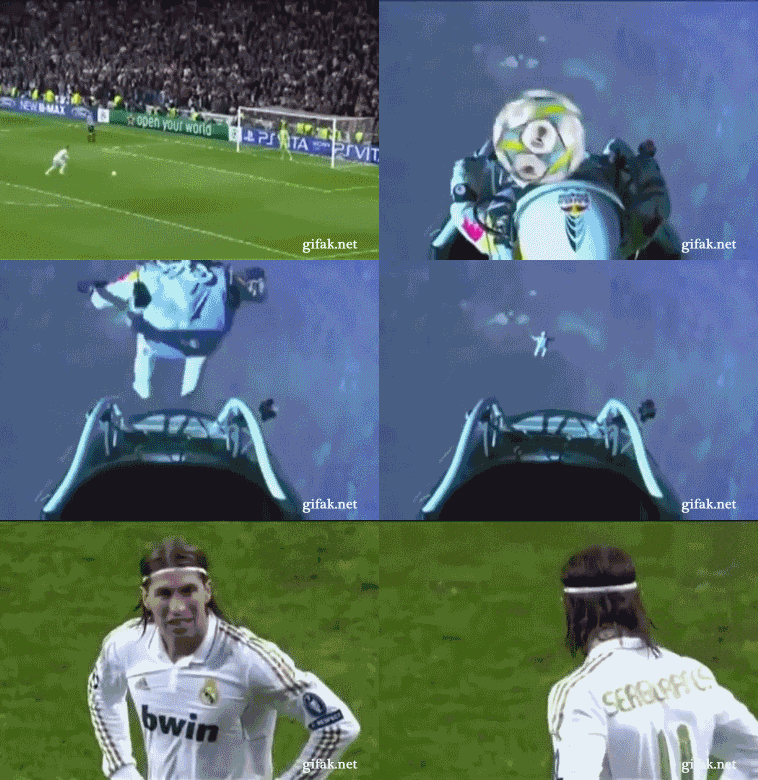
Hab ich gestern schon getwittert, muss aber auch hier rein: „I hate soccer but this is awesome“. And it is.
Traditional laptops may have reached an evolutionary dead-end (or, more charitably, a plateau), but it is an amazing time for things that … aren't quite traditional laptops.
The Nexus 7 is excellent, the Nexus 10 looks fantastic, I can't wait to get my hands on the twice-as-fast iPad 4, the new Chromebooks are finally decent and priced right, and then there's the Microsoft Surface RT. In short, it is a fantastic time to be a computer nerd.
I love computers, always have, always will. My strategy with new computing devices is simple: I buy 'em all, then try living with them. The devices that fall away from me over time – the ones that gather dust, or that I forget about – are the ones I eventually get rid of. So long, Kindle Fire! I knew that the Nexus 7 was really working for me when I gave mine to my father as a spontaneous gift while he was visiting, then missed it sorely when waiting for the replacement to arrive.
As I use these devices, I've grown more and more sold on the idea that touch is going to dominate the next era of computing. This reductionism is inevitable and part of the natural evolution of computers. Remove the mouse. Remove the keyboard. Remove the monitor. Reducing a computer to its absolute minumum leads us inexorably, inevitably to the tablet (or, if a bit smaller, the phone). All you're left with is a flat, featureless slate that invites you to touch it. Welcome to the future, here's your … rectangle.
I've stopped thinking of touch as some exotic, add-in technology contained in specialized devices. I belatedly realized that I love to touch computers. And why not? We constantly point and gesture at everything in our lives, including our screens. It's completely natural to want to interact with computers by touching them. That's why the more unfortunate among us have displays covered in filthy fingerprints.
Although I love my touch devices, one thing I've noticed is that they are a major disincentive to writing actual paragraphs. On screen keyboards get the job done, but if I have to scrawl more than a Twitter length reply to someone on a tablet or phone, it's so much effort that I just avoid doing it altogether, postponing indefinitely until I can be in front of a keyboard. By the time that happens I've probably forgotten what I wanted to say in the first place, or that I even needed to reply at all. Multiply that by millions or billions, and you have a whole generation technologically locked into a backwater of minimal communication. Yelp, for example, does not allow posting reviews from their mobile app because when they did, all they got was LOL OMG raspberry poop Emoji.
It's not good. In fact, it's a little scary. I realize that there are plenty of ways of creating content that don't involve writing, but writing is pretty damn fundamental to communication and civilization as we know it. Anything that adds a significant barrier to the act of placing words on a page is kind of dangerous – and a major regression from the world where every computer had a keyboard in front of it, inviting people to write and communicate with each other. So the idea that billions of people in the future will be staring at touchscreen computers, Instagramming and fingerpainting their thoughts to each other, leaves me with deeply mixed feelings. As Joey Hess said:
If it doesn't have a keyboard, I feel that my thoughts are being forced out through a straw.
When I pre-ordered the Microsoft Surface RT, I wasn't expecting much. This is a version one device from a company that has never built a computer before, running a brand new and controversial operating system. On paper, it doesn't seem like a significant change from all the other tablets on the market, and its primary differentiating feature – the touch keyboard – can be viewed as merely flipping a regular laptop over, so the "fat" side is on the display rather than the keyboard.
Surface is just like the first iPad in that it has all the flaws and rough edges you'd expect in a version one device. But it is also like the first iPad in that there is undeniably the core of something revelatory and transformative here – a vision of the future of computing that doesn't sacrifice either keyboard or touch.
Reviewers think Surface is intended to be a tablet killer, but it isn't. It's a laptop killer. After living with the Surface RT for a few days now, I'm convinced that this form factor is the replacement and way forward for the stagnant laptop. I can't even remember the last time I was this excited about a computer. The more I use it, the more I think that touch plus keyboard is the future of all laptops.
How wonderful it is to flip open the Surface and quickly type a 4 paragraph email response when I need to. How wonderful it is to browse the web and touch whatever I want to. And switching between the two modes of interaction – sometimes typing, sometimes touching – is completely natural. Remember when I talked about two-fisted computing, referring to the mouse and keyboard working in harmony? With Surface, I found that also applies to touch. In spades.
This isn't a review, per se, but let me get into a few specifics:
Notice how the 2010 iPad 1 is already obsolete? Expect the same thing with the Surface RT. It's a fascinating glimpse into the future, but it'll be totally utterly obsolete in 2 years. Do not buy this device expecting longevity. Buy it because you want to see tomorrow today.
The received wisdom about touchscreen interaction with computers was that it didn't work. That you'd get "gorilla arm". That's why we had to have special tablet devices. But Surface proves that's not true; typing and touching are spectacularly compatible, at least for laptops. And I'm beginning to wonder about my desktop a little, because lately I'm starting to I think I wanna touch that, too.
| [advertisement] How are you showing off your awesome? Create a Stack Overflow Careers profile and show off all of your hard work from Stack Overflow, Github, and virtually every other coding site. Who knows, you might even get recruited for a great new position! |
Há exatos dois anos, o tio Laguna desejava um serviço de streaming de animês no Brasil que exibisse tal tipo de conteúdo na íntegra e com o menor atraso possível em relação à transmissão no país de origem (Japão). Pois bem, o dia chegou: ontem, 1º de novembro, o Crunchyroll Brasil iniciou as transmissões simultâneas licenciadas de animês para o Brasil, que terão legendas em português em cada novo episódio transmitido por streaming no PC, Android, iOS e também no PlayStation 3 (o pessoal do XBox 360 terá de esperar um pouco).

Só faltava o XBox 360 na festa!
Neste início, o Crunchyroll Brasil oferecerá a transmissão simultânea dos episódios inéditos de animês como Naruto Shippūden, Bleach e Gintama que estiverem passando lá no Japão. O serviço brasileiro promete um atraso de alguns minutos em tal transmissão simultânea por streaming, necessários para que a equipe de tradução oficial disponibilize a legenda em português.
Quanto ao acervo, o Crunchyroll (que nome difícil!) terá animês relativamente recentes, então por enquanto não veremos Shin Seiki Evangelion, Dragon Ball (Z/GT) e os Cavaleiros do Zodíaco por lá tão cedo. Se bem que eu acho estranho não ver nem menção aos animês atuais que representem tais franquias, no caso os filmes da série Evangelion Shin Gekijōban, o remake Dragon Ball Kai e a nova saga Saint Seiya Ω.

Crunchyroll representa alguma ameaça ao Netflix?
Sobre o preço, o usuário premium do Crunchyroll Brasil pagará R$ 9,90 por mês para assistir aos desenhos nipônicos em 1080p sem quaisquer anúncios, enquanto há a opção de ser usuário não-pagante e baixar na net assistir a alguns episódios em qualidade SD repletos de anúncios.
O pessoal do Portallos chegou a assinar o serviço e experimentá-lo, mas o tio Laguna ainda está bem indeciso sobre assinar esse Netflix cheio dos tentáculos: eu pagaria para ver One Piece, rever Cowboy Bebop e Yu Yu Hakushô, só que a maioria dos animês que desejei no passado eu já vi de outras formas e talvez o Crunchyroll me valha a pena quando o acervo aumentar. E meu tempo livre também.

|
|
That is a new paper by Pierre Azoulay, Jeffrey Furman, Joshua Krieger, and Fiona Murray, and here is the abstract:
To what extent does “false science” impact the rate and direction of scientific change? We examine the impact of more than 1,100 scientific retractions on the citation trajectories of articles that are close neighbors of retracted articles in intellectual space but were published prior to the retraction event. Our results indicate that following retraction and relative to carefully selected controls, related articles experience a lasting five to ten percent decline in the rate at which they are cited. We probe the mechanisms that might underlie these negative spillovers over intellectual space. One view holds that adjacent fields atrophy post-retraction because the shoulders they offer to follow-on researchers have been proven to be shaky or absent. An alternative view holds that scientists avoid the “infected” fields lest their own status suffers through mere association. Two pieces of evidence are consistent with the latter view. First, for-profit citers are much less responsive to the retraction event than are academic citers. Second, the penalty suffered by related articles is much more severe when the associated retracted article includes fraud or misconduct, relative to cases where the retraction occurred because of honest mistakes.
This of course may suggest one reason why some scientists are not so keen to force retractions from other researchers in their field.
From an email from Coursera:
Several students have contacted me about cases of cheating on the Final Exam. Frankly, why anyone who do this in a course that focuses on learning and offers no credentials, beats me. Students who cheat are really cheating themselves. If you are sure an answer is plagiarized from somewhere else (often easy to determine with a quick web search), you could simply award 1′s everywhere, which amounts to a score of 0. Whether you do that for one question or the whole exam is up to you. If there is any doubt that the student has broken the honor code, you have to give the student the benefit of that doubt. 0 on the whole exam is more significant than on one question. Though again, the stakes here are essentially zero; it’s mostly about self esteem, surely. For truly egregious cases, send me the details (your login id and the Student number (1, 2, or 3) and I can take it from there. Violation of the honor code is cause for expulsion from the class. Expulsion has occurred, in this class and others, I’m sad to say.
Meanwhile, if you want to know how evaluation training and peer grading looked from our side (the instruction team and the folks at Coursera who were making sure the ship stayed afloat), check out my latest post at MOOCtalk.org to see what was going on behind the scenes. Enjoy!
I thank AA for the pointer.

Whoa, so my last post was BEFORE Game of Thrones! Tsk tsk – so very slack. Anyways, I’m back! (until I slack off again of course). Oh, and if you’re experiencing Higgsteria, you can get this on a shirt here.

Submitted by: ferpiccolo
Posted at: 2012-10-31 11:57:39
See full post and comment: http://9gag.com/gag/5730421

Submitted by: cellopera
Posted at: 2012-10-31 08:23:04
See full post and comment: http://9gag.com/gag/5729322

Submitted by: night_dreamer
Posted at: 2012-10-31 13:42:10
See full post and comment: http://9gag.com/gag/5731096

Submitted by: interflob
Posted at: 2012-11-01 06:53:59
See full post and comment: http://9gag.com/gag/5737531

Submitted by: ashleyshupe
Posted at: 2012-10-31 14:55:55
See full post and comment: http://9gag.com/gag/5731606

Submitted by: ligerforyou
Posted at: 2012-10-31 18:34:47
See full post and comment: http://9gag.com/gag/5737521


