Shared posts

18 Nov 14:17

Estudo revela: Gamers são tão bons com cirurgia robótica quanto estudantes de medicina

by Carlos Cardoso

last-starfighter

Nos primórdios era consenso entre pais e outras criaturas atrasadas que videogame estragava televisão. Depois apareceu um batalhão de pedagogas psicólogos e outros chatos para provar matematicamente, como 1+1=3, que videogames causam toda uma série de problemas psicológicos. igual aos RPGs, e antes, histórias em quadrinhos, que iriam corromper e seduzir nossos inocentes.

No meio disso tudo algumas vozes explicavam que não era bem assim. Videogames tornavam as crianças mais ágeis, capazes de responder a estímulos mais rapidamente, tomando decisões rápidas e avaliando muito mais variáveis simultaneamente do que experiências sensoriais “normais” permitiam.


Isso se mostrou verdadeiro com a modernização das forças armadas no EUA. Antes era preciso anos para treinar soldados para operar os equipamentos mais modernos. Hoje qualquer nerd da vida em algumas horas aprender a comandar um Predador. Algumas tecnologias usam inclusive Joysticks de XBox, não só pelo baixo custo, resistência e eficiência, mas também por causa da familiaridade dos soldados com o hardware.

Por isso não foi surpresa o resultado de uma experiência da Universidade do Texas. Eles pegaram um grupo de colegiais, com média de 2 horas por dia jogando videogames e os colocaram para executar tarefas em um simulador, usado para treinar cirurgiões no uso de robôs como o DaVinci, aquele que o House usou para fazer cybersexo com a Cameron.

Já voltou do vídeo? OK, continuando. Os alunos experimentaram procedimentos como sutura e manipulação de objetos, operando via controles que nunca tinham usado antes.

O resultado foi que os gamers se saíram tão bem quanto, na verdade até um pouco melhor do que acadêmicos de medicina treinados no equipamento e que já chegaram até a executar os procedimentos em cirurgias de verdade:

Não é uma coincidência. Os desenvolvedores desses robôs também cresceram jogando videogames, conhecem a capacidade dos gamers. Sabem que multitasking não é coisa do capeta.

Antigamente aviões tinham piloto, co-piloto, engenheiro de vôo, navegador, telegrafista e bombardeiro. Hoje um B2 joga 23 toneladas de bombas em qualquer lugar do mundo com dois tripulantes. Muito se resolveu com automação, mas boa parte da “culpa” é da habilidade dos pilotos em multitaskear.

Médicos usando equipamentos robóticos com desenvoltura é algo bom pra todo mundo, significa que a expertise pode ser transferida para qualquer lugar onde haja um robô desses. Há projetos miniaturizando esse tipo de equipamento, e convenhamos treinar médicos é muito mais trabalhoso e caro do que fazer robôs.

Podem dizer que é injusto com o pessoal da antiga que não sabe usar os equipamentos modernos, mas quer saber? Azar o deles. Não há como comparar uma cirurgia laparoscópica feita com um robô, da qual você sai praticamente andando, com uma operação que abre o sujeito feito um leitão a pururuca, é garantia de infecção e exige 3 meses de recuperação.

Portanto, fikadika: Pare de imitar seus pais e deixe seus filhos se divertirem no videogame. Matar gente de mentira um dia pode ajudá-lo a salvar gente de verdade.

Fonte: PS


18 Nov 14:15

Por isso não podemos ter coisas legais: Motor de Dobra iria destruir o planeta de destino

by Carlos Cardoso

vlcsnap-00002

Longe dos olhos do público todo fã de ficção científica odeia Einstein. Por causa dele, daquelas garotos intrometidos e do cachorro bobão estamos destinados a explorar o Universo em velocidades rubinhescas, tartarugando no máximo a 99% da velocidade da luz.

Por muito tempo procurou-se alternativas para contornar esse limite, até que em 1994 um físico mexicano com credenciais invejáveis, Miguel Alcubierre apresentou um trabalho onde detalhava as bases teóricas de um Motor de Dobra Espacial, onde a própria estrutura do espaço-tempo seria distorcida, permitindo viagem acima da velocidade da luz, do ponto de vista de um observador externo.

O modelo de Alcubierre ficou no plano teórico por ser impossível, dependendo de enormes quantidades de energia negativa e matéria exótica, dois conceitos apenas teóricos. Recentemente a esperança voltou a crescer, quando novos cálculos reduziram muito a quantidade desses materiais. Assim o Motor de Dobra Alcubierre deixou de ser COMPLETAMENTE impossível para apenas MUITO impossível.

A esperança durou pouco. Uma pesquisa da Universidade de Sidney descobriu um efeito colateral indesejado no motor de dobra de Alcubierre é que o conjunto nave/distorção espacial iria acumular partículas energéticas durante o trajeto, e ao chegar em seu destino essas partículas seriam emitidas em um cone de energia, aniquilando o que estivesse pela frente.

Segundo Einstein não há limite pra quantidade de energia acumulada, só dependendo do tamanho do campo de distorção e da distância percorrida. Ou seja: Viaje alguns milhares de anos-luz e você tem a arma mais poderosa do Universo, aniquilando planetas, ou mesmo estrelas inteiras.

Essa seria uma nave ainda pior do que aquela do Mochileiro das Galáxias, movida à Más Notícias.

Claro, Star Trek como sempre chegou na frente. No episódio New Ground (S5E10) de Jornada nas Estrelas – A Nova Geração a Enterprise enfrenta um problema idêntico: Uma nova tecnologia, usando ondas soliton promete viagens interestelares muito mais rápidas, mas acaba gerando uma onda que acumula cada vez mais energia e ameaça destruir um planeta. Obviamente não leram o trabalho da Universidade de Sidney.

Se esse modelo se mostrar verdadeiro, ao menos temos uma grande utilidade para essa tecnologia: Armas. Aqueles malditos insetos em Klendathu não teriam chance.

Klendathu-system

Fonte: ET (sem trocadilhos)


18 Nov 13:42

Breaking news from the department for the bleeding obvious

by Neurobonkers

Spin abstracts Breaking news from the department for the bleeding obvious

Two major papers have recently been published that may or may not surprise you. Please excuse the sarcy title, in all seriousness these are fantastic papers that provide evidence for massive problems facing the scientific world today. They are both well worth reading in full, the key points are …

Read More

Return to Neurobonkers.com Breaking news from the department for the bleeding obvious
18 Nov 13:30

Demystifying Hallucinations

by Neurobonkers

Hallucinations Demystifying HallucinationsDr. Oliver Sacks’ new book Hallucinations is a tremendous anthology of case studies of hallucinatory experiences recorded through his decades of work as a clinical neurologist, his analysis of clinical case studies and through his own personal experimentation with hallucinogenic drugs. Sacks …

Read More

Return to Neurobonkers.com Demystifying Hallucinations
18 Nov 13:30

Introducing Mind Lab: The all singing, all dancing, interactive psychology class

by Neurobonkers

Mind Lab550 Introducing Mind Lab: The all singing, all dancing, interactive psychology class
Mind Lab is an awesomely mind-bending little project created by Japan’s Science and Technology Agency. It consists of four fully interactive classes of about fifteen minutes each on the workings of our visual perception, perfect for completing in a lunch break (though you’ll need headphones …

Read More

Return to Neurobonkers.com Introducing Mind Lab: The all singing, all dancing, interactive psychology class
18 Nov 13:28

We're Probably Not Getting Dumber

by Neuroskeptic
There's been buzz over the past few days in the idea that humans have been getting stupider for the past few millennia. That's according to Stanford's Gerald R. Crabtree -
I would wager that if an average citizen from Athens of 1000 BC were to appear suddenly among us, he or she would be among the brightest and most intellectually alive of our colleagues and companions, with a good memory, a broad range of ideas, and a clear-sighted view of important issues. Furthermore, I would guess that he or she would be among the most emotionally stable of our friends and colleagues.
OK. How so?


Crabtree's argument in a nutshell:

In Part I, he outlines the latest evidence showing that many thousands of genes contribute to human cognitive ability, and that because mutation rates are high (higher than previously believed), any given individual probably carries harmful variants of many of these genes. This is quite possibly true ,and interesting, but by itself it's nothing to do with declining IQ.

In Part II, Crabtree says that during human evolution, all of these genes were under strong selection pressure because any human or proto-human who wasn't smart enough to hunt, fight and survive in the stone age environment, would get eaten by a predator or starve. However, after these hunter-gatherer tribes became settled farming communities (in say 6000 BC), they were no longer so vulnerable, so the less intellectually able could live... and breed... leading to ever-more unintelligence genes.

Now, there's a lot of problems here. Many have said that this is all a bit like eugenics, and indeed it is, but that doesn't necessary mean it's wrong... no, it's wrong because the argument is flawed.

For instance, it's already been pointed out that, even if it recently got easier to stay alive, that doesn't mean it's got easier to get laid lots and have lots of kids; and sexual selection is a powerful force in evolution, perhaps even stronger than survival, and it probably favours higher intelligence.

However, there are other issues.

The idea that hunter-gatherers have especially hard lives is dubious. There's good evidence that life expectancy and health fell when hunter-gatherer societies settled down and got agriculture. Today, survival doesn't exert much of a selective pressure in most parts of the world but life stayed pretty precarious (by modern standards) until at least the 19th century.  You could indeed argue that 8,000-odd years of agriculture made us smarter than ever before, and that we're enjoying the benefits . In which case we'd be smarter than someone from 1000 BC, who only had 5,000 years or so.

Crabtree does acknowledge that agriculture changed selection pressures. He suggests that it would have made it more important to be immune to the various diseases that emerged when our population density rose. But this isn't enough - for his argument to work, intelligence would also have needed to become less important with agriculture, and whether that's true is really not clear at all. Maybe it did. Maybe it didn't. There's a prejudice in modern culture against 'ignorant peasants' and 'dumb hicks', but farming is not easy.

Even if we do grant that cognitive evolutionary pressures have eased since 1000 BC, it's not clear that this would make us 'less intelligent'. 'Intelligence' is not one thing. To simplify, it might be that there's a trade-off between 'book smarts' and 'street smarts', and that you used to need the latter to survive. A society in which everyone survives would then allow more people the luxury of being book-smart. Would Einstein or Newton would have made good peasants?

Crabtree's arguments are interesting, but they're entirely speculative. There's just no hard evidence for the decline of intelligence over recent millennia. Since we can't go back in time and do IQ tests, there never will be, although he does suggest an experiment, using genetics, that might be able to check whether there's been a build-up of harmful mutations.

But until then, as he puts it,
in the meantime I’m going to have another beer and watch my favorite rerun of ‘Miami CSI’ (if I can figure out how to work the remote control).

ResearchBlogging.orgCrabtree, G. (2012). Our fragile intellect. Part II Trends in Genetics DOI: 10.1016/j.tig.2012.10.003 

Crabtree, G. (2012). Our fragile intellect. Part I Trends in Genetics DOI: 10.1016/j.tig.2012.10.002
18 Nov 12:57

Dont' Be an iDiot...wait

Submitted by: acu91
Posted at: 2012-11-17 00:44:05
See full post and comment: http://9gag.com/gag/5860126


17 Nov 13:21

Polícia multa sujeito que levou a sério essa coisa de computação móvel

by Carlos Cardoso

Home Office, tudo bem. Computação Móvel, tudo bem. Mundo Mobile, acesso instantâneo, tudo bem, mas esse sujeito na região de Saarland, Alemanha, foi literal na coisa de auto-estrada da informação.

Parado por andar a 130km/h em uma região de 100km/h, ele acabou sendo multado por excesso de velocidade e provavelmente ganhará outra por manter itens soltos no carro. Tipo transportar carga sem estar devidamente presa.

Quais os itens?

  • Um laptop em um stand de uso-rápidp
  • Um inversor de tomadas 12/110-220V
  • Uma impressora
  • Um roteador WIFI
  • Um modem 3G
  • Uma antena WIFI

Fora isso, GPS e celular no painel, mas aí meio que tudo bem.

O cara transformou o carro em escritório, o banco da frente estava tomado pela tralha, com direito a uma armação de madeira mantendo tudo junto. Veja a gambiarra:

gamiarra

Confesso que senti falta do forno pra assar cupcakes, da cafeteira e da máquina de churros. O frigobar, pela quantidade de garrafas, deve ficar no banco de trás.

Fonte: TOL


17 Nov 13:21

Piu piu piu? Pew pew pew!

by Carlos Cardoso

pewpewpew

Aves e aeronaves não se dão bem, que o diga o Capitão Sully. Aeroportos no mundo inteiro sofrem com esse problema. Alguns usam até falcões treinados para espantar outras aves.

A Coréia, CLARO, arranjou uma solução tecnológica: Um robô semi-autônomo com “lasers”.

O Bird Strike Defense Robot pesa 1,2 toneladas e tem scanners a laser, câmeras normais, de visão térmica e visão noturna colorida e um emissor acústico de 100dB capaz de 100 sons diferentes, inclusive predadores.

Como arma de longo alcance ele tem um laser verde com alcance de 2Km, usado para espantar aves, que obviamente pensam diferente de gatos.

Dizem os fabricantes que o robô é 20% mais eficiente que as outras soluções, e pode identificar um pássaro de 30cm a 300m de distância. Proposto em 2009, testado em 2011, agora é só começar a vender. Complicado é o sujeito aguentar a zoação de ser o caçador de passarinho mais overequipado do planeta.

Fonte: GM


17 Nov 13:19

Pintofeed–Ignore seus bichos igual faz com seus filhos

by Carlos Cardoso

A intenção é até boa, um dispenser de ração conectado à Internet, que pode ser acionado remotamente, alimentando seus bichos mesmo quando você não está em casa. Ou então, diretamente do sofá, assim não interrompe o jogo do parmera.

Na prática é uma sacanagem com os bichos. O ritual da alimentação é importante para eles, ele vêem a gente como provedores (ou garçons, no caso de gatos). Há todo um envolvimento emocional, toda uma confiança. Jogar essa tarefa para uma máquina é desumanizar essa relação.

Seu bicho não vai morrer se você se atrasar uma ou duas horas para chegar em casa e colocar ração. E se você for viajar muito tempo, por favor, peça para amigos visitarem e cuidarem deles, ou então use um serviço de hotel para animais de estimação.

Essa desculpa de agilidade não cola. Se você não tem tempo NEM para dar comida a eles, por quê diabos decidiu ter bichos?

Fonte: DT


17 Nov 13:17

967 – Jesus na terra 3

by Carlos Ruas

17 Nov 10:00

10/31/12 PHD comic: 'How many Ph.D.s does it take?'

Piled Higher & Deeper by Jorge Cham www.phdcomics.com
Click on the title below to read the comic
title: "How many Ph.D.s does it take?" - originally published 10/31/2012

For the latest news in PHD Comics, CLICK HERE!

17 Nov 09:58

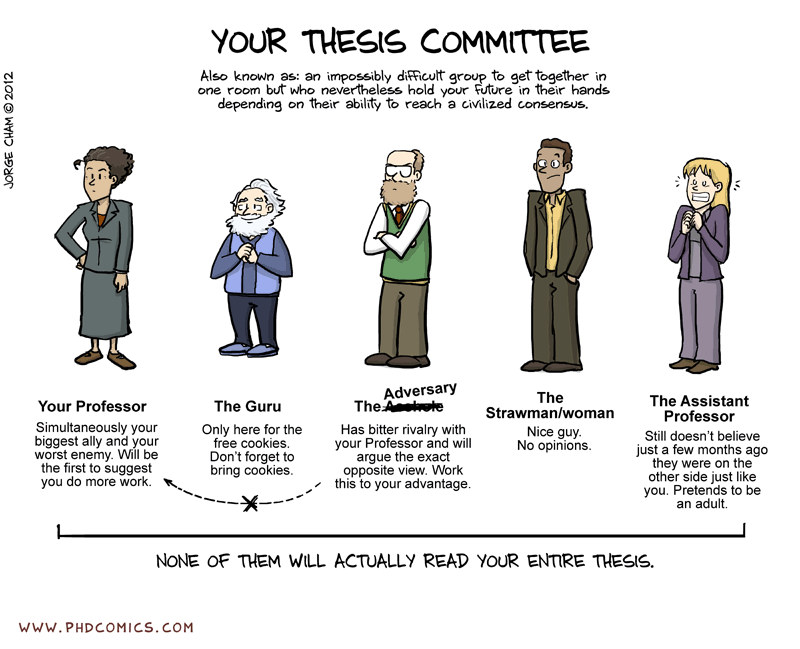
11/16/12 PHD comic: 'The Thesis Committee'

Piled Higher & Deeper by Jorge Cham www.phdcomics.com
Click on the title below to read the comic
title: "The Thesis Committee" - originally published 11/16/2012

For the latest news in PHD Comics, CLICK HERE!

17 Nov 00:34

Monday November 12, 2012

by admin
Albener Pessoa

With great power comes great responsibility

17 Nov 00:33

Tuesday November 13, 2012

by admin

17 Nov 00:33

Wednesday November 14, 2012

by admin

17 Nov 00:32

Thursday November 15, 2012

by admin

17 Nov 00:32

Literatura de fantasia é isso aí!

by Gian Danton/Ivan Carlo
Certas imagens parecem ser perfeitas para inspirar histórias de fantasia. Coloco abaixo alguns exemplos. A propósito, a primeira delas é de um amapaense, Ângelo Silva.


16 Nov 23:55

Hamlet

by Doug

Hamlet

Here’s more Shakespeare.

16 Nov 23:55

Crise existencial – remake

by O Criador
16 Nov 23:53

Piratas Gastam Mais com Música, Cadê seu Deus Agora, RIAA?

by j. noronha

Stupid RIAA is Stupid

Eu não vou falar o quanto a RIAA, a toda-poderosa indústria do copyright de música, vive em um universo paralelo, por que o Cardoso já fez isso muito bem. Mas, em se tratando deles, a fonte de piadas prontas é inesgotável.

Uma pesquisa da Universidade de Colúmbia constatou que quem compartilha arquivos gasta 30% mais com música do que quem não.

A RIAA não gostou do resultado e resolveu colocar seu próprio time em campo, que chegou a conclusões deveras divertidas.

Ontem, Joshua Friedlander, vice presidente de pesquisa e análise de estratégias, deu uma declaração de que os piratas certamente não compra mais música por que eles baixam música.

Segundo ele, a explicação é simples: os piratas têm mais interesse em música do que o consumidor comum.

“Na verdade, a comparação é injusta, já que estamos comparando pessoas interessadas em música com aqueles que não tem interesse algum. Claro que quem tem interesse em música compra mais.”

Pausa para rir…

A menos que eu tenha perdido completamente minha capacidade de interpretação de texto, o cara disse que piratas NÃO gastam mais com música por serem piratas, mas sim por terem mais interesse em música.

Em bom português: quem não baixa música gasta menos do que quem baixa… mas não foi isso o que a pesquisa inicial constatou?

Mas a coisa não para de melhorar, a pesquisa encomendada pela RIAA constatou que piratas gastam 40% mais com música, contra os 30% da pesquisa anterior.

Como toda boa pesquisa precisa de tabelas, aqui vai a da RIAA, que deveria comprovar que pirataria faz o menino Jesus chorar.

Estatísticas

A tabela só reforça a piada como um todo:

Piratas gastam praticamente a mesma soma (1 dólar a menos) com CDs, mas gastam mais em todos os outros itens, chegando a mais do que o dobro no quesito camisetas de bandas e afins (merchandise, em português).

Russ Crupnick, o coordenador da pesquisa, declara, mesmo depois de olhar para a tabela acima:

“Estamos dizendo que piratas aumentam o consumo de camisetas ou ingressos para shows? Claro que não, isso seria idiota”.

Caso encerrado.

Via Torrent Freak


16 Nov 23:24

How The Star Wars Deal Went Down

by DOGHOUSE DIARIES

How The Star Wars Deal Went Down

I’ve got a good feeling about this. -Ray

Tweet
16 Nov 22:34

Friday November 16, 2012

by admin

16 Nov 10:54

Too Soon?

Too Soon? It's never too soon to start drinking for relief.

Submitted by: Unknown

Tagged: drink special , sandy , manhattan , too soon , watered down Share on Facebook
16 Nov 10:53

Two Can Play at That Game...

Two Can Play at That Game... Never assume that youth can trump experience.

Submitted by: Unknown

Tagged: grandmothers , wife , grandma , newlyweds , wink wink Share on Facebook
16 Nov 10:51

GAME ON

GAME ON

Submitted by: Unknown

Tagged: rules , lectures , teachers , game on Share on Facebook
15 Nov 20:21

Fundador da McAfee procurado por assassinato que [diz ele] não cometeu

by Carlos Cardoso


John McAfee, caçando a presa mais perigosa - o Homem

John McAfee é um dos pioneiros da microinformática. Com passagens pela NASA e Xerox, o criador de um dos primeiros antivirus vivia até pouco tempo em Belize, América Central, mas agora sua aposentadoria se transformou em um episódio mediano de CSI, ou em um filme ruim.

John está foragido, sendo procurado em todo o país pelo assassinato de seu vizinho, Gregory Viant Faull, encontrado em uma poça do próprio sangue, executado com um tiro na nuca. Para tornar o mistério mais exótico ainda, a arma do crime foi uma Luger.

John se escondeu da policia enterrando-se na areia, usando uma placa de papelão para criar um bolsão de ar e poder respirar. Depois ligou para um repórter da Wired, contando sua versão dos fatos.

Em Abril a polícia invadiu a casa de McAfee, depois de denúncias de produção de metanfetaminas e posse ilegal de arma de fogo. Depois as acusações foram retiradas, mas John jura que é perseguido pelo Primeiro-Ministro.

Quem também não gosta dele são os vizinhos. McAfee tinha seis cachorros que incomodavam Muita gente. Queixas foram feitas junto à Prefeitura local, e no meio de tudo os cachorros foram envenenados.

Diz McAfee que o vizinho assassinado não era suspeito na morte dos cães.

A vítima tinha passagem pela polícia; no passado fora preso por lesão corporal, na Flórida.

John McAfee denuncia que querem matá-lo:

“Sob nenhuma circunstância vou falar com a polícis deste país. Você pode dizer que sou paranóico, mas eles vão me matar, não há dúvida. Eles estão tentando me pegar tem meses, eles querem me silenciar. Não sou querido pelo Primeiro-Ministro. Eu sou um espinho no sapato de todo mundo”

Mesmo com toda a experiência adquirida por anos assistindo seriados policiais, não dá pra deduzir o desfecho desse caso, as histórias estão muito mal-contadas. John tinha uma Luger, mas segundo ele foi apreendida pela polícia, na mesma operação que depois teve as acusações retiradas.

Mais ainda: McAfee protegia sua propriedade com vários guardas armados, e aventou a possibilidade de que o alvo original seria ele, não o vizinho.

Enquanto isso ele prossegue se escondendo em um país com 22 mil Km2 de área, o equivalente a alguns apartamentos grandes em Ipanema. Ao menos John McAfee teve a decência de não acusar um homem de um braço só.

Mesmo assim, ficam as perguntas:

Será John McAfee vítima de uma conspiração que vai até o alto do poder em Belize? Ou será ele vítima de um desequilíbrio mental, desenvolvendo um estado paranóico?

Quem matou os cachorros?

De quem era a Luger?

Isso tudo e muito mais você descobrirá nos próximos capítulos!

Fonte: Wired


15 Nov 20:18

Depois de um ano YouTube descobre que não é fácil ser HBO e cancela metade dos canais

by Carlos Cardoso

abedbatman

Ano passado o YouTube anunciou que iria investir em conteúdo original. Foi uma fortuna colocada em grandes e/ou promissores canais. Em alguns casos o investimento chegou a US$5 milhões. Pode não ser muito para padrões televisivos mas na mão de um Epic Meal da vida dá pra comprar muito Bacon.

A idéia era engajar os usuários, tansformando-os em espectadores, gerando toneladas de visualizações e consequentemente, receita publicitária.

O conceito era ótimo. Por um lado lembrava o Cavalcade of Humour, projeto de Seth McFarlane em 2008 que iria gerar conteúdo exclusivo para YouTube, com patrocínio direto e renderia milhões. Ao contrário de quase tudo que Seth coloca a mão, o Cavalcade não deu certo e hoje até o domínio foi abandonado, e cai na home do provedor.

O YouTube resolveu ignorar décadas de experiência da indústria televisiva, e abriu a bolsa, nem nenhum critério. Com isso investiu em coisas “geniais” como um canal de humor do Shaquille O’Neal.

Junte a isso a imensa quantidade de conteúdo já subido pelos usuários e se torna virtualmente impossível concentrar audiência em um único canal o suficiente para ele se tornar lucrativo. Isso é complicado até em TV de verdade, séries excelentes como Community e Pushing Daisies não são renovadas por falta de público. A quantidade de conteúdo disponível no mundo hoje é grande demais, dispersa demais.

O experimento acabou. 50% dos canais foram cancelados, mas não da forma rápida e indolor com que emissoras de TV cancelam séries. No caso, conforme reporta o All Things Digital, o YouTube irá cancelar a verba mas os canais serão livres para continuar a fornecer conteúdo. Só que 100% da receita publicitária será recolhida pelo YouTube para recompor o investimento.

Isso mesmo. “Não vamos mais te bancar. Continue trabalhando de graça até devolver o que te emprestamos fingindo que era investimento”. O YouTube fez uma oferta que eles não poderiam recusar, e não recusaram, pelo visto.

Nada mau, pra quem se orgulha do “Do No Evil” o Google se saiu pior que executivos de TV.


15 Nov 19:07

Turning 3D shutter glasses into automatic sunglasses

by Mike Szczys

[Dino's] hack this week seeks to create sunglasses that dim based on the intensity of ambient light. The thought is that this should give you the best light level even with changing brightness like when the sun goes behind a cloud or walking from inside to outside. He started with a pair of 3D shutter glasses. These have lenses that are each a liquid crystal pane. The glasses monitor an IR signal coming from a 3D TV, then alternately black out the lenses so that each eye is seeing a different frame of video to create the stereoscopic effect. In the video after the break he tears down the hardware and builds it back up with his own ambient light sensor circuit.

It only takes 6V to immediately darken one of the LCD panes. The interesting thing is that it takes a few seconds for them to become clear again. It turns out you need to bleed off the voltage in the pane using a resistor in order to have a fast response in both directions. Above you can see the light dependent resistor in the bridge of the frame that is used to trigger the panes. [Dino] shows at the end of his video that they work. But the main protective feature of sunglasses is that they filter out UV rays and he’s not sure if these have any ability to do that or not.


Filed under: wearable hacks


15 Nov 16:36

A Modest Proposal

by Dexter Industries

Actually, it was an epic proposal. Of marriage.

As founder of Dexter Industries, I try to write every single customer and see that each purchase from our website is working out.  When I checked in on Jay Davey and his purchase of a dGPS, I thought we would be getting a usual response:  “Worked ok” “Need to improve this” or “<SPAM>”.

Instead, I got a very heart-warming response from Jay about how he used it in an epic proposal of marriage to his future wife

This wasn’t exactly what I was expecting.  I was blown away.

Jay graciously agreed to share his awesome story on our blog.  We’re flattered to have been a part, even a small part, in such a huge event in two people’s lives.  Thank you Jay for sharing this with us!  Below are some pictures, the story, and code (yes, computer code for a marriage proposal . . .  may yours be so awesome!).

Hi John,

Thank you for your email. My purchase at DI has been a part of one of the happiest days of my life.

I had wanted to ask my girlfriend to marry me for some time but couldn’t work out how to pop the question.

Long story short, I decided to use my dGPS sensor that I purchased from Dexter Industries to send Helen on a GPS guided treasure hunt around the town of Hershey in PA.

Helen had just attended a volunteer stroke rehabilitation clinic in Jamaica and so I found some time to plan out my proposal.  I chose the town of Hershey because it is close by our home but is much more beautiful!  I swear the town can sometimes literally smell like chocolate! Perfect place for an engagement.

I had decided to propose without an actual engagement ring.  This was following the advice of my mother and two sisters who insisted that I let Helen choose her own ring.  For this reason I made a ring with a Lego brick on it.  I still had to make the engagement appear personal and clever, well planned and really well executed, to show Helen that I had put lots of love and thought into my proposal, even though there wasn’t any diamonds.  I knew Hershey had a beautiful botanical gardens and I found out that the rose garden was in full bloom this time of year.  I decided this was the perfect place to propose. To make the proposal appear will organized I booked 3 days’ worth of activities for us to enjoy…

We set off for our vacation after Helen returned from Jamaica.  I assured her that I had pre-booked and prepaid everything so all she had to do was come along.  I got lucky here because Helen’s birthday happened while she was in Jamaica and so I initially told her it was part of her birthday treat.  I told her the kinds of things she would need to bring (for instance on day two we would need swimmers and day 3 we would need runners). We started our 3 day long ‘treasure hunt’ around Hershey when I gave Helen my Lego Mindstorms NXT with a dGPS sensor attached. I had pre-programmed the NXT to remember a list of GPS coordinates (found using Google maps satellite view) of every location that Helen would be going to during our time in Hershey. When she turned on the NXT in the car on our way the screen told her how many miles and feet she was from her first waypoint (checkpoint).  Helen played along really well and she enjoyed this fun game we would be playing on our trip, not knowing where exactly she was going but knowing that it was all planned and booked in advance. I told her I would let her know when we had to leave to go to the next place and where that would be along the way.

The first location was to Hersheypark which is a massive chocolate themed roller coaster park. Helen and I both love roller coasters so this was a great way to get some thrills. The next location was to find our hotel and then out to dinner (each place had its own GPS coordinate that Helen had to find before the GPS would let her go to the next location). Day two we went to a North American zoo, a water theme park, found more restaurants, and a chocolate spa. On the third day I took her to a Segway riding school where we spent all morning riding off-road Segways. By this time Helen tells me she is thinking “holy crap, I’m gonna have to try really hard for your birthday next year!”.  This was a good lead in to the last final destination – Hershey botanical gardens. Before I let her loose in the gardens I explained to her that the ‘treasure hunt’ would be really anti-climactic if she found all of the goals and at the end there was no treasure or anything to want to keep up the game. So at this point I gave her a small wooden box that I made for her. The box I had made at school in the week she was in Jamaica and had her name laser etched on the top. I had specially made the box for the proposal to hold the Lego ring. Helen found an obvious problem when she got the box. It wouldn’t open. This was deliberate. I had made the box so that it was completely sealed shut from the inside until Helen found the last goal. When she found the goal the NXT became the key to opening the box. She would have to plug the NXT into the box and the box would open if the NXT detected that the GPS was in the right location…

So! Here goes Helen and I around the botanical gardens trying to find the last goal, going only by how many feet we were away from the GPS coordinate programmed into the GPS’s memory. Gradually, Helen and I made our way down into the secluded rose garden and the GPS told Helen it was now possible for her to open the box…

…Helen found a ring with a Lego brick on it, got a little bit confused, and so then I took the ring out, got down on one knee and asked her to marry me. She was super surprised and had no idea that this was where the treasure hunt was leading to!  She said yes!  We were both super excited and she laughed super hard after realizing all the clues that she had missed leading up to the proposal. She loved the Lego ring and I did reassure her that the Lego ring is not the actual ring shortly afterwards.  She said she loved it and would wear it anyway!  We did though go straight to the shopping outlets to the Jewelers and Helen actually found a ring she really loved.  I purchased the ring for her and that was that.

John, thank you and your team at DI, for making a sweet reliable sensor that guided Helen via dGPS into my arms for life.  Our 1st Wedding Anniversary has just passed and we are living happily ever after.

Download Jay’s Source here:  HelenInHershey.nxc

#define OK LDR_SUCCESS

task main(){
SetSensorLowspeed(S3);

//----------------------------
// Hershey waypoints
//----------------------------
long Hlat[12];
long Hlng[12];
long Hr[12];

// Latitude,          Longitude,           Radius,
Hlat[0] = 40289674;  Hlng[0]=-76663198;  Hr[0]=1000;
Hlat[1] = 40282413;  Hlng[1]=-76657319;  Hr[1]=100;
Hlat[2] = 40285316;  Hlng[2]=-76651319;  Hr[2]=100;
Hlat[3] = 40282413;  Hlng[3]=-76657319;  Hr[3]=100;
Hlat[4] = 40289674;  Hlng[4]=-76663198;  Hr[4]=1000;
Hlat[5] = 40299449;  Hlng[5]=-76658623;  Hr[5]=500;
Hlat[6] = 40282413;  Hlng[6]=-76657319;  Hr[6]=100;
Hlat[7] = 40285421;  Hlng[7]=-76650978;  Hr[7]=100;
Hlat[8] = 40282413;  Hlng[8]=-76657319;  Hr[8]=100;
Hlat[9] = 40299449;  Hlng[9]=-76658623;  Hr[9]=100;
Hlat[10] = 40297408;  Hlng[10]=-76658757;  Hr[10]=100;
Hlat[11] = 40296884;  Hlng[11]=-76657129;  Hr[11]=40;

// Names
string Hname[12]={"- Hersheypark  -",
"-Days Inn Hotel-",
"-Devon Seafood -",
"-Days Inn Hotel-",
"- Hersheypark  -",
"- Chocolate Spa-",
"-Days Inn Hotel-",
"- Houlihans Bar-",
"-Days Inn Hotel-",
"-  Segway Ride -",
"H'shey Gardens 1",
"H'shey Gardens 2"};

//---------------------------------

/*
//--------------------------------------
// Testing waypoints in Philadelphia
//--------------------------------------
long Tlat[4];
long Tlng[4];
long Tr[4];

// lat              long                  radius
Tlat[0] = 40089188; Tlng[0] = -75130278;  Tr[0] = 100;  //robs apartment          dist = 2.0 miles, (10560 ft)
Tlat[1] = 40062121; Tlng[1] = -75085822;  Tr[1] = 100;  //pathmark                dist = 1.0 miles, (5280 ft)
Tlat[2] = 40071366; Tlng[2] = -75127296;  Tr[2] = 100;  //elkins park station     dist = 1.8 miles, (9504 ft)
Tlat[3] = 40070627; Tlng[3] = -75101611;  Tr[3] = 100;  //26 township line rd

// Names
string Tname[4]={
"-  Rob's Apt   -",
"-   Pathmark   -",
"- E.P train st -",
"- 26 Township L-"
};
*/

//turn on green screen light
//SetSensorColorGreen(S4);

byte handle, time = 0;
int n, fsize,len, i;
string in;

//Find which waypoint we are up to
OpenFileRead("Waypoints.txt",fsize,handle);
ReadLnString(handle,in);
CloseFile(handle);
ClearScreen();
int WaypointIndex = StrToNum(in);
long lat;
long lng;

if(WaypointIndex<12){
  // wait for GPS to establish a link with satellites
  TextOut(0, LCD_LINE3, "Waiting for GPS" );
  TextOut(20, LCD_LINE4, "to find" );
  TextOut(10, LCD_LINE5, "satellites..." );
  TextOut(0, LCD_LINE7, "GPS count:" );
  while(SensorDIGPSStatus(S3)==false){
    Wait(200);
    NumOut(60, LCD_LINE7, SensorDIGPSTime(S3));
  }
}

ClearScreen();
float x1, x2;
float y1, y2;
float a, a_2;
float b, b_2;
float c, c_2;
float c_feet, c_miles;

while(WaypointIndex<12){
  x1 = Hlat[WaypointIndex];
  y1 = Hlng[WaypointIndex];

  //read GPS lat and long
  x2 = SensorDIGPSLatitude(S3);
  y2 = SensorDIGPSLongitude(S3);

  a = (x2-x1);
  a = a/1000;  //scale number to prevent overflow in calcs
  a_2 = a*a;

  b = (y2-y1);
  b = b/1000;  //scale number to prevent overflow in calcs
  b_2 = b*b;

  c_2 = a_2+b_2; // pythagorus theorem
  c = sqrt(c_2);
  c_feet = c*309.2;
  c_miles = c_feet/5280;

  ClearScreen();
  TextOut(0, LCD_LINE1, Hname[WaypointIndex] );
  TextOut(0, LCD_LINE2, "Feet :" );
  TextOut(0, LCD_LINE3, "Miles:" );
  NumOut(40,LCD_LINE2, c_feet);
  NumOut(40,LCD_LINE3, c_miles);
  TextOut(0, LCD_LINE5, "Goal GPS coords:" );
  TextOut(0, LCD_LINE6, "Lat:" );
  TextOut(0, LCD_LINE7, "Long:" );
  NumOut(40,LCD_LINE6, x2);
  NumOut(40,LCD_LINE7, y2);
  TextOut(0, LCD_LINE8, "Goal:      /12" );
  NumOut(50, LCD_LINE8, WaypointIndex+1);
  Wait(200);

  //if gps is located < 100 feet, make a sound and display "CONGRATULATIONS, you found the goal!"
  if (c_feet<Hr[WaypointIndex]){
    WaypointIndex++;

    //update waypoint indexer in text file
    byte fileHandle;
    short fileSize;
    short bytesWritten;
    string write;
    DeleteFile("Waypoints.txt" );
    CreateFile("Waypoints.txt" , 512, fileHandle);
    write = NumToStr(WaypointIndex);
    WriteLnString(fileHandle,write, bytesWritten);
    CloseFile(fileHandle);

    ClearScreen();
    TextOut(10, LCD_LINE2, "YAY HELEN!" );
    TextOut(0, LCD_LINE4, "You've reached" );
    TextOut(0, LCD_LINE5, "Goal    /12" );
    NumOut(35, LCD_LINE5, WaypointIndex);
    PlayFile("Hooray.rso" );
    if (WaypointIndex!=4){
        Wait(20000);
    }
  }

}

while(1){
  //last goal has been reached, pulse output A at high power to open box
  ClearScreen();
  TextOut(0, LCD_LINE1, "Helen, you found" );
  TextOut(0, LCD_LINE2, "the last spot!" );
  TextOut(0, LCD_LINE4, "Plug the box in" );
  TextOut(0, LCD_LINE5, "Port 'A'. Push" );
  TextOut(0, LCD_LINE6, "Orange button to" );
  TextOut(0, LCD_LINE7, "release box..." );
  TextOut(0, LCD_LINE8, "...and open it!" );
  //wait for button push
  until(ButtonPressed(BTNCENTER, false)) Wait(100);

  ClearScreen();
  GraphicOut(14, 2, "Heart 01.ric" );

  OnFwd(OUT_A, 100);
  Wait(1000);
  Off(OUT_A);
  ClearScreen();
  GraphicOut(19, 6, "Heart 02.ric" );

  for(int j=0;j<4;j++){
    Wait(500);
    ClearScreen();
    GraphicOut(14, 2, "Heart 01.ric" );
    OnFwd(OUT_A, 100);
    Wait(200);
    ClearScreen();
    GraphicOut(19, 6, "Heart 02.ric" );
    Off(OUT_A);

  }

}

}