Shared posts
Doutor Estranho | Diretor e roteirista do remake de Evil Dead estariam trabalhando no filme [atualizado]
LuciocQuerida Qualquer Divindade Que Estiver Lendo, por favor faça o filme do Dr. Estranho acontecer de verdade *e* não ser uma merda.
Se for igual o desenho de longa metragem que apareceu uns anos atrás, já vai estar ótimo!
Vikings é renovada para a segunda temporada
LuciocYay!!! Confesso que estou adorando Vikings. As historinhas são simplíssimas - nada da complicação rocambolesca do Game of Thrones - mas por isso mesmo soam "realistas" de certa forma (eu *não* esperaria historinhas complicadas e rocambolescas para um povo chucro e tosko como aquele :), e prendem a atenção e entretêm. E os cenários e fotografia são liiiiiiindos, a Escandinávia dá a impressão de ser as Terras do Sem-Sol de que falam no Sandman. 8-)
Nasa plan to 'lasso' asteroid the size of two buses and turn it into a 'space station' to orbit the moon
LuciocOk, é um artigo do Daily Fail, mas um dos comentários tem um link para o PDF com o estudo original...
Swaziland Bans Women From Wearing "Rape-Provoking" Mini-Skirts, Midriff-Revealing Tops & Low-Rise Jeans. Offenders face 6-mos in jail. "The act of the rapist is made easy, because it'd be easy to remove half-cloth worn by women." Those wearing such clothi
Lucioc...
US Government promises world won’t end on Dec. 21
LuciocFudeu! Isso claramente quer dizer que o mundo vai acabar mesmo!!! ;)
Secret Space War, and how the U.S. government and mainstream media work to make sure that this information is kept from the people.
LuciocO post porra-louca definitivo do r/conspiracy ! O cara conseguiu entuchar TUDO no artigo - engenharia reversa de tecnologia alien por americanos e nazistas, reptilianos infiltrados no governo, tecnologia militar a la Stargate já em uso pelas forças armadas americanas, etc, etc. Fox Mulder choraria de felicidade lendo isso! ;)
 |
submitted by mastergangles [link] [3 comments] |
North Korean prisoner born in labor camp escaped after 23 brutal years
LuciocA piadinha "Bane da vida real" é inevitável, mas - WARNING! - por ser da vida real a historinha é um vale de lágrimas, melhor pegar um lençol antes de ler. :(
A Genius Investor Thinks Billions Of People Are Going To Starve To Death.
LuciocApresentação interessante sobre o "peak phosphorus". 8-)
Great tits more susceptible to disease than other British birds
LuciocSharado pela dissonância cognitiva bizarra causada pelo título.
Keeping your home obsessively clean could make your children more likely to develop a life-threatening peanut allergy, a new research has revealed.
LuciocMais um ponto amostral para a Hipótese da Higiene.

The original (pre-Lindelof) script of Prometheus was officially released. What do you guys think?
LuciocNumas coisas ficou melhor que a versão que foi para os cinemas, mas por outro lado acho que dá respostas demais. Uma das coisas que gostei em Prometheus foi deixar mais perguntas que respostas.
What would happen if China and Japan went to war? (Brought to you by War Tard)
LuciocAdorei especialmente a parte em que o War Tard defende que armas nucleares salvaram mais vidas que a penicilina. 8-)
Obama sworn in as Senator in 2005 (Batman Begins released), as President in 2008 (The Dark Knight), and re-elected in 2012 (Dark Knight Rises).
LuciocMomento "como alguém consegue pensar isso???" do r/conspiracy.
Mas acho que o cara está trolando. ;)
"One man can save the world" - I can't describe my anger at the bullshit that is now "World War Z"
LuciocCircle jerk de fãs do World War Z batendo a cabeça na parede com o grotesco, a abominação, a total falta de noção da "adaptação" do livro para filme. E tudo cagado em um teaser de, sei lá, 30 segundos!
fucking self post because FUCK
this was supposed to be the one.. the one that FINALLY has real zombies with real reactions.. now it's just walking dead on steroids..
why? WHY make it ANOTHER action movie? why not a series of stories to capture the world and the subtext of each country that went through this?
the ENTIRE point of the book is missed. i have no words.
my disappointment is palpable.. i'm going to go reread the book and weep
edit: sorry about that, i rarely lose it so thoroughly.. if you want to see why just click that link. that's a warning not advice =(
edit 2: to see how to do something properly please see Dead Set and Survivors (both british) about the end of the world. perfect execution
submitted by makesureimjewish[link] [53 comments]
BBC News - Microsoft ditches Windows Live Messenger for Skype
LuciocUma boa parte dos brasileiros provavelmente vai desesperar.
first look at world war z
LuciocPronto, podemos definitivamente perder as esperanças de uma adaptação que preste.
Non-Muslims have 'sex like donkeys' and deserve to be blown-up, said 'terror plot' leader - Telegraph
LuciocEu não entendi. Eles querem dizer que não-muçulmanos são muito bem dotados?
Rede de cinema é condenada a pagar indenização a deficiente auditiva por falta de filme legendado
LuciocSeria TÃO BOM se isso criasse uma tendência anti-dumbificação do cinema no Brasil...
IMF study: Peak oil could do serious damage to the global economy
LuciocEu não sabia que o FMI era um braço do Instituto O RLY de Pesquisas!
Under the Skin | Scarlett Johansson faz alien sensual em mais fotos do set
LuciocA SJ basicamente fazendo um remake the "Species", a trasheira de etéia gostosa dos 90s?
Ela devia repensar a estratégia, não parece ter funcionado bem para a Natasha Henstridge. 8-)
Recreating Neanderthal Man - Scientists create 1st really accurate reconstruction of Neanderthal man, from a skeleton discovered in France over a century ago. They were stocky with strong arms & hands, & had large skulls - longer & lower than ours - with
LuciocComo se pode ver, Neandertais passariam completamente desapercebidos como sujeitos mais atarracados que a média. Considerando essa aparência e o fato de que existem evidências de que muita gente por aí tem um pouquinho de DNA neandertal e portanto ocorreram cruzamentos, eu me pergunto se eles eram mesmo uma espécie separada (na definição de "conseguir criar descendentes férteis") ou eram só uma "raça" que não existe mais...
CANNONBALL!!!
LuciocPara horrorizar o Claumman. Cachórros na água!
The first time we featured Seth Casteel’s Amazing Underwater Dogs, the response was tremendous. Seth just let us know that he is announcing s new book. Introducing Underwater Dogs–a compilation of his best photos. Dive in! Order now.


Filed under: Uncategorized Tagged: dogs


China hints at reform by dropping Mao
LuciocDepois de ver a sucessão de absurdos, abmudos e abcegos que o Camarada Mao fez, entendo a China iniciar um processo gradual de varrimento da figura para baixo do tapete da História.
Killer Disease Reaches Uganda Capital - Highly contagious & deadly Marburg virus, a cousin of Ebola, spread after an infected woman visited the city. It's transmitted through bodily fluids or infected wild animals. Symptoms include severe headache followe
LuciocProvavelmente não vai dar em nada, como o outbreak de Ebola que teve esse ano no mesmo lugar, mas adoro compartilhar potenciais Notícias do Fim do Mundo. ;)
Giant Elliptical Hides a Spiral Galaxy at Its Core
LuciocAwwwww! Há décadas suspeitava-se que a Centaurus A tinha (onnomnom!) engolido uma galáxia espiral em eras passadas, mas agora é que foi possível detectar que de alguma forma isso criou braços espirais dentro da bolota gigante típica de galáxia elíptica.

Planet Found in Nearest Star System to Earth
LuciocOMFG!!! Finalmente!!!
Mas não vão pensar que acharam o lar dos Centauri do Babylon 5, ou a Pandora do Avatar, ou qualquer um dos inúmeros mundos ficcionais já imaginados ao redor de Alfa Centauri. Esse planeta tem massa muito próxima da da Terra, mas é quente demais (gira ao redor do sol laranja do sistema, mas um tanto perto demais...).
Porém, isso abre a possibilidade de que existam mais planetas ao redor dos três sóis - mais longe, e por conseguinte mais distantes de descobrir. Os métodos de descoberta de planetas extra-solares atuais são uma merda no sentido de que tendem a descobrir planetas mais perto da estrela muito mais fácil que planetas mais longe...
Revolution | Veja um mapa dos Estados Unidos após o blecaute
LuciocNo último episódio mencionaram alguns desses países, e a Plains Nation é realmente onde eu esperava que fosse. ;)
A série teria tudo para ser completamente "meh" para mim, mas estou gostando por uma coisa inusitada: o maneirismo aborrescente de colocar flashbacks de personagens que persegue as séries do JJ Abrams, que era uma coisa que me irritava profundamente em Lost, aqui *realmente* serve para alguma coisa. É interessantíssimo ver como um personagem era antes do Apagão e como ele "evoluiu" até virar a versão que vemos 15 anos depois.
Ah, sim, e no terceiro episódio a série me permitiu descobrir uma música do Marvin Gaye que venho procurando há décadas, então a série já tem minha eterna gratidão. 8-)
Reflections on Centauri B b
LuciocPost gigante do Centauri Dreams sobre o planeta em volta de Alpha Centauri B. Gostei da foteenha do par central de Alpha Centauri atrás dos anéis de Saturno!
When planet-hunter Greg Laughlin (UC-Santa Cruz) took his turn at the recent press conference announcing the Alpha Centauri B findings, he used the occasion to make a unique visual comparison. One image showed the planet Saturn over the limb of the Moon, as shown immediately below in a 1997 photo from Krzysztof Z. Stanek. Think of this as the Galilean baseline, for when Galileo went to work on the heavens with his first telescope, the Moon was visually close at hand and Saturn a mysterious, blurry object with apparent side-lobes.
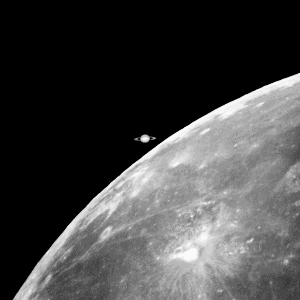
Laughlin contrasted that with the image I ran yesterday, showing the Alpha Centauri stars as viewed from Saturn, a spectacular vista including the planet and the tantalizing stellar neighbors beyond. Four hundred years after Galileo, we thus define what we can do — a probe of Saturn — and we have the image of a much more distant destination we’d like to know a lot more about. The findings of the Geneva team take us a giant step in that direction, revealing a small world of roughly Earth mass in a tight three-day orbit around a star a little smaller and a little more orange than the Sun. What comes next is truly interesting, both for what is implied and for what we are capable of doing.

Image: Have another look: Alpha Centauri as seen from Saturn space. These days we can see Saturn’s features in sharp detail thanks to Cassini, but Centauri A and B remain distant and enigmatic. The discovery of Centauri B b is the first step in sharpening our focus. Credit: JPL/NASA.
Be sure to check Alpha Centauri B b on Greg’s systemic blog for his latest thoughts.
Closing on Alpha Centauri
Surprisingly, there is a 10 percent chance that Centauri B b is a transiting world, and a slightly higher chance still if the new planet is in the orbital plane of the binary stars. Remember, the primary Centauri stars are just eleven degrees from being seen edge-on to us. We’re talking about a very challenging detection scenario, but one that’s not out of the question for an instrument like the Hubble Space Telescope. Clearly, a transit would be a major boost, allowing us to determine the radius and the density of the planet (and, obviously, confirming its existence). Stéphane Udry (Observatoire de Genève) told the news conference that a proposal to examine Centauri B for transits has already been sent to the Hubble team.
Radial velocity work on the Centauri stars has proven tricky business, requiring 500 nights of observing time spread over a nine year period. But things are going to get a bit more complicated still, as Laughlin explained in an email on Tuesday. For Centauri A and B are not exactly static, and stray light from the brighter Centauri A can contaminate the studies of B:
I really like the particular way that the narrative is unfolding. The presence of the 3.2-day planet, taken in conjunction with the myriad Kepler candidates and the other results from the HARPS survey, quite clearly points to the possibility, and I would even say the likelihood, of finding additional planets at substantially more clement distances from the star. Alpha Cen A and B, however, are drawing closer together over the next several years, severely metering the rate at which high-precision measurements can be obtained. This builds suspense! It reminds me a bit of a mission like New Horizons, where the long coast to the destination serves to build a groundswell of excitement and momentum for the dramatic close encounter.
At the news conference, Laughlin likened our current state to halftime at a football game. We’ve pulled out a major detection but even as we start to speculate about rocky worlds further out in the system, we’re faced with increasingly difficult observations. We can expect the Alpha Centauri story to unfold slowly, but Xavier Dumusque (Centro de Astrofísica da Universidade do Porto) pointed out how much more difficult it becomes to find planets as we move further out in the Centauri B system, adding that it would take at least twice as many measurements as the Geneva team has now made. Right now the researchers are saying the HARPS spectrograph might be limited to a planet with a lower mass limit of about four Earth masses here, but Stéphane Udry added that new ESO instrumentation was in the works that offered, in the not so distant future, good prospects for finding an Earth-mass planet in the habitable zone.
A 230-day orbit around Centauri B should put us right in the middle of the habitable zone, the place we’d most like to find a terrestrial world. Fortunately, it’s a region of orbital stability — the effects of Centauri A only become problematic as we move as much as 3 AU out from the star. Before we can find a habitable zone planet, we’ll need to confirm Centauri B b and begin to study it, which is where that useful transit could come in. The probable picture is stark — a rocky, lava-world with a surface temperature somewhere around 1500 Kelvin, surely in a tidally locked orbit. Not exactly a clement place, but the implication of other worlds in this system will urge us forward.
Putting the new planet in perspective involves seeing the overall picture of exoplanet research, which could be changed by the discovery. In his email, Laughlin noted the possibilities:
I think that this is important for a society that is increasingly expectant of immediate interactivity and instant gratification… I hope that this detection of Alpha Cen B b provides an impetus for the funding of additional radial velocity infrastructure, and also for space-based missions such as TESS, which can find and study the very best planets orbiting the very nearest stars.
Will the focus now shift from the statistical wonders being revealed by Kepler to the many nearby stars about which we have little planetary information? We saw the other day that the ESA mission concept called NEAT offers new ways to study Alpha Centauri and other nearby stars, and TESS (Transiting Exoplanet Survey Satellite) is likewise out there as a concept that would allow us to survey 2.5 million of the brightest stars in the sky. Data from a mission like this could be handed off to the James Webb Space Telescope for more intense investigation. All that depends on funding and the continued awakening of interest in planets around neighboring stars.
The Choice of Centauri B
We have three stars in the Alpha Centauri system, but Centauri B has been at the center of the current effort, not only by the Geneva team but by Debra Fischer’s team and a third group in New Zealand. Why Centauri B and not its brighter partner, Centauri A? Both could have planets, and in the case of A we can’t rule out planets as large as ten Earth masses (gas giants would probably have been detected by now). What a fascinating scenario that is: Two planetary systems, each with the possibility of a planet in the habitable zone. Imagine the spur to space travel that would give any civilization there, to find a habitable world within easy striking distance!
The focus is on Centauri B because it is a more promising study for the radial velocity methods used in this investigation. Its level of stellar activity is low, which means there are fewer perturbations that can distort radial velocity measurements. It’s also a cooler star than our Sun, which means the habitable zone will be closer to the star than around the brighter Centauri A. Remember that with radial velocity methods we’re looking at incredibly tiny distortions in the movement of the star (in the case of Centauri B b, 51 centimeters per second, or 1.8 kilometers per hour, the highest precision ever achieved using this method). A smaller mass means stronger radial-velocity variation for a planet of similar mass, hence an easier detection.

Image: An artist’s impression of the planet orbiting Alpha Centauri B, a member of the triple star system that is the closest to Earth. Alpha Centauri B is the most brilliant object in the sky and the other dazzling object is Alpha Centauri A. Our own Sun is visible to the upper right. The tiny signal of the planet was found with the HARPS spectrograph on the 3.6-metre telescope at ESO’s La Silla Observatory in Chile. Credit: ESO/L. Calçada/N. Risinger (skysurvey.org).
Not that Centauri B is an easy target. There are plenty of factors intrinsic to the star that can introduce jitter in these observations and thus render planet detection difficult. A huge part of the Geneva team’s work has been to examine HARPS spectrograph observations between February 2008 and July 2011 to model and remove all non-planetary sources of perturbation. From the paper:
The raw radial velocities of α Centauri B… exhibit several contributing signals that we could identify. Their origin is associated with instrumental noise, stellar oscillation modes, granulation at the surface of the star, rotational activity, long-term activity induced by a magnetic cycle, the orbital motion of the binary composed of a Centauri A and B, light contamination from a Centauri A, and imprecise stellar coordinates.
Each of these factors had to be modeled and subtracted from the data. The team performed Monte Carlo simulations to check against the signal at 3.236 days being an artifact from the elimination of the stellar signals and was able to conclude that the signal is real. Xavier Dumusque, lead author of the discovery paper, showed the press conference graphs of Centauri B’s magnetic activity, noting that as the latter went up, radial velocity jitter increased. Notice how subtle these effects are and remember that they must be understood to get the real picture:
For the Sun, as for other stars similar to α Centauri B in spectral type, convection induces a blueshift of the stellar spectra. Therefore, no convection means no convective blueshift inside these regions, and so the spectrum of the integrated stellar surface will appear redshifted. Because a redshift means a measured positive radial velocity, a positive correlation between the magnetic cycle variation and the long-term radial velocity variation is then expected.
Get the noise out of the data and that 51 centimeter per second signal persists as Centauri B b.
Significance of the Find
There was a sense of exhilaration in the air on Tuesday as the buzz around an Alpha Centauri planet built, and when the embargo was lifted, reports of the find filled the social media as the early articles began to appear online. Just how big a deal is Centauri B b? A skeptic could point out that while finding an Earth-mass planet is significant, it must still be confirmed, and in any case, this is an Earth-mass planet that is nothing like a clement, habitable world. Then too, the level of investigation involved here was so intense that it may be years before we learn about other planets in this system, not to mention planets around Centauri A or Proxima.
NASA’s John Grunsfeld, Science Mission Directorate Associate Administrator for the agency, had this to say about NASA’s plans in the days after the discovery:
“NASA’s James Webb Space Telescope (JWST) will provide a unique facility that will serve through the next decade as the mainstay for characterization of transiting exoplanets. The main transit studies JWST will be able to undertake are: discovery of unseen planets, determining exoplanet properties like mass, radius, and physical structure, and characterizing exoplanet atmospheres to determine things like their temperature and weather. If there are other planets in the Alpha Centauri system farther from the star, JWST may be able to detect them as well through imaging.
“NASA is also studying two medium-class exoplanet missions in our Explorer program, and in the spring of 2013 will select one of them to enter development for flight later in the decade.”
Clearly the game is afoot. A confirmed Centauri B b would tell us that planet formation is indeed possible in the nearest stellar system to our own — this had by no means been obvious, and the debate over planet formation mechanisms in close binaries has been brisk. The presence of a rocky planet here obviously implies the presence of other worlds, and the Geneva team holds out strong hope that we’re up to the task of finding them. From the paper:
The optimized observational strategy used to monitor α Centauri B is capable of reaching the precision needed to search for habitable super-Earths around solar-type stars using the radial-velocity technique. However, it requires an important investment in observation time, and thus only few targets can be observed over several years. Recent statistical analyses and theoretical models of planetary formation suggest that low-mass rocky planets and especially Earth twins should be common. We are therefore confident that we are on the right path to the discovery of Earth analogues.
Alpha Centauri is obviously a prime target for any future interstellar probe because it is so much closer than other stars. Space-based instrumentation will one day be able to tell us something about the larger Centauri B system, assuming other planets are present. The discovery of a terrestrial world in the habitable zone here would be a spur to exploration that could drive public interest and funding for increasingly sophisticated technologies. Maybe a distant but theoretically reachable green and blue world is out there around our nearest neighbor, but we won’t know until we commit the resources to continue the investigation. Centauri B b is an exciting start to characterizing this fascinating system, a process that will demand time, patience, and effort just as rigorous as the Geneva team put in here. Well done to all involved!