Nosimpler
Shared posts
18 Dec 17:58
velleity
Merriam-Webster's Word of the Day for December 11, 2015 is:
velleity \vuh-LEE-uh-tee\ noun
1 : the lowest degree of volition
2 : a slight wish or tendency : inclination
Examples:
Samuel sometimes mentions that he would like to go back to school, but his interest strikes me as more of a velleity than a firm statement of purpose.
"It should be enough of an advantage for online retailers … that you can order items from them the instant your internet-browsing fingers conceive a velleity to own something; exploiting and maintaining anachronistic tax loopholes is uncalled for." — The Economist (online), 9 Sept. 2011
Did you know?
Allow us, if you will, to volunteer our knowledge about velleity. It is a derivative of the New Latin noun velleitas,from the Latin verb velle, meaning "to wish or will." You might also wish to know that velle is the word that gave us voluntary (by way of Anglo-French voluntarie and Latin voluntarius) and volunteer (by way of French voluntaire). While both of those words might imply a wish to do something (specifically, to offer one's help) and the will to act upon it, the less common velleity typically refers to a wish or inclination that is so insignificant that a person feels little or no compulsion to act.
13 Dec 18:58
No Good Men Among the Living
by Alex Tabarrok
Anand Gopal’s No Good Men Among the Living…his new and shocking indictment demonstrates that the failures of the [Afghanistan] intervention were worse than even the most cynical believed. Gopal, a Wall Street Journal and Christian Science Monitor reporter, investigates, for example, a US counterterrorist operation in January 2002. US Central Command in Tampa, Florida, had identified two sites as likely “al-Qaeda compounds.” It sent in a Special Forces team by helicopter; the commander, Master Sergeant Anthony Pryor, was attacked by an unknown assailant, broke his neck as they fought and then killed him with his pistol; he used his weapon to shoot further adversaries, seized prisoners, and flew out again, like a Hollywood hero.
As Gopal explains, however, the American team did not attack al-Qaeda or even the Taliban. They attacked the offices of two district governors, both of whom were opponents of the Taliban. They shot the guards, handcuffed one district governor in his bed and executed him, scooped up twenty-six prisoners, sent in AC-130 gunships to blow up most of what remained, and left a calling card behind in the wreckage saying “Have a nice day. From Damage, Inc.” Weeks later, having tortured the prisoners, they released them with apologies. It turned out in this case, as in hundreds of others, that an Afghan “ally” had falsely informed the US that his rivals were Taliban in order to have them eliminated. In Gopal’s words:
The toll…: twenty-one pro-American leaders and their employees dead, twenty-six taken prisoner, and a few who could not be accounted for. Not one member of the Taliban or al-Qaeda was among the victims. Instead, in a single thirty-minute stretch the United States had managed to eradicate both of Khas Uruzgan’s potential governments, the core of any future anti-Taliban leadership—stalwarts who had outlasted the Russian invasion, the civil war, and the Taliban years but would not survive their own allies.
Gopal then finds the interview that the US Special Forces commander gave a year and a half later in which he celebrated the derring-do, and recorded that seven of his team were awarded bronze stars, and that he himself received a silver star for gallantry.
From a 2014 review by Rory Stewart in the NYReview of Books. Have a nice day.
10 Dec 20:54
Can Neural Activity Propagate by Endogenous Electrical Field?
by Qiu, C., Shivacharan, R. S., Zhang, M., Durand, D. M.
It is widely accepted that synaptic transmissions and gap junctions are the major governing mechanisms for signal traveling in the neural system. Yet, a group of neural waves, either physiological or pathological, share the same speed of ~0.1 m/s without synaptic transmission or gap junctions, and this speed is not consistent with axonal conduction or ionic diffusion. The only explanation left is an electrical field effect. We tested the hypothesis that endogenous electric fields are sufficient to explain the propagation with in silico and in vitro experiments. Simulation results show that field effects alone can indeed mediate propagation across layers of neurons with speeds of 0.12 ± 0.09 m/s with pathological kinetics, and 0.11 ± 0.03 m/s with physiologic kinetics, both generating weak field amplitudes of ~2–6 mV/mm. Further, the model predicted that propagation speed values are inversely proportional to the cell-to-cell distances, but do not significantly change with extracellular resistivity, membrane capacitance, or membrane resistance. In vitro recordings in mice hippocampi produced similar speeds (0.10 ± 0.03 m/s) and field amplitudes (2.5–5 mV/mm), and by applying a blocking field, the propagation speed was greatly reduced. Finally, osmolarity experiments confirmed the model's prediction that cell-to-cell distance inversely affects propagation speed. Together, these results show that despite their weak amplitude, electric fields can be solely responsible for spike propagation at ~0.1 m/s. This phenomenon could be important to explain the slow propagation of epileptic activity and other normal propagations at similar speeds.
SIGNIFICANCE STATEMENT Neural activity (waves or spikes) can propagate using well documented mechanisms such as synaptic transmission, gap junctions, or diffusion. However, the purpose of this paper is to provide an explanation for experimental data showing that neural signals can propagate by means other than synaptic transmission, gap junction, or diffusion. The results indicate that electric fields (ephaptic effects) are capable of mediating propagation of self-regenerating neural waves. This novel mechanism coupling cell-by-volume conduction could be involved in other types of propagating neural signals, such as slow-wave sleep, sharp hippocampal waves, theta waves, or seizures.
06 Dec 17:30
The War Was Great, Everybody Got Rich
by noreply@blogger.com (Atrios)
One big grift.
But we can't have any nice things at home.
The Special Inspector General for Afghanistan Reconstruction (SIGAR) is asking why a small Department of Defense task force charged with developing the Afghan economy spent nearly $150 million on private villas, security guards and luxury meals while operating in the country between 2010 and 2014.
But we can't have any nice things at home.
06 Dec 14:28

A guaranteed annual income for Finland?
by Tyler Cowen
The Finnish government is currently drawing up plans to introduce a national basic income. A final proposal won’t be presented until November 2016, but if all goes to schedule, Finland will scrap all existing benefits and instead hand out 800 euros per month—to everyone.
It sounds far-fetched, but it’s looking likely that Finland will carry through with the idea. Whereas several Dutch cities will introduce basic income next year and Switzerland is holding a referendum on the subject, there is strongest political and public support for the idea in Finland.
A poll commissioned by the government agency planning the proposal, the Finnish Social Insurance Institution or KELA, showed that 69% support (link in Finnish) a basic income plan. Prime minister Juha Sipilä is in favor of the idea and he’s backed by most of the major political parties.
There is more here, by Olivia Goldhill, via Matt Yglesias.
01 Dec 17:21

The coffee-machine bacteriome
by Alex Tabarrok
 From a new paper in Nature, Scientific Reports:
Microbial communities are ubiquitous in both natural and artificial environments. However, microbial diversity is usually reduced under strong selection pressures, such as those present in habitats rich in recalcitrant or toxic compounds displaying antimicrobial properties. Caffeine is a natural alkaloid present in coffee, tea and soft drinks with well-known antibacterial properties. Here we present the first systematic analysis of coffee machine-associated bacteria. We sampled the coffee waste reservoir of ten different Nespresso machines and conducted a dynamic monitoring of the colonization process in a new machine. Our results reveal the existence of a varied bacterial community in all the machines sampled, and a rapid colonisation process of the coffee leach. The community developed from a pioneering pool of enterobacteria and other opportunistic taxa to a mature but still highly variable microbiome rich in coffee-adapted bacteria. The bacterial communities described here, for the first time, are potential drivers of biotechnologically relevant processes including decaffeination and bioremediation.
The authors note:
The presence of bacterial genera with pathogenic properties and the fast recovery of the communities after rinsing the capsule container, strongly suggest the need for frequent maintenance of the capsule container of these machines.
In related news from a few years ago, scientists in the US have genetically modified an E.coli strain so that it is ‘addicted’ to caffeine. Yes, but will E. coli prove theorems?
Hat tip: Paul Kedrosky.
01 Dec 00:24

L.A. City Council Wants to Send You A Letter When Its License-Plate Readers See Your Car in Certain Neighborhoods
by Brian Doherty
The Los Angeles City Council thinks it would be a good idea to use license plate readers to send automated letters to people whose cars are seen by cameras in areas they believe to be used to solicit prostitution. These helpful prospective letters would warn the recipient that, well, the city knows they, or someone with access to their car, has driven or parked their cars in parts of the city where the city believes people often go to solicit prostitutes.

In other words, freely traveling in a part of the city that the city has some generalized suspicion about should be enough for the city to use your tax money to be the worst sort of backfence neighborhood busybody and try to ruin your relationship(s).
The Council last week officially asked the city attorney for advice on that proposal it would like to implement. The idea was the brainchild of San Fernando Valley Councilwoman Nury Martinez, who really wants to stamp out prostitution, or so she keeps saying.
From an Associated Press report in the Orange County Register:
The letters would be written to discourage those who were soliciting prostitutes from returning to the area while posing no harm to those who were there for legitimate reasons, Councilwoman Nury Martinez said.
“If you aren’t soliciting, you have no reason to worry about finding one of these letters in your mailbox,” she said.
This councilwoman has zero knowledge about the dynamics of human marriage or romantic relationships if she believes that nonsense for a second.
The Electronic Frontier Foundation, already in an ongoing lawsuit against the LAPD and L.A. County sheriff over its license plate reader collection practices, thinks it's a terrible idea, as the Los Angeles Daily News reports. J.D. Tuccille reported on that lawsuit here back in 2014.
Nick Selby with an essay posted at Medium.com has a pretty good compendium of reasons why the city attorney should say please forget this horrible idea back to the Council, even though he's cool with license plate readers in law enforcement in general:
As a law enforcement technologist, and a working police detective, I generally support the use of license plate readers...
[But this L.A. proposed] scheme makes, literally, a state issue out of legal travel to arbitrary places deemed by some — but not by a court, and without due process — to be “related” to crime in general, not to any specific crime.
There isn’t “potential” for abuse here, this is a legislated abuse of technology that is already controversial when it’s used by police for the purpose of seeking stolen vehicles, tracking down fugitives and solving specific crimes.
The City Council and Ms. Martinez seek to “automate” this process of reasonable suspicion (reducing it to mere presence at a certain place), and deploy it on a massive scale....they seek to use municipal funds to take action against those guilty of nothing other than traveling legally on city streets, then access the state-funded Department of Motor Vehicle registration records to resolve the owner data, then use municipal moneys to write, package and pay the United States Postal Service to deliver a letter that is at best a physical manifestation of the worst kind of Digital McCarthyism....
Oh, and what happens to those records once they are committed to paper? As letters sent by the District Attorney or City Council, they would be rightly subject to Freedom of Information Laws. And mandatory retention periods that exceed those of automated license plate data, even though no investigation has been consummated.
Which means that, under Councilwoman Martinez’ scheme, anyone will be able to get a list of all vehicles driving in certain parts of town merely by requesting “all ‘John’ letters sent” between a date range.
Far from serving as, in the words of one proponent, a private “wake-up call,” these letters will surely be the basis of insurance, medical, employment and other decisions, and such a list can be re-sold to public records companies, advertising mailing list companies… who in their right mind would do business at any company located in that area? The list of unintended consequences is long.
Scott Shackford wrote back in 2013 about Sanford, Florida's, adoption of the same crummy, intrusive idea. A 2012 National Institute of Justice report on the pernicious practice's use nationally.
30 Nov 23:05

France Puts Climate Activists Under House Arrest Before They Can Protest
by Anthony L. Fisher
The Guardian reports French police have placed 24 climate change activists under house arrest in anticipation of the COP21 climate change conference in Paris.
As part of the extended state of emergency imposed on the country following the terror attacks in Paris on November 13, groups or individuals deemed a "threat to security or public order" can be placed under house arrest. Additionally, French authorities placed a blanket ban on large demonstrations timed to coincide with the long-planned conference.
The New York Times writes:
Juliette Rousseau, the head of Coalition Climat 21, an umbrella group for environmental activists, said the authorities had searched homes and seized computers and other equipment belonging to activists who have no connection to terrorism.
“There’s clearly an environment to keep activists out,” she said. “The state of emergency is clearly targeting activist movements. This is not justified. These people under house arrest, they don’t have any kind of criminal record.”
She added: “The impression we have is that there is this conference taking place in a sealed-up space, and meanwhile people in civil society are being asphyxiated.”
France24 spoke with one of the activists placed under house arrest, who described the raid on her home:
“They entered the apartment with shotguns and assault rifles. It was quite violent. They pinned us to the ground,” said Amélie, a young barmaid who did not wish to give her full name. “It lasted quite a long time. We had no idea why they were there.”
The officers handed Amélie a restraining order informing her that she can no longer leave Rennes, is required to register three times a day at the local police station, and must stay at home between 8pm and 6am.
Such warnings didn't stop thousands of protesters from turning out yesterday, with 4,500 reportedly forming a human chain near the Place de la Republique. Tear gas was deployed and some protesters turned violent, resulting in 208 arrests.
NBC News reports:
President Francois Hollande said "everything will be done" to keep violent protesters away from the conference.
Hollande said the violence was "scandalous," because the "disruptive elements" had nothing to do with activism and because it erupted at Place de la Republique, which has become a memorial site for the victims of the Paris attacks.
Paris police chief Michel Cadot told reporters that some demonstrators hurled glass bottles and memorial candles at police.
Some protesters were undeterred by the criticism though, chanting, "a state of emergency is a police state."
Thousands of shoes — including a pair from the pope — were arranged at the Place de la Republique to represent activists who could not participate due to the ban on large gatherings. Organizers said they had collected more than 11,000 pairs of shoes.
French authorities must have known that placing a mere few dozen activists under house arrest would not quell the ambitions of demonstrators eager to make themselves heard in the shadow of a legally binding conference of more than 150 world leaders. To that point, activists have noted other mass gatherings, including sporting events and holiday markets, have been allowed to continue during the state of emergency.
Heightened security in the wake of ISIS-inspired attacks on mainland Europe will be a concern for years to come, it will not magically go away when the state of emergency expires at the end of three months. But by taking a small number of would-be protesters off the streets, it's possible French authorities are engaging in a kind of security theatre, with heavy-handed shows of force meant to telegraph to the 84 percent of the French population that currently supports trading civil liberties for a sense of security that their government is in control and working to keep them safe.
30 Nov 05:08
One more sign that a Journal is bogus. Or is it?
by GASARCH
I went to an AMS conference with my High School Student Naveen (who presented this paper) and an ugrad from my REU program Nichole (who presented this paper). Note that this is a math conference- low prestige, mostly unrefereed, parallel sessions, but still a good place to pick up some new problems to work on and learn some things, and meet people.
Both Naveen and Nichole later got email from a journal urging them to submit their work! They were also invited to be on the Editorial Board! I can understand inviting a HS student who is a SENIOR to be on an editorial board, but Naveen is a SOPHMORE!
Naveen and Nichole both emailed me asking what this was about and I looked around and found, not to my surprise, that the journal is an author-pays journal of no standards. On the other hand, it was open access, on the other other hand, they had an article claiming that R(4,6)=36 (might be true, but if this was known, I would know it, see this blog post for more on that proof technique).
The pay-to-publish model is not necc. bad, and is standard in some fields, but is unusual for math. Of perhaps more importance is that the journal had no standards. And they prey on the young and naive.
Or do they?
Consider the following scenario: Naveen publishes in this journal and this publication is on his college application, hence he gets into a good college with scholarship. He knows exactly what he is buying. Or Nicole does this to help her Grad school Application. Or I do this for my resume and get a salary increase. Or an untenured prof does this to get tenure ( Deans can count but they can't read). And it gets worse--- the school gives the prof tenure, knowing the papers are bogus, but now they can say they have a prof who publishes X papers a year! At some point I don't know who is scamming who.
This blog post (not mine) gives several criteria for when a journal is bogus. I'll add one: When they ask a 15 years old to be on their editorial board.
Both Naveen and Nichole later got email from a journal urging them to submit their work! They were also invited to be on the Editorial Board! I can understand inviting a HS student who is a SENIOR to be on an editorial board, but Naveen is a SOPHMORE!
Naveen and Nichole both emailed me asking what this was about and I looked around and found, not to my surprise, that the journal is an author-pays journal of no standards. On the other hand, it was open access, on the other other hand, they had an article claiming that R(4,6)=36 (might be true, but if this was known, I would know it, see this blog post for more on that proof technique).
The pay-to-publish model is not necc. bad, and is standard in some fields, but is unusual for math. Of perhaps more importance is that the journal had no standards. And they prey on the young and naive.
Or do they?
Consider the following scenario: Naveen publishes in this journal and this publication is on his college application, hence he gets into a good college with scholarship. He knows exactly what he is buying. Or Nicole does this to help her Grad school Application. Or I do this for my resume and get a salary increase. Or an untenured prof does this to get tenure ( Deans can count but they can't read). And it gets worse--- the school gives the prof tenure, knowing the papers are bogus, but now they can say they have a prof who publishes X papers a year! At some point I don't know who is scamming who.
This blog post (not mine) gives several criteria for when a journal is bogus. I'll add one: When they ask a 15 years old to be on their editorial board.
30 Nov 05:04
Long-range Synchronization of Nanomechanical Oscillators with Light. (arXiv:1511.08536v2 [physics.optics] UPDATED)
by Shreyas Y. Shah, Mian Zhang, Richard Rand, Michal Lipson
We experimentally demonstrate mutual synchronization of two free-running nanomechanical oscillators separated by an effective distance of 30 meters and coupled through light. Due to the finite speed of light, the large separation introduces a significant coupling delay of 139 nanoseconds, approximately four and a half times the mechanical oscillation time period. We reveal multiple stable states of synchronized oscillations, enabled by delayed coupling, with distinct synchronization frequency in the coupled system. These states are accessed by tuning independently the directional coupling strengths. Our results demonstrate rich dynamics and could enable applications in reconfigurable radio-frequency networks and novel computing concepts.
30 Nov 05:02

Last Roar from a Dying Grammar?
by Blair
Along with the question about the evolution of blank slates (see last post) Dr. Bolhuis sent me a paper just published in Trends in Cognitive Science. The paper, which Bolhuis teased would annoy me, is titled, “Structures, not Strings: Linguistics as Part of the Cognitive Sciences” and has a number of distinguished co-authors, including Noam himself. Bolhuis is the corresponding author. I told him I would never have been able to maintain my blog for so long if I did not have a taste for being annoyed.
Truth is, however, I was more puzzled than annoyed. The paper seems a concise summary of positions held for many years. Why write such old news?
There are hints to why scattered about the paper. The old news is being ignored. I was astonished by one sentence, “Introductions to psycholinguistics generally do not mention notions such as hierarchy, structure, or constituent.” As I recall it, the very word psycholinguistics was coined by George Miller to denote the marriage of psychology with generative grammar. Now the two fields are quite divorced.
Also, in the paper's abstract, we find: “taking language as a computational cognitive mechanism seriously, allow us to address issues left unexplained in the increasingly popular surface-oriented approaches to language.” So that’s what the paper rebuts: big data approaches to language. This method compares texts with a many similar texts in a database and then makes a statistically-supported guess as to the text’s meaning.
The limitations of big data approaches is demonstrated by the unlikely French sentence La pomme mange le garcon (The apple eats the boy) The authors submitted this simple sentence to Google Translate and got as their translation the more probable, “The boy eats the apple.” I got a nice chuckle out of that one, but the truth is that for all its flaws, Google Translate does a better job than machine translation based on Chomskyan rules. The big data approach so disliked by the authors is paying off in a practical way that 60 years of Chomskyan linguistics never has.
Chomsky began with the assumption that the brain is a type of computer and that language can best be understood as the product of an algorithmic computation. Over the years this theory has been honed so that now the decisive operation for generating sentences, an operation called Merge, is pretty much a duplicate of the way a Turing machine works. So, if the brain is a computer, and if language is the product of a computation, we should now be seeing computers that do at least a semi-decent job of generating sentences. Actually, we do. We can speak to our phones, translate news articles, and produce computer written news reports. It is just that these computers ignore the work of Chomsky and colleagues.
Big data's approach to language is like Deep Blue’s approach to chess. Neither tries to emulate human thinking, but just seeks to solve a problem through a computer’s enormous speed and search powers. Successful humans, on the other hand, think strategically. That is to say, good chess players have a common purpose behind their tactical moves. Machines, however, are no good at developing purposes, so they have to play some other way. When humans use language well, they have something to say. That is, they have a purpose behind their choice of words and the formation of sentences. Generative grammar has failed, and computer developers have moved on, because Chomsky’s bold ideas turned out to overlook the purposes that lie behind language use. There can be many purposes behind a sentence, but the universal one is to draw attention to a particular phenomenon or idea. The authors of the paper seem (and probably are) oblivious to this purpose. Thus, computers using generative rules are neither taking full advantage of their computational power nor managing to think like a human.
Big data approaches to language hold very little interest to this blog, because they are irrelevant to the issue of language origins. Big data assumes the existence of a large body of sentences to analyze, and I first became interested in the problem of language origins when I realized that at some time there must have been people who were not born into a world of sentences. At the same time, the Chomskyan revolution has, as the authors say, “been forgotten, ignored, or even denied.” The authors lament this state of affairs, but by arguing only with the big data approach they have nothing new to say to followers of this blog.
Yohan likes this
16 Nov 22:51

Hey, GOP Fearmongers: Not One Terrorist Act by Refugees in U.S.
by Ronald Bailey
 In reaction to the terrorist murders in Paris on Friday, Republican presidential hopefuls including Rand Paul (say it ain't so, Rand) are demanding that no refugees be admitted to the United States. Sen. Ted Cruz (R-Tex) claimed that letting in Syrian refugees would be a "roll of the dice." Reality TV billionaire blowhard Donald Trump declared that the refugees could be "one of the great Trojan horses." Politico reports that at least ten Republican governors are vowing to keep out of their states any of the 10,000 or so Syrian refugees that could be admitted to the U.S. next year. Just how the governors think they have the authority to prevent people who are legally in this country from going where they want is not at all clear.
So what does history say about the dangers posed by refugees? Over at the Niskanen Center, David Bier who heads up the immigration policy department provides Six Reasons to Welcome Syrian Refugees After Paris. Number 2 is most relevant to the fearmongering Republicans pols:
2. U.S. refugees don’t become terrorists: The history of the U.S. refugee program demonstrates that the lengthy and extensive vetting that all refugees must undergo is an effective deterrent for terrorists. Since 1980, the U.S. has invited in millions of refugees, including hundreds of thousands from the Middle East. Not one has committed an act of terrorism in the U.S. Traditional law enforcement and security screening processes have a proven record of handling the threat from terrorist posing as refugees.
Demagoguery is the practice of a politician to gain power and popularity by arousing the emotions, passions, and prejudices of the people. For shame!
Note: Several commenters suggested Tamerlan and Dzhokar Tsarnaev, who committed the Boston Marathon bombing in 2013, were refugees. Strictly speaking, they were the children of asylees. As Bloomberg News explained the two were given “derivative asylum status” and didn’t come through the refugee admissions program. Apparently the legal distinction is too fine a point for some readers. So be it, but they should nevertheless keep in mind that the brothers were two people out around 1.8 million people who were granted refugee or asylee status between 1995 and 2013.
13 Nov 19:21
[This Week in Science] Brain keeps body size and shape in check
by Beverly A. Purnell
Author: Beverly A. Purnell
Leuchtkaefer likes this
13 Nov 19:02

Do women face a reputational bias when they co-author?
by Tyler Cowen
Apparently. Heather Sarsons has a paper on this phenomenon (pdf), the abstract is this:
Within academia, men are tenured at higher rates than women are in most quantitative fields, including economics. Researchers have attempted to identify the source of this disparity but find that nearly 30% of the gap remains unexplained even after controlling for family commitments and differences in productivity. Using data from academic economists’ CVs, I test whether coauthored and solo-authored publications matter differently for tenure for men and women. While solo-authored papers send a clear signal about one’s ability, coauthored papers are noisy in that they do not provide specific information about each contributor’s skills. I find that men are tenured at roughly the same rate regardless of whether they coauthor or solo-author. Women, however, suffer a significant penalty when they coauthor. The results hold after controlling for the total number of papers published, quality of papers, field of study, tenure institution, tenure year, and the number of years it took an individual to go up for tenure. The result is most pronounced for women coauthoring with only men and is less pronounced the more women there are on a paper, suggesting that some gender bias is at play. I present a model in which bias enters when workers collaborate and test its predictions in the data.
See also this very interesting paper on “Confidence Men,” in economic science, women seem to have more epistemic modesty than men.
Hat tip goes to Dina Pomeranz.
13 Nov 17:27
Mathematical toy model inspired by the problem of the adaptive origins of the sexual orientation continuum. (arXiv:1511.03721v2 [q-bio.PE] UPDATED)
by Brian Skinner
Same-sex sexual behavior is ubiquitous in the animal kingdom, but its adaptive origins remain a prominent puzzle. Here I suggest the possibility that same-sex sexual behavior arises as a consequence of the competition between an evolutionary drive for a wide diversity in traits, which improves the adaptability of a species, and a drive for sexual dichotomization of traits, which promotes opposite-sex attraction and increases the rate of reproduction. A simple analytical "toy model" is proposed for describing this tradeoff. The model exhibits a number of interesting features, and suggests a simple mathematical form for describing the sexual orientation continuum.
13 Nov 17:24


Machine Vision Algorithm Learns to Recognize Hidden Facial Expressions
Microexpressions reveal your deepest emotions, even when you are trying to hide them. Now a machine vision algorithm has learned to spot them, with wide-ranging applications from law enforcement to psychological analysis.
Most people are good at recognizing the ordinary emotions on other people’s faces. But there are another set of facial expression that most people are almost entirely unaware of. In the late 1960s, psychologists discovered that when humans try to hide their emotions, they often display their real feelings in “microexpressions” that appear and disappear in the blink of an eye.
12 Nov 19:56
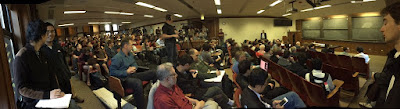
I spent 14 years on the faculty at the University of Chicago. I know László Babai well, we collaborated on some of my best known work. I also know Ryerson 251, a room where I've seen hundreds of talks and given more than a few myself. So I could imagine the excitement in that room on Tuesday as Babai gave the most anticipated talk in the history of theoretical computer science, the first of several talks Babai is giving on his new algorithm for graph isomorphism [Video]. Gabriel Gaster extensively live tweeted the event. Jeremy Kun has some details. Update (12/14): Paper now posted.
For this post instead of doing a bad job trying to overview Babai's proof, I'll explain the graph isomorphism problem and why it is important in the complexity world.
Suppose we have two high schools, say HS North and HS South, each with 1000 students. Consider a diagram (or graph) containing a point for each student at HS North with lines between students who are facebook friends, and a similar diagram for HS South. Is there a 1-1 map from the students at HS North to the students at HS South so that these diagrams look identical? That's the graph isomorphism problem.
To determine whether these two graphs were isomorphic you could look at all the possible mappings between students, but that's 1000! or more than 4x102567 possible maps. There has long been known how to search a smaller number of possibilities, especially if we put some restrictions on the diagrams, but always exponential in n (the number of students) in the worst case. Ideally we'd like a polynomial-time algorithm and Babai gets very close, an algorithm that runs in time nlogkn time for some fixed k.
Graph Isomorphism is one of those few problems, like factoring, known to be in NP but not known to be in P or NP-complete. Graph non-isomorphism is the poster child for the class AM, the problems solved by a randomized verifier asking a single question to a powerful prover. Graph non-isomorphism in AM implies that Graph Isomorphism is not likely NP-complete and that under reasonable derandomization assumptions that Graph non-isomorphism is in NP. Kobler, Schöning and Toran wrote a whole book on the computational complexity issues of graph isomorphism.
Even small progress in graph isomorphism creates waves. At a theory conference in the late 80's a speaker caused a major stir when he casually mentioned he had a proof (he didn't) that Graph non-isomorphism was in NP. Babai's announced caused a huge tsunami and those of us who know him realize he wouldn't make such an announcement without being sure he has a proof. The talk put together a large number of ideas from combinatorics and graph theory. My impression is that those who saw the talk didn't leave convinced of the proof, but did feel Babai had found the pieces to make it work.
With Babai's breakthrough algorithm, the smart money says now that graph isomorphism sits in P. It took decades to get from quasipolynomial time to polynomial time for primality testing and the same time frame may be needed to get polynomial time for graph isomorphism. But it will likely happen and the complexity of graph isomorphism then gets a whole lot simpler.
A couple of thoughts: All the breakthrough results that I can remember were released as papers, ready to devour. This is the first result of this caliber I remember being announced as a talk.
Also we think of theory as a young person's game, most of the big breakthroughs coming from researchers early in their careers. Babai is 65, having just won the Knuth Prize for his lifetime work on interactive proofs, group algorithms and communication complexity. Babai uses his extensive knowledge of combinatorics and group theory to get his algorithm. No young researcher could have had the knowledge base or maturity to be able to put the pieces together the way that Babai did.
More on Babai and graph isomorphism from Scott, Luca, Bill, Tim, Dick and Ken, Reddit, Science News, New Scientist and Science.
A Primer on Graph Isomorphism
by Lance Fortnow

I spent 14 years on the faculty at the University of Chicago. I know László Babai well, we collaborated on some of my best known work. I also know Ryerson 251, a room where I've seen hundreds of talks and given more than a few myself. So I could imagine the excitement in that room on Tuesday as Babai gave the most anticipated talk in the history of theoretical computer science, the first of several talks Babai is giving on his new algorithm for graph isomorphism [Video]. Gabriel Gaster extensively live tweeted the event. Jeremy Kun has some details. Update (12/14): Paper now posted.
For this post instead of doing a bad job trying to overview Babai's proof, I'll explain the graph isomorphism problem and why it is important in the complexity world.
Suppose we have two high schools, say HS North and HS South, each with 1000 students. Consider a diagram (or graph) containing a point for each student at HS North with lines between students who are facebook friends, and a similar diagram for HS South. Is there a 1-1 map from the students at HS North to the students at HS South so that these diagrams look identical? That's the graph isomorphism problem.
To determine whether these two graphs were isomorphic you could look at all the possible mappings between students, but that's 1000! or more than 4x102567 possible maps. There has long been known how to search a smaller number of possibilities, especially if we put some restrictions on the diagrams, but always exponential in n (the number of students) in the worst case. Ideally we'd like a polynomial-time algorithm and Babai gets very close, an algorithm that runs in time nlogkn time for some fixed k.
Graph Isomorphism is one of those few problems, like factoring, known to be in NP but not known to be in P or NP-complete. Graph non-isomorphism is the poster child for the class AM, the problems solved by a randomized verifier asking a single question to a powerful prover. Graph non-isomorphism in AM implies that Graph Isomorphism is not likely NP-complete and that under reasonable derandomization assumptions that Graph non-isomorphism is in NP. Kobler, Schöning and Toran wrote a whole book on the computational complexity issues of graph isomorphism.
Even small progress in graph isomorphism creates waves. At a theory conference in the late 80's a speaker caused a major stir when he casually mentioned he had a proof (he didn't) that Graph non-isomorphism was in NP. Babai's announced caused a huge tsunami and those of us who know him realize he wouldn't make such an announcement without being sure he has a proof. The talk put together a large number of ideas from combinatorics and graph theory. My impression is that those who saw the talk didn't leave convinced of the proof, but did feel Babai had found the pieces to make it work.
With Babai's breakthrough algorithm, the smart money says now that graph isomorphism sits in P. It took decades to get from quasipolynomial time to polynomial time for primality testing and the same time frame may be needed to get polynomial time for graph isomorphism. But it will likely happen and the complexity of graph isomorphism then gets a whole lot simpler.
A couple of thoughts: All the breakthrough results that I can remember were released as papers, ready to devour. This is the first result of this caliber I remember being announced as a talk.
Also we think of theory as a young person's game, most of the big breakthroughs coming from researchers early in their careers. Babai is 65, having just won the Knuth Prize for his lifetime work on interactive proofs, group algorithms and communication complexity. Babai uses his extensive knowledge of combinatorics and group theory to get his algorithm. No young researcher could have had the knowledge base or maturity to be able to put the pieces together the way that Babai did.
More on Babai and graph isomorphism from Scott, Luca, Bill, Tim, Dick and Ken, Reddit, Science News, New Scientist and Science.
12 Nov 16:29

Burritos for Category Theorists
by john
You’ve probably heard of Lawvere’s Hegelian taco. Now here is a paper that introduces the burrito to category theorists:
- Ed Morehouse, Burritos for the hungry mathematician.
The source of its versatility and popularity is revealed:
To wit, a burrito is just a strong monad in the symmetric monoidal category of food.
Frankly, having seen plenty of attempts to explain monads to computer scientists, I thought this should have been marketed as ‘monads for chefs’. But Mike Stay, who pointed me to this article, explained its subtext:
Haskell uses monads all over the place, and programmers who are not used to functional programming often find them confusing. This is a quote from a widely-shared article on the proliferation of “monad tutorials”:
After struggling to understand them for a week, looking at examples, writing code, reading things other people have written, he finally has an “aha!” moment: everything is suddenly clear, and Joe Understands Monads! What has really happened, of course, is that Joe’s brain has fit all the details together into a higher-level abstraction, a metaphor which Joe can use to get an intuitive grasp of monads; let us suppose that Joe’s metaphor is that Monads are Like Burritos. Here is where Joe badly misinterprets his own thought process: “Of course!” Joe thinks. “It’s all so simple now. The key to understanding monads is that they are Like Burritos. If only I had thought of this before!” The problem, of course, is that if Joe HAD thought of this before, it wouldn’t have helped: the week of struggling through details was a necessary and integral part of forming Joe’s Burrito intuition, not a sad consequence of his failure to hit upon the idea sooner.
The article is this:
- Brent Yorgey, Abstraction, intuition, and the “monad tutorial fallacy”, January 12, 2009.
06 Nov 20:43

Chemsex Panic: British Media Alleges Drug-Fueled Orgies Are Driving Up HIV Rates
by Elizabeth Nolan Brown
 U.K. media and government officials are sounding the alarm over something called "chemsex," which involves—are you ready for this newfangled idea?—taking mind-altering substances and then having sex. Oblivious that they're describing something that has happened for literally all of time, British officials warn that "taking recreational drugs during sex can lead to a number of potentially harmful side effects including facilitating the spread of common STIs and HIV, but also serious mental health problems, such as anxiety, psychoses and suicidal tendencies."
That's right, folks: Smoke up, get down, jump off a cliff. Duh.
Think that's a bit melodramatic? Government officials have nothing on how British newspaper The Telegraph explained the situation:
An alarming new craze for lengthy drug-fuelled sex sessions, which can last for days a time, could lead to a rise in HIV and hepatitis, health officials has warned. The practice, dubbed ‘chemsex’ has been reported by more than 60 per cent of people visiting some clinics in London and involves people taking drugs like crystal meth before embarking on 72 hour sex binges with multiple partners.
Precisely 72 hours. There are timers.
As you might have guessed, The Telegraph's "statistic" about London clinic visitors is craptastic as all get out. Neither the majority of patients at "some clinics in London" nor at any particular London clinic reported engaging in the chemsex. What the stat that Science Editor (!) Sarah Knapton so horribly bungled actually said was that 64 percent of patients seeking drug-abuse treatment from the nonprofit network Antidote reported using certain common illicit drugs (like meth) that are allegedly associated with chemsex.
The origin of this particular panic is a British Medical Journal editorial, in which public health professionals from Antidote and Britain's National Health Service warn that fighting chemsex "needs to become a public health priority." As evidence, they note that around a fifth of 1,142 British respondents to the European Men-Who-Have-Sex-With-Men Internet Survey "reported chemsex within the past five years" and link to yet-unpublished papers that contain anecdotal tales of drug-fueled sex, sometimes with more than one partner.
After laying out this underwhelming evidence, the BMJ writers again suggest that "addressing chemsex related morbidities should be a public health priority." And can you guess what they need to address it? More public funding, of course. Always follow the money when people are pushing panics that strain credulity.
This is not to say that people don't have "chemsex," or that people don't sometimes make stupid sexual decisions under the influence of drugs or alcohol, or that serious drug addicts don't engage in risky sexual behavior sometimes. Of course, on all accounts. But none of this is new, and it's certainly not some dire public health emergency.
Even the Novel Psychoactive Treatment UK Network (Neptune)—a group whose work is cited favorably by the fear-mongering BMJ editorialists—can admit this, tempering a report section on chemsex with the following caveat: "Sex under the influence or intoxication of substances with the potential for associated harm is by no means a new phenomenon." Neptune also notes that "there is no evidence that the use of methamphetamine is becoming more widespread among (men who have sex with men) in the UK... (and) no evidence that its use is becoming more mainstream in the UK" more generally.
05 Nov 16:46

Mexican Supreme Court Says People Have a Right to Smoke Pot
by Jacob Sullum
NosimplerI'd always thought freedom of thought was a prerequisite to freedom of speech, and it seems the Mexican supreme court agrees!
 Mexico's Supreme Court yesterday ruled that individuals should have the right to grow, possess, and consume marijuana. According to the official summary of the decision, the court's criminal division concluded that the right to "free development of the personality" includes the freedom to enage in recreational activities, subject to restrictions "necessary to protect health and public order." In the court's view, the damage caused by consumption and noncommercial production of marijuana is not "of such gravity as to warrant an absolute ban."
The court was responding to a lawsuit brought by activists who asked COFEPRIS, the national agency in charge of regulating drugs, for permission to use marijuana. When COFEPRIS said no, the applicants challenged the its decision in the courts. According to The New York Times, the Supreme Court's ruling applies only to the cannabis consumers who brought the case. "For legal marijuana to become the law of the land," the Times says, "the justices in the court's criminal chamber will have to rule the same way five times, or eight of the 11 members of the full court will have to vote in favor."
Assuming one of those things happens, it sounds like the resulting policy would be not full legalization but decriminalization of consumption and home cultivation—something like the current situation in Washington, D.C., where Congress has prevented local officials from licensing and regulating marijuana businesses. "If Mexicans are allowed to grow and consume their own marijuana, casual users will not have to commit a crime to obtain it," the Times says. "Marijuana users are currently vulnerable to extortion by the police and are locked up by the thousands every year on charges of consumption and possession."
The Times cites an estimate that "60 percent of the inmates sentenced for drug crimes [in Mexico] were convicted in cases involving marijuana." It's not clear how many of those inmates grew or possessed marijuana for their own use, as opposed to distribution. The latter category of marijuana offenders, which in the U.S. accounts for a small share of arrests but the vast majority of jail and prison sentences, would not be affected by a policy that merely allows consumption and noncommercial cultivation.
03 Nov 15:55
All About The Grift, The Grift, The Grift
by noreply@blogger.com (Atrios)
If only I'd been smart enough to start a Ted Cruz Super PAC.
So funny.
The super PACs backing Sen. Ted Cruz’s presidential run have yet to reserve any TV time in the early primary states — or anywhere else — despite a combined $38 million war chest that ranks second among presidential contenders only to Jeb Bush’s $103 million operation.
The total absence of ads has created confusion and growing consternation inside the Cruz campaign, which cannot legally communicate with its allied super PACs and has had to watch as its rivals lock in tens of millions of dollars in ads before prices spike, as they typically do as elections near.
So funny.
01 Nov 19:42

Hide Your Chats From Spies With Tor Messenger
by Justin Monticello
In a blog post published on Thursday, the Tor Project, the non-profit organization that manages the Tor network, announced the release of an anonymous chat app, Tor Messenger. The new messaging client will not replace existing chat platforms such as Facebook, Google Talk, or Twitter, but will allow users to anonymize the traffic they send using such services.
Based on an instant messaging client that arose in the Mozilla community, Instantbird, Tor Messenger is designed to be secure by default. It encrypts all communications and routes data through Tor's network of servers, which disguises the origin and identity of the sender.
"[Instant messaging] has traditionally been in a client-server model, meaning that your metadata (specifically the relationships between contacts) can be logged by the server," explains the post. Tor Messenger prevents unwanted spies from finding your metadata by hiding its route to the server.
The client is still in beta, but is available for download on Windows, Mac, and Linux systems.
Reason TV editor Nick Gillespie recently sat down with the development director of the Tor Project, Karen Reilly, who explained how Tor's products enable us to restore our privacy in the digital world. Watch their discussion below.
31 Oct 13:38

The drone wars have begun, a continuing series
by Tyler Cowen
A man dubbed the Drone Slayer for shooting a miniature aircraft out of the sky has had a criminal case against him thrown out.
William Meredith drew his shotgun and took out a Phantom 3 drone after spotting it above his home in Hillview, Kentucky, this summer – landing him in jail and prompting legal proceedings.
Mr Meredith was charged with criminal mischief and wanton endangerment for destroying the $900 drone in July – but this week had both of them thrown out by a judge.
There is more here, via the excellent Mark Thorson. And here is a previous installment in the series.
30 Oct 15:57
Ordinary Words Will Do
by Scott
Izabella Laba, a noted mathematician at the University of British Columbia, recently posted some tweets that used me as a bad, cautionary example for how “STEM faculty should be less contemptuous of social sciences.” Here was the offending comment of mine, from the epic Walter Lewin thread last fall:
[W]hy not dispense with the empirically-empty notion of “privilege,” and just talk directly about the actual well-being of actual people, or groups of people? If men are doing horrific things to women—for example, lashing them for driving cars, like in Saudi Arabia—then surely we can just say so in plain language. Stipulating that the torturers are “exercising their male privilege” with every lash adds nothing to anyone’s understanding of the evil. It’s bad writing. More broadly, it seems to me that the entire apparatus of “privilege,” “delegitimation,” etc. etc. can simply be tossed overboard, to rust on the ocean floor alongside dialectical materialism and other theoretical superstructures that were once pompously insisted upon as preconditions of enlightened social discourse. This isn’t quantum field theory. Ordinary words will do.
Prof. Laba derisively commented:
Might as well ask you to explain calculus without using fancy words like “derivative” or “continuous.” Simple number arithmetic will do.
Prof. Laba’s tweets were favorited by Jordan Ellenberg, a mathematician who wrote the excellent popular book How Not to Be Wrong. (Ellenberg had also criticized me last year for my strange, naïve idea that human relations can be thought about using logic.)
Given my respect for the critics, I guess I’m honor-bound to respond.
For the record, I tend not to think about the social sciences—or for that matter, the natural sciences—as monolithic entities at all. I admire any honest attempt to discover the truth about anything. And not being a postmodern relativist, I believe there are deep truths worth discovering in history, psychology, economics, linguistics, possibly even sociology. Reading the books of Steven Pinker underscored for me how much is actually understood nowadays about human nature—much of it only figured out within the last half-century. Likewise, reading the voluminous profundities of Scott Alexander taught me that even in psychiatry, there are truths (and even a few definite cures) to be had for those who seek.
I also believe that the social sciences are harder—way harder—than math or physics or CS. They’re harder because of the tenuousness of the correlations, because of the complexity of each individual human brain (let alone 7 billion of them on the same planet), but most of all, because politics and ideology and the scientist’s own biases place such powerful thumbs on the scale. This makes it all the more impressive when a social scientist, like (say) Stanley Milgram or Judith Rich Harris or Napoleon Chagnon, teaches the world something important and new.
I will confess to contempt for anything that I regard as pompous obscurantism—for self-referential systems of jargon whose main purposes are to bar outsiders, to mask a lack of actual understanding, and to confer power on certain favored groups. And I regard the need to be alert to such systems, to nip them in the bud before they grow into Lysenkoism, as in some sense the problem of intellectual life. Which brings me to the most fundamental asymmetry between the hard and soft sciences. Namely, the very fact that it’s so much harder to nurture new truths to maturity in the social sciences than it is in math or physics, means that in the former, the jargon-weeds have an easier time filling the void—and we know they’ve done it again and again, even in the post-Enlightenment West.
Time for a thought experiment. Suppose you showed up at a university anytime between, let’s say, 1910 and 1970, and went from department to department asking (in so many words): what are you excited about this century? Where are your new continents, what’s the future of your field? Who should I read to learn about that future?
In physics, the consensus answer would’ve been something like: Planck, Einstein, Bohr, Schrödinger, Dirac.
In psychology, it would’ve been: Freud and Jung (with another faction for B. F. Skinner).
In politics and social sciences, over an enormous swath of academia (including in the West), it would’ve been: Marx, Engels, Trotsky, Lenin.
With hindsight, we now know that the physics advice would’ve been absolute perfection, the psychology and politics advice an unmitigated disaster. Yes, physicists today know more than Einstein, can even correct him on some points, but the continents he revealed to us actually existed—indeed, have only become more important since Einstein’s time.
But Marx and Freud? You would’ve done better to leave the campus, and ask a random person on the street what she or he thought about economics and psychology. In high school, I remember cringing through a unit on the 1920s, when we learned about how “two European professors upset a war-weary civilization’s established certainties—with Einstein overturning received wisdom about space and time, and Freud doing just the same for the world of the mind.” It was never thought important to add that Einstein’s theories turned out to be true while Freud’s turned out to be false. Still, at least Freud’s ideas led “only” to decades of bad psychology and hundreds of innocent people sent to jail because of testimony procured through hypnosis, rather than to tens of millions of dead, as with the other social-scientific theory that reigned supreme among 20th-century academics.
Marx and Freud built impressive intellectual edifices—sufficiently impressive for a large fraction of intellectuals to have accepted those men as gurus on par with Darwin and Einstein for almost a century. Yet on nearly every topic they wrote about, we now know that Marx and Freud couldn’t have been any more catastrophically wrong. Moreover, their wrongness was knowable at the time—and was known to many, though the ones who knew were typically the ones who the intellectual leaders sneered at, as deluded reactionaries.
Which raises a question: suppose that, in the 1920s, I’d taken the social experts’ advice to study Marx and Freud, didn’t understand much of what they said (and found nonsensical much of what I did understand), and eventually rejected them as pretentious charlatans. Then why wouldn’t I have been just like Prof. Laba’s ignorant rube, who dismisses calculus because he doesn’t understand technical terms like “continuous” and “derivative”?
On reflection, I don’t think that the two cases are comparable at all.
The hard sciences need technical vocabularies for a simple reason: because they’re about things that normal people don’t spend their hours obsessively worrying about. Yes, I’d have a hard time understanding organic chemists or differential geometers, but largely for the same reasons I’d have a hard time understanding football fans or pirates. It’s not just that I don’t understand the arguments; it’s that the arguments are about a world that’s alien to me (and that, to be honest, I don’t care about as much as I do my world).
Suppose, by contrast, that you’re writing about the topics everyone spends their time obsessively worrying about: politics, society, the human mind, the relations between the races and sexes. In other words, suppose you’re writing about precisely the topics for which the ordinary English language has been honed over centuries—for which Shakespeare and Twain and Dr. King and so many others deployed the language to such spectacular effect. In that case, what excuse could you possibly have to write in academese, to pepper your prose with undefined in-group neologisms?
Well, let’s be charitable; maybe you have a reason. For example, maybe you’re doing a complicated meta-analysis of psychology papers, so you need to talk about r-values and kurtosis and heteroskedasticity. Or maybe you’re putting people in an fMRI machine while you ask them questions, so you need to talk about the temporal resolution in the anterior cingulate cortex. Or maybe you’re analyzing sibling rivalries using game theory, so you need Nash equilibria. Or you’re picking apart sentences using Chomskyan formal grammar. In all these cases, armchair language doesn’t suffice because you’re not just sitting in your armchair: you’re using a new tool to examine the everyday from a different perspective. For present purposes, you might as well be doing algebraic geometry.
The Freudians and Marxists would, of course, claim that they’re doing the exact same thing. Yes, they’d say, you thought you had the words to discuss your own mind or the power structure of society, but really you didn’t, because you lacked the revolutionary theoretical framework that we now possess. (Trotsky’s writings are suffused with this brand of arrogance in nearly every sentence: for example, when he ridicules the bourgeoisie liberals who whine about “human rights violations” in the early USSR, yet who are too dense to phrase their objections within the framework of dialectical materialism.)
I submit that, even without the hindsight of 2015, there would’ve been excellent reasons to be skeptical of these claims. Has it ever happened, you might ask yourself, that someone sat in their study and mused about the same human questions that occupied Plato and Shakespeare and Hume, in the same human way they did, and then came up with a new, scientific conclusion that was as rigorous and secure as relativity or evolution?
Let me know if I missed something, but I can’t think of a single example. Sure, it seems to me, there have been geniuses of human nature, who enlarged our vision without any recourse to the quantitative methods of science. But even those geniuses “only” contributed melodies for other geniuses to answer in counterpoint, rather than stones for everyone who came later to build upon. Also, the geniuses usually wrote well.
Am I claiming that progress is impossible in the social realm? Not at all. The emancipation of slaves, the end of dueling and blasphemy laws and the divine right of kings, women’s suffrage and participation in the workforce, gay marriage—all these strike me as crystal-clear examples of moral progress, as advances that will still be considered progress a thousand years from now, if there’s anyone around then to discuss such things. Evolutionary psychology, heuristics and biases, reciprocal altruism, and countless other developments likewise strike me as intellectual progress within the sciences of human nature. But none of these advances needed recondite language! Ordinary words sufficed for Thomas Paine and Frederick Douglass and John Stuart Mill, as they sufficed for Robert Axelrod and for Kahneman and Tversky. So forgive me for thinking that whatever is true and important in the social world today, should likewise be defensible to every smart person in ordinary words, and that this represents a genuine difference between the social sciences and physics.
Which brings us to the central point that Prof. Laba disputed in that comment of mine. I believe there are countless moral heroes in our time, as well as social scientists who struggle heroically to get the right answers. But as far as I can tell, the people who build complex intellectual edifices around words like “privilege” and “delegitimation” and “entitlement” and “marginalized” are very much the same sort of people who, a few generations ago, built similar edifices around “bourgeoisie” and “dialectical” and “false consciousness.” In both cases, there’s an impressive body of theory that’s held up as the equivalent in its domain of relativity, quantum mechanics, and Darwinism, with any skeptics denounced as science-deniers. In both cases, enlightened liberals are tempted to side with the theorists, since the theorists believe in so many of the same causes that the enlightened liberals believe in, and hate so many of the same people who the enlightened liberals hate. But in both cases, the theorists’ language seems to alternate between incomprehensible word-salad and fervid, often profanity-laced denunciations, skipping entirely over calm clarity. And in both cases, the only thing that the impressive theoretical edifice ever seems to get used for, is to prove over and over that certain favored groups should get more power while disfavored ones should get less.
So I’m led to the view that, if you want to rouse people’s anger about injustice or their pity about preventable suffering, or end arbitrary discrimination codified into law, or give individuals more freedom to pursue their own happiness, or come up with a new insight about human nature, or simply describe the human realities that you see around you—for all these purposes, the words that sufficed for every previous generation’s great humanists will also suffice for you.
On the other hand, to restrict freedom and invent new forms of discrimination—and to do it in the name of equality and justice—that takes theory. You’ll need a sophisticated framework, for example, to prove that even if two adults both insist they’re consenting to a relationship, really they might not be, because of power structures in the wider society that your superior insight lets you see. You’ll need advanced discourse to assure you that, even though your gut reaction might be horror at (say) someone who misspoke once and then had their life gleefully destroyed on social media, your gut is not to be trusted, because it’s poisoned by the same imperialist, patriarchal biases as everything else—and because what looks like a cruel lynching needs to be understood in a broader social context (did the victim belong to a dominant group, or to a marginalized one?). Finally, you’ll need oodles of theory (bring out the Marcuse) to explain why the neoliberal fanaticism about “free speech” and “tolerance” and “due process” and “the presumption of innocence” is too abstract and simplistic—for those concepts, too, fail to distinguish between a marginalized group that deserves society’s protection and a dominant group that doesn’t.
So I concede to Prof. Laba that the complicated discourse of privilege, hegemony, etc. serves a definite purpose for the people who wield it, just as much as the complicated discourse of quantum field theory serves a purpose for physicists. It’s just that the purposes of the privilege-warriors aren’t my purposes. For my purposes—which include fighting injustice, advancing every social and natural science as quickly as possible, and helping all well-meaning women and men see each other’s common humanity—I said last year and I say again that ordinary words will do.
Update (Oct. 26): Izabella Laba has written a response to this post, for which I’m extremely grateful. Her reply reveals that she and I have a great deal of common ground, and also a few clear areas of disagreement (e.g., what’s wrong with Steven Pinker?). But my most important objection is simply that, the first time I loaded her blog, the text went directly over the rock image in the background, making it impossible to read without highlighting it.
Chris Concannon likes this
26 Oct 21:29

A hat tip to Miss C at Neatorama for posting a most interesting story from Buzzfeed.
One wonders how many lives have been affected/disrupted by genetic testing that did not take the possibility of chimerism into account - especially paternity cases.
A man's unborn twin fathers his child
by Minnesotastan

A hat tip to Miss C at Neatorama for posting a most interesting story from Buzzfeed.
A couple had a child with fertility assistance, but later found out that the child’s blood type did not match either parent. A paternity test, using cheek swabs, determined that the man was not the father of the baby. The couple had more tests, and was prepared to sue the fertility clinic. Then they did a genetic test through 23andMe, which tests many more markers than a standard paternity test in order to establish genetic ties in extended families. That test said the man was the baby’s uncle!Last year I posted a similar article involving a young mother:
The explanation is that the man is a genetic chimera. Before he was born, he had a fraternal twin that did not develop into a viable baby. But the vanished twin’s DNA survived by being absorbed into the surviving twin...
However, since the cells of his lost twin brother are a part of him, he is still the father. The case shows how a person cannot be defined by their DNA. About one in eight single-child births start out as multiple pregnancies, so chimerism is probably more common than we know.
In order to qualify for financial assistance in supporting her young family, Fairchild was required to undergo DNA testing to prove that she was the mother of children for whom she was claiming... To her horror, the young mother was informed that she would be the subject of an investigation into possible welfare fraud as the DNA tests had revealed no genetic link between her and the children she claimed were hers...More information at the links, or type "chimera" in the new search box in the right sidebar to see unusual butterflies, apples, and legendary monsters.
One wonders how many lives have been affected/disrupted by genetic testing that did not take the possibility of chimerism into account - especially paternity cases.
Ionut likes this
26 Oct 21:10

Viewpoint: Microbial Ecosystem Follows Deterministic Dynamics
by Otto X. Cordero
Author(s): Otto X. Cordero
High-resolution tracking of the population abundances in a simple, closed microbial ecosystem shows that the intrinsic dynamics of the system are strongly deterministic.
[Physics 8, 101] Published Mon Oct 26, 2015
26 Oct 12:58
Geometry-Invariant Resonant Cavities. (arXiv:1510.07005v1 [physics.optics])
by Iñigo Liberal, Ahmed M. Mahmoud, Nader Engheta
Resonant cavities are one of the basic building blocks in various disciplines of science and technology, with numerous applications ranging from abstract theoretical modeling to everyday life devices. The eigenfrequencies of conventional cavities are a function of its geometry, and, thus, the size and shape of a resonant cavity is selected in order to operate at a specific frequency. Here, we demonstrate theoretically the existence of geometry-invariant resonant cavities, i.e., resonators whose eigenfrequency is invariant with respect to geometrical deformations. This effect is obtained by exploiting the unusual properties of zero-index metamaterials, which enable decoupling of the time and spatial field variations. This new class of resonators may inspire alternative design concepts, and it might lead to the first generation of deformable resonant devices.
23 Oct 16:49
Random Projections through multiple optical scattering: Approximating kernels at the speed of light. (arXiv:1510.06664v1 [cs.ET])
by Alaa Saade, Francesco Caltagirone, Igor Carron, Laurent Daudet, Angélique Drémeau, Sylvain Gigan, Florent Krzakala
NosimplerDon't have an enormous random matrix? Just use a cloud or a sheet of paper or something.
Random projections have proven extremely useful in many signal processing and machine learning applications. However, they often require either to store a very large random matrix, or to use a different, structured matrix to reduce the computational and memory costs. Here, we overcome this difficulty by proposing an analog, optical device, that performs the random projections literally at the speed of light without having to store any matrix in memory. This is achieved using the physical properties of multiple coherent scattering of coherent light in random media. We use this device on a simple task of classification with a kernel machine, and we show that, on the MNIST database, the experimental results closely match the theoretical performance of the corresponding kernel. This framework can help make kernel methods practical for applications that have large training sets and/or require real-time prediction. We discuss possible extensions of the method in terms of a class of kernels, speed, memory consumption and different problems.
20 Oct 13:12

Incoming Canadian Government Plans to Legalize Marijuana
by Jacob Sullum
 Liberal Party leader Justin Trudeau, Canada's next prime minister, ran on a promise to legalize marijuana. The Liberal platform includes this plank (italics added):
We will legalize, regulate, and restrict access to marijuana.
Canada’s current system of marijuana prohibition does not work. It does not prevent young people from using marijuana and too many Canadians end up with criminal records for possessing small amounts of the drug.
Arresting and prosecuting these offenses is expensive for our criminal justice system. It traps too many Canadians in the criminal justice system for minor, non-violent offenses. At the same time, the proceeds from the illegal drug trade support organized crime and greater threats to public safety, like human trafficking and hard drugs.
To ensure that we keep marijuana out of the hands of children, and the profits out of the hands of criminals, we will legalize, regulate, and restrict access to marijuana.
We will remove marijuana consumption and incidental possession from the Criminal Code, and create new, stronger laws to punish more severely those who provide it to minors, those who operate a motor vehicle while under its influence, and those who sell it outside of the new regulatory framework.
We will create a federal/provincial/territorial task force, and with input from experts in public health, substance abuse, and law enforcement, will design a new system of strict marijuana sales and distribution, with appropriate federal and provincial excise taxes applied.
"While U.S. states led the way by becoming the first places in the world to legalize and regulate marijuana in 2012," says Marijuana Majority Chairman Tom Angell, "it looks like Canada could soon leapfrog ahead of us and become the first country in North America to legalize cannabis nationwide." Canada already allows medical use of marijuana, and last June the Supreme Court of Canada unanimously ruled that qualifying patients have a right to obtain not just dried buds but any form of cannabis they find useful. Now the Liberals intend to eliminate penalties for marijuana use and establish something like a Colorado-style system for licensing and regulating marijuana businesses serving the recreational market. "We're going to get started on that right away," Trudeau told CTV last month.
Legalization is also supported by the New Democratic Party, which currently controls the second largest bloc in Parliament but fell to third place in yesterday's elections, as well as the Green Party, the Libertarian Party, and the Marijuana Party. Bloc Québécois supports decriminalization of possession for personal use.
By contrast, the current prime minister, Tory Stephen Harper, is an unreconstructed drug warrior who recently called marijuana "infinitely worse" than tobacco, although he had trouble backing up that claim. Harper tried to use Trudeau's support for legalization against him, apparently with little success. The Liberals won 184 seats in the 338-member House of Commons (up from 34), compared to the Conservatives' 99 (down from 159). A recent CBC survey found that 56 percent of Canadians favor legalizing marijuana, while another 30 percent would eliminate criminal penalties for marijuana use. Although only 38 percent of Conservatives supported legalization, another 37 percent favored decriminalization, and just 26 percent wanted to maintain criminal penalties for users.