
icecream
Steve DyerThere are some SICK BURNS in these responses.
“American Girl in Italy.” Photograph by Ruth Orkin, 1951. pic.twitter.com/27lx4IFkCy
— Wayne (@Toaster_Pastry) September 16, 2014
A bunch of commentary still remains from last week’s popular thread:
I am a 31 and I’ve been getting these so-called “hellos” on the street for about 20 years (basically since I started to get breasts). Let’s stop pretending that women everywhere cannot distinguish between (1) the casual friendly “hellos” people sometimes give when walking around town and (2) the form of greeting that is really just a form of “I have decided to pass judgment on your appearance and I am very offended when you do not thank me as a wise and respected judge of your sexual appeal.” This is a power dynamic. These cat-callers tend to get upset when you don’t give them the deference they believe they are owed, and sometimes they are so pissed that women fear for their safety. Even when I am not actually fearing for my safety, I do not enjoy being told that I should be slavishly grateful for someone trying to objectify me. Even if I know that there are witnesses and I am unlikely to be physically harmed by someone, I am not an idiot, and I can sense the power dynamic game at play.
Another reader:
All these feminist controversies miss one extremely important point: in the mating game, it is men who are the aggressors. For all the talk of equality among feminists, there is never discussion of equality in the way men and women meet each other. Women, feminists or otherwise, are quite content to let men continue to deal with the issues of approach anxiety or rejection, or the issue of financing the courting process, which is also shouldered almost exclusively by men. Men approach women they do not know and hit on them as a matter of necessity. The men who do not for the most part, are alone.
As for the racial component, in my own experience, men of color are far more easy with approaching women, and they’re often somewhat aggressive in doing so. I’ve also noticed these men of color usually have girlfriends, while the feminism-aware white guy has a lot of female friends … but no girlfriend. He also probably has a great deal of approach anxiety and probably beats himself up a lot for not talking to women when opportunities arise.
Aggressively pursuing women is a winning strategy for men. Of course there will be rejection, but these men power through it, shrug their shoulders and sally forth. The other poor guys, crippled by their fear of offending a woman – and I was once one of them – spend their Friday and Saturday nights alone. Some of these men spend their weekends out and about desperately trying to meet a woman without being an asshole about it, while the assholes sweep up the women.
Update from a reader, who quotes the previous one:
Men approach women they do not know and hit on them as a matter of necessity. The men who do not for the most part, are alone.
That makes my blood boil. He can’t tell the difference between places where it’s acceptable for men to “aggressively pursue women” (and vice versa!) like a bar, a party, and online dating websites and where they probably shouldn’t (the sidewalk) and still fancies himself socially aware enough to comment on “the mating game”? I’m not sure if you posted it yet but this tweet sums up the whole situation very well:
And how did you meet your husband? “He shouted something sexually aggressive at me from a van and we just went from there really.”
— Rhys James (@rhysjamesy) September 28, 2014
But another responds with an anecdote:
A few years ago, a friend of mine was walking past a construction site in NYC. A worker squeezes through the orange plastic netting and darts in front of her with his arms stretched wide and says “Hey, beautiful, why in such a hurry?” She tries to side-step around him but he moves aside, blocking her path again. “Come on, just say hi.” She says “Hi” and he doffs his hard hat and bows and she walks past.
She intentionally walks by there a couple of days later at the same time and is “greeted” again. They strike up a conversation and have been dating for 6 years now.
She is an early 30s lawyer, Ivy educated, and attractive. (She has since discovered he’s married, by the way.) I think it would be fair to say that his methods verged on assault. But, apparently, sometimes that approach works, it seems. Go figure.
Another offers XKCD’s “great take on this”:

Another reader on the racial angle:
Instead of injecting my thoughts into this discussions, I thought I would direct your attention to a recent episode of Black-ish. It’s a very funny show and I highly recommend it. (In fact, a recent episode chronicled the parents struggle with whether to spank your child, and I think it addresses many of the issues raised by your readers.) In the third episode, available here, the father struggles with his son, who is growing up in an affluent white neighborhood and not understanding black culture, including the face that a black guy makes when he sees a woman with a nice butt. The episode ends (go to about the 20 minute mark) with father and grandfather high-fiving after the son makes the face and says “damn” after looking at a woman’s behind. I was a little shocked by the scene myself and I don’t know whether it is really reflective of black culture. However, I was surprised when the episode aired and there was little if any backlash.
Another turns the tables:
As a straight woman, I am constantly objectifying men I see on the street and on the college campus where I work. I am admiring their bodies (sometimes specific parts of their bodies), mentally unclothing them, imagining touching them, imagining having sex with them. I do not stop myself from doing this, and I do not feel shame or guilt about it – because it’s natural.
Yet I also recognize that these are my private thoughts, and that the men I am objectifying may be offended or feel sexually violated by me were I to tell these men that they are beautiful, hot, have a nice ass, etc. I also want to respect their personhood. For that reason, I stay as discrete as possible (though I am sure I’ve been noticed at least a few times). In my opinion, we shouldn’t pathologize the sexualization and objectification of other bodies; we should recognize that to do so is human instinct, for both men and women. We should instead seek to bring more civility into our culture – to recognize that it is the voicing the objectification, not the mental act of objectification itself, that is problematic and dehumanizing.
Another circles back to class:
I just want to respond to your reader on the updated Catcalling post, who wanted to point out this behavior doesn’t happen on their upper-middle-class streets. I’m sure it does happen there, if more rarely than in a heavily populated city; they just aren’t aware. Teenage boys will always find ways to let their female peers know if they like what they see – and I say that as having grown up in areas that sound very similar to this reader’s neighborhood, where once my friends and I were old enough to drive ourselves, rolling down car windows to shout “compliments” at girls and young women became frequent enough. It seemed like harmless fun then, but I’ve known for years that it really wasn’t. I carry no small amount of shame for having participated, even if I can chalk it up to being a hormone-fueled idiot. The phenomenon really shouldn’t astonish me, then, but it still does today when I see or hear of grown men behaving this way.
I work in the very white collar industry of financial products and services, and I hear from my women friends and co-workers that they get sexually harassed on some level on a near-daily basis while at work, in the same office I share with them. I don’t see it because these men have learned that behaving openly like that will get them fired post-haste, but it happens. Married managers, single interns, executives with grandkids. I’ve heard about them all, though never with any names attached to the stories, because these women are afraid of rocking the boat and would rather “deal with it” in relative silence than cost anyone their livelihood (including, especially, themselves).
No, it definitely isn’t all men, or even most men. Not even according to the harassed I’ve spoken to. But when it happens to them, or they witness it, every day, the unwanted attention becomes unbearable. How could it not? Videos like Hollaback are clearly striking that same nerve.
So your aforementioned reader wants to make this a class issue, but he’s using the word incorrectly. It’s not about economic class structure; it’s about a person’s, a heterosexual man’s, level of maturity. It’s about showing decorum, to know that catcalling or trying to get a woman’s attention through disrespectful means is wrong. Always. Period. It doesn’t matter where you grew up or where you live now. Or how you raise your kids. My father certainly didn’t teach me to catcall, but I did it anyway through some combination of peer pressure, cultural osmosis, and those damn hormones.
“Catcalling” can happen anywhere, whether it’s yelled on the street or whispered in the halls of corporations. Your net worth has nothing to do with it.
Another would agree:
I’m the cliche long-time reader, first-time writer. This catcalling business finally struck a deep nerve with me, so after hundreds of started-but-never-completed e-mails, I’m finally mad enough for the “SEND” button.
I’m a 29 year-old woman working in a heavily male dominated industry. My clients and business partners are primarily white, in their late 40s, and making anywhere from $300-500k annually. Some, quite a bit more than that.
These upper-middle-class white men are just as bad (I would say, worse) at this catcalling business … they just do it differently. Your self-proclaimed upper middle class white guy isn’t out on the street all day whistling at girls who walk past. Instead, he’s sitting behind a mahogany desk with all sorts of trumped-up self importance thanks to his six-figure salary dishing out unwanted comments to the occasional woman he comes across under the guise of being complimentary. Frankly, I prefer comments from strangers to what I deal with on a daily basis at work.
The most insulting “compliment” that I receive on the regular is the classic “you know, there’s more to you than meets the eye” – as if I, walking into his office on my initial visit, received low marks just for the fact that I’m a size-six twenty-something. I straighten my hair, wear limited amounts of make-up with almost exclusively black suits and almost no jewelry. I’m a straightforward, aggressive, business-focused woman, desperate to hide the three biggest hurdles in gaining their respect: my age, gender, and shape.
A sampling of the repeated “compliments” I get fall along these lines: “It’s so nice that young women today don’t look like the butch girls in the industry when I was young.” … “I bet if you had a boyfriend or husband he wouldn’t be letting you do this job with so many men.” (I have one, actually) …”You came with such a great recommendation – I was surprised when you walked in the door!” … “A pretty girl like you couldn’t find someone to take care of you so you could stay home and stop traveling so much?” … And, one of my personal favorites: “I bet a ton of the other guys out there hit on you, don’t they?”
These men appear to be committed family men when they’re back in their white, middle-class neighborhoods, but in the office, they feel entitled to comment on (and touch) young professional women’s bodies and general appearances just as much as the men in the video. So please inform your middle-aged white reader that his group is boorish, too.
Another woman complicates matters a little:
I’m 66 years old. I remember the catcalls of the 1960s – girls walking down the street were often called broads and cunts and asked if we wanted to fuck. (Compare that with the overall good-natured and respectful language on the video!)
However, to muddy the waters; here’s one thing I miss about the catcalls of my youth. I was only average looking, but I had nice long legs. In the days of short skirts, it was common for guys to whistle when I got out of the car. I loved that!
Another older woman with mixed feelings:
I’ve listened and watched all the comments people have about that woman walking the streets of New York and subjected to catcalls and whatever. Takes me back to the last century – it really does. Much has not changed.
The same stuff was going on in the streets my city back in the ’60s and ’70s and all the decades since. I remember it well. I hated it when it happened back then; the comments and whistles and gross come-ons made me feel cheap and diminished somehow. I was a 20-year old from the farm country, new to the city, trying to get on with my career. I’d steel myself to the shouts and keep on walking. Some of those comments were the reason I became a “feminist”, way back then – still am, truth to tell. Fighting for equal wages, equal rights, they called us “bra burners”. Yeah, sure.
Back then, I got special prices at the butchers, extra bits of meat thrown in at no cost but with a sly comment that sounded much like “wanna meet me out back? I got some short ribs that are really meaty”. I took the short ribs, but never went “out back”. I got extra oranges and apples in the bag from the fruit market because I looked good. There were little extras at every turn. Bartenders would say “we just got this nice white in, thought you might like to try it – this one’s on the house.”
I took it all and said thanks very much! I knew it was just because of how I looked – young and attractive.
Now, at the age of 70, I can walk the sidewalks and markets downtown with no comments from anyone at all. I don’t recall when I actually noticed that I’d become one of the “invisible women” on the street, probably around the time I hit between 50 and 55. That’s about the time I noticed a few other things.
I don’t get deals at the butcher’s anymore – I’m still slender but a bit thicker through the middle, my hair is graying and I have a few wrinkles, I‘m still “good looking” according to my men friends, still dress stylishly, still have good legs but high heels have been traded in for boxy heels for comfort – it’s just that nobody ever whistles anymore or invites me “out back”. Or offers me deals on short ribs. Or offers me a nice white on the house. I don’t miss it – I just note the absence.
Part of that absence makes me feel a little sad – yes, I’m old now. The juiciness of life has passed me by. Still, part of being “older” makes me feel a real sense of freedom; I’m accepted as just another human being, female by birth. Nobody notices us older gals. But we pay our way.
I kind of envy that gorgeous woman in her black slacks and black t-shirt. Part of me wants to say you’ll only have to put up with this for so long, and then it’ll be done. Guys are guys, the cat-callers are mostly just dumb jerks being led by their hormones, and they’ll be old and fat and gone in no time. And soon you’ll be older and heavier and nobody will notice you ever again. You just might miss it when that time comes. Not that I miss it all that much – but I DO have memories. :-)


Steve Dyerwe are obsessed with this right now (NSFW)
NYC rappers Cazwell and Big Dipper have dropped "Hot Homo" a parody of the summer rap hit "Hot N*gga" by Bobby Shmurda, but in this version lyrics about murder and drugs have been replaced with raunch, sex, and a generous helping of celebrity mocking (see above).
Says Cazwell about the track, which you can download for free here:
"’Hot Homo’ is no more overtly sexual than what I hear on any given Hip Hop radio station. The point of the song is that gay men should feel as entitled to express themselves sexually as straight guys. That’s been my message since I dropped my ‘All Over Your Face’ single in 2006. First of all, being gay is the f--kin’ s--t. I have an amazing life that I wouldn’t have if I was one of my brothers. I don’t deal with the stress of being married with kids. I get to enjoy hot boys and d--k."
Watch it all go down (warning: work-unfriendly language), AFTER THE JUMP...
Steve Dyerhappy friday, probably!
so here’s some weird Corgi mixes
Corgi/Chihuahua
Corgi/Chow
Corgi/Dachshund
Corgi/Dalmatian
Corgi/English Bulldog
Corgi/German Shepherd
Corgi/Golden Retriever
Corgi/Husky
Corgi/Jack Russell
Corgi/Papillon
Corgi/Toy Poodle
Corgi/Sheltie
Corgi/Shiba Inu
Steve Dyerthis second graph is BANANAS
Justin E. H. Smith argues that humans “are not the only political animals”:
There are overwhelming empirical data revealing, to anyone who is willing to look, complex social organization across the animal kingdom, including collective deliberation, division of labor, ritualized conflict resolution, and other forms of behavior that, when identified in human society, are deemed political without hesitation. We know that elephants plan elaborate raids on human settlements to recover the remains of their slaughtered loved ones. We know that in ant colonies the appearance of elaborate systems of task-allocation is related directly to the size of the colony: just as in human society, the more individual members of the society, the more we may expect to find social differentiation. Thanks to the primatologist Frans De Waal’s popular work, we are now slowly warming up to the idea that there is such a thing, at least, as “chimpanzee politics.” …
[T]here is another way of understanding animals as political that even the most defiant human-exceptionalist cannot dispute:
not as separated out into their own discrete political societies, each according to its kind, but rather as part of a single, global political formation that includes, notably but not exclusively, human beings. Some recent political philosophy, in fact, is starting to approach its subject from just such a trans-species perspective. In their groundbreaking 2011 book, Zoopolis: A Political Theory of Animal Rights, Sue Donaldson and Will Kymlicka argue compellingly that animal rights theory has been limited to the extent that it has emphasized only negative rights of animals, a category that is conceived as universal and without any distinctions of moral significance within it. They argue instead that theorists would do well to focus on relational obligations that human beings come to have to animals that figure in different ways in human society. For them, nonhuman animals belong to the polis, too.
Update from a reader:
I came across this item regarding animal politics. Several species seem to make decisions by voting. A couple examples:
Red deer
The red deer of Eurasia live in large herds, spending lots of time either grazing or lying down to ruminate. Some deer are ready to move on before others are, and scientists have noticed that herds only move when 60 percent of the adults stand up — essentially voting with their feet. Even if a dominant individual is more experienced and makes fewer mistakes than its underlings, herds typically favor democratic decisions over autocratic ones.
A major reason for this, according to research by biologists Larissa Conradt and Timothy Roper, is that groups are less impulsive: “Democratic decisions are more beneficial primarily because they tend to produce less extreme decisions, rather than because each individual has an influence on the decision per se.”
African buffalo
Similar to red deer, African buffalo are herd herbivores that often make group decisions about when and where to move. In the 1990s, researchers realized that what initially looked like “mundane stretching” is actually a type of “voting behavior,” in which females indicate their travel preferences by standing up, staring in one direction and then lying back down.
“Only adult females vote, and females participate regardless of their social status within the herd,” biologist David Sloan Wilson wrote in a 1997 study. “When the average direction of gaze is compared with the subsequent movement of the herd, the average deviation is only three degrees, which is well within measurement error. On days in which cows differ sharply in their direction of gaze, the herd tends to split and graze in separate patches for the night.”


Steve Dyerlet's make chocolate cake with blood instead of eggs
Steve DyerTHIS WAS A FUCKING BEAST BUT WE GOT IT

If you’re already sick of the midterms, perhaps you’d rather be in …
Cocoli, Panama. That’s the best I can do. Google Earth is not my friend today, so I can’t pinpoint it. I thought I’d guess on the off chance no one else gets it. You can’t win if you don’t play!
Another glares through the in-tray:
Jesus H. Christ on a taco, that could be just about anywhere.
Like the Middle East?
I think it’s Beirut. The Lead construction crane is a clue. There is a Lead construction firm that operates in Lebanon. And Princess Cruise Lines do feature Beirut as port of call on Mediterranean cruises.
That sign led another reader astray at first:
The big billboard with LEAD printed on it led me down the path, of all things, of Bishop Eddie Long.
And according to other readers, the view might be Galvaston, Texas or Bustan, South Korea or Bayonne, New Jersey or Brazil:
Well, at first I got a bit turned around, and ended up in Taipei, thanks to the LEAD crane, and the fact that Royal Carribean does sale there. But, not the ship that was in the port, which is either the Legend of the Seas or the Splendour of the Seas, both of which had itineraries that included Rio. Where there’s a lot of construction going on near the port. The photo was taken, I believe, from the recently renovated Hotel Sao Francisco, 95 Rue Visconde de Inhauma. Apparently, a renovation that did not go over well with at least one traveler, who has dubbed it “the worst hotel in the last 7 years of travel.“
This reader hits the right country:
I’ve gone through every possible port city, thinking Norfolk or Baltimore seemed worth digging into. Boston, Portland? Even stabbed at the Southern Hemisphere. The Legend of the Seas cruise ship would have been on the Canada, New England schedule the week of this VFYW but I can’t match Quebec City, Saguenay, Sydney, Halifax, Charlottetown or towns of any size between. So for a guess, unless I can waste more time before the deadline instead of voting:
Let’s guess Quebec City, which would offer a view east across water while the ship sails south … never mind that there don’t appear to be any buildings in the right places.
I think I’ll go vote.
Meanwhile, the old satellite-dish-direction trick helps this reader nail the right city:
Well, it’s a port of call for Royal Carribean cruise, and based on the satellite dish angles, it’s pretty far north. Alaska’s port cities are too dinky, but RC also goes up the Canadian coast. So, I’m guessing Halifax, Nova Scotia.
Another more labored but still correct guess:
This week is a woeful tale of a red herring. That giant crane with the word “LEAD.” I found a manufacturer of cranes and hoists based out of Tiawan. Combine that with a list of Royal Carribean ports of call in Asia Pacific, easy to spot oil and gas tanks in the distance for reference and this should be a slam dunk. Several hours later, and very cold coffee, I gave up for the day. Fast forward to Sunday morning and the extra hour of sleep and I came at it with fresh eyes. The house whose roof we can see amidst the otherwise commercial buildings looks distinctly North American in style. And the leaves on the nearby tree are beginning to blush, suggesting a Northern Hemisphere locale. So I combine these tidbits of information with said list of Royal Caribbean ports of call and came to Halifax, Nova Scotia. There are oil tanks in the proper orientation to the city, and an airport further on behind them, indicated in the view by the red and white water tower just visible above the crane.
This reader nails the hotel and floor:
Thank goodness for the extra hour of sleep. I started with the numbers in the top right and had no luck. The only other clue for me was the Royal Caribbean cruise ship, which I actually narrowed down to one of two vessels in their fleet and began mapping out their (extensive) ports of call before nodding off. I dreamed I had found the right city and felt when I woke up I’d just need to do some sightseeing on Google Earth to pinpoint it. Instead I felt the need to start over, and glad I did.
Retrying the numbers as 5670 (initially I thought the last digit was 6 or 8) easily brought up the distinctive concrete facade – and a Canadian flag flying out front! The view is from the 9th floor of the Lord Nelson Hotel, looking east-ish down the hill towards the waterfront. I’ll guess and say room 902.
Other clues kept this reader on target:
There are a lot of clues in this photo. The cruise ship seemed like an easy starting point, but Royal Caribbean has dozens of departure points and even more ports of call. The oil refinery in the background seemed like the next easiest thing, but the Wikipedia list of oil refineries has 100s of entries. Even cross referencing the refineries with the ship wasn’t worthwhile.
The biggest takeaway from this week’s puzzle is how freakin’ huge those cruise ships are. This photo was taken about a mile from the ship and yet it blends right into the line of buildings. After spending some time on their website, I think that’s one of Royal Carribean’s vision-class ships known as “Grandeur of the Seas“. It’s got 11 decks, a casino, 8 themed bars, a great dining hall that spans 2 decks, and (my favorite) a “piano area”. At capacity, the ship holds 2,446 passengers and 760 crew who are all off to spend 8 or 9 nights looking at Canada & New England.
Thanks for a fun challenge!
A Canadian Dishhead gets sentimental:
After years of bitter VFYW failures, I finally find a piece of Halloween candy left in the Dish… It’s Halifax, the capital of Nova Scotia.
In the distance (in front of the cruise ship) is the grey roof of the Canadian Museum of Immigration at Pier 21 (Canada’s “Ellis Island”); my wife and I visited the museum a few years ago, and found the arrival records of our families. Not many dry eyes that day, and not just because of the omnipresent Haligonian fog! Thanks for picking a view that I know. Win or lose it’s a sweet memory.
Another adds:
There is an incredible piece of history associated with Halifax. At 9:04 am on December 6, 1917, the “Mont Blanc”, a cargo ship chock full of explosives headed for the western front, caught fire and exploded in Halifax harbor. It was the largest man-made explosion in history to that time. The ship’s 1000 lb anchor landed two miles away, and the resulting cloud rose 11,800 feet into the air. Laura MacDonald’s excellent book, Curse of the Narrows, tells the story in all of its stunning detail. Highly recommended.
A more modern take on the city:
The largest city in the maritime provinces, Halifax is a beautiful little city. Some people would associate the city with the Citadel, the establishment of responsible government in British North America, the Halifax Explosion, the naval base, or maybe the “Halifax Pop Explosion” from the mid-90’s (which gave rise to such bands as Sloan, the Superfrienz, Hardship Post and Jale – although maybe I am just tipping my hat to both my age and my CanCon-ness) – or maybe even our favourite band of petty criminals, the Trailer Park Boys.
But for me, I most associate Halifax with Pizza Corner, at the corner of Grafton and Blowers. It’s in an area chock-a-block full of bars and late on a Friday or Saturday night, kids from Dal or Saint Mary’s spill out of the streets and head to Pizza Corner for some nosh. Three pizzerias front Pizza Corner, but the place is actually less known for its pizza and more for its donairs, for this is where the Halifax donair was born. The Halifax donair is a beautiful thing – pretty much the same as doner kebabs found worldwide, but lean ground beaf and a distinctive sweet sauce of condensed milk, sugar, vinegar and garlic. It also appears to be quite regionally-specific, although places have popped up across Canada where you can find it. But since the doner kebab is pretty much a global phenomenon at this point, I was just hoping to maybe expound on the wonderfulness of that tangy garlic sauce and maybe we’ll see it on the streets of Ankara or Berlin someday…
Another place to visit:
If you find yourself in HFX with some time, I recommend checking out the greatest self-generated museum ever — the Happy Face museum across the harbour in Dartmouth. It’s a labour of love created by Debbie Power, whose pet grooming shop is next door; and while you might at first deem it pure kitsch, you will get more out of it if you check your irony at the curb. It is a place that is full of genuine compassion. A photo from my visit there:
Chini nods off:
BOOOORRRRINNNG. We want Botswana, we want Botswana…or Benin…or Borneo. Seriously, anything but this. Not only was it dead simple, but if you tried a hundred times I don’t think you could come up with a more depressing shot of this town. The leaden skies, the sea of gas tanks on the far shore, that modernist mess at right, yuck.
This week’s view comes from the normally lovely city of Halifax, Canada. The picture was taken from a room on roughly the seventh floor of the Lord Nelson Hotel and looks almost due east along a heading of 96.6 degrees. Now if you’ll excuse me, I’m gonna go stare at that tree-house view from Costa Rica until the depression wears off.
Well this pair of former winners did something more productive with their boredom, like a GIF:

Or a poem!
Yes, I’m a past winner, it feels like a curse,
So I’ll just have fun by submitting in verse:The secret to this, if you don’t want to lose?
Just take a Royal Carribean Cruise,
Or Google cruise logos, they’re proudly displayed,
And research their ports, you’ll soon have it made!Those trees of Autumn …. it must be up north,
It feels like the New World, so I’ll chart that course.RCC ports and 5-6-7-0,
When Googled, will lead you to Spring Garden Road.(Charlottetown, Charleston, others I’d tried,
But Halifax! that was the end of my ride.)What view to the harbour shows eight windowed floors?
The Lord Nelson Hotel & Suites ……. What a score!Ol’ Nelson ain’t tall, so floor nine is my guess,
And no doubt I’m missing some surefire test.So now for the final room window assignment,
I’ll try my luck with some landmark alignment.
Cross Halifax Harbour: white, brown and tan tanks,
Align with roof features atop Scotiabank.It’s no corner window, it’s two or three in,
I’m pegging the second, it damn well should win!
And as for room numbers, I shan’t chase that scoop,
It’s all yers, more Chini-esque internet snoops.
Another contest veteran zooms in on the window specifics:
I am guessing the contest photograph was taken from the upper, easternmost window on the southern face of The Lord Nelson Hotel although I could not rule out windows immediately to the west and below this window (see above). There are eight large windows on this side of the 1966 addition to the hotel. Each has nine panes of glass with the central pane being the largest. I was initially concerned that the contest photograph could not have been taken from one of these windows because the window frame visible to the left in contest photograph appeared flush with the wall. The side panes of the nine-pane windows appeared too narrow for the contest photograph. This discrepancy was rectified by a hotel guest’s YouTube video which showed that the framing of the large central pane was identical to that in the contest photograph. My choice of the upper and easternmost window relied on it being relatively at the same height as the 5670 building (hotel said to be 9 stories, the insurance building 10) and the end widow allowing a wider view of the harbor than those farther west. Street views near the lone quaint house in the contest view, however, demonstrate that it could be others..
I will now remember Halifax as the city with a model of the Titanic in the pond of its lovely public garden across from The Lord Nelson Hotel.
No one guessed the right room number this week, and we weren’t able to pinpoint the exact window, as there wasn’t even a consensus among our best players as to which one it was. Thus we’re awarding this week’s prize to a player who guessed one of the only four windows it could be, and he’s on top of the pile because he’s been racking up correct guesses since 2011:
My initial thought was to check out ports of call for Royal Caribbean, since that’s one of their ships in the harbor. However, after looking around Bayonne, New Jersey for a while, I realized that scoping out all those port cities would be too onerous. Scouring the photo for clues again, I decided to search for “5670 building” and found a picture of the distinctive windows on the building on the right at 5670 Spring Garden Road in Halifax, Nova Scotia. Confirming this was easy enough by identifying the distinctive, globe-like fuel tanks across the way and finding the little frame house proudly standing among all those tall buildings, which stands at 1465 Birmingham Street. A view looking back to the northwest gives us another view of 5670 Spring Garden Road and what may be that odd roof in the middle of the picture.
From there it was fairly easy to determine that the photo was taken from the southwest corner of the Lord Nelson Hotel and Suites, also on Spring Garden Road.
The hard part, as always, is finding the right window. I’m just going to guess this one, top floor, second from left, because it’s close to the middle and seems about the right height compared to the window level over at 5670 and all.
Congrats! For the record, the reader who submitted this week’s view said it was room 915, and added that “apparently the Lord Nelson was one of the Rolling Stones’ favorite hotels, or at least it was where they preferred to stay in Halifax.”
And thanks to all of you for preferring the Dish for all your maddening Google Map puzzle needs. Here’s this week’s guess collage:


Steve DyerThis is a subtweet at Will Kent and our new sharebro, Jess Bidgood.
Steve DyerWill is on my couch and we are going to CRACK THIS NUT
You have until noon on Tuesday to guess it. City and/or state first, then country. Please put the location in the subject heading, along with any description within the email. If no one guesses the exact location, proximity counts. Be sure to email entries to contest@andrewsullivan.com. Winner gets a free The View From Your Window book or two free gift subscriptions to the Dish. Have at it.
Last week’s (updated) results are here. Browse all our other previous contests here.


Steve Dyerhi guys you are so welcome
Nicki Minaj 57 Best Verses

Steve Dyerthis is a very long scroll, but i just want to remind the ladies how awesome it is to be gay
Last weekend, Towleroad hit The Big Easy for Halloween New Orleans!
We were so excited to participate this year as a media sponsor and our crew was headquartered outside OZ bar each day at the corner of Bourbon and St. Ann Streets in the French Quarter where the revelry that New Orleans is famous for continued day and night.
Our Bourbon Street gallery features photos we took in and around the gayest intersection in NOLA, and inside OZ bar. We were happy to meet so many Towleroad readers and look forward to see you again next year.
Also, coming up shortly we'll have galleries of both the Friday night NEON party at Republic nightclub and the main 'Descent' costume ball where there was plenty of sexiness, skin, drag, and devilry to be found.
Halloween New Orleans is one of the largest and most amazing party events of the season and the weekend, now in its 31st year, is one of the only 100% donation/volunteer event weekends left in the U.S.. Project Lazarus, a home in New Orleans which provides healthcare and support services for men and women with AIDS, is the sole beneficiary of all the funds that are raised.
The weekend includes four days of events including a black tie ball, two big parties, and a brunch and a traditional brass band Second Line parade through the city.
Check out 102 photos from Bourbon Street, AFTER THE JUMP...
STAY TUNED: Galleries of the NEON party and Halloween Costume Ball coming soon!
Also, coming up shortly we'll have galleries of both the Friday night NEON party at Republic nightclub and the main 'Descent' costume ball where there was plenty of sexiness, skin, drag, and devilry to be found.
It's funny when people make distinctions about whether it's darker in the morning or the evening, as if it isn't the most obvious truth of our time that it's all darkness, and it's not going to get any better, ever. That said, the clocks go back this Sunday, so the inherent sense of gloom and futility you feel of an afternoon—the crushing knowledge that there's no point to any of it and no one is less useful than you and the sorrowful certainty that the things you spend your sad little days worrying about are just additions to the list of wasted time and chances missed—will be settling in an hour earlier starting next week. Enjoy.
2 CommentsThe post Shift The Darkness Around, It Won't Help Any appeared first on The Awl.
Steve Dyerfap

May 6, 2016 – Captain America: Civil War
November 4, 2016 – Doctor StrangeMay 5, 2017 – Guardians Of The Galaxy 2 (new date)
July 28, 2017 – Thor: Ragnarok
November 3, 2017 – Black PantherMay 4, 2018 – Avengers: Infinity War – Part I
July 6, 2018 – Captain Marvel
November 2, 2018 – The InhumansMay 3, 2019 – Avengers: Infinity War – Part II
The internet is very excited about this news, especially the fact that Marvel will be making movies starring a black superhero (the excellent Chadwick Boseman will play the Black Panther in Captain America: Civil War before spinning off into his own film) and a female superhero (no actor has been announced for Captain Marvel). Some people are psyched to see Iron Man and Captain America fight in the third Captain America movie. Others are thrilled that the third Avengers movie will be split, Peter Jackson–like, into a two-part story. Some people don't care. I like Tom Spurgeon's depressing take on the story:
these movie timelines are less exciting if you imagine yourself on each date: older, fatter and closer to death
— Tom Spurgeon (@comicsreporter) October 28, 2014
Which of these announcements do you think is the most exciting?
Steve Dyergot it

A reader squeals:
FINALLY one I recognize at first glance! I can’t pinpoint the exact location (Google Street View is limited in the marshy/industrial areas by the Bay), but I could drive there on my way home from work. The yellow building is San Quentin Prison.
Another is thinking Reyjavik, while this one looks to mainland Europe:
Reminded me of Sète, on the southern French coast. Took a look at a couple of photos and … it’s not. Probably nearby, though!
Relatively nearby. A principled reader gets us closer:
Penzance, England. Looking eastward. I don’t think it’s fair to research these.
Another gets lost in Cornwall:
Classic VFYW: at first glance, impossible. Then, I find one clue to substantially narrow the range of my search and feel like it is within my grasp. Four hours later, it once again seems impossible.
Another thinks through the evidence:
This week’s photo really fascinates me, though I have no idea where it is, except that it’s someplace in Britain or Ireland. That’s easy enough to tell because of the double, yellow no-parking lines painted on the street, the stonework in the wall, and the fact that this place looks rather chilly. What is that white, round building anyway? A lifeguard station? Really? An old bunker for observing Nazi planes? (That would explain the observation platform on top.) What about that thing in the ocean in the right-hand side of the picture, between the rock and the lamppost – what is that? Is it really attached by a line to the aluminum pole just to the left of the lamppost or am I seeing things? If this really is somewhere in Britain or Ireland, why is the hillside on the left so devoid of vegetation?
I could go on and on. I’m really looking forward to finding out at least some of the answers to these questions.
This reader just misses the mark:
Stalwart folks enjoying the beach in cold weather, the double line, and the kerbstones scream British Isles. The color and shape of the houses is more Ireland than England, I’m thinking. Sandy beach AND rocky shore suggests north. The shadow of the building suggests east/northeast coast. No scraggly palm trees, so not Man. Googling “cement blue bench” and “UK promenade light post” returns nothing helpful. Might be Cornwall or Wales or Scotland too. But I can’t find it so I’m hoping for proximity here. Bangor, Northern Ireland, UK?
Another hits the target by heading south:
On the “Coffee Difficulty Scale” (the temperature of the coffee upon getting the answer corresponds to the difficulty of the window), this one scores Lukewarm.
The British influence is strong with the houses here. The double yellow line on the roadside confirms we are somewhere on the British Isles. I was pretty solid on this being either Scottish or Irish, with a possibility of somewhere in Cornwall. I almost looks like St. Ives, but without a seawall, I ruled it out. With some tinkering of search terms, I found Kilkee, Ireland pretty quickly. I could not make out any house numbers, but I think it’s either 26 or 28 Strand Line, Kilkee Ireland. Since I’m putting off raking the leaves outside, I made a picture this week:
Now the only question is, do I stick this last half cup of coffee in the microwave, or just down it and get on with my yardwork?
For the record, it’s 26 Strand Line, but that reader nailed the right window. Meanwhile, a father feels some in-home pressure from the next generation of contest savants:
My 9-year-old son is now in the game (and playing Geoguessr on the rare occasions he’s allowed on the computer) and will soon be an force to be reckoned with. He got half way around the coast of Ireland from Dublin before I found a tipoff image under “Irish coastal towns.” Two minutes more and he would have beaten me to it.
But nobody can touch our favorite GIF-contestant, who really gives this week’s view a spin:

A former winner really does his research on Kilkee:
Attached is the contest picture with labels for features in the scenery and directions to the statute of the late actor Richard Harris playing squash and one of the murals of Che Guevara around the town.
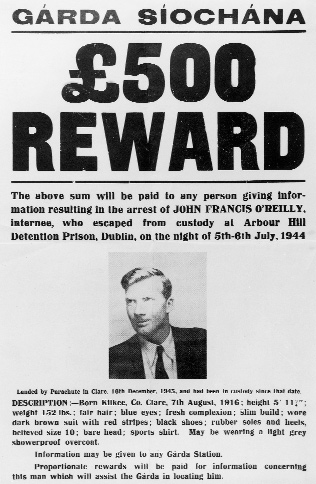
One of the features in the picture is George’s Head, the 100-foot cliff rising up from the bay on the right. It was off George’s Head that John Francis O’Reilly claimed to have ditched the wireless set provided by his German handlers of the Sicherheitsdienst (a/k/a/ “SD”) before turning himself in to the gardaí on the night of 16 December 1943. O’Reilly parachuted (out of a Heinkel He 111 or a Junkers JU-88 bomber) into Ireland a short distance from his parent’s home in Kilkee around 2 am and presented himself to the authorities later that evening after he learned the authorities were making inquiries. His radio transmitter and £143 of the £300 the SD handed him were recovered in the yard of his parent’s house. (See Terence O’Reilly’s book Hitler’s Irishmen and Anthony Kinsella’s article John Francis O’Reilly: The “Flighty Boy”).
Prior to his insertion as a German spy, O’Reilly read bulletins, poetry and other content on the Nazi’s Irland-Redacktion radio service aimed at spreading pro-German and anti-British propaganda to Irish audiences. Given his quick arrest and subsequent military prison sentence, O’Reilly did not feed the Germans information on US and British army and navy activity in Northern Ireland as originally instructed. As for the Richard Harris statute, Harris won the Tivoli Cup for Racquets in Kilkee four years in a row (1948-51).
Another has a personal connection to the view:
I’ve tried in vain to find the location, but haven’t been successful. The frustrating bit is the Royal National Lifeboat Institution (RNLI) lifeguard station in the picture – I thought that would help.
As an aside, I live in NYC and I am married to a Londoner. A few months before I met my (now) wife, her mother passed away. That I didn’t get the chance to meet my wife’s mother is my great loss – by every account she was an amazing and loving person and inspired all who knew her. She was also a supporter of good works, including the RNLI. And as a tribute to this amazing woman, I make a donation to the RNLI in her memory every year on the anniversary of her death.
This Irish Dishhead is very familiar with the area:
Total time to recognise this location: 0.05 seconds. But that’s hardly surprising as I’m from County Limerick, Ireland and most people from Limerick would be able to recognise Kilkee in less than a second. Kilkee, for most Limerick folk, is like a second home. During the summer months, Kilkee becomes Little Limerick for there is scarcely a family from Limerick that doesn’t have a relative who doesn’t own or rent a mobile home (caravan or trailer) or holiday home in Kilkee where they spend the majority of their summer holidays.
Personally, I’ve been going to Kilkee since before I can remember. When I was a kid, my parents used to rent a holiday home on the West End (the exact area isn’t actually captured n the photo but the white walls on the beech in the photo is an area where people play a hybrid of tennis/squash and our holiday home was just off the Dunlicky Road just behind that. It’s common for most Limerick people to leave work on a Friday evening and wish everyone well and tell them that you’ll see them on Monday, take the 70 minute trip down to Kilkee, get a bite to eat and head of to The Greyhound Bar or Fitzpatricks Pub or Scotts Bar (or any other Kilkee pub) and wind up having a drink with half of the people they’ve just wished a good weekend to at work.
The Dunlicky Road is very well known in Kilkee and is one of the famous walking routes in the area. The walk takes you up the Dunlicky Road over towards Intrinsic Bay (not too far away from the Diving Boards) and finally over to the Pollack Holes. It’s considered one of the best natural cures for a hangover. The Pollack Holes are natural holes that have formed in the rocks that are covered by the Atlantic during high and for six months of the year, are a breeding ground for Atlantic Pollack, but during the summer months, when the tide is out, they are one of the most populated swimming spots in Kilkee. But they’re bloody freezing at the best of times! If anyone from the Dish ever decides to visit the area, I have one recommendation: bring a wetsuit! I Googled the Pollack Holes just to see what I’d get back and came across this photo of a brave man who evidently had no fear of the cold … Christ only knows how he survived.
Springsteen played a gig in Limerick last year in Thomond Park (home to the Munster Rugby Team – “G’Wan Munster!”). During his stay in Ireland, The Boss took a trip down to
Kilkee and stopped in Scotts Bar on the Main Street (properly known as O’Curry Street) in Kilkee and the photo went viral on Facebook and twitter for all Limerick people who were raging that they missed the opportunity to get locked (drunk) with The Boss in one of Kilkee’s better watering holes (another tip for anyone planning on visiting Kilkee – avoid Miles Creeks pub – kind of a rough crowd.)
The window I found is different from the one in Google Maps, but that could be as a result of damage caused by a storm on February 12th of this year (subsequently nicknamed “Wild Wednesday”) that battered Kilkee and other locations on Ireland West Coast including Limerick City. The main bandstand in Kilkee was practically destroyed and quite a bit of damage was done to the promenade on Kilkee beach, but the local town council did a fantastic job of cleaning the area up and repairing the damage in time for the annual summer pilgrimage of Limerick residents to the area. I’m therefore assuming that the new looking wall and window were recently installed.
Another reader has a look at the damage from the storm:

More on the town from one of several contestants who’s been there::
Kilkee is a Victorian seaside resort in Co.Clare in the west of Ireland that was hugely popular with Irish families in the sixties and seventies before cheap flights to Spain and Portugal took them to more reliable sunshine. The small round white building is the lifeguards’ hut on the Strand Line promenade. The absence of a small flag from the roof indicates that they’re not in residence today, or not yet anyway. The shadows show the picture was taken in the morning. The hut is one of three round shelters that were originally built to cover fleeing beachgoers from the always imminent rain. The Strand Line seawall dates from Kilkee’s Victorian heyday, when Kilkee was popular with English visitors. Charlotte Bronte visited on her honeymoon in 1854. The seawall wraps around a magnificent horseshoe-shaped beach:
Sponsored Content: The Irish Tourist Board has asked me to point out that the Kilkee/Loop Head area has some truly stunning Atlantic seascapes, less well known than the Cliffs of Moher in the same county, but not as tourist-infested:
Kilkee is also a major centre for safe and spectacular scuba diving. And here’s Kilkee’s beach on a recent summer’s day, just as I remember it in the ’70s. Note the cloud shadow:
Speaking of shadows, Chini admits that even he suffers from routine bouts of contest terror:
After this much time and experience, you’d think it would go away; that terrifying feeling every time a new one pops up. That a sort of confidence would have developed. But no, it’s always the same. The mad desire to look around, that growing, gnawing sense of imminent failure, and the voice in the back of the head whispering “…you may never get this one.” Then, from nowhere, a sudden insight and a realization that there was nothing to worry about at all:
This week’s winner is a four-year-veteran who hails from our esteemed list of players who have guessed difficult contests in the past but never won:
This view shows us a day at the beach in Kilkee, a resort town in County Clare, Ireland. The double yellow lines next to the curb suggested we were somewhere in the British Isles. My gut told me this was probably a seaside town in Ireland, but I ignored my gut and went on an extended detour through the beaches of the United Kingdom. Bad call.
When that didn’t work, I went down a list of beaches in Ireland and found the beach in Kilkee. The view was taken from a one-story home on the Strand Line, a scenic street that runs parallel to the beach.
Kilkee has a number of claims to fame, one of which is that the actor Richard Harris used to summer there. The town honored him with a statue of him playing squash, which was unveiled by Harris’ family and Russell Crowe. Also, the sea wall in the background used to host (improbably) a 20-foot mural with the iconic image of Che Guevara, which would’ve been just out of view to the left had it not been painted over last year. Guevara spent a night in Kilkee and was recognized there by the artist Jim Fitzpatrick, who went on to create the famous image. The mural was painted over after it upset some Americans who saw it and apparently left town in protest. It’s fair to say that either the statue or the now-departed mural would’ve made memorable clues.
Congrats on a long-deserved victory. For everyone else, get ready for the next view Saturday!


Steve DyerI think I like this Freddie guy? I feel like he is challenging in a constructive way and maybe I should start reading him, I dunno. He guest blogged for sully for a week during vacation and I remember laughing at stuff he wrote.

“Argument is like all other human behaviors: subject to conditioning through reward and punishment. And we’ve created these incentives on the left: always politicize; always escalate; always ridicule. We’re living with the consequences of those tendencies now. Unfortunately, I don’t know how we build a new left discourse, given that the two current modes of left-wing expression appear to be a) showily condescending ridicule and b) utter fury.
I mean you can guess what the response by some will be to this essay: deBoer doesn’t think racism is real, he doesn’t think sexism is real, he wants people to just get over it when they’re the victims of sexism and racism. None of that is true. I write about the structural racism of our society constantly. I believe that we’re still a deeply, inherently sexist culture. (For example, you may have heard of #GamerGate.) And I absolutely believe that there are tons of daily encounters that demonstrate these problems, and that the victims of them should feel comfortable speaking out.
I just also think that we have to be able to say “you know, I don’t think that your particular political critique here is correct” without being accused of failing to oppose racism and sexism in general,” – Freddie DeBoer.
(Illustration: a visualization of the Twitterverse on Gamergate over 72 hours via Andy Baio, with the help of Gilad Lotan, chief data scientist at Betaworks. Look at the polarization. The data also found many many more misogynist tweets than those about ethics in gamer journalism.)


Steve DyerGuys, if you are my friend, you need to stay ahead of trends, so read this trendpiece
We need water. And maybe somebody's daughter. — The Who, "Water"
Recently, in a story about brands and hashtags, the New York Times defined a word.
The effort to co-opt cool can backfire, Mr. Roan said. When someone is "watching a topic that's trending and then whips up some contrived way to get their voice in that conversation, it's very predatory and a super-false way to speak," he said. Or worse: "It reeks of thirst," he said. (We looked it up, and "thirst," in this case, means "desperate.")
This definition may or may not come from UrbanDictionary.com, where the top entry for the word 'thirsty' is dated to 2003 and contains two definitions. The first is, "Too eager to get something (especially play)"; the second, merely "desperate." Ten years later, another user defined thirsty as "The need to gain fame and admiration through social media," specifically "by posting 'selfie' pictures to boost the self esteem."
Now, not to universalize anyone's experience, but one of the things about having a living human body is that there are certain functions with which we are all necessarily familiar—one of those is the physical imperative to imbibe water. If we don't have water, we die. To one degree or another, everyone is familiar with this bodily phenomenon, which, as far as shared language is concerned, makes for a powerful, experiential reference point.
In this sense, to be "thirsty" is a natural state of being; to describe someone in this context as "thirsty" is not a value-judgement—or it is, but only in so far as the state of being "thirsty" is reflective of the bodily state of being dehydrated. But calling someone "dehydrated" doesn't roll off the tongue in quite the same way as calling someone "thirsty." "'Thirst' sounds gross as a word," one friend told me. "It slithers around in your mouth."
Like many colloquialisms, however, the word's meaning has changed both over time and depending upon whose mouth it is slithering around in. On the hook to "Ching-A-Ling," the lead single to the Step Up 2: The Streets soundtrack released in January 2008, Missy Elliot sings, "Thirsty, baby, bring it over here / See my money maker, do my money maker." An episode of This American Life from that same month, "Matchmakers," included a story about an Afghan man's infatuation. "The young boy get a little bit thirsty, especially in Afghanistan," a friend of the story's subject told the segment producer. "When you drink some things more and more, you are not thirsty." In May of this year, Mariah Carey released her own "Thirsty," on which she sings, "You used to be Mister-all-about-we / Now you're just thirsty for celebrity." The first two examples are evocative of the desire for sexual attention, while Carey echoes the more recent Urban Dictionary definition's gesture towards the influence of social media on the word's meaning when she goes on to sing, "So you stunting on your Instagram / But that shit ain't everything."

In the cycle of appropriation to which African-American Vernacular English is particularly subject, there comes a point at which a certain kind of person begins to fixate on the fixation of meaning: over the past six months, for example, writers for New York magazine's The Cut, Jezebel, and BuzzFeed have volleyed back and forth over the meaning of "basic," culminating in Kara Brown's proclamation that overanalyzing the word "basic" is itself the most basic thing of all. "It's really not that deep," Brown wrote. And yet! Can we really deny that in the decontextualized, dehistoricized desert of social media, words lose their original shape and take on new ones? As a word is passed around this landscape, back and forth across the Internet, it seems worth considering the relationship between the different meanings it accrues.
In my experience, calling someone "thirsty" either in public or behind their back seems to happen most often when a man says something inappropriate to a woman on the Internet. "To be 'thirsty' is to be needy of someone's attention without realizing it," my friend Kevin told me. "It's not necessarily romantic attention, but when it is, 'thirsty' is really just a euphemism for being horny and lacking any self-awareness about it." Kevin says he isn't thirsty, but knows it when he sees it.
The idea of "thirst" seems to me not altogether unrelated to certain put-downs of my youth: God help you if people thought you were a "poser," for example, or a "follower," or a "try-hard." There were nuances, even then, that differentiated the meaning and use of these words, but what unified them all is that the connotation of desperation to be acknowledged, included, and validated. In a word: to be cool. Even now, the artifacts of cool may change, but the artifice remains, and what will always be the least cool of all will be to be caught in the construction of the artifice. What sets "thirst" apart from these earlier ideas, however, is that while the "poser" was just wearing cargo shorts because everyone else was wearing cargo shorts—and even the most precocious sixth grader can hardly be expected to develop a coherent and thoughtful personal style—a grown adult who is "thirsty" is someone who ought to know better, but doesn't. It is a personal failing of another order entirely.
"I think 'thirst' is generally pretty gendered. And for those of us (women) that deal with casual harassment on a daily basis, it's less of a cute concept to embrace," my friend Nicole told me over Gchat. Kevin speculated that "pointing out a man's 'thirst' is a gentler way of telling him that he is acting inappropriately." My friend Jessie told me, "Women are very sensitive to thirst. If a woman calls you thirsty, you are being thirsty." For this reason, the epithet can be quite scalding when used sincerely. "I would not call someone thirsty if they were not being thirsty," wrote Casey, another friend. "I've called you thirsty in a joking way and you got mad." It's true, I did.
What is the relationship, then, between thirsty men harassing women on Twitter—or anywhere, really, but especially on Twitter—and thirsty brands harassing consumers, as mentioned in that New York Times piece? Most Twitter users are probably familiar with the experience of mentioning a product on Twitter only to have the Twitter account belonging to that product's producer butt into the conversation. It might be useful for a certain kind of man to remember that feeling he gets—some combination of annoyance, surprise, and disgust—when an uninvited brand interrupts a conversation or canoe. Is it possible, he might ask himself, that I—not a brand, but a man—have behaved in such a way to provoke similar feelings in the people to whose conversation I felt compelled to contribute? Maybe. Maybe not! Social cues can be hard to read, especially on the Internet. We've all been there.
"Thirst is different than hunger," another friend wrote. (The body, it turns out, is a rich source of figurative language.) "Hunger is a long-term desire for something that is definitely personal but doesn't require another person to be on the other end of it." My friend Caroline reassured me, "It's always good to be excited or eager about something. Being passionate shouldn't mean you're desperate, but sometimes wires get crossed. I think holding in thirst to please other people and to be 'cool' is the thirstiest thing one can do."
I wondered about this. Is it thirsty to contact editors, asking to meet for coffee? Is it thirsty to fave their tweets? By definition, if I were thirsty—in this way, or otherwise—I wouldn't even know it. More to the point: is it thirsty to ask friends and acquaintances for quotes… for an article about "thirst?" Is this whole piece thirsty?? Maybe! "If a person is being thirsty in order to further his or her career (e.g. an email to friends asking for quotes about what it means to be thirsty), it's rude to call that person 'thirsty' to his/her face," my friend Abe wrote. "Which is what I did, and I feel bad for it now." ("This email has created a metatextual irony loop so powerful it rivals the Large Hadron Collider," he also wrote.)
| ̄ ̄ ̄ ̄ ̄ ̄  ̄ ̄  ̄ ̄ ̄|
| i'm so fucking
| thirsty |
|________ _ __|
(\__/) ||
(•ㅅ•) ||
/ づ"
— Sin Subadere (@hadakasinpie) July 7, 2014
Again, this feels like the most basic definition of the word used as slang. But slang, almost by definition, is where language is at its most fluid and dynamic—on the periphery, outside of codified, official meaning. Indeed this is its cachet, and it plays a large part in why so many kids spend so much time studiously adopting—appropriating—mannerisms and phrasing that originate from well outside their immediate surroundings. And it is why the re-appropriation of certain words, in turn, is such a radical rhetorical strategy. Indeed, it seems to me that this is what is happening with the idea of the "thirst trap"—shorthand, in its way, for a woman (or Idris Elba) owning her (or his) sexuality and deploying it when, where, and how she sees fit.
All of which is to say: every once in a while, people seem to stumble into a word that can be used to describe a kind of experience that they were less able to describe before—and that, perhaps, is not such a bad thing.
I've heard it recommended that one drink at least half as many ounces of water in a day as one weighs in pounds. I'm not sure of the scientific authority behind this benchmark, but I tend follow it anyway. I've also heard that you're not supposed to give someone who is literally dying of thirst too much water at once, because it will literally make their cells explode. Maybe that's an Uber Fact. Anyway! It behooves me to drink—by the mysterious metric mentioned above—at least 85 ounces or so of water every day. (I hover around 173 lbs.) I hit this goal regularly, filling and emptying my 32-ounce Nalgene water bottle at least three times a day. The initial act of filling my water bottle requires thought, and action, but the drinking of the water has become an almost thoughtless action. I also drink a lot of coffee. What I'm saying is that I pee a lot. It's fine. But also: you don't have to be thirsty to drink. And in fact, if you drink enough water, you needn't ever be thirsty in the first place.

Brendan O'Connor is a reporter who lives off of the L train.
1 CommentsThe post A Modern History of Thirst appeared first on The Awl.
Steve Dyerreminder
because of this
shia labeouf is ortberg status
immune to all criticism