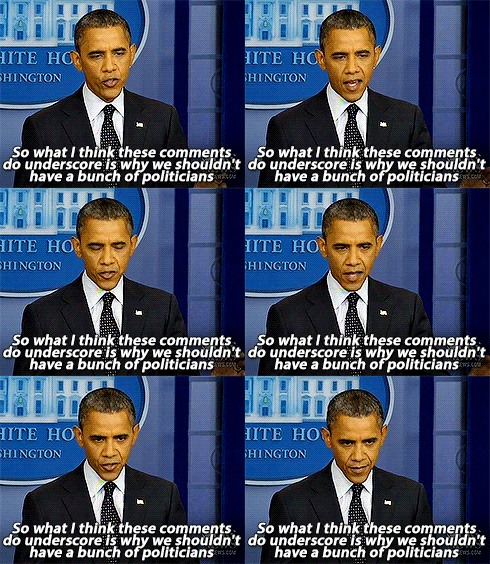
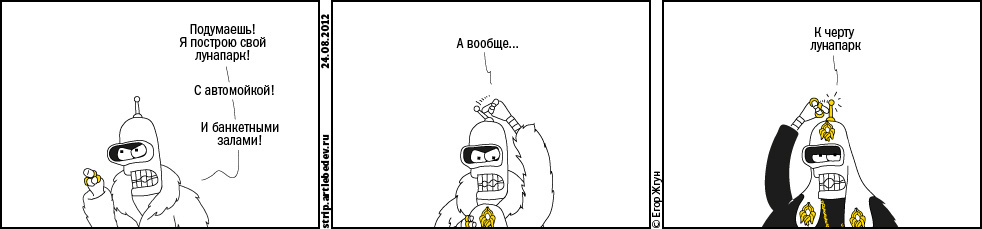
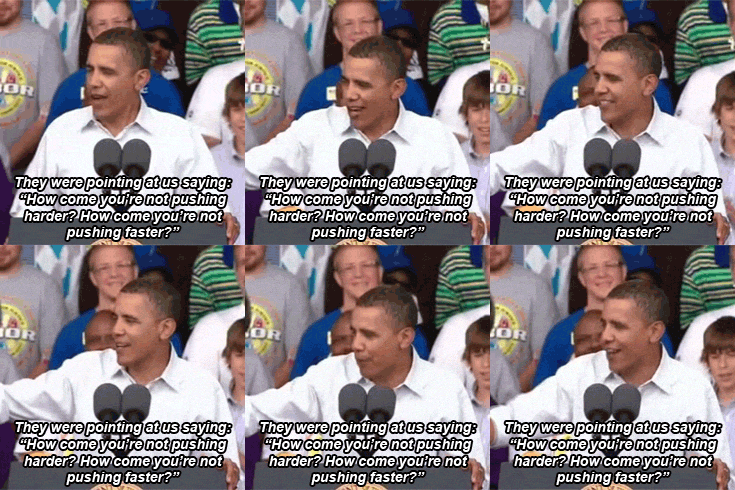
Vic.trofimovвот когда с этими дизайнерами и программистами случится что-то плохое, они ведь обязательно спросят: "за что?". вот за вот это вот.


Vic.trofimovкакой же он охуенный
Expert, Airtight Political Punditry by Dan Harmon
I don’t think Mitt Romney actually wants to be president. Not being, myself, a politically clued-in guy, I base this mostly on body language and tone of voice in these fun video clips that get posted by the other side. I see him getting pouty and snippy, acting the way I’ve felt so many times when nobody appreciated all my fancy gifted specialness and I wanted to go home and do bong hits and wait for the world to miss me. Like a nine year old being told he has to choose between second dessert and the zoo.
I saw this youtube clip of Romney speaking to his reporters (I call them “his” because I assume they’re reporters he’s carting around, as opposed to actual journalists, all of whom died in some consequently unreported plane crash in the seventies) I don’t know where he’s standing but it looks like the back of a Staples. It literally says “ballpoint pens” on a wall behind his head, as if his handlers are attempting a message about utility over appeal, like this candidate is a well-needed if weirdly-smelling eraser or bottle of white-out. He offers up a relatively meaningless, certainly familiar, dare I say traditional squirt of political diarrhea that all of his kind squirt three times a term, something about not being in anyone’s pocket, specifying that his campaign “isn’t run by lobbyists.”
Then you hear an exasperated, high pitched voice from off camera say, “come on, that’s not true, Governor.” It’s one of the Romney Reporters, some poor blogoblob that’s been given access to a politician in exchange for releasing press releases, and apparently, in a sadder, day-late-dollar-short version of Network, he’s mildly irritated as hell and can pretty much take it forever but doesn’t feel like it anymore. This reporter wants to hold Romney’s semantic pinky toe to a low flame on this issue, he demands clarification, isn’t so-and-so on his campaign and isn’t he part of this or that, etc.
He has one job, this reporter: to redirect diarrhea from the conveyor to the pallet and now he’s up and gone all Lucy on us. Now he’s looking at the camera going “waaaaaah.” Maybe it’s mental and spiritual exhaustion brought on by the anti-yoga of pretending Romney is human within pretending Romney has a shot within pretending elections matter. Maybe he figures he has a better shot at a bigger apartment if he gets a mention on The Daily Show, or, maybe, if you’re cynical enough, he’s been promised a seat on Obama’s plane by a buddy from college. Whatever his motive, he’s too young to have seen anything with Robert Redford in it, so he does what he thinks Amy Adams might do in a movie about famous reporting, which basically amounts to heckling. It’s as close to a nervous breakdown as someone that’s allowed to be close to a politician is allowed to have. It’s as close to holding a rich dick accountable as the poor are allowed to do without jail time. But it’s nothing terribly egregious or outrageous. If it feels that way, it’s because it never happens, a fact which is a lot fucking weirder than a chubby guy getting irritated while sitting cross legged on the floor of what I really feel is a Staples.
What’s weird is Romney’s reaction. Or maybe it’s not weird at all, maybe it’s uncomfortable how normal it is, having watched clips of this guy for six months acting like a puppet on a Canadian kids’ show about the metric system. The second he hears someone accuse him of lying, Romney lowers himself to the reporter’s status and just boldly whines right back at him. They instantly become a couple bickering in a grocery aisle. Lots of “can I finish” and “is that what I said, Eric? Did I say that?” kind of stuff. We’ve all been there. Perfectly relatable and therefore forgivable on both sides.
Until you remember, with embarrassment and horror, that this guy that sounds like he’s being given a hard time by his girlfriend about Grape Nuts after a long day at work is, in reality, a billionaire being given a not-so-hard time by a subordinate pseudo-reporter about a run-of-the-mill lie he’s telling while running for Motherfucking President of the God Damn United Fucking Nuclear Armed Fucking States. He’s running for Abraham fucking Lincoln’s job. He wants us to pay him to oversee the fucking planet and he’s breaking a sweat going toe to toe with a kid that I’m pretty sure interviewed me at Comic-Con.
I am a very bad person. I get bitchy. I snip and snap and bully when Erin wants to go look at a famous mansion and I want to go to a dinosaur museum, or when I want more pizza than she ordered, or when I want to watch Clive Owen in Time Exploder and she wants to watch Jason Siegel in Funny Wedding. I turn into a whiny, selfish, defensive cock. If you saw how I talk to my partner when I’m not getting what I want, you wouldn’t want me to be your friend, let alone your partner.
But here’s two really important things about me: I don’t do it in public and I DON’T WANT TO BE FUCKING PRESIDENT. And if Romney says he does, he’s either lying or he’s an even more twisted mind than all my politically invested friends would have me believe. Because I know a person that knows they’re bad for a job when I see one talking, and he is one. And darn-tootin’ he can hear himself, and knows a shitty, dangerous employee when he hears one talking. So if he truly “wants” to be President, knowing what he knows about himself, then he “wants” America to suffer. And that would KIND OF MAKE HIM A TERRORIST, an accusation which I’m proud to take incredibly lightly as an American.
But honestly, I don’t think that’s the case. I don’t think Romney hates America. I just think he’s lying when he says he wants to run it at this point. If you think about it, what’s the single biggest crime a candidate in his position could commit in the eyes of the most powerful organizations? Embezzlement? Murder? Rape? EAh, those are pretty big crimes, and some entities would be very disappointed in him, but they’d also be boons to other entities, especially the media. Think about the one thing he could do that would piss off an unparalleled number of entities equally and simultaneously, to the point where he’d be ruined forever. I submit that he’s not allowed to say: “Folks, it seems very unlikely I’m going to win, and I have to say, I don’t think I fully want to win, because I am learning that it’s hard to even ask for the job without getting very irritated and told I’m fucking up a lot, so it seems like a huge waste of a lot of people’s money and the President’s time to follow through on this, and we’ve got a deeply troubled nation to get out of a real bind together, so I suggest we skip the remainder of the circus and I concede.”
Think about the uncountable trillions of dollars he’d be flushing down our collective toilet if he just gave up. CNN alone would have him killed, purely out of revenge for stealing their Olympics. Let alone every sponsor committing to the coverage, let alone the lobbyists that are or aren’t running his campaign but are certainly invested in it. Let alone his own political party, which could have chosen ANYONE but trusted HIM to keep lying, let alone the theoretically opposing political party banking on his straw to stay dog-shaped, let alone, most importantly of all, the bilaterally symmetrical, single entity called the bipartisan system. And believe me, it is a single entity in every way that matters. Ask the League of Women Voters, a nonpartisan organization that stopped moderating the debates in 1988 lest they become “an accessory to the hoodwinking of the American public.” Hoodwinking, you say, ladies? By whom? Well, in their words: “The TWO campaign organizations [that] would perpetrate a fraud on the American voter.”
Yeah, they sure would. And when the LWV left, they sure did. And do. Together. In tandem. And we have a word we use for two things doing the same thing in the same place at the same time. We call it “one thing.” No matter how much it calls itself two. Daddy’s the one that hit you, kids, he’s not a different guy when he’s sober.
And it’s that thing, which is a big blob of things made up of things, and only made of people on its lowest level, that would sooner destroy a human being than be momentarily inconvenienced. It’s this thing, made up of all of us, representing none of us, that has this poor rich dumbass by the balls, now. This all too human, snippy little billionaire throwing bitch fits at fake reporters on his own junkets. It seems clear to me that he wants out now, all too late, and isn’t allowed out. He has to finish playing his little role while offending the least amount of the Thing he can, because if he screws up badly enough, he can walk away from this Thing with a lot less than he had when he arrived.
The irony is, as every four years, the loser is closest to the lever that could bring it all down. He could sacrifice himself, say what he’s feeling, create history, change things for people… if not people for things. He could just continue his surrender to humanity, a few steps past frustration, all the way to honesty. He wouldn’t get elected but we’d remember his weird name a lot longer than we’re going to.
The non-irony is, he’s only been allowed this far because he’s vetted. Much like the fake reporter that irked him, he’s not capable of doing much damage or he wouldn’t be in a position to do it. It’s not in a fiber of any politician’s being to lead, only to preen or squirm depending on approval. Just like it’s not in the fiber of this Thing called “The People” to coordinate, to demand, to take ownership of the country it created and stop pitting clowns against dipshits in an American Idol contest so we can tell ourselves we did something literally by pulling a lever. Each of us has it in EVERY fiber. Because each of us is human, and American. But united, we blow it, because then it’s not our fault anymore. United, we are that thing we can’t see, with its hand up Romney and Obama’s asses, making them talk nonsense to each other.
That was self indulgent and cynical. Well, fuck you, it’s a blog. Your refund’s in your mom’s butt, I’ll get it for you Friday night.

And now we have come full circle.
Christ
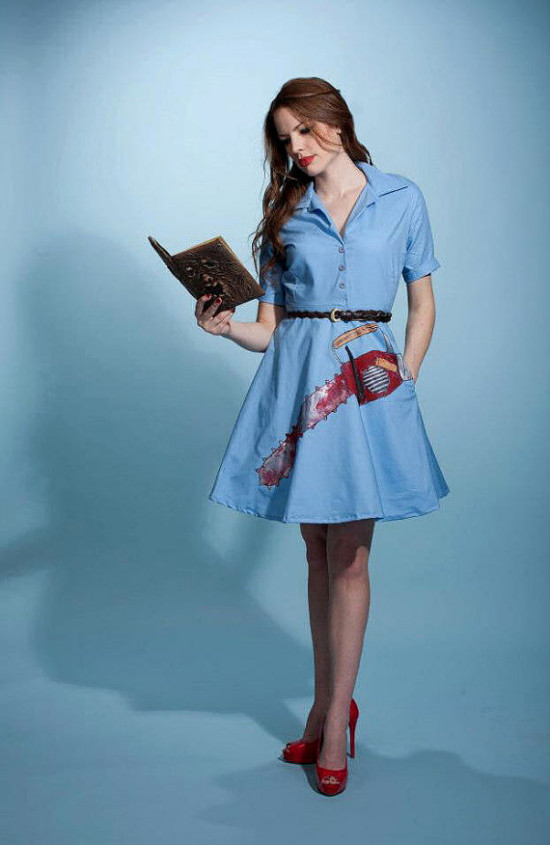
Each dress features a hand painted bloody chainsaw on the skirt, with a pocket placed just beneath it. Once your hand is in that pocket- INSTANT CHAINSAW HAND!
The Ash Dress is available for sale at Crissy Baker‘s Etsy shop.







Vic.trofimovYou simply go out and shut the door
without thinking. And when you look back
at what you’ve done
it’s too late. If this sounds
like the story of a life, okay.
It was raining. The neighbors who had
a key were away. I tried and tried
the lower windows. Stared
inside the sofa, plants, the table
and chairs, the stereo set-up.
My coffee cup and ashtrays waited for me
on the glass-topped table, and my heart
went out to them. I said, Hello, friends,
or something like that. After all,
this wasn’t so bad.
Worse things had happened. This
was even a little funny. I found the ladder.
Took that and leaned it against the house.
Then climbed in the rain to the deck,
swung myself over the railing
and tried the door. Which was locked,
of course. But I looked in just the same
at my desk, some papers, and my chair.
This was the window on the other side
of the desk where I’d raise my eyes
and stare out when I sat at that desk.
This is not like downstairs, I thought.
This is something else.
And it was something to look in like that, unseen,
from the deck. To be there, inside, and not be there.
I don’t even think I can talk about it.
I brought my face close to the glass
and imagined myself inside,
sitting at the desk. Looking up
from my work now and again.
Thinking about some other place
and some other time.
The people I had loved then.
I stood there for a minute in the rain.
Considering myself to be the luckiest of men.
Even though a wave of grief passed through me.
Even though I felt violently ashamed
of the injury I’d done back then.
I bashed that beautiful window.
And stepped back in.
Vic.trofimovхаляль?
схуяль?

Текст:
Патриарх Московский и всея Руси Кирилл посетил Никольский кафедральный собор в городе Белосток — главный храм епархии. Здесь он поклонился святым мощам мученика младенца Гавриила и встретился с прихожанами. Получить благословение предстоятеля Русской Православной Церкви собрались несколько сот верующих.
Приветствуя собравшихся, патриарх призвал “хранить свою веру и чувство любви к своей Церкви”, передает ИТАР-ТАСС. “Пускай укрепляется наша духовная жизнь и великие традиции”, — сказал он.
Никольский кафедральный собор Белостока был освящен в 1846 году. После реставрации в 1910 году он был оформлен по мотивам росписей Василия Васнецова. С 1951 года храм стал кафедральным собором Белостокской епархии Польской Православной Церкви. В 1991 году Никольский собор посещал папа римский Иоанн Павел Второй.
Святой младенец Гавриил родился в 1684 году в семье крестьянина в Белостокском уезде Гродненской губернии. В 1690 году Гавриил был выкраден из дома иудеем и вывезен в Белосток, где был зверски замучен. В 1720 года тело младенца Гавриила было найдено нетленным. В 1820 году мученик младенец Гавриил был причислен к лику святых Русской Православной Церковью. (источник)
Ну то есть вот так. Великие традиции духовной жизни и всё такое.
Vic.trofimovПрилепин ебнулся
Vic.trofimov" Moreover, the participation of multinational elites and large-scale capital flows in the political process means that individual electorates are always pitted against forces much larger than they are, as the Eurozone crisis most recently has shown." - какой русский не любит сложноподчиненые предложения
by Greg Afinogenov

Image: Image courtesy of whatwouldjackdo.net.
It is a commonplace, at least in the West, that the current regime in Russia is authoritarian, if not totalitarian. A line can be drawn—with caveats about scale and severity—from Putin straight back to Stalin, while others can be drawn sideways from Putin to the dictators he has befriended and supported: Assad, Qaddafi, Chavez, and Saddam Hussein. (If nothing else, Putin seems to have an oddly consistent and unlucky way of choosing his friends.) The recent protests against him only confirm the neatness of this symmetry.
We think we know what authoritarianism is and why it survives, but our notions about it have not changed much since the 18th century, when Montesquieu contrasted the capricious rule of a despot, who holds power through fear, with the bounded governance of a monarch, held in check by law. In our political language, monarchy has evolved into democracy, but despotism remains despotism (or authoritarianism). In comparison to monarchies and democracies, each in their own time, despotism has always seemed archaic. The gleaming military uniforms, Tolkienesque titles, and Orientalized imperial paraphernalia of modern dictators like Idi Amin, Pinochet, and Qaddafi evoke the 19th century; leaders who are truly modern are supposed to wear self-effacing suits.
If authoritarianism is a relic of a pre-democratic age, Putinism, like the late regime of Putin’s friend Silvio Berlusconi, is not authoritarian. Regimes that see themselves as successors to democracy are not rare—fascists and communists were equally convinced that liberal democracy belonged in the dustbin of history. The difference is that Putinism is partly right in seeing itself as post-democratic, which is why the problems it poses are so vexing. It represents one answer to a set of contradictions that exist not just in Russian democracy but also in contemporary democracy in general.
These contradictions are well known in the United States and Western Europe, on the right as well as on the left. One of them is that while democratic discourse constantly represents the electoral process as a canvassing of the will of the people, in reality political and media institutions police the field of acceptable alternatives so strictly that the choices that can be made are rudimentary at best. Moreover, the participation of multinational elites and large-scale capital flows in the political process means that individual electorates are always pitted against forces much larger than they are, as the Eurozone crisis most recently has shown. The old American conservative fear of international institutions like the United Nations reflects a similar worry. The premise of 19th-century liberal democracy, which envisioned national communities as largely self-enclosed and politics as localized debates on the common good, becomes less tenable with each passing year.
Democracy arrived in Russia with many of these contradictions already exposed. It had long been a staple of Soviet propaganda that American democracy was a mockery controlled by finance-capital puppet masters and served by a craven media, whose business it was to play down racial, economic, and gender inequalities. Soviet ideologists, like Soviet citizens more generally, knew little about real life in the West, but they closely followed the struggles of Western leftists who were making similar arguments. Ordinary Soviet people were not usually skeptical of such claims: to believe in the decrepitude of the Soviet system or the wonders of the free market, as many did, did not demand allegiance to American-style politics. Up until the last months of the Soviet Union’s existence, most reformers (and supporters of reform) thought they were building a social democracy that abolished the unfree aspects of the Soviet system, not buckling to global capital.
The catastrophic 1990s—which Putin, for whom they are an ideological keystone, famously labeled “the greatest geopolitical catastrophe of the 20th century”—put paid to this dream. For a long time the Soviet state had nurtured close-knit networks of local elites in its many different regional units, from Union republics to autonomous ethnic enclaves. After the collapse, these became powerful engines of decentralization: not only did they form the governments of the post-Soviet states, they also retained control in Russia of their own regions and even their own industries. Unchecked by any functional central authority (the government itself effectively being a Moscow-based clique), state and “private” interests coalesced into corrupt and unaccountable oligarchies that fought pitched battles in Moscow’s streets. Runaway inflation and fraud destroyed the savings of ordinary citizens, while a series of poor harvests, beginning in the late 1980s, created chronic food shortages. Assassinations of political and business leaders became routine, so that a political class governed by anything other than fear and greed never even had a chance to form.
It would be unfair to blame the abandonment of social-democratic dreams on the forces of global capital itself, but it is hard to deny that they took full advantage of the ensuing crisis. Neoliberal economists nurtured by the World Bank and International Monetary Fund arrived in Moscow in droves, promoting an agenda that the ruling clique adopted wholesale, quickly foreclosing any possible alternatives for the post-Soviet future. Given the weakness of the state and the impotence of public institutions, it was hard to imagine other outcomes after 1991; the “shock therapy” treatment supposedly ushered in by Yeltsin’s economic team was largely a contentless label for a state of chaos the central authorities were unable to do anything about anyway. Still, the involvement of the IMF and other Western financiers was significant for two reasons. First, they provided massive loans that were used to support a colossal and unsustainable system of government bonds that enriched the new oligarchy and then were made to disappear by the 1998 default, leading to an economic collapse that fell hardest on ordinary Russians. This was a wholly undeserved injection of funds that only expanded the gulf between the new rulers and the people they so obviously failed to govern. Second, these loans were contingent on lip service being paid to the Western economists and advisors who appeared like toadstools after the rain. Their influence was a constant, humiliating reminder that the Russians were not masters of their domain, creating resentment Putin capitalized on in the early years of the 21st century.
+ + +Although the Western advisors presented themselves as apostles of liberal democracy and civil society, their guiding role in economic policy helped ensure that Russian democracy would be hollow from the very beginning. In order to push through even nominal liberalization reforms, Yeltsin and his clique needed to thoroughly rig the political process.
Two simultaneous crises made this feat of engineering both possible and necessary. The first was the need to keep at least a shred of control over the division of state-owned assets and somehow hold back the complete collapse of the economy. The second was that the first Russian parliament had no interest in the politics that were expected of it. Its unwillingness to cede power to President Yeltsin in 1992 and ’93 led to a constitutional crisis that culminated in the Duma being shelled into submission by army tanks. The parliamentary constitution of the early post-Soviet years was replaced by a presidential one. Even at its height, Yeltsin’s support in the Duma fell far short of a majority; the dominant players either had no coherent political vision at all (like the Liberal Democratic Party, a mouthpiece for inchoate nationalist populism that continues to control a large number of seats) or were structurally marginal (like the Communists). By the mid-’90s, the Russian political system had taken the shape that made Putinism possible. Yeltsin, with a hand-picked cadre of oligarchs and foreign economic advisors, made the real decisions, while a squabbling and impotent gaggle of parliamentarians filled the airwaves with noise that resembled the discourse of a real democracy.
The appearance of democracy was held up by an explosively growing media, largely controlled by the same oligarchs who were running the country. Western commentators frequently cite this period of ferment as a triumph for liberalism and rights in Russia, but they neglect to mention that the media’s ability to catalyze bottom-up change was as circumscribed then as it is now. In short, Russian democracy became a caricature of the caricature once drawn by Soviet propagandists: it was a pseudo-politics serving only to conceal the controlling hand of moneyed interests. Unlike in Western democracies, however, in Russia everyone was aware of the deception. Yeltsin’s erratic behavior, incompetence, and alcoholism could not have been concealed by the shrewdest public relations team, yet it was clear that no other politician or bloc could exert any sort of countervailing force.
One of the most influential and representative texts of the period, which last year was made into a star-studded blockbuster movie, was Viktor Pelevin’s novel Generation ‘P’ (1999), set in Moscow during the Yeltsin era. At its climax, the protagonist Tatarsky, an advertising copywriter, is invited into the basement of the mysterious Apiculture Institute. There he discovers a room full of SGI workstations busily engaged in the business of Russian democracy. The politicians, he learns, are digital models that exist only on television, and the news programs on which they appear are edited according to the whims of corporate sponsors. The entire political system, including Yeltsin himself, is the creation of a figure whom Pelevin clearly intends to represent the media-capitalist unconscious. Political participation, needless to say, is revealed to be senseless.
Pelevin’s satire of post-Soviet Russia spoke most directly to intellectuals, who felt increasingly adrift in a world that appeared incomprehensible and even absurd. (The Tatarsky character is a university graduate with a degree in “translation from the national languages of the USSR.”) But Pelevin’s sentiments were also shared more broadly, by a population that had become even more cynical than it was under the Soviet system in the 1980s. Then, there still appeared to be a consensus around Soviet values (social justice, equality, and peace) even though the Soviet order was no longer functional. By the late 1990s, as data from opinion polls shows, the very idea of liberal democracy had been delegitimized. (In one of Generation ‘P’’s most striking moments, a character decodes the Russian equivalent of moolah, le-ve, as an abbreviation for “liberal values.”) Public speech that made any value claim at all was automatically assumed to be hypocrisy in the service of self-interest, as in fact it usually was. Russia on the eve of Putin was a democracy in which any discussion of the public good was automatically foreclosed, and without the mystification provided by democratic history and tradition, the new system’s lifespan seemed likely to be brief.
+ + +Putin’s rise to power, like Hitler’s, is often framed in terms of an exhausted population opting for stability over freedom, but Putin’s ideological appeal was distinct. Unlike most dictatorial regimes, which typically rely on the rhetoric of nation and tradition, Putinism appealed directly to cynicism. It promised Russians a quasi-democracy that combined a totally neutered political sphere (expertly stage-managed by chief ideologist Vladislav Surkov) with a theoretically rigid central “vertical of power.” The substance of the appeal was not the preservation of democratic institutions but their increasing irrelevance. Everyone knew the score, and it was by virtue of knowing the score that one became a supporter of the regime. The liberals who were singled out for harassment by one or another branch of the apparatus never had any significant degree of influence within Russia because their earnestness was viewed as a mark of either stupidity or treason. By 2003, four-fifths of Russians agreed with the statement, “Democratic procedures are pure show business.” In an American context, these words would sound like an angry call for reform. In Putin’s Russia, they were a pledge of allegiance.
Putin was most appealing, of course, to his principal clients: the new state-private-criminal oligarchies that took power all over Russia in the 1990s. Publicly, the systemic reconfiguration that took place in the early 2000s was represented as “suppressing the oligarchs,” a narrative the Western media echoed as it breathlessly reported on the expropriation of magnates such as Vladimir Gusinsky and Mikhail Khodorkovsky. In reality, the political veneer of “sovereign democracy” provided the oligarchies with a shred of legitimacy while making it understood that the rules of the game had not changed at all. The most glaring example of this new contract was the case of Chechnya. In the 1990s, the Islamist-dominated Caucasian republic defeated its former imperial master in a war of independence. When Putin fought to reclaim it, he essentially offered one of the more prominent rebel leaders a deal: practically unrestricted power within Chechnya as long as the republic formally remained part of Russia. The gamble paid off: in last year’s elections, the Chechen political machine delivered 99 percent of its votes to Russia’s ruling party.
This politics of cynicism was most apparent in foreign policy. The omnipresent reality of Russian foreign relations after 1991 was the ongoing, failing struggle against the United States. The expansion of NATO, the war in Kosovo, and eventually the Orange Revolution: Moscow perceived all of them as transparent attempts by Washington to extend itself into the former Soviet sphere of influence. This, in itself, was not offensive. Most Russians understood, however unwillingly, that they no longer had the authority to dictate terms in the region. What baffled and angered them was the United States’ unyielding insistence that it was no longer playing the old game of spheres of influence at all, that human rights and democracy were causes it was willing to defend at the risk of its own interests. Putin, freed from the obligation to grovel for IMF credits, gave voice to this frustration: his government, like his constituents, came to treat protestations of humanitarian or liberal-democratic innocence simply as a subversive evolution of cold war great power politics. In contemporary Russian parlance, this is the meaning of the term “soft power,” and its symbol is Ukraine’s Orange Revolution.
It is easy to see, then, why allusions to State Department meddling were on the lips of every Putinist apparatchik both during and after the recent Moscow protests. A movement that used the language of democracy and liberal values unironically, without the demystifying caveat that it could be no more than a disguise for self-interested claims, was as much of a challenge to the Putinist regime as a mass movement founded on demystification would be to any contemporary Western democracy. During a protest in December, government-funded provocateurs posted a series of gotcha clips on YouTube. These consisted of interviews with ditzy-looking protesters, who were each posed the question, “How has Putin’s rise to power personally harmed you?” Their confused responses were presumably meant to demonstrate the unseriousness of the protest movement, but what these interviews really showed was the blinkered vision of the reigning ideology. It actually cannot imagine a protest movement grounded in something other than self-interest.
+ + +How did such a movement emerge in the first place? A number of more or less compelling explanations can be adduced. One revolves around the internet. As the Russian print and broadcast media was evacuated of any challenging content, political discussion gradually moved online. Ten years ago, only a tiny percentage of Russians could go online, and they were unlikely to cause any trouble. As internet access radically expanded, however, and the Russian LiveJournal–based blogosphere came into contact with the Russian diaspora, online dissent became more unified and much more difficult to control. (The government is currently implementing an online censorship bill that at long last seems to be a serious attempt to clamp down on internet activism, though its stated justification is protecting children from immorality.) Another explanation is purely Maslovian: a new middle class has emerged, and a large segment of the population can finally pay attention to more abstract needs than security and shelter. Corruption is of particular interest to this new social force, since it is a direct threat to its economic prospects.
At least as significant, however, is the fact that the government’s behavior diverged from its antipolitical line. While the four-year rigmarole with President Medvedev may have been intended as a play to a knowing crowd—and certainly Medvedev was not taken seriously at the beginning of his term—by 2009 significant numbers of Russians had been persuaded to buy into the new president’s program of reform and modernization. Many Russians began to become aware of the possibilities of idealistic collective action. They organized local groups to fight developers, corrupt officials, and deficiencies in public services. At first, the aspirations of these activists were limited, but it could not have been long before they awoke to the fact that corruption was not simply an incidental part of the Putinist system.
This faction possibly even included Medvedev himself. It seemed as though the authorities not only had discovered Russia’s urgent problems but also had become willing to solve them through the political process. They began to speak the suspect language of “civil society” and “rule of law,” although always in adequately controlled contexts. (A Russian newspaper recently released a file of leaked government notes on the Public Chamber, one of the foremost civil society groups that emerged in the High Medvedev period. These notes make it clear that almost every single member was a paid and protected stooge of the government; the new civil society, in other words, was neither organic nor spontaneous.) This turn was so at odds with the self-interested tunnel vision long encouraged by official ideology that it looked like a credible threat. By the time Putin put a humiliating end to the charade on the eve of the presidential campaign, the number of people who were willing to take up the government on its offer of political participation was no longer negligible. The democratic movement, in short, was as much or more the product of internal government intrigues than of any putative CIA front organization.
Moreover, it was crucial that the government did not move immediately to suppress marches and protests, neither the early ones, in 2009 and 2010, nor the much larger demonstrations that took place between the fall of 2011 and the spring of 2012. Throughout the Putin era, gay-rights marchers and members of Garry Kasparov’s rump opposition movement could never count on the right to assembly; the police broke up their demonstrations even when the participants numbered in the single digits. The new democratic movement associated with Aleksei Navalny, who is not a radical but a centrist nationalist, encountered just enough difficulties that organizing a march felt like a moral victory; it never dealt with the level of resistance that would have blocked it completely. Police violence and legal reprisals were rare enough that each new march emboldened new waves of supporters. While the state media relentlessly downplayed the scale of these events, there was never a serious effort to suppress them.
+ + +In retrospect, it is obvious that the government’s goal was to demonstrate how unthreatened it was by the popular opposition (and to show itself in a favorable light on the eve of Russia’s admission to the WTO, which is now in its final stages). Putin’s resounding election victory and subsequent gloating amid a pro-government crowd sent a clear message. The years of High Putinism, with its superficial adherence to democratic institutions and ideals and controlled space for public engagement, were over. Putin, evidently more frightened than he cared to admit, had become a classic authoritarian president-for-life, more Assad than Berlusconi.
Protests at Putin’s inauguration in May, and at every subsequent march, were met by ruthless beatings and indiscriminate arrests. These early confrontations with the Moscow police were accompanied by observations, on both sides, that protest suppression in the West is considerably harsher. There is more truth to this than most of us would like to admit. The Moscow police, for all their brutality, have generally preferred familiar weapons, nightsticks and mobile detention vans (avtozaki), to kettling, tear gas, rubber bullets, and sound cannons.
In response, the opposition changed its tactics. After the inauguration protests were suppressed, an occupation formed in a Moscow park around a statue of the Kazakh national poet Abai Kunanbaev. Its name, ОккупайАбай, unapologetically rhymed Abai’s name with a direct transliteration of Occupy. At the encampment, activists who had participated in the American Occupy movement taught the Russian protesters how to organize general assemblies and express their opinions on resolutions. Taking its cues from Western authorities, the Moscow police dispersed OkkupaiAbai within a few days. United Russia has since pushed through a law imposing massive penalties for participation in “unsanctioned demonstrations.”
There is much common ground between Western Occupy activists and the Russian protesters. The oligarchical elites that benefit most from Putinism have little faith in the future of a country they themselves are responsible for pillaging, so they usually end up moving their money, families, and property to Europe, and often Britain. There they form part of the network of international elites that is responsible for the corporatization of politics that Occupy opposes. The Russian oligarchs, even less accountable and bound by convention than the indigenous ruling class, have had a uniquely radicalizing effect on the culture of the elite.
Meanwhile, the growing tactical and ideological solidarity between the Russian protesters and Occupy seems to be paralleled by a shared sense of hopelessness. Where does the protest movement go from here? Where is the chink in the armor of the regime? Occupy has struggled to answer these questions ever since its encampments began to be dismantled; with the once-unifying call for fair elections no longer a going concern, Russian activists are beginning to do the same.
Sympathetic discussions of Occupy have often suggested that escalating state violence in suppressing protests is effectively an admission that the state cannot defend itself in other ways. In response, protesters have begun to focus on defending their rights of assembly and expression, and showcased police violations. In the West, this strategy has had mixed success; in Russia it threatens to be fatal. Putinism (and its predecessors) severely damaged any political strategy based on abstract claims of rights. Even without electoral manipulation, Putin’s cynical politics would have won a majority of the vote. In the eyes of this half of the population, nothing will succeed like success, and nothing bespeaks failure like Western liberal arguments based on checking the tyranny of the majority.
What remains is what Navalny and his crew are already doing with renewed strength, exposing the commonplace rot that is so integral to the Putin regime: misappropriation of government contracts, extortion, theft. Realistically, revealing the machine’s worst excesses is unlikely to collapse it, even if the legal system works well enough to punish well-connected offenders. In fact, Navalny’s meliorism may even strengthen the regime in the long run by resolving the most urgent symptoms of its failure to govern.
The best that can be expected is that, like Occupy, the Russian protest movement will become an enduring and inspiring symbol of the possibilities of collective action. The large-scale volunteer effort to mitigate the effects of catastrophic flooding in the southern town of Krymsk have already shown how the movement’s spirit might permeate Russian society. By highlighting the authorities’ inability to deal with the summer catastrophes that have become annual events in Russia, the volunteers are not just poking the regime in the eye but are also drawing on the profound moral authority accorded to volunteerism in Russian culture. It would be hard to choose a better strategy for building popular consensus.
Vic.trofimovочень крутой журнал
by Christopher Glazek

Image: from gdefon.com
This piece appears in Issue 14. Buy the issue.Cut off in the prime of manhood, he was cheated of that final phase of development which permits a man to harmonize his warring selves. Operating under a curse for the major part of his life, fighting with all his powers to find egress into the clear, open spaces of his being, he is beaten to earth for the last time just when one feels that the clouds were lifting.
—Henry Miller, The Time of the Assassins: A Study of Rimbaud. Banner quote on “Rio’s Attic,” a memorial website for River Phoenix.
The fantasy proposed by I’m Not There, Todd Haynes’s unsuccessful biopic of Bob Dylan, is that celebrities are blank screens onto whom we project hopes and fears. In Haynes’s film, Dylan is played by six different actors, including Richard Gere, who plays a cowboy; Cate Blanchett, who plays a playboy; Ben Whishaw, who plays a character named Arthur Rimbaud; and Heath Ledger, who died two months after the film’s release from an overdose of Oxycontin, Valium, Xanax, Restoril, Unisom, and Vicodin.
It’s easy to see why Haynes favored this approach. Dylan, who achieved fame while still essentially an adolescent, strayed from the typical singer-songwriter career path. He has performed under a number of pseudonyms over the years, among them Elston Gunnn, Bob Landy, Blind Boy Grunt, Boo Wilbury, Lucky Wilbury, Robert Milkwood Thomas, Sergei Petrov, and Jack Frost. It’s hard to say who he really is.
Haynes is best known for films with queer themes, like Velvet Goldmine, a biopic of the David Bowie avatar “Ziggy Stardust.” When Haynes originally pitched the idea for I’m Not There, he was advised by Jeff Rosen, Dylan’s manager, to send along a one-page proposal that didn’t include the word “genius.” Haynes took Rosen’s advice and opted for obliqueness. “I is someone else,” Haynes noted in the proposal’s opening line, channeling Rimbaud. He went on:
If a film were to exist in which the breadth and flux of a creative life could be experienced, a film that could open up as opposed to consolidating what we think we already know walking in, it could never be within the tidy arc of a master narrative. The structure of such a film would have to be a fractured one, with numerous openings and a multitude of voices, with its prime strategy being one of refraction, not condensation. Imagine a film splintered between seven separate faces — old men, young men, women, children — each standing in for spaces in a single life.
Getting compared to Rimbaud, of course, is flattering for anyone, and geniuses, much like nongeniuses, have receptive egos.
But while few things are more titillating than a hollow shell, no one is actually a cipher. Celebrity may disfigure personality, but it doesn’t obliterate it; creative lives are not so different from other lives — they just command more attention.
Creative deaths may not be so different, either; spotlight or no, everyone loves a corpse. Dylan, though, is unusual: motorcycle accident aside, he’s one of the few geniuses of his kind who could kill off a personality, and various forms of unwanted attention, without having to kill himself.
+ + +I don’t want to die in a car accident. When I die it will be a glorious day. It will probably be a waterfall.
—River Phoenix
Shortly after 1 AM on October 31, 1993, a dispatcher for the LAPD received a 911 call from a pay phone outside the Viper Room, a West Hollywood nightclub owned and operated by the actor Johnny Depp. On the other end of the line, a young man’s voice was trembling. The caller was in a panic.
“It’s my brother,” the caller pleaded, “he’s having seizures at Sunset and Larrabee. Please come here.”
“OK, calm down a little bit. What’s the address?”
The caller was gasping. “You must get here, PLEASE. You must get here.”
“OK, take it easy. OK?”
“I’m thinking he’s had Valium or something. I don’t know.” The caller’s voice became urgent, seeming to register how little time remained. “You must get over here, PLEASE! BECAUSE HE’S DYING.”
The caller began to cry.
“Slow down, OK?”
He became hostile. “OK, what? WHAT? WHAT? Just get the ambulance over here.”
“OK. We have help on the way.”
“I know.” The caller did not explain. “I thank you guys.” His tone slid into eerie tranquility.
“Where’s your brother right now?”
“He’s lying on the cement.”
“Is he breathing?”
“I don’t know.”
Shortly after the medics arrived, the brother died. He was 23 years old. The caller, whose conversation with the dispatcher would soon be transcribed in newspapers and broadcast on radio stations all over the world, was 19.
+ + +The reason I keep making movies is I hate the last thing I did. I’m trying to rectify my wrongs.
—Joaquin Phoenix
On September 12, 2010, a previously unknown production company called They Are Going to Kill Us Productions released I’m Still Here: The Lost Years of Joaquin Phoenix, an unusual, unpopular, unapologetic masterpiece directed by Casey Affleck.
I’m Still Here documents the personal collapse of a character named Joaquin Phoenix, an A-list martyr who tumbles from the heights of industry success to abject, drug-addled paranoia. The film begins with Phoenix’s surprising announcement that he’s giving up his lucrative film career in a bid to become a hip-hop star. The next hundred minutes trace the consequences of this decision through reality-style footage of Phoenix burrowing in car seats, harassing assistants, and stalking around his dreary Los Angeles estate.
Over the course of the film, which condenses the events of an entire year, Phoenix sprouts a Jim Morrison beard, snorts cocaine, fattens his physique, victimizes his entourage, rambles incoherently, raps abominably, stumbles, vomits, gets shit on, cavorts with prostitutes (though without having sex), and subjects himself to recurring episodes of humiliation at the hands of other highly successful males, most notably the producer, rapper, and fashion impresario Sean Combs. The sequence of clips doesn’t add up to a plot as much as to a diagnosis: Phoenix’s performance is a masterful depiction of manic depression.
The critics, however, did not like I’m Still Here. Their complaints were epistemological. Was it a documentary, or a hoax? If, as many suspected, it was a “mockumentary” — by then an established comic genre — then why perpetrate so much deceit?
When Phoenix revealed in late 2008 that Two Lovers, a James Gray melodrama, would be his last film, the news was met with alarm. Then again, Hollywood had gotten used to unusual behavior from Phoenix, who had never excelled in the limelight. Shortly before the release of Gladiator (2000), in which Phoenix delivered an Oscar-nominated performance as a parricidal Roman prince, he lashed out at a reporter inquiring whom Phoenix would be taking to the premiere. “My significant other is myself right now,” Phoenix snapped, “which is what happens when you suffer from multiple personality disorder and self-obsession.” (He took his mom.) In 2005, shortly before the release of Walk the Line, which won him a second Oscar nomination for his portrayal of the crossover country star Johnny Cash, Phoenix checked into rehab for alcoholism. Months later, he skidded his car into a Hollywood canyon. He was pulled from the wreckage by the director Werner Herzog, who happened to be passing by.
+ + +The movie was painful. The three of them were not recognizable to me as my parents in any way. But the scenes were recognizable, and the storyline, so the whole thing was fraught with sadness because they all had just died.
—Roseanne Cash on Walk the Line
When River Phoenix’s autopsy came back two weeks after his death, it revealed traces of heroin, cocaine, cannabis, valium, and “Persian Brown” — a meth and opium concoction then popular on the Sunset Strip. His fans were stunned; River had a reputation for healthy living. He was a vegan, a spiritualist, an animal rights activist. He didn’t drink.
Around Hollywood, River’s chemical entanglements were an open secret. River had been doing drugs at least since My Own Private Idaho (1991), a Gus Van Sant film in which River played a gay street hustler, a breakout role that ended up being the performance of his career. Initially, his agent had refused the role, so Van Sant hand-delivered the script to River, who was staying at the Chateau Marmont, the infamous Hollywood Hills hotel where John Belushi died.
At the time of River’s death, Van Sant claimed he had not been aware of River’s substance abuse problems. Four years later, Van Sant wrote Pink, a roman à clef in which the narrator, a middle-aged director with an affection for charismatic striplings, expresses grief for not having done more to protect his favorite protégé from a lethal overdose.
In the days immediately following River’s death, media attention focused on the fate of his two unfinished film projects: Dark Blood— an outlandish drama in which River played the part of “Boy,” a hermit who lives on a nuclear testing site and makes kachina dolls while waiting for the world to end — and Interview with the Vampire. River had been cast as a young reporter, referred to simply as “the boy” in the 1978 Anne Rice novel upon which the screenplay is based; the vampires were played by Tom Cruise and Brad Pitt. After River’s death, his role went to Christian Slater. Dark Blood, though, had eleven days of filming to go, and was abandoned. The makers of Interview with the Vampire decided to dedicate their film to River. The makers of Dark Blood decided to sue River’s mother for $6 million.
Shortly before his death, River had told friends that Interview with the Vampire would be his last film. He had decided to abandon Hollywood, which he never liked, and join his sister Rain in pursuing a career in music. River hoped that touring with their band, Aleka’s Attic, would provide an escape hatch from the claustrophobia of the film industry. Around the same time, River promised his father, who had been living in Costa Rica, that he would join him there and help him open a vegan restaurant.
“I’ve kept my ego and my happiness completely separate from my work,” River once told a reporter. “In fact, if I see my face on the cover of a magazine I go into remission. I shut myself out and freak.”
But River had a habit of saying different things to different people. “I have a lot of chameleon qualities,” he once admitted. “I get very absorbed in my surroundings.” In 1991, shortly after the release of My Own Private Idaho, he told a reporter that he lost his virginity at age 4. Less than two weeks before his death, River told a French journalist that he hadn’t always been truthful when talking to the media. “I have lied and changed stories and contradicted myself left and right, so that at the end of the year you could read five different articles and say, ‘This guy is schizophrenic.’”
For River’s fans, his proteanism was proof of purity. Because he was unknowable, everyone felt like they knew him.
“I’ll never forgive Johnny Depp,” a friend recently announced with a grave look. “River was the most beautiful of them all.” My friend has never met Johnny Depp. It seems unlikely he ever will. But his beef with Depp and his estimation of River is shared by hundreds of disciples who, nineteen years later, continue to maintain Tumblrs and message boards dedicated to River’s memory. The River Phoenix memorial sites, which straddle the line between Christian devotion and child pornography, take up the media’s intuition that River died for all our sins — the sins of America, the sins of Hollywood, the sins of youth. Five months after River’s overdose, Kurt Cobain shot himself. It’s often noted that the two never met, as if that were an odd thing.
Joaquin, who was neither an anonymous fan nor a leering mentor, was horrified by the aftermath of his brother’s death. “It was terrible,” he later told a reporter. “They photographed him in his coffin. And these hysterical girls who were at the funeral almost fell into the grave.”
Joaquin vowed to stay away from acting, but was eventually persuaded to return to the fold by Gus Van Sant, who cast him as Nicole Kidman’s psychotic groupie in To Die For. It was during filming that he became close friends with costar Casey Affleck, who in 2006 married Joaquin’s youngest sister, Summer Phoenix.
+ + +To
the bosse of the
upper and lower tributarys.
Goodbye. It’s been good
to Sea you. May you live
for river.—from the Pink dedication
The main character of Sofia Coppola’s Somewhere is Johnny Marco, a film star played by Stephen Dorff whose life is stuck in a cul-de-sac even as his career, to all appearances, is “taking off.” The Dorff character’s predicament is underscored by the film’s lengthy opening shot, which shows a race car zooming around in circles in a sunless desert. After a couple of minutes of watching the car, we encounter Dorff at the Chateau Marmont, where he’s staring listlessly at a pair of strippers straddling a pole that has been wheeled into his bedroom for the morning of his birthday. Shortly thereafter, the Dorff character’s ex-wife stops by to drop off their daughter, played by Elle Fanning, who’s scheduled to hang out for a couple weeks with her illustrious father.
A few days later, Dorff receives a phone call that has occurred several times in the history of film, though potentially never in the history of the world. As Dorff paces along the balcony, we hear his ex-wife say she won’t be coming back to pick up Fanning. “I’m going away for a while. . . . I need a little time.” This scenario of maternal abandonment, memorably presented in Kramer vs. Kramer, provides the narrative circumstances required for us to follow Dorff as he steps back from the abyss of eminence and finds authenticity in the incestuous embrace of his beautiful tween offspring.
Coppola’s point seems to be that Hollywood empties the soul. The only route back to grace is the family. Opposing the sacral father-daughter relation, whose genuineness the film signals most directly in an acoustic rendition of “I’ll Try Anything Once,” a song by the Strokes, are all those things Coppola takes to be inauthentic: genital sexuality, gatherings of more than four people, and, importantly, the spoken word. Those who say the most in the film — reporters, PR people, and other plebeian intermediaries who mooch off the fame of others — are babblers; their words are noise. As with Lost in Translation, another Coppola film anchored around a silent heroine, much of the verbal content in Somewhere consists of unsubtitled utterances in a language that’s foreign to the film’s characters. Sentences provide a medium for business transactions and other unlovely chores, but they have no role in intimate communication. Dorff and Fanning’s bond is conveyed first through looks, and second through an accompanying soundtrack propelled by Coppola’s husband, Thomas Mars, lead singer of the French indie-rock band Phoenix — a man whose interest in words is so circumscribed that he has chosen to conduct his career in a language he has never mastered.
Some critics, compelled by Coppola’s vision of aphasic lethargy, applauded the film for exposing the hollowness of the film industry. Whether Somewhere does this is debatable. One might argue it pays pretty obsequious homage to that industry through its aestheticization of vaporousness, a quality popularly thought to accompany movie-star lifestyles. The filming of vacancy, of course, is a tradition, and Somewhere achieves it by lifting visual sequences from other films — 8½; Lolita; Paris, Texas — appropriations that seem closer to plagiarism than recontextualization.
Like many stars, Coppola has good reasons to despise Hollywood, and even better ones to love it. Daughter to one of the most successful directors in the history of film, Coppola’s birth home was a twenty-eight-room mansion overlooking the Golden Gate Bridge. Her family’s second home, bought with proceeds from the Godfather franchise, was a 1,700-acre estate in wine country. While promoting Somewhere, she mentioned that at some point her father had apparently tried to buy, or maybe actually briefly owned, the Chateau Marmont.
In 1986, shortly after Coppola turned 15, she received a phone call informing her that Gio, her 22-year-old brother, had been killed in a speedboating accident. Gio had been working on Gardens of Stone, their father’s latest movie. On set, he had befriended Griffin O’Neal, troubled son of the troubled Hollywood star Ryan O’Neal. Twenty-one-year-old Griffin, like many children raised in Hollywood, had led a fast life, slipping in and out of rehab. On this particular day, he was drunk and drove the boat he and Gio were riding into a tug line. Griffin managed to duck, but Gio was slammed onto the metal deck and died instantly.
“It was such a pointless death,” Coppola later said. “It is hard to imagine there was any reason for it, though it changed all our lives forever.” Coppola has made a career of melancholic understatement, and while her films are often interpreted in light of her eminent father, it may make more sense to read them as an anguished response to fraternal death. In The Virgin Suicides, a devout mother is so worried about her blond, beautiful, alluring daughters growing up too quickly that she tries to prevent them from growing at all, which directly leads to their deaths.
Gio died too young to obtain eminence or to mature as a personality, so Coppola honors her brother’s stillborn identity by stunting her own. Her characters, like her elusive off-set persona, invoke elsewhere by not being really here: ethereality pays tribute to dolor.
In the few available accounts of Gio’s life, his primary defining trait seems to have been an interest in cars. Eleanor Coppola, in her memoir, describes a night after his death, when she imagines him “racing among the stars in a red Ferrari” — an image that seems like a version of the opening sequence of Somewhere. The film is all surfaces, and therein lies the depth. According to the morbid principles of Hollywood mythos, the shell approximates the corpse.
+ + +I don’t want to be comforted by his death. I think it’s right that I’m angry about it, angry at the people who helped him stay sick, and angry at River.
—Martha Plimpton, River’s ex-girlfriend, at his funeral
“I’ll never forgive Joaquin Phoenix for overshadowing Two Lovers,” complained Richard Brody, the New Yorker’s film editor. He wasn’t the only one offended by Phoenix’s hijinks. In February 2009, shortly after the release of Two Lovers, Phoenix appeared on David Letterman’s show to promote the movie. By that time, however, he had transformed into something different from the hunky specimen of the Two Lovers trailer. As he slid into a chair opposite Letterman, bearded and glutted, chewing gum and wearing sunglasses, he looked less like Johnny Cash than a cross between Borat and Slavoj Žižek.
Phoenix’s comportment was equally bizarre — he was hostile, shaky, and seemingly on the verge of tears. He appeared either drugged or insane, or both. He insisted that he was serious about his rap career — he would perform under the handle “JP” — and asked whether Letterman would book him as a musical act. Caught off guard, Letterman fought back. “Tell us about your time with the Unabomber,” he suggested. Phoenix responded with scary silence.
Eventually, Letterman showed a clip from Two Lovers, a film in which Phoenix plays Leonard Kraditor, a young man suffering from bipolar disorder. In his review of the film, Richard Brody called Two Lovers “majestic,” deeming it the fourth-best movie of 2009, tied with Judd Apatow’s Funny People. Two Lovers begins with a botched suicide attempt. After Kraditor’s fiancée discovers the couple is at risk for conceiving a child with Tay Sachs disease, she leaves him; Kraditor decides to jump off a bridge. The bridge isn’t very tall, and he survives. In the weeks that follow, Kraditor is confronted with two women apparently meant to correspond to the two poles of his personality: the wild side — played by Gwyneth Paltrow, who delivers an older, frumpier version of the crazy-person performance she gave eight years before in The Anniversary Party — and the subdued side — played by Vinessa Shaw, whose character is the scioness of a Jewish dry cleaning fortune.
Neither manic nor depressive, Phoenix’s Kraditor charms his love interests with arty oddness, conveying depths of sensitivity familiar to fans of Russell Crowe’s performance as the schizophrenic game theorist John Nash in A Beautiful Mind. Deferring to a Hollywood tradition, Two Lovers in effect confuses bipolar disorder with Asperger’s syndrome, a condition that wouldn’t undergo its own official glamorization until later that year with the Hugh Dancy star vehicle Adam.
Phoenix told Letterman he hadn’t bothered to see Two Lovers; Letterman huffed at what he took to be Phoenix’s charade. At the end of the interview Letterman said with disappointment, “Joaquin, I’m sorry you couldn’t be here tonight.”
But Phoenix really was there, and it’s tempting to believe he was telling the truth. To those familiar with the rhythms and cadence of actually existing manic depression, Two Lovers, otherwise a schmaltzy trifle, is indeed quite painful to watch. The irony is that at the same time Phoenix was badly impersonating a crazy person on screens across America, he was very successfully and disturbingly imitating a crazy person in his everyday life. The footage collected in I’m Still Here cannot be described as a mockumentary, not in the genial manner of a Christopher Guest project. In their zeal to uncover the “truth” behind the film, the critics missed the movie’s deeper truth: I’m Still Here exposes its audience to a spectrum of anger and pathos that forestalls the literal-minded question of whether Phoenix’s performance was motivated by a genuine mental breakdown, or by the impulse to recreate such a breakdown and map its public consequences.
The film’s effect is distressing. Its reality-style scenes resemble footage from Jackass or Cops rather than the fastidiously wrought images we associate with “cinema” — but instead of inducing the usual schadenfreude, these pranks leave the viewer feeling prickly and unnerved. The creatures who slither around Hollywood are insulated by fame, not oppressed by it. They worry about each other, not the public. Like other tacky rich people, they live in large and unglamorous structures in the hilly sections of Los Angeles. Actors, PR professionals, club promoters, TV reporters, hangers-on, and YouTube critics are all shown to be callow predators who flatter the powerful and devour the vulnerable. In other words, Hollywood is exactly as depraved as any other sector of society.
“I live a really boring life,” Phoenix told a reporter in 2007. “I’m much more clichéd, pathetic, and pretentious than you would probably give me credit for.”
Critics resented the stunt because they thought Phoenix and his codirector Casey Affleck were having a laugh at their expense. They were right to feel targeted, wrong about the hoax. There’s no cynicism in I’m Still Here. The film is an act of revenge.
+ + +At the beginning of I’m Still Here, the audience is shown what looks like a family video. A majestic waterfall is emptying into a lush, green pond. The screen tells us the footage is from Huigra, Panama, where the Phoenix children partially grew up, traveling with their parents through Latin America as missionaries for a Christian cult called the Children of God; at that time, the Phoenixes were called the Bottoms — it was only after they left the scandal-ridden sect that the Bottoms took on the surname “Phoenix,” to symbolize their rebirth.
In the video, the camera zooms in on a small boy climbing up a cliff to the waterfall’s summit. The cameraman seems to be the child’s father. The boy looks fragile, and the camera shakes as he fumbles over the rocks. Eventually he makes it to the top of the cliff and peers down, teetering over the edge. The footage is worrisome — the boy seems to be in danger. We expect the father to put down the camera and yell up to the boy to come down. He doesn’t. Instead, the camera remains trained on the boy, who jumps off the cliff and into the water, making a huge splash. The father claps.
A version of the scene is reprised at the end of the film, but this time, instead of a young boy, it’s Joaquin Phoenix — the enlarged, hairy version — who first dives, then comes back up and walks into a river after visiting a man who seems to be his father at a restaurant in Costa Rica. As Joaquin trudges forward in the opaque green water, we no longer see his face, only his bloated body. As the shot goes on and on, Joaquin goes deeper and deeper, until he finally disappears. He does not emerge from the river rebaptized to begin a new life. Rather, he wipes himself out, burying himself in the river, or perhaps in River, the little boy fascinated by waterfalls whose death was greeted by the world with thunderous applause — his greatest performance. The screen goes black, and we’re confronted with the film’s title, as if in rebuke: I’m Still Here.
Joaquin didn’t make a biopic of his brother. Instead, he emulated him by disintegrating, letting himself be humiliated by everyone, ritually disappearing, and yet playing out River’s fantasy of saying “fuck you” to Hollywood and escaping into music before it was too late.
The film’s title indicates that Joaquin, unlike River, is still living, still stuck here after his brother’s death to deal with the cultural madness that River escaped. (Recently, the director of Dark Blood, George Sluizer, announced he would be recutting and releasing the nineteen-year-old footage with the help of Joaquin, whom he planned to ask to do some necessary voiceovers for River’s character. The Phoenix family issued a statement saying they’d never communicated with the director and had no intention of participating.) The title also quotes the song that Joaquin performs in what might be called the movie’s climax, during his last hopeless performance as JP, before a packed nightclub in Miami. Despite evidence in the film that Joaquin’s musical foray is demented, we know from his earlier work, not least in Walk the Line, that Joaquin is, in fact, a pretty talented musician. And the song’s chorus is weirdly affecting:
I’m still here,
through these years,
I don’t scareDon’t even fear
fucking fearI never crack, never,
I don’t give, neverI’ll live forever, I’m the one
God’s chosen — bitch!
Reenacting River is also an undoing of River. Whereas River’s fans and mentors pay him homage by beaming his memory through the magic lantern of Hollywood myth— an innocent youth struck down by jealous gods — Joaquin turns against myth, crushing the machinery of celebrity adoration that contributed to his brother’s death and now corrupts his brother’s memory. Of the two of them, he’s the one God’s chosen — the psychotic idiot over the sacrificial lamb.
+ + +Last summer, I traveled to my parents’ cottage in northern Michigan and forced my mother to watch I’m Still Here. We are not, as a pair, generally fond of films. I used to hate watching movies, and my mother still does. All the same, she sat spellbound through the film’s hundred and eight minutes. She said she had never seen an actor so accurately mimic the behavior of her middle son.
For the last decade, my family has been in mourning, not for my grandparents, though they have all recently passed away, but for my older brother, Matt, a gaunt and handsome young man, recently turned 30, who descended into madness eleven years ago.
It’s a strange species of loss. After all, Matt’s still here. He walks and talks, but bears little resemblance to the charismatic taskmaster who haunts my earliest memories. That guy led me to victory in water gun fights, shamed me at ping-pong, warned me to say no to drugs, and chauffeured me to hockey practice. That man starred in The Tempest, dominated Model UN, seduced the prettiest girls. Now Matt’s moods swing chaotically, tracking both the volatility of his capriciously monitored lineup of medicines and general shifts in the zeitgeist. Even the most pleasant version of Matt — the one that usually shows up in early spring, roused from the dejection of winter but only beginning to ramp up to the derangement of summer — couldn’t be confused with the high schooler who went off to college one year and never really came back.
Some vestiges remain. Matt still loves movies, for example, unlike my mother and me. Often now he’ll curl up in the basement of my parents’ house and watch On Demand movies from dusk till dawn. Mostly he likes thrillers, especially when they have international themes. His favorite is probably the Bourne franchise, a trilogy that follows the peregrinations of a young amnesiac, played by Matt Damon (a top contender for a role in To Die For, the role that ultimately went to Phoenix), who washes up on a beach and is then pursued by the CIA through European financial centers. He wouldn’t like to admit it, but sometimes when Matt’s really enjoying a film — when it’s really working — he lets the plot seep into his psyche and adopts the characters’ predicaments as his own.
For example, he must have felt awfully similar to Jason Bourne the summer he turned up at a bank in Zurich, a lost American who couldn’t quite remember how he’d gotten to Switzerland. He must have been even more cinematically stimulated the following spring when Secret Service agents came to our parents’ home to ask about a letter Matt had sent to a justice on Michigan’s Supreme Court. President Bush was in danger, Matt explained in the letter, but his assassin wasn’t going to be an Arab. It would be a well-dressed woman from the suburbs of Detroit. The drama was cut short when the agents failed to arrest our mother, accepting her explanation that Matt’s flair for narrative extravagance posed no threat to national security.
+ + +When art fails to imitate life, even the unafflicted are driven to make their lives somehow imitate art. Building an inner world is exhausting: we look to film and television to show us versions of ourselves, to allow us to process our lives, to excuse them, and maybe to ennoble them. And yet, at this task, Hollywood is notoriously deficient. Some stories do not get told. Some identities are never offered up for examination.
For children of Hollywood, to whom the industry’s failures are especially vivid and proximate, an excellent option is to a make a film of one’s own. (In a press interview, Sofia Coppola mentioned that she’d liked the Bourne series, but wanted to make something “closer to what life is”; hence, Somewhere.)
I’m not a child of Hollywood. In the years since I began pondering the drama of River Phoenix and following the careers of his brother, Joaquin, his brother-in-law, Casey Affleck, and his teacher, Gus Van Sant, I have often recoiled at the drippiness of my psychic involvement with personages whose lives, like those of the characters they depict, don’t figure in my lived experience. But although the industry’s foot soldiers are paid to get our lives wrong on screen, their off-screen lives fascinate by dint of their recognizability. The traumas endured by the children that Hollywood has let down — the sons and daughters of the Phoenixes, the Coppolas, the Afflecks, and many others — provide the narrative templates for anyone who has lived a commonplace American nightmare but lacks the resources to act it out onscreen.
When art fails to provide catharsis — when the movies won’t resemble reality, or admit their own unreality — the tabloids take over. Here, at least, the world is half-acknowledged, if not transcended. Recognition, of course, is not the same as resolution: the only thing like life is life, which is so much longer than a movie. The story seems never to end; the suffering does not stop.
I will never exact revenge on Hollywood for determining the architecture of my brother’s madness. My family will never see its story held up to the mirror of cinematic production. It takes a work of art that wrecks the mirror for us to see what we are missing. For that sight, too, I am grateful to Joaquin.
Vic.trofimovwatership down
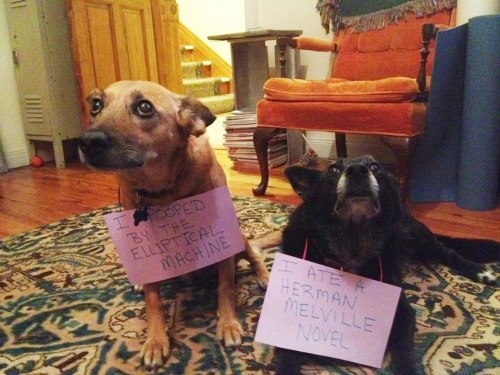
Familiar animals’ interpretations
Vic.trofimovawwwwwwwwww

Offering a surprisingly warm start to another week of cold show business news, Ron Perlman instantly became one of the nicest celebrities you know by agreeing to reprise his role as Hellboy—not for that promised third film, but for a daylong visit with a boy with leukemia, at the behest of the Make-A-Wish Foundation. After six-year-old Zachary told the organization of his desire "to meet and become Hellboy," they contacted visual effects house Spectral Motion, who then passed the word along to Perlman. And because he is awesome, the actor eagerly agreed to undergo the four-hour transformation to become Hellboy once again and spend the day with Zachary—who eventually got his own turn in the makeup chair—and thus Zachary accomplished what years of pestering Guillermo del Toro has not. You can check out more photos from their visit here, and should you have your own secret desire ...
Read more