His name is Clark and his father raised him to be a savior to humanity. He possesses superhuman strength and finely tuned senses. He is the world’s greatest detective, an inventor, chemist, surgeon and martial artist. Villains the world over want him dead, but through his intelligence, strength, wealth (of course), cunning and technological prowess he’s always able to defeat them – all while staying faithful to a personal edict to spare all lives.
No, he’s not a mash-up of Superman and Batman; rather, he’s Clark (Doc) Savage, Jr, a character created in 1933 by publisher Harry W. Ralston and editor John L. Nanovic, with further contributions from Lester Dent, the writer most often associated with the character. (Most stories originally appeared under the pseudonym Kenneth Robeson, a house name used by Ralston's Street & Smith company to disguise authorship of pulp tales; it allowed the company to advertise other series as coming from "the creator of Doc Savage," even when they were in fact written by others.) And he actually served as inspiration for Superman and Batman.
Doc Savage’s height of popularity was during the chaos of the Depression and World War II. He also experienced a brief resurgence through reprints of the original novels during the Vietnam era, and the covers illustrated here are from that time in the mid-1960's. Look at the prices!
To many, he is the greatest superhero to ever appear, the source of hundreds of iterations – first in “pulps,” later in comics, radio, television and film. However, today he’s largely forgotten; at best, his name sparks vague recognition or recollection. One conspicuous exception was in 1975, when low-budget producer George Pal made the box-office bomb Doc Savage: The Man of Bronze. Since then, Doc has been dormant, but in 2019, Hollywood will try again, this time offering up Dwayne Johnson as Doc. I won't get my hopes up.
More on Doc Savage - and there is a lot to take in - may be found here, here, and here.
by Adam Ni, Researcher, Strategic and Defense Studies Centre, Australian National University
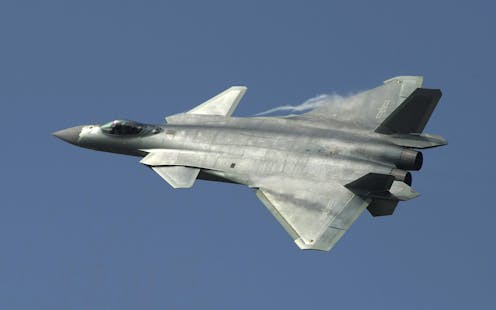
China's new J-20 stealth fighter was placed into combat service in February. AAP/EPA
Chinese President Xi Jinping wants to transform China’s military into the world’s most powerful force by 2050. And he could be on track to do it.
On the opening day of its National People’s Congress in Beijing yesterday, China reported a defence budget of ¥1.11 trillion ($A225 billion) for 2018. That represents an 8.1% increase in its defence budget, compared to a 7% increase last year.
China’s military has modernised rapidly in recent years. Since January alone it has demonstrated new capabilities in stealth fighter jets, drones, naval ships and advanced missiles.
Chinese scientists are also working to develop revolutionary technologies that would change the way wars are fought – and the way we live.
While China still lags the US in overall technological capability, it has narrowed the gap substantially. In the coming decades, it is poised to challenge US technological supremacy in key fields such as artificial intelligence, supercomputing and quantum information science.
What explains China’s rise as a technological power?
First, it has leveraged the innovation of other countries via technology transfers, and the acquisition of foreign companies and talent. It has also been reverse-engineering Western technology, and conducting state-sponsored industrial espionage.
According to one security analysis, between 2006 and 2013 the Chinese military stole confidential data from more than 140 organisations around the world. The problem was so serious that in May 2014, the US Department of Justice indicted five Chinese military hackers for cyber-espionage activities against US companies.
Second, China has been able to mobilise resources for priority technology sectors and research and development (R&D) projects in a way that many democracies are simply unable to do because of the limits of government power or popular mandate. Large state subsidies, government R&D funding, tailored regulations, market barriers and lax individual rights (such as privacy) protection have given Chinese domestic companies an edge over their foreign competitors.
Finally, China has substantially increased its R&D expenditure in recent years. From 2012 to 2017, China’s annual R&D spending rose 70.9% to ¥1.76 trillion ($A356 billion). The US National Science Board expects China to surpass the US in R&D investment, in purchasing power terms, by the end of this year.
China’s new superweapons
Here are a few examples of how China is making rapid progress in high-tech fields with military applications.
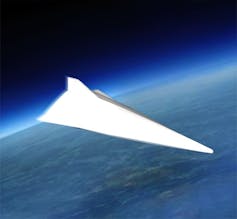
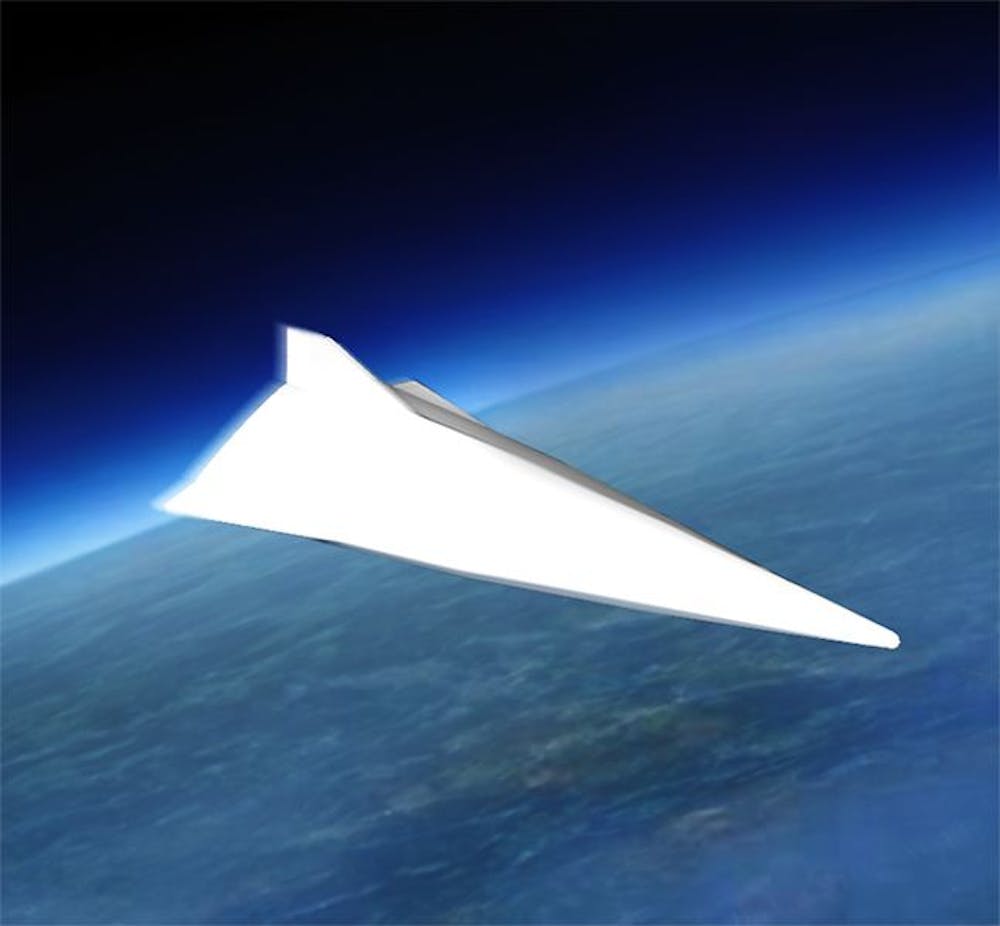
Hypersonic technology could one day allow us to travel from Beijing to New York in about two hours, rather than the 13 hours it currently takes. China is developing a hypersonic glide vehicle known as DF-ZF to make its nuclear and non-nuclear missiles extremely fast, manoeuvrable and capable of defeating existing missile defence systems.
To support this effort, China is building the world’s most advanced hypersonic wind tunnel for testing the extreme conditions of supersonic flight. While an operational hypersonic missile is still years away, once developed it would be a formidable weapon. It could also have a destabilising effect on strategic relations between China and other powers by compressing the time window for decision-making in a conflict or crisis situation.
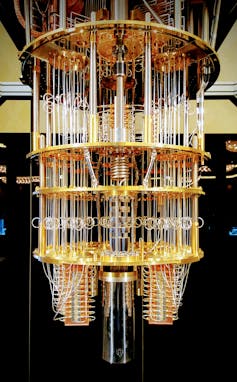
Another area of China’s focus is quantum technology, which uses subatomic mechanics to process and transmit information in a fraction of the time required by existing technology.
China is making rapid headway in quantum communication, computing and cryptography. In August 2016, China launched the world’s first quantum satellite. This enabled Chinese researchers to conduct cutting-edge experiments in quantum entanglement and teleportation. To win the quantum race, China announced last year that it will build the world’s largest quantum research facility at a cost of ¥76 billion ($A15.4 billion).
Quantum technology would enable the Chinese military to set up virtually unbreakable communication networks. It would also provide it with overwhelming computing power for information operations, such as the decryption of secret communications by adversaries.
China is also in the advanced stages of developing an electromagnetic railgun. This supergun uses electromagnetic energy to shoot powerful projectiles over vast distances at incredible speed. These projectiles are aerodynamic and their power comes from the kinetic damage generated by the intense speed at which they travel.
Recent photos circulated on Chinese social media show what is suspected to be an experimental electromagnetic railgun mounted on the bow of the Chinese navy ship. This indicates that China may soon be the first in world to test such a weapon at sea, where it could revolutionise naval combat. In contrast, the US Navy is winding down its railgun research program because of resource constraints and shifting priorities.
The above examples are only a few among dozens of high-tech fields in which China is making rapid progress. Others include biotechnology, robotics, supercomputing, nanotechnology, advanced materials, space technology, and artificial intelligence. In fact, the Chinese government has identified 17 engineering and science megaprojects that are key to China’s economic and military strength. These include advanced satellites, large nuclear reactors, large aircraft and high-end electronic chips.
China’s continued rise as a technological giant will have profound implications for its military power as Beijing leverages civilian technology for its military. This effort is so important that President Xi considers it a top priority. To underscore this, Xi created a powerful commission under his direct leadership to provide high-level guidance and oversight.
Much hinges on how Beijing chooses to use its new-found military and technological might. Indeed, China’s extensive geopolitical ambitions and increasingly assertive foreign policy are ominous signs that foreshadow the challenges ahead.
Adam Ni does not work for, consult, own shares in or receive funding from any company or organisation that would benefit from this article, and has disclosed no relevant affiliations beyond their academic appointment.
by Tim Pitman, Senior Researcher Fellow, Curtin University
The surveyors start out with almost 100,000 graduate contacts, of whom less than 10% provide their supervisor's details and of those supervisors, less than half participate in the survey. Shutterstock
Concerns about whether universities are doing enough to make graduates job-ready are not new. As higher education policy expert Andrew Norton observed recently, this issue was alive in the early 70s.
In fact, you can go back in time even further. In the 1950s, the Report of the Committee on Australian Universities called upon both universities and government to do more to work with industry to identify future labour demand and offer courses accordingly.
The release of the latest Graduate Ouctomes Survey had a similar effect in focussing attention on higher education performance.
A focus on graduate employability is not surprising. What is surprising is we are using mostly the same ways of measuring university performance we have for decades, when more accurate means exist.
Why the way we use the surveys is flawed
Like all surveys, the Employer Satisfaction Survey has to account for and overcome a number of elements that can affect the validity of the results. For example, 4,348 survey responses sounds like a lot, but this represents only 9.3% of all possible employer contacts.
Also, the way employers are contacted is a problem. It’s the graduate who’s contacted and invited to provide their supervisor’s details to the survey team. So the surveyors start out with almost 100,000 graduate contacts, of whom less than 10% provide their supervisor’s details and of those supervisors, less than half participate in the survey.
Another issue is the survey relies largely on subjective measurements of perception. For example, data shows the supervisors of graduates are more likely than the graduates themselves to think the graduate’s qualification is important. Two perceptions of the same qualification in the same context - which one, if either, is right?
Employers and graduates had different ideas of how important the graduate’s qualification was.
Shutterstock
The Graduate Outcomes Survey also relies on graduates being willing to complete the survey. The latest survey had a response rate of 45%, which is very good for surveys. But the survey is sent out only four months after graduation. It does not, then, necessarily reflect the short - let alone medium or long-term - employment prospects for the individual.
This is not to say the methodologies underpinning these surveys are not robust, or the Social Research Centre, who deliver the surveys, are not experts in their field. It is and they are. When a survey is the best option for gathering data, then these types of survey should be run. But we shouldn’t be using findings such as these to measure university performance, when there are better options available.
The missing link
For decades now, there has been an administrative link between a graduate’s education and taxation records. If domestic students have ever wondered why they are issued with a Commonwealth Higher Education Student Support Number (CHESSN), and why they need to provide their Tax File Number (TFN) to the university, this is the reason.
The CHESSN tracks their educational history, even when they change courses or institutions. Consequently it keeps track of their
HECS-HELP debt. By linking the CHESSN to the TFN, a record of the debt can be provided to the Australian Taxation Office, for future collection.
This administrative link could also be used to provide accurate and detailed longitudinal analyses of which jobs all graduates end up in, not just those motivated to respond to a survey. As time passes - or by going back further into the records - detailed pictures can be provided about how graduates perform over time, which organisations recruit and retain the most graduates, which courses show evidence of greater graduate mobility, actual lifetime earnings (as opposed to predicted), and so on.
Students already have to provide their TFN to their place of study and work so that debt can be tracked.
Shutterstock
Graduate outcomes would also be better contextualised against non-graduate outcomes, as well as national and international labour market trends. One-off, or purpose-specific analyses could be more easily provided to address specific government or community concerns as and when they arise.
If the government were to make key findings of these analyses publicly-available on a regular basis, students, politicians and policymakers would be able to make much more informed decisions regarding future study requirements. The current surveys would still be important, as they can provide additional information government records cannot. But when it comes to measuring university performance, hard data is the key.
Linking government records in this way is a sensitive issue. There would need to be a significant investment in the right infrastructure and systems to ensure the data was protected and analysed appropriately. Given the centrality of graduate employability to government higher education policy, now might be the time for this investment.
The final paragraph of this article has been amended since publication to reflect that there is some existing legislation that could facilitate this data collection.
Tim Pitman does not work for, consult, own shares in or receive funding from any company or organization that would benefit from this article, and has disclosed no relevant affiliations beyond their academic appointment.
It's no secret that Boing Boing (along with over 4 million other netizens) loves the Primitive Technology channel on YouTube. We've covered this channel numerous times (about a guy making primitive tech in the wilds of Far North Queensland, Australia with nothing but the gym shorts on his ass). I anxiously await each episode and am like a kid at Christmas when I get the alert that a new one is up.
But this month, thanks to one of the reader comments, I made a cool discovery. The videos are without narration. The un-named survivalist, who some have dubbed "Prim," is really good at showing you what he's doing so that you can understand it without explanation, and he writes up decent notes that are published along with the videos. But then I saw the comment: "[Turns on captions] That clever bastard has been talking to us the entire time!!" Whoa.
The captions and the notes are pretty similar, but you do get extra content in the captions and you get to see them in situ. I've been using closed captioning on my TV recently and have been delighted to see how much additional information you actually get: background conversations you would never hear, song titles and lyrics, and wonderful sound descriptions like "sexual gasping." So, it's great to discover another instance of CC being useful.
Have you heard that 2017’s Richard Spencer incident officially kicked off Nazi punching season? It’s true. The more we communicate the immediate risk that Nazis run of being punched wherever they go, the better. This t-shirt gets that message across, and stars our very favorite cinematic Professor of Archaeology and unrepentant Nazi-puncher.
The shirt, which was posted by Tumblr user thisistheglamorous, feels a little too eerily appropriate today, considering President Trump’s proposed budget that would cut all funding to the National Endowment for the Arts. At least the sight of it made me smile for the first time since I read about the President’s plans to eliminate funds for Meals on Wheels.
Okay, I lied, I’m not smiling, I’m weeping tears of joy. I need to possess this t-shirt with every fiber of my being. While I haven’t been able to dig up the one pictured here, there is a very close facsimile available from TeeBK. The shirt’s phrase emerged from a recent popular meme, but this is the first time I’ve seen it in glorious wearable form.
For anyone worried about meeting violent ideology with violence, I have a very simple solution to avoid getting punched: don’t be a Nazi.
It is bizarre that gas customers in Japan buy Australian gas more cheaply than Australians. Some of this gas is drilled in the Bass Strait, piped to Queensland, turned into liquid and shipped 6,700 kilometres to Japan … but the Japanese still pay less than Victorians.
When Prime Minister Malcolm Turnbull meets gas industry bosses in Canberra tomorrow he will be regaled with tales of looming blackouts, spiralling prices and the stubborn refusal of state governments to open up coal seam gas fields to assuage the impending supply crisis.
Turnbull will be fervently advised to avoid a domestic reservation policy to earmark gas supplies for Australian consumers and businesses, though Western Australia has one. He will be implored not to tamper with the “market”.
There is no market though, only a cartel of six big players who control the price: Santos, Exxon, BHP, Origin, Arrow Energy and Shell. Markets have visible prices and quantities on the bid and offer. The cartel even hides information about its gas reserves from government.
As the price of gas has shot up threefold, as high prices exact a drag on the entire economy, and as the government confronts its challenge of energy security, it is worth considering the global gas glut.
Tonight, at the Columbia Law School in New York, Bruce Robertson, an analyst with the Institute for Energy Economics and Financial Analysis (IEEFA), will hand down a paper describing how this gas glut will only get worse, and how excess supply and faltering demand are leading to a breakdown of the contract pricing mechanism.
Australia now exports 12% of the world’s gas. When the LNG export facilities are running at capacity, this country will be the world’s premier exporter.
Incidentally, Qatar, now the world’s biggest exporter with 32% of the market, raises three times as much in royalties as Australia for selling the same amount of gas. But that’s another story, another story of Australia’s broken energy policy.
Japan, which is comfortably the world’s largest importer of gas at 34% of the global market, showed a 2% drop in imports last year just as the three LNG plants in Gladstone, Queensland, were ramping up production.
Japan has now begun re-exporting LNG, says Bruce Robertson. Its Ministry of Economy, Trade and Industry estimates LNG demand will fall about 30% to 62 million tonnes by 2030.
The global gas industry closed out 2015 already in glut with total nameplate liquefaction capacity of 308 million tonnes (mt) surpassing demand for LNG imports of 245mt, by 26%.
While demand recedes across the world, the supply side looks ominous. By 2020, says Robertson, global LNG capacity is tipped to reach 400mt a year, up 30% on 2015. Some 92mtpa (million tonnes per annum) of new capacity will hit the global market between 2015 and 2020.
Meanwhile, Australia’s Office of the Chief Economist is predicting this:
Global LNG demand is expected to grow strongly to 2020 to approximately 457bcm (336 Mt), an annual increase of 5.9 per cent from 2014. … This growth is led by China, the rest of Asia and Europe, offset by falling demand in Japan. Demand growth has softened recently but the prospects remain positive overall.
The reality is that LNG trade grew by 2.5% in 2015, less than half the annual growth rate projected out to 2020 by the Office of the Chief Economist. Moreover, the key markets for Australian LNG producers are in North Asia. And in 2015, LNG demand in North Asia contracted by 1.7%.
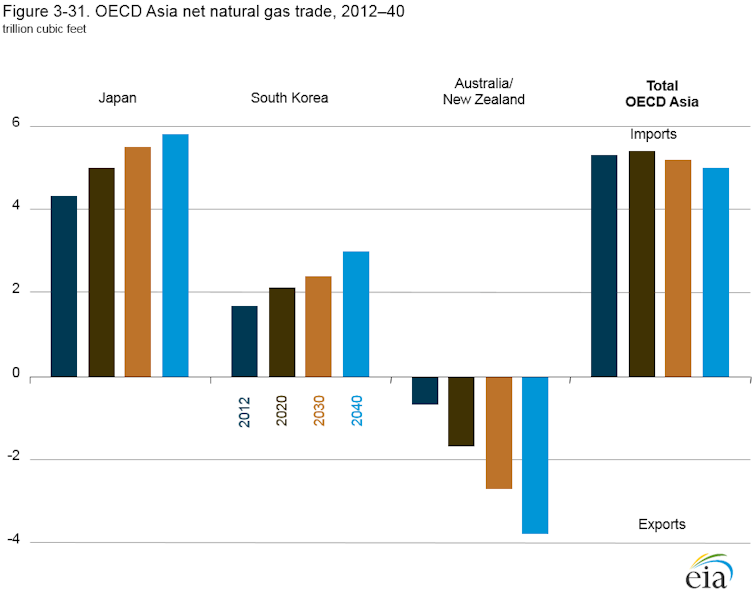
OECD Asia’s net demand for gas imports is set to fall.
U.S. Energy Information Administration/International Energy Outlook 2016
It seems that, in gas as in electricity, over-cooked forecasts for demand have justified excessive spending and therefore ensured higher prices. This is precisely what the gas cartel wants: the spectre of shortages whipping up prices. They have been doing it for years.
While AGL was earnestly talking up gas shortages in 2014, BHP Petroleum chief Mike Yeager told journalists:
We want to make sure that the market knows that the Bass Strait field still has a large amount of gas that’s undeveloped … We have a lot of gas in eastern Australia that’s available. It’s more important to let the citizens of Victoria and New South Wales, and to some degree, you know, even Queensland … there’s plenty of gas to supply those provinces for – you know, indefinitely.
AGL later quietly issued a release to the ASX conceding it had plenty of gas supply.
Last September, Japan’s energy minister said imports of LNG would continue to fall. They fell by 4.7% in 2015 and another 2% in 2016 amid a rising commitment to renewables and the rebooting of nuclear reactors that were shut down after the Fukushima disaster.
They have also been falling in other parts of North Asia, down 9% year on year in the world’s second-largest import market, Korea.
Then there is China, which unlike Australia, is pursuing an aggressive transition to renewable energy while growing domestic gas capacity. The big swing factor here is the forecast 50mtpa of supply to come from Russia via two new Siberian pipelines.
Asian LNG imports peaked in 2014 and have been falling since, but what of emerging markets taking up the slack?
There is simply too much supply coming on line, says Bruce Robertson. While demand falls, global LNG capacity is tipped to rise by 30% between 2015 and 2020.
Contract defaults are already afoot. India’s Petronet has renegotiated its LNG contract with Qatar’s Rasgas, cutting the price in half over the 25-year term of the deal.
Meanwhile, the International Energy Agency (IEA), the energy adviser to the OECD, has pulled back its forecasts for gas demand for four years on the trot. IEA estimates growth in gas consumption will decelerate to 1.5% a year between 2015 and 2021.
Ironically, the very fact of a thermal coal market in structural decline and a global glut in gas conspire to push down fossil fuel prices and delay the transition to renewable energy. The gas cartel, though, by its actions in restricting domestic supply, is deliberately keeping prices high.
For its part, the government has been faithfully trotting out the cartel line that the states must bring new unconventional gas online, coal seam gas. This is not only expensive to produce but poses inestimable environmental risks to farmland thanks to the fracking process.
The cartel has manufactured a fake gas crisis. Australia is soaked in gas. The answer is a domestic reservation policy starting now.
This column, co-published by The Conversation with michaelwest.com.au, is part of the Democracy Futures series, a joint global initiative with the Sydney Democracy Network. The project aims to stimulate fresh thinking about the many challenges facing democracies in the 21st century.
This is the stunning trailer for a badass-looking fake film called Dawn of the Planet of the Zombies and the Giant Killer Plants on Some Serious Acid. The special effects you'll see in the trailer are the result of some incredibly impressive work. The trailer is full of awesome action and fun humor. It was created by a man by the name of Alf Lovvold, and as you'll see, he did a phenomenal job. I think this needs to be a feature length film! You're gonna love this.
Art from Avengers: Age of Ultron indicates a showdown between two of the new characters. Weta confirms that Batman v. Superman will have a huge standalone scene that they're working on. Plus a look ahead to the rest of The Walking Dead season five. Spoilers now!
Today’s graphic is a whimsical look at lethal doses of chemicals we consume on a regular basis. Whilst it may be more common to view chemicals in a black and white framing of ‘toxic’ or ‘non-toxic’, the reality is more of a sliding scale of toxicity. The admission of too much of any chemical into the body can cause toxic effects, and even death – the only variant from chemical to chemical is how much is ‘too much’. For some chemicals, the amount will be very low, whilst for others, it may be almost impossibly high.
So, how can we compare the toxicities of differing chemicals, when they can all produce varying effects, and these effects all require the intake of differing amounts? One of the most commonly quoted figures when discussing the toxicity of chemicals is the LD50, which stands for ‘lethal dose 50%’, or ‘median lethal dose.’ This is the amount of a chemical required to cause death in 50% of the animals in the group it is tested on. The figures can be given for when the chemical is given orally, when it is applied to the skin, or when it is injected into the animal. The results of these tests can then be converted into figures for humans, and expressed in milligrams per kilogram of body weight. The smaller the lethal dose, the more toxic the chemical; thus, the LD50 provides a way of comparing the toxicities of all chemicals.
There are a number of caveats to the LD50 test. Firstly, as mentioned, it is the dose required to kill 50% of the test subjects. Therefore, it does not guarantee death – in fact, it’s possible to take more than the lethal dose and live, and take less of the lethal dose and die. For the purposes of clarification, other types of lethal dose data also exist: the LDLo (Lethal Dose Low) is the lowest dose known to have resulted in fatality in testing, whilst the LD100 (Lethal Dose 100%) is the dose at which 100% of the test subjects are killed.
Another issue with the lethal dose tests is the obvious fact that animals are not humans. The sensitivity of animals to different chemicals varies from species to species, and can also vary from that of humans. A prime example is that of the chemical theobromine, found in chocolate. Humans can stomach around 1000mg/kg of their body weight of theobromine; this is quite a large figure, and means it’s next to impossible for a human to eat enough chocolate to die of theobromine poisoning (an average 200g bar of milk chocolate contains a little under 300mg). Compare this to dogs, who can only tolerate around 300mg/kg of their body weight, and can therefore easily die as a result of eating too much chocolate. Therefore, there’s no guarantee that the figures converted from animal lethal dose tests are always reliable in humans.
Additionally, although lethal dose tests provide absolute figures, these will invariably vary from person to person dependent on a wide range of variables, including physical condition, and medical conditions they may be suffering from. The lethal dose of a compound also tells us little about what dose effects of its toxicity start to be manifested. Some chemicals may have a high lethal dose, but may cause toxic effects at a dose much lower than this.
A final issue with the lethal dose tests is one of ethics. There is obviously an aspect of animal cruelty involved in the tests, and for this reason they are now being widely phased out, with other methods for assessing toxicity preferred. Several alternatives have been developed:
Fixed Dose Procedure: In this test, five male and five female rats are used. The chemical being tested is given to them orally at one of four fixed dose levels (5mg, 50mg, 500mg or 2000mg). Rather than trying to identify the dose at which death is the result, instead the test tries to identify the dose at which toxicity can be observed. Testing stops once this is seen. Although this still uses animal subjects, it drastically reduces the number of animals required, as well as the mortality rate.
Up and Down Procedure: In this test, animals are tested one at a time, and observed for 1-2 days. If they survive, an increased dose is given to the next animal, whilst if they die, a decreased dose is given. Again, this reduces the number of animals required, but does not completely avoid their use.
Acute Toxic Class Method: Still uses animals. A stepwise procedure, where three animals of the same sex per fixed dose level are used. Dependent on the outcome, a decision is made as to whether further testing is necessary.
Cell-Based Screening Methods: Involves studying the effects of chemicals on cells removed from their biological environment in the lab. This alternative avoids the use of animals, and scientists hope that in the future, it will be able to be used exclusively.
To conclude, it’s clear that the LD50 method of categorising chemicals, whilst providing a useful comparison, has several flaws. For that reason, it is largely considered to be a somewhat outdated method for determining toxicity. Nonetheless, LD50 figures are still frequently quoted for various chemicals, and it is unlikely that references to them will ever be phased out completely, at least in more general parlance.
As a final note, the graphic provides the LD50 values for water, caffeine and alcohol (ethanol). It’s worth noting that, in the case of caffeine, drinking 118 cups of coffee would almost certainly see you dying of water poisoning before caffeine poisoning! The figure for alcohol is also especially variable, including whether or not you’re drinking on an empty stomach, as well as personal drinking history.
I’m indebted to Justin Brower for the content of this graphic, with whom I corresponded on the figures, who was able to provide some very useful feedback and suggestions. Justin runs the excellent blog ‘Nature’s Poisons‘ which, unsurprisingly, looks at the various poisonous chemical compounds found in nature and is well worth a read.