Shared posts

04 Oct 01:58

Did you know that in 1988 they put out a STAR TREK: THE NEXT...


dat neck


dat neck again


dose pecs


dat - head? and hand? Also he's talking to Wesley, as I'm sure you can tell by that Classic Wesley Pose.


Worf looks normal, and yet, Picard looks like a confused Stretch Armstrong with one giant arm


His other arm is super stubby though (this was usually covered up with clever camera angles on the show I think??)


such a beautiful ship that one could weep


HAHA THEY NAILED RIKER THOUGH, THIS IS 100% RIKER RIGHT HERE

Did you know that in 1988 they put out a STAR TREK: THE NEXT GENERATION comic? It’s got a lot of cool necks in it.

29 Sep 21:41

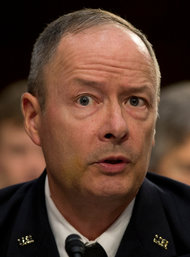
Keith Alexander affirms his intention to collect all Americans' data

by Cory Doctorow

At yesterday's Senate Intelligence Committee hearings, NSA boss Keith Alexander and top spy James Clapper evaded, blocked, and dodged questions from elected reps, making a mockery of the idea that there's any adult supervision of America's spooks. A telling moment came when Mark Udall asked if they ended to collect the records of all Americans, and Alexander said, "I believe it is in the nation's best interest to put all the phone records into a lockbox – yes."

Wyden and his fellow Democrat Mark Udall used the public hearing to press the intelligence chiefs on aspects of the top-secret surveillance infrastructure.

Asked by Udall whether it was the NSA's aim to collect the records of all Americans, Alexander replied: "I believe it is in the nation's best interest to put all the phone records into a lockbox – yes."

He would not be drawn on any past attempts or plans to store cell site data for security reasons. The NSA director evaded repeated questions from Wyden over whether the NSA had either collection of cell site phone data, or planned to do so. Alexander eventually replied: "What I don't want to do senator is put out in an unclassified form anything that is classified."

US intelligence chiefs urge Congress to preserve surveillance programs [Paul Lewis and Dan Roberts/The Guardian]


29 Sep 21:09

FBI: We know you're innocent, but you're not getting off the No-Fly list unless you rat out your friends

by Cory Doctorow

An ACLU report on the FBI called Unleashed and Unaccountable details how three ACLU clients were added to the no-fly list, and were told by FBI agents that though they were understood to be innocent of any wrongdoing, they would not be taken off the list unless they agreed to inform on their friends. In one case, the FBI waiting until their victim was in Yemen before sticking him on the no-fly list; they told him he would be stranded there until he agreed to act as an informant.

FBI agents put this pressure on ACLU clients Abe Mashal, a Marine veteran; Amir Meshal; and Nagib Ali Ghaleb. Each of these Americans spoke to FBI agents to learn why they were suddenly banned from flying and to clear up the errors that led to that decision. Instead of providing that explanation or opportunity, FBI agents offered to help them get off the No-Fly List—but only in exchange for serving as informants in their communities.Our clients refused.

The ACLU's report,Unleashed and Unaccountable: The FBI's Unchecked Abuse of Authority, explains what happened to Nagib Ali Ghaleb. Nagib was denied boarding when trying to fly home to San Francisco after a trip to visit family in Yemen. Stranded abroad and desperate to return home, Nagib sought help from the U.S. embassy in Yemen and was asked to submit to an FBI interview. FBI agents offered to arrange for Nagib to fly back immediately to the United States if he would agree to tell the agents who the "bad guys" were in Yemen and San Francisco. The agents insisted that Nagib could provide the names of people from his mosque and the San Francisco Yemeni community. The agents said they would have Nagib arrested and jailed in Yemen if he did not cooperate, and that Nagib should "think about it." Nagib, however, did not know any "bad guys" and therefore refused to spy on innocent people in exchange for a flight home.

Nagib's experience is far from unique. After Abe Mashal was denied boarding at Chicago's Midway Airport, FBI agents questioned him about his religious beliefs and practices.The agents told Abe that if he would serve as an informant for the FBI, his name would be removed from the No-Fly List and he would receive compensation. When Abe refused, the FBI promptly ended the meeting.

Neither Nagib nor Abe present a threat to aviation security. But FBI agents sought to exploit their fear, desperation, and confusion when they were most vulnerable, and to coerce them into working as informants. Moreover, the very fact that FBI agents asked Nagib and Abe to spy on people for the government is yet another indication that the FBI doesn't actually think either man is a suspected terrorist. This abusive use of a government watch list underscores the serious need for regulation, oversight, and public accountability of an FBI that has become unleashed and unaccountable.

The No-Fly List: Where the FBI Goes Fishing for Informants (via Interesting People)


29 Sep 21:09

NSA has, as the paranoids warned us, been studying the social ties of Americans through our data

by Xeni Jardin


Gen. Keith Alexander, National Security Agency director, testifying Thursday before the Senate Intelligence Committee.

James Risen and Laura Poitras, two journalists who have experienced first-hand the consequences of pissing off the federal government in the course of performing uncompromising investigative journalism, have a story in today's New York Times revealing a new layer of the NSA's domestic surveillance activities. Edward Snowden's leaked documents are the source of the report, which shows that since November 2010, NSA has been mining its vast data collections to "create sophisticated graphs of some Americans’ social connections that can identify their associates, their locations at certain times, their traveling companions and other personal information."

The policy shift was intended to help the agency “discover and track” connections between intelligence targets overseas and people in the United States, according to an N.S.A. memorandum from January 2011. The agency was authorized to conduct “large-scale graph analysis on very large sets of communications metadata without having to check foreignness” of every e-mail address, phone number or other identifier, the document said. Because of concerns about infringing on the privacy of American citizens, the computer analysis of such data had previously been permitted only for foreigners.

The agency can augment the communications data with material from public, commercial and other sources, including bank codes, insurance information, Facebook profiles, passenger manifests, voter registration rolls and GPS location information, as well as property records and unspecified tax data, according to the documents. They do not indicate any restrictions on the use of such “enrichment” data, and several former senior Obama administration officials said the agency drew on it for both Americans and foreigners.

N.S.A. officials declined to say how many Americans have been caught up in the effort, including people involved in no wrongdoing. The documents do not describe what has resulted from the scrutiny, which links phone numbers and e-mails in a “contact chain” tied directly or indirectly to a person or organization overseas that is of foreign intelligence interest.

"N.S.A. Gathers Data on Social Connections of U.S. Citizens" [nytimes.com]


29 Sep 21:08

DiFi admits that the NSA is wiretapping the Internet's backbone

by Cory Doctorow
Ever since whistleblower Mark Klein revealed that he'd build a secret wiretapping room for the NSA at AT&T's San Francisco switching center, we've known that the NSA was illegally wiretapping the Internet's backbone. But the government has steadfastly denied it. However, as Bruce Schneier documents, Senator Diane Feinstein has let slip that the NSA is tapping the backbone on several occasions, though president Obama continues to deny it.


18 Sep 23:39

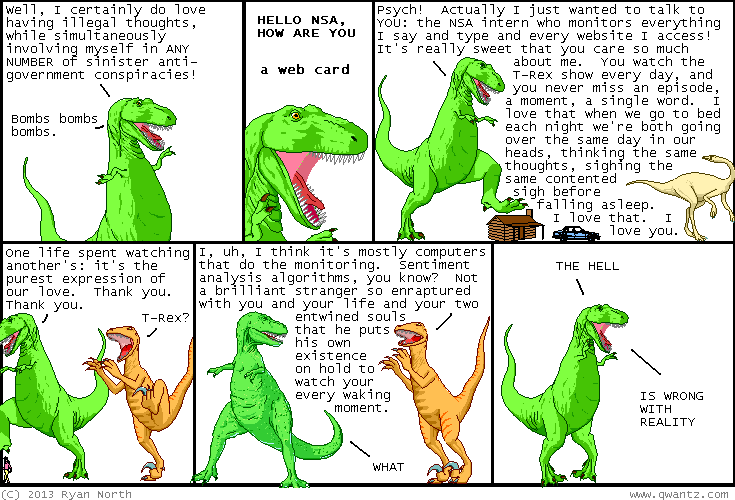
truth and beauty bombs bombs bombs

archive - contact - sexy exciting merchandise - cute - search - about
← previous September 17th, 2013 next

September 17th, 2013: This Is How You Die is the sequel to Machine of Death and is also SUPER AWESOME. It's out now! Within that book is a choose-your-own-path story called Your Choice, by Richard Salter. We thought it'd be a cool way to share some of the book by putting up that story as an interactive website, complete with audiobook narration! Go click that link! You can read a story OR have it read to you! :o

One year ago today: has there been a family drama called relativity and if not, why not? oh, there has? okay, well, good.

– Ryan

16 Sep 17:30

Peer review, or it didn't happen

by Maggie Koerth-Baker

An amusing science meme, courtesy my friend Andrew Balfour.


05 Sep 03:15

TSA is officially allowed to lie to you in order to cover its ass

by Cory Doctorow

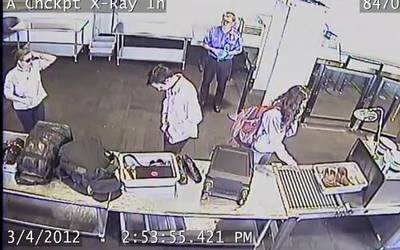
The TSA is allowed to lie in its responses to Freedom of Information Requests. Its court-granted ability to lie to the public it nominally serves isn't limited to sensitive issues, either: they're allowed to pretend that they don't have CCTV footage of their own officers violating their own policies, even when they do.

U.S. District Judge Joan A. Lenard granted the TSA the special privilege of not needing to go that route, rubber-stamping the decision of the TSA and the airport authority to write to me that no CCTV footage of the incident existed when, in fact, it did. This footage is non-classified and its existence is admitted by over a dozen visible camera domes and even signage that the area is being recorded. Beyond that, the TSA regularly releases checkpoint video when it doesn’t show them doing something wrong (for example, here’s CCTV of me beating their body scanners). But if it shows evidence of misconduct? Just go ahead and lie.

Court: Federal Law Allows Lying in TSA-Related FOIA Requests [TSA Out of Our Pants]

(via Hacker News)


02 Sep 19:13

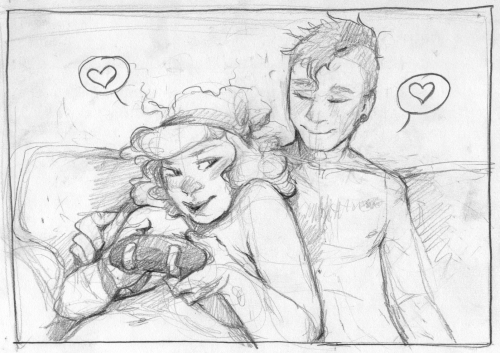
thattallsummonerguy: norhuu: Excuse me while I draw cuties...

by iamacollectionofmiscellanyandtea


thattallsummonerguy:

norhuu:

Excuse me while I draw cuties having safe, consensual sex :>

Why can’t there be more art like this, absolutely perfect

25 Aug 23:01

defjamblr: Big Sean “Beware” Ft. Jhene Aiko & Lil Wayne

by freshest-tittymilk


defjamblr:

Big Sean “Beware” Ft. Jhene Aiko & Lil Wayne

23 Aug 02:23

Great moments in pedantry: Double Stuf Oreos not actually double stuffed

by Maggie Koerth-Baker
In fact, the Double Stuf Oreos tested by a high school math class in Queensbury, N.Y. contained only 1.86x the amount of stuff that was in a regular Oreo. A Nabisco spokeswoman, responding to the scandal, says the measurements must have been inaccurate.


14 Aug 19:13

NSA leak: US can spy on Americans, despite direct statements of President, Congress, top spooks

by Cory Doctorow


The Guardian has the latest of the Snowden/NSA leaks, detailing the semantic loophole exploited by the Agency in order to spy on the communications of Americans and people in the USA, something it is otherwise forbidden from doing. Since the initial Snowden leaks, President Obama, ranking Democrats (including Diane Feinstein), and NSA officials have made categorical statements denying that the NSA spies on Americans. These statements appear to be outright lies, as revealed by these revelations, and make me wonder if there are Hill rats looking up the procedures for impeachment at this very moment.

The revelations revolve around Section 702 of the FISA Amendments Act, whose wording contains enough ambiguity that the Agency has been able to interpret it as giving them authority to spy on Americans and people in America. As a foreigner in the UK (and thus liable to total, open, uncontroversial NSA surveillance), I extend my sympathy to my American sisters and brothers.

"While the FAA 702 minimization procedures approved on 3 October 2011 now allow for use of certain United States person names and identifiers as query terms when reviewing collected FAA 702 data," the glossary states, "analysts may NOT/NOT [not repeat not] implement any USP [US persons] queries until an effective oversight process has been developed by NSA and agreed to by DOJ/ODNI [Office of the Director of National Intelligence]."

The term "identifiers" is NSA jargon for information relating to an individual, such as telephone number, email address, IP address and username as well as their name.

The document – which is undated, though metadata suggests this version was last updated in June 2012 – does not say whether the oversight process it mentions has been established or whether any searches against US person names have taken place.

Wyden, an Oregon Democrat on the Senate intelligence committee, has obliquely warned for months that the NSA's retention of Americans' communications incidentally collected and its ability to search through it has been far more extensive than intelligence officials have stated publicly. Speaking this week, Wyden told the Guardian it amounts to a "backdoor search" through Americans' communications data.

NSA loophole allows warrantless search for US citizens' emails and phone calls [James Ball and Spencer Ackerman/Guardian]


04 Aug 22:56

Anonymous Web-host shut down, owner arrested; Tor users compromised by Javascript exploit

by Cory Doctorow

FreedomWeb, an Irish company known for providing hosting for Tor "hidden services" -- services reached over the Tor anonymized/encrypted network -- has shut down after its owner, Eric Eoin Marques, was arrested over allegations that he had facilitated the spread of child pornography. Users of Tor hidden services report that their copies of "Tor Browser" (a modified, locked-down version of Firefox that uses Tor by default) were infected with malicious Javascript that de-anonymized them, and speculate that this may have originated with with FBI. Tor Browser formerly came with Javascript disabled by default, but it was switched back on again recently to make the browser more generally useful. Some are predicting an imminent Bitcoin crash precipitated by the shutdown.

The execution of malicious JavaScript inside the Tor Browser Bundle, perhaps the most commonly used Tor client, comes as a surprise to many users. Previously, the browser disabled JavaScript execution by default for security purposes, however this change was recently reverted by developers in order to make the product more useful for average internet users. As a result, however, the applications has become vastly more vulnerable to attacks such as this...

...We expect there will be a deeper technical analysis of the malware in the coming days as security researchers examine it in greater detail. Since the attack was designed at Firefox for Windows, which the Tor Browser Bundle is based upon, it seems likely that this is not a random occurance, and that the malware is designed specifically designed to compromise the identities of anonymous internet users. Although this would be a victory for the FBI against child pornographers who use the Tor network, it could also mean a serious security breach for international activists and internet users living in repressive states who use the services to practice online free speech.

Anonymous Web Host 'Freedom Hosting' Owner Arrested, TorMail Compromised


04 Aug 16:54

Six blatant lies about spying from the NSA up to Obama

by Cory Doctorow

ProPublica has produced a video showing, point-by-point all the ways that US government officials, all the way up to Obama, have told blatant lies about the details and extent of NSA spying.

Since Edward Snowden leaked a trove of documents detailing the NSA's sweeping surveillance programs, Director of National Intelligence James Clapper acknowledged that part of his congressional testimony in March was "erroneous." But that's not the only questionable comment by administration officials about the programs.

Has the Gov't Lied on Snooping? Let's Go to the Videotape (via Techdirt)


03 Aug 13:22

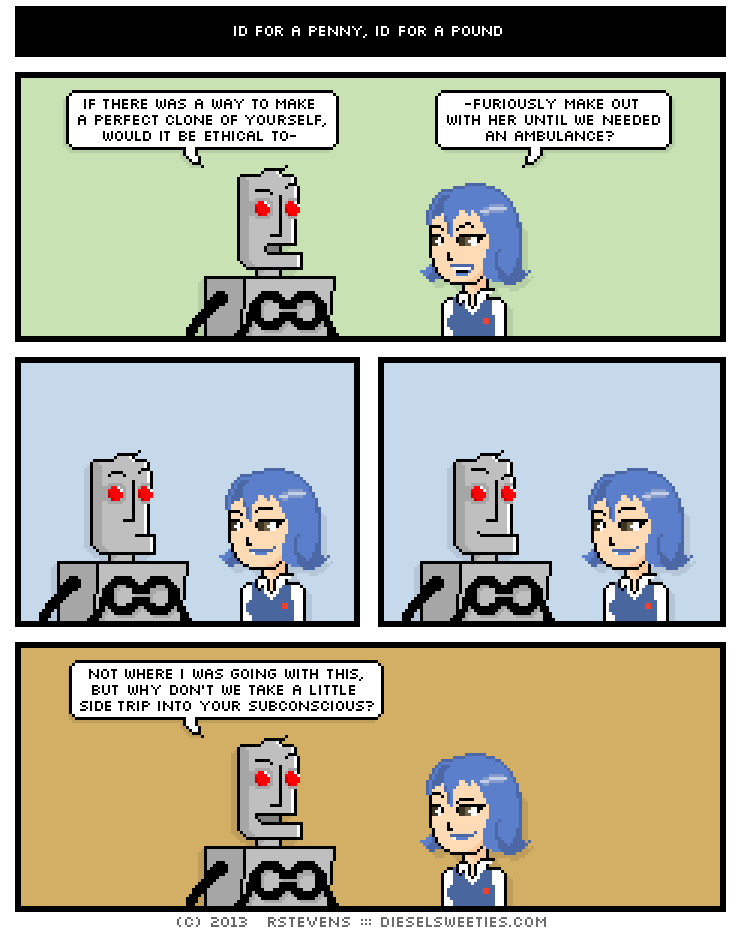
Id For a Penny, Id For a Pound

Cynthiabagiertaylor

I ALWAYS point this out when there are clones/robot doppelgangers in movies.

the world's most dangerous kitten

On the sexy ethics of sexy cloning

03 Aug 05:13

A Softer World

28 Jul 01:59

Notes from the ducking stool: wget as evidence of guilt at the Manning trial

by Cory Doctorow
Cynthiabagiertaylor

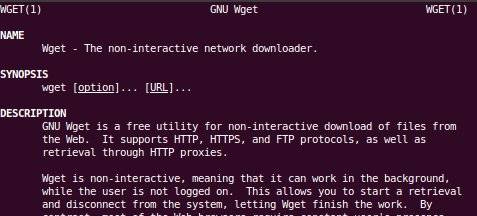
They pulled this shit in the Weev case too. So sick of people pretending basic net scripting is "hacking"/evil.


A moment of outstanding absurdity from the Manning trial: prosecutors inquiring in tones of menace whether a witness is familiar with "wget" -- a standard Unix command for fetching a file from the Web ("wget" = "Web get") that many of us use routinely.

The prosecutors are in their early 30s — nominally “digital natives” — and should know better. “Do you know what Wget is?” they interrogate a witness, as if it is malicious spyware and not an everyday command line program. The government is capitalizing on asymmetric tech literacy and the failure of language when old laws are applied to the internet.

Bradley Manning on Trial


22 Jul 13:53

Hack exposes e-mail addresses, password data for 2 million Ubuntu Forum users

The defacement left on the Ubuntu Forums website.

E-mail addresses, user names, and password data for every registered user of the Ubuntu Forums—estimated to be 1.82 million accounts—were exposed in a security breach hitting the company responsible for maintaining the freely available, open-source operating system. There's no sign the compromised data has been published online.

The Ubuntu Forums were closed Saturday evening, following the discovery that the site's homepage was defaced by someone who managed to gain privileged access to its underlying servers. To their credit, administrators with Canonical, the for-profit company that markets Ubuntu, quickly issued an advisory that warned users who used their forum password to safeguard other accounts to change the credentials immediately. The forums remained inaccessible at time of writing on Sunday afternoon.

"While the passwords were not stored in plain text, good practice dictates that users should assume the passwords have been accessed and change them," Ubuntu CEO Jane Silber wrote in an updated advisory. "If users used the same password on other services, they should immediately change that password."

In an e-mail, Silber told Ars the passwords were cryptographically scrambled using the MD5 hashing algorithm, along with a per-user cryptographic salt. While the scheme is the standard protection provided by VBulletin, the Web software used on the Ubuntu forums, password experts consider MD5 with or without salt to be an inadequate means of protecting stored passwords. While per-user salt slows down the time it takes to crack large numbers of passwords in unison, it does little to nothing to delay the cracking of small numbers of hashes. That means the scheme used by Canonical doesn't prevent the decoding of individual hashes that may be targeted because of the attractiveness of the specific user it belongs to—a high-ranking executive, for instance, or people whose e-mail addresses belong to Fortune-500 domains.

As Ars has explained repeatedly, a far more robust password-storage scheme involves the use of bcrypt, scrypt, or another "slow" hashing algorithm. By increasing the time and computing resources required to convert plain-text passwords into hashes, these slow algorithms require crackers to spend months, years, or even centuries to decipher hashes, compared with days or weeks for salted hashes generated with MD5, SHA1 and other fast algorithms. The protection provided by slow hashing algorithms also extends to single hashes, unlike the protection afforded by salting. These enhanced protections are important in scenarios of database breaches, which allow people to perform offline cracking attacks and then use the results to breach accounts that use those credentials elsewhere.

While it's disappointing that Canonical chose a relatively weak hashing scheme to protect its forum users' passwords, company officials deserve credit for immediately reporting the breach and exhorting users to change passwords. By contrast, recent responses to password breaches hitting Reputation.com and LivingSocial.com either made no suggestion to change passwords or played down that advice.

So far, there's no indication the password hashes and other data exposed in the Ubuntu forums hack have been published online, but it wouldn't be surprising for that to change. The person responsible for the hack went to the trouble of defacing the forum homepage. To get maximum publicity, the individual may decide to air some or all of the data acquired. And with the Internet Archive recently estimating 1.82 million registered Ubuntu forum accounts, the potential for abuse is high.

As always, Ars readers are encouraged to use a password manager and choose a long, randomly generated passcode that's unique for each important site. For a deeper dive on passwords in general, see last year's feature Why passwords have never been weaker—and crackers have never been stronger. To get an inside look at how even long passcodes are cracked following database breaches, see Anatomy of a hack: How crackers ransack passwords like “qeadzcwrsfxv1331.”

Article updated to emphasize in the first paragraph that the data isn't found online.

19 Jul 21:31

TSA screening about to get a lot worse

by Cory Doctorow
The major check against the unreasonable, horrible practices on the part of the TSA is that people who fly are wealthier, on average than people who don't -- and people who fly a lot are wealthier still. That meant that the worst stuff the TSA did was felt disproportionately by people who had a lot of political juice -- people who get listened to. Increasingly, though, rich people can opt out of the worst of TSA treatment by buying voluntary background checks and bypassing the rigmarole of the plebs. Now, the TSA is expanding its Pre-Check program, ensuring that pretty much everyone with any political clout will be spared the worst of it, letting the TSA's treatment for aviation's 99 percent spiral steadily downward, moving from mere Security Theater to Security Grand Guignol.


16 Jul 19:28

Book Club: Coding Freedom, Part II: Codes of Value

by yatima
Cynthiabagiertaylor

"The single biggest flaw in the idea of meritocracy is the proposition that there are people who are without merit. "

In Part II of Coding Freedom, Biella begins the vital work of problematizing the meritocratic ideal.

“Hackers will publicly acknowledge… acts of “genius” and are thus fiercely meritocratic – in ideology and practice. Yet given that so much of hacker production is collective, a fact increasingly acknowledged and even celebrated in the ethical philosophy of F/OSS, a commitment to individualism, meritocracy, and independence is potentially subverted by the reality of as well as the desire to recognize their fundamental interdependence. The belief in the value of individuality coupled with the constant need for the help of other hackers points to a subtle paradox that textures their social world.”

Who among us picked up any technical skills whatsoever without the help of someone more skilled who helped us out just because, in the spirit of paying it forward? Patient friends, lucid documentation, gentle answers on mailing lists: these are the familiar stepping stones from n00b to basic competence. Depending on your point of view, they exist in dynamic tension with, or in stark contrast to, the Romantic hero, powered only by genius and Mountain Dew. You know, this guy:

The Wanderer Above the Sea of Fog

There is for sure a seductive aspect to the idea of meritocracy, an aspect that’s maybe especially potent for adolescent people – or nations – who are trying to separate their identities from their progenitors in order to individuate and develop their potential. It’s understandable, but it shouldn’t survive contact with the real world, which is nothing if not More Complicated Than That.

“The United States is often thought of as a living embodiment of meritocracy: a nation where people are judged on their individual abilities alone. The system supposedly works so well because, as the media myth goes, the United States provides everyone with equal opportunity, usually through public education, to achieve their goals. As such, the hierarchies of difference that arise from one’s ability (usually to achieve wealth) are sanctioned by this moral order as legitimate.”

You’ve got to love the strategic deployment of qualifiers in the above passage, especially if, like me, you have come late in life to the conviction that meritocracy is bullshit. Yeah. I said it. The single biggest flaw in the idea of meritocracy is the proposition that there are people who are without merit. This is, to put it mildly, not the case.

The second biggest flaw in the idea of meritocracy is that it’s just a recursive modern gloss on the Divine Right of Kings. Leaders in the (ostensibly-meritocratic) open source community are entitled to exercise power because of their merit. The proof of their merit? Is their exercise of power. The word “meritocracy” is an ungainsayable defense of the status quo. It’s conservatism in a nutshell. As Alexander Pope once, infuriatingly, put it: “Whatever is, is right.”

This week, in which Linux kernel developer Sarah Sharp advanced the revolutionary notion that programming could be carried on without ad hominem attacks, has added special piquancy to this passage from Biella’s book:

“When Torvalds and Murdock developed their own projects (the Linux kernel and Debian, respectively), they did things differently than the earlier cadre of Unix hackers by fostering a more egalitarian environment of openness and transparency. Participation was encouraged, and recognition was given where it was due. Accepting more contributions was also, of course, seen as a way to improve and encourage technical efficiency.”

Biella acknowledges that Linux and Debian grew up to be very different projects, and goes on to discuss Debian’s Social Contract, Free Software Guidelines and Constitution. She has some sharp observations on the fear within the Debian community that the “meritocracy” will be “corrupted.”

I’d like to propose that the notion of meritocracy is itself corrupt. Ideas may have, or lack, merit. People have worth, and every person is worth more than we can possibly imagine. Inclusive communities are likely to write the best software because in them, ideas can compete on their (yes!) merits; and because software written by the other communities has exclusion coded into its very DNA.

But, y’know, I’m not a kernel coder, so who the hell cares what I think? ;) More to the point, dear readers: what do you think?

13 Jul 19:57

Container ship breaks in half, sinks, burns

by Cory Doctorow
Cynthiabagiertaylor

I recommend clicking through to see more pictures.


Here's a gallery of photos showing an enormous container ship breaking in two at the middle, and then the stern section sinking. The bow of the ship -- the Mitsui O.S.K. Lines's MOL Comfort -- was towed away, but burst into flames and broke free of its tow, off the coast of Gujarat, India.

On June 17, Mitsui O.S.K. Lines’ MOL Comfort began suffering from severe hogging and broke in two while underway from Singapore to Jeddah with a load of 7,041 TEUs. The crew escaped in life rafts and picked up by another merchant vessel... On June 27, the stern section began taking on water and sank with an estimated 1,700 containers and 1,500 metric tons of fuel oil. These photos sent to gCaptain were taken over a five minute period... On July 2, the MOL Comfort’s bow section broke free from its towing wire while in “adverse” sea conditions. Crews were able to reconnected and continue towing. Four days later, Mitsui O.S.K. Lines reported that on July 6, a fire broke towards the rear of the bow section of the MOL Comfort, and fire fighting efforts commenced.

The whole set is pretty amazing -- container ships are one of my prime fascinations, and to see these huge packetized lumps of consumer good being tossed around like children's blocks is terrifying.

A Look Back: MOL Comfort Incident Photos [25 PHOTOS] (Thanks, Fipi Lele!)


06 Jul 13:30

A Softer World

03 Jul 02:42

LSD ABC, fun "A is for…" animation

by David Pescovitz

A wonderful and trippy "A is for…" animation by Laura Sicouri and Kadavre Exquis with music by Kadavre Exquis. The music is available on a vinyl pack that includes the digital download and postcards from the film.


01 Jul 23:22

In 1983 the most common fear among adults was that their...


In 1983 the most common fear among adults was that their computers were going to grow faces and take charge of them. Seductively. AND THAT IS EXACTLY WHAT HAPPENED.

01 Jul 18:24

And all the howling sounds fun too.

by Jessica Hagy

Aside from the fleas, of course

Share and Enjoy:DiggStumbleUpondel.icio.usFacebookTwitterGoogle Bookmarks

29 Jun 17:14

How could a drone help a deer?

by Xeni Jardin

By indicating to farmers who are operating heavy equipment where deer might be hiding and resting in their fields. Many deer are killed instantly or lose limbs when they're run over by farming equipment, by farmers who have no idea they're there. What a wonderful use of drones! Video Link. It's a Swiss TV news segment, and includes some other interesting new technologies Swiss farmers are using. (thanks, @DeerRehab)


29 Jun 17:14

Abortions do happen in Catholic hospitals - they just aren't called that

by Maggie Koerth-Baker
The most dangerous time to be a woman in need of a life-saving abortion at a Catholic hospital is right after that hospital has been consolidated into a Catholic system, according the medical demographer Dr. Diana Foster. That's because doctors with more experience in the Catholic system are more likely to secretly offer therapeutic abortions under the table, and get away with it.


29 Jun 02:41

Single photo looks like four

by David Pescovitz
NewImage

This is photographer Bela Borsodi's cover for VLP's album Terrain. It's a single image of very carefully positioned objects seen at a very specific angle. Below, see a revealing photo and "making of" video.

NewImage


26 Jun 16:49

How do you get excitable dogs out of a rotting elk carcass?

by Cory Doctorow
Dogs in Elk is one of the canonical Funny Internet Message Board Threads, up there with the Mall Ninja, but you yungguns may not be familiar with it. Let ole grampa Doctorow take you on a walk through the prehistory of memes: "So what we did was put the ribcages (containing dogs) on tarps and drag them around to the side yard, where I figured they would at least be harder to see, and then opened my bedroom window so that the dogs could let me know when they were ready..."


12 Jun 01:07

A Softer World

Cynthiabagiertaylor

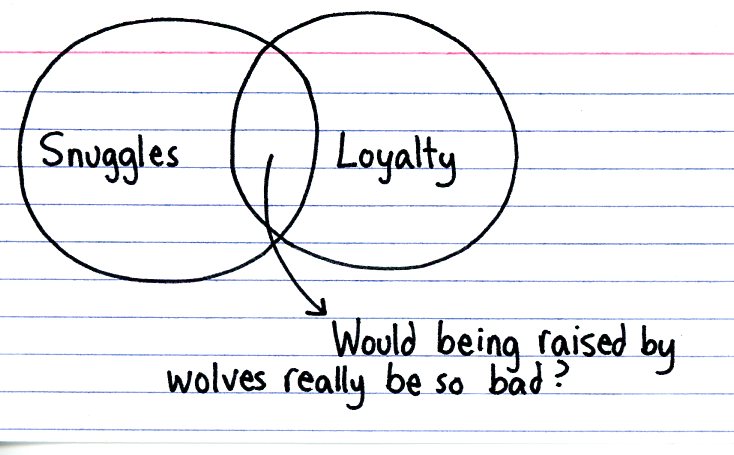
Fight fight make out.