I learned English as a second language. Becoming an Anglophone turned out to be a crucially advantage in a brief scientific career years later. (I once worked as a medicinal chemist.) English is de rigueur for many things, but especially for science. More than three-quarters of scientific papers today are published in English—and in some fields it is more than 90 percent, according to data compiled by Scott Montgomery in his book Does Science Need a Global Language?.
×You need to sign in to continue.
Shared posts
21 Mar 15:14

Former TSA officer reveals widespread misery there
by Mark Frauenfelder
Image: Shutterstock
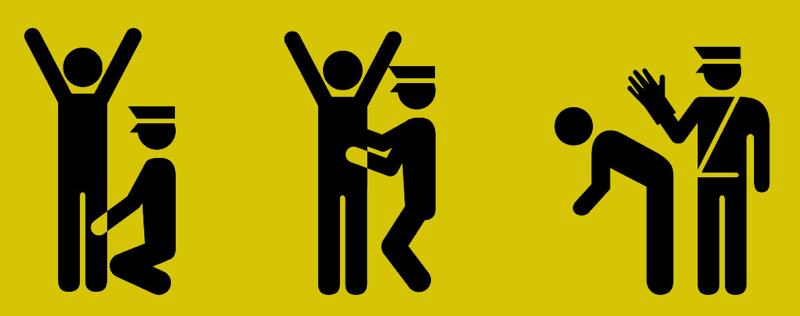
Being a TSA officer is a dream job for sadistic sociopaths, but for people who are able to sympathize, it's a nightmare. "I hated it from the beginning," writes former TSA officer Jason Edward Harrington, in an essay published in Politico Magazine. He recounts the daily shame of having to confiscate nail clippers from pilots (to prevent the pilots from using them to "hijack the very planes they were flying"), jars of homemade apple butter ("on the pretense that they could pose threats to national security") and a bottle of champagne from some Marines returning home from Afghanistan who wanted to share it with a young soldier who'd lost his legs to an I.E.D. Read the rest
Bushchime, Markku.lempinen and one other like this
15 Mar 12:24
Snowmen are anti-Islamic, promote lust
by Rob Beschizza
A cleric in Saudi Arabia has forbidden the building of snowmen: "It is imitating the infidels, it promotes lustiness and eroticism."
11 Mar 22:39

UK government tells nursery workers to turn in potential terrorist toddlers
by Cory Doctorow
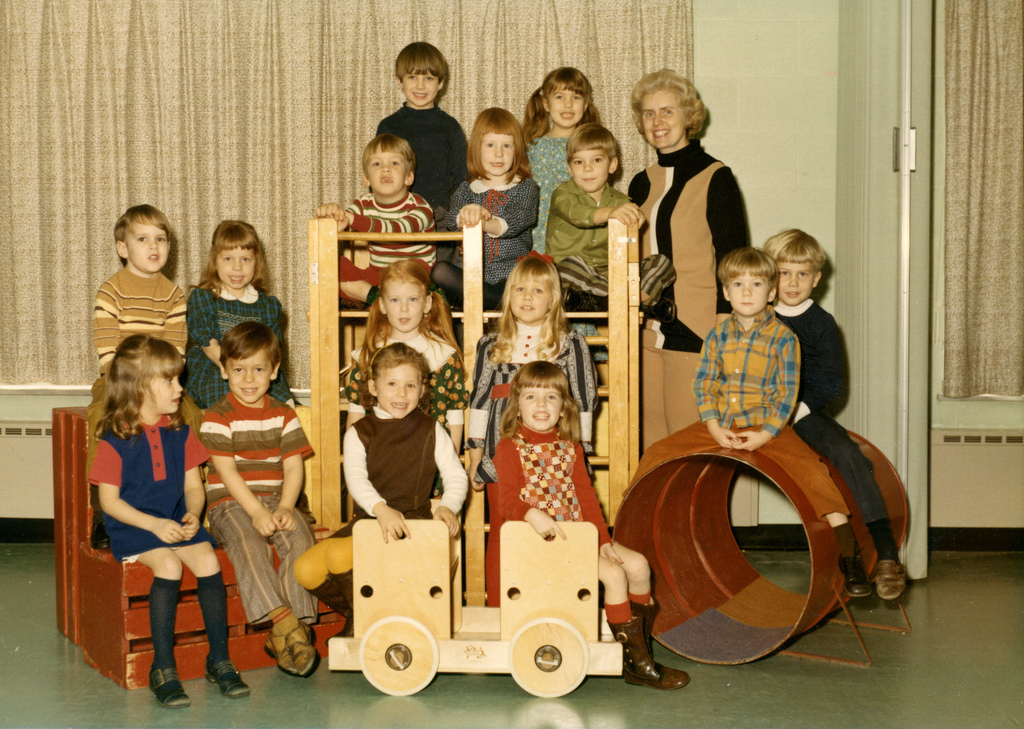
They'll have to report 3-year-olds who are "at risk of radicalisation," according to a consultation document that the Home Office is pushing to turn into legislation.
Read the rest
26 Jan 20:26
What Makes Bowerbirds Such Good Artists?
Bowerbirds are perhaps the most intriguing artists of the bird world. Their beautiful constructions are built purely to impress females (they are not nests, as often mistaken to be).
-- Read more on ScientificAmerican.com


-- Read more on ScientificAmerican.com
26 Jan 20:26
Different Research Papers Score Big with Scientists and the Public
Twitter, mainstream media and academic blogs focus on surprisingly different scientific subjects
-- Read more on ScientificAmerican.com

-- Read more on ScientificAmerican.com
26 Jan 20:26
Fathers-to-Be May Have Hormonal Changes Too
By Shereen Lehman Men waiting to become fathers for the first time experienced hormonal changes before their babies were born, and levels of some hormones appeared linked to those of the men’s...
-- Read more on ScientificAmerican.com

-- Read more on ScientificAmerican.com
07 Jan 11:23
Publication Bias May Boost Findings for Bilingual Brain Benefits
Of studies presented at conferences, those that found a cognitive benefit to bilingualism were almost twice as likely to get published in journals as were studies finding no benefit. Karen Hopkin...
-- Read more on ScientificAmerican.com

-- Read more on ScientificAmerican.com
05 Jan 19:32
Nine people choke to death eating mochi rice cakes in Japan
by Justin McCurry in Tokyo
Traditional consumption of mochi rice cakes during New Year celebrations leaves 13 more people in serious condition
Japan’s habitual New Year killer has struck again, after nine people were reported to have died in recent days from choking on rice cakes.
Mochi – glutinous cakes of pounded rice – are traditionally eaten in vast quantities over the holidays, usually in soup, or toasted and served with sweet soy sauce and wrapped in dried seaweed.
Continue reading...
31 Dec 22:52
Generative Syntax: The DP Hypothesis This is one of a series of...
Generative Syntax: The DP Hypothesis
This is one of a series of videos from the University of Edinburgh featuring Prof Caroline Heycock and some really nice-looking glowy syntax trees. They’re all on generative syntax, and they follow the chapter numbers of the free online textbook “Syntax of Natural Language” by Santorini and Kroch. There is not (yet?) one for every chapter, but it looks like they’re continuing to add to them, although the comment I left on youtube several weeks ago asking why they’ve started with chapter four remains unanswered.
This video does start at quite a high level: for more basic introductory syntax videos, there’s one by Martina Wiltschko and one by thelingspace, and of course my series on how to draw syntax trees.
Tertiarymatt likes this
31 Dec 22:51
Faire smashy-smash or fucking shit up? The complications of bilingual profanity
Faire smashy-smash or fucking shit up? The complications of bilingual profanity:
Strong Language is a group blog on the language of swearing, involving me and a fucking who’s who of language writers. It started a few weeks ago and already has lots of posts, so I’d definitely recommend checking it out!
Here’s a recent post I made, about a mysterious bilingual sweary sticker I snapped a photo of in Montreal a while ago.
But as a Montreal bilingual myself, I’m also intrigued by the interplay between the two versions. I’m not sure which one was written first, but they’re not really translations of each other. Sure, “il est interdit de” is pretty much exactly “it is forbidden to” but “faire smashy-smash” isn’t an obvious equivalent of “fuck shit up”. In fact, when I first encountered the sticker, I was confused about its intention until I considered both versions together. I ended up interpreting the combination “faire smashy-smash/fuck shit up” as approximately “vandalize things, protest loudly in the streets, break things, mess with others’ property”, but where does this meaning come from? (Read more.)
If anyone has more information about these stickers, I’d love to hear it!
31 Dec 22:32
What to do when a kid gets his head stuck in a gate
by Mark Frauenfelder
"Very funny kid head stuck in gate. Very difficult to get it off."
31 Dec 22:30
Superbly Awful Library Books: mega-gallery of terrible (but awesome) book covers
by Xeni Jardin
If you enjoy scoffing at "What were they thinking of?" book covers of yesteryear, Awful Library Books is a site you'll want to follow. Read the rest
31 Dec 22:19
A "Mail... Kimp?" song you can dance to
by Matthew Williams
 Some crazed genius made a song from the MailChimp ad at the introduction to every Serial episode.
31 Dec 22:18

Coach-minus: a new low in high-flying travel
by Cory Doctorow

An unnamed airline is said to be planning a "coach-minus" service that features smaller, more crowded seats. They say they're providing cheaper tickets to passengers who demand it.
Read the rest



30 Dec 00:54
The Messy Minds of Creative People
Creativity is very messy. According to one prominent theory, the creative process involves four stages: preparation, incubation, illumination, and verification.
-- Read more on ScientificAmerican.com

-- Read more on ScientificAmerican.com
30 Dec 00:52

Wearing blackface is a big part of Dutch Christmas
by Dylan Matthews
There's remarkable variety in Christmas traditions internationally. In Japan, eating at KFC on Christmas is a thing. A number of Alpine countries incorporate a demonic figure known as Krampus. But there's no Christmas tradition anywhere that's as bizarrely over-the-top offensive as Black Petes (Zwarte Pieten in Dutch), the black assistants to Santa who play a major role in Holland's holiday celebrations.
1) Who are Black Petes?
Black Petes. (Gerald Stolk)
To understand Black Petes, you first have to know a bit about St. Nicholas Day. While technically just the feast day of St. Nicholas, the occasion — or technically St. Nicholas Eve, December 5 — has traditionally eclipsed Christmas Day as a gift-giving occasion in the Netherlands. The Dutch St. Nicholas myth generally holds that Santa Claus (Sinterklaas) lives in Spain, and then travels by steamboat every year to Holland in mid-November, spends weeks crisscrossing the country handing out gifts, and then finally arrives in Amsterdam on December 5.
More than that, this actually happens every year, or at least is acted out. An actor is hired to play Sinterklaas, arrives by steamboat from Spain in mid-November, criss-crosses the country, and then arrives at a parade in Amsterdam. He's accompanied by a number of people dressed as Black Petes, who according to the legend are elf-like assistants to Sinterklaas, assisting in gift distribution and with punishment of naughty children (one common legend is that the Black Petes will send bad children back to Spain with them).
Oh yeah — also, "Black Petes" are generally white Dutch people wearing blackface.
2) Wait, what, blackface? Seriously?
Yep. Historically, the Sinterklaas legend described the Black Petes as Spanish Moors, and some illustrators depicted them as slaves. In recent years, though, this version has been sanitized, and it's common to hear a version wherein Black Petes are white but got soot on their faces from climbing down chimneys delivering gifts.
The standard depiction of Black Petes — blackface, Afro wigs, big red lips — shares much with minstrel show depictions of African-Americans. The character is particularly ugly in light of the history of Dutch imperialism in both South Africa and Suriname, which while located in South America has a large black population. It's not an accident that historically Black Petes have been portrayed as having Surinamese accents.
"The Dutch were deeply involved in the slave trade, both transporting African slaves to be sold and using slave labor to work coffee and sugar plantations in their colonies," Jessica Olien notes in Slate. "Minstrel shows were a popular form of entertainment."
3) How the hell is this still happening?
Because Black Pete is a widely beloved figure in the Netherlands. An October 2013 poll found that 91 percent of Dutch people believe "the tradition should not be changed to suit the tastes of a minority" and 81 percent oppose changing the color of Black Pete. Center-right Dutch prime minister Mark Rutte has publicly defended the character, saying, "Black Pete is black and I cannot change that, because his name is Black Pete." He also played the "my black friends say it's okay" card, saying, "My friends in the Dutch Antilles, they are very happy when they have Sinterklaas because they don’t have to paint their faces. When I'm playing Zwarte Piet, I am for days trying to get off stuff on my face."
Diederik Samsom, the leader of the Labour Party, the Netherlands' largest left-leaning party and a member of Rutte's coalition, agreed, saying, "I do not particularly like to quote Premier Rutte, but he put it well: Zwarte Piet is simply black."
"Otherwise mature and liberal-minded adults may recoil from the topic and offer a rote list of reasons why Zwarte Piet should not offend anybody," Olien observes. "The general tenor among the Dutch public was that 'they' should keep their mitts off 'our tradition,' an opinion you can hear in any number of variations on any street corner," Dutch novelist Arnon Grunberg writes. "By 'them' people mean the United Nations and 'unnatural' Dutch citizens."
Defenders of the tradition tend to argue that blackface is only offensive in the American context, and it's different when done in the Netherlands. "It's not blackface like you used to see in America, which is indeed racist," pro-Pete activist Marc Gilling told USA Today. "Pete's blackness has a symbolic meaning which dates back thousands of years, to the days when black represented winter and the Catholic bishop (St. Nicholas) stood for summer."
Some on the Dutch right have seized on Black Pete as a political cause. Geert Wilders, leader of the far-right, virulently xenophobic Party of Freedom, the fourth largest party in Dutch parliament, has called for a law mandating Black Pete be depicted as black at official Sinterklaas events.
4) Is anyone trying to make the tradition less racist?
Just don't. (zoetnet)
Fortunately yes. A vocal minority of Dutch people oppose the tradition or want to modify it, and Black Pete-featuring events are increasingly facing protests. In July, a Dutch court declared Black Pete a negative racial stereotype and ordered Amsterdam to rethink its decision to issue a permit for a parade featuring him. But that ruling was overturned and the parade allowed to go forward. Grunberg notes that Dutch critics of the tradition have received death threats int he past.
Human rights observers abroad are pressing the Netherlands to reconsider its tradition as well. In 2013, the UN High Commissioner for Human Rights' office sent a letter to the Dutch government expressing concern about the character. Verene Shepherd, one of the letter writers and head of a UNHCHR working group on Black Pete, called the character a "return to slavery."
5) Is Black Pete racist?
C'mon. Yes. Don't take my word for it, ask these London residents who saw Dutch filmmaker Sunny Bergman walking around dressed as Black Pete:
Or these Alabama residents reacting to descriptions and illustrations of the character:
30 Dec 00:52

Why airlines bump passengers, and what you can do about it
by Danielle Kurtzleben
Welcome to one of the busiest travel times of the year. The airports are going to be absolutely packed this weekend, and bad weather could make an already hellish travel experience even worse. Add to that aircraft changes and overbooked flights, and it's pretty much assured that there will be some unhappy travelers who aren't getting home when their tickets say they will.
So what do airlines owe you when they delay or bump you, and what can you do about it? We looked into it, and here's a quick rundown of the basics of what you can expect from US carriers on domestic flights.
Here are your rights
In the case of a delay, federal law has almost nothing to say about what an airline has to do for you. At the very least, they have to be humane when it comes to tarmac delays — in most cases, an airline can't keep domestic fliers waiting on the tarmac for more than three hours, and for any delay exceeding two they have to have food and drinking water. But beyond that, it's really mostly up to airlines how they handle customers who are delayed.
Federal law doesn't really say much about what airlines have to do when you're delayed
Likewise, as many travelers know all too well, airlines oversell flights all the time, to compensate for no-show passengers. But what comes next depends whether people are willing to be bumped from that flight voluntarily.
First, most airlines will make an offer for anyone willing to wait for a later flight, like a travel voucher. In that case, the transaction is between the airline and the customer — the law has nothing to do with it.
But let's say the airline can't find enough people to voluntarily exit the flight. In that case, it has to do what are called "involuntary deboards," which is what some airlines call kicking someone off a flight who doesn't want to be kicked off.
In that particular case, you may be entitled to cash — but once again, it depends. If the airline finds a way to get you to your destination within one hour of your original arrival time, they owe you nothing. If it's one to two hours (or more than two for international flights), they owe you 200 percent (or $650, whichever is smaller) of your one-way fare, and if it's more than two hours (or four, for international flights), they owe you 400 percent (up to a max of $1,300) of your fare. An airline may try to negotiate with you (or vice versa) for some sort of a voucher in this case as well, but if you want the money, you are entitled to it.
(Unfortunately, this only applies in cases of overbooking. If you get bumped because an airline has to switch out a big plane in favor of a small one, these cash perks don't apply to you.)
For a full rundown of everything you can legally expect of an air carrier in the US, from airfares to baggage handling, the Department of Transportation's consumer guide to air travel is a good place to start.
/cdn0.vox-cdn.com/uploads/chorus_asset/file/2883514/458166833.0.jpg)
This is more or less how Dante described Purgatory. (Getty Images)
If I'm delayed, don't airlines owe me food or a hotel?
Nope. Or, at least, they're not legally required to give you one. But a lot of airlines will go above and beyond anyway. You can see airlines' policies for delays, as well as overbooking and really most of the minor details about your flight you can think of in documents called contracts of carriage. Many airlines, for example, have policies saying they will get you a hotel room for you if you are delayed overnight. But there are also differences both big and subtle in airlines' official policies.
overbooking is infuriating, but at the very least, getting bumped against your will is quite rare.
Delta, for example, says that if it delays a person by 90 minutes or more or causes them to miss a connection, they will refund the unused portion of a ticket if a passenger requests it. American has no such policy (though it will refund a ticket for what it calls "force majeure" events, like "acts of God").
If you ever question how an airline is treating you, its contract of carriage is usually a great place to start.
/cdn0.vox-cdn.com/uploads/chorus_asset/file/2883526/456201696.0.jpg)
Literally The Worst. (Getty Images)
Why do airlines overbook, anyway?
We mentioned above that airlines overbook to compensate for "no-shows." A lot of those are people who just miss their flights, but some airlines are inadvertently incentivizing people to ditch their flights — rising ticket-change fees sometimes mean it makes more sense to just cancel a ticket (or not show up for a flight) than to get an airline to change a ticket, as the Washington Post's Christopher Elliott wrote last year.
But for the whole year of 2013, there were 523,645 voluntary or involuntary deboards on US airlines, which totals out to only 8 per 10,000 passengers. Look at just involuntary deboards and it's only 0.92 per 10,000 passengers.
So the good news is that it's relatively rare, and there's more good news: it has gotten rarer in the last few years. But part of it is that airlines have gotten way smarter about overbooking. By using years and years of past data on no-shows, they can better guess how many people will, as Businessweek's Justin Bachman wrote earlier this year. And overbooking has improved in the last few years — it was around 30 percent more common in 2009, when nearly 1.2 per 10,000 passengers were bumped against their will.
It sounds like an insane system, and if you've ever been bumped, it's just infuriating. But counterintuitively, it more often than not works out for everyone, says Brett Snyder, who runs air travel assistance service Cranky Flier and has worked in the air travel industry for nearly two decades. Bumping people is profitable for airlines, but it works because of all the deal-hunting passengers out there.
"It is generally really good for everybody involved. [Airlines] know there will be no-shows," he says. "By selling more seats they're able to keep fares lower because otherwise they wouldn't be able to sell those extra seats at higher fares. Then for all the people that get bumped voluntarily, they get freebies."
/cdn0.vox-cdn.com/uploads/chorus_asset/file/2883530/127987024.0.jpg)
Ready to protect the friendly skies from moisturizer. (Getty Images)
So can you avoid being bumped?
You can do a few things, but there's only so much. JetBlue is famous for not overbooking, so if you are dead set on not getting bumped, you can do what you can to fly that airline. Virgin America also limits its overbookings. In all of 2013, JetBlue only involuntarily bumped 19 people, and for Virgin America it was only 26. That puts them leaps and bounds below most other airlines.
If you don't get assigned a seat at check-in time, that's often a sign you're more likely to be bumped (but keep in mind that Southwest Airlines, for example, doesn't do assigned seats). You can also make sure you show up early, since when people check in is usually a factor in how airlines determine who gets bumped and who doesn't. But even then, being conscientious about time might not save you. Passengers in first class, business, and who paid full-fare will often be more likely to stick on the flight, regardless of check-in time. It's hard to make blanket statements about how airlines prioritize passengers because different airlines have different policies.
Some people are (for good reason) virtually bump-proof. A United Airlines spokesman explains that unaccompanied minors, for example, are less likely to be bumped, and the airline will also try to keep families together, which can up other passengers' chances of being kicked off a flight.
Complaining on Twitter can only get you so far
Complaining on Twitter can maybe make you feel better and will definitely get many airlines' attention — big airlines have customer service representatives closely watching social media. But they can only do so much.
"The Twitter folks aren't going to be able to reorder the list to get a seat ... I would say it's most likely going to be a waste [in the case of overbooking]," says Snyder. "But if your flight's canceled or you are going to miss a connection, they can in theory help you get rebooked," he says, listing Delta and Jet Blue in particular as having helpful Twitter accounts.
If you need to get to your destination and are willing spend some extra money, you can take the advice of Alexander Anolik, a travel and tourism attorney and law professor who wrote about airline passengers' rights for the American Bar Association in 2013.
"If I absolutely need to get onto a flight that has been oversold, I will yell out (without alarming the security officers) that I will throw in an extra few hundred dollars to obtain a volunteer," he writes. That may sound silly, but in some cases (i.e. if you're an attorney who's also on the clock), the cost-benefit analysis might skew in favor of wheeling and dealing in the gate area.
"Another few hundred when you have to get to a meeting and you are billing at twice this amount or more has worked for me and for my friends who have called me from the airport asking what to do," he adds.
At the very least, one of the best things you can do is know your rights and know what an airline has promised. Often, an airline will offer you vouchers instead of cash when you've been involuntarily bumped, and Delta's refund policy only works at the request of the customer. If you don't ask, you might not get what you're entitled to.
Further reading:
- The DOT's full list of consumers' flying rights.
- Contracts of carriage from the big three legacy carriers: United, American, and Delta.
- The New York Times explains how Ralph Nader got you those voucher auctions in the first place
- And if worse comes to worst, you can file a complaint with the DOT; read here about the complaint process.
30 Dec 00:52
The Teen Years: 9 Cringe-Inducing Realizations
by Tim Urban
Yesterday, home for the holidays and assigned an attic chore, I stumbled upon a box—well-taped up, covered in dust, and clearly labeled as “TIM’S STUFF” with two underlines. Oh yeah. That box.
When I graduated high school, I decided to gather up everything I owned that had meaning to me and put it in a big cardboard box. That was 14 years ago.
With almost no memory of what was in the box, I decided to open it up. Inside I found old schoolwork, report cards, things I had written, things my friends had written, pictures, audio and video recordings, tickets of things I had gone to, and a ton of letters. It quickly turned into a very weird day for me.
First, it’s been fascinating—it’s amazing how many things you remember incorrectly, and I’ve been doing a lot of revising of off-base memories.
Second, I’m a slight emotional wreck—right on the edge of doing this.
But mostly, I spent seven straight hours cringing. Looking at yourself from the outside always has the potential to be mortifying, but looking at yourself and your friends as teenagers is like watching the least endearing, most excruciating reality show ever made. Here’s why:

Anyone who knows 9 to 23-year-olds knows that they tend to detract more value from the world than they add, but as you can see on this graph, the teen years, and especially ages 12 to 16, are a full train wreck. The reason we sometimes forget this is that the only people who spend time with teens are other, equally un-self-aware teens, parents of teens (whose judgment is clouded by their love for their kid), and professionals who have chosen to work with teens because they have an inexplicable soft spot for them. All the people in a position to see teenagers for who they actually are don’t come into much contact with them, so we often forget what kind of people they are.
But there was no forgetting yesterday, as I pored through this mound of primary sources—especially since in this case, it brought back all the inner thinking behind the way my friends and I were.
So all teens reading this, especially those on the younger side: You have a right to live your life, but at least do so with the knowledge that you’re probably bringing down the general quality of the world by being the way you are. I can’t fix you—no one can—but I’ll try to offer some basic suggestions that will help you minimize the amount of embarrassment you’re causing to our species and to your future self:
1) Don’t attempt to be profound, for any reason whatsoever. Profound is not for teenagers, and you’re 100% not an exception. In particular, if one day at the age of 16, you decide to write a short philosophical story in red ink in all tiny capital letters and you’re quivering by the end with a sense of sublime connection to something bigger than yourself, what you should do is A) stop feeling this way, B) keep this whole experience to yourself, and C) throw the story away, since reading it later in life, once you have clarity, will shatter the incorrect, more impressive image you have of yourself as a teen.
2) Don’t be such a dick to your parents, you entitled little shit. You live in a world where 99.9999999% of humans care more about how their hair looks than whether you live or die, and then there’s this person, or two if you’re lucky, who’d give their lives for you. And how do you feel about all this? You feel the exact levels of entitlement and gratitude of this horse:

3) Girls between 11 and 13 and boys between 13 and 15 should implement a strict no-photography policy. For your future self, it’s like being reminded how the hot dog was made.
4) 13-14-year old boys: Your newfound sexuality is extremely icky and upsetting to everyone else.
Just a year or two ago, you had a high voice, a microscopic penis, and people found you endearing. A lot of changes have happened in your life since then, and none of them are appealing to the rest of the world. Even your parents are kind of sickened by your whole vibe these days. Here’s the issue:

There’s not really anything you can do to shield humanity from what you’re thinking about, since everyone can see it on your greasy little face, so I’m not sure there’s any advice here—just try not to hurt yourself.
5) 12-14-year-old girls: Try to form one notch less of a medieval empire of sadism and tears. There are a few people crueler to their peers than 12-14-year-old girls—

—but not many. One of the things I found in the cardboard box was a photo of some Play-Doh creation of a human head with a bunch of little red spheres stuck to it, which at the time was made by an acne-ridden girl’s peers and passed around the entire 7th grade at school. Another finding was a letter a friend had written me while I was away the summer after 8th grade, telling me that a girl we knew had been crying yesterday because a bunch of people had been hanging out at a house, but they hadn’t invited this one ostracized member of the group, and the girl whose house it was wouldn’t let her in the door when she showed up.
No one else can quite understand the psychology of a 12-14-year-old girl, just like we can’t understand the way medieval dictators thought—all you can do is remain wary when you’re around them and be careful never to show weakness.
6) Be aware that there are no winners when a 14-year-old boy decides to grow his hair into a shoulder-length bowl cut.
7) 16-18-year-olds: You’re not in love. You’re in something—I understand that—but that thing you’re in is very likely not love. What’s happening is that you’re a basket of hormones that has become infatuated with another basket of hormones, and that’s fine—go for it. But if you find yourself tempted to do something like sever an old, otherwise-strong friendship of yours over it, or alter your college-application plans in order to go to college together as a couple, or write some horrifying love note about this person in your high school yearbook—the thing you need to be made clear on is that friends, and college, and paper are real, and your relationship is fictional:

This is a graph of a group of sample relationships I created based on no actual data (the graph seemed like a good idea in my head, but then when I made it, it came out totally weird and confusing. Luckily, that’s your problem and not mine). Anyway the point is, when it comes to high school couples, a vast majority of them who are still together after high school ends will be finished by Thanksgiving (late November) of their freshman year of college—the high school relationship wall. The problem is, lots of high school couples are pretty sure that they just might be that one outlier couple on the graph who actually will end up together forever—except then they won’t make it past the wall. So keep this in mind and try not to bump something over in the realm of long-lasting things for the sake of this relationship.
And if, for some incredible reason, you decide to write a song related to this situation of yours, and you choose to write the lyrics on a physical piece of long-lasting paper, and before you graduate you decide to put a bunch of things into a box for the future, understand that you’re only hurting yourself by putting the paper with the lyrics on it into the box, because it’ll cause you to read them when you’re 33 when you had otherwise completely forgotten about the incident.
8) You’re not a Communist, you’re not a Marxist, you’re not an Anarchist, you’re not a Nihilist. No one likes a teenage zealot. Just stop.
9) When your 7th grade girlfriend gives you this note—

—realize that A) it means she’s incredibly not into you, and B) if she has to write her last name, it means your relationship was lacking in the first place. You should also explain to her how to do the “It’s not you, it’s me” thing correctly, instead of basically saying, “It’s not you, it’s me—me not liking you.” Whatever you do, don’t convince her to get back together with you, since that’ll just result in you going through all the pain again two weeks later—

If someone you’ve spoken to no more than three times in your life A) is acting like she’s divorcing you after 20 years of marriage, averaging 2.5 sorry’s per note, because of how devastated she thinks you’ll be when you read this, and B) feels the need to use the word “look” with you, which is the step right below a restraining order—and all this from someone who thinks it’s okay to hyphenate the word “would”—you need to make some big changes.
So, teenagers, I suggest you take a long look in the mirror and understand the perils you face by being you. Your entire existence is like a drunk person dancing at a wedding—fun from the inside, horrifying from the outside—so just think about that when you’re choosing what to put in writing, put online, and gather into the box at the end of high school. Your future self might be better off without all the details.
Related Wait But Why Posts
11 Awkward Things About Email
7 Ways To Be Insufferable On Facebook
All the Weird Toys From Your Childhood
The post The Teen Years: 9 Cringe-Inducing Realizations appeared first on Wait But Why.
Claes Mogren, Ettore Del Monte and -1 others like this
29 Dec 00:13
Alternate theory on Sony Hack points to Russian hackers, not North Korea
by Xeni Jardin
Many in the information security community doubt that the Sony hack was North Korea's handiwork. Read the rest
Igeldard likes this
28 Dec 18:41
Linguistically relevant xkcd comics
Linguistically relevant xkcd comics:
Arnold Zwicky’s blog has a list of linguistically relevant xkcd comics, along with links to their associated commentary from his own blog and/or Language Log. There are about a hundred of them, but even a brief scan is pretty interesting, and a great reference if you’re looking for a particular linguistically-relevant xkcd to use as an example somewhere.
I’m especially amused by the very first one, where Mark Liberman notes on Language Log in 2006 that computational linguistics has officially “arrived”.
28 Dec 08:45

Snowball Numbers
by Greg Ross
What’s unusual about the number 313,340,350,000,000,000,499? Its English name, THREE HUNDRED THIRTEEN QUINTILLION THREE HUNDRED FORTY QUADRILLION THREE HUNDRED FIFTY TRILLION FOUR HUNDRED NINETY-NINE, contains these letter counts:
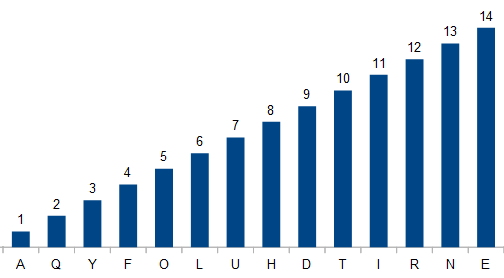
This makes the name a perfect “snowball,” in the language of wordplay enthusiasts. In exploring this phenomenon for the November 2012 issue of Word Ways, Eric Harshbarger and Mike Keith found hundreds of thousands of solutions among very large numbers, but the example above is “shockingly small compared to all other known SH [snowball histogram] numbers,” they write. “It seems very likely that this is the smallest SH number of any order, but a proof of this fact, even with computer assistance, seems difficult.”
Two other pretty findings from their article:
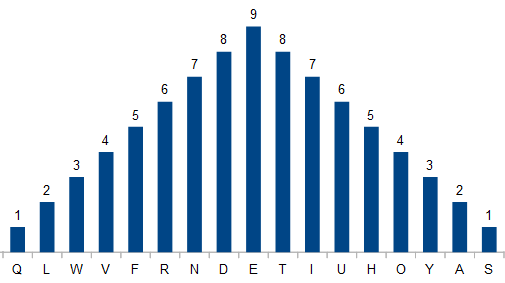
224,000,000,000,525,535, or TWO HUNDRED TWENTY-FOUR QUADRILLION FIVE HUNDRED TWENTY-FIVE THOUSAND FIVE HUNDRED THIRTY-FIVE, produces a “growing/melting” snowball:
And 520,636,000,000,757,000, or FIVE HUNDRED TWENTY QUADRILLION SIX HUNDRED THIRTY-SIX TRILLION SEVEN HUNDRED FIFTY-SEVEN THOUSAND, produces the first 18 digits of π:
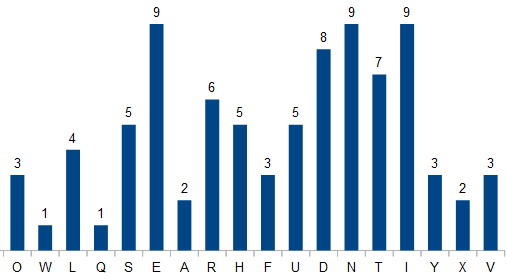
“This idea can also be applied to arbitrary text, not just number names,” they write. “Can you find a sentence in Moby Dick or Pride and Prejudice whose letter distribution is a snowball or is interesting in some other way? Such possibilities are left for future consideration.”
(Eric Harshbarger and Mike Keith, “Number Names With a Snowball Letter Distribution,” Word Ways, November 2012.)
Vvicked likes this
27 Dec 21:58


skunkbear: Your mother tongue has a lasting effect on your...
Your mother tongue has a lasting effect on your brain — even if you can’t remember it. That’s according to a new study from the Montreal Neurological Institute and Hospital and McGill University’s Department of Psychology.
It’s hard to say exactly what this means for our understanding of language acquisition, but it’s an incredible reminder that our first few months of life are so important for our brain development.
MRI images: Montreal Neurological Institute, McGill University
Title image: Moonchilde-Struck
My first question on seeing this was to wonder what would happen if people with “lost” languages tried to re-learn the same language later in life. Fortunately, thelingspace has an answer for us: previous studies have shown that heritage speakers tend to be better at re-learning especially the sounds of a language they’ve had previous exposure too, although it’s not necessarily a huge advantage for words or syntax.
27 Dec 16:58

Why you're so busy
by Cory Doctorow

The Economist's feature on time-poverty is an absolute must-read, explaining the multi-factorial nature of the modern time crunch, which combines the equivalence of time and money (leading to leisure hours that are as crammed as possible in order to maximize their value), the precarity of the American workplace (meaning that affluent workers work longer hours), and the pace of electronically mediated communications (which makes any kind of refractory pause feel like a wasteful and dull eternity).
Read the rest
26 Dec 23:00
Spread the Sign: Multilingual sign language dictionary
Spread the Sign: Multilingual sign language dictionary:
Spread the Sign is an online multilingual sign language dictionary: you can type in a word, phrase, or fixed expression and get it translated into almost two dozen different national sign languages, including Swedish, British English (BSL), American English (ASL), German, French, Spanish, Portuguese, Russian, Estonian, Lithuanian, Icelandic, Latvian, Polish, Czech, Japanese, and Turkish.
Not all languages are available for every word, but all the ones I tried had at least a dozen or so languages available. Once you’ve searched for a word or phrase, you click on the flag for the national sign language that you want, and you can see a video clip of the sign as well as a translation into the same country’s spoken/written language.

It’s a project of the European Commission, so there tend to be more European languages — I notice a lack of Auslan (Australia), for example, so here’s a list of around 300 sign languages — but it’s definitely a great rebuttal to the idea that there’s only one sign language, as well as being incredibly interesting to click around!
Note though that it’s just a dictionary, and doesn’t account for grammatical differences between the languages in addition to the vocabulary, although you could probably recover some of the grammar from close attention to the phrases.
There is also a list of fifteen different sign alphabets, with images. Note that despite the fact that most of the fifteen languages are spoken in countries that use the Latin alphabet, their signs for, say, A, do not generally resemble each other. As a particularly obvious example, ASL has a one-handed alphabet while BSL has a two-handed alphabet. And Japanese Sign Language has signs for all the hiragana, which isn’t strictly speaking an alphabet. (Is the distinction between an alphabet and a syllabary still meaningful when you’re signing both of them? I…honestly have no idea. Apparently there is an Arabic Sign Language alphabet though, and none of the charts I found online include the short vowels, so I guess it would still qualify as an abjad? Wow, I don’t even know.)

John Costello likes this
26 Dec 16:33
Chinese university bans Christmas
by Reuters in Beijing
University in Xi’an forces students to watch propaganda films and to pay more attention to Chinese holidays instead
A university in north-western China has banned Christmas, calling it a “kitsch” foreign celebration unbefitting of the country’s own traditions and making its students watch propaganda films instead, state media said on Thursday.
The state-run Beijing News said the Modern College of North-west University, located in Xi’an, had strung up banners around the campus reading “Strive to be outstanding sons and daughters of China, oppose kitsch western holidays” and “Resist the expansion of western culture”.
Continue reading...
25 Dec 20:26

Jesus Christ was an asylum seeker
by Cory Doctorow

Across the rich world, this decade has seen the rise of increasingly fierce anti-immigrant sentiment, much of it from self-identified Christians -- as you recount the Christmas story this year, remember that Mary and Joseph fled religious persecution and sought asylum in a rich country, which took them in.
Read the rest
Bushchime likes this
25 Dec 14:34

This
by Greg Ross
This is not very interesting
But if
You have read this far already
You will
Probably
Read as far as this:
And still
Not really accomplishing
Anything at all
You might
Even read on
Which brings you to
The line you are reading now
And after all that you are still
Probably dumb enough to keep
Right on making
A dope of yourself
By reading
As far down
The page as this.
— Anonymous, Princeton Tiger, 1949
mkvande likes this